
A English
Faraday's and Lenz's Law Questions in English
Class 12 Physics · Electromagnetic Induction · Faraday's and Lenz's Law
310+
Questions
English
Language
100%
With Solutions
Showing 49 of 310 questions in English
251
EasyMCQ
The instantaneous magnetic flux associated with a closed loop of resistance $10 \ \Omega$ is given by $\phi = 2t^2 - 5t + 1$. The magnitude of the induced current at $t = 0.25 \ s$ will be . . . . . . . (in $A$)
A
$0.4$
B
$1$
C
$4.0$
D
$0.04$
Solution
(A) Given: Magnetic flux $\phi = 2t^2 - 5t + 1$ and resistance $R = 10 \ \Omega$.
According to Faraday's law of electromagnetic induction,the induced electromotive force (emf) is given by $\varepsilon = -\frac{d\phi}{dt}$.
Differentiating $\phi$ with respect to $t$: $\frac{d\phi}{dt} = \frac{d}{dt}(2t^2 - 5t + 1) = 4t - 5$.
Thus,$\varepsilon = -(4t - 5) = 5 - 4t$.
At $t = 0.25 \ s$,the induced emf is $\varepsilon = 5 - 4(0.25) = 5 - 1 = 4 \ V$.
The magnitude of the induced current $I$ is given by $I = \frac{|\varepsilon|}{R}$.
$I = \frac{4 \ V}{10 \ \Omega} = 0.4 \ A$.
According to Faraday's law of electromagnetic induction,the induced electromotive force (emf) is given by $\varepsilon = -\frac{d\phi}{dt}$.
Differentiating $\phi$ with respect to $t$: $\frac{d\phi}{dt} = \frac{d}{dt}(2t^2 - 5t + 1) = 4t - 5$.
Thus,$\varepsilon = -(4t - 5) = 5 - 4t$.
At $t = 0.25 \ s$,the induced emf is $\varepsilon = 5 - 4(0.25) = 5 - 1 = 4 \ V$.
The magnitude of the induced current $I$ is given by $I = \frac{|\varepsilon|}{R}$.
$I = \frac{4 \ V}{10 \ \Omega} = 0.4 \ A$.
0 likes
View Solution252
Easy
The following figure shows planar loops of different shapes moving into or out of a region of a magnetic field which is directed normal to the plane of the loop,away from the reader. Determine the direction of the induced current in each loop using Lenz's law.
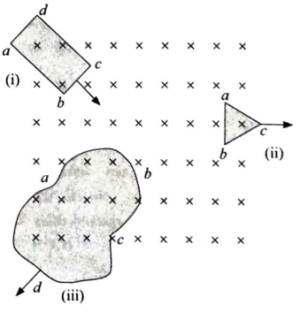
Solution
(A) According to Lenz's law,the direction of the induced current is such that it opposes the change in magnetic flux that produced it.
$(i)$ The rectangular loop $abcd$ is moving into the magnetic field region. The magnetic flux through the loop increases. To oppose this increase,the induced current must create a magnetic field directed out of the page. By the right-hand rule,the induced current flows in the counter-clockwise direction,i.e.,along $adcba$.
(ii) The triangular loop $abc$ is moving out of the magnetic field region. The magnetic flux through the loop decreases. To oppose this decrease,the induced current must create a magnetic field directed into the page. By the right-hand rule,the induced current flows in the clockwise direction,i.e.,along $abc$.
(iii) The irregular loop $abcd$ is moving out of the magnetic field region. The magnetic flux through the loop decreases. To oppose this decrease,the induced current must create a magnetic field directed into the page. By the right-hand rule,the induced current flows in the clockwise direction,i.e.,along $abcda$.
$(i)$ The rectangular loop $abcd$ is moving into the magnetic field region. The magnetic flux through the loop increases. To oppose this increase,the induced current must create a magnetic field directed out of the page. By the right-hand rule,the induced current flows in the counter-clockwise direction,i.e.,along $adcba$.
(ii) The triangular loop $abc$ is moving out of the magnetic field region. The magnetic flux through the loop decreases. To oppose this decrease,the induced current must create a magnetic field directed into the page. By the right-hand rule,the induced current flows in the clockwise direction,i.e.,along $abc$.
(iii) The irregular loop $abcd$ is moving out of the magnetic field region. The magnetic flux through the loop decreases. To oppose this decrease,the induced current must create a magnetic field directed into the page. By the right-hand rule,the induced current flows in the clockwise direction,i.e.,along $abcda$.
0 likes
View Solution253
EasyMCQ
The flux associated with a closed loop is $\phi = 3t^2 + 2t + 5 \text{ Wb}$. If the resistance of the loop is $14 \ \Omega$,then the current induced in this coil at $t = 2 \text{ s}$ is . . . . . . . (in $\text{ A}$)
A
$1$
B
$1.5$
C
$2$
D
$2.5$
Solution
(A) According to Faraday's law of electromagnetic induction,the induced electromotive force $(EMF)$ is given by $\varepsilon = -\frac{d\phi}{dt}$.
Taking the magnitude of the induced $EMF$:
$|\varepsilon| = \left| \frac{d}{dt}(3t^2 + 2t + 5) \right|$
$|\varepsilon| = 6t + 2$
At time $t = 2 \text{ s}$,the induced $EMF$ is:
$|\varepsilon| = 6(2) + 2 = 14 \text{ V}$
The induced current $I$ is given by Ohm's law: $I = \frac{|\varepsilon|}{R}$.
Given $R = 14 \ \Omega$,we have:
$I = \frac{14 \text{ V}}{14 \ \Omega} = 1 \text{ A}$.
Taking the magnitude of the induced $EMF$:
$|\varepsilon| = \left| \frac{d}{dt}(3t^2 + 2t + 5) \right|$
$|\varepsilon| = 6t + 2$
At time $t = 2 \text{ s}$,the induced $EMF$ is:
$|\varepsilon| = 6(2) + 2 = 14 \text{ V}$
The induced current $I$ is given by Ohm's law: $I = \frac{|\varepsilon|}{R}$.
Given $R = 14 \ \Omega$,we have:
$I = \frac{14 \text{ V}}{14 \ \Omega} = 1 \text{ A}$.
0 likes
View Solution254
EasyMCQ
Magnetic flux linked with the coil is given by $\phi(t) = 2t^2 + 2t + 1$ and its resistance is $10 \ \Omega$. The current passing through the coil at $t = 2 \ s$ is . . . . . . $A$.
A
$1.5$
B
$1$
C
$0.5$
D
$2$
Solution
(B) According to Faraday's law of electromagnetic induction,the induced electromotive force (emf) $\varepsilon$ is given by the rate of change of magnetic flux: $\varepsilon = |\frac{d\phi}{dt}|$.
Given $\phi(t) = 2t^2 + 2t + 1$,we differentiate with respect to $t$:
$\varepsilon = |\frac{d}{dt}(2t^2 + 2t + 1)| = |4t + 2|$.
At $t = 2 \ s$,the induced emf is:
$\varepsilon = 4(2) + 2 = 10 \ V$.
Using Ohm's law,the current $i$ is given by $i = \frac{\varepsilon}{R}$.
Given resistance $R = 10 \ \Omega$,the current is:
$i = \frac{10 \ V}{10 \ \Omega} = 1 \ A$.
Given $\phi(t) = 2t^2 + 2t + 1$,we differentiate with respect to $t$:
$\varepsilon = |\frac{d}{dt}(2t^2 + 2t + 1)| = |4t + 2|$.
At $t = 2 \ s$,the induced emf is:
$\varepsilon = 4(2) + 2 = 10 \ V$.
Using Ohm's law,the current $i$ is given by $i = \frac{\varepsilon}{R}$.
Given resistance $R = 10 \ \Omega$,the current is:
$i = \frac{10 \ V}{10 \ \Omega} = 1 \ A$.
0 likes
View Solution255
MediumMCQ
$A$ rectangular coil of $100$ turns and size $0.1 \,m \times 0.05 \,m$ is placed perpendicular to a magnetic field of $0.1 \,T$. If the field drops to $0.05 \,T$ in $0.05 \,s$, the magnitude of the e.m.f. induced in the coil is (in $\,V$)
A
$0.5$
B
$0.25$
C
$1.0$
D
$0.1$
Solution
$(A)$ Given: Number of turns $n = 100$, Area $A = 0.1 \,m \times 0.05 \,m = 0.005 \,m^{2}$.
Initial magnetic field $B_{1} = 0.1 \,T$, final magnetic field $B_{2} = 0.05 \,T$, and time interval $dt = 0.05 \,s$.
The magnetic flux $\phi$ is given by $\phi = nBA \cos \theta$. Since the coil is perpendicular to the field, the angle $\theta = 0^{\circ}$, so $\cos 0^{\circ} = 1$.
The induced e.m.f. $e$ is given by Faraday's Law: $e = \left| -\frac{d\phi}{dt} \right| = nA \frac{|dB|}{dt}$.
Substituting the values: $e = 100 \times 0.005 \times \frac{(0.1 - 0.05)}{0.05}$.
$e = 0.5 \times \frac{0.05}{0.05} = 0.5 \,V$.
Initial magnetic field $B_{1} = 0.1 \,T$, final magnetic field $B_{2} = 0.05 \,T$, and time interval $dt = 0.05 \,s$.
The magnetic flux $\phi$ is given by $\phi = nBA \cos \theta$. Since the coil is perpendicular to the field, the angle $\theta = 0^{\circ}$, so $\cos 0^{\circ} = 1$.
The induced e.m.f. $e$ is given by Faraday's Law: $e = \left| -\frac{d\phi}{dt} \right| = nA \frac{|dB|}{dt}$.
Substituting the values: $e = 100 \times 0.005 \times \frac{(0.1 - 0.05)}{0.05}$.
$e = 0.5 \times \frac{0.05}{0.05} = 0.5 \,V$.
0 likes
View Solution256
EasyMCQ
When a bar magnet is pushed towards the coil,along its axis,as shown in the figure,the galvanometer pointer deflects towards $X$. When this magnet is pulled away from the coil,the galvanometer pointer:
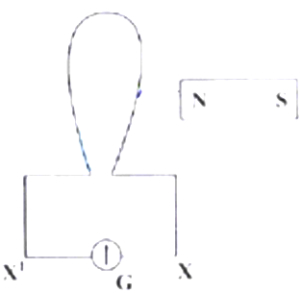
A
Deflects towards $X^1$
B
Does not deflect
C
Oscillates
D
Deflects towards $X$
Solution
(A) According to Lenz's law,the induced current in the coil always opposes the change in magnetic flux that produces it.
When the north pole of the magnet is pushed towards the coil,the magnetic flux through the coil increases,and the induced current flows in a direction to oppose this increase.
When the magnet is pulled away from the coil,the magnetic flux through the coil decreases. To oppose this decrease,the induced current flows in the opposite direction compared to the first case.
Since the galvanometer pointer deflected towards $X$ when the magnet was pushed in,it will deflect in the opposite direction,i.e.,towards $X^1$,when the magnet is pulled away.
When the north pole of the magnet is pushed towards the coil,the magnetic flux through the coil increases,and the induced current flows in a direction to oppose this increase.
When the magnet is pulled away from the coil,the magnetic flux through the coil decreases. To oppose this decrease,the induced current flows in the opposite direction compared to the first case.
Since the galvanometer pointer deflected towards $X$ when the magnet was pushed in,it will deflect in the opposite direction,i.e.,towards $X^1$,when the magnet is pulled away.
0 likes
View Solution257
MediumMCQ
In the figure,a conducting ring of certain resistance is falling towards a current-carrying straight long conductor. The ring and conductor are in the same plane. Then,the:
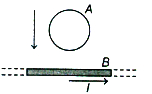
A
induced electric current is zero
B
induced electric current is anti-clockwise
C
induced electric current is clockwise
D
ring will come to rest
Solution
(C) The magnetic field $B$ produced by a long straight current-carrying conductor at a distance $r$ is given by $B = \frac{\mu_0 I}{2 \pi r}$.
As the ring falls towards the conductor,the distance $r$ decreases,causing the magnetic field $B$ passing through the ring to increase.
According to the right-hand rule,the magnetic field lines from the conductor point out of the plane of the paper in the region where the ring is located.
Since the magnetic flux linked with the ring is increasing in the outward direction,according to Lenz's law,the induced current in the ring will create a magnetic field pointing into the plane of the paper to oppose this increase.
Using the right-hand grip rule,a magnetic field directed into the plane of the paper corresponds to a clockwise induced current in the ring.
As the ring falls towards the conductor,the distance $r$ decreases,causing the magnetic field $B$ passing through the ring to increase.
According to the right-hand rule,the magnetic field lines from the conductor point out of the plane of the paper in the region where the ring is located.
Since the magnetic flux linked with the ring is increasing in the outward direction,according to Lenz's law,the induced current in the ring will create a magnetic field pointing into the plane of the paper to oppose this increase.
Using the right-hand grip rule,a magnetic field directed into the plane of the paper corresponds to a clockwise induced current in the ring.
0 likes
View Solution258
EasyMCQ
An induced current of $2 \text{ A}$ flows through a coil. The resistance of the coil is $10 \text{ } \Omega$. What is the change in magnetic flux associated with the coil in $1 \text{ ms}$?
A
$0.2 \times 10^{-2} \text{ Wb}$
B
$2 \times 10^{-2} \text{ Wb}$
C
$22 \times 10^{-2} \text{ Wb}$
D
$0.22 \times 10^{-2} \text{ Wb}$
Solution
(B) Given: Induced current $I = 2 \text{ A}$,Resistance $R = 10 \text{ } \Omega$,Time interval $\Delta t = 1 \text{ ms} = 10^{-3} \text{ s}$.
According to Faraday's law of induction,the magnitude of induced emf is $|\varepsilon| = \frac{\Delta \phi}{\Delta t}$.
Since $|\varepsilon| = I R$,we have $I R = \frac{\Delta \phi}{\Delta t}$.
Therefore,the change in magnetic flux is $\Delta \phi = I R \Delta t$.
Substituting the values: $\Delta \phi = 2 \times 10 \times 10^{-3} \text{ Wb}$.
$\Delta \phi = 20 \times 10^{-3} \text{ Wb} = 2 \times 10^{-2} \text{ Wb}$.
According to Faraday's law of induction,the magnitude of induced emf is $|\varepsilon| = \frac{\Delta \phi}{\Delta t}$.
Since $|\varepsilon| = I R$,we have $I R = \frac{\Delta \phi}{\Delta t}$.
Therefore,the change in magnetic flux is $\Delta \phi = I R \Delta t$.
Substituting the values: $\Delta \phi = 2 \times 10 \times 10^{-3} \text{ Wb}$.
$\Delta \phi = 20 \times 10^{-3} \text{ Wb} = 2 \times 10^{-2} \text{ Wb}$.
0 likes
View Solution259
EasyMCQ
$A$ magnetic field of flux density $1.0 \,Wb \,m^{-2}$ acts normal to a $80$ turn coil of $0.01 \,m^2$ area. If this coil is removed from the field in $0.2 \,s$, then the emf induced in it is (in $\,V$)
A
$8$
B
$0.8$
C
$5$
D
$4$
Solution
(D) Given: Magnetic flux density, $B = 1.0 \,Wb \,m^{-2}$
Number of turns, $N = 80$
Area of coil, $A = 0.01 \,m^2$
Time interval, $\Delta t = 0.2 \,s$
According to Faraday's law of electromagnetic induction, the magnitude of induced emf is given by:
$|e| = N \frac{|\Delta \phi|}{\Delta t}$
Since the coil is removed from the field, the final flux is $0$.
Change in flux, $\Delta \phi = B \cdot A - 0 = 1.0 \times 0.01 = 0.01 \,Wb$
Substituting the values:
$|e| = \frac{80 \times 0.01}{0.2} = \frac{0.8}{0.2} = 4 \,V$
Number of turns, $N = 80$
Area of coil, $A = 0.01 \,m^2$
Time interval, $\Delta t = 0.2 \,s$
According to Faraday's law of electromagnetic induction, the magnitude of induced emf is given by:
$|e| = N \frac{|\Delta \phi|}{\Delta t}$
Since the coil is removed from the field, the final flux is $0$.
Change in flux, $\Delta \phi = B \cdot A - 0 = 1.0 \times 0.01 = 0.01 \,Wb$
Substituting the values:
$|e| = \frac{80 \times 0.01}{0.2} = \frac{0.8}{0.2} = 4 \,V$
0 likes
View Solution260
EasyMCQ
The magnetic flux linked with a coil varies as $\phi = 3t^{2} + 4t + 9$. The magnitude of the emf induced at $t = 2 \text{ s}$ is: (in $\text{ V}$)
A
$8$
B
$16$
C
$32$
D
$64$
Solution
(B) Given,magnetic flux $\phi = 3t^{2} + 4t + 9$.
According to Faraday's law of electromagnetic induction,the magnitude of the induced emf is given by $\varepsilon = \left| \frac{d\phi}{dt} \right|$.
First,differentiate the flux expression with respect to time $t$:
$\frac{d\phi}{dt} = \frac{d}{dt}(3t^{2} + 4t + 9) = 6t + 4$.
Now,substitute the value $t = 2 \text{ s}$ into the derivative:
$\varepsilon = |6(2) + 4| = |12 + 4| = 16 \text{ V}$.
Thus,the magnitude of the induced emf at $t = 2 \text{ s}$ is $16 \text{ V}$.
According to Faraday's law of electromagnetic induction,the magnitude of the induced emf is given by $\varepsilon = \left| \frac{d\phi}{dt} \right|$.
First,differentiate the flux expression with respect to time $t$:
$\frac{d\phi}{dt} = \frac{d}{dt}(3t^{2} + 4t + 9) = 6t + 4$.
Now,substitute the value $t = 2 \text{ s}$ into the derivative:
$\varepsilon = |6(2) + 4| = |12 + 4| = 16 \text{ V}$.
Thus,the magnitude of the induced emf at $t = 2 \text{ s}$ is $16 \text{ V}$.
0 likes
View Solution261
MediumMCQ
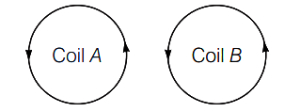
Two identical circular coils $A$ and $B$ are kept on a horizontal tube side by side without touching each other. If the current in the coil $A$ increases with time,in response,the coil $B$
A
is attracted by $A$
B
remains stationary
C
is repelled
D
rotates
Solution
(C) According to Lenz's law,the induced current in coil $B$ will oppose the cause that produces it.
As the current in coil $A$ increases,the magnetic flux linked with coil $B$ increases.
To oppose this increase in magnetic flux,an induced current flows in coil $B$ in a direction opposite to the current in coil $A$.
Since the currents in the adjacent sides of the two coils flow in opposite directions,they exert a repulsive force on each other.
Therefore,coil $B$ is repelled.
As the current in coil $A$ increases,the magnetic flux linked with coil $B$ increases.
To oppose this increase in magnetic flux,an induced current flows in coil $B$ in a direction opposite to the current in coil $A$.
Since the currents in the adjacent sides of the two coils flow in opposite directions,they exert a repulsive force on each other.
Therefore,coil $B$ is repelled.
0 likes
View Solution262
MediumMCQ
There is a uniform magnetic field directed perpendicular and into the plane of the paper. An irregular shaped conducting loop is slowly changing into a circular loop in the plane of the paper. Then
A
current is induced in the loop in the anticlockwise direction
B
current is induced in the loop in the clockwise direction
C
$AC$ is induced in the loop
D
no current is induced in the loop
Solution
(A) For a given perimeter,the area of a circle is the maximum among all plane shapes. As the irregular loop changes into a circular loop,its area $A$ increases.
Since the magnetic field $B$ is uniform and directed into the plane,the magnetic flux $\phi = B \cdot A$ increases.
According to Lenz's law,the induced current will create a magnetic field to oppose this increase in flux.
Therefore,the induced magnetic field must be directed out of the plane.
Using the right-hand thumb rule,a magnetic field directed out of the plane corresponds to an anticlockwise induced current.
Since the magnetic field $B$ is uniform and directed into the plane,the magnetic flux $\phi = B \cdot A$ increases.
According to Lenz's law,the induced current will create a magnetic field to oppose this increase in flux.
Therefore,the induced magnetic field must be directed out of the plane.
Using the right-hand thumb rule,a magnetic field directed out of the plane corresponds to an anticlockwise induced current.
0 likes
View Solution263
EasyMCQ
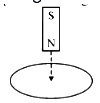
$A$ bar magnet is allowed to fall vertically through a copper coil placed in a horizontal plane. The magnet falls with a net acceleration:
A
$=g$
B
$ > g$
C
$ < g$
D
Zero
Solution
(C) As the bar magnet falls through the copper coil, the magnetic flux linked with the coil changes.
According to Faraday's law of electromagnetic induction, this change in magnetic flux induces an electromotive force (emf) and consequently an induced current in the coil.
According to Lenz's law, the direction of this induced current is such that it opposes the cause that produces it, which is the motion of the falling magnet.
This induced current creates a magnetic field that exerts an upward repulsive force on the falling magnet.
Therefore, the net downward force on the magnet is $F_{net} = mg - F_{repulsive}$.
Since there is an upward force opposing gravity, the net acceleration $a$ of the magnet is given by $a = \frac{F_{net}}{m} = g - \frac{F_{repulsive}}{m}$.
Thus, the net acceleration of the magnet is less than $g$.
According to Faraday's law of electromagnetic induction, this change in magnetic flux induces an electromotive force (emf) and consequently an induced current in the coil.
According to Lenz's law, the direction of this induced current is such that it opposes the cause that produces it, which is the motion of the falling magnet.
This induced current creates a magnetic field that exerts an upward repulsive force on the falling magnet.
Therefore, the net downward force on the magnet is $F_{net} = mg - F_{repulsive}$.
Since there is an upward force opposing gravity, the net acceleration $a$ of the magnet is given by $a = \frac{F_{net}}{m} = g - \frac{F_{repulsive}}{m}$.
Thus, the net acceleration of the magnet is less than $g$.
0 likes
View Solution264
MediumMCQ
$A$ metal loop of area $10 \,cm^2$ is placed in a region such that its area vector points along $\hat{k}$. The region contains a uniform magnetic field of magnitude $1.73 \,T$ that points in the direction $\hat{i}+\hat{j}+\hat{k}$. When the magnetic field is switched off, the field decreases to zero at a steady rate in $10 \,s$, then the magnitude of emf induced in the loop is (in $\,mV$)
A
$0.10$
B
$0.17$
C
$1$
D
$1.7$
Solution
(A) The magnetic flux $\phi$ through the loop is given by $\phi = \vec{B} \cdot \vec{A}$.
Given, area vector $\vec{A} = (10 \times 10^{-4} \,m^2) \hat{k}$.
The magnetic field vector $\vec{B} = B \hat{n}$, where $\hat{n}$ is the unit vector in the direction $\hat{i}+\hat{j}+\hat{k}$.
Thus, $\vec{B} = 1.73 \times \frac{\hat{i}+\hat{j}+\hat{k}}{\sqrt{3}} \,T$.
Initial flux $\phi_i = \vec{B} \cdot \vec{A} = \left( \frac{1.73}{\sqrt{3}} (\hat{i}+\hat{j}+\hat{k}) \right) \cdot (10^{-3} \hat{k}) = \frac{1.73}{\sqrt{3}} \times 10^{-3} \,Wb$.
Since $\sqrt{3} \approx 1.732$, $\phi_i \approx 10^{-3} \,Wb$.
Final flux $\phi_f = 0$ as the field decreases to zero.
The induced emf is $|e| = \left| -\frac{\Delta \phi}{\Delta t} \right| = \frac{\phi_i - \phi_f}{\Delta t} = \frac{10^{-3} \,Wb - 0}{10 \,s} = 10^{-4} \,V = 0.1 \,mV$.
Given, area vector $\vec{A} = (10 \times 10^{-4} \,m^2) \hat{k}$.
The magnetic field vector $\vec{B} = B \hat{n}$, where $\hat{n}$ is the unit vector in the direction $\hat{i}+\hat{j}+\hat{k}$.
Thus, $\vec{B} = 1.73 \times \frac{\hat{i}+\hat{j}+\hat{k}}{\sqrt{3}} \,T$.
Initial flux $\phi_i = \vec{B} \cdot \vec{A} = \left( \frac{1.73}{\sqrt{3}} (\hat{i}+\hat{j}+\hat{k}) \right) \cdot (10^{-3} \hat{k}) = \frac{1.73}{\sqrt{3}} \times 10^{-3} \,Wb$.
Since $\sqrt{3} \approx 1.732$, $\phi_i \approx 10^{-3} \,Wb$.
Final flux $\phi_f = 0$ as the field decreases to zero.
The induced emf is $|e| = \left| -\frac{\Delta \phi}{\Delta t} \right| = \frac{\phi_i - \phi_f}{\Delta t} = \frac{10^{-3} \,Wb - 0}{10 \,s} = 10^{-4} \,V = 0.1 \,mV$.
0 likes
View Solution265
EasyMCQ
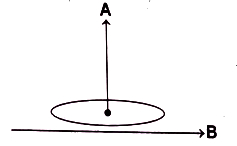
Assertion $(A)$: When a circular coil,placed in a region with its plane parallel to a magnetic field,expands radially outwards,no emf is induced in it.
Reason $(R)$: There is a constant magnetic field in the perpendicular (to the plane of the coil) direction.
Reason $(R)$: There is a constant magnetic field in the perpendicular (to the plane of the coil) direction.
A
Both $A$ and $R$ are true. $R$ is the correct explanation of $A$.
B
Both $A$ and $R$ are true. $R$ is not the correct explanation of $A$.
C
$A$ is true,$R$ is false.
D
$A$ is false,$R$ is true.
Solution
(C) The magnetic flux $\phi_B$ linked with a coil is given by $\phi_B = \vec{B} \cdot \vec{A} = BA \cos \theta$,where $\theta$ is the angle between the magnetic field vector $\vec{B}$ and the area vector $\vec{A}$.
When the plane of the coil is parallel to the magnetic field,the area vector $\vec{A}$ (which is perpendicular to the plane) is perpendicular to the magnetic field $\vec{B}$. Thus,$\theta = 90^\circ$ and $\phi_B = BA \cos 90^\circ = 0$.
Since the magnetic field is uniform and the coil expands radially while remaining in the same plane parallel to the field,the flux remains zero at all times. Therefore,the induced emf $\varepsilon = -\frac{d\phi_B}{dt} = 0$.
Thus,Assertion $(A)$ is true.
The Reason $(R)$ states that there is a constant magnetic field in the perpendicular direction to the plane of the coil. If this were true,the flux would be $\phi_B = BA$,and expanding the coil would change the area $A$,thereby inducing an emf. Since the problem states the plane is parallel to the field,the Reason $(R)$ is false.
When the plane of the coil is parallel to the magnetic field,the area vector $\vec{A}$ (which is perpendicular to the plane) is perpendicular to the magnetic field $\vec{B}$. Thus,$\theta = 90^\circ$ and $\phi_B = BA \cos 90^\circ = 0$.
Since the magnetic field is uniform and the coil expands radially while remaining in the same plane parallel to the field,the flux remains zero at all times. Therefore,the induced emf $\varepsilon = -\frac{d\phi_B}{dt} = 0$.
Thus,Assertion $(A)$ is true.
The Reason $(R)$ states that there is a constant magnetic field in the perpendicular direction to the plane of the coil. If this were true,the flux would be $\phi_B = BA$,and expanding the coil would change the area $A$,thereby inducing an emf. Since the problem states the plane is parallel to the field,the Reason $(R)$ is false.
0 likes
View Solution266
MediumMCQ
$A$ copper rod is moved in a magnetic field. The charge developed across its ends will be proportional to
A
magnetic flux
B
rate of change of magnetic flux
C
$1 /$ velocity of the rod
D
$1 /$ magnitude of the magnetic field
Solution
(B) When a copper rod is moved in a magnetic field,an electromotive force $(emf)$ is induced.
According to Faraday's law of electromagnetic induction,the induced $emf$ $(e)$ is given by $e = -\frac{d\phi}{dt}$.
Since the rod has a resistance $(R)$,the induced current $(i)$ is given by $i = \frac{e}{R} = -\frac{1}{R} \frac{d\phi}{dt}$.
We know that current is the rate of flow of charge,so $i = \frac{dQ}{dt}$.
Substituting this into the equation,we get $\frac{dQ}{dt} = -\frac{1}{R} \frac{d\phi}{dt}$.
Integrating both sides,we find that the total charge $Q$ developed is proportional to the change in magnetic flux $\Delta\phi$.
However,the instantaneous rate of charge flow is proportional to the rate of change of magnetic flux,$\frac{d\phi}{dt}$.
According to Faraday's law of electromagnetic induction,the induced $emf$ $(e)$ is given by $e = -\frac{d\phi}{dt}$.
Since the rod has a resistance $(R)$,the induced current $(i)$ is given by $i = \frac{e}{R} = -\frac{1}{R} \frac{d\phi}{dt}$.
We know that current is the rate of flow of charge,so $i = \frac{dQ}{dt}$.
Substituting this into the equation,we get $\frac{dQ}{dt} = -\frac{1}{R} \frac{d\phi}{dt}$.
Integrating both sides,we find that the total charge $Q$ developed is proportional to the change in magnetic flux $\Delta\phi$.
However,the instantaneous rate of charge flow is proportional to the rate of change of magnetic flux,$\frac{d\phi}{dt}$.
0 likes
View Solution267
EasyMCQ
The magnetic flux through a circuit of resistance $R$ changes by an amount $\Delta \phi$ in time $\Delta t$. Then the total quantity of electric charge $Q$ which is passing during this time through any point of the circuit is given by:
A
$Q=\frac{\Delta \phi}{\Delta t}$
B
$Q=\frac{\Delta \phi}{\Delta t} \times R$
C
$Q=-\frac{\Delta \phi}{\Delta t}+R$
D
$Q=\frac{\Delta \phi}{R}$
Solution
(D) According to Faraday's law of electromagnetic induction,the magnitude of induced emf $e$ is given by $e = \frac{\Delta \phi}{\Delta t}$.
Since the circuit has a resistance $R$,the induced current $i$ is given by $i = \frac{e}{R} = \frac{\Delta \phi}{R \Delta t}$.
The total charge $Q$ passing through any point in the circuit in time $\Delta t$ is given by $Q = i \Delta t$.
Substituting the value of $i$,we get $Q = \left( \frac{\Delta \phi}{R \Delta t} \right) \Delta t = \frac{\Delta \phi}{R}$.
Since the circuit has a resistance $R$,the induced current $i$ is given by $i = \frac{e}{R} = \frac{\Delta \phi}{R \Delta t}$.
The total charge $Q$ passing through any point in the circuit in time $\Delta t$ is given by $Q = i \Delta t$.
Substituting the value of $i$,we get $Q = \left( \frac{\Delta \phi}{R \Delta t} \right) \Delta t = \frac{\Delta \phi}{R}$.
0 likes
View Solution268
MediumMCQ
$A$ coil of $45$ turns and radius $4 \ cm$ is placed in a uniform magnetic field such that its plane is perpendicular to the direction of the field. If the magnetic field increases from $0$ to $0.70 \ T$ at a constant rate in a time interval of $220 \ s$,then the induced emf in the coil is (in $mV$)
A
$0.32$
B
$0.50$
C
$0.72$
D
$0.96$
Solution
(C) Given:
Number of turns $N = 45$
Radius $r = 4 \ cm = 0.04 \ m$
Area $A = \pi r^2 = \pi \times (0.04)^2 = 16\pi \times 10^{-4} \ m^2$
Initial magnetic field $B_1 = 0 \ T$
Final magnetic field $B_2 = 0.70 \ T$
Time interval $\Delta t = 220 \ s$
The magnetic flux $\phi = B \cdot A \cdot \cos(\theta)$. Since the plane is perpendicular to the field,the angle $\theta = 0^\circ$,so $\cos(0^\circ) = 1$.
Change in flux $\Delta \phi = A(B_2 - B_1) = 16\pi \times 10^{-4} \times (0.70 - 0) = 11.2\pi \times 10^{-4} \ Wb$.
According to Faraday's law,the induced emf $\varepsilon = -N \frac{\Delta \phi}{\Delta t}$.
Magnitude of emf $|\varepsilon| = \frac{45 \times 11.2\pi \times 10^{-4}}{220}$.
$|\varepsilon| = \frac{504\pi \times 10^{-4}}{220} \approx \frac{1583.36 \times 10^{-4}}{220} \approx 7.2 \times 10^{-4} \ V = 0.72 \ mV$.
Number of turns $N = 45$
Radius $r = 4 \ cm = 0.04 \ m$
Area $A = \pi r^2 = \pi \times (0.04)^2 = 16\pi \times 10^{-4} \ m^2$
Initial magnetic field $B_1 = 0 \ T$
Final magnetic field $B_2 = 0.70 \ T$
Time interval $\Delta t = 220 \ s$
The magnetic flux $\phi = B \cdot A \cdot \cos(\theta)$. Since the plane is perpendicular to the field,the angle $\theta = 0^\circ$,so $\cos(0^\circ) = 1$.
Change in flux $\Delta \phi = A(B_2 - B_1) = 16\pi \times 10^{-4} \times (0.70 - 0) = 11.2\pi \times 10^{-4} \ Wb$.
According to Faraday's law,the induced emf $\varepsilon = -N \frac{\Delta \phi}{\Delta t}$.
Magnitude of emf $|\varepsilon| = \frac{45 \times 11.2\pi \times 10^{-4}}{220}$.
$|\varepsilon| = \frac{504\pi \times 10^{-4}}{220} \approx \frac{1583.36 \times 10^{-4}}{220} \approx 7.2 \times 10^{-4} \ V = 0.72 \ mV$.
0 likes
View Solution269
MediumMCQ
$A$ coil of resistance $200 \Omega$ is placed in a magnetic field. If the magnetic flux $\phi$ (in weber) linked with the coil varies with time $t$ (in second) as per the equation $\phi = 50t^2 + 4$,then the current induced in the coil at a time $t = 2 \ s$ is (in $A$)
A
$2$
B
$1$
C
$0.5$
D
$0.1$
Solution
(B) According to Faraday's law of electromagnetic induction,the induced electromotive force $(EMF)$ $\varepsilon$ is given by $\varepsilon = -\frac{d\phi}{dt}$.
Given the magnetic flux $\phi = 50t^2 + 4$.
Differentiating $\phi$ with respect to time $t$:
$\frac{d\phi}{dt} = \frac{d}{dt}(50t^2 + 4) = 100t$.
The magnitude of the induced $EMF$ is $|\varepsilon| = |-\frac{d\phi}{dt}| = 100t$.
At time $t = 2 \ s$,the induced $EMF$ is $|\varepsilon| = 100(2) = 200 \ V$.
The induced current $I$ is given by Ohm's law: $I = \frac{|\varepsilon|}{R}$.
Given resistance $R = 200 \ \Omega$.
Therefore,$I = \frac{200 \ V}{200 \ \Omega} = 1 \ A$.
Given the magnetic flux $\phi = 50t^2 + 4$.
Differentiating $\phi$ with respect to time $t$:
$\frac{d\phi}{dt} = \frac{d}{dt}(50t^2 + 4) = 100t$.
The magnitude of the induced $EMF$ is $|\varepsilon| = |-\frac{d\phi}{dt}| = 100t$.
At time $t = 2 \ s$,the induced $EMF$ is $|\varepsilon| = 100(2) = 200 \ V$.
The induced current $I$ is given by Ohm's law: $I = \frac{|\varepsilon|}{R}$.
Given resistance $R = 200 \ \Omega$.
Therefore,$I = \frac{200 \ V}{200 \ \Omega} = 1 \ A$.
0 likes
View Solution270
EasyMCQ
$A$ coil having $100$ square loops each of side $10 \ cm$ is placed such that its plane is normal to a magnetic field,which is changing at a rate of $0.7 \ T \ s^{-1}$. The emf induced in the coil is (in $V$)
A
$0.2$
B
$0.4$
C
$0.7$
D
$1$
Solution
(C) The magnetic flux $\phi$ through a single loop is given by $\phi = B \cdot A \cdot \cos(\theta)$.
Since the plane of the coil is normal to the magnetic field,the angle $\theta$ between the area vector and the magnetic field is $0^\circ$,so $\cos(0^\circ) = 1$.
Thus,$\phi = B \cdot A$.
The induced emf $\epsilon$ in a coil with $N$ turns is given by Faraday's Law: $\epsilon = -N \frac{d\phi}{dt}$.
Here,$N = 100$,the area $A = (10 \ cm)^2 = (0.1 \ m)^2 = 0.01 \ m^2$,and the rate of change of magnetic field $\frac{dB}{dt} = 0.7 \ T \ s^{-1}$.
Substituting these values: $\epsilon = N \cdot A \cdot \frac{dB}{dt} = 100 \times 0.01 \times 0.7$.
$\epsilon = 1 \times 0.7 = 0.7 \ V$.
Since the plane of the coil is normal to the magnetic field,the angle $\theta$ between the area vector and the magnetic field is $0^\circ$,so $\cos(0^\circ) = 1$.
Thus,$\phi = B \cdot A$.
The induced emf $\epsilon$ in a coil with $N$ turns is given by Faraday's Law: $\epsilon = -N \frac{d\phi}{dt}$.
Here,$N = 100$,the area $A = (10 \ cm)^2 = (0.1 \ m)^2 = 0.01 \ m^2$,and the rate of change of magnetic field $\frac{dB}{dt} = 0.7 \ T \ s^{-1}$.
Substituting these values: $\epsilon = N \cdot A \cdot \frac{dB}{dt} = 100 \times 0.01 \times 0.7$.
$\epsilon = 1 \times 0.7 = 0.7 \ V$.
0 likes
View Solution271
EasyMCQ
When two coaxial coils having the same current in the same direction are brought closer to each other,what happens to the value of the current in both coils?
A
Increases
B
Decreases
C
Remains same
D
Increases in one coil and decreases in the other coil
Solution
(B) When two coaxial coils carrying current in the same direction are brought closer to each other,the magnetic flux linked with each coil increases.
According to Lenz's law,the induced electromotive force $(EMF)$ will oppose this change in magnetic flux.
To oppose the increase in flux,the induced current flows in a direction opposite to the original current in each coil.
Consequently,the net current in both coils decreases.
According to Lenz's law,the induced electromotive force $(EMF)$ will oppose this change in magnetic flux.
To oppose the increase in flux,the induced current flows in a direction opposite to the original current in each coil.
Consequently,the net current in both coils decreases.
0 likes
View Solution272
EasyMCQ
The Lenz law is associated with
A
law of conservation of charge.
B
law of conservation of mass.
C
law of conservation of angular momentum.
D
law of conservation of energy.
Solution
(D) Lenz's law states that the direction of the induced current is such that it opposes the change in magnetic flux that produced it.
This law is a direct consequence of the law of conservation of energy.
If the induced current were to assist the change in magnetic flux,it would lead to a perpetual motion machine,which violates the principle of conservation of energy.
Therefore,the work done in moving a magnet against the induced magnetic force is converted into electrical energy,satisfying the law of conservation of energy.
This law is a direct consequence of the law of conservation of energy.
If the induced current were to assist the change in magnetic flux,it would lead to a perpetual motion machine,which violates the principle of conservation of energy.
Therefore,the work done in moving a magnet against the induced magnetic force is converted into electrical energy,satisfying the law of conservation of energy.
0 likes
View Solution273
EasyMCQ
The total emf induced in a closely wound coil of $N$ turns in which the magnetic flux linked with the coil is changing at the rate $\frac{d \phi_{B}}{dt}$ is
A
$-N \frac{d \phi_{B}}{dt}$
B
$N \frac{d \phi_{B}}{dt}$
C
$-N \frac{d^2 \phi_{B}}{dt^2}$
D
$-\frac{d \phi_{B}}{dt}$
Solution
(A) According to Faraday's law of electromagnetic induction,the induced emf in a single loop is given by $\varepsilon = -\frac{d \phi_{B}}{dt}$.
For a coil consisting of $N$ closely wound turns,the total magnetic flux linked with the coil is $N \phi_{B}$.
Therefore,the total induced emf $\varepsilon$ is given by the rate of change of the total flux linkage:
$\varepsilon = -\frac{d}{dt} (N \phi_{B}) = -N \frac{d \phi_{B}}{dt}$.
For a coil consisting of $N$ closely wound turns,the total magnetic flux linked with the coil is $N \phi_{B}$.
Therefore,the total induced emf $\varepsilon$ is given by the rate of change of the total flux linkage:
$\varepsilon = -\frac{d}{dt} (N \phi_{B}) = -N \frac{d \phi_{B}}{dt}$.
0 likes
View Solution274
MediumMCQ
$A$ circular coil has $100$ turns,radius $3 \ cm$ and resistance $4 \Omega$. This coil is co-axial with a solenoid of $200$ turns/cm and diameter $4 \ cm$. If the solenoid current is decreased from $2 \ A$ to zero in $0.04 \ s$,then the current induced in the coil is
A
$9 \pi^2 \ mA$
B
$8 \pi \ mA$
C
$30.3 \ mA$
D
$45.5 \ mA$
Solution
(A) The magnetic field $B$ inside a long solenoid is given by $B = \mu_0 n i$,where $n$ is the number of turns per unit length and $i$ is the current.
Here,$n = 200 \ \text{turns/cm} = 20000 \ \text{turns/m}$.
The magnetic flux $\phi$ linked with the circular coil is $\phi = N B A$,where $N = 100$ is the number of turns in the coil and $A = \pi r^2$ is the area of the coil with $r = 0.03 \ m$.
Thus,$\phi = N (\mu_0 n i) (\pi r^2)$.
According to Faraday's law,the induced $EMF$ is $\varepsilon = -\frac{\Delta \phi}{\Delta t}$.
The induced current $I_{ind} = \frac{|\varepsilon|}{R} = \frac{N \mu_0 n \pi r^2}{R} \times \frac{\Delta i}{\Delta t}$.
Substituting the values: $I_{ind} = \frac{100 \times (4 \pi \times 10^{-7}) \times 20000 \times \pi \times (0.03)^2}{4} \times \frac{2 - 0}{0.04}$.
$I_{ind} = \frac{100 \times 4 \pi \times 10^{-7} \times 20000 \times \pi \times 0.0009}{4} \times 50$.
$I_{ind} = 9 \pi^2 \times 10^{-3} \ A = 9 \pi^2 \ mA$.
Here,$n = 200 \ \text{turns/cm} = 20000 \ \text{turns/m}$.
The magnetic flux $\phi$ linked with the circular coil is $\phi = N B A$,where $N = 100$ is the number of turns in the coil and $A = \pi r^2$ is the area of the coil with $r = 0.03 \ m$.
Thus,$\phi = N (\mu_0 n i) (\pi r^2)$.
According to Faraday's law,the induced $EMF$ is $\varepsilon = -\frac{\Delta \phi}{\Delta t}$.
The induced current $I_{ind} = \frac{|\varepsilon|}{R} = \frac{N \mu_0 n \pi r^2}{R} \times \frac{\Delta i}{\Delta t}$.
Substituting the values: $I_{ind} = \frac{100 \times (4 \pi \times 10^{-7}) \times 20000 \times \pi \times (0.03)^2}{4} \times \frac{2 - 0}{0.04}$.
$I_{ind} = \frac{100 \times 4 \pi \times 10^{-7} \times 20000 \times \pi \times 0.0009}{4} \times 50$.
$I_{ind} = 9 \pi^2 \times 10^{-3} \ A = 9 \pi^2 \ mA$.
0 likes
View Solution275
EasyMCQ
$A$ circular loop of wire of radius $14 \ cm$ is placed in a magnetic field directed perpendicular to the plane of the loop. If the field decreases at a steady rate of $0.05 \ Ts^{-1}$ in some interval,then the magnitude of the emf induced in the loop is (in $mV$)
A
$2.08$
B
$3.08$
C
$2.16$
D
$3.24$
Solution
(B) Given: Radius of the circular loop $r = 14 \ cm = 0.14 \ m$.
Rate of change of magnetic field $\frac{dB}{dt} = 0.05 \ Ts^{-1}$.
According to Faraday's law of electromagnetic induction,the magnitude of induced emf $|e|$ is given by $|e| = \frac{d\phi}{dt}$.
Since the magnetic field is perpendicular to the plane,the magnetic flux $\phi = B \cdot A$.
Thus,$|e| = \frac{d}{dt}(BA) = A \frac{dB}{dt}$.
The area of the loop $A = \pi r^2 = \frac{22}{7} \times (0.14)^2 = \frac{22}{7} \times 0.0196 = 0.0616 \ m^2$.
Substituting the values: $|e| = 0.0616 \times 0.05 = 0.00308 \ V$.
Converting to millivolts: $|e| = 3.08 \times 10^{-3} \ V = 3.08 \ mV$.
Rate of change of magnetic field $\frac{dB}{dt} = 0.05 \ Ts^{-1}$.
According to Faraday's law of electromagnetic induction,the magnitude of induced emf $|e|$ is given by $|e| = \frac{d\phi}{dt}$.
Since the magnetic field is perpendicular to the plane,the magnetic flux $\phi = B \cdot A$.
Thus,$|e| = \frac{d}{dt}(BA) = A \frac{dB}{dt}$.
The area of the loop $A = \pi r^2 = \frac{22}{7} \times (0.14)^2 = \frac{22}{7} \times 0.0196 = 0.0616 \ m^2$.
Substituting the values: $|e| = 0.0616 \times 0.05 = 0.00308 \ V$.
Converting to millivolts: $|e| = 3.08 \times 10^{-3} \ V = 3.08 \ mV$.
0 likes
View Solution276
EasyMCQ
$A$ uniform magnetic field $\vec{B}$ is perpendicular to the plane of a circular loop of diameter $10 \text{ cm}$ formed from a wire of diameter $2 \text{ mm}$ and resistivity $2 \times 10^{-8} \Omega \text{ m}$. If a current of $11 \text{ A}$ is to be induced in the loop, then the rate at which $\vec{B}$ is to be changed is: (in $\text{ T s}^{-1}$)
A
$2.8$
B
$1.4$
C
$3.2$
D
$2.4$
Solution
(A) The induced current $i$ is given by $i = \frac{e}{R} = \frac{1}{R} \frac{d\phi}{dt} = \frac{A}{R} \frac{dB}{dt}$.
Here, $A$ is the area of the loop: $A = \pi r^2 = \pi \times (0.05 \text{ m})^2 = 25\pi \times 10^{-4} \text{ m}^2$.
The resistance $R$ of the wire is $R = \frac{\rho l}{a}$, where $l = 2\pi r$ and $a = \pi (r_{wire})^2$.
$l = 2 \times \pi \times 0.05 = 0.1\pi \text{ m}$.
$a = \pi \times (10^{-3} \text{ m})^2 = \pi \times 10^{-6} \text{ m}^2$.
$R = \frac{2 \times 10^{-8} \times 0.1\pi}{\pi \times 10^{-6}} = 2 \times 10^{-3} \Omega$.
Now, $\frac{dB}{dt} = \frac{iR}{A} = \frac{11 \times 2 \times 10^{-3}}{25\pi \times 10^{-4}} = \frac{22 \times 10^{-3}}{25 \times 3.14 \times 10^{-4}} \approx 2.8 \text{ T s}^{-1}$.
Here, $A$ is the area of the loop: $A = \pi r^2 = \pi \times (0.05 \text{ m})^2 = 25\pi \times 10^{-4} \text{ m}^2$.
The resistance $R$ of the wire is $R = \frac{\rho l}{a}$, where $l = 2\pi r$ and $a = \pi (r_{wire})^2$.
$l = 2 \times \pi \times 0.05 = 0.1\pi \text{ m}$.
$a = \pi \times (10^{-3} \text{ m})^2 = \pi \times 10^{-6} \text{ m}^2$.
$R = \frac{2 \times 10^{-8} \times 0.1\pi}{\pi \times 10^{-6}} = 2 \times 10^{-3} \Omega$.
Now, $\frac{dB}{dt} = \frac{iR}{A} = \frac{11 \times 2 \times 10^{-3}}{25\pi \times 10^{-4}} = \frac{22 \times 10^{-3}}{25 \times 3.14 \times 10^{-4}} \approx 2.8 \text{ T s}^{-1}$.
0 likes
View Solution277
EasyMCQ
The induced emf cannot be produced by:
A
Moving a magnet near a circuit
B
Moving a circuit near a magnet
C
Changing the current in one circuit placed near the other
D
Maintaining large but constant current in a circuit
Solution
(D) Faraday's law states that an induced $emf$ is produced whenever the magnetic flux linked with a circuit changes with time.
$1$. Moving a magnet near a circuit changes the magnetic flux,thus inducing an $emf$.
$2$. Moving a circuit near a magnet also changes the magnetic flux,thus inducing an $emf$.
$3$. Changing the current in one circuit placed near another changes the magnetic field and thus the magnetic flux in the second circuit,inducing an $emf$.
$4$. Maintaining a large but constant current in a circuit produces a constant magnetic field. Since the magnetic flux remains constant over time,no induced $emf$ is produced.
Therefore,the correct answer is option $D$.
$1$. Moving a magnet near a circuit changes the magnetic flux,thus inducing an $emf$.
$2$. Moving a circuit near a magnet also changes the magnetic flux,thus inducing an $emf$.
$3$. Changing the current in one circuit placed near another changes the magnetic field and thus the magnetic flux in the second circuit,inducing an $emf$.
$4$. Maintaining a large but constant current in a circuit produces a constant magnetic field. Since the magnetic flux remains constant over time,no induced $emf$ is produced.
Therefore,the correct answer is option $D$.
0 likes
View Solution278
MediumMCQ
$A$ coil having $500$ square loops each of side $10 \ cm$ is placed normal to a magnetic flux which increases at a rate of $1 \ T s^{-1}$. The induced emf is (in $V$)
A
$0.1$
B
$0.5$
C
$1$
D
$5$
Solution
(D) Given that,number of loops,$N = 500$.
Side of square,$a = 10 \ cm = 0.1 \ m$.
Rate of increase of magnetic field,$\frac{dB}{dt} = 1 \ T/s$.
Since the coil is placed normal to the magnetic field,the magnetic flux $\phi = B \cdot A$.
The induced emf is given by Faraday's law: $\varepsilon = -N \frac{d\phi}{dt} = -N \frac{d}{dt}(BA)$.
Since the area $A$ is constant,$\varepsilon = -NA \frac{dB}{dt} = -N a^2 \frac{dB}{dt}$.
Substituting the values: $\varepsilon = -500 \times (0.1)^2 \times 1 = -5 \ V$.
The magnitude of the induced emf is $|\varepsilon| = 5 \ V$.
Side of square,$a = 10 \ cm = 0.1 \ m$.
Rate of increase of magnetic field,$\frac{dB}{dt} = 1 \ T/s$.
Since the coil is placed normal to the magnetic field,the magnetic flux $\phi = B \cdot A$.
The induced emf is given by Faraday's law: $\varepsilon = -N \frac{d\phi}{dt} = -N \frac{d}{dt}(BA)$.
Since the area $A$ is constant,$\varepsilon = -NA \frac{dB}{dt} = -N a^2 \frac{dB}{dt}$.
Substituting the values: $\varepsilon = -500 \times (0.1)^2 \times 1 = -5 \ V$.
The magnitude of the induced emf is $|\varepsilon| = 5 \ V$.
0 likes
View Solution279
EasyMCQ
Lenz's law is a consequence of the law of conservation of
A
energy
B
charge
C
linear momentum
D
electric flux
Solution
(A) Lenz's law states that the induced current always flows in a direction that opposes the change in magnetic flux that produced it.
To overcome this opposing force,external mechanical work must be performed.
This mechanical work is converted into electrical energy in the circuit.
Since energy is neither created nor destroyed but only transformed from one form to another,Lenz's law is a direct consequence of the law of conservation of energy.
To overcome this opposing force,external mechanical work must be performed.
This mechanical work is converted into electrical energy in the circuit.
Since energy is neither created nor destroyed but only transformed from one form to another,Lenz's law is a direct consequence of the law of conservation of energy.
0 likes
View Solution280
EasyMCQ
The magnitude of induced emf is directly proportional to the rate of change of magnetic flux linked with the coil. This statement is known as
A
Ohm's law
B
Lenz's law
C
Faraday's law
D
Ampere's law
Solution
(C) According to Faraday's law of electromagnetic induction,the magnitude of the induced electromotive force $(emf)$ in a circuit is equal to the time rate of change of magnetic flux through the circuit. Mathematically,it is expressed as $|\varepsilon| = |\frac{d\Phi_B}{dt}|$. Therefore,the correct statement corresponds to Faraday's law.
0 likes
View Solution281
EasyMCQ
The Lenz's law gives
A
the direction of induced current
B
the quantity of charge flowing
C
the magnitude of the induced emf
D
motional emf in the circuit
Solution
(A) According to Lenz's law,the direction of the induced current is such that it opposes the change in magnetic flux that produced it.
Therefore,Lenz's law provides the direction of the induced current in a circuit.
Therefore,Lenz's law provides the direction of the induced current in a circuit.
0 likes
View Solution282
EasyMCQ
Lenz's law is a consequence of the law of conservation of:
A
charge
B
momentum
C
mass
D
energy
Solution
(D) Lenz's law states that the direction of the induced current is such that it opposes the change in magnetic flux that produced it. If the induced current were to assist the change,it would violate the law of conservation of energy by creating energy out of nothing. Therefore,Lenz's law is a direct consequence of the law of conservation of energy.
0 likes
View Solution283
MediumMCQ
$A$ circular loop made of thin copper wire of mass $m$ is placed in a uniform magnetic field such that the plane of the loop is perpendicular to the magnetic field. If $d$ and $\rho$ are the density and resistivity of copper respectively and the magnetic field varies at a constant rate of $\frac{dB}{dt}$,then the induced current in the loop is . . . . . .
A
$\frac{4 \pi m}{\rho d}\left(\frac{dB}{dt}\right)$
B
$\frac{m}{4 \pi \rho d}\left(\frac{dB}{dt}\right)$
C
$\frac{\pi m}{4 \rho d}\left(\frac{dB}{dt}\right)$
D
$\frac{4 m}{\pi \rho d}\left(\frac{dB}{dt}\right)$
Solution
(B) Let $r$ be the radius of the loop and $A_w$ be the cross-sectional area of the wire.
The mass of the loop is $m = (2 \pi r) A_w d$,so $A_w = \frac{m}{2 \pi r d}$.
The resistance of the loop is $R = \rho \frac{l}{A_w} = \rho \frac{2 \pi r}{A_w} = \rho \frac{2 \pi r}{m / (2 \pi r d)} = \frac{4 \pi^2 r^2 \rho d}{m}$.
The magnetic flux through the loop is $\phi = B \cdot \pi r^2$.
The induced electromotive force $(EMF)$ is $\varepsilon = -\frac{d\phi}{dt} = -\pi r^2 \frac{dB}{dt}$.
The induced current is $I = \frac{|\varepsilon|}{R} = \frac{\pi r^2 (dB/dt)}{4 \pi^2 r^2 \rho d / m} = \frac{m}{4 \pi \rho d} \left(\frac{dB}{dt}\right)$.
The mass of the loop is $m = (2 \pi r) A_w d$,so $A_w = \frac{m}{2 \pi r d}$.
The resistance of the loop is $R = \rho \frac{l}{A_w} = \rho \frac{2 \pi r}{A_w} = \rho \frac{2 \pi r}{m / (2 \pi r d)} = \frac{4 \pi^2 r^2 \rho d}{m}$.
The magnetic flux through the loop is $\phi = B \cdot \pi r^2$.
The induced electromotive force $(EMF)$ is $\varepsilon = -\frac{d\phi}{dt} = -\pi r^2 \frac{dB}{dt}$.
The induced current is $I = \frac{|\varepsilon|}{R} = \frac{\pi r^2 (dB/dt)}{4 \pi^2 r^2 \rho d / m} = \frac{m}{4 \pi \rho d} \left(\frac{dB}{dt}\right)$.
0 likes
View Solution284
EasyMCQ
Assertion $(A)$: It is more difficult to push a magnet into a coil with a greater number of turns.
Reason $(R)$: The $emf$ induced in a coil opposes the motion of a magnet when it is moved towards the coil.
Reason $(R)$: The $emf$ induced in a coil opposes the motion of a magnet when it is moved towards the coil.
A
$A$ is false,$R$ is true
B
Both $A$ and $R$ are true. $R$ is the correct explanation of $A$
C
$A$ is true,$R$ is false
D
Both $A$ and $R$ are true. $R$ is not the correct explanation of $A$
Solution
(B) According to Faraday's law,the induced $emf$ $(\varepsilon)$ in a coil is given by $\varepsilon = -N \frac{d\phi}{dt}$,where $N$ is the number of turns.
As the number of turns $(N)$ increases,the induced $emf$ and consequently the induced current increase for a given rate of change of magnetic flux.
According to Lenz's law,the direction of the induced current is such that it opposes the cause that produces it,which is the motion of the magnet.
Since a larger $N$ results in a stronger induced current,the opposing magnetic force becomes greater,making it more difficult to push the magnet into the coil.
Thus,both $A$ and $R$ are true,and $R$ is the correct explanation of $A$.
As the number of turns $(N)$ increases,the induced $emf$ and consequently the induced current increase for a given rate of change of magnetic flux.
According to Lenz's law,the direction of the induced current is such that it opposes the cause that produces it,which is the motion of the magnet.
Since a larger $N$ results in a stronger induced current,the opposing magnetic force becomes greater,making it more difficult to push the magnet into the coil.
Thus,both $A$ and $R$ are true,and $R$ is the correct explanation of $A$.
0 likes
View Solution285
MediumMCQ
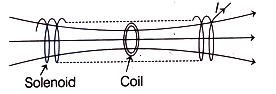
$A$ long solenoid having $100$ turns per $cm$ carries a current of $\frac{4}{\pi} \,A$. At the centre of it is placed a coil of $200$ turns of cross-sectional area $25 \,cm^2$ having its axis parallel to the field produced by the solenoid. When the direction of the current in the solenoid is reversed within $0.04 \,s$, the induced emf in the coil is (in $\,V$)
A
$0.2$
B
$0.4$
C
$0.002$
D
$0.016$
Solution
(B) The magnetic field $B$ inside a long solenoid is given by $B = \mu_0 n I$, where $n$ is the number of turns per unit length and $I$ is the current.
Given: $n = 100 \text{ turns/cm} = 10^4 \text{ turns/m}$, $I = \frac{4}{\pi} \,A$, and $\mu_0 = 4\pi \times 10^{-7} \,T \cdot m/A$.
$B = (4\pi \times 10^{-7}) \times (10^4) \times (\frac{4}{\pi}) = 16 \times 10^{-3} \,T$.
The magnetic flux $\phi_B$ linked with the coil of $N$ turns and area $A$ is $\phi_B = N B A$.
Given: $N = 200$, $A = 25 \,cm^2 = 25 \times 10^{-4} \,m^2$.
When the current is reversed, the magnetic field changes from $B$ to $-B$. The change in flux is $\Delta \phi_B = N(B - (-B))A = 2NBA$.
The induced emf $e$ is given by Faraday's law: $e = \left| \frac{\Delta \phi_B}{\Delta t} \right| = \frac{2NBA}{\Delta t}$.
Substituting the values: $e = \frac{2 \times 200 \times (16 \times 10^{-3}) \times (25 \times 10^{-4})}{0.04} = \frac{400 \times 16 \times 10^{-3} \times 25 \times 10^{-4}}{0.04} = \frac{160000 \times 10^{-7}}{0.04} = \frac{0.016}{0.04} = 0.4 \,V$.
Given: $n = 100 \text{ turns/cm} = 10^4 \text{ turns/m}$, $I = \frac{4}{\pi} \,A$, and $\mu_0 = 4\pi \times 10^{-7} \,T \cdot m/A$.
$B = (4\pi \times 10^{-7}) \times (10^4) \times (\frac{4}{\pi}) = 16 \times 10^{-3} \,T$.
The magnetic flux $\phi_B$ linked with the coil of $N$ turns and area $A$ is $\phi_B = N B A$.
Given: $N = 200$, $A = 25 \,cm^2 = 25 \times 10^{-4} \,m^2$.
When the current is reversed, the magnetic field changes from $B$ to $-B$. The change in flux is $\Delta \phi_B = N(B - (-B))A = 2NBA$.
The induced emf $e$ is given by Faraday's law: $e = \left| \frac{\Delta \phi_B}{\Delta t} \right| = \frac{2NBA}{\Delta t}$.
Substituting the values: $e = \frac{2 \times 200 \times (16 \times 10^{-3}) \times (25 \times 10^{-4})}{0.04} = \frac{400 \times 16 \times 10^{-3} \times 25 \times 10^{-4}}{0.04} = \frac{160000 \times 10^{-7}}{0.04} = \frac{0.016}{0.04} = 0.4 \,V$.
0 likes
View Solution286
MediumMCQ
Assertion $(A)$: It is more difficult to move a magnet into a coil with more loops.
Reason $(R)$: This is because the emf induced in each current loop resists the motion of the magnet.
Reason $(R)$: This is because the emf induced in each current loop resists the motion of the magnet.
A
Both $A$ and $R$ are true and $R$ is a correct explanation for $A$
B
Both $A$ and $R$ are true but $R$ is not a correct explanation for $A$
C
$A$ is true,$R$ is false
D
$A$ is false,$R$ is true
Solution
(A) According to Faraday's law of electromagnetic induction,the induced emf in a coil is given by $e = -N \frac{d\phi}{dt}$.
Here,$N$ represents the number of turns in the coil.
As the number of turns $N$ increases,the magnitude of the induced emf increases.
According to Lenz's law,the induced current creates a magnetic field that opposes the change in magnetic flux that produced it.
When a magnet is moved into a coil,the induced emf in each loop creates a current that opposes the motion of the magnet.
Since more loops result in a larger total induced emf,the opposing force becomes greater,making it more difficult to move the magnet.
Therefore,both $A$ and $R$ are true,and $R$ is the correct explanation for $A$.
Here,$N$ represents the number of turns in the coil.
As the number of turns $N$ increases,the magnitude of the induced emf increases.
According to Lenz's law,the induced current creates a magnetic field that opposes the change in magnetic flux that produced it.
When a magnet is moved into a coil,the induced emf in each loop creates a current that opposes the motion of the magnet.
Since more loops result in a larger total induced emf,the opposing force becomes greater,making it more difficult to move the magnet.
Therefore,both $A$ and $R$ are true,and $R$ is the correct explanation for $A$.
0 likes
View Solution287
EasyMCQ
An electric generator is based on . . . . . .
A
Faraday's laws of electromagnetic induction
B
Motion of charged particles in an electromagnetic field
C
Fission of Uranium by slow neutrons
D
Newton's laws of motion
Solution
(A) An electric generator is a device that converts mechanical energy into electrical energy.
When a coil rotates in a magnetic field,the magnetic flux linked with the coil changes continuously.
According to Faraday's laws of electromagnetic induction,this change in magnetic flux induces an electromotive force $(emf)$ across the coil.
This induced $emf$ is responsible for the flow of induced current in the circuit.
Therefore,the working principle of an electric generator is based on Faraday's laws of electromagnetic induction.
When a coil rotates in a magnetic field,the magnetic flux linked with the coil changes continuously.
According to Faraday's laws of electromagnetic induction,this change in magnetic flux induces an electromotive force $(emf)$ across the coil.
This induced $emf$ is responsible for the flow of induced current in the circuit.
Therefore,the working principle of an electric generator is based on Faraday's laws of electromagnetic induction.
0 likes
View Solution288
DifficultMCQ
An infinitely long cylinder is kept parallel to a uniform magnetic field $B$ directed along the positive $z$-axis. The direction of induced current as seen from the $z$-axis will be
A
zero
B
along the magnetic field
C
clockwise of the positive $z$-axis
D
anti-clockwise of the positive $z$-axis
Solution
(A) According to Faraday's law of electromagnetic induction, an induced electromotive force $(EMF)$ and current are produced only when there is a change in the magnetic flux $(\Phi_B)$ linked with a circuit over time.
Magnetic flux is defined as $\Phi_B = \int \vec{B} \cdot d\vec{A}$.
In this scenario, the cylinder is placed parallel to a uniform magnetic field $\vec{B}$. Since the magnetic field is uniform and the cylinder is stationary, the magnetic flux passing through any cross-section of the cylinder remains constant over time.
Since $\frac{d\Phi_B}{dt} = 0$, there is no induced $EMF$ and consequently no induced current.
Therefore, the induced current is zero.
Magnetic flux is defined as $\Phi_B = \int \vec{B} \cdot d\vec{A}$.
In this scenario, the cylinder is placed parallel to a uniform magnetic field $\vec{B}$. Since the magnetic field is uniform and the cylinder is stationary, the magnetic flux passing through any cross-section of the cylinder remains constant over time.
Since $\frac{d\Phi_B}{dt} = 0$, there is no induced $EMF$ and consequently no induced current.
Therefore, the induced current is zero.
0 likes
View Solution289
MediumMCQ
$A$ coil of resistance $8 \Omega$,number of turns $250$,and area $120 \ cm^2$ is placed in a uniform magnetic field of $2 \ T$ such that the plane of the coil makes an angle of $\frac{\pi}{6}$ with the direction of the magnetic field. In a time of $100 \ ms$,the coil is rotated until its plane becomes parallel to the direction of the magnetic field. The current induced in the coil is (in $A$)
A
$5.25$
B
$3.75$
C
$2.75$
D
$1.25$
Solution
(B) The magnetic flux $\phi$ through a coil is given by $\phi = NBA \cos \theta$,where $\theta$ is the angle between the area vector and the magnetic field.
Given that the plane of the coil makes an angle of $\frac{\pi}{6}$ with the magnetic field,the angle $\theta_1$ between the area vector and the magnetic field is $\theta_1 = \frac{\pi}{2} - \frac{\pi}{6} = \frac{\pi}{3} = 60^\circ$.
Initial flux $\phi_1 = NBA \cos(60^\circ) = 250 \times 2 \times (120 \times 10^{-4}) \times 0.5 = 3 \ Wb$.
When the plane of the coil is parallel to the magnetic field,the area vector is perpendicular to the magnetic field,so $\theta_2 = 90^\circ$.
Final flux $\phi_2 = NBA \cos(90^\circ) = 0 \ Wb$.
The change in flux is $\Delta \phi = |\phi_2 - \phi_1| = 3 \ Wb$.
The induced $EMF$ is $\varepsilon = \frac{\Delta \phi}{\Delta t} = \frac{3}{100 \times 10^{-3}} = 30 \ V$.
The induced current is $I = \frac{\varepsilon}{R} = \frac{30}{8} = 3.75 \ A$.
Given that the plane of the coil makes an angle of $\frac{\pi}{6}$ with the magnetic field,the angle $\theta_1$ between the area vector and the magnetic field is $\theta_1 = \frac{\pi}{2} - \frac{\pi}{6} = \frac{\pi}{3} = 60^\circ$.
Initial flux $\phi_1 = NBA \cos(60^\circ) = 250 \times 2 \times (120 \times 10^{-4}) \times 0.5 = 3 \ Wb$.
When the plane of the coil is parallel to the magnetic field,the area vector is perpendicular to the magnetic field,so $\theta_2 = 90^\circ$.
Final flux $\phi_2 = NBA \cos(90^\circ) = 0 \ Wb$.
The change in flux is $\Delta \phi = |\phi_2 - \phi_1| = 3 \ Wb$.
The induced $EMF$ is $\varepsilon = \frac{\Delta \phi}{\Delta t} = \frac{3}{100 \times 10^{-3}} = 30 \ V$.
The induced current is $I = \frac{\varepsilon}{R} = \frac{30}{8} = 3.75 \ A$.
0 likes
View Solution290
MediumMCQ
$A$ coil of resistance $16 \Omega$ is placed with its plane perpendicular to a uniform magnetic field whose flux ($\phi$ in $10^{-3} \text{ Wb}$) changes with time ($t$ in seconds) as $\phi = 5t^2 + 4t + 2$. The induced current at time $t = 6 \text{ s}$ is: (in $\text{ mA}$)
A
$4$
B
$2.12$
C
$34$
D
$74$
Solution
(A) According to Faraday's law of electromagnetic induction, the induced electromotive force $(EMF)$ is given by $\varepsilon = -\frac{d\phi}{dt}$.
Given $\phi = (5t^2 + 4t + 2) \times 10^{-3} \text{ Wb}$.
Differentiating with respect to $t$:
$\frac{d\phi}{dt} = (10t + 4) \times 10^{-3} \text{ Wb/s}$.
At $t = 6 \text{ s}$, the magnitude of induced $EMF$ is:
$|\varepsilon| = |10(6) + 4| \times 10^{-3} = 64 \times 10^{-3} \text{ V}$.
The induced current $I$ is given by $I = \frac{|\varepsilon|}{R}$.
Given $R = 16 \Omega$, we have:
$I = \frac{64 \times 10^{-3}}{16} = 4 \times 10^{-3} \text{ A} = 4 \text{ mA}$.
Thus, the correct option is $A$.
Given $\phi = (5t^2 + 4t + 2) \times 10^{-3} \text{ Wb}$.
Differentiating with respect to $t$:
$\frac{d\phi}{dt} = (10t + 4) \times 10^{-3} \text{ Wb/s}$.
At $t = 6 \text{ s}$, the magnitude of induced $EMF$ is:
$|\varepsilon| = |10(6) + 4| \times 10^{-3} = 64 \times 10^{-3} \text{ V}$.
The induced current $I$ is given by $I = \frac{|\varepsilon|}{R}$.
Given $R = 16 \Omega$, we have:
$I = \frac{64 \times 10^{-3}}{16} = 4 \times 10^{-3} \text{ A} = 4 \text{ mA}$.
Thus, the correct option is $A$.
0 likes
View Solution291
MediumMCQ
$A$ long solenoid has $20$ turns per cm. $A$ small loop of area $\frac{4}{\pi} \text{ cm}^2$ is placed inside the solenoid normal to its axis. If the current carried by the solenoid changes steadily from $1.0 \text{ A}$ to $3.0 \text{ A}$ in $0.2 \text{ s}$,what is the magnitude of the induced emf in the loop while the current is changing (in $\mu \text{V}$)?
A
$2.4$
B
$3.2$
C
$7.2$
D
$4.8$
Solution
(B) The magnetic field $B$ inside a long solenoid is given by $B = \mu_0 n I$,where $n$ is the number of turns per unit length.
Given $n = 20 \text{ turns/cm} = 2000 \text{ turns/m}$.
$B = (4\pi \times 10^{-7} \text{ T m/A}) \times (2000 \text{ m}^{-1}) \times I = 8\pi \times 10^{-4} I \text{ T}$.
The magnetic flux $\phi$ through the loop of area $A = \frac{4}{\pi} \text{ cm}^2 = \frac{4}{\pi} \times 10^{-4} \text{ m}^2$ is $\phi = B \cdot A$.
The induced emf $\varepsilon$ is given by Faraday's Law: $\varepsilon = \left| \frac{\Delta \phi}{\Delta t} \right| = A \left| \frac{\Delta B}{\Delta t} \right| = A \mu_0 n \left| \frac{\Delta I}{\Delta t} \right|$.
Substituting the values: $\Delta I = 3.0 \text{ A} - 1.0 \text{ A} = 2.0 \text{ A}$,$\Delta t = 0.2 \text{ s}$.
$\varepsilon = \left( \frac{4}{\pi} \times 10^{-4} \text{ m}^2 \right) \times (4\pi \times 10^{-7} \text{ T m/A}) \times (2000 \text{ m}^{-1}) \times \left( \frac{2.0 \text{ A}}{0.2 \text{ s}} \right)$.
$\varepsilon = (4 \times 10^{-4}) \times (4 \times 10^{-7}) \times (2000) \times (10) \text{ V}$.
$\varepsilon = 32 \times 10^{-7} \text{ V} = 3.2 \times 10^{-6} \text{ V} = 3.2 \mu \text{V}$.
Given $n = 20 \text{ turns/cm} = 2000 \text{ turns/m}$.
$B = (4\pi \times 10^{-7} \text{ T m/A}) \times (2000 \text{ m}^{-1}) \times I = 8\pi \times 10^{-4} I \text{ T}$.
The magnetic flux $\phi$ through the loop of area $A = \frac{4}{\pi} \text{ cm}^2 = \frac{4}{\pi} \times 10^{-4} \text{ m}^2$ is $\phi = B \cdot A$.
The induced emf $\varepsilon$ is given by Faraday's Law: $\varepsilon = \left| \frac{\Delta \phi}{\Delta t} \right| = A \left| \frac{\Delta B}{\Delta t} \right| = A \mu_0 n \left| \frac{\Delta I}{\Delta t} \right|$.
Substituting the values: $\Delta I = 3.0 \text{ A} - 1.0 \text{ A} = 2.0 \text{ A}$,$\Delta t = 0.2 \text{ s}$.
$\varepsilon = \left( \frac{4}{\pi} \times 10^{-4} \text{ m}^2 \right) \times (4\pi \times 10^{-7} \text{ T m/A}) \times (2000 \text{ m}^{-1}) \times \left( \frac{2.0 \text{ A}}{0.2 \text{ s}} \right)$.
$\varepsilon = (4 \times 10^{-4}) \times (4 \times 10^{-7}) \times (2000) \times (10) \text{ V}$.
$\varepsilon = 32 \times 10^{-7} \text{ V} = 3.2 \times 10^{-6} \text{ V} = 3.2 \mu \text{V}$.
0 likes
View Solution292
EasyMCQ
$A$ flat circular coil has $100$ turns of wire of radius $10 \ cm$. $A$ uniform magnetic field exists in a direction perpendicular to the plane of the coil and it grows at a rate of $0.1 \ T \ s^{-1}$. The induced emf in the coil is:
A
$\pi \ V$
B
$10 \pi \ V$
C
$\frac{\pi}{10} \ V$
D
$2 \pi \ V$
Solution
(C) According to Faraday's Law of Electromagnetic Induction,the induced electromotive force $(EMF)$ in a coil is given by the rate of change of magnetic flux linkage.
$|\varepsilon| = N \left| \frac{d\phi}{dt} \right| = N A \left| \frac{dB}{dt} \right|$
Given:
Number of turns $N = 100$
Radius $r = 10 \ cm = 0.1 \ m$
Area $A = \pi r^2 = \pi \times (0.1)^2 = 0.01 \pi \ m^2$
Rate of change of magnetic field $\frac{dB}{dt} = 0.1 \ T \ s^{-1}$
Substituting the values:
$|\varepsilon| = 100 \times (0.01 \pi) \times 0.1$
$|\varepsilon| = 1 \times 0.1 \pi = 0.1 \pi \ V = \frac{\pi}{10} \ V$
$|\varepsilon| = N \left| \frac{d\phi}{dt} \right| = N A \left| \frac{dB}{dt} \right|$
Given:
Number of turns $N = 100$
Radius $r = 10 \ cm = 0.1 \ m$
Area $A = \pi r^2 = \pi \times (0.1)^2 = 0.01 \pi \ m^2$
Rate of change of magnetic field $\frac{dB}{dt} = 0.1 \ T \ s^{-1}$
Substituting the values:
$|\varepsilon| = 100 \times (0.01 \pi) \times 0.1$
$|\varepsilon| = 1 \times 0.1 \pi = 0.1 \pi \ V = \frac{\pi}{10} \ V$
0 likes
View Solution293
EasyMCQ
The magnetic field of an electromagnetic wave in a certain region obeys the relation $B = 10^{-12} \sin(5 \times 10^6 t) \text{ T}$,where $t$ is the time. Then,the induced emf in a coil of $300$ turns and area $20 \text{ cm}^2$,oriented perpendicular to the field,is:
A
$-2 \times 10^{-5} \cos(5 \times 10^6 t) \text{ V}$
B
$-3 \times 10^{-6} \cos(5 \times 10^6 t) \text{ V}$
C
$-2.5 \times 10^{-6} \cos(5 \times 10^6 t) \text{ V}$
D
$-3.3 \times 10^{-6} \cos(5 \times 10^6 t) \text{ V}$
Solution
(B) Given: Magnetic field $B = 10^{-12} \sin(5 \times 10^6 t) \text{ T}$,number of turns $N = 300$,and area $A = 20 \text{ cm}^2 = 20 \times 10^{-4} \text{ m}^2$.
According to Faraday's law of induction,the induced emf $e$ is given by $e = -N \frac{d\phi}{dt}$,where $\phi = BA$.
Since the coil is perpendicular to the field,$\phi = BA \cos(0^\circ) = BA$.
Substituting the values:
$e = -N \frac{d}{dt}(BA) = -NA \frac{dB}{dt}$
$e = -300 \times (20 \times 10^{-4}) \times \frac{d}{dt} [10^{-12} \sin(5 \times 10^6 t)]$
$e = -300 \times 20 \times 10^{-4} \times 10^{-12} \times \cos(5 \times 10^6 t) \times (5 \times 10^6)$
$e = -6000 \times 10^{-16} \times 5 \times 10^6 \times \cos(5 \times 10^6 t)$
$e = -30000 \times 10^{-10} \times \cos(5 \times 10^6 t)$
$e = -3 \times 10^4 \times 10^{-10} \times \cos(5 \times 10^6 t)$
$e = -3 \times 10^{-6} \cos(5 \times 10^6 t) \text{ V}$.
According to Faraday's law of induction,the induced emf $e$ is given by $e = -N \frac{d\phi}{dt}$,where $\phi = BA$.
Since the coil is perpendicular to the field,$\phi = BA \cos(0^\circ) = BA$.
Substituting the values:
$e = -N \frac{d}{dt}(BA) = -NA \frac{dB}{dt}$
$e = -300 \times (20 \times 10^{-4}) \times \frac{d}{dt} [10^{-12} \sin(5 \times 10^6 t)]$
$e = -300 \times 20 \times 10^{-4} \times 10^{-12} \times \cos(5 \times 10^6 t) \times (5 \times 10^6)$
$e = -6000 \times 10^{-16} \times 5 \times 10^6 \times \cos(5 \times 10^6 t)$
$e = -30000 \times 10^{-10} \times \cos(5 \times 10^6 t)$
$e = -3 \times 10^4 \times 10^{-10} \times \cos(5 \times 10^6 t)$
$e = -3 \times 10^{-6} \cos(5 \times 10^6 t) \text{ V}$.
0 likes
View Solution294
MediumMCQ
$A$ coil having $n$ turns and resistance $R \ \Omega$ is connected with a galvanometer of resistance $4 R \ \Omega$. This combination is moved in time $t$ seconds from a magnetic flux $\phi_1$ Weber to $\phi_2$ Weber. The induced current in the circuit is
A
$\frac{\phi_2-\phi_1}{5 Rnt}$
B
$-\frac{n(\phi_2-\phi_1)}{5 Rt}$
C
$-\frac{(\phi_2-\phi_1)}{Rnt}$
D
$-\frac{n(\phi_2-\phi_1)}{Rt}$
Solution
(B) Given: Number of turns in the coil $= n$. Resistance of the coil $= R$. Resistance of the galvanometer $= 4R$. Total resistance of the circuit $R_{total} = R + 4R = 5R$.
According to Faraday's Law of electromagnetic induction,the induced electromotive force (emf) is given by $e = -n \frac{\Delta \phi}{\Delta t}$.
Here,the change in flux is $\Delta \phi = \phi_2 - \phi_1$ and the time taken is $\Delta t = t$.
Therefore,$e = -n \frac{(\phi_2 - \phi_1)}{t}$.
The induced current $i$ is given by $i = \frac{e}{R_{total}}$.
Substituting the values,we get $i = \frac{-n(\phi_2 - \phi_1)}{5Rt}$.
According to Faraday's Law of electromagnetic induction,the induced electromotive force (emf) is given by $e = -n \frac{\Delta \phi}{\Delta t}$.
Here,the change in flux is $\Delta \phi = \phi_2 - \phi_1$ and the time taken is $\Delta t = t$.
Therefore,$e = -n \frac{(\phi_2 - \phi_1)}{t}$.
The induced current $i$ is given by $i = \frac{e}{R_{total}}$.
Substituting the values,we get $i = \frac{-n(\phi_2 - \phi_1)}{5Rt}$.
0 likes
View Solution295
DifficultMCQ
$A$ conducting circular coil is placed in a uniform magnetic field with the magnetic field initially directed perpendicular to the plane of the coil. In step $A$,the coil is rotated from its initial position by $60^{\circ}$ about its diameter in time $t$. In step $B$,the coil is further rotated about the same axis in the same sense by another $120^{\circ}$ in time $2t$. The ratio of the emf induced in the coil in step $A$ to that in step $B$ is:
A
$1: 1$
B
$1: 2$
C
$1: 3$
D
$2: 3$
Solution
(D) The magnetic flux through the coil is given by $\Phi = BA \cos(\theta)$,where $\theta$ is the angle between the magnetic field and the area vector. Initially,the field is perpendicular to the plane,so $\theta_0 = 0^{\circ}$.
In step $A$,the coil rotates by $60^{\circ}$,so the final angle is $\theta_A = 60^{\circ}$. The change in flux is $\Delta \Phi_A = BA(\cos 60^{\circ} - \cos 0^{\circ}) = BA(0.5 - 1) = -0.5 BA$. The induced emf is $\varepsilon_A = -\frac{\Delta \Phi_A}{t} = \frac{0.5 BA}{t}$.
In step $B$,the coil rotates by another $120^{\circ}$ in the same sense,so the final angle is $\theta_B = 60^{\circ} + 120^{\circ} = 180^{\circ}$. The change in flux is $\Delta \Phi_B = BA(\cos 180^{\circ} - \cos 60^{\circ}) = BA(-1 - 0.5) = -1.5 BA$. The induced emf is $\varepsilon_B = -\frac{\Delta \Phi_B}{2t} = \frac{1.5 BA}{2t} = \frac{0.75 BA}{t}$.
The ratio of the induced emf is $\frac{\varepsilon_A}{\varepsilon_B} = \frac{0.5 BA / t}{0.75 BA / t} = \frac{0.5}{0.75} = \frac{2}{3}$.
In step $A$,the coil rotates by $60^{\circ}$,so the final angle is $\theta_A = 60^{\circ}$. The change in flux is $\Delta \Phi_A = BA(\cos 60^{\circ} - \cos 0^{\circ}) = BA(0.5 - 1) = -0.5 BA$. The induced emf is $\varepsilon_A = -\frac{\Delta \Phi_A}{t} = \frac{0.5 BA}{t}$.
In step $B$,the coil rotates by another $120^{\circ}$ in the same sense,so the final angle is $\theta_B = 60^{\circ} + 120^{\circ} = 180^{\circ}$. The change in flux is $\Delta \Phi_B = BA(\cos 180^{\circ} - \cos 60^{\circ}) = BA(-1 - 0.5) = -1.5 BA$. The induced emf is $\varepsilon_B = -\frac{\Delta \Phi_B}{2t} = \frac{1.5 BA}{2t} = \frac{0.75 BA}{t}$.
The ratio of the induced emf is $\frac{\varepsilon_A}{\varepsilon_B} = \frac{0.5 BA / t}{0.75 BA / t} = \frac{0.5}{0.75} = \frac{2}{3}$.
0 likes
View Solution296
EasyMCQ
$A$ wire loop of area $0.2 \, m^2$ has a resistance of $20 \, \Omega$. $A$ magnetic field pointing normal to the loop has a magnitude of $0.25 \, T$ and is reduced to zero at a uniform rate in $10^{-4} \, s$. What is the induced emf and the resulting current?
A
$50 \, V, 2.5 \, A$
B
$500 \, V, 25 \, A$
C
$250 \, V, 12.5 \, A$
D
$500 \, V, 2.5 \, A$
Solution
(B) The induced emf $\varepsilon$ is given by Faraday's law of induction: $|\varepsilon| = |\frac{d\phi}{dt}| = |\frac{d(B \cdot A)}{dt}|$.
Since the area $A$ is constant,$|\varepsilon| = A \cdot |\frac{dB}{dt}|$.
Given $A = 0.2 \, m^2$,initial $B = 0.25 \, T$,final $B = 0 \, T$,and $\Delta t = 10^{-4} \, s$.
$|\varepsilon| = 0.2 \cdot \frac{0.25 - 0}{10^{-4}} = 0.2 \cdot 2500 = 500 \, V$.
The induced current $I$ is given by Ohm's law: $I = \frac{\varepsilon}{R}$.
Given $R = 20 \, \Omega$,$I = \frac{500}{20} = 25 \, A$.
Since the area $A$ is constant,$|\varepsilon| = A \cdot |\frac{dB}{dt}|$.
Given $A = 0.2 \, m^2$,initial $B = 0.25 \, T$,final $B = 0 \, T$,and $\Delta t = 10^{-4} \, s$.
$|\varepsilon| = 0.2 \cdot \frac{0.25 - 0}{10^{-4}} = 0.2 \cdot 2500 = 500 \, V$.
The induced current $I$ is given by Ohm's law: $I = \frac{\varepsilon}{R}$.
Given $R = 20 \, \Omega$,$I = \frac{500}{20} = 25 \, A$.
0 likes
View Solution297
EasyMCQ
$A$ circular coil of area $100 \,cm^2$ and $20$ turns is kept in a magnetic field of flux density $2 \,Wb/m^2$. It rotates from a position where its plane makes an angle of $30^{\circ}$ with the field to a position perpendicular to the field in a time $0.2 \,s$. Find the magnitude of the emf induced in the coil due to its rotation. (in $V$)
A
$2$
B
$3$
C
$1.5$
D
$1$
Solution
(D) Given that:
Area of coil,$A = 100 \,cm^2 = 100 \times 10^{-4} \,m^2 = 10^{-2} \,m^2$
Number of turns,$N = 20$
Magnetic field,$B = 2 \,Wb/m^2$
Time interval,$\Delta t = 0.2 \,s$
The magnetic flux $\phi$ is given by $\phi = N B A \cos \theta$,where $\theta$ is the angle between the area vector $\hat{n}$ and the magnetic field $B$.
Initial position: The plane of the coil makes an angle of $30^{\circ}$ with the field. Therefore,the angle between the area vector $\hat{n}$ and the field $B$ is $\theta_1 = 90^{\circ} - 30^{\circ} = 60^{\circ}$.
Initial flux,$\phi_1 = N B A \cos 60^{\circ} = 20 \times 2 \times 10^{-2} \times 0.5 = 0.2 \,Wb$.
Final position: The coil is perpendicular to the field. Therefore,the area vector $\hat{n}$ is parallel to the field $B$,so $\theta_2 = 0^{\circ}$.
Final flux,$\phi_2 = N B A \cos 0^{\circ} = 20 \times 2 \times 10^{-2} \times 1 = 0.4 \,Wb$.
Induced emf,$e = -\frac{\Delta \phi}{\Delta t} = -\frac{\phi_2 - \phi_1}{\Delta t} = -\frac{0.4 - 0.2}{0.2} = -\frac{0.2}{0.2} = -1 \,V$.
The magnitude of the induced emf is $|e| = 1 \,V$.
Area of coil,$A = 100 \,cm^2 = 100 \times 10^{-4} \,m^2 = 10^{-2} \,m^2$
Number of turns,$N = 20$
Magnetic field,$B = 2 \,Wb/m^2$
Time interval,$\Delta t = 0.2 \,s$
The magnetic flux $\phi$ is given by $\phi = N B A \cos \theta$,where $\theta$ is the angle between the area vector $\hat{n}$ and the magnetic field $B$.
Initial position: The plane of the coil makes an angle of $30^{\circ}$ with the field. Therefore,the angle between the area vector $\hat{n}$ and the field $B$ is $\theta_1 = 90^{\circ} - 30^{\circ} = 60^{\circ}$.
Initial flux,$\phi_1 = N B A \cos 60^{\circ} = 20 \times 2 \times 10^{-2} \times 0.5 = 0.2 \,Wb$.
Final position: The coil is perpendicular to the field. Therefore,the area vector $\hat{n}$ is parallel to the field $B$,so $\theta_2 = 0^{\circ}$.
Final flux,$\phi_2 = N B A \cos 0^{\circ} = 20 \times 2 \times 10^{-2} \times 1 = 0.4 \,Wb$.
Induced emf,$e = -\frac{\Delta \phi}{\Delta t} = -\frac{\phi_2 - \phi_1}{\Delta t} = -\frac{0.4 - 0.2}{0.2} = -\frac{0.2}{0.2} = -1 \,V$.
The magnitude of the induced emf is $|e| = 1 \,V$.
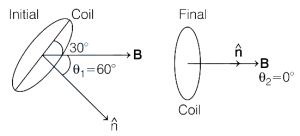
0 likes
View Solution298
DifficultMCQ
$A$ $10 \Omega$ coil of $180$ turns and diameter $4 \text{ cm}$ is placed in a uniform magnetic field so that the magnetic flux is maximum through the coil's cross-sectional area. When the field is suddenly removed, a charge of $360 \mu \text{C}$ flows through a $618 \Omega$ galvanometer connected to the coil. Find the magnetic field. (in $\text{ T}$)
A
$12$
B
$6$
C
$1$
D
$8$
Solution
(C) Given: Resistance of the coil, $R = 10 \Omega$. Number of turns, $N = 180$. Diameter of the coil, $d = 4 \text{ cm} = 4 \times 10^{-2} \text{ m}$. Radius, $r = 2 \times 10^{-2} \text{ m}$. Resistance of the galvanometer, $R_g = 618 \Omega$. Total resistance, $R_{eq} = R + R_g = 10 + 618 = 628 \Omega$. Charge, $q = 360 \mu \text{C} = 360 \times 10^{-6} \text{ C}$.
The magnetic flux is maximum, so $\phi = BA$.
The induced charge is given by $q = \frac{N \Delta \phi}{R_{eq}}$.
Since the field is removed, $\Delta \phi = BA - 0 = BA$.
Area $A = \pi r^2 = \pi (2 \times 10^{-2})^2 = 4 \pi \times 10^{-4} \text{ m}^2$.
Substituting the values: $360 \times 10^{-6} = \frac{180 \times B \times 4 \pi \times 10^{-4}}{628}$.
$B = \frac{360 \times 10^{-6} \times 628}{180 \times 4 \times 3.14 \times 10^{-4}} = \frac{2 \times 10^{-6} \times 628}{12.56 \times 10^{-4}} = \frac{1256 \times 10^{-6}}{1256 \times 10^{-4}} = 1 \text{ T}$.
The magnetic flux is maximum, so $\phi = BA$.
The induced charge is given by $q = \frac{N \Delta \phi}{R_{eq}}$.
Since the field is removed, $\Delta \phi = BA - 0 = BA$.
Area $A = \pi r^2 = \pi (2 \times 10^{-2})^2 = 4 \pi \times 10^{-4} \text{ m}^2$.
Substituting the values: $360 \times 10^{-6} = \frac{180 \times B \times 4 \pi \times 10^{-4}}{628}$.
$B = \frac{360 \times 10^{-6} \times 628}{180 \times 4 \times 3.14 \times 10^{-4}} = \frac{2 \times 10^{-6} \times 628}{12.56 \times 10^{-4}} = \frac{1256 \times 10^{-6}}{1256 \times 10^{-4}} = 1 \text{ T}$.
0 likes
View Solution299
EasyMCQ
In a closed circuit,there is only a coil of inductance $L$ and resistance $100 \Omega$. The coil is situated in a uniform magnetic field. Suddenly,the magnetic flux linked with the circuit changes by $5 \text{ Wb}$. What amount of charge will flow in the circuit as a result?
A
$500 \text{ C}$
B
$0.05 \text{ C}$
C
$20 \text{ C}$
D
Value of $L$ is required to find the charge flown
Solution
(B) According to Faraday's Law of electromagnetic induction,the induced electromotive force (Emf) is given by: $\epsilon = -\frac{d\phi}{dt}$.
Since the circuit has a resistance $R$,the induced current $i$ is: $i = \frac{\epsilon}{R} = -\frac{1}{R} \frac{d\phi}{dt}$.
We know that current $i = \frac{dq}{dt}$,where $dq$ is the small amount of charge flowing in time $dt$.
Substituting this,we get: $\frac{dq}{dt} = -\frac{1}{R} \frac{d\phi}{dt}$.
Integrating both sides,we find the total charge $q$ that flows:
$q = \int dq = -\frac{1}{R} \int d\phi = \frac{\Delta\phi}{R}$.
Given $\Delta\phi = 5 \text{ Wb}$ and $R = 100 \Omega$,the charge $q$ is:
$q = \frac{5}{100} = 0.05 \text{ C}$.
Since the circuit has a resistance $R$,the induced current $i$ is: $i = \frac{\epsilon}{R} = -\frac{1}{R} \frac{d\phi}{dt}$.
We know that current $i = \frac{dq}{dt}$,where $dq$ is the small amount of charge flowing in time $dt$.
Substituting this,we get: $\frac{dq}{dt} = -\frac{1}{R} \frac{d\phi}{dt}$.
Integrating both sides,we find the total charge $q$ that flows:
$q = \int dq = -\frac{1}{R} \int d\phi = \frac{\Delta\phi}{R}$.
Given $\Delta\phi = 5 \text{ Wb}$ and $R = 100 \Omega$,the charge $q$ is:
$q = \frac{5}{100} = 0.05 \text{ C}$.
0 likes
View SolutionElectromagnetic Induction — Faraday's and Lenz's Law · Frequently Asked Questions
1Are these Electromagnetic Induction questions useful for JEE and NEET?
Yes. All questions in this section are mapped to JEE Main and NEET exam patterns. Previous year questions from JEE Main, NEET, GUJCET and state-level exams are included with full solutions.
2Can I switch to Hindi or Gujarati for these questions?
Yes. Use the language tabs in the hero section or the sidebar to view the same questions and solutions in English, Hindi or Gujarati.
3How do I generate a question paper from this subtopic?
Use the Vedclass Exam Paper Generator — select the chapter and subtopic, set difficulty, and generate Sets A, B, C, D automatically. First 3 chapters of every subject are free.
Vedclass Products
For Students
Vedclass Test Series
Mock tests in real JEE/NEET style with performance analysis. 5-day free trial.
Start Free TrialFor Teachers
Exam Paper Generator
Generate Set A/B/C/D papers from this chapter in 2 minutes. 3 chapters free.
Try FreeFor Institutes
Online Exam Module
Live online exams with unlimited students, 360° analytics & white-label branding.
See DemoFor Teachers & Institutes
Generate a Electromagnetic Induction Exam Paper in 2 Minutes
Select subtopic & difficulty — Sets A, B, C, D auto-generated with No Repeat logic.
First 3 chapters of every subject are free — no payment required.