
A English
Faraday's and Lenz's Law Questions in English
Class 12 Physics · Electromagnetic Induction · Faraday's and Lenz's Law
310+
Questions
English
Language
100%
With Solutions
Showing 10 of 310 questions in English
301
MediumMCQ
$A$ magnetic field $B = 2t + 4t^{2}$ (where $t$ is time) is applied perpendicular to the plane of a circular wire of radius $r$ and resistance $R$. If all units are in $SI$,the electric charge that flows through the circular wire during $t = 0 \ s$ to $t = 2 \ s$ is:
A
$\frac{6 \pi r^{2}}{R}$
B
$\frac{20 \pi r^{2}}{R}$
C
$\frac{32 \pi r^{2}}{R}$
D
$\frac{48 \pi r^{2}}{R}$
Solution
(B) Given,$B = 2t + 4t^{2}$.
At $t = 0 \ s$,$B_{1} = 2(0) + 4(0)^{2} = 0 \ T$.
At $t = 2 \ s$,$B_{2} = 2(2) + 4(2)^{2} = 4 + 16 = 20 \ T$.
The magnetic flux is $\phi = B \cdot A = B \cdot \pi r^{2}$.
The change in magnetic flux is $\Delta \phi = \phi_{2} - \phi_{1} = \pi r^{2} (B_{2} - B_{1})$.
Substituting the values,$\Delta \phi = \pi r^{2} (20 - 0) = 20 \pi r^{2} \ Wb$.
The induced charge $Q$ is given by $Q = \frac{\Delta \phi}{R}$.
Therefore,$Q = \frac{20 \pi r^{2}}{R} \ C$.
At $t = 0 \ s$,$B_{1} = 2(0) + 4(0)^{2} = 0 \ T$.
At $t = 2 \ s$,$B_{2} = 2(2) + 4(2)^{2} = 4 + 16 = 20 \ T$.
The magnetic flux is $\phi = B \cdot A = B \cdot \pi r^{2}$.
The change in magnetic flux is $\Delta \phi = \phi_{2} - \phi_{1} = \pi r^{2} (B_{2} - B_{1})$.
Substituting the values,$\Delta \phi = \pi r^{2} (20 - 0) = 20 \pi r^{2} \ Wb$.
The induced charge $Q$ is given by $Q = \frac{\Delta \phi}{R}$.
Therefore,$Q = \frac{20 \pi r^{2}}{R} \ C$.
0 likes
View Solution302
EasyMCQ
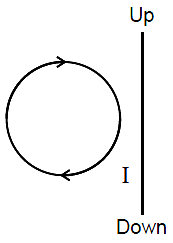
$A$ circular coil is placed near a current-carrying conductor,both lying on the plane of the paper. The current is flowing through the conductor in such a way that the induced current in the loop is clockwise,as shown in the figure. The current in the wire is,
A
time-dependent and downward.
B
steady and upward.
C
an alternating current.
D
None of these
Solution
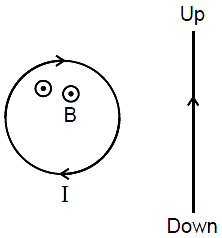
(D) According to the right-hand thumb rule,if the current in the wire flows upward,the magnetic field lines in the region of the coil are directed into the plane of the paper.
If the current in the wire flows downward,the magnetic field lines in the region of the coil are directed out of the plane of the paper.
For a clockwise induced current in the loop,the induced magnetic field must be directed into the plane of the paper (by the right-hand grip rule).
According to Lenz's law,the induced current opposes the change in magnetic flux.
Case $1$: If the current is flowing upward and increasing,the magnetic field into the plane increases,so the induced current will be counter-clockwise to oppose it. This does not match.
Case $2$: If the current is flowing upward and decreasing,the magnetic field into the plane decreases,so the induced current will be clockwise to support it.
Case $3$: If the current is flowing downward and increasing,the magnetic field out of the plane increases,so the induced current will be counter-clockwise to oppose it.
Case $4$: If the current is flowing downward and decreasing,the magnetic field out of the plane decreases,so the induced current will be clockwise to support it.
Since the current must be time-dependent to induce a current,and both decreasing upward current and decreasing downward current can produce a clockwise induced current,the most appropriate general description is that the current is time-dependent.
If the current in the wire flows downward,the magnetic field lines in the region of the coil are directed out of the plane of the paper.
For a clockwise induced current in the loop,the induced magnetic field must be directed into the plane of the paper (by the right-hand grip rule).
According to Lenz's law,the induced current opposes the change in magnetic flux.
Case $1$: If the current is flowing upward and increasing,the magnetic field into the plane increases,so the induced current will be counter-clockwise to oppose it. This does not match.
Case $2$: If the current is flowing upward and decreasing,the magnetic field into the plane decreases,so the induced current will be clockwise to support it.
Case $3$: If the current is flowing downward and increasing,the magnetic field out of the plane increases,so the induced current will be counter-clockwise to oppose it.
Case $4$: If the current is flowing downward and decreasing,the magnetic field out of the plane decreases,so the induced current will be clockwise to support it.
Since the current must be time-dependent to induce a current,and both decreasing upward current and decreasing downward current can produce a clockwise induced current,the most appropriate general description is that the current is time-dependent.
0 likes
View Solution303
EasyMCQ
The magnetic flux linked with a coil satisfies the relation $\phi = 4t^2 + 6t + 9 \text{ Wb}$, where $t$ is the time in seconds. The emf induced in the coil at $t = 2 \text{ s}$ is (in $\text{ V}$)
A
$22$
B
$18$
C
$16$
D
$40$
Solution
(A) Given the magnetic flux $\phi = 4t^2 + 6t + 9 \text{ Wb}$.
According to Faraday's law of electromagnetic induction, the induced emf $\varepsilon$ is given by $\varepsilon = -\frac{d\phi}{dt}$.
Taking the magnitude, $\varepsilon = \left| \frac{d\phi}{dt} \right|$.
Differentiating $\phi$ with respect to $t$:
$\frac{d\phi}{dt} = \frac{d}{dt}(4t^2 + 6t + 9) = 8t + 6$.
At $t = 2 \text{ s}$, the induced emf is:
$\varepsilon = 8(2) + 6 = 16 + 6 = 22 \text{ V}$.
According to Faraday's law of electromagnetic induction, the induced emf $\varepsilon$ is given by $\varepsilon = -\frac{d\phi}{dt}$.
Taking the magnitude, $\varepsilon = \left| \frac{d\phi}{dt} \right|$.
Differentiating $\phi$ with respect to $t$:
$\frac{d\phi}{dt} = \frac{d}{dt}(4t^2 + 6t + 9) = 8t + 6$.
At $t = 2 \text{ s}$, the induced emf is:
$\varepsilon = 8(2) + 6 = 16 + 6 = 22 \text{ V}$.
0 likes
View Solution304
EasyMCQ
The magnetic flux through a loop of resistance $10 \Omega$ is given by $\phi = 5t^2 - 4t + 1 \text{ Wb}$. How much current is induced in the loop after $0.2 \text{ s}$ (in $\text{ A}$)?
A
$0.4$
B
$0.2$
C
$0.04$
D
$0.02$
Solution
(B) Given: Magnetic flux $\phi = 5t^2 - 4t + 1 \text{ Wb}$ and resistance $R = 10 \Omega$.
According to Faraday's law of induction, the induced electromotive force $(EMF)$ is $e = -\frac{d\phi}{dt}$.
Differentiating $\phi$ with respect to $t$: $\frac{d\phi}{dt} = \frac{d}{dt}(5t^2 - 4t + 1) = 10t - 4$.
The induced current $I$ is given by $I = \frac{|e|}{R} = \frac{|-d\phi/dt|}{R} = \frac{|-(10t - 4)|}{10} = \frac{|4 - 10t|}{10}$.
At $t = 0.2 \text{ s}$, the current is $I = \frac{|4 - 10(0.2)|}{10} = \frac{|4 - 2|}{10} = \frac{2}{10} = 0.2 \text{ A}$.
According to Faraday's law of induction, the induced electromotive force $(EMF)$ is $e = -\frac{d\phi}{dt}$.
Differentiating $\phi$ with respect to $t$: $\frac{d\phi}{dt} = \frac{d}{dt}(5t^2 - 4t + 1) = 10t - 4$.
The induced current $I$ is given by $I = \frac{|e|}{R} = \frac{|-d\phi/dt|}{R} = \frac{|-(10t - 4)|}{10} = \frac{|4 - 10t|}{10}$.
At $t = 0.2 \text{ s}$, the current is $I = \frac{|4 - 10(0.2)|}{10} = \frac{|4 - 2|}{10} = \frac{2}{10} = 0.2 \text{ A}$.
0 likes
View Solution305
EasyMCQ
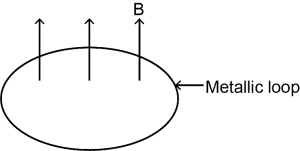
$A$ metallic loop is placed in a uniform magnetic field $B$ with the plane of the loop perpendicular to $B$. Under which condition will an electromotive force (emf) be induced in the loop? "If the loop is ....."
A
moved along the direction of $B$
B
squeezed to a smaller area
C
rotated about its axis
D
rotated about one of its diameters
Solution
(B, D) According to Faraday's law of electromagnetic induction, an emf is induced in a loop when the magnetic flux $\Phi = B \cdot A \cos \theta$ linked with the loop changes with time.
$1$. If the loop is moved along the direction of $B$, the magnetic field $B$, area $A$, and the angle $\theta$ remain constant. Thus, the flux remains constant, and no emf is induced.
$2$. If the loop is squeezed to a smaller area, the area $A$ changes with time. Therefore, the magnetic flux $\Phi$ changes, and an emf is induced.
$3$. If the loop is rotated about its axis, the orientation of the area vector relative to the magnetic field remains constant $(\theta = 0^\circ)$. Thus, the flux remains constant, and no emf is induced.
$4$. If the loop is rotated about one of its diameters, the angle $\theta$ between the magnetic field $B$ and the area vector changes with time. Therefore, the magnetic flux $\Phi$ changes, and an emf is induced.
Since both $(b)$ and $(d)$ result in a change in magnetic flux, both conditions will induce an emf.
$1$. If the loop is moved along the direction of $B$, the magnetic field $B$, area $A$, and the angle $\theta$ remain constant. Thus, the flux remains constant, and no emf is induced.
$2$. If the loop is squeezed to a smaller area, the area $A$ changes with time. Therefore, the magnetic flux $\Phi$ changes, and an emf is induced.
$3$. If the loop is rotated about its axis, the orientation of the area vector relative to the magnetic field remains constant $(\theta = 0^\circ)$. Thus, the flux remains constant, and no emf is induced.
$4$. If the loop is rotated about one of its diameters, the angle $\theta$ between the magnetic field $B$ and the area vector changes with time. Therefore, the magnetic flux $\Phi$ changes, and an emf is induced.
Since both $(b)$ and $(d)$ result in a change in magnetic flux, both conditions will induce an emf.
0 likes
View Solution306
MediumMCQ
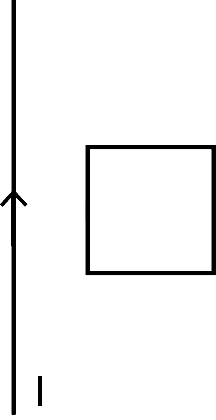
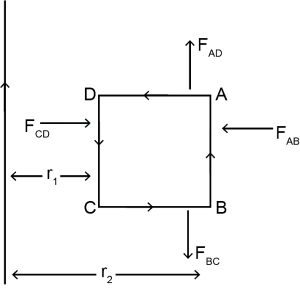
$A$ square conducting loop is placed near an infinitely long current-carrying wire with one edge parallel to the wire as shown in the figure. If the current in the straight wire is suddenly halved, which of the following statements will be true? "The loop will .......".
A
stay stationary
B
move towards the wire
C
move away from the wire
D
move parallel to the wire
Solution
(B) The magnetic field $B$ at a distance $x$ from an infinitely long wire carrying current $I$ is given by $B = \frac{\mu_0 I}{2 \pi x}$.
As the current $I$ in the wire is suddenly halved, the magnetic flux $\phi$ linked with the square loop decreases.
According to Lenz's law, the induced current in the loop will flow in such a direction as to oppose this decrease in magnetic flux. This means the induced current will create a magnetic field in the same direction as the original magnetic field.
For this to happen, the induced current in the loop must flow in the clockwise direction.
Now, consider the forces on the sides of the loop:
$1$. The side of the loop closer to the wire (let's call it $CD$) carries current in the same direction as the main wire. Thus, it experiences an attractive force $F_{CD}$ towards the wire.
$2$. The side of the loop farther from the wire (let's call it $AB$) carries current in the opposite direction to the main wire. Thus, it experiences a repulsive force $F_{AB}$ away from the wire.
Since the magnetic field is stronger closer to the wire, the attractive force on the closer side is greater than the repulsive force on the farther side $(F_{CD} > F_{AB})$.
Therefore, the net force on the loop is directed towards the wire, and the loop will move towards the wire.
As the current $I$ in the wire is suddenly halved, the magnetic flux $\phi$ linked with the square loop decreases.
According to Lenz's law, the induced current in the loop will flow in such a direction as to oppose this decrease in magnetic flux. This means the induced current will create a magnetic field in the same direction as the original magnetic field.
For this to happen, the induced current in the loop must flow in the clockwise direction.
Now, consider the forces on the sides of the loop:
$1$. The side of the loop closer to the wire (let's call it $CD$) carries current in the same direction as the main wire. Thus, it experiences an attractive force $F_{CD}$ towards the wire.
$2$. The side of the loop farther from the wire (let's call it $AB$) carries current in the opposite direction to the main wire. Thus, it experiences a repulsive force $F_{AB}$ away from the wire.
Since the magnetic field is stronger closer to the wire, the attractive force on the closer side is greater than the repulsive force on the farther side $(F_{CD} > F_{AB})$.
Therefore, the net force on the loop is directed towards the wire, and the loop will move towards the wire.
0 likes
View Solution307
DifficultMCQ
Suppose a long solenoid of $100 \ cm$ length,radius $2 \ cm$ having $500 \ turns/cm$ carries a current $I = 10 \sin(\omega t) \ A$,where $\omega = 1000 \ rad/s$. $A$ circular conducting loop $(B)$ of radius $1 \ cm$ is coaxially placed inside the solenoid. The r.m.s. current through the loop when the coil $B$ is inside the solenoid is $\alpha / \sqrt{2} \ \mu A$. The value of $\alpha$ is . . . . . . . [Resistance of the loop $= 10 \ \Omega$]
A
$197$
B
$80$
C
$280$
D
$100$
Solution
(A) The magnetic field inside the long solenoid is given by $B = \mu_0 n I$,where $n = 500 \ turns/cm = 50000 \ turns/m$.
Given $I = 10 \sin(\omega t)$,so $B = \mu_0 n (10 \sin(\omega t))$.
The magnetic flux through the loop of radius $r = 1 \ cm = 0.01 \ m$ is $\phi = B \cdot A = \mu_0 n (10 \sin(\omega t)) \cdot (\pi r^2)$.
The induced $EMF$ is $\varepsilon = -\frac{d\phi}{dt} = -\mu_0 n \pi r^2 (10 \omega \cos(\omega t))$.
The magnitude of induced current is $i = \frac{|\varepsilon|}{R} = \frac{\mu_0 n \pi r^2 (10 \omega \cos(\omega t))}{R}$.
The peak current is $i_0 = \frac{\mu_0 n \pi r^2 (10 \omega)}{R}$.
Substituting values: $\mu_0 = 4\pi \times 10^{-7} \ T\cdot m/A$,$n = 5 \times 10^4 \ m^{-1}$,$r = 10^{-2} \ m$,$\omega = 10^3 \ rad/s$,$R = 10 \ \Omega$.
$i_0 = \frac{(4\pi \times 10^{-7}) \times (5 \times 10^4) \times \pi \times (10^{-2})^2 \times 10 \times 10^3}{10} = 20 \pi^2 \times 10^{-6} \ A$.
$i_0 = 20 \times (9.8696) \times 10^{-6} \ A \approx 197.39 \ \mu A$.
The r.m.s. current is $i_{rms} = \frac{i_0}{\sqrt{2}} = \frac{197.39}{\sqrt{2}} \ \mu A$.
Thus,$\alpha \approx 197$.
Given $I = 10 \sin(\omega t)$,so $B = \mu_0 n (10 \sin(\omega t))$.
The magnetic flux through the loop of radius $r = 1 \ cm = 0.01 \ m$ is $\phi = B \cdot A = \mu_0 n (10 \sin(\omega t)) \cdot (\pi r^2)$.
The induced $EMF$ is $\varepsilon = -\frac{d\phi}{dt} = -\mu_0 n \pi r^2 (10 \omega \cos(\omega t))$.
The magnitude of induced current is $i = \frac{|\varepsilon|}{R} = \frac{\mu_0 n \pi r^2 (10 \omega \cos(\omega t))}{R}$.
The peak current is $i_0 = \frac{\mu_0 n \pi r^2 (10 \omega)}{R}$.
Substituting values: $\mu_0 = 4\pi \times 10^{-7} \ T\cdot m/A$,$n = 5 \times 10^4 \ m^{-1}$,$r = 10^{-2} \ m$,$\omega = 10^3 \ rad/s$,$R = 10 \ \Omega$.
$i_0 = \frac{(4\pi \times 10^{-7}) \times (5 \times 10^4) \times \pi \times (10^{-2})^2 \times 10 \times 10^3}{10} = 20 \pi^2 \times 10^{-6} \ A$.
$i_0 = 20 \times (9.8696) \times 10^{-6} \ A \approx 197.39 \ \mu A$.
The r.m.s. current is $i_{rms} = \frac{i_0}{\sqrt{2}} = \frac{197.39}{\sqrt{2}} \ \mu A$.
Thus,$\alpha \approx 197$.
0 likes
View Solution308
DifficultMCQ
$A$ circular loop of radius $7 \ cm$ is placed in a uniform magnetic field of $0.2 \ T$ directed perpendicular to the plane of the loop. The loop is converted into a square loop in $0.5 \ s$. The $EMF$ induced in the loop is . . . . . . $mV$.
A
$6.6$
B
$13.2$
C
$8.25$
D
$1.32$
Solution
(D) The radius of the circular loop is $r = 7 \ cm = 0.07 \ m$. The area of the circular loop is $A_1 = \pi r^2 = \pi (0.07)^2 = 0.0049 \pi \ m^2$.
The circumference of the loop is $C = 2 \pi r = 2 \pi (0.07) = 0.14 \pi \ m$.
When converted to a square loop,the perimeter remains the same. Let the side of the square be $a$. Then $4a = 0.14 \pi$,so $a = 0.035 \pi \ m$.
The area of the square loop is $A_2 = a^2 = (0.035 \pi)^2 = 0.001225 \pi^2 \ m^2$.
The change in magnetic flux is $\Delta \phi = B(A_1 - A_2) = 0.2 \times (0.0049 \pi - 0.001225 \pi^2)$.
Using $\pi \approx 3.14159$,$A_1 \approx 0.01539 \ m^2$ and $A_2 \approx 0.01208 \ m^2$.
$\Delta \phi = 0.2 \times (0.01539 - 0.01208) = 0.2 \times 0.00331 = 0.000662 \ Wb$.
The induced $EMF$ is $\epsilon = \frac{|\Delta \phi|}{\Delta t} = \frac{0.000662}{0.5} = 0.001324 \ V$.
Converting to $mV$,$\epsilon = 1.324 \ mV \approx 1.32 \ mV$.
The circumference of the loop is $C = 2 \pi r = 2 \pi (0.07) = 0.14 \pi \ m$.
When converted to a square loop,the perimeter remains the same. Let the side of the square be $a$. Then $4a = 0.14 \pi$,so $a = 0.035 \pi \ m$.
The area of the square loop is $A_2 = a^2 = (0.035 \pi)^2 = 0.001225 \pi^2 \ m^2$.
The change in magnetic flux is $\Delta \phi = B(A_1 - A_2) = 0.2 \times (0.0049 \pi - 0.001225 \pi^2)$.
Using $\pi \approx 3.14159$,$A_1 \approx 0.01539 \ m^2$ and $A_2 \approx 0.01208 \ m^2$.
$\Delta \phi = 0.2 \times (0.01539 - 0.01208) = 0.2 \times 0.00331 = 0.000662 \ Wb$.
The induced $EMF$ is $\epsilon = \frac{|\Delta \phi|}{\Delta t} = \frac{0.000662}{0.5} = 0.001324 \ V$.
Converting to $mV$,$\epsilon = 1.324 \ mV \approx 1.32 \ mV$.
0 likes
View Solution309
MediumMCQ
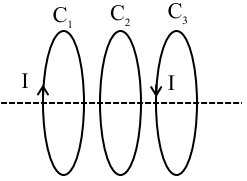
Three identical coils $C_1, C_2$ and $C_3$ are placed coaxially. $C_2$ is exactly midway between $C_1$ and $C_3$. $C_1$ carries current $I$ in an anti-clockwise direction,while $C_3$ carries current $I$ in a clockwise direction. An induced current flows through $C_2$ in a clockwise direction when:
A
$C_1$ and $C_3$ move with equal speeds away from $C_2$
B
$C_1$ moves towards $C_2$ and $C_3$ moves away from $C_2$
C
$C_1$ moves away from $C_2$ and $C_3$ moves towards $C_2$
D
$C_1$ and $C_3$ move with equal speeds towards $C_2$
Solution
(B) The magnetic field at the center of $C_2$ due to $C_1$ (anti-clockwise) is directed towards the right,and the magnetic field due to $C_3$ (clockwise) is directed towards the left. Since the coils are identical and $C_2$ is midway,the net magnetic field at $C_2$ is zero.
If $C_1$ moves towards $C_2$,the magnetic field from $C_1$ at $C_2$ increases (directed right). To oppose this,$C_2$ induces a current to create a magnetic field towards the left (clockwise).
If $C_3$ moves away from $C_2$,the magnetic field from $C_3$ at $C_2$ decreases (directed left). To oppose this decrease,$C_2$ induces a current to create a magnetic field towards the left (clockwise).
Thus,if $C_1$ moves towards $C_2$ and $C_3$ moves away from $C_2$,the net flux change induces a clockwise current in $C_2$.
If $C_1$ moves towards $C_2$,the magnetic field from $C_1$ at $C_2$ increases (directed right). To oppose this,$C_2$ induces a current to create a magnetic field towards the left (clockwise).
If $C_3$ moves away from $C_2$,the magnetic field from $C_3$ at $C_2$ decreases (directed left). To oppose this decrease,$C_2$ induces a current to create a magnetic field towards the left (clockwise).
Thus,if $C_1$ moves towards $C_2$ and $C_3$ moves away from $C_2$,the net flux change induces a clockwise current in $C_2$.
0 likes
View Solution310
MediumMCQ
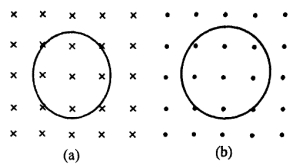
As shown in the figure,two identical conducting rings of radius $r$ are placed in a magnetic field. In figure $(a)$,the magnetic field is increasing at the rate of $0.3 \text{ T/s}$,and in figure $(b)$,the magnetic field is decreasing at the rate of $0.2 \text{ T/s}$. The direction of the current in ring $(a)$ and ring $(b)$,when observed from the top,is . . . . . .
A
Clockwise,Anticlockwise
B
Anticlockwise,Anticlockwise
C
Clockwise,Clockwise
D
Anticlockwise,Clockwise
Solution
According to Lenz's law, the induced current creates a magnetic field that opposes the change in magnetic flux.
In figure (a), the magnetic field is directed into the page $(\times)$ and is increasing. To oppose this increase, the induced current must create a magnetic field directed out of the page $(\bullet)$. According to the right-hand rule, an outward magnetic field corresponds to an anticlockwise current.
In figure (b), the magnetic field is directed out of the page $(\bullet)$ and is decreasing. To oppose this decrease, the induced current must create a magnetic field into the page $(\times)$. According to the right-hand rule, this corresponds to a clockwise current.
Therefore, the direction of current in ring (a) is anticlockwise and in ring (b) is clockwise.
In figure (a), the magnetic field is directed into the page $(\times)$ and is increasing. To oppose this increase, the induced current must create a magnetic field directed out of the page $(\bullet)$. According to the right-hand rule, an outward magnetic field corresponds to an anticlockwise current.
In figure (b), the magnetic field is directed out of the page $(\bullet)$ and is decreasing. To oppose this decrease, the induced current must create a magnetic field into the page $(\times)$. According to the right-hand rule, this corresponds to a clockwise current.
Therefore, the direction of current in ring (a) is anticlockwise and in ring (b) is clockwise.
0 likes
View SolutionElectromagnetic Induction — Faraday's and Lenz's Law · Frequently Asked Questions
1Are these Electromagnetic Induction questions useful for JEE and NEET?
Yes. All questions in this section are mapped to JEE Main and NEET exam patterns. Previous year questions from JEE Main, NEET, GUJCET and state-level exams are included with full solutions.
2Can I switch to Hindi or Gujarati for these questions?
Yes. Use the language tabs in the hero section or the sidebar to view the same questions and solutions in English, Hindi or Gujarati.
3How do I generate a question paper from this subtopic?
Use the Vedclass Exam Paper Generator — select the chapter and subtopic, set difficulty, and generate Sets A, B, C, D automatically. First 3 chapters of every subject are free.
Vedclass Products
For Students
Vedclass Test Series
Mock tests in real JEE/NEET style with performance analysis. 5-day free trial.
Start Free TrialFor Teachers
Exam Paper Generator
Generate Set A/B/C/D papers from this chapter in 2 minutes. 3 chapters free.
Try FreeFor Institutes
Online Exam Module
Live online exams with unlimited students, 360° analytics & white-label branding.
See DemoFor Teachers & Institutes
Generate a Electromagnetic Induction Exam Paper in 2 Minutes
Select subtopic & difficulty — Sets A, B, C, D auto-generated with No Repeat logic.
First 3 chapters of every subject are free — no payment required.