
A English
Parallel Plate Capacitor Questions in English
Class 12 Physics · Electric Potential and Capacitance · Parallel Plate Capacitor
130+
Questions
English
Language
100%
With Solutions
Showing 29 of 130 questions in English
101
DifficultMCQ
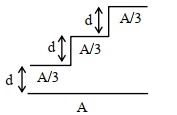
$A$ capacitor is made of a flat plate of area $A$ and a second plate having a stair-like structure as shown in the figure. If the area of each stair is $\frac{A}{3}$ and the height of each step is $d$,the capacitance of the arrangement is:
A
$\frac{11 \varepsilon_0 A}{18 d}$
B
$\frac{13 \varepsilon_0 A}{17 d}$
C
$\frac{11 \varepsilon_0 A}{20 d}$
D
$\frac{18 \varepsilon_0 A}{11 d}$
Solution
(A) The arrangement can be viewed as three capacitors connected in parallel,each having an area of $\frac{A}{3}$ but different plate separations.
For the first capacitor,the separation is $d$. Its capacitance is $C_1 = \frac{\varepsilon_0 (A/3)}{d} = \frac{\varepsilon_0 A}{3d}$.
For the second capacitor,the separation is $2d$. Its capacitance is $C_2 = \frac{\varepsilon_0 (A/3)}{2d} = \frac{\varepsilon_0 A}{6d}$.
For the third capacitor,the separation is $3d$. Its capacitance is $C_3 = \frac{\varepsilon_0 (A/3)}{3d} = \frac{\varepsilon_0 A}{9d}$.
Since they are in parallel,the equivalent capacitance is $C_{eq} = C_1 + C_2 + C_3$.
$C_{eq} = \frac{\varepsilon_0 A}{3d} + \frac{\varepsilon_0 A}{6d} + \frac{\varepsilon_0 A}{9d} = \frac{\varepsilon_0 A}{d} \left( \frac{1}{3} + \frac{1}{6} + \frac{1}{9} \right)$.
Taking the least common multiple of $3, 6, 9$,which is $18$:
$C_{eq} = \frac{\varepsilon_0 A}{d} \left( \frac{6 + 3 + 2}{18} \right) = \frac{11 \varepsilon_0 A}{18 d}$.
For the first capacitor,the separation is $d$. Its capacitance is $C_1 = \frac{\varepsilon_0 (A/3)}{d} = \frac{\varepsilon_0 A}{3d}$.
For the second capacitor,the separation is $2d$. Its capacitance is $C_2 = \frac{\varepsilon_0 (A/3)}{2d} = \frac{\varepsilon_0 A}{6d}$.
For the third capacitor,the separation is $3d$. Its capacitance is $C_3 = \frac{\varepsilon_0 (A/3)}{3d} = \frac{\varepsilon_0 A}{9d}$.
Since they are in parallel,the equivalent capacitance is $C_{eq} = C_1 + C_2 + C_3$.
$C_{eq} = \frac{\varepsilon_0 A}{3d} + \frac{\varepsilon_0 A}{6d} + \frac{\varepsilon_0 A}{9d} = \frac{\varepsilon_0 A}{d} \left( \frac{1}{3} + \frac{1}{6} + \frac{1}{9} \right)$.
Taking the least common multiple of $3, 6, 9$,which is $18$:
$C_{eq} = \frac{\varepsilon_0 A}{d} \left( \frac{6 + 3 + 2}{18} \right) = \frac{11 \varepsilon_0 A}{18 d}$.
0 likes
View Solution102
MediumMCQ
If the plates of a parallel plate capacitor connected to a battery are moved close to each other,then
$A$. the charge stored in it,increases.
$B$. the energy stored in it,decreases.
$C$. its capacitance increases.
$D$. the ratio of charge to its potential remains the same.
$E$. the product of charge and voltage increases.
Choose the most appropriate answer from the options given below:
$A$. the charge stored in it,increases.
$B$. the energy stored in it,decreases.
$C$. its capacitance increases.
$D$. the ratio of charge to its potential remains the same.
$E$. the product of charge and voltage increases.
Choose the most appropriate answer from the options given below:
A
$A, C$ and $E$ only
B
$B, D$ and $E$ only
C
$A, B$ and $C$ only
D
$A, B$ and $E$ only
Solution
(A) Given that the capacitor is connected to a battery,the potential difference $V$ remains constant.
$(i)$ Capacitance $C = \frac{\varepsilon_0 A}{d}$. As the plates are moved closer,the distance $d$ decreases,so the capacitance $C$ increases. Thus,statement $C$ is correct.
$(ii)$ Charge $Q = CV$. Since $C$ increases and $V$ is constant,the charge $Q$ increases. Thus,statement $A$ is correct.
$(iii)$ Energy stored $U = \frac{1}{2}CV^2$. Since $C$ increases and $V$ is constant,the energy $U$ increases. Thus,statement $B$ is incorrect.
$(iv)$ The ratio of charge to potential is $\frac{Q}{V} = C$. Since $C$ increases,the ratio $\frac{Q}{V}$ changes. Thus,statement $D$ is incorrect.
$(v)$ The product of charge and voltage is $QV = CV^2$. Since $C$ increases and $V$ is constant,the product $QV$ increases. Thus,statement $E$ is correct.
Therefore,statements $A, C,$ and $E$ are correct.
$(i)$ Capacitance $C = \frac{\varepsilon_0 A}{d}$. As the plates are moved closer,the distance $d$ decreases,so the capacitance $C$ increases. Thus,statement $C$ is correct.
$(ii)$ Charge $Q = CV$. Since $C$ increases and $V$ is constant,the charge $Q$ increases. Thus,statement $A$ is correct.
$(iii)$ Energy stored $U = \frac{1}{2}CV^2$. Since $C$ increases and $V$ is constant,the energy $U$ increases. Thus,statement $B$ is incorrect.
$(iv)$ The ratio of charge to potential is $\frac{Q}{V} = C$. Since $C$ increases,the ratio $\frac{Q}{V}$ changes. Thus,statement $D$ is incorrect.
$(v)$ The product of charge and voltage is $QV = CV^2$. Since $C$ increases and $V$ is constant,the product $QV$ increases. Thus,statement $E$ is correct.
Therefore,statements $A, C,$ and $E$ are correct.
0 likes
View Solution103
MediumMCQ
$A$ parallel plate capacitor was made with two rectangular plates,each with a length of $l=3 \ cm$ and breadth of $b=1 \ cm$. The distance between the plates is $d=3 \ \mu m$. Out of the following,which are the ways to increase the capacitance by a factor of $10$?
$A. l=30 \ cm, b=1 \ cm, d=1 \ \mu m$
$B. l=3 \ cm, b=1 \ cm, d=30 \ \mu m$
$C. l=6 \ cm, b=5 \ cm, d=3 \ \mu m$
$D. l=1 \ cm, b=1 \ cm, d=10 \ \mu m$
$E. l=5 \ cm, b=2 \ cm, d=1 \ \mu m$
Choose the correct answer from the options given below:
$A. l=30 \ cm, b=1 \ cm, d=1 \ \mu m$
$B. l=3 \ cm, b=1 \ cm, d=30 \ \mu m$
$C. l=6 \ cm, b=5 \ cm, d=3 \ \mu m$
$D. l=1 \ cm, b=1 \ cm, d=10 \ \mu m$
$E. l=5 \ cm, b=2 \ cm, d=1 \ \mu m$
Choose the correct answer from the options given below:
A
$C$ and $E$ only
B
$B$ and $D$ only
C
$A$ only
D
$C$ only
Solution
(A) The capacitance of a parallel plate capacitor is given by $C = \frac{\epsilon_0 A}{d}$,where $A = l \times b$ is the area of the plates and $d$ is the distance between them.
Initial capacitance $C_i = \frac{\epsilon_0 (3 \ cm \times 1 \ cm)}{3 \ \mu m} = \epsilon_0 \times 10^4 \ cm^2/m$.
We want the new capacitance $C_f = 10 C_i$.
For option $A$: $C_A = \frac{\epsilon_0 (30 \times 1)}{1} = 30 C_i$ (Incorrect).
For option $B$: $C_B = \frac{\epsilon_0 (3 \times 1)}{30} = 0.1 C_i$ (Incorrect).
For option $C$: $C_C = \frac{\epsilon_0 (6 \times 5)}{3} = 10 C_i$ (Correct).
For option $D$: $C_D = \frac{\epsilon_0 (1 \times 1)}{10} = 0.033 C_i$ (Incorrect).
For option $E$: $C_E = \frac{\epsilon_0 (5 \times 2)}{1} = 10 C_i$ (Correct).
Thus,options $C$ and $E$ increase the capacitance by a factor of $10$.
Initial capacitance $C_i = \frac{\epsilon_0 (3 \ cm \times 1 \ cm)}{3 \ \mu m} = \epsilon_0 \times 10^4 \ cm^2/m$.
We want the new capacitance $C_f = 10 C_i$.
For option $A$: $C_A = \frac{\epsilon_0 (30 \times 1)}{1} = 30 C_i$ (Incorrect).
For option $B$: $C_B = \frac{\epsilon_0 (3 \times 1)}{30} = 0.1 C_i$ (Incorrect).
For option $C$: $C_C = \frac{\epsilon_0 (6 \times 5)}{3} = 10 C_i$ (Correct).
For option $D$: $C_D = \frac{\epsilon_0 (1 \times 1)}{10} = 0.033 C_i$ (Incorrect).
For option $E$: $C_E = \frac{\epsilon_0 (5 \times 2)}{1} = 10 C_i$ (Correct).
Thus,options $C$ and $E$ increase the capacitance by a factor of $10$.
0 likes
View Solution104
MediumMCQ
$A$ parallel plate capacitor consisting of two circular plates of radius $10 \ cm$ is being charged by a constant current of $0.15 \ A$. If the rate of change of potential difference between the plates is $7 \times 10^8 \ V/s$,then the integer value of the distance between the parallel plates is $—$ (Take $\epsilon_0 = 9 \times 10^{-12} \ F/m, \pi = 22/7$) . . . . . . $\mu m$.
A
$1350$
B
$1320$
C
$1340$
D
$1325$
Solution
(B) The capacitance of a parallel plate capacitor is given by $C = \frac{\epsilon_0 A}{d}$,where $A = \pi r^2$.
Given $V = \frac{Q}{C}$,we have $V = \frac{Q d}{\epsilon_0 A}$.
Differentiating with respect to time $t$,we get $\frac{dV}{dt} = \frac{d}{dt} \left( \frac{Q d}{\epsilon_0 A} \right) = \frac{d}{\epsilon_0 A} \frac{dQ}{dt}$.
Since $\frac{dQ}{dt} = I$,the rate of change of potential difference is $\frac{dV}{dt} = \frac{I d}{\epsilon_0 A}$.
Rearranging for $d$,we get $d = \frac{\epsilon_0 A (dV/dt)}{I} = \frac{\epsilon_0 (\pi r^2) (dV/dt)}{I}$.
Substituting the given values: $r = 0.1 \ m$,$I = 0.15 \ A$,$\frac{dV}{dt} = 7 \times 10^8 \ V/s$,$\epsilon_0 = 9 \times 10^{-12} \ F/m$,and $\pi = 22/7$.
$d = \frac{(9 \times 10^{-12}) \times (22/7) \times (0.1)^2 \times (7 \times 10^8)}{0.15} \ m$.
$d = \frac{9 \times 10^{-12} \times 22 \times 0.01 \times 10^8}{0.15} \ m = \frac{9 \times 22 \times 10^{-6}}{0.15} \ m = \frac{198 \times 10^{-6}}{0.15} \ m = 1320 \times 10^{-6} \ m$.
Since $1 \ \mu m = 10^{-6} \ m$,the distance $d = 1320 \ \mu m$.
Given $V = \frac{Q}{C}$,we have $V = \frac{Q d}{\epsilon_0 A}$.
Differentiating with respect to time $t$,we get $\frac{dV}{dt} = \frac{d}{dt} \left( \frac{Q d}{\epsilon_0 A} \right) = \frac{d}{\epsilon_0 A} \frac{dQ}{dt}$.
Since $\frac{dQ}{dt} = I$,the rate of change of potential difference is $\frac{dV}{dt} = \frac{I d}{\epsilon_0 A}$.
Rearranging for $d$,we get $d = \frac{\epsilon_0 A (dV/dt)}{I} = \frac{\epsilon_0 (\pi r^2) (dV/dt)}{I}$.
Substituting the given values: $r = 0.1 \ m$,$I = 0.15 \ A$,$\frac{dV}{dt} = 7 \times 10^8 \ V/s$,$\epsilon_0 = 9 \times 10^{-12} \ F/m$,and $\pi = 22/7$.
$d = \frac{(9 \times 10^{-12}) \times (22/7) \times (0.1)^2 \times (7 \times 10^8)}{0.15} \ m$.
$d = \frac{9 \times 10^{-12} \times 22 \times 0.01 \times 10^8}{0.15} \ m = \frac{9 \times 22 \times 10^{-6}}{0.15} \ m = \frac{198 \times 10^{-6}}{0.15} \ m = 1320 \times 10^{-6} \ m$.
Since $1 \ \mu m = 10^{-6} \ m$,the distance $d = 1320 \ \mu m$.
0 likes
View Solution105
MediumMCQ
$A$ parallel plate air capacitor has capacity $C$ and separation between the plates is $d$. $A$ potential difference $V$ is applied between the plates. The force of attraction between the plates of the parallel plate air capacitor is:
A
$\frac{C^2 V^2}{2 d^2}$
B
$\frac{C^2 V^2}{2 d}$
C
$\frac{C V^2}{2 d}$
D
$\frac{C V^2}{d}$
Solution
(C) The force of attraction between the plates of a parallel plate capacitor is given by the formula $F = \frac{Q^2}{2 \varepsilon_0 A}$.
Since the charge $Q = CV$ and the capacitance $C = \frac{\varepsilon_0 A}{d}$,we can write $\varepsilon_0 A = Cd$.
Substituting these values into the force equation:
$F = \frac{(CV)^2}{2(Cd)} = \frac{C^2 V^2}{2 Cd} = \frac{CV^2}{2 d}$.
Since the charge $Q = CV$ and the capacitance $C = \frac{\varepsilon_0 A}{d}$,we can write $\varepsilon_0 A = Cd$.
Substituting these values into the force equation:
$F = \frac{(CV)^2}{2(Cd)} = \frac{C^2 V^2}{2 Cd} = \frac{CV^2}{2 d}$.
0 likes
View Solution106
EasyMCQ
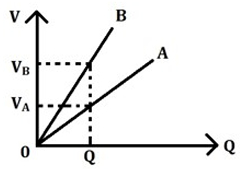
The graph shows the variation of voltage $(V)$ across the plates of two parallel plate capacitors $A$ and $B$ versus the charge $(Q)$ stored in them. Then
A
capacity of both capacitors is same.
B
capacity of $A$ is higher than $B$.
C
capacity of $B$ is higher than $A$.
D
capacity of both is zero.
Solution
(B) The relationship between charge $(Q)$,voltage $(V)$,and capacitance $(C)$ is given by $Q = CV$,which can be rearranged as $V = Q/C$.
In the given graph,voltage $(V)$ is plotted on the $y$-axis and charge $(Q)$ is plotted on the $x$-axis.
The slope of this graph is $V/Q = 1/C$.
From the graph,for a fixed charge $Q$,the voltage $V_B > V_A$.
Since the slope is inversely proportional to capacitance $(C)$,a higher slope corresponds to a lower capacitance.
Therefore,the slope of line $B$ is greater than the slope of line $A$,which implies that the capacitance of $A$ is greater than the capacitance of $B$ $(C_A > C_B)$.
In the given graph,voltage $(V)$ is plotted on the $y$-axis and charge $(Q)$ is plotted on the $x$-axis.
The slope of this graph is $V/Q = 1/C$.
From the graph,for a fixed charge $Q$,the voltage $V_B > V_A$.
Since the slope is inversely proportional to capacitance $(C)$,a higher slope corresponds to a lower capacitance.
Therefore,the slope of line $B$ is greater than the slope of line $A$,which implies that the capacitance of $A$ is greater than the capacitance of $B$ $(C_A > C_B)$.
0 likes
View Solution107
MediumMCQ
Two identical metal plates are given charges $q_1$ and $q_2$ $(q_2 < q_1)$ respectively. If they are now brought close together to form a parallel plate capacitor with capacitance $C$,the potential difference $V$ between the plates is
A
$\frac{q_1-q_2}{C}$
B
$\frac{q_1+q_2}{C}$
C
$\frac{q_1-q_2}{2C}$
D
$\frac{q_1+q_2}{2C}$
Solution
(C) When two charged plates with charges $q_1$ and $q_2$ are brought close to form a parallel plate capacitor,the charge on the inner faces of the plates becomes $q_{inner} = \frac{q_1 - q_2}{2}$.
This is because the total charge on the inner surfaces must be equal and opposite to create a uniform electric field between the plates.
The potential difference $V$ across a capacitor is given by the formula $V = \frac{Q}{C}$,where $Q$ is the magnitude of the charge on the inner face of the capacitor plates.
Substituting $Q = \frac{q_1 - q_2}{2}$,we get $V = \frac{q_1 - q_2}{2C}$.
Therefore,the correct option is $C$.
This is because the total charge on the inner surfaces must be equal and opposite to create a uniform electric field between the plates.
The potential difference $V$ across a capacitor is given by the formula $V = \frac{Q}{C}$,where $Q$ is the magnitude of the charge on the inner face of the capacitor plates.
Substituting $Q = \frac{q_1 - q_2}{2}$,we get $V = \frac{q_1 - q_2}{2C}$.
Therefore,the correct option is $C$.
0 likes
View Solution108
MediumMCQ
Two circular metal plates each of radius '$r$' are kept parallel to each other at a distance '$d$' apart. The capacitance of the capacitor formed is '$C_1$'. If the radius of each of the plates is increased to $\sqrt{2}$ times the earlier radius and their distance of separation is decreased to half the initial value,the capacitance now becomes '$C_2$'. The ratio of the capacitances $C_1: C_2$ is:
A
$1: 1$
B
$1: 2$
C
$1: 4$
D
$4: 1$
Solution
(C) For the $1^{\text{st}}$ capacitor,the capacitance is given by $C_1 = \frac{\varepsilon_0 A_1}{d} = \frac{\varepsilon_0 \pi r^2}{d}$.
For the $2^{\text{nd}}$ capacitor,the new radius is $r' = \sqrt{2}r$ and the new distance is $d' = \frac{d}{2}$.
The new area is $A_2 = \pi (r')^2 = \pi (\sqrt{2}r)^2 = 2\pi r^2$.
The new capacitance is $C_2 = \frac{\varepsilon_0 A_2}{d'} = \frac{\varepsilon_0 (2\pi r^2)}{d/2} = \frac{4\varepsilon_0 \pi r^2}{d} = 4C_1$.
Therefore,the ratio $\frac{C_1}{C_2} = \frac{C_1}{4C_1} = \frac{1}{4}$.
For the $2^{\text{nd}}$ capacitor,the new radius is $r' = \sqrt{2}r$ and the new distance is $d' = \frac{d}{2}$.
The new area is $A_2 = \pi (r')^2 = \pi (\sqrt{2}r)^2 = 2\pi r^2$.
The new capacitance is $C_2 = \frac{\varepsilon_0 A_2}{d'} = \frac{\varepsilon_0 (2\pi r^2)}{d/2} = \frac{4\varepsilon_0 \pi r^2}{d} = 4C_1$.
Therefore,the ratio $\frac{C_1}{C_2} = \frac{C_1}{4C_1} = \frac{1}{4}$.
0 likes
View Solution109
EasyMCQ
Two parallel air capacitors have their plate areas $100 \,cm^2$ and $500 \,cm^2$, respectively. They have the same charge and potential. If the distance between the plates of the first capacitor is $0.5 \,mm$, the distance between the plates of the second capacitor is (in $\,cm$)
A
$1$
B
$0.75$
C
$0.25$
D
$0.52$
Solution
(C) Given that the two parallel plate capacitors have the same charge $q$ and the same potential $V$, their capacitances must be equal because $C = q/V$.
Therefore, $C_1 = C_2$.
The formula for the capacitance of a parallel plate capacitor is $C = \frac{\varepsilon_0 A}{d}$.
Equating the two capacitances: $\frac{\varepsilon_0 A_1}{d_1} = \frac{\varepsilon_0 A_2}{d_2}$.
This simplifies to $d_2 = \frac{A_2}{A_1} d_1$.
Given $A_1 = 100 \,cm^2$, $A_2 = 500 \,cm^2$, and $d_1 = 0.5 \,mm = 0.05 \,cm$.
Substituting these values: $d_2 = \frac{500}{100} \times 0.05 \,cm = 5 \times 0.05 \,cm = 0.25 \,cm$.
Therefore, $C_1 = C_2$.
The formula for the capacitance of a parallel plate capacitor is $C = \frac{\varepsilon_0 A}{d}$.
Equating the two capacitances: $\frac{\varepsilon_0 A_1}{d_1} = \frac{\varepsilon_0 A_2}{d_2}$.
This simplifies to $d_2 = \frac{A_2}{A_1} d_1$.
Given $A_1 = 100 \,cm^2$, $A_2 = 500 \,cm^2$, and $d_1 = 0.5 \,mm = 0.05 \,cm$.
Substituting these values: $d_2 = \frac{500}{100} \times 0.05 \,cm = 5 \times 0.05 \,cm = 0.25 \,cm$.
0 likes
View Solution110
EasyMCQ
The plates of a parallel plate capacitor of capacity $C_1$ are moved closer together until they are half their original separation. The new capacitance $C_2$ is
A
$C_2 = \frac{C_1}{2}$
B
$C_2 = C_1$
C
$C_2 = 2C_1$
D
$C_2 = 4C_1$
Solution
(C) The capacitance of a parallel plate capacitor is given by the formula $C = \frac{k A \varepsilon_0}{d}$, where $k$ is the dielectric constant, $A$ is the area of the plates, $\varepsilon_0$ is the permittivity of free space, and $d$ is the separation between the plates.
Initially, the capacitance is $C_1 = \frac{k A \varepsilon_0}{d}$.
When the plates are moved closer such that the new separation $d' = \frac{d}{2}$, the new capacitance $C_2$ becomes:
$C_2 = \frac{k A \varepsilon_0}{d'} = \frac{k A \varepsilon_0}{d/2} = 2 \left( \frac{k A \varepsilon_0}{d} \right)$.
Substituting $C_1$ into the equation, we get $C_2 = 2C_1$.
Initially, the capacitance is $C_1 = \frac{k A \varepsilon_0}{d}$.
When the plates are moved closer such that the new separation $d' = \frac{d}{2}$, the new capacitance $C_2$ becomes:
$C_2 = \frac{k A \varepsilon_0}{d'} = \frac{k A \varepsilon_0}{d/2} = 2 \left( \frac{k A \varepsilon_0}{d} \right)$.
Substituting $C_1$ into the equation, we get $C_2 = 2C_1$.
0 likes
View Solution111
MediumMCQ
If the distance between the plates of a parallel plate capacitor of capacity $10 \mu F$ is doubled,then the new capacity will be: (in $\mu F$)
A
$5$
B
$20$
C
$10$
D
$15$
Solution
(A) The capacitance $C$ of a parallel plate capacitor is given by the formula:
$C = \frac{\varepsilon_{0} A}{d}$
where $A$ is the area of the plates and $d$ is the distance between them.
Given the initial capacity $C = 10 \mu F$.
If the distance is doubled,the new distance $d' = 2d$.
The new capacitance $C'$ is:
$C' = \frac{\varepsilon_{0} A}{d'} = \frac{\varepsilon_{0} A}{2d}$
Substituting the initial capacitance expression:
$C' = \frac{C}{2}$
$C' = \frac{10 \mu F}{2} = 5 \mu F$
Therefore,the new capacity is $5 \mu F$.
$C = \frac{\varepsilon_{0} A}{d}$
where $A$ is the area of the plates and $d$ is the distance between them.
Given the initial capacity $C = 10 \mu F$.
If the distance is doubled,the new distance $d' = 2d$.
The new capacitance $C'$ is:
$C' = \frac{\varepsilon_{0} A}{d'} = \frac{\varepsilon_{0} A}{2d}$
Substituting the initial capacitance expression:
$C' = \frac{C}{2}$
$C' = \frac{10 \mu F}{2} = 5 \mu F$
Therefore,the new capacity is $5 \mu F$.
0 likes
View Solution112
EasyMCQ
In a parallel plate capacitor,the capacity increases if
A
area of the plate is decreased
B
distance between the plates increases
C
area of the plate is increased
D
dielectric constant decreases
Solution
(C) The capacitance $C$ of a parallel plate capacitor is given by the formula:
$C = \frac{k \varepsilon_{0} A}{d}$
where $k$ is the dielectric constant,$\varepsilon_{0}$ is the permittivity of free space,$A$ is the area of the plates,and $d$ is the distance between the plates.
From the formula,we can see that $C \propto A$.
Therefore,the capacity of the capacitor increases if the area of the plate is increased.
$C = \frac{k \varepsilon_{0} A}{d}$
where $k$ is the dielectric constant,$\varepsilon_{0}$ is the permittivity of free space,$A$ is the area of the plates,and $d$ is the distance between the plates.
From the formula,we can see that $C \propto A$.
Therefore,the capacity of the capacitor increases if the area of the plate is increased.
0 likes
View Solution113
EasyMCQ
In a parallel plate capacitor,the capacity can be increased by decreasing
A
permeability of the medium.
B
value of dielectric constant.
C
area of the plates.
D
the distance between the plates.
Solution
(D) The capacitance $C$ of a parallel plate capacitor is given by the formula $C = \frac{\epsilon_0 A}{d}$,where $\epsilon_0$ is the permittivity of free space,$A$ is the area of the plates,and $d$ is the distance between the plates.
From this formula,it is clear that the capacitance $C$ is inversely proportional to the distance $d$ between the plates $(C \propto \frac{1}{d})$.
Therefore,by decreasing the distance $d$ between the plates,the capacitance $C$ of the capacitor increases.
From this formula,it is clear that the capacitance $C$ is inversely proportional to the distance $d$ between the plates $(C \propto \frac{1}{d})$.
Therefore,by decreasing the distance $d$ between the plates,the capacitance $C$ of the capacitor increases.
0 likes
View Solution114
MediumMCQ
$A$ parallel plate capacitor is charged and then disconnected from the charging battery. If the plates are now moved further apart by pulling them by means of insulating handles,then
A
the capacitance of the capacitor increases
B
the voltage across the capacitor increases
C
the energy stored in the capacitor decreases
D
the charge on the capacitor decreases
Solution
(B) When the capacitor is charged and then disconnected from the battery,the charge $Q$ on the plates remains constant because there is no path for the charge to flow.
The capacitance $C$ of a parallel plate capacitor is given by $C = \frac{A \varepsilon_0}{d}$.
When the plates are moved further apart,the distance $d$ increases,which causes the capacitance $C$ to decrease.
Since the charge $Q$ is constant and $Q = CV$,the voltage $V = \frac{Q}{C}$ must increase as $C$ decreases.
Therefore,the voltage across the capacitor increases.
The capacitance $C$ of a parallel plate capacitor is given by $C = \frac{A \varepsilon_0}{d}$.
When the plates are moved further apart,the distance $d$ increases,which causes the capacitance $C$ to decrease.
Since the charge $Q$ is constant and $Q = CV$,the voltage $V = \frac{Q}{C}$ must increase as $C$ decreases.
Therefore,the voltage across the capacitor increases.
0 likes
View Solution115
EasyMCQ
The charge on a parallel plate capacitor of capacity $C$ is $Q$. The electric field intensity between its two plates,which are separated by a distance $t$,is:
A
$\frac{Qt}{C}$
B
$\frac{Q}{Ct}$
C
$\frac{C}{Qt}$
D
$\frac{Ct}{Q}$
Solution
(B) The electric field intensity $E$ between the plates of a parallel plate capacitor is given by the formula:
$E = \frac{\sigma}{\varepsilon_0} = \frac{Q}{A \varepsilon_0}$ --- $(i)$
The capacitance $C$ of a parallel plate capacitor with plate area $A$ and separation distance $t$ is given by:
$C = \frac{A \varepsilon_0}{t}$
From this,we can write $A \varepsilon_0 = Ct$ --- $(ii)$
Substituting the value of $A \varepsilon_0$ from equation $(ii)$ into equation $(i)$:
$E = \frac{Q}{Ct}$
Therefore,the electric field intensity is $\frac{Q}{Ct}$.
$E = \frac{\sigma}{\varepsilon_0} = \frac{Q}{A \varepsilon_0}$ --- $(i)$
The capacitance $C$ of a parallel plate capacitor with plate area $A$ and separation distance $t$ is given by:
$C = \frac{A \varepsilon_0}{t}$
From this,we can write $A \varepsilon_0 = Ct$ --- $(ii)$
Substituting the value of $A \varepsilon_0$ from equation $(ii)$ into equation $(i)$:
$E = \frac{Q}{Ct}$
Therefore,the electric field intensity is $\frac{Q}{Ct}$.
0 likes
View Solution116
EasyMCQ
The force between the plates of a parallel plate capacitor of capacitance $C$ and distance of separation of the plates $d$ with a potential difference $V$ between the plates is
A
$\frac{C V^2}{2 d}$
B
$\frac{C^2 V^2}{2 d^2}$
C
$\frac{C^2 V^2}{d^2}$
D
$\frac{V^2 d}{C}$
Solution
(A) The total electric field $E$ between the plates of a parallel plate capacitor is given by $E = \frac{V}{d}$.
Since the electric field due to one plate is half of the total field,the field due to one plate is $E_1 = \frac{E}{2} = \frac{V}{2 d}$.
The charge on the plates is $Q = C V$.
The force $F$ exerted by one plate on the other is given by $F = Q \times E_1$.
Substituting the values,we get $F = (C V) \times \left( \frac{V}{2 d} \right) = \frac{C V^2}{2 d}$.
Since the electric field due to one plate is half of the total field,the field due to one plate is $E_1 = \frac{E}{2} = \frac{V}{2 d}$.
The charge on the plates is $Q = C V$.
The force $F$ exerted by one plate on the other is given by $F = Q \times E_1$.
Substituting the values,we get $F = (C V) \times \left( \frac{V}{2 d} \right) = \frac{C V^2}{2 d}$.
0 likes
View Solution117
EasyMCQ
In a parallel plate capacitor,the electric field between the plates is '$E$'. If the charge on the plates is '$Q$',then the force on each plate is:
A
$QE$
B
$\frac{QE^2}{2}$
C
$QE^2$
D
$\frac{QE}{2}$
Solution
(D) The total electric field '$E$' between the plates of a parallel plate capacitor is the sum of the fields produced by each plate individually.
Since the plates are identical,each plate produces an electric field of magnitude $\frac{E}{2}$.
The force '$F$' on one plate is due to the electric field produced by the other plate.
Therefore,$F = Q \times (\text{Field produced by the other plate}) = Q \times \frac{E}{2} = \frac{QE}{2}$.
Since the plates are identical,each plate produces an electric field of magnitude $\frac{E}{2}$.
The force '$F$' on one plate is due to the electric field produced by the other plate.
Therefore,$F = Q \times (\text{Field produced by the other plate}) = Q \times \frac{E}{2} = \frac{QE}{2}$.
0 likes
View Solution118
MediumMCQ
Two parallel plates separated by $d \ mm$ are kept at a potential difference of $V \ V$. $A$ particle of mass $m$ and charge $q$ enters the region between them with some velocity. The acceleration of the particle will be
A
$\frac{q}{dmV}$
B
$\frac{qm}{Vd}$
C
$\frac{qd}{Vm}$
D
$\frac{qV}{dm}$
Solution
(D) The electric field $E$ between two parallel plates separated by a distance $d$ with a potential difference $V$ is given by $E = \frac{V}{d}$.
The force $F$ acting on a particle of charge $q$ in this electric field is $F = qE = \frac{qV}{d}$.
According to Newton's second law of motion,the acceleration $a$ is given by $a = \frac{F}{m}$.
Substituting the value of $F$,we get $a = \frac{qV}{md}$.
The force $F$ acting on a particle of charge $q$ in this electric field is $F = qE = \frac{qV}{d}$.
According to Newton's second law of motion,the acceleration $a$ is given by $a = \frac{F}{m}$.
Substituting the value of $F$,we get $a = \frac{qV}{md}$.
0 likes
View Solution119
EasyMCQ
For a parallel plate capacitor having plates with finite area,the electric field lines bend outward at the edges. This effect is called . . . . . . .
A
Electrostatic shielding
B
Fringing of the field
C
Diffraction
D
Polarisation
Solution
(B) In an ideal parallel plate capacitor,we assume the plates are infinite in extent,resulting in a uniform electric field between them.
However,for real capacitors with finite plate dimensions,the electric field lines do not remain perfectly parallel near the edges.
Instead,they bulge or bend outward at the edges of the plates.
This phenomenon is known as the fringing of the field.
However,for real capacitors with finite plate dimensions,the electric field lines do not remain perfectly parallel near the edges.
Instead,they bulge or bend outward at the edges of the plates.
This phenomenon is known as the fringing of the field.
0 likes
View Solution120
EasyMCQ
$A$ parallel plate capacitor is charged and then isolated. The effect of increasing the plate separation on charge,potential,and capacitance respectively are:
A
constant,decreases,decreases
B
increases,decreases,decreases
C
constant,decreases,increases
D
constant,increases,decreases
Solution
(D) Given that the parallel plate capacitor is charged and then isolated. Therefore,the charge $Q$ remains constant.
Capacitance of a parallel plate capacitor is given by $C = \frac{\varepsilon_{0} A}{d}$,which implies $C \propto \frac{1}{d}$.
If the separation $d$ between the plates is increased,the capacitance $C$ decreases.
From the relation $Q = CV$,we have $V = \frac{Q}{C}$. Since $Q$ is constant and $C$ decreases,the potential $V$ must increase.
Thus,on increasing the plate separation,the charge remains constant,the potential increases,and the capacitance decreases.
Capacitance of a parallel plate capacitor is given by $C = \frac{\varepsilon_{0} A}{d}$,which implies $C \propto \frac{1}{d}$.
If the separation $d$ between the plates is increased,the capacitance $C$ decreases.
From the relation $Q = CV$,we have $V = \frac{Q}{C}$. Since $Q$ is constant and $C$ decreases,the potential $V$ must increase.
Thus,on increasing the plate separation,the charge remains constant,the potential increases,and the capacitance decreases.
0 likes
View Solution121
EasyMCQ
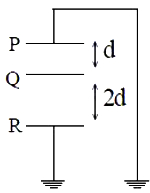
In the diagram,the area of each plate is $A = 2 \,m^2$ and $d = 2 \times 10^{-3} \,m$. An electric charge of $q = 8.85 \times 10^{-8} \,C$ is given to the plate '$Q$'. Plates '$P$' and '$R$' are connected to the ground. Then the potential of plate '$Q$' is:
A
$13 \,V$
B
$10 \,V$
C
$\frac{20}{3} \,V$
D
$8.85 \,V$
Solution
(C) The system consists of two capacitors in parallel connected to plate '$Q$'.
One capacitor is formed by plates '$P$' and '$Q$' with separation $d$,and the other by plates '$Q$' and '$R$' with separation $2d$.
The capacitance of a parallel plate capacitor is given by $C = \frac{\epsilon_0 A}{d}$.
Let $C_1$ be the capacitance between '$P$' and '$Q$': $C_1 = \frac{\epsilon_0 A}{d}$.
Let $C_2$ be the capacitance between '$Q$' and '$R$': $C_2 = \frac{\epsilon_0 A}{2d} = \frac{C_1}{2}$.
Since both plates '$P$' and '$R$' are grounded,the potential of both is $0 \,V$. Thus,the capacitors are in parallel with respect to plate '$Q$'.
The equivalent capacitance is $C_{eq} = C_1 + C_2 = C_1 + \frac{C_1}{2} = \frac{3}{2} C_1$.
Substituting the values: $C_1 = \frac{8.85 \times 10^{-12} \times 2}{2 \times 10^{-3}} = 8.85 \times 10^{-9} \,F$.
$C_{eq} = \frac{3}{2} \times 8.85 \times 10^{-9} = 1.3275 \times 10^{-8} \,F$.
The potential of plate '$Q$' is $V = \frac{q}{C_{eq}} = \frac{8.85 \times 10^{-8}}{1.3275 \times 10^{-8}} = \frac{8.85}{1.3275} = \frac{8.85}{1.5 \times 8.85} \times 10 = \frac{20}{3} \,V$.
One capacitor is formed by plates '$P$' and '$Q$' with separation $d$,and the other by plates '$Q$' and '$R$' with separation $2d$.
The capacitance of a parallel plate capacitor is given by $C = \frac{\epsilon_0 A}{d}$.
Let $C_1$ be the capacitance between '$P$' and '$Q$': $C_1 = \frac{\epsilon_0 A}{d}$.
Let $C_2$ be the capacitance between '$Q$' and '$R$': $C_2 = \frac{\epsilon_0 A}{2d} = \frac{C_1}{2}$.
Since both plates '$P$' and '$R$' are grounded,the potential of both is $0 \,V$. Thus,the capacitors are in parallel with respect to plate '$Q$'.
The equivalent capacitance is $C_{eq} = C_1 + C_2 = C_1 + \frac{C_1}{2} = \frac{3}{2} C_1$.
Substituting the values: $C_1 = \frac{8.85 \times 10^{-12} \times 2}{2 \times 10^{-3}} = 8.85 \times 10^{-9} \,F$.
$C_{eq} = \frac{3}{2} \times 8.85 \times 10^{-9} = 1.3275 \times 10^{-8} \,F$.
The potential of plate '$Q$' is $V = \frac{q}{C_{eq}} = \frac{8.85 \times 10^{-8}}{1.3275 \times 10^{-8}} = \frac{8.85}{1.3275} = \frac{8.85}{1.5 \times 8.85} \times 10 = \frac{20}{3} \,V$.
0 likes
View Solution122
DifficultMCQ
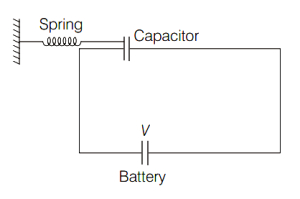
One plate of a parallel plate capacitor is connected to a spring as shown in the figure. The area of each plate of the capacitor is $A$ and the distance between the plates is $d$,when the battery is not connected and the spring is unstretched. After connecting the battery,in the steady state the distance between the plates is $0.75 d$,then the force constant of the spring is
A
$\frac{3}{8} \frac{\varepsilon_0 V^2 A}{d^3}$
B
$\frac{8}{3} \frac{\varepsilon_0 V^2 A}{d^3}$
C
$\frac{9}{32} \frac{\varepsilon_0 V^2 A}{d^3}$
D
$\frac{32}{9} \frac{\varepsilon_0 V^2 A}{d^3}$
Solution
(D) In equilibrium,the attractive force between the plates of the capacitor is balanced by the spring force.
The force between the plates of a parallel plate capacitor is given by $F = \frac{q^2}{2 \varepsilon_0 A} = \frac{C^2 V^2}{2 \varepsilon_0 A}$.
Since $C = \frac{\varepsilon_0 A}{d'}$,where $d'$ is the new distance between the plates,we have $F = \frac{(\varepsilon_0 A / d')^2 V^2}{2 \varepsilon_0 A} = \frac{\varepsilon_0 A V^2}{2 d'^2}$.
Given that the initial distance is $d$ and the final distance is $d' = 0.75 d = \frac{3}{4} d$,the extension in the spring is $x = d - d' = d - \frac{3}{4} d = \frac{1}{4} d$.
The spring force is $F_s = kx = k \left( \frac{1}{4} d \right)$.
Equating the forces: $\frac{\varepsilon_0 A V^2}{2 (\frac{3}{4} d)^2} = k \left( \frac{1}{4} d \right)$.
$\frac{\varepsilon_0 A V^2}{2 (\frac{9}{16} d^2)} = k \left( \frac{d}{4} \right)$.
$\frac{\varepsilon_0 A V^2}{\frac{9}{8} d^2} = k \left( \frac{d}{4} \right)$.
$\frac{8 \varepsilon_0 A V^2}{9 d^2} = k \left( \frac{d}{4} \right)$.
$k = \frac{32 \varepsilon_0 A V^2}{9 d^3}$.
The force between the plates of a parallel plate capacitor is given by $F = \frac{q^2}{2 \varepsilon_0 A} = \frac{C^2 V^2}{2 \varepsilon_0 A}$.
Since $C = \frac{\varepsilon_0 A}{d'}$,where $d'$ is the new distance between the plates,we have $F = \frac{(\varepsilon_0 A / d')^2 V^2}{2 \varepsilon_0 A} = \frac{\varepsilon_0 A V^2}{2 d'^2}$.
Given that the initial distance is $d$ and the final distance is $d' = 0.75 d = \frac{3}{4} d$,the extension in the spring is $x = d - d' = d - \frac{3}{4} d = \frac{1}{4} d$.
The spring force is $F_s = kx = k \left( \frac{1}{4} d \right)$.
Equating the forces: $\frac{\varepsilon_0 A V^2}{2 (\frac{3}{4} d)^2} = k \left( \frac{1}{4} d \right)$.
$\frac{\varepsilon_0 A V^2}{2 (\frac{9}{16} d^2)} = k \left( \frac{d}{4} \right)$.
$\frac{\varepsilon_0 A V^2}{\frac{9}{8} d^2} = k \left( \frac{d}{4} \right)$.
$\frac{8 \varepsilon_0 A V^2}{9 d^2} = k \left( \frac{d}{4} \right)$.
$k = \frac{32 \varepsilon_0 A V^2}{9 d^3}$.
0 likes
View Solution123
DifficultMCQ
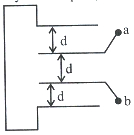
Four metal plates,each with surface area $A$ on one side,are placed with separation '$d$' as shown in the figure. The capacitance between $a$ and $b$ is ($\varepsilon_0$ = permittivity of free space).
A
$\frac{3 \varepsilon_0 A}{d}$
B
$\frac{2 \varepsilon_0 A}{d}$
C
$\frac{2 \varepsilon_0 A}{3 d}$
D
$\frac{3 \varepsilon_0 A}{2 d}$
Solution
(D) Let the capacitance of each pair of plates be $C = \frac{\varepsilon_0 A}{d}$.
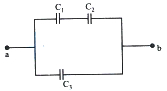
Based on the arrangement,the system can be modeled as two capacitors in series ($C_1$ and $C_2$) which are then in parallel with a third capacitor $(C_3)$.
Here,$C_1 = C_2 = C_3 = C = \frac{\varepsilon_0 A}{d}$.
The equivalent capacitance of the series combination of $C_1$ and $C_2$ is $C_{12} = \frac{C_1 C_2}{C_1 + C_2} = \frac{C^2}{2C} = \frac{C}{2}$.
Now,$C_{12}$ and $C_3$ are in parallel,so the total capacitance $C_T$ is:
$C_T = C_{12} + C_3 = \frac{C}{2} + C = \frac{3C}{2}$.
Substituting $C = \frac{\varepsilon_0 A}{d}$,we get:
$C_T = \frac{3 \varepsilon_0 A}{2 d}$.
Based on the arrangement,the system can be modeled as two capacitors in series ($C_1$ and $C_2$) which are then in parallel with a third capacitor $(C_3)$.
Here,$C_1 = C_2 = C_3 = C = \frac{\varepsilon_0 A}{d}$.
The equivalent capacitance of the series combination of $C_1$ and $C_2$ is $C_{12} = \frac{C_1 C_2}{C_1 + C_2} = \frac{C^2}{2C} = \frac{C}{2}$.
Now,$C_{12}$ and $C_3$ are in parallel,so the total capacitance $C_T$ is:
$C_T = C_{12} + C_3 = \frac{C}{2} + C = \frac{3C}{2}$.
Substituting $C = \frac{\varepsilon_0 A}{d}$,we get:
$C_T = \frac{3 \varepsilon_0 A}{2 d}$.
0 likes
View Solution124
MediumMCQ
In a parallel plate capacitor,if $10^{12}$ electrons pass from one plate to another,a potential difference of $10 \,V$ is developed across the plates. The capacitance of the capacitor is
A
$0.16 \times 10^{-8} \,F$
B
$1.6 \times 10^{-8} \,F$
C
$16 \times 10^{-8} \,F$
D
$0.8 \times 10^{-8} \,F$
Solution
(B) The magnitude of the charge transferred between the plates is given by $Q = N \cdot e$.
Given $N = 10^{12}$ electrons and $e = 1.6 \times 10^{-19} \,C$.
So,$Q = 10^{12} \times 1.6 \times 10^{-19} = 1.6 \times 10^{-7} \,C$.
The potential difference developed is $V = 10 \,V$.
The capacitance $C$ is defined as $C = \frac{Q}{V}$.
Substituting the values,$C = \frac{1.6 \times 10^{-7}}{10} = 1.6 \times 10^{-8} \,F$.
Given $N = 10^{12}$ electrons and $e = 1.6 \times 10^{-19} \,C$.
So,$Q = 10^{12} \times 1.6 \times 10^{-19} = 1.6 \times 10^{-7} \,C$.
The potential difference developed is $V = 10 \,V$.
The capacitance $C$ is defined as $C = \frac{Q}{V}$.
Substituting the values,$C = \frac{1.6 \times 10^{-7}}{10} = 1.6 \times 10^{-8} \,F$.
0 likes
View Solution125
MediumMCQ
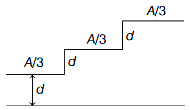
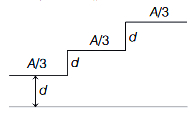
$A$ capacitor is made of a flat plate of area $A$ and a second plate of stair-like structure as shown in the figure. The area of each stair is $\frac{A}{3}$ and the height is $d$. The capacitance of the arrangement is
A
$\frac{\varepsilon_0 A}{3 d}$
B
$\frac{6 \varepsilon_0 A}{11 d}$
C
$\frac{3 \varepsilon_0 A}{d}$
D
$\frac{11 \varepsilon_0 A}{18 d}$
Solution
(D) The arrangement can be considered as three parallel plate capacitors connected in parallel,each having an area of $\frac{A}{3}$.
Let the distance between the flat plate and the first,second,and third stairs be $d$,$2d$,and $3d$ respectively.
The capacitance of a parallel plate capacitor is given by $C = \frac{\varepsilon_0 A}{d}$.
For the first part,$C_1 = \frac{\varepsilon_0 (A/3)}{d} = \frac{\varepsilon_0 A}{3d}$.
For the second part,$C_2 = \frac{\varepsilon_0 (A/3)}{2d} = \frac{\varepsilon_0 A}{6d}$.
For the third part,$C_3 = \frac{\varepsilon_0 (A/3)}{3d} = \frac{\varepsilon_0 A}{9d}$.
Since these capacitors are connected in parallel,the equivalent capacitance $C_{eq}$ is the sum of individual capacitances:
$C_{eq} = C_1 + C_2 + C_3$
$C_{eq} = \frac{\varepsilon_0 A}{3d} + \frac{\varepsilon_0 A}{6d} + \frac{\varepsilon_0 A}{9d}$
Taking the common denominator as $18d$:
$C_{eq} = \frac{6\varepsilon_0 A + 3\varepsilon_0 A + 2\varepsilon_0 A}{18d} = \frac{11\varepsilon_0 A}{18d}$
Let the distance between the flat plate and the first,second,and third stairs be $d$,$2d$,and $3d$ respectively.
The capacitance of a parallel plate capacitor is given by $C = \frac{\varepsilon_0 A}{d}$.
For the first part,$C_1 = \frac{\varepsilon_0 (A/3)}{d} = \frac{\varepsilon_0 A}{3d}$.
For the second part,$C_2 = \frac{\varepsilon_0 (A/3)}{2d} = \frac{\varepsilon_0 A}{6d}$.
For the third part,$C_3 = \frac{\varepsilon_0 (A/3)}{3d} = \frac{\varepsilon_0 A}{9d}$.
Since these capacitors are connected in parallel,the equivalent capacitance $C_{eq}$ is the sum of individual capacitances:
$C_{eq} = C_1 + C_2 + C_3$
$C_{eq} = \frac{\varepsilon_0 A}{3d} + \frac{\varepsilon_0 A}{6d} + \frac{\varepsilon_0 A}{9d}$
Taking the common denominator as $18d$:
$C_{eq} = \frac{6\varepsilon_0 A + 3\varepsilon_0 A + 2\varepsilon_0 A}{18d} = \frac{11\varepsilon_0 A}{18d}$
0 likes
View Solution126
EasyMCQ
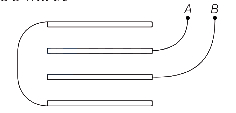
Four identical metal plates are located in air at equal distance $d$ from each other. The area of each plate is $S$. If the outer most plates are connected by a conducting wire as shown in the figure, the capacitance between points $A$ and $B$ will be
A
$\frac{\varepsilon_0 S}{d}$
B
$\frac{3}{2} \frac{\varepsilon_0 S}{d}$
C
$\frac{1}{2} \frac{\varepsilon_0 S}{d}$
D
$\frac{2}{3} \frac{\varepsilon_0 S}{d}$
Solution
(B) Let the four plates be numbered $1, 2, 3, 4$ from top to bottom. The outer plates $1$ and $4$ are connected together. Points $A$ and $B$ are connected to plates $2$ and $3$ respectively.
Between plates $1$ and $2$, there is a capacitor $C_1 = \frac{\varepsilon_0 S}{d}$.
Between plates $2$ and $3$, there is a capacitor $C_2 = \frac{\varepsilon_0 S}{d}$.
Between plates $3$ and $4$, there is a capacitor $C_3 = \frac{\varepsilon_0 S}{d}$.
Since plates $1$ and $4$ are connected, they are at the same potential. Let this potential be $V_0$. Plate $2$ is at potential $V_A$ and plate $3$ is at potential $V_B$.
The capacitor $C_1$ is connected between $V_A$ and $V_0$. The capacitor $C_3$ is connected between $V_B$ and $V_0$. The capacitor $C_2$ is connected between $V_A$ and $V_B$.
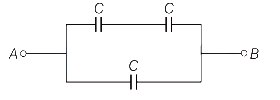
This is equivalent to two capacitors $C_1$ and $C_3$ in series, which are then in parallel with $C_2$.
Since $C_1 = C_2 = C_3 = C = \frac{\varepsilon_0 S}{d}$, the equivalent capacitance $C_{eq}$ is:
$C_{eq} = C_2 + (C_1 \text{ in series with } C_3)$
$C_{eq} = C + \frac{C \times C}{C + C} = C + \frac{C}{2} = \frac{3C}{2}$
Substituting $C = \frac{\varepsilon_0 S}{d}$, we get:
$C_{eq} = \frac{3}{2} \frac{\varepsilon_0 S}{d}$
Between plates $1$ and $2$, there is a capacitor $C_1 = \frac{\varepsilon_0 S}{d}$.
Between plates $2$ and $3$, there is a capacitor $C_2 = \frac{\varepsilon_0 S}{d}$.
Between plates $3$ and $4$, there is a capacitor $C_3 = \frac{\varepsilon_0 S}{d}$.
Since plates $1$ and $4$ are connected, they are at the same potential. Let this potential be $V_0$. Plate $2$ is at potential $V_A$ and plate $3$ is at potential $V_B$.
The capacitor $C_1$ is connected between $V_A$ and $V_0$. The capacitor $C_3$ is connected between $V_B$ and $V_0$. The capacitor $C_2$ is connected between $V_A$ and $V_B$.
This is equivalent to two capacitors $C_1$ and $C_3$ in series, which are then in parallel with $C_2$.
Since $C_1 = C_2 = C_3 = C = \frac{\varepsilon_0 S}{d}$, the equivalent capacitance $C_{eq}$ is:
$C_{eq} = C_2 + (C_1 \text{ in series with } C_3)$
$C_{eq} = C + \frac{C \times C}{C + C} = C + \frac{C}{2} = \frac{3C}{2}$
Substituting $C = \frac{\varepsilon_0 S}{d}$, we get:
$C_{eq} = \frac{3}{2} \frac{\varepsilon_0 S}{d}$
0 likes
View Solution127
MediumMCQ
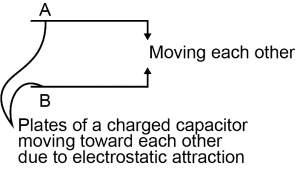
The insulated plates of a charged parallel plate capacitor (with small separation between the plates) are approaching each other due to electrostatic attraction. Assuming no other force to be operative and no radiation taking place,which of the following graphs approximately shows the variation with time $(t)$ of the potential difference $(V)$ between the plates?
A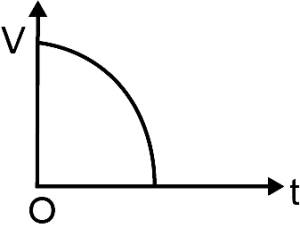
B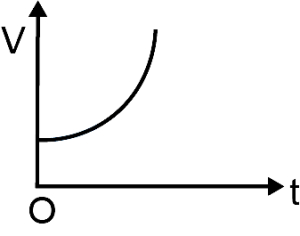
C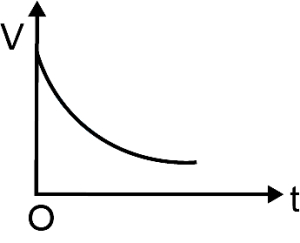
D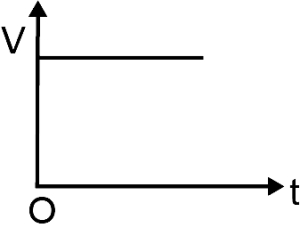
Solution
(A) For an isolated charged parallel plate capacitor,the charge $q$ on the plates remains constant.
The electric field $E$ between the plates is given by $E = \frac{\sigma}{\varepsilon_{0}} = \frac{q}{A \varepsilon_{0}}$,which is constant since $q$,$A$,and $\varepsilon_{0}$ are constant.
The electrostatic force of attraction between the plates is $F = qE = \frac{q^2}{2A \varepsilon_{0}}$.
Since the force is constant,the acceleration $a$ of the plates is constant $(a = F/m)$.
The separation $d$ between the plates at time $t$ is given by $d(t) = d_{0} - \frac{1}{2} a t^2$,where $d_{0}$ is the initial separation.
The potential difference $V$ is given by $V = E \cdot d(t) = E (d_{0} - \frac{1}{2} a t^2)$.
This equation $V(t) = E d_{0} - (\frac{E a}{2}) t^2$ represents a downward-opening parabola,which corresponds to Graph $A$.
The electric field $E$ between the plates is given by $E = \frac{\sigma}{\varepsilon_{0}} = \frac{q}{A \varepsilon_{0}}$,which is constant since $q$,$A$,and $\varepsilon_{0}$ are constant.
The electrostatic force of attraction between the plates is $F = qE = \frac{q^2}{2A \varepsilon_{0}}$.
Since the force is constant,the acceleration $a$ of the plates is constant $(a = F/m)$.
The separation $d$ between the plates at time $t$ is given by $d(t) = d_{0} - \frac{1}{2} a t^2$,where $d_{0}$ is the initial separation.
The potential difference $V$ is given by $V = E \cdot d(t) = E (d_{0} - \frac{1}{2} a t^2)$.
This equation $V(t) = E d_{0} - (\frac{E a}{2}) t^2$ represents a downward-opening parabola,which corresponds to Graph $A$.
0 likes
View Solution128
DifficultMCQ
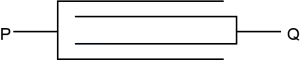
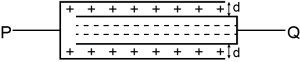
Four identical plates each of area $a$ are separated by a distance $d$. The connection is shown below. What is the capacitance between $P$ and $Q$?
A
$2 a \varepsilon_{0} / d$
B
$a \varepsilon_{0} /(2 d)$
C
$a \varepsilon_{0} / d$
D
$4 a \varepsilon_{0} / d$
Solution
(A) The given arrangement consists of four plates. Let the plates connected to $P$ be the positive plates and the plates connected to $Q$ be the negative plates.
From the figure,we can see that there are two capacitors formed between the plates.
Each capacitor is formed by two adjacent plates separated by a distance $d$ with an area $a$.
The capacitance of a single parallel plate capacitor is given by $C = \frac{\varepsilon_{0} a}{d}$.
Since the two capacitors are connected in parallel,the equivalent capacitance $C_{eq}$ is the sum of the individual capacitances.
$C_{eq} = C_{1} + C_{2} = \frac{\varepsilon_{0} a}{d} + \frac{\varepsilon_{0} a}{d} = \frac{2 \varepsilon_{0} a}{d}$.
From the figure,we can see that there are two capacitors formed between the plates.
Each capacitor is formed by two adjacent plates separated by a distance $d$ with an area $a$.
The capacitance of a single parallel plate capacitor is given by $C = \frac{\varepsilon_{0} a}{d}$.
Since the two capacitors are connected in parallel,the equivalent capacitance $C_{eq}$ is the sum of the individual capacitances.
$C_{eq} = C_{1} + C_{2} = \frac{\varepsilon_{0} a}{d} + \frac{\varepsilon_{0} a}{d} = \frac{2 \varepsilon_{0} a}{d}$.
0 likes
View Solution129
MediumMCQ
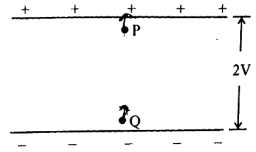
The potential difference between two plates of a parallel plate capacitor is $2V$. As shown in the figure,electrons are placed at point $P$ and $Q$. So,
A
Electric forces acting on both the electrons are same.
B
Electric force acting on the electron at point $P$ is greater than the electron at point $Q$.
C
Electric force acting on the electron at point $P$ is less than the electron at point $Q$.
D
Electric forces acting on both the electrons are zero.
Solution
(A) In a parallel plate capacitor,the electric field between the plates is uniform.
Since the force $F = eE$,where $e$ is the charge of the electron and $E$ is the uniform electric field,the force experienced by an electron at any point between the plates is constant.
Thus,the forces acting on the electrons at both points $P$ and $Q$ are the same.
Therefore,option $(A)$ is correct.
Since the force $F = eE$,where $e$ is the charge of the electron and $E$ is the uniform electric field,the force experienced by an electron at any point between the plates is constant.
Thus,the forces acting on the electrons at both points $P$ and $Q$ are the same.
Therefore,option $(A)$ is correct.
0 likes
View SolutionElectric Potential and Capacitance — Parallel Plate Capacitor · Frequently Asked Questions
1Are these Electric Potential and Capacitance questions useful for JEE and NEET?
Yes. All questions in this section are mapped to JEE Main and NEET exam patterns. Previous year questions from JEE Main, NEET, GUJCET and state-level exams are included with full solutions.
2Can I switch to Hindi or Gujarati for these questions?
Yes. Use the language tabs in the hero section or the sidebar to view the same questions and solutions in English, Hindi or Gujarati.
3How do I generate a question paper from this subtopic?
Use the Vedclass Exam Paper Generator — select the chapter and subtopic, set difficulty, and generate Sets A, B, C, D automatically. First 3 chapters of every subject are free.
Vedclass Products
For Students
Vedclass Test Series
Mock tests in real JEE/NEET style with performance analysis. 5-day free trial.
Start Free TrialFor Teachers
Exam Paper Generator
Generate Set A/B/C/D papers from this chapter in 2 minutes. 3 chapters free.
Try FreeFor Institutes
Online Exam Module
Live online exams with unlimited students, 360° analytics & white-label branding.
See DemoFor Teachers & Institutes
Generate a Electric Potential and Capacitance Exam Paper in 2 Minutes
Select subtopic & difficulty — Sets A, B, C, D auto-generated with No Repeat logic.
First 3 chapters of every subject are free — no payment required.