
A English
Mix Examples-Electric Charges and Fields Questions in English
Class 12 Physics · Electric Charges and Fields · Mix Examples-Electric Charges and Fields
196+
Questions
English
Language
100%
With Solutions
Showing 46 of 196 questions in English
151
MediumMCQ
Given below are two statements:
Statement-$I$: $A$ point charge is brought into an electric field. The value of the electric field at a point near the charge may increase if the charge is positive.
Statement-$II$: An electric dipole is placed in a non-uniform electric field. The net electric force on the dipole will not be zero.
Choose the correct answer from the options given below:
Statement-$I$: $A$ point charge is brought into an electric field. The value of the electric field at a point near the charge may increase if the charge is positive.
Statement-$II$: An electric dipole is placed in a non-uniform electric field. The net electric force on the dipole will not be zero.
Choose the correct answer from the options given below:
A
Both Statement-$I$ and Statement-$II$ are true.
B
Both Statement-$I$ and Statement-$II$ are false.
C
Statement-$I$ is true but Statement-$II$ is false.
D
Statement-$I$ is false but Statement-$II$ is true.
Solution
(C) Statement-$I$ is true: When a positive point charge is placed in an existing electric field,the total electric field at any point is the vector sum of the external field and the field produced by the point charge. Depending on the position relative to the charge,the field can increase or decrease.
Statement-$II$ is false: While it is generally true that a dipole in a non-uniform field experiences a net force,it is not always true. If the dipole is placed at a point where the electric field has a local extremum (maximum or minimum),the net force on the dipole can be zero. Therefore,the statement that the force will 'not be zero' is not universally true.
Statement-$II$ is false: While it is generally true that a dipole in a non-uniform field experiences a net force,it is not always true. If the dipole is placed at a point where the electric field has a local extremum (maximum or minimum),the net force on the dipole can be zero. Therefore,the statement that the force will 'not be zero' is not universally true.
0 likes
View Solution152
DifficultMCQ
Which of the following physical quantities have the same dimensions?
A
Electric displacement $(\overrightarrow{D})$ and surface charge density
B
Displacement current and electric field
C
Current density and surface charge density
D
Electric potential and energy
Solution
(A) The electric displacement vector is defined as $\overrightarrow{D} = \epsilon_{0} \overrightarrow{E}$.
Dimensional analysis of electric displacement: $[D] = [\epsilon_{0}][E]$.
Since the electric field $E$ is related to surface charge density $\sigma$ by $E = \frac{\sigma}{\epsilon_{0}}$,we have $\epsilon_{0} E = \sigma$.
Therefore,the dimensions of electric displacement $[D]$ are equal to the dimensions of surface charge density $[\sigma]$.
Both have dimensions of $[Q L^{-2}]$,where $Q$ is charge and $L$ is length.
Dimensional analysis of electric displacement: $[D] = [\epsilon_{0}][E]$.
Since the electric field $E$ is related to surface charge density $\sigma$ by $E = \frac{\sigma}{\epsilon_{0}}$,we have $\epsilon_{0} E = \sigma$.
Therefore,the dimensions of electric displacement $[D]$ are equal to the dimensions of surface charge density $[\sigma]$.
Both have dimensions of $[Q L^{-2}]$,where $Q$ is charge and $L$ is length.
0 likes
View Solution153
MediumMCQ
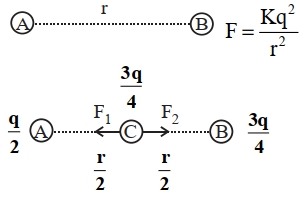
Two identical metallic spheres $A$ and $B$ when placed at a certain distance in air repel each other with a force of $F$. Another identical uncharged sphere $C$ is first placed in contact with $A$ and then in contact with $B$ and finally placed at the midpoint between spheres $A$ and $B$. The force experienced by sphere $C$ will be:
A
$3F / 2$
B
$3F / 4$
C
$F$
D
$2F$
Solution
(B) Let the initial charges on spheres $A$ and $B$ be $q_A = q_B = q$. The initial force is $F = \frac{Kq^2}{r^2}$.
When sphere $C$ (initially uncharged) is placed in contact with $A$,the charge redistributes equally: $q_A' = q_C' = \frac{q}{2}$.
Now,sphere $C$ is placed in contact with $B$. The total charge is $q + \frac{q}{2} = \frac{3q}{2}$. Upon separation,each gets $q_B' = q_C'' = \frac{3q/2}{2} = \frac{3q}{4}$.
Now,$A$ has charge $\frac{q}{2}$ and $B$ has charge $\frac{3q}{4}$. Sphere $C$ is placed at the midpoint (distance $r/2$ from both).
The force on $C$ due to $A$ is $F_1 = \frac{K(q/2)(3q/4)}{(r/2)^2} = \frac{3Kq^2/8}{r^2/4} = \frac{3Kq^2}{2r^2} = \frac{3F}{2}$ (towards $A$).
The force on $C$ due to $B$ is $F_2 = \frac{K(3q/4)(3q/4)}{(r/2)^2} = \frac{9Kq^2/16}{r^2/4} = \frac{9Kq^2}{4r^2} = \frac{9F}{4}$ (towards $A$).
The net force on $C$ is $F_{net} = F_2 - F_1 = \frac{9F}{4} - \frac{3F}{2} = \frac{9F - 6F}{4} = \frac{3F}{4}$.
When sphere $C$ (initially uncharged) is placed in contact with $A$,the charge redistributes equally: $q_A' = q_C' = \frac{q}{2}$.
Now,sphere $C$ is placed in contact with $B$. The total charge is $q + \frac{q}{2} = \frac{3q}{2}$. Upon separation,each gets $q_B' = q_C'' = \frac{3q/2}{2} = \frac{3q}{4}$.
Now,$A$ has charge $\frac{q}{2}$ and $B$ has charge $\frac{3q}{4}$. Sphere $C$ is placed at the midpoint (distance $r/2$ from both).
The force on $C$ due to $A$ is $F_1 = \frac{K(q/2)(3q/4)}{(r/2)^2} = \frac{3Kq^2/8}{r^2/4} = \frac{3Kq^2}{2r^2} = \frac{3F}{2}$ (towards $A$).
The force on $C$ due to $B$ is $F_2 = \frac{K(3q/4)(3q/4)}{(r/2)^2} = \frac{9Kq^2/16}{r^2/4} = \frac{9Kq^2}{4r^2} = \frac{9F}{4}$ (towards $A$).
The net force on $C$ is $F_{net} = F_2 - F_1 = \frac{9F}{4} - \frac{3F}{2} = \frac{9F - 6F}{4} = \frac{3F}{4}$.
0 likes
View Solution154
AdvancedMCQ
The surface of a planet is found to be uniformly charged. When a particle of mass $m$ and no charge is thrown at an angle from the surface of the planet,it has a parabolic trajectory as in projectile motion with horizontal range $L$. $A$ particle of mass $m$ and charge $q$,with the same initial conditions,has a range $L/2$. The range of a particle of mass $m$ and charge $2q$,with the same initial conditions,is:
A
$L$
B
$L/2$
C
$L/3$
D
$L/4$
Solution
(C) For an uncharged particle in projectile motion,the range is $L = \frac{u^2 \sin 2\theta}{g} \quad \dots(i)$
For a charged particle,the effective acceleration becomes $g' = g + \frac{qE}{m}$.
Given that the range for a particle with charge $q$ is $L/2$,we have:
$\frac{L}{2} = \frac{u^2 \sin 2\theta}{g + \frac{qE}{m}}$
Substituting $u^2 \sin 2\theta = Lg$ from equation $(i)$:
$\frac{L}{2} = \frac{Lg}{g + \frac{qE}{m}}$
$\Rightarrow g + \frac{qE}{m} = 2g \Rightarrow \frac{qE}{m} = g \quad \dots(ii)$
Now,for a particle of mass $m$ and charge $2q$,the effective acceleration is $g'' = g + \frac{2qE}{m}$.
Using equation $(ii)$,$g'' = g + 2g = 3g$.
The new range $R$ is:
$R = \frac{u^2 \sin 2\theta}{3g} = \frac{1}{3} \left( \frac{u^2 \sin 2\theta}{g} \right) = \frac{L}{3}$.
For a charged particle,the effective acceleration becomes $g' = g + \frac{qE}{m}$.
Given that the range for a particle with charge $q$ is $L/2$,we have:
$\frac{L}{2} = \frac{u^2 \sin 2\theta}{g + \frac{qE}{m}}$
Substituting $u^2 \sin 2\theta = Lg$ from equation $(i)$:
$\frac{L}{2} = \frac{Lg}{g + \frac{qE}{m}}$
$\Rightarrow g + \frac{qE}{m} = 2g \Rightarrow \frac{qE}{m} = g \quad \dots(ii)$
Now,for a particle of mass $m$ and charge $2q$,the effective acceleration is $g'' = g + \frac{2qE}{m}$.
Using equation $(ii)$,$g'' = g + 2g = 3g$.
The new range $R$ is:
$R = \frac{u^2 \sin 2\theta}{3g} = \frac{1}{3} \left( \frac{u^2 \sin 2\theta}{g} \right) = \frac{L}{3}$.
0 likes
View Solution155
AdvancedMCQ
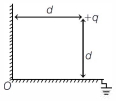
$A$ charge $+q$ is situated at a distance $d$ away from both the sides of a grounded conducting $L$-shaped sheet as shown in the figure. The force acting on the charge $+q$ is:
A
towards $O$,magnitude $\frac{q^2}{32 \pi \varepsilon_0 d^2}(2 \sqrt{2}+1)$
B
away from $O$,magnitude $\frac{q^2}{32 \pi \varepsilon_0 d^2}(2 \sqrt{2}+1)$
C
towards $O$,magnitude $\frac{q^2}{32 \pi \varepsilon_0 d^2}(2 \sqrt{2}-1)$
D
away from $O$,magnitude $\frac{q^2}{32 \pi \varepsilon_0 d^2}(2 \sqrt{2}-1)$
Solution
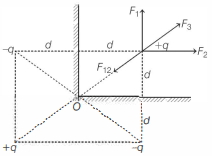
(C) Using the method of images for a grounded conducting corner,we place three image charges to satisfy the boundary conditions: $-q$ at $(-d, 0)$,$-q$ at $(0, -d)$,and $+q$ at $(-d, -d)$.
The force on the charge $+q$ at $(d, d)$ due to the image charges is:
$1$. Force due to $-q$ at $(-d, 0)$: $F_1 = \frac{1}{4 \pi \varepsilon_0} \frac{q^2}{(2d)^2 + 0^2} = \frac{q^2}{16 \pi \varepsilon_0 d^2}$ (attractive,towards the $x$-axis).
$2$. Force due to $-q$ at $(0, -d)$: $F_2 = \frac{1}{4 \pi \varepsilon_0} \frac{q^2}{0^2 + (2d)^2} = \frac{q^2}{16 \pi \varepsilon_0 d^2}$ (attractive,towards the $y$-axis).
$3$. Force due to $+q$ at $(-d, -d)$: $F_3 = \frac{1}{4 \pi \varepsilon_0} \frac{q^2}{(2d)^2 + (2d)^2} = \frac{q^2}{32 \pi \varepsilon_0 d^2}$ (repulsive,away from the origin).
The resultant attractive force $F_{12}$ from the two $-q$ charges is $\sqrt{F_1^2 + F_2^2} = \sqrt{2} F_1 = \frac{\sqrt{2} q^2}{16 \pi \varepsilon_0 d^2}$,directed towards the origin $O$.
The net force $F_{\text{net}}$ is $F_{12} - F_3 = \frac{\sqrt{2} q^2}{16 \pi \varepsilon_0 d^2} - \frac{q^2}{32 \pi \varepsilon_0 d^2} = \frac{q^2}{32 \pi \varepsilon_0 d^2} (2\sqrt{2} - 1)$,directed towards $O$.
The force on the charge $+q$ at $(d, d)$ due to the image charges is:
$1$. Force due to $-q$ at $(-d, 0)$: $F_1 = \frac{1}{4 \pi \varepsilon_0} \frac{q^2}{(2d)^2 + 0^2} = \frac{q^2}{16 \pi \varepsilon_0 d^2}$ (attractive,towards the $x$-axis).
$2$. Force due to $-q$ at $(0, -d)$: $F_2 = \frac{1}{4 \pi \varepsilon_0} \frac{q^2}{0^2 + (2d)^2} = \frac{q^2}{16 \pi \varepsilon_0 d^2}$ (attractive,towards the $y$-axis).
$3$. Force due to $+q$ at $(-d, -d)$: $F_3 = \frac{1}{4 \pi \varepsilon_0} \frac{q^2}{(2d)^2 + (2d)^2} = \frac{q^2}{32 \pi \varepsilon_0 d^2}$ (repulsive,away from the origin).
The resultant attractive force $F_{12}$ from the two $-q$ charges is $\sqrt{F_1^2 + F_2^2} = \sqrt{2} F_1 = \frac{\sqrt{2} q^2}{16 \pi \varepsilon_0 d^2}$,directed towards the origin $O$.
The net force $F_{\text{net}}$ is $F_{12} - F_3 = \frac{\sqrt{2} q^2}{16 \pi \varepsilon_0 d^2} - \frac{q^2}{32 \pi \varepsilon_0 d^2} = \frac{q^2}{32 \pi \varepsilon_0 d^2} (2\sqrt{2} - 1)$,directed towards $O$.
0 likes
View Solution156
AdvancedMCQ
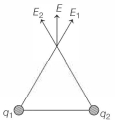
$A$ total charge $q$ is divided into $q_1$ and $q_2$,which are placed at two vertices of an equilateral triangle of side $a$. The magnitude of the electric field $E$ at the third vertex of the triangle is to be depicted schematically as a function of $x = q_1 / q$. Choose the correct figure.
A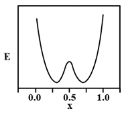
B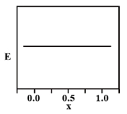
C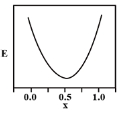
D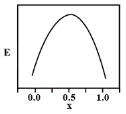
Solution
(C) Let $q_1$ and $q_2$ be the charges at two vertices of an equilateral triangle of side $a$. The magnitude of the electric field $E$ at the third vertex is given by the vector sum of fields $E_1$ and $E_2$ due to $q_1$ and $q_2$ respectively.
$E = \sqrt{E_1^2 + E_2^2 + 2 E_1 E_2 \cos 60^{\circ}}$
Since $E_1 = \frac{k q_1}{a^2}$ and $E_2 = \frac{k q_2}{a^2}$,we have:
$E = \frac{k}{a^2} \sqrt{q_1^2 + q_2^2 + q_1 q_2}$
Given $q_1 + q_2 = q$,let $x = q_1 / q$,so $q_1 = xq$ and $q_2 = (1-x)q$.
Substituting these into the expression for $E$:
$E = \frac{k}{a^2} \sqrt{(xq)^2 + ((1-x)q)^2 + (xq)((1-x)q)}$
$E = \frac{kq}{a^2} \sqrt{x^2 + 1 - 2x + x^2 + x - x^2} = \frac{kq}{a^2} \sqrt{x^2 - x + 1}$
To find the minimum,we differentiate $f(x) = x^2 - x + 1$ with respect to $x$ and set it to zero:
$f'(x) = 2x - 1 = 0 \implies x = 0.5$.
At $x = 0$ or $x = 1$,$E = \frac{kq}{a^2}$. At $x = 0.5$,$E = \frac{kq}{a^2} \sqrt{0.25 - 0.5 + 1} = \frac{kq}{a^2} \sqrt{0.75} = \frac{\sqrt{3}}{2} \frac{kq}{a^2}$.
This corresponds to the curve in graph $C$.
$E = \sqrt{E_1^2 + E_2^2 + 2 E_1 E_2 \cos 60^{\circ}}$
Since $E_1 = \frac{k q_1}{a^2}$ and $E_2 = \frac{k q_2}{a^2}$,we have:
$E = \frac{k}{a^2} \sqrt{q_1^2 + q_2^2 + q_1 q_2}$
Given $q_1 + q_2 = q$,let $x = q_1 / q$,so $q_1 = xq$ and $q_2 = (1-x)q$.
Substituting these into the expression for $E$:
$E = \frac{k}{a^2} \sqrt{(xq)^2 + ((1-x)q)^2 + (xq)((1-x)q)}$
$E = \frac{kq}{a^2} \sqrt{x^2 + 1 - 2x + x^2 + x - x^2} = \frac{kq}{a^2} \sqrt{x^2 - x + 1}$
To find the minimum,we differentiate $f(x) = x^2 - x + 1$ with respect to $x$ and set it to zero:
$f'(x) = 2x - 1 = 0 \implies x = 0.5$.
At $x = 0$ or $x = 1$,$E = \frac{kq}{a^2}$. At $x = 0.5$,$E = \frac{kq}{a^2} \sqrt{0.25 - 0.5 + 1} = \frac{kq}{a^2} \sqrt{0.75} = \frac{\sqrt{3}}{2} \frac{kq}{a^2}$.
This corresponds to the curve in graph $C$.
0 likes
View Solution157
DifficultMCQ
Five balls marked $a$ to $e$ are suspended using separate threads. Pairs $(b, c)$ and $(d, e)$ show electrostatic repulsion,while pairs $(a, b)$,$(c, e)$,and $(a, e)$ show electrostatic attraction. The ball marked $a$ must be:
A
Negatively charged
B
Positively charged
C
Uncharged
D
Any of the above is possible
Solution
(C) $1$. Repulsion occurs only between like charges. Thus,$b$ and $c$ have the same charge,and $d$ and $e$ have the same charge.
$2$. Attraction occurs between opposite charges or between a charged body and an uncharged body (due to induction).
$3$. Given $(a, b)$ attract,$(c, e)$ attract,and $(a, e)$ attract.
$4$. If $a$ were charged (say positive),then $b$ must be negative. Since $(b, c)$ repel,$c$ must also be negative. Since $(c, e)$ attract,$e$ must be positive (or uncharged). If $e$ is positive,then $(a, e)$ would repel,which contradicts the given information. If $e$ is uncharged,then $(a, e)$ would attract,but $(d, e)$ would not repel (as $d$ would need to be charged to repel $e$).
$5$. If $a$ is uncharged,it will attract any charged body $b$ or $e$ due to electrostatic induction. This is consistent with all given observations.
$2$. Attraction occurs between opposite charges or between a charged body and an uncharged body (due to induction).
$3$. Given $(a, b)$ attract,$(c, e)$ attract,and $(a, e)$ attract.
$4$. If $a$ were charged (say positive),then $b$ must be negative. Since $(b, c)$ repel,$c$ must also be negative. Since $(c, e)$ attract,$e$ must be positive (or uncharged). If $e$ is positive,then $(a, e)$ would repel,which contradicts the given information. If $e$ is uncharged,then $(a, e)$ would attract,but $(d, e)$ would not repel (as $d$ would need to be charged to repel $e$).
$5$. If $a$ is uncharged,it will attract any charged body $b$ or $e$ due to electrostatic induction. This is consistent with all given observations.
0 likes
View Solution158
EasyMCQ
Which of the following processes involves the principle of electrostatic induction?
A
Pollination
B
Chocolate making
C
Xerox copying
D
All of these
Solution
(D) The principle of electrostatic induction is a fundamental phenomenon used in various industrial and natural processes.
$1$. Pollination: In many plants,pollen grains are attracted to the stigma due to electrostatic forces generated by induction.
$2$. Chocolate making: Electrostatic deposition is used to coat chocolates uniformly.
$3$. Xerox copying: The process of xerography (photocopying) relies heavily on electrostatic induction to transfer toner particles onto paper.
Since all these processes utilize the principle of electrostatic induction,the correct option is $D$.
$1$. Pollination: In many plants,pollen grains are attracted to the stigma due to electrostatic forces generated by induction.
$2$. Chocolate making: Electrostatic deposition is used to coat chocolates uniformly.
$3$. Xerox copying: The process of xerography (photocopying) relies heavily on electrostatic induction to transfer toner particles onto paper.
Since all these processes utilize the principle of electrostatic induction,the correct option is $D$.
0 likes
View Solution159
MediumMCQ
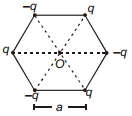
Six point charges are placed at the vertices of a regular hexagon of side $a$ as shown. If $E$ represents the electric field and $V$ represents the electric potential at the center $O$,then:
A
$E=0$ but $V \neq 0$
B
$E \neq 0$ but $V=0$
C
$E=0$ and $V=0$
D
$E \neq 0$ and $V \neq 0$
Solution
(C) For a regular hexagon with side $a$,the distance from each vertex to the center $O$ is $r = a$.
$1$. Electric Potential $(V)$: The potential at the center $O$ is the algebraic sum of potentials due to individual charges: $V = \sum \frac{k q_i}{r_i} = \frac{k}{a} (q - q + q - q + q - q) = 0$.
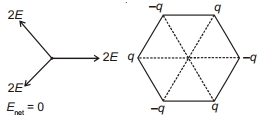
$2$. Electric Field $(E)$: The electric field at the center $O$ is the vector sum of fields due to individual charges. Each pair of opposite charges (e.g.,$q$ and $-q$) produces a resultant field at the center directed towards the negative charge. Specifically,a charge $q$ at one vertex and $-q$ at the opposite vertex create a net field of magnitude $\frac{2kq}{a^2}$ directed towards the negative charge. Since there are three such pairs oriented at $120^\circ$ to each other,their vector sum is zero. Thus,$E = 0$.
$1$. Electric Potential $(V)$: The potential at the center $O$ is the algebraic sum of potentials due to individual charges: $V = \sum \frac{k q_i}{r_i} = \frac{k}{a} (q - q + q - q + q - q) = 0$.
$2$. Electric Field $(E)$: The electric field at the center $O$ is the vector sum of fields due to individual charges. Each pair of opposite charges (e.g.,$q$ and $-q$) produces a resultant field at the center directed towards the negative charge. Specifically,a charge $q$ at one vertex and $-q$ at the opposite vertex create a net field of magnitude $\frac{2kq}{a^2}$ directed towards the negative charge. Since there are three such pairs oriented at $120^\circ$ to each other,their vector sum is zero. Thus,$E = 0$.
0 likes
View Solution160
DifficultMCQ
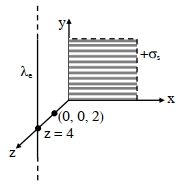
An infinite plane sheet of charge having uniform surface charge density $+\sigma_s \text{ C/m}^2$ is placed on the $x-y$ plane. Another infinitely long line charge having uniform linear charge density $+\lambda_e \text{ C/m}$ is placed at the $z=4 \text{ m}$ plane and is parallel to the $y$-axis. If the magnitude values satisfy $|\sigma_s| = 2|\lambda_e|$,then at the point $(0, 0, 2)$,the ratio of the magnitudes of the electric field values due to the sheet charge to that of the line charge is $\pi \sqrt{n} : 1$. The value of $n$ is:
A
$16$
B
$20$
C
$23$
D
$30$
Solution
(A) The electric field due to an infinite plane sheet of charge is given by $E_S = \frac{|\sigma_s|}{2\epsilon_0}$.
At the point $(0, 0, 2)$,the distance from the sheet (in the $x-y$ plane,i.e.,$z=0$) is $r_S = 2 \text{ m}$.
The electric field due to an infinitely long line charge is given by $E_{\ell} = \frac{|\lambda_e|}{2\pi\epsilon_0 r_{\ell}}$.
The line charge is at $z=4 \text{ m}$ and is parallel to the $y$-axis. The point is $(0, 0, 2)$. The perpendicular distance $r_{\ell}$ from the line charge to the point $(0, 0, 2)$ is $|4 - 2| = 2 \text{ m}$.
Given $|\sigma_s| = 2|\lambda_e|$.
The ratio of the electric fields is:
$\frac{E_S}{E_{\ell}} = \frac{|\sigma_s| / 2\epsilon_0}{|\lambda_e| / 2\pi\epsilon_0 r_{\ell}} = \frac{|\sigma_s|}{2\epsilon_0} \times \frac{2\pi\epsilon_0 r_{\ell}}{|\lambda_e|} = \frac{|\sigma_s| \pi r_{\ell}}{|\lambda_e|}$.
Substituting the values $|\sigma_s| = 2|\lambda_e|$ and $r_{\ell} = 2 \text{ m}$:
$\frac{E_S}{E_{\ell}} = \frac{2|\lambda_e| \times \pi \times 2}{|\lambda_e|} = 4\pi$.
We are given the ratio as $\pi \sqrt{n} : 1$,so $\pi \sqrt{n} = 4\pi$,which implies $\sqrt{n} = 4$.
Therefore,$n = 16$.
At the point $(0, 0, 2)$,the distance from the sheet (in the $x-y$ plane,i.e.,$z=0$) is $r_S = 2 \text{ m}$.
The electric field due to an infinitely long line charge is given by $E_{\ell} = \frac{|\lambda_e|}{2\pi\epsilon_0 r_{\ell}}$.
The line charge is at $z=4 \text{ m}$ and is parallel to the $y$-axis. The point is $(0, 0, 2)$. The perpendicular distance $r_{\ell}$ from the line charge to the point $(0, 0, 2)$ is $|4 - 2| = 2 \text{ m}$.
Given $|\sigma_s| = 2|\lambda_e|$.
The ratio of the electric fields is:
$\frac{E_S}{E_{\ell}} = \frac{|\sigma_s| / 2\epsilon_0}{|\lambda_e| / 2\pi\epsilon_0 r_{\ell}} = \frac{|\sigma_s|}{2\epsilon_0} \times \frac{2\pi\epsilon_0 r_{\ell}}{|\lambda_e|} = \frac{|\sigma_s| \pi r_{\ell}}{|\lambda_e|}$.
Substituting the values $|\sigma_s| = 2|\lambda_e|$ and $r_{\ell} = 2 \text{ m}$:
$\frac{E_S}{E_{\ell}} = \frac{2|\lambda_e| \times \pi \times 2}{|\lambda_e|} = 4\pi$.
We are given the ratio as $\pi \sqrt{n} : 1$,so $\pi \sqrt{n} = 4\pi$,which implies $\sqrt{n} = 4$.
Therefore,$n = 16$.
0 likes
View Solution161
AdvancedMCQ
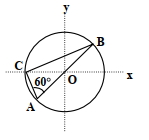
Consider a system of three charges $\frac{q}{3}, \frac{q}{3}$ and $-\frac{2q}{3}$ placed at points $A, B$ and $C$,respectively,as shown in the figure. Take $O$ to be the centre of the circle of radius $R$ and angle $\angle CAB = 60^{\circ}$.
A
The electric field at point $O$ is $\frac{q}{8 \pi \varepsilon_0 R^2}$ directed along the negative $x$-axis.
B
The potential energy of the system is zero.
C
The magnitude of the force between the charges at $C$ and $B$ is $\frac{q^2}{54 \pi \varepsilon_0 R^2}$.
D
The potential at point $O$ is $\frac{q}{12 \pi \varepsilon_0 R}$.
Solution
(C) The charges are $q_A = q/3$,$q_B = q/3$,and $q_C = -2q/3$.
In $\triangle ABC$,since $A, B, C$ are on a circle with center $O$,$OA = OB = OC = R$.
Given $\angle CAB = 60^{\circ}$,in $\triangle OAC$,$OA = OC = R$,so $\angle OCA = \angle OAC = 60^{\circ}$,implying $\triangle OAC$ is equilateral. Thus,$AC = R$.
Similarly,for $\triangle OBC$,since $\angle ACB = 90^{\circ}$ (angle in a semicircle if $AB$ is diameter,but here $AB$ is a chord),we calculate the distance $BC$.
Using the law of cosines in $\triangle OBC$,or geometry: $BC = \sqrt{R^2 + R^2 - 2R^2 \cos(120^{\circ})} = R\sqrt{3}$.
The force between $C$ and $B$ is $F_{BC} = \frac{1}{4 \pi \varepsilon_0} \frac{|q_C| |q_B|}{(BC)^2} = \frac{1}{4 \pi \varepsilon_0} \frac{(2q/3)(q/3)}{(R\sqrt{3})^2} = \frac{1}{4 \pi \varepsilon_0} \frac{2q^2/9}{3R^2} = \frac{q^2}{54 \pi \varepsilon_0 R^2}$.
Thus,option $C$ is correct.
In $\triangle ABC$,since $A, B, C$ are on a circle with center $O$,$OA = OB = OC = R$.
Given $\angle CAB = 60^{\circ}$,in $\triangle OAC$,$OA = OC = R$,so $\angle OCA = \angle OAC = 60^{\circ}$,implying $\triangle OAC$ is equilateral. Thus,$AC = R$.
Similarly,for $\triangle OBC$,since $\angle ACB = 90^{\circ}$ (angle in a semicircle if $AB$ is diameter,but here $AB$ is a chord),we calculate the distance $BC$.
Using the law of cosines in $\triangle OBC$,or geometry: $BC = \sqrt{R^2 + R^2 - 2R^2 \cos(120^{\circ})} = R\sqrt{3}$.
The force between $C$ and $B$ is $F_{BC} = \frac{1}{4 \pi \varepsilon_0} \frac{|q_C| |q_B|}{(BC)^2} = \frac{1}{4 \pi \varepsilon_0} \frac{(2q/3)(q/3)}{(R\sqrt{3})^2} = \frac{1}{4 \pi \varepsilon_0} \frac{2q^2/9}{3R^2} = \frac{q^2}{54 \pi \varepsilon_0 R^2}$.
Thus,option $C$ is correct.
0 likes
View Solution162
DifficultMCQ
Under the influence of the Coulomb field of charge $+Q$,a charge $-q$ is moving around it in an elliptical orbit. Find out the correct statement$(s)$.
A
The angular momentum of the charge $-q$ is constant.
B
The linear momentum of the charge $-q$ is constant.
C
The angular velocity of the charge $-q$ is constant.
D
The linear speed of the charge $-q$ is constant.
Solution
(A) The correct option is $A$.
In a central force field,such as the Coulomb field created by a stationary charge $+Q$,the force acting on the orbiting charge $-q$ is always directed towards the center (the position of $+Q$).
Since the force is a central force,the torque $\vec{\tau} = \vec{r} \times \vec{F}$ acting on the charge $-q$ about the center $+Q$ is zero.
According to the principle of conservation of angular momentum,if the net external torque on a system is zero,the angular momentum $\vec{L}$ remains constant.
Therefore,the angular momentum of the charge $-q$ is constant throughout its elliptical orbit.
Linear momentum,angular velocity,and linear speed are not constant in an elliptical orbit because the distance between the charges changes,leading to variations in speed and direction.
In a central force field,such as the Coulomb field created by a stationary charge $+Q$,the force acting on the orbiting charge $-q$ is always directed towards the center (the position of $+Q$).
Since the force is a central force,the torque $\vec{\tau} = \vec{r} \times \vec{F}$ acting on the charge $-q$ about the center $+Q$ is zero.
According to the principle of conservation of angular momentum,if the net external torque on a system is zero,the angular momentum $\vec{L}$ remains constant.
Therefore,the angular momentum of the charge $-q$ is constant throughout its elliptical orbit.
Linear momentum,angular velocity,and linear speed are not constant in an elliptical orbit because the distance between the charges changes,leading to variations in speed and direction.
0 likes
View Solution163
AdvancedMCQ
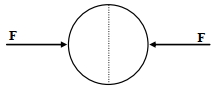
$A$ uniformly charged thin spherical shell of radius $R$ carries a uniform surface charge density of $\sigma$ per unit area. It is made of two hemispherical shells, held together by pressing them with force $F$ (see figure). $F$ is proportional to
A
$\frac{1}{\varepsilon_0} \sigma^2 R^2$
B
$\frac{1}{\varepsilon_0} \sigma^2 R$
C
$\frac{1}{\varepsilon_0} \frac{\sigma^2}{R}$
D
$\frac{1}{\varepsilon_0} \frac{\sigma^2}{R^2}$
Solution
(A) The electrostatic pressure on the surface of a charged conductor is given by $P = \frac{\sigma^2}{2\varepsilon_0}$.
This pressure acts radially outward on every element of the surface.
To keep the two hemispherical shells together, the external force $F$ must balance the total outward force exerted by the electrostatic pressure on the cross-sectional area of the hemisphere.
The cross-sectional area of the hemisphere is $A = \pi R^2$.
The total outward force $F$ is the product of the electrostatic pressure and the projected area perpendicular to the force direction:
$F = P \times A = \left( \frac{\sigma^2}{2\varepsilon_0} \right) \times \pi R^2$.
Thus, $F = \frac{\pi \sigma^2 R^2}{2\varepsilon_0}$.
Since $\pi$, $2$, and $\varepsilon_0$ are constants, the force $F$ is proportional to $\sigma^2 R^2$.
This pressure acts radially outward on every element of the surface.
To keep the two hemispherical shells together, the external force $F$ must balance the total outward force exerted by the electrostatic pressure on the cross-sectional area of the hemisphere.
The cross-sectional area of the hemisphere is $A = \pi R^2$.
The total outward force $F$ is the product of the electrostatic pressure and the projected area perpendicular to the force direction:
$F = P \times A = \left( \frac{\sigma^2}{2\varepsilon_0} \right) \times \pi R^2$.
Thus, $F = \frac{\pi \sigma^2 R^2}{2\varepsilon_0}$.
Since $\pi$, $2$, and $\varepsilon_0$ are constants, the force $F$ is proportional to $\sigma^2 R^2$.
0 likes
View Solution164
AdvancedMCQ
$A$ tiny spherical oil drop carrying a net charge $q$ is balanced in still air with a vertical uniform electric field of strength $\frac{81 \pi}{7} \times 10^5 \text{ Vm}^{-1}$. When the field is switched off,the drop is observed to fall with a terminal velocity $2 \times 10^{-3} \text{ ms}^{-1}$. Given $g = 9.8 \text{ ms}^{-2}$,viscosity of the air $\eta = 1.8 \times 10^{-5} \text{ Ns m}^{-2}$,and the density of oil $\rho = 900 \text{ kg m}^{-3}$,the magnitude of $q$ is:
A
$1.6 \times 10^{-19} \text{ C}$
B
$3.2 \times 10^{-19} \text{ C}$
C
$4.8 \times 10^{-19} \text{ C}$
D
$8.0 \times 10^{-19} \text{ C}$
Solution
(D) $1$. When the drop is balanced: $qE = mg = \frac{4}{3} \pi R^3 \rho g$ (assuming air density is negligible).
$2$. When the field is switched off,the drop falls with terminal velocity $v_T$: $mg = 6 \pi \eta R v_T$.
$3$. From the second equation,$R = \sqrt{\frac{9 \eta v_T}{2 \rho g}}$.
$4$. Substituting values: $R = \sqrt{\frac{9 \times 1.8 \times 10^{-5} \times 2 \times 10^{-3}}{2 \times 900 \times 9.8}} = \sqrt{\frac{32.4 \times 10^{-8}}{17640}} \approx 1.355 \times 10^{-6} \text{ m}$.
$5$. Now,$q = \frac{6 \pi \eta R v_T}{E} = \frac{6 \pi \times 1.8 \times 10^{-5} \times 1.355 \times 10^{-6} \times 2 \times 10^{-3}}{\frac{81 \pi}{7} \times 10^5}$.
$6$. Calculating this yields $q = 8.0 \times 10^{-19} \text{ C}$.
$2$. When the field is switched off,the drop falls with terminal velocity $v_T$: $mg = 6 \pi \eta R v_T$.
$3$. From the second equation,$R = \sqrt{\frac{9 \eta v_T}{2 \rho g}}$.
$4$. Substituting values: $R = \sqrt{\frac{9 \times 1.8 \times 10^{-5} \times 2 \times 10^{-3}}{2 \times 900 \times 9.8}} = \sqrt{\frac{32.4 \times 10^{-8}}{17640}} \approx 1.355 \times 10^{-6} \text{ m}$.
$5$. Now,$q = \frac{6 \pi \eta R v_T}{E} = \frac{6 \pi \times 1.8 \times 10^{-5} \times 1.355 \times 10^{-6} \times 2 \times 10^{-3}}{\frac{81 \pi}{7} \times 10^5}$.
$6$. Calculating this yields $q = 8.0 \times 10^{-19} \text{ C}$.
0 likes
View Solution165
DifficultMCQ
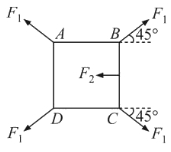
Four point charges,each of $+q$,are rigidly fixed at the four corners of a square planar soap film of side $a$. The surface tension of the soap film is $\gamma$. The system of charges and the planar film are in equilibrium,and $a = k \left[ \frac{q^2}{\gamma} \right]^{1/N}$,where $k$ is a constant. Then $N$ is:
A
$3$
B
$6$
C
$4$
D
$5$
Solution
(A) Consider the equilibrium of one side of the square film,say side $BC$ of length $a$. The surface tension force acting on this side is $F_2 = \gamma a$ (since a soap film has two surfaces,the force is $2 \gamma a$,but here we consider the force per unit length acting on the film edge).
The electrostatic force on the charges at $B$ and $C$ due to the other charges must be balanced by the surface tension. The net electrostatic force on charge $B$ due to charges at $A$ and $C$ is $F_{AC} = \frac{1}{4 \pi \varepsilon_0} \frac{q^2}{a^2} \sqrt{2}$ (along the diagonal $DB$) and due to charge $D$ is $F_D = \frac{1}{4 \pi \varepsilon_0} \frac{q^2}{2a^2}$ (along $DB$).
The component of the net electrostatic force on the side $BC$ perpendicular to $BC$ is $F_{net} = 2 \times F_{charge} \cos(45^{\circ})$.
Equating the forces: $2 \left( \frac{1}{4 \pi \varepsilon_0} \frac{q^2}{a^2} \right) \left( \frac{1}{\sqrt{2}} + \frac{1}{4} \right) = \gamma a$.
Simplifying,$a^3 = \frac{1}{4 \pi \varepsilon_0} \frac{q^2}{\gamma} \left( \sqrt{2} + \frac{1}{2} \right)$.
Comparing this with $a = k \left[ \frac{q^2}{\gamma} \right]^{1/N}$,we get $N = 3$.
The electrostatic force on the charges at $B$ and $C$ due to the other charges must be balanced by the surface tension. The net electrostatic force on charge $B$ due to charges at $A$ and $C$ is $F_{AC} = \frac{1}{4 \pi \varepsilon_0} \frac{q^2}{a^2} \sqrt{2}$ (along the diagonal $DB$) and due to charge $D$ is $F_D = \frac{1}{4 \pi \varepsilon_0} \frac{q^2}{2a^2}$ (along $DB$).
The component of the net electrostatic force on the side $BC$ perpendicular to $BC$ is $F_{net} = 2 \times F_{charge} \cos(45^{\circ})$.
Equating the forces: $2 \left( \frac{1}{4 \pi \varepsilon_0} \frac{q^2}{a^2} \right) \left( \frac{1}{\sqrt{2}} + \frac{1}{4} \right) = \gamma a$.
Simplifying,$a^3 = \frac{1}{4 \pi \varepsilon_0} \frac{q^2}{\gamma} \left( \sqrt{2} + \frac{1}{2} \right)$.
Comparing this with $a = k \left[ \frac{q^2}{\gamma} \right]^{1/N}$,we get $N = 3$.
0 likes
View Solution166
DifficultMCQ
Which of the field patterns given below is valid for electric field as well as for magnetic field?
A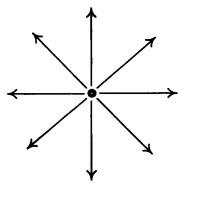
B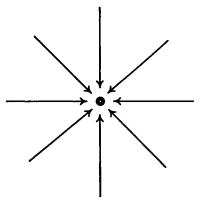
C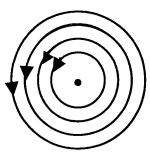
D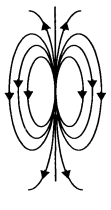
Solution
(C) The electric field lines originate from a positive charge and terminate at a negative charge. They do not form closed loops.
Magnetic field lines,on the other hand,always form closed continuous loops because magnetic monopoles do not exist.
However,the question asks for a pattern valid for both.
Option $C$ shows circular field lines.
For an electric field,circular lines can exist in regions with time-varying magnetic fields (induced electric fields).
For a magnetic field,circular lines are produced by a straight current-carrying wire.
Thus,the circular field pattern is the only one that can represent both an electric field (in specific non-electrostatic conditions) and a magnetic field.
Magnetic field lines,on the other hand,always form closed continuous loops because magnetic monopoles do not exist.
However,the question asks for a pattern valid for both.
Option $C$ shows circular field lines.
For an electric field,circular lines can exist in regions with time-varying magnetic fields (induced electric fields).
For a magnetic field,circular lines are produced by a straight current-carrying wire.
Thus,the circular field pattern is the only one that can represent both an electric field (in specific non-electrostatic conditions) and a magnetic field.
0 likes
View Solution167
DifficultMCQ
Which of the following statement$(s)$ is/are correct?
$(A)$ If the electric field due to a point charge varies as $r^{-2.5}$ instead of $r^{-2}$,then the Gauss law will still be valid.
$(B)$ The Gauss law can be used to calculate the field distribution around an electric dipole.
$(C)$ If the electric field between two point charges is zero somewhere,then the sign of the two charges is the same.
$(D)$ The work done by the external force in moving a unit positive charge from point $A$ at potential $V_A$ to point $B$ at potential $V_B$ is $(V_B - V_A)$.
$(A)$ If the electric field due to a point charge varies as $r^{-2.5}$ instead of $r^{-2}$,then the Gauss law will still be valid.
$(B)$ The Gauss law can be used to calculate the field distribution around an electric dipole.
$(C)$ If the electric field between two point charges is zero somewhere,then the sign of the two charges is the same.
$(D)$ The work done by the external force in moving a unit positive charge from point $A$ at potential $V_A$ to point $B$ at potential $V_B$ is $(V_B - V_A)$.
A
$(A, B)$
B
$(C, D)$
C
$(A, D)$
D
$(B, C)$
Solution
(B) The correct statements are $(C)$ and $(D)$.
$(A)$ Gauss's law is derived from the inverse-square law $(E \propto r^{-2})$. If the field varies as $r^{-2.5}$,the flux through a closed surface would depend on the shape and size of the surface,making the standard Gauss law invalid.
$(B)$ Gauss's law is most effective when there is high symmetry (spherical,cylindrical,or planar). An electric dipole lacks the symmetry required to simplify the calculation of the electric field using Gauss's law.
$(C)$ For two point charges,the electric field is zero at a point between them only if the charges have the same sign (repulsive force). If they have opposite signs,the field is zero outside the region between them.
$(D)$ By definition,the potential difference $V_B - V_A$ is the work done by an external agent in moving a unit positive charge from $A$ to $B$ without acceleration.
$(A)$ Gauss's law is derived from the inverse-square law $(E \propto r^{-2})$. If the field varies as $r^{-2.5}$,the flux through a closed surface would depend on the shape and size of the surface,making the standard Gauss law invalid.
$(B)$ Gauss's law is most effective when there is high symmetry (spherical,cylindrical,or planar). An electric dipole lacks the symmetry required to simplify the calculation of the electric field using Gauss's law.
$(C)$ For two point charges,the electric field is zero at a point between them only if the charges have the same sign (repulsive force). If they have opposite signs,the field is zero outside the region between them.
$(D)$ By definition,the potential difference $V_B - V_A$ is the work done by an external agent in moving a unit positive charge from $A$ to $B$ without acceleration.
0 likes
View Solution168
AdvancedMCQ
The electric field $E$ is measured at a point $P(0, 0, d)$ generated due to various charge distributions and the dependence of $E$ on $d$ is found to be different for different charge distributions. List-$I$ contains different relations between $E$ and $d$. List-$II$ describes different electric charge distributions,along with their locations. Match the functions in List-$I$ with the related charge distributions in List-$II$.
| List-$I$ | List-$II$ |
|---|---|
| $P$. $E$ is independent of $d$ | $1$. $A$ point charge $Q$ at the origin |
| $Q$. $E \propto \frac{1}{d}$ | $2$. $A$ small dipole with point charges $Q$ at $(0, 0, l)$ and $-Q$ at $(0, 0, -l)$. Take $2l \ll d$. |
| $R$. $E \propto \frac{1}{d^2}$ | $3$. An infinite line charge coincident with the $x$-axis,with uniform linear charge density $\lambda$ |
| $S$. $E \propto \frac{1}{d^3}$ | $4$. Two infinite wires carrying uniform linear charge density parallel to the $x$-axis. The one along $(y=0, z=l)$ has a charge density $+\lambda$ and the one along $(y=0, z=-l)$ has a charge density $-\lambda$. Take $2l \ll d$ |
| $5$. Infinite plane with uniform surface charge density |
A
$P \rightarrow 5; Q \rightarrow 3, 4; R \rightarrow 1; S \rightarrow 2$
B
$P \rightarrow 5; Q \rightarrow 3; R \rightarrow 1, 4; S \rightarrow 2$
C
$P \rightarrow 5; Q \rightarrow 3; R \rightarrow 1, 2; S \rightarrow 4$
D
$P \rightarrow 4; Q \rightarrow 2, 3; R \rightarrow 1; S \rightarrow 5$
Solution
(B) $(1)$ Electric field due to a point charge at the origin is $E = \frac{kQ}{d^2}$,so $E \propto \frac{1}{d^2}$.
$(2)$ Electric field at any point on the axis of a dipole is $E = \frac{2kp}{d^3} = \frac{4kQl}{d^3}$,so $E \propto \frac{1}{d^3}$.
$(3)$ Electric field due to an infinite long line charge is $E = \frac{2k\lambda}{d}$,so $E \propto \frac{1}{d}$.
$(4)$ Electric field due to two infinite long wires is $\vec{E} = \vec{E}_1 + \vec{E}_2 = \frac{2k\lambda}{d-l} - \frac{2k\lambda}{d+l} = \frac{4k\lambda l}{d^2-l^2}$. If $d \gg l$,then $E = \frac{4k\lambda l}{d^2}$,so $E \propto \frac{1}{d^2}$.
$(5)$ Electric field due to an infinite plane charge is $E = \frac{\sigma}{2\epsilon_0}$,which is independent of $d$.
Matching: $P \rightarrow 5$,$Q \rightarrow 3$,$R \rightarrow 1, 4$,$S \rightarrow 2$. Thus,option $B$ is correct.
$(2)$ Electric field at any point on the axis of a dipole is $E = \frac{2kp}{d^3} = \frac{4kQl}{d^3}$,so $E \propto \frac{1}{d^3}$.
$(3)$ Electric field due to an infinite long line charge is $E = \frac{2k\lambda}{d}$,so $E \propto \frac{1}{d}$.
$(4)$ Electric field due to two infinite long wires is $\vec{E} = \vec{E}_1 + \vec{E}_2 = \frac{2k\lambda}{d-l} - \frac{2k\lambda}{d+l} = \frac{4k\lambda l}{d^2-l^2}$. If $d \gg l$,then $E = \frac{4k\lambda l}{d^2}$,so $E \propto \frac{1}{d^2}$.
$(5)$ Electric field due to an infinite plane charge is $E = \frac{\sigma}{2\epsilon_0}$,which is independent of $d$.
Matching: $P \rightarrow 5$,$Q \rightarrow 3$,$R \rightarrow 1, 4$,$S \rightarrow 2$. Thus,option $B$ is correct.
0 likes
View Solution169
AdvancedMCQ
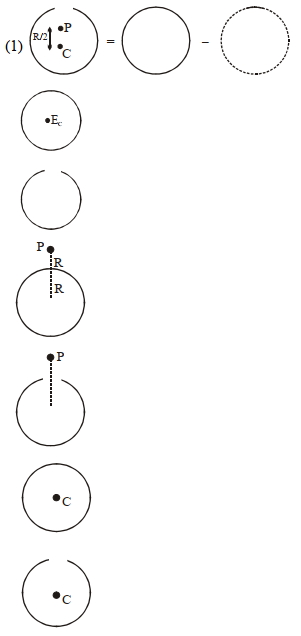
$A$ thin spherical insulating shell of radius $R$ carries a uniformly distributed charge such that the potential at its surface is $V_0$. $A$ hole with a small area $\alpha 4 \pi R^2$ (where $\alpha \ll 1$) is made on the shell without affecting the rest of the shell. Which one of the following statements is correct?
A
The ratio of the potential at the center of the shell to that of the point at $\frac{1}{2} R$ from the center towards the hole is $\frac{1-\alpha}{1-2\alpha}$.
B
The magnitude of the electric field at the center of the shell is reduced by $\frac{\alpha V_0}{2R}$.
C
The magnitude of the electric field at a point,located on a line passing through the hole and the shell's center at a distance $2R$ from the center of the spherical shell,will be reduced by $\frac{\alpha V_0}{R}$.
D
The potential at the center of the shell is reduced by $2\alpha V_0$.
Solution
(A) Let the initial charge on the sphere be $Q$. Thus,$V_0 = \frac{kQ}{R}$.
When a small hole of area $\alpha(4\pi R^2)$ is made,the charge removed is $q = \alpha Q$.
$(1)$ Potential at the center $(V_c)$ and at a point $P$ at distance $R/2$ from the center towards the hole $(V_p)$:
The potential at any point is the sum of the potential due to the complete sphere and the potential due to the removed charge element (treated as a negative point charge at the surface).
$V_c = \frac{kQ}{R} - \frac{kq}{R} = \frac{kQ}{R}(1-\alpha) = V_0(1-\alpha)$.
$V_p = \frac{kQ}{R} - \frac{kq}{R/2} = \frac{kQ}{R} - \frac{2kq}{R} = \frac{kQ}{R}(1-2\alpha) = V_0(1-2\alpha)$.
Therefore,the ratio $\frac{V_c}{V_p} = \frac{1-\alpha}{1-2\alpha}$. Thus,option $(A)$ is correct.
$(2)$ Electric field at the center $(E_c)$:
Initially,$E_c = 0$. After removing charge $q$,$E_c = \frac{kq}{R^2} = \frac{k(\alpha Q)}{R^2} = \alpha \frac{V_0}{R}$. The field increases.
$(3)$ Electric field at a point $P'$ at distance $2R$ from the center:
Initially,$E_{P'} = \frac{kQ}{(2R)^2} = \frac{kQ}{4R^2}$.
After removing charge $q$ from the surface,the field due to the hole at $P'$ is $\frac{kq}{R^2}$ (since $P'$ is at distance $R$ from the hole).
$E_{P', \text{final}} = \frac{kQ}{4R^2} - \frac{kq}{R^2} = \frac{kQ}{4R^2} - \frac{k(\alpha Q)}{R^2} = \frac{kQ}{4R^2} - \frac{4k\alpha Q}{4R^2} = \frac{kQ}{4R^2}(1-4\alpha)$.
Change in field $\Delta E = \frac{kq}{R^2} = \frac{k(\alpha Q)}{R^2} = \frac{\alpha V_0}{R}$.
When a small hole of area $\alpha(4\pi R^2)$ is made,the charge removed is $q = \alpha Q$.
$(1)$ Potential at the center $(V_c)$ and at a point $P$ at distance $R/2$ from the center towards the hole $(V_p)$:
The potential at any point is the sum of the potential due to the complete sphere and the potential due to the removed charge element (treated as a negative point charge at the surface).
$V_c = \frac{kQ}{R} - \frac{kq}{R} = \frac{kQ}{R}(1-\alpha) = V_0(1-\alpha)$.
$V_p = \frac{kQ}{R} - \frac{kq}{R/2} = \frac{kQ}{R} - \frac{2kq}{R} = \frac{kQ}{R}(1-2\alpha) = V_0(1-2\alpha)$.
Therefore,the ratio $\frac{V_c}{V_p} = \frac{1-\alpha}{1-2\alpha}$. Thus,option $(A)$ is correct.
$(2)$ Electric field at the center $(E_c)$:
Initially,$E_c = 0$. After removing charge $q$,$E_c = \frac{kq}{R^2} = \frac{k(\alpha Q)}{R^2} = \alpha \frac{V_0}{R}$. The field increases.
$(3)$ Electric field at a point $P'$ at distance $2R$ from the center:
Initially,$E_{P'} = \frac{kQ}{(2R)^2} = \frac{kQ}{4R^2}$.
After removing charge $q$ from the surface,the field due to the hole at $P'$ is $\frac{kq}{R^2}$ (since $P'$ is at distance $R$ from the hole).
$E_{P', \text{final}} = \frac{kQ}{4R^2} - \frac{kq}{R^2} = \frac{kQ}{4R^2} - \frac{k(\alpha Q)}{R^2} = \frac{kQ}{4R^2} - \frac{4k\alpha Q}{4R^2} = \frac{kQ}{4R^2}(1-4\alpha)$.
Change in field $\Delta E = \frac{kq}{R^2} = \frac{k(\alpha Q)}{R^2} = \frac{\alpha V_0}{R}$.
0 likes
View Solution170
MediumMCQ
Let $E_1(r)$,$E_2(r)$,and $E_3(r)$ be the respective electric fields at a distance $r$ from a point charge $Q$,an infinitely long wire with constant linear charge density $\lambda$,and an infinite plane with uniform surface charge density $\sigma$. If $E_1(r_0) = E_2(r_0) = E_3(r_0)$ at a given distance $r_0$,then:
A
$Q = 4 \sigma \pi r_0^2$
B
$r_0 = \frac{\lambda}{2 \pi \sigma}$
C
$E_1(r_0 / 2) = 2 E_2(r_0 / 2)$
D
$E_2(r_0 / 2) = 4 E_3(r_0 / 2)$
Solution
(C) The electric fields are given by: $E_1(r) = \frac{Q}{4 \pi \epsilon_0 r^2}$,$E_2(r) = \frac{\lambda}{2 \pi \epsilon_0 r}$,and $E_3(r) = \frac{\sigma}{2 \epsilon_0}$.
Given $E_1(r_0) = E_2(r_0) = E_3(r_0) = E_0$,we have:
$\frac{Q}{4 \pi \epsilon_0 r_0^2} = \frac{\lambda}{2 \pi \epsilon_0 r_0} = \frac{\sigma}{2 \epsilon_0} = E_0$.
From $E_2(r_0) = E_3(r_0)$,we get $\frac{\lambda}{2 \pi \epsilon_0 r_0} = \frac{\sigma}{2 \epsilon_0}$,which implies $r_0 = \frac{\lambda}{\pi \sigma}$. Thus,option $B$ is incorrect.
From $E_1(r_0) = E_3(r_0)$,we get $\frac{Q}{4 \pi \epsilon_0 r_0^2} = \frac{\sigma}{2 \epsilon_0}$,which implies $Q = 2 \pi \sigma r_0^2$. Thus,option $A$ is incorrect.
Now,check option $C$: $E_1(r_0/2) = \frac{Q}{4 \pi \epsilon_0 (r_0/2)^2} = 4 E_1(r_0) = 4 E_0$. Also,$E_2(r_0/2) = \frac{\lambda}{2 \pi \epsilon_0 (r_0/2)} = 2 E_2(r_0) = 2 E_0$. Therefore,$E_1(r_0/2) = 2 E_2(r_0/2)$. Option $C$ is correct.
Check option $D$: $E_3(r)$ is independent of $r$,so $E_3(r_0/2) = E_3(r_0) = E_0$. Since $E_2(r_0/2) = 2 E_0$,$E_2(r_0/2) = 2 E_3(r_0/2)$. Option $D$ is incorrect.
Given $E_1(r_0) = E_2(r_0) = E_3(r_0) = E_0$,we have:
$\frac{Q}{4 \pi \epsilon_0 r_0^2} = \frac{\lambda}{2 \pi \epsilon_0 r_0} = \frac{\sigma}{2 \epsilon_0} = E_0$.
From $E_2(r_0) = E_3(r_0)$,we get $\frac{\lambda}{2 \pi \epsilon_0 r_0} = \frac{\sigma}{2 \epsilon_0}$,which implies $r_0 = \frac{\lambda}{\pi \sigma}$. Thus,option $B$ is incorrect.
From $E_1(r_0) = E_3(r_0)$,we get $\frac{Q}{4 \pi \epsilon_0 r_0^2} = \frac{\sigma}{2 \epsilon_0}$,which implies $Q = 2 \pi \sigma r_0^2$. Thus,option $A$ is incorrect.
Now,check option $C$: $E_1(r_0/2) = \frac{Q}{4 \pi \epsilon_0 (r_0/2)^2} = 4 E_1(r_0) = 4 E_0$. Also,$E_2(r_0/2) = \frac{\lambda}{2 \pi \epsilon_0 (r_0/2)} = 2 E_2(r_0) = 2 E_0$. Therefore,$E_1(r_0/2) = 2 E_2(r_0/2)$. Option $C$ is correct.
Check option $D$: $E_3(r)$ is independent of $r$,so $E_3(r_0/2) = E_3(r_0) = E_0$. Since $E_2(r_0/2) = 2 E_0$,$E_2(r_0/2) = 2 E_3(r_0/2)$. Option $D$ is incorrect.
0 likes
View Solution171
DifficultMCQ
Four charges $Q_1, Q_2, Q_3$, and $Q_4$ of the same magnitude are fixed along the $x$-axis at $x = -2a, -a, +a$, and $+2a$, respectively. A positive charge $q$ is placed on the positive $y$-axis at a distance $b > 0$. Four options regarding the signs of these charges are given in List-$I$. The direction of the net force on the charge $q$ is given in List-$II$. Match List-$I$ with List-$II$ and select the correct answer using the codes given below the lists.
| List-$I$ | List-$II$ |
| $P. Q_1, Q_2, Q_3, Q_4$ all positive | $1. +x$ |
| $Q. Q_1, Q_2$ positive; $Q_3, Q_4$ negative | $2. -x$ |
| $R. Q_1, Q_4$ positive; $Q_2, Q_3$ negative | $3. +y$ |
| $S. Q_1, Q_3$ positive; $Q_2, Q_4$ negative | $4. -y$ |
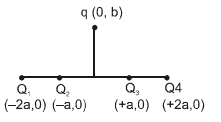
A
$P-3, Q-1, R-4, S-2$
B
$P-4, Q-2, R-3, S-1$
C
$P-3, Q-1, R-2, S-4$
D
$P-4, Q-2, R-1, S-3$
Solution
(A) Let the force exerted by charge $Q_i$ on $q$ be $\vec{F}_i$. The $x$-component of the force from a pair of charges at $\pm x_0$ is proportional to $(Q_{left} - Q_{right})$. The $y$-component is proportional to $(Q_{left} + Q_{right})$.
$(P)$ All positive: $Q_1=Q_2=Q_3=Q_4 = +Q$. The $x$-components cancel out due to symmetry. The $y$-components add up, resulting in a net force along $+y$ (Option $3$).
$(Q)$ $Q_1, Q_2$ positive, $Q_3, Q_4$ negative: The $y$-components cancel out. The $x$-components add up in the $+x$ direction because the positive charges are on the left and negative on the right, pushing $q$ to the right (Option $1$).
$(R)$ $Q_1, Q_4$ positive, $Q_2, Q_3$ negative: The $x$-components cancel out. The $y$-components are negative because the charges closer to the origin $(Q_2, Q_3)$ are negative and stronger in their $y$-effect than the farther positive charges $(Q_1, Q_4)$, resulting in a net force along $-y$ (Option $4$).
$(S)$ $Q_1, Q_3$ positive, $Q_2, Q_4$ negative: The $y$-components cancel out. The $x$-components result in a net force along $-x$ because the net effect of the charges on the left is negative and on the right is positive, pulling $q$ to the left (Option $2$).
Thus, the correct matching is $P-3, Q-1, R-4, S-2$.
$(P)$ All positive: $Q_1=Q_2=Q_3=Q_4 = +Q$. The $x$-components cancel out due to symmetry. The $y$-components add up, resulting in a net force along $+y$ (Option $3$).
$(Q)$ $Q_1, Q_2$ positive, $Q_3, Q_4$ negative: The $y$-components cancel out. The $x$-components add up in the $+x$ direction because the positive charges are on the left and negative on the right, pushing $q$ to the right (Option $1$).
$(R)$ $Q_1, Q_4$ positive, $Q_2, Q_3$ negative: The $x$-components cancel out. The $y$-components are negative because the charges closer to the origin $(Q_2, Q_3)$ are negative and stronger in their $y$-effect than the farther positive charges $(Q_1, Q_4)$, resulting in a net force along $-y$ (Option $4$).
$(S)$ $Q_1, Q_3$ positive, $Q_2, Q_4$ negative: The $y$-components cancel out. The $x$-components result in a net force along $-x$ because the net effect of the charges on the left is negative and on the right is positive, pulling $q$ to the left (Option $2$).
Thus, the correct matching is $P-3, Q-1, R-4, S-2$.
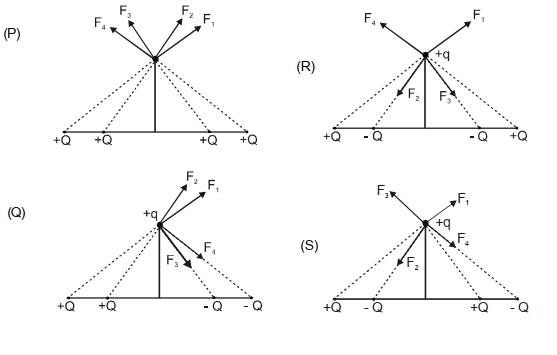
0 likes
View Solution172
AdvancedMCQ
$A$ disk of radius $R$ with uniform positive charge density $\sigma$ is placed on the $xy$ plane with its center at the origin. The Coulomb potential along the $z$-axis is $V(z) = \frac{\sigma}{2\epsilon_0} (\sqrt{R^2+z^2} - z)$. $A$ particle of positive charge $q$ is placed initially at rest at a point on the $z$-axis with $z=z_0$ and $z_0 > 0$. In addition to the Coulomb force,the particle experiences a vertical force $\vec{F} = -c\hat{k}$ with $c > 0$. Let $\beta = \frac{2c\epsilon_0}{q\sigma}$. Which of the following statement$(s)$ is(are) correct?
$(A)$ For $\beta = \frac{1}{4}$ and $z_0 = \frac{25}{7}R$,the particle reaches the origin.
$(B)$ For $\beta = \frac{1}{4}$ and $z_0 = \frac{3}{7}R$,the particle reaches the origin.
$(C)$ For $\beta = \frac{1}{4}$ and $z_0 = \frac{R}{\sqrt{3}}$,the particle returns back to $z=z_0$.
$(D)$ For $\beta > 1$ and $z_0 > 0$,the particle always reaches the origin.
$(A)$ For $\beta = \frac{1}{4}$ and $z_0 = \frac{25}{7}R$,the particle reaches the origin.
$(B)$ For $\beta = \frac{1}{4}$ and $z_0 = \frac{3}{7}R$,the particle reaches the origin.
$(C)$ For $\beta = \frac{1}{4}$ and $z_0 = \frac{R}{\sqrt{3}}$,the particle returns back to $z=z_0$.
$(D)$ For $\beta > 1$ and $z_0 > 0$,the particle always reaches the origin.
A
$A, B, C$
B
$A, B$
C
$A, C$
D
$A, C, D$
Solution
(A) The potential energy of the particle is $U(z) = qV(z) = \frac{q\sigma}{2\epsilon_0}(\sqrt{R^2+z^2} - z)$.
The external force is $\vec{F} = -c\hat{k}$,so the potential energy due to this force is $U_{ext}(z) = cz$.
The total potential energy is $U_{total}(z) = \frac{q\sigma}{2\epsilon_0}(\sqrt{R^2+z^2} - z) + cz$.
Using $\beta = \frac{2c\epsilon_0}{q\sigma}$,we have $c = \frac{\beta q\sigma}{2\epsilon_0}$.
Thus,$U_{total}(z) = \frac{q\sigma}{2\epsilon_0}(\sqrt{R^2+z^2} - z + \beta z)$.
For the particle to reach the origin,the total energy at $z_0$ must be greater than or equal to the potential energy at $z=0$. Since the particle starts from rest,$E = U_{total}(z_0)$.
$U_{total}(z_0) \ge U_{total}(0) \implies \sqrt{R^2+z_0^2} - z_0 + \beta z_0 \ge R$.
For $(A)$: $\beta = 1/4, z_0 = 25/7 R$. $\sqrt{R^2 + (25/7)^2 R^2} - 25/7 R + 1/4(25/7) R = \sqrt{1 + 625/49} R - 25/7 R + 25/28 R = \sqrt{674/49} R - 75/28 R \approx 3.71 R - 2.67 R = 1.04 R > R$. Particle reaches origin.
For $(B)$: $\beta = 1/4, z_0 = 3/7 R$. $\sqrt{1 + 9/49} R - 3/7 R + 1/4(3/7) R = \sqrt{58/49} R - 3/7 R + 3/28 R \approx 1.08 R - 0.428 R + 0.107 R = 0.759 R < R$. Particle does not reach origin.
For $(C)$: At $z_0 = R/\sqrt{3}$,$U_{total}(z_0) = \frac{q\sigma}{2\epsilon_0}(\sqrt{R^2 + R^2/3} - R/\sqrt{3} + 1/4(R/\sqrt{3})) = \frac{q\sigma}{2\epsilon_0}(2R/\sqrt{3} - R/\sqrt{3} + R/4\sqrt{3}) = \frac{q\sigma}{2\epsilon_0}(5R/4\sqrt{3}) > R$. It will pass the origin.
Correct option is $(A)$.
The external force is $\vec{F} = -c\hat{k}$,so the potential energy due to this force is $U_{ext}(z) = cz$.
The total potential energy is $U_{total}(z) = \frac{q\sigma}{2\epsilon_0}(\sqrt{R^2+z^2} - z) + cz$.
Using $\beta = \frac{2c\epsilon_0}{q\sigma}$,we have $c = \frac{\beta q\sigma}{2\epsilon_0}$.
Thus,$U_{total}(z) = \frac{q\sigma}{2\epsilon_0}(\sqrt{R^2+z^2} - z + \beta z)$.
For the particle to reach the origin,the total energy at $z_0$ must be greater than or equal to the potential energy at $z=0$. Since the particle starts from rest,$E = U_{total}(z_0)$.
$U_{total}(z_0) \ge U_{total}(0) \implies \sqrt{R^2+z_0^2} - z_0 + \beta z_0 \ge R$.
For $(A)$: $\beta = 1/4, z_0 = 25/7 R$. $\sqrt{R^2 + (25/7)^2 R^2} - 25/7 R + 1/4(25/7) R = \sqrt{1 + 625/49} R - 25/7 R + 25/28 R = \sqrt{674/49} R - 75/28 R \approx 3.71 R - 2.67 R = 1.04 R > R$. Particle reaches origin.
For $(B)$: $\beta = 1/4, z_0 = 3/7 R$. $\sqrt{1 + 9/49} R - 3/7 R + 1/4(3/7) R = \sqrt{58/49} R - 3/7 R + 3/28 R \approx 1.08 R - 0.428 R + 0.107 R = 0.759 R < R$. Particle does not reach origin.
For $(C)$: At $z_0 = R/\sqrt{3}$,$U_{total}(z_0) = \frac{q\sigma}{2\epsilon_0}(\sqrt{R^2 + R^2/3} - R/\sqrt{3} + 1/4(R/\sqrt{3})) = \frac{q\sigma}{2\epsilon_0}(2R/\sqrt{3} - R/\sqrt{3} + R/4\sqrt{3}) = \frac{q\sigma}{2\epsilon_0}(5R/4\sqrt{3}) > R$. It will pass the origin.
Correct option is $(A)$.
0 likes
View Solution173
MediumMCQ
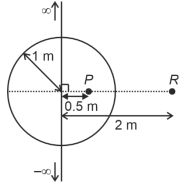
An infinitely long thin wire,having a uniform charge density per unit length of $5 \text{ nC/m}$,is passing through a spherical shell of radius $1 \text{ m}$,as shown in the figure. $A$ $10 \text{ nC}$ charge is distributed uniformly over the spherical shell. If the configuration of the charges remains static,the magnitude of the potential difference between points $P$ and $R$,in Volt,is. . . .
[Given: In $SI$ units $\frac{1}{4 \pi \epsilon_0}=9 \times 10^9, \ln 2=0.7$. Ignore the area pierced by the wire.]
[Given: In $SI$ units $\frac{1}{4 \pi \epsilon_0}=9 \times 10^9, \ln 2=0.7$. Ignore the area pierced by the wire.]
A
$110$
B
$115$
C
$170$
D
$171$
Solution
(D) The total potential difference $V_P - V_R$ is the sum of the potential differences due to the wire and the spherical shell.
$1$. Potential difference due to the infinitely long wire:
The electric field at a distance $x$ from the wire is $E = \frac{2k\lambda}{x}$,where $k = 9 \times 10^9 \text{ N m}^2/\text{C}^2$ and $\lambda = 5 \times 10^{-9} \text{ C/m}$.
The potential difference $V_P - V_R = \int_{0.5}^{2} E \, dx = \int_{0.5}^{2} \frac{2k\lambda}{x} \, dx = 2k\lambda \ln\left(\frac{2}{0.5}\right) = 2k\lambda \ln(4) = 4k\lambda \ln(2)$.
Substituting the values: $V_P - V_R = 4 \times (9 \times 10^9) \times (5 \times 10^{-9}) \times 0.7 = 180 \times 0.7 = 126 \text{ V}$.
$2$. Potential difference due to the spherical shell:
Point $P$ is at distance $0.5 \text{ m}$ (inside the shell of radius $R_s = 1 \text{ m}$),and point $R$ is at distance $2 \text{ m}$ (outside the shell).
The potential inside a shell is constant: $V_P = \frac{kQ}{R_s} = \frac{(9 \times 10^9) \times (10 \times 10^{-9})}{1} = 90 \text{ V}$.
The potential outside a shell at distance $r$ is $V_R = \frac{kQ}{r} = \frac{(9 \times 10^9) \times (10 \times 10^{-9})}{2} = 45 \text{ V}$.
Thus,$V_P - V_R = 90 - 45 = 45 \text{ V}$.
Total potential difference: $V_P - V_R = 126 + 45 = 171 \text{ V}$.
$1$. Potential difference due to the infinitely long wire:
The electric field at a distance $x$ from the wire is $E = \frac{2k\lambda}{x}$,where $k = 9 \times 10^9 \text{ N m}^2/\text{C}^2$ and $\lambda = 5 \times 10^{-9} \text{ C/m}$.
The potential difference $V_P - V_R = \int_{0.5}^{2} E \, dx = \int_{0.5}^{2} \frac{2k\lambda}{x} \, dx = 2k\lambda \ln\left(\frac{2}{0.5}\right) = 2k\lambda \ln(4) = 4k\lambda \ln(2)$.
Substituting the values: $V_P - V_R = 4 \times (9 \times 10^9) \times (5 \times 10^{-9}) \times 0.7 = 180 \times 0.7 = 126 \text{ V}$.
$2$. Potential difference due to the spherical shell:
Point $P$ is at distance $0.5 \text{ m}$ (inside the shell of radius $R_s = 1 \text{ m}$),and point $R$ is at distance $2 \text{ m}$ (outside the shell).
The potential inside a shell is constant: $V_P = \frac{kQ}{R_s} = \frac{(9 \times 10^9) \times (10 \times 10^{-9})}{1} = 90 \text{ V}$.
The potential outside a shell at distance $r$ is $V_R = \frac{kQ}{r} = \frac{(9 \times 10^9) \times (10 \times 10^{-9})}{2} = 45 \text{ V}$.
Thus,$V_P - V_R = 90 - 45 = 45 \text{ V}$.
Total potential difference: $V_P - V_R = 126 + 45 = 171 \text{ V}$.
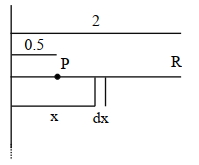
0 likes
View Solution174
MediumMCQ
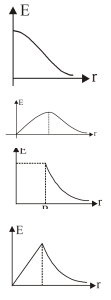
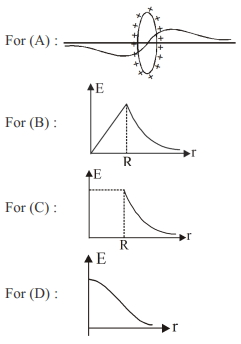
Column $II$ corresponds to the graph of magnitude of electric field versus distance from the centre of the charge distribution in Column $I$. Match the items in Column $I$ with the corresponding graphs in Column $II$.
| Column-$I$ | Column-$II$ |
|---|---|
| $(A)$ Ring along its axis | $(P)$ Graph with a peak at a distance $r > 0$ |
| $(B)$ Uniformly charged solid sphere | $(Q)$ Graph increasing linearly for $r < R$ and decreasing as $1/r^2$ for $r > R$ |
| $(C)$ Uniformly charged spherical shell | $(R)$ Graph with zero field for $r < R$ and decreasing as $1/r^2$ for $r > R$ |
| $(D)$ Combination of charge $+Q$ and $-Q$ at the perpendicular bisector | $(S)$ Graph with a maximum at the center and decreasing as $r$ increases |
A
$(A)-(Q); (B)-(S); (C)-(R); (D)-(P)$
B
$(A)-(S); (B)-(R); (C)-(P); (D)-(S)$
C
$(A)-(R); (B)-(P); (C)-(Q); (D)-(R)$
D
$(A)-(P); (B)-(Q); (C)-(S); (D)-(R)$
Solution
(D) The electric field $E$ for different charge distributions is as follows:
$(A)$ For a charged ring along its axis,the field is zero at the center,increases to a maximum at $r = R/\sqrt{2}$,and then decreases. This corresponds to graph $(P)$.
$(B)$ For a uniformly charged solid sphere,the field $E \propto r$ for $r < R$ and $E \propto 1/r^2$ for $r > R$. This corresponds to graph $(Q)$.
$(C)$ For a uniformly charged spherical shell,the field is zero for $r < R$ and $E \propto 1/r^2$ for $r > R$. This corresponds to graph $(R)$.
$(D)$ For a dipole (combination of $+Q$ and $-Q$),the field on the perpendicular bisector is maximum at the center and decreases as distance increases. This corresponds to graph $(S)$.
Thus,the correct matching is $(A)-(P), (B)-(Q), (C)-(R), (D)-(S)$.
$(A)$ For a charged ring along its axis,the field is zero at the center,increases to a maximum at $r = R/\sqrt{2}$,and then decreases. This corresponds to graph $(P)$.
$(B)$ For a uniformly charged solid sphere,the field $E \propto r$ for $r < R$ and $E \propto 1/r^2$ for $r > R$. This corresponds to graph $(Q)$.
$(C)$ For a uniformly charged spherical shell,the field is zero for $r < R$ and $E \propto 1/r^2$ for $r > R$. This corresponds to graph $(R)$.
$(D)$ For a dipole (combination of $+Q$ and $-Q$),the field on the perpendicular bisector is maximum at the center and decreases as distance increases. This corresponds to graph $(S)$.
Thus,the correct matching is $(A)-(P), (B)-(Q), (C)-(R), (D)-(S)$.
0 likes
View Solution175
AdvancedMCQ
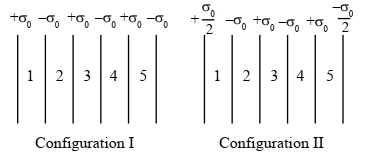
Six infinitely large and thin non-conducting sheets are fixed in configurations $I$ and $II$. As shown in the figure,the sheets carry uniform surface charge densities which are indicated in terms of $\sigma_0$. The separation between any two consecutive sheets is $d = 1 \mu m$. The various regions between the sheets are denoted as $1, 2, 3, 4$ and $5$. If $\sigma_0 = 9 \mu C / m^2$,then which of the following statements is/are correct: (Take permittivity of free space $\epsilon_0 = 9 \times 10^{-12} F / m$):
A
In region $3$ of the configuration $II$,the magnitude of the electric field is $\frac{\sigma_0}{\epsilon_0}$.
B
Potential difference between the first and the last sheets of the configuration $I$ is $3 V$.
C
In region $4$ of the configuration $I$,the magnitude of the electric field is zero.
D
Potential difference between the first and the last sheets of the configuration $II$ is zero.
Solution
(NONE) For configuration $I$: The electric field in any region between the sheets is given by $E = \frac{1}{2\epsilon_0} \sum \sigma_i$.
In region $4$,$E_4 = \frac{1}{2\epsilon_0} (\sigma_0 - \sigma_0 + \sigma_0 - \sigma_0 + \sigma_0) = \frac{\sigma_0}{2\epsilon_0} (1 - 1 + 1 - 1 + 1) = \frac{\sigma_0}{2\epsilon_0}$. Thus,option $C$ is incorrect.
The potential difference between the first and last sheet is $V_1 - V_6 = E_1 d + E_2 d + E_3 d + E_4 d + E_5 d$.
For configuration $I$,$E_1 = \frac{\sigma_0}{2\epsilon_0}$,$E_2 = -\frac{\sigma_0}{2\epsilon_0}$,$E_3 = \frac{\sigma_0}{2\epsilon_0}$,$E_4 = -\frac{\sigma_0}{2\epsilon_0}$,$E_5 = \frac{\sigma_0}{2\epsilon_0}$.
$V_1 - V_6 = d \frac{\sigma_0}{2\epsilon_0} (1 - 1 + 1 - 1 + 1) = \frac{\sigma_0 d}{2\epsilon_0} = \frac{9 \times 10^{-6} \times 10^{-6}}{2 \times 9 \times 10^{-12}} = 0.5 V$. Option $B$ is incorrect.
For configuration $II$: The electric field in region $3$ is $E_3 = \frac{1}{2\epsilon_0} (\frac{\sigma_0}{2} - \sigma_0 + \sigma_0) = \frac{\sigma_0}{4\epsilon_0}$. Option $A$ is incorrect.
The potential difference between the first and last sheet for configuration $II$: $E_1 = \frac{\sigma_0}{4\epsilon_0}$,$E_2 = -\frac{\sigma_0}{4\epsilon_0}$,$E_3 = \frac{\sigma_0}{4\epsilon_0}$,$E_4 = -\frac{\sigma_0}{4\epsilon_0}$,$E_5 = \frac{\sigma_0}{4\epsilon_0}$.
$V_1 - V_6 = d (E_1 + E_2 + E_3 + E_4 + E_5) = d \frac{\sigma_0}{4\epsilon_0} (1 - 1 + 1 - 1 + 1) = \frac{\sigma_0 d}{4\epsilon_0} \neq 0$. Option $D$ is incorrect.
Upon re-evaluating the configurations,no provided option is correct based on standard physics principles.
In region $4$,$E_4 = \frac{1}{2\epsilon_0} (\sigma_0 - \sigma_0 + \sigma_0 - \sigma_0 + \sigma_0) = \frac{\sigma_0}{2\epsilon_0} (1 - 1 + 1 - 1 + 1) = \frac{\sigma_0}{2\epsilon_0}$. Thus,option $C$ is incorrect.
The potential difference between the first and last sheet is $V_1 - V_6 = E_1 d + E_2 d + E_3 d + E_4 d + E_5 d$.
For configuration $I$,$E_1 = \frac{\sigma_0}{2\epsilon_0}$,$E_2 = -\frac{\sigma_0}{2\epsilon_0}$,$E_3 = \frac{\sigma_0}{2\epsilon_0}$,$E_4 = -\frac{\sigma_0}{2\epsilon_0}$,$E_5 = \frac{\sigma_0}{2\epsilon_0}$.
$V_1 - V_6 = d \frac{\sigma_0}{2\epsilon_0} (1 - 1 + 1 - 1 + 1) = \frac{\sigma_0 d}{2\epsilon_0} = \frac{9 \times 10^{-6} \times 10^{-6}}{2 \times 9 \times 10^{-12}} = 0.5 V$. Option $B$ is incorrect.
For configuration $II$: The electric field in region $3$ is $E_3 = \frac{1}{2\epsilon_0} (\frac{\sigma_0}{2} - \sigma_0 + \sigma_0) = \frac{\sigma_0}{4\epsilon_0}$. Option $A$ is incorrect.
The potential difference between the first and last sheet for configuration $II$: $E_1 = \frac{\sigma_0}{4\epsilon_0}$,$E_2 = -\frac{\sigma_0}{4\epsilon_0}$,$E_3 = \frac{\sigma_0}{4\epsilon_0}$,$E_4 = -\frac{\sigma_0}{4\epsilon_0}$,$E_5 = \frac{\sigma_0}{4\epsilon_0}$.
$V_1 - V_6 = d (E_1 + E_2 + E_3 + E_4 + E_5) = d \frac{\sigma_0}{4\epsilon_0} (1 - 1 + 1 - 1 + 1) = \frac{\sigma_0 d}{4\epsilon_0} \neq 0$. Option $D$ is incorrect.
Upon re-evaluating the configurations,no provided option is correct based on standard physics principles.
0 likes
View Solution176
MediumMCQ
Two small identical metal balls are equally charged and placed at a fixed distance away from each other. They experience an electrostatic force '$F$'. $A$ similar uncharged ball,after touching one of them,is placed at the midpoint between the two balls. The force experienced by this ball is:
A
$F/2$
B
$F$
C
$4F$
D
$2F$
Solution
(B) The initial electrostatic force between two identical balls with charge $Q$ at distance $r$ is given by Coulomb's Law: $F = \frac{kQ^2}{r^2}$.
When an identical uncharged ball touches one of the charged balls,the charge $Q$ is shared equally between them. Thus,the touched ball now has charge $Q/2$ and the third ball also acquires a charge $Q/2$.
The third ball is placed at the midpoint ($r/2$ from each). Let the charges be $q_1 = Q/2$ (touched ball),$q_2 = Q$ (untouched ball),and $q_3 = Q/2$ (third ball).
The force on the third ball due to the first ball is $F_1 = \frac{k(Q/2)(Q/2)}{(r/2)^2} = \frac{kQ^2/4}{r^2/4} = \frac{kQ^2}{r^2} = F$ (directed away from the first ball).
The force on the third ball due to the second ball is $F_2 = \frac{k(Q)(Q/2)}{(r/2)^2} = \frac{kQ^2/2}{r^2/4} = \frac{2kQ^2}{r^2} = 2F$ (directed away from the second ball).
Since the forces are in opposite directions,the net force is $F_{\text{net}} = |F_2 - F_1| = |2F - F| = F$.
When an identical uncharged ball touches one of the charged balls,the charge $Q$ is shared equally between them. Thus,the touched ball now has charge $Q/2$ and the third ball also acquires a charge $Q/2$.
The third ball is placed at the midpoint ($r/2$ from each). Let the charges be $q_1 = Q/2$ (touched ball),$q_2 = Q$ (untouched ball),and $q_3 = Q/2$ (third ball).
The force on the third ball due to the first ball is $F_1 = \frac{k(Q/2)(Q/2)}{(r/2)^2} = \frac{kQ^2/4}{r^2/4} = \frac{kQ^2}{r^2} = F$ (directed away from the first ball).
The force on the third ball due to the second ball is $F_2 = \frac{k(Q)(Q/2)}{(r/2)^2} = \frac{kQ^2/2}{r^2/4} = \frac{2kQ^2}{r^2} = 2F$ (directed away from the second ball).
Since the forces are in opposite directions,the net force is $F_{\text{net}} = |F_2 - F_1| = |2F - F| = F$.
0 likes
View Solution177
EasyMCQ
$A$ Van de Graaff generator produces:
A
low voltage and low current.
B
high voltage and high current.
C
high voltage and low current.
D
low voltage and high current.
Solution
(C) Van de Graaff generator is an electrostatic generator which uses a moving belt to accumulate very high electric charge on a hollow metal dome.
It is designed to produce a very high potential difference (voltage),typically in the range of millions of volts.
However,the amount of charge transferred per unit time is very small,resulting in a very low current.
Therefore,it produces high voltage and low current.
It is designed to produce a very high potential difference (voltage),typically in the range of millions of volts.
However,the amount of charge transferred per unit time is very small,resulting in a very low current.
Therefore,it produces high voltage and low current.
0 likes
View Solution178
MediumMCQ
The Van de Graaff generator is not based on
A
the phenomenon of Corona discharge.
B
the application of electric field and magnetic field which are perpendicular to each other.
C
the property that charge given to a hollow conductor is transferred to its outer surface and distributed uniformly over it.
D
the fact that if a charge is continuously supplied to an isolated metallic conductor,the potential of the conductor goes on increasing.
Solution
(B) The Van de Graaff generator operates on two primary principles:
$1$. The phenomenon of Corona discharge at sharp points,which allows for the transfer of charge to a moving belt.
$2$. The property that charge given to a hollow conductor is transferred to its outer surface,and the potential of an isolated conductor increases as more charge is supplied to it.
Option $B$ describes the principle of a cyclotron,where electric and magnetic fields are used to accelerate charged particles. Therefore,the Van de Graaff generator is not based on the application of perpendicular electric and magnetic fields.
$1$. The phenomenon of Corona discharge at sharp points,which allows for the transfer of charge to a moving belt.
$2$. The property that charge given to a hollow conductor is transferred to its outer surface,and the potential of an isolated conductor increases as more charge is supplied to it.
Option $B$ describes the principle of a cyclotron,where electric and magnetic fields are used to accelerate charged particles. Therefore,the Van de Graaff generator is not based on the application of perpendicular electric and magnetic fields.
0 likes
View Solution179
EasyMCQ
When two spheres having $4 Q$ and $-2 Q$ charge are placed at a certain distance,the force acting between them is $F$. Now they are connected by a conducting wire and again separated from each other. Now they are kept at a distance half of the previous one. The force acting between them is . . . . . . .
A
$\frac{F}{2}$
B
$F$
C
$\frac{F}{4}$
D
$\frac{F}{8}$
Solution
(A) Initial force between the spheres is given by Coulomb's law:
$F = \frac{k(4Q)(2Q)}{r^2} = \frac{8kQ^2}{r^2} \quad \dots(1)$
When the spheres are connected by a conducting wire,the total charge is redistributed equally between them:
$Q_{new} = \frac{4Q + (-2Q)}{2} = \frac{2Q}{2} = Q$
Now,the new distance is $r' = \frac{r}{2}$. The new force $F'$ is:
$F' = \frac{k(Q)(Q)}{(r/2)^2} = \frac{kQ^2}{r^2/4} = \frac{4kQ^2}{r^2}$
From equation $(1)$,we know $\frac{kQ^2}{r^2} = \frac{F}{8}$.
Substituting this into the expression for $F'$:
$F' = 4 \times \left(\frac{F}{8}\right) = \frac{F}{2}$
$F = \frac{k(4Q)(2Q)}{r^2} = \frac{8kQ^2}{r^2} \quad \dots(1)$
When the spheres are connected by a conducting wire,the total charge is redistributed equally between them:
$Q_{new} = \frac{4Q + (-2Q)}{2} = \frac{2Q}{2} = Q$
Now,the new distance is $r' = \frac{r}{2}$. The new force $F'$ is:
$F' = \frac{k(Q)(Q)}{(r/2)^2} = \frac{kQ^2}{r^2/4} = \frac{4kQ^2}{r^2}$
From equation $(1)$,we know $\frac{kQ^2}{r^2} = \frac{F}{8}$.
Substituting this into the expression for $F'$:
$F' = 4 \times \left(\frac{F}{8}\right) = \frac{F}{2}$
0 likes
View Solution180
EasyMCQ
One moving electron when comes closer to another stationary electron,then its kinetic energy and potential energy respectively . . . . . . and . . . . . . .
A
Increases,Decreases
B
Increases,Increases
C
Decreases,Increases
D
Decreases,Decreases
Solution
(C) The correct option is $C$.
When a moving electron approaches another stationary electron,the electrostatic force of repulsion between them acts in the direction opposite to the motion of the moving electron.
This repulsive force does negative work on the moving electron,which causes its kinetic energy to decrease.
According to the law of conservation of energy,the total energy of the system remains constant.
Since the kinetic energy of the moving electron decreases,its potential energy must increase as the distance between the two electrons decreases.
When a moving electron approaches another stationary electron,the electrostatic force of repulsion between them acts in the direction opposite to the motion of the moving electron.
This repulsive force does negative work on the moving electron,which causes its kinetic energy to decrease.
According to the law of conservation of energy,the total energy of the system remains constant.
Since the kinetic energy of the moving electron decreases,its potential energy must increase as the distance between the two electrons decreases.
0 likes
View Solution181
MediumMCQ
Two spheres of electric charges $+2 \ nC$ and $-8 \ nC$ are placed at a distance '$d$' apart. If they are allowed to touch each other,what is the new distance between them to get a repulsive force of the same magnitude as before?
A
$\frac{4d}{3}$
B
$\frac{3d}{4}$
C
$d$
D
$\frac{d}{2}$
Solution
(B) Initial charges are $q_1 = +2 \ nC$ and $q_2 = -8 \ nC$. The magnitude of the initial attractive force is $|F| = \frac{k |q_1 q_2|}{d^2} = \frac{k (2 \times 8) \times 10^{-18}}{d^2} = \frac{16k \times 10^{-18}}{d^2}$.
When the spheres touch,the total charge is shared equally: $q_{new} = \frac{q_1 + q_2}{2} = \frac{2 - 8}{2} = -3 \ nC$. Both spheres now have a charge of $-3 \ nC$.
Let the new distance be $d'$. The new repulsive force is $|F'| = \frac{k |q_{new} q_{new}|}{(d')^2} = \frac{k (3 \times 3) \times 10^{-18}}{(d')^2} = \frac{9k \times 10^{-18}}{(d')^2}$.
Given $|F| = |F'|$,we have $\frac{16k \times 10^{-18}}{d^2} = \frac{9k \times 10^{-18}}{(d')^2}$.
$\frac{16}{d^2} = \frac{9}{(d')^2} \Rightarrow (d')^2 = \frac{9}{16} d^2$.
Taking the square root,$d' = \frac{3}{4} d$.
When the spheres touch,the total charge is shared equally: $q_{new} = \frac{q_1 + q_2}{2} = \frac{2 - 8}{2} = -3 \ nC$. Both spheres now have a charge of $-3 \ nC$.
Let the new distance be $d'$. The new repulsive force is $|F'| = \frac{k |q_{new} q_{new}|}{(d')^2} = \frac{k (3 \times 3) \times 10^{-18}}{(d')^2} = \frac{9k \times 10^{-18}}{(d')^2}$.
Given $|F| = |F'|$,we have $\frac{16k \times 10^{-18}}{d^2} = \frac{9k \times 10^{-18}}{(d')^2}$.
$\frac{16}{d^2} = \frac{9}{(d')^2} \Rightarrow (d')^2 = \frac{9}{16} d^2$.
Taking the square root,$d' = \frac{3}{4} d$.
0 likes
View Solution182
DifficultMCQ
Two identical charged spheres of material density $\rho$,suspended from the same point by inextensible strings of equal length,make an angle $\theta$ between the strings. When suspended in a liquid of density $\sigma$,the angle $\theta$ remains the same. The dielectric constant $K$ of the liquid is
A
$\frac{\rho}{\rho-\sigma}$
B
$\frac{\rho-\sigma}{\rho}$
C
$\frac{\rho}{\rho+\sigma}$
D
$\frac{\rho+\sigma}{\rho}$
Solution
(A) Let $m$ be the mass of each sphere and $V$ be its volume. The density of the sphere is $\rho = m/V$,so $m = V\rho$.
In air,the forces acting on the sphere are tension $T$,weight $mg$,and electrostatic force $F_e = \frac{1}{4\pi\epsilon_0} \frac{q^2}{r^2}$.
For equilibrium,$\tan(\theta/2) = \frac{F_e}{mg} = \frac{q^2}{4\pi\epsilon_0 r^2 mg}$.
In a liquid of density $\sigma$,the sphere experiences an upthrust $F_b = V\sigma g$. The effective weight is $mg' = mg - V\sigma g = Vg(\rho - \sigma)$.
The electrostatic force in the liquid is $F_e' = \frac{F_e}{K}$.
Since the angle $\theta$ remains the same,$\tan(\theta/2) = \frac{F_e'}{mg'} = \frac{F_e}{K Vg(\rho - \sigma)}$.
Equating the two expressions for $\tan(\theta/2)$:
$\frac{F_e}{V\rho g} = \frac{F_e}{K Vg(\rho - \sigma)}$.
Solving for $K$,we get $K = \frac{\rho}{\rho - \sigma}$.
In air,the forces acting on the sphere are tension $T$,weight $mg$,and electrostatic force $F_e = \frac{1}{4\pi\epsilon_0} \frac{q^2}{r^2}$.
For equilibrium,$\tan(\theta/2) = \frac{F_e}{mg} = \frac{q^2}{4\pi\epsilon_0 r^2 mg}$.
In a liquid of density $\sigma$,the sphere experiences an upthrust $F_b = V\sigma g$. The effective weight is $mg' = mg - V\sigma g = Vg(\rho - \sigma)$.
The electrostatic force in the liquid is $F_e' = \frac{F_e}{K}$.
Since the angle $\theta$ remains the same,$\tan(\theta/2) = \frac{F_e'}{mg'} = \frac{F_e}{K Vg(\rho - \sigma)}$.
Equating the two expressions for $\tan(\theta/2)$:
$\frac{F_e}{V\rho g} = \frac{F_e}{K Vg(\rho - \sigma)}$.
Solving for $K$,we get $K = \frac{\rho}{\rho - \sigma}$.
0 likes
View Solution183
MediumMCQ
Two identical metal spheres charged with $+12 \mu C$ and $-8 \mu C$ are kept at a certain distance in air. They are brought into contact and then kept at the same distance. The ratio of the magnitudes of electrostatic forces between them before and after contact is (in $: 1$)
A
$12$
B
$8$
C
$24$
D
$4$
Solution
(C) The initial electrostatic force between the spheres is given by Coulomb's law: $F_{\text{initial}} = \frac{1}{4 \pi \varepsilon_0} \frac{|q_1 q_2|}{r^2} = \frac{1}{4 \pi \varepsilon_0} \frac{|12 \times (-8)|}{r^2} = \frac{1}{4 \pi \varepsilon_0} \frac{96}{r^2}$.
When the spheres are brought into contact,the total charge is redistributed equally because the spheres are identical: $q_{\text{new}} = \frac{q_1 + q_2}{2} = \frac{12 + (-8)}{2} = \frac{4}{2} = 2 \mu C$.
After contact,the new electrostatic force is: $F_{\text{final}} = \frac{1}{4 \pi \varepsilon_0} \frac{|q_{\text{new}} q_{\text{new}}|}{r^2} = \frac{1}{4 \pi \varepsilon_0} \frac{2 \times 2}{r^2} = \frac{1}{4 \pi \varepsilon_0} \frac{4}{r^2}$.
The ratio of the magnitudes of the forces is: $\frac{|F_{\text{initial}}|}{|F_{\text{final}}|} = \frac{96/r^2}{4/r^2} = \frac{96}{4} = 24$.
Thus,the ratio is $24: 1$.
When the spheres are brought into contact,the total charge is redistributed equally because the spheres are identical: $q_{\text{new}} = \frac{q_1 + q_2}{2} = \frac{12 + (-8)}{2} = \frac{4}{2} = 2 \mu C$.
After contact,the new electrostatic force is: $F_{\text{final}} = \frac{1}{4 \pi \varepsilon_0} \frac{|q_{\text{new}} q_{\text{new}}|}{r^2} = \frac{1}{4 \pi \varepsilon_0} \frac{2 \times 2}{r^2} = \frac{1}{4 \pi \varepsilon_0} \frac{4}{r^2}$.
The ratio of the magnitudes of the forces is: $\frac{|F_{\text{initial}}|}{|F_{\text{final}}|} = \frac{96/r^2}{4/r^2} = \frac{96}{4} = 24$.
Thus,the ratio is $24: 1$.
0 likes
View Solution184
MediumMCQ
The force between two conducting spheres of same radius having charges $+8 \mu C$ and $-4 \mu C$ separated by some distance in air is $F$. If the spheres are connected by a conducting wire and after some time the wire is removed,then the magnitude of the force between the two conducting spheres is
A
$F$
B
$F/2$
C
$F/8$
D
$F/4$
Solution
(C) Initially,the force between the two spheres is given by Coulomb's Law: $F = k \frac{|q_1 q_2|}{r^2} = k \frac{|(+8 \mu C)(-4 \mu C)|}{r^2} = k \frac{32 \mu C^2}{r^2}$.
When the two identical conducting spheres are connected by a wire,the charges redistribute equally because they have the same radius.
The new charge on each sphere will be $q' = \frac{q_1 + q_2}{2} = \frac{+8 \mu C - 4 \mu C}{2} = +2 \mu C$.
The new force $F'$ between the spheres is $F' = k \frac{|q' q'|}{r^2} = k \frac{|(+2 \mu C)(+2 \mu C)|}{r^2} = k \frac{4 \mu C^2}{r^2}$.
Comparing the two forces: $\frac{F'}{F} = \frac{4}{32} = \frac{1}{8}$.
Therefore,$F' = \frac{F}{8}$.
When the two identical conducting spheres are connected by a wire,the charges redistribute equally because they have the same radius.
The new charge on each sphere will be $q' = \frac{q_1 + q_2}{2} = \frac{+8 \mu C - 4 \mu C}{2} = +2 \mu C$.
The new force $F'$ between the spheres is $F' = k \frac{|q' q'|}{r^2} = k \frac{|(+2 \mu C)(+2 \mu C)|}{r^2} = k \frac{4 \mu C^2}{r^2}$.
Comparing the two forces: $\frac{F'}{F} = \frac{4}{32} = \frac{1}{8}$.
Therefore,$F' = \frac{F}{8}$.
0 likes
View Solution185
DifficultMCQ
Two small spheres of each charge $q$,mass $m$ and material density $d$ are suspended from a fixed point with the help of inextensible light threads. When the spheres are in air,the angle between the threads is $90^{\circ}$. When the spheres are suspended in a liquid of density $\frac{2}{3} d$,the angle between the threads is $60^{\circ}$. The value of the dielectric constant of the liquid is
A
$6 \sqrt{3}$
B
$2 \sqrt{5}$
C
$5 \sqrt{3}$
D
$7 \sqrt{2}$
Solution
(A) Let $l$ be the length of the thread. In equilibrium,the forces acting on each sphere are tension $T$,weight $mg$,and electrostatic force $F_e$. From the geometry,$\tan \theta = \frac{F_e}{mg}$,where $\theta$ is the angle the thread makes with the vertical.
In air,the angle between the threads is $90^{\circ}$,so $\theta = 45^{\circ}$. The distance between the spheres is $r = 2l \sin 45^{\circ} = l\sqrt{2}$.
Thus,$\tan 45^{\circ} = \frac{1}{4\pi\epsilon_0} \frac{q^2}{r^2 mg} \Rightarrow 1 = \frac{q^2}{4\pi\epsilon_0 (2l^2) mg} \Rightarrow \frac{q^2}{4\pi\epsilon_0 l^2} = 2mg$ (Eq. $1$).
In the liquid,the angle between the threads is $60^{\circ}$,so $\theta' = 30^{\circ}$. The effective weight is $m'g = V(d - \rho_{liquid})g = V(d - \frac{2}{3}d)g = \frac{mg}{3}$. The electrostatic force is $F_e' = \frac{1}{4\pi\epsilon_0 \epsilon_r} \frac{q^2}{r'^2}$,where $r' = 2l \sin 30^{\circ} = l$.
Thus,$\tan 30^{\circ} = \frac{F_e'}{m'g} \Rightarrow \frac{1}{\sqrt{3}} = \frac{q^2}{4\pi\epsilon_0 \epsilon_r l^2 (mg/3)} \Rightarrow \frac{q^2}{4\pi\epsilon_0 l^2} = \frac{mg}{3\sqrt{3}} \epsilon_r$ (Eq. $2$).
Equating Eq. $1$ and Eq. $2$: $2mg = \frac{mg}{3\sqrt{3}} \epsilon_r \Rightarrow \epsilon_r = 6\sqrt{3}$.
In air,the angle between the threads is $90^{\circ}$,so $\theta = 45^{\circ}$. The distance between the spheres is $r = 2l \sin 45^{\circ} = l\sqrt{2}$.
Thus,$\tan 45^{\circ} = \frac{1}{4\pi\epsilon_0} \frac{q^2}{r^2 mg} \Rightarrow 1 = \frac{q^2}{4\pi\epsilon_0 (2l^2) mg} \Rightarrow \frac{q^2}{4\pi\epsilon_0 l^2} = 2mg$ (Eq. $1$).
In the liquid,the angle between the threads is $60^{\circ}$,so $\theta' = 30^{\circ}$. The effective weight is $m'g = V(d - \rho_{liquid})g = V(d - \frac{2}{3}d)g = \frac{mg}{3}$. The electrostatic force is $F_e' = \frac{1}{4\pi\epsilon_0 \epsilon_r} \frac{q^2}{r'^2}$,where $r' = 2l \sin 30^{\circ} = l$.
Thus,$\tan 30^{\circ} = \frac{F_e'}{m'g} \Rightarrow \frac{1}{\sqrt{3}} = \frac{q^2}{4\pi\epsilon_0 \epsilon_r l^2 (mg/3)} \Rightarrow \frac{q^2}{4\pi\epsilon_0 l^2} = \frac{mg}{3\sqrt{3}} \epsilon_r$ (Eq. $2$).
Equating Eq. $1$ and Eq. $2$: $2mg = \frac{mg}{3\sqrt{3}} \epsilon_r \Rightarrow \epsilon_r = 6\sqrt{3}$.
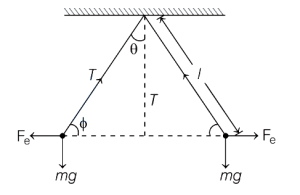
0 likes
View Solution186
EasyMCQ
Two charged particles,each of mass $3 \ g$ and charge $0.2 \ \mu C$,stay in (vacuum) equilibrium on a horizontal surface with a separation of $20 \ cm$. The coefficient of friction is $\left[\frac{1}{4 \pi \epsilon_0}=9 \times 10^9 \ Nm^2 C^{-2}\right]$ and $\left(g=10 \ ms^{-2}\right)$.
A
$0.20$
B
$0.18$
C
$0.25$
D
$0.30$
Solution
(D) For the particles to be in equilibrium on a horizontal surface,the electrostatic repulsive force must be balanced by the maximum static frictional force.
Given: $m = 3 \ g = 3 \times 10^{-3} \ kg$,$q = 0.2 \ \mu C = 0.2 \times 10^{-6} \ C$,$r = 20 \ cm = 0.2 \ m$,$g = 10 \ ms^{-2}$,$k = 9 \times 10^9 \ Nm^2 C^{-2}$.
The electrostatic force is $F_e = \frac{k q^2}{r^2} = \frac{9 \times 10^9 \times (0.2 \times 10^{-6})^2}{(0.2)^2}$.
$F_e = \frac{9 \times 10^9 \times 0.04 \times 10^{-12}}{0.04} = 9 \times 10^{-3} \ N$.
The maximum static friction is $f_s = \mu N = \mu mg$.
Equating $F_e = f_s$,we get $\mu mg = 9 \times 10^{-3}$.
$\mu \times (3 \times 10^{-3}) \times 10 = 9 \times 10^{-3}$.
$\mu \times 3 \times 10^{-2} = 9 \times 10^{-3}$.
$\mu = \frac{9 \times 10^{-3}}{3 \times 10^{-2}} = 3 \times 10^{-1} = 0.30$.
Given: $m = 3 \ g = 3 \times 10^{-3} \ kg$,$q = 0.2 \ \mu C = 0.2 \times 10^{-6} \ C$,$r = 20 \ cm = 0.2 \ m$,$g = 10 \ ms^{-2}$,$k = 9 \times 10^9 \ Nm^2 C^{-2}$.
The electrostatic force is $F_e = \frac{k q^2}{r^2} = \frac{9 \times 10^9 \times (0.2 \times 10^{-6})^2}{(0.2)^2}$.
$F_e = \frac{9 \times 10^9 \times 0.04 \times 10^{-12}}{0.04} = 9 \times 10^{-3} \ N$.
The maximum static friction is $f_s = \mu N = \mu mg$.
Equating $F_e = f_s$,we get $\mu mg = 9 \times 10^{-3}$.
$\mu \times (3 \times 10^{-3}) \times 10 = 9 \times 10^{-3}$.
$\mu \times 3 \times 10^{-2} = 9 \times 10^{-3}$.
$\mu = \frac{9 \times 10^{-3}}{3 \times 10^{-2}} = 3 \times 10^{-1} = 0.30$.
0 likes
View Solution187
DifficultMCQ
An inclined plane making an angle $30^{\circ}$ with the horizontal is placed in a uniform horizontal electric field of $100 \ Vm^{-1}$ as shown in the figure. $A$ small block of mass $1 \ kg$ and charge $0.01 \ C$ is allowed to slide down from rest from a height $h=1 \ m$. If the coefficient of friction is $0.2$,then the acceleration of the block is nearly,
(Acceleration due to gravity,$g=10 \ ms^{-2}$) (in $ms^{-2}$)
(Acceleration due to gravity,$g=10 \ ms^{-2}$) (in $ms^{-2}$)
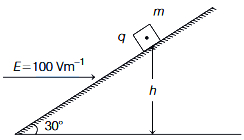
A
$1.3$
B
$2.3$
C
$3.3$
D
$4.3$
Solution
(B) The forces acting on the block along the inclined plane are the component of gravity $mg \sin 30^{\circ}$ acting downwards,the frictional force $f = \mu N$ acting upwards,and the component of the electric force $qE \cos 30^{\circ}$ acting upwards.
First,we find the normal reaction $N$ on the block:
$N = mg \cos 30^{\circ} + qE \sin 30^{\circ}$
$N = (1 \times 10 \times \frac{\sqrt{3}}{2}) + (0.01 \times 100 \times \frac{1}{2}) = 5\sqrt{3} + 0.5 \approx 8.66 + 0.5 = 9.16 \ N$
The net force $F_{net}$ along the incline is:
$F_{net} = mg \sin 30^{\circ} - \mu N - qE \cos 30^{\circ}$
$F_{net} = (1 \times 10 \times 0.5) - 0.2 \times (9.16) - (0.01 \times 100 \times \frac{\sqrt{3}}{2})$
$F_{net} = 5 - 1.832 - 0.866 = 2.302 \ N$
Since $F_{net} = ma$,and $m = 1 \ kg$,the acceleration $a = 2.302 \ ms^{-2} \approx 2.3 \ ms^{-2}$.
First,we find the normal reaction $N$ on the block:
$N = mg \cos 30^{\circ} + qE \sin 30^{\circ}$
$N = (1 \times 10 \times \frac{\sqrt{3}}{2}) + (0.01 \times 100 \times \frac{1}{2}) = 5\sqrt{3} + 0.5 \approx 8.66 + 0.5 = 9.16 \ N$
The net force $F_{net}$ along the incline is:
$F_{net} = mg \sin 30^{\circ} - \mu N - qE \cos 30^{\circ}$
$F_{net} = (1 \times 10 \times 0.5) - 0.2 \times (9.16) - (0.01 \times 100 \times \frac{\sqrt{3}}{2})$
$F_{net} = 5 - 1.832 - 0.866 = 2.302 \ N$
Since $F_{net} = ma$,and $m = 1 \ kg$,the acceleration $a = 2.302 \ ms^{-2} \approx 2.3 \ ms^{-2}$.
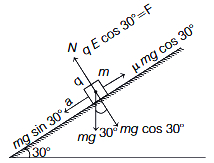
0 likes
View Solution188
MediumMCQ
Two charged identical metal spheres $A$ and $B$ repel each other with a force of $3 \times 10^{-5} \,N$. Another identical uncharged sphere $C$ is touched with sphere $A$ and then it is placed mid-way between $A$ and $B$. Then, the magnitude of net force on $C$ is
A
$1 \times 10^{-5} \,N$
B
$3 \times 10^{-5} \,N$
C
$2 \times 10^{-5} \,N$
D
$5 \times 10^{-5} \,N$
Solution
(B) Let the initial charges on spheres $A$ and $B$ be $q$. The distance between them is $r$.
The initial repulsive force is $F = \frac{k q^2}{r^2} = 3 \times 10^{-5} \,N$.
When uncharged sphere $C$ touches sphere $A$, the charge $q$ is shared equally between $A$ and $C$. Thus, the charge on $A$ becomes $q/2$ and the charge on $C$ becomes $q/2$.
Sphere $C$ is then placed at the midpoint between $A$ and $B$. The distance of $C$ from both $A$ and $B$ is $r/2$.
The force exerted by $A$ on $C$ is $F_{AC} = \frac{k (q/2)(q/2)}{(r/2)^2} = \frac{k q^2}{r^2} = F = 3 \times 10^{-5} \,N$ (repulsive, directed towards $B$).
The force exerted by $B$ on $C$ is $F_{BC} = \frac{k (q)(q/2)}{(r/2)^2} = 2 \frac{k q^2}{r^2} = 2F = 6 \times 10^{-5} \,N$ (repulsive, directed towards $A$).
The net force on $C$ is $F' = |F_{BC} - F_{AC}| = |2F - F| = F = 3 \times 10^{-5} \,N$.
The initial repulsive force is $F = \frac{k q^2}{r^2} = 3 \times 10^{-5} \,N$.
When uncharged sphere $C$ touches sphere $A$, the charge $q$ is shared equally between $A$ and $C$. Thus, the charge on $A$ becomes $q/2$ and the charge on $C$ becomes $q/2$.
Sphere $C$ is then placed at the midpoint between $A$ and $B$. The distance of $C$ from both $A$ and $B$ is $r/2$.
The force exerted by $A$ on $C$ is $F_{AC} = \frac{k (q/2)(q/2)}{(r/2)^2} = \frac{k q^2}{r^2} = F = 3 \times 10^{-5} \,N$ (repulsive, directed towards $B$).
The force exerted by $B$ on $C$ is $F_{BC} = \frac{k (q)(q/2)}{(r/2)^2} = 2 \frac{k q^2}{r^2} = 2F = 6 \times 10^{-5} \,N$ (repulsive, directed towards $A$).
The net force on $C$ is $F' = |F_{BC} - F_{AC}| = |2F - F| = F = 3 \times 10^{-5} \,N$.
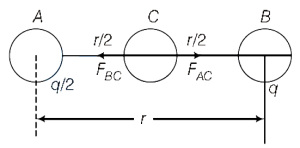
0 likes
View Solution189
MediumMCQ
$A$ clock dial has point charges $-q, -2q, -3q, \ldots, -12q$ at the positions of the corresponding numbers on the dial respectively. The time at which the hour hand points in the direction of the net electric field at the centre of the dial is (Assume clock hands do not influence the net electric field). (in $:30$)
A
$8$
B
$9$
C
$10$
D
$12$
Solution
(B) The electric field $E$ due to a charge $Q$ at distance $r$ is given by $E = \frac{k|Q|}{r^2}$. Since all charges are at the same distance $r$ from the centre,the electric field due to a charge $nq$ is proportional to $n$.
Let the electric field due to charge $-q$ at position $1$ be $\vec{E}_1$ directed towards the charge (since it is negative).
The net electric field $\vec{E}_{net}$ is the vector sum of all fields: $\vec{E}_{net} = \sum_{n=1}^{12} \vec{E}_n$.
Note that the charge at position $n$ is $-nq$. The field $\vec{E}_n$ is directed from the centre towards the position $n$.
We can pair opposite charges: $(n)$ and $(n+6)$. The net field from these two is $\vec{E}_{net, n} = \vec{E}_n + \vec{E}_{n+6} = \frac{k}{r^2} [(-n\hat{r}_n) + (-(n+6)\hat{r}_{n+6})]$.
Since $\hat{r}_{n+6} = -\hat{r}_n$,we have $\vec{E}_{net, n} = \frac{k}{r^2} [-n\hat{r}_n + (n+6)\hat{r}_n] = \frac{6k}{r^2} \hat{r}_n$.
This means the net field from each pair $(n, n+6)$ is directed towards the position $n+6$.
There are $6$ such pairs: $(1,7), (2,8), (3,9), (4,10), (5,11), (6,12)$.
The net field is $\vec{E}_{net} = \frac{6k}{r^2} [\hat{r}_7 + \hat{r}_8 + \hat{r}_9 + \hat{r}_{10} + \hat{r}_{11} + \hat{r}_{12}]$.
These unit vectors point towards $7, 8, 9, 10, 11, 12$ on the clock. The resultant of these vectors points towards the direction between $9$ and $10$,which corresponds to $9:30$.
Let the electric field due to charge $-q$ at position $1$ be $\vec{E}_1$ directed towards the charge (since it is negative).
The net electric field $\vec{E}_{net}$ is the vector sum of all fields: $\vec{E}_{net} = \sum_{n=1}^{12} \vec{E}_n$.
Note that the charge at position $n$ is $-nq$. The field $\vec{E}_n$ is directed from the centre towards the position $n$.
We can pair opposite charges: $(n)$ and $(n+6)$. The net field from these two is $\vec{E}_{net, n} = \vec{E}_n + \vec{E}_{n+6} = \frac{k}{r^2} [(-n\hat{r}_n) + (-(n+6)\hat{r}_{n+6})]$.
Since $\hat{r}_{n+6} = -\hat{r}_n$,we have $\vec{E}_{net, n} = \frac{k}{r^2} [-n\hat{r}_n + (n+6)\hat{r}_n] = \frac{6k}{r^2} \hat{r}_n$.
This means the net field from each pair $(n, n+6)$ is directed towards the position $n+6$.
There are $6$ such pairs: $(1,7), (2,8), (3,9), (4,10), (5,11), (6,12)$.
The net field is $\vec{E}_{net} = \frac{6k}{r^2} [\hat{r}_7 + \hat{r}_8 + \hat{r}_9 + \hat{r}_{10} + \hat{r}_{11} + \hat{r}_{12}]$.
These unit vectors point towards $7, 8, 9, 10, 11, 12$ on the clock. The resultant of these vectors points towards the direction between $9$ and $10$,which corresponds to $9:30$.
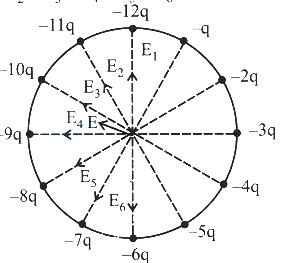
0 likes
View Solution190
MediumMCQ
Two electric charges $+2 \mu C$ and $-4 \mu C$ are separated by a distance $3 \ m$ in air. At a point $P$ located on the line joining the two charges and in between them, the electric potential is zero. Then the electric field at point $P$ (in $NC^{-1}$) is (in $,000$)
A
$9$
B
$18$
C
$12$
D
$27$
Solution
(D) Given: $Q_1 = +2 \times 10^{-6} \ C$, $Q_2 = -4 \times 10^{-6} \ C$, distance $d = 3 \ m$. Let $P$ be at a distance $r_1$ from $Q_1$ and $r_2$ from $Q_2$. Since $P$ is between them, $r_1 + r_2 = 3 \ m$. Let $r_2 = x$, then $r_1 = 3 - x$.
Electric potential $V = \frac{1}{4 \pi \epsilon_0} \left( \frac{Q_1}{r_1} + \frac{Q_2}{r_2} \right) = 0$.
$\frac{2 \times 10^{-6}}{3 - x} + \frac{-4 \times 10^{-6}}{x} = 0 \Rightarrow \frac{2}{3 - x} = \frac{4}{x} \Rightarrow x = 6 - 2x \Rightarrow 3x = 6 \Rightarrow x = 2 \ m$.
So, $r_2 = 2 \ m$ and $r_1 = 1 \ m$.
The electric field $E$ at $P$ due to $Q_1$ is $E_1 = \frac{k |Q_1|}{r_1^2} = \frac{9 \times 10^9 \times 2 \times 10^{-6}}{1^2} = 18000 \ N/C$ (directed towards $Q_2$).
The electric field $E$ at $P$ due to $Q_2$ is $E_2 = \frac{k |Q_2|}{r_2^2} = \frac{9 \times 10^9 \times 4 \times 10^{-6}}{2^2} = 9000 \ N/C$ (directed towards $Q_2$).
Since both fields point in the same direction (towards $Q_2$), the net electric field $E = E_1 + E_2 = 18000 + 9000 = 27000 \ N/C$.
Electric potential $V = \frac{1}{4 \pi \epsilon_0} \left( \frac{Q_1}{r_1} + \frac{Q_2}{r_2} \right) = 0$.
$\frac{2 \times 10^{-6}}{3 - x} + \frac{-4 \times 10^{-6}}{x} = 0 \Rightarrow \frac{2}{3 - x} = \frac{4}{x} \Rightarrow x = 6 - 2x \Rightarrow 3x = 6 \Rightarrow x = 2 \ m$.
So, $r_2 = 2 \ m$ and $r_1 = 1 \ m$.
The electric field $E$ at $P$ due to $Q_1$ is $E_1 = \frac{k |Q_1|}{r_1^2} = \frac{9 \times 10^9 \times 2 \times 10^{-6}}{1^2} = 18000 \ N/C$ (directed towards $Q_2$).
The electric field $E$ at $P$ due to $Q_2$ is $E_2 = \frac{k |Q_2|}{r_2^2} = \frac{9 \times 10^9 \times 4 \times 10^{-6}}{2^2} = 9000 \ N/C$ (directed towards $Q_2$).
Since both fields point in the same direction (towards $Q_2$), the net electric field $E = E_1 + E_2 = 18000 + 9000 = 27000 \ N/C$.
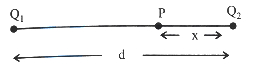
0 likes
View Solution191
MediumMCQ
In a regular polygon of $10$ sides,each corner is at a distance $R$ from the centre. Identical charges $q$ are placed at $9$ corners. At the centre,the magnitude of the electric field is $E$ and the potential is $V$. The ratio $\frac{V}{E}$ is
A
$10 R$
B
$\frac{9}{R}$
C
$\frac{9}{10} R$
D
$9 R$
Solution
(D) Electric potential is a scalar quantity. The potential at the centre due to $9$ charges is the sum of potentials due to each charge:
$V = 9 \times \frac{Kq}{R} = \frac{9Kq}{R} \quad \dots(i)$
Electric field is a vector quantity. In a regular polygon of $10$ sides,if charges were present at all $10$ corners,the net electric field at the centre would be zero due to symmetry (each pair of opposite charges cancels out).
Let the missing charge be at the $10^{th}$ corner. If we place a charge $+q$ and $-q$ at the $10^{th}$ corner,the net field is the field due to $-q$ at that corner,as the other $10$ charges cancel out.
Thus,the magnitude of the electric field at the centre is:
$E = \frac{Kq}{R^2} \quad \dots(ii)$
Dividing Eq. $(i)$ by Eq. $(ii)$:
$\frac{V}{E} = \frac{\frac{9Kq}{R}}{\frac{Kq}{R^2}} = 9R$
$V = 9 \times \frac{Kq}{R} = \frac{9Kq}{R} \quad \dots(i)$
Electric field is a vector quantity. In a regular polygon of $10$ sides,if charges were present at all $10$ corners,the net electric field at the centre would be zero due to symmetry (each pair of opposite charges cancels out).
Let the missing charge be at the $10^{th}$ corner. If we place a charge $+q$ and $-q$ at the $10^{th}$ corner,the net field is the field due to $-q$ at that corner,as the other $10$ charges cancel out.
Thus,the magnitude of the electric field at the centre is:
$E = \frac{Kq}{R^2} \quad \dots(ii)$
Dividing Eq. $(i)$ by Eq. $(ii)$:
$\frac{V}{E} = \frac{\frac{9Kq}{R}}{\frac{Kq}{R^2}} = 9R$

0 likes
View Solution192
EasyMCQ
Two charged particles of mass $1 \ g$ each are placed $1 \ m$ apart. If each of these possesses $1 \ fC$ (femto coulomb) of charge,then the dominant force of interaction between them is:
A
Gravitational
B
Electrostatic
C
Weak
D
Strong
Solution
(A) Given: Mass $m = 1 \ g = 10^{-3} \ kg$,distance $r = 1 \ m$,charge $q = 1 \ fC = 10^{-15} \ C$.
$1$. Gravitational force: $F_g = \frac{G m_1 m_2}{r^2} = \frac{(6.67 \times 10^{-11}) \times (10^{-3}) \times (10^{-3})}{1^2} = 6.67 \times 10^{-17} \ N$.
$2$. Electrostatic force: $F_e = \frac{k q_1 q_2}{r^2} = \frac{(9 \times 10^9) \times (10^{-15}) \times (10^{-15})}{1^2} = 9 \times 10^{-21} \ N$.
Comparing the two,$F_g > F_e$ $(6.67 \times 10^{-17} \ N > 9 \times 10^{-21} \ N)$.
Therefore,the gravitational force is the dominant force.
$1$. Gravitational force: $F_g = \frac{G m_1 m_2}{r^2} = \frac{(6.67 \times 10^{-11}) \times (10^{-3}) \times (10^{-3})}{1^2} = 6.67 \times 10^{-17} \ N$.
$2$. Electrostatic force: $F_e = \frac{k q_1 q_2}{r^2} = \frac{(9 \times 10^9) \times (10^{-15}) \times (10^{-15})}{1^2} = 9 \times 10^{-21} \ N$.
Comparing the two,$F_g > F_e$ $(6.67 \times 10^{-17} \ N > 9 \times 10^{-21} \ N)$.
Therefore,the gravitational force is the dominant force.
0 likes
View Solution193
MediumMCQ
As shown in the figure,a point charge $q_{1} = +1 \times 10^{-8} \ C$ is placed at the origin in the $x-y$ plane and another point charge $q_{2} = +3 \times 10^{-6} \ C$ is placed at the coordinate $(10, 0)$. In that case,which of the following graph$(s)$ shows most correctly the electric field vector $E_{x}$ in the $x$-direction?
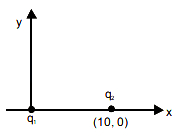
A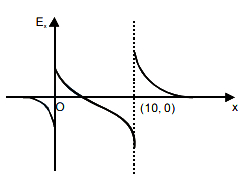
B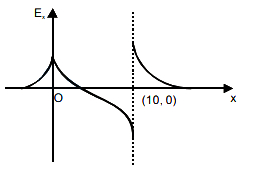
C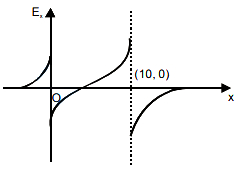
D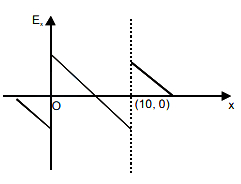
Solution
(A) The electric field $E_{x}$ due to two positive point charges $q_{1}$ and $q_{2}$ on the $x$-axis is given by the superposition principle: $E_{x} = \frac{k q_{1}}{x^{2}} + \frac{k q_{2}}{(x-10)^{2}}$ for $x < 0$,$E_{x} = \frac{k q_{1}}{x^{2}} - \frac{k q_{2}}{(x-10)^{2}}$ for $0 < x < 10$,and $E_{x} = -\frac{k q_{1}}{x^{2}} - \frac{k q_{2}}{(x-10)^{2}}$ for $x > 10$.
$1$. For $x < 0$: Both charges contribute to a negative electric field in the $x$-direction,so $E_{x} < 0$. As $x \to 0^{-}$,$E_{x} \to -\infty$.
$2$. For $0 < x < 10$: The field due to $q_{1}$ is positive and the field due to $q_{2}$ is negative. There is a point between the charges where $E_{x} = 0$. As $x \to 0^{+}$,$E_{x} \to +\infty$. As $x \to 10^{-}$,$E_{x} \to -\infty$.
$3$. For $x > 10$: Both charges contribute to a positive electric field in the $x$-direction,so $E_{x} > 0$. As $x \to 10^{+}$,$E_{x} \to +\infty$. As $x \to \infty$,$E_{x} \to 0$.
Comparing these characteristics with the given options,the graph in option $A$ correctly represents these behaviors.
$1$. For $x < 0$: Both charges contribute to a negative electric field in the $x$-direction,so $E_{x} < 0$. As $x \to 0^{-}$,$E_{x} \to -\infty$.
$2$. For $0 < x < 10$: The field due to $q_{1}$ is positive and the field due to $q_{2}$ is negative. There is a point between the charges where $E_{x} = 0$. As $x \to 0^{+}$,$E_{x} \to +\infty$. As $x \to 10^{-}$,$E_{x} \to -\infty$.
$3$. For $x > 10$: Both charges contribute to a positive electric field in the $x$-direction,so $E_{x} > 0$. As $x \to 10^{+}$,$E_{x} \to +\infty$. As $x \to \infty$,$E_{x} \to 0$.
Comparing these characteristics with the given options,the graph in option $A$ correctly represents these behaviors.
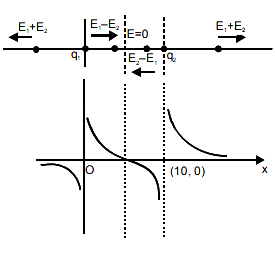
0 likes
View Solution194
MediumMCQ
Four identical point masses,each of mass $m$ and carrying charge $+q$,are placed at the corners of a square of side $a$ on a frictionless horizontal surface. If the particles are released simultaneously,the kinetic energy of the system when they are infinitely far apart is
A
$\frac{q^{2}}{a}(2 \sqrt{2}+1) k$
B
$\frac{q^{2}}{a}(\sqrt{2}+2) k$
C
$\frac{q^{2}}{a}(4+\sqrt{2}) k$
D
$\frac{q^{2}}{a}(\sqrt{2}+1) k$
Solution
(C) According to the principle of conservation of energy,the initial total energy of the system must equal the final total energy.
Since the particles are released from rest,the initial kinetic energy $KE_i = 0$.
The initial potential energy $PE_i$ is the sum of the electrostatic potential energies of all pairs of charges.
In a square of side $a$,there are $4$ pairs of charges at distance $a$ (sides) and $2$ pairs of charges at distance $\sqrt{2}a$ (diagonals).
$PE_i = 4 \times \frac{kq^2}{a} + 2 \times \frac{kq^2}{\sqrt{2}a} = \frac{kq^2}{a} (4 + \sqrt{2})$.
When the particles are infinitely far apart,the final potential energy $PE_f = 0$.
Thus,$KE_f = PE_i = \frac{kq^2}{a} (4 + \sqrt{2})$.
Since the particles are released from rest,the initial kinetic energy $KE_i = 0$.
The initial potential energy $PE_i$ is the sum of the electrostatic potential energies of all pairs of charges.
In a square of side $a$,there are $4$ pairs of charges at distance $a$ (sides) and $2$ pairs of charges at distance $\sqrt{2}a$ (diagonals).
$PE_i = 4 \times \frac{kq^2}{a} + 2 \times \frac{kq^2}{\sqrt{2}a} = \frac{kq^2}{a} (4 + \sqrt{2})$.
When the particles are infinitely far apart,the final potential energy $PE_f = 0$.
Thus,$KE_f = PE_i = \frac{kq^2}{a} (4 + \sqrt{2})$.
0 likes
View Solution195
MediumMCQ
Identify the correct statements:
$A$. Electrostatic field lines form closed loops.
$B$. The electric field lines point radially outward when charge is greater than zero.
$C$. The Gauss-Law is valid only for inverse-square force.
$D$. The work done in moving a charged particle in a static electric field around a closed path is zero.
$E$. The motion of a particle under Coulomb's force must take place in a plane.
Choose the correct answer from the options given below:
$A$. Electrostatic field lines form closed loops.
$B$. The electric field lines point radially outward when charge is greater than zero.
$C$. The Gauss-Law is valid only for inverse-square force.
$D$. The work done in moving a charged particle in a static electric field around a closed path is zero.
$E$. The motion of a particle under Coulomb's force must take place in a plane.
Choose the correct answer from the options given below:
A
$A, B, D, E$ Only
B
$A, B, C, D$ Only
C
$B, C, D, E$ Only
D
$A, C, E$ Only
Solution
(C) Analysis of statements:
$A$. Incorrect: Electrostatic field lines originate from positive charges and terminate at negative charges; they do not form closed loops (unlike magnetic field lines).
$B$. Correct: For a positive charge $(q > 0)$,the electric field lines point radially outward.
$C$. Correct: Gauss's Law is a direct consequence of the inverse-square nature of Coulomb's law.
$D$. Correct: The electrostatic force is a conservative force,so the work done in moving a charge along a closed path is zero.
$E$. Correct: Coulomb's force is a central force,and motion under a central force is always confined to a plane.
Therefore,statements $B, C, D,$ and $E$ are correct.
$A$. Incorrect: Electrostatic field lines originate from positive charges and terminate at negative charges; they do not form closed loops (unlike magnetic field lines).
$B$. Correct: For a positive charge $(q > 0)$,the electric field lines point radially outward.
$C$. Correct: Gauss's Law is a direct consequence of the inverse-square nature of Coulomb's law.
$D$. Correct: The electrostatic force is a conservative force,so the work done in moving a charge along a closed path is zero.
$E$. Correct: Coulomb's force is a central force,and motion under a central force is always confined to a plane.
Therefore,statements $B, C, D,$ and $E$ are correct.
0 likes
View Solution196
DifficultMCQ
Two metal plates $(A, B)$ are kept horizontally with a separation of $(\frac{12}{\pi}) \text{ cm}$,with plate $A$ on the top. An atomizer jet sprays oil (density $1.5 \text{ g/cm}^3$) droplets of radius $1 \text{ mm}$ horizontally. All oil droplets carry a charge of $5 \text{ nC}$. The potentials $V_A$ and $V_B$ are required on plates $A$ and $B$ respectively in order to ensure the droplets do not descend. The values of $V_A$ and $V_B$ are . . . . . . . (Neglect the air resistance to the droplets and take $g = 10 \text{ m/s}^2$)
A
$100 \text{ V}$ and $580 \text{ V}$
B
$580 \text{ V}$ and $100 \text{ V}$
C
$60 \text{ V}$ and $400 \text{ V}$
D
$0 \text{ V}$ and $-200 \text{ V}$
Solution
(B) The force of gravity on the oil droplet is balanced by the electric force acting upwards. The droplet must be attracted towards the top plate $A$. The force of gravity is $F_g = mg = (\rho \cdot \frac{4}{3}\pi r^3)g$.
The electric force is $F_e = qE = q(\frac{V_A - V_B}{d})$.
Setting $F_g = F_e$,we have $\rho \cdot \frac{4}{3}\pi r^3 g = q \frac{\Delta V}{d}$.
Given $\rho = 1500 \text{ kg/m}^3$,$r = 10^{-3} \text{ m}$,$g = 10 \text{ m/s}^2$,$d = \frac{0.12}{\pi} \text{ m}$,$q = 5 \times 10^{-9} \text{ C}$.
Substituting values: $1500 \times \frac{4}{3} \times \pi \times (10^{-3})^3 \times 10 = 5 \times 10^{-9} \times \frac{\Delta V}{(0.12/\pi)}$.
$20 \times 10^{-6} \times \pi = 5 \times 10^{-9} \times \frac{\Delta V \times \pi}{0.12}$.
Solving for $\Delta V$: $\Delta V = \frac{20 \times 10^{-6} \times 0.12}{5 \times 10^{-9}} = 480 \text{ V}$.
Since $V_A - V_B = 480 \text{ V}$,only option $(B)$ $580 \text{ V} - 100 \text{ V} = 480 \text{ V}$ satisfies this condition.
The electric force is $F_e = qE = q(\frac{V_A - V_B}{d})$.
Setting $F_g = F_e$,we have $\rho \cdot \frac{4}{3}\pi r^3 g = q \frac{\Delta V}{d}$.
Given $\rho = 1500 \text{ kg/m}^3$,$r = 10^{-3} \text{ m}$,$g = 10 \text{ m/s}^2$,$d = \frac{0.12}{\pi} \text{ m}$,$q = 5 \times 10^{-9} \text{ C}$.
Substituting values: $1500 \times \frac{4}{3} \times \pi \times (10^{-3})^3 \times 10 = 5 \times 10^{-9} \times \frac{\Delta V}{(0.12/\pi)}$.
$20 \times 10^{-6} \times \pi = 5 \times 10^{-9} \times \frac{\Delta V \times \pi}{0.12}$.
Solving for $\Delta V$: $\Delta V = \frac{20 \times 10^{-6} \times 0.12}{5 \times 10^{-9}} = 480 \text{ V}$.
Since $V_A - V_B = 480 \text{ V}$,only option $(B)$ $580 \text{ V} - 100 \text{ V} = 480 \text{ V}$ satisfies this condition.
0 likes
View SolutionElectric Charges and Fields — Mix Examples-Electric Charges and Fields · Frequently Asked Questions
1Are these Electric Charges and Fields questions useful for JEE and NEET?
Yes. All questions in this section are mapped to JEE Main and NEET exam patterns. Previous year questions from JEE Main, NEET, GUJCET and state-level exams are included with full solutions.
2Can I switch to Hindi or Gujarati for these questions?
Yes. Use the language tabs in the hero section or the sidebar to view the same questions and solutions in English, Hindi or Gujarati.
3How do I generate a question paper from this subtopic?
Use the Vedclass Exam Paper Generator — select the chapter and subtopic, set difficulty, and generate Sets A, B, C, D automatically. First 3 chapters of every subject are free.
Vedclass Products
For Students
Vedclass Test Series
Mock tests in real JEE/NEET style with performance analysis. 5-day free trial.
Start Free TrialFor Teachers
Exam Paper Generator
Generate Set A/B/C/D papers from this chapter in 2 minutes. 3 chapters free.
Try FreeFor Institutes
Online Exam Module
Live online exams with unlimited students, 360° analytics & white-label branding.
See DemoFor Teachers & Institutes
Generate a Electric Charges and Fields Exam Paper in 2 Minutes
Select subtopic & difficulty — Sets A, B, C, D auto-generated with No Repeat logic.
First 3 chapters of every subject are free — no payment required.