
A English
Einstein's Photoelectric Equation and Energy Quantum of Radiation Questions in English
Class 12 Physics · Dual Nature of Radiation and matter · Einstein's Photoelectric Equation and Energy Quantum of Radiation
736+
Questions
English
Language
100%
With Solutions
Showing 50 of 736 questions in English
601
EasyMCQ
The threshold frequency of cesium is $5.16 \times 10^{14} \ Hz$. Then its work function is . . . . . . $eV$.
A
$4.12$
B
$2.14$
C
$1.12$
D
$1.14$
Solution
(B) The work function $\phi_{0}$ is given by the formula $\phi_{0} = h \nu_{0}$,where $h$ is Planck's constant $(6.626 \times 10^{-34} \ J \cdot s)$ and $\nu_{0}$ is the threshold frequency.
To convert the energy from Joules to electron-volts $(eV)$,we divide by the charge of an electron $(e = 1.6 \times 10^{-19} \ C)$.
$\phi_{0} = \frac{h \nu_{0}}{e} = \frac{6.626 \times 10^{-34} \times 5.16 \times 10^{14}}{1.6 \times 10^{-19}} \ eV$.
$\phi_{0} \approx \frac{34.19 \times 10^{-20}}{1.6 \times 10^{-19}} \ eV$.
$\phi_{0} \approx 2.137 \ eV$.
Rounding to two decimal places,we get $\phi_{0} \approx 2.14 \ eV$.
To convert the energy from Joules to electron-volts $(eV)$,we divide by the charge of an electron $(e = 1.6 \times 10^{-19} \ C)$.
$\phi_{0} = \frac{h \nu_{0}}{e} = \frac{6.626 \times 10^{-34} \times 5.16 \times 10^{14}}{1.6 \times 10^{-19}} \ eV$.
$\phi_{0} \approx \frac{34.19 \times 10^{-20}}{1.6 \times 10^{-19}} \ eV$.
$\phi_{0} \approx 2.137 \ eV$.
Rounding to two decimal places,we get $\phi_{0} \approx 2.14 \ eV$.
0 likes
View Solution602
EasyMCQ
The photoelectric cut-off voltage in a certain experiment is $1.5 \ V$. What is the maximum kinetic energy of the emitted photoelectrons?
A
$1.5 \ eV$
B
$1.5 \ J$
C
$3.0 \ eV$
D
$1.6 \times 10^{-19} \ J$
Solution
(A) The relationship between the maximum kinetic energy $(K_{\text{max}})$ of photoelectrons and the stopping potential (cut-off voltage,$V_0$) is given by the equation:
$K_{\text{max}} = e V_0$
Given that the cut-off voltage $V_0 = 1.5 \ V$,we substitute this value into the equation:
$K_{\text{max}} = e \times 1.5 \ V$
$K_{\text{max}} = 1.5 \ eV$
Therefore,the maximum kinetic energy of the emitted photoelectrons is $1.5 \ eV$.
$K_{\text{max}} = e V_0$
Given that the cut-off voltage $V_0 = 1.5 \ V$,we substitute this value into the equation:
$K_{\text{max}} = e \times 1.5 \ V$
$K_{\text{max}} = 1.5 \ eV$
Therefore,the maximum kinetic energy of the emitted photoelectrons is $1.5 \ eV$.
0 likes
View Solution603
EasyMCQ
In the case of the photoelectric effect, on increasing the frequency of incident light:
A
Photoelectric current increases.
B
Photoelectric current decreases.
C
Stopping potential increases.
D
Stopping potential decreases.
Solution
(C) According to Einstein's photoelectric equation, $K_{max} = h\nu - \phi_0$, where $K_{max}$ is the maximum kinetic energy of emitted photoelectrons, $h$ is Planck's constant, $\nu$ is the frequency of incident light, and $\phi_0$ is the work function of the metal.
Since $K_{max} = eV_s$ (where $e$ is the charge of an electron and $V_s$ is the stopping potential), we have $eV_s = h\nu - \phi_0$.
Rearranging for the stopping potential, $V_s = \frac{h}{e}\nu - \frac{\phi_0}{e}$.
As the frequency $\nu$ of the incident light increases, the term $\frac{h}{e}\nu$ increases, which leads to an increase in the stopping potential $V_s$.
The photoelectric current depends on the intensity of the incident light, not its frequency, provided the frequency is above the threshold frequency.
Since $K_{max} = eV_s$ (where $e$ is the charge of an electron and $V_s$ is the stopping potential), we have $eV_s = h\nu - \phi_0$.
Rearranging for the stopping potential, $V_s = \frac{h}{e}\nu - \frac{\phi_0}{e}$.
As the frequency $\nu$ of the incident light increases, the term $\frac{h}{e}\nu$ increases, which leads to an increase in the stopping potential $V_s$.
The photoelectric current depends on the intensity of the incident light, not its frequency, provided the frequency is above the threshold frequency.
0 likes
View Solution604
EasyMCQ
The variation of stopping potential $V_{0}$ with frequency $\nu$ of incident radiation for a given photosensitive material is a straight line [frequency $\nu$ of incident radiation is greater than threshold frequency $\nu_{0}$]. The slope of this line is . . . . . . .
A
$\frac{h}{\nu}$
B
$\frac{\phi_{0}}{h}$
C
$\frac{h}{e}$
D
$\frac{e}{V_{0}}$
Solution
(C) According to Einstein's photoelectric equation,the maximum kinetic energy $K_{max}$ of emitted photoelectrons is given by $K_{max} = h\nu - \phi_{0}$.
Since the stopping potential $V_{0}$ is related to the maximum kinetic energy by $K_{max} = eV_{0}$,we can write $eV_{0} = h\nu - \phi_{0}$.
Dividing by the elementary charge $e$,we get $V_{0} = \frac{h}{e}\nu - \frac{\phi_{0}}{e}$.
Comparing this with the equation of a straight line $y = mx + c$,where $y = V_{0}$,$x = \nu$,and $c = -\frac{\phi_{0}}{e}$,the slope $m$ is equal to $\frac{h}{e}$.
Since the stopping potential $V_{0}$ is related to the maximum kinetic energy by $K_{max} = eV_{0}$,we can write $eV_{0} = h\nu - \phi_{0}$.
Dividing by the elementary charge $e$,we get $V_{0} = \frac{h}{e}\nu - \frac{\phi_{0}}{e}$.
Comparing this with the equation of a straight line $y = mx + c$,where $y = V_{0}$,$x = \nu$,and $c = -\frac{\phi_{0}}{e}$,the slope $m$ is equal to $\frac{h}{e}$.
0 likes
View Solution605
EasyMCQ
Light of energy $E$ falls normally on a metal of work function $\frac{E}{3}$. The kinetic energies $K$ of the photoelectrons are
A
$K = \frac{2E}{3}$
B
$K = \frac{E}{3}$
C
$0 \leq K \leq \frac{2E}{3}$
D
$0 \leq K \leq \frac{E}{3}$
Solution
(C) Given,energy of incident light is $E$ and work function is $\phi_0 = \frac{E}{3}$.
According to Einstein's photoelectric equation,the maximum kinetic energy $K_{\max}$ is given by:
$K_{\max} = E - \phi_0$
$K_{\max} = E - \frac{E}{3} = \frac{2E}{3}$.
Since photoelectrons are emitted with a range of energies from $0$ to $K_{\max}$ due to collisions within the metal,the kinetic energy $K$ of the photoelectrons lies in the range $0 \leq K \leq \frac{2E}{3}$.
According to Einstein's photoelectric equation,the maximum kinetic energy $K_{\max}$ is given by:
$K_{\max} = E - \phi_0$
$K_{\max} = E - \frac{E}{3} = \frac{2E}{3}$.
Since photoelectrons are emitted with a range of energies from $0$ to $K_{\max}$ due to collisions within the metal,the kinetic energy $K$ of the photoelectrons lies in the range $0 \leq K \leq \frac{2E}{3}$.
0 likes
View Solution606
EasyMCQ
The photoelectric work function for a metal is $2.4 \ eV$. Among the four wavelengths,the wavelength of light for which photoemission does not take place is: (in $nm$)
A
$200$
B
$300$
C
$700$
D
$400$
Solution
(C) Given,work function $\phi_0 = 2.4 \ eV$.
Photoemission occurs only if the incident photon energy $E \ge \phi_0$,which implies the incident wavelength $\lambda \le \lambda_0$.
The threshold wavelength $\lambda_0$ is calculated as:
$\lambda_0 = \frac{1240 \ eV \cdot nm}{\phi_0} = \frac{1240}{2.4} \approx 516.7 \ nm$.
Photoemission will not take place if the incident wavelength $\lambda > \lambda_0$.
Comparing the given options:
$A) 200 \ nm < 516.7 \ nm$ (Emission occurs)
$B) 300 \ nm < 516.7 \ nm$ (Emission occurs)
$C) 700 \ nm > 516.7 \ nm$ (No emission)
$D) 400 \ nm < 516.7 \ nm$ (Emission occurs)
Therefore,for $700 \ nm$,photoemission does not take place.
Photoemission occurs only if the incident photon energy $E \ge \phi_0$,which implies the incident wavelength $\lambda \le \lambda_0$.
The threshold wavelength $\lambda_0$ is calculated as:
$\lambda_0 = \frac{1240 \ eV \cdot nm}{\phi_0} = \frac{1240}{2.4} \approx 516.7 \ nm$.
Photoemission will not take place if the incident wavelength $\lambda > \lambda_0$.
Comparing the given options:
$A) 200 \ nm < 516.7 \ nm$ (Emission occurs)
$B) 300 \ nm < 516.7 \ nm$ (Emission occurs)
$C) 700 \ nm > 516.7 \ nm$ (No emission)
$D) 400 \ nm < 516.7 \ nm$ (Emission occurs)
Therefore,for $700 \ nm$,photoemission does not take place.
0 likes
View Solution607
EasyMCQ
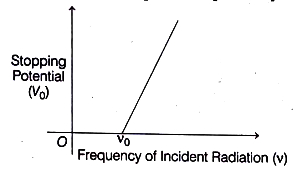
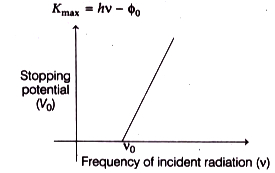
In an experiment to study the photoelectric effect,the observed variation of stopping potential $(V_0)$ with the frequency $(
u)$ of incident radiation is as shown in the figure. The slope and $y$-intercept are respectively
u)$ of incident radiation is as shown in the figure. The slope and $y$-intercept are respectively
A
$\frac{h}{e}, -\frac{h \nu_0}{e}$
B
$\frac{h \nu}{e}, \nu_0$
C
$\frac{h \nu}{e}, -\frac{h}{e}$
D
$h \nu_1 - h \nu_0$
Solution
(A) According to Einstein's photoelectric equation,the maximum kinetic energy $(K_{max})$ of emitted photoelectrons is given by:
$K_{max} = h\nu - \phi_0$
Since $K_{max} = eV_0$,where $V_0$ is the stopping potential,we have:
$eV_0 = h\nu - \phi_0$
Dividing by $e$,we get:
$V_0 = \left(\frac{h}{e}\right)\nu - \frac{\phi_0}{e}$
Comparing this equation with the straight-line equation $y = mx + c$,where $y = V_0$ and $x = \nu$:
Slope $(m)$ = $\frac{h}{e}$
$y$-intercept $(c)$ = $-\frac{\phi_0}{e}$
Since the work function $\phi_0 = h\nu_0$,where $\nu_0$ is the threshold frequency,the $y$-intercept becomes:
$c = -\frac{h\nu_0}{e}$
Thus,the slope is $\frac{h}{e}$ and the $y$-intercept is $-\frac{h\nu_0}{e}$.
$K_{max} = h\nu - \phi_0$
Since $K_{max} = eV_0$,where $V_0$ is the stopping potential,we have:
$eV_0 = h\nu - \phi_0$
Dividing by $e$,we get:
$V_0 = \left(\frac{h}{e}\right)\nu - \frac{\phi_0}{e}$
Comparing this equation with the straight-line equation $y = mx + c$,where $y = V_0$ and $x = \nu$:
Slope $(m)$ = $\frac{h}{e}$
$y$-intercept $(c)$ = $-\frac{\phi_0}{e}$
Since the work function $\phi_0 = h\nu_0$,where $\nu_0$ is the threshold frequency,the $y$-intercept becomes:
$c = -\frac{h\nu_0}{e}$
Thus,the slope is $\frac{h}{e}$ and the $y$-intercept is $-\frac{h\nu_0}{e}$.
0 likes
View Solution608
MediumMCQ
The kinetic energy of the photoelectrons increases by $0.52 eV$ when the wavelength of incident light is changed from $500 \,nm$ to another wavelength. The new wavelength is approximately: (in $\,nm$)
A
$400$
B
$1250$
C
$1000$
D
$700$
Solution
(A) Given,the change in kinetic energy of photoelectrons is $\Delta K = 0.52 eV$. The initial wavelength is $\lambda_1 = 500 \,nm$.
Using Einstein's photoelectric equation,$K = \frac{hc}{\lambda} - \phi$.
For two different wavelengths $\lambda_1$ and $\lambda_2$,the change in kinetic energy is given by:
$\Delta K = K_2 - K_1 = hc \left( \frac{1}{\lambda_2} - \frac{1}{\lambda_1} \right)$.
Using $hc \approx 1242 \,eV \cdot nm$,we substitute the values:
$0.52 = 1242 \left( \frac{1}{\lambda_2} - \frac{1}{500} \right)$.
$\frac{0.52}{1242} = \frac{1}{\lambda_2} - 0.002$.
$0.000418 = \frac{1}{\lambda_2} - 0.002$.
$\frac{1}{\lambda_2} = 0.002418$.
$\lambda_2 = \frac{1}{0.002418} \approx 413.5 \,nm$.
Rounding to the nearest option,the new wavelength is approximately $400 \,nm$.
Using Einstein's photoelectric equation,$K = \frac{hc}{\lambda} - \phi$.
For two different wavelengths $\lambda_1$ and $\lambda_2$,the change in kinetic energy is given by:
$\Delta K = K_2 - K_1 = hc \left( \frac{1}{\lambda_2} - \frac{1}{\lambda_1} \right)$.
Using $hc \approx 1242 \,eV \cdot nm$,we substitute the values:
$0.52 = 1242 \left( \frac{1}{\lambda_2} - \frac{1}{500} \right)$.
$\frac{0.52}{1242} = \frac{1}{\lambda_2} - 0.002$.
$0.000418 = \frac{1}{\lambda_2} - 0.002$.
$\frac{1}{\lambda_2} = 0.002418$.
$\lambda_2 = \frac{1}{0.002418} \approx 413.5 \,nm$.
Rounding to the nearest option,the new wavelength is approximately $400 \,nm$.
0 likes
View Solution609
MediumMCQ
The work-function of a metal is $1 eV$. Light of wavelength $3000 \text{Å}$ is incident on this metal surface. The velocity of emitted photoelectrons will be
A
$10 \text{ ms}^{-1}$
B
$1 \times 10^{3} \text{ ms}^{-1}$
C
$1 \times 10^{4} \text{ ms}^{-1}$
D
$1 \times 10^{6} \text{ ms}^{-1}$
Solution
(D) Given: Work-function, $\phi_{0} = 1 eV = 1.6 \times 10^{-19} J$.
Wavelength, $\lambda = 3000 \text{Å} = 3000 \times 10^{-10} m$.
The energy of the incident photon is given by $E = \frac{hc}{\lambda}$.
$E = \frac{6.63 \times 10^{-34} \times 3 \times 10^{8}}{3000 \times 10^{-10}} = 6.63 \times 10^{-19} J$.
According to Einstein's photoelectric equation, $E = \phi_{0} + KE_{max}$.
$KE_{max} = E - \phi_{0} = 6.63 \times 10^{-19} - 1.6 \times 10^{-19} = 5.03 \times 10^{-19} J$.
Since $KE_{max} = \frac{1}{2}mv^{2}$, we have $v = \sqrt{\frac{2 \times KE_{max}}{m}}$.
$v = \sqrt{\frac{2 \times 5.03 \times 10^{-19}}{9.1 \times 10^{-31}}} = \sqrt{1.105 \times 10^{12}} \approx 1.05 \times 10^{6} m/s$.
Thus, the velocity is approximately $1 \times 10^{6} m/s$.
Wavelength, $\lambda = 3000 \text{Å} = 3000 \times 10^{-10} m$.
The energy of the incident photon is given by $E = \frac{hc}{\lambda}$.
$E = \frac{6.63 \times 10^{-34} \times 3 \times 10^{8}}{3000 \times 10^{-10}} = 6.63 \times 10^{-19} J$.
According to Einstein's photoelectric equation, $E = \phi_{0} + KE_{max}$.
$KE_{max} = E - \phi_{0} = 6.63 \times 10^{-19} - 1.6 \times 10^{-19} = 5.03 \times 10^{-19} J$.
Since $KE_{max} = \frac{1}{2}mv^{2}$, we have $v = \sqrt{\frac{2 \times KE_{max}}{m}}$.
$v = \sqrt{\frac{2 \times 5.03 \times 10^{-19}}{9.1 \times 10^{-31}}} = \sqrt{1.105 \times 10^{12}} \approx 1.05 \times 10^{6} m/s$.
Thus, the velocity is approximately $1 \times 10^{6} m/s$.
0 likes
View Solution610
EasyMCQ
According to Einstein's photoelectric equation,the graph between the kinetic energy of ejected photoelectrons and the frequency of incident radiation is:
A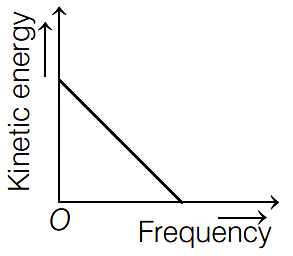
B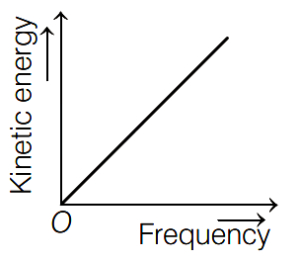
C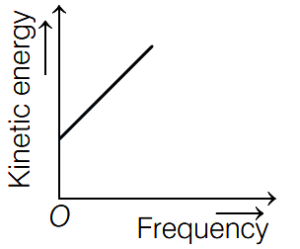
D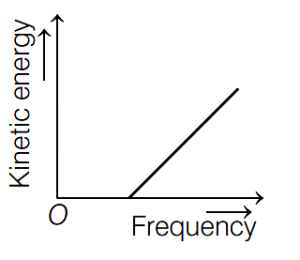
Solution
(D) According to Einstein's photoelectric equation,the maximum kinetic energy $K_{max}$ of an ejected photoelectron is given by:
$K_{max} = h\nu - \phi_0$
where $h$ is Planck's constant,$\nu$ is the frequency of incident radiation,and $\phi_0$ is the work function of the metal.
Since $\phi_0 = h\nu_0$,where $\nu_0$ is the threshold frequency,we can write:
$K_{max} = h\nu - h\nu_0 = h(\nu - \nu_0)$
This equation represents a straight line of the form $y = mx + c$,where the slope is $h$ and the intercept on the frequency axis is $\nu_0$.
For frequencies $\nu < \nu_0$,the kinetic energy is zero because no photoemission occurs. For $\nu \geq \nu_0$,the kinetic energy increases linearly with frequency. This behavior is correctly represented by graph $D$.
$K_{max} = h\nu - \phi_0$
where $h$ is Planck's constant,$\nu$ is the frequency of incident radiation,and $\phi_0$ is the work function of the metal.
Since $\phi_0 = h\nu_0$,where $\nu_0$ is the threshold frequency,we can write:
$K_{max} = h\nu - h\nu_0 = h(\nu - \nu_0)$
This equation represents a straight line of the form $y = mx + c$,where the slope is $h$ and the intercept on the frequency axis is $\nu_0$.
For frequencies $\nu < \nu_0$,the kinetic energy is zero because no photoemission occurs. For $\nu \geq \nu_0$,the kinetic energy increases linearly with frequency. This behavior is correctly represented by graph $D$.
0 likes
View Solution611
EasyMCQ
The maximum kinetic energy of emitted photoelectrons depends on
A
Intensity of incident radiation
B
Frequency of incident radiation
C
Speed of incident radiation
D
Number of photons in the incident radiation
Solution
(B) In the photoelectric effect,the maximum kinetic energy of emitted photoelectrons depends on the frequency of the incident radiation.
According to Einstein's photoelectric equation:
$KE_{\max} = h\nu - \phi$
Where:
$KE_{\max}$ is the maximum kinetic energy of the emitted photoelectrons.
$h$ is Planck's constant.
$\nu$ is the frequency of the incident radiation.
$\phi$ is the work function of the metal.
Since the work function $\phi$ is a constant for a given metal,the maximum kinetic energy $(KE_{\max})$ is directly dependent on the frequency $\nu$ of the incident radiation.
According to Einstein's photoelectric equation:
$KE_{\max} = h\nu - \phi$
Where:
$KE_{\max}$ is the maximum kinetic energy of the emitted photoelectrons.
$h$ is Planck's constant.
$\nu$ is the frequency of the incident radiation.
$\phi$ is the work function of the metal.
Since the work function $\phi$ is a constant for a given metal,the maximum kinetic energy $(KE_{\max})$ is directly dependent on the frequency $\nu$ of the incident radiation.
0 likes
View Solution612
MediumMCQ
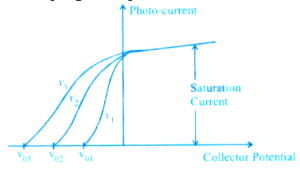
The variation of photo-current with collector potential for different frequencies of incident radiation $v_{1}, v_{2}$ and $v_{3}$ is as shown in the graph. Then:
A
$v_{1}=v_{2}=v_{3}$
B
$v_{1}>v_{2}>v_{3}$
C
$v_{1} < v_{2} < v_{3}$
D
$v_{3}=\frac{v_{1}+v_{2}}{2}$
Solution
(C) According to Einstein's photoelectric equation,the stopping potential $V_{0}$ is related to the frequency of incident radiation $v$ by the relation: $eV_{0} = h\nu - \phi$,where $h$ is Planck's constant and $\phi$ is the work function of the metal.
From the graph,the stopping potentials for the three frequencies are $V_{01}, V_{02},$ and $V_{03}$ respectively.
It is observed that $|V_{03}| > |V_{02}| > |V_{01}|$.
Since the stopping potential is directly proportional to the frequency of the incident radiation,a higher magnitude of stopping potential corresponds to a higher frequency.
Therefore,the relationship between the frequencies is $v_{3} > v_{2} > v_{1}$,which is equivalent to $v_{1} < v_{2} < v_{3}$.
From the graph,the stopping potentials for the three frequencies are $V_{01}, V_{02},$ and $V_{03}$ respectively.
It is observed that $|V_{03}| > |V_{02}| > |V_{01}|$.
Since the stopping potential is directly proportional to the frequency of the incident radiation,a higher magnitude of stopping potential corresponds to a higher frequency.
Therefore,the relationship between the frequencies is $v_{3} > v_{2} > v_{1}$,which is equivalent to $v_{1} < v_{2} < v_{3}$.
0 likes
View Solution613
EasyMCQ
Light emitted during the de-excitation of an electron from $n=3$ to $n=2$ is incident on a metal, and photoelectrons are just emitted from that metal. In which of the following de-excitations is the photoelectric effect $NOT$ possible?
A
From $n=2$ to $n=1$
B
From $n=3$ to $n=1$
C
From $n=5$ to $n=2$
D
From $n=4$ to $n=3$
Solution
(D) The energy of a photon emitted during a transition from $n_i$ to $n_f$ is given by $E = 13.6 \left( \frac{1}{n_f^2} - \frac{1}{n_i^2} \right) \text{ eV}$.
For the transition $n=3$ to $n=2$, the energy is $E_{3-2} = 13.6 \left( \frac{1}{4} - \frac{1}{9} \right) = 13.6 \left( \frac{5}{36} \right) \approx 1.89 \text{ eV}$.
Since photoelectrons are just emitted, the work function of the metal is $\Phi = 1.89 \text{ eV}$.
For the photoelectric effect to occur, the energy of the incident photon must be greater than or equal to the work function $(E \ge \Phi)$.
Let's calculate the energy for the given options:
$A$: $n=2$ to $n=1$: $E = 13.6 (1 - 1/4) = 10.2 \text{ eV} > 1.89 \text{ eV}$ (Possible).
$B$: $n=3$ to $n=1$: $E = 13.6 (1 - 1/9) = 12.09 \text{ eV} > 1.89 \text{ eV}$ (Possible).
$C$: $n=5$ to $n=2$: $E = 13.6 (1/4 - 1/25) = 13.6 (21/100) = 2.856 \text{ eV} > 1.89 \text{ eV}$ (Possible).
$D$: $n=4$ to $n=3$: $E = 13.6 (1/9 - 1/16) = 13.6 (7/144) \approx 0.66 \text{ eV} < 1.89 \text{ eV}$ (Not possible).
Therefore, the photoelectric effect is not possible for the transition from $n=4$ to $n=3$.
For the transition $n=3$ to $n=2$, the energy is $E_{3-2} = 13.6 \left( \frac{1}{4} - \frac{1}{9} \right) = 13.6 \left( \frac{5}{36} \right) \approx 1.89 \text{ eV}$.
Since photoelectrons are just emitted, the work function of the metal is $\Phi = 1.89 \text{ eV}$.
For the photoelectric effect to occur, the energy of the incident photon must be greater than or equal to the work function $(E \ge \Phi)$.
Let's calculate the energy for the given options:
$A$: $n=2$ to $n=1$: $E = 13.6 (1 - 1/4) = 10.2 \text{ eV} > 1.89 \text{ eV}$ (Possible).
$B$: $n=3$ to $n=1$: $E = 13.6 (1 - 1/9) = 12.09 \text{ eV} > 1.89 \text{ eV}$ (Possible).
$C$: $n=5$ to $n=2$: $E = 13.6 (1/4 - 1/25) = 13.6 (21/100) = 2.856 \text{ eV} > 1.89 \text{ eV}$ (Possible).
$D$: $n=4$ to $n=3$: $E = 13.6 (1/9 - 1/16) = 13.6 (7/144) \approx 0.66 \text{ eV} < 1.89 \text{ eV}$ (Not possible).
Therefore, the photoelectric effect is not possible for the transition from $n=4$ to $n=3$.
0 likes
View Solution614
EasyMCQ
Maximum velocity of the photoelectron emitted by a metal is $1.8 \times 10^{6} \ m/s$. Take the value of specific charge of the electron as $1.8 \times 10^{11} \ C/kg$. Then the stopping potential in volt is
A
$1$
B
$3$
C
$9$
D
$6$
Solution
(C) Given: Maximum velocity $v = 1.8 \times 10^{6} \ m/s$ and specific charge $\frac{e}{m} = 1.8 \times 10^{11} \ C/kg$.
The kinetic energy of the fastest photoelectron is equal to the work done by the stopping potential $V_{0}$,given by the equation: $e V_{0} = \frac{1}{2} m v^{2}$.
Dividing both sides by $m$,we get: $V_{0} \left(\frac{e}{m}\right) = \frac{v^{2}}{2}$.
Substituting the given values:
$V_{0} \times (1.8 \times 10^{11}) = \frac{(1.8 \times 10^{6})^{2}}{2}$.
$V_{0} \times 1.8 \times 10^{11} = \frac{3.24 \times 10^{12}}{2}$.
$V_{0} \times 1.8 \times 10^{11} = 1.62 \times 10^{12}$.
$V_{0} = \frac{1.62 \times 10^{12}}{1.8 \times 10^{11}} = 0.9 \times 10 = 9 \ V$.
The kinetic energy of the fastest photoelectron is equal to the work done by the stopping potential $V_{0}$,given by the equation: $e V_{0} = \frac{1}{2} m v^{2}$.
Dividing both sides by $m$,we get: $V_{0} \left(\frac{e}{m}\right) = \frac{v^{2}}{2}$.
Substituting the given values:
$V_{0} \times (1.8 \times 10^{11}) = \frac{(1.8 \times 10^{6})^{2}}{2}$.
$V_{0} \times 1.8 \times 10^{11} = \frac{3.24 \times 10^{12}}{2}$.
$V_{0} \times 1.8 \times 10^{11} = 1.62 \times 10^{12}$.
$V_{0} = \frac{1.62 \times 10^{12}}{1.8 \times 10^{11}} = 0.9 \times 10 = 9 \ V$.
0 likes
View Solution615
DifficultMCQ
The photoelectric threshold wavelength for silver is $\lambda_{0}$. The energy of the electron ejected from the surface of silver by an incident wavelength $\lambda$ (where $\lambda < \lambda_{0}$) will be:
A
$h c(\lambda_{0}-\lambda)$
B
$\frac{h c}{\lambda_{0}-\lambda}$
C
$\frac{h}{c}(\frac{\lambda_{0}-\lambda}{\lambda \lambda_{0}})$
D
$h c(\frac{\lambda_{0}-\lambda}{\lambda \lambda_{0}})$
Solution
(D) According to Einstein's photoelectric equation,the energy of the incident photon is equal to the sum of the work function $(W)$ and the maximum kinetic energy $(KE)$ of the ejected electron.
$E = W + KE$
$KE = E - W$
Since $E = \frac{hc}{\lambda}$ and $W = \frac{hc}{\lambda_{0}}$,we have:
$KE = \frac{hc}{\lambda} - \frac{hc}{\lambda_{0}}$
$KE = hc \left( \frac{1}{\lambda} - \frac{1}{\lambda_{0}} \right)$
$KE = hc \left( \frac{\lambda_{0} - \lambda}{\lambda \lambda_{0}} \right)$
$E = W + KE$
$KE = E - W$
Since $E = \frac{hc}{\lambda}$ and $W = \frac{hc}{\lambda_{0}}$,we have:
$KE = \frac{hc}{\lambda} - \frac{hc}{\lambda_{0}}$
$KE = hc \left( \frac{1}{\lambda} - \frac{1}{\lambda_{0}} \right)$
$KE = hc \left( \frac{\lambda_{0} - \lambda}{\lambda \lambda_{0}} \right)$
0 likes
View Solution616
EasyMCQ
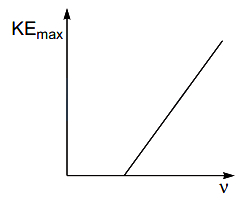
According to Einstein's photoelectric equation,the graph of $KE_{max}$ of the photoelectrons emitted from a metal versus the frequency $\nu$ of the incident radiation gives a straight line. The slope of this graph
A
depends on the intensity of the incident radiation
B
depends on the nature of the metal and also on the intensity of incident radiation
C
is the same for all metals and independent of the intensity of the incident radiation
D
depends on the nature of the metal
Solution
(C) According to Einstein's photoelectric equation:
$KE_{max} = h\nu - \phi_{0}$
Comparing this with the equation of a straight line $y = mx + c$,where $y = KE_{max}$,$x = \nu$,$m$ is the slope,and $c$ is the y-intercept:
$KE_{max} = h\nu + (-\phi_{0})$
Here,the slope $m = h$ (Planck's constant).
Since $h$ is a universal constant,the slope is the same for all metals and is independent of the intensity of the incident radiation.
$KE_{max} = h\nu - \phi_{0}$
Comparing this with the equation of a straight line $y = mx + c$,where $y = KE_{max}$,$x = \nu$,$m$ is the slope,and $c$ is the y-intercept:
$KE_{max} = h\nu + (-\phi_{0})$
Here,the slope $m = h$ (Planck's constant).
Since $h$ is a universal constant,the slope is the same for all metals and is independent of the intensity of the incident radiation.
0 likes
View Solution617
MediumMCQ
When a piece of metal is illuminated by a monochromatic light of wavelength $\lambda$,the stopping potential is $3 V_{s}$. When the same surface is illuminated by light of wavelength $2 \lambda$,the stopping potential becomes $V_{s}$. The value of the threshold wavelength for photoelectric emission is:
A
$4 \lambda$
B
$8 \lambda$
C
$\frac{4}{3} \lambda$
D
$6 \lambda$
Solution
(A) According to Einstein's photoelectric equation: $eV = \frac{hc}{\lambda} - \frac{hc}{\lambda_{0}} = hc \left( \frac{1}{\lambda} - \frac{1}{\lambda_{0}} \right)$.
For the first case: $3 eV_{s} = hc \left( \frac{1}{\lambda} - \frac{1}{\lambda_{0}} \right)$ --- $(i)$
For the second case: $eV_{s} = hc \left( \frac{1}{2 \lambda} - \frac{1}{\lambda_{0}} \right)$ --- (ii)
Dividing equation $(i)$ by equation (ii):
$\frac{3 eV_{s}}{eV_{s}} = \frac{hc \left( \frac{1}{\lambda} - \frac{1}{\lambda_{0}} \right)}{hc \left( \frac{1}{2 \lambda} - \frac{1}{\lambda_{0}} \right)}$
$3 = \frac{\frac{1}{\lambda} - \frac{1}{\lambda_{0}}}{\frac{1}{2 \lambda} - \frac{1}{\lambda_{0}}}$
$3 \left( \frac{1}{2 \lambda} - \frac{1}{\lambda_{0}} \right) = \frac{1}{\lambda} - \frac{1}{\lambda_{0}}$
$\frac{3}{2 \lambda} - \frac{3}{\lambda_{0}} = \frac{1}{\lambda} - \frac{1}{\lambda_{0}}$
$\frac{3}{2 \lambda} - \frac{1}{\lambda} = \frac{3}{\lambda_{0}} - \frac{1}{\lambda_{0}}$
$\frac{1}{2 \lambda} = \frac{2}{\lambda_{0}}$
$\lambda_{0} = 4 \lambda$.
For the first case: $3 eV_{s} = hc \left( \frac{1}{\lambda} - \frac{1}{\lambda_{0}} \right)$ --- $(i)$
For the second case: $eV_{s} = hc \left( \frac{1}{2 \lambda} - \frac{1}{\lambda_{0}} \right)$ --- (ii)
Dividing equation $(i)$ by equation (ii):
$\frac{3 eV_{s}}{eV_{s}} = \frac{hc \left( \frac{1}{\lambda} - \frac{1}{\lambda_{0}} \right)}{hc \left( \frac{1}{2 \lambda} - \frac{1}{\lambda_{0}} \right)}$
$3 = \frac{\frac{1}{\lambda} - \frac{1}{\lambda_{0}}}{\frac{1}{2 \lambda} - \frac{1}{\lambda_{0}}}$
$3 \left( \frac{1}{2 \lambda} - \frac{1}{\lambda_{0}} \right) = \frac{1}{\lambda} - \frac{1}{\lambda_{0}}$
$\frac{3}{2 \lambda} - \frac{3}{\lambda_{0}} = \frac{1}{\lambda} - \frac{1}{\lambda_{0}}$
$\frac{3}{2 \lambda} - \frac{1}{\lambda} = \frac{3}{\lambda_{0}} - \frac{1}{\lambda_{0}}$
$\frac{1}{2 \lambda} = \frac{2}{\lambda_{0}}$
$\lambda_{0} = 4 \lambda$.
0 likes
View Solution618
EasyMCQ
The maximum kinetic energy of emitted electrons in a photoelectric effect does not depend upon
A
wavelength
B
frequency
C
intensity
D
work function
Solution
(C) According to Einstein's photoelectric equation, the maximum kinetic energy $K_{max}$ of emitted electrons is given by $K_{max} = h\nu - \Phi_0$, where $h$ is Planck's constant, $\nu$ is the frequency of incident light, and $\Phi_0$ is the work function of the metal.
Since $\nu = c / \lambda$, the kinetic energy depends on the frequency $\nu$ and the wavelength $\lambda$ of the incident light, as well as the work function $\Phi_0$ of the material.
The intensity of incident light determines the number of photons striking the surface per unit time, which affects the number of emitted electrons (photoelectric current), but it does not affect the maximum kinetic energy of individual emitted electrons.
Since $\nu = c / \lambda$, the kinetic energy depends on the frequency $\nu$ and the wavelength $\lambda$ of the incident light, as well as the work function $\Phi_0$ of the material.
The intensity of incident light determines the number of photons striking the surface per unit time, which affects the number of emitted electrons (photoelectric current), but it does not affect the maximum kinetic energy of individual emitted electrons.
0 likes
View Solution619
EasyMCQ
Which one of the following graphs correctly represents the variation of maximum kinetic energy $(E_{k})$ of the emitted electrons with frequency $(\nu)$ of incident light in the photoelectric effect?
A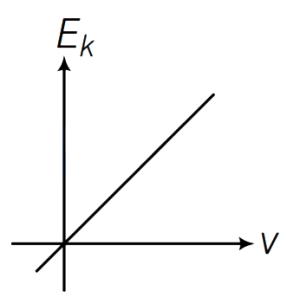
B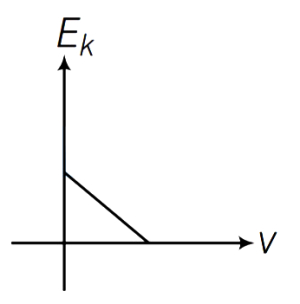
C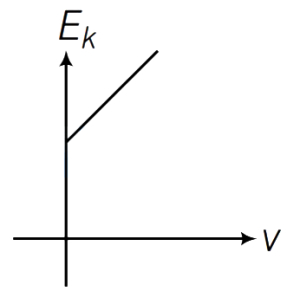
D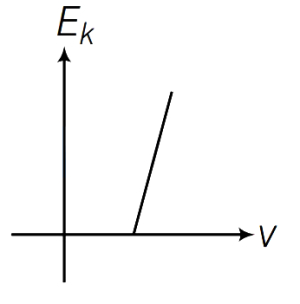
Solution
(D) According to Einstein's photoelectric equation:
$E_{k} = h\nu - \Phi$
where $E_{k}$ is the maximum kinetic energy,$h$ is Planck's constant,$\nu$ is the frequency of incident light,and $\Phi = h\nu_{0}$ is the work function of the metal surface ($\nu_{0}$ is the threshold frequency).
This equation is of the form $y = mx + c$,where:
$y = E_{k}$
$x = \nu$
$m = h$ (slope)
$c = -\Phi$ (y-intercept)
$1$. For $\nu < \nu_{0}$,the energy of the incident photon is less than the work function,so no photoelectric emission occurs,and $E_{k} = 0$.
$2$. For $\nu = \nu_{0}$,$E_{k} = 0$.
$3$. For $\nu > \nu_{0}$,$E_{k}$ increases linearly with frequency $\nu$.
Graph $D$ correctly shows that $E_{k}$ is zero until the threshold frequency $\nu_{0}$ is reached,after which it increases linearly.
$E_{k} = h\nu - \Phi$
where $E_{k}$ is the maximum kinetic energy,$h$ is Planck's constant,$\nu$ is the frequency of incident light,and $\Phi = h\nu_{0}$ is the work function of the metal surface ($\nu_{0}$ is the threshold frequency).
This equation is of the form $y = mx + c$,where:
$y = E_{k}$
$x = \nu$
$m = h$ (slope)
$c = -\Phi$ (y-intercept)
$1$. For $\nu < \nu_{0}$,the energy of the incident photon is less than the work function,so no photoelectric emission occurs,and $E_{k} = 0$.
$2$. For $\nu = \nu_{0}$,$E_{k} = 0$.
$3$. For $\nu > \nu_{0}$,$E_{k}$ increases linearly with frequency $\nu$.
Graph $D$ correctly shows that $E_{k}$ is zero until the threshold frequency $\nu_{0}$ is reached,after which it increases linearly.
0 likes
View Solution620
MediumMCQ
$A$ and $B$ are two metals with threshold frequencies $1.8 \times 10^{14} \ Hz$ and $2.2 \times 10^{14} \ Hz$. Two identical photons of energy $0.825 \ eV$ each are incident on them. Then photoelectrons are emitted by (Take $h = 6.6 \times 10^{-34} \ J \cdot s$)
A
$B$ alone
B
$A$ alone
C
neither $A$ nor $B$
D
both $A$ and $B$
Solution
(B) The threshold energy (work function) is given by $\Phi = h \nu_0$. Given $h = 6.6 \times 10^{-34} \ J \cdot s$ and $1 \ eV = 1.6 \times 10^{-19} \ J$.
For metal $A$:
$\Phi_A = h \nu_A = (6.6 \times 10^{-34}) \times (1.8 \times 10^{14}) \ J = 11.88 \times 10^{-20} \ J$.
Converting to $eV$: $\Phi_A = \frac{11.88 \times 10^{-20}}{1.6 \times 10^{-19}} \ eV = 0.7425 \ eV$.
For metal $B$:
$\Phi_B = h \nu_B = (6.6 \times 10^{-34}) \times (2.2 \times 10^{14}) \ J = 14.52 \times 10^{-20} \ J$.
Converting to $eV$: $\Phi_B = \frac{14.52 \times 10^{-20}}{1.6 \times 10^{-19}} \ eV = 0.9075 \ eV$.
The energy of incident photons is $E = 0.825 \ eV$.
Since $E > \Phi_A$ $(0.825 \ eV > 0.7425 \ eV)$ and $E < \Phi_B$ $(0.825 \ eV < 0.9075 \ eV)$,photoelectrons are emitted only from metal $A$.
For metal $A$:
$\Phi_A = h \nu_A = (6.6 \times 10^{-34}) \times (1.8 \times 10^{14}) \ J = 11.88 \times 10^{-20} \ J$.
Converting to $eV$: $\Phi_A = \frac{11.88 \times 10^{-20}}{1.6 \times 10^{-19}} \ eV = 0.7425 \ eV$.
For metal $B$:
$\Phi_B = h \nu_B = (6.6 \times 10^{-34}) \times (2.2 \times 10^{14}) \ J = 14.52 \times 10^{-20} \ J$.
Converting to $eV$: $\Phi_B = \frac{14.52 \times 10^{-20}}{1.6 \times 10^{-19}} \ eV = 0.9075 \ eV$.
The energy of incident photons is $E = 0.825 \ eV$.
Since $E > \Phi_A$ $(0.825 \ eV > 0.7425 \ eV)$ and $E < \Phi_B$ $(0.825 \ eV < 0.9075 \ eV)$,photoelectrons are emitted only from metal $A$.
0 likes
View Solution621
EasyMCQ
Light of two different frequencies whose photons have energies $1 \text{ eV}$ and $2.5 \text{ eV}$ respectively,successively illuminate a metallic surface whose work function is $0.5 \text{ eV}$. The ratio of the maximum speeds of the emitted electrons will be:
A
$1:5$
B
$1:4$
C
$1:2$
D
$1:1$
Solution
(C) According to Einstein's photoelectric equation,the maximum kinetic energy $K_{max}$ of emitted electrons is given by $K_{max} = E - \Phi$,where $E$ is the energy of the incident photon and $\Phi$ is the work function of the metal.
For the first photon with energy $E_1 = 1 \text{ eV}$:
$K_1 = 1 \text{ eV} - 0.5 \text{ eV} = 0.5 \text{ eV}$.
For the second photon with energy $E_2 = 2.5 \text{ eV}$:
$K_2 = 2.5 \text{ eV} - 0.5 \text{ eV} = 2.0 \text{ eV}$.
Since $K_{max} = \frac{1}{2}mv^2$,the ratio of the kinetic energies is:
$\frac{K_1}{K_2} = \frac{0.5}{2.0} = \frac{1}{4}$.
Substituting the expression for kinetic energy:
$\frac{\frac{1}{2}mv_1^2}{\frac{1}{2}mv_2^2} = \frac{1}{4} \Rightarrow \frac{v_1^2}{v_2^2} = \frac{1}{4}$.
Taking the square root on both sides:
$\frac{v_1}{v_2} = \sqrt{\frac{1}{4}} = \frac{1}{2}$.
Thus,the ratio of the maximum speeds is $1:2$.
For the first photon with energy $E_1 = 1 \text{ eV}$:
$K_1 = 1 \text{ eV} - 0.5 \text{ eV} = 0.5 \text{ eV}$.
For the second photon with energy $E_2 = 2.5 \text{ eV}$:
$K_2 = 2.5 \text{ eV} - 0.5 \text{ eV} = 2.0 \text{ eV}$.
Since $K_{max} = \frac{1}{2}mv^2$,the ratio of the kinetic energies is:
$\frac{K_1}{K_2} = \frac{0.5}{2.0} = \frac{1}{4}$.
Substituting the expression for kinetic energy:
$\frac{\frac{1}{2}mv_1^2}{\frac{1}{2}mv_2^2} = \frac{1}{4} \Rightarrow \frac{v_1^2}{v_2^2} = \frac{1}{4}$.
Taking the square root on both sides:
$\frac{v_1}{v_2} = \sqrt{\frac{1}{4}} = \frac{1}{2}$.
Thus,the ratio of the maximum speeds is $1:2$.
0 likes
View Solution622
EasyMCQ
The maximum kinetic energy of the photo-electrons depends only on
A
potential
B
frequency
C
incident angle
D
pressure
Solution
(B) When light of suitable frequency falls on a metal plate,electrons are emitted. This phenomenon is known as the photoelectric effect.
According to Einstein's photoelectric equation,the maximum kinetic energy $(K_{\max})$ of the emitted photo-electrons is given by:
$K_{\max} = hf - \phi_0$
where $h$ is Planck's constant,$f$ is the frequency of the incident light,and $\phi_0$ is the work function of the metal.
Since $h$ and $\phi_0$ are constants for a given metal,the maximum kinetic energy depends only on the frequency $(f)$ of the incident light.
According to Einstein's photoelectric equation,the maximum kinetic energy $(K_{\max})$ of the emitted photo-electrons is given by:
$K_{\max} = hf - \phi_0$
where $h$ is Planck's constant,$f$ is the frequency of the incident light,and $\phi_0$ is the work function of the metal.
Since $h$ and $\phi_0$ are constants for a given metal,the maximum kinetic energy depends only on the frequency $(f)$ of the incident light.
0 likes
View Solution623
MediumMCQ
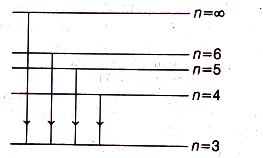
Light from the Paschen series of a hydrogen atom is able to eject photoelectrons from a metal. Then the work function of the metal is:
A
$3.4 \text{ eV}$
B
$1.54 \text{ eV}$
C
None of these
D
$1.1 \text{ eV}$
Solution
(D) In the Paschen series,an electron transitions from a higher energy state to the $n=3$ state. The energy of a photon in the Paschen series is given by $E = 13.6 \left( \frac{1}{3^2} - \frac{1}{n^2} \right) \text{ eV}$,where $n = 4, 5, 6, \dots$
The minimum energy corresponds to the transition from $n=4$ to $n=3$:
$E_{\min} = 13.6 \left( \frac{1}{9} - \frac{1}{16} \right) = 13.6 \left( \frac{16-9}{144} \right) = 13.6 \left( \frac{7}{144} \right) \approx 0.66 \text{ eV}$.
The maximum energy corresponds to the transition from $n=\infty$ to $n=3$:
$E_{\max} = 13.6 \left( \frac{1}{9} - 0 \right) = \frac{13.6}{9} \approx 1.51 \text{ eV}$.
For a photon to eject a photoelectron,its energy must be greater than or equal to the work function $\phi_0$ of the metal. Thus,$\phi_0 \leq E_{\text{photon}}$. Since the maximum energy of a Paschen photon is $1.51 \text{ eV}$,the work function must satisfy $\phi_0 \leq 1.51 \text{ eV}$.
Among the given options,$1.1 \text{ eV}$ is the only value that satisfies this condition.
The minimum energy corresponds to the transition from $n=4$ to $n=3$:
$E_{\min} = 13.6 \left( \frac{1}{9} - \frac{1}{16} \right) = 13.6 \left( \frac{16-9}{144} \right) = 13.6 \left( \frac{7}{144} \right) \approx 0.66 \text{ eV}$.
The maximum energy corresponds to the transition from $n=\infty$ to $n=3$:
$E_{\max} = 13.6 \left( \frac{1}{9} - 0 \right) = \frac{13.6}{9} \approx 1.51 \text{ eV}$.
For a photon to eject a photoelectron,its energy must be greater than or equal to the work function $\phi_0$ of the metal. Thus,$\phi_0 \leq E_{\text{photon}}$. Since the maximum energy of a Paschen photon is $1.51 \text{ eV}$,the work function must satisfy $\phi_0 \leq 1.51 \text{ eV}$.
Among the given options,$1.1 \text{ eV}$ is the only value that satisfies this condition.
0 likes
View Solution624
EasyMCQ
If the threshold wavelength of light for photoelectric emission to take place from a metal surface is $6250 \ \text{Å}$, then the work function of the metal is (Planck's constant $= 6.6 \times 10^{-34} \ \text{Js}$) (in $\text{eV}$)
A
$3.98$
B
$1.98$
C
$2.98$
D
$4.98$
Solution
(B) The work function $\Phi$ is given by the formula $\Phi = \frac{hc}{\lambda_0}$, where $h$ is Planck's constant, $c$ is the speed of light, and $\lambda_0$ is the threshold wavelength.
Given: $h = 6.6 \times 10^{-34} \ \text{Js}$, $c = 3 \times 10^8 \ \text{m/s}$, and $\lambda_0 = 6250 \ \text{Å} = 6250 \times 10^{-10} \ \text{m}$.
Substituting the values:
$\Phi = \frac{6.6 \times 10^{-34} \times 3 \times 10^8}{6250 \times 10^{-10}} \ \text{J}$.
$\Phi = \frac{19.8 \times 10^{-26}}{6250 \times 10^{-10}} = \frac{19.8}{6250} \times 10^{-16} \ \text{J} = 3.168 \times 10^{-20} \ \text{J}$.
To convert this into electron-volts (eV), divide by the charge of an electron $e = 1.6 \times 10^{-19} \ \text{C}$:
$\Phi = \frac{3.168 \times 10^{-20}}{1.6 \times 10^{-19}} \ \text{eV} = 1.98 \ \text{eV}$.
Thus, the correct option is $B$.
Given: $h = 6.6 \times 10^{-34} \ \text{Js}$, $c = 3 \times 10^8 \ \text{m/s}$, and $\lambda_0 = 6250 \ \text{Å} = 6250 \times 10^{-10} \ \text{m}$.
Substituting the values:
$\Phi = \frac{6.6 \times 10^{-34} \times 3 \times 10^8}{6250 \times 10^{-10}} \ \text{J}$.
$\Phi = \frac{19.8 \times 10^{-26}}{6250 \times 10^{-10}} = \frac{19.8}{6250} \times 10^{-16} \ \text{J} = 3.168 \times 10^{-20} \ \text{J}$.
To convert this into electron-volts (eV), divide by the charge of an electron $e = 1.6 \times 10^{-19} \ \text{C}$:
$\Phi = \frac{3.168 \times 10^{-20}}{1.6 \times 10^{-19}} \ \text{eV} = 1.98 \ \text{eV}$.
Thus, the correct option is $B$.
0 likes
View Solution625
MediumMCQ
When photons of energy $8 \times 10^{-19} \ J$ are incident on a photosensitive material,the de Broglie wavelength of the photoelectrons emitted with maximum kinetic energy is $10 \ Å$. The work function of the photosensitive material is nearly (in $eV$)
A
$3.5$
B
$2.5$
C
$2.0$
D
$1.5$
Solution
(A) The energy of the incident photon is $E = 8 \times 10^{-19} \ J$.
Converting this to electron-volts,$E = \frac{8 \times 10^{-19}}{1.6 \times 10^{-19}} \ eV = 5 \ eV$.
The de Broglie wavelength $\lambda$ of the emitted photoelectrons is $10 \ Å = 10^{-9} \ m$.
The kinetic energy $K_{max}$ of the photoelectrons is given by $K_{max} = \frac{h^2}{2m\lambda^2}$.
Substituting the values: $K_{max} = \frac{(6.63 \times 10^{-34})^2}{2 \times 9.1 \times 10^{-31} \times (10^{-9})^2} \approx 2.41 \times 10^{-19} \ J$.
Converting to $eV$: $K_{max} = \frac{2.41 \times 10^{-19}}{1.6 \times 10^{-19}} \ eV \approx 1.5 \ eV$.
Using Einstein's photoelectric equation: $E = \phi + K_{max}$,where $\phi$ is the work function.
$\phi = E - K_{max} = 5 \ eV - 1.5 \ eV = 3.5 \ eV$.
Converting this to electron-volts,$E = \frac{8 \times 10^{-19}}{1.6 \times 10^{-19}} \ eV = 5 \ eV$.
The de Broglie wavelength $\lambda$ of the emitted photoelectrons is $10 \ Å = 10^{-9} \ m$.
The kinetic energy $K_{max}$ of the photoelectrons is given by $K_{max} = \frac{h^2}{2m\lambda^2}$.
Substituting the values: $K_{max} = \frac{(6.63 \times 10^{-34})^2}{2 \times 9.1 \times 10^{-31} \times (10^{-9})^2} \approx 2.41 \times 10^{-19} \ J$.
Converting to $eV$: $K_{max} = \frac{2.41 \times 10^{-19}}{1.6 \times 10^{-19}} \ eV \approx 1.5 \ eV$.
Using Einstein's photoelectric equation: $E = \phi + K_{max}$,where $\phi$ is the work function.
$\phi = E - K_{max} = 5 \ eV - 1.5 \ eV = 3.5 \ eV$.
0 likes
View Solution626
MediumMCQ
Energy required to remove an electron from an aluminum surface is $4.2 \text{ eV}$. If light of wavelength $2000 \text{ Å}$ falls on the surface,the velocity of the fastest electron ejected from the surface will be:
A
$8.4 \times 10^5 \text{ m/s}$
B
$7.4 \times 10^5 \text{ m/s}$
C
$6.4 \times 10^5 \text{ m/s}$
D
$8.4 \times 10^6 \text{ m/s}$
Solution
(A) Given: Work function $\phi_0 = 4.2 \text{ eV}$,Wavelength $\lambda = 2000 \text{ Å}$.
Energy of incident photon $E = \frac{12400}{\lambda(\text{in Å})} \text{ eV} = \frac{12400}{2000} = 6.2 \text{ eV}$.
According to Einstein's photoelectric equation,the maximum kinetic energy $K_{\max} = E - \phi_0$.
$K_{\max} = 6.2 \text{ eV} - 4.2 \text{ eV} = 2 \text{ eV}$.
Converting kinetic energy to Joules: $K_{\max} = 2 \times 1.6 \times 10^{-19} \text{ J} = 3.2 \times 10^{-19} \text{ J}$.
Using $K_{\max} = \frac{1}{2} m v_{\max}^2$,where mass of electron $m = 9.1 \times 10^{-31} \text{ kg}$.
$v_{\max}^2 = \frac{2 \times K_{\max}}{m} = \frac{2 \times 3.2 \times 10^{-19}}{9.1 \times 10^{-31}} \approx 0.703 \times 10^{12} \text{ m}^2/\text{s}^2$.
$v_{\max} = \sqrt{0.703 \times 10^{12}} \approx 8.38 \times 10^5 \text{ m/s} \approx 8.4 \times 10^5 \text{ m/s}$.
Energy of incident photon $E = \frac{12400}{\lambda(\text{in Å})} \text{ eV} = \frac{12400}{2000} = 6.2 \text{ eV}$.
According to Einstein's photoelectric equation,the maximum kinetic energy $K_{\max} = E - \phi_0$.
$K_{\max} = 6.2 \text{ eV} - 4.2 \text{ eV} = 2 \text{ eV}$.
Converting kinetic energy to Joules: $K_{\max} = 2 \times 1.6 \times 10^{-19} \text{ J} = 3.2 \times 10^{-19} \text{ J}$.
Using $K_{\max} = \frac{1}{2} m v_{\max}^2$,where mass of electron $m = 9.1 \times 10^{-31} \text{ kg}$.
$v_{\max}^2 = \frac{2 \times K_{\max}}{m} = \frac{2 \times 3.2 \times 10^{-19}}{9.1 \times 10^{-31}} \approx 0.703 \times 10^{12} \text{ m}^2/\text{s}^2$.
$v_{\max} = \sqrt{0.703 \times 10^{12}} \approx 8.38 \times 10^5 \text{ m/s} \approx 8.4 \times 10^5 \text{ m/s}$.
0 likes
View Solution627
EasyMCQ
The longest wavelength of light that can initiate the photoelectric effect in a metal with a work function of $9 \ eV$ is:
A
$1.37 \times 10^{-7} \ m$
B
$1.5 \times 10^{-7} \ m$
C
$3.7 \times 10^{-7} \ m$
D
$4 \times 10^{-7} \ m$
Solution
(A) The work function $\phi_0$ is given as $9 \ eV$.
The threshold wavelength $\lambda_0$ is the longest wavelength capable of initiating the photoelectric effect.
The relationship between work function and threshold wavelength is given by $\phi_0 = \frac{hc}{\lambda_0}$.
Using the constant $hc \approx 1240 \ eV \cdot nm$,we have:
$\lambda_0 = \frac{1240 \ eV \cdot nm}{9 \ eV} \approx 137.77 \ nm$.
Converting nanometers to meters:
$\lambda_0 \approx 137.77 \times 10^{-9} \ m = 1.3777 \times 10^{-7} \ m$.
Rounding to the nearest option,we get $1.37 \times 10^{-7} \ m$.
The threshold wavelength $\lambda_0$ is the longest wavelength capable of initiating the photoelectric effect.
The relationship between work function and threshold wavelength is given by $\phi_0 = \frac{hc}{\lambda_0}$.
Using the constant $hc \approx 1240 \ eV \cdot nm$,we have:
$\lambda_0 = \frac{1240 \ eV \cdot nm}{9 \ eV} \approx 137.77 \ nm$.
Converting nanometers to meters:
$\lambda_0 \approx 137.77 \times 10^{-9} \ m = 1.3777 \times 10^{-7} \ m$.
Rounding to the nearest option,we get $1.37 \times 10^{-7} \ m$.
0 likes
View Solution628
DifficultMCQ
The maximum wavelength of light which causes photoelectric emission from a photosensitive metal surface is $\lambda_0$. Two light beams of wavelengths $\frac{\lambda_0}{3}$ and $\frac{\lambda_0}{9}$ are incident on the metal surface. The ratio of the maximum velocities of the emitted photoelectrons is
A
$3: 4$
B
$1: 3$
C
$1: 2$
D
$2: 3$
Solution
(C) According to Einstein's photoelectric equation,the maximum kinetic energy $K_{\max}$ is given by:
$K_{\max} = \frac{hc}{\lambda} - \phi_0 = \frac{hc}{\lambda} - \frac{hc}{\lambda_0}$
Since $K_{\max} = \frac{1}{2}mv_{\max}^2$,we have:
$\frac{1}{2}mv_{\max}^2 = hc \left( \frac{1}{\lambda} - \frac{1}{\lambda_0} \right)$
$v_{\max} = \sqrt{\frac{2hc}{m} \left( \frac{1}{\lambda} - \frac{1}{\lambda_0} \right)}$
For the first beam with $\lambda_1 = \frac{\lambda_0}{3}$:
$v_1 = \sqrt{\frac{2hc}{m} \left( \frac{3}{\lambda_0} - \frac{1}{\lambda_0} \right)} = \sqrt{\frac{2hc}{m} \cdot \frac{2}{\lambda_0}}$
For the second beam with $\lambda_2 = \frac{\lambda_0}{9}$:
$v_2 = \sqrt{\frac{2hc}{m} \left( \frac{9}{\lambda_0} - \frac{1}{\lambda_0} \right)} = \sqrt{\frac{2hc}{m} \cdot \frac{8}{\lambda_0}}$
The ratio of the maximum velocities is:
$\frac{v_1}{v_2} = \sqrt{\frac{2/\lambda_0}{8/\lambda_0}} = \sqrt{\frac{2}{8}} = \sqrt{\frac{1}{4}} = \frac{1}{2}$
$K_{\max} = \frac{hc}{\lambda} - \phi_0 = \frac{hc}{\lambda} - \frac{hc}{\lambda_0}$
Since $K_{\max} = \frac{1}{2}mv_{\max}^2$,we have:
$\frac{1}{2}mv_{\max}^2 = hc \left( \frac{1}{\lambda} - \frac{1}{\lambda_0} \right)$
$v_{\max} = \sqrt{\frac{2hc}{m} \left( \frac{1}{\lambda} - \frac{1}{\lambda_0} \right)}$
For the first beam with $\lambda_1 = \frac{\lambda_0}{3}$:
$v_1 = \sqrt{\frac{2hc}{m} \left( \frac{3}{\lambda_0} - \frac{1}{\lambda_0} \right)} = \sqrt{\frac{2hc}{m} \cdot \frac{2}{\lambda_0}}$
For the second beam with $\lambda_2 = \frac{\lambda_0}{9}$:
$v_2 = \sqrt{\frac{2hc}{m} \left( \frac{9}{\lambda_0} - \frac{1}{\lambda_0} \right)} = \sqrt{\frac{2hc}{m} \cdot \frac{8}{\lambda_0}}$
The ratio of the maximum velocities is:
$\frac{v_1}{v_2} = \sqrt{\frac{2/\lambda_0}{8/\lambda_0}} = \sqrt{\frac{2}{8}} = \sqrt{\frac{1}{4}} = \frac{1}{2}$
0 likes
View Solution629
DifficultMCQ
The surface of a metal is first illuminated with a light of wavelength $300 \ nm$ and later illuminated by another light of wavelength $500 \ nm$. It is observed that the ratio of maximum velocities of photoelectrons in the two cases is $3$. The work function of the metal is close to: (in $eV$)
A
$6.48$
B
$1.23$
C
$4.17$
D
$2.28$
Solution
(D) Given: $\lambda_1 = 300 \ nm$,$\lambda_2 = 500 \ nm$,and the ratio of maximum velocities $\frac{v_1}{v_2} = 3$.
Using Einstein's photoelectric equation: $E = \phi_0 + K_{max}$,where $K_{max} = \frac{1}{2}mv^2$.
Thus,$\frac{1}{2}mv^2 = \frac{hc}{\lambda} - \phi_0$.
Taking the ratio for the two cases:
$\left(\frac{v_1}{v_2}\right)^2 = \frac{E_1 - \phi_0}{E_2 - \phi_0} = \frac{\frac{1240}{\lambda_1} - \phi_0}{\frac{1240}{\lambda_2} - \phi_0}$.
Substituting the values: $3^2 = \frac{\frac{1240}{300} - \phi_0}{\frac{1240}{500} - \phi_0}$.
$9 = \frac{4.133 - \phi_0}{2.48 - \phi_0}$.
$9(2.48 - \phi_0) = 4.133 - \phi_0$.
$22.32 - 9\phi_0 = 4.133 - \phi_0$.
$8\phi_0 = 18.187$.
$\phi_0 \approx 2.273 \ eV \approx 2.28 \ eV$.
Using Einstein's photoelectric equation: $E = \phi_0 + K_{max}$,where $K_{max} = \frac{1}{2}mv^2$.
Thus,$\frac{1}{2}mv^2 = \frac{hc}{\lambda} - \phi_0$.
Taking the ratio for the two cases:
$\left(\frac{v_1}{v_2}\right)^2 = \frac{E_1 - \phi_0}{E_2 - \phi_0} = \frac{\frac{1240}{\lambda_1} - \phi_0}{\frac{1240}{\lambda_2} - \phi_0}$.
Substituting the values: $3^2 = \frac{\frac{1240}{300} - \phi_0}{\frac{1240}{500} - \phi_0}$.
$9 = \frac{4.133 - \phi_0}{2.48 - \phi_0}$.
$9(2.48 - \phi_0) = 4.133 - \phi_0$.
$22.32 - 9\phi_0 = 4.133 - \phi_0$.
$8\phi_0 = 18.187$.
$\phi_0 \approx 2.273 \ eV \approx 2.28 \ eV$.
0 likes
View Solution630
EasyMCQ
$A$ photon incident on a metal of work function $2 \text{ eV}$ produces photoelectrons of maximum kinetic energy of $2 \text{ eV}$. The wavelength associated with the photon is: (in $\text{ Å}$)
A
$6200$
B
$3100$
C
$9300$
D
$2000$
Solution
(B) Given:
Work function,$\phi_0 = 2 \text{ eV}$
Maximum kinetic energy,$K_{\max} = 2 \text{ eV}$
According to Einstein's photoelectric equation:
$E = \phi_0 + K_{\max}$
$E = 2 \text{ eV} + 2 \text{ eV} = 4 \text{ eV}$
The energy of a photon is given by $E = \frac{hc}{\lambda}$.
Using the relation $\lambda = \frac{12400 \text{ eV Å}}{E \text{ (in eV)}}$:
$\lambda = \frac{12400}{4} \text{ Å} = 3100 \text{ Å}$
Thus,the wavelength of the incident photon is $3100 \text{ Å}$.
Work function,$\phi_0 = 2 \text{ eV}$
Maximum kinetic energy,$K_{\max} = 2 \text{ eV}$
According to Einstein's photoelectric equation:
$E = \phi_0 + K_{\max}$
$E = 2 \text{ eV} + 2 \text{ eV} = 4 \text{ eV}$
The energy of a photon is given by $E = \frac{hc}{\lambda}$.
Using the relation $\lambda = \frac{12400 \text{ eV Å}}{E \text{ (in eV)}}$:
$\lambda = \frac{12400}{4} \text{ Å} = 3100 \text{ Å}$
Thus,the wavelength of the incident photon is $3100 \text{ Å}$.
0 likes
View Solution631
MediumMCQ
The de Broglie wavelength of the most energetic photoelectrons emitted from a photosensitive metal of work function $\phi$,when light of frequency $\nu$ is incident on it,is $\lambda$. Then $\nu =$ (where $h$ is Planck's constant and $m$ is the mass of the electron).
A
$\frac{2 \phi}{h} - \frac{h}{m \lambda^2}$
B
$\frac{2 \phi}{h} + \frac{h}{m \lambda^2}$
C
$\frac{\phi}{h} + \frac{h}{2 m \lambda^2}$
D
$\frac{\phi}{h} - \frac{h}{2 m \lambda^2}$
Solution
(C) According to Einstein's photoelectric equation:
$h \nu = \phi + K.E._{max}$
$h \nu = \phi + \frac{1}{2} m v^2$
We know that the de Broglie wavelength is given by $\lambda = \frac{h}{mv}$,which implies $v = \frac{h}{m \lambda}$.
Substituting the value of $v$ into the kinetic energy equation:
$h \nu = \phi + \frac{1}{2} m \left( \frac{h}{m \lambda} \right)^2$
$h \nu = \phi + \frac{1}{2} m \left( \frac{h^2}{m^2 \lambda^2} \right)$
$h \nu = \phi + \frac{h^2}{2 m \lambda^2}$
Dividing both sides by $h$:
$\nu = \frac{\phi}{h} + \frac{h}{2 m \lambda^2}$
$h \nu = \phi + K.E._{max}$
$h \nu = \phi + \frac{1}{2} m v^2$
We know that the de Broglie wavelength is given by $\lambda = \frac{h}{mv}$,which implies $v = \frac{h}{m \lambda}$.
Substituting the value of $v$ into the kinetic energy equation:
$h \nu = \phi + \frac{1}{2} m \left( \frac{h}{m \lambda} \right)^2$
$h \nu = \phi + \frac{1}{2} m \left( \frac{h^2}{m^2 \lambda^2} \right)$
$h \nu = \phi + \frac{h^2}{2 m \lambda^2}$
Dividing both sides by $h$:
$\nu = \frac{\phi}{h} + \frac{h}{2 m \lambda^2}$
0 likes
View Solution632
EasyMCQ
The maximum kinetic energy of the emitted photoelectrons from a photosensitive material of work function $\phi$,when light of frequency $\nu$ is incident on it,is $E$. If the frequency of the incident light is $3\nu$,the maximum kinetic energy of the emitted photoelectrons is:
A
$3E + 2\phi$
B
$3E - 2\phi$
C
$2E + 3\phi$
D
$2E - 3\phi$
Solution
(A) According to Einstein's photoelectric equation,the maximum kinetic energy $K_{max}$ is given by $K_{max} = h\nu - \phi$.
Given that for frequency $\nu$,the maximum kinetic energy is $E$,we have:
$E = h\nu - \phi$ --- $(1)$
When the frequency is increased to $3\nu$,the new maximum kinetic energy $K'_{max}$ is:
$K'_{max} = h(3\nu) - \phi = 3h\nu - \phi$ --- $(2)$
From equation $(1)$,we can express $h\nu$ as $h\nu = E + \phi$.
Substituting this into equation $(2)$:
$K'_{max} = 3(E + \phi) - \phi$
$K'_{max} = 3E + 3\phi - \phi$
$K'_{max} = 3E + 2\phi$.
Given that for frequency $\nu$,the maximum kinetic energy is $E$,we have:
$E = h\nu - \phi$ --- $(1)$
When the frequency is increased to $3\nu$,the new maximum kinetic energy $K'_{max}$ is:
$K'_{max} = h(3\nu) - \phi = 3h\nu - \phi$ --- $(2)$
From equation $(1)$,we can express $h\nu$ as $h\nu = E + \phi$.
Substituting this into equation $(2)$:
$K'_{max} = 3(E + \phi) - \phi$
$K'_{max} = 3E + 3\phi - \phi$
$K'_{max} = 3E + 2\phi$.
0 likes
View Solution633
MediumMCQ
The threshold frequency of a photosensitive material is $v$. When photons of frequency $2v$ are incident on the material,photoelectrons are emitted with a maximum linear momentum $P$. To get photoelectrons with maximum linear momentum $2P$,the frequency of the incident photons is: (in $v$)
A
$2$
B
$3$
C
$4$
D
$5$
Solution
(D) According to Einstein's photoelectric equation,the maximum kinetic energy $K_{max}$ is given by $K_{max} = h\nu - h\nu_0$,where $\nu_0$ is the threshold frequency.
Since $K_{max} = \frac{P^2}{2m}$,we have $\frac{P^2}{2m} = h\nu - h\nu_0$.
For the first case,$\nu = 2v$ and $\nu_0 = v$:
$\frac{P^2}{2m} = h(2v) - hv = hv$ ... $(1)$
For the second case,let the new frequency be $\nu'$ and the new momentum be $2P$:
$\frac{(2P)^2}{2m} = h\nu' - hv$
$\frac{4P^2}{2m} = h\nu' - hv$ ... $(2)$
Substituting the value of $\frac{P^2}{2m}$ from equation $(1)$ into equation $(2)$:
$4(hv) = h\nu' - hv$
$4hv + hv = h\nu'$
$h\nu' = 5hv$
$\nu' = 5v$
Since $K_{max} = \frac{P^2}{2m}$,we have $\frac{P^2}{2m} = h\nu - h\nu_0$.
For the first case,$\nu = 2v$ and $\nu_0 = v$:
$\frac{P^2}{2m} = h(2v) - hv = hv$ ... $(1)$
For the second case,let the new frequency be $\nu'$ and the new momentum be $2P$:
$\frac{(2P)^2}{2m} = h\nu' - hv$
$\frac{4P^2}{2m} = h\nu' - hv$ ... $(2)$
Substituting the value of $\frac{P^2}{2m}$ from equation $(1)$ into equation $(2)$:
$4(hv) = h\nu' - hv$
$4hv + hv = h\nu'$
$h\nu' = 5hv$
$\nu' = 5v$
0 likes
View Solution634
EasyMCQ
When light of wavelength $\lambda$ incidents on a photosensitive material,photoelectrons are emitted. If the wavelength of the incident light is reduced by $50 \%$,the maximum kinetic energy of the emitted photoelectrons becomes $3$ times the initial maximum kinetic energy. The work function of the material is ($h$ - Planck's constant,$c$ - Speed of light in vacuum).
A
$\frac{hc}{\lambda}$
B
$\frac{hc}{2 \lambda}$
C
$\frac{2 hc}{\lambda}$
D
$\frac{hc}{3 \lambda}$
Solution
(B) According to Einstein's photoelectric equation,the maximum kinetic energy $E$ is given by: $E = \frac{hc}{\lambda} - \phi$ ... $(i)$,
where $\phi$ is the work function.
When the wavelength is reduced by $50 \%$,the new wavelength $\lambda' = \lambda - 0.5\lambda = 0.5\lambda = \frac{\lambda}{2}$.
The new maximum kinetic energy $E' = 3E$.
Substituting these into the photoelectric equation: $3E = \frac{hc}{\lambda/2} - \phi = \frac{2hc}{\lambda} - \phi$ ... $(ii)$.
From equation $(i)$,we have $E = \frac{hc}{\lambda} - \phi$. Substituting this into equation $(ii)$:
$3(\frac{hc}{\lambda} - \phi) = \frac{2hc}{\lambda} - \phi$
$\frac{3hc}{\lambda} - 3\phi = \frac{2hc}{\lambda} - \phi$
$\frac{3hc}{\lambda} - \frac{2hc}{\lambda} = 3\phi - \phi$
$\frac{hc}{\lambda} = 2\phi$
$\phi = \frac{hc}{2\lambda}$.
where $\phi$ is the work function.
When the wavelength is reduced by $50 \%$,the new wavelength $\lambda' = \lambda - 0.5\lambda = 0.5\lambda = \frac{\lambda}{2}$.
The new maximum kinetic energy $E' = 3E$.
Substituting these into the photoelectric equation: $3E = \frac{hc}{\lambda/2} - \phi = \frac{2hc}{\lambda} - \phi$ ... $(ii)$.
From equation $(i)$,we have $E = \frac{hc}{\lambda} - \phi$. Substituting this into equation $(ii)$:
$3(\frac{hc}{\lambda} - \phi) = \frac{2hc}{\lambda} - \phi$
$\frac{3hc}{\lambda} - 3\phi = \frac{2hc}{\lambda} - \phi$
$\frac{3hc}{\lambda} - \frac{2hc}{\lambda} = 3\phi - \phi$
$\frac{hc}{\lambda} = 2\phi$
$\phi = \frac{hc}{2\lambda}$.
0 likes
View Solution635
EasyMCQ
In a photoelectric experiment,a graph is drawn with stopping potential along $Y$-axis and the frequency of the incident light along $X$-axis. If the graph is a straight line which makes an angle $\theta$ with $Y$-axis,then $\tan \theta=$ ($h$-Planck's constant,$e$-charge of electron).
A
$\frac{h}{e}$
B
$\frac{e}{h}$
C
$\sqrt{\frac{h}{e}}$
D
$\sqrt{\frac{e}{h}}$
Solution
(B) The photoelectric equation is given by $eV_s = h\nu - \phi$,where $V_s$ is the stopping potential,$h$ is Planck's constant,$\nu$ is the frequency,and $\phi$ is the work function.
Rearranging the equation for $V_s$ as a function of $\nu$: $V_s = (\frac{h}{e})\nu - \frac{\phi}{e}$.
Comparing this with the equation of a straight line $y = mx + c$,where $y = V_s$ and $x = \nu$,the slope of the graph with respect to the $X$-axis is $m = \frac{h}{e}$.
However,the question specifies that the angle $\theta$ is made with the $Y$-axis. For a line $y = mx + c$,the slope $m = \tan(\alpha)$ where $\alpha$ is the angle with the $X$-axis. The angle $\theta$ with the $Y$-axis is related to the angle $\alpha$ with the $X$-axis by $\theta = 90^\circ - \alpha$.
Therefore,$\tan \theta = \tan(90^\circ - \alpha) = \cot \alpha = \frac{1}{\tan \alpha} = \frac{1}{h/e} = \frac{e}{h}$.
Rearranging the equation for $V_s$ as a function of $\nu$: $V_s = (\frac{h}{e})\nu - \frac{\phi}{e}$.
Comparing this with the equation of a straight line $y = mx + c$,where $y = V_s$ and $x = \nu$,the slope of the graph with respect to the $X$-axis is $m = \frac{h}{e}$.
However,the question specifies that the angle $\theta$ is made with the $Y$-axis. For a line $y = mx + c$,the slope $m = \tan(\alpha)$ where $\alpha$ is the angle with the $X$-axis. The angle $\theta$ with the $Y$-axis is related to the angle $\alpha$ with the $X$-axis by $\theta = 90^\circ - \alpha$.
Therefore,$\tan \theta = \tan(90^\circ - \alpha) = \cot \alpha = \frac{1}{\tan \alpha} = \frac{1}{h/e} = \frac{e}{h}$.
0 likes
View Solution636
MediumMCQ
Photoelectrons are emitted with maximum velocity $v$ when light of frequency $3f$ is incident on a photosensitive material of work function $2hf$. If the frequency of the incident light is $4.25f$,the maximum velocity of the emitted photoelectrons is ($h$ = Planck's constant).
A
$0.5v$
B
$v$
C
$1.5v$
D
$2v$
Solution
(C) According to Einstein's photoelectric equation,the maximum kinetic energy is given by $K_{max} = hf - \phi$.
For the first case: $f_1 = 3f$,$\phi = 2hf$,and $v_1 = v$.
$\frac{1}{2}mv^2 = 3hf - 2hf = hf$ --- $(1)$
For the second case: $f_2 = 4.25f$,$\phi = 2hf$,and $v_2 = ?$.
$\frac{1}{2}mv_2^2 = 4.25hf - 2hf = 2.25hf$ --- $(2)$
Dividing equation $(2)$ by equation $(1)$:
$\frac{\frac{1}{2}mv_2^2}{\frac{1}{2}mv^2} = \frac{2.25hf}{hf}$
$\frac{v_2^2}{v^2} = 2.25$
$v_2^2 = 2.25v^2$
$v_2 = \sqrt{2.25}v = 1.5v$.
For the first case: $f_1 = 3f$,$\phi = 2hf$,and $v_1 = v$.
$\frac{1}{2}mv^2 = 3hf - 2hf = hf$ --- $(1)$
For the second case: $f_2 = 4.25f$,$\phi = 2hf$,and $v_2 = ?$.
$\frac{1}{2}mv_2^2 = 4.25hf - 2hf = 2.25hf$ --- $(2)$
Dividing equation $(2)$ by equation $(1)$:
$\frac{\frac{1}{2}mv_2^2}{\frac{1}{2}mv^2} = \frac{2.25hf}{hf}$
$\frac{v_2^2}{v^2} = 2.25$
$v_2^2 = 2.25v^2$
$v_2 = \sqrt{2.25}v = 1.5v$.
0 likes
View Solution637
MediumMCQ
The threshold frequency of a photosensitive material is equal to the frequency of the $H_{\alpha}$ line of hydrogen. If a photon whose frequency is equal to the frequency of the $H_{\beta}$ line of hydrogen is incident on this photosensitive material,the maximum kinetic energy of the emitted photoelectrons is ($R$ = Rydberg's constant,$h$ = Planck's constant,and $c$ = speed of light in vacuum).
A
$Rhc$
B
$\frac{5 Rhc}{144}$
C
$\frac{7 Rhc}{144}$
D
$\frac{Rhc}{36}$
Solution
(C) The frequency of the $H_{\alpha}$ line of the Balmer series is given by $\nu_0 = Rc(\frac{1}{2^2} - \frac{1}{3^2}) = Rc(\frac{1}{4} - \frac{1}{9}) = \frac{5Rc}{36}$. This is the threshold frequency $\nu_0$ of the material.
The frequency of the $H_{\beta}$ line of the Balmer series is given by $\nu = Rc(\frac{1}{2^2} - \frac{1}{4^2}) = Rc(\frac{1}{4} - \frac{1}{16}) = \frac{3Rc}{16}$.
According to Einstein's photoelectric equation,the maximum kinetic energy $K_{max}$ is given by $K_{max} = h\nu - h\nu_0$.
Substituting the values:
$K_{max} = h(\frac{3Rc}{16}) - h(\frac{5Rc}{36})$
$K_{max} = Rhc(\frac{3}{16} - \frac{5}{36})$
$K_{max} = Rhc(\frac{27 - 20}{144}) = \frac{7 Rhc}{144}$.
The frequency of the $H_{\beta}$ line of the Balmer series is given by $\nu = Rc(\frac{1}{2^2} - \frac{1}{4^2}) = Rc(\frac{1}{4} - \frac{1}{16}) = \frac{3Rc}{16}$.
According to Einstein's photoelectric equation,the maximum kinetic energy $K_{max}$ is given by $K_{max} = h\nu - h\nu_0$.
Substituting the values:
$K_{max} = h(\frac{3Rc}{16}) - h(\frac{5Rc}{36})$
$K_{max} = Rhc(\frac{3}{16} - \frac{5}{36})$
$K_{max} = Rhc(\frac{27 - 20}{144}) = \frac{7 Rhc}{144}$.
0 likes
View Solution638
EasyMCQ
Which of the following statements is correct in the case of the photoelectric effect?
A
For a given frequency of incident radiation,the stopping potential varies linearly with its intensity.
B
For a given frequency of incident radiation,the photocurrent is independent of its intensity.
C
For a given frequency of incident radiation,the maximum kinetic energy of the photoelectrons is independent of its intensity.
D
For a frequency lower than the cutoff frequency,photoelectric emissions can occur if the intensity of incident light is increased slightly.
Solution
(C) According to Einstein's photoelectric equation,the maximum kinetic energy of the emitted photoelectrons is given by $K_{max} = h\nu - \phi_0$,where $h$ is Planck's constant,$\nu$ is the frequency of incident radiation,and $\phi_0$ is the work function of the metal.
This equation shows that $K_{max}$ depends only on the frequency of the incident radiation and is independent of the intensity of the incident radiation.
Therefore,option $(C)$ is correct.
For a given frequency,the photocurrent is directly proportional to the intensity of incident radiation.
The stopping potential depends only on the frequency of incident radiation and is independent of the intensity.
If the frequency of incident radiation is less than the threshold (cutoff) frequency,no photoelectric emission occurs,regardless of how much the intensity is increased.
This equation shows that $K_{max}$ depends only on the frequency of the incident radiation and is independent of the intensity of the incident radiation.
Therefore,option $(C)$ is correct.
For a given frequency,the photocurrent is directly proportional to the intensity of incident radiation.
The stopping potential depends only on the frequency of incident radiation and is independent of the intensity.
If the frequency of incident radiation is less than the threshold (cutoff) frequency,no photoelectric emission occurs,regardless of how much the intensity is increased.
0 likes
View Solution639
MediumMCQ
The electric field associated with a monochromatic light wave is given by $E = E_0 \sin \left[ \left( 1.57 \times 10^7 \text{ m}^{-1} \right) (x - ct) \right]$. The stopping potential when this light is used in a photoelectric experiment with a metal having a work function of $1.9 \text{ eV}$ is: (Planck's constant,$h = 6.64 \times 10^{-34} \text{ J-s}$) (in $\text{ V}$)
A
$0.5$
B
$3.2$
C
$1.1$
D
$0.75$
Solution
(C) Given the wave equation: $E = E_0 \sin [k(x - ct)]$,where $k = \frac{2\pi}{\lambda} = 1.57 \times 10^7 \text{ m}^{-1}$.
Calculating wavelength $\lambda$: $\lambda = \frac{2 \times 3.14}{1.57 \times 10^7} = 4 \times 10^{-7} \text{ m}$.
Energy of incident photon $E_p = \frac{hc}{\lambda} = \frac{6.64 \times 10^{-34} \times 3 \times 10^8}{4 \times 10^{-7}} = 4.98 \times 10^{-19} \text{ J}$.
Converting work function $\phi_0$ to Joules: $\phi_0 = 1.9 \text{ eV} = 1.9 \times 1.6 \times 10^{-19} \text{ J} = 3.04 \times 10^{-19} \text{ J}$.
Using Einstein's photoelectric equation: $E_p = \phi_0 + eV_0$.
$eV_0 = 4.98 \times 10^{-19} - 3.04 \times 10^{-19} = 1.94 \times 10^{-19} \text{ J}$.
$V_0 = \frac{1.94 \times 10^{-19}}{1.6 \times 10^{-19}} \text{ V} = 1.2125 \text{ V}$.
Rounding to the nearest option,the stopping potential is $1.1 \text{ V}$.
Calculating wavelength $\lambda$: $\lambda = \frac{2 \times 3.14}{1.57 \times 10^7} = 4 \times 10^{-7} \text{ m}$.
Energy of incident photon $E_p = \frac{hc}{\lambda} = \frac{6.64 \times 10^{-34} \times 3 \times 10^8}{4 \times 10^{-7}} = 4.98 \times 10^{-19} \text{ J}$.
Converting work function $\phi_0$ to Joules: $\phi_0 = 1.9 \text{ eV} = 1.9 \times 1.6 \times 10^{-19} \text{ J} = 3.04 \times 10^{-19} \text{ J}$.
Using Einstein's photoelectric equation: $E_p = \phi_0 + eV_0$.
$eV_0 = 4.98 \times 10^{-19} - 3.04 \times 10^{-19} = 1.94 \times 10^{-19} \text{ J}$.
$V_0 = \frac{1.94 \times 10^{-19}}{1.6 \times 10^{-19}} \text{ V} = 1.2125 \text{ V}$.
Rounding to the nearest option,the stopping potential is $1.1 \text{ V}$.
0 likes
View Solution640
EasyMCQ
Two light waves of wavelengths $600 \,nm$ and $200 \,nm$ are incident on a metal surface. The maximum velocity of photoelectrons produced due to one wavelength is $\frac{1}{3}$ of the maximum velocity of the photoelectrons produced due to the other wavelength. The work function of the metal is:
A
$\frac{hc}{8} \times 10^7 \,J$
B
$\frac{8}{hc} \times 10^7 \,J$
C
$\frac{hc}{4} \times 10^7 \,J$
D
$\frac{hc}{9} \times 10^7 \,J$
Solution
(A) According to Einstein's photoelectric equation: $K_{max} = \frac{hc}{\lambda} - \phi = \frac{1}{2}mv^2$.
For $\lambda_1 = 200 \,nm$,let the velocity be $v$. Then $\frac{hc}{200 \times 10^{-9}} - \phi = \frac{1}{2}mv^2$ $(i)$.
For $\lambda_2 = 600 \,nm$,the velocity is $\frac{v}{3}$. Then $\frac{hc}{600 \times 10^{-9}} - \phi = \frac{1}{2}m(\frac{v}{3})^2 = \frac{1}{9}(\frac{1}{2}mv^2)$ (ii).
From $(i)$,$\frac{1}{2}mv^2 = \frac{hc}{200 \times 10^{-9}} - \phi$.
Substitute this into (ii): $\frac{hc}{600 \times 10^{-9}} - \phi = \frac{1}{9}(\frac{hc}{200 \times 10^{-9}} - \phi)$.
Multiply by $9$: $\frac{9hc}{600 \times 10^{-9}} - 9\phi = \frac{hc}{200 \times 10^{-9}} - \phi$.
$8\phi = hc(\frac{9}{600 \times 10^{-9}} - \frac{1}{200 \times 10^{-9}}) = hc(\frac{9-3}{600 \times 10^{-9}}) = hc(\frac{6}{600 \times 10^{-9}}) = hc(\frac{1}{100 \times 10^{-9}}) = hc \times 10^7$.
Therefore,$\phi = \frac{hc}{8} \times 10^7 \,J$.
For $\lambda_1 = 200 \,nm$,let the velocity be $v$. Then $\frac{hc}{200 \times 10^{-9}} - \phi = \frac{1}{2}mv^2$ $(i)$.
For $\lambda_2 = 600 \,nm$,the velocity is $\frac{v}{3}$. Then $\frac{hc}{600 \times 10^{-9}} - \phi = \frac{1}{2}m(\frac{v}{3})^2 = \frac{1}{9}(\frac{1}{2}mv^2)$ (ii).
From $(i)$,$\frac{1}{2}mv^2 = \frac{hc}{200 \times 10^{-9}} - \phi$.
Substitute this into (ii): $\frac{hc}{600 \times 10^{-9}} - \phi = \frac{1}{9}(\frac{hc}{200 \times 10^{-9}} - \phi)$.
Multiply by $9$: $\frac{9hc}{600 \times 10^{-9}} - 9\phi = \frac{hc}{200 \times 10^{-9}} - \phi$.
$8\phi = hc(\frac{9}{600 \times 10^{-9}} - \frac{1}{200 \times 10^{-9}}) = hc(\frac{9-3}{600 \times 10^{-9}}) = hc(\frac{6}{600 \times 10^{-9}}) = hc(\frac{1}{100 \times 10^{-9}}) = hc \times 10^7$.
Therefore,$\phi = \frac{hc}{8} \times 10^7 \,J$.
0 likes
View Solution641
EasyMCQ
$A$ metal has a work function of $2.5 eV$. If radiation of frequency $3.2 \times 10^{15} Hz$ is incident on this metal surface,then the maximum kinetic energy of the ejected photoelectrons is (Planck's constant,$h = 6.6 \times 10^{-34} J-s$) (in $eV$)
A
$9.5$
B
$2.5$
C
$10.7$
D
$12.6$
Solution
(C) Given: Work function $\phi_0 = 2.5 eV$,Frequency $f = 3.2 \times 10^{15} Hz$,Planck's constant $h = 6.6 \times 10^{-34} J-s$.
Energy of incident photon $E = hf$.
$E = (6.6 \times 10^{-34} J-s) \times (3.2 \times 10^{15} Hz) = 21.12 \times 10^{-19} J$.
To convert energy into $eV$,divide by $1.6 \times 10^{-19} J/eV$:
$E = \frac{21.12 \times 10^{-19}}{1.6 \times 10^{-19}} eV = 13.2 eV$.
According to Einstein's photoelectric equation,the maximum kinetic energy $K_{max} = E - \phi_0$.
$K_{max} = 13.2 eV - 2.5 eV = 10.7 eV$.
Energy of incident photon $E = hf$.
$E = (6.6 \times 10^{-34} J-s) \times (3.2 \times 10^{15} Hz) = 21.12 \times 10^{-19} J$.
To convert energy into $eV$,divide by $1.6 \times 10^{-19} J/eV$:
$E = \frac{21.12 \times 10^{-19}}{1.6 \times 10^{-19}} eV = 13.2 eV$.
According to Einstein's photoelectric equation,the maximum kinetic energy $K_{max} = E - \phi_0$.
$K_{max} = 13.2 eV - 2.5 eV = 10.7 eV$.
0 likes
View Solution642
DifficultMCQ
Radiation of wavelength $300 \ nm$ and intensity $100 \ W \ m^{-2}$ falls on the surface of a photosensitive material. If $2 \%$ of the incident photons produce photoelectrons,the number of photoelectrons emitted from an area of $2 \ cm^2$ of the surface per second is nearly:
A
$15 \times 10^{11}$
B
$6.04 \times 10^{14}$
C
$1.5 \times 10^{12}$
D
$60.4 \times 10^{15}$
Solution
(B) The intensity $I$ is given as $100 \ W \ m^{-2}$. The energy of a single photon is $E = \frac{hc}{\lambda}$.
Number of photons incident per unit area per unit time $(N)$ is given by $N = \frac{I}{E} = \frac{I \lambda}{hc}$.
Substituting the values: $N = \frac{100 \times 300 \times 10^{-9}}{6.63 \times 10^{-34} \times 3 \times 10^8} \approx 1.51 \times 10^{20} \ m^{-2} \ s^{-1}$.
Given that $2 \%$ of incident photons produce photoelectrons,the number of photoelectrons emitted per unit area per unit time is $n' = 0.02 \times N = 0.02 \times 1.51 \times 10^{20} = 3.02 \times 10^{18} \ m^{-2} \ s^{-1}$.
For an area $A = 2 \ cm^2 = 2 \times 10^{-4} \ m^2$,the number of photoelectrons emitted per second is $n = n' \times A = 3.02 \times 10^{18} \times 2 \times 10^{-4} = 6.04 \times 10^{14}$.
Number of photons incident per unit area per unit time $(N)$ is given by $N = \frac{I}{E} = \frac{I \lambda}{hc}$.
Substituting the values: $N = \frac{100 \times 300 \times 10^{-9}}{6.63 \times 10^{-34} \times 3 \times 10^8} \approx 1.51 \times 10^{20} \ m^{-2} \ s^{-1}$.
Given that $2 \%$ of incident photons produce photoelectrons,the number of photoelectrons emitted per unit area per unit time is $n' = 0.02 \times N = 0.02 \times 1.51 \times 10^{20} = 3.02 \times 10^{18} \ m^{-2} \ s^{-1}$.
For an area $A = 2 \ cm^2 = 2 \times 10^{-4} \ m^2$,the number of photoelectrons emitted per second is $n = n' \times A = 3.02 \times 10^{18} \times 2 \times 10^{-4} = 6.04 \times 10^{14}$.
0 likes
View Solution643
MediumMCQ
The graph between the maximum speed $v_{\text{max}}$ of a photoelectron and frequency $(\nu)$ of the incident radiation,in the photoelectric effect,is correctly represented by:
A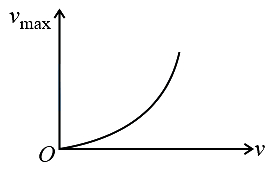
B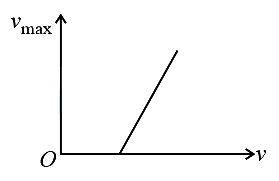
C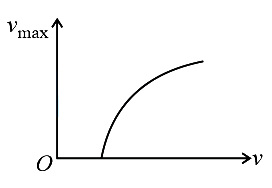
D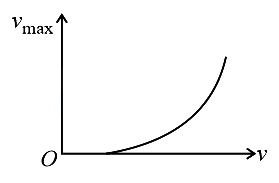
Solution
(C) According to Einstein's photoelectric equation:
$h\nu = h\nu_0 + \frac{1}{2}mv_{\text{max}}^2$
Where $h$ is Planck's constant,$\nu$ is the frequency of incident radiation,$\nu_0$ is the threshold frequency,$m$ is the mass of the electron,and $v_{\text{max}}$ is the maximum speed of the photoelectron.
Rearranging the equation for $v_{\text{max}}$:
$\frac{1}{2}mv_{\text{max}}^2 = h(\nu - \nu_0)$
$v_{\text{max}}^2 = \frac{2h}{m}(\nu - \nu_0)$
$v_{\text{max}} = \sqrt{\frac{2h}{m}} \sqrt{\nu - \nu_0}$
For $\nu < \nu_0$,$v_{\text{max}} = 0$. For $\nu \ge \nu_0$,$v_{\text{max}}$ increases with $\nu$. The relationship is $v_{\text{max}} \propto \sqrt{\nu - \nu_0}$. This represents a parabolic curve starting from the threshold frequency $\nu_0$ on the frequency axis,where the slope decreases as $\nu$ increases. Thus,option $C$ is the correct representation.
$h\nu = h\nu_0 + \frac{1}{2}mv_{\text{max}}^2$
Where $h$ is Planck's constant,$\nu$ is the frequency of incident radiation,$\nu_0$ is the threshold frequency,$m$ is the mass of the electron,and $v_{\text{max}}$ is the maximum speed of the photoelectron.
Rearranging the equation for $v_{\text{max}}$:
$\frac{1}{2}mv_{\text{max}}^2 = h(\nu - \nu_0)$
$v_{\text{max}}^2 = \frac{2h}{m}(\nu - \nu_0)$
$v_{\text{max}} = \sqrt{\frac{2h}{m}} \sqrt{\nu - \nu_0}$
For $\nu < \nu_0$,$v_{\text{max}} = 0$. For $\nu \ge \nu_0$,$v_{\text{max}}$ increases with $\nu$. The relationship is $v_{\text{max}} \propto \sqrt{\nu - \nu_0}$. This represents a parabolic curve starting from the threshold frequency $\nu_0$ on the frequency axis,where the slope decreases as $\nu$ increases. Thus,option $C$ is the correct representation.
0 likes
View Solution644
MediumMCQ
If a photocell is illuminated with a radiation of $1240 \mathring{A}$,the stopping potential is found to be $8 \text{ V}$. Then the work function of the emitter and the threshold wavelength are:
A
$2 \text{ eV}, 2000 \mathring{A}$
B
$2 \text{ eV}, 6200 \mathring{A}$
C
$2 \text{ eV}, 2480 \mathring{A}$
D
$3 \text{ eV}, 6200 \mathring{A}$
Solution
(B) The Einstein's photoelectric equation is given by: $K E_{\max} = \frac{hc}{\lambda} - W$,where $W$ is the work function and $\lambda$ is the wavelength of incident light.
Given $\lambda = 1240 \mathring{A} = 1240 \times 10^{-10} \text{ m}$ and stopping potential $V_0 = 8 \text{ V}$.
The energy of incident photon is $E = \frac{hc}{\lambda} = \frac{12400 \text{ eV} \cdot \mathring{A}}{1240 \mathring{A}} = 10 \text{ eV}$.
Since $K E_{\max} = eV_0 = 8 \text{ eV}$,we have $8 \text{ eV} = 10 \text{ eV} - W$.
Therefore,the work function $W = 10 \text{ eV} - 8 \text{ eV} = 2 \text{ eV}$.
The threshold wavelength $\lambda_0$ is given by $W = \frac{hc}{\lambda_0}$.
$\lambda_0 = \frac{12400 \text{ eV} \cdot \mathring{A}}{W} = \frac{12400 \text{ eV} \cdot \mathring{A}}{2 \text{ eV}} = 6200 \mathring{A}$.
Given $\lambda = 1240 \mathring{A} = 1240 \times 10^{-10} \text{ m}$ and stopping potential $V_0 = 8 \text{ V}$.
The energy of incident photon is $E = \frac{hc}{\lambda} = \frac{12400 \text{ eV} \cdot \mathring{A}}{1240 \mathring{A}} = 10 \text{ eV}$.
Since $K E_{\max} = eV_0 = 8 \text{ eV}$,we have $8 \text{ eV} = 10 \text{ eV} - W$.
Therefore,the work function $W = 10 \text{ eV} - 8 \text{ eV} = 2 \text{ eV}$.
The threshold wavelength $\lambda_0$ is given by $W = \frac{hc}{\lambda_0}$.
$\lambda_0 = \frac{12400 \text{ eV} \cdot \mathring{A}}{W} = \frac{12400 \text{ eV} \cdot \mathring{A}}{2 \text{ eV}} = 6200 \mathring{A}$.
0 likes
View Solution645
EasyMCQ
The study of photoelectric effect is useful in understanding
A
quantisation of charge
B
quantisation of energy
C
conservation of energy
D
conservation of kinetic energy
Solution
(B) In the study of the photoelectric effect,light energy is considered to exist in the form of discrete packets. Each packet of this energy is known as a photon.
The energy of one photon is given by $E = h \nu$,where $h$ is Planck's constant and $\nu$ is the frequency of the photon.
Since the energy is restricted to discrete values (multiples of $h\nu$),the study of the photoelectric effect is fundamental in understanding the quantisation of energy.
The energy of one photon is given by $E = h \nu$,where $h$ is Planck's constant and $\nu$ is the frequency of the photon.
Since the energy is restricted to discrete values (multiples of $h\nu$),the study of the photoelectric effect is fundamental in understanding the quantisation of energy.
0 likes
View Solution646
MediumMCQ
When a light of wavelength $4900 Å$ falls on a photosensitive metal, a negative $2 \,V$ potential is required to stop the emitted electrons. Then, the work-function of the material is nearly (given charge on electron $= 1.602 \times 10^{-19} C$ and Planck's constant $= 6.625 \times 10^{-34} Js$) (in $eV$)
A
$1.1$
B
$2.2$
C
$0.53$
D
$1$
Solution
(C) Given, wavelength of light, $\lambda = 4900 Å$.
Stopping potential, $V_s = 2 \,V$.
The energy of the incident photon is given by $E = \frac{hc}{\lambda}$.
Using the approximation $E \approx \frac{12400}{\lambda (Å)} eV$:
$E = \frac{12400}{4900} eV \approx 2.53 eV$.
The maximum kinetic energy of the emitted electrons is $K_{max} = e V_s = 2 eV$.
According to Einstein's photoelectric equation, $K_{max} = E - \phi$, where $\phi$ is the work function.
Substituting the values: $2 eV = 2.53 eV - \phi$.
Therefore, $\phi = 2.53 eV - 2 eV = 0.53 eV$.
Stopping potential, $V_s = 2 \,V$.
The energy of the incident photon is given by $E = \frac{hc}{\lambda}$.
Using the approximation $E \approx \frac{12400}{\lambda (Å)} eV$:
$E = \frac{12400}{4900} eV \approx 2.53 eV$.
The maximum kinetic energy of the emitted electrons is $K_{max} = e V_s = 2 eV$.
According to Einstein's photoelectric equation, $K_{max} = E - \phi$, where $\phi$ is the work function.
Substituting the values: $2 eV = 2.53 eV - \phi$.
Therefore, $\phi = 2.53 eV - 2 eV = 0.53 eV$.
0 likes
View Solution647
EasyMCQ
If ultraviolet radiation of $6.2 eV$ falls on an aluminium surface,then the kinetic energy of the fastest emitted electron is (work-function $= 4.2 eV$)
A
$3.2 \times 10^{-19} J$
B
$32 \times 10^{-21} J$
C
$7 \times 10^{-25} J$
D
$9 \times 10^{-31} J$
Solution
(A) Energy of the incident ultraviolet radiation,$E = 6.2 eV$.
Work-function of the aluminium surface,$\phi = 4.2 eV$.
According to Einstein's photoelectric equation,the maximum kinetic energy $(K_{\max})$ of the emitted electron is given by:
$K_{\max} = E - \phi$
$K_{\max} = 6.2 eV - 4.2 eV = 2.0 eV$.
To convert this energy into Joules,we use the conversion factor $1 eV = 1.6 \times 10^{-19} J$:
$K_{\max} = 2.0 \times 1.6 \times 10^{-19} J = 3.2 \times 10^{-19} J$.
Work-function of the aluminium surface,$\phi = 4.2 eV$.
According to Einstein's photoelectric equation,the maximum kinetic energy $(K_{\max})$ of the emitted electron is given by:
$K_{\max} = E - \phi$
$K_{\max} = 6.2 eV - 4.2 eV = 2.0 eV$.
To convert this energy into Joules,we use the conversion factor $1 eV = 1.6 \times 10^{-19} J$:
$K_{\max} = 2.0 \times 1.6 \times 10^{-19} J = 3.2 \times 10^{-19} J$.
0 likes
View Solution648
DifficultMCQ
The retarding potential necessary to stop the emission of photoelectrons,when a target material of work function $1.24 eV$ is irradiated with light of wavelength $4.36 \times 10^{-7} m$ is (in $eV$)
A
$4.08$
B
$2.84$
C
$1.60$
D
$0.36$
Solution
(C) Given: Work function $\phi_0 = 1.24 eV$.
Wavelength $\lambda = 4.36 \times 10^{-7} m$.
Using the relation $E = \frac{hc}{\lambda}$,where $hc \approx 1240 eV \cdot nm = 1240 \times 10^{-9} eV \cdot m$.
$E = \frac{1240 \times 10^{-9} eV \cdot m}{4.36 \times 10^{-7} m} \approx 2.844 eV$.
According to Einstein's photoelectric equation,the maximum kinetic energy $K_{max} = E - \phi_0$.
$K_{max} = 2.844 eV - 1.24 eV = 1.604 eV$.
Since $K_{max} = eV_0$,the retarding potential $V_0$ is $1.604 V \approx 1.60 V$.
Wavelength $\lambda = 4.36 \times 10^{-7} m$.
Using the relation $E = \frac{hc}{\lambda}$,where $hc \approx 1240 eV \cdot nm = 1240 \times 10^{-9} eV \cdot m$.
$E = \frac{1240 \times 10^{-9} eV \cdot m}{4.36 \times 10^{-7} m} \approx 2.844 eV$.
According to Einstein's photoelectric equation,the maximum kinetic energy $K_{max} = E - \phi_0$.
$K_{max} = 2.844 eV - 1.24 eV = 1.604 eV$.
Since $K_{max} = eV_0$,the retarding potential $V_0$ is $1.604 V \approx 1.60 V$.
0 likes
View Solution649
MediumMCQ
The maximum velocity of an electron emitted by light of wavelength $\lambda$ incident on the surface of a metal of work function $\phi$ is [$h=$ Planck's constant,$m=$ mass of electron and $c=$ speed of light]
A
$\sqrt{\frac{2(h c+\lambda \phi)}{m \lambda}}$
B
$\frac{2(h c-\lambda \phi)}{m}$
C
$\sqrt{\frac{2(h c-\lambda \phi)}{m \lambda}}$
D
$\frac{2(h \lambda-\phi)}{m}$
Solution
(C) According to Einstein's photoelectric equation,the maximum kinetic energy of an emitted electron is given by:
$K_{\max} = \frac{hc}{\lambda} - \phi$
Since $K_{\max} = \frac{1}{2}mv_{\max}^2$,we have:
$\frac{1}{2}mv_{\max}^2 = \frac{hc}{\lambda} - \phi$
$\frac{1}{2}mv_{\max}^2 = \frac{hc - \lambda\phi}{\lambda}$
$v_{\max}^2 = \frac{2(hc - \lambda\phi)}{m\lambda}$
$v_{\max} = \sqrt{\frac{2(hc - \lambda\phi)}{m\lambda}}$
$K_{\max} = \frac{hc}{\lambda} - \phi$
Since $K_{\max} = \frac{1}{2}mv_{\max}^2$,we have:
$\frac{1}{2}mv_{\max}^2 = \frac{hc}{\lambda} - \phi$
$\frac{1}{2}mv_{\max}^2 = \frac{hc - \lambda\phi}{\lambda}$
$v_{\max}^2 = \frac{2(hc - \lambda\phi)}{m\lambda}$
$v_{\max} = \sqrt{\frac{2(hc - \lambda\phi)}{m\lambda}}$
0 likes
View Solution650
MediumMCQ
$A$ metal surface is illuminated by light of a given intensity and frequency to cause photoemission. If the intensity of illumination is reduced to one-fourth of its original value, then the maximum kinetic energy of the emitted photoelectrons would become
A
unchanged
B
half of the original value
C
twice of the original value
D
four times of the original value
Solution
(A) According to Einstein's photoelectric equation, the maximum kinetic energy $(K_{max})$ of emitted photoelectrons is given by $K_{max} = h\nu - \Phi$, where $h$ is Planck's constant, $\nu$ is the frequency of incident light, and $\Phi$ is the work function of the metal.
This equation shows that $K_{max}$ depends only on the frequency of the incident light and the nature of the metal surface.
Intensity of light affects the number of photons incident per unit area per unit time, which in turn affects the number of photoelectrons emitted (photoelectric current), but it does not affect the energy of individual photoelectrons.
Therefore, when the intensity is reduced to one-fourth, the maximum kinetic energy of the emitted photoelectrons remains unchanged.
This equation shows that $K_{max}$ depends only on the frequency of the incident light and the nature of the metal surface.
Intensity of light affects the number of photons incident per unit area per unit time, which in turn affects the number of photoelectrons emitted (photoelectric current), but it does not affect the energy of individual photoelectrons.
Therefore, when the intensity is reduced to one-fourth, the maximum kinetic energy of the emitted photoelectrons remains unchanged.
0 likes
View SolutionDual Nature of Radiation and matter — Einstein's Photoelectric Equation and Energy Quantum of Radiation · Frequently Asked Questions
1Are these Dual Nature of Radiation and matter questions useful for JEE and NEET?
Yes. All questions in this section are mapped to JEE Main and NEET exam patterns. Previous year questions from JEE Main, NEET, GUJCET and state-level exams are included with full solutions.
2Can I switch to Hindi or Gujarati for these questions?
Yes. Use the language tabs in the hero section or the sidebar to view the same questions and solutions in English, Hindi or Gujarati.
3How do I generate a question paper from this subtopic?
Use the Vedclass Exam Paper Generator — select the chapter and subtopic, set difficulty, and generate Sets A, B, C, D automatically. First 3 chapters of every subject are free.
Vedclass Products
For Students
Vedclass Test Series
Mock tests in real JEE/NEET style with performance analysis. 5-day free trial.
Start Free TrialFor Teachers
Exam Paper Generator
Generate Set A/B/C/D papers from this chapter in 2 minutes. 3 chapters free.
Try FreeFor Institutes
Online Exam Module
Live online exams with unlimited students, 360° analytics & white-label branding.
See DemoFor Teachers & Institutes
Generate a Dual Nature of Radiation and matter Exam Paper in 2 Minutes
Select subtopic & difficulty — Sets A, B, C, D auto-generated with No Repeat logic.
First 3 chapters of every subject are free — no payment required.