
A English
Einstein's Photoelectric Equation and Energy Quantum of Radiation Questions in English
Class 12 Physics · Dual Nature of Radiation and matter · Einstein's Photoelectric Equation and Energy Quantum of Radiation
736+
Questions
English
Language
100%
With Solutions
Showing 29 of 736 questions in English
701
DifficultMCQ
The work function of a certain metal is $3.31 \times 10^{-19} \,J$. The maximum kinetic energy of photoelectrons emitted by incident radiation of wavelength $5000 \text{ Å}$ is (Given: $h = 6.62 \times 10^{-34} \,J \cdot s$,$c = 3 \times 10^8 \,m/s$,$e = 1.6 \times 10^{-19} \,C$) (in $\text{ eV}$)
A
$2.48$
B
$0.41$
C
$2.07$
D
$0.82$
Solution
(B) The work function is given as $W_0 = 3.31 \times 10^{-19} \,J$.
The wavelength of incident radiation is $\lambda = 5000 \text{ Å} = 5000 \times 10^{-10} \,m = 5 \times 10^{-7} \,m$.
According to Einstein's photoelectric equation,the energy of the incident photon $E$ is given by $E = W_0 + KE_{max}$,where $KE_{max}$ is the maximum kinetic energy.
The energy of the incident photon is $E = \frac{hc}{\lambda} = \frac{6.62 \times 10^{-34} \times 3 \times 10^8}{5 \times 10^{-7}} \,J$.
$E = \frac{19.86 \times 10^{-26}}{5 \times 10^{-7}} = 3.972 \times 10^{-19} \,J$.
Now,$KE_{max} = E - W_0 = 3.972 \times 10^{-19} \,J - 3.31 \times 10^{-19} \,J = 0.662 \times 10^{-19} \,J$.
To convert this energy into electron-volts $(eV)$,divide by the charge of an electron $e = 1.6 \times 10^{-19} \,C$:
$KE_{max} = \frac{0.662 \times 10^{-19} \,J}{1.6 \times 10^{-19} \,C} = 0.41375 \,eV \approx 0.41 \,eV$.
The wavelength of incident radiation is $\lambda = 5000 \text{ Å} = 5000 \times 10^{-10} \,m = 5 \times 10^{-7} \,m$.
According to Einstein's photoelectric equation,the energy of the incident photon $E$ is given by $E = W_0 + KE_{max}$,where $KE_{max}$ is the maximum kinetic energy.
The energy of the incident photon is $E = \frac{hc}{\lambda} = \frac{6.62 \times 10^{-34} \times 3 \times 10^8}{5 \times 10^{-7}} \,J$.
$E = \frac{19.86 \times 10^{-26}}{5 \times 10^{-7}} = 3.972 \times 10^{-19} \,J$.
Now,$KE_{max} = E - W_0 = 3.972 \times 10^{-19} \,J - 3.31 \times 10^{-19} \,J = 0.662 \times 10^{-19} \,J$.
To convert this energy into electron-volts $(eV)$,divide by the charge of an electron $e = 1.6 \times 10^{-19} \,C$:
$KE_{max} = \frac{0.662 \times 10^{-19} \,J}{1.6 \times 10^{-19} \,C} = 0.41375 \,eV \approx 0.41 \,eV$.
0 likes
View Solution702
DifficultMCQ
In an experiment on photoelectric emission from a metallic surface,the wavelength of incident light is $2 \times 10^{-7} \,m$ and the stopping potential is $2.5 \,V$. The threshold frequency of the metal (in $Hz$) is approximately (charge of electron $e=1.6 \times 10^{-19} \,C$,Planck's constant $h=6.6 \times 10^{-34} \,J-s$):
A
$12 \times 10^{15}$
B
$9 \times 10^{15}$
C
$9 \times 10^{14}$
D
$12 \times 10^{13}$
Solution
(C) According to Einstein's photoelectric equation: $e V_0 = h \nu - h \nu_0$,where $V_0$ is the stopping potential,$\nu$ is the frequency of incident light,and $\nu_0$ is the threshold frequency.
Rearranging for the threshold frequency $\nu_0$: $\nu_0 = \nu - \frac{e V_0}{h}$.
Since $\nu = \frac{c}{\lambda}$,we have $\nu_0 = \frac{c}{\lambda} - \frac{e V_0}{h}$.
Substituting the given values: $c = 3 \times 10^8 \,m/s$,$\lambda = 2 \times 10^{-7} \,m$,$e = 1.6 \times 10^{-19} \,C$,$V_0 = 2.5 \,V$,and $h = 6.6 \times 10^{-34} \,J-s$.
$\nu_0 = \frac{3 \times 10^8}{2 \times 10^{-7}} - \frac{1.6 \times 10^{-19} \times 2.5}{6.6 \times 10^{-34}}$
$\nu_0 = 1.5 \times 10^{15} - 0.606 \times 10^{15} \approx 0.894 \times 10^{15} \,Hz$.
Rounding to the nearest significant value,$\nu_0 \approx 9.0 \times 10^{14} \,Hz$.
Rearranging for the threshold frequency $\nu_0$: $\nu_0 = \nu - \frac{e V_0}{h}$.
Since $\nu = \frac{c}{\lambda}$,we have $\nu_0 = \frac{c}{\lambda} - \frac{e V_0}{h}$.
Substituting the given values: $c = 3 \times 10^8 \,m/s$,$\lambda = 2 \times 10^{-7} \,m$,$e = 1.6 \times 10^{-19} \,C$,$V_0 = 2.5 \,V$,and $h = 6.6 \times 10^{-34} \,J-s$.
$\nu_0 = \frac{3 \times 10^8}{2 \times 10^{-7}} - \frac{1.6 \times 10^{-19} \times 2.5}{6.6 \times 10^{-34}}$
$\nu_0 = 1.5 \times 10^{15} - 0.606 \times 10^{15} \approx 0.894 \times 10^{15} \,Hz$.
Rounding to the nearest significant value,$\nu_0 \approx 9.0 \times 10^{14} \,Hz$.
0 likes
View Solution703
DifficultMCQ
The work function of nickel is $5 \text{ eV}$. When light of wavelength $2000 \text{ Å}$ falls on it,it emits photoelectrons. The potential difference necessary to stop the fastest emitted electrons is (given $h = 6.67 \times 10^{-34} \text{ J-s}$): (in $\text{ V}$)
A
$1.0$
B
$1.75$
C
$1.25$
D
$0.75$
Solution
(C) The stopping potential $V_0$ is related to the incident energy and work function by the Einstein's photoelectric equation: $e V_0 = K_{\text{max}} = \frac{hc}{\lambda} - \phi$.
Given:
Work function $\phi = 5 \text{ eV} = 5 \times 1.6 \times 10^{-19} \text{ J} = 8 \times 10^{-19} \text{ J}$.
Wavelength $\lambda = 2000 \text{ Å} = 2 \times 10^{-7} \text{ m}$.
Planck's constant $h = 6.67 \times 10^{-34} \text{ J-s}$.
Speed of light $c = 3 \times 10^8 \text{ m/s}$.
Calculating the energy of incident photon:
$E = \frac{hc}{\lambda} = \frac{6.67 \times 10^{-34} \times 3 \times 10^8}{2 \times 10^{-7}} = 10.005 \times 10^{-19} \text{ J}$.
Now,substituting into the equation:
$e V_0 = 10.005 \times 10^{-19} \text{ J} - 8 \times 10^{-19} \text{ J} = 2.005 \times 10^{-19} \text{ J}$.
$V_0 = \frac{2.005 \times 10^{-19} \text{ J}}{1.6 \times 10^{-19} \text{ C}} \approx 1.25 \text{ V}$.
Given:
Work function $\phi = 5 \text{ eV} = 5 \times 1.6 \times 10^{-19} \text{ J} = 8 \times 10^{-19} \text{ J}$.
Wavelength $\lambda = 2000 \text{ Å} = 2 \times 10^{-7} \text{ m}$.
Planck's constant $h = 6.67 \times 10^{-34} \text{ J-s}$.
Speed of light $c = 3 \times 10^8 \text{ m/s}$.
Calculating the energy of incident photon:
$E = \frac{hc}{\lambda} = \frac{6.67 \times 10^{-34} \times 3 \times 10^8}{2 \times 10^{-7}} = 10.005 \times 10^{-19} \text{ J}$.
Now,substituting into the equation:
$e V_0 = 10.005 \times 10^{-19} \text{ J} - 8 \times 10^{-19} \text{ J} = 2.005 \times 10^{-19} \text{ J}$.
$V_0 = \frac{2.005 \times 10^{-19} \text{ J}}{1.6 \times 10^{-19} \text{ C}} \approx 1.25 \text{ V}$.
0 likes
View Solution704
DifficultMCQ
Electrons ejected from the surface of a metal,when light of a certain frequency is incident on it,are stopped fully by a retarding potential of $3 \ V$. The photoelectric effect on this metallic surface begins at a frequency of $6 \times 10^{14} \ s^{-1}$. The frequency of the incident light in $s^{-1}$ is: [Planck's constant $= 6.4 \times 10^{-34} \ J \cdot s$,charge on the electron $= 1.6 \times 10^{-19} \ C$]
A
$7.5 \times 10^{13}$
B
$13.5 \times 10^{13}$
C
$13.5 \times 10^{14}$
D
$7.5 \times 10^{15}$
Solution
(C) Einstein's photoelectric equation is given by:
$h \nu = h \nu_0 + K_{max}$
Since the stopping potential $V_0 = 3 \ V$,the maximum kinetic energy $K_{max} = e V_0 = 1.6 \times 10^{-19} \times 3 \ J$.
The threshold frequency $\nu_0 = 6 \times 10^{14} \ s^{-1}$.
Using the relation $h \nu = h \nu_0 + e V_0$,we get:
$\nu = \nu_0 + \frac{e V_0}{h}$
$\nu = 6 \times 10^{14} + \frac{1.6 \times 10^{-19} \times 3}{6.4 \times 10^{-34}}$
$\nu = 6 \times 10^{14} + \frac{4.8 \times 10^{-19}}{6.4 \times 10^{-34}}$
$\nu = 6 \times 10^{14} + 0.75 \times 10^{15}$
$\nu = 6 \times 10^{14} + 7.5 \times 10^{14} = 13.5 \times 10^{14} \ s^{-1}$.
$h \nu = h \nu_0 + K_{max}$
Since the stopping potential $V_0 = 3 \ V$,the maximum kinetic energy $K_{max} = e V_0 = 1.6 \times 10^{-19} \times 3 \ J$.
The threshold frequency $\nu_0 = 6 \times 10^{14} \ s^{-1}$.
Using the relation $h \nu = h \nu_0 + e V_0$,we get:
$\nu = \nu_0 + \frac{e V_0}{h}$
$\nu = 6 \times 10^{14} + \frac{1.6 \times 10^{-19} \times 3}{6.4 \times 10^{-34}}$
$\nu = 6 \times 10^{14} + \frac{4.8 \times 10^{-19}}{6.4 \times 10^{-34}}$
$\nu = 6 \times 10^{14} + 0.75 \times 10^{15}$
$\nu = 6 \times 10^{14} + 7.5 \times 10^{14} = 13.5 \times 10^{14} \ s^{-1}$.
0 likes
View Solution705
MediumMCQ
When radiation of the wavelength $\lambda$ is incident on a metallic surface,the stopping potential is $4.8 \ V$. If the same surface is illuminated with radiation of double the wavelength,then the stopping potential becomes $1.6 \ V$. Then,the threshold wavelength for the surface is :
A
$2 \lambda$
B
$4 \lambda$
C
$6 \lambda$
D
$8 \lambda$
Solution
(B) The Einstein's photoelectric equation is given by $eV_0 = \frac{hc}{\lambda} - \frac{hc}{\lambda_0}$,where $V_0$ is the stopping potential and $\lambda_0$ is the threshold wavelength.
For the first case: $4.8 = \frac{hc}{e} \left( \frac{1}{\lambda} - \frac{1}{\lambda_0} \right) \quad \dots (i)$
For the second case: $1.6 = \frac{hc}{e} \left( \frac{1}{2\lambda} - \frac{1}{\lambda_0} \right) \quad \dots (ii)$
Dividing equation $(i)$ by $(ii)$:
$\frac{4.8}{1.6} = \frac{\frac{1}{\lambda} - \frac{1}{\lambda_0}}{\frac{1}{2\lambda} - \frac{1}{\lambda_0}}$
$3 = \frac{\frac{1}{\lambda} - \frac{1}{\lambda_0}}{\frac{1}{2\lambda} - \frac{1}{\lambda_0}}$
$3 \left( \frac{1}{2\lambda} - \frac{1}{\lambda_0} \right) = \frac{1}{\lambda} - \frac{1}{\lambda_0}$
$\frac{3}{2\lambda} - \frac{3}{\lambda_0} = \frac{1}{\lambda} - \frac{1}{\lambda_0}$
$\frac{3}{2\lambda} - \frac{1}{\lambda} = \frac{3}{\lambda_0} - \frac{1}{\lambda_0}$
$\frac{1}{2\lambda} = \frac{2}{\lambda_0}$
$\lambda_0 = 4\lambda$
For the first case: $4.8 = \frac{hc}{e} \left( \frac{1}{\lambda} - \frac{1}{\lambda_0} \right) \quad \dots (i)$
For the second case: $1.6 = \frac{hc}{e} \left( \frac{1}{2\lambda} - \frac{1}{\lambda_0} \right) \quad \dots (ii)$
Dividing equation $(i)$ by $(ii)$:
$\frac{4.8}{1.6} = \frac{\frac{1}{\lambda} - \frac{1}{\lambda_0}}{\frac{1}{2\lambda} - \frac{1}{\lambda_0}}$
$3 = \frac{\frac{1}{\lambda} - \frac{1}{\lambda_0}}{\frac{1}{2\lambda} - \frac{1}{\lambda_0}}$
$3 \left( \frac{1}{2\lambda} - \frac{1}{\lambda_0} \right) = \frac{1}{\lambda} - \frac{1}{\lambda_0}$
$\frac{3}{2\lambda} - \frac{3}{\lambda_0} = \frac{1}{\lambda} - \frac{1}{\lambda_0}$
$\frac{3}{2\lambda} - \frac{1}{\lambda} = \frac{3}{\lambda_0} - \frac{1}{\lambda_0}$
$\frac{1}{2\lambda} = \frac{2}{\lambda_0}$
$\lambda_0 = 4\lambda$
0 likes
View Solution706
DifficultMCQ
Two photons of energies twice and thrice the work function of a metal are incident on the metal surface. Then,the ratio of maximum velocities of the photoelectrons emitted in the two cases respectively,is
A
$\sqrt{2}: 1$
B
$\sqrt{3}: 3$
C
$\sqrt{3}: \sqrt{2}$
D
$1: \sqrt{2}$
Solution
(D) Let the work function of the metal be $W$.
The energy of the first photon is $E_1 = 2W$.
The energy of the second photon is $E_2 = 3W$.
According to Einstein's photoelectric equation,the maximum kinetic energy $(KE)_{\max}$ is given by $(KE)_{\max} = E - W$.
For the first photon: $(KE_1)_{\max} = 2W - W = W$.
For the second photon: $(KE_2)_{\max} = 3W - W = 2W$.
The ratio of maximum kinetic energies is $\frac{(KE_1)_{\max}}{(KE_2)_{\max}} = \frac{W}{2W} = \frac{1}{2}$.
Since $(KE)_{\max} = \frac{1}{2}mv^2$,we have $\frac{\frac{1}{2}mv_1^2}{\frac{1}{2}mv_2^2} = \frac{1}{2}$.
This simplifies to $\frac{v_1^2}{v_2^2} = \frac{1}{2}$,which gives $\frac{v_1}{v_2} = \sqrt{\frac{1}{2}} = \frac{1}{\sqrt{2}}$.
Thus,the ratio of maximum velocities is $1 : \sqrt{2}$.
The energy of the first photon is $E_1 = 2W$.
The energy of the second photon is $E_2 = 3W$.
According to Einstein's photoelectric equation,the maximum kinetic energy $(KE)_{\max}$ is given by $(KE)_{\max} = E - W$.
For the first photon: $(KE_1)_{\max} = 2W - W = W$.
For the second photon: $(KE_2)_{\max} = 3W - W = 2W$.
The ratio of maximum kinetic energies is $\frac{(KE_1)_{\max}}{(KE_2)_{\max}} = \frac{W}{2W} = \frac{1}{2}$.
Since $(KE)_{\max} = \frac{1}{2}mv^2$,we have $\frac{\frac{1}{2}mv_1^2}{\frac{1}{2}mv_2^2} = \frac{1}{2}$.
This simplifies to $\frac{v_1^2}{v_2^2} = \frac{1}{2}$,which gives $\frac{v_1}{v_2} = \sqrt{\frac{1}{2}} = \frac{1}{\sqrt{2}}$.
Thus,the ratio of maximum velocities is $1 : \sqrt{2}$.
0 likes
View Solution707
DifficultMCQ
Photoelectric emission is observed from a metallic surface for frequencies $v_1$ and $v_2$ of the incident light rays $(v_1 > v_2)$. If the maximum values of kinetic energy of the photoelectrons emitted in the two cases are in the ratio of $1:k$,then the threshold frequency of the metallic surface is
A
$\frac{v_2-v_1}{k-1}$
B
$\frac{k v_1-v_2}{k-1}$
C
$\frac{k v_2-v_1}{k-1}$
D
$\frac{v_2-v_1}{k}$
Solution
(B) According to Einstein's photoelectric equation,the maximum kinetic energy $(KE)_{\max}$ is given by:
$(KE)_{\max} = h v - h v_0$,where $v$ is the frequency of incident radiation and $v_0$ is the threshold frequency.
For the first case with frequency $v_1$: $(KE_1)_{\max} = h(v_1 - v_0)$.
For the second case with frequency $v_2$: $(KE_2)_{\max} = h(v_2 - v_0)$.
Given the ratio of maximum kinetic energies is $1:k$,we have:
$\frac{(KE_1)_{\max}}{(KE_2)_{\max}} = \frac{1}{k} = \frac{h(v_1 - v_0)}{h(v_2 - v_0)}$.
Cross-multiplying gives:
$v_2 - v_0 = k(v_1 - v_0)$.
$v_2 - v_0 = k v_1 - k v_0$.
Rearranging to solve for $v_0$:
$k v_0 - v_0 = k v_1 - v_2$.
$v_0(k - 1) = k v_1 - v_2$.
$v_0 = \frac{k v_1 - v_2}{k - 1}$.
$(KE)_{\max} = h v - h v_0$,where $v$ is the frequency of incident radiation and $v_0$ is the threshold frequency.
For the first case with frequency $v_1$: $(KE_1)_{\max} = h(v_1 - v_0)$.
For the second case with frequency $v_2$: $(KE_2)_{\max} = h(v_2 - v_0)$.
Given the ratio of maximum kinetic energies is $1:k$,we have:
$\frac{(KE_1)_{\max}}{(KE_2)_{\max}} = \frac{1}{k} = \frac{h(v_1 - v_0)}{h(v_2 - v_0)}$.
Cross-multiplying gives:
$v_2 - v_0 = k(v_1 - v_0)$.
$v_2 - v_0 = k v_1 - k v_0$.
Rearranging to solve for $v_0$:
$k v_0 - v_0 = k v_1 - v_2$.
$v_0(k - 1) = k v_1 - v_2$.
$v_0 = \frac{k v_1 - v_2}{k - 1}$.
0 likes
View Solution708
EasyMCQ
Albert Einstein was awarded the Nobel Prize in Physics for his work on
A
special theory of relativity
B
Bose-Einstein Statistics
C
photoelectric effect
D
general relativity
Solution
(C) Albert Einstein is widely known for his work on the special theory of relativity and general relativity. However,he was awarded the Nobel Prize in Physics in $1921$ specifically for his discovery of the law of the photoelectric effect.
Therefore,the correct option is $C$.
Therefore,the correct option is $C$.
0 likes
View Solution709
EasyMCQ
$A$ beam of photons with an energy of $10.5 \ eV$ strikes a metal plate. The photoelectrons are emitted with a maximum velocity of $1.6 \times 10^6 \ m \ s^{-1}$. The work function of the metal is (Assume mass of electron $= 9 \times 10^{-31} \ kg$ and charge of electron $= 1.6 \times 10^{-19} \ C$). (in $eV$)
A
$3.0$
B
$3.1$
C
$3.3$
D
$3.5$
Solution
(C) Given: Energy of incident photons $E = 10.5 \ eV$.
Maximum velocity of photoelectrons $v = 1.6 \times 10^6 \ m \ s^{-1}$.
Mass of electron $m = 9 \times 10^{-31} \ kg$.
The maximum kinetic energy $K.E._{\max}$ is given by $\frac{1}{2}mv^2$.
$K.E._{\max} = \frac{1}{2} \times (9 \times 10^{-31}) \times (1.6 \times 10^6)^2 = 0.5 \times 9 \times 10^{-31} \times 2.56 \times 10^{12} = 11.52 \times 10^{-19} \ J$.
Converting this to electron-volts: $K.E._{\max} = \frac{11.52 \times 10^{-19}}{1.6 \times 10^{-19}} \ eV = 7.2 \ eV$.
According to Einstein's photoelectric equation,$E = \phi + K.E._{\max}$,where $\phi$ is the work function.
$\phi = E - K.E._{\max} = 10.5 \ eV - 7.2 \ eV = 3.3 \ eV$.
Maximum velocity of photoelectrons $v = 1.6 \times 10^6 \ m \ s^{-1}$.
Mass of electron $m = 9 \times 10^{-31} \ kg$.
The maximum kinetic energy $K.E._{\max}$ is given by $\frac{1}{2}mv^2$.
$K.E._{\max} = \frac{1}{2} \times (9 \times 10^{-31}) \times (1.6 \times 10^6)^2 = 0.5 \times 9 \times 10^{-31} \times 2.56 \times 10^{12} = 11.52 \times 10^{-19} \ J$.
Converting this to electron-volts: $K.E._{\max} = \frac{11.52 \times 10^{-19}}{1.6 \times 10^{-19}} \ eV = 7.2 \ eV$.
According to Einstein's photoelectric equation,$E = \phi + K.E._{\max}$,where $\phi$ is the work function.
$\phi = E - K.E._{\max} = 10.5 \ eV - 7.2 \ eV = 3.3 \ eV$.
0 likes
View Solution710
MediumMCQ
An electron in a Hydrogen atom jumps from the second Bohr orbit to the ground state,and the difference between the energies of the two states is radiated in the form of a photon. This photon strikes a material. If the work function of the material is $4.2 \ eV$,then the stopping potential is (Energy of electron in $n$-th orbit $= -\frac{13.6}{n^2} \ eV$). (in $V$)
A
$2$
B
$4$
C
$6$
D
$8$
Solution
(C) The energy of the photon emitted during the transition from $n=2$ to $n=1$ is given by:
$E = E_2 - E_1 = -\frac{13.6}{2^2} - (-\frac{13.6}{1^2}) = -3.4 + 13.6 = 10.2 \ eV$.
According to Einstein's photoelectric equation:
$E = \phi + K_{max}$,where $\phi$ is the work function and $K_{max} = eV_s$ is the maximum kinetic energy.
$10.2 \ eV = 4.2 \ eV + eV_s$.
$eV_s = 10.2 \ eV - 4.2 \ eV = 6.0 \ eV$.
Therefore,the stopping potential $V_s = 6 \ V$.
$E = E_2 - E_1 = -\frac{13.6}{2^2} - (-\frac{13.6}{1^2}) = -3.4 + 13.6 = 10.2 \ eV$.
According to Einstein's photoelectric equation:
$E = \phi + K_{max}$,where $\phi$ is the work function and $K_{max} = eV_s$ is the maximum kinetic energy.
$10.2 \ eV = 4.2 \ eV + eV_s$.
$eV_s = 10.2 \ eV - 4.2 \ eV = 6.0 \ eV$.
Therefore,the stopping potential $V_s = 6 \ V$.
0 likes
View Solution711
DifficultMCQ
$A$ beam of light of wavelength $\lambda$ falls on a metal having work function $\phi$ placed in a magnetic field $B$. The most energetic electrons,moving perpendicular to the field,are bent in circular arcs of radius $R$. If the experiment is performed for different values of $\lambda$,then the $B^2$ vs. $\frac{1}{\lambda}$ graph will look like (keeping all other quantities constant):
A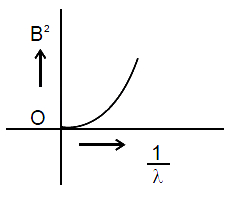
B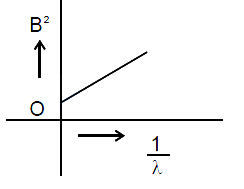
C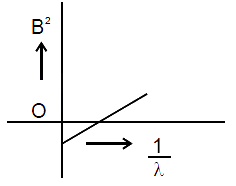
D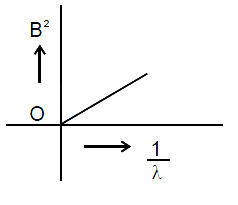
Solution
(C) According to Einstein's photoelectric equation,the maximum kinetic energy $K$ of the emitted electrons is given by:
$K = \frac{hc}{\lambda} - \phi$
When an electron of charge $q$ and mass $m$ moves perpendicular to a magnetic field $B$,it follows a circular path of radius $R$ given by:
$R = \frac{mv}{qB} = \frac{\sqrt{2mK}}{qB}$
Squaring both sides,we get:
$R^2 = \frac{2mK}{q^2 B^2}$
Rearranging for $B^2$:
$B^2 = \frac{2mK}{q^2 R^2}$
Substituting the expression for $K$:
$B^2 = \frac{2m}{q^2 R^2} \left( \frac{hc}{\lambda} - \phi \right)$
$B^2 = \left( \frac{2mhc}{q^2 R^2} \right) \frac{1}{\lambda} - \left( \frac{2m\phi}{q^2 R^2} \right)$
This is an equation of a straight line of the form $y = mx + c$,where $y = B^2$,$x = \frac{1}{\lambda}$,slope $m = \frac{2mhc}{q^2 R^2}$ (positive),and intercept $c = -\frac{2m\phi}{q^2 R^2}$ (negative).
Thus,the graph is a straight line with a positive slope and a negative y-intercept. This corresponds to Graph $C$.
$K = \frac{hc}{\lambda} - \phi$
When an electron of charge $q$ and mass $m$ moves perpendicular to a magnetic field $B$,it follows a circular path of radius $R$ given by:
$R = \frac{mv}{qB} = \frac{\sqrt{2mK}}{qB}$
Squaring both sides,we get:
$R^2 = \frac{2mK}{q^2 B^2}$
Rearranging for $B^2$:
$B^2 = \frac{2mK}{q^2 R^2}$
Substituting the expression for $K$:
$B^2 = \frac{2m}{q^2 R^2} \left( \frac{hc}{\lambda} - \phi \right)$
$B^2 = \left( \frac{2mhc}{q^2 R^2} \right) \frac{1}{\lambda} - \left( \frac{2m\phi}{q^2 R^2} \right)$
This is an equation of a straight line of the form $y = mx + c$,where $y = B^2$,$x = \frac{1}{\lambda}$,slope $m = \frac{2mhc}{q^2 R^2}$ (positive),and intercept $c = -\frac{2m\phi}{q^2 R^2}$ (negative).
Thus,the graph is a straight line with a positive slope and a negative y-intercept. This corresponds to Graph $C$.
0 likes
View Solution712
EasyMCQ
Monochromatic light of wavelength $\lambda = 4770 \ \mathring{A}$ is incident separately on the surface of four different metals $A, B, C$ and $D$. The work functions of $A, B, C$ and $D$ are $4.2 \ \text{eV}, 3.7 \ \text{eV}, 3.2 \ \text{eV}$ and $2.3 \ \text{eV}$,respectively. From which of these metals will electrons be emitted?
A
$A, B, C$ and $D$
B
$B, C$ and $D$
C
$C$ and $D$
D
$D$ only
Solution
(D) The energy of the incident photon is given by $E = \frac{hc}{\lambda}$.
Using $hc \approx 12400 \ \text{eV} \cdot \mathring{A}$,we get $E = \frac{12400}{4770} \ \text{eV} \approx 2.6 \ \text{eV}$.
For photoelectric emission to occur,the energy of the incident photon must be greater than or equal to the work function $(\phi)$ of the metal $(E \ge \phi)$.
Comparing $E = 2.6 \ \text{eV}$ with the work functions:
For metal $A$: $2.6 \ \text{eV} < 4.2 \ \text{eV}$ (No emission)
For metal $B$: $2.6 \ \text{eV} < 3.7 \ \text{eV}$ (No emission)
For metal $C$: $2.6 \ \text{eV} < 3.2 \ \text{eV}$ (No emission)
For metal $D$: $2.6 \ \text{eV} > 2.3 \ \text{eV}$ (Emission occurs)
Therefore,electrons will be emitted only from metal $D$.
Using $hc \approx 12400 \ \text{eV} \cdot \mathring{A}$,we get $E = \frac{12400}{4770} \ \text{eV} \approx 2.6 \ \text{eV}$.
For photoelectric emission to occur,the energy of the incident photon must be greater than or equal to the work function $(\phi)$ of the metal $(E \ge \phi)$.
Comparing $E = 2.6 \ \text{eV}$ with the work functions:
For metal $A$: $2.6 \ \text{eV} < 4.2 \ \text{eV}$ (No emission)
For metal $B$: $2.6 \ \text{eV} < 3.7 \ \text{eV}$ (No emission)
For metal $C$: $2.6 \ \text{eV} < 3.2 \ \text{eV}$ (No emission)
For metal $D$: $2.6 \ \text{eV} > 2.3 \ \text{eV}$ (Emission occurs)
Therefore,electrons will be emitted only from metal $D$.
0 likes
View Solution713
MediumMCQ
The electric field component of an $EM$ radiation varies with time as $E = a(\cos \omega_{0} t + \sin \omega t \cos \omega_{0} t)$,where '$a$' is a constant,$\omega = 10^{15} \text{ s}^{-1}$,and $\omega_{0} = 5 \times 10^{15} \text{ s}^{-1}$. This radiation falls on a metal whose stopping potential is $2 \text{ V}$. Which of the following statement$(s)$ is/are true? $(h = 6.62 \times 10^{-34} \text{ J s})$
A
For light of frequency $\omega$,the photoelectric effect is not possible.
B
The stopping potential vs. frequency graph will be a straight line.
C
The work function of the metal is $2 \text{ eV}$.
D
The maximum kinetic energy of the photoelectrons is $1.95 \text{ eV}$.
Solution
(A, B) The given electric field is $E = a \cos \omega_{0} t + \frac{a}{2} [\sin(\omega + \omega_{0})t + \sin(\omega - \omega_{0})t]$.
This indicates the presence of three frequencies: $f_{0} = \frac{\omega_{0}}{2\pi}$,$f_{1} = \frac{\omega + \omega_{0}}{2\pi}$,and $f_{2} = \frac{|\omega - \omega_{0}|}{2\pi}$.
The maximum energy corresponds to the highest frequency $f_{1} = \frac{6 \times 10^{15}}{2\pi} \text{ Hz}$.
The energy of this photon is $E_{max} = h f_{1} = \frac{6.62 \times 10^{-34} \times 6 \times 10^{15}}{2 \times 3.14 \times 1.6 \times 10^{-19}} \text{ eV} \approx 3.95 \text{ eV}$.
Given stopping potential $V_{s} = 2 \text{ V}$,so $KE_{max} = 2 \text{ eV}$.
Using $KE_{max} = E_{max} - \phi$,we get $2 \text{ eV} = 3.95 \text{ eV} - \phi$,so $\phi = 1.95 \text{ eV}$.
For frequency $\omega = 10^{15} \text{ s}^{-1}$,energy $E = h(\frac{\omega}{2\pi}) \approx 0.66 \text{ eV}$.
Since $E < \phi$,the photoelectric effect is not possible for frequency $\omega$.
Einstein's photoelectric equation $eV_{s} = hf - \phi$ represents a straight line graph between $V_{s}$ and $f$.
This indicates the presence of three frequencies: $f_{0} = \frac{\omega_{0}}{2\pi}$,$f_{1} = \frac{\omega + \omega_{0}}{2\pi}$,and $f_{2} = \frac{|\omega - \omega_{0}|}{2\pi}$.
The maximum energy corresponds to the highest frequency $f_{1} = \frac{6 \times 10^{15}}{2\pi} \text{ Hz}$.
The energy of this photon is $E_{max} = h f_{1} = \frac{6.62 \times 10^{-34} \times 6 \times 10^{15}}{2 \times 3.14 \times 1.6 \times 10^{-19}} \text{ eV} \approx 3.95 \text{ eV}$.
Given stopping potential $V_{s} = 2 \text{ V}$,so $KE_{max} = 2 \text{ eV}$.
Using $KE_{max} = E_{max} - \phi$,we get $2 \text{ eV} = 3.95 \text{ eV} - \phi$,so $\phi = 1.95 \text{ eV}$.
For frequency $\omega = 10^{15} \text{ s}^{-1}$,energy $E = h(\frac{\omega}{2\pi}) \approx 0.66 \text{ eV}$.
Since $E < \phi$,the photoelectric effect is not possible for frequency $\omega$.
Einstein's photoelectric equation $eV_{s} = hf - \phi$ represents a straight line graph between $V_{s}$ and $f$.
0 likes
View Solution714
EasyMCQ
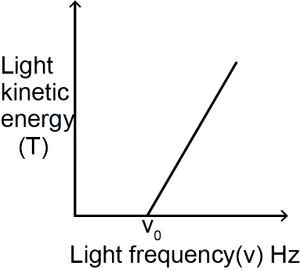
Electrons are emitted with kinetic energy $T$ from a metal plate by an irradiation of light of intensity $J$ and frequency $v$. Then,which of the following will be true?
A
$T \propto J$
B
$T$ linearly increases with $v$
C
$T \propto \text{time of irradiation}$
D
Number of electrons emitted $\propto J$
Solution
(D) According to Einstein's photoelectric equation,the maximum kinetic energy $T$ of the emitted photoelectrons is given by $T = hv - \phi$,where $h$ is Planck's constant,$v$ is the frequency of incident light,and $\phi$ is the work function of the metal.
From this equation,it is clear that $T$ increases linearly with the frequency $v$ of the incident light.
Additionally,the number of photoelectrons emitted per second is directly proportional to the intensity $J$ of the incident light,provided the frequency $v$ is greater than the threshold frequency $v_{0}$.
Since both statements $(B)$ and $(D)$ are physically correct,in the context of standard multiple-choice questions where only one answer is expected,$(D)$ is often cited as a fundamental observation regarding intensity,while $(B)$ describes the energy dependence. Given the options,$(D)$ is a standard result of the photoelectric effect.
From this equation,it is clear that $T$ increases linearly with the frequency $v$ of the incident light.
Additionally,the number of photoelectrons emitted per second is directly proportional to the intensity $J$ of the incident light,provided the frequency $v$ is greater than the threshold frequency $v_{0}$.
Since both statements $(B)$ and $(D)$ are physically correct,in the context of standard multiple-choice questions where only one answer is expected,$(D)$ is often cited as a fundamental observation regarding intensity,while $(B)$ describes the energy dependence. Given the options,$(D)$ is a standard result of the photoelectric effect.
0 likes
View Solution715
MediumMCQ
When light of frequency $v_{1}$ is incident on a metal with work function $W$ (where $h v_{1} > W$),then the photocurrent falls to zero at a stopping potential of $V_{1}$. If the frequency of light is increased to $v_{2}$,the stopping potential changes to $V_{2}$. Therefore,the charge of an electron $e$ is given by:
A
$\frac{W(v_{2}+v_{1})}{v_{1} V_{2}+v_{2} V_{1}}$
B
$\frac{W(v_{2}+v_{1})}{v_{1} V_{1}+v_{2} V_{2}}$
C
$\frac{W(v_{2}-v_{1})}{v_{1} V_{2}-v_{2} V_{1}}$
D
$\frac{W(v_{2}-v_{1})}{v_{2} V_{2}-v_{1} V_{1}}$
Solution
(C) From Einstein's photoelectric equation,$h v = W + e V$,where $W$ is the work function,$v$ is the frequency of incident light,and $V$ is the stopping potential.
For frequency $v_{1}$,we have: $h v_{1} = W + e V_{1}$ --- $(i)$
For frequency $v_{2}$,we have: $h v_{2} = W + e V_{2}$ --- (ii)
Subtracting equation $(i)$ from equation (ii):
$h(v_{2} - v_{1}) = e(V_{2} - V_{1})$
$e = \frac{h(v_{2} - v_{1})}{V_{2} - V_{1}}$
However,we need to express $e$ in terms of $W$. From $(i)$,$h = \frac{W + e V_{1}}{v_{1}}$. Substituting this into (ii):
$(\frac{W + e V_{1}}{v_{1}}) v_{2} = W + e V_{2}$
$W v_{2} + e V_{1} v_{2} = W v_{1} + e V_{2} v_{1}$
$e(V_{1} v_{2} - V_{2} v_{1}) = W v_{1} - W v_{2}$
$e(V_{1} v_{2} - V_{2} v_{1}) = -W(v_{2} - v_{1})$
$e = \frac{W(v_{2} - v_{1})}{V_{2} v_{1} - V_{1} v_{2}}$
This matches option $C$.
For frequency $v_{1}$,we have: $h v_{1} = W + e V_{1}$ --- $(i)$
For frequency $v_{2}$,we have: $h v_{2} = W + e V_{2}$ --- (ii)
Subtracting equation $(i)$ from equation (ii):
$h(v_{2} - v_{1}) = e(V_{2} - V_{1})$
$e = \frac{h(v_{2} - v_{1})}{V_{2} - V_{1}}$
However,we need to express $e$ in terms of $W$. From $(i)$,$h = \frac{W + e V_{1}}{v_{1}}$. Substituting this into (ii):
$(\frac{W + e V_{1}}{v_{1}}) v_{2} = W + e V_{2}$
$W v_{2} + e V_{1} v_{2} = W v_{1} + e V_{2} v_{1}$
$e(V_{1} v_{2} - V_{2} v_{1}) = W v_{1} - W v_{2}$
$e(V_{1} v_{2} - V_{2} v_{1}) = -W(v_{2} - v_{1})$
$e = \frac{W(v_{2} - v_{1})}{V_{2} v_{1} - V_{1} v_{2}}$
This matches option $C$.
0 likes
View Solution716
MediumMCQ
The work function of Cesium is $2.27 eV$. The cut-off voltage which stops the emission of electrons from a cesium cathode irradiated with light of $600 nm$ wavelength is
A
$0.5 V$
B
$-0.2 V$
C
$-0.5 V$
D
None of the above
Solution
(D) The work function of Cesium is $\phi = 2.27 eV$.
The wavelength of the incident light is $\lambda = 600 nm = 600 \times 10^{-9} m$.
The energy of the incident photon is given by $E = \frac{hc}{\lambda}$.
Substituting the values ($h = 6.63 \times 10^{-34} Js$,$c = 3 \times 10^8 m/s$):
$E = \frac{6.63 \times 10^{-34} \times 3 \times 10^8}{600 \times 10^{-9}} J = 3.315 \times 10^{-19} J$.
Converting this energy into electron-volts $(eV)$:
$E = \frac{3.315 \times 10^{-19}}{1.6 \times 10^{-19}} eV \approx 2.07 eV$.
Since the energy of the incident photon $(2.07 eV)$ is less than the work function of Cesium $(2.27 eV)$,the photoelectric effect will not occur.
Therefore,no electrons are emitted,and no cut-off voltage is required. Thus,the correct answer is $D$.
The wavelength of the incident light is $\lambda = 600 nm = 600 \times 10^{-9} m$.
The energy of the incident photon is given by $E = \frac{hc}{\lambda}$.
Substituting the values ($h = 6.63 \times 10^{-34} Js$,$c = 3 \times 10^8 m/s$):
$E = \frac{6.63 \times 10^{-34} \times 3 \times 10^8}{600 \times 10^{-9}} J = 3.315 \times 10^{-19} J$.
Converting this energy into electron-volts $(eV)$:
$E = \frac{3.315 \times 10^{-19}}{1.6 \times 10^{-19}} eV \approx 2.07 eV$.
Since the energy of the incident photon $(2.07 eV)$ is less than the work function of Cesium $(2.27 eV)$,the photoelectric effect will not occur.
Therefore,no electrons are emitted,and no cut-off voltage is required. Thus,the correct answer is $D$.
0 likes
View Solution717
MediumMCQ
The work function of metals is in the range of $2 eV$ to $5 eV$. Find which of the following wavelengths of light cannot be used for the photoelectric effect (in $nm$)? (Consider,Planck constant $= 4 \times 10^{-15} eVs$,velocity of light $= 3 \times 10^{8} m/s$)
A
$510$
B
$650$
C
$400$
D
$570$
Solution
(B) The photoelectric effect occurs when the energy of incident photons $E = \frac{hc}{\lambda}$ is greater than or equal to the work function $\phi$ of the metal.
Given the range of work function $2 eV \leq \phi \leq 5 eV$,the threshold wavelength $\lambda$ must satisfy $\lambda \leq \frac{hc}{\phi}$.
For $\phi = 2 eV$,$\lambda_{\max} = \frac{4 \times 10^{-15} eVs \times 3 \times 10^{8} m/s}{2 eV} = 6 \times 10^{-7} m = 600 nm$.
For $\phi = 5 eV$,$\lambda_{\min} = \frac{4 \times 10^{-15} eVs \times 3 \times 10^{8} m/s}{5 eV} = 2.4 \times 10^{-7} m = 240 nm$.
Thus,the range of wavelengths that can cause the photoelectric effect is $240 nm \leq \lambda \leq 600 nm$.
Comparing the given options,$650 nm$ is greater than $600 nm$,so it cannot cause the photoelectric effect.
Given the range of work function $2 eV \leq \phi \leq 5 eV$,the threshold wavelength $\lambda$ must satisfy $\lambda \leq \frac{hc}{\phi}$.
For $\phi = 2 eV$,$\lambda_{\max} = \frac{4 \times 10^{-15} eVs \times 3 \times 10^{8} m/s}{2 eV} = 6 \times 10^{-7} m = 600 nm$.
For $\phi = 5 eV$,$\lambda_{\min} = \frac{4 \times 10^{-15} eVs \times 3 \times 10^{8} m/s}{5 eV} = 2.4 \times 10^{-7} m = 240 nm$.
Thus,the range of wavelengths that can cause the photoelectric effect is $240 nm \leq \lambda \leq 600 nm$.
Comparing the given options,$650 nm$ is greater than $600 nm$,so it cannot cause the photoelectric effect.
0 likes
View Solution718
EasyMCQ
Find the correct statement$(s)$ about the photoelectric effect.
A
There is no significant time delay between the absorption of suitable radiation and the emission of electrons.
B
Einstein's analysis gives a threshold frequency below which no electron can be emitted.
C
The maximum kinetic energy of the emitted photoelectrons is directly proportional to the frequency of incident radiation.
D
The maximum kinetic energy of electrons does not depend on the intensity of radiation.
Solution
(A, B, D) According to the experimental observations of the photoelectric effect:
$1$. There is no significant time delay between the absorption of suitable radiation and the emission of electrons,even at very low intensities.
$2$. Einstein's photoelectric equation is $K_{max} = h\nu - \phi_0$,where $\phi_0$ is the work function. Electrons are emitted only if $\nu > \nu_0$ (threshold frequency). Thus,no electrons are emitted below the threshold frequency.
$3$. The maximum kinetic energy $K_{max}$ is a linear function of frequency $\nu$,but it is not directly proportional to it (due to the work function term $\phi_0$).
$4$. The maximum kinetic energy $K_{max}$ depends only on the frequency of incident radiation and the work function of the metal; it is independent of the intensity of the incident radiation.
Therefore,statements $(a)$,$(b)$,and $(d)$ are correct.
$1$. There is no significant time delay between the absorption of suitable radiation and the emission of electrons,even at very low intensities.
$2$. Einstein's photoelectric equation is $K_{max} = h\nu - \phi_0$,where $\phi_0$ is the work function. Electrons are emitted only if $\nu > \nu_0$ (threshold frequency). Thus,no electrons are emitted below the threshold frequency.
$3$. The maximum kinetic energy $K_{max}$ is a linear function of frequency $\nu$,but it is not directly proportional to it (due to the work function term $\phi_0$).
$4$. The maximum kinetic energy $K_{max}$ depends only on the frequency of incident radiation and the work function of the metal; it is independent of the intensity of the incident radiation.
Therefore,statements $(a)$,$(b)$,and $(d)$ are correct.
0 likes
View Solution719
EasyMCQ
The stopping potential for photoelectrons from a metal surface is $V_{1}$ when monochromatic light of frequency $v_{1}$ is incident on it. The stopping potential becomes $V_{2}$ when monochromatic light of another frequency is incident on the same metal surface. If $h$ is the Planck's constant and $e$ is the charge of an electron,then the frequency of light in the second case is
A
$v_{1}-\frac{e}{h}(V_{2}+V_{1})$
B
$v_{1}+\frac{e}{h}(V_{2}+V_{1})$
C
$v_{1}-\frac{e}{h}(V_{2}-V_{1})$
D
$v_{1}+\frac{e}{h}(V_{2}-V_{1})$
Solution
(D) According to Einstein's photoelectric equation,the maximum kinetic energy of photoelectrons is given by $K_{max} = h v - \phi_{0}$,where $\phi_{0}$ is the work function of the metal.
Since $K_{max} = e V_{s}$,where $V_{s}$ is the stopping potential,we have $e V_{s} = h v - \phi_{0}$.
For the first case: $e V_{1} = h v_{1} - \phi_{0}$ ---$(i)$
For the second case: $e V_{2} = h v_{2} - \phi_{0}$ ---(ii)
Subtracting equation $(i)$ from equation (ii):
$e V_{2} - e V_{1} = (h v_{2} - \phi_{0}) - (h v_{1} - \phi_{0})$
$e(V_{2} - V_{1}) = h(v_{2} - v_{1})$
$v_{2} - v_{1} = \frac{e}{h}(V_{2} - V_{1})$
$v_{2} = v_{1} + \frac{e}{h}(V_{2} - V_{1})$
Since $K_{max} = e V_{s}$,where $V_{s}$ is the stopping potential,we have $e V_{s} = h v - \phi_{0}$.
For the first case: $e V_{1} = h v_{1} - \phi_{0}$ ---$(i)$
For the second case: $e V_{2} = h v_{2} - \phi_{0}$ ---(ii)
Subtracting equation $(i)$ from equation (ii):
$e V_{2} - e V_{1} = (h v_{2} - \phi_{0}) - (h v_{1} - \phi_{0})$
$e(V_{2} - V_{1}) = h(v_{2} - v_{1})$
$v_{2} - v_{1} = \frac{e}{h}(V_{2} - V_{1})$
$v_{2} = v_{1} + \frac{e}{h}(V_{2} - V_{1})$
0 likes
View Solution720
EasyMCQ
When a certain metal surface is illuminated with light of frequency $v$,the stopping potential for photoelectric current is $V_{0}$. When the same surface is illuminated by light of frequency $\frac{v}{2}$,the stopping potential is $\frac{V_{0}}{4}$. The threshold frequency for photoelectric emission is:
A
$\frac{v}{6}$
B
$\frac{v}{3}$
C
$\frac{2v}{3}$
D
$\frac{4v}{3}$
Solution
(B) According to Einstein's photoelectric equation: $h\nu = h\nu_{0} + eV_{0}$,where $\nu_{0}$ is the threshold frequency.
For the first case:
$h\nu = h\nu_{0} + eV_{0}$ --- $(i)$
For the second case:
$h(\frac{\nu}{2}) = h\nu_{0} + e(\frac{V_{0}}{4})$ --- (ii)
From equation $(i)$,we have $eV_{0} = h\nu - h\nu_{0}$.
Substitute this into equation (ii):
$\frac{h\nu}{2} = h\nu_{0} + \frac{1}{4}(h\nu - h\nu_{0})$
Multiply the entire equation by $4$ to clear the denominator:
$2h\nu = 4h\nu_{0} + h\nu - h\nu_{0}$
$2h\nu = 3h\nu_{0} + h\nu$
$h\nu = 3h\nu_{0}$
$\nu_{0} = \frac{\nu}{3}$
For the first case:
$h\nu = h\nu_{0} + eV_{0}$ --- $(i)$
For the second case:
$h(\frac{\nu}{2}) = h\nu_{0} + e(\frac{V_{0}}{4})$ --- (ii)
From equation $(i)$,we have $eV_{0} = h\nu - h\nu_{0}$.
Substitute this into equation (ii):
$\frac{h\nu}{2} = h\nu_{0} + \frac{1}{4}(h\nu - h\nu_{0})$
Multiply the entire equation by $4$ to clear the denominator:
$2h\nu = 4h\nu_{0} + h\nu - h\nu_{0}$
$2h\nu = 3h\nu_{0} + h\nu$
$h\nu = 3h\nu_{0}$
$\nu_{0} = \frac{\nu}{3}$
0 likes
View Solution721
MediumMCQ
Light is incident on a metallic plate having a work function of $ 110 \times 10^{-20} \ J $. If the produced photoelectrons have zero kinetic energy,then the angular frequency of the incident light is . . . . . . $ rad/s $. $( h = 6.63 \times 10^{-34} \ J \cdot s )$
A
$ 1.04 \times 10^{16} $
B
$ 1.04 \times 10^{13} $
C
$ 1.66 \times 10^{16} $
D
$ 1.66 \times 10^{15} $
Solution
(A) According to Einstein's photoelectric equation,the energy of the incident photon is equal to the work function when the kinetic energy of the emitted photoelectrons is zero.
$ E = h\nu = \phi $
Where $ \phi = 110 \times 10^{-20} \ J $ is the work function and $ h = 6.63 \times 10^{-34} \ J \cdot s $ is Planck's constant.
The frequency $ \nu $ is given by $ \nu = \frac{\phi}{h} $.
The angular frequency $ \omega $ is related to frequency by $ \omega = 2\pi\nu $.
Substituting the values:
$ \omega = 2\pi \left( \frac{\phi}{h} \right) = \frac{2 \times 3.14 \times 110 \times 10^{-20}}{6.63 \times 10^{-34}} $
$ \omega \approx 1.04 \times 10^{16} \ rad/s $.
$ E = h\nu = \phi $
Where $ \phi = 110 \times 10^{-20} \ J $ is the work function and $ h = 6.63 \times 10^{-34} \ J \cdot s $ is Planck's constant.
The frequency $ \nu $ is given by $ \nu = \frac{\phi}{h} $.
The angular frequency $ \omega $ is related to frequency by $ \omega = 2\pi\nu $.
Substituting the values:
$ \omega = 2\pi \left( \frac{\phi}{h} \right) = \frac{2 \times 3.14 \times 110 \times 10^{-20}}{6.63 \times 10^{-34}} $
$ \omega \approx 1.04 \times 10^{16} \ rad/s $.
0 likes
View Solution722
DifficultMCQ
$A$ light wave described by $E = 60 \sin(3 \times 10^{15} t) + \sin(12 \times 10^{15} t)$ (in $SI$ units) falls on a metal surface of work function $2.8 \text{ eV}$. The maximum kinetic energy of the ejected photoelectron is (approximately) . . . . . . $\text{eV}$.
A
$5.1$
B
$3.8$
C
$6$
D
$7.8$
Solution
(A) The given electric field equation is $E = 60 \sin(3 \times 10^{15} t) + \sin(12 \times 10^{15} t)$.
This represents two light waves with angular frequencies $\omega_1 = 3 \times 10^{15} \text{ rad/s}$ and $\omega_2 = 12 \times 10^{15} \text{ rad/s}$.
The energy of a photon is given by $E_{ph} = \hbar \omega = \frac{h \omega}{2\pi}$.
For the higher frequency component $\omega_2 = 12 \times 10^{15} \text{ rad/s}$:
$E_{ph} = \frac{6.63 \times 10^{-34} \times 12 \times 10^{15}}{2 \times 3.14} \text{ J}$.
$E_{ph} \approx 1.265 \times 10^{-18} \text{ J}$.
Converting this to electron-volts $(\text{eV})$: $E_{ph} = \frac{1.265 \times 10^{-18}}{1.6 \times 10^{-19}} \approx 7.9 \text{ eV}$.
According to Einstein's photoelectric equation,$K_{max} = E_{ph} - \phi_0$.
Given work function $\phi_0 = 2.8 \text{ eV}$.
$K_{max} = 7.9 \text{ eV} - 2.8 \text{ eV} = 5.1 \text{ eV}$.
This represents two light waves with angular frequencies $\omega_1 = 3 \times 10^{15} \text{ rad/s}$ and $\omega_2 = 12 \times 10^{15} \text{ rad/s}$.
The energy of a photon is given by $E_{ph} = \hbar \omega = \frac{h \omega}{2\pi}$.
For the higher frequency component $\omega_2 = 12 \times 10^{15} \text{ rad/s}$:
$E_{ph} = \frac{6.63 \times 10^{-34} \times 12 \times 10^{15}}{2 \times 3.14} \text{ J}$.
$E_{ph} \approx 1.265 \times 10^{-18} \text{ J}$.
Converting this to electron-volts $(\text{eV})$: $E_{ph} = \frac{1.265 \times 10^{-18}}{1.6 \times 10^{-19}} \approx 7.9 \text{ eV}$.
According to Einstein's photoelectric equation,$K_{max} = E_{ph} - \phi_0$.
Given work function $\phi_0 = 2.8 \text{ eV}$.
$K_{max} = 7.9 \text{ eV} - 2.8 \text{ eV} = 5.1 \text{ eV}$.
0 likes
View Solution723
MediumMCQ
In photoelectric effect,the graph of stopping potential $(V_0)$ versus frequency $(\nu)$ is a straight line. The slope of this graph is . . . . . . .
A
$h$
B
$\frac{e}{h}$
C
$\frac{V_0}{e}$
D
$\frac{h}{e}$
Solution
(D) Einstein's photoelectric equation is given by $eV_0 = h\nu - \Phi$,where $\Phi$ is the work function.
Rearranging the equation to the form $y = mx + c$,we get $V_0 = (\frac{h}{e})\nu - \frac{\Phi}{e}$.
Comparing this with the equation of a straight line $y = mx + c$,where $y = V_0$ and $x = \nu$,the slope $m$ is equal to $\frac{h}{e}$.
Therefore,the correct option is $D$.
Rearranging the equation to the form $y = mx + c$,we get $V_0 = (\frac{h}{e})\nu - \frac{\Phi}{e}$.
Comparing this with the equation of a straight line $y = mx + c$,where $y = V_0$ and $x = \nu$,the slope $m$ is equal to $\frac{h}{e}$.
Therefore,the correct option is $D$.
0 likes
View Solution724
MediumMCQ
The photoelectric cut-off voltage in a certain experiment is $1.5 \text{ V}$. The maximum kinetic energy of photoelectrons emitted will be . . . . . . .
A
$1.5 \text{ J}$
B
$1.5 \text{ eV}$
C
$2.4 \text{ eV}$
D
$2.4 \text{ J}$
Solution
(B) The maximum kinetic energy $(K_{max})$ of photoelectrons is related to the stopping potential $(V_0)$ by the equation $K_{max} = eV_0$.
Given that the cut-off voltage (stopping potential) $V_0 = 1.5 \text{ V}$.
Substituting the value into the equation,we get $K_{max} = e \times 1.5 \text{ V} = 1.5 \text{ eV}$.
Therefore,the maximum kinetic energy is $1.5 \text{ eV}$.
Given that the cut-off voltage (stopping potential) $V_0 = 1.5 \text{ V}$.
Substituting the value into the equation,we get $K_{max} = e \times 1.5 \text{ V} = 1.5 \text{ eV}$.
Therefore,the maximum kinetic energy is $1.5 \text{ eV}$.
0 likes
View Solution725
MediumMCQ
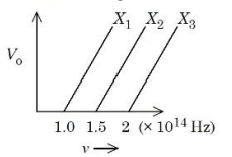
The graph shows the variation of stopping potential $V_o$ with the frequency $\nu$ of the incident radiation for three photosensitive metals $X_1, X_2$ and $X_3$. Which metal will emit photoelectrons with greater kinetic energy,for the same wavelength of incident radiation?
A
$X_1$
B
$X_2$
C
$X_3$
D
All the metals will emit photoelectrons with the same kinetic energy.
Solution
(A) According to Einstein's photoelectric equation,$K_{max} = h\nu - \phi = \frac{hc}{\lambda} - \phi$.
For the same wavelength $\lambda$,the energy of the incident photon $\frac{hc}{\lambda}$ is constant.
The maximum kinetic energy $K_{max}$ is higher for the metal with the smaller work function $\phi$.
The work function is given by $\phi = h\nu_0$,where $\nu_0$ is the threshold frequency (the $x$-intercept of the graph).
From the graph,$X_1$ has the lowest threshold frequency $(\nu_0 = 1.0 \times 10^{14} \text{ Hz})$,which implies it has the smallest work function.
Therefore,for a fixed incident wavelength,metal $X_1$ will emit photoelectrons with the greatest maximum kinetic energy.
For the same wavelength $\lambda$,the energy of the incident photon $\frac{hc}{\lambda}$ is constant.
The maximum kinetic energy $K_{max}$ is higher for the metal with the smaller work function $\phi$.
The work function is given by $\phi = h\nu_0$,where $\nu_0$ is the threshold frequency (the $x$-intercept of the graph).
From the graph,$X_1$ has the lowest threshold frequency $(\nu_0 = 1.0 \times 10^{14} \text{ Hz})$,which implies it has the smallest work function.
Therefore,for a fixed incident wavelength,metal $X_1$ will emit photoelectrons with the greatest maximum kinetic energy.
0 likes
View Solution726
DifficultMCQ
Light source having wavelength $331 \text{ nm}$ is used to generate photo-electrons whose stopping potential is $0.2 \text{ V}$. The work function of the used metal in the experiment is $\alpha \times 10^{-19} \text{ J}$. The value of $\alpha$ is . . . . . . . ($h = 6.62 \times 10^{-34} \text{ J s}$,$e = 1.6 \times 10^{-19} \text{ C}$ and $c = 3 \times 10^8 \text{ m/s}$) (in $.68$)
A
$3$
B
$4$
C
$5$
D
$2$
Solution
(C) The energy of the incident photon is given by $E = \frac{hc}{\lambda}$.
Substituting the given values: $E = \frac{6.62 \times 10^{-34} \times 3 \times 10^8}{331 \times 10^{-9}} = \frac{19.86 \times 10^{-26}}{331 \times 10^{-9}} = 0.06 \times 10^{-17} \text{ J} = 6 \times 10^{-19} \text{ J}$.
According to Einstein's photoelectric equation,$E = \phi + K_{max}$,where $\phi$ is the work function and $K_{max}$ is the maximum kinetic energy.
The maximum kinetic energy is $K_{max} = eV_s = 1.6 \times 10^{-19} \times 0.2 = 0.32 \times 10^{-19} \text{ J}$.
Therefore,the work function $\phi = E - K_{max} = 6 \times 10^{-19} - 0.32 \times 10^{-19} = 5.68 \times 10^{-19} \text{ J}$.
Comparing this with $\alpha \times 10^{-19} \text{ J}$,we get $\alpha = 5.68$.
Substituting the given values: $E = \frac{6.62 \times 10^{-34} \times 3 \times 10^8}{331 \times 10^{-9}} = \frac{19.86 \times 10^{-26}}{331 \times 10^{-9}} = 0.06 \times 10^{-17} \text{ J} = 6 \times 10^{-19} \text{ J}$.
According to Einstein's photoelectric equation,$E = \phi + K_{max}$,where $\phi$ is the work function and $K_{max}$ is the maximum kinetic energy.
The maximum kinetic energy is $K_{max} = eV_s = 1.6 \times 10^{-19} \times 0.2 = 0.32 \times 10^{-19} \text{ J}$.
Therefore,the work function $\phi = E - K_{max} = 6 \times 10^{-19} - 0.32 \times 10^{-19} = 5.68 \times 10^{-19} \text{ J}$.
Comparing this with $\alpha \times 10^{-19} \text{ J}$,we get $\alpha = 5.68$.
0 likes
View Solution727
DifficultMCQ
$K_1$ and $K_2$ are the maximum kinetic energies of photoelectrons emitted from a surface of a given material for light of wavelengths $\lambda_1$ and $\lambda_2$,respectively. If $\lambda_1 = 2\lambda_2$,then the work function of the material is given by:
A
$K_2 + 2K_1$
B
$2K_2 - K_1$
C
$K_1 - 2K_2$
D
$K_2 - 2K_1$
Solution
(D) According to Einstein's photoelectric equation,the maximum kinetic energy $K$ is given by $K = \frac{hc}{\lambda} - \phi$,where $\phi$ is the work function.
For wavelengths $\lambda_1$ and $\lambda_2$,we have:
$K_1 = \frac{hc}{\lambda_1} - \phi$ --- $(1)$
$K_2 = \frac{hc}{\lambda_2} - \phi$ --- $(2)$
Given $\lambda_1 = 2\lambda_2$,substitute this into equation $(1)$:
$K_1 = \frac{hc}{2\lambda_2} - \phi$
Multiply by $2$:
$2K_1 = \frac{hc}{\lambda_2} - 2\phi$ --- $(3)$
Now,subtract equation $(3)$ from equation $(2)$:
$K_2 - 2K_1 = (\frac{hc}{\lambda_2} - \phi) - (\frac{hc}{\lambda_2} - 2\phi)$
$K_2 - 2K_1 = \phi$
Therefore,the work function $\phi = K_2 - 2K_1$.
For wavelengths $\lambda_1$ and $\lambda_2$,we have:
$K_1 = \frac{hc}{\lambda_1} - \phi$ --- $(1)$
$K_2 = \frac{hc}{\lambda_2} - \phi$ --- $(2)$
Given $\lambda_1 = 2\lambda_2$,substitute this into equation $(1)$:
$K_1 = \frac{hc}{2\lambda_2} - \phi$
Multiply by $2$:
$2K_1 = \frac{hc}{\lambda_2} - 2\phi$ --- $(3)$
Now,subtract equation $(3)$ from equation $(2)$:
$K_2 - 2K_1 = (\frac{hc}{\lambda_2} - \phi) - (\frac{hc}{\lambda_2} - 2\phi)$
$K_2 - 2K_1 = \phi$
Therefore,the work function $\phi = K_2 - 2K_1$.
0 likes
View Solution728
DifficultMCQ
For a certain metal,when monochromatic light of wavelength $\lambda$ is incident,the stopping potential for photoelectrons is $3V_0$. When the same metal is illuminated by light of wavelength $2\lambda$,then the stopping potential becomes $V_0$. The threshold wavelength for photoelectric emission for the given metal is $\alpha\lambda$. The value of $\alpha$ is . . . . . . .
A
$1$
B
$4$
C
$2$
D
$3$
Solution
(B) According to Einstein's photoelectric equation: $eV_s = \frac{hc}{\lambda} - \Phi$,where $\Phi$ is the work function.
For the first case: $e(3V_0) = \frac{hc}{\lambda} - \Phi$ --- $(1)$
For the second case: $e(V_0) = \frac{hc}{2\lambda} - \Phi$ --- $(2)$
Subtracting equation $(2)$ from equation $(1)$:
$3eV_0 - eV_0 = (\frac{hc}{\lambda} - \Phi) - (\frac{hc}{2\lambda} - \Phi)$
$2eV_0 = \frac{hc}{\lambda} - \frac{hc}{2\lambda} = \frac{hc}{2\lambda}$
$eV_0 = \frac{hc}{4\lambda}$
Substitute $eV_0$ into equation $(2)$:
$\frac{hc}{4\lambda} = \frac{hc}{2\lambda} - \Phi$
$\Phi = \frac{hc}{2\lambda} - \frac{hc}{4\lambda} = \frac{hc}{4\lambda}$
The threshold wavelength $\lambda_0$ is given by $\lambda_0 = \frac{hc}{\Phi}$.
Substituting $\Phi = \frac{hc}{4\lambda}$:
$\lambda_0 = \frac{hc}{hc / 4\lambda} = 4\lambda$.
Comparing this with $\alpha\lambda$,we get $\alpha = 4$.
For the first case: $e(3V_0) = \frac{hc}{\lambda} - \Phi$ --- $(1)$
For the second case: $e(V_0) = \frac{hc}{2\lambda} - \Phi$ --- $(2)$
Subtracting equation $(2)$ from equation $(1)$:
$3eV_0 - eV_0 = (\frac{hc}{\lambda} - \Phi) - (\frac{hc}{2\lambda} - \Phi)$
$2eV_0 = \frac{hc}{\lambda} - \frac{hc}{2\lambda} = \frac{hc}{2\lambda}$
$eV_0 = \frac{hc}{4\lambda}$
Substitute $eV_0$ into equation $(2)$:
$\frac{hc}{4\lambda} = \frac{hc}{2\lambda} - \Phi$
$\Phi = \frac{hc}{2\lambda} - \frac{hc}{4\lambda} = \frac{hc}{4\lambda}$
The threshold wavelength $\lambda_0$ is given by $\lambda_0 = \frac{hc}{\Phi}$.
Substituting $\Phi = \frac{hc}{4\lambda}$:
$\lambda_0 = \frac{hc}{hc / 4\lambda} = 4\lambda$.
Comparing this with $\alpha\lambda$,we get $\alpha = 4$.
0 likes
View Solution729
DifficultMCQ
For a metal with a work function of $6.6 \text{eV}$, which of the following wavelengths of incident radiation does not cause the photoelectric effect (in $\text{nm}$)? (Take Planck's constant $h = 6.6 \times 10^{-34} \text{J s}$ and speed of light $c = 3 \times 10^8 \text{m/s}$)
A
$200$
B
$100$
C
$50$
D
$150$
Solution
(A) The threshold wavelength $\lambda_0$ is given by the formula $\lambda_0 = \frac{hc}{\phi}$.
Given work function $\phi = 6.6 \text{eV} = 6.6 \times 1.6 \times 10^{-19} \text{J}$.
Substituting the values: $\lambda_0 = \frac{6.6 \times 10^{-34} \times 3 \times 10^8}{6.6 \times 1.6 \times 10^{-19}} \text{m}$.
$\lambda_0 = \frac{3 \times 10^{-26}}{1.6 \times 10^{-19}} \text{m} = 1.875 \times 10^{-7} \text{m} = 187.5 \text{nm}$.
The photoelectric effect occurs only when the incident wavelength $\lambda \le \lambda_0$.
If $\lambda > \lambda_0$, the energy of the incident photon is less than the work function, and no photoelectric emission occurs.
Comparing the options: $200 \text{nm} > 187.5 \text{nm}$, $100 \text{nm} < 187.5 \text{nm}$, $50 \text{nm} < 187.5 \text{nm}$, and $150 \text{nm} < 187.5 \text{nm}$.
Therefore, $200 \text{nm}$ radiation will not cause the photoelectric effect.
Given work function $\phi = 6.6 \text{eV} = 6.6 \times 1.6 \times 10^{-19} \text{J}$.
Substituting the values: $\lambda_0 = \frac{6.6 \times 10^{-34} \times 3 \times 10^8}{6.6 \times 1.6 \times 10^{-19}} \text{m}$.
$\lambda_0 = \frac{3 \times 10^{-26}}{1.6 \times 10^{-19}} \text{m} = 1.875 \times 10^{-7} \text{m} = 187.5 \text{nm}$.
The photoelectric effect occurs only when the incident wavelength $\lambda \le \lambda_0$.
If $\lambda > \lambda_0$, the energy of the incident photon is less than the work function, and no photoelectric emission occurs.
Comparing the options: $200 \text{nm} > 187.5 \text{nm}$, $100 \text{nm} < 187.5 \text{nm}$, $50 \text{nm} < 187.5 \text{nm}$, and $150 \text{nm} < 187.5 \text{nm}$.
Therefore, $200 \text{nm}$ radiation will not cause the photoelectric effect.
0 likes
View SolutionDual Nature of Radiation and matter — Einstein's Photoelectric Equation and Energy Quantum of Radiation · Frequently Asked Questions
1Are these Dual Nature of Radiation and matter questions useful for JEE and NEET?
Yes. All questions in this section are mapped to JEE Main and NEET exam patterns. Previous year questions from JEE Main, NEET, GUJCET and state-level exams are included with full solutions.
2Can I switch to Hindi or Gujarati for these questions?
Yes. Use the language tabs in the hero section or the sidebar to view the same questions and solutions in English, Hindi or Gujarati.
3How do I generate a question paper from this subtopic?
Use the Vedclass Exam Paper Generator — select the chapter and subtopic, set difficulty, and generate Sets A, B, C, D automatically. First 3 chapters of every subject are free.
Vedclass Products
For Students
Vedclass Test Series
Mock tests in real JEE/NEET style with performance analysis. 5-day free trial.
Start Free TrialFor Teachers
Exam Paper Generator
Generate Set A/B/C/D papers from this chapter in 2 minutes. 3 chapters free.
Try FreeFor Institutes
Online Exam Module
Live online exams with unlimited students, 360° analytics & white-label branding.
See DemoFor Teachers & Institutes
Generate a Dual Nature of Radiation and matter Exam Paper in 2 Minutes
Select subtopic & difficulty — Sets A, B, C, D auto-generated with No Repeat logic.
First 3 chapters of every subject are free — no payment required.