
A English
Matter Waves and de Broglie Wavelength Questions in English
Class 12 Physics · Dual Nature of Radiation and matter · Matter Waves and de Broglie Wavelength
437+
Questions
English
Language
100%
With Solutions
Showing 48 of 437 questions in English
1
EasyMCQ
The idea of matter waves was given by
A
Davisson and Germer
B
de-Broglie
C
Einstein
D
Planck
Solution
(B) In $1924$,the French physicist Louis de-Broglie proposed the hypothesis that matter,like radiation,exhibits a dual nature (wave-particle duality). He suggested that every moving particle of matter is associated with a wave,which is known as a matter wave or de-Broglie wave. Therefore,the correct option is $B$.
0 likes
View Solution2
EasyMCQ
$A$ wave is associated with matter:
A
When it is stationary
B
When it is in motion with the velocity of light only
C
When it is in motion with any velocity
D
None of the above
Solution
(C) According to the de-Broglie hypothesis,every moving particle of matter is associated with a wave,known as a matter wave or de-Broglie wave.
The wavelength $\lambda$ of this wave is given by $\lambda = \frac{h}{p} = \frac{h}{mv}$,where $h$ is Planck's constant,$m$ is the mass of the particle,and $v$ is its velocity.
Since the wavelength depends on the velocity $v$,the wave is associated with matter only when it is in motion (i.e.,$v \neq 0$).
Therefore,a wave is associated with matter when it is in motion with any velocity.
The wavelength $\lambda$ of this wave is given by $\lambda = \frac{h}{p} = \frac{h}{mv}$,where $h$ is Planck's constant,$m$ is the mass of the particle,and $v$ is its velocity.
Since the wavelength depends on the velocity $v$,the wave is associated with matter only when it is in motion (i.e.,$v \neq 0$).
Therefore,a wave is associated with matter when it is in motion with any velocity.
0 likes
View Solution3
EasyMCQ
The de-Broglie wavelength associated with a particle of mass $m$ moving with velocity $v$ is:
A
$h/mv$
B
$mv/h$
C
$mh/v$
D
$m/hv$
Solution
(A) According to the de-Broglie hypothesis,the wavelength $\lambda$ associated with a particle of momentum $p$ is given by the relation: $\lambda = \frac{h}{p}$.
Since the momentum $p$ of a particle of mass $m$ moving with velocity $v$ is defined as $p = mv$,we substitute this into the equation.
Therefore,the de-Broglie wavelength is $\lambda = \frac{h}{mv}$.
Since the momentum $p$ of a particle of mass $m$ moving with velocity $v$ is defined as $p = mv$,we substitute this into the equation.
Therefore,the de-Broglie wavelength is $\lambda = \frac{h}{mv}$.
0 likes
View Solution4
EasyMCQ
When the kinetic energy of an electron is increased,the wavelength of the associated wave will
A
Increase
B
Decrease
C
Wavelength does not depend on the kinetic energy
D
None of the above
Solution
(B) According to the de Broglie hypothesis,the wavelength $\lambda$ associated with a particle of momentum $p$ is given by $\lambda = \frac{h}{p}$.
Since the kinetic energy $E$ is related to momentum by $E = \frac{p^2}{2m}$,we have $p = \sqrt{2mE}$.
Substituting this into the wavelength formula,we get $\lambda = \frac{h}{\sqrt{2mE}}$.
Here,$h$ is Planck's constant and $m$ is the mass of the electron,both of which are constants.
Therefore,$\lambda \propto \frac{1}{\sqrt{E}}$.
As the kinetic energy $E$ increases,the wavelength $\lambda$ must decrease.
Since the kinetic energy $E$ is related to momentum by $E = \frac{p^2}{2m}$,we have $p = \sqrt{2mE}$.
Substituting this into the wavelength formula,we get $\lambda = \frac{h}{\sqrt{2mE}}$.
Here,$h$ is Planck's constant and $m$ is the mass of the electron,both of which are constants.
Therefore,$\lambda \propto \frac{1}{\sqrt{E}}$.
As the kinetic energy $E$ increases,the wavelength $\lambda$ must decrease.
0 likes
View Solution5
DifficultMCQ
If the de-Broglie wavelengths for a proton and for an $\alpha$-particle are equal, then the ratio of their velocities will be
A
$4 : 1$
B
$2 : 1$
C
$1 : 2$
D
$1 : 4$
Solution
(A) The de-Broglie wavelength is given by $\lambda = \frac{h}{mv}$.
Given that the de-Broglie wavelengths for a proton $(p)$ and an $\alpha$-particle $(\alpha)$ are equal, we have $\lambda_p = \lambda_{\alpha}$.
Therefore, $\frac{h}{m_p v_p} = \frac{h}{m_{\alpha} v_{\alpha}}$, which simplifies to $m_p v_p = m_{\alpha} v_{\alpha}$.
The ratio of their velocities is $\frac{v_p}{v_{\alpha}} = \frac{m_{\alpha}}{m_p}$.
We know that the mass of an $\alpha$-particle is approximately $4$ times the mass of a proton, so $m_{\alpha} = 4 m_p$.
Substituting this, we get $\frac{v_p}{v_{\alpha}} = \frac{4 m_p}{m_p} = \frac{4}{1}$.
Thus, the ratio of their velocities is $4 : 1$.
Given that the de-Broglie wavelengths for a proton $(p)$ and an $\alpha$-particle $(\alpha)$ are equal, we have $\lambda_p = \lambda_{\alpha}$.
Therefore, $\frac{h}{m_p v_p} = \frac{h}{m_{\alpha} v_{\alpha}}$, which simplifies to $m_p v_p = m_{\alpha} v_{\alpha}$.
The ratio of their velocities is $\frac{v_p}{v_{\alpha}} = \frac{m_{\alpha}}{m_p}$.
We know that the mass of an $\alpha$-particle is approximately $4$ times the mass of a proton, so $m_{\alpha} = 4 m_p$.
Substituting this, we get $\frac{v_p}{v_{\alpha}} = \frac{4 m_p}{m_p} = \frac{4}{1}$.
Thus, the ratio of their velocities is $4 : 1$.
0 likes
View Solution6
MediumMCQ
The de-Broglie wavelength $\lambda$ associated with an electron having kinetic energy $E$ is given by the expression:
A
$\frac{h}{\sqrt{2mE}}$
B
$\frac{2h}{mE}$
C
$2mhE$
D
$\frac{2\sqrt{2mE}}{h}$
Solution
(A) The kinetic energy $E$ of an electron of mass $m$ moving with velocity $v$ is given by $E = \frac{1}{2}mv^2$.
From this,we can write $v^2 = \frac{2E}{m}$,which implies $v = \sqrt{\frac{2E}{m}}$.
The momentum $p$ of the electron is $p = mv = m \sqrt{\frac{2E}{m}} = \sqrt{2mE}$.
According to the de-Broglie hypothesis,the wavelength $\lambda$ is given by $\lambda = \frac{h}{p}$.
Substituting the value of $p$,we get $\lambda = \frac{h}{\sqrt{2mE}}$.
From this,we can write $v^2 = \frac{2E}{m}$,which implies $v = \sqrt{\frac{2E}{m}}$.
The momentum $p$ of the electron is $p = mv = m \sqrt{\frac{2E}{m}} = \sqrt{2mE}$.
According to the de-Broglie hypothesis,the wavelength $\lambda$ is given by $\lambda = \frac{h}{p}$.
Substituting the value of $p$,we get $\lambda = \frac{h}{\sqrt{2mE}}$.
0 likes
View Solution7
MediumMCQ
An electron of mass $m$ when accelerated through a potential difference $V$ has a de-Broglie wavelength $\lambda$. The de-Broglie wavelength associated with a proton of mass $M$ accelerated through the same potential difference will be:
A
$\lambda \frac{m}{M}$
B
$\lambda \sqrt{\frac{m}{M}}$
C
$\lambda \frac{M}{m}$
D
$\lambda \sqrt{\frac{M}{m}}$
Solution
(B) The de-Broglie wavelength $\lambda$ of a particle of mass $m$ accelerated through a potential difference $V$ is given by the formula: $\lambda = \frac{h}{\sqrt{2mqV}}$.
Since both the electron and the proton are accelerated through the same potential difference $V$ and both have the same magnitude of charge $q = e$,the wavelength is inversely proportional to the square root of the mass: $\lambda \propto \frac{1}{\sqrt{m}}$.
For the electron: $\lambda_e = \lambda = \frac{k}{\sqrt{m}}$,where $k$ is a constant.
For the proton: $\lambda_p = \frac{k}{\sqrt{M}}$.
Dividing the two equations: $\frac{\lambda_p}{\lambda_e} = \frac{\sqrt{m}}{\sqrt{M}} = \sqrt{\frac{m}{M}}$.
Therefore,$\lambda_p = \lambda \sqrt{\frac{m}{M}}$.
Since both the electron and the proton are accelerated through the same potential difference $V$ and both have the same magnitude of charge $q = e$,the wavelength is inversely proportional to the square root of the mass: $\lambda \propto \frac{1}{\sqrt{m}}$.
For the electron: $\lambda_e = \lambda = \frac{k}{\sqrt{m}}$,where $k$ is a constant.
For the proton: $\lambda_p = \frac{k}{\sqrt{M}}$.
Dividing the two equations: $\frac{\lambda_p}{\lambda_e} = \frac{\sqrt{m}}{\sqrt{M}} = \sqrt{\frac{m}{M}}$.
Therefore,$\lambda_p = \lambda \sqrt{\frac{m}{M}}$.
0 likes
View Solution8
MediumMCQ
What is the de-Broglie wavelength of the $\alpha$-particle accelerated through a potential difference $V$?
A
$\frac{0.287}{\sqrt{V}} \ \mathring{A}$
B
$\frac{12.27}{\sqrt{V}} \ \mathring{A}$
C
$\frac{0.101}{\sqrt{V}} \ \mathring{A}$
D
$\frac{0.202}{\sqrt{V}} \ \mathring{A}$
Solution
(C) The de-Broglie wavelength $\lambda$ is given by $\lambda = \frac{h}{p} = \frac{h}{\sqrt{2mK}}$,where $K = qV$ is the kinetic energy.
For an $\alpha$-particle,the charge $q = 2e = 2 \times 1.6 \times 10^{-19} \ C$ and mass $m = 4m_p = 4 \times 1.67 \times 10^{-27} \ kg$.
Substituting these values:
$\lambda = \frac{h}{\sqrt{2(4m_p)(2e)V}} = \frac{6.63 \times 10^{-34}}{\sqrt{2 \times 4 \times 1.67 \times 10^{-27} \times 2 \times 1.6 \times 10^{-19} \times V}}$
$\lambda = \frac{6.63 \times 10^{-34}}{\sqrt{42.752 \times 10^{-46} \times V}} = \frac{6.63 \times 10^{-34}}{6.538 \times 10^{-23} \sqrt{V}} \ m$
$\lambda \approx \frac{1.014 \times 10^{-11}}{\sqrt{V}} \ m = \frac{0.1014 \times 10^{-10}}{\sqrt{V}} \ m = \frac{0.101}{\sqrt{V}} \ \mathring{A}$.
For an $\alpha$-particle,the charge $q = 2e = 2 \times 1.6 \times 10^{-19} \ C$ and mass $m = 4m_p = 4 \times 1.67 \times 10^{-27} \ kg$.
Substituting these values:
$\lambda = \frac{h}{\sqrt{2(4m_p)(2e)V}} = \frac{6.63 \times 10^{-34}}{\sqrt{2 \times 4 \times 1.67 \times 10^{-27} \times 2 \times 1.6 \times 10^{-19} \times V}}$
$\lambda = \frac{6.63 \times 10^{-34}}{\sqrt{42.752 \times 10^{-46} \times V}} = \frac{6.63 \times 10^{-34}}{6.538 \times 10^{-23} \sqrt{V}} \ m$
$\lambda \approx \frac{1.014 \times 10^{-11}}{\sqrt{V}} \ m = \frac{0.1014 \times 10^{-10}}{\sqrt{V}} \ m = \frac{0.101}{\sqrt{V}} \ \mathring{A}$.
0 likes
View Solution9
EasyMCQ
The de-Broglie hypothesis treated electrons as
A
Particles
B
Waves
C
Both $A$ and $B$
D
None of these
Solution
(B) The de-Broglie hypothesis proposed that matter,such as electrons,exhibits wave-like properties in addition to particle-like properties. This is known as wave-particle duality. Therefore,the hypothesis specifically introduced the concept of matter waves associated with electrons.
0 likes
View Solution10
MediumMCQ
The de-Broglie wavelength of an electron having $80 \ eV$ of energy is nearly .............. $\mathring{A}$ ($1 \ eV = 1.6 \times 10^{-19} \ J$,Mass of electron $= 9 \times 10^{-31} \ kg$,Planck's constant $= 6.6 \times 10^{-34} \ J \cdot s$).
A
$140$
B
$0.14$
C
$14$
D
$1.4$
Solution
(D) The de-Broglie wavelength $\lambda$ is given by the formula: $\lambda = \frac{h}{\sqrt{2mE}}$.
Given values are:
$h = 6.6 \times 10^{-34} \ J \cdot s$
$m = 9 \times 10^{-31} \ kg$
$E = 80 \ eV = 80 \times 1.6 \times 10^{-19} \ J = 128 \times 10^{-19} \ J = 1.28 \times 10^{-17} \ J$.
Substituting these values into the formula:
$\lambda = \frac{6.6 \times 10^{-34}}{\sqrt{2 \times 9 \times 10^{-31} \times 1.28 \times 10^{-17}}}$
$\lambda = \frac{6.6 \times 10^{-34}}{\sqrt{23.04 \times 10^{-48}}}$
$\lambda = \frac{6.6 \times 10^{-34}}{4.8 \times 10^{-24}}$
$\lambda = 1.375 \times 10^{-10} \ m \approx 1.375 \ \mathring{A} \approx 1.4 \ \mathring{A}$.
Thus,the correct option is $D$.
Given values are:
$h = 6.6 \times 10^{-34} \ J \cdot s$
$m = 9 \times 10^{-31} \ kg$
$E = 80 \ eV = 80 \times 1.6 \times 10^{-19} \ J = 128 \times 10^{-19} \ J = 1.28 \times 10^{-17} \ J$.
Substituting these values into the formula:
$\lambda = \frac{6.6 \times 10^{-34}}{\sqrt{2 \times 9 \times 10^{-31} \times 1.28 \times 10^{-17}}}$
$\lambda = \frac{6.6 \times 10^{-34}}{\sqrt{23.04 \times 10^{-48}}}$
$\lambda = \frac{6.6 \times 10^{-34}}{4.8 \times 10^{-24}}$
$\lambda = 1.375 \times 10^{-10} \ m \approx 1.375 \ \mathring{A} \approx 1.4 \ \mathring{A}$.
Thus,the correct option is $D$.
0 likes
View Solution11
EasyMCQ
If particles are moving with the same velocity,then the maximum de-Broglie wavelength will be for
A
Neutron
B
Proton
C
$\beta$-particle
D
$\alpha$-particle
Solution
(C) The de-Broglie wavelength $\lambda$ is given by the formula $\lambda = \frac{h}{mv}$,where $h$ is Planck's constant,$m$ is the mass of the particle,and $v$ is its velocity.
Given that the velocity $v$ is the same for all particles,the relationship becomes $\lambda \propto \frac{1}{m}$.
This means that the particle with the smallest mass will have the maximum de-Broglie wavelength.
Comparing the masses: $m_{\beta} < m_{proton} \approx m_{neutron} < m_{\alpha}$.
Since the $\beta$-particle (an electron) has the smallest mass among the given options,it will have the maximum de-Broglie wavelength.
Given that the velocity $v$ is the same for all particles,the relationship becomes $\lambda \propto \frac{1}{m}$.
This means that the particle with the smallest mass will have the maximum de-Broglie wavelength.
Comparing the masses: $m_{\beta} < m_{proton} \approx m_{neutron} < m_{\alpha}$.
Since the $\beta$-particle (an electron) has the smallest mass among the given options,it will have the maximum de-Broglie wavelength.
0 likes
View Solution12
EasyMCQ
If an electron and a photon propagate in the form of waves having the same wavelength,it implies that they have the same
A
Energy
B
Momentum
C
Velocity
D
Angular momentum
Solution
(B) According to the de-Broglie hypothesis,the momentum $p$ of a particle is related to its wavelength $\lambda$ by the equation $p = \frac{h}{\lambda}$,where $h$ is Planck's constant.
Since both the electron and the photon have the same wavelength $\lambda$,and $h$ is a universal constant,their momenta must be equal.
Therefore,they have the same momentum.
Since both the electron and the photon have the same wavelength $\lambda$,and $h$ is a universal constant,their momenta must be equal.
Therefore,they have the same momentum.
0 likes
View Solution13
EasyMCQ
The de-Broglie wavelength is proportional to
A
$\lambda \propto \frac{1}{\nu}$
B
$\lambda \propto \frac{1}{m}$
C
$\lambda \propto \frac{1}{p}$
D
$\lambda \propto p$
Solution
(C) The de-Broglie wavelength $\lambda$ of a particle is given by the relation $\lambda = \frac{h}{p}$,where $h$ is Planck's constant and $p$ is the momentum of the particle.
From this equation,it is clear that the wavelength $\lambda$ is inversely proportional to the momentum $p$ of the particle.
Therefore,$\lambda \propto \frac{1}{p}$.
From this equation,it is clear that the wavelength $\lambda$ is inversely proportional to the momentum $p$ of the particle.
Therefore,$\lambda \propto \frac{1}{p}$.
0 likes
View Solution14
MediumMCQ
The speed of an electron having a wavelength of $10^{-10} \ m$ is ................. $ \times 10^6 \ m/s$.
A
$7.25$
B
$6.26$
C
$5.25$
D
$4.24$
Solution
(A) The de Broglie wavelength of an electron is given by the formula $\lambda = \frac{h}{m_e v}$.
Rearranging the formula to solve for velocity $v$,we get $v = \frac{h}{m_e \lambda}$.
Substituting the known values: $h = 6.63 \times 10^{-34} \ J \cdot s$,$m_e = 9.11 \times 10^{-31} \ kg$,and $\lambda = 10^{-10} \ m$.
$v = \frac{6.63 \times 10^{-34}}{9.11 \times 10^{-31} \times 10^{-10}} \ m/s$.
$v = \frac{6.63}{9.11} \times 10^{-34 + 31 + 10} \ m/s$.
$v \approx 0.7277 \times 10^7 \ m/s = 7.277 \times 10^6 \ m/s$.
Rounding to the nearest provided option,the speed is $7.25 \times 10^6 \ m/s$.
Rearranging the formula to solve for velocity $v$,we get $v = \frac{h}{m_e \lambda}$.
Substituting the known values: $h = 6.63 \times 10^{-34} \ J \cdot s$,$m_e = 9.11 \times 10^{-31} \ kg$,and $\lambda = 10^{-10} \ m$.
$v = \frac{6.63 \times 10^{-34}}{9.11 \times 10^{-31} \times 10^{-10}} \ m/s$.
$v = \frac{6.63}{9.11} \times 10^{-34 + 31 + 10} \ m/s$.
$v \approx 0.7277 \times 10^7 \ m/s = 7.277 \times 10^6 \ m/s$.
Rounding to the nearest provided option,the speed is $7.25 \times 10^6 \ m/s$.
0 likes
View Solution15
EasyMCQ
The de-Broglie wavelength associated with a hydrogen molecule moving with a thermal velocity of $3 \ km/s$ will be ............ $\mathring{A}$.
A
$1$
B
$0.66$
C
$6.6$
D
$66$
Solution
(B) The de-Broglie wavelength is given by the formula $\lambda = \frac{h}{mv}$.
Here,$h = 6.63 \times 10^{-34} \ J \cdot s$ (Planck's constant).
The mass of a hydrogen molecule $(H_2)$ is $m = 2 \times 1.67 \times 10^{-27} \ kg = 3.34 \times 10^{-27} \ kg$.
The velocity is $v = 3 \ km/s = 3 \times 10^3 \ m/s$.
Substituting these values into the formula:
$\lambda = \frac{6.63 \times 10^{-34}}{3.34 \times 10^{-27} \times 3 \times 10^3} \ m$.
$\lambda = \frac{6.63 \times 10^{-34}}{10.02 \times 10^{-24}} \ m \approx 0.66 \times 10^{-10} \ m$.
Since $1 \ \mathring{A} = 10^{-10} \ m$,we get $\lambda = 0.66 \ \mathring{A}$.
Here,$h = 6.63 \times 10^{-34} \ J \cdot s$ (Planck's constant).
The mass of a hydrogen molecule $(H_2)$ is $m = 2 \times 1.67 \times 10^{-27} \ kg = 3.34 \times 10^{-27} \ kg$.
The velocity is $v = 3 \ km/s = 3 \times 10^3 \ m/s$.
Substituting these values into the formula:
$\lambda = \frac{6.63 \times 10^{-34}}{3.34 \times 10^{-27} \times 3 \times 10^3} \ m$.
$\lambda = \frac{6.63 \times 10^{-34}}{10.02 \times 10^{-24}} \ m \approx 0.66 \times 10^{-10} \ m$.
Since $1 \ \mathring{A} = 10^{-10} \ m$,we get $\lambda = 0.66 \ \mathring{A}$.
0 likes
View Solution16
MediumMCQ
The de-Broglie wavelength of a neutron at $27^oC$ is $\lambda$. What will be its wavelength at $927^oC$?
A
$\lambda / 2$
B
$\lambda / 3$
C
$\lambda / 4$
D
$\lambda / 9$
Solution
(A) The de-Broglie wavelength of a neutron is given by $\lambda = \frac{h}{\sqrt{2mkT}}$,where $m$ is the mass of the neutron,$k$ is the Boltzmann constant,and $T$ is the absolute temperature.
Since $h$,$m$,and $k$ are constants,we have $\lambda \propto \frac{1}{\sqrt{T}}$.
Therefore,$\frac{\lambda_1}{\lambda_2} = \sqrt{\frac{T_2}{T_1}}$.
Given $T_1 = 27^oC = 27 + 273 = 300 \ K$ and $T_2 = 927^oC = 927 + 273 = 1200 \ K$.
Substituting the values: $\frac{\lambda}{\lambda_2} = \sqrt{\frac{1200}{300}} = \sqrt{4} = 2$.
Thus,$\lambda_2 = \frac{\lambda}{2}$.
Since $h$,$m$,and $k$ are constants,we have $\lambda \propto \frac{1}{\sqrt{T}}$.
Therefore,$\frac{\lambda_1}{\lambda_2} = \sqrt{\frac{T_2}{T_1}}$.
Given $T_1 = 27^oC = 27 + 273 = 300 \ K$ and $T_2 = 927^oC = 927 + 273 = 1200 \ K$.
Substituting the values: $\frac{\lambda}{\lambda_2} = \sqrt{\frac{1200}{300}} = \sqrt{4} = 2$.
Thus,$\lambda_2 = \frac{\lambda}{2}$.
0 likes
View Solution17
EasyMCQ
An electron and a proton have the same de-Broglie wavelength. Then the kinetic energy of the electron is
A
Zero
B
Infinity
C
Equal to the kinetic energy of the proton
D
Greater than the kinetic energy of the proton
Solution
(D) The de-Broglie wavelength $\lambda$ is given by the formula $\lambda = \frac{h}{\sqrt{2mE}}$,where $h$ is Planck's constant,$m$ is the mass of the particle,and $E$ is the kinetic energy.
Since the de-Broglie wavelength $\lambda$ is the same for both the electron and the proton,we have $\lambda = \text{constant}$.
From the formula,we can see that $E = \frac{h^2}{2m\lambda^2}$,which implies $E \propto \frac{1}{m}$.
Since the mass of an electron $(m_e)$ is much smaller than the mass of a proton $(m_p)$,i.e.,$m_e < m_p$,it follows that the kinetic energy of the electron $(E_e)$ must be greater than the kinetic energy of the proton $(E_p)$.
Therefore,$E_e > E_p$.
Since the de-Broglie wavelength $\lambda$ is the same for both the electron and the proton,we have $\lambda = \text{constant}$.
From the formula,we can see that $E = \frac{h^2}{2m\lambda^2}$,which implies $E \propto \frac{1}{m}$.
Since the mass of an electron $(m_e)$ is much smaller than the mass of a proton $(m_p)$,i.e.,$m_e < m_p$,it follows that the kinetic energy of the electron $(E_e)$ must be greater than the kinetic energy of the proton $(E_p)$.
Therefore,$E_e > E_p$.
0 likes
View Solution18
EasyMCQ
For a moving cricket ball,which of the following statements regarding the de-Broglie wavelength is correct?
A
It is not applicable for such a large particle.
B
$\lambda = \frac{h}{p} = \frac{h}{\sqrt{2mE}}$
C
$\lambda = \sqrt{\frac{h}{2mE}}$
D
$\lambda = \frac{h}{2mE}$
Solution
(B) The de-Broglie wavelength $\lambda$ of a particle of mass $m$ moving with momentum $p$ is given by $\lambda = \frac{h}{p}$.
Since kinetic energy $E = \frac{p^2}{2m}$,we have $p = \sqrt{2mE}$.
Substituting this into the wavelength formula,we get $\lambda = \frac{h}{\sqrt{2mE}}$.
While the de-Broglie wavelength exists for all matter,for a macroscopic object like a cricket ball,the wavelength is extremely small (on the order of $10^{-34} \ m$),making it physically undetectable and practically irrelevant,but the mathematical expression remains valid.
Since kinetic energy $E = \frac{p^2}{2m}$,we have $p = \sqrt{2mE}$.
Substituting this into the wavelength formula,we get $\lambda = \frac{h}{\sqrt{2mE}}$.
While the de-Broglie wavelength exists for all matter,for a macroscopic object like a cricket ball,the wavelength is extremely small (on the order of $10^{-34} \ m$),making it physically undetectable and practically irrelevant,but the mathematical expression remains valid.
0 likes
View Solution19
MediumMCQ
$A$ photon and an electron are given the same energy $(10^{-20} \ J)$. If the wavelengths associated with the photon and the electron are $\lambda_{Ph}$ and $\lambda_{el}$ respectively,then which of the following statements is correct?
A
$\lambda_{Ph} > \lambda_{el}$
B
$\lambda_{Ph} < \lambda_{el}$
C
$\lambda_{Ph} = \lambda_{el}$
D
$\frac{\lambda_{el}}{\lambda_{Ph}} = C$
Solution
(A) For a photon,the energy $E$ is given by $E = \frac{hc}{\lambda_{Ph}}$,so $\lambda_{Ph} = \frac{hc}{E}$.
For a non-relativistic electron,the energy $E$ is given by $E = \frac{p^2}{2m}$,where $p$ is the momentum. The de Broglie wavelength is $\lambda_{el} = \frac{h}{p}$.
From the energy equation,$p = \sqrt{2mE}$,so $\lambda_{el} = \frac{h}{\sqrt{2mE}}$.
Comparing the two expressions:
$\lambda_{Ph} = \frac{hc}{E}$
$\lambda_{el} = \frac{h}{\sqrt{2mE}}$
Given the same energy $E$,the ratio is $\frac{\lambda_{Ph}}{\lambda_{el}} = \frac{hc/E}{h/\sqrt{2mE}} = \frac{c\sqrt{2mE}}{E} = c \sqrt{\frac{2m}{E}}$.
Since $c$ is the speed of light $(3 \times 10^8 \ m/s)$ and $E$ is very small $(10^{-20} \ J)$,the value of $\lambda_{Ph}$ is significantly larger than $\lambda_{el}$.
Therefore,$\lambda_{Ph} > \lambda_{el}$.
For a non-relativistic electron,the energy $E$ is given by $E = \frac{p^2}{2m}$,where $p$ is the momentum. The de Broglie wavelength is $\lambda_{el} = \frac{h}{p}$.
From the energy equation,$p = \sqrt{2mE}$,so $\lambda_{el} = \frac{h}{\sqrt{2mE}}$.
Comparing the two expressions:
$\lambda_{Ph} = \frac{hc}{E}$
$\lambda_{el} = \frac{h}{\sqrt{2mE}}$
Given the same energy $E$,the ratio is $\frac{\lambda_{Ph}}{\lambda_{el}} = \frac{hc/E}{h/\sqrt{2mE}} = \frac{c\sqrt{2mE}}{E} = c \sqrt{\frac{2m}{E}}$.
Since $c$ is the speed of light $(3 \times 10^8 \ m/s)$ and $E$ is very small $(10^{-20} \ J)$,the value of $\lambda_{Ph}$ is significantly larger than $\lambda_{el}$.
Therefore,$\lambda_{Ph} > \lambda_{el}$.
0 likes
View Solution20
MediumMCQ
The kinetic energy of an electron with a de-Broglie wavelength of $0.3 \, nm$ is ............. $eV$.
A
$0.168$
B
$16.8$
C
$1.68$
D
$2.5$
Solution
(B) The de-Broglie wavelength $\lambda$ is related to the kinetic energy $K$ of an electron by the formula: $\lambda = \frac{h}{\sqrt{2mK}}$.
Rearranging for $K$, we get: $K = \frac{h^2}{2m\lambda^2}$.
Given $\lambda = 0.3 \, nm = 0.3 \times 10^{-9} \, m$, $h = 6.626 \times 10^{-34} \, J \cdot s$, and $m = 9.1 \times 10^{-31} \, kg$.
Substituting the values: $K = \frac{(6.626 \times 10^{-34})^2}{2 \times 9.1 \times 10^{-31} \times (0.3 \times 10^{-9})^2}$.
$K = \frac{43.9 \times 10^{-68}}{18.2 \times 10^{-31} \times 0.09 \times 10^{-18}} = \frac{43.9 \times 10^{-68}}{1.638 \times 10^{-48}} \approx 26.8 \times 10^{-20} \, J$.
To convert Joules to $eV$, divide by $1.6 \times 10^{-19} \, J/eV$: $K \approx \frac{26.8 \times 10^{-20}}{1.6 \times 10^{-19}} \approx 16.75 \, eV \approx 16.8 \, eV$.
Rearranging for $K$, we get: $K = \frac{h^2}{2m\lambda^2}$.
Given $\lambda = 0.3 \, nm = 0.3 \times 10^{-9} \, m$, $h = 6.626 \times 10^{-34} \, J \cdot s$, and $m = 9.1 \times 10^{-31} \, kg$.
Substituting the values: $K = \frac{(6.626 \times 10^{-34})^2}{2 \times 9.1 \times 10^{-31} \times (0.3 \times 10^{-9})^2}$.
$K = \frac{43.9 \times 10^{-68}}{18.2 \times 10^{-31} \times 0.09 \times 10^{-18}} = \frac{43.9 \times 10^{-68}}{1.638 \times 10^{-48}} \approx 26.8 \times 10^{-20} \, J$.
To convert Joules to $eV$, divide by $1.6 \times 10^{-19} \, J/eV$: $K \approx \frac{26.8 \times 10^{-20}}{1.6 \times 10^{-19}} \approx 16.75 \, eV \approx 16.8 \, eV$.
0 likes
View Solution21
EasyMCQ
The wavelength of a de-Broglie wave is $2 \mu m$. Calculate its momentum. (Given: $h = 6.63 \times 10^{-34} \ J \cdot s$)
A
$3.315 \times 10^{-28} \ kg \cdot m/s$
B
$1.16 \times 10^{-28} \ kg \cdot m/s$
C
$4.95 \times 10^{-28} \ kg \cdot m/s$
D
$9.9 \times 10^{-28} \ kg \cdot m/s$
Solution
(A) The de-Broglie wavelength $\lambda$ is related to the momentum $p$ by the equation: $\lambda = \frac{h}{p}$.
Rearranging the formula to solve for momentum $p$,we get: $p = \frac{h}{\lambda}$.
Given values are: $h = 6.63 \times 10^{-34} \ J \cdot s$ and $\lambda = 2 \mu m = 2 \times 10^{-6} \ m$.
Substituting these values into the equation:
$p = \frac{6.63 \times 10^{-34}}{2 \times 10^{-6}} \ kg \cdot m/s$.
$p = 3.315 \times 10^{-28} \ kg \cdot m/s$.
Rearranging the formula to solve for momentum $p$,we get: $p = \frac{h}{\lambda}$.
Given values are: $h = 6.63 \times 10^{-34} \ J \cdot s$ and $\lambda = 2 \mu m = 2 \times 10^{-6} \ m$.
Substituting these values into the equation:
$p = \frac{6.63 \times 10^{-34}}{2 \times 10^{-6}} \ kg \cdot m/s$.
$p = 3.315 \times 10^{-28} \ kg \cdot m/s$.
0 likes
View Solution22
EasyMCQ
The de-Broglie wavelength of a body of mass $1 \ kg$ moving with a velocity of $2000 \ m/s$ is:
A
$3.3 \times 10^{-27} \ \mathring{A}$
B
$1.5 \times 10^{7} \ \mathring{A}$
C
$0.55 \times 10^{-22} \ \mathring{A}$
D
None of these
Solution
(A) The de-Broglie wavelength $\lambda$ is given by the formula $\lambda = \frac{h}{mv}$.
Given: $h = 6.63 \times 10^{-34} \ J \cdot s$,$m = 1 \ kg$,$v = 2000 \ m/s$.
Substituting the values: $\lambda = \frac{6.63 \times 10^{-34}}{1 \times 2000} = \frac{6.63}{2} \times 10^{-37} \ m = 3.315 \times 10^{-37} \ m$.
Since $1 \ \mathring{A} = 10^{-10} \ m$,we convert the wavelength to $\mathring{A}$:
$\lambda = 3.315 \times 10^{-37} \ m = 3.315 \times 10^{-27} \ \mathring{A}$.
Rounding to one decimal place,we get $3.3 \times 10^{-27} \ \mathring{A}$.
Given: $h = 6.63 \times 10^{-34} \ J \cdot s$,$m = 1 \ kg$,$v = 2000 \ m/s$.
Substituting the values: $\lambda = \frac{6.63 \times 10^{-34}}{1 \times 2000} = \frac{6.63}{2} \times 10^{-37} \ m = 3.315 \times 10^{-37} \ m$.
Since $1 \ \mathring{A} = 10^{-10} \ m$,we convert the wavelength to $\mathring{A}$:
$\lambda = 3.315 \times 10^{-37} \ m = 3.315 \times 10^{-27} \ \mathring{A}$.
Rounding to one decimal place,we get $3.3 \times 10^{-27} \ \mathring{A}$.
0 likes
View Solution23
MediumMCQ
The kinetic energy of an electron is $5 \ eV$. Calculate the de-Broglie wavelength associated with it in $\mathring{A}$. $(h = 6.6 \times 10^{-34} \ J \cdot s, m_e = 9.1 \times 10^{-31} \ kg)$
A
$5.47$
B
$10.9$
C
$2.7$
D
None of these
Solution
(A) The de-Broglie wavelength $\lambda$ is given by the formula $\lambda = \frac{h}{\sqrt{2mE}}$.
Given: $h = 6.6 \times 10^{-34} \ J \cdot s$,$m = 9.1 \times 10^{-31} \ kg$,and $E = 5 \ eV = 5 \times 1.6 \times 10^{-19} \ J$.
Substituting the values:
$\lambda = \frac{6.6 \times 10^{-34}}{\sqrt{2 \times 9.1 \times 10^{-31} \times 5 \times 1.6 \times 10^{-19}}}$
$\lambda = \frac{6.6 \times 10^{-34}}{\sqrt{145.6 \times 10^{-50}}}$
$\lambda = \frac{6.6 \times 10^{-34}}{12.066 \times 10^{-25}}$
$\lambda \approx 0.547 \times 10^{-9} \ m = 5.47 \times 10^{-10} \ m = 5.47 \ \mathring{A}$.
Given: $h = 6.6 \times 10^{-34} \ J \cdot s$,$m = 9.1 \times 10^{-31} \ kg$,and $E = 5 \ eV = 5 \times 1.6 \times 10^{-19} \ J$.
Substituting the values:
$\lambda = \frac{6.6 \times 10^{-34}}{\sqrt{2 \times 9.1 \times 10^{-31} \times 5 \times 1.6 \times 10^{-19}}}$
$\lambda = \frac{6.6 \times 10^{-34}}{\sqrt{145.6 \times 10^{-50}}}$
$\lambda = \frac{6.6 \times 10^{-34}}{12.066 \times 10^{-25}}$
$\lambda \approx 0.547 \times 10^{-9} \ m = 5.47 \times 10^{-10} \ m = 5.47 \ \mathring{A}$.
0 likes
View Solution24
MediumMCQ
The wavelength associated with an electron accelerated through a potential difference of $100 \ V$ is nearly .............. $ \mathring A $
A
$100$
B
$123$
C
$1.23$
D
$0.123$
Solution
(C) The de Broglie wavelength $\lambda$ of an electron accelerated through a potential difference $V$ is given by the formula: $\lambda = \frac{h}{\sqrt{2mQV}}$.
Substituting the values $h = 6.63 \times 10^{-34} \ J \cdot s$,$m = 9.11 \times 10^{-31} \ kg$,$Q = 1.60 \times 10^{-19} \ C$,and $V = 100 \ V$:
$\lambda = \frac{6.63 \times 10^{-34}}{\sqrt{2 \times 9.11 \times 10^{-31} \times 1.60 \times 10^{-19} \times 100}}$
$\lambda \approx \frac{12.27}{\sqrt{V}} \ \mathring A$
For $V = 100 \ V$,$\lambda = \frac{12.27}{\sqrt{100}} = \frac{12.27}{10} = 1.227 \ \mathring A \approx 1.23 \ \mathring A$.
Substituting the values $h = 6.63 \times 10^{-34} \ J \cdot s$,$m = 9.11 \times 10^{-31} \ kg$,$Q = 1.60 \times 10^{-19} \ C$,and $V = 100 \ V$:
$\lambda = \frac{6.63 \times 10^{-34}}{\sqrt{2 \times 9.11 \times 10^{-31} \times 1.60 \times 10^{-19} \times 100}}$
$\lambda \approx \frac{12.27}{\sqrt{V}} \ \mathring A$
For $V = 100 \ V$,$\lambda = \frac{12.27}{\sqrt{100}} = \frac{12.27}{10} = 1.227 \ \mathring A \approx 1.23 \ \mathring A$.
0 likes
View Solution25
EasyMCQ
The de-Broglie wavelength $\lambda$ of a particle is:
A
proportional to mass
B
proportional to momentum
C
inversely proportional to momentum
D
independent of momentum
Solution
(C) The de-Broglie wavelength $\lambda$ of a particle is given by the relation $\lambda = \frac{h}{p}$,where $h$ is Planck's constant and $p$ is the momentum of the particle.
From this relation,it is clear that $\lambda \propto \frac{1}{p}$.
Therefore,the de-Broglie wavelength is inversely proportional to the momentum of the particle.
Thus,option $C$ is correct.
From this relation,it is clear that $\lambda \propto \frac{1}{p}$.
Therefore,the de-Broglie wavelength is inversely proportional to the momentum of the particle.
Thus,option $C$ is correct.
0 likes
View Solution26
EasyMCQ
If the kinetic energy of a free electron doubles,its de-Broglie wavelength changes by the factor
A
$1/\sqrt{2}$
B
$\sqrt{2}$
C
$1/2$
D
$2$
Solution
(A) The de-Broglie wavelength $\lambda$ is given by the formula $\lambda = \frac{h}{p}$,where $p$ is the momentum.
Since kinetic energy $E = \frac{p^2}{2m}$,we have $p = \sqrt{2mE}$.
Substituting this into the wavelength formula,we get $\lambda = \frac{h}{\sqrt{2mE}}$.
From this expression,it is clear that $\lambda \propto \frac{1}{\sqrt{E}}$.
If the kinetic energy $E$ becomes $E' = 2E$,the new wavelength $\lambda'$ is given by $\lambda' = \frac{h}{\sqrt{2m(2E)}} = \frac{1}{\sqrt{2}} \cdot \frac{h}{\sqrt{2mE}}$.
Therefore,$\lambda' = \frac{1}{\sqrt{2}} \lambda$.
Thus,the wavelength changes by a factor of $1/\sqrt{2}$.
Since kinetic energy $E = \frac{p^2}{2m}$,we have $p = \sqrt{2mE}$.
Substituting this into the wavelength formula,we get $\lambda = \frac{h}{\sqrt{2mE}}$.
From this expression,it is clear that $\lambda \propto \frac{1}{\sqrt{E}}$.
If the kinetic energy $E$ becomes $E' = 2E$,the new wavelength $\lambda'$ is given by $\lambda' = \frac{h}{\sqrt{2m(2E)}} = \frac{1}{\sqrt{2}} \cdot \frac{h}{\sqrt{2mE}}$.
Therefore,$\lambda' = \frac{1}{\sqrt{2}} \lambda$.
Thus,the wavelength changes by a factor of $1/\sqrt{2}$.
0 likes
View Solution27
EasyMCQ
The de-Broglie wavelength of a body of mass $m$ and kinetic energy $E$ is given by:
A
$\lambda = \frac{h}{mE}$
B
$\lambda = \frac{\sqrt{2mE}}{h}$
C
$\lambda = \frac{h}{2mE}$
D
$\lambda = \frac{h}{\sqrt{2mE}}$
Solution
(D) The de-Broglie wavelength $\lambda$ is related to the momentum $p$ of a particle by the equation $\lambda = \frac{h}{p}$.
We know that the kinetic energy $E$ of a body of mass $m$ is given by $E = \frac{p^2}{2m}$.
Rearranging this for momentum,we get $p^2 = 2mE$,which implies $p = \sqrt{2mE}$.
Substituting the expression for $p$ into the de-Broglie wavelength formula,we get $\lambda = \frac{h}{\sqrt{2mE}}$.
Therefore,the correct option is $D$.
We know that the kinetic energy $E$ of a body of mass $m$ is given by $E = \frac{p^2}{2m}$.
Rearranging this for momentum,we get $p^2 = 2mE$,which implies $p = \sqrt{2mE}$.
Substituting the expression for $p$ into the de-Broglie wavelength formula,we get $\lambda = \frac{h}{\sqrt{2mE}}$.
Therefore,the correct option is $D$.
0 likes
View Solution28
EasyMCQ
The wavelength of the matter wave is independent of
A
Mass
B
Velocity
C
Momentum
D
Charge
Solution
(D) The wavelength of a matter wave (de Broglie wavelength) is given by the formula:
$\lambda = \frac{h}{mv} = \frac{h}{p}$ $....(i)$
where $h$ is Planck's constant,$m$ is the mass of the particle,$v$ is its velocity,and $p$ is its momentum.
From equation $(i)$,it is clear that the wavelength $\lambda$ depends on the mass,velocity,and momentum of the particle.
It does not depend on the charge of the particle.
Therefore,the correct option is $D$.
$\lambda = \frac{h}{mv} = \frac{h}{p}$ $....(i)$
where $h$ is Planck's constant,$m$ is the mass of the particle,$v$ is its velocity,and $p$ is its momentum.
From equation $(i)$,it is clear that the wavelength $\lambda$ depends on the mass,velocity,and momentum of the particle.
It does not depend on the charge of the particle.
Therefore,the correct option is $D$.
0 likes
View Solution29
MediumMCQ
$A$ particle of mass $M$ at rest decays into two particles of masses $m_1$ and $m_2$,having non-zero velocities. The ratio of the de-Broglie wavelengths of the particles,$\lambda_1 / \lambda_2$ is
A
$m_1 / m_2$
B
$m_2 / m_1$
C
$1$
D
$\sqrt{m_2} / \sqrt{m_1}$
Solution
(C) According to the law of conservation of linear momentum,the initial momentum of the system is zero.
$0 = m_1 \vec{v}_1 + m_2 \vec{v}_2$
$\Rightarrow m_1 \vec{v}_1 = -m_2 \vec{v}_2$
Taking the magnitude,we get $m_1 v_1 = m_2 v_2$,which implies that the magnitudes of the momenta of the two particles are equal $(p_1 = p_2 = p)$.
The de-Broglie wavelength is given by $\lambda = h / p$.
Since both particles have the same magnitude of momentum $p$,their de-Broglie wavelengths will be $\lambda_1 = h / p$ and $\lambda_2 = h / p$.
Therefore,the ratio $\lambda_1 / \lambda_2 = (h / p) / (h / p) = 1$.
$0 = m_1 \vec{v}_1 + m_2 \vec{v}_2$
$\Rightarrow m_1 \vec{v}_1 = -m_2 \vec{v}_2$
Taking the magnitude,we get $m_1 v_1 = m_2 v_2$,which implies that the magnitudes of the momenta of the two particles are equal $(p_1 = p_2 = p)$.
The de-Broglie wavelength is given by $\lambda = h / p$.
Since both particles have the same magnitude of momentum $p$,their de-Broglie wavelengths will be $\lambda_1 = h / p$ and $\lambda_2 = h / p$.
Therefore,the ratio $\lambda_1 / \lambda_2 = (h / p) / (h / p) = 1$.
0 likes
View Solution30
MediumMCQ
$A$ photon and an electron have equal energy $E$. The ratio $\lambda_{\text{photon}} / \lambda_{\text{electron}}$ is proportional to:
A
$\sqrt{E}$
B
$1/\sqrt{E}$
C
$1/E$
D
Does not depend upon $E$
Solution
(B) For a photon,the energy is given by $E = \frac{hc}{\lambda_{\text{photon}}}$,which implies $\lambda_{\text{photon}} = \frac{hc}{E}$.
For an electron,the de Broglie wavelength is given by $\lambda_{\text{electron}} = \frac{h}{p} = \frac{h}{\sqrt{2mE}}$,where $m$ is the mass of the electron and $E$ is its kinetic energy.
Taking the ratio of the two wavelengths:
$\frac{\lambda_{\text{photon}}}{\lambda_{\text{electron}}} = \frac{hc/E}{h/\sqrt{2mE}} = \frac{hc}{E} \cdot \frac{\sqrt{2mE}}{h} = c \sqrt{\frac{2m}{E}}$.
Since $c$ and $m$ are constants,we have $\frac{\lambda_{\text{photon}}}{\lambda_{\text{electron}}} \propto \frac{1}{\sqrt{E}}$.
For an electron,the de Broglie wavelength is given by $\lambda_{\text{electron}} = \frac{h}{p} = \frac{h}{\sqrt{2mE}}$,where $m$ is the mass of the electron and $E$ is its kinetic energy.
Taking the ratio of the two wavelengths:
$\frac{\lambda_{\text{photon}}}{\lambda_{\text{electron}}} = \frac{hc/E}{h/\sqrt{2mE}} = \frac{hc}{E} \cdot \frac{\sqrt{2mE}}{h} = c \sqrt{\frac{2m}{E}}$.
Since $c$ and $m$ are constants,we have $\frac{\lambda_{\text{photon}}}{\lambda_{\text{electron}}} \propto \frac{1}{\sqrt{E}}$.
0 likes
View Solution31
MediumMCQ
The ratio of de-Broglie wavelengths of molecules of hydrogen and helium which are at temperatures $27^oC$ and $127^oC$ respectively is
A
$\frac{1}{2}$
B
$\sqrt{\frac{3}{8}}$
C
$\sqrt{\frac{8}{3}}$
D
$1$
Solution
(C) The de-Broglie wavelength is given by $\lambda = \frac{h}{p} = \frac{h}{m v_{rms}}$.
For a gas molecule,the root mean square velocity is $v_{rms} = \sqrt{\frac{3kT}{m}}$.
Substituting this into the wavelength formula,we get $\lambda = \frac{h}{\sqrt{3mkT}}$.
Given $T_H = 27^oC = 300 K$ and $T_{He} = 127^oC = 400 K$.
The masses are $m_H = 2$ units and $m_{He} = 4$ units.
The ratio is $\frac{\lambda_H}{\lambda_{He}} = \sqrt{\frac{m_{He} T_{He}}{m_H T_H}} = \sqrt{\frac{4 \times 400}{2 \times 300}} = \sqrt{\frac{1600}{600}} = \sqrt{\frac{8}{3}}$.
For a gas molecule,the root mean square velocity is $v_{rms} = \sqrt{\frac{3kT}{m}}$.
Substituting this into the wavelength formula,we get $\lambda = \frac{h}{\sqrt{3mkT}}$.
Given $T_H = 27^oC = 300 K$ and $T_{He} = 127^oC = 400 K$.
The masses are $m_H = 2$ units and $m_{He} = 4$ units.
The ratio is $\frac{\lambda_H}{\lambda_{He}} = \sqrt{\frac{m_{He} T_{He}}{m_H T_H}} = \sqrt{\frac{4 \times 400}{2 \times 300}} = \sqrt{\frac{1600}{600}} = \sqrt{\frac{8}{3}}$.
0 likes
View Solution32
DifficultMCQ
The potential energy of a particle of mass $m$ is given by $U(x) = \begin{cases} E_0; & 0 \le x \le 1 \\ 0; & x > 1 \end{cases}$. $\lambda_1$ and $\lambda_2$ are the de-Broglie wavelengths of the particle when $0 \le x \le 1$ and $x > 1$ respectively. If the total energy of the particle is $2 E_0$,the ratio $\frac{\lambda_1}{\lambda_2}$ will be:
A
$2$
B
$1$
C
$\sqrt{2}$
D
$\frac{1}{\sqrt{2}}$
Solution
(C) The total energy of the particle is $E = 2 E_0$.
For the region $0 \le x \le 1$,the potential energy is $U_1 = E_0$. The kinetic energy is $K_1 = E - U_1 = 2 E_0 - E_0 = E_0$.
The de-Broglie wavelength is $\lambda_1 = \frac{h}{\sqrt{2m K_1}} = \frac{h}{\sqrt{2m E_0}}$.
For the region $x > 1$,the potential energy is $U_2 = 0$. The kinetic energy is $K_2 = E - U_2 = 2 E_0 - 0 = 2 E_0$.
The de-Broglie wavelength is $\lambda_2 = \frac{h}{\sqrt{2m K_2}} = \frac{h}{\sqrt{2m(2 E_0)}} = \frac{h}{\sqrt{4m E_0}}$.
Taking the ratio: $\frac{\lambda_1}{\lambda_2} = \frac{h / \sqrt{2m E_0}}{h / \sqrt{4m E_0}} = \sqrt{\frac{4m E_0}{2m E_0}} = \sqrt{2}$.
For the region $0 \le x \le 1$,the potential energy is $U_1 = E_0$. The kinetic energy is $K_1 = E - U_1 = 2 E_0 - E_0 = E_0$.
The de-Broglie wavelength is $\lambda_1 = \frac{h}{\sqrt{2m K_1}} = \frac{h}{\sqrt{2m E_0}}$.
For the region $x > 1$,the potential energy is $U_2 = 0$. The kinetic energy is $K_2 = E - U_2 = 2 E_0 - 0 = 2 E_0$.
The de-Broglie wavelength is $\lambda_2 = \frac{h}{\sqrt{2m K_2}} = \frac{h}{\sqrt{2m(2 E_0)}} = \frac{h}{\sqrt{4m E_0}}$.
Taking the ratio: $\frac{\lambda_1}{\lambda_2} = \frac{h / \sqrt{2m E_0}}{h / \sqrt{4m E_0}} = \sqrt{\frac{4m E_0}{2m E_0}} = \sqrt{2}$.
0 likes
View Solution33
DifficultMCQ
The $log-log$ graph between the energy $E$ of an electron and its de-Broglie wavelength $\lambda$ will be
A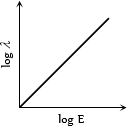
B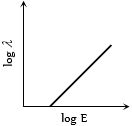
C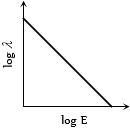
D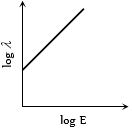
Solution
(C) The de-Broglie wavelength $\lambda$ of an electron with energy $E$ is given by the relation:
$\lambda = \frac{h}{\sqrt{2mE}} = \frac{h}{\sqrt{2m}} \cdot E^{-1/2}$
Taking the logarithm on both sides:
$\log \lambda = \log \left( \frac{h}{\sqrt{2m}} \cdot E^{-1/2} \right)$
Using the properties of logarithms:
$\log \lambda = \log \left( \frac{h}{\sqrt{2m}} \right) + \log (E^{-1/2})$
$\log \lambda = -\frac{1}{2} \log E + \log \left( \frac{h}{\sqrt{2m}} \right)$
This equation is in the form of a straight line $y = mx + c$,where:
$y = \log \lambda$
$x = \log E$
$m = -1/2$ (slope)
$c = \log \left( \frac{h}{\sqrt{2m}} \right)$ (positive intercept on the $y$-axis)
Since the slope is negative,the graph is a straight line with a negative slope,which corresponds to the graph shown in option $C$.
$\lambda = \frac{h}{\sqrt{2mE}} = \frac{h}{\sqrt{2m}} \cdot E^{-1/2}$
Taking the logarithm on both sides:
$\log \lambda = \log \left( \frac{h}{\sqrt{2m}} \cdot E^{-1/2} \right)$
Using the properties of logarithms:
$\log \lambda = \log \left( \frac{h}{\sqrt{2m}} \right) + \log (E^{-1/2})$
$\log \lambda = -\frac{1}{2} \log E + \log \left( \frac{h}{\sqrt{2m}} \right)$
This equation is in the form of a straight line $y = mx + c$,where:
$y = \log \lambda$
$x = \log E$
$m = -1/2$ (slope)
$c = \log \left( \frac{h}{\sqrt{2m}} \right)$ (positive intercept on the $y$-axis)
Since the slope is negative,the graph is a straight line with a negative slope,which corresponds to the graph shown in option $C$.
0 likes
View Solution34
DifficultMCQ
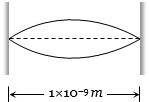
Consider an electron $(m = 9.1 \times 10^{-31} \ kg)$ confined by electrical forces to move between two rigid walls separated by $1.0 \times 10^{-9} \ m$,which is about five atomic diameters. The quantized energy value for the lowest stationary state is
A
$12 \times 10^{-20} \ J$
B
$6.0 \times 10^{-20} \ J$
C
$6.0 \times 10^{-18} \ J$
D
$6 \ J$
Solution
(B) For an electron confined between two rigid walls of length $L$,the particle acts like a standing wave. For the lowest energy state (ground state),the length $L$ corresponds to half a wavelength: $L = \frac{\lambda}{2}$,so $\lambda = 2L$.
Given $L = 1.0 \times 10^{-9} \ m$,we have $\lambda = 2 \times 10^{-9} \ m$.
Using the de Broglie relation $p = \frac{h}{\lambda}$,the kinetic energy $E$ is given by $E = \frac{p^2}{2m} = \frac{h^2}{2m\lambda^2}$.
Substituting the values: $h = 6.63 \times 10^{-34} \ J \cdot s$,$m = 9.1 \times 10^{-31} \ kg$,and $\lambda = 2 \times 10^{-9} \ m$:
$E = \frac{(6.63 \times 10^{-34})^2}{2 \times (9.1 \times 10^{-31}) \times (2 \times 10^{-9})^2}$
$E = \frac{43.96 \times 10^{-68}}{18.2 \times 10^{-31} \times 4 \times 10^{-18}}$
$E = \frac{43.96 \times 10^{-68}}{72.8 \times 10^{-49}} \approx 0.6038 \times 10^{-19} \ J = 6.038 \times 10^{-20} \ J$.
Thus,the closest value is $6.0 \times 10^{-20} \ J$.
Given $L = 1.0 \times 10^{-9} \ m$,we have $\lambda = 2 \times 10^{-9} \ m$.
Using the de Broglie relation $p = \frac{h}{\lambda}$,the kinetic energy $E$ is given by $E = \frac{p^2}{2m} = \frac{h^2}{2m\lambda^2}$.
Substituting the values: $h = 6.63 \times 10^{-34} \ J \cdot s$,$m = 9.1 \times 10^{-31} \ kg$,and $\lambda = 2 \times 10^{-9} \ m$:
$E = \frac{(6.63 \times 10^{-34})^2}{2 \times (9.1 \times 10^{-31}) \times (2 \times 10^{-9})^2}$
$E = \frac{43.96 \times 10^{-68}}{18.2 \times 10^{-31} \times 4 \times 10^{-18}}$
$E = \frac{43.96 \times 10^{-68}}{72.8 \times 10^{-49}} \approx 0.6038 \times 10^{-19} \ J = 6.038 \times 10^{-20} \ J$.
Thus,the closest value is $6.0 \times 10^{-20} \ J$.
0 likes
View Solution35
MediumMCQ
We wish to see inside an atom. Assuming the atom to have a diameter of $100 \ pm$, this means that one must be able to resolve a width of say $10 \ pm$. If an electron microscope is used, the minimum electron energy required is about....... $KeV$.
A
$1.5$
B
$15$
C
$150$
D
$0.15$
Solution
(B) The wavelength of the electron wave must be $\lambda = 10 \ pm = 10 \times 10^{-12} \ m$.
Using the de Broglie wavelength formula: $\lambda = \frac{h}{\sqrt{2mE}}$, we can solve for energy $E$:
$E = \frac{h^2}{2m\lambda^2}$
Substituting the values $h = 6.63 \times 10^{-34} \ J \cdot s$, $m = 9.1 \times 10^{-31} \ kg$, and $\lambda = 10^{-11} \ m$:
$E = \frac{(6.63 \times 10^{-34})^2}{2 \times 9.1 \times 10^{-31} \times (10^{-11})^2} \ J$
$E \approx 2.41 \times 10^{-15} \ J$
To convert this energy into $eV$, divide by $1.6 \times 10^{-19} \ J/eV$:
$E = \frac{2.41 \times 10^{-15}}{1.6 \times 10^{-19}} \ eV \approx 15062 \ eV \approx 15 \ KeV$.
Using the de Broglie wavelength formula: $\lambda = \frac{h}{\sqrt{2mE}}$, we can solve for energy $E$:
$E = \frac{h^2}{2m\lambda^2}$
Substituting the values $h = 6.63 \times 10^{-34} \ J \cdot s$, $m = 9.1 \times 10^{-31} \ kg$, and $\lambda = 10^{-11} \ m$:
$E = \frac{(6.63 \times 10^{-34})^2}{2 \times 9.1 \times 10^{-31} \times (10^{-11})^2} \ J$
$E \approx 2.41 \times 10^{-15} \ J$
To convert this energy into $eV$, divide by $1.6 \times 10^{-19} \ J/eV$:
$E = \frac{2.41 \times 10^{-15}}{1.6 \times 10^{-19}} \ eV \approx 15062 \ eV \approx 15 \ KeV$.
0 likes
View Solution36
MediumMCQ
Two particles have the same charge. If they are accelerated through the same potential difference,what will be the ratio of their de Broglie wavelengths?
A
$\lambda_1 : \lambda_2 = 1 : 1$
B
$\lambda_1 : \lambda_2 = m_2 : m_1$
C
$\lambda_1 : \lambda_2 = \sqrt{m_2} : \sqrt{m_1}$
D
$\lambda_1 : \lambda_2 = \sqrt{m_1} : \sqrt{m_2}$
Solution
(C) Let the two particles have charges $q_1$ and $q_2$. Given $q_1 = q_2 = q$. Both are accelerated through the same potential difference $V$.
The kinetic energy $K$ acquired by a particle of charge $q$ accelerated through potential $V$ is $K = qV$.
Since $K = \frac{p^2}{2m}$,we have $p = \sqrt{2mK} = \sqrt{2mqV}$.
The de Broglie wavelength is given by $\lambda = \frac{h}{p} = \frac{h}{\sqrt{2mqV}}$.
Since $h$,$q$,and $V$ are constant for both particles,we have $\lambda \propto \frac{1}{\sqrt{m}}$.
Therefore,the ratio of their wavelengths is $\frac{\lambda_1}{\lambda_2} = \sqrt{\frac{m_2}{m_1}}$.
The kinetic energy $K$ acquired by a particle of charge $q$ accelerated through potential $V$ is $K = qV$.
Since $K = \frac{p^2}{2m}$,we have $p = \sqrt{2mK} = \sqrt{2mqV}$.
The de Broglie wavelength is given by $\lambda = \frac{h}{p} = \frac{h}{\sqrt{2mqV}}$.
Since $h$,$q$,and $V$ are constant for both particles,we have $\lambda \propto \frac{1}{\sqrt{m}}$.
Therefore,the ratio of their wavelengths is $\frac{\lambda_1}{\lambda_2} = \sqrt{\frac{m_2}{m_1}}$.
0 likes
View Solution37
DifficultMCQ
The de Broglie wavelength of an electron in a metal at $27^{\circ}C$ is compared with the given mean distance between two electrons in the metal,which is $2 \times 10^{-10} \ m$. The ratio of the mean distance to the de Broglie wavelength is approximately:
A
$1.03$
B
$0.03$
C
$0.09$
D
$1.08$
Solution
(B) The de Broglie wavelength is given by $\lambda = \frac{h}{\sqrt{3mk_BT}}$.
Here,$m = 9.11 \times 10^{-31} \ kg$,$k_B = 1.38 \times 10^{-23} \ J/K$,and $T = 27 + 273 = 300 \ K$.
Substituting these values:
$\lambda = \frac{6.63 \times 10^{-34}}{\sqrt{3 \times (9.11 \times 10^{-31}) \times (1.38 \times 10^{-23}) \times 300}}$
$\lambda \approx 6.2 \times 10^{-9} \ m$.
The mean distance between two electrons is $r = 2 \times 10^{-10} \ m$.
The ratio is $\frac{r}{\lambda} = \frac{2 \times 10^{-10}}{6.2 \times 10^{-9}} \approx 0.03$.
Here,$m = 9.11 \times 10^{-31} \ kg$,$k_B = 1.38 \times 10^{-23} \ J/K$,and $T = 27 + 273 = 300 \ K$.
Substituting these values:
$\lambda = \frac{6.63 \times 10^{-34}}{\sqrt{3 \times (9.11 \times 10^{-31}) \times (1.38 \times 10^{-23}) \times 300}}$
$\lambda \approx 6.2 \times 10^{-9} \ m$.
The mean distance between two electrons is $r = 2 \times 10^{-10} \ m$.
The ratio is $\frac{r}{\lambda} = \frac{2 \times 10^{-10}}{6.2 \times 10^{-9}} \approx 0.03$.
0 likes
View Solution38
DifficultMCQ
The de Broglie wavelength associated with a proton changes by $0.25\%$. If its momentum changes by $p_0$,then its initial momentum is ......
A
$10\ p_0$
B
$p_0/400$
C
$401\ p_0$
D
$p_0/100$
Solution
(C) The de Broglie wavelength is given by $\lambda = \frac{h}{p}$,which implies $\lambda \propto \frac{1}{p}$.
Given that the wavelength changes by $0.25\%$,the new wavelength $\lambda' = \lambda + \frac{0.25}{100}\lambda = 1.0025\lambda$.
Since the wavelength increases,the momentum must decrease. Let the new momentum be $p' = p - p_0$.
Using the relation $\lambda' = \frac{h}{p'}$,we have $1.0025\lambda = \frac{h}{p - p_0}$.
Dividing this by $\lambda = \frac{h}{p}$,we get $1.0025 = \frac{p}{p - p_0}$.
$1.0025(p - p_0) = p$.
$1.0025p - 1.0025p_0 = p$.
$0.0025p = 1.0025p_0$.
$p = \frac{1.0025}{0.0025}p_0 = 401\ p_0$.
Given that the wavelength changes by $0.25\%$,the new wavelength $\lambda' = \lambda + \frac{0.25}{100}\lambda = 1.0025\lambda$.
Since the wavelength increases,the momentum must decrease. Let the new momentum be $p' = p - p_0$.
Using the relation $\lambda' = \frac{h}{p'}$,we have $1.0025\lambda = \frac{h}{p - p_0}$.
Dividing this by $\lambda = \frac{h}{p}$,we get $1.0025 = \frac{p}{p - p_0}$.
$1.0025(p - p_0) = p$.
$1.0025p - 1.0025p_0 = p$.
$0.0025p = 1.0025p_0$.
$p = \frac{1.0025}{0.0025}p_0 = 401\ p_0$.
0 likes
View Solution39
MediumMCQ
Find the de Broglie wavelength of an electron in a metal at $27^{\circ}C$.
A
$6.2 \times 10^{-9} \ m$
B
$6.3 \times 10^{-11} \ m$
C
$6.2 \times 10^{-12} \ m$
D
$7.1 \times 10^{-20} \ m$
Solution
(A) The de Broglie wavelength $\lambda$ is given by the formula: $\lambda = \frac{h}{\sqrt{3mk_BT}}$
Given values are:
Mass of electron,$m = 9.11 \times 10^{-31} \ kg$
Boltzmann constant,$k_B = 1.38 \times 10^{-23} \ J/K$
Temperature,$T = 27 + 273 = 300 \ K$
Planck's constant,$h = 6.63 \times 10^{-34} \ J \cdot s$
Substituting these values into the formula:
$\lambda = \frac{6.63 \times 10^{-34}}{\sqrt{3 \times (9.11 \times 10^{-31}) \times (1.38 \times 10^{-23}) \times 300}}$
$\lambda = \frac{6.63 \times 10^{-34}}{\sqrt{11293.62 \times 10^{-54}}}$
$\lambda = \frac{6.63 \times 10^{-34}}{1.0627 \times 10^{-25}}$
$\lambda \approx 6.24 \times 10^{-9} \ m$
Thus,the correct option is $A$.
Given values are:
Mass of electron,$m = 9.11 \times 10^{-31} \ kg$
Boltzmann constant,$k_B = 1.38 \times 10^{-23} \ J/K$
Temperature,$T = 27 + 273 = 300 \ K$
Planck's constant,$h = 6.63 \times 10^{-34} \ J \cdot s$
Substituting these values into the formula:
$\lambda = \frac{6.63 \times 10^{-34}}{\sqrt{3 \times (9.11 \times 10^{-31}) \times (1.38 \times 10^{-23}) \times 300}}$
$\lambda = \frac{6.63 \times 10^{-34}}{\sqrt{11293.62 \times 10^{-54}}}$
$\lambda = \frac{6.63 \times 10^{-34}}{1.0627 \times 10^{-25}}$
$\lambda \approx 6.24 \times 10^{-9} \ m$
Thus,the correct option is $A$.
0 likes
View Solution40
MediumMCQ
Find the ratio of the de Broglie wavelengths of a proton and an $\alpha$-particle accelerated through the same potential difference.
A
$2\sqrt{2} : 1$
B
$1 : 2\sqrt{2}$
C
$2 : 1$
D
$1 : 2$
Solution
(A) The de Broglie wavelength $\lambda$ of a particle accelerated through a potential difference $V$ is given by $\lambda = \frac{h}{\sqrt{2mqV}}$.
For a proton $(p)$: $m_p = m$, $q_p = e$.
For an $\alpha$-particle $(\alpha)$: $m_{\alpha} = 4m$, $q_{\alpha} = 2e$.
The ratio of the wavelengths is:
$\frac{\lambda_p}{\lambda_{\alpha}} = \frac{h / \sqrt{2m_p q_p V}}{h / \sqrt{2m_{\alpha} q_{\alpha} V}} = \sqrt{\frac{m_{\alpha} q_{\alpha}}{m_p q_p}}$.
Substituting the values:
$\frac{\lambda_p}{\lambda_{\alpha}} = \sqrt{\frac{4m \times 2e}{m \times e}} = \sqrt{8} = 2\sqrt{2}$.
Thus, the ratio is $2\sqrt{2} : 1$.
For a proton $(p)$: $m_p = m$, $q_p = e$.
For an $\alpha$-particle $(\alpha)$: $m_{\alpha} = 4m$, $q_{\alpha} = 2e$.
The ratio of the wavelengths is:
$\frac{\lambda_p}{\lambda_{\alpha}} = \frac{h / \sqrt{2m_p q_p V}}{h / \sqrt{2m_{\alpha} q_{\alpha} V}} = \sqrt{\frac{m_{\alpha} q_{\alpha}}{m_p q_p}}$.
Substituting the values:
$\frac{\lambda_p}{\lambda_{\alpha}} = \sqrt{\frac{4m \times 2e}{m \times e}} = \sqrt{8} = 2\sqrt{2}$.
Thus, the ratio is $2\sqrt{2} : 1$.
0 likes
View Solution41
EasyMCQ
If particles move with the same velocity,the de Broglie wavelength is maximum for .........
A
Proton
B
$\alpha$-particle
C
Neutron
D
$\beta$-particle
Solution
(D) The de Broglie wavelength is given by $\lambda = \frac{h}{mv}$.
Since the velocity $v$ is the same for all particles,$\lambda \propto \frac{1}{m}$.
This means the particle with the smallest mass will have the maximum de Broglie wavelength.
The masses of the given particles are in the order: $m_{\alpha} > m_n \approx m_p > m_{\beta}$.
Since the $\beta$-particle (electron) has the smallest mass among the given options,it will have the maximum de Broglie wavelength.
Since the velocity $v$ is the same for all particles,$\lambda \propto \frac{1}{m}$.
This means the particle with the smallest mass will have the maximum de Broglie wavelength.
The masses of the given particles are in the order: $m_{\alpha} > m_n \approx m_p > m_{\beta}$.
Since the $\beta$-particle (electron) has the smallest mass among the given options,it will have the maximum de Broglie wavelength.
0 likes
View Solution42
EasyMCQ
Which of the following statements is incorrect?
A
de Broglie waves are probability waves and are not physically generated.
B
The de Broglie wavelength of a moving particle is inversely proportional to its momentum.
C
The wave nature is associated only with atomic particles.
D
Generally,the wave nature of matter is not observed.
Solution
(C) According to the de Broglie hypothesis,every moving particle,whether microscopic (like an electron) or macroscopic (like a ball),is associated with a wave known as a matter wave or de Broglie wave.
$1$. Statement $A$ is correct: de Broglie waves represent the probability of finding a particle and are not physical waves like sound or water waves.
$2$. Statement $B$ is correct: The de Broglie wavelength $\lambda$ is given by $\lambda = h/p$,where $h$ is Planck's constant and $p$ is momentum. Thus,$\lambda \propto 1/p$.
$3$. Statement $C$ is incorrect: The wave nature is associated with all particles,regardless of their size (atomic or macroscopic). However,for macroscopic objects,the wavelength is too small to be detected.
$4$. Statement $D$ is correct: Due to the extremely small value of Planck's constant $h$,the wavelength of macroscopic objects is negligible,making the wave nature unobservable in daily life.
Therefore,the incorrect statement is $C$.
$1$. Statement $A$ is correct: de Broglie waves represent the probability of finding a particle and are not physical waves like sound or water waves.
$2$. Statement $B$ is correct: The de Broglie wavelength $\lambda$ is given by $\lambda = h/p$,where $h$ is Planck's constant and $p$ is momentum. Thus,$\lambda \propto 1/p$.
$3$. Statement $C$ is incorrect: The wave nature is associated with all particles,regardless of their size (atomic or macroscopic). However,for macroscopic objects,the wavelength is too small to be detected.
$4$. Statement $D$ is correct: Due to the extremely small value of Planck's constant $h$,the wavelength of macroscopic objects is negligible,making the wave nature unobservable in daily life.
Therefore,the incorrect statement is $C$.
0 likes
View Solution43
DifficultMCQ
The de Broglie wavelength of a neutron at $27^{\circ}C$ is $\lambda$. What will be its de Broglie wavelength at $927^{\circ}C$?
A
$\lambda /2$
B
$\lambda /3$
C
$\lambda /4$
D
$\lambda /9$
Solution
(A) The kinetic energy of a neutron at temperature $T$ is given by $K.E. = \frac{3}{2}kT = \frac{p^2}{2m}$.
Thus,the momentum $p = \sqrt{3mkT}$.
The de Broglie wavelength is $\lambda = \frac{h}{p} = \frac{h}{\sqrt{3mkT}}$.
This implies $\lambda \propto \frac{1}{\sqrt{T}}$.
Given $T_1 = 27^{\circ}C = 300 \ K$ and $T_2 = 927^{\circ}C = 1200 \ K$.
Therefore,$\frac{\lambda_2}{\lambda_1} = \sqrt{\frac{T_1}{T_2}} = \sqrt{\frac{300}{1200}} = \sqrt{\frac{1}{4}} = \frac{1}{2}$.
Hence,$\lambda_2 = \frac{\lambda}{2}$.
Thus,the momentum $p = \sqrt{3mkT}$.
The de Broglie wavelength is $\lambda = \frac{h}{p} = \frac{h}{\sqrt{3mkT}}$.
This implies $\lambda \propto \frac{1}{\sqrt{T}}$.
Given $T_1 = 27^{\circ}C = 300 \ K$ and $T_2 = 927^{\circ}C = 1200 \ K$.
Therefore,$\frac{\lambda_2}{\lambda_1} = \sqrt{\frac{T_1}{T_2}} = \sqrt{\frac{300}{1200}} = \sqrt{\frac{1}{4}} = \frac{1}{2}$.
Hence,$\lambda_2 = \frac{\lambda}{2}$.
0 likes
View Solution44
DifficultMCQ
If the momentum of an electron is changed by $P_m$ and the associated de Broglie wavelength changes by $0.50\ \%$, find the initial momentum of the electron. (in $P_m$)
A
$180$
B
$200$
C
$150$
D
$210$
Solution
(B) The de Broglie wavelength is given by $\lambda = \frac{h}{p}$.
Taking the derivative, we get $d\lambda = -\frac{h}{p^2} dp$.
Dividing by $\lambda = \frac{h}{p}$, we obtain $\frac{d\lambda}{\lambda} = -\frac{dp}{p}$.
Taking the magnitude, $\frac{|d\lambda|}{\lambda} = \frac{|dp|}{p}$.
Given $\frac{|d\lambda|}{\lambda} \times 100 = 0.50\ \%$, so $\frac{|d\lambda|}{\lambda} = \frac{0.50}{100} = \frac{1}{200}$.
Given the change in momentum $|dp| = P_m$, we have $\frac{P_m}{p} = \frac{1}{200}$.
Therefore, the initial momentum $p = 200\ P_m$.
Taking the derivative, we get $d\lambda = -\frac{h}{p^2} dp$.
Dividing by $\lambda = \frac{h}{p}$, we obtain $\frac{d\lambda}{\lambda} = -\frac{dp}{p}$.
Taking the magnitude, $\frac{|d\lambda|}{\lambda} = \frac{|dp|}{p}$.
Given $\frac{|d\lambda|}{\lambda} \times 100 = 0.50\ \%$, so $\frac{|d\lambda|}{\lambda} = \frac{0.50}{100} = \frac{1}{200}$.
Given the change in momentum $|dp| = P_m$, we have $\frac{P_m}{p} = \frac{1}{200}$.
Therefore, the initial momentum $p = 200\ P_m$.
0 likes
View Solution45
EasyMCQ
If a photon,an electron,and a uranium nucleus have the same de Broglie wavelength,which one will have the highest energy?
A
Photon
B
Electron
C
Uranium nucleus
D
Depends on the wavelength and properties of the particle
Solution
(A) The de Broglie wavelength $\lambda$ is related to momentum $p$ as $\lambda = \frac{h}{p}$.
For a particle with mass $m$ and kinetic energy $E$,the momentum is $p = \sqrt{2mE}$,so $\lambda = \frac{h}{\sqrt{2mE}}$.
Rearranging for energy,we get $E = \frac{h^2}{2m\lambda^2}$.
For a photon,the energy is $E = \frac{hc}{\lambda}$.
Comparing the two,since the mass $m$ of the uranium nucleus is much larger than the mass of the electron,and the photon's energy expression is inversely proportional to $\lambda$ (rather than $\lambda^2$),the photon has the highest energy for a given wavelength $\lambda$.
For a particle with mass $m$ and kinetic energy $E$,the momentum is $p = \sqrt{2mE}$,so $\lambda = \frac{h}{\sqrt{2mE}}$.
Rearranging for energy,we get $E = \frac{h^2}{2m\lambda^2}$.
For a photon,the energy is $E = \frac{hc}{\lambda}$.
Comparing the two,since the mass $m$ of the uranium nucleus is much larger than the mass of the electron,and the photon's energy expression is inversely proportional to $\lambda$ (rather than $\lambda^2$),the photon has the highest energy for a given wavelength $\lambda$.
0 likes
View Solution46
MediumMCQ
The wavelength of a very fast-moving electron $(v \approx c)$ is:
A
$\lambda = \frac{h}{m_0 v / \sqrt{1 - \frac{v^2}{c^2}}}$
B
$\lambda = \frac{h}{\sqrt{2 m_0 E}}$
C
$\lambda^2 = \frac{h^2}{\sqrt{2 m_0 E}}$
D
$\lambda = \frac{h}{m_0 v}$
Solution
(A) According to the de Broglie hypothesis,the wavelength $\lambda$ is given by $\lambda = \frac{h}{p}$,where $p$ is the momentum of the particle.
For a particle moving at relativistic speeds $(v \approx c)$,the mass $m$ is given by the relativistic mass formula: $m = \frac{m_0}{\sqrt{1 - \frac{v^2}{c^2}}}$,where $m_0$ is the rest mass.
The momentum $p$ is defined as $p = m \cdot v$.
Substituting the expression for relativistic mass into the momentum formula,we get: $p = \frac{m_0 v}{\sqrt{1 - \frac{v^2}{c^2}}}$.
Finally,substituting this into the de Broglie wavelength equation,we obtain: $\lambda = \frac{h}{m_0 v / \sqrt{1 - \frac{v^2}{c^2}}}$.
For a particle moving at relativistic speeds $(v \approx c)$,the mass $m$ is given by the relativistic mass formula: $m = \frac{m_0}{\sqrt{1 - \frac{v^2}{c^2}}}$,where $m_0$ is the rest mass.
The momentum $p$ is defined as $p = m \cdot v$.
Substituting the expression for relativistic mass into the momentum formula,we get: $p = \frac{m_0 v}{\sqrt{1 - \frac{v^2}{c^2}}}$.
Finally,substituting this into the de Broglie wavelength equation,we obtain: $\lambda = \frac{h}{m_0 v / \sqrt{1 - \frac{v^2}{c^2}}}$.
0 likes
View Solution47
EasyMCQ
If the velocity of an electron increases,what will be the change in its de Broglie wavelength?
A
It will increase
B
It will decrease
C
It will remain constant
D
It will become double
Solution
(B) The de Broglie wavelength $\lambda$ is given by the formula $\lambda = \frac{h}{mv}$,where $h$ is Planck's constant,$m$ is the mass of the electron,and $v$ is its velocity.
From this relation,we can see that $\lambda \propto \frac{1}{v}$.
This implies that the de Broglie wavelength is inversely proportional to the velocity of the electron.
Therefore,if the velocity $v$ of the electron increases,the de Broglie wavelength $\lambda$ will decrease.
From this relation,we can see that $\lambda \propto \frac{1}{v}$.
This implies that the de Broglie wavelength is inversely proportional to the velocity of the electron.
Therefore,if the velocity $v$ of the electron increases,the de Broglie wavelength $\lambda$ will decrease.
0 likes
View Solution48
MediumMCQ
If the velocity of a free electron is doubled,the change in its de Broglie wavelength will be ...
A
Increase by $\lambda/2$
B
Decrease by $\lambda/2$
C
Increase by $2\lambda$
D
Decrease by $2\lambda$
Solution
(B) The de Broglie wavelength $\lambda$ is given by the formula $\lambda = \frac{h}{p} = \frac{h}{mv}$.
Since $h$ and $m$ are constants,$\lambda \propto \frac{1}{v}$.
Let the initial velocity be $v_1 = v$ and the initial wavelength be $\lambda_1 = \lambda$.
When the velocity is doubled,the new velocity is $v_2 = 2v$.
The new wavelength is $\lambda_2 = \frac{h}{m(2v)} = \frac{1}{2} \left( \frac{h}{mv} \right) = \frac{\lambda}{2}$.
The change in wavelength is $\Delta \lambda = \lambda_1 - \lambda_2 = \lambda - \frac{\lambda}{2} = \frac{\lambda}{2}$.
Thus,the wavelength decreases by $\frac{\lambda}{2}$.
Since $h$ and $m$ are constants,$\lambda \propto \frac{1}{v}$.
Let the initial velocity be $v_1 = v$ and the initial wavelength be $\lambda_1 = \lambda$.
When the velocity is doubled,the new velocity is $v_2 = 2v$.
The new wavelength is $\lambda_2 = \frac{h}{m(2v)} = \frac{1}{2} \left( \frac{h}{mv} \right) = \frac{\lambda}{2}$.
The change in wavelength is $\Delta \lambda = \lambda_1 - \lambda_2 = \lambda - \frac{\lambda}{2} = \frac{\lambda}{2}$.
Thus,the wavelength decreases by $\frac{\lambda}{2}$.
0 likes
View SolutionDual Nature of Radiation and matter — Matter Waves and de Broglie Wavelength · Frequently Asked Questions
1Are these Dual Nature of Radiation and matter questions useful for JEE and NEET?
Yes. All questions in this section are mapped to JEE Main and NEET exam patterns. Previous year questions from JEE Main, NEET, GUJCET and state-level exams are included with full solutions.
2Can I switch to Hindi or Gujarati for these questions?
Yes. Use the language tabs in the hero section or the sidebar to view the same questions and solutions in English, Hindi or Gujarati.
3How do I generate a question paper from this subtopic?
Use the Vedclass Exam Paper Generator — select the chapter and subtopic, set difficulty, and generate Sets A, B, C, D automatically. First 3 chapters of every subject are free.
Vedclass Products
For Students
Vedclass Test Series
Mock tests in real JEE/NEET style with performance analysis. 5-day free trial.
Start Free TrialFor Teachers
Exam Paper Generator
Generate Set A/B/C/D papers from this chapter in 2 minutes. 3 chapters free.
Try FreeFor Institutes
Online Exam Module
Live online exams with unlimited students, 360° analytics & white-label branding.
See DemoFor Teachers & Institutes
Generate a Dual Nature of Radiation and matter Exam Paper in 2 Minutes
Select subtopic & difficulty — Sets A, B, C, D auto-generated with No Repeat logic.
First 3 chapters of every subject are free — no payment required.