
A English
Einstein's Photoelectric Equation and Energy Quantum of Radiation Questions in English
Class 12 Physics · Dual Nature of Radiation and matter · Einstein's Photoelectric Equation and Energy Quantum of Radiation
736+
Questions
English
Language
100%
With Solutions
Showing 49 of 736 questions in English
501
MediumMCQ
Light of wavelength $\lambda$ strikes a photoelectric surface and electrons are ejected with energy $E$. If $E$ is to be increased to twice the original value,the wavelength changes to $\lambda_1$. Which of the following is correct?
A
$\lambda_1 < \lambda / 2$
B
$\lambda_1 = \lambda$
C
$\lambda_1 > \lambda / 2$
D
$\lambda_1 = \lambda / 2$
Solution
(C) According to Einstein's photoelectric equation,the kinetic energy $E$ of the ejected electrons is given by: $E = \frac{hc}{\lambda} - \Phi$,where $\Phi$ is the work function of the surface.
For the initial state: $E = \frac{hc}{\lambda} - \Phi$.
For the final state,the energy becomes $2E$: $2E = \frac{hc}{\lambda_1} - \Phi$.
From the first equation,$\Phi = \frac{hc}{\lambda} - E$.
Substituting this into the second equation: $2E = \frac{hc}{\lambda_1} - (\frac{hc}{\lambda} - E)$.
$2E = \frac{hc}{\lambda_1} - \frac{hc}{\lambda} + E$.
$E = \frac{hc}{\lambda_1} - \frac{hc}{\lambda}$.
Since $E > 0$,it follows that $\frac{hc}{\lambda_1} > \frac{hc}{\lambda}$,which implies $\lambda_1 < \lambda$.
Also,$\frac{hc}{\lambda_1} = E + \frac{hc}{\lambda}$.
Since $E = \frac{hc}{\lambda} - \Phi$,we have $\frac{hc}{\lambda_1} = \frac{hc}{\lambda} - \Phi + \frac{hc}{\lambda} = \frac{2hc}{\lambda} - \Phi$.
Since $\Phi > 0$,$\frac{hc}{\lambda_1} < \frac{2hc}{\lambda}$,which implies $\lambda_1 > \frac{\lambda}{2}$.
Thus,$\frac{\lambda}{2} < \lambda_1 < \lambda$.
For the initial state: $E = \frac{hc}{\lambda} - \Phi$.
For the final state,the energy becomes $2E$: $2E = \frac{hc}{\lambda_1} - \Phi$.
From the first equation,$\Phi = \frac{hc}{\lambda} - E$.
Substituting this into the second equation: $2E = \frac{hc}{\lambda_1} - (\frac{hc}{\lambda} - E)$.
$2E = \frac{hc}{\lambda_1} - \frac{hc}{\lambda} + E$.
$E = \frac{hc}{\lambda_1} - \frac{hc}{\lambda}$.
Since $E > 0$,it follows that $\frac{hc}{\lambda_1} > \frac{hc}{\lambda}$,which implies $\lambda_1 < \lambda$.
Also,$\frac{hc}{\lambda_1} = E + \frac{hc}{\lambda}$.
Since $E = \frac{hc}{\lambda} - \Phi$,we have $\frac{hc}{\lambda_1} = \frac{hc}{\lambda} - \Phi + \frac{hc}{\lambda} = \frac{2hc}{\lambda} - \Phi$.
Since $\Phi > 0$,$\frac{hc}{\lambda_1} < \frac{2hc}{\lambda}$,which implies $\lambda_1 > \frac{\lambda}{2}$.
Thus,$\frac{\lambda}{2} < \lambda_1 < \lambda$.
0 likes
View Solution502
EasyMCQ
The maximum velocity of the photoelectrons emitted by a metal surface is $9 \times 10^5 \ m/s$. The value of the ratio of charge $(e)$ to mass $(m)$ of the photoelectron is $1.8 \times 10^{11} \ C/kg$. The value of the stopping potential in volts is:
A
$2.00$
B
$2.25$
C
$2.50$
D
$3.00$
Solution
(B) The kinetic energy of the emitted photoelectrons is given by $K_{max} = \frac{1}{2}mv^2$.
At the stopping potential $(V_s)$,the work done by the retarding potential equals the maximum kinetic energy: $eV_s = \frac{1}{2}mv^2$.
Rearranging for the stopping potential,we get $V_s = \frac{1}{2} \left(\frac{m}{e}\right) v^2$.
Given $\frac{e}{m} = 1.8 \times 10^{11} \ C/kg$,therefore $\frac{m}{e} = \frac{1}{1.8 \times 10^{11}} \ kg/C$.
Substituting the values: $V_s = \frac{1}{2} \times \frac{1}{1.8 \times 10^{11}} \times (9 \times 10^5)^2$.
$V_s = \frac{1}{2} \times \frac{81 \times 10^{10}}{1.8 \times 10^{11}} = \frac{81}{3.6} = 22.5 \times 0.1 = 2.25 \ V$.
Thus,the stopping potential is $2.25 \ V$.
At the stopping potential $(V_s)$,the work done by the retarding potential equals the maximum kinetic energy: $eV_s = \frac{1}{2}mv^2$.
Rearranging for the stopping potential,we get $V_s = \frac{1}{2} \left(\frac{m}{e}\right) v^2$.
Given $\frac{e}{m} = 1.8 \times 10^{11} \ C/kg$,therefore $\frac{m}{e} = \frac{1}{1.8 \times 10^{11}} \ kg/C$.
Substituting the values: $V_s = \frac{1}{2} \times \frac{1}{1.8 \times 10^{11}} \times (9 \times 10^5)^2$.
$V_s = \frac{1}{2} \times \frac{81 \times 10^{10}}{1.8 \times 10^{11}} = \frac{81}{3.6} = 22.5 \times 0.1 = 2.25 \ V$.
Thus,the stopping potential is $2.25 \ V$.
0 likes
View Solution503
EasyMCQ
Light of wavelength $\lambda$ falls on a metal having work function $\frac{hc}{\lambda_0}$. Photoelectric effect will take place only if ($\lambda_0$ is the threshold wavelength).
A
$\lambda \geqslant \lambda_0$
B
$\lambda \geqslant 2 \lambda_0$
C
$\lambda < \lambda_0$
D
$\lambda = 4 \lambda_0$
Solution
(C) The energy of an incident photon is given by $E = \frac{hc}{\lambda}$.
For the photoelectric effect to occur,the energy of the incident photon must be greater than or equal to the work function $(\Phi)$ of the metal.
The work function is given as $\Phi = \frac{hc}{\lambda_0}$,where $\lambda_0$ is the threshold wavelength.
Therefore,the condition for the photoelectric effect is $E \geqslant \Phi$.
Substituting the expressions,we get $\frac{hc}{\lambda} \geqslant \frac{hc}{\lambda_0}$.
Dividing both sides by $hc$,we get $\frac{1}{\lambda} \geqslant \frac{1}{\lambda_0}$.
Taking the reciprocal,the inequality sign reverses: $\lambda \leqslant \lambda_0$.
Since the standard condition for emission is that the incident wavelength must be less than or equal to the threshold wavelength,the correct option is $\lambda < \lambda_0$ (or $\lambda \leqslant \lambda_0$).
For the photoelectric effect to occur,the energy of the incident photon must be greater than or equal to the work function $(\Phi)$ of the metal.
The work function is given as $\Phi = \frac{hc}{\lambda_0}$,where $\lambda_0$ is the threshold wavelength.
Therefore,the condition for the photoelectric effect is $E \geqslant \Phi$.
Substituting the expressions,we get $\frac{hc}{\lambda} \geqslant \frac{hc}{\lambda_0}$.
Dividing both sides by $hc$,we get $\frac{1}{\lambda} \geqslant \frac{1}{\lambda_0}$.
Taking the reciprocal,the inequality sign reverses: $\lambda \leqslant \lambda_0$.
Since the standard condition for emission is that the incident wavelength must be less than or equal to the threshold wavelength,the correct option is $\lambda < \lambda_0$ (or $\lambda \leqslant \lambda_0$).
0 likes
View Solution504
MediumMCQ
On a photosensitive material,when the frequency of incident radiation is increased by $20 \%$,the maximum kinetic energy of emitted photoelectrons increases from $0.4 \ eV$ to $0.7 \ eV$. The work function of the material is (in $eV$)
A
$3.5$
B
$1.1$
C
$0.48$
D
$0.22$
Solution
(B) According to Einstein's photoelectric equation: $K_{max} = h\nu - \Phi$,where $\Phi$ is the work function.
Initially: $0.4 = h\nu - \Phi$ --- $(1)$
When frequency is increased by $20 \%$,the new frequency $\nu' = 1.2\nu$.
The new kinetic energy is: $0.7 = h(1.2\nu) - \Phi$ --- $(2)$
From $(1)$,$h\nu = 0.4 + \Phi$.
Substitute this into $(2)$: $0.7 = 1.2(0.4 + \Phi) - \Phi$.
$0.7 = 0.48 + 1.2\Phi - \Phi$.
$0.7 - 0.48 = 0.2\Phi$.
$0.22 = 0.2\Phi$.
$\Phi = \frac{0.22}{0.2} = 1.1 \ eV$.
Initially: $0.4 = h\nu - \Phi$ --- $(1)$
When frequency is increased by $20 \%$,the new frequency $\nu' = 1.2\nu$.
The new kinetic energy is: $0.7 = h(1.2\nu) - \Phi$ --- $(2)$
From $(1)$,$h\nu = 0.4 + \Phi$.
Substitute this into $(2)$: $0.7 = 1.2(0.4 + \Phi) - \Phi$.
$0.7 = 0.48 + 1.2\Phi - \Phi$.
$0.7 - 0.48 = 0.2\Phi$.
$0.22 = 0.2\Phi$.
$\Phi = \frac{0.22}{0.2} = 1.1 \ eV$.
0 likes
View Solution505
MediumMCQ
Photoelectric emission is observed from a metallic surface for frequencies $v_1$ and $v_2$ of the incident light rays $(v_1 > v_2)$. If the maximum kinetic energies of the photoelectrons emitted in the two cases are in the ratio of $1:k$, then the threshold frequency of the metallic surface is:
A
$\frac{k v_2 - v_1}{k - 1}$
B
$\frac{v_2 - v_1}{k}$
C
$\frac{v_1 - v_2}{k - 1}$
D
$\frac{k v_1 - v_2}{k - 1}$
Solution
(D) According to Einstein's photoelectric equation, the maximum kinetic energy $K_{max}$ is given by $K_{max} = h v - \Phi_0$, where $h$ is Planck's constant, $v$ is the frequency of incident light, and $\Phi_0 = h v_0$ is the work function ($v_0$ is the threshold frequency).
For frequency $v_1$, $K_1 = h v_1 - h v_0 = h(v_1 - v_0)$.
For frequency $v_2$, $K_2 = h v_2 - h v_0 = h(v_2 - v_0)$.
Given the ratio $K_1 : K_2 = 1 : k$, we have $\frac{K_1}{K_2} = \frac{1}{k}$.
Substituting the expressions: $\frac{h(v_1 - v_0)}{h(v_2 - v_0)} = \frac{1}{k}$.
This simplifies to $k(v_1 - v_0) = v_2 - v_0$.
Expanding the terms: $k v_1 - k v_0 = v_2 - v_0$.
Rearranging to solve for $v_0$: $k v_1 - v_2 = k v_0 - v_0 = v_0(k - 1)$.
Therefore, $v_0 = \frac{k v_1 - v_2}{k - 1}$.
For frequency $v_1$, $K_1 = h v_1 - h v_0 = h(v_1 - v_0)$.
For frequency $v_2$, $K_2 = h v_2 - h v_0 = h(v_2 - v_0)$.
Given the ratio $K_1 : K_2 = 1 : k$, we have $\frac{K_1}{K_2} = \frac{1}{k}$.
Substituting the expressions: $\frac{h(v_1 - v_0)}{h(v_2 - v_0)} = \frac{1}{k}$.
This simplifies to $k(v_1 - v_0) = v_2 - v_0$.
Expanding the terms: $k v_1 - k v_0 = v_2 - v_0$.
Rearranging to solve for $v_0$: $k v_1 - v_2 = k v_0 - v_0 = v_0(k - 1)$.
Therefore, $v_0 = \frac{k v_1 - v_2}{k - 1}$.
0 likes
View Solution506
MediumMCQ
When a light of wavelength $\lambda$ falls on the emitter of a photocell,the maximum speed of emitted photoelectrons is $V$. If the incident wavelength is changed to $2\lambda / 3$,the maximum speed of the emitted photoelectrons will be:
A
Greater than $\sqrt{3/2} \,V$
B
Less than $\sqrt{3/2} \,V$
C
Equal to $\sqrt{3/2} \,V$
D
Equal to $V$
Solution
(A) According to Einstein's photoelectric equation: $K_{max} = \frac{hc}{\lambda} - \phi$,where $K_{max} = \frac{1}{2}mv^2$.
For wavelength $\lambda$: $\frac{1}{2}mV^2 = \frac{hc}{\lambda} - \phi$ --- $(1)$
For wavelength $\lambda' = \frac{2\lambda}{3}$: $\frac{1}{2}mv'^2 = \frac{hc}{2\lambda/3} - \phi = \frac{3hc}{2\lambda} - \phi$ --- $(2)$
From $(1)$,$\frac{hc}{\lambda} = \frac{1}{2}mV^2 + \phi$.
Substitute this into $(2)$: $\frac{1}{2}mv'^2 = \frac{3}{2}(\frac{1}{2}mV^2 + \phi) - \phi = \frac{3}{4}mV^2 + \frac{1}{2}\phi$.
Since $\phi > 0$,$\frac{1}{2}mv'^2 > \frac{3}{4}mV^2$.
$v'^2 > \frac{3}{2}V^2$,which implies $v' > \sqrt{\frac{3}{2}}V$.
For wavelength $\lambda$: $\frac{1}{2}mV^2 = \frac{hc}{\lambda} - \phi$ --- $(1)$
For wavelength $\lambda' = \frac{2\lambda}{3}$: $\frac{1}{2}mv'^2 = \frac{hc}{2\lambda/3} - \phi = \frac{3hc}{2\lambda} - \phi$ --- $(2)$
From $(1)$,$\frac{hc}{\lambda} = \frac{1}{2}mV^2 + \phi$.
Substitute this into $(2)$: $\frac{1}{2}mv'^2 = \frac{3}{2}(\frac{1}{2}mV^2 + \phi) - \phi = \frac{3}{4}mV^2 + \frac{1}{2}\phi$.
Since $\phi > 0$,$\frac{1}{2}mv'^2 > \frac{3}{4}mV^2$.
$v'^2 > \frac{3}{2}V^2$,which implies $v' > \sqrt{\frac{3}{2}}V$.
0 likes
View Solution507
MediumMCQ
When photons of energies twice and thrice the work function of a metal are incident on the metal surface one after other,the maximum velocities of the photoelectrons emitted in the two cases are $V_1$ and $V_2$ respectively. The ratio $V_1: V_2$ is
A
$1: \sqrt{2}$
B
$1: 2$
C
$\sqrt{2}: 1$
D
$\sqrt{3}: 1$
Solution
(A) According to Einstein's photoelectric equation,the maximum kinetic energy $K_{max}$ of emitted photoelectrons is given by $K_{max} = E - \Phi$,where $E$ is the energy of the incident photon and $\Phi$ is the work function of the metal.
Case $1$: When incident energy $E_1 = 2\Phi$,the maximum kinetic energy is $K_1 = 2\Phi - \Phi = \Phi$.
Since $K_1 = \frac{1}{2} m V_1^2$,we have $\frac{1}{2} m V_1^2 = \Phi$,which implies $V_1 = \sqrt{\frac{2\Phi}{m}}$.
Case $2$: When incident energy $E_2 = 3\Phi$,the maximum kinetic energy is $K_2 = 3\Phi - \Phi = 2\Phi$.
Since $K_2 = \frac{1}{2} m V_2^2$,we have $\frac{1}{2} m V_2^2 = 2\Phi$,which implies $V_2 = \sqrt{\frac{4\Phi}{m}}$.
Taking the ratio $V_1: V_2$:
$\frac{V_1}{V_2} = \frac{\sqrt{\frac{2\Phi}{m}}}{\sqrt{\frac{4\Phi}{m}}} = \sqrt{\frac{2}{4}} = \sqrt{\frac{1}{2}} = \frac{1}{\sqrt{2}}$.
Therefore,the ratio $V_1: V_2$ is $1: \sqrt{2}$.
Case $1$: When incident energy $E_1 = 2\Phi$,the maximum kinetic energy is $K_1 = 2\Phi - \Phi = \Phi$.
Since $K_1 = \frac{1}{2} m V_1^2$,we have $\frac{1}{2} m V_1^2 = \Phi$,which implies $V_1 = \sqrt{\frac{2\Phi}{m}}$.
Case $2$: When incident energy $E_2 = 3\Phi$,the maximum kinetic energy is $K_2 = 3\Phi - \Phi = 2\Phi$.
Since $K_2 = \frac{1}{2} m V_2^2$,we have $\frac{1}{2} m V_2^2 = 2\Phi$,which implies $V_2 = \sqrt{\frac{4\Phi}{m}}$.
Taking the ratio $V_1: V_2$:
$\frac{V_1}{V_2} = \frac{\sqrt{\frac{2\Phi}{m}}}{\sqrt{\frac{4\Phi}{m}}} = \sqrt{\frac{2}{4}} = \sqrt{\frac{1}{2}} = \frac{1}{\sqrt{2}}$.
Therefore,the ratio $V_1: V_2$ is $1: \sqrt{2}$.
0 likes
View Solution508
MediumMCQ
When a photosensitive metal surface is illuminated with radiation of wavelength $\lambda_1$,the stopping potential is $V_1$. If the same surface is illuminated with radiation of wavelength $3\lambda_1$,the stopping potential is $\frac{V_1}{6}$. The threshold wavelength for the photosensitive metal surface is:
A
$\frac{3}{2} \lambda_1$
B
$2 \lambda_1$
C
$5 \lambda_1$
D
$6 \lambda_1$
Solution
(C) According to Einstein's photoelectric equation,the stopping potential $V_s$ is given by: $eV_s = \frac{hc}{\lambda} - \Phi$,where $\Phi = \frac{hc}{\lambda_0}$ is the work function and $\lambda_0$ is the threshold wavelength.
For the first case: $eV_1 = \frac{hc}{\lambda_1} - \frac{hc}{\lambda_0} = hc \left( \frac{1}{\lambda_1} - \frac{1}{\lambda_0} \right)$ --- $(1)$
For the second case: $e \left( \frac{V_1}{6} \right) = \frac{hc}{3\lambda_1} - \frac{hc}{\lambda_0} = hc \left( \frac{1}{3\lambda_1} - \frac{1}{\lambda_0} \right)$ --- $(2)$
Dividing equation $(1)$ by equation $(2)$:
$6 = \frac{\frac{1}{\lambda_1} - \frac{1}{\lambda_0}}{\frac{1}{3\lambda_1} - \frac{1}{\lambda_0}}$
$6 \left( \frac{1}{3\lambda_1} - \frac{1}{\lambda_0} \right) = \frac{1}{\lambda_1} - \frac{1}{\lambda_0}$
$\frac{2}{\lambda_1} - \frac{6}{\lambda_0} = \frac{1}{\lambda_1} - \frac{1}{\lambda_0}$
$\frac{2}{\lambda_1} - \frac{1}{\lambda_1} = \frac{6}{\lambda_0} - \frac{1}{\lambda_0}$
$\frac{1}{\lambda_1} = \frac{5}{\lambda_0}$
$\lambda_0 = 5\lambda_1$. Thus,the correct option is $C$.
For the first case: $eV_1 = \frac{hc}{\lambda_1} - \frac{hc}{\lambda_0} = hc \left( \frac{1}{\lambda_1} - \frac{1}{\lambda_0} \right)$ --- $(1)$
For the second case: $e \left( \frac{V_1}{6} \right) = \frac{hc}{3\lambda_1} - \frac{hc}{\lambda_0} = hc \left( \frac{1}{3\lambda_1} - \frac{1}{\lambda_0} \right)$ --- $(2)$
Dividing equation $(1)$ by equation $(2)$:
$6 = \frac{\frac{1}{\lambda_1} - \frac{1}{\lambda_0}}{\frac{1}{3\lambda_1} - \frac{1}{\lambda_0}}$
$6 \left( \frac{1}{3\lambda_1} - \frac{1}{\lambda_0} \right) = \frac{1}{\lambda_1} - \frac{1}{\lambda_0}$
$\frac{2}{\lambda_1} - \frac{6}{\lambda_0} = \frac{1}{\lambda_1} - \frac{1}{\lambda_0}$
$\frac{2}{\lambda_1} - \frac{1}{\lambda_1} = \frac{6}{\lambda_0} - \frac{1}{\lambda_0}$
$\frac{1}{\lambda_1} = \frac{5}{\lambda_0}$
$\lambda_0 = 5\lambda_1$. Thus,the correct option is $C$.
0 likes
View Solution509
MediumMCQ
Photoelectric emission takes place from a certain metal at threshold frequency $v$. If the radiation of frequency $4v$ is incident on the metal plate,the maximum velocity of the emitted photoelectrons will be ($m=$ mass of photoelectron,$h=$ Planck's constant).
A
$\sqrt{\frac{6hv}{m}}$
B
$\sqrt{\frac{3hv}{m}}$
C
$\sqrt{\frac{hv}{m}}$
D
$\sqrt{\frac{5hv}{m}}$
Solution
(A) According to Einstein's photoelectric equation,the maximum kinetic energy $K_{max}$ of the emitted photoelectrons is given by $K_{max} = E - \Phi$,where $E$ is the energy of the incident photon and $\Phi$ is the work function of the metal.
Given the threshold frequency is $v$,the work function is $\Phi = hv$.
The energy of the incident radiation with frequency $4v$ is $E = h(4v) = 4hv$.
Substituting these values into the equation:
$K_{max} = 4hv - hv = 3hv$.
Since $K_{max} = \frac{1}{2}mv_{max}^2$,we have:
$\frac{1}{2}mv_{max}^2 = 3hv$.
Solving for $v_{max}$:
$v_{max}^2 = \frac{6hv}{m}$.
$v_{max} = \sqrt{\frac{6hv}{m}}$.
Given the threshold frequency is $v$,the work function is $\Phi = hv$.
The energy of the incident radiation with frequency $4v$ is $E = h(4v) = 4hv$.
Substituting these values into the equation:
$K_{max} = 4hv - hv = 3hv$.
Since $K_{max} = \frac{1}{2}mv_{max}^2$,we have:
$\frac{1}{2}mv_{max}^2 = 3hv$.
Solving for $v_{max}$:
$v_{max}^2 = \frac{6hv}{m}$.
$v_{max} = \sqrt{\frac{6hv}{m}}$.
0 likes
View Solution510
MediumMCQ
For two different photosensitive materials having work functions $\phi$ and $2 \phi$ respectively,which are illuminated with light of sufficient energy to emit electrons,if the graph of stopping potential $(V_s)$ versus frequency $(\nu)$ is drawn for these two materials,what is the ratio of the slopes of the graphs for these two materials?
A
$1: 1$
B
$1: 2$
C
$1: 4$
D
$4: 1$
Solution
(A) According to Einstein's photoelectric equation,the stopping potential $V_s$ is given by:
$eV_s = h\nu - \phi$
$V_s = (h/e)\nu - (\phi/e)$
Comparing this with the equation of a straight line $y = mx + c$,we get the slope $m = h/e$.
Here,$h$ is Planck's constant and $e$ is the charge of an electron.
Since both $h$ and $e$ are universal constants,the slope of the graph of stopping potential versus frequency is independent of the work function $\phi$ of the material.
Therefore,the slope for both materials is the same,i.e.,$h/e$.
Thus,the ratio of the slopes is $1: 1$.
$eV_s = h\nu - \phi$
$V_s = (h/e)\nu - (\phi/e)$
Comparing this with the equation of a straight line $y = mx + c$,we get the slope $m = h/e$.
Here,$h$ is Planck's constant and $e$ is the charge of an electron.
Since both $h$ and $e$ are universal constants,the slope of the graph of stopping potential versus frequency is independent of the work function $\phi$ of the material.
Therefore,the slope for both materials is the same,i.e.,$h/e$.
Thus,the ratio of the slopes is $1: 1$.
0 likes
View Solution511
MediumMCQ
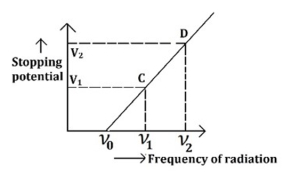
The graph shows the variation of stopping potential with the frequency of incident radiation on a metal plate. The value of Planck's constant is [$e=$ charge on photoelectron].
A
$\frac{e(V_2-V_1)}{\nu_2-\nu_1}$
B
$\frac{e(V_2-V_1)}{\nu_2+\nu_1}$
C
$\frac{e(V_1+V_2)}{\nu_2-\nu_1}$
D
$\frac{e(V_1-V_2)}{\nu_2-\nu_1}$
Solution
(A) According to Einstein's photoelectric equation,the stopping potential $V_s$ is related to the frequency $\nu$ of incident radiation by the equation:
$eV_s = h\nu - \phi$
where $h$ is Planck's constant,$e$ is the charge of an electron,and $\phi$ is the work function of the metal.
Rearranging for $V_s$,we get:
$V_s = \frac{h}{e}\nu - \frac{\phi}{e}$
This is the equation of a straight line $y = mx + c$,where the slope $m = \frac{h}{e}$.
From the given graph,the slope of the line can be calculated using two points $( \nu_1, V_1 )$ and $( \nu_2, V_2 )$:
Slope $= \frac{V_2 - V_1}{\nu_2 - \nu_1}$
Equating the two expressions for the slope:
$\frac{h}{e} = \frac{V_2 - V_1}{\nu_2 - \nu_1}$
Therefore,the value of Planck's constant $h$ is:
$h = \frac{e(V_2 - V_1)}{\nu_2 - \nu_1}$
$eV_s = h\nu - \phi$
where $h$ is Planck's constant,$e$ is the charge of an electron,and $\phi$ is the work function of the metal.
Rearranging for $V_s$,we get:
$V_s = \frac{h}{e}\nu - \frac{\phi}{e}$
This is the equation of a straight line $y = mx + c$,where the slope $m = \frac{h}{e}$.
From the given graph,the slope of the line can be calculated using two points $( \nu_1, V_1 )$ and $( \nu_2, V_2 )$:
Slope $= \frac{V_2 - V_1}{\nu_2 - \nu_1}$
Equating the two expressions for the slope:
$\frac{h}{e} = \frac{V_2 - V_1}{\nu_2 - \nu_1}$
Therefore,the value of Planck's constant $h$ is:
$h = \frac{e(V_2 - V_1)}{\nu_2 - \nu_1}$
0 likes
View Solution512
MediumMCQ
When a metal surface is illuminated by light of wavelength $\lambda_1$ and $\lambda_2$,the maximum velocities of photoelectrons ejected are $V$ and $2V$ respectively. The work function of the metal is ($h=$ Planck's constant,$c=$ velocity of light,$\lambda_1 > \lambda_2$).
A
$\frac{hc}{2 \lambda_1 \lambda_2}(\lambda_1 - \lambda_2)$
B
$\frac{hc}{\lambda_1 \lambda_2}(\lambda_1 - \lambda_2)$
C
$\frac{hc}{\lambda_1 \lambda_2}(\lambda_1 + \lambda_2)$
D
$\frac{hc}{3 \lambda_1 \lambda_2}(4 \lambda_2 - \lambda_1)$
Solution
(D) According to Einstein's photoelectric equation: $\frac{hc}{\lambda} = \Phi + K_{max}$,where $\Phi$ is the work function and $K_{max} = \frac{1}{2}mv^2$.
For wavelength $\lambda_1$ with velocity $V$: $\frac{hc}{\lambda_1} = \Phi + \frac{1}{2}mV^2$ --- $(1)$
For wavelength $\lambda_2$ with velocity $2V$: $\frac{hc}{\lambda_2} = \Phi + \frac{1}{2}m(2V)^2 = \Phi + 2mV^2$ --- $(2)$
From $(1)$,$\frac{1}{2}mV^2 = \frac{hc}{\lambda_1} - \Phi$. Multiplying by $4$,we get $2mV^2 = \frac{4hc}{\lambda_1} - 4\Phi$.
Substitute this into $(2)$: $\frac{hc}{\lambda_2} = \Phi + \frac{4hc}{\lambda_1} - 4\Phi$.
$\frac{hc}{\lambda_2} = \frac{4hc}{\lambda_1} - 3\Phi$.
$3\Phi = \frac{4hc}{\lambda_1} - \frac{hc}{\lambda_2} = hc \left( \frac{4\lambda_2 - \lambda_1}{\lambda_1 \lambda_2} \right)$.
$\Phi = \frac{hc}{3 \lambda_1 \lambda_2} (4 \lambda_2 - \lambda_1)$.
For wavelength $\lambda_1$ with velocity $V$: $\frac{hc}{\lambda_1} = \Phi + \frac{1}{2}mV^2$ --- $(1)$
For wavelength $\lambda_2$ with velocity $2V$: $\frac{hc}{\lambda_2} = \Phi + \frac{1}{2}m(2V)^2 = \Phi + 2mV^2$ --- $(2)$
From $(1)$,$\frac{1}{2}mV^2 = \frac{hc}{\lambda_1} - \Phi$. Multiplying by $4$,we get $2mV^2 = \frac{4hc}{\lambda_1} - 4\Phi$.
Substitute this into $(2)$: $\frac{hc}{\lambda_2} = \Phi + \frac{4hc}{\lambda_1} - 4\Phi$.
$\frac{hc}{\lambda_2} = \frac{4hc}{\lambda_1} - 3\Phi$.
$3\Phi = \frac{4hc}{\lambda_1} - \frac{hc}{\lambda_2} = hc \left( \frac{4\lambda_2 - \lambda_1}{\lambda_1 \lambda_2} \right)$.
$\Phi = \frac{hc}{3 \lambda_1 \lambda_2} (4 \lambda_2 - \lambda_1)$.
0 likes
View Solution513
MediumMCQ
If the frequency of incident light in a photoelectric experiment is doubled,then the stopping potential will
A
be doubled.
B
be halved.
C
become more than double.
D
become less than double.
Solution
(C) According to Einstein's photoelectric equation,the maximum kinetic energy $K_{max}$ of the emitted photoelectrons is given by $K_{max} = h\nu - \phi$,where $h$ is Planck's constant,$\nu$ is the frequency of incident light,and $\phi$ is the work function of the metal.
Since the stopping potential $V_s$ is related to the maximum kinetic energy by $K_{max} = eV_s$,we have $eV_s = h\nu - \phi$,or $V_s = \frac{h\nu}{e} - \frac{\phi}{e}$.
Initially,let the frequency be $\nu_1$ and stopping potential be $V_{s1} = \frac{h\nu_1}{e} - \frac{\phi}{e}$.
When the frequency is doubled,$\nu_2 = 2\nu_1$,the new stopping potential is $V_{s2} = \frac{h(2\nu_1)}{e} - \frac{\phi}{e} = \frac{2h\nu_1}{e} - \frac{\phi}{e}$.
Comparing $V_{s2}$ with $V_{s1}$,we see that $V_{s2} = 2V_{s1} + \frac{\phi}{e}$.
Since $\frac{\phi}{e} > 0$,it follows that $V_{s2} > 2V_{s1}$.
Therefore,the stopping potential becomes more than double.
Since the stopping potential $V_s$ is related to the maximum kinetic energy by $K_{max} = eV_s$,we have $eV_s = h\nu - \phi$,or $V_s = \frac{h\nu}{e} - \frac{\phi}{e}$.
Initially,let the frequency be $\nu_1$ and stopping potential be $V_{s1} = \frac{h\nu_1}{e} - \frac{\phi}{e}$.
When the frequency is doubled,$\nu_2 = 2\nu_1$,the new stopping potential is $V_{s2} = \frac{h(2\nu_1)}{e} - \frac{\phi}{e} = \frac{2h\nu_1}{e} - \frac{\phi}{e}$.
Comparing $V_{s2}$ with $V_{s1}$,we see that $V_{s2} = 2V_{s1} + \frac{\phi}{e}$.
Since $\frac{\phi}{e} > 0$,it follows that $V_{s2} > 2V_{s1}$.
Therefore,the stopping potential becomes more than double.
0 likes
View Solution514
MediumMCQ
Light of incident frequency $3$ times the threshold frequency is incident on a photosensitive material. If the incident frequency is made $\left(\frac{1}{4}\right)^{\text{th}}$ and intensity is tripled,then the photoelectric current will
A
increase
B
decrease
C
be $\left(\frac{1}{3}\right)^{\text{rd}}$
D
be zero
Solution
(D) The threshold frequency of the material is $\nu_0$. The initial incident frequency is $\nu_1 = 3\nu_0$.
When the incident frequency is changed to $\nu_2 = \frac{1}{4} \nu_1 = \frac{1}{4} (3\nu_0) = 0.75 \nu_0$.
For the photoelectric effect to occur,the incident frequency must be greater than or equal to the threshold frequency $(\nu \ge \nu_0)$.
Since the new frequency $\nu_2 = 0.75 \nu_0$ is less than the threshold frequency $\nu_0$,no photoelectrons will be emitted regardless of the intensity of the incident light.
Therefore,the photoelectric current will be zero.
When the incident frequency is changed to $\nu_2 = \frac{1}{4} \nu_1 = \frac{1}{4} (3\nu_0) = 0.75 \nu_0$.
For the photoelectric effect to occur,the incident frequency must be greater than or equal to the threshold frequency $(\nu \ge \nu_0)$.
Since the new frequency $\nu_2 = 0.75 \nu_0$ is less than the threshold frequency $\nu_0$,no photoelectrons will be emitted regardless of the intensity of the incident light.
Therefore,the photoelectric current will be zero.
0 likes
View Solution515
MediumMCQ
Energy of the incident photons on the metal surface is initially $4W$ and then $6W$,where $W$ is the work function of that metal. The ratio of the maximum velocities of the emitted photoelectrons is:
A
$\sqrt{3}: \sqrt{5}$
B
$1: 2$
C
$2: 3$
D
$\sqrt{2}: \sqrt{3}$
Solution
(A) According to Einstein's photoelectric equation,the maximum kinetic energy $K_{max}$ of the emitted photoelectrons is given by $K_{max} = E - W$,where $E$ is the energy of the incident photon and $W$ is the work function.
Case $1$: $E_1 = 4W$.
$K_1 = 4W - W = 3W$.
Since $K = \frac{1}{2}mv^2$,we have $\frac{1}{2}mv_1^2 = 3W$,so $v_1 = \sqrt{\frac{6W}{m}}$.
Case $2$: $E_2 = 6W$.
$K_2 = 6W - W = 5W$.
Similarly,$\frac{1}{2}mv_2^2 = 5W$,so $v_2 = \sqrt{\frac{10W}{m}}$.
The ratio of velocities is $\frac{v_1}{v_2} = \frac{\sqrt{6W/m}}{\sqrt{10W/m}} = \sqrt{\frac{6}{10}} = \sqrt{\frac{3}{5}} = \sqrt{3}: \sqrt{5}$.
Case $1$: $E_1 = 4W$.
$K_1 = 4W - W = 3W$.
Since $K = \frac{1}{2}mv^2$,we have $\frac{1}{2}mv_1^2 = 3W$,so $v_1 = \sqrt{\frac{6W}{m}}$.
Case $2$: $E_2 = 6W$.
$K_2 = 6W - W = 5W$.
Similarly,$\frac{1}{2}mv_2^2 = 5W$,so $v_2 = \sqrt{\frac{10W}{m}}$.
The ratio of velocities is $\frac{v_1}{v_2} = \frac{\sqrt{6W/m}}{\sqrt{10W/m}} = \sqrt{\frac{6}{10}} = \sqrt{\frac{3}{5}} = \sqrt{3}: \sqrt{5}$.
0 likes
View Solution516
MediumMCQ
$A$ photosensitive surface has work function $\phi$. If a photon of energy $3 \phi$ falls on this surface, the electron comes out with a maximum velocity of $4 \times 10^6 \,m/s$. When the photon energy is increased to $7 \phi$, the maximum velocity of the photoelectron will be:
A
$4 \sqrt{2} \times 10^6 \,m/s$
B
$8 \times 10^6 \,m/s$
C
$4 \sqrt{3} \times 10^6 \,m/s$
D
$2 \sqrt{3} \times 10^6 \,m/s$
Solution
(C) According to Einstein's photoelectric equation, the maximum kinetic energy $K_{max}$ is given by $K_{max} = E - \phi$, where $E$ is the incident photon energy and $\phi$ is the work function.
For the first case: $E_1 = 3\phi$. Thus, $K_{max1} = 3\phi - \phi = 2\phi$.
We know $K_{max} = \frac{1}{2}mv^2$, so $\frac{1}{2}mv_1^2 = 2\phi$ --- $(1)$.
For the second case: $E_2 = 7\phi$. Thus, $K_{max2} = 7\phi - \phi = 6\phi$.
So, $\frac{1}{2}mv_2^2 = 6\phi$ --- $(2)$.
Dividing equation $(2)$ by equation $(1)$: $\frac{v_2^2}{v_1^2} = \frac{6\phi}{2\phi} = 3$.
Therefore, $v_2 = v_1 \sqrt{3}$.
Given $v_1 = 4 \times 10^6 \,m/s$, we get $v_2 = 4 \sqrt{3} \times 10^6 \,m/s$.
For the first case: $E_1 = 3\phi$. Thus, $K_{max1} = 3\phi - \phi = 2\phi$.
We know $K_{max} = \frac{1}{2}mv^2$, so $\frac{1}{2}mv_1^2 = 2\phi$ --- $(1)$.
For the second case: $E_2 = 7\phi$. Thus, $K_{max2} = 7\phi - \phi = 6\phi$.
So, $\frac{1}{2}mv_2^2 = 6\phi$ --- $(2)$.
Dividing equation $(2)$ by equation $(1)$: $\frac{v_2^2}{v_1^2} = \frac{6\phi}{2\phi} = 3$.
Therefore, $v_2 = v_1 \sqrt{3}$.
Given $v_1 = 4 \times 10^6 \,m/s$, we get $v_2 = 4 \sqrt{3} \times 10^6 \,m/s$.
0 likes
View Solution517
DifficultMCQ
The work functions of metal $A$ and $B$ are in the ratio $1: 2$. If light of frequency $f$ and $2f$ is incident on surface $A$ and $B$ respectively,then the ratio of the maximum kinetic energies of the emitted photoelectrons is:
A
$1: 1$
B
$1: 2$
C
$1: 3$
D
$1: 4$
Solution
(B) According to Einstein's photoelectric equation,the maximum kinetic energy $K_{\max}$ is given by $K_{\max} = h\nu - \phi$,where $h\nu$ is the energy of the incident photon and $\phi$ is the work function of the metal.
For metal $A$: $K_{A} = hf - \phi_A$
For metal $B$: $K_{B} = h(2f) - \phi_B = 2hf - \phi_B$
Given the ratio of work functions $\frac{\phi_A}{\phi_B} = \frac{1}{2}$,we have $\phi_B = 2\phi_A$.
Substituting this into the expression for $K_B$: $K_B = 2hf - 2\phi_A = 2(hf - \phi_A)$.
Now,the ratio of kinetic energies is $\frac{K_A}{K_B} = \frac{hf - \phi_A}{2(hf - \phi_A)} = \frac{1}{2}$.
For metal $A$: $K_{A} = hf - \phi_A$
For metal $B$: $K_{B} = h(2f) - \phi_B = 2hf - \phi_B$
Given the ratio of work functions $\frac{\phi_A}{\phi_B} = \frac{1}{2}$,we have $\phi_B = 2\phi_A$.
Substituting this into the expression for $K_B$: $K_B = 2hf - 2\phi_A = 2(hf - \phi_A)$.
Now,the ratio of kinetic energies is $\frac{K_A}{K_B} = \frac{hf - \phi_A}{2(hf - \phi_A)} = \frac{1}{2}$.
0 likes
View Solution518
MediumMCQ
When a metallic surface is illuminated with radiation of wavelength $\lambda$,the stopping potential is $V$. If the same surface is illuminated with radiation of wavelength $3\lambda$,the stopping potential is $\frac{V}{6}$. The threshold wavelength for the surface is:
A
$3\lambda$
B
$4\lambda$
C
$5\lambda$
D
$6\lambda$
Solution
(C) According to Einstein's photoelectric equation,$K_{max} = eV_0 = \frac{hc}{\lambda} - \frac{hc}{\lambda_0}$,where $\lambda_0$ is the threshold wavelength.
For the first case: $\frac{hc}{\lambda} - \frac{hc}{\lambda_0} = eV$ $(i)$
For the second case: $\frac{hc}{3\lambda} - \frac{hc}{\lambda_0} = e\left(\frac{V}{6}\right)$ (ii)
Dividing equation $(i)$ by equation (ii):
$\frac{\frac{hc}{\lambda} - \frac{hc}{\lambda_0}}{\frac{hc}{3\lambda} - \frac{hc}{\lambda_0}} = \frac{eV}{eV/6} = 6$
$\frac{1}{\lambda} - \frac{1}{\lambda_0} = 6 \left( \frac{1}{3\lambda} - \frac{1}{\lambda_0} \right)$
$\frac{1}{\lambda} - \frac{1}{\lambda_0} = \frac{2}{\lambda} - \frac{6}{\lambda_0}$
$\frac{6}{\lambda_0} - \frac{1}{\lambda_0} = \frac{2}{\lambda} - \frac{1}{\lambda}$
$\frac{5}{\lambda_0} = \frac{1}{\lambda}$
$\lambda_0 = 5\lambda$
For the first case: $\frac{hc}{\lambda} - \frac{hc}{\lambda_0} = eV$ $(i)$
For the second case: $\frac{hc}{3\lambda} - \frac{hc}{\lambda_0} = e\left(\frac{V}{6}\right)$ (ii)
Dividing equation $(i)$ by equation (ii):
$\frac{\frac{hc}{\lambda} - \frac{hc}{\lambda_0}}{\frac{hc}{3\lambda} - \frac{hc}{\lambda_0}} = \frac{eV}{eV/6} = 6$
$\frac{1}{\lambda} - \frac{1}{\lambda_0} = 6 \left( \frac{1}{3\lambda} - \frac{1}{\lambda_0} \right)$
$\frac{1}{\lambda} - \frac{1}{\lambda_0} = \frac{2}{\lambda} - \frac{6}{\lambda_0}$
$\frac{6}{\lambda_0} - \frac{1}{\lambda_0} = \frac{2}{\lambda} - \frac{1}{\lambda}$
$\frac{5}{\lambda_0} = \frac{1}{\lambda}$
$\lambda_0 = 5\lambda$
0 likes
View Solution519
EasyMCQ
The stopping potential for a photoelectric emission process is $10 \ V$. The maximum kinetic energy of the electrons ejected in the process is [Charge on electron $e = 1.6 \times 10^{-19} \ C$]
A
$3.2 \times 10^{-19} \ J$
B
$1.6 \times 10^{-19} \ J$
C
$1.6 \times 10^{-18} \ J$
D
$0 \ J$
Solution
(C) The maximum kinetic energy $(K.E.)_{\max}$ of the ejected electrons is related to the stopping potential $V_s$ by the equation:
$(K.E.)_{\max} = e V_s$
Given that the stopping potential $V_s = 10 \ V$ and the charge of an electron $e = 1.6 \times 10^{-19} \ C$,we substitute these values into the equation:
$(K.E.)_{\max} = (1.6 \times 10^{-19} \ C) \times (10 \ V)$
$(K.E.)_{\max} = 1.6 \times 10^{-18} \ J$
Therefore,the maximum kinetic energy is $1.6 \times 10^{-18} \ J$.
$(K.E.)_{\max} = e V_s$
Given that the stopping potential $V_s = 10 \ V$ and the charge of an electron $e = 1.6 \times 10^{-19} \ C$,we substitute these values into the equation:
$(K.E.)_{\max} = (1.6 \times 10^{-19} \ C) \times (10 \ V)$
$(K.E.)_{\max} = 1.6 \times 10^{-18} \ J$
Therefore,the maximum kinetic energy is $1.6 \times 10^{-18} \ J$.
0 likes
View Solution520
DifficultMCQ
When photons of energy $h \nu$ fall on a photosensitive surface of work function $E_0$,photoelectrons of maximum kinetic energy $k$ are emitted. If the frequency of radiation is doubled,the maximum kinetic energy will be equal to ($h=$ Planck's constant).
A
$k$
B
$2k$
C
$k+E_0$
D
$k+h\nu$
Solution
(D) According to Einstein's photoelectric equation,the maximum kinetic energy $k$ is given by:
$k = h\nu - E_0$
From this,we can express the work function $E_0$ as:
$E_0 = h\nu - k$
When the frequency of the incident radiation is doubled $(2\nu)$,let the new maximum kinetic energy be $k'$. The new equation becomes:
$k' = h(2\nu) - E_0$
Substituting the value of $E_0$ into the equation:
$k' = 2h\nu - (h\nu - k)$
$k' = 2h\nu - h\nu + k$
$k' = h\nu + k$
$k = h\nu - E_0$
From this,we can express the work function $E_0$ as:
$E_0 = h\nu - k$
When the frequency of the incident radiation is doubled $(2\nu)$,let the new maximum kinetic energy be $k'$. The new equation becomes:
$k' = h(2\nu) - E_0$
Substituting the value of $E_0$ into the equation:
$k' = 2h\nu - (h\nu - k)$
$k' = 2h\nu - h\nu + k$
$k' = h\nu + k$
0 likes
View Solution521
EasyMCQ
The frequency of incident light falling on a photosensitive material is doubled. The kinetic energy $(K.E.)$ of the emitted photoelectrons will be:
A
unchanged.
B
two times its initial value.
C
more than two times its initial value.
D
less than two times its initial value.
Solution
(C) According to Einstein's photoelectric equation,the maximum kinetic energy is given by $K.E_{\max} = h\nu - W$,where $h\nu$ is the energy of the incident photon and $W$ is the work function of the material.
Initially,$K_1 = h\nu - W$.
When the frequency is doubled,the new frequency becomes $2\nu$. The new maximum kinetic energy $K_2$ is:
$K_2 = h(2\nu) - W = 2h\nu - W$.
We can rewrite this as:
$K_2 = 2(h\nu - W) + W = 2K_1 + W$.
Since the work function $W$ is a positive constant,$K_2 > 2K_1$.
Therefore,the kinetic energy of the emitted photoelectrons will be more than two times its initial value.
Initially,$K_1 = h\nu - W$.
When the frequency is doubled,the new frequency becomes $2\nu$. The new maximum kinetic energy $K_2$ is:
$K_2 = h(2\nu) - W = 2h\nu - W$.
We can rewrite this as:
$K_2 = 2(h\nu - W) + W = 2K_1 + W$.
Since the work function $W$ is a positive constant,$K_2 > 2K_1$.
Therefore,the kinetic energy of the emitted photoelectrons will be more than two times its initial value.
0 likes
View Solution522
EasyMCQ
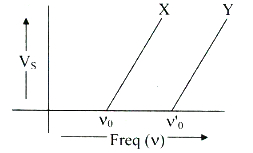
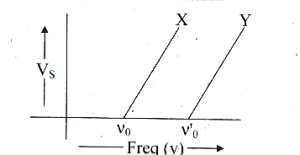
The graph of stopping potential $V_s$ against frequency $\nu$ of incident radiation is plotted for two different metals $X$ and $Y$ as shown in the graph. If $\phi_x$ and $\phi_y$ are the work functions of $X$ and $Y$,respectively,then:
A
$\phi_x = \phi_y$
B
$\phi_x < \phi_y$
C
$\phi_x > \phi_y$
D
$\phi_x = \phi_y = 0$
Solution
(B) According to Einstein's photoelectric equation,the stopping potential $V_s$ is given by:
$e V_s = h \nu - \phi$
$V_s = \frac{h}{e} \nu - \frac{\phi}{e}$
Comparing this with the equation of a straight line $y = mx + c$,the intercept on the frequency axis (where $V_s = 0$) is the threshold frequency $\nu_0$,given by $\nu_0 = \frac{\phi}{h}$,which implies $\phi = h \nu_0$.
From the graph,it is clear that the threshold frequency for metal $X$ $(\nu_0)$ is less than the threshold frequency for metal $Y$ $(\nu_0^{\prime})$,i.e.,$\nu_0 < \nu_0^{\prime}$.
Since the work function $\phi$ is directly proportional to the threshold frequency $\nu_0$,we have $\phi_x < \phi_y$.
$e V_s = h \nu - \phi$
$V_s = \frac{h}{e} \nu - \frac{\phi}{e}$
Comparing this with the equation of a straight line $y = mx + c$,the intercept on the frequency axis (where $V_s = 0$) is the threshold frequency $\nu_0$,given by $\nu_0 = \frac{\phi}{h}$,which implies $\phi = h \nu_0$.
From the graph,it is clear that the threshold frequency for metal $X$ $(\nu_0)$ is less than the threshold frequency for metal $Y$ $(\nu_0^{\prime})$,i.e.,$\nu_0 < \nu_0^{\prime}$.
Since the work function $\phi$ is directly proportional to the threshold frequency $\nu_0$,we have $\phi_x < \phi_y$.
0 likes
View Solution523
EasyMCQ
For a photosensitive material,the work function is $W_0$ and the stopping potential is $V$. What is the wavelength of the incident radiation? ($h=$ Planck's constant,$c=$ velocity of light,$e=$ electronic charge)
A
$\frac{h^2 c^2}{W_0+eV}$
B
$\frac{hc}{W_0}$
C
$\frac{hcV}{W_0}$
D
$\frac{hc}{W_0+eV}$
Solution
(D) According to Einstein's photoelectric equation,the maximum kinetic energy $K_{max}$ of emitted photoelectrons is given by:
$K_{max} = \frac{hc}{\lambda} - W_0$
We also know that the maximum kinetic energy is related to the stopping potential $V$ by the equation:
$K_{max} = eV$
Equating the two expressions for $K_{max}$:
$eV = \frac{hc}{\lambda} - W_0$
Rearranging the equation to solve for $\lambda$:
$\frac{hc}{\lambda} = W_0 + eV$
$\lambda = \frac{hc}{W_0 + eV}$
$K_{max} = \frac{hc}{\lambda} - W_0$
We also know that the maximum kinetic energy is related to the stopping potential $V$ by the equation:
$K_{max} = eV$
Equating the two expressions for $K_{max}$:
$eV = \frac{hc}{\lambda} - W_0$
Rearranging the equation to solve for $\lambda$:
$\frac{hc}{\lambda} = W_0 + eV$
$\lambda = \frac{hc}{W_0 + eV}$
0 likes
View Solution524
MediumMCQ
The threshold frequency of a metal is $F_0$. When light of frequency $2F_0$ is incident on the metal plate,the maximum velocity of the photoelectrons is $V_1$. When the frequency of incident radiation is increased to $5F_0$,the maximum velocity of the photoelectrons emitted is $V_2$. The ratio of $V_1$ to $V_2$ is:
A
$1:8$
B
$1:16$
C
$1:4$
D
$1:2$
Solution
(D) According to Einstein's photoelectric equation,the maximum kinetic energy is given by $K.E._{\max} = hF - \Phi$,where $\Phi = hF_0$ is the work function.
Case $1$: When incident frequency $F = 2F_0$,
$\frac{1}{2}mV_1^2 = h(2F_0) - hF_0 = hF_0$
Case $2$: When incident frequency $F = 5F_0$,
$\frac{1}{2}mV_2^2 = h(5F_0) - hF_0 = 4hF_0$
Dividing the two equations:
$\frac{V_1^2}{V_2^2} = \frac{hF_0}{4hF_0} = \frac{1}{4}$
Taking the square root on both sides:
$\frac{V_1}{V_2} = \sqrt{\frac{1}{4}} = \frac{1}{2}$
Case $1$: When incident frequency $F = 2F_0$,
$\frac{1}{2}mV_1^2 = h(2F_0) - hF_0 = hF_0$
Case $2$: When incident frequency $F = 5F_0$,
$\frac{1}{2}mV_2^2 = h(5F_0) - hF_0 = 4hF_0$
Dividing the two equations:
$\frac{V_1^2}{V_2^2} = \frac{hF_0}{4hF_0} = \frac{1}{4}$
Taking the square root on both sides:
$\frac{V_1}{V_2} = \sqrt{\frac{1}{4}} = \frac{1}{2}$
0 likes
View Solution525
EasyMCQ
$A$ photosensitive metallic surface has a work function $\phi$. If a photon of energy $3 \phi$ falls on the surface,the electron is emitted with a maximum velocity of $6 \times 10^6 \ m/s$. When the photon energy is increased to $9 \phi$,the maximum velocity of the photoelectrons will be:
A
$12 \times 10^6 \ m/s$
B
$6 \times 10^6 \ m/s$
C
$3 \times 10^6 \ m/s$
D
$24 \times 10^6 \ m/s$
Solution
(A) According to Einstein's photoelectric equation,the maximum kinetic energy is given by $K.E_{\max} = E - \phi$.
For the first case,$E_1 = 3\phi$,so $K.E_1 = 3\phi - \phi = 2\phi$.
For the second case,$E_2 = 9\phi$,so $K.E_2 = 9\phi - \phi = 8\phi$.
Since $K.E = \frac{1}{2}mv^2$,we have the ratio $\frac{K.E_1}{K.E_2} = \frac{v_1^2}{v_2^2}$.
Substituting the values,$\frac{2\phi}{8\phi} = \frac{1}{4} = \frac{v_1^2}{v_2^2}$.
Taking the square root,$\frac{v_1}{v_2} = \frac{1}{2}$,which implies $v_2 = 2v_1$.
Given $v_1 = 6 \times 10^6 \ m/s$,then $v_2 = 2 \times 6 \times 10^6 = 12 \times 10^6 \ m/s$.
For the first case,$E_1 = 3\phi$,so $K.E_1 = 3\phi - \phi = 2\phi$.
For the second case,$E_2 = 9\phi$,so $K.E_2 = 9\phi - \phi = 8\phi$.
Since $K.E = \frac{1}{2}mv^2$,we have the ratio $\frac{K.E_1}{K.E_2} = \frac{v_1^2}{v_2^2}$.
Substituting the values,$\frac{2\phi}{8\phi} = \frac{1}{4} = \frac{v_1^2}{v_2^2}$.
Taking the square root,$\frac{v_1}{v_2} = \frac{1}{2}$,which implies $v_2 = 2v_1$.
Given $v_1 = 6 \times 10^6 \ m/s$,then $v_2 = 2 \times 6 \times 10^6 = 12 \times 10^6 \ m/s$.
0 likes
View Solution526
DifficultMCQ
Two identical photocathodes receive light of frequencies $n_1$ and $n_2$. If the velocities of the emitted photoelectrons of mass $m$ are $V_1$ and $V_2$ respectively,then ($h=$ Planck's constant):
A
$V_1+V_2=\left[\frac{2h}{m}(n_1+n_2)\right]^{1/2}$
B
$V_1-V_2=\left[\frac{2h}{m}(n_1-n_2)\right]^{1/2}$
C
$V_1^2+V_2^2=\frac{2h}{m}(n_1+n_2)$
D
$V_1^2-V_2^2=\frac{2h}{m}(n_1-n_2)$
Solution
(D) According to Einstein's photoelectric equation,the maximum kinetic energy of emitted photoelectrons is given by $K.E. = h n - \phi$,where $\phi$ is the work function of the metal.
For the first photocathode: $\frac{1}{2}mV_1^2 = hn_1 - \phi$ $(1)$
For the second photocathode: $\frac{1}{2}mV_2^2 = hn_2 - \phi$ $(2)$
Subtracting equation $(2)$ from equation $(1)$:
$\frac{1}{2}mV_1^2 - \frac{1}{2}mV_2^2 = (hn_1 - \phi) - (hn_2 - \phi)$
$\frac{1}{2}m(V_1^2 - V_2^2) = h(n_1 - n_2)$
$V_1^2 - V_2^2 = \frac{2h}{m}(n_1 - n_2)$
For the first photocathode: $\frac{1}{2}mV_1^2 = hn_1 - \phi$ $(1)$
For the second photocathode: $\frac{1}{2}mV_2^2 = hn_2 - \phi$ $(2)$
Subtracting equation $(2)$ from equation $(1)$:
$\frac{1}{2}mV_1^2 - \frac{1}{2}mV_2^2 = (hn_1 - \phi) - (hn_2 - \phi)$
$\frac{1}{2}m(V_1^2 - V_2^2) = h(n_1 - n_2)$
$V_1^2 - V_2^2 = \frac{2h}{m}(n_1 - n_2)$
0 likes
View Solution527
EasyMCQ
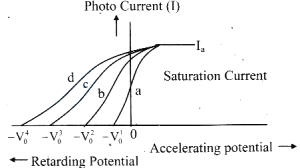
The figure shows the variation of photocurrent with anode potential for four different radiations. Let $f_a$,$f_b$,$f_c$ and $f_d$ be the frequencies for the curves $a$,$b$,$c$ and $d$ respectively.
A
$f_a > f_b > f_c > f_d$
B
$f_a < f_b < f_c < f_d$
C
$f_a > f_b < f_c = f_d$
D
$f_a = f_b > f_c > f_d$
Solution
(A) According to Einstein's photoelectric equation,the stopping potential $V_0$ is related to the frequency $f$ of the incident radiation by the equation: $eV_0 = hf - \Phi$,where $e$ is the charge of an electron,$h$ is Planck's constant,and $\Phi$ is the work function of the metal.
From the graph,the stopping potentials are $|V_0^1| < |V_0^2| < |V_0^3| < |V_0^4|$.
Since the stopping potential $V_0$ is directly proportional to the frequency $f$ for a given metal,a larger magnitude of stopping potential corresponds to a higher frequency of incident radiation.
Therefore,the order of frequencies is $f_a > f_b > f_c > f_d$.
From the graph,the stopping potentials are $|V_0^1| < |V_0^2| < |V_0^3| < |V_0^4|$.
Since the stopping potential $V_0$ is directly proportional to the frequency $f$ for a given metal,a larger magnitude of stopping potential corresponds to a higher frequency of incident radiation.
Therefore,the order of frequencies is $f_a > f_b > f_c > f_d$.
0 likes
View Solution528
EasyMCQ
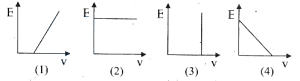
Using Einstein's photoelectric equation,the graph between the maximum kinetic energy $(K_{max})$ of emitted photoelectrons and the frequency $(v)$ of incident radiation is shown correctly by which graph?
A
Graph $(1)$
B
Graph $(2)$
C
Graph $(3)$
D
Graph $(4)$
Solution
(A) According to Einstein's photoelectric equation,the maximum kinetic energy of emitted photoelectrons is given by: $K_{max} = hv - \phi$,where $h$ is Planck's constant,$v$ is the frequency of incident radiation,and $\phi$ is the work function of the metal.
Comparing this equation with the equation of a straight line,$y = mx + c$,we have $y = K_{max}$,$x = v$,slope $m = h$,and intercept $c = -\phi$.
Since the slope $h$ is positive and the intercept $-\phi$ is negative,the graph is a straight line starting from a threshold frequency $v_0$ (where $K_{max} = 0$) and increasing linearly with frequency $v$.
This corresponds to graph $(1)$.
Comparing this equation with the equation of a straight line,$y = mx + c$,we have $y = K_{max}$,$x = v$,slope $m = h$,and intercept $c = -\phi$.
Since the slope $h$ is positive and the intercept $-\phi$ is negative,the graph is a straight line starting from a threshold frequency $v_0$ (where $K_{max} = 0$) and increasing linearly with frequency $v$.
This corresponds to graph $(1)$.
0 likes
View Solution529
EasyMCQ
When a photosensitive surface is irradiated by light of wavelengths $\lambda_1$ and $\lambda_2$,the kinetic energies of the emitted photoelectrons are $E_1$ and $E_2$ respectively. The work function of the photosensitive surface is:
A
$\frac{(E_2 \lambda_2 - E_1 \lambda_1)}{(\lambda_2 - \lambda_1)}$
B
$\frac{(E_1 \lambda_1 + E_2 \lambda_2)}{(\lambda_2 - \lambda_1)}$
C
$\frac{(E_1 \lambda_1 - E_2 \lambda_2)}{(\lambda_2 - \lambda_1)}$
D
$\frac{(E_2 \lambda_2 + E_1 \lambda_1)}{(\lambda_1 - \lambda_2)}$
Solution
(C) According to Einstein's photoelectric equation,the kinetic energy $E$ of an emitted photoelectron is given by $E = \frac{hc}{\lambda} - W_0$,where $W_0$ is the work function.
For wavelength $\lambda_1$,$E_1 = \frac{hc}{\lambda_1} - W_0 \implies E_1 \lambda_1 = hc - W_0 \lambda_1 \implies hc = E_1 \lambda_1 + W_0 \lambda_1$ ... $(i)$
For wavelength $\lambda_2$,$E_2 = \frac{hc}{\lambda_2} - W_0 \implies E_2 \lambda_2 = hc - W_0 \lambda_2 \implies hc = E_2 \lambda_2 + W_0 \lambda_2$ ... (ii)
Equating $(i)$ and (ii):
$E_1 \lambda_1 + W_0 \lambda_1 = E_2 \lambda_2 + W_0 \lambda_2$
$E_1 \lambda_1 - E_2 \lambda_2 = W_0 \lambda_2 - W_0 \lambda_1$
$E_1 \lambda_1 - E_2 \lambda_2 = W_0 (\lambda_2 - \lambda_1)$
$W_0 = \frac{E_1 \lambda_1 - E_2 \lambda_2}{\lambda_2 - \lambda_1}$
For wavelength $\lambda_1$,$E_1 = \frac{hc}{\lambda_1} - W_0 \implies E_1 \lambda_1 = hc - W_0 \lambda_1 \implies hc = E_1 \lambda_1 + W_0 \lambda_1$ ... $(i)$
For wavelength $\lambda_2$,$E_2 = \frac{hc}{\lambda_2} - W_0 \implies E_2 \lambda_2 = hc - W_0 \lambda_2 \implies hc = E_2 \lambda_2 + W_0 \lambda_2$ ... (ii)
Equating $(i)$ and (ii):
$E_1 \lambda_1 + W_0 \lambda_1 = E_2 \lambda_2 + W_0 \lambda_2$
$E_1 \lambda_1 - E_2 \lambda_2 = W_0 \lambda_2 - W_0 \lambda_1$
$E_1 \lambda_1 - E_2 \lambda_2 = W_0 (\lambda_2 - \lambda_1)$
$W_0 = \frac{E_1 \lambda_1 - E_2 \lambda_2}{\lambda_2 - \lambda_1}$
0 likes
View Solution530
MediumMCQ
$A$ photoelectric surface is illuminated successively by monochromatic light of wavelength $\lambda$ and $\frac{\lambda}{2}$. If the maximum kinetic energy of the emitted photoelectrons in the first case is one-fourth that in the second case,the work function of the surface of the material is ($c=$ speed of light,$h=$ Planck's constant).
A
$\frac{2 hc}{\lambda}$
B
$\frac{hc}{\lambda}$
C
$\frac{2 hc}{3 \lambda}$
D
$\frac{hc}{3 \lambda}$
Solution
(C) According to Einstein's photoelectric equation,the maximum kinetic energy $E_k$ is given by $E_k = \frac{hc}{\lambda} - \phi$,where $\phi$ is the work function.
For the first case with wavelength $\lambda$:
$E_1 = \frac{hc}{\lambda} - \phi$ ... $(i)$
For the second case with wavelength $\frac{\lambda}{2}$:
$E_2 = \frac{hc}{\lambda/2} - \phi = \frac{2hc}{\lambda} - \phi$ ... (ii)
Given that $E_1 = \frac{1}{4} E_2$,which implies $4E_1 = E_2$ ... (iii)
Substituting $(i)$ and (ii) into (iii):
$4\left(\frac{hc}{\lambda} - \phi\right) = \frac{2hc}{\lambda} - \phi$
$\frac{4hc}{\lambda} - 4\phi = \frac{2hc}{\lambda} - \phi$
$\frac{4hc}{\lambda} - \frac{2hc}{\lambda} = 4\phi - \phi$
$\frac{2hc}{\lambda} = 3\phi$
$\phi = \frac{2hc}{3\lambda}$
For the first case with wavelength $\lambda$:
$E_1 = \frac{hc}{\lambda} - \phi$ ... $(i)$
For the second case with wavelength $\frac{\lambda}{2}$:
$E_2 = \frac{hc}{\lambda/2} - \phi = \frac{2hc}{\lambda} - \phi$ ... (ii)
Given that $E_1 = \frac{1}{4} E_2$,which implies $4E_1 = E_2$ ... (iii)
Substituting $(i)$ and (ii) into (iii):
$4\left(\frac{hc}{\lambda} - \phi\right) = \frac{2hc}{\lambda} - \phi$
$\frac{4hc}{\lambda} - 4\phi = \frac{2hc}{\lambda} - \phi$
$\frac{4hc}{\lambda} - \frac{2hc}{\lambda} = 4\phi - \phi$
$\frac{2hc}{\lambda} = 3\phi$
$\phi = \frac{2hc}{3\lambda}$
0 likes
View Solution531
EasyMCQ
If the frequency of incident radiation $(v)$ is increased,keeping other factors constant,the stopping potential ($v > v_0$,threshold frequency) will:
A
increase
B
decrease
C
remain constant
D
suddenly become zero
Solution
(A) According to Einstein's photoelectric equation,the maximum kinetic energy of emitted photoelectrons is given by $K_{max} = hv - W_0$,where $h$ is Planck's constant,$v$ is the frequency of incident radiation,and $W_0$ is the work function of the metal.
Since the stopping potential $V_s$ is related to the maximum kinetic energy by $eV_s = K_{max}$,we have $eV_s = hv - W_0$.
Rearranging for $V_s$,we get $V_s = \frac{h}{e}v - \frac{W_0}{e}$.
From this equation,it is clear that the stopping potential $V_s$ is directly proportional to the frequency $v$ of the incident radiation.
Therefore,if the frequency $v$ is increased,the stopping potential $V_s$ will also increase.
Since the stopping potential $V_s$ is related to the maximum kinetic energy by $eV_s = K_{max}$,we have $eV_s = hv - W_0$.
Rearranging for $V_s$,we get $V_s = \frac{h}{e}v - \frac{W_0}{e}$.
From this equation,it is clear that the stopping potential $V_s$ is directly proportional to the frequency $v$ of the incident radiation.
Therefore,if the frequency $v$ is increased,the stopping potential $V_s$ will also increase.
0 likes
View Solution532
MediumMCQ
$A$ photoelectric surface is illuminated successively by monochromatic light of wavelength $\lambda$ and $(\lambda / 3)$. If the maximum kinetic energy of the emitted photoelectrons in the second case is $4$ times that in the first case,the work function of the surface of the material is ($h=$ Planck's constant,$c=$ speed of light).
A
$\frac{hc}{\lambda}$
B
$\frac{hc}{2 \lambda}$
C
$\frac{hc}{3 \lambda}$
D
$\frac{3 hc}{\lambda}$
Solution
(C) According to Einstein's photoelectric equation,the maximum kinetic energy $K_{max}$ is given by $K_{max} = \frac{hc}{\lambda} - \phi$,where $\phi$ is the work function.
For the first case with wavelength $\lambda$:
$K_1 = \frac{hc}{\lambda} - \phi$ ... $(i)$
For the second case with wavelength $\lambda / 3$:
$K_2 = \frac{hc}{\lambda / 3} - \phi = \frac{3hc}{\lambda} - \phi$ ... $(ii)$
Given that $K_2 = 4K_1$,we substitute the expressions:
$\frac{3hc}{\lambda} - \phi = 4 \left( \frac{hc}{\lambda} - \phi \right)$
Expanding the equation:
$\frac{3hc}{\lambda} - \phi = \frac{4hc}{\lambda} - 4\phi$
Rearranging to solve for $\phi$:
$4\phi - \phi = \frac{4hc}{\lambda} - \frac{3hc}{\lambda}$
$3\phi = \frac{hc}{\lambda}$
$\phi = \frac{hc}{3\lambda}$
For the first case with wavelength $\lambda$:
$K_1 = \frac{hc}{\lambda} - \phi$ ... $(i)$
For the second case with wavelength $\lambda / 3$:
$K_2 = \frac{hc}{\lambda / 3} - \phi = \frac{3hc}{\lambda} - \phi$ ... $(ii)$
Given that $K_2 = 4K_1$,we substitute the expressions:
$\frac{3hc}{\lambda} - \phi = 4 \left( \frac{hc}{\lambda} - \phi \right)$
Expanding the equation:
$\frac{3hc}{\lambda} - \phi = \frac{4hc}{\lambda} - 4\phi$
Rearranging to solve for $\phi$:
$4\phi - \phi = \frac{4hc}{\lambda} - \frac{3hc}{\lambda}$
$3\phi = \frac{hc}{\lambda}$
$\phi = \frac{hc}{3\lambda}$
0 likes
View Solution533
MediumMCQ
In the case of the photoelectric effect,the graph of measured stopping potential $(V_0)$ against the frequency $(\nu)$ of incident light is a straight line. The slope of this line multiplied by the charge of an electron $(e)$ gives:
A
the work function of the metal.
B
the Planck's constant.
C
the maximum kinetic energy of the ejected electrons.
D
the threshold frequency for photoejection from the metal.
Solution
(B) According to Einstein's photoelectric equation,the maximum kinetic energy $(K_{max})$ is given by: $K_{max} = h\nu - \Phi_0$,where $\Phi_0$ is the work function.
Since $K_{max} = eV_0$,we can write: $eV_0 = h\nu - \Phi_0$.
Dividing by $e$,we get: $V_0 = (\frac{h}{e})\nu - \frac{\Phi_0}{e}$.
Comparing this with the equation of a straight line $y = mx + c$,where $y = V_0$ and $x = \nu$,the slope $(m)$ is $\frac{h}{e}$.
Multiplying the slope by the charge of the electron $(e)$,we get: $m \times e = (\frac{h}{e}) \times e = h$.
Thus,the product gives the Planck's constant $(h)$.
Since $K_{max} = eV_0$,we can write: $eV_0 = h\nu - \Phi_0$.
Dividing by $e$,we get: $V_0 = (\frac{h}{e})\nu - \frac{\Phi_0}{e}$.
Comparing this with the equation of a straight line $y = mx + c$,where $y = V_0$ and $x = \nu$,the slope $(m)$ is $\frac{h}{e}$.
Multiplying the slope by the charge of the electron $(e)$,we get: $m \times e = (\frac{h}{e}) \times e = h$.
Thus,the product gives the Planck's constant $(h)$.
0 likes
View Solution534
MediumMCQ
Two photons having energies twice and thrice the work function of a metal are incident one after another on the metal surface. Then the ratio of maximum velocities of the photoelectrons emitted in the two cases is respectively:
A
$1: \sqrt{2}$
B
$1: 2$
C
$\sqrt{2}: 1$
D
$1: \sqrt{3}$
Solution
(A) According to Einstein's photoelectric equation,the maximum kinetic energy is given by $K.E_{\max} = E - \phi_0$,where $E$ is the energy of the incident photon and $\phi_0$ is the work function.
For the first case,$E_1 = 2\phi_0$,so $K.E_1 = 2\phi_0 - \phi_0 = \phi_0$.
For the second case,$E_2 = 3\phi_0$,so $K.E_2 = 3\phi_0 - \phi_0 = 2\phi_0$.
Since $K.E. = \frac{1}{2}mv^2$,we have $\frac{K.E_1}{K.E_2} = \frac{v_1^2}{v_2^2}$.
Substituting the values,$\frac{v_1^2}{v_2^2} = \frac{\phi_0}{2\phi_0} = \frac{1}{2}$.
Therefore,the ratio of maximum velocities is $\frac{v_1}{v_2} = \sqrt{\frac{1}{2}} = \frac{1}{\sqrt{2}}$.
For the first case,$E_1 = 2\phi_0$,so $K.E_1 = 2\phi_0 - \phi_0 = \phi_0$.
For the second case,$E_2 = 3\phi_0$,so $K.E_2 = 3\phi_0 - \phi_0 = 2\phi_0$.
Since $K.E. = \frac{1}{2}mv^2$,we have $\frac{K.E_1}{K.E_2} = \frac{v_1^2}{v_2^2}$.
Substituting the values,$\frac{v_1^2}{v_2^2} = \frac{\phi_0}{2\phi_0} = \frac{1}{2}$.
Therefore,the ratio of maximum velocities is $\frac{v_1}{v_2} = \sqrt{\frac{1}{2}} = \frac{1}{\sqrt{2}}$.
0 likes
View Solution535
EasyMCQ
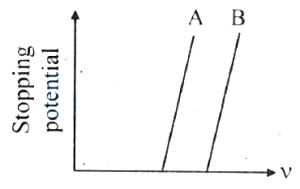
The stopping potential as a function of frequency of incident radiation is plotted for two different photoelectric surfaces $A$ and $B$. The graph shows that the work function of $A$ is
A
greater than that of $B$.
B
smaller than that of $B$.
C
same as that of $B$.
D
that no comparison can be made from the graphs.
Solution
(B) According to Einstein's photoelectric equation, the stopping potential $V_s$ is given by:
$e V_s = h \nu - \Phi_0$
$V_s = \frac{h}{e} \nu - \frac{\Phi_0}{e}$
where $\Phi_0$ is the work function and $\nu_0$ is the threshold frequency, such that $\Phi_0 = h \nu_0$.
From the given graph, the intercept on the frequency axis represents the threshold frequency $\nu_0$.
Since the threshold frequency $\nu_{0,A}$ for surface $A$ is less than the threshold frequency $\nu_{0,B}$ for surface $B$ ( $\nu_{0,A} < \nu_{0,B}$ ),
it follows that the work function $\Phi_{0,A} = h \nu_{0,A}$ is smaller than the work function $\Phi_{0,B} = h \nu_{0,B}$.
Therefore, the work function of $A$ is smaller than that of $B$.
$e V_s = h \nu - \Phi_0$
$V_s = \frac{h}{e} \nu - \frac{\Phi_0}{e}$
where $\Phi_0$ is the work function and $\nu_0$ is the threshold frequency, such that $\Phi_0 = h \nu_0$.
From the given graph, the intercept on the frequency axis represents the threshold frequency $\nu_0$.
Since the threshold frequency $\nu_{0,A}$ for surface $A$ is less than the threshold frequency $\nu_{0,B}$ for surface $B$ ( $\nu_{0,A} < \nu_{0,B}$ ),
it follows that the work function $\Phi_{0,A} = h \nu_{0,A}$ is smaller than the work function $\Phi_{0,B} = h \nu_{0,B}$.
Therefore, the work function of $A$ is smaller than that of $B$.
0 likes
View Solution536
MediumMCQ
When a certain metallic surface is illuminated with monochromatic light of wavelength $\lambda$,the stopping potential for photoelectric current is $4 V_0$. When the same surface is illuminated with light of wavelength $3 \lambda$,the stopping potential is $V_0$. The threshold wavelength for this surface for the photoelectric effect is
A
$9 \lambda$
B
$\frac{\lambda}{9}$
C
$3 \lambda$
D
$\frac{\lambda}{3}$
Solution
(A) Using Einstein's photoelectric equation,$h \nu = \phi_0 + KE_{\text{max}}$.
Since $KE_{\text{max}} = eV_s$,we have $\frac{hc}{\lambda} = \phi_0 + e(4V_0)$ ....$(i)$
Similarly,for wavelength $3\lambda$,we have $\frac{hc}{3\lambda} = \phi_0 + eV_0$ ....(ii)
Multiply equation (ii) by $4$:
$\frac{4hc}{3\lambda} = 4\phi_0 + 4eV_0$ ....(iii)
Subtract equation $(i)$ from equation (iii):
$\frac{4hc}{3\lambda} - \frac{hc}{\lambda} = (4\phi_0 + 4eV_0) - (\phi_0 + 4eV_0)$
$\frac{hc}{3\lambda} = 3\phi_0$
$\phi_0 = \frac{hc}{9\lambda}$
Since the work function $\phi_0 = \frac{hc}{\lambda_0}$,where $\lambda_0$ is the threshold wavelength,we get $\lambda_0 = 9\lambda$.
Thus,option $(A)$ is correct.
Since $KE_{\text{max}} = eV_s$,we have $\frac{hc}{\lambda} = \phi_0 + e(4V_0)$ ....$(i)$
Similarly,for wavelength $3\lambda$,we have $\frac{hc}{3\lambda} = \phi_0 + eV_0$ ....(ii)
Multiply equation (ii) by $4$:
$\frac{4hc}{3\lambda} = 4\phi_0 + 4eV_0$ ....(iii)
Subtract equation $(i)$ from equation (iii):
$\frac{4hc}{3\lambda} - \frac{hc}{\lambda} = (4\phi_0 + 4eV_0) - (\phi_0 + 4eV_0)$
$\frac{hc}{3\lambda} = 3\phi_0$
$\phi_0 = \frac{hc}{9\lambda}$
Since the work function $\phi_0 = \frac{hc}{\lambda_0}$,where $\lambda_0$ is the threshold wavelength,we get $\lambda_0 = 9\lambda$.
Thus,option $(A)$ is correct.
0 likes
View Solution537
EasyMCQ
$A$ point source of light is used in a photoelectric effect experiment. If the source is moved farther from the emitting metal, then the stopping potential will
A
increase.
B
decrease.
C
remain constant.
D
either increase or decrease.
Solution
(C) The stopping potential $(V_0)$ in the photoelectric effect is determined by the maximum kinetic energy of the emitted photoelectrons, which depends solely on the frequency of the incident light and the work function of the metal surface, as given by Einstein's photoelectric equation: $eV_0 = h\nu - \Phi$.
Moving the point source of light farther away changes the intensity of the light incident on the metal surface, but it does not change the frequency of the incident photons.
Since the stopping potential is independent of the intensity of the incident light, it will remain constant.
Moving the point source of light farther away changes the intensity of the light incident on the metal surface, but it does not change the frequency of the incident photons.
Since the stopping potential is independent of the intensity of the incident light, it will remain constant.
0 likes
View Solution538
MediumMCQ
When a certain metal surface is illuminated with light of frequency $v$,the stopping potential for photoelectric current is $V_0$. When the same surface is illuminated by light of frequency $\frac{v}{2}$,the stopping potential is $\frac{V_0}{4}$,the threshold frequency of photoelectric emission is
A
$\frac{v}{6}$
B
$\frac{v}{3}$
C
$\frac{2 v}{3}$
D
$\frac{4 v}{3}$
Solution
(B) According to Einstein's photoelectric equation,the stopping potential $V_0$ is given by $eV_0 = h\nu - h\nu_0$,where $\nu_0$ is the threshold frequency.
For frequency $\nu$,we have: $eV_0 = h\nu - h\nu_0$ ... $(i)$
For frequency $\frac{\nu}{2}$,we have: $e\frac{V_0}{4} = h\frac{\nu}{2} - h\nu_0$ ... $(ii)$
Dividing equation $(i)$ by equation $(ii)$:
$4 = \frac{h\nu - h\nu_0}{\frac{h\nu}{2} - h\nu_0} = \frac{\nu - \nu_0}{\frac{\nu}{2} - \nu_0}$
$4(\frac{\nu}{2} - \nu_0) = \nu - \nu_0$
$2\nu - 4\nu_0 = \nu - \nu_0$
$2\nu - \nu = 4\nu_0 - \nu_0$
$\nu = 3\nu_0$
$\nu_0 = \frac{\nu}{3}$
For frequency $\nu$,we have: $eV_0 = h\nu - h\nu_0$ ... $(i)$
For frequency $\frac{\nu}{2}$,we have: $e\frac{V_0}{4} = h\frac{\nu}{2} - h\nu_0$ ... $(ii)$
Dividing equation $(i)$ by equation $(ii)$:
$4 = \frac{h\nu - h\nu_0}{\frac{h\nu}{2} - h\nu_0} = \frac{\nu - \nu_0}{\frac{\nu}{2} - \nu_0}$
$4(\frac{\nu}{2} - \nu_0) = \nu - \nu_0$
$2\nu - 4\nu_0 = \nu - \nu_0$
$2\nu - \nu = 4\nu_0 - \nu_0$
$\nu = 3\nu_0$
$\nu_0 = \frac{\nu}{3}$
0 likes
View Solution539
MediumMCQ
When photons of energies twice and thrice the work function of a metal are incident on the metal surface one after other,the maximum velocities of the photoelectrons emitted in the two cases are $v_1$ and $v_2$ respectively. The ratio $v_1: v_2$ is
A
$1: 2$
B
$1: \sqrt{2}$
C
$\sqrt{2}: 1$
D
$1: \sqrt{3}$
Solution
(B) According to Einstein's photoelectric equation,the maximum kinetic energy of emitted photoelectrons is given by $K.E_{\max} = E - \phi_0$,where $E$ is the energy of the incident photon and $\phi_0$ is the work function of the metal.
For the first case,$E_1 = 2\phi_0$. Therefore,$K.E_1 = 2\phi_0 - \phi_0 = \phi_0$.
Since $K.E_1 = \frac{1}{2}mv_1^2$,we have $\frac{1}{2}mv_1^2 = \phi_0$ --- $(1)$
For the second case,$E_2 = 3\phi_0$. Therefore,$K.E_2 = 3\phi_0 - \phi_0 = 2\phi_0$.
Since $K.E_2 = \frac{1}{2}mv_2^2$,we have $\frac{1}{2}mv_2^2 = 2\phi_0$ --- $(2)$
Dividing equation $(1)$ by equation $(2)$:
$\frac{\frac{1}{2}mv_1^2}{\frac{1}{2}mv_2^2} = \frac{\phi_0}{2\phi_0}$
$\frac{v_1^2}{v_2^2} = \frac{1}{2}$
Taking the square root on both sides:
$\frac{v_1}{v_2} = \frac{1}{\sqrt{2}}$
Thus,the ratio $v_1: v_2$ is $1: \sqrt{2}$.
For the first case,$E_1 = 2\phi_0$. Therefore,$K.E_1 = 2\phi_0 - \phi_0 = \phi_0$.
Since $K.E_1 = \frac{1}{2}mv_1^2$,we have $\frac{1}{2}mv_1^2 = \phi_0$ --- $(1)$
For the second case,$E_2 = 3\phi_0$. Therefore,$K.E_2 = 3\phi_0 - \phi_0 = 2\phi_0$.
Since $K.E_2 = \frac{1}{2}mv_2^2$,we have $\frac{1}{2}mv_2^2 = 2\phi_0$ --- $(2)$
Dividing equation $(1)$ by equation $(2)$:
$\frac{\frac{1}{2}mv_1^2}{\frac{1}{2}mv_2^2} = \frac{\phi_0}{2\phi_0}$
$\frac{v_1^2}{v_2^2} = \frac{1}{2}$
Taking the square root on both sides:
$\frac{v_1}{v_2} = \frac{1}{\sqrt{2}}$
Thus,the ratio $v_1: v_2$ is $1: \sqrt{2}$.
0 likes
View Solution540
MediumMCQ
The maximum kinetic energy of a photoelectron is $E$ when the wavelength of incident radiation is $\lambda$. If the wavelength of the incident radiation is reduced to $\frac{\lambda}{3}$,the maximum kinetic energy becomes $4E$. The work function of the metal is:
A
$\frac{3 hc}{\lambda}$
B
$\frac{hc}{3 \lambda}$
C
$\frac{hc}{\lambda}$
D
$\frac{hc}{2 \lambda}$
Solution
(B) According to Einstein's photoelectric equation: $E = \frac{hc}{\lambda} - \phi_0$ ... $(i)$
Given that when the wavelength becomes $\lambda' = \frac{\lambda}{3}$,the kinetic energy becomes $E' = 4E$.
Substituting these into the photoelectric equation: $4E = \frac{hc}{\lambda/3} - \phi_0$
$4E = \frac{3hc}{\lambda} - \phi_0$ ... (ii)
Substitute the value of $E$ from equation $(i)$ into equation (ii):
$4\left(\frac{hc}{\lambda} - \phi_0\right) = \frac{3hc}{\lambda} - \phi_0$
$\frac{4hc}{\lambda} - 4\phi_0 = \frac{3hc}{\lambda} - \phi_0$
$\frac{4hc}{\lambda} - \frac{3hc}{\lambda} = 4\phi_0 - \phi_0$
$\frac{hc}{\lambda} = 3\phi_0$
$\phi_0 = \frac{hc}{3\lambda}$
Given that when the wavelength becomes $\lambda' = \frac{\lambda}{3}$,the kinetic energy becomes $E' = 4E$.
Substituting these into the photoelectric equation: $4E = \frac{hc}{\lambda/3} - \phi_0$
$4E = \frac{3hc}{\lambda} - \phi_0$ ... (ii)
Substitute the value of $E$ from equation $(i)$ into equation (ii):
$4\left(\frac{hc}{\lambda} - \phi_0\right) = \frac{3hc}{\lambda} - \phi_0$
$\frac{4hc}{\lambda} - 4\phi_0 = \frac{3hc}{\lambda} - \phi_0$
$\frac{4hc}{\lambda} - \frac{3hc}{\lambda} = 4\phi_0 - \phi_0$
$\frac{hc}{\lambda} = 3\phi_0$
$\phi_0 = \frac{hc}{3\lambda}$
0 likes
View Solution541
EasyMCQ
The maximum kinetic energy of the photoelectrons varies:
A
inversely with the intensity of incident radiation and is independent of its frequency.
B
inversely with the frequency of incident radiation and is independent of its intensity.
C
linearly with the frequency of incident radiation and depends on its intensity.
D
linearly with the frequency of incident radiation and is independent of its intensity.
Solution
(D) According to Einstein's photoelectric equation, the maximum kinetic energy $(K_{max})$ of photoelectrons is given by:
$K_{max} = h\nu - \Phi_0$
where $h$ is Planck's constant, $\nu$ is the frequency of incident radiation, and $\Phi_0$ is the work function of the metal.
From this equation, it is clear that $K_{max}$ varies linearly with the frequency $(\nu)$ of the incident radiation.
Furthermore, the maximum kinetic energy is independent of the intensity of the incident radiation, as intensity only affects the number of photoelectrons emitted per unit time.
$K_{max} = h\nu - \Phi_0$
where $h$ is Planck's constant, $\nu$ is the frequency of incident radiation, and $\Phi_0$ is the work function of the metal.
From this equation, it is clear that $K_{max}$ varies linearly with the frequency $(\nu)$ of the incident radiation.
Furthermore, the maximum kinetic energy is independent of the intensity of the incident radiation, as intensity only affects the number of photoelectrons emitted per unit time.
0 likes
View Solution542
MediumMCQ
The maximum kinetic energies of photoelectrons emitted are $K_1$ and $K_2$ when lights of wavelengths $\lambda_1$ and $\lambda_2$ are incident on a metallic surface. If $\lambda_1 = 3 \lambda_2$,then:
A
$K_1 = \frac{K_2}{3}$
B
$K_1 < \frac{K_2}{3}$
C
$K_1 = 3 K_2$
D
$3 K_1 = 2 K_2$
Solution
(B) According to Einstein's photoelectric equation,the maximum kinetic energy $K$ is given by $K = \frac{hc}{\lambda} - \phi$,where $\phi$ is the work function of the metal.
For wavelength $\lambda_1$,$K_1 = \frac{hc}{\lambda_1} - \phi$ $(i)$
For wavelength $\lambda_2$,$K_2 = \frac{hc}{\lambda_2} - \phi$ (ii)
Given $\lambda_1 = 3 \lambda_2$,substitute this into equation $(i)$:
$K_1 = \frac{hc}{3 \lambda_2} - \phi$ (iii)
From equation (ii),$\frac{hc}{\lambda_2} = K_2 + \phi$. Substituting this into equation (iii):
$K_1 = \frac{1}{3} (K_2 + \phi) - \phi$
$K_1 = \frac{K_2}{3} + \frac{\phi}{3} - \phi$
$K_1 = \frac{K_2}{3} - \frac{2\phi}{3}$
Since the work function $\phi > 0$,it follows that $K_1 < \frac{K_2}{3}$.
For wavelength $\lambda_1$,$K_1 = \frac{hc}{\lambda_1} - \phi$ $(i)$
For wavelength $\lambda_2$,$K_2 = \frac{hc}{\lambda_2} - \phi$ (ii)
Given $\lambda_1 = 3 \lambda_2$,substitute this into equation $(i)$:
$K_1 = \frac{hc}{3 \lambda_2} - \phi$ (iii)
From equation (ii),$\frac{hc}{\lambda_2} = K_2 + \phi$. Substituting this into equation (iii):
$K_1 = \frac{1}{3} (K_2 + \phi) - \phi$
$K_1 = \frac{K_2}{3} + \frac{\phi}{3} - \phi$
$K_1 = \frac{K_2}{3} - \frac{2\phi}{3}$
Since the work function $\phi > 0$,it follows that $K_1 < \frac{K_2}{3}$.
0 likes
View Solution543
MediumMCQ
$A$ metal surface of work function $1.13 eV$ is irradiated with light of wavelength $310 nm$. The retarding potential required to stop the escape of photoelectrons is [Take $hc = 1240 eV \cdot nm$] (in $V$)
A
$1.13$
B
$2.87$
C
$3.97$
D
$4.23$
Solution
(B) Energy of incident light $(E)$:
$E = \frac{hc}{\lambda} = \frac{1240 eV \cdot nm}{310 nm} = 4 eV$
According to Einstein's photoelectric equation:
$K_{max} = E - \phi_0$
Where $\phi_0$ is the work function.
$K_{max} = 4 eV - 1.13 eV = 2.87 eV$
The stopping potential $(V_0)$ is given by $K_{max} = eV_0$.
Therefore, $V_0 = 2.87 V$.
$E = \frac{hc}{\lambda} = \frac{1240 eV \cdot nm}{310 nm} = 4 eV$
According to Einstein's photoelectric equation:
$K_{max} = E - \phi_0$
Where $\phi_0$ is the work function.
$K_{max} = 4 eV - 1.13 eV = 2.87 eV$
The stopping potential $(V_0)$ is given by $K_{max} = eV_0$.
Therefore, $V_0 = 2.87 V$.
0 likes
View Solution544
MediumMCQ
When light of wavelength $\lambda$ is incident on a photosensitive surface,the stopping potential is $V$. When light of wavelength $3 \lambda$ is incident on the same surface,the stopping potential is $\frac{V}{6}$. Then the threshold wavelength for the surface is:
A
$2 \lambda$
B
$3 \lambda$
C
$4 \lambda$
D
$5 \lambda$
Solution
(D) The photoelectric equation is given by $eV_0 = hc \left( \frac{1}{\lambda} - \frac{1}{\lambda_0} \right)$,where $\lambda_0$ is the threshold wavelength.
For the first case: $eV = hc \left( \frac{1}{\lambda} - \frac{1}{\lambda_0} \right) \dots (i)$
For the second case: $e \left( \frac{V}{6} \right) = hc \left( \frac{1}{3\lambda} - \frac{1}{\lambda_0} \right) \dots (ii)$
Dividing equation $(i)$ by equation $(ii)$:
$6 = \frac{\frac{1}{\lambda} - \frac{1}{\lambda_0}}{\frac{1}{3\lambda} - \frac{1}{\lambda_0}} = \frac{\frac{\lambda_0 - \lambda}{\lambda \lambda_0}}{\frac{\lambda_0 - 3\lambda}{3\lambda \lambda_0}} = \frac{3(\lambda_0 - \lambda)}{\lambda_0 - 3\lambda}$
$6(\lambda_0 - 3\lambda) = 3\lambda_0 - 3\lambda$
$6\lambda_0 - 18\lambda = 3\lambda_0 - 3\lambda$
$3\lambda_0 = 15\lambda$
$\lambda_0 = 5\lambda$
For the first case: $eV = hc \left( \frac{1}{\lambda} - \frac{1}{\lambda_0} \right) \dots (i)$
For the second case: $e \left( \frac{V}{6} \right) = hc \left( \frac{1}{3\lambda} - \frac{1}{\lambda_0} \right) \dots (ii)$
Dividing equation $(i)$ by equation $(ii)$:
$6 = \frac{\frac{1}{\lambda} - \frac{1}{\lambda_0}}{\frac{1}{3\lambda} - \frac{1}{\lambda_0}} = \frac{\frac{\lambda_0 - \lambda}{\lambda \lambda_0}}{\frac{\lambda_0 - 3\lambda}{3\lambda \lambda_0}} = \frac{3(\lambda_0 - \lambda)}{\lambda_0 - 3\lambda}$
$6(\lambda_0 - 3\lambda) = 3\lambda_0 - 3\lambda$
$6\lambda_0 - 18\lambda = 3\lambda_0 - 3\lambda$
$3\lambda_0 = 15\lambda$
$\lambda_0 = 5\lambda$
0 likes
View Solution545
EasyMCQ
Radiations of two photons having energies twice and five times the work function of a metal are incident successively on a metal surface. The ratio of the maximum velocity of photoelectrons emitted in the two cases will be
A
$1: 1$
B
$1: 2$
C
$1: 3$
D
$1: 4$
Solution
(B) According to Einstein's photoelectric equation,the maximum kinetic energy $(K.E._{\max})$ is given by $K.E._{\max} = E - \phi_0$,where $E$ is the energy of the incident photon and $\phi_0$ is the work function of the metal.
For the first case,$E_1 = 2\phi_0$,so $K.E._{\max 1} = 2\phi_0 - \phi_0 = \phi_0$.
For the second case,$E_2 = 5\phi_0$,so $K.E._{\max 2} = 5\phi_0 - \phi_0 = 4\phi_0$.
The ratio of maximum kinetic energies is $\frac{K.E._{\max 1}}{K.E._{\max 2}} = \frac{\phi_0}{4\phi_0} = \frac{1}{4}$.
Since $K.E._{\max} = \frac{1}{2}mv_{\max}^2$,the ratio of velocities is $\frac{v_1}{v_2} = \sqrt{\frac{K.E._{\max 1}}{K.E._{\max 2}}} = \sqrt{\frac{1}{4}} = \frac{1}{2}$.
For the first case,$E_1 = 2\phi_0$,so $K.E._{\max 1} = 2\phi_0 - \phi_0 = \phi_0$.
For the second case,$E_2 = 5\phi_0$,so $K.E._{\max 2} = 5\phi_0 - \phi_0 = 4\phi_0$.
The ratio of maximum kinetic energies is $\frac{K.E._{\max 1}}{K.E._{\max 2}} = \frac{\phi_0}{4\phi_0} = \frac{1}{4}$.
Since $K.E._{\max} = \frac{1}{2}mv_{\max}^2$,the ratio of velocities is $\frac{v_1}{v_2} = \sqrt{\frac{K.E._{\max 1}}{K.E._{\max 2}}} = \sqrt{\frac{1}{4}} = \frac{1}{2}$.
0 likes
View Solution546
MediumMCQ
When a light of wavelength $300 \ nm$ falls on a photoelectric emitter,photoelectrons are emitted. For another emitter,light of wavelength $600 \ nm$ is just sufficient for liberating photoelectrons. The ratio of the work function of the two emitters is
A
$1: 2$
B
$2: 1$
C
$4: 1$
D
$1: 4$
Solution
(B) The work function $\phi_0$ of a photoelectric emitter is given by the formula $\phi_0 = \frac{hc}{\lambda_0}$,where $h$ is Planck's constant,$c$ is the speed of light,and $\lambda_0$ is the threshold wavelength.
From this relation,we can see that $\phi_0 \propto \frac{1}{\lambda_0}$.
For the first emitter,the incident wavelength is $300 \ nm$. Since photoelectrons are emitted,the threshold wavelength $\lambda_{0_1}$ must be at least $300 \ nm$.
For the second emitter,the threshold wavelength $\lambda_{0_2}$ is given as $600 \ nm$.
Assuming the first emitter is just at the threshold for $300 \ nm$,we have $\lambda_{0_1} = 300 \ nm$ and $\lambda_{0_2} = 600 \ nm$.
The ratio of the work functions is $\frac{\phi_{0_1}}{\phi_{0_2}} = \frac{\lambda_{0_2}}{\lambda_{0_1}} = \frac{600 \ nm}{300 \ nm} = \frac{2}{1}$.
Thus,the ratio is $2: 1$.
From this relation,we can see that $\phi_0 \propto \frac{1}{\lambda_0}$.
For the first emitter,the incident wavelength is $300 \ nm$. Since photoelectrons are emitted,the threshold wavelength $\lambda_{0_1}$ must be at least $300 \ nm$.
For the second emitter,the threshold wavelength $\lambda_{0_2}$ is given as $600 \ nm$.
Assuming the first emitter is just at the threshold for $300 \ nm$,we have $\lambda_{0_1} = 300 \ nm$ and $\lambda_{0_2} = 600 \ nm$.
The ratio of the work functions is $\frac{\phi_{0_1}}{\phi_{0_2}} = \frac{\lambda_{0_2}}{\lambda_{0_1}} = \frac{600 \ nm}{300 \ nm} = \frac{2}{1}$.
Thus,the ratio is $2: 1$.
0 likes
View Solution547
MediumMCQ
When radiations of wavelength $\lambda$ are incident on a metallic surface,the stopping potential required is $4.8 \ V$. If the same surface is illuminated with radiations of double the wavelength,the required stopping potential becomes $1.6 \ V$. The value of the threshold wavelength for the surface is:
A
$2 \lambda$
B
$4 \lambda$
C
$6 \lambda$
D
$8 \lambda$
Solution
(B) According to Einstein's photoelectric equation,the stopping potential $V_s$ is given by $eV_s = \frac{hc}{\lambda} - \phi$,where $\phi$ is the work function.
For the first case: $4.8 = \frac{hc}{e\lambda} - \frac{\phi}{e} \quad \dots(i)$
For the second case,where wavelength is $2\lambda$: $1.6 = \frac{hc}{e(2\lambda)} - \frac{\phi}{e} \quad \dots(ii)$
Subtracting equation $(ii)$ from equation $(i)$:
$4.8 - 1.6 = \left(\frac{hc}{e\lambda} - \frac{\phi}{e}\right) - \left(\frac{hc}{2e\lambda} - \frac{\phi}{e}\right)$
$3.2 = \frac{hc}{e\lambda} - \frac{hc}{2e\lambda} = \frac{hc}{2e\lambda}$
So,$\frac{hc}{e\lambda} = 6.4$.
Substituting this into equation $(i)$:
$4.8 = 6.4 - \frac{\phi}{e} \Rightarrow \frac{\phi}{e} = 6.4 - 4.8 = 1.6$.
The threshold wavelength $\lambda_0$ is given by $\phi = \frac{hc}{\lambda_0}$,so $\frac{\phi}{e} = \frac{hc}{e\lambda_0} = 1.6$.
Since $\frac{hc}{e\lambda} = 6.4$,we have $\frac{hc}{e\lambda_0} = \frac{1}{4} \left(\frac{hc}{e\lambda}\right)$.
Therefore,$\lambda_0 = 4\lambda$.
For the first case: $4.8 = \frac{hc}{e\lambda} - \frac{\phi}{e} \quad \dots(i)$
For the second case,where wavelength is $2\lambda$: $1.6 = \frac{hc}{e(2\lambda)} - \frac{\phi}{e} \quad \dots(ii)$
Subtracting equation $(ii)$ from equation $(i)$:
$4.8 - 1.6 = \left(\frac{hc}{e\lambda} - \frac{\phi}{e}\right) - \left(\frac{hc}{2e\lambda} - \frac{\phi}{e}\right)$
$3.2 = \frac{hc}{e\lambda} - \frac{hc}{2e\lambda} = \frac{hc}{2e\lambda}$
So,$\frac{hc}{e\lambda} = 6.4$.
Substituting this into equation $(i)$:
$4.8 = 6.4 - \frac{\phi}{e} \Rightarrow \frac{\phi}{e} = 6.4 - 4.8 = 1.6$.
The threshold wavelength $\lambda_0$ is given by $\phi = \frac{hc}{\lambda_0}$,so $\frac{\phi}{e} = \frac{hc}{e\lambda_0} = 1.6$.
Since $\frac{hc}{e\lambda} = 6.4$,we have $\frac{hc}{e\lambda_0} = \frac{1}{4} \left(\frac{hc}{e\lambda}\right)$.
Therefore,$\lambda_0 = 4\lambda$.
0 likes
View Solution548
DifficultMCQ
$A$ photon of energy $E$ ejects photoelectrons from a metal surface whose work function is $W_0$. If this electron enters into a uniform magnetic field with induction $B$ in a direction perpendicular to the field and describes a circular path of radius $r$,then the radius is given by
A
$\sqrt{\frac{2 e(E-W_0)}{m B}}$
B
$\frac{\sqrt{2(E-W_0) m}}{e B}$
C
$\sqrt{\frac{2 m(E-W_0)}{m B}}$
D
$\sqrt{2 m(E-W_0) e B}$
Solution
(B) Concept: Photoelectric effect and the motion of a charge in a direction perpendicular to a magnetic field.
According to Einstein's photoelectric equation,the maximum kinetic energy $K$ of a photoelectron is given by:
$K = E - W_0$
Since $K = \frac{1}{2} m v^2$,we have:
$v = \sqrt{\frac{2(E - W_0)}{m}}$
When a charge $e$ moves with velocity $v$ perpendicular to a magnetic field $B$,it experiences a magnetic Lorentz force that acts as a centripetal force,causing it to move in a circular path of radius $r$:
$e v B = \frac{m v^2}{r}$
Solving for $r$:
$r = \frac{m v}{e B}$
Substituting the expression for $v$:
$r = \frac{m}{e B} \sqrt{\frac{2(E - W_0)}{m}} = \frac{\sqrt{m^2 \cdot \frac{2(E - W_0)}{m}}}{e B} = \frac{\sqrt{2m(E - W_0)}}{e B}$
According to Einstein's photoelectric equation,the maximum kinetic energy $K$ of a photoelectron is given by:
$K = E - W_0$
Since $K = \frac{1}{2} m v^2$,we have:
$v = \sqrt{\frac{2(E - W_0)}{m}}$
When a charge $e$ moves with velocity $v$ perpendicular to a magnetic field $B$,it experiences a magnetic Lorentz force that acts as a centripetal force,causing it to move in a circular path of radius $r$:
$e v B = \frac{m v^2}{r}$
Solving for $r$:
$r = \frac{m v}{e B}$
Substituting the expression for $v$:
$r = \frac{m}{e B} \sqrt{\frac{2(E - W_0)}{m}} = \frac{\sqrt{m^2 \cdot \frac{2(E - W_0)}{m}}}{e B} = \frac{\sqrt{2m(E - W_0)}}{e B}$
0 likes
View Solution549
EasyMCQ
$A$ photoelectric surface is illuminated successively by monochromatic light of wavelength $\lambda$ and $\frac{\lambda}{2}$. If the maximum kinetic energy of the emitted photoelectrons in the first case is one-third that in the second case,the work function of the surface of the material is ($c=$ speed of light,$h=$ Planck's constant).
A
$\frac{2 hc}{\lambda}$
B
$\frac{hc}{2 \lambda}$
C
$\frac{hc}{\lambda}$
D
$\frac{hc}{3 \lambda}$
Solution
(B) According to Einstein's photoelectric equation,the maximum kinetic energy $K$ is given by $K = \frac{hc}{\lambda} - \phi$,where $\phi$ is the work function.
For the first case with wavelength $\lambda$: $K_1 = \frac{hc}{\lambda} - \phi$.
For the second case with wavelength $\frac{\lambda}{2}$: $K_2 = \frac{hc}{\lambda/2} - \phi = \frac{2hc}{\lambda} - \phi$.
Given that $K_1 = \frac{1}{3} K_2$,we have $3K_1 = K_2$.
Substituting the expressions: $3(\frac{hc}{\lambda} - \phi) = \frac{2hc}{\lambda} - \phi$.
$\frac{3hc}{\lambda} - 3\phi = \frac{2hc}{\lambda} - \phi$.
$\frac{3hc}{\lambda} - \frac{2hc}{\lambda} = 3\phi - \phi$.
$\frac{hc}{\lambda} = 2\phi$.
Therefore,$\phi = \frac{hc}{2\lambda}$.
For the first case with wavelength $\lambda$: $K_1 = \frac{hc}{\lambda} - \phi$.
For the second case with wavelength $\frac{\lambda}{2}$: $K_2 = \frac{hc}{\lambda/2} - \phi = \frac{2hc}{\lambda} - \phi$.
Given that $K_1 = \frac{1}{3} K_2$,we have $3K_1 = K_2$.
Substituting the expressions: $3(\frac{hc}{\lambda} - \phi) = \frac{2hc}{\lambda} - \phi$.
$\frac{3hc}{\lambda} - 3\phi = \frac{2hc}{\lambda} - \phi$.
$\frac{3hc}{\lambda} - \frac{2hc}{\lambda} = 3\phi - \phi$.
$\frac{hc}{\lambda} = 2\phi$.
Therefore,$\phi = \frac{hc}{2\lambda}$.
0 likes
View SolutionDual Nature of Radiation and matter — Einstein's Photoelectric Equation and Energy Quantum of Radiation · Frequently Asked Questions
1Are these Dual Nature of Radiation and matter questions useful for JEE and NEET?
Yes. All questions in this section are mapped to JEE Main and NEET exam patterns. Previous year questions from JEE Main, NEET, GUJCET and state-level exams are included with full solutions.
2Can I switch to Hindi or Gujarati for these questions?
Yes. Use the language tabs in the hero section or the sidebar to view the same questions and solutions in English, Hindi or Gujarati.
3How do I generate a question paper from this subtopic?
Use the Vedclass Exam Paper Generator — select the chapter and subtopic, set difficulty, and generate Sets A, B, C, D automatically. First 3 chapters of every subject are free.
Vedclass Products
For Students
Vedclass Test Series
Mock tests in real JEE/NEET style with performance analysis. 5-day free trial.
Start Free TrialFor Teachers
Exam Paper Generator
Generate Set A/B/C/D papers from this chapter in 2 minutes. 3 chapters free.
Try FreeFor Institutes
Online Exam Module
Live online exams with unlimited students, 360° analytics & white-label branding.
See DemoFor Teachers & Institutes
Generate a Dual Nature of Radiation and matter Exam Paper in 2 Minutes
Select subtopic & difficulty — Sets A, B, C, D auto-generated with No Repeat logic.
First 3 chapters of every subject are free — no payment required.