
A English
Particle Nature of Light : Photon Questions in English
Class 12 Physics · Dual Nature of Radiation and matter · Particle Nature of Light : Photon
228+
Questions
English
Language
100%
With Solutions
Showing 49 of 228 questions in English
1
EasyMCQ
The value of Planck's constant is
A
$6.63 \times 10^{-34} \, J \cdot s$
B
$6.63 \times 10^{34} \, J/s$
C
$6.63 \times 10^{-34} \, kg \cdot m^2$
D
$6.63 \times 10^{34} \, kg/s$
Solution
(A) Planck's constant is a fundamental physical constant denoted by the symbol $h$.
It relates the energy of a photon to its frequency,given by the equation $E = h\nu$.
The accepted value of Planck's constant is approximately $6.626 \times 10^{-34} \, J \cdot s$.
Rounding this to two decimal places gives $6.63 \times 10^{-34} \, J \cdot s$.
Therefore,the correct option is $A$.
It relates the energy of a photon to its frequency,given by the equation $E = h\nu$.
The accepted value of Planck's constant is approximately $6.626 \times 10^{-34} \, J \cdot s$.
Rounding this to two decimal places gives $6.63 \times 10^{-34} \, J \cdot s$.
Therefore,the correct option is $A$.
0 likes
View Solution2
MediumMCQ
$A$ stick of $1 \, m$ is moving with a velocity of $2.7 \times 10^8 \, m/s$. What is the apparent length of the stick in meters? (Given: $c = 3 \times 10^8 \, m/s$)
A
$10$
B
$0.22$
C
$0.44$
D
$2.4$
Solution
(C) According to the theory of special relativity,the length of an object moving at relativistic speeds undergoes length contraction in the direction of motion.
The formula for length contraction is $l = l_0 \sqrt{1 - \frac{v^2}{c^2}}$,where $l_0$ is the proper length,$v$ is the velocity of the object,and $c$ is the speed of light.
Given: $l_0 = 1 \, m$,$v = 2.7 \times 10^8 \, m/s$,and $c = 3 \times 10^8 \, m/s$.
Substituting the values into the formula:
$l = 1 \times \sqrt{1 - \left( \frac{2.7 \times 10^8}{3 \times 10^8} \right)^2}$
$l = \sqrt{1 - (0.9)^2}$
$l = \sqrt{1 - 0.81}$
$l = \sqrt{0.19}$
$l \approx 0.4358 \, m \approx 0.44 \, m$.
Thus,the apparent length of the stick is $0.44 \, m$.
The formula for length contraction is $l = l_0 \sqrt{1 - \frac{v^2}{c^2}}$,where $l_0$ is the proper length,$v$ is the velocity of the object,and $c$ is the speed of light.
Given: $l_0 = 1 \, m$,$v = 2.7 \times 10^8 \, m/s$,and $c = 3 \times 10^8 \, m/s$.
Substituting the values into the formula:
$l = 1 \times \sqrt{1 - \left( \frac{2.7 \times 10^8}{3 \times 10^8} \right)^2}$
$l = \sqrt{1 - (0.9)^2}$
$l = \sqrt{1 - 0.81}$
$l = \sqrt{0.19}$
$l \approx 0.4358 \, m \approx 0.44 \, m$.
Thus,the apparent length of the stick is $0.44 \, m$.
0 likes
View Solution3
EasyMCQ
$A$ photon,an electron,and a uranium nucleus all have the same wavelength. The one with the most energy is:
A
The photon
B
The electron
C
The uranium nucleus
D
Depends upon the wavelength and the properties of the particle.
Solution
(A) The de Broglie wavelength is given by $\lambda = \frac{h}{p}$,where $p$ is the momentum.
For a particle with mass $m$ and kinetic energy $E$,the momentum is $p = \sqrt{2mE}$. Thus,$\lambda = \frac{h}{\sqrt{2mE}}$.
Rearranging for energy,we get $E = \frac{h^2}{2m\lambda^2}$.
Since the wavelength $\lambda$ is the same for all,the energy $E$ is inversely proportional to the mass $m$ $(E \propto \frac{1}{m})$.
For a photon,the energy is given by $E = \frac{hc}{\lambda}$. Comparing this to the massive particles,the photon behaves as if it has the smallest effective mass in this context,leading to the highest energy for a given wavelength.
Therefore,the photon has the most energy.
For a particle with mass $m$ and kinetic energy $E$,the momentum is $p = \sqrt{2mE}$. Thus,$\lambda = \frac{h}{\sqrt{2mE}}$.
Rearranging for energy,we get $E = \frac{h^2}{2m\lambda^2}$.
Since the wavelength $\lambda$ is the same for all,the energy $E$ is inversely proportional to the mass $m$ $(E \propto \frac{1}{m})$.
For a photon,the energy is given by $E = \frac{hc}{\lambda}$. Comparing this to the massive particles,the photon behaves as if it has the smallest effective mass in this context,leading to the highest energy for a given wavelength.
Therefore,the photon has the most energy.
0 likes
View Solution4
EasyMCQ
$A$ particle which has zero rest mass and non-zero energy and momentum must travel with a speed
A
Equal to $c$,the speed of light in vacuum
B
Greater than $c$
C
Less than $c$
D
Tending to infinity
Solution
(A) According to the theory of relativity,the energy $E$ and momentum $p$ of a particle are related to its rest mass $m_0$ by the equation $E^2 = (pc)^2 + (m_0c^2)^2$.
For a particle with zero rest mass $(m_0 = 0)$,the equation simplifies to $E = pc$.
Since $p = mv$ and $E = mc^2$ (where $m$ is the relativistic mass),we have $mc^2 = mvc$,which implies $v = c$.
Therefore,any particle with zero rest mass,such as a photon,must travel at the speed of light $c$ in a vacuum.
For a particle with zero rest mass $(m_0 = 0)$,the equation simplifies to $E = pc$.
Since $p = mv$ and $E = mc^2$ (where $m$ is the relativistic mass),we have $mc^2 = mvc$,which implies $v = c$.
Therefore,any particle with zero rest mass,such as a photon,must travel at the speed of light $c$ in a vacuum.
0 likes
View Solution5
MediumMCQ
The momentum of a photon is $3.3 \times 10^{-29} \ kg \ m/s$. Its frequency will be
A
$3 \times 10^3 \ Hz$
B
$6 \times 10^3 \ Hz$
C
$7.5 \times 10^{12} \ Hz$
D
$1.5 \times 10^{13} \ Hz$
Solution
(D) The momentum $p$ of a photon is related to its frequency $\nu$ by the formula: $p = \frac{h\nu}{c}$.
Rearranging for frequency $\nu$,we get: $\nu = \frac{pc}{h}$.
Given: $p = 3.3 \times 10^{-29} \ kg \ m/s$,$c = 3 \times 10^8 \ m/s$,and Planck's constant $h = 6.6 \times 10^{-34} \ J \ s$.
Substituting the values: $\nu = \frac{3.3 \times 10^{-29} \times 3 \times 10^8}{6.6 \times 10^{-34}}$.
$\nu = \frac{9.9 \times 10^{-21}}{6.6 \times 10^{-34}} = 1.5 \times 10^{13} \ Hz$.
Rearranging for frequency $\nu$,we get: $\nu = \frac{pc}{h}$.
Given: $p = 3.3 \times 10^{-29} \ kg \ m/s$,$c = 3 \times 10^8 \ m/s$,and Planck's constant $h = 6.6 \times 10^{-34} \ J \ s$.
Substituting the values: $\nu = \frac{3.3 \times 10^{-29} \times 3 \times 10^8}{6.6 \times 10^{-34}}$.
$\nu = \frac{9.9 \times 10^{-21}}{6.6 \times 10^{-34}} = 1.5 \times 10^{13} \ Hz$.
0 likes
View Solution6
EasyMCQ
The energy of a photon of wavelength $\lambda$ is given by
A
$h\lambda$
B
$ch\lambda$
C
$\lambda /hc$
D
$hc/\lambda$
Solution
(D) The energy of a photon is directly proportional to its frequency,with the proportionality constant being Planck's constant $h$.
The relationship between energy $E$,frequency $\nu$,and wavelength $\lambda$ is given by $E = h\nu$.
Since the speed of light $c$ is related to frequency and wavelength by $c = \nu\lambda$,we can express frequency as $\nu = c/\lambda$.
Substituting this into the energy equation,we get $E = h(c/\lambda) = hc/\lambda$.
The relationship between energy $E$,frequency $\nu$,and wavelength $\lambda$ is given by $E = h\nu$.
Since the speed of light $c$ is related to frequency and wavelength by $c = \nu\lambda$,we can express frequency as $\nu = c/\lambda$.
Substituting this into the energy equation,we get $E = h(c/\lambda) = hc/\lambda$.
0 likes
View Solution7
EasyMCQ
The momentum of a photon is $2 \times 10^{-16} \text{ g} \cdot \text{cm/s}$. Its energy is:
A
$0.61 \times 10^{-26} \text{ erg}$
B
$2.0 \times 10^{-26} \text{ erg}$
C
$6 \times 10^{-6} \text{ erg}$
D
$6 \times 10^{-8} \text{ erg}$
Solution
(C) The relationship between the energy $E$ and momentum $p$ of a photon is given by $E = p \times c$,where $c$ is the speed of light.
Given momentum $p = 2 \times 10^{-16} \text{ g} \cdot \text{cm/s}$.
The speed of light $c = 3 \times 10^{10} \text{ cm/s}$.
Substituting these values into the formula:
$E = (2 \times 10^{-16} \text{ g} \cdot \text{cm/s}) \times (3 \times 10^{10} \text{ cm/s})$
$E = 6 \times 10^{-6} \text{ g} \cdot \text{cm}^2/\text{s}^2$
Since $1 \text{ erg} = 1 \text{ g} \cdot \text{cm}^2/\text{s}^2$,the energy is $6 \times 10^{-6} \text{ erg}$.
Given momentum $p = 2 \times 10^{-16} \text{ g} \cdot \text{cm/s}$.
The speed of light $c = 3 \times 10^{10} \text{ cm/s}$.
Substituting these values into the formula:
$E = (2 \times 10^{-16} \text{ g} \cdot \text{cm/s}) \times (3 \times 10^{10} \text{ cm/s})$
$E = 6 \times 10^{-6} \text{ g} \cdot \text{cm}^2/\text{s}^2$
Since $1 \text{ erg} = 1 \text{ g} \cdot \text{cm}^2/\text{s}^2$,the energy is $6 \times 10^{-6} \text{ erg}$.
0 likes
View Solution8
EasyMCQ
The rest mass of the photon is
A
$0$
B
$\infty$
C
Between $0$ and $\infty$
D
Equal to that of an electron
Solution
(A) According to Einstein's quantum theory,light propagates in the form of packets,i.e.,quanta of energy,which are called photons.
The rest mass of a photon is zero. This can be shown using the theory of relativity.
According to the relativistic mass equation,the mass of a particle is given by:
$m = \frac{m_{0}}{\sqrt{1 - \frac{v^{2}}{c^{2}}}}$
Rearranging for the rest mass $(m_{0})$:
$m_{0} = m \sqrt{1 - \frac{v^{2}}{c^{2}}}$
Since a photon always travels at the speed of light $(v = c)$,we substitute $v = c$ into the equation:
$m_{0} = m \sqrt{1 - \frac{c^{2}}{c^{2}}} = m \sqrt{1 - 1} = 0$
Therefore,the rest mass of a photon is $0$.
The rest mass of a photon is zero. This can be shown using the theory of relativity.
According to the relativistic mass equation,the mass of a particle is given by:
$m = \frac{m_{0}}{\sqrt{1 - \frac{v^{2}}{c^{2}}}}$
Rearranging for the rest mass $(m_{0})$:
$m_{0} = m \sqrt{1 - \frac{v^{2}}{c^{2}}}$
Since a photon always travels at the speed of light $(v = c)$,we substitute $v = c$ into the equation:
$m_{0} = m \sqrt{1 - \frac{c^{2}}{c^{2}}} = m \sqrt{1 - 1} = 0$
Therefore,the rest mass of a photon is $0$.
0 likes
View Solution9
EasyMCQ
The momentum of a photon with a wavelength of $5000\,\mathring{A}$ is:
A
$1.3 \times 10^{-27}\,kg\cdot m/s$
B
$1.3 \times 10^{-28}\,kg\cdot m/s$
C
$4 \times 10^{29}\,kg\cdot m/s$
D
$4 \times 10^{-18}\,kg\cdot m/s$
Solution
(A) The momentum $p$ of a photon is given by the de Broglie relation: $p = \frac{h}{\lambda}$.
Given:
Planck's constant $h = 6.6 \times 10^{-34}\,J\cdot s$
Wavelength $\lambda = 5000\,\mathring{A} = 5000 \times 10^{-10}\,m = 5 \times 10^{-7}\,m$.
Substituting the values:
$p = \frac{6.6 \times 10^{-34}}{5 \times 10^{-7}}$
$p = 1.32 \times 10^{-27}\,kg\cdot m/s$.
Thus,the correct option is $A$.
Given:
Planck's constant $h = 6.6 \times 10^{-34}\,J\cdot s$
Wavelength $\lambda = 5000\,\mathring{A} = 5000 \times 10^{-10}\,m = 5 \times 10^{-7}\,m$.
Substituting the values:
$p = \frac{6.6 \times 10^{-34}}{5 \times 10^{-7}}$
$p = 1.32 \times 10^{-27}\,kg\cdot m/s$.
Thus,the correct option is $A$.
0 likes
View Solution10
EasyMCQ
The momentum of a photon of energy $h\nu$ will be:
A
$h\nu$
B
$\frac{h\nu}{c}$
C
$h\nu c$
D
$h/\nu$
Solution
(B) According to Einstein's mass-energy equivalence relation,the energy of a photon is given by $E = mc^2$.
Also,the energy of a photon is given by $E = h\nu$.
Equating the two,we get $mc^2 = h\nu$.
Since momentum $p$ is defined as $p = mc$,we can rewrite the energy equation as $p \cdot c = h\nu$.
Therefore,the momentum of the photon is $p = \frac{h\nu}{c}$.
Also,the energy of a photon is given by $E = h\nu$.
Equating the two,we get $mc^2 = h\nu$.
Since momentum $p$ is defined as $p = mc$,we can rewrite the energy equation as $p \cdot c = h\nu$.
Therefore,the momentum of the photon is $p = \frac{h\nu}{c}$.
0 likes
View Solution11
EasyMCQ
$A$ photon in motion has a mass.
A
$h\nu / c$
B
$h / \nu$
C
$h\nu$
D
$h\nu / c^2$
Solution
(D) According to Einstein's mass-energy equivalence principle,the energy $E$ of a photon is given by $E = h\nu$.
Also,from the mass-energy relation,$E = mc^2$,where $m$ is the relativistic mass of the photon.
Equating the two expressions for energy:
$mc^2 = h\nu$
Therefore,the mass of the photon in motion is $m = \frac{h\nu}{c^2}$.
Also,from the mass-energy relation,$E = mc^2$,where $m$ is the relativistic mass of the photon.
Equating the two expressions for energy:
$mc^2 = h\nu$
Therefore,the mass of the photon in motion is $m = \frac{h\nu}{c^2}$.
0 likes
View Solution12
EasyMCQ
If the momentum of a photon is $p$,then its frequency is:
A
$\frac{ph}{c}$
B
$\frac{pc}{h}$
C
$\frac{mh}{c}$
D
$\frac{mc}{h}$
Solution
(B) The energy of a photon is given by $E = h\nu$,where $h$ is Planck's constant and $\nu$ is the frequency.
From the relation between energy and momentum for a photon,$E = pc$,where $c$ is the speed of light.
Equating the two expressions for energy: $h\nu = pc$.
Therefore,the frequency is $\nu = \frac{pc}{h}$.
From the relation between energy and momentum for a photon,$E = pc$,where $c$ is the speed of light.
Equating the two expressions for energy: $h\nu = pc$.
Therefore,the frequency is $\nu = \frac{pc}{h}$.
1 likes
View Solution13
MediumMCQ
An $AIR$ station is broadcasting waves of wavelength $300 \ m$. If the radiating power of the transmitter is $10 \ kW$,then the number of photons radiated per second is:
A
$1.5 \times 10^{29}$
B
$1.5 \times 10^{31}$
C
$1.5 \times 10^{33}$
D
$1.5 \times 10^{35}$
Solution
(B) The power $P$ of the transmitter is given by the total energy radiated per unit time,$P = \frac{E}{t}$.
Since the energy of a single photon is $E_{photon} = \frac{hc}{\lambda}$,the total energy radiated by $n$ photons in time $t$ is $E = n \times \frac{hc}{\lambda}$.
Therefore,the number of photons radiated per second is $\frac{n}{t} = \frac{P \lambda}{hc}$.
Given: $P = 10 \ kW = 10^4 \ W$,$\lambda = 300 \ m$,$h = 6.6 \times 10^{-34} \ J \cdot s$,and $c = 3 \times 10^8 \ m/s$.
Substituting the values:
$\frac{n}{t} = \frac{10^4 \times 300}{6.6 \times 10^{-34} \times 3 \times 10^8}$
$\frac{n}{t} = \frac{3 \times 10^6}{19.8 \times 10^{-26}}$
$\frac{n}{t} = \frac{3}{19.8} \times 10^{32} \approx 0.1515 \times 10^{32} = 1.515 \times 10^{31} \approx 1.5 \times 10^{31}$ photons per second.
Since the energy of a single photon is $E_{photon} = \frac{hc}{\lambda}$,the total energy radiated by $n$ photons in time $t$ is $E = n \times \frac{hc}{\lambda}$.
Therefore,the number of photons radiated per second is $\frac{n}{t} = \frac{P \lambda}{hc}$.
Given: $P = 10 \ kW = 10^4 \ W$,$\lambda = 300 \ m$,$h = 6.6 \times 10^{-34} \ J \cdot s$,and $c = 3 \times 10^8 \ m/s$.
Substituting the values:
$\frac{n}{t} = \frac{10^4 \times 300}{6.6 \times 10^{-34} \times 3 \times 10^8}$
$\frac{n}{t} = \frac{3 \times 10^6}{19.8 \times 10^{-26}}$
$\frac{n}{t} = \frac{3}{19.8} \times 10^{32} \approx 0.1515 \times 10^{32} = 1.515 \times 10^{31} \approx 1.5 \times 10^{31}$ photons per second.
0 likes
View Solution14
EasyMCQ
The energy of a photon is $E = h\nu$ and the momentum of a photon is $p = \frac{h}{\lambda}$. The velocity of the photon is:
A
$E/p$
B
$Ep$
C
$(E/p)^2$
D
$3 \times 10^8 \ m/s$
Solution
(A) The energy of a photon is given by $E = h\nu$ and the momentum is given by $p = \frac{h}{\lambda}$.
Since the velocity of a photon is $c = \nu \lambda$,we can express the energy as $E = h \left( \frac{c}{\lambda} \right) = \frac{hc}{\lambda}$.
Substituting the expression for momentum $p = \frac{h}{\lambda}$ into the energy equation,we get $E = pc$.
Rearranging this equation to solve for the velocity $c$,we obtain $c = \frac{E}{p}$.
Thus,the velocity of the photon is $E/p$.
Since the velocity of a photon is $c = \nu \lambda$,we can express the energy as $E = h \left( \frac{c}{\lambda} \right) = \frac{hc}{\lambda}$.
Substituting the expression for momentum $p = \frac{h}{\lambda}$ into the energy equation,we get $E = pc$.
Rearranging this equation to solve for the velocity $c$,we obtain $c = \frac{E}{p}$.
Thus,the velocity of the photon is $E/p$.
0 likes
View Solution15
MediumMCQ
The approximate wavelength of a photon of energy $2.48 \,eV$ is ............ $\mathring A$.
A
$500$
B
$5000$
C
$2000$
D
$1000$
Solution
(B) The energy of a photon is given by the formula $E = \frac{hc}{\lambda}$.
For energy in $eV$ and wavelength in $\mathring A$,the relation is approximately $E(eV) = \frac{12400}{\lambda(\mathring A)}$.
Given $E = 2.48 \,eV$,we have $2.48 = \frac{12400}{\lambda}$.
$\lambda = \frac{12400}{2.48} \, \mathring A$.
$\lambda = 5000 \, \mathring A$.
Thus,the approximate wavelength is $5000 \, \mathring A$.
For energy in $eV$ and wavelength in $\mathring A$,the relation is approximately $E(eV) = \frac{12400}{\lambda(\mathring A)}$.
Given $E = 2.48 \,eV$,we have $2.48 = \frac{12400}{\lambda}$.
$\lambda = \frac{12400}{2.48} \, \mathring A$.
$\lambda = 5000 \, \mathring A$.
Thus,the approximate wavelength is $5000 \, \mathring A$.
0 likes
View Solution16
EasyMCQ
An important spectral emission line has a wavelength of $21 \ cm$. The corresponding photon energy is $(h = 6.62 \times 10^{-34} \ J \cdot s; \ c = 3 \times 10^8 \ m/s)$.
A
$5.9 \times 10^{-4} \ eV$
B
$5.9 \times 10^{-6} \ eV$
C
$5.9 \times 10^{-8} \ eV$
D
$11.8 \times 10^{-6} \ eV$
Solution
(B) The energy of a photon is given by the formula $E = \frac{hc}{\lambda}$.
Given:
$h = 6.62 \times 10^{-34} \ J \cdot s$
$c = 3 \times 10^8 \ m/s$
$\lambda = 21 \ cm = 0.21 \ m$
To convert the energy from Joules to electron-volts $(eV)$,we divide by $1.6 \times 10^{-19} \ J/eV$.
$E = \frac{6.62 \times 10^{-34} \times 3 \times 10^8}{0.21 \times 1.6 \times 10^{-19}} \ eV$
$E = \frac{19.86 \times 10^{-26}}{0.336 \times 10^{-19}} \ eV$
$E \approx 5.91 \times 10^{-6} \ eV$.
Therefore,the correct option is $B$.
Given:
$h = 6.62 \times 10^{-34} \ J \cdot s$
$c = 3 \times 10^8 \ m/s$
$\lambda = 21 \ cm = 0.21 \ m$
To convert the energy from Joules to electron-volts $(eV)$,we divide by $1.6 \times 10^{-19} \ J/eV$.
$E = \frac{6.62 \times 10^{-34} \times 3 \times 10^8}{0.21 \times 1.6 \times 10^{-19}} \ eV$
$E = \frac{19.86 \times 10^{-26}}{0.336 \times 10^{-19}} \ eV$
$E \approx 5.91 \times 10^{-6} \ eV$.
Therefore,the correct option is $B$.
0 likes
View Solution17
EasyMCQ
The momentum of a photon in an $X-$ray beam of $10^{-10} \ m$ wavelength is
A
$1.5 \times 10^{-23} \ kg \ m/s$
B
$6.6 \times 10^{-24} \ kg \ m/s$
C
$6.6 \times 10^{-44} \ kg \ m/s$
D
$2.2 \times 10^{-52} \ kg \ m/s$
Solution
(B) The momentum $p$ of a photon is given by the formula $p = \frac{h}{\lambda}$,where $h$ is Planck's constant and $\lambda$ is the wavelength.
Given: $h = 6.6 \times 10^{-34} \ J \ s$ and $\lambda = 10^{-10} \ m$.
Substituting the values:
$p = \frac{6.6 \times 10^{-34}}{10^{-10}}$
$p = 6.6 \times 10^{-24} \ kg \ m/s$.
Therefore,the correct option is $B$.
Given: $h = 6.6 \times 10^{-34} \ J \ s$ and $\lambda = 10^{-10} \ m$.
Substituting the values:
$p = \frac{6.6 \times 10^{-34}}{10^{-10}}$
$p = 6.6 \times 10^{-24} \ kg \ m/s$.
Therefore,the correct option is $B$.
0 likes
View Solution18
EasyMCQ
The energy of a quantum of frequency $10^{15} \ Hz$ and $h = 6.6 \times 10^{-34} \ J \cdot s$ will be:
A
$6.6 \times 10^{-19} \ J$
B
$6.6 \times 10^{-12} \ J$
C
$6.6 \times 10^{-49} \ J$
D
$6.6 \times 10^{-41} \ J$
Solution
(A) The energy $E$ of a quantum (photon) is given by the formula $E = h\nu$,where $h$ is Planck's constant and $\nu$ is the frequency.
Given:
Frequency $\nu = 10^{15} \ Hz$
Planck's constant $h = 6.6 \times 10^{-34} \ J \cdot s$
Substituting the values into the formula:
$E = (6.6 \times 10^{-34} \ J \cdot s) \times (10^{15} \ Hz)$
$E = 6.6 \times 10^{-34+15} \ J$
$E = 6.6 \times 10^{-19} \ J$
Therefore,the correct option is $A$.
Given:
Frequency $\nu = 10^{15} \ Hz$
Planck's constant $h = 6.6 \times 10^{-34} \ J \cdot s$
Substituting the values into the formula:
$E = (6.6 \times 10^{-34} \ J \cdot s) \times (10^{15} \ Hz)$
$E = 6.6 \times 10^{-34+15} \ J$
$E = 6.6 \times 10^{-19} \ J$
Therefore,the correct option is $A$.
0 likes
View Solution19
EasyMCQ
The momentum of a photon of wavelength $\lambda$ is
A
$\frac{h}{\lambda}$
B
Zero
C
$\frac{h\lambda}{c^2}$
D
$\frac{h\lambda}{c}$
Solution
(A) The energy of a photon is given by $E = h\nu$,where $h$ is Planck's constant and $\nu$ is the frequency.
According to Einstein's mass-energy equivalence,$E = mc^2$,where $m$ is the relativistic mass and $c$ is the speed of light.
Equating the two expressions for energy: $mc^2 = h\nu$.
Since the momentum $p$ of a photon is defined as $p = mc$,we can substitute $m = \frac{p}{c}$ into the equation: $p = \frac{h\nu}{c}$.
Using the relation $\nu = \frac{c}{\lambda}$,we substitute for $\nu$: $p = \frac{h(c/\lambda)}{c} = \frac{h}{\lambda}$.
Therefore,the momentum of a photon is $\frac{h}{\lambda}$.
According to Einstein's mass-energy equivalence,$E = mc^2$,where $m$ is the relativistic mass and $c$ is the speed of light.
Equating the two expressions for energy: $mc^2 = h\nu$.
Since the momentum $p$ of a photon is defined as $p = mc$,we can substitute $m = \frac{p}{c}$ into the equation: $p = \frac{h\nu}{c}$.
Using the relation $\nu = \frac{c}{\lambda}$,we substitute for $\nu$: $p = \frac{h(c/\lambda)}{c} = \frac{h}{\lambda}$.
Therefore,the momentum of a photon is $\frac{h}{\lambda}$.
0 likes
View Solution20
EasyMCQ
The wavelength of a $1 \;keV$ photon is $1.24 \times 10^{-9} \;m$. What is the frequency of a $1 \;MeV$ photon?
A
$1.24 \times 10^{15} \;Hz$
B
$2.4 \times 10^{20} \;Hz$
C
$1.24 \times 10^{18} \;Hz$
D
$2.4 \times 10^{23} \;Hz$
Solution
(B) The energy of a photon is given by the relation $E = h\nu$,where $h$ is Planck's constant and $\nu$ is the frequency.
Given energy $E = 1 \;MeV = 1 \times 10^6 \;eV = 10^6 \times 1.6 \times 10^{-19} \;J = 1.6 \times 10^{-13} \;J$.
Planck's constant $h \approx 6.63 \times 10^{-34} \;J \cdot s$.
Using the formula $\nu = \frac{E}{h}$:
$\nu = \frac{1.6 \times 10^{-13} \;J}{6.63 \times 10^{-34} \;J \cdot s} \approx 0.241 \times 10^{21} \;Hz = 2.41 \times 10^{20} \;Hz$.
Thus,the frequency is approximately $2.4 \times 10^{20} \;Hz$.
Given energy $E = 1 \;MeV = 1 \times 10^6 \;eV = 10^6 \times 1.6 \times 10^{-19} \;J = 1.6 \times 10^{-13} \;J$.
Planck's constant $h \approx 6.63 \times 10^{-34} \;J \cdot s$.
Using the formula $\nu = \frac{E}{h}$:
$\nu = \frac{1.6 \times 10^{-13} \;J}{6.63 \times 10^{-34} \;J \cdot s} \approx 0.241 \times 10^{21} \;Hz = 2.41 \times 10^{20} \;Hz$.
Thus,the frequency is approximately $2.4 \times 10^{20} \;Hz$.
0 likes
View Solution21
EasyMCQ
What is the momentum of a photon having frequency $1.5 \times 10^{13} \ Hz$?
A
$3.3 \times 10^{-29} \ kg \ m/s$
B
$3.3 \times 10^{-34} \ kg \ m/s$
C
$6.6 \times 10^{-34} \ kg \ m/s$
D
$6.6 \times 10^{-30} \ kg \ m/s$
Solution
(A) The momentum $p$ of a photon is given by the formula $p = \frac{E}{c}$,where $E = h\nu$ is the energy of the photon.
Substituting the values,we get $p = \frac{h\nu}{c}$.
Given: $h = 6.6 \times 10^{-34} \ J \ s$,$\nu = 1.5 \times 10^{13} \ Hz$,and $c = 3 \times 10^8 \ m/s$.
$p = \frac{6.6 \times 10^{-34} \times 1.5 \times 10^{13}}{3 \times 10^8}$.
$p = \frac{9.9 \times 10^{-21}}{3 \times 10^8} = 3.3 \times 10^{-29} \ kg \ m/s$.
Substituting the values,we get $p = \frac{h\nu}{c}$.
Given: $h = 6.6 \times 10^{-34} \ J \ s$,$\nu = 1.5 \times 10^{13} \ Hz$,and $c = 3 \times 10^8 \ m/s$.
$p = \frac{6.6 \times 10^{-34} \times 1.5 \times 10^{13}}{3 \times 10^8}$.
$p = \frac{9.9 \times 10^{-21}}{3 \times 10^8} = 3.3 \times 10^{-29} \ kg \ m/s$.
0 likes
View Solution22
EasyMCQ
The energy of a photon of light of wavelength $450 \ nm$ is
A
$4.4 \times 10^{-19} \ J$
B
$2.5 \times 10^{-19} \ J$
C
$1.25 \times 10^{-17} \ J$
D
$2.5 \times 10^{-17} \ J$
Solution
(A) The energy $E$ of a photon is given by the formula $E = \frac{hc}{\lambda}$.
Given:
Planck's constant $h = 6.62 \times 10^{-34} \ J \cdot s$
Speed of light $c = 3 \times 10^8 \ m/s$
Wavelength $\lambda = 450 \ nm = 450 \times 10^{-9} \ m$
Substituting these values into the formula:
$E = \frac{6.62 \times 10^{-34} \times 3 \times 10^8}{450 \times 10^{-9}}$
$E = \frac{19.86 \times 10^{-26}}{450 \times 10^{-9}}$
$E = 0.04413 \times 10^{-17} \ J = 4.413 \times 10^{-19} \ J$
Rounding to two significant figures,we get $E \approx 4.4 \times 10^{-19} \ J$.
Given:
Planck's constant $h = 6.62 \times 10^{-34} \ J \cdot s$
Speed of light $c = 3 \times 10^8 \ m/s$
Wavelength $\lambda = 450 \ nm = 450 \times 10^{-9} \ m$
Substituting these values into the formula:
$E = \frac{6.62 \times 10^{-34} \times 3 \times 10^8}{450 \times 10^{-9}}$
$E = \frac{19.86 \times 10^{-26}}{450 \times 10^{-9}}$
$E = 0.04413 \times 10^{-17} \ J = 4.413 \times 10^{-19} \ J$
Rounding to two significant figures,we get $E \approx 4.4 \times 10^{-19} \ J$.
0 likes
View Solution23
MediumMCQ
The frequency of a photon having energy $66 \ eV$ is:
A
$8 \times 10^{15} \ Hz$
B
$12 \times 10^{15} \ Hz$
C
$16 \times 10^{15} \ Hz$
D
None of these
Solution
(C) The energy of a photon is given by the relation $E = h\nu$,where $h$ is Planck's constant and $\nu$ is the frequency.
Given energy $E = 66 \ eV = 66 \times 1.6 \times 10^{-19} \ J$.
Planck's constant $h \approx 6.6 \times 10^{-34} \ J \cdot s$.
Substituting the values into the formula: $\nu = \frac{E}{h}$.
$\nu = \frac{66 \times 1.6 \times 10^{-19}}{6.6 \times 10^{-34}}$.
$\nu = 10 \times 1.6 \times 10^{15} \ Hz$.
$\nu = 16 \times 10^{15} \ Hz$.
Given energy $E = 66 \ eV = 66 \times 1.6 \times 10^{-19} \ J$.
Planck's constant $h \approx 6.6 \times 10^{-34} \ J \cdot s$.
Substituting the values into the formula: $\nu = \frac{E}{h}$.
$\nu = \frac{66 \times 1.6 \times 10^{-19}}{6.6 \times 10^{-34}}$.
$\nu = 10 \times 1.6 \times 10^{15} \ Hz$.
$\nu = 16 \times 10^{15} \ Hz$.
0 likes
View Solution24
MediumMCQ
If we express the energy of a photon in $KeV$ and the wavelength in $\mathring{A}$,then the energy of a photon can be calculated from the relation:
A
$E = 12.4\,h\nu$
B
$E = 12.4\,h/\lambda$
C
$E = 12.4/\lambda$
D
$E = h\nu$
Solution
(C) The energy of a photon is given by $E = \frac{hc}{\lambda}$.
To express $E$ in $eV$ and $\lambda$ in $\mathring{A}$,we use:
$E(eV) = \frac{(6.626 \times 10^{-34} \text{ J s}) \times (3 \times 10^8 \text{ m/s})}{(1.602 \times 10^{-19} \text{ J/eV}) \times (\lambda \times 10^{-10} \text{ m})}$
$E(eV) \approx \frac{12400}{\lambda(\mathring{A})}$.
To convert this to $KeV$,we divide by $1000$:
$E(KeV) = \frac{12400}{1000 \times \lambda(\mathring{A})} = \frac{12.4}{\lambda(\mathring{A})}$.
Thus,the correct relation is $E = 12.4/\lambda$.
To express $E$ in $eV$ and $\lambda$ in $\mathring{A}$,we use:
$E(eV) = \frac{(6.626 \times 10^{-34} \text{ J s}) \times (3 \times 10^8 \text{ m/s})}{(1.602 \times 10^{-19} \text{ J/eV}) \times (\lambda \times 10^{-10} \text{ m})}$
$E(eV) \approx \frac{12400}{\lambda(\mathring{A})}$.
To convert this to $KeV$,we divide by $1000$:
$E(KeV) = \frac{12400}{1000 \times \lambda(\mathring{A})} = \frac{12.4}{\lambda(\mathring{A})}$.
Thus,the correct relation is $E = 12.4/\lambda$.
0 likes
View Solution25
EasyMCQ
The frequency of a photon having energy $100 \ eV$ is $(h = 6.6 \times 10^{-34} \ J \cdot s)$.
A
$2.42 \times 10^{26} \ Hz$
B
$2.42 \times 10^{16} \ Hz$
C
$2.42 \times 10^{12} \ Hz$
D
$2.42 \times 10^9 \ Hz$
Solution
(B) The energy of a photon is given by the formula $E = h\nu$,where $E$ is the energy,$h$ is Planck's constant,and $\nu$ is the frequency.
First,convert the energy from electron-volts $(eV)$ to Joules $(J)$:
$E = 100 \ eV = 100 \times 1.6 \times 10^{-19} \ J = 1.6 \times 10^{-17} \ J$.
Now,substitute the values into the formula:
$1.6 \times 10^{-17} = 6.6 \times 10^{-34} \times \nu$.
Solving for $\nu$:
$\nu = \frac{1.6 \times 10^{-17}}{6.6 \times 10^{-34}} \approx 0.2424 \times 10^{17} \ Hz = 2.42 \times 10^{16} \ Hz$.
Thus,the correct option is $B$.
First,convert the energy from electron-volts $(eV)$ to Joules $(J)$:
$E = 100 \ eV = 100 \times 1.6 \times 10^{-19} \ J = 1.6 \times 10^{-17} \ J$.
Now,substitute the values into the formula:
$1.6 \times 10^{-17} = 6.6 \times 10^{-34} \times \nu$.
Solving for $\nu$:
$\nu = \frac{1.6 \times 10^{-17}}{6.6 \times 10^{-34}} \approx 0.2424 \times 10^{17} \ Hz = 2.42 \times 10^{16} \ Hz$.
Thus,the correct option is $B$.
0 likes
View Solution26
MediumMCQ
$A$ photon of wavelength $4400 \, \mathring{A}$ is passing through vacuum. The effective mass and momentum of the photon are respectively
A
$5 \times 10^{-36} \, kg, \, 1.5 \times 10^{-27} \, kg \cdot m/s$
B
$5 \times 10^{-35} \, kg, \, 1.5 \times 10^{-26} \, kg \cdot m/s$
C
Zero,$1.5 \times 10^{-26} \, kg \cdot m/s$
D
$5 \times 10^{-36} \, kg, \, 1.67 \times 10^{-43} \, kg \cdot m/s$
Solution
(A) The momentum $p$ of a photon is given by the formula $p = \frac{h}{\lambda}$.
Given $h = 6.6 \times 10^{-34} \, J \cdot s$ and $\lambda = 4400 \times 10^{-10} \, m$.
$p = \frac{6.6 \times 10^{-34}}{4400 \times 10^{-10}} = 1.5 \times 10^{-27} \, kg \cdot m/s$.
The effective mass $m$ of a photon is given by $m = \frac{p}{c}$,where $c = 3 \times 10^8 \, m/s$.
$m = \frac{1.5 \times 10^{-27}}{3 \times 10^8} = 5 \times 10^{-36} \, kg$.
Thus,the effective mass is $5 \times 10^{-36} \, kg$ and the momentum is $1.5 \times 10^{-27} \, kg \cdot m/s$.
Given $h = 6.6 \times 10^{-34} \, J \cdot s$ and $\lambda = 4400 \times 10^{-10} \, m$.
$p = \frac{6.6 \times 10^{-34}}{4400 \times 10^{-10}} = 1.5 \times 10^{-27} \, kg \cdot m/s$.
The effective mass $m$ of a photon is given by $m = \frac{p}{c}$,where $c = 3 \times 10^8 \, m/s$.
$m = \frac{1.5 \times 10^{-27}}{3 \times 10^8} = 5 \times 10^{-36} \, kg$.
Thus,the effective mass is $5 \times 10^{-36} \, kg$ and the momentum is $1.5 \times 10^{-27} \, kg \cdot m/s$.
0 likes
View Solution27
EasyMCQ
Which of the following is true for a photon?
A
$E = \frac{hc}{\lambda}$
B
$E = \frac{1}{2}mu^2$
C
$p = \frac{E}{2v}$
D
$E = \frac{1}{2}mc^2$
Solution
(A) photon is a quantum of electromagnetic radiation. The energy $E$ of a photon is given by the relation $E = h\nu$,where $h$ is Planck's constant and $\nu$ is the frequency of the radiation.
Since the frequency $\nu = \frac{c}{\lambda}$,where $c$ is the speed of light and $\lambda$ is the wavelength,we can substitute this into the energy equation.
Therefore,$E = \frac{hc}{\lambda}$.
This is the correct expression for the energy of a photon.
Since the frequency $\nu = \frac{c}{\lambda}$,where $c$ is the speed of light and $\lambda$ is the wavelength,we can substitute this into the energy equation.
Therefore,$E = \frac{hc}{\lambda}$.
This is the correct expression for the energy of a photon.
0 likes
View Solution28
EasyMCQ
If a photon has velocity $c$ and frequency $\nu$,then which of the following represents its wavelength?
A
$\frac{h\nu}{c^2}$
B
$\frac{h\nu}{c}$
C
$\frac{c}{\nu}$
D
$h\nu$
Solution
(C) The energy of a photon is given by $E = h\nu$,where $h$ is Planck's constant and $\nu$ is the frequency.
Also,the relationship between the speed of light $c$,frequency $\nu$,and wavelength $\lambda$ is given by $c = \nu \lambda$.
Rearranging this formula to solve for wavelength $\lambda$,we get $\lambda = \frac{c}{\nu}$.
Also,the relationship between the speed of light $c$,frequency $\nu$,and wavelength $\lambda$ is given by $c = \nu \lambda$.
Rearranging this formula to solve for wavelength $\lambda$,we get $\lambda = \frac{c}{\nu}$.
0 likes
View Solution29
EasyMCQ
The energy of a photon whose frequency is $10^{12} \text{ MHz}$ is:
A
$4.14 \times 10^3 \text{ keV}$
B
$4.14 \times 10^2 \text{ eV}$
C
$4.14 \times 10^3 \text{ MeV}$
D
$4.14 \times 10^3 \text{ eV}$
Solution
(D) The energy of a photon is given by the formula $E = h\nu$.
Given frequency $\nu = 10^{12} \text{ MHz} = 10^{12} \times 10^6 \text{ Hz} = 10^{18} \text{ Hz}$.
Planck's constant $h \approx 4.14 \times 10^{-15} \text{ eV} \cdot \text{s}$.
Therefore,$E = (4.14 \times 10^{-15} \text{ eV} \cdot \text{s}) \times (10^{18} \text{ Hz}) = 4.14 \times 10^3 \text{ eV}$.
Thus,the correct option is $D$.
Given frequency $\nu = 10^{12} \text{ MHz} = 10^{12} \times 10^6 \text{ Hz} = 10^{18} \text{ Hz}$.
Planck's constant $h \approx 4.14 \times 10^{-15} \text{ eV} \cdot \text{s}$.
Therefore,$E = (4.14 \times 10^{-15} \text{ eV} \cdot \text{s}) \times (10^{18} \text{ Hz}) = 4.14 \times 10^3 \text{ eV}$.
Thus,the correct option is $D$.
0 likes
View Solution30
EasyMCQ
There are $n_1$ photons of frequency $\nu_1$ in a beam of light. In an equally energetic beam,there are $n_2$ photons of frequency $\nu_2$. Then the correct relation is
A
$\frac{n_1}{n_2} = 1$
B
$\frac{n_1}{n_2} = \frac{\nu_1}{\nu_2}$
C
$\frac{n_1}{n_2} = \frac{\nu_2}{\nu_1}$
D
$\frac{n_1}{n_2} = \frac{\nu_1^2}{\nu_2^2}$
Solution
(C) The energy $E$ of a beam of light containing $n$ photons of frequency $\nu$ is given by $E = n h \nu$,where $h$ is Planck's constant.
Since both beams are equally energetic,we have $E_1 = E_2$.
Therefore,$n_1 h \nu_1 = n_2 h \nu_2$.
Dividing both sides by $h$,we get $n_1 \nu_1 = n_2 \nu_2$.
Rearranging the terms to find the ratio $\frac{n_1}{n_2}$,we get $\frac{n_1}{n_2} = \frac{\nu_2}{\nu_1}$.
Since both beams are equally energetic,we have $E_1 = E_2$.
Therefore,$n_1 h \nu_1 = n_2 h \nu_2$.
Dividing both sides by $h$,we get $n_1 \nu_1 = n_2 \nu_2$.
Rearranging the terms to find the ratio $\frac{n_1}{n_2}$,we get $\frac{n_1}{n_2} = \frac{\nu_2}{\nu_1}$.
0 likes
View Solution31
EasyMCQ
The radiation with frequency $1.0 \times 10^{14} \ Hz$ lies in the infrared region. The energy of one photon of this radiation in joules is:
A
$6.62 \times 10^{-48}$
B
$6.62 \times 10^{-20}$
C
$\frac{6.62}{3} \times 10^{-28}$
D
$3 \times 6.62 \times 10^{-28}$
Solution
(B) The energy $E$ of a photon is given by the formula $E = h\nu$,where $h$ is Planck's constant $(h \approx 6.62 \times 10^{-34} \ J \cdot s)$ and $\nu$ is the frequency of the radiation.
Given: $\nu = 1.0 \times 10^{14} \ Hz$.
Substituting the values: $E = (6.62 \times 10^{-34} \ J \cdot s) \times (1.0 \times 10^{14} \ Hz)$.
$E = 6.62 \times 10^{-34 + 14} \ J$.
$E = 6.62 \times 10^{-20} \ J$.
Given: $\nu = 1.0 \times 10^{14} \ Hz$.
Substituting the values: $E = (6.62 \times 10^{-34} \ J \cdot s) \times (1.0 \times 10^{14} \ Hz)$.
$E = 6.62 \times 10^{-34 + 14} \ J$.
$E = 6.62 \times 10^{-20} \ J$.
0 likes
View Solution32
EasyMCQ
$A$ radio transmitter operates at a frequency of $880 \, kHz$ and a power of $10 \, kW$. The number of photons emitted per second is:
A
$1.72 \times 10^{31}$
B
$1327 \times 10^{34}$
C
$13.27 \times 10^{34}$
D
$0.075 \times 10^{-34}$
Solution
(A) The power $P$ of the transmitter is the energy emitted per second. The energy of a single photon is given by $E = h\nu$,where $h = 6.6 \times 10^{-34} \, J \cdot s$ is Planck's constant and $\nu$ is the frequency.
If $n$ is the number of photons emitted per second,then the total power is $P = n \times E = n \times h\nu$.
Therefore,$n = \frac{P}{h\nu}$.
Given: $P = 10 \, kW = 10^4 \, W$ and $\nu = 880 \, kHz = 880 \times 10^3 \, Hz$.
Substituting the values:
$n = \frac{10^4}{(6.6 \times 10^{-34}) \times (880 \times 10^3)}$
$n = \frac{10^4}{5808 \times 10^{-31}}$
$n = \frac{10^4}{5.808 \times 10^{-28}}$
$n \approx 1.72 \times 10^{31}$ photons per second.
If $n$ is the number of photons emitted per second,then the total power is $P = n \times E = n \times h\nu$.
Therefore,$n = \frac{P}{h\nu}$.
Given: $P = 10 \, kW = 10^4 \, W$ and $\nu = 880 \, kHz = 880 \times 10^3 \, Hz$.
Substituting the values:
$n = \frac{10^4}{(6.6 \times 10^{-34}) \times (880 \times 10^3)}$
$n = \frac{10^4}{5808 \times 10^{-31}}$
$n = \frac{10^4}{5.808 \times 10^{-28}}$
$n \approx 1.72 \times 10^{31}$ photons per second.
0 likes
View Solution33
MediumMCQ
If the mean wavelength of light radiated by a $100 \ W$ lamp is $5000 \ \mathring{A}$,then the number of photons radiated per second is:
A
$3 \times 10^{23}$
B
$2.5 \times 10^{22}$
C
$2.5 \times 10^{20}$
D
$5 \times 10^{17}$
Solution
(C) The power $P$ radiated by the lamp is given by the energy of $n$ photons emitted in time $t$: $P = \frac{n}{t} \frac{hc}{\lambda}$.
Rearranging for the number of photons per second $\frac{n}{t} = \frac{P \lambda}{hc}$.
Given: $P = 100 \ W$,$\lambda = 5000 \ \mathring{A} = 5000 \times 10^{-10} \ m$,$h = 6.63 \times 10^{-34} \ J \cdot s$,$c = 3 \times 10^8 \ m/s$.
Substituting the values: $\frac{n}{t} = \frac{100 \times 5000 \times 10^{-10}}{6.63 \times 10^{-34} \times 3 \times 10^8}$.
$\frac{n}{t} = \frac{5 \times 10^{-5}}{19.89 \times 10^{-26}} \approx 2.51 \times 10^{20}$.
Thus,the number of photons radiated per second is approximately $2.5 \times 10^{20}$.
Rearranging for the number of photons per second $\frac{n}{t} = \frac{P \lambda}{hc}$.
Given: $P = 100 \ W$,$\lambda = 5000 \ \mathring{A} = 5000 \times 10^{-10} \ m$,$h = 6.63 \times 10^{-34} \ J \cdot s$,$c = 3 \times 10^8 \ m/s$.
Substituting the values: $\frac{n}{t} = \frac{100 \times 5000 \times 10^{-10}}{6.63 \times 10^{-34} \times 3 \times 10^8}$.
$\frac{n}{t} = \frac{5 \times 10^{-5}}{19.89 \times 10^{-26}} \approx 2.51 \times 10^{20}$.
Thus,the number of photons radiated per second is approximately $2.5 \times 10^{20}$.
0 likes
View Solution34
EasyMCQ
According to the photon theory of light,which of the following physical quantities associated with a photon does not change as it collides with an electron in a vacuum?
A
Energy and momentum
B
Speed and momentum
C
Speed only
D
Energy only
Solution
(C) When a photon collides with an electron (Compton scattering),it transfers some of its energy and momentum to the electron.
According to the conservation of energy and momentum,the energy $(E = h\nu)$ and momentum $(p = h/\lambda)$ of the photon decrease after the collision.
However,the speed of a photon in a vacuum is a universal constant,$c = 3 \times 10^8 \ m/s$,which remains unchanged regardless of the interaction.
Therefore,only the speed of the photon remains constant.
According to the conservation of energy and momentum,the energy $(E = h\nu)$ and momentum $(p = h/\lambda)$ of the photon decrease after the collision.
However,the speed of a photon in a vacuum is a universal constant,$c = 3 \times 10^8 \ m/s$,which remains unchanged regardless of the interaction.
Therefore,only the speed of the photon remains constant.
0 likes
View Solution35
MediumMCQ
$A$ radio transmitter radiates $1 \text{ kW}$ power at a wavelength of $198.6 \text{ m}$. How many photons does it emit per second?
A
$10^{10}$
B
$10^{20}$
C
$10^{30}$
D
$10^{40}$
Solution
(C) The power $P$ radiated by the transmitter is given by $P = \frac{E}{t}$, where $E$ is the total energy emitted in time $t$.
Since $E = n \times E_{\text{photon}} = n \times \frac{hc}{\lambda}$, where $n$ is the number of photons emitted per second, we have $P = \frac{nhc}{\lambda}$.
Given: $P = 1 \text{ kW} = 10^3 \text{ W}$, $\lambda = 198.6 \text{ m}$, $h = 6.63 \times 10^{-34} \text{ J s}$, and $c = 3 \times 10^8 \text{ m/s}$.
Substituting the values: $10^3 = \frac{n \times 6.63 \times 10^{-34} \times 3 \times 10^8}{198.6}$.
$n = \frac{10^3 \times 198.6}{6.63 \times 10^{-34} \times 3 \times 10^8} \approx \frac{198600}{19.89} \times 10^{26} \approx 10^{30}$.
Thus, the number of photons emitted per second is $10^{30}$.
Since $E = n \times E_{\text{photon}} = n \times \frac{hc}{\lambda}$, where $n$ is the number of photons emitted per second, we have $P = \frac{nhc}{\lambda}$.
Given: $P = 1 \text{ kW} = 10^3 \text{ W}$, $\lambda = 198.6 \text{ m}$, $h = 6.63 \times 10^{-34} \text{ J s}$, and $c = 3 \times 10^8 \text{ m/s}$.
Substituting the values: $10^3 = \frac{n \times 6.63 \times 10^{-34} \times 3 \times 10^8}{198.6}$.
$n = \frac{10^3 \times 198.6}{6.63 \times 10^{-34} \times 3 \times 10^8} \approx \frac{198600}{19.89} \times 10^{26} \approx 10^{30}$.
Thus, the number of photons emitted per second is $10^{30}$.
0 likes
View Solution36
MediumMCQ
The number of photons of wavelength $540 \ nm$ emitted per second by an electric bulb of power $100 \ W$ is (taking $h = 6 \times 10^{-34} \ J \cdot s$ and $c = 3 \times 10^8 \ m/s$):
A
$100$
B
$1000$
C
$3 \times 10^{20}$
D
$3 \times 10^{18}$
Solution
(C) The power $P$ of the bulb is the total energy emitted per second,given by $P = \frac{nE}{\Delta t}$,where $n$ is the number of photons emitted per second and $E = \frac{hc}{\lambda}$ is the energy of one photon.
Given: $P = 100 \ W$,$\lambda = 540 \ nm = 540 \times 10^{-9} \ m$,$h = 6 \times 10^{-34} \ J \cdot s$,and $c = 3 \times 10^8 \ m/s$.
Substituting these values into the formula $P = \frac{nhc}{\lambda}$:
$100 = \frac{n \times (6 \times 10^{-34}) \times (3 \times 10^8)}{540 \times 10^{-9}}$
$100 = \frac{n \times 18 \times 10^{-26}}{540 \times 10^{-9}}$
$100 = n \times \frac{18}{540} \times 10^{-17}$
$100 = n \times \frac{1}{30} \times 10^{-17}$
$n = 100 \times 30 \times 10^{17} = 3000 \times 10^{17} = 3 \times 10^{20}$
Thus,the number of photons emitted per second is $3 \times 10^{20}$.
Given: $P = 100 \ W$,$\lambda = 540 \ nm = 540 \times 10^{-9} \ m$,$h = 6 \times 10^{-34} \ J \cdot s$,and $c = 3 \times 10^8 \ m/s$.
Substituting these values into the formula $P = \frac{nhc}{\lambda}$:
$100 = \frac{n \times (6 \times 10^{-34}) \times (3 \times 10^8)}{540 \times 10^{-9}}$
$100 = \frac{n \times 18 \times 10^{-26}}{540 \times 10^{-9}}$
$100 = n \times \frac{18}{540} \times 10^{-17}$
$100 = n \times \frac{1}{30} \times 10^{-17}$
$n = 100 \times 30 \times 10^{17} = 3000 \times 10^{17} = 3 \times 10^{20}$
Thus,the number of photons emitted per second is $3 \times 10^{20}$.
0 likes
View Solution37
MediumMCQ
If the energy of a photon corresponding to a wavelength of $6000 \mathring A$ is $3.32 \times 10^{-19} \ J$,the photon energy for a wavelength of $4000 \mathring A$ will be ............ $eV$.
A
$1.4$
B
$4.9$
C
$3.1$
D
$1.6$
Solution
(C) The energy of a photon is given by the relation $E = \frac{hc}{\lambda}$.
Since $h$ and $c$ are constants,we have $E \propto \frac{1}{\lambda}$.
Therefore,$\frac{E_1}{E_2} = \frac{\lambda_2}{\lambda_1}$.
Given $\lambda_1 = 6000 \ \mathring A$,$E_1 = 3.32 \times 10^{-19} \ J$,and $\lambda_2 = 4000 \ \mathring A$.
Substituting the values: $\frac{3.32 \times 10^{-19}}{E_2} = \frac{4000}{6000} = \frac{2}{3}$.
$E_2 = \frac{3}{2} \times 3.32 \times 10^{-19} \ J = 4.98 \times 10^{-19} \ J$.
To convert energy from Joules to $eV$,we divide by $1.6 \times 10^{-19} \ J/eV$:
$E_2 = \frac{4.98 \times 10^{-19}}{1.6 \times 10^{-19}} \ eV \approx 3.11 \ eV$.
Thus,the correct option is $C$.
Since $h$ and $c$ are constants,we have $E \propto \frac{1}{\lambda}$.
Therefore,$\frac{E_1}{E_2} = \frac{\lambda_2}{\lambda_1}$.
Given $\lambda_1 = 6000 \ \mathring A$,$E_1 = 3.32 \times 10^{-19} \ J$,and $\lambda_2 = 4000 \ \mathring A$.
Substituting the values: $\frac{3.32 \times 10^{-19}}{E_2} = \frac{4000}{6000} = \frac{2}{3}$.
$E_2 = \frac{3}{2} \times 3.32 \times 10^{-19} \ J = 4.98 \times 10^{-19} \ J$.
To convert energy from Joules to $eV$,we divide by $1.6 \times 10^{-19} \ J/eV$:
$E_2 = \frac{4.98 \times 10^{-19}}{1.6 \times 10^{-19}} \ eV \approx 3.11 \ eV$.
Thus,the correct option is $C$.
0 likes
View Solution38
EasyMCQ
The velocity of a photon is proportional to (where $\nu$ is frequency):
A
$\frac{\nu^2}{2}$
B
$\frac{1}{\sqrt{\nu}}$
C
$\sqrt{\nu}$
D
$\nu^0$
Solution
(D) The velocity of a photon in a vacuum is a constant value,denoted by $c$,which is approximately $3 \times 10^8 \ m/s$.
Since the velocity of light $(c)$ is independent of the frequency $(\nu)$ and wavelength $(\lambda)$ of the photon,it can be expressed as being proportional to $\nu^0$ (i.e.,$c \propto \nu^0 = 1$).
Therefore,the velocity does not change with frequency.
Since the velocity of light $(c)$ is independent of the frequency $(\nu)$ and wavelength $(\lambda)$ of the photon,it can be expressed as being proportional to $\nu^0$ (i.e.,$c \propto \nu^0 = 1$).
Therefore,the velocity does not change with frequency.
0 likes
View Solution39
EasyMCQ
If the energy of the photon is increased by a factor of $4$,then its momentum
A
Does not change
B
Decreases by a factor of $4$
C
Increases by a factor of $4$
D
Decreases by a factor of $2$
Solution
(C) The energy of a photon is given by $E = h\nu = \frac{hc}{\lambda}$.
The momentum of a photon is given by $p = \frac{h}{\lambda}$.
By dividing these two equations,we get $E = pc$,where $c$ is the speed of light.
Since $c$ is a constant,the momentum $p$ is directly proportional to the energy $E$ $(p \propto E)$.
If the energy $E$ is increased by a factor of $4$,the momentum $p$ will also increase by a factor of $4$.
The momentum of a photon is given by $p = \frac{h}{\lambda}$.
By dividing these two equations,we get $E = pc$,where $c$ is the speed of light.
Since $c$ is a constant,the momentum $p$ is directly proportional to the energy $E$ $(p \propto E)$.
If the energy $E$ is increased by a factor of $4$,the momentum $p$ will also increase by a factor of $4$.
0 likes
View Solution40
EasyMCQ
The ratio of the energy of a photon with $\lambda = 150\,nm$ to that with $\lambda = 300\,nm$ is
A
$2$
B
$1/4$
C
$4$
D
$1/2$
Solution
(A) The energy of a photon is given by the formula $E = \frac{hc}{\lambda}$,where $h$ is Planck's constant,$c$ is the speed of light,and $\lambda$ is the wavelength.
Since $h$ and $c$ are constants,the energy $E$ is inversely proportional to the wavelength $\lambda$,i.e.,$E \propto \frac{1}{\lambda}$.
Let $E_1$ be the energy of the photon with $\lambda_1 = 150\,nm$ and $E_2$ be the energy of the photon with $\lambda_2 = 300\,nm$.
Then,the ratio is $\frac{E_1}{E_2} = \frac{\lambda_2}{\lambda_1}$.
Substituting the given values: $\frac{E_1}{E_2} = \frac{300\,nm}{150\,nm} = 2$.
Therefore,the ratio is $2:1$.
Since $h$ and $c$ are constants,the energy $E$ is inversely proportional to the wavelength $\lambda$,i.e.,$E \propto \frac{1}{\lambda}$.
Let $E_1$ be the energy of the photon with $\lambda_1 = 150\,nm$ and $E_2$ be the energy of the photon with $\lambda_2 = 300\,nm$.
Then,the ratio is $\frac{E_1}{E_2} = \frac{\lambda_2}{\lambda_1}$.
Substituting the given values: $\frac{E_1}{E_2} = \frac{300\,nm}{150\,nm} = 2$.
Therefore,the ratio is $2:1$.
0 likes
View Solution41
EasyMCQ
The photoelectric effect can be understood on the basis of
A
The principle of superposition
B
The electromagnetic theory of light
C
The special theory of relativity
D
Quantum nature of light (Photon theory)
Solution
(D) The photoelectric effect cannot be explained by the classical wave theory of light because the wave theory predicts that the energy of emitted electrons should depend on the intensity of light,whereas experiments show it depends on the frequency. Albert Einstein explained the photoelectric effect by proposing that light consists of discrete packets of energy called photons,where the energy of each photon is given by $E = h\nu$. This quantum nature of light successfully explains why the kinetic energy of emitted electrons depends on the frequency of incident light.
0 likes
View Solution42
EasyMCQ
The wavelength of a photon is $5000 \mathring A$. Its energy will be:
A
$2.5 \text{ eV}$
B
$50 \text{ V}$
C
$5.48 \text{ eV}$
D
$7.48 \text{ eV}$
Solution
(A) The energy $E$ of a photon is given by the formula $E = \frac{hc}{\lambda}$.
Using the shortcut formula $E(\text{eV}) = \frac{12375}{\lambda(\mathring A)}$,where $\lambda = 5000 \mathring A$:
$E = \frac{12375}{5000} \text{ eV}$.
$E = 2.475 \text{ eV}$.
Rounding to the nearest option,we get $E \approx 2.5 \text{ eV}$.
Using the shortcut formula $E(\text{eV}) = \frac{12375}{\lambda(\mathring A)}$,where $\lambda = 5000 \mathring A$:
$E = \frac{12375}{5000} \text{ eV}$.
$E = 2.475 \text{ eV}$.
Rounding to the nearest option,we get $E \approx 2.5 \text{ eV}$.
0 likes
View Solution43
EasyMCQ
Which of the following relations is correct for a photon?
A
$E^2 = p^2c^2$
B
$E^2 = p^2c$
C
$E^2 = pc^2$
D
$E^2 = p^2/c^2$
Solution
(A) For a photon,the energy $E$ is related to its momentum $p$ by the equation $E = pc$,where $c$ is the speed of light in vacuum.
Squaring both sides of this equation,we get $E^2 = (pc)^2$,which simplifies to $E^2 = p^2c^2$.
Therefore,the correct relation is $E^2 = p^2c^2$.
Squaring both sides of this equation,we get $E^2 = (pc)^2$,which simplifies to $E^2 = p^2c^2$.
Therefore,the correct relation is $E^2 = p^2c^2$.
0 likes
View Solution44
EasyMCQ
$A$ photon of $1.7 \times 10^{-13} \ J$ is absorbed by a material under special circumstances. The correct statement is:
A
Electrons of the atom of the absorbed material will go to higher energy states.
B
Electron and positron pair will be created.
C
Only positron will be produced.
D
Photoelectric effect will occur and an electron will be produced.
Solution
(B) For electron-positron pair production,the minimum energy required is $1.02 \ MeV$.
The energy of the given photon is $E = 1.7 \times 10^{-13} \ J$.
To convert this energy into $MeV$,we divide by the charge of an electron $(1.6 \times 10^{-19} \ C)$:
$E = \frac{1.7 \times 10^{-13}}{1.6 \times 10^{-19}} \ eV = 1.0625 \times 10^6 \ eV = 1.0625 \ MeV$.
Since the energy of the photon $(1.0625 \ MeV)$ is greater than the threshold energy required for pair production $(1.02 \ MeV)$,an electron-positron pair will be created.
The energy of the given photon is $E = 1.7 \times 10^{-13} \ J$.
To convert this energy into $MeV$,we divide by the charge of an electron $(1.6 \times 10^{-19} \ C)$:
$E = \frac{1.7 \times 10^{-13}}{1.6 \times 10^{-19}} \ eV = 1.0625 \times 10^6 \ eV = 1.0625 \ MeV$.
Since the energy of the photon $(1.0625 \ MeV)$ is greater than the threshold energy required for pair production $(1.02 \ MeV)$,an electron-positron pair will be created.
0 likes
View Solution45
DifficultMCQ
The rest mass energy of an electron is $0.51 \ MeV$. If this electron is moving with a velocity of $0.8 \ c$ (where $c$ is the velocity of light in vacuum),then the kinetic energy of the electron is ........... $MeV$.
A
$0.28$
B
$0.34$
C
$0.39$
D
$0.46$
Solution
(B) Given: Rest mass energy $E_0 = m_0c^2 = 0.51 \ MeV$ and velocity $v = 0.8 \ c$.
The kinetic energy $(K.E.)$ of a relativistic particle is given by $K.E. = mc^2 - m_0c^2$.
The relativistic mass $m$ is given by $m = \frac{m_0}{\sqrt{1 - \frac{v^2}{c^2}}}$.
Substituting $v = 0.8 \ c$:
$m = \frac{m_0}{\sqrt{1 - (0.8)^2}} = \frac{m_0}{\sqrt{1 - 0.64}} = \frac{m_0}{\sqrt{0.36}} = \frac{m_0}{0.6}$.
Now,the total energy $E = mc^2 = \frac{m_0c^2}{0.6} = \frac{0.51 \ MeV}{0.6} = 0.85 \ MeV$.
Therefore,$K.E. = E - E_0 = 0.85 \ MeV - 0.51 \ MeV = 0.34 \ MeV$.
The kinetic energy $(K.E.)$ of a relativistic particle is given by $K.E. = mc^2 - m_0c^2$.
The relativistic mass $m$ is given by $m = \frac{m_0}{\sqrt{1 - \frac{v^2}{c^2}}}$.
Substituting $v = 0.8 \ c$:
$m = \frac{m_0}{\sqrt{1 - (0.8)^2}} = \frac{m_0}{\sqrt{1 - 0.64}} = \frac{m_0}{\sqrt{0.36}} = \frac{m_0}{0.6}$.
Now,the total energy $E = mc^2 = \frac{m_0c^2}{0.6} = \frac{0.51 \ MeV}{0.6} = 0.85 \ MeV$.
Therefore,$K.E. = E - E_0 = 0.85 \ MeV - 0.51 \ MeV = 0.34 \ MeV$.
0 likes
View Solution46
DifficultMCQ
The minimum intensity of light to be detected by the human eye is $10^{-10} \ W/m^2$. The number of photons of wavelength $5.6 \times 10^{-7} \ m$ entering the eye,with a pupil area of $10^{-6} \ m^2$,per second for vision will be nearly:
A
$100$
B
$200$
C
$300$
D
$400$
Solution
(C) The intensity $I$ is defined as power per unit area: $I = \frac{P}{A}$.
Given $I = 10^{-10} \ W/m^2$ and $A = 10^{-6} \ m^2$,the power $P$ entering the eye is $P = I \times A = 10^{-10} \times 10^{-6} = 10^{-16} \ W$.
The power of a beam of $n$ photons per second is given by $P = \frac{n \cdot h \cdot c}{\lambda}$.
Rearranging for the number of photons per second $\frac{n}{t} = \frac{P \cdot \lambda}{h \cdot c}$.
Substituting the values: $\frac{n}{t} = \frac{10^{-16} \times 5.6 \times 10^{-7}}{6.63 \times 10^{-34} \times 3 \times 10^8}$.
$\frac{n}{t} = \frac{5.6 \times 10^{-23}}{19.89 \times 10^{-26}} \approx 281.5 \approx 300$ photons per second.
Given $I = 10^{-10} \ W/m^2$ and $A = 10^{-6} \ m^2$,the power $P$ entering the eye is $P = I \times A = 10^{-10} \times 10^{-6} = 10^{-16} \ W$.
The power of a beam of $n$ photons per second is given by $P = \frac{n \cdot h \cdot c}{\lambda}$.
Rearranging for the number of photons per second $\frac{n}{t} = \frac{P \cdot \lambda}{h \cdot c}$.
Substituting the values: $\frac{n}{t} = \frac{10^{-16} \times 5.6 \times 10^{-7}}{6.63 \times 10^{-34} \times 3 \times 10^8}$.
$\frac{n}{t} = \frac{5.6 \times 10^{-23}}{19.89 \times 10^{-26}} \approx 281.5 \approx 300$ photons per second.
0 likes
View Solution47
DifficultMCQ
The eye can detect $5 \times 10^4$ photons per square metre per second of green light $(\lambda = 5000 \ \mathring{A})$ while the ear can detect $10^{-13} \ W/m^2$. The factor by which the eye is more sensitive as a power detector than the ear is close to:
A
$5$
B
$10$
C
$106$
D
$1539$
Solution
(A) The energy of a single photon of green light is given by $E = \frac{hc}{\lambda}$.
Using $hc \approx 12400 \ \text{eV} \ \mathring{A}$, we get $E = \frac{12400}{5000} \ \text{eV} = 2.48 \ \text{eV}$.
Converting this to Joules: $E = 2.48 \times 1.6 \times 10^{-19} \ J \approx 3.97 \times 10^{-19} \ J \approx 4 \times 10^{-19} \ J$.
The minimum intensity detected by the eye $(I_{Eye})$ is the product of photon flux and energy per photon:
$I_{Eye} = (5 \times 10^4 \ \text{photons}/m^2s) \times (4 \times 10^{-19} \ J) = 2 \times 10^{-14} \ W/m^2$.
The sensitivity of a detector is inversely proportional to the minimum intensity it can detect.
Therefore, the ratio of sensitivity is $\frac{S_{Eye}}{S_{Ear}} = \frac{I_{Ear}}{I_{Eye}} = \frac{10^{-13}}{2 \times 10^{-14}} = \frac{10}{2} = 5$.
Thus, the eye is $5$ times more sensitive than the ear.
Using $hc \approx 12400 \ \text{eV} \ \mathring{A}$, we get $E = \frac{12400}{5000} \ \text{eV} = 2.48 \ \text{eV}$.
Converting this to Joules: $E = 2.48 \times 1.6 \times 10^{-19} \ J \approx 3.97 \times 10^{-19} \ J \approx 4 \times 10^{-19} \ J$.
The minimum intensity detected by the eye $(I_{Eye})$ is the product of photon flux and energy per photon:
$I_{Eye} = (5 \times 10^4 \ \text{photons}/m^2s) \times (4 \times 10^{-19} \ J) = 2 \times 10^{-14} \ W/m^2$.
The sensitivity of a detector is inversely proportional to the minimum intensity it can detect.
Therefore, the ratio of sensitivity is $\frac{S_{Eye}}{S_{Ear}} = \frac{I_{Ear}}{I_{Eye}} = \frac{10^{-13}}{2 \times 10^{-14}} = \frac{10}{2} = 5$.
Thus, the eye is $5$ times more sensitive than the ear.
0 likes
View Solution48
EasyMCQ
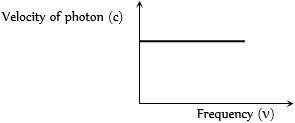
The curve drawn between the velocity and frequency of a photon in a vacuum will be a
A
Straight line parallel to the frequency axis
B
Straight line parallel to the velocity axis
C
Straight line passing through the origin and making an angle of $45^o$ with the frequency axis
D
Hyperbola
Solution
(A) In a vacuum,the velocity of a photon (i.e.,light) is a constant value,$c \approx 3 \times 10^8 \ m/s$,regardless of its frequency or wavelength. Since the velocity does not depend on the frequency,the graph of velocity versus frequency is a straight line parallel to the frequency axis. The graph is shown below:
Velocity of photon $(c)$ vs Frequency $(\nu)$: $A$ horizontal line at $y = c$.
Velocity of photon $(c)$ vs Frequency $(\nu)$: $A$ horizontal line at $y = c$.
0 likes
View Solution49
EasyMCQ
Which one of these is non-divisible?
A
Nucleus
B
Photon
C
Proton
D
Atom
Solution
(B) $Photon$ is an elementary particle,which is a quantum of electromagnetic radiation. It is considered a fundamental particle in the Standard Model of particle physics and is non-divisible. In contrast,an $Atom$ consists of a nucleus and electrons,a $Nucleus$ consists of protons and neutrons,and a $Proton$ is a composite particle made of quarks. Therefore,the correct option is $B$.
0 likes
View SolutionDual Nature of Radiation and matter — Particle Nature of Light : Photon · Frequently Asked Questions
1Are these Dual Nature of Radiation and matter questions useful for JEE and NEET?
Yes. All questions in this section are mapped to JEE Main and NEET exam patterns. Previous year questions from JEE Main, NEET, GUJCET and state-level exams are included with full solutions.
2Can I switch to Hindi or Gujarati for these questions?
Yes. Use the language tabs in the hero section or the sidebar to view the same questions and solutions in English, Hindi or Gujarati.
3How do I generate a question paper from this subtopic?
Use the Vedclass Exam Paper Generator — select the chapter and subtopic, set difficulty, and generate Sets A, B, C, D automatically. First 3 chapters of every subject are free.
Vedclass Products
For Students
Vedclass Test Series
Mock tests in real JEE/NEET style with performance analysis. 5-day free trial.
Start Free TrialFor Teachers
Exam Paper Generator
Generate Set A/B/C/D papers from this chapter in 2 minutes. 3 chapters free.
Try FreeFor Institutes
Online Exam Module
Live online exams with unlimited students, 360° analytics & white-label branding.
See DemoFor Teachers & Institutes
Generate a Dual Nature of Radiation and matter Exam Paper in 2 Minutes
Select subtopic & difficulty — Sets A, B, C, D auto-generated with No Repeat logic.
First 3 chapters of every subject are free — no payment required.