
A English
Einstein's Photoelectric Equation and Energy Quantum of Radiation Questions in English
Class 12 Physics · Dual Nature of Radiation and matter · Einstein's Photoelectric Equation and Energy Quantum of Radiation
736+
Questions
English
Language
100%
With Solutions
Showing 45 of 736 questions in English
651
DifficultMCQ
The photoelectric threshold wavelength for a certain metal surface is $3600 \mathring A$. If the metal surface is irradiated by a wavelength of $1100 \mathring A$,the kinetic energy of the emitted photoelectrons is (in $text{ eV}$)
A
$1.1$
B
$2$
C
$2.3$
D
$7.83$
Solution
(D) The photoelectric effect occurs when the incident wavelength $\lambda$ is less than or equal to the threshold wavelength $\lambda_{\text{th}}$.
Given:
Threshold wavelength $\lambda_{\text{th}} = 3600 \mathring A$.
Incident wavelength $\lambda = 1100 \mathring A$.
The kinetic energy $K_{\text{max}}$ is given by Einstein's photoelectric equation:
$K_{\text{max}} = \frac{hc}{\lambda} - \frac{hc}{\lambda_{\text{th}}}$
Using $hc \approx 12400 \text{ eV} \cdot \mathring A$:
$K_{\text{max}} = 12400 \left( \frac{1}{1100} - \frac{1}{3600} \right) \text{ eV}$
$K_{\text{max}} = 12400 \left( \frac{3600 - 1100}{1100 \times 3600} \right) \text{ eV}$
$K_{\text{max}} = 12400 \left( \frac{2500}{3960000} \right) \text{ eV} \approx 7.83 \text{ eV}$.
Given:
Threshold wavelength $\lambda_{\text{th}} = 3600 \mathring A$.
Incident wavelength $\lambda = 1100 \mathring A$.
The kinetic energy $K_{\text{max}}$ is given by Einstein's photoelectric equation:
$K_{\text{max}} = \frac{hc}{\lambda} - \frac{hc}{\lambda_{\text{th}}}$
Using $hc \approx 12400 \text{ eV} \cdot \mathring A$:
$K_{\text{max}} = 12400 \left( \frac{1}{1100} - \frac{1}{3600} \right) \text{ eV}$
$K_{\text{max}} = 12400 \left( \frac{3600 - 1100}{1100 \times 3600} \right) \text{ eV}$
$K_{\text{max}} = 12400 \left( \frac{2500}{3960000} \right) \text{ eV} \approx 7.83 \text{ eV}$.
0 likes
View Solution652
MediumMCQ
The threshold wavelength for the photoelectric effect on sodium is $5000 \ Å$. Its work function is:
A
$15 \ J$
B
$16 \times 10^{-14} \ J$
C
$4 \times 10^{-19} \ J$
D
$4 \times 10^{-18} \ J$
Solution
(C) The work function $\Phi_0$ is given by the formula $\Phi_0 = \frac{hc}{\lambda_0}$,where $h$ is Planck's constant $(6.63 \times 10^{-34} \ J \cdot s)$,$c$ is the speed of light $(3 \times 10^8 \ m/s)$,and $\lambda_0$ is the threshold wavelength $(5000 \ Å = 5000 \times 10^{-10} \ m = 5 \times 10^{-7} \ m)$.
Substituting the values:
$\Phi_0 = \frac{(6.63 \times 10^{-34}) \times (3 \times 10^8)}{5 \times 10^{-7}}$
$\Phi_0 = \frac{19.89 \times 10^{-26}}{5 \times 10^{-7}}$
$\Phi_0 = 3.978 \times 10^{-19} \ J \approx 4 \times 10^{-19} \ J$.
Thus,the correct option is $C$.
Substituting the values:
$\Phi_0 = \frac{(6.63 \times 10^{-34}) \times (3 \times 10^8)}{5 \times 10^{-7}}$
$\Phi_0 = \frac{19.89 \times 10^{-26}}{5 \times 10^{-7}}$
$\Phi_0 = 3.978 \times 10^{-19} \ J \approx 4 \times 10^{-19} \ J$.
Thus,the correct option is $C$.
0 likes
View Solution653
DifficultMCQ
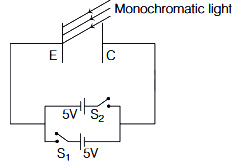
In a photoelectric experiment,a monochromatic light is incident on the emitter plate $E$,as shown in the figure. When switch $S_1$ is closed and switch $S_2$ is open,the photoelectrons strike the collector plate $C$ with a maximum kinetic energy of $1 eV$. If switch $S_1$ is open and switch $S_2$ is closed and the frequency of the incident light is doubled,the photoelectrons strike the collector plate with a maximum kinetic energy of $20 eV$. The threshold wavelength of the emitter plate is (in $Å$)
A
$5233.3$
B
$4133.3$
C
$4166.7$
D
$5336.7$
Solution
(B) Let the work function of the emitter plate be $\phi = h v_0$. The energy of the incident photon is $E = h v$.
Case $1$: Switch $S_1$ is closed and $S_2$ is open. The battery of $5 V$ is connected such that the collector $C$ is at a potential of $+5 V$ relative to $E$. The maximum kinetic energy of photoelectrons at the collector is $K_{max, C} = K_{max, E} + e V_{acc} = (E - \phi) + 5 eV = 1 eV$.
Thus,$E - \phi = -4 eV$ (This implies the light frequency is below the threshold,but the problem states photoelectrons strike,so we interpret the potential as retarding). Looking at the circuit,$S_1$ closed means $C$ is at $-5 V$ relative to $E$. So,$K_{max, C} = (E - \phi) - 5 eV = 1 eV \Rightarrow E - \phi = 6 eV$.
Case $2$: Switch $S_1$ is open and $S_2$ is closed. The battery of $5 V$ is connected such that $C$ is at $+5 V$ relative to $E$. The frequency is doubled,so the new energy is $2E$. The maximum kinetic energy at the collector is $K_{max, C} = (2E - \phi) + 5 eV = 20 eV \Rightarrow 2E - \phi = 15 eV$.
We have the system of equations:
$E - \phi = 6 eV$ ...$(i)$
$2E - \phi = 15 eV$ ...(ii)
Subtracting $(i)$ from (ii): $E = 9 eV$.
Substituting $E = 9 eV$ into $(i)$: $9 eV - \phi = 6 eV \Rightarrow \phi = 3 eV$.
The threshold wavelength $\lambda_0$ is given by $\lambda_0 = \frac{hc}{\phi} = \frac{12400 eV Å}{3 eV} \approx 4133.3 Å$.
Case $1$: Switch $S_1$ is closed and $S_2$ is open. The battery of $5 V$ is connected such that the collector $C$ is at a potential of $+5 V$ relative to $E$. The maximum kinetic energy of photoelectrons at the collector is $K_{max, C} = K_{max, E} + e V_{acc} = (E - \phi) + 5 eV = 1 eV$.
Thus,$E - \phi = -4 eV$ (This implies the light frequency is below the threshold,but the problem states photoelectrons strike,so we interpret the potential as retarding). Looking at the circuit,$S_1$ closed means $C$ is at $-5 V$ relative to $E$. So,$K_{max, C} = (E - \phi) - 5 eV = 1 eV \Rightarrow E - \phi = 6 eV$.
Case $2$: Switch $S_1$ is open and $S_2$ is closed. The battery of $5 V$ is connected such that $C$ is at $+5 V$ relative to $E$. The frequency is doubled,so the new energy is $2E$. The maximum kinetic energy at the collector is $K_{max, C} = (2E - \phi) + 5 eV = 20 eV \Rightarrow 2E - \phi = 15 eV$.
We have the system of equations:
$E - \phi = 6 eV$ ...$(i)$
$2E - \phi = 15 eV$ ...(ii)
Subtracting $(i)$ from (ii): $E = 9 eV$.
Substituting $E = 9 eV$ into $(i)$: $9 eV - \phi = 6 eV \Rightarrow \phi = 3 eV$.
The threshold wavelength $\lambda_0$ is given by $\lambda_0 = \frac{hc}{\phi} = \frac{12400 eV Å}{3 eV} \approx 4133.3 Å$.
0 likes
View Solution654
DifficultMCQ
The maximum kinetic energy of a photoelectron liberated from the surface of lithium with work function $2.35 \text{ eV}$ by electromagnetic radiation whose electric component varies with time as: $E=a[1+\cos(2 \pi f_1 t)] \cos(2 \pi f_2 t)$ (where $a$ is a constant) is (given $f_1=3.6 \times 10^{15} \text{ Hz}$,$f_2=1.2 \times 10^{15} \text{ Hz}$ and Planck's constant $h=6.6 \times 10^{-34} \text{ Js}$) (in $\text{ eV}$)
A
$2.64$
B
$7.55$
C
$12.52$
D
$17.45$
Solution
(D) Given,work function $W_0 = 2.35 \text{ eV}$. The electric component of the electromagnetic radiation is given by $E = a[1 + \cos(2 \pi f_1 t)] \cos(2 \pi f_2 t)$.
Using the trigonometric identity $\cos A \cos B = \frac{1}{2}[\cos(A+B) + \cos(A-B)]$,we expand the expression:
$E = a \cos(2 \pi f_2 t) + a \cos(2 \pi f_1 t) \cos(2 \pi f_2 t)$
$E = a \cos(2 \pi f_2 t) + \frac{a}{2} \cos[2 \pi (f_1 + f_2) t] + \frac{a}{2} \cos[2 \pi (f_1 - f_2) t]$.
The frequencies present in the radiation are $f_2$,$(f_1 + f_2)$,and $(f_1 - f_2)$.
To obtain the maximum kinetic energy,we must use the photon with the maximum frequency,which is $f_{\max} = f_1 + f_2 = 3.6 \times 10^{15} + 1.2 \times 10^{15} = 4.8 \times 10^{15} \text{ Hz}$.
The energy of this photon is $E_{\text{photon}} = h f_{\max} = (6.6 \times 10^{-34} \text{ Js} \times 4.8 \times 10^{15} \text{ Hz}) / (1.6 \times 10^{-19} \text{ J/eV}) = 19.8 \text{ eV}$.
The maximum kinetic energy is $KE_{\max} = E_{\text{photon}} - W_0 = 19.8 \text{ eV} - 2.35 \text{ eV} = 17.45 \text{ eV}$.
Thus,the correct option is $D$.
Using the trigonometric identity $\cos A \cos B = \frac{1}{2}[\cos(A+B) + \cos(A-B)]$,we expand the expression:
$E = a \cos(2 \pi f_2 t) + a \cos(2 \pi f_1 t) \cos(2 \pi f_2 t)$
$E = a \cos(2 \pi f_2 t) + \frac{a}{2} \cos[2 \pi (f_1 + f_2) t] + \frac{a}{2} \cos[2 \pi (f_1 - f_2) t]$.
The frequencies present in the radiation are $f_2$,$(f_1 + f_2)$,and $(f_1 - f_2)$.
To obtain the maximum kinetic energy,we must use the photon with the maximum frequency,which is $f_{\max} = f_1 + f_2 = 3.6 \times 10^{15} + 1.2 \times 10^{15} = 4.8 \times 10^{15} \text{ Hz}$.
The energy of this photon is $E_{\text{photon}} = h f_{\max} = (6.6 \times 10^{-34} \text{ Js} \times 4.8 \times 10^{15} \text{ Hz}) / (1.6 \times 10^{-19} \text{ J/eV}) = 19.8 \text{ eV}$.
The maximum kinetic energy is $KE_{\max} = E_{\text{photon}} - W_0 = 19.8 \text{ eV} - 2.35 \text{ eV} = 17.45 \text{ eV}$.
Thus,the correct option is $D$.
0 likes
View Solution655
MediumMCQ
All electrons ejected from a metallic surface by incident light of wavelength $400 \,nm$ travelled $1 \,m$ in the direction of a uniform electric field of $2 \,N/C$ and came to rest. The work function of the surface is (in $\,eV$)
A
$1.1$
B
$2.2$
C
$3.1$
D
$5.1$
Solution
(A) Given,wavelength of incident radiation,$\lambda = 400 \,nm = 4 \times 10^{-7} \,m$.
Electric field,$E = 2 \,N/C$ and distance,$s = 1 \,m$.
Energy of the incident photon,$E_{ph} = \frac{hc}{\lambda} = \frac{6.63 \times 10^{-34} \times 3 \times 10^8}{4 \times 10^{-7}} \approx 4.97 \times 10^{-19} \,J$.
Converting to $eV$,$E_{ph} = \frac{4.97 \times 10^{-19}}{1.6 \times 10^{-19}} \approx 3.1 \,eV$.
The electrons come to rest after traveling $1 \,m$ against the electric field. The work done by the electric field on the electron is $W = qEs = (1.6 \times 10^{-19} \,C) \times (2 \,N/C) \times (1 \,m) = 3.2 \times 10^{-19} \,J$.
Converting this to $eV$,$K_{max} = 2 \,eV$.
Using Einstein's photoelectric equation,$E_{ph} = W_0 + K_{max}$.
Therefore,the work function $W_0 = E_{ph} - K_{max} = 3.1 \,eV - 2 \,eV = 1.1 \,eV$.
Electric field,$E = 2 \,N/C$ and distance,$s = 1 \,m$.
Energy of the incident photon,$E_{ph} = \frac{hc}{\lambda} = \frac{6.63 \times 10^{-34} \times 3 \times 10^8}{4 \times 10^{-7}} \approx 4.97 \times 10^{-19} \,J$.
Converting to $eV$,$E_{ph} = \frac{4.97 \times 10^{-19}}{1.6 \times 10^{-19}} \approx 3.1 \,eV$.
The electrons come to rest after traveling $1 \,m$ against the electric field. The work done by the electric field on the electron is $W = qEs = (1.6 \times 10^{-19} \,C) \times (2 \,N/C) \times (1 \,m) = 3.2 \times 10^{-19} \,J$.
Converting this to $eV$,$K_{max} = 2 \,eV$.
Using Einstein's photoelectric equation,$E_{ph} = W_0 + K_{max}$.
Therefore,the work function $W_0 = E_{ph} - K_{max} = 3.1 \,eV - 2 \,eV = 1.1 \,eV$.
0 likes
View Solution656
DifficultMCQ
Light of wavelength $488 \, nm$ produced by an Argon laser is used in the photoelectric effect. When light from this spectral line is incident on the cathode, the stopping potential of the photoelectrons is $0.38 \, V$. The work function of the cathode material is (in $ \, eV$)
A
$2.16$
B
$216$
C
$21.6$
D
$0.216$
Solution
(A) Given: Wavelength of light, $\lambda = 488 \, nm$ and stopping potential, $V_0 = 0.38 \, V$.
Energy of a photon is given by $E = \frac{hc}{\lambda}$.
Using $hc \approx 1240 \, eV \cdot nm$ (or $1242 \, eV \cdot nm$), we calculate $E = \frac{1240}{488} \approx 2.54 \, eV$.
Using $hc = 1242 \, eV \cdot nm$, $E = \frac{1242}{488} \approx 2.545 \, eV$.
Maximum kinetic energy of photoelectrons is $KE_{\max} = eV_0 = 0.38 \, eV$.
According to Einstein's photoelectric equation, $E = KE_{\max} + W_0$.
Therefore, the work function $W_0 = E - KE_{\max} = 2.54 - 0.38 = 2.16 \, eV$.
Thus, the work function of the cathode material is $2.16 \, eV$.
Energy of a photon is given by $E = \frac{hc}{\lambda}$.
Using $hc \approx 1240 \, eV \cdot nm$ (or $1242 \, eV \cdot nm$), we calculate $E = \frac{1240}{488} \approx 2.54 \, eV$.
Using $hc = 1242 \, eV \cdot nm$, $E = \frac{1242}{488} \approx 2.545 \, eV$.
Maximum kinetic energy of photoelectrons is $KE_{\max} = eV_0 = 0.38 \, eV$.
According to Einstein's photoelectric equation, $E = KE_{\max} + W_0$.
Therefore, the work function $W_0 = E - KE_{\max} = 2.54 - 0.38 = 2.16 \, eV$.
Thus, the work function of the cathode material is $2.16 \, eV$.
0 likes
View Solution657
EasyMCQ
Photons of frequencies equal to the frequencies of $H_\beta$ and $H_{\infty}$ lines of hydrogen are incident on a photosensitive plate,whose threshold frequency is equal to the frequency of the $H_\alpha$ line of hydrogen. The ratio of the maximum kinetic energies of the emitted electrons is
A
$7$ : $16$
B
$3$ : $4$
C
$8$ : $27$
D
$5$ : $36$
Solution
(A) The energy of a photon corresponding to a spectral line is given by $E = h\nu = \Delta E = 13.6 \left( \frac{1}{n_f^2} - \frac{1}{n_i^2} \right) eV$.
Threshold energy $\phi = E(H_\alpha) = 13.6 \left( \frac{1}{2^2} - \frac{1}{3^2} \right) = 13.6 \left( \frac{5}{36} \right) eV$.
Energy of $H_\beta$ photon $E_\beta = 13.6 \left( \frac{1}{2^2} - \frac{1}{4^2} \right) = 13.6 \left( \frac{3}{16} \right) eV$.
Energy of $H_\infty$ photon $E_\infty = 13.6 \left( \frac{1}{2^2} - \frac{1}{\infty^2} \right) = 13.6 \left( \frac{1}{4} \right) eV$.
Maximum kinetic energy $K_{max} = E - \phi$.
$K_\beta = 13.6 \left( \frac{3}{16} - \frac{5}{36} \right) = 13.6 \left( \frac{27 - 20}{144} \right) = 13.6 \left( \frac{7}{144} \right) eV$.
$K_\infty = 13.6 \left( \frac{1}{4} - \frac{5}{36} \right) = 13.6 \left( \frac{9 - 5}{36} \right) = 13.6 \left( \frac{4}{36} \right) = 13.6 \left( \frac{16}{144} \right) eV$.
Ratio $\frac{K_\beta}{K_\infty} = \frac{7/144}{16/144} = \frac{7}{16}$.
Threshold energy $\phi = E(H_\alpha) = 13.6 \left( \frac{1}{2^2} - \frac{1}{3^2} \right) = 13.6 \left( \frac{5}{36} \right) eV$.
Energy of $H_\beta$ photon $E_\beta = 13.6 \left( \frac{1}{2^2} - \frac{1}{4^2} \right) = 13.6 \left( \frac{3}{16} \right) eV$.
Energy of $H_\infty$ photon $E_\infty = 13.6 \left( \frac{1}{2^2} - \frac{1}{\infty^2} \right) = 13.6 \left( \frac{1}{4} \right) eV$.
Maximum kinetic energy $K_{max} = E - \phi$.
$K_\beta = 13.6 \left( \frac{3}{16} - \frac{5}{36} \right) = 13.6 \left( \frac{27 - 20}{144} \right) = 13.6 \left( \frac{7}{144} \right) eV$.
$K_\infty = 13.6 \left( \frac{1}{4} - \frac{5}{36} \right) = 13.6 \left( \frac{9 - 5}{36} \right) = 13.6 \left( \frac{4}{36} \right) = 13.6 \left( \frac{16}{144} \right) eV$.
Ratio $\frac{K_\beta}{K_\infty} = \frac{7/144}{16/144} = \frac{7}{16}$.
0 likes
View Solution658
DifficultMCQ
Photons of wavelength $\lambda$ emitted by a source of power $P$ are incident on a photocell. If the current produced in the cell is $I$,then the percentage of incident photons which produce current in the photocell is: (where $h$ is Planck's constant and $c$ is the speed of light in vacuum)
A
$\frac{100 e P c}{I h \lambda}$
B
$\frac{100 I h c}{e P \lambda}$
C
$\frac{100 I h \lambda}{e P c}$
D
$\frac{100 e P \lambda}{I h c}$
Solution
(B) The energy of a single photon is $E = \frac{hc}{\lambda}$.
The total number of photons emitted per second by the source of power $P$ is $N = \frac{P}{E} = \frac{P \lambda}{hc}$.
The number of electrons produced per second is $n = \frac{I}{e}$,where $I$ is the photoelectric current and $e$ is the charge of an electron.
The percentage of incident photons that produce current is given by $\eta = \frac{n}{N} \times 100$.
Substituting the values: $\eta = \frac{I/e}{P \lambda / hc} \times 100 = \frac{Ihc}{eP \lambda} \times 100$.
The total number of photons emitted per second by the source of power $P$ is $N = \frac{P}{E} = \frac{P \lambda}{hc}$.
The number of electrons produced per second is $n = \frac{I}{e}$,where $I$ is the photoelectric current and $e$ is the charge of an electron.
The percentage of incident photons that produce current is given by $\eta = \frac{n}{N} \times 100$.
Substituting the values: $\eta = \frac{I/e}{P \lambda / hc} \times 100 = \frac{Ihc}{eP \lambda} \times 100$.
0 likes
View Solution659
EasyMCQ
When light of frequency $v$ is incident on two metallic plates $A$ and $B$,photoelectrons are emitted. If the work function of $A$ is greater than that of $B$,which of the following curves correctly represents the relationship between the stopping potential $V$ and the incident frequency $v$?
A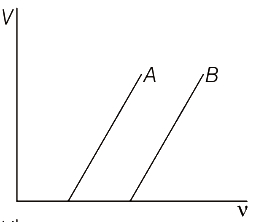
B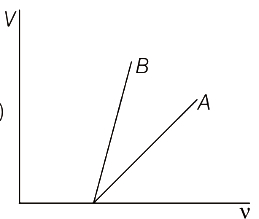
C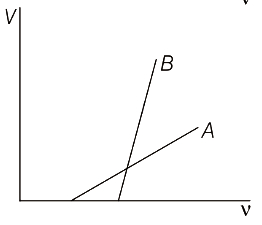
D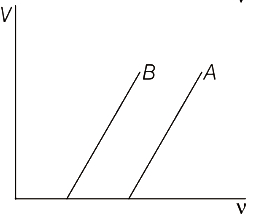
Solution
(D) According to Einstein's photoelectric equation,the stopping potential $V$ is given by:
$eV = h v - \Phi$
$V = (h/e) v - (\Phi/e)$
Here,$h$ is Planck's constant,$e$ is the charge of an electron,$v$ is the frequency of incident light,and $\Phi$ is the work function of the metal.
This equation represents a straight line $y = mx + c$,where the slope $m = h/e$ is constant for all metals,and the $y$-intercept is $-(\Phi/e)$.
The threshold frequency $v_0$ is given by $\Phi = h v_0$,so $v_0 = \Phi/h$.
Since the work function of $A$ is greater than that of $B$ $(\Phi_A > \Phi_B)$,the threshold frequency of $A$ must be greater than that of $B$ $(v_{0A} > v_{0B})$.
On a $V$ versus $v$ graph,the $x$-intercept represents the threshold frequency $v_0$.
Therefore,the line for metal $A$ must intersect the $v$-axis at a point further to the right than the line for metal $B$.
Looking at the provided options,the curve where $A$ has a larger threshold frequency than $B$ is the correct representation.
$eV = h v - \Phi$
$V = (h/e) v - (\Phi/e)$
Here,$h$ is Planck's constant,$e$ is the charge of an electron,$v$ is the frequency of incident light,and $\Phi$ is the work function of the metal.
This equation represents a straight line $y = mx + c$,where the slope $m = h/e$ is constant for all metals,and the $y$-intercept is $-(\Phi/e)$.
The threshold frequency $v_0$ is given by $\Phi = h v_0$,so $v_0 = \Phi/h$.
Since the work function of $A$ is greater than that of $B$ $(\Phi_A > \Phi_B)$,the threshold frequency of $A$ must be greater than that of $B$ $(v_{0A} > v_{0B})$.
On a $V$ versus $v$ graph,the $x$-intercept represents the threshold frequency $v_0$.
Therefore,the line for metal $A$ must intersect the $v$-axis at a point further to the right than the line for metal $B$.
Looking at the provided options,the curve where $A$ has a larger threshold frequency than $B$ is the correct representation.
0 likes
View Solution660
EasyMCQ
When photons of energy $5 eV$ are incident on a metal surface with a work function of $4.36 eV$,photoelectrons are emitted. What is the maximum momentum of the emitted photoelectrons?
A
$2.41 \times 10^{-25} kgms^{-1}$
B
$2.31 \times 10^{-25} kgms^{-1}$
C
$4.31 \times 10^{-25} kgms^{-1}$
D
$1.31 \times 10^{-24} kgms^{-1}$
Solution
(C) According to Einstein's photoelectric equation,the maximum kinetic energy $K_{max}$ of the emitted photoelectrons is given by: $K_{max} = E - \Phi$,where $E = 5 eV$ is the energy of the incident photon and $\Phi = 4.36 eV$ is the work function of the metal.
$K_{max} = 5 eV - 4.36 eV = 0.64 eV$.
Converting this energy into Joules: $K_{max} = 0.64 \times 1.6 \times 10^{-19} J = 1.024 \times 10^{-19} J$.
The relationship between maximum kinetic energy and maximum momentum $p$ is $K_{max} = \frac{p^2}{2m}$,where $m$ is the mass of an electron $(9.1 \times 10^{-31} kg)$.
$p = \sqrt{2m K_{max}} = \sqrt{2 \times 9.1 \times 10^{-31} \times 1.024 \times 10^{-19}}$.
$p = \sqrt{18.6368 \times 10^{-50}} \approx 4.31 \times 10^{-25} kgms^{-1}$.
$K_{max} = 5 eV - 4.36 eV = 0.64 eV$.
Converting this energy into Joules: $K_{max} = 0.64 \times 1.6 \times 10^{-19} J = 1.024 \times 10^{-19} J$.
The relationship between maximum kinetic energy and maximum momentum $p$ is $K_{max} = \frac{p^2}{2m}$,where $m$ is the mass of an electron $(9.1 \times 10^{-31} kg)$.
$p = \sqrt{2m K_{max}} = \sqrt{2 \times 9.1 \times 10^{-31} \times 1.024 \times 10^{-19}}$.
$p = \sqrt{18.6368 \times 10^{-50}} \approx 4.31 \times 10^{-25} kgms^{-1}$.
0 likes
View Solution661
EasyMCQ
$A$ point source of light emits photons of energy $4.8 eV$ at the rate $10^5$ photons per second. These photons are incident on a photo-sensitive sphere of work function $2.8 eV$ and radius $9 mm$. The sphere is initially neutral and the emitted photoelectrons are instantly swept away. The time after which the photoelectric emission stops is (in $s$)
A
$250$
B
$125$
C
$375$
D
$175$
Solution
(B) The energy of incident photons is $E = 4.8 eV$ and the work function of the sphere is $\phi = 2.8 eV$. Photoelectric emission stops when the potential of the sphere $V$ reaches a value such that the kinetic energy of the emitted electrons is zero. This occurs when $eV = E - \phi = 4.8 eV - 2.8 eV = 2.0 eV$,so $V = 2.0 V$.
The capacitance of a sphere of radius $R = 9 mm = 9 \times 10^{-3} m$ is $C = 4\pi\epsilon_0 R = \frac{R}{k} = \frac{9 \times 10^{-3}}{9 \times 10^9} = 10^{-12} F$.
The charge $Q$ required to reach potential $V$ is $Q = CV = 10^{-12} F \times 2.0 V = 2 \times 10^{-12} C$.
The number of electrons emitted is $n = \frac{Q}{e} = \frac{2 \times 10^{-12}}{1.6 \times 10^{-19}} = 1.25 \times 10^7$.
Since the rate of emission is $10^5$ electrons per second,the time taken is $t = \frac{n}{\text{rate}} = \frac{1.25 \times 10^7}{10^5} = 125 s$.
The capacitance of a sphere of radius $R = 9 mm = 9 \times 10^{-3} m$ is $C = 4\pi\epsilon_0 R = \frac{R}{k} = \frac{9 \times 10^{-3}}{9 \times 10^9} = 10^{-12} F$.
The charge $Q$ required to reach potential $V$ is $Q = CV = 10^{-12} F \times 2.0 V = 2 \times 10^{-12} C$.
The number of electrons emitted is $n = \frac{Q}{e} = \frac{2 \times 10^{-12}}{1.6 \times 10^{-19}} = 1.25 \times 10^7$.
Since the rate of emission is $10^5$ electrons per second,the time taken is $t = \frac{n}{\text{rate}} = \frac{1.25 \times 10^7}{10^5} = 125 s$.
0 likes
View Solution662
EasyMCQ
The threshold frequency for a certain metal is $v_0$. When radiation of frequency $2v_0$ is incident on this metal surface,the maximum velocity of the emitted photoelectrons is $2 \times 10^6 \ m/s$. If radiation of frequency $3v_0$ is incident on the same metal surface,the maximum velocity of the emitted photoelectrons is . . . . . .
A
$\sqrt{2} \times 10^6 \ m/s$
B
$2\sqrt{2} \times 10^6 \ m/s$
C
$4 \times 10^6 \ m/s$
D
$5 \times 10^6 \ m/s$
Solution
(B) According to Einstein's photoelectric equation: $K_{max} = h\nu - \phi_0$,where $\phi_0 = h\nu_0$.
For frequency $\nu_1 = 2\nu_0$,the maximum kinetic energy is $K_1 = h(2\nu_0) - h\nu_0 = h\nu_0$.
Given $v_1 = 2 \times 10^6 \ m/s$,so $K_1 = \frac{1}{2}mv_1^2 = h\nu_0$.
For frequency $\nu_2 = 3\nu_0$,the maximum kinetic energy is $K_2 = h(3\nu_0) - h\nu_0 = 2h\nu_0$.
Since $K_2 = 2K_1$,we have $\frac{1}{2}mv_2^2 = 2(\frac{1}{2}mv_1^2)$.
Thus,$v_2^2 = 2v_1^2$,which implies $v_2 = \sqrt{2}v_1$.
Substituting $v_1 = 2 \times 10^6 \ m/s$,we get $v_2 = \sqrt{2} \times 2 \times 10^6 = 2\sqrt{2} \times 10^6 \ m/s$.
For frequency $\nu_1 = 2\nu_0$,the maximum kinetic energy is $K_1 = h(2\nu_0) - h\nu_0 = h\nu_0$.
Given $v_1 = 2 \times 10^6 \ m/s$,so $K_1 = \frac{1}{2}mv_1^2 = h\nu_0$.
For frequency $\nu_2 = 3\nu_0$,the maximum kinetic energy is $K_2 = h(3\nu_0) - h\nu_0 = 2h\nu_0$.
Since $K_2 = 2K_1$,we have $\frac{1}{2}mv_2^2 = 2(\frac{1}{2}mv_1^2)$.
Thus,$v_2^2 = 2v_1^2$,which implies $v_2 = \sqrt{2}v_1$.
Substituting $v_1 = 2 \times 10^6 \ m/s$,we get $v_2 = \sqrt{2} \times 2 \times 10^6 = 2\sqrt{2} \times 10^6 \ m/s$.
0 likes
View Solution663
DifficultMCQ
If the light from the Balmer series of hydrogen is used to eject photoelectrons from a metal, then the maximum work function of the metal can be: (in $\text{ eV}$)
A
$1.89$
B
$3.4$
C
$3.8$
D
$5.1$
Solution
(B) The energy of a photon emitted in the hydrogen spectrum is given by the Rydberg formula: $E = 13.6 \left( \frac{1}{n_1^2} - \frac{1}{n_2^2} \right) \text{ eV}$.
For the Balmer series, the transition ends at $n_1 = 2$.
The maximum energy photon corresponds to the transition from $n_2 = \infty$ to $n_1 = 2$.
Substituting these values: $E_{\text{max}} = 13.6 \left( \frac{1}{2^2} - \frac{1}{\infty^2} \right) \text{ eV} = 13.6 \times \frac{1}{4} \text{ eV} = 3.4 \text{ eV}$.
For photoemission to occur, the energy of the incident photon must be greater than or equal to the work function $(\phi)$ of the metal. Thus, the maximum possible work function for which photoelectrons can be ejected is equal to the maximum energy of the incident photon, which is $3.4 \text{ eV}$.
For the Balmer series, the transition ends at $n_1 = 2$.
The maximum energy photon corresponds to the transition from $n_2 = \infty$ to $n_1 = 2$.
Substituting these values: $E_{\text{max}} = 13.6 \left( \frac{1}{2^2} - \frac{1}{\infty^2} \right) \text{ eV} = 13.6 \times \frac{1}{4} \text{ eV} = 3.4 \text{ eV}$.
For photoemission to occur, the energy of the incident photon must be greater than or equal to the work function $(\phi)$ of the metal. Thus, the maximum possible work function for which photoelectrons can be ejected is equal to the maximum energy of the incident photon, which is $3.4 \text{ eV}$.
0 likes
View Solution664
EasyMCQ
$A$ photon released by the transition of an electron from the second excited state to the ground state of a Hydrogen atom is incident on the surface of a metal with a work function of $3.1 \ eV$. The de Broglie wavelength of the most energetic electron emitted from that metal surface is nearly:
A
$2.6 \ \text{Å}$
B
$4 \ \text{Å}$
C
$6 \ \text{Å}$
D
None of these
Solution
(B) The energy of the photon released during the transition from the second excited state $(n_2 = 3)$ to the ground state $(n_1 = 1)$ is given by:
$E = 13.6 \left[ \frac{1}{n_1^2} - \frac{1}{n_2^2} \right] \ eV$
$E = 13.6 \left[ \frac{1}{1^2} - \frac{1}{3^2} \right] = 13.6 \left[ 1 - \frac{1}{9} \right] = 13.6 \times \frac{8}{9} \approx 12.09 \ eV \approx 12.1 \ eV$.
Using Einstein's photoelectric equation,the maximum kinetic energy $(K_{\max})$ of the emitted electron is:
$K_{\max} = E - W = 12.1 \ eV - 3.1 \ eV = 9.0 \ eV$.
The de Broglie wavelength $(\lambda)$ is given by $\lambda = \frac{h}{\sqrt{2mK_{\max}}}$.
Using the formula $\lambda \approx \frac{12.27}{\sqrt{K_{\max}}} \ \text{Å}$ (where $K_{\max}$ is in $eV$):
$\lambda = \frac{12.27}{\sqrt{9}} = \frac{12.27}{3} = 4.09 \ \text{Å}$.
Thus,the wavelength is nearly $4 \ \text{Å}$.
$E = 13.6 \left[ \frac{1}{n_1^2} - \frac{1}{n_2^2} \right] \ eV$
$E = 13.6 \left[ \frac{1}{1^2} - \frac{1}{3^2} \right] = 13.6 \left[ 1 - \frac{1}{9} \right] = 13.6 \times \frac{8}{9} \approx 12.09 \ eV \approx 12.1 \ eV$.
Using Einstein's photoelectric equation,the maximum kinetic energy $(K_{\max})$ of the emitted electron is:
$K_{\max} = E - W = 12.1 \ eV - 3.1 \ eV = 9.0 \ eV$.
The de Broglie wavelength $(\lambda)$ is given by $\lambda = \frac{h}{\sqrt{2mK_{\max}}}$.
Using the formula $\lambda \approx \frac{12.27}{\sqrt{K_{\max}}} \ \text{Å}$ (where $K_{\max}$ is in $eV$):
$\lambda = \frac{12.27}{\sqrt{9}} = \frac{12.27}{3} = 4.09 \ \text{Å}$.
Thus,the wavelength is nearly $4 \ \text{Å}$.
0 likes
View Solution665
MediumMCQ
When a photosensitive material is illuminated by photons of energy $3.1 \ eV$,the stopping potential of the photoelectrons is $1.7 \ V$. When the same photosensitive material is illuminated by photons of energy $2.5 \ eV$,the stopping potential of the photoelectrons is: (in $V$)
A
$1.8$
B
$1.4$
C
$1.1$
D
$1.3$
Solution
(C) According to Einstein's photoelectric equation,the maximum kinetic energy of photoelectrons is given by $K_{max} = E - \phi$,where $E$ is the energy of the incident photon and $\phi$ is the work function of the material.
Since $K_{max} = e V_s$,where $V_s$ is the stopping potential,we have $e V_s = E - \phi$.
For the first case: $e(1.7 \ V) = 3.1 \ eV - \phi$,which implies $\phi = 3.1 \ eV - 1.7 \ eV = 1.4 \ eV$.
For the second case: $e V_s' = 2.5 \ eV - \phi$.
Substituting the value of $\phi$: $e V_s' = 2.5 \ eV - 1.4 \ eV = 1.1 \ eV$.
Therefore,the stopping potential $V_s' = 1.1 \ V$.
Since $K_{max} = e V_s$,where $V_s$ is the stopping potential,we have $e V_s = E - \phi$.
For the first case: $e(1.7 \ V) = 3.1 \ eV - \phi$,which implies $\phi = 3.1 \ eV - 1.7 \ eV = 1.4 \ eV$.
For the second case: $e V_s' = 2.5 \ eV - \phi$.
Substituting the value of $\phi$: $e V_s' = 2.5 \ eV - 1.4 \ eV = 1.1 \ eV$.
Therefore,the stopping potential $V_s' = 1.1 \ V$.
0 likes
View Solution666
MediumMCQ
When photons are incident on a photosensitive material of work function $1.5 \text{ eV}$,the maximum velocity of the emitted photoelectrons is $8 \times 10^5 \text{ m/s}$. The stopping potential of the photoelectrons is (Mass of the electron $= 9 \times 10^{-31} \text{ kg}$ and charge of the electron $= 1.6 \times 10^{-19} \text{ C}$) (in $V$)
A
$1.8$
B
$1.5$
C
$2.1$
D
$2.4$
Solution
(A) The maximum kinetic energy $(K_{max})$ of the emitted photoelectrons is given by the formula: $K_{max} = \frac{1}{2} m v_{max}^2$.
Given $m = 9 \times 10^{-31} \text{ kg}$ and $v_{max} = 8 \times 10^5 \text{ m/s}$.
$K_{max} = \frac{1}{2} \times (9 \times 10^{-31}) \times (8 \times 10^5)^2$.
$K_{max} = 0.5 \times 9 \times 10^{-31} \times 64 \times 10^{10} = 288 \times 10^{-21} \text{ J}$.
To convert this energy into electron-volts (eV),divide by the charge of an electron $(e = 1.6 \times 10^{-19} \text{ C})$:
$K_{max} \text{ (in eV)} = \frac{288 \times 10^{-21}}{1.6 \times 10^{-19}} = 180 \times 10^{-2} = 1.8 \text{ eV}$.
The stopping potential $(V_s)$ is related to the maximum kinetic energy by the equation: $K_{max} = e V_s$.
Therefore,$V_s = \frac{K_{max}}{e} = 1.8 \text{ V}$.
Given $m = 9 \times 10^{-31} \text{ kg}$ and $v_{max} = 8 \times 10^5 \text{ m/s}$.
$K_{max} = \frac{1}{2} \times (9 \times 10^{-31}) \times (8 \times 10^5)^2$.
$K_{max} = 0.5 \times 9 \times 10^{-31} \times 64 \times 10^{10} = 288 \times 10^{-21} \text{ J}$.
To convert this energy into electron-volts (eV),divide by the charge of an electron $(e = 1.6 \times 10^{-19} \text{ C})$:
$K_{max} \text{ (in eV)} = \frac{288 \times 10^{-21}}{1.6 \times 10^{-19}} = 180 \times 10^{-2} = 1.8 \text{ eV}$.
The stopping potential $(V_s)$ is related to the maximum kinetic energy by the equation: $K_{max} = e V_s$.
Therefore,$V_s = \frac{K_{max}}{e} = 1.8 \text{ V}$.
0 likes
View Solution667
MediumMCQ
In a photoelectric experiment, the slope of the graph drawn between stopping potential $(V_s)$ along the $y$-axis and the frequency $(\nu)$ of incident radiation along the $x$-axis is (Planck's constant $h = 6.6 \times 10^{-34} \text{ Js}$)
A
$2.42 \times 10^{15} \text{ JsC}^{-1}$
B
$10.56 \times 10^{-15} \text{ JsC}^{-1}$
C
$4.125 \times 10^{-15} \text{ JsC}^{-1}$
D
$6.25 \times 10^{-20} \text{ JsC}^{-1}$
Solution
(C) According to Einstein's photoelectric equation, the maximum kinetic energy of emitted photoelectrons is given by $K_{max} = h\nu - \phi_0$, where $h$ is Planck's constant, $\nu$ is the frequency of incident radiation, and $\phi_0$ is the work function.
Since $K_{max} = eV_s$, where $e$ is the charge of an electron and $V_s$ is the stopping potential, we can write:
$eV_s = h\nu - \phi_0$
$V_s = (\frac{h}{e})\nu - \frac{\phi_0}{e}$
This equation is in the form of a straight line $y = mx + c$, where $y = V_s$, $x = \nu$, and the slope $m = \frac{h}{e}$.
Given $h = 6.6 \times 10^{-34} \text{ Js}$ and $e = 1.6 \times 10^{-19} \text{ C}$.
Slope $m = \frac{6.6 \times 10^{-34}}{1.6 \times 10^{-19}} = 4.125 \times 10^{-15} \text{ JsC}^{-1}$.
Thus, the correct option is $C$.
Since $K_{max} = eV_s$, where $e$ is the charge of an electron and $V_s$ is the stopping potential, we can write:
$eV_s = h\nu - \phi_0$
$V_s = (\frac{h}{e})\nu - \frac{\phi_0}{e}$
This equation is in the form of a straight line $y = mx + c$, where $y = V_s$, $x = \nu$, and the slope $m = \frac{h}{e}$.
Given $h = 6.6 \times 10^{-34} \text{ Js}$ and $e = 1.6 \times 10^{-19} \text{ C}$.
Slope $m = \frac{6.6 \times 10^{-34}}{1.6 \times 10^{-19}} = 4.125 \times 10^{-15} \text{ JsC}^{-1}$.
Thus, the correct option is $C$.
0 likes
View Solution668
EasyMCQ
If Planck's constant is $6.63 \times 10^{-34} \ J \cdot s$,then the slope of a graph drawn between cut-off voltage and frequency of incident light in a photoelectric experiment is
A
$4.14 \times 10^{-15} \ V \cdot s$
B
$19.776 \times 10^{-15} \ V \cdot s$
C
$2.198 \times 10^{-15} \ V \cdot s$
D
$1.337 \times 10^{-15} \ V \cdot s$
Solution
(A) According to Einstein's photoelectric equation,the maximum kinetic energy of emitted photoelectrons is given by $K_{max} = h\nu - \phi_0$,where $h$ is Planck's constant,$\nu$ is the frequency of incident light,and $\phi_0$ is the work function.
Since $K_{max} = eV_0$,where $V_0$ is the cut-off (stopping) potential and $e$ is the charge of an electron,we have $eV_0 = h\nu - \phi_0$.
Rearranging this,we get $V_0 = (\frac{h}{e})\nu - \frac{\phi_0}{e}$.
Comparing this with the equation of a straight line $y = mx + c$,the slope $m$ of the graph between cut-off voltage $V_0$ and frequency $\nu$ is $\frac{h}{e}$.
Substituting the values: $\text{Slope} = \frac{6.63 \times 10^{-34} \ J \cdot s}{1.6 \times 10^{-19} \ C} = 4.14 \times 10^{-15} \ V \cdot s$.
Since $K_{max} = eV_0$,where $V_0$ is the cut-off (stopping) potential and $e$ is the charge of an electron,we have $eV_0 = h\nu - \phi_0$.
Rearranging this,we get $V_0 = (\frac{h}{e})\nu - \frac{\phi_0}{e}$.
Comparing this with the equation of a straight line $y = mx + c$,the slope $m$ of the graph between cut-off voltage $V_0$ and frequency $\nu$ is $\frac{h}{e}$.
Substituting the values: $\text{Slope} = \frac{6.63 \times 10^{-34} \ J \cdot s}{1.6 \times 10^{-19} \ C} = 4.14 \times 10^{-15} \ V \cdot s$.
0 likes
View Solution669
MediumMCQ
The work function of a photosensitive metal surface is $1.1 \ eV$. Two light beams of energies $1.5 \ eV$ and $2 \ eV$ are incident on the metal surface. The ratio of the maximum velocities of the emitted photoelectrons is
A
$3: 4$
B
$1: 1$
C
$2: 3$
D
$4: 9$
Solution
(C) The work function of the metal is $\phi_0 = 1.1 \ eV$.
According to Einstein's photoelectric equation,the maximum kinetic energy $K_{max}$ of the emitted photoelectrons is given by $K_{max} = E - \phi_0$,where $E$ is the energy of the incident photon.
Since $K_{max} = \frac{1}{2}mv^2$,we have $v = \sqrt{\frac{2(E - \phi_0)}{m}}$.
For the first beam with energy $E_1 = 1.5 \ eV$,the maximum velocity is $v_1 = \sqrt{\frac{2(1.5 - 1.1)}{m}} = \sqrt{\frac{2(0.4)}{m}}$.
For the second beam with energy $E_2 = 2 \ eV$,the maximum velocity is $v_2 = \sqrt{\frac{2(2 - 1.1)}{m}} = \sqrt{\frac{2(0.9)}{m}}$.
The ratio of the maximum velocities is $\frac{v_1}{v_2} = \sqrt{\frac{0.4}{0.9}} = \sqrt{\frac{4}{9}} = \frac{2}{3}$.
Thus,the ratio is $2:3$.
According to Einstein's photoelectric equation,the maximum kinetic energy $K_{max}$ of the emitted photoelectrons is given by $K_{max} = E - \phi_0$,where $E$ is the energy of the incident photon.
Since $K_{max} = \frac{1}{2}mv^2$,we have $v = \sqrt{\frac{2(E - \phi_0)}{m}}$.
For the first beam with energy $E_1 = 1.5 \ eV$,the maximum velocity is $v_1 = \sqrt{\frac{2(1.5 - 1.1)}{m}} = \sqrt{\frac{2(0.4)}{m}}$.
For the second beam with energy $E_2 = 2 \ eV$,the maximum velocity is $v_2 = \sqrt{\frac{2(2 - 1.1)}{m}} = \sqrt{\frac{2(0.9)}{m}}$.
The ratio of the maximum velocities is $\frac{v_1}{v_2} = \sqrt{\frac{0.4}{0.9}} = \sqrt{\frac{4}{9}} = \frac{2}{3}$.
Thus,the ratio is $2:3$.
0 likes
View Solution670
MediumMCQ
Radiations of wavelength $400 \,nm$ are incident on a photosensitive material with a work function of $2.2 \,eV$. The stopping potential is nearly: (in $\,V$)
A
$0.9$
B
$0.5$
C
$0.4$
D
$0.1$
Solution
(A) Given:
Work function,$W = 2.2 \,eV$
Wavelength of incident radiation,$\lambda = 400 \,nm$
The energy of the incident photon is given by:
$E = \frac{1240 \,eV \cdot nm}{\lambda (nm)} = \frac{1240}{400} = 3.1 \,eV$
According to Einstein's photoelectric equation:
$E = W + K_{max}$
where $K_{max} = e V_s$ ($V_s$ is the stopping potential).
$e V_s = E - W$
$e V_s = 3.1 \,eV - 2.2 \,eV = 0.9 \,eV$
Therefore,the stopping potential $V_s = 0.9 \,V$.
Work function,$W = 2.2 \,eV$
Wavelength of incident radiation,$\lambda = 400 \,nm$
The energy of the incident photon is given by:
$E = \frac{1240 \,eV \cdot nm}{\lambda (nm)} = \frac{1240}{400} = 3.1 \,eV$
According to Einstein's photoelectric equation:
$E = W + K_{max}$
where $K_{max} = e V_s$ ($V_s$ is the stopping potential).
$e V_s = E - W$
$e V_s = 3.1 \,eV - 2.2 \,eV = 0.9 \,eV$
Therefore,the stopping potential $V_s = 0.9 \,V$.
0 likes
View Solution671
MediumMCQ
For the photoelectric effect,which of the following statements are true?
$I$ The kinetic energies of the photoelectrons do not depend on the frequency of light.
$II$ The photoelectric effect will always occur for highly intense light.
$III$ The maximum kinetic energy of a photoelectron does not depend upon the intensity of the light.
$IV$ The escaping electron's kinetic energy is larger for a larger frequency.
$I$ The kinetic energies of the photoelectrons do not depend on the frequency of light.
$II$ The photoelectric effect will always occur for highly intense light.
$III$ The maximum kinetic energy of a photoelectron does not depend upon the intensity of the light.
$IV$ The escaping electron's kinetic energy is larger for a larger frequency.
A
$I$ and $II$ only
B
$II$ and $III$ only
C
$III$ and $IV$ only
D
$IV$ and $I$ only
Solution
(C) According to Einstein's photoelectric equation,the maximum kinetic energy $(K_{\max})$ of emitted photoelectrons is given by $K_{\max} = h\nu - \phi$,where $h$ is Planck's constant,$\nu$ is the frequency of incident light,and $\phi$ is the work function of the metal.
$1$. Statement $I$ is incorrect because $K_{\max}$ depends directly on the frequency $\nu$.
$2$. Statement $II$ is incorrect because the photoelectric effect depends on the frequency of light being greater than the threshold frequency $(\nu_0)$,regardless of intensity.
$3$. Statement $III$ is correct because $K_{\max}$ depends only on the frequency of incident light,not on its intensity.
$4$. Statement $IV$ is correct because as frequency $\nu$ increases,$K_{\max} = h\nu - \phi$ also increases.
Thus,statements $III$ and $IV$ are correct.
$1$. Statement $I$ is incorrect because $K_{\max}$ depends directly on the frequency $\nu$.
$2$. Statement $II$ is incorrect because the photoelectric effect depends on the frequency of light being greater than the threshold frequency $(\nu_0)$,regardless of intensity.
$3$. Statement $III$ is correct because $K_{\max}$ depends only on the frequency of incident light,not on its intensity.
$4$. Statement $IV$ is correct because as frequency $\nu$ increases,$K_{\max} = h\nu - \phi$ also increases.
Thus,statements $III$ and $IV$ are correct.
0 likes
View Solution672
EasyMCQ
The value of Planck's constant,if the slope of the graph of stopping potential vs frequency of incident light is $4 \times 10^{-15} \ V \ s$,is (given charge of an electron $= 1.6 \times 10^{-19} \ C$):
A
$6.0 \times 10^{-34} \ J \ s$
B
$6.2 \times 10^{-34} \ J \ s$
C
$6.4 \times 10^{-34} \ J \ s$
D
$6.6 \times 10^{-34} \ J \ s$
Solution
(C) From Einstein's photoelectric equation,the stopping potential $V_s$ is related to the frequency $\nu$ as:
$e V_s = h \nu - \phi$
Rearranging for $V_s$,we get:
$V_s = \left( \frac{h}{e} \right) \nu - \frac{\phi}{e}$
This is a linear equation of the form $y = mx + c$,where the slope $m = \frac{h}{e}$.
Given that the slope is $4 \times 10^{-15} \ V \ s$,we have:
$\frac{h}{e} = 4 \times 10^{-15} \ V \ s$
$h = (4 \times 10^{-15} \ V \ s) \times (1.6 \times 10^{-19} \ C)$
$h = 6.4 \times 10^{-34} \ J \ s$
Thus,the value of Planck's constant is $6.4 \times 10^{-34} \ J \ s$.
$e V_s = h \nu - \phi$
Rearranging for $V_s$,we get:
$V_s = \left( \frac{h}{e} \right) \nu - \frac{\phi}{e}$
This is a linear equation of the form $y = mx + c$,where the slope $m = \frac{h}{e}$.
Given that the slope is $4 \times 10^{-15} \ V \ s$,we have:
$\frac{h}{e} = 4 \times 10^{-15} \ V \ s$
$h = (4 \times 10^{-15} \ V \ s) \times (1.6 \times 10^{-19} \ C)$
$h = 6.4 \times 10^{-34} \ J \ s$
Thus,the value of Planck's constant is $6.4 \times 10^{-34} \ J \ s$.
0 likes
View Solution673
EasyMCQ
Light strikes a metal surface causing photoelectric emission. The wavelength of incident light is $248 \, nm$. If the stopping potential for the ejected electrons is $2.8 \, eV$, then the work function of the metal is (Take $hc = 1240 \, eV \cdot nm$). (in $ \, eV$)
A
$5.2$
B
$4.4$
C
$3.8$
D
$2.2$
Solution
(D) According to Einstein's photoelectric equation, the maximum kinetic energy $(K.E._{max})$ of the emitted electrons is given by:
$K.E._{max} = E - W$
where $E$ is the energy of the incident photon and $W$ is the work function of the metal.
The energy of the incident photon is:
$E = \frac{hc}{\lambda} = \frac{1240 \, eV \cdot nm}{248 \, nm} = 5.0 \, eV$
The maximum kinetic energy is related to the stopping potential $(V_s)$ by:
$K.E._{max} = e V_s = 2.8 \, eV$
Substituting these values into the photoelectric equation:
$2.8 \, eV = 5.0 \, eV - W$
$W = 5.0 \, eV - 2.8 \, eV$
$W = 2.2 \, eV$
Thus, the work function of the metal is $2.2 \, eV$.
$K.E._{max} = E - W$
where $E$ is the energy of the incident photon and $W$ is the work function of the metal.
The energy of the incident photon is:
$E = \frac{hc}{\lambda} = \frac{1240 \, eV \cdot nm}{248 \, nm} = 5.0 \, eV$
The maximum kinetic energy is related to the stopping potential $(V_s)$ by:
$K.E._{max} = e V_s = 2.8 \, eV$
Substituting these values into the photoelectric equation:
$2.8 \, eV = 5.0 \, eV - W$
$W = 5.0 \, eV - 2.8 \, eV$
$W = 2.2 \, eV$
Thus, the work function of the metal is $2.2 \, eV$.
0 likes
View Solution674
MediumMCQ
In a photoelectric experiment, the wavelength of the light incident on the metal is changed from $200 \, nm$ to $400 \, nm$. The decrease in the stopping potential is close to [Use $hc = 1240 \, eV \cdot nm$ where $h$ is Planck's constant and $c$ is the velocity of light]. (in $ \, V$)
A
$3.1$
B
$2.8$
C
$4.2$
D
$1.2$
Solution
(A) The photoelectric equation is given by $eV_S = \frac{hc}{\lambda} - \Phi$, where $\Phi = \frac{hc}{\lambda_0}$ is the work function of the metal.
Thus, the stopping potential is $V_S = \frac{hc}{e} \left( \frac{1}{\lambda} - \frac{1}{\lambda_0} \right)$.
For the first wavelength $\lambda_1 = 200 \, nm$, the stopping potential is $V_{S1} = \frac{1240}{e} \left( \frac{1}{200} - \frac{1}{\lambda_0} \right)$.
For the second wavelength $\lambda_2 = 400 \, nm$, the stopping potential is $V_{S2} = \frac{1240}{e} \left( \frac{1}{400} - \frac{1}{\lambda_0} \right)$.
The decrease in stopping potential is $\Delta V_S = V_{S1} - V_{S2}$.
$\Delta V_S = \frac{1240}{e} \left( \frac{1}{200} - \frac{1}{\lambda_0} - \left( \frac{1}{400} - \frac{1}{\lambda_0} \right) \right)$.
$\Delta V_S = \frac{1240}{e} \left( \frac{1}{200} - \frac{1}{400} \right) = \frac{1240}{e} \left( \frac{2-1}{400} \right) = \frac{1240}{400} = 3.1 \, V$.
Thus, the stopping potential is $V_S = \frac{hc}{e} \left( \frac{1}{\lambda} - \frac{1}{\lambda_0} \right)$.
For the first wavelength $\lambda_1 = 200 \, nm$, the stopping potential is $V_{S1} = \frac{1240}{e} \left( \frac{1}{200} - \frac{1}{\lambda_0} \right)$.
For the second wavelength $\lambda_2 = 400 \, nm$, the stopping potential is $V_{S2} = \frac{1240}{e} \left( \frac{1}{400} - \frac{1}{\lambda_0} \right)$.
The decrease in stopping potential is $\Delta V_S = V_{S1} - V_{S2}$.
$\Delta V_S = \frac{1240}{e} \left( \frac{1}{200} - \frac{1}{\lambda_0} - \left( \frac{1}{400} - \frac{1}{\lambda_0} \right) \right)$.
$\Delta V_S = \frac{1240}{e} \left( \frac{1}{200} - \frac{1}{400} \right) = \frac{1240}{e} \left( \frac{2-1}{400} \right) = \frac{1240}{400} = 3.1 \, V$.
0 likes
View Solution675
DifficultMCQ
When monochromatic light falls on a photo-sensitive metal,an electron is emitted with maximum velocity $1.6 \times 10^6 \ m/s$. Find the stopping potential.
[charge of electron $= 1.6 \times 10^{-19} \ C$,mass of electron $= 9 \times 10^{-31} \ kg$] (in $V$)
[charge of electron $= 1.6 \times 10^{-19} \ C$,mass of electron $= 9 \times 10^{-31} \ kg$] (in $V$)
A
$7.2$
B
$14.4$
C
$21.6$
D
$28.8$
Solution
(A) The maximum kinetic energy $(K.E.)_{\max}$ of the emitted electron is given by the formula:
$(K.E.)_{\max} = \frac{1}{2} m v_{\max}^2$
Given $m = 9 \times 10^{-31} \ kg$ and $v_{\max} = 1.6 \times 10^6 \ m/s$,we have:
$(K.E.)_{\max} = \frac{1}{2} \times (9 \times 10^{-31}) \times (1.6 \times 10^6)^2$
$(K.E.)_{\max} = 0.5 \times 9 \times 10^{-31} \times 2.56 \times 10^{12}$
$(K.E.)_{\max} = 11.52 \times 10^{-19} \ J$
The stopping potential $V_s$ is related to the maximum kinetic energy by the equation:
$e V_s = (K.E.)_{\max}$
$V_s = \frac{(K.E.)_{\max}}{e} = \frac{11.52 \times 10^{-19} \ J}{1.6 \times 10^{-19} \ C}$
$V_s = 7.2 \ V$
Therefore,the correct option is $A$.
$(K.E.)_{\max} = \frac{1}{2} m v_{\max}^2$
Given $m = 9 \times 10^{-31} \ kg$ and $v_{\max} = 1.6 \times 10^6 \ m/s$,we have:
$(K.E.)_{\max} = \frac{1}{2} \times (9 \times 10^{-31}) \times (1.6 \times 10^6)^2$
$(K.E.)_{\max} = 0.5 \times 9 \times 10^{-31} \times 2.56 \times 10^{12}$
$(K.E.)_{\max} = 11.52 \times 10^{-19} \ J$
The stopping potential $V_s$ is related to the maximum kinetic energy by the equation:
$e V_s = (K.E.)_{\max}$
$V_s = \frac{(K.E.)_{\max}}{e} = \frac{11.52 \times 10^{-19} \ J}{1.6 \times 10^{-19} \ C}$
$V_s = 7.2 \ V$
Therefore,the correct option is $A$.
0 likes
View Solution676
EasyMCQ
The work function of a metal is $h \nu_0$. Light of frequency $\nu$ falls on this metal. The photoelectric effect will take place only if
A
$ \nu > \nu_0 $
B
$ \nu > 2 \nu_0 $
C
$ \nu < \nu_0 $
D
$ \nu < \frac{\nu_0}{2} $
Solution
(A) According to Einstein's photoelectric equation,$h \nu - W = K_{\text{max}}$,where $h$ is Planck's constant,$\nu$ is the frequency of incident radiation,$W$ is the work function,and $K_{\text{max}}$ is the maximum kinetic energy of the emitted photoelectrons.
Since kinetic energy cannot be negative,$K_{\text{max}} \geq 0$.
Therefore,$h \nu - W \geq 0$,which implies $h \nu \geq W$.
Given that the work function $W = h \nu_0$,the condition becomes $h \nu \geq h \nu_0$.
Dividing both sides by $h$,we get $\nu \geq \nu_0$.
Thus,the photoelectric effect will take place only if the frequency of incident light is greater than or equal to the threshold frequency $\nu_0$.
Since kinetic energy cannot be negative,$K_{\text{max}} \geq 0$.
Therefore,$h \nu - W \geq 0$,which implies $h \nu \geq W$.
Given that the work function $W = h \nu_0$,the condition becomes $h \nu \geq h \nu_0$.
Dividing both sides by $h$,we get $\nu \geq \nu_0$.
Thus,the photoelectric effect will take place only if the frequency of incident light is greater than or equal to the threshold frequency $\nu_0$.
0 likes
View Solution677
EasyMCQ
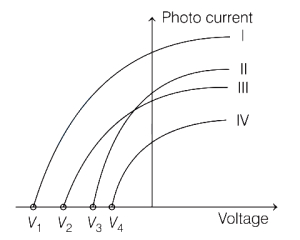
In a photoelectric experiment,three different lights are incident on a metal with a work function of $1.5 \ eV$. Light $A$ has a wavelength of $200 \ nm$ and an intensity of $1.8 \ W/m^2$,light $B$ has a wavelength of $400 \ nm$ and an intensity of $1 \ W/m^2$,and light $C$ has a wavelength of $600 \ nm$ and an intensity of $0.5 \ W/m^2$. The photocurrent versus voltage is measured. Which graphs correspond to which light?
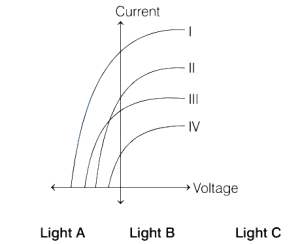
A
$I, III, II$
B
$I, II, IV$
C
$I, III, IV$
D
$III, II, IV$
Solution
(D) Given that,work function $\phi_0 = 1.5 \ eV$. The stopping potential $V_s$ is given by Einstein's photoelectric equation: $eV_s = \frac{hc}{\lambda} - \phi_0$. Since $V_s \propto \frac{1}{\lambda}$,smaller wavelength corresponds to a larger magnitude of stopping potential (more negative).
Comparing wavelengths: $\lambda_A = 200 \ nm < \lambda_B = 400 \ nm < \lambda_C = 600 \ nm$. Thus,the magnitude of stopping potentials follows $|V_A| > |V_B| > |V_C|$. From the graph,the stopping potentials are $V_1, V_2, V_3, V_4$ where $|V_1| > |V_2| > |V_3| > |V_4|$. Therefore,$A \rightarrow V_2$,$B \rightarrow V_3$,and $C \rightarrow V_4$.
Saturation photocurrent is directly proportional to the intensity of incident light. Given intensities: $I_A = 1.8 \ W/m^2$,$I_B = 1 \ W/m^2$,$I_C = 0.5 \ W/m^2$. Thus,the saturation current order is $I_A > I_B > I_C$.
Matching these with the curves:
Curve $III$ has stopping potential $V_2$ and high saturation current,corresponding to light $A$.
Curve $II$ has stopping potential $V_3$ and medium saturation current,corresponding to light $B$.
Curve $IV$ has stopping potential $V_4$ and low saturation current,corresponding to light $C$.
Thus,the correct correspondence is $A \rightarrow III, B \rightarrow II, C \rightarrow IV$. Option $(d)$ is correct.
Comparing wavelengths: $\lambda_A = 200 \ nm < \lambda_B = 400 \ nm < \lambda_C = 600 \ nm$. Thus,the magnitude of stopping potentials follows $|V_A| > |V_B| > |V_C|$. From the graph,the stopping potentials are $V_1, V_2, V_3, V_4$ where $|V_1| > |V_2| > |V_3| > |V_4|$. Therefore,$A \rightarrow V_2$,$B \rightarrow V_3$,and $C \rightarrow V_4$.
Saturation photocurrent is directly proportional to the intensity of incident light. Given intensities: $I_A = 1.8 \ W/m^2$,$I_B = 1 \ W/m^2$,$I_C = 0.5 \ W/m^2$. Thus,the saturation current order is $I_A > I_B > I_C$.
Matching these with the curves:
Curve $III$ has stopping potential $V_2$ and high saturation current,corresponding to light $A$.
Curve $II$ has stopping potential $V_3$ and medium saturation current,corresponding to light $B$.
Curve $IV$ has stopping potential $V_4$ and low saturation current,corresponding to light $C$.
Thus,the correct correspondence is $A \rightarrow III, B \rightarrow II, C \rightarrow IV$. Option $(d)$ is correct.
0 likes
View Solution678
DifficultMCQ
In a photoelectric effect experiment,the cathode metal is exposed to light of wavelength $600 \ nm$. The maximum kinetic energy of the ejected electron doubles when light of wavelength $400 \ nm$ is used. The work function of the cathode metal is approximately: [Use $h=6.63 \times 10^{-34} \ J-s, c=3 \times 10^8 \ m/s$] (in $eV$)
A
$1.58$
B
$1.84$
C
$1.02$
D
$2.64$
Solution
(C) According to Einstein's photoelectric equation,the maximum kinetic energy $K_{max}$ is given by $K_{max} = \frac{hc}{\lambda} - \phi$,where $\phi$ is the work function.
For $\lambda_1 = 600 \ nm$,$K_1 = \frac{hc}{\lambda_1} - \phi$ --- $(i)$
For $\lambda_2 = 400 \ nm$,$K_2 = 2K_1 = \frac{hc}{\lambda_2} - \phi$ --- (ii)
From $(i)$,$K_1 = \frac{hc}{\lambda_1} - \phi$. Substituting this into (ii):
$2 \left( \frac{hc}{\lambda_1} - \phi \right) = \frac{hc}{\lambda_2} - \phi$
$\frac{2hc}{\lambda_1} - 2\phi = \frac{hc}{\lambda_2} - \phi$
$\phi = hc \left( \frac{2}{\lambda_1} - \frac{1}{\lambda_2} \right)$
Substituting the values: $h = 6.63 \times 10^{-34} \ J-s$,$c = 3 \times 10^8 \ m/s$,$\lambda_1 = 600 \times 10^{-9} \ m$,$\lambda_2 = 400 \times 10^{-9} \ m$:
$\phi = (6.63 \times 10^{-34} \times 3 \times 10^8) \left( \frac{2}{600 \times 10^{-9}} - \frac{1}{400 \times 10^{-9}} \right)$
$\phi = (19.89 \times 10^{-26}) \times 10^9 \left( \frac{1}{300} - \frac{1}{400} \right)$
$\phi = 19.89 \times 10^{-17} \left( \frac{4-3}{1200} \right) = \frac{19.89 \times 10^{-17}}{1200} \ J$
$\phi = \frac{19.89 \times 10^{-17}}{1200 \times 1.6 \times 10^{-19}} \ eV \approx 1.036 \ eV \approx 1.02 \ eV$.
For $\lambda_1 = 600 \ nm$,$K_1 = \frac{hc}{\lambda_1} - \phi$ --- $(i)$
For $\lambda_2 = 400 \ nm$,$K_2 = 2K_1 = \frac{hc}{\lambda_2} - \phi$ --- (ii)
From $(i)$,$K_1 = \frac{hc}{\lambda_1} - \phi$. Substituting this into (ii):
$2 \left( \frac{hc}{\lambda_1} - \phi \right) = \frac{hc}{\lambda_2} - \phi$
$\frac{2hc}{\lambda_1} - 2\phi = \frac{hc}{\lambda_2} - \phi$
$\phi = hc \left( \frac{2}{\lambda_1} - \frac{1}{\lambda_2} \right)$
Substituting the values: $h = 6.63 \times 10^{-34} \ J-s$,$c = 3 \times 10^8 \ m/s$,$\lambda_1 = 600 \times 10^{-9} \ m$,$\lambda_2 = 400 \times 10^{-9} \ m$:
$\phi = (6.63 \times 10^{-34} \times 3 \times 10^8) \left( \frac{2}{600 \times 10^{-9}} - \frac{1}{400 \times 10^{-9}} \right)$
$\phi = (19.89 \times 10^{-26}) \times 10^9 \left( \frac{1}{300} - \frac{1}{400} \right)$
$\phi = 19.89 \times 10^{-17} \left( \frac{4-3}{1200} \right) = \frac{19.89 \times 10^{-17}}{1200} \ J$
$\phi = \frac{19.89 \times 10^{-17}}{1200 \times 1.6 \times 10^{-19}} \ eV \approx 1.036 \ eV \approx 1.02 \ eV$.

0 likes
View Solution679
DifficultMCQ
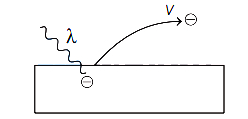
Photons of energy $2.4 \text{ eV}$ and wavelength $\lambda$ fall on a metal plate and release photoelectrons with a maximum velocity $v$. By decreasing $\lambda$ by $50 \%$, the maximum velocity of photoelectrons becomes $3 v$. The work function of the material of the metal plate is (in $\text{ eV}$)
A
$2.1$
B
$1.7$
C
$2.8$
D
$2.0$
Solution
(A) Let $\phi_0$ be the work function of the metal.
According to Einstein's photoelectric equation, the maximum kinetic energy $K_{\max}$ is given by:
$K_{\max} = \frac{1}{2} m v^2 = \frac{hc}{\lambda} - \phi_0$ --- $(i)$
Given that the initial energy of the photon is $E = \frac{hc}{\lambda} = 2.4 \text{ eV}$.
When the wavelength is decreased by $50 \%$, the new wavelength is $\lambda' = \frac{\lambda}{2}$.
The new energy of the photon is $E' = \frac{hc}{\lambda'} = \frac{hc}{\lambda / 2} = 2 \left( \frac{hc}{\lambda} \right) = 2 \times 2.4 \text{ eV} = 4.8 \text{ eV}$.
The new maximum velocity is $v' = 3v$, so the new maximum kinetic energy is $K'_{\max} = \frac{1}{2} m (3v)^2 = 9 \left( \frac{1}{2} m v^2 \right) = 9 K_{\max}$.
Using the photoelectric equation for the second case:
$9 K_{\max} = E' - \phi_0 = 4.8 - \phi_0$ --- (ii)
From equation $(i)$, $K_{\max} = 2.4 - \phi_0$.
Substituting this into equation (ii):
$9(2.4 - \phi_0) = 4.8 - \phi_0$
$21.6 - 9\phi_0 = 4.8 - \phi_0$
$8\phi_0 = 21.6 - 4.8 = 16.8$
$\phi_0 = \frac{16.8}{8} = 2.1 \text{ eV}$.
According to Einstein's photoelectric equation, the maximum kinetic energy $K_{\max}$ is given by:
$K_{\max} = \frac{1}{2} m v^2 = \frac{hc}{\lambda} - \phi_0$ --- $(i)$
Given that the initial energy of the photon is $E = \frac{hc}{\lambda} = 2.4 \text{ eV}$.
When the wavelength is decreased by $50 \%$, the new wavelength is $\lambda' = \frac{\lambda}{2}$.
The new energy of the photon is $E' = \frac{hc}{\lambda'} = \frac{hc}{\lambda / 2} = 2 \left( \frac{hc}{\lambda} \right) = 2 \times 2.4 \text{ eV} = 4.8 \text{ eV}$.
The new maximum velocity is $v' = 3v$, so the new maximum kinetic energy is $K'_{\max} = \frac{1}{2} m (3v)^2 = 9 \left( \frac{1}{2} m v^2 \right) = 9 K_{\max}$.
Using the photoelectric equation for the second case:
$9 K_{\max} = E' - \phi_0 = 4.8 - \phi_0$ --- (ii)
From equation $(i)$, $K_{\max} = 2.4 - \phi_0$.
Substituting this into equation (ii):
$9(2.4 - \phi_0) = 4.8 - \phi_0$
$21.6 - 9\phi_0 = 4.8 - \phi_0$
$8\phi_0 = 21.6 - 4.8 = 16.8$
$\phi_0 = \frac{16.8}{8} = 2.1 \text{ eV}$.
0 likes
View Solution680
EasyMCQ
Let $v_1$ and $v_2$ be the maximum velocities of the emitted electrons when the surface of a metal is illuminated with light waves of energy $E_1 = 4 \text{ eV}$ and $E_2 = 2.5 \text{ eV}$,respectively. If the work function of the metal is $2 \text{ eV}$,then the ratio $\frac{v_1}{v_2}$ is
A
$1.6$
B
$4$
C
$2$
D
$0.5$
Solution
(C) According to Einstein's photoelectric equation,the maximum kinetic energy $K_{\max}$ of emitted electrons is given by $K_{\max} = \frac{1}{2} m v_{\max}^2 = E - \phi_0$,where $E$ is the incident photon energy and $\phi_0$ is the work function.
For the first case,$E_1 = 4 \text{ eV}$ and $\phi_0 = 2 \text{ eV}$:
$\frac{1}{2} m v_1^2 = 4 - 2 = 2 \text{ eV} \quad \dots(i)$
For the second case,$E_2 = 2.5 \text{ eV}$ and $\phi_0 = 2 \text{ eV}$:
$\frac{1}{2} m v_2^2 = 2.5 - 2 = 0.5 \text{ eV} \quad \dots(ii)$
Dividing equation $(i)$ by equation $(ii)$:
$\frac{\frac{1}{2} m v_1^2}{\frac{1}{2} m v_2^2} = \frac{2}{0.5}$
$\frac{v_1^2}{v_2^2} = 4$
Taking the square root on both sides:
$\frac{v_1}{v_2} = \sqrt{4} = 2$
For the first case,$E_1 = 4 \text{ eV}$ and $\phi_0 = 2 \text{ eV}$:
$\frac{1}{2} m v_1^2 = 4 - 2 = 2 \text{ eV} \quad \dots(i)$
For the second case,$E_2 = 2.5 \text{ eV}$ and $\phi_0 = 2 \text{ eV}$:
$\frac{1}{2} m v_2^2 = 2.5 - 2 = 0.5 \text{ eV} \quad \dots(ii)$
Dividing equation $(i)$ by equation $(ii)$:
$\frac{\frac{1}{2} m v_1^2}{\frac{1}{2} m v_2^2} = \frac{2}{0.5}$
$\frac{v_1^2}{v_2^2} = 4$
Taking the square root on both sides:
$\frac{v_1}{v_2} = \sqrt{4} = 2$
0 likes
View Solution681
EasyMCQ
When the energy of incident radiation is increased by $20 \%$,the kinetic energy of the photoelectrons emitted from a metal surface increases from $0.5 \ eV$ to $0.8 \ eV$. The work function of the metal is (in $eV$)
A
$0.65$
B
$1.0$
C
$1.3$
D
$1.5$
Solution
(B) According to Einstein's photoelectric equation,$E_K = E - \phi_0$,where $E_K$ is the kinetic energy,$E$ is the energy of the incident photon,and $\phi_0$ is the work function of the metal surface.
From this,we have $E = E_K + \phi_0$ ... $(i)$.
When the energy of the incident photon is increased by $20 \%$,the new energy $E'$ becomes $E' = E + 0.2E = 1.2E$.
The new kinetic energy $E_K'$ is given by $E_K' = E' - \phi_0$,so $E' = E_K' + \phi_0$ ... (ii).
Substituting $E' = 1.2E$ into equation (ii),we get $1.2E = E_K' + \phi_0$.
From equation $(i)$,$E = 0.5 + \phi_0$. Substituting this into the modified equation (ii):
$1.2(0.5 + \phi_0) = 0.8 + \phi_0$
$0.6 + 1.2\phi_0 = 0.8 + \phi_0$
$1.2\phi_0 - \phi_0 = 0.8 - 0.6$
$0.2\phi_0 = 0.2$
$\phi_0 = 1.0 \ eV$.
From this,we have $E = E_K + \phi_0$ ... $(i)$.
When the energy of the incident photon is increased by $20 \%$,the new energy $E'$ becomes $E' = E + 0.2E = 1.2E$.
The new kinetic energy $E_K'$ is given by $E_K' = E' - \phi_0$,so $E' = E_K' + \phi_0$ ... (ii).
Substituting $E' = 1.2E$ into equation (ii),we get $1.2E = E_K' + \phi_0$.
From equation $(i)$,$E = 0.5 + \phi_0$. Substituting this into the modified equation (ii):
$1.2(0.5 + \phi_0) = 0.8 + \phi_0$
$0.6 + 1.2\phi_0 = 0.8 + \phi_0$
$1.2\phi_0 - \phi_0 = 0.8 - 0.6$
$0.2\phi_0 = 0.2$
$\phi_0 = 1.0 \ eV$.
0 likes
View Solution682
EasyMCQ
$A$ monochromatic light of wavelength $\lambda$ ejects photoelectrons from a metal surface with work function $\phi = 2.4 \text{ eV}$. These photoelectrons are made to collide with hydrogen atoms in the ground state. The maximum value of $\lambda$ for which the hydrogen atom may be ionized is [take $hc = 1240 \text{ eV-nm}$]. (in $\text{ nm}$)
A
$80$
B
$77.5$
C
$75.5$
D
$85$
Solution
(B) Given, work function $\phi = 2.4 \text{ eV}$.
Energy required to ionize a hydrogen atom in the ground state is $E_i = 13.6 \text{ eV}$.
For the hydrogen atom to be ionized by the photoelectron, the kinetic energy $(KE)$ of the photoelectron must be at least equal to the ionization energy of the hydrogen atom.
Thus, $KE_{max} = 13.6 \text{ eV}$.
According to the photoelectric equation, $E = KE_{max} + \phi$, where $E = \frac{hc}{\lambda}$.
Substituting the values: $\frac{1240}{\lambda} = 13.6 + 2.4$.
$\frac{1240}{\lambda} = 16$.
$\lambda = \frac{1240}{16} = 77.5 \text{ nm}$.
Energy required to ionize a hydrogen atom in the ground state is $E_i = 13.6 \text{ eV}$.
For the hydrogen atom to be ionized by the photoelectron, the kinetic energy $(KE)$ of the photoelectron must be at least equal to the ionization energy of the hydrogen atom.
Thus, $KE_{max} = 13.6 \text{ eV}$.
According to the photoelectric equation, $E = KE_{max} + \phi$, where $E = \frac{hc}{\lambda}$.
Substituting the values: $\frac{1240}{\lambda} = 13.6 + 2.4$.
$\frac{1240}{\lambda} = 16$.
$\lambda = \frac{1240}{16} = 77.5 \text{ nm}$.
0 likes
View Solution683
EasyMCQ
In a photoelectric effect experiment,if the frequency of light is doubled,the stopping potential will
A
be halved
B
become more than double
C
become less than double
D
be doubled
Solution
(B) The energy equation in the photoelectric effect is given by Einstein's photoelectric equation:
$e V_0 = h \nu - \phi_0 \Rightarrow V_0 = \frac{h \nu}{e} - \frac{\phi_0}{e}$ $\ldots$ $(i)$
Where $V_0$ is the stopping potential,$h$ is Planck's constant,$\nu$ is the frequency,and $\phi_0$ is the work function.
When the frequency is doubled,the new frequency is $\nu' = 2\nu$.
The new stopping potential $V_0'$ is given by:
$V_0' = \frac{h(2\nu)}{e} - \frac{\phi_0}{e} = \frac{2h\nu}{e} - \frac{\phi_0}{e}$
We can rewrite this as:
$V_0' = 2\left(\frac{h\nu}{e} - \frac{\phi_0}{e}\right) + \frac{\phi_0}{e}$
Substituting equation $(i)$ into this expression:
$V_0' = 2V_0 + \frac{\phi_0}{e}$
Since $\frac{\phi_0}{e} > 0$,it follows that $V_0' > 2V_0$.
Therefore,the stopping potential will become more than double.
$e V_0 = h \nu - \phi_0 \Rightarrow V_0 = \frac{h \nu}{e} - \frac{\phi_0}{e}$ $\ldots$ $(i)$
Where $V_0$ is the stopping potential,$h$ is Planck's constant,$\nu$ is the frequency,and $\phi_0$ is the work function.
When the frequency is doubled,the new frequency is $\nu' = 2\nu$.
The new stopping potential $V_0'$ is given by:
$V_0' = \frac{h(2\nu)}{e} - \frac{\phi_0}{e} = \frac{2h\nu}{e} - \frac{\phi_0}{e}$
We can rewrite this as:
$V_0' = 2\left(\frac{h\nu}{e} - \frac{\phi_0}{e}\right) + \frac{\phi_0}{e}$
Substituting equation $(i)$ into this expression:
$V_0' = 2V_0 + \frac{\phi_0}{e}$
Since $\frac{\phi_0}{e} > 0$,it follows that $V_0' > 2V_0$.
Therefore,the stopping potential will become more than double.
0 likes
View Solution684
EasyMCQ
According to the photoelectric effect,the plot of kinetic energy of the emitted photo-electrons from a metal versus the frequency of the incident radiation gives a straight line whose slope
A
is the same for all metals and independent of the intensity of radiation
B
depends only on the intensity of radiation
C
depends both on the intensity of the radiation and the metal used
D
depends on the nature of metals used
Solution
(A) According to Einstein's photoelectric equation,the maximum kinetic energy $(KE)_{\max }$ of emitted photoelectrons is given by: $(KE)_{\max } = h\nu - \phi_0$,where $h$ is Planck's constant,$\nu$ is the frequency of incident radiation,and $\phi_0$ is the work function of the metal.
Comparing this with the equation of a straight line $y = mx + c$,where $y = (KE)_{\max }$ and $x = \nu$,we get the slope $m = h$.
Since $h$ (Planck's constant) is a universal constant,the slope of the $(KE)_{\max }$ versus $\nu$ graph is the same for all metals and is independent of the intensity of the incident radiation.
Comparing this with the equation of a straight line $y = mx + c$,where $y = (KE)_{\max }$ and $x = \nu$,we get the slope $m = h$.
Since $h$ (Planck's constant) is a universal constant,the slope of the $(KE)_{\max }$ versus $\nu$ graph is the same for all metals and is independent of the intensity of the incident radiation.

0 likes
View Solution685
EasyMCQ
$A$ light of wavelength $310 \,nm$ is used in a photoelectric experiment. The metal electrode of work function $2.5 \,eV$ is used in the experiment. The stopping potential for the photoelectrons will be (assume $hc = 1240 \,eV-nm$): (in $V$)
A
$1.0$
B
$1.5$
C
$2.0$
D
$2.5$
Solution
(B) The work function of the metal surface is $\phi_0 = 2.5 \,eV$.
The wavelength of the incident light is $\lambda = 310 \,nm$.
Given the constant $hc = 1240 \,eV-nm$.
According to Einstein's photoelectric equation,the maximum kinetic energy $K_{max}$ is given by:
$K_{max} = \frac{hc}{\lambda} - \phi_0$
Since the stopping potential $V_0$ is related to the maximum kinetic energy by $K_{max} = eV_0$,we have:
$eV_0 = \frac{1240 \,eV-nm}{310 \,nm} - 2.5 \,eV$
$eV_0 = 4 \,eV - 2.5 \,eV$
$eV_0 = 1.5 \,eV$
Therefore,the stopping potential $V_0 = 1.5 \,V$.
The wavelength of the incident light is $\lambda = 310 \,nm$.
Given the constant $hc = 1240 \,eV-nm$.
According to Einstein's photoelectric equation,the maximum kinetic energy $K_{max}$ is given by:
$K_{max} = \frac{hc}{\lambda} - \phi_0$
Since the stopping potential $V_0$ is related to the maximum kinetic energy by $K_{max} = eV_0$,we have:
$eV_0 = \frac{1240 \,eV-nm}{310 \,nm} - 2.5 \,eV$
$eV_0 = 4 \,eV - 2.5 \,eV$
$eV_0 = 1.5 \,eV$
Therefore,the stopping potential $V_0 = 1.5 \,V$.
0 likes
View Solution686
EasyMCQ
$A$ cobalt $(Co)$ plate is placed at a distance of $1 \,m$ from a point source of power $1 \,W$. Assume a circular area of the plate of radius $r = 1 \,Å$ is exposed to the radiation and ejects photoelectrons. The light energy is considered to be spread uniformly and the work function of cobalt is $5 \,eV$. The minimum time the target should be exposed to the light source to eject a photoelectron (assuming no reflection losses) is: (in $\,s$)
A
$320$
B
$450$
C
$860$
D
$100$
Solution
(A) Given: Power of source $P = 1 \,W$, distance $d = 1 \,m$, radius of exposed area $r = 1 \,Å = 10^{-10} \,m$, work function $\phi = 5 \,eV = 5 \times 1.6 \times 10^{-19} \,J$.
Intensity $I$ at distance $d$ is $I = \frac{P}{4 \pi d^2} = \frac{1}{4 \pi (1)^2} = \frac{1}{4 \pi} \,W/m^2$.
Power absorbed by the circular area $A = \pi r^2$ is $P_{abs} = I \times A = \frac{1}{4 \pi} \times \pi (10^{-10})^2 = \frac{10^{-20}}{4} \,W$.
The time $t$ required to accumulate energy equal to the work function is $t = \frac{\phi}{P_{abs}}$.
Substituting the values: $t = \frac{5 \times 1.6 \times 10^{-19}}{10^{-20} / 4} = \frac{8 \times 10^{-19}}{0.25 \times 10^{-20}} = 320 \,s$.
Intensity $I$ at distance $d$ is $I = \frac{P}{4 \pi d^2} = \frac{1}{4 \pi (1)^2} = \frac{1}{4 \pi} \,W/m^2$.
Power absorbed by the circular area $A = \pi r^2$ is $P_{abs} = I \times A = \frac{1}{4 \pi} \times \pi (10^{-10})^2 = \frac{10^{-20}}{4} \,W$.
The time $t$ required to accumulate energy equal to the work function is $t = \frac{\phi}{P_{abs}}$.
Substituting the values: $t = \frac{5 \times 1.6 \times 10^{-19}}{10^{-20} / 4} = \frac{8 \times 10^{-19}}{0.25 \times 10^{-20}} = 320 \,s$.
0 likes
View Solution687
MediumMCQ
At an incident radiation frequency of $v_1$,which is greater than the threshold frequency,the stopping potential for a certain metal is $V_1$. At frequency $2 v_1$,the stopping potential is $3 V_1$. If the stopping potential at frequency $4 v_1$ is $n V_1$,then $n$ is
A
$2$
B
$3$
C
$6$
D
$7$
Solution
(D) According to Einstein's photoelectric equation,$h v = \phi + K.E_{max}$,where $K.E_{max} = e V_s$.
For frequency $v_1$: $h v_1 = \phi + e V_1$ --- $(1)$
For frequency $2 v_1$: $h(2 v_1) = \phi + e(3 V_1) = \phi + 3 e V_1$ --- $(2)$
From $(1)$,$h v_1 = \phi + e V_1$. Substituting this into $(2)$:
$2(\phi + e V_1) = \phi + 3 e V_1$
$2 \phi + 2 e V_1 = \phi + 3 e V_1$
$\phi = e V_1$
Now,substitute $\phi = e V_1$ back into $(1)$:
$h v_1 = e V_1 + e V_1 = 2 e V_1$
For frequency $4 v_1$,let the stopping potential be $V_s = n V_1$:
$h(4 v_1) = \phi + e(n V_1)$
$4(h v_1) = e V_1 + n e V_1$
$4(2 e V_1) = e V_1(1 + n)$
$8 e V_1 = e V_1(1 + n)$
$8 = 1 + n$
$n = 7$
For frequency $v_1$: $h v_1 = \phi + e V_1$ --- $(1)$
For frequency $2 v_1$: $h(2 v_1) = \phi + e(3 V_1) = \phi + 3 e V_1$ --- $(2)$
From $(1)$,$h v_1 = \phi + e V_1$. Substituting this into $(2)$:
$2(\phi + e V_1) = \phi + 3 e V_1$
$2 \phi + 2 e V_1 = \phi + 3 e V_1$
$\phi = e V_1$
Now,substitute $\phi = e V_1$ back into $(1)$:
$h v_1 = e V_1 + e V_1 = 2 e V_1$
For frequency $4 v_1$,let the stopping potential be $V_s = n V_1$:
$h(4 v_1) = \phi + e(n V_1)$
$4(h v_1) = e V_1 + n e V_1$
$4(2 e V_1) = e V_1(1 + n)$
$8 e V_1 = e V_1(1 + n)$
$8 = 1 + n$
$n = 7$
0 likes
View Solution688
MediumMCQ
An isolated lead ball is charged upon continuous irradiation by $EM$ radiation of wavelength, $\lambda = 221 \,nm$. The maximum potential attained by the lead ball, if its work function is $4.14 \,eV$, is (take, $h = 6.63 \times 10^{-34} \,J \cdot s$, $c = 3 \times 10^8 \,m/s$, $e = 1.6 \times 10^{-19} \,C$): (in $\,V$)
A
$1.49$
B
$2.67$
C
$3.14$
D
$0.51$
Solution
(A) The energy of the incident photon is given by $E = \frac{hc}{\lambda}$.
Given $\lambda = 221 \,nm = 221 \times 10^{-9} \,m$, $h = 6.63 \times 10^{-34} \,J \cdot s$, and $c = 3 \times 10^8 \,m/s$.
$E = \frac{6.63 \times 10^{-34} \times 3 \times 10^8}{221 \times 10^{-9}} \,J = \frac{19.89 \times 10^{-26}}{221 \times 10^{-9}} \,J = 0.09 \times 10^{-17} \,J = 9 \times 10^{-19} \,J$.
Converting this energy into electron-volts $(eV)$:
$E = \frac{9 \times 10^{-19} \,J}{1.6 \times 10^{-19} \,J/eV} = 5.625 \,eV \approx 5.63 \,eV$.
The work function of the lead ball is $\phi = 4.14 \,eV$.
The maximum kinetic energy of the emitted photoelectrons is $K_{max} = E - \phi = 5.63 \,eV - 4.14 \,eV = 1.49 \,eV$.
As the ball loses electrons, it becomes positively charged and its potential increases until the photoelectrons can no longer escape. The maximum potential $V$ attained is given by $eV = K_{max}$.
Thus, $V = 1.49 \,V$.
Given $\lambda = 221 \,nm = 221 \times 10^{-9} \,m$, $h = 6.63 \times 10^{-34} \,J \cdot s$, and $c = 3 \times 10^8 \,m/s$.
$E = \frac{6.63 \times 10^{-34} \times 3 \times 10^8}{221 \times 10^{-9}} \,J = \frac{19.89 \times 10^{-26}}{221 \times 10^{-9}} \,J = 0.09 \times 10^{-17} \,J = 9 \times 10^{-19} \,J$.
Converting this energy into electron-volts $(eV)$:
$E = \frac{9 \times 10^{-19} \,J}{1.6 \times 10^{-19} \,J/eV} = 5.625 \,eV \approx 5.63 \,eV$.
The work function of the lead ball is $\phi = 4.14 \,eV$.
The maximum kinetic energy of the emitted photoelectrons is $K_{max} = E - \phi = 5.63 \,eV - 4.14 \,eV = 1.49 \,eV$.
As the ball loses electrons, it becomes positively charged and its potential increases until the photoelectrons can no longer escape. The maximum potential $V$ attained is given by $eV = K_{max}$.
Thus, $V = 1.49 \,V$.
0 likes
View Solution689
EasyMCQ
$A$ photon of energy $4 eV$ imparts all its energy to an electron that leaves a metal surface with $1.1 eV$ of kinetic energy. The work function of the metal is (in $eV$)
A
$2.9$
B
$5.1$
C
$3.64$
D
$4.4$
Solution
(A) According to Einstein's photoelectric equation, the energy of the incident photon $(E)$ is equal to the sum of the work function $(\Phi)$ and the maximum kinetic energy $(K_{max})$ of the emitted electron.
$E = \Phi + K_{max}$
Given:
Energy of incident photon $(E)$ = $4 eV$
Maximum kinetic energy $(K_{max})$ = $1.1 eV$
Rearranging the formula to find the work function:
$\Phi = E - K_{max}$
$\Phi = 4 eV - 1.1 eV$
$\Phi = 2.9 eV$
Therefore, the work function of the metal is $2.9 eV$.
$E = \Phi + K_{max}$
Given:
Energy of incident photon $(E)$ = $4 eV$
Maximum kinetic energy $(K_{max})$ = $1.1 eV$
Rearranging the formula to find the work function:
$\Phi = E - K_{max}$
$\Phi = 4 eV - 1.1 eV$
$\Phi = 2.9 eV$
Therefore, the work function of the metal is $2.9 eV$.
0 likes
View Solution690
EasyMCQ
Light of frequency $4 \times 10^{14} \,Hz$ is incident on a metal surface of work function $2.14 \,eV$, resulting in photoemission of electrons. The maximum kinetic energy of the emitted electrons is $\left[h=6.63 \times 10^{-34} \,J-s\right]$ (in $\,eV$)
A
$0.35$
B
$0.14$
C
$2.14$
D
$0$
Solution
(D) The energy of an incident photon is given by $E = hf$.
Given $h = 6.63 \times 10^{-34} \,J-s$ and $f = 4 \times 10^{14} \,Hz$.
$E = 6.63 \times 10^{-34} \times 4 \times 10^{14} = 26.52 \times 10^{-20} \,J$.
To convert this energy into electron-volts $(eV)$, divide by $1.6 \times 10^{-19} \,J/eV$:
$E = \frac{26.52 \times 10^{-20}}{1.6 \times 10^{-19}} \,eV = 1.6575 \,eV$.
The work function of the metal is $\Phi = 2.14 \,eV$.
Since the energy of the incident photon $(1.6575 \,eV)$ is less than the work function $(2.14 \,eV)$, the incident light does not have sufficient energy to eject electrons from the metal surface.
Therefore, no photoemission occurs, and the maximum kinetic energy is $0 \,eV$.
Given $h = 6.63 \times 10^{-34} \,J-s$ and $f = 4 \times 10^{14} \,Hz$.
$E = 6.63 \times 10^{-34} \times 4 \times 10^{14} = 26.52 \times 10^{-20} \,J$.
To convert this energy into electron-volts $(eV)$, divide by $1.6 \times 10^{-19} \,J/eV$:
$E = \frac{26.52 \times 10^{-20}}{1.6 \times 10^{-19}} \,eV = 1.6575 \,eV$.
The work function of the metal is $\Phi = 2.14 \,eV$.
Since the energy of the incident photon $(1.6575 \,eV)$ is less than the work function $(2.14 \,eV)$, the incident light does not have sufficient energy to eject electrons from the metal surface.
Therefore, no photoemission occurs, and the maximum kinetic energy is $0 \,eV$.
0 likes
View Solution691
MediumMCQ
The work function of a metal is $2 \ eV$. If a radiation of wavelength $3000 \ \text{Å}$ is incident on it,the maximum kinetic energy of the emitted photoelectrons is (Planck's constant $h=6.6 \times 10^{-34} \ \text{Js}$; velocity of light $c=3 \times 10^8 \ \text{m/s}$; $1 \ \text{eV}=1.6 \times 10^{-19} \ \text{J}$).
A
$4.4 \times 10^{-19} \ \text{J}$
B
$5.6 \times 10^{-19} \ \text{J}$
C
$3.4 \times 10^{-19} \ \text{J}$
D
$2.5 \times 10^{-19} \ \text{J}$
Solution
(C) According to Einstein's photoelectric equation,the maximum kinetic energy $(KE_{max})$ is given by:
$KE_{max} = \frac{hc}{\lambda} - \phi_0$
Given:
Work function $\phi_0 = 2 \ \text{eV} = 2 \times 1.6 \times 10^{-19} \ \text{J} = 3.2 \times 10^{-19} \ \text{J}$
Wavelength $\lambda = 3000 \ \text{Å} = 3000 \times 10^{-10} \ \text{m} = 3 \times 10^{-7} \ \text{m}$
Energy of incident photon $E = \frac{hc}{\lambda} = \frac{6.6 \times 10^{-34} \times 3 \times 10^8}{3 \times 10^{-7}} \ \text{J} = 6.6 \times 10^{-19} \ \text{J}$
Now,calculate $KE_{max}$:
$KE_{max} = 6.6 \times 10^{-19} \ \text{J} - 3.2 \times 10^{-19} \ \text{J} = 3.4 \times 10^{-19} \ \text{J}$
$KE_{max} = \frac{hc}{\lambda} - \phi_0$
Given:
Work function $\phi_0 = 2 \ \text{eV} = 2 \times 1.6 \times 10^{-19} \ \text{J} = 3.2 \times 10^{-19} \ \text{J}$
Wavelength $\lambda = 3000 \ \text{Å} = 3000 \times 10^{-10} \ \text{m} = 3 \times 10^{-7} \ \text{m}$
Energy of incident photon $E = \frac{hc}{\lambda} = \frac{6.6 \times 10^{-34} \times 3 \times 10^8}{3 \times 10^{-7}} \ \text{J} = 6.6 \times 10^{-19} \ \text{J}$
Now,calculate $KE_{max}$:
$KE_{max} = 6.6 \times 10^{-19} \ \text{J} - 3.2 \times 10^{-19} \ \text{J} = 3.4 \times 10^{-19} \ \text{J}$
0 likes
View Solution692
MediumMCQ
Initially,a photon of wavelength $\lambda_1$ falls on a photocathode and emits an electron of maximum energy $E_1$. If the wavelength of the incident photon is changed to $\lambda_2$,the maximum energy of the electron emitted becomes $E_2$. Then the value of $hc$ ($h=$ Planck's constant,$c=$ velocity of light) is
A
$hc = \frac{(E_1 + E_2) \lambda_1 \lambda_2}{\lambda_2 - \lambda_1}$
B
$hc = \frac{E_1 - E_2}{\lambda_2 - \lambda_1} \cdot (\lambda_1 \lambda_2)$
C
$hc = \frac{(E_1 - E_2)(\lambda_2 - \lambda_1)}{\lambda_1 \lambda_2}$
D
$hc = \frac{\lambda_2 - \lambda_1}{\lambda_1 \lambda_2 E_2} \cdot E_1$
Solution
(B) According to Einstein's photoelectric equation,the maximum kinetic energy $E$ of an emitted electron is given by $E = \frac{hc}{\lambda} - W$,where $W$ is the work function of the metal.
For the first case: $E_1 = \frac{hc}{\lambda_1} - W$ --- $(i)$
For the second case: $E_2 = \frac{hc}{\lambda_2} - W$ --- (ii)
Subtracting equation (ii) from equation $(i)$:
$E_1 - E_2 = \left(\frac{hc}{\lambda_1} - W\right) - \left(\frac{hc}{\lambda_2} - W\right)$
$E_1 - E_2 = hc \left(\frac{1}{\lambda_1} - \frac{1}{\lambda_2}\right)$
$E_1 - E_2 = hc \left(\frac{\lambda_2 - \lambda_1}{\lambda_1 \lambda_2}\right)$
Rearranging to solve for $hc$:
$hc = \frac{(E_1 - E_2) \lambda_1 \lambda_2}{\lambda_2 - \lambda_1}$
For the first case: $E_1 = \frac{hc}{\lambda_1} - W$ --- $(i)$
For the second case: $E_2 = \frac{hc}{\lambda_2} - W$ --- (ii)
Subtracting equation (ii) from equation $(i)$:
$E_1 - E_2 = \left(\frac{hc}{\lambda_1} - W\right) - \left(\frac{hc}{\lambda_2} - W\right)$
$E_1 - E_2 = hc \left(\frac{1}{\lambda_1} - \frac{1}{\lambda_2}\right)$
$E_1 - E_2 = hc \left(\frac{\lambda_2 - \lambda_1}{\lambda_1 \lambda_2}\right)$
Rearranging to solve for $hc$:
$hc = \frac{(E_1 - E_2) \lambda_1 \lambda_2}{\lambda_2 - \lambda_1}$
0 likes
View Solution693
DifficultMCQ
Two photons of energy $2.5 eV$ and $3.5 eV$ fall on a metal surface of work function $1.5 eV$. The ratio of the maximum velocities of the photoelectrons emitted from the metal surface is
A
$1$ : $4$
B
$2$ : $1$
C
$1$ : $2$
D
$1 : \sqrt{2}$
Solution
(D) According to Einstein's photoelectric equation,the maximum kinetic energy $K_{max}$ of an emitted photoelectron is given by $K_{max} = E - \phi_0$,where $E$ is the energy of the incident photon and $\phi_0$ is the work function of the metal.
For the first photon with energy $E_1 = 2.5 eV$:
$\frac{1}{2} m v_1^2 = E_1 - \phi_0 = 2.5 eV - 1.5 eV = 1.0 eV$ $(i)$
For the second photon with energy $E_2 = 3.5 eV$:
$\frac{1}{2} m v_2^2 = E_2 - \phi_0 = 3.5 eV - 1.5 eV = 2.0 eV$ (ii)
Dividing equation $(i)$ by equation (ii),we get:
$\frac{\frac{1}{2} m v_1^2}{\frac{1}{2} m v_2^2} = \frac{1.0 eV}{2.0 eV}$
$\frac{v_1^2}{v_2^2} = \frac{1}{2}$
Taking the square root on both sides:
$\frac{v_1}{v_2} = \frac{1}{\sqrt{2}}$
Thus,the ratio of the maximum velocities is $1 : \sqrt{2}$.
For the first photon with energy $E_1 = 2.5 eV$:
$\frac{1}{2} m v_1^2 = E_1 - \phi_0 = 2.5 eV - 1.5 eV = 1.0 eV$ $(i)$
For the second photon with energy $E_2 = 3.5 eV$:
$\frac{1}{2} m v_2^2 = E_2 - \phi_0 = 3.5 eV - 1.5 eV = 2.0 eV$ (ii)
Dividing equation $(i)$ by equation (ii),we get:
$\frac{\frac{1}{2} m v_1^2}{\frac{1}{2} m v_2^2} = \frac{1.0 eV}{2.0 eV}$
$\frac{v_1^2}{v_2^2} = \frac{1}{2}$
Taking the square root on both sides:
$\frac{v_1}{v_2} = \frac{1}{\sqrt{2}}$
Thus,the ratio of the maximum velocities is $1 : \sqrt{2}$.
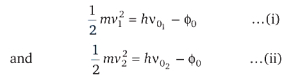
0 likes
View Solution694
MediumMCQ
Photoelectric emission is observed from a metallic surface for frequencies $v_1$ and $v_2$ of the incident light $(v_1 > v_2)$. If the maximum values of kinetic energy of the photoelectrons emitted in the two cases are in the ratio $1: n$,then the threshold frequency of the metallic surface is
A
$\frac{(v_1-v_2)}{(n-1)}$
B
$\frac{(n v_1-v_2)}{(n-1)}$
C
$\frac{(n v_2-v_1)}{(n-1)}$
D
$\frac{(v_1-v_2)}{n}$
Solution
(B) According to Einstein's photoelectric equation,the maximum kinetic energy $K_{\max}$ is given by $K_{\max} = h v - h v_0$,where $h$ is Planck's constant and $v_0$ is the threshold frequency.
For frequency $v_1$,$K_1 = h(v_1 - v_0)$.
For frequency $v_2$,$K_2 = h(v_2 - v_0)$.
Given the ratio of maximum kinetic energies is $K_1 : K_2 = 1 : n$,we have $\frac{K_1}{K_2} = \frac{1}{n}$.
Substituting the expressions,we get $\frac{h(v_1 - v_0)}{h(v_2 - v_0)} = \frac{1}{n}$.
$\frac{v_1 - v_0}{v_2 - v_0} = \frac{1}{n}$.
Cross-multiplying gives $n(v_1 - v_0) = v_2 - v_0$.
$n v_1 - n v_0 = v_2 - v_0$.
$n v_1 - v_2 = n v_0 - v_0$.
$n v_1 - v_2 = v_0(n - 1)$.
Therefore,the threshold frequency is $v_0 = \frac{n v_1 - v_2}{n - 1}$.
For frequency $v_1$,$K_1 = h(v_1 - v_0)$.
For frequency $v_2$,$K_2 = h(v_2 - v_0)$.
Given the ratio of maximum kinetic energies is $K_1 : K_2 = 1 : n$,we have $\frac{K_1}{K_2} = \frac{1}{n}$.
Substituting the expressions,we get $\frac{h(v_1 - v_0)}{h(v_2 - v_0)} = \frac{1}{n}$.
$\frac{v_1 - v_0}{v_2 - v_0} = \frac{1}{n}$.
Cross-multiplying gives $n(v_1 - v_0) = v_2 - v_0$.
$n v_1 - n v_0 = v_2 - v_0$.
$n v_1 - v_2 = n v_0 - v_0$.
$n v_1 - v_2 = v_0(n - 1)$.
Therefore,the threshold frequency is $v_0 = \frac{n v_1 - v_2}{n - 1}$.
0 likes
View Solution695
DifficultMCQ
$A$ photon of energy $E$ ejects a photoelectron from a metal surface whose work function is $W_0$. If this electron enters into a uniform magnetic field of induction $B$ in a direction perpendicular to the field and describes a circular path of radius $r$,then the radius $r$ is given by,(in the usual notation)
A
$\frac{\sqrt{2 m(E-W_0)}}{e B}$
B
$\sqrt{2 m(E-W_0) e B}$
C
$\frac{\sqrt{2 e(E-W_0)}}{m B}$
D
$\frac{\sqrt{2 m(E-W_0)}}{e B}$
Solution
(A) According to Einstein's photoelectric equation,the kinetic energy $K$ of the ejected photoelectron is given by $K = E - W_0$.
Since $K = \frac{1}{2}mv^2$,we have $v = \sqrt{\frac{2(E-W_0)}{m}}$.
When a charged particle of mass $m$ and charge $e$ moves in a uniform magnetic field $B$ perpendicular to its velocity,it experiences a magnetic Lorentz force which provides the necessary centripetal force for circular motion:
$evB = \frac{mv^2}{r}$
Solving for the radius $r$,we get $r = \frac{mv}{eB}$.
Substituting the expression for $v$ into the equation for $r$:
$r = \frac{m}{eB} \sqrt{\frac{2(E-W_0)}{m}} = \frac{\sqrt{m^2 \cdot \frac{2(E-W_0)}{m}}}{eB} = \frac{\sqrt{2m(E-W_0)}}{eB}$.
Since $K = \frac{1}{2}mv^2$,we have $v = \sqrt{\frac{2(E-W_0)}{m}}$.
When a charged particle of mass $m$ and charge $e$ moves in a uniform magnetic field $B$ perpendicular to its velocity,it experiences a magnetic Lorentz force which provides the necessary centripetal force for circular motion:
$evB = \frac{mv^2}{r}$
Solving for the radius $r$,we get $r = \frac{mv}{eB}$.
Substituting the expression for $v$ into the equation for $r$:
$r = \frac{m}{eB} \sqrt{\frac{2(E-W_0)}{m}} = \frac{\sqrt{m^2 \cdot \frac{2(E-W_0)}{m}}}{eB} = \frac{\sqrt{2m(E-W_0)}}{eB}$.
0 likes
View SolutionDual Nature of Radiation and matter — Einstein's Photoelectric Equation and Energy Quantum of Radiation · Frequently Asked Questions
1Are these Dual Nature of Radiation and matter questions useful for JEE and NEET?
Yes. All questions in this section are mapped to JEE Main and NEET exam patterns. Previous year questions from JEE Main, NEET, GUJCET and state-level exams are included with full solutions.
2Can I switch to Hindi or Gujarati for these questions?
Yes. Use the language tabs in the hero section or the sidebar to view the same questions and solutions in English, Hindi or Gujarati.
3How do I generate a question paper from this subtopic?
Use the Vedclass Exam Paper Generator — select the chapter and subtopic, set difficulty, and generate Sets A, B, C, D automatically. First 3 chapters of every subject are free.
Vedclass Products
For Students
Vedclass Test Series
Mock tests in real JEE/NEET style with performance analysis. 5-day free trial.
Start Free TrialFor Teachers
Exam Paper Generator
Generate Set A/B/C/D papers from this chapter in 2 minutes. 3 chapters free.
Try FreeFor Institutes
Online Exam Module
Live online exams with unlimited students, 360° analytics & white-label branding.
See DemoFor Teachers & Institutes
Generate a Dual Nature of Radiation and matter Exam Paper in 2 Minutes
Select subtopic & difficulty — Sets A, B, C, D auto-generated with No Repeat logic.
First 3 chapters of every subject are free — no payment required.