
A English
Einstein's Photoelectric Equation and Energy Quantum of Radiation Questions in English
Class 12 Physics · Dual Nature of Radiation and matter · Einstein's Photoelectric Equation and Energy Quantum of Radiation
736+
Questions
English
Language
100%
With Solutions
Showing 49 of 736 questions in English
551
EasyMCQ
Light of two different frequencies whose photons have energies $1.3 eV$ and $2.8 eV$ respectively,successfully illuminate a metallic surface whose work function is $0.8 eV$. The ratio of maximum speeds of emitted electrons will be
A
$1: 4$
B
$1: 2$
C
$1: 3$
D
$1: 5$
Solution
(B) According to Einstein's photoelectric equation,the maximum kinetic energy of emitted photoelectrons is given by $K_{max} = \frac{1}{2} m v^2 = E_p - \phi$,where $E_p$ is the energy of the incident photon and $\phi$ is the work function of the metal.
Given $\phi = 0.8 eV$.
For the first photon with energy $E_1 = 1.3 eV$:
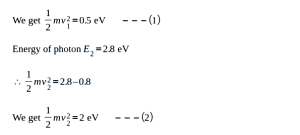
$\frac{1}{2} m v_1^2 = 1.3 eV - 0.8 eV = 0.5 eV$ --- $(1)$
For the second photon with energy $E_2 = 2.8 eV$:
$\frac{1}{2} m v_2^2 = 2.8 eV - 0.8 eV = 2.0 eV$ --- $(2)$
Dividing equation $(1)$ by equation $(2)$:
$\frac{\frac{1}{2} m v_1^2}{\frac{1}{2} m v_2^2} = \frac{0.5 eV}{2.0 eV}$
$\frac{v_1^2}{v_2^2} = \frac{0.5}{2.0} = \frac{1}{4}$
Taking the square root on both sides:
$\frac{v_1}{v_2} = \sqrt{\frac{1}{4}} = \frac{1}{2}$
Therefore,the ratio of maximum speeds is $1: 2$.
Given $\phi = 0.8 eV$.
For the first photon with energy $E_1 = 1.3 eV$:
$\frac{1}{2} m v_1^2 = 1.3 eV - 0.8 eV = 0.5 eV$ --- $(1)$
For the second photon with energy $E_2 = 2.8 eV$:
$\frac{1}{2} m v_2^2 = 2.8 eV - 0.8 eV = 2.0 eV$ --- $(2)$
Dividing equation $(1)$ by equation $(2)$:
$\frac{\frac{1}{2} m v_1^2}{\frac{1}{2} m v_2^2} = \frac{0.5 eV}{2.0 eV}$
$\frac{v_1^2}{v_2^2} = \frac{0.5}{2.0} = \frac{1}{4}$
Taking the square root on both sides:
$\frac{v_1}{v_2} = \sqrt{\frac{1}{4}} = \frac{1}{2}$
Therefore,the ratio of maximum speeds is $1: 2$.
0 likes
View Solution552
EasyMCQ
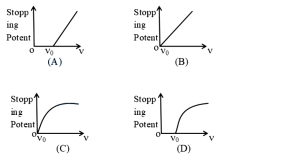
The following graph shows the variation of stopping potential with the frequency of incident radiation $(v)$ for a given metal. The correct variation is shown in graph [$v_0 =$ threshold frequency].
A
$(A)$
B
$(B)$
C
$(C)$
D
$(D)$
Solution
(C) Concept: The stopping potential $V$ is related to the maximum kinetic energy $K_{\max}$ of the photoelectrons via Einstein's photoelectric effect equation:
$eV = K_{\max} = hv - hv_0$
Therefore,
$V = \left(\frac{h}{e}\right)v - \left(\frac{h}{e}\right)v_0$
This equation is of the form $y = mx + c$,which represents a straight line.
Here,the slope $m = \frac{h}{e}$ is positive,and the intercept on the $V$-axis is $-\left(\frac{h}{e}\right)v_0$.
At $v = v_0$,the stopping potential $V = 0$.
Thus,the graph is a straight line starting from $v = v_0$ on the frequency axis and increasing linearly with frequency.
Graph $(A)$ correctly represents this relationship.
$eV = K_{\max} = hv - hv_0$
Therefore,
$V = \left(\frac{h}{e}\right)v - \left(\frac{h}{e}\right)v_0$
This equation is of the form $y = mx + c$,which represents a straight line.
Here,the slope $m = \frac{h}{e}$ is positive,and the intercept on the $V$-axis is $-\left(\frac{h}{e}\right)v_0$.
At $v = v_0$,the stopping potential $V = 0$.
Thus,the graph is a straight line starting from $v = v_0$ on the frequency axis and increasing linearly with frequency.
Graph $(A)$ correctly represents this relationship.
0 likes
View Solution553
EasyMCQ
In the case of photoelectric emission from a certain metal,the cutoff frequency is $v$. If radiation of frequency $2v$ is incident on the metal plate,the maximum possible velocity of the emitted electrons will be ($m=$ mass of electron).
A
$2 \sqrt{\frac{hv}{m}}$
B
$\sqrt{\frac{hv}{2m}}$
C
$\sqrt{\frac{2hv}{m}}$
D
$\sqrt{\frac{hv}{m}}$
Solution
(C) According to Einstein's photoelectric equation,the maximum kinetic energy $(K.E._{max})$ of emitted electrons is given by:
$K.E._{max} = E - \phi$
Where $E$ is the energy of the incident photon and $\phi$ is the work function of the metal.
Given that the cutoff frequency (threshold frequency) is $v$,the work function is $\phi = hv$.
The energy of the incident radiation with frequency $2v$ is $E = h(2v) = 2hv$.
Substituting these values into the equation:
$\frac{1}{2}mv_{max}^2 = 2hv - hv$
$\frac{1}{2}mv_{max}^2 = hv$
$v_{max}^2 = \frac{2hv}{m}$
$v_{max} = \sqrt{\frac{2hv}{m}}$
$K.E._{max} = E - \phi$
Where $E$ is the energy of the incident photon and $\phi$ is the work function of the metal.
Given that the cutoff frequency (threshold frequency) is $v$,the work function is $\phi = hv$.
The energy of the incident radiation with frequency $2v$ is $E = h(2v) = 2hv$.
Substituting these values into the equation:
$\frac{1}{2}mv_{max}^2 = 2hv - hv$
$\frac{1}{2}mv_{max}^2 = hv$
$v_{max}^2 = \frac{2hv}{m}$
$v_{max} = \sqrt{\frac{2hv}{m}}$
0 likes
View Solution554
MediumMCQ
In a photoelectric experiment,the stopping potential was measured to be $V_1$ and $V_2$ volts with incident light of wavelength $\lambda$ and $\frac{\lambda}{2}$ respectively. The value of $V_2$ is: [where $\phi=$ work function,$e=$ electronic charge]
A
$V_1+\frac{2 \phi}{e}$
B
$2 V_1+\frac{\phi}{e}$
C
$2 V_1-\frac{\phi}{e}$
D
$V_1-\frac{2 \phi}{e}$
Solution
(B) Einstein's photoelectric equation is given by: $e V = \frac{h c}{\lambda} - \phi$,which can be written as $\frac{h c}{\lambda} = \phi + e V$.
For incident wavelength $\lambda$,the stopping potential is $V_1$:
$\frac{h c}{\lambda} = \phi + e V_1$ --- $(1)$
For incident wavelength $\frac{\lambda}{2}$,the stopping potential is $V_2$:
$\frac{h c}{\lambda / 2} = \phi + e V_2 \Rightarrow \frac{2 h c}{\lambda} = \phi + e V_2$ --- $(2)$
Substitute the value of $\frac{h c}{\lambda}$ from equation $(1)$ into equation $(2)$:
$2(\phi + e V_1) = \phi + e V_2$
$2 \phi + 2 e V_1 = \phi + e V_2$
$e V_2 = 2 e V_1 + \phi$
Dividing by $e$,we get:
$V_2 = 2 V_1 + \frac{\phi}{e}$
For incident wavelength $\lambda$,the stopping potential is $V_1$:
$\frac{h c}{\lambda} = \phi + e V_1$ --- $(1)$
For incident wavelength $\frac{\lambda}{2}$,the stopping potential is $V_2$:
$\frac{h c}{\lambda / 2} = \phi + e V_2 \Rightarrow \frac{2 h c}{\lambda} = \phi + e V_2$ --- $(2)$
Substitute the value of $\frac{h c}{\lambda}$ from equation $(1)$ into equation $(2)$:
$2(\phi + e V_1) = \phi + e V_2$
$2 \phi + 2 e V_1 = \phi + e V_2$
$e V_2 = 2 e V_1 + \phi$
Dividing by $e$,we get:
$V_2 = 2 V_1 + \frac{\phi}{e}$

0 likes
View Solution555
EasyMCQ
When a certain metal surface is illuminated with light of frequency $v$,the stopping potential for the photoelectric current is $V_s$. When the same surface is illuminated by a light of frequency $v/2$,the stopping potential is $V_s/4$. The threshold frequency of photoelectric emission is
A
$4v/3$
B
$5v/3$
C
$v/3$
D
$v/5$
Solution
(C) According to Einstein's photoelectric equation,the maximum kinetic energy $K_{max}$ of the emitted photoelectrons is given by $K_{max} = h v - h v_0$,where $v_0$ is the threshold frequency.
Since the stopping potential $V_s$ is related to the maximum kinetic energy by $K_{max} = e V_s$,we have $e V_s = h v - h v_0$ ... $(1)$.
For the second case,with frequency $v/2$ and stopping potential $V_s/4$,we have $e(V_s/4) = h(v/2) - h v_0$ ... $(2)$.
From equation $(1)$,$e V_s = h v - h v_0$. Substituting this into equation $(2)$ multiplied by $4$:
$e V_s = 4(h v/2 - h v_0) = 2h v - 4h v_0$.
Equating the two expressions for $e V_s$:
$h v - h v_0 = 2h v - 4h v_0$.
Rearranging the terms: $3h v_0 = h v$.
Therefore,$v_0 = v/3$.
Since the stopping potential $V_s$ is related to the maximum kinetic energy by $K_{max} = e V_s$,we have $e V_s = h v - h v_0$ ... $(1)$.
For the second case,with frequency $v/2$ and stopping potential $V_s/4$,we have $e(V_s/4) = h(v/2) - h v_0$ ... $(2)$.
From equation $(1)$,$e V_s = h v - h v_0$. Substituting this into equation $(2)$ multiplied by $4$:
$e V_s = 4(h v/2 - h v_0) = 2h v - 4h v_0$.
Equating the two expressions for $e V_s$:
$h v - h v_0 = 2h v - 4h v_0$.
Rearranging the terms: $3h v_0 = h v$.
Therefore,$v_0 = v/3$.
0 likes
View Solution556
EasyMCQ
The work functions for metals $A$, $B$, and $C$ are $1.92 eV$, $2.0 eV$, and $5 eV$ respectively. The metal(s) which will emit photoelectrons for incident radiation of wavelength $4100 Å$ is/are $[h=6.63 \times 10^{-34} J s, e=1.6 \times 10^{-19} C, c=3 \times 10^8 m/s]$.
A
Only $C$
B
$B$ and $C$
C
Only $A$
D
$A$ and $B$
Solution
(D) The energy of the incident photon is given by $E = \frac{hc}{\lambda}$.
Given $h = 6.63 \times 10^{-34} J s$, $c = 3 \times 10^8 m/s$, and $\lambda = 4100 \times 10^{-10} m$.
$E = \frac{6.63 \times 10^{-34} \times 3 \times 10^8}{4100 \times 10^{-10}} J = 4.85 \times 10^{-19} J$.
To convert this energy into electron-volts $(eV)$, divide by $e = 1.6 \times 10^{-19} C$:
$E = \frac{4.85 \times 10^{-19}}{1.6 \times 10^{-19}} eV \approx 3.03 eV$.
Photoelectric emission occurs if the incident photon energy is greater than the work function $(\Phi)$ of the metal.
For metal $A$: $\Phi_A = 1.92 eV < 3.03 eV$ (Emission occurs).
For metal $B$: $\Phi_B = 2.0 eV < 3.03 eV$ (Emission occurs).
For metal $C$: $\Phi_C = 5 eV > 3.03 eV$ (No emission).
Therefore, metals $A$ and $B$ will emit photoelectrons.
Given $h = 6.63 \times 10^{-34} J s$, $c = 3 \times 10^8 m/s$, and $\lambda = 4100 \times 10^{-10} m$.
$E = \frac{6.63 \times 10^{-34} \times 3 \times 10^8}{4100 \times 10^{-10}} J = 4.85 \times 10^{-19} J$.
To convert this energy into electron-volts $(eV)$, divide by $e = 1.6 \times 10^{-19} C$:
$E = \frac{4.85 \times 10^{-19}}{1.6 \times 10^{-19}} eV \approx 3.03 eV$.
Photoelectric emission occurs if the incident photon energy is greater than the work function $(\Phi)$ of the metal.
For metal $A$: $\Phi_A = 1.92 eV < 3.03 eV$ (Emission occurs).
For metal $B$: $\Phi_B = 2.0 eV < 3.03 eV$ (Emission occurs).
For metal $C$: $\Phi_C = 5 eV > 3.03 eV$ (No emission).
Therefore, metals $A$ and $B$ will emit photoelectrons.
0 likes
View Solution557
MediumMCQ
In a photoelectric emission experiment,the stopping potential for a given metal is $V$ volt,when radiation of wavelength $\lambda$ is used. If radiation of wavelength $2 \lambda$ is used with the same metal,then the stopping potential (in volt) will be. [Given: $c = \text{velocity of light}$,$e = \text{charge on electron}$,$h = \text{Planck's constant}$]
A
$V - \frac{hc}{2e\lambda}$
B
$V + \frac{hc}{2e\lambda}$
C
$\frac{V}{2}$
D
$2V$
Solution
(A) According to Einstein's photoelectric equation:
$eV = \frac{hc}{\lambda} - \Phi$ --- $(1)$
where $V$ is the stopping potential,$\lambda$ is the incident wavelength,and $\Phi$ is the work function of the metal.
When the incident wavelength is changed to $2\lambda$,let the new stopping potential be $V'$. The equation becomes:
$eV' = \frac{hc}{2\lambda} - \Phi$ --- $(2)$
Subtracting equation $(2)$ from equation $(1)$:
$eV - eV' = \left( \frac{hc}{\lambda} - \Phi \right) - \left( \frac{hc}{2\lambda} - \Phi \right)$
$e(V - V') = \frac{hc}{\lambda} - \frac{hc}{2\lambda} = \frac{hc}{2\lambda}$
$V - V' = \frac{hc}{2e\lambda}$
$V' = V - \frac{hc}{2e\lambda}$
$eV = \frac{hc}{\lambda} - \Phi$ --- $(1)$
where $V$ is the stopping potential,$\lambda$ is the incident wavelength,and $\Phi$ is the work function of the metal.
When the incident wavelength is changed to $2\lambda$,let the new stopping potential be $V'$. The equation becomes:
$eV' = \frac{hc}{2\lambda} - \Phi$ --- $(2)$
Subtracting equation $(2)$ from equation $(1)$:
$eV - eV' = \left( \frac{hc}{\lambda} - \Phi \right) - \left( \frac{hc}{2\lambda} - \Phi \right)$
$e(V - V') = \frac{hc}{\lambda} - \frac{hc}{2\lambda} = \frac{hc}{2\lambda}$
$V - V' = \frac{hc}{2e\lambda}$
$V' = V - \frac{hc}{2e\lambda}$
0 likes
View Solution558
MediumMCQ
Photoelectric emission takes place from a certain metal at threshold frequency $\nu$. If the radiation of frequency $2\nu$ is incident on the metal plate, the maximum velocity of the emitted photoelectron will be ($m = \text{mass of electron}$, $h = \text{Planck's constant}$)
A
$\sqrt{\frac{2h\nu}{m}}$
B
$\sqrt{\frac{h\nu}{2m}}$
C
$\sqrt{\frac{h\nu}{3m}}$
D
$\sqrt{\frac{h\nu}{m}}$
Solution
(A) According to Einstein's photoelectric equation, the maximum kinetic energy $K_{max}$ of the emitted photoelectron is given by:
$K_{max} = h\nu - \phi$
where $\phi$ is the work function of the metal.
Given that the threshold frequency is $\nu$, the work function is $\phi = h\nu$.
When radiation of frequency $2\nu$ is incident on the metal, the maximum kinetic energy is:
$K_{max} = h(2\nu) - h\nu = h\nu$
Since $K_{max} = \frac{1}{2}mv_{max}^2$, we have:
$\frac{1}{2}mv_{max}^2 = h\nu$
$v_{max}^2 = \frac{2h\nu}{m}$
$v_{max} = \sqrt{\frac{2h\nu}{m}}$
Therefore, option $A$ is correct.
$K_{max} = h\nu - \phi$
where $\phi$ is the work function of the metal.
Given that the threshold frequency is $\nu$, the work function is $\phi = h\nu$.
When radiation of frequency $2\nu$ is incident on the metal, the maximum kinetic energy is:
$K_{max} = h(2\nu) - h\nu = h\nu$
Since $K_{max} = \frac{1}{2}mv_{max}^2$, we have:
$\frac{1}{2}mv_{max}^2 = h\nu$
$v_{max}^2 = \frac{2h\nu}{m}$
$v_{max} = \sqrt{\frac{2h\nu}{m}}$
Therefore, option $A$ is correct.
0 likes
View Solution559
EasyMCQ
The maximum velocity of the photoelectron emitted by the metal surface is $v$. The charge and mass of the photoelectron are denoted by $e$ and $m$ respectively. The stopping potential in volt is
A
$\frac{v^2 e}{m}$
B
$\frac{v^2 m}{2 e}$
C
$\frac{v^2 m}{e}$
D
$\frac{v^2 e}{2 m}$
Solution
(B) The kinetic energy of the fastest emitted photoelectron is given by $K_{max} = \frac{1}{2} m v^2$.
The stopping potential $V$ is the potential required to stop these fastest electrons,such that the work done by the electric field equals the maximum kinetic energy:
$e V = K_{max}$
$e V = \frac{1}{2} m v^2$
Solving for $V$,we get:
$V = \frac{m v^2}{2 e}$
The stopping potential $V$ is the potential required to stop these fastest electrons,such that the work done by the electric field equals the maximum kinetic energy:
$e V = K_{max}$
$e V = \frac{1}{2} m v^2$
Solving for $V$,we get:
$V = \frac{m v^2}{2 e}$
0 likes
View Solution560
EasyMCQ
In the photoelectric effect, the kinetic energy of the electron emitted from the metal surface depends upon:
A
intensity of incident light
B
both intensity and velocity of incident light
C
frequency of incident light
D
velocity of incident light
Solution
(C) According to Einstein's photoelectric equation, the maximum kinetic energy $(K_{max})$ of an emitted photoelectron is given by $K_{max} = h\nu - \Phi$, where $h$ is Planck's constant, $\nu$ is the frequency of the incident light, and $\Phi$ is the work function of the metal surface.
Since $h$ and $\Phi$ are constants for a given metal, the kinetic energy $K_{max}$ depends directly on the frequency $\nu$ of the incident light.
Intensity of light affects the number of photoelectrons emitted per second, but not their individual kinetic energy.
Since $h$ and $\Phi$ are constants for a given metal, the kinetic energy $K_{max}$ depends directly on the frequency $\nu$ of the incident light.
Intensity of light affects the number of photoelectrons emitted per second, but not their individual kinetic energy.
0 likes
View Solution561
MediumMCQ
Photoelectrons are emitted when photons of energy $4.2 \text{ eV}$ are incident on a photosensitive metallic sphere of radius $10 \text{ cm}$ and work function $2.4 \text{ eV}$. The number of photoelectrons emitted before the emission is stopped is
$\left[\frac{1}{4 \pi \epsilon_0}=9 \times 10^9 \text{ SI unit; } e=1.6 \times 10^{-19} \text{ C}\right]$
$\left[\frac{1}{4 \pi \epsilon_0}=9 \times 10^9 \text{ SI unit; } e=1.6 \times 10^{-19} \text{ C}\right]$
A
$1.25 \times 10^6$
B
$1.25 \times 10^8$
C
$1.25 \times 10^2$
D
$1.25 \times 10^4$
Solution
(B) The maximum kinetic energy of the emitted photoelectrons is given by Einstein's photoelectric equation:
$(KE)_{\max} = h\nu - \phi = 4.2 \text{ eV} - 2.4 \text{ eV} = 1.8 \text{ eV}$.
Emission stops when the potential $V$ of the sphere reaches a value such that the potential energy of an electron equals its maximum kinetic energy:
$eV = (KE)_{\max} \implies V = 1.8 \text{ V}$.
The potential of a metallic sphere of radius $r$ is given by $V = \frac{1}{4 \pi \epsilon_0} \frac{q}{r}$.
Substituting the values: $1.8 = (9 \times 10^9) \times \frac{q}{0.1}$.
Solving for charge $q$: $q = \frac{1.8 \times 0.1}{9 \times 10^9} = 2 \times 10^{-11} \text{ C}$.
The number of photoelectrons $n$ emitted is $n = \frac{q}{e} = \frac{2 \times 10^{-11}}{1.6 \times 10^{-19}} = 1.25 \times 10^8$.
$(KE)_{\max} = h\nu - \phi = 4.2 \text{ eV} - 2.4 \text{ eV} = 1.8 \text{ eV}$.
Emission stops when the potential $V$ of the sphere reaches a value such that the potential energy of an electron equals its maximum kinetic energy:
$eV = (KE)_{\max} \implies V = 1.8 \text{ V}$.
The potential of a metallic sphere of radius $r$ is given by $V = \frac{1}{4 \pi \epsilon_0} \frac{q}{r}$.
Substituting the values: $1.8 = (9 \times 10^9) \times \frac{q}{0.1}$.
Solving for charge $q$: $q = \frac{1.8 \times 0.1}{9 \times 10^9} = 2 \times 10^{-11} \text{ C}$.
The number of photoelectrons $n$ emitted is $n = \frac{q}{e} = \frac{2 \times 10^{-11}}{1.6 \times 10^{-19}} = 1.25 \times 10^8$.
0 likes
View Solution562
MediumMCQ
Photoemission from a metal surface takes place for frequencies $v_1$ and $v_2$ of incident rays. If the ratio of the maximum kinetic energy of photoelectrons is $1:K$,then the threshold frequency of the metallic surface is
A
$\frac{K v_2-v_1}{K-1}$
B
$\frac{v_1-v_2}{K-1}$
C
$\frac{v_2-v_1}{K}$
D
$\frac{K v_1-v_2}{K-1}$
Solution
(D) According to Einstein's photoelectric equation,the maximum kinetic energy $(K.E.)_{max}$ is given by:
$(K.E.)_{max} = h v - h v_0$
where $h$ is Planck's constant,$v$ is the frequency of incident light,and $v_0$ is the threshold frequency.
For frequencies $v_1$ and $v_2$,we have:
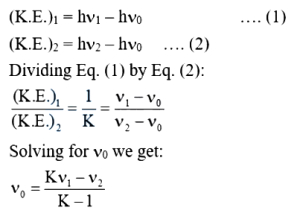
$(K.E.)_1 = h v_1 - h v_0$ ....$(1)$
$(K.E.)_2 = h v_2 - h v_0$ ....$(2)$
Given the ratio of maximum kinetic energies is $\frac{(K.E.)_1}{(K.E.)_2} = \frac{1}{K}$.
Dividing equation $(1)$ by $(2)$:
$\frac{1}{K} = \frac{h v_1 - h v_0}{h v_2 - h v_0} = \frac{v_1 - v_0}{v_2 - v_0}$
Cross-multiplying:
$v_2 - v_0 = K(v_1 - v_0)$
$v_2 - v_0 = K v_1 - K v_0$
$K v_0 - v_0 = K v_1 - v_2$
$v_0(K - 1) = K v_1 - v_2$
$v_0 = \frac{K v_1 - v_2}{K - 1}$
$(K.E.)_{max} = h v - h v_0$
where $h$ is Planck's constant,$v$ is the frequency of incident light,and $v_0$ is the threshold frequency.
For frequencies $v_1$ and $v_2$,we have:
$(K.E.)_1 = h v_1 - h v_0$ ....$(1)$
$(K.E.)_2 = h v_2 - h v_0$ ....$(2)$
Given the ratio of maximum kinetic energies is $\frac{(K.E.)_1}{(K.E.)_2} = \frac{1}{K}$.
Dividing equation $(1)$ by $(2)$:
$\frac{1}{K} = \frac{h v_1 - h v_0}{h v_2 - h v_0} = \frac{v_1 - v_0}{v_2 - v_0}$
Cross-multiplying:
$v_2 - v_0 = K(v_1 - v_0)$
$v_2 - v_0 = K v_1 - K v_0$
$K v_0 - v_0 = K v_1 - v_2$
$v_0(K - 1) = K v_1 - v_2$
$v_0 = \frac{K v_1 - v_2}{K - 1}$
0 likes
View Solution563
DifficultMCQ
When light of wavelength $\lambda$ falls on the emitter of a photocell,the maximum speed of the emitted photoelectrons is $V$. If the incident wavelength is changed to $\frac{2\lambda}{3}$,the maximum speed of the emitted photoelectrons will be:
A
less than $(1.5)^{1/2} V$
B
$\sqrt{V}$
C
greater than $(1.5)^{1/2} V$
D
$V$
Solution
(C) According to Einstein's photoelectric equation,the maximum kinetic energy $(K.E.)_{max}$ is given by:
$(K.E.)_{max} = \frac{hc}{\lambda} - W_0$,where $W_0$ is the work function.
For the first case:
$(K.E.)_1 = \frac{1}{2}mV^2 = \frac{hc}{\lambda} - W_0$ ... $(1)$
For the second case,with wavelength $\lambda' = \frac{2\lambda}{3}$:
$(K.E.)_2 = \frac{1}{2}mv_2^2 = \frac{hc}{\lambda'} - W_0 = \frac{hc}{(2\lambda/3)} - W_0 = \frac{3}{2}\frac{hc}{\lambda} - W_0$ ... $(2)$
From equation $(1)$,$\frac{hc}{\lambda} = \frac{1}{2}mV^2 + W_0$. Substituting this into equation $(2)$:
$(K.E.)_2 = \frac{3}{2}(\frac{1}{2}mV^2 + W_0) - W_0$
$(K.E.)_2 = \frac{3}{2}(\frac{1}{2}mV^2) + \frac{3}{2}W_0 - W_0$
$(K.E.)_2 = \frac{3}{2}(\frac{1}{2}mV^2) + \frac{1}{2}W_0$
Since $W_0 > 0$,it follows that $(K.E.)_2 > \frac{3}{2}(K.E.)_1$.
$\frac{1}{2}mv_2^2 > \frac{3}{2}(\frac{1}{2}mV^2)$
$v_2^2 > 1.5 V^2$
$v_2 > \sqrt{1.5} V = (1.5)^{1/2} V$.
$(K.E.)_{max} = \frac{hc}{\lambda} - W_0$,where $W_0$ is the work function.
For the first case:
$(K.E.)_1 = \frac{1}{2}mV^2 = \frac{hc}{\lambda} - W_0$ ... $(1)$
For the second case,with wavelength $\lambda' = \frac{2\lambda}{3}$:
$(K.E.)_2 = \frac{1}{2}mv_2^2 = \frac{hc}{\lambda'} - W_0 = \frac{hc}{(2\lambda/3)} - W_0 = \frac{3}{2}\frac{hc}{\lambda} - W_0$ ... $(2)$
From equation $(1)$,$\frac{hc}{\lambda} = \frac{1}{2}mV^2 + W_0$. Substituting this into equation $(2)$:
$(K.E.)_2 = \frac{3}{2}(\frac{1}{2}mV^2 + W_0) - W_0$
$(K.E.)_2 = \frac{3}{2}(\frac{1}{2}mV^2) + \frac{3}{2}W_0 - W_0$
$(K.E.)_2 = \frac{3}{2}(\frac{1}{2}mV^2) + \frac{1}{2}W_0$
Since $W_0 > 0$,it follows that $(K.E.)_2 > \frac{3}{2}(K.E.)_1$.
$\frac{1}{2}mv_2^2 > \frac{3}{2}(\frac{1}{2}mV^2)$
$v_2^2 > 1.5 V^2$
$v_2 > \sqrt{1.5} V = (1.5)^{1/2} V$.
0 likes
View Solution564
MediumMCQ
Photons of energy $10 eV$ are incident on a photosensitive surface of threshold frequency $2 \times 10^{15} Hz$. The kinetic energy in $eV$ of the photoelectrons emitted is [Planck's constant $h = 6.63 \times 10^{-34} Js$]. (in $eV$)
A
$8.29$
B
$6.5$
C
$4.2$
D
$1.7$
Solution
(D) The energy of the incident photons is $E = 10 eV$.
The threshold frequency is $\nu_0 = 2 \times 10^{15} Hz$.
The work function $W_0$ is given by $W_0 = h\nu_0$.
Substituting the values: $W_0 = (6.63 \times 10^{-34} Js) \times (2 \times 10^{15} Hz) = 13.26 \times 10^{-19} J$.
To convert this into $eV$,divide by the charge of an electron $(1.6 \times 10^{-19} C)$:
$W_0 = \frac{13.26 \times 10^{-19}}{1.6 \times 10^{-19}} eV \approx 8.2875 eV \approx 8.3 eV$.
According to Einstein's photoelectric equation,the maximum kinetic energy $K_{max}$ is given by $K_{max} = E - W_0$.
$K_{max} = 10 eV - 8.3 eV = 1.7 eV$.
The threshold frequency is $\nu_0 = 2 \times 10^{15} Hz$.
The work function $W_0$ is given by $W_0 = h\nu_0$.
Substituting the values: $W_0 = (6.63 \times 10^{-34} Js) \times (2 \times 10^{15} Hz) = 13.26 \times 10^{-19} J$.
To convert this into $eV$,divide by the charge of an electron $(1.6 \times 10^{-19} C)$:
$W_0 = \frac{13.26 \times 10^{-19}}{1.6 \times 10^{-19}} eV \approx 8.2875 eV \approx 8.3 eV$.
According to Einstein's photoelectric equation,the maximum kinetic energy $K_{max}$ is given by $K_{max} = E - W_0$.
$K_{max} = 10 eV - 8.3 eV = 1.7 eV$.
0 likes
View Solution565
MediumMCQ
The light of wavelength $\lambda$ is incident on the surface of a metal with work function $\phi$ and emits electrons. What is the maximum velocity of the emitted electrons? [Given: $m=$ mass of electron,$h=$ Planck's constant,$c=$ velocity of light]
A
$\left[\frac{2(hc-\lambda)}{m \lambda}\right]^{\frac{1}{2}}$
B
$\left[\frac{2(hc-\phi) \lambda}{mc}\right]^{\frac{1}{2}}$
C
$\left[\frac{2(hc-\lambda)}{m \lambda}\right]$
D
$\left[\frac{2(hc-\phi \lambda)}{m \lambda}\right]^{\frac{1}{2}}$
Solution
(D) According to Einstein's photoelectric equation,the maximum kinetic energy $K_{\max}$ of the emitted electron is given by:
$K_{\max} = E - \phi$
where $E = \frac{hc}{\lambda}$ is the energy of the incident photon.
Substituting the values,we get:
$\frac{1}{2} mv_{\max}^2 = \frac{hc}{\lambda} - \phi$
$\frac{1}{2} mv_{\max}^2 = \frac{hc - \phi \lambda}{\lambda}$
Multiplying both sides by $\frac{2}{m}$:
$v_{\max}^2 = \frac{2(hc - \phi \lambda)}{m \lambda}$
Taking the square root on both sides:
$v_{\max} = \sqrt{\frac{2(hc - \phi \lambda)}{m \lambda}}$
Thus,the correct option is $D$.
$K_{\max} = E - \phi$
where $E = \frac{hc}{\lambda}$ is the energy of the incident photon.
Substituting the values,we get:
$\frac{1}{2} mv_{\max}^2 = \frac{hc}{\lambda} - \phi$
$\frac{1}{2} mv_{\max}^2 = \frac{hc - \phi \lambda}{\lambda}$
Multiplying both sides by $\frac{2}{m}$:
$v_{\max}^2 = \frac{2(hc - \phi \lambda)}{m \lambda}$
Taking the square root on both sides:
$v_{\max} = \sqrt{\frac{2(hc - \phi \lambda)}{m \lambda}}$
Thus,the correct option is $D$.
0 likes
View Solution566
EasyMCQ
When the wavelength of incident radiation on a metal surface is reduced from $\lambda_1$ to $\lambda_2$,the kinetic energy of the emitted photoelectrons is tripled. Find the work function of the metal. [$h =$ Planck's constant,$c =$ velocity of light]
A
$\frac{hc}{2}\left[\frac{3 \lambda_1-\lambda_2}{\lambda_1 \lambda_2}\right]$
B
$\frac{hc}{2}\left[\frac{3 \lambda_2-\lambda_1}{\lambda_1 \lambda_2}\right]$
C
$hc\left[\frac{3 \lambda_1-\lambda_2}{\lambda_1 \lambda_2}\right]$
D
$hc\left[\frac{3 \lambda_2-\lambda_1}{\lambda_1 \lambda_2}\right]$
Solution
(B) According to Einstein's photoelectric equation,the kinetic energy $K$ is given by $K = \frac{hc}{\lambda} - W_0$,where $W_0$ is the work function.
For wavelength $\lambda_1$,the kinetic energy is $K_1 = \frac{hc}{\lambda_1} - W_0$.
For wavelength $\lambda_2$,the kinetic energy is $K_2 = \frac{hc}{\lambda_2} - W_0$.
Given that $K_2 = 3K_1$,we substitute the expressions:
$\frac{hc}{\lambda_2} - W_0 = 3\left(\frac{hc}{\lambda_1} - W_0\right)$.
$\frac{hc}{\lambda_2} - W_0 = \frac{3hc}{\lambda_1} - 3W_0$.
Rearranging the terms to solve for $W_0$:
$3W_0 - W_0 = \frac{3hc}{\lambda_1} - \frac{hc}{\lambda_2}$.
$2W_0 = hc\left(\frac{3}{\lambda_1} - \frac{1}{\lambda_2}\right)$.
$2W_0 = hc\left(\frac{3\lambda_2 - \lambda_1}{\lambda_1\lambda_2}\right)$.
Therefore,$W_0 = \frac{hc}{2}\left(\frac{3\lambda_2 - \lambda_1}{\lambda_1\lambda_2}\right)$.
For wavelength $\lambda_1$,the kinetic energy is $K_1 = \frac{hc}{\lambda_1} - W_0$.
For wavelength $\lambda_2$,the kinetic energy is $K_2 = \frac{hc}{\lambda_2} - W_0$.
Given that $K_2 = 3K_1$,we substitute the expressions:
$\frac{hc}{\lambda_2} - W_0 = 3\left(\frac{hc}{\lambda_1} - W_0\right)$.
$\frac{hc}{\lambda_2} - W_0 = \frac{3hc}{\lambda_1} - 3W_0$.
Rearranging the terms to solve for $W_0$:
$3W_0 - W_0 = \frac{3hc}{\lambda_1} - \frac{hc}{\lambda_2}$.
$2W_0 = hc\left(\frac{3}{\lambda_1} - \frac{1}{\lambda_2}\right)$.
$2W_0 = hc\left(\frac{3\lambda_2 - \lambda_1}{\lambda_1\lambda_2}\right)$.
Therefore,$W_0 = \frac{hc}{2}\left(\frac{3\lambda_2 - \lambda_1}{\lambda_1\lambda_2}\right)$.
0 likes
View Solution567
DifficultMCQ
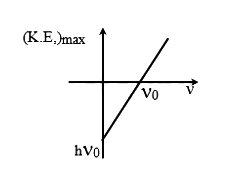
In a photoelectric experiment,a graph of maximum kinetic energy $(KE_{\max})$ against the frequency of incident radiation $(\nu)$ is plotted. If $A$ and $B$ are the intercepts on the $X$ and $Y$ axis respectively,the Planck's constant is given by:
A
$A+B$
B
$\frac{B}{A}$
C
$A \times B$
D
$\frac{A}{B}$
Solution
(B) According to Einstein's photoelectric equation,the maximum kinetic energy is given by:
$(KE)_{\max} = h\nu - \phi_0$
where $\phi_0 = h\nu_0$ is the work function.
Comparing this with the equation of a straight line $y = mx + c$:
Here,$y = (KE)_{\max}$,$x = \nu$,$m = h$ (slope),and $c = -h\nu_0$ (y-intercept).
$1$. The $X$-intercept $(A)$ occurs when $(KE)_{\max} = 0$:
$0 = h\nu - h\nu_0 \implies \nu = \nu_0 = A$.
$2$. The $Y$-intercept $(B)$ occurs when $\nu = 0$:
$(KE)_{\max} = -h\nu_0 = B$. Since $B$ represents the magnitude of the intercept,we take $|B| = h\nu_0$.
Therefore,the ratio of the magnitude of the $Y$-intercept to the $X$-intercept is:
$\frac{|B|}{A} = \frac{h\nu_0}{\nu_0} = h$.
Thus,Planck's constant $h$ is given by $\frac{B}{A}$ (considering magnitudes).
$(KE)_{\max} = h\nu - \phi_0$
where $\phi_0 = h\nu_0$ is the work function.
Comparing this with the equation of a straight line $y = mx + c$:
Here,$y = (KE)_{\max}$,$x = \nu$,$m = h$ (slope),and $c = -h\nu_0$ (y-intercept).
$1$. The $X$-intercept $(A)$ occurs when $(KE)_{\max} = 0$:
$0 = h\nu - h\nu_0 \implies \nu = \nu_0 = A$.
$2$. The $Y$-intercept $(B)$ occurs when $\nu = 0$:
$(KE)_{\max} = -h\nu_0 = B$. Since $B$ represents the magnitude of the intercept,we take $|B| = h\nu_0$.
Therefore,the ratio of the magnitude of the $Y$-intercept to the $X$-intercept is:
$\frac{|B|}{A} = \frac{h\nu_0}{\nu_0} = h$.
Thus,Planck's constant $h$ is given by $\frac{B}{A}$ (considering magnitudes).
0 likes
View Solution568
MediumMCQ
$A$ light of wavelength $\lambda$ and intensity $I$ falls on a photosensitive material. If $N$ photoelectrons are emitted,each with kinetic energy $E$,then:
A
$E \propto I, N \propto \lambda$
B
$E \propto I, N \propto I$
C
$E \propto I, N \propto \frac{1}{\lambda}$
D
$E \propto \frac{1}{\lambda}, N \propto I$
Solution
(D) According to Einstein's photoelectric equation,the kinetic energy $E$ of an emitted photoelectron is given by $E = \frac{hc}{\lambda} - \phi$,where $\phi$ is the work function of the material. This shows that $E$ depends only on the wavelength $\lambda$ of the incident light,specifically $E \propto \frac{1}{\lambda}$.
Intensity $I$ of light is proportional to the number of photons incident per unit area per unit time. Since each photon interacts with one electron to cause emission,the number of emitted photoelectrons $N$ is directly proportional to the intensity $I$ of the incident light $(N \propto I)$.
Intensity $I$ of light is proportional to the number of photons incident per unit area per unit time. Since each photon interacts with one electron to cause emission,the number of emitted photoelectrons $N$ is directly proportional to the intensity $I$ of the incident light $(N \propto I)$.
0 likes
View Solution569
EasyMCQ
The maximum velocity of the photoelectron emitted by the metal surface is $v$. The charge and mass of the photoelectron are denoted by $e$ and $m$ respectively. The stopping potential in volts is:
A
$\frac{v^{2}}{(m/e)}$
B
$\frac{v^{2}}{(e/m)}$
C
$\frac{v^{2}}{2(m/e)}$
D
$\frac{v^{2}}{2(e/m)}$
Solution
(D) The kinetic energy of the emitted photoelectron is given by $K_{max} = \frac{1}{2}mv^2$.
At the stopping potential $V_s$,the work done by the retarding electric field is equal to the maximum kinetic energy of the photoelectron.
Therefore,$eV_s = \frac{1}{2}mv^2$.
Solving for the stopping potential $V_s$:
$V_s = \frac{mv^2}{2e}$.
This can be rewritten as $V_s = \frac{v^2}{2(e/m)}$.
At the stopping potential $V_s$,the work done by the retarding electric field is equal to the maximum kinetic energy of the photoelectron.
Therefore,$eV_s = \frac{1}{2}mv^2$.
Solving for the stopping potential $V_s$:
$V_s = \frac{mv^2}{2e}$.
This can be rewritten as $V_s = \frac{v^2}{2(e/m)}$.
0 likes
View Solution570
EasyMCQ
If the frequency of incident light falling on a metallic surface is doubled, what happens to the maximum kinetic energy of the emitted photoelectrons?
A
increases to slightly more than double.
B
remains the same.
C
becomes twice.
D
decreases to slightly more than double.
Solution
(A) According to Einstein's photoelectric equation, the maximum kinetic energy $K_{max}$ of emitted photoelectrons is given by $K_{max} = h\nu - \phi$, where $h$ is Planck's constant, $\nu$ is the frequency of incident light, and $\phi$ is the work function of the metal.
Initially, $K_{max1} = h\nu - \phi$.
When the frequency is doubled, the new frequency is $\nu' = 2\nu$.
The new maximum kinetic energy is $K_{max2} = h(2\nu) - \phi = 2h\nu - \phi$.
Since $K_{max2} = 2(h\nu - \phi/2)$, and $\phi > 0$, it follows that $K_{max2} > 2(h\nu - \phi) = 2K_{max1}$.
Therefore, the maximum kinetic energy increases to slightly more than double the initial value.
Initially, $K_{max1} = h\nu - \phi$.
When the frequency is doubled, the new frequency is $\nu' = 2\nu$.
The new maximum kinetic energy is $K_{max2} = h(2\nu) - \phi = 2h\nu - \phi$.
Since $K_{max2} = 2(h\nu - \phi/2)$, and $\phi > 0$, it follows that $K_{max2} > 2(h\nu - \phi) = 2K_{max1}$.
Therefore, the maximum kinetic energy increases to slightly more than double the initial value.
0 likes
View Solution571
EasyMCQ
When the work function of a metal increases,the maximum kinetic energy of the emitted photoelectrons:
A
first decreases and then increases.
B
increases.
C
remains same.
D
decreases.
Solution
(D) According to Einstein's photoelectric equation,the maximum kinetic energy $(K.E.)_{\max}$ of emitted photoelectrons is given by:
$(K.E.)_{\max} = h\nu - \phi_0$
Where:
$h\nu$ is the energy of the incident photon.
$\phi_0$ is the work function of the metal.
From the equation,it is clear that $(K.E.)_{\max}$ is inversely proportional to the work function $\phi_0$ for a constant incident frequency $\nu$.
Therefore,if the work function $\phi_0$ increases,the maximum kinetic energy $(K.E.)_{\max}$ decreases.
$(K.E.)_{\max} = h\nu - \phi_0$
Where:
$h\nu$ is the energy of the incident photon.
$\phi_0$ is the work function of the metal.
From the equation,it is clear that $(K.E.)_{\max}$ is inversely proportional to the work function $\phi_0$ for a constant incident frequency $\nu$.
Therefore,if the work function $\phi_0$ increases,the maximum kinetic energy $(K.E.)_{\max}$ decreases.
0 likes
View Solution572
DifficultMCQ
$A$ metal surface having work function '$W_{0}$' emits photoelectrons when photons of energy '$E$' are incident on it. The electron enters a uniform magnetic field '$B$' in a perpendicular direction and moves in a circular path of radius '$r$'. Then '$r$' is equal to (where '$m$' and '$e$' are the mass and charge of the electron,respectively).
A
$\frac{\sqrt{m(E-W_{0})}}{eB}$
B
$\frac{m(E-W_{0})}{eB}$
C
$\frac{\sqrt{2m(E-W_{0})}}{eB}$
D
$\frac{2m(E-W_{0})}{eB}$
Solution
(C) According to Einstein's photoelectric equation,the maximum kinetic energy '$K$' of the emitted photoelectron is given by: $K = E - W_{0}$.
Since $K = \frac{P^{2}}{2m}$,the momentum '$P$' of the electron is $P = \sqrt{2mK} = \sqrt{2m(E - W_{0})}$.
When a charged particle moves in a uniform magnetic field '$B$' perpendicular to its velocity,it follows a circular path of radius '$r = \frac{P}{eB}$.
Substituting the value of '$P$',we get: $r = \frac{\sqrt{2m(E - W_{0})}}{eB}$.
Since $K = \frac{P^{2}}{2m}$,the momentum '$P$' of the electron is $P = \sqrt{2mK} = \sqrt{2m(E - W_{0})}$.
When a charged particle moves in a uniform magnetic field '$B$' perpendicular to its velocity,it follows a circular path of radius '$r = \frac{P}{eB}$.
Substituting the value of '$P$',we get: $r = \frac{\sqrt{2m(E - W_{0})}}{eB}$.
0 likes
View Solution573
EasyMCQ
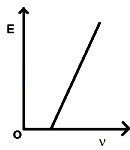
Using Einstein's photoelectric equation,the graph between the maximum kinetic energy $(E_k)$ of emitted photoelectrons and the frequency $(
u)$ of incident radiation is shown correctly in which figure?
u)$ of incident radiation is shown correctly in which figure?
A
Figure $A$
B
Figure $B$
C
Figure $C$
D
Figure $D$
Solution
(B) According to Einstein's photoelectric equation,the maximum kinetic energy $(E_k)$ of emitted photoelectrons is given by:
$E_k = h\nu - \Phi$
Where $h$ is Planck's constant,$\nu$ is the frequency of incident radiation,and $\Phi$ is the work function of the metal.
This equation is of the form $y = mx + c$,where $y = E_k$,$x = \nu$,$m = h$ (slope),and $c = -\Phi$ (y-intercept).
Since the y-intercept is negative $(-\Phi)$,the graph is a straight line that does not pass through the origin. It starts from the x-axis at a threshold frequency $\nu_0$ (where $E_k = 0$,so $h\nu_0 = \Phi$) and has a positive slope $h$. The provided image shows a straight line with a positive x-intercept,which correctly represents this relationship.
$E_k = h\nu - \Phi$
Where $h$ is Planck's constant,$\nu$ is the frequency of incident radiation,and $\Phi$ is the work function of the metal.
This equation is of the form $y = mx + c$,where $y = E_k$,$x = \nu$,$m = h$ (slope),and $c = -\Phi$ (y-intercept).
Since the y-intercept is negative $(-\Phi)$,the graph is a straight line that does not pass through the origin. It starts from the x-axis at a threshold frequency $\nu_0$ (where $E_k = 0$,so $h\nu_0 = \Phi$) and has a positive slope $h$. The provided image shows a straight line with a positive x-intercept,which correctly represents this relationship.
0 likes
View Solution574
EasyMCQ
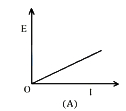
Which of the following graphs shows the correct variation of maximum kinetic energy $(E)$ of photoelectrons with the intensity of incident radiation $(I)$?
A
Graph $(A)$
B
Graph $(B)$
C
Graph $(C)$
D
Graph $(D)$
Solution
(A) According to Einstein's photoelectric equation,the maximum kinetic energy $(K_{max})$ of emitted photoelectrons is given by $K_{max} = h\nu - \Phi$,where $h$ is Planck's constant,$\nu$ is the frequency of incident radiation,and $\Phi$ is the work function of the metal surface.
This equation shows that the maximum kinetic energy depends only on the frequency of the incident radiation and the work function of the metal. It is independent of the intensity $(I)$ of the incident radiation.
Therefore,the graph showing the variation of maximum kinetic energy $(E)$ with intensity $(I)$ should be a horizontal line parallel to the intensity axis. Assuming graph $(D)$ represents this constant behavior,the correct option is $(D)$.
This equation shows that the maximum kinetic energy depends only on the frequency of the incident radiation and the work function of the metal. It is independent of the intensity $(I)$ of the incident radiation.
Therefore,the graph showing the variation of maximum kinetic energy $(E)$ with intensity $(I)$ should be a horizontal line parallel to the intensity axis. Assuming graph $(D)$ represents this constant behavior,the correct option is $(D)$.
0 likes
View Solution575
MediumMCQ
In the experiment of the photoelectric effect,the stopping potential for a given metal is $V_{0}$ volts when radiation of wavelength $\lambda_{0}$ is used. If radiation of wavelength $2\lambda_{0}$ is used for the same metal,then the stopping potential (in volts) will be: [$e=$ charge on electron,$c=$ speed of light,$h=$ Planck's constant.]
A
$V_{0} + \frac{hc}{2e\lambda_{0}}$
B
$V_{0} - \frac{hc}{2e\lambda_{0}}$
C
$\frac{V_{0}}{2}$
D
$2V_{0}$
Solution
(B) According to Einstein's photoelectric equation: $K_{max} = \frac{hc}{\lambda} - \phi$,where $\phi$ is the work function.
Since $K_{max} = eV_{s}$,where $V_{s}$ is the stopping potential,we have $eV_{s} = \frac{hc}{\lambda} - \phi$.
For the first case: $eV_{0} = \frac{hc}{\lambda_{0}} - \phi$ --- $(1)$
For the second case with wavelength $2\lambda_{0}$: $eV_{s}' = \frac{hc}{2\lambda_{0}} - \phi$ --- $(2)$
Subtracting equation $(2)$ from equation $(1)$:
$eV_{0} - eV_{s}' = \left(\frac{hc}{\lambda_{0}} - \phi\right) - \left(\frac{hc}{2\lambda_{0}} - \phi\right)$
$e(V_{0} - V_{s}') = \frac{hc}{\lambda_{0}} - \frac{hc}{2\lambda_{0}} = \frac{hc}{2\lambda_{0}}$
$V_{0} - V_{s}' = \frac{hc}{2e\lambda_{0}}$
$V_{s}' = V_{0} - \frac{hc}{2e\lambda_{0}}$
Note: If $\frac{hc}{2\lambda_{0}} < \phi$,the stopping potential will be $0$ as no photoelectric emission occurs.
Since $K_{max} = eV_{s}$,where $V_{s}$ is the stopping potential,we have $eV_{s} = \frac{hc}{\lambda} - \phi$.
For the first case: $eV_{0} = \frac{hc}{\lambda_{0}} - \phi$ --- $(1)$
For the second case with wavelength $2\lambda_{0}$: $eV_{s}' = \frac{hc}{2\lambda_{0}} - \phi$ --- $(2)$
Subtracting equation $(2)$ from equation $(1)$:
$eV_{0} - eV_{s}' = \left(\frac{hc}{\lambda_{0}} - \phi\right) - \left(\frac{hc}{2\lambda_{0}} - \phi\right)$
$e(V_{0} - V_{s}') = \frac{hc}{\lambda_{0}} - \frac{hc}{2\lambda_{0}} = \frac{hc}{2\lambda_{0}}$
$V_{0} - V_{s}' = \frac{hc}{2e\lambda_{0}}$
$V_{s}' = V_{0} - \frac{hc}{2e\lambda_{0}}$
Note: If $\frac{hc}{2\lambda_{0}} < \phi$,the stopping potential will be $0$ as no photoelectric emission occurs.
0 likes
View Solution576
MediumMCQ
Light of incident frequency $2$ times the threshold frequency is incident on a photosensitive material. If the incident frequency is made $\left(\frac{1}{3}\right)^{\text{rd}}$ and intensity is doubled,then the photoelectric current will
A
decrease.
B
increase.
C
be halved.
D
be zero.
Solution
(D) The threshold frequency of the material is $\nu_0$. The initial incident frequency is $\nu_1 = 2\nu_0$. Since $\nu_1 > \nu_0$,photoelectric emission occurs.
When the incident frequency is changed to $\nu_2 = \frac{1}{3} \nu_1 = \frac{1}{3} (2\nu_0) = \frac{2}{3} \nu_0$.
For photoelectric emission to occur,the incident frequency must be greater than or equal to the threshold frequency $(\nu \ge \nu_0)$.
Since $\nu_2 = \frac{2}{3} \nu_0 < \nu_0$,the incident frequency is now less than the threshold frequency.
Therefore,no photoelectric emission will take place regardless of the increase in intensity.
Thus,the photoelectric current will be zero.
When the incident frequency is changed to $\nu_2 = \frac{1}{3} \nu_1 = \frac{1}{3} (2\nu_0) = \frac{2}{3} \nu_0$.
For photoelectric emission to occur,the incident frequency must be greater than or equal to the threshold frequency $(\nu \ge \nu_0)$.
Since $\nu_2 = \frac{2}{3} \nu_0 < \nu_0$,the incident frequency is now less than the threshold frequency.
Therefore,no photoelectric emission will take place regardless of the increase in intensity.
Thus,the photoelectric current will be zero.
0 likes
View Solution577
EasyMCQ
When a photosensitive surface is irradiated by light of wavelengths $\lambda_{1}$ and $\lambda_{2}$,the kinetic energies of the emitted photoelectrons are $E_{1}$ and $E_{2}$ respectively. The work function of the photosensitive surface is
A
$\frac{\lambda_{2} E_{2}-\lambda_{1} E_{1}}{\lambda_{1}-\lambda_{2}}$
B
$\frac{\lambda_{1} E_{1}-\lambda_{2} E_{2}}{\lambda_{2}-\lambda_{1}}$
C
$\frac{\lambda_{1} E_{1}+\lambda_{2} E_{2}}{\lambda_{1}+\lambda_{2}}$
D
$\frac{\lambda_{2} E_{1}-\lambda_{1} E_{2}}{\lambda_{1}-\lambda_{2}}$
Solution
(B) According to Einstein's photoelectric equation,the maximum kinetic energy $K_{max}$ is given by $K_{max} = \frac{hc}{\lambda} - \phi$,where $\phi$ is the work function.
For wavelength $\lambda_{1}$,$E_{1} = \frac{hc}{\lambda_{1}} - \phi$ --- $(i)$
For wavelength $\lambda_{2}$,$E_{2} = \frac{hc}{\lambda_{2}} - \phi$ --- (ii)
From $(i)$,$hc = \lambda_{1}(E_{1} + \phi)$.
From (ii),$hc = \lambda_{2}(E_{2} + \phi)$.
Equating the two expressions for $hc$:
$\lambda_{1}(E_{1} + \phi) = \lambda_{2}(E_{2} + \phi)$
$\lambda_{1}E_{1} + \lambda_{1}\phi = \lambda_{2}E_{2} + \lambda_{2}\phi$
$\phi(\lambda_{1} - \lambda_{2}) = \lambda_{2}E_{2} - \lambda_{1}E_{1}$
$\phi = \frac{\lambda_{2}E_{2} - \lambda_{1}E_{1}}{\lambda_{1} - \lambda_{2}}$
Multiplying numerator and denominator by $-1$ gives $\phi = \frac{\lambda_{1}E_{1} - \lambda_{2}E_{2}}{\lambda_{2} - \lambda_{1}}$.
For wavelength $\lambda_{1}$,$E_{1} = \frac{hc}{\lambda_{1}} - \phi$ --- $(i)$
For wavelength $\lambda_{2}$,$E_{2} = \frac{hc}{\lambda_{2}} - \phi$ --- (ii)
From $(i)$,$hc = \lambda_{1}(E_{1} + \phi)$.
From (ii),$hc = \lambda_{2}(E_{2} + \phi)$.
Equating the two expressions for $hc$:
$\lambda_{1}(E_{1} + \phi) = \lambda_{2}(E_{2} + \phi)$
$\lambda_{1}E_{1} + \lambda_{1}\phi = \lambda_{2}E_{2} + \lambda_{2}\phi$
$\phi(\lambda_{1} - \lambda_{2}) = \lambda_{2}E_{2} - \lambda_{1}E_{1}$
$\phi = \frac{\lambda_{2}E_{2} - \lambda_{1}E_{1}}{\lambda_{1} - \lambda_{2}}$
Multiplying numerator and denominator by $-1$ gives $\phi = \frac{\lambda_{1}E_{1} - \lambda_{2}E_{2}}{\lambda_{2} - \lambda_{1}}$.
0 likes
View Solution578
EasyMCQ
The maximum velocity of the photoelectron emitted by the metal surface is $V$. The charge and mass of the photoelectron are denoted by $e$ and $m$ respectively. The stopping potential in volts is:
A
$\frac{V^{2}}{(m/e)}$
B
$\frac{V^{2}}{2(e/m)}$
C
$\frac{V^{2}}{(e/m)}$
D
$\frac{V^{2}}{2(m/e)}$
Solution
(B) The kinetic energy of the emitted photoelectron is given by $K_{max} = \frac{1}{2} mv^{2}$.
At the stopping potential $V_{s}$,the work done by the retarding potential is equal to the maximum kinetic energy,so $eV_{s} = \frac{1}{2} mv^{2}$.
Rearranging for $V_{s}$,we get $V_{s} = \frac{1}{2} \frac{m}{e} v^{2}$.
Since $\frac{m}{e} = \frac{1}{(e/m)}$,we can write $V_{s} = \frac{v^{2}}{2(e/m)}$.
At the stopping potential $V_{s}$,the work done by the retarding potential is equal to the maximum kinetic energy,so $eV_{s} = \frac{1}{2} mv^{2}$.
Rearranging for $V_{s}$,we get $V_{s} = \frac{1}{2} \frac{m}{e} v^{2}$.
Since $\frac{m}{e} = \frac{1}{(e/m)}$,we can write $V_{s} = \frac{v^{2}}{2(e/m)}$.
0 likes
View Solution579
EasyMCQ
The energy of the incident photon on a metal surface is $3W$ and then $5W$,where $W$ is the work function of that metal. The ratio of the maximum velocities of the emitted photoelectrons is:
A
$1: \sqrt{2}$
B
$1: 1$
C
$1: 2$
D
$1: 4$
Solution
(A) According to Einstein's photoelectric equation,the maximum kinetic energy $K_{max}$ of an emitted photoelectron is given by $K_{max} = E - W$,where $E$ is the energy of the incident photon and $W$ is the work function.
For the first case,$E_1 = 3W$. Thus,$K_1 = \frac{1}{2}mv_1^2 = 3W - W = 2W$.
For the second case,$E_2 = 5W$. Thus,$K_2 = \frac{1}{2}mv_2^2 = 5W - W = 4W$.
Taking the ratio of the two equations:
$\frac{\frac{1}{2}mv_1^2}{\frac{1}{2}mv_2^2} = \frac{2W}{4W} = \frac{1}{2}$.
Therefore,$\frac{v_1^2}{v_2^2} = \frac{1}{2}$,which implies $\frac{v_1}{v_2} = \frac{1}{\sqrt{2}}$.
The ratio of velocities is $1: \sqrt{2}$.
For the first case,$E_1 = 3W$. Thus,$K_1 = \frac{1}{2}mv_1^2 = 3W - W = 2W$.
For the second case,$E_2 = 5W$. Thus,$K_2 = \frac{1}{2}mv_2^2 = 5W - W = 4W$.
Taking the ratio of the two equations:
$\frac{\frac{1}{2}mv_1^2}{\frac{1}{2}mv_2^2} = \frac{2W}{4W} = \frac{1}{2}$.
Therefore,$\frac{v_1^2}{v_2^2} = \frac{1}{2}$,which implies $\frac{v_1}{v_2} = \frac{1}{\sqrt{2}}$.
The ratio of velocities is $1: \sqrt{2}$.
0 likes
View Solution580
EasyMCQ
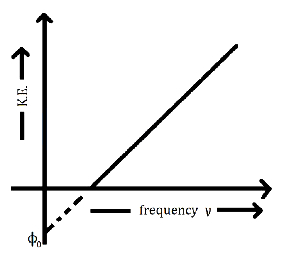
The graph of maximum kinetic energy $(K.E._{max})$ against the frequency $(
u)$ of incident light is as shown in the figure. The slope of the graph and the intercept on the $X$-axis respectively are:
u)$ of incident light is as shown in the figure. The slope of the graph and the intercept on the $X$-axis respectively are:
A
Planck's constant,threshold frequency
B
Work function,maximum kinetic energy
C
Maximum kinetic energy,threshold frequency
D
Planck's constant,work function
Solution
(A) According to Einstein's photoelectric equation,the maximum kinetic energy $(K.E._{max})$ of emitted photoelectrons is given by:
$K.E._{max} = h\nu - \phi_0$
Comparing this with the equation of a straight line $y = mx + c$,where $y = K.E._{max}$ and $x = \nu$:
$1$. The slope $(m)$ of the graph is equal to Planck's constant $(h)$.
$2$. The $X$-axis intercept occurs when $K.E._{max} = 0$,which gives $0 = h\nu_0 - \phi_0$,or $\nu_0 = \phi_0 / h$. This intercept represents the threshold frequency $(\nu_0)$.
Therefore,the slope is Planck's constant and the $X$-axis intercept is the threshold frequency.
$K.E._{max} = h\nu - \phi_0$
Comparing this with the equation of a straight line $y = mx + c$,where $y = K.E._{max}$ and $x = \nu$:
$1$. The slope $(m)$ of the graph is equal to Planck's constant $(h)$.
$2$. The $X$-axis intercept occurs when $K.E._{max} = 0$,which gives $0 = h\nu_0 - \phi_0$,or $\nu_0 = \phi_0 / h$. This intercept represents the threshold frequency $(\nu_0)$.
Therefore,the slope is Planck's constant and the $X$-axis intercept is the threshold frequency.
0 likes
View Solution581
EasyMCQ
Light of wavelength $\lambda$ is incident on the surface of a metal having work function $\phi$, causing the emission of electrons. What is the maximum velocity of the emitted electrons? (Given: $c = \text{velocity of light}$, $h = \text{Planck's constant}$, $m = \text{mass of electron}$)
A
$\left[\frac{2(hc - \phi)}{m\lambda}\right]$
B
$\left[\frac{2(hc - \lambda\phi)}{m\lambda}\right]^{1/2}$
C
$\left[\frac{2(hc - \phi)}{m}\right]^{1/2}$
D
$\left[\frac{2(h\nu - \phi)\lambda}{mc}\right]$
Solution
(B) According to Einstein's photoelectric equation, the maximum kinetic energy $K_{\max}$ of emitted electrons is given by:
$K_{\max} = \frac{hc}{\lambda} - \phi$
Since $K_{\max} = \frac{1}{2}mv^2$, we have:
$\frac{1}{2}mv^2 = \frac{hc}{\lambda} - \phi$
$\frac{1}{2}mv^2 = \frac{hc - \lambda\phi}{\lambda}$
$v^2 = \frac{2(hc - \lambda\phi)}{m\lambda}$
$v = \left[\frac{2(hc - \lambda\phi)}{m\lambda}\right]^{1/2}$
Thus, the correct option is $B$.
$K_{\max} = \frac{hc}{\lambda} - \phi$
Since $K_{\max} = \frac{1}{2}mv^2$, we have:
$\frac{1}{2}mv^2 = \frac{hc}{\lambda} - \phi$
$\frac{1}{2}mv^2 = \frac{hc - \lambda\phi}{\lambda}$
$v^2 = \frac{2(hc - \lambda\phi)}{m\lambda}$
$v = \left[\frac{2(hc - \lambda\phi)}{m\lambda}\right]^{1/2}$
Thus, the correct option is $B$.
0 likes
View Solution582
MediumMCQ
The threshold wavelengths for photoelectric emission from two metals $A$ and $B$ are $400 \ nm$ and $800 \ nm$ respectively. The ratio of their work functions,$\phi_{A} : \phi_{B}$ is:
A
$1/2$
B
$4$
C
$1/4$
D
$2$
Solution
(D) The work function $\phi$ of a metal is related to the threshold wavelength $\lambda_{0}$ by the formula $\phi = \frac{hc}{\lambda_{0}}$.
Given that $\lambda_{A} = 400 \ nm$ and $\lambda_{B} = 800 \ nm$.
Therefore,the work functions are $\phi_{A} = \frac{hc}{\lambda_{A}}$ and $\phi_{B} = \frac{hc}{\lambda_{B}}$.
The ratio $\frac{\phi_{A}}{\phi_{B}} = \frac{hc/\lambda_{A}}{hc/\lambda_{B}} = \frac{\lambda_{B}}{\lambda_{A}}$.
Substituting the values,we get $\frac{\phi_{A}}{\phi_{B}} = \frac{800 \ nm}{400 \ nm} = 2$.
Thus,the ratio $\phi_{A} : \phi_{B}$ is $2$.
Given that $\lambda_{A} = 400 \ nm$ and $\lambda_{B} = 800 \ nm$.
Therefore,the work functions are $\phi_{A} = \frac{hc}{\lambda_{A}}$ and $\phi_{B} = \frac{hc}{\lambda_{B}}$.
The ratio $\frac{\phi_{A}}{\phi_{B}} = \frac{hc/\lambda_{A}}{hc/\lambda_{B}} = \frac{\lambda_{B}}{\lambda_{A}}$.
Substituting the values,we get $\frac{\phi_{A}}{\phi_{B}} = \frac{800 \ nm}{400 \ nm} = 2$.
Thus,the ratio $\phi_{A} : \phi_{B}$ is $2$.
0 likes
View Solution583
EasyMCQ
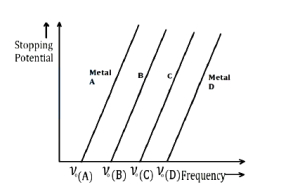
The variation of stopping potential for metals $A$,$B$,$C$ and $D$ with the frequency of incident radiation is shown in the figure. For which metal is the stopping potential higher for a given frequency of incident radiation $(v)$ if the threshold frequency is lower $(
u_o)$?
u_o)$?
A
$C$
B
$D$
C
$A$
D
$B$
Solution
(C) According to Einstein's photoelectric equation,the stopping potential $V_s$ is given by:
$eV_s = h\nu - \phi_o = h\nu - h\nu_o$
$V_s = \frac{h}{e}(\nu - \nu_o)$
Where $h$ is Planck's constant,$e$ is the charge of an electron,$\nu$ is the frequency of incident radiation,and $\nu_o$ is the threshold frequency.
For a fixed incident frequency $\nu$,the stopping potential $V_s$ is inversely proportional to the threshold frequency $\nu_o$.
From the graph,the threshold frequencies follow the order: $\nu_o(A) < \nu_o(B) < \nu_o(C) < \nu_o(D)$.
Since metal $A$ has the lowest threshold frequency,it will have the highest stopping potential for any given incident frequency $\nu$ (where $\nu > \nu_o(D)$).
Therefore,the correct option is $C$.
$eV_s = h\nu - \phi_o = h\nu - h\nu_o$
$V_s = \frac{h}{e}(\nu - \nu_o)$
Where $h$ is Planck's constant,$e$ is the charge of an electron,$\nu$ is the frequency of incident radiation,and $\nu_o$ is the threshold frequency.
For a fixed incident frequency $\nu$,the stopping potential $V_s$ is inversely proportional to the threshold frequency $\nu_o$.
From the graph,the threshold frequencies follow the order: $\nu_o(A) < \nu_o(B) < \nu_o(C) < \nu_o(D)$.
Since metal $A$ has the lowest threshold frequency,it will have the highest stopping potential for any given incident frequency $\nu$ (where $\nu > \nu_o(D)$).
Therefore,the correct option is $C$.
0 likes
View Solution584
EasyMCQ
The graph of stopping potential $(V_{s})$ against frequency $(\nu)$ of incident radiation is plotted for two different metals '$P$' and '$Q$' as shown in the graph. If $\phi_{P}$ and $\phi_{Q}$ are the work functions of metals '$P$' and '$Q$' respectively,then which of the following is correct?
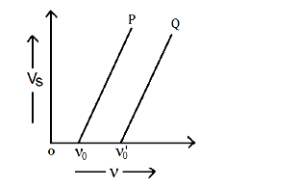
A
$\phi_{P} = \phi_{Q}$
B
$\nu_{0} < \nu_{0}^{\prime}$
C
$\phi_{P} < \phi_{Q}$
D
$\phi_{P} > \phi_{Q}$
Solution
(C) According to Einstein's photoelectric equation,the stopping potential $V_{s}$ is given by:
$eV_{s} = h\nu - \phi$
$V_{s} = \frac{h}{e}\nu - \frac{\phi}{e}$
Comparing this with the equation of a straight line $y = mx + c$,the x-intercept (where $V_{s} = 0$) is the threshold frequency $\nu_{0}$,where $\nu_{0} = \frac{\phi}{h}$ or $\phi = h\nu_{0}$.
From the given graph,the threshold frequency for metal '$P$' is $\nu_{0}$ and for metal '$Q$' is $\nu_{0}^{\prime}$.
Since $\nu_{0} < \nu_{0}^{\prime}$,it follows that $h\nu_{0} < h\nu_{0}^{\prime}$.
Therefore,the work function $\phi_{P} < \phi_{Q}$.
$eV_{s} = h\nu - \phi$
$V_{s} = \frac{h}{e}\nu - \frac{\phi}{e}$
Comparing this with the equation of a straight line $y = mx + c$,the x-intercept (where $V_{s} = 0$) is the threshold frequency $\nu_{0}$,where $\nu_{0} = \frac{\phi}{h}$ or $\phi = h\nu_{0}$.
From the given graph,the threshold frequency for metal '$P$' is $\nu_{0}$ and for metal '$Q$' is $\nu_{0}^{\prime}$.
Since $\nu_{0} < \nu_{0}^{\prime}$,it follows that $h\nu_{0} < h\nu_{0}^{\prime}$.
Therefore,the work function $\phi_{P} < \phi_{Q}$.
0 likes
View Solution585
MediumMCQ
If the maximum kinetic energy of emitted electrons in the photoelectric effect is $3.2 \times 10^{-19} \text{ J}$ and the work function for the metal is $6.63 \times 10^{-19} \text{ J}$,then the stopping potential and threshold wavelength respectively are:
[Planck's constant $h = 6.63 \times 10^{-34} \text{ J} \cdot \text{s}$]
[Velocity of light $c = 3 \times 10^{8} \text{ m/s}$]
[Charge on electron $e = 1.6 \times 10^{-19} \text{ C}$]
[Planck's constant $h = 6.63 \times 10^{-34} \text{ J} \cdot \text{s}$]
[Velocity of light $c = 3 \times 10^{8} \text{ m/s}$]
[Charge on electron $e = 1.6 \times 10^{-19} \text{ C}$]
A
$3 \text{ V}, 4000 \text{ Å}$
B
$4 \text{ V}, 6000 \text{ Å}$
C
$1 \text{ V}, 1000 \text{ Å}$
D
$2 \text{ V}, 3000 \text{ Å}$
Solution
(D) $1$. The stopping potential $V_s$ is related to the maximum kinetic energy $(K.E.)_{\max}$ by the equation: $(K.E.)_{\max} = e V_s$.
Given $(K.E.)_{\max} = 3.2 \times 10^{-19} \text{ J}$ and $e = 1.6 \times 10^{-19} \text{ C}$.
$V_s = \frac{(K.E.)_{\max}}{e} = \frac{3.2 \times 10^{-19}}{1.6 \times 10^{-19}} = 2 \text{ V}$.
$2$. The threshold wavelength $\lambda_0$ is related to the work function $\Phi$ by the equation: $\Phi = \frac{hc}{\lambda_0}$.
Given $\Phi = 6.63 \times 10^{-19} \text{ J}$,$h = 6.63 \times 10^{-34} \text{ J} \cdot \text{s}$,and $c = 3 \times 10^{8} \text{ m/s}$.
$\lambda_0 = \frac{hc}{\Phi} = \frac{6.63 \times 10^{-34} \times 3 \times 10^{8}}{6.63 \times 10^{-19}} = 3 \times 10^{-7} \text{ m} = 3000 \times 10^{-10} \text{ m} = 3000 \text{ Å}$.
Thus,the stopping potential is $2 \text{ V}$ and the threshold wavelength is $3000 \text{ Å}$. The correct option is $(D)$.
Given $(K.E.)_{\max} = 3.2 \times 10^{-19} \text{ J}$ and $e = 1.6 \times 10^{-19} \text{ C}$.
$V_s = \frac{(K.E.)_{\max}}{e} = \frac{3.2 \times 10^{-19}}{1.6 \times 10^{-19}} = 2 \text{ V}$.
$2$. The threshold wavelength $\lambda_0$ is related to the work function $\Phi$ by the equation: $\Phi = \frac{hc}{\lambda_0}$.
Given $\Phi = 6.63 \times 10^{-19} \text{ J}$,$h = 6.63 \times 10^{-34} \text{ J} \cdot \text{s}$,and $c = 3 \times 10^{8} \text{ m/s}$.
$\lambda_0 = \frac{hc}{\Phi} = \frac{6.63 \times 10^{-34} \times 3 \times 10^{8}}{6.63 \times 10^{-19}} = 3 \times 10^{-7} \text{ m} = 3000 \times 10^{-10} \text{ m} = 3000 \text{ Å}$.
Thus,the stopping potential is $2 \text{ V}$ and the threshold wavelength is $3000 \text{ Å}$. The correct option is $(D)$.
0 likes
View Solution586
EasyMCQ
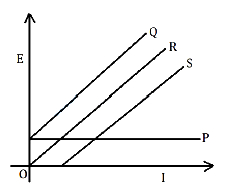
Which one of the following four graphs showing lines $P, Q, R$ and $S$ between maximum kinetic energy $(E)$ and intensity of incident light $(I)$ is correct?
A
$S$
B
$R$
C
$Q$
D
$P$
Solution
(D) According to Einstein's photoelectric equation,the maximum kinetic energy $(E_k)$ of emitted photoelectrons is given by $E_k = h\nu - \phi$,where $h$ is Planck's constant,$\nu$ is the frequency of incident light,and $\phi$ is the work function of the metal surface.
This equation shows that the maximum kinetic energy depends only on the frequency of the incident light and the nature of the material (work function).
It does not depend on the intensity $(I)$ of the incident light.
Therefore,the graph between maximum kinetic energy $(E)$ and intensity $(I)$ should be a horizontal line parallel to the intensity axis.
Looking at the given graph,line $P$ represents a constant value of $E$ regardless of the intensity $I$.
Thus,line $P$ is the correct representation.
This equation shows that the maximum kinetic energy depends only on the frequency of the incident light and the nature of the material (work function).
It does not depend on the intensity $(I)$ of the incident light.
Therefore,the graph between maximum kinetic energy $(E)$ and intensity $(I)$ should be a horizontal line parallel to the intensity axis.
Looking at the given graph,line $P$ represents a constant value of $E$ regardless of the intensity $I$.
Thus,line $P$ is the correct representation.
0 likes
View Solution587
EasyMCQ
$A$ photon of wavelength $3315 \ \text{Å}$ falls on a photocathode and an electron of energy $3 \times 10^{-19} \ \text{J}$ is ejected. The threshold wavelength of the photon is [Planck's constant $(h)$ $= 6.63 \times 10^{-34} \ \text{J-s}$, velocity of light $(c)$ $= 3 \times 10^{8} \ \text{m/s}$]. (in $\text{Å}$)
A
$6630$
B
$3315$
C
$5000$
D
$1130$
Solution
(A) The energy of the incident photon is given by $E = \frac{hc}{\lambda}$.
Substituting the values: $E = \frac{6.63 \times 10^{-34} \times 3 \times 10^{8}}{3315 \times 10^{-10}} = 6 \times 10^{-19} \ \text{J}$.
According to Einstein's photoelectric equation, $E = \phi_{0} + K_{\text{max}}$, where $\phi_{0}$ is the work function and $K_{\text{max}}$ is the kinetic energy of the ejected electron.
$\phi_{0} = E - K_{\text{max}} = 6 \times 10^{-19} - 3 \times 10^{-19} = 3 \times 10^{-19} \ \text{J}$.
The threshold wavelength $\lambda_{0}$ is given by $\lambda_{0} = \frac{hc}{\phi_{0}}$.
$\lambda_{0} = \frac{6.63 \times 10^{-34} \times 3 \times 10^{8}}{3 \times 10^{-19}} = 6.63 \times 10^{-7} \ \text{m} = 6630 \ \text{Å}$.
Substituting the values: $E = \frac{6.63 \times 10^{-34} \times 3 \times 10^{8}}{3315 \times 10^{-10}} = 6 \times 10^{-19} \ \text{J}$.
According to Einstein's photoelectric equation, $E = \phi_{0} + K_{\text{max}}$, where $\phi_{0}$ is the work function and $K_{\text{max}}$ is the kinetic energy of the ejected electron.
$\phi_{0} = E - K_{\text{max}} = 6 \times 10^{-19} - 3 \times 10^{-19} = 3 \times 10^{-19} \ \text{J}$.
The threshold wavelength $\lambda_{0}$ is given by $\lambda_{0} = \frac{hc}{\phi_{0}}$.
$\lambda_{0} = \frac{6.63 \times 10^{-34} \times 3 \times 10^{8}}{3 \times 10^{-19}} = 6.63 \times 10^{-7} \ \text{m} = 6630 \ \text{Å}$.
0 likes
View Solution588
EasyMCQ
Two incident radiations having energies two times and ten times of the work function of a metal surface,produce photoelectric effect. The ratio of maximum velocities of emitted photoelectrons respectively is
A
$3: 2$
B
$1: 3$
C
$2: 3$
D
$1: 2$
Solution
(B) According to Einstein's photoelectric equation,the maximum kinetic energy $K_{max}$ is given by $K_{max} = E - \phi_{0}$,where $E$ is the incident energy and $\phi_{0}$ is the work function.
For the first radiation,$E_{1} = 2\phi_{0}$,so $K_{1} = \frac{1}{2}mv_{1}^{2} = 2\phi_{0} - \phi_{0} = \phi_{0}$.
For the second radiation,$E_{2} = 10\phi_{0}$,so $K_{2} = \frac{1}{2}mv_{2}^{2} = 10\phi_{0} - \phi_{0} = 9\phi_{0}$.
Taking the ratio of the two equations: $\frac{\frac{1}{2}mv_{1}^{2}}{\frac{1}{2}mv_{2}^{2}} = \frac{\phi_{0}}{9\phi_{0}}$.
This simplifies to $\frac{v_{1}^{2}}{v_{2}^{2}} = \frac{1}{9}$.
Taking the square root on both sides,we get $\frac{v_{1}}{v_{2}} = \frac{1}{3}$.
For the first radiation,$E_{1} = 2\phi_{0}$,so $K_{1} = \frac{1}{2}mv_{1}^{2} = 2\phi_{0} - \phi_{0} = \phi_{0}$.
For the second radiation,$E_{2} = 10\phi_{0}$,so $K_{2} = \frac{1}{2}mv_{2}^{2} = 10\phi_{0} - \phi_{0} = 9\phi_{0}$.
Taking the ratio of the two equations: $\frac{\frac{1}{2}mv_{1}^{2}}{\frac{1}{2}mv_{2}^{2}} = \frac{\phi_{0}}{9\phi_{0}}$.
This simplifies to $\frac{v_{1}^{2}}{v_{2}^{2}} = \frac{1}{9}$.
Taking the square root on both sides,we get $\frac{v_{1}}{v_{2}} = \frac{1}{3}$.
0 likes
View Solution589
EasyMCQ
Photoelectrons are emitted from a photosensitive surface for light of wavelengths $\lambda_{1} = 360 \ nm$ and $\lambda_{2} = 600 \ nm$. What is the ratio of the work functions for the lights of wavelengths $\lambda_{1}$ and $\lambda_{2}$?
A
$6:1$
B
$1:6$
C
$5:3$
D
$3:5$
Solution
(C) The work function $\phi$ of a photosensitive surface is a characteristic property of the material itself and does not depend on the wavelength of the incident light.
Since the same photosensitive surface is used for both wavelengths,the work function remains constant.
Therefore,the ratio of the work functions for the two cases is $\phi_{1} : \phi_{2} = 1 : 1$.
However,if the question implies the ratio of the energy of the incident photons,it would be $\frac{E_{1}}{E_{2}} = \frac{hc/\lambda_{1}}{hc/\lambda_{2}} = \frac{\lambda_{2}}{\lambda_{1}} = \frac{600}{360} = \frac{5}{3}$.
Given the standard interpretation of such problems in physics textbooks,the ratio of the work functions for the same material is always $1:1$. Since $1:1$ is not an option,the question likely asks for the ratio of the energy of the incident photons,which is $5:3$.
Since the same photosensitive surface is used for both wavelengths,the work function remains constant.
Therefore,the ratio of the work functions for the two cases is $\phi_{1} : \phi_{2} = 1 : 1$.
However,if the question implies the ratio of the energy of the incident photons,it would be $\frac{E_{1}}{E_{2}} = \frac{hc/\lambda_{1}}{hc/\lambda_{2}} = \frac{\lambda_{2}}{\lambda_{1}} = \frac{600}{360} = \frac{5}{3}$.
Given the standard interpretation of such problems in physics textbooks,the ratio of the work functions for the same material is always $1:1$. Since $1:1$ is not an option,the question likely asks for the ratio of the energy of the incident photons,which is $5:3$.
0 likes
View Solution590
DifficultMCQ
When a certain metal surface is illuminated with light of wavelength $\lambda$,the stopping potential is $V$. When the same surface is illuminated by light of wavelength $2\lambda$,the stopping potential is $\frac{V}{3}$. The threshold wavelength for the surface is:
A
$\frac{8\lambda}{3}$
B
$\frac{4\lambda}{3}$
C
$4\lambda$
D
$6\lambda$
Solution
(C) According to Einstein's photoelectric equation,the maximum kinetic energy of emitted photoelectrons is given by $K_{\max} = eV = \frac{hc}{\lambda} - \frac{hc}{\lambda_0}$,where $\lambda_0$ is the threshold wavelength.
For the first case: $eV = \frac{hc}{\lambda} - \frac{hc}{\lambda_0}$ --- $(i)$
For the second case: $e(\frac{V}{3}) = \frac{hc}{2\lambda} - \frac{hc}{\lambda_0}$ --- (ii)
Dividing equation $(i)$ by equation (ii):
$\frac{eV}{eV/3} = \frac{\frac{hc}{\lambda} - \frac{hc}{\lambda_0}}{\frac{hc}{2\lambda} - \frac{hc}{\lambda_0}}$
$3 = \frac{\frac{1}{\lambda} - \frac{1}{\lambda_0}}{\frac{1}{2\lambda} - \frac{1}{\lambda_0}}$
$3(\frac{1}{2\lambda} - \frac{1}{\lambda_0}) = \frac{1}{\lambda} - \frac{1}{\lambda_0}$
$\frac{3}{2\lambda} - \frac{3}{\lambda_0} = \frac{1}{\lambda} - \frac{1}{\lambda_0}$
$\frac{3}{2\lambda} - \frac{1}{\lambda} = \frac{3}{\lambda_0} - \frac{1}{\lambda_0}$
$\frac{1}{2\lambda} = \frac{2}{\lambda_0}$
$\lambda_0 = 4\lambda$.
For the first case: $eV = \frac{hc}{\lambda} - \frac{hc}{\lambda_0}$ --- $(i)$
For the second case: $e(\frac{V}{3}) = \frac{hc}{2\lambda} - \frac{hc}{\lambda_0}$ --- (ii)
Dividing equation $(i)$ by equation (ii):
$\frac{eV}{eV/3} = \frac{\frac{hc}{\lambda} - \frac{hc}{\lambda_0}}{\frac{hc}{2\lambda} - \frac{hc}{\lambda_0}}$
$3 = \frac{\frac{1}{\lambda} - \frac{1}{\lambda_0}}{\frac{1}{2\lambda} - \frac{1}{\lambda_0}}$
$3(\frac{1}{2\lambda} - \frac{1}{\lambda_0}) = \frac{1}{\lambda} - \frac{1}{\lambda_0}$
$\frac{3}{2\lambda} - \frac{3}{\lambda_0} = \frac{1}{\lambda} - \frac{1}{\lambda_0}$
$\frac{3}{2\lambda} - \frac{1}{\lambda} = \frac{3}{\lambda_0} - \frac{1}{\lambda_0}$
$\frac{1}{2\lambda} = \frac{2}{\lambda_0}$
$\lambda_0 = 4\lambda$.
0 likes
View Solution591
EasyMCQ
The stopping potential of the photoelectrons from a photocell is:
A
Directly proportional to the intensity of incident light
B
Directly proportional to the frequency of incident light
C
Inversely proportional to the frequency of incident light
D
Inversely proportional to the intensity of incident light
Solution
(B) The stopping potential $(V_0)$ is the minimum negative potential applied to the anode with respect to the cathode that stops even the most energetic photoelectrons from reaching the collector.
According to Einstein's photoelectric equation: $K_{max} = h\nu - \Phi_0$, where $K_{max} = eV_0$.
Thus, $eV_0 = h\nu - \Phi_0$, which implies $V_0 = \frac{h}{e}\nu - \frac{\Phi_0}{e}$.
From this equation, it is clear that the stopping potential $V_0$ is a linear function of the frequency of incident light ($\nu$).
Therefore, the stopping potential is directly proportional to the frequency of incident light (above the threshold frequency).
According to Einstein's photoelectric equation: $K_{max} = h\nu - \Phi_0$, where $K_{max} = eV_0$.
Thus, $eV_0 = h\nu - \Phi_0$, which implies $V_0 = \frac{h}{e}\nu - \frac{\Phi_0}{e}$.
From this equation, it is clear that the stopping potential $V_0$ is a linear function of the frequency of incident light ($\nu$).
Therefore, the stopping potential is directly proportional to the frequency of incident light (above the threshold frequency).
0 likes
View Solution592
EasyMCQ
$A$ metal surface is illuminated by light of given intensity and frequency to cause photoemission. If the intensity of illumination is reduced to one fourth of its original value,then the maximum $KE$ of the emitted photoelectrons would be
A
Twice the original value
B
Four times the original value
C
One fourth of the original value
D
Unchanged
Solution
(D) The maximum kinetic energy of photoelectrons is given by Einstein's photoelectric equation: $KE_{\text{max}} = h(v - v_0)$ ... $(i)$
Where $h$ is Planck's constant,$v$ is the frequency of incident radiation,and $v_0$ is the threshold frequency.
From equation $(i)$,it is clear that the maximum kinetic energy $(KE_{\text{max}})$ depends only on the frequency of the incident light and the work function of the metal.
It is independent of the intensity of the incident radiation.
Therefore,if the intensity is reduced to one-fourth of its original value,the maximum kinetic energy of the emitted photoelectrons remains unchanged.
Where $h$ is Planck's constant,$v$ is the frequency of incident radiation,and $v_0$ is the threshold frequency.
From equation $(i)$,it is clear that the maximum kinetic energy $(KE_{\text{max}})$ depends only on the frequency of the incident light and the work function of the metal.
It is independent of the intensity of the incident radiation.
Therefore,if the intensity is reduced to one-fourth of its original value,the maximum kinetic energy of the emitted photoelectrons remains unchanged.
0 likes
View Solution593
MediumMCQ
When photons of energy $hv$ fall on a metal plate of work function $W_0$,photoelectrons of maximum kinetic energy $K$ are ejected. If the frequency of the radiation is doubled,the maximum kinetic energy of the ejected photoelectrons will be
A
$K+W_0$
B
$K+hv$
C
$K$
D
$2K$
Solution
(B) According to Einstein's photoelectric equation,the maximum kinetic energy $K$ is given by:
$K = hv - W_0$ --- $(1)$
When the frequency of the radiation is doubled,the new frequency becomes $2v$. The new maximum kinetic energy $K'$ is:
$K' = h(2v) - W_0$
$K' = 2hv - W_0$ --- $(2)$
From equation $(1)$,we have $hv = K + W_0$. Substituting this into equation $(2)$:
$K' = 2(K + W_0) - W_0$
$K' = 2K + 2W_0 - W_0$
$K' = 2K + W_0$
Alternatively,using the difference method:
$K' - K = (2hv - W_0) - (hv - W_0) = hv$
$K' = K + hv$
$K = hv - W_0$ --- $(1)$
When the frequency of the radiation is doubled,the new frequency becomes $2v$. The new maximum kinetic energy $K'$ is:
$K' = h(2v) - W_0$
$K' = 2hv - W_0$ --- $(2)$
From equation $(1)$,we have $hv = K + W_0$. Substituting this into equation $(2)$:
$K' = 2(K + W_0) - W_0$
$K' = 2K + 2W_0 - W_0$
$K' = 2K + W_0$
Alternatively,using the difference method:
$K' - K = (2hv - W_0) - (hv - W_0) = hv$
$K' = K + hv$
0 likes
View Solution594
MediumMCQ
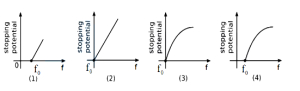
The following graphs show the variation of stopping potential $(V_s)$ corresponding to the frequency of incident radiation $(f)$ for a given metal. The correct variation is shown in graph ($f_0 =$ Threshold frequency):
A
$(1)$
B
$(2)$
C
$(3)$
D
$(4)$
Solution
(A) According to Einstein's photoelectric equation,the maximum kinetic energy $(K_{max})$ of emitted photoelectrons is given by:
$K_{max} = hf - \phi$
Since the stopping potential $(V_s)$ is related to the maximum kinetic energy by $K_{max} = eV_s$,we can write:
$eV_s = hf - \phi$
$V_s = (h/e)f - (\phi/e)$
This equation is of the form $y = mx + c$,which represents a straight line.
Here,the slope is $(h/e)$ (a positive constant) and the intercept on the $V_s$-axis is $(-\phi/e)$.
When $V_s = 0$,we have $hf = \phi$,which gives $f = \phi/h = f_0$ (the threshold frequency).
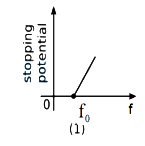
Thus,the graph of $V_s$ versus $f$ is a straight line starting from $f = f_0$ on the frequency axis.
Graph $(1)$ correctly represents this linear relationship.
$K_{max} = hf - \phi$
Since the stopping potential $(V_s)$ is related to the maximum kinetic energy by $K_{max} = eV_s$,we can write:
$eV_s = hf - \phi$
$V_s = (h/e)f - (\phi/e)$
This equation is of the form $y = mx + c$,which represents a straight line.
Here,the slope is $(h/e)$ (a positive constant) and the intercept on the $V_s$-axis is $(-\phi/e)$.
When $V_s = 0$,we have $hf = \phi$,which gives $f = \phi/h = f_0$ (the threshold frequency).
Thus,the graph of $V_s$ versus $f$ is a straight line starting from $f = f_0$ on the frequency axis.
Graph $(1)$ correctly represents this linear relationship.
0 likes
View Solution595
MediumMCQ
In a photoelectric effect experiment, the frequency of incident radiation is increased while keeping other factors constant $(f > f_0)$. The stopping potential
A
decreases
B
increases
C
becomes zero
D
first decreases and then increases
Solution
(B) According to Einstein's photoelectric equation: $e V_0 = h f - \Phi$, where $\Phi = h f_0$ is the work function.
Rearranging the equation for stopping potential $V_0$: $V_0 = \frac{h}{e} f - \frac{h f_0}{e}$.
Since $h$, $e$, and $f_0$ are constants, $V_0$ is a linear function of the incident frequency $f$.
As the frequency $f$ of the incident radiation increases, the term $\frac{h}{e} f$ increases.
Therefore, the stopping potential $V_0$ increases.
Rearranging the equation for stopping potential $V_0$: $V_0 = \frac{h}{e} f - \frac{h f_0}{e}$.
Since $h$, $e$, and $f_0$ are constants, $V_0$ is a linear function of the incident frequency $f$.
As the frequency $f$ of the incident radiation increases, the term $\frac{h}{e} f$ increases.
Therefore, the stopping potential $V_0$ increases.
0 likes
View Solution596
MediumMCQ
On a photosensitive material,when the frequency of incident radiation is increased by $30 \%$,the kinetic energy of emitted photoelectrons increases from $0.4 \ eV$ to $0.9 \ eV$. The work function of the surface is (in $eV$)
A
$1$
B
$1.267$
C
$1.4$
D
$1.8$
Solution
(B) According to Einstein's photoelectric equation: $K_{max} = h\nu - W_0$,where $W_0$ is the work function.
Initially: $0.4 = h\nu - W_0 \implies h\nu = 0.4 + W_0$ ... $(i)$
When frequency is increased by $30 \%$,the new frequency $\nu' = 1.3\nu$. The new kinetic energy is $0.9 \ eV$.
So,$0.9 = 1.3h\nu - W_0$ ... (ii)
Substitute $(i)$ into (ii): $0.9 = 1.3(0.4 + W_0) - W_0$
$0.9 = 0.52 + 1.3W_0 - W_0$
$0.9 - 0.52 = 0.3W_0$
$0.38 = 0.3W_0$
$W_0 = \frac{0.38}{0.3} = 1.267 \ eV$.
Initially: $0.4 = h\nu - W_0 \implies h\nu = 0.4 + W_0$ ... $(i)$
When frequency is increased by $30 \%$,the new frequency $\nu' = 1.3\nu$. The new kinetic energy is $0.9 \ eV$.
So,$0.9 = 1.3h\nu - W_0$ ... (ii)
Substitute $(i)$ into (ii): $0.9 = 1.3(0.4 + W_0) - W_0$
$0.9 = 0.52 + 1.3W_0 - W_0$
$0.9 - 0.52 = 0.3W_0$
$0.38 = 0.3W_0$
$W_0 = \frac{0.38}{0.3} = 1.267 \ eV$.
0 likes
View Solution597
MediumMCQ
An electron in a hydrogen atom jumps from the second Bohr orbit to the ground state,and the energy difference of the two states is radiated in the form of photons. These photons are then allowed to fall on a metal surface having a work function equal to $4.2 \ eV$. Calculate the stopping potential. [Energy of electron in $n^{\text{th}}$ orbit $= -\frac{13.6}{n^2} \ eV$] (in $V$)
A
$2$
B
$4$
C
$6$
D
$8$
Solution
(C) The energy of an electron in the $n^{\text{th}}$ orbit is given by $E_n = -\frac{13.6}{n^2} \ eV$.
For the ground state $(n=1)$,$E_1 = -13.6 \ eV$.
For the second orbit $(n=2)$,$E_2 = -\frac{13.6}{2^2} = -3.4 \ eV$.
The energy of the emitted photon is the difference between these two states: $E = E_2 - E_1 = -3.4 - (-13.6) = 10.2 \ eV$.
According to Einstein's photoelectric equation,$h\nu = \phi_0 + eV_s$,where $h\nu$ is the photon energy,$\phi_0$ is the work function,and $V_s$ is the stopping potential.
Given $\phi_0 = 4.2 \ eV$ and $h\nu = 10.2 \ eV$,we have $10.2 \ eV = 4.2 \ eV + eV_s$.
$eV_s = 10.2 \ eV - 4.2 \ eV = 6 \ eV$.
Therefore,the stopping potential $V_s = 6 \ V$.
For the ground state $(n=1)$,$E_1 = -13.6 \ eV$.
For the second orbit $(n=2)$,$E_2 = -\frac{13.6}{2^2} = -3.4 \ eV$.
The energy of the emitted photon is the difference between these two states: $E = E_2 - E_1 = -3.4 - (-13.6) = 10.2 \ eV$.
According to Einstein's photoelectric equation,$h\nu = \phi_0 + eV_s$,where $h\nu$ is the photon energy,$\phi_0$ is the work function,and $V_s$ is the stopping potential.
Given $\phi_0 = 4.2 \ eV$ and $h\nu = 10.2 \ eV$,we have $10.2 \ eV = 4.2 \ eV + eV_s$.
$eV_s = 10.2 \ eV - 4.2 \ eV = 6 \ eV$.
Therefore,the stopping potential $V_s = 6 \ V$.
0 likes
View Solution598
MediumMCQ
Light of wavelength $\lambda$ which is less than threshold wavelength is incident on a photosensitive material. If incident wavelength is decreased so that emitted photoelectrons are moving with the same velocity,then stopping potential will:
A
increase
B
decrease
C
be zero
D
become exactly half
Solution
(A) According to the photoelectric equation: $\frac{hc}{\lambda} = \phi + eV_s$.
Here,$V_s$ is the stopping potential and $\phi$ is the work function.
The kinetic energy of the emitted photoelectrons is given by $K_{max} = eV_s = \frac{1}{2}mv^2$.
If the velocity $v$ of the emitted photoelectrons is kept constant,the kinetic energy $K_{max}$ remains constant.
However,as the incident wavelength $\lambda$ is decreased,the energy of the incident photon $E = \frac{hc}{\lambda}$ increases.
Since $E = \phi + K_{max}$,and $K_{max}$ is constant while $E$ increases,the work function $\phi$ of the material would effectively need to change or the stopping potential $V_s$ must increase to balance the equation if we consider the energy conservation principle for a fixed material.
Actually,for a fixed material,if $\lambda$ decreases,$K_{max}$ increases. If the problem states the velocity is kept constant,it implies an external adjustment or a misunderstanding of the physical constraints; however,based on the standard photoelectric equation $\frac{hc}{\lambda} = \phi + eV_s$,if $\lambda$ decreases,the energy of the incident photon increases,which leads to an increase in the stopping potential $V_s$.
Here,$V_s$ is the stopping potential and $\phi$ is the work function.
The kinetic energy of the emitted photoelectrons is given by $K_{max} = eV_s = \frac{1}{2}mv^2$.
If the velocity $v$ of the emitted photoelectrons is kept constant,the kinetic energy $K_{max}$ remains constant.
However,as the incident wavelength $\lambda$ is decreased,the energy of the incident photon $E = \frac{hc}{\lambda}$ increases.
Since $E = \phi + K_{max}$,and $K_{max}$ is constant while $E$ increases,the work function $\phi$ of the material would effectively need to change or the stopping potential $V_s$ must increase to balance the equation if we consider the energy conservation principle for a fixed material.
Actually,for a fixed material,if $\lambda$ decreases,$K_{max}$ increases. If the problem states the velocity is kept constant,it implies an external adjustment or a misunderstanding of the physical constraints; however,based on the standard photoelectric equation $\frac{hc}{\lambda} = \phi + eV_s$,if $\lambda$ decreases,the energy of the incident photon increases,which leads to an increase in the stopping potential $V_s$.
0 likes
View Solution599
EasyMCQ
In the photoelectric effect,if the intensity of light is doubled,then the maximum kinetic energy of photoelectrons will become
A
double
B
half
C
four times
D
no change
Solution
(D) According to Einstein's photoelectric equation,$K_{\max} = h\nu - \Phi$,where $h\nu$ is the energy of the incident photon and $\Phi$ is the work function of the metal.
$K_{\max}$ depends only on the frequency of the incident light and the nature of the metal surface.
Intensity of light is related to the number of photons incident per unit area per unit time,which affects the number of photoelectrons emitted (photoelectric current),but not their individual maximum kinetic energy.
Therefore,if the intensity of light is doubled,the maximum kinetic energy of the photoelectrons remains unchanged.
$K_{\max}$ depends only on the frequency of the incident light and the nature of the metal surface.
Intensity of light is related to the number of photons incident per unit area per unit time,which affects the number of photoelectrons emitted (photoelectric current),but not their individual maximum kinetic energy.
Therefore,if the intensity of light is doubled,the maximum kinetic energy of the photoelectrons remains unchanged.
0 likes
View SolutionDual Nature of Radiation and matter — Einstein's Photoelectric Equation and Energy Quantum of Radiation · Frequently Asked Questions
1Are these Dual Nature of Radiation and matter questions useful for JEE and NEET?
Yes. All questions in this section are mapped to JEE Main and NEET exam patterns. Previous year questions from JEE Main, NEET, GUJCET and state-level exams are included with full solutions.
2Can I switch to Hindi or Gujarati for these questions?
Yes. Use the language tabs in the hero section or the sidebar to view the same questions and solutions in English, Hindi or Gujarati.
3How do I generate a question paper from this subtopic?
Use the Vedclass Exam Paper Generator — select the chapter and subtopic, set difficulty, and generate Sets A, B, C, D automatically. First 3 chapters of every subject are free.
Vedclass Products
For Students
Vedclass Test Series
Mock tests in real JEE/NEET style with performance analysis. 5-day free trial.
Start Free TrialFor Teachers
Exam Paper Generator
Generate Set A/B/C/D papers from this chapter in 2 minutes. 3 chapters free.
Try FreeFor Institutes
Online Exam Module
Live online exams with unlimited students, 360° analytics & white-label branding.
See DemoFor Teachers & Institutes
Generate a Dual Nature of Radiation and matter Exam Paper in 2 Minutes
Select subtopic & difficulty — Sets A, B, C, D auto-generated with No Repeat logic.
First 3 chapters of every subject are free — no payment required.