
A English
X-Rays Questions in English
Class 12 Physics · Atoms · X-Rays
316+
Questions
English
Language
100%
With Solutions
Showing 49 of 316 questions in English
251
DifficultMCQ
The wavelengths of $K_{\alpha}$ $X$-rays of two metals $A$ and $B$ are $\frac{4}{1875R}$ and $\frac{1}{675R}$ respectively,where $R$ is Rydberg's constant. The number of elements lying between $A$ and $B$ according to their atomic numbers is
A
$3$
B
$6$
C
$5$
D
$4$
Solution
(D) According to Moseley's law for $K_{\alpha}$ $X$-rays: $\frac{1}{\lambda} = R(Z-1)^2 \left( \frac{1}{1^2} - \frac{1}{2^2} \right) = \frac{3R}{4}(Z-1)^2$.
For metal $A$: $\frac{1875R}{4} = \frac{3R}{4}(Z_A-1)^2 \implies (Z_A-1)^2 = 625 \implies Z_A-1 = 25 \implies Z_A = 26$.
For metal $B$: $675R = \frac{3R}{4}(Z_B-1)^2 \implies (Z_B-1)^2 = 900 \implies Z_B-1 = 30 \implies Z_B = 31$.
The number of elements between $A$ and $B$ is given by $Z_B - Z_A - 1 = 31 - 26 - 1 = 4$.
For metal $A$: $\frac{1875R}{4} = \frac{3R}{4}(Z_A-1)^2 \implies (Z_A-1)^2 = 625 \implies Z_A-1 = 25 \implies Z_A = 26$.
For metal $B$: $675R = \frac{3R}{4}(Z_B-1)^2 \implies (Z_B-1)^2 = 900 \implies Z_B-1 = 30 \implies Z_B = 31$.
The number of elements between $A$ and $B$ is given by $Z_B - Z_A - 1 = 31 - 26 - 1 = 4$.
0 likes
View Solution252
DifficultMCQ
If $10000\, V$ is applied across an $X$-ray tube,what will be the ratio of the de-Broglie wavelength of the incident electrons to the shortest wavelength of $X$-rays produced? (Given: $\frac{e}{m}$ for an electron is $1.8 \times 10^{11}\, C\, kg^{-1}$)
A
$1$
B
$0.1$
C
$0.2$
D
$0.3$
Solution
(B) The de-Broglie wavelength of an electron accelerated through a potential $V$ is given by $\lambda_1 = \frac{h}{p} = \frac{h}{\sqrt{2meV}}$.
The shortest wavelength of the $X$-rays produced (cut-off wavelength) is given by $\lambda_2 = \frac{hc}{eV}$.
The ratio of the wavelengths is $\frac{\lambda_1}{\lambda_2} = \frac{h}{\sqrt{2meV}} \times \frac{eV}{hc} = \frac{1}{c} \sqrt{\frac{eV}{2m}} = \frac{1}{c} \sqrt{\frac{V}{2} \cdot \frac{e}{m}}$.
Substituting the given values: $V = 10^4\, V$,$\frac{e}{m} = 1.8 \times 10^{11}\, C\, kg^{-1}$,and $c = 3 \times 10^8\, m/s$.
$\frac{\lambda_1}{\lambda_2} = \frac{1}{3 \times 10^8} \sqrt{\frac{10^4}{2} \times 1.8 \times 10^{11}} = \frac{1}{3 \times 10^8} \sqrt{0.9 \times 10^{15}} = \frac{1}{3 \times 10^8} \sqrt{9 \times 10^{14}} = \frac{3 \times 10^7}{3 \times 10^8} = 0.1$.
The shortest wavelength of the $X$-rays produced (cut-off wavelength) is given by $\lambda_2 = \frac{hc}{eV}$.
The ratio of the wavelengths is $\frac{\lambda_1}{\lambda_2} = \frac{h}{\sqrt{2meV}} \times \frac{eV}{hc} = \frac{1}{c} \sqrt{\frac{eV}{2m}} = \frac{1}{c} \sqrt{\frac{V}{2} \cdot \frac{e}{m}}$.
Substituting the given values: $V = 10^4\, V$,$\frac{e}{m} = 1.8 \times 10^{11}\, C\, kg^{-1}$,and $c = 3 \times 10^8\, m/s$.
$\frac{\lambda_1}{\lambda_2} = \frac{1}{3 \times 10^8} \sqrt{\frac{10^4}{2} \times 1.8 \times 10^{11}} = \frac{1}{3 \times 10^8} \sqrt{0.9 \times 10^{15}} = \frac{1}{3 \times 10^8} \sqrt{9 \times 10^{14}} = \frac{3 \times 10^7}{3 \times 10^8} = 0.1$.
0 likes
View Solution253
EasyMCQ
The structure of solids is investigated by using
A
infra-red radiations
B
cosmic rays
C
$\gamma$-rays
D
$X$-rays
Solution
(D) $X$-rays have a wavelength on the order of the inter-atomic spacing in solid crystals $(10^{-10} \ m)$.
Because the wavelength of $X$-rays is comparable to the inter-atomic distances,they undergo diffraction when interacting with the crystal lattice.
Therefore,$X$-rays are the most suitable electromagnetic waves for investigating the structure of solids.
Because the wavelength of $X$-rays is comparable to the inter-atomic distances,they undergo diffraction when interacting with the crystal lattice.
Therefore,$X$-rays are the most suitable electromagnetic waves for investigating the structure of solids.
0 likes
View Solution254
DifficultMCQ
An $X$-ray tube is operated at $50\, kV$. The minimum wavelength produced is ....... $\mathring{A}$.
A
$0.5$
B
$0.75$
C
$0.25$
D
$1$
Solution
(C) The minimum wavelength $(\lambda_{\min})$ produced in an $X$-ray tube is given by the formula: $\lambda_{\min} = \frac{hc}{eV} = \frac{12400}{V(\text{in volts})} \mathring{A}$ (approximately).
Using the given potential difference $V = 50\, kV = 50,000\, V$:
$\lambda_{\min} = \frac{12375}{50,000} \mathring{A}$.
$\lambda_{\min} = 0.2475 \mathring{A}$.
Rounding to the nearest given option,we get $\lambda_{\min} \approx 0.25 \mathring{A}$.
Using the given potential difference $V = 50\, kV = 50,000\, V$:
$\lambda_{\min} = \frac{12375}{50,000} \mathring{A}$.
$\lambda_{\min} = 0.2475 \mathring{A}$.
Rounding to the nearest given option,we get $\lambda_{\min} \approx 0.25 \mathring{A}$.
0 likes
View Solution255
MediumMCQ
Which of the following is related to the characteristic emission of $X$-rays?
A
$\alpha$-particle emission
B
Electron emission
C
Positron emission
D
$K$-electron capturing
Solution
(D) Characteristic $X$-rays are produced when an electron from an outer shell fills a vacancy in an inner shell (such as the $K$-shell) of an atom.
When a high-energy electron strikes an atom,it can eject an inner-shell electron,creating a vacancy.
An electron from a higher energy level then transitions to fill this vacancy,emitting a photon with energy equal to the difference between the two energy levels.
This process is fundamentally related to the electronic transitions within the atom,which is also the mechanism involved in $K$-electron capture,where a nucleus captures an inner-shell electron,leading to a vacancy that is subsequently filled by an outer-shell electron,resulting in characteristic $X$-ray emission.
When a high-energy electron strikes an atom,it can eject an inner-shell electron,creating a vacancy.
An electron from a higher energy level then transitions to fill this vacancy,emitting a photon with energy equal to the difference between the two energy levels.
This process is fundamentally related to the electronic transitions within the atom,which is also the mechanism involved in $K$-electron capture,where a nucleus captures an inner-shell electron,leading to a vacancy that is subsequently filled by an outer-shell electron,resulting in characteristic $X$-ray emission.
0 likes
View Solution256
DifficultMCQ
$A$ potential difference of $20 \, kV$ is applied across an $X-ray$ tube. The minimum wavelength of $X-rays$ generated (in $\mathring{A}$) is
A
$0.62$
B
$1.24$
C
$0.31$
D
$6.2$
Solution
(A) The energy of an electron accelerated through a potential difference $V$ is $E = eV$.
For the minimum wavelength (maximum energy photon),all kinetic energy of the electron is converted into a single photon: $E = \frac{hc}{\lambda_{\min}}$.
Equating the two: $eV = \frac{hc}{\lambda_{\min}}$,which gives $\lambda_{\min} = \frac{hc}{eV}$.
Given $V = 20 \, kV = 20 \times 10^3 \, V$.
Using the constant $hc \approx 12400 \, eV \cdot \mathring{A}$,we get:
$\lambda_{\min} = \frac{12400 \, eV \cdot \mathring{A}}{20 \times 10^3 \, eV} = \frac{12400}{20000} \, \mathring{A} = 0.62 \, \mathring{A}$.
For the minimum wavelength (maximum energy photon),all kinetic energy of the electron is converted into a single photon: $E = \frac{hc}{\lambda_{\min}}$.
Equating the two: $eV = \frac{hc}{\lambda_{\min}}$,which gives $\lambda_{\min} = \frac{hc}{eV}$.
Given $V = 20 \, kV = 20 \times 10^3 \, V$.
Using the constant $hc \approx 12400 \, eV \cdot \mathring{A}$,we get:
$\lambda_{\min} = \frac{12400 \, eV \cdot \mathring{A}}{20 \times 10^3 \, eV} = \frac{12400}{20000} \, \mathring{A} = 0.62 \, \mathring{A}$.
0 likes
View Solution257
DifficultMCQ
The wavelength of the most energetic $X$-rays emitted when a metal target is bombarded by $40 \ keV$ electrons is approximately .............. $\mathring{A}$.
A
$300$
B
$10$
C
$4$
D
$0.31$
Solution
(D) The most energetic $X$-rays correspond to the minimum wavelength $(\lambda_{\min})$ produced when the entire kinetic energy of the electron is converted into a single photon.
Using the formula: $\lambda_{\min} = \frac{hc}{eV}$.
Given: $V = 40 \ keV = 40 \times 10^3 \ V$,$h = 6.63 \times 10^{-34} \ J \cdot s$,$c = 3 \times 10^8 \ m/s$,and $e = 1.6 \times 10^{-19} \ C$.
Alternatively,using the shortcut $\lambda_{\min} \approx \frac{12400 \ \mathring{A} \cdot eV}{E \text{ (in } eV)} = \frac{12400}{40000} \ \mathring{A}$.
$\lambda_{\min} = 0.31 \ \mathring{A}$.
Using the formula: $\lambda_{\min} = \frac{hc}{eV}$.
Given: $V = 40 \ keV = 40 \times 10^3 \ V$,$h = 6.63 \times 10^{-34} \ J \cdot s$,$c = 3 \times 10^8 \ m/s$,and $e = 1.6 \times 10^{-19} \ C$.
Alternatively,using the shortcut $\lambda_{\min} \approx \frac{12400 \ \mathring{A} \cdot eV}{E \text{ (in } eV)} = \frac{12400}{40000} \ \mathring{A}$.
$\lambda_{\min} = 0.31 \ \mathring{A}$.
0 likes
View Solution258
EasyMCQ
Assertion: $X-$rays travel with the speed of light.
Reason: $X-$rays are electromagnetic rays.
Reason: $X-$rays are electromagnetic rays.
A
If both Assertion and Reason are correct and the Reason is a correct explanation of the Assertion.
B
If both Assertion and Reason are correct but Reason is not a correct explanation of the Assertion.
C
If the Assertion is correct but Reason is incorrect.
D
If both the Assertion and Reason are incorrect.
Solution
(A) All electromagnetic waves travel at the speed of light $(c \approx 3 \times 10^8 \ m/s)$ in a vacuum.
Since $X-$rays are a part of the electromagnetic spectrum,they are electromagnetic waves.
Therefore,the Assertion is correct because the Reason correctly identifies their nature as electromagnetic waves,which dictates their speed.
Since $X-$rays are a part of the electromagnetic spectrum,they are electromagnetic waves.
Therefore,the Assertion is correct because the Reason correctly identifies their nature as electromagnetic waves,which dictates their speed.
0 likes
View Solution259
MediumMCQ
Hard $X$-rays for the study of fractures in bones should have a minimum wavelength of $10^{-11} \, m$. The accelerating voltage for electrons in the $X$-ray machine should be:
A
$< 124.2 \, kV$
B
$> 124.2 \, kV$
C
Between $60 \, kV$ and $70 \, kV$
D
$= 100 \, kV$
Solution
(B) The energy of an $X$-ray photon is given by $E = \frac{hc}{\lambda}$.
For the minimum wavelength $\lambda_{min}$,the accelerating voltage $V$ is given by $eV = \frac{hc}{\lambda_{min}}$.
Substituting the values $h = 6.63 \times 10^{-34} \, J \cdot s$,$c = 3 \times 10^8 \, m/s$,$e = 1.6 \times 10^{-19} \, C$,and $\lambda = 10^{-11} \, m$:
$V = \frac{6.63 \times 10^{-34} \times 3 \times 10^8}{1.6 \times 10^{-19} \times 10^{-11}}$
$V = \frac{19.89 \times 10^{-26}}{1.6 \times 10^{-30}} = 12.43 \times 10^4 \, V = 124.3 \, kV$.
Since the wavelength must be at least $10^{-11} \, m$,the energy of the electrons must be sufficient to produce this wavelength. Therefore,the accelerating voltage must be at least $124.3 \, kV$ to produce wavelengths equal to or shorter than this limit. However,in the context of the question asking for the condition to produce this specific minimum wavelength,the voltage must be at least $124.2 \, kV$ (using $hc \approx 1242 \, eV \cdot nm$). Thus,$V \geq 124.2 \, kV$.
For the minimum wavelength $\lambda_{min}$,the accelerating voltage $V$ is given by $eV = \frac{hc}{\lambda_{min}}$.
Substituting the values $h = 6.63 \times 10^{-34} \, J \cdot s$,$c = 3 \times 10^8 \, m/s$,$e = 1.6 \times 10^{-19} \, C$,and $\lambda = 10^{-11} \, m$:
$V = \frac{6.63 \times 10^{-34} \times 3 \times 10^8}{1.6 \times 10^{-19} \times 10^{-11}}$
$V = \frac{19.89 \times 10^{-26}}{1.6 \times 10^{-30}} = 12.43 \times 10^4 \, V = 124.3 \, kV$.
Since the wavelength must be at least $10^{-11} \, m$,the energy of the electrons must be sufficient to produce this wavelength. Therefore,the accelerating voltage must be at least $124.3 \, kV$ to produce wavelengths equal to or shorter than this limit. However,in the context of the question asking for the condition to produce this specific minimum wavelength,the voltage must be at least $124.2 \, kV$ (using $hc \approx 1242 \, eV \cdot nm$). Thus,$V \geq 124.2 \, kV$.
0 likes
View Solution260
MediumMCQ
The energy of a photon of light with wavelength $5000\,\mathring{A}$ is approximately $2.5\,\text{eV}$. In this way,the energy of an $X$-ray photon with wavelength $1\,\mathring{A}$ would be:
A
$12500\,\text{eV}$
B
$2.5 \times 5000\,\text{eV}$
C
$2.5 \times 500\,\text{eV}$
D
$2.5 \times 1000\,\text{eV}$
Solution
(B) The energy of a photon is given by the formula $E = \frac{hc}{\lambda}$.
For the first photon:
$E_1 = 2.5\,\text{eV}$ and $\lambda_1 = 5000\,\mathring{A}$.
So,$2.5 = \frac{hc}{5000\,\mathring{A}} \implies hc = 2.5 \times 5000\,\text{eV} \cdot \mathring{A}$.
For the $X$-ray photon:
$E_2 = \frac{hc}{\lambda_2}$ where $\lambda_2 = 1\,\mathring{A}$.
Substituting the value of $hc$:
$E_2 = \frac{2.5 \times 5000}{1} = 12500\,\text{eV}$.
Thus,the energy is $2.5 \times 5000\,\text{eV}$.
For the first photon:
$E_1 = 2.5\,\text{eV}$ and $\lambda_1 = 5000\,\mathring{A}$.
So,$2.5 = \frac{hc}{5000\,\mathring{A}} \implies hc = 2.5 \times 5000\,\text{eV} \cdot \mathring{A}$.
For the $X$-ray photon:
$E_2 = \frac{hc}{\lambda_2}$ where $\lambda_2 = 1\,\mathring{A}$.
Substituting the value of $hc$:
$E_2 = \frac{2.5 \times 5000}{1} = 12500\,\text{eV}$.
Thus,the energy is $2.5 \times 5000\,\text{eV}$.
0 likes
View Solution261
EasyMCQ
Assertion : Soft and hard $X-$ rays differ in frequency as well as velocity.
Reason : The penetrating power of hard $X-$ rays is more than the penetrating power of soft $X-$ rays.
Reason : The penetrating power of hard $X-$ rays is more than the penetrating power of soft $X-$ rays.
A
If both Assertion and Reason are correct and the Reason is a correct explanation of the Assertion.
B
If both Assertion and Reason are correct but Reason is not a correct explanation of the Assertion.
C
If the Assertion is correct but Reason is incorrect.
D
If both the Assertion and Reason are incorrect.
Solution
(D) The Assertion is incorrect because while soft and hard $X-$ rays differ in frequency,they both travel with the same velocity,which is the speed of light $(c \approx 3 \times 10^8 \ m/s)$ in a vacuum.
The Reason is correct because hard $X-$ rays have higher energy and frequency,which gives them greater penetrating power compared to soft $X-$ rays.
Therefore,the Assertion is incorrect and the Reason is correct.
The Reason is correct because hard $X-$ rays have higher energy and frequency,which gives them greater penetrating power compared to soft $X-$ rays.
Therefore,the Assertion is incorrect and the Reason is correct.
0 likes
View Solution262
MediumMCQ
The ratio of the energy of the photon emitted by the $K_{\alpha}$ line to that of the $K_{\beta}$ line is
A
greater than $1$
B
less than $1$
C
$1$
D
indeterminate
Solution
(B) According to Moseley's law,the energy of a photon emitted during an electronic transition in an atom is given by $\Delta E = Rch(Z-1)^2 \left( \frac{1}{n_1^2} - \frac{1}{n_2^2} \right)$.
For the $K_{\alpha}$ line,the transition is from $n_2 = 2$ to $n_1 = 1$. Thus,$\Delta E_{\alpha} \propto \left( \frac{1}{1^2} - \frac{1}{2^2} \right) = \left( 1 - \frac{1}{4} \right) = \frac{3}{4} = 0.75$.
For the $K_{\beta}$ line,the transition is from $n_2 = 3$ to $n_1 = 1$. Thus,$\Delta E_{\beta} \propto \left( \frac{1}{1^2} - \frac{1}{3^2} \right) = \left( 1 - \frac{1}{9} \right) = \frac{8}{9} \approx 0.889$.
Since $\Delta E_{\alpha} < \Delta E_{\beta}$,the ratio $\frac{\Delta E_{\alpha}}{\Delta E_{\beta}}$ is less than $1$.
For the $K_{\alpha}$ line,the transition is from $n_2 = 2$ to $n_1 = 1$. Thus,$\Delta E_{\alpha} \propto \left( \frac{1}{1^2} - \frac{1}{2^2} \right) = \left( 1 - \frac{1}{4} \right) = \frac{3}{4} = 0.75$.
For the $K_{\beta}$ line,the transition is from $n_2 = 3$ to $n_1 = 1$. Thus,$\Delta E_{\beta} \propto \left( \frac{1}{1^2} - \frac{1}{3^2} \right) = \left( 1 - \frac{1}{9} \right) = \frac{8}{9} \approx 0.889$.
Since $\Delta E_{\alpha} < \Delta E_{\beta}$,the ratio $\frac{\Delta E_{\alpha}}{\Delta E_{\beta}}$ is less than $1$.
0 likes
View Solution263
Easy
Find the $(a)$ maximum frequency,and $(b)$ minimum wavelength of $X$-rays produced by $30 \; kV$ electrons.
Solution
(N/A) The maximum frequency of $X$-rays is produced when the entire kinetic energy of the electron is converted into a single photon. The energy of the photon is given by $E = h \nu_{\max} = eV$.
Thus,$\nu_{\max} = \frac{eV}{h}$.
Substituting the values: $\nu_{\max} = \frac{(1.6 \times 10^{-19} \; C) \times (30 \times 10^3 \; V)}{6.63 \times 10^{-34} \; J \cdot s} = 7.24 \times 10^{18} \; Hz$.
$(b)$ The minimum wavelength is related to the maximum frequency by $\lambda_{\min} = \frac{c}{\nu_{\max}}$.
Substituting the values: $\lambda_{\min} = \frac{3 \times 10^8 \; m/s}{7.24 \times 10^{18} \; Hz} \approx 0.0414 \times 10^{-9} \; m = 0.0414 \; nm$.
Thus,$\nu_{\max} = \frac{eV}{h}$.
Substituting the values: $\nu_{\max} = \frac{(1.6 \times 10^{-19} \; C) \times (30 \times 10^3 \; V)}{6.63 \times 10^{-34} \; J \cdot s} = 7.24 \times 10^{18} \; Hz$.
$(b)$ The minimum wavelength is related to the maximum frequency by $\lambda_{\min} = \frac{c}{\nu_{\max}}$.
Substituting the values: $\lambda_{\min} = \frac{3 \times 10^8 \; m/s}{7.24 \times 10^{18} \; Hz} \approx 0.0414 \times 10^{-9} \; m = 0.0414 \; nm$.
0 likes
View Solution264
Medium
$(a)$ An $X$-ray tube produces a continuous spectrum of radiation with its short wavelength end at $0.45\,\mathring{A}$. What is the maximum energy of a photon in the radiation?
$(b)$ From your answer to $(a)$,guess what order of accelerating voltage (for electrons) is required in such a tube?
$(b)$ From your answer to $(a)$,guess what order of accelerating voltage (for electrons) is required in such a tube?
Solution
(N/A) The wavelength produced by an $X$-ray tube is $\lambda = 0.45\,\mathring{A} = 0.45 \times 10^{-10}\,\text{m}$.
Planck's constant,$h = 6.626 \times 10^{-34}\,\text{J s}$.
Speed of light,$c = 3 \times 10^{8}\,\text{m/s}$.
The maximum energy of a photon is given by $E = \frac{hc}{\lambda}$.
Converting to electron-volts $(eV)$: $E = \frac{6.626 \times 10^{-34} \times 3 \times 10^{8}}{0.45 \times 10^{-10} \times 1.602 \times 10^{-19}}\,\text{eV} \approx 27.6 \times 10^{3}\,\text{eV} = 27.6\,\text{keV}$.
Therefore,the maximum energy of an $X$-ray photon is $27.6\,\text{keV}$.
$(b)$ The accelerating voltage provides kinetic energy to the electrons to produce $X$-rays. To obtain an $X$-ray photon of $27.6\,\text{keV}$,the incident electrons must possess at least $27.6\,\text{keV}$ of kinetic energy.
Hence,an accelerating voltage of the order of $30\,\text{kV}$ is required for producing these $X$-rays.
Planck's constant,$h = 6.626 \times 10^{-34}\,\text{J s}$.
Speed of light,$c = 3 \times 10^{8}\,\text{m/s}$.
The maximum energy of a photon is given by $E = \frac{hc}{\lambda}$.
Converting to electron-volts $(eV)$: $E = \frac{6.626 \times 10^{-34} \times 3 \times 10^{8}}{0.45 \times 10^{-10} \times 1.602 \times 10^{-19}}\,\text{eV} \approx 27.6 \times 10^{3}\,\text{eV} = 27.6\,\text{keV}$.
Therefore,the maximum energy of an $X$-ray photon is $27.6\,\text{keV}$.
$(b)$ The accelerating voltage provides kinetic energy to the electrons to produce $X$-rays. To obtain an $X$-ray photon of $27.6\,\text{keV}$,the incident electrons must possess at least $27.6\,\text{keV}$ of kinetic energy.
Hence,an accelerating voltage of the order of $30\,\text{kV}$ is required for producing these $X$-rays.
0 likes
View Solution265
MediumMCQ
Who invented $X-$rays?
A
Wilhelm Conrad Roentgen
B
$J$.$J$. Thomson
C
Marie Curie
D
Ernest Rutherford
Solution
(A) $X-$rays were discovered by the German physicist Wilhelm Conrad Roentgen in $1895$. He observed that these rays were produced when high-energy electrons struck a metal target in a vacuum tube. For this groundbreaking discovery,he was awarded the first Nobel Prize in Physics in $1901$.
0 likes
View Solution266
Medium
Write the sources and uses of $X$-rays and gamma rays.
Solution
(A) $X$-rays are produced when high-energy electrons are bombarded on a metal target. Their wavelength ranges from $10^{-8} \text{ m}$ to $10^{-13} \text{ m}$.
Uses of $X$-rays:
$(i)$ Used in medical science to detect bone fractures and treat certain types of cancer.
$(ii)$ Used in industrial applications to detect cracks and flaws in metal components.
Gamma rays are emitted during nuclear processes and from certain radioactive nuclei. They have the highest frequency in the electromagnetic spectrum,with a wavelength range of $10^{-10} \text{ m}$ to $10^{-14} \text{ m}$.
Uses of gamma rays:
$(i)$ Used in medical science to destroy cancer cells (radiotherapy).
$(ii)$ Used in the food industry for sterilization and to kill bacteria.
Uses of $X$-rays:
$(i)$ Used in medical science to detect bone fractures and treat certain types of cancer.
$(ii)$ Used in industrial applications to detect cracks and flaws in metal components.
Gamma rays are emitted during nuclear processes and from certain radioactive nuclei. They have the highest frequency in the electromagnetic spectrum,with a wavelength range of $10^{-10} \text{ m}$ to $10^{-14} \text{ m}$.
Uses of gamma rays:
$(i)$ Used in medical science to destroy cancer cells (radiotherapy).
$(ii)$ Used in the food industry for sterilization and to kill bacteria.
0 likes
View Solution267
MediumMCQ
How are $X-$rays produced?
A
By the rapid deceleration of high-energy electrons hitting a metal target.
B
By the vibration of atoms in a crystal lattice.
C
By the radioactive decay of heavy nuclei.
D
By the oscillation of electric charges in an antenna.
Solution
(A) $X-$rays are produced when high-energy electrons,accelerated by a high potential difference,strike a metal target of high atomic number (such as tungsten).
When these fast-moving electrons interact with the atoms of the target,they undergo rapid deceleration (braking radiation or Bremsstrahlung) or knock out inner-shell electrons,causing transitions that emit high-frequency electromagnetic radiation known as $X-$rays.
When these fast-moving electrons interact with the atoms of the target,they undergo rapid deceleration (braking radiation or Bremsstrahlung) or knock out inner-shell electrons,causing transitions that emit high-frequency electromagnetic radiation known as $X-$rays.
0 likes
View Solution268
MediumMCQ
An $X$-ray tube is operated at $1.24$ million volts. The shortest wavelength of the produced photon will be ..... $nm$.
A
$10^{-3}$
B
$10^{-1}$
C
$10^{-2}$
D
$10^{-4}$
Solution
(A) The shortest wavelength (cut-off wavelength) of $X$-rays produced in an $X$-ray tube is given by the formula: $\lambda_{\min} = \frac{hc}{eV}$.
Given that the accelerating potential $V = 1.24 \times 10^{6} \, V$,we can use the simplified relation: $\lambda_{\min} \approx \frac{1240}{V \text{ (in kV)}} \, nm$.
Here,$V = 1.24 \times 10^{6} \, V = 1240 \times 10^{3} \, kV$.
Substituting the values: $\lambda_{\min} = \frac{1240}{1.24 \times 10^{6}} \, nm = 10^{-3} \, nm$.
Given that the accelerating potential $V = 1.24 \times 10^{6} \, V$,we can use the simplified relation: $\lambda_{\min} \approx \frac{1240}{V \text{ (in kV)}} \, nm$.
Here,$V = 1.24 \times 10^{6} \, V = 1240 \times 10^{3} \, kV$.
Substituting the values: $\lambda_{\min} = \frac{1240}{1.24 \times 10^{6}} \, nm = 10^{-3} \, nm$.
0 likes
View Solution269
MediumMCQ
The wavelength of an $X$-ray beam is $10 \, \mathring{A}$. The mass of a fictitious particle having the same energy as that of the $X$-ray photons is $\frac{x}{3} h \, \text{kg}$. The value of $x$ is ....... . ($h =$ Planck's constant)
A
$25$
B
$16$
C
$10$
D
$6$
Solution
(C) The energy of an $X$-ray photon is given by $E = \frac{hc}{\lambda}$.
According to the problem,the mass $m$ of a fictitious particle having the same energy is given by $E = mc^2$.
Equating the two expressions: $\frac{hc}{\lambda} = mc^2$.
Solving for $m$: $m = \frac{h}{c\lambda}$.
Given $\lambda = 10 \, \mathring{A} = 10 \times 10^{-10} \, \text{m} = 10^{-9} \, \text{m}$.
Substituting the value of $c = 3 \times 10^8 \, \text{m/s}$:
$m = \frac{h}{(3 \times 10^8) \times 10^{-9}} = \frac{h}{3 \times 10^{-1}} = \frac{h}{0.3} = \frac{10h}{3}$.
Comparing this with the given expression $\frac{x}{3} h$,we get $x = 10$.
According to the problem,the mass $m$ of a fictitious particle having the same energy is given by $E = mc^2$.
Equating the two expressions: $\frac{hc}{\lambda} = mc^2$.
Solving for $m$: $m = \frac{h}{c\lambda}$.
Given $\lambda = 10 \, \mathring{A} = 10 \times 10^{-10} \, \text{m} = 10^{-9} \, \text{m}$.
Substituting the value of $c = 3 \times 10^8 \, \text{m/s}$:
$m = \frac{h}{(3 \times 10^8) \times 10^{-9}} = \frac{h}{3 \times 10^{-1}} = \frac{h}{0.3} = \frac{10h}{3}$.
Comparing this with the given expression $\frac{x}{3} h$,we get $x = 10$.
0 likes
View Solution270
DifficultMCQ
An electron having de-Broglie wavelength $\lambda$ is incident on a target in an $X$-ray tube. The cut-off wavelength of the emitted $X$-ray is:
A
$0$
B
$\frac{hc}{mc}$
C
$\frac{2m^2c^2\lambda^2}{h^2}$
D
$\frac{2mc\lambda^2}{h}$
Solution
(D) The de-Broglie wavelength of the electron is given by $\lambda = \frac{h}{p}$,where $p$ is the momentum of the electron.
The kinetic energy $K$ of the electron is $K = \frac{p^2}{2m}$.
Substituting $p = \frac{h}{\lambda}$,we get $K = \frac{(h/\lambda)^2}{2m} = \frac{h^2}{2m\lambda^2}$.
In an $X$-ray tube,the maximum energy of the emitted $X$-ray photon (corresponding to the cut-off wavelength $\lambda_c$) is equal to the kinetic energy of the incident electron: $K = \frac{hc}{\lambda_c}$.
Equating the two expressions for $K$: $\frac{h^2}{2m\lambda^2} = \frac{hc}{\lambda_c}$.
Solving for $\lambda_c$: $\lambda_c = \frac{hc \cdot 2m\lambda^2}{h^2} = \frac{2mc\lambda^2}{h}$.
The kinetic energy $K$ of the electron is $K = \frac{p^2}{2m}$.
Substituting $p = \frac{h}{\lambda}$,we get $K = \frac{(h/\lambda)^2}{2m} = \frac{h^2}{2m\lambda^2}$.
In an $X$-ray tube,the maximum energy of the emitted $X$-ray photon (corresponding to the cut-off wavelength $\lambda_c$) is equal to the kinetic energy of the incident electron: $K = \frac{hc}{\lambda_c}$.
Equating the two expressions for $K$: $\frac{h^2}{2m\lambda^2} = \frac{hc}{\lambda_c}$.
Solving for $\lambda_c$: $\lambda_c = \frac{hc \cdot 2m\lambda^2}{h^2} = \frac{2mc\lambda^2}{h}$.
0 likes
View Solution271
DifficultMCQ
The $K_{\alpha}$ $X$-ray of molybdenum has a wavelength of $0.071 \, nm$. If the energy of a molybdenum atom with a $K$ electron knocked out is $27.5 \, keV$,the energy of this atom when an $L$ electron is knocked out will be $.... \, keV$. (Round off to the nearest integer) $[h = 4.14 \times 10^{-15} \, eVs, c = 3 \times 10^{8} \, ms^{-1}]$
A
$27.5$
B
$17.5$
C
$13.6$
D
$10$
Solution
(D) The energy of the $K_{\alpha}$ $X$-ray photon is given by the difference in energy between the $K$ shell and the $L$ shell: $E_{K_{\alpha}} = E_{K} - E_{L}$.
The energy of the photon is calculated as $E_{K_{\alpha}} = \frac{hc}{\lambda}$.
Given $h = 4.14 \times 10^{-15} \, eVs$ and $c = 3 \times 10^{8} \, ms^{-1}$,the product $hc = 12.42 \times 10^{-7} \, eV \cdot m$.
Substituting the wavelength $\lambda = 0.071 \times 10^{-9} \, m$:
$E_{K_{\alpha}} = \frac{12.42 \times 10^{-7}}{0.071 \times 10^{-9}} \, eV \approx 17493 \, eV \approx 17.5 \, keV$.
We are given the energy of the atom with a $K$ electron removed as $E_{K} = 27.5 \, keV$.
Using the relation $E_{L} = E_{K} - E_{K_{\alpha}}$:
$E_{L} = 27.5 \, keV - 17.5 \, keV = 10 \, keV$.
The energy of the photon is calculated as $E_{K_{\alpha}} = \frac{hc}{\lambda}$.
Given $h = 4.14 \times 10^{-15} \, eVs$ and $c = 3 \times 10^{8} \, ms^{-1}$,the product $hc = 12.42 \times 10^{-7} \, eV \cdot m$.
Substituting the wavelength $\lambda = 0.071 \times 10^{-9} \, m$:
$E_{K_{\alpha}} = \frac{12.42 \times 10^{-7}}{0.071 \times 10^{-9}} \, eV \approx 17493 \, eV \approx 17.5 \, keV$.
We are given the energy of the atom with a $K$ electron removed as $E_{K} = 27.5 \, keV$.
Using the relation $E_{L} = E_{K} - E_{K_{\alpha}}$:
$E_{L} = 27.5 \, keV - 17.5 \, keV = 10 \, keV$.
0 likes
View Solution272
DifficultMCQ
The continuous part of $X$-ray spectrum is a result of the
A
photoelectric effect
B
raman effect
C
compton effect
D
inverse photoelectric effect
Solution
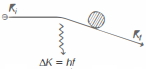
(D) The continuous $X$-ray spectrum is produced when a high-speed electron (often called a projectile or incident electron) is decelerated by the electric field of a target atom's nucleus. This process is known as Bremsstrahlung or braking radiation.
During this interaction,the electron loses kinetic energy,which is emitted in the form of an $X$-ray photon. The energy of the emitted photon is given by $\Delta K = hf$,where $\Delta K$ is the change in kinetic energy of the electron.
This process is essentially the inverse of the photoelectric effect. In the photoelectric effect,a photon is absorbed to eject an electron from a material. In the production of continuous $X$-rays,an electron is decelerated to emit a photon. Therefore,it is referred to as the inverse photoelectric effect.
During this interaction,the electron loses kinetic energy,which is emitted in the form of an $X$-ray photon. The energy of the emitted photon is given by $\Delta K = hf$,where $\Delta K$ is the change in kinetic energy of the electron.
This process is essentially the inverse of the photoelectric effect. In the photoelectric effect,a photon is absorbed to eject an electron from a material. In the production of continuous $X$-rays,an electron is decelerated to emit a photon. Therefore,it is referred to as the inverse photoelectric effect.
0 likes
View Solution273
MediumMCQ
$A$ charged gold leaf electroscope has its leaves apart by a certain amount with enclosed air. When the electroscope is subjected to $X$-rays,then the leaves
A
Further dilate
B
Start oscillating
C
Collapse
D
Remain unaltered
Solution
(C) $X$-rays are ionizing radiations. When the electroscope is exposed to $X$-rays,they ionize the air molecules inside the electroscope enclosure.
These ions (positive and negative) are attracted to the charged gold leaves.
The charges of opposite polarity to that on the leaves neutralize the charge on the leaves.
As the net charge on the leaves decreases,the electrostatic repulsion between them decreases,causing the leaves to collapse.
These ions (positive and negative) are attracted to the charged gold leaves.
The charges of opposite polarity to that on the leaves neutralize the charge on the leaves.
As the net charge on the leaves decreases,the electrostatic repulsion between them decreases,causing the leaves to collapse.
0 likes
View Solution274
MediumMCQ
$X$-rays of wavelength $22 \, pm$ are scattered from a carbon target at an angle of $85^{\circ}$ to the incident beam. The Compton shift for $X$-rays is ......... $pm$.
A
$2.2$
B
$1.1$
C
$0.55$
D
$4.4$
Solution
(A) The Compton shift $\Delta \lambda$ is given by the formula: $\Delta \lambda = \frac{h}{m_0 c} (1 - \cos \phi)$.
Here, the Compton wavelength $\lambda_c = \frac{h}{m_0 c} \approx 2.43 \times 10^{-12} \, m = 2.43 \, pm$.
The scattering angle $\phi = 85^{\circ}$.
Substituting the values: $\Delta \lambda = 2.43 \times (1 - \cos 85^{\circ})$.
Since $\cos 85^{\circ} \approx 0.087$, we have $\Delta \lambda = 2.43 \times (1 - 0.087) = 2.43 \times 0.913 \approx 2.218 \, pm$.
Rounding to the nearest given option, the Compton shift is approximately $2.2 \, pm$.
Here, the Compton wavelength $\lambda_c = \frac{h}{m_0 c} \approx 2.43 \times 10^{-12} \, m = 2.43 \, pm$.
The scattering angle $\phi = 85^{\circ}$.
Substituting the values: $\Delta \lambda = 2.43 \times (1 - \cos 85^{\circ})$.
Since $\cos 85^{\circ} \approx 0.087$, we have $\Delta \lambda = 2.43 \times (1 - 0.087) = 2.43 \times 0.913 \approx 2.218 \, pm$.
Rounding to the nearest given option, the Compton shift is approximately $2.2 \, pm$.
0 likes
View Solution275
EasyMCQ
The minimum wavelength of the $X$-rays produced at an accelerating potential $V$ is $\lambda$. If the accelerating potential is changed to $2V$, then the minimum wavelength would become:
A
$4 \lambda$
B
$2 \lambda$
C
$\lambda / 2$
D
$\lambda / 4$
Solution
(C) The minimum wavelength (cut-off wavelength) of $X$-rays is given by the formula: $\lambda_{\min} = \frac{hc}{eV} = \frac{12400}{V} \text{ Å}$.
From this relation, we can see that $\lambda_{\min} \propto \frac{1}{V}$.
Given that the initial potential is $V$ and the initial wavelength is $\lambda$, we have $\lambda = \frac{k}{V}$ (where $k$ is a constant).
When the potential is changed to $V' = 2V$, the new minimum wavelength $\lambda'$ will be:
$\lambda' = \frac{k}{V'} = \frac{k}{2V} = \frac{1}{2} \left( \frac{k}{V} \right) = \frac{\lambda}{2}$.
From this relation, we can see that $\lambda_{\min} \propto \frac{1}{V}$.
Given that the initial potential is $V$ and the initial wavelength is $\lambda$, we have $\lambda = \frac{k}{V}$ (where $k$ is a constant).
When the potential is changed to $V' = 2V$, the new minimum wavelength $\lambda'$ will be:
$\lambda' = \frac{k}{V'} = \frac{k}{2V} = \frac{1}{2} \left( \frac{k}{V} \right) = \frac{\lambda}{2}$.
0 likes
View Solution276
EasyMCQ
An $X$-ray tube has a short wavelength limit at $0.45 \mathring{A}$. The voltage of the tube is ........ $V$.
A
$450000$
B
$9600$
C
$27500$
D
$60600$
Solution
(C) The minimum wavelength $(\lambda_{\min})$ of $X$-rays produced by an $X$-ray tube is given by the Duane-Hunt law:
$\lambda_{\min} = \frac{hc}{eV} = \frac{12400 \text{ } \mathring{A} \cdot V}{V}$
Given $\lambda_{\min} = 0.45 \mathring{A}$.
Substituting the value into the formula:
$0.45 = \frac{12400}{V}$
$V = \frac{12400}{0.45}$
$V \approx 27555 \text{ } V$
Comparing this with the given options, the closest value is $27500 \text{ } V$.
$\lambda_{\min} = \frac{hc}{eV} = \frac{12400 \text{ } \mathring{A} \cdot V}{V}$
Given $\lambda_{\min} = 0.45 \mathring{A}$.
Substituting the value into the formula:
$0.45 = \frac{12400}{V}$
$V = \frac{12400}{0.45}$
$V \approx 27555 \text{ } V$
Comparing this with the given options, the closest value is $27500 \text{ } V$.
0 likes
View Solution277
MediumMCQ
$X$-rays incident on a material:
A
Will exert a force on it
B
Will transfer energy to it
C
May cause emission of electrons
D
All of these
Solution
(D) $X$-rays are electromagnetic waves that carry momentum and energy.
$1$. When $X$-rays strike a material,they exert radiation pressure,which results in a force on the material.
$2$. They transfer energy to the material through absorption or scattering processes.
$3$. Due to the photoelectric effect,$X$-rays can cause the emission of electrons from the surface of the material.
Therefore,all the given statements are correct.
$1$. When $X$-rays strike a material,they exert radiation pressure,which results in a force on the material.
$2$. They transfer energy to the material through absorption or scattering processes.
$3$. Due to the photoelectric effect,$X$-rays can cause the emission of electrons from the surface of the material.
Therefore,all the given statements are correct.
0 likes
View Solution278
EasyMCQ
Penetrating power of $X$-rays increases with an increase in
A
Accelerating potential
B
Wavelength
C
Mass number of the target material
D
Filament current
Solution
(A) The penetrating power of $X$-rays is directly proportional to their energy.
According to the relation $E = eV$,where $E$ is the energy of the $X$-ray photon,$e$ is the elementary charge,and $V$ is the accelerating potential applied across the $X$-ray tube.
As the accelerating potential $V$ increases,the energy of the $X$-rays increases,which in turn increases their penetrating power.
Therefore,the correct option is $A$.
According to the relation $E = eV$,where $E$ is the energy of the $X$-ray photon,$e$ is the elementary charge,and $V$ is the accelerating potential applied across the $X$-ray tube.
As the accelerating potential $V$ increases,the energy of the $X$-rays increases,which in turn increases their penetrating power.
Therefore,the correct option is $A$.
0 likes
View Solution279
EasyMCQ
If the potential difference $V$ applied to the Coolidge tube is doubled, then the cut-off wavelength
A
Is doubled
B
Is halved
C
Remains unchanged
D
Is quadrupled
Solution
(B) The cut-off wavelength (also known as the minimum wavelength) of $X$-rays produced in a Coolidge tube is given by the formula: $\lambda_{\min} = \frac{hc}{eV} = \frac{12400}{V} \text{ Å}$.
From this relation, it is clear that $\lambda_{\min} \propto \frac{1}{V}$.
If the potential difference $V$ is doubled (i.e., $V' = 2V$), the new cut-off wavelength $\lambda'_{\min}$ becomes:
$\lambda'_{\min} = \frac{12400}{2V} = \frac{1}{2} \left( \frac{12400}{V} \right) = \frac{1}{2} \lambda_{\min}$.
Therefore, the cut-off wavelength is halved.
From this relation, it is clear that $\lambda_{\min} \propto \frac{1}{V}$.
If the potential difference $V$ is doubled (i.e., $V' = 2V$), the new cut-off wavelength $\lambda'_{\min}$ becomes:
$\lambda'_{\min} = \frac{12400}{2V} = \frac{1}{2} \left( \frac{12400}{V} \right) = \frac{1}{2} \lambda_{\min}$.
Therefore, the cut-off wavelength is halved.
0 likes
View Solution280
MediumMCQ
If the frequency of $K_\alpha$ $X$-rays emitted from the element with atomic number $31$ is $v$,then the frequency of $K_\alpha$ $X$-rays emitted from the element with atomic number $51$ would be:
A
$\frac{5}{3} v$
B
$\frac{51}{31} v$
C
$\frac{25}{9} v$
D
$\frac{9}{25} v$
Solution
(C) According to Moseley's Law,the frequency $v$ of characteristic $X$-rays is given by $\sqrt{v} = a(Z - b)$,where $Z$ is the atomic number and $b$ is the screening constant. For $K_\alpha$ $X$-rays,$b = 1$.
For the first element with $Z_1 = 31$,the frequency is $v_1 = v$:
$\sqrt{v} = a(31 - 1) = 30a \quad \dots (i)$
For the second element with $Z_2 = 51$,let the frequency be $v_2$:
$\sqrt{v_2} = a(51 - 1) = 50a \quad \dots (ii)$
Dividing equation $(ii)$ by equation $(i)$:
$\frac{\sqrt{v_2}}{\sqrt{v}} = \frac{50a}{30a} = \frac{5}{3}$
Squaring both sides:
$\frac{v_2}{v} = \left(\frac{5}{3}\right)^2 = \frac{25}{9}$
Therefore,$v_2 = \frac{25}{9} v$.
For the first element with $Z_1 = 31$,the frequency is $v_1 = v$:
$\sqrt{v} = a(31 - 1) = 30a \quad \dots (i)$
For the second element with $Z_2 = 51$,let the frequency be $v_2$:
$\sqrt{v_2} = a(51 - 1) = 50a \quad \dots (ii)$
Dividing equation $(ii)$ by equation $(i)$:
$\frac{\sqrt{v_2}}{\sqrt{v}} = \frac{50a}{30a} = \frac{5}{3}$
Squaring both sides:
$\frac{v_2}{v} = \left(\frac{5}{3}\right)^2 = \frac{25}{9}$
Therefore,$v_2 = \frac{25}{9} v$.
0 likes
View Solution281
EasyMCQ
The $X$-ray beam coming from the $X$-ray tube will be:
A
Monochromatic
B
Dichromatic
C
Having all wavelengths greater than a certain minimum wavelength
D
Having all wavelengths between a minimum and maximum wavelengths
Solution
(C) The $X$-ray spectrum produced by an $X$-ray tube consists of a continuous spectrum of wavelengths.
When high-speed electrons strike the target,they lose energy in the form of $X$-ray photons.
The maximum energy of an $X$-ray photon corresponds to the kinetic energy of the incident electron,given by $E_{max} = eV = \frac{hc}{\lambda_{min}}$.
This implies that there is a minimum wavelength $\lambda_{min} = \frac{hc}{eV}$ below which no $X$-rays are produced.
Since electrons can lose any fraction of their kinetic energy,the resulting $X$-ray beam contains a continuous range of wavelengths starting from $\lambda_{min}$ up to infinity (theoretically).
Therefore,the beam has all wavelengths greater than a certain minimum wavelength.
When high-speed electrons strike the target,they lose energy in the form of $X$-ray photons.
The maximum energy of an $X$-ray photon corresponds to the kinetic energy of the incident electron,given by $E_{max} = eV = \frac{hc}{\lambda_{min}}$.
This implies that there is a minimum wavelength $\lambda_{min} = \frac{hc}{eV}$ below which no $X$-rays are produced.
Since electrons can lose any fraction of their kinetic energy,the resulting $X$-ray beam contains a continuous range of wavelengths starting from $\lambda_{min}$ up to infinity (theoretically).
Therefore,the beam has all wavelengths greater than a certain minimum wavelength.
0 likes
View Solution282
EasyMCQ
Atomic number of anticathode material in an $X$-ray tube is $41$. Wavelength of $K_\alpha$ $X$-ray produced in the tube is ........ $\mathring A$.
A
$0.66$
B
$0.76$
C
$0.82$
D
$0.88$
Solution
(B) According to Moseley's Law for $K_\alpha$ $X$-rays,the frequency $f$ is given by $\sqrt{f} = a(Z - b)$,where $a = \sqrt{\frac{3}{4} R c}$ and $b = 1$.
Substituting the values,$\sqrt{f} = \sqrt{\frac{3}{4} \times 1.097 \times 10^7 \times 3 \times 10^8} \times (41 - 1)$.
$\sqrt{f} \approx 4.97 \times 10^7 \times 40 = 1.988 \times 10^9 \text{ Hz}^{1/2}$.
Squaring both sides,$f \approx 3.95 \times 10^{18} \text{ Hz}$.
Using $\lambda = \frac{c}{f}$,where $c = 3 \times 10^8 \text{ m/s}$.
$\lambda = \frac{3 \times 10^8}{3.95 \times 10^{18}} \approx 0.76 \times 10^{-10} \text{ m} = 0.76 \,\mathring A$.
Substituting the values,$\sqrt{f} = \sqrt{\frac{3}{4} \times 1.097 \times 10^7 \times 3 \times 10^8} \times (41 - 1)$.
$\sqrt{f} \approx 4.97 \times 10^7 \times 40 = 1.988 \times 10^9 \text{ Hz}^{1/2}$.
Squaring both sides,$f \approx 3.95 \times 10^{18} \text{ Hz}$.
Using $\lambda = \frac{c}{f}$,where $c = 3 \times 10^8 \text{ m/s}$.
$\lambda = \frac{3 \times 10^8}{3.95 \times 10^{18}} \approx 0.76 \times 10^{-10} \text{ m} = 0.76 \,\mathring A$.
0 likes
View Solution283
DifficultMCQ
When $0.50\; \mathring{A}$ $X$-rays strike a material,the photoelectrons from the $K$-shell are observed to move in a circle of radius $23\; mm$ in a magnetic field of $2 \times 10^{-2}\; T$ acting perpendicularly to the direction of emission of photoelectrons. The binding energy of $K$-shell electrons is $..........\; keV$.
A
$3.5$
B
$6.2$
C
$2.9$
D
$5.5$
Solution
(B) The velocity $v$ of the photoelectrons is given by the magnetic force providing the centripetal force: $evB = m\frac{v^2}{R} \implies v = \frac{eBR}{m}$.
The kinetic energy $K$ of the photoelectrons is $K = \frac{1}{2}mv^2 = \frac{e^2B^2R^2}{2m}$.
Substituting the values: $e = 1.6 \times 10^{-19}\; C$,$B = 2 \times 10^{-2}\; T$,$R = 23 \times 10^{-3}\; m$,$m = 9.1 \times 10^{-31}\; kg$:
$K = \frac{(1.6 \times 10^{-19})^2 \times (2 \times 10^{-2})^2 \times (23 \times 10^{-3})^2}{2 \times 9.1 \times 10^{-31}} \approx 2.97 \times 10^{-15}\; J$.
Converting to $keV$: $K = \frac{2.97 \times 10^{-15}}{1.6 \times 10^{-19}} \approx 18.56\; keV$.
The energy of the incident photon is $E = \frac{hc}{\lambda} = \frac{12.4\; keV \cdot \mathring{A}}{0.50\; \mathring{A}} = 24.8\; keV$.
The binding energy $BE$ is given by $BE = E - K = 24.8\; keV - 18.6\; keV = 6.2\; keV$.
The kinetic energy $K$ of the photoelectrons is $K = \frac{1}{2}mv^2 = \frac{e^2B^2R^2}{2m}$.
Substituting the values: $e = 1.6 \times 10^{-19}\; C$,$B = 2 \times 10^{-2}\; T$,$R = 23 \times 10^{-3}\; m$,$m = 9.1 \times 10^{-31}\; kg$:
$K = \frac{(1.6 \times 10^{-19})^2 \times (2 \times 10^{-2})^2 \times (23 \times 10^{-3})^2}{2 \times 9.1 \times 10^{-31}} \approx 2.97 \times 10^{-15}\; J$.
Converting to $keV$: $K = \frac{2.97 \times 10^{-15}}{1.6 \times 10^{-19}} \approx 18.56\; keV$.
The energy of the incident photon is $E = \frac{hc}{\lambda} = \frac{12.4\; keV \cdot \mathring{A}}{0.50\; \mathring{A}} = 24.8\; keV$.
The binding energy $BE$ is given by $BE = E - K = 24.8\; keV - 18.6\; keV = 6.2\; keV$.
0 likes
View Solution284
EasyMCQ
The waves emitted when a metal target is bombarded with high energy electrons are
A
Microwaves
B
$X$-rays
C
Infrared rays
D
Radio Waves
Solution
(B) When a metal target is bombarded with high-energy electrons,the electrons undergo rapid deceleration upon interacting with the target atoms. This loss of kinetic energy is emitted in the form of electromagnetic radiation known as $X$-rays. Therefore,the correct answer is $X$-rays.
0 likes
View Solution285
EasyMCQ
The minimum wavelength of $X$-rays produced by an electron accelerated through a potential difference of $V$ volts is proportional to:
A
$V^2$
B
$\sqrt{V}$
C
$\frac{1}{V}$
D
$\frac{1}{\sqrt{V}}$
Solution
(C) The kinetic energy gained by an electron accelerated through a potential difference $V$ is given by $K = eV$,where $e$ is the charge of the electron.
When this electron strikes the target,the maximum energy of the emitted $X$-ray photon is equal to the kinetic energy of the electron,i.e.,$E_{\max} = h\nu_{\max} = eV$.
Since the frequency $\nu = \frac{c}{\lambda}$,the minimum wavelength $\lambda_{\min}$ corresponds to the maximum energy:
$\lambda_{\min} = \frac{hc}{E_{\max}} = \frac{hc}{eV}$.
Since $h$,$c$,and $e$ are constants,we have $\lambda_{\min} \propto \frac{1}{V}$.
Therefore,the correct option is $C$.
When this electron strikes the target,the maximum energy of the emitted $X$-ray photon is equal to the kinetic energy of the electron,i.e.,$E_{\max} = h\nu_{\max} = eV$.
Since the frequency $\nu = \frac{c}{\lambda}$,the minimum wavelength $\lambda_{\min}$ corresponds to the maximum energy:
$\lambda_{\min} = \frac{hc}{E_{\max}} = \frac{hc}{eV}$.
Since $h$,$c$,and $e$ are constants,we have $\lambda_{\min} \propto \frac{1}{V}$.
Therefore,the correct option is $C$.
0 likes
View Solution286
DifficultMCQ
$STATEMENT-1$: If the accelerating potential in an $X$-ray tube is increased, the wavelengths of the characteristic $X$-rays do not change. because
$STATEMENT-2$: When an electron beam strikes the target in an $X$-ray tube, part of the kinetic energy is converted into $X$-ray energy.
$STATEMENT-2$: When an electron beam strikes the target in an $X$-ray tube, part of the kinetic energy is converted into $X$-ray energy.
A
$Statement-1$ is True, $Statement-2$ is True; $Statement-2$ is a correct explanation for $Statement-1$.
B
$Statement-1$ is True, $Statement-2$ is True; $Statement-2$ is $NOT$ a correct explanation for $Statement-1$.
C
$Statement-1$ is True, $Statement-2$ is False.
D
$Statement-1$ is False, $Statement-2$ is True.
Solution
(B) The characteristic $X$-rays are produced due to electronic transitions between the inner shells of the target atoms. The energy of these transitions depends only on the atomic number $(Z)$ of the target material, not on the accelerating potential of the electrons. Thus, $Statement-1$ is True.
When an electron beam strikes the target, it loses kinetic energy, which is emitted as $X$-ray photons (Bremsstrahlung and characteristic). This is a general physical process occurring in the tube. Thus, $Statement-2$ is True.
However, $Statement-2$ describes the general production of $X$-rays, whereas $Statement-1$ refers specifically to the independence of characteristic $X$-ray wavelengths from the accelerating potential. Therefore, $Statement-2$ is not the specific explanation for $Statement-1$.
When an electron beam strikes the target, it loses kinetic energy, which is emitted as $X$-ray photons (Bremsstrahlung and characteristic). This is a general physical process occurring in the tube. Thus, $Statement-2$ is True.
However, $Statement-2$ describes the general production of $X$-rays, whereas $Statement-1$ refers specifically to the independence of characteristic $X$-ray wavelengths from the accelerating potential. Therefore, $Statement-2$ is not the specific explanation for $Statement-1$.
0 likes
View Solution287
MediumMCQ
Which one of the following statements is $WRONG$ in the context of $X$-rays generated from an $X$-ray tube?
A
Wavelength of characteristic $X$-rays decreases when the atomic number of the target increases.
B
Cut-off wavelength of the continuous $X$-rays depends on the atomic number of the target.
C
Intensity of the characteristic $X$-rays depends on the electrical power given to the $X$-ray tube.
D
Cut-off wavelength of the continuous $X$-rays depends on the energy of the electrons in the $X$-ray tube.
Solution
(B) The cut-off wavelength $(\lambda_{\text{min}})$ of continuous $X$-rays is given by the formula $\lambda_{\text{min}} = \frac{hc}{eV}$, where $V$ is the accelerating potential difference.
This formula shows that the cut-off wavelength depends only on the accelerating voltage $(V)$ and is independent of the atomic number $(Z)$ of the target material.
Therefore, the statement that the cut-off wavelength depends on the atomic number of the target is $WRONG$.
This formula shows that the cut-off wavelength depends only on the accelerating voltage $(V)$ and is independent of the atomic number $(Z)$ of the target material.
Therefore, the statement that the cut-off wavelength depends on the atomic number of the target is $WRONG$.
0 likes
View Solution288
MediumMCQ
In an $X$-ray tube, electrons emitted from a filament (cathode) carrying current $I$ hit a target (anode) at a distance $d$ from the cathode. The target is kept at a potential $V$ higher than the cathode, resulting in the emission of continuous and characteristic $X$-rays. If the filament current $I$ is decreased to $I/2$, the potential difference $V$ is increased to $2V$, and the separation distance $d$ is reduced to $d/2$, then:
$(A)$ The cut-off wavelength will reduce to half, and the wavelengths of the characteristic $X$-rays will remain the same.
$(B)$ The cut-off wavelength as well as the wavelengths of the characteristic $X$-rays will remain the same.
$(C)$ The cut-off wavelength will reduce to half, and the intensities of all the $X$-rays will decrease.
$(D)$ The cut-off wavelength will become two times larger, and the intensity of all the $X$-rays will decrease.
$(A)$ The cut-off wavelength will reduce to half, and the wavelengths of the characteristic $X$-rays will remain the same.
$(B)$ The cut-off wavelength as well as the wavelengths of the characteristic $X$-rays will remain the same.
$(C)$ The cut-off wavelength will reduce to half, and the intensities of all the $X$-rays will decrease.
$(D)$ The cut-off wavelength will become two times larger, and the intensity of all the $X$-rays will decrease.
A
$(A), (C)$
B
$(A), (B)$
C
$(B), (D)$
D
$(C), (D)$
Solution
$(A)$ $1$. The cut-off wavelength $(\lambda_{\min})$ is given by the formula: $\lambda_{\min} = \frac{hc}{eV}$.
$2$. Since $V$ is increased to $2V$, the new cut-off wavelength $\lambda'_{\min} = \frac{hc}{e(2V)} = \frac{1}{2} \lambda_{\min}$. Thus, the cut-off wavelength reduces to half.
$3$. The wavelengths of characteristic $X$-rays depend only on the target material, not on the accelerating potential $V$ or the filament current $I$. Therefore, they remain unchanged.
$4$. The intensity of $X$-rays is directly proportional to the number of electrons hitting the target per unit time, which is determined by the filament current $I$. Since $I$ is decreased to $I/2$, the number of electrons hitting the target decreases, leading to a decrease in the intensity of all $X$-rays.
$5$. Combining these, the cut-off wavelength reduces to half, and the intensities decrease. Thus, statements $(A)$ and $(C)$ are correct.
$2$. Since $V$ is increased to $2V$, the new cut-off wavelength $\lambda'_{\min} = \frac{hc}{e(2V)} = \frac{1}{2} \lambda_{\min}$. Thus, the cut-off wavelength reduces to half.
$3$. The wavelengths of characteristic $X$-rays depend only on the target material, not on the accelerating potential $V$ or the filament current $I$. Therefore, they remain unchanged.
$4$. The intensity of $X$-rays is directly proportional to the number of electrons hitting the target per unit time, which is determined by the filament current $I$. Since $I$ is decreased to $I/2$, the number of electrons hitting the target decreases, leading to a decrease in the intensity of all $X$-rays.
$5$. Combining these, the cut-off wavelength reduces to half, and the intensities decrease. Thus, statements $(A)$ and $(C)$ are correct.
0 likes
View Solution289
AdvancedMCQ
If $\lambda_{Cu}$ is the wavelength of the $K_{\alpha}$ $X$-ray line of copper (atomic number $Z = 29$) and $\lambda_{Mo}$ is the wavelength of the $K_{\alpha}$ $X$-ray line of molybdenum (atomic number $Z = 42$),then the ratio $\frac{\lambda_{Cu}}{\lambda_{Mo}}$ is close to:
A
$1.99$
B
$2.14$
C
$0.50$
D
$0.48$
Solution
(B) According to Moseley's law,the frequency $\nu$ of the $K_{\alpha}$ $X$-ray line is given by $\sqrt{\nu} = a(Z - b)$,where $b = 1$ for the $K_{\alpha}$ transition.
Since $\nu = \frac{c}{\lambda}$,we have $\sqrt{\frac{c}{\lambda}} = a(Z - 1)$,which implies $\frac{1}{\sqrt{\lambda}} \propto (Z - 1)$.
Therefore,the ratio of the wavelengths is given by $\frac{\sqrt{\lambda_{Mo}}}{\sqrt{\lambda_{Cu}}} = \frac{Z_{Cu} - 1}{Z_{Mo} - 1}$.
Squaring both sides,we get $\frac{\lambda_{Mo}}{\lambda_{Cu}} = \left( \frac{29 - 1}{42 - 1} \right)^2 = \left( \frac{28}{41} \right)^2$.
Thus,the ratio $\frac{\lambda_{Cu}}{\lambda_{Mo}} = \left( \frac{41}{28} \right)^2 = \frac{1681}{784} \approx 2.144$.
Therefore,the ratio is close to $2.14$.
Since $\nu = \frac{c}{\lambda}$,we have $\sqrt{\frac{c}{\lambda}} = a(Z - 1)$,which implies $\frac{1}{\sqrt{\lambda}} \propto (Z - 1)$.
Therefore,the ratio of the wavelengths is given by $\frac{\sqrt{\lambda_{Mo}}}{\sqrt{\lambda_{Cu}}} = \frac{Z_{Cu} - 1}{Z_{Mo} - 1}$.
Squaring both sides,we get $\frac{\lambda_{Mo}}{\lambda_{Cu}} = \left( \frac{29 - 1}{42 - 1} \right)^2 = \left( \frac{28}{41} \right)^2$.
Thus,the ratio $\frac{\lambda_{Cu}}{\lambda_{Mo}} = \left( \frac{41}{28} \right)^2 = \frac{1681}{784} \approx 2.144$.
Therefore,the ratio is close to $2.14$.
0 likes
View Solution290
MediumMCQ
$A$ metal target with atomic number $Z=46$ is bombarded with a high-energy electron beam. The emission of $X$-rays from the target is analyzed. The ratio $r$ of the wavelengths of the $K_\alpha$-line and the cut-off wavelength is found to be $r=2$. If the same electron beam bombards another metal target with $Z=41$,the value of $r$ will be
A
$2.53$
B
$1.27$
C
$2.24$
D
$1.58$
Solution
(A) The wavelength of the $K_\alpha$ line is given by Moseley's law: $\frac{1}{\lambda_{K_\alpha}} = R(Z-1)^2 \left( \frac{1}{1^2} - \frac{1}{2^2} \right) = R(Z-1)^2 \left( \frac{3}{4} \right)$.
The cut-off wavelength $\lambda_0$ is given by $\lambda_0 = \frac{hc}{eV}$,where $V$ is the accelerating potential of the electron beam.
Given the ratio $r = \frac{\lambda_{K_\alpha}}{\lambda_0} = 2$ for $Z_1 = 46$.
From the expression for $\lambda_{K_\alpha}$,we see that $\lambda_{K_\alpha} \propto \frac{1}{(Z-1)^2}$.
Since the accelerating potential $V$ is the same,$\lambda_0$ remains constant. Therefore,$r \propto \frac{1}{(Z-1)^2}$.
Thus,$\frac{r_2}{r_1} = \frac{(Z_1-1)^2}{(Z_2-1)^2}$.
Substituting the values: $\frac{r_2}{2} = \frac{(46-1)^2}{(41-1)^2} = \frac{45^2}{40^2} = \left( \frac{9}{8} \right)^2 = \frac{81}{64} = 1.2656$.
$r_2 = 2 \times 1.2656 = 2.5312 \approx 2.53$.
The cut-off wavelength $\lambda_0$ is given by $\lambda_0 = \frac{hc}{eV}$,where $V$ is the accelerating potential of the electron beam.
Given the ratio $r = \frac{\lambda_{K_\alpha}}{\lambda_0} = 2$ for $Z_1 = 46$.
From the expression for $\lambda_{K_\alpha}$,we see that $\lambda_{K_\alpha} \propto \frac{1}{(Z-1)^2}$.
Since the accelerating potential $V$ is the same,$\lambda_0$ remains constant. Therefore,$r \propto \frac{1}{(Z-1)^2}$.
Thus,$\frac{r_2}{r_1} = \frac{(Z_1-1)^2}{(Z_2-1)^2}$.
Substituting the values: $\frac{r_2}{2} = \frac{(46-1)^2}{(41-1)^2} = \frac{45^2}{40^2} = \left( \frac{9}{8} \right)^2 = \frac{81}{64} = 1.2656$.
$r_2 = 2 \times 1.2656 = 2.5312 \approx 2.53$.
0 likes
View Solution291
EasyMCQ
Electrons of mass $m$ with de-Broglie wavelength $\lambda$ fall on a target. The cut-off wavelength $\lambda_0$ is equal to [$h=$ Planck's constant,$c=$ velocity of light].
A
$\frac{2 m c \lambda^2}{h}$
B
$\frac{m c \lambda}{h}$
C
$\frac{2 h}{m c \lambda^2}$
D
$\frac{2 m c \lambda}{h}$
Solution
(A) The de-Broglie wavelength of an electron is given by $\lambda = \frac{h}{p}$,where $p$ is the momentum of the electron.
Since the kinetic energy $E = \frac{p^2}{2m}$,we have $p = \sqrt{2mE}$.
Substituting this into the de-Broglie equation: $\lambda = \frac{h}{\sqrt{2mE}}$.
Squaring both sides: $\lambda^2 = \frac{h^2}{2mE}$,which gives $E = \frac{h^2}{2m\lambda^2}$.
The cut-off wavelength $\lambda_0$ of the emitted $X$-rays corresponds to the maximum energy of the photon,which is equal to the kinetic energy $E$ of the incident electron: $E = \frac{hc}{\lambda_0}$.
Equating the two expressions for $E$: $\frac{hc}{\lambda_0} = \frac{h^2}{2m\lambda^2}$.
Solving for $\lambda_0$: $\lambda_0 = \frac{hc \cdot 2m\lambda^2}{h^2} = \frac{2mc\lambda^2}{h}$.
Since the kinetic energy $E = \frac{p^2}{2m}$,we have $p = \sqrt{2mE}$.
Substituting this into the de-Broglie equation: $\lambda = \frac{h}{\sqrt{2mE}}$.
Squaring both sides: $\lambda^2 = \frac{h^2}{2mE}$,which gives $E = \frac{h^2}{2m\lambda^2}$.
The cut-off wavelength $\lambda_0$ of the emitted $X$-rays corresponds to the maximum energy of the photon,which is equal to the kinetic energy $E$ of the incident electron: $E = \frac{hc}{\lambda_0}$.
Equating the two expressions for $E$: $\frac{hc}{\lambda_0} = \frac{h^2}{2m\lambda^2}$.
Solving for $\lambda_0$: $\lambda_0 = \frac{hc \cdot 2m\lambda^2}{h^2} = \frac{2mc\lambda^2}{h}$.
0 likes
View Solution292
EasyMCQ
The range of wavelength for $X$-rays is from . . . . . . .
A
$1 \, mm$ to $700 \, nm$
B
$700 \, nm$ to $400 \, nm$
C
$400 \, nm$ to $1 \, nm$
D
$1 \, nm$ to $10^{-3} \, nm$
Solution
(D) The electromagnetic spectrum classifies waves based on their wavelength and frequency. $X$-rays are high-energy electromagnetic waves that occupy the region between ultraviolet rays and gamma rays. The typical wavelength range for $X$-rays is approximately $1 \, nm$ to $10^{-3} \, nm$ ($0.1 \, \text{\AA}$ to $10 \, \text{\AA}$). Therefore, option $D$ is the correct answer.
0 likes
View Solution293
MediumMCQ
$A$ hydrogen atom does not emit $X$-rays because
A
it contains only a single electron
B
energy levels in it are far apart
C
its size is very small
D
energy levels in it are very close to each other
Solution
(D) $X$-rays are high-energy electromagnetic radiations produced by transitions between inner electron shells (like $K$-shell to $L$-shell) in atoms with high atomic numbers $(Z)$.
In a hydrogen atom,there is only one electron and the energy difference between its energy levels is very small (in the order of $eV$).
$X$-ray emission requires energy transitions in the order of $keV$.
Therefore,a hydrogen atom cannot emit $X$-rays because the energy levels are too close to each other to produce such high-energy photons.
In a hydrogen atom,there is only one electron and the energy difference between its energy levels is very small (in the order of $eV$).
$X$-ray emission requires energy transitions in the order of $keV$.
Therefore,a hydrogen atom cannot emit $X$-rays because the energy levels are too close to each other to produce such high-energy photons.
0 likes
View Solution294
EasyMCQ
When a metal target is bombarded with high-energy electrons,the electromagnetic waves generated are
A
infrared waves
B
microwaves
C
$X$-rays
D
gamma rays
Solution
(C) When a beam of high-energy electrons strikes a metal target,the sudden deceleration of electrons results in the emission of high-frequency electromagnetic radiation known as $X$-rays.
0 likes
View Solution295
MediumMCQ
The minimum wavelength of $X$-rays produced by $20 \ kV$ electrons is nearly (in $Å$)
A
$0.62$
B
$1.8$
C
$3.2$
D
$6.5$
Solution
(A) The minimum wavelength $(\lambda_{min})$ of $X$-rays produced by electrons accelerated through a potential difference $V$ is given by the Duane-Hunt law: $\lambda_{min} = \frac{hc}{eV}$.
Substituting the values: $h = 6.63 \times 10^{-34} \ J \cdot s$,$c = 3 \times 10^8 \ m/s$,$e = 1.6 \times 10^{-19} \ C$,and $V = 20 \times 10^3 \ V$.
$\lambda_{min} = \frac{(6.63 \times 10^{-34}) \times (3 \times 10^8)}{(1.6 \times 10^{-19}) \times (20 \times 10^3)} \ m$.
$\lambda_{min} = \frac{19.89 \times 10^{-26}}{3.2 \times 10^{-15}} \ m = 6.215 \times 10^{-11} \ m$.
Since $1 \ Å = 10^{-10} \ m$,we have $\lambda_{min} = 0.6215 \times 10^{-10} \ m = 0.62 \ Å$.
Substituting the values: $h = 6.63 \times 10^{-34} \ J \cdot s$,$c = 3 \times 10^8 \ m/s$,$e = 1.6 \times 10^{-19} \ C$,and $V = 20 \times 10^3 \ V$.
$\lambda_{min} = \frac{(6.63 \times 10^{-34}) \times (3 \times 10^8)}{(1.6 \times 10^{-19}) \times (20 \times 10^3)} \ m$.
$\lambda_{min} = \frac{19.89 \times 10^{-26}}{3.2 \times 10^{-15}} \ m = 6.215 \times 10^{-11} \ m$.
Since $1 \ Å = 10^{-10} \ m$,we have $\lambda_{min} = 0.6215 \times 10^{-10} \ m = 0.62 \ Å$.
0 likes
View Solution296
EasyMCQ
The structure of solids is investigated by using
A
Cosmic rays
B
$\beta$-rays
C
$X$-rays
D
$\gamma$-rays
Solution
(C) The structure of solids is investigated using $X$-ray diffraction. Since the wavelength of $X$-rays is of the order of the interatomic spacing in crystals (approximately $1 \ \text{\AA}$), they are diffracted by the atomic planes in a solid. This phenomenon is used to determine the crystal structure of materials.
0 likes
View Solution297
MediumMCQ
The shortest wavelength of $X-$rays emitted from an $X-$ray tube depends upon
A
Nature of the gas in the tube
B
Voltage applied to tube
C
Current in the tube
D
Nature of target of the tube
Solution
(B) The shortest wavelength (also known as the cut-off wavelength,$\lambda_{min}$) of $X-$rays emitted from an $X-$ray tube is given by the Duane-Hunt law: $\lambda_{min} = \frac{hc}{eV}$.
Here,$h$ is Planck's constant,$c$ is the speed of light,$e$ is the charge of an electron,and $V$ is the accelerating potential difference (voltage) applied across the tube.
Since $h$,$c$,and $e$ are constants,$\lambda_{min}$ depends inversely on the voltage $V$ applied to the tube.
Therefore,the shortest wavelength depends only on the voltage applied to the tube.
Here,$h$ is Planck's constant,$c$ is the speed of light,$e$ is the charge of an electron,and $V$ is the accelerating potential difference (voltage) applied across the tube.
Since $h$,$c$,and $e$ are constants,$\lambda_{min}$ depends inversely on the voltage $V$ applied to the tube.
Therefore,the shortest wavelength depends only on the voltage applied to the tube.
0 likes
View Solution298
EasyMCQ
$W$. $K$. Roentgen discovered
A
Short radio waves
B
$X$-rays
C
Electrons
D
Laws of electromagnetic induction
Solution
(B) Wilhelm Roentgen,a Professor of Physics in Wurzburg,Bavaria,discovered $X$-rays in $1895$ accidentally while testing whether cathode rays could pass through glass.
$X$-rays are electromagnetic radiation of extremely short wavelength and high frequency,with wavelengths ranging from about $10^{-8} \ m$ to $10^{-12} \ m$ and corresponding frequencies from about $10^{16} \ Hz$ to $10^{20} \ Hz$.
$X$-rays are electromagnetic radiation of extremely short wavelength and high frequency,with wavelengths ranging from about $10^{-8} \ m$ to $10^{-12} \ m$ and corresponding frequencies from about $10^{16} \ Hz$ to $10^{20} \ Hz$.
0 likes
View Solution299
MediumMCQ
Calculate the wavelength of the $K_{\alpha}$ line for $Z=31$, when $a=5 \times 10^7 \, Hz^{1/2}$ for a characteristic $X$-ray spectrum.
A
$1.33 \, \mathring{A}$
B
$1.33 \, nm$
C
$133 \times 10^{-10} \, m$
D
$133 \, nm$
Solution
(A) Given, $Z=31$ and $a=5 \times 10^7 \, \text{Hz}^{1/2}$.
According to Moseley's law for $K_{\alpha}$ lines, $\sqrt{\nu} = a(Z-1)$.
Squaring both sides, we get $\nu = a^2(Z-1)^2$.
Substituting the values: $\nu = (5 \times 10^7)^2 \times (31-1)^2$.
$\nu = 25 \times 10^{14} \times 30^2 = 25 \times 10^{14} \times 900 = 2.25 \times 10^{18} \, \text{Hz}$.
We know that $\lambda = \frac{c}{\nu}$, where $c = 3 \times 10^8 \, \text{m/s}$.
$\lambda = \frac{3 \times 10^8}{2.25 \times 10^{18}} = 1.33 \times 10^{-10} \, \text{m}$.
Since $1 \, \mathring{A} = 10^{-10} \, \text{m}$, the wavelength is $1.33 \, \mathring{A}$.
According to Moseley's law for $K_{\alpha}$ lines, $\sqrt{\nu} = a(Z-1)$.
Squaring both sides, we get $\nu = a^2(Z-1)^2$.
Substituting the values: $\nu = (5 \times 10^7)^2 \times (31-1)^2$.
$\nu = 25 \times 10^{14} \times 30^2 = 25 \times 10^{14} \times 900 = 2.25 \times 10^{18} \, \text{Hz}$.
We know that $\lambda = \frac{c}{\nu}$, where $c = 3 \times 10^8 \, \text{m/s}$.
$\lambda = \frac{3 \times 10^8}{2.25 \times 10^{18}} = 1.33 \times 10^{-10} \, \text{m}$.
Since $1 \, \mathring{A} = 10^{-10} \, \text{m}$, the wavelength is $1.33 \, \mathring{A}$.
0 likes
View SolutionAtoms — X-Rays · Frequently Asked Questions
1Are these Atoms questions useful for JEE and NEET?
Yes. All questions in this section are mapped to JEE Main and NEET exam patterns. Previous year questions from JEE Main, NEET, GUJCET and state-level exams are included with full solutions.
2Can I switch to Hindi or Gujarati for these questions?
Yes. Use the language tabs in the hero section or the sidebar to view the same questions and solutions in English, Hindi or Gujarati.
3How do I generate a question paper from this subtopic?
Use the Vedclass Exam Paper Generator — select the chapter and subtopic, set difficulty, and generate Sets A, B, C, D automatically. First 3 chapters of every subject are free.
Vedclass Products
For Students
Vedclass Test Series
Mock tests in real JEE/NEET style with performance analysis. 5-day free trial.
Start Free TrialFor Teachers
Exam Paper Generator
Generate Set A/B/C/D papers from this chapter in 2 minutes. 3 chapters free.
Try FreeFor Institutes
Online Exam Module
Live online exams with unlimited students, 360° analytics & white-label branding.
See DemoFor Teachers & Institutes
Generate a Atoms Exam Paper in 2 Minutes
Select subtopic & difficulty — Sets A, B, C, D auto-generated with No Repeat logic.
First 3 chapters of every subject are free — no payment required.