
A English
X-Rays Questions in English
Class 12 Physics · Atoms · X-Rays
316+
Questions
English
Language
100%
With Solutions
Showing 10 of 316 questions in English
301
EasyMCQ
According to Moseley's law,the frequency $(v)$ of the $K_\alpha$ line and the atomic number $Z$ of the element have the relation ($A$ and $B$ are constants):
A
$\frac{v}{(Z-A)}=B$
B
$\frac{\sqrt{v}}{(Z-A)}=B$
C
$v(Z-A)=B$
D
$v(Z-A)^2=B$
Solution
(B) Moseley's law states that the square root of the frequency $(v)$ of a characteristic $X$-ray spectral line is directly proportional to the atomic number $(Z)$ of the target element.
Mathematically,it is expressed as: $\sqrt{v} = a(Z - b)$.
Here,$a$ and $b$ are constants depending on the specific spectral line (such as $K_\alpha$).
Rearranging this equation,we get: $\frac{\sqrt{v}}{(Z - b)} = a$.
Comparing this with the given options,where $A$ and $B$ are constants,the relation is $\frac{\sqrt{v}}{(Z - A)} = B$.
Mathematically,it is expressed as: $\sqrt{v} = a(Z - b)$.
Here,$a$ and $b$ are constants depending on the specific spectral line (such as $K_\alpha$).
Rearranging this equation,we get: $\frac{\sqrt{v}}{(Z - b)} = a$.
Comparing this with the given options,where $A$ and $B$ are constants,the relation is $\frac{\sqrt{v}}{(Z - A)} = B$.
0 likes
View Solution302
DifficultMCQ
An $X$-ray tube produces a continuous spectrum of radiation with its shortest wavelength of $45 \times 10^{-2} \text{ Å}$. The maximum energy of a photon in the radiation in $eV$ is (in $27,500$). $(h = 6.62 \times 10^{-34} \text{ J-s}, c = 3 \times 10^8 \text{ m/s})$.
A
$27$
B
$22$
C
$17$
D
$12$
Solution
(A) The energy of a photon is given by the formula $E = \frac{hc}{\lambda}$.
Given, $\lambda = 45 \times 10^{-2} \text{ Å} = 45 \times 10^{-12} \text{ m}$.
Substituting the values: $E = \frac{6.62 \times 10^{-34} \times 3 \times 10^8}{45 \times 10^{-12}} \text{ J}$.
$E = \frac{19.86 \times 10^{-26}}{45 \times 10^{-12}} \text{ J} = 0.4413 \times 10^{-14} \text{ J}$.
To convert energy into $eV$, divide by the charge of an electron $(1.6 \times 10^{-19} \text{ C})$:
$E_{eV} = \frac{0.4413 \times 10^{-14}}{1.6 \times 10^{-19}} \text{ eV} \approx 0.2758 \times 10^5 \text{ eV} = 27,580 \text{ eV}$.
Rounding to the nearest given option, the value is $27,500 \text{ eV}$.
Given, $\lambda = 45 \times 10^{-2} \text{ Å} = 45 \times 10^{-12} \text{ m}$.
Substituting the values: $E = \frac{6.62 \times 10^{-34} \times 3 \times 10^8}{45 \times 10^{-12}} \text{ J}$.
$E = \frac{19.86 \times 10^{-26}}{45 \times 10^{-12}} \text{ J} = 0.4413 \times 10^{-14} \text{ J}$.
To convert energy into $eV$, divide by the charge of an electron $(1.6 \times 10^{-19} \text{ C})$:
$E_{eV} = \frac{0.4413 \times 10^{-14}}{1.6 \times 10^{-19}} \text{ eV} \approx 0.2758 \times 10^5 \text{ eV} = 27,580 \text{ eV}$.
Rounding to the nearest given option, the value is $27,500 \text{ eV}$.
0 likes
View Solution303
MediumMCQ
$20 \ kV$ electrons can produce $X$-rays with a minimum wavelength of
A
$0.062 \ nm$
B
$0.41 \ Å$
C
$0.099 \ nm$
D
$0.248 \ Å$
Solution
(A) The minimum wavelength $(\lambda_{min})$ of $X$-rays produced by electrons accelerated through a potential difference $V$ is given by the Duane-Hunt law: $\lambda_{min} = \frac{hc}{eV}$.
Given $V = 20 \ kV = 20 \times 10^3 \ V$.
Using the values $h = 6.626 \times 10^{-34} \ J \cdot s$,$c = 3 \times 10^8 \ m/s$,and $e = 1.6 \times 10^{-19} \ C$:
$\lambda_{min} = \frac{12400 \ Å \cdot V}{V \text{ (in volts)}}$.
$\lambda_{min} = \frac{12400}{20000} \ Å = 0.62 \ Å = 0.062 \ nm$.
Given $V = 20 \ kV = 20 \times 10^3 \ V$.
Using the values $h = 6.626 \times 10^{-34} \ J \cdot s$,$c = 3 \times 10^8 \ m/s$,and $e = 1.6 \times 10^{-19} \ C$:
$\lambda_{min} = \frac{12400 \ Å \cdot V}{V \text{ (in volts)}}$.
$\lambda_{min} = \frac{12400}{20000} \ Å = 0.62 \ Å = 0.062 \ nm$.
0 likes
View Solution304
EasyMCQ
The typical wavelength of $X$-ray is
A
$10^{-10} \,m$
B
$10^{-15} \,m$
C
$10^{-6} \,m$
D
$10^6 \,m$
Solution
(A) The electromagnetic spectrum classifies $X$-rays as high-energy radiation with wavelengths typically ranging from $10^{-8} \,m$ to $10^{-12} \,m$.
Among the given options, $10^{-10} \,m$ falls within this range, making it a typical wavelength for $X$-rays.
Among the given options, $10^{-10} \,m$ falls within this range, making it a typical wavelength for $X$-rays.
0 likes
View Solution305
DifficultMCQ
Calculate the wavelength of the $K_{\alpha}$ line for $Z=31$, given $a=5 \times 10^7 \text{ Hz}^{1/2}$ for a characteristic $X$-ray spectrum.
A
$1.33 \text{ Å}$
B
$1.33 \text{ nm}$
C
$133 \times 10^{-10} \text{ m}$
D
$133 \text{ nm}$
Solution
(A) Given: Atomic number $Z=31$ and constant $a=5 \times 10^7 \text{ Hz}^{1/2}$.
According to Moseley's Law for the $K_{\alpha}$ line:
$\sqrt{\nu} = a(Z-1)$
Squaring both sides:
$\nu = a^2(Z-1)^2$
Substitute the values:
$\nu = (5 \times 10^7)^2 \times (31-1)^2$
$\nu = 25 \times 10^{14} \times 30^2$
$\nu = 25 \times 10^{14} \times 900 = 2.25 \times 10^{18} \text{ Hz}$
Now, using the relation $\lambda = \frac{c}{\nu}$ where $c = 3 \times 10^8 \text{ m/s}$:
$\lambda = \frac{3 \times 10^8}{2.25 \times 10^{18}}$
$\lambda = 1.33 \times 10^{-10} \text{ m}$
Since $1 \text{ Å} = 10^{-10} \text{ m}$, we get:
$\lambda = 1.33 \text{ Å}$.
According to Moseley's Law for the $K_{\alpha}$ line:
$\sqrt{\nu} = a(Z-1)$
Squaring both sides:
$\nu = a^2(Z-1)^2$
Substitute the values:
$\nu = (5 \times 10^7)^2 \times (31-1)^2$
$\nu = 25 \times 10^{14} \times 30^2$
$\nu = 25 \times 10^{14} \times 900 = 2.25 \times 10^{18} \text{ Hz}$
Now, using the relation $\lambda = \frac{c}{\nu}$ where $c = 3 \times 10^8 \text{ m/s}$:
$\lambda = \frac{3 \times 10^8}{2.25 \times 10^{18}}$
$\lambda = 1.33 \times 10^{-10} \text{ m}$
Since $1 \text{ Å} = 10^{-10} \text{ m}$, we get:
$\lambda = 1.33 \text{ Å}$.
0 likes
View Solution306
DifficultMCQ
$X$-rays of wavelength $0.140 \,nm$ are scattered from a block of carbon. What will be the wavelengths of $X$-rays scattered at $90^{\circ}$ (in $\,nm$)?
A
$0.140$
B
$0.142$
C
$0.144$
D
$0.146$
Solution
(B) The Compton shift formula is given by $\Delta \lambda = \lambda^{\prime} - \lambda = \frac{h}{m_e c} (1 - \cos \phi)$.
Given $\lambda = 0.140 \,nm = 0.140 \times 10^{-9} \,m$ and $\phi = 90^{\circ}$.
Since $\cos 90^{\circ} = 0$,the shift is $\Delta \lambda = \frac{h}{m_e c}$.
The Compton wavelength is $\frac{h}{m_e c} \approx 2.426 \times 10^{-12} \,m = 0.002426 \,nm$.
Thus,$\lambda^{\prime} = \lambda + \Delta \lambda = 0.140 \,nm + 0.002426 \,nm = 0.142426 \,nm$.
Rounding to three decimal places,we get $\lambda^{\prime} \approx 0.142 \,nm$.
Given $\lambda = 0.140 \,nm = 0.140 \times 10^{-9} \,m$ and $\phi = 90^{\circ}$.
Since $\cos 90^{\circ} = 0$,the shift is $\Delta \lambda = \frac{h}{m_e c}$.
The Compton wavelength is $\frac{h}{m_e c} \approx 2.426 \times 10^{-12} \,m = 0.002426 \,nm$.
Thus,$\lambda^{\prime} = \lambda + \Delta \lambda = 0.140 \,nm + 0.002426 \,nm = 0.142426 \,nm$.
Rounding to three decimal places,we get $\lambda^{\prime} \approx 0.142 \,nm$.
0 likes
View Solution307
MediumMCQ
According to Moseley's law,the frequency $(v)$ of the $K_\alpha$ line and the atomic number $Z$ of the element have the relation ($A$ and $B$ are constants)
A
$\frac{v}{(Z-A)}=B$
B
$\sqrt{v} = B(Z-A)$
C
$v(Z-A)=B$
D
$v(Z-A)^2=B$
Solution
(B) Moseley's law states that the square root of the frequency $(v)$ of a characteristic $X$-ray spectral line is directly proportional to the atomic number $(Z)$ of the element.
Mathematically,this is expressed as: $\sqrt{v} = a(Z - b)$,where $a$ and $b$ are constants.
In the given options,if we rearrange the relation $\sqrt{v} = B(Z-A)$,we get $\frac{\sqrt{v}}{(Z-A)} = B$.
Therefore,the correct relation is $\frac{\sqrt{v}}{(Z-A)} = B$.
Mathematically,this is expressed as: $\sqrt{v} = a(Z - b)$,where $a$ and $b$ are constants.
In the given options,if we rearrange the relation $\sqrt{v} = B(Z-A)$,we get $\frac{\sqrt{v}}{(Z-A)} = B$.
Therefore,the correct relation is $\frac{\sqrt{v}}{(Z-A)} = B$.
0 likes
View Solution308
MediumMCQ
$\Delta \lambda$ is the difference between the wavelength of the $K_\alpha$ line and the minimum wavelength of the continuous $X$-ray spectrum when the $X$-ray tube is operated at a voltage $V$. If the operating voltage is changed to $V / 3$,then the above difference is $\Delta \lambda^{\prime}$. Then:
A
$\Delta \lambda^{\prime} = 5 \Delta \lambda$
B
$\Delta \lambda^{\prime} = 4 \Delta \lambda$
C
$\Delta \lambda^{\prime} = 3 \Delta \lambda$
D
$\Delta \lambda^{\prime} < 3 \Delta \lambda$
Solution
(D) The wavelength of the $K_\alpha$ line,denoted as $\lambda_{K_\alpha}$,is constant and independent of the operating voltage $V$.
The minimum wavelength of the continuous $X$-ray spectrum is given by $\lambda_{min} = \frac{hc}{eV}$.
Given $\Delta \lambda = \lambda_{min} - \lambda_{K_\alpha} = \frac{hc}{eV} - \lambda_{K_\alpha}$.
When the voltage is changed to $V^{\prime} = V/3$,the new minimum wavelength is $\lambda_{min}^{\prime} = \frac{hc}{e(V/3)} = 3 \frac{hc}{eV} = 3 \lambda_{min}$.
The new difference is $\Delta \lambda^{\prime} = \lambda_{min}^{\prime} - \lambda_{K_\alpha} = 3 \lambda_{min} - \lambda_{K_\alpha}$.
Since $\lambda_{min} = \Delta \lambda + \lambda_{K_\alpha}$,we substitute this into the expression for $\Delta \lambda^{\prime}$:
$\Delta \lambda^{\prime} = 3(\Delta \lambda + \lambda_{K_\alpha}) - \lambda_{K_\alpha} = 3 \Delta \lambda + 3 \lambda_{K_\alpha} - \lambda_{K_\alpha} = 3 \Delta \lambda + 2 \lambda_{K_\alpha}$.
Since $\lambda_{K_\alpha} > 0$,it follows that $\Delta \lambda^{\prime} > 3 \Delta \lambda$. Therefore,the correct option is $D$.
The minimum wavelength of the continuous $X$-ray spectrum is given by $\lambda_{min} = \frac{hc}{eV}$.
Given $\Delta \lambda = \lambda_{min} - \lambda_{K_\alpha} = \frac{hc}{eV} - \lambda_{K_\alpha}$.
When the voltage is changed to $V^{\prime} = V/3$,the new minimum wavelength is $\lambda_{min}^{\prime} = \frac{hc}{e(V/3)} = 3 \frac{hc}{eV} = 3 \lambda_{min}$.
The new difference is $\Delta \lambda^{\prime} = \lambda_{min}^{\prime} - \lambda_{K_\alpha} = 3 \lambda_{min} - \lambda_{K_\alpha}$.
Since $\lambda_{min} = \Delta \lambda + \lambda_{K_\alpha}$,we substitute this into the expression for $\Delta \lambda^{\prime}$:
$\Delta \lambda^{\prime} = 3(\Delta \lambda + \lambda_{K_\alpha}) - \lambda_{K_\alpha} = 3 \Delta \lambda + 3 \lambda_{K_\alpha} - \lambda_{K_\alpha} = 3 \Delta \lambda + 2 \lambda_{K_\alpha}$.
Since $\lambda_{K_\alpha} > 0$,it follows that $\Delta \lambda^{\prime} > 3 \Delta \lambda$. Therefore,the correct option is $D$.
0 likes
View Solution309
MediumMCQ
Two elements $A$ and $B$ with atomic numbers $Z_{A}$ and $Z_{B}$ are used to produce characteristic $X$-rays with frequencies $v_{A}$ and $v_{B}$ respectively. If $Z_{A}: Z_{B} = 1: 2$,then $v_{A}: v_{B}$ will be
A
$1: \sqrt{2}$
B
$1: 8$
C
$4: 1$
D
$1: 4$
Solution
(D) According to Moseley's law for characteristic $X$-rays,the frequency $v$ of the emitted $X$-rays is related to the atomic number $Z$ as $v \propto (Z - b)^2$,where $b$ is a screening constant. For the $K_{\alpha}$ line,$b = 1$.
Assuming the same series for both elements,we have $v \propto Z^2$.
Given the ratio of atomic numbers $Z_{A} : Z_{B} = 1 : 2$.
Therefore,the ratio of frequencies is:
$\frac{v_{A}}{v_{B}} = \left( \frac{Z_{A}}{Z_{B}} \right)^2$
$\frac{v_{A}}{v_{B}} = \left( \frac{1}{2} \right)^2 = \frac{1}{4}$
Thus,$v_{A} : v_{B} = 1 : 4$.
Assuming the same series for both elements,we have $v \propto Z^2$.
Given the ratio of atomic numbers $Z_{A} : Z_{B} = 1 : 2$.
Therefore,the ratio of frequencies is:
$\frac{v_{A}}{v_{B}} = \left( \frac{Z_{A}}{Z_{B}} \right)^2$
$\frac{v_{A}}{v_{B}} = \left( \frac{1}{2} \right)^2 = \frac{1}{4}$
Thus,$v_{A} : v_{B} = 1 : 4$.
0 likes
View Solution310
EasyMCQ
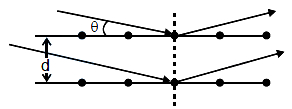
$X$-rays of wavelength $\lambda$ are reflected from parallel planes of atoms in a crystal with spacing $d$ between two planes,as shown in the figure. If the two reflected beams interfere constructively,then the condition for maxima will be (where $n$ is the order of the interference fringe):
A
$d \tan \theta = n \lambda$
B
$d \sin \theta = n \lambda$
C
$2 d \cos \theta = n \lambda$
D
$2 d \sin \theta = n \lambda$
Solution
(D) When $X$-rays are incident on parallel atomic planes with spacing $d$ at a glancing angle $\theta$,the path difference between the rays reflected from successive planes is given by $\Delta x = 2 d \sin \theta$.
For constructive interference (maxima),the path difference must be an integer multiple of the wavelength $\lambda$.
Therefore,the condition for maxima is $2 d \sin \theta = n \lambda$,where $n = 1, 2, 3, \dots$ is the order of the interference fringe. This is known as Bragg's Law.
For constructive interference (maxima),the path difference must be an integer multiple of the wavelength $\lambda$.
Therefore,the condition for maxima is $2 d \sin \theta = n \lambda$,where $n = 1, 2, 3, \dots$ is the order of the interference fringe. This is known as Bragg's Law.
0 likes
View SolutionAtoms — X-Rays · Frequently Asked Questions
1Are these Atoms questions useful for JEE and NEET?
Yes. All questions in this section are mapped to JEE Main and NEET exam patterns. Previous year questions from JEE Main, NEET, GUJCET and state-level exams are included with full solutions.
2Can I switch to Hindi or Gujarati for these questions?
Yes. Use the language tabs in the hero section or the sidebar to view the same questions and solutions in English, Hindi or Gujarati.
3How do I generate a question paper from this subtopic?
Use the Vedclass Exam Paper Generator — select the chapter and subtopic, set difficulty, and generate Sets A, B, C, D automatically. First 3 chapters of every subject are free.
Vedclass Products
For Students
Vedclass Test Series
Mock tests in real JEE/NEET style with performance analysis. 5-day free trial.
Start Free TrialFor Teachers
Exam Paper Generator
Generate Set A/B/C/D papers from this chapter in 2 minutes. 3 chapters free.
Try FreeFor Institutes
Online Exam Module
Live online exams with unlimited students, 360° analytics & white-label branding.
See DemoFor Teachers & Institutes
Generate a Atoms Exam Paper in 2 Minutes
Select subtopic & difficulty — Sets A, B, C, D auto-generated with No Repeat logic.
First 3 chapters of every subject are free — no payment required.