
A English
Mix Examples of Solutions Questions in English
Class 12 Chemistry · Solutions · Mix Examples of Solutions
153+
Questions
English
Language
100%
With Solutions
Showing 50 of 153 questions in English
101
AdvancedMCQ
Properties such as boiling point,freezing point,and vapour pressure of a pure solvent change when solute molecules are added to get a homogeneous solution. These are called colligative properties. Applications of colligative properties are very useful in day-to-day life. One of its examples is the use of an ethylene glycol and water mixture as an anti-freezing liquid in the radiator of automobiles.
$A$ solution $M$ is prepared by mixing ethanol and water. The mole fraction of ethanol in the mixture is $0.9$.
Given: Freezing point depression constant of water $(K_{f}^{\text{water}}) = 1.86 \ K \ kg \ mol^{-1}$
Freezing point depression constant of ethanol $(K_{f}^{\text{ethanol}}) = 2.0 \ K \ kg \ mol^{-1}$
Boiling point elevation constant of water $(K_{b}^{\text{water}}) = 0.52 \ K \ kg \ mol^{-1}$
Boiling point elevation constant of ethanol $(K_{b}^{\text{ethanol}}) = 1.2 \ K \ kg \ mol^{-1}$
Standard freezing point of water $= 273 \ K$
Standard freezing point of ethanol $= 155.7 \ K$
Standard boiling point of water $= 373 \ K$
Standard boiling point of ethanol $= 351.5 \ K$
Vapour pressure of pure water $= 32.8 \ mm \ Hg$
Vapour pressure of pure ethanol $= 40 \ mm \ Hg$
Molecular weight of water $= 18 \ g \ mol^{-1}$
Molecular weight of ethanol $= 46 \ g \ mol^{-1}$
In answering the following questions,consider the solutions to be ideal dilute solutions and solutes to be non-volatile and non-dissociative.
$1.$ The freezing point of the solution $M$ is
$(A) \ 268.7 \ K \ (B) \ 268.5 \ K$
$(C) \ 234.2 \ K \ (D) \ 150.9 \ K$
$2.$ The vapour pressure of the solution $M$ is
$(A) \ 39.3 \ mm \ Hg \ (B) \ 36.0 \ mm \ Hg$
$(C) \ 29.5 \ mm \ Hg \ (D) \ 28.8 \ mm \ Hg$
$3.$ Water is added to the solution $M$ such that the mole fraction of water in the solution becomes $0.9$. The boiling point of this solution is
$(A) \ 380.4 \ K \ (B) \ 376.2 \ K$
$(C) \ 375.5 \ K \ (D) \ 354.7 \ K$
Give the answer for questions $1, 2$ and $3.$
$A$ solution $M$ is prepared by mixing ethanol and water. The mole fraction of ethanol in the mixture is $0.9$.
Given: Freezing point depression constant of water $(K_{f}^{\text{water}}) = 1.86 \ K \ kg \ mol^{-1}$
Freezing point depression constant of ethanol $(K_{f}^{\text{ethanol}}) = 2.0 \ K \ kg \ mol^{-1}$
Boiling point elevation constant of water $(K_{b}^{\text{water}}) = 0.52 \ K \ kg \ mol^{-1}$
Boiling point elevation constant of ethanol $(K_{b}^{\text{ethanol}}) = 1.2 \ K \ kg \ mol^{-1}$
Standard freezing point of water $= 273 \ K$
Standard freezing point of ethanol $= 155.7 \ K$
Standard boiling point of water $= 373 \ K$
Standard boiling point of ethanol $= 351.5 \ K$
Vapour pressure of pure water $= 32.8 \ mm \ Hg$
Vapour pressure of pure ethanol $= 40 \ mm \ Hg$
Molecular weight of water $= 18 \ g \ mol^{-1}$
Molecular weight of ethanol $= 46 \ g \ mol^{-1}$
In answering the following questions,consider the solutions to be ideal dilute solutions and solutes to be non-volatile and non-dissociative.
$1.$ The freezing point of the solution $M$ is
$(A) \ 268.7 \ K \ (B) \ 268.5 \ K$
$(C) \ 234.2 \ K \ (D) \ 150.9 \ K$
$2.$ The vapour pressure of the solution $M$ is
$(A) \ 39.3 \ mm \ Hg \ (B) \ 36.0 \ mm \ Hg$
$(C) \ 29.5 \ mm \ Hg \ (D) \ 28.8 \ mm \ Hg$
$3.$ Water is added to the solution $M$ such that the mole fraction of water in the solution becomes $0.9$. The boiling point of this solution is
$(A) \ 380.4 \ K \ (B) \ 376.2 \ K$
$(C) \ 375.5 \ K \ (D) \ 354.7 \ K$
Give the answer for questions $1, 2$ and $3.$
A
$(D, B, B)$
B
$(D, B, C)$
C
$(A, B, C)$
D
$(D, C, C)$
Solution
(A) $1.$ In solution $M$,ethanol is the solvent ($X_{\text{ethanol}} = 0.9$,$X_{\text{water}} = 0.1$).
$\Delta T_{f} = K_{f}^{\text{ethanol}} \times m = 2.0 \times \frac{0.1 \times 1000}{0.9 \times 46} = 4.83 \ K$.
Freezing point $= 155.7 - 4.83 = 150.87 \ K \approx 150.9 \ K$.
$2.$ According to Raoult's Law,$P_{\text{total}} = X_{\text{ethanol}} \times P^{\circ}_{\text{ethanol}} + X_{\text{water}} \times P^{\circ}_{\text{water}}$.
$P = (0.9 \times 40) + (0.1 \times 32.8) = 36 + 3.28 = 39.28 \ mm \ Hg \approx 39.3 \ mm \ Hg$.
$3.$ After adding water,$X_{\text{water}} = 0.9$,so $X_{\text{ethanol}} = 0.1$. Now water is the solvent.
$\Delta T_{b} = K_{b}^{\text{water}} \times m = 0.52 \times \frac{0.1 \times 1000}{0.9 \times 18} = 3.21 \ K$.
Boiling point $= 373 + 3.21 = 376.21 \ K \approx 376.2 \ K$.
$\Delta T_{f} = K_{f}^{\text{ethanol}} \times m = 2.0 \times \frac{0.1 \times 1000}{0.9 \times 46} = 4.83 \ K$.
Freezing point $= 155.7 - 4.83 = 150.87 \ K \approx 150.9 \ K$.
$2.$ According to Raoult's Law,$P_{\text{total}} = X_{\text{ethanol}} \times P^{\circ}_{\text{ethanol}} + X_{\text{water}} \times P^{\circ}_{\text{water}}$.
$P = (0.9 \times 40) + (0.1 \times 32.8) = 36 + 3.28 = 39.28 \ mm \ Hg \approx 39.3 \ mm \ Hg$.
$3.$ After adding water,$X_{\text{water}} = 0.9$,so $X_{\text{ethanol}} = 0.1$. Now water is the solvent.
$\Delta T_{b} = K_{b}^{\text{water}} \times m = 0.52 \times \frac{0.1 \times 1000}{0.9 \times 18} = 3.21 \ K$.
Boiling point $= 373 + 3.21 = 376.21 \ K \approx 376.2 \ K$.
0 likes
View Solution102
MediumMCQ
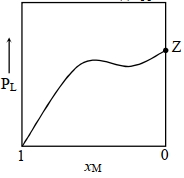
For a solution formed by mixing liquids $L$ and $M$,the vapour pressure of $L$ plotted against the mole fraction of $M$ in solution is shown in the following figure. Here $x_L$ and $x_M$ represent mole fractions of $L$ and $M$,respectively,in the solution. The correct statement$(s)$ applicable to this system is(are)
$A$. Attractive intermolecular interactions between $L-L$ in pure liquid $L$ and $M-M$ in pure liquid $M$ are stronger than those between $L-M$ when mixed in solution
$B$. The point $Z$ represents vapour pressure of pure liquid $M$ and Raoult's law is obeyed when $x_L \rightarrow 0$
$C$. The point $Z$ represents vapour pressure of pure liquid $L$ and Raoult's law is obeyed when $x_L \rightarrow 1$
$D$. The point $Z$ represents vapour pressure of pure liquid $M$ and Raoult's law is obeyed from $x_L=0$ to $x_L=1$
$A$. Attractive intermolecular interactions between $L-L$ in pure liquid $L$ and $M-M$ in pure liquid $M$ are stronger than those between $L-M$ when mixed in solution
$B$. The point $Z$ represents vapour pressure of pure liquid $M$ and Raoult's law is obeyed when $x_L \rightarrow 0$
$C$. The point $Z$ represents vapour pressure of pure liquid $L$ and Raoult's law is obeyed when $x_L \rightarrow 1$
$D$. The point $Z$ represents vapour pressure of pure liquid $M$ and Raoult's law is obeyed from $x_L=0$ to $x_L=1$
A
$A, C$
B
$A, B$
C
$A, D$
D
$A, C, D$
Solution
(A) The graph plots the partial vapour pressure of $L$ $(P_L)$ against the mole fraction of $M$ $(x_M)$.
At $x_M = 0$,$x_L = 1$,which corresponds to pure liquid $L$. The point $Z$ is at $x_M = 0$,so $Z$ represents the vapour pressure of pure liquid $L$ $(P_L^0)$. Thus,statement $C$ is correct.
As $x_M$ increases from $0$ to $1$,$x_L$ decreases from $1$ to $0$. The curve shows a positive deviation from Raoult's law because the observed vapour pressure is higher than the ideal straight line.
Positive deviation occurs when $L-M$ interactions are weaker than $L-L$ and $M-M$ interactions. Thus,statement $A$ is correct.
Raoult's law is obeyed as the solution approaches the pure state (i.e.,$x_L \rightarrow 1$ or $x_M \rightarrow 0$). Therefore,statement $C$ is correct.
At $x_M = 0$,$x_L = 1$,which corresponds to pure liquid $L$. The point $Z$ is at $x_M = 0$,so $Z$ represents the vapour pressure of pure liquid $L$ $(P_L^0)$. Thus,statement $C$ is correct.
As $x_M$ increases from $0$ to $1$,$x_L$ decreases from $1$ to $0$. The curve shows a positive deviation from Raoult's law because the observed vapour pressure is higher than the ideal straight line.
Positive deviation occurs when $L-M$ interactions are weaker than $L-L$ and $M-M$ interactions. Thus,statement $A$ is correct.
Raoult's law is obeyed as the solution approaches the pure state (i.e.,$x_L \rightarrow 1$ or $x_M \rightarrow 0$). Therefore,statement $C$ is correct.
0 likes
View Solution103
EasyMCQ
On dissolving $0.5 \ g$ of a non-volatile non-ionic solute to $39 \ g$ of benzene,its vapor pressure decreases from $650 \ mm \ Hg$ to $640 \ mm \ Hg$. The depression of freezing point of benzene (in $K$) upon addition of the solute is. . . . .
(Given data : Molar mass and the molal freezing point depression constant of benzene are $78 \ g \ mol^{-1}$ and $5.12 \ K \ kg \ mol^{-1}$,respectively)
(Given data : Molar mass and the molal freezing point depression constant of benzene are $78 \ g \ mol^{-1}$ and $5.12 \ K \ kg \ mol^{-1}$,respectively)
A
$1.01$
B
$1.02$
C
$1.03$
D
$1.04$
Solution
(A) According to Raoult's law for relative lowering of vapor pressure:
$\frac{P^{\circ} - P_s}{P^{\circ}} = \frac{n_2}{n_1 + n_2} \approx \frac{n_2}{n_1}$
Given: $P^{\circ} = 650 \ mm \ Hg$,$P_s = 640 \ mm \ Hg$,$W_2 = 0.5 \ g$,$W_1 = 39 \ g$,$M_1 = 78 \ g \ mol^{-1}$,$K_f = 5.12 \ K \ kg \ mol^{-1}$.
$\frac{650 - 640}{650} = \frac{0.5 / M_2}{39 / 78} = \frac{0.5 / M_2}{0.5} = \frac{1}{M_2}$
$\frac{10}{650} = \frac{1}{M_2} \implies M_2 = 65 \ g \ mol^{-1}$.
Now,calculate molality $(m)$:
$m = \frac{W_2 \times 1000}{M_2 \times W_1} = \frac{0.5 \times 1000}{65 \times 39} \approx 0.197 \ mol \ kg^{-1}$.
Depression in freezing point $\Delta T_f = K_f \times m = 5.12 \times 0.197 \approx 1.01 \ K$.
$\frac{P^{\circ} - P_s}{P^{\circ}} = \frac{n_2}{n_1 + n_2} \approx \frac{n_2}{n_1}$
Given: $P^{\circ} = 650 \ mm \ Hg$,$P_s = 640 \ mm \ Hg$,$W_2 = 0.5 \ g$,$W_1 = 39 \ g$,$M_1 = 78 \ g \ mol^{-1}$,$K_f = 5.12 \ K \ kg \ mol^{-1}$.
$\frac{650 - 640}{650} = \frac{0.5 / M_2}{39 / 78} = \frac{0.5 / M_2}{0.5} = \frac{1}{M_2}$
$\frac{10}{650} = \frac{1}{M_2} \implies M_2 = 65 \ g \ mol^{-1}$.
Now,calculate molality $(m)$:
$m = \frac{W_2 \times 1000}{M_2 \times W_1} = \frac{0.5 \times 1000}{65 \times 39} \approx 0.197 \ mol \ kg^{-1}$.
Depression in freezing point $\Delta T_f = K_f \times m = 5.12 \times 0.197 \approx 1.01 \ K$.
0 likes
View Solution104
AdvancedMCQ
The boiling point of water in a $0.1 \ m$ molal silver nitrate solution (solution $A$) is $x \ ^{\circ}C$. To this solution $A$,an equal volume of $0.1 \ m$ molal aqueous barium chloride solution is added to make a new solution $B$. The difference in the boiling points of water in the two solutions $A$ and $B$ is $y \times 10^{-2} \ ^{\circ}C$. (Assume: Densities of the solutions $A$ and $B$ are the same as that of water and the soluble salts dissociate completely. Use: Molal elevation constant,$K_b = 0.5 \ K \ kg \ mol^{-1}$; Boiling point of pure water as $100 \ ^{\circ}C$.) $(1)$ The value of $x$ is $(2)$ The value of $|y|$ is
A
$100.1, 2.50$
B
$101, 2.55$
C
$102, 2.60$
D
$103, 2.66$
Solution
(A) $(1)$ For $0.1 \ m$ $AgNO_3$ solution,the van't Hoff factor $i = 2$. The elevation in boiling point is $\Delta T_b = i \times K_b \times m = 2 \times 0.5 \times 0.1 = 0.1 \ ^{\circ}C$. Thus,the boiling point of solution $A$ is $x = 100 + 0.1 = 100.1 \ ^{\circ}C$.
$(2)$ Upon mixing equal volumes of $0.1 \ m$ $AgNO_3$ and $0.1 \ m$ $BaCl_2$,the concentration of each solute becomes $0.05 \ m$. The reaction is $Ag^+_{(aq)} + Cl^-_{(aq)} \rightarrow AgCl_{(s)}$. After precipitation,the remaining ions in solution $B$ are $NO_3^-$ $(0.05 \ m)$,$Ba^{2+}$ $(0.05 \ m)$,and $Cl^-$ $(0.1 - 0.05 = 0.05 \ m)$. The total molality of ions is $0.05 + 0.05 + 0.05 = 0.15 \ m$. The elevation in boiling point is $\Delta T_b = K_b \times \sum m_{ions} = 0.5 \times 0.15 = 0.075 \ ^{\circ}C$. The boiling point of solution $B$ is $100.075 \ ^{\circ}C$. The difference is $100.1 - 100.075 = 0.025 \ ^{\circ}C = 2.5 \times 10^{-2} \ ^{\circ}C$. Therefore,$|y| = 2.5$.
$(2)$ Upon mixing equal volumes of $0.1 \ m$ $AgNO_3$ and $0.1 \ m$ $BaCl_2$,the concentration of each solute becomes $0.05 \ m$. The reaction is $Ag^+_{(aq)} + Cl^-_{(aq)} \rightarrow AgCl_{(s)}$. After precipitation,the remaining ions in solution $B$ are $NO_3^-$ $(0.05 \ m)$,$Ba^{2+}$ $(0.05 \ m)$,and $Cl^-$ $(0.1 - 0.05 = 0.05 \ m)$. The total molality of ions is $0.05 + 0.05 + 0.05 = 0.15 \ m$. The elevation in boiling point is $\Delta T_b = K_b \times \sum m_{ions} = 0.5 \times 0.15 = 0.075 \ ^{\circ}C$. The boiling point of solution $B$ is $100.075 \ ^{\circ}C$. The difference is $100.1 - 100.075 = 0.025 \ ^{\circ}C = 2.5 \times 10^{-2} \ ^{\circ}C$. Therefore,$|y| = 2.5$.
0 likes
View Solution105
DifficultMCQ
For a dilute solution containing $2.5 \ g$ of a non-volatile non-electrolyte solute in $100 \ g$ of water,the elevation in boiling point at $1 \ atm$ pressure is $2^{\circ} C$. Assuming the concentration of solute is much lower than the concentration of solvent,the vapour pressure ($mm$ of $Hg$) of the solution is (take $K_{b}=0.76 \ K \ kg \ mol^{-1}$)
A
$724$
B
$740$
C
$736$
D
$718$
Solution
(A) Given: $\Delta T_{b} = 2^{\circ} C$,$w_{solute} = 2.5 \ g$,$w_{solvent} = 100 \ g$,$K_{b} = 0.76 \ K \ kg \ mol^{-1}$.
Using $\Delta T_{b} = K_{b} \times m$,we get $2 = 0.76 \times m$,so $m = \frac{2}{0.76} \ mol \ kg^{-1}$.
For a dilute solution,the relative lowering of vapour pressure is given by $\frac{P^{0}-P}{P} = m \times M_{solvent} \times 10^{-3}$,where $P^{0} = 760 \ mm \ Hg$ and $M_{solvent} = 18 \ g \ mol^{-1}$.
$\frac{760-P}{P} = \frac{2}{0.76} \times 18 \times 10^{-3} = \frac{36}{760} \approx 0.04737$.
$760 - P = 0.04737 P \implies 760 = 1.04737 P$.
$P = \frac{760}{1.04737} \approx 725.6 \ mm \ Hg$.
Rounding to the nearest provided option,$P \approx 724 \ mm \ Hg$.
Using $\Delta T_{b} = K_{b} \times m$,we get $2 = 0.76 \times m$,so $m = \frac{2}{0.76} \ mol \ kg^{-1}$.
For a dilute solution,the relative lowering of vapour pressure is given by $\frac{P^{0}-P}{P} = m \times M_{solvent} \times 10^{-3}$,where $P^{0} = 760 \ mm \ Hg$ and $M_{solvent} = 18 \ g \ mol^{-1}$.
$\frac{760-P}{P} = \frac{2}{0.76} \times 18 \times 10^{-3} = \frac{36}{760} \approx 0.04737$.
$760 - P = 0.04737 P \implies 760 = 1.04737 P$.
$P = \frac{760}{1.04737} \approx 725.6 \ mm \ Hg$.
Rounding to the nearest provided option,$P \approx 724 \ mm \ Hg$.
0 likes
View Solution106
MediumMCQ
Benzene and naphthalene form an ideal solution at room temperature. For this process,the true statement$(s)$ is (are)
$(A)$ $\Delta G$ is positive
$(B)$ $\Delta S_{\text{system}}$ is positive
$(C)$ $\Delta S_{\text{surroundings}} = 0$
$(D)$ $\Delta H = 0$
$(A)$ $\Delta G$ is positive
$(B)$ $\Delta S_{\text{system}}$ is positive
$(C)$ $\Delta S_{\text{surroundings}} = 0$
$(D)$ $\Delta H = 0$
A
$(A, B, C)$
B
$(A, B, D)$
C
$(A, C, D)$
D
$(B, C, D)$
Solution
(D) For the formation of an ideal solution:
$1$. $\Delta G < 0$ (The process is spontaneous).
$2$. $\Delta S_{\text{system}} > 0$ (Mixing increases the entropy of the system).
$3$. $\Delta H = 0$ (There is no enthalpy change upon mixing for an ideal solution).
$4$. $\Delta S_{\text{surroundings}} = -\frac{\Delta H}{T}$. Since $\Delta H = 0$,$\Delta S_{\text{surroundings}} = 0$.
Therefore,statements $(B)$,$(C)$,and $(D)$ are correct.
$1$. $\Delta G < 0$ (The process is spontaneous).
$2$. $\Delta S_{\text{system}} > 0$ (Mixing increases the entropy of the system).
$3$. $\Delta H = 0$ (There is no enthalpy change upon mixing for an ideal solution).
$4$. $\Delta S_{\text{surroundings}} = -\frac{\Delta H}{T}$. Since $\Delta H = 0$,$\Delta S_{\text{surroundings}} = 0$.
Therefore,statements $(B)$,$(C)$,and $(D)$ are correct.
0 likes
View Solution107
DifficultMCQ
$1.24 \ g$ of $AX_2$ (molar mass $124 \ g \ mol^{-1}$) is dissolved in $1 \ kg$ of water to form a solution with a boiling point of $100.0156^{\circ} C$,while $25.4 \ g$ of $AY_2$ (molar mass $250 \ g \ mol^{-1}$) in $2 \ kg$ of water constitutes a solution with a boiling point of $100.0260^{\circ} C$. $K_{b}(H_2O) = 0.52 \ K \ kg \ mol^{-1}$. Which of the following is correct?
A
$AX_2$ and $AY_2$ (both) are completely unionised.
B
$AX_2$ and $AY_2$ (both) are fully ionised.
C
$AX_2$ is completely unionised while $AY_2$ is fully ionised.
D
$AX_2$ is fully ionised while $AY_2$ is completely unionised.
Solution
(D) For $AX_2$: $\Delta T_{b} = K_{b} \times m \times i$
$0.0156 = 0.52 \times (1.24/124) \times i_{AX_2} = 0.52 \times 0.01 \times i_{AX_2}$
$i_{AX_2} = 0.0156 / 0.0052 = 3$. Since $AX_2 \rightarrow A^{2+} + 2X^-$,$i=3$ implies complete ionisation.
For $AY_2$: $\Delta T_{b} = K_{b} \times m \times i$
$0.026 = 0.52 \times (25.4/250) / 2 \times i_{AY_2} = 0.52 \times 0.0508 \times i_{AY_2}$
$i_{AY_2} = 0.026 / 0.026416 \approx 1$. This implies complete unionisation.
$0.0156 = 0.52 \times (1.24/124) \times i_{AX_2} = 0.52 \times 0.01 \times i_{AX_2}$
$i_{AX_2} = 0.0156 / 0.0052 = 3$. Since $AX_2 \rightarrow A^{2+} + 2X^-$,$i=3$ implies complete ionisation.
For $AY_2$: $\Delta T_{b} = K_{b} \times m \times i$
$0.026 = 0.52 \times (25.4/250) / 2 \times i_{AY_2} = 0.52 \times 0.0508 \times i_{AY_2}$
$i_{AY_2} = 0.026 / 0.026416 \approx 1$. This implies complete unionisation.
0 likes
View Solution108
MediumMCQ
When $1 \ g$ each of compounds $AB$ and $AB_2$ are dissolved in $15 \ g$ of water separately,they increase the boiling point of water by $2.7 \ K$ and $1.5 \ K$ respectively. The atomic mass of $A$ (in $amu$) is $........ \times 10^{-1}$ (Nearest integer). (Given: Molal boiling point elevation constant $K_b = 0.5 \ K \ kg \ mol^{-1}$)
A
$45$
B
$35$
C
$85$
D
$25$
Solution
(D) For $AB$: $\Delta T_b = K_b \times m \implies 2.7 = 0.5 \times \frac{1/M_{AB}}{15 \times 10^{-3}} \implies M_{AB} = \frac{0.5 \times 1000}{2.7 \times 15} = \frac{500}{40.5} \approx 12.34 \ g/mol$.
For $AB_2$: $\Delta T_b = K_b \times m \implies 1.5 = 0.5 \times \frac{1/M_{AB_2}}{15 \times 10^{-3}} \implies M_{AB_2} = \frac{0.5 \times 1000}{1.5 \times 15} = \frac{500}{22.5} \approx 22.22 \ g/mol$.
Let $A$ and $B$ be the atomic masses of elements $A$ and $B$.
$A + B = 12.34$ $(I)$
$A + 2B = 22.22$ $(II)$
Subtracting $(I)$ from $(II)$: $B = 22.22 - 12.34 = 9.88$.
Substituting $B$ in $(I)$: $A = 12.34 - 9.88 = 2.46$.
$A = 24.6 \times 10^{-1} \approx 25 \times 10^{-1}$.
Thus,the nearest integer is $25$.
For $AB_2$: $\Delta T_b = K_b \times m \implies 1.5 = 0.5 \times \frac{1/M_{AB_2}}{15 \times 10^{-3}} \implies M_{AB_2} = \frac{0.5 \times 1000}{1.5 \times 15} = \frac{500}{22.5} \approx 22.22 \ g/mol$.
Let $A$ and $B$ be the atomic masses of elements $A$ and $B$.
$A + B = 12.34$ $(I)$
$A + 2B = 22.22$ $(II)$
Subtracting $(I)$ from $(II)$: $B = 22.22 - 12.34 = 9.88$.
Substituting $B$ in $(I)$: $A = 12.34 - 9.88 = 2.46$.
$A = 24.6 \times 10^{-1} \approx 25 \times 10^{-1}$.
Thus,the nearest integer is $25$.
0 likes
View Solution109
DifficultMCQ
$2 \ \text{moles}$ each of ethylene glycol and glucose are dissolved in $500 \ \text{g}$ of water. The boiling point of the resulting solution is $:$ (Given $:$ Ebullioscopic constant of water $= 0.52 \ \text{K kg mol}^{-1}$) (in $\text{K}$)
A
$379.2$
B
$377.3$
C
$375.3$
D
$277.3$
Solution
(B) The elevation in boiling point is given by $\Delta T_b = i_1 \cdot m_1 \cdot K_b + i_2 \cdot m_2 \cdot K_b$.
Since both ethylene glycol and glucose are non-electrolytes,their van't Hoff factor $i = 1$.
The molality $m$ for each is $\frac{2 \ \text{mol}}{0.5 \ \text{kg}} = 4 \ \text{mol kg}^{-1}$.
$\Delta T_b = (1 \times 4 \times 0.52) + (1 \times 4 \times 0.52) = 2.08 + 2.08 = 4.16 \ \text{K}$.
The boiling point of pure water is $373.15 \ \text{K}$.
$(T_b)_{\text{solution}} = 373.15 + 4.16 = 377.31 \ \text{K} \approx 377.3 \ \text{K}$.
Since both ethylene glycol and glucose are non-electrolytes,their van't Hoff factor $i = 1$.
The molality $m$ for each is $\frac{2 \ \text{mol}}{0.5 \ \text{kg}} = 4 \ \text{mol kg}^{-1}$.
$\Delta T_b = (1 \times 4 \times 0.52) + (1 \times 4 \times 0.52) = 2.08 + 2.08 = 4.16 \ \text{K}$.
The boiling point of pure water is $373.15 \ \text{K}$.
$(T_b)_{\text{solution}} = 373.15 + 4.16 = 377.31 \ \text{K} \approx 377.3 \ \text{K}$.
0 likes
View Solution110
MediumMCQ
Match List-$I$ with List-$II$
Choose the correct answer from the options given below $:$
| List-$I$ | List-$II$ |
| $A$. Solution of chloroform and acetone | $I$. Minimum boiling azeotrope |
| $B$. Solution of ethanol and water | $II$. Dimerizes |
| $C$. Solution of benzene and toluene | $III$. Maximum boiling azeotrope |
| $D$. Solution of acetic acid in benzene | $IV$. $\Delta V_{mix}=0$ |
Choose the correct answer from the options given below $:$
A
$A-III, B-I, C-IV, D-II$
B
$A-II, B-IV, C-I, D-III$
C
$A-III, B-IV, C-I, D-II$
D
$A-II, B-I, C-IV, D-III$
Solution
(A) . The solution of chloroform and acetone shows negative deviation from Raoult's law,resulting in a maximum boiling azeotrope $(A-III)$.
$B$. The solution of ethanol and water shows positive deviation from Raoult's law,resulting in a minimum boiling azeotrope $(B-I)$.
$C$. The solution of benzene and toluene forms an ideal solution,which follows $\Delta V_{mix} = 0$ $(C-IV)$.
$D$. Acetic acid in benzene undergoes hydrogen bonding to form a dimer $(D-II)$.
Therefore,the correct matching is $A-III, B-I, C-IV, D-II$.
$B$. The solution of ethanol and water shows positive deviation from Raoult's law,resulting in a minimum boiling azeotrope $(B-I)$.
$C$. The solution of benzene and toluene forms an ideal solution,which follows $\Delta V_{mix} = 0$ $(C-IV)$.
$D$. Acetic acid in benzene undergoes hydrogen bonding to form a dimer $(D-II)$.
Therefore,the correct matching is $A-III, B-I, C-IV, D-II$.
0 likes
View Solution111
MediumMCQ
$A$ liquid freezes at $7^{\circ} C$ and boils at $77^{\circ} C$. If $K_{f}$ and $K_{b}$ values for the liquid are $5.6$ and $2.5 \ ^{\circ} C \ kg \ mol^{-1}$ respectively,then the ratio of latent heat of vaporisation of the liquid to the latent heat of fusion is $:-$
A
$1: 1$
B
$3: 1$
C
$7: 2$
D
$2: 7$
Solution
(C) The relationship between latent heat and cryoscopic/ebullioscopic constants is given by the formulas: $K_f = \frac{R(T_f^o)^2}{1000 \ L_f}$ and $K_b = \frac{R(T_b^o)^2}{1000 \ L_v}$.
Dividing the two expressions,we get: $\frac{L_v}{L_f} = \frac{(T_b^o)^2 \times K_f}{(T_f^o)^2 \times K_b}$.
Given $T_f^o = 7 + 273 = 280 \ K$ and $T_b^o = 77 + 273 = 350 \ K$.
Substituting the values: $\frac{L_v}{L_f} = \frac{(350)^2 \times 5.6}{(280)^2 \times 2.5} = \left( \frac{350}{280} \right)^2 \times \frac{5.6}{2.5} = \left( \frac{5}{4} \right)^2 \times 2.24 = \frac{25}{16} \times 2.24 = 1.5625 \times 2.24 = 3.5$.
Thus,the ratio is $3.5:1$,which is equivalent to $7:2$.
Dividing the two expressions,we get: $\frac{L_v}{L_f} = \frac{(T_b^o)^2 \times K_f}{(T_f^o)^2 \times K_b}$.
Given $T_f^o = 7 + 273 = 280 \ K$ and $T_b^o = 77 + 273 = 350 \ K$.
Substituting the values: $\frac{L_v}{L_f} = \frac{(350)^2 \times 5.6}{(280)^2 \times 2.5} = \left( \frac{350}{280} \right)^2 \times \frac{5.6}{2.5} = \left( \frac{5}{4} \right)^2 \times 2.24 = \frac{25}{16} \times 2.24 = 1.5625 \times 2.24 = 3.5$.
Thus,the ratio is $3.5:1$,which is equivalent to $7:2$.
0 likes
View Solution112
EasyMCQ
Identify an example of a solution that consists of a solid as the solute and a liquid as the solvent.
A
Sea water
B
Sugar in water
C
Carbonated water
D
Chloroform in nitrogen
Solution
(B) solution of a solid solute in a liquid solvent is a common type of solution.
In the given options,$A$ (Sea water) is a solution of salt (solid) in water (liquid).
$B$ (Sugar in water) is also a solid in liquid solution.
$C$ (Carbonated water) is a gas in liquid solution.
$D$ (Chloroform in nitrogen) is a liquid in gas solution.
Since the question asks for a solid in liquid solution,both $A$ and $B$ fit the criteria. However,$B$ is the most standard textbook example.
In the given options,$A$ (Sea water) is a solution of salt (solid) in water (liquid).
$B$ (Sugar in water) is also a solid in liquid solution.
$C$ (Carbonated water) is a gas in liquid solution.
$D$ (Chloroform in nitrogen) is a liquid in gas solution.
Since the question asks for a solid in liquid solution,both $A$ and $B$ fit the criteria. However,$B$ is the most standard textbook example.
0 likes
View Solution113
EasyMCQ
What type of solution is iodine in air?
A
Liquid in solid
B
Solid in gas
C
Solid in liquid
D
Liquid in gas
Solution
(B) solution of iodine in air is an example of a solid dispersed in a gas. Iodine is a solid at room temperature and it undergoes sublimation to form iodine vapor,which is a gas. Therefore,it is a solid in gas type of solution.
0 likes
View Solution114
EasyMCQ
Identify the false statement from the following.
A
The boiling point of a solution containing a non-volatile solute is always higher than that of the pure solvent.
B
At any temperature,the vapour pressure of a solution containing a non-volatile solute is lower than that of the pure solvent.
C
The boiling point of a liquid is the temperature at which its vapour pressure equals atmospheric pressure.
D
The molal elevation constant is the boiling point elevation produced by a $1$ molal solution.
Solution
(D) The molal elevation constant $(K_b)$ is defined as the elevation in boiling point produced by a $1$ molal solution (i.e.,$1 \ mol$ of solute dissolved in $1 \ kg$ of solvent). Option $D$ states '$1$ molar solution',which is incorrect because molarity depends on temperature,whereas molality is used for boiling point elevation.
0 likes
View Solution115
MediumMCQ
Identify the correct statement from the following properties.
A
Osmosis is a colligative property.
B
The vapour pressure of a solution containing a non-volatile solute is lower than that of the pure solvent at any given temperature.
C
The osmotic pressure of $0.1 \ M$ $NaCl$ solution is lower than $0.1 \ M$ sucrose solution.
D
The boiling point of a solution containing a non-volatile solute is lower than that of the pure solvent.
Solution
(B) Osmotic pressure is a colligative property,not osmosis itself. Thus,statement $A$ is incorrect.The vapour pressure of a solution containing a non-volatile solute is lower than that of the pure solvent due to the decrease in the number of solvent molecules at the surface. Thus,statement $B$ is correct.Osmotic pressure is a colligative property dependent on the number of particles. $NaCl$ dissociates into $2$ ions ($Na^+$ and $Cl^-$),while sucrose does not dissociate. Therefore,the osmotic pressure of $0.1 \ M$ $NaCl$ is higher than $0.1 \ M$ sucrose. Thus,statement $C$ is incorrect.The boiling point of a solution containing a non-volatile solute is higher than that of the pure solvent (elevation in boiling point). Thus,statement $D$ is incorrect.
0 likes
View Solution116
EasyMCQ
An amalgam of mercury with sodium is an example of:
A
solid in liquid solution
B
solid in solid solution
C
liquid in liquid solution
D
liquid in solid solution
Solution
(D) An amalgam is a mixture of mercury $(Hg)$ with another metal. In the case of sodium amalgam $(Na-Hg)$,sodium $(Na)$ is the solid solvent and mercury $(Hg)$ is the liquid solute. Therefore,it is an example of a liquid in solid solution.
0 likes
View Solution117
EasyMCQ
The osmotic pressure of a $0.5 \ M$ aqueous solution of $CH_3COOH$ having a $pH$ of $2$ at temperature $T$ is . . . . . . . (in $RT$)
A
$0.51$
B
$1.02$
C
$0.051$
D
$0.102$
Solution
(A) The osmotic pressure $\pi$ is given by the formula $\pi = iCRT$,where $i$ is the van't Hoff factor,$C$ is the molar concentration,$R$ is the gas constant,and $T$ is the temperature.
For $CH_3COOH \rightleftharpoons CH_3COO^- + H^+$,the degree of dissociation $\alpha$ is related to $[H^+]$.
Given $pH = 2$,so $[H^+] = 10^{-pH} = 10^{-2} = 0.01 \ M$.
Since $[H^+] = C \alpha$,we have $0.01 = 0.5 \times \alpha$,which gives $\alpha = 0.01 / 0.5 = 0.02$.
The van't Hoff factor $i = 1 + \alpha = 1 + 0.02 = 1.02$.
Substituting the values into the osmotic pressure formula: $\pi = 1.02 \times 0.5 \times RT = 0.51 \ RT$.
For $CH_3COOH \rightleftharpoons CH_3COO^- + H^+$,the degree of dissociation $\alpha$ is related to $[H^+]$.
Given $pH = 2$,so $[H^+] = 10^{-pH} = 10^{-2} = 0.01 \ M$.
Since $[H^+] = C \alpha$,we have $0.01 = 0.5 \times \alpha$,which gives $\alpha = 0.01 / 0.5 = 0.02$.
The van't Hoff factor $i = 1 + \alpha = 1 + 0.02 = 1.02$.
Substituting the values into the osmotic pressure formula: $\pi = 1.02 \times 0.5 \times RT = 0.51 \ RT$.
0 likes
View Solution118
EasyMCQ
In which solution,solute is liquid and solvent is gas?
A
Chloroform mixed with nitrogen gas
B
Ethanol dissolved in water
C
Camphor in nitrogen gas
D
Solution of hydrogen in palladium
Solution
(A) solution where the solute is a liquid and the solvent is a gas is known as a liquid-in-gas solution.
Chloroform $(CHCl_3)$ is a liquid at room temperature,and nitrogen gas $(N_2)$ acts as the solvent.
Therefore,chloroform mixed with nitrogen gas is an example of a liquid-in-gas solution.
Chloroform $(CHCl_3)$ is a liquid at room temperature,and nitrogen gas $(N_2)$ acts as the solvent.
Therefore,chloroform mixed with nitrogen gas is an example of a liquid-in-gas solution.
0 likes
View Solution119
EasyMCQ
In a mixture of camphor in nitrogen gas,the physical states of the solute and the solvent are,respectively:
A
$gas, solid$
B
$solid, gas$
C
$solid, solid$
D
$gas, gas$
Solution
(B) solution is a homogeneous mixture of two or more components.
In this mixture,camphor is the solute (the substance being dissolved) and nitrogen gas is the solvent (the substance in which the solute is dissolved).
Camphor is a $solid$ at room temperature,and nitrogen is a $gas$.
Therefore,the physical state of the solute is $solid$ and the solvent is $gas$.
In this mixture,camphor is the solute (the substance being dissolved) and nitrogen gas is the solvent (the substance in which the solute is dissolved).
Camphor is a $solid$ at room temperature,and nitrogen is a $gas$.
Therefore,the physical state of the solute is $solid$ and the solvent is $gas$.
0 likes
View Solution120
DifficultMCQ
After adding a non-volatile solute, the freezing point of water decreases to $-0.186^{\circ} C$. Calculate $\Delta T_b$ if $K_f = 1.86 \text{ K kg mol}^{-1}$ and $K_b = 0.521 \text{ K kg mol}^{-1}$. (in $\text{ K}$)
A
$0.521$
B
$0.0521$
C
$1.86$
D
$0.0186$
Solution
(B) Given:
Freezing point of solution $(T_f)$ = $-0.186^{\circ} C$
Freezing point of pure water $(T_f^{\circ})$ = $0^{\circ} C$
$\Delta T_f = T_f^{\circ} - T_f = 0 - (-0.186) = 0.186 \text{ K}$
We know that $\Delta T_f = K_f \cdot m$ and $\Delta T_b = K_b \cdot m$
Dividing the two equations: $\frac{\Delta T_b}{\Delta T_f} = \frac{K_b}{K_f}$
$\Delta T_b = \Delta T_f \times \frac{K_b}{K_f}$
$\Delta T_b = 0.186 \times \frac{0.521}{1.86} = 0.1 \times 0.521 = 0.0521 \text{ K}$.
Freezing point of solution $(T_f)$ = $-0.186^{\circ} C$
Freezing point of pure water $(T_f^{\circ})$ = $0^{\circ} C$
$\Delta T_f = T_f^{\circ} - T_f = 0 - (-0.186) = 0.186 \text{ K}$
We know that $\Delta T_f = K_f \cdot m$ and $\Delta T_b = K_b \cdot m$
Dividing the two equations: $\frac{\Delta T_b}{\Delta T_f} = \frac{K_b}{K_f}$
$\Delta T_b = \Delta T_f \times \frac{K_b}{K_f}$
$\Delta T_b = 0.186 \times \frac{0.521}{1.86} = 0.1 \times 0.521 = 0.0521 \text{ K}$.
0 likes
View Solution121
DifficultMCQ
$1 \ g$ of silver gets distributed between $10 \ cm^3$ of molten zinc and $100 \ cm^3$ of molten lead at $800^{\circ} C$. The percentage of silver in the zinc layer is approximately
A
$89$
B
$91$
C
$97$
D
$94$
Solution
(C) Let the mass of silver in the zinc layer be $x \ g$. Then the mass of silver in the lead layer is $(1-x) \ g$.
Given the distribution coefficient $K_D = \frac{C_{Zn}}{C_{Pb}} = 300$.
Concentration in zinc $C_{Zn} = \frac{x}{10} \ g/cm^3$.
Concentration in lead $C_{Pb} = \frac{1-x}{100} \ g/cm^3$.
Setting up the equation: $\frac{x/10}{(1-x)/100} = 300$.
$\frac{10x}{1-x} = 300$.
$10x = 300 - 300x$.
$310x = 300$.
$x = \frac{300}{310} \approx 0.9677$.
Thus,the percentage of silver in the zinc layer is approximately $97 \%$.
Given the distribution coefficient $K_D = \frac{C_{Zn}}{C_{Pb}} = 300$.
Concentration in zinc $C_{Zn} = \frac{x}{10} \ g/cm^3$.
Concentration in lead $C_{Pb} = \frac{1-x}{100} \ g/cm^3$.
Setting up the equation: $\frac{x/10}{(1-x)/100} = 300$.
$\frac{10x}{1-x} = 300$.
$10x = 300 - 300x$.
$310x = 300$.
$x = \frac{300}{310} \approx 0.9677$.
Thus,the percentage of silver in the zinc layer is approximately $97 \%$.
0 likes
View Solution122
MediumMCQ
At $T \ K$,the vapour pressure of pure benzene $(C_6H_6)$ and toluene $(C_7H_8)$ are $75 \ mm \ Hg$ and $22 \ mm \ Hg$ respectively. $23.4 \ g$ of benzene and $64.4 \ g$ of toluene are mixed to form an ideal solution. If the vapours are in equilibrium with the liquid mixture,the mole fraction of toluene in the vapour phase is (Atomic weight: $C=12, H=1$).
A
$0.406$
B
$0.594$
C
$0.539$
D
$0.461$
Solution
(A) $1$. Calculate moles of components:
$n_{\text{benzene}} = \frac{23.4 \ g}{78 \ g/mol} = 0.3 \ mol$
$n_{\text{toluene}} = \frac{64.4 \ g}{92 \ g/mol} = 0.7 \ mol$
$2$. Calculate mole fractions in liquid phase $(x)$:
$x_{\text{benzene}} = \frac{0.3}{0.3 + 0.7} = 0.3$
$x_{\text{toluene}} = \frac{0.7}{0.3 + 0.7} = 0.7$
$3$. Calculate partial pressures using Raoult's Law:
$P_{\text{benzene}} = x_{\text{benzene}} \times P^0_{\text{benzene}} = 0.3 \times 75 = 22.5 \ mm \ Hg$
$P_{\text{toluene}} = x_{\text{toluene}} \times P^0_{\text{toluene}} = 0.7 \times 22 = 15.4 \ mm \ Hg$
$4$. Calculate total pressure $(P_{\text{total}})$:
$P_{\text{total}} = 22.5 + 15.4 = 37.9 \ mm \ Hg$
$5$. Calculate mole fraction of toluene in vapour phase $(y_{\text{toluene}})$:
$y_{\text{toluene}} = \frac{P_{\text{toluene}}}{P_{\text{total}}} = \frac{15.4}{37.9} \approx 0.406$
$n_{\text{benzene}} = \frac{23.4 \ g}{78 \ g/mol} = 0.3 \ mol$
$n_{\text{toluene}} = \frac{64.4 \ g}{92 \ g/mol} = 0.7 \ mol$
$2$. Calculate mole fractions in liquid phase $(x)$:
$x_{\text{benzene}} = \frac{0.3}{0.3 + 0.7} = 0.3$
$x_{\text{toluene}} = \frac{0.7}{0.3 + 0.7} = 0.7$
$3$. Calculate partial pressures using Raoult's Law:
$P_{\text{benzene}} = x_{\text{benzene}} \times P^0_{\text{benzene}} = 0.3 \times 75 = 22.5 \ mm \ Hg$
$P_{\text{toluene}} = x_{\text{toluene}} \times P^0_{\text{toluene}} = 0.7 \times 22 = 15.4 \ mm \ Hg$
$4$. Calculate total pressure $(P_{\text{total}})$:
$P_{\text{total}} = 22.5 + 15.4 = 37.9 \ mm \ Hg$
$5$. Calculate mole fraction of toluene in vapour phase $(y_{\text{toluene}})$:
$y_{\text{toluene}} = \frac{P_{\text{toluene}}}{P_{\text{total}}} = \frac{15.4}{37.9} \approx 0.406$
0 likes
View Solution123
MediumMCQ
Given below are two statements.
Statement-$I$: Liquids $A$ and $B$ form a non-ideal solution with negative deviation. The interactions between $A$ and $B$ are weaker than $A-A$ and $B-B$ interactions.
Statement-$II$: In reverse osmosis,the applied pressure must be higher than the osmotic pressure of solution.
The correct answer is
Statement-$I$: Liquids $A$ and $B$ form a non-ideal solution with negative deviation. The interactions between $A$ and $B$ are weaker than $A-A$ and $B-B$ interactions.
Statement-$II$: In reverse osmosis,the applied pressure must be higher than the osmotic pressure of solution.
The correct answer is
A
Both Statement-$I$ and Statement-$II$ are correct
B
Both Statement-$I$ and Statement-$II$ are not correct
C
Statement-$I$ is correct but Statement-$II$ is not correct
D
Statement-$I$ is not correct but Statement-$II$ is correct
Solution
(D) In case of negative deviations from Raoult's law,the intermolecular attractive forces between $A-A$ and $B-B$ are weaker than those between $A-B$. This leads to a decrease in vapour pressure,resulting in negative deviations.
In reverse osmosis,the applied pressure must be higher than the osmotic pressure of the solution to force the solvent molecules to move from the solution to the pure solvent through a semi-permeable membrane.
Therefore,Statement-$I$ is incorrect and Statement-$II$ is correct.
In reverse osmosis,the applied pressure must be higher than the osmotic pressure of the solution to force the solvent molecules to move from the solution to the pure solvent through a semi-permeable membrane.
Therefore,Statement-$I$ is incorrect and Statement-$II$ is correct.
0 likes
View Solution124
MediumMCQ
$A$ solution is formed by the combination of two liquids such as dichloromethane and chloroform. The partial pressures of dichloromethane and chloroform in the solution are $285.5 \ mm \ Hg$ and $62.4 \ mm \ Hg$ respectively. What is the total pressure of the solution (in $mm \ Hg$)?
A
$223.1$
B
$347.9$
C
$357.9$
D
$337.9$
Solution
(B) According to Dalton's Law of partial pressures,the total pressure of a solution containing volatile components is the sum of their individual partial pressures.
$P_{total} = P_{dichloromethane} + P_{chloroform}$
$P_{total} = 285.5 \ mm \ Hg + 62.4 \ mm \ Hg$
$P_{total} = 347.9 \ mm \ Hg$
Therefore,the total pressure of the solution is $347.9 \ mm \ Hg$.
$P_{total} = P_{dichloromethane} + P_{chloroform}$
$P_{total} = 285.5 \ mm \ Hg + 62.4 \ mm \ Hg$
$P_{total} = 347.9 \ mm \ Hg$
Therefore,the total pressure of the solution is $347.9 \ mm \ Hg$.
0 likes
View Solution125
EasyMCQ
At $300 \ K$,an ideal solution is formed by mixing $460 \ g$ of toluene with $390 \ g$ of benzene. If the vapour pressure of pure toluene and pure benzene at $300 \ K$ are $32 \ mm$ and $40 \ mm$ respectively,the mole fraction of toluene in the vapour phase is:
A
$0.196$
B
$0.588$
C
$0.294$
D
$0.444$
Solution
(D) Given: Mass of toluene $(w_T) = 460 \ g$,Molar mass $(M_T) = 92 \ g/mol$.
Mass of benzene $(w_B) = 390 \ g$,Molar mass $(M_B) = 78 \ g/mol$.
Moles of toluene $(n_T) = \frac{460}{92} = 5 \ mol$.
Moles of benzene $(n_B) = \frac{390}{78} = 5 \ mol$.
Mole fraction of toluene $(\chi_T) = \frac{n_T}{n_T + n_B} = \frac{5}{5 + 5} = 0.5$.
Mole fraction of benzene $(\chi_B) = \frac{5}{5 + 5} = 0.5$.
Vapour pressure of pure toluene $(p^{\circ}_T) = 32 \ mm$,pure benzene $(p^{\circ}_B) = 40 \ mm$.
Total vapour pressure $(P_{total}) = p^{\circ}_T \chi_T + p^{\circ}_B \chi_B = (32 \times 0.5) + (40 \times 0.5) = 16 + 20 = 36 \ mm$.
Mole fraction of toluene in vapour phase $(Y_T) = \frac{p^{\circ}_T \chi_T}{P_{total}} = \frac{32 \times 0.5}{36} = \frac{16}{36} = 0.444$.
Mass of benzene $(w_B) = 390 \ g$,Molar mass $(M_B) = 78 \ g/mol$.
Moles of toluene $(n_T) = \frac{460}{92} = 5 \ mol$.
Moles of benzene $(n_B) = \frac{390}{78} = 5 \ mol$.
Mole fraction of toluene $(\chi_T) = \frac{n_T}{n_T + n_B} = \frac{5}{5 + 5} = 0.5$.
Mole fraction of benzene $(\chi_B) = \frac{5}{5 + 5} = 0.5$.
Vapour pressure of pure toluene $(p^{\circ}_T) = 32 \ mm$,pure benzene $(p^{\circ}_B) = 40 \ mm$.
Total vapour pressure $(P_{total}) = p^{\circ}_T \chi_T + p^{\circ}_B \chi_B = (32 \times 0.5) + (40 \times 0.5) = 16 + 20 = 36 \ mm$.
Mole fraction of toluene in vapour phase $(Y_T) = \frac{p^{\circ}_T \chi_T}{P_{total}} = \frac{32 \times 0.5}{36} = \frac{16}{36} = 0.444$.
0 likes
View Solution126
MediumMCQ
Match the following.
The correct answer is
| List-$I$ | List-$II$ |
|---|---|
| $(A)$ Azeotrope | $(I)$ $\Delta T_b = i K_b m$ |
| $(B)$ Henry's law | $(II)$ $p = K_H x$ |
| $(C)$ Cryoscopic constant | $(III)$ $\Delta T_f / m$ |
| $(D)$ Van't Hoff factor | $(IV)$ Deviation from Raoult's law |
| $(V)$ $\pi = CRT$ |
The correct answer is
A
$A-II, B-III, C-V, D-IV$
B
$A-IV, B-II, C-III, D-I$
C
$A-IV, B-II, C-I, D-III$
D
$A-I, B-III, C-II, D-IV$
Solution
(B) The correct matches are as follows:
$(A)$ Azeotrope: These are constant boiling mixtures that show significant deviation from Raoult's law. Thus,$(A-IV)$.
$(B)$ Henry's law: It states that the partial pressure of a gas is proportional to its mole fraction,$p = K_H x$. Thus,$(B-II)$.
$(C)$ Cryoscopic constant $(K_f)$: It is defined as the depression in freezing point per unit molality,$K_f = \Delta T_f / m$. Thus,$(C-III)$.
$(D)$ Van't Hoff factor $(i)$: It is used to calculate colligative properties for electrolytes,e.g.,$\Delta T_b = i K_b m$. Thus,$(D-I)$.
Therefore,the correct sequence is $(A-IV, B-II, C-III, D-I)$.
$(A)$ Azeotrope: These are constant boiling mixtures that show significant deviation from Raoult's law. Thus,$(A-IV)$.
$(B)$ Henry's law: It states that the partial pressure of a gas is proportional to its mole fraction,$p = K_H x$. Thus,$(B-II)$.
$(C)$ Cryoscopic constant $(K_f)$: It is defined as the depression in freezing point per unit molality,$K_f = \Delta T_f / m$. Thus,$(C-III)$.
$(D)$ Van't Hoff factor $(i)$: It is used to calculate colligative properties for electrolytes,e.g.,$\Delta T_b = i K_b m$. Thus,$(D-I)$.
Therefore,the correct sequence is $(A-IV, B-II, C-III, D-I)$.
0 likes
View Solution127
MediumMCQ
$A$ solution of urea in water has a boiling point of $100.18^{\circ} C$. What is the freezing point of the same solution,if $K_{f}$ and $K_{b}$ of water are $1.86$ and $0.52 \ K \ kg \ mol^{-1}$,respectively (in $^{\circ} C$)? (Boiling point of water $= 100^{\circ} C$ )
A
$-0.34$
B
$-0.22$
C
$-0.64$
D
$-0.32$
Solution
(C) The elevation in boiling point is given by $\Delta T_{b} = T_{b} - T_{b}^{\circ} = 100.18^{\circ} C - 100^{\circ} C = 0.18 \ K$.
Since $\Delta T_{b} = K_{b} \times m$,the molality $m = \frac{\Delta T_{b}}{K_{b}} = \frac{0.18}{0.52} \ mol \ kg^{-1}$.
The depression in freezing point is given by $\Delta T_{f} = K_{f} \times m$.
Substituting the value of $m$: $\Delta T_{f} = 1.86 \times \frac{0.18}{0.52} \approx 0.644 \ K$.
The freezing point of the solution is $T_{f} = T_{f}^{\circ} - \Delta T_{f} = 0^{\circ} C - 0.644^{\circ} C = -0.644^{\circ} C$.
Rounding to two decimal places,the freezing point is $-0.64^{\circ} C$.
Since $\Delta T_{b} = K_{b} \times m$,the molality $m = \frac{\Delta T_{b}}{K_{b}} = \frac{0.18}{0.52} \ mol \ kg^{-1}$.
The depression in freezing point is given by $\Delta T_{f} = K_{f} \times m$.
Substituting the value of $m$: $\Delta T_{f} = 1.86 \times \frac{0.18}{0.52} \approx 0.644 \ K$.
The freezing point of the solution is $T_{f} = T_{f}^{\circ} - \Delta T_{f} = 0^{\circ} C - 0.644^{\circ} C = -0.644^{\circ} C$.
Rounding to two decimal places,the freezing point is $-0.64^{\circ} C$.
0 likes
View Solution128
EasyMCQ
$A$ non-volatile solute is dissolved in water. The $\Delta T_b$ of the resultant solution is $0.052 \ K$. What is the freezing point of the solution (in $K$)?
($K_b$ of water $= 0.52 \ K \ kg \ mol^{-1}$; $K_f$ of water $= 1.86 \ K \ kg \ mol^{-1}$,Freezing point of water $= 273 \ K$)
($K_b$ of water $= 0.52 \ K \ kg \ mol^{-1}$; $K_f$ of water $= 1.86 \ K \ kg \ mol^{-1}$,Freezing point of water $= 273 \ K$)
A
$272.628$
B
$273.186$
C
$273.000$
D
$272.814$
Solution
(D) Given:
$\Delta T_b = 0.052 \ K$
Since $\Delta T_b = K_b \times m$,we have:
$0.052 = 0.52 \times m$
$m = 0.1 \ mol \ kg^{-1}$
Now,calculate the depression in freezing point:
$\Delta T_f = m \times K_f = 0.1 \times 1.86 = 0.186 \ K$
The freezing point of the solution is:
$T_f = T_f^{\circ} - \Delta T_f = 273 - 0.186 = 272.814 \ K$.
$\Delta T_b = 0.052 \ K$
Since $\Delta T_b = K_b \times m$,we have:
$0.052 = 0.52 \times m$
$m = 0.1 \ mol \ kg^{-1}$
Now,calculate the depression in freezing point:
$\Delta T_f = m \times K_f = 0.1 \times 1.86 = 0.186 \ K$
The freezing point of the solution is:
$T_f = T_f^{\circ} - \Delta T_f = 273 - 0.186 = 272.814 \ K$.
0 likes
View Solution129
EasyMCQ
The elevation in the boiling point of an aqueous urea solution is $0.104 \ K$. What is its $\Delta T_{f}$ (in $K$) value? (Given for water: $K_{b} = 0.52 \ K \ kg \ mol^{-1}$,$K_{f} = 1.86 \ K \ kg \ mol^{-1}$)
A
$0.0186$
B
$0.186$
C
$0.372$
D
$0.0372$
Solution
(C) Given: $\Delta T_{b} = 0.104 \ K$,$K_{b} = 0.52 \ K \ kg \ mol^{-1}$,$K_{f} = 1.86 \ K \ kg \ mol^{-1}$.
We know that the elevation in boiling point is given by $\Delta T_{b} = m \times K_{b}$,where $m$ is the molality of the solution.
$m = \frac{\Delta T_{b}}{K_{b}} = \frac{0.104}{0.52} = 0.2 \ mol \ kg^{-1}$.
The depression in freezing point is given by $\Delta T_{f} = m \times K_{f}$.
Substituting the values: $\Delta T_{f} = 0.2 \times 1.86 = 0.372 \ K$.
We know that the elevation in boiling point is given by $\Delta T_{b} = m \times K_{b}$,where $m$ is the molality of the solution.
$m = \frac{\Delta T_{b}}{K_{b}} = \frac{0.104}{0.52} = 0.2 \ mol \ kg^{-1}$.
The depression in freezing point is given by $\Delta T_{f} = m \times K_{f}$.
Substituting the values: $\Delta T_{f} = 0.2 \times 1.86 = 0.372 \ K$.
0 likes
View Solution130
DifficultMCQ
Which of the following pairs of solutions is isotonic?
$A$. $18 \ g/L$ of glucose solution and $6 \ g/L$ of urea solution
$B$. $10 \ g/L$ of glucose solution and $10 \ g/L$ of urea solution
$C$. $0.01 \ M \ NaOH$ solution and $0.02 \ M$ glucose solution
$D$. $0.01 \ M \ NaCl$ solution and $0.01 \ M$ glucose solution
(Assume that $NaCl$ undergoes complete dissociation)
$A$. $18 \ g/L$ of glucose solution and $6 \ g/L$ of urea solution
$B$. $10 \ g/L$ of glucose solution and $10 \ g/L$ of urea solution
$C$. $0.01 \ M \ NaOH$ solution and $0.02 \ M$ glucose solution
$D$. $0.01 \ M \ NaCl$ solution and $0.01 \ M$ glucose solution
(Assume that $NaCl$ undergoes complete dissociation)
A
$A$ and $B$
B
$A$ and $C$
C
$B$ and $D$
D
$B$ and $C$
Solution
(B) Two solutions are isotonic if they have the same osmotic pressure $(\pi)$. For a solution,$\pi = iCRT$,where $i$ is the van't Hoff factor,$C$ is molarity,$R$ is the gas constant,and $T$ is temperature.
For non-electrolytes like glucose and urea,$i = 1$. For electrolytes,$i$ is the number of ions produced.
$(A)$ Glucose $(18 \ g/L)$: $C = 18/180 = 0.1 \ M$. Urea $(6 \ g/L)$: $C = 6/60 = 0.1 \ M$. Since $C_1 = C_2$,$\pi_1 = \pi_2$. Thus,$A$ is isotonic.
$(B)$ Glucose $(10 \ g/L)$: $C = 10/180 \approx 0.056 \ M$. Urea $(10 \ g/L)$: $C = 10/60 \approx 0.167 \ M$. $\pi_1 \neq \pi_2$.
$(C)$ $NaOH$ $(0.01 \ M)$: $i = 2$ $(Na^+ + OH^-)$,so $\pi = 2 \times 0.01 \times RT = 0.02 \ RT$. Glucose $(0.02 \ M)$: $i = 1$,so $\pi = 1 \times 0.02 \times RT = 0.02 \ RT$. Since $\pi_1 = \pi_2$,$C$ is isotonic.
$(D)$ $NaCl$ $(0.01 \ M)$: $i = 2$,so $\pi = 2 \times 0.01 \times RT = 0.02 \ RT$. Glucose $(0.01 \ M)$: $i = 1$,so $\pi = 0.01 \times RT$. $\pi_1 \neq \pi_2$.
Therefore,both $A$ and $C$ are isotonic pairs.
For non-electrolytes like glucose and urea,$i = 1$. For electrolytes,$i$ is the number of ions produced.
$(A)$ Glucose $(18 \ g/L)$: $C = 18/180 = 0.1 \ M$. Urea $(6 \ g/L)$: $C = 6/60 = 0.1 \ M$. Since $C_1 = C_2$,$\pi_1 = \pi_2$. Thus,$A$ is isotonic.
$(B)$ Glucose $(10 \ g/L)$: $C = 10/180 \approx 0.056 \ M$. Urea $(10 \ g/L)$: $C = 10/60 \approx 0.167 \ M$. $\pi_1 \neq \pi_2$.
$(C)$ $NaOH$ $(0.01 \ M)$: $i = 2$ $(Na^+ + OH^-)$,so $\pi = 2 \times 0.01 \times RT = 0.02 \ RT$. Glucose $(0.02 \ M)$: $i = 1$,so $\pi = 1 \times 0.02 \times RT = 0.02 \ RT$. Since $\pi_1 = \pi_2$,$C$ is isotonic.
$(D)$ $NaCl$ $(0.01 \ M)$: $i = 2$,so $\pi = 2 \times 0.01 \times RT = 0.02 \ RT$. Glucose $(0.01 \ M)$: $i = 1$,so $\pi = 0.01 \times RT$. $\pi_1 \neq \pi_2$.
Therefore,both $A$ and $C$ are isotonic pairs.
0 likes
View Solution131
MediumMCQ
$A$ solution of urea (molar mass $60 \ g \ mol^{-1}$) boils at $100.20^{\circ}C$ at atmospheric pressure. If $K_{f}$ and $K_{b}$ for water are $1.86$ and $0.512 \ K \ kg \ mol^{-1}$ respectively,the freezing point of the solution will be:
A
$-0.654^{\circ}C$
B
$+0.654^{\circ}C$
C
$-0.726^{\circ}C$
D
$+0.726^{\circ}C$
Solution
(C) The elevation in boiling point is given by $\Delta T_{b} = K_{b} \cdot m$.
Given $\Delta T_{b} = 100.20^{\circ}C - 100^{\circ}C = 0.20^{\circ}C$.
Thus,the molality $m = \frac{\Delta T_{b}}{K_{b}} = \frac{0.20}{0.512} \ mol \ kg^{-1}$.
The depression in freezing point is given by $\Delta T_{f} = K_{f} \cdot m$.
Substituting the values: $\Delta T_{f} = 1.86 \times \frac{0.20}{0.512} \approx 0.726^{\circ}C$.
The freezing point of the solution is $T_{f} = T_{f}^{\circ} - \Delta T_{f} = 0^{\circ}C - 0.726^{\circ}C = -0.726^{\circ}C$.
Given $\Delta T_{b} = 100.20^{\circ}C - 100^{\circ}C = 0.20^{\circ}C$.
Thus,the molality $m = \frac{\Delta T_{b}}{K_{b}} = \frac{0.20}{0.512} \ mol \ kg^{-1}$.
The depression in freezing point is given by $\Delta T_{f} = K_{f} \cdot m$.
Substituting the values: $\Delta T_{f} = 1.86 \times \frac{0.20}{0.512} \approx 0.726^{\circ}C$.
The freezing point of the solution is $T_{f} = T_{f}^{\circ} - \Delta T_{f} = 0^{\circ}C - 0.726^{\circ}C = -0.726^{\circ}C$.
0 likes
View Solution132
DifficultMCQ
$6 \ g$ of a mixture of naphthalene $(C_{10}H_8)$ and anthracene $(C_{14}H_{10})$ is dissolved in $300 \ g$ of benzene. If the depression in freezing point is $0.70 \ K$,the composition of naphthalene and anthracene in the mixture respectively in $g$ are (molal depression constant of benzene is $5.1 \ K \ kg \ mol^{-1}$)
A
$2.60, 3.40$
B
$3.40, 2.60$
C
$2.90, 3.10$
D
$3.10, 2.90$
Solution
(B) Given,weight of solvent $(W_A) = 300 \ g = 0.3 \ kg$.
Depression in freezing point,$\Delta T_f = 0.70 \ K$.
Molal depression constant,$K_f = 5.1 \ K \ kg \ mol^{-1}$.
Using the formula $\Delta T_f = K_f \times m$,where $m$ is molality:
$0.70 = 5.1 \times \frac{\text{Total moles of solute}}{0.3}$.
Total moles of solute $= \frac{0.70 \times 0.3}{5.1} = 0.04117 \ mol$.
Let $x$ be the mass of naphthalene $(C_{10}H_8, \text{molar mass} = 128 \ g/mol)$ and $(6-x)$ be the mass of anthracene $(C_{14}H_{10}, \text{molar mass} = 178 \ g/mol)$.
$\frac{x}{128} + \frac{6-x}{178} = 0.04117$.
$0.0078125x + 0.033707 - 0.005618x = 0.04117$.
$0.0021945x = 0.007463$.
$x \approx 3.40 \ g$ (naphthalene).
Mass of anthracene $= 6 - 3.40 = 2.60 \ g$.
Thus,the composition is $3.40 \ g$ naphthalene and $2.60 \ g$ anthracene.
Depression in freezing point,$\Delta T_f = 0.70 \ K$.
Molal depression constant,$K_f = 5.1 \ K \ kg \ mol^{-1}$.
Using the formula $\Delta T_f = K_f \times m$,where $m$ is molality:
$0.70 = 5.1 \times \frac{\text{Total moles of solute}}{0.3}$.
Total moles of solute $= \frac{0.70 \times 0.3}{5.1} = 0.04117 \ mol$.
Let $x$ be the mass of naphthalene $(C_{10}H_8, \text{molar mass} = 128 \ g/mol)$ and $(6-x)$ be the mass of anthracene $(C_{14}H_{10}, \text{molar mass} = 178 \ g/mol)$.
$\frac{x}{128} + \frac{6-x}{178} = 0.04117$.
$0.0078125x + 0.033707 - 0.005618x = 0.04117$.
$0.0021945x = 0.007463$.
$x \approx 3.40 \ g$ (naphthalene).
Mass of anthracene $= 6 - 3.40 = 2.60 \ g$.
Thus,the composition is $3.40 \ g$ naphthalene and $2.60 \ g$ anthracene.
0 likes
View Solution133
MediumMCQ
$100 \ mL$ of $1.5\%(w/v)$ solution of urea has an osmotic pressure of $6.0 \ atm$ and $100 \ mL$ of $3.42\%(w/v)$ solution of cane sugar has an osmotic pressure of $2.4 \ atm$. If the two solutions are mixed,the osmotic pressure of the resulting solution in $atm$ is (Assume that there is no reaction between urea and cane sugar).
A
$8.4$
B
$16.8$
C
$4.2$
D
$2.1$
Solution
(C) The osmotic pressure $\pi$ is given by $\pi = CRT = \frac{n}{V}RT$. Since $n = \frac{w}{M}$,we have $\pi = \frac{w \times 1000}{M \times V}RT$.
For the mixture,the total osmotic pressure $\pi_{mix}$ is given by $\pi_{mix} = \frac{\pi_1 V_1 + \pi_2 V_2}{V_1 + V_2}$.
Given:
$\pi_1 = 6.0 \ atm, V_1 = 100 \ mL$
$\pi_2 = 2.4 \ atm, V_2 = 100 \ mL$
$\pi_{mix} = \frac{(6.0 \times 100) + (2.4 \times 100)}{100 + 100} \ atm$
$\pi_{mix} = \frac{600 + 240}{200} \ atm$
$\pi_{mix} = \frac{840}{200} \ atm = 4.2 \ atm$.
Therefore,the correct option is $C$.
For the mixture,the total osmotic pressure $\pi_{mix}$ is given by $\pi_{mix} = \frac{\pi_1 V_1 + \pi_2 V_2}{V_1 + V_2}$.
Given:
$\pi_1 = 6.0 \ atm, V_1 = 100 \ mL$
$\pi_2 = 2.4 \ atm, V_2 = 100 \ mL$
$\pi_{mix} = \frac{(6.0 \times 100) + (2.4 \times 100)}{100 + 100} \ atm$
$\pi_{mix} = \frac{600 + 240}{200} \ atm$
$\pi_{mix} = \frac{840}{200} \ atm = 4.2 \ atm$.
Therefore,the correct option is $C$.
0 likes
View Solution134
MediumMCQ
At $T(K)$,the vapour pressure of pure benzene (molar mass $= 78 \ g \ mol^{-1}$) is $0.85 \ bar$. When $2.0 \ g$ of a non-volatile,non-electrolyte solute is added to $39 \ g$ of benzene,the vapour pressure of the solution at $T(K)$ is $0.83 \ bar$. The elevation in boiling point (in $K$) of the same solution is: ($K_b$ of benzene is $2.6 \ K \ kg \ mol^{-1}$)
A
$0.0784$
B
$0.196$
C
$1.568$
D
$0.784$
Solution
(D) According to Raoult's law for non-volatile solutes: $\frac{P^o - P_s}{P^o} = \frac{n_2}{n_1 + n_2} \approx \frac{n_2}{n_1}$.
Given: $P^o = 0.85 \ bar$,$P_s = 0.83 \ bar$,$W_2 = 2.0 \ g$,$W_1 = 39 \ g$,$M_1 = 78 \ g \ mol^{-1}$.
$\frac{0.85 - 0.83}{0.85} = \frac{2.0 / M_2}{39 / 78}$.
$\frac{0.02}{0.85} = \frac{2.0 / M_2}{0.5} \implies \frac{0.02}{0.85} = \frac{4}{M_2}$.
$M_2 = \frac{4 \times 0.85}{0.02} = 200 \ g \ mol^{-1}$.
Now,calculate molality $(m)$: $m = \frac{W_2 \times 1000}{M_2 \times W_1(g)} = \frac{2.0 \times 1000}{200 \times 39} = \frac{10}{39} \approx 0.2564 \ mol \ kg^{-1}$.
Elevation in boiling point: $\Delta T_b = K_b \times m = 2.6 \times \frac{10}{39} = \frac{26}{39} = \frac{2}{3} \approx 0.667 \ K$.
Wait,re-calculating: $\frac{0.02}{0.85} = \frac{n_2}{0.5} \implies n_2 = \frac{0.01}{0.85} \approx 0.01176 \ mol$.
$M_2 = \frac{2.0}{0.01176} = 170 \ g \ mol^{-1}$.
$m = \frac{0.01176}{0.039} = 0.3015 \ mol \ kg^{-1}$.
$\Delta T_b = 2.6 \times 0.3015 = 0.784 \ K$. Thus,the correct option is $D$.
Given: $P^o = 0.85 \ bar$,$P_s = 0.83 \ bar$,$W_2 = 2.0 \ g$,$W_1 = 39 \ g$,$M_1 = 78 \ g \ mol^{-1}$.
$\frac{0.85 - 0.83}{0.85} = \frac{2.0 / M_2}{39 / 78}$.
$\frac{0.02}{0.85} = \frac{2.0 / M_2}{0.5} \implies \frac{0.02}{0.85} = \frac{4}{M_2}$.
$M_2 = \frac{4 \times 0.85}{0.02} = 200 \ g \ mol^{-1}$.
Now,calculate molality $(m)$: $m = \frac{W_2 \times 1000}{M_2 \times W_1(g)} = \frac{2.0 \times 1000}{200 \times 39} = \frac{10}{39} \approx 0.2564 \ mol \ kg^{-1}$.
Elevation in boiling point: $\Delta T_b = K_b \times m = 2.6 \times \frac{10}{39} = \frac{26}{39} = \frac{2}{3} \approx 0.667 \ K$.
Wait,re-calculating: $\frac{0.02}{0.85} = \frac{n_2}{0.5} \implies n_2 = \frac{0.01}{0.85} \approx 0.01176 \ mol$.
$M_2 = \frac{2.0}{0.01176} = 170 \ g \ mol^{-1}$.
$m = \frac{0.01176}{0.039} = 0.3015 \ mol \ kg^{-1}$.
$\Delta T_b = 2.6 \times 0.3015 = 0.784 \ K$. Thus,the correct option is $D$.
0 likes
View Solution135
DifficultMCQ
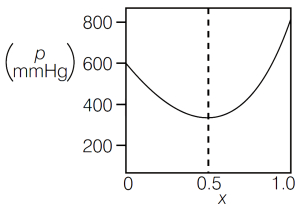
The vapour pressure of a non-ideal two-component solution is given below. Identify the correct $B.P.-x$ curve for the same mixture.
A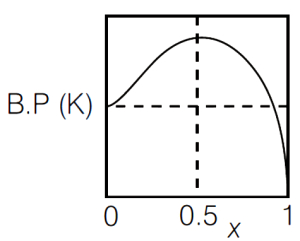
B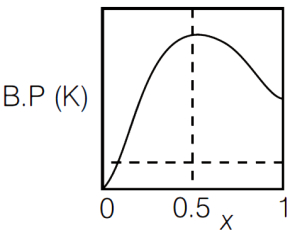
C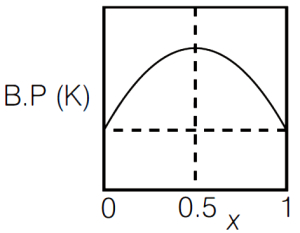
D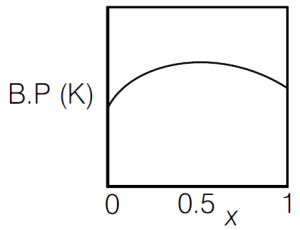
Solution
(A) The given graph shows a minimum in the vapour pressure curve at $x = 0.5$.
This indicates that the solution exhibits a large positive deviation from Raoult's law.
For solutions showing a large positive deviation from Raoult's law,the boiling point of the mixture is lower than the boiling points of the individual components,resulting in a minimum boiling azeotrope.
Therefore,the boiling point $(B.P.)$ vs. mole fraction $(x)$ curve must show a minimum at the same composition $(x = 0.5)$.
Among the given options,option $A$ represents a minimum boiling azeotrope curve.
This indicates that the solution exhibits a large positive deviation from Raoult's law.
For solutions showing a large positive deviation from Raoult's law,the boiling point of the mixture is lower than the boiling points of the individual components,resulting in a minimum boiling azeotrope.
Therefore,the boiling point $(B.P.)$ vs. mole fraction $(x)$ curve must show a minimum at the same composition $(x = 0.5)$.
Among the given options,option $A$ represents a minimum boiling azeotrope curve.
0 likes
View Solution136
DifficultMCQ
Match the following.
The correct match is
| $A$. Ebullioscopic constant | $I$. Depression of freezing point |
| $B$. Cryoscopic constant | $II$. Total pressure is the sum of partial pressures of the components |
| $C$. Henry's law | $III$. Elevation of boiling point |
| $D$. Dalton's law | $IV$. Solubility of a gas in liquid |
The correct match is
A
$A-III, B-I, C-II, D-IV$
B
$A-I, B-III, C-II, D-IV$
C
$A-III, B-I, C-IV, D-II$
D
$A-I, B-III, C-IV, D-II$
Solution
(C) Ebullioscopic constant $(K_b)$ is associated with the elevation of boiling point: $\Delta T_b = i \times K_b \times m$.
Cryoscopic constant $(K_f)$ is associated with the depression of freezing point: $\Delta T_f = i \times K_f \times m$.
Henry's law is associated with the solubility of a gas in a liquid: $P_{gas} = K_H \cdot X_{gas}$.
Dalton's law states that the total pressure is the sum of the partial pressures of the components: $P_{\text{total}} = P_1 + P_2 + P_3 + \ldots$
Therefore,the correct match is $A-III, B-I, C-IV, D-II$.
Cryoscopic constant $(K_f)$ is associated with the depression of freezing point: $\Delta T_f = i \times K_f \times m$.
Henry's law is associated with the solubility of a gas in a liquid: $P_{gas} = K_H \cdot X_{gas}$.
Dalton's law states that the total pressure is the sum of the partial pressures of the components: $P_{\text{total}} = P_1 + P_2 + P_3 + \ldots$
Therefore,the correct match is $A-III, B-I, C-IV, D-II$.
0 likes
View Solution137
EasyMCQ
Distilled water boils at $373.15 \ K$ and freezes at $273.15 \ K$. $A$ solution of glucose in distilled water boils at $373.202 \ K$. What is the freezing point (in $K$) of the same solution? (For water,$K_{b}=0.52 \ K \ kg \ mol^{-1}, \ K_{f}=1.86 \ K \ kg \ mol^{-1}$)
A
$273.15$
B
$273$
C
$272.964$
D
$273.336$
Solution
(C) Given: $T_{b}^{\circ} = 373.15 \ K$,$T_{b} = 373.202 \ K$,$K_{b} = 0.52 \ K \ kg \ mol^{-1}$,$K_{f} = 1.86 \ K \ kg \ mol^{-1}$,$T_{f}^{\circ} = 273.15 \ K$.
Elevation in boiling point: $\Delta T_{b} = T_{b} - T_{b}^{\circ} = 373.202 - 373.15 = 0.052 \ K$.
Since $\Delta T_{b} = m \times K_{b}$,we have $0.052 = m \times 0.52$,which gives molality $m = 0.1 \ mol \ kg^{-1}$.
Depression in freezing point: $\Delta T_{f} = m \times K_{f} = 0.1 \times 1.86 = 0.186 \ K$.
Freezing point of the solution: $T_{f} = T_{f}^{\circ} - \Delta T_{f} = 273.15 - 0.186 = 272.964 \ K$.
Elevation in boiling point: $\Delta T_{b} = T_{b} - T_{b}^{\circ} = 373.202 - 373.15 = 0.052 \ K$.
Since $\Delta T_{b} = m \times K_{b}$,we have $0.052 = m \times 0.52$,which gives molality $m = 0.1 \ mol \ kg^{-1}$.
Depression in freezing point: $\Delta T_{f} = m \times K_{f} = 0.1 \times 1.86 = 0.186 \ K$.
Freezing point of the solution: $T_{f} = T_{f}^{\circ} - \Delta T_{f} = 273.15 - 0.186 = 272.964 \ K$.
0 likes
View Solution138
MediumMCQ
An aqueous solution of a non-volatile solute boils at $100.17^{\circ} C$. The temperature at which this solution will freeze (in $^{\circ} C$) is
$K_{b}(H_2 O) = 0.512^{\circ} C \ kg \ mol^{-1}$,
$K_{f}(H_2 O) = 1.86^{\circ} C \ kg \ mol^{-1}$
$K_{b}(H_2 O) = 0.512^{\circ} C \ kg \ mol^{-1}$,
$K_{f}(H_2 O) = 1.86^{\circ} C \ kg \ mol^{-1}$
A
$-0.62$
B
$-0.512$
C
$-1.24$
D
$-1.86$
Solution
(A) The elevation in boiling point is given by $\Delta T_{b} = T_{b} - T_{b}^{\circ} = 100.17^{\circ} C - 100^{\circ} C = 0.17^{\circ} C$.
Using the formula $\Delta T_{b} = K_{b} \times m$,where $m$ is the molality:
$0.17 = 0.512 \times m \implies m = \frac{0.17}{0.512} \ mol \ kg^{-1}$.
The depression in freezing point is given by $\Delta T_{f} = K_{f} \times m$.
$\Delta T_{f} = 1.86 \times \frac{0.17}{0.512} \approx 0.6176^{\circ} C \approx 0.62^{\circ} C$.
The freezing point of the solution is $T_{f} = T_{f}^{\circ} - \Delta T_{f} = 0^{\circ} C - 0.62^{\circ} C = -0.62^{\circ} C$.
Using the formula $\Delta T_{b} = K_{b} \times m$,where $m$ is the molality:
$0.17 = 0.512 \times m \implies m = \frac{0.17}{0.512} \ mol \ kg^{-1}$.
The depression in freezing point is given by $\Delta T_{f} = K_{f} \times m$.
$\Delta T_{f} = 1.86 \times \frac{0.17}{0.512} \approx 0.6176^{\circ} C \approx 0.62^{\circ} C$.
The freezing point of the solution is $T_{f} = T_{f}^{\circ} - \Delta T_{f} = 0^{\circ} C - 0.62^{\circ} C = -0.62^{\circ} C$.
0 likes
View Solution139
DifficultMCQ
On mixing urea,the boiling point of $H_{2}O$ changed to $100.5^{\circ}C$. Calculate the freezing point of the solution,if $K_{f}$ of water is $1.87 \ K \cdot kg \cdot mol^{-1}$ and $K_{b}$ of water is $0.52 \ K \cdot kg \cdot mol^{-1}$. (in $^{\circ}C$)
A
$-1$
B
$-0.5$
C
$-1.8$
D
$0$
Solution
(C) Elevation in boiling point of the solution:
$\Delta T_{b} = T_{b} - T_{b}^{\circ} = 100.5^{\circ}C - 100^{\circ}C = 0.5^{\circ}C$
Since urea is a non-electrolyte,the van't Hoff factor $i = 1$.
Using the formula $\Delta T_{b} = i \times K_{b} \times m$:
$0.5 = 1 \times 0.52 \times m$
$m = \frac{0.5}{0.52} \ mol \ kg^{-1}$
Depression in freezing point of the solution:
$\Delta T_{f} = i \times K_{f} \times m$
$\Delta T_{f} = 1 \times 1.87 \times \frac{0.5}{0.52} \approx 1.798 \approx 1.8^{\circ}C$
Since $\Delta T_{f} = T_{f}^{\circ} - T_{f}$,where $T_{f}^{\circ} = 0^{\circ}C$:
$1.8 = 0 - T_{f}$
$T_{f} = -1.8^{\circ}C$
$\Delta T_{b} = T_{b} - T_{b}^{\circ} = 100.5^{\circ}C - 100^{\circ}C = 0.5^{\circ}C$
Since urea is a non-electrolyte,the van't Hoff factor $i = 1$.
Using the formula $\Delta T_{b} = i \times K_{b} \times m$:
$0.5 = 1 \times 0.52 \times m$
$m = \frac{0.5}{0.52} \ mol \ kg^{-1}$
Depression in freezing point of the solution:
$\Delta T_{f} = i \times K_{f} \times m$
$\Delta T_{f} = 1 \times 1.87 \times \frac{0.5}{0.52} \approx 1.798 \approx 1.8^{\circ}C$
Since $\Delta T_{f} = T_{f}^{\circ} - T_{f}$,where $T_{f}^{\circ} = 0^{\circ}C$:
$1.8 = 0 - T_{f}$
$T_{f} = -1.8^{\circ}C$
0 likes
View Solution140
DifficultMCQ
The $pH$ of a $0.1 \ M$ monobasic acid is $2$. Its osmotic pressure at a given temperature $T \ (K)$ is: (Given that the effective concentration for osmotic pressure is $(1+\alpha) \times$ concentration of acid,where $\alpha$ is the degree of dissociation)
A
$RT$
B
$0.11 \ RT$
C
$0.01 \ RT$
D
$0.001 \ RT$
Solution
(B) Given $pH = 2$ and concentration $C = 0.1 \ M$.
Since $pH = -\log[H^{+}]$,we have $[H^{+}] = 10^{-2} = 0.01 \ M$.
The degree of dissociation $\alpha = [H^{+}] / C = 0.01 / 0.1 = 0.1$.
The effective concentration (van't Hoff factor $i$) is $(1+\alpha) = 1 + 0.1 = 1.1$.
Using the formula for osmotic pressure $\pi = iCRT$:
$\pi = 1.1 \times 0.1 \ RT = 0.11 \ RT$.
Since $pH = -\log[H^{+}]$,we have $[H^{+}] = 10^{-2} = 0.01 \ M$.
The degree of dissociation $\alpha = [H^{+}] / C = 0.01 / 0.1 = 0.1$.
The effective concentration (van't Hoff factor $i$) is $(1+\alpha) = 1 + 0.1 = 1.1$.
Using the formula for osmotic pressure $\pi = iCRT$:
$\pi = 1.1 \times 0.1 \ RT = 0.11 \ RT$.
0 likes
View Solution141
DifficultMCQ
The freezing point depression of $0.001 \ M$ of $A_x B_y[Fe(CN)_6]$ is $5.58 \times 10^{-3} \ K$. If the oxidation state of $Fe$ is $+2$ and $K_f = 1.86 \ K \ kg \ mol^{-1}$,then the total number of possibilities for different types of $A$ and $B$ cations are
A
$1$
B
$2$
C
$3$
D
$4$
Solution
(B) The formula for depression in freezing point is $\Delta T_f = i \times K_f \times M$.
Given $\Delta T_f = 5.58 \times 10^{-3} \ K$,$K_f = 1.86 \ K \ kg \ mol^{-1}$,and $M = 0.001 \ M = 10^{-3} \ M$.
Calculating the van't Hoff factor $(i)$:
$i = \frac{\Delta T_f}{K_f \times M} = \frac{5.58 \times 10^{-3}}{1.86 \times 10^{-3}} = 3$.
The complex salt dissociates as $A_x B_y[Fe(CN)_6] \rightarrow xA^{n+} + yB^{m+} + [Fe(CN)_6]^{4-}$.
Since the total number of ions produced is $i = 3$,and the complex anion $[Fe(CN)_6]^{4-}$ counts as $1$ ion,the total number of cations $(x+y)$ must be $3 - 1 = 2$.
Given the charge balance: $x(n) + y(m) = 4$.
Possible combinations for $x+y=2$ with $n, m$ as positive integers:
$1$. If $x=1, y=1$,then $n+m=4$. Possible $(n, m)$ pairs are $(1, 3)$ and $(2, 2)$.
$2$. If $x=2, y=0$ (not possible as $B$ is mentioned) or $x=1, y=1$ with different valencies.
Thus,there are $2$ possibilities for the cation types.
Given $\Delta T_f = 5.58 \times 10^{-3} \ K$,$K_f = 1.86 \ K \ kg \ mol^{-1}$,and $M = 0.001 \ M = 10^{-3} \ M$.
Calculating the van't Hoff factor $(i)$:
$i = \frac{\Delta T_f}{K_f \times M} = \frac{5.58 \times 10^{-3}}{1.86 \times 10^{-3}} = 3$.
The complex salt dissociates as $A_x B_y[Fe(CN)_6] \rightarrow xA^{n+} + yB^{m+} + [Fe(CN)_6]^{4-}$.
Since the total number of ions produced is $i = 3$,and the complex anion $[Fe(CN)_6]^{4-}$ counts as $1$ ion,the total number of cations $(x+y)$ must be $3 - 1 = 2$.
Given the charge balance: $x(n) + y(m) = 4$.
Possible combinations for $x+y=2$ with $n, m$ as positive integers:
$1$. If $x=1, y=1$,then $n+m=4$. Possible $(n, m)$ pairs are $(1, 3)$ and $(2, 2)$.
$2$. If $x=2, y=0$ (not possible as $B$ is mentioned) or $x=1, y=1$ with different valencies.
Thus,there are $2$ possibilities for the cation types.
0 likes
View Solution142
DifficultMCQ
The osmotic pressure of $0.1 \ M$ monobasic acid of $pH \ 3$ at $27^{\circ} C$ is (in $atm$)
A
$2.42$
B
$242.4$
C
$60.6$
D
$50.9$
Solution
(A) The formula for osmotic pressure is $\pi = i \cdot C \cdot R \cdot T$.
Given $pH = 3$,the concentration of hydrogen ions is $[H^{+}] = 10^{-pH} = 10^{-3} = 0.001 \ M$.
For a monobasic acid $HX \rightleftharpoons H^{+} + X^{-}$,the degree of dissociation $\alpha$ is given by $\alpha = \frac{[H^{+}]}{C} = \frac{0.001}{0.1} = 0.01$.
The van't Hoff factor $i$ is $1 + \alpha = 1 + 0.01 = 1.01$.
Using $R = 0.0821 \ L \ atm \ K^{-1} \ mol^{-1}$ and $T = 27 + 273 = 300 \ K$:
$\pi = 1.01 \times 0.1 \times 0.0821 \times 300 \approx 2.48 \ atm$.
Given the options,the closest value is $2.42 \ atm$ (calculated using $R = 0.08$).
Thus,$(A)$ is the correct answer.
Given $pH = 3$,the concentration of hydrogen ions is $[H^{+}] = 10^{-pH} = 10^{-3} = 0.001 \ M$.
For a monobasic acid $HX \rightleftharpoons H^{+} + X^{-}$,the degree of dissociation $\alpha$ is given by $\alpha = \frac{[H^{+}]}{C} = \frac{0.001}{0.1} = 0.01$.
The van't Hoff factor $i$ is $1 + \alpha = 1 + 0.01 = 1.01$.
Using $R = 0.0821 \ L \ atm \ K^{-1} \ mol^{-1}$ and $T = 27 + 273 = 300 \ K$:
$\pi = 1.01 \times 0.1 \times 0.0821 \times 300 \approx 2.48 \ atm$.
Given the options,the closest value is $2.42 \ atm$ (calculated using $R = 0.08$).
Thus,$(A)$ is the correct answer.
0 likes
View Solution143
EasyMCQ
The solubility product of a sparingly soluble $AB_2$ salt is $2.56 \times 10^{-4} \ M^3$ at $25^{\circ} C$. The $K_f$ of water is $1.8 \ K \ kg \ mol^{-1}$. The depression in freezing point of a saturated solution of $AB_2$ is (in $K$)
A
$0.432$
B
$0.216$
C
$0.108$
D
$13.824$
Solution
(B) Let the solubility of $AB_2$ ($1:2$ type electrolyte) in water be $S \ mol \ L^{-1} = S \ M$.
For $AB_2 \rightleftharpoons A^{2+} + 2B^-$,the solubility product is $K_{sp} = [S][2S]^2 = 4S^3$.
Given $K_{sp} = 2.56 \times 10^{-4} \ M^3$,so $4S^3 = 2.56 \times 10^{-4}$.
$S^3 = 0.64 \times 10^{-4} = 64 \times 10^{-6}$,which gives $S = 0.04 \ M$.
Assuming density of solution $\approx 1 \ g/mL$,$S \approx 0.04 \ m$ (molality).
For $AB_2$,the van't Hoff factor $i = 3$ (assuming complete dissociation).
The depression in freezing point is $\Delta T_f = i \times K_f \times m$.
$\Delta T_f = 3 \times 1.8 \times 0.04 = 0.216 \ K$.
For $AB_2 \rightleftharpoons A^{2+} + 2B^-$,the solubility product is $K_{sp} = [S][2S]^2 = 4S^3$.
Given $K_{sp} = 2.56 \times 10^{-4} \ M^3$,so $4S^3 = 2.56 \times 10^{-4}$.
$S^3 = 0.64 \times 10^{-4} = 64 \times 10^{-6}$,which gives $S = 0.04 \ M$.
Assuming density of solution $\approx 1 \ g/mL$,$S \approx 0.04 \ m$ (molality).
For $AB_2$,the van't Hoff factor $i = 3$ (assuming complete dissociation).
The depression in freezing point is $\Delta T_f = i \times K_f \times m$.
$\Delta T_f = 3 \times 1.8 \times 0.04 = 0.216 \ K$.
0 likes
View Solution144
DifficultMCQ
$P$ and $Q$ combine to form two compounds $PQ_2$ and $PQ_3$. If $1 \ g$ of $PQ_2$ is dissolved in $51 \ g$ of benzene,the depression of freezing point is $0.8^{\circ} C$. If $1 \ g$ of $PQ_3$ is dissolved in $51 \ g$ of benzene,the depression of freezing point is $0.625^{\circ} C$. Given $K_f$ of benzene $= 5.1 \ K \ kg \ mol^{-1}$,calculate the atomic masses of $P$ and $Q$.
A
$35, 55$
B
$45, 45$
C
$55, 45$
D
$55, 35$
Solution
(D) The formula for depression in freezing point is $\Delta T_f = K_f \times m$,where $m$ is molality.
For $PQ_2$: $0.8 = \frac{5.1 \times 1000 \times 1}{51 \times M_{PQ_2}}$ $\Rightarrow M_{PQ_2} = \frac{5100}{51 \times 0.8} = 125 \ g/mol$.
For $PQ_3$: $0.625 = \frac{5.1 \times 1000 \times 1}{51 \times M_{PQ_3}}$ $\Rightarrow M_{PQ_3} = \frac{5100}{51 \times 0.625} = 160 \ g/mol$.
Let atomic masses be $P$ and $Q$.
$P + 2Q = 125$ $(i)$
$P + 3Q = 160$ (ii)
Subtracting $(i)$ from (ii): $Q = 35$.
Substituting $Q$ in $(i)$: $P + 2(35) = 125 \Rightarrow P = 125 - 70 = 55$.
Thus,atomic mass of $P = 55$ and $Q = 35$.
For $PQ_2$: $0.8 = \frac{5.1 \times 1000 \times 1}{51 \times M_{PQ_2}}$ $\Rightarrow M_{PQ_2} = \frac{5100}{51 \times 0.8} = 125 \ g/mol$.
For $PQ_3$: $0.625 = \frac{5.1 \times 1000 \times 1}{51 \times M_{PQ_3}}$ $\Rightarrow M_{PQ_3} = \frac{5100}{51 \times 0.625} = 160 \ g/mol$.
Let atomic masses be $P$ and $Q$.
$P + 2Q = 125$ $(i)$
$P + 3Q = 160$ (ii)
Subtracting $(i)$ from (ii): $Q = 35$.
Substituting $Q$ in $(i)$: $P + 2(35) = 125 \Rightarrow P = 125 - 70 = 55$.
Thus,atomic mass of $P = 55$ and $Q = 35$.
0 likes
View Solution145
MediumMCQ
Pick the correct statement.
A
Relative lowering of vapour pressure is independent of $T$.
B
Osmotic pressure always depends on the nature of solute.
C
Elevation of boiling point is independent of nature of the solvent.
D
Lowering of freezing point is proportional to the molar concentration of solute.
Solution
(A) The relative lowering of vapour pressure is given by $\frac{\Delta P}{P^{\circ}} = x_{solute}$.
Since the mole fraction $(x_{solute})$ is a dimensionless quantity and does not change with temperature,the relative lowering of vapour pressure is independent of $T$.
Option $A$ is correct.
Option $B$ is incorrect because osmotic pressure is a colligative property and depends on the number of particles,not the nature of the solute.
Option $C$ is incorrect because elevation of boiling point depends on the molal elevation constant $(K_b)$,which is a characteristic property of the solvent.
Option $D$ is incorrect because the lowering of freezing point is proportional to the molality $(m)$ of the solute,not the molar concentration (molarity).
Since the mole fraction $(x_{solute})$ is a dimensionless quantity and does not change with temperature,the relative lowering of vapour pressure is independent of $T$.
Option $A$ is correct.
Option $B$ is incorrect because osmotic pressure is a colligative property and depends on the number of particles,not the nature of the solute.
Option $C$ is incorrect because elevation of boiling point depends on the molal elevation constant $(K_b)$,which is a characteristic property of the solvent.
Option $D$ is incorrect because the lowering of freezing point is proportional to the molality $(m)$ of the solute,not the molar concentration (molarity).
0 likes
View Solution146
DifficultMCQ
Consider the following aqueous solutions.
$I$. $2.2 \ g$ Glucose in $125 \ mL$ of solution.
$II$. $1.9 \ g$ Calcium chloride in $250 \ mL$ of solution.
$III$. $9.0 \ g$ Urea in $500 \ mL$ of solution.
$IV$. $20.5 \ g$ Aluminium sulphate in $750 \ mL$ of solution.
The correct increasing order of boiling point of these solutions will be:
[Given: Molar mass in $g \ mol^{-1}$: $H=1, C=12, N=14, O=16, Cl=35.5, Ca=40, Al=27, S=32$]
$I$. $2.2 \ g$ Glucose in $125 \ mL$ of solution.
$II$. $1.9 \ g$ Calcium chloride in $250 \ mL$ of solution.
$III$. $9.0 \ g$ Urea in $500 \ mL$ of solution.
$IV$. $20.5 \ g$ Aluminium sulphate in $750 \ mL$ of solution.
The correct increasing order of boiling point of these solutions will be:
[Given: Molar mass in $g \ mol^{-1}$: $H=1, C=12, N=14, O=16, Cl=35.5, Ca=40, Al=27, S=32$]
A
$I < II < III < IV$
B
$III < II < I < IV$
C
$II < III < IV < I$
D
$II < III < I < IV$
Solution
(A) The elevation in boiling point is given by $\Delta T_{b} = i \cdot K_{b} \cdot m$. For dilute solutions,molarity $(M)$ is approximately equal to molality $(m)$. The boiling point increases with the value of $i \cdot M$.
Comparing the values: $0.098 (I) < 0.204 (II) < 0.300 (III) < 0.400 (IV)$.
Thus,the increasing order of boiling point is $I < II < III < IV$.
| Solution | $i \cdot M$ calculation | Value |
| $I$. Glucose $(C_6H_{12}O_6)$ | $1 \times (\frac{2.2}{180} \times \frac{1000}{125})$ | $0.098$ |
| $II$. $CaCl_2$ | $3 \times (\frac{1.9}{111} \times \frac{1000}{250})$ | $0.204$ |
| $III$. Urea $(NH_2CONH_2)$ | $1 \times (\frac{9}{60} \times \frac{1000}{500})$ | $0.300$ |
| $IV$. $Al_2(SO_4)_3$ | $5 \times (\frac{20.5}{342} \times \frac{1000}{750})$ | $0.400$ |
Comparing the values: $0.098 (I) < 0.204 (II) < 0.300 (III) < 0.400 (IV)$.
Thus,the increasing order of boiling point is $I < II < III < IV$.
0 likes
View Solution147
DifficultMCQ
At $T(K)$,$2$ moles of liquid $A$ and $3$ moles of liquid $B$ are mixed. The vapour pressure of the ideal solution formed is $320 \ mm \ Hg$. At this stage,one mole of $A$ and one mole of $B$ are added to the solution. The vapour pressure is now measured as $328.6 \ mm \ Hg$. The vapour pressures of pure $A$ and pure $B$ (in $mm \ Hg$) are respectively:
A
$300, 200$
B
$600, 400$
C
$400, 300$
D
$500, 200$
Solution
(D) According to Raoult's law for an ideal solution,$P_S = X_A P_A^{\circ} + X_B P_B^{\circ}$.
For the first mixture: $X_A = 2/5$,$X_B = 3/5$,and $P_S = 320 \ mm \ Hg$.
$320 = P_A^{\circ} (2/5) + P_B^{\circ} (3/5) \implies 2 P_A^{\circ} + 3 P_B^{\circ} = 1600$ ...$(I)$
After adding $1$ mole of $A$ and $1$ mole of $B$,the new moles are $3$ moles of $A$ and $4$ moles of $B$. Total moles = $7$.
$X_A' = 3/7$,$X_B' = 4/7$,and $P_S' = 328.6 \ mm \ Hg$.
$328.6 = P_A^{\circ} (3/7) + P_B^{\circ} (4/7) \implies 3 P_A^{\circ} + 4 P_B^{\circ} = 2300.2$ ...$(II)$
Solving the system of equations:
Multiply $(I)$ by $3$: $6 P_A^{\circ} + 9 P_B^{\circ} = 4800$ ...$(III)$
Multiply $(II)$ by $2$: $6 P_A^{\circ} + 8 P_B^{\circ} = 4600.4$ ...$(IV)$
Subtracting $(IV)$ from $(III)$: $P_B^{\circ} = 199.6 \ mm \ Hg \approx 200 \ mm \ Hg$.
Substituting $P_B^{\circ} = 200$ into $(I)$: $2 P_A^{\circ} + 3(200) = 1600 \implies 2 P_A^{\circ} = 1000 \implies P_A^{\circ} = 500 \ mm \ Hg$.
Thus,the vapour pressures are $500 \ mm \ Hg$ and $200 \ mm \ Hg$.
For the first mixture: $X_A = 2/5$,$X_B = 3/5$,and $P_S = 320 \ mm \ Hg$.
$320 = P_A^{\circ} (2/5) + P_B^{\circ} (3/5) \implies 2 P_A^{\circ} + 3 P_B^{\circ} = 1600$ ...$(I)$
After adding $1$ mole of $A$ and $1$ mole of $B$,the new moles are $3$ moles of $A$ and $4$ moles of $B$. Total moles = $7$.
$X_A' = 3/7$,$X_B' = 4/7$,and $P_S' = 328.6 \ mm \ Hg$.
$328.6 = P_A^{\circ} (3/7) + P_B^{\circ} (4/7) \implies 3 P_A^{\circ} + 4 P_B^{\circ} = 2300.2$ ...$(II)$
Solving the system of equations:
Multiply $(I)$ by $3$: $6 P_A^{\circ} + 9 P_B^{\circ} = 4800$ ...$(III)$
Multiply $(II)$ by $2$: $6 P_A^{\circ} + 8 P_B^{\circ} = 4600.4$ ...$(IV)$
Subtracting $(IV)$ from $(III)$: $P_B^{\circ} = 199.6 \ mm \ Hg \approx 200 \ mm \ Hg$.
Substituting $P_B^{\circ} = 200$ into $(I)$: $2 P_A^{\circ} + 3(200) = 1600 \implies 2 P_A^{\circ} = 1000 \implies P_A^{\circ} = 500 \ mm \ Hg$.
Thus,the vapour pressures are $500 \ mm \ Hg$ and $200 \ mm \ Hg$.
0 likes
View Solution148
DifficultMCQ
$W \ g$ of a non-volatile electrolyte solid solute of molar mass $M \ g \ mol^{-1}$ when dissolved in $100 \ mL$ water,decreases vapor pressure of water from $640 \ mm \ Hg$ to $600 \ mm \ Hg$. If aqueous solution of the electrolyte boils at $375 \ K$ and $K_b$ for water is $0.52 \ K \ kg \ mol^{-1}$,then the mole fraction of the electrolyte solute $(X_2)$ in the solution can be expressed as (Given density of water $= 1 \ g/mL$ and boiling point of water $= 373 \ K$):
A
$\frac{1.3}{8} \times \frac{W}{M}$
B
$\frac{16}{2.6} \times \frac{W}{M}$
C
$\frac{2.6}{16} \times \frac{M}{W}$
D
$\frac{1.3}{8} \times \frac{M}{W}$
Solution
(A) Given:
$P^0 = 640 \ mm \ Hg$,$P_s = 600 \ mm \ Hg$.
Relative lowering of vapor pressure: $\frac{P^0 - P_s}{P^0} = i \cdot X_2$.
$\frac{640 - 600}{640} = i \cdot X_2 \implies i \cdot X_2 = \frac{40}{640} = \frac{1}{16}$ ... $(i)$.
Elevation in boiling point: $\Delta T_b = T_b - T_b^0 = 375 - 373 = 2 \ K$.
Formula: $\Delta T_b = i \cdot K_b \cdot m$.
$2 = i \cdot 0.52 \cdot \frac{W \times 1000}{M \times 100} \implies 2 = i \cdot 5.2 \cdot \frac{W}{M} \implies i = \frac{2 \cdot M}{5.2 \cdot W} = \frac{M}{2.6 \cdot W}$ ... $(ii)$.
Substituting $(ii)$ in $(i)$:
$\left(\frac{M}{2.6 \cdot W}\right) \cdot X_2 = \frac{1}{16}$.
$X_2 = \frac{2.6 \cdot W}{16 \cdot M} = \frac{1.3}{8} \cdot \frac{W}{M}$.
$P^0 = 640 \ mm \ Hg$,$P_s = 600 \ mm \ Hg$.
Relative lowering of vapor pressure: $\frac{P^0 - P_s}{P^0} = i \cdot X_2$.
$\frac{640 - 600}{640} = i \cdot X_2 \implies i \cdot X_2 = \frac{40}{640} = \frac{1}{16}$ ... $(i)$.
Elevation in boiling point: $\Delta T_b = T_b - T_b^0 = 375 - 373 = 2 \ K$.
Formula: $\Delta T_b = i \cdot K_b \cdot m$.
$2 = i \cdot 0.52 \cdot \frac{W \times 1000}{M \times 100} \implies 2 = i \cdot 5.2 \cdot \frac{W}{M} \implies i = \frac{2 \cdot M}{5.2 \cdot W} = \frac{M}{2.6 \cdot W}$ ... $(ii)$.
Substituting $(ii)$ in $(i)$:
$\left(\frac{M}{2.6 \cdot W}\right) \cdot X_2 = \frac{1}{16}$.
$X_2 = \frac{2.6 \cdot W}{16 \cdot M} = \frac{1.3}{8} \cdot \frac{W}{M}$.
0 likes
View Solution149
DifficultMCQ
$A$ substance '$X$' $(1.5 \ g)$ dissolved in $150 \ g$ of a solvent '$Y$' (molar mass $= 300 \ g \ mol^{-1}$) led to an elevation of the boiling point by $0.5 \ K$. The relative lowering in the vapour pressure of the solvent '$Y$' is . . . . . . $\times 10^{-2}$. (Nearest integer)
[Given : $K_{b}$ of the solvent $= 5.0 \ K \ kg \ mol^{-1}$]
Assume the solution to be dilute and no association or dissociation of $X$ takes place in solution.
[Given : $K_{b}$ of the solvent $= 5.0 \ K \ kg \ mol^{-1}$]
Assume the solution to be dilute and no association or dissociation of $X$ takes place in solution.
A
$3$
B
$1$
C
$5$
D
$2$
Solution
(A) The elevation in boiling point is given by $\Delta T_{b} = K_{b} \times m$,where $m$ is the molality.
$0.5 = 5.0 \times m \implies m = 0.1 \ mol \ kg^{-1}$.
Molality $m = \frac{n_{X}}{W_{Y} (\text{in } kg)} = \frac{n_{X}}{0.150 \ kg} = 0.1 \implies n_{X} = 0.015 \ mol$.
The relative lowering in vapour pressure is given by $\frac{P^{o} - P_{s}}{P^{o}} = X_{X} = \frac{n_{X}}{n_{X} + n_{Y}}$.
$n_{Y} = \frac{150 \ g}{300 \ g \ mol^{-1}} = 0.5 \ mol$.
Since the solution is dilute,$n_{X} + n_{Y} \approx n_{Y} = 0.5 \ mol$.
Relative lowering $= \frac{0.015}{0.5} = 0.03 = 3 \times 10^{-2}$.
Thus,the value is $3$.
$0.5 = 5.0 \times m \implies m = 0.1 \ mol \ kg^{-1}$.
Molality $m = \frac{n_{X}}{W_{Y} (\text{in } kg)} = \frac{n_{X}}{0.150 \ kg} = 0.1 \implies n_{X} = 0.015 \ mol$.
The relative lowering in vapour pressure is given by $\frac{P^{o} - P_{s}}{P^{o}} = X_{X} = \frac{n_{X}}{n_{X} + n_{Y}}$.
$n_{Y} = \frac{150 \ g}{300 \ g \ mol^{-1}} = 0.5 \ mol$.
Since the solution is dilute,$n_{X} + n_{Y} \approx n_{Y} = 0.5 \ mol$.
Relative lowering $= \frac{0.015}{0.5} = 0.03 = 3 \times 10^{-2}$.
Thus,the value is $3$.
0 likes
View Solution150
DifficultMCQ
Which of the following statements are not correct?
$A$. For water,magnitude of $K_b$ is more than the magnitude of $K_f$.
$B$. The elevation in boiling point of water when a non-volatile solute is added to it is larger in magnitude than its depression in freezing point.
$C$. Osmotic pressure measurement is preferred over any other colligative property to determine molar mass of proteins and polymers.
$D$. The dimerised form of benzoic acid in benzene is $C_6H_5 - C(=O) - OH \cdots O = C(OH) - C_6H_5$. Choose the correct answer from the options given below:
$A$. For water,magnitude of $K_b$ is more than the magnitude of $K_f$.
$B$. The elevation in boiling point of water when a non-volatile solute is added to it is larger in magnitude than its depression in freezing point.
$C$. Osmotic pressure measurement is preferred over any other colligative property to determine molar mass of proteins and polymers.
$D$. The dimerised form of benzoic acid in benzene is $C_6H_5 - C(=O) - OH \cdots O = C(OH) - C_6H_5$. Choose the correct answer from the options given below:
A
$A$ and $B$ only
B
$A$ and $D$ only
C
$A, B$ and $D$ only
D
$A, C$ and $D$ only
Solution
(C) is incorrect: For water,$K_f = 1.86 \text{ K kg mol}^{-1}$ and $K_b = 0.512 \text{ K kg mol}^{-1}$,so $K_f > K_b$.
$B$ is incorrect: Since $K_f > K_b$,the depression in freezing point $(\Delta T_f = K_f m)$ is larger than the elevation in boiling point $(\Delta T_b = K_b m)$ for the same molality $m$.
$C$ is correct: Osmotic pressure is preferred because its magnitude is large even for dilute solutions,making it easier to measure for macromolecules like proteins and polymers.
$D$ is incorrect: The dimerised form of benzoic acid involves hydrogen bonding between the carboxyl groups,represented as $(C_6H_5COOH)_2$ with the structure $C_6H_5 - C(OH)=O \cdots HO - C(O) - C_6H_5$.
Therefore,statements $A, B$,and $D$ are incorrect.
$B$ is incorrect: Since $K_f > K_b$,the depression in freezing point $(\Delta T_f = K_f m)$ is larger than the elevation in boiling point $(\Delta T_b = K_b m)$ for the same molality $m$.
$C$ is correct: Osmotic pressure is preferred because its magnitude is large even for dilute solutions,making it easier to measure for macromolecules like proteins and polymers.
$D$ is incorrect: The dimerised form of benzoic acid involves hydrogen bonding between the carboxyl groups,represented as $(C_6H_5COOH)_2$ with the structure $C_6H_5 - C(OH)=O \cdots HO - C(O) - C_6H_5$.
Therefore,statements $A, B$,and $D$ are incorrect.
0 likes
View SolutionSolutions — Mix Examples of Solutions · Frequently Asked Questions
1Are these Solutions questions useful for JEE and NEET?
Yes. All questions in this section are mapped to JEE Main and NEET exam patterns. Previous year questions from JEE Main, NEET, GUJCET and state-level exams are included with full solutions.
2Can I switch to Hindi or Gujarati for these questions?
Yes. Use the language tabs in the hero section or the sidebar to view the same questions and solutions in English, Hindi or Gujarati.
3How do I generate a question paper from this subtopic?
Use the Vedclass Exam Paper Generator — select the chapter and subtopic, set difficulty, and generate Sets A, B, C, D automatically. First 3 chapters of every subject are free.
Vedclass Products
For Students
Vedclass Test Series
Mock tests in real JEE/NEET style with performance analysis. 5-day free trial.
Start Free TrialFor Teachers
Exam Paper Generator
Generate Set A/B/C/D papers from this chapter in 2 minutes. 3 chapters free.
Try FreeFor Institutes
Online Exam Module
Live online exams with unlimited students, 360° analytics & white-label branding.
See DemoFor Teachers & Institutes
Generate a Solutions Exam Paper in 2 Minutes
Select subtopic & difficulty — Sets A, B, C, D auto-generated with No Repeat logic.
First 3 chapters of every subject are free — no payment required.