
A English
Mix Examples of Solutions Questions in English
Class 12 Chemistry · Solutions · Mix Examples of Solutions
153+
Questions
English
Language
100%
With Solutions
Showing 47 of 153 questions in English
51
MediumMCQ
The $pH$ of a $0.1 \ M$ monobasic acid solution is $2$. Its osmotic pressure at $T$ Kelvin temperature is ............. $RT$.
A
$0.1$
B
$0.11$
C
$1.1$
D
$0.01$
Solution
(B) Given $pH = 2$.
We know that $pH = -\log [H^+]$,so $[H^+] = 10^{-pH} = 10^{-2} = 0.01 \ M$.
For a monobasic acid $HX$,the dissociation is $HX \rightleftharpoons H^+ + X^-$.
The degree of dissociation $\alpha$ is given by $[H^+] = c \alpha$,where $c = 0.1 \ M$.
$\alpha = \frac{[H^+]}{c} = \frac{0.01}{0.1} = 0.1$.
The van't Hoff factor $i$ for a binary electrolyte is $i = 1 + \alpha = 1 + 0.1 = 1.1$.
The osmotic pressure $\Pi$ is given by $\Pi = iCRT$.
Substituting the values: $\Pi = 1.1 \times 0.1 \times RT = 0.11 \ RT$.
Thus,the correct option is $B$.
We know that $pH = -\log [H^+]$,so $[H^+] = 10^{-pH} = 10^{-2} = 0.01 \ M$.
For a monobasic acid $HX$,the dissociation is $HX \rightleftharpoons H^+ + X^-$.
The degree of dissociation $\alpha$ is given by $[H^+] = c \alpha$,where $c = 0.1 \ M$.
$\alpha = \frac{[H^+]}{c} = \frac{0.01}{0.1} = 0.1$.
The van't Hoff factor $i$ for a binary electrolyte is $i = 1 + \alpha = 1 + 0.1 = 1.1$.
The osmotic pressure $\Pi$ is given by $\Pi = iCRT$.
Substituting the values: $\Pi = 1.1 \times 0.1 \times RT = 0.11 \ RT$.
Thus,the correct option is $B$.
0 likes
View Solution52
MediumMCQ
An aqueous solution freezes at $-0.186 \ ^\circ C$ ($K_f = 1.86 \ ^\circ C \ kg \ mol^{-1}$; $K_b = 0.512 \ ^\circ C \ kg \ mol^{-1}$). What is the elevation in boiling point of the same solution?
A
$0.18$
B
$0.51$
C
$0.0512$
D
$0.05$
Solution
(C) The depression in freezing point is given by $\Delta T_f = T_f^\circ - T_f = 0 - (-0.186) = 0.186 \ ^\circ C$.
We know that $\Delta T_f = K_f \times m$ and $\Delta T_b = K_b \times m$.
Dividing the two equations: $\frac{\Delta T_b}{\Delta T_f} = \frac{K_b}{K_f}$.
Substituting the values: $\Delta T_b = \Delta T_f \times \frac{K_b}{K_f} = 0.186 \times \frac{0.512}{1.86}$.
$\Delta T_b = 0.1 \times 0.512 = 0.0512 \ ^\circ C$.
We know that $\Delta T_f = K_f \times m$ and $\Delta T_b = K_b \times m$.
Dividing the two equations: $\frac{\Delta T_b}{\Delta T_f} = \frac{K_b}{K_f}$.
Substituting the values: $\Delta T_b = \Delta T_f \times \frac{K_b}{K_f} = 0.186 \times \frac{0.512}{1.86}$.
$\Delta T_b = 0.1 \times 0.512 = 0.0512 \ ^\circ C$.
0 likes
View Solution53
DifficultMCQ
The $pH$ of a $0.1 \, M$ monobasic acid is measured to be $2$. Its osmotic pressure at a given temperature $T \, K$ is (in $, RT$)
A
$0.1$
B
$0.11$
C
$1.1$
D
$0.01$
Solution
(B) The osmotic pressure is given by the formula $\pi = iCRT$.
Given $pH = 2$,the concentration of hydrogen ions is $[H^{+}] = 10^{-2} \, M$.
For a monobasic acid $HA \rightleftharpoons H^{+} + A^{-}$,the degree of dissociation $\alpha$ is calculated as $\alpha = \frac{[H^{+}]}{C} = \frac{10^{-2}}{0.1} = 0.1$.
The van't Hoff factor $i$ for dissociation is $i = 1 + \alpha(n - 1)$,where $n = 2$.
Thus,$i = 1 + 0.1(2 - 1) = 1.1$.
Substituting the values into the osmotic pressure formula: $\pi = 1.1 \times 0.1 \times RT = 0.11 \, RT$.
Given $pH = 2$,the concentration of hydrogen ions is $[H^{+}] = 10^{-2} \, M$.
For a monobasic acid $HA \rightleftharpoons H^{+} + A^{-}$,the degree of dissociation $\alpha$ is calculated as $\alpha = \frac{[H^{+}]}{C} = \frac{10^{-2}}{0.1} = 0.1$.
The van't Hoff factor $i$ for dissociation is $i = 1 + \alpha(n - 1)$,where $n = 2$.
Thus,$i = 1 + 0.1(2 - 1) = 1.1$.
Substituting the values into the osmotic pressure formula: $\pi = 1.1 \times 0.1 \times RT = 0.11 \, RT$.
0 likes
View Solution54
EasyMCQ
When $0.1 \, m$ $CH_3COOH$ is present in a solvent,it shows an elevation in boiling point of $0.75 \, ^oC$. The acid dissociation constant $(K_a)$ will be: (Given: $K_b = 5 \, K \, kg \, mol^{-1}$)
A
$5 \times 10^{-2}$
B
$5 \times 10^{-3}$
C
$10^{-2}$
D
$10^{-3}$
Solution
(A) The elevation in boiling point is given by $\Delta T_b = i K_b m$.
Given $\Delta T_b = 0.75 \, ^oC$,$K_b = 5 \, K \, kg \, mol^{-1}$,and $m = 0.1 \, m$.
Substituting these values: $0.75 = i \times 5 \times 0.1$.
$i = \frac{0.75}{0.5} = 1.5$.
For the dissociation of $CH_3COOH \rightleftharpoons CH_3COO^- + H^+$,the van't Hoff factor $i = 1 + \alpha$.
$1.5 = 1 + \alpha \implies \alpha = 0.5$.
The dissociation constant $K_a$ is given by $K_a = \frac{c \alpha^2}{1 - \alpha}$.
$K_a = \frac{0.1 \times (0.5)^2}{1 - 0.5} = \frac{0.1 \times 0.25}{0.5} = 0.05 = 5 \times 10^{-2}$.
Given $\Delta T_b = 0.75 \, ^oC$,$K_b = 5 \, K \, kg \, mol^{-1}$,and $m = 0.1 \, m$.
Substituting these values: $0.75 = i \times 5 \times 0.1$.
$i = \frac{0.75}{0.5} = 1.5$.
For the dissociation of $CH_3COOH \rightleftharpoons CH_3COO^- + H^+$,the van't Hoff factor $i = 1 + \alpha$.
$1.5 = 1 + \alpha \implies \alpha = 0.5$.
The dissociation constant $K_a$ is given by $K_a = \frac{c \alpha^2}{1 - \alpha}$.
$K_a = \frac{0.1 \times (0.5)^2}{1 - 0.5} = \frac{0.1 \times 0.25}{0.5} = 0.05 = 5 \times 10^{-2}$.
0 likes
View Solution55
EasyMCQ
Drinking water contains some salt impurities dissolved in it. When this solution is heated in an open container,vapours are formed and separated slowly. In this process,the freezing point and osmotic pressure of the remaining solution will continuously
A
Increase,Decrease
B
Increase,Increase
C
Decrease,Decrease
D
Decrease,Increase
Solution
(D) As vapours are removed,the remaining solution becomes more concentrated.
The freezing point depression is defined as $\Delta T_f = K_f \times m$. As the molality $m$ increases,$\Delta T_f$ increases,which means the freezing point $(T_f = T_f^0 - \Delta T_f)$ decreases.
Osmotic pressure is given by $\Pi = CRT$. As the concentration $C$ increases,the osmotic pressure $\Pi$ increases.
Therefore,the freezing point decreases and the osmotic pressure increases.
The freezing point depression is defined as $\Delta T_f = K_f \times m$. As the molality $m$ increases,$\Delta T_f$ increases,which means the freezing point $(T_f = T_f^0 - \Delta T_f)$ decreases.
Osmotic pressure is given by $\Pi = CRT$. As the concentration $C$ increases,the osmotic pressure $\Pi$ increases.
Therefore,the freezing point decreases and the osmotic pressure increases.
0 likes
View Solution56
EasyMCQ
$A$ saturated solution of $Ag_2SO_4$ shows a $0.003 \ K$ rise in boiling point. Calculate the $K_{sp}$ of $Ag_2SO_4$. Given: $K_b = 5 \ K \ kg \ mol^{-1}$ and $1 \ m = 1 \ M$.
A
$3.2 \times 10^{-11}$
B
$3.2 \times 10^{-10}$
C
$3.2 \times 10^{-9}$
D
$3.2 \times 10^{-12}$
Solution
(A) The elevation in boiling point is given by $\Delta T_b = i K_b m$.
For $Ag_2SO_4$,the dissociation is $Ag_2SO_4 \rightleftharpoons 2Ag^+ + SO_4^{2-}$,so the van't Hoff factor $i = 3$.
Given $\Delta T_b = 0.003 \ K$,$K_b = 5 \ K \ kg \ mol^{-1}$,and $m = S$ (solubility).
Substituting the values: $0.003 = 3 \times 5 \times S$.
$S = \frac{0.003}{15} = 2 \times 10^{-4} \ mol \ L^{-1}$.
The solubility product $K_{sp}$ for $Ag_2SO_4$ is $K_{sp} = [Ag^+]^2 [SO_4^{2-}] = (2S)^2 (S) = 4S^3$.
$K_{sp} = 4 \times (2 \times 10^{-4})^3 = 4 \times 8 \times 10^{-12} = 3.2 \times 10^{-11}$.
For $Ag_2SO_4$,the dissociation is $Ag_2SO_4 \rightleftharpoons 2Ag^+ + SO_4^{2-}$,so the van't Hoff factor $i = 3$.
Given $\Delta T_b = 0.003 \ K$,$K_b = 5 \ K \ kg \ mol^{-1}$,and $m = S$ (solubility).
Substituting the values: $0.003 = 3 \times 5 \times S$.
$S = \frac{0.003}{15} = 2 \times 10^{-4} \ mol \ L^{-1}$.
The solubility product $K_{sp}$ for $Ag_2SO_4$ is $K_{sp} = [Ag^+]^2 [SO_4^{2-}] = (2S)^2 (S) = 4S^3$.
$K_{sp} = 4 \times (2 \times 10^{-4})^3 = 4 \times 8 \times 10^{-12} = 3.2 \times 10^{-11}$.
0 likes
View Solution57
MediumMCQ
If a $1 \ m$ solution of benzoic acid in benzene has a freezing point depression of $2.56 \ ^{\circ}C$ $(K_f = 5.12 \ ^{\circ}C \ kg \ mol^{-1})$ and a boiling point elevation of $2.53 \ ^{\circ}C$ $(K_b = 2.53 \ ^{\circ}C \ kg \ mol^{-1})$,select the correct statement$(s)$:
Statement $I$: There is dimer formation when undergoing freezing.
Statement $II$: There is no change when undergoing boiling.
Statement $III$: Reverse of $I$ and $II$.
Statement $IV$: Dimer formation in freezing and boiling state.
Statement $I$: There is dimer formation when undergoing freezing.
Statement $II$: There is no change when undergoing boiling.
Statement $III$: Reverse of $I$ and $II$.
Statement $IV$: Dimer formation in freezing and boiling state.
A
$I, II$
B
$II, III$
C
$III, I$
D
only $I$
Solution
(A) For freezing point: Theoretical $\Delta T_f = K_f \times m = 5.12 \times 1 = 5.12 \ ^{\circ}C$.
Observed $\Delta T_f = 2.56 \ ^{\circ}C$.
Since observed $\Delta T_f < $ theoretical $\Delta T_f$,the van't Hoff factor $i = \frac{2.56}{5.12} = 0.5$,which indicates dimer formation.
For boiling point: Theoretical $\Delta T_b = K_b \times m = 2.53 \times 1 = 2.53 \ ^{\circ}C$.
Observed $\Delta T_b = 2.53 \ ^{\circ}C$.
Since observed $\Delta T_b =$ theoretical $\Delta T_b$,$i = 1$,indicating no association or dissociation.
Thus,Statement $I$ and Statement $II$ are correct.
Observed $\Delta T_f = 2.56 \ ^{\circ}C$.
Since observed $\Delta T_f < $ theoretical $\Delta T_f$,the van't Hoff factor $i = \frac{2.56}{5.12} = 0.5$,which indicates dimer formation.
For boiling point: Theoretical $\Delta T_b = K_b \times m = 2.53 \times 1 = 2.53 \ ^{\circ}C$.
Observed $\Delta T_b = 2.53 \ ^{\circ}C$.
Since observed $\Delta T_b =$ theoretical $\Delta T_b$,$i = 1$,indicating no association or dissociation.
Thus,Statement $I$ and Statement $II$ are correct.
0 likes
View Solution58
MediumMCQ
Which of the following graphs correctly represents the changes in thermodynamic properties during the formation of $1 \, mol$ of an ideal binary solution?
A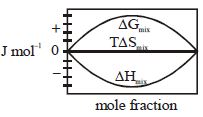
B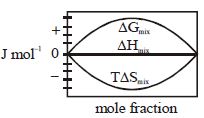
C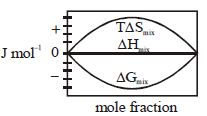
D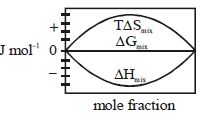
Solution
(C) For the formation of an ideal binary solution:
$1$. The enthalpy of mixing is zero,i.e.,$\Delta H_{mix} = 0$.
$2$. The entropy of mixing is positive,i.e.,$\Delta S_{mix} > 0$,so $T \Delta S_{mix} > 0$.
$3$. The Gibbs free energy of mixing is given by $\Delta G_{mix} = \Delta H_{mix} - T \Delta S_{mix}$. Since $\Delta H_{mix} = 0$,we have $\Delta G_{mix} = -T \Delta S_{mix}$. Because $\Delta S_{mix} > 0$,$\Delta G_{mix}$ must be negative $(\Delta G_{mix} < 0)$.
Comparing these conditions with the given options:
- $\Delta H_{mix}$ should be a straight line at $0$.
- $T \Delta S_{mix}$ should be a positive curve (above the $0$ axis).
- $\Delta G_{mix}$ should be a negative curve (below the $0$ axis).
Option $C$ correctly shows $\Delta H_{mix} = 0$,$T \Delta S_{mix} > 0$,and $\Delta G_{mix} < 0$.
$1$. The enthalpy of mixing is zero,i.e.,$\Delta H_{mix} = 0$.
$2$. The entropy of mixing is positive,i.e.,$\Delta S_{mix} > 0$,so $T \Delta S_{mix} > 0$.
$3$. The Gibbs free energy of mixing is given by $\Delta G_{mix} = \Delta H_{mix} - T \Delta S_{mix}$. Since $\Delta H_{mix} = 0$,we have $\Delta G_{mix} = -T \Delta S_{mix}$. Because $\Delta S_{mix} > 0$,$\Delta G_{mix}$ must be negative $(\Delta G_{mix} < 0)$.
Comparing these conditions with the given options:
- $\Delta H_{mix}$ should be a straight line at $0$.
- $T \Delta S_{mix}$ should be a positive curve (above the $0$ axis).
- $\Delta G_{mix}$ should be a negative curve (below the $0$ axis).
Option $C$ correctly shows $\Delta H_{mix} = 0$,$T \Delta S_{mix} > 0$,and $\Delta G_{mix} < 0$.
0 likes
View Solution59
MediumMCQ
$P_A = (235y - 125xy) \, \text{mm of Hg}$. $P_A$ is the partial pressure of $A$,$x$ is the mole fraction of $B$ in the liquid phase in the mixture of two liquids $A$ and $B$,and $y$ is the mole fraction of $A$ in the vapour phase. Then $P^o_B$ in $\text{mm of Hg}$ is:
A
$235$
B
$0$
C
$110$
D
$125$
Solution
(C) According to Raoult's law,the partial pressure of $A$ is given by $P_A = P^o_A \cdot x_A$,where $x_A$ is the mole fraction of $A$ in the liquid phase.
Since $x$ is the mole fraction of $B$ in the liquid phase,$x_A = 1 - x$.
Thus,$P_A = P^o_A(1 - x) = P^o_A - P^o_A \cdot x$.
Also,from Dalton's law,$P_A = y \cdot P_{total}$,where $y$ is the mole fraction of $A$ in the vapour phase.
Given the equation $P_A = 235y - 125xy$,we can rewrite this as $P_A = y(235 - 125x)$.
Comparing the expressions,we note that for a binary mixture,$P_{total} = P^o_A x_A + P^o_B x_B = P^o_A(1-x) + P^o_B x = P^o_A + (P^o_B - P^o_A)x$.
Substituting this into $P_A = y \cdot P_{total}$,we get $P^o_A(1-x) = y(P^o_A + (P^o_B - P^o_A)x)$.
Rearranging to match the form $P_A = 235y - 125xy$,we identify $P^o_A = 235$ and $P^o_A - P^o_B = 125$.
Therefore,$P^o_B = P^o_A - 125 = 235 - 125 = 110 \, \text{mm of Hg}$.
Since $x$ is the mole fraction of $B$ in the liquid phase,$x_A = 1 - x$.
Thus,$P_A = P^o_A(1 - x) = P^o_A - P^o_A \cdot x$.
Also,from Dalton's law,$P_A = y \cdot P_{total}$,where $y$ is the mole fraction of $A$ in the vapour phase.
Given the equation $P_A = 235y - 125xy$,we can rewrite this as $P_A = y(235 - 125x)$.
Comparing the expressions,we note that for a binary mixture,$P_{total} = P^o_A x_A + P^o_B x_B = P^o_A(1-x) + P^o_B x = P^o_A + (P^o_B - P^o_A)x$.
Substituting this into $P_A = y \cdot P_{total}$,we get $P^o_A(1-x) = y(P^o_A + (P^o_B - P^o_A)x)$.
Rearranging to match the form $P_A = 235y - 125xy$,we identify $P^o_A = 235$ and $P^o_A - P^o_B = 125$.
Therefore,$P^o_B = P^o_A - 125 = 235 - 125 = 110 \, \text{mm of Hg}$.
0 likes
View Solution60
MediumMCQ
An aqueous solution of a solute $AB$ has a $b.p.$ of $101.08^\circ C$ ($AB$ is $100\%$ ionized at the boiling point of the solution) and freezes at $-1.80^\circ C$. Given $K_b / K_f = 0.3$,the solute $AB$:
A
is $100\%$ ionized at the $f.p.$ of the solution
B
behaves as a non-electrolyte at the $f.p.$ of the solution
C
forms a dimer
D
none of these
Solution
(B) For boiling point elevation: $\Delta T_b = i_b \times m \times K_b$
$101.08 - 100 = 2 \times m \times K_b$ (Since $AB$ is $100\%$ ionized at $b.p.$,$i_b = 2$)
$1.08 = 2 \times m \times K_b \implies m \times K_b = 0.54$
For freezing point depression: $\Delta T_f = i_f \times m \times K_f$
$0 - (-1.80) = i_f \times m \times (K_b / 0.3)$ (Given $K_b / K_f = 0.3 \implies K_f = K_b / 0.3$)
$1.80 = i_f \times (0.54 / 0.3)$
$1.80 = i_f \times 1.8 \implies i_f = 1$
Since $i_f = 1$,$AB$ behaves as a non-electrolyte at the freezing point.
$101.08 - 100 = 2 \times m \times K_b$ (Since $AB$ is $100\%$ ionized at $b.p.$,$i_b = 2$)
$1.08 = 2 \times m \times K_b \implies m \times K_b = 0.54$
For freezing point depression: $\Delta T_f = i_f \times m \times K_f$
$0 - (-1.80) = i_f \times m \times (K_b / 0.3)$ (Given $K_b / K_f = 0.3 \implies K_f = K_b / 0.3$)
$1.80 = i_f \times (0.54 / 0.3)$
$1.80 = i_f \times 1.8 \implies i_f = 1$
Since $i_f = 1$,$AB$ behaves as a non-electrolyte at the freezing point.
0 likes
View Solution61
MediumMCQ
If the freezing point of an aqueous solution of salt $MX_4$ $(\alpha = 90\%)$ is $-3\ ^oC$,then its boiling point will be ........ $^oC$. (Assume it is $100\%$ ionized at the boiling temperature and $k_f = 1.86\ K\ kg\ mol^{-1}$,$k_b = 0.52\ K\ kg\ mol^{-1}$)
A
$100.9$
B
$101.3$
C
$102.3$
D
$103.3$
Solution
(A) For salt $MX_4$,the dissociation is $MX_4 \rightarrow M^{4+} + 4X^-$. The number of ions $n = 5$.
Van't Hoff factor $i = 1 + (n-1)\alpha = 1 + (5-1)(0.9) = 1 + 3.6 = 4.6$.
Freezing point depression $\Delta T_f = T_f^0 - T_f = 0 - (-3) = 3\ ^oC$.
Using $\Delta T_f = i \cdot k_f \cdot m$,we get $3 = 4.6 \cdot 1.86 \cdot m$,so $m = 3 / (4.6 \cdot 1.86) \approx 0.3506\ mol\ kg^{-1}$.
At boiling point,the salt is $100\%$ ionized,so $i' = n = 5$.
Boiling point elevation $\Delta T_b = i' \cdot k_b \cdot m = 5 \cdot 0.52 \cdot 0.3506 \approx 0.911\ ^oC$.
Boiling point of solution $= 100 + 0.911 = 100.911\ ^oC \approx 100.9\ ^oC$.
Van't Hoff factor $i = 1 + (n-1)\alpha = 1 + (5-1)(0.9) = 1 + 3.6 = 4.6$.
Freezing point depression $\Delta T_f = T_f^0 - T_f = 0 - (-3) = 3\ ^oC$.
Using $\Delta T_f = i \cdot k_f \cdot m$,we get $3 = 4.6 \cdot 1.86 \cdot m$,so $m = 3 / (4.6 \cdot 1.86) \approx 0.3506\ mol\ kg^{-1}$.
At boiling point,the salt is $100\%$ ionized,so $i' = n = 5$.
Boiling point elevation $\Delta T_b = i' \cdot k_b \cdot m = 5 \cdot 0.52 \cdot 0.3506 \approx 0.911\ ^oC$.
Boiling point of solution $= 100 + 0.911 = 100.911\ ^oC \approx 100.9\ ^oC$.
0 likes
View Solution62
MediumMCQ
The ionization constant of a monobasic acid $HA$ is to be determined. If a $0.025 \ m$ aqueous solution of the acid freezes at $-0.060 \ ^{\circ}C$,calculate the ionization constant $K_a$. (Assume molality = molarity and $K_f(H_2O) = 1.86 \ K \ kg \ mol^{-1}$).
A
$3 \times 10^{-3}$
B
$4 \times 10^{-2}$
C
$6 \times 10^{-4}$
D
$5 \times 10^{-5}$
Solution
(A) Given: $m = 0.025 \ m$,$\Delta T_f = 0 - (-0.060) = 0.060 \ K$,$K_f = 1.86 \ K \ kg \ mol^{-1}$.
Using the formula $\Delta T_f = i \times K_f \times m$:
$0.060 = i \times 1.86 \times 0.025$
$i = \frac{0.060}{0.0465} \approx 1.29$.
For a monobasic acid $HA \rightleftharpoons H^+ + A^-$,the van't Hoff factor $i = 1 + \alpha$,where $\alpha$ is the degree of dissociation.
$1 + \alpha = 1.29 \implies \alpha = 0.29$.
The ionization constant $K_a = \frac{c \alpha^2}{1 - \alpha} = \frac{0.025 \times (0.29)^2}{1 - 0.29} = \frac{0.025 \times 0.0841}{0.71} \approx 0.00296 \approx 3 \times 10^{-3}$.
Using the formula $\Delta T_f = i \times K_f \times m$:
$0.060 = i \times 1.86 \times 0.025$
$i = \frac{0.060}{0.0465} \approx 1.29$.
For a monobasic acid $HA \rightleftharpoons H^+ + A^-$,the van't Hoff factor $i = 1 + \alpha$,where $\alpha$ is the degree of dissociation.
$1 + \alpha = 1.29 \implies \alpha = 0.29$.
The ionization constant $K_a = \frac{c \alpha^2}{1 - \alpha} = \frac{0.025 \times (0.29)^2}{1 - 0.29} = \frac{0.025 \times 0.0841}{0.71} \approx 0.00296 \approx 3 \times 10^{-3}$.
0 likes
View Solution63
DifficultMCQ
Select the correct statement.
A
Acidic strength of $HBr > HCl$,but the reverse is true for their reducing property.
B
Basic strength of $PH_3 > AsH_3$,but the reverse is true for their bond angle.
C
Dipole moment of $CH_3Cl > CH_3F$,but the reverse is true for their $H-C-H$ bond angle.
D
$Ka_1$ of fumaric acid is higher than maleic acid,but the reverse is true for their $Ka_2$.
Solution
(C) Let us analyze each option:
$A$: Acidic strength depends on bond dissociation energy. $HCl$ has a stronger bond than $HBr$,so $HBr$ is more acidic. Reducing property also follows the order $HI > HBr > HCl > HF$. Thus,both properties follow the same order. This is incorrect.
$B$: Basic strength depends on the availability of the lone pair. As we go down the group,the lone pair is in a larger orbital,making it less available. Thus,$PH_3 > AsH_3$. Bond angle also follows the same order due to the decrease in electronegativity of the central atom. This is incorrect.
$C$: The dipole moment of $CH_3Cl$ $(1.86 \ D)$ is greater than $CH_3F$ $(1.85 \ D)$ due to the larger bond length in $C-Cl$. The $H-C-H$ bond angle in $CH_3F$ is larger than in $CH_3Cl$ due to the higher electronegativity of $F$ causing more $s$-character in $C-H$ bonds. This is correct.
$D$: Maleic acid (cis-isomer) has a higher $Ka_1$ due to intramolecular hydrogen bonding in the mono-anion,but its $Ka_2$ is lower than fumaric acid due to strong electrostatic repulsion between the two carboxylate groups. This is correct.
Note: Both $C$ and $D$ are scientifically correct statements.
$A$: Acidic strength depends on bond dissociation energy. $HCl$ has a stronger bond than $HBr$,so $HBr$ is more acidic. Reducing property also follows the order $HI > HBr > HCl > HF$. Thus,both properties follow the same order. This is incorrect.
$B$: Basic strength depends on the availability of the lone pair. As we go down the group,the lone pair is in a larger orbital,making it less available. Thus,$PH_3 > AsH_3$. Bond angle also follows the same order due to the decrease in electronegativity of the central atom. This is incorrect.
$C$: The dipole moment of $CH_3Cl$ $(1.86 \ D)$ is greater than $CH_3F$ $(1.85 \ D)$ due to the larger bond length in $C-Cl$. The $H-C-H$ bond angle in $CH_3F$ is larger than in $CH_3Cl$ due to the higher electronegativity of $F$ causing more $s$-character in $C-H$ bonds. This is correct.
$D$: Maleic acid (cis-isomer) has a higher $Ka_1$ due to intramolecular hydrogen bonding in the mono-anion,but its $Ka_2$ is lower than fumaric acid due to strong electrostatic repulsion between the two carboxylate groups. This is correct.
Note: Both $C$ and $D$ are scientifically correct statements.
0 likes
View Solution64
MediumMCQ
The values of $K_b$ and $K_f$ for water are $0.52 \, K \, kg \, mol^{-1}$ and $1.86 \, K \, kg \, mol^{-1}$ respectively. If the solution boils at $0.78 \, K$ above the boiling point of water,then the freezing point of the solution will be ........ $K$.
A
$272.22$
B
$271.14$
C
$271.86$
D
$270.21$
Solution
(D) Given: $\Delta T_b = 0.78 \, K$,$K_b = 0.52 \, K \, kg \, mol^{-1}$,$K_f = 1.86 \, K \, kg \, mol^{-1}$.
We know that $\Delta T_b = K_b \times m$ and $\Delta T_f = K_f \times m$.
Dividing the two equations: $\frac{\Delta T_f}{\Delta T_b} = \frac{K_f}{K_b}$.
$\Delta T_f = \Delta T_b \times \frac{K_f}{K_b} = 0.78 \times \frac{1.86}{0.52} = 0.78 \times 3.5769 \approx 2.79 \, K$.
The freezing point of pure water is $273.15 \, K$.
The freezing point of the solution = $T_f^0 - \Delta T_f = 273.15 - 2.79 = 270.36 \, K$.
Rounding to the nearest provided option,the correct value is $270.21 \, K$.
We know that $\Delta T_b = K_b \times m$ and $\Delta T_f = K_f \times m$.
Dividing the two equations: $\frac{\Delta T_f}{\Delta T_b} = \frac{K_f}{K_b}$.
$\Delta T_f = \Delta T_b \times \frac{K_f}{K_b} = 0.78 \times \frac{1.86}{0.52} = 0.78 \times 3.5769 \approx 2.79 \, K$.
The freezing point of pure water is $273.15 \, K$.
The freezing point of the solution = $T_f^0 - \Delta T_f = 273.15 - 2.79 = 270.36 \, K$.
Rounding to the nearest provided option,the correct value is $270.21 \, K$.
0 likes
View Solution65
MediumMCQ
Calculate the freezing point in $^oC$ of an aqueous solution of urea that boils at $100.18\,^oC$. $(K_f = 1.86\, ^oC\, m^{-1}, K_b = 0.512\,^oC\, m^{-1})$
A
$- 0.18$
B
$0.65$
C
$- 0.65$
D
$0.18$
0 likes
View Solution66
MediumMCQ
Calculate the osmotic pressure in $atm$ of an aqueous solution of urea at $37\,^oC$,which has a freezing point of $0.52\,^oC$. Assume molality and molarity are numerically equal. $(K_f = 1.86\,^oC\, m^{-1})$
A
$720.5$
B
$7.1$
C
$71.1$
D
$0.85$
Solution
(B) Step $1$: Calculate the molality $(m)$ of the solution using the freezing point depression formula: $\Delta T_f = K_f \times m$. Given $\Delta T_f = 0.52\,^oC$ and $K_f = 1.86\,^oC\, m^{-1}$,we have $0.52 = 1.86 \times m$,so $m = \frac{0.52}{1.86} \approx 0.2796 \, m$.
Step $2$: Since molality and molarity are assumed to be numerically equal,$M \approx 0.2796 \, M$.
Step $3$: Calculate the osmotic pressure $(\pi)$ using the formula $\pi = MRT$,where $R = 0.0821 \, L \, atm \, K^{-1} \, mol^{-1}$ and $T = 37 + 273 = 310 \, K$.
Step $4$: $\pi = 0.2796 \times 0.0821 \times 310 \approx 7.11 \, atm$.
Step $2$: Since molality and molarity are assumed to be numerically equal,$M \approx 0.2796 \, M$.
Step $3$: Calculate the osmotic pressure $(\pi)$ using the formula $\pi = MRT$,where $R = 0.0821 \, L \, atm \, K^{-1} \, mol^{-1}$ and $T = 37 + 273 = 310 \, K$.
Step $4$: $\pi = 0.2796 \times 0.0821 \times 310 \approx 7.11 \, atm$.
0 likes
View Solution67
MediumMCQ
Calculate the osmotic pressure in $atm$ at $0\,^oC$ of a $0.18\, m$ aqueous solution of $KCl$ which has a freezing point of $-0.68\,^oC$. Assume the volume of the solution is equal to the volume of pure water. $(K_f = 1.86\,^oC\, m^{-1})$
A
$4$
B
$8.1$
C
$3$
D
$0.81$
0 likes
View Solution68
EasyMCQ
If the mole fraction of the solvent decreases while preparing a solution,then ...........
A
The boiling point increases
B
The freezing point decreases
C
The lowering of vapor pressure increases
D
All of the above are correct
0 likes
View Solution69
MediumMCQ
The difference between the boiling point and freezing point of an aqueous solution of urea containing $10.0 \ kg$ of water is $100.2372 \ ^oC$. How many grams of urea are dissolved in the solution? (Given: $K_b = 0.513 \ K \ kg \ mol^{-1}$,$K_f = 1.86 \ K \ kg \ mol^{-1}$)
A
$59.64$
B
$38.95$
C
$51.65$
D
$40.5$
Solution
(A) Let the mass of urea be $w \ g$. The molar mass of urea $(NH_2CONH_2)$ is $60 \ g \ mol^{-1}$.
Molality $(m) = \frac{w \times 1000}{60 \times 10000} = \frac{w}{600} \ mol \ kg^{-1}$.
Elevation in boiling point: $\Delta T_b = K_b \times m = 0.513 \times \frac{w}{600}$.
Depression in freezing point: $\Delta T_f = K_f \times m = 1.86 \times \frac{w}{600}$.
The boiling point of the solution is $T_b = 100 + \Delta T_b$ and the freezing point is $T_f = 0 - \Delta T_f$.
The difference is $(100 + \Delta T_b) - (0 - \Delta T_f) = 100 + \Delta T_b + \Delta T_f = 100.2372$.
Therefore,$\Delta T_b + \Delta T_f = 0.2372$.
$\frac{w}{600} \times (0.513 + 1.86) = 0.2372$.
$\frac{w}{600} \times 2.373 = 0.2372$.
$w = \frac{0.2372 \times 600}{2.373} \approx 60 \ g$.
Comparing with options,the closest value is $59.64 \ g$.
Molality $(m) = \frac{w \times 1000}{60 \times 10000} = \frac{w}{600} \ mol \ kg^{-1}$.
Elevation in boiling point: $\Delta T_b = K_b \times m = 0.513 \times \frac{w}{600}$.
Depression in freezing point: $\Delta T_f = K_f \times m = 1.86 \times \frac{w}{600}$.
The boiling point of the solution is $T_b = 100 + \Delta T_b$ and the freezing point is $T_f = 0 - \Delta T_f$.
The difference is $(100 + \Delta T_b) - (0 - \Delta T_f) = 100 + \Delta T_b + \Delta T_f = 100.2372$.
Therefore,$\Delta T_b + \Delta T_f = 0.2372$.
$\frac{w}{600} \times (0.513 + 1.86) = 0.2372$.
$\frac{w}{600} \times 2.373 = 0.2372$.
$w = \frac{0.2372 \times 600}{2.373} \approx 60 \ g$.
Comparing with options,the closest value is $59.64 \ g$.
1 likes
View Solution70
EasyMCQ
Which of the following mixtures represents Proof Spirit (by volume)?
A
$67.1\% \text{ ethyl alcohol} + 32.9\% \text{ water}$
B
$95.8\% \text{ ethyl alcohol} + 4.13\% \text{ water}$
C
$57.1\% \text{ ethyl alcohol} + 42.9\% \text{ water}$
D
None of these
Solution
(C) Proof spirit is defined as a mixture of ethyl alcohol and water that contains $57.1\%$ of ethyl alcohol by volume.
This corresponds to approximately $49.28\%$ by mass.
Therefore,the correct composition is $57.1\% \text{ ethyl alcohol}$ and $42.9\% \text{ water}$.
This corresponds to approximately $49.28\%$ by mass.
Therefore,the correct composition is $57.1\% \text{ ethyl alcohol}$ and $42.9\% \text{ water}$.
0 likes
View Solution71
MediumMCQ
An aqueous solution of $NaCl$ shows the depression of freezing point of water equal to $0.372 \, K$. The boiling point of $BaCl_2$ solution of same molality will be .........$^oC$. $[K_f(H_2O) = 1.86 \, K \, kg \, mol^{-1}; K_b(H_2O) = 0.52 \, K \, kg \, mol^{-1}]$
A
$100.52$
B
$100.104$
C
$101.56$
D
$100.156$
Solution
(D) For $NaCl$,the van't Hoff factor $i_1 = 2$. The depression in freezing point is given by $\Delta T_f = i_1 K_f m = 0.372 \, K$.
Thus,$m = \frac{0.372}{2 \times 1.86} = 0.1 \, mol \, kg^{-1}$.
For $BaCl_2$,the van't Hoff factor $i_2 = 3$.
The elevation in boiling point is $\Delta T_b = i_2 K_b m = 3 \times 0.52 \times 0.1 = 0.156 \, K$.
The boiling point of the solution is $T_b = 100 + \Delta T_b = 100 + 0.156 = 100.156 \, ^oC$.
Thus,$m = \frac{0.372}{2 \times 1.86} = 0.1 \, mol \, kg^{-1}$.
For $BaCl_2$,the van't Hoff factor $i_2 = 3$.
The elevation in boiling point is $\Delta T_b = i_2 K_b m = 3 \times 0.52 \times 0.1 = 0.156 \, K$.
The boiling point of the solution is $T_b = 100 + \Delta T_b = 100 + 0.156 = 100.156 \, ^oC$.
0 likes
View Solution72
DifficultMCQ
$A$ solution of urea (molar mass $60 \, g \, mol^{-1}$) boils at $100.18 \, ^oC$ at atmospheric pressure. If $K_f$ and $K_b$ for water are $1.86$ and $0.512 \, K \, kg \, mol^{-1}$ respectively,the above solution will freeze at ........... $^oC$.
A
$0.65$
B
$-0.65$
C
$6.54$
D
$-6.54$
Solution
(B) Given: Boiling point of solution = $100.18 \, ^oC$. Boiling point of pure water = $100 \, ^oC$.
Elevation in boiling point,$\Delta T_b = 100.18 - 100 = 0.18 \, ^oC$.
We know that $\Delta T_b = K_b \cdot m$ and $\Delta T_f = K_f \cdot m$.
Therefore,$\frac{\Delta T_f}{\Delta T_b} = \frac{K_f}{K_b}$.
$\Delta T_f = \Delta T_b \times \frac{K_f}{K_b} = 0.18 \times \frac{1.86}{0.512} \approx 0.654 \, ^oC$.
Since $\Delta T_f = T_f^{\circ} - T_f$,where $T_f^{\circ} = 0 \, ^oC$ for water:
$0.654 = 0 - T_f$.
$T_f = -0.654 \, ^oC$.
Rounding to two decimal places,the freezing point is $-0.65 \, ^oC$.
Elevation in boiling point,$\Delta T_b = 100.18 - 100 = 0.18 \, ^oC$.
We know that $\Delta T_b = K_b \cdot m$ and $\Delta T_f = K_f \cdot m$.
Therefore,$\frac{\Delta T_f}{\Delta T_b} = \frac{K_f}{K_b}$.
$\Delta T_f = \Delta T_b \times \frac{K_f}{K_b} = 0.18 \times \frac{1.86}{0.512} \approx 0.654 \, ^oC$.
Since $\Delta T_f = T_f^{\circ} - T_f$,where $T_f^{\circ} = 0 \, ^oC$ for water:
$0.654 = 0 - T_f$.
$T_f = -0.654 \, ^oC$.
Rounding to two decimal places,the freezing point is $-0.65 \, ^oC$.
0 likes
View Solution73
MediumMCQ
$A$ solution containing $1.8 \ g$ of a compound (empirical formula $CH_2O$) in $40 \ g$ of water is observed to freeze at $-0.465 \ ^oC$. The molecular formula of the compound is ($K_f$ of water $= 1.86 \ K \ kg \ mol^{-1}$)
A
$C_2H_4O_2$
B
$C_3H_6O_3$
C
$C_4H_8O_4$
D
$C_6H_{12}O_6$
Solution
(D) The depression in freezing point is given by $\Delta T_f = T_f^o - T_f = 0 - (-0.465) = 0.465 \ K$.
Using the formula for molar mass $M$ of the solute:
$M = \frac{1000 \times K_f \times w_2}{\Delta T_f \times w_1} = \frac{1000 \times 1.86 \times 1.8}{0.465 \times 40} = 180 \ g \ mol^{-1}$.
The empirical formula mass of $CH_2O$ is $12 + (2 \times 1) + 16 = 30 \ g \ mol^{-1}$.
Calculating the value of $n$:
$n = \frac{\text{Molecular mass}}{\text{Empirical formula mass}} = \frac{180}{30} = 6$.
Therefore,the molecular formula is $(CH_2O)_6 = C_6H_{12}O_6$.
Using the formula for molar mass $M$ of the solute:
$M = \frac{1000 \times K_f \times w_2}{\Delta T_f \times w_1} = \frac{1000 \times 1.86 \times 1.8}{0.465 \times 40} = 180 \ g \ mol^{-1}$.
The empirical formula mass of $CH_2O$ is $12 + (2 \times 1) + 16 = 30 \ g \ mol^{-1}$.
Calculating the value of $n$:
$n = \frac{\text{Molecular mass}}{\text{Empirical formula mass}} = \frac{180}{30} = 6$.
Therefore,the molecular formula is $(CH_2O)_6 = C_6H_{12}O_6$.
0 likes
View Solution74
AdvancedMCQ
Assertion : Lowering of vapour pressure is directly proportional to osmotic pressure of the solution.
Reason : Osmotic pressure is a colligative property.
Reason : Osmotic pressure is a colligative property.
A
If both Assertion and Reason are correct and the Reason is a correct explanation of the Assertion.
B
If both Assertion and Reason are correct but Reason is not a correct explanation of the Assertion.
C
If the Assertion is correct but Reason is incorrect.
D
If both the Assertion and Reason are incorrect.
Solution
(B) Both assertion and reason are correct but reason is not the correct explanation of assertion.
The relationship between lowering of vapour pressure and osmotic pressure can be derived as follows:
Van't Hoff equation for a dilute solution is $\pi = \frac{n}{V}RT$ ..... $(i)$
In the case of a dilute solution,the volume of the solution can be taken as equal to that of the solvent. If $N$ is the number of moles of solvent of molecular weight $M$ and density $\rho$,the volume $V$ is given by $V = \frac{NM}{\rho}$ ...... $(ii)$
Substituting $(ii)$ in $(i)$,we get $\frac{n}{N} = \frac{\pi M}{\rho RT}$ .... $(iii)$
From Raoult's law,the relative lowering of vapour pressure is $\frac{p^o - p}{p^o} = \frac{n}{N}$ ...... $(iv)$
Equating $(iii)$ and $(iv)$,we get $\frac{p^o - p}{p^o} = \frac{\pi M}{\rho RT}$
Rearranging,$(p^o - p) = \frac{\pi M p^o}{\rho RT}$
Since $\frac{M p^o}{\rho RT}$ is constant at a constant temperature,$(p^o - p) \propto \pi$.
Thus,the lowering of vapour pressure is directly proportional to the osmotic pressure. The assertion is correct.
Osmotic pressure is indeed a colligative property,so the reason is also correct. However,the fact that osmotic pressure is a colligative property does not explain why the lowering of vapour pressure is proportional to it.
The relationship between lowering of vapour pressure and osmotic pressure can be derived as follows:
Van't Hoff equation for a dilute solution is $\pi = \frac{n}{V}RT$ ..... $(i)$
In the case of a dilute solution,the volume of the solution can be taken as equal to that of the solvent. If $N$ is the number of moles of solvent of molecular weight $M$ and density $\rho$,the volume $V$ is given by $V = \frac{NM}{\rho}$ ...... $(ii)$
Substituting $(ii)$ in $(i)$,we get $\frac{n}{N} = \frac{\pi M}{\rho RT}$ .... $(iii)$
From Raoult's law,the relative lowering of vapour pressure is $\frac{p^o - p}{p^o} = \frac{n}{N}$ ...... $(iv)$
Equating $(iii)$ and $(iv)$,we get $\frac{p^o - p}{p^o} = \frac{\pi M}{\rho RT}$
Rearranging,$(p^o - p) = \frac{\pi M p^o}{\rho RT}$
Since $\frac{M p^o}{\rho RT}$ is constant at a constant temperature,$(p^o - p) \propto \pi$.
Thus,the lowering of vapour pressure is directly proportional to the osmotic pressure. The assertion is correct.
Osmotic pressure is indeed a colligative property,so the reason is also correct. However,the fact that osmotic pressure is a colligative property does not explain why the lowering of vapour pressure is proportional to it.
0 likes
View Solution75
MediumMCQ
Assertion : If one component of a solution obeys Raoult's law over a certain range of composition,the other component will not obey Henry's law in that range.
Reason : Raoult's law is a special case of Henry's law.
Reason : Raoult's law is a special case of Henry's law.
A
If both Assertion and Reason are correct and the Reason is a correct explanation of the Assertion.
B
If both Assertion and Reason are correct but Reason is not a correct explanation of the Assertion.
C
If the Assertion is correct but Reason is incorrect.
D
If both the Assertion and Reason are incorrect.
Solution
(D) According to the thermodynamic relationship between Raoult's law and Henry's law,if one component of a binary solution obeys Raoult's law $(P_i = x_i P_i^o)$ over the entire range of composition,the other component must also obey Raoult's law.
However,in dilute solutions,the solvent obeys Raoult's law $(P_1 = x_1 P_1^o)$ while the solute obeys Henry's law $(P_2 = K_H x_2)$.
The Assertion is incorrect because if one component obeys Raoult's law,the other component often obeys Henry's law in the dilute range.
The Reason is correct because Raoult's law is indeed a special case of Henry's law where the Henry's constant $(K_H)$ becomes equal to the pure component vapor pressure $(P_i^o)$.
However,in dilute solutions,the solvent obeys Raoult's law $(P_1 = x_1 P_1^o)$ while the solute obeys Henry's law $(P_2 = K_H x_2)$.
The Assertion is incorrect because if one component obeys Raoult's law,the other component often obeys Henry's law in the dilute range.
The Reason is correct because Raoult's law is indeed a special case of Henry's law where the Henry's constant $(K_H)$ becomes equal to the pure component vapor pressure $(P_i^o)$.
0 likes
View Solution76
AdvancedMCQ
At $35^{\circ} C$,the vapour pressure of $CS_{2}$ is $512 \; mm \; Hg$ and that of acetone is $344 \; mm \; Hg$. $A$ solution of $CS_{2}$ in acetone has a total vapour pressure of $600 \; mm \; Hg$. The false statement amongst the following is
A
heat must be absorbed in order to produce the solution at $35^{\circ} C$
B
Raoult's law is not obeyed by this system
C
a mixture of $100 \; mL \; CS_{2}$ and $100 \; mL$ acetone has a volume $< 200 \; mL$
D
$CS_{2}$ and acetone are less attracted to each other than to themselves
Solution
(C) The observed total vapour pressure $(600 \; mm \; Hg)$ is greater than the vapour pressure of either pure component ($512 \; mm \; Hg$ and $344 \; mm \; Hg$).
This indicates that the solution exhibits a positive deviation from Raoult's law.
For solutions showing positive deviation:
$1$. $\Delta_{sol} H > 0$ (Endothermic process,heat is absorbed).
$2$. $\Delta_{sol} V > 0$ (Volume increases,so the final volume is $> 200 \; mL$).
$3$. The solute-solvent interactions are weaker than the solute-solute and solvent-solvent interactions.
$4$. Raoult's law is not obeyed.
Therefore,the statement that the volume is $< 200 \; mL$ is false.
This indicates that the solution exhibits a positive deviation from Raoult's law.
For solutions showing positive deviation:
$1$. $\Delta_{sol} H > 0$ (Endothermic process,heat is absorbed).
$2$. $\Delta_{sol} V > 0$ (Volume increases,so the final volume is $> 200 \; mL$).
$3$. The solute-solvent interactions are weaker than the solute-solute and solvent-solvent interactions.
$4$. Raoult's law is not obeyed.
Therefore,the statement that the volume is $< 200 \; mL$ is false.
0 likes
View Solution77
DifficultMCQ
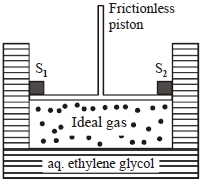
$A$ cylinder containing an ideal gas ($0.1 \; mol$ in $1.0 \; dm^{3}$) is in thermal equilibrium with a large volume of $0.5 \; m$ (molal) aqueous solution of ethylene glycol at its freezing point. If the stoppers $S_{1}$ and $S_{2}$ (as shown in the figure) are suddenly withdrawn,the volume of the gas in litres after equilibrium is achieved will be ............ $litre$.
(Given: $K_{f}$ (water) $= 2.0 \; K \; kg \; mol^{-1}$,$R = 0.08 \; dm^{3} \; atm \; K^{-1} \; mol^{-1}$,freezing point of water $= 273 \; K$)
(Given: $K_{f}$ (water) $= 2.0 \; K \; kg \; mol^{-1}$,$R = 0.08 \; dm^{3} \; atm \; K^{-1} \; mol^{-1}$,freezing point of water $= 273 \; K$)
A
$2.67$
B
$1.67$
C
$2.18$
D
$1.52$
Solution
(C) $1$. Calculate the freezing point of the solution:
$\Delta T_{f} = K_{f} \times m = 2.0 \; K \; kg \; mol^{-1} \times 0.5 \; mol \; kg^{-1} = 1.0 \; K$.
Freezing point of solution $T = 273 - 1 = 272 \; K$.
$2$. Calculate the initial pressure of the gas:
Using $PV = nRT$,$P = \frac{nRT}{V} = \frac{0.1 \; mol \times 0.08 \; dm^{3} \; atm \; K^{-1} \; mol^{-1} \times 272 \; K}{1.0 \; dm^{3}} = 2.176 \; atm$.
$3$. After withdrawing the stoppers,the piston is frictionless and exposed to atmospheric pressure $(P_{ext} = 1 \; atm)$. The gas will expand until its internal pressure equals the external pressure.
Using Boyle's Law $(P_{1}V_{1} = P_{2}V_{2})$:
$2.176 \; atm \times 1.0 \; L = 1.0 \; atm \times V_{2}$.
$V_{2} = 2.176 \; L \approx 2.18 \; L$.
$\Delta T_{f} = K_{f} \times m = 2.0 \; K \; kg \; mol^{-1} \times 0.5 \; mol \; kg^{-1} = 1.0 \; K$.
Freezing point of solution $T = 273 - 1 = 272 \; K$.
$2$. Calculate the initial pressure of the gas:
Using $PV = nRT$,$P = \frac{nRT}{V} = \frac{0.1 \; mol \times 0.08 \; dm^{3} \; atm \; K^{-1} \; mol^{-1} \times 272 \; K}{1.0 \; dm^{3}} = 2.176 \; atm$.
$3$. After withdrawing the stoppers,the piston is frictionless and exposed to atmospheric pressure $(P_{ext} = 1 \; atm)$. The gas will expand until its internal pressure equals the external pressure.
Using Boyle's Law $(P_{1}V_{1} = P_{2}V_{2})$:
$2.176 \; atm \times 1.0 \; L = 1.0 \; atm \times V_{2}$.
$V_{2} = 2.176 \; L \approx 2.18 \; L$.
0 likes
View Solution78
Easy
Two elements $A$ and $B$ form compounds having formula $AB_{2}$ and $AB_{4}$. When dissolved in $20 \ g$ of benzene $(C_{6}H_{6})$,$1 \ g$ of $AB_{2}$ lowers the freezing point by $2.3 \ K$ whereas $1.0 \ g$ of $AB_{4}$ lowers it by $1.3 \ K$. The molar depression constant for benzene is $5.1 \ K \ kg \ mol^{-1}$. Calculate atomic masses of $A$ and $B$.
Solution
(N/A) We know that the formula for molar mass is $M_{2} = \frac{1000 \times w_{2} \times K_{f}}{\Delta T_{f} \times w_{1}}$.
For $AB_{2}$: $M_{AB_{2}} = \frac{1000 \times 1 \times 5.1}{2.3 \times 20} = 110.87 \ g \ mol^{-1}$.
For $AB_{4}$: $M_{AB_{4}} = \frac{1000 \times 1 \times 5.1}{1.3 \times 20} = 196.15 \ g \ mol^{-1}$.
Let the atomic masses of $A$ and $B$ be $x$ and $y$ respectively.
Then,$x + 2y = 110.87$ $(i)$ and $x + 4y = 196.15$ $(ii)$.
Subtracting $(i)$ from $(ii)$,we get $2y = 85.28$,so $y = 42.64 \ u$.
Substituting $y$ in $(i)$,$x + 2(42.64) = 110.87$,so $x = 25.59 \ u$.
The atomic masses of $A$ and $B$ are $25.59 \ u$ and $42.64 \ u$ respectively.
For $AB_{2}$: $M_{AB_{2}} = \frac{1000 \times 1 \times 5.1}{2.3 \times 20} = 110.87 \ g \ mol^{-1}$.
For $AB_{4}$: $M_{AB_{4}} = \frac{1000 \times 1 \times 5.1}{1.3 \times 20} = 196.15 \ g \ mol^{-1}$.
Let the atomic masses of $A$ and $B$ be $x$ and $y$ respectively.
Then,$x + 2y = 110.87$ $(i)$ and $x + 4y = 196.15$ $(ii)$.
Subtracting $(i)$ from $(ii)$,we get $2y = 85.28$,so $y = 42.64 \ u$.
Substituting $y$ in $(i)$,$x + 2(42.64) = 110.87$,so $x = 25.59 \ u$.
The atomic masses of $A$ and $B$ are $25.59 \ u$ and $42.64 \ u$ respectively.
0 likes
View Solution79
Difficult
Benzene and toluene form an ideal solution over the entire range of composition. The vapour pressure of pure benzene and toluene at $300 \, K$ are $50.71 \, mm \, Hg$ and $32.06 \, mm \, Hg$ respectively. Calculate the mole fraction of benzene in the vapour phase if $80 \, g$ of benzene is mixed with $100 \, g$ of toluene.
Solution
(0.6) Molar mass of benzene $(C_6H_6) = 78 \, g \, mol^{-1}$.
Molar mass of toluene $(C_6H_5CH_3) = 92 \, g \, mol^{-1}$.
Moles of benzene $(n_b) = \frac{80}{78} = 1.026 \, mol$.
Moles of toluene $(n_t) = \frac{100}{92} = 1.087 \, mol$.
Mole fraction of benzene $(x_b) = \frac{1.026}{1.026 + 1.087} = 0.486$.
Mole fraction of toluene $(x_t) = 1 - 0.486 = 0.514$.
Partial pressure of benzene $(p_b) = x_b \times p_b^o = 0.486 \times 50.71 = 24.645 \, mm \, Hg$.
Partial pressure of toluene $(p_t) = x_t \times p_t^o = 0.514 \times 32.06 = 16.479 \, mm \, Hg$.
Mole fraction of benzene in vapour phase $(y_b) = \frac{p_b}{p_b + p_t} = \frac{24.645}{24.645 + 16.479} = \frac{24.645}{41.124} = 0.599 \approx 0.6$.
Molar mass of toluene $(C_6H_5CH_3) = 92 \, g \, mol^{-1}$.
Moles of benzene $(n_b) = \frac{80}{78} = 1.026 \, mol$.
Moles of toluene $(n_t) = \frac{100}{92} = 1.087 \, mol$.
Mole fraction of benzene $(x_b) = \frac{1.026}{1.026 + 1.087} = 0.486$.
Mole fraction of toluene $(x_t) = 1 - 0.486 = 0.514$.
Partial pressure of benzene $(p_b) = x_b \times p_b^o = 0.486 \times 50.71 = 24.645 \, mm \, Hg$.
Partial pressure of toluene $(p_t) = x_t \times p_t^o = 0.514 \times 32.06 = 16.479 \, mm \, Hg$.
Mole fraction of benzene in vapour phase $(y_b) = \frac{p_b}{p_b + p_t} = \frac{24.645}{24.645 + 16.479} = \frac{24.645}{41.124} = 0.599 \approx 0.6$.
0 likes
View Solution80
Medium
Give examples of ideal solutions and azeotropes.
Solution
(N/A) Ideal solutions: $n-hexane$ and $n-heptane$,or $bromoethane$ and $chloroethane$.
Azeotropes:
$1$. Minimum boiling azeotrope: $Ethanol-Water$ mixture ($95.4\%$ $ethanol$ by volume).
$2$. Maximum boiling azeotrope: $Nitric \ acid-Water$ ($68\%$ $HNO_3$ by mass).
Azeotropes:
$1$. Minimum boiling azeotrope: $Ethanol-Water$ mixture ($95.4\%$ $ethanol$ by volume).
$2$. Maximum boiling azeotrope: $Nitric \ acid-Water$ ($68\%$ $HNO_3$ by mass).
0 likes
View Solution81
Medium
What is boiling point? What is freezing point?
Solution
(N/A) $1$. Boiling point: The boiling point of a liquid is the temperature at which its vapor pressure becomes equal to the atmospheric pressure $(1.013 \ bar)$.
$2$. Freezing point: The freezing point of a substance is the temperature at which the vapor pressure of the substance in its liquid phase is equal to the vapor pressure of the substance in its solid phase.
$2$. Freezing point: The freezing point of a substance is the temperature at which the vapor pressure of the substance in its liquid phase is equal to the vapor pressure of the substance in its solid phase.
0 likes
View Solution82
MediumMCQ
The osmotic pressure of a solution of $NaCl$ is $0.10 \ atm$ and that of a glucose solution is $0.20 \ atm.$ The osmotic pressure of a solution formed by mixing $1 \ L$ of the sodium chloride solution with $2 \ L$ of the glucose solution is $x \times 10^{-3} \ atm.$ $x$ is.......... (nearest integer)
A
$150$
B
$167$
C
$160$
D
$159$
Solution
(B) Osmotic pressure $\pi = i \times C \times RT$
For $NaCl$,$i = 2$. Given $\pi_{NaCl} = 0.10 \ atm = 2 \times C_{NaCl} \times RT$. Thus,$C_{NaCl} \times RT = 0.05 \ atm$.
For glucose,$i = 1$. Given $\pi_{glucose} = 0.20 \ atm = 1 \times C_{glucose} \times RT$. Thus,$C_{glucose} \times RT = 0.20 \ atm$.
Number of moles of $NaCl$ in $1 \ L$ is $n_{NaCl} = C_{NaCl} \times 1 = \frac{0.05}{RT}$.
Number of moles of glucose in $2 \ L$ is $n_{glucose} = C_{glucose} \times 2 = \frac{0.20 \times 2}{RT} = \frac{0.40}{RT}$.
Total volume $V_{total} = 1 \ L + 2 \ L = 3 \ L$.
Total osmotic pressure $\pi_{total} = \frac{(n_{NaCl} \times i_{NaCl} + n_{glucose} \times i_{glucose}) \times RT}{V_{total}}$.
$\pi_{total} = \frac{(\frac{0.05}{RT} \times 2 + \frac{0.40}{RT} \times 1) \times RT}{3} = \frac{0.10 + 0.40}{3} = \frac{0.50}{3} \ atm$.
$\pi_{total} = 0.1666... \ atm = 166.6... \times 10^{-3} \ atm$.
Rounding to the nearest integer,$x = 167$.
For $NaCl$,$i = 2$. Given $\pi_{NaCl} = 0.10 \ atm = 2 \times C_{NaCl} \times RT$. Thus,$C_{NaCl} \times RT = 0.05 \ atm$.
For glucose,$i = 1$. Given $\pi_{glucose} = 0.20 \ atm = 1 \times C_{glucose} \times RT$. Thus,$C_{glucose} \times RT = 0.20 \ atm$.
Number of moles of $NaCl$ in $1 \ L$ is $n_{NaCl} = C_{NaCl} \times 1 = \frac{0.05}{RT}$.
Number of moles of glucose in $2 \ L$ is $n_{glucose} = C_{glucose} \times 2 = \frac{0.20 \times 2}{RT} = \frac{0.40}{RT}$.
Total volume $V_{total} = 1 \ L + 2 \ L = 3 \ L$.
Total osmotic pressure $\pi_{total} = \frac{(n_{NaCl} \times i_{NaCl} + n_{glucose} \times i_{glucose}) \times RT}{V_{total}}$.
$\pi_{total} = \frac{(\frac{0.05}{RT} \times 2 + \frac{0.40}{RT} \times 1) \times RT}{3} = \frac{0.10 + 0.40}{3} = \frac{0.50}{3} \ atm$.
$\pi_{total} = 0.1666... \ atm = 166.6... \times 10^{-3} \ atm$.
Rounding to the nearest integer,$x = 167$.
0 likes
View Solution83
MediumMCQ
$1$ molal $K_{4}[Fe(CN)_{6}]$ solution has a degree of dissociation of $0.4$. Its boiling point is equal to that of another solution which contains $18.1$ weight percent of a non-electrolytic solute $A$. The molar mass of $A$ is $.......\, u$. (Round off to the Nearest Integer). [Density of water $= 1.0\, g\, cm^{-3}$]
A
$95$
B
$85$
C
$105$
D
$26$
Solution
(B) The dissociation of $K_{4}[Fe(CN)_{6}]$ is given by: $K_{4}[Fe(CN)_{6}] \rightleftharpoons 4K^{+} + [Fe(CN)_{6}]^{4-}$.
Initial concentration: $1 \, m$,$0$,$0$.
Final concentration: $(1 - 0.4) \, m$,$4 \times 0.4 \, m$,$0.4 \, m$.
Total effective molality $= 0.6 + 1.6 + 0.4 = 2.6 \, m$.
Since the boiling point is the same,the molality of the non-electrolytic solution must also be $2.6 \, m$.
For $18.1 \%$ by weight solution,$18.1 \, g$ of solute $A$ is present in $81.9 \, g$ of water.
Using the formula for molality: $m = \frac{w_A \times 1000}{M_A \times w_{solvent}}$.
$2.6 = \frac{18.1 \times 1000}{M_A \times 81.9}$.
$M_A = \frac{18100}{2.6 \times 81.9} \approx 85 \, u$.
Initial concentration: $1 \, m$,$0$,$0$.
Final concentration: $(1 - 0.4) \, m$,$4 \times 0.4 \, m$,$0.4 \, m$.
Total effective molality $= 0.6 + 1.6 + 0.4 = 2.6 \, m$.
Since the boiling point is the same,the molality of the non-electrolytic solution must also be $2.6 \, m$.
For $18.1 \%$ by weight solution,$18.1 \, g$ of solute $A$ is present in $81.9 \, g$ of water.
Using the formula for molality: $m = \frac{w_A \times 1000}{M_A \times w_{solvent}}$.
$2.6 = \frac{18.1 \times 1000}{M_A \times 81.9}$.
$M_A = \frac{18100}{2.6 \times 81.9} \approx 85 \, u$.
0 likes
View Solution84
DifficultMCQ
$1.22 \, g$ of an organic acid is separately dissolved in $100 \, g$ of benzene $(K_{b}=2.6 \, K \, kg \, mol^{-1})$ and $100 \, g$ of acetone $(K_{b}=1.7 \, K \, kg \, mol^{-1})$. The acid is known to dimerize in benzene but remain as a monomer in acetone. The boiling point of the solution in acetone increases by $0.17^{\circ} C$.
The increase in boiling point of solution in benzene in $^{\circ} C$ is $x \times 10^{-2}$. The value of $x$ is ..... .(Nearest integer)
$[$ Atomic mass : $C=12.0, H=1.0, O=16.0]$
The increase in boiling point of solution in benzene in $^{\circ} C$ is $x \times 10^{-2}$. The value of $x$ is ..... .(Nearest integer)
$[$ Atomic mass : $C=12.0, H=1.0, O=16.0]$
A
$12$
B
$13$
C
$10$
D
$11$
Solution
(B) For acetone as solvent:
$\Delta T_{b} = i \times K_{b} \times m$
$0.17 = 1 \times 1.7 \times \frac{1.22 / M_{w}}{100 / 1000} \dots (1)$
For benzene as solvent (dimerization,$i = 0.5$):
$\Delta T_{b} = 0.5 \times 2.6 \times \frac{1.22 / M_{w}}{100 / 1000} \dots (2)$
Dividing $(2)$ by $(1)$:
$\frac{\Delta T_{b}}{0.17} = \frac{0.5 \times 2.6}{1.7} = \frac{1.3}{1.7}$
$\Delta T_{b} = \frac{1.3 \times 0.17}{1.7} = 0.13 \, ^{\circ}C$
Given $\Delta T_{b} = x \times 10^{-2} \, ^{\circ}C$,we have $0.13 = x \times 10^{-2}$,so $x = 13$.
$\Delta T_{b} = i \times K_{b} \times m$
$0.17 = 1 \times 1.7 \times \frac{1.22 / M_{w}}{100 / 1000} \dots (1)$
For benzene as solvent (dimerization,$i = 0.5$):
$\Delta T_{b} = 0.5 \times 2.6 \times \frac{1.22 / M_{w}}{100 / 1000} \dots (2)$
Dividing $(2)$ by $(1)$:
$\frac{\Delta T_{b}}{0.17} = \frac{0.5 \times 2.6}{1.7} = \frac{1.3}{1.7}$
$\Delta T_{b} = \frac{1.3 \times 0.17}{1.7} = 0.13 \, ^{\circ}C$
Given $\Delta T_{b} = x \times 10^{-2} \, ^{\circ}C$,we have $0.13 = x \times 10^{-2}$,so $x = 13$.
0 likes
View Solution85
MediumMCQ
Elevation in boiling point for $1.5 \, m$ solution of glucose in water is $4 \, K$. The depression in freezing point for $4.5 \, m$ solution of glucose in water is $4 \, K$. The ratio of molal elevation constant to molal depression constant $(K_{b} / K_{f})$ is $....$
A
$4$
B
$1$
C
$2$
D
$3$
Solution
(D) For glucose,the van't Hoff factor $i = 1$.
The elevation in boiling point is given by $\Delta T_{b} = K_{b} \cdot m_{1} = 4 \, K$,where $m_{1} = 1.5 \, m$.
So,$K_{b} \cdot 1.5 = 4 \implies K_{b} = \frac{4}{1.5}$.
The depression in freezing point is given by $\Delta T_{f} = K_{f} \cdot m_{2} = 4 \, K$,where $m_{2} = 4.5 \, m$.
So,$K_{f} \cdot 4.5 = 4 \implies K_{f} = \frac{4}{4.5}$.
The ratio $\frac{K_{b}}{K_{f}} = \frac{4 / 1.5}{4 / 4.5} = \frac{4.5}{1.5} = 3$.
The elevation in boiling point is given by $\Delta T_{b} = K_{b} \cdot m_{1} = 4 \, K$,where $m_{1} = 1.5 \, m$.
So,$K_{b} \cdot 1.5 = 4 \implies K_{b} = \frac{4}{1.5}$.
The depression in freezing point is given by $\Delta T_{f} = K_{f} \cdot m_{2} = 4 \, K$,where $m_{2} = 4.5 \, m$.
So,$K_{f} \cdot 4.5 = 4 \implies K_{f} = \frac{4}{4.5}$.
The ratio $\frac{K_{b}}{K_{f}} = \frac{4 / 1.5}{4 / 4.5} = \frac{4.5}{1.5} = 3$.
0 likes
View Solution86
MediumMCQ
The elevation in boiling point for $1 \ m$ solution of non-volatile solute $A$ is $3 \ K$. The depression in freezing point for $2 \ m$ solution of $A$ in the same solvent is $6 \ K$. The ratio of $K_{b}$ and $K_{f}$ i.e.,$K_{b} / K_{f}$ is $1 : X$. The value of $X$ is [nearest integer].
A
$0$
B
$1$
C
$2$
D
$3$
Solution
(B) For elevation in boiling point: $\Delta T_{b} = K_{b} \times m_{1} = 3 \ K$ where $m_{1} = 1 \ m$. So,$K_{b} = 3 \ K \ kg \ mol^{-1}$.
For depression in freezing point: $\Delta T_{f} = K_{f} \times m_{2} = 6 \ K$ where $m_{2} = 2 \ m$. So,$K_{f} = 6 / 2 = 3 \ K \ kg \ mol^{-1}$.
The ratio $K_{b} / K_{f} = 3 / 3 = 1 / 1$.
Comparing this with $1 : X$,we get $X = 1$.
For depression in freezing point: $\Delta T_{f} = K_{f} \times m_{2} = 6 \ K$ where $m_{2} = 2 \ m$. So,$K_{f} = 6 / 2 = 3 \ K \ kg \ mol^{-1}$.
The ratio $K_{b} / K_{f} = 3 / 3 = 1 / 1$.
Comparing this with $1 : X$,we get $X = 1$.
0 likes
View Solution87
MediumMCQ
$A$ concentrated solution of copper sulphate,which is dark blue in colour,is mixed at room temperature with a dilute solution of copper sulphate,which is light blue. For this process:
A
entropy change is positive,but enthalpy change is negative
B
entropy and enthalpy changes are both positive
C
entropy change is positive and enthalpy does not change
D
entropy change is negative and enthalpy change is positive
Solution
(C) The correct option is $(C)$.
When a concentrated solution of $CuSO_4$ is mixed with a dilute solution of $CuSO_4$,the process is essentially a dilution process.
During dilution,the randomness of the solute particles increases as they spread out in a larger volume,which leads to an increase in entropy $(\Delta S > 0)$.
Since the mixing of two solutions of the same solute at the same temperature involves negligible heat change (ideal mixing approximation),the enthalpy change $(\Delta H)$ is approximately zero.
When a concentrated solution of $CuSO_4$ is mixed with a dilute solution of $CuSO_4$,the process is essentially a dilution process.
During dilution,the randomness of the solute particles increases as they spread out in a larger volume,which leads to an increase in entropy $(\Delta S > 0)$.
Since the mixing of two solutions of the same solute at the same temperature involves negligible heat change (ideal mixing approximation),the enthalpy change $(\Delta H)$ is approximately zero.
0 likes
View Solution88
DifficultMCQ
The specific heat of a certain substance is $0.86 \,J \,g^{-1} \,K^{-1}$. Assuming ideal solution behaviour,the energy required (in $J$) to heat $10 \,g$ of $1 \,molal$ of its aqueous solution from $300 \,K$ to $310 \,K$ is closest to $.... \,J$
[Given: Molar mass of the substance $= 58 \,g \,mol^{-1}$; specific heat of water $= 4.2 \,J \,g^{-1} \,K^{-1}$]
[Given: Molar mass of the substance $= 58 \,g \,mol^{-1}$; specific heat of water $= 4.2 \,J \,g^{-1} \,K^{-1}$]
A
$401.7$
B
$424.7$
C
$420.0$
D
$86.0$
Solution
(A) Given,specific heat of substance $= 0.86 \,J \,g^{-1} \,K^{-1}$.
$1 \,molal$ solution means $1 \,mole$ of solute in $1000 \,g$ of solvent (water).
Mass of solute $= 1 \,mole \times 58 \,g \,mol^{-1} = 58 \,g$.
Total mass of solution $= 1000 \,g + 58 \,g = 1058 \,g$.
In $1058 \,g$ solution,mass of solute $= 58 \,g$ and mass of water $= 1000 \,g$.
For $10 \,g$ of solution:
Mass of solute $= (58 / 1058) \times 10 \approx 0.548 \,g$.
Mass of water $= (1000 / 1058) \times 10 \approx 9.452 \,g$.
Energy required $q = (m_{solute} \times c_{solute} \times \Delta T) + (m_{water} \times c_{water} \times \Delta T)$.
$q = (0.548 \times 0.86 \times 10) + (9.452 \times 4.2 \times 10)$.
$q = 4.7128 + 396.984 = 401.6968 \,J \approx 401.7 \,J$.
$1 \,molal$ solution means $1 \,mole$ of solute in $1000 \,g$ of solvent (water).
Mass of solute $= 1 \,mole \times 58 \,g \,mol^{-1} = 58 \,g$.
Total mass of solution $= 1000 \,g + 58 \,g = 1058 \,g$.
In $1058 \,g$ solution,mass of solute $= 58 \,g$ and mass of water $= 1000 \,g$.
For $10 \,g$ of solution:
Mass of solute $= (58 / 1058) \times 10 \approx 0.548 \,g$.
Mass of water $= (1000 / 1058) \times 10 \approx 9.452 \,g$.
Energy required $q = (m_{solute} \times c_{solute} \times \Delta T) + (m_{water} \times c_{water} \times \Delta T)$.
$q = (0.548 \times 0.86 \times 10) + (9.452 \times 4.2 \times 10)$.
$q = 4.7128 + 396.984 = 401.6968 \,J \approx 401.7 \,J$.
0 likes
View Solution89
DifficultMCQ
In the depression of freezing point experiment:
$A.$ Vapour pressure of the solution is less than that of pure solvent
$B.$ Vapour pressure of the solution is more than that of pure solvent
$C.$ Only solute molecules solidify at the freezing point
$D.$ Only solvent molecules solidify at the freezing point
$A.$ Vapour pressure of the solution is less than that of pure solvent
$B.$ Vapour pressure of the solution is more than that of pure solvent
$C.$ Only solute molecules solidify at the freezing point
$D.$ Only solvent molecules solidify at the freezing point
A
$A$ and $D$ only
B
$B$ and $C$ only
C
$A$ and $C$ only
D
$A$ only
Solution
(A) The vapour pressure $(V.P.)$ of a solution is always lower than that of the pure solvent due to the presence of non-volatile solute particles.
At the freezing point,the solid phase of the solvent is in equilibrium with the liquid phase of the solution. Only the solvent molecules solidify,while the solute remains in the liquid phase.
Therefore,statements $A$ and $D$ are correct.
At the freezing point,the solid phase of the solvent is in equilibrium with the liquid phase of the solution. Only the solvent molecules solidify,while the solute remains in the liquid phase.
Therefore,statements $A$ and $D$ are correct.
0 likes
View Solution90
DifficultMCQ
The number of pairs of solutions having the same value of osmotic pressure from the following is:
(Assume $100\%$ ionization)
$A.$ $0.500 \ M \ C_2H_5OH \ (aq)$ and $0.25 \ M \ KBr \ (aq)$
$B.$ $0.100 \ M \ K_4[Fe(CN)_6] \ (aq)$ and $0.100 \ M \ FeSO_4(NH_4)_2SO_4 \ (aq)$
$C.$ $0.05 \ M \ K_4[Fe(CN)_6] \ (aq)$ and $0.25 \ M \ NaCl \ (aq)$
$D.$ $0.15 \ M \ NaCl \ (aq)$ and $0.1 \ M \ BaCl_2 \ (aq)$
$E.$ $0.02 \ M \ KCl \cdot MgCl_2 \cdot 6H_2O \ (aq)$ and $0.05 \ M \ KCl \ (aq)$
(Assume $100\%$ ionization)
$A.$ $0.500 \ M \ C_2H_5OH \ (aq)$ and $0.25 \ M \ KBr \ (aq)$
$B.$ $0.100 \ M \ K_4[Fe(CN)_6] \ (aq)$ and $0.100 \ M \ FeSO_4(NH_4)_2SO_4 \ (aq)$
$C.$ $0.05 \ M \ K_4[Fe(CN)_6] \ (aq)$ and $0.25 \ M \ NaCl \ (aq)$
$D.$ $0.15 \ M \ NaCl \ (aq)$ and $0.1 \ M \ BaCl_2 \ (aq)$
$E.$ $0.02 \ M \ KCl \cdot MgCl_2 \cdot 6H_2O \ (aq)$ and $0.05 \ M \ KCl \ (aq)$
A
$2$
B
$3$
C
$4$
D
$5$
Solution
(A) The osmotic pressure is given by $\pi = iCRT$,where $i$ is the van't Hoff factor,$C$ is the molarity,$R$ is the gas constant,and $T$ is the temperature.
For solutions at the same temperature,$\pi \propto iC$.
$A.$ $iC$ for $C_2H_5OH = 1 \times 0.500 = 0.500$; $iC$ for $KBr = 2 \times 0.25 = 0.500$. (Equal)
$B.$ $iC$ for $K_4[Fe(CN)_6] = 5 \times 0.100 = 0.500$; $iC$ for $FeSO_4(NH_4)_2SO_4 = 3 \times 0.100 = 0.300$. (Not equal)
$C.$ $iC$ for $K_4[Fe(CN)_6] = 5 \times 0.05 = 0.250$; $iC$ for $NaCl = 2 \times 0.25 = 0.500$. (Not equal)
$D.$ $iC$ for $NaCl = 2 \times 0.15 = 0.300$; $iC$ for $BaCl_2 = 3 \times 0.1 = 0.300$. (Equal)
$E.$ $iC$ for $KCl \cdot MgCl_2 \cdot 6H_2O = 3 \times 0.02 = 0.060$; $iC$ for $KCl = 2 \times 0.05 = 0.100$. (Not equal)
Only pairs $A$ and $D$ have the same osmotic pressure. Thus,the number of such pairs is $2$.
For solutions at the same temperature,$\pi \propto iC$.
$A.$ $iC$ for $C_2H_5OH = 1 \times 0.500 = 0.500$; $iC$ for $KBr = 2 \times 0.25 = 0.500$. (Equal)
$B.$ $iC$ for $K_4[Fe(CN)_6] = 5 \times 0.100 = 0.500$; $iC$ for $FeSO_4(NH_4)_2SO_4 = 3 \times 0.100 = 0.300$. (Not equal)
$C.$ $iC$ for $K_4[Fe(CN)_6] = 5 \times 0.05 = 0.250$; $iC$ for $NaCl = 2 \times 0.25 = 0.500$. (Not equal)
$D.$ $iC$ for $NaCl = 2 \times 0.15 = 0.300$; $iC$ for $BaCl_2 = 3 \times 0.1 = 0.300$. (Equal)
$E.$ $iC$ for $KCl \cdot MgCl_2 \cdot 6H_2O = 3 \times 0.02 = 0.060$; $iC$ for $KCl = 2 \times 0.05 = 0.100$. (Not equal)
Only pairs $A$ and $D$ have the same osmotic pressure. Thus,the number of such pairs is $2$.
0 likes
View Solution91
DifficultMCQ
Solid Lead nitrate is dissolved in $1 \, L$ of water. The solution was found to boil at $100.15^{\circ}C$. When $0.2 \, mol$ of $NaCl$ is added to the resulting solution,it was observed that the solution froze at $-0.8^{\circ}C$. The solubility product of $PbCl_2$ formed is $........... \times 10^{-6}$ at $298 \, K$. (Nearest integer) Given: $K_b = 0.5 \, K \, kg \, mol^{-1}$ and $K_f = 1.8 \, K \, kg \, mol^{-1}$. Assume molality to be equal to molarity in all cases.
A
$13$
B
$12$
C
$11$
D
$10$
Solution
(A) Let $a$ moles of $Pb(NO_3)_2$ be added.
$Pb(NO_3)_2 \rightarrow Pb^{2+} + 2NO_3^-$
Initial moles: $a \quad 0 \quad 0$
Final moles: $0 \quad a \quad 2a$
Total particles = $3a$.
$\Delta T_b = i \times K_b \times m = 3 \times 0.5 \times a = 0.15 \Rightarrow a = 0.1 \, mol$.
Now,$Pb^{2+} + 2Cl^- \rightarrow PbCl_2(s)$.
Initial moles: $Pb^{2+} = 0.1, Cl^- = 0.2, NO_3^- = 0.2$.
Let $x$ moles of $PbCl_2$ precipitate.
Remaining moles: $Pb^{2+} = (0.1-x), Cl^- = (0.2-2x), NO_3^- = 0.2$.
Total moles of solute particles = $(0.1-x) + (0.2-2x) + 0.2 = 0.5-3x$.
$\Delta T_f = K_f \times m = 1.8 \times (0.5-3x) = 0.8$.
$0.9 - 5.4x = 0.8$ $\Rightarrow 5.4x = 0.1$ $\Rightarrow x = 0.1/5.4 = 1/54$.
$[Pb^{2+}] = 0.1 - 1/54 = 4.4/54 \approx 0.0815$.
$[Cl^-] = 0.2 - 2/54 = 8.8/54 \approx 0.163$.
$K_{sp} = [Pb^{2+}][Cl^-]^2 = (4.4/54) \times (8.8/54)^2 \approx 13 \times 10^{-6}$.
$Pb(NO_3)_2 \rightarrow Pb^{2+} + 2NO_3^-$
Initial moles: $a \quad 0 \quad 0$
Final moles: $0 \quad a \quad 2a$
Total particles = $3a$.
$\Delta T_b = i \times K_b \times m = 3 \times 0.5 \times a = 0.15 \Rightarrow a = 0.1 \, mol$.
Now,$Pb^{2+} + 2Cl^- \rightarrow PbCl_2(s)$.
Initial moles: $Pb^{2+} = 0.1, Cl^- = 0.2, NO_3^- = 0.2$.
Let $x$ moles of $PbCl_2$ precipitate.
Remaining moles: $Pb^{2+} = (0.1-x), Cl^- = (0.2-2x), NO_3^- = 0.2$.
Total moles of solute particles = $(0.1-x) + (0.2-2x) + 0.2 = 0.5-3x$.
$\Delta T_f = K_f \times m = 1.8 \times (0.5-3x) = 0.8$.
$0.9 - 5.4x = 0.8$ $\Rightarrow 5.4x = 0.1$ $\Rightarrow x = 0.1/5.4 = 1/54$.
$[Pb^{2+}] = 0.1 - 1/54 = 4.4/54 \approx 0.0815$.
$[Cl^-] = 0.2 - 2/54 = 8.8/54 \approx 0.163$.
$K_{sp} = [Pb^{2+}][Cl^-]^2 = (4.4/54) \times (8.8/54)^2 \approx 13 \times 10^{-6}$.
0 likes
View Solution92
MediumMCQ
Match List-$I$ with List-$II$.
Choose the correct answer from the options given below:
| List-$I$ | List-$II$ |
| $A$. van't Hoff factor,$i$ | $I$. Cryoscopic constant |
| $B$. $k_{f}$ | $II$. Isotonic solutions |
| $C$. Solutions with same osmotic pressure | $III$. $\frac{\text{Normal molar mass}}{\text{Abnormal molar mass}}$ |
| $D$. Azeotropes | $IV$. Solutions with same composition of vapour above it |
Choose the correct answer from the options given below:
A
$A-III, B-I, C-II, D-IV$
B
$A-III, B-II, C-I, D-IV$
C
$A-III, B-I, C-IV, D-II$
D
$A-I, B-III, C-II, D-IV$
Solution
(A) van't Hoff factor,$i = \frac{\text{Normal molar mass}}{\text{Abnormal molar mass}}$,which corresponds to $III$.
$(B)$ $k_{f}$ is the Cryoscopic constant (molal depression constant),which corresponds to $I$.
$(C)$ Solutions with the same osmotic pressure are known as Isotonic solutions,which corresponds to $II$.
$(D)$ Azeotropes are binary mixtures having the same composition in liquid and vapour phases,which corresponds to $IV$.
Therefore,the correct matching is $A-III, B-I, C-II, D-IV$.
$(B)$ $k_{f}$ is the Cryoscopic constant (molal depression constant),which corresponds to $I$.
$(C)$ Solutions with the same osmotic pressure are known as Isotonic solutions,which corresponds to $II$.
$(D)$ Azeotropes are binary mixtures having the same composition in liquid and vapour phases,which corresponds to $IV$.
Therefore,the correct matching is $A-III, B-I, C-II, D-IV$.
0 likes
View Solution93
DifficultMCQ
Evaluate the following statements for their correctness.
$(A)$ The elevation in boiling point temperature of water will be same for $0.1 \ M \ NaCl$ and $0.1 \ M$ urea.
$(B)$ Azeotropic mixtures boil without change in their composition.
$(C)$ Osmosis always takes place from hypertonic to hypotonic solution.
$(D)$ The density of $32 \% \ H_2SO_4$ solution having molarity $4.09 \ M$ is approximately $1.26 \ g \ mL^{-1}$.
$(E)$ $A$ negatively charged sol is obtained when $KI$ solution is added to silver nitrate solution.
Choose the correct answer from the options given below:
$(A)$ The elevation in boiling point temperature of water will be same for $0.1 \ M \ NaCl$ and $0.1 \ M$ urea.
$(B)$ Azeotropic mixtures boil without change in their composition.
$(C)$ Osmosis always takes place from hypertonic to hypotonic solution.
$(D)$ The density of $32 \% \ H_2SO_4$ solution having molarity $4.09 \ M$ is approximately $1.26 \ g \ mL^{-1}$.
$(E)$ $A$ negatively charged sol is obtained when $KI$ solution is added to silver nitrate solution.
Choose the correct answer from the options given below:
A
$B, D$ and $E$ only
B
$A, B$ and $D$ only
C
$A$ and $C$ only
D
$B$ and $D$ only
Solution
(D) Incorrect. $\Delta T_b = i \times K_b \times m$. For $NaCl$,$i=2$,and for urea,$i=1$. Thus,elevation is not the same.
$(B)$ Correct. Azeotropic mixtures boil at a constant temperature and have the same composition in both liquid and vapour phases.
$(C)$ Incorrect. Osmosis always takes place from a hypotonic solution (lower concentration) to a hypertonic solution (higher concentration) through a semi-permeable membrane.
$(D)$ Correct. Molarity $M = \frac{\% \times 10 \times d}{M_{solute}} = \frac{32 \times 10 \times 1.26}{98} \approx 4.11 \ M$,which is approximately $4.09 \ M$.
$(E)$ Incorrect. When $KI$ is added to $AgNO_3$ (excess $AgNO_3$),$AgI$ adsorbs $Ag^+$ ions to form a positively charged sol $(AgI/Ag^+)$.
Therefore,only statements $(B)$ and $(D)$ are correct.
$(B)$ Correct. Azeotropic mixtures boil at a constant temperature and have the same composition in both liquid and vapour phases.
$(C)$ Incorrect. Osmosis always takes place from a hypotonic solution (lower concentration) to a hypertonic solution (higher concentration) through a semi-permeable membrane.
$(D)$ Correct. Molarity $M = \frac{\% \times 10 \times d}{M_{solute}} = \frac{32 \times 10 \times 1.26}{98} \approx 4.11 \ M$,which is approximately $4.09 \ M$.
$(E)$ Incorrect. When $KI$ is added to $AgNO_3$ (excess $AgNO_3$),$AgI$ adsorbs $Ag^+$ ions to form a positively charged sol $(AgI/Ag^+)$.
Therefore,only statements $(B)$ and $(D)$ are correct.
0 likes
View Solution94
DifficultMCQ
$25 \ mL$ of an aqueous solution of $KCl$ was found to require $20 \ mL$ of $1 \ M \ AgNO_3$ solution when titrated using $K_2CrO_4$ as an indicator. What is the depression in freezing point of $KCl$ solution of the given concentration? (Nearest integer). Given: $K_f = 2.0 \ K \ kg \ mol^{-1}$. Assume: $(1)$ $100 \%$ ionization and $(2)$ density of the aqueous solution as $1 \ g \ mL^{-1}$.
A
$3$
B
$1$
C
$2$
D
$4$
Solution
(A) The reaction is: $KCl + AgNO_3 \rightarrow AgCl + KNO_3$.
At the equivalence point,the millimoles of $KCl$ equal the millimoles of $AgNO_3$:
$n(KCl) = 20 \ mL \times 1 \ M = 20 \ mmol = 0.02 \ mol$.
Mass of the solution $= 25 \ mL \times 1 \ g \ mL^{-1} = 25 \ g$.
Mass of $KCl$ solute $= 0.02 \ mol \times 74.5 \ g \ mol^{-1} = 1.49 \ g$.
Mass of solvent $= 25 \ g - 1.49 \ g = 23.51 \ g = 0.02351 \ kg$.
Molality $(m) = \frac{0.02 \ mol}{0.02351 \ kg} \approx 0.8507 \ mol \ kg^{-1}$.
Since $KCl$ undergoes $100 \%$ ionization,the van't Hoff factor $i = 2$.
Depression in freezing point $\Delta T_f = i \times K_f \times m = 2 \times 2.0 \times 0.8507 = 3.4028 \ K$.
The nearest integer is $3$.
At the equivalence point,the millimoles of $KCl$ equal the millimoles of $AgNO_3$:
$n(KCl) = 20 \ mL \times 1 \ M = 20 \ mmol = 0.02 \ mol$.
Mass of the solution $= 25 \ mL \times 1 \ g \ mL^{-1} = 25 \ g$.
Mass of $KCl$ solute $= 0.02 \ mol \times 74.5 \ g \ mol^{-1} = 1.49 \ g$.
Mass of solvent $= 25 \ g - 1.49 \ g = 23.51 \ g = 0.02351 \ kg$.
Molality $(m) = \frac{0.02 \ mol}{0.02351 \ kg} \approx 0.8507 \ mol \ kg^{-1}$.
Since $KCl$ undergoes $100 \%$ ionization,the van't Hoff factor $i = 2$.
Depression in freezing point $\Delta T_f = i \times K_f \times m = 2 \times 2.0 \times 0.8507 = 3.4028 \ K$.
The nearest integer is $3$.
0 likes
View Solution95
MediumMCQ
$20\%$ of acetic acid is dissociated when its $5\ g$ is added to $500\ mL$ of water. The depression in freezing point of such water is $..... \times 10^{-3} \ { }^{\circ}C$. Atomic mass of $C$,$H$,and $O$ are $12$,$1$,and $16 \ \text{a.m.u.}$ respectively.
[Given: Molal depression constant and density of water are $1.86 \ K \ kg \ mol^{-1}$ and $1 \ g \ cm^{-3}$ respectively.]
[Given: Molal depression constant and density of water are $1.86 \ K \ kg \ mol^{-1}$ and $1 \ g \ cm^{-3}$ respectively.]
A
$371$
B
$372$
C
$373$
D
$375$
Solution
(B) $1$. Calculate the molar mass of acetic acid $(CH_3COOH)$: $12 + 3(1) + 12 + 16 + 16 + 1 = 60 \ g \ mol^{-1}$.
$2$. Calculate the van't Hoff factor $(i)$ for $20\%$ dissociation $(\alpha = 0.2)$: $i = 1 + \alpha(n-1) = 1 + 0.2(2-1) = 1.2$.
$3$. Calculate the molality $(m)$ of the solution: $m = \frac{\text{moles of solute}}{\text{mass of solvent in kg}} = \frac{5/60}{0.5} = \frac{1}{6} \times 2 = 0.333 \ mol \ kg^{-1}$.
$4$. Calculate the depression in freezing point $(\Delta T_f)$: $\Delta T_f = i \times K_f \times m = 1.2 \times 1.86 \times \frac{5 \times 1000}{60 \times 500} = 1.2 \times 1.86 \times 0.1666 = 0.372 \ { }^{\circ}C$.
$5$. Express in the required format: $0.372 \ { }^{\circ}C = 372 \times 10^{-3} \ { }^{\circ}C$.
$2$. Calculate the van't Hoff factor $(i)$ for $20\%$ dissociation $(\alpha = 0.2)$: $i = 1 + \alpha(n-1) = 1 + 0.2(2-1) = 1.2$.
$3$. Calculate the molality $(m)$ of the solution: $m = \frac{\text{moles of solute}}{\text{mass of solvent in kg}} = \frac{5/60}{0.5} = \frac{1}{6} \times 2 = 0.333 \ mol \ kg^{-1}$.
$4$. Calculate the depression in freezing point $(\Delta T_f)$: $\Delta T_f = i \times K_f \times m = 1.2 \times 1.86 \times \frac{5 \times 1000}{60 \times 500} = 1.2 \times 1.86 \times 0.1666 = 0.372 \ { }^{\circ}C$.
$5$. Express in the required format: $0.372 \ { }^{\circ}C = 372 \times 10^{-3} \ { }^{\circ}C$.
0 likes
View Solution96
DifficultMCQ
The solution from the following with the highest depression in freezing point (lowest freezing point) is:
A
$180 \ g$ of acetic acid dissolved in water
B
$180 \ g$ of acetic acid dissolved in benzene
C
$180 \ g$ of benzoic acid dissolved in benzene
D
$180 \ g$ of glucose dissolved in water
Solution
(B) The depression in freezing point is given by $\Delta T_f = i \cdot K_f \cdot m$.
$1.$ For $180 \ g$ of acetic acid ($CH_3COOH$,molar mass $= 60 \ g/mol$) in benzene,$m = 3 \ mol/kg$ (assuming $1 \ kg$ solvent). Acetic acid dimerizes in benzene,so $i \approx 0.5$. $\Delta T_f = 0.5 \times 5.12 \times 3 = 7.68 \ K$.
$2.$ For $180 \ g$ of benzoic acid ($C_6H_5COOH$,molar mass $= 122 \ g/mol$) in benzene,$m = 180/122 \approx 1.47 \ mol/kg$. $i \approx 0.5$. $\Delta T_f = 0.5 \times 5.12 \times 1.47 \approx 3.76 \ K$.
$3.$ For $180 \ g$ of acetic acid in water,$m = 3 \ mol/kg$. Acetic acid is a weak electrolyte,$i \approx 1 + \alpha \approx 1$. $\Delta T_f = 1 \times 1.86 \times 3 = 5.58 \ K$.
$4.$ For $180 \ g$ of glucose ($C_6H_{12}O_6$,molar mass $= 180 \ g/mol$) in water,$m = 1 \ mol/kg$. $i = 1$. $\Delta T_f = 1 \times 1.86 \times 1 = 1.86 \ K$.
Comparing all,acetic acid in benzene shows the highest $\Delta T_f$.
$1.$ For $180 \ g$ of acetic acid ($CH_3COOH$,molar mass $= 60 \ g/mol$) in benzene,$m = 3 \ mol/kg$ (assuming $1 \ kg$ solvent). Acetic acid dimerizes in benzene,so $i \approx 0.5$. $\Delta T_f = 0.5 \times 5.12 \times 3 = 7.68 \ K$.
$2.$ For $180 \ g$ of benzoic acid ($C_6H_5COOH$,molar mass $= 122 \ g/mol$) in benzene,$m = 180/122 \approx 1.47 \ mol/kg$. $i \approx 0.5$. $\Delta T_f = 0.5 \times 5.12 \times 1.47 \approx 3.76 \ K$.
$3.$ For $180 \ g$ of acetic acid in water,$m = 3 \ mol/kg$. Acetic acid is a weak electrolyte,$i \approx 1 + \alpha \approx 1$. $\Delta T_f = 1 \times 1.86 \times 3 = 5.58 \ K$.
$4.$ For $180 \ g$ of glucose ($C_6H_{12}O_6$,molar mass $= 180 \ g/mol$) in water,$m = 1 \ mol/kg$. $i = 1$. $\Delta T_f = 1 \times 1.86 \times 1 = 1.86 \ K$.
Comparing all,acetic acid in benzene shows the highest $\Delta T_f$.
0 likes
View Solution97
MediumMCQ
$2.5 \ g$ of a non-volatile,non-electrolyte is dissolved in $100 \ g$ of water at $25^{\circ} C$. The solution showed a boiling point elevation by $2^{\circ} C$. Assuming the solute concentration is negligible with respect to the solvent concentration,the vapour pressure of the resulting aqueous solution is . . . . . . $mm$ of $Hg$ (nearest integer).
[Given : Molal boiling point elevation constant of water $(K_b) = 0.52 \ K \ kg \ mol^{-1}$,
$1 \ atm$ pressure $= 760 \ mm$ of $Hg$,molar mass of water $= 18 \ g \ mol^{-1}]$
[Given : Molal boiling point elevation constant of water $(K_b) = 0.52 \ K \ kg \ mol^{-1}$,
$1 \ atm$ pressure $= 760 \ mm$ of $Hg$,molar mass of water $= 18 \ g \ mol^{-1}]$
A
$702$
B
$704$
C
$705$
D
$707$
Solution
(D) Given: $\Delta T_b = 2 \ K$,$K_b = 0.52 \ K \ kg \ mol^{-1}$,$W_{\text{solvent}} = 100 \ g$,$M_{\text{solvent}} = 18 \ g \ mol^{-1}$,$P^{\circ} = 760 \ mm \ Hg$.
Step $1$: Calculate molality $(m)$ using $\Delta T_b = K_b \times m$.
$2 = 0.52 \times m \implies m = \frac{2}{0.52} \approx 3.846 \ mol \ kg^{-1}$.
Step $2$: Use Raoult's law for dilute solutions: $\frac{P^{\circ} - P_s}{P^{\circ}} = \frac{n_{\text{solute}}}{n_{\text{solvent}}}$.
Since $m = \frac{n_{\text{solute}}}{W_{\text{solvent}}(kg)}$,we have $n_{\text{solute}} = m \times \frac{W_{\text{solvent}}}{1000}$.
$n_{\text{solvent}} = \frac{100}{18} = 5.556 \ mol$.
Step $3$: Calculate relative lowering of vapour pressure.
$\frac{\Delta P}{P^{\circ}} = \frac{m \times W_{\text{solvent}}}{1000} \times \frac{1}{n_{\text{solvent}}} = \frac{m \times M_{\text{solvent}}}{1000}$.
$\Delta P = 760 \times \frac{3.846 \times 18}{1000} = 760 \times 0.069228 = 52.613 \ mm \ Hg$.
Step $4$: Calculate vapour pressure of solution $(P_s)$.
$P_s = P^{\circ} - \Delta P = 760 - 52.613 = 707.387 \ mm \ Hg$.
Rounding to the nearest integer,we get $707 \ mm \ Hg$.
Step $1$: Calculate molality $(m)$ using $\Delta T_b = K_b \times m$.
$2 = 0.52 \times m \implies m = \frac{2}{0.52} \approx 3.846 \ mol \ kg^{-1}$.
Step $2$: Use Raoult's law for dilute solutions: $\frac{P^{\circ} - P_s}{P^{\circ}} = \frac{n_{\text{solute}}}{n_{\text{solvent}}}$.
Since $m = \frac{n_{\text{solute}}}{W_{\text{solvent}}(kg)}$,we have $n_{\text{solute}} = m \times \frac{W_{\text{solvent}}}{1000}$.
$n_{\text{solvent}} = \frac{100}{18} = 5.556 \ mol$.
Step $3$: Calculate relative lowering of vapour pressure.
$\frac{\Delta P}{P^{\circ}} = \frac{m \times W_{\text{solvent}}}{1000} \times \frac{1}{n_{\text{solvent}}} = \frac{m \times M_{\text{solvent}}}{1000}$.
$\Delta P = 760 \times \frac{3.846 \times 18}{1000} = 760 \times 0.069228 = 52.613 \ mm \ Hg$.
Step $4$: Calculate vapour pressure of solution $(P_s)$.
$P_s = P^{\circ} - \Delta P = 760 - 52.613 = 707.387 \ mm \ Hg$.
Rounding to the nearest integer,we get $707 \ mm \ Hg$.
0 likes
View SolutionSolutions — Mix Examples of Solutions · Frequently Asked Questions
1Are these Solutions questions useful for JEE and NEET?
Yes. All questions in this section are mapped to JEE Main and NEET exam patterns. Previous year questions from JEE Main, NEET, GUJCET and state-level exams are included with full solutions.
2Can I switch to Hindi or Gujarati for these questions?
Yes. Use the language tabs in the hero section or the sidebar to view the same questions and solutions in English, Hindi or Gujarati.
3How do I generate a question paper from this subtopic?
Use the Vedclass Exam Paper Generator — select the chapter and subtopic, set difficulty, and generate Sets A, B, C, D automatically. First 3 chapters of every subject are free.
Vedclass Products
For Students
Vedclass Test Series
Mock tests in real JEE/NEET style with performance analysis. 5-day free trial.
Start Free TrialFor Teachers
Exam Paper Generator
Generate Set A/B/C/D papers from this chapter in 2 minutes. 3 chapters free.
Try FreeFor Institutes
Online Exam Module
Live online exams with unlimited students, 360° analytics & white-label branding.
See DemoFor Teachers & Institutes
Generate a Solutions Exam Paper in 2 Minutes
Select subtopic & difficulty — Sets A, B, C, D auto-generated with No Repeat logic.
First 3 chapters of every subject are free — no payment required.