
A English
Ideal and Non-ideal solution Questions in English
Class 12 Chemistry · Solutions · Ideal and Non-ideal solution
179+
Questions
English
Language
100%
With Solutions
Showing 50 of 179 questions in English
1
MediumMCQ
Benzene and toluene form nearly ideal solutions. At $20\,^{\circ}C$,the vapour pressure of benzene is $75\,torr$ and that of toluene is $22\,torr$. The partial vapour pressure of benzene at $20\,^{\circ}C$ for a solution containing $78\,g$ of benzene and $46\,g$ of toluene in $torr$ is
A
$50$
B
$25$
C
$37.5$
D
$53.5$
Solution
(A) According to Raoult's law,the partial vapour pressure of a component is given by $P_i = P_i^{\circ} \times X_i$.
First,calculate the number of moles of benzene $(C_6H_6)$ and toluene $(C_7H_8)$:
$n_{\text{benzene}} = \frac{78\,g}{78\,g/mol} = 1\,mol$.
$n_{\text{toluene}} = \frac{46\,g}{92\,g/mol} = 0.5\,mol$.
Next,calculate the mole fraction of benzene $(X_B)$:
$X_B = \frac{n_{\text{benzene}}}{n_{\text{benzene}} + n_{\text{toluene}}} = \frac{1}{1 + 0.5} = \frac{1}{1.5} = \frac{2}{3}$.
Now,calculate the partial vapour pressure of benzene $(P_B)$:
$P_B = P_B^{\circ} \times X_B = 75\,torr \times \frac{2}{3} = 50\,torr$.
First,calculate the number of moles of benzene $(C_6H_6)$ and toluene $(C_7H_8)$:
$n_{\text{benzene}} = \frac{78\,g}{78\,g/mol} = 1\,mol$.
$n_{\text{toluene}} = \frac{46\,g}{92\,g/mol} = 0.5\,mol$.
Next,calculate the mole fraction of benzene $(X_B)$:
$X_B = \frac{n_{\text{benzene}}}{n_{\text{benzene}} + n_{\text{toluene}}} = \frac{1}{1 + 0.5} = \frac{1}{1.5} = \frac{2}{3}$.
Now,calculate the partial vapour pressure of benzene $(P_B)$:
$P_B = P_B^{\circ} \times X_B = 75\,torr \times \frac{2}{3} = 50\,torr$.
0 likes
View Solution2
DifficultMCQ
An ideal solution was obtained by mixing methanol and ethanol. If the partial vapour pressure of methanol and ethanol are $2.619 \, kPa$ and $4.556 \, kPa$ respectively,the composition of the vapour (in terms of mole fraction) will be
A
$0.635$ methanol,$0.365$ ethanol
B
$0.365$ methanol,$0.635$ ethanol
C
$0.574$ methanol,$0.326$ ethanol
D
$0.173$ methanol,$0.827$ ethanol
Solution
(B) Partial pressure of methanol $= 2.619 \, kPa$
Partial pressure of ethanol $= 4.556 \, kPa$
Total pressure $= \text{Partial pressure of methanol} + \text{Partial pressure of ethanol}$
Total pressure $= 2.619 + 4.556 = 7.175 \, kPa$
Let $y_{methanol}$ be the mole fraction of methanol in the vapour phase.
$y_{methanol} = \frac{P_{methanol}}{P_{total}} = \frac{2.619}{7.175} = 0.365$
Let $y_{ethanol}$ be the mole fraction of ethanol in the vapour phase.
$y_{ethanol} = \frac{P_{ethanol}}{P_{total}} = \frac{4.556}{7.175} = 0.635$
Thus,the composition of the vapour is $0.365$ methanol and $0.635$ ethanol.
Hence,the correct option is $B$.
Partial pressure of ethanol $= 4.556 \, kPa$
Total pressure $= \text{Partial pressure of methanol} + \text{Partial pressure of ethanol}$
Total pressure $= 2.619 + 4.556 = 7.175 \, kPa$
Let $y_{methanol}$ be the mole fraction of methanol in the vapour phase.
$y_{methanol} = \frac{P_{methanol}}{P_{total}} = \frac{2.619}{7.175} = 0.365$
Let $y_{ethanol}$ be the mole fraction of ethanol in the vapour phase.
$y_{ethanol} = \frac{P_{ethanol}}{P_{total}} = \frac{4.556}{7.175} = 0.635$
Thus,the composition of the vapour is $0.365$ methanol and $0.635$ ethanol.
Hence,the correct option is $B$.
0 likes
View Solution3
MediumMCQ
Determination of correct molecular mass from Raoult's law is applicable to
A
An electrolyte in solution
B
$A$ non-electrolyte in a dilute solution
C
$A$ non-electrolyte in a concentrated solution
D
An electrolyte in a liquid solvent
Solution
(B) Raoult's law is valid for dilute solutions containing non-volatile,non-electrolyte solutes. In such solutions,the solute does not undergo association or dissociation,allowing for the determination of the correct molecular mass. Therefore,it is applicable to a non-electrolyte in a dilute solution.
0 likes
View Solution4
MediumMCQ
Which of the following liquid pairs shows a positive deviation from Raoult's law?
A
Water-nitric acid $(H_2O - HNO_3)$
B
Benzene-methanol $(C_6H_6 - CH_3OH)$
C
Water-hydrochloric acid $(H_2O - HCl)$
D
Acetone-chloroform $(CH_3COCH_3 - CHCl_3)$
Solution
(B) The correct answer is $(b)$.
In a mixture of benzene and methanol,methanol molecules are initially held together by strong hydrogen bonds.
When benzene is added,it disrupts these hydrogen bonds,resulting in weaker intermolecular forces in the mixture compared to the pure components.
This reduction in intermolecular attraction leads to a higher vapor pressure than predicted by Raoult's law,which is defined as a positive deviation.
In a mixture of benzene and methanol,methanol molecules are initially held together by strong hydrogen bonds.
When benzene is added,it disrupts these hydrogen bonds,resulting in weaker intermolecular forces in the mixture compared to the pure components.
This reduction in intermolecular attraction leads to a higher vapor pressure than predicted by Raoult's law,which is defined as a positive deviation.
0 likes
View Solution5
MediumMCQ
Which one of the following is a non-ideal solution?
A
Benzene + toluene
B
$n$-hexane + $n$-heptane
C
Ethyl bromide + ethyl iodide
D
$CCl_4 + CHCl_3$
Solution
(D) An ideal solution follows Raoult's law over the entire range of concentration and shows no change in enthalpy or volume upon mixing.
Benzene + toluene,$n$-hexane + $n$-heptane,and ethyl bromide + ethyl iodide are examples of ideal solutions because the intermolecular forces between the components are similar.
$CCl_4 + CHCl_3$ is a non-ideal solution because the intermolecular forces between $CCl_4$ and $CHCl_3$ are different from the forces in the pure components,leading to deviations from Raoult's law.
Therefore,the correct option is $D$.
Benzene + toluene,$n$-hexane + $n$-heptane,and ethyl bromide + ethyl iodide are examples of ideal solutions because the intermolecular forces between the components are similar.
$CCl_4 + CHCl_3$ is a non-ideal solution because the intermolecular forces between $CCl_4$ and $CHCl_3$ are different from the forces in the pure components,leading to deviations from Raoult's law.
Therefore,the correct option is $D$.
0 likes
View Solution6
MediumMCQ
$A$ non-ideal solution was prepared by mixing $30 \ mL$ chloroform and $50 \ mL$ acetone. The volume of the mixture will be
A
$> 80 \ mL$
B
$< 80 \ mL$
C
$= 80 \ mL$
D
None of these
Solution
(B) Chloroform $(CHCl_3)$ and acetone $(CH_3COCH_3)$ form a non-ideal solution showing negative deviation from Raoult's Law.
In this mixture,the intermolecular $A-B$ interactions (between chloroform and acetone) are stronger than the $A-A$ (chloroform-chloroform) and $B-B$ (acetone-acetone) interactions due to the formation of hydrogen bonding between the oxygen of acetone and the hydrogen of chloroform.
Due to these stronger interactions,the molecules come closer to each other,resulting in a decrease in the total volume of the mixture.
Therefore,$\Delta V_{mix} < 0$,which means the total volume of the solution will be less than the sum of the individual volumes $(30 \ mL + 50 \ mL = 80 \ mL)$.
Thus,the volume of the mixture will be $< 80 \ mL$.
In this mixture,the intermolecular $A-B$ interactions (between chloroform and acetone) are stronger than the $A-A$ (chloroform-chloroform) and $B-B$ (acetone-acetone) interactions due to the formation of hydrogen bonding between the oxygen of acetone and the hydrogen of chloroform.
Due to these stronger interactions,the molecules come closer to each other,resulting in a decrease in the total volume of the mixture.
Therefore,$\Delta V_{mix} < 0$,which means the total volume of the solution will be less than the sum of the individual volumes $(30 \ mL + 50 \ mL = 80 \ mL)$.
Thus,the volume of the mixture will be $< 80 \ mL$.
0 likes
View Solution7
MediumMCQ
Which pair from the following will not form an ideal solution?
A
$CCl_4 + SiCl_4$
B
$H_2O + C_4H_9OH$
C
$C_2H_5Br + C_2H_5I$
D
$C_6H_{14} + C_7H_{16}$
Solution
(B) An ideal solution is formed by components that have similar molecular structures and polarities,resulting in similar intermolecular forces ($A-A$,$B-B$,and $A-B$ interactions are nearly equal).
$CCl_4 + SiCl_4$,$C_2H_5Br + C_2H_5I$,and $C_6H_{14} + C_7H_{16}$ are pairs of structurally similar compounds that form ideal solutions.
$H_2O$ and $C_4H_9OH$ (butanol) do not form an ideal solution because they exhibit strong intermolecular hydrogen bonding,leading to significant deviations from Raoult's Law.
$CCl_4 + SiCl_4$,$C_2H_5Br + C_2H_5I$,and $C_6H_{14} + C_7H_{16}$ are pairs of structurally similar compounds that form ideal solutions.
$H_2O$ and $C_4H_9OH$ (butanol) do not form an ideal solution because they exhibit strong intermolecular hydrogen bonding,leading to significant deviations from Raoult's Law.
0 likes
View Solution8
MediumMCQ
An ideal solution is that which
A
Shows positive deviation from Raoult's law
B
Shows negative deviation from Raoult's law
C
Has no connection with Raoult's law
D
Obeys Raoult's law
Solution
(D) An ideal solution is defined as a solution that obeys Raoult's law over the entire range of concentration at all temperatures.
For an ideal solution,the enthalpy of mixing $(\Delta H_{mix})$ is $0$ and the volume of mixing $(\Delta V_{mix})$ is $0$.
For an ideal solution,the enthalpy of mixing $(\Delta H_{mix})$ is $0$ and the volume of mixing $(\Delta V_{mix})$ is $0$.
0 likes
View Solution9
EasyMCQ
Which of the following pairs does not form an ideal solution?
A
$C_2H_5Br$ and $C_2H_5I$
B
$C_6H_5Cl$ and $C_6H_5Br$
C
$C_6H_6$ and $C_6H_5CH_3$
D
$C_2H_5I$ and $C_2H_5OH$
Solution
(D) An ideal solution is formed by components that have similar molecular structures and polarities,resulting in similar intermolecular forces.
$C_2H_5Br$ and $C_2H_5I$,$C_6H_5Cl$ and $C_6H_5Br$,and $C_6H_6$ and $C_6H_5CH_3$ form ideal solutions because their components are structurally similar.
However,$C_2H_5I$ and $C_2H_5OH$ do not form an ideal solution because $C_2H_5OH$ exhibits strong hydrogen bonding,whereas $C_2H_5I$ does not.
This difference in intermolecular forces leads to significant deviations from Raoult's Law.
$C_2H_5Br$ and $C_2H_5I$,$C_6H_5Cl$ and $C_6H_5Br$,and $C_6H_6$ and $C_6H_5CH_3$ form ideal solutions because their components are structurally similar.
However,$C_2H_5I$ and $C_2H_5OH$ do not form an ideal solution because $C_2H_5OH$ exhibits strong hydrogen bonding,whereas $C_2H_5I$ does not.
This difference in intermolecular forces leads to significant deviations from Raoult's Law.
0 likes
View Solution10
EasyMCQ
Which property is shown by an ideal solution?
A
It follows Raoult's law
B
$\Delta H_{mix} = 0$
C
$\Delta V_{mix} = 0$
D
All of these
Solution
(D) Ideal solutions exhibit the following characteristics:
$1$. They follow Raoult's Law over the entire range of concentration.
$2$. The enthalpy of mixing is zero,i.e.,$\Delta_{mix} H = 0$. This means no heat is absorbed or evolved during the formation of the solution.
$3$. The volume change upon mixing is zero,i.e.,$\Delta_{mix} V = 0$. This implies that the total volume of the solution is equal to the sum of the volumes of the individual components.
$4$. The intermolecular forces of attraction between solute-solute and solvent-solvent are nearly equal to those between solute-solvent.
$1$. They follow Raoult's Law over the entire range of concentration.
$2$. The enthalpy of mixing is zero,i.e.,$\Delta_{mix} H = 0$. This means no heat is absorbed or evolved during the formation of the solution.
$3$. The volume change upon mixing is zero,i.e.,$\Delta_{mix} V = 0$. This implies that the total volume of the solution is equal to the sum of the volumes of the individual components.
$4$. The intermolecular forces of attraction between solute-solute and solvent-solvent are nearly equal to those between solute-solvent.
0 likes
View Solution11
MediumMCQ
When two liquids $A$ and $B$ are mixed,their boiling point becomes greater than both of them. What is the nature of this solution?
A
Ideal solution
B
Positive deviation with non-ideal solution
C
Negative deviation with non-ideal solution
D
Normal solution
Solution
(C) The boiling point of a solution is inversely proportional to its vapour pressure.
When the boiling point of the mixture is greater than the boiling points of both individual components,it indicates that the vapour pressure of the solution is lower than that predicted by Raoult's Law.
This decrease in vapour pressure is characteristic of a non-ideal solution showing negative deviation from Raoult's Law.
When the boiling point of the mixture is greater than the boiling points of both individual components,it indicates that the vapour pressure of the solution is lower than that predicted by Raoult's Law.
This decrease in vapour pressure is characteristic of a non-ideal solution showing negative deviation from Raoult's Law.
0 likes
View Solution12
MediumMCQ
In a mixture of components $A$ and $B$,the components show negative deviation when:
A
$\Delta V_{mix} > 0$
B
$\Delta H_{mix} < 0$
C
$A-B$ interaction is weaker than $A-A$ and $B-B$ interaction
D
$A-B$ interaction is stronger than $A-A$ and $B-B$ interaction
Solution
(D) For a solution to show negative deviation from Raoult's Law:
$1$. The intermolecular forces of attraction between $A$ and $B$ are stronger than those between $A-A$ and $B-B$ ($A-B > A-A$ and $B-B$).
$2$. The enthalpy change of mixing is negative,$\Delta H_{mix} < 0$.
$3$. The volume change of mixing is negative,$\Delta V_{mix} < 0$.
Therefore,the correct condition is that the $A-B$ interaction is stronger than the $A-A$ and $B-B$ interactions.
$1$. The intermolecular forces of attraction between $A$ and $B$ are stronger than those between $A-A$ and $B-B$ ($A-B > A-A$ and $B-B$).
$2$. The enthalpy change of mixing is negative,$\Delta H_{mix} < 0$.
$3$. The volume change of mixing is negative,$\Delta V_{mix} < 0$.
Therefore,the correct condition is that the $A-B$ interaction is stronger than the $A-A$ and $B-B$ interactions.
0 likes
View Solution13
EasyMCQ
$A$ solution that obeys Raoult's law is
A
Normal
B
Molar
C
Ideal
D
Saturated
Solution
(C) solution that obeys Raoult's law is known as an ideal solution.
Raoult's law states that for an ideal solution,the partial vapor pressure of each component is directly proportional to its mole fraction. Since this law is the defining characteristic of ideal solutions,the correct answer is $C$.
Raoult's law states that for an ideal solution,the partial vapor pressure of each component is directly proportional to its mole fraction. Since this law is the defining characteristic of ideal solutions,the correct answer is $C$.
0 likes
View Solution14
EasyMCQ
An example of a near-ideal solution is:
A
$n$-heptane and $n$-hexane
B
$CH_3COOH + C_5H_5N$
C
$CHCl_3 + (C_2H_5)_2O$ and $H_2O + HNO_3$
D
None of these
Solution
(A) An ideal solution is one that obeys Raoult's law over the entire range of concentration and shows no change in enthalpy or volume upon mixing.
Mixtures of $n$-hexane and $n$-heptane are very similar in molecular structure and polarity,resulting in intermolecular forces that are nearly identical to those in the pure components.
Therefore,the mixture of $n$-heptane and $n$-hexane forms a near-ideal solution.
Mixtures of $n$-hexane and $n$-heptane are very similar in molecular structure and polarity,resulting in intermolecular forces that are nearly identical to those in the pure components.
Therefore,the mixture of $n$-heptane and $n$-hexane forms a near-ideal solution.
0 likes
View Solution15
EasyMCQ
Which of the following liquid mixtures shows a positive deviation from Raoult's law?
A
$(CH_3)_2CO + C_2H_5OH$
B
$(CH_3)_2CO + CHCl_3$
C
$C_2H_5OC_2H_5 + CHCl_3$
D
$(CH_3)_2CO + C_6H_5NH_2$
Solution
(A) positive deviation from Raoult's law occurs when the solute-solvent intermolecular interactions are weaker than the solute-solute and solvent-solvent interactions.
In the mixture of acetone $(CH_3)_2CO$ and ethanol $(C_2H_5OH)$,the hydrogen bonding present in pure ethanol is disrupted by the addition of acetone,leading to weaker interactions in the mixture.
Therefore,this mixture exhibits a positive deviation from Raoult's law.
In the mixture of acetone $(CH_3)_2CO$ and ethanol $(C_2H_5OH)$,the hydrogen bonding present in pure ethanol is disrupted by the addition of acetone,leading to weaker interactions in the mixture.
Therefore,this mixture exhibits a positive deviation from Raoult's law.
0 likes
View Solution16
MediumMCQ
All form ideal solutions except:
A
$C_2H_5Br$ and $C_2H_5I$
B
$C_2H_5Cl$ and $C_2H_5Br$
C
$C_6H_6$ and $C_6H_5CH_3$
D
$C_2H_5I$ and $C_2H_5OH$
Solution
(D) An ideal solution is formed by components that are chemically similar in structure and polarity,leading to similar intermolecular forces of attraction.
$C_2H_5Br$ and $C_2H_5I$,$C_2H_5Cl$ and $C_2H_5Br$,and $C_6H_6$ and $C_6H_5CH_3$ are pairs of homologous series or structurally similar compounds,which form nearly ideal solutions.
However,$C_2H_5I$ (an alkyl halide) and $C_2H_5OH$ (an alcohol) have different polarities and intermolecular forces (alcohol exhibits hydrogen bonding),so they form a non-ideal solution.
$C_2H_5Br$ and $C_2H_5I$,$C_2H_5Cl$ and $C_2H_5Br$,and $C_6H_6$ and $C_6H_5CH_3$ are pairs of homologous series or structurally similar compounds,which form nearly ideal solutions.
However,$C_2H_5I$ (an alkyl halide) and $C_2H_5OH$ (an alcohol) have different polarities and intermolecular forces (alcohol exhibits hydrogen bonding),so they form a non-ideal solution.
0 likes
View Solution17
MediumMCQ
Formation of a solution from two components can be considered as
$(i)$ Pure solvent $\to$ separated solvent molecules $\Delta H_1$
$(ii)$ Pure solute $\to$ separated solute molecules $\Delta H_2$
$(iii)$ Separated solvent and solute molecules $\to$ solution $\Delta H_3$
Solution so formed will be ideal if
$(i)$ Pure solvent $\to$ separated solvent molecules $\Delta H_1$
$(ii)$ Pure solute $\to$ separated solute molecules $\Delta H_2$
$(iii)$ Separated solvent and solute molecules $\to$ solution $\Delta H_3$
Solution so formed will be ideal if
A
$\Delta H_{soln} = \Delta H_3 - \Delta H_1 - \Delta H_2$
B
$\Delta H_{soln} = \Delta H_1 + \Delta H_2 + \Delta H_3$
C
$\Delta H_{soln} = \Delta H_1 + \Delta H_2 - \Delta H_3$
D
$\Delta H_{soln} = \Delta H_1 - \Delta H_2 - \Delta H_3$
Solution
(B) The enthalpy of solution formation is the sum of the enthalpy changes of the individual steps:
$\Delta H_{soln} = \Delta H_1 + \Delta H_2 + \Delta H_3$
For an ideal solution,the net enthalpy change of mixing is zero,meaning $\Delta H_{mix} = 0$.
However,the question asks for the expression of $\Delta H_{soln}$ based on the given steps.
By Hess's Law,the total enthalpy change is the sum of the enthalpy changes of the intermediate steps:
$\Delta H_{soln} = \Delta H_1 + \Delta H_2 + \Delta H_3$
$\Delta H_{soln} = \Delta H_1 + \Delta H_2 + \Delta H_3$
For an ideal solution,the net enthalpy change of mixing is zero,meaning $\Delta H_{mix} = 0$.
However,the question asks for the expression of $\Delta H_{soln}$ based on the given steps.
By Hess's Law,the total enthalpy change is the sum of the enthalpy changes of the intermediate steps:
$\Delta H_{soln} = \Delta H_1 + \Delta H_2 + \Delta H_3$
0 likes
View Solution18
MediumMCQ
When acetone is added to chloroform,then a hydrogen bond is formed between them. These liquids show:
A
Positive deviation from Raoult's law
B
Negative deviation from Raoult's law
C
No deviation from Raoult's law
D
Volume is slightly increased
Solution
(B) When acetone $(CH_3COCH_3)$ is mixed with chloroform $(CHCl_3)$,a strong intermolecular hydrogen bond is formed between the oxygen atom of acetone and the hydrogen atom of chloroform.
This interaction makes the attraction between the molecules of $A$ and $B$ stronger than the individual $A-A$ or $B-B$ interactions.
As a result,the escaping tendency of both components decreases,leading to a lower vapour pressure than expected for an ideal solution.
Therefore,this mixture shows a negative deviation from Raoult's law.
This interaction makes the attraction between the molecules of $A$ and $B$ stronger than the individual $A-A$ or $B-B$ interactions.
As a result,the escaping tendency of both components decreases,leading to a lower vapour pressure than expected for an ideal solution.
Therefore,this mixture shows a negative deviation from Raoult's law.
0 likes
View Solution19
EasyMCQ
Which of the following is true when components forming an ideal solution are mixed?
A
$\Delta H_{mix} = \Delta V_{mix} = 0$
B
$\Delta H_{mix} > \Delta V_{mix}$
C
$\Delta H_{mix} < \Delta V_{mix}$
D
$\Delta H_{mix} = \Delta V_{mix} = 1$
Solution
(A) An ideal solution is formed when the components obey Raoult's Law over the entire range of concentration.
For an ideal solution,the enthalpy of mixing $(\Delta H_{mix})$ is $0$ because the intermolecular forces between the components are similar to those in the pure components.
The volume of mixing $(\Delta V_{mix})$ is also $0$ because there is no change in the total volume upon mixing.
Therefore,$\Delta H_{mix} = \Delta V_{mix} = 0$.
For an ideal solution,the enthalpy of mixing $(\Delta H_{mix})$ is $0$ because the intermolecular forces between the components are similar to those in the pure components.
The volume of mixing $(\Delta V_{mix})$ is also $0$ because there is no change in the total volume upon mixing.
Therefore,$\Delta H_{mix} = \Delta V_{mix} = 0$.
0 likes
View Solution20
EasyMCQ
The liquid pair benzene-toluene shows
A
Irregular deviation from Raoult's law
B
Negative deviation from Raoult's law
C
Positive deviation from Raoult's law
D
Practically no deviation from Raoult's law
Solution
(D) Benzene and toluene have similar molecular structures and polarities.
When mixed,the intermolecular forces of attraction between benzene-benzene,toluene-toluene,and benzene-toluene are nearly identical.
Therefore,the mixture forms an ideal solution and shows practically no deviation from Raoult's law.
When mixed,the intermolecular forces of attraction between benzene-benzene,toluene-toluene,and benzene-toluene are nearly identical.
Therefore,the mixture forms an ideal solution and shows practically no deviation from Raoult's law.
0 likes
View Solution21
EasyMCQ
The solution which shows negative or positive deviation from Raoult's law is called:
A
Ideal solution
B
Real solution
C
Non-ideal solution
D
Colloidal solution
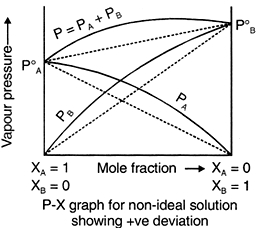
Solution
(C) Solutions that do not obey Raoult's law over the entire range of concentration are known as Non-Ideal Solutions.
These solutions exhibit either positive or negative deviations from Raoult's law depending on the intermolecular forces between the solute and solvent molecules compared to those in the pure components.
These solutions exhibit either positive or negative deviations from Raoult's law depending on the intermolecular forces between the solute and solvent molecules compared to those in the pure components.
0 likes
View Solution22
EasyMCQ
Which of the following mixtures does not show positive deviation from Raoult's law?
A
Benzene-Chloroform
B
Benzene-Acetone
C
Benzene-Ethanol,Benzene-Carbon tetrachloride
D
None of these
Solution
(A) Positive deviation from Raoult's law occurs when the solute-solvent interactions are weaker than the solute-solute and solvent-solvent interactions.
Benzene-Chloroform mixture shows negative deviation from Raoult's law because of the formation of strong intermolecular hydrogen bonding or dipole-dipole interactions between the components,which leads to a decrease in vapor pressure.
Therefore,the mixture that does not show positive deviation is Benzene-Chloroform.
Benzene-Chloroform mixture shows negative deviation from Raoult's law because of the formation of strong intermolecular hydrogen bonding or dipole-dipole interactions between the components,which leads to a decrease in vapor pressure.
Therefore,the mixture that does not show positive deviation is Benzene-Chloroform.
0 likes
View Solution23
DifficultMCQ
Which of the following mixtures shows positive deviation from ideal behavior?
A
$CHCl_3 + (CH_3)_2CO$
B
$C_6H_6 + C_6H_5CH_3$
C
$H_2O + HCl$
D
$CCl_4 + CHCl_3$
Solution
(D) . $CHCl_3 + (CH_3)_2CO$: The formation of strong intermolecular $H$-bonding between chloroform and acetone leads to negative deviation from Raoult's law.
$B$. $C_6H_6 + C_6H_5CH_3$: These are structurally similar and form an ideal solution.
$C$. $H_2O + HCl$: This mixture shows negative deviation due to strong solute-solvent interactions.
$D$. $CCl_4 + CHCl_3$: The interaction between $CCl_4$ and $CHCl_3$ is weaker than the pure component interactions,leading to positive deviation from Raoult's law.
$B$. $C_6H_6 + C_6H_5CH_3$: These are structurally similar and form an ideal solution.
$C$. $H_2O + HCl$: This mixture shows negative deviation due to strong solute-solvent interactions.
$D$. $CCl_4 + CHCl_3$: The interaction between $CCl_4$ and $CHCl_3$ is weaker than the pure component interactions,leading to positive deviation from Raoult's law.
0 likes
View Solution24
EasyMCQ
Which property is not found in an ideal solution?
A
$P_A = P_A^o \times X_A$
B
$\Delta H_{mix} = 0$
C
$\Delta V_{mix} = 0$
D
None of these
Solution
(D) Ideal solutions exhibit the following characteristics:
$1$. They obey Raoult's Law,meaning the partial pressure of components $A$ and $B$ follows $P_A = P_A^o \times X_A$ and $P_B = P_B^o \times X_B$.
$2$. The enthalpy of mixing is zero,i.e.,$\Delta H_{mix} = 0$. This indicates that no heat is evolved or absorbed during the formation of the solution.
$3$. The volume change upon mixing is zero,i.e.,$\Delta V_{mix} = 0$. This means the total volume of the solution equals the sum of the volumes of the individual components.
$4$. The intermolecular forces of attraction between solute-solute and solvent-solvent are similar to those between solute-solvent.
Since options $A$,$B$,and $C$ are all properties of an ideal solution,the correct choice is $D$.
$1$. They obey Raoult's Law,meaning the partial pressure of components $A$ and $B$ follows $P_A = P_A^o \times X_A$ and $P_B = P_B^o \times X_B$.
$2$. The enthalpy of mixing is zero,i.e.,$\Delta H_{mix} = 0$. This indicates that no heat is evolved or absorbed during the formation of the solution.
$3$. The volume change upon mixing is zero,i.e.,$\Delta V_{mix} = 0$. This means the total volume of the solution equals the sum of the volumes of the individual components.
$4$. The intermolecular forces of attraction between solute-solute and solvent-solvent are similar to those between solute-solvent.
Since options $A$,$B$,and $C$ are all properties of an ideal solution,the correct choice is $D$.
0 likes
View Solution25
EasyMCQ
Which of the following is not correct for an ideal solution?
A
$\Delta S_{mix} = 0$
B
$\Delta H_{mix} = 0$
C
It obeys Raoult's law
D
$\Delta V_{mix} = 0$
Solution
(A) For an ideal solution,the following conditions must be met:
$1$. It obeys Raoult's law over the entire range of concentration.
$2$. The enthalpy of mixing,$\Delta H_{mix} = 0$.
$3$. The volume of mixing,$\Delta V_{mix} = 0$.
$4$. The entropy of mixing,$\Delta S_{mix} > 0$ (since mixing is a spontaneous process).
Therefore,the statement $\Delta S_{mix} = 0$ is incorrect.
$1$. It obeys Raoult's law over the entire range of concentration.
$2$. The enthalpy of mixing,$\Delta H_{mix} = 0$.
$3$. The volume of mixing,$\Delta V_{mix} = 0$.
$4$. The entropy of mixing,$\Delta S_{mix} > 0$ (since mixing is a spontaneous process).
Therefore,the statement $\Delta S_{mix} = 0$ is incorrect.
0 likes
View Solution26
EasyMCQ
$A$ mixture of benzene and toluene forms
A
An ideal solution
B
Non-ideal solution
C
Suspension
D
Emulsion
Solution
(A) The mixing of benzene and toluene does not involve any significant change in the intermolecular forces of attraction between the molecules.
Since the solute-solute,solvent-solvent,and solute-solvent interactions are nearly identical,they form an ideal solution.
Since the solute-solute,solvent-solvent,and solute-solvent interactions are nearly identical,they form an ideal solution.
0 likes
View Solution27
EasyMCQ
Which of the following is an ideal solution?
A
Water $+$ ethanol
B
Chloroform $+$ carbon tetrachloride
C
Benzene $+$ toluene
D
Water $+$ hydrochloric acid
Solution
(C) An ideal solution is one that obeys Raoult's law over the entire range of concentration and shows no change in enthalpy or volume upon mixing.
$1$. Water $+$ ethanol shows positive deviation from Raoult's law due to the disruption of hydrogen bonding.
$2$. Chloroform $+$ carbon tetrachloride shows positive deviation from Raoult's law.
$3$. Water $+$ hydrochloric acid shows negative deviation from Raoult's law.
$4$. Benzene $+$ toluene forms an ideal solution because the intermolecular forces of attraction between benzene-benzene,toluene-toluene,and benzene-toluene are nearly identical,as they are structurally similar (differing only by a $-CH_3$ group).
$1$. Water $+$ ethanol shows positive deviation from Raoult's law due to the disruption of hydrogen bonding.
$2$. Chloroform $+$ carbon tetrachloride shows positive deviation from Raoult's law.
$3$. Water $+$ hydrochloric acid shows negative deviation from Raoult's law.
$4$. Benzene $+$ toluene forms an ideal solution because the intermolecular forces of attraction between benzene-benzene,toluene-toluene,and benzene-toluene are nearly identical,as they are structurally similar (differing only by a $-CH_3$ group).
0 likes
View Solution28
EasyMCQ
When ethanol is mixed with cyclohexane,cyclohexane reduces the intermolecular forces between ethanol molecules. In this case,the liquid pair shows:
A
Positive deviation from Raoult's law
B
Negative deviation from Raoult's law
C
No deviation from Raoult's law
D
Decrease in volume
Solution
(A) When ethanol is mixed with cyclohexane,the strong hydrogen bonding between ethanol molecules is disrupted by the non-polar cyclohexane molecules.
As a result,the intermolecular forces between ethanol and cyclohexane $(A-B)$ are weaker than the forces between pure ethanol molecules $(A-A)$ or pure cyclohexane molecules $(B-B)$.
This leads to an increase in vapor pressure and a positive deviation from Raoult's law.
Therefore,the correct option is $A$.
As a result,the intermolecular forces between ethanol and cyclohexane $(A-B)$ are weaker than the forces between pure ethanol molecules $(A-A)$ or pure cyclohexane molecules $(B-B)$.
This leads to an increase in vapor pressure and a positive deviation from Raoult's law.
Therefore,the correct option is $A$.
0 likes
View Solution29
EasyMCQ
Liquids $A$ and $B$ form an ideal solution. Which of the following statements is true?
A
The enthalpy of mixing is zero
B
The entropy of mixing is zero
C
The free energy of mixing is zero
D
The free energy as well as the entropy of mixing are each zero
Solution
(A) For an ideal solution,the following conditions must be satisfied:-
$1. \Delta H_{mix} = 0$ (Enthalpy of mixing is zero)
$2. \Delta V_{mix} = 0$ (Volume of mixing is zero)
$3. \Delta S_{mix} > 0$ (Entropy of mixing is positive)
$4. \Delta G_{mix} < 0$ (Gibbs free energy of mixing is negative)
Since $\Delta H_{mix} = 0$ is a defining characteristic of an ideal solution,option $A$ is correct.
$1. \Delta H_{mix} = 0$ (Enthalpy of mixing is zero)
$2. \Delta V_{mix} = 0$ (Volume of mixing is zero)
$3. \Delta S_{mix} > 0$ (Entropy of mixing is positive)
$4. \Delta G_{mix} < 0$ (Gibbs free energy of mixing is negative)
Since $\Delta H_{mix} = 0$ is a defining characteristic of an ideal solution,option $A$ is correct.
0 likes
View Solution30
MediumMCQ
At $27^o C$,the vapor pressure of pure liquid $A$ is $70 \ torr$. It forms an ideal solution with $B$. The mole fraction of $B$ is $0.2$ and the vapor pressure of the solution at $27^o C$ is $84 \ torr$. What is the vapor pressure of pure liquid $B$ at $27^o C$ (in $torr$)?
A
$14$
B
$56$
C
$140$
D
$70$
Solution
(C) According to Raoult's Law for an ideal solution,the total vapor pressure $P_{total}$ is given by:
$P_{total} = P_A^o \chi_A + P_B^o \chi_B$
Given:
$P_A^o = 70 \ torr$
$\chi_B = 0.2$
$\chi_A = 1 - \chi_B = 1 - 0.2 = 0.8$
$P_{total} = 84 \ torr$
Substituting the values:
$84 = (70 \times 0.8) + (P_B^o \times 0.2)$
$84 = 56 + 0.2 P_B^o$
$84 - 56 = 0.2 P_B^o$
$28 = 0.2 P_B^o$
$P_B^o = \frac{28}{0.2} = 140 \ torr$
Thus,the vapor pressure of pure liquid $B$ is $140 \ torr$.
$P_{total} = P_A^o \chi_A + P_B^o \chi_B$
Given:
$P_A^o = 70 \ torr$
$\chi_B = 0.2$
$\chi_A = 1 - \chi_B = 1 - 0.2 = 0.8$
$P_{total} = 84 \ torr$
Substituting the values:
$84 = (70 \times 0.8) + (P_B^o \times 0.2)$
$84 = 56 + 0.2 P_B^o$
$84 - 56 = 0.2 P_B^o$
$28 = 0.2 P_B^o$
$P_B^o = \frac{28}{0.2} = 140 \ torr$
Thus,the vapor pressure of pure liquid $B$ is $140 \ torr$.
0 likes
View Solution31
MediumMCQ
At $373 \ K$,heptane and octane form an ideal solution. The vapor pressures of the two pure liquid components (heptane and octane) are $105 \ kPa$ and $45 \ kPa$,respectively. The vapor pressure of the solution formed by mixing $25 \ g$ of heptane and $35 \ g$ of octane is ........ $kPa$. (Molar masses of heptane and octane are $100 \ g \ mol^{-1}$ and $114 \ g \ mol^{-1}$,respectively.)
A
$144.5$
B
$72.0$
C
$36.1$
D
$96.2$
Solution
(B) $1$. Calculate the moles of each component:
$n_{\text{heptane}} = \frac{25 \ g}{100 \ g \ mol^{-1}} = 0.25 \ mol$
$n_{\text{octane}} = \frac{35 \ g}{114 \ g \ mol^{-1}} \approx 0.307 \ mol$
$2$. Calculate the mole fractions:
$n_{\text{total}} = 0.25 + 0.307 = 0.557 \ mol$
$x_{\text{heptane}} = \frac{0.25}{0.557} \approx 0.449$
$x_{\text{octane}} = \frac{0.307}{0.557} \approx 0.551$
$3$. Apply Raoult's Law:
$P_{\text{total}} = P^{\circ}_{\text{heptane}} \cdot x_{\text{heptane}} + P^{\circ}_{\text{octane}} \cdot x_{\text{octane}}$
$P_{\text{total}} = (105 \times 0.449) + (45 \times 0.551)$
$P_{\text{total}} = 47.145 + 24.795 = 71.94 \ kPa \approx 72.0 \ kPa$.
$n_{\text{heptane}} = \frac{25 \ g}{100 \ g \ mol^{-1}} = 0.25 \ mol$
$n_{\text{octane}} = \frac{35 \ g}{114 \ g \ mol^{-1}} \approx 0.307 \ mol$
$2$. Calculate the mole fractions:
$n_{\text{total}} = 0.25 + 0.307 = 0.557 \ mol$
$x_{\text{heptane}} = \frac{0.25}{0.557} \approx 0.449$
$x_{\text{octane}} = \frac{0.307}{0.557} \approx 0.551$
$3$. Apply Raoult's Law:
$P_{\text{total}} = P^{\circ}_{\text{heptane}} \cdot x_{\text{heptane}} + P^{\circ}_{\text{octane}} \cdot x_{\text{octane}}$
$P_{\text{total}} = (105 \times 0.449) + (45 \times 0.551)$
$P_{\text{total}} = 47.145 + 24.795 = 71.94 \ kPa \approx 72.0 \ kPa$.
0 likes
View Solution32
MediumMCQ
Mixing $1 \ mol$ of heptane $(V.P = 92 \ mm \ Hg)$ with $4 \ mol$ of octane $(V.P = 31 \ mm \ Hg)$ forms an ideal solution. The vapor pressure of the solution will be .......... $mm \ Hg$. (in $.2$)
A
$51$
B
$27$
C
$33$
D
$43$
Solution
(D) Total moles $= 1 + 4 = 5 \ mol$.
Mole fraction of heptane $(X_A) = 1/5 = 0.2$.
Mole fraction of octane $(X_B) = 4/5 = 0.8$.
According to Raoult's Law,the total vapor pressure of the solution is given by:
$P_{total} = X_A P_A^0 + X_B P_B^0$
$P_{total} = (0.2 \times 92) + (0.8 \times 31)$
$P_{total} = 18.4 + 24.8 = 43.2 \ mm \ Hg$.
Mole fraction of heptane $(X_A) = 1/5 = 0.2$.
Mole fraction of octane $(X_B) = 4/5 = 0.8$.
According to Raoult's Law,the total vapor pressure of the solution is given by:
$P_{total} = X_A P_A^0 + X_B P_B^0$
$P_{total} = (0.2 \times 92) + (0.8 \times 31)$
$P_{total} = 18.4 + 24.8 = 43.2 \ mm \ Hg$.
0 likes
View Solution33
MediumMCQ
The formation of a binary solution is considered as follows:
$(1)$ Pure solvent enthalpy $\Delta H_1$ (separated)
$(2)$ Pure solute enthalpy $\Delta H_2$ (separated)
$(3)$ Pure solvent + Pure solute $\to$ Solution $\to$ Enthalpy $\Delta H_3$
If $......$ then the resulting solution is ideal.
$(1)$ Pure solvent enthalpy $\Delta H_1$ (separated)
$(2)$ Pure solute enthalpy $\Delta H_2$ (separated)
$(3)$ Pure solvent + Pure solute $\to$ Solution $\to$ Enthalpy $\Delta H_3$
If $......$ then the resulting solution is ideal.
A
$\Delta H_{soln} = \Delta H_3 - \Delta H_1 - \Delta H_2$
B
$\Delta H_{soln} = \Delta H_1 + \Delta H_2 + \Delta H_3$
C
$\Delta H_{soln} = \Delta H_1 + \Delta H_2 - \Delta H_3$
D
$\Delta H_{soln} = \Delta H_1 - \Delta H_2 - \Delta H_3$
Solution
(B) For an ideal solution,the enthalpy of mixing is zero,i.e.,$\Delta H_{mix} = 0$.
The total enthalpy change of the solution is given by $\Delta H_{soln} = \Delta H_1 + \Delta H_2 + \Delta H_3$.
Since $\Delta H_{soln} = 0$ for an ideal solution,we have $\Delta H_1 + \Delta H_2 + \Delta H_3 = 0$.
However,based on the standard thermodynamic cycle for solution formation,the enthalpy of solution is $\Delta H_{soln} = \Delta H_1 + \Delta H_2 + \Delta H_3$.
If we define $\Delta H_3$ as the enthalpy of interaction between solute and solvent,then for an ideal solution,$\Delta H_1 + \Delta H_2 + \Delta H_3 = 0$.
The total enthalpy change of the solution is given by $\Delta H_{soln} = \Delta H_1 + \Delta H_2 + \Delta H_3$.
Since $\Delta H_{soln} = 0$ for an ideal solution,we have $\Delta H_1 + \Delta H_2 + \Delta H_3 = 0$.
However,based on the standard thermodynamic cycle for solution formation,the enthalpy of solution is $\Delta H_{soln} = \Delta H_1 + \Delta H_2 + \Delta H_3$.
If we define $\Delta H_3$ as the enthalpy of interaction between solute and solvent,then for an ideal solution,$\Delta H_1 + \Delta H_2 + \Delta H_3 = 0$.
0 likes
View Solution34
MediumMCQ
Which pair of liquids shows positive deviation from Raoult's law?
A
Water-Hydrochloric acid
B
Benzene-Methanol
C
Water-Nitric acid
D
Acetone-Chloroform
Solution
(B) Positive deviation from Raoult's law occurs when the solute-solvent interactions are weaker than the solute-solute and solvent-solvent interactions. $A-B$ interactions are weaker than $A-A$ and $B-B$ interactions. In the case of $Benzene-Methanol$,the hydrogen bonding between methanol molecules is disrupted by the addition of benzene,leading to weaker interactions and positive deviation. Options $A$ and $C$ show negative deviation due to strong hydrogen bonding or ionization,while $D$ shows negative deviation due to hydrogen bonding between acetone and chloroform.
0 likes
View Solution35
EasyMCQ
Which of the following does not show negative deviation from Raoult's law?
A
Acetone-Chloroform
B
Acetone-Benzene
C
Chloroform-Ether
D
Chloroform-Benzene
Solution
(B) Negative deviation from Raoult's law occurs when the solute-solvent interaction is stronger than the solute-solute and solvent-solvent interactions.
Acetone-Chloroform,Chloroform-Ether,and Chloroform-Benzene exhibit negative deviation due to hydrogen bonding or strong dipole-dipole interactions.
Acetone-Benzene shows positive deviation from Raoult's law because the interaction between acetone and benzene is weaker than the pure components' interactions.
Acetone-Chloroform,Chloroform-Ether,and Chloroform-Benzene exhibit negative deviation due to hydrogen bonding or strong dipole-dipole interactions.
Acetone-Benzene shows positive deviation from Raoult's law because the interaction between acetone and benzene is weaker than the pure components' interactions.
0 likes
View Solution36
MediumMCQ
$A$ mixture of methanol $(MeOH)$ and ethanol $(EtOH)$ forms an ideal solution. If the partial pressures of methanol and ethanol are $2.619 \ kPa$ and $4.556 \ kPa$ respectively,what will be the mole fractions of the components in the vapor phase?
A
$0.635 \ MeOH, 0.365 \ EtOH$
B
$0.365 \ MeOH, 0.635 \ EtOH$
C
$0.574 \ MeOH, 0.326 \ EtOH$
D
$0.173 \ MeOH, 0.827 \ EtOH$
Solution
(B) In the vapor phase,the mole fraction of a component is given by the ratio of its partial pressure to the total pressure of the solution.
Total pressure $P_{total} = P_{MeOH} + P_{EtOH} = 2.619 \ kPa + 4.556 \ kPa = 7.175 \ kPa$.
Mole fraction of $MeOH$ in vapor phase $(y_{MeOH}) = \frac{P_{MeOH}}{P_{total}} = \frac{2.619}{7.175} = 0.365$.
Mole fraction of $EtOH$ in vapor phase $(y_{EtOH}) = \frac{P_{EtOH}}{P_{total}} = \frac{4.556}{7.175} = 0.635$.
Total pressure $P_{total} = P_{MeOH} + P_{EtOH} = 2.619 \ kPa + 4.556 \ kPa = 7.175 \ kPa$.
Mole fraction of $MeOH$ in vapor phase $(y_{MeOH}) = \frac{P_{MeOH}}{P_{total}} = \frac{2.619}{7.175} = 0.365$.
Mole fraction of $EtOH$ in vapor phase $(y_{EtOH}) = \frac{P_{EtOH}}{P_{total}} = \frac{4.556}{7.175} = 0.635$.
0 likes
View Solution37
AdvancedMCQ
Two liquids $x$ and $y$ form an ideal solution. At $300 \ K$,the vapor pressure of a solution containing $1 \ mol$ of $x$ and $3 \ mol$ of $y$ is $550 \ mm \ Hg$. At the same temperature,if $1 \ mol$ of $y$ is added to the solution,the vapor pressure increases by $10 \ mm \ Hg$. The vapor pressures of pure $x$ and $y$ are respectively:
A
$200, 300$
B
$300, 400$
C
$400, 600$
D
$500, 600$
Solution
(C) Let $P_A^0$ and $P_B^0$ be the vapor pressures of pure $x$ and $y$ respectively.
For the first solution: $n_x = 1, n_y = 3$. Total moles = $4$.
Mole fractions: $X_x = 1/4, X_y = 3/4$.
$P_{total} = P_A^0 X_x + P_B^0 X_y \Rightarrow 550 = P_A^0(1/4) + P_B^0(3/4)$.
$P_A^0 + 3P_B^0 = 2200$ ... $(1)$
For the second solution: $n_x = 1, n_y = 4$. Total moles = $5$.
$P_{total} = 550 + 10 = 560 \ mm \ Hg$.
Mole fractions: $X_x = 1/5, X_y = 4/5$.
$560 = P_A^0(1/5) + P_B^0(4/5)$.
$P_A^0 + 4P_B^0 = 2800$ ... $(2)$
Subtracting $(1)$ from $(2)$:
$(P_A^0 + 4P_B^0) - (P_A^0 + 3P_B^0) = 2800 - 2200$.
$P_B^0 = 600 \ mm \ Hg$.
Substituting $P_B^0$ in $(1)$:
$P_A^0 + 3(600) = 2200 \Rightarrow P_A^0 = 2200 - 1800 = 400 \ mm \ Hg$.
Thus,the vapor pressures are $400 \ mm \ Hg$ and $600 \ mm \ Hg$.
For the first solution: $n_x = 1, n_y = 3$. Total moles = $4$.
Mole fractions: $X_x = 1/4, X_y = 3/4$.
$P_{total} = P_A^0 X_x + P_B^0 X_y \Rightarrow 550 = P_A^0(1/4) + P_B^0(3/4)$.
$P_A^0 + 3P_B^0 = 2200$ ... $(1)$
For the second solution: $n_x = 1, n_y = 4$. Total moles = $5$.
$P_{total} = 550 + 10 = 560 \ mm \ Hg$.
Mole fractions: $X_x = 1/5, X_y = 4/5$.
$560 = P_A^0(1/5) + P_B^0(4/5)$.
$P_A^0 + 4P_B^0 = 2800$ ... $(2)$
Subtracting $(1)$ from $(2)$:
$(P_A^0 + 4P_B^0) - (P_A^0 + 3P_B^0) = 2800 - 2200$.
$P_B^0 = 600 \ mm \ Hg$.
Substituting $P_B^0$ in $(1)$:
$P_A^0 + 3(600) = 2200 \Rightarrow P_A^0 = 2200 - 1800 = 400 \ mm \ Hg$.
Thus,the vapor pressures are $400 \ mm \ Hg$ and $600 \ mm \ Hg$.
0 likes
View Solution38
MediumMCQ
At $20^o C$,benzene and toluene form an ideal solution. The pure vapor pressure of benzene is $75 \ torr$ and that of toluene is $22 \ torr$. What is the partial vapor pressure of benzene in a solution containing $78 \ g$ of benzene and $46 \ g$ of toluene at $20^o C$?
A
$25$
B
$50$
C
$53.5$
D
$37.5$
Solution
(B) $1$. Calculate the moles of benzene $(C_6H_6)$: $n_{benzene} = \frac{78 \ g}{78 \ g/mol} = 1 \ mol$.
$2$. Calculate the moles of toluene $(C_7H_8)$: $n_{toluene} = \frac{46 \ g}{92 \ g/mol} = 0.5 \ mol$.
$3$. Calculate the mole fraction of benzene $(X_{benzene})$: $X_{benzene} = \frac{n_{benzene}}{n_{benzene} + n_{toluene}} = \frac{1}{1 + 0.5} = \frac{1}{1.5} = \frac{2}{3}$.
$4$. Calculate the partial vapor pressure of benzene $(P_{benzene})$ using Raoult's Law: $P_{benzene} = P^0_{benzene} \times X_{benzene} = 75 \ torr \times \frac{2}{3} = 50 \ torr$.
$2$. Calculate the moles of toluene $(C_7H_8)$: $n_{toluene} = \frac{46 \ g}{92 \ g/mol} = 0.5 \ mol$.
$3$. Calculate the mole fraction of benzene $(X_{benzene})$: $X_{benzene} = \frac{n_{benzene}}{n_{benzene} + n_{toluene}} = \frac{1}{1 + 0.5} = \frac{1}{1.5} = \frac{2}{3}$.
$4$. Calculate the partial vapor pressure of benzene $(P_{benzene})$ using Raoult's Law: $P_{benzene} = P^0_{benzene} \times X_{benzene} = 75 \ torr \times \frac{2}{3} = 50 \ torr$.
0 likes
View Solution39
EasyMCQ
For a solution of two liquids $A$ and $B$,if $P = X_A (P_A^o - P_B^o) + P_B^o$ holds true,then what type of solution is it?
A
Ideal
B
Non-ideal
C
Sub-ideal
D
None of these
Solution
(A) According to Raoult's law,the total pressure $P$ of a solution containing two volatile components $A$ and $B$ is given by:
$P = P_A + P_B$
Since $P_A = X_A P_A^o$ and $P_B = X_B P_B^o$,we have:
$P = X_A P_A^o + X_B P_B^o$
Substituting $X_B = 1 - X_A$:
$P = X_A P_A^o + (1 - X_A) P_B^o$
$P = X_A P_A^o + P_B^o - X_A P_B^o$
$P = X_A (P_A^o - P_B^o) + P_B^o$
This equation is derived directly from Raoult's law,which defines an $Ideal$ solution.
$P = P_A + P_B$
Since $P_A = X_A P_A^o$ and $P_B = X_B P_B^o$,we have:
$P = X_A P_A^o + X_B P_B^o$
Substituting $X_B = 1 - X_A$:
$P = X_A P_A^o + (1 - X_A) P_B^o$
$P = X_A P_A^o + P_B^o - X_A P_B^o$
$P = X_A (P_A^o - P_B^o) + P_B^o$
This equation is derived directly from Raoult's law,which defines an $Ideal$ solution.
0 likes
View Solution40
MediumMCQ
At $88 \, ^\circ C$,the vapor pressure of benzene is $900 \, \text{torr}$ and the vapor pressure of toluene is $360 \, \text{torr}$. What is the mole fraction of benzene in the mixture with toluene at $1 \, \text{atm}$ and $88 \, ^\circ C$? Assume benzene and toluene form an ideal solution.
A
$0.416$
B
$0.588$
C
$0.688$
D
$0.740$
Solution
(D) When the mixture of benzene and toluene is boiled at $88 \, ^\circ C$,the total vapor pressure of the solution becomes equal to the external pressure,which is $1 \, \text{atm} = 760 \, \text{torr}$.
According to Raoult's Law for an ideal solution: $P_S = P_A^0 X_A + P_B^0 X_B$
Here,$P_S = 760 \, \text{torr}$,$P_A^0 = 900 \, \text{torr}$ (benzene),$P_B^0 = 360 \, \text{torr}$ (toluene),and $X_B = 1 - X_A$.
Substituting the values: $760 = 900 X_A + 360(1 - X_A)$
$760 = 900 X_A + 360 - 360 X_A$
$760 - 360 = 540 X_A$
$400 = 540 X_A$
$X_A = \frac{400}{540} \approx 0.7407 \approx 0.740$.
According to Raoult's Law for an ideal solution: $P_S = P_A^0 X_A + P_B^0 X_B$
Here,$P_S = 760 \, \text{torr}$,$P_A^0 = 900 \, \text{torr}$ (benzene),$P_B^0 = 360 \, \text{torr}$ (toluene),and $X_B = 1 - X_A$.
Substituting the values: $760 = 900 X_A + 360(1 - X_A)$
$760 = 900 X_A + 360 - 360 X_A$
$760 - 360 = 540 X_A$
$400 = 540 X_A$
$X_A = \frac{400}{540} \approx 0.7407 \approx 0.740$.
0 likes
View Solution41
MediumMCQ
When does a mixture containing components $A$ and $B$ show negative deviation from Raoult's law?
A
$A-B$ interactions are stronger than $A-A$ and $B-B$ interactions.
B
$A-B$ interactions are weaker than $A-A$ and $B-B$ interactions.
C
$\Delta V_{mix} > 0$,$\Delta S_{mix} > 0$
D
$\Delta V_{mix} = 0$,$\Delta S_{mix} > 0$
Solution
(A) non-ideal solution shows negative deviation from Raoult's law when the intermolecular forces of attraction between the solute $(A)$ and solvent $(B)$ are stronger than the forces of attraction between the pure components ($A-A$ and $B-B$).
This leads to a decrease in volume $(\Delta V_{mix} < 0)$ and a release of heat $(\Delta H_{mix} < 0)$.
This leads to a decrease in volume $(\Delta V_{mix} < 0)$ and a release of heat $(\Delta H_{mix} < 0)$.
0 likes
View Solution42
MediumMCQ
At $88\,^oC$,the vapor pressure of benzene is $900 \, \text{torr}$ and that of toluene is $360 \, \text{torr}$. What is the mole fraction of benzene in the mixture with toluene that will boil at $88\,^oC$ and $1 \, \text{atm}$ pressure,assuming it forms an ideal solution?
A
$0.45$
B
$0.58$
C
$0.74$
D
$0.83$
Solution
(C) The boiling point is the temperature at which the total vapor pressure of the solution equals the external pressure.
Given: $P_{\text{total}} = 1 \, \text{atm} = 760 \, \text{torr}$.
Let $x_B$ be the mole fraction of benzene $(C_6H_6)$ and $x_T$ be the mole fraction of toluene $(C_7H_8)$.
Since $x_B + x_T = 1$,we have $x_T = 1 - x_B$.
According to Raoult's law: $P_{\text{total}} = P_B^0 x_B + P_T^0 x_T$.
Substituting the values: $760 = 900 x_B + 360 (1 - x_B)$.
$760 = 900 x_B + 360 - 360 x_B$.
$760 - 360 = 540 x_B$.
$400 = 540 x_B$.
$x_B = \frac{400}{540} \approx 0.74$.
Given: $P_{\text{total}} = 1 \, \text{atm} = 760 \, \text{torr}$.
Let $x_B$ be the mole fraction of benzene $(C_6H_6)$ and $x_T$ be the mole fraction of toluene $(C_7H_8)$.
Since $x_B + x_T = 1$,we have $x_T = 1 - x_B$.
According to Raoult's law: $P_{\text{total}} = P_B^0 x_B + P_T^0 x_T$.
Substituting the values: $760 = 900 x_B + 360 (1 - x_B)$.
$760 = 900 x_B + 360 - 360 x_B$.
$760 - 360 = 540 x_B$.
$400 = 540 x_B$.
$x_B = \frac{400}{540} \approx 0.74$.
0 likes
View Solution43
EasyMCQ
Which of the following does not show positive deviation from Raoult's law?
A
Benzene-Chloroform
B
Benzene-Acetone
C
Benzene-Ethanol
D
Benzene-Carbon tetrachloride
Solution
(D) Positive deviation from Raoult's law occurs when the solute-solvent intermolecular forces are weaker than the solute-solute and solvent-solvent forces.
$A$,$B$,and $C$ (Benzene-Chloroform,Benzene-Acetone,and Benzene-Ethanol) exhibit positive deviations because the interaction between the components is weaker than the pure components.
$D$ (Benzene-Carbon tetrachloride) forms an ideal solution because the intermolecular forces between $C_6H_6$ and $CCl_4$ are similar to those in the pure components.
Therefore,it does not show positive deviation.
$A$,$B$,and $C$ (Benzene-Chloroform,Benzene-Acetone,and Benzene-Ethanol) exhibit positive deviations because the interaction between the components is weaker than the pure components.
$D$ (Benzene-Carbon tetrachloride) forms an ideal solution because the intermolecular forces between $C_6H_6$ and $CCl_4$ are similar to those in the pure components.
Therefore,it does not show positive deviation.
0 likes
View Solution44
EasyMCQ
If liquids $A$ and $B$ form an ideal solution,then which of the following is true?
A
The Gibbs energy of mixing is zero.
B
The Gibbs energy of mixing is zero and the entropy of mixing is zero.
C
The enthalpy of mixing is zero.
D
The entropy of mixing is zero.
Solution
(C) An ideal solution is defined as a solution that obeys Raoult's law over the entire range of concentration. For an ideal solution,the following conditions must be met:
$1$. The enthalpy of mixing,$\Delta H_{mix} = 0$.
$2$. The volume of mixing,$\Delta V_{mix} = 0$.
$3$. The entropy of mixing,$\Delta S_{mix} > 0$.
$4$. The Gibbs energy of mixing,$\Delta G_{mix} < 0$.
Since $\Delta G_{mix} = \Delta H_{mix} - T \Delta S_{mix}$,and $\Delta H_{mix} = 0$ while $\Delta S_{mix} > 0$,it follows that $\Delta G_{mix} < 0$.
Therefore,the correct statement is that the enthalpy of mixing is zero.
$1$. The enthalpy of mixing,$\Delta H_{mix} = 0$.
$2$. The volume of mixing,$\Delta V_{mix} = 0$.
$3$. The entropy of mixing,$\Delta S_{mix} > 0$.
$4$. The Gibbs energy of mixing,$\Delta G_{mix} < 0$.
Since $\Delta G_{mix} = \Delta H_{mix} - T \Delta S_{mix}$,and $\Delta H_{mix} = 0$ while $\Delta S_{mix} > 0$,it follows that $\Delta G_{mix} < 0$.
Therefore,the correct statement is that the enthalpy of mixing is zero.
0 likes
View Solution45
AdvancedMCQ
Two liquids $A$ and $B$ form an ideal solution. When they are mixed in a molar ratio of $1:1$,the vapor pressure of the solution at $300 \ K$ is $400 \ mm \ Hg$. When they are mixed in a molar ratio of $1:2$,the vapor pressure of the solution at the same temperature is $350 \ mm \ Hg$. The vapor pressures of pure liquids $A$ and $B$ are respectively:
A
$250, 550$
B
$550, 250$
C
$350, 450$
D
$350, 700$
Solution
(B) According to Raoult's Law,$P_{total} = P_A^0 X_A + P_B^0 X_B$.
For the $1:1$ molar ratio,$X_A = 1/2$ and $X_B = 1/2$:
$400 = P_A^0(1/2) + P_B^0(1/2) \implies P_A^0 + P_B^0 = 800$ (Equation $1$).
For the $1:2$ molar ratio,$X_A = 1/3$ and $X_B = 2/3$:
$350 = P_A^0(1/3) + P_B^0(2/3) \implies P_A^0 + 2P_B^0 = 1050$ (Equation $2$).
Subtracting Equation $1$ from Equation $2$:
$(P_A^0 + 2P_B^0) - (P_A^0 + P_B^0) = 1050 - 800 \implies P_B^0 = 250 \ mm \ Hg$.
Substituting $P_B^0 = 250$ into Equation $1$:
$P_A^0 + 250 = 800 \implies P_A^0 = 550 \ mm \ Hg$.
Thus,the vapor pressures are $550 \ mm \ Hg$ and $250 \ mm \ Hg$.
For the $1:1$ molar ratio,$X_A = 1/2$ and $X_B = 1/2$:
$400 = P_A^0(1/2) + P_B^0(1/2) \implies P_A^0 + P_B^0 = 800$ (Equation $1$).
For the $1:2$ molar ratio,$X_A = 1/3$ and $X_B = 2/3$:
$350 = P_A^0(1/3) + P_B^0(2/3) \implies P_A^0 + 2P_B^0 = 1050$ (Equation $2$).
Subtracting Equation $1$ from Equation $2$:
$(P_A^0 + 2P_B^0) - (P_A^0 + P_B^0) = 1050 - 800 \implies P_B^0 = 250 \ mm \ Hg$.
Substituting $P_B^0 = 250$ into Equation $1$:
$P_A^0 + 250 = 800 \implies P_A^0 = 550 \ mm \ Hg$.
Thus,the vapor pressures are $550 \ mm \ Hg$ and $250 \ mm \ Hg$.
0 likes
View Solution46
DifficultMCQ
Which of the following graphs does not represent the behavior of an ideal binary liquid solution?
A
The graph of $P_A$ versus $X_A$ (mole fraction of $A$ in liquid phase) is linear.
B
The graph of $P_B$ versus $X_B$ is linear.
C
The graph of $P_{total}$ versus $X_A$ (or $X_B$) is linear.
D
The graph of $P_{total}$ versus $X_A$ is non-linear.
Solution
(D) An ideal binary liquid solution obeys Raoult's Law,which states that $P_A = P_A^0 X_A$ and $P_B = P_B^0 X_B$.
Since $P_{total} = P_A + P_B = P_A^0 X_A + P_B^0 (1 - X_A) = (P_A^0 - P_B^0) X_A + P_B^0$,the total pressure is a linear function of the mole fraction.
Therefore,graphs of $P_A$ vs $X_A$,$P_B$ vs $X_B$,and $P_{total}$ vs $X_A$ are all linear for an ideal solution.
Option $D$ states that the graph of $P_{total}$ vs $X_A$ is non-linear,which contradicts the behavior of an ideal solution.
Since $P_{total} = P_A + P_B = P_A^0 X_A + P_B^0 (1 - X_A) = (P_A^0 - P_B^0) X_A + P_B^0$,the total pressure is a linear function of the mole fraction.
Therefore,graphs of $P_A$ vs $X_A$,$P_B$ vs $X_B$,and $P_{total}$ vs $X_A$ are all linear for an ideal solution.
Option $D$ states that the graph of $P_{total}$ vs $X_A$ is non-linear,which contradicts the behavior of an ideal solution.
0 likes
View Solution47
MediumMCQ
Which one of the following non-ideal solutions shows negative deviation?
A
$CH_3COCH_3 + CS_2$
B
$C_6H_6 + CH_3COCH_3$
C
$CCl_4 + CHCl_3$
D
$CH_3COCH_3 + CHCl_3$
Solution
(D) non-ideal solution shows negative deviation when the solute-solvent interaction is stronger than the solute-solute and solvent-solvent interactions.
In the mixture of $CH_3COCH_3$ (acetone) and $CHCl_3$ (chloroform),a strong hydrogen bond is formed between the oxygen atom of acetone and the hydrogen atom of chloroform.
This leads to a decrease in volume and enthalpy of mixing,resulting in negative deviation from Raoult's Law.
Therefore,the correct option is $(D)$.
In the mixture of $CH_3COCH_3$ (acetone) and $CHCl_3$ (chloroform),a strong hydrogen bond is formed between the oxygen atom of acetone and the hydrogen atom of chloroform.
This leads to a decrease in volume and enthalpy of mixing,resulting in negative deviation from Raoult's Law.
Therefore,the correct option is $(D)$.
0 likes
View Solution48
MediumMCQ
Which one of the following is incorrect for an ideal solution?
A
$\Delta H_{mix} = 0$
B
$\Delta U_{mix} = 0$
C
$\Delta P = P_{obs} - P_{calculated \ by \ Raoult's \ law} = 0$
D
$\Delta G_{mix} = 0$
Solution
(D) An ideal solution is defined by the following characteristics:
$1$. $\Delta H_{mix} = 0$ (Enthalpy of mixing is zero).
$2$. $\Delta V_{mix} = 0$ (Volume of mixing is zero).
$3$. $\Delta U_{mix} = 0$ (Internal energy of mixing is zero).
$4$. The solution obeys Raoult's law over the entire range of concentration,so $\Delta P = 0$.
However,for any spontaneous mixing process,the entropy of mixing $\Delta S_{mix}$ is always positive.
Since $\Delta G_{mix} = \Delta H_{mix} - T\Delta S_{mix}$,and $\Delta H_{mix} = 0$ while $\Delta S_{mix} > 0$,it follows that $\Delta G_{mix} = -T\Delta S_{mix} < 0$.
Therefore,the statement $\Delta G_{mix} = 0$ is incorrect.
$1$. $\Delta H_{mix} = 0$ (Enthalpy of mixing is zero).
$2$. $\Delta V_{mix} = 0$ (Volume of mixing is zero).
$3$. $\Delta U_{mix} = 0$ (Internal energy of mixing is zero).
$4$. The solution obeys Raoult's law over the entire range of concentration,so $\Delta P = 0$.
However,for any spontaneous mixing process,the entropy of mixing $\Delta S_{mix}$ is always positive.
Since $\Delta G_{mix} = \Delta H_{mix} - T\Delta S_{mix}$,and $\Delta H_{mix} = 0$ while $\Delta S_{mix} > 0$,it follows that $\Delta G_{mix} = -T\Delta S_{mix} < 0$.
Therefore,the statement $\Delta G_{mix} = 0$ is incorrect.
0 likes
View Solution49
DifficultMCQ
Which of the following statements about the composition of the vapour over an ideal $1:1$ molar mixture of benzene and toluene is correct? Assume that the temperature is constant at $25\ ^oC$. (Given,vapour pressure data at $25\ ^oC$,benzene $= 12.8\ kPa,$ toluene $= 3.85\ kPa$)
A
The vapour will contain equal amounts of benzene and toluene.
B
Not enough information is given to make a prediction.
C
The vapour will contain a higher percentage of benzene.
D
The vapour will contain a higher percentage of toluene.
Solution
(C) According to Raoult's Law,the partial pressure of a component in the vapour phase is given by $P_i = P^o_i X_i$.
Since the mixture is $1:1$ molar,the mole fractions in the liquid phase are equal $(X_{\text{benzene}} = X_{\text{toluene}} = 0.5)$.
The total pressure $P = P^o_{\text{benzene}} X_{\text{benzene}} + P^o_{\text{toluene}} X_{\text{toluene}}$.
The mole fraction in the vapour phase is $Y_i = \frac{P_i}{P} = \frac{P^o_i X_i}{P}$.
Since $X_{\text{benzene}} = X_{\text{toluene}}$,the component with the higher pure vapour pressure $(P^o)$ will have a higher mole fraction in the vapour phase.
Given $P^o_{\text{benzene}} = 12.8\ kPa$ and $P^o_{\text{toluene}} = 3.85\ kPa$,benzene is more volatile.
Therefore,the vapour will contain a higher percentage of benzene.
Since the mixture is $1:1$ molar,the mole fractions in the liquid phase are equal $(X_{\text{benzene}} = X_{\text{toluene}} = 0.5)$.
The total pressure $P = P^o_{\text{benzene}} X_{\text{benzene}} + P^o_{\text{toluene}} X_{\text{toluene}}$.
The mole fraction in the vapour phase is $Y_i = \frac{P_i}{P} = \frac{P^o_i X_i}{P}$.
Since $X_{\text{benzene}} = X_{\text{toluene}}$,the component with the higher pure vapour pressure $(P^o)$ will have a higher mole fraction in the vapour phase.
Given $P^o_{\text{benzene}} = 12.8\ kPa$ and $P^o_{\text{toluene}} = 3.85\ kPa$,benzene is more volatile.
Therefore,the vapour will contain a higher percentage of benzene.
1 likes
View Solution50
MediumMCQ
Which of the following is not equal to zero for an ideal solution?
A
$\Delta V_{mix}$
B
$\Delta P = P_{observed} - P_{Raoult}$
C
$\Delta H_{mix}$
D
$\Delta S_{mix}$
Solution
(D) For an ideal solution,the enthalpy change of mixing $(\Delta H_{mix})$ is $0$,the volume change of mixing $(\Delta V_{mix})$ is $0$,and the pressure deviation $(\Delta P)$ is $0$.
However,for any spontaneous mixing process,the entropy change of mixing $(\Delta S_{mix})$ is always greater than $0$ $(\Delta S_{mix} > 0)$.
However,for any spontaneous mixing process,the entropy change of mixing $(\Delta S_{mix})$ is always greater than $0$ $(\Delta S_{mix} > 0)$.
0 likes
View SolutionSolutions — Ideal and Non-ideal solution · Frequently Asked Questions
1Are these Solutions questions useful for JEE and NEET?
Yes. All questions in this section are mapped to JEE Main and NEET exam patterns. Previous year questions from JEE Main, NEET, GUJCET and state-level exams are included with full solutions.
2Can I switch to Hindi or Gujarati for these questions?
Yes. Use the language tabs in the hero section or the sidebar to view the same questions and solutions in English, Hindi or Gujarati.
3How do I generate a question paper from this subtopic?
Use the Vedclass Exam Paper Generator — select the chapter and subtopic, set difficulty, and generate Sets A, B, C, D automatically. First 3 chapters of every subject are free.
Vedclass Products
For Students
Vedclass Test Series
Mock tests in real JEE/NEET style with performance analysis. 5-day free trial.
Start Free TrialFor Teachers
Exam Paper Generator
Generate Set A/B/C/D papers from this chapter in 2 minutes. 3 chapters free.
Try FreeFor Institutes
Online Exam Module
Live online exams with unlimited students, 360° analytics & white-label branding.
See DemoFor Teachers & Institutes
Generate a Solutions Exam Paper in 2 Minutes
Select subtopic & difficulty — Sets A, B, C, D auto-generated with No Repeat logic.
First 3 chapters of every subject are free — no payment required.