
A English
Elevation of boiling point of the solvent Questions in English
Class 12 Chemistry · Solutions · Elevation of boiling point of the solvent
141+
Questions
English
Language
100%
With Solutions
Showing 50 of 141 questions in English
1
EasyMCQ
When a substance is dissolved in a solvent,the vapour pressure of the solvent is decreased. This results in:
A
An increase in the $b.p.$ of the solution
B
$A$ decrease in the $b.p.$ of the solvent
C
The solution having a higher freezing point than the solvent
D
The solution having a lower osmotic pressure than the solvent
Solution
(A) According to Raoult's law,the addition of a non-volatile solute decreases the vapour pressure of the solvent.
Since the boiling point $(b.p.)$ is the temperature at which the vapour pressure of a liquid becomes equal to the atmospheric pressure,a lower vapour pressure requires a higher temperature to reach atmospheric pressure.
Therefore,the boiling point of the solution increases $(b.p. \text{ elevation})$.
Thus,the correct option is $A$.
Since the boiling point $(b.p.)$ is the temperature at which the vapour pressure of a liquid becomes equal to the atmospheric pressure,a lower vapour pressure requires a higher temperature to reach atmospheric pressure.
Therefore,the boiling point of the solution increases $(b.p. \text{ elevation})$.
Thus,the correct option is $A$.
0 likes
View Solution2
EasyMCQ
When a substance is dissolved in a solvent,the vapour pressure of the solvent is decreased. This results in:
A
An increase in the boiling point of the solution
B
$A$ decrease in the boiling point of solvent
C
The solution having a higher freezing point than the solvent
D
The solution having a lower osmotic pressure than the solvent
Solution
(A) According to Raoult's law,when a non-volatile solute is added to a solvent,the vapour pressure of the solution decreases.
Since the boiling point is defined as the temperature at which the vapour pressure of the liquid becomes equal to the atmospheric pressure,a lower vapour pressure requires more heat to reach atmospheric pressure.
Therefore,the boiling point of the solution increases compared to the pure solvent.
Thus,the correct option is $A$.
Since the boiling point is defined as the temperature at which the vapour pressure of the liquid becomes equal to the atmospheric pressure,a lower vapour pressure requires more heat to reach atmospheric pressure.
Therefore,the boiling point of the solution increases compared to the pure solvent.
Thus,the correct option is $A$.
0 likes
View Solution3
MediumMCQ
The latent heat of vaporisation of water is $9700 \, Cal/mole$ and if the boiling point is $100 \, ^oC$,the ebullioscopic constant of water is .......... $^oC \, kg/mol$.
A
$0.51$
B
$1.03$
C
$10.26$
D
$1.83$
Solution
(A) The ebullioscopic constant $(K_b)$ is given by the formula: $K_b = \frac{R \times T_b^2 \times M}{1000 \times \Delta H_{vap}}$
Where:
$R = 1.987 \, cal \, K^{-1} \, mol^{-1} \approx 2 \, cal \, K^{-1} \, mol^{-1}$
$T_b = 100 + 273 = 373 \, K$
$\Delta H_{vap} = 9700 \, cal/mol$
$M = 18 \, g/mol$ (Molar mass of water)
Substituting the values:
$K_b = \frac{2 \times (373)^2 \times 18}{1000 \times 9700}$
$K_b = \frac{2 \times 139129 \times 18}{9700000}$
$K_b = \frac{5008644}{9700000} \approx 0.516 \, ^oC \, kg/mol$
Thus,the correct option is $A$.
Where:
$R = 1.987 \, cal \, K^{-1} \, mol^{-1} \approx 2 \, cal \, K^{-1} \, mol^{-1}$
$T_b = 100 + 273 = 373 \, K$
$\Delta H_{vap} = 9700 \, cal/mol$
$M = 18 \, g/mol$ (Molar mass of water)
Substituting the values:
$K_b = \frac{2 \times (373)^2 \times 18}{1000 \times 9700}$
$K_b = \frac{2 \times 139129 \times 18}{9700000}$
$K_b = \frac{5008644}{9700000} \approx 0.516 \, ^oC \, kg/mol$
Thus,the correct option is $A$.
0 likes
View Solution4
EasyMCQ
The rise in the boiling point of a solution containing $1.8 \ g$ of glucose in $100 \ g$ of a solvent is $0.1 \ ^\circ C$. The molal elevation constant of the liquid is .......... $K/m$.
A
$0.01$
B
$0.1$
C
$1$
D
$10$
Solution
(C) The formula for elevation in boiling point is $\Delta T_b = K_b \times m$.
First,calculate the molality $(m)$ of the solution:
$m = \frac{\text{moles of solute}}{\text{mass of solvent in kg}} = \frac{1.8 \ g / 180 \ g/mol}{100 \ g / 1000 \ g/kg} = \frac{0.01 \ mol}{0.1 \ kg} = 0.1 \ m$.
Now,calculate the molal elevation constant $(K_b)$:
$K_b = \frac{\Delta T_b}{m} = \frac{0.1 \ K}{0.1 \ m} = 1 \ K/m$.
First,calculate the molality $(m)$ of the solution:
$m = \frac{\text{moles of solute}}{\text{mass of solvent in kg}} = \frac{1.8 \ g / 180 \ g/mol}{100 \ g / 1000 \ g/kg} = \frac{0.01 \ mol}{0.1 \ kg} = 0.1 \ m$.
Now,calculate the molal elevation constant $(K_b)$:
$K_b = \frac{\Delta T_b}{m} = \frac{0.1 \ K}{0.1 \ m} = 1 \ K/m$.
0 likes
View Solution5
MediumMCQ
If $0.15 \ g$ of a solute dissolved in $15 \ g$ of solvent is boiled at a temperature higher by $0.216 \ ^oC$ than that of the pure solvent,what is the molecular weight of the substance? (Given: molal elevation constant for the solvent is $2.16 \ ^oC \ kg \ mol^{-1}$)
A
$1.01$
B
$10$
C
$10.1$
D
$100$
Solution
(D) The formula for elevation in boiling point is given by: $\Delta T_b = K_b \times m$,where $m$ is the molality of the solution.
Molality $m = \frac{w \times 1000}{M \times W}$,where $w$ is the mass of solute,$M$ is the molar mass,and $W$ is the mass of solvent in grams.
Substituting the values: $\Delta T_b = \frac{K_b \times w \times 1000}{M \times W}$.
Rearranging for $M$: $M = \frac{K_b \times w \times 1000}{\Delta T_b \times W}$.
Given: $K_b = 2.16 \ ^oC \ kg \ mol^{-1}$,$w = 0.15 \ g$,$W = 15 \ g$,and $\Delta T_b = 0.216 \ ^oC$.
$M = \frac{2.16 \times 0.15 \times 1000}{0.216 \times 15} = \frac{324}{3.24} = 100 \ g \ mol^{-1}$.
Thus,the molecular weight is $100$.
Molality $m = \frac{w \times 1000}{M \times W}$,where $w$ is the mass of solute,$M$ is the molar mass,and $W$ is the mass of solvent in grams.
Substituting the values: $\Delta T_b = \frac{K_b \times w \times 1000}{M \times W}$.
Rearranging for $M$: $M = \frac{K_b \times w \times 1000}{\Delta T_b \times W}$.
Given: $K_b = 2.16 \ ^oC \ kg \ mol^{-1}$,$w = 0.15 \ g$,$W = 15 \ g$,and $\Delta T_b = 0.216 \ ^oC$.
$M = \frac{2.16 \times 0.15 \times 1000}{0.216 \times 15} = \frac{324}{3.24} = 100 \ g \ mol^{-1}$.
Thus,the molecular weight is $100$.
0 likes
View Solution6
EasyMCQ
Which of the following statements is correct for the boiling point of a solvent containing a dissolved solid substance?
A
Boiling point of the liquid is depressed
B
Boiling point of the liquid is elevated
C
There is no effect on the boiling point
D
The change depends upon the polarity of liquid
Solution
(B) The dissolution of a non-volatile solute in a solvent leads to a decrease in vapor pressure,which results in an increase in the boiling point of the liquid. This phenomenon is known as the elevation of boiling point.
0 likes
View Solution7
EasyMCQ
When a substance is dissolved in a solvent,the vapour pressure of the solvent decreases. It brings:
A
$A$. $A$ decrease in boiling point of the solution
B
$B$. An increase in boiling point of the solution
C
$C$. $A$ decrease in freezing point of the solution
D
$D$. An increase in freezing point of the solution
Solution
(B) When a non-volatile solute is added to a solvent,the vapour pressure of the solution decreases compared to the pure solvent.
According to the definition of boiling point,it is the temperature at which the vapour pressure of the liquid becomes equal to the atmospheric pressure.
Since the vapour pressure of the solution is lower,it requires more heat to reach the atmospheric pressure.
Therefore,the boiling point of the solution increases. This phenomenon is known as elevation in boiling point.
According to the definition of boiling point,it is the temperature at which the vapour pressure of the liquid becomes equal to the atmospheric pressure.
Since the vapour pressure of the solution is lower,it requires more heat to reach the atmospheric pressure.
Therefore,the boiling point of the solution increases. This phenomenon is known as elevation in boiling point.
0 likes
View Solution8
MediumMCQ
Elevation in boiling point was $0.52 \, ^\circ C$ when $6 \, g$ of a compound $X$ was dissolved in $100 \, g$ of water. The molecular weight of $X$ is: ($K_b$ for water is $0.52 \, K \, kg \, mol^{-1}$)
A
$120$
B
$60$
C
$180$
D
$600$
Solution
(B) The formula for elevation in boiling point is $\Delta T_b = \frac{K_b \times w \times 1000}{m \times W}$.
Given: $\Delta T_b = 0.52 \, ^\circ C$,$w = 6 \, g$,$W = 100 \, g$,$K_b = 0.52 \, K \, kg \, mol^{-1}$.
Substituting the values into the formula:
$0.52 = \frac{0.52 \times 6 \times 1000}{m \times 100}$.
$m = \frac{0.52 \times 6 \times 1000}{0.52 \times 100}$.
$m = 60 \, g \, mol^{-1}$.
Given: $\Delta T_b = 0.52 \, ^\circ C$,$w = 6 \, g$,$W = 100 \, g$,$K_b = 0.52 \, K \, kg \, mol^{-1}$.
Substituting the values into the formula:
$0.52 = \frac{0.52 \times 6 \times 1000}{m \times 100}$.
$m = \frac{0.52 \times 6 \times 1000}{0.52 \times 100}$.
$m = 60 \, g \, mol^{-1}$.
0 likes
View Solution9
EasyMCQ
If the solution boils at a temperature $T_1$ and the solvent at a temperature $T_2$,the elevation of boiling point is given by:
A
$T_1 + T_2$
B
$T_1 - T_2$
C
$T_2 - T_1$
D
$T_1 \div T_2$
Solution
(B) The elevation in boiling point,denoted as $\Delta T_b$,is defined as the difference between the boiling point of the solution $(T_1)$ and the boiling point of the pure solvent $(T_2)$.
Since the addition of a non-volatile solute increases the boiling point of the solvent,$T_1 > T_2$.
Therefore,the elevation in boiling point is given by $\Delta T_b = T_1 - T_2$.
Since the addition of a non-volatile solute increases the boiling point of the solvent,$T_1 > T_2$.
Therefore,the elevation in boiling point is given by $\Delta T_b = T_1 - T_2$.
0 likes
View Solution10
EasyMCQ
The molal elevation constant is the ratio of the elevation in $B.P.$ to
A
Molarity
B
Molality
C
Mole fraction of solute
D
Mole fraction of solvent
Solution
(B) The elevation in boiling point is given by the formula: $\Delta T_b = K_b \times m$.
Rearranging this equation,we get $K_b = \Delta T_b / m$.
Thus,the molal elevation constant $(K_b)$ is the ratio of the elevation in boiling point $(\Delta T_b)$ to the molality $(m)$ of the solution.
Rearranging this equation,we get $K_b = \Delta T_b / m$.
Thus,the molal elevation constant $(K_b)$ is the ratio of the elevation in boiling point $(\Delta T_b)$ to the molality $(m)$ of the solution.
0 likes
View Solution11
MediumMCQ
The molal boiling point constant for water is $0.513 \, ^oC \, kg \, mol^{-1}$. When $0.1 \, mol$ of sugar is dissolved in $200 \, mL$ of water,the solution boils under a pressure of one atmosphere at ......... $^oC$.
A
$100.51$
B
$100.05$
C
$100.25$
D
$101.02$
Solution
(C) The molality $(m)$ of the solution is calculated as: $m = \frac{\text{moles of solute}}{\text{mass of solvent in kg}} = \frac{0.1 \, mol}{0.2 \, kg} = 0.5 \, mol \, kg^{-1}$.
Using the formula for elevation in boiling point: $\Delta T_b = K_b \times m$.
$\Delta T_b = 0.513 \, ^oC \, kg \, mol^{-1} \times 0.5 \, mol \, kg^{-1} = 0.2565 \, ^oC$.
The boiling point of the solution $(T_b)$ is: $T_b = T_b^0 + \Delta T_b = 100 \, ^oC + 0.2565 \, ^oC = 100.2565 \, ^oC$.
Rounding to two decimal places,the value is approximately $100.25 \, ^oC$.
Using the formula for elevation in boiling point: $\Delta T_b = K_b \times m$.
$\Delta T_b = 0.513 \, ^oC \, kg \, mol^{-1} \times 0.5 \, mol \, kg^{-1} = 0.2565 \, ^oC$.
The boiling point of the solution $(T_b)$ is: $T_b = T_b^0 + \Delta T_b = 100 \, ^oC + 0.2565 \, ^oC = 100.2565 \, ^oC$.
Rounding to two decimal places,the value is approximately $100.25 \, ^oC$.
0 likes
View Solution12
MediumMCQ
When $10 \ g$ of a non-volatile solute is dissolved in $100 \ g$ of benzene,it raises the boiling point by $1 \ ^{\circ}C$. The molecular mass of the solute is ....... $g \ mol^{-1}$. ($K_b$ for benzene $= 2.53 \ K \ kg \ mol^{-1}$)
A
$223$
B
$233$
C
$243$
D
$253$
Solution
(D) The formula for elevation in boiling point is $\Delta T_b = \frac{K_b \times w \times 1000}{M \times W}$.
Here,$\Delta T_b = 1 \ K$,$K_b = 2.53 \ K \ kg \ mol^{-1}$,$w = 10 \ g$,and $W = 100 \ g$.
Rearranging the formula for molar mass $M$: $M = \frac{K_b \times w \times 1000}{\Delta T_b \times W}$.
Substituting the values: $M = \frac{2.53 \times 10 \times 1000}{1 \times 100} = 253 \ g \ mol^{-1}$.
Here,$\Delta T_b = 1 \ K$,$K_b = 2.53 \ K \ kg \ mol^{-1}$,$w = 10 \ g$,and $W = 100 \ g$.
Rearranging the formula for molar mass $M$: $M = \frac{K_b \times w \times 1000}{\Delta T_b \times W}$.
Substituting the values: $M = \frac{2.53 \times 10 \times 1000}{1 \times 100} = 253 \ g \ mol^{-1}$.
0 likes
View Solution13
MediumMCQ
An aqueous solution containing $1 \ g$ of urea boils at $100.25 \ ^oC$. The aqueous solution containing $3 \ g$ of glucose in the same volume will boil at ........ $^oC$. (Molecular weight of urea and glucose are $60$ and $180$ respectively)
A
$100.75$
B
$100.5$
C
$100.25$
D
$100$
Solution
(C) The elevation in boiling point is given by $\Delta T_b = K_b \times m$,where $m$ is the molality of the solution.
For urea: $m_1 = \frac{1 \ g / 60 \ g \cdot mol^{-1}}{V \ L} = \frac{1}{60V} \ mol \cdot L^{-1}$.
For glucose: $m_2 = \frac{3 \ g / 180 \ g \cdot mol^{-1}}{V \ L} = \frac{1}{60V} \ mol \cdot L^{-1}$.
Since the molality $(m)$ is the same for both solutions,the elevation in boiling point $(\Delta T_b)$ will be identical.
Given $\Delta T_b = 100.25 \ ^oC - 100 \ ^oC = 0.25 \ ^oC$ for urea.
Therefore,the boiling point of the glucose solution will be $100 \ ^oC + 0.25 \ ^oC = 100.25 \ ^oC$.
For urea: $m_1 = \frac{1 \ g / 60 \ g \cdot mol^{-1}}{V \ L} = \frac{1}{60V} \ mol \cdot L^{-1}$.
For glucose: $m_2 = \frac{3 \ g / 180 \ g \cdot mol^{-1}}{V \ L} = \frac{1}{60V} \ mol \cdot L^{-1}$.
Since the molality $(m)$ is the same for both solutions,the elevation in boiling point $(\Delta T_b)$ will be identical.
Given $\Delta T_b = 100.25 \ ^oC - 100 \ ^oC = 0.25 \ ^oC$ for urea.
Therefore,the boiling point of the glucose solution will be $100 \ ^oC + 0.25 \ ^oC = 100.25 \ ^oC$.
0 likes
View Solution14
EasyMCQ
When common salt is dissolved in water,
A
Melting point of the solution increases
B
Boiling point of the solution increases
C
Boiling point of the solution decreases
D
Both melting point and boiling point decreases
Solution
(B) When a non-volatile solute like common salt $(NaCl)$ is dissolved in a solvent like water,the vapor pressure of the solution decreases.
To reach the atmospheric pressure,the solution must be heated to a higher temperature.
Therefore,the boiling point of the solution increases,which is known as the elevation of boiling point.
To reach the atmospheric pressure,the solution must be heated to a higher temperature.
Therefore,the boiling point of the solution increases,which is known as the elevation of boiling point.
0 likes
View Solution15
EasyMCQ
The elevation in boiling point for one molal solution of a solute in a solvent is called
A
Boiling point constant
B
Molal elevation constant
C
Cryoscopic constant
D
None of these
Solution
(B) The elevation in boiling point for a $1 \, \text{molal}$ solution of a solute in a solvent is defined as the molal boiling point elevation constant,also known as the ebullioscopic constant.
It is denoted by $K_b$.
The unit of $K_b$ is $K \, kg \, mol^{-1}$.
For example,for water,$K_b = 0.52 \, K \, kg \, mol^{-1}$.
It is denoted by $K_b$.
The unit of $K_b$ is $K \, kg \, mol^{-1}$.
For example,for water,$K_b = 0.52 \, K \, kg \, mol^{-1}$.
0 likes
View Solution16
EasyMCQ
$A$ solution of $1$ molal concentration of a solute will have maximum boiling point elevation when the solvent is
A
Ethyl alcohol
B
Acetone
C
Benzene
D
Chloroform
Solution
(D) The elevation in boiling point is given by the formula $\Delta T_b = K_b \times m$,where $K_b$ is the ebullioscopic constant of the solvent and $m$ is the molality of the solution.
Since the molality $(m = 1)$ is constant for all cases,the boiling point elevation depends directly on the value of the ebullioscopic constant $(K_b)$ of the solvent.
The $K_b$ values for the given solvents are approximately:
$1$. Ethyl alcohol: $1.22 \ K \ kg \ mol^{-1}$
$2$. Acetone: $1.71 \ K \ kg \ mol^{-1}$
$3$. Benzene: $2.53 \ K \ kg \ mol^{-1}$
$4$. Chloroform: $3.63 \ K \ kg \ mol^{-1}$
Since Chloroform has the highest $K_b$ value,it will show the maximum boiling point elevation.
Since the molality $(m = 1)$ is constant for all cases,the boiling point elevation depends directly on the value of the ebullioscopic constant $(K_b)$ of the solvent.
The $K_b$ values for the given solvents are approximately:
$1$. Ethyl alcohol: $1.22 \ K \ kg \ mol^{-1}$
$2$. Acetone: $1.71 \ K \ kg \ mol^{-1}$
$3$. Benzene: $2.53 \ K \ kg \ mol^{-1}$
$4$. Chloroform: $3.63 \ K \ kg \ mol^{-1}$
Since Chloroform has the highest $K_b$ value,it will show the maximum boiling point elevation.
0 likes
View Solution17
MediumMCQ
Which one of the following would produce maximum elevation in boiling point?
A
$0.1 \ M$ glucose
B
$0.2 \ M$ sucrose
C
$0.1 \ M$ barium chloride
D
$0.1 \ M$ magnesium sulphate
Solution
(C) The elevation in boiling point is a colligative property,which depends on the van't Hoff factor $(i)$ and the concentration of the solute particles.
The formula is $\Delta T_b = i \times K_b \times m$.
$1$. For $0.1 \ M$ glucose (non-electrolyte),$i = 1$,so effective concentration = $0.1 \times 1 = 0.1 \ M$.
$2$. For $0.2 \ M$ sucrose (non-electrolyte),$i = 1$,so effective concentration = $0.2 \times 1 = 0.2 \ M$.
$3$. For $0.1 \ M$ barium chloride $(BaCl_2 \rightarrow Ba^{2+} + 2Cl^-)$,$i = 3$,so effective concentration = $0.1 \times 3 = 0.3 \ M$.
$4$. For $0.1 \ M$ magnesium sulphate $(MgSO_4 \rightarrow Mg^{2+} + SO_4^{2-})$,$i = 2$,so effective concentration = $0.1 \times 2 = 0.2 \ M$.
Since $BaCl_2$ provides the highest effective concentration of particles $(0.3 \ M)$,it will produce the maximum elevation in boiling point.
The formula is $\Delta T_b = i \times K_b \times m$.
$1$. For $0.1 \ M$ glucose (non-electrolyte),$i = 1$,so effective concentration = $0.1 \times 1 = 0.1 \ M$.
$2$. For $0.2 \ M$ sucrose (non-electrolyte),$i = 1$,so effective concentration = $0.2 \times 1 = 0.2 \ M$.
$3$. For $0.1 \ M$ barium chloride $(BaCl_2 \rightarrow Ba^{2+} + 2Cl^-)$,$i = 3$,so effective concentration = $0.1 \times 3 = 0.3 \ M$.
$4$. For $0.1 \ M$ magnesium sulphate $(MgSO_4 \rightarrow Mg^{2+} + SO_4^{2-})$,$i = 2$,so effective concentration = $0.1 \times 2 = 0.2 \ M$.
Since $BaCl_2$ provides the highest effective concentration of particles $(0.3 \ M)$,it will produce the maximum elevation in boiling point.
0 likes
View Solution18
EasyMCQ
Which of the following aqueous solutions containing $10 \ g$ of solute in each case has the highest boiling point $(B.P.)$?
A
$NaCl$ solution
B
$KCl$ solution
C
Sugar solution
D
Glucose solution
Solution
(A) The boiling point elevation is a colligative property,which depends on the number of particles in the solution.
The formula for boiling point elevation is $\Delta T_b = i \times K_b \times m$.
Since the mass of the solute is the same $(10 \ g)$,the molality $(m)$ is inversely proportional to the molar mass $(M)$ of the solute.
$NaCl$ $(M \approx 58.5 \ g/mol)$ and $KCl$ $(M \approx 74.5 \ g/mol)$ are electrolytes with a van't Hoff factor $(i)$ of $2$,while sugar ($C_{12}H_{22}O_{11}$,$M \approx 342 \ g/mol$) and glucose ($C_6H_{12}O_6$,$M \approx 180 \ g/mol$) are non-electrolytes $(i = 1)$.
Comparing $NaCl$ and $KCl$,$NaCl$ has a lower molar mass,resulting in a higher molality $(m)$.
Therefore,$NaCl$ produces the highest number of particles per unit mass,leading to the highest boiling point.
The formula for boiling point elevation is $\Delta T_b = i \times K_b \times m$.
Since the mass of the solute is the same $(10 \ g)$,the molality $(m)$ is inversely proportional to the molar mass $(M)$ of the solute.
$NaCl$ $(M \approx 58.5 \ g/mol)$ and $KCl$ $(M \approx 74.5 \ g/mol)$ are electrolytes with a van't Hoff factor $(i)$ of $2$,while sugar ($C_{12}H_{22}O_{11}$,$M \approx 342 \ g/mol$) and glucose ($C_6H_{12}O_6$,$M \approx 180 \ g/mol$) are non-electrolytes $(i = 1)$.
Comparing $NaCl$ and $KCl$,$NaCl$ has a lower molar mass,resulting in a higher molality $(m)$.
Therefore,$NaCl$ produces the highest number of particles per unit mass,leading to the highest boiling point.
0 likes
View Solution19
EasyMCQ
The boiling point of a solution of $0.1050 \ g$ of a substance in $15.84 \ g$ of ether was found to be $100^\circ C$ higher than that of pure ether. What is the molecular weight of the substance? [Molecular elevation constant of ether per $100 \ g = 21.6$]
A
$144.5$
B
$143.18$
C
$140.28$
D
$146.66$
Solution
(B) The formula for elevation in boiling point is $\Delta T_b = \frac{K_b \times w \times 1000}{M \times W}$.
Given:
$w = 0.1050 \ g$ (mass of solute)
$W = 15.84 \ g$ (mass of solvent)
$\Delta T_b = 100^\circ C$
$K_b = 21.6$ (per $100 \ g$ of solvent,so for $1000 \ g$,$K_b = 216$)
Rearranging for molecular weight $M$:
$M = \frac{K_b \times w \times 1000}{\Delta T_b \times W} = \frac{216 \times 0.1050 \times 1000}{100 \times 15.84} = \frac{22680}{1584} = 143.18 \ g/mol$.
Given:
$w = 0.1050 \ g$ (mass of solute)
$W = 15.84 \ g$ (mass of solvent)
$\Delta T_b = 100^\circ C$
$K_b = 21.6$ (per $100 \ g$ of solvent,so for $1000 \ g$,$K_b = 216$)
Rearranging for molecular weight $M$:
$M = \frac{K_b \times w \times 1000}{\Delta T_b \times W} = \frac{216 \times 0.1050 \times 1000}{100 \times 15.84} = \frac{22680}{1584} = 143.18 \ g/mol$.
0 likes
View Solution20
MediumMCQ
The boiling point of chloroform was raised by $0.323 \ K$ when $0.5143 \ g$ of anthracene was dissolved in $35 \ g$ of chloroform. The molecular mass of anthracene is ....... $g/mol$. (${K_b}$ for $CHCl_3 = 3.9 \ K \ kg \ mol^{-1}$)
A
$79.42$
B
$132.32$
C
$177.42$
D
$242.32$
Solution
(C) Given: $\Delta T_b = 0.323 \ K$,$w = 0.5143 \ g$ (mass of solute),$W = 35 \ g$ (mass of solvent),${K_b} = 3.9 \ K \ kg \ mol^{-1}$.
Using the formula for elevation in boiling point: $\Delta T_b = \frac{{K_b \times w \times 1000}}{{M_2 \times W}}$.
Rearranging for molecular mass $(M_2)$: $M_2 = \frac{{K_b \times w \times 1000}}{{W \times \Delta T_b}}$.
Substituting the values: $M_2 = \frac{{3.9 \times 0.5143 \times 1000}}{{35 \times 0.323}}$.
$M_2 = \frac{{2005.77}}{{11.305}} = 177.42 \ g/mol$.
Using the formula for elevation in boiling point: $\Delta T_b = \frac{{K_b \times w \times 1000}}{{M_2 \times W}}$.
Rearranging for molecular mass $(M_2)$: $M_2 = \frac{{K_b \times w \times 1000}}{{W \times \Delta T_b}}$.
Substituting the values: $M_2 = \frac{{3.9 \times 0.5143 \times 1000}}{{35 \times 0.323}}$.
$M_2 = \frac{{2005.77}}{{11.305}} = 177.42 \ g/mol$.
0 likes
View Solution21
MediumMCQ
The boiling point of water $(100\,^{\circ}C)$ becomes $100.52\,^{\circ}C$,if $3\,g$ of a non-volatile solute is dissolved in $200\,mL$ of water. The molecular weight of the solute is: (${K_b}$ for water is $0.6\,K\,kg\,mol^{-1}$)
A
$12.2$
B
$15.4$
C
$17.3$
D
$20.4$
Solution
(C) Given:
Initial boiling point of water = $100\,^{\circ}C$
Final boiling point of water = $100.52\,^{\circ}C$
Mass of solute $(w)$ = $3\,g$
Mass of solvent $(W)$ = $200\,g$ (assuming density of water is $1\,g/mL$)
${K_b}$ for water = $0.6\,K\,kg\,mol^{-1}$
Elevation in boiling point $(\Delta {T_b})$ = $100.52 - 100 = 0.52\,^{\circ}C$
Using the formula:
$M = \frac{{K_b \times w \times 1000}}{{\Delta {T_b} \times W}}$
$M = \frac{{0.6 \times 3 \times 1000}}{{0.52 \times 200}}$
$M = \frac{{1800}}{{104}} \approx 17.3\,g\,mol^{-1}$
Initial boiling point of water = $100\,^{\circ}C$
Final boiling point of water = $100.52\,^{\circ}C$
Mass of solute $(w)$ = $3\,g$
Mass of solvent $(W)$ = $200\,g$ (assuming density of water is $1\,g/mL$)
${K_b}$ for water = $0.6\,K\,kg\,mol^{-1}$
Elevation in boiling point $(\Delta {T_b})$ = $100.52 - 100 = 0.52\,^{\circ}C$
Using the formula:
$M = \frac{{K_b \times w \times 1000}}{{\Delta {T_b} \times W}}$
$M = \frac{{0.6 \times 3 \times 1000}}{{0.52 \times 200}}$
$M = \frac{{1800}}{{104}} \approx 17.3\,g\,mol^{-1}$
0 likes
View Solution22
MediumMCQ
When $1.8 \ g$ of glucose is dissolved in $100 \ g$ of solvent,the boiling point of the solution increases by $0.1 \ ^\circ C$. The molal elevation constant of the solvent is ............ $\frac{K}{m}$.
A
$0.01$
B
$0.1$
C
$1$
D
$10$
Solution
(C) The molality $(m)$ is calculated as: $m = \frac{w_2 \times 1000}{M_2 \times w_1} = \frac{1.8 \times 1000}{180 \times 100} = 0.1 \ m$.
The formula for elevation in boiling point is: $\Delta T_b = i \times K_b \times m$.
For glucose,the van't Hoff factor $(i)$ is $1$.
Given $\Delta T_b = 0.1 \ K$,we have: $0.1 = 1 \times K_b \times 0.1$.
Therefore,$K_b = \frac{0.1}{0.1} = 1 \ \frac{K}{m}$.
The formula for elevation in boiling point is: $\Delta T_b = i \times K_b \times m$.
For glucose,the van't Hoff factor $(i)$ is $1$.
Given $\Delta T_b = 0.1 \ K$,we have: $0.1 = 1 \times K_b \times 0.1$.
Therefore,$K_b = \frac{0.1}{0.1} = 1 \ \frac{K}{m}$.
0 likes
View Solution23
MediumMCQ
When $174.5 \ mg$ of octatomic sulfur $(S_8)$ is added to $78 \ g$ of bromine $(Br_2)$,the boiling point of bromine becomes ............. $K$. Given: $K_b$ for $Br_2 = 5.2 \ K \ kg \ mol^{-1}$ and the boiling point of pure $Br_2 = 332.15 \ K$.
A
$332.19$
B
$236.52$
C
$339.89$
D
$345.63$
Solution
(A) Given: Mass of solute $(w)$ = $174.5 \ mg = 0.1745 \ g$,Mass of solvent $(W)$ = $78 \ g$,Molar mass of $S_8$ $(m)$ = $8 \times 32 = 256 \ g \ mol^{-1}$,$K_b = 5.2 \ K \ kg \ mol^{-1}$.
The formula for elevation in boiling point is $\Delta T_b = \frac{1000 \times K_b \times w}{m \times W}$.
Substituting the values: $\Delta T_b = \frac{1000 \times 5.2 \times 0.1745}{256 \times 78}$.
$\Delta T_b = \frac{907.4}{19968} \approx 0.0454 \ K$.
The boiling point of the solution = Boiling point of pure solvent + $\Delta T_b$.
Boiling point = $332.15 + 0.0454 = 332.1954 \ K \approx 332.19 \ K$.
The formula for elevation in boiling point is $\Delta T_b = \frac{1000 \times K_b \times w}{m \times W}$.
Substituting the values: $\Delta T_b = \frac{1000 \times 5.2 \times 0.1745}{256 \times 78}$.
$\Delta T_b = \frac{907.4}{19968} \approx 0.0454 \ K$.
The boiling point of the solution = Boiling point of pure solvent + $\Delta T_b$.
Boiling point = $332.15 + 0.0454 = 332.1954 \ K \approx 332.19 \ K$.
0 likes
View Solution24
EasyMCQ
What is the elevation in boiling point for a one molal solution of a solute in a solvent called?
A
Molal depression constant
B
Ebullioscopic constant
C
Cryoscopic constant
D
None of these
Solution
(B) The elevation in boiling point $(\Delta T_b)$ is given by the formula: $\Delta T_b = K_b \times m$,where $K_b$ is the ebullioscopic constant and $m$ is the molality of the solution.
For a $1 \ m$ (one molal) solution,$\Delta T_b = K_b \times 1 = K_b$.
Therefore,the elevation in boiling point for a one molal solution is equal to the ebullioscopic constant $(K_b)$.
For a $1 \ m$ (one molal) solution,$\Delta T_b = K_b \times 1 = K_b$.
Therefore,the elevation in boiling point for a one molal solution is equal to the ebullioscopic constant $(K_b)$.
0 likes
View Solution25
MediumMCQ
The elevation in boiling point of a solution containing $1.8 \ g$ of glucose in $100 \ g$ of solvent is $0.1 \ ^\circ C$. Find the molal elevation constant of the liquid.
A
$1$
B
$1.8$
C
$2.1$
D
$2.7$
Solution
(A) The formula for elevation in boiling point is $\Delta T_b = K_b \times m$,where $m$ is the molality.
The molality $m$ is given by $\frac{w \times 1000}{M_2 \times W}$,where $w$ is the mass of solute,$M_2$ is the molar mass of solute,and $W$ is the mass of solvent in grams.
Given: $\Delta T_b = 0.1 \ ^\circ C$,$w = 1.8 \ g$,$M_2 = 180 \ g/mol$ (for glucose),$W = 100 \ g$.
Substituting the values: $0.1 = K_b \times \frac{1.8 \times 1000}{180 \times 100}$.
$0.1 = K_b \times \frac{1800}{18000} = K_b \times 0.1$.
Therefore,$K_b = \frac{0.1}{0.1} = 1 \ K \ kg/mol$.
The molality $m$ is given by $\frac{w \times 1000}{M_2 \times W}$,where $w$ is the mass of solute,$M_2$ is the molar mass of solute,and $W$ is the mass of solvent in grams.
Given: $\Delta T_b = 0.1 \ ^\circ C$,$w = 1.8 \ g$,$M_2 = 180 \ g/mol$ (for glucose),$W = 100 \ g$.
Substituting the values: $0.1 = K_b \times \frac{1.8 \times 1000}{180 \times 100}$.
$0.1 = K_b \times \frac{1800}{18000} = K_b \times 0.1$.
Therefore,$K_b = \frac{0.1}{0.1} = 1 \ K \ kg/mol$.
0 likes
View Solution26
DifficultMCQ
Pure benzene boils at $80\,^oC$. When $1\,g$ of a solute is dissolved in $83.4\,g$ of benzene,the boiling point of the solution becomes $80.175\,^oC$. If the latent heat of vaporization of benzene is $90\,cal/g$,calculate the molar mass of the solute.
A
$162.19$
B
$176.52$
C
$189.79$
D
$205.63$
Solution
(C) The boiling point of benzene $(T_b)$ is $80 + 273 = 353\,K$. The latent heat of vaporization $(L_v)$ is $90\,cal/g$.
The elevation in boiling point is $\Delta T_b = 80.175 - 80 = 0.175\,K$.
The molal elevation constant $(K_b)$ is calculated as:
$K_b = \frac{R \times T_b^2}{1000 \times L_v} = \frac{2 \times 353^2}{1000 \times 90} = \frac{2 \times 124609}{90000} \approx 2.769\,K\,kg\,mol^{-1}$.
Using the formula for elevation in boiling point:
$\Delta T_b = \frac{K_b \times w \times 1000}{M \times W}$
where $w = 1\,g$ (solute mass),$W = 83.4\,g$ (solvent mass),and $M$ is the molar mass.
$0.175 = \frac{2.769 \times 1 \times 1000}{M \times 83.4}$
$M = \frac{2769}{0.175 \times 83.4} = \frac{2769}{14.595} \approx 189.72\,g/mol$.
Rounding to the nearest option,the molar mass is $189.79\,g/mol$.
The elevation in boiling point is $\Delta T_b = 80.175 - 80 = 0.175\,K$.
The molal elevation constant $(K_b)$ is calculated as:
$K_b = \frac{R \times T_b^2}{1000 \times L_v} = \frac{2 \times 353^2}{1000 \times 90} = \frac{2 \times 124609}{90000} \approx 2.769\,K\,kg\,mol^{-1}$.
Using the formula for elevation in boiling point:
$\Delta T_b = \frac{K_b \times w \times 1000}{M \times W}$
where $w = 1\,g$ (solute mass),$W = 83.4\,g$ (solvent mass),and $M$ is the molar mass.
$0.175 = \frac{2.769 \times 1 \times 1000}{M \times 83.4}$
$M = \frac{2769}{0.175 \times 83.4} = \frac{2769}{14.595} \approx 189.72\,g/mol$.
Rounding to the nearest option,the molar mass is $189.79\,g/mol$.
0 likes
View Solution27
MediumMCQ
The molal elevation constant of water is $0.513 \ ^oC \ kg \ mol^{-1}$. If $0.1 \ mol$ of sugar is dissolved in $200 \ g$ of water,at what temperature $(^oC)$ will the solution start to boil under $1 \ bar$ pressure?
A
$100.51$
B
$100.051$
C
$100.26$
D
$101.02$
Solution
(C) The elevation in boiling point is given by the formula: $\Delta T_b = K_b \times m$
Here,$K_b = 0.513 \ ^oC \ kg \ mol^{-1}$,
Molality $(m)$ = $\frac{\text{moles of solute}}{\text{mass of solvent in kg}} = \frac{0.1 \ mol}{0.2 \ kg} = 0.5 \ mol \ kg^{-1}$
$\Delta T_b = 0.513 \times 0.5 = 0.2565 \ ^oC$
Since the boiling point of pure water at $1 \ bar$ is $100 \ ^oC$,the boiling point of the solution is $T_b = T_b^0 + \Delta T_b = 100 + 0.2565 = 100.2565 \ ^oC \approx 100.26 \ ^oC$.
Here,$K_b = 0.513 \ ^oC \ kg \ mol^{-1}$,
Molality $(m)$ = $\frac{\text{moles of solute}}{\text{mass of solvent in kg}} = \frac{0.1 \ mol}{0.2 \ kg} = 0.5 \ mol \ kg^{-1}$
$\Delta T_b = 0.513 \times 0.5 = 0.2565 \ ^oC$
Since the boiling point of pure water at $1 \ bar$ is $100 \ ^oC$,the boiling point of the solution is $T_b = T_b^0 + \Delta T_b = 100 + 0.2565 = 100.2565 \ ^oC \approx 100.26 \ ^oC$.
0 likes
View Solution28
MediumMCQ
The elevation in boiling point of a solution containing $1.8 \ g$ of glucose in $100 \ g$ of solvent is $0.1^{\circ}C$. The value of $K_b$ for the solvent is ........ $\frac{K}{m}$.
A
$0.01$
B
$0.1$
C
$1$
D
$10$
Solution
(C) The formula for elevation in boiling point is $\Delta T_b = i \times K_b \times m$.
Since glucose is a non-electrolyte,the van't Hoff factor $i = 1$.
The molality $m$ is calculated as: $m = \frac{\text{moles of solute}}{\text{mass of solvent in kg}} = \frac{1.8 / 180}{100 / 1000} = \frac{0.01}{0.1} = 0.1 \ m$.
Substituting the values into the equation: $0.1 = K_b \times 0.1$.
Therefore,$K_b = \frac{0.1}{0.1} = 1 \ \frac{K}{m}$.
Since glucose is a non-electrolyte,the van't Hoff factor $i = 1$.
The molality $m$ is calculated as: $m = \frac{\text{moles of solute}}{\text{mass of solvent in kg}} = \frac{1.8 / 180}{100 / 1000} = \frac{0.01}{0.1} = 0.1 \ m$.
Substituting the values into the equation: $0.1 = K_b \times 0.1$.
Therefore,$K_b = \frac{0.1}{0.1} = 1 \ \frac{K}{m}$.
0 likes
View Solution29
MediumMCQ
When $0.5143 \ g$ of anthracene is dissolved in $35 \ g$ of $CHCl_3$,the boiling point of $CHCl_3$ increases by $0.323 \ K$. Calculate the molar mass of anthracene. ($K_b$ for $CHCl_3 = 3.9 \ K \ kg \ mol^{-1}$)
A
$198.23$
B
$167.23$
C
$177.42$
D
$183.26$
Solution
(C) Given: Mass of solute $(w)$ = $0.5143 \ g$,Mass of solvent $(W)$ = $35 \ g$,$K_b = 3.9 \ K \ kg \ mol^{-1}$,Elevation in boiling point $(\Delta T_b)$ = $0.323 \ K$.
The formula for elevation in boiling point is: $\Delta T_b = \frac{1000 \times K_b \times w}{M \times W}$.
Rearranging for molar mass $(M)$: $M = \frac{1000 \times K_b \times w}{\Delta T_b \times W}$.
Substituting the values: $M = \frac{1000 \times 3.9 \times 0.5143}{0.323 \times 35}$.
$M = \frac{2005.77}{11.305} \approx 177.42 \ g \ mol^{-1}$.
The formula for elevation in boiling point is: $\Delta T_b = \frac{1000 \times K_b \times w}{M \times W}$.
Rearranging for molar mass $(M)$: $M = \frac{1000 \times K_b \times w}{\Delta T_b \times W}$.
Substituting the values: $M = \frac{1000 \times 3.9 \times 0.5143}{0.323 \times 35}$.
$M = \frac{2005.77}{11.305} \approx 177.42 \ g \ mol^{-1}$.
0 likes
View Solution30
MediumMCQ
When salt is dissolved in water,then.....
A
The melting point of the solution increases.
B
The boiling point of the solution increases.
C
The boiling point of the solution decreases.
D
Both boiling point and melting point decrease.
Solution
(B) When a non-volatile solute like salt $(NaCl)$ is added to a solvent like water,the vapor pressure of the solution decreases.
According to the colligative properties,the boiling point of a solution increases (elevation in boiling point) because the vapor pressure of the solution is lower than that of the pure solvent.
Therefore,the boiling point of the solution increases.
According to the colligative properties,the boiling point of a solution increases (elevation in boiling point) because the vapor pressure of the solution is lower than that of the pure solvent.
Therefore,the boiling point of the solution increases.
0 likes
View Solution31
EasyMCQ
When a solute is dissolved in a solvent,the vapor pressure of the solvent decreases. As a result,........
A
The boiling point of the solution decreases.
B
The boiling point of the solution increases.
C
The freezing point of the solution increases.
D
None of the above.
Solution
(B) The boiling point of a liquid is inversely proportional to its vapor pressure $(T_b \propto 1/P_{vap})$.
When a non-volatile solute is added to a solvent,the vapor pressure of the solution decreases.
To reach the atmospheric pressure,the solution must be heated to a higher temperature.
Therefore,the boiling point of the solution increases,which is known as the elevation of boiling point.
When a non-volatile solute is added to a solvent,the vapor pressure of the solution decreases.
To reach the atmospheric pressure,the solution must be heated to a higher temperature.
Therefore,the boiling point of the solution increases,which is known as the elevation of boiling point.
0 likes
View Solution32
MediumMCQ
If $10 \ g$ of a solute (molar mass $= 100 \ g/mol$) is dissolved in $100 \ g$ of water,then the molal elevation constant $K_b$ of the solvent will be equal to:
A
$10$
B
$10 \Delta T_b$
C
$\Delta T_b$
D
$\Delta T_b / 10$
Solution
(C) The formula for elevation in boiling point is $\Delta T_b = K_b \times m$,where $m$ is the molality of the solution.
Molality $m = \frac{\text{mass of solute}}{\text{molar mass of solute}} \times \frac{1000}{\text{mass of solvent in } g}$.
Given: mass of solute $= 10 \ g$,molar mass $= 100 \ g/mol$,mass of solvent $= 100 \ g$.
Substituting the values: $m = \frac{10}{100} \times \frac{1000}{100} = 1 \ mol/kg$.
Therefore,$\Delta T_b = K_b \times 1$,which means $\Delta T_b = K_b$.
Molality $m = \frac{\text{mass of solute}}{\text{molar mass of solute}} \times \frac{1000}{\text{mass of solvent in } g}$.
Given: mass of solute $= 10 \ g$,molar mass $= 100 \ g/mol$,mass of solvent $= 100 \ g$.
Substituting the values: $m = \frac{10}{100} \times \frac{1000}{100} = 1 \ mol/kg$.
Therefore,$\Delta T_b = K_b \times 1$,which means $\Delta T_b = K_b$.
0 likes
View Solution33
MediumMCQ
When common salt is dissolved in water,what happens to the boiling point of the solution?
A
The melting point of the solution increases.
B
The boiling point of the solution increases.
C
The boiling point of the solution decreases.
D
Both the melting point and the boiling point decrease.
Solution
(B) When a non-volatile solute like common salt $(NaCl)$ is added to a solvent like water,the vapor pressure of the solution decreases.
According to the concept of elevation in boiling point,the boiling point of a solution is higher than that of the pure solvent.
Therefore,the boiling point of the solution increases.
According to the concept of elevation in boiling point,the boiling point of a solution is higher than that of the pure solvent.
Therefore,the boiling point of the solution increases.
0 likes
View Solution34
MediumMCQ
When $3.3 \ g$ of an unknown substance is dissolved in $125 \ g$ of benzene (boiling point $80^\circ \text{C}$),the boiling point of the resulting solution is $80.66^\circ \text{C}$. What is the molar mass of the unknown substance? $(K_b = 3.28 \ \text{K kg mol}^{-1})$
A
$127.2$
B
$131.2$
C
$137.12$
D
$142.72$
Solution
(B) The elevation in boiling point is given by $\Delta T_b = T_b - T_b^\circ = 80.66^\circ \text{C} - 80^\circ \text{C} = 0.66 \ \text{K}$.
The formula for molar mass $(M_2)$ of the solute is:
$M_2 = \frac{K_b \times W_2 \times 1000}{\Delta T_b \times W_1}$
Where:
$K_b = 3.28 \ \text{K kg mol}^{-1}$
$W_2 = 3.3 \ \text{g}$ (mass of solute)
$W_1 = 125 \ \text{g}$ (mass of solvent)
$\Delta T_b = 0.66 \ \text{K}$
Substituting the values:
$M_2 = \frac{3.28 \times 3.3 \times 1000}{0.66 \times 125}$
$M_2 = \frac{10824}{82.5} = 131.2 \ \text{g mol}^{-1}$.
The formula for molar mass $(M_2)$ of the solute is:
$M_2 = \frac{K_b \times W_2 \times 1000}{\Delta T_b \times W_1}$
Where:
$K_b = 3.28 \ \text{K kg mol}^{-1}$
$W_2 = 3.3 \ \text{g}$ (mass of solute)
$W_1 = 125 \ \text{g}$ (mass of solvent)
$\Delta T_b = 0.66 \ \text{K}$
Substituting the values:
$M_2 = \frac{3.28 \times 3.3 \times 1000}{0.66 \times 125}$
$M_2 = \frac{10824}{82.5} = 131.2 \ \text{g mol}^{-1}$.
0 likes
View Solution35
EasyMCQ
The molal elevation constant is the ratio of the elevation in boiling point to the $......$.
A
Molarity
B
Molality
C
Mole fraction of solute
D
Mole fraction of solvent
Solution
(B) The elevation in boiling point $(\Delta T_b)$ is given by the formula: $\Delta T_b = K_b \times m$,where $K_b$ is the molal elevation constant and $m$ is the molality of the solution.
Therefore,$K_b = \frac{\Delta T_b}{m}$.
Thus,the molal elevation constant is the ratio of the elevation in boiling point to the molality of the solution.
Therefore,$K_b = \frac{\Delta T_b}{m}$.
Thus,the molal elevation constant is the ratio of the elevation in boiling point to the molality of the solution.
0 likes
View Solution36
MediumMCQ
For water,$K_b = 0.513 \ ^oC \ kg \ mol^{-1}$. If $0.1 \ mol$ of sugar $(C_{12}H_{22}O_{11})$ is dissolved in $200 \ mL$ of water,at what temperature will the resulting solution boil at $1 \ atm$ pressure (in $^oC$)?
A
$100.513$
B
$100.0513$
C
$100.256$
D
$101.025$
Solution
(C) The formula for elevation in boiling point is $\Delta T_b = K_b \times m \times i$.
Since sugar is a non-electrolyte,the van't Hoff factor $i = 1$.
The molality $m = \frac{\text{moles of solute}}{\text{mass of solvent in kg}} = \frac{0.1 \ mol}{0.2 \ kg} = 0.5 \ mol \ kg^{-1}$.
Therefore,$\Delta T_b = 0.513 \ ^oC \ kg \ mol^{-1} \times 0.5 \ mol \ kg^{-1} = 0.2565 \ ^oC$.
The boiling point of the solution = Boiling point of pure water + $\Delta T_b = 100 \ ^oC + 0.2565 \ ^oC = 100.2565 \ ^oC$.
Since sugar is a non-electrolyte,the van't Hoff factor $i = 1$.
The molality $m = \frac{\text{moles of solute}}{\text{mass of solvent in kg}} = \frac{0.1 \ mol}{0.2 \ kg} = 0.5 \ mol \ kg^{-1}$.
Therefore,$\Delta T_b = 0.513 \ ^oC \ kg \ mol^{-1} \times 0.5 \ mol \ kg^{-1} = 0.2565 \ ^oC$.
The boiling point of the solution = Boiling point of pure water + $\Delta T_b = 100 \ ^oC + 0.2565 \ ^oC = 100.2565 \ ^oC$.
0 likes
View Solution37
MediumMCQ
$A$ solution containing $0.1050 \ g$ of a substance in $15.84 \ g$ of ether has a boiling point $1 \ ^\circ C$ higher than that of pure ether. What is the molar mass of the substance? [Given: Molar elevation constant for ether per $100 \ g = 21.6$]
A
$144.5$
B
$143.18$
C
$140.28$
D
$146.66$
Solution
(B) The formula for molar mass $(M_2)$ using the elevation of boiling point is: $M_2 = \frac{K_b \times w_2 \times 1000}{\Delta T_b \times w_1}$.
Here,$w_2 = 0.1050 \ g$ (mass of solute),$w_1 = 15.84 \ g$ (mass of solvent),$\Delta T_b = 1 \ ^\circ C$ (elevation in boiling point),and $K_b$ per $100 \ g = 21.6$,so $K_b$ per $1000 \ g = 216$.
Substituting the values: $M_2 = \frac{216 \times 0.1050 \times 1000}{1 \times 15.84 \times 10} = \frac{22680}{158.4} \approx 143.18 \ g/mol$.
Here,$w_2 = 0.1050 \ g$ (mass of solute),$w_1 = 15.84 \ g$ (mass of solvent),$\Delta T_b = 1 \ ^\circ C$ (elevation in boiling point),and $K_b$ per $100 \ g = 21.6$,so $K_b$ per $1000 \ g = 216$.
Substituting the values: $M_2 = \frac{216 \times 0.1050 \times 1000}{1 \times 15.84 \times 10} = \frac{22680}{158.4} \approx 143.18 \ g/mol$.
0 likes
View Solution38
EasyMCQ
If the boiling point of a solution is $T_1$ and the boiling point of the pure solvent is $T_2$,then the elevation in boiling point is given by:
A
$T_1 + T_2$
B
$T_1 - T_2$
C
$T_2 - T_1$
D
$T_1 / T_2$
Solution
(B) The elevation in boiling point $(\Delta T_b)$ is defined as the difference between the boiling point of the solution $(T_1)$ and the boiling point of the pure solvent $(T_2)$.
Mathematically,it is expressed as $\Delta T_b = T_1 - T_2$.
Mathematically,it is expressed as $\Delta T_b = T_1 - T_2$.
0 likes
View Solution39
MediumMCQ
The boiling point of a solution of $0.11 \ g$ of a substance in $15 \ g$ of ether was found to be $0.1 \ ^\circ C$ higher than that of the pure ether. The molecular weight of the substance will be $(K_b = 2.16 \ K \ kg \ mol^{-1})$.
A
$148$
B
$158$
C
$168$
D
$178$
Solution
(B) The elevation in boiling point is given by the formula: $\Delta T_b = \frac{K_b \times w \times 1000}{M \times W}$
Where:
$K_b = 2.16 \ K \ kg \ mol^{-1}$
$w = 0.11 \ g$ (mass of solute)
$W = 15 \ g$ (mass of solvent)
$\Delta T_b = 0.1 \ ^\circ C$
Rearranging for molecular weight $(M)$:
$M = \frac{K_b \times w \times 1000}{\Delta T_b \times W}$
Substituting the values:
$M = \frac{2.16 \times 0.11 \times 1000}{0.1 \times 15}$
$M = \frac{237.6}{1.5} = 158.4 \ g \ mol^{-1}$
Rounding to the nearest integer,the molecular weight is $158$.
Where:
$K_b = 2.16 \ K \ kg \ mol^{-1}$
$w = 0.11 \ g$ (mass of solute)
$W = 15 \ g$ (mass of solvent)
$\Delta T_b = 0.1 \ ^\circ C$
Rearranging for molecular weight $(M)$:
$M = \frac{K_b \times w \times 1000}{\Delta T_b \times W}$
Substituting the values:
$M = \frac{2.16 \times 0.11 \times 1000}{0.1 \times 15}$
$M = \frac{237.6}{1.5} = 158.4 \ g \ mol^{-1}$
Rounding to the nearest integer,the molecular weight is $158$.
0 likes
View Solution40
MediumMCQ
The boiling point of benzene is $353.23 \, K$. When $1.80 \, g$ of a nonvolatile solute was dissolved in $90 \, g$ of benzene,the boiling point is raised to $354.11 \, K$. The molar mass of the solute is $........ \, g \, mol^{-1}$. $[K_b \text{ for benzene} = 2.53 \, K \, kg \, mol^{-1}]$
A
$5.8$
B
$0.58$
C
$58$
D
$0.88$
Solution
(C) The elevation in boiling point $(\Delta T_b)$ is calculated as:
$\Delta T_b = T_b - T_b^\circ = 354.11 \, K - 353.23 \, K = 0.88 \, K$
The formula for molar mass $(M_2)$ of the solute is:
$M_2 = \frac{K_b \times w_2 \times 1000}{\Delta T_b \times w_1}$
Given:
$K_b = 2.53 \, K \, kg \, mol^{-1}$
$w_2 = 1.80 \, g$
$w_1 = 90 \, g$
$\Delta T_b = 0.88 \, K$
Substituting the values:
$M_2 = \frac{2.53 \times 1.80 \times 1000}{0.88 \times 90} = \frac{4554}{79.2} = 58 \, g \, mol^{-1}$
Thus,the molar mass of the solute is $58 \, g \, mol^{-1}$.
$\Delta T_b = T_b - T_b^\circ = 354.11 \, K - 353.23 \, K = 0.88 \, K$
The formula for molar mass $(M_2)$ of the solute is:
$M_2 = \frac{K_b \times w_2 \times 1000}{\Delta T_b \times w_1}$
Given:
$K_b = 2.53 \, K \, kg \, mol^{-1}$
$w_2 = 1.80 \, g$
$w_1 = 90 \, g$
$\Delta T_b = 0.88 \, K$
Substituting the values:
$M_2 = \frac{2.53 \times 1.80 \times 1000}{0.88 \times 90} = \frac{4554}{79.2} = 58 \, g \, mol^{-1}$
Thus,the molar mass of the solute is $58 \, g \, mol^{-1}$.
0 likes
View Solution41
MediumMCQ
The boiling point of a $0.1 \ m$ aqueous solution of urea is $100.18 \ ^\circ C$ at $1 \ atm$. The molal elevation constant $(K_b)$ of water is:
A
$1.8 \ K \ kg \ mol^{-1}$
B
$0.18 \ K \ kg \ mol^{-1}$
C
$18 \ K \ kg \ mol^{-1}$
D
$18.6 \ K \ kg \ mol^{-1}$
Solution
(A) The elevation in boiling point is given by the formula: $\Delta T_b = K_b \times m$.
Here,$\Delta T_b = T_b - T_b^\circ = 100.18 \ ^\circ C - 100 \ ^\circ C = 0.18 \ ^\circ C$ (or $0.18 \ K$).
The molality $(m)$ is $0.1 \ m$.
Substituting the values: $0.18 = K_b \times 0.1$.
Therefore,$K_b = \frac{0.18}{0.1} = 1.8 \ K \ kg \ mol^{-1}$.
Here,$\Delta T_b = T_b - T_b^\circ = 100.18 \ ^\circ C - 100 \ ^\circ C = 0.18 \ ^\circ C$ (or $0.18 \ K$).
The molality $(m)$ is $0.1 \ m$.
Substituting the values: $0.18 = K_b \times 0.1$.
Therefore,$K_b = \frac{0.18}{0.1} = 1.8 \ K \ kg \ mol^{-1}$.
0 likes
View Solution42
MediumMCQ
The boiling point of $0.2 \, mol \, kg^{-1}$ solution of $X$ in water is greater than equimolal solution of $Y$ in water. Which one of the following statements is true in this case?
A
Molecular mass of $X$ is less than the molecular mass of $Y.$
B
$Y$ is undergoing dissociation in water while $X$ undergoes no change.
C
$X$ is undergoing dissociation in water.
D
Molecular mass of $X$ is greater than the molecular mass of $Y.$
Solution
(C) The elevation in boiling point is given by the formula $\Delta T_{b} = i K_{b} m$,where $i$ is the van't Hoff factor,$K_{b}$ is the ebullioscopic constant,and $m$ is the molality.
Since the solutions are equimolal ($m$ is constant) and the solvent is the same ($K_{b}$ is constant),the elevation in boiling point depends directly on the van't Hoff factor $i$.
Given that the boiling point of the solution of $X$ is greater than that of $Y$,it implies that $\Delta T_{b}(X) > \Delta T_{b}(Y)$,which means $i_{X} > i_{Y}$.
If $X$ undergoes dissociation,its van't Hoff factor $i$ becomes greater than $1$,leading to a higher boiling point compared to a non-dissociating solute.
Since the solutions are equimolal ($m$ is constant) and the solvent is the same ($K_{b}$ is constant),the elevation in boiling point depends directly on the van't Hoff factor $i$.
Given that the boiling point of the solution of $X$ is greater than that of $Y$,it implies that $\Delta T_{b}(X) > \Delta T_{b}(Y)$,which means $i_{X} > i_{Y}$.
If $X$ undergoes dissociation,its van't Hoff factor $i$ becomes greater than $1$,leading to a higher boiling point compared to a non-dissociating solute.
0 likes
View Solution43
MediumMCQ
Calculate the amount of water evaporated if $2.8 \ kg$ of $2 \ m$ $CaBr_2$ solution is heated to $110 \ ^oC$ at $1 \ atm$ .......... $gm$.
(Given: $K_b$ of water $= 0.5 \ K \ kg/mol$; Atomic mass of $Ca = 40$,$Br = 80$)
(Given: $K_b$ of water $= 0.5 \ K \ kg/mol$; Atomic mass of $Ca = 40$,$Br = 80$)
A
$1400$
B
$300$
C
$1700$
D
$600$
Solution
(A) The boiling point of water at $1 \ atm$ is $100 \ ^oC$. The elevation in boiling point is $\Delta T_b = 110 \ ^oC - 100 \ ^oC = 10 \ K$.
$CaBr_2$ dissociates as $CaBr_2 \rightarrow Ca^{2+} + 2Br^-$,so the van't Hoff factor $i = 3$.
The initial mass of the solution is $2.8 \ kg = 2800 \ g$. The molality $m = 2 \ mol/kg$. Let $W_s$ be the mass of solute and $W_w$ be the mass of solvent (water).
$m = \frac{n_{solute}}{W_w (in \ kg)}$ $\Rightarrow 2 = \frac{n_{solute}}{W_w}$ $\Rightarrow n_{solute} = 2 W_w$.
Total mass $= W_s + W_w = 2800 \ g$. Molar mass of $CaBr_2 = 40 + 2(80) = 200 \ g/mol$.
$W_s = n_{solute} \times 200 = (2 W_w) \times 200 = 400 W_w$.
$400 W_w + W_w = 2800$ $\Rightarrow 401 W_w = 2800$ $\Rightarrow W_w \approx 6.98 \ kg$ (This implies the initial solution was not $2.8 \ kg$ for $2 \ m$ concentration). Re-evaluating based on the standard formula $\Delta T_b = K_b \times m_{final} \times i$:
$10 = 0.5 \times m_{final} \times 3 \Rightarrow m_{final} = \frac{10}{1.5} = 6.67 \ mol/kg$.
Initial moles of $CaBr_2 = 2 \ mol/kg \times 2 \ kg = 4 \ mol$ (assuming $2 \ kg$ solvent). Mass of $CaBr_2 = 4 \times 200 = 800 \ g$. Initial water $= 2000 \ g$.
$6.67 = \frac{4}{W_{final}} \Rightarrow W_{final} = 0.6 \ kg = 600 \ g$.
Water evaporated $= 2000 \ g - 600 \ g = 1400 \ g$.
$CaBr_2$ dissociates as $CaBr_2 \rightarrow Ca^{2+} + 2Br^-$,so the van't Hoff factor $i = 3$.
The initial mass of the solution is $2.8 \ kg = 2800 \ g$. The molality $m = 2 \ mol/kg$. Let $W_s$ be the mass of solute and $W_w$ be the mass of solvent (water).
$m = \frac{n_{solute}}{W_w (in \ kg)}$ $\Rightarrow 2 = \frac{n_{solute}}{W_w}$ $\Rightarrow n_{solute} = 2 W_w$.
Total mass $= W_s + W_w = 2800 \ g$. Molar mass of $CaBr_2 = 40 + 2(80) = 200 \ g/mol$.
$W_s = n_{solute} \times 200 = (2 W_w) \times 200 = 400 W_w$.
$400 W_w + W_w = 2800$ $\Rightarrow 401 W_w = 2800$ $\Rightarrow W_w \approx 6.98 \ kg$ (This implies the initial solution was not $2.8 \ kg$ for $2 \ m$ concentration). Re-evaluating based on the standard formula $\Delta T_b = K_b \times m_{final} \times i$:
$10 = 0.5 \times m_{final} \times 3 \Rightarrow m_{final} = \frac{10}{1.5} = 6.67 \ mol/kg$.
Initial moles of $CaBr_2 = 2 \ mol/kg \times 2 \ kg = 4 \ mol$ (assuming $2 \ kg$ solvent). Mass of $CaBr_2 = 4 \times 200 = 800 \ g$. Initial water $= 2000 \ g$.
$6.67 = \frac{4}{W_{final}} \Rightarrow W_{final} = 0.6 \ kg = 600 \ g$.
Water evaporated $= 2000 \ g - 600 \ g = 1400 \ g$.
0 likes
View Solution44
MediumMCQ
$Y \ g$ of non-volatile organic substance of molecular mass $M$ is dissolved in $250 \ g$ benzene. The molal elevation constant of benzene is $K_b$. The elevation in its boiling point is given by:
A
$\frac{M}{K_b Y}$
B
$\frac{4 K_b Y}{M}$
C
$\frac{K_b Y}{4 M}$
D
$\frac{K_b Y}{M}$
Solution
(B) The formula for elevation in boiling point is $\Delta T_b = K_b \times m$,where $m$ is the molality of the solution.
Molality $(m)$ is defined as the number of moles of solute per kilogram of solvent.
Moles of solute = $\frac{Y}{M}$.
Mass of solvent in $kg$ = $\frac{250}{1000} = 0.25 \ kg$.
Therefore,$m = \frac{Y / M}{0.25} = \frac{4Y}{M}$.
Substituting this into the elevation formula: $\Delta T_b = K_b \times \frac{4Y}{M} = \frac{4 K_b Y}{M}$.
Molality $(m)$ is defined as the number of moles of solute per kilogram of solvent.
Moles of solute = $\frac{Y}{M}$.
Mass of solvent in $kg$ = $\frac{250}{1000} = 0.25 \ kg$.
Therefore,$m = \frac{Y / M}{0.25} = \frac{4Y}{M}$.
Substituting this into the elevation formula: $\Delta T_b = K_b \times \frac{4Y}{M} = \frac{4 K_b Y}{M}$.
0 likes
View Solution45
EasyMCQ
The value of $K_b$ is given by $mRT_b^2 / 1000 \, X$. In this relation,$X$ is :-
A
Density of solution
B
$\Delta H^o_f$ of solvent
C
Latent heat of vaporisation
D
Enthalpy of vaporisation
Solution
(C) The ebullioscopic constant $(K_b)$ is related to the thermodynamic properties of the solvent by the formula: $K_b = \frac{R T_b^2 M_1}{1000 \Delta H_{vap}}$.
Comparing this with the given expression $K_b = \frac{m R T_b^2}{1000 X}$,where $m$ is the molar mass of the solvent,we identify $X$ as the latent heat of vaporisation of the solvent $(\Delta H_{vap})$.
Therefore,$X$ represents the latent heat of vaporisation.
Comparing this with the given expression $K_b = \frac{m R T_b^2}{1000 X}$,where $m$ is the molar mass of the solvent,we identify $X$ as the latent heat of vaporisation of the solvent $(\Delta H_{vap})$.
Therefore,$X$ represents the latent heat of vaporisation.
0 likes
View Solution46
MediumMCQ
The boiling point of $0.2 \ m$ aqueous urea solution is $....... \ ^oC$. ($K_b$ of water $= 0.52 \ K \ kg \ mol^{-1}$)
A
$100.104$
B
$101.0$
C
$100.52$
D
$273.10$
Solution
(A) The elevation in boiling point is given by the formula: $\Delta T_b = K_b \times m$.
Given: $K_b = 0.52 \ K \ kg \ mol^{-1}$ and molality $m = 0.2 \ m$.
$\Delta T_b = 0.52 \times 0.2 = 0.104 \ ^oC$.
The boiling point of pure water is $100 \ ^oC$.
Therefore,the boiling point of the solution $= 100 + 0.104 = 100.104 \ ^oC$.
Given: $K_b = 0.52 \ K \ kg \ mol^{-1}$ and molality $m = 0.2 \ m$.
$\Delta T_b = 0.52 \times 0.2 = 0.104 \ ^oC$.
The boiling point of pure water is $100 \ ^oC$.
Therefore,the boiling point of the solution $= 100 + 0.104 = 100.104 \ ^oC$.
0 likes
View Solution47
EasyMCQ
$A$ solution containing $12.5 \ g$ of non-electrolyte substance in $250 \ g$ of water shows boiling point elevation of $0.52 \ K$. Calculate the molar mass of the substance. $(K_b = 0.52 \ K \ kg \ mol^{-1})$ ......... $g \ mol^{-1}$.
A
$43.06$
B
$25.3$
C
$16.08$
D
$50$
Solution
(D) The formula for boiling point elevation is $\Delta T_b = K_b \times m$,where $m$ is the molality of the solution.
Molality $m = \frac{w_2 \times 1000}{M_2 \times w_1}$,where $w_2$ is the mass of solute,$M_2$ is the molar mass,and $w_1$ is the mass of solvent in grams.
Substituting the given values: $0.52 = 0.52 \times \frac{12.5 \times 1000}{M_2 \times 250}$.
Simplifying the equation: $1 = \frac{12500}{M_2 \times 250}$.
$M_2 = \frac{12500}{250} = 50 \ g \ mol^{-1}$.
Molality $m = \frac{w_2 \times 1000}{M_2 \times w_1}$,where $w_2$ is the mass of solute,$M_2$ is the molar mass,and $w_1$ is the mass of solvent in grams.
Substituting the given values: $0.52 = 0.52 \times \frac{12.5 \times 1000}{M_2 \times 250}$.
Simplifying the equation: $1 = \frac{12500}{M_2 \times 250}$.
$M_2 = \frac{12500}{250} = 50 \ g \ mol^{-1}$.
0 likes
View Solution48
EasyMCQ
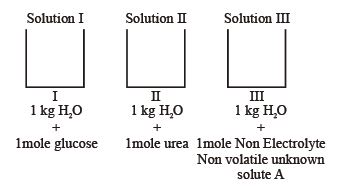
The order of boiling point $(B.P.)$ of the solutions formed is:
A
$I > II > III$
B
$I < II < III$
C
$I = II = III$
D
Data Insufficient
Solution
(C) The elevation in boiling point $(\Delta T_b)$ is a colligative property given by the formula $\Delta T_b = i \times K_b \times m$,where $i$ is the van't Hoff factor,$K_b$ is the ebullioscopic constant,and $m$ is the molality of the solution.
For all three solutions,the solvent is $1 \ kg$ of $H_2O$ and the amount of solute is $1 \ mole$.
Thus,the molality $(m)$ is the same for all three solutions $(m = 1 \ mol / 1 \ kg = 1 \ m)$.
Glucose,urea,and the non-electrolyte non-volatile unknown solute $A$ are all non-electrolytes,so their van't Hoff factor $(i)$ is $1$ for all of them.
Since $i$,$K_b$,and $m$ are identical for all three solutions,the elevation in boiling point $(\Delta T_b)$ will be the same.
Therefore,the boiling point of the solutions will be equal: $I = II = III$.
For all three solutions,the solvent is $1 \ kg$ of $H_2O$ and the amount of solute is $1 \ mole$.
Thus,the molality $(m)$ is the same for all three solutions $(m = 1 \ mol / 1 \ kg = 1 \ m)$.
Glucose,urea,and the non-electrolyte non-volatile unknown solute $A$ are all non-electrolytes,so their van't Hoff factor $(i)$ is $1$ for all of them.
Since $i$,$K_b$,and $m$ are identical for all three solutions,the elevation in boiling point $(\Delta T_b)$ will be the same.
Therefore,the boiling point of the solutions will be equal: $I = II = III$.
0 likes
View Solution49
MediumMCQ
$11.1 \ g$ of $CaCl_2$ is dissolved in $1 \ kg$ of water. Determine the elevation in boiling point of the solution. $[K_b = 0.5 \ K \ kg \ mol^{-1}]$ :-
A
$0.15$
B
$0.052$
C
$0.015$
D
$0.5$
Solution
(A) The molar mass of $CaCl_2$ is $40 + 2 \times 35.5 = 111 \ g \ mol^{-1}$.
The number of moles of $CaCl_2$ is $n = \frac{11.1 \ g}{111 \ g \ mol^{-1}} = 0.1 \ mol$.
Since $CaCl_2$ dissociates as $CaCl_2 \rightarrow Ca^{2+} + 2Cl^-$,the van't Hoff factor $i = 3$.
The elevation in boiling point is given by $\Delta T_b = i \times K_b \times m$,where $m$ is the molality.
$m = \frac{0.1 \ mol}{1 \ kg} = 0.1 \ mol \ kg^{-1}$.
$\Delta T_b = 3 \times 0.5 \ K \ kg \ mol^{-1} \times 0.1 \ mol \ kg^{-1} = 0.15 \ K$.
The number of moles of $CaCl_2$ is $n = \frac{11.1 \ g}{111 \ g \ mol^{-1}} = 0.1 \ mol$.
Since $CaCl_2$ dissociates as $CaCl_2 \rightarrow Ca^{2+} + 2Cl^-$,the van't Hoff factor $i = 3$.
The elevation in boiling point is given by $\Delta T_b = i \times K_b \times m$,where $m$ is the molality.
$m = \frac{0.1 \ mol}{1 \ kg} = 0.1 \ mol \ kg^{-1}$.
$\Delta T_b = 3 \times 0.5 \ K \ kg \ mol^{-1} \times 0.1 \ mol \ kg^{-1} = 0.15 \ K$.
0 likes
View Solution50
MediumMCQ
By studying the elevation in boiling point of an aqueous solution of glucose,the value of $K_b$ for water is found to be $0.51 \ K \ kg \ mol^{-1}$. What value of $K_b$ can be expected from an aqueous solution of $K_4[Fe(CN)_6]$?
A
$0.51$
B
$1$
C
$2.55$
D
$1.53$
Solution
(A) The ebullioscopic constant $(K_b)$ is a characteristic property of the solvent.
It depends only on the nature of the solvent and is independent of the solute dissolved in it.
Since the solvent in both cases is water,the value of $K_b$ will remain the same,i.e.,$0.51 \ K \ kg \ mol^{-1}$.
It depends only on the nature of the solvent and is independent of the solute dissolved in it.
Since the solvent in both cases is water,the value of $K_b$ will remain the same,i.e.,$0.51 \ K \ kg \ mol^{-1}$.
0 likes
View SolutionSolutions — Elevation of boiling point of the solvent · Frequently Asked Questions
1Are these Solutions questions useful for JEE and NEET?
Yes. All questions in this section are mapped to JEE Main and NEET exam patterns. Previous year questions from JEE Main, NEET, GUJCET and state-level exams are included with full solutions.
2Can I switch to Hindi or Gujarati for these questions?
Yes. Use the language tabs in the hero section or the sidebar to view the same questions and solutions in English, Hindi or Gujarati.
3How do I generate a question paper from this subtopic?
Use the Vedclass Exam Paper Generator — select the chapter and subtopic, set difficulty, and generate Sets A, B, C, D automatically. First 3 chapters of every subject are free.
Vedclass Products
For Students
Vedclass Test Series
Mock tests in real JEE/NEET style with performance analysis. 5-day free trial.
Start Free TrialFor Teachers
Exam Paper Generator
Generate Set A/B/C/D papers from this chapter in 2 minutes. 3 chapters free.
Try FreeFor Institutes
Online Exam Module
Live online exams with unlimited students, 360° analytics & white-label branding.
See DemoFor Teachers & Institutes
Generate a Solutions Exam Paper in 2 Minutes
Select subtopic & difficulty — Sets A, B, C, D auto-generated with No Repeat logic.
First 3 chapters of every subject are free — no payment required.