
A English
Hybridisation and Geometry Questions in English
Class 12 Chemistry · Coordination Compounds · Hybridisation and Geometry
436+
Questions
English
Language
100%
With Solutions
Showing 50 of 436 questions in English
101
MediumMCQ
The hybridization involved in the complex $[Ni(CN)_4]^{2-}$ is (Atomic number of $Ni = 28$):
A
$sp^3$
B
$d^2sp^2$
C
$d^2sp^3$
D
$dsp^2$
Solution
(D) $1$. The oxidation state of $Ni$ in $[Ni(CN)_4]^{2-}$ is calculated as: $x + 4(-1) = -2$,so $x = +2$.
$2$. The electronic configuration of $Ni^{2+}$ is $[Ar]^{18} 3d^8 4s^0$.
$3$. $CN^-$ is a strong field ligand,which causes the pairing of electrons in the $3d$ orbitals.
$4$. After pairing,one $3d$,one $4s$,and two $4p$ orbitals are available for hybridization.
$5$. Thus,the hybridization is $dsp^2$.
$2$. The electronic configuration of $Ni^{2+}$ is $[Ar]^{18} 3d^8 4s^0$.
$3$. $CN^-$ is a strong field ligand,which causes the pairing of electrons in the $3d$ orbitals.
$4$. After pairing,one $3d$,one $4s$,and two $4p$ orbitals are available for hybridization.
$5$. Thus,the hybridization is $dsp^2$.
0 likes
View Solution102
DifficultMCQ
Which of these statements about $[Co(CN)_6]^{3-}$ is true?
A
$[Co(CN)_6]^{3-}$ has four unpaired electrons and will be in a high-spin configuration.
B
$[Co(CN)_6]^{3-}$ has no unpaired electrons and will be in a high-spin configuration.
C
$[Co(CN)_6]^{3-}$ has no unpaired electrons and will be in a low-spin configuration.
D
$[Co(CN)_6]^{3-}$ has four unpaired electrons and will be in a low-spin configuration.
Solution
(C) In $[Co(CN)_6]^{3-}$,the oxidation state of $Co$ is $+3$.
The electronic configuration of $Co^{3+}$ is $3d^6$.
Since $CN^-$ is a strong field ligand,it causes pairing of electrons in the $3d$ orbitals.
This results in all $6$ electrons being paired in the $t_{2g}$ orbitals.
Therefore,the complex has no unpaired electrons and is a low-spin complex.
The electronic configuration of $Co^{3+}$ is $3d^6$.
Since $CN^-$ is a strong field ligand,it causes pairing of electrons in the $3d$ orbitals.
This results in all $6$ electrons being paired in the $t_{2g}$ orbitals.
Therefore,the complex has no unpaired electrons and is a low-spin complex.
0 likes
View Solution103
DifficultMCQ
Which one of the following is an outer orbital complex and exhibits paramagnetic behaviour?
A
$[Ni(NH_3)_6]^{2+}$
B
$[Zn(NH_3)_6]^{2+}$
C
$[Cr(NH_3)_6]^{3+}$
D
$[Co(NH_3)_6]^{3+}$
Solution
(A) For $[Ni(NH_3)_6]^{2+}$,the oxidation state of $Ni$ is $+2$ ($3d^8$ configuration). It uses $4s, 4p,$ and $4d$ orbitals to form $sp^3d^2$ hybrid orbitals,making it an outer orbital complex. It has two unpaired electrons in the $3d$ orbitals,so it is paramagnetic.
For $[Zn(NH_3)_6]^{2+}$,the oxidation state of $Zn$ is $+2$ ($3d^{10}$ configuration). It is an outer orbital complex $(sp^3d^2)$,but it is diamagnetic due to no unpaired electrons.
For $[Cr(NH_3)_6]^{3+}$,the oxidation state of $Cr$ is $+3$ ($3d^3$ configuration). It uses $3d, 4s,$ and $4p$ orbitals to form $d^2sp^3$ hybrid orbitals,making it an inner orbital complex. It is paramagnetic.
For $[Co(NH_3)_6]^{3+}$,the oxidation state of $Co$ is $+3$ ($3d^6$ configuration). It forms $d^2sp^3$ hybrid orbitals,making it an inner orbital complex. It is diamagnetic.
For $[Zn(NH_3)_6]^{2+}$,the oxidation state of $Zn$ is $+2$ ($3d^{10}$ configuration). It is an outer orbital complex $(sp^3d^2)$,but it is diamagnetic due to no unpaired electrons.
For $[Cr(NH_3)_6]^{3+}$,the oxidation state of $Cr$ is $+3$ ($3d^3$ configuration). It uses $3d, 4s,$ and $4p$ orbitals to form $d^2sp^3$ hybrid orbitals,making it an inner orbital complex. It is paramagnetic.
For $[Co(NH_3)_6]^{3+}$,the oxidation state of $Co$ is $+3$ ($3d^6$ configuration). It forms $d^2sp^3$ hybrid orbitals,making it an inner orbital complex. It is diamagnetic.
0 likes
View Solution104
DifficultMCQ
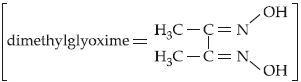
Red precipitate is obtained when an ethanol solution of dimethylglyoxime is added to ammoniacal $Ni(II)$. Which of the following statements is not true?
A
Red complex has a square planar geometry.
B
Complex has symmetrical $H$-bonding.
C
Red complex has a tetrahedral geometry.
D
Dimethylglyoxime functions as a bidentate ligand.
Solution
(C) The reaction of $Ni^{2+}$ with dimethylglyoxime $(DMG)$ in an ammoniacal medium produces a red-coloured complex,$[Ni(DMG)_2]$.
This complex has a square planar geometry,not a tetrahedral one.
Dimethylglyoxime acts as a bidentate ligand,coordinating through the nitrogen atoms.
The complex is highly stable due to the presence of strong intramolecular symmetrical hydrogen bonding between the oxime groups of the two ligands.
This complex has a square planar geometry,not a tetrahedral one.
Dimethylglyoxime acts as a bidentate ligand,coordinating through the nitrogen atoms.
The complex is highly stable due to the presence of strong intramolecular symmetrical hydrogen bonding between the oxime groups of the two ligands.
0 likes
View Solution105
DifficultMCQ
$[Cr(H_2O)_6]Cl_3$ $(At. \text{ } no. \text{ } of \text{ } Cr = 24)$ has a magnetic moment of $3.83 \text{ } B.M.$ The correct distribution of $3d$ electrons in the chromium of the complex is
A
$3d_{xy}^1, 3d_{yz}^1, 3d_{z^2}^1$
B
$3d_{(x^2-y^2)}^1, 3d_{z^2}^1, 3d_{xz}^1$
C
$3d_{xy}^1, 3d_{(x^2-y^2)}^1, 3d_{yz}^1$
D
$3d_{xy}^1, 3d_{yz}^1, 3d_{xz}^1$
Solution
(D) Magnetic moment $(\mu) = \sqrt{n(n+2)} \text{ } B.M.$
Given $\mu = 3.83 \text{ } B.M.$
$3.83 = \sqrt{n(n+2)} \implies n \approx 3$
This indicates there are $3$ unpaired electrons.
For the complex $[Cr(H_2O)_6]Cl_3$,the oxidation state of $Cr$ is $+3$.
The electronic configuration of $Cr$ $(Z=24)$ is $[Ar] 3d^5 4s^1$.
Thus,$Cr^{3+}$ is $[Ar] 3d^3$.
According to Hund's rule,the $3$ electrons in the $3d$ orbitals occupy the $t_{2g}$ set $(d_{xy}, d_{yz}, d_{xz})$ singly.
Therefore,the distribution is $3d_{xy}^1, 3d_{yz}^1, 3d_{xz}^1$.
Given $\mu = 3.83 \text{ } B.M.$
$3.83 = \sqrt{n(n+2)} \implies n \approx 3$
This indicates there are $3$ unpaired electrons.
For the complex $[Cr(H_2O)_6]Cl_3$,the oxidation state of $Cr$ is $+3$.
The electronic configuration of $Cr$ $(Z=24)$ is $[Ar] 3d^5 4s^1$.
Thus,$Cr^{3+}$ is $[Ar] 3d^3$.
According to Hund's rule,the $3$ electrons in the $3d$ orbitals occupy the $t_{2g}$ set $(d_{xy}, d_{yz}, d_{xz})$ singly.
Therefore,the distribution is $3d_{xy}^1, 3d_{yz}^1, 3d_{xz}^1$.
0 likes
View Solution106
DifficultMCQ
Nickel $(Z = 28)$ combines with a uninegative monodentate ligand $X^{-}$ to form a paramagnetic complex $[NiX_4]^{-2}.$ The number of unpaired electron$(s)$ in the nickel and geometry of this complex ion are,respectively $:$
A
$1$,square planar
B
$2$,square planar
C
$1$,tetrahedral
D
$2$,tetrahedral
Solution
(D) The atomic number of Nickel $(Ni)$ is $28$. Its electronic configuration is $[Ar] 3d^8 4s^2$.
In the complex $[NiX_4]^{-2}$,let the oxidation state of $Ni$ be $y$.
$y + 4(-1) = -2 \implies y = +2$.
So,$Ni^{+2}$ has the configuration $[Ar] 3d^8$.
In the $3d$ orbital,there are $8$ electrons. According to Hund's rule,these are distributed as $3$ paired and $2$ unpaired electrons.
Since the complex is paramagnetic and the ligand $X^-$ is a weak field ligand (as it forms a tetrahedral complex),no pairing of electrons occurs in the $3d$ orbitals.
Thus,there are $2$ unpaired electrons.
The hybridization involved is $sp^3$,which corresponds to a tetrahedral geometry.
In the complex $[NiX_4]^{-2}$,let the oxidation state of $Ni$ be $y$.
$y + 4(-1) = -2 \implies y = +2$.
So,$Ni^{+2}$ has the configuration $[Ar] 3d^8$.
In the $3d$ orbital,there are $8$ electrons. According to Hund's rule,these are distributed as $3$ paired and $2$ unpaired electrons.
Since the complex is paramagnetic and the ligand $X^-$ is a weak field ligand (as it forms a tetrahedral complex),no pairing of electrons occurs in the $3d$ orbitals.
Thus,there are $2$ unpaired electrons.
The hybridization involved is $sp^3$,which corresponds to a tetrahedral geometry.
0 likes
View Solution107
EasyMCQ
Which of the following has a square planar geometry?
(At. nos.: $Fe=26, Co=27, Ni=28, Pt=78$)
(At. nos.: $Fe=26, Co=27, Ni=28, Pt=78$)
A
$[PtCl_4]^{2-}$
B
$[CoCl_4]^{2-}$
C
$[FeCl_4]^{2-}$
D
$[NiCl_4]^{2-}$
Solution
(A) In $[PtCl_4]^{2-}$,the central metal ion is $Pt^{2 }$ ($5d^8$ configuration).
$Pt$ is a $5d$ series element,and for $5d$ elements,the crystal field splitting energy $(\Delta_o)$ is very high,even with weak ligands like $Cl^-$.
This high splitting energy forces the pairing of electrons in the $5d$ orbitals,resulting in $dsp^2$ hybridization.
Therefore,$[PtCl_4]^{2-}$ exhibits a square planar geometry.
In contrast,$[NiCl_4]^{2-}$,$[CoCl_4]^{2-}$,and $[FeCl_4]^{2-}$ involve $3d$ metals with weak ligands,leading to $sp^3$ hybridization and tetrahedral geometry.
$Pt$ is a $5d$ series element,and for $5d$ elements,the crystal field splitting energy $(\Delta_o)$ is very high,even with weak ligands like $Cl^-$.
This high splitting energy forces the pairing of electrons in the $5d$ orbitals,resulting in $dsp^2$ hybridization.
Therefore,$[PtCl_4]^{2-}$ exhibits a square planar geometry.
In contrast,$[NiCl_4]^{2-}$,$[CoCl_4]^{2-}$,and $[FeCl_4]^{2-}$ involve $3d$ metals with weak ligands,leading to $sp^3$ hybridization and tetrahedral geometry.
0 likes
View Solution108
MediumMCQ
Which of the following facts about the complex $[Cr(NH_3)_6]Cl_3$ is wrong?
A
The complex involves $d^2sp^3$ hybridisation and is octahedral in shape.
B
The complex is paramagnetic.
C
The complex is an outer orbital complex.
D
The complex gives white precipitate with silver nitrate solution.
Solution
(C) In the complex $[Cr(NH_3)_6]Cl_3$,the oxidation state of $Cr$ is $+3$. The electronic configuration of $Cr^{3+}$ is $[Ar]3d^3$.
Since $NH_3$ is a ligand,it forms an octahedral complex using $d^2sp^3$ hybridization.
Because it uses $(n-1)d$ orbitals ($3d$ orbitals),it is classified as an inner orbital complex,not an outer orbital complex.
Therefore,the statement that it is an outer orbital complex is wrong.
Since $NH_3$ is a ligand,it forms an octahedral complex using $d^2sp^3$ hybridization.
Because it uses $(n-1)d$ orbitals ($3d$ orbitals),it is classified as an inner orbital complex,not an outer orbital complex.
Therefore,the statement that it is an outer orbital complex is wrong.
0 likes
View Solution109
MediumMCQ
The complex $[Pt(NH_3)_4]^{2+}$ has $.....$ structure.
A
square planar
B
tetrahedral
C
pyramidal
D
pentagonal
Solution
(A) The central metal ion is $Pt^{2+}$,which has a $5d^8$ electronic configuration.
For $5d$ series elements,the crystal field splitting energy $(CFSE)$ is very high,which forces the pairing of electrons.
This leads to $dsp^2$ hybridization,resulting in a square planar geometry.
The complex is diamagnetic because all electrons are paired.
For $5d$ series elements,the crystal field splitting energy $(CFSE)$ is very high,which forces the pairing of electrons.
This leads to $dsp^2$ hybridization,resulting in a square planar geometry.
The complex is diamagnetic because all electrons are paired.
0 likes
View Solution110
MediumMCQ
Which of the following pairs differ in geometry but resemble in magnetic behavior?
A
$[Ni(CO)_4]$ & $[Ni(CN)_4]^{2-}$
B
$[Be(H_2O)_4]^{2+}$ & $[Zn(CN)_4]^{2-}$
C
$[Fe(CN)_6]^{3-}$ & $[FeF_6]^{3-}$
D
$[Fe(CO)_5]$ & $PCl_5$
Solution
(A) $1$. $[Ni(CO)_4]$: $Ni(0)$ is $3d^8 4s^2$. $CO$ is a strong field ligand,causing pairing. Hybridization is $sp^3$,geometry is tetrahedral,and it is diamagnetic $(n=0)$.
$2$. $[Ni(CN)_4]^{2-}$: $Ni(II)$ is $3d^8$. $CN^-$ is a strong field ligand. Hybridization is $dsp^2$,geometry is square planar,and it is diamagnetic $(n=0)$.
$3$. Since both are diamagnetic but have different geometries (tetrahedral vs square planar),option $A$ is correct.
$2$. $[Ni(CN)_4]^{2-}$: $Ni(II)$ is $3d^8$. $CN^-$ is a strong field ligand. Hybridization is $dsp^2$,geometry is square planar,and it is diamagnetic $(n=0)$.
$3$. Since both are diamagnetic but have different geometries (tetrahedral vs square planar),option $A$ is correct.
0 likes
View Solution111
MediumMCQ
Which of the following complexes is tetrahedral as well as diamagnetic?
A
$[Ni(CN)_4]^{2-}$
B
$[NiCl_4]^{2-}$
C
$[Ni(CO)_4]$
D
$[Fe(CO)_5]$
Solution
(C) $1$. $[Ni(CN)_4]^{2-}$: $Ni^{2+}$ is $d^8$. $CN^-$ is a strong field ligand,causing pairing. It forms $dsp^2$ hybridization,which is square planar and diamagnetic.
$2$. $[NiCl_4]^{2-}$: $Ni^{2+}$ is $d^8$. $Cl^-$ is a weak field ligand. It forms $sp^3$ hybridization,which is tetrahedral and paramagnetic.
$3$. $[Ni(CO)_4]$: $Ni$ is $d^8s^2$. $CO$ is a strong field ligand,forcing electrons to pair. It forms $sp^3$ hybridization,which is tetrahedral and diamagnetic.
$4$. $[Fe(CO)_5]$: $Fe$ is $d^6s^2$. It forms $dsp^3$ hybridization,which is trigonal bipyramidal and diamagnetic.
Therefore,the complex that is both tetrahedral and diamagnetic is $[Ni(CO)_4]$.
$2$. $[NiCl_4]^{2-}$: $Ni^{2+}$ is $d^8$. $Cl^-$ is a weak field ligand. It forms $sp^3$ hybridization,which is tetrahedral and paramagnetic.
$3$. $[Ni(CO)_4]$: $Ni$ is $d^8s^2$. $CO$ is a strong field ligand,forcing electrons to pair. It forms $sp^3$ hybridization,which is tetrahedral and diamagnetic.
$4$. $[Fe(CO)_5]$: $Fe$ is $d^6s^2$. It forms $dsp^3$ hybridization,which is trigonal bipyramidal and diamagnetic.
Therefore,the complex that is both tetrahedral and diamagnetic is $[Ni(CO)_4]$.
0 likes
View Solution112
EasyMCQ
$[FeF_6]^{3-}$ has ........ hybridisation and ....... geometry. Select the best option to fill the blank space respectively:
A
$d^2sp^3$,octahedral
B
$sp^3d^2$,octahedral
C
$dsp^3d$,octahedral
D
$dsp^2$,square planar
Solution
(B) The electronic configuration of $Fe$ is $[Ar] 3d^6 4s^2$.
In the complex $[FeF_6]^{3-}$,the oxidation state of $Fe$ is $+3$,resulting in an electronic configuration of $[Ar] 3d^5$.
Since $F^-$ is a weak field ligand,it does not cause pairing of electrons in the $3d$ orbitals.
Therefore,the $4s$,$4p$,and $4d$ orbitals participate in hybridization,resulting in $sp^3d^2$ hybridization.
This hybridization corresponds to an octahedral geometry.
Hence,option $B$ is the correct answer.
In the complex $[FeF_6]^{3-}$,the oxidation state of $Fe$ is $+3$,resulting in an electronic configuration of $[Ar] 3d^5$.
Since $F^-$ is a weak field ligand,it does not cause pairing of electrons in the $3d$ orbitals.
Therefore,the $4s$,$4p$,and $4d$ orbitals participate in hybridization,resulting in $sp^3d^2$ hybridization.
This hybridization corresponds to an octahedral geometry.
Hence,option $B$ is the correct answer.
0 likes
View Solution113
MediumMCQ
Which of the following is correctly matched?
A
$[Cu(NH_3)_4]^{2+}$: $dsp^2$,paramagnetic
B
$K_2[Ni(CN)_4]$: $dsp^2$,diamagnetic
C
$[Co(NH_3)_4(H_2O)_2]Cl_3$: $sp^3d^2$,paramagnetic
D
$[Pt(NH_3)_2Cl_2]$: $sp^3$,diamagnetic
Solution
(B) $1$. For $[Cu(NH_3)_4]^{2+}$,$Cu^{2+}$ is $3d^9$. It undergoes $dsp^2$ hybridization and is paramagnetic due to one unpaired electron.
$2$. For $K_2[Ni(CN)_4]$,$Ni^{2+}$ is $3d^8$. $CN^-$ is a strong field ligand,causing pairing of electrons. It undergoes $dsp^2$ hybridization and is diamagnetic.
$3$. $[Co(NH_3)_4(H_2O)_2]Cl_3$ involves $Co^{3+}$ $(3d^6)$. With weak field ligands,it undergoes $sp^3d^2$ hybridization and is paramagnetic.
$4$. $[Pt(NH_3)_2Cl_2]$ is a square planar complex ($dsp^2$ hybridization) and is diamagnetic.
Therefore,option $B$ is correctly matched.
$2$. For $K_2[Ni(CN)_4]$,$Ni^{2+}$ is $3d^8$. $CN^-$ is a strong field ligand,causing pairing of electrons. It undergoes $dsp^2$ hybridization and is diamagnetic.
$3$. $[Co(NH_3)_4(H_2O)_2]Cl_3$ involves $Co^{3+}$ $(3d^6)$. With weak field ligands,it undergoes $sp^3d^2$ hybridization and is paramagnetic.
$4$. $[Pt(NH_3)_2Cl_2]$ is a square planar complex ($dsp^2$ hybridization) and is diamagnetic.
Therefore,option $B$ is correctly matched.
0 likes
View Solution114
EasyMCQ
Which of the following combinations is correct regarding the hybridization of the central metal ion?
A
$[PdCl_4]^{2-} \Rightarrow dsp^2$
B
$[PtCl_4]^{2-} \Rightarrow sp^3$
C
$[Fe(NH_3)_6]^{2+} \Rightarrow d^2sp^3$
D
$[Co(H_2O)_6]^{3+} \Rightarrow sp^3d^2$
Solution
(A) $1$. For $[PdCl_4]^{2-}$,$Pd^{2+}$ is a $4d^8$ ion. Since $Pd$ is a $4d$ series metal,it always forms square planar complexes with $dsp^2$ hybridization. This is correct.
$2$. For $[PtCl_4]^{2-}$,$Pt^{2+}$ is a $5d^8$ ion. Like $Pd^{2+}$,it forms square planar complexes with $dsp^2$ hybridization,not $sp^3$. This is incorrect.
$3$. For $[Fe(NH_3)_6]^{2+}$,$Fe^{2+}$ is a $3d^6$ ion. $NH_3$ is a strong field ligand,but for $Fe^{2+}$,it is not strong enough to force pairing in the $3d$ orbital to form $d^2sp^3$. It forms an outer orbital complex $sp^3d^2$. This is incorrect.
$4$. For $[Co(H_2O)_6]^{3+}$,$Co^{3+}$ is a $3d^6$ ion. $H_2O$ is a weak field ligand,so it forms an outer orbital complex $sp^3d^2$. This is correct.
Note: Both $A$ and $D$ are technically correct based on standard coordination chemistry principles. However,$A$ is a classic example of $4d$ metal behavior.
$2$. For $[PtCl_4]^{2-}$,$Pt^{2+}$ is a $5d^8$ ion. Like $Pd^{2+}$,it forms square planar complexes with $dsp^2$ hybridization,not $sp^3$. This is incorrect.
$3$. For $[Fe(NH_3)_6]^{2+}$,$Fe^{2+}$ is a $3d^6$ ion. $NH_3$ is a strong field ligand,but for $Fe^{2+}$,it is not strong enough to force pairing in the $3d$ orbital to form $d^2sp^3$. It forms an outer orbital complex $sp^3d^2$. This is incorrect.
$4$. For $[Co(H_2O)_6]^{3+}$,$Co^{3+}$ is a $3d^6$ ion. $H_2O$ is a weak field ligand,so it forms an outer orbital complex $sp^3d^2$. This is correct.
Note: Both $A$ and $D$ are technically correct based on standard coordination chemistry principles. However,$A$ is a classic example of $4d$ metal behavior.
0 likes
View Solution115
MediumMCQ
Which ion has tetrahedral geometry:
A
$[Fe(CO)_5]$
B
$[Co(NH_3)_6]^{2+}$
C
$[NiCl_4]^{2-}$
D
$[Ni(CN)_4]^{2-}$
Solution
(C) $1$. In $[Fe(CO)_5]$,the geometry is trigonal bipyramidal ($sp^3d$ hybridization).
$2$. In $[Co(NH_3)_6]^{2+}$,the geometry is octahedral ($d^2sp^3$ or $sp^3d^2$ hybridization).
$3$. In $[NiCl_4]^{2-}$,$Ni^{2+}$ has a $d^8$ configuration. $Cl^-$ is a weak field ligand,so it does not cause pairing. The hybridization is $sp^3$,resulting in a tetrahedral geometry.
$4$. In $[Ni(CN)_4]^{2-}$,$Ni^{2+}$ has a $d^8$ configuration. $CN^-$ is a strong field ligand,causing pairing. The hybridization is $dsp^2$,resulting in a square planar geometry.
Therefore,the correct option is $C$.
$2$. In $[Co(NH_3)_6]^{2+}$,the geometry is octahedral ($d^2sp^3$ or $sp^3d^2$ hybridization).
$3$. In $[NiCl_4]^{2-}$,$Ni^{2+}$ has a $d^8$ configuration. $Cl^-$ is a weak field ligand,so it does not cause pairing. The hybridization is $sp^3$,resulting in a tetrahedral geometry.
$4$. In $[Ni(CN)_4]^{2-}$,$Ni^{2+}$ has a $d^8$ configuration. $CN^-$ is a strong field ligand,causing pairing. The hybridization is $dsp^2$,resulting in a square planar geometry.
Therefore,the correct option is $C$.
0 likes
View Solution116
MediumMCQ
The hybridisation and unpaired electrons in $[Fe(H_2O)_6]^{2+}$ ion are:
A
$sp^3d^2 ; 4$
B
$d^2sp^3 ; 3$
C
$sp^3d ; 4$
D
$sp^3d^2 ; 2$
Solution
(A) The central metal ion is $Fe^{2+}$,which has an electronic configuration of $[Ar] 3d^6$.
$H_2O$ is a weak field ligand,so it does not cause pairing of electrons in the $3d$ orbital.
Thus,the $3d$ electrons are arranged as $t_{2g}^4 e_g^2$,resulting in $4$ unpaired electrons.
The hybridization involves the outer $4d$ orbitals,leading to $sp^3d^2$ hybridization (outer orbital complex).
$H_2O$ is a weak field ligand,so it does not cause pairing of electrons in the $3d$ orbital.
Thus,the $3d$ electrons are arranged as $t_{2g}^4 e_g^2$,resulting in $4$ unpaired electrons.
The hybridization involves the outer $4d$ orbitals,leading to $sp^3d^2$ hybridization (outer orbital complex).
0 likes
View Solution117
MediumMCQ
The hybridisation involved in $[CoF_6]^{3-}$ is :
A
$d^2sp^3$
B
$d^3sp^2$
C
$dsp^3$
D
$sp^3d^2$
Solution
(D) The central metal ion is $Co^{3+}$,which has an electronic configuration of $[Ar] 3d^6$.
$F^-$ is a weak field ligand,so it does not cause pairing of electrons in the $3d$ orbitals.
Therefore,the complex uses the outer $4d$ orbitals for hybridisation.
For a coordination number of $6$,the hybridisation is $sp^3d^2$,resulting in an outer orbital high-spin complex.
$F^-$ is a weak field ligand,so it does not cause pairing of electrons in the $3d$ orbitals.
Therefore,the complex uses the outer $4d$ orbitals for hybridisation.
For a coordination number of $6$,the hybridisation is $sp^3d^2$,resulting in an outer orbital high-spin complex.
0 likes
View Solution118
EasyMCQ
The structure of iron pentacarbonyl is:
A
Square planar
B
Trigonal bipyramid
C
Triangular
D
None of these
Solution
(B) $Fe(CO)_5$ adopts a trigonal bipyramidal structure with the $Fe$ atom surrounded by five $CO$ ligands: three in equatorial positions and two axially bound. The $Fe-C-O$ linkages are each linear.
0 likes
View Solution119
EasyMCQ
$Cu^{2+}$ shows a coordination number of
A
$2$ only
B
$2$ or $4$
C
$4$ only
D
$4$ or $6$
Solution
(D) The coordination number of a metal ion in a complex depends on the nature of the ligands and the geometry of the complex.
For the $Cu^{2+}$ ion,it commonly forms complexes with a coordination number of $4$ (e.g.,$[Cu(NH_3)_4]^{2+}$ with square planar geometry) and sometimes $6$ (e.g.,$[Cu(H_2O)_6]^{2+}$ with distorted octahedral geometry).
Therefore,$Cu^{2+}$ can exhibit a coordination number of $4$ or $6$ depending on the ligands attached.
For the $Cu^{2+}$ ion,it commonly forms complexes with a coordination number of $4$ (e.g.,$[Cu(NH_3)_4]^{2+}$ with square planar geometry) and sometimes $6$ (e.g.,$[Cu(H_2O)_6]^{2+}$ with distorted octahedral geometry).
Therefore,$Cu^{2+}$ can exhibit a coordination number of $4$ or $6$ depending on the ligands attached.
0 likes
View Solution120
DifficultMCQ
The geometry of $Ni(CO)_4$ and $[Ni(PPh_3)_2Cl_2]$ are
A
both square planar
B
tetrahedral and square planar
C
both tetrahedral
D
square planar and tetrahedral
Solution
(C) $Ni(CO)_4$: The oxidation state of $Ni$ is $0$. The electronic configuration is $[Ar] 3d^{10} 4s^0$. Due to the strong field ligand $CO$,the electrons are paired,resulting in $sp^3$ hybridization. Thus,the geometry is tetrahedral.
$[Ni(PPh_3)_2Cl_2]$: The oxidation state of $Ni$ is $+2$. The electronic configuration is $[Ar] 3d^8$. $PPh_3$ and $Cl^-$ are ligands that do not cause pairing of $d$-electrons in this specific complex,leading to $sp^3$ hybridization. Thus,the geometry is tetrahedral.
$[Ni(PPh_3)_2Cl_2]$: The oxidation state of $Ni$ is $+2$. The electronic configuration is $[Ar] 3d^8$. $PPh_3$ and $Cl^-$ are ligands that do not cause pairing of $d$-electrons in this specific complex,leading to $sp^3$ hybridization. Thus,the geometry is tetrahedral.
0 likes
View Solution121
MediumMCQ
$[Cu(NH_3)_4]^{2+}$ has hybridisation and magnetic moment
A
$sp^3, 1.73 \ B.M.$
B
$sp^3d, 1.73 \ B.M.$
C
$dsp^2, 2.83 \ B.M.$
D
$dsp^2, 1.73 \ B.M.$
Solution
(D) In $[Cu(NH_3)_4]^{2+}$,the oxidation state of $Cu$ is $+2$.
The electronic configuration of $Cu^{2+}$ is $[Ar] 3d^9$.
The $3d^9$ configuration has one unpaired electron.
The magnetic moment $\mu$ is calculated as $\mu = \sqrt{n(n+2)} \ B.M.$,where $n$ is the number of unpaired electrons.
For $n = 1$,$\mu = \sqrt{1(1+2)} = \sqrt{3} \approx 1.73 \ B.M.$
Due to the square planar geometry of this complex,the hybridisation is $dsp^2$.
The electronic configuration of $Cu^{2+}$ is $[Ar] 3d^9$.
The $3d^9$ configuration has one unpaired electron.
The magnetic moment $\mu$ is calculated as $\mu = \sqrt{n(n+2)} \ B.M.$,where $n$ is the number of unpaired electrons.
For $n = 1$,$\mu = \sqrt{1(1+2)} = \sqrt{3} \approx 1.73 \ B.M.$
Due to the square planar geometry of this complex,the hybridisation is $dsp^2$.
0 likes
View Solution122
MediumMCQ
$[FeF_6]^{3-}$ has $Fe$ atom . . . . . . hybridised with unpaired . . . . . . electrons.
A
$d^2sp^3, 4$
B
$d^2sp^3, 5$
C
$sp^3d^2, 5$
D
$sp^3d^2, 3$
Solution
(C) In $[FeF_6]^{3-}$,the oxidation state of $Fe$ is $+3$.
The electronic configuration of $Fe^{3+}$ is $[Ar] 3d^5$.
Since $F^-$ is a weak field ligand,it does not cause pairing of electrons.
Therefore,the $3d$ electrons remain unpaired,resulting in $5$ unpaired electrons.
The hybridization involves the outer $d$-orbitals,leading to $sp^3d^2$ hybridization.
The electronic configuration of $Fe^{3+}$ is $[Ar] 3d^5$.
Since $F^-$ is a weak field ligand,it does not cause pairing of electrons.
Therefore,the $3d$ electrons remain unpaired,resulting in $5$ unpaired electrons.
The hybridization involves the outer $d$-orbitals,leading to $sp^3d^2$ hybridization.
0 likes
View Solution123
MediumMCQ
Which of the following statements about $Fe(CO)_5$ is correct?
A
It is paramagnetic and high spin complex
B
It is diamagnetic and high spin complex
C
It is diamagnetic and low spin complex
D
It is paramagnetic and low spin complex
Solution
(C) In $Fe(CO)_5$,the central metal atom is $Fe$ in $0$ oxidation state.
The electronic configuration of $Fe$ $(Z=26)$ is $[Ar] 3d^6 4s^2$.
$CO$ is a strong field ligand,which causes pairing of electrons in the $3d$ orbitals.
After pairing,all electrons are paired,making the complex diamagnetic.
Since all electrons are paired,it is a low spin complex.
The electronic configuration of $Fe$ $(Z=26)$ is $[Ar] 3d^6 4s^2$.
$CO$ is a strong field ligand,which causes pairing of electrons in the $3d$ orbitals.
After pairing,all electrons are paired,making the complex diamagnetic.
Since all electrons are paired,it is a low spin complex.
0 likes
View Solution124
DifficultMCQ
Which of the following statements is not true?
A
$MnCl_4^{2-}$ ion has tetrahedral geometry and is paramagnetic.
B
$[Mn(CN)_6]^{2-}$ ion has octahedral geometry and is paramagnetic.
C
$[CuCl_4]^{2-}$ has square planar geometry and is paramagnetic.
D
$[Ni(PPh_3)_2Br_2]$ has trigonal bipyramidal geometry and one unpaired electron.
Solution
(D) The correct answer is $D$.
$A$. $MnCl_4^{2-}$: $Mn$ is in $+2$ oxidation state $(d^5)$. $Cl^-$ is a weak field ligand,leading to $sp^3$ hybridization and tetrahedral geometry. It has $5$ unpaired electrons,so it is paramagnetic. This statement is true.
$B$. $[Mn(CN)_6]^{2-}$: $Mn$ is in $+4$ oxidation state $(d^3)$. It forms an octahedral complex ($d^2sp^3$ or $sp^3d^2$). It has $3$ unpaired electrons,so it is paramagnetic. This statement is true.
$C$. $[CuCl_4]^{2-}$: $Cu$ is in $+2$ oxidation state $(d^9)$. It is a tetrahedral complex ($sp^3$ hybridization). However,the statement claims square planar geometry,which is incorrect for $[CuCl_4]^{2-}$. Note: $[CuCl_4]^{2-}$ is actually tetrahedral. Wait,checking the options: $[Ni(PPh_3)_2Br_2]$ is a $4$-coordinate complex,which is tetrahedral,not trigonal bipyramidal. Thus,$D$ is definitely false.
$D$. $[Ni(PPh_3)_2Br_2]$: $Ni$ is in $+2$ oxidation state $(d^8)$. It is a $4$-coordinate complex,which typically adopts tetrahedral geometry,not trigonal bipyramidal. Therefore,this statement is false.
$A$. $MnCl_4^{2-}$: $Mn$ is in $+2$ oxidation state $(d^5)$. $Cl^-$ is a weak field ligand,leading to $sp^3$ hybridization and tetrahedral geometry. It has $5$ unpaired electrons,so it is paramagnetic. This statement is true.
$B$. $[Mn(CN)_6]^{2-}$: $Mn$ is in $+4$ oxidation state $(d^3)$. It forms an octahedral complex ($d^2sp^3$ or $sp^3d^2$). It has $3$ unpaired electrons,so it is paramagnetic. This statement is true.
$C$. $[CuCl_4]^{2-}$: $Cu$ is in $+2$ oxidation state $(d^9)$. It is a tetrahedral complex ($sp^3$ hybridization). However,the statement claims square planar geometry,which is incorrect for $[CuCl_4]^{2-}$. Note: $[CuCl_4]^{2-}$ is actually tetrahedral. Wait,checking the options: $[Ni(PPh_3)_2Br_2]$ is a $4$-coordinate complex,which is tetrahedral,not trigonal bipyramidal. Thus,$D$ is definitely false.
$D$. $[Ni(PPh_3)_2Br_2]$: $Ni$ is in $+2$ oxidation state $(d^8)$. It is a $4$-coordinate complex,which typically adopts tetrahedral geometry,not trigonal bipyramidal. Therefore,this statement is false.
0 likes
View Solution125
MediumMCQ
An octahedral complex of $Ni(II)$ must be:
A
inner orbital
B
outer orbital
C
inner or outer orbital depending upon the strong or weak field ligand
D
none of these
Solution
(B) The electronic configuration of $Ni^{2+}$ is $[Ar] 3d^8$.
In an octahedral geometry,the coordination number is $6$.
For $d^8$ configuration,the $d$-orbitals are $d_{xy}, d_{yz}, d_{zx}, d_{x^2-y^2}, d_{z^2}$.
Regardless of whether the ligand is strong field or weak field,the $d^8$ configuration will always have two unpaired electrons in the $e_g$ set ($d_{x^2-y^2}$ and $d_{z^2}$).
Since the $3d$ orbitals are not fully available for hybridization,the complex must use the $4d$ orbitals for $sp^3d^2$ hybridization.
Therefore,$Ni(II)$ octahedral complexes are always outer orbital complexes.
In an octahedral geometry,the coordination number is $6$.
For $d^8$ configuration,the $d$-orbitals are $d_{xy}, d_{yz}, d_{zx}, d_{x^2-y^2}, d_{z^2}$.
Regardless of whether the ligand is strong field or weak field,the $d^8$ configuration will always have two unpaired electrons in the $e_g$ set ($d_{x^2-y^2}$ and $d_{z^2}$).
Since the $3d$ orbitals are not fully available for hybridization,the complex must use the $4d$ orbitals for $sp^3d^2$ hybridization.
Therefore,$Ni(II)$ octahedral complexes are always outer orbital complexes.
0 likes
View Solution126
DifficultMCQ
$Mn^{2+}$ forms a complex with $Br^{-}$ ion. The magnetic moment of the complex is $5.92 \ B.M.$ What could not be the probable formula and geometry of the complex?
A
$[MnBr_6]^{4-}$,octahedral
B
$[MnBr_4]^{2-}$,square planar
C
$[MnBr_4]^{2-}$,tetrahedral
D
$[MnBr_5]^{3-}$,trigonal bipyramidal
Solution
(B) The magnetic moment of $5.92 \ B.M.$ corresponds to $n = 5$ unpaired electrons,indicating a high-spin $d^5$ configuration for $Mn^{2+}$.
Since $Br^{-}$ is a weak field ligand,it does not cause pairing of electrons.
For a coordination number of $4$,the $sp^3$ hybridization leads to a tetrahedral geometry.
Square planar geometry for a $d^5$ system would require $dsp^2$ hybridization,which is not possible for a high-spin $Mn^{2+}$ complex as it would require pairing of electrons.
Therefore,$[MnBr_4]^{2-}$ with square planar geometry is not possible.
Since $Br^{-}$ is a weak field ligand,it does not cause pairing of electrons.
For a coordination number of $4$,the $sp^3$ hybridization leads to a tetrahedral geometry.
Square planar geometry for a $d^5$ system would require $dsp^2$ hybridization,which is not possible for a high-spin $Mn^{2+}$ complex as it would require pairing of electrons.
Therefore,$[MnBr_4]^{2-}$ with square planar geometry is not possible.
0 likes
View Solution127
DifficultMCQ
Point out the correct statements amongst the following.
A
$[Cu(CN)_4]^{3-}$ has tetrahedral geometry and $sp^3$ hybridization.
B
$[Ni(CN)_6]^{4-}$ is octahedral and $Ni$ has $d^2sp^3$ hybridization.
C
$[ZnBr_4]^{2-}$ is tetrahedral and diamagnetic.
D
$[Cr(NH_3)_6]^{3+}$ has octahedral geometry and $d^2sp^3$ hybridization.
Solution
(A, C, D) $1$. $[Cu(CN)_4]^{3-}$: $Cu^+$ is $3d^{10}$. It forms a tetrahedral complex with $sp^3$ hybridization. This statement is correct.
$2$. $[Ni(CN)_6]^{4-}$: $Ni^{2+}$ is $3d^8$. It cannot form a $d^2sp^3$ complex as it lacks sufficient empty $d$-orbitals. This is incorrect.
$3$. $[ZnBr_4]^{2-}$: $Zn^{2+}$ is $3d^{10}$. It forms a tetrahedral complex with $sp^3$ hybridization and is diamagnetic. This statement is correct.
$4$. $[Cr(NH_3)_6]^{3+}$: $Cr^{3+}$ is $3d^3$. It forms an octahedral complex with $d^2sp^3$ hybridization. This statement is correct.
Note: Multiple options ($A$,$C$,and $D$) are chemically correct based on standard coordination chemistry principles.
$2$. $[Ni(CN)_6]^{4-}$: $Ni^{2+}$ is $3d^8$. It cannot form a $d^2sp^3$ complex as it lacks sufficient empty $d$-orbitals. This is incorrect.
$3$. $[ZnBr_4]^{2-}$: $Zn^{2+}$ is $3d^{10}$. It forms a tetrahedral complex with $sp^3$ hybridization and is diamagnetic. This statement is correct.
$4$. $[Cr(NH_3)_6]^{3+}$: $Cr^{3+}$ is $3d^3$. It forms an octahedral complex with $d^2sp^3$ hybridization. This statement is correct.
Note: Multiple options ($A$,$C$,and $D$) are chemically correct based on standard coordination chemistry principles.
0 likes
View Solution128
MediumMCQ
Which one of the following is an inner orbital complex?
A
$[NiCl_2(PPh_3)_2]$
B
$[Ni(CN)_2(PPh_3)_2]$
C
$[Co(H_2O)_3F_3]$
D
$[NiF_6]^{4-}$
Solution
(B) An inner orbital complex is one that uses $(n-1)d$ orbitals for hybridization.
In $[Ni(CN)_2(PPh_3)_2]$,the central metal ion is $Ni^{2+}$ ($3d^8$ configuration).
$CN^{-}$ is a strong field ligand,which causes the pairing of electrons in the $3d$ orbitals.
This results in $dsp^2$ hybridization,which is characteristic of inner orbital complexes in square planar geometry.
In $[Ni(CN)_2(PPh_3)_2]$,the central metal ion is $Ni^{2+}$ ($3d^8$ configuration).
$CN^{-}$ is a strong field ligand,which causes the pairing of electrons in the $3d$ orbitals.
This results in $dsp^2$ hybridization,which is characteristic of inner orbital complexes in square planar geometry.
0 likes
View Solution129
DifficultMCQ
The geometry,hybridization,and magnetic moment of the ions $[Ni(CN)_4]^{2-}$,$[MnBr_4]^{2-}$,and $[FeF_6]^{4-}$ respectively are:
A
Tetrahedral,square planar,octahedral : $sp^3, dsp^2, sp^3d^2 : 5.9, 0, 4.9$
B
Tetrahedral,square planar,octahedral : $dsp^2, sp^3, sp^3d^2 : 0, 5.9, 4.9$
C
Square planar,tetrahedral,octahedral : $dsp^2, sp^3, d^2sp^3 : 5.9, 4.9, 0$
D
Square planar,tetrahedral,octahedral : $dsp^2, sp^3, sp^3d^2 : 0, 5.9, 4.9$
Solution
(D) $CN^-$ is a strong field ligand,while $Br^-$ and $F^-$ are weak field ligands.
For $[Ni(CN)_4]^{2-}$,$Ni^{2+}$ has $d^8$ configuration. $CN^-$ causes pairing,leading to $dsp^2$ hybridization (square planar) with $0$ unpaired electrons and $\mu = 0 \ BM$.
For $[MnBr_4]^{2-}$,$Mn^{2+}$ has $d^5$ configuration. $Br^-$ is a weak ligand,leading to $sp^3$ hybridization (tetrahedral) with $5$ unpaired electrons and $\mu = \sqrt{5(5+2)} = 5.9 \ BM$.
For $[FeF_6]^{4-}$,$Fe^{2+}$ has $d^6$ configuration. $F^-$ is a weak ligand,leading to $sp^3d^2$ hybridization (octahedral) with $4$ unpaired electrons and $\mu = \sqrt{4(4+2)} = 4.9 \ BM$.
For $[Ni(CN)_4]^{2-}$,$Ni^{2+}$ has $d^8$ configuration. $CN^-$ causes pairing,leading to $dsp^2$ hybridization (square planar) with $0$ unpaired electrons and $\mu = 0 \ BM$.
For $[MnBr_4]^{2-}$,$Mn^{2+}$ has $d^5$ configuration. $Br^-$ is a weak ligand,leading to $sp^3$ hybridization (tetrahedral) with $5$ unpaired electrons and $\mu = \sqrt{5(5+2)} = 5.9 \ BM$.
For $[FeF_6]^{4-}$,$Fe^{2+}$ has $d^6$ configuration. $F^-$ is a weak ligand,leading to $sp^3d^2$ hybridization (octahedral) with $4$ unpaired electrons and $\mu = \sqrt{4(4+2)} = 4.9 \ BM$.
0 likes
View Solution130
DifficultMCQ
Consider the reaction $K_2[Ni(CN)_4] + 4K + 4NH_3 \to A$ (complex $A$).
Complex $A$ gives five ions in aqueous solution. Choose the $CORRECT$ statements.
Complex $A$ gives five ions in aqueous solution. Choose the $CORRECT$ statements.
A
Complex is $sp^3$ hybridised & diamagnetic
B
Complex is $sp^3$ hybridised and paramagnetic
C
Complex is $dsp^2$ hybridised and diamagnetic
D
In complex $CN^-$ ligands are replaced by $NH_3$ ligands
Solution
(A) The reaction is $K_2[Ni(CN)_4] + 4K + 4NH_3 \to K_4[Ni(NH_3)_4] + 4KCN$.
Complex $A$ is $K_4[Ni(NH_3)_4]$.
In $K_4[Ni(NH_3)_4]$,the oxidation state of $Ni$ is $0$ ($d^{10}$ configuration).
Since $Ni(0)$ has a $d^{10}$ configuration,all $d$-orbitals are filled.
Therefore,it undergoes $sp^3$ hybridisation to form a tetrahedral geometry.
Since all electrons are paired in the $d^{10}$ configuration,the complex is diamagnetic.
Thus,the complex is $sp^3$ hybridised and diamagnetic.
Complex $A$ is $K_4[Ni(NH_3)_4]$.
In $K_4[Ni(NH_3)_4]$,the oxidation state of $Ni$ is $0$ ($d^{10}$ configuration).
Since $Ni(0)$ has a $d^{10}$ configuration,all $d$-orbitals are filled.
Therefore,it undergoes $sp^3$ hybridisation to form a tetrahedral geometry.
Since all electrons are paired in the $d^{10}$ configuration,the complex is diamagnetic.
Thus,the complex is $sp^3$ hybridised and diamagnetic.
0 likes
View Solution131
DifficultMCQ
Consider the reaction $CuSO_4 + KCN \to CuCN + Y \xrightarrow{\text{excess } K^{+}CN^{-}} Z$. Identify the correct statement regarding the products $Y$ and $Z$.
A
$Y$ has an open book-like structure.
B
$Z$ is a paramagnetic complex.
C
$Z$ is a tetrahedral complex with $dsp^2$ hybridization.
D
$Z$ is a diamagnetic complex with $sp^3$ hybridization.
Solution
(D) The reaction proceeds as follows:
$1$. $2CuSO_4 + 4KCN \to 2CuCN + (CN)_2 + 2K_2SO_4$. Here,$Y$ is $(CN)_2$ (cyanogen).
$2$. Cyanogen $(CN)_2$ has a linear structure,not an open book-like structure.
$3$. When $CuCN$ reacts with excess $KCN$,it forms the complex $K_3[Cu(CN)_4]$.
$4$. In $K_3[Cu(CN)_4]$,the copper is in the $+1$ oxidation state $(Cu^+)$,which has a $d^{10}$ configuration.
$5$. The complex $[Cu(CN)_4]^{3-}$ is tetrahedral with $sp^3$ hybridization.
$6$. Since all $d$-orbitals are filled $(d^{10})$,there are no unpaired electrons,making it a diamagnetic complex.
$7$. Therefore,statement $D$ is correct.
$1$. $2CuSO_4 + 4KCN \to 2CuCN + (CN)_2 + 2K_2SO_4$. Here,$Y$ is $(CN)_2$ (cyanogen).
$2$. Cyanogen $(CN)_2$ has a linear structure,not an open book-like structure.
$3$. When $CuCN$ reacts with excess $KCN$,it forms the complex $K_3[Cu(CN)_4]$.
$4$. In $K_3[Cu(CN)_4]$,the copper is in the $+1$ oxidation state $(Cu^+)$,which has a $d^{10}$ configuration.
$5$. The complex $[Cu(CN)_4]^{3-}$ is tetrahedral with $sp^3$ hybridization.
$6$. Since all $d$-orbitals are filled $(d^{10})$,there are no unpaired electrons,making it a diamagnetic complex.
$7$. Therefore,statement $D$ is correct.
0 likes
View Solution132
MediumMCQ
Triple degenerate $d-$ orbitals are exactly half-filled in
A
$Co^{3+}$ (octahedral field,low spin)
B
$Co^{2+}$ (tetrahedral field)
C
$Co^{3+}$ (octahedral field,high spin)
D
$Co^{2+}$ (square planar field)
Solution
(B) The electronic configuration of $Co$ is $[Ar] 3d^7 4s^2$. For $Co^{2+}$,the configuration is $3d^7$.
In a tetrahedral field,the $d-$ orbitals split into $e_g$ (lower energy,doubly degenerate) and $t_{2g}$ (higher energy,triply degenerate) sets.
The $7$ electrons fill as follows: $e_g^4 t_{2g}^3$.
The $t_{2g}$ orbitals are triply degenerate and contain $3$ electrons,meaning they are exactly half-filled ($3/6$ capacity).
Thus,$Co^{2+}$ in a tetrahedral field satisfies the condition.
In a tetrahedral field,the $d-$ orbitals split into $e_g$ (lower energy,doubly degenerate) and $t_{2g}$ (higher energy,triply degenerate) sets.
The $7$ electrons fill as follows: $e_g^4 t_{2g}^3$.
The $t_{2g}$ orbitals are triply degenerate and contain $3$ electrons,meaning they are exactly half-filled ($3/6$ capacity).
Thus,$Co^{2+}$ in a tetrahedral field satisfies the condition.
0 likes
View Solution133
MediumMCQ
In a square planar complex of $Co^{2+}$ ion,the unpaired electron is present in which orbital?
A
$d_{x^2-y^2}$
B
$d_{z^2}$
C
$d_{xy}$
D
$d_{zx}$
Solution
(C) In a square planar complex,the $d$-orbitals split into four energy levels: $d_{x^2-y^2}$ (highest energy),$d_{xy}$,$d_{z^2}$,and the degenerate pair $d_{zx}$ and $d_{yz}$ (lowest energy).
For a $Co^{2+}$ ion ($d^7$ configuration) in a square planar field,the electrons fill these orbitals starting from the lowest energy level.
The filling order is: $(d_{zx}, d_{yz})^4, (d_{z^2})^2, (d_{xy})^1, (d_{x^2-y^2})^0$.
Thus,the single unpaired electron is present in the $d_{xy}$ orbital.
For a $Co^{2+}$ ion ($d^7$ configuration) in a square planar field,the electrons fill these orbitals starting from the lowest energy level.
The filling order is: $(d_{zx}, d_{yz})^4, (d_{z^2})^2, (d_{xy})^1, (d_{x^2-y^2})^0$.
Thus,the single unpaired electron is present in the $d_{xy}$ orbital.
0 likes
View Solution134
DifficultMCQ
How many different types of $O-B-O$ angles are there in sodium peroxoborate?
A
$2$
B
$3$
C
$5$
D
$1$
Solution
(B) The structure of the peroxoborate ion $[B_2(O_2)_2(OH)_4]^{2-}$ consists of two boron atoms linked by two peroxo bridges. Each boron atom is bonded to two hydroxyl groups and two oxygen atoms of the peroxo bridges. By observing the structure,we can identify three distinct types of $O-B-O$ bond angles:
$1$. The angle between the two hydroxyl oxygen atoms $(HO-B-OH)$.
$2$. The angle between a hydroxyl oxygen and a peroxo oxygen $(HO-B-O)$.
$3$. The angle between the two peroxo oxygen atoms ($O-B-O$ within the ring).
Therefore,there are $3$ different types of $O-B-O$ angles.
$1$. The angle between the two hydroxyl oxygen atoms $(HO-B-OH)$.
$2$. The angle between a hydroxyl oxygen and a peroxo oxygen $(HO-B-O)$.
$3$. The angle between the two peroxo oxygen atoms ($O-B-O$ within the ring).
Therefore,there are $3$ different types of $O-B-O$ angles.
0 likes
View Solution135
DifficultMCQ
According to $V.B.T.$,in which of the following complexes does the transition of an electron occur from one shell to another shell of the central metal atom?
A
$[Fe(H_2O)_5(NO)]^{2+}$
B
$K_3[Cu(CN)_4]$
C
$[Ni(CN)_6]^{4-}$
D
$[Co(CN)_6]^{4-}$
Solution
(A) In the complex $[Fe(H_2O)_5(NO)]^{2+}$,the $NO$ ligand acts as $NO^+$. The oxidation state of $Fe$ is $+1$. The electronic configuration of $Fe^+$ is $[Ar] 3d^6 4s^1$. Due to the strong field of $NO^+$,the electron from the $4s$ orbital is promoted to the $3d$ orbital to facilitate $d^2sp^3$ hybridization. This involves the transition of an electron from the $4s$ shell to the $3d$ shell of the central metal atom.
0 likes
View Solution136
DifficultMCQ
If $Hund's$ rule is violated,then select the $CORRECT$ statement regarding $[Ni(NH_3)_6]^{2+}$:
A
$sp^3d^2$,paramagnetic
B
$d^2sp^3$,diamagnetic
C
$sp^3d^2$,diamagnetic
D
$d^2sp^3$,paramagnetic
Solution
(B) The atomic number of $Ni$ is $28$. The electronic configuration of $Ni^{2+}$ is $[Ar] 3d^8$.
If $Hund's$ rule is violated,the $8$ electrons in the $3d$ orbitals would pair up in the lower energy orbitals first.
Specifically,the $3d$ orbitals would be filled as: $(d_{xy})^2 (d_{yz})^2 (d_{zx})^2 (d_{x^2-y^2})^2 (d_{z^2})^0$.
This leaves two inner $d$-orbitals ($d_{x^2-y^2}$ and $d_{z^2}$) vacant.
These two vacant $d$-orbitals,along with one $4s$ and three $4p$ orbitals,undergo $d^2sp^3$ hybridization.
Since all electrons are paired in this configuration,the complex becomes diamagnetic.
Therefore,the correct statement is $d^2sp^3$ and diamagnetic.
If $Hund's$ rule is violated,the $8$ electrons in the $3d$ orbitals would pair up in the lower energy orbitals first.
Specifically,the $3d$ orbitals would be filled as: $(d_{xy})^2 (d_{yz})^2 (d_{zx})^2 (d_{x^2-y^2})^2 (d_{z^2})^0$.
This leaves two inner $d$-orbitals ($d_{x^2-y^2}$ and $d_{z^2}$) vacant.
These two vacant $d$-orbitals,along with one $4s$ and three $4p$ orbitals,undergo $d^2sp^3$ hybridization.
Since all electrons are paired in this configuration,the complex becomes diamagnetic.
Therefore,the correct statement is $d^2sp^3$ and diamagnetic.
0 likes
View Solution137
AdvancedMCQ
The ammine complexes of metal ions $Cu^{2+}$,$Ni^{2+}$ and $Zn^{2+}$ have shapes respectively:
A
Square planar,Octahedral,Tetrahedral
B
Octahedral,Square planar,Tetrahedral
C
Square planar,Tetrahedral,Octahedral
D
Tetrahedral,Square planar,Octahedral
Solution
(A) The ammine complexes are as follows:
$1$. For $Cu^{2+}$,the complex is $[Cu(NH_3)_4]^{2+}$,which has a square planar geometry due to $dsp^2$ hybridization.
$2$. For $Ni^{2+}$,the complex is $[Ni(NH_3)_6]^{2+}$,which has an octahedral geometry due to $sp^3d^2$ hybridization.
$3$. For $Zn^{2+}$,the complex is $[Zn(NH_3)_4]^{2+}$,which has a tetrahedral geometry due to $sp^3$ hybridization.
Therefore,the shapes are square planar,octahedral,and tetrahedral respectively.
$1$. For $Cu^{2+}$,the complex is $[Cu(NH_3)_4]^{2+}$,which has a square planar geometry due to $dsp^2$ hybridization.
$2$. For $Ni^{2+}$,the complex is $[Ni(NH_3)_6]^{2+}$,which has an octahedral geometry due to $sp^3d^2$ hybridization.
$3$. For $Zn^{2+}$,the complex is $[Zn(NH_3)_4]^{2+}$,which has a tetrahedral geometry due to $sp^3$ hybridization.
Therefore,the shapes are square planar,octahedral,and tetrahedral respectively.
0 likes
View Solution138
MediumMCQ
Which of the following complexes is paramagnetic and an inner orbital complex?
A
$[Fe(CN)_6]^{4-}$
B
$[Cr(NH_3)_6]^{3+}$
C
$[Co(NH_3)_6]^{3+}$
D
$[Fe(NO_2)_6]^{4-}$
Solution
(B) $1$. $[Fe(CN)_6]^{4-}$: $Fe^{2+}$ $(3d^6)$,$CN^-$ is a strong field ligand. It forms $d^2sp^3$ (inner orbital) and is diamagnetic ($0$ unpaired electrons).
$2$. $[Cr(NH_3)_6]^{3+}$: $Cr^{3+}$ $(3d^3)$,$NH_3$ is a ligand. It forms $d^2sp^3$ (inner orbital) and is paramagnetic ($3$ unpaired electrons).
$3$. $[Co(NH_3)_6]^{3+}$: $Co^{3+}$ $(3d^6)$,$NH_3$ is a strong field ligand. It forms $d^2sp^3$ (inner orbital) and is diamagnetic ($0$ unpaired electrons).
$4$. $[Fe(NO_2)_6]^{4-}$: $Fe^{2+}$ $(3d^6)$,$NO_2^-$ is a strong field ligand. It forms $d^2sp^3$ (inner orbital) and is diamagnetic ($0$ unpaired electrons).
Thus,$[Cr(NH_3)_6]^{3+}$ is both paramagnetic and an inner orbital complex.
$2$. $[Cr(NH_3)_6]^{3+}$: $Cr^{3+}$ $(3d^3)$,$NH_3$ is a ligand. It forms $d^2sp^3$ (inner orbital) and is paramagnetic ($3$ unpaired electrons).
$3$. $[Co(NH_3)_6]^{3+}$: $Co^{3+}$ $(3d^6)$,$NH_3$ is a strong field ligand. It forms $d^2sp^3$ (inner orbital) and is diamagnetic ($0$ unpaired electrons).
$4$. $[Fe(NO_2)_6]^{4-}$: $Fe^{2+}$ $(3d^6)$,$NO_2^-$ is a strong field ligand. It forms $d^2sp^3$ (inner orbital) and is diamagnetic ($0$ unpaired electrons).
Thus,$[Cr(NH_3)_6]^{3+}$ is both paramagnetic and an inner orbital complex.
0 likes
View Solution139
EasyMCQ
Which one of the following has a square planar geometry?
A
$[FeCl_4]^{2-}$
B
$[NiCl_4]^{2-}$
C
$[PtCl_4]^{2-}$
D
$[CoCl_4]^{2-}$
Solution
(C) The correct answer is $[PtCl_4]^{2-}$.
$Pt$ is a $5d$ series element. For $5d$ series elements,the crystal field splitting energy is high,so even weak field ligands like $Cl^-$ can cause pairing of electrons.
$Pt^{2+}$ has a $5d^8$ configuration. Due to the pairing of electrons,it undergoes $dsp^2$ hybridisation,resulting in a square planar geometry.
In contrast,$[FeCl_4]^{2-}$,$[NiCl_4]^{2-}$,and $[CoCl_4]^{2-}$ involve $3d$ series metals where $Cl^-$ acts as a weak field ligand and cannot cause pairing. Thus,they undergo $sp^3$ hybridisation and exhibit tetrahedral geometry.
$Pt$ is a $5d$ series element. For $5d$ series elements,the crystal field splitting energy is high,so even weak field ligands like $Cl^-$ can cause pairing of electrons.
$Pt^{2+}$ has a $5d^8$ configuration. Due to the pairing of electrons,it undergoes $dsp^2$ hybridisation,resulting in a square planar geometry.
In contrast,$[FeCl_4]^{2-}$,$[NiCl_4]^{2-}$,and $[CoCl_4]^{2-}$ involve $3d$ series metals where $Cl^-$ acts as a weak field ligand and cannot cause pairing. Thus,they undergo $sp^3$ hybridisation and exhibit tetrahedral geometry.
0 likes
View Solution140
AdvancedMCQ
The incorrect statement about $Ni(CO)_4$ is
A
The bond order of $CO$ in the complex is less than bond order of $CO$ molecule
B
The complex is diamagnetic and $sp^3$ hybridised
C
The bond order of $Ni-C$ bond is greater than one
D
The complex cannot act as oxidizing or reducing agent according to sidwick $EAN$ rule
Solution
(D) $1$. $Ni(CO)_4$ is a tetrahedral complex where $Ni$ is in $0$ oxidation state.
$2$. The electronic configuration of $Ni$ is $[Ar] 3d^8 4s^2$. In the presence of strong field ligand $CO$,electrons pair up,resulting in $sp^3$ hybridization. It is diamagnetic.
$3$. Due to back-bonding from $Ni$ to $CO$,the $C-O$ bond order decreases compared to free $CO$ molecule,while the $Ni-C$ bond order increases (becomes greater than $1$).
$4$. According to the $EAN$ rule,$Ni(CO)_4$ has $28 + 4 \times 2 = 36$ electrons,which is the atomic number of $Kr$. This makes it stable,but it can still act as a reducing agent in certain chemical reactions. Thus,the statement that it cannot act as an oxidizing or reducing agent is incorrect.
$2$. The electronic configuration of $Ni$ is $[Ar] 3d^8 4s^2$. In the presence of strong field ligand $CO$,electrons pair up,resulting in $sp^3$ hybridization. It is diamagnetic.
$3$. Due to back-bonding from $Ni$ to $CO$,the $C-O$ bond order decreases compared to free $CO$ molecule,while the $Ni-C$ bond order increases (becomes greater than $1$).
$4$. According to the $EAN$ rule,$Ni(CO)_4$ has $28 + 4 \times 2 = 36$ electrons,which is the atomic number of $Kr$. This makes it stable,but it can still act as a reducing agent in certain chemical reactions. Thus,the statement that it cannot act as an oxidizing or reducing agent is incorrect.
0 likes
View Solution141
EasyMCQ
What is the hybridisation and shape of $Cr$ in chromyl chloride $(CrO_2Cl_2)$?
A
$sp^3$,Tetrahedral
B
$dsp^2$,Planar
C
$d^3s$,Tetrahedral
D
$d^2sp^3$,Octahedral
Solution
(A) In chromyl chloride $(CrO_2Cl_2)$,the oxidation state of Chromium $(Cr)$ is $+6$.
The electronic configuration of $Cr$ is $[Ar] 3d^5 4s^1$.
For $Cr^{6+}$,the configuration is $[Ar] 3d^0 4s^0$.
Chromium forms two double bonds with oxygen atoms and two single bonds with chlorine atoms.
There are $4$ sigma bonds and $2$ pi bonds around the central $Cr$ atom.
Since there are $4$ sigma bonds and no lone pairs,the hybridisation is $sp^3$.
The shape corresponding to $sp^3$ hybridisation with $4$ bonding pairs is Tetrahedral.
The electronic configuration of $Cr$ is $[Ar] 3d^5 4s^1$.
For $Cr^{6+}$,the configuration is $[Ar] 3d^0 4s^0$.
Chromium forms two double bonds with oxygen atoms and two single bonds with chlorine atoms.
There are $4$ sigma bonds and $2$ pi bonds around the central $Cr$ atom.
Since there are $4$ sigma bonds and no lone pairs,the hybridisation is $sp^3$.
The shape corresponding to $sp^3$ hybridisation with $4$ bonding pairs is Tetrahedral.
0 likes
View Solution142
MediumMCQ
Which of the following is/are correct for the complex $[Cu(NH_3)_4]^{2+}$?
A
Paramagnetic
B
$dsp^2$ hybridisation
C
Square planar geometry
D
All of these
Solution
(D) In the complex $[Cu(NH_3)_4]^{2+}$,the oxidation state of $Cu$ is $+2$.
The electronic configuration of $Cu^{2+}$ is $[Ar] 3d^9$.
According to $C.F.T.$ and valence bond theory,the $Cu^{2+}$ ion undergoes $dsp^2$ hybridisation to form a square planar geometry.
Due to the presence of one unpaired electron in the $3d$ orbital,the complex is paramagnetic.
Therefore,all the given statements are correct.
The electronic configuration of $Cu^{2+}$ is $[Ar] 3d^9$.
According to $C.F.T.$ and valence bond theory,the $Cu^{2+}$ ion undergoes $dsp^2$ hybridisation to form a square planar geometry.
Due to the presence of one unpaired electron in the $3d$ orbital,the complex is paramagnetic.
Therefore,all the given statements are correct.
0 likes
View Solution143
AdvancedMCQ
Determine the hybridisation,magnetic nature,and spin-only magnetic moment for $[Co(C_2O_4)_3]^{3-}$
A
$sp^3d^2$; Paramagnetic; $4.8 \ B.M.$
B
$sp^3d^2$; Diamagnetic; $0 \ B.M.$
C
$d^2sp^3$; Paramagnetic; $4.8 \ B.M.$
D
$d^2sp^3$; Diamagnetic; $0 \ B.M.$
Solution
(D) $1$. The central metal ion is $Co^{3+}$. The electronic configuration of $Co$ $(Z=27)$ is $[Ar] 3d^7 4s^2$. Thus,$Co^{3+}$ is $[Ar] 3d^6$.
$2$. The ligand $C_2O_4^{2-}$ (oxalate) is a strong field ligand $(SFL)$ for $Co^{3+}$,causing pairing of electrons in the $3d$ orbitals.
$3$. The $6$ electrons in $3d$ orbitals pair up to occupy $3$ orbitals,leaving $2$ $d$-orbitals empty for hybridisation.
$4$. The hybridisation is $d^2sp^3$,which corresponds to an inner orbital octahedral complex.
$5$. Since all electrons are paired,the complex is diamagnetic.
$6$. The spin-only magnetic moment $\mu = \sqrt{n(n+2)} \ B.M.$,where $n$ is the number of unpaired electrons. Here $n=0$,so $\mu = 0 \ B.M.$
$2$. The ligand $C_2O_4^{2-}$ (oxalate) is a strong field ligand $(SFL)$ for $Co^{3+}$,causing pairing of electrons in the $3d$ orbitals.
$3$. The $6$ electrons in $3d$ orbitals pair up to occupy $3$ orbitals,leaving $2$ $d$-orbitals empty for hybridisation.
$4$. The hybridisation is $d^2sp^3$,which corresponds to an inner orbital octahedral complex.
$5$. Since all electrons are paired,the complex is diamagnetic.
$6$. The spin-only magnetic moment $\mu = \sqrt{n(n+2)} \ B.M.$,where $n$ is the number of unpaired electrons. Here $n=0$,so $\mu = 0 \ B.M.$
0 likes
View Solution144
DifficultMCQ
Which of the following complexes is paramagnetic,an inner orbital complex,and coloured?
A
$[Ni(NH_3)_6]^{2+}$
B
$[Co(H_2O)_6]^{2+}$
C
$[Ti(H_2O)_6]^{3+}$
D
$[Co(NH_3)_6]^{3+}$
Solution
(D) $1$. $[Ni(NH_3)_6]^{2+}$: $Ni^{2+}$ is $3d^8$,outer orbital complex $(sp^3d^2)$,paramagnetic,coloured.
$2$. $[Co(H_2O)_6]^{2+}$: $Co^{2+}$ is $3d^7$,outer orbital complex $(sp^3d^2)$,paramagnetic,coloured.
$3$. $[Ti(H_2O)_6]^{3+}$: $Ti^{3+}$ is $3d^1$,outer orbital complex $(sp^3d^2)$,paramagnetic,coloured.
$4$. $[Co(NH_3)_6]^{3+}$: $Co^{3+}$ is $3d^6$. $NH_3$ is a strong field ligand,causing pairing of electrons. It forms an inner orbital complex $(d^2sp^3)$. Since it has no unpaired electrons,it is diamagnetic and colourless.
Wait,re-evaluating the question criteria: Paramagnetic,inner orbital,and coloured. None of the options perfectly fit all three criteria simultaneously based on standard ligand field theory. However,if we consider $[Co(NH_3)_6]^{3+}$ as the target for inner orbital,it is diamagnetic. Given the options,there might be a typo in the question. If we look for paramagnetic and coloured,$A, B, C$ are candidates. If we look for inner orbital,only $D$ is a candidate. Assuming the question implies a complex like $[Fe(CN)_6]^{3-}$,but among these,$[Co(NH_3)_6]^{3+}$ is the only inner orbital complex.
$2$. $[Co(H_2O)_6]^{2+}$: $Co^{2+}$ is $3d^7$,outer orbital complex $(sp^3d^2)$,paramagnetic,coloured.
$3$. $[Ti(H_2O)_6]^{3+}$: $Ti^{3+}$ is $3d^1$,outer orbital complex $(sp^3d^2)$,paramagnetic,coloured.
$4$. $[Co(NH_3)_6]^{3+}$: $Co^{3+}$ is $3d^6$. $NH_3$ is a strong field ligand,causing pairing of electrons. It forms an inner orbital complex $(d^2sp^3)$. Since it has no unpaired electrons,it is diamagnetic and colourless.
Wait,re-evaluating the question criteria: Paramagnetic,inner orbital,and coloured. None of the options perfectly fit all three criteria simultaneously based on standard ligand field theory. However,if we consider $[Co(NH_3)_6]^{3+}$ as the target for inner orbital,it is diamagnetic. Given the options,there might be a typo in the question. If we look for paramagnetic and coloured,$A, B, C$ are candidates. If we look for inner orbital,only $D$ is a candidate. Assuming the question implies a complex like $[Fe(CN)_6]^{3-}$,but among these,$[Co(NH_3)_6]^{3+}$ is the only inner orbital complex.
0 likes
View Solution145
DifficultMCQ
Which of the following is correctly matched?
A
$[Fe(CN)_6]^{4-}$ and $[Fe(CN)_6]^{3-}$ - Both are octahedral with $d^2sp^3$ hybridisation
B
$[Ni(CO)_4]$ and $[Ni(CN)_4]^{2-}$ - Both are tetrahedral and diamagnetic with $sp^3$ hybridisation
C
$[Ni(CO)_4]$ and $[Co(CO)_4]^{-}$ - Both are tetrahedral and diamagnetic with $sp^3$ hybridisation
D
$[Co(H_2O)_6]^{3+}$ and $[Cr(H_2O)_6]^{3+}$ - Both are paramagnetic and $d^2sp^3$ hybridised
Solution
(A) $1$. In $[Fe(CN)_6]^{4-}$,$Fe$ is in $+2$ oxidation state $(3d^6)$. $CN^-$ is a strong field ligand,causing pairing,resulting in $d^2sp^3$ hybridisation (inner orbital complex).
$2$. In $[Fe(CN)_6]^{3-}$,$Fe$ is in $+3$ oxidation state $(3d^5)$. $CN^-$ causes pairing,resulting in $d^2sp^3$ hybridisation.
$3$. Both are octahedral and $d^2sp^3$ hybridised. Thus,option $A$ is correct.
$4$. $[Ni(CO)_4]$ is tetrahedral ($sp^3$,diamagnetic),but $[Ni(CN)_4]^{2-}$ is square planar ($dsp^2$,diamagnetic). Option $B$ is incorrect.
$5$. $[Ni(CO)_4]$ and $[Co(CO)_4]^{-}$ are both isoelectronic and tetrahedral ($sp^3$,diamagnetic). Option $C$ is also technically correct in terms of geometry and hybridisation,but $A$ is the standard textbook example for $d^2sp^3$ comparison.
$6$. $[Co(H_2O)_6]^{3+}$ is $d^2sp^3$ (low spin),while $[Cr(H_2O)_6]^{3+}$ is $d^2sp^3$ (inner orbital). However,$A$ is the most definitive match.
$2$. In $[Fe(CN)_6]^{3-}$,$Fe$ is in $+3$ oxidation state $(3d^5)$. $CN^-$ causes pairing,resulting in $d^2sp^3$ hybridisation.
$3$. Both are octahedral and $d^2sp^3$ hybridised. Thus,option $A$ is correct.
$4$. $[Ni(CO)_4]$ is tetrahedral ($sp^3$,diamagnetic),but $[Ni(CN)_4]^{2-}$ is square planar ($dsp^2$,diamagnetic). Option $B$ is incorrect.
$5$. $[Ni(CO)_4]$ and $[Co(CO)_4]^{-}$ are both isoelectronic and tetrahedral ($sp^3$,diamagnetic). Option $C$ is also technically correct in terms of geometry and hybridisation,but $A$ is the standard textbook example for $d^2sp^3$ comparison.
$6$. $[Co(H_2O)_6]^{3+}$ is $d^2sp^3$ (low spin),while $[Cr(H_2O)_6]^{3+}$ is $d^2sp^3$ (inner orbital). However,$A$ is the most definitive match.
0 likes
View Solution146
MediumMCQ
Which one of the following complexes is an outer orbital complex?
A
$[Co(NH_3)_6]^{3+}$
B
$[Mn(CN)_6]^{4-}$
C
$[Fe(CN)_6]^{4-}$
D
$[Ni(NH_3)_6]^{2+}$
Solution
(D) In the $[Ni(NH_3)_6]^{2+}$ complex,the oxidation state of $Ni$ is $+2$.
$Ni$ has an outer electronic configuration of $3d^8, 4s^2$,so $Ni^{2+}$ has an electronic configuration of $3d^8, 4s^0$.
$NH_3$ is a weak field ligand,so it does not cause pairing of the $3d$ electrons.
Therefore,the complex utilizes the $4d$ orbitals for hybridization,resulting in $sp^3d^2$ hybridization.
Since the outer $d$-orbitals are used,it is classified as an outer orbital complex.
$Ni$ has an outer electronic configuration of $3d^8, 4s^2$,so $Ni^{2+}$ has an electronic configuration of $3d^8, 4s^0$.
$NH_3$ is a weak field ligand,so it does not cause pairing of the $3d$ electrons.
Therefore,the complex utilizes the $4d$ orbitals for hybridization,resulting in $sp^3d^2$ hybridization.
Since the outer $d$-orbitals are used,it is classified as an outer orbital complex.
0 likes
View Solution147
MediumMCQ
Total number of $e^-$ in $e_g$ orbitals of $Mn$ for the complex $[MnO_4]^-$ is:
A
$3$
B
$4$
C
$0$
D
$7$
Solution
(C) In the complex $[MnO_4]^-$,the oxidation state of $Mn$ is calculated as $x + 4(-2) = -1$,which gives $x = +7$.
The electronic configuration of $Mn$ $(Z=25)$ is $[Ar] 3d^5 4s^2$.
For $Mn^{7+}$,the configuration is $[Ar] 3d^0$.
Since there are no electrons in the $d$-orbitals,the number of electrons in the $e_g$ orbitals is $0$.
The electronic configuration of $Mn$ $(Z=25)$ is $[Ar] 3d^5 4s^2$.
For $Mn^{7+}$,the configuration is $[Ar] 3d^0$.
Since there are no electrons in the $d$-orbitals,the number of electrons in the $e_g$ orbitals is $0$.
0 likes
View Solution148
DifficultMCQ
Which of the following complexes has $dsp^2$ hybridisation?
A
$[Ni(CO)_4]$
B
$[Ni(CN)_4]^{2-}$
C
$[Ni(CN)_4]^{4-}$
D
$[NiCl_4]^{2-}$
Solution
(B) In $[Ni(CN)_4]^{2-}$,the central metal ion is $Ni^{2+}$ ($3d^8$ configuration).
$CN^-$ is a strong field ligand,which causes the pairing of electrons in the $3d$ orbitals.
This leaves one $3d$ orbital,one $4s$ orbital,and two $4p$ orbitals vacant,which undergo $dsp^2$ hybridisation to form a square planar geometry.
Conversely,$[Ni(CO)_4]$ and $[NiCl_4]^{2-}$ involve $sp^3$ hybridisation,resulting in a tetrahedral geometry.
$CN^-$ is a strong field ligand,which causes the pairing of electrons in the $3d$ orbitals.
This leaves one $3d$ orbital,one $4s$ orbital,and two $4p$ orbitals vacant,which undergo $dsp^2$ hybridisation to form a square planar geometry.
Conversely,$[Ni(CO)_4]$ and $[NiCl_4]^{2-}$ involve $sp^3$ hybridisation,resulting in a tetrahedral geometry.
0 likes
View Solution149
AdvancedMCQ
When excess of ammonia is added to copper sulphate solution,the deep blue coloured complex is formed. The complex is
A
tetrahedral and paramagnetic
B
tetrahedral and diamagnetic
C
square planar and diamagnetic
D
square planar and paramagnetic
Solution
(D) When excess $NH_3$ is added to $CuSO_4$ solution,the complex formed is $[Cu(NH_3)_4]^{2+}$.
In this complex,the oxidation state of $Cu$ is $+2$,which corresponds to the electronic configuration $[Ar] 3d^9$.
Due to the presence of one unpaired electron in the $3d$ orbital,the complex is paramagnetic.
Although the geometry is often described as distorted octahedral in aqueous solution,in the context of coordination chemistry theory regarding this specific complex,it is frequently categorized as square planar or distorted square planar with $dsp^2$ hybridization character,exhibiting paramagnetism due to the unpaired electron.
In this complex,the oxidation state of $Cu$ is $+2$,which corresponds to the electronic configuration $[Ar] 3d^9$.
Due to the presence of one unpaired electron in the $3d$ orbital,the complex is paramagnetic.
Although the geometry is often described as distorted octahedral in aqueous solution,in the context of coordination chemistry theory regarding this specific complex,it is frequently categorized as square planar or distorted square planar with $dsp^2$ hybridization character,exhibiting paramagnetism due to the unpaired electron.
0 likes
View Solution150
MediumMCQ
Which of the following compounds has a different geometry from the others?
A
$[Ni(CN)_4]^{2-}$
B
$[Cu(CN)_4]^{3-}$
C
$[Ni(CO)_4]$
D
$[NiCl_4]^{2-}$
Solution
(A) $1$. $[Ni(CN)_4]^{2-}$: $Ni^{2+}$ is $3d^8$. $CN^-$ is a strong field ligand,causing pairing. Hybridization is $dsp^2$,geometry is square planar.
$2$. $[Cu(CN)_4]^{3-}$: $Cu^+$ is $3d^{10}$. Hybridization is $sp^3$,geometry is tetrahedral.
$3$. $[Ni(CO)_4]$: $Ni$ is $3d^8 4s^2$. $CO$ is a strong field ligand,causing pairing. Hybridization is $sp^3$,geometry is tetrahedral.
$4$. $[NiCl_4]^{2-}$: $Ni^{2+}$ is $3d^8$. $Cl^-$ is a weak field ligand,no pairing. Hybridization is $sp^3$,geometry is tetrahedral.
Thus,$[Ni(CN)_4]^{2-}$ has a square planar geometry,while the others are tetrahedral.
$2$. $[Cu(CN)_4]^{3-}$: $Cu^+$ is $3d^{10}$. Hybridization is $sp^3$,geometry is tetrahedral.
$3$. $[Ni(CO)_4]$: $Ni$ is $3d^8 4s^2$. $CO$ is a strong field ligand,causing pairing. Hybridization is $sp^3$,geometry is tetrahedral.
$4$. $[NiCl_4]^{2-}$: $Ni^{2+}$ is $3d^8$. $Cl^-$ is a weak field ligand,no pairing. Hybridization is $sp^3$,geometry is tetrahedral.
Thus,$[Ni(CN)_4]^{2-}$ has a square planar geometry,while the others are tetrahedral.
0 likes
View SolutionCoordination Compounds — Hybridisation and Geometry · Frequently Asked Questions
1Are these Coordination Compounds questions useful for JEE and NEET?
Yes. All questions in this section are mapped to JEE Main and NEET exam patterns. Previous year questions from JEE Main, NEET, GUJCET and state-level exams are included with full solutions.
2Can I switch to Hindi or Gujarati for these questions?
Yes. Use the language tabs in the hero section or the sidebar to view the same questions and solutions in English, Hindi or Gujarati.
3How do I generate a question paper from this subtopic?
Use the Vedclass Exam Paper Generator — select the chapter and subtopic, set difficulty, and generate Sets A, B, C, D automatically. First 3 chapters of every subject are free.
Vedclass Products
For Students
Vedclass Test Series
Mock tests in real JEE/NEET style with performance analysis. 5-day free trial.
Start Free TrialFor Teachers
Exam Paper Generator
Generate Set A/B/C/D papers from this chapter in 2 minutes. 3 chapters free.
Try FreeFor Institutes
Online Exam Module
Live online exams with unlimited students, 360° analytics & white-label branding.
See DemoFor Teachers & Institutes
Generate a Coordination Compounds Exam Paper in 2 Minutes
Select subtopic & difficulty — Sets A, B, C, D auto-generated with No Repeat logic.
First 3 chapters of every subject are free — no payment required.