
A English
Hybridisation and Geometry Questions in English
Class 12 Chemistry · Coordination Compounds · Hybridisation and Geometry
436+
Questions
English
Language
100%
With Solutions
Showing 50 of 436 questions in English
201
DifficultMCQ
Which of the following complexes has a shape different from the others?
A
$[Zn(NH_3)_4]^{2+}$
B
$[Ni(CO)_4]$
C
$[Cu(CN)_4]^{3-}$
D
$[Cu(NH_3)_4]^{2+}$
Solution
(D) To determine the shape,we analyze the hybridization of each complex:
$1$. $[Zn(NH_3)_4]^{2+}$: $Zn^{2+}$ has a $d^{10}$ configuration. It undergoes $sp^3$ hybridization,resulting in a tetrahedral geometry.
$2$. $[Ni(CO)_4]$: $Ni$ is in the $0$ oxidation state $(3d^8 4s^2)$. $CO$ is a strong field ligand,causing pairing of electrons. It undergoes $sp^3$ hybridization,resulting in a tetrahedral geometry.
$3$. $[Cu(CN)_4]^{3-}$: $Cu^+$ has a $d^{10}$ configuration. It undergoes $sp^3$ hybridization,resulting in a tetrahedral geometry.
$4$. $[Cu(NH_3)_4]^{2+}$: $Cu^{2+}$ has a $d^9$ configuration. It undergoes $dsp^2$ hybridization,resulting in a square planar geometry.
Thus,$[Cu(NH_3)_4]^{2+}$ has a square planar shape,while the others are tetrahedral.
$1$. $[Zn(NH_3)_4]^{2+}$: $Zn^{2+}$ has a $d^{10}$ configuration. It undergoes $sp^3$ hybridization,resulting in a tetrahedral geometry.
$2$. $[Ni(CO)_4]$: $Ni$ is in the $0$ oxidation state $(3d^8 4s^2)$. $CO$ is a strong field ligand,causing pairing of electrons. It undergoes $sp^3$ hybridization,resulting in a tetrahedral geometry.
$3$. $[Cu(CN)_4]^{3-}$: $Cu^+$ has a $d^{10}$ configuration. It undergoes $sp^3$ hybridization,resulting in a tetrahedral geometry.
$4$. $[Cu(NH_3)_4]^{2+}$: $Cu^{2+}$ has a $d^9$ configuration. It undergoes $dsp^2$ hybridization,resulting in a square planar geometry.
Thus,$[Cu(NH_3)_4]^{2+}$ has a square planar shape,while the others are tetrahedral.
0 likes
View Solution202
EasyMCQ
Which of the following has the maximum number of unpaired electrons?
A
$d^4$ (low spin)
B
$d^8$ (high spin)
C
$d^6$ (high spin)
D
None
Solution
(C) To determine the number of unpaired electrons,we analyze the electronic configuration in an octahedral field:
$1$. For $d^4$ (low spin): The configuration is $t_{2g}^4 e_g^0$. The number of unpaired electrons is $2$.
$2$. For $d^8$ (high spin): The configuration is $t_{2g}^6 e_g^2$. The number of unpaired electrons is $2$.
$3$. For $d^6$ (high spin): The configuration is $t_{2g}^4 e_g^2$. The number of unpaired electrons is $4$.
Comparing these,$d^6$ (high spin) has the maximum number of unpaired electrons $(4)$.
$1$. For $d^4$ (low spin): The configuration is $t_{2g}^4 e_g^0$. The number of unpaired electrons is $2$.
$2$. For $d^8$ (high spin): The configuration is $t_{2g}^6 e_g^2$. The number of unpaired electrons is $2$.
$3$. For $d^6$ (high spin): The configuration is $t_{2g}^4 e_g^2$. The number of unpaired electrons is $4$.
Comparing these,$d^6$ (high spin) has the maximum number of unpaired electrons $(4)$.
0 likes
View Solution203
MediumMCQ
Which of the following hybrid states is associated with a low spin octahedral complex?
A
$dsp^2$
B
$sp^3d^2$
C
$d^2sp^3$
D
$sp^3d$
Solution
(C) In octahedral complexes,the coordination number is $6$.
Low spin complexes are formed when strong field ligands cause pairing of electrons in the inner $d$-orbitals.
This requires the use of $(n-1)d$ orbitals for hybridization,resulting in $d^2sp^3$ hybridization.
$sp^3d^2$ hybridization corresponds to high spin outer orbital complexes.
Low spin complexes are formed when strong field ligands cause pairing of electrons in the inner $d$-orbitals.
This requires the use of $(n-1)d$ orbitals for hybridization,resulting in $d^2sp^3$ hybridization.
$sp^3d^2$ hybridization corresponds to high spin outer orbital complexes.
0 likes
View Solution204
MediumMCQ
Which among the following complexes has square pyramidal geometry?
A
$Tetracarbonylnickel(0)$
B
$Hexaamminecobalt(II)$ nitrate
C
$Pentacarbonyliron(0)$
D
$Bis(acetylacetonato)oxovanadium(IV)$
Solution
(D) The geometry of a coordination complex depends on its coordination number and the nature of the ligands.
$Tetracarbonylnickel(0)$ $([Ni(CO)_4])$ has a coordination number of $4$ and exhibits tetrahedral geometry.
$Hexaamminecobalt(II)$ nitrate $([Co(NH_3)_6](NO_3)_2)$ has a coordination number of $6$ and exhibits octahedral geometry.
$Pentacarbonyliron(0)$ $([Fe(CO)_5])$ has a coordination number of $5$ and exhibits trigonal bipyramidal geometry.
$Bis(acetylacetonato)oxovanadium(IV)$ $([VO(acac)_2])$ has a coordination number of $5$ and exhibits square pyramidal geometry,where the oxo group $(O^{2-})$ occupies the apical position.
$Tetracarbonylnickel(0)$ $([Ni(CO)_4])$ has a coordination number of $4$ and exhibits tetrahedral geometry.
$Hexaamminecobalt(II)$ nitrate $([Co(NH_3)_6](NO_3)_2)$ has a coordination number of $6$ and exhibits octahedral geometry.
$Pentacarbonyliron(0)$ $([Fe(CO)_5])$ has a coordination number of $5$ and exhibits trigonal bipyramidal geometry.
$Bis(acetylacetonato)oxovanadium(IV)$ $([VO(acac)_2])$ has a coordination number of $5$ and exhibits square pyramidal geometry,where the oxo group $(O^{2-})$ occupies the apical position.
0 likes
View Solution205
DifficultMCQ
Which of the following is not a square planar complex?
A
$[AgF_4]^-$
B
$[AuCl_4]^-$
C
$[RhCl(PPh_3)_3]$
D
$[NiCl_2(PMe_3)_2]$
Solution
(D) $1$. $[AgF_4]^-$: $Ag(III)$ is a $d^8$ metal ion,which typically forms square planar complexes.
$2$. $[AuCl_4]^-$: $Au(III)$ is a $d^8$ metal ion,which forms square planar complexes.
$3$. $[RhCl(PPh_3)_3]$: This is a $16$-electron $Rh(I)$ complex,which is square planar (Wilkinson's catalyst).
$4$. $[NiCl_2(PMe_3)_2]$: $Ni(II)$ is a $d^8$ ion. While many $Ni(II)$ complexes are square planar,the geometry depends on the ligand field strength. For $[NiCl_2(PMe_3)_2]$,the complex is tetrahedral due to the steric bulk of the $PMe_3$ ligands and the weak field nature of $Cl^-$ ligands.
$2$. $[AuCl_4]^-$: $Au(III)$ is a $d^8$ metal ion,which forms square planar complexes.
$3$. $[RhCl(PPh_3)_3]$: This is a $16$-electron $Rh(I)$ complex,which is square planar (Wilkinson's catalyst).
$4$. $[NiCl_2(PMe_3)_2]$: $Ni(II)$ is a $d^8$ ion. While many $Ni(II)$ complexes are square planar,the geometry depends on the ligand field strength. For $[NiCl_2(PMe_3)_2]$,the complex is tetrahedral due to the steric bulk of the $PMe_3$ ligands and the weak field nature of $Cl^-$ ligands.
0 likes
View Solution206
EasyMCQ
Which of the following is not a square planar complex?
A
$[Cu(CN)_4]^{-2}$
B
$[PtCl_4]^{-2}$
C
$[Cu(H_2O)_4]^{+2}$
D
$[Ni(Cl)_4]^{-2}$
Solution
(D) To determine the geometry,we look at the hybridization of the central metal ion:
$1$. $[Cu(CN)_4]^{-2}$: $Cu^{+2}$ is $d^9$. It undergoes $dsp^2$ hybridization,resulting in a square planar geometry.
$2$. $[PtCl_4]^{-2}$: $Pt^{+2}$ is a $5d$ series element,which always forms square planar complexes due to high crystal field splitting energy.
$3$. $[Cu(H_2O)_4]^{+2}$: This complex has a distorted octahedral geometry (Jahn-Teller distortion) in the solid state,often described as elongated octahedral,not square planar.
$4$. $[Ni(Cl)_4]^{-2}$: $Ni^{+2}$ is $d^8$. $Cl^-$ is a weak field ligand,so it undergoes $sp^3$ hybridization,resulting in a tetrahedral geometry.
Both $[Cu(H_2O)_4]^{+2}$ and $[Ni(Cl)_4]^{-2}$ are not square planar. However,in standard textbook contexts for this specific question,$[Ni(Cl)_4]^{-2}$ is the classic example of a tetrahedral complex. Given the options,$[Ni(Cl)_4]^{-2}$ is the most definitive tetrahedral complex.
$1$. $[Cu(CN)_4]^{-2}$: $Cu^{+2}$ is $d^9$. It undergoes $dsp^2$ hybridization,resulting in a square planar geometry.
$2$. $[PtCl_4]^{-2}$: $Pt^{+2}$ is a $5d$ series element,which always forms square planar complexes due to high crystal field splitting energy.
$3$. $[Cu(H_2O)_4]^{+2}$: This complex has a distorted octahedral geometry (Jahn-Teller distortion) in the solid state,often described as elongated octahedral,not square planar.
$4$. $[Ni(Cl)_4]^{-2}$: $Ni^{+2}$ is $d^8$. $Cl^-$ is a weak field ligand,so it undergoes $sp^3$ hybridization,resulting in a tetrahedral geometry.
Both $[Cu(H_2O)_4]^{+2}$ and $[Ni(Cl)_4]^{-2}$ are not square planar. However,in standard textbook contexts for this specific question,$[Ni(Cl)_4]^{-2}$ is the classic example of a tetrahedral complex. Given the options,$[Ni(Cl)_4]^{-2}$ is the most definitive tetrahedral complex.
0 likes
View Solution207
DifficultMCQ
The hybridization of the central atom in $NH_3, [PtCl_4]^{2-}, PCl_5$,and $BCl_3$ respectively is:
A
$dsp^2, dsp^3, sp^3, sp^2$
B
$sp^3, dsp^2, sp^3d, sp^2$
C
$dsp^3, sp^2, sp^3, dsp^2$
D
$dsp^3, sp^3, sp^2, dsp^3$
Solution
(B) $1$. For $NH_3$: The central atom $N$ has $5$ valence electrons. It forms $3$ bonds with $H$ and has $1$ lone pair. Steric number = $3 + 1 = 4$,so hybridization is $sp^3$.
$2$. For $[PtCl_4]^{2-}$: $Pt$ is in $+2$ oxidation state ($d^8$ configuration). It forms a square planar complex,so hybridization is $dsp^2$.
$3$. For $PCl_5$: $P$ has $5$ valence electrons and forms $5$ bonds with $Cl$. Steric number = $5$,so hybridization is $sp^3d$.
$4$. For $BCl_3$: $B$ has $3$ valence electrons and forms $3$ bonds with $Cl$. Steric number = $3$,so hybridization is $sp^2$.
Thus,the sequence is $sp^3, dsp^2, sp^3d, sp^2$.
$2$. For $[PtCl_4]^{2-}$: $Pt$ is in $+2$ oxidation state ($d^8$ configuration). It forms a square planar complex,so hybridization is $dsp^2$.
$3$. For $PCl_5$: $P$ has $5$ valence electrons and forms $5$ bonds with $Cl$. Steric number = $5$,so hybridization is $sp^3d$.
$4$. For $BCl_3$: $B$ has $3$ valence electrons and forms $3$ bonds with $Cl$. Steric number = $3$,so hybridization is $sp^2$.
Thus,the sequence is $sp^3, dsp^2, sp^3d, sp^2$.
0 likes
View Solution208
MediumMCQ
In an octahedral geometry,which pair of $d$-orbitals is involved in $d^2sp^3$ hybridization?
A
$d_{xy}, d_{yz}$
B
$d_{x^2-y^2}, d_{z^2}$
C
$d_{xz}, d_{x^2-y^2}$
D
$d_{z^2}, d_{xz}$
Solution
(B) In $d^2sp^3$ hybridization,the two $d$-orbitals involved are the inner $d$-orbitals,which are the $d_{x^2-y^2}$ and $d_{z^2}$ orbitals.
These orbitals are directed along the axes and are used to form the octahedral complex.
These orbitals are directed along the axes and are used to form the octahedral complex.
0 likes
View Solution209
MediumMCQ
Which of the following is a square planar complex ion?
A
$[PtCl_4]^{2-}$
B
$[PtClBr(H_2O)_2]$
C
$[Pt(NH_3)(Py)(H_2O)I]^{+1}$
D
All of these
Solution
(D) The central metal ion in all these complexes is $Pt^{2+}$,which has a $d^8$ electronic configuration.
For $d^8$ metal ions,the crystal field splitting energy is generally high enough to cause pairing of electrons,leading to $dsp^2$ hybridization.
$dsp^2$ hybridization results in a square planar geometry.
Therefore,all the given complexes,$[PtCl_4]^{2-}$,$[PtClBr(H_2O)_2]$,and $[Pt(NH_3)(Py)(H_2O)I]^{+1}$,exhibit square planar geometry.
For $d^8$ metal ions,the crystal field splitting energy is generally high enough to cause pairing of electrons,leading to $dsp^2$ hybridization.
$dsp^2$ hybridization results in a square planar geometry.
Therefore,all the given complexes,$[PtCl_4]^{2-}$,$[PtClBr(H_2O)_2]$,and $[Pt(NH_3)(Py)(H_2O)I]^{+1}$,exhibit square planar geometry.
0 likes
View Solution210
MediumMCQ
Which of the following statements is correct?
A
$[CoF_6]^{3-}$ and $[Co(NH_3)_6]^{3+}$ both are paramagnetic complexes.
B
$[CoF_6]^{3-}$ and $[Co(NH_3)_6]^{3+}$ both are high spin complexes.
C
$[CoF_6]^{3-}$ is octahedral while $[Co(NH_3)_6]^{3+}$ has a pentagonal pyramid shape.
D
$[CoF_6]^{3-}$ is an outer orbital complex while $[Co(NH_3)_6]^{3+}$ is an inner orbital complex.
Solution
(D) In $[CoF_6]^{3-}$,the oxidation state of $Co$ is $+3$ $(3d^6)$. $F^-$ is a weak field ligand,so it forms an outer orbital complex $(sp^3d^2)$ which is paramagnetic.
In $[Co(NH_3)_6]^{3+}$,the oxidation state of $Co$ is $+3$ $(3d^6)$. $NH_3$ is a strong field ligand,so it causes pairing of electrons,forming an inner orbital complex $(d^2sp^3)$ which is diamagnetic.
Therefore,the statement that $[CoF_6]^{3-}$ is an outer orbital complex and $[Co(NH_3)_6]^{3+}$ is an inner orbital complex is correct.
In $[Co(NH_3)_6]^{3+}$,the oxidation state of $Co$ is $+3$ $(3d^6)$. $NH_3$ is a strong field ligand,so it causes pairing of electrons,forming an inner orbital complex $(d^2sp^3)$ which is diamagnetic.
Therefore,the statement that $[CoF_6]^{3-}$ is an outer orbital complex and $[Co(NH_3)_6]^{3+}$ is an inner orbital complex is correct.
0 likes
View Solution211
AdvancedMCQ
Select the incorrect match.
A
$[Cu(CN)_4]^{3-} \Rightarrow \text{Colourless, tetrahedral, diamagnetic}$
B
$[Cu(NH_3)_4]^{2+} \Rightarrow \text{Coloured, square planar}$
C
$[Pt(NH_3)_2Cl_2] \Rightarrow \text{Diamagnetic, square planar, show geometrical isomer}$
D
$[Ni(dmg)_2] \Rightarrow \text{Coloured, tetrahedral, } H^{-} \text{ bond present}$
Solution
(D) In $[Cu(CN)_4]^{3-}$,$Cu$ is in $+1$ oxidation state ($3d^{10}$ configuration). It is colourless,tetrahedral,and diamagnetic. This is correct.
In $[Cu(NH_3)_4]^{2+}$,$Cu$ is in $+2$ oxidation state ($3d^9$ configuration). It is coloured due to $d-d$ transition and has a square planar geometry. This is correct.
In $[Pt(NH_3)_2Cl_2]$,$Pt^{2+}$ is a $5d^8$ metal ion,which forms square planar complexes. It is diamagnetic and exhibits geometrical isomerism (cis-trans). This is correct.
In $[Ni(dmg)_2]$,$Ni^{2+}$ is a $3d^8$ ion. It forms a square planar complex (not tetrahedral) and is diamagnetic. It contains intramolecular hydrogen bonding. Therefore,the statement 'tetrahedral' is incorrect.
In $[Cu(NH_3)_4]^{2+}$,$Cu$ is in $+2$ oxidation state ($3d^9$ configuration). It is coloured due to $d-d$ transition and has a square planar geometry. This is correct.
In $[Pt(NH_3)_2Cl_2]$,$Pt^{2+}$ is a $5d^8$ metal ion,which forms square planar complexes. It is diamagnetic and exhibits geometrical isomerism (cis-trans). This is correct.
In $[Ni(dmg)_2]$,$Ni^{2+}$ is a $3d^8$ ion. It forms a square planar complex (not tetrahedral) and is diamagnetic. It contains intramolecular hydrogen bonding. Therefore,the statement 'tetrahedral' is incorrect.
0 likes
View Solution212
MediumMCQ
Which statement is incorrect regarding the complex $[HgI_3]^{-}$?
A
Trigonal planar shape
B
$sp^2$ hybridisation
C
Diamagnetic
D
Both $A$ and $B$
Solution
(D) The complex $[HgI_3]^{-}$ involves the $Hg^{2+}$ ion. The electronic configuration of $Hg^{2+}$ is $[Xe] 4f^{14} 5d^{10}$.
Since the $d$-orbitals are completely filled,the central metal ion does not participate in $sp^2$ hybridisation in the way a main group element would.
In reality,$[HgI_3]^{-}$ adopts a trigonal planar geometry due to the steric arrangement of the three iodide ligands around the mercury center,but the bonding is primarily ionic/covalent with $d^{10}$ configuration.
However,the statement that it has $sp^2$ hybridisation is chemically incorrect because $Hg^{2+}$ is a $d^{10}$ system and does not typically undergo $sp^2$ hybridisation for this geometry.
Since both $A$ and $B$ are technically incorrect descriptions of the bonding and geometry,option $D$ is the correct answer.
Since the $d$-orbitals are completely filled,the central metal ion does not participate in $sp^2$ hybridisation in the way a main group element would.
In reality,$[HgI_3]^{-}$ adopts a trigonal planar geometry due to the steric arrangement of the three iodide ligands around the mercury center,but the bonding is primarily ionic/covalent with $d^{10}$ configuration.
However,the statement that it has $sp^2$ hybridisation is chemically incorrect because $Hg^{2+}$ is a $d^{10}$ system and does not typically undergo $sp^2$ hybridisation for this geometry.
Since both $A$ and $B$ are technically incorrect descriptions of the bonding and geometry,option $D$ is the correct answer.
0 likes
View Solution213
DifficultMCQ
Which of the following complexes has its hybridisation correctly matched?
A
$AuCl_4^- - sp^3$
B
$[Co(oxalato)_3]^{3-} - sp^3d^2$
C
$RhCl(PPh_3)_3 - dsp^2$
D
$[Fe(NH_3)_6]^{2+} - d^2sp^3$
Solution
(C) Let us analyze each complex:
$1$. $AuCl_4^-$: $Au^{3+}$ is a $5d^8$ ion. It forms a square planar complex with $dsp^2$ hybridisation.
$2$. $[Co(oxalato)_3]^{3-}$: $Co^{3+}$ is a $3d^6$ ion. Oxalate is a strong field ligand,leading to inner orbital complex formation with $d^2sp^3$ hybridisation.
$3$. $RhCl(PPh_3)_3$: This is Wilkinson's catalyst. $Rh^+$ is a $4d^8$ ion,forming a square planar complex with $dsp^2$ hybridisation.
$4$. $[Fe(NH_3)_6]^{2+}$: $Fe^{2+}$ is a $3d^6$ ion. $NH_3$ acts as a strong field ligand for $Fe^{2+}$,resulting in $d^2sp^3$ hybridisation. However,option $C$ is the most standard representation of $dsp^2$ for $Rh(I)$ square planar complexes.
$1$. $AuCl_4^-$: $Au^{3+}$ is a $5d^8$ ion. It forms a square planar complex with $dsp^2$ hybridisation.
$2$. $[Co(oxalato)_3]^{3-}$: $Co^{3+}$ is a $3d^6$ ion. Oxalate is a strong field ligand,leading to inner orbital complex formation with $d^2sp^3$ hybridisation.
$3$. $RhCl(PPh_3)_3$: This is Wilkinson's catalyst. $Rh^+$ is a $4d^8$ ion,forming a square planar complex with $dsp^2$ hybridisation.
$4$. $[Fe(NH_3)_6]^{2+}$: $Fe^{2+}$ is a $3d^6$ ion. $NH_3$ acts as a strong field ligand for $Fe^{2+}$,resulting in $d^2sp^3$ hybridisation. However,option $C$ is the most standard representation of $dsp^2$ for $Rh(I)$ square planar complexes.
0 likes
View Solution214
EasyMCQ
The geometry possessed by $[Ni(CO)_4]$ is
A
tetrahedral
B
square planar
C
linear
D
octahedral
Solution
(A) In $[Ni(CO)_4]$,the oxidation state of $Ni$ is $0$.
The electronic configuration of $Ni$ $(Z=28)$ is $[Ar] 3d^8 4s^2$.
Due to the presence of a strong field ligand $(CO)$,the electrons pair up,resulting in $3d^{10}$ configuration.
The $4s$ and $4p$ orbitals undergo $sp^3$ hybridization.
Therefore,the geometry of $[Ni(CO)_4]$ is tetrahedral.
The electronic configuration of $Ni$ $(Z=28)$ is $[Ar] 3d^8 4s^2$.
Due to the presence of a strong field ligand $(CO)$,the electrons pair up,resulting in $3d^{10}$ configuration.
The $4s$ and $4p$ orbitals undergo $sp^3$ hybridization.
Therefore,the geometry of $[Ni(CO)_4]$ is tetrahedral.
0 likes
View Solution215
DifficultMCQ
What is not correct about $[Fe(H_2O)_5NO]^{2+}$?
A
Oxidation number of metal is $+1$
B
Coordination number of metal is $6$
C
It is a tetrahedral complex
D
Ligand $NO$ carries unit positive charge
Solution
(C) In the complex $[Fe(H_2O)_5NO]^{2+}$,the $NO$ ligand is present as $NO^+$.
Calculating the oxidation state of $Fe$: $x + 5(0) + 1 = +2$,so $x = +1$.
The coordination number is $5 + 1 = 6$.
Since the coordination number is $6$,the geometry is octahedral,not tetrahedral.
Therefore,the statement that it is a tetrahedral complex is incorrect.
Calculating the oxidation state of $Fe$: $x + 5(0) + 1 = +2$,so $x = +1$.
The coordination number is $5 + 1 = 6$.
Since the coordination number is $6$,the geometry is octahedral,not tetrahedral.
Therefore,the statement that it is a tetrahedral complex is incorrect.
0 likes
View Solution216
EasyMCQ
Which of the following outer orbital complexes has the maximum number of unpaired electrons?
A
$d^4$ (octahedral)
B
$d^9$ (octahedral)
C
$d^7$ (octahedral)
D
$d^5$ (octahedral)
Solution
(D) In an outer orbital octahedral complex,the ligands are weak field ligands,which means they do not cause pairing of electrons in the $d$-orbitals.
For a $d^4$ configuration: $t_{2g}^3 e_g^1$,number of unpaired electrons = $4$.
For a $d^9$ configuration: $t_{2g}^6 e_g^3$,number of unpaired electrons = $1$.
For a $d^7$ configuration: $t_{2g}^5 e_g^2$,number of unpaired electrons = $3$.
For a $d^5$ configuration: $t_{2g}^3 e_g^2$,number of unpaired electrons = $5$.
Comparing these,the $d^5$ configuration has the maximum number of unpaired electrons $(5)$.
For a $d^4$ configuration: $t_{2g}^3 e_g^1$,number of unpaired electrons = $4$.
For a $d^9$ configuration: $t_{2g}^6 e_g^3$,number of unpaired electrons = $1$.
For a $d^7$ configuration: $t_{2g}^5 e_g^2$,number of unpaired electrons = $3$.
For a $d^5$ configuration: $t_{2g}^3 e_g^2$,number of unpaired electrons = $5$.
Comparing these,the $d^5$ configuration has the maximum number of unpaired electrons $(5)$.
0 likes
View Solution217
MediumMCQ
Which of the following ions forms complexes with a coordination number of only $4$?
A
$Pt^{2+}$
B
$Cr^{3+}$
C
$Fe^{3+}$
D
$Pt^{4+}$
Solution
(A) The coordination number of a metal ion in a complex depends on its electronic configuration and the nature of the ligands.
$Pt^{2+}$ (a $d^8$ metal ion) typically forms square planar complexes with a coordination number of $4$.
$Cr^{3+}$ and $Fe^{3+}$ are $d^3$ and $d^5$ ions respectively,which typically form octahedral complexes with a coordination number of $6$.
$Pt^{4+}$ is a $d^6$ ion which also typically forms octahedral complexes with a coordination number of $6$.
Therefore,$Pt^{2+}$ is the correct answer.
$Pt^{2+}$ (a $d^8$ metal ion) typically forms square planar complexes with a coordination number of $4$.
$Cr^{3+}$ and $Fe^{3+}$ are $d^3$ and $d^5$ ions respectively,which typically form octahedral complexes with a coordination number of $6$.
$Pt^{4+}$ is a $d^6$ ion which also typically forms octahedral complexes with a coordination number of $6$.
Therefore,$Pt^{2+}$ is the correct answer.
0 likes
View Solution218
MediumMCQ
In the crystal of $CuSO_4 \cdot 5H_2O$,the copper atom is coordinated by:
A
$4$ water molecules
B
$5$ water molecules
C
$1$ sulfate ion
D
$1$ water molecule
Solution
(A) In the crystal structure of $CuSO_4 \cdot 5H_2O$,the copper ion $(Cu^{2+})$ is coordinated to $4$ water molecules in a square planar geometry.
The fifth water molecule is held by hydrogen bonding in the crystal lattice,while the sulfate ion $(SO_4^{2-})$ is also involved in the coordination sphere.
The fifth water molecule is held by hydrogen bonding in the crystal lattice,while the sulfate ion $(SO_4^{2-})$ is also involved in the coordination sphere.
0 likes
View Solution219
MediumMCQ
The tetracyanonickelate $(II)$ complex ion has a ..... geometry.
A
Linear
B
Tetrahedral
C
Square planar
D
None of these
Solution
(C) The complex ion is $[Ni(CN)_4]^{2-}$.
In this complex,the oxidation state of $Ni$ is $+2$,which corresponds to the electronic configuration $[Ar] 3d^8$.
$CN^-$ is a strong field ligand,which causes the pairing of electrons in the $3d$ orbitals.
This results in $dsp^2$ hybridization.
$dsp^2$ hybridization corresponds to a square planar geometry.
In this complex,the oxidation state of $Ni$ is $+2$,which corresponds to the electronic configuration $[Ar] 3d^8$.
$CN^-$ is a strong field ligand,which causes the pairing of electrons in the $3d$ orbitals.
This results in $dsp^2$ hybridization.
$dsp^2$ hybridization corresponds to a square planar geometry.
0 likes
View Solution220
MediumMCQ
The geometry of the $[Cu(NH_3)_4]^{2+}$ ion (tetraamminecopper$(II)$ ion) is ................ .
A
Tetrahedral
B
Octahedral
C
Square planar
D
Trigonal pyramidal
Solution
(C) In the $[Cu(NH_3)_4]^{2+}$ complex,the central metal ion is $Cu^{2+}$.
The electronic configuration of $Cu^{2+}$ is $[Ar] 3d^9$.
Although $NH_3$ is a strong field ligand,the geometry of this complex is $dsp^2$ hybridized,resulting in a square planar structure.
This is due to the promotion of one electron from the $3d$ orbital to the $4p$ orbital to facilitate $dsp^2$ hybridization.
The electronic configuration of $Cu^{2+}$ is $[Ar] 3d^9$.
Although $NH_3$ is a strong field ligand,the geometry of this complex is $dsp^2$ hybridized,resulting in a square planar structure.
This is due to the promotion of one electron from the $3d$ orbital to the $4p$ orbital to facilitate $dsp^2$ hybridization.
0 likes
View Solution221
MediumMCQ
The hybridization of the central metal ion in $[CoF_6]^{3-}$ is ....
A
$d^2sp^3$
B
$d^3sp^2$
C
$dsp^3$
D
$sp^3d^2$
Solution
(D) In $[CoF_6]^{3-}$,the oxidation state of $Co$ is $+3$. The atomic number of $Co$ is $27$,so its electronic configuration is $[Ar] 3d^7 4s^2$.
For $Co^{3+}$,the configuration is $[Ar] 3d^6$.
$F^-$ is a weak field ligand,so it does not cause pairing of electrons in the $3d$ orbitals.
Therefore,the $3d$ electrons remain unpaired,and the hybridization involves the outer $4d$ orbitals.
The hybridization is $sp^3d^2$.
For $Co^{3+}$,the configuration is $[Ar] 3d^6$.
$F^-$ is a weak field ligand,so it does not cause pairing of electrons in the $3d$ orbitals.
Therefore,the $3d$ electrons remain unpaired,and the hybridization involves the outer $4d$ orbitals.
The hybridization is $sp^3d^2$.
0 likes
View Solution222
DifficultMCQ
Which of the following complexes has a square planar geometry and $dsp^2$ hybridization?
A
$[Ni(CN)_4]^{2-}$
B
$[Cu(NH_3)_4]^{2+}$
C
$[PtCl_4]^{2-}$
D
All of these
Solution
(D) $1$. $[Ni(CN)_4]^{2-}$: $Ni^{2+}$ is $3d^8$. $CN^-$ is a strong field ligand,causing pairing of electrons. It undergoes $dsp^2$ hybridization,resulting in a square planar geometry.
$2$. $[Cu(NH_3)_4]^{2+}$: $Cu^{2+}$ is $3d^9$. The unpaired electron is in the $4p_z$ orbital,and the four ligands form bonds using $dsp^2$ hybrid orbitals,resulting in a square planar geometry.
$3$. $[PtCl_4]^{2-}$: $Pt^{2+}$ is a $5d^8$ ion. $Pt$ is a $5d$ series element,so it always forms square planar complexes with $dsp^2$ hybridization regardless of the ligand strength.
Since all three complexes exhibit $dsp^2$ hybridization and square planar geometry,the correct answer is $D$.
$2$. $[Cu(NH_3)_4]^{2+}$: $Cu^{2+}$ is $3d^9$. The unpaired electron is in the $4p_z$ orbital,and the four ligands form bonds using $dsp^2$ hybrid orbitals,resulting in a square planar geometry.
$3$. $[PtCl_4]^{2-}$: $Pt^{2+}$ is a $5d^8$ ion. $Pt$ is a $5d$ series element,so it always forms square planar complexes with $dsp^2$ hybridization regardless of the ligand strength.
Since all three complexes exhibit $dsp^2$ hybridization and square planar geometry,the correct answer is $D$.
0 likes
View Solution223
DifficultMCQ
Which of the following statements is correct regarding the $[Fe(CN)_6]^{4-}$ complex?
A
Diamagnetic
B
Octahedral
C
$d^2sp^3$ hybridization
D
All are correct
0 likes
View Solution224
MediumMCQ
Which of the following statements is $NOT$ correct regarding the complex $[Co(NH_3)_6]^{3+}$?
A
It has an octahedral geometry.
B
It has $d^2sp^3$ hybridization.
C
It is diamagnetic.
D
None of these.
0 likes
View Solution225
MediumMCQ
The hybridization observed in the $[PtCl_6]^{2-}$ ion is .......
A
$sp^3d^2$
B
$d^2sp^3$
C
$sp^3d$
D
$dsp^2$
Solution
(A) In the $[PtCl_6]^{2-}$ ion,the central metal atom is $Pt^{4+}$.
$Pt$ is a $5d$ series transition metal $(5d^8 6s^2)$.
$Pt^{4+}$ has the electronic configuration $[Xe] 4f^{14} 5d^6$.
Since $Cl^-$ is a weak field ligand,it does not cause pairing of electrons in the $5d$ orbitals.
Therefore,the $5d$ orbitals remain occupied by $6$ electrons,and the hybridization involves the outer $6s$,$6p$,and $6d$ orbitals.
The hybridization is $sp^3d^2$,resulting in an octahedral geometry.
$Pt$ is a $5d$ series transition metal $(5d^8 6s^2)$.
$Pt^{4+}$ has the electronic configuration $[Xe] 4f^{14} 5d^6$.
Since $Cl^-$ is a weak field ligand,it does not cause pairing of electrons in the $5d$ orbitals.
Therefore,the $5d$ orbitals remain occupied by $6$ electrons,and the hybridization involves the outer $6s$,$6p$,and $6d$ orbitals.
The hybridization is $sp^3d^2$,resulting in an octahedral geometry.
0 likes
View Solution226
MediumMCQ
Which of the following complexes does not exhibit $d^2sp^3$ hybridization?
A
$[CoF_6]^{3-}$
B
$[Co(NH_3)_6]^{3+}$
C
$[Fe(CN)_6]^{3-}$
D
$[Cr(NH_3)_6]^{3+}$
Solution
(A) $1$. In $[CoF_6]^{3-}$,the oxidation state of $Co$ is $+3$. The electronic configuration of $Co^{3+}$ is $[Ar] 3d^6$. $F^-$ is a weak field ligand,so it does not cause pairing of electrons. Thus,it undergoes $sp^3d^2$ hybridization (outer orbital complex).
$2$. In $[Co(NH_3)_6]^{3+}$,$Co^{3+}$ is $[Ar] 3d^6$. $NH_3$ is a strong field ligand,causing pairing of electrons in $3d$ orbitals,leading to $d^2sp^3$ hybridization.
$3$. In $[Fe(CN)_6]^{3-}$,$Fe^{3+}$ is $[Ar] 3d^5$. $CN^-$ is a strong field ligand,causing pairing,leading to $d^2sp^3$ hybridization.
$4$. In $[Cr(NH_3)_6]^{3+}$,$Cr^{3+}$ is $[Ar] 3d^3$. It utilizes two $3d$ orbitals,one $4s$ orbital,and three $4p$ orbitals to form $d^2sp^3$ hybridization.
$5$. Therefore,$[CoF_6]^{3-}$ is the only complex that exhibits $sp^3d^2$ hybridization instead of $d^2sp^3$.
$2$. In $[Co(NH_3)_6]^{3+}$,$Co^{3+}$ is $[Ar] 3d^6$. $NH_3$ is a strong field ligand,causing pairing of electrons in $3d$ orbitals,leading to $d^2sp^3$ hybridization.
$3$. In $[Fe(CN)_6]^{3-}$,$Fe^{3+}$ is $[Ar] 3d^5$. $CN^-$ is a strong field ligand,causing pairing,leading to $d^2sp^3$ hybridization.
$4$. In $[Cr(NH_3)_6]^{3+}$,$Cr^{3+}$ is $[Ar] 3d^3$. It utilizes two $3d$ orbitals,one $4s$ orbital,and three $4p$ orbitals to form $d^2sp^3$ hybridization.
$5$. Therefore,$[CoF_6]^{3-}$ is the only complex that exhibits $sp^3d^2$ hybridization instead of $d^2sp^3$.
0 likes
View Solution227
DifficultMCQ
The complex ion $[Cu(NH_3)_4]^{2+}$ has:
A
Tetrahedral geometry with one unpaired electron
B
Square planar geometry with one unpaired electron
C
Tetrahedral geometry with all paired electrons
D
Square planar geometry with all paired electrons
Solution
(B) In $[Cu(NH_3)_4]^{2+}$,the oxidation state of $Cu$ is $+2$. The electronic configuration of $Cu^{2+}$ is $[Ar] 3d^9$.
In the presence of $NH_3$ (a strong field ligand),the $3d$ electrons are arranged such that one electron remains unpaired in the $3d$ orbital.
The hybridization involved is $dsp^2$,which corresponds to a square planar geometry.
Thus,the complex has a square planar geometry with one unpaired electron.
In the presence of $NH_3$ (a strong field ligand),the $3d$ electrons are arranged such that one electron remains unpaired in the $3d$ orbital.
The hybridization involved is $dsp^2$,which corresponds to a square planar geometry.
Thus,the complex has a square planar geometry with one unpaired electron.
0 likes
View Solution228
DifficultMCQ
The complex ion $[Co(C_2O_4)_3]^{3-}$ has which of the following hybridizations?
A
$sp^3d^2$
B
$d^2sp^3$
C
$sp^2d^3$
D
$d^3sp^2$
Solution
(B) $1$. In the complex ion $[Co(C_2O_4)_3]^{3-}$,the central metal atom is $Co^{3+}$.
$2$. The atomic number of $Co$ is $27$,so the electronic configuration of $Co^{3+}$ is $[Ar] 3d^6$.
$3$. The ligand $C_2O_4^{2-}$ (oxalate) is a strong field ligand,which causes pairing of electrons in the $3d$ orbitals.
$4$. Due to the presence of a strong field ligand,the $6$ electrons in the $3d$ orbitals pair up to occupy $3$ orbitals,leaving $2$ empty $3d$ orbitals.
$5$. These $2$ empty $3d$ orbitals,along with one $4s$ and three $4p$ orbitals,undergo $d^2sp^3$ hybridization to form $6$ equivalent hybrid orbitals to accommodate $6$ pairs of electrons from $3$ bidentate oxalate ligands.
$2$. The atomic number of $Co$ is $27$,so the electronic configuration of $Co^{3+}$ is $[Ar] 3d^6$.
$3$. The ligand $C_2O_4^{2-}$ (oxalate) is a strong field ligand,which causes pairing of electrons in the $3d$ orbitals.
$4$. Due to the presence of a strong field ligand,the $6$ electrons in the $3d$ orbitals pair up to occupy $3$ orbitals,leaving $2$ empty $3d$ orbitals.
$5$. These $2$ empty $3d$ orbitals,along with one $4s$ and three $4p$ orbitals,undergo $d^2sp^3$ hybridization to form $6$ equivalent hybrid orbitals to accommodate $6$ pairs of electrons from $3$ bidentate oxalate ligands.
0 likes
View Solution229
DifficultMCQ
Which of the following complexes exhibits $dsp^2$ hybridization?
A
$[NiCl_4]^{2-}$
B
$[Ni(CN)_4]^{2-}$
C
$[Zn(NH_3)_4]^{2+}$
D
$[FeF_6]^{3-}$
Solution
(B) $1$. In $[Ni(CN)_4]^{2-}$,the oxidation state of $Ni$ is $+2$. The electronic configuration of $Ni^{2+}$ is $[Ar] 3d^8$.
$2$. $CN^-$ is a strong field ligand,which causes pairing of electrons in the $3d$ orbitals.
$3$. This results in one empty $3d$ orbital,one $4s$ orbital,and two $4p$ orbitals,which undergo $dsp^2$ hybridization to form a square planar geometry.
$4$. $[NiCl_4]^{2-}$ and $[Zn(NH_3)_4]^{2+}$ exhibit $sp^3$ hybridization (tetrahedral),while $[FeF_6]^{3-}$ exhibits $sp^3d^2$ hybridization (octahedral).
$2$. $CN^-$ is a strong field ligand,which causes pairing of electrons in the $3d$ orbitals.
$3$. This results in one empty $3d$ orbital,one $4s$ orbital,and two $4p$ orbitals,which undergo $dsp^2$ hybridization to form a square planar geometry.
$4$. $[NiCl_4]^{2-}$ and $[Zn(NH_3)_4]^{2+}$ exhibit $sp^3$ hybridization (tetrahedral),while $[FeF_6]^{3-}$ exhibits $sp^3d^2$ hybridization (octahedral).
0 likes
View Solution230
MediumMCQ
The hexafluoroferrate $(II)$ ion is an outer orbital complex. The number of unpaired electrons in it is .............
A
$1$
B
$5$
C
$4$
D
Unpredictable
Solution
(C) The formula for the hexafluoroferrate $(II)$ ion is $[FeF_6]^{4-}$.
In this complex,the oxidation state of $Fe$ is $+2$.
The electronic configuration of $Fe^{2+}$ is $[Ar] 3d^6$.
Since $F^-$ is a weak field ligand,it does not cause pairing of electrons in the $3d$ orbitals.
Thus,the $3d$ orbitals contain $5$ electrons in the $t_{2g}$ and $e_g$ sets as follows: $t_{2g}^4 e_g^2$.
The number of unpaired electrons is $4$.
In this complex,the oxidation state of $Fe$ is $+2$.
The electronic configuration of $Fe^{2+}$ is $[Ar] 3d^6$.
Since $F^-$ is a weak field ligand,it does not cause pairing of electrons in the $3d$ orbitals.
Thus,the $3d$ orbitals contain $5$ electrons in the $t_{2g}$ and $e_g$ sets as follows: $t_{2g}^4 e_g^2$.
The number of unpaired electrons is $4$.
0 likes
View Solution231
DifficultMCQ
The number of unpaired electrons in $Ni(CO)_4$ is ..........
A
$0$
B
$1$
C
$2$
D
$3$
Solution
(A) In $Ni(CO)_4$,the oxidation state of $Ni$ is $0$. The electronic configuration of $Ni$ $(Z=28)$ is $[Ar] 3d^8 4s^2$.
Since $CO$ is a strong field ligand,it causes pairing of electrons.
The $4s$ electrons shift to the $3d$ orbital,resulting in a fully filled $3d$ subshell $(3d^{10})$.
Therefore,there are $0$ unpaired electrons.
Since $CO$ is a strong field ligand,it causes pairing of electrons.
The $4s$ electrons shift to the $3d$ orbital,resulting in a fully filled $3d$ subshell $(3d^{10})$.
Therefore,there are $0$ unpaired electrons.
0 likes
View Solution232
DifficultMCQ
Which of the following statements is incorrect?
A
$[Ni(CO)_4]$ $-$ Tetrahedral,Paramagnetic
B
$[Ni(CN)_4]^{2-}$ $-$ Square planar,Diamagnetic
C
$[Ni(CO)_4]$ $-$ Tetrahedral,Diamagnetic
D
$[NiCl_4]^{2-}$ $-$ Tetrahedral,Paramagnetic
Solution
(A) $1$. For $[Ni(CO)_4]$: $Ni$ is in $0$ oxidation state $(3d^8 4s^2)$. $CO$ is a strong field ligand,causing pairing of electrons. The hybridization is $sp^3$,resulting in a tetrahedral geometry and diamagnetic nature (all electrons paired).
$2$. For $[Ni(CN)_4]^{2-}$: $Ni$ is in $+2$ oxidation state $(3d^8)$. $CN^-$ is a strong field ligand,causing pairing. The hybridization is $dsp^2$,resulting in a square planar geometry and diamagnetic nature.
$3$. For $[NiCl_4]^{2-}$: $Ni$ is in $+2$ oxidation state $(3d^8)$. $Cl^-$ is a weak field ligand,no pairing occurs. The hybridization is $sp^3$,resulting in a tetrahedral geometry and paramagnetic nature (two unpaired electrons).
$4$. Comparing these with the options,statement $A$ is incorrect because $[Ni(CO)_4]$ is diamagnetic,not paramagnetic.
$2$. For $[Ni(CN)_4]^{2-}$: $Ni$ is in $+2$ oxidation state $(3d^8)$. $CN^-$ is a strong field ligand,causing pairing. The hybridization is $dsp^2$,resulting in a square planar geometry and diamagnetic nature.
$3$. For $[NiCl_4]^{2-}$: $Ni$ is in $+2$ oxidation state $(3d^8)$. $Cl^-$ is a weak field ligand,no pairing occurs. The hybridization is $sp^3$,resulting in a tetrahedral geometry and paramagnetic nature (two unpaired electrons).
$4$. Comparing these with the options,statement $A$ is incorrect because $[Ni(CO)_4]$ is diamagnetic,not paramagnetic.
0 likes
View Solution233
DifficultMCQ
$K_3[CoF_6]$ is a high-spin complex. The hybridization state of $Co$ in this complex is .....................
A
$sp^3d$
B
$sp^3d^2$
C
$d^2sp^3$
D
$dsp^2$
Solution
(B) $1$. In $K_3[CoF_6]$,the oxidation state of $Co$ is $+3$.
$2$. The electronic configuration of $Co^{3+}$ is $[Ar] 3d^6$.
$3$. $F^-$ is a weak field ligand,so it does not cause pairing of electrons in the $3d$ orbitals.
$4$. Since it is an octahedral complex with a coordination number of $6$,the hybridization involves the outer $4d$ orbitals.
$5$. Thus,the hybridization is $sp^3d^2$.
$2$. The electronic configuration of $Co^{3+}$ is $[Ar] 3d^6$.
$3$. $F^-$ is a weak field ligand,so it does not cause pairing of electrons in the $3d$ orbitals.
$4$. Since it is an octahedral complex with a coordination number of $6$,the hybridization involves the outer $4d$ orbitals.
$5$. Thus,the hybridization is $sp^3d^2$.
0 likes
View Solution234
DifficultMCQ
Which of the following complexes exhibits outer orbital hybridization?
A
$[Zn(NH_3)_6]^{2+}$
B
$[Co(NH_3)_6]^{3+}$
C
$[Cr(NH_3)_6]^{3+}$
D
$[V(NH_3)_6]^{3+}$
Solution
(A) Outer orbital hybridization involves the use of outer $d$-orbitals (i.e.,$nd$ orbitals) for hybridization,typically $sp^3d^2$.
In $[Zn(NH_3)_6]^{2+}$,the oxidation state of $Zn$ is $+2$. The electronic configuration of $Zn^{2+}$ is $[Ar] 3d^{10}$.
Since the $3d$ subshell is completely filled,the $NH_3$ ligands must occupy the $4s$,$4p$,and $4d$ orbitals to form the complex.
Thus,it undergoes $sp^3d^2$ hybridization,which is an outer orbital complex.
In contrast,$[Co(NH_3)_6]^{3+}$,$[Cr(NH_3)_6]^{3+}$,and $[V(NH_3)_6]^{3+}$ involve inner $d$-orbitals $(3d)$ for hybridization ($d^2sp^3$ hybridization).
In $[Zn(NH_3)_6]^{2+}$,the oxidation state of $Zn$ is $+2$. The electronic configuration of $Zn^{2+}$ is $[Ar] 3d^{10}$.
Since the $3d$ subshell is completely filled,the $NH_3$ ligands must occupy the $4s$,$4p$,and $4d$ orbitals to form the complex.
Thus,it undergoes $sp^3d^2$ hybridization,which is an outer orbital complex.
In contrast,$[Co(NH_3)_6]^{3+}$,$[Cr(NH_3)_6]^{3+}$,and $[V(NH_3)_6]^{3+}$ involve inner $d$-orbitals $(3d)$ for hybridization ($d^2sp^3$ hybridization).
0 likes
View Solution235
DifficultMCQ
Which of the following complexes does not involve inner orbital hybridization?
A
$[CoF_6]^{3-}$
B
$[Co(NH_3)_6]^{3+}$
C
$[Fe(CN)_6]^{3-}$
D
$[Cr(NH_3)_6]^{3+}$
Solution
(A) $1$. Inner orbital complexes involve the use of $(n-1)d$ orbitals for hybridization (e.g.,$d^2sp^3$).
$2$. Outer orbital complexes involve the use of $nd$ orbitals for hybridization (e.g.,$sp^3d^2$).
$3$. In $[CoF_6]^{3-}$,$F^-$ is a weak field ligand,so it does not cause pairing of electrons. The hybridization is $sp^3d^2$ (outer orbital).
$4$. In $[Co(NH_3)_6]^{3+}$,$[Fe(CN)_6]^{3-}$,and $[Cr(NH_3)_6]^{3+}$,the ligands are strong enough or the electronic configuration allows for $d^2sp^3$ (inner orbital) hybridization.
$5$. Therefore,$[CoF_6]^{3-}$ is the complex that does not involve inner orbital hybridization.
$2$. Outer orbital complexes involve the use of $nd$ orbitals for hybridization (e.g.,$sp^3d^2$).
$3$. In $[CoF_6]^{3-}$,$F^-$ is a weak field ligand,so it does not cause pairing of electrons. The hybridization is $sp^3d^2$ (outer orbital).
$4$. In $[Co(NH_3)_6]^{3+}$,$[Fe(CN)_6]^{3-}$,and $[Cr(NH_3)_6]^{3+}$,the ligands are strong enough or the electronic configuration allows for $d^2sp^3$ (inner orbital) hybridization.
$5$. Therefore,$[CoF_6]^{3-}$ is the complex that does not involve inner orbital hybridization.
0 likes
View Solution236
MediumMCQ
Which of the following configurations will show an outer orbital octahedral complex?
A
$d^6$ (high spin)
B
$d^4$ (low spin)
C
$d^8$
D
None of these
Solution
(A) An outer orbital octahedral complex is formed when the metal ion uses outer $d$-orbitals (i.e.,$4d$-orbitals) for hybridization,resulting in $sp^3d^2$ hybridization.
This typically occurs with weak field ligands.
For $d^4, d^5, d^6$ configurations,if the ligand is weak,the electrons do not pair up,leading to high spin complexes which are outer orbital complexes.
Specifically,$d^4, d^5, d^6$ (high spin) configurations result in $sp^3d^2$ hybridization.
Among the given options,$d^6$ (high spin) is a classic example of an outer orbital complex (e.g.,$[FeF_6]^{3-}$).
This typically occurs with weak field ligands.
For $d^4, d^5, d^6$ configurations,if the ligand is weak,the electrons do not pair up,leading to high spin complexes which are outer orbital complexes.
Specifically,$d^4, d^5, d^6$ (high spin) configurations result in $sp^3d^2$ hybridization.
Among the given options,$d^6$ (high spin) is a classic example of an outer orbital complex (e.g.,$[FeF_6]^{3-}$).
0 likes
View Solution237
DifficultMCQ
The structure of iron pentacarbonyl,$Fe(CO)_5$,is ................. .
A
Square planar
B
Trigonal bipyramidal
C
Octahedral
D
None of these
Solution
(B) Iron pentacarbonyl,$Fe(CO)_5$,involves the central metal atom $Fe$ in the $d^8$ configuration.
In this complex,the $Fe$ atom undergoes $dsp^3$ hybridization.
According to $VSEPR$ theory and valence bond theory,$dsp^3$ hybridization corresponds to a trigonal bipyramidal geometry.
Thus,the structure of $Fe(CO)_5$ is trigonal bipyramidal.
In this complex,the $Fe$ atom undergoes $dsp^3$ hybridization.
According to $VSEPR$ theory and valence bond theory,$dsp^3$ hybridization corresponds to a trigonal bipyramidal geometry.
Thus,the structure of $Fe(CO)_5$ is trigonal bipyramidal.
0 likes
View Solution238
DifficultMCQ
Among the following,the species having square planar geometry for the central atom are:
$(i)$ $XeF_4$
$(ii)$ $SF_4$
$(iii)$ $[NiCl_4]^{2-}$
$(iv)$ $[PtCl_4]^{2-}$
$(i)$ $XeF_4$
$(ii)$ $SF_4$
$(iii)$ $[NiCl_4]^{2-}$
$(iv)$ $[PtCl_4]^{2-}$
A
$(i)$ and $(iv)$
B
$(i)$ and $(ii)$
C
$(ii)$ and $(iii)$
D
$(iii)$ and $(iv)$
Solution
(A) To determine the geometry,we analyze the hybridization and lone pairs of the central atom:
$1$. $XeF_4$: $Xe$ has $8$ valence electrons. It forms $4$ bonds with $F$ and has $2$ lone pairs. Steric number = $4 + 2 = 6$ ($sp^3d^2$ hybridization). Due to $2$ lone pairs,it adopts a square planar geometry.
$2$. $SF_4$: $S$ has $6$ valence electrons. It forms $4$ bonds with $F$ and has $1$ lone pair. Steric number = $4 + 1 = 5$ ($sp^3d$ hybridization). It adopts a see-saw geometry.
$3$. $[NiCl_4]^{2-}$: $Ni^{2+}$ is a $d^8$ ion. With a weak field ligand $(Cl^-)$,it undergoes $sp^3$ hybridization,resulting in a tetrahedral geometry.
$4$. $[PtCl_4]^{2-}$: $Pt^{2+}$ is a $5d$ series metal ion. It forms square planar complexes due to high crystal field splitting,resulting in $dsp^2$ hybridization.
Therefore,the species with square planar geometry are $(i)$ $XeF_4$ and $(iv)$ $[PtCl_4]^{2-}$.
$1$. $XeF_4$: $Xe$ has $8$ valence electrons. It forms $4$ bonds with $F$ and has $2$ lone pairs. Steric number = $4 + 2 = 6$ ($sp^3d^2$ hybridization). Due to $2$ lone pairs,it adopts a square planar geometry.
$2$. $SF_4$: $S$ has $6$ valence electrons. It forms $4$ bonds with $F$ and has $1$ lone pair. Steric number = $4 + 1 = 5$ ($sp^3d$ hybridization). It adopts a see-saw geometry.
$3$. $[NiCl_4]^{2-}$: $Ni^{2+}$ is a $d^8$ ion. With a weak field ligand $(Cl^-)$,it undergoes $sp^3$ hybridization,resulting in a tetrahedral geometry.
$4$. $[PtCl_4]^{2-}$: $Pt^{2+}$ is a $5d$ series metal ion. It forms square planar complexes due to high crystal field splitting,resulting in $dsp^2$ hybridization.
Therefore,the species with square planar geometry are $(i)$ $XeF_4$ and $(iv)$ $[PtCl_4]^{2-}$.
0 likes
View Solution239
MediumMCQ
Assertion : $[FeF_6]^{3-}$ is a low spin complex.
Reason : Low spin complexes have a lesser number of unpaired electrons.
Reason : Low spin complexes have a lesser number of unpaired electrons.
A
If both Assertion and Reason are correct and the Reason is a correct explanation of the Assertion.
B
If both Assertion and Reason are correct but Reason is not a correct explanation of the Assertion.
C
If the Assertion is correct but Reason is incorrect.
D
If both the Assertion and Reason are incorrect.
Solution
(D) In $[FeF_6]^{3-}$,the oxidation state of $Fe$ is $+3$ ($3d^5$ configuration).
$F^{-}$ is a weak field ligand,which does not cause pairing of electrons.
Therefore,it forms a high spin complex with $5$ unpaired electrons.
Thus,the Assertion is incorrect,while the Reason is a correct statement regarding the definition of low spin complexes.
$F^{-}$ is a weak field ligand,which does not cause pairing of electrons.
Therefore,it forms a high spin complex with $5$ unpaired electrons.
Thus,the Assertion is incorrect,while the Reason is a correct statement regarding the definition of low spin complexes.
0 likes
View Solution240
AdvancedMCQ
Aluminium chloride in acidified aqueous solution forms a complex $A$,in which hybridisation of $Al$ is $B$. What are $A$ and $B$,respectively?
A
$[Al(H_{2}O)_{6}]^{3+}, sp^{3}d^{2}$
B
$[Al(H_{2}O)_{4}]^{3+}, sp^{3}$
C
$[Al(H_{2}O)_{4}]^{3+}, dsp^{2}$
D
$[Al(H_{2}O)_{6}]^{3+}, d^{2}sp^{3}$
Solution
(A) $AlCl_{3}$ in an acidified aqueous solution undergoes hydration to form the octahedral complex $[Al(H_{2}O)_{6}]^{3+}$.
The electronic configuration of $Al^{3+}$ is $[Ne] \ 3s^{0} \ 3p^{0} \ 3d^{0}$.
To accommodate six water ligands,the $Al^{3+}$ ion utilizes one $3s$,three $3p$,and two $3d$ orbitals,resulting in $sp^{3}d^{2}$ hybridisation.
Therefore,$A = [Al(H_{2}O)_{6}]^{3+}$ and $B = sp^{3}d^{2}$.
The electronic configuration of $Al^{3+}$ is $[Ne] \ 3s^{0} \ 3p^{0} \ 3d^{0}$.
To accommodate six water ligands,the $Al^{3+}$ ion utilizes one $3s$,three $3p$,and two $3d$ orbitals,resulting in $sp^{3}d^{2}$ hybridisation.
Therefore,$A = [Al(H_{2}O)_{6}]^{3+}$ and $B = sp^{3}d^{2}$.
0 likes
View Solution241
MediumMCQ
The geometry and magnetic behaviour of the complex $[Ni(CO)_4]$ are
A
square planar geometry and diamagnetic
B
tetrahedral geometry and diamagnetic
C
square planar geometry and paramagnetic
D
tetrahedral geometry and paramagnetic
Solution
(B) The atomic number of $Ni$ is $28$. The electronic configuration of $Ni$ is $[Ar] 3d^8 4s^2$.
In the complex $[Ni(CO)_4]$,the oxidation state of $Ni$ is $0$.
$CO$ is a strong field ligand $(SFL)$,which causes the pairing of electrons in the $3d$ orbital.
The $4s$ electrons are promoted to the $3d$ orbital,and the $4s$ and $4p$ orbitals undergo $sp^3$ hybridisation.
Since all electrons are paired,the complex is diamagnetic.
The $sp^3$ hybridisation results in a tetrahedral geometry.
In the complex $[Ni(CO)_4]$,the oxidation state of $Ni$ is $0$.
$CO$ is a strong field ligand $(SFL)$,which causes the pairing of electrons in the $3d$ orbital.
The $4s$ electrons are promoted to the $3d$ orbital,and the $4s$ and $4p$ orbitals undergo $sp^3$ hybridisation.
Since all electrons are paired,the complex is diamagnetic.
The $sp^3$ hybridisation results in a tetrahedral geometry.
0 likes
View Solution242
DifficultMCQ
Complexes $(ML_5)$ of metals $Ni$ and $Fe$ have ideal square pyramidal and trigonal bipyramidal geometries,respectively. The sum of the $90^{\circ}$,$120^{\circ}$ and $180^{\circ}$ $L-M-L$ angles in the two complexes is
A
$24$
B
$20$
C
$26$
D
$28$
Solution
(B) $1$. For a square pyramidal geometry $(ML_5)$ (e.g.,$Ni$ complex):
- There are $8$ angles of $90^{\circ}$ (between the axial ligand and the four basal ligands,and between adjacent basal ligands).
- There are $2$ angles of $180^{\circ}$ (between the axial ligand and the opposite basal ligand,and between opposite basal ligands).
- Total angles for square pyramidal = $8 + 2 = 10$.
$2$. For a trigonal bipyramidal geometry $(ML_5)$ (e.g.,$Fe$ complex):
- There are $6$ angles of $90^{\circ}$ (between axial and equatorial ligands).
- There are $3$ angles of $120^{\circ}$ (between equatorial ligands).
- There are $1$ angle of $180^{\circ}$ (between the two axial ligands).
- Total angles for trigonal bipyramidal = $6 + 3 + 1 = 10$.
$3$. Sum of all specified angles = $10 + 10 = 20$.
- There are $8$ angles of $90^{\circ}$ (between the axial ligand and the four basal ligands,and between adjacent basal ligands).
- There are $2$ angles of $180^{\circ}$ (between the axial ligand and the opposite basal ligand,and between opposite basal ligands).
- Total angles for square pyramidal = $8 + 2 = 10$.
$2$. For a trigonal bipyramidal geometry $(ML_5)$ (e.g.,$Fe$ complex):
- There are $6$ angles of $90^{\circ}$ (between axial and equatorial ligands).
- There are $3$ angles of $120^{\circ}$ (between equatorial ligands).
- There are $1$ angle of $180^{\circ}$ (between the two axial ligands).
- Total angles for trigonal bipyramidal = $6 + 3 + 1 = 10$.
$3$. Sum of all specified angles = $10 + 10 = 20$.
0 likes
View Solution243
EasyMCQ
The spin-only magnetic moment of $[MnBr_4]^{2-}$ is $5.9 \ BM$. Predict the geometry of the complex ion.
A
Tetrahedral
B
Square planar
C
Octahedral
D
Linear
Solution
(A) The oxidation state of $Mn$ in $[MnBr_4]^{2-}$ is $+2$. The electronic configuration of $Mn^{2+}$ is $[Ar] 3d^5$.
Since the coordination number is $4$,the geometry can be either tetrahedral $(sp^3)$ or square planar $(dsp^2)$.
$A$ magnetic moment of $5.9 \ BM$ corresponds to $n = 5$ unpaired electrons,calculated using the formula $\mu = \sqrt{n(n+2)} \ BM$.
For $Mn^{2+}$ $(3d^5)$,having $5$ unpaired electrons indicates a high-spin complex.
Therefore,the geometry must be tetrahedral,as square planar geometry would involve pairing of electrons,resulting in a lower magnetic moment.
Since the coordination number is $4$,the geometry can be either tetrahedral $(sp^3)$ or square planar $(dsp^2)$.
$A$ magnetic moment of $5.9 \ BM$ corresponds to $n = 5$ unpaired electrons,calculated using the formula $\mu = \sqrt{n(n+2)} \ BM$.
For $Mn^{2+}$ $(3d^5)$,having $5$ unpaired electrons indicates a high-spin complex.
Therefore,the geometry must be tetrahedral,as square planar geometry would involve pairing of electrons,resulting in a lower magnetic moment.
0 likes
View Solution244
Medium
Explain on the basis of valence bond theory that $[Ni(CN)_4]^{2-}$ ion with square planar structure is diamagnetic and the $[NiCl_4]^{2-}$ ion with tetrahedral geometry is paramagnetic.
Solution
(N/A) In both complexes,$Ni$ is in the $+2$ oxidation state,which corresponds to a $d^8$ electronic configuration.
For $[Ni(CN)_4]^{2-}$:
$CN^-$ is a strong field ligand. It causes the pairing of the two unpaired $3d$ electrons. This results in $dsp^2$ hybridization,leading to a square planar geometry. Since all electrons are paired,the complex is diamagnetic.
For $[NiCl_4]^{2-}$:
$Cl^-$ is a weak field ligand. It does not cause the pairing of the two unpaired $3d$ electrons. Therefore,the complex undergoes $sp^3$ hybridization,resulting in a tetrahedral geometry. Due to the presence of two unpaired electrons,the complex is paramagnetic.
For $[Ni(CN)_4]^{2-}$:
$CN^-$ is a strong field ligand. It causes the pairing of the two unpaired $3d$ electrons. This results in $dsp^2$ hybridization,leading to a square planar geometry. Since all electrons are paired,the complex is diamagnetic.
For $[NiCl_4]^{2-}$:
$Cl^-$ is a weak field ligand. It does not cause the pairing of the two unpaired $3d$ electrons. Therefore,the complex undergoes $sp^3$ hybridization,resulting in a tetrahedral geometry. Due to the presence of two unpaired electrons,the complex is paramagnetic.
0 likes
View Solution245
Medium
$[NiCl_{4}]^{2-}$ is paramagnetic while $[Ni(CO)_{4}]$ is diamagnetic though both are tetrahedral. Why?
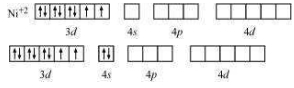
Solution
(N/A) Though both $[NiCl_{4}]^{2-}$ and $[Ni(CO)_{4}]$ are tetrahedral,their magnetic characters are different. This is due to a difference in the nature of ligands.
In $[NiCl_{4}]^{2-}$,$Ni$ is in the $+2$ oxidation state with a $3d^{8}$ configuration. $Cl^{-}$ is a weak field ligand and it does not cause the pairing of unpaired $3d$ electrons. Hence,$[NiCl_{4}]^{2-}$ is paramagnetic.
In $[Ni(CO)_{4}]$,$Ni$ is in the zero oxidation state i.e.,it has a configuration of $3d^{8}4s^{2}$.
$CO$ is a strong field ligand. Therefore,it causes the pairing of unpaired $3d$ electrons. Also,it causes the $4s$ electrons to shift to the $3d$ orbital,thereby giving rise to $sp^{3}$ hybridization. Since no unpaired electrons are present in this case,$[Ni(CO)_{4}]$ is diamagnetic.
In $[NiCl_{4}]^{2-}$,$Ni$ is in the $+2$ oxidation state with a $3d^{8}$ configuration. $Cl^{-}$ is a weak field ligand and it does not cause the pairing of unpaired $3d$ electrons. Hence,$[NiCl_{4}]^{2-}$ is paramagnetic.
In $[Ni(CO)_{4}]$,$Ni$ is in the zero oxidation state i.e.,it has a configuration of $3d^{8}4s^{2}$.
$CO$ is a strong field ligand. Therefore,it causes the pairing of unpaired $3d$ electrons. Also,it causes the $4s$ electrons to shift to the $3d$ orbital,thereby giving rise to $sp^{3}$ hybridization. Since no unpaired electrons are present in this case,$[Ni(CO)_{4}]$ is diamagnetic.
0 likes
View Solution246
Medium
Explain why $[Co(NH_{3})_{6}]^{3+}$ is an inner orbital complex whereas $[Ni(NH_{3})_{6}]^{2+}$ is an outer orbital complex.
Solution
(N/A)
| $[Co(NH_{3})_{6}]^{3+}$ | $[Ni(NH_{3})_{6}]^{2+}$ |
|---|---|
| Oxidation state of cobalt $= +3$ | Oxidation state of nickel $= +2$ |
| Electronic configuration of cobalt ion $(Co^{3+})$ $= 3d^{6}$ | Electronic configuration of nickel ion $(Ni^{2+})$ $= 3d^{8}$ |
| $NH_{3}$ is a strong field ligand,which causes pairing of electrons in the $3d$ orbitals. This makes two $3d$ orbitals available for $d^{2}sp^{3}$ hybridization. Hence,it is an inner orbital complex. | Even with $NH_{3}$ as a ligand,the $3d^{8}$ configuration leaves only one $3d$ orbital empty after pairing. Thus,it cannot undergo $d^{2}sp^{3}$ hybridization and instead undergoes $sp^{3}d^{2}$ hybridization using $4d$ orbitals. Hence,it is an outer orbital complex. |
0 likes
View Solution247
Medium
Predict the number of unpaired electrons in the square planar $[Pt(CN)_{4}]^{2-}$ ion.
Solution
(0) In the complex $[Pt(CN)_{4}]^{2-}$,the central metal ion is $Pt^{2+}$.
The atomic number of $Pt$ is $78$. The electronic configuration of $Pt$ is $[Xe] 4f^{14} 5d^{9} 6s^{1}$.
For $Pt^{2+}$,the configuration is $[Xe] 4f^{14} 5d^{8}$.
$CN^{-}$ is a strong field ligand,which forces the pairing of electrons in the $5d$ orbitals to facilitate $dsp^{2}$ hybridization,which is characteristic of square planar geometry.
After pairing,all $8$ electrons in the $5d$ orbitals are paired.
Therefore,the number of unpaired electrons is $0$.
The atomic number of $Pt$ is $78$. The electronic configuration of $Pt$ is $[Xe] 4f^{14} 5d^{9} 6s^{1}$.
For $Pt^{2+}$,the configuration is $[Xe] 4f^{14} 5d^{8}$.
$CN^{-}$ is a strong field ligand,which forces the pairing of electrons in the $5d$ orbitals to facilitate $dsp^{2}$ hybridization,which is characteristic of square planar geometry.
After pairing,all $8$ electrons in the $5d$ orbitals are paired.
Therefore,the number of unpaired electrons is $0$.
0 likes
View Solution248
Easy
Discuss the nature of bonding in the following coordination entities on the basis of valence bond theory:
$(i)$ $[Fe(CN)_6]^{4-}$
$(ii)$ $[FeF_6]^{3-}$
$(iii)$ $[Co(C_2O_4)_3]^{3-}$
$(iv)$ $[CoF_6]^{3-}$
$(i)$ $[Fe(CN)_6]^{4-}$
$(ii)$ $[FeF_6]^{3-}$
$(iii)$ $[Co(C_2O_4)_3]^{3-}$
$(iv)$ $[CoF_6]^{3-}$
Solution
(N/A) $(i)$ $[Fe(CN)_6]^{4-}$: Iron is in $+2$ oxidation state $(Fe^{2+}: 3d^6)$. $CN^-$ is a strong field ligand,causing pairing of $3d$ electrons. It undergoes $d^2sp^3$ hybridization. The complex is octahedral and diamagnetic.
$(ii)$ $[FeF_6]^{3-}$: Iron is in $+3$ oxidation state $(Fe^{3+}: 3d^5)$. $F^-$ is a weak field ligand,so no pairing occurs. It undergoes $sp^3d^2$ hybridization. The complex is octahedral and paramagnetic.
$(iii)$ $[Co(C_2O_4)_3]^{3-}$: Cobalt is in $+3$ oxidation state $(Co^{3+}: 3d^6)$. Oxalate $(C_2O_4^{2-})$ is a bidentate ligand. Although it is often considered a weak field ligand,in this specific complex,it forms a low-spin octahedral complex with $d^2sp^3$ hybridization. The complex is octahedral and diamagnetic.
$(iv)$ $[CoF_6]^{3-}$: Cobalt is in $+3$ oxidation state $(Co^{3+}: 3d^6)$. $F^-$ is a weak field ligand,so no pairing occurs. It undergoes $sp^3d^2$ hybridization. The complex is octahedral and paramagnetic.
$(ii)$ $[FeF_6]^{3-}$: Iron is in $+3$ oxidation state $(Fe^{3+}: 3d^5)$. $F^-$ is a weak field ligand,so no pairing occurs. It undergoes $sp^3d^2$ hybridization. The complex is octahedral and paramagnetic.
$(iii)$ $[Co(C_2O_4)_3]^{3-}$: Cobalt is in $+3$ oxidation state $(Co^{3+}: 3d^6)$. Oxalate $(C_2O_4^{2-})$ is a bidentate ligand. Although it is often considered a weak field ligand,in this specific complex,it forms a low-spin octahedral complex with $d^2sp^3$ hybridization. The complex is octahedral and diamagnetic.
$(iv)$ $[CoF_6]^{3-}$: Cobalt is in $+3$ oxidation state $(Co^{3+}: 3d^6)$. $F^-$ is a weak field ligand,so no pairing occurs. It undergoes $sp^3d^2$ hybridization. The complex is octahedral and paramagnetic.
0 likes
View Solution249
MediumMCQ
What is the geometry of $[Ni(CO)_4]$?
A
Tetrahedral
B
Square planar
C
Octahedral
D
Trigonal bipyramidal
Solution
(A) In $[Ni(CO)_4]$,the oxidation state of $Ni$ is $0$. The electronic configuration of $Ni$ $(Z=28)$ is $[Ar] 3d^8 4s^2$. Since $CO$ is a strong field ligand,it causes pairing of electrons in the $3d$ orbital. The $4s$ electrons shift to the $3d$ orbital,resulting in a $3d^{10}$ configuration. The hybridization is $sp^3$,which corresponds to a tetrahedral geometry.
0 likes
View Solution250
EasyMCQ
What is the color of the complex $[Co(H_2O)_6]Cl_3$?
A
Pink
B
Violet
C
Yellow
D
Green
Solution
(A) The complex $[Co(H_2O)_6]Cl_3$ contains the $[Co(H_2O)_6]^{3+}$ ion.
In this complex,the oxidation state of $Co$ is $+3$.
The electronic configuration of $Co^{3+}$ is $3d^6$.
Due to the presence of $H_2O$ as a weak field ligand,it forms a high-spin octahedral complex.
This complex is known to be pink in color.
In this complex,the oxidation state of $Co$ is $+3$.
The electronic configuration of $Co^{3+}$ is $3d^6$.
Due to the presence of $H_2O$ as a weak field ligand,it forms a high-spin octahedral complex.
This complex is known to be pink in color.
0 likes
View SolutionCoordination Compounds — Hybridisation and Geometry · Frequently Asked Questions
1Are these Coordination Compounds questions useful for JEE and NEET?
Yes. All questions in this section are mapped to JEE Main and NEET exam patterns. Previous year questions from JEE Main, NEET, GUJCET and state-level exams are included with full solutions.
2Can I switch to Hindi or Gujarati for these questions?
Yes. Use the language tabs in the hero section or the sidebar to view the same questions and solutions in English, Hindi or Gujarati.
3How do I generate a question paper from this subtopic?
Use the Vedclass Exam Paper Generator — select the chapter and subtopic, set difficulty, and generate Sets A, B, C, D automatically. First 3 chapters of every subject are free.
Vedclass Products
For Students
Vedclass Test Series
Mock tests in real JEE/NEET style with performance analysis. 5-day free trial.
Start Free TrialFor Teachers
Exam Paper Generator
Generate Set A/B/C/D papers from this chapter in 2 minutes. 3 chapters free.
Try FreeFor Institutes
Online Exam Module
Live online exams with unlimited students, 360° analytics & white-label branding.
See DemoFor Teachers & Institutes
Generate a Coordination Compounds Exam Paper in 2 Minutes
Select subtopic & difficulty — Sets A, B, C, D auto-generated with No Repeat logic.
First 3 chapters of every subject are free — no payment required.