
A English
Properties of Amines Questions in English
Class 12 Chemistry · Amines · Properties of Amines
1212+
Questions
English
Language
100%
With Solutions
Showing 50 of 1212 questions in English
301
MediumMCQ
Which of the following is the strongest base in an aqueous medium?
A
$(C_2H_5)_3N$
B
$C_2H_5NH_2$
C
$NH_3$
D
$(C_2H_5)_2NH$
Solution
(D) In an aqueous medium,the basicity of amines is determined by a combination of three factors: inductive effect $(+I)$,solvation effect (hydrogen bonding),and steric hindrance.
For ethyl-substituted amines,the secondary amine $(C_2H_5)_2NH$ provides the optimal balance between the electron-donating inductive effect of the two ethyl groups and the stability provided by solvation.
Therefore,$(C_2H_5)_2NH$ is the strongest base among the given options in an aqueous medium.
For ethyl-substituted amines,the secondary amine $(C_2H_5)_2NH$ provides the optimal balance between the electron-donating inductive effect of the two ethyl groups and the stability provided by solvation.
Therefore,$(C_2H_5)_2NH$ is the strongest base among the given options in an aqueous medium.
0 likes
View Solution302
MediumMCQ
What is the correct order of nucleophilicity for the species $RO^{-}, HO^{-}, RCOO^{-}, ROH, $ and $H_2O$?
A
$OH^{-} > RO^{-} > H_2O > ROH > RCOO^{-}$
B
$RO^{-} > HO^{-} > RCOO^{-} > ROH > H_2O$
C
$H_2O > ROH > RCOO^{-} > HO^{-} > RO^{-}$
D
$ROH > H_2O > HO^{-} > RCOO^{-} > RO^{-}$
Solution
(B) Nucleophilicity is generally related to the basicity of the species. Stronger bases are better nucleophiles when the attacking atom is the same.
$1$. The order of basicity is $RO^{-} > HO^{-} > RCOO^{-} > ROH > H_2O$.
$2$. Since $RO^{-}$ is a stronger base than $HO^{-}$,it is a better nucleophile.
$3$. $RCOO^{-}$ is a weaker base due to resonance stabilization compared to $HO^{-}$.
$4$. Neutral molecules like $ROH$ and $H_2O$ are weaker nucleophiles than their conjugate bases.
Therefore,the correct order of nucleophilicity is $RO^{-} > HO^{-} > RCOO^{-} > ROH > H_2O$.
$1$. The order of basicity is $RO^{-} > HO^{-} > RCOO^{-} > ROH > H_2O$.
$2$. Since $RO^{-}$ is a stronger base than $HO^{-}$,it is a better nucleophile.
$3$. $RCOO^{-}$ is a weaker base due to resonance stabilization compared to $HO^{-}$.
$4$. Neutral molecules like $ROH$ and $H_2O$ are weaker nucleophiles than their conjugate bases.
Therefore,the correct order of nucleophilicity is $RO^{-} > HO^{-} > RCOO^{-} > ROH > H_2O$.
0 likes
View Solution303
MediumMCQ
Which of the following is the strongest base?
A
$C_6H_5NH_2$
B
$C_6H_{11}NH_2$
C
$O_2N-C_6H_4-NH_2$
D
$C_6H_5NHCOCH_3$
Solution
(B) The basicity of amines depends on the availability of the lone pair of electrons on the nitrogen atom.
In $C_6H_5NH_2$ (aniline),the lone pair is delocalized into the benzene ring due to resonance,reducing its availability.
In $O_2N-C_6H_4-NH_2$,the $-NO_2$ group is a strong electron-withdrawing group,which further decreases the electron density on nitrogen.
In $C_6H_5NHCOCH_3$,the lone pair is involved in resonance with the carbonyl group $(C=O)$,making it less available.
In $C_6H_{11}NH_2$ (cyclohexylamine),the nitrogen is attached to an $sp^3$ hybridized carbon atom. There is no resonance,and the alkyl group shows a $+I$ effect,which increases the electron density on the nitrogen atom,making it the strongest base among the given options.
In $C_6H_5NH_2$ (aniline),the lone pair is delocalized into the benzene ring due to resonance,reducing its availability.
In $O_2N-C_6H_4-NH_2$,the $-NO_2$ group is a strong electron-withdrawing group,which further decreases the electron density on nitrogen.
In $C_6H_5NHCOCH_3$,the lone pair is involved in resonance with the carbonyl group $(C=O)$,making it less available.
In $C_6H_{11}NH_2$ (cyclohexylamine),the nitrogen is attached to an $sp^3$ hybridized carbon atom. There is no resonance,and the alkyl group shows a $+I$ effect,which increases the electron density on the nitrogen atom,making it the strongest base among the given options.
0 likes
View Solution304
MediumMCQ
Which of the following is the most basic compound?
A
$C_6H_5NH_2$
B
$p-NO_2-C_6H_4NH_2$
C
$m-NO_2-C_6H_4NH_2$
D
$C_6H_5CH_2NH_2$
Solution
(D) The basicity of amines depends on the availability of the lone pair of electrons on the nitrogen atom.
In $C_6H_5NH_2$ (aniline),the lone pair is involved in resonance with the benzene ring,reducing its availability.
In $p-NO_2-C_6H_4NH_2$ and $m-NO_2-C_6H_4NH_2$,the $-NO_2$ group is a strong electron-withdrawing group $(EWG)$ that further decreases the electron density on the nitrogen atom,making them less basic than aniline.
In $C_6H_5CH_2NH_2$ (benzylamine),the $-NH_2$ group is attached to a $CH_2$ group,not directly to the benzene ring. Therefore,there is no resonance with the benzene ring,and the lone pair is fully available for protonation.
Thus,$C_6H_4CH_2NH_2$ is the most basic compound among the given options.
In $C_6H_5NH_2$ (aniline),the lone pair is involved in resonance with the benzene ring,reducing its availability.
In $p-NO_2-C_6H_4NH_2$ and $m-NO_2-C_6H_4NH_2$,the $-NO_2$ group is a strong electron-withdrawing group $(EWG)$ that further decreases the electron density on the nitrogen atom,making them less basic than aniline.
In $C_6H_5CH_2NH_2$ (benzylamine),the $-NH_2$ group is attached to a $CH_2$ group,not directly to the benzene ring. Therefore,there is no resonance with the benzene ring,and the lone pair is fully available for protonation.
Thus,$C_6H_4CH_2NH_2$ is the most basic compound among the given options.
0 likes
View Solution305
MediumMCQ
Which set represents the increasing order of basic strength (least basic first)?
A
$ClNH_2, NH_3, CH_3NH_2$
B
$ClNH_2, CH_3NH_2, NH_3$
C
$NH_3, ClNH_2, CH_3NH_2$
D
$CH_3NH_2, ClNH_2, NH_3$
Solution
(A) The basic strength of amines depends on the availability of the lone pair on the nitrogen atom.
$1$. In $CH_3NH_2$,the methyl group $(CH_3)$ is an electron-donating group ($+I$ effect),which increases the electron density on the nitrogen atom,making it more basic.
$2$. In $NH_3$,there is no substituent effect.
$3$. In $ClNH_2$,the chlorine atom $(Cl)$ is an electron-withdrawing group ($-I$ effect),which decreases the electron density on the nitrogen atom,making it the least basic.
Therefore,the increasing order of basic strength is: $ClNH_2 < NH_3 < CH_3NH_2$.
$1$. In $CH_3NH_2$,the methyl group $(CH_3)$ is an electron-donating group ($+I$ effect),which increases the electron density on the nitrogen atom,making it more basic.
$2$. In $NH_3$,there is no substituent effect.
$3$. In $ClNH_2$,the chlorine atom $(Cl)$ is an electron-withdrawing group ($-I$ effect),which decreases the electron density on the nitrogen atom,making it the least basic.
Therefore,the increasing order of basic strength is: $ClNH_2 < NH_3 < CH_3NH_2$.
0 likes
View Solution306
MediumMCQ
Which of the following is the strongest base?
A
$C_6H_5NH_2$
B
$C_6H_5NHCH_3$
C
$C_6H_4(CH_3)NH_2$ (ortho-toluidine)
D
$C_6H_5CH_2NH_2$
Solution
(D) To determine the strongest base,we look at the availability of the lone pair on the nitrogen atom.
In $C_6H_5NH_2$ (aniline) and $C_6H_5NHCH_3$ ($N$-methylaniline),the lone pair on the nitrogen is in conjugation with the benzene ring,which significantly reduces its basicity.
In $o$-toluidine $(C_6H_4(CH_3)NH_2)$,the ortho-methyl group causes steric hindrance,further reducing basicity.
In $C_6H_5CH_2NH_2$ (benzylamine),the nitrogen atom is not directly attached to the benzene ring. The lone pair is not involved in resonance with the aromatic ring,making it much more available for protonation compared to the other options. Therefore,$C_6H_5CH_2NH_2$ is the strongest base.
In $C_6H_5NH_2$ (aniline) and $C_6H_5NHCH_3$ ($N$-methylaniline),the lone pair on the nitrogen is in conjugation with the benzene ring,which significantly reduces its basicity.
In $o$-toluidine $(C_6H_4(CH_3)NH_2)$,the ortho-methyl group causes steric hindrance,further reducing basicity.
In $C_6H_5CH_2NH_2$ (benzylamine),the nitrogen atom is not directly attached to the benzene ring. The lone pair is not involved in resonance with the aromatic ring,making it much more available for protonation compared to the other options. Therefore,$C_6H_5CH_2NH_2$ is the strongest base.
0 likes
View Solution307
MediumMCQ
What is the correct order of increasing basic strength for the bases $NH_3$,$CH_3NH_2$,and $(CH_3)_2NH$?
A
$CH_3NH_2 < NH_3 < (CH_3)_2NH$
B
$(CH_3)_2NH < NH_3 < CH_3NH_2$
C
$NH_3 < CH_3NH_2 < (CH_3)_2NH$
D
$CH_3NH_2 < (CH_3)_2NH < NH_3$
Solution
(C) The basic strength of amines depends on the availability of the lone pair of electrons on the nitrogen atom.
$1$. $NH_3$ has no alkyl group to increase electron density on the nitrogen atom.
$2$. $CH_3NH_2$ ($1^{\circ}$ amine) has one methyl group which shows a $+I$ effect,increasing the electron density on the nitrogen atom,making it more basic than $NH_3$.
$3$. $(CH_3)_2NH$ ($2^{\circ}$ amine) has two methyl groups,providing a stronger $+I$ effect than $CH_3NH_2$,further increasing the electron density on the nitrogen atom.
Therefore,the correct order of increasing basic strength is $NH_3 < CH_3NH_2 < (CH_3)_2NH$.
$1$. $NH_3$ has no alkyl group to increase electron density on the nitrogen atom.
$2$. $CH_3NH_2$ ($1^{\circ}$ amine) has one methyl group which shows a $+I$ effect,increasing the electron density on the nitrogen atom,making it more basic than $NH_3$.
$3$. $(CH_3)_2NH$ ($2^{\circ}$ amine) has two methyl groups,providing a stronger $+I$ effect than $CH_3NH_2$,further increasing the electron density on the nitrogen atom.
Therefore,the correct order of increasing basic strength is $NH_3 < CH_3NH_2 < (CH_3)_2NH$.
0 likes
View Solution308
DifficultMCQ
What is the correct decreasing order of basic strength?
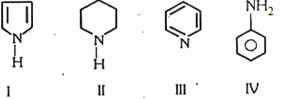
A
$I > II > III > IV$
B
$II > III > I > IV$
C
$II > IV > I > III$
D
$II > III > IV > I$
Solution
(D) The basic strength depends on the availability of the lone pair of electrons on the nitrogen atom.
$I$ (Pyrrole): The lone pair on nitrogen is involved in aromaticity (delocalized),making it the least basic.
$II$ (Piperidine): The lone pair is on an $sp^3$ hybridized nitrogen and is localized,making it the most basic.
$III$ (Pyridine): The lone pair is on an $sp^2$ hybridized nitrogen and is localized,but $sp^2$ nitrogen is more electronegative than $sp^3$ nitrogen,making it less basic than $II$.
$IV$ (Aniline): The lone pair is delocalized into the benzene ring through resonance,making it more basic than $I$ but less basic than $III$.
Therefore,the correct decreasing order of basic strength is $II > III > IV > I$.
$I$ (Pyrrole): The lone pair on nitrogen is involved in aromaticity (delocalized),making it the least basic.
$II$ (Piperidine): The lone pair is on an $sp^3$ hybridized nitrogen and is localized,making it the most basic.
$III$ (Pyridine): The lone pair is on an $sp^2$ hybridized nitrogen and is localized,but $sp^2$ nitrogen is more electronegative than $sp^3$ nitrogen,making it less basic than $II$.
$IV$ (Aniline): The lone pair is delocalized into the benzene ring through resonance,making it more basic than $I$ but less basic than $III$.
Therefore,the correct decreasing order of basic strength is $II > III > IV > I$.
0 likes
View Solution309
EasyMCQ
Which of the following is the most acidic substance?
A
$CH_3NH_2$
B
$CH_3CH_2NH_2$
C
$NH_3$
D
$(CH_3)_2CHNH_2$
Solution
(C) The acidity of amines depends on the stability of the conjugate base formed after the loss of a proton $(H^+)$.
In these compounds,the acidity is primarily determined by the electron-donating effect (inductive effect) of the alkyl groups attached to the nitrogen atom.
Alkyl groups are electron-releasing ($+I$ effect),which destabilizes the conjugate base (amide ion) by increasing electron density on the nitrogen atom.
Therefore,the compound with the fewest or least electron-donating alkyl groups will be the most acidic.
Comparing the options:
$NH_3$ has no alkyl groups.
$CH_3NH_2$ has one methyl group.
$CH_3CH_2NH_2$ has one ethyl group (more $+I$ effect than methyl).
$(CH_3)_2CHNH_2$ has two methyl groups.
Thus,$NH_3$ is the most acidic among the given options.
In these compounds,the acidity is primarily determined by the electron-donating effect (inductive effect) of the alkyl groups attached to the nitrogen atom.
Alkyl groups are electron-releasing ($+I$ effect),which destabilizes the conjugate base (amide ion) by increasing electron density on the nitrogen atom.
Therefore,the compound with the fewest or least electron-donating alkyl groups will be the most acidic.
Comparing the options:
$NH_3$ has no alkyl groups.
$CH_3NH_2$ has one methyl group.
$CH_3CH_2NH_2$ has one ethyl group (more $+I$ effect than methyl).
$(CH_3)_2CHNH_2$ has two methyl groups.
Thus,$NH_3$ is the most acidic among the given options.
0 likes
View Solution310
MediumMCQ
Which of the following represents the correct order of basicity in an aqueous medium?
A
$(CH_3)_3N > (CH_3)_2NH > CH_3NH_2 > NH_3$
B
$(CH_3)_2NH > (CH_3)_3N > CH_3NH_2 > NH_3$
C
$(CH_3)_2NH > CH_3NH_2 > (CH_3)_3N > NH_3$
D
$(CH_3)_2NH > CH_3NH_2 > NH_3 > (CH_3)_3N$
Solution
(C) In an aqueous medium,the basicity of methyl-substituted amines is determined by a combination of inductive effect,solvation effect,and steric hindrance.
For methyl-substituted amines,the order of basicity is $(CH_3)_2NH > CH_3NH_2 > (CH_3)_3N > NH_3$.
$1$. $(CH_3)_2NH$ (dimethylamine) is the most basic due to the combined effect of the $+I$ effect of two methyl groups and sufficient solvation.
$2$. $CH_3NH_2$ (methylamine) is next.
$3$. $(CH_3)_3N$ (trimethylamine) is less basic than expected due to steric hindrance which prevents effective solvation of the protonated cation.
$4$. $NH_3$ (ammonia) is the least basic among these.
For methyl-substituted amines,the order of basicity is $(CH_3)_2NH > CH_3NH_2 > (CH_3)_3N > NH_3$.
$1$. $(CH_3)_2NH$ (dimethylamine) is the most basic due to the combined effect of the $+I$ effect of two methyl groups and sufficient solvation.
$2$. $CH_3NH_2$ (methylamine) is next.
$3$. $(CH_3)_3N$ (trimethylamine) is less basic than expected due to steric hindrance which prevents effective solvation of the protonated cation.
$4$. $NH_3$ (ammonia) is the least basic among these.
0 likes
View Solution311
MediumMCQ
What is the product formed when ethylamine reacts with nitrous acid?
A
$C_2H_6$ and $NH_3$
B
$C_2H_5OH$ and $N_2$
C
$C_2H_5OH$ and $C_2H_4$
D
$C_2H_5OH$ and $NH_3$
Solution
(B) The reaction of primary aliphatic amines with nitrous acid $(HNO_2)$ produces unstable diazonium salts,which decompose to form alcohols,nitrogen gas,and water.
The chemical equation is:
$C_2H_5NH_2 + HNO_2 \rightarrow C_2H_5OH + N_2 + H_2O$
Thus,ethylamine reacts with nitrous acid to give ethyl alcohol and nitrogen gas.
The chemical equation is:
$C_2H_5NH_2 + HNO_2 \rightarrow C_2H_5OH + N_2 + H_2O$
Thus,ethylamine reacts with nitrous acid to give ethyl alcohol and nitrogen gas.
0 likes
View Solution312
MediumMCQ
What is the major product obtained from the following reaction?
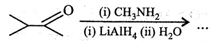
A
$N$-methyl$-2-$propanamine
B
Isopropyl methyl ether
C
$2-$propanamine
D
$N$-methyl$-2-$propanolamine
Solution
(A) The reaction proceeds in two steps:
$1$. The ketone reacts with methylamine $(CH_3NH_2)$ to form an imine intermediate $(R_2C=NCH_3)$.
$2$. The imine is then reduced by lithium aluminum hydride $(LiAlH_4)$ followed by hydrolysis $(H_2O)$ to yield a secondary amine,specifically $N$-methyl$-2-$propanamine.
$1$. The ketone reacts with methylamine $(CH_3NH_2)$ to form an imine intermediate $(R_2C=NCH_3)$.
$2$. The imine is then reduced by lithium aluminum hydride $(LiAlH_4)$ followed by hydrolysis $(H_2O)$ to yield a secondary amine,specifically $N$-methyl$-2-$propanamine.
0 likes
View Solution313
MediumMCQ
Aniline reacts with which of the following to form a Schiff base?
A
Acetic acid
B
Benzaldehyde
C
Acetone
D
$NH_3$
Solution
(C) Schiff base is formed by the reaction of a primary amine with an aldehyde or a ketone. The general reaction is $R-NH_2 + R'-C(=O)-R'' \rightarrow R-N=C(R')R'' + H_2O$. In this case,aniline $(C_6H_5NH_2)$ reacts with a carbonyl compound like acetone $(CH_3COCH_3)$ or benzaldehyde $(C_6H_5CHO)$ to form a Schiff base. Based on the provided image,the reaction shown is between acetone and aniline to form a Schiff base. Therefore,the correct option is acetone.
0 likes
View Solution314
MediumMCQ
When propionamide is treated with $Br_2$ and $NaOH$,which of the following products is obtained?
A
Ethyl alcohol
B
Propyl alcohol
C
Propyl amine
D
Ethyl amine
Solution
(D) This reaction is known as the Hofmann bromamide degradation reaction.
In this reaction,an amide is converted into a primary amine with one carbon atom less than the original amide.
$CH_3CH_2CONH_2 + Br_2 + 4NaOH \rightarrow CH_3CH_2NH_2 + 2NaBr + Na_2CO_3 + 2H_2O$
Propionamide $(CH_3CH_2CONH_2)$ reacts to form ethyl amine $(CH_3CH_2NH_2)$.
In this reaction,an amide is converted into a primary amine with one carbon atom less than the original amide.
$CH_3CH_2CONH_2 + Br_2 + 4NaOH \rightarrow CH_3CH_2NH_2 + 2NaBr + Na_2CO_3 + 2H_2O$
Propionamide $(CH_3CH_2CONH_2)$ reacts to form ethyl amine $(CH_3CH_2NH_2)$.
0 likes
View Solution315
MediumMCQ
Which of the following substances generally has the highest melting point?
A
Tertiary amides
B
Secondary amides
C
Primary amides
D
Amines
Solution
(C) Primary amides contain two $N-H$ bonds,which allow them to form the maximum number of intermolecular hydrogen bonds compared to secondary or tertiary amides. Due to this extensive hydrogen bonding,primary amides exhibit the highest melting points.
0 likes
View Solution316
MediumMCQ
What is the product formed when acetamide is reacted with $Br_2$ and caustic soda $(NaOH)$?
A
Acetic acid
B
Bromoacetic acid
C
Methylamine
D
Ethylamine
Solution
(C) This reaction is known as the $Hofmann$ bromamide degradation reaction.
When acetamide $(CH_3CONH_2)$ reacts with $Br_2$ and $KOH$ (or $NaOH$),it undergoes degradation to form methylamine $(CH_3NH_2)$.
The chemical equation is: $CH_3CONH_2 + Br_2 + 4KOH \rightarrow CH_3NH_2 + K_2CO_3 + 2KBr + 2H_2O$.
When acetamide $(CH_3CONH_2)$ reacts with $Br_2$ and $KOH$ (or $NaOH$),it undergoes degradation to form methylamine $(CH_3NH_2)$.
The chemical equation is: $CH_3CONH_2 + Br_2 + 4KOH \rightarrow CH_3NH_2 + K_2CO_3 + 2KBr + 2H_2O$.
0 likes
View Solution317
MediumMCQ
Acetamide is
A
highly acidic
B
highly basic
C
neutral
D
amphoteric
Solution
(D) Acetamide $(CH_3CONH_2)$ is an amide. Amides exhibit amphoteric character because the lone pair on the nitrogen atom can be protonated by strong acids,and the hydrogen atoms attached to the nitrogen can be removed by strong bases.
0 likes
View Solution318
MediumMCQ
What is formed when benzoyl chloride reacts with aniline in the presence of sodium hydroxide?
A
Acetanilide
B
Benzanilide
C
Benzoic acid
D
Azobenzene
Solution
(B) This reaction is known as the $Schotten-Baumann$ reaction.
$C_6H_5NH_2 + ClCOC_6H_5 \xrightarrow{NaOH} C_6H_5NHCOC_6H_5 + HCl$
In this reaction,the nucleophilic attack of the aniline nitrogen on the carbonyl carbon of benzoyl chloride leads to the formation of $N$-phenylbenzamide,commonly known as $Benzanilide$.
$C_6H_5NH_2 + ClCOC_6H_5 \xrightarrow{NaOH} C_6H_5NHCOC_6H_5 + HCl$
In this reaction,the nucleophilic attack of the aniline nitrogen on the carbonyl carbon of benzoyl chloride leads to the formation of $N$-phenylbenzamide,commonly known as $Benzanilide$.
0 likes
View Solution319
MediumMCQ
Melting points are normally the highest for
A
Tertiary amides
B
Secondary amides
C
Primary amides
D
Amines
Solution
(C) The correct answer is $(C)$.
Amides exhibit high melting and boiling points due to strong intermolecular hydrogen bonding.
In primary amides $(R-CONH_2)$,there are two hydrogen atoms attached to the nitrogen atom,which allows for extensive intermolecular hydrogen bonding.
In secondary amides $(R-CONHR)$,there is only one hydrogen atom available for hydrogen bonding.
Tertiary amides $(R-CONR_2)$ lack hydrogen atoms attached to the nitrogen atom,preventing them from forming intermolecular hydrogen bonds with each other.
Therefore,the order of melting/boiling points is: $\text{Primary amides} > \text{Secondary amides} > \text{Tertiary amides} > \text{Amines}$.
Amides exhibit high melting and boiling points due to strong intermolecular hydrogen bonding.
In primary amides $(R-CONH_2)$,there are two hydrogen atoms attached to the nitrogen atom,which allows for extensive intermolecular hydrogen bonding.
In secondary amides $(R-CONHR)$,there is only one hydrogen atom available for hydrogen bonding.
Tertiary amides $(R-CONR_2)$ lack hydrogen atoms attached to the nitrogen atom,preventing them from forming intermolecular hydrogen bonds with each other.
Therefore,the order of melting/boiling points is: $\text{Primary amides} > \text{Secondary amides} > \text{Tertiary amides} > \text{Amines}$.
0 likes
View Solution320
MediumMCQ
Amines behave as
A
Lewis acids
B
Lewis bases
C
Aprotic acids
D
Amphoteric compounds
Solution
(B) In amines,the nitrogen atom possesses a lone pair of electrons.
According to the Lewis theory,a species that can donate an electron pair is a Lewis base.
Since amines can donate their lone pair of electrons,they behave as Lewis bases.
According to the Lewis theory,a species that can donate an electron pair is a Lewis base.
Since amines can donate their lone pair of electrons,they behave as Lewis bases.
0 likes
View Solution321
MediumMCQ
The reaction between a primary amine,chloroform and a few drops of alcoholic $KOH$ is known as:
A
Cannizzaro reaction
B
Carbylamine reaction
C
Wurtz reaction
D
Reimer-Tiemann reaction
Solution
(B) The reaction of a primary amine with chloroform $(CHCl_3)$ and alcoholic potassium hydroxide $(KOH)$ is known as the Carbylamine reaction.
This reaction produces an isocyanide (carbylamine),which has a foul smell.
The general chemical equation is: $R-NH_2 + CHCl_3 + 3KOH_{(alc)} \to R-NC + 3KCl + 3H_2O$.
This reaction produces an isocyanide (carbylamine),which has a foul smell.
The general chemical equation is: $R-NH_2 + CHCl_3 + 3KOH_{(alc)} \to R-NC + 3KCl + 3H_2O$.
0 likes
View Solution322
DifficultMCQ
Phenyl isocyanides are prepared from which of the following reactions?
A
Rosenmund's reaction
B
Carbylamine reaction
C
Reimer-Tiemann reaction
D
Wurtz reaction
Solution
(B) The $Carbylamine$ reaction is used for the preparation of isocyanides (or carbylamines).
In this reaction,a primary amine (aliphatic or aromatic) is heated with chloroform $(CHCl_3)$ and an alcoholic potassium hydroxide $(KOH)$ solution to form an isocyanide (carbylamine),which has a foul smell.
The reaction for the preparation of phenyl isocyanide from aniline is:
$C_6H_5NH_2 + CHCl_3 + 3KOH \rightarrow C_6H_5NC + 3KCl + 3H_2O$
Therefore,the correct option is $(B)$.
In this reaction,a primary amine (aliphatic or aromatic) is heated with chloroform $(CHCl_3)$ and an alcoholic potassium hydroxide $(KOH)$ solution to form an isocyanide (carbylamine),which has a foul smell.
The reaction for the preparation of phenyl isocyanide from aniline is:
$C_6H_5NH_2 + CHCl_3 + 3KOH \rightarrow C_6H_5NC + 3KCl + 3H_2O$
Therefore,the correct option is $(B)$.
0 likes
View Solution323
MediumMCQ
In amines,the hybridisation state of $N$ is
A
$sp$
B
$sp^2$
C
$sp^3$
D
$sp^2d$
Solution
(C) In amines,the nitrogen atom is bonded to three other atoms (either $H$ or $R$ groups) and possesses one lone pair of electrons.
Using the formula for steric number: $\text{Steric Number} = \frac{1}{2} [V + M - C + A]$,where $V$ is the number of valence electrons of the central atom,$M$ is the number of monovalent atoms,$C$ is the cationic charge,and $A$ is the anionic charge.
For $N$ in amines: $\text{Steric Number} = \frac{1}{2} [5 + 3 - 0 + 0] = 4$.
$A$ steric number of $4$ corresponds to $sp^3$ hybridisation.
Using the formula for steric number: $\text{Steric Number} = \frac{1}{2} [V + M - C + A]$,where $V$ is the number of valence electrons of the central atom,$M$ is the number of monovalent atoms,$C$ is the cationic charge,and $A$ is the anionic charge.
For $N$ in amines: $\text{Steric Number} = \frac{1}{2} [5 + 3 - 0 + 0] = 4$.
$A$ steric number of $4$ corresponds to $sp^3$ hybridisation.
0 likes
View Solution324
MediumMCQ
The foul-smelling compound formed during the carbylamine reaction is:
A
Alcohol
B
Aldehyde
C
Alkyl isocyanide
D
Carboxylic acid
Solution
(C) The carbylamine reaction involves heating a primary amine with chloroform $(CHCl_3)$ and ethanolic potassium hydroxide $(KOH)$.
This reaction produces an alkyl isocyanide $(RNC)$,which is characterized by a highly offensive or foul smell.
The chemical equation is: $RNH_2 + CHCl_3 + 3KOH \xrightarrow{\Delta} RNC + 3KCl + 3H_2O$.
Therefore,the correct option is $(C)$.
This reaction produces an alkyl isocyanide $(RNC)$,which is characterized by a highly offensive or foul smell.
The chemical equation is: $RNH_2 + CHCl_3 + 3KOH \xrightarrow{\Delta} RNC + 3KCl + 3H_2O$.
Therefore,the correct option is $(C)$.
0 likes
View Solution325
MediumMCQ
The end product of the reaction $C_2H_5NH_2$ $\xrightarrow{HNO_2} A$ $\xrightarrow{PCl_5} B$ $\xrightarrow{KCN} C$ is
A
$Ethyl \ amine$
B
$Diethyl \ amine$
C
$Propane \ nitrile$
D
$Triethyl \ amine$
Solution
(C) $C_2H_5NH_2 + HNO_2 \to C_2H_5OH (A) + N_2 + H_2O$
$C_2H_5OH + PCl_5 \to C_2H_5Cl (B) + POCl_3 + HCl$
$C_2H_5Cl + KCN \to C_2H_5CN (C) + KCl$
The final product $C$ is $C_2H_5CN$,which is named $Propane \ nitrile$.
$C_2H_5OH + PCl_5 \to C_2H_5Cl (B) + POCl_3 + HCl$
$C_2H_5Cl + KCN \to C_2H_5CN (C) + KCl$
The final product $C$ is $C_2H_5CN$,which is named $Propane \ nitrile$.
0 likes
View Solution326
MediumMCQ
The correct increasing order of basic strength for the following compounds is:
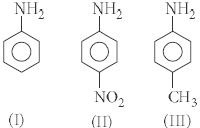
A
$III < I < II$
B
$III < II < I$
C
$II < I < III$
D
$II < III < I$
Solution
(C) The basic strength of aromatic amines depends on the electron density on the nitrogen atom.
Electron-donating groups (like $-CH_3$) increase the electron density on the nitrogen atom,thereby increasing the basic strength.
Electron-withdrawing groups (like $-NO_2$) decrease the electron density on the nitrogen atom,thereby decreasing the basic strength.
In the given compounds:
$(I)$ is Aniline.
$(II)$ is $p$-Nitroaniline,where $-NO_2$ is a strong electron-withdrawing group,making it the least basic.
$(III)$ is $p$-Toluidine,where $-CH_3$ is an electron-donating group,making it the most basic.
Therefore,the increasing order of basic strength is: $II < I < III$.
Electron-donating groups (like $-CH_3$) increase the electron density on the nitrogen atom,thereby increasing the basic strength.
Electron-withdrawing groups (like $-NO_2$) decrease the electron density on the nitrogen atom,thereby decreasing the basic strength.
In the given compounds:
$(I)$ is Aniline.
$(II)$ is $p$-Nitroaniline,where $-NO_2$ is a strong electron-withdrawing group,making it the least basic.
$(III)$ is $p$-Toluidine,where $-CH_3$ is an electron-donating group,making it the most basic.
Therefore,the increasing order of basic strength is: $II < I < III$.
0 likes
View Solution327
DifficultMCQ
The correct statement regarding the basicity of arylamines is
A
arylamines are generally more basic than alkylamines because of aryl group
B
arylamines are generally more basic than alkylamines,because the nitrogen atom in arylamines is $sp$-hybridised
C
arylamines are generally less basic than alkylamines because the nitrogen lone-pair electrons are delocalised by interaction with the aromatic ring $\pi$-electron system
D
arylamines are generally more basic than alkylamines because the nitrogen lone-pair electrons are not delocalised by interaction with the aromatic ring $\pi$-electron system.
Solution
(C) In arylamines,the lone pair of electrons on the nitrogen atom is involved in resonance with the aromatic ring.
This delocalization makes the lone pair less available for protonation,thereby reducing the basicity of arylamines compared to alkylamines,where the alkyl group exerts a $+I$ effect that increases electron density on the nitrogen atom.
This delocalization makes the lone pair less available for protonation,thereby reducing the basicity of arylamines compared to alkylamines,where the alkyl group exerts a $+I$ effect that increases electron density on the nitrogen atom.
0 likes
View Solution328
MediumMCQ
The following reaction is known by the name:
$C_6H_5NH_2 + C_6H_5COCl \xrightarrow{NaOH} C_6H_5NHCOC_6H_5 + HCl$
$C_6H_5NH_2 + C_6H_5COCl \xrightarrow{NaOH} C_6H_5NHCOC_6H_5 + HCl$
A
Perkin's reaction
B
Acetylation reaction
C
Schotten-Baumann reaction
D
Friedel-Craft's reaction
Solution
(C) The reaction of aniline $(C_6H_5NH_2)$ with benzoyl chloride $(C_6H_5COCl)$ in the presence of a base like $NaOH$ is known as the Schotten-Baumann reaction.
This process involves the benzoylation of the amine to form an amide ($N$-phenylbenzamide).
This process involves the benzoylation of the amine to form an amide ($N$-phenylbenzamide).
0 likes
View Solution329
MediumMCQ
The electrolytic reduction of nitrobenzene in a strongly acidic medium produces:
A
azobenzene
B
aniline
C
$p-$aminophenol
D
azoxybenzene
Solution
(C) The electrolytic reduction of nitrobenzene $(C_6H_5NO_2)$ in a strongly acidic medium proceeds through the formation of phenylhydroxylamine $(C_6H_5NHOH)$.
In the presence of a strong acid $(H^+)$,phenylhydroxylamine undergoes a Bamberger rearrangement to form $p-$aminophenol $(H_2N-C_6H_4-OH)$.
In the presence of a strong acid $(H^+)$,phenylhydroxylamine undergoes a Bamberger rearrangement to form $p-$aminophenol $(H_2N-C_6H_4-OH)$.
0 likes
View Solution330
MediumMCQ
In the following reaction,the product $(A)$ is
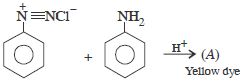
A
The structure of $p$-aminoazobenzene
B
The structure of $o$-aminoazobenzene
C
The structure of $m$-aminoazobenzene
D
The structure of $N$-phenyl$-1,4-$phenylenediamine
Solution
(A) The reaction shown is a coupling reaction between benzenediazonium chloride and aniline.
This reaction is an electrophilic aromatic substitution where the diazonium cation acts as the electrophile.
Since the $-NH_2$ group is a strong ortho/para-directing group,the electrophile attacks the para-position to the $-NH_2$ group,yielding $p$-aminoazobenzene,which is a yellow dye.
This reaction is an electrophilic aromatic substitution where the diazonium cation acts as the electrophile.
Since the $-NH_2$ group is a strong ortho/para-directing group,the electrophile attacks the para-position to the $-NH_2$ group,yielding $p$-aminoazobenzene,which is a yellow dye.
0 likes
View Solution331
MediumMCQ
Which of the following diazonium salts $RN_2^+X^-$ will be the most stable?
A
$CH_3N_2^+X^-$
B
$C_6H_5N_2^+X^-$
C
$CH_3CH_2N_2^+X^-$
D
$C_6H_5CH_2N_2^+X^-$
Solution
(B) The diazonium salt containing an aryl group directly linked to the nitrogen atom $(C_6H_5N_2^+X^-)$ is the most stable.
This stability is due to the resonance stabilization between the benzene ring and the diazonium group $(-N_2^+)$,which delocalizes the positive charge over the benzene ring.
Aliphatic diazonium salts are highly unstable and decompose readily to form carbocations and nitrogen gas.
The resonance structures of the benzene diazonium ion are shown below:
(The image provided shows the resonance structures where the positive charge is delocalized into the ortho and para positions of the benzene ring.)
This stability is due to the resonance stabilization between the benzene ring and the diazonium group $(-N_2^+)$,which delocalizes the positive charge over the benzene ring.
Aliphatic diazonium salts are highly unstable and decompose readily to form carbocations and nitrogen gas.
The resonance structures of the benzene diazonium ion are shown below:
(The image provided shows the resonance structures where the positive charge is delocalized into the ortho and para positions of the benzene ring.)
0 likes
View Solution332
MediumMCQ
In the given reaction,identify the reagent $A$:
$4-nitro-3-bromobenzenediazonium \ chloride \xrightarrow{A} 1-bromo-3-nitrobenzene$
$4-nitro-3-bromobenzenediazonium \ chloride \xrightarrow{A} 1-bromo-3-nitrobenzene$
A
$H_3PO_2$ and $H_2O$
B
$H^{+}/H_2O$
C
$HgSO_4/H_2SO_4$
D
$Cu_2Cl_2$
Solution
(A) The given reaction involves the removal of the diazonium group $(-N_2^+Cl^-)$ from the benzene ring,which is a deamination reaction.
The reagent $H_3PO_2$ (hypophosphorous acid) in the presence of water $(H_2O)$ is a standard reducing agent used to replace the diazonium group with a hydrogen atom.
Therefore,the conversion of $4-nitro-3-bromobenzenediazonium \ chloride$ to $1-bromo-3-nitrobenzene$ is achieved using $H_3PO_2$ and $H_2O$.
The reagent $H_3PO_2$ (hypophosphorous acid) in the presence of water $(H_2O)$ is a standard reducing agent used to replace the diazonium group with a hydrogen atom.
Therefore,the conversion of $4-nitro-3-bromobenzenediazonium \ chloride$ to $1-bromo-3-nitrobenzene$ is achieved using $H_3PO_2$ and $H_2O$.
0 likes
View Solution333
DifficultMCQ
On hydrolysis of a "compound",two compounds are obtained. One of which on treatment with sodium nitrite and hydrochloric acid gives a product which does not respond to iodoform test. The second one reduces Tollens reagent and Fehling's solution. The "compound" is
A
$CH_3CH_2CH_2NC$
B
$CH_3CH_2CH_2CN$
C
$CH_3CH_2CH_2ON=O$
D
$CH_3CH_2CH_2CON(CH_3)_2$
Solution
(A) The hydrolysis of an alkyl isocyanide $(R-NC)$ yields a primary amine $(R-NH_2)$ and formic acid $(HCOOH)$.
Here,the compound is $CH_3CH_2CH_2NC$ (propyl isocyanide).
Hydrolysis: $CH_3CH_2CH_2NC + 2H_2O \rightarrow CH_3CH_2CH_2NH_2 + HCOOH$.
$1$. $CH_3CH_2CH_2NH_2$ (propylamine) reacts with $NaNO_2/HCl$ to form $CH_3CH_2CH_2OH$ (propan$-1-$ol),which does not give the iodoform test.
$2$. $HCOOH$ (formic acid) reduces both Tollens reagent and Fehling's solution.
Thus,the compound is $CH_3CH_2CH_2NC$.
Here,the compound is $CH_3CH_2CH_2NC$ (propyl isocyanide).
Hydrolysis: $CH_3CH_2CH_2NC + 2H_2O \rightarrow CH_3CH_2CH_2NH_2 + HCOOH$.
$1$. $CH_3CH_2CH_2NH_2$ (propylamine) reacts with $NaNO_2/HCl$ to form $CH_3CH_2CH_2OH$ (propan$-1-$ol),which does not give the iodoform test.
$2$. $HCOOH$ (formic acid) reduces both Tollens reagent and Fehling's solution.
Thus,the compound is $CH_3CH_2CH_2NC$.
0 likes
View Solution334
DifficultMCQ
Some reactions of amines are given. Which one is not correct?
A
$CH_3NH_2 + CH_3COCl \rightarrow CH_3NHCOCH_3 + HCl$
B
$CH_3CH_2NH_2 + HNO_2 \rightarrow CH_3CH_2OH + N_2 + H_2O$
C
$CH_3NH_2 + C_6H_5SO_2Cl \rightarrow CH_3NHSO_2C_6H_5 + HCl$
D
$(CH_3)_2NH + NaNO_2 + HCl \rightarrow (CH_3)_2N-N=O + NaCl + H_2O$
Solution
(D) The reaction of secondary aliphatic amines with nitrous acid $(HNO_2)$ produces $N$-nitrosamines,which are yellow oily compounds. The reaction is: $(CH_3)_2NH + HNO_2 \rightarrow (CH_3)_2N-N=O + H_2O$.
Option $D$ is incorrect because the reaction of dimethylamine with nitrous acid (generated from $NaNO_2 + HCl$) forms $N$-nitrosodimethylamine,not the structure implied by the notation in the option. Furthermore,the reaction shown in the option is chemically inaccurate regarding the products and stoichiometry for the given reactants.
Option $D$ is incorrect because the reaction of dimethylamine with nitrous acid (generated from $NaNO_2 + HCl$) forms $N$-nitrosodimethylamine,not the structure implied by the notation in the option. Furthermore,the reaction shown in the option is chemically inaccurate regarding the products and stoichiometry for the given reactants.
0 likes
View Solution335
MediumMCQ
An organic compound $(C_3H_9N)$ $(A)$,when treated with nitrous acid,gave an alcohol and $N_2$ gas was evolved. $(A)$ on warming with $CHCl_3$ and caustic potash gave $(C)$ which on reduction gave isopropylmethylamine. Predict the structure of $(A)$.
A
$(CH_3)_2CH-NH_2$
B
$CH_3CH_2-NH-CH_3$
C
$N(CH_3)_3$
D
$CH_3CH_2CH_2-NH_2$
Solution
(A) The molecular formula $(C_3H_9N)$ corresponds to a primary amine.
When treated with nitrous acid $(HNO_2)$,primary aliphatic amines evolve $N_2$ gas and form an alcohol.
The carbylamine reaction (warming with $CHCl_3$ and $KOH$) is a characteristic test for primary amines,forming an isocyanide $(C)$.
Reduction of the isocyanide $(CH_3)_2CH-NC$ gives isopropylmethylamine $(CH_3)_2CH-NH-CH_3$.
Therefore,$(A)$ is isopropylamine,$(CH_3)_2CH-NH_2$.
When treated with nitrous acid $(HNO_2)$,primary aliphatic amines evolve $N_2$ gas and form an alcohol.
The carbylamine reaction (warming with $CHCl_3$ and $KOH$) is a characteristic test for primary amines,forming an isocyanide $(C)$.
Reduction of the isocyanide $(CH_3)_2CH-NC$ gives isopropylmethylamine $(CH_3)_2CH-NH-CH_3$.
Therefore,$(A)$ is isopropylamine,$(CH_3)_2CH-NH_2$.
0 likes
View Solution336
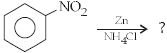
DifficultMCQ
What is the product obtained in the following reaction?
A
Phenylhydroxylamine
B
Azobenzene
C
Azoxybenzene
D
Aniline
Solution
(A) The reduction of nitrobenzene with $Zn$ in the presence of $NH_4Cl$ is a controlled reduction process.
Nitrobenzene $(C_6H_5NO_2)$ reacts with $Zn/NH_4Cl$ to form $N$-phenylhydroxylamine $(C_6H_5NHOH)$.
Therefore,the correct product is phenylhydroxylamine.
Nitrobenzene $(C_6H_5NO_2)$ reacts with $Zn/NH_4Cl$ to form $N$-phenylhydroxylamine $(C_6H_5NHOH)$.
Therefore,the correct product is phenylhydroxylamine.
0 likes
View Solution337
MediumMCQ
Which of the following compounds is most basic?
A
$O_2N-C_6H_4-NH_2$ (p-nitroaniline)
B
$C_6H_5-CH_2NH_2$ (benzylamine)
C
$C_6H_5-NH-COCH_3$ (acetanilide)
D
$C_6H_5-NH_2$ (aniline)
Solution
(B) The basicity of an amine depends on the availability of the lone pair of electrons on the nitrogen atom for protonation.
In $C_6H_5-CH_2NH_2$ (benzylamine),the lone pair on the nitrogen atom is localised because the $-NH_2$ group is attached to an $sp^3$ hybridized carbon atom,which is not directly attached to the benzene ring.
In the other compounds ($p$-nitroaniline,acetanilide,and aniline),the lone pair on the nitrogen atom is delocalized over the benzene ring due to resonance,making it less available for donation.
Therefore,benzylamine is the most basic compound among the given options.
In $C_6H_5-CH_2NH_2$ (benzylamine),the lone pair on the nitrogen atom is localised because the $-NH_2$ group is attached to an $sp^3$ hybridized carbon atom,which is not directly attached to the benzene ring.
In the other compounds ($p$-nitroaniline,acetanilide,and aniline),the lone pair on the nitrogen atom is delocalized over the benzene ring due to resonance,making it less available for donation.
Therefore,benzylamine is the most basic compound among the given options.
0 likes
View Solution338
MediumMCQ
Aniline in a set of the following reactions yielded a coloured product $Y$.
Aniline $\xrightarrow[(273-278 \ K)]{NaNO_{2}/HCl} X$ $\xrightarrow{N,N-dimethylaniline} Y$
The structure of $Y$ would be
Aniline $\xrightarrow[(273-278 \ K)]{NaNO_{2}/HCl} X$ $\xrightarrow{N,N-dimethylaniline} Y$
The structure of $Y$ would be
A
Aniline
B
p-(Dimethylamino)azobenzene
C
$N$,$N$-Dimethyl-p-phenylenediamine
D
p-Aminoazobenzene
Solution
(B) $1$. The reaction of aniline with $NaNO_{2}/HCl$ at $273-278 \ K$ results in the formation of benzenediazonium chloride $(X)$.
$2$. Benzenediazonium chloride $(X)$ then undergoes an electrophilic aromatic substitution reaction (coupling reaction) with $N,N-dimethylaniline$ in a weakly acidic medium.
$3$. The coupling occurs at the para-position of $N,N-dimethylaniline$ to form $p-(dimethylamino)azobenzene$ $(Y)$,which is a yellow-orange coloured dye.
$4$. The structure of $Y$ is $C_6H_5-N=N-C_6H_4-N(CH_3)_2$.
$2$. Benzenediazonium chloride $(X)$ then undergoes an electrophilic aromatic substitution reaction (coupling reaction) with $N,N-dimethylaniline$ in a weakly acidic medium.
$3$. The coupling occurs at the para-position of $N,N-dimethylaniline$ to form $p-(dimethylamino)azobenzene$ $(Y)$,which is a yellow-orange coloured dye.
$4$. The structure of $Y$ is $C_6H_5-N=N-C_6H_4-N(CH_3)_2$.
0 likes
View Solution339
MediumMCQ
Which of the following statements about primary amines is false?
A
Alkyl amines are stronger bases than aryl amines.
B
Alkyl amines react with nitrous acid to produce alcohols.
C
Aryl amines react with nitrous acid to produce phenols.
D
Alkyl amines are stronger bases than ammonia.
Solution
(C) $(i)$ The presence of an electron-withdrawing substituent decreases basicity,while the presence of an electron-releasing substituent like $-CH_{3}, -C_{2}H_{5},$ etc.,increases basicity.
$(ii)$ $HNO_{2}$ converts the $-NH_{2}$ group of aliphatic amines into $-OH$ (alcohols),whereas it converts aromatic amines into diazonium salts at low temperatures $(0-5\,^{\circ}C)$.
$(iii)$ Alkyl amines are more basic than ammonia due to the electron-releasing effect of the alkyl group,while aryl amines are less basic than ammonia due to the electron-withdrawing nature of the phenyl ring.
$(iv)$ The reaction for alkyl amines: $R-NH_{2} \xrightarrow{HNO_{2}} R-OH + N_{2} + H_{2}O$.
$(v)$ The reaction for aryl amines: $C_{6}H_{5}NH_{2} \xrightarrow{NaNO_{2} + HCl, 273-278\,K} C_{6}H_{5}N_{2}^{+}Cl^{-}$.
Therefore,the statement that aryl amines react with nitrous acid to produce phenols is false,as they form diazonium salts under these conditions.
$(ii)$ $HNO_{2}$ converts the $-NH_{2}$ group of aliphatic amines into $-OH$ (alcohols),whereas it converts aromatic amines into diazonium salts at low temperatures $(0-5\,^{\circ}C)$.
$(iii)$ Alkyl amines are more basic than ammonia due to the electron-releasing effect of the alkyl group,while aryl amines are less basic than ammonia due to the electron-withdrawing nature of the phenyl ring.
$(iv)$ The reaction for alkyl amines: $R-NH_{2} \xrightarrow{HNO_{2}} R-OH + N_{2} + H_{2}O$.
$(v)$ The reaction for aryl amines: $C_{6}H_{5}NH_{2} \xrightarrow{NaNO_{2} + HCl, 273-278\,K} C_{6}H_{5}N_{2}^{+}Cl^{-}$.
Therefore,the statement that aryl amines react with nitrous acid to produce phenols is false,as they form diazonium salts under these conditions.
0 likes
View Solution340
MediumMCQ
Predict the product of the following reaction:
$C_6H_5NHCH_3 + NaNO_2 + HCl \rightarrow \text{Product}$
$C_6H_5NHCH_3 + NaNO_2 + HCl \rightarrow \text{Product}$
A
$N$-nitroso-$N$-methylaniline
B
$o$-nitroso-$N$-methylaniline + $p$-nitroso-$N$-methylaniline
C
$N$-hydroxy-$N$-methylaniline
D
$N$-methyl-$N$-nitrosoaniline
Solution
(A) $N$-methylaniline is a secondary amine. When it reacts with nitrous acid $(HNO_2)$,generated in situ by the reaction of $NaNO_2$ and $HCl$,it undergoes $N$-nitrosation to form $N$-nitroso-$N$-methylaniline. The reaction is as follows:
$C_6H_5NHCH_3 + NaNO_2 + HCl \rightarrow C_6H_5N(NO)CH_3 + NaCl + H_2O$
This product is a yellow oily liquid.
$C_6H_5NHCH_3 + NaNO_2 + HCl \rightarrow C_6H_5N(NO)CH_3 + NaCl + H_2O$
This product is a yellow oily liquid.
0 likes
View Solution341
MediumMCQ
Which one of the following on reduction with lithium aluminium hydride yields a secondary amine?
A
Methyl isocyanide
B
Acetamide
C
Methyl cyanide
D
Nitroethane
Solution
(A) $CH_{3}NC + 4[H] \xrightarrow{LiAlH_{4}} CH_{3}NHCH_{3}$
$CH_{3}NC$ (Methyl isocyanide) on reduction with lithium aluminium hydride $(LiAlH_{4})$ yields $CH_{3}NHCH_{3}$ (Dimethylamine),which is a secondary $(2^{\circ})$ amine.
In contrast,reduction of alkyl cyanides $(RCN)$ with $LiAlH_{4}$ yields primary $(1^{\circ})$ amines $(RCH_{2}NH_{2})$.
Reduction of acetamide $(CH_{3}CONH_{2})$ yields ethylamine $(CH_{3}CH_{2}NH_{2})$,a primary amine.
Reduction of nitroethane $(CH_{3}CH_{2}NO_{2})$ yields ethylamine $(CH_{3}CH_{2}NH_{2})$,a primary amine.
$CH_{3}NC$ (Methyl isocyanide) on reduction with lithium aluminium hydride $(LiAlH_{4})$ yields $CH_{3}NHCH_{3}$ (Dimethylamine),which is a secondary $(2^{\circ})$ amine.
In contrast,reduction of alkyl cyanides $(RCN)$ with $LiAlH_{4}$ yields primary $(1^{\circ})$ amines $(RCH_{2}NH_{2})$.
Reduction of acetamide $(CH_{3}CONH_{2})$ yields ethylamine $(CH_{3}CH_{2}NH_{2})$,a primary amine.
Reduction of nitroethane $(CH_{3}CH_{2}NO_{2})$ yields ethylamine $(CH_{3}CH_{2}NH_{2})$,a primary amine.
0 likes
View Solution342
MediumMCQ
Which of the following is more basic than aniline?
A
Benzylamine
B
Diphenylamine
C
Triphenylamine
D
$p-$Nitroaniline
Solution
(A) Benzylamine,$C_{6}H_{5}CH_{2}NH_{2}$,is more basic than aniline because the benzyl group $(C_{6}H_{5}CH_{2}-)$ is an electron-donating group due to the $+I$ effect.
This increases the electron density on the nitrogen atom of the $-NH_{2}$ group,making the lone pair more available for donation.
In contrast,phenyl and nitro groups are electron-withdrawing groups ($-I$ or $-M$ effects),which decrease the electron density on the nitrogen atom.
Therefore,diphenylamine,triphenylamine,and $p-$nitroaniline are less basic than aniline.
This increases the electron density on the nitrogen atom of the $-NH_{2}$ group,making the lone pair more available for donation.
In contrast,phenyl and nitro groups are electron-withdrawing groups ($-I$ or $-M$ effects),which decrease the electron density on the nitrogen atom.
Therefore,diphenylamine,triphenylamine,and $p-$nitroaniline are less basic than aniline.
0 likes
View Solution343
MediumMCQ
Which one of the following is the strongest base in aqueous solution?
A
Methylamine
B
Trimethylamine
C
Aniline
D
Dimethylamine
Solution
(D) Aromatic amines are less basic than aliphatic amines.
Among aliphatic amines,the order of basicity in aqueous solution is $2^{o} > 1^{o} > 3^{o}$ due to a combination of inductive effect,solvation effect,and steric hindrance.
In $3^{o}$ amines (Trimethylamine),the steric hindrance of three alkyl groups makes the approach and bonding of a proton relatively difficult.
Aniline is much less basic than aliphatic amines because the lone pair of electrons on the nitrogen atom is involved in resonance with the benzene ring.
Therefore,Dimethylamine ($2^{o}$ aliphatic amine) is the strongest base among the given choices.
$\therefore$ The correct order of basic strength is $\text{Dimethylamine} > \text{Methylamine} > \text{Trimethylamine} > \text{Aniline}$.
Among aliphatic amines,the order of basicity in aqueous solution is $2^{o} > 1^{o} > 3^{o}$ due to a combination of inductive effect,solvation effect,and steric hindrance.
In $3^{o}$ amines (Trimethylamine),the steric hindrance of three alkyl groups makes the approach and bonding of a proton relatively difficult.
Aniline is much less basic than aliphatic amines because the lone pair of electrons on the nitrogen atom is involved in resonance with the benzene ring.
Therefore,Dimethylamine ($2^{o}$ aliphatic amine) is the strongest base among the given choices.
$\therefore$ The correct order of basic strength is $\text{Dimethylamine} > \text{Methylamine} > \text{Trimethylamine} > \text{Aniline}$.
0 likes
View Solution344
MediumMCQ
In the chemical reaction,
$CH_3CH_2NH_2 + CHCl_3 + 3KOH \rightarrow (A) + (B) + 3H_2O,$
the compounds $(A)$ and $(B)$ are respectively
$CH_3CH_2NH_2 + CHCl_3 + 3KOH \rightarrow (A) + (B) + 3H_2O,$
the compounds $(A)$ and $(B)$ are respectively
A
$C_2H_5NC$ and $3KCl$
B
$C_2H_5CN$ and $3KCl$
C
$CH_3CH_2CONH_2$ and $3KCl$
D
$C_2H_5NC$ and $K_2CO_3$
Solution
(A) The given reaction is the carbylamine reaction,which is a characteristic test for primary amines.
In this reaction,a primary amine reacts with chloroform $(CHCl_3)$ and alcoholic potassium hydroxide $(KOH)$ to form an isocyanide (carbylamine) and potassium chloride $(KCl)$.
The balanced chemical equation is:
$CH_3CH_2NH_2 + CHCl_3 + 3KOH \rightarrow C_2H_5NC + 3KCl + 3H_2O$
Here,$(A)$ is $C_2H_5NC$ (ethyl isocyanide) and $(B)$ is $3KCl$.
In this reaction,a primary amine reacts with chloroform $(CHCl_3)$ and alcoholic potassium hydroxide $(KOH)$ to form an isocyanide (carbylamine) and potassium chloride $(KCl)$.
The balanced chemical equation is:
$CH_3CH_2NH_2 + CHCl_3 + 3KOH \rightarrow C_2H_5NC + 3KCl + 3H_2O$
Here,$(A)$ is $C_2H_5NC$ (ethyl isocyanide) and $(B)$ is $3KCl$.
0 likes
View Solution345
MediumMCQ
In the chemical reactions,the compounds $A$ and $B$ respectively are
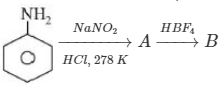
A
nitrobenzene and fluorobenzene
B
phenol and benzene
C
benzene diazonium chloride and fluorobenzene
D
nitrobenzene and chlorobenzene
Solution
(C) The reaction of aniline with $NaNO_2$ and $HCl$ at $278 \ K$ $(0-5 \ ^\circ C)$ is known as diazotization,which produces benzene diazonium chloride $(A)$.
Reaction: $C_6H_5NH_2 + NaNO_2 + 2HCl \xrightarrow{278 \ K} C_6H_5N_2^+Cl^- + NaCl + 2H_2O$.
When benzene diazonium chloride $(A)$ is treated with fluoroboric acid $(HBF_4)$,it forms benzene diazonium fluoroborate,which upon heating decomposes to give fluorobenzene $(B)$.
Reaction: $C_6H_5N_2^+Cl^- + HBF_4$ $\rightarrow C_6H_5N_2^+BF_4^- + HCl$ $\xrightarrow{\Delta} C_6H_5F + N_2 + BF_3$.
Thus,$A$ is benzene diazonium chloride and $B$ is fluorobenzene.
Reaction: $C_6H_5NH_2 + NaNO_2 + 2HCl \xrightarrow{278 \ K} C_6H_5N_2^+Cl^- + NaCl + 2H_2O$.
When benzene diazonium chloride $(A)$ is treated with fluoroboric acid $(HBF_4)$,it forms benzene diazonium fluoroborate,which upon heating decomposes to give fluorobenzene $(B)$.
Reaction: $C_6H_5N_2^+Cl^- + HBF_4$ $\rightarrow C_6H_5N_2^+BF_4^- + HCl$ $\xrightarrow{\Delta} C_6H_5F + N_2 + BF_3$.
Thus,$A$ is benzene diazonium chloride and $B$ is fluorobenzene.
0 likes
View Solution346
DifficultMCQ
$A$ compound with molecular mass $180$ is acylated with $CH_3COCl$ to get a compound with molecular mass $390$. The number of amino groups present per molecule of the former compound is:
A
$2$
B
$5$
C
$4$
D
$6$
Solution
(B) During acetylation,one $H$ atom (atomic mass $1 \, u$) of an $-NH_2$ group is replaced by an acetyl group $(CH_3CO-)$ with a molecular mass of $43 \, u$.
The reaction is: $-NH_2 + CH_3COCl \longrightarrow -NHCOCH_3 + HCl$.
This indicates that the acylation of each $-NH_2$ group increases the molecular mass of the compound by $(43 - 1) = 42 \, u$.
Given that the initial molecular mass is $180 \, u$ and the final molecular mass is $390 \, u$,the total increase in mass is $390 - 180 = 210 \, u$.
Therefore,the number of $-NH_2$ groups present is $\frac{210}{42} = 5$.
The reaction is: $-NH_2 + CH_3COCl \longrightarrow -NHCOCH_3 + HCl$.
This indicates that the acylation of each $-NH_2$ group increases the molecular mass of the compound by $(43 - 1) = 42 \, u$.
Given that the initial molecular mass is $180 \, u$ and the final molecular mass is $390 \, u$,the total increase in mass is $390 - 180 = 210 \, u$.
Therefore,the number of $-NH_2$ groups present is $\frac{210}{42} = 5$.
0 likes
View Solution347
MediumMCQ
On heating an aliphatic primary amine with chloroform and ethanolic potassium hydroxide,the organic compound formed is:
A
an alkanol
B
an alkanediol
C
an alkyl cyanide
D
an alkyl isocyanide
Solution
(D) This reaction is known as the $Carbylamine$ test,which is used to identify primary amines.
When an aliphatic primary amine $(R-NH_2)$ is heated with chloroform $(CHCl_3)$ and ethanolic potassium hydroxide $(KOH)$,it forms an alkyl isocyanide $(R-NC)$,which has a foul smell.
The chemical equation is: $R-NH_2 + CHCl_3 + 3KOH (alc.) \rightarrow R-NC + 3KCl + 3H_2O$.
This reaction involves the formation of a dichlorocarbene intermediate $(:CCl_2)$.
When an aliphatic primary amine $(R-NH_2)$ is heated with chloroform $(CHCl_3)$ and ethanolic potassium hydroxide $(KOH)$,it forms an alkyl isocyanide $(R-NC)$,which has a foul smell.
The chemical equation is: $R-NH_2 + CHCl_3 + 3KOH (alc.) \rightarrow R-NC + 3KCl + 3H_2O$.
This reaction involves the formation of a dichlorocarbene intermediate $(:CCl_2)$.
0 likes
View Solution348
MediumMCQ
Considering the basic strength of amines in aqueous solution,which one has the smallest $pK_b$ value?
A
$(CH_3)_2NH$
B
$CH_3NH_2$
C
$(CH_3)_3N$
D
$C_6H_5NH_2$
Solution
(A) The basic strength of amines in aqueous solution depends on the combined effect of inductive effect,solvation effect,and steric hindrance. For methyl-substituted amines,the order of basic strength is $(CH_3)_2NH > CH_3NH_2 > (CH_3)_3N > C_6H_5NH_2$.
Since $pK_b = -\log K_b$,a higher $K_b$ value corresponds to a smaller $pK_b$ value.
Therefore,$(CH_3)_2NH$ (dimethylamine) has the highest basic strength and consequently the smallest $pK_b$ value.
$C_6H_5NH_2$ (aniline) is the least basic due to the resonance of the lone pair with the benzene ring.
Since $pK_b = -\log K_b$,a higher $K_b$ value corresponds to a smaller $pK_b$ value.
Therefore,$(CH_3)_2NH$ (dimethylamine) has the highest basic strength and consequently the smallest $pK_b$ value.
$C_6H_5NH_2$ (aniline) is the least basic due to the resonance of the lone pair with the benzene ring.
0 likes
View Solution349
DifficultMCQ
In the given reaction,the product $E$ is:
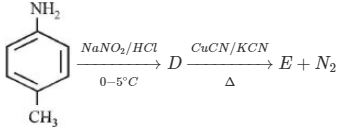
A
$4$-methylbenzonitrile
B
Toluene
C
$4$-methylbenzoic acid
D
$4,4'$-dimethylbiphenyl
Solution
(A) The reaction proceeds in two steps:
$1$. The reaction of $p$-toluidine ($4$-methylaniline) with $NaNO_2/HCl$ at $0-5^{\circ}C$ is a diazotization reaction,which forms the diazonium salt,$4$-methylbenzenediazonium chloride $(D)$.
$2$. The reaction of the diazonium salt $(D)$ with $CuCN/KCN$ is a Sandmeyer reaction,where the diazonium group $(-N_2^+Cl^-)$ is replaced by a cyano group $(-CN)$ to form $4$-methylbenzonitrile $(E)$.
$1$. The reaction of $p$-toluidine ($4$-methylaniline) with $NaNO_2/HCl$ at $0-5^{\circ}C$ is a diazotization reaction,which forms the diazonium salt,$4$-methylbenzenediazonium chloride $(D)$.
$2$. The reaction of the diazonium salt $(D)$ with $CuCN/KCN$ is a Sandmeyer reaction,where the diazonium group $(-N_2^+Cl^-)$ is replaced by a cyano group $(-CN)$ to form $4$-methylbenzonitrile $(E)$.
0 likes
View Solution350
MediumMCQ
In the $Hofmann$ bromamide degradation reaction,the number of moles of $NaOH$ and $Br_2$ used per mole of amine produced are:
A
$Two$ moles of $NaOH$ and $two$ moles of $Br_2$.
B
$Four$ moles of $NaOH$ and $one$ mole of $Br_2$.
C
$One$ mole of $NaOH$ and $one$ mole of $Br_2$.
D
$Four$ moles of $NaOH$ and $two$ moles of $Br_2$.
Solution
(B) The $Hofmann$ bromamide degradation reaction is represented by the following chemical equation:
$RCONH_2 + 4NaOH + Br_2 \rightarrow RNH_2 + Na_2CO_3 + 2NaBr + 2H_2O$
From the stoichiometry of the balanced equation,it is clear that for every $1$ mole of amine $(RNH_2)$ produced,$4$ moles of $NaOH$ and $1$ mole of $Br_2$ are consumed.
$RCONH_2 + 4NaOH + Br_2 \rightarrow RNH_2 + Na_2CO_3 + 2NaBr + 2H_2O$
From the stoichiometry of the balanced equation,it is clear that for every $1$ mole of amine $(RNH_2)$ produced,$4$ moles of $NaOH$ and $1$ mole of $Br_2$ are consumed.
0 likes
View SolutionAmines — Properties of Amines · Frequently Asked Questions
1Are these Amines questions useful for JEE and NEET?
Yes. All questions in this section are mapped to JEE Main and NEET exam patterns. Previous year questions from JEE Main, NEET, GUJCET and state-level exams are included with full solutions.
2Can I switch to Hindi or Gujarati for these questions?
Yes. Use the language tabs in the hero section or the sidebar to view the same questions and solutions in English, Hindi or Gujarati.
3How do I generate a question paper from this subtopic?
Use the Vedclass Exam Paper Generator — select the chapter and subtopic, set difficulty, and generate Sets A, B, C, D automatically. First 3 chapters of every subject are free.
Vedclass Products
For Students
Vedclass Test Series
Mock tests in real JEE/NEET style with performance analysis. 5-day free trial.
Start Free TrialFor Teachers
Exam Paper Generator
Generate Set A/B/C/D papers from this chapter in 2 minutes. 3 chapters free.
Try FreeFor Institutes
Online Exam Module
Live online exams with unlimited students, 360° analytics & white-label branding.
See DemoFor Teachers & Institutes
Generate a Amines Exam Paper in 2 Minutes
Select subtopic & difficulty — Sets A, B, C, D auto-generated with No Repeat logic.
First 3 chapters of every subject are free — no payment required.