
A English
Properties of Amines Questions in English
Class 12 Chemistry · Amines · Properties of Amines
1212+
Questions
English
Language
100%
With Solutions
Showing 50 of 1212 questions in English
251
MediumMCQ
Which of the following compounds does not undergo the carbylamine reaction?
A
Isopropylamine
B
Diethylamine
C
$t$-Butylamine
D
sec-Butylamine
Solution
(B) The carbylamine reaction is a characteristic test for primary amines $(R-NH_2)$.
It involves the reaction of a primary amine with chloroform $(CHCl_3)$ and alcoholic potassium hydroxide $(KOH)$ to form an isocyanide (carbylamine),which has a foul smell.
Secondary $(R_2NH)$ and tertiary $(R_3N)$ amines do not undergo this reaction because they lack the necessary hydrogen atoms on the nitrogen to form the isocyanide linkage.
Among the given options,diethylamine is a secondary amine $( (C_2H_5)_2NH )$,therefore it does not give the carbylamine reaction.
It involves the reaction of a primary amine with chloroform $(CHCl_3)$ and alcoholic potassium hydroxide $(KOH)$ to form an isocyanide (carbylamine),which has a foul smell.
Secondary $(R_2NH)$ and tertiary $(R_3N)$ amines do not undergo this reaction because they lack the necessary hydrogen atoms on the nitrogen to form the isocyanide linkage.
Among the given options,diethylamine is a secondary amine $( (C_2H_5)_2NH )$,therefore it does not give the carbylamine reaction.
0 likes
View Solution252
DifficultMCQ
In the reaction $RNH_2 + CHCl_3 + 3KOH(alc.) \rightarrow A + 3KCl + 3H_2O$,the product $A$ can be converted back to $RNH_2$ by which process?
A
Ammonolysis
B
Reduction
C
Oxidation
D
Hydrolysis
Solution
(D) The given reaction is the Carbylamine reaction,where $A$ is an isocyanide $(R-NC)$.
$R-NH_2 + CHCl_3 + 3KOH(alc.) \rightarrow R-NC + 3KCl + 3H_2O$.
The product $A$ is $R-NC$.
$R-NC$ on hydrolysis gives back the primary amine:
$R-NC + 2H_2O \xrightarrow{H^+} R-NH_2 + HCOOH$.
$R-NH_2 + CHCl_3 + 3KOH(alc.) \rightarrow R-NC + 3KCl + 3H_2O$.
The product $A$ is $R-NC$.
$R-NC$ on hydrolysis gives back the primary amine:
$R-NC + 2H_2O \xrightarrow{H^+} R-NH_2 + HCOOH$.
0 likes
View Solution253
MediumMCQ
Which of the following compounds reacts with aqueous nitrous acid at low temperature to give an oily substance,$N$-nitrosoamine?
A
Diethylamine
B
Ethylamine
C
Aniline
D
Methylamine
Solution
(A) Secondary amines,such as diethylamine $(C_2H_5)_2NH$,react with nitrous acid $(HONO)$ at low temperatures $(273-278 \ K)$ to form $N$-nitrosoamines,which appear as yellow oily substances.
The reaction is: $(C_2H_5)_2NH + HONO \rightarrow (C_2H_5)_2N-N=O + H_2O$.
The reaction is: $(C_2H_5)_2NH + HONO \rightarrow (C_2H_5)_2N-N=O + H_2O$.
0 likes
View Solution254
MediumMCQ
Which of the following reaction names is not associated with a scientist?
A
$ - CN \xrightarrow{Na/EtOH} - CH_2NH_2 $
B
$ - CONH_2 \xrightarrow{NaOH/Br_2} - NH_2 $
C
$ - CH_2CH_2NH_2 \xrightarrow{NaNO_2/HCl} - CH_2 - CH_2OH $
D
$ - COOH \xrightarrow[H_2SO_4]{N_3H} - NH_2 $
Solution
(C) The given reactions are identified as follows:
$A$: $ - CN \xrightarrow{Na/EtOH} - CH_2NH_2 $ is the $Mendius$ reduction,which is named after a scientist.
$B$: $ - CONH_2 \xrightarrow{NaOH/Br_2} - NH_2 $ is the $Hofmann$ bromamide degradation,which is named after a scientist.
$C$: $ - CH_2CH_2NH_2 \xrightarrow{NaNO_2/HCl} - CH_2 - CH_2OH $ is a simple diazotization reaction followed by hydrolysis,which is not named after a specific scientist.
$D$: $ - COOH \xrightarrow[H_2SO_4]{N_3H} - NH_2 $ is the $Schmidt$ reaction,which is named after a scientist.
Therefore,the correct option is $C$.
$A$: $ - CN \xrightarrow{Na/EtOH} - CH_2NH_2 $ is the $Mendius$ reduction,which is named after a scientist.
$B$: $ - CONH_2 \xrightarrow{NaOH/Br_2} - NH_2 $ is the $Hofmann$ bromamide degradation,which is named after a scientist.
$C$: $ - CH_2CH_2NH_2 \xrightarrow{NaNO_2/HCl} - CH_2 - CH_2OH $ is a simple diazotization reaction followed by hydrolysis,which is not named after a specific scientist.
$D$: $ - COOH \xrightarrow[H_2SO_4]{N_3H} - NH_2 $ is the $Schmidt$ reaction,which is named after a scientist.
Therefore,the correct option is $C$.
0 likes
View Solution255
DifficultMCQ
$A$ $\xrightarrow{H_2NOH} B$ $\xrightarrow{\text{reduction}} C$ $\xrightarrow{NOCl} CH_3CH_2Cl$. What are $A$ and $C$ in the given reaction sequence?
A
Methanal,Methylamine
B
Acetone,Ethanamine
C
Ethanal,Dimethylamine
D
Acetaldehyde,Ethylamine
Solution
(D) The reaction sequence is as follows:
$1$. $A$ reacts with hydroxylamine $(H_2NOH)$ to form an oxime $(B)$.
$2$. The reduction of oxime $(B)$ yields a primary amine $(C)$.
$3$. The primary amine $(C)$ reacts with nitrosyl chloride $(NOCl)$ to form an alkyl chloride $(CH_3CH_2Cl)$.
Given the final product is $CH_3CH_2Cl$ (ethyl chloride),the primary amine $(C)$ must be ethylamine $(CH_3CH_2NH_2)$.
Working backwards:
- $C$ is $CH_3CH_2NH_2$ (ethylamine).
- $B$ is $CH_3CH=NOH$ (acetaldoxime).
- $A$ is $CH_3CHO$ (acetaldehyde/ethanal).
Thus,$A$ is acetaldehyde and $C$ is ethylamine.
$1$. $A$ reacts with hydroxylamine $(H_2NOH)$ to form an oxime $(B)$.
$2$. The reduction of oxime $(B)$ yields a primary amine $(C)$.
$3$. The primary amine $(C)$ reacts with nitrosyl chloride $(NOCl)$ to form an alkyl chloride $(CH_3CH_2Cl)$.
Given the final product is $CH_3CH_2Cl$ (ethyl chloride),the primary amine $(C)$ must be ethylamine $(CH_3CH_2NH_2)$.
Working backwards:
- $C$ is $CH_3CH_2NH_2$ (ethylamine).
- $B$ is $CH_3CH=NOH$ (acetaldoxime).
- $A$ is $CH_3CHO$ (acetaldehyde/ethanal).
Thus,$A$ is acetaldehyde and $C$ is ethylamine.
0 likes
View Solution256
DifficultMCQ
What is the final product $C$ in the reaction sequence: $CH_3CH_2NH_2$ $\xrightarrow{HNO_2} A$ $\xrightarrow{PCl_5} B$ $\xrightarrow{NH_3} C$?
A
Ethyl cyanide
B
Ethyl amine
C
Methyl amine
D
Acetamide
Solution
(B) The reaction sequence is as follows:
$1$. $CH_3CH_2NH_2 + HNO_2 \rightarrow CH_3CH_2OH + N_2 + H_2O$ ($A$ is $CH_3CH_2OH$,ethanol).
$2$. $CH_3CH_2OH + PCl_5 \rightarrow CH_3CH_2Cl + POCl_3 + HCl$ ($B$ is $CH_3CH_2Cl$,ethyl chloride).
$3$. $CH_3CH_2Cl + NH_3 \rightarrow CH_3CH_2NH_2 + HCl$ ($C$ is $CH_3CH_2NH_2$,ethyl amine).
$1$. $CH_3CH_2NH_2 + HNO_2 \rightarrow CH_3CH_2OH + N_2 + H_2O$ ($A$ is $CH_3CH_2OH$,ethanol).
$2$. $CH_3CH_2OH + PCl_5 \rightarrow CH_3CH_2Cl + POCl_3 + HCl$ ($B$ is $CH_3CH_2Cl$,ethyl chloride).
$3$. $CH_3CH_2Cl + NH_3 \rightarrow CH_3CH_2NH_2 + HCl$ ($C$ is $CH_3CH_2NH_2$,ethyl amine).
0 likes
View Solution257
MediumMCQ
Which of the following compounds reacts with $HNO_2$ to form an alcohol?
A
Ethylamine
B
Aniline
C
Dimethylamine
D
Triethylamine
Solution
(A) Primary aliphatic amines $(R-NH_2)$ react with nitrous acid $(HNO_2)$ to form unstable diazonium salts,which decompose to evolve $N_2$ gas and form alcohols $(R-OH)$.
For ethylamine: $CH_3CH_2NH_2 + HNO_2 \to CH_3CH_2OH + N_2 + H_2O$.
Aniline $(C_6H_5NH_2)$ forms a stable benzene diazonium salt at low temperatures $(0-5 \ ^\circ C)$.
Secondary amines $(R_2NH)$ react with $HNO_2$ to form $N$-nitrosoamines (yellow oily liquids).
Tertiary amines $(R_3N)$ form salts with $HNO_2$.
For ethylamine: $CH_3CH_2NH_2 + HNO_2 \to CH_3CH_2OH + N_2 + H_2O$.
Aniline $(C_6H_5NH_2)$ forms a stable benzene diazonium salt at low temperatures $(0-5 \ ^\circ C)$.
Secondary amines $(R_2NH)$ react with $HNO_2$ to form $N$-nitrosoamines (yellow oily liquids).
Tertiary amines $(R_3N)$ form salts with $HNO_2$.
0 likes
View Solution258
MediumMCQ
What is the product formed when acetamide reacts with $NaOBr$ in an alkaline medium?
A
$NH_3$
B
$CH_3NH_2$
C
$CH_3CN$
D
$CH_3CH_2NH_2$
Solution
(B) The reaction of acetamide $(CH_3CONH_2)$ with $NaOBr$ in an alkaline medium is known as the Hofmann bromamide degradation reaction.
In this reaction,the amide group is converted into a primary amine with one carbon atom less than the original amide.
$CH_3CONH_2 + NaOBr + 2NaOH \rightarrow CH_3NH_2 + Na_2CO_3 + NaBr + H_2O$.
Thus,the product formed is methylamine $(CH_3NH_2)$.
In this reaction,the amide group is converted into a primary amine with one carbon atom less than the original amide.
$CH_3CONH_2 + NaOBr + 2NaOH \rightarrow CH_3NH_2 + Na_2CO_3 + NaBr + H_2O$.
Thus,the product formed is methylamine $(CH_3NH_2)$.
0 likes
View Solution259
MediumMCQ
Which of the following reagents reacts with acetamide to produce methylamine?
A
Sodalime
B
Hot concentrated $H_2SO_4$
C
$PCl_5$
D
$NaOH - Br_2$
Solution
(D) The reaction of an amide with $NaOH$ and $Br_2$ is known as the $Hofmann$ $bromamide$ degradation reaction.
In this reaction,acetamide $(CH_3CONH_2)$ reacts with $Br_2$ in the presence of an aqueous or alcoholic solution of $NaOH$ to form methylamine $(CH_3NH_2)$.
The chemical equation is: $CH_3CONH_2 + Br_2 + 4NaOH \rightarrow CH_3NH_2 + Na_2CO_3 + 2NaBr + 2H_2O$.
This reaction is used to decrease the number of carbon atoms in the chain.
In this reaction,acetamide $(CH_3CONH_2)$ reacts with $Br_2$ in the presence of an aqueous or alcoholic solution of $NaOH$ to form methylamine $(CH_3NH_2)$.
The chemical equation is: $CH_3CONH_2 + Br_2 + 4NaOH \rightarrow CH_3NH_2 + Na_2CO_3 + 2NaBr + 2H_2O$.
This reaction is used to decrease the number of carbon atoms in the chain.
0 likes
View Solution260
MediumMCQ
Which foul-smelling substance is formed when methylamine reacts with chloroform and ethanolic caustic alkali?
A
$CH_3NCO$
B
$CH_3CNO$
C
$CH_3CN$
D
$CH_3NC$
Solution
(D) The reaction of primary amines with chloroform $(CHCl_3)$ and alcoholic potassium hydroxide $(KOH)$ is known as the Carbylamine reaction.
This reaction produces an isocyanide (or carbylamine),which is characterized by an extremely unpleasant or foul smell.
The chemical equation for the reaction of methylamine $(CH_3NH_2)$ is:
$CH_3NH_2 + CHCl_3 + 3KOH \rightarrow CH_3NC + 3KCl + 3H_2O$.
Thus,the product formed is methyl isocyanide $(CH_3NC)$.
This reaction produces an isocyanide (or carbylamine),which is characterized by an extremely unpleasant or foul smell.
The chemical equation for the reaction of methylamine $(CH_3NH_2)$ is:
$CH_3NH_2 + CHCl_3 + 3KOH \rightarrow CH_3NC + 3KCl + 3H_2O$.
Thus,the product formed is methyl isocyanide $(CH_3NC)$.
0 likes
View Solution261
MediumMCQ
In the given chemical reaction $CH_3CH_2NH_2 + CHCl_3 + 3KOH \rightarrow X + Y + 3H_2O$,what are $X$ and $Y$ respectively?
A
$CH_3CH_2CN$ and $3 \, KCl$
B
$CH_3CH_2CONH_2$ and $3 \, KCl$
C
$C_2H_5NC$ and $K_2CO_3$
D
$C_2H_5NC$ and $3 \, KCl$
Solution
(D) The given reaction is the $Carbylamine$ reaction,which is a characteristic test for primary amines.
In this reaction,a primary amine reacts with chloroform $(CHCl_3)$ and alcoholic potassium hydroxide $(KOH)$ to form an isocyanide (carbylamine),which has a foul smell.
The balanced chemical equation is: $CH_3CH_2NH_2 + CHCl_3 + 3KOH \rightarrow CH_3CH_2NC + 3KCl + 3H_2O$.
Here,$X$ is $CH_3CH_2NC$ (which is $C_2H_5NC$) and $Y$ is $3KCl$.
In this reaction,a primary amine reacts with chloroform $(CHCl_3)$ and alcoholic potassium hydroxide $(KOH)$ to form an isocyanide (carbylamine),which has a foul smell.
The balanced chemical equation is: $CH_3CH_2NH_2 + CHCl_3 + 3KOH \rightarrow CH_3CH_2NC + 3KCl + 3H_2O$.
Here,$X$ is $CH_3CH_2NC$ (which is $C_2H_5NC$) and $Y$ is $3KCl$.
0 likes
View Solution262
MediumMCQ
Identify products $I$ and $II$ in the following reactions: $Aniline \xrightarrow{COCl_2} I$ and $Aniline \xrightarrow{C_2H_5MgI} II$.
A
Diphenyl urea,Ethane
B
Diphenyl urea,$C_6H_5MgI$
C
Diphenyl amine,Ethane
D
Diphenyl amine,Benzene
Solution
(A) $1$. Reaction of aniline with phosgene $(COCl_2)$: $2C_6H_5NH_2 + COCl_2 \rightarrow (C_6H_5NH)_2CO + 2HCl$. The product $I$ is $N,N'$-diphenylurea.
$2$. Reaction of aniline with ethylmagnesium iodide $(C_2H_5MgI)$: Aniline contains an active hydrogen atom attached to the nitrogen. $C_6H_5NH_2 + C_2H_5MgI \rightarrow C_6H_5NHMgI + C_2H_6$. The product $II$ is ethane $(C_2H_6)$.
$2$. Reaction of aniline with ethylmagnesium iodide $(C_2H_5MgI)$: Aniline contains an active hydrogen atom attached to the nitrogen. $C_6H_5NH_2 + C_2H_5MgI \rightarrow C_6H_5NHMgI + C_2H_6$. The product $II$ is ethane $(C_2H_6)$.
0 likes
View Solution263
MediumMCQ
What is formed when $1-$propanamine is treated with $NaNO_2$ and $HCl$?
A
$1-$propanol,$2-$propanol
B
Propene
C
$2-$chloropropane,$1-$chloropropane
D
All of the above
Solution
(D) The reaction of $1-$propanamine $(CH_3CH_2CH_2NH_2)$ with $NaNO_2$ and $HCl$ produces a diazonium salt $(CH_3CH_2CH_2N_2^+Cl^-)$ as an intermediate.
This aliphatic diazonium salt is highly unstable and decomposes to form a carbocation $(CH_3CH_2CH_2^+)$.
The primary carbocation undergoes rearrangement to form a more stable secondary carbocation $(CH_3CH^+CH_3)$.
These carbocations react with water,chloride ions,or undergo elimination to form a mixture of products including $1-$propanol,$2-$propanol,propene,$1-$chloropropane,and $2-$chloropropane.
Therefore,all the mentioned products are formed.
This aliphatic diazonium salt is highly unstable and decomposes to form a carbocation $(CH_3CH_2CH_2^+)$.
The primary carbocation undergoes rearrangement to form a more stable secondary carbocation $(CH_3CH^+CH_3)$.
These carbocations react with water,chloride ions,or undergo elimination to form a mixture of products including $1-$propanol,$2-$propanol,propene,$1-$chloropropane,and $2-$chloropropane.
Therefore,all the mentioned products are formed.
0 likes
View Solution264
MediumMCQ
Which of the following compounds reacts with acetone to form a product containing the $>C = N -$ group?
A
$C_6H_5NH_2$
B
$(CH_3)_3N$
C
$C_6H_5NHC_6H_5$
D
$CH_3CH_2-NHCH_3$
Solution
(A) The reaction of a ketone (like acetone) with a primary amine $(R-NH_2)$ leads to the formation of an imine (Schiff base),which contains the $>C = N -$ group.
Acetone is $CH_3COCH_3$.
$CH_3COCH_3 + C_6H_5NH_2 \rightarrow CH_3C(=NC_6H_5)CH_3 + H_2O$.
$C_6H_5NH_2$ (aniline) is a primary amine,whereas $(CH_3)_3N$ is a tertiary amine,$C_6H_5NHC_6H_5$ is a secondary amine with no replaceable hydrogen on nitrogen,and $CH_3CH_2-NHCH_3$ is a secondary amine. Only primary amines react with ketones to form imines containing the $>C = N -$ linkage.
Acetone is $CH_3COCH_3$.
$CH_3COCH_3 + C_6H_5NH_2 \rightarrow CH_3C(=NC_6H_5)CH_3 + H_2O$.
$C_6H_5NH_2$ (aniline) is a primary amine,whereas $(CH_3)_3N$ is a tertiary amine,$C_6H_5NHC_6H_5$ is a secondary amine with no replaceable hydrogen on nitrogen,and $CH_3CH_2-NHCH_3$ is a secondary amine. Only primary amines react with ketones to form imines containing the $>C = N -$ linkage.
0 likes
View Solution265
MediumMCQ
For reaction-$I$,the reagents are $CH_3CONH_2, KOH, Br_2$. For reaction-$II$,the reagents are $CH_3NH_2, CHCl_3, KOH$. What are the intermediates for reaction-$I$ and reaction-$II$ respectively?
A
Carbanion,Carbene
B
Nitrene,Carbene
C
Carbene,Nitrene
D
Carbocation,Carbanion
Solution
(B) Reaction-$I$ is the Hofmann bromamide degradation,which proceeds through the formation of a nitrene intermediate.
Reaction-$II$ is the carbylamine reaction,which proceeds through the formation of a dichlorocarbene $(:CCl_2)$ intermediate.
Therefore,the intermediates are nitrene and carbene respectively.
Reaction-$II$ is the carbylamine reaction,which proceeds through the formation of a dichlorocarbene $(:CCl_2)$ intermediate.
Therefore,the intermediates are nitrene and carbene respectively.
0 likes
View Solution266
MediumMCQ
The reaction of aniline with a mixture of concentrated $HNO_3$ and $H_2SO_4$ yields ......
A
$o$- and $p$-nitroaniline
B
None of these
C
$m$-nitroaniline
D
No reaction
Solution
(C) In the presence of concentrated $H_2SO_4$,aniline is protonated to form the anilinium ion $(C_6H_5NH_3^+)$.
The $-NH_3^+$ group is meta-directing because it is electron-withdrawing.
Therefore,nitration of aniline in a strongly acidic medium results in the formation of a significant amount of $m$-nitroaniline.
The $-NH_3^+$ group is meta-directing because it is electron-withdrawing.
Therefore,nitration of aniline in a strongly acidic medium results in the formation of a significant amount of $m$-nitroaniline.
0 likes
View Solution267
DifficultMCQ
In the reaction sequence $CH_3Cl$ $\xrightarrow{KCN}$ $\xrightarrow{+4H} A$ $\xrightarrow{NaNO_2/HCl} \text{Ethyl alcohol} + ?$. What are the major and minor products formed?
A
Ethylene
B
Ethyl nitrile
C
Ethyl chloride
D
All of the above
0 likes
View Solution268
MediumMCQ
Examine the two structures of the anilinium ion and identify the correct statement from the options given below.
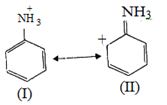
A
$II$ is not an acceptable canonical structure because a carbonium ion is less stable than an ammonium ion.
B
$II$ is not an acceptable canonical structure because it is non-aromatic.
C
$II$ is not an acceptable canonical structure because nitrogen has ten valence electrons.
D
Both $(a)$ and $(c)$
Solution
(C) In structure $II$,the nitrogen atom is bonded to the ring with a double bond and also has three hydrogen atoms attached to it. This would mean the nitrogen atom has $5$ bonds,which corresponds to $10$ valence electrons. Since nitrogen belongs to the second period,it can accommodate a maximum of $8$ electrons in its valence shell (octet rule). Therefore,structure $II$ is not an acceptable canonical structure because nitrogen cannot have $10$ valence electrons.
0 likes
View Solution269
MediumMCQ
The acetylation of ethylamine gives $......$.
A
$N$-ethylacetamide
B
Acetamide
C
Methylacetamide
D
None of these
Solution
(A) The reaction of ethylamine $(CH_3CH_2NH_2)$ with acetyl chloride $(CH_3COCl)$ in the presence of a base leads to the formation of $N$-ethylacetamide.
$CH_3CH_2NH_2 + CH_3COCl \rightarrow CH_3CH_2NHCOCH_3 + HCl$
$CH_3CH_2NH_2 + CH_3COCl \rightarrow CH_3CH_2NHCOCH_3 + HCl$
0 likes
View Solution270
MediumMCQ
What is the product obtained upon the hydrolysis of a $1^o$ amine?
A
Nitroalkane
B
Cyanoalkane
C
Alkyl isocyanate
D
All of the above
Solution
(D) The hydrolysis of a $1^o$ amine is not a standard reaction that yields these products. However,if the question refers to the hydrolysis of an alkyl isocyanate $(R-N=C=O)$,it produces a $1^o$ amine $(R-NH_2)$ and $CO_2$. If the question implies the reaction of a $1^o$ amine with nitrous acid $(HNO_2)$,it produces an alcohol. Given the options provided,there seems to be a conceptual mismatch. Assuming the question asks for the product of a reaction involving these functional groups,none of the options are direct hydrolysis products of a $1^o$ amine. However,in many textbook contexts,this question is often misstated. Based on standard chemical reactivity,$1^o$ amines are stable to hydrolysis.
0 likes
View Solution271
MediumMCQ
Which of the following compounds reacts with $CHCl_3$ and $KOH$ to produce an isocyanide?
A
$R-NH_2$
B
$R_2NH$
C
$R_3N$
D
$R_4N^+Cl^-$
Solution
(A) The reaction of primary amines with chloroform $(CHCl_3)$ and alcoholic potassium hydroxide $(KOH)$ is known as the carbylamine reaction.
The general equation is:
$R-NH_2 + CHCl_3 + 3KOH \to R-NC + 3KCl + 3H_2O$
Only primary $(1^o)$ amines give this test.
Secondary $(2^o)$ and tertiary $(3^o)$ amines do not give the carbylamine test.
The general equation is:
$R-NH_2 + CHCl_3 + 3KOH \to R-NC + 3KCl + 3H_2O$
Only primary $(1^o)$ amines give this test.
Secondary $(2^o)$ and tertiary $(3^o)$ amines do not give the carbylamine test.
0 likes
View Solution272
DifficultMCQ
Which reaction is known as the Schotten-Baumann reaction?
A
Acetylation of $RNH_2$
B
Benzoylation of $RNH_2$
C
Alkylation of $RNH_2$
D
Arylation of $RNH_2$
Solution
(B) The reaction of amines ($RNH_2$ or $R_2NH$) or phenols with benzoyl chloride $(C_6H_5COCl)$ in the presence of an aqueous base (like $NaOH$) is known as the Schotten-Baumann reaction. Therefore,the benzoylation of $RNH_2$ is the correct answer.
0 likes
View Solution273
MediumMCQ
What is formed when ethylamine reacts with chloroform in the presence of alcoholic $KOH$?
A
Ethyl cyanide
B
Ethyl isocyanide
C
Formic acid
D
Phosgene
Solution
(B) The reaction of a primary amine $(R-NH_2)$ with chloroform $(CHCl_3)$ and alcoholic potassium hydroxide $(KOH)$ is known as the Carbylamine reaction.
The chemical equation is: $CH_3CH_2NH_2 + CHCl_3 + 3KOH(alc.) \rightarrow CH_3CH_2NC + 3KCl + 3H_2O$.
In this reaction,ethylamine reacts with chloroform and $KOH$ to form ethyl isocyanide $(CH_3CH_2NC)$,which is characterized by an offensive,foul smell.
The chemical equation is: $CH_3CH_2NH_2 + CHCl_3 + 3KOH(alc.) \rightarrow CH_3CH_2NC + 3KCl + 3H_2O$.
In this reaction,ethylamine reacts with chloroform and $KOH$ to form ethyl isocyanide $(CH_3CH_2NC)$,which is characterized by an offensive,foul smell.
0 likes
View Solution274
MediumMCQ
Which foul-smelling substance is formed by the action of alcoholic caustic potash on chloroform and aniline?
A
Phenyl cyanide
B
Nitrobenzene
C
Phenyl isocyanide
D
Phenyl isocyanate
Solution
(C) This reaction is known as the carbylamine reaction. When aniline $(C_6H_5NH_2)$ reacts with chloroform $(CHCl_3)$ in the presence of alcoholic potassium hydroxide $(KOH)$,it produces phenyl isocyanide $(C_6H_5NC)$,which has a characteristic foul smell.
The chemical equation is:
$C_6H_5NH_2 + CHCl_3 + 3KOH \rightarrow C_6H_5NC + 3KCl + 3H_2O$
The chemical equation is:
$C_6H_5NH_2 + CHCl_3 + 3KOH \rightarrow C_6H_5NC + 3KCl + 3H_2O$
0 likes
View Solution275
DifficultMCQ
In the reaction $C_6H_5NH_2 + CHCl_3 + 3KOH \rightarrow A + 3KCl + 3H_2O$,what is '$A$'?
A
$C_6H_5CN$
B
$C_6H_5NC$
C
$o-HOC_6H_4NH_2$
D
$o-ClC_6H_4NH_2$
Solution
(B) The given reaction is the Carbylamine reaction,which is a characteristic test for primary amines.
When a primary amine (aliphatic or aromatic) is heated with chloroform $(CHCl_3)$ and an alcoholic base (like $KOH$),it forms an isocyanide (also known as carbylamine),which has a foul smell.
The balanced chemical equation is:
$C_6H_5NH_2 + CHCl_3 + 3KOH \rightarrow C_6H_5NC + 3KCl + 3H_2O$
Here,$C_6H_5NC$ (phenyl isocyanide) is the product '$A$'.
When a primary amine (aliphatic or aromatic) is heated with chloroform $(CHCl_3)$ and an alcoholic base (like $KOH$),it forms an isocyanide (also known as carbylamine),which has a foul smell.
The balanced chemical equation is:
$C_6H_5NH_2 + CHCl_3 + 3KOH \rightarrow C_6H_5NC + 3KCl + 3H_2O$
Here,$C_6H_5NC$ (phenyl isocyanide) is the product '$A$'.
0 likes
View Solution276
DifficultMCQ
What is formed by the reaction of $p$-toluidine with chloroform and alcoholic $KOH$?
A
$CH_3-C_6H_4-CN$
B
$CH_3-C_6H_4-N_2Cl$
C
$CH_3-C_6H_4-NHCHCl_2$
D
$CH_3-C_6H_4-NC$
0 likes
View Solution277
MediumMCQ
In the reaction $CH_3NH_2 + X + KOH \rightarrow CH_3NC + 3KCl + 3H_2O$,what is $X$?
A
$CH_2Cl_2$
B
$CHCl_3$
C
$CH_3Cl$
D
$CCl_4$
Solution
(B) The given reaction is the $Carbylamine$ reaction,which is a characteristic test for primary amines.
In this reaction,a primary amine reacts with chloroform $(CHCl_3)$ and alcoholic potassium hydroxide $(KOH)$ to form an isocyanide (carbylamine),which has a foul smell.
The balanced chemical equation is:
$CH_3NH_2 + CHCl_3 + 3KOH \rightarrow CH_3NC + 3KCl + 3H_2O$.
Thus,$X$ is $CHCl_3$.
In this reaction,a primary amine reacts with chloroform $(CHCl_3)$ and alcoholic potassium hydroxide $(KOH)$ to form an isocyanide (carbylamine),which has a foul smell.
The balanced chemical equation is:
$CH_3NH_2 + CHCl_3 + 3KOH \rightarrow CH_3NC + 3KCl + 3H_2O$.
Thus,$X$ is $CHCl_3$.
0 likes
View Solution278
MediumMCQ
$C_2H_5Br$ $\xrightarrow{AgCN} X$ $\xrightarrow{Reduction} Y$. Here,$Y$ is:
A
$n$-propylamine
B
Isopropylamine
C
Ethylmethylamine
D
Ethylamine
0 likes
View Solution279
MediumMCQ
Which of the following reacts with $CHCl_3$ and $KOH$ to produce $RNC$?
A
$RNH_2$
B
$R_2NH$
C
$R_3N$
D
$R_4N^{+}Cl^{-}$
Solution
(A) The reaction of primary amines $(RNH_2)$ with chloroform $(CHCl_3)$ and alcoholic potassium hydroxide $(KOH)$ is known as the Carbylamine reaction or Isocyanide test.
In this reaction,the primary amine is converted into an isocyanide $(RNC)$,which has a characteristic foul smell.
The chemical equation is: $RNH_2 + CHCl_3 + 3KOH \rightarrow RNC + 3KCl + 3H_2O$.
Secondary and tertiary amines do not give this test.
In this reaction,the primary amine is converted into an isocyanide $(RNC)$,which has a characteristic foul smell.
The chemical equation is: $RNH_2 + CHCl_3 + 3KOH \rightarrow RNC + 3KCl + 3H_2O$.
Secondary and tertiary amines do not give this test.
0 likes
View Solution280
MediumMCQ
What is produced when aniline is heated with chloroform and alcoholic $KOH$?
A
Phenyl isocyanide
B
Phenyl cyanide
C
Chlorobenzene
D
Phenol
Solution
(A) The reaction of primary amines with chloroform $(CHCl_3)$ and alcoholic potassium hydroxide $(KOH)$ is known as the $Carbylamine$ reaction or $Isocyanide$ test.
Aniline $(C_6H_5NH_2)$,being a primary amine,reacts with $CHCl_3$ and $KOH$ to form phenyl isocyanide $(C_6H_5NC)$,which has an offensive,foul smell.
The chemical equation is: $C_6H_5NH_2 + CHCl_3 + 3KOH \rightarrow C_6H_5NC + 3KCl + 3H_2O$.
Aniline $(C_6H_5NH_2)$,being a primary amine,reacts with $CHCl_3$ and $KOH$ to form phenyl isocyanide $(C_6H_5NC)$,which has an offensive,foul smell.
The chemical equation is: $C_6H_5NH_2 + CHCl_3 + 3KOH \rightarrow C_6H_5NC + 3KCl + 3H_2O$.
0 likes
View Solution281
MediumMCQ
Consider the following reaction. What is the major product formed?
$[CH_3CH_2CH_2-N^+(CH_3)_2-CH_2CH_3] OH^- \xrightarrow{\text{Heat}}$
$[CH_3CH_2CH_2-N^+(CH_3)_2-CH_2CH_3] OH^- \xrightarrow{\text{Heat}}$
A
$CH_2=CH_2$
B
$CH_3CH_2CH=CH_2$
C
Both $(1)$ and $(2)$ in equal amounts
D
No reaction occurs
Solution
(A) This is an example of the $Hofmann$ elimination reaction.
In the quaternary ammonium hydroxide $[CH_3CH_2CH_2-N^+(CH_3)_2-CH_2CH_3] OH^-$,there are two types of $\beta$-hydrogens available for elimination.
Elimination occurs to form the least substituted alkene according to $Hofmann's$ rule.
The $\beta$-hydrogens on the ethyl group are more accessible and acidic compared to those on the propyl group.
Therefore,the major product formed is $CH_2=CH_2$ (ethene).
In the quaternary ammonium hydroxide $[CH_3CH_2CH_2-N^+(CH_3)_2-CH_2CH_3] OH^-$,there are two types of $\beta$-hydrogens available for elimination.
Elimination occurs to form the least substituted alkene according to $Hofmann's$ rule.
The $\beta$-hydrogens on the ethyl group are more accessible and acidic compared to those on the propyl group.
Therefore,the major product formed is $CH_2=CH_2$ (ethene).
0 likes
View Solution282
MediumMCQ
Which of the following is the most basic compound?
A
Benzylamine
B
Aniline
C
Acetanilide
D
$p-$Nitroaniline
Solution
(A) Benzylamine $(C_6H_5CH_2NH_2)$ is the most basic compound among the given options.
In benzylamine,the lone pair of electrons on the nitrogen atom is localized and available for donation.
In aniline $(C_6H_5NH_2)$,the lone pair is delocalized into the benzene ring due to resonance,reducing its basicity.
In acetanilide $(CH_3CONHC_6H_5)$,the lone pair is involved in resonance with the carbonyl group $(C=O)$,further reducing basicity.
In $p-$nitroaniline,the strong electron-withdrawing $-NO_2$ group decreases the electron density on the nitrogen atom,making it the least basic.
In benzylamine,the lone pair of electrons on the nitrogen atom is localized and available for donation.
In aniline $(C_6H_5NH_2)$,the lone pair is delocalized into the benzene ring due to resonance,reducing its basicity.
In acetanilide $(CH_3CONHC_6H_5)$,the lone pair is involved in resonance with the carbonyl group $(C=O)$,further reducing basicity.
In $p-$nitroaniline,the strong electron-withdrawing $-NO_2$ group decreases the electron density on the nitrogen atom,making it the least basic.
0 likes
View Solution283
DifficultMCQ
Which alkene is obtained as the major product in the given reaction?
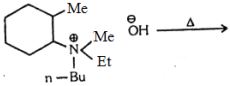
A
$1-$methylcyclohexene
B
$CH_2 = CH_2$
C
$3-$methylcyclohexene
D
$2-$butene
Solution
(C) The reaction is a Hofmann elimination of a quaternary ammonium hydroxide.
In Hofmann elimination,the base abstracts a proton from the least sterically hindered $\beta$-carbon.
Here,the $\beta$-hydrogens on the methyl group attached to the ring are less hindered than the $\beta$-hydrogen on the ring carbon.
Therefore,the elimination occurs to form the less substituted alkene,which is $3-$methylcyclohexene.
In Hofmann elimination,the base abstracts a proton from the least sterically hindered $\beta$-carbon.
Here,the $\beta$-hydrogens on the methyl group attached to the ring are less hindered than the $\beta$-hydrogen on the ring carbon.
Therefore,the elimination occurs to form the less substituted alkene,which is $3-$methylcyclohexene.
0 likes
View Solution284
EasyMCQ
Which of the following is the strongest base?
A
$C_6H_5NH_2$
B
$p-O_2NC_6H_4NH_2$
C
$m-O_2NC_6H_4NH_2$
D
$C_6H_5CH_2NH_2$
Solution
(D) To determine the basic strength,we look at the availability of the lone pair on the nitrogen atom.
$C_6H_5NH_2$ (Aniline) has the lone pair in resonance with the benzene ring,reducing its availability.
$p-O_2NC_6H_4NH_2$ and $m-O_2NC_6H_4NH_2$ contain the $-NO_2$ group,which is a strong electron-withdrawing group ($-I$ and $-M$ effects),further decreasing the basicity.
$C_6H_5CH_2NH_2$ (Benzylamine) has the $-NH_2$ group attached to a $CH_2$ group,not directly to the benzene ring.
Therefore,the lone pair on nitrogen is not involved in resonance with the benzene ring,making it the most available for protonation.
Thus,$C_6H_5CH_2NH_2$ is the strongest base among the given options.
$C_6H_5NH_2$ (Aniline) has the lone pair in resonance with the benzene ring,reducing its availability.
$p-O_2NC_6H_4NH_2$ and $m-O_2NC_6H_4NH_2$ contain the $-NO_2$ group,which is a strong electron-withdrawing group ($-I$ and $-M$ effects),further decreasing the basicity.
$C_6H_5CH_2NH_2$ (Benzylamine) has the $-NH_2$ group attached to a $CH_2$ group,not directly to the benzene ring.
Therefore,the lone pair on nitrogen is not involved in resonance with the benzene ring,making it the most available for protonation.
Thus,$C_6H_5CH_2NH_2$ is the strongest base among the given options.
0 likes
View Solution285
EasyMCQ
Which of the following is the strongest base?
A
$C_6H_5NH_2$
B
$p-NO_2-C_6H_4NH_2$
C
$m-NO_2-C_6H_4NH_2$
D
$C_6H_5CH_2NH_2$
Solution
(D) The basicity of amines depends on the availability of the lone pair of electrons on the nitrogen atom.
In $C_6H_5NH_2$ (aniline),the lone pair is involved in resonance with the benzene ring,reducing its availability.
In $p-NO_2-C_6H_4NH_2$ and $m-NO_2-C_6H_4NH_2$,the $-NO_2$ group is a strong electron-withdrawing group ($-I$ and $-M$ effect),which further decreases the electron density on the nitrogen atom,making them weaker bases than aniline.
In $C_6H_5CH_2NH_2$ (benzylamine),the $-NH_2$ group is attached to a $CH_2$ group,not directly to the benzene ring. Therefore,the lone pair is not involved in resonance with the benzene ring.
Thus,$C_6H_5CH_2NH_2$ is the strongest base among the given options.
In $C_6H_5NH_2$ (aniline),the lone pair is involved in resonance with the benzene ring,reducing its availability.
In $p-NO_2-C_6H_4NH_2$ and $m-NO_2-C_6H_4NH_2$,the $-NO_2$ group is a strong electron-withdrawing group ($-I$ and $-M$ effect),which further decreases the electron density on the nitrogen atom,making them weaker bases than aniline.
In $C_6H_5CH_2NH_2$ (benzylamine),the $-NH_2$ group is attached to a $CH_2$ group,not directly to the benzene ring. Therefore,the lone pair is not involved in resonance with the benzene ring.
Thus,$C_6H_5CH_2NH_2$ is the strongest base among the given options.
0 likes
View Solution286
MediumMCQ
What is the correct order of basicity for the given amines in a chlorobenzene medium?
$(A)$ $CH_3CH_2NH_2$
$(B)$ Cyclohexylamine
$(C)$ $N$-Methylpiperidine
$(D)$ Pyrrolidine
$(A)$ $CH_3CH_2NH_2$
$(B)$ Cyclohexylamine
$(C)$ $N$-Methylpiperidine
$(D)$ Pyrrolidine
A
$D > A > C > B$
B
$A > B > C > D$
C
$C > D > B > A$
D
$C > D > A > B$
Solution
(D) The basicity of amines in a non-polar solvent like chlorobenzene is primarily determined by the availability of the lone pair on the nitrogen atom and the stability of the conjugate acid.
$(A)$ $CH_3CH_2NH_2$ is a primary aliphatic amine.
$(B)$ Cyclohexylamine is a primary cyclic amine.
$(C)$ $N$-Methylpiperidine is a tertiary cyclic amine.
$(D)$ Pyrrolidine is a secondary cyclic amine.
In non-polar solvents,the steric hindrance and the inductive effect play a major role. Pyrrolidine $(D)$ is a secondary amine with a five-membered ring,which is highly basic due to the high electron density on nitrogen. $N$-Methylpiperidine $(C)$ is a tertiary amine. Generally,the order of basicity for these structures in non-polar media is $D > C > A > B$ or $C > D > A > B$ depending on specific solvation effects. Based on standard chemical trends for these specific structures,the correct order is $C > D > A > B$.
$(A)$ $CH_3CH_2NH_2$ is a primary aliphatic amine.
$(B)$ Cyclohexylamine is a primary cyclic amine.
$(C)$ $N$-Methylpiperidine is a tertiary cyclic amine.
$(D)$ Pyrrolidine is a secondary cyclic amine.
In non-polar solvents,the steric hindrance and the inductive effect play a major role. Pyrrolidine $(D)$ is a secondary amine with a five-membered ring,which is highly basic due to the high electron density on nitrogen. $N$-Methylpiperidine $(C)$ is a tertiary amine. Generally,the order of basicity for these structures in non-polar media is $D > C > A > B$ or $C > D > A > B$ depending on specific solvation effects. Based on standard chemical trends for these specific structures,the correct order is $C > D > A > B$.
0 likes
View Solution287
DifficultMCQ
What is the order of basicity for the following compounds?

A
$I > III > II > IV$
B
$II > III > I > IV$
C
$IV > III > II > I$
D
$III > I > II > IV$
Solution
(A) The basicity of amines depends on the availability of the lone pair on the nitrogen atom.
$(I)$ Piperidine: The nitrogen is $sp^3$ hybridized,and the lone pair is localized. It is a strong base.
$(II)$ Pyridine: The nitrogen is $sp^2$ hybridized. The lone pair is in an $sp^2$ orbital,which is more electronegative than an $sp^3$ orbital,making it less basic than piperidine.
$(III)$ Morpholine: Similar to piperidine,but the oxygen atom exerts an electron-withdrawing inductive effect ($-I$ effect),which decreases the electron density on the nitrogen,making it less basic than piperidine.
$(IV)$ Pyrrole: The lone pair on the nitrogen is involved in the aromatic sextet ($6\pi$ electrons),making it unavailable for protonation. Thus,it is the least basic.
Comparing these,the order of basicity is: Piperidine $(I) >$ Morpholine $(III) >$ Pyridine $(II) >$ Pyrrole $(IV)$.
$(I)$ Piperidine: The nitrogen is $sp^3$ hybridized,and the lone pair is localized. It is a strong base.
$(II)$ Pyridine: The nitrogen is $sp^2$ hybridized. The lone pair is in an $sp^2$ orbital,which is more electronegative than an $sp^3$ orbital,making it less basic than piperidine.
$(III)$ Morpholine: Similar to piperidine,but the oxygen atom exerts an electron-withdrawing inductive effect ($-I$ effect),which decreases the electron density on the nitrogen,making it less basic than piperidine.
$(IV)$ Pyrrole: The lone pair on the nitrogen is involved in the aromatic sextet ($6\pi$ electrons),making it unavailable for protonation. Thus,it is the least basic.
Comparing these,the order of basicity is: Piperidine $(I) >$ Morpholine $(III) >$ Pyridine $(II) >$ Pyrrole $(IV)$.
0 likes
View Solution288
MediumMCQ
Which of the following compounds is not soluble in $NaOH$?
A
$CH_3-CH_2-NO_2$
B
$(CH_3)_2CH-NO_2$
C
$(CH_3)_3C-NO_2$
D
$Ph-CH_2-NO_2$
Solution
(C) For a nitroalkane to be soluble in $NaOH$,it must possess at least one $\alpha$-hydrogen atom.
The $\alpha$-hydrogen is acidic due to the electron-withdrawing effect of the $-NO_2$ group,allowing it to be removed by a base like $NaOH$ to form a water-soluble salt.
$1.$ $CH_3-CH_2-NO_2$ (Nitroethane) has two $\alpha$-hydrogens.
$2.$ $(CH_3)_2CH-NO_2$ ($2$-Nitropropane) has one $\alpha$-hydrogen.
$3.$ $(CH_3)_3C-NO_2$ ($2$-Methyl$-2-$nitropropane) has no $\alpha$-hydrogen.
$4.$ $Ph-CH_2-NO_2$ (Phenylnitromethane) has two $\alpha$-hydrogens.
Since $(CH_3)_3C-NO_2$ lacks an $\alpha$-hydrogen,it cannot form a salt with $NaOH$ and is therefore insoluble.
The $\alpha$-hydrogen is acidic due to the electron-withdrawing effect of the $-NO_2$ group,allowing it to be removed by a base like $NaOH$ to form a water-soluble salt.
$1.$ $CH_3-CH_2-NO_2$ (Nitroethane) has two $\alpha$-hydrogens.
$2.$ $(CH_3)_2CH-NO_2$ ($2$-Nitropropane) has one $\alpha$-hydrogen.
$3.$ $(CH_3)_3C-NO_2$ ($2$-Methyl$-2-$nitropropane) has no $\alpha$-hydrogen.
$4.$ $Ph-CH_2-NO_2$ (Phenylnitromethane) has two $\alpha$-hydrogens.
Since $(CH_3)_3C-NO_2$ lacks an $\alpha$-hydrogen,it cannot form a salt with $NaOH$ and is therefore insoluble.
0 likes
View Solution289
MediumMCQ
Which of the following is the strongest base in an aqueous medium?
A
Trimethylamine
B
Aniline
C
Dimethylamine
D
Methylamine
Solution
(C) In an aqueous medium,the basicity of amines depends on the combined effect of the inductive effect $(+I)$,solvation effect,and steric hindrance.
For methyl-substituted amines,the order of basicity is $(CH_3)_2NH > CH_3NH_2 > (CH_3)_3N > C_6H_5NH_2$.
Dimethylamine $((CH_3)_2NH)$ has the highest basicity due to the optimal balance of the $+I$ effect of two methyl groups and sufficient solvation of the conjugate acid ion.
Aniline is the weakest base due to the delocalization of the lone pair of electrons on the nitrogen atom into the benzene ring.
For methyl-substituted amines,the order of basicity is $(CH_3)_2NH > CH_3NH_2 > (CH_3)_3N > C_6H_5NH_2$.
Dimethylamine $((CH_3)_2NH)$ has the highest basicity due to the optimal balance of the $+I$ effect of two methyl groups and sufficient solvation of the conjugate acid ion.
Aniline is the weakest base due to the delocalization of the lone pair of electrons on the nitrogen atom into the benzene ring.
0 likes
View Solution290
EasyMCQ
Which of the following is the most basic substance?
A
$p-$Nitroaniline
B
Acetanilide
C
Aniline
D
Benzylamine
Solution
(D) The basicity of amines depends on the availability of the lone pair of electrons on the nitrogen atom for protonation.
$1$. In $p-$Nitroaniline,the $-NO_2$ group is a strong electron-withdrawing group ($-I$ and $-M$ effect),which decreases the electron density on the nitrogen atom,making it the least basic.
$2$. In Acetanilide,the lone pair on the nitrogen atom is involved in resonance with the carbonyl group $(C=O)$,making it much less basic.
$3$. In Aniline,the lone pair on the nitrogen atom is involved in resonance with the benzene ring,reducing its availability for protonation.
$4$. In Benzylamine $(C_6H_5CH_2NH_2)$,the nitrogen atom is attached to a $CH_2$ group,which is not directly attached to the benzene ring. Therefore,the lone pair is not involved in resonance with the ring,making it the most basic among the given options.
$1$. In $p-$Nitroaniline,the $-NO_2$ group is a strong electron-withdrawing group ($-I$ and $-M$ effect),which decreases the electron density on the nitrogen atom,making it the least basic.
$2$. In Acetanilide,the lone pair on the nitrogen atom is involved in resonance with the carbonyl group $(C=O)$,making it much less basic.
$3$. In Aniline,the lone pair on the nitrogen atom is involved in resonance with the benzene ring,reducing its availability for protonation.
$4$. In Benzylamine $(C_6H_5CH_2NH_2)$,the nitrogen atom is attached to a $CH_2$ group,which is not directly attached to the benzene ring. Therefore,the lone pair is not involved in resonance with the ring,making it the most basic among the given options.
0 likes
View Solution291
EasyMCQ
Which of the following substituents,when attached at the para-position of aniline,decreases its basicity?
A
$-OH$
B
$-NO_2$
C
$-OCH_3$
D
All of the above
Solution
(B) The basicity of aniline depends on the availability of the lone pair of electrons on the nitrogen atom.
Substituents that exert an electron-withdrawing effect ($-I$ or $-M$ effect) decrease the electron density on the nitrogen atom,thereby reducing its basicity.
The $-NO_2$ group is a strong electron-withdrawing group due to both $-I$ and $-M$ effects.
Groups like $-OH$ and $-OCH_3$ are electron-donating groups ($+M$ effect),which increase the electron density on the nitrogen atom and thus increase the basicity of aniline.
Therefore,the $-NO_2$ group decreases the basicity of aniline.
Substituents that exert an electron-withdrawing effect ($-I$ or $-M$ effect) decrease the electron density on the nitrogen atom,thereby reducing its basicity.
The $-NO_2$ group is a strong electron-withdrawing group due to both $-I$ and $-M$ effects.
Groups like $-OH$ and $-OCH_3$ are electron-donating groups ($+M$ effect),which increase the electron density on the nitrogen atom and thus increase the basicity of aniline.
Therefore,the $-NO_2$ group decreases the basicity of aniline.
0 likes
View Solution292
MediumMCQ
Which of the following has the maximum nucleophilicity?
A
$F^{-}$
B
$OH^{-}$
C
$CH_3O^{-}$
D
$NH_2^{-}$
Solution
(D) Nucleophilicity is the ability of a species to donate an electron pair to an electrophile.
In a given period,nucleophilicity decreases as electronegativity increases.
The order of electronegativity for the atoms $N, O, F$ is $N < O < F$.
Therefore,the order of nucleophilicity is $NH_2^{-} > CH_3O^{-} > OH^{-} > F^{-}$.
Thus,$NH_2^{-}$ is the strongest nucleophile among the given options.
In a given period,nucleophilicity decreases as electronegativity increases.
The order of electronegativity for the atoms $N, O, F$ is $N < O < F$.
Therefore,the order of nucleophilicity is $NH_2^{-} > CH_3O^{-} > OH^{-} > F^{-}$.
Thus,$NH_2^{-}$ is the strongest nucleophile among the given options.
0 likes
View Solution293
MediumMCQ
Which of the following is the weakest base?
A
$C_6H_5 - CH_2 - NH_2$
B
$C_6H_5 - CH_2 - NH - CH_3$
C
$O_2N - CH_2 - NH_2$
D
$CH_3 - NH - CHO$
Solution
(D) The basicity of an amine depends on the availability of the lone pair of electrons on the nitrogen atom.
In $CH_3 - NH - CHO$,the lone pair on the nitrogen atom is involved in resonance with the adjacent carbonyl group $(C=O)$,which significantly reduces its availability for protonation.
In $O_2N - CH_2 - NH_2$,the $-NO_2$ group exerts a strong $-I$ effect,reducing basicity,but the resonance effect in the amide $(CH_3 - NH - CHO)$ is much stronger in decreasing the electron density on nitrogen.
Therefore,$CH_3 - NH - CHO$ is the weakest base among the given options.
In $CH_3 - NH - CHO$,the lone pair on the nitrogen atom is involved in resonance with the adjacent carbonyl group $(C=O)$,which significantly reduces its availability for protonation.
In $O_2N - CH_2 - NH_2$,the $-NO_2$ group exerts a strong $-I$ effect,reducing basicity,but the resonance effect in the amide $(CH_3 - NH - CHO)$ is much stronger in decreasing the electron density on nitrogen.
Therefore,$CH_3 - NH - CHO$ is the weakest base among the given options.
0 likes
View Solution294
MediumMCQ
What is the correct order of basicity for the following compounds?
$1$. $C_6H_5NH_2$ (Aniline)
$2$. $CH_3CH_2NH_2$ (Ethylamine)
$3$. $(CH_3)_2NH$ (Dimethylamine)
$4$. $CH_3CONH_2$ (Acetamide)
$1$. $C_6H_5NH_2$ (Aniline)
$2$. $CH_3CH_2NH_2$ (Ethylamine)
$3$. $(CH_3)_2NH$ (Dimethylamine)
$4$. $CH_3CONH_2$ (Acetamide)
A
$2 > 3 > 1 > 4$
B
$3 > 2 > 1 > 4$
C
$3 > 1 > 2 > 4$
D
$1 > 2 > 3 > 4$
Solution
(B) The basicity of amines depends on the availability of the lone pair on the nitrogen atom.
$1$. $C_6H_5NH_2$: The lone pair is involved in resonance with the benzene ring,making it less available for protonation.
$2$. $CH_3CH_2NH_2$: It is a primary aliphatic amine with a $+I$ effect from the ethyl group,increasing basicity compared to aniline.
$3$. $(CH_3)_2NH$: It is a secondary aliphatic amine with two methyl groups providing a stronger $+I$ effect,making it more basic than primary amines.
$4$. $CH_3CONH_2$: The lone pair on nitrogen is involved in resonance with the carbonyl group $(C=O)$,significantly reducing its basicity.
Comparing these,the order of basicity is: $(CH_3)_2NH > CH_3CH_2NH_2 > C_6H_5NH_2 > CH_3CONH_2$,which corresponds to $3 > 2 > 1 > 4$.
$1$. $C_6H_5NH_2$: The lone pair is involved in resonance with the benzene ring,making it less available for protonation.
$2$. $CH_3CH_2NH_2$: It is a primary aliphatic amine with a $+I$ effect from the ethyl group,increasing basicity compared to aniline.
$3$. $(CH_3)_2NH$: It is a secondary aliphatic amine with two methyl groups providing a stronger $+I$ effect,making it more basic than primary amines.
$4$. $CH_3CONH_2$: The lone pair on nitrogen is involved in resonance with the carbonyl group $(C=O)$,significantly reducing its basicity.
Comparing these,the order of basicity is: $(CH_3)_2NH > CH_3CH_2NH_2 > C_6H_5NH_2 > CH_3CONH_2$,which corresponds to $3 > 2 > 1 > 4$.
0 likes
View Solution295
MediumMCQ
What is the correct order of basicity for the substituted anilines ($I$ to $IV$)?
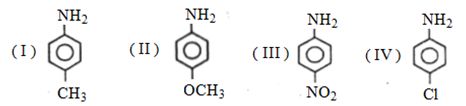
A
$I < II < IV < III$
B
$I < II < III < IV$
C
$II < I < III < IV$
D
$III < IV < I < II$
Solution
(D) The basicity of substituted anilines depends on the electron-donating or electron-withdrawing nature of the substituent attached to the benzene ring.
Electron-donating groups $(EDG)$ increase the electron density on the nitrogen atom,thereby increasing basicity.
Electron-withdrawing groups $(EWG)$ decrease the electron density on the nitrogen atom,thereby decreasing basicity.
In the given structures:
$(I)$ $p$-toluidine: $-CH_3$ is an $EDG$ (+$I$ effect).
$(II)$ $p$-anisidine: $-OCH_3$ is a strong $EDG$ (+$M$ effect).
$(III)$ $p$-nitroaniline: $-NO_2$ is a strong $EWG$ (-$M$ and -$I$ effect).
$(IV)$ $p$-chloroaniline: $-Cl$ is an $EWG$ (-$I$ effect,but +$M$ effect is weak).
Comparing the effects: The strongest $EDG$ is $-OCH_3$ $(II)$,followed by $-CH_3$ $(I)$. The EWGs are $-Cl$ $(IV)$ and $-NO_2$ $(III)$. Since $-NO_2$ is a much stronger $EWG$ than $-Cl$,it will make the aniline the least basic.
Thus,the order of basicity is: $III < IV < I < II$.
Electron-donating groups $(EDG)$ increase the electron density on the nitrogen atom,thereby increasing basicity.
Electron-withdrawing groups $(EWG)$ decrease the electron density on the nitrogen atom,thereby decreasing basicity.
In the given structures:
$(I)$ $p$-toluidine: $-CH_3$ is an $EDG$ (+$I$ effect).
$(II)$ $p$-anisidine: $-OCH_3$ is a strong $EDG$ (+$M$ effect).
$(III)$ $p$-nitroaniline: $-NO_2$ is a strong $EWG$ (-$M$ and -$I$ effect).
$(IV)$ $p$-chloroaniline: $-Cl$ is an $EWG$ (-$I$ effect,but +$M$ effect is weak).
Comparing the effects: The strongest $EDG$ is $-OCH_3$ $(II)$,followed by $-CH_3$ $(I)$. The EWGs are $-Cl$ $(IV)$ and $-NO_2$ $(III)$. Since $-NO_2$ is a much stronger $EWG$ than $-Cl$,it will make the aniline the least basic.
Thus,the order of basicity is: $III < IV < I < II$.
0 likes
View Solution296
MediumMCQ
Which is the correct decreasing order of basic strength for the following compounds?
$(I)$ Aniline
$(II)$ $p$-Nitroaniline
$(III)$ $p$-Cyanoaniline
$(IV)$ $p$-Toluidine
$(I)$ Aniline
$(II)$ $p$-Nitroaniline
$(III)$ $p$-Cyanoaniline
$(IV)$ $p$-Toluidine
A
$I > II > III > IV$
B
$II > III > I > IV$
C
$IV > I > III > II$
D
$IV > I > II > III$
Solution
(C) The basic strength of aromatic amines depends on the electron density on the nitrogen atom.
Electron-donating groups (like $-CH_3$) increase the basicity by increasing electron density on the nitrogen atom through the $+I$ effect.
Electron-withdrawing groups (like $-NO_2$ and $-CN$) decrease the basicity by withdrawing electron density from the nitrogen atom through the $-M$ and $-I$ effects.
Comparing the compounds:
$(IV)$ $p$-Toluidine has a $-CH_3$ group ($+I$ effect),making it the most basic.
$(I)$ Aniline has no substituent.
$(III)$ $p$-Cyanoaniline has a $-CN$ group (strong $-M$ and $-I$ effect).
$(II)$ $p$-Nitroaniline has a $-NO_2$ group (stronger $-M$ and $-I$ effect than $-CN$).
Therefore,the decreasing order of basic strength is $(IV) > (I) > (III) > (II)$.
Electron-donating groups (like $-CH_3$) increase the basicity by increasing electron density on the nitrogen atom through the $+I$ effect.
Electron-withdrawing groups (like $-NO_2$ and $-CN$) decrease the basicity by withdrawing electron density from the nitrogen atom through the $-M$ and $-I$ effects.
Comparing the compounds:
$(IV)$ $p$-Toluidine has a $-CH_3$ group ($+I$ effect),making it the most basic.
$(I)$ Aniline has no substituent.
$(III)$ $p$-Cyanoaniline has a $-CN$ group (strong $-M$ and $-I$ effect).
$(II)$ $p$-Nitroaniline has a $-NO_2$ group (stronger $-M$ and $-I$ effect than $-CN$).
Therefore,the decreasing order of basic strength is $(IV) > (I) > (III) > (II)$.
0 likes
View Solution297
MediumMCQ
Which of the following substances is more basic than aniline?
A
Diphenylamine
B
Triphenylamine
C
$p$-Nitroaniline
D
Benzylamine
Solution
(D) The basicity of amines depends on the availability of the lone pair of electrons on the nitrogen atom.
In aniline,the lone pair of electrons on the nitrogen atom is involved in resonance with the benzene ring,which decreases its availability for protonation.
$A$,$B$,and $C$ are either less basic or have electron-withdrawing groups that further decrease the electron density on the nitrogen atom.
In $D$ (Benzylamine,$C_6H_5CH_2NH_2$),the nitrogen atom is attached to a $CH_2$ group,which is not directly attached to the benzene ring. Therefore,the lone pair is not involved in resonance with the benzene ring,making it more basic than aniline.
In aniline,the lone pair of electrons on the nitrogen atom is involved in resonance with the benzene ring,which decreases its availability for protonation.
$A$,$B$,and $C$ are either less basic or have electron-withdrawing groups that further decrease the electron density on the nitrogen atom.
In $D$ (Benzylamine,$C_6H_5CH_2NH_2$),the nitrogen atom is attached to a $CH_2$ group,which is not directly attached to the benzene ring. Therefore,the lone pair is not involved in resonance with the benzene ring,making it more basic than aniline.
0 likes
View Solution298
MediumMCQ
When $R-CO-NH_2$ is treated with $Br_2$ and $KOH$,it gives $R-NH_2$ as the major product. Which intermediate is involved in this reaction?
A
$R-CO-NHBr$
B
$R-NHBr$
C
$R-Br$
D
$R-CO-NHBr_2$
Solution
(A) The reaction described is the $Hofmann$ $Bromamide$ $Degradation$ reaction.
In this reaction,the amide $(R-CO-NH_2)$ reacts with $Br_2$ in the presence of a strong base $(KOH)$ to form an isocyanate intermediate $(R-N=C=O)$.
However,the initial step involves the formation of $N-bromamide$ $(R-CO-NHBr)$ by the replacement of a hydrogen atom on the nitrogen with a bromine atom.
Thus,$R-CO-NHBr$ is the key intermediate formed during the process.
In this reaction,the amide $(R-CO-NH_2)$ reacts with $Br_2$ in the presence of a strong base $(KOH)$ to form an isocyanate intermediate $(R-N=C=O)$.
However,the initial step involves the formation of $N-bromamide$ $(R-CO-NHBr)$ by the replacement of a hydrogen atom on the nitrogen with a bromine atom.
Thus,$R-CO-NHBr$ is the key intermediate formed during the process.
0 likes
View Solution299
MediumMCQ
Which of the following substances is more basic?
A
Acetanilide
B
Benzylamine
C
$p$-Nitroaniline
D
Aniline
Solution
(B) The basicity of amines depends on the availability of the lone pair of electrons on the nitrogen atom.
In $p$-Nitroaniline,the $-NO_2$ group is electron-withdrawing,which decreases the electron density on the nitrogen atom.
In Acetanilide,the lone pair on the nitrogen is involved in resonance with the carbonyl group $(C=O)$,making it less available.
In Aniline,the lone pair is involved in resonance with the benzene ring.
In Benzylamine $(C_6H_5CH_2NH_2)$,the nitrogen atom is attached to a $CH_2$ group,which is not directly attached to the benzene ring. Therefore,the lone pair is not involved in resonance with the ring,making it the most basic among the given options.
In $p$-Nitroaniline,the $-NO_2$ group is electron-withdrawing,which decreases the electron density on the nitrogen atom.
In Acetanilide,the lone pair on the nitrogen is involved in resonance with the carbonyl group $(C=O)$,making it less available.
In Aniline,the lone pair is involved in resonance with the benzene ring.
In Benzylamine $(C_6H_5CH_2NH_2)$,the nitrogen atom is attached to a $CH_2$ group,which is not directly attached to the benzene ring. Therefore,the lone pair is not involved in resonance with the ring,making it the most basic among the given options.
0 likes
View Solution300
EasyMCQ
Which of the following is the least basic?
A
$CH_3NH_2$
B
$NH_3$
C
$C_2H_5NH_2$
D
$PhNH_2$
Solution
(D) In $PhNH_2$ (aniline),the lone pair of electrons on the nitrogen atom is involved in resonance with the benzene ring.
This decreases the availability of the lone pair for protonation,making it the least basic among the given compounds.
This decreases the availability of the lone pair for protonation,making it the least basic among the given compounds.
0 likes
View SolutionAmines — Properties of Amines · Frequently Asked Questions
1Are these Amines questions useful for JEE and NEET?
Yes. All questions in this section are mapped to JEE Main and NEET exam patterns. Previous year questions from JEE Main, NEET, GUJCET and state-level exams are included with full solutions.
2Can I switch to Hindi or Gujarati for these questions?
Yes. Use the language tabs in the hero section or the sidebar to view the same questions and solutions in English, Hindi or Gujarati.
3How do I generate a question paper from this subtopic?
Use the Vedclass Exam Paper Generator — select the chapter and subtopic, set difficulty, and generate Sets A, B, C, D automatically. First 3 chapters of every subject are free.
Vedclass Products
For Students
Vedclass Test Series
Mock tests in real JEE/NEET style with performance analysis. 5-day free trial.
Start Free TrialFor Teachers
Exam Paper Generator
Generate Set A/B/C/D papers from this chapter in 2 minutes. 3 chapters free.
Try FreeFor Institutes
Online Exam Module
Live online exams with unlimited students, 360° analytics & white-label branding.
See DemoFor Teachers & Institutes
Generate a Amines Exam Paper in 2 Minutes
Select subtopic & difficulty — Sets A, B, C, D auto-generated with No Repeat logic.
First 3 chapters of every subject are free — no payment required.