
A English
Properties of Amines Questions in English
Class 12 Chemistry · Amines · Properties of Amines
1212+
Questions
English
Language
100%
With Solutions
Showing 50 of 1212 questions in English
651
MediumMCQ
$CH_3CH_2Br$ $\xrightarrow{AgCN} A$ $\xrightarrow{H_2, Ni} B$. The final product $(B)$ is
A
$CH_3CH_2NH_2$
B
$CH_3CH_2CH_2NH_2$
C
$CH_3CH_2NHCH_3$
D
$CH_3CH_2NC$
Solution
(C) The reaction proceeds as follows:
$1$. $CH_3CH_2Br$ reacts with $AgCN$ to form an isocyanide (carbylamine) as the major product because $AgCN$ is a covalent compound. The reaction is: $CH_3CH_2Br + AgCN \rightarrow CH_3CH_2NC + AgBr$. Thus,$A$ is $CH_3CH_2NC$ (ethyl isocyanide).
$2$. The reduction of isocyanide $(R-NC)$ with $H_2$ in the presence of $Ni$ catalyst yields a secondary amine. The reaction is: $CH_3CH_2NC + 2H_2 \xrightarrow{Ni} CH_3CH_2NHCH_3$. Thus,$B$ is $CH_3CH_2NHCH_3$ ($N$-methylethanamine).
$1$. $CH_3CH_2Br$ reacts with $AgCN$ to form an isocyanide (carbylamine) as the major product because $AgCN$ is a covalent compound. The reaction is: $CH_3CH_2Br + AgCN \rightarrow CH_3CH_2NC + AgBr$. Thus,$A$ is $CH_3CH_2NC$ (ethyl isocyanide).
$2$. The reduction of isocyanide $(R-NC)$ with $H_2$ in the presence of $Ni$ catalyst yields a secondary amine. The reaction is: $CH_3CH_2NC + 2H_2 \xrightarrow{Ni} CH_3CH_2NHCH_3$. Thus,$B$ is $CH_3CH_2NHCH_3$ ($N$-methylethanamine).
0 likes
View Solution652
DifficultMCQ
Which of the following compounds will not give isocyanide on reaction with $CHCl_3 + KOH$?
A
Isobutylamine
B
Diethylamine
C
Aniline
D
Ethylamine
Solution
(B) The reaction of primary amines with $CHCl_3$ and $KOH$ (alcoholic) is known as the carbylamine test,which produces an isocyanide (carbylamine) with a foul smell.
$R-NH_2 + CHCl_3 + 3KOH \rightarrow R-NC + 3KCl + 3H_2O$
Secondary and tertiary amines do not undergo this reaction because they lack the necessary hydrogen atoms on the nitrogen atom to form the isocyanide intermediate.
Among the given options:
$(A)$ Isobutylamine ($CH_3)_2CHCH_2NH_2$ is a primary amine.
$(B)$ Diethylamine $(C_2H_5)_2NH$ is a secondary amine.
$(C)$ Aniline $C_6H_5NH_2$ is a primary amine.
$(D)$ Ethylamine $C_2H_5NH_2$ is a primary amine.
Therefore,diethylamine will not give the isocyanide test.
$R-NH_2 + CHCl_3 + 3KOH \rightarrow R-NC + 3KCl + 3H_2O$
Secondary and tertiary amines do not undergo this reaction because they lack the necessary hydrogen atoms on the nitrogen atom to form the isocyanide intermediate.
Among the given options:
$(A)$ Isobutylamine ($CH_3)_2CHCH_2NH_2$ is a primary amine.
$(B)$ Diethylamine $(C_2H_5)_2NH$ is a secondary amine.
$(C)$ Aniline $C_6H_5NH_2$ is a primary amine.
$(D)$ Ethylamine $C_2H_5NH_2$ is a primary amine.
Therefore,diethylamine will not give the isocyanide test.
0 likes
View Solution653
DifficultMCQ
$CH_3-CH_2-NH_2 \xrightarrow{CHCl_3, KOH} \text{Product}$
A
$CH_3-CH_2-CN$
B
$CH_3-CH_2-NC$
C
$CH_3-CH_2-OH$
D
$CH_3-CH_2-Cl$
Solution
(B) The given reaction is the $Carbylamine$ reaction,which is a characteristic test for primary amines.
When an aliphatic or aromatic primary amine is heated with chloroform $(CHCl_3)$ and alcoholic potassium hydroxide $(KOH)$,an isocyanide (or carbylamine) is formed.
The reaction is: $CH_3-CH_2-NH_2 + CHCl_3 + 3KOH \rightarrow CH_3-CH_2-NC + 3KCl + 3H_2O$.
The product formed is ethyl isocyanide $(CH_3-CH_2-NC)$.
When an aliphatic or aromatic primary amine is heated with chloroform $(CHCl_3)$ and alcoholic potassium hydroxide $(KOH)$,an isocyanide (or carbylamine) is formed.
The reaction is: $CH_3-CH_2-NH_2 + CHCl_3 + 3KOH \rightarrow CH_3-CH_2-NC + 3KCl + 3H_2O$.
The product formed is ethyl isocyanide $(CH_3-CH_2-NC)$.
0 likes
View Solution654
MediumMCQ
Which of the following is most reactive towards electrophilic substitution reaction?
A
Benzoic acid
B
Toluene
C
Chlorobenzene
D
Aniline
Solution
(D) Electrophilic substitution reaction rate depends on the electron density of the benzene ring. Groups that donate electrons to the ring (activating groups) increase the electron density,making the ring more reactive towards electrophiles.
$1$. $-COOH$ (in Benzoic acid) is a strong electron-withdrawing group (deactivating).
$2$. $-CH_3$ (in Toluene) is an electron-donating group via hyperconjugation and inductive effect (activating).
$3$. $-Cl$ (in Chlorobenzene) is an electron-withdrawing group via inductive effect,although it is ortho/para directing due to resonance (deactivating).
$4$. $-NH_2$ (in Aniline) is a very strong electron-donating group via resonance (+$M$ effect),which significantly increases the electron density of the benzene ring.
Therefore,Aniline is the most reactive towards electrophilic substitution.
$1$. $-COOH$ (in Benzoic acid) is a strong electron-withdrawing group (deactivating).
$2$. $-CH_3$ (in Toluene) is an electron-donating group via hyperconjugation and inductive effect (activating).
$3$. $-Cl$ (in Chlorobenzene) is an electron-withdrawing group via inductive effect,although it is ortho/para directing due to resonance (deactivating).
$4$. $-NH_2$ (in Aniline) is a very strong electron-donating group via resonance (+$M$ effect),which significantly increases the electron density of the benzene ring.
Therefore,Aniline is the most reactive towards electrophilic substitution.
0 likes
View Solution655
DifficultMCQ
The correct order of base strength in benzene as a solvent for the given amines is:
$I: CH_3CH_2NH_2$
$II: (CH_3CH_2)_2NH$
$III: (CH_3CH_2)_3N$
$I: CH_3CH_2NH_2$
$II: (CH_3CH_2)_2NH$
$III: (CH_3CH_2)_3N$
A
$I > II > III$
B
$II > III > I$
C
$III > II > I$
D
$II > I > III$
Solution
(C) In a non-polar solvent like benzene,the solvation effect (which is significant in water) is absent.
Therefore,the basic strength is primarily determined by the inductive effect ($+I$ effect) of the alkyl groups.
As the number of ethyl groups increases,the electron density on the nitrogen atom increases due to the $+I$ effect,making the lone pair more available for donation.
The order of basic strength based on the $+I$ effect is: tertiary amine $(III)$ > secondary amine $(II)$ > primary amine $(I)$.
Thus,the correct order is $III > II > I$.
Therefore,the basic strength is primarily determined by the inductive effect ($+I$ effect) of the alkyl groups.
As the number of ethyl groups increases,the electron density on the nitrogen atom increases due to the $+I$ effect,making the lone pair more available for donation.
The order of basic strength based on the $+I$ effect is: tertiary amine $(III)$ > secondary amine $(II)$ > primary amine $(I)$.
Thus,the correct order is $III > II > I$.
0 likes
View Solution656
DifficultMCQ
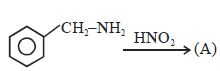
The reaction of benzylamine with nitrous acid $(HNO_2)$ produces product $A$. Identify product $A$.
A
$C_6H_5CH_2OH$
B
$C_6H_5OH$
C
$C_6H_5CHO$
D
$C_6H_5COOH$
Solution
(A) Primary aliphatic amines react with nitrous acid $(HNO_2)$ to form highly unstable aliphatic diazonium salts.
These salts immediately decompose in the presence of water to form alcohols,nitrogen gas,and mineral acids.
Benzylamine $(C_6H_5CH_2NH_2)$ is a primary amine.
The reaction is:
$C_6H_5CH_2NH_2 + HNO_2$ $\rightarrow [C_6H_5CH_2N_2^+Cl^-]$ $\xrightarrow{H_2O} C_6H_5CH_2OH + N_2 + HCl$.
Thus,the product $A$ is benzyl alcohol $(C_6H_5CH_2OH)$.
These salts immediately decompose in the presence of water to form alcohols,nitrogen gas,and mineral acids.
Benzylamine $(C_6H_5CH_2NH_2)$ is a primary amine.
The reaction is:
$C_6H_5CH_2NH_2 + HNO_2$ $\rightarrow [C_6H_5CH_2N_2^+Cl^-]$ $\xrightarrow{H_2O} C_6H_5CH_2OH + N_2 + HCl$.
Thus,the product $A$ is benzyl alcohol $(C_6H_5CH_2OH)$.
0 likes
View Solution657
MediumMCQ
The product of the following reaction is:
$C_6H_5N_2^+Cl^-$ $\xrightarrow{H_3PO_2 / \text{ethanol}}$ ?
$C_6H_5N_2^+Cl^-$ $\xrightarrow{H_3PO_2 / \text{ethanol}}$ ?
A
phenol
B
benzene
C
ethoxybenzene
D
chlorobenzene
Solution
(B) The reaction of benzene diazonium chloride $(C_6H_5N_2^+Cl^-)$ with hypophosphorous acid $(H_3PO_2)$ in the presence of ethanol acts as a reducing agent.
This reaction results in the reduction of the diazonium group to a hydrogen atom,yielding benzene $(C_6H_6)$ as the major product.
The reaction is:
$C_6H_5N_2^+Cl^- + H_3PO_2 + H_2O \rightarrow C_6H_6 + N_2 + H_3PO_3 + HCl$
Therefore,the correct option is $B$.
This reaction results in the reduction of the diazonium group to a hydrogen atom,yielding benzene $(C_6H_6)$ as the major product.
The reaction is:
$C_6H_5N_2^+Cl^- + H_3PO_2 + H_2O \rightarrow C_6H_6 + N_2 + H_3PO_3 + HCl$
Therefore,the correct option is $B$.
0 likes
View Solution658
MediumMCQ
Identify the strongest base from the given compounds.
A
Piperidine
B
Pyridine
C
Tetrahydrofuran
D
All have same basic strength
Solution
(A) To determine the strongest base,we evaluate the availability of the lone pair of electrons on the heteroatom for protonation:
$1$. $A$ (Piperidine): The nitrogen atom is $sp^3$ hybridized. The lone pair is localized and readily available for donation to a proton. It is a secondary amine and a strong base.
$2$. $B$ (Pyridine): The nitrogen atom is $sp^2$ hybridized. The lone pair resides in an $sp^2$ orbital,which has more $s$-character than an $sp^3$ orbital,making the lone pair less available for donation. Additionally,the lone pair is not involved in resonance,but the $sp^2$ hybridization makes it significantly less basic than piperidine.
$3$. $C$ (Tetrahydrofuran): The oxygen atom is $sp^3$ hybridized,but oxygen is much more electronegative than nitrogen. Therefore,it holds its lone pairs more tightly,making it a very weak base compared to amines.
Comparing these,piperidine $(A)$ is the strongest base because its lone pair is on a less electronegative nitrogen atom and is in an $sp^3$ orbital,making it most available for protonation.
$1$. $A$ (Piperidine): The nitrogen atom is $sp^3$ hybridized. The lone pair is localized and readily available for donation to a proton. It is a secondary amine and a strong base.
$2$. $B$ (Pyridine): The nitrogen atom is $sp^2$ hybridized. The lone pair resides in an $sp^2$ orbital,which has more $s$-character than an $sp^3$ orbital,making the lone pair less available for donation. Additionally,the lone pair is not involved in resonance,but the $sp^2$ hybridization makes it significantly less basic than piperidine.
$3$. $C$ (Tetrahydrofuran): The oxygen atom is $sp^3$ hybridized,but oxygen is much more electronegative than nitrogen. Therefore,it holds its lone pairs more tightly,making it a very weak base compared to amines.
Comparing these,piperidine $(A)$ is the strongest base because its lone pair is on a less electronegative nitrogen atom and is in an $sp^3$ orbital,making it most available for protonation.
0 likes
View Solution659
MediumMCQ
Choose the correct order of basic strength.
A
$C_2H_5-NH_2 > (C_2H_5)_2NH > (C_2H_5)_3N > C_6H_5-NH_2$
B
$(C_2H_5)_3N > (C_2H_5)_2NH > C_2H_5-NH_2 > C_6H_5-NH_2$
C
$(C_2H_5)_2NH > (C_2H_5)_3N > C_2H_5-NH_2 > C_6H_5-NH_2$
D
$C_6H_5-NH_2 > (C_2H_5)_2NH > (C_2H_5)_3N > C_2H_5-NH_2$
Solution
(C) The basic strength of amines in aqueous solution depends on the combined effect of inductive effect,solvation effect,and steric hindrance.
For ethyl-substituted amines,the order of basicity is $(C_2H_5)_2NH > (C_2H_5)_3N > C_2H_5NH_2$.
$C_6H_5-NH_2$ (aniline) is the least basic among these because the lone pair on the nitrogen atom is involved in resonance with the benzene ring,making it less available for protonation.
Therefore,the correct order is $(C_2H_5)_2NH > (C_2H_5)_3N > C_2H_5-NH_2 > C_6H_5-NH_2$.
For ethyl-substituted amines,the order of basicity is $(C_2H_5)_2NH > (C_2H_5)_3N > C_2H_5NH_2$.
$C_6H_5-NH_2$ (aniline) is the least basic among these because the lone pair on the nitrogen atom is involved in resonance with the benzene ring,making it less available for protonation.
Therefore,the correct order is $(C_2H_5)_2NH > (C_2H_5)_3N > C_2H_5-NH_2 > C_6H_5-NH_2$.
0 likes
View Solution660
DifficultMCQ
Identify the final product $Z$ in the following reaction sequence:
$Aniline$ $\xrightarrow{CH_3COCl} X$ $\xrightarrow{Br_2/AlBr_3} Y$ $\xrightarrow{H_3O^+} Z$
$Aniline$ $\xrightarrow{CH_3COCl} X$ $\xrightarrow{Br_2/AlBr_3} Y$ $\xrightarrow{H_3O^+} Z$
A
$p$-Bromoaniline
B
$p$-Bromophenol
C
$p$-Bromoacetanilide
D
$2,4,6$-Tribromoaniline
Solution
(A) $1$. The reaction of aniline with acetyl chloride $(CH_3COCl)$ in the presence of a base (like pyridine) leads to the formation of acetanilide $(X)$,which is $C_6H_5NHCOCH_3$.
$2$. The acetanilide group $(-NHCOCH_3)$ is an ortho/para-directing group. Due to steric hindrance,the para-substitution is the major product when treated with $Br_2$ in the presence of a Lewis acid catalyst like $AlBr_3$ (or $FeBr_3$). Thus,$Y$ is $p$-bromoacetanilide.
$3$. Finally,the hydrolysis of $p$-bromoacetanilide $(Y)$ with $H_3O^+$ removes the acetyl protecting group to regenerate the amino group,yielding $p$-bromoaniline $(Z)$ as the final product.
$2$. The acetanilide group $(-NHCOCH_3)$ is an ortho/para-directing group. Due to steric hindrance,the para-substitution is the major product when treated with $Br_2$ in the presence of a Lewis acid catalyst like $AlBr_3$ (or $FeBr_3$). Thus,$Y$ is $p$-bromoacetanilide.
$3$. Finally,the hydrolysis of $p$-bromoacetanilide $(Y)$ with $H_3O^+$ removes the acetyl protecting group to regenerate the amino group,yielding $p$-bromoaniline $(Z)$ as the final product.
0 likes
View Solution661
DifficultMCQ
The reaction of $CH_3NH_2$ with $CH_3MgX$ yields ...........
A
Acetone
B
Alcohol
C
Methane
D
Ethane
Solution
(C) The reaction between a Grignard reagent $(CH_3MgX)$ and a compound containing an active hydrogen atom (like the $N-H$ bond in $CH_3NH_2$) results in the formation of an alkane.
$CH_3NH_2 + CH_3MgX \rightarrow CH_4 + CH_3NHMgX$
Here,the $CH_3^-$ group from the Grignard reagent abstracts the acidic proton from the amine,producing methane $(CH_4)$.
$CH_3NH_2 + CH_3MgX \rightarrow CH_4 + CH_3NHMgX$
Here,the $CH_3^-$ group from the Grignard reagent abstracts the acidic proton from the amine,producing methane $(CH_4)$.
0 likes
View Solution662
DifficultMCQ
The reaction of excess ethyl chloride with ammonia yields .................. .
A
Diethylamine
B
Ethane
C
Tetraethylammonium chloride
D
Methylamine
Solution
(C) The reaction of an alkyl halide with ammonia is known as ammonolysis. When excess ethyl chloride $(C_2H_5Cl)$ is reacted with ammonia $(NH_3)$,the reaction proceeds through successive alkylation steps until all hydrogen atoms on the nitrogen are replaced by ethyl groups.
$NH_3 + C_2H_5Cl \rightarrow C_2H_5NH_2 + HCl$
$C_2H_5NH_2 + C_2H_5Cl \rightarrow (C_2H_5)_2NH + HCl$
$(C_2H_5)_2NH + C_2H_5Cl \rightarrow (C_2H_5)_3N + HCl$
$(C_2H_5)_3N + C_2H_5Cl \rightarrow (C_2H_5)_4N^+Cl^-$
Since ethyl chloride is in excess,the final product is the quaternary ammonium salt,tetraethylammonium chloride.
$NH_3 + C_2H_5Cl \rightarrow C_2H_5NH_2 + HCl$
$C_2H_5NH_2 + C_2H_5Cl \rightarrow (C_2H_5)_2NH + HCl$
$(C_2H_5)_2NH + C_2H_5Cl \rightarrow (C_2H_5)_3N + HCl$
$(C_2H_5)_3N + C_2H_5Cl \rightarrow (C_2H_5)_4N^+Cl^-$
Since ethyl chloride is in excess,the final product is the quaternary ammonium salt,tetraethylammonium chloride.
0 likes
View Solution663
MediumMCQ
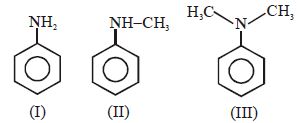
Which of the following is the correct order for basic strength?
A
$I > II > III$
B
$II > I > III$
C
$III > II > I$
D
$III > I > II$
Solution
(C) The basic strength of amines depends on the availability of the lone pair of electrons on the nitrogen atom.
In the given compounds:
$(I)$ is aniline $(C_6H_5NH_2)$.
$(II)$ is $N$-methylaniline $(C_6H_5NHCH_3)$.
$(III)$ is $N,N$-dimethylaniline $(C_6H_5N(CH_3)_2)$.
All three compounds have the lone pair on the nitrogen atom involved in resonance with the benzene ring,which decreases their basicity compared to aliphatic amines.
However,the presence of electron-donating methyl groups $(-CH_3)$ increases the electron density on the nitrogen atom due to the $+I$ effect.
As the number of methyl groups increases,the electron density on the nitrogen atom increases,making the lone pair more available for protonation.
Therefore,the order of basic strength is $III > II > I$.
In the given compounds:
$(I)$ is aniline $(C_6H_5NH_2)$.
$(II)$ is $N$-methylaniline $(C_6H_5NHCH_3)$.
$(III)$ is $N,N$-dimethylaniline $(C_6H_5N(CH_3)_2)$.
All three compounds have the lone pair on the nitrogen atom involved in resonance with the benzene ring,which decreases their basicity compared to aliphatic amines.
However,the presence of electron-donating methyl groups $(-CH_3)$ increases the electron density on the nitrogen atom due to the $+I$ effect.
As the number of methyl groups increases,the electron density on the nitrogen atom increases,making the lone pair more available for protonation.
Therefore,the order of basic strength is $III > II > I$.
0 likes
View Solution664
MediumMCQ
Identify the reagent $R$ in the following reaction:
$C_6H_5NO_2 \xrightarrow{R} C_6H_5NHOH$
$C_6H_5NO_2 \xrightarrow{R} C_6H_5NHOH$
A
$Sn + HCl$
B
$Zn + NH_4Cl$
C
$Pd + H_2$
D
$LiAlH_4$
Solution
(B) The reduction of nitrobenzene $(C_6H_5NO_2)$ to phenylhydroxylamine $(C_6H_5NHOH)$ is a partial reduction.
This specific transformation is achieved using zinc dust in the presence of an aqueous ammonium chloride solution $(Zn + NH_4Cl)$.
$Sn + HCl$ and $LiAlH_4$ typically reduce nitrobenzene completely to aniline $(C_6H_5NH_2)$.
$Pd + H_2$ also leads to the complete reduction to aniline.
Therefore,the correct reagent is $Zn + NH_4Cl$.
This specific transformation is achieved using zinc dust in the presence of an aqueous ammonium chloride solution $(Zn + NH_4Cl)$.
$Sn + HCl$ and $LiAlH_4$ typically reduce nitrobenzene completely to aniline $(C_6H_5NH_2)$.
$Pd + H_2$ also leads to the complete reduction to aniline.
Therefore,the correct reagent is $Zn + NH_4Cl$.
0 likes
View Solution665
EasyMCQ
Sulfanilic acid is a/an ....
A
Arrhenius acid
B
Lewis base
C
Both $(A)$ and $(B)$
D
Neither $(A)$ nor $(B)$
Solution
(C) Sulfanilic acid $(NH_2-C_6H_4-SO_3H)$ exists as a zwitterion in aqueous solution,where the acidic $-SO_3H$ group donates a proton to the basic $-NH_2$ group to form $^+NH_3-C_6H_4-SO_3^-$.
Due to the presence of the $-SO_3H$ group,it acts as an Arrhenius acid by increasing the concentration of $H^+$ ions in water.
Additionally,the $-NH_2$ group contains a lone pair of electrons on the nitrogen atom,which allows it to act as a Lewis base by donating this electron pair.
Therefore,it exhibits both characteristics.
Due to the presence of the $-SO_3H$ group,it acts as an Arrhenius acid by increasing the concentration of $H^+$ ions in water.
Additionally,the $-NH_2$ group contains a lone pair of electrons on the nitrogen atom,which allows it to act as a Lewis base by donating this electron pair.
Therefore,it exhibits both characteristics.
0 likes
View Solution666
DifficultMCQ
What product is formed when ethylamine reacts with nitrous acid?
A
$C_2H_6$ and $NH_3$
B
$C_2H_5OH$ and $N_2$
C
$C_2H_5OH$ and $C_2H_4$
D
$C_2H_5OH$ and $NH_3$
Solution
(B) When ethylamine $(C_2H_5NH_2)$ reacts with nitrous acid $(HNO_2)$,which is generated in situ by the reaction of $NaNO_2$ and $HCl$,it forms an unstable diazonium salt $(C_2H_5N_2^+Cl^-)$.
This diazonium salt immediately decomposes in the presence of water to form ethanol $(C_2H_5OH)$,nitrogen gas $(N_2)$,and hydrochloric acid $(HCl)$.
The reaction is: $C_2H_5NH_2 + HNO_2 \rightarrow C_2H_5OH + N_2 + H_2O$.
This diazonium salt immediately decomposes in the presence of water to form ethanol $(C_2H_5OH)$,nitrogen gas $(N_2)$,and hydrochloric acid $(HCl)$.
The reaction is: $C_2H_5NH_2 + HNO_2 \rightarrow C_2H_5OH + N_2 + H_2O$.
0 likes
View Solution667
DifficultMCQ
What will be the products $A$,$B$,and $C$ in the following reaction sequence?
$\text{Phenol}$ $\xrightarrow[\text{Distillation}]{\text{Zn}} A$ $\xrightarrow[\text{conc. } H_2SO_4]{\text{conc. } HNO_3, 60^{\circ}C} B$ $\xrightarrow[\text{NaOH (aq)}]{\text{Zn}} C$
$\text{Phenol}$ $\xrightarrow[\text{Distillation}]{\text{Zn}} A$ $\xrightarrow[\text{conc. } H_2SO_4]{\text{conc. } HNO_3, 60^{\circ}C} B$ $\xrightarrow[\text{NaOH (aq)}]{\text{Zn}} C$
A
Benzene,Nitrobenzene,and Aniline
B
Benzene,Dinitrobenzene,and $m$-Toluidine
C
Toluene,Nitrobenzene,and $m$-Toluidine
D
Benzene,Nitrobenzene,and Hydrazobenzene
Solution
(D) Step $1$: Phenol reacts with $Zn$ dust to form Benzene $(A)$.
$\text{C}_6H_5OH + Zn \rightarrow C_6H_6 + ZnO$
Step $2$: Benzene undergoes nitration with conc. $HNO_3$ and conc. $H_2SO_4$ at $60^{\circ}C$ to form Nitrobenzene $(B)$.
$C_6H_6 + HNO_3 \xrightarrow{H_2SO_4} C_6H_5NO_2 + H_2O$
Step $3$: Nitrobenzene is reduced by $Zn$ in the presence of aqueous $NaOH$ to form Hydrazobenzene $(C)$.
$2C_6H_5NO_2 + 5Zn + 10NaOH \rightarrow C_6H_5NH-NHC_6H_5 + 5Na_2ZnO_2 + 4H_2O$
$\text{C}_6H_5OH + Zn \rightarrow C_6H_6 + ZnO$
Step $2$: Benzene undergoes nitration with conc. $HNO_3$ and conc. $H_2SO_4$ at $60^{\circ}C$ to form Nitrobenzene $(B)$.
$C_6H_6 + HNO_3 \xrightarrow{H_2SO_4} C_6H_5NO_2 + H_2O$
Step $3$: Nitrobenzene is reduced by $Zn$ in the presence of aqueous $NaOH$ to form Hydrazobenzene $(C)$.
$2C_6H_5NO_2 + 5Zn + 10NaOH \rightarrow C_6H_5NH-NHC_6H_5 + 5Na_2ZnO_2 + 4H_2O$
0 likes
View Solution668
DifficultMCQ
What is the product formed when benzylamine reacts with nitrous acid $(HNO_2)$?
A
Aminobenzene
B
Benzene
C
Benzyl alcohol
D
Phenol
Solution
(C) When benzylamine $(C_6H_5CH_2NH_2)$ reacts with nitrous acid $(HNO_2)$,it forms an unstable diazonium salt $(C_6H_5CH_2N_2^+Cl^-)$.
This diazonium salt immediately undergoes hydrolysis in the presence of water to form benzyl alcohol $(C_6H_5CH_2OH)$ and nitrogen gas $(N_2)$.
The reaction is: $C_6H_5CH_2NH_2 + HNO_2 \rightarrow C_6H_5CH_2OH + N_2 + H_2O$.
This diazonium salt immediately undergoes hydrolysis in the presence of water to form benzyl alcohol $(C_6H_5CH_2OH)$ and nitrogen gas $(N_2)$.
The reaction is: $C_6H_5CH_2NH_2 + HNO_2 \rightarrow C_6H_5CH_2OH + N_2 + H_2O$.
0 likes
View Solution669
MediumMCQ
Assertion : Boiling and melting points of amides are higher than corresponding acids.
Reason : It is due to strong intermolecular hydrogen bonding in their molecules.
Reason : It is due to strong intermolecular hydrogen bonding in their molecules.
A
If both Assertion and Reason are correct and the Reason is a correct explanation of the Assertion.
B
If both Assertion and Reason are correct but Reason is not a correct explanation of the Assertion.
C
If the Assertion is correct but Reason is incorrect.
D
If both the Assertion and Reason are incorrect.
Solution
(D) Amides generally exhibit high boiling and melting points compared to other compounds of similar molecular mass,but when compared to their corresponding carboxylic acids,they are generally lower or comparable depending on the specific structure.
However,the statement that amides have higher boiling and melting points than corresponding acids is scientifically incorrect,as carboxylic acids form stronger intermolecular hydrogen bonds (dimers) than amides.
Therefore,the Assertion is incorrect,and the Reason is correct regarding the presence of intermolecular hydrogen bonding in amides.
However,the statement that amides have higher boiling and melting points than corresponding acids is scientifically incorrect,as carboxylic acids form stronger intermolecular hydrogen bonds (dimers) than amides.
Therefore,the Assertion is incorrect,and the Reason is correct regarding the presence of intermolecular hydrogen bonding in amides.
0 likes
View Solution670
DifficultMCQ
In the following sequence of reactions,what is $D$?
$Toluene$ $\xrightarrow{[O]} A$ $\xrightarrow{SOCl_2} B$ $\xrightarrow{NaN_3} C$ $\xrightarrow{Heat} D$
$Toluene$ $\xrightarrow{[O]} A$ $\xrightarrow{SOCl_2} B$ $\xrightarrow{NaN_3} C$ $\xrightarrow{Heat} D$
A
Primary amine
B
An amide
C
Phenyl isocyanate
D
$A$ chain lengthened hydrocarbon
Solution
(C) The reaction sequence is as follows:
$1$. $Toluene$ undergoes oxidation $([O])$ to form $Benzoic \ acid$ $(A)$.
$2$. $Benzoic \ acid$ reacts with $SOCl_2$ to form $Benzoyl \ chloride$ $(B)$.
$3$. $Benzoyl \ chloride$ reacts with $NaN_3$ to form $Benzoyl \ azide$ $(C)$.
$4$. $Benzoyl \ azide$ undergoes $Curtius \ rearrangement$ upon heating to form $Phenyl \ isocyanate$ $(D)$ with the loss of $N_2$ gas.
Therefore,$D$ is $Phenyl \ isocyanate$.
$1$. $Toluene$ undergoes oxidation $([O])$ to form $Benzoic \ acid$ $(A)$.
$2$. $Benzoic \ acid$ reacts with $SOCl_2$ to form $Benzoyl \ chloride$ $(B)$.
$3$. $Benzoyl \ chloride$ reacts with $NaN_3$ to form $Benzoyl \ azide$ $(C)$.
$4$. $Benzoyl \ azide$ undergoes $Curtius \ rearrangement$ upon heating to form $Phenyl \ isocyanate$ $(D)$ with the loss of $N_2$ gas.
Therefore,$D$ is $Phenyl \ isocyanate$.
0 likes
View Solution671
DifficultMCQ
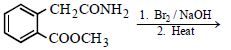
The following sequence of reactions on $A$ gives:
A
$A$ cyclic anhydride
B
$A$ cyclic imide
C
$A$ cyclic amide (lactam)
D
$A$ cyclic ketone
Solution
(C) The reaction sequence is as follows:
$1$. The starting material is methyl $2$-(carbamoylmethyl)benzoate.
$2$. Treatment with $Br_2/NaOH$ (Hofmann bromamide degradation) converts the amide group $(-CONH_2)$ into a primary amine group $(-NH_2)$.
$3$. The resulting intermediate is methyl $2$-(aminomethyl)benzoate.
$4$. Upon heating,this intermediate undergoes intramolecular cyclization (nucleophilic acyl substitution) where the amino group attacks the ester carbonyl,eliminating methanol $(CH_3OH)$ to form a cyclic amide,specifically a lactam (isoindolin$-1-$one).
$1$. The starting material is methyl $2$-(carbamoylmethyl)benzoate.
$2$. Treatment with $Br_2/NaOH$ (Hofmann bromamide degradation) converts the amide group $(-CONH_2)$ into a primary amine group $(-NH_2)$.
$3$. The resulting intermediate is methyl $2$-(aminomethyl)benzoate.
$4$. Upon heating,this intermediate undergoes intramolecular cyclization (nucleophilic acyl substitution) where the amino group attacks the ester carbonyl,eliminating methanol $(CH_3OH)$ to form a cyclic amide,specifically a lactam (isoindolin$-1-$one).
0 likes
View Solution672
DifficultMCQ
Nitrobenzene on treatment with zinc dust and aqueous ammonium chloride gives
A
$C_6H_5N = NC_6H_5$
B
$C_6H_5NH_2$
C
$C_6H_5NO$
D
$C_6H_5NHOH$
Solution
(D) When nitrobenzene $(C_6H_5NO_2)$ is treated with zinc dust and aqueous ammonium chloride $(NH_4Cl)$,it undergoes partial reduction to form phenylhydroxylamine $(C_6H_5NHOH)$.
This is a selective reduction reaction where the nitro group is reduced to a hydroxylamine group instead of being fully reduced to an amine.
This is a selective reduction reaction where the nitro group is reduced to a hydroxylamine group instead of being fully reduced to an amine.
0 likes
View Solution673
MediumMCQ
Which of the following statements is true?
A
Trimethylamine forms a soluble compound with Hinsberg reagent and $KOH$.
B
Dimethylamine reacts with $KOH$ and phenol to form an azo dye.
C
Methylamine reacts with nitrous acid and liberates $N_2$ from aqueous solution.
D
None of these.
Solution
(C) Among the given statements,only $(c)$ is true. Methylamine reacts with nitrous acid to liberate $N_2$ gas:
$CH_3-NH_2 + HNO_2 \to CH_3OH + N_2 + H_2O$.
Trimethylamine does not react with Hinsberg reagent $(C_6H_5SO_2Cl)$ in the presence of $KOH$ because it lacks an acidic hydrogen,and it remains insoluble.
Dimethylamine reacts with Hinsberg reagent to form a sulfonamide which is insoluble in $KOH$.
Azo dyes are typically formed by the coupling reaction of diazonium salts with phenols or aromatic amines,not by simple secondary amines.
$CH_3-NH_2 + HNO_2 \to CH_3OH + N_2 + H_2O$.
Trimethylamine does not react with Hinsberg reagent $(C_6H_5SO_2Cl)$ in the presence of $KOH$ because it lacks an acidic hydrogen,and it remains insoluble.
Dimethylamine reacts with Hinsberg reagent to form a sulfonamide which is insoluble in $KOH$.
Azo dyes are typically formed by the coupling reaction of diazonium salts with phenols or aromatic amines,not by simple secondary amines.
0 likes
View Solution674
DifficultMCQ
The compound which gives an oily nitrosoamine on reaction with nitrous acid at low temperature is:
A
$CH_3-NH_2$
B
$CH_3-CH(NH_2)-CH_3$
C
$CH_3-NH-CH_3$
D
$(CH_3)_3N$
Solution
(C) Secondary amines react with nitrous acid $(HNO_2)$ at low temperature to form yellow oily $N$-nitrosoamines.
$CH_3-NH-CH_3$ is a secondary amine.
Reaction: $(CH_3)_2NH + HNO_2 \rightarrow (CH_3)_2N-NO + H_2O$
$CH_3-NH-CH_3$ is a secondary amine.
Reaction: $(CH_3)_2NH + HNO_2 \rightarrow (CH_3)_2N-NO + H_2O$
0 likes
View Solution675
MediumMCQ
The basic character of ethylamine,diethylamine,and triethylamine in chlorobenzene is:
A
$C_2H_5NH_2 < (C_2H_5)_2NH < (C_2H_5)_3N$
B
$C_2H_5NH_2 < (C_2H_5)_3N < (C_2H_5)_2NH$
C
$(C_2H_5)_3N < (C_2H_5)_2NH < C_2H_5NH_2$
D
$(C_2H_5)_3N < C_2H_5NH_2 < (C_2H_5)_2NH$
Solution
(A) In a non-polar solvent like chlorobenzene,the solvation effect (hydrogen bonding) is absent.
Therefore,the basicity is determined solely by the inductive effect ($+I$ effect) of the alkyl groups.
As the number of ethyl groups increases,the electron density on the nitrogen atom increases,making the amine more basic.
Thus,the order of basicity is: $C_2H_5NH_2 < (C_2H_5)_2NH < (C_2H_5)_3N$.
Therefore,the basicity is determined solely by the inductive effect ($+I$ effect) of the alkyl groups.
As the number of ethyl groups increases,the electron density on the nitrogen atom increases,making the amine more basic.
Thus,the order of basicity is: $C_2H_5NH_2 < (C_2H_5)_2NH < (C_2H_5)_3N$.
0 likes
View Solution676
MediumMCQ
Consider the following reaction:
$C_6H_5NO_2$ $\xrightarrow{Sn / HCl} X$ $\xrightarrow{C_6H_5COCl} Y + HCl$
What is $Y$?
$C_6H_5NO_2$ $\xrightarrow{Sn / HCl} X$ $\xrightarrow{C_6H_5COCl} Y + HCl$
What is $Y$?
A
Acetanilide
B
Benzanilide
C
Azobenzene
D
Hydrazobenzene
Solution
(B) Step $1$: Reduction of nitrobenzene $(C_6H_5NO_2)$ with $Sn/HCl$ yields aniline $(C_6H_5NH_2)$ as product $X$.
Step $2$: Aniline $(C_6H_5NH_2)$ reacts with benzoyl chloride $(C_6H_5COCl)$ in the presence of a base to undergo benzoylation (Schotten-Baumann reaction).
Step $3$: The reaction is $C_6H_5NH_2 + C_6H_5COCl \rightarrow C_6H_5NHCOC_6H_5 + HCl$.
The product $Y$ is $C_6H_5NHCOC_6H_5$,which is known as benzanilide.
Step $2$: Aniline $(C_6H_5NH_2)$ reacts with benzoyl chloride $(C_6H_5COCl)$ in the presence of a base to undergo benzoylation (Schotten-Baumann reaction).
Step $3$: The reaction is $C_6H_5NH_2 + C_6H_5COCl \rightarrow C_6H_5NHCOC_6H_5 + HCl$.
The product $Y$ is $C_6H_5NHCOC_6H_5$,which is known as benzanilide.
0 likes
View Solution677
MediumMCQ
Which of the following compounds will not undergo an azo coupling reaction with benzene diazonium chloride?
A
Aniline
B
Phenol
C
Anisole
D
Nitrobenzene
Solution
(D) The benzene diazonium cation acts as a weak electrophile.
It undergoes electrophilic aromatic substitution (azo coupling) only with electron-rich aromatic compounds that contain strong electron-donating groups like $-OH$,$-NH_2$,or $-OCH_3$.
Nitrobenzene contains a strong electron-withdrawing group $(-NO_2)$,which deactivates the benzene ring towards electrophilic attack.
Therefore,nitrobenzene does not undergo the azo coupling reaction.
It undergoes electrophilic aromatic substitution (azo coupling) only with electron-rich aromatic compounds that contain strong electron-donating groups like $-OH$,$-NH_2$,or $-OCH_3$.
Nitrobenzene contains a strong electron-withdrawing group $(-NO_2)$,which deactivates the benzene ring towards electrophilic attack.
Therefore,nitrobenzene does not undergo the azo coupling reaction.
0 likes
View Solution678
MediumMCQ
Assertion : Amines are basic in nature.
Reason : Presence of a lone pair of electrons on the nitrogen atom.
Reason : Presence of a lone pair of electrons on the nitrogen atom.
A
If both Assertion and Reason are correct and the Reason is a correct explanation of the Assertion.
B
If both Assertion and Reason are correct but Reason is not a correct explanation of the Assertion.
C
If the Assertion is correct but Reason is incorrect.
D
If both the Assertion and Reason are incorrect.
Solution
(A) Amines are organic derivatives of ammonia $(NH_3)$.
The nitrogen atom in amines possesses one lone pair of electrons.
This lone pair can be donated to a Lewis acid (like $H^+$),which makes amines basic in nature.
Therefore,the presence of a lone pair of electrons on the nitrogen atom is the correct explanation for the basic nature of amines.
The nitrogen atom in amines possesses one lone pair of electrons.
This lone pair can be donated to a Lewis acid (like $H^+$),which makes amines basic in nature.
Therefore,the presence of a lone pair of electrons on the nitrogen atom is the correct explanation for the basic nature of amines.
0 likes
View Solution679
DifficultMCQ
Assertion : Alkyl isocyanides in acidified water give alkyl formamides.
Reason : In isocyanides,carbon first acts as a nucleophile and then as an electrophile.
Reason : In isocyanides,carbon first acts as a nucleophile and then as an electrophile.
A
If both Assertion and Reason are correct and the Reason is a correct explanation of the Assertion.
B
If both Assertion and Reason are correct but Reason is not a correct explanation of the Assertion.
C
If the Assertion is correct but Reason is incorrect.
D
If both the Assertion and Reason are incorrect.
Solution
(A) Alkyl isocyanides $(R-NC)$ undergo hydrolysis in the presence of acid to form alkyl formamides $(R-NH-CHO)$.
In the mechanism,the terminal carbon atom of the isocyanide group possesses a lone pair and a partial negative charge,allowing it to act as a nucleophile and get protonated by $H^+$.
After protonation,the carbon atom becomes electron-deficient (electrophilic) and is subsequently attacked by water $(H_2O)$.
The reaction sequence is: $R-N \equiv C$ $\xrightarrow{H^+} R-N^+ \equiv CH$ $\xrightarrow{H_2O} R-N=C(H)(OH) \rightleftharpoons R-NH-CHO$.
In the mechanism,the terminal carbon atom of the isocyanide group possesses a lone pair and a partial negative charge,allowing it to act as a nucleophile and get protonated by $H^+$.
After protonation,the carbon atom becomes electron-deficient (electrophilic) and is subsequently attacked by water $(H_2O)$.
The reaction sequence is: $R-N \equiv C$ $\xrightarrow{H^+} R-N^+ \equiv CH$ $\xrightarrow{H_2O} R-N=C(H)(OH) \rightleftharpoons R-NH-CHO$.
0 likes
View Solution680
MediumMCQ
Assertion : Anilinium chloride is more acidic than ammonium chloride.
Reason : Anilinium ion is resonance stabilized.
Reason : Anilinium ion is resonance stabilized.
A
If both Assertion and Reason are correct and the Reason is a correct explanation of the Assertion.
B
If both Assertion and Reason are correct but Reason is not a correct explanation of the Assertion.
C
If the Assertion is correct but Reason is incorrect.
D
If both the Assertion and Reason are incorrect.
Solution
(C) The assertion is correct: Anilinium chloride $(C_6H_5NH_3^+Cl^-)$ is more acidic than ammonium chloride $(NH_4^+Cl^-)$. This is because the conjugate base of anilinium ion,which is aniline $(C_6H_5NH_2)$,is resonance stabilized by the benzene ring.
The reason is incorrect: The anilinium ion itself is not resonance stabilized because the nitrogen atom is $sp^3$ hybridized and cannot participate in resonance with the benzene ring's $\pi$-system. The resonance stabilization occurs in the conjugate base (aniline) after the loss of a proton.
The reason is incorrect: The anilinium ion itself is not resonance stabilized because the nitrogen atom is $sp^3$ hybridized and cannot participate in resonance with the benzene ring's $\pi$-system. The resonance stabilization occurs in the conjugate base (aniline) after the loss of a proton.
0 likes
View Solution681
MediumMCQ
Assertion : Benzene diazonium salt on boiling with water forms phenol.
Reason : $C-N$ bond is polar.
Reason : $C-N$ bond is polar.
A
If both Assertion and Reason are correct and the Reason is a correct explanation of the Assertion.
B
If both Assertion and Reason are correct but Reason is not a correct explanation of the Assertion.
C
If the Assertion is correct but Reason is incorrect.
D
If both the Assertion and Reason are incorrect.
Solution
(C) The Assertion is correct: Benzene diazonium salts react with water upon boiling to form phenol,releasing $N_2$ gas.
The Reason is incorrect: The $C-N$ bond in the diazonium salt is indeed polar,but the reaction proceeds because the $N_2$ group is an excellent leaving group,not simply due to the polarity of the bond.
The Reason is incorrect: The $C-N$ bond in the diazonium salt is indeed polar,but the reaction proceeds because the $N_2$ group is an excellent leaving group,not simply due to the polarity of the bond.
0 likes
View Solution682
MediumMCQ
Assertion : Nitration of aniline can be conveniently done by protecting the amino group by acetylation.
Reason : Acetylation increases the electron density in the benzene ring.
Reason : Acetylation increases the electron density in the benzene ring.
A
If both Assertion and Reason are correct and the Reason is a correct explanation of the Assertion.
B
If both Assertion and Reason are correct but Reason is not a correct explanation of the Assertion.
C
If the Assertion is correct but Reason is incorrect.
D
If both the Assertion and Reason are incorrect.
Solution
(C) The Assertion is correct. Aniline is highly reactive and prone to oxidation; therefore,the $-NH_2$ group is protected by acetylation with acetic anhydride to form acetanilide.
The Reason is incorrect. The acetyl group $(-COCH_3)$ is an electron-withdrawing group due to resonance with the lone pair of nitrogen,which decreases the electron density on the benzene ring,thereby moderating the reactivity of the ring and preventing the formation of oxidation products.
The Reason is incorrect. The acetyl group $(-COCH_3)$ is an electron-withdrawing group due to resonance with the lone pair of nitrogen,which decreases the electron density on the benzene ring,thereby moderating the reactivity of the ring and preventing the formation of oxidation products.
0 likes
View Solution683
MediumMCQ
Assertion : Acetamide reacts with $Br_2$ in presence of methanolic $CH_3ONa$ to form methyl $N$-methylcarbamate.
Reason : Methyl isocyanate is formed as an intermediate which reacts with methanol to form methyl $N$-methylcarbamate.
Reason : Methyl isocyanate is formed as an intermediate which reacts with methanol to form methyl $N$-methylcarbamate.
A
If both Assertion and Reason are correct and the Reason is a correct explanation of the Assertion.
B
If both Assertion and Reason are correct but Reason is not a correct explanation of the Assertion.
C
If the Assertion is correct but Reason is incorrect.
D
If both the Assertion and Reason are incorrect.
Solution
(A) The reaction of acetamide $(CH_3CONH_2)$ with $Br_2$ in the presence of a base like $CH_3ONa$ is a variation of the Hofmann bromamide degradation.
In this specific medium,the intermediate formed is methyl isocyanate $(CH_3-N=C=O)$.
This methyl isocyanate then undergoes nucleophilic attack by the methanol $(CH_3OH)$ present in the medium to form methyl $N$-methylcarbamate $(CH_3NHCOOCH_3)$.
Therefore,both the Assertion and the Reason are correct,and the Reason correctly explains the mechanism of the reaction.
In this specific medium,the intermediate formed is methyl isocyanate $(CH_3-N=C=O)$.
This methyl isocyanate then undergoes nucleophilic attack by the methanol $(CH_3OH)$ present in the medium to form methyl $N$-methylcarbamate $(CH_3NHCOOCH_3)$.
Therefore,both the Assertion and the Reason are correct,and the Reason correctly explains the mechanism of the reaction.
0 likes
View Solution684
DifficultMCQ
Assertion : Acylation of amines gives a monosubstituted product whereas alkylation of amines gives polysubstituted product.
Reason : Acyl group sterically hinders the approach of further acyl groups.
Reason : Acyl group sterically hinders the approach of further acyl groups.
A
If both Assertion and Reason are correct and the Reason is a correct explanation of the Assertion.
B
If both Assertion and Reason are correct but Reason is not a correct explanation of the Assertion.
C
If the Assertion is correct but Reason is incorrect.
D
If both the Assertion and Reason are incorrect.
Solution
(C) The assertion is correct: Acylation of amines (using acid chlorides or anhydrides) results in a monosubstituted product because the electron-withdrawing nature of the acyl group reduces the nucleophilicity of the nitrogen atom,preventing further acylation. In contrast,alkylation of amines (using alkyl halides) leads to a mixture of primary,secondary,tertiary amines,and quaternary ammonium salts because the alkyl group is electron-donating,which increases the nucleophilicity of the nitrogen atom,making it more reactive toward further alkylation.
The reason is incorrect: The limitation of acylation is due to the electronic effect (electron-withdrawing nature of the acyl group) rather than steric hindrance. Therefore,the assertion is correct,but the reason is incorrect.
The reason is incorrect: The limitation of acylation is due to the electronic effect (electron-withdrawing nature of the acyl group) rather than steric hindrance. Therefore,the assertion is correct,but the reason is incorrect.
1 likes
View Solution685
MediumMCQ
Assertion : Aniline does not undergo Friedel-Crafts reaction.
Reason : $-NH_2$ group of aniline reacts with $AlCl_3$ (Lewis acid) to give acid-base reaction.
Reason : $-NH_2$ group of aniline reacts with $AlCl_3$ (Lewis acid) to give acid-base reaction.
A
If both Assertion and Reason are correct and the Reason is a correct explanation of the Assertion.
B
If both Assertion and Reason are correct but Reason is not a correct explanation of the Assertion.
C
If the Assertion is correct but Reason is incorrect.
D
If both the Assertion and Reason are incorrect.
Solution
(A) Aniline is a Lewis base due to the lone pair of electrons on the nitrogen atom of the $-NH_2$ group.
Friedel-Crafts reaction requires $AlCl_3$ as a Lewis acid catalyst.
When aniline reacts with $AlCl_3$,it forms a salt (an acid-base adduct) where the nitrogen atom coordinates with the aluminum atom.
This results in the nitrogen atom acquiring a positive charge,which acts as a strong deactivating group for the benzene ring,thereby inhibiting the electrophilic substitution reaction required for Friedel-Crafts alkylation or acylation.
Therefore,both the Assertion and the Reason are correct,and the Reason is the correct explanation for the Assertion.
Friedel-Crafts reaction requires $AlCl_3$ as a Lewis acid catalyst.
When aniline reacts with $AlCl_3$,it forms a salt (an acid-base adduct) where the nitrogen atom coordinates with the aluminum atom.
This results in the nitrogen atom acquiring a positive charge,which acts as a strong deactivating group for the benzene ring,thereby inhibiting the electrophilic substitution reaction required for Friedel-Crafts alkylation or acylation.
Therefore,both the Assertion and the Reason are correct,and the Reason is the correct explanation for the Assertion.
0 likes
View Solution686
MediumMCQ
Assertion : Aniline is a better nucleophile than anilinium ion.
Reason : Anilinium ion has a positive charge.
Reason : Anilinium ion has a positive charge.
A
If both Assertion and Reason are correct and the Reason is a correct explanation of the Assertion.
B
If both Assertion and Reason are correct but Reason is not a correct explanation of the Assertion.
C
If the Assertion is correct but Reason is incorrect.
D
If both the Assertion and Reason are incorrect.
Solution
(A) nucleophile is a species that donates a lone pair of electrons.
In aniline $(C_6H_5NH_2)$,the nitrogen atom has a lone pair of electrons available for donation.
In the anilinium ion $(C_6H_5NH_3^+)$,the lone pair of the nitrogen atom is involved in bond formation with a proton $(H^+)$,resulting in a positive charge on the nitrogen.
Because the anilinium ion carries a positive charge and lacks an available lone pair,it cannot act as a nucleophile.
Therefore,aniline is a much better nucleophile than the anilinium ion.
Both the assertion and the reason are correct,and the reason correctly explains why the anilinium ion is not a nucleophile.
In aniline $(C_6H_5NH_2)$,the nitrogen atom has a lone pair of electrons available for donation.
In the anilinium ion $(C_6H_5NH_3^+)$,the lone pair of the nitrogen atom is involved in bond formation with a proton $(H^+)$,resulting in a positive charge on the nitrogen.
Because the anilinium ion carries a positive charge and lacks an available lone pair,it cannot act as a nucleophile.
Therefore,aniline is a much better nucleophile than the anilinium ion.
Both the assertion and the reason are correct,and the reason correctly explains why the anilinium ion is not a nucleophile.
0 likes
View Solution687
MediumMCQ
The correct order of the basic strength of methyl substituted amines in aqueous solution is
A
$(CH_{3})_{2}NH > CH_{3}NH_{2} > (CH_{3})_{3}N$
B
$(CH_{3})_{3}N > CH_{3}NH_{2} > (CH_{3})_{2}NH$
C
$(CH_{3})_{3}N > (CH_{3})_{2}NH > CH_{3}NH_{2}$
D
$CH_{3}NH_{2} > (CH_{3})_{2}NH > (CH_{3})_{3}N$
Solution
(A) In aqueous solution,the basic strength of amines depends on three factors: inductive effect,solvation effect (solvation of protonated amine),and steric hindrance.
For methyl substituted amines,the order is determined by the combined effect of these factors:
$(CH_{3})_{2}NH > CH_{3}NH_{2} > (CH_{3})_{3}N$
Here,$(CH_{3})_{2}NH$ is the most basic due to the optimal balance of the $+I$ effect and solvation,while $(CH_{3})_{3}N$ is the least basic among these due to steric hindrance preventing effective solvation of the protonated cation.
For methyl substituted amines,the order is determined by the combined effect of these factors:
$(CH_{3})_{2}NH > CH_{3}NH_{2} > (CH_{3})_{3}N$
Here,$(CH_{3})_{2}NH$ is the most basic due to the optimal balance of the $+I$ effect and solvation,while $(CH_{3})_{3}N$ is the least basic among these due to steric hindrance preventing effective solvation of the protonated cation.
0 likes
View Solution688
AdvancedMCQ
Nitration of aniline in a strong acidic medium also gives $m$-nitroaniline because
A
In spite of substituents,the nitro group always goes to only the $m$-position.
B
In electrophilic substitution reactions,the amino group is meta-directive.
C
In the absence of substituents,the nitro group always goes to the $m$-position.
D
In an acidic (strong) medium,aniline is present as an anilinium ion.
Solution
(D) In a strong acidic medium,the lone pair of electrons on the nitrogen atom of aniline is protonated by the acid to form the anilinium ion $(C_6H_5NH_3^+)$.
The $-NH_3^+$ group is strongly electron-withdrawing due to its positive charge and exerts a strong $-I$ effect.
This deactivates the benzene ring and makes it meta-directing for electrophilic substitution reactions.
Therefore,the nitration of aniline in a strong acidic medium yields a significant amount of $m$-nitroaniline.
The $-NH_3^+$ group is strongly electron-withdrawing due to its positive charge and exerts a strong $-I$ effect.
This deactivates the benzene ring and makes it meta-directing for electrophilic substitution reactions.
Therefore,the nitration of aniline in a strong acidic medium yields a significant amount of $m$-nitroaniline.
0 likes
View Solution689
DifficultMCQ
The increasing order of $pK_b$ for the following compounds will be:
$(A)$ $NH_2-CH=NH$
$(B)$ $1,5,7-Triazabicyclo[4.4.0]dec-5-ene$
$(C)$ $(CH_3)_2NH$
$(A)$ $NH_2-CH=NH$
$(B)$ $1,5,7-Triazabicyclo[4.4.0]dec-5-ene$
$(C)$ $(CH_3)_2NH$
A
$A < B < C$
B
$C < A < B$
C
$B < A < C$
D
$B < C < A$
Solution
(C) The basic strength of amines is inversely proportional to their $pK_b$ values.
$(B)$ is a bicyclic guanidine derivative,which is a very strong base due to the resonance stabilization of its conjugate acid.
$(A)$ is formamidine,which is also resonance stabilized but less basic than the bicyclic guanidine.
$(C)$ is dimethylamine,a secondary aliphatic amine,which is a weaker base compared to the resonance-stabilized guanidine derivatives.
Thus,the order of basic strength is $(B) > (A) > (C)$.
Since $pK_b$ is inversely proportional to basic strength,the increasing order of $pK_b$ is $(B) < (A) < (C)$.
$(B)$ is a bicyclic guanidine derivative,which is a very strong base due to the resonance stabilization of its conjugate acid.
$(A)$ is formamidine,which is also resonance stabilized but less basic than the bicyclic guanidine.
$(C)$ is dimethylamine,a secondary aliphatic amine,which is a weaker base compared to the resonance-stabilized guanidine derivatives.
Thus,the order of basic strength is $(B) > (A) > (C)$.
Since $pK_b$ is inversely proportional to basic strength,the increasing order of $pK_b$ is $(B) < (A) < (C)$.
0 likes
View Solution690
DifficultMCQ
Consider the following reaction. The product $X$ is used:

A
in acid base titration as an indicator
B
in protein estimation as an alternative to ninhydrin
C
in laboratory test for phenols
D
as food grade colourant
Solution
(A) The reaction shown is a coupling reaction between $N,N$-dimethylaniline and diazotized sulfanilic acid in the presence of a base $(OH^-)$.
This reaction produces $4$-dimethylaminoazobenzene-$4'$-sulfonic acid sodium salt,which is commonly known as $Methyl \ orange$.
$Methyl \ orange$ is a well-known acid-base indicator used in titrations,which changes color depending on the $pH$ of the solution (red in acidic medium and yellow in basic medium).
This reaction produces $4$-dimethylaminoazobenzene-$4'$-sulfonic acid sodium salt,which is commonly known as $Methyl \ orange$.
$Methyl \ orange$ is a well-known acid-base indicator used in titrations,which changes color depending on the $pH$ of the solution (red in acidic medium and yellow in basic medium).
0 likes
View Solution691
MediumMCQ
The decreasing order of basicity of the following amines is:
$(I)$ Aniline
$(II)$ Pyridine
$(III)$ Cyclohexylamine
$(IV)$ Pyrrole
$(I)$ Aniline
$(II)$ Pyridine
$(III)$ Cyclohexylamine
$(IV)$ Pyrrole
A
$III > II > I > IV$
B
$III > I > II > IV$
C
$I > III > IV > II$
D
$II > III > IV > I$
Solution
(A) To determine the basicity,we look at the availability of the lone pair on the nitrogen atom:
$1$. $(III)$ Cyclohexylamine: The nitrogen is attached to an $sp^3$ hybridized carbon. There is no resonance,and the alkyl group is electron-donating,making it the most basic.
$2$. $(II)$ Pyridine: The lone pair is in an $sp^2$ orbital,which is more electronegative than $sp^3$,making it less basic than cyclohexylamine but more basic than aniline.
$3$. $(I)$ Aniline: The lone pair on the nitrogen is involved in resonance with the benzene ring,significantly reducing its availability for protonation.
$4$. $(IV)$ Pyrrole: The lone pair on the nitrogen is part of the aromatic sextet ($6\pi$ electrons),making it unavailable for protonation. Thus,it is the least basic.
Therefore,the decreasing order of basicity is $(III) > (II) > (I) > (IV)$.
$1$. $(III)$ Cyclohexylamine: The nitrogen is attached to an $sp^3$ hybridized carbon. There is no resonance,and the alkyl group is electron-donating,making it the most basic.
$2$. $(II)$ Pyridine: The lone pair is in an $sp^2$ orbital,which is more electronegative than $sp^3$,making it less basic than cyclohexylamine but more basic than aniline.
$3$. $(I)$ Aniline: The lone pair on the nitrogen is involved in resonance with the benzene ring,significantly reducing its availability for protonation.
$4$. $(IV)$ Pyrrole: The lone pair on the nitrogen is part of the aromatic sextet ($6\pi$ electrons),making it unavailable for protonation. Thus,it is the least basic.
Therefore,the decreasing order of basicity is $(III) > (II) > (I) > (IV)$.
0 likes
View Solution692
AdvancedMCQ
Consider the following reactions:
$[P] \xrightarrow[(i) \ NaNO_2/HCl, \ 0 - 5^oC]{(ii) \ \beta-naphthol/NaOH} \text{Colored Solid}$
$[P] \xrightarrow{Br_2/H_2O} C_7H_6NBr_3$
The compound $[P]$ is:
$[P] \xrightarrow[(i) \ NaNO_2/HCl, \ 0 - 5^oC]{(ii) \ \beta-naphthol/NaOH} \text{Colored Solid}$
$[P] \xrightarrow{Br_2/H_2O} C_7H_6NBr_3$
The compound $[P]$ is:
A
$2-$methylaniline
B
$3-$methylaniline
C
$4-$methylaniline
D
$N$-methylaniline
Solution
(B) The reaction of $[P]$ with $NaNO_2/HCl$ at $0-5^oC$ followed by coupling with $\beta$-naphthol to form a colored solid indicates that $[P]$ is a primary aromatic amine.
The reaction of $[P]$ with $Br_2/H_2O$ to form $C_7H_6NBr_3$ (a tribromo derivative) confirms that the amino group is activating the ring towards electrophilic substitution.
Comparing the options:
$m$-toluidine ($3$-methylaniline) reacts with $NaNO_2/HCl$ to form a diazonium salt,which then couples with $\beta$-naphthol to form an azo dye (colored solid).
It also reacts with $Br_2/H_2O$ to form $2,4,6$-tribromo-$3$-methylaniline $(C_7H_6NBr_3)$.
Therefore,$[P]$ is $3$-methylaniline.
The reaction of $[P]$ with $Br_2/H_2O$ to form $C_7H_6NBr_3$ (a tribromo derivative) confirms that the amino group is activating the ring towards electrophilic substitution.
Comparing the options:
$m$-toluidine ($3$-methylaniline) reacts with $NaNO_2/HCl$ to form a diazonium salt,which then couples with $\beta$-naphthol to form an azo dye (colored solid).
It also reacts with $Br_2/H_2O$ to form $2,4,6$-tribromo-$3$-methylaniline $(C_7H_6NBr_3)$.
Therefore,$[P]$ is $3$-methylaniline.
0 likes
View Solution693
AdvancedMCQ
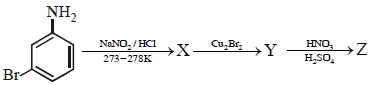
The major product $Z$ obtained in the following reaction scheme is
A
$3-$bromo$-2-$nitro-bromobenzene
B
$1,3-$dibromo$-4-$nitrobenzene
C
$2,3-$dibromonitrobenzene
D
$1,3-$dibromo$-5-$nitrobenzene
Solution
(B) $1$. The starting material is $m$-bromoaniline. Treatment with $NaNO_2/HCl$ at $273-278 \ K$ performs diazotization to form $m$-bromobenzenediazonium chloride $(X)$.
$2$. Reaction of $X$ with $Cu_2Br_2$ (Sandmeyer reaction) replaces the diazonium group with a bromine atom,yielding $1,3$-dibromobenzene $(Y)$.
$3$. Finally,nitration of $1,3$-dibromobenzene using $HNO_3/H_2SO_4$ occurs. Since the bromine atom is ortho/para-directing,the nitro group enters the position ortho to one bromine and para to the other,which is the $4$-position relative to one of the bromine atoms,leading to $1,3$-dibromo$-4-$nitrobenzene as the major product.
$2$. Reaction of $X$ with $Cu_2Br_2$ (Sandmeyer reaction) replaces the diazonium group with a bromine atom,yielding $1,3$-dibromobenzene $(Y)$.
$3$. Finally,nitration of $1,3$-dibromobenzene using $HNO_3/H_2SO_4$ occurs. Since the bromine atom is ortho/para-directing,the nitro group enters the position ortho to one bromine and para to the other,which is the $4$-position relative to one of the bromine atoms,leading to $1,3$-dibromo$-4-$nitrobenzene as the major product.
0 likes
View Solution694
EasyMCQ
Arrange the following in decreasing order of their basic strength:
$C_6H_5NH_2, C_2H_5NH_2, (C_2H_5)_2NH, NH_3$
$C_6H_5NH_2, C_2H_5NH_2, (C_2H_5)_2NH, NH_3$
A
$(C_2H_5)_2NH > C_2H_5NH_2 > NH_3 > C_6H_5NH_2$
B
$C_6H_5NH_2 > C_2H_5NH_2 > (C_2H_5)_2NH > NH_3$
C
$(C_2H_5)_2NH > C_2H_5NH_2 > C_6H_5NH_2 > NH_3$
D
$NH_3 > C_2H_5NH_2 > (C_2H_5)_2NH > C_6H_5NH_2$
Solution
(A) The basic strength of amines depends on the electron-donating inductive effect $(+I)$ of alkyl groups and the resonance effect of the aryl group.
$1$. $(C_2H_5)_2NH$ (secondary amine) is the most basic due to the $+I$ effect of two ethyl groups.
$2$. $C_2H_5NH_2$ (primary amine) is next,having one ethyl group.
$3$. $NH_3$ is less basic than aliphatic amines.
$4$. $C_6H_5NH_2$ (aniline) is the least basic because the lone pair on nitrogen is delocalized into the benzene ring via resonance.
Therefore,the decreasing order is: $(C_2H_5)_2NH > C_2H_5NH_2 > NH_3 > C_6H_5NH_2$.
$1$. $(C_2H_5)_2NH$ (secondary amine) is the most basic due to the $+I$ effect of two ethyl groups.
$2$. $C_2H_5NH_2$ (primary amine) is next,having one ethyl group.
$3$. $NH_3$ is less basic than aliphatic amines.
$4$. $C_6H_5NH_2$ (aniline) is the least basic because the lone pair on nitrogen is delocalized into the benzene ring via resonance.
Therefore,the decreasing order is: $(C_2H_5)_2NH > C_2H_5NH_2 > NH_3 > C_6H_5NH_2$.
0 likes
View Solution695
Difficult
Arrange the following in increasing order of their basic strength:
$(i)$ $C_2H_5NH_2, C_6H_5NH_2, NH_3, C_6H_5CH_2NH_2$ and $(C_2H_5)_2NH$
$(ii)$ $C_2H_5NH_2, (C_2H_5)_2NH, (C_2H_5)_3N, C_6H_5NH_2$
$(iii)$ $CH_3NH_2, (CH_3)_2NH, (CH_3)_3N, C_6H_5NH_2, C_6H_5CH_2NH_2$
$(i)$ $C_2H_5NH_2, C_6H_5NH_2, NH_3, C_6H_5CH_2NH_2$ and $(C_2H_5)_2NH$
$(ii)$ $C_2H_5NH_2, (C_2H_5)_2NH, (C_2H_5)_3N, C_6H_5NH_2$
$(iii)$ $CH_3NH_2, (CH_3)_2NH, (CH_3)_3N, C_6H_5NH_2, C_6H_5CH_2NH_2$
Solution
(N/A) $(i)$ Considering the inductive effect of alkyl groups,the basic strength order is $C_6H_5NH_2 < NH_3 < C_6H_5CH_2NH_2 < C_2H_5NH_2 < (C_2H_5)_2NH$.
$(ii)$ Considering the inductive effect,solvation effect,and steric hindrance of the alkyl groups in aqueous medium,the order is $C_6H_5NH_2 < C_2H_5NH_2 < (C_2H_5)_3N < (C_2H_5)_2NH$.
$(iii)$ Considering the inductive effect,solvation effect,and steric hindrance of the methyl groups in aqueous medium,the order is $C_6H_5NH_2 < C_6H_5CH_2NH_2 < (CH_3)_3N < CH_3NH_2 < (CH_3)_2NH$.
$(ii)$ Considering the inductive effect,solvation effect,and steric hindrance of the alkyl groups in aqueous medium,the order is $C_6H_5NH_2 < C_2H_5NH_2 < (C_2H_5)_3N < (C_2H_5)_2NH$.
$(iii)$ Considering the inductive effect,solvation effect,and steric hindrance of the methyl groups in aqueous medium,the order is $C_6H_5NH_2 < C_6H_5CH_2NH_2 < (CH_3)_3N < CH_3NH_2 < (CH_3)_2NH$.
0 likes
View Solution696
Medium
Complete the following acid-base reactions and name the products:
$(i)$ $CH_{3}CH_{2}CH_{2}NH_{2} + HCl \rightarrow$
$(ii)$ $(C_{2}H_{5})_{3}N + HCl \rightarrow$
$(i)$ $CH_{3}CH_{2}CH_{2}NH_{2} + HCl \rightarrow$
$(ii)$ $(C_{2}H_{5})_{3}N + HCl \rightarrow$
Solution
(N/A) $(i)$ $CH_{3}CH_{2}CH_{2}NH_{2}$ ($n$-Propylamine) $+ HCl \rightarrow CH_{3}CH_{2}CH_{2}NH_{3}^{+}Cl^{-}$ ($n$-Propylammonium chloride)
$(ii)$ $(C_{2}H_{5})_{3}N$ (Triethylamine) $+ HCl \rightarrow (C_{2}H_{5})_{3}NH^{+}Cl^{-}$ (Triethylammonium chloride)
$(ii)$ $(C_{2}H_{5})_{3}N$ (Triethylamine) $+ HCl \rightarrow (C_{2}H_{5})_{3}NH^{+}Cl^{-}$ (Triethylammonium chloride)
0 likes
View Solution697
Difficult
Write the reactions for the final alkylation product of aniline with an excess of methyl iodide in the presence of sodium carbonate solution.
Solution
(N/A) Aniline reacts with methyl iodide $(CH_3I)$ to form $N,N$-dimethylaniline.
When $N,N$-dimethylaniline reacts with an excess of methyl iodide,it forms $N,N,N$-trimethylanilinium iodide $([C_6H_5N(CH_3)_3]^+I^-)$.
In the presence of sodium carbonate $(Na_2CO_3)$ solution,the iodide ion is replaced by the carbonate ion to form $N,N,N$-trimethylanilinium carbonate,represented as $[C_6H_5N(CH_3)_3]_2CO_3$.
When $N,N$-dimethylaniline reacts with an excess of methyl iodide,it forms $N,N,N$-trimethylanilinium iodide $([C_6H_5N(CH_3)_3]^+I^-)$.
In the presence of sodium carbonate $(Na_2CO_3)$ solution,the iodide ion is replaced by the carbonate ion to form $N,N,N$-trimethylanilinium carbonate,represented as $[C_6H_5N(CH_3)_3]_2CO_3$.
0 likes
View Solution698
Medium
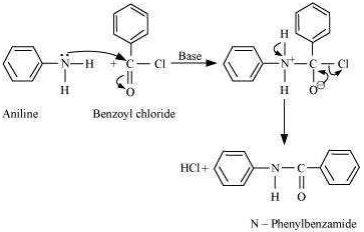
Write the chemical reaction of aniline with benzoyl chloride and write the name of the product obtained.
Solution
(N/A) The reaction of aniline $(C_6H_5NH_2)$ with benzoyl chloride $(C_6H_5COCl)$ in the presence of a base (like pyridine or $NaOH$) is an acylation reaction known as benzoylation.
$C_6H_5NH_2 + C_6H_5COCl \rightarrow C_6H_5NHCOC_6H_5 + HCl$
The product obtained is $N$-phenylbenzamide (also known as benzanilide).
$C_6H_5NH_2 + C_6H_5COCl \rightarrow C_6H_5NHCOC_6H_5 + HCl$
The product obtained is $N$-phenylbenzamide (also known as benzanilide).
0 likes
View Solution699
Difficult
Write structures of different isomers corresponding to the molecular formula $C_{3}H_{9}N$. Write $IUPAC$ names of the isomers which will liberate nitrogen gas on treatment with nitrous acid.
Solution
(A) The isomers for $C_{3}H_{9}N$ are:
$(a)$ $CH_{3}CH_{2}CH_{2}NH_{2}$: $\text{Propan-1-amine} (1^{\circ})$
$(b)$ $CH_{3}CH(NH_{2})CH_{3}$: $\text{Propan-2-amine} (1^{\circ})$
$(c)$ $CH_{3}NHCH_{2}CH_{3}$: $N\text{-methylethanamine} (2^{\circ})$
$(d)$ $CH_{3}N(CH_{3})_{2}$: $N,N\text{-dimethylmethanamine} (3^{\circ})$
Primary $(1^{\circ})$ aliphatic amines react with nitrous acid $(HNO_{2})$ to form unstable diazonium salts which decompose to evolve $N_{2}$ gas.
Therefore,$\text{Propan-1-amine}$ and $\text{Propan-2-amine}$ will liberate nitrogen gas.
$CH_{3}CH_{2}CH_{2}NH_{2} + HNO_{2} \to CH_{3}CH_{2}CH_{2}OH + N_{2} + H_{2}O$
$CH_{3}CH(NH_{2})CH_{3} + HNO_{2} \to CH_{3}CH(OH)CH_{3} + N_{2} + H_{2}O$
$(a)$ $CH_{3}CH_{2}CH_{2}NH_{2}$: $\text{Propan-1-amine} (1^{\circ})$
$(b)$ $CH_{3}CH(NH_{2})CH_{3}$: $\text{Propan-2-amine} (1^{\circ})$
$(c)$ $CH_{3}NHCH_{2}CH_{3}$: $N\text{-methylethanamine} (2^{\circ})$
$(d)$ $CH_{3}N(CH_{3})_{2}$: $N,N\text{-dimethylmethanamine} (3^{\circ})$
Primary $(1^{\circ})$ aliphatic amines react with nitrous acid $(HNO_{2})$ to form unstable diazonium salts which decompose to evolve $N_{2}$ gas.
Therefore,$\text{Propan-1-amine}$ and $\text{Propan-2-amine}$ will liberate nitrogen gas.
$CH_{3}CH_{2}CH_{2}NH_{2} + HNO_{2} \to CH_{3}CH_{2}CH_{2}OH + N_{2} + H_{2}O$
$CH_{3}CH(NH_{2})CH_{3} + HNO_{2} \to CH_{3}CH(OH)CH_{3} + N_{2} + H_{2}O$
0 likes
View Solution700
Medium
Account for the following:
$(i)$ $pK_{b}$ of aniline is more than that of methylamine.
$(ii)$ Ethylamine is soluble in water whereas aniline is not.
$(iii)$ Methylamine in water reacts with ferric chloride to precipitate hydrated ferric oxide.
$(iv)$ Although amino group is $o-$ and $p-$ directing in aromatic electrophilic substitution reactions,aniline on nitration gives a substantial amount of $m$-nitroaniline.
$(v)$ Aniline does not undergo Friedel-Crafts reaction.
$(vi)$ Diazonium salts of aromatic amines are more stable than those of aliphatic amines.
$(vii)$ Gabriel phthalimide synthesis is preferred for synthesising primary amines.
$(i)$ $pK_{b}$ of aniline is more than that of methylamine.
$(ii)$ Ethylamine is soluble in water whereas aniline is not.
$(iii)$ Methylamine in water reacts with ferric chloride to precipitate hydrated ferric oxide.
$(iv)$ Although amino group is $o-$ and $p-$ directing in aromatic electrophilic substitution reactions,aniline on nitration gives a substantial amount of $m$-nitroaniline.
$(v)$ Aniline does not undergo Friedel-Crafts reaction.
$(vi)$ Diazonium salts of aromatic amines are more stable than those of aliphatic amines.
$(vii)$ Gabriel phthalimide synthesis is preferred for synthesising primary amines.
Solution
(N/A) $(i)$ $pK_{b}$ of aniline is more than that of methylamine: In aniline,the lone pair of electrons on the $N$ atom is delocalized over the benzene ring due to resonance,making it less available for protonation. In methylamine,the $+I$ effect of the $-CH_{3}$ group increases the electron density on the $N$ atom,making it more basic. Since basicity is inversely proportional to $pK_{b}$,aniline has a higher $pK_{b}$ value.
$(ii)$ Ethylamine is soluble in water whereas aniline is not: Ethylamine forms intermolecular hydrogen bonds with water molecules. Aniline,due to the large hydrophobic $-C_{6}H_{5}$ group,does not form significant hydrogen bonds with water,making it insoluble.
$(iii)$ Methylamine in water reacts with ferric chloride to precipitate hydrated ferric oxide: Methylamine is more basic than water and produces $OH^{-}$ ions in aqueous solution: $CH_{3}NH_{2} + H_{2}O \rightarrow CH_{3}NH_{3}^{+} + OH^{-}$. These $OH^{-}$ ions react with $Fe^{3+}$ ions from $FeCl_{3}$ to form a precipitate: $2Fe^{3+} + 6OH^{-} \rightarrow Fe_{2}O_{3} \cdot 3H_{2}O$.
$(iv)$ Although amino group is $o-$ and $p-$ directing,aniline on nitration gives a substantial amount of $m$-nitroaniline: Nitration is performed in a strongly acidic medium. Aniline gets protonated to form the anilinium ion $(-NH_{3}^{+})$,which is meta-directing,leading to the formation of $m$-nitroaniline.
$(v)$ Aniline does not undergo Friedel-Crafts reaction: Aniline is a Lewis base and reacts with the Lewis acid catalyst $AlCl_{3}$ to form a salt. The positive charge on the $N$ atom deactivates the benzene ring towards electrophilic substitution.
$(vi)$ Diazonium salts of aromatic amines are more stable than those of aliphatic amines: The diazonium ion in aromatic amines is stabilized by resonance with the benzene ring,whereas aliphatic diazonium ions lack such stabilization.
$(vii)$ Gabriel phthalimide synthesis is preferred for synthesising primary amines: This method exclusively produces primary amines without the formation of secondary or tertiary amines,ensuring high purity.
$(ii)$ Ethylamine is soluble in water whereas aniline is not: Ethylamine forms intermolecular hydrogen bonds with water molecules. Aniline,due to the large hydrophobic $-C_{6}H_{5}$ group,does not form significant hydrogen bonds with water,making it insoluble.
$(iii)$ Methylamine in water reacts with ferric chloride to precipitate hydrated ferric oxide: Methylamine is more basic than water and produces $OH^{-}$ ions in aqueous solution: $CH_{3}NH_{2} + H_{2}O \rightarrow CH_{3}NH_{3}^{+} + OH^{-}$. These $OH^{-}$ ions react with $Fe^{3+}$ ions from $FeCl_{3}$ to form a precipitate: $2Fe^{3+} + 6OH^{-} \rightarrow Fe_{2}O_{3} \cdot 3H_{2}O$.
$(iv)$ Although amino group is $o-$ and $p-$ directing,aniline on nitration gives a substantial amount of $m$-nitroaniline: Nitration is performed in a strongly acidic medium. Aniline gets protonated to form the anilinium ion $(-NH_{3}^{+})$,which is meta-directing,leading to the formation of $m$-nitroaniline.
$(v)$ Aniline does not undergo Friedel-Crafts reaction: Aniline is a Lewis base and reacts with the Lewis acid catalyst $AlCl_{3}$ to form a salt. The positive charge on the $N$ atom deactivates the benzene ring towards electrophilic substitution.
$(vi)$ Diazonium salts of aromatic amines are more stable than those of aliphatic amines: The diazonium ion in aromatic amines is stabilized by resonance with the benzene ring,whereas aliphatic diazonium ions lack such stabilization.
$(vii)$ Gabriel phthalimide synthesis is preferred for synthesising primary amines: This method exclusively produces primary amines without the formation of secondary or tertiary amines,ensuring high purity.
0 likes
View SolutionAmines — Properties of Amines · Frequently Asked Questions
1Are these Amines questions useful for JEE and NEET?
Yes. All questions in this section are mapped to JEE Main and NEET exam patterns. Previous year questions from JEE Main, NEET, GUJCET and state-level exams are included with full solutions.
2Can I switch to Hindi or Gujarati for these questions?
Yes. Use the language tabs in the hero section or the sidebar to view the same questions and solutions in English, Hindi or Gujarati.
3How do I generate a question paper from this subtopic?
Use the Vedclass Exam Paper Generator — select the chapter and subtopic, set difficulty, and generate Sets A, B, C, D automatically. First 3 chapters of every subject are free.
Vedclass Products
For Students
Vedclass Test Series
Mock tests in real JEE/NEET style with performance analysis. 5-day free trial.
Start Free TrialFor Teachers
Exam Paper Generator
Generate Set A/B/C/D papers from this chapter in 2 minutes. 3 chapters free.
Try FreeFor Institutes
Online Exam Module
Live online exams with unlimited students, 360° analytics & white-label branding.
See DemoFor Teachers & Institutes
Generate a Amines Exam Paper in 2 Minutes
Select subtopic & difficulty — Sets A, B, C, D auto-generated with No Repeat logic.
First 3 chapters of every subject are free — no payment required.