
A English
Properties of alcohol Questions in English
Class 12 Chemistry · Alcohols, Phenols and Ethers · Properties of alcohol
889+
Questions
English
Language
100%
With Solutions
Showing 25 of 889 questions in English
851
MediumMCQ
$CH_3 CH_2 OH$ $\xrightarrow{Cl_2} CH_3 CHO$ $\xrightarrow{3 Cl_2} Cl_3 CCHO$. In the above reactions,the role of $Cl_2$ in step-$1$ and step-$2$ respectively is:
A
oxidation,chlorination
B
reduction,chlorination
C
oxidation,addition
D
reduction,substitution
Solution
(A) In step-$1$: $CH_3 CH_2 OH + Cl_2 \rightarrow CH_3 CHO + 2HCl$. Here,$Cl_2$ acts as an oxidizing agent,converting the primary alcohol $(-CH_2OH)$ into an aldehyde $(-CHO)$.
In step-$2$: $CH_3 CHO + 3Cl_2 \rightarrow CCl_3 CHO + 3HCl$. Here,$Cl_2$ replaces the hydrogen atoms of the methyl group with chlorine atoms,which is a chlorination reaction (specifically,a substitution reaction).
In step-$2$: $CH_3 CHO + 3Cl_2 \rightarrow CCl_3 CHO + 3HCl$. Here,$Cl_2$ replaces the hydrogen atoms of the methyl group with chlorine atoms,which is a chlorination reaction (specifically,a substitution reaction).
0 likes
View Solution852
EasyMCQ
Which one of the following gases is liberated when ethyl alcohol is heated with methyl magnesium iodide?
A
Methane
B
Ethane
C
Carbon dioxide
D
Propane
Solution
(A) Ethyl alcohol $(C_2H_5OH)$ contains an active hydrogen atom attached to an oxygen atom. When it reacts with a Grignard reagent like methyl magnesium iodide $(CH_3MgI)$,the active hydrogen is replaced by the methyl group to form methane gas $(CH_4)$.
The reaction is as follows:
$C_2H_5OH + CH_3MgI \rightarrow CH_4 \uparrow + C_2H_5OMgI$
The reaction is as follows:
$C_2H_5OH + CH_3MgI \rightarrow CH_4 \uparrow + C_2H_5OMgI$
0 likes
View Solution853
MediumMCQ
$3$ moles of ethanol react with $1$ mole of phosphorus tribromide to form $3$ moles of bromoethane and $1$ mole of $X$. Which of the following is $X$?
A
$H_3PO_4$
B
$H_3PO_2$
C
$HPO_3$
D
$H_3PO_3$
Solution
(D) The balanced chemical equation for the reaction of ethanol with phosphorus tribromide is:
$3 CH_3CH_2OH + PBr_3 \rightarrow 3 CH_3CH_2Br + H_3PO_3$
In this reaction,$3$ moles of ethanol react with $1$ mole of $PBr_3$ to produce $3$ moles of bromoethane and $1$ mole of phosphorous acid $(H_3PO_3)$.
Therefore,$X$ is $H_3PO_3$.
$3 CH_3CH_2OH + PBr_3 \rightarrow 3 CH_3CH_2Br + H_3PO_3$
In this reaction,$3$ moles of ethanol react with $1$ mole of $PBr_3$ to produce $3$ moles of bromoethane and $1$ mole of phosphorous acid $(H_3PO_3)$.
Therefore,$X$ is $H_3PO_3$.
0 likes
View Solution854
MediumMCQ
Ethanol,when reacted with $PCl_5$,gives $A$,$POCl_3$,and $HCl$. $A$ reacts with silver nitrite $(AgNO_2)$ to form $B$ (major product) and $AgCl$. $A$ and $B$ are respectively:
A
$C_2H_5Cl$ and $C_2H_5OC_2H_5$
B
$C_2H_6$ and $C_2H_5OC_2H_5$
C
$C_2H_5Cl$ and $C_2H_5NO_2$
D
$C_2H_6$ and $C_2H_5NO_2$
Solution
(C) The reaction of ethanol with $PCl_5$ is as follows:
$C_2H_5OH + PCl_5 \rightarrow C_2H_5Cl (A) + POCl_3 + HCl$
Thus,$A$ is $C_2H_5Cl$ (ethyl chloride).
Next,the reaction of ethyl chloride $(A)$ with silver nitrite $(AgNO_2)$ is:
$C_2H_5Cl + AgNO_2 \rightarrow C_2H_5NO_2 (B) + AgCl$
Thus,$B$ is $C_2H_5NO_2$ (nitroethane).
Therefore,$A$ and $B$ are $C_2H_5Cl$ and $C_2H_5NO_2$ respectively.
$C_2H_5OH + PCl_5 \rightarrow C_2H_5Cl (A) + POCl_3 + HCl$
Thus,$A$ is $C_2H_5Cl$ (ethyl chloride).
Next,the reaction of ethyl chloride $(A)$ with silver nitrite $(AgNO_2)$ is:
$C_2H_5Cl + AgNO_2 \rightarrow C_2H_5NO_2 (B) + AgCl$
Thus,$B$ is $C_2H_5NO_2$ (nitroethane).
Therefore,$A$ and $B$ are $C_2H_5Cl$ and $C_2H_5NO_2$ respectively.
0 likes
View Solution855
DifficultMCQ
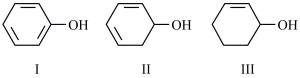
The correct order of decreasing reactivity towards $H_3PO_4$ for the following compounds is:
A
$II > III > I$
B
$I > III > II$
C
$II > I > III$
D
$III > I > II$
Solution
(A) The dehydration of alcohols in the presence of $H_3PO_4$ proceeds via the formation of a carbocation intermediate. The rate of reaction depends on the stability of the carbocation formed.
$I$: Phenol (or cyclohexadienol derivative) forms a highly stable aromatic carbocation (benzene ring system).
$II$: Cyclohexadienol forms a conjugated diene system upon dehydration.
$III$: Cyclohexenol forms a simple alkene.
Comparing the stability of the carbocations formed:
$1$. Compound $II$ (cyclohexa$-1,4-$dien$-1-$ol) leads to the formation of benzene,which is highly stable due to aromaticity.
$2$. Compound $III$ (cyclohex$-2-$en$-1-$ol) leads to the formation of cyclohexadiene.
$3$. Compound $I$ (phenol) is not an alcohol in the aliphatic sense and does not undergo dehydration to an alkene under these conditions; however,based on the provided structures,$II$ is the most reactive due to the formation of aromatic benzene,followed by $III$,and $I$ is the least reactive.
Thus,the correct order of reactivity is $II > III > I$.
$I$: Phenol (or cyclohexadienol derivative) forms a highly stable aromatic carbocation (benzene ring system).
$II$: Cyclohexadienol forms a conjugated diene system upon dehydration.
$III$: Cyclohexenol forms a simple alkene.
Comparing the stability of the carbocations formed:
$1$. Compound $II$ (cyclohexa$-1,4-$dien$-1-$ol) leads to the formation of benzene,which is highly stable due to aromaticity.
$2$. Compound $III$ (cyclohex$-2-$en$-1-$ol) leads to the formation of cyclohexadiene.
$3$. Compound $I$ (phenol) is not an alcohol in the aliphatic sense and does not undergo dehydration to an alkene under these conditions; however,based on the provided structures,$II$ is the most reactive due to the formation of aromatic benzene,followed by $III$,and $I$ is the least reactive.
Thus,the correct order of reactivity is $II > III > I$.
0 likes
View Solution856
MediumMCQ
What are $X$ and $Y$ in the following reaction sequence?
$C_2H_5OH$ $\xrightarrow{Cl_2} \underline{X}$ $\xrightarrow{Cl_2} \underline{Y}$
$C_2H_5OH$ $\xrightarrow{Cl_2} \underline{X}$ $\xrightarrow{Cl_2} \underline{Y}$
A
$C_2H_5Cl, CH_3CHO$
B
$CH_3CHO, CH_3CO_2H$
C
$CH_3CHO, CCl_3CHO$
D
$C_2H_5Cl, CCl_3CHO$
Solution
(C) The reaction of ethanol $(C_2H_5OH)$ with chlorine $(Cl_2)$ proceeds as follows:
$1$. Ethanol is oxidized by chlorine to form acetaldehyde $(CH_3CHO)$,which is $X$.
$CH_3CH_2OH + Cl_2 \rightarrow CH_3CHO + 2HCl$
$2$. Acetaldehyde then reacts with further chlorine to form chloral $(CCl_3CHO)$,which is $Y$.
$CH_3CHO + 3Cl_2 \rightarrow CCl_3CHO + 3HCl$
Thus,$X$ is $CH_3CHO$ and $Y$ is $CCl_3CHO$.
$1$. Ethanol is oxidized by chlorine to form acetaldehyde $(CH_3CHO)$,which is $X$.
$CH_3CH_2OH + Cl_2 \rightarrow CH_3CHO + 2HCl$
$2$. Acetaldehyde then reacts with further chlorine to form chloral $(CCl_3CHO)$,which is $Y$.
$CH_3CHO + 3Cl_2 \rightarrow CCl_3CHO + 3HCl$
Thus,$X$ is $CH_3CHO$ and $Y$ is $CCl_3CHO$.
0 likes
View Solution857
MediumMCQ
What is '$C$' in the following reaction sequence?
$(CH_3)_2CO + CH_3MgBr$ $\xrightarrow{\text{Ether}} A$ $\xrightarrow{H_3O^+} B$ $\xrightarrow{Cu/573K} C$
$(CH_3)_2CO + CH_3MgBr$ $\xrightarrow{\text{Ether}} A$ $\xrightarrow{H_3O^+} B$ $\xrightarrow{Cu/573K} C$
A
Propanone
B
$2-$methyl$-2-$propanol
C
$2-$methylprop$-1-$ene
D
But$-2-$enal
Solution
(C) $1$. The reaction of propanone $(CH_3)_2CO$ with methylmagnesium bromide $(CH_3MgBr)$ in the presence of ether forms an addition product $A$ (an alkoxide complex).
$2$. Acidic hydrolysis $(H_3O^+)$ of $A$ yields $B$,which is $2-$methylpropan$-2-$ol $(CH_3)_3C-OH$ (a tertiary alcohol).
$3$. When tertiary alcohols are passed over heated copper $(Cu)$ at $573 \ K$,they undergo dehydration to form alkenes.
$4$. Therefore,$2-$methylpropan$-2-$ol undergoes dehydration to form $2-$methylprop$-1-$ene $(CH_3)_2C=CH_2$ as the final product $C$.
$2$. Acidic hydrolysis $(H_3O^+)$ of $A$ yields $B$,which is $2-$methylpropan$-2-$ol $(CH_3)_3C-OH$ (a tertiary alcohol).
$3$. When tertiary alcohols are passed over heated copper $(Cu)$ at $573 \ K$,they undergo dehydration to form alkenes.
$4$. Therefore,$2-$methylpropan$-2-$ol undergoes dehydration to form $2-$methylprop$-1-$ene $(CH_3)_2C=CH_2$ as the final product $C$.
0 likes
View Solution858
DifficultMCQ
Which of the following reactions is feasible?
A
$\text{Phenol} + SOCl_2 \rightarrow \text{Chlorobenzene} + SO_2 + HCl$
B
$H_3CCH=CHCH_2OH \xrightarrow{PCC} H_3CCH=CHCHO$
C
$CH_3CH_2CH_2OH \xrightarrow{KMnO_4/H^{+}} H_3CCH_2CHO$
D
$CH_3CH_2CH_2CH_2OH \xrightarrow{20\%\ H_3PO_4, 273 \ K} CH_3CH_2CH=CH_2$
Solution
(B) The reaction in $(A)$ is not feasible because the $C-O$ bond in phenol has partial double bond character due to resonance,making it resistant to nucleophilic substitution by $SOCl_2$.
The reaction in $(B)$ is feasible. $PCC$ (Pyridinium chlorochromate) is a selective oxidizing agent that oxidizes primary allylic alcohols to aldehydes without affecting the double bond.
The reaction in $(C)$ is not feasible because $KMnO_4/H^{+}$ is a strong oxidizing agent that will oxidize the primary alcohol directly to a carboxylic acid $(CH_3CH_2COOH)$,not an aldehyde.
The reaction in $(D)$ is not feasible because $20\%\ H_3PO_4$ is a dilute acid and is not a strong enough dehydrating agent to convert an alcohol to an alkene; concentrated $H_3PO_4$ or $H_2SO_4$ is required.
The reaction in $(B)$ is feasible. $PCC$ (Pyridinium chlorochromate) is a selective oxidizing agent that oxidizes primary allylic alcohols to aldehydes without affecting the double bond.
The reaction in $(C)$ is not feasible because $KMnO_4/H^{+}$ is a strong oxidizing agent that will oxidize the primary alcohol directly to a carboxylic acid $(CH_3CH_2COOH)$,not an aldehyde.
The reaction in $(D)$ is not feasible because $20\%\ H_3PO_4$ is a dilute acid and is not a strong enough dehydrating agent to convert an alcohol to an alkene; concentrated $H_3PO_4$ or $H_2SO_4$ is required.
0 likes
View Solution859
MediumMCQ
Which one of the following is a secondary alcohol?
A
$2$-methyl-$1$-propanol
B
$2$-methyl-$2$-propanol
C
$2$-butanol
D
$1$-butanol
Solution
(C) secondary $(2^{\circ})$ alcohol is one in which the hydroxyl group $(-OH)$ is attached to a carbon atom that is bonded to two other carbon atoms.
$1$. $2$-methyl-$1$-propanol: $(CH_3)_2CH-CH_2OH$ (Primary alcohol)
$2$. $2$-methyl-$2$-propanol: $(CH_3)_3C-OH$ (Tertiary alcohol)
$3$. $2$-butanol: $CH_3-CH(OH)-CH_2-CH_3$ (Secondary alcohol)
$4$. $1$-butanol: $CH_3-CH_2-CH_2-CH_2OH$ (Primary alcohol)
Thus,$2$-butanol is a secondary alcohol.
$1$. $2$-methyl-$1$-propanol: $(CH_3)_2CH-CH_2OH$ (Primary alcohol)
$2$. $2$-methyl-$2$-propanol: $(CH_3)_3C-OH$ (Tertiary alcohol)
$3$. $2$-butanol: $CH_3-CH(OH)-CH_2-CH_3$ (Secondary alcohol)
$4$. $1$-butanol: $CH_3-CH_2-CH_2-CH_2OH$ (Primary alcohol)
Thus,$2$-butanol is a secondary alcohol.
0 likes
View Solution860
MediumMCQ
Which one of the following is a secondary alcohol?
A
$2$-methyl-$2$-propanol
B
$1$-propanol
C
$1$-butanol
D
$2$-pentanol
Solution
(D) secondary $(2^{\circ})$ alcohol is one in which the hydroxyl group $(-OH)$ is attached to a carbon atom that is bonded to two other carbon atoms.
$1$. $2$-methyl-$2$-propanol: $(CH_3)_3COH$ is a tertiary $(3^{\circ})$ alcohol.
$2$. $1$-propanol: $CH_3CH_2CH_2OH$ is a primary $(1^{\circ})$ alcohol.
$3$. $1$-butanol: $CH_3CH_2CH_2CH_2OH$ is a primary $(1^{\circ})$ alcohol.
$4$. $2$-pentanol: $CH_3CH(OH)CH_2CH_2CH_3$ is a secondary $(2^{\circ})$ alcohol,as the $-OH$ group is attached to the $C2$ atom,which is bonded to $C1$ and $C3$.
$1$. $2$-methyl-$2$-propanol: $(CH_3)_3COH$ is a tertiary $(3^{\circ})$ alcohol.
$2$. $1$-propanol: $CH_3CH_2CH_2OH$ is a primary $(1^{\circ})$ alcohol.
$3$. $1$-butanol: $CH_3CH_2CH_2CH_2OH$ is a primary $(1^{\circ})$ alcohol.
$4$. $2$-pentanol: $CH_3CH(OH)CH_2CH_2CH_3$ is a secondary $(2^{\circ})$ alcohol,as the $-OH$ group is attached to the $C2$ atom,which is bonded to $C1$ and $C3$.
0 likes
View Solution861
DifficultMCQ
Identify $Z$ in the following reaction:
$CH_3CH_2OH$ $\xrightarrow{PBr_3} X$ $\xrightarrow{alc. KOH} Y$ $\xrightarrow[{(ii) H_2O, \text{heat}}]{{(i) H_2SO_4, \text{RT}}} Z$
$CH_3CH_2OH$ $\xrightarrow{PBr_3} X$ $\xrightarrow{alc. KOH} Y$ $\xrightarrow[{(ii) H_2O, \text{heat}}]{{(i) H_2SO_4, \text{RT}}} Z$
A
$CH_2=CH_2$
B
$CH_3CH_2OH$
C
$CH_3CH_2-O-CH_2CH_3$
D
$CH_3CH_2-SO_3H$
Solution
(B) $PBr_3$ converts ethanol into ethyl bromide. The compound $X$ is $CH_3CH_2Br$.
Alcoholic $KOH$ causes dehydrohalogenation of ethyl bromide to form ethene. The compound $Y$ is $CH_2=CH_2$.
Ethene reacts with cold concentrated $H_2SO_4$ followed by hydrolysis to form ethanol. The compound $Z$ is $CH_3CH_2OH$.
Reaction sequence:
$CH_3CH_2OH$ $\xrightarrow{PBr_3} (X) CH_3CH_2Br$ $\xrightarrow{alc. KOH} (Y) CH_2=CH_2$ $\xrightarrow[{(ii) H_2O, \text{heat}}]{{(i) H_2SO_4, \text{RT}}} (Z) CH_3CH_2OH$
Therefore,the compound $Z$ is $CH_3CH_2OH$.
Alcoholic $KOH$ causes dehydrohalogenation of ethyl bromide to form ethene. The compound $Y$ is $CH_2=CH_2$.
Ethene reacts with cold concentrated $H_2SO_4$ followed by hydrolysis to form ethanol. The compound $Z$ is $CH_3CH_2OH$.
Reaction sequence:
$CH_3CH_2OH$ $\xrightarrow{PBr_3} (X) CH_3CH_2Br$ $\xrightarrow{alc. KOH} (Y) CH_2=CH_2$ $\xrightarrow[{(ii) H_2O, \text{heat}}]{{(i) H_2SO_4, \text{RT}}} (Z) CH_3CH_2OH$
Therefore,the compound $Z$ is $CH_3CH_2OH$.
0 likes
View Solution862
DifficultMCQ
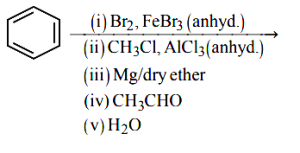
The major product of the following reaction is:
A
$1-$($4$-methylphenyl)propan$-2-$ol
B
$1-$($4$-methylphenyl)ethanol
C
$2-$($2$-methylphenyl)propan$-2-$ol
D
$1-$($2$-methylphenyl)ethanol
Solution
(B) Step $(i)$: Benzene reacts with $Br_2$ in the presence of anhydrous $FeBr_3$ to form bromobenzene via electrophilic aromatic substitution.
Step (ii): Bromobenzene undergoes Friedel-Crafts alkylation with $CH_3Cl$ and anhydrous $AlCl_3$. Since the $-Br$ group is ortho/para directing,the major product is $p$-bromotoluene.
Step (iii): $p$-Bromotoluene reacts with $Mg$ in dry ether to form the Grignard reagent,$p$-tolylmagnesium bromide $(CH_3-C_6H_4-MgBr)$.
Step (iv) and $(v)$: The Grignard reagent reacts with acetaldehyde $(CH_3CHO)$ followed by hydrolysis $(H_2O)$ to form a secondary alcohol. The nucleophilic carbon of the Grignard reagent attacks the carbonyl carbon of acetaldehyde,resulting in $1-(4-methylphenyl)ethanol$.
Step (ii): Bromobenzene undergoes Friedel-Crafts alkylation with $CH_3Cl$ and anhydrous $AlCl_3$. Since the $-Br$ group is ortho/para directing,the major product is $p$-bromotoluene.
Step (iii): $p$-Bromotoluene reacts with $Mg$ in dry ether to form the Grignard reagent,$p$-tolylmagnesium bromide $(CH_3-C_6H_4-MgBr)$.
Step (iv) and $(v)$: The Grignard reagent reacts with acetaldehyde $(CH_3CHO)$ followed by hydrolysis $(H_2O)$ to form a secondary alcohol. The nucleophilic carbon of the Grignard reagent attacks the carbonyl carbon of acetaldehyde,resulting in $1-(4-methylphenyl)ethanol$.
0 likes
View Solution863
EasyMCQ
Cyclopentanol on reaction with $NaH$ followed by $CS_{2}$ and $CH_{3}I$ produces a/an
A
ketone
B
alkene
C
ether
D
xanthate
Solution
(D) The reaction of cyclopentanol with $NaH$ forms a sodium alkoxide intermediate.
This alkoxide then reacts with $CS_{2}$ to form a sodium xanthate salt.
Finally,the reaction with $CH_{3}I$ (methyl iodide) results in the formation of a methyl xanthate ester.
This sequence is known as the Chugaev elimination precursor synthesis.
Therefore,the product is a xanthate.
Thus,option $(d)$ is the correct answer.
This alkoxide then reacts with $CS_{2}$ to form a sodium xanthate salt.
Finally,the reaction with $CH_{3}I$ (methyl iodide) results in the formation of a methyl xanthate ester.
This sequence is known as the Chugaev elimination precursor synthesis.
Therefore,the product is a xanthate.
Thus,option $(d)$ is the correct answer.
0 likes
View Solution864
EasyMCQ
Oxidation of allyl alcohol with a peracid gives a compound of molecular formula $C_3H_6O_2$,which contains an asymmetric carbon atom. The structure of the compound is
A
$CH_2(OH)-CH(OH)-CH_3$
B
$CH_2(OH)-CH_2-CHO$
C
$CH_2(O)CH-CH_2OH$ (glycidol)
D
$CH_3-CH(OH)-CHO$
Solution
(C) The oxidation of allyl alcohol $(CH_2=CH-CH_2OH)$ with a peracid $(RCO_3H)$ is an epoxidation reaction.
This reaction yields glycidol,which has the molecular formula $C_3H_6O_2$.
The structure of glycidol is $CH_2(O)CH-CH_2OH$ (or $2,3-$epoxypropan$-1-$ol).
In this molecule,the carbon atom at the $C-2$ position is bonded to four different groups ($-H$,$-CH_2OH$,and the two carbons of the epoxide ring),making it an asymmetric (chiral) carbon atom.
Therefore,the correct structure is $CH_2(O)CH-CH_2OH$.
This reaction yields glycidol,which has the molecular formula $C_3H_6O_2$.
The structure of glycidol is $CH_2(O)CH-CH_2OH$ (or $2,3-$epoxypropan$-1-$ol).
In this molecule,the carbon atom at the $C-2$ position is bonded to four different groups ($-H$,$-CH_2OH$,and the two carbons of the epoxide ring),making it an asymmetric (chiral) carbon atom.
Therefore,the correct structure is $CH_2(O)CH-CH_2OH$.
0 likes
View Solution865
MediumMCQ
$C_{4}H_{10}O$ $\xrightarrow{K_{2}Cr_{2}O_{7} / H_{2}SO_{4}} C_{4}H_{8}O$ $\xrightarrow{I_{2} / NaOH, \text{Warm}} CHI_{3}$
Here,$N$ is
Here,$N$ is
A
Butan-$1$-ol
B
Butan-$2$-ol
C
Diethyl ether
D
$2$-Methylpropan-$1$-ol
Solution
(B) The given sequence of chemical reactions is:
$C_{4}H_{10}O$ $\xrightarrow{K_{2}Cr_{2}O_{7} / H_{2}SO_{4}} C_{4}H_{8}O$ $\xrightarrow{I_{2} / NaOH, \text{Warm}} CHI_{3}$
$(N)$
Step $1$: The compound $N$ is oxidized by $K_{2}Cr_{2}O_{7} / H_{2}SO_{4}$ to a ketone $(C_{4}H_{8}O)$. This indicates that $N$ is a secondary alcohol.
Step $2$: The ketone formed undergoes the iodoform reaction with $I_{2} / NaOH$ to produce iodoform $(CHI_{3})$. This confirms that the ketone must have a methyl group attached to the carbonyl carbon (i.e.,it is a methyl ketone).
Butan-$2$-ol $(CH_{3}CH(OH)CH_{2}CH_{3})$ is a secondary alcohol. Upon oxidation,it yields butan-$2$-one $(CH_{3}COCH_{2}CH_{3})$,which is a methyl ketone and gives a positive iodoform test.
Therefore,$N$ is butan-$2$-ol.
$C_{4}H_{10}O$ $\xrightarrow{K_{2}Cr_{2}O_{7} / H_{2}SO_{4}} C_{4}H_{8}O$ $\xrightarrow{I_{2} / NaOH, \text{Warm}} CHI_{3}$
$(N)$
Step $1$: The compound $N$ is oxidized by $K_{2}Cr_{2}O_{7} / H_{2}SO_{4}$ to a ketone $(C_{4}H_{8}O)$. This indicates that $N$ is a secondary alcohol.
Step $2$: The ketone formed undergoes the iodoform reaction with $I_{2} / NaOH$ to produce iodoform $(CHI_{3})$. This confirms that the ketone must have a methyl group attached to the carbonyl carbon (i.e.,it is a methyl ketone).
Butan-$2$-ol $(CH_{3}CH(OH)CH_{2}CH_{3})$ is a secondary alcohol. Upon oxidation,it yields butan-$2$-one $(CH_{3}COCH_{2}CH_{3})$,which is a methyl ketone and gives a positive iodoform test.
Therefore,$N$ is butan-$2$-ol.
0 likes
View Solution866
EasyMCQ
Which of the following compounds would not react with Lucas reagent at room temperature?
A
$H_{2}C=CHCH_{2}OH$
B
$C_{6}H_{5}CH_{2}OH$
C
$CH_{3}CH_{2}CH_{2}OH$
D
$(CH_{3})_{3}COH$
Solution
(C) The Lucas reagent test is used to distinguish between primary,secondary,and tertiary alcohols.
Tertiary alcohols react immediately at room temperature to form turbidity.
Secondary alcohols react within $5-10$ minutes.
Primary alcohols do not react with Lucas reagent at room temperature.
Among the given options,$CH_{3}CH_{2}CH_{2}OH$ is a primary alcohol,so it does not react at room temperature.
Tertiary alcohols react immediately at room temperature to form turbidity.
Secondary alcohols react within $5-10$ minutes.
Primary alcohols do not react with Lucas reagent at room temperature.
Among the given options,$CH_{3}CH_{2}CH_{2}OH$ is a primary alcohol,so it does not react at room temperature.
0 likes
View Solution867
EasyMCQ
Reaction of $R-OH$ with $R'-MgX$ produces :
A
$R-H$
B
$R'-H$
C
$R-R$
D
$R'-R'$
Solution
(B) The reaction between an alcohol $(R-OH)$ and a Grignard reagent $(R'-MgX)$ is an acid-base reaction.
Alcohols contain a weakly acidic hydrogen atom attached to an oxygen atom.
Grignard reagents $(R'-MgX)$ contain a highly nucleophilic/basic alkyl group $(R'^- )$.
The $R'^- $ group abstracts the acidic proton from the alcohol to form an alkane $(R'-H)$ and an alkoxide salt $(R-OMgX)$.
The reaction is: $R-OH + R'-MgX \rightarrow R-OMgX + R'-H$ (Alkane).
Alcohols contain a weakly acidic hydrogen atom attached to an oxygen atom.
Grignard reagents $(R'-MgX)$ contain a highly nucleophilic/basic alkyl group $(R'^- )$.
The $R'^- $ group abstracts the acidic proton from the alcohol to form an alkane $(R'-H)$ and an alkoxide salt $(R-OMgX)$.
The reaction is: $R-OH + R'-MgX \rightarrow R-OMgX + R'-H$ (Alkane).
0 likes
View Solution868
EasyMCQ
The correct order of boiling points of $N$-ethylethanamine $(I)$,ethoxyethane $(II)$ and butan$-2-$ol $(III)$ is
A
$III < II < I$
B
$II < III < I$
C
$II < I < III$
D
$III < I < II$
Solution
(C) The boiling point depends on the strength of intermolecular forces.
$1$. Ethoxyethane $(II)$ is an ether,which exhibits only weak dipole-dipole interactions.
$2$. $N$-ethylethanamine $(I)$ is a secondary amine,which exhibits hydrogen bonding,but it is weaker than the hydrogen bonding in alcohols due to the lower electronegativity of $N$ compared to $O$.
$3$. Butan$-2-$ol $(III)$ is an alcohol,which exhibits strong intermolecular hydrogen bonding.
Therefore,the order of boiling points is $II < I < III$.
$1$. Ethoxyethane $(II)$ is an ether,which exhibits only weak dipole-dipole interactions.
$2$. $N$-ethylethanamine $(I)$ is a secondary amine,which exhibits hydrogen bonding,but it is weaker than the hydrogen bonding in alcohols due to the lower electronegativity of $N$ compared to $O$.
$3$. Butan$-2-$ol $(III)$ is an alcohol,which exhibits strong intermolecular hydrogen bonding.
Therefore,the order of boiling points is $II < I < III$.
0 likes
View Solution869
MediumMCQ
The exact order of boiling points of the compounds $n$-pentane,isopentane,butanone,and $1$-butanol is:
A
$n$-pentane < isopentane < butanone < $1$-butanol
B
isopentane < $n$-pentane < butanone < $1$-butanol
C
butanone < $n$-pentane < isopentane < $1$-butanol
D
$1$-butanol < butanone < $n$-pentane < isopentane
Solution
(B) The boiling point depends on the strength of intermolecular forces. The order of strength of intermolecular forces is: $\text{Hydrogen bonding} > \text{Dipole-dipole interaction} > \text{Van der Waals forces}$.
$1$. $1$-butanol $(CH_3CH_2CH_2CH_2OH)$ exhibits intermolecular hydrogen bonding,which is the strongest force among the given compounds,resulting in the highest boiling point.
$2$. Butanone $(CH_3COCH_2CH_3)$ is a polar molecule and exhibits dipole-dipole interactions,which are stronger than Van der Waals forces but weaker than hydrogen bonding.
$3$. $n$-pentane and isopentane are non-polar alkanes and exhibit only Van der Waals forces. For alkanes,the boiling point decreases with branching because branching reduces the surface area of contact,leading to weaker Van der Waals forces. Thus,$n$-pentane has a higher boiling point than isopentane.
Therefore,the correct order of boiling points is: $\text{isopentane} < n\text{-pentane} < \text{butanone} < 1\text{-butanol}$.
$1$. $1$-butanol $(CH_3CH_2CH_2CH_2OH)$ exhibits intermolecular hydrogen bonding,which is the strongest force among the given compounds,resulting in the highest boiling point.
$2$. Butanone $(CH_3COCH_2CH_3)$ is a polar molecule and exhibits dipole-dipole interactions,which are stronger than Van der Waals forces but weaker than hydrogen bonding.
$3$. $n$-pentane and isopentane are non-polar alkanes and exhibit only Van der Waals forces. For alkanes,the boiling point decreases with branching because branching reduces the surface area of contact,leading to weaker Van der Waals forces. Thus,$n$-pentane has a higher boiling point than isopentane.
Therefore,the correct order of boiling points is: $\text{isopentane} < n\text{-pentane} < \text{butanone} < 1\text{-butanol}$.
0 likes
View Solution870
EasyMCQ
Correct statement$(s)$ in cases of $n-$butanol and $t-$butanol is (are)
A
both are having equal solubility in water
B
$t-$butanol is more soluble in water than $n-$butanol
C
boiling point of $t-$butanol is lower than $n-$butanol
D
boiling point of $n-$butanol is lower than $t-$butanol
Solution
(B, C) $n-$butanol is a straight-chain alcohol,while $t-$butanol is a branched-chain alcohol.
Branching decreases the surface area of the molecule,which reduces the strength of intermolecular van der Waals forces,leading to a lower boiling point for $t-$butanol compared to $n-$butanol.
Additionally,branching increases the solubility of alcohols in water because it reduces the hydrophobic character of the alkyl group.
Therefore,$t-$butanol is more soluble in water and has a lower boiling point than $n-$butanol.
Thus,both statements $B$ and $C$ are correct.
Branching decreases the surface area of the molecule,which reduces the strength of intermolecular van der Waals forces,leading to a lower boiling point for $t-$butanol compared to $n-$butanol.
Additionally,branching increases the solubility of alcohols in water because it reduces the hydrophobic character of the alkyl group.
Therefore,$t-$butanol is more soluble in water and has a lower boiling point than $n-$butanol.
Thus,both statements $B$ and $C$ are correct.
0 likes
View Solution871
DifficultMCQ
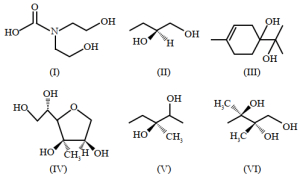
From the following,how many compounds contain at least one secondary alcohol? Choose the correct answer from the options given below:
A
Five
B
Three
C
Four
D
Two
Solution
(B) secondary alcohol is one where the $-OH$ group is attached to a carbon atom that is bonded to two other carbon atoms.
Analyzing the structures:
$(I)$ Contains two primary alcohols $(-CH_2OH)$.
$(II)$ Contains a secondary alcohol (the $-OH$ is on a $CH$ group bonded to two carbons).
$(III)$ Contains a tertiary alcohol (the $-OH$ is on a carbon bonded to three other carbons).
$(IV)$ Contains secondary alcohols (the $-OH$ groups are on $CH$ groups bonded to two carbons).
$(V)$ Contains a secondary alcohol (the $-OH$ is on a $CH$ group bonded to two carbons).
$(VI)$ Contains tertiary alcohols (the $-OH$ groups are on carbons bonded to three other carbons).
Thus,compounds $(II)$,$(IV)$,and $(V)$ contain at least one secondary alcohol.
There are $3$ such compounds.
Analyzing the structures:
$(I)$ Contains two primary alcohols $(-CH_2OH)$.
$(II)$ Contains a secondary alcohol (the $-OH$ is on a $CH$ group bonded to two carbons).
$(III)$ Contains a tertiary alcohol (the $-OH$ is on a carbon bonded to three other carbons).
$(IV)$ Contains secondary alcohols (the $-OH$ groups are on $CH$ groups bonded to two carbons).
$(V)$ Contains a secondary alcohol (the $-OH$ is on a $CH$ group bonded to two carbons).
$(VI)$ Contains tertiary alcohols (the $-OH$ groups are on carbons bonded to three other carbons).
Thus,compounds $(II)$,$(IV)$,and $(V)$ contain at least one secondary alcohol.
There are $3$ such compounds.
0 likes
View Solution872
DifficultMCQ
$A$ hydroxy compound $(X)$ with molar mass $122 \ g \ mol^{-1}$ is acetylated with acetic anhydride,using a large excess of the reagent ensuring complete acetylation of all hydroxyl groups. The product obtained has a molar mass of $290 \ g \ mol^{-1}$. The number of hydroxyl groups present in compound $(X)$ is :
A
$3$
B
$5$
C
$2$
D
$4$
Solution
(D) During acetylation,each $-OH$ group is replaced by an $-OCOCH_3$ group.
This results in the replacement of one hydrogen atom (mass $1 \ u$) with an acetyl group ($-COCH_3$,mass $43 \ u$).
Therefore,the net increase in molar mass for each $-OH$ group is $43 - 1 = 42 \ g \ mol^{-1}$.
Let $n$ be the number of $-OH$ groups.
The increase in molar mass is $290 - 122 = 168 \ g \ mol^{-1}$.
Thus,$n \times 42 = 168$.
$n = \frac{168}{42} = 4$.
So,there are $4$ hydroxyl groups present in compound $(X)$.
This results in the replacement of one hydrogen atom (mass $1 \ u$) with an acetyl group ($-COCH_3$,mass $43 \ u$).
Therefore,the net increase in molar mass for each $-OH$ group is $43 - 1 = 42 \ g \ mol^{-1}$.
Let $n$ be the number of $-OH$ groups.
The increase in molar mass is $290 - 122 = 168 \ g \ mol^{-1}$.
Thus,$n \times 42 = 168$.
$n = \frac{168}{42} = 4$.
So,there are $4$ hydroxyl groups present in compound $(X)$.
0 likes
View Solution873
MediumMCQ
$Ethanol \xrightarrow{H_2SO_4, 413 K} \text{diethyl ether}$. The above reaction is which type?
A
Substitution nucleophilic bimolecular $(S_N2)$
B
Substitution electrophilic bimolecular $(S_E2)$
C
Substitution nucleophilic unimolecular $(S_N1)$
D
Substitution electrophilic unimolecular $(S_E1)$
Solution
(A) The reaction of ethanol with concentrated $H_2SO_4$ at $413 \ K$ is an example of intermolecular dehydration of alcohols to form ethers.
This reaction proceeds via an $S_N2$ mechanism.
In the first step,the alcohol is protonated by the acid.
In the second step,a second molecule of ethanol acts as a nucleophile and attacks the protonated alcohol,displacing a water molecule to form diethyl ether.
Since the rate-determining step involves the collision of two molecules,it is a bimolecular nucleophilic substitution reaction $(S_N2)$.
This reaction proceeds via an $S_N2$ mechanism.
In the first step,the alcohol is protonated by the acid.
In the second step,a second molecule of ethanol acts as a nucleophile and attacks the protonated alcohol,displacing a water molecule to form diethyl ether.
Since the rate-determining step involves the collision of two molecules,it is a bimolecular nucleophilic substitution reaction $(S_N2)$.
0 likes
View Solution874
MediumMCQ
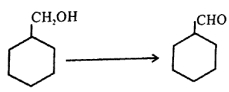
For the given reaction,identify the proper reagent.
A
$KMnO_4/H_2SO_4$
B
$O_3/H_2O - Zn$ dust
C
$C_5H_5NH^+CrO_3Cl^-$
D
$CrO_3 + (CH_3CO)_2O$
Solution
(C) The reaction shows the oxidation of a primary alcohol (cyclohexylmethanol) to an aldehyde (cyclohexanecarbaldehyde).
Pyridinium chlorochromate $(C_5H_5NH^+CrO_3Cl^-)$,commonly known as $PCC$,is a mild oxidizing agent.
It selectively oxidizes primary alcohols to aldehydes and prevents further oxidation to carboxylic acids.
Other reagents like $KMnO_4$ are strong oxidizing agents that would oxidize the primary alcohol directly to a carboxylic acid.
Pyridinium chlorochromate $(C_5H_5NH^+CrO_3Cl^-)$,commonly known as $PCC$,is a mild oxidizing agent.
It selectively oxidizes primary alcohols to aldehydes and prevents further oxidation to carboxylic acids.
Other reagents like $KMnO_4$ are strong oxidizing agents that would oxidize the primary alcohol directly to a carboxylic acid.
0 likes
View Solution875
MediumMCQ
Which product is not obtained when $\text{CH}_3\text{CH}_2\text{OH}$ reacts with $\text{H}_2\text{SO}_4$?
A
$\text{CH}_2 = \text{CH}_2$
B
$\text{CH} \equiv \text{CH}$
C
$\text{C}_2\text{H}_5\text{OC}_2\text{H}_5$
D
$\text{C}_2\text{H}_5\text{HSO}_4$
Solution
(B) The dehydration of ethanol $(\text{CH}_3\text{CH}_2\text{OH})$ with concentrated $\text{H}_2\text{SO}_4$ depends on the reaction conditions.
$1$. At $413 \text{ K}$ $(140^{\circ}\text{C})$,the reaction proceeds via an $S_N2$ mechanism to form diethyl ether $(\text{C}_2\text{H}_5\text{OC}_2\text{H}_5)$.
$2$. At $443 \text{ K}$ $(170^{\circ}\text{C})$,the reaction proceeds via an $E1$ mechanism to form ethene $(\text{CH}_2 = \text{CH}_2)$.
$3$. Ethyl hydrogen sulfate $(\text{C}_2\text{H}_5\text{HSO}_4)$ is formed as an intermediate in both processes.
$4$. Acetylene $(\text{CH} \equiv \text{CH})$ is not a product of this reaction.
$1$. At $413 \text{ K}$ $(140^{\circ}\text{C})$,the reaction proceeds via an $S_N2$ mechanism to form diethyl ether $(\text{C}_2\text{H}_5\text{OC}_2\text{H}_5)$.
$2$. At $443 \text{ K}$ $(170^{\circ}\text{C})$,the reaction proceeds via an $E1$ mechanism to form ethene $(\text{CH}_2 = \text{CH}_2)$.
$3$. Ethyl hydrogen sulfate $(\text{C}_2\text{H}_5\text{HSO}_4)$ is formed as an intermediate in both processes.
$4$. Acetylene $(\text{CH} \equiv \text{CH})$ is not a product of this reaction.
0 likes
View SolutionAlcohols, Phenols and Ethers — Properties of alcohol · Frequently Asked Questions
1Are these Alcohols, Phenols and Ethers questions useful for JEE and NEET?
Yes. All questions in this section are mapped to JEE Main and NEET exam patterns. Previous year questions from JEE Main, NEET, GUJCET and state-level exams are included with full solutions.
2Can I switch to Hindi or Gujarati for these questions?
Yes. Use the language tabs in the hero section or the sidebar to view the same questions and solutions in English, Hindi or Gujarati.
3How do I generate a question paper from this subtopic?
Use the Vedclass Exam Paper Generator — select the chapter and subtopic, set difficulty, and generate Sets A, B, C, D automatically. First 3 chapters of every subject are free.
Vedclass Products
For Students
Vedclass Test Series
Mock tests in real JEE/NEET style with performance analysis. 5-day free trial.
Start Free TrialFor Teachers
Exam Paper Generator
Generate Set A/B/C/D papers from this chapter in 2 minutes. 3 chapters free.
Try FreeFor Institutes
Online Exam Module
Live online exams with unlimited students, 360° analytics & white-label branding.
See DemoFor Teachers & Institutes
Generate a Alcohols, Phenols and Ethers Exam Paper in 2 Minutes
Select subtopic & difficulty — Sets A, B, C, D auto-generated with No Repeat logic.
First 3 chapters of every subject are free — no payment required.