
A English
Properties of alcohol Questions in English
Class 12 Chemistry · Alcohols, Phenols and Ethers · Properties of alcohol
889+
Questions
English
Language
100%
With Solutions
Showing 42 of 889 questions in English
801
EasyMCQ
Which is most viscous?
A
Ethanol
B
Ethylene glycol
C
Glycerol
D
Methanol
Solution
(C) Viscosity is directly proportional to the extent of intermolecular hydrogen bonding.
Among the given options,$Glycerol$ $(CH_2OH-CHOH-CH_2OH)$ has the highest viscosity because it contains $3$ $-OH$ groups,allowing for extensive hydrogen bonding.
In comparison,$Ethylene \ glycol$ has $2$ $-OH$ groups,while $Ethanol$ and $Methanol$ each have only $1$ $-OH$ group.
Among the given options,$Glycerol$ $(CH_2OH-CHOH-CH_2OH)$ has the highest viscosity because it contains $3$ $-OH$ groups,allowing for extensive hydrogen bonding.
In comparison,$Ethylene \ glycol$ has $2$ $-OH$ groups,while $Ethanol$ and $Methanol$ each have only $1$ $-OH$ group.
0 likes
View Solution802
DifficultMCQ
$A$ Grignard reagent $(X)$ on reaction with a carbonyl compound $(Y)$ followed by hydrolysis gives $Z$. $Z$ reacts with conc. $HCl$ at room temperature to give immediate turbidity. $X$ and $Y$ respectively are:
A
$CH_3MgBr, CH_3CH_2CHO$
B
$CH_3MgBr, CH_3COCH_3$
C
$CH_3CH_2CH_2MgBr, HCHO$
D
$CH_3CH_2MgBr, CH_3CHO$
Solution
(B) The reaction of a Grignard reagent with a carbonyl compound followed by hydrolysis produces an alcohol.
$Z$ reacts with conc. $HCl$ at room temperature to give immediate turbidity,which is the characteristic test for a tertiary $(3^{\circ})$ alcohol (Lucas test).
Among the options,the reaction of $CH_3MgBr$ $(X)$ with $CH_3COCH_3$ $(Y)$ produces $tert$-butyl alcohol,which is a tertiary alcohol.
The reaction is: $CH_3MgBr + CH_3COCH_3$ $\rightarrow (CH_3)_3COMgBr$ $\xrightarrow{H_3O^+} (CH_3)_3COH$.
Thus,the correct option is $B$.
$Z$ reacts with conc. $HCl$ at room temperature to give immediate turbidity,which is the characteristic test for a tertiary $(3^{\circ})$ alcohol (Lucas test).
Among the options,the reaction of $CH_3MgBr$ $(X)$ with $CH_3COCH_3$ $(Y)$ produces $tert$-butyl alcohol,which is a tertiary alcohol.
The reaction is: $CH_3MgBr + CH_3COCH_3$ $\rightarrow (CH_3)_3COMgBr$ $\xrightarrow{H_3O^+} (CH_3)_3COH$.
Thus,the correct option is $B$.
0 likes
View Solution803
EasyMCQ
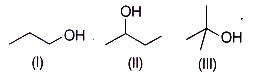
Identify the correct trend of acidic strength for the given alcohols.
A
$(I) > (III) > (II)$
B
$(I) > (II) > (III)$
C
$(III) > (I) > (II)$
D
$(III) > (II) > (I)$
Solution
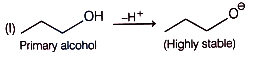
(B) The acidic strength of alcohols depends on the stability of the conjugate base (alkoxide ion) formed after the release of a proton $(H^+)$.
Alkyl groups are electron-donating ($+I$ effect). As the number of alkyl groups attached to the carbon bearing the $-OH$ group increases,the electron density on the oxygen atom increases due to the $+I$ effect,which destabilizes the alkoxide ion.
Therefore,the stability of the alkoxide ion follows the order: Primary $(1^{\circ})$ > Secondary $(2^{\circ})$ > Tertiary $(3^{\circ})$.
Consequently,the acidic strength follows the same order: Primary $(I)$ > Secondary $(II)$ > Tertiary $(III)$.
Thus,the correct order is $(I) > (II) > (III)$.
Alkyl groups are electron-donating ($+I$ effect). As the number of alkyl groups attached to the carbon bearing the $-OH$ group increases,the electron density on the oxygen atom increases due to the $+I$ effect,which destabilizes the alkoxide ion.
Therefore,the stability of the alkoxide ion follows the order: Primary $(1^{\circ})$ > Secondary $(2^{\circ})$ > Tertiary $(3^{\circ})$.
Consequently,the acidic strength follows the same order: Primary $(I)$ > Secondary $(II)$ > Tertiary $(III)$.
Thus,the correct order is $(I) > (II) > (III)$.
0 likes
View Solution804
MediumMCQ
The number of primary $(1^{\circ})$,secondary $(2^{\circ})$ and tertiary $(3^{\circ})$ alcohols possible for the formula $C_5H_{12}O$ respectively are
A
$3, 3, 2$
B
$4, 2, 2$
C
$4, 3, 1$
D
$3, 4, 1$
Solution
(C) For the molecular formula $C_5H_{12}O$,the possible alcohols are:
$1^{\circ}$ Alcohols: $CH_3CH_2CH_2CH_2CH_2OH$ (pentan$-1-$ol),$CH_3CH_2CH_2CH(CH_3)OH$ (is incorrect,this is $2^{\circ}$),$CH_3CH(CH_3)CH_2CH_2OH$ ($3$-methylbutan$-1-$ol),$CH_3CH_2CH(CH_3)CH_2OH$ ($2$-methylbutan$-1-$ol),and $(CH_3)_3CCH_2OH$ ($2$,$2$-dimethylpropan$-1-$ol). Total $1^{\circ} = 4$.
$2^{\circ}$ Alcohols: $CH_3CH_2CH_2CH(OH)CH_3$ (pentan$-2-$ol),$CH_3CH_2CH(OH)CH_2CH_3$ (pentan$-3-$ol),and $CH_3CH(CH_3)CH(OH)CH_3$ ($3$-methylbutan$-2-$ol). Total $2^{\circ} = 3$.
$3^{\circ}$ Alcohols: $CH_3CH_2C(CH_3)(OH)CH_3$ ($2$-methylbutan$-2-$ol). Total $3^{\circ} = 1$.
Thus,the count is $4, 3, 1$.
$1^{\circ}$ Alcohols: $CH_3CH_2CH_2CH_2CH_2OH$ (pentan$-1-$ol),$CH_3CH_2CH_2CH(CH_3)OH$ (is incorrect,this is $2^{\circ}$),$CH_3CH(CH_3)CH_2CH_2OH$ ($3$-methylbutan$-1-$ol),$CH_3CH_2CH(CH_3)CH_2OH$ ($2$-methylbutan$-1-$ol),and $(CH_3)_3CCH_2OH$ ($2$,$2$-dimethylpropan$-1-$ol). Total $1^{\circ} = 4$.
$2^{\circ}$ Alcohols: $CH_3CH_2CH_2CH(OH)CH_3$ (pentan$-2-$ol),$CH_3CH_2CH(OH)CH_2CH_3$ (pentan$-3-$ol),and $CH_3CH(CH_3)CH(OH)CH_3$ ($3$-methylbutan$-2-$ol). Total $2^{\circ} = 3$.
$3^{\circ}$ Alcohols: $CH_3CH_2C(CH_3)(OH)CH_3$ ($2$-methylbutan$-2-$ol). Total $3^{\circ} = 1$.
Thus,the count is $4, 3, 1$.
0 likes
View Solution805
MediumMCQ
The correct statement about the product of the following reaction is
$CH_3-CHO \xrightarrow[(ii) H_2O]{(i) C_2H_5MgBr} \text{product}$
$CH_3-CHO \xrightarrow[(ii) H_2O]{(i) C_2H_5MgBr} \text{product}$
A
It undergoes dehydration with $20 \% H_3PO_4$ at $358 \ K$
B
It gives ketone on oxidation with $CrO_3$
C
It does not give positive iodoform test
D
It is a vinylic alcohol
Solution
(A) The reaction of $CH_3-CHO$ (acetaldehyde) with $C_2H_5MgBr$ (ethylmagnesium bromide) followed by hydrolysis yields $CH_3-CH(OH)-C_2H_5$ (butan$-2-$ol).
$CH_3-CHO + C_2H_5MgBr$ $\rightarrow CH_3-CH(OMgBr)-C_2H_5$ $\xrightarrow{H_2O} CH_3-CH(OH)-C_2H_5$.
Butan$-2-$ol is a secondary alcohol.
$(A)$ Secondary alcohols undergo dehydration with $20 \% H_3PO_4$ at $358 \ K$ to form alkenes. This is a correct statement.
$(B)$ Oxidation of secondary alcohols with $CrO_3$ gives a ketone (butanone). This is also a correct statement.
$(C)$ Butan$-2-$ol contains the $CH_3-CH(OH)-$ group,so it gives a positive iodoform test. Thus,this statement is incorrect.
$(D)$ It is not a vinylic alcohol.
Note: In many competitive contexts,$(A)$ is considered the primary characteristic reaction for this specific alcohol under these conditions.
$CH_3-CHO + C_2H_5MgBr$ $\rightarrow CH_3-CH(OMgBr)-C_2H_5$ $\xrightarrow{H_2O} CH_3-CH(OH)-C_2H_5$.
Butan$-2-$ol is a secondary alcohol.
$(A)$ Secondary alcohols undergo dehydration with $20 \% H_3PO_4$ at $358 \ K$ to form alkenes. This is a correct statement.
$(B)$ Oxidation of secondary alcohols with $CrO_3$ gives a ketone (butanone). This is also a correct statement.
$(C)$ Butan$-2-$ol contains the $CH_3-CH(OH)-$ group,so it gives a positive iodoform test. Thus,this statement is incorrect.
$(D)$ It is not a vinylic alcohol.
Note: In many competitive contexts,$(A)$ is considered the primary characteristic reaction for this specific alcohol under these conditions.
0 likes
View Solution806
MediumMCQ
The preferred reagent for the preparation of pure alkyl chloride from alcohol is
A
$HCl + ZnCl_2$
B
$PCl_5$
C
$SOCl_2$
D
$PCl_3$
Solution
(C) The reaction of alcohol with thionyl chloride $(SOCl_2)$ is the preferred method for preparing alkyl chlorides because the by-products formed ($SO_2$ and $HCl$) are gases.
Since these by-products escape into the atmosphere,the resulting alkyl chloride is obtained in a pure state.
The reaction is: $R-OH + SOCl_2 \rightarrow R-Cl + SO_2(g) + HCl(g)$.
Since these by-products escape into the atmosphere,the resulting alkyl chloride is obtained in a pure state.
The reaction is: $R-OH + SOCl_2 \rightarrow R-Cl + SO_2(g) + HCl(g)$.
0 likes
View Solution807
MediumMCQ
An alcohol $X$ $(C_4H_{10}O)$ on dehydration gives an alkene $(C_4H_8)$ as the major product,which on bromination followed by treatment with $Y$ gives an alkyne $C_4H_6$. The alkyne $C_4H_6$ does not react with sodium metal. What are $X$ and $Y$?
A
butan$-2-$ol; $aq. KOH$
B
butan$-2-$ol; $(i) alc. KOH, (ii) NaNH_2$
C
butan$-1-$ol; $alc. KOH$
D
butan$-1-$ol; $(i) alc. KOH, (ii) NaNH_2$
Solution
(B) $1$. Dehydration of $X$ $(C_4H_{10}O)$ gives $C_4H_8$ (but$-2-$ene as major product). This implies $X$ is butan$-2-$ol.
$2$. Bromination of but$-2-$ene gives $2,3-$dibromobutane.
$3$. Treatment of $2,3-$dibromobutane with $Y$ $(NaNH_2)$ causes double dehydrohalogenation to form but$-2-$yne $(CH_3-C \equiv C-CH_3)$.
$4$. But$-2-$yne is an internal alkyne and does not have an acidic hydrogen,so it does not react with sodium metal.
$5$. Thus,$X$ is butan$-2-$ol and $Y$ is $(i) alc. KOH, (ii) NaNH_2$.
$2$. Bromination of but$-2-$ene gives $2,3-$dibromobutane.
$3$. Treatment of $2,3-$dibromobutane with $Y$ $(NaNH_2)$ causes double dehydrohalogenation to form but$-2-$yne $(CH_3-C \equiv C-CH_3)$.
$4$. But$-2-$yne is an internal alkyne and does not have an acidic hydrogen,so it does not react with sodium metal.
$5$. Thus,$X$ is butan$-2-$ol and $Y$ is $(i) alc. KOH, (ii) NaNH_2$.
0 likes
View Solution808
MediumMCQ
An alcohol $X$ $(C_5H_{12}O)$ on dehydration gives $Y$ (major product). Reaction of $Y$ with $HBr$ gave $Z$ ($C_5H_{11}Br$,major product). $Z$ undergoes nucleophilic substitution in two steps. What are $X$ and $Y$?
A
Pentan$-3-$ol and pent$-2-$ene
B
$2-$methylbutan$-2-$ol and $2-$methylbut$-2-$ene
C
$3-$methylbutan$-2-$ol and $3-$methylbut$-1-$ene
D
$2-$methylbutan$-2-$ol and $2-$methylbut$-1-$ene
Solution
(B) $1$. Alcohol $X$ $(C_5H_{12}O)$ undergoes dehydration to form alkene $Y$ (major product).
$2$. $Y$ reacts with $HBr$ to form $Z$ ($C_5H_{11}Br$,major product) via Markovnikov addition.
$3$. $Z$ undergoes nucleophilic substitution in two steps,which is characteristic of an $S_N1$ mechanism. This implies $Z$ is a tertiary alkyl halide.
$4$. Among the options,$2$-methylbutan-$2$-ol is a tertiary alcohol. Its dehydration gives $2$-methylbut-$2$-ene as the major product (Saytzeff product).
$5$. Reaction of $2$-methylbut-$2$-ene with $HBr$ gives $2$-bromo-$2$-methylbutane $(Z)$ as the major product,which is a tertiary alkyl halide and follows the $S_N1$ mechanism (two steps).
$6$. Thus,$X$ is $2$-methylbutan-$2$-ol and $Y$ is $2$-methylbut-$2$-ene.
$2$. $Y$ reacts with $HBr$ to form $Z$ ($C_5H_{11}Br$,major product) via Markovnikov addition.
$3$. $Z$ undergoes nucleophilic substitution in two steps,which is characteristic of an $S_N1$ mechanism. This implies $Z$ is a tertiary alkyl halide.
$4$. Among the options,$2$-methylbutan-$2$-ol is a tertiary alcohol. Its dehydration gives $2$-methylbut-$2$-ene as the major product (Saytzeff product).
$5$. Reaction of $2$-methylbut-$2$-ene with $HBr$ gives $2$-bromo-$2$-methylbutane $(Z)$ as the major product,which is a tertiary alkyl halide and follows the $S_N1$ mechanism (two steps).
$6$. Thus,$X$ is $2$-methylbutan-$2$-ol and $Y$ is $2$-methylbut-$2$-ene.
0 likes
View Solution809
MediumMCQ
An alcohol $X$ $(C_4H_{10}O)$ reacts with concentrated $HCl$ at room temperature to give $Y$ $(C_4H_9Cl)$. Reaction of $X$ with copper at $573 \ K$ gives $Z$. What is $Z$?
A
Butan$-2-$one
B
$2-$Methylpropene
C
Butanal
D
Butanoic acid
Solution
(B) The alcohol $X$ $(C_4H_{10}O)$ reacts with concentrated $HCl$ at room temperature to form $Y$ $(C_4H_9Cl)$. This indicates that $X$ is a tertiary alcohol,specifically $2$-methylpropan-$2$-ol (tert-butyl alcohol),because tertiary alcohols react rapidly with $HCl$ at room temperature (Lucas test).
The reaction is:
$(CH_3)_3C-OH + HCl \rightarrow (CH_3)_3C-Cl + H_2O$
When $X$ ($2$-methylpropan-$2$-ol) is passed over heated copper at $573 \ K$,it undergoes dehydration to form an alkene,$2$-methylpropene $(Z)$:
$(CH_3)_3C-OH \xrightarrow{Cu, 573 \ K} CH_3-C(CH_3)=CH_2 + H_2O$
Therefore,$Z$ is $2$-methylpropene.
The reaction is:
$(CH_3)_3C-OH + HCl \rightarrow (CH_3)_3C-Cl + H_2O$
When $X$ ($2$-methylpropan-$2$-ol) is passed over heated copper at $573 \ K$,it undergoes dehydration to form an alkene,$2$-methylpropene $(Z)$:
$(CH_3)_3C-OH \xrightarrow{Cu, 573 \ K} CH_3-C(CH_3)=CH_2 + H_2O$
Therefore,$Z$ is $2$-methylpropene.
0 likes
View Solution810
EasyMCQ
Which of the following sequence of reagents converts propene to $1$-chloropropane?
A
$(i) (BH_3)_2, (ii) H_2O_2 / OH^- ; HCl, ZnCl_2$
B
$(i) (BH_3)_2, (ii) H_2O_2 / OH^- ; NaCl$
C
dil. $H_2SO_4 ; HCl, ZnCl_2$
D
dil. $H_2SO_4 ;$ Conc. $HCl$
Solution
(A) The conversion of propene $(CH_3-CH=CH_2)$ to $1$-chloropropane $(CH_3-CH_2-CH_2-Cl)$ requires an anti-Markovnikov hydration followed by the conversion of the primary alcohol to an alkyl chloride.
Step $1$: Hydroboration-oxidation of propene using $(i) (BH_3)_2$ and $(ii) H_2O_2 / OH^-$ yields propan-$1$-ol $(CH_3-CH_2-CH_2-OH)$.
Step $2$: The conversion of propan-$1$-ol to $1$-chloropropane is typically achieved using $HCl$ in the presence of a catalyst like $ZnCl_2$ (Lucas reagent) or other chlorinating agents. Although primary alcohols react slowly with Lucas reagent,the sequence provided in option $A$ represents the standard synthetic route for this transformation.
Step $1$: Hydroboration-oxidation of propene using $(i) (BH_3)_2$ and $(ii) H_2O_2 / OH^-$ yields propan-$1$-ol $(CH_3-CH_2-CH_2-OH)$.
Step $2$: The conversion of propan-$1$-ol to $1$-chloropropane is typically achieved using $HCl$ in the presence of a catalyst like $ZnCl_2$ (Lucas reagent) or other chlorinating agents. Although primary alcohols react slowly with Lucas reagent,the sequence provided in option $A$ represents the standard synthetic route for this transformation.
0 likes
View Solution811
EasyMCQ
An alcohol $X$ $(C_4H_{10}O)$ does not give turbidity with conc. $HCl$ and $ZnCl_2$ at room temperature. $X$ on reaction with reagent $Y$ gives $Z$. What are $X, Y$ and $Z$ respectively?
A
$n$-butanol,$PCC$,butanal
B
$n$-butanol,$KMnO_4/H^+$,butanal
C
butan-$2$-ol,$CrO_3$,butan-$2$-one
D
$2$-methylpropan-$2$-ol,$Cu/573 \ K$,$2$-methylpropene
Solution
(A) The Lucas test uses conc. $HCl$ and $ZnCl_2$ to distinguish between $1^{\circ}$,$2^{\circ}$,and $3^{\circ}$ alcohols.
$3^{\circ}$ alcohols give immediate turbidity,$2^{\circ}$ alcohols give turbidity within $5-10$ minutes,and $1^{\circ}$ alcohols do not give turbidity at room temperature.
Since alcohol $X$ $(C_4H_{10}O)$ does not give turbidity at room temperature,it must be a $1^{\circ}$ alcohol.
Among the options,$n$-butanol is a $1^{\circ}$ alcohol.
$n$-butanol reacts with $PCC$ (Pyridinium chlorochromate) to form butanal $(Z)$.
Therefore,$X = n$-butanol,$Y = PCC$,and $Z = \text{butanal}$.
$3^{\circ}$ alcohols give immediate turbidity,$2^{\circ}$ alcohols give turbidity within $5-10$ minutes,and $1^{\circ}$ alcohols do not give turbidity at room temperature.
Since alcohol $X$ $(C_4H_{10}O)$ does not give turbidity at room temperature,it must be a $1^{\circ}$ alcohol.
Among the options,$n$-butanol is a $1^{\circ}$ alcohol.
$n$-butanol reacts with $PCC$ (Pyridinium chlorochromate) to form butanal $(Z)$.
Therefore,$X = n$-butanol,$Y = PCC$,and $Z = \text{butanal}$.
0 likes
View Solution812
MediumMCQ
Which of the following reactions is not feasible?
A
$CH_3-CH_2-OH \xrightarrow{95\% \ H_2SO_4, \ 443 \ K} CH_2=CH_2$
B
$CH_3-CH_2-CH_2-CH_2-OH \xrightarrow{75\% \ H_2SO_4, \ 300 \ K} CH_3-CH_2-CH=CH_2$
C
$CH_3-CH_2-CH(OH)-CH_3 \xrightarrow{85\% \ H_3PO_4, \ 440 \ K} CH_3-CH=CH-CH_3$
D
$CH_3-C(CH_3)_2-OH \xrightarrow{20\% \ H_3PO_4, \ 358 \ K} CH_3-C(CH_3)=CH_2$
Solution
(B) The dehydration of alcohols to alkenes requires specific conditions depending on the degree of substitution of the alcohol.
Primary $(1^{\circ})$ alcohols,like butan$-1-$ol in option $(B)$,are the least reactive towards dehydration and typically require concentrated acid (e.g.,$95\% \ H_2SO_4$) and high temperatures (around $443 \ K$) to proceed.
Option $(B)$ suggests the dehydration of a primary alcohol at a very low temperature $(300 \ K)$ with a lower concentration of acid $(75\% \ H_2SO_4)$,which is insufficient to drive the elimination reaction.
Secondary and tertiary alcohols are more reactive and can undergo dehydration under milder conditions,making options $(C)$ and $(D)$ feasible.
Primary $(1^{\circ})$ alcohols,like butan$-1-$ol in option $(B)$,are the least reactive towards dehydration and typically require concentrated acid (e.g.,$95\% \ H_2SO_4$) and high temperatures (around $443 \ K$) to proceed.
Option $(B)$ suggests the dehydration of a primary alcohol at a very low temperature $(300 \ K)$ with a lower concentration of acid $(75\% \ H_2SO_4)$,which is insufficient to drive the elimination reaction.
Secondary and tertiary alcohols are more reactive and can undergo dehydration under milder conditions,making options $(C)$ and $(D)$ feasible.
0 likes
View Solution813
MediumMCQ
When ethanol is treated with sulphuric acid at $413 \ K$,the reaction involved in it is:
A
$S_N2$
B
$S_N1$
C
addition
D
elimination
Solution
(A) The reaction of ethanol with $H_2SO_4$ at $413 \ K$ leads to the formation of ethoxyethane (diethyl ether).
This process is an intermolecular dehydration reaction.
The mechanism involves the protonation of one ethanol molecule followed by the nucleophilic attack of another ethanol molecule on the protonated species,which follows the $S_N2$ pathway.
This process is an intermolecular dehydration reaction.
The mechanism involves the protonation of one ethanol molecule followed by the nucleophilic attack of another ethanol molecule on the protonated species,which follows the $S_N2$ pathway.
0 likes
View Solution814
MediumMCQ
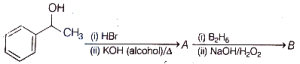
The major product '$B$' of the following reaction sequence is
A
$1-$phenylethanol
B
Acetophenone
C
Phenylacetaldehyde
D
$2-$phenylethanol
Solution
(D) The reaction sequence is as follows:
$1$. $1-$phenylethanol reacts with $HBr$ to form $1-$bromo$-1-$phenylethane,which then undergoes dehydrohalogenation with alcoholic $KOH$ to yield styrene $(C_6H_5CH=CH_2)$.
$2$. Styrene undergoes hydroboration-oxidation (using $B_2H_6$ followed by $NaOH/H_2O_2$) to produce $2-$phenylethanol $(C_6H_5CH_2CH_2OH)$ as the major anti-Markovnikov product.
Therefore,the major product '$B$' is $2-$phenylethanol.
$1$. $1-$phenylethanol reacts with $HBr$ to form $1-$bromo$-1-$phenylethane,which then undergoes dehydrohalogenation with alcoholic $KOH$ to yield styrene $(C_6H_5CH=CH_2)$.
$2$. Styrene undergoes hydroboration-oxidation (using $B_2H_6$ followed by $NaOH/H_2O_2$) to produce $2-$phenylethanol $(C_6H_5CH_2CH_2OH)$ as the major anti-Markovnikov product.
Therefore,the major product '$B$' is $2-$phenylethanol.
0 likes
View Solution815
MediumMCQ
Which of the following reactions takes place when tertiary butanol is passed over heated copper at $573 \ K$?
A
Dehydrogenation reaction
B
Dehydration reaction
C
Oxidation reaction
D
Addition reaction
Solution
(B) When tertiary butanol ($3^{\circ}$ alcohol) is passed over heated $Cu$ at $573 \ K$,isobutene is formed through an elimination reaction.
Since a water molecule is eliminated from the alcohol,this process is specifically classified as a dehydration reaction.
In contrast,$1^{\circ}$ alcohols undergo dehydrogenation to form aldehydes,and $2^{\circ}$ alcohols undergo dehydrogenation to form ketones under the same conditions.
Since a water molecule is eliminated from the alcohol,this process is specifically classified as a dehydration reaction.
In contrast,$1^{\circ}$ alcohols undergo dehydrogenation to form aldehydes,and $2^{\circ}$ alcohols undergo dehydrogenation to form ketones under the same conditions.
0 likes
View Solution816
EasyMCQ
Lucas test is used for the determination of
A
aldehydes
B
phenols
C
carboxylic acid
D
alcohols
Solution
(D) Lucas test is used to distinguish between primary,secondary,and tertiary alcohols.
Lucas reagent is a solution of anhydrous zinc chloride $(ZnCl_2)$ in concentrated hydrochloric acid $(HCl)$.
Lucas reagent converts alcohols into alkyl chlorides.
Tertiary alcohols react immediately with Lucas reagent,secondary alcohols react within $5 \ \text{minutes}$,while primary alcohols do not react at room temperature.
Lucas reagent is a solution of anhydrous zinc chloride $(ZnCl_2)$ in concentrated hydrochloric acid $(HCl)$.
Lucas reagent converts alcohols into alkyl chlorides.
Tertiary alcohols react immediately with Lucas reagent,secondary alcohols react within $5 \ \text{minutes}$,while primary alcohols do not react at room temperature.
0 likes
View Solution817
MediumMCQ
Which of the following compounds will give butanone on oxidation with alkaline $KMnO_4$ solution?
A
Butan$-1-$ol only
B
Butan$-2-$ol only
C
Butan$-1-$ol and butan$-2-$ol
D
None of the options are correct
Solution
(B) Secondary alcohols like $CH_3-CH(OH)-CH_2-CH_3$ (butan$-2-$ol) on oxidation with strong oxidizing agents like alkaline $KMnO_4$ undergo oxidation to form ketones.
Specifically,butan$-2-$ol is oxidized to butanone $(CH_3-CO-CH_2-CH_3)$.
Primary alcohols like butan$-1-$ol $(CH_3-CH_2-CH_2-CH_2OH)$ are oxidized to carboxylic acids (butanoic acid) under these conditions.
Hence,the correct option is $(B)$.
Specifically,butan$-2-$ol is oxidized to butanone $(CH_3-CO-CH_2-CH_3)$.
Primary alcohols like butan$-1-$ol $(CH_3-CH_2-CH_2-CH_2OH)$ are oxidized to carboxylic acids (butanoic acid) under these conditions.
Hence,the correct option is $(B)$.
0 likes
View Solution818
DifficultMCQ
Identify the reagents $X, Y, Z$ for the following dehydration reactions of alcohols:
$CH_3-CH_2-OH \xrightarrow{X} CH_2=CH_2 + H_2O$
$CH_3-CH(OH)-CH_3 \xrightarrow{Y} CH_3-CH=CH_2 + H_2O$
$(CH_3)_3C-OH \xrightarrow{Z} (CH_3)_2C=CH_2 + H_2O$
$CH_3-CH_2-OH \xrightarrow{X} CH_2=CH_2 + H_2O$
$CH_3-CH(OH)-CH_3 \xrightarrow{Y} CH_3-CH=CH_2 + H_2O$
$(CH_3)_3C-OH \xrightarrow{Z} (CH_3)_2C=CH_2 + H_2O$
A
| $X$ | $Y$ | $Z$ |
| $H_2SO_4, 443 \ K$ | $85 \% \ H_3PO_4, 440 \ K$ | $20 \% \ H_3PO_4, 358 \ K$ |
B
| $X$ | $Y$ | $Z$ |
| $85 \% \ H_3PO_4, 440 \ K$ | $H_2SO_4, 443 \ K$ | $20 \% \ H_3PO_4, 358 \ K$ |
C
| $X$ | $Y$ | $Z$ |
| $20 \% \ H_3PO_4, 358 \ K$ | $H_2SO_4, 443 \ K$ | $85 \% \ H_3PO_4, 440 \ K$ |
D
| $X$ | $Y$ | $Z$ |
| $H_2SO_4, 443 \ K$ | $20 \% \ H_3PO_4, 358 \ K$ | $85 \% \ H_3PO_4, 440 \ K$ |
Solution
(A) The dehydration of alcohols depends on the degree of substitution of the alcohol:
$1$. Primary $(1^{\circ})$ alcohols like ethanol undergo dehydration using concentrated $H_2SO_4$ at $443 \ K$.
$2$. Secondary $(2^{\circ})$ alcohols like propan$-2-$ol undergo dehydration using $85 \% \ H_3PO_4$ at $440 \ K$.
$3$. Tertiary $(3^{\circ})$ alcohols like tert-butyl alcohol undergo dehydration using $20 \% \ H_3PO_4$ at $358 \ K$.
Therefore,$X = H_2SO_4, 443 \ K$; $Y = 85 \% \ H_3PO_4, 440 \ K$; $Z = 20 \% \ H_3PO_4, 358 \ K$.
$1$. Primary $(1^{\circ})$ alcohols like ethanol undergo dehydration using concentrated $H_2SO_4$ at $443 \ K$.
$2$. Secondary $(2^{\circ})$ alcohols like propan$-2-$ol undergo dehydration using $85 \% \ H_3PO_4$ at $440 \ K$.
$3$. Tertiary $(3^{\circ})$ alcohols like tert-butyl alcohol undergo dehydration using $20 \% \ H_3PO_4$ at $358 \ K$.
Therefore,$X = H_2SO_4, 443 \ K$; $Y = 85 \% \ H_3PO_4, 440 \ K$; $Z = 20 \% \ H_3PO_4, 358 \ K$.
0 likes
View Solution819
MediumMCQ
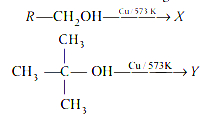
What are $X$ and $Y$ in the following reactions?
A
$X = RCHO, Y = (CH_3)_2C=CH_2$
B
$X = RCOOH, Y = (CH_3)_2C=CH_2$
C
$X = RCHO, Y = (CH_3)_2C=CH_2$
D
$X = RCOR, Y = (CH_3)_2C=O$
Solution
(C) When the vapours of a primary alcohol are passed over heated copper at $573 \ K$,dehydrogenation takes place and an aldehyde is formed: $R-CH_2OH \xrightarrow{Cu/573 \ K} R-CHO + H_2$.
In the case of tertiary alcohols,dehydration takes place to form an alkene: $(CH_3)_3C-OH \xrightarrow{Cu/573 \ K} (CH_3)_2C=CH_2 + H_2O$.
Thus,$X$ is an aldehyde $(RCHO)$ and $Y$ is an alkene $((CH_3)_2C=CH_2)$.
In the case of tertiary alcohols,dehydration takes place to form an alkene: $(CH_3)_3C-OH \xrightarrow{Cu/573 \ K} (CH_3)_2C=CH_2 + H_2O$.
Thus,$X$ is an aldehyde $(RCHO)$ and $Y$ is an alkene $((CH_3)_2C=CH_2)$.
0 likes
View Solution820
MediumMCQ
What are $X$ and $Y$ in the following reaction? $R-OH + PCl_5 \rightarrow X + Y + HCl$
A
$X = R-OCl, Y = PCl_3$
B
$X = R-Cl, Y = POCl_3$
C
$X = R-O-R, Y = POCl_3$
D
$X = R-Cl, Y = P(OH)_3$
Solution
(B) In the reaction of alcohols with $PCl_5$,the hydroxyl group $(-OH)$ is replaced by a chlorine atom to form an alkyl chloride $(R-Cl)$.
The side products are phosphorus oxychloride $(POCl_3)$ and hydrogen chloride $(HCl)$.
The balanced chemical equation is: $R-OH + PCl_5 \rightarrow R-Cl + POCl_3 + HCl$.
Thus,$X = R-Cl$ and $Y = POCl_3$.
The side products are phosphorus oxychloride $(POCl_3)$ and hydrogen chloride $(HCl)$.
The balanced chemical equation is: $R-OH + PCl_5 \rightarrow R-Cl + POCl_3 + HCl$.
Thus,$X = R-Cl$ and $Y = POCl_3$.
0 likes
View Solution821
EasyMCQ
$C_2H_5OH + 4I_2 + 3Na_2CO_3 \longrightarrow X + HCOONa + 5NaI + 3CO_2 + 2H_2O$
In the above reaction,'$X$' is
In the above reaction,'$X$' is
A
diiodomethane
B
triiodomethane
C
iodomethane
D
tetraiodomethane
Solution
(B) The given reaction is the iodoform test for ethanol.
Ethanol $(C_2H_5OH)$ reacts with iodine $(I_2)$ in the presence of a base like sodium carbonate $(Na_2CO_3)$ to form iodoform $(CHI_3)$,which is also known as triiodomethane.
The balanced chemical equation is:
$C_2H_5OH + 4I_2 + 3Na_2CO_3 \longrightarrow CHI_3 + HCOONa + 5NaI + 3CO_2 + 2H_2O$
Therefore,'$X$' is $CHI_3$ (triiodomethane).
Ethanol $(C_2H_5OH)$ reacts with iodine $(I_2)$ in the presence of a base like sodium carbonate $(Na_2CO_3)$ to form iodoform $(CHI_3)$,which is also known as triiodomethane.
The balanced chemical equation is:
$C_2H_5OH + 4I_2 + 3Na_2CO_3 \longrightarrow CHI_3 + HCOONa + 5NaI + 3CO_2 + 2H_2O$
Therefore,'$X$' is $CHI_3$ (triiodomethane).
0 likes
View Solution822
DifficultMCQ
$CH_3 CH_2 OH \underset{\text{step-}1}{\stackrel{Cl_2}{\longrightarrow}} CH_3 CHO$ $\underset{\text{step-}2}{\stackrel{3 Cl_2}{\longrightarrow}} Cl_3 CCHO$
In the above reactions,the role of $Cl_2$ in step-$1$ and step-$2$ respectively is:
In the above reactions,the role of $Cl_2$ in step-$1$ and step-$2$ respectively is:
A
oxidation,chlorination
B
reduction,chlorination
C
oxidation,addition
D
reduction,substitution
Solution
(A) In step-$1$,$CH_3 CH_2 OH$ is converted to $CH_3 CHO$ by $Cl_2$. This is an oxidation reaction where the primary alcohol group $(-CH_2 OH)$ is oxidized to an aldehyde group $(-CHO)$.
In step-$2$,$CH_3 CHO$ reacts with $3 Cl_2$ to form $Cl_3 C CHO$. This is a chlorination reaction where the hydrogen atoms of the methyl group are substituted by chlorine atoms.
In step-$2$,$CH_3 CHO$ reacts with $3 Cl_2$ to form $Cl_3 C CHO$. This is a chlorination reaction where the hydrogen atoms of the methyl group are substituted by chlorine atoms.
0 likes
View Solution823
EasyMCQ
The reagent used for the conversion of allyl alcohol into propenal is
A
$O_3 / H_2O - Zn$ dust
B
$DIBAL-H$
C
$CrO_2Cl_2 / H_3O^{+}$
D
$C_5H_5NH^{+} CrO_3Cl^{-}$
Solution
(D) The reagent used for the conversion of allyl alcohol into propenal is $C_5H_5NH^{+} CrO_3Cl^{-}$ [$PCC$ (pyridinium chlorochromate)].
$CH_2=CH-CH_2-OH \xrightarrow{PCC} CH_2=CH-CHO$
(Allyl alcohol) (Propenal)
Here,the reagent used must selectively oxidize the primary alcohol group $(-CH_2OH)$ to an aldehyde $(-CHO)$ without affecting the carbon-carbon double bond. $PCC$ is a mild oxidizing agent that performs this specific transformation.
$CH_2=CH-CH_2-OH \xrightarrow{PCC} CH_2=CH-CHO$
(Allyl alcohol) (Propenal)
Here,the reagent used must selectively oxidize the primary alcohol group $(-CH_2OH)$ to an aldehyde $(-CHO)$ without affecting the carbon-carbon double bond. $PCC$ is a mild oxidizing agent that performs this specific transformation.
0 likes
View Solution824
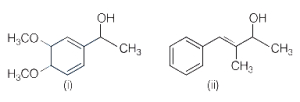
DifficultMCQ
Which compounds among the following give a positive iodoform test?
A
$(i), (iii)$ and $(vi)$
B
$(iii), (iv)$ and $(v)$
C
$(i), (ii)$ and $(v)$
D
$(ii), (iv)$ and $(vi)$
Solution
(C) positive iodoform test is given by compounds containing the $CH_3CO-$ group or the $CH_3CH(OH)-$ group.
These groups are oxidized to the $CH_3CO-$ group in the presence of iodine and sodium hydroxide,which then reacts to form a pale yellow precipitate of iodoform $(CHI_3)$.
In the provided structures,compounds $(i)$ and $(ii)$ contain the $CH_3CH(OH)-$ moiety,which is capable of undergoing the iodoform reaction.
Therefore,these compounds will give a positive iodoform test.
These groups are oxidized to the $CH_3CO-$ group in the presence of iodine and sodium hydroxide,which then reacts to form a pale yellow precipitate of iodoform $(CHI_3)$.
In the provided structures,compounds $(i)$ and $(ii)$ contain the $CH_3CH(OH)-$ moiety,which is capable of undergoing the iodoform reaction.
Therefore,these compounds will give a positive iodoform test.
0 likes
View Solution825
MediumMCQ
The bond angle between $C-O$ and $O-H$ bonds in alcohols is close to (in $^{\circ}$)
A
$109$
B
$120$
C
$180$
D
$90$
Solution
(A) In alcohols,the oxygen atom is $sp^3$ hybridized.
Due to the presence of two lone pairs on the oxygen atom,the bond angle is slightly less than the ideal tetrahedral angle of $109.5^{\circ}$ $(109^{\circ} 28')$.
Therefore,the bond angle in alcohols is close to $109^{\circ}$.
Due to the presence of two lone pairs on the oxygen atom,the bond angle is slightly less than the ideal tetrahedral angle of $109.5^{\circ}$ $(109^{\circ} 28')$.
Therefore,the bond angle in alcohols is close to $109^{\circ}$.
0 likes
View Solution826
EasyMCQ
Which of the following is not correct about Grignard reagent?
A
It is a nucleophile
B
Forms new carbon-carbon bond
C
Reacts with carbonyl compounds
D
It is an organomanganese compound
Solution
(D) The general formula of a Grignard reagent is $R-Mg-X$,where $R$ is an alkyl or aryl group and $X$ is a halogen.
It acts as a nucleophile due to the partial negative charge on the carbon atom bonded to magnesium.
It is used to form new carbon-carbon bonds by reacting with carbonyl compounds.
It is an organomagnesium compound,not an organomanganese compound.
Therefore,option $D$ is incorrect.
It acts as a nucleophile due to the partial negative charge on the carbon atom bonded to magnesium.
It is used to form new carbon-carbon bonds by reacting with carbonyl compounds.
It is an organomagnesium compound,not an organomanganese compound.
Therefore,option $D$ is incorrect.
0 likes
View Solution827
MediumMCQ
What are $X$,$Y$ and $Z$ in the following reaction?
$R-OH + PCl_5 \longrightarrow X + Y + Z$
$R-OH + PCl_5 \longrightarrow X + Y + Z$
A
$R-Cl, HCl, POCl_3$
B
$R-O-R, H_3PO_3, H_2O$
C
$R-Cl, H_2O, POCl_3$
D
$R-O-R, H_2O, POCl_3$
Solution
(A) The reaction of alcohol $(R-OH)$ with phosphorus pentachloride $(PCl_5)$ is a standard method for the preparation of haloalkanes.
In this reaction,the hydroxyl group of the alcohol is replaced by a chlorine atom.
The balanced chemical equation is:
$R-OH + PCl_5 \longrightarrow R-Cl + HCl + POCl_3$
Comparing this with the given reaction $R-OH + PCl_5 \longrightarrow X + Y + Z$,we identify:
$X = R-Cl$
$Y = HCl$
$Z = POCl_3$
Therefore,the correct option is $A$.
In this reaction,the hydroxyl group of the alcohol is replaced by a chlorine atom.
The balanced chemical equation is:
$R-OH + PCl_5 \longrightarrow R-Cl + HCl + POCl_3$
Comparing this with the given reaction $R-OH + PCl_5 \longrightarrow X + Y + Z$,we identify:
$X = R-Cl$
$Y = HCl$
$Z = POCl_3$
Therefore,the correct option is $A$.
0 likes
View Solution828
MediumMCQ
Consider the following reactions:
$X + HCl \xrightarrow{\text{Anhydrous } AlCl_3} C_2H_5Cl$
$Y \xrightarrow{\text{Anhydrous } ZnCl_2 / HCl} C_2H_5Cl$
$Y$ can be converted to $X$ on heating with which of the following reagents?
$X + HCl \xrightarrow{\text{Anhydrous } AlCl_3} C_2H_5Cl$
$Y \xrightarrow{\text{Anhydrous } ZnCl_2 / HCl} C_2H_5Cl$
$Y$ can be converted to $X$ on heating with which of the following reagents?
A
$Al_2O_3, 350^{\circ}C$
B
$Cu, 300^{\circ}C$
C
$Ca(OH)_2 + CaOCl_2, 60^{\circ}C$
D
$NaOH / I_2, 60^{\circ}C$
Solution
(A) From the given reactions:
$1$. $X + HCl \xrightarrow{AlCl_3} C_2H_5Cl$ implies $X$ is ethene $(C_2H_4)$.
$2$. $Y + HCl \xrightarrow{ZnCl_2} C_2H_5Cl$ implies $Y$ is ethanol $(C_2H_5OH)$ (Lucas test).
$3$. The conversion of $Y$ (ethanol) to $X$ (ethene) is a dehydration reaction.
$4$. Ethanol undergoes dehydration to ethene when heated with $Al_2O_3$ at $350^{\circ}C$.
Reaction: $\underset{(Y)}{C_2H_5OH} \xrightarrow{Al_2O_3, 350^{\circ}C} \underset{(X)}{C_2H_4} + H_2O$.
$1$. $X + HCl \xrightarrow{AlCl_3} C_2H_5Cl$ implies $X$ is ethene $(C_2H_4)$.
$2$. $Y + HCl \xrightarrow{ZnCl_2} C_2H_5Cl$ implies $Y$ is ethanol $(C_2H_5OH)$ (Lucas test).
$3$. The conversion of $Y$ (ethanol) to $X$ (ethene) is a dehydration reaction.
$4$. Ethanol undergoes dehydration to ethene when heated with $Al_2O_3$ at $350^{\circ}C$.
Reaction: $\underset{(Y)}{C_2H_5OH} \xrightarrow{Al_2O_3, 350^{\circ}C} \underset{(X)}{C_2H_4} + H_2O$.
0 likes
View Solution829
EasyMCQ
Arrange the following in the correct order of their boiling points.
| $I$. $(C_2H_5)_2O$ |
| $II$. $CH_3(CH_2)_3OH$ |
| $III$. $CH_3CH(CH_3)CH_2OH$ |
| $IV$. $CH_3(CH_2)_3CH_3$ |
A
$I > III > II > IV$
B
$II > I > III > IV$
C
$III > II > I > IV$
D
$II > III > IV > I$
Solution
(D) The boiling points depend on intermolecular forces.
$1$. $II$ ($n$-butanol) and $III$ (isobutanol) are alcohols and exhibit strong intermolecular hydrogen bonding,leading to higher boiling points compared to ethers and alkanes.
$2$. Between $II$ and $III$,$II$ is a straight-chain alcohol with a larger surface area,leading to stronger van der Waals forces than the branched $III$. Thus,$II > III$.
$3$. $I$ (diethyl ether) is polar due to the $C-O-C$ bond,giving it a higher boiling point than the non-polar alkane $IV$ ($n$-pentane).
$4$. Therefore,the order is $II > III > I > IV$.
$1$. $II$ ($n$-butanol) and $III$ (isobutanol) are alcohols and exhibit strong intermolecular hydrogen bonding,leading to higher boiling points compared to ethers and alkanes.
$2$. Between $II$ and $III$,$II$ is a straight-chain alcohol with a larger surface area,leading to stronger van der Waals forces than the branched $III$. Thus,$II > III$.
$3$. $I$ (diethyl ether) is polar due to the $C-O-C$ bond,giving it a higher boiling point than the non-polar alkane $IV$ ($n$-pentane).
$4$. Therefore,the order is $II > III > I > IV$.
0 likes
View Solution830
MediumMCQ
Absolute alcohol ($100\%$ alcohol) is prepared by distilling rectified spirit over:
A
$Na$
B
$CaCl_2$
C
$Mg$
D
$Mg(OC_2H_5)_2$
Solution
(D) Rectified spirit ($95.6\%$ ethanol and $4.4\%$ water) cannot be concentrated further by simple distillation because it forms a constant boiling mixture (azeotrope).
To obtain absolute alcohol ($100\%$ ethanol),the water is removed by adding a dehydrating agent like quick lime $(CaO)$ or by distilling it over magnesium ethoxide,$Mg(OC_2H_5)_2$.
To obtain absolute alcohol ($100\%$ ethanol),the water is removed by adding a dehydrating agent like quick lime $(CaO)$ or by distilling it over magnesium ethoxide,$Mg(OC_2H_5)_2$.
0 likes
View Solution831
MediumMCQ
Consider the following reaction sequence: $CH_3CHO$ $\xrightarrow[(ii) H_2O/H^+]{(i) CH_3MgBr} (A)$ $\xrightarrow{H_2SO_4, \Delta} (B)$ $\xrightarrow[(ii) H_2O_2/OH^-]{(i) B_2H_6} (C)$. $(A)$ and $(C)$ are
A
Functional isomers
B
Metamers
C
Optical isomers
D
Position isomers
Solution
(D) Step $1$: Reaction of $CH_3CHO$ with $CH_3MgBr$ followed by hydrolysis gives $(A)$,which is propan$-2-$ol $(CH_3CH(OH)CH_3)$.
Step $2$: Dehydration of propan$-2-$ol with $H_2SO_4$ and heat gives $(B)$,which is propene $(CH_3CH=CH_2)$.
Step $3$: Hydroboration-oxidation of propene $(CH_3CH=CH_2)$ gives $(C)$,which is propan$-1-$ol $(CH_3CH_2CH_2OH)$.
Step $4$: $(A)$ is propan$-2-$ol and $(C)$ is propan$-1-$ol. These are position isomers because the position of the $-OH$ group differs.
Step $2$: Dehydration of propan$-2-$ol with $H_2SO_4$ and heat gives $(B)$,which is propene $(CH_3CH=CH_2)$.
Step $3$: Hydroboration-oxidation of propene $(CH_3CH=CH_2)$ gives $(C)$,which is propan$-1-$ol $(CH_3CH_2CH_2OH)$.
Step $4$: $(A)$ is propan$-2-$ol and $(C)$ is propan$-1-$ol. These are position isomers because the position of the $-OH$ group differs.
0 likes
View Solution832
DifficultMCQ
An alcohol $X$ $(C_5H_{12}O)$ when reacted with conc. $HCl$ and anhydrous $ZnCl_2$ produces turbidity instantly. The alcohol $X$ can be prepared from which of the following reactions?
A
Reduction of $2-$pentanone with $NaBH_4$
B
Reaction of isopropyl magnesium bromide with ethanal
C
Reaction of ethyl magnesium bromide with propanal
D
Acid catalysed hydration of $2-$methyl$-1-$butene
Solution
(D) The Lucas test uses conc. $HCl$ and anhydrous $ZnCl_2$ to distinguish between primary,secondary,and tertiary alcohols.
Tertiary alcohols react instantly to produce turbidity due to the formation of an insoluble alkyl chloride.
Given the molecular formula $C_5H_{12}O$,the alcohol $X$ must be a tertiary alcohol,which is $2-$methyl$-2-$butanol.
Acid-catalysed hydration of $2-$methyl$-1-$butene follows Markovnikov's rule to yield $2-$methyl$-2-$butanol,which is a tertiary alcohol.
Therefore,option $D$ is the correct answer.
Tertiary alcohols react instantly to produce turbidity due to the formation of an insoluble alkyl chloride.
Given the molecular formula $C_5H_{12}O$,the alcohol $X$ must be a tertiary alcohol,which is $2-$methyl$-2-$butanol.
Acid-catalysed hydration of $2-$methyl$-1-$butene follows Markovnikov's rule to yield $2-$methyl$-2-$butanol,which is a tertiary alcohol.
Therefore,option $D$ is the correct answer.
0 likes
View Solution833
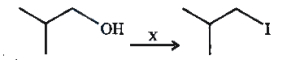
EasyMCQ
The reagent '$X$' used in the following reaction to obtain a good yield of the product is:
A
$KI, H_2SO_4$
B
$KI, 95\% H_3PO_4$
C
$NaI, ZnCl_2$
D
$HI$
Solution
(B) The reaction involves the conversion of an alcohol to an alkyl iodide.
Using $H_2SO_4$ with $KI$ is not ideal because $H_2SO_4$ is an oxidizing agent that can oxidize $HI$ to $I_2$.
Phosphoric acid $(H_3PO_4)$ is a non-oxidizing acid and is preferred for the in-situ generation of $HI$ from $KI$.
The reaction is: $3 KI + H_3PO_4 \rightarrow 3 HI + K_3PO_4$.
This $HI$ then reacts with the alcohol via an $S_N2$ mechanism to give the alkyl iodide with a good yield.
Using $H_2SO_4$ with $KI$ is not ideal because $H_2SO_4$ is an oxidizing agent that can oxidize $HI$ to $I_2$.
Phosphoric acid $(H_3PO_4)$ is a non-oxidizing acid and is preferred for the in-situ generation of $HI$ from $KI$.
The reaction is: $3 KI + H_3PO_4 \rightarrow 3 HI + K_3PO_4$.
This $HI$ then reacts with the alcohol via an $S_N2$ mechanism to give the alkyl iodide with a good yield.
0 likes
View Solution834
EasyMCQ
$1-$Propanol can be distinguished from $2-$propanol by which test?
A
$2, 4-DNP$ test
B
Tollen's test
C
Lucas test
D
Fehling's test
Solution
(C) $1-$Propanol is a primary $(1^{\circ})$ alcohol, while $2-$propanol is a secondary $(2^{\circ})$ alcohol.
These can be distinguished by the Lucas test, which uses a mixture of anhydrous $ZnCl_2$ and concentrated $HCl$.
$2^{\circ}$ alcohols react with the Lucas reagent to produce turbidity within $5-10$ minutes at room temperature.
$1^{\circ}$ alcohols do not produce turbidity at room temperature.
These can be distinguished by the Lucas test, which uses a mixture of anhydrous $ZnCl_2$ and concentrated $HCl$.
$2^{\circ}$ alcohols react with the Lucas reagent to produce turbidity within $5-10$ minutes at room temperature.
$1^{\circ}$ alcohols do not produce turbidity at room temperature.
0 likes
View Solution835
MediumMCQ
The order of reactivity of the following compounds towards the esterification with acetic acid is:

A
$I > II > III > IV$
B
$IV > III > II > I$
C
$I > IV > II > III$
D
$I > IV > III > II$
Solution
(D) The chemical reaction in which alcohols and acids react with each other to form esters is called esterification.
In this reaction,the alcohol acts as a nucleophile and attacks the carbonyl carbon of the carboxylic acid.
The reactivity of alcohols towards esterification is primarily governed by steric hindrance.
As the bulkiness of the alkyl group attached to the carbon bearing the $-OH$ group increases,the steric hindrance increases,making it more difficult for the alcohol to attack the acid,thus decreasing the reactivity.
The given compounds are:
$(I) CH_3CH_2OH$ (Ethanol)
$(II) (CH_3)_2CHCH_2OH$ ($2-$methylpropan$-1-$ol)
$(III) (CH_3)_2CHCH(CH_3)CH_2OH$ ($2,3-$dimethylbutan$-1-$ol)
$(IV) CH_3CH_2CH_2OH$ (Propan$-1-$ol)
Comparing the steric hindrance,the order of reactivity is $(I) > (IV) > (II) > (III)$.
Therefore,the correct option is $D$.
In this reaction,the alcohol acts as a nucleophile and attacks the carbonyl carbon of the carboxylic acid.
The reactivity of alcohols towards esterification is primarily governed by steric hindrance.
As the bulkiness of the alkyl group attached to the carbon bearing the $-OH$ group increases,the steric hindrance increases,making it more difficult for the alcohol to attack the acid,thus decreasing the reactivity.
The given compounds are:
$(I) CH_3CH_2OH$ (Ethanol)
$(II) (CH_3)_2CHCH_2OH$ ($2-$methylpropan$-1-$ol)
$(III) (CH_3)_2CHCH(CH_3)CH_2OH$ ($2,3-$dimethylbutan$-1-$ol)
$(IV) CH_3CH_2CH_2OH$ (Propan$-1-$ol)
Comparing the steric hindrance,the order of reactivity is $(I) > (IV) > (II) > (III)$.
Therefore,the correct option is $D$.
0 likes
View Solution836
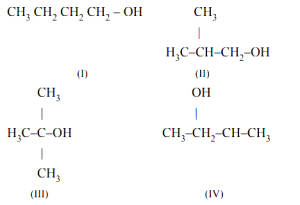
MediumMCQ
The correct order of the rate of acid-mediated dehydration reaction of the following compounds is:
A
$II > III > IV > I$
B
$IV > III > I > II$
C
$III > II > IV > I$
D
$III > IV > II > I$
Solution
(D) The rate of acid-catalyzed dehydration of alcohols depends on the stability of the carbocation intermediate formed during the reaction. The stability order of carbocations is $3^\circ > 2^\circ > 1^\circ$.
Let us analyze the carbocations formed from each alcohol:
$(I)$ $CH_3CH_2CH_2CH_2OH$ forms a $1^\circ$ carbocation: $CH_3CH_2CH_2CH_2^+$.
$(II)$ $CH_3-CH(CH_3)-CH_2OH$ forms a $1^\circ$ carbocation: $CH_3-CH(CH_3)-CH_2^+$,which can rearrange to a more stable $2^\circ$ carbocation.
$(III)$ $CH_3-C(CH_3)_2-OH$ forms a $3^\circ$ carbocation: $CH_3-C^+(CH_3)_2$.
$(IV)$ $CH_3-CH_2-CH(OH)-CH_3$ forms a $2^\circ$ carbocation: $CH_3-CH_2-CH^+-CH_3$.
Comparing the stability: The $3^\circ$ carbocation $(III)$ is the most stable,followed by the $2^\circ$ carbocation $(IV)$. Between the two $1^\circ$ carbocations,$(II)$ can undergo rearrangement to form a more stable carbocation,making it more reactive than the primary carbocation $(I)$.
Thus,the order of reactivity is $III > IV > II > I$.
Let us analyze the carbocations formed from each alcohol:
$(I)$ $CH_3CH_2CH_2CH_2OH$ forms a $1^\circ$ carbocation: $CH_3CH_2CH_2CH_2^+$.
$(II)$ $CH_3-CH(CH_3)-CH_2OH$ forms a $1^\circ$ carbocation: $CH_3-CH(CH_3)-CH_2^+$,which can rearrange to a more stable $2^\circ$ carbocation.
$(III)$ $CH_3-C(CH_3)_2-OH$ forms a $3^\circ$ carbocation: $CH_3-C^+(CH_3)_2$.
$(IV)$ $CH_3-CH_2-CH(OH)-CH_3$ forms a $2^\circ$ carbocation: $CH_3-CH_2-CH^+-CH_3$.
Comparing the stability: The $3^\circ$ carbocation $(III)$ is the most stable,followed by the $2^\circ$ carbocation $(IV)$. Between the two $1^\circ$ carbocations,$(II)$ can undergo rearrangement to form a more stable carbocation,making it more reactive than the primary carbocation $(I)$.
Thus,the order of reactivity is $III > IV > II > I$.
0 likes
View Solution837
EasyMCQ
The major product of the following reaction is: $CH_3CH(OH)CH_3 \xrightarrow{Cu, 573 \ K} ?$
A
$CH_3CH_2CH_3$
B
$CH_3CH=CH_2$
C
$CH_3C \equiv CH$
D
$CH_3COCH_3$
Solution
(D) The reactant is propan-$2$-ol,which is a secondary alcohol.
When vapours of a secondary alcohol are passed over heated $Cu$ at $573 \ K$,dehydrogenation occurs,resulting in the loss of $H_2$ to form a ketone.
Therefore,propan-$2$-ol undergoes dehydrogenation to form propanone $(CH_3COCH_3)$.
When vapours of a secondary alcohol are passed over heated $Cu$ at $573 \ K$,dehydrogenation occurs,resulting in the loss of $H_2$ to form a ketone.
Therefore,propan-$2$-ol undergoes dehydrogenation to form propanone $(CH_3COCH_3)$.
0 likes
View Solution838
EasyMCQ
Assertion $(A)$: Tertiary alcohols produce turbidity immediately with Lucas reagent.
Reason $(R)$: Lucas reagent is a $1:1$ mixture of conc. $HNO_3$ and anhydrous $ZnCl_2$.
The correct option among the following is:
Reason $(R)$: Lucas reagent is a $1:1$ mixture of conc. $HNO_3$ and anhydrous $ZnCl_2$.
The correct option among the following is:
A
$A$. $(A)$ is true,$(R)$ is true and $(R)$ is the correct explanation for $(A)$
B
$B$. $(A)$ is true,$(R)$ is true but $(R)$ is not the correct explanation for $(A)$
C
$C$. $(A)$ is true but $(R)$ is false
D
$D$. $(A)$ is false but $(R)$ is true
Solution
(C) Assertion $(A)$ is true because tertiary alcohols react very rapidly with Lucas reagent to form alkyl chlorides,which appear as turbidity immediately.
Reason $(R)$ is false because Lucas reagent is a mixture of concentrated $HCl$ and anhydrous $ZnCl_2$,not $HNO_3$ and $ZnCl_2$.
Reason $(R)$ is false because Lucas reagent is a mixture of concentrated $HCl$ and anhydrous $ZnCl_2$,not $HNO_3$ and $ZnCl_2$.
0 likes
View Solution839
EasyMCQ
Which of the following alcohols gives white turbidity almost immediately with the Lucas reagent at room temperature?
$(i)$ $n-$Butanol
$(ii)$ $tert-$Butanol
$(iii)$ Benzyl alcohol
$(iv)$ Allyl alcohol
$(i)$ $n-$Butanol
$(ii)$ $tert-$Butanol
$(iii)$ Benzyl alcohol
$(iv)$ Allyl alcohol
A
$(i)$,$(ii)$ and $(iii)$
B
$(i)$,$(iii)$ and $(iv)$
C
$(ii)$,$(iii)$ and $(iv)$
D
$(i)$,$(ii)$ and $(iv)$
Solution
(C) The Lucas reagent is a mixture of concentrated $HCl$ and anhydrous $ZnCl_2$. It is used to distinguish between primary,secondary,and tertiary alcohols based on the rate of formation of alkyl chlorides,which appear as white turbidity.
$1$. Tertiary alcohols $(3^\circ)$ react immediately to form white turbidity.
$2$. Secondary alcohols $(2^\circ)$ react within $5-10 \ min$ to form white turbidity.
$3$. Primary alcohols $(1^\circ)$ do not react at room temperature or react very slowly (after $30 \ min$ upon heating).
Analysis of the given compounds:
$(i)$ $n-$Butanol $(CH_3CH_2CH_2CH_2OH)$ is a primary alcohol.
$(ii)$ $tert-$Butanol $((CH_3)_3COH)$ is a tertiary alcohol.
$(iii)$ Benzyl alcohol $(C_6H_5CH_2OH)$ is a primary alcohol,but it reacts rapidly due to the stability of the carbocation formed (benzylic carbocation).
$(iv)$ Allyl alcohol $(CH_2=CH-CH_2OH)$ is a primary alcohol,but it also reacts rapidly due to the stability of the carbocation formed (allylic carbocation).
Therefore,$(ii)$,$(iii)$,and $(iv)$ give white turbidity almost immediately.
$1$. Tertiary alcohols $(3^\circ)$ react immediately to form white turbidity.
$2$. Secondary alcohols $(2^\circ)$ react within $5-10 \ min$ to form white turbidity.
$3$. Primary alcohols $(1^\circ)$ do not react at room temperature or react very slowly (after $30 \ min$ upon heating).
Analysis of the given compounds:
$(i)$ $n-$Butanol $(CH_3CH_2CH_2CH_2OH)$ is a primary alcohol.
$(ii)$ $tert-$Butanol $((CH_3)_3COH)$ is a tertiary alcohol.
$(iii)$ Benzyl alcohol $(C_6H_5CH_2OH)$ is a primary alcohol,but it reacts rapidly due to the stability of the carbocation formed (benzylic carbocation).
$(iv)$ Allyl alcohol $(CH_2=CH-CH_2OH)$ is a primary alcohol,but it also reacts rapidly due to the stability of the carbocation formed (allylic carbocation).
Therefore,$(ii)$,$(iii)$,and $(iv)$ give white turbidity almost immediately.
0 likes
View Solution840
EasyMCQ
The alcohol that reacts faster with Lucas reagent is
A
$CH_3-CH_2-CH_2-CH_2-OH$
B
$CH_3-CH_2-CH(OH)-CH_3$
C
$(CH_3)_2CH-CH_2-OH$
D
$(CH_3)_3C-OH$
Solution
(D) Lucas reagent is a mixture of concentrated $HCl$ and anhydrous $ZnCl_2$. The reaction of alcohols with Lucas reagent proceeds via an $S_N1$ mechanism,which involves the formation of a carbocation intermediate. The reactivity of alcohols towards Lucas reagent follows the order: $3^{\circ} > 2^{\circ} > 1^{\circ}$.
$(A)$ $CH_3-CH_2-CH_2-CH_2-OH$ is a $1^{\circ}$ alcohol.
$(B)$ $CH_3-CH_2-CH(OH)-CH_3$ is a $2^{\circ}$ alcohol.
$(C)$ $(CH_3)_2CH-CH_2-OH$ is a $1^{\circ}$ alcohol.
$(D)$ $(CH_3)_3C-OH$ is a $3^{\circ}$ alcohol.
Since $3^{\circ}$ alcohols form the most stable carbocation,they react fastest with Lucas reagent,often at room temperature.
$(A)$ $CH_3-CH_2-CH_2-CH_2-OH$ is a $1^{\circ}$ alcohol.
$(B)$ $CH_3-CH_2-CH(OH)-CH_3$ is a $2^{\circ}$ alcohol.
$(C)$ $(CH_3)_2CH-CH_2-OH$ is a $1^{\circ}$ alcohol.
$(D)$ $(CH_3)_3C-OH$ is a $3^{\circ}$ alcohol.
Since $3^{\circ}$ alcohols form the most stable carbocation,they react fastest with Lucas reagent,often at room temperature.
0 likes
View Solution841
DifficultMCQ
Optically active $3-$methylpent$-1-$en$-3-$ol loses its optical activity after standing in water containing a few drops of acid,mainly due to the formation of:
A
$CH_3-CH_2-C(CH_3)=CH-CH_3$
B
$CH_3-CH_2-C(CH_3)=CH_2$
C
$CH_3-CH_2-CH_2-C(CH_3)=CH_2$
D
$CH_3-CH_2-CH=C(CH_3)_2$
Solution
(A) The compound $3-$methylpent$-1-$en$-3-$ol is an allylic alcohol. In the presence of an acid,it undergoes protonation of the $-OH$ group followed by the loss of water to form a resonance-stabilized carbocation: $CH_3-CH_2-C^+(CH_3)-CH=CH_2 \leftrightarrow CH_3-CH_2-C(CH_3)=CH-CH_2^+$.
This carbocation can lose a proton to form a more stable,conjugated diene or a substituted alkene. Specifically,the loss of optical activity occurs because the chiral center at $C-3$ is destroyed upon the formation of the planar carbocation intermediate. The major product formed is $3-$methylpenta$-1,3-$diene or a related stable alkene isomer depending on the specific rearrangement,but among the given options,the most stable alkene formed via rearrangement is $3-$methylpent$-2-$ene $(CH_3-CH_2-C(CH_3)=CH-CH_3)$.
This carbocation can lose a proton to form a more stable,conjugated diene or a substituted alkene. Specifically,the loss of optical activity occurs because the chiral center at $C-3$ is destroyed upon the formation of the planar carbocation intermediate. The major product formed is $3-$methylpenta$-1,3-$diene or a related stable alkene isomer depending on the specific rearrangement,but among the given options,the most stable alkene formed via rearrangement is $3-$methylpent$-2-$ene $(CH_3-CH_2-C(CH_3)=CH-CH_3)$.
0 likes
View Solution842
MediumMCQ
The correct order of reactivity of hydrogen halides with ethyl alcohol is
A
$HF > HCl > HBr > HI$
B
$HCl > HBr > HF > HI$
C
$HBr > HCl > HI > HF$
D
$HI > HBr > HCl > HF$
Solution
(D) The reaction of hydrogen halides $(HX)$ with ethyl alcohol $(C_2H_5OH)$ involves the cleavage of the $C-O$ bond.
The reactivity depends on the strength of the $H-X$ bond.
As the size of the halogen atom increases from $F$ to $I$,the bond dissociation energy of the $H-X$ bond decreases,making the bond easier to break.
Therefore,the reactivity order is $HI > HBr > HCl > HF$.
The reactivity depends on the strength of the $H-X$ bond.
As the size of the halogen atom increases from $F$ to $I$,the bond dissociation energy of the $H-X$ bond decreases,making the bond easier to break.
Therefore,the reactivity order is $HI > HBr > HCl > HF$.
0 likes
View SolutionAlcohols, Phenols and Ethers — Properties of alcohol · Frequently Asked Questions
1Are these Alcohols, Phenols and Ethers questions useful for JEE and NEET?
Yes. All questions in this section are mapped to JEE Main and NEET exam patterns. Previous year questions from JEE Main, NEET, GUJCET and state-level exams are included with full solutions.
2Can I switch to Hindi or Gujarati for these questions?
Yes. Use the language tabs in the hero section or the sidebar to view the same questions and solutions in English, Hindi or Gujarati.
3How do I generate a question paper from this subtopic?
Use the Vedclass Exam Paper Generator — select the chapter and subtopic, set difficulty, and generate Sets A, B, C, D automatically. First 3 chapters of every subject are free.
Vedclass Products
For Students
Vedclass Test Series
Mock tests in real JEE/NEET style with performance analysis. 5-day free trial.
Start Free TrialFor Teachers
Exam Paper Generator
Generate Set A/B/C/D papers from this chapter in 2 minutes. 3 chapters free.
Try FreeFor Institutes
Online Exam Module
Live online exams with unlimited students, 360° analytics & white-label branding.
See DemoFor Teachers & Institutes
Generate a Alcohols, Phenols and Ethers Exam Paper in 2 Minutes
Select subtopic & difficulty — Sets A, B, C, D auto-generated with No Repeat logic.
First 3 chapters of every subject are free — no payment required.