
An organic compound $(A)$ (molecular formula $C_{6}H_{12}O_{2}$) was hydrolysed with dil. $H_{2}SO_{4}$ to give a carboxylic acid $(B)$ and an alcohol $(C).$ $C$ gives white turbidity immediately when treated with anhydrous $ZnCl_{2}$ and conc. $HCl$. The organic compound $(A)$ is
- A
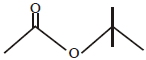
- B
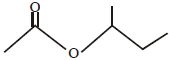
- C
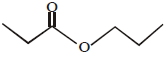
- D
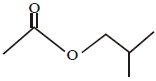
Explore More
Similar Questions
Which of the following will not react with $NaOH$?
Medium
View SolutionWhich of the following compounds will form a hydrocarbon on reaction with a Grignard reagent?
Medium
View SolutionIdentify the final product in the following reaction sequence: $CH \equiv CH$ $\xrightarrow[H_2SO_4]{HgSO_4}$ $\xrightarrow[H_2O]{CH_3MgBr}$ $\xrightarrow{P/Br_2}$
Medium
View Solution$A$ sample of $4.5 \ g$ of an unknown monohydric alcohol,$ROH$,was added to methylmagnesium iodide. $A$ gas is evolved,collected,and its volume is measured to be $3.1 \ L$ at $NTP$. The molecular weight of the unknown alcohol is $g/mol$. [Nearest integer]
DifficultJEE MAIN 2022
View SolutionWhich of the following alcohols gives the best yield of dialkyl ether on being heated with a trace of sulphuric acid?
DifficultAIIMS 2014
View SolutionVedclass Products
For Students
Vedclass Test Series
Mock tests in real JEE/NEET style with performance analysis. 5-day free trial.
Start Free TrialFor Teachers
Exam Paper Generator
Generate Set A/B/C/D exam papers from 7.5L+ questions in 2 minutes. 3 chapters free.
Try FreeFor Institutes
Online Exam Module
Live online exams with unlimited students, 360° analytics & white-label branding.
See Demo