
A English
Mix Examples-Alcohol, Phenol and Ethers Questions in English
Class 12 Chemistry · Alcohols, Phenols and Ethers · Mix Examples-Alcohol, Phenol and Ethers
159+
Questions
English
Language
100%
With Solutions
Showing 50 of 159 questions in English
51
DifficultMCQ
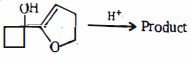
Identify the major product.
A
B
C
D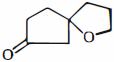
Solution
(A) The reaction involves the acid-catalyzed rearrangement of the given alcohol.
$1$. Protonation of the hydroxyl group occurs,followed by the loss of a water molecule to form a carbocation.
$2$. The carbocation undergoes a ring expansion (or rearrangement) to form a more stable resonance-stabilized carbocation.
$3$. Finally,the loss of a proton leads to the formation of the ketone product as shown in the mechanism.
$1$. Protonation of the hydroxyl group occurs,followed by the loss of a water molecule to form a carbocation.
$2$. The carbocation undergoes a ring expansion (or rearrangement) to form a more stable resonance-stabilized carbocation.
$3$. Finally,the loss of a proton leads to the formation of the ketone product as shown in the mechanism.
0 likes
View Solution52
DifficultMCQ
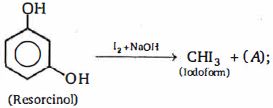
Compound $A$ is
A
$CH_3-CH=CH-CH_2-COONa$
B
$HOOC-(CH_2)_2-COOH$
C
$CH_3-CH_2-CH_2-CH_2-COOH$
D
$CH_3-(CH_2)_3-COONa$
Solution
(A) Resorcinol exists in tautomeric equilibrium with its keto form.
In the presence of $I_2$ and $NaOH$,the active methylene group of the keto form undergoes the haloform reaction.
The reaction proceeds as follows:
Resorcinol $\rightleftharpoons$ Keto form of resorcinol
Keto form + $I_2 + NaOH \rightarrow$ $CH_3-CH=CH-CH_2-COONa + CHI_3$
Thus,compound $A$ is $CH_3-CH=CH-CH_2-COONa$.
In the presence of $I_2$ and $NaOH$,the active methylene group of the keto form undergoes the haloform reaction.
The reaction proceeds as follows:
Resorcinol $\rightleftharpoons$ Keto form of resorcinol
Keto form + $I_2 + NaOH \rightarrow$ $CH_3-CH=CH-CH_2-COONa + CHI_3$
Thus,compound $A$ is $CH_3-CH=CH-CH_2-COONa$.
0 likes
View Solution53
MediumMCQ
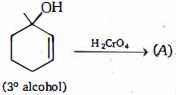
Product $(A)$ is
A
No reaction
B
C
D
Solution
(B) The starting material is a $3^{\circ}$ allylic alcohol. In the presence of an acidic oxidizing agent like $H_2CrO_4$,it undergoes dehydration to form a resonance-stabilized carbocation. This carbocation is then attacked by water to form a $2^{\circ}$ allylic alcohol. This $2^{\circ}$ alcohol is subsequently oxidized by $H_2CrO_4$ to the corresponding $\alpha,\beta$-unsaturated ketone,which is the final product $(A)$.
0 likes
View Solution54
AdvancedMCQ
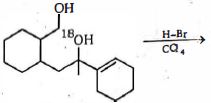
The major product obtained in the reaction is:
A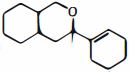
B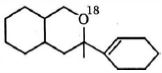
C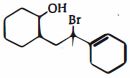
D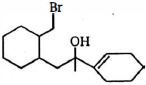
Solution
(A) The reaction involves the protonation of the tertiary alcohol group containing the $^{18}O$ isotope.
Upon protonation,the $^{18}OH_2^+$ group acts as a good leaving group,leading to the formation of a tertiary carbocation.
The neighboring primary alcohol group then acts as a nucleophile,attacking the carbocation to form a cyclic ether.
Since the $^{18}O$ atom is lost as water,the oxygen atom in the resulting cyclic ether is the one from the primary alcohol group,not the $^{18}O$ isotope.
Therefore,the major product is the cyclic ether formed by the intramolecular nucleophilic attack,where the $^{18}O$ is excluded from the ring.
Upon protonation,the $^{18}OH_2^+$ group acts as a good leaving group,leading to the formation of a tertiary carbocation.
The neighboring primary alcohol group then acts as a nucleophile,attacking the carbocation to form a cyclic ether.
Since the $^{18}O$ atom is lost as water,the oxygen atom in the resulting cyclic ether is the one from the primary alcohol group,not the $^{18}O$ isotope.
Therefore,the major product is the cyclic ether formed by the intramolecular nucleophilic attack,where the $^{18}O$ is excluded from the ring.
0 likes
View Solution55
AdvancedMCQ
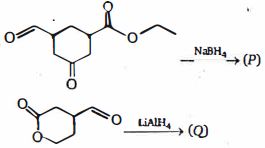
Sum of number of $1^o$ alcoholic groups in product $(P)$ and $(Q)$ is
A
$1$
B
$2$
C
$3$
D
$5$
Solution
(D) $1$. In the first reaction,$NaBH_4$ is a selective reducing agent that reduces aldehydes and ketones but does not reduce esters. The starting material has an aldehyde group,a ketone group,and an ester group. The aldehyde and ketone are reduced to $1^o$ and $2^o$ alcohols respectively,while the ester remains unchanged. However,the provided solution image indicates a product $(P)$ where all groups are reduced to alcohols,which implies a stronger reducing agent like $LiAlH_4$ was intended or the product structure is as shown. Based on the provided solution image,$(P)$ contains two $1^o$ alcoholic groups.
$2$. In the second reaction,$LiAlH_4$ is a strong reducing agent that reduces both the lactone (cyclic ester) and the aldehyde group. The reduction of the lactone opens the ring to form a diol,and the aldehyde is reduced to a primary alcohol. Based on the provided solution image,$(Q)$ contains three $1^o$ alcoholic groups.
$3$. The sum of $1^o$ alcoholic groups in $(P)$ and $(Q)$ is $2 + 3 = 5$.
$2$. In the second reaction,$LiAlH_4$ is a strong reducing agent that reduces both the lactone (cyclic ester) and the aldehyde group. The reduction of the lactone opens the ring to form a diol,and the aldehyde is reduced to a primary alcohol. Based on the provided solution image,$(Q)$ contains three $1^o$ alcoholic groups.
$3$. The sum of $1^o$ alcoholic groups in $(P)$ and $(Q)$ is $2 + 3 = 5$.
0 likes
View Solution56
DifficultMCQ
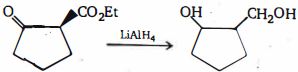
What is the product of the reaction shown below?
A
Racemic
B
Diastereomer
C
Meso
D
Optically pure
Solution
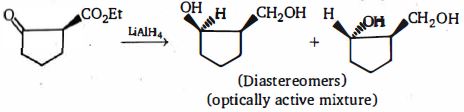
(B) The reaction involves the reduction of a ketone and an ester group using $LiAlH_4$. The starting material is a chiral molecule with a fixed stereocenter at the $CO_2Et$ position. When the ketone is reduced to a secondary alcohol,a new stereocenter is created at the carbon bearing the hydroxyl group. Since the hydride can attack from either the top or bottom face of the planar carbonyl group,two different stereoisomers are formed. These two products have the same configuration at the original stereocenter but different configurations at the newly formed stereocenter,making them diastereomers.
0 likes
View Solution57
DifficultMCQ
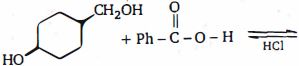
The major product of the above esterification reaction is:
A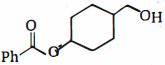
B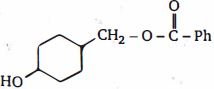
C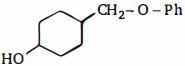
D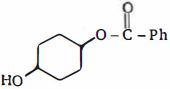
Solution
(B) The reaction involves the esterification of a diol containing both a primary $(1^{\circ})$ and a secondary $(2^{\circ})$ alcohol group with benzoic acid in the presence of an acid catalyst $(HCl)$.
Esterification is a nucleophilic substitution reaction where the alcohol acts as a nucleophile. The rate of esterification is primarily governed by steric hindrance.
Primary alcohols $(R-CH_2OH)$ are less sterically hindered and more nucleophilic than secondary alcohols $(R_2CH-OH)$.
Therefore,the primary alcohol group $(CH_2OH)$ reacts faster than the secondary alcohol group ($OH$ attached to the ring) to form the ester.
The major product is the ester formed at the primary alcohol position.
Esterification is a nucleophilic substitution reaction where the alcohol acts as a nucleophile. The rate of esterification is primarily governed by steric hindrance.
Primary alcohols $(R-CH_2OH)$ are less sterically hindered and more nucleophilic than secondary alcohols $(R_2CH-OH)$.
Therefore,the primary alcohol group $(CH_2OH)$ reacts faster than the secondary alcohol group ($OH$ attached to the ring) to form the ester.
The major product is the ester formed at the primary alcohol position.
0 likes
View Solution58
MediumMCQ
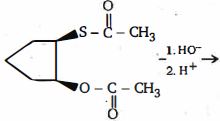
Major product of the reaction is
A
B
C
D
Solution
(A) The reaction involves the hydrolysis of a thioester and an ester group using $HO^-$ followed by $H^+$.
$1.$ The hydroxide ion $(HO^-)$ acts as a nucleophile and attacks the carbonyl carbon of the thioester group,leading to the formation of a thiolate anion $(S^-)$ and an acetate ion.
$2.$ The hydroxide ion also attacks the carbonyl carbon of the ester group,leading to the formation of an alkoxide ion $(O^-)$ and another acetate ion.
$3.$ Upon workup with $H^+$,the thiolate anion is protonated to form a thiol $(-SH)$ and the alkoxide ion is protonated to form an alcohol $(-OH)$.
$4.$ Since the starting material has both groups in a cis-configuration (both are wedged),the final product retains this stereochemistry,resulting in a cis-hydroxy thiol.
$1.$ The hydroxide ion $(HO^-)$ acts as a nucleophile and attacks the carbonyl carbon of the thioester group,leading to the formation of a thiolate anion $(S^-)$ and an acetate ion.
$2.$ The hydroxide ion also attacks the carbonyl carbon of the ester group,leading to the formation of an alkoxide ion $(O^-)$ and another acetate ion.
$3.$ Upon workup with $H^+$,the thiolate anion is protonated to form a thiol $(-SH)$ and the alkoxide ion is protonated to form an alcohol $(-OH)$.
$4.$ Since the starting material has both groups in a cis-configuration (both are wedged),the final product retains this stereochemistry,resulting in a cis-hydroxy thiol.
0 likes
View Solution59
DifficultMCQ
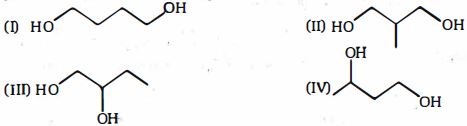
Diols $(I-IV)$ which react with $CrO_3$ in aqueous $H_2SO_4$ and yield products that readily undergo decarboxylation on heating,are
A
$I$ and $II$
B
$II$ and $III$
C
$II$ and $IV$
D
$I$ and $IV$
Solution
(C) $CrO_3$ in aqueous $H_2SO_4$ (Jones reagent) is a strong oxidizing agent that oxidizes primary alcohols to carboxylic acids and secondary alcohols to ketones.
$(II)$ is a primary diol: $HO-CH_2-CH(CH_3)-CH_2-OH$. Oxidation gives a gem-dicarboxylic acid: $HOOC-CH(CH_3)-COOH$. Gem-dicarboxylic acids readily undergo decarboxylation on heating.
$(IV)$ is a secondary-primary diol: $CH_3-CH(OH)-CH_2-CH_2-OH$. Oxidation gives a $\beta$-keto acid: $CH_3-CO-CH_2-COOH$. $\beta$-keto acids readily undergo decarboxylation on heating to form ketones.
Thus,$(II)$ and $(IV)$ satisfy the given conditions.
$(II)$ is a primary diol: $HO-CH_2-CH(CH_3)-CH_2-OH$. Oxidation gives a gem-dicarboxylic acid: $HOOC-CH(CH_3)-COOH$. Gem-dicarboxylic acids readily undergo decarboxylation on heating.
$(IV)$ is a secondary-primary diol: $CH_3-CH(OH)-CH_2-CH_2-OH$. Oxidation gives a $\beta$-keto acid: $CH_3-CO-CH_2-COOH$. $\beta$-keto acids readily undergo decarboxylation on heating to form ketones.
Thus,$(II)$ and $(IV)$ satisfy the given conditions.
0 likes
View Solution60
DifficultMCQ
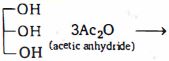
In the above reaction,the molecular formula of glycerol increases by:
A
$C_4H_4O_2$
B
$C_6H_6O_6$
C
$C_6H_6O_2$
D
$C_6H_6O_3$
Solution
(D) The reaction of glycerol with acetic anhydride $(Ac_2O)$ is an acetylation reaction where each hydroxyl $(-OH)$ group is replaced by an acetyl group $(-COCH_3)$.
In this process,an $H$ atom is replaced by a $COCH_3$ group.
The net change for each $-OH$ group is the addition of $C_2H_2O$ (since $COCH_3 - H = C_2H_2O$).
Glycerol has three $-OH$ groups,so for three groups,the total increase in the molecular formula is $3 \times (C_2H_2O) = C_6H_6O_3$.
In this process,an $H$ atom is replaced by a $COCH_3$ group.
The net change for each $-OH$ group is the addition of $C_2H_2O$ (since $COCH_3 - H = C_2H_2O$).
Glycerol has three $-OH$ groups,so for three groups,the total increase in the molecular formula is $3 \times (C_2H_2O) = C_6H_6O_3$.
0 likes
View Solution61
MediumMCQ
Product $(D)$ in the above reaction is:

A
$2-$($1$-hydroxy$-1-$methylcyclohexyl)methanol
B
$1-$methyl$-2-$(hydroxymethyl)cyclohexanol
C
$1-$methyl$-1-$(hydroxymethyl)cyclohexanol
D
$2-$($1$-hydroxyethyl)cyclohexanol
Solution
(A) $1$. The starting material is $2-(hydroxymethyl)cyclohexanol$. Treatment with $PCC$ (Pyridinium chlorochromate) selectively oxidizes the primary alcohol to an aldehyde,forming $2-formylcyclohexanone$ $(A)$.
$2$. Reaction with ethylene glycol in the presence of $H^+$ forms a cyclic acetal at the aldehyde group,protecting it to give $2-(1,3-dioxolan-2-yl)cyclohexanone$ $(B)$.
$3$. Addition of $MeMgBr$ followed by $H_3O^+$ attacks the ketone carbonyl to form a tertiary alcohol,yielding $2-(1,3-dioxolan-2-yl)-1-methylcyclohexanol$ $(C)$.
$4$. Finally,the acetal is hydrolyzed (implied in the workup or subsequent step) and the resulting aldehyde is reduced by $NaBH_4$ to a primary alcohol,resulting in $2-(1-hydroxy-1-methylcyclohexyl)methanol$ $(D)$.
$2$. Reaction with ethylene glycol in the presence of $H^+$ forms a cyclic acetal at the aldehyde group,protecting it to give $2-(1,3-dioxolan-2-yl)cyclohexanone$ $(B)$.
$3$. Addition of $MeMgBr$ followed by $H_3O^+$ attacks the ketone carbonyl to form a tertiary alcohol,yielding $2-(1,3-dioxolan-2-yl)-1-methylcyclohexanol$ $(C)$.
$4$. Finally,the acetal is hydrolyzed (implied in the workup or subsequent step) and the resulting aldehyde is reduced by $NaBH_4$ to a primary alcohol,resulting in $2-(1-hydroxy-1-methylcyclohexyl)methanol$ $(D)$.
0 likes
View Solution62
DifficultMCQ
Which of the following is an example of Pinacol-Diazotization?
A
$Me_2C(OH)-CMe_2(Br) \xrightarrow{Ag^{+}} Me_3C-CO-Me$
B
$Me_2C(OH)-CMe_2(NH_2) \xrightarrow{NaNO_2, HCl} Me_3C-CO-Me$
C
$Me_2C(OH)-CMe_2(OH) \xrightarrow{H^{+}} Me_3C-CO-Me$
D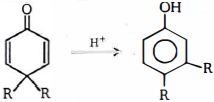
Solution
(B) Pinacol-Diazotization involves the reaction of an amino-alcohol (specifically a $1,2-$amino alcohol) with nitrous acid $(NaNO_2 + HCl)$.
In this reaction,the amino group is converted into a diazonium salt,which is a good leaving group,followed by a rearrangement similar to the Pinacol-Pinacolone rearrangement.
The reaction is: $Me_2C(OH)-CMe_2(NH_2) \xrightarrow{NaNO_2, HCl} Me_3C-CO-Me$.
Therefore,option $B$ is the correct example.
In this reaction,the amino group is converted into a diazonium salt,which is a good leaving group,followed by a rearrangement similar to the Pinacol-Pinacolone rearrangement.
The reaction is: $Me_2C(OH)-CMe_2(NH_2) \xrightarrow{NaNO_2, HCl} Me_3C-CO-Me$.
Therefore,option $B$ is the correct example.
0 likes
View Solution63
MediumMCQ
Select the correct statement.
A
Solvolysis of $(CH_3)_2C=CH-CH_2-Cl$ in ethanol is over $6000$ times greater than alkyl chloride $(25\,^oC)$.
B
$CH_3-CH=CH-CH_2-OH$ when reacts with $HBr$ gives a mixture of $1$-bromo-$2$-butene and $3$-bromo-$1$-butene.
C
When a solution of $3$-buten-$2$-ol in aqueous sulphuric acid is allowed to stand for one week,it is found to contain both $3$-buten-$2$-ol and $2$-buten-$1$-ol.
D
All of these
Solution
(D) Option $(A)$ is correct because the carbocation formed from $(CH_3)_2C=CH-CH_2-Cl$ is resonance-stabilized,making it much more reactive in solvolysis compared to a simple alkyl chloride.
Option $(B)$ is correct because the reaction of $CH_3-CH=CH-CH_2-OH$ with $HBr$ involves the formation of an allylic carbocation intermediate,which can be attacked by $Br^-$ at two different positions,leading to a mixture of $1$-bromo-$2$-butene and $3$-bromo-$1$-butene.
Option $(C)$ is correct because $3$-buten-$2$-ol in aqueous acid undergoes protonation and loss of water to form an allylic carbocation,which can be attacked by water at either the $C-1$ or $C-3$ position,leading to an equilibrium mixture of $3$-buten-$2$-ol and $2$-buten-$1$-ol.
Since all statements are correct,the correct answer is $(D)$.
Option $(B)$ is correct because the reaction of $CH_3-CH=CH-CH_2-OH$ with $HBr$ involves the formation of an allylic carbocation intermediate,which can be attacked by $Br^-$ at two different positions,leading to a mixture of $1$-bromo-$2$-butene and $3$-bromo-$1$-butene.
Option $(C)$ is correct because $3$-buten-$2$-ol in aqueous acid undergoes protonation and loss of water to form an allylic carbocation,which can be attacked by water at either the $C-1$ or $C-3$ position,leading to an equilibrium mixture of $3$-buten-$2$-ol and $2$-buten-$1$-ol.
Since all statements are correct,the correct answer is $(D)$.
0 likes
View Solution64
MediumMCQ
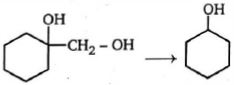
The above transformation can be carried out by:
A
$H^{+} / \Delta , Zn(Hg), HCl$
B
$HIO_4 , LiAlH_4$
C
$HIO_4 , H^{+} / \Delta $
D
$H^{+} / \Delta , HIO_4$
Solution
(B) The starting material is $1$-hydroxymethylcyclohexanol,which is a vicinal diol.
Treatment with periodic acid $(HIO_4)$ causes oxidative cleavage of the vicinal diol to form cyclohexanone and formaldehyde.
Cyclohexanone is then reduced to cyclohexanol using a reducing agent like $LiAlH_4$ or $NaBH_4$.
Therefore,the sequence of reagents is $HIO_4$ followed by $LiAlH_4$.
Treatment with periodic acid $(HIO_4)$ causes oxidative cleavage of the vicinal diol to form cyclohexanone and formaldehyde.
Cyclohexanone is then reduced to cyclohexanol using a reducing agent like $LiAlH_4$ or $NaBH_4$.
Therefore,the sequence of reagents is $HIO_4$ followed by $LiAlH_4$.
0 likes
View Solution65
AdvancedMCQ
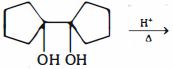
The structure of the product formed in the reaction given below is:
A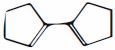
B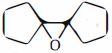
C
D
Solution
(D) The given reaction is a pinacol-pinacolone rearrangement.
$1$. Protonation of one of the hydroxyl groups occurs,followed by the loss of a water molecule to form a stable carbocation.
$2$. $A$ ring expansion occurs where one of the cyclopentyl rings expands to form a cyclohexyl ring,resulting in a more stable carbocation.
$3$. Finally,the loss of a proton from the remaining hydroxyl group leads to the formation of a ketone,which is spiro[$4.5$]decan$-6-$one.
$1$. Protonation of one of the hydroxyl groups occurs,followed by the loss of a water molecule to form a stable carbocation.
$2$. $A$ ring expansion occurs where one of the cyclopentyl rings expands to form a cyclohexyl ring,resulting in a more stable carbocation.
$3$. Finally,the loss of a proton from the remaining hydroxyl group leads to the formation of a ketone,which is spiro[$4.5$]decan$-6-$one.
0 likes
View Solution66
AdvancedMCQ
The product $Z$ of the above reaction is:

A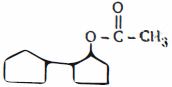
B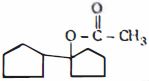
C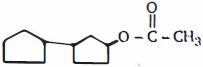
D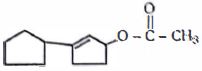
Solution
(B) $1$. Cyclopentanol reacts with $PBr_3$ to form bromocyclopentane $(W)$.
$2$. Bromocyclopentane reacts with $Mg$ in ether to form the Grignard reagent,cyclopentylmagnesium bromide $(X)$.
$3$. Cyclopentanol is oxidized by $Na_2Cr_2O_7$ to form cyclopentanone $(V)$.
$4$. The Grignard reagent $(X)$ reacts with cyclopentanone $(V)$ followed by acidic workup $(H_3O^+)$ to form dicyclopentylmethanol $(Y)$.
$5$. Dicyclopentylmethanol $(Y)$ reacts with acetyl chloride $(CH_3COCl)$ to form the ester product $Z$.
$2$. Bromocyclopentane reacts with $Mg$ in ether to form the Grignard reagent,cyclopentylmagnesium bromide $(X)$.
$3$. Cyclopentanol is oxidized by $Na_2Cr_2O_7$ to form cyclopentanone $(V)$.
$4$. The Grignard reagent $(X)$ reacts with cyclopentanone $(V)$ followed by acidic workup $(H_3O^+)$ to form dicyclopentylmethanol $(Y)$.
$5$. Dicyclopentylmethanol $(Y)$ reacts with acetyl chloride $(CH_3COCl)$ to form the ester product $Z$.
0 likes
View Solution67
DifficultMCQ
Identify the product $(A)$ in the following reaction:
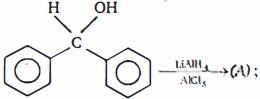
A
No reaction
B
Biphenyl
C
Diphenylmethane
D
$Ph-CO-Ph$
Solution
(C) The reaction involves the reduction of diphenylmethanol using $LiAlH_4$ in the presence of $AlCl_3$.
$AlCl_3$ acts as a Lewis acid and coordinates with the oxygen atom of the hydroxyl group,making it a better leaving group.
This facilitates the removal of the hydroxyl group as $HO-AlCl_3^-$,generating a carbocation intermediate stabilized by two phenyl groups.
Subsequently,the hydride ion $(H^-)$ from $LiAlH_4$ attacks the carbocation to form diphenylmethane $(Ph_2CH_2)$.
$AlCl_3$ acts as a Lewis acid and coordinates with the oxygen atom of the hydroxyl group,making it a better leaving group.
This facilitates the removal of the hydroxyl group as $HO-AlCl_3^-$,generating a carbocation intermediate stabilized by two phenyl groups.
Subsequently,the hydride ion $(H^-)$ from $LiAlH_4$ attacks the carbocation to form diphenylmethane $(Ph_2CH_2)$.
0 likes
View Solution68
DifficultMCQ
What is the product of the following reaction?
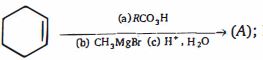
A
$2-$methylcyclohexanol (cis-isomer)
B
$2-$methylcyclohexanol (trans-isomer)
C
cyclohexane$-1,2-$diol
D
$1-$methylcyclohexene
Solution
(B) The reaction proceeds in two main steps:
$1$. Epoxidation: Cyclohexene reacts with a peroxyacid $(RCO_3H)$ to form cyclohexene oxide (an epoxide).
$2$. Nucleophilic Ring Opening: The Grignard reagent $(CH_3MgBr)$ acts as a nucleophile $(CH_3^-)$ and attacks the epoxide ring. The attack occurs from the side opposite to the oxygen atom,leading to an anti-addition.
$3$. Protonation: Subsequent treatment with $H_3O^+$ protonates the alkoxide to form the alcohol.
$4$. Stereochemistry: The $CH_3$ group and the $OH$ group are added in a trans-configuration relative to each other. Thus,the product is trans$-2-$methylcyclohexanol.
$1$. Epoxidation: Cyclohexene reacts with a peroxyacid $(RCO_3H)$ to form cyclohexene oxide (an epoxide).
$2$. Nucleophilic Ring Opening: The Grignard reagent $(CH_3MgBr)$ acts as a nucleophile $(CH_3^-)$ and attacks the epoxide ring. The attack occurs from the side opposite to the oxygen atom,leading to an anti-addition.
$3$. Protonation: Subsequent treatment with $H_3O^+$ protonates the alkoxide to form the alcohol.
$4$. Stereochemistry: The $CH_3$ group and the $OH$ group are added in a trans-configuration relative to each other. Thus,the product is trans$-2-$methylcyclohexanol.
0 likes
View Solution69
DifficultMCQ
Esterification of the acid $P$ with the alcohol $Q$ will give:
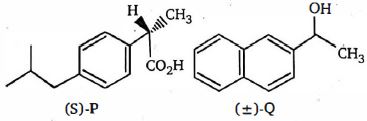
A
only one enantiomer
B
a mixture of diastereomers
C
a mixture of enantiomers
D
only one diastereomer
Solution
(B) The acid $P$ is a single enantiomer with $(S)$ configuration.
The alcohol $Q$ is a racemic mixture,i.e.,a mixture of $(R)$ and $(S)$ enantiomers.
During esterification,the chiral center of the acid remains unchanged,while the chiral center of the alcohol reacts.
Reaction: $(S)\text{-acid} + (R/S)\text{-alcohol} \rightarrow (S,R)\text{-ester} + (S,S)\text{-ester}$.
The products $(S,R)$ and $(S,S)$ are diastereomers of each other because they have different configurations at one chiral center while the other remains the same.
Therefore,a mixture of diastereomers is produced.
The alcohol $Q$ is a racemic mixture,i.e.,a mixture of $(R)$ and $(S)$ enantiomers.
During esterification,the chiral center of the acid remains unchanged,while the chiral center of the alcohol reacts.
Reaction: $(S)\text{-acid} + (R/S)\text{-alcohol} \rightarrow (S,R)\text{-ester} + (S,S)\text{-ester}$.
The products $(S,R)$ and $(S,S)$ are diastereomers of each other because they have different configurations at one chiral center while the other remains the same.
Therefore,a mixture of diastereomers is produced.
0 likes
View Solution70
AdvancedMCQ
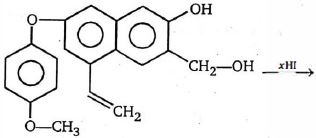
For the given reaction,the value of $x$ is:
A
$2$
B
$3$
C
$4$
D
$5$
Solution
(B) The reaction involves the cleavage of ethers and the reaction of functional groups with $HI$.
$1$. The molecule contains two ether linkages: one aryl-alkyl ether $(-OCH_3)$ and one diaryl ether ($-O-$ linkage between the two aromatic rings).
$2$. The aryl-alkyl ether $(-OCH_3)$ reacts with $HI$ to form a phenol and $CH_3I$ ($1$ mole of $HI$ used).
$3$. The diaryl ether linkage is generally resistant to cleavage by $HI$ under normal conditions.
$4$. The primary alcohol group $(-CH_2OH)$ reacts with $HI$ to form an alkyl iodide $(-CH_2I)$ and water ($1$ mole of $HI$ used).
$5$. The alkene group $(-CH=CH_2)$ reacts with $HI$ via electrophilic addition to form an alkyl iodide $(-CH(I)-CH_3)$ ($1$ mole of $HI$ used).
$6$. Total moles of $HI$ required $(x)$ = $1$ (for ether) + $1$ (for alcohol) + $1$ (for alkene) = $3$ moles.
Therefore,the value of $x$ is $3$.
$1$. The molecule contains two ether linkages: one aryl-alkyl ether $(-OCH_3)$ and one diaryl ether ($-O-$ linkage between the two aromatic rings).
$2$. The aryl-alkyl ether $(-OCH_3)$ reacts with $HI$ to form a phenol and $CH_3I$ ($1$ mole of $HI$ used).
$3$. The diaryl ether linkage is generally resistant to cleavage by $HI$ under normal conditions.
$4$. The primary alcohol group $(-CH_2OH)$ reacts with $HI$ to form an alkyl iodide $(-CH_2I)$ and water ($1$ mole of $HI$ used).
$5$. The alkene group $(-CH=CH_2)$ reacts with $HI$ via electrophilic addition to form an alkyl iodide $(-CH(I)-CH_3)$ ($1$ mole of $HI$ used).
$6$. Total moles of $HI$ required $(x)$ = $1$ (for ether) + $1$ (for alcohol) + $1$ (for alkene) = $3$ moles.
Therefore,the value of $x$ is $3$.
1 likes
View Solution71
MediumMCQ
In which of the following reactions is the migration of an alkyl group from carbon to oxygen observed?
A
Pinacol-pinacolone rearrangement
B
Baeyer-Villiger oxidation
C
Preparation of phenol from cumene hydroperoxide
D
Both $(b)$ and $(c)$
Solution
(D) In the Baeyer-Villiger oxidation,a peroxy acid reacts with a ketone to form an ester,where an alkyl group migrates from the carbonyl carbon to the oxygen atom of the peroxy group.
In the preparation of phenol from cumene hydroperoxide,the acid-catalyzed rearrangement involves the migration of the phenyl group from the carbon to the oxygen atom,followed by hydrolysis to yield phenol and acetone.
Since both reactions involve the migration of a group from carbon to oxygen,the correct answer is $(d)$.
In the preparation of phenol from cumene hydroperoxide,the acid-catalyzed rearrangement involves the migration of the phenyl group from the carbon to the oxygen atom,followed by hydrolysis to yield phenol and acetone.
Since both reactions involve the migration of a group from carbon to oxygen,the correct answer is $(d)$.
0 likes
View Solution72
DifficultMCQ
The increasing order of the boiling points for the following compounds is
$C_2H_5OH$ $(I)$,$C_2H_5Cl$ $(II)$,$C_2H_5CH_3$ $(III)$,$C_2H_5OCH_3$ $(IV)$
$C_2H_5OH$ $(I)$,$C_2H_5Cl$ $(II)$,$C_2H_5CH_3$ $(III)$,$C_2H_5OCH_3$ $(IV)$
A
$(III) < (IV) < (II) < (I)$
B
$(IV) < (III) < (I) < (II)$
C
$(II) < (III) < (IV) < (I)$
D
$(III) < (II) < (I) < (IV)$
Solution
(A) $I$. $C_2H_5OH$: Exhibits strong intermolecular hydrogen bonding,which leads to the highest boiling point.
$II$. $C_2H_5Cl$: Exhibits dipole-dipole interactions. It is more polar than the ether $(IV)$,resulting in a higher boiling point.
$III$. $C_2H_5CH_3$ (Propane): Only weak London dispersion forces exist,leading to the lowest boiling point.
$IV$. $C_2H_5OCH_3$ (Methoxyethane): Exhibits weaker dipole-dipole interactions compared to $C_2H_5Cl$.
Therefore,the increasing order of boiling points is: $(III) < (IV) < (II) < (I)$.
$II$. $C_2H_5Cl$: Exhibits dipole-dipole interactions. It is more polar than the ether $(IV)$,resulting in a higher boiling point.
$III$. $C_2H_5CH_3$ (Propane): Only weak London dispersion forces exist,leading to the lowest boiling point.
$IV$. $C_2H_5OCH_3$ (Methoxyethane): Exhibits weaker dipole-dipole interactions compared to $C_2H_5Cl$.
Therefore,the increasing order of boiling points is: $(III) < (IV) < (II) < (I)$.
0 likes
View Solution73
MediumMCQ
Which of the following statements is correct?
A
Power alcohol is formed by mixing petrol and ethyl alcohol in a fixed ratio.
B
The boiling point of rectified spirit is between that of absolute alcohol and water.
C
Solubility in water: $isobutyl \text{ alcohol} > tert\text{-butyl alcohol}$
D
Diastase enzyme is used to convert glucose into ethyl alcohol.
Solution
(A) . Option $A$ is correct. Power alcohol is a mixture of petrol and ethyl alcohol (usually $10-25\%$ ethanol) used as fuel.
$B$. Option $B$ is incorrect. Rectified spirit ($95.6\%$ ethanol and $4.4\%$ water) is an azeotrope with a boiling point of $78.15^{\circ}C$,which is lower than both pure ethanol $(78.37^{\circ}C)$ and water $(100^{\circ}C)$.
$C$. Option $C$ is incorrect. $tert\text{-butyl alcohol}$ is more soluble in water than $isobutyl \text{ alcohol}$ due to its more compact structure and greater branching,which reduces the hydrophobic effect.
$D$. Option $D$ is incorrect. Diastase converts starch into maltose,while Zymase is the enzyme used to convert glucose into ethyl alcohol.
$B$. Option $B$ is incorrect. Rectified spirit ($95.6\%$ ethanol and $4.4\%$ water) is an azeotrope with a boiling point of $78.15^{\circ}C$,which is lower than both pure ethanol $(78.37^{\circ}C)$ and water $(100^{\circ}C)$.
$C$. Option $C$ is incorrect. $tert\text{-butyl alcohol}$ is more soluble in water than $isobutyl \text{ alcohol}$ due to its more compact structure and greater branching,which reduces the hydrophobic effect.
$D$. Option $D$ is incorrect. Diastase converts starch into maltose,while Zymase is the enzyme used to convert glucose into ethyl alcohol.
0 likes
View Solution74
DifficultMCQ
Which of the following statements is not incorrect?
$(i)$ tert-butyl chloride is easily hydrolysed to give alcohol.
$(ii)$ Secondary alcohol gives a blue colour in the Victor-Meyer test.
$(iii)$ The $IUPAC$ name of the given structure is $3-$methylpentan$-2-$ol.
$(iv)$ Alcohol releases $CH_4$ gas with a Grignard reagent (not $H_2$ gas).
$(i)$ tert-butyl chloride is easily hydrolysed to give alcohol.
$(ii)$ Secondary alcohol gives a blue colour in the Victor-Meyer test.
$(iii)$ The $IUPAC$ name of the given structure is $3-$methylpentan$-2-$ol.
$(iv)$ Alcohol releases $CH_4$ gas with a Grignard reagent (not $H_2$ gas).
A
$ii, iii, iv$
B
$i, ii, iii, iv$
C
$i, ii, iii$
D
$i, ii$
Solution
(C) Let us analyze each statement:
$(i)$ tert-butyl chloride is a tertiary alkyl halide. It undergoes hydrolysis via the $S_N1$ mechanism,which is favored by the formation of a stable tertiary carbocation. Thus,it is easily hydrolysed. This statement is correct.
$(ii)$ In the Victor-Meyer test,primary alcohols give red,secondary alcohols give blue,and tertiary alcohols give no colour. This statement is correct.
$(iii)$ The structure shown is $CH_3-CH_2-CH(CH_3)-CH(OH)-CH_3$. The longest chain has $5$ carbons. Numbering from the right gives the hydroxyl group at position $2$ and the methyl group at position $3$. The name is $3-$methylpentan$-2-$ol. This statement is correct.
$(iv)$ Alcohols react with Grignard reagents $(R'MgX)$ to form alkanes $(R'H)$,not $H_2$ gas. For example,$ROH + R'MgX \rightarrow RH + R'H + Mg(OH)X$. This statement is incorrect.
Since statements $(i)$,$(ii)$,and $(iii)$ are correct,the correct option is $(C)$.
$(i)$ tert-butyl chloride is a tertiary alkyl halide. It undergoes hydrolysis via the $S_N1$ mechanism,which is favored by the formation of a stable tertiary carbocation. Thus,it is easily hydrolysed. This statement is correct.
$(ii)$ In the Victor-Meyer test,primary alcohols give red,secondary alcohols give blue,and tertiary alcohols give no colour. This statement is correct.
$(iii)$ The structure shown is $CH_3-CH_2-CH(CH_3)-CH(OH)-CH_3$. The longest chain has $5$ carbons. Numbering from the right gives the hydroxyl group at position $2$ and the methyl group at position $3$. The name is $3-$methylpentan$-2-$ol. This statement is correct.
$(iv)$ Alcohols react with Grignard reagents $(R'MgX)$ to form alkanes $(R'H)$,not $H_2$ gas. For example,$ROH + R'MgX \rightarrow RH + R'H + Mg(OH)X$. This statement is incorrect.
Since statements $(i)$,$(ii)$,and $(iii)$ are correct,the correct option is $(C)$.
0 likes
View Solution75
MediumMCQ
Which of the following reactions involves the formation of a carbene intermediate?
A
Reimer-Tiemann reaction
B
Carbylamine reaction
C
Hoffmann bromamide reaction
D
Both $A$ and $B$
Solution
(D) In both the Reimer-Tiemann reaction and the Carbylamine reaction,chloroform $(CHCl_3)$ reacts with a base $(KOH)$ to generate dichlorocarbene $(:CCl_2)$ as an intermediate.
$CHCl_3 + 3KOH \longrightarrow :CCl_2 + 3KCl + H_2O$.
Therefore,both reactions involve the formation of a carbene intermediate.
$CHCl_3 + 3KOH \longrightarrow :CCl_2 + 3KCl + H_2O$.
Therefore,both reactions involve the formation of a carbene intermediate.
0 likes
View Solution76
MediumMCQ
Ethanol and phenol cannot be distinguished by
A
$I_2/NaOH$
B
Neutral $FeCl_3$
C
$Br_2/H_2O$
D
$NaHCO_3$
Solution
(D) $1$. $I_2/NaOH$ (Iodoform test): Ethanol gives a positive iodoform test (yellow precipitate),whereas phenol does not. Thus,they can be distinguished.
$2$. Neutral $FeCl_3$: Phenol gives a violet color with neutral $FeCl_3$ solution,while ethanol does not. Thus,they can be distinguished.
$3$. $Br_2/H_2O$: Phenol gives a white precipitate of $2,4,6-tribromophenol$ with bromine water,while ethanol does not react. Thus,they can be distinguished.
$4$. $NaHCO_3$: Neither ethanol nor phenol is acidic enough to react with $NaHCO_3$ to evolve $CO_2$ gas. Therefore,they cannot be distinguished by this reagent.
$2$. Neutral $FeCl_3$: Phenol gives a violet color with neutral $FeCl_3$ solution,while ethanol does not. Thus,they can be distinguished.
$3$. $Br_2/H_2O$: Phenol gives a white precipitate of $2,4,6-tribromophenol$ with bromine water,while ethanol does not react. Thus,they can be distinguished.
$4$. $NaHCO_3$: Neither ethanol nor phenol is acidic enough to react with $NaHCO_3$ to evolve $CO_2$ gas. Therefore,they cannot be distinguished by this reagent.
0 likes
View Solution77
EasyMCQ
$1^o, 2^o, 3^o$ alcohols are distinguished by
A
Oxidation method
B
Lucas test
C
Victor-Meyer's method
D
All of the above
Solution
(D) Primary,secondary,and tertiary alcohols can be distinguished using the oxidation method,Lucas test,and Victor-Meyer's method.
$1.$ Oxidation method: Primary alcohols oxidize to aldehydes and then to carboxylic acids. Secondary alcohols oxidize to ketones and resist further oxidation. Tertiary alcohols are generally resistant to oxidation under these conditions.
$2.$ Lucas test: This test uses Lucas reagent (conc. $HCl$ and anhydrous $ZnCl_2$). Tertiary alcohols react immediately to form turbidity,secondary alcohols react within $5-10$ minutes,and primary alcohols show no reaction at room temperature.
$3.$ Victor-Meyer's method: Alcohols are converted to nitroalkanes and treated with nitrous acid and alkali. Primary alcohols yield a blood-red color,secondary alcohols yield a blue color,and tertiary alcohols remain colorless.
$1.$ Oxidation method: Primary alcohols oxidize to aldehydes and then to carboxylic acids. Secondary alcohols oxidize to ketones and resist further oxidation. Tertiary alcohols are generally resistant to oxidation under these conditions.
$2.$ Lucas test: This test uses Lucas reagent (conc. $HCl$ and anhydrous $ZnCl_2$). Tertiary alcohols react immediately to form turbidity,secondary alcohols react within $5-10$ minutes,and primary alcohols show no reaction at room temperature.
$3.$ Victor-Meyer's method: Alcohols are converted to nitroalkanes and treated with nitrous acid and alkali. Primary alcohols yield a blood-red color,secondary alcohols yield a blue color,and tertiary alcohols remain colorless.
0 likes
View Solution78
MediumMCQ
Phenol can be converted into salicylic acid by heating with
A
$CO_2$ (under pressure) and alkali
B
$CCl_4$ and alkali
C
$CHCl_3$ and alkali followed by oxidation
D
All of the above
Solution
(D) The conversion of phenol to salicylic acid can be achieved through several methods:
$1$. Kolbe-Schmitt reaction: Phenol reacts with $CO_2$ under pressure in the presence of an alkali $(NaOH)$ to form sodium salicylate,which upon acidification yields salicylic acid.
$2$. Reimer-Tiemann reaction with $CCl_4$: Phenol reacts with $CCl_4$ in the presence of an alkali $(NaOH)$ to form salicylic acid directly.
$3$. Reimer-Tiemann reaction with $CHCl_3$: Phenol reacts with $CHCl_3$ and alkali to form salicylaldehyde,which can then be oxidized to salicylic acid.
Since all these methods can lead to the formation of salicylic acid,the correct answer is $D$.
$1$. Kolbe-Schmitt reaction: Phenol reacts with $CO_2$ under pressure in the presence of an alkali $(NaOH)$ to form sodium salicylate,which upon acidification yields salicylic acid.
$2$. Reimer-Tiemann reaction with $CCl_4$: Phenol reacts with $CCl_4$ in the presence of an alkali $(NaOH)$ to form salicylic acid directly.
$3$. Reimer-Tiemann reaction with $CHCl_3$: Phenol reacts with $CHCl_3$ and alkali to form salicylaldehyde,which can then be oxidized to salicylic acid.
Since all these methods can lead to the formation of salicylic acid,the correct answer is $D$.
0 likes
View Solution79
DifficultMCQ
Dichlorocarbene is formed by chloroform and alcoholic $KOH$. Which reaction involves this carbene?
A
Schmidt reaction
B
Reimer-Tiemann reaction
C
Carbylamine reaction
D
$(B)$ and $(C)$ both
Solution
(D) The reaction of chloroform $(CHCl_3)$ with alcoholic $KOH$ generates dichlorocarbene $(:CCl_2)$ as an intermediate.
In the Reimer-Tiemann reaction,phenol reacts with $CHCl_3$ and $KOH$ to form salicylaldehyde,where $:CCl_2$ is the electrophilic intermediate.
In the Carbylamine reaction,primary amines react with $CHCl_3$ and $KOH$ to form isocyanides,where $:CCl_2$ is also the electrophilic intermediate.
Therefore,both reactions involve the formation of dichlorocarbene.
In the Reimer-Tiemann reaction,phenol reacts with $CHCl_3$ and $KOH$ to form salicylaldehyde,where $:CCl_2$ is the electrophilic intermediate.
In the Carbylamine reaction,primary amines react with $CHCl_3$ and $KOH$ to form isocyanides,where $:CCl_2$ is also the electrophilic intermediate.
Therefore,both reactions involve the formation of dichlorocarbene.
0 likes
View Solution80
DifficultMCQ
Which of the following ethers cannot be produced by Williamson ether synthesis?
A
$(CH_3)_3C-O-CH=CH_2$
B
$Ph-O-Ph$
C
$CH \equiv C-O-CH=CH_2$
D
All of these
Solution
(D) Williamson ether synthesis involves the $S_N2$ reaction of an alkoxide ion with a primary alkyl halide. It cannot be used to prepare ethers where the halide is a vinyl halide,aryl halide,or tertiary alkyl halide because these do not undergo $S_N2$ reactions effectively.
$1.$ For $(a)$,the reactants would be $(CH_3)_3C-O^-$ and $CH_2=CH-X$ (vinyl halide) or $CH_2=CH-O^-$ and $(CH_3)_3C-X$ (tertiary halide).
$2.$ For $(b)$,the reactants would be $Ph-O^-$ and $Ph-X$ (aryl halide).
$3.$ For $(c)$,the reactants would be $CH \equiv C-O^-$ and $CH_2=CH-X$ (vinyl halide).
Since none of these reactions are feasible via $S_N2$,none of these ethers can be produced.
$1.$ For $(a)$,the reactants would be $(CH_3)_3C-O^-$ and $CH_2=CH-X$ (vinyl halide) or $CH_2=CH-O^-$ and $(CH_3)_3C-X$ (tertiary halide).
$2.$ For $(b)$,the reactants would be $Ph-O^-$ and $Ph-X$ (aryl halide).
$3.$ For $(c)$,the reactants would be $CH \equiv C-O^-$ and $CH_2=CH-X$ (vinyl halide).
Since none of these reactions are feasible via $S_N2$,none of these ethers can be produced.
0 likes
View Solution81
MediumMCQ
In the following reaction,$\text{Phenol}$ $\xrightarrow{Zn \, \text{dust}} x$ $\xrightarrow[\text{Anhy.} \, ZnCl_2]{CH_3Cl} y$ $\xrightarrow{\text{Alk.} \, KMnO_4} z$. The product $z$ is:
A
Toluene
B
Benzaldehyde
C
Benzoic acid
D
Benzene
Solution
(C) Step $1$: Phenol reacts with $Zn$ dust to form benzene $(x = C_6H_6)$.
Step $2$: Benzene undergoes Friedel-Crafts alkylation with $CH_3Cl$ in the presence of anhydrous $ZnCl_2$ to form toluene $(y = C_6H_5CH_3)$.
Step $3$: Toluene is oxidized by alkaline $KMnO_4$ to form benzoic acid $(z = C_6H_5COOH)$.
Step $2$: Benzene undergoes Friedel-Crafts alkylation with $CH_3Cl$ in the presence of anhydrous $ZnCl_2$ to form toluene $(y = C_6H_5CH_3)$.
Step $3$: Toluene is oxidized by alkaline $KMnO_4$ to form benzoic acid $(z = C_6H_5COOH)$.
0 likes
View Solution82
AdvancedMCQ
$p-$Cresol reacts with chloroform in an alkaline medium to give compound $A$,which reacts with hydrogen cyanide to form compound $Y$. Hydrolysis of $Y$ gives a chiral carboxylic acid. Identify the structure of the carboxylic acid.
A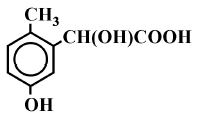
B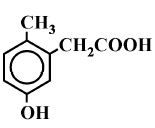
C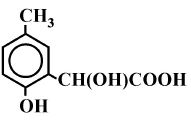
D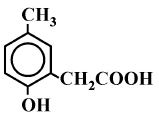
Solution
(A) $1$. $p-$Cresol reacts with $CHCl_3$ in an alkaline medium (Reimer-Tiemann reaction) to form $2-$hydroxy$-5-$methylbenzaldehyde (compound $A$).
$2$. Compound $A$ reacts with $HCN$ to form a cyanohydrin,$2-$hydroxy$-5-$methylmandelonitrile (compound $Y$).
$3$. Hydrolysis of the cyanohydrin group $(-CN)$ yields a carboxylic acid group $(-COOH)$.
$4$. The resulting product is $2-$hydroxy$-5-$methylmandelic acid,which has a chiral center at the carbon atom attached to the $-OH$ and $-COOH$ groups.
$5$. The structure is a benzene ring with a $-CH_3$ group at position $1$,an $-OH$ group at position $4$,and a $-CH(OH)COOH$ group at position $2$.
$2$. Compound $A$ reacts with $HCN$ to form a cyanohydrin,$2-$hydroxy$-5-$methylmandelonitrile (compound $Y$).
$3$. Hydrolysis of the cyanohydrin group $(-CN)$ yields a carboxylic acid group $(-COOH)$.
$4$. The resulting product is $2-$hydroxy$-5-$methylmandelic acid,which has a chiral center at the carbon atom attached to the $-OH$ and $-COOH$ groups.
$5$. The structure is a benzene ring with a $-CH_3$ group at position $1$,an $-OH$ group at position $4$,and a $-CH(OH)COOH$ group at position $2$.
0 likes
View Solution83
MediumMCQ
Assertion: $tert$-Butyl methyl ether is not prepared by the reaction of $tert$-butyl bromide with sodium methoxide.
Reason: Sodium methoxide is a strong nucleophile.
Reason: Sodium methoxide is a strong nucleophile.
A
If both Assertion and Reason are correct and the Reason is a correct explanation of the Assertion.
B
If both Assertion and Reason are correct but Reason is not a correct explanation of the Assertion.
C
If the Assertion is correct but Reason is incorrect.
D
If both the Assertion and Reason are incorrect.
Solution
(B) $Assertion$ is correct because $tert$-butyl bromide is a $3^\circ$ alkyl halide,which undergoes $E2$ elimination rather than $S_N2$ substitution when treated with a strong base like sodium methoxide. The major product is isobutylene $(CH_3-C(CH_3)=CH_2)$.
$Reason$ is also correct because sodium methoxide $(CH_3ONa)$ is indeed a strong nucleophile,but its primary role in this specific reaction with a bulky $3^\circ$ substrate is that of a strong base.
However,the reason for the failure of the reaction is the steric hindrance of the $3^\circ$ alkyl halide,not just the nucleophilicity of the methoxide ion. Thus,the Reason is not the correct explanation for the Assertion.
$Reason$ is also correct because sodium methoxide $(CH_3ONa)$ is indeed a strong nucleophile,but its primary role in this specific reaction with a bulky $3^\circ$ substrate is that of a strong base.
However,the reason for the failure of the reaction is the steric hindrance of the $3^\circ$ alkyl halide,not just the nucleophilicity of the methoxide ion. Thus,the Reason is not the correct explanation for the Assertion.
0 likes
View Solution84
DifficultMCQ
The predominant intermolecular forces present in ethyl acetate,a liquid,are
A
Hydrogen bonding and London dispersion
B
Dipole-dipole and hydrogen bonding
C
London dispersion and dipole-dipole
D
London dispersion,dipole-dipole and hydrogen bonding
Solution
(C) Ethyl acetate $(CH_3COOCH_2CH_3)$ is a polar molecule due to the presence of the ester group $(C=O)$.
Because it is polar,it exhibits dipole-dipole interactions.
Additionally,all molecules exhibit London dispersion forces.
It does not contain $O-H$,$N-H$,or $F-H$ bonds,so it does not exhibit hydrogen bonding.
Therefore,the predominant forces are London dispersion and dipole-dipole interactions.
Because it is polar,it exhibits dipole-dipole interactions.
Additionally,all molecules exhibit London dispersion forces.
It does not contain $O-H$,$N-H$,or $F-H$ bonds,so it does not exhibit hydrogen bonding.
Therefore,the predominant forces are London dispersion and dipole-dipole interactions.
0 likes
View Solution85
Medium
Arrange the following sets of compounds in order of their increasing boiling points:
$(a)$ Pentan$-1-$ol,butan$-1-$ol,butan$-2-$ol,ethanol,propan$-1-$ol,methanol.
$(b)$ Pentan$-1-$ol,$n-$butane,pentanal,ethoxyethane.
$(a)$ Pentan$-1-$ol,butan$-1-$ol,butan$-2-$ol,ethanol,propan$-1-$ol,methanol.
$(b)$ Pentan$-1-$ol,$n-$butane,pentanal,ethoxyethane.
Solution
(N/A) The boiling point of organic compounds depends on intermolecular forces such as hydrogen bonding and dipole-dipole interactions.
$(a)$ The boiling point increases with the increase in the length of the carbon chain due to increased van der Waals forces. For isomers,branching decreases the boiling point. The order is: $\text{Methanol} < \text{Ethanol} < \text{Propan-}1\text{-ol} < \text{Butan-}2\text{-ol} < \text{Butan-}1\text{-ol} < \text{Pentan-}1\text{-ol}$.
$(b)$ The order of boiling points based on intermolecular forces (Hydrogen bonding > Dipole-dipole > van der Waals) is: $n\text{-Butane} < \text{Ethoxyethane} < \text{Pentanal} < \text{Pentan-}1\text{-ol}$.
$(a)$ The boiling point increases with the increase in the length of the carbon chain due to increased van der Waals forces. For isomers,branching decreases the boiling point. The order is: $\text{Methanol} < \text{Ethanol} < \text{Propan-}1\text{-ol} < \text{Butan-}2\text{-ol} < \text{Butan-}1\text{-ol} < \text{Pentan-}1\text{-ol}$.
$(b)$ The order of boiling points based on intermolecular forces (Hydrogen bonding > Dipole-dipole > van der Waals) is: $n\text{-Butane} < \text{Ethoxyethane} < \text{Pentanal} < \text{Pentan-}1\text{-ol}$.
0 likes
View Solution86
Medium
$(i)$ Draw the structures of all isomeric alcohols of molecular formula $C_5H_{12}O$ and give their $IUPAC$ names.
$(ii)$ Classify the isomers of alcohols in question $(i)$ as primary,secondary and tertiary alcohols.
$(ii)$ Classify the isomers of alcohols in question $(i)$ as primary,secondary and tertiary alcohols.
Solution
(N/A) There are $8$ structural isomers of alcohols with the molecular formula $C_5H_{12}O$.
| Structure | $IUPAC$ Name | Classification |
|---|---|---|
| $CH_3-CH_2-CH_2-CH_2-CH_2-OH$ | $Pentan-1-ol$ | Primary $(1^\circ)$ |
| $CH_3-CH_2-CH_2-CH(OH)-CH_3$ | $Pentan-2-ol$ | Secondary $(2^\circ)$ |
| $CH_3-CH_2-CH(OH)-CH_2-CH_3$ | $Pentan-3-ol$ | Secondary $(2^\circ)$ |
| $CH_3-CH_2-CH(CH_3)-CH_2-OH$ | $2-Methylbutan-1-ol$ | Primary $(1^\circ)$ |
| $CH_3-CH(CH_3)-CH_2-CH_2-OH$ | $3-Methylbutan-1-ol$ | Primary $(1^\circ)$ |
| $CH_3-CH(CH_3)-CH(OH)-CH_3$ | $3-Methylbutan-2-ol$ | Secondary $(2^\circ)$ |
| $CH_3-C(CH_3)(OH)-CH_2-CH_3$ | $2-Methylbutan-2-ol$ | Tertiary $(3^\circ)$ |
| $CH_3-C(CH_3)_2-CH_2-OH$ | $2,2-Dimethylpropan-1-ol$ | Primary $(1^\circ)$ |
0 likes
View Solution87
Difficult
Give equations of the following reactions:
$(i)$ Oxidation of propan$-1-$ol with alkaline $KMnO_4$ solution.
$(ii)$ Bromine in $CS_2$ with phenol.
$(iii)$ Dilute $HNO_3$ with phenol.
$(iv)$ Treating phenol with chloroform in presence of aqueous $NaOH$.
$(i)$ Oxidation of propan$-1-$ol with alkaline $KMnO_4$ solution.
$(ii)$ Bromine in $CS_2$ with phenol.
$(iii)$ Dilute $HNO_3$ with phenol.
$(iv)$ Treating phenol with chloroform in presence of aqueous $NaOH$.
Solution
(N/A) $(i)$ $CH_3CH_2CH_2OH \xrightarrow{\text{alk. } KMnO_4} CH_3CH_2COOH$ (Propanoic acid)
$(ii)$ Phenol reacts with $Br_2$ in $CS_2$ at $273 \ K$ to give a mixture of $o$-bromophenol (minor) and $p$-bromophenol (major).
$(iii)$ Phenol reacts with dilute $HNO_3$ at low temperature to give a mixture of $o$-nitrophenol and $p$-nitrophenol.
$(iv)$ Phenol reacts with $CHCl_3$ in the presence of aqueous $NaOH$ (Reimer-Tiemann reaction) to form salicylaldehyde.
$(ii)$ Phenol reacts with $Br_2$ in $CS_2$ at $273 \ K$ to give a mixture of $o$-bromophenol (minor) and $p$-bromophenol (major).
$(iii)$ Phenol reacts with dilute $HNO_3$ at low temperature to give a mixture of $o$-nitrophenol and $p$-nitrophenol.
$(iv)$ Phenol reacts with $CHCl_3$ in the presence of aqueous $NaOH$ (Reimer-Tiemann reaction) to form salicylaldehyde.
0 likes
View Solution88
Difficult
Explain the following with an example.
$(i)$ Kolbe's reaction.
$(ii)$ Reimer-Tiemann reaction.
$(iii)$ Williamson ether synthesis.
$(iv)$ Unsymmetrical ether.
$(i)$ Kolbe's reaction.
$(ii)$ Reimer-Tiemann reaction.
$(iii)$ Williamson ether synthesis.
$(iv)$ Unsymmetrical ether.
Solution
(N/A) $(i)$ Kolbe's reaction: When phenol is treated with sodium hydroxide,sodium phenoxide is produced. This sodium phenoxide,when treated with carbon dioxide followed by acidification,undergoes electrophilic substitution to give ortho-hydroxybenzoic acid (salicylic acid) as the main product.
$(ii)$ Reimer-Tiemann reaction: When phenol is treated with chloroform $(CHCl_{3})$ in the presence of aqueous sodium hydroxide,a $-CHO$ group is introduced at the ortho position of the benzene ring to form salicylaldehyde.
$(iii)$ Williamson ether synthesis: This is a laboratory method to prepare symmetrical and unsymmetrical ethers by reacting an alkyl halide with a sodium alkoxide. It involves an $S_{N}2$ attack of the alkoxide ion on the alkyl halide. For example: $CH_{3}CH_{2}ONa + CH_{3}I \rightarrow CH_{3}CH_{2}OCH_{3} + NaI$.
$(iv)$ Unsymmetrical ether: An ether where the two alkyl or aryl groups attached to the oxygen atom are different. For example: ethyl methyl ether $(CH_{3}OCH_{2}CH_{3})$.
$(ii)$ Reimer-Tiemann reaction: When phenol is treated with chloroform $(CHCl_{3})$ in the presence of aqueous sodium hydroxide,a $-CHO$ group is introduced at the ortho position of the benzene ring to form salicylaldehyde.
$(iii)$ Williamson ether synthesis: This is a laboratory method to prepare symmetrical and unsymmetrical ethers by reacting an alkyl halide with a sodium alkoxide. It involves an $S_{N}2$ attack of the alkoxide ion on the alkyl halide. For example: $CH_{3}CH_{2}ONa + CH_{3}I \rightarrow CH_{3}CH_{2}OCH_{3} + NaI$.
$(iv)$ Unsymmetrical ether: An ether where the two alkyl or aryl groups attached to the oxygen atom are different. For example: ethyl methyl ether $(CH_{3}OCH_{2}CH_{3})$.
0 likes
View Solution89
Difficult
How are the following conversions carried out?
$(i)$ Propene $\rightarrow$ Propan$-2-$ol.
$(ii)$ Benzyl chloride $\rightarrow$ Benzyl alcohol.
$(iii)$ Ethyl magnesium chloride $\rightarrow$ Propan$-1-$ol.
$(iv)$ Methyl magnesium bromide $\rightarrow$ $2-$Methylpropan$-2-$ol.
$(i)$ Propene $\rightarrow$ Propan$-2-$ol.
$(ii)$ Benzyl chloride $\rightarrow$ Benzyl alcohol.
$(iii)$ Ethyl magnesium chloride $\rightarrow$ Propan$-1-$ol.
$(iv)$ Methyl magnesium bromide $\rightarrow$ $2-$Methylpropan$-2-$ol.
Solution
(N/A) $(i)$ Acid-catalyzed hydration of propene follows Markovnikov's rule to yield propan$-2-$ol.
$CH_3-CH=CH_2 + H_2O \xrightarrow{H^+} CH_3-CH(OH)-CH_3$
$(ii)$ Benzyl chloride reacts with aqueous $NaOH$ via nucleophilic substitution to form benzyl alcohol.
$C_6H_5CH_2Cl + NaOH(aq) \to C_6H_5CH_2OH + NaCl$
$(iii)$ Ethyl magnesium chloride reacts with methanal $(HCHO)$ to form an adduct,which upon hydrolysis yields propan$-1-$ol.
$C_2H_5MgCl + HCHO \to C_2H_5CH_2OMgCl \xrightarrow{H_2O/H^+} C_2H_5CH_2OH + Mg(OH)Cl$
$(iv)$ Methyl magnesium bromide reacts with acetone $(CH_3COCH_3)$ to form an adduct,which upon hydrolysis yields $2-$methylpropan$-2-$ol.
$CH_3MgBr + CH_3COCH_3 \to (CH_3)_3COMgBr \xrightarrow{H_2O/H^+} (CH_3)_3COH + Mg(OH)Br$
$CH_3-CH=CH_2 + H_2O \xrightarrow{H^+} CH_3-CH(OH)-CH_3$
$(ii)$ Benzyl chloride reacts with aqueous $NaOH$ via nucleophilic substitution to form benzyl alcohol.
$C_6H_5CH_2Cl + NaOH(aq) \to C_6H_5CH_2OH + NaCl$
$(iii)$ Ethyl magnesium chloride reacts with methanal $(HCHO)$ to form an adduct,which upon hydrolysis yields propan$-1-$ol.
$C_2H_5MgCl + HCHO \to C_2H_5CH_2OMgCl \xrightarrow{H_2O/H^+} C_2H_5CH_2OH + Mg(OH)Cl$
$(iv)$ Methyl magnesium bromide reacts with acetone $(CH_3COCH_3)$ to form an adduct,which upon hydrolysis yields $2-$methylpropan$-2-$ol.
$CH_3MgBr + CH_3COCH_3 \to (CH_3)_3COMgBr \xrightarrow{H_2O/H^+} (CH_3)_3COH + Mg(OH)Br$
0 likes
View Solution90
DifficultMCQ
Arrange the following compounds in the increasing order of their boiling points:
$CH_3CH_2CH_2CHO$,$CH_3CH_2CH_2CH_2OH$,$C_2H_5OC_2H_5$,$CH_3CH_2CH_2CH_3$
$CH_3CH_2CH_2CHO$,$CH_3CH_2CH_2CH_2OH$,$C_2H_5OC_2H_5$,$CH_3CH_2CH_2CH_3$
A
$CH_3CH_2CH_2CH_3 < C_2H_5OC_2H_5 < CH_3CH_2CH_2CHO < CH_3CH_2CH_2CH_2OH$
B
$CH_3CH_2CH_2CH_2OH < CH_3CH_2CH_2CHO < C_2H_5OC_2H_5 < CH_3CH_2CH_2CH_3$
C
$CH_3CH_2CH_2CH_3 < CH_3CH_2CH_2CHO < C_2H_5OC_2H_5 < CH_3CH_2CH_2CH_2OH$
D
$C_2H_5OC_2H_5 < CH_3CH_2CH_2CH_3 < CH_3CH_2CH_2CHO < CH_3CH_2CH_2CH_2OH$
Solution
(A) The boiling point depends on the intermolecular forces present in the compounds.
$1$. $CH_3CH_2CH_2CH_2OH$ (butan-$1$-ol) has intermolecular hydrogen bonding,resulting in the highest boiling point.
$2$. $CH_3CH_2CH_2CHO$ (butanal) is a polar molecule with dipole-dipole interactions,which are stronger than the forces in ethers and alkanes.
$3$. $C_2H_5OC_2H_5$ (ethoxyethane) has weak dipole-dipole interactions.
$4$. $CH_3CH_2CH_2CH_3$ (butane) is a non-polar alkane with only weak van der Waals dispersion forces,resulting in the lowest boiling point.
Thus,the increasing order of boiling points is: $CH_3CH_2CH_2CH_3 < C_2H_5OC_2H_5 < CH_3CH_2CH_2CHO < CH_3CH_2CH_2CH_2OH$.
$1$. $CH_3CH_2CH_2CH_2OH$ (butan-$1$-ol) has intermolecular hydrogen bonding,resulting in the highest boiling point.
$2$. $CH_3CH_2CH_2CHO$ (butanal) is a polar molecule with dipole-dipole interactions,which are stronger than the forces in ethers and alkanes.
$3$. $C_2H_5OC_2H_5$ (ethoxyethane) has weak dipole-dipole interactions.
$4$. $CH_3CH_2CH_2CH_3$ (butane) is a non-polar alkane with only weak van der Waals dispersion forces,resulting in the lowest boiling point.
Thus,the increasing order of boiling points is: $CH_3CH_2CH_2CH_3 < C_2H_5OC_2H_5 < CH_3CH_2CH_2CHO < CH_3CH_2CH_2CH_2OH$.
0 likes
View Solution91
Medium
State the various applications of alcohols,phenols,and ethers in day-to-day life.
Solution
(N/A) Alcohols and phenols are formed by the replacement of a hydrogen atom in an aliphatic and aromatic hydrocarbon,respectively. Ethers are formed by the replacement of a hydrogen atom in a hydrocarbon by alkoxy or aryloxy groups. Ethers can also be visualized as the replacement of the hydrogen atom of the $-OH$ group of an alcohol or phenol by an alkyl or aryl group.
Alcohols contain one or more $-OH$ groups bonded directly to carbon atom$(s)$ of an aliphatic system (e.g.,$CH_3OH$),whereas phenols contain $-OH$ group$(s)$ bonded directly to the $sp^2$ carbon of an aromatic system (e.g.,$C_6H_5OH$).
Applications:
$1$. Ethanol is used as a solvent for polishing wooden furniture and is commonly known as spirit.
$2$. Many essential compounds in our daily life,such as the sugar we consume,the cotton used in fabrics,and the paper used for writing,are composed of molecules containing multiple $-OH$ groups.
$3$. Ethers,such as diethyl ether,are widely used as solvents in laboratories and in the extraction of organic compounds.
Alcohols contain one or more $-OH$ groups bonded directly to carbon atom$(s)$ of an aliphatic system (e.g.,$CH_3OH$),whereas phenols contain $-OH$ group$(s)$ bonded directly to the $sp^2$ carbon of an aromatic system (e.g.,$C_6H_5OH$).
Applications:
$1$. Ethanol is used as a solvent for polishing wooden furniture and is commonly known as spirit.
$2$. Many essential compounds in our daily life,such as the sugar we consume,the cotton used in fabrics,and the paper used for writing,are composed of molecules containing multiple $-OH$ groups.
$3$. Ethers,such as diethyl ether,are widely used as solvents in laboratories and in the extraction of organic compounds.
0 likes
View Solution92
MediumMCQ
Identify the reagents $X$,$Y$,and $Z$ in the following reaction schemes:
$(i)$ Benzene $\xrightarrow{X}$ Benzenesulfonic acid $\xrightarrow{Y}$ Sodium phenoxide $\xrightarrow{Z}$ Phenol
$(ii)$ Aniline $\xrightarrow{X}$ Benzenediazonium chloride $\xrightarrow{Y}$ Phenol
$(iii)$ Chlorobenzene $\xrightarrow{X}$ Sodium phenoxide $\xrightarrow{Y}$ Phenol
$(i)$ Benzene $\xrightarrow{X}$ Benzenesulfonic acid $\xrightarrow{Y}$ Sodium phenoxide $\xrightarrow{Z}$ Phenol
$(ii)$ Aniline $\xrightarrow{X}$ Benzenediazonium chloride $\xrightarrow{Y}$ Phenol
$(iii)$ Chlorobenzene $\xrightarrow{X}$ Sodium phenoxide $\xrightarrow{Y}$ Phenol
A
$X = \text{conc. } H_2SO_4, Y = NaOH, Z = H_3O^+$; $X = NaNO_2/HCl, Y = H_2O/\Delta$; $X = NaOH, Y = H_3O^+$
B
$X = SO_3, Y = NaOH, Z = H_2O$; $X = NaNO_2, Y = H_2O$; $X = NaOH, Y = H_2O$
C
$X = H_2SO_4, Y = Na_2CO_3, Z = H^+$; $X = HNO_2, Y = H_2O$; $X = Na, Y = H^+$
D
$X = H_2SO_4, Y = NaOH, Z = H_2O$; $X = NaNO_2/HCl, Y = H_3O^+$; $X = NaOH, Y = H_3O^+$
Solution
(A) For reaction $(i)$:
Benzene reacts with conc. $H_2SO_4$ (oleum) to form benzenesulfonic acid $(X = conc. H_2SO_4)$.
Benzenesulfonic acid reacts with $NaOH$ (fusion) to form sodium phenoxide $(Y = NaOH)$.
Sodium phenoxide reacts with dilute acid $(H_3O^+)$ to form phenol $(Z = H_3O^+)$.
For reaction $(ii)$:
Aniline reacts with $NaNO_2/HCl$ at $0-5 ^\circ C$ to form benzenediazonium chloride $(X = NaNO_2/HCl)$.
Benzenediazonium chloride reacts with water ($H_2O$ or $H_3O^+$) upon warming to form phenol $(Y = H_3O^+)$.
For reaction $(iii)$:
Chlorobenzene reacts with $NaOH$ at high temperature and pressure $(623 K, 300 atm)$ to form sodium phenoxide $(X = NaOH)$.
Sodium phenoxide reacts with dilute acid $(H_3O^+)$ to form phenol $(Y = H_3O^+)$.
Thus,the correct reagents are $X = conc. H_2SO_4, Y = NaOH, Z = H_3O^+$ for $(i)$; $X = NaNO_2/HCl, Y = H_3O^+$ for $(ii)$; and $X = NaOH, Y = H_3O^+$ for $(iii)$.
Benzene reacts with conc. $H_2SO_4$ (oleum) to form benzenesulfonic acid $(X = conc. H_2SO_4)$.
Benzenesulfonic acid reacts with $NaOH$ (fusion) to form sodium phenoxide $(Y = NaOH)$.
Sodium phenoxide reacts with dilute acid $(H_3O^+)$ to form phenol $(Z = H_3O^+)$.
For reaction $(ii)$:
Aniline reacts with $NaNO_2/HCl$ at $0-5 ^\circ C$ to form benzenediazonium chloride $(X = NaNO_2/HCl)$.
Benzenediazonium chloride reacts with water ($H_2O$ or $H_3O^+$) upon warming to form phenol $(Y = H_3O^+)$.
For reaction $(iii)$:
Chlorobenzene reacts with $NaOH$ at high temperature and pressure $(623 K, 300 atm)$ to form sodium phenoxide $(X = NaOH)$.
Sodium phenoxide reacts with dilute acid $(H_3O^+)$ to form phenol $(Y = H_3O^+)$.
Thus,the correct reagents are $X = conc. H_2SO_4, Y = NaOH, Z = H_3O^+$ for $(i)$; $X = NaNO_2/HCl, Y = H_3O^+$ for $(ii)$; and $X = NaOH, Y = H_3O^+$ for $(iii)$.
0 likes
View Solution93
Medium
Write the chemical reactions for the following conversions:
$1.$ Phenol to Anisole and Phenetole
$2.$ Chlorobenzene to $p$-Bromoanisole
$1.$ Phenol to Anisole and Phenetole
$2.$ Chlorobenzene to $p$-Bromoanisole
Solution
(N/A) $1.$ Conversion of Phenol to Anisole and Phenetole:
Phenol reacts with $NaOH$ to form Sodium phenoxide. Sodium phenoxide then undergoes Williamson ether synthesis with alkyl halides:
- Phenol $+ NaOH \rightarrow$ Sodium phenoxide $+ H_2O$
- Sodium phenoxide $+ CH_3Br \rightarrow$ Anisole $+ NaBr$
- Sodium phenoxide $+ CH_3CH_2Br \rightarrow$ Phenetole $+ NaBr$
$2.$ Conversion of Chlorobenzene to $p$-Bromoanisole:
- Chlorobenzene is converted to Sodium phenoxide using $NaOH$ at $623 \ K$ and $300 \ atm$ (Dow's process).
- Sodium phenoxide reacts with $CH_3Br$ to form Anisole.
- Anisole undergoes electrophilic aromatic substitution (bromination) with $Br_2$ in ethanoic acid to yield $p$-Bromoanisole as the major product.
Phenol reacts with $NaOH$ to form Sodium phenoxide. Sodium phenoxide then undergoes Williamson ether synthesis with alkyl halides:
- Phenol $+ NaOH \rightarrow$ Sodium phenoxide $+ H_2O$
- Sodium phenoxide $+ CH_3Br \rightarrow$ Anisole $+ NaBr$
- Sodium phenoxide $+ CH_3CH_2Br \rightarrow$ Phenetole $+ NaBr$
$2.$ Conversion of Chlorobenzene to $p$-Bromoanisole:
- Chlorobenzene is converted to Sodium phenoxide using $NaOH$ at $623 \ K$ and $300 \ atm$ (Dow's process).
- Sodium phenoxide reacts with $CH_3Br$ to form Anisole.
- Anisole undergoes electrophilic aromatic substitution (bromination) with $Br_2$ in ethanoic acid to yield $p$-Bromoanisole as the major product.
0 likes
View Solution94
Medium
Write the chemical reactions for the following conversions:
$1.$ Propan$-2-$ol to $2-$methylbutan$-2-$ol
$2.$ Benzenesulphonic acid to benzoquinone
$1.$ Propan$-2-$ol to $2-$methylbutan$-2-$ol
$2.$ Benzenesulphonic acid to benzoquinone
Solution
(N/A) $1.$ Propan$-2-$ol to $2-$methylbutan$-2-$ol:
$CH_3-CH(OH)-CH_3 \xrightarrow{Cu, 573 \ K} CH_3-CO-CH_3$ (Propanone)
$CH_3-CO-CH_3 + CH_3CH_2MgBr \rightarrow CH_3-C(OMgBr)(CH_2CH_3)-CH_3$
$CH_3-C(OMgBr)(CH_2CH_3)-CH_3 \xrightarrow{H_3O^+} CH_3-C(OH)(CH_2CH_3)-CH_3$ ($2-$methylbutan$-2-$ol)
$2.$ Benzenesulphonic acid to benzoquinone:
$C_6H_5SO_3H \xrightarrow[(ii) H^+]{(i) NaOH, \Delta} C_6H_5OH$ (Phenol)
$C_6H_5OH \xrightarrow{Na_2Cr_2O_7, H_2SO_4} \text{Benzoquinone}$
$CH_3-CH(OH)-CH_3 \xrightarrow{Cu, 573 \ K} CH_3-CO-CH_3$ (Propanone)
$CH_3-CO-CH_3 + CH_3CH_2MgBr \rightarrow CH_3-C(OMgBr)(CH_2CH_3)-CH_3$
$CH_3-C(OMgBr)(CH_2CH_3)-CH_3 \xrightarrow{H_3O^+} CH_3-C(OH)(CH_2CH_3)-CH_3$ ($2-$methylbutan$-2-$ol)
$2.$ Benzenesulphonic acid to benzoquinone:
$C_6H_5SO_3H \xrightarrow[(ii) H^+]{(i) NaOH, \Delta} C_6H_5OH$ (Phenol)
$C_6H_5OH \xrightarrow{Na_2Cr_2O_7, H_2SO_4} \text{Benzoquinone}$
0 likes
View Solution95
Medium
Match the items given in column $-I$ with the items given in column $-II$.
| column $-I$ | column $-II$ |
| $(A)$ Antifreeze used in car engine | $(1)$ Neutral $FeCl_3$ |
| $(B)$ Solvent used in perfumes | $(2)$ Glycerol |
| $(C)$ Starting material for picric acid | $(3)$ Methanol |
| $(D)$ Wood spirit | $(4)$ Phenol |
| $(E)$ Reagent used for detection of phenolic group | $(5)$ Ethylene glycol |
| $(F)$ By-product of soap industry used in cosmetics | $(6)$ Ethanol |
Solution
(A-5, B-6, C-4, D-3, E-1, F-2) The correct matches are as follows:
$(A)$ Antifreeze used in car engine $\rightarrow$ $(5)$ Ethylene glycol
$(B)$ Solvent used in perfumes $\rightarrow$ $(6)$ Ethanol
$(C)$ Starting material for picric acid $\rightarrow$ $(4)$ Phenol
$(D)$ Wood spirit $\rightarrow$ $(3)$ Methanol
$(E)$ Reagent used for detection of phenolic group $\rightarrow$ $(1)$ Neutral $FeCl_3$
$(F)$ By-product of soap industry used in cosmetics $\rightarrow$ $(2)$ Glycerol
Therefore,the correct sequence is: $(A-5, B-6, C-4, D-3, E-1, F-2)$.
$(A)$ Antifreeze used in car engine $\rightarrow$ $(5)$ Ethylene glycol
$(B)$ Solvent used in perfumes $\rightarrow$ $(6)$ Ethanol
$(C)$ Starting material for picric acid $\rightarrow$ $(4)$ Phenol
$(D)$ Wood spirit $\rightarrow$ $(3)$ Methanol
$(E)$ Reagent used for detection of phenolic group $\rightarrow$ $(1)$ Neutral $FeCl_3$
$(F)$ By-product of soap industry used in cosmetics $\rightarrow$ $(2)$ Glycerol
Therefore,the correct sequence is: $(A-5, B-6, C-4, D-3, E-1, F-2)$.
0 likes
View Solution96
Medium
Match the items of column $-I$ with the items of column $-II$.
| Column $-I$ | Column $-II$ |
|---|---|
| $(A)$ Methanol | $(1)$ Conversion of phenol to $o-$hydroxybenzoic acid |
| $(B)$ Kolbe's reaction | $(2)$ Ethyl alcohol |
| $(C)$ Williamson's synthesis | $(3)$ Conversion of phenol to salicylaldehyde |
| $(D)$ Conversion of $2^o-$ alcohol to ketone | $(4)$ Wood spirit |
| $(E)$ Reimer-Tiemann reaction | $(5)$ Heated copper at $573 \ K$ |
| $(F)$ Fermentation | $(6)$ Reaction of alkyl halide with sodium alkoxide |
Solution
(A-4, B-1, C-6, D-5, E-3, F-2) The correct matches are:
$(A)$ Methanol is known as Wood spirit $(4)$.
$(B)$ Kolbe's reaction is the conversion of phenol to $o-$hydroxybenzoic acid (salicylic acid) $(1)$.
$(C)$ Williamson's synthesis involves the reaction of alkyl halide with sodium alkoxide $(6)$.
$(D)$ Conversion of $2^o-$ alcohol to ketone is achieved by using heated copper at $573 \ K$ $(5)$.
$(E)$ Reimer-Tiemann reaction is the conversion of phenol to salicylaldehyde $(3)$.
$(F)$ Fermentation is the process used to produce Ethyl alcohol $(2)$.
Thus,the correct sequence is: $(A-4, B-1, C-6, D-5, E-3, F-2)$.
$(A)$ Methanol is known as Wood spirit $(4)$.
$(B)$ Kolbe's reaction is the conversion of phenol to $o-$hydroxybenzoic acid (salicylic acid) $(1)$.
$(C)$ Williamson's synthesis involves the reaction of alkyl halide with sodium alkoxide $(6)$.
$(D)$ Conversion of $2^o-$ alcohol to ketone is achieved by using heated copper at $573 \ K$ $(5)$.
$(E)$ Reimer-Tiemann reaction is the conversion of phenol to salicylaldehyde $(3)$.
$(F)$ Fermentation is the process used to produce Ethyl alcohol $(2)$.
Thus,the correct sequence is: $(A-4, B-1, C-6, D-5, E-3, F-2)$.
0 likes
View Solution97
Medium
Match the compounds in Group-$I$ with their uses in Group-$II$. Find the correct match for Group-$I$ from Group-$II$.
| Group-$I$ (Compound) | Group-$II$ (Use) |
| $A$. Alcohol | $1$. Antiseptic |
| $B$. Phenol | $2$. Perfumes |
| $C$. Ether | $3$. Detergents |
| $D$. Amine | $4$. Dyes |
Solution
(A-3, B-1, C-2, D-4) The correct matches are:
$A \rightarrow 3$ (Alcohols are used in the synthesis of detergents).
$B \rightarrow 1$ (Phenols,such as $0.2\%$ solution,act as antiseptics).
$C \rightarrow 2$ (Ethers are commonly used in perfumes due to their pleasant odor).
$D \rightarrow 4$ (Amines are widely used in the production of dyes).
Therefore,the correct sequence is $A-3, B-1, C-2, D-4$.
$A \rightarrow 3$ (Alcohols are used in the synthesis of detergents).
$B \rightarrow 1$ (Phenols,such as $0.2\%$ solution,act as antiseptics).
$C \rightarrow 2$ (Ethers are commonly used in perfumes due to their pleasant odor).
$D \rightarrow 4$ (Amines are widely used in the production of dyes).
Therefore,the correct sequence is $A-3, B-1, C-2, D-4$.
0 likes
View Solution98
Medium
Match the structures in Column-$I$ with their common names in Column-$II$ and $\text{IUPAC}$ names in Column-$III$.
| Column-$I$ | Column-$II$ (Common Name) | Column-$III$ ($\text{IUPAC}$ Name) |
|---|---|---|
| $(A)$ Phenol | $(1)$ Resorcinol | $(i)$ Benzene$-1,2-$diol |
| $(B)$ Benzene$-1,3-$diol | $(2)$ Catechol | (ii) Phenol |
| $(C)$ Benzene$-1,2-$diol | $(3)$ Phenol | (iii) Benzene$-1,4-$diol |
| $(D)$ Benzene$-1,4-$diol | $(4)$ Hydroquinone | (iv) Benzene$-1,3-$diol |
Solution
(A) The matching is as follows:
$(A)$ Phenol $\rightarrow$ $(3)$ Phenol $\rightarrow$ $(ii)$ Phenol
$(B)$ Benzene$-1,3-$diol $\rightarrow$ $(1)$ Resorcinol $\rightarrow$ $(iv)$ Benzene$-1,3-$diol
$(C)$ Benzene$-1,2-$diol $\rightarrow$ $(2)$ Catechol $\rightarrow$ $(i)$ Benzene$-1,2-$diol
$(D)$ Benzene$-1,4-$diol $\rightarrow$ $(4)$ Hydroquinone $\rightarrow$ $(iii)$ Benzene$-1,4-$diol
Therefore,the correct match is: $(A$ $\rightarrow 3, ii), (B$ $\rightarrow 1, iv), (C$ $\rightarrow 2, i), (D$ $\rightarrow 4, iii)$.
$(A)$ Phenol $\rightarrow$ $(3)$ Phenol $\rightarrow$ $(ii)$ Phenol
$(B)$ Benzene$-1,3-$diol $\rightarrow$ $(1)$ Resorcinol $\rightarrow$ $(iv)$ Benzene$-1,3-$diol
$(C)$ Benzene$-1,2-$diol $\rightarrow$ $(2)$ Catechol $\rightarrow$ $(i)$ Benzene$-1,2-$diol
$(D)$ Benzene$-1,4-$diol $\rightarrow$ $(4)$ Hydroquinone $\rightarrow$ $(iii)$ Benzene$-1,4-$diol
Therefore,the correct match is: $(A$ $\rightarrow 3, ii), (B$ $\rightarrow 1, iv), (C$ $\rightarrow 2, i), (D$ $\rightarrow 4, iii)$.
0 likes
View Solution99
Difficult
Match the structures in Column-$I$ with their common names in Column-$II$ and $\text{IUPAC}$ names in Column-$III$.
| Column-$I$ | Column-$II$ | Column-$III$ |
| $(A) \ HO-CH_2-CH_2OH$ | $(1) \ \text{sec-Butyl alcohol}$ | $(i) \ \text{Ethane-1,2-diol}$ |
| $(B) \ CH_3-CH(OH)-CH_2CH_3$ | $(2) \ \text{Isopropyl alcohol}$ | $(ii) \ \text{2,2-Dimethylpropan-1-ol}$ |
| $(C) \ CH_3-CH(OH)-CH_3$ | $(3) \ \text{Ethylene glycol}$ | $(iii) \ \text{Butan-2-ol}$ |
| $(D) \ (CH_3)_3C-CH_2OH$ | $(4) \ \text{Neopentyl alcohol}$ | $(iv) \ \text{Propan-2-ol}$ |
Solution
(A) The matching is as follows:
$(A) \ HO-CH_2-CH_2OH$ is Ethylene glycol $(3)$ and Ethane$-1,2-$diol $(i)$.
$(B) \ CH_3-CH(OH)-CH_2CH_3$ is sec-Butyl alcohol $(1)$ and Butan$-2-$ol $(iii)$.
$(C) \ CH_3-CH(OH)-CH_3$ is Isopropyl alcohol $(2)$ and Propan$-2-$ol $(iv)$.
$(D) \ (CH_3)_3C-CH_2OH$ is Neopentyl alcohol $(4)$ and $2,2-$Dimethylpropan$-1-$ol $(ii)$.
Therefore,the correct sequence is $(A$ $\rightarrow 3, i), (B$ $\rightarrow 1, iii), (C$ $\rightarrow 2, iv), (D$ $\rightarrow 4, ii)$.
$(A) \ HO-CH_2-CH_2OH$ is Ethylene glycol $(3)$ and Ethane$-1,2-$diol $(i)$.
$(B) \ CH_3-CH(OH)-CH_2CH_3$ is sec-Butyl alcohol $(1)$ and Butan$-2-$ol $(iii)$.
$(C) \ CH_3-CH(OH)-CH_3$ is Isopropyl alcohol $(2)$ and Propan$-2-$ol $(iv)$.
$(D) \ (CH_3)_3C-CH_2OH$ is Neopentyl alcohol $(4)$ and $2,2-$Dimethylpropan$-1-$ol $(ii)$.
Therefore,the correct sequence is $(A$ $\rightarrow 3, i), (B$ $\rightarrow 1, iii), (C$ $\rightarrow 2, iv), (D$ $\rightarrow 4, ii)$.
0 likes
View Solution100
Medium
Match the common names of the ethers given in Column $(I)$ with their structures in Column $(II)$ and their $\text{IUPAC}$ names in Column $(III)$.
| Column $(I)$ | Column $(II)$ | Column $(III)$ |
|---|---|---|
| $(A)$ Methyl isopropyl ether | $(1)$ ${C_6}{H_5}O{(CH_2)_6}CH_3$ | $(i)$ $2$-Methoxypropane |
| $(B)$ Phenyl isopentyl ether | $(2)$ $CH_3-O-CH(CH_3)_2$ | $(ii)$ Methoxyethane |
| $(C)$ Heptyl phenyl ether | $(3)$ ${C_6}{H_5}-O-CH_2CH_2CH(CH_3)_2$ | $(iii)$ $1$-Phenoxyheptane |
| $(D)$ Ethyl methyl ether | $(4)$ $CH_3CH_2-O-CH_3$ | $(iv)$ $1$-Methoxy$-3-$methylbutane (or $3$-Methylbutoxybenzene) |
Solution
(A) The correct matches are:
$(A)$ Methyl isopropyl ether is $CH_3-O-CH(CH_3)_2$,which is $2$-Methoxypropane $(A \rightarrow 2, i)$.
$(B)$ Phenyl isopentyl ether is ${C_6}{H_5}-O-CH_2CH_2CH(CH_3)_2$,which is $1$-isopentyloxybenzene or $1$-($3$-methylbutoxy)benzene $(B \rightarrow 3, iv)$.
$(C)$ Heptyl phenyl ether is ${C_6}{H_5}O{(CH_2)_6}CH_3$,which is $1$-Phenoxyheptane $(C \rightarrow 1, iii)$.
$(D)$ Ethyl methyl ether is $CH_3CH_2-O-CH_3$,which is Methoxyethane $(D \rightarrow 4, ii)$.
$(A)$ Methyl isopropyl ether is $CH_3-O-CH(CH_3)_2$,which is $2$-Methoxypropane $(A \rightarrow 2, i)$.
$(B)$ Phenyl isopentyl ether is ${C_6}{H_5}-O-CH_2CH_2CH(CH_3)_2$,which is $1$-isopentyloxybenzene or $1$-($3$-methylbutoxy)benzene $(B \rightarrow 3, iv)$.
$(C)$ Heptyl phenyl ether is ${C_6}{H_5}O{(CH_2)_6}CH_3$,which is $1$-Phenoxyheptane $(C \rightarrow 1, iii)$.
$(D)$ Ethyl methyl ether is $CH_3CH_2-O-CH_3$,which is Methoxyethane $(D \rightarrow 4, ii)$.
0 likes
View SolutionAlcohols, Phenols and Ethers — Mix Examples-Alcohol, Phenol and Ethers · Frequently Asked Questions
1Are these Alcohols, Phenols and Ethers questions useful for JEE and NEET?
Yes. All questions in this section are mapped to JEE Main and NEET exam patterns. Previous year questions from JEE Main, NEET, GUJCET and state-level exams are included with full solutions.
2Can I switch to Hindi or Gujarati for these questions?
Yes. Use the language tabs in the hero section or the sidebar to view the same questions and solutions in English, Hindi or Gujarati.
3How do I generate a question paper from this subtopic?
Use the Vedclass Exam Paper Generator — select the chapter and subtopic, set difficulty, and generate Sets A, B, C, D automatically. First 3 chapters of every subject are free.
Vedclass Products
For Students
Vedclass Test Series
Mock tests in real JEE/NEET style with performance analysis. 5-day free trial.
Start Free TrialFor Teachers
Exam Paper Generator
Generate Set A/B/C/D papers from this chapter in 2 minutes. 3 chapters free.
Try FreeFor Institutes
Online Exam Module
Live online exams with unlimited students, 360° analytics & white-label branding.
See DemoFor Teachers & Institutes
Generate a Alcohols, Phenols and Ethers Exam Paper in 2 Minutes
Select subtopic & difficulty — Sets A, B, C, D auto-generated with No Repeat logic.
First 3 chapters of every subject are free — no payment required.