
A English
Mix Examples-Alcohol, Phenol and Ethers Questions in English
Class 12 Chemistry · Alcohols, Phenols and Ethers · Mix Examples-Alcohol, Phenol and Ethers
159+
Questions
English
Language
100%
With Solutions
Showing 6 of 159 questions in English
151
MediumMCQ
Which of the following statements are correct for phenol?
$(A)$ In general,phenol is more acidic than alcohol.
$(B)$ Phenol is used in the production of melamine plastic.
$(C)$ Phenol gives violet colour with neutral ferric chloride solution.
$(D)$ Phenol when heated with acetyl chloride gives phenetole.
$(A)$ In general,phenol is more acidic than alcohol.
$(B)$ Phenol is used in the production of melamine plastic.
$(C)$ Phenol gives violet colour with neutral ferric chloride solution.
$(D)$ Phenol when heated with acetyl chloride gives phenetole.
A
$C \& D$
B
$A \& D$
C
$B \& C$
D
$A \& C$
Solution
(D) Statement $(A)$ is correct: Phenol is more acidic than alcohols because the phenoxide ion formed after deprotonation is stabilized by resonance with the benzene ring.
Statement $(B)$ is incorrect: Melamine plastic is produced from melamine and formaldehyde,not phenol.
Statement $(C)$ is correct: Phenol reacts with neutral $FeCl_3$ solution to form a violet-colored iron-phenoxide complex.
Statement $(D)$ is incorrect: Phenol reacts with acetyl chloride $(CH_3COCl)$ to form phenyl acetate $(C_6H_5OCOCH_3)$,not phenetole $(C_6H_5OC_2H_5)$.
Therefore,statements $(A)$ and $(C)$ are correct.
Statement $(B)$ is incorrect: Melamine plastic is produced from melamine and formaldehyde,not phenol.
Statement $(C)$ is correct: Phenol reacts with neutral $FeCl_3$ solution to form a violet-colored iron-phenoxide complex.
Statement $(D)$ is incorrect: Phenol reacts with acetyl chloride $(CH_3COCl)$ to form phenyl acetate $(C_6H_5OCOCH_3)$,not phenetole $(C_6H_5OC_2H_5)$.
Therefore,statements $(A)$ and $(C)$ are correct.
0 likes
View Solution152
MediumMCQ
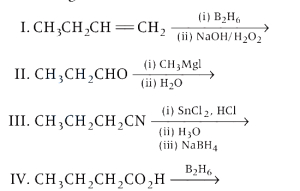
Which of the following reactions produce $n$-butanol?
A
$I, II$ and $III$
B
$II, III$ and $IV$
C
$I, II$ and $IV$
D
$I, III$ and $IV$
Solution
(D) Let us analyze each reaction:
$I$. $CH_3CH_2CH=CH_2 \xrightarrow[(ii) NaOH/H_2O_2]{(i) B_2H_6} CH_3CH_2CH_2CH_2OH$ ($n$-butanol). This is hydroboration-oxidation,which follows anti-Markovnikov addition of water.
$II$. $CH_3CH_2CHO \xrightarrow[(ii) H_2O]{(i) CH_3MgI} CH_3CH_2CH(OH)CH_3$ (butan-$2$-ol). This is a Grignard reaction forming a secondary alcohol.
$III$. $CH_3CH_2CH_2CN$ $\xrightarrow[(ii) H_3O^+]{(i) SnCl_2, HCl} CH_3CH_2CH_2CHO$ $\xrightarrow{NaBH_4} CH_3CH_2CH_2CH_2OH$ ($n$-butanol). The Stephen reduction converts nitrile to aldehyde,which is then reduced to primary alcohol.
$IV$. $CH_3CH_2CH_2CO_2H \xrightarrow{B_2H_6} CH_3CH_2CH_2CH_2OH$ ($n$-butanol). Diborane specifically reduces carboxylic acids to primary alcohols.
Thus,reactions $I, III$ and $IV$ produce $n$-butanol.
$I$. $CH_3CH_2CH=CH_2 \xrightarrow[(ii) NaOH/H_2O_2]{(i) B_2H_6} CH_3CH_2CH_2CH_2OH$ ($n$-butanol). This is hydroboration-oxidation,which follows anti-Markovnikov addition of water.
$II$. $CH_3CH_2CHO \xrightarrow[(ii) H_2O]{(i) CH_3MgI} CH_3CH_2CH(OH)CH_3$ (butan-$2$-ol). This is a Grignard reaction forming a secondary alcohol.
$III$. $CH_3CH_2CH_2CN$ $\xrightarrow[(ii) H_3O^+]{(i) SnCl_2, HCl} CH_3CH_2CH_2CHO$ $\xrightarrow{NaBH_4} CH_3CH_2CH_2CH_2OH$ ($n$-butanol). The Stephen reduction converts nitrile to aldehyde,which is then reduced to primary alcohol.
$IV$. $CH_3CH_2CH_2CO_2H \xrightarrow{B_2H_6} CH_3CH_2CH_2CH_2OH$ ($n$-butanol). Diborane specifically reduces carboxylic acids to primary alcohols.
Thus,reactions $I, III$ and $IV$ produce $n$-butanol.
0 likes
View Solution153
DifficultMCQ
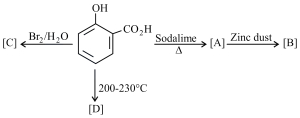
$A, B, C, D$ in the following reactions are
A
$[A] = \text{phenol}, [B] = \text{benzene}, [C] = 2,4,6-\text{tribromophenol}, [D] = \text{phenol}$
B
$[A] = \text{phenol}, [B] = \text{benzene}, [C] = 2,3,4,5-\text{tetrabromophenol}, [D] = \text{phenol}$
C
$[A] = \text{phenol}, [B] = \text{benzene}, [C] = 2,4,6-\text{tribromophenol}, [D] = \text{phenol}$
D
$[A] = \text{phenol}, [B] = \text{benzene}, [C] = 3,5-\text{dibromo-2-hydroxybenzoic acid}, [D] = \text{phenol}$
Solution
(A) $1$. When salicylic acid is heated with sodalime $(NaOH + CaO)$,it undergoes decarboxylation to form phenol $([A])$.
$2$. When phenol $([A])$ is distilled with zinc dust,it undergoes reduction to form benzene $([B])$.
$3$. When salicylic acid reacts with bromine water $(Br_2/H_2O)$,it undergoes electrophilic substitution and decarboxylation to form $2,4,6-\text{tribromophenol}$ $([C])$.
$4$. When salicylic acid is heated at $200-230^{\circ}C$,it undergoes decarboxylation to form phenol $([D])$.
$2$. When phenol $([A])$ is distilled with zinc dust,it undergoes reduction to form benzene $([B])$.
$3$. When salicylic acid reacts with bromine water $(Br_2/H_2O)$,it undergoes electrophilic substitution and decarboxylation to form $2,4,6-\text{tribromophenol}$ $([C])$.
$4$. When salicylic acid is heated at $200-230^{\circ}C$,it undergoes decarboxylation to form phenol $([D])$.
0 likes
View Solution154
DifficultMCQ
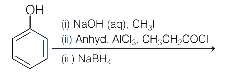
The major product in the following reaction sequence is:
A
$1-$($4$-methoxyphenyl)propan$-1-$ol
B
$1-$($2$-methoxyphenyl)propan$-1-$ol
C
$1-$($4$-methoxyphenyl)propan$-2-$ol
D
$1-$($2$-methoxyphenyl)propan$-2-$ol
Solution
(A) The reaction proceeds as follows:
$(i)$ Phenol reacts with $NaOH$ and $CH_3I$ to form anisole (methoxybenzene) via Williamson ether synthesis.
(ii) Anisole undergoes Friedel-Crafts acylation with propionyl chloride $(CH_3CH_2COCl)$ in the presence of anhydrous $AlCl_3$. Since the $-OCH_3$ group is ortho/para-directing,and the para-position is sterically less hindered,the major product is $p$-methoxypropiophenone.
(iii) Reduction of the ketone group with $NaBH_4$ yields the corresponding secondary alcohol,$1$-($4$-methoxyphenyl)propan$-1-$ol.
Therefore,the correct option is $A$.
$(i)$ Phenol reacts with $NaOH$ and $CH_3I$ to form anisole (methoxybenzene) via Williamson ether synthesis.
(ii) Anisole undergoes Friedel-Crafts acylation with propionyl chloride $(CH_3CH_2COCl)$ in the presence of anhydrous $AlCl_3$. Since the $-OCH_3$ group is ortho/para-directing,and the para-position is sterically less hindered,the major product is $p$-methoxypropiophenone.
(iii) Reduction of the ketone group with $NaBH_4$ yields the corresponding secondary alcohol,$1$-($4$-methoxyphenyl)propan$-1-$ol.
Therefore,the correct option is $A$.
0 likes
View Solution155
DifficultMCQ
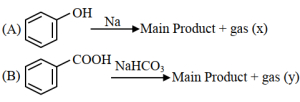
Consider the following two reactions $A$ and $B$.
Numerical value of [molar mass of $x$ + molar mass of $y$] is . . . . . . .
Numerical value of [molar mass of $x$ + molar mass of $y$] is . . . . . . .
A
$4$
B
$88$
C
$46$
D
$160$
Solution
(C) In reaction $A$,phenol reacts with sodium $(Na)$ to release hydrogen gas $(x = H_2)$.
Molar mass of $H_2 = 2 \ g/mol$.
In reaction $B$,benzoic acid reacts with sodium bicarbonate $(NaHCO_3)$ to release carbon dioxide gas $(y = CO_2)$.
Molar mass of $CO_2 = 44 \ g/mol$.
Sum of molar masses = $2 + 44 = 46$.
Molar mass of $H_2 = 2 \ g/mol$.
In reaction $B$,benzoic acid reacts with sodium bicarbonate $(NaHCO_3)$ to release carbon dioxide gas $(y = CO_2)$.
Molar mass of $CO_2 = 44 \ g/mol$.
Sum of molar masses = $2 + 44 = 46$.
0 likes
View Solution156
DifficultMCQ
Match List-$I$ with List-$II$ :
Choose the correct answer from the options given below :
| List-$I$ | List-$II$ |
| $A$. $H_{3}C-CH(OH)-CH_{3}$ | $I$. $(i)$ oleum; (ii) $NaOH, \Delta$; (iii) $H^{+}$ |
| $B$. $CH_{3}COOH \rightarrow CH_{3}CH_{2}OH$ | $II$. $(i)$ $O_{2}$; (ii) $H_{2}O/H^{+}$ |
| $C$. $CH_{3}CH_{2}OH \rightarrow H_{3}C-CH(OH)-CH_{3}$ | $III$. $(i)$ $CH_{3}OH, H^{+}$; (ii) $H_{2}$,Catalyst |
| $D$. Benzene $\rightarrow$ Phenol | $IV$. $(i)$ conc. $H_{2}SO_{4}, \Delta$; (ii) $H^{+}/H_{2}O$ |
Choose the correct answer from the options given below :
A
$A-I, B-III, C-IV, D-II$
B
$A-II, B-IV, C-III, D-I$
C
$A-II, B-III, C-IV, D-I$
D
$A-III, B-II, C-I, D-IV$
Solution
(D) The correct matching is as follows:
$A$. $H_{3}C-CH(OH)-CH_{3}$ is formed by the reaction of $CH_{3}COOH$ with $CH_{3}OH$ followed by reduction (Grignard or similar sequence). This matches with $III$.
$B$. $CH_{3}COOH \rightarrow CH_{3}CH_{2}OH$ is a reduction reaction. This matches with $II$.
$C$. $CH_{3}CH_{2}OH \rightarrow H_{3}C-CH(OH)-CH_{3}$ involves dehydration to ethene followed by hydration. This matches with $IV$.
$D$. Benzene $\rightarrow$ Phenol is the Cumene process. This matches with $I$.
Therefore,the correct sequence is $A-III, B-II, C-IV, D-I$. Note: The provided options in the prompt were slightly inconsistent with standard chemical pathways; based on the logic,the correct mapping is $A-III, B-II, C-IV, D-I$.
$A$. $H_{3}C-CH(OH)-CH_{3}$ is formed by the reaction of $CH_{3}COOH$ with $CH_{3}OH$ followed by reduction (Grignard or similar sequence). This matches with $III$.
$B$. $CH_{3}COOH \rightarrow CH_{3}CH_{2}OH$ is a reduction reaction. This matches with $II$.
$C$. $CH_{3}CH_{2}OH \rightarrow H_{3}C-CH(OH)-CH_{3}$ involves dehydration to ethene followed by hydration. This matches with $IV$.
$D$. Benzene $\rightarrow$ Phenol is the Cumene process. This matches with $I$.
Therefore,the correct sequence is $A-III, B-II, C-IV, D-I$. Note: The provided options in the prompt were slightly inconsistent with standard chemical pathways; based on the logic,the correct mapping is $A-III, B-II, C-IV, D-I$.
0 likes
View SolutionAlcohols, Phenols and Ethers — Mix Examples-Alcohol, Phenol and Ethers · Frequently Asked Questions
1Are these Alcohols, Phenols and Ethers questions useful for JEE and NEET?
Yes. All questions in this section are mapped to JEE Main and NEET exam patterns. Previous year questions from JEE Main, NEET, GUJCET and state-level exams are included with full solutions.
2Can I switch to Hindi or Gujarati for these questions?
Yes. Use the language tabs in the hero section or the sidebar to view the same questions and solutions in English, Hindi or Gujarati.
3How do I generate a question paper from this subtopic?
Use the Vedclass Exam Paper Generator — select the chapter and subtopic, set difficulty, and generate Sets A, B, C, D automatically. First 3 chapters of every subject are free.
Vedclass Products
For Students
Vedclass Test Series
Mock tests in real JEE/NEET style with performance analysis. 5-day free trial.
Start Free TrialFor Teachers
Exam Paper Generator
Generate Set A/B/C/D papers from this chapter in 2 minutes. 3 chapters free.
Try FreeFor Institutes
Online Exam Module
Live online exams with unlimited students, 360° analytics & white-label branding.
See DemoFor Teachers & Institutes
Generate a Alcohols, Phenols and Ethers Exam Paper in 2 Minutes
Select subtopic & difficulty — Sets A, B, C, D auto-generated with No Repeat logic.
First 3 chapters of every subject are free — no payment required.