
A English
Properties of Carboxylic Acids and Their Derivatives Questions in English
Class 12 Chemistry · 8-2.Carboxylic acids and Their derivative · Properties of Carboxylic Acids and Their Derivatives
791+
Questions
English
Language
100%
With Solutions
Showing 50 of 791 questions in English
451
MediumMCQ
Which of the following does not give alcohol on reduction?
A
$CH_3COCl$
B
$CH_3COOC_2H_5$
C
$CH_3COOCOCH_3$
D
$CH_3CONH_2$
Solution
(D) Amides $(CH_3CONH_2)$ are reduced to amines $(CH_3CH_2NH_2)$ using reducing agents like $LiAlH_4$.
Other derivatives like acid chlorides $(CH_3COCl)$,esters $(CH_3COOC_2H_5)$,and anhydrides $(CH_3COOCOCH_3)$ are reduced to alcohols.
Other derivatives like acid chlorides $(CH_3COCl)$,esters $(CH_3COOC_2H_5)$,and anhydrides $(CH_3COOCOCH_3)$ are reduced to alcohols.
0 likes
View Solution452
DifficultMCQ
The dehydration of malonic acid $CH_2(COOH)_2$ with $P_4O_{10}$ gives:
A
carbon monoxide
B
carbon suboxide
C
carbon dioxide
D
all three
Solution
(B) The dehydration of malonic acid $(CH_2(COOH)_2)$ using phosphorus pentoxide $(P_4O_{10})$ as a dehydrating agent results in the formation of carbon suboxide $(C_3O_2)$.
The chemical reaction is as follows:
$CH_2(COOH)_2 \xrightarrow{P_4O_{10}} C_3O_2 + 2H_2O$
Carbon suboxide is a linear molecule with the structure $O=C=C=C=O$.
The chemical reaction is as follows:
$CH_2(COOH)_2 \xrightarrow{P_4O_{10}} C_3O_2 + 2H_2O$
Carbon suboxide is a linear molecule with the structure $O=C=C=C=O$.
0 likes
View Solution453
EasyMCQ
What are the products formed when oxalic acid is dehydrated by concentrated $H_2SO_4$?
A
$CO + CO_2$
B
$CO$
C
$CO_2$
D
$CO + CO_2 + H_2O$
Solution
(D) The dehydration of oxalic acid $(COOH-COOH)$ by concentrated $H_2SO_4$ removes a water molecule,resulting in the formation of carbon monoxide $(CO)$ and carbon dioxide $(CO_2)$.
The reaction is as follows:
$(COOH)_2 \xrightarrow{conc. H_2SO_4} CO + CO_2 + H_2O$
The reaction is as follows:
$(COOH)_2 \xrightarrow{conc. H_2SO_4} CO + CO_2 + H_2O$
0 likes
View Solution454
MediumMCQ
Most acidic among the given acids is:
A
$CH_3-CH(Cl)-CH_2-COOH$
B
$Cl-CH_2-CH_2-CH_2-COOH$
C
$CH_3-CH_2-CH(Cl)-COOH$
D
All are of equal strength
Solution
(C) The acidity of carboxylic acids increases with the presence of electron-withdrawing groups due to the $-I$ effect.
The $-I$ effect of the chlorine atom decreases as the distance from the $-COOH$ group increases.
In $CH_3-CH_2-CH(Cl)-COOH$ ($2$-chlorobutanoic acid),the $Cl$ atom is at the $\alpha$-position,which is closest to the $-COOH$ group.
In $CH_3-CH(Cl)-CH_2-COOH$ ($3$-chlorobutanoic acid),the $Cl$ is at the $\beta$-position.
In $Cl-CH_2-CH_2-CH_2-COOH$ ($4$-chlorobutanoic acid),the $Cl$ is at the $\gamma$-position.
Therefore,$CH_3-CH_2-CH(Cl)-COOH$ is the most acidic.
The $-I$ effect of the chlorine atom decreases as the distance from the $-COOH$ group increases.
In $CH_3-CH_2-CH(Cl)-COOH$ ($2$-chlorobutanoic acid),the $Cl$ atom is at the $\alpha$-position,which is closest to the $-COOH$ group.
In $CH_3-CH(Cl)-CH_2-COOH$ ($3$-chlorobutanoic acid),the $Cl$ is at the $\beta$-position.
In $Cl-CH_2-CH_2-CH_2-COOH$ ($4$-chlorobutanoic acid),the $Cl$ is at the $\gamma$-position.
Therefore,$CH_3-CH_2-CH(Cl)-COOH$ is the most acidic.
0 likes
View Solution455
MediumMCQ
Which among the following compounds is the most acidic?
A
$3-$hydroxybenzoic acid
B
$3-$chlorobenzoic acid
C
$3-$methylbenzoic acid
D
$3-$nitrobenzoic acid
Solution
(D) The acidic strength of substituted benzoic acids is primarily influenced by the inductive effect $(-I)$ of the substituent group at the meta position.
Acidic strength is directly proportional to the electron-withdrawing nature of the substituent ($-I$ effect).
Comparing the substituents at the meta position:
$1$. $-OH$ group: Shows $-I$ effect but also $+M$ effect.
$2$. $-Cl$ group: Shows $-I$ effect.
$3$. $-CH_3$ group: Shows $+I$ effect (decreases acidity).
$4$. $-NO_2$ group: Shows a strong $-I$ effect.
Since the $-NO_2$ group has the strongest electron-withdrawing inductive effect among the given options,$3$-nitrobenzoic acid is the most acidic compound.
Acidic strength is directly proportional to the electron-withdrawing nature of the substituent ($-I$ effect).
Comparing the substituents at the meta position:
$1$. $-OH$ group: Shows $-I$ effect but also $+M$ effect.
$2$. $-Cl$ group: Shows $-I$ effect.
$3$. $-CH_3$ group: Shows $+I$ effect (decreases acidity).
$4$. $-NO_2$ group: Shows a strong $-I$ effect.
Since the $-NO_2$ group has the strongest electron-withdrawing inductive effect among the given options,$3$-nitrobenzoic acid is the most acidic compound.
0 likes
View Solution456
DifficultMCQ
$2,2-$ Dimethylpropanoic acid on heating with sodalime gives:
A
$CH_3-C(CH_3)_2-CH_3$
B
$CH_3-C(CH_3)=CH_2$
C
$CH_3-CH(CH_3)-CH_3$
D
$CH_3-C(CH_3)_2-OH$
Solution
(C) When $2,2-$ dimethylpropanoic acid is heated with sodalime ($NaOH$ and $CaO$),it undergoes decarboxylation (removal of $CO_2$) to form isobutane ($2-$methylpropane).
Reaction: $CH_3-C(CH_3)_2-COOH \xrightarrow{NaOH/CaO, \Delta} CH_3-CH(CH_3)-CH_3 + Na_2CO_3$.
Reaction: $CH_3-C(CH_3)_2-COOH \xrightarrow{NaOH/CaO, \Delta} CH_3-CH(CH_3)-CH_3 + Na_2CO_3$.
0 likes
View Solution457
MediumMCQ
$HCOOH$ reacts with conc. $H_2SO_4$ to produce:
A
$CO$
B
$CO_2$
C
$NO$
D
$NO_2$
Solution
(A) When formic acid $(HCOOH)$ is heated with concentrated sulphuric acid $(H_2SO_4)$,it undergoes dehydration.
$HCOOH \xrightarrow{conc. H_2SO_4} CO + H_2O$
Concentrated $H_2SO_4$ acts as a dehydrating agent,removing a water molecule from the formic acid to produce carbon monoxide $(CO)$.
$HCOOH \xrightarrow{conc. H_2SO_4} CO + H_2O$
Concentrated $H_2SO_4$ acts as a dehydrating agent,removing a water molecule from the formic acid to produce carbon monoxide $(CO)$.
0 likes
View Solution458
DifficultMCQ
Identify product $B$ in the above reaction sequence.

A
$3-$Chlorobenzaldehyde
B
$3-$Chlorobenzoic acid
C
$4-$Chlorobenzoic acid
D
$4-$Chlorobenzaldehyde
Solution
(B) $1$. The reaction of toluene $(C_6H_5CH_3)$ with $KMnO_4/H^+$ under heating conditions is a strong oxidation reaction that converts the alkyl side chain into a carboxylic acid group. Thus,product $A$ is benzoic acid $(C_6H_5COOH)$.
$2$. Benzoic acid contains a $-COOH$ group,which is a strongly deactivating and meta-directing group for electrophilic aromatic substitution reactions.
$3$. When benzoic acid reacts with $Cl_2$ in the presence of a Lewis acid catalyst like $FeCl_3$,the chlorine electrophile $(Cl^+)$ is directed to the meta-position.
$4$. Therefore,the major product $B$ is $3$-chlorobenzoic acid.
$2$. Benzoic acid contains a $-COOH$ group,which is a strongly deactivating and meta-directing group for electrophilic aromatic substitution reactions.
$3$. When benzoic acid reacts with $Cl_2$ in the presence of a Lewis acid catalyst like $FeCl_3$,the chlorine electrophile $(Cl^+)$ is directed to the meta-position.
$4$. Therefore,the major product $B$ is $3$-chlorobenzoic acid.
0 likes
View Solution459
DifficultMCQ
In esterification,which of the following is the best combination for the maximum rate of reaction?
A
$CH_3OH + (CH_3)_3CCOOH$
B
$(CH_3)_3COH + HCOOH$
C
$CH_3OH + HCOOH$
D
$(CH_3)_3COH + (CH_3)_3CCOOH$
Solution
(C) The rate of esterification depends on the steric hindrance present in both the alcohol and the carboxylic acid.
Lower steric hindrance leads to a faster reaction rate.
$1.$ Alcohol: Primary alcohols $(CH_3OH)$ react faster than tertiary alcohols $((CH_3)_3COH)$ due to less steric hindrance.
$2.$ Carboxylic Acid: Formic acid $(HCOOH)$ is the least sterically hindered acid and reacts faster than bulky acids like pivalic acid $((CH_3)_3CCOOH)$.
Therefore,the combination of $CH_3OH$ and $HCOOH$ provides the minimum steric hindrance,resulting in the maximum rate of reaction.
Lower steric hindrance leads to a faster reaction rate.
$1.$ Alcohol: Primary alcohols $(CH_3OH)$ react faster than tertiary alcohols $((CH_3)_3COH)$ due to less steric hindrance.
$2.$ Carboxylic Acid: Formic acid $(HCOOH)$ is the least sterically hindered acid and reacts faster than bulky acids like pivalic acid $((CH_3)_3CCOOH)$.
Therefore,the combination of $CH_3OH$ and $HCOOH$ provides the minimum steric hindrance,resulting in the maximum rate of reaction.
0 likes
View Solution460
MediumMCQ
Which of the following compounds is hydrolysed most rapidly in aqueous $NaOH$?
A
$R-CO-NH_2$
B
$R-CO-OCH_3$
C
$R-CO-Cl$
D
$R-CO-OH$
Solution
(C) The rate of hydrolysis of carboxylic acid derivatives depends on the leaving group ability of the substituent attached to the carbonyl carbon.
The order of leaving group ability is $Cl^- > -OCH_3 > -NH_2$.
Since $Cl^-$ is the weakest base and the best leaving group,acid chlorides $(R-CO-Cl)$ are the most reactive towards nucleophilic acyl substitution and hydrolyse most rapidly.
The order of leaving group ability is $Cl^- > -OCH_3 > -NH_2$.
Since $Cl^-$ is the weakest base and the best leaving group,acid chlorides $(R-CO-Cl)$ are the most reactive towards nucleophilic acyl substitution and hydrolyse most rapidly.
0 likes
View Solution461
MediumMCQ
When $CH_3-CH_2-COOH$ is reduced with $LiAlH_4$,the compound obtained will be
A
$CH_3CH_2COOH$
B
$CH_3CH_2CHO$
C
$CH_3CH_2CH_2OH$
D
$CH_3-CH=CH-OH$
Solution
(C) $LiAlH_4$ is a strong reducing agent that reduces carboxylic acids directly to primary alcohols.
The reduction of propanoic acid $(CH_3CH_2COOH)$ with $LiAlH_4$ proceeds as follows:
$CH_3CH_2COOH + 4[H] \xrightarrow{LiAlH_4} CH_3CH_2CH_2OH + H_2O$
Thus,the product obtained is propan$-1-$ol $(CH_3CH_2CH_2OH)$.
The reduction of propanoic acid $(CH_3CH_2COOH)$ with $LiAlH_4$ proceeds as follows:
$CH_3CH_2COOH + 4[H] \xrightarrow{LiAlH_4} CH_3CH_2CH_2OH + H_2O$
Thus,the product obtained is propan$-1-$ol $(CH_3CH_2CH_2OH)$.
0 likes
View Solution462
MediumMCQ
The compound that undergoes decarboxylation most readily under mild conditions is:
A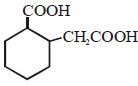
$A$.
B
$B$.
C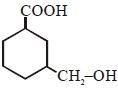
$C$.
D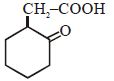
$D$.
Solution
(B) Decarboxylation of carboxylic acids is facilitated by the presence of an electron-withdrawing group at the $\beta$-position,such as a carbonyl group ($\beta$-keto acid).
This allows for the formation of a stable six-membered cyclic transition state involving the carbonyl oxygen and the hydroxyl hydrogen of the carboxyl group.
Among the given options,option $B$ represents a $\beta$-keto acid (specifically,a cyclic $\beta$-keto acid derivative),which undergoes decarboxylation most readily due to this mechanism.
This allows for the formation of a stable six-membered cyclic transition state involving the carbonyl oxygen and the hydroxyl hydrogen of the carboxyl group.
Among the given options,option $B$ represents a $\beta$-keto acid (specifically,a cyclic $\beta$-keto acid derivative),which undergoes decarboxylation most readily due to this mechanism.
0 likes
View Solution463
DifficultMCQ
An optically active compound $'X'$ having molecular formula $C_4H_8O_3$ evolves $CO_2$ with $NaHCO_3$. $'X'$ on treatment with $LiAlH_4$ gives an achiral compound. Then $'X'$ is
A
$CH_3-CH(OH)-CH_2-COOH$
B
$CH_3-CH_2-CH(OH)-COOH$
C
$HO-CH_2-CH(CH_3)-COOH$
D
$CH_3-CH(OCH_3)-COOH$
Solution
(C) The molecular formula $C_4H_8O_3$ and the evolution of $CO_2$ with $NaHCO_3$ indicate the presence of a carboxylic acid group $(-COOH)$.
Since the compound is optically active,it must contain a chiral center.
Reduction of the carboxylic acid group with $LiAlH_4$ converts it into a primary alcohol $(-CH_2OH)$.
Let us analyze option $A$: $CH_3-CH(OH)-CH_2-COOH$. Upon reduction,it gives $CH_3-CH(OH)-CH_2-CH_2OH$ (butane$-1,3-$diol). This molecule has a chiral center at the $C-3$ position,so it is optically active.
Let us analyze option $B$: $CH_3-CH_2-CH(OH)-COOH$. Upon reduction,it gives $CH_3-CH_2-CH(OH)-CH_2OH$ (butane$-1,2-$diol). This molecule has a chiral center at the $C-2$ position,so it is optically active.
Let us analyze option $C$: $HO-CH_2-CH(CH_3)-COOH$. Upon reduction,it gives $HO-CH_2-CH(CH_3)-CH_2OH$ ($2$-methylpropane$-1,3-$diol). This molecule is achiral because it has a plane of symmetry passing through the $C-2$ atom.
Therefore,the compound $'X'$ is $HO-CH_2-CH(CH_3)-COOH$.
Since the compound is optically active,it must contain a chiral center.
Reduction of the carboxylic acid group with $LiAlH_4$ converts it into a primary alcohol $(-CH_2OH)$.
Let us analyze option $A$: $CH_3-CH(OH)-CH_2-COOH$. Upon reduction,it gives $CH_3-CH(OH)-CH_2-CH_2OH$ (butane$-1,3-$diol). This molecule has a chiral center at the $C-3$ position,so it is optically active.
Let us analyze option $B$: $CH_3-CH_2-CH(OH)-COOH$. Upon reduction,it gives $CH_3-CH_2-CH(OH)-CH_2OH$ (butane$-1,2-$diol). This molecule has a chiral center at the $C-2$ position,so it is optically active.
Let us analyze option $C$: $HO-CH_2-CH(CH_3)-COOH$. Upon reduction,it gives $HO-CH_2-CH(CH_3)-CH_2OH$ ($2$-methylpropane$-1,3-$diol). This molecule is achiral because it has a plane of symmetry passing through the $C-2$ atom.
Therefore,the compound $'X'$ is $HO-CH_2-CH(CH_3)-COOH$.
0 likes
View Solution464
MediumMCQ
Which of the following carboxylic acids is difficult to decarboxylate?
A
Acetoacetic acid $(CH_3COCH_2COOH)$
B
Propionic acid $(CH_3CH_2COOH)$
C
Malonic acid $(HOOCCH_2COOH)$
D
Nitroacetic acid $(O_2NCH_2COOH)$
Solution
(B) Decarboxylation of carboxylic acids is generally facilitated by the presence of an electron-withdrawing group at the $\beta$-position,which stabilizes the transition state (often involving a cyclic mechanism).
$1$. Acetoacetic acid $(CH_3COCH_2COOH)$ has a carbonyl group at the $\beta$-position,making it easy to decarboxylate.
$2$. Malonic acid $(HOOCCH_2COOH)$ has a carboxyl group at the $\beta$-position,making it easy to decarboxylate.
$3$. Nitroacetic acid $(O_2NCH_2COOH)$ has a nitro group at the $\beta$-position,which is a strong electron-withdrawing group,facilitating decarboxylation.
$4$. Propionic acid $(CH_3CH_2COOH)$ is a simple aliphatic carboxylic acid without any electron-withdrawing group at the $\beta$-position. Therefore,it is the most difficult to decarboxylate among the given options.
$1$. Acetoacetic acid $(CH_3COCH_2COOH)$ has a carbonyl group at the $\beta$-position,making it easy to decarboxylate.
$2$. Malonic acid $(HOOCCH_2COOH)$ has a carboxyl group at the $\beta$-position,making it easy to decarboxylate.
$3$. Nitroacetic acid $(O_2NCH_2COOH)$ has a nitro group at the $\beta$-position,which is a strong electron-withdrawing group,facilitating decarboxylation.
$4$. Propionic acid $(CH_3CH_2COOH)$ is a simple aliphatic carboxylic acid without any electron-withdrawing group at the $\beta$-position. Therefore,it is the most difficult to decarboxylate among the given options.
0 likes
View Solution465
MediumMCQ
Which of the following is most reactive towards nucleophilic attack at the carbonyl group?
A
$CH_3COCl$
B
$CH_3COOCH_3$
C
$CH_3CONH_2$
D
$CH_3COOCOCH_3$
Solution
(A) The reactivity of carboxylic acid derivatives towards nucleophilic acyl substitution depends on the leaving group ability and the electrophilicity of the carbonyl carbon.
$CH_3COCl$ (acid chloride) is the most reactive because the $Cl^-$ ion is a very good leaving group and the electron-withdrawing effect of the chlorine atom increases the positive charge on the carbonyl carbon,making it highly susceptible to nucleophilic attack.
The order of reactivity is: $CH_3COCl > CH_3COOCOCH_3 > CH_3COOCH_3 > CH_3CONH_2$.
$CH_3COCl$ (acid chloride) is the most reactive because the $Cl^-$ ion is a very good leaving group and the electron-withdrawing effect of the chlorine atom increases the positive charge on the carbonyl carbon,making it highly susceptible to nucleophilic attack.
The order of reactivity is: $CH_3COCl > CH_3COOCOCH_3 > CH_3COOCH_3 > CH_3CONH_2$.
0 likes
View Solution466
MediumMCQ
What is the major product of the following reaction sequence: $CH_3-CH_2-Br$ $\xrightarrow{KCN}$ $\xrightarrow[H_2O]{OH^{-}}$ $\xrightarrow{PCl_5, \Delta} \text{product}$?
A
$CH_3-CH_2-Cl$
B
$CH_3-CH_2-CN$
C
$CH_3-CH_2-COCl$
D
$CH_3-CONH_2$
Solution
(C) The reaction sequence is as follows:
$1.$ $CH_3-CH_2-Br + KCN \rightarrow CH_3-CH_2-CN + KBr$ (Formation of propanenitrile).
$2.$ $CH_3-CH_2-CN \xrightarrow[H_2O]{OH^{-}} CH_3-CH_2-COOH$ (Hydrolysis of nitrile to propanoic acid).
$3.$ $CH_3-CH_2-COOH + PCl_5 \xrightarrow{\Delta} CH_3-CH_2-COCl + POCl_3 + HCl$ (Conversion of carboxylic acid to acid chloride using $PCl_5$).
$1.$ $CH_3-CH_2-Br + KCN \rightarrow CH_3-CH_2-CN + KBr$ (Formation of propanenitrile).
$2.$ $CH_3-CH_2-CN \xrightarrow[H_2O]{OH^{-}} CH_3-CH_2-COOH$ (Hydrolysis of nitrile to propanoic acid).
$3.$ $CH_3-CH_2-COOH + PCl_5 \xrightarrow{\Delta} CH_3-CH_2-COCl + POCl_3 + HCl$ (Conversion of carboxylic acid to acid chloride using $PCl_5$).
0 likes
View Solution467
AdvancedMCQ
An optically active compound $'X'$ having molecular formula $C_4H_8O_3$ evolves $CO_2$ with $NaHCO_3$. $'X'$ on treatment with $LiAlH_4$ gives an achiral compound. Then $'X'$ is:
A
$CH_3-CH(OH)-CH_2-COOH$
B
$CH_3-CH_2-CH(OH)-COOH$
C
$HO-CH_2-CH_2-CH_2-COOH$
D
$CH_3-CH(OH)-CH_2-CHO$
Solution
(A) The compound $X$ is $CH_3-CH(OH)-CH_2-COOH$ ($3-$hydroxybutanoic acid).
It is optically active due to the presence of a chiral center at the $C-3$ position.
It evolves $CO_2$ gas when treated with $NaHCO_3$ because it contains a carboxylic acid group $(-COOH)$.
Upon reduction with $LiAlH_4$,the carboxylic acid group is reduced to a primary alcohol,yielding $1,3-$butanediol $(CH_3-CH(OH)-CH_2-CH_2OH)$.
Since $1,3-$butanediol is achiral (it does not possess a chiral center as the $C-3$ carbon is no longer chiral in the product),it satisfies all the given conditions.
It is optically active due to the presence of a chiral center at the $C-3$ position.
It evolves $CO_2$ gas when treated with $NaHCO_3$ because it contains a carboxylic acid group $(-COOH)$.
Upon reduction with $LiAlH_4$,the carboxylic acid group is reduced to a primary alcohol,yielding $1,3-$butanediol $(CH_3-CH(OH)-CH_2-CH_2OH)$.
Since $1,3-$butanediol is achiral (it does not possess a chiral center as the $C-3$ carbon is no longer chiral in the product),it satisfies all the given conditions.
0 likes
View Solution468
DifficultMCQ
Which of the following carboxylic acids is difficult to decarboxylate?
A
$CH_3COCH_2COOH$
B
$CH_3CH_2COOH$
C
$HOOCCH_2COOH$
D
$O_2NCH_2COOH$
Solution
(B) Decarboxylation of carboxylic acids is facilitated by the presence of electron-withdrawing groups at the $\alpha$ or $\beta$ position,which stabilize the transition state or the resulting carbanion intermediate.
$CH_3COCH_2COOH$ has a $\beta$-keto group,which facilitates decarboxylation.
$HOOCCH_2COOH$ (malonic acid) has a carboxylic group at the $\beta$ position,which facilitates decarboxylation.
$O_2NCH_2COOH$ has a strong electron-withdrawing nitro group at the $\alpha$ position,which facilitates decarboxylation.
$CH_3CH_2COOH$ (propanoic acid) is a simple saturated aliphatic carboxylic acid without any electron-withdrawing groups to stabilize the transition state,making it the most difficult to decarboxylate among the given options.
$CH_3COCH_2COOH$ has a $\beta$-keto group,which facilitates decarboxylation.
$HOOCCH_2COOH$ (malonic acid) has a carboxylic group at the $\beta$ position,which facilitates decarboxylation.
$O_2NCH_2COOH$ has a strong electron-withdrawing nitro group at the $\alpha$ position,which facilitates decarboxylation.
$CH_3CH_2COOH$ (propanoic acid) is a simple saturated aliphatic carboxylic acid without any electron-withdrawing groups to stabilize the transition state,making it the most difficult to decarboxylate among the given options.
0 likes
View Solution469
MediumMCQ
When acetyl chloride $(CH_3COCl)$ is reduced with $LiAlH_4$,the product formed is:
A
Methyl alcohol
B
Ethyl alcohol
C
Acetaldehyde
D
Acetone
Solution
(B) $CH_3COCl$ is an acid chloride. When it is reduced with a strong reducing agent like $LiAlH_4$,it undergoes reduction to form a primary alcohol.
The reaction is: $CH_3COCl \xrightarrow{LiAlH_4} CH_3CH_2OH$.
Thus,the product formed is ethyl alcohol.
The reaction is: $CH_3COCl \xrightarrow{LiAlH_4} CH_3CH_2OH$.
Thus,the product formed is ethyl alcohol.
0 likes
View Solution470
DifficultMCQ
Ethyl acetate $\xrightarrow[{(2)\,HOH}]{{(1)\,C{H_3}MgBr\,\left[ {Excess} \right]}}P$
The product $P$ will be
The product $P$ will be
A
$2-$methylpropan$-2-$ol
B
$2-$methylbutan$-2-$ol
C
$3-$ethylpentan$-3-$ol
D
$3-$propylhexan$-3-$ol
Solution
(A) Ethyl acetate $(CH_3COOC_2H_5)$ reacts with excess Grignard reagent $(CH_3MgBr)$ in two steps.
Step $1$: The first equivalent of $CH_3MgBr$ attacks the carbonyl carbon of ethyl acetate to form a ketone intermediate,acetone $(CH_3COCH_3)$,and releases ethanol $(C_2H_5OH)$.
Step $2$: Since $CH_3MgBr$ is in excess,the second equivalent of $CH_3MgBr$ attacks the carbonyl carbon of the newly formed acetone to form an alkoxide intermediate,magnesium salt of tert-butyl alcohol.
Step $3$: Upon hydrolysis $(HOH)$,the alkoxide is protonated to yield the final product,$2$-methylpropan-$2$-ol ($tert$-butyl alcohol).
The reaction is: $CH_3COOC_2H_5 + 2CH_3MgBr$ $\rightarrow (CH_3)_3COMgBr + C_2H_5OMgBr$ $\xrightarrow{H_2O} (CH_3)_3COH + C_2H_5OH + Mg(OH)Br$.
Step $1$: The first equivalent of $CH_3MgBr$ attacks the carbonyl carbon of ethyl acetate to form a ketone intermediate,acetone $(CH_3COCH_3)$,and releases ethanol $(C_2H_5OH)$.
Step $2$: Since $CH_3MgBr$ is in excess,the second equivalent of $CH_3MgBr$ attacks the carbonyl carbon of the newly formed acetone to form an alkoxide intermediate,magnesium salt of tert-butyl alcohol.
Step $3$: Upon hydrolysis $(HOH)$,the alkoxide is protonated to yield the final product,$2$-methylpropan-$2$-ol ($tert$-butyl alcohol).
The reaction is: $CH_3COOC_2H_5 + 2CH_3MgBr$ $\rightarrow (CH_3)_3COMgBr + C_2H_5OMgBr$ $\xrightarrow{H_2O} (CH_3)_3COH + C_2H_5OH + Mg(OH)Br$.
0 likes
View Solution471
DifficultMCQ
Acetamide reacts with $P_2O_5$ to give:
A
Methyl cyanide
B
Methyl cyanate
C
Ethyl cyanide
D
Acetamide
Solution
(A) $P_2O_5$ is a strong dehydrating agent. When acetamide $(CH_3CONH_2)$ is heated with $P_2O_5$,it undergoes dehydration to form methyl cyanide ($CH_3CN$ or acetonitrile).
The reaction is: $CH_3CONH_2 \xrightarrow{P_2O_5} CH_3-C \equiv N + H_2O$
The reaction is: $CH_3CONH_2 \xrightarrow{P_2O_5} CH_3-C \equiv N + H_2O$
0 likes
View Solution472
DifficultMCQ
$CH_3-CCl_3$ $\xrightarrow[(2) H^{+}]{(1) KOH_{(aq)}}$ $P$ $\xrightarrow[(2) \Delta]{(1) Ca(OH)_2}$ $Q$; $Q$ is:
A
$CH_3-CH=CH-CHO$
B
$CH_3-C(CH_3)=CH-COCH_3$
C
$CH_3-CHO$
D
$CH_3-COCH_3$
Solution
(D) $Step$ $1$: $CH_3-CCl_3$ reacts with aqueous $KOH$ followed by acidic workup $(H^{+})$ to form $CH_3-C(OH)_3$,which is unstable and loses a water molecule to form $CH_3-COOH$ (Acetic acid). Thus,$P$ is $CH_3-COOH$.
$Step$ $2$: Acetic acid reacts with $Ca(OH)_2$ to form calcium acetate,$(CH_3COO)_2Ca$.
$Step$ $3$: Calcium acetate upon dry distillation $(\Delta)$ undergoes decarboxylation to give $CH_3-COCH_3$ (Acetone) and $CaCO_3$. Thus,$Q$ is $CH_3-COCH_3$.
$Step$ $2$: Acetic acid reacts with $Ca(OH)_2$ to form calcium acetate,$(CH_3COO)_2Ca$.
$Step$ $3$: Calcium acetate upon dry distillation $(\Delta)$ undergoes decarboxylation to give $CH_3-COCH_3$ (Acetone) and $CaCO_3$. Thus,$Q$ is $CH_3-COCH_3$.
0 likes
View Solution473
DifficultMCQ
Which of the following is the strongest acid?
A
m-Nitrobenzenesulfonic acid
B
m-Aminobenzenesulfonic acid
C
m-Methoxybenzenesulfonic acid
D
m-Hydroxybenzenesulfonic acid
Solution
(A) The acidity of substituted benzenesulfonic acids is determined by the electron-withdrawing or electron-donating nature of the substituent group attached to the benzene ring.
Electron-withdrawing groups $(EWG)$ increase acidity by stabilizing the conjugate base,while electron-donating groups $(EDG)$ decrease acidity.
At the meta position,only the inductive effect $(-I)$ is operative.
Comparing the substituents:
$1$. $-NO_2$: Strong $-I$ effect (strongly electron-withdrawing).
$2$. $-NH_2$: $+I$ effect (electron-donating).
$3$. $-OCH_3$: $-I$ effect (but weaker than $-NO_2$).
$4$. $-OH$: $-I$ effect (but weaker than $-NO_2$).
Since $-NO_2$ has the strongest $-I$ effect among the given substituents,$m$-nitrobenzenesulfonic acid is the strongest acid.
Electron-withdrawing groups $(EWG)$ increase acidity by stabilizing the conjugate base,while electron-donating groups $(EDG)$ decrease acidity.
At the meta position,only the inductive effect $(-I)$ is operative.
Comparing the substituents:
$1$. $-NO_2$: Strong $-I$ effect (strongly electron-withdrawing).
$2$. $-NH_2$: $+I$ effect (electron-donating).
$3$. $-OCH_3$: $-I$ effect (but weaker than $-NO_2$).
$4$. $-OH$: $-I$ effect (but weaker than $-NO_2$).
Since $-NO_2$ has the strongest $-I$ effect among the given substituents,$m$-nitrobenzenesulfonic acid is the strongest acid.
0 likes
View Solution474
MediumMCQ
In the reaction,the product $D$ is:
$CH_2=CH_2$ $\xrightarrow{Br_2/CCl_4} A$ $\xrightarrow{KCN} B$ $\xrightarrow{H_3O^{+}} C$ $\xrightarrow{\Delta} D$
$CH_2=CH_2$ $\xrightarrow{Br_2/CCl_4} A$ $\xrightarrow{KCN} B$ $\xrightarrow{H_3O^{+}} C$ $\xrightarrow{\Delta} D$
A
Succinic acid
B
$CH_3CH_2COOH$
C
Succinic anhydride
D
$CH_2OHCH_2CN$
Solution
(C) The reaction sequence is as follows:
$1$. $CH_2=CH_2 + Br_2 \xrightarrow{CCl_4} BrCH_2-CH_2Br$ $(A)$
$2$. $BrCH_2-CH_2Br + 2KCN \rightarrow NCCH_2-CH_2CN + 2KBr$ $(B)$
$3$. $NCCH_2-CH_2CN + 4H_2O + 2H^{+} \rightarrow HOOCCH_2-CH_2COOH + 2NH_4^{+}$ ($C$,Succinic acid)
$4$. $HOOCCH_2-CH_2COOH \xrightarrow{\Delta} \text{Succinic anhydride} + H_2O$ $(D)$
Thus,the product $D$ is Succinic anhydride.
$1$. $CH_2=CH_2 + Br_2 \xrightarrow{CCl_4} BrCH_2-CH_2Br$ $(A)$
$2$. $BrCH_2-CH_2Br + 2KCN \rightarrow NCCH_2-CH_2CN + 2KBr$ $(B)$
$3$. $NCCH_2-CH_2CN + 4H_2O + 2H^{+} \rightarrow HOOCCH_2-CH_2COOH + 2NH_4^{+}$ ($C$,Succinic acid)
$4$. $HOOCCH_2-CH_2COOH \xrightarrow{\Delta} \text{Succinic anhydride} + H_2O$ $(D)$
Thus,the product $D$ is Succinic anhydride.
0 likes
View Solution475
EasyMCQ
Which of the following reagents will convert propionic acid to $1-$propanol?
A
$NaBr$
B
${H^\oplus } / H_2O$
C
$Cr_2O_3$
D
$LiAlH_4$
Solution
(D) Carboxylic acids,such as propionic acid $(CH_3-CH_2-COOH)$,are reduced to primary alcohols using strong reducing agents like lithium aluminum hydride $(LiAlH_4)$.
The reaction is as follows:
$CH_3-CH_2-COOH \xrightarrow{LiAlH_4} CH_3-CH_2-CH_2-OH$
The reaction is as follows:
$CH_3-CH_2-COOH \xrightarrow{LiAlH_4} CH_3-CH_2-CH_2-OH$
0 likes
View Solution476
DifficultMCQ
Which of the following has the maximum melting point?
A
$2$-chlorobenzoic acid
B
$2$-aminobenzoic acid
C
$3$-nitrobenzoic acid
D
Toluene
Solution
(B) The melting point of a compound depends on its molecular structure,intermolecular forces,and crystal lattice packing.
$1$. $2$-chlorobenzoic acid,$2$-aminobenzoic acid,and $3$-nitrobenzoic acid are carboxylic acids capable of forming strong intermolecular hydrogen bonds,which significantly increase their melting points compared to Toluene (a hydrocarbon with only weak van der Waals forces).
$2$. Among the carboxylic acids,$2$-aminobenzoic acid (anthranilic acid) exists as a zwitterion in the solid state $(NH_3^+ - C_6H_4 - COO^-)$. This ionic character leads to very strong electrostatic interactions (ionic bonding) within the crystal lattice,resulting in a much higher melting point compared to the other substituted benzoic acids.
Therefore,$2$-aminobenzoic acid has the maximum melting point.
$1$. $2$-chlorobenzoic acid,$2$-aminobenzoic acid,and $3$-nitrobenzoic acid are carboxylic acids capable of forming strong intermolecular hydrogen bonds,which significantly increase their melting points compared to Toluene (a hydrocarbon with only weak van der Waals forces).
$2$. Among the carboxylic acids,$2$-aminobenzoic acid (anthranilic acid) exists as a zwitterion in the solid state $(NH_3^+ - C_6H_4 - COO^-)$. This ionic character leads to very strong electrostatic interactions (ionic bonding) within the crystal lattice,resulting in a much higher melting point compared to the other substituted benzoic acids.
Therefore,$2$-aminobenzoic acid has the maximum melting point.
0 likes
View Solution477
MediumMCQ
$R-COOH \xrightarrow{\text{Reagent}} R-CH_2-OH$
The suitable reagent for the above conversion is:
The suitable reagent for the above conversion is:
A
$NaBH_4$
B
$B_2H_6$
C
$P + HI$
D
$DIBAL-H$ / low temperature
Solution
(B) The conversion of a carboxylic acid $(R-COOH)$ to a primary alcohol $(R-CH_2-OH)$ requires a strong reducing agent.
$NaBH_4$ is a mild reducing agent and does not reduce carboxylic acids.
$B_2H_6$ (diborane) is a selective and powerful reducing agent that reduces carboxylic acids to primary alcohols efficiently,while leaving other functional groups like esters or halides often unaffected.
$P + HI$ is a strong reducing agent that reduces carboxylic acids to alkanes $(R-CH_3)$.
$DIBAL-H$ at low temperature typically reduces esters or nitriles to aldehydes,not carboxylic acids to alcohols.
Therefore,the correct reagent is $B_2H_6$.
$NaBH_4$ is a mild reducing agent and does not reduce carboxylic acids.
$B_2H_6$ (diborane) is a selective and powerful reducing agent that reduces carboxylic acids to primary alcohols efficiently,while leaving other functional groups like esters or halides often unaffected.
$P + HI$ is a strong reducing agent that reduces carboxylic acids to alkanes $(R-CH_3)$.
$DIBAL-H$ at low temperature typically reduces esters or nitriles to aldehydes,not carboxylic acids to alcohols.
Therefore,the correct reagent is $B_2H_6$.
0 likes
View Solution478
MediumMCQ
The reaction of benzoyl chloride with hydroxylamine $(NH_2OH)$ gives a product. Identify the product.
A
$3-$amino benzoyl chloride
B
$3-$hydroxy benzoyl chloride
C
Benzohydroxamic acid $(C_6H_5CONHOH)$
D
$O$-benzoyl hydroxylamine $(C_6H_5CONHO)$
0 likes
View Solution479
DifficultMCQ
Toluene $\xrightarrow[\Delta ]{KMnO_4} X$ $\xrightarrow{Br_2/H_2O} Y$; $Y$ is
A
$4-$Bromobenzoic acid
B
$2-$Bromobenzoic acid
C
$3-$Bromobenzoic acid
D
$2,4,6-$Tribromobenzoic acid
Solution
(C) $1$. Oxidation of toluene with alkaline $KMnO_4$ followed by acidification yields benzoic acid $(X)$.
$2$. Benzoic acid contains a $-COOH$ group,which is a strongly deactivating and meta-directing group.
$3$. Electrophilic aromatic substitution (bromination) of benzoic acid with $Br_2/H_2O$ (or $Br_2/FeBr_3$) occurs at the meta-position due to the electron-withdrawing nature of the $-COOH$ group.
$4$. Therefore,the product $Y$ is $3$-bromobenzoic acid.
$2$. Benzoic acid contains a $-COOH$ group,which is a strongly deactivating and meta-directing group.
$3$. Electrophilic aromatic substitution (bromination) of benzoic acid with $Br_2/H_2O$ (or $Br_2/FeBr_3$) occurs at the meta-position due to the electron-withdrawing nature of the $-COOH$ group.
$4$. Therefore,the product $Y$ is $3$-bromobenzoic acid.
0 likes
View Solution480
DifficultMCQ
Which of the following shows the correct order of decreasing acidity?
A
$PhCO_2H > PhSO_3H > PhCH_2OH > PhOH$
B
$PhSO_3H > PhOH > PhCH_2OH > PhCH_2OH$
C
$PhCO_2H > PhOH > PhCH_2OH > PhSO_3H$
D
$PhSO_3H > PhCO_2H > PhOH > PhCH_2OH$
Solution
(D) $PhCH_2OH$ is the least acidic because its conjugate base is not stabilized by resonance like the others.
Conjugate bases of $PhSO_3H$ and $PhCOOH$ have equivalent resonance structures,whereas the conjugate base of $PhOH$ (phenoxide ion) has non-equivalent resonance structures.
Furthermore,in the phenoxide ion,the negative charge is delocalized on carbon atoms,whereas in the conjugate bases of $PhSO_3H$ and $PhCOOH$,the negative charge is delocalized on highly electronegative oxygen atoms,making $PhSO_3H$ and $PhCOOH$ stronger acids than $PhOH$.
Comparing $PhSO_3H$ and $PhCOOH$,the conjugate base of $PhSO_3H$ (sulfonate ion) has $3$ equivalent resonance structures,while the conjugate base of $PhCOOH$ (carboxylate ion) has $2$ equivalent resonance structures.
Greater the number of equivalent resonance structures,the higher the stability of the conjugate base.
Stability of conjugate base $\propto$ Acidity.
Therefore,the correct decreasing order of acidity is $PhSO_3H > PhCO_2H > PhOH > PhCH_2OH$.
Conjugate bases of $PhSO_3H$ and $PhCOOH$ have equivalent resonance structures,whereas the conjugate base of $PhOH$ (phenoxide ion) has non-equivalent resonance structures.
Furthermore,in the phenoxide ion,the negative charge is delocalized on carbon atoms,whereas in the conjugate bases of $PhSO_3H$ and $PhCOOH$,the negative charge is delocalized on highly electronegative oxygen atoms,making $PhSO_3H$ and $PhCOOH$ stronger acids than $PhOH$.
Comparing $PhSO_3H$ and $PhCOOH$,the conjugate base of $PhSO_3H$ (sulfonate ion) has $3$ equivalent resonance structures,while the conjugate base of $PhCOOH$ (carboxylate ion) has $2$ equivalent resonance structures.
Greater the number of equivalent resonance structures,the higher the stability of the conjugate base.
Stability of conjugate base $\propto$ Acidity.
Therefore,the correct decreasing order of acidity is $PhSO_3H > PhCO_2H > PhOH > PhCH_2OH$.
0 likes
View Solution481
AdvancedMCQ
Arrange the following in decreasing order of acidic strength:
$A. F-CH_2-CH_2-COOH$
$B. Cl-CH(Cl)-CH_2-COOH$
$C. F-CH_2-COOH$
$D. Br-CH_2-CH_2-COOH$
$A. F-CH_2-CH_2-COOH$
$B. Cl-CH(Cl)-CH_2-COOH$
$C. F-CH_2-COOH$
$D. Br-CH_2-CH_2-COOH$
A
$B > D > A > C$
B
$A > C > D > B$
C
$C > B > A > D$
D
$D > B > A > C$
Solution
(C) Acidic strength depends on the $-I$ effect of the electron-withdrawing groups. The $-I$ effect increases with the electronegativity of the halogen $(F > Cl > Br)$ and decreases with increasing distance from the $-COOH$ group.
$1.$ In $C$ $(F-CH_2-COOH)$,the $F$ atom is at the $\alpha$-position,making it the strongest acid.
$2.$ In $B$ $(Cl-CH(Cl)-CH_2-COOH)$,there are two $Cl$ atoms at the $\beta$-position,which exert a stronger collective $-I$ effect than a single $F$ or $Br$ at the same position.
$3.$ In $A$ $(F-CH_2-CH_2-COOH)$ and $D$ $(Br-CH_2-CH_2-COOH)$,the halogens are at the $\beta$-position. Since $F$ is more electronegative than $Br$,$A$ is more acidic than $D$.
Therefore,the decreasing order of acidic strength is $C > B > A > D$.
$1.$ In $C$ $(F-CH_2-COOH)$,the $F$ atom is at the $\alpha$-position,making it the strongest acid.
$2.$ In $B$ $(Cl-CH(Cl)-CH_2-COOH)$,there are two $Cl$ atoms at the $\beta$-position,which exert a stronger collective $-I$ effect than a single $F$ or $Br$ at the same position.
$3.$ In $A$ $(F-CH_2-CH_2-COOH)$ and $D$ $(Br-CH_2-CH_2-COOH)$,the halogens are at the $\beta$-position. Since $F$ is more electronegative than $Br$,$A$ is more acidic than $D$.
Therefore,the decreasing order of acidic strength is $C > B > A > D$.
0 likes
View Solution482
DifficultMCQ
Which of the following has maximum reactivity towards nucleophilic attack?
A
$R-CO-Cl$
B
$R-CO-R$
C
$R-CO-OC_2H_5$
D
$R-CO-NH_2$
Solution
(A) The reactivity of carbonyl compounds towards nucleophilic attack depends on the magnitude of the partial positive charge on the carbonyl carbon and the nature of the leaving group.
In acid chlorides $(R-CO-Cl)$,the chlorine atom exerts a strong $-I$ effect and is an excellent leaving group $(Cl^-)$.
This makes the carbonyl carbon highly electrophilic,making it the most reactive among the given options.
In acid chlorides $(R-CO-Cl)$,the chlorine atom exerts a strong $-I$ effect and is an excellent leaving group $(Cl^-)$.
This makes the carbonyl carbon highly electrophilic,making it the most reactive among the given options.
0 likes
View Solution483
DifficultMCQ
In which of the following reactions will cyanide be obtained as the major product?
A
$Ph-CO-CH_3 \xrightarrow[(ii) H_3O^{+}]{(i) LiAlH_4}$
B
$Ph-CONH_2 \xrightarrow[Br_2]{NaOH}$
C
$Ph-CONH_2 \xrightarrow{P_4O_{10}}$
D
$Ph-COOH$ $\xrightarrow{SOCl_2}$ $\xrightarrow{NH_3}$
Solution
(C) $P_4O_{10}$ is a strong dehydrating agent. It removes a water molecule from the amide $(Ph-CONH_2)$ to form benzonitrile $(Ph-CN)$.
$Ph-CONH_2 \xrightarrow{P_4O_{10}} Ph-CN + H_2O$
$Ph-CONH_2 \xrightarrow{P_4O_{10}} Ph-CN + H_2O$
0 likes
View Solution484
DifficultMCQ
Which of the following is most reactive for decarboxylation?
A
$CH_3CH_2COCH_2COOH$
B
$CH_3COCH_2CH_2COOH$
C
$CH_3CH_2CHFCH_2COOH$
D
$CH_3CH_2CH(CH_3)CH_2COOH$
Solution
(A) Decarboxylation of $\beta$-keto acids is very easy because it proceeds through a stable six-membered cyclic transition state involving hydrogen bonding between the carboxylic acid hydrogen and the carbonyl oxygen.
Among the given options,$CH_3CH_2COCH_2COOH$ (option $A$) is a $\beta$-keto acid,where the carbonyl group is at the $\beta$-position relative to the carboxylic acid group.
This allows for the formation of the stable cyclic transition state,making it highly reactive towards decarboxylation upon heating.
Other options do not possess a $\beta$-keto group.
Among the given options,$CH_3CH_2COCH_2COOH$ (option $A$) is a $\beta$-keto acid,where the carbonyl group is at the $\beta$-position relative to the carboxylic acid group.
This allows for the formation of the stable cyclic transition state,making it highly reactive towards decarboxylation upon heating.
Other options do not possess a $\beta$-keto group.
0 likes
View Solution485
MediumMCQ
Which of the following compounds will not give the Iodoform test?
A
$CH_3-CH_2-OH$
B
Phenylacetone
C
$CH_3-COOH$
D
Acetophenone
Solution
(C) The Iodoform test is positive for compounds containing a methyl ketone group $(CH_3-CO-)$ or a methyl carbinol group $(CH_3-CH(OH)-)$.
$1$. Ethanol $(CH_3-CH_2-OH)$ contains a methyl carbinol group and gives a positive test.
$2$. Phenylacetone $(C_6H_5-CH_2-CO-CH_3)$ contains a methyl ketone group and gives a positive test.
$3$. Acetic acid $(CH_3-COOH)$ does not give the Iodoform test because the $-OH$ group is not a suitable leaving group for the haloform reaction mechanism.
$4$. Acetophenone $(C_6H_5-CO-CH_3)$ contains a methyl ketone group and gives a positive test.
Therefore,$CH_3-COOH$ will not give the Iodoform test.
$1$. Ethanol $(CH_3-CH_2-OH)$ contains a methyl carbinol group and gives a positive test.
$2$. Phenylacetone $(C_6H_5-CH_2-CO-CH_3)$ contains a methyl ketone group and gives a positive test.
$3$. Acetic acid $(CH_3-COOH)$ does not give the Iodoform test because the $-OH$ group is not a suitable leaving group for the haloform reaction mechanism.
$4$. Acetophenone $(C_6H_5-CO-CH_3)$ contains a methyl ketone group and gives a positive test.
Therefore,$CH_3-COOH$ will not give the Iodoform test.
0 likes
View Solution486
MediumMCQ
Formic acid and acetic acid can be distinguished by
A
Tollen's reagent
B
$NaHCO_3$
C
Litmus test
D
$Na$
Solution
(A) Formic acid $(HCOOH)$ contains an aldehyde group $(-CHO)$ attached to a hydrogen atom.
Due to the presence of this aldehyde group,it acts as a reducing agent and reduces Tollen's reagent to a silver mirror.
Acetic acid $(CH_3COOH)$ does not contain an aldehyde group and therefore does not reduce Tollen's reagent.
Both acids react with $NaHCO_3$ and $Na$ and change the color of litmus,so these cannot be used to distinguish them.
Due to the presence of this aldehyde group,it acts as a reducing agent and reduces Tollen's reagent to a silver mirror.
Acetic acid $(CH_3COOH)$ does not contain an aldehyde group and therefore does not reduce Tollen's reagent.
Both acids react with $NaHCO_3$ and $Na$ and change the color of litmus,so these cannot be used to distinguish them.
0 likes
View Solution487
MediumMCQ
Decarboxylation is observed to be fastest in
A
$A. \text{3-oxobutanoic acid}$
B
$B. \text{2-oxobutanoic acid}$
C
$C. \text{4-oxobutanoic acid}$
D
$D. \text{Butanoic acid}$
Solution
(A) Decarboxylation of $\beta$-keto acids is very fast because it proceeds through a stable six-membered cyclic transition state involving hydrogen bonding between the carboxylic acid hydrogen and the carbonyl oxygen of the $\beta$-keto group.
Among the given options,$\text{3-oxobutanoic acid}$ $(CH_3COCH_2COOH)$ is a $\beta$-keto acid.
In this molecule,the carbonyl group is at the $\beta$-position relative to the carboxyl group,which facilitates the formation of the cyclic transition state,leading to rapid loss of $CO_2$ upon heating.
Other options do not possess the $\beta$-keto group arrangement required for this specific mechanism.
Among the given options,$\text{3-oxobutanoic acid}$ $(CH_3COCH_2COOH)$ is a $\beta$-keto acid.
In this molecule,the carbonyl group is at the $\beta$-position relative to the carboxyl group,which facilitates the formation of the cyclic transition state,leading to rapid loss of $CO_2$ upon heating.
Other options do not possess the $\beta$-keto group arrangement required for this specific mechanism.
0 likes
View Solution488
DifficultMCQ
The major product in the reaction is:
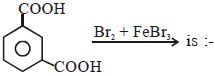
A
$1,2-$dicarboxy$-3-$bromobenzene
B
$1,3-$dicarboxy$-5-$bromobenzene
C
$1,4-$dicarboxy$-2-$bromobenzene
D
$1,2-$dicarboxy$-4,5-$dibromobenzene
Solution
(B) The reactant is benzene$-1,3-$dicarboxylic acid (isophthalic acid).
Both $-COOH$ groups are strongly electron-withdrawing and meta-directing.
In benzene$-1,3-$dicarboxylic acid,the positions $2, 4, 5,$ and $6$ are available for electrophilic substitution.
Position $5$ is meta to both $-COOH$ groups.
Electrophilic aromatic substitution (bromination) occurs at the position that is meta to both electron-withdrawing groups to minimize steric hindrance and electronic repulsion.
Therefore,the major product is $5$-bromobenzene-$1,3$-dicarboxylic acid.
Both $-COOH$ groups are strongly electron-withdrawing and meta-directing.
In benzene$-1,3-$dicarboxylic acid,the positions $2, 4, 5,$ and $6$ are available for electrophilic substitution.
Position $5$ is meta to both $-COOH$ groups.
Electrophilic aromatic substitution (bromination) occurs at the position that is meta to both electron-withdrawing groups to minimize steric hindrance and electronic repulsion.
Therefore,the major product is $5$-bromobenzene-$1,3$-dicarboxylic acid.
0 likes
View Solution489
DifficultMCQ
$CH_3COOH + C_2H_5^{18}OH \xrightarrow{Conc. H_2SO_4} (X)$
$CH_3COOH + (CH_3)_3C^{18}OH \xrightarrow{Conc. H_2SO_4} (Y)$
In the above reaction $(X)$ and $(Y)$ are respectively:
$CH_3COOH + (CH_3)_3C^{18}OH \xrightarrow{Conc. H_2SO_4} (Y)$
In the above reaction $(X)$ and $(Y)$ are respectively:
A
$CH_3CO^{18}OC_2H_5$ and $CH_3COOC(CH_3)_3$
B
$CH_3CO^{18}OC_2H_5$ and $CH_3CO^{18}OC(CH_3)_3$
C
$CH_3COOC_2H_5$ and $CH_3COOC(CH_3)_3$
D
$CH_3COOC_2H_5$ and $CH_3CO^{18}OC(CH_3)_3$
Solution
(A) In the esterification of carboxylic acids with primary alcohols like ethanol,acyl-oxygen cleavage occurs ($A_{AC}2$ mechanism). The oxygen atom of the alcohol is retained in the ester. Thus,$(X)$ is $CH_3CO^{18}OC_2H_5$.
However,with tertiary alcohols like tert-butyl alcohol,alkyl-oxygen cleavage occurs ($A_{AL}1$ mechanism) because a stable tertiary carbocation can form. The oxygen atom of the alcohol is lost as water,and the oxygen atom of the carboxylic acid is retained in the ester. Thus,$(Y)$ is $CH_3COOC(CH_3)_3$.
However,with tertiary alcohols like tert-butyl alcohol,alkyl-oxygen cleavage occurs ($A_{AL}1$ mechanism) because a stable tertiary carbocation can form. The oxygen atom of the alcohol is lost as water,and the oxygen atom of the carboxylic acid is retained in the ester. Thus,$(Y)$ is $CH_3COOC(CH_3)_3$.
0 likes
View Solution490
DifficultMCQ
In the following reaction: $CH_3COOH + PCl_5$ $\rightarrow (A)$ $\xrightarrow[(2) H_2O]{(1) CH_3MgBr} (B)$,product $(B)$ would be:
A
$CH_3-CH_2-CH(OH)-CH_3$
B
$CH_3-CO-C_6H_5$
C
$CH_3-CH(OH)-CH_3$
D
$CH_3-C(OH)(CH_3)_2$
Solution
(D) $CH_3COOH + PCl_5 \rightarrow CH_3COCl (A) + POCl_3 + HCl$
$CH_3COCl + CH_3MgBr \rightarrow CH_3COCH_3 + MgBrCl$
$CH_3COCH_3 + CH_3MgBr \rightarrow (CH_3)_3C-OMgBr$
$(CH_3)_3C-OMgBr + H_2O \rightarrow (CH_3)_3C-OH (B) + Mg(OH)Br$
The final product $(B)$ is $2$-methylpropan-$2$-ol (tert-butyl alcohol).
$CH_3COCl + CH_3MgBr \rightarrow CH_3COCH_3 + MgBrCl$
$CH_3COCH_3 + CH_3MgBr \rightarrow (CH_3)_3C-OMgBr$
$(CH_3)_3C-OMgBr + H_2O \rightarrow (CH_3)_3C-OH (B) + Mg(OH)Br$
The final product $(B)$ is $2$-methylpropan-$2$-ol (tert-butyl alcohol).
0 likes
View Solution491
MediumMCQ
Which of the following is most acidic?
A
$p-Nitrophenol$
B
$CH_3COOH$
C
$HCOOH$
D
$CCl_3COOH$
Solution
(D) The acidity of a compound depends on the stability of its conjugate base.
$CCl_3COOH$ is a carboxylic acid with three highly electronegative chlorine atoms attached to the alpha carbon.
These chlorine atoms exert a strong electron-withdrawing inductive effect ($-I$ effect),which stabilizes the carboxylate anion $(RCOO^-)$ significantly more than the electron-donating methyl group in $CH_3COOH$ or the hydrogen atom in $HCOOH$.
While $p-Nitrophenol$ is acidic due to the resonance stabilization of the phenoxide ion by the $-NO_2$ group,$CCl_3COOH$ is a much stronger acid because the inductive effect of three chlorine atoms is very powerful in stabilizing the negative charge on the carboxylate group.
Therefore,$CCl_3COOH$ is the most acidic among the given options.
$CCl_3COOH$ is a carboxylic acid with three highly electronegative chlorine atoms attached to the alpha carbon.
These chlorine atoms exert a strong electron-withdrawing inductive effect ($-I$ effect),which stabilizes the carboxylate anion $(RCOO^-)$ significantly more than the electron-donating methyl group in $CH_3COOH$ or the hydrogen atom in $HCOOH$.
While $p-Nitrophenol$ is acidic due to the resonance stabilization of the phenoxide ion by the $-NO_2$ group,$CCl_3COOH$ is a much stronger acid because the inductive effect of three chlorine atoms is very powerful in stabilizing the negative charge on the carboxylate group.
Therefore,$CCl_3COOH$ is the most acidic among the given options.
0 likes
View Solution492
MediumMCQ
Which of the following is most reactive for nucleophilic substitution reaction?
A
$CH_3CONH_2$
B
$CH_3COOC_2H_5$
C
$CH_3COOCOCH_3$
D
$CH_3COCl$
Solution
(D) The reactivity of carboxylic acid derivatives towards nucleophilic acyl substitution depends on the leaving group ability.
The leaving group ability is inversely proportional to the basicity of the leaving group.
The order of leaving group ability is $Cl^{-} > CH_3COO^{-} > C_2H_5O^{-} > NH_2^-$.
Therefore,the reactivity order is: $\text{Acid chloride} > \text{Acid anhydride} > \text{Ester} > \text{Amide}$.
Thus,$CH_3COCl$ is the most reactive.
The leaving group ability is inversely proportional to the basicity of the leaving group.
The order of leaving group ability is $Cl^{-} > CH_3COO^{-} > C_2H_5O^{-} > NH_2^-$.
Therefore,the reactivity order is: $\text{Acid chloride} > \text{Acid anhydride} > \text{Ester} > \text{Amide}$.
Thus,$CH_3COCl$ is the most reactive.
0 likes
View Solution493
MediumMCQ
The correct order of acidic strength is
A
$Chloroacetic \ acid > Fluoroacetic \ acid > Phenol > Ethanol$
B
$Ethanol > Phenol > Chloroacetic \ acid > Fluoroacetic \ acid$
C
$Fluoroacetic \ acid > Chloroacetic \ acid > Phenol > Ethanol$
D
$Fluoroacetic \ acid > Chloroacetic \ acid > Ethanol > Phenol$
Solution
(C) The acidic strength of compounds depends on the stability of their conjugate bases. Carboxylic acids are generally more acidic than phenols,and phenols are more acidic than alcohols.
Among carboxylic acids,the presence of an electron-withdrawing group $(EWG)$ increases acidity by stabilizing the carboxylate anion through the inductive effect ($-I$ effect).
Fluorine $(F)$ has a stronger $-I$ effect than chlorine $(Cl)$,so $Fluoroacetic \ acid$ is more acidic than $Chloroacetic \ acid$.
Thus,the correct order is: $Fluoroacetic \ acid > Chloroacetic \ acid > Phenol > Ethanol$.
Among carboxylic acids,the presence of an electron-withdrawing group $(EWG)$ increases acidity by stabilizing the carboxylate anion through the inductive effect ($-I$ effect).
Fluorine $(F)$ has a stronger $-I$ effect than chlorine $(Cl)$,so $Fluoroacetic \ acid$ is more acidic than $Chloroacetic \ acid$.
Thus,the correct order is: $Fluoroacetic \ acid > Chloroacetic \ acid > Phenol > Ethanol$.
0 likes
View Solution494
MediumMCQ
Which of the following does not give alcohol on reduction?
A
$CH_3COCl$
B
$CH_3COOC_2H_5$
C
$(CH_3CO)_2O$
D
$CH_3CONH_2$
Solution
(D) Amides $(RCONH_2)$ on reduction with $LiAlH_4$ yield primary amines $(RCH_2NH_2)$,whereas acid halides $(RCOCl)$,esters $(RCOOR')$,and acid anhydrides $((RCO)_2O)$ are reduced to alcohols.
0 likes
View Solution495
MediumMCQ
Decarboxylation of isobutyric acid gives .....
A
Isobutane
B
Propane
C
Butane
D
None of these
Solution
(B) Isobutyric acid is $(CH_3)_2CHCOOH$.
Decarboxylation involves the removal of $CO_2$ from the carboxylic acid group.
When isobutyric acid is treated with soda lime $(NaOH + CaO)$,it undergoes decarboxylation to form propane $(CH_3-CH_2-CH_3)$.
The reaction is: $(CH_3)_2CHCOOH + NaOH \xrightarrow{CaO, \Delta} CH_3-CH_2-CH_3 + Na_2CO_3$.
Decarboxylation involves the removal of $CO_2$ from the carboxylic acid group.
When isobutyric acid is treated with soda lime $(NaOH + CaO)$,it undergoes decarboxylation to form propane $(CH_3-CH_2-CH_3)$.
The reaction is: $(CH_3)_2CHCOOH + NaOH \xrightarrow{CaO, \Delta} CH_3-CH_2-CH_3 + Na_2CO_3$.
0 likes
View Solution496
MediumMCQ
What is formed when oxalic acid is dehydrated with concentrated $H_2SO_4$?
A
$C + CO_2$
B
$CO$
C
$CO_2$
D
$CO + CO_2$
Solution
(D) When oxalic acid $(HOOC-COOH)$ is heated with concentrated $H_2SO_4$,it undergoes dehydration to produce carbon monoxide $(CO)$,carbon dioxide $(CO_2)$,and water $(H_2O)$.
The chemical reaction is: $HOOC-COOH \xrightarrow{conc. H_2SO_4} CO + CO_2 + H_2O$.
The chemical reaction is: $HOOC-COOH \xrightarrow{conc. H_2SO_4} CO + CO_2 + H_2O$.
0 likes
View Solution497
MediumMCQ
What is formed when $HCOOH$ reacts with concentrated $H_2SO_4$?
A
$CO$
B
$CO_2$
C
$NO$
D
$NO_2$
Solution
(A) When formic acid $(HCOOH)$ is heated with concentrated sulfuric acid $(H_2SO_4)$,it undergoes dehydration to produce carbon monoxide $(CO)$ and water $(H_2O)$.
The reaction is: $HCOOH + H_2SO_4 (\text{conc.}) \rightarrow CO + H_2O + H_2SO_4$.
The reaction is: $HCOOH + H_2SO_4 (\text{conc.}) \rightarrow CO + H_2O + H_2SO_4$.
0 likes
View Solution498
MediumMCQ
Oxalic acid reacts with concentrated $H_2SO_4$ to produce a mixture of two gases. When this mixture is passed through caustic potash,one of the gases is absorbed. What substance is formed by the absorption of the gas in caustic potash?
A
$K_2SO_4$
B
$KHCO_3$
C
$K_2CO_3$
D
$KOH$
0 likes
View Solution499
MediumMCQ
The reaction of sugar with concentrated $HNO_3$ yields ....
A
$CO_2$ and $H_2O$
B
Oxalic acid
C
$CO$ and $H_2O$
D
Carbonic acid
Solution
(B) Concentrated $HNO_3$ acts as a strong oxidizing agent. When sugar $(C_{12}H_{22}O_{11})$ is treated with concentrated $HNO_3$,it undergoes oxidation to form oxalic acid $(C_2H_2O_4 \cdot 2H_2O)$.
0 likes
View Solution500
MediumMCQ
Which of the following reactions of ethanol produces a fruity smell?
A
$PCl_5$
B
$CH_3COCH_3$
C
$CH_3COOH$
D
None of these
Solution
(C) The reaction of ethanol $(C_2H_5OH)$ with ethanoic acid $(CH_3COOH)$ in the presence of a small amount of concentrated sulfuric acid $(H_2SO_4)$ is known as esterification.
This reaction produces ethyl ethanoate $(CH_3COOC_2H_5)$,which is an ester characterized by a pleasant,fruity smell.
The reaction is: $CH_3COOH + C_2H_5OH \xrightarrow{H^+} CH_3COOC_2H_5 + H_2O$.
This reaction produces ethyl ethanoate $(CH_3COOC_2H_5)$,which is an ester characterized by a pleasant,fruity smell.
The reaction is: $CH_3COOH + C_2H_5OH \xrightarrow{H^+} CH_3COOC_2H_5 + H_2O$.
0 likes
View Solution8-2.Carboxylic acids and Their derivative — Properties of Carboxylic Acids and Their Derivatives · Frequently Asked Questions
1Are these 8-2.Carboxylic acids and Their derivative questions useful for JEE and NEET?
Yes. All questions in this section are mapped to JEE Main and NEET exam patterns. Previous year questions from JEE Main, NEET, GUJCET and state-level exams are included with full solutions.
2Can I switch to Hindi or Gujarati for these questions?
Yes. Use the language tabs in the hero section or the sidebar to view the same questions and solutions in English, Hindi or Gujarati.
3How do I generate a question paper from this subtopic?
Use the Vedclass Exam Paper Generator — select the chapter and subtopic, set difficulty, and generate Sets A, B, C, D automatically. First 3 chapters of every subject are free.
Vedclass Products
For Students
Vedclass Test Series
Mock tests in real JEE/NEET style with performance analysis. 5-day free trial.
Start Free TrialFor Teachers
Exam Paper Generator
Generate Set A/B/C/D papers from this chapter in 2 minutes. 3 chapters free.
Try FreeFor Institutes
Online Exam Module
Live online exams with unlimited students, 360° analytics & white-label branding.
See DemoFor Teachers & Institutes
Generate a 8-2.Carboxylic acids and Their derivative Exam Paper in 2 Minutes
Select subtopic & difficulty — Sets A, B, C, D auto-generated with No Repeat logic.
First 3 chapters of every subject are free — no payment required.