
A English
Properties of Carboxylic Acids and Their Derivatives Questions in English
Class 12 Chemistry · 8-2.Carboxylic acids and Their derivative · Properties of Carboxylic Acids and Their Derivatives
791+
Questions
English
Language
100%
With Solutions
Showing 48 of 791 questions in English
501
DifficultMCQ
Which of the following substances among phenol,acetic acid,and $n$-hexanol will react with $NaHCO_3$ solution to produce a sodium salt and $CO_2$?
A
Acetic acid and phenol
B
Phenol
C
Acetic acid
D
$n$-hexanol
Solution
(C) The reaction with $NaHCO_3$ is a characteristic test for carboxylic acids.
Carboxylic acids are stronger acids than carbonic acid $(H_2CO_3)$,which is formed when $NaHCO_3$ reacts with an acid.
Acetic acid $(CH_3COOH)$ is a carboxylic acid and reacts with $NaHCO_3$ to evolve $CO_2$ gas:
$CH_3COOH + NaHCO_3 \rightarrow CH_3COONa + H_2O + CO_2 \uparrow$.
Phenol is a much weaker acid than carbonic acid and does not react with $NaHCO_3$.
$n$-hexanol is an alcohol and is even less acidic than phenol,so it also does not react with $NaHCO_3$.
Therefore,only acetic acid reacts with $NaHCO_3$ to produce $CO_2$.
Carboxylic acids are stronger acids than carbonic acid $(H_2CO_3)$,which is formed when $NaHCO_3$ reacts with an acid.
Acetic acid $(CH_3COOH)$ is a carboxylic acid and reacts with $NaHCO_3$ to evolve $CO_2$ gas:
$CH_3COOH + NaHCO_3 \rightarrow CH_3COONa + H_2O + CO_2 \uparrow$.
Phenol is a much weaker acid than carbonic acid and does not react with $NaHCO_3$.
$n$-hexanol is an alcohol and is even less acidic than phenol,so it also does not react with $NaHCO_3$.
Therefore,only acetic acid reacts with $NaHCO_3$ to produce $CO_2$.
0 likes
View Solution502
EasyMCQ
Benzoic acid is treated with lithium aluminium hydride. The compound obtained is
A
benzaldehyde
B
benzyl alcohol
C
toluene
D
benzene
Solution
(B) When benzoic acid $(C_6H_5COOH)$ is treated with lithium aluminium hydride $(LiAlH_4)$,it acts as a strong reducing agent.
It reduces the carboxylic acid group $(-COOH)$ to a primary alcohol group $(-CH_2OH)$.
The reaction is:
$C_6H_5COOH + 4[H] \xrightarrow{LiAlH_4} C_6H_5CH_2OH + H_2O$
Thus,the product obtained is benzyl alcohol.
It reduces the carboxylic acid group $(-COOH)$ to a primary alcohol group $(-CH_2OH)$.
The reaction is:
$C_6H_5COOH + 4[H] \xrightarrow{LiAlH_4} C_6H_5CH_2OH + H_2O$
Thus,the product obtained is benzyl alcohol.
0 likes
View Solution503
MediumMCQ
Acid hydrolysis of which of the following compounds yields two different organic compounds?
A
$CH_3COOH$
B
$CH_3CONH_2$
C
$CH_3COOC_2H_5$
D
$(CH_3CO)_2O$
Solution
(C) Acid hydrolysis of an ester involves the reaction with water in the presence of an acid catalyst to produce a carboxylic acid and an alcohol.
For ethyl acetate $(CH_3COOC_2H_5)$:
$CH_3COOC_2H_5 + H_2O \xrightarrow{H^+} CH_3COOH + C_2H_5OH$
Here,$CH_3COOH$ (acetic acid) and $C_2H_5OH$ (ethanol) are two different organic compounds.
For ethyl acetate $(CH_3COOC_2H_5)$:
$CH_3COOC_2H_5 + H_2O \xrightarrow{H^+} CH_3COOH + C_2H_5OH$
Here,$CH_3COOH$ (acetic acid) and $C_2H_5OH$ (ethanol) are two different organic compounds.
0 likes
View Solution504
MediumMCQ
When ethane-$1, 2$-dioic acid is heated with conc. $H_2SO_4$,it gives
A
$CO + HCOOH$
B
$CO_2 + HCOOH$
C
$CO + CO_2 + HCOOH$
D
$CO + CO_2 + H_2O$
Solution
(D) Ethane-$1, 2$-dioic acid (oxalic acid) undergoes dehydration in the presence of concentrated $H_2SO_4$ upon heating.
The reaction is as follows:
$(COOH)_2 \xrightarrow[\text{conc. } H_2SO_4]{\Delta} CO + CO_2 + H_2O$
Thus,the products formed are carbon monoxide,carbon dioxide,and water.
The reaction is as follows:
$(COOH)_2 \xrightarrow[\text{conc. } H_2SO_4]{\Delta} CO + CO_2 + H_2O$
Thus,the products formed are carbon monoxide,carbon dioxide,and water.
0 likes
View Solution505
MediumMCQ
Which of the following is the correct order of acidity?
A
$HCOOH > CH_3COOH > ClCH_2COOH > C_2H_5COOH$
B
$ClCH_2COOH > HCOOH > CH_3COOH > C_2H_5COOH$
C
$CH_3COOH > HCOOH > ClCH_2COOH > C_2H_5COOH$
D
$C_2H_5COOH > CH_3COOH > HCOOH > ClCH_2COOH$
Solution
(B) The acidity of carboxylic acids depends on the stability of the carboxylate ion formed after the loss of a proton.
Electron-withdrawing groups ($-I$ effect) like $-Cl$ increase acidity by stabilizing the negative charge on the carboxylate ion.
Electron-donating groups ($+I$ effect) like alkyl groups decrease acidity by destabilizing the negative charge.
The $+I$ effect strength follows the order: $-C_2H_5 > -CH_3 > -H$.
Comparing the given acids:
$1$. $ClCH_2COOH$ has a $-Cl$ group ($-I$ effect),making it the most acidic.
$2$. $HCOOH$ has no alkyl group.
$3$. $CH_3COOH$ has a $-CH_3$ group ($+I$ effect).
$4$. $C_2H_5COOH$ has a $-C_2H_5$ group (stronger $+I$ effect than $-CH_3$),making it the least acidic.
Thus,the correct order is $ClCH_2COOH > HCOOH > CH_3COOH > C_2H_5COOH$.
Electron-withdrawing groups ($-I$ effect) like $-Cl$ increase acidity by stabilizing the negative charge on the carboxylate ion.
Electron-donating groups ($+I$ effect) like alkyl groups decrease acidity by destabilizing the negative charge.
The $+I$ effect strength follows the order: $-C_2H_5 > -CH_3 > -H$.
Comparing the given acids:
$1$. $ClCH_2COOH$ has a $-Cl$ group ($-I$ effect),making it the most acidic.
$2$. $HCOOH$ has no alkyl group.
$3$. $CH_3COOH$ has a $-CH_3$ group ($+I$ effect).
$4$. $C_2H_5COOH$ has a $-C_2H_5$ group (stronger $+I$ effect than $-CH_3$),making it the least acidic.
Thus,the correct order is $ClCH_2COOH > HCOOH > CH_3COOH > C_2H_5COOH$.
0 likes
View Solution506
MediumMCQ
The reaction $R-CH_2-CH_2-COOH \xrightarrow[Br_2]{Red \ P} R-CH_2-CH(Br)-COOH$ is called as:
A
Reimer-Tiemann reaction
B
Hell-Volhard-Zelinsky reaction
C
Cannizzaro reaction
D
Sandmeyer reaction
Solution
(B) The reaction of carboxylic acids having an $\alpha$-hydrogen with halogen ($Cl_2$ or $Br_2$) in the presence of a small amount of red phosphorus to give $\alpha$-halo carboxylic acids is known as the Hell-Volhard-Zelinsky $(HVZ)$ reaction.
0 likes
View Solution507
MediumMCQ
Assertion : Nitration of benzoic acid gives $m-$nitrobenzoic acid.
Reason : Carboxyl group increases the electron density at meta-position.
Reason : Carboxyl group increases the electron density at meta-position.
A
If both Assertion and Reason are correct and the Reason is a correct explanation of the Assertion.
B
If both Assertion and Reason are correct but Reason is not a correct explanation of the Assertion.
C
If the Assertion is correct but Reason is incorrect.
D
If both the Assertion and Reason are incorrect.
Solution
(C) The $-COOH$ group is a strong electron-withdrawing group due to both $-I$ and $-M$ effects.
It deactivates the benzene ring towards electrophilic substitution.
The electron density is decreased at all positions,but the decrease is relatively less at the $m-$position compared to the $o-$ and $p-$positions.
Therefore,the incoming electrophile $(NO_2^+)$ attacks the $m-$position.
The Assertion is correct,but the Reason is incorrect because the carboxyl group decreases,not increases,the electron density.
It deactivates the benzene ring towards electrophilic substitution.
The electron density is decreased at all positions,but the decrease is relatively less at the $m-$position compared to the $o-$ and $p-$positions.
Therefore,the incoming electrophile $(NO_2^+)$ attacks the $m-$position.
The Assertion is correct,but the Reason is incorrect because the carboxyl group decreases,not increases,the electron density.
0 likes
View Solution508
DifficultMCQ
Assertion : $\beta$-Keto carboxylic acids lose $CO_2$ when heated at about $370 \ K$.
Reason : An enol is first formed by loss of $CO_2$,but it readily tautomerises to the more stable ketone.
Reason : An enol is first formed by loss of $CO_2$,but it readily tautomerises to the more stable ketone.
A
If both Assertion and Reason are correct and the Reason is a correct explanation of the Assertion.
B
If both Assertion and Reason are correct but Reason is not a correct explanation of the Assertion.
C
If the Assertion is correct but Reason is incorrect.
D
If both the Assertion and Reason are incorrect.
Solution
(A) The decarboxylation of $\beta$-keto carboxylic acids occurs via a cyclic transition state involving the carbonyl oxygen of the ketone and the hydrogen of the carboxylic acid group.
This process releases $CO_2$ and initially forms an enol intermediate.
The enol is unstable and rapidly undergoes tautomerization to form the more stable ketone.
Therefore,both the Assertion and the Reason are correct,and the Reason provides the correct explanation for the decarboxylation process.
This process releases $CO_2$ and initially forms an enol intermediate.
The enol is unstable and rapidly undergoes tautomerization to form the more stable ketone.
Therefore,both the Assertion and the Reason are correct,and the Reason provides the correct explanation for the decarboxylation process.
0 likes
View Solution509
MediumMCQ
Assertion : The acetate ion is resonance stabilized.
Reason : Acetate ion is more basic than the methoxide ion.
Reason : Acetate ion is more basic than the methoxide ion.
A
If both Assertion and Reason are correct and the Reason is a correct explanation of the Assertion.
B
If both Assertion and Reason are correct but Reason is not a correct explanation of the Assertion.
C
If the Assertion is correct but Reason is incorrect.
D
If both the Assertion and Reason are incorrect.
Solution
(C) The Assertion is correct because the negative charge on the acetate ion $(CH_3COO^-)$ is delocalized over two oxygen atoms through resonance,which stabilizes the ion.
The Reason is incorrect because the acetate ion is a much weaker base than the methoxide ion $(CH_3O^-)$. This is because $CH_3COOH$ is a much stronger acid $(pK_a \approx 4.75)$ than $CH_3OH$ $(pK_a \approx 15.5)$. Since the conjugate base of a stronger acid is always a weaker base,the acetate ion is less basic than the methoxide ion.
The Reason is incorrect because the acetate ion is a much weaker base than the methoxide ion $(CH_3O^-)$. This is because $CH_3COOH$ is a much stronger acid $(pK_a \approx 4.75)$ than $CH_3OH$ $(pK_a \approx 15.5)$. Since the conjugate base of a stronger acid is always a weaker base,the acetate ion is less basic than the methoxide ion.
0 likes
View Solution510
MediumMCQ
Assertion: $CH_3COCl$ is converted to $CH_3CONH_2$ on reaction with $NH_3$.
Reason: $Cl^{-}$ is a stronger nucleophile and better leaving group.
Reason: $Cl^{-}$ is a stronger nucleophile and better leaving group.
A
If both Assertion and Reason are correct and the Reason is a correct explanation of the Assertion.
B
If both Assertion and Reason are correct but Reason is not a correct explanation of the Assertion.
C
If the Assertion is correct but Reason is incorrect.
D
If both the Assertion and Reason are incorrect.
Solution
(C) The reaction $CH_3COCl + 2NH_3 \rightarrow CH_3CONH_2 + NH_4Cl$ is an example of nucleophilic acyl substitution. The Assertion is correct because $NH_3$ acts as a nucleophile to replace the $Cl$ atom.
However,the Reason is incorrect. While $Cl^{-}$ is indeed a good leaving group,it is a very weak nucleophile compared to $NH_3$. The strength of a nucleophile is generally inversely related to the strength of its conjugate acid. Since $HCl$ is a strong acid,$Cl^{-}$ is a weak base and a weak nucleophile.
However,the Reason is incorrect. While $Cl^{-}$ is indeed a good leaving group,it is a very weak nucleophile compared to $NH_3$. The strength of a nucleophile is generally inversely related to the strength of its conjugate acid. Since $HCl$ is a strong acid,$Cl^{-}$ is a weak base and a weak nucleophile.
0 likes
View Solution511
DifficultMCQ
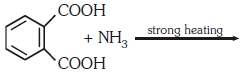
The major product of the following reaction is:
A
Phthalamic acid
B
Phthalimide
C
Phthalamide
D
Anthranilic acid
Solution
(B) When phthalic acid reacts with ammonia $(NH_3)$,it first forms ammonium phthalate.
Upon heating,ammonium phthalate loses two molecules of water to form phthalamide.
On further strong heating,phthalamide loses a molecule of ammonia $(NH_3)$ to form the cyclic imide known as phthalimide.
Upon heating,ammonium phthalate loses two molecules of water to form phthalamide.
On further strong heating,phthalamide loses a molecule of ammonia $(NH_3)$ to form the cyclic imide known as phthalimide.
0 likes
View Solution512
MediumMCQ
Carboxylic acids have higher boiling points than aldehydes,ketones,and even alcohols of comparable molecular mass. This is due to their:
A
formation of intramolecular $H$-bonding
B
formation of carboxylate ion
C
more extensive association of carboxylic acid via van der Waals forces of attraction
D
formation of intermolecular $H$-bonding
Solution
(D) Carboxylic acids have higher boiling points than aldehydes,ketones,and even alcohols of comparable molecular mass.
This is due to the more extensive association of carboxylic acid molecules through intermolecular $H$-bonding,which often results in the formation of stable dimers in the vapor phase or non-polar solvents.
This is due to the more extensive association of carboxylic acid molecules through intermolecular $H$-bonding,which often results in the formation of stable dimers in the vapor phase or non-polar solvents.
0 likes
View Solution513
DifficultMCQ
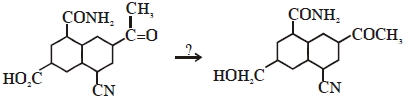
The most suitable reagent for the given conversion is
A
$LiAlH_4$
B
$NaBH_4$
C
$H_2/Pd$
D
$B_2H_6$
Solution
(D) The given conversion involves the reduction of a carboxylic acid group $(-COOH)$ to a primary alcohol $(-CH_2OH)$ while leaving the ketone $(-COCH_3)$,amide $(-CONH_2)$,and nitrile $(-CN)$ groups unaffected.
$B_2H_6$ (diborane) is a selective electrophilic reducing agent that reduces carboxylic acids to primary alcohols much faster than it reduces other functional groups like ketones,amides,or nitriles under controlled conditions.
$LiAlH_4$ is a strong reducing agent that would reduce all these groups ($-COOH$,$-COCH_3$,$-CONH_2$,$-CN$).
$NaBH_4$ is a milder reducing agent but is generally not effective for reducing carboxylic acids directly.
$H_2/Pd$ would reduce the ketone and potentially the nitrile group.
Therefore,$B_2H_6$ is the most suitable reagent.
$B_2H_6$ (diborane) is a selective electrophilic reducing agent that reduces carboxylic acids to primary alcohols much faster than it reduces other functional groups like ketones,amides,or nitriles under controlled conditions.
$LiAlH_4$ is a strong reducing agent that would reduce all these groups ($-COOH$,$-COCH_3$,$-CONH_2$,$-CN$).
$NaBH_4$ is a milder reducing agent but is generally not effective for reducing carboxylic acids directly.
$H_2/Pd$ would reduce the ketone and potentially the nitrile group.
Therefore,$B_2H_6$ is the most suitable reagent.
0 likes
View Solution514
Medium
Why is the ester hydrolysis slow in the beginning and becomes faster after sometime?
Solution
(N/A) Ester hydrolysis can be represented as:
$Ester + H_2O \longrightarrow Acid + Alcohol$
The acid produced in the reaction acts as a catalyst and makes the reaction faster.
Substances that act as catalysts in the same reaction in which they are obtained as products are known as autocatalysts.
This phenomenon is called autocatalysis.
$Ester + H_2O \longrightarrow Acid + Alcohol$
The acid produced in the reaction acts as a catalyst and makes the reaction faster.
Substances that act as catalysts in the same reaction in which they are obtained as products are known as autocatalysts.
This phenomenon is called autocatalysis.
0 likes
View Solution515
Difficult
Although phenoxide ion has more number of resonating structures than carboxylate ion,carboxylic acid is a stronger acid than phenol. Why?
Solution
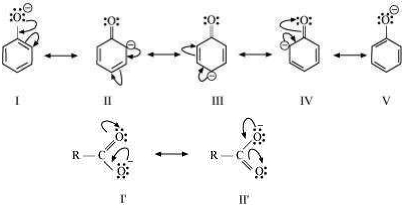
(N/A) The resonance structures of the phenoxide ion are shown in the figure.
It can be observed from the resonance structures of the phenoxide ion that in structures $II$,$III$,and $IV$,less electronegative carbon atoms carry a negative charge. Therefore,these three structures contribute negligibly to the resonance stability of the phenoxide ion.
Hence,these structures can be ignored. Only structures $I$ and $V$ carry a negative charge on the more electronegative oxygen atom.
The resonance structures of the carboxylate ion are also shown in the figure.
In the case of the carboxylate ion,resonating structures $I'$ and $II'$ contain a negative charge carried by a more electronegative oxygen atom.
Further,in resonating structures $I'$ and $II'$,the negative charge is delocalized over two oxygen atoms. However,in resonating structures $I$ and $V$ of the phenoxide ion,the negative charge is localized on the same oxygen atom. Therefore,the resonating structures of the carboxylate ion contribute more towards its stability than those of the phenoxide ion. As a result,the carboxylate ion is more resonance-stabilized than the phenoxide ion. Hence,carboxylic acid is a stronger acid than phenol.
It can be observed from the resonance structures of the phenoxide ion that in structures $II$,$III$,and $IV$,less electronegative carbon atoms carry a negative charge. Therefore,these three structures contribute negligibly to the resonance stability of the phenoxide ion.
Hence,these structures can be ignored. Only structures $I$ and $V$ carry a negative charge on the more electronegative oxygen atom.
The resonance structures of the carboxylate ion are also shown in the figure.
In the case of the carboxylate ion,resonating structures $I'$ and $II'$ contain a negative charge carried by a more electronegative oxygen atom.
Further,in resonating structures $I'$ and $II'$,the negative charge is delocalized over two oxygen atoms. However,in resonating structures $I$ and $V$ of the phenoxide ion,the negative charge is localized on the same oxygen atom. Therefore,the resonating structures of the carboxylate ion contribute more towards its stability than those of the phenoxide ion. As a result,the carboxylate ion is more resonance-stabilized than the phenoxide ion. Hence,carboxylic acid is a stronger acid than phenol.
0 likes
View Solution516
Medium
Explain decarboxylation with examples. Or,provide the product obtained from the carboxylic acid method with examples.
Solution
(N/A) Sodium salts of carboxylic acids,when heated with soda lime (a mixture of sodium hydroxide and calcium oxide),yield alkanes containing one carbon atom less than the parent carboxylic acid. This process of eliminating carbon dioxide from a carboxylic acid is known as decarboxylation.
$RCOOH \xrightarrow{\text{Soda lime, } \Delta} RH + Na_2CO_3$
Soda lime is a mixture of sodium hydroxide $(NaOH)$ and calcium oxide $(CaO)$. The $NaOH$ in soda lime reacts with the carboxylic acid to form its sodium salt.
Example-$1$: Preparation of methane from ethanoic acid (acetic acid).
$CH_3COONa + NaOH \xrightarrow{CaO, \Delta} CH_4 + Na_2CO_3$
Example-$2$: Preparation of ethane from propanoic acid.
$CH_3CH_2COONa + NaOH \xrightarrow{CaO, \Delta} C_2H_6 + Na_2CO_3$
$RCOOH \xrightarrow{\text{Soda lime, } \Delta} RH + Na_2CO_3$
Soda lime is a mixture of sodium hydroxide $(NaOH)$ and calcium oxide $(CaO)$. The $NaOH$ in soda lime reacts with the carboxylic acid to form its sodium salt.
Example-$1$: Preparation of methane from ethanoic acid (acetic acid).
$CH_3COONa + NaOH \xrightarrow{CaO, \Delta} CH_4 + Na_2CO_3$
Example-$2$: Preparation of ethane from propanoic acid.
$CH_3CH_2COONa + NaOH \xrightarrow{CaO, \Delta} C_2H_6 + Na_2CO_3$
0 likes
View Solution517
Medium
Describe the colours,smell,and physical state of aliphatic carboxylic acids.
Solution
(N/A) The first three members of aliphatic carboxylic acids ($HCOOH$,$CH_3COOH$,and $CH_3CH_2COOH$) are colourless liquids with a pungent,sharp smell.
Aliphatic carboxylic acids containing $4$ to $9$ carbon atoms are colourless liquids at room temperature with an unpleasant,rancid odour.
Higher carboxylic acids (containing more than $9$ carbon atoms) are wax-like solids and are practically odourless due to their low volatility.
Aliphatic carboxylic acids containing $4$ to $9$ carbon atoms are colourless liquids at room temperature with an unpleasant,rancid odour.
Higher carboxylic acids (containing more than $9$ carbon atoms) are wax-like solids and are practically odourless due to their low volatility.
0 likes
View Solution518
Medium
Explain hydrogen bonding in carboxylic acids and its effect on their boiling points.
Solution
(N/A) $(i)$ Carboxylic acids contain the $-COOH$ functional group. In the carboxyl group,the oxygen atom is highly electronegative,creating a polar $C=O$ bond and an $O-H$ bond. This results in a partial positive charge on the hydrogen atom and a partial negative charge on the carbonyl oxygen,leading to the formation of intermolecular hydrogen bonds between carboxylic acid molecules.
$(ii)$ These intermolecular hydrogen bonds are strong enough that they are not completely broken even in the vapour phase. Consequently,most carboxylic acids exist as stable dimers in the vapour phase or in aprotic solvents. This association of molecules increases the effective molecular mass,which significantly raises the boiling points of carboxylic acids compared to alcohols or aldehydes of comparable molecular masses.
$(ii)$ These intermolecular hydrogen bonds are strong enough that they are not completely broken even in the vapour phase. Consequently,most carboxylic acids exist as stable dimers in the vapour phase or in aprotic solvents. This association of molecules increases the effective molecular mass,which significantly raises the boiling points of carboxylic acids compared to alcohols or aldehydes of comparable molecular masses.
0 likes
View Solution519
Medium
Write about the solubility of carboxylic acid compounds.
Solution
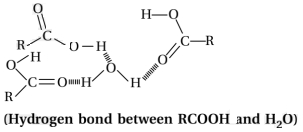
(N/A) $(i)$ Simple aliphatic carboxylic acids having up to four carbon atoms ($HCOOH, CH_3COOH, CH_3CH_2COOH$ and $CH_3CH_2CH_2COOH$) are miscible in water due to the formation of hydrogen bonds with water.
$(ii)$ The solubility decreases with an increasing number of carbon atoms.
$(iii)$ Higher carboxylic acids are practically insoluble in water due to the increased hydrophobic interaction of the hydrocarbon part.
$(iv)$ Benzoic acid,the simplest aromatic carboxylic acid,is nearly insoluble in cold water.
$(v)$ Carboxylic acids are also soluble in less polar organic solvents like benzene,ether,alcohol,chloroform,etc.
$(ii)$ The solubility decreases with an increasing number of carbon atoms.
$(iii)$ Higher carboxylic acids are practically insoluble in water due to the increased hydrophobic interaction of the hydrocarbon part.
$(iv)$ Benzoic acid,the simplest aromatic carboxylic acid,is nearly insoluble in cold water.
$(v)$ Carboxylic acids are also soluble in less polar organic solvents like benzene,ether,alcohol,chloroform,etc.
0 likes
View Solution520
Medium
Carboxylic acid compounds are Bronsted acids. Prove this by different reactions.
Solution
(N/A) Carboxylic acids act as Bronsted acids because they can donate a proton $(H^+)$. Their acidic nature is proven by the following reactions:
$(i)$ Reaction with metals: Carboxylic acids react with electropositive metals like $Na$ and $K$ to liberate dihydrogen gas,acting as proton donors.
$2 RCOOH + 2 Na \longrightarrow 2 RCOO^- Na^+ + H_2 \uparrow$
$(ii)$ Reaction with carbonates and bicarbonates: Carboxylic acids react with mild bases like aqueous solutions of carbonates and hydrogen carbonates to evolve carbon dioxide gas.
$RCOOH + NaHCO_{3(aq)} \longrightarrow RCOO^- Na^+ + H_2O + CO_2 \uparrow$
$2 RCOOH + Na_2CO_3 \longrightarrow 2 RCOO^- Na^+ + H_2O + CO_2 \uparrow$
$(i)$ Reaction with metals: Carboxylic acids react with electropositive metals like $Na$ and $K$ to liberate dihydrogen gas,acting as proton donors.
$2 RCOOH + 2 Na \longrightarrow 2 RCOO^- Na^+ + H_2 \uparrow$
$(ii)$ Reaction with carbonates and bicarbonates: Carboxylic acids react with mild bases like aqueous solutions of carbonates and hydrogen carbonates to evolve carbon dioxide gas.
$RCOOH + NaHCO_{3(aq)} \longrightarrow RCOO^- Na^+ + H_2O + CO_2 \uparrow$
$2 RCOOH + Na_2CO_3 \longrightarrow 2 RCOO^- Na^+ + H_2O + CO_2 \uparrow$
0 likes
View Solution521
Medium
The acidity of alcohol,phenol,and carboxylic acid differs. Demonstrate their reactivity with $Na$,$NaOH$,and $NaHCO_3$ using the table below.
| Compound | Reaction with $Na$ metal | Reaction with $NaOH$ | Reaction with $NaHCO_3$ |
|---|---|---|---|
| Alcohol | $H_2$ is liberated | No reaction | No reaction |
| Phenol | $H_2$ is liberated | Soluble salt formed | No reaction |
| Carboxylic acid | $H_2$ is liberated | Soluble salt formed | $CO_2$ gas is liberated |
Solution
(N/A) The acidity of these compounds follows the order: $Carboxylic \ acid > Phenol > Alcohol$.
$1$. $Na$ metal: All three compounds contain an acidic hydrogen atom ($-OH$ group),so they all react with $Na$ to liberate $H_2$ gas.
$2$. $NaOH$: Carboxylic acids and phenols are acidic enough to react with the strong base $NaOH$ to form water-soluble salts. Alcohols are too weakly acidic to react with $NaOH$.
$3$. $NaHCO_3$: Only carboxylic acids are strong enough to react with the weak base $NaHCO_3$ to liberate $CO_2$ gas. Phenols and alcohols are not acidic enough to decompose $NaHCO_3$.
$1$. $Na$ metal: All three compounds contain an acidic hydrogen atom ($-OH$ group),so they all react with $Na$ to liberate $H_2$ gas.
$2$. $NaOH$: Carboxylic acids and phenols are acidic enough to react with the strong base $NaOH$ to form water-soluble salts. Alcohols are too weakly acidic to react with $NaOH$.
$3$. $NaHCO_3$: Only carboxylic acids are strong enough to react with the weak base $NaHCO_3$ to liberate $CO_2$ gas. Phenols and alcohols are not acidic enough to decompose $NaHCO_3$.
0 likes
View Solution522
Difficult
Derive an equation for $pK_{a}$ for carboxylic acid compounds. Also,give the relation between $pK_{a}$ and acidic strength.
Solution
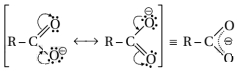
(N/A) $(i)$ Carboxylic acids dissociate in water to give resonance-stabilized carboxylate anions and hydronium ions.
$RCOOH + H_{2}O \rightleftharpoons RCOO^{-} + H_{3}O^{+}$
This carboxylate ion is stable due to its resonance activity.
$(ii)$ If the equilibrium constant for the aqueous acidic solution is $K_{eq}$,then:
$K_{eq} = \frac{[H_{3}O^{+}][RCOO^{-}]}{[RCOOH][H_{2}O]}$
$\therefore K_{eq}[H_{2}O] = \frac{[H_{3}O^{+}][RCOO^{-}]}{[RCOOH]}$
$\therefore K_{a} = \frac{[H_{3}O^{+}][RCOO^{-}]}{[RCOOH]} \quad (\because K_{eq}[H_{2}O] = K_{a})$
Where,$K_{a}$ is the dissociation constant for the acid.
Taking the negative logarithm on both sides:
$-\log K_{a} = -\log \left( \frac{[H_{3}O^{+}][RCOO^{-}]}{[RCOOH]} \right)$
$\therefore pK_{a} = -\log K_{a}$
Relation: $K_{a} \propto \text{acidic strength}$ and $pK_{a} \propto \frac{1}{\text{acidic strength}}$. For convenience,the strength of an acid is generally indicated by its $pK_{a}$ value rather than its $K_{a}$ value.
$RCOOH + H_{2}O \rightleftharpoons RCOO^{-} + H_{3}O^{+}$
This carboxylate ion is stable due to its resonance activity.
$(ii)$ If the equilibrium constant for the aqueous acidic solution is $K_{eq}$,then:
$K_{eq} = \frac{[H_{3}O^{+}][RCOO^{-}]}{[RCOOH][H_{2}O]}$
$\therefore K_{eq}[H_{2}O] = \frac{[H_{3}O^{+}][RCOO^{-}]}{[RCOOH]}$
$\therefore K_{a} = \frac{[H_{3}O^{+}][RCOO^{-}]}{[RCOOH]} \quad (\because K_{eq}[H_{2}O] = K_{a})$
Where,$K_{a}$ is the dissociation constant for the acid.
Taking the negative logarithm on both sides:
$-\log K_{a} = -\log \left( \frac{[H_{3}O^{+}][RCOO^{-}]}{[RCOOH]} \right)$
$\therefore pK_{a} = -\log K_{a}$
Relation: $K_{a} \propto \text{acidic strength}$ and $pK_{a} \propto \frac{1}{\text{acidic strength}}$. For convenience,the strength of an acid is generally indicated by its $pK_{a}$ value rather than its $K_{a}$ value.
0 likes
View Solution523
Medium
Compare the acidity among mineral acids,carboxylic acids,phenols,and alcohols.
Solution
(N/A) Mineral acids are stronger than carboxylic acids because they completely dissociate in water.
Carboxylic acids are stronger acids than phenols and alcohols because the carboxylate ion is stabilized by resonance,where the negative charge is delocalized over two electronegative oxygen atoms.
Phenols are more acidic than alcohols because the phenoxide ion is stabilized by resonance with the benzene ring.
Alcohols are the least acidic among these as the alkoxide ion is not stabilized by resonance.
The order of acidic strength is: $\text{mineral acid} > \text{carboxylic acid} > \text{phenol} > \text{alcohol}$.
Carboxylic acids are stronger acids than phenols and alcohols because the carboxylate ion is stabilized by resonance,where the negative charge is delocalized over two electronegative oxygen atoms.
Phenols are more acidic than alcohols because the phenoxide ion is stabilized by resonance with the benzene ring.
Alcohols are the least acidic among these as the alkoxide ion is not stabilized by resonance.
The order of acidic strength is: $\text{mineral acid} > \text{carboxylic acid} > \text{phenol} > \text{alcohol}$.
0 likes
View Solution524
Difficult
Explain the following and provide reasons:
$(i)$ Carboxylic acid compounds are acidic in nature.
$(ii)$ Carboxylic acid compounds are more acidic than phenol compounds.
$(i)$ Carboxylic acid compounds are acidic in nature.
$(ii)$ Carboxylic acid compounds are more acidic than phenol compounds.
Solution
(N/A) The acidity of carboxylic acids is due to the resonance stabilization of the carboxylate ion.
$(i)$ Carboxylic acids are acidic because they can donate a proton to form a carboxylate ion $(RCOO^-)$.
$(a)$ In the carboxylic acid molecule $(RCOOH)$,resonance involves charge separation,which makes the structures less stable.
$(b)$ In the carboxylate ion $(RCOO^-)$,the negative charge is delocalized over two electronegative oxygen atoms through two equivalent resonance structures. This makes the carboxylate ion highly stable.
$(c)$ Since the conjugate base (carboxylate ion) is much more stable than the acid itself,the equilibrium shifts towards the formation of the carboxylate ion,making carboxylic acids acidic.
$(ii)$ Carboxylic acids are more acidic than phenols because:
$(a)$ In the carboxylate ion,the negative charge is delocalized over two electronegative oxygen atoms,which are equivalent. In the phenoxide ion $(C_6H_5O^-)$,the negative charge is delocalized over the carbon atoms of the benzene ring,which are less electronegative than oxygen. Thus,the carboxylate ion is more stable than the phenoxide ion,making carboxylic acids stronger acids than phenols.
$(i)$ Carboxylic acids are acidic because they can donate a proton to form a carboxylate ion $(RCOO^-)$.
$(a)$ In the carboxylic acid molecule $(RCOOH)$,resonance involves charge separation,which makes the structures less stable.
$(b)$ In the carboxylate ion $(RCOO^-)$,the negative charge is delocalized over two electronegative oxygen atoms through two equivalent resonance structures. This makes the carboxylate ion highly stable.
$(c)$ Since the conjugate base (carboxylate ion) is much more stable than the acid itself,the equilibrium shifts towards the formation of the carboxylate ion,making carboxylic acids acidic.
$(ii)$ Carboxylic acids are more acidic than phenols because:
$(a)$ In the carboxylate ion,the negative charge is delocalized over two electronegative oxygen atoms,which are equivalent. In the phenoxide ion $(C_6H_5O^-)$,the negative charge is delocalized over the carbon atoms of the benzene ring,which are less electronegative than oxygen. Thus,the carboxylate ion is more stable than the phenoxide ion,making carboxylic acids stronger acids than phenols.
0 likes
View Solution525
Difficult
Write a note on the effect of substituents on the acidic strength of carboxylic acid compounds.
Solution
(N/A) Substituents may affect the stability of the conjugate base and thus,also affect the acidity of the carboxylic acids.
$(a)$ Effect of substituents on the acidity of carboxylic acids:
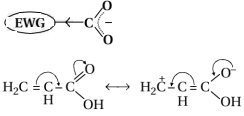
$(i)$ Electron withdrawing groups $(EWG)$ increase the acidity of carboxylic acids by stabilizing the conjugate base through delocalization of the negative charge by inductive and/or resonance effects.
$(ii)$ The effect of the following groups in increasing acidity order is:
$Ph < I < Br < Cl < F < CN < NO_{2} < CF_{3}$
$(iii)$ Thus,the following acids are arranged in order of decreasing acidity (based on $pK_{a}$ values):
$CF_{3}COOH > CCl_{3}COOH > CHCl_{2}COOH > NO_{2}CH_{2}COOH > NC-CH_{2}COOH > FCH_{2}COOH > ClCH_{2}COOH > BrCH_{2}COOH > HCOOH > ClCH_{2}CH_{2}COOH > C_{6}H_{5}COOH > C_{6}H_{5}CH_{2}COOH > CH_{3}COOH > CH_{3}CH_{2}COOH$
$(iv)$ Direct attachment of groups such as phenyl or vinyl to the carboxylic acid increases the acidity of the corresponding carboxylic acid,contrary to the decrease expected due to the resonance effect. For example: $CH_{2}=CHCOOH$ is more acidic than $CH_{3}COOH$.
$(a)$ Effect of substituents on the acidity of carboxylic acids:
$(i)$ Electron withdrawing groups $(EWG)$ increase the acidity of carboxylic acids by stabilizing the conjugate base through delocalization of the negative charge by inductive and/or resonance effects.
$(ii)$ The effect of the following groups in increasing acidity order is:
$Ph < I < Br < Cl < F < CN < NO_{2} < CF_{3}$
$(iii)$ Thus,the following acids are arranged in order of decreasing acidity (based on $pK_{a}$ values):
$CF_{3}COOH > CCl_{3}COOH > CHCl_{2}COOH > NO_{2}CH_{2}COOH > NC-CH_{2}COOH > FCH_{2}COOH > ClCH_{2}COOH > BrCH_{2}COOH > HCOOH > ClCH_{2}CH_{2}COOH > C_{6}H_{5}COOH > C_{6}H_{5}CH_{2}COOH > CH_{3}COOH > CH_{3}CH_{2}COOH$
$(iv)$ Direct attachment of groups such as phenyl or vinyl to the carboxylic acid increases the acidity of the corresponding carboxylic acid,contrary to the decrease expected due to the resonance effect. For example: $CH_{2}=CHCOOH$ is more acidic than $CH_{3}COOH$.
0 likes
View Solution526
Medium
Explain the effect of electron-donating and electron-withdrawing groups on the acidic strength of benzoic acid with suitable examples.
Solution
(N/A) The acidic strength of benzoic acid is influenced by the substituents present on the benzene ring:
$1$. Electron-Withdrawing Groups $(EWG)$: Groups like $-NO_{2}$,$-Cl$,etc.,exert an electron-withdrawing effect ($-I$ and/or $-M$ effect),which stabilizes the carboxylate anion by dispersing the negative charge. This increases the acidic strength. For example,the order of acidic strength is: $p-nitrobenzoic \ acid > p-chlorobenzoic \ acid > benzoic \ acid$.
$2$. Electron-Donating Groups $(EDG)$: Groups like $-CH_{3}$,$-OH$,$-OCH_{3}$,etc.,exert an electron-donating effect ($+I$ and/or $+M$ effect),which destabilizes the carboxylate anion by intensifying the negative charge. This decreases the acidic strength. For example,the order of acidic strength is: $benzoic \ acid > p-toluic \ acid > p-hydroxybenzoic \ acid$.
$1$. Electron-Withdrawing Groups $(EWG)$: Groups like $-NO_{2}$,$-Cl$,etc.,exert an electron-withdrawing effect ($-I$ and/or $-M$ effect),which stabilizes the carboxylate anion by dispersing the negative charge. This increases the acidic strength. For example,the order of acidic strength is: $p-nitrobenzoic \ acid > p-chlorobenzoic \ acid > benzoic \ acid$.
$2$. Electron-Donating Groups $(EDG)$: Groups like $-CH_{3}$,$-OH$,$-OCH_{3}$,etc.,exert an electron-donating effect ($+I$ and/or $+M$ effect),which destabilizes the carboxylate anion by intensifying the negative charge. This decreases the acidic strength. For example,the order of acidic strength is: $benzoic \ acid > p-toluic \ acid > p-hydroxybenzoic \ acid$.
0 likes
View Solution527
Medium
Give reactions of carboxylic acids in which $C-OH$ bond breaks. $OR$ Give methods of preparation for $(a)$ anhydride $(b)$ ester $(c)$ acid chloride and $(d)$ amide from carboxylic acids.
Solution
(N/A) Formation of anhydride: Carboxylic acids on heating with mineral acids such as $H_{2}SO_{4}$ or with $P_{2}O_{5}$ give corresponding anhydride.
$(b)$ Esterification: Carboxylic acids are esterified with alcohols or phenols in the presence of a mineral acid such as concentrated $H_{2}SO_{4}$ or $HCl$ gas as a catalyst.
$RCOOH + R'OH \rightleftharpoons H^{+} \rightleftharpoons RCOOR' + H_{2}O$
In this method,the $C-OH$ bond of the acid and the $O-H$ bond of the alcohol break to form an ester and remove one molecule of water.
$(c)$ Formation of acid chloride: The hydroxyl group $(-OH)$ of carboxylic acids is easily replaced by a chlorine atom on treating with $PCl_{5}$,$PCl_{3}$ or $SOCl_{2}$.
$RCOOH + PCl_{5} \rightarrow RCOCl + POCl_{3} + HCl$
$3RCOOH + PCl_{3} \rightarrow 3RCOCl + H_{3}PO_{3}$
$RCOOH + SOCl_{2} \rightarrow RCOCl + SO_{2} + HCl$
$(d)$ Formation of amide: Carboxylic acids react with ammonia to give ammonium salts which on further heating at high temperature give amides.
$RCOOH + NH_{3}$ $\rightarrow RCOONH_{4}$ $\xrightarrow{\Delta} RCONH_{2} + H_{2}O$
$(b)$ Esterification: Carboxylic acids are esterified with alcohols or phenols in the presence of a mineral acid such as concentrated $H_{2}SO_{4}$ or $HCl$ gas as a catalyst.
$RCOOH + R'OH \rightleftharpoons H^{+} \rightleftharpoons RCOOR' + H_{2}O$
In this method,the $C-OH$ bond of the acid and the $O-H$ bond of the alcohol break to form an ester and remove one molecule of water.
$(c)$ Formation of acid chloride: The hydroxyl group $(-OH)$ of carboxylic acids is easily replaced by a chlorine atom on treating with $PCl_{5}$,$PCl_{3}$ or $SOCl_{2}$.
$RCOOH + PCl_{5} \rightarrow RCOCl + POCl_{3} + HCl$
$3RCOOH + PCl_{3} \rightarrow 3RCOCl + H_{3}PO_{3}$
$RCOOH + SOCl_{2} \rightarrow RCOCl + SO_{2} + HCl$
$(d)$ Formation of amide: Carboxylic acids react with ammonia to give ammonium salts which on further heating at high temperature give amides.
$RCOOH + NH_{3}$ $\rightarrow RCOONH_{4}$ $\xrightarrow{\Delta} RCONH_{2} + H_{2}O$
0 likes
View Solution528
Difficult
Give reactions of $(i)$ Acetic acid,$(ii)$ Benzoic acid,and $(iii)$ Phthalic acid with ammonia.
Solution
(N/A) $(i)$ Acetic acid reacts with ammonia to form ammonium acetate,which on heating loses water to form acetamide:
$CH_3COOH + NH_3 \rightleftharpoons CH_3COO^-NH_4^+ \xrightarrow{\Delta, -H_2O} CH_3CONH_2$
$(ii)$ Benzoic acid reacts with ammonia to form ammonium benzoate,which on heating loses water to form benzamide:
$C_6H_5COOH + NH_3 \rightleftharpoons C_6H_5COO^-NH_4^+ \xrightarrow{\Delta, -H_2O} C_6H_5CONH_2$
$(iii)$ Phthalic acid reacts with ammonia to form ammonium phthalate,which on heating loses water to form phthalamide,and upon further heating,it loses ammonia to form phthalimide:
$C_6H_4(COOH)_2 + 2NH_3 \rightleftharpoons C_6H_4(COO^-NH_4^+)_2$ $\xrightarrow{\Delta, -2H_2O} C_6H_4(CONH_2)_2$ $\xrightarrow{\Delta, -NH_3} C_6H_4(CO)_2NH$
$CH_3COOH + NH_3 \rightleftharpoons CH_3COO^-NH_4^+ \xrightarrow{\Delta, -H_2O} CH_3CONH_2$
$(ii)$ Benzoic acid reacts with ammonia to form ammonium benzoate,which on heating loses water to form benzamide:
$C_6H_5COOH + NH_3 \rightleftharpoons C_6H_5COO^-NH_4^+ \xrightarrow{\Delta, -H_2O} C_6H_5CONH_2$
$(iii)$ Phthalic acid reacts with ammonia to form ammonium phthalate,which on heating loses water to form phthalamide,and upon further heating,it loses ammonia to form phthalimide:
$C_6H_4(COOH)_2 + 2NH_3 \rightleftharpoons C_6H_4(COO^-NH_4^+)_2$ $\xrightarrow{\Delta, -2H_2O} C_6H_4(CONH_2)_2$ $\xrightarrow{\Delta, -NH_3} C_6H_4(CO)_2NH$
0 likes
View Solution529
Difficult
Explain the mechanism of action for the esterification of carboxylic acids.
Solution
(N/A) The esterification of carboxylic acids with alcohols is a type of nucleophilic acyl substitution. This reaction proceeds through the following steps:
$(i)$ Protonation of the carbonyl oxygen by the $H^{+}$ acid catalyst to produce the protonated carboxylic acid $(X)$.
$(ii)$ The protonated carbonyl group is activated towards nucleophilic attack by the alcohol $(R'-OH)$,forming a tetrahedral intermediate $(M)$.
$(iii)$ $A$ proton transfer occurs within the tetrahedral intermediate $(M)$ to convert the hydroxyl group into a better leaving group,$-OH_2^{+}$,resulting in intermediate $(Y)$.
$(iv)$ The intermediate $(Y)$ eliminates a water molecule to form the protonated ester $(Z)$.
$(v)$ Finally,the protonated ester $(Z)$ loses a proton to yield the final ester $(P)$.
$(i)$ Protonation of the carbonyl oxygen by the $H^{+}$ acid catalyst to produce the protonated carboxylic acid $(X)$.
$(ii)$ The protonated carbonyl group is activated towards nucleophilic attack by the alcohol $(R'-OH)$,forming a tetrahedral intermediate $(M)$.
$(iii)$ $A$ proton transfer occurs within the tetrahedral intermediate $(M)$ to convert the hydroxyl group into a better leaving group,$-OH_2^{+}$,resulting in intermediate $(Y)$.
$(iv)$ The intermediate $(Y)$ eliminates a water molecule to form the protonated ester $(Z)$.
$(v)$ Finally,the protonated ester $(Z)$ loses a proton to yield the final ester $(P)$.
0 likes
View Solution530
Medium
Write a note on the reaction occurring in the hydrocarbon part of carboxylic acid or write a note on the Hell-Volhard-Zelinsky reaction.
Solution
(N/A) Carboxylic acids having an $\alpha$-hydrogen are halogenated at the $\alpha$-position on treatment with chlorine or bromine in the presence of a small amount of red phosphorus to give $\alpha$-halo-carboxylic acids. This reaction is known as the 'Hell-Volhard-Zelinsky' reaction.
$RCH_{2}COOH \xrightarrow[(ii)\ H_{2}O]{(i)\ X_{2}/\text{Red } P} RCH(X)COOH$
Where,$X = Cl, Br$.
This halogenation reaction continues until all $\alpha$-hydrogens are replaced.
Example: Chlorination of ethanoic acid:
$CH_{3}COOH$ $\xrightarrow{Cl_{2}/\text{Red } P} CH_{2}ClCOOH$ $\xrightarrow{Cl_{2}/\text{Red } P} CHCl_{2}COOH$ $\xrightarrow{Cl_{2}/\text{Red } P} CCl_{3}COOH$
Uses: This reaction is utilized to introduce groups like $-OH, -CN, -NH_{2}$ by first substituting the $\alpha$-position with $Cl$ or $Br$.
$RCH_{2}COOH \xrightarrow[(ii)\ H_{2}O]{(i)\ X_{2}/\text{Red } P} RCH(X)COOH$
Where,$X = Cl, Br$.
This halogenation reaction continues until all $\alpha$-hydrogens are replaced.
Example: Chlorination of ethanoic acid:
$CH_{3}COOH$ $\xrightarrow{Cl_{2}/\text{Red } P} CH_{2}ClCOOH$ $\xrightarrow{Cl_{2}/\text{Red } P} CHCl_{2}COOH$ $\xrightarrow{Cl_{2}/\text{Red } P} CCl_{3}COOH$
Uses: This reaction is utilized to introduce groups like $-OH, -CN, -NH_{2}$ by first substituting the $\alpha$-position with $Cl$ or $Br$.
0 likes
View Solution531
Medium
Write a note on electrophilic substitution reactions in the ring of aromatic carboxylic acids.
Solution
(N/A) $1$. Aromatic carboxylic acids undergo electrophilic substitution reactions.
$2$. The carboxyl group $(-COOH)$ acts as a deactivating and meta-directing group.
$3$. They do not undergo Friedel-Crafts reactions because the carboxyl group is strongly deactivating and the catalyst (Lewis acid,$AlCl_3$) gets bonded to the carboxyl group.
$4$. Examples:
$(i)$ Nitration of benzoic acid: Benzoic acid reacts with conc. $HNO_3$ and conc. $H_2SO_4$ to form $m$-nitrobenzoic acid.
(ii) Bromination of benzoic acid: Benzoic acid reacts with $Br_2$ in the presence of $FeBr_3$ to form $m$-bromobenzoic acid.
(iii) Sulphonation of benzoic acid: Benzoic acid reacts with $H_2SO_4$ (containing $SO_3$) to form $m$-sulphobenzoic acid.
$2$. The carboxyl group $(-COOH)$ acts as a deactivating and meta-directing group.
$3$. They do not undergo Friedel-Crafts reactions because the carboxyl group is strongly deactivating and the catalyst (Lewis acid,$AlCl_3$) gets bonded to the carboxyl group.
$4$. Examples:
$(i)$ Nitration of benzoic acid: Benzoic acid reacts with conc. $HNO_3$ and conc. $H_2SO_4$ to form $m$-nitrobenzoic acid.
(ii) Bromination of benzoic acid: Benzoic acid reacts with $Br_2$ in the presence of $FeBr_3$ to form $m$-bromobenzoic acid.
(iii) Sulphonation of benzoic acid: Benzoic acid reacts with $H_2SO_4$ (containing $SO_3$) to form $m$-sulphobenzoic acid.
0 likes
View Solution532
Advanced
Give the reactions of benzoic acid $(C_6H_5COOH)$ with the following:
$(i)$ Sodium metal
$(ii)$ Solution of sodium hydroxide $(NaOH)$
$(iii)$ Solution of sodium bicarbonate $(NaHCO_3)$
$(iv)$ $P_2O_5$ or conc. $H_2SO_4$ $+$ heat
$(v)$ $PCl_5$
$(vi)$ $PCl_3$
$(vii)$ $SOCl_2$
$(viii)$ $NH_3$ $+$ high temperature
$(ix)$ $LiAlH_4$ / ether or $B_2H_6$
$(x)$ Sodalime $(NaOH + CaO)$ $+$ heat
$(xi)$ Conc. $HNO_3$ $+$ conc. $H_2SO_4$ $+$ heat
$(xii)$ $Br_2 + FeBr_3$
$(xiii)$ Oleum $(H_2SO_4 + SO_3)$ $+$ heat
$(i)$ Sodium metal
$(ii)$ Solution of sodium hydroxide $(NaOH)$
$(iii)$ Solution of sodium bicarbonate $(NaHCO_3)$
$(iv)$ $P_2O_5$ or conc. $H_2SO_4$ $+$ heat
$(v)$ $PCl_5$
$(vi)$ $PCl_3$
$(vii)$ $SOCl_2$
$(viii)$ $NH_3$ $+$ high temperature
$(ix)$ $LiAlH_4$ / ether or $B_2H_6$
$(x)$ Sodalime $(NaOH + CaO)$ $+$ heat
$(xi)$ Conc. $HNO_3$ $+$ conc. $H_2SO_4$ $+$ heat
$(xii)$ $Br_2 + FeBr_3$
$(xiii)$ Oleum $(H_2SO_4 + SO_3)$ $+$ heat
Solution
(A) $(i) 2C_6H_5COOH + 2Na \rightarrow 2C_6H_5COO^-Na^+ + H_2 \uparrow$
$(ii) C_6H_5COOH + NaOH \rightarrow C_6H_5COO^-Na^+ + H_2O$
$(iii) C_6H_5COOH + NaHCO_3 \rightarrow C_6H_5COO^-Na^+ + H_2O + CO_2 \uparrow$
$(iv) 2C_6H_5COOH \xrightarrow{P_2O_5/\Delta} (C_6H_5CO)_2O + H_2O$
$(v) C_6H_5COOH + PCl_5 \rightarrow C_6H_5COCl + POCl_3 + HCl$
$(vi) 3C_6H_5COOH + PCl_3 \rightarrow 3C_6H_5COCl + H_3PO_3$
$(vii) C_6H_5COOH + SOCl_2 \rightarrow C_6H_5COCl + SO_2 + HCl$
$(viii) C_6H_5COOH + NH_3 \rightarrow C_6H_5COONH_4 \xrightarrow{\Delta, -H_2O} C_6H_5CONH_2$
$(ix) C_6H_5COOH \xrightarrow{LiAlH_4/\text{ether}} C_6H_5CH_2OH$
$(x) C_6H_5COOH + NaOH/CaO \xrightarrow{\Delta} C_6H_6 + Na_2CO_3$
$(xi) C_6H_5COOH \xrightarrow{\text{conc. } HNO_3/H_2SO_4, \Delta} m\text{-nitrobenzoic acid}$
$(xii) C_6H_5COOH \xrightarrow{Br_2/FeBr_3} m\text{-bromobenzoic acid}$
$(xiii) C_6H_5COOH \xrightarrow{\text{Oleum}, \Delta} m\text{-sulphobenzoic acid}$
$(ii) C_6H_5COOH + NaOH \rightarrow C_6H_5COO^-Na^+ + H_2O$
$(iii) C_6H_5COOH + NaHCO_3 \rightarrow C_6H_5COO^-Na^+ + H_2O + CO_2 \uparrow$
$(iv) 2C_6H_5COOH \xrightarrow{P_2O_5/\Delta} (C_6H_5CO)_2O + H_2O$
$(v) C_6H_5COOH + PCl_5 \rightarrow C_6H_5COCl + POCl_3 + HCl$
$(vi) 3C_6H_5COOH + PCl_3 \rightarrow 3C_6H_5COCl + H_3PO_3$
$(vii) C_6H_5COOH + SOCl_2 \rightarrow C_6H_5COCl + SO_2 + HCl$
$(viii) C_6H_5COOH + NH_3 \rightarrow C_6H_5COONH_4 \xrightarrow{\Delta, -H_2O} C_6H_5CONH_2$
$(ix) C_6H_5COOH \xrightarrow{LiAlH_4/\text{ether}} C_6H_5CH_2OH$
$(x) C_6H_5COOH + NaOH/CaO \xrightarrow{\Delta} C_6H_6 + Na_2CO_3$
$(xi) C_6H_5COOH \xrightarrow{\text{conc. } HNO_3/H_2SO_4, \Delta} m\text{-nitrobenzoic acid}$
$(xii) C_6H_5COOH \xrightarrow{Br_2/FeBr_3} m\text{-bromobenzoic acid}$
$(xiii) C_6H_5COOH \xrightarrow{\text{Oleum}, \Delta} m\text{-sulphobenzoic acid}$
0 likes
View Solution533
Advanced
$A$ compound $(A)$ has the molecular formula $C_2H_4O_2$ and it gives the following reactions:
$(i)$ Addition of the above compound to a sodium carbonate solution gives effervescence of $CO_2$ gas and forms compound $(P)$.
$(ii)$ When compound $(P)$ is heated with sodalime,it gives gas $(Q)$. Identify $(A)$,$(P)$,and $(Q)$ and provide the reactions.
$(i)$ Addition of the above compound to a sodium carbonate solution gives effervescence of $CO_2$ gas and forms compound $(P)$.
$(ii)$ When compound $(P)$ is heated with sodalime,it gives gas $(Q)$. Identify $(A)$,$(P)$,and $(Q)$ and provide the reactions.
Solution
(N/A) $(i)$ $A$ compound with the molecular formula $C_2H_4O_2$ that gives effervescence of $CO_2$ gas upon addition of sodium carbonate must possess a $-COOH$ group. Therefore,compound $(A)$ is $CH_3COOH$ (Acetic acid).
$(ii)$ Compound $(P)$ is the sodium salt of the acid,which is $CH_3COONa$ (Sodium ethanoate). When $(P)$ is heated with sodalime $(NaOH + CaO)$,it undergoes decarboxylation to give $CH_4$ gas. Thus,$(Q) = CH_4$ (Methane gas).
The reactions are:
$CH_3COOH + Na_2CO_3 \rightarrow CH_3COONa + CO_2 + H_2O$
$(A) \quad \quad \quad \quad \quad \quad \quad \quad (P)$
$CH_3COONa + NaOH \xrightarrow{\Delta, CaO} CH_4 + Na_2CO_3$
$(P) \quad \quad \quad \quad \quad \quad \quad \quad \quad \quad (Q)$
$(ii)$ Compound $(P)$ is the sodium salt of the acid,which is $CH_3COONa$ (Sodium ethanoate). When $(P)$ is heated with sodalime $(NaOH + CaO)$,it undergoes decarboxylation to give $CH_4$ gas. Thus,$(Q) = CH_4$ (Methane gas).
The reactions are:
$CH_3COOH + Na_2CO_3 \rightarrow CH_3COONa + CO_2 + H_2O$
$(A) \quad \quad \quad \quad \quad \quad \quad \quad (P)$
$CH_3COONa + NaOH \xrightarrow{\Delta, CaO} CH_4 + Na_2CO_3$
$(P) \quad \quad \quad \quad \quad \quad \quad \quad \quad \quad (Q)$
0 likes
View Solution534
Medium
Arrange the following in decreasing order of their acidic strength and give reason for your answer: $CH_{3}CH_{2}OH$,$CH_{3}COOH$,$ClCH_{2}COOH$,$FCH_{2}COOH$,$C_{6}H_{5}CH_{2}COOH$.
Solution
(N/A) The decreasing order of acidic strength is: $FCH_{2}COOH > ClCH_{2}COOH > C_{6}H_{5}CH_{2}COOH > CH_{3}COOH > CH_{3}CH_{2}OH$.
Reasoning:
$1$. The acidity of carboxylic acids depends on the stability of the carboxylate anion (conjugate base).
$2$. Electron-withdrawing groups $(EWG)$ like $F$ and $Cl$ stabilize the carboxylate anion through the inductive effect ($-I$ effect),thereby increasing acidity. Since $F$ is more electronegative than $Cl$,$FCH_{2}COOH$ is more acidic than $ClCH_{2}COOH$.
$3$. $C_{6}H_{5}CH_{2}COOH$ is more acidic than $CH_{3}COOH$ because the phenyl group exerts a weak electron-withdrawing inductive effect.
$4$. $CH_{3}COOH$ is more acidic than $CH_{3}CH_{2}OH$ because the carboxylate ion is resonance-stabilized,whereas the ethoxide ion is not. Alcohols are much weaker acids than carboxylic acids.
Reasoning:
$1$. The acidity of carboxylic acids depends on the stability of the carboxylate anion (conjugate base).
$2$. Electron-withdrawing groups $(EWG)$ like $F$ and $Cl$ stabilize the carboxylate anion through the inductive effect ($-I$ effect),thereby increasing acidity. Since $F$ is more electronegative than $Cl$,$FCH_{2}COOH$ is more acidic than $ClCH_{2}COOH$.
$3$. $C_{6}H_{5}CH_{2}COOH$ is more acidic than $CH_{3}COOH$ because the phenyl group exerts a weak electron-withdrawing inductive effect.
$4$. $CH_{3}COOH$ is more acidic than $CH_{3}CH_{2}OH$ because the carboxylate ion is resonance-stabilized,whereas the ethoxide ion is not. Alcohols are much weaker acids than carboxylic acids.
0 likes
View Solution535
Medium
Arrange the following in decreasing order of their acidic strength: $C_6H_5COOH$,$FCH_2COOH$,$NO_2CH_2COOH$. Give an explanation for the arrangement.
Solution
(A) The decreasing order of acidic strength is: $NO_2CH_2COOH > FCH_2COOH > C_6H_5COOH$.
Explanation: The acidity of carboxylic acids depends on the stability of the carboxylate ion (conjugate base) formed after the loss of a proton. Electron-withdrawing groups $(EWG)$ stabilize the carboxylate ion by dispersing the negative charge through the inductive effect ($-I$ effect). The strength of the $-I$ effect follows the order: $-NO_2 > -F$. The nitro group $(-NO_2)$ is a stronger electron-withdrawing group than the fluorine atom $(-F)$,making $NO_2CH_2COOH$ the most acidic. $C_6H_5COOH$ (benzoic acid) is the least acidic among these because the phenyl group is less electron-withdrawing compared to the inductive effect of $-F$ and $-NO_2$ groups attached to the alpha-carbon.
Explanation: The acidity of carboxylic acids depends on the stability of the carboxylate ion (conjugate base) formed after the loss of a proton. Electron-withdrawing groups $(EWG)$ stabilize the carboxylate ion by dispersing the negative charge through the inductive effect ($-I$ effect). The strength of the $-I$ effect follows the order: $-NO_2 > -F$. The nitro group $(-NO_2)$ is a stronger electron-withdrawing group than the fluorine atom $(-F)$,making $NO_2CH_2COOH$ the most acidic. $C_6H_5COOH$ (benzoic acid) is the least acidic among these because the phenyl group is less electron-withdrawing compared to the inductive effect of $-F$ and $-NO_2$ groups attached to the alpha-carbon.
0 likes
View Solution536
Medium
Carboxylic acids contain a carbonyl group but do not show the nucleophilic addition reaction like aldehydes or ketones. Why?
Solution
(N/A) The carbonyl carbon in carboxylic acids is less electrophilic than in aldehydes and ketones. This is due to the resonance effect of the $-OH$ group,where the lone pair of electrons on the oxygen atom is delocalized into the carbonyl group.
This resonance structure,as shown below,reduces the partial positive charge on the carbonyl carbon:
$-C(=O)-OH \leftrightarrow -C(-O^-)=O^+-H$
Because the electrophilicity of the carbonyl carbon is significantly reduced,it does not readily undergo nucleophilic addition reactions.
This resonance structure,as shown below,reduces the partial positive charge on the carbonyl carbon:
$-C(=O)-OH \leftrightarrow -C(-O^-)=O^+-H$
Because the electrophilicity of the carbonyl carbon is significantly reduced,it does not readily undergo nucleophilic addition reactions.
0 likes
View Solution537
MediumMCQ
Identify the compounds $A$,$B$,and $C$ in the following reaction sequence:
$CH_3-Br$ $\xrightarrow{Mg, \text{Ether}} [A]$ $\xrightarrow[(ii) \text{Water}]{(i) CO_2} [B]$ $\xrightarrow{CH_3OH, H^+} [C]$
$CH_3-Br$ $\xrightarrow{Mg, \text{Ether}} [A]$ $\xrightarrow[(ii) \text{Water}]{(i) CO_2} [B]$ $\xrightarrow{CH_3OH, H^+} [C]$
A
$A = CH_3MgBr, B = CH_3COOH, C = CH_3COOCH_3$
B
$A = CH_3MgBr, B = CH_3CH_2OH, C = CH_3COOCH_3$
C
$A = CH_3CH_3, B = CH_3COOH, C = CH_3COOCH_3$
D
$A = CH_3MgBr, B = CH_3COOH, C = CH_3COCH_3$
Solution
(A) $1$. The reaction of $CH_3-Br$ with $Mg$ in the presence of dry ether forms the Grignard reagent,methylmagnesium bromide,which is $[A] = CH_3MgBr$.
$2$. The reaction of methylmagnesium bromide with $CO_2$ followed by hydrolysis yields ethanoic acid,which is $[B] = CH_3COOH$.
$3$. The esterification of ethanoic acid with methanol $(CH_3OH)$ in the presence of an acid catalyst $(H^+)$ yields methyl ethanoate,which is $[C] = CH_3COOCH_3$.
Therefore,the correct identification is $A = CH_3MgBr, B = CH_3COOH, C = CH_3COOCH_3$.
$2$. The reaction of methylmagnesium bromide with $CO_2$ followed by hydrolysis yields ethanoic acid,which is $[B] = CH_3COOH$.
$3$. The esterification of ethanoic acid with methanol $(CH_3OH)$ in the presence of an acid catalyst $(H^+)$ yields methyl ethanoate,which is $[C] = CH_3COOCH_3$.
Therefore,the correct identification is $A = CH_3MgBr, B = CH_3COOH, C = CH_3COOCH_3$.
0 likes
View Solution538
Medium
Why are carboxylic acids more acidic than alcohols or phenols,although all of them have a hydrogen atom attached to an oxygen atom $(-O-H)$?
Solution
(A) The acidity of a compound depends on the stability of its conjugate base.
$1$. Carboxylic acids $(R-COOH)$ lose a proton to form a carboxylate ion $(R-COO^-)$. This ion is stabilized by two equivalent resonance structures where the negative charge is delocalized over two highly electronegative oxygen atoms.
$2$. Phenols $(C_6H_5OH)$ lose a proton to form a phenoxide ion $(C_6H_5O^-)$. Although the phenoxide ion is stabilized by resonance,the negative charge is delocalized onto the less electronegative carbon atoms of the benzene ring,making it less stable than the carboxylate ion.
$3$. Alcohols $(R-OH)$ form alkoxide ions $(R-O^-)$ upon losing a proton. These ions have no resonance stabilization,making them the least stable and thus the least acidic.
Therefore,due to the greater stability of the carboxylate ion compared to the phenoxide and alkoxide ions,carboxylic acids are more acidic.
$1$. Carboxylic acids $(R-COOH)$ lose a proton to form a carboxylate ion $(R-COO^-)$. This ion is stabilized by two equivalent resonance structures where the negative charge is delocalized over two highly electronegative oxygen atoms.
$2$. Phenols $(C_6H_5OH)$ lose a proton to form a phenoxide ion $(C_6H_5O^-)$. Although the phenoxide ion is stabilized by resonance,the negative charge is delocalized onto the less electronegative carbon atoms of the benzene ring,making it less stable than the carboxylate ion.
$3$. Alcohols $(R-OH)$ form alkoxide ions $(R-O^-)$ upon losing a proton. These ions have no resonance stabilization,making them the least stable and thus the least acidic.
Therefore,due to the greater stability of the carboxylate ion compared to the phenoxide and alkoxide ions,carboxylic acids are more acidic.
0 likes
View Solution539
Medium
What is a soft soap?
Solution
Soaps are sodium or potassium salts of long-chain fatty acids,such as palmitic acid $(C_{15}H_{31}COOH)$,stearic acid $(C_{17}H_{35}COOH)$,and oleic acid $(C_{17}H_{33}COOH)$.
Potassium salts of these fatty acids are known as soft soaps. They are more soluble in water and are used in shaving creams and shampoos.
The reaction for the preparation of potassium stearate (a soft soap) is:
$(C_{17}H_{35}COO)_3C_3H_5 + 3KOH \rightarrow 3C_{17}H_{35}COOK + C_3H_5(OH)_3$
(Glyceryl ester of stearic acid + Potassium hydroxide $\rightarrow$ Potassium stearate + Glycerol)
Potassium salts of these fatty acids are known as soft soaps. They are more soluble in water and are used in shaving creams and shampoos.
The reaction for the preparation of potassium stearate (a soft soap) is:
$(C_{17}H_{35}COO)_3C_3H_5 + 3KOH \rightarrow 3C_{17}H_{35}COOK + C_3H_5(OH)_3$
(Glyceryl ester of stearic acid + Potassium hydroxide $\rightarrow$ Potassium stearate + Glycerol)
0 likes
View Solution540
Medium
Give the reaction for heating benzoic acid with soda lime,also known as the decarboxylation of benzoic acid.
Solution
(N/A) $C_6H_5COOH + NaOH \xrightarrow{CaO, \Delta} C_6H_6 + Na_2CO_3$
Heating benzoic acid with soda lime $(NaOH + CaO)$ leads to decarboxylation,resulting in the formation of benzene and sodium carbonate.
Heating benzoic acid with soda lime $(NaOH + CaO)$ leads to decarboxylation,resulting in the formation of benzene and sodium carbonate.
0 likes
View Solution541
Easy
Arrange the following in the increasing order of their acidic strength: $CH_{3}COOH, CH_{2}ClCOOH, CHCl_{2}COOH, CCl_{3}COOH$.
Solution
(A) The acidic strength of carboxylic acids depends on the electron-withdrawing effect of substituents attached to the alpha-carbon. The presence of electronegative chlorine atoms increases the acidity by stabilizing the carboxylate anion through the inductive effect ($-I$ effect). As the number of chlorine atoms increases,the $-I$ effect increases,thereby increasing the acidic strength. The order is: $CH_{3}COOH < CH_{2}ClCOOH < CHCl_{2}COOH < CCl_{3}COOH$.
0 likes
View Solution542
MediumMCQ
Consider the following molecules and statements related to them:
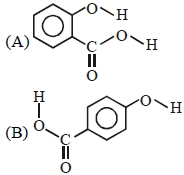
$(a)$ $(B)$ is more likely to be crystalline than $(A)$
$(b)$ $(B)$ has a higher boiling point than $(A)$
$(c)$ $(B)$ dissolves more readily than $(A)$ in water.
Identify the correct option from below:
$(a)$ $(B)$ is more likely to be crystalline than $(A)$
$(b)$ $(B)$ has a higher boiling point than $(A)$
$(c)$ $(B)$ dissolves more readily than $(A)$ in water.
Identify the correct option from below:
A
only $(a)$ is true
B
$(a)$ and $(c)$ are true
C
$(b)$ and $(c)$ are true
D
$(a)$,$(b)$ and $(c)$ are true
Solution
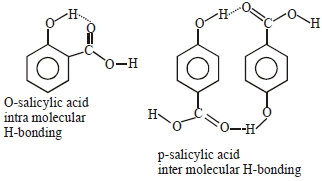
(D) is $o$-hydroxybenzoic acid (salicylic acid),which exhibits intramolecular $H$-bonding.
$(B)$ is $p$-hydroxybenzoic acid,which exhibits intermolecular $H$-bonding.
$(a)$ Due to intermolecular $H$-bonding,$(B)$ molecules associate to form a lattice structure,making it more likely to be crystalline than $(A)$,which exists as discrete molecules due to intramolecular $H$-bonding. Thus,$(a)$ is true.
$(b)$ Intermolecular $H$-bonding in $(B)$ leads to higher molecular association,requiring more energy to break,thus $(B)$ has a higher boiling point than $(A)$. Thus,$(b)$ is true.
$(c)$ $(B)$ can form more extensive $H$-bonding with water molecules compared to $(A)$ due to the availability of its functional groups,making it more soluble in water. Thus,$(c)$ is true.
Therefore,all three statements are correct.
$(B)$ is $p$-hydroxybenzoic acid,which exhibits intermolecular $H$-bonding.
$(a)$ Due to intermolecular $H$-bonding,$(B)$ molecules associate to form a lattice structure,making it more likely to be crystalline than $(A)$,which exists as discrete molecules due to intramolecular $H$-bonding. Thus,$(a)$ is true.
$(b)$ Intermolecular $H$-bonding in $(B)$ leads to higher molecular association,requiring more energy to break,thus $(B)$ has a higher boiling point than $(A)$. Thus,$(b)$ is true.
$(c)$ $(B)$ can form more extensive $H$-bonding with water molecules compared to $(A)$ due to the availability of its functional groups,making it more soluble in water. Thus,$(c)$ is true.
Therefore,all three statements are correct.
0 likes
View Solution543
MediumMCQ
Which one of the following compounds possesses the most acidic hydrogen $?$
A
Propanedinitrile $(CH_2(CN)_2)$
B
$H_3C-C \equiv C-H$
C
Acetone $(CH_3COCH_3)$
D
Trimethyl methanetricarboxylate $(CH(COOCH_3)_3)$
Solution
(D) The acidity of a hydrogen atom depends on the stability of the conjugate base formed after the removal of the proton.
In trimethyl methanetricarboxylate,the central carbon is attached to three electron-withdrawing ester groups $(-COOCH_3)$.
These groups stabilize the resulting carbanion through strong inductive $(-I)$ and resonance $(-R)$ effects.
Since there are three such groups,the negative charge on the carbanion is highly delocalized,making the hydrogen atom significantly more acidic compared to the other options.
In trimethyl methanetricarboxylate,the central carbon is attached to three electron-withdrawing ester groups $(-COOCH_3)$.
These groups stabilize the resulting carbanion through strong inductive $(-I)$ and resonance $(-R)$ effects.
Since there are three such groups,the negative charge on the carbanion is highly delocalized,making the hydrogen atom significantly more acidic compared to the other options.
0 likes
View Solution544
MediumMCQ
The increasing order of the acidity of the $\alpha$-hydrogen of the following compounds is:
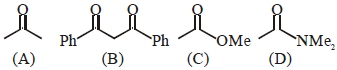
A
$(C) < (A) < (B) < (D)$
B
$(B) < (C) < (A) < (D)$
C
$(A) < (C) < (D) < (B)$
D
$(D) < (C) < (A) < (B)$
Solution
(D) The acidity of $\alpha$-hydrogen depends on the stability of the resulting carbanion. The more stable the carbanion,the more acidic the $\alpha$-hydrogen.
$(B)$ $Ph-CO-CH_2-CO-Ph$ is the most acidic because the carbanion is stabilized by resonance with two carbonyl groups and two phenyl rings.
$(A)$ $CH_3-CO-CH_3$ (acetone) has a carbanion stabilized by one carbonyl group.
$(C)$ $CH_3-CO-OCH_3$ (methyl acetate) has a carbanion that is less stable than $(A)$ due to cross-conjugation of the lone pair on oxygen with the carbonyl group,which reduces the electron-withdrawing effect of the carbonyl.
$(D)$ $CH_3-CO-N(CH_3)_2$ ($N$,$N$-dimethylacetamide) is the least acidic because the nitrogen lone pair participates in strong resonance (cross-conjugation) with the carbonyl group,making the carbonyl carbon less electron-withdrawing.
Therefore,the increasing order of acidity is $(D) < (C) < (A) < (B)$.
$(B)$ $Ph-CO-CH_2-CO-Ph$ is the most acidic because the carbanion is stabilized by resonance with two carbonyl groups and two phenyl rings.
$(A)$ $CH_3-CO-CH_3$ (acetone) has a carbanion stabilized by one carbonyl group.
$(C)$ $CH_3-CO-OCH_3$ (methyl acetate) has a carbanion that is less stable than $(A)$ due to cross-conjugation of the lone pair on oxygen with the carbonyl group,which reduces the electron-withdrawing effect of the carbonyl.
$(D)$ $CH_3-CO-N(CH_3)_2$ ($N$,$N$-dimethylacetamide) is the least acidic because the nitrogen lone pair participates in strong resonance (cross-conjugation) with the carbonyl group,making the carbonyl carbon less electron-withdrawing.
Therefore,the increasing order of acidity is $(D) < (C) < (A) < (B)$.
0 likes
View Solution545
DifficultMCQ
Which of the following derivatives of alcohols is unstable in an aqueous base $?$
A
$RO^{-}CMe_3$
B
$RO-CO-CH_3$
C
$RO-CH_2-C_6H_5$
D
$RO-C_5H_9O$
Solution
(B) The stability of alcohol derivatives in an aqueous base depends on their susceptibility to hydrolysis.
Esters,represented by the structure $RO-CO-CH_3$,undergo base-catalyzed hydrolysis (saponification) in an aqueous base.
The mechanism involves the nucleophilic attack of the $OH^-$ ion on the carbonyl carbon of the ester,followed by the elimination of the alkoxide ion $(RO^-)$,which then abstracts a proton from the resulting carboxylic acid to form an alcohol and a carboxylate ion.
Other derivatives like ethers $(RO-CH_2-C_6H_5)$ and acetals/ketals $(RO-C_5H_9O)$ are generally stable in basic media.
Esters,represented by the structure $RO-CO-CH_3$,undergo base-catalyzed hydrolysis (saponification) in an aqueous base.
The mechanism involves the nucleophilic attack of the $OH^-$ ion on the carbonyl carbon of the ester,followed by the elimination of the alkoxide ion $(RO^-)$,which then abstracts a proton from the resulting carboxylic acid to form an alcohol and a carboxylate ion.
Other derivatives like ethers $(RO-CH_2-C_6H_5)$ and acetals/ketals $(RO-C_5H_9O)$ are generally stable in basic media.
0 likes
View Solution546
MediumMCQ
Which of the following acids will form an $(a)$ anhydride on heating and $(b)$ an acid imide on strong heating with ammonia?
A
$Phthalic \ acid$
B
$Succinic \ acid$
C
$Maleic \ acid$
D
$Adipic \ acid$
Solution
(A) Phthalic acid $(C_6H_4(COOH)_2)$ on heating loses a water molecule to form phthalic anhydride. When heated strongly with ammonia,it forms phthalimide,which is an acid imide. Succinic acid also behaves similarly,but phthalic acid is the standard example for this reaction in the context of aromatic dicarboxylic acids.
0 likes
View Solution547
MediumMCQ
The relative reactivities of acyl compounds towards nucleophilic substitution are in the order of
A
acyl chloride $ > $ acid anhydride $ > $ ester $ > $ amide
B
ester $ > $ acyl chloride $ > $ amide $ > $ acid anhydride
C
acid anhydride $ > $ amide $ > $ ester $ > $ acyl chloride
D
acyl chloride $ > $ ester $ > $ acid anhydride $ > $ amide
Solution
(A) The ease of nucleophilic substitution depends upon the nature of the leaving group. When the leaving tendency of a group in a compound is high,the compound is more reactive towards nucleophilic substitution.
The nucleophilic acyl substitution proceeds in two steps as shown in the mechanism:
$1$. Nucleophilic attack on the carbonyl carbon to form a tetrahedral intermediate.
$2$. Elimination of the leaving group $(A^-)$ to regenerate the carbonyl group.
The order of leaving tendency is $Cl^{-} > RCOO^{-} > RO^{-} > NH_{2}^{-}$.
Therefore,the order of reactivity of acyl compounds is:
$RCOCl$ (Acyl chloride) $ > (RCO)_2O$ (Acid anhydride) $ > RCOOR$ (Ester) $ > RCONH_2$ (Amide).
The nucleophilic acyl substitution proceeds in two steps as shown in the mechanism:
$1$. Nucleophilic attack on the carbonyl carbon to form a tetrahedral intermediate.
$2$. Elimination of the leaving group $(A^-)$ to regenerate the carbonyl group.
The order of leaving tendency is $Cl^{-} > RCOO^{-} > RO^{-} > NH_{2}^{-}$.
Therefore,the order of reactivity of acyl compounds is:
$RCOCl$ (Acyl chloride) $ > (RCO)_2O$ (Acid anhydride) $ > RCOOR$ (Ester) $ > RCONH_2$ (Amide).
0 likes
View Solution548
MediumMCQ
Identify the suitable reagents for the following conversion:
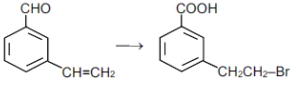
A
$CH_3MgBr, H_3O^{+}, I_2/NaOH, HBr/R_2O_2$
B
$KMnO_4/NaOH, HBr/R_2O_2$
C
$CH_3MgBr, KMnO_4, HBr$
D
$CH_3MgBr, H_3O^{+}, HBr, I_2/NaOH$
Solution
(A) The conversion of $3-$vinylbenzaldehyde to $3-(2-$bromoethyl$)$benzoic acid involves two main transformations:
$1$. Oxidation of the aldehyde group $(-CHO)$ to a carboxylic acid group $(-COOH)$ using the iodoform test reagents $(I_2/NaOH)$ which selectively oxidizes the methyl ketone or aldehyde group while leaving the alkene intact.
$2$. Anti-Markovnikov addition of $HBr$ to the vinyl group $(-CH=CH_2)$ using $HBr/R_2O_2$ (peroxide effect) to yield the $2-$bromoethyl substituent.
Thus,the correct sequence of reagents is $I_2/NaOH$ followed by $HBr/R_2O_2$.
$1$. Oxidation of the aldehyde group $(-CHO)$ to a carboxylic acid group $(-COOH)$ using the iodoform test reagents $(I_2/NaOH)$ which selectively oxidizes the methyl ketone or aldehyde group while leaving the alkene intact.
$2$. Anti-Markovnikov addition of $HBr$ to the vinyl group $(-CH=CH_2)$ using $HBr/R_2O_2$ (peroxide effect) to yield the $2-$bromoethyl substituent.
Thus,the correct sequence of reagents is $I_2/NaOH$ followed by $HBr/R_2O_2$.
0 likes
View Solution8-2.Carboxylic acids and Their derivative — Properties of Carboxylic Acids and Their Derivatives · Frequently Asked Questions
1Are these 8-2.Carboxylic acids and Their derivative questions useful for JEE and NEET?
Yes. All questions in this section are mapped to JEE Main and NEET exam patterns. Previous year questions from JEE Main, NEET, GUJCET and state-level exams are included with full solutions.
2Can I switch to Hindi or Gujarati for these questions?
Yes. Use the language tabs in the hero section or the sidebar to view the same questions and solutions in English, Hindi or Gujarati.
3How do I generate a question paper from this subtopic?
Use the Vedclass Exam Paper Generator — select the chapter and subtopic, set difficulty, and generate Sets A, B, C, D automatically. First 3 chapters of every subject are free.
Vedclass Products
For Students
Vedclass Test Series
Mock tests in real JEE/NEET style with performance analysis. 5-day free trial.
Start Free TrialFor Teachers
Exam Paper Generator
Generate Set A/B/C/D papers from this chapter in 2 minutes. 3 chapters free.
Try FreeFor Institutes
Online Exam Module
Live online exams with unlimited students, 360° analytics & white-label branding.
See DemoFor Teachers & Institutes
Generate a 8-2.Carboxylic acids and Their derivative Exam Paper in 2 Minutes
Select subtopic & difficulty — Sets A, B, C, D auto-generated with No Repeat logic.
First 3 chapters of every subject are free — no payment required.