
A English
Properties of Carboxylic Acids and Their Derivatives Questions in English
Class 12 Chemistry · 8-2.Carboxylic acids and Their derivative · Properties of Carboxylic Acids and Their Derivatives
791+
Questions
English
Language
100%
With Solutions
Showing 50 of 791 questions in English
401
MediumMCQ
Arrange the following in order of increasing reactivity (least $\to$ most) towards nucleophilic acyl substitution:
$1. CH_3COCH_2CH_3$,$2. CH_3COCl$,$3. CH_3CONHCH_3$
$1. CH_3COCH_2CH_3$,$2. CH_3COCl$,$3. CH_3CONHCH_3$
A
$1 < 2 < 3$
B
$3 < 1 < 2$
C
$1 < 3 < 2$
D
$2 < 1 < 3$
Solution
(B) The reactivity of carboxylic acid derivatives towards nucleophilic acyl substitution depends on the nature of the leaving group attached to the acyl carbon.
The order of leaving group ability is: $Cl^- > CH_3CH_2O^- > CH_3NH^-$.
Therefore,the order of reactivity is:
$3. CH_3CONHCH_3$ (amide,least reactive) $< 1. CH_3COCH_2CH_3$ (ester) $< 2. CH_3COCl$ (acid chloride,most reactive).
The correct order is $3 < 1 < 2$.
The order of leaving group ability is: $Cl^- > CH_3CH_2O^- > CH_3NH^-$.
Therefore,the order of reactivity is:
$3. CH_3CONHCH_3$ (amide,least reactive) $< 1. CH_3COCH_2CH_3$ (ester) $< 2. CH_3COCl$ (acid chloride,most reactive).
The correct order is $3 < 1 < 2$.
0 likes
View Solution402
MediumMCQ
$A$ key step in the hydrolysis of acetamide in aqueous acid proceeds by nucleophilic addition of
A
$H_3O^{+}$ to $CH_3-CONH_2$
B
$H_2O$ to $CH_3-C(OH^{+})-NH_2$
C
$H_3O^{+}$ to $CH_3-C(OH^{+})-NH_2$
D
$HO^{-}$ to $CH_3-C(OH^{+})-NH_2$
Solution
(B) In the acid-catalyzed hydrolysis of acetamide $(CH_3CONH_2)$,the first step is the protonation of the carbonyl oxygen by $H_3O^{+}$ to form a resonance-stabilized cation,$CH_3-C(OH^{+})-NH_2$.
Following this,the nucleophile,which is water $(H_2O)$,attacks the electrophilic carbonyl carbon of the protonated acetamide.
This nucleophilic addition of $H_2O$ to the protonated species $CH_3-C(OH^{+})-NH_2$ is the key step that leads to the formation of the tetrahedral intermediate.
Following this,the nucleophile,which is water $(H_2O)$,attacks the electrophilic carbonyl carbon of the protonated acetamide.
This nucleophilic addition of $H_2O$ to the protonated species $CH_3-C(OH^{+})-NH_2$ is the key step that leads to the formation of the tetrahedral intermediate.
0 likes
View Solution403
DifficultMCQ
Which reaction is not possible for acetic anhydride?
A
$(CH_3CO)_2O + 2HN(CH_3)_2 \rightarrow CH_3CON(CH_3)_2 + CH_3CO_2^- + H_2N^{+}(CH_3)_2$
B
$(CH_3CO)_2O + CH_3CH_2OH \rightarrow CH_3COOCH_2CH_3 + CH_3COOH$
C
$(CH_3CO)_2O + C_6H_6 \xrightarrow{AlCl_3} CH_3COC_6H_5 + CH_3COOH$
D
$(CH_3CO)_2O + NaCl \rightarrow CH_3COCl + CH_3COONa$
Solution
(D) The reaction $(CH_3CO)_2O + NaCl \rightarrow CH_3COCl + CH_3COONa$ is not possible.
This is because $Cl^-$ is a much weaker base than the acetate ion $(CH_3COO^-)$.
In a nucleophilic acyl substitution reaction,a stronger base (nucleophile) can displace a weaker base (leaving group),but a weaker base cannot displace a stronger base.
The basicity order is $Cl^- < CH_3COO^- < RO^- < NH_2^-$.
Therefore,$Cl^-$ cannot act as a nucleophile to displace the acetate group from acetic anhydride.
This is because $Cl^-$ is a much weaker base than the acetate ion $(CH_3COO^-)$.
In a nucleophilic acyl substitution reaction,a stronger base (nucleophile) can displace a weaker base (leaving group),but a weaker base cannot displace a stronger base.
The basicity order is $Cl^- < CH_3COO^- < RO^- < NH_2^-$.
Therefore,$Cl^-$ cannot act as a nucleophile to displace the acetate group from acetic anhydride.
0 likes
View Solution404
MediumMCQ
Which of the following acids remains unaffected on heating?
A
Malonic acid
B
Maleic acid
C
Fumaric acid
D
Succinic acid
Solution
(C) Heating effects on dicarboxylic acids:
$1$. Malonic acid $(CH_2(COOH)_2)$ undergoes decarboxylation to form acetic acid $(CH_3COOH)$ and $CO_2$.
$2$. Maleic acid (cis-butenedioic acid) loses a molecule of water on heating to form maleic anhydride.
$3$. Succinic acid $(HOOC-CH_2-CH_2-COOH)$ loses a molecule of water on heating to form succinic anhydride.
$4$. Fumaric acid (trans-butenedioic acid) is stable and does not form an anhydride on heating because the two carboxylic acid groups are on opposite sides of the double bond,making the formation of a cyclic anhydride geometrically impossible.
Therefore,Fumaric acid remains unaffected on heating.
$1$. Malonic acid $(CH_2(COOH)_2)$ undergoes decarboxylation to form acetic acid $(CH_3COOH)$ and $CO_2$.
$2$. Maleic acid (cis-butenedioic acid) loses a molecule of water on heating to form maleic anhydride.
$3$. Succinic acid $(HOOC-CH_2-CH_2-COOH)$ loses a molecule of water on heating to form succinic anhydride.
$4$. Fumaric acid (trans-butenedioic acid) is stable and does not form an anhydride on heating because the two carboxylic acid groups are on opposite sides of the double bond,making the formation of a cyclic anhydride geometrically impossible.
Therefore,Fumaric acid remains unaffected on heating.
0 likes
View Solution405
DifficultMCQ
Identify the product $(A)$ in the following reaction:
$Ph-CO-Cl + \text{Morpholine} \rightarrow (A) \text{ (Major)}$
$Ph-CO-Cl + \text{Morpholine} \rightarrow (A) \text{ (Major)}$
A
$Ph-CO-O-C_4H_8N$
B
$Ph-CO-N(C_4H_8O)$
C
$Ph-CO-NH-C_4H_8O$
D
$Ph-CO-NH_2$
Solution
(B) The reaction involves the nucleophilic acyl substitution of benzoyl chloride $(Ph-CO-Cl)$ with morpholine.
Morpholine is a secondary amine containing both an oxygen atom and a nitrogen atom.
Nitrogen is more nucleophilic than the oxygen atom because the lone pair on nitrogen is more available for donation than the lone pair on oxygen,which is involved in resonance or is less basic.
Therefore,the nitrogen atom of morpholine attacks the carbonyl carbon of benzoyl chloride to form an amide product,$N$-benzoyl-morpholine.
Morpholine is a secondary amine containing both an oxygen atom and a nitrogen atom.
Nitrogen is more nucleophilic than the oxygen atom because the lone pair on nitrogen is more available for donation than the lone pair on oxygen,which is involved in resonance or is less basic.
Therefore,the nitrogen atom of morpholine attacks the carbonyl carbon of benzoyl chloride to form an amide product,$N$-benzoyl-morpholine.
0 likes
View Solution406
DifficultMCQ
Which of the following is an intermediate formed in the reaction shown below?
$CH_3-C(=O)-Cl + NH_3 \to$ Intermediate $\to$ product
$CH_3-C(=O)-Cl + NH_3 \to$ Intermediate $\to$ product
A
$CH_3-\overset{\oplus}{N}H_3$
B
$CH_3-C^{\oplus}=O$
C
$Cl^{-}C(OH)(Cl)-NH_3^{\oplus}$
D
$CH_3-C(O^{-})(Cl)(NH_3^{\oplus})$
Solution
(D) The reaction between acetyl chloride $(CH_3COCl)$ and ammonia $(NH_3)$ is a nucleophilic acyl substitution reaction.
In the first step,the lone pair on the nitrogen atom of ammonia acts as a nucleophile and attacks the electrophilic carbonyl carbon of the acetyl chloride.
This leads to the formation of a tetrahedral intermediate where the carbonyl oxygen acquires a negative charge and the nitrogen atom acquires a positive charge.
The structure of this intermediate is $CH_3-C(O^{-})(Cl)(NH_3^{\oplus})$.
In the first step,the lone pair on the nitrogen atom of ammonia acts as a nucleophile and attacks the electrophilic carbonyl carbon of the acetyl chloride.
This leads to the formation of a tetrahedral intermediate where the carbonyl oxygen acquires a negative charge and the nitrogen atom acquires a positive charge.
The structure of this intermediate is $CH_3-C(O^{-})(Cl)(NH_3^{\oplus})$.
0 likes
View Solution407
MediumMCQ
Which is the major product of the following reaction? $CH_3-COCl \xrightarrow{H_2S} \text{product}$
A
$CH_3-C(OH)(Cl)-SH$
B
$CH_3-COSH$
C
$CH_3-CSCl$
D
$CH_3-CO-S-CO-CH_3$
Solution
(B) The reaction between acetyl chloride $(CH_3COCl)$ and hydrogen sulfide $(H_2S)$ is a nucleophilic acyl substitution reaction.
In this reaction,the sulfur atom of $H_2S$ acts as a nucleophile and attacks the electrophilic carbonyl carbon of the acetyl chloride.
This leads to the displacement of the chloride ion $(Cl^-)$ and the formation of thioacetic acid $(CH_3COSH)$ as the major product,along with the release of hydrogen chloride $(HCl)$.
The reaction is: $CH_3COCl + H_2S \rightarrow CH_3COSH + HCl$.
In this reaction,the sulfur atom of $H_2S$ acts as a nucleophile and attacks the electrophilic carbonyl carbon of the acetyl chloride.
This leads to the displacement of the chloride ion $(Cl^-)$ and the formation of thioacetic acid $(CH_3COSH)$ as the major product,along with the release of hydrogen chloride $(HCl)$.
The reaction is: $CH_3COCl + H_2S \rightarrow CH_3COSH + HCl$.
0 likes
View Solution408
DifficultMCQ
Which one of the following is not an intermediate in the generally accepted mechanism for the reaction shown below?
$CF_3C(O)OH + CH_3CH(OH)CH_3 \xrightarrow{H_2SO_4} CF_3C(O)OCH(CH_3)_2 + H_2O$
$CF_3C(O)OH + CH_3CH(OH)CH_3 \xrightarrow{H_2SO_4} CF_3C(O)OCH(CH_3)_2 + H_2O$
A
$CF_3C(OH)_2^+$
B
$CF_3C(OH)(OH^-)OCH(CH_3)_2^+$
C
$CF_3C(OH)(OH_2^+)OCH(CH_3)_2$
D
$CF_3C(OH)_2OCH(CH_3)_2^+$
Solution
(B) The reaction is an acid-catalyzed esterification (Fischer esterification) between a carboxylic acid and an alcohol.
$1$. Protonation of the carbonyl oxygen of $CF_3COOH$ gives $CF_3C(OH)_2^+$.
$2$. Nucleophilic attack by the alcohol $CH_3CH(OH)CH_3$ on the activated carbonyl carbon leads to the tetrahedral intermediate $CF_3C(OH)_2OCH(CH_3)_2^+$.
$3$. Proton transfer occurs to form $CF_3C(OH)(OH_2^+)OCH(CH_3)_2$.
$4$. Elimination of water and deprotonation yields the ester $CF_3C(O)OCH(CH_3)_2$.
Option $B$ involves an $OH^-$ species,which is a strong base and cannot exist in a highly acidic medium $(H_2SO_4)$. Therefore,it is not a valid intermediate.
$1$. Protonation of the carbonyl oxygen of $CF_3COOH$ gives $CF_3C(OH)_2^+$.
$2$. Nucleophilic attack by the alcohol $CH_3CH(OH)CH_3$ on the activated carbonyl carbon leads to the tetrahedral intermediate $CF_3C(OH)_2OCH(CH_3)_2^+$.
$3$. Proton transfer occurs to form $CF_3C(OH)(OH_2^+)OCH(CH_3)_2$.
$4$. Elimination of water and deprotonation yields the ester $CF_3C(O)OCH(CH_3)_2$.
Option $B$ involves an $OH^-$ species,which is a strong base and cannot exist in a highly acidic medium $(H_2SO_4)$. Therefore,it is not a valid intermediate.
0 likes
View Solution409
DifficultMCQ
What is compound $Z$?
$CH_3CH_2CH_2Br$ $\xrightarrow{NaCN} X$ $\xrightarrow[heat]{H_3O^{+}} Y$ $\xrightarrow[H^{+}]{CH_3CH_2OH} Z$
$CH_3CH_2CH_2Br$ $\xrightarrow{NaCN} X$ $\xrightarrow[heat]{H_3O^{+}} Y$ $\xrightarrow[H^{+}]{CH_3CH_2OH} Z$
A
$CH_3CH=CH^{-}COOH$
B
$CH_3CH_2CH_2CH=NOCH_2CH_3$
C
$CH_3CH_2CH_2CH(OCH_2CH_3)$
D
$CH_3CH_2CH_2COOCH_2CH_3$
Solution
(D) Step $1$: $CH_3CH_2CH_2Br + NaCN \to CH_3CH_2CH_2CN (X) + NaBr$ (Nucleophilic substitution).
Step $2$: $CH_3CH_2CH_2CN + H_3O^{+} \xrightarrow{\Delta} CH_3CH_2CH_2COOH (Y) + NH_4^{+}$ (Acidic hydrolysis of nitrile).
Step $3$: $CH_3CH_2CH_2COOH + CH_3CH_2OH \xrightarrow{H^{+}} CH_3CH_2CH_2COOCH_2CH_3 (Z) + H_2O$ (Esterification reaction).
Thus,compound $Z$ is $CH_3CH_2CH_2COOCH_2CH_3$.
Step $2$: $CH_3CH_2CH_2CN + H_3O^{+} \xrightarrow{\Delta} CH_3CH_2CH_2COOH (Y) + NH_4^{+}$ (Acidic hydrolysis of nitrile).
Step $3$: $CH_3CH_2CH_2COOH + CH_3CH_2OH \xrightarrow{H^{+}} CH_3CH_2CH_2COOCH_2CH_3 (Z) + H_2O$ (Esterification reaction).
Thus,compound $Z$ is $CH_3CH_2CH_2COOCH_2CH_3$.
0 likes
View Solution410
MediumMCQ
$CH_3 - CH = CH - CH_2 - CO_2H \xrightarrow[\Delta ]{}(X) \,(major)$; Product $(X)$ is
A
$CH_3 - CH = CH - CH_3$
B
$CH_3 - C(CH_3) = CH_2$
C
$CH_3 - CH_2 - CH = CH_2$
D
$CH_3 - CH = CH_2$
Solution
(C) The given reaction is the thermal decarboxylation of a $\beta,\gamma$-unsaturated carboxylic acid.
This reaction proceeds via a concerted,six-membered cyclic transition state (pericyclic mechanism).
During the process,the hydrogen atom from the carboxylic group is transferred to the $\gamma$-carbon,while the $CO_2$ molecule is eliminated and a new double bond is formed between the $\alpha$ and $\beta$ carbons.
For the reactant $CH_3 - CH = CH - CH_2 - CO_2H$,the product formed is $CH_3 - CH_2 - CH = CH_2$ (but$-1-$ene).
Therefore,the correct option is $C$.
This reaction proceeds via a concerted,six-membered cyclic transition state (pericyclic mechanism).
During the process,the hydrogen atom from the carboxylic group is transferred to the $\gamma$-carbon,while the $CO_2$ molecule is eliminated and a new double bond is formed between the $\alpha$ and $\beta$ carbons.
For the reactant $CH_3 - CH = CH - CH_2 - CO_2H$,the product formed is $CH_3 - CH_2 - CH = CH_2$ (but$-1-$ene).
Therefore,the correct option is $C$.
0 likes
View Solution411
DifficultMCQ
$HOOC-(CH_2)_n-COOH \xrightarrow[\Delta]{} \text{product}$
At what value of $(n)$ will the given compound not evolve $CO_2$ gas?
At what value of $(n)$ will the given compound not evolve $CO_2$ gas?
A
$5$
B
$4$
C
$2$
D
$1$
Solution
(C) The thermal decomposition of dicarboxylic acids depends on the ring size of the resulting anhydride or ketone.
For $n=0$ (oxalic acid) and $n=1$ (malonic acid),heating leads to decarboxylation,evolving $CO_2$ gas.
For $n=2$ (succinic acid) and $n=3$ (glutaric acid),heating leads to the formation of stable cyclic anhydrides without the evolution of $CO_2$ gas.
For $n \ge 4$,the formation of larger rings is less favorable,and other pathways may occur,but specifically for $n=2$,the product is succinic anhydride,which does not involve $CO_2$ loss.
For $n=0$ (oxalic acid) and $n=1$ (malonic acid),heating leads to decarboxylation,evolving $CO_2$ gas.
For $n=2$ (succinic acid) and $n=3$ (glutaric acid),heating leads to the formation of stable cyclic anhydrides without the evolution of $CO_2$ gas.
For $n \ge 4$,the formation of larger rings is less favorable,and other pathways may occur,but specifically for $n=2$,the product is succinic anhydride,which does not involve $CO_2$ loss.
0 likes
View Solution412
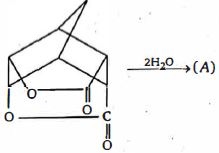
AdvancedMCQ
Product $(A)$ of the above reaction is
A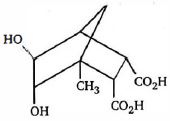
B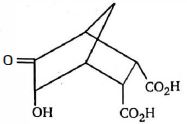
C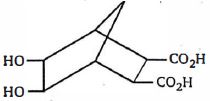
D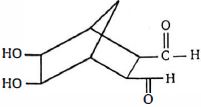
Solution
(C) The reactant is a bicyclic di-lactone (an anhydride-like structure).
Hydrolysis of the ester/lactone linkages with $2H_2O$ leads to the opening of the rings.
The two lactone rings open to form two carboxylic acid groups $(-CO_2H)$ and two hydroxyl groups $(-OH)$ on the bicyclic framework.
This corresponds to the structure shown in option $(C)$.
Hydrolysis of the ester/lactone linkages with $2H_2O$ leads to the opening of the rings.
The two lactone rings open to form two carboxylic acid groups $(-CO_2H)$ and two hydroxyl groups $(-OH)$ on the bicyclic framework.
This corresponds to the structure shown in option $(C)$.
0 likes
View Solution413
DifficultMCQ
The product of the reaction is:
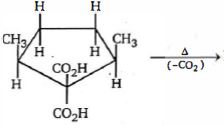
A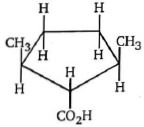
B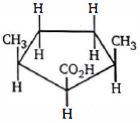
C
Both $(a)$ and $(b)$
D
None of these
Solution
(C) The starting material is a $1,1$-dicarboxylic acid derivative of a cyclopentane ring. Upon heating,geminal dicarboxylic acids undergo decarboxylation,where one of the $-CO_2H$ groups is lost as $CO_2$. Since the starting material has two $-CO_2H$ groups at the same carbon,the decarboxylation can occur by losing either of the two groups. Because the molecule has stereocenters at the positions of the methyl groups,the loss of the two different $-CO_2H$ groups leads to the formation of two different stereoisomers (diastereomers) of the resulting monocarboxylic acid. Therefore,both products shown in options $(a)$ and $(b)$ are formed.
0 likes
View Solution414
MediumMCQ
In which of the following reactions will cyanide be obtained as a major product?
A
$Ph-C(=O)-CH_3 \xrightarrow[(i) \ LiAlH_4]{(ii) \ H_3O^+} Ph-CH(OH)-CH_3$
B
$Ph-C(=O)-NH_2 \xrightarrow[Br_2]{NaOH} Ph-NH_2$
C
$Ph-C(=O)-NH_2 \xrightarrow{P_4O_{10}} Ph-C \equiv N$
D
$Ph-C(=O)-OH$ $\xrightarrow{SOCl_2} Ph-C(=O)Cl$ $\xrightarrow{NH_3} Ph-C(=O)-NH_2$
Solution
(C) The reaction of an amide $(Ph-C(=O)-NH_2)$ with a strong dehydrating agent like $P_4O_{10}$ leads to the removal of a water molecule to form a nitrile (cyanide) as the major product.
$Ph-C(=O)-NH_2 \xrightarrow{P_4O_{10}} Ph-C \equiv N + H_2O$.
$Ph-C(=O)-NH_2 \xrightarrow{P_4O_{10}} Ph-C \equiv N + H_2O$.
0 likes
View Solution415
MediumMCQ
The major product formed in the reaction is

A
Phenyl $3$-nitrobenzoate
B
Phenyl $4$-nitrobenzoate
C
$2$-nitrophenyl benzoate
D
$4$-nitrophenyl benzoate
Solution
(D) The reactant is phenyl benzoate,which contains two benzene rings: one attached to the carbonyl group (benzoyl ring) and one attached to the oxygen atom (phenolic ring).
Electrophilic aromatic substitution (nitration) occurs on the more activated ring.
The phenolic ring is activated by the $+M$ effect of the oxygen atom,while the benzoyl ring is deactivated by the $-M$ effect of the carbonyl group.
Therefore,the phenolic ring is more reactive towards electrophilic substitution.
In the phenolic ring,the $-O-CO-Ph$ group is ortho/para directing.
Due to the steric hindrance caused by the bulky benzoyl group at the ortho position,the para position is the major site for nitration.
Thus,the major product is $4$-nitrophenyl benzoate.
Electrophilic aromatic substitution (nitration) occurs on the more activated ring.
The phenolic ring is activated by the $+M$ effect of the oxygen atom,while the benzoyl ring is deactivated by the $-M$ effect of the carbonyl group.
Therefore,the phenolic ring is more reactive towards electrophilic substitution.
In the phenolic ring,the $-O-CO-Ph$ group is ortho/para directing.
Due to the steric hindrance caused by the bulky benzoyl group at the ortho position,the para position is the major site for nitration.
Thus,the major product is $4$-nitrophenyl benzoate.
0 likes
View Solution416
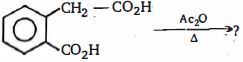
MediumMCQ
Identify the product of the following reaction:
A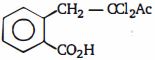
B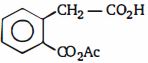
C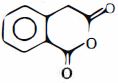
D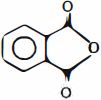
Solution
(C) $Ac_2O$ (acetic anhydride) acts as a dehydrating agent when heated with carboxylic acids. In the case of $o$-phenylacetic acid,the two carboxylic acid groups are positioned such that they can undergo intramolecular cyclization to form a cyclic anhydride. The reaction involves the loss of a water molecule between the two carboxyl groups,resulting in the formation of homophthalic anhydride.
0 likes
View Solution417
MediumMCQ
The unknown product $(A)$ is:
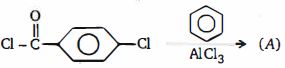
A
$4-$chlorobenzophenone
B
$3-$chlorobenzophenone
C
$4-$chlorobenzophenone
D
Benzophenone
Solution
(C) The reaction is a Friedel-Crafts acylation reaction.
In this reaction,$4$-chlorobenzoyl chloride reacts with benzene in the presence of a Lewis acid catalyst,$AlCl_3$.
The $AlCl_3$ facilitates the formation of the acylium ion,which then undergoes electrophilic aromatic substitution on the benzene ring to form $4$-chlorobenzophenone as the product $(A)$.
In this reaction,$4$-chlorobenzoyl chloride reacts with benzene in the presence of a Lewis acid catalyst,$AlCl_3$.
The $AlCl_3$ facilitates the formation of the acylium ion,which then undergoes electrophilic aromatic substitution on the benzene ring to form $4$-chlorobenzophenone as the product $(A)$.
0 likes
View Solution418
MediumMCQ
$Ph-CO_2H$ $\xrightarrow{SOCl_2} A$ $\xrightarrow{Me_2NH} B$ $\xrightarrow{(C)} Ph-CHO$. The unknown reagent $(C)$ is:
A
$LiAlH_4$
B
$NaBH_4$
C
$LiAlH(Ot-Bu)_3$
D
$PCC/CH_2Cl_2$
Solution
(C) The reaction sequence is:
$Ph-CO_2H \xrightarrow{SOCl_2} Ph-COCl (A)$
$Ph-COCl \xrightarrow{Me_2NH} Ph-CON(CH_3)_2 (B)$
$Ph-CON(CH_3)_2 \xrightarrow{LiAlH(Ot-Bu)_3} Ph-CHO$
Reagent $(C)$ is $LiAlH(Ot-Bu)_3$ (Lithium tri-tert-butoxyaluminum hydride).
This is a selective reducing agent that reduces tertiary amides to aldehydes.
$Ph-CO_2H \xrightarrow{SOCl_2} Ph-COCl (A)$
$Ph-COCl \xrightarrow{Me_2NH} Ph-CON(CH_3)_2 (B)$
$Ph-CON(CH_3)_2 \xrightarrow{LiAlH(Ot-Bu)_3} Ph-CHO$
Reagent $(C)$ is $LiAlH(Ot-Bu)_3$ (Lithium tri-tert-butoxyaluminum hydride).
This is a selective reducing agent that reduces tertiary amides to aldehydes.
0 likes
View Solution419
MediumMCQ
$C_6H_5(CH_2)_5COCl$ $\xrightarrow[CS_2]{AlCl_3}$ $(A)$ $(C_{12}H_{14}O)$ $\xrightarrow[H_3O^{\oplus}]{KMnO_4, \Delta}$ $(B)$. Compound $(B)$ is
A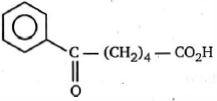
B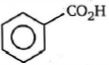
C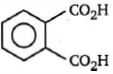
D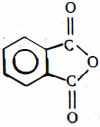
Solution
(C) $1$. The first step is an intramolecular Friedel-Crafts acylation of $C_6H_5(CH_2)_5COCl$ in the presence of $AlCl_3$ and $CS_2$. This reaction forms a cyclic ketone,specifically $\alpha$-tetralone derivative,which is $1$-oxo-$1,2,3,4$-tetrahydronaphthalene (or a substituted version depending on chain length). Given the formula $C_{12}H_{14}O$,the product $(A)$ is $1$-oxo-$1,2,3,4$-tetrahydronaphthalene.
$2$. The second step involves the oxidation of the cyclic ketone $(A)$ using $KMnO_4$ in the presence of $H_3O^{\oplus}$ and heat. Strong oxidation of the alkyl side chain attached to the benzene ring results in the cleavage of the ring and the formation of a dicarboxylic acid.
$3$. The oxidation of $1$-oxo-$1,2,3,4$-tetrahydronaphthalene with $KMnO_4$ leads to the formation of phthalic acid (benzene-$1,2$-dicarboxylic acid).
$4$. Therefore,compound $(B)$ is phthalic acid,which corresponds to the structure shown in option $(C)$.
$2$. The second step involves the oxidation of the cyclic ketone $(A)$ using $KMnO_4$ in the presence of $H_3O^{\oplus}$ and heat. Strong oxidation of the alkyl side chain attached to the benzene ring results in the cleavage of the ring and the formation of a dicarboxylic acid.
$3$. The oxidation of $1$-oxo-$1,2,3,4$-tetrahydronaphthalene with $KMnO_4$ leads to the formation of phthalic acid (benzene-$1,2$-dicarboxylic acid).
$4$. Therefore,compound $(B)$ is phthalic acid,which corresponds to the structure shown in option $(C)$.
0 likes
View Solution420
MediumMCQ
The product $(C)$ of the following reaction is:
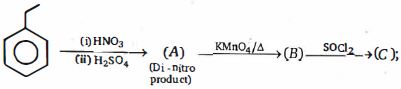
A
$2,4-$dinitrobenzoyl chloride
B
$3,4-$dinitrobenzoyl chloride
C
$2,5-$dinitrobenzoyl chloride
D
$3,5-$dinitrobenzoyl chloride
Solution
(A) $1$. The starting material is ethylbenzene. Nitration with $HNO_3/H_2SO_4$ introduces two nitro groups at the ortho and para positions relative to the ethyl group,forming $1-$ethyl$-2,4-$dinitrobenzene $(A)$.
$2$. Oxidation of the alkyl side chain with $KMnO_4/\Delta$ converts the ethyl group into a carboxylic acid group,resulting in $2,4-$dinitrobenzoic acid $(B)$.
$3$. Treatment of the carboxylic acid with $SOCl_2$ converts the $-COOH$ group into an acid chloride group $(-COCl)$,yielding $2,4-$dinitrobenzoyl chloride $(C)$.
$2$. Oxidation of the alkyl side chain with $KMnO_4/\Delta$ converts the ethyl group into a carboxylic acid group,resulting in $2,4-$dinitrobenzoic acid $(B)$.
$3$. Treatment of the carboxylic acid with $SOCl_2$ converts the $-COOH$ group into an acid chloride group $(-COCl)$,yielding $2,4-$dinitrobenzoyl chloride $(C)$.
0 likes
View Solution421
DifficultMCQ
The product of the above Friedel-Crafts reaction is:
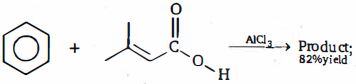
A
$3-$phenyl$-3-$methylbutanoic acid
B
$3-$phenyl$-3-$methylbutanoic acid (structure shown)
C
Phenyl$-3-$methylbut$-2-$en$-1-$one
D
$3-$phenyl$-3-$methylbutanoic acid (alternative structure)
Solution
(A) The reaction is an electrophilic addition of benzene to an $\alpha,\beta$-unsaturated carboxylic acid in the presence of a Lewis acid catalyst $(AlCl_3)$.
$1$. The $AlCl_3$ coordinates with the carbonyl oxygen,increasing the electrophilicity of the $\beta$-carbon.
$2$. This facilitates the attack of the benzene ring on the $\beta$-carbon,leading to the formation of a carbocation intermediate.
$3$. The final product is $3$-phenyl-$3$-methylbutanoic acid,which corresponds to the structure shown in option $A$.
$1$. The $AlCl_3$ coordinates with the carbonyl oxygen,increasing the electrophilicity of the $\beta$-carbon.
$2$. This facilitates the attack of the benzene ring on the $\beta$-carbon,leading to the formation of a carbocation intermediate.
$3$. The final product is $3$-phenyl-$3$-methylbutanoic acid,which corresponds to the structure shown in option $A$.
0 likes
View Solution422
DifficultMCQ
Consider the following sequence of reactions:
$2\text{-benzylbenzoic acid}$ $\xrightarrow{SOCl_2} A$ $\xrightarrow[2. H_3O^+]{1. AlCl_3} B$ $\xrightarrow{Zn-Hg, \text{conc. } HCl, \text{heat}} C$
The end product $(C)$ is:
$2\text{-benzylbenzoic acid}$ $\xrightarrow{SOCl_2} A$ $\xrightarrow[2. H_3O^+]{1. AlCl_3} B$ $\xrightarrow{Zn-Hg, \text{conc. } HCl, \text{heat}} C$
The end product $(C)$ is:
A
Anthraquinone
B
Anthrone
C
Anthracene
D
$9-$benzylanthracene
Solution
(C) $1$. The reaction of $2\text{-benzylbenzoic acid}$ with $SOCl_2$ converts the carboxylic acid group into an acid chloride,forming $A$ $(2\text{-benzylbenzoyl chloride})$.
$2$. Intramolecular Friedel-Crafts acylation of $A$ using $AlCl_3$ leads to the formation of $B$ ($anthrone$ or $9,10\text{-dihydroanthracen-9-one}$).
$3$. The Clemmensen reduction of $B$ using $Zn-Hg$ and $\text{conc. } HCl$ reduces the carbonyl group to a methylene group,resulting in the formation of $C$ $(anthracene)$.
$2$. Intramolecular Friedel-Crafts acylation of $A$ using $AlCl_3$ leads to the formation of $B$ ($anthrone$ or $9,10\text{-dihydroanthracen-9-one}$).
$3$. The Clemmensen reduction of $B$ using $Zn-Hg$ and $\text{conc. } HCl$ reduces the carbonyl group to a methylene group,resulting in the formation of $C$ $(anthracene)$.
0 likes
View Solution423
MediumMCQ
The labelled carbon in $Ph-CH_2-^{14}CO_2H$ goes with which product upon oxidation with $KMnO_4, HO^-, \Delta$ followed by $H_3O^+$?

A
$Ph-^{14}CO_2H$
B
$^{14}CO_2$
C
$Ph-^{14}CH_2-CO_2H$
D
$^{14}CH_4$
Solution
(B) The reaction of $Ph-CH_2-^{14}CO_2H$ with $KMnO_4, HO^-, \Delta$ followed by $H_3O^+$ is an oxidative cleavage of the benzylic carbon.
In this reaction,the benzylic $CH_2$ group is oxidized to a carboxyl group,and the original carboxyl group attached to it is released as carbon dioxide $(CO_2)$.
Since the label $^{14}C$ is on the carboxyl carbon of the starting material,this carbon is released as $^{14}CO_2$.
In this reaction,the benzylic $CH_2$ group is oxidized to a carboxyl group,and the original carboxyl group attached to it is released as carbon dioxide $(CO_2)$.
Since the label $^{14}C$ is on the carboxyl carbon of the starting material,this carbon is released as $^{14}CO_2$.
0 likes
View Solution424
DifficultMCQ
Bouveault-Blanc reduction reaction involves:
A
Reduction of an acyl halide with $H_2/Pd$
B
Reduction of an anhydride with $LiAlH_4$
C
Reduction of an ester with $Na/C_2H_5OH$
D
Reduction of a carbonyl compound with $Na/Hg$ and $HCl$
Solution
(C) The Bouveault-Blanc reduction involves the reduction of esters to primary alcohols using sodium metal in the presence of an alcohol (usually ethanol).
The general reaction is: $R-COOR' + 4[H] \xrightarrow{Na/C_2H_5OH} R-CH_2OH + R'OH$.
The general reaction is: $R-COOR' + 4[H] \xrightarrow{Na/C_2H_5OH} R-CH_2OH + R'OH$.
0 likes
View Solution425
DifficultMCQ
In the presence of a small amount of phosphorus,aliphatic carboxylic acids react with chlorine or bromine to yield a compound in which $\alpha$-hydrogen has been replaced by a halogen. This reaction is known as:
A
Wolff-Kishner reaction
B
Rosenmund reaction
C
Etard reaction
D
Hell-Volhard-Zelinsky reaction
Solution
(D) The reaction described is the Hell-Volhard-Zelinsky $(HVZ)$ reaction.
In this reaction,aliphatic carboxylic acids containing at least one $\alpha$-hydrogen atom are reacted with chlorine or bromine in the presence of a small amount of red phosphorus.
The $\alpha$-hydrogen is replaced by a halogen atom to form $\alpha$-halo carboxylic acids.
The general chemical equation is: $R-CH_2-COOH + X_2 \xrightarrow{\text{red } P} R-CH(X)-COOH + HX$,where $X = Cl, Br$.
In this reaction,aliphatic carboxylic acids containing at least one $\alpha$-hydrogen atom are reacted with chlorine or bromine in the presence of a small amount of red phosphorus.
The $\alpha$-hydrogen is replaced by a halogen atom to form $\alpha$-halo carboxylic acids.
The general chemical equation is: $R-CH_2-COOH + X_2 \xrightarrow{\text{red } P} R-CH(X)-COOH + HX$,where $X = Cl, Br$.
0 likes
View Solution426
DifficultMCQ
Aspirin can be prepared by the reaction of
A
Salicyldehyde with acetic anhydride in presence of $H_2SO_4$
B
Salicylic acid with methanol in presence of $H_2SO_4$
C
Salicylic acid with acetic anhydride in presence of $H_2SO_4$
D
Cinnamic acid with acetic anhydride in presence of $H_2SO_4$
Solution
(C) Aspirin,also known as acetylsalicylic acid,is prepared by the acetylation of the phenolic $-OH$ group of salicylic acid using acetic anhydride in the presence of an acid catalyst like $H_2SO_4$.
The chemical reaction is as follows:
$C_6H_4(OH)COOH + (CH_3CO)_2O \xrightarrow{H_2SO_4} C_6H_4(OCOCH_3)COOH + CH_3COOH$
Thus,the correct option is $C$.
The chemical reaction is as follows:
$C_6H_4(OH)COOH + (CH_3CO)_2O \xrightarrow{H_2SO_4} C_6H_4(OCOCH_3)COOH + CH_3COOH$
Thus,the correct option is $C$.
0 likes
View Solution427
DifficultMCQ
The correct decreasing order for acidic strength is
A
$NO_2CH_2COOH > FCH_2COOH > CNCH_2COOH > ClCH_2COOH$
B
$FCH_2COOH > NCCH_2COOH > NO_2CH_2COOH > ClCH_2COOH$
C
$CNCH_2COOH > O_2NCH_2COOH > FCH_2COOH > ClCH_2COOH$
D
$NO_2CH_2COOH > NCCH_2COOH > FCH_2COOH > ClCH_2COOH$
Solution
(D) Acidic strength is directly proportional to the electron-withdrawing effect ($-I$ effect) of the substituent group attached to the $\alpha$-carbon of the carboxylic acid.
The strength of the $-I$ effect follows the order: $NO_2 > CN > F > Cl$.
Therefore,the correct decreasing order of acidic strength is $NO_2CH_2COOH > NCCH_2COOH > FCH_2COOH > ClCH_2COOH$.
The strength of the $-I$ effect follows the order: $NO_2 > CN > F > Cl$.
Therefore,the correct decreasing order of acidic strength is $NO_2CH_2COOH > NCCH_2COOH > FCH_2COOH > ClCH_2COOH$.
0 likes
View Solution428
DifficultMCQ
The major product of the following reaction is:
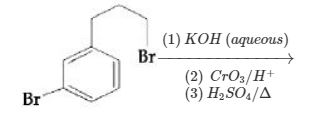
A
$6-$bromo$-1-$indanone
B
$4-$bromo$-1-$indanone
C
$4-$hydroxy$-1-$indanone
D
$6-$hydroxy$-1-$indanone
Solution
(A) Step $1$: Treatment with aqueous $KOH$ performs nucleophilic substitution of the primary alkyl bromide to form a primary alcohol,$3-(3-bromophenyl)propan-1-ol$.
Step $2$: Oxidation with $CrO_3/H^+$ (Jones reagent) converts the primary alcohol into a carboxylic acid,$3-(3-bromophenyl)propanoic acid$.
Step $3$: Intramolecular Friedel-Crafts acylation using $H_2SO_4/\Delta$ leads to cyclization. The carboxylic acid group attacks the ortho position relative to the alkyl chain. Since the meta-bromo group directs the cyclization,the product formed is $6-bromo-1-indanone$.
Step $2$: Oxidation with $CrO_3/H^+$ (Jones reagent) converts the primary alcohol into a carboxylic acid,$3-(3-bromophenyl)propanoic acid$.
Step $3$: Intramolecular Friedel-Crafts acylation using $H_2SO_4/\Delta$ leads to cyclization. The carboxylic acid group attacks the ortho position relative to the alkyl chain. Since the meta-bromo group directs the cyclization,the product formed is $6-bromo-1-indanone$.
0 likes
View Solution429
DifficultMCQ
Which dicarboxylic acid,in the presence of a dehydrating agent,is least reactive to form an anhydride?
A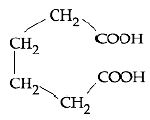
B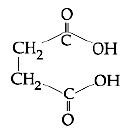
C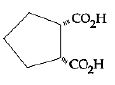
D
Solution
(A) The formation of cyclic anhydrides from dicarboxylic acids depends on the stability of the resulting ring. Five-membered and six-membered rings are generally stable and form easily.
$1$. Succinic acid forms a $5$-membered anhydride (succinic anhydride).
$2$. Phthalic acid forms a $5$-membered cyclic anhydride.
$3$. Cyclopentane-$1,2$-dicarboxylic acid (cis-isomer) forms a $5$-membered fused anhydride.
$4$. Adipic acid $(HOOC(CH_2)_4COOH)$ would form a $7$-membered ring anhydride,which is highly unstable due to ring strain and transannular interactions. Therefore,it is the least reactive toward anhydride formation.
$1$. Succinic acid forms a $5$-membered anhydride (succinic anhydride).
$2$. Phthalic acid forms a $5$-membered cyclic anhydride.
$3$. Cyclopentane-$1,2$-dicarboxylic acid (cis-isomer) forms a $5$-membered fused anhydride.
$4$. Adipic acid $(HOOC(CH_2)_4COOH)$ would form a $7$-membered ring anhydride,which is highly unstable due to ring strain and transannular interactions. Therefore,it is the least reactive toward anhydride formation.
0 likes
View Solution430
DifficultMCQ
The decreasing order of the rate of alkaline hydrolysis for the following esters is:
$I: C_6H_5COOC_2H_5$
$II: p-Cl-C_6H_4COOC_2H_5$
$III: p-NO_2-C_6H_4COOC_2H_5$
$IV: p-CH_3O-C_6H_4COOC_2H_5$
$I: C_6H_5COOC_2H_5$
$II: p-Cl-C_6H_4COOC_2H_5$
$III: p-NO_2-C_6H_4COOC_2H_5$
$IV: p-CH_3O-C_6H_4COOC_2H_5$
A
$III > II > I > IV$
B
$III > II > IV > I$
C
$IV > II > III > I$
D
$II > III > I > IV$
Solution
(A) The rate of alkaline hydrolysis of esters depends on the electrophilicity of the carbonyl carbon.
Electron-withdrawing groups $(EWG)$ increase the electrophilicity of the carbonyl carbon,thereby increasing the rate of nucleophilic attack by $OH^-$.
Electron-donating groups $(EDG)$ decrease the electrophilicity,thereby decreasing the rate.
The substituents at the para-position are:
$III: -NO_2$ (Strong $EWG$,$-I$ and $-M$ effect)
$II: -Cl$ ($EWG$,$-I$ effect > $+M$ effect)
$I: -H$ (Reference)
$IV: -OCH_3$ (Strong $EDG$,$+M$ effect > $-I$ effect)
The order of electron-withdrawing strength is $-NO_2 > -Cl > -H > -OCH_3$.
Therefore,the decreasing order of the rate of alkaline hydrolysis is $III > II > I > IV$.
Electron-withdrawing groups $(EWG)$ increase the electrophilicity of the carbonyl carbon,thereby increasing the rate of nucleophilic attack by $OH^-$.
Electron-donating groups $(EDG)$ decrease the electrophilicity,thereby decreasing the rate.
The substituents at the para-position are:
$III: -NO_2$ (Strong $EWG$,$-I$ and $-M$ effect)
$II: -Cl$ ($EWG$,$-I$ effect > $+M$ effect)
$I: -H$ (Reference)
$IV: -OCH_3$ (Strong $EDG$,$+M$ effect > $-I$ effect)
The order of electron-withdrawing strength is $-NO_2 > -Cl > -H > -OCH_3$.
Therefore,the decreasing order of the rate of alkaline hydrolysis is $III > II > I > IV$.
0 likes
View Solution431
DifficultMCQ
Which is the most suitable reagent for the following transformation?
$CH_3-CH=CH-CH_2-CH(OH)-CH_3 \rightarrow CH_3-CH=CH-CH_2-COOH$
$CH_3-CH=CH-CH_2-CH(OH)-CH_3 \rightarrow CH_3-CH=CH-CH_2-COOH$
A
Tollen's reagent
B
$I_2 / NaOH$
C
$CrO_2Cl_2 / CS_2$
D
alkaline $KMnO_4$
Solution
(B) The reactant $CH_3-CH=CH-CH_2-CH(OH)-CH_3$ contains a methyl carbinol group $(-CH(OH)CH_3)$.
The iodoform reagent $(I_2/NaOH)$ oxidizes the secondary alcohol to a methyl ketone and then undergoes the haloform reaction to produce a carboxylic acid with one less carbon atom (as $CHI_3$ is formed),while leaving the carbon-carbon double bond $(C=C)$ unaffected.
Thus,option $(b)$ is the correct reagent.
The iodoform reagent $(I_2/NaOH)$ oxidizes the secondary alcohol to a methyl ketone and then undergoes the haloform reaction to produce a carboxylic acid with one less carbon atom (as $CHI_3$ is formed),while leaving the carbon-carbon double bond $(C=C)$ unaffected.
Thus,option $(b)$ is the correct reagent.
0 likes
View Solution432
DifficultMCQ
The major product of the following reaction is:
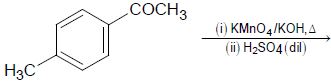
A
$4-$acetylbenzoic acid
B
$4-$formylbenzoic acid
C
benzene$-1,4-$dicarboxylic acid
D
$4-$acetylbenzoic acid
Solution
(C) The reaction involves the oxidation of alkyl side chains attached to a benzene ring using alkaline $KMnO_4$ followed by acidification.
In the given reactant,$p$-methylacetophenone $(CH_3-C_6H_4-COCH_3)$,both the methyl group $(-CH_3)$ and the acetyl group $(-COCH_3)$ are attached to the benzene ring.
Alkaline $KMnO_4$ oxidizes alkyl groups attached to the benzene ring to carboxylic acid groups $(-COOH)$,provided there is at least one benzylic hydrogen.
The methyl group $(-CH_3)$ is oxidized to $-COOH$.
The acetyl group $(-COCH_3)$ is also oxidized to $-COOH$ because the carbon atom adjacent to the benzene ring (the carbonyl carbon) is bonded to a methyl group,which effectively acts as a site for oxidation,leading to the formation of terephthalic acid (benzene$-1,4-$dicarboxylic acid).
In the given reactant,$p$-methylacetophenone $(CH_3-C_6H_4-COCH_3)$,both the methyl group $(-CH_3)$ and the acetyl group $(-COCH_3)$ are attached to the benzene ring.
Alkaline $KMnO_4$ oxidizes alkyl groups attached to the benzene ring to carboxylic acid groups $(-COOH)$,provided there is at least one benzylic hydrogen.
The methyl group $(-CH_3)$ is oxidized to $-COOH$.
The acetyl group $(-COCH_3)$ is also oxidized to $-COOH$ because the carbon atom adjacent to the benzene ring (the carbonyl carbon) is bonded to a methyl group,which effectively acts as a site for oxidation,leading to the formation of terephthalic acid (benzene$-1,4-$dicarboxylic acid).
0 likes
View Solution433
DifficultMCQ
The increasing order of the reactivity of the following compounds with $LiAlH_4$ is:
$(a)$ $C_2H_5CONH_2$
$(b)$ $C_2H_5COOCH_3$
$(c)$ $C_2H_5COCl$
$(d)$ $(C_2H_5CO)_2O$
$(a)$ $C_2H_5CONH_2$
$(b)$ $C_2H_5COOCH_3$
$(c)$ $C_2H_5COCl$
$(d)$ $(C_2H_5CO)_2O$
A
$(a) < (b) < (d) < (c)$
B
$(b) < (a) < (d) < (c)$
C
$(a) < (b) < (d) < (c)$
D
$(a) < (b) < (c) < (d)$
Solution
(A) The reactivity of carboxylic acid derivatives towards nucleophilic attack by $LiAlH_4$ depends on the leaving group ability and the electrophilicity of the carbonyl carbon.
The order of reactivity is determined by the stability of the leaving group and the resonance stabilization of the carbonyl group:
$1. \text{Acid chloride } (C_2H_5COCl) \text{ is the most reactive due to the excellent leaving group } Cl^- \text{ and strong electron-withdrawing effect.}$
$2. \text{Acid anhydride } ((C_2H_5CO)_2O) \text{ is next, with } RCOO^- \text{ as a good leaving group.}$
$3. \text{Ester } (C_2H_5COOCH_3) \text{ follows, with } CH_3O^- \text{ as a poorer leaving group.}$
$4. \text{Amide } (C_2H_5CONH_2) \text{ is the least reactive due to strong resonance stabilization of the carbonyl group by the nitrogen lone pair.}$
Thus,the increasing order of reactivity is: $(a) < (b) < (d) < (c)$.
The order of reactivity is determined by the stability of the leaving group and the resonance stabilization of the carbonyl group:
$1. \text{Acid chloride } (C_2H_5COCl) \text{ is the most reactive due to the excellent leaving group } Cl^- \text{ and strong electron-withdrawing effect.}$
$2. \text{Acid anhydride } ((C_2H_5CO)_2O) \text{ is next, with } RCOO^- \text{ as a good leaving group.}$
$3. \text{Ester } (C_2H_5COOCH_3) \text{ follows, with } CH_3O^- \text{ as a poorer leaving group.}$
$4. \text{Amide } (C_2H_5CONH_2) \text{ is the least reactive due to strong resonance stabilization of the carbonyl group by the nitrogen lone pair.}$
Thus,the increasing order of reactivity is: $(a) < (b) < (d) < (c)$.
0 likes
View Solution434
DifficultMCQ
The major product of the following reaction is:
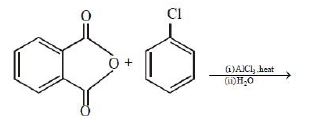
A
$A$ structure showing $2-$($4$-chlorobenzoyl)benzoic acid.
B
$A$ structure showing $2-$($3$-chlorobenzoyl)benzoic acid.
C
$A$ structure showing $2-$chloroanthraquinone.
D
$A$ structure showing $1-$chloroanthraquinone.
Solution
(A) The reaction between phthalic anhydride and chlorobenzene in the presence of $AlCl_3$ and heat is a Friedel-Crafts acylation reaction.
Chlorine $(-Cl)$ is an ortho/para-directing group.
Due to steric hindrance,the para-substitution is favored over ortho-substitution.
Therefore,the major product formed is $2-(4-chlorobenzoyl)benzoic acid$.
Chlorine $(-Cl)$ is an ortho/para-directing group.
Due to steric hindrance,the para-substitution is favored over ortho-substitution.
Therefore,the major product formed is $2-(4-chlorobenzoyl)benzoic acid$.
0 likes
View Solution435
DifficultMCQ
The major product of the following reaction is $CH_3CH=CHCO_2CH_3 \xrightarrow{LiAlH_4}$
A
$CH_3CH_2CH_2CHO$
B
$CH_3CH=CHCH_2OH$
C
$CH_3CH_2CH_2CO_2CH_3$
D
$CH_3CH_2CH_2CH_2OH$
Solution
(B) $LiAlH_4$ is a strong reducing agent that selectively reduces the ester group $(-CO_2CH_3)$ to a primary alcohol $(-CH_2OH)$ while leaving the carbon-carbon double bond $(C=C)$ unaffected.
Therefore,the product is $CH_3CH=CHCH_2OH$.
Therefore,the product is $CH_3CH=CHCH_2OH$.
0 likes
View Solution436
DifficultMCQ
$CCl_4$ $\xrightarrow{Aq. KOH} A$ $\xrightarrow[ii) H_3O^+]{i) CH_3MgBr} B$
Which of the following is correct about $B$?
Which of the following is correct about $B$?
A
Gives $HVZ$ reaction
B
Gives Haloform reaction
C
Gives Victor Meyer test
D
Gives Fehling solution test
Solution
(B) Step $1$: $CCl_4$ reacts with aqueous $KOH$ to form potassium carbonate $(K_2CO_3)$,which upon acidification gives carbonic acid $(H_2CO_3)$,which decomposes to $CO_2$ and $H_2O$. However,in the context of this reaction sequence,$CCl_4$ with $KOH$ typically leads to the formation of $CO_2$ or carboxylic acid derivatives. Given the reaction with $CH_3MgBr$,$A$ is $CO_2$.
Step $2$: $CO_2 + CH_3MgBr \rightarrow CH_3COOMgBr$.
Step $3$: Upon hydrolysis $(H_3O^+)$,$CH_3COOMgBr$ gives acetic acid $(CH_3COOH)$.
Step $4$: $B$ is $CH_3COOH$. Acetic acid contains a methyl group attached to a carbonyl carbon $(CH_3-C=O)$,which gives a positive iodoform test (a type of Haloform reaction).
Step $2$: $CO_2 + CH_3MgBr \rightarrow CH_3COOMgBr$.
Step $3$: Upon hydrolysis $(H_3O^+)$,$CH_3COOMgBr$ gives acetic acid $(CH_3COOH)$.
Step $4$: $B$ is $CH_3COOH$. Acetic acid contains a methyl group attached to a carbonyl carbon $(CH_3-C=O)$,which gives a positive iodoform test (a type of Haloform reaction).
0 likes
View Solution437
DifficultMCQ
Which of the following compounds is most reactive toward decarboxylation when reacting with sodalime?
A
$CH_3-C(CH_3)_2-COOH$
B
$O_2N-CH_2-COOH$
C
$CH_3-CH(CH_3)-COOH$
D
$C_6H_5-COOH$
Solution
(B) Decarboxylation with sodalime $(NaOH + CaO)$ proceeds via the formation of a carbanion intermediate in the rate-determining step.
The stability of the carbanion determines the rate of decarboxylation.
Electron-withdrawing groups (EWGs) stabilize the carbanion by dispersing the negative charge,thereby increasing the rate of decarboxylation.
Among the given options,the nitro group $(-NO_2)$ in $O_2N-CH_2-COOH$ is a strong electron-withdrawing group,which significantly stabilizes the resulting carbanion $(O_2N-CH_2^-)$.
Therefore,$O_2N-CH_2-COOH$ is the most reactive toward decarboxylation.
The stability of the carbanion determines the rate of decarboxylation.
Electron-withdrawing groups (EWGs) stabilize the carbanion by dispersing the negative charge,thereby increasing the rate of decarboxylation.
Among the given options,the nitro group $(-NO_2)$ in $O_2N-CH_2-COOH$ is a strong electron-withdrawing group,which significantly stabilizes the resulting carbanion $(O_2N-CH_2^-)$.
Therefore,$O_2N-CH_2-COOH$ is the most reactive toward decarboxylation.
0 likes
View Solution438
MediumMCQ
Which of the following is the most reactive compound toward a nucleophile?
A
$CH_3-COCl$
B
$CH_3-CH_2-COCl$
C
$CH_3-CH(CH_3)-COCl$
D
$CH_3-C(CH_3)_2-COCl$
Solution
(A) The reactivity of acyl chlorides towards nucleophilic substitution is governed by two main factors: the electrophilicity of the carbonyl carbon and steric hindrance.
$1$. The electrophilicity of the carbonyl carbon is reduced by the $+I$ (inductive) effect of the alkyl group attached to it. As the size of the alkyl group increases,the $+I$ effect increases,making the carbonyl carbon less positive and thus less reactive.
$2$. Steric hindrance increases as the bulkiness of the alkyl group increases,which hinders the approach of the nucleophile.
Comparing the options:
$A$ $(CH_3-COCl)$: Smallest alkyl group,least $+I$ effect,least steric hindrance.
$B$ $(CH_3-CH_2-COCl)$: Larger alkyl group,more $+I$ effect.
$C$ $(CH_3-CH(CH_3)-COCl)$: Branched alkyl group,higher $+I$ effect and steric hindrance.
$D$ $(CH_3-C(CH_3)_2-COCl)$: Most branched alkyl group,highest $+I$ effect and steric hindrance.
Therefore,$CH_3-COCl$ is the most reactive.
Order of reactivity: $CH_3-COCl > CH_3-CH_2-COCl > (CH_3)_2CH-COCl > (CH_3)_3C-COCl$.
$1$. The electrophilicity of the carbonyl carbon is reduced by the $+I$ (inductive) effect of the alkyl group attached to it. As the size of the alkyl group increases,the $+I$ effect increases,making the carbonyl carbon less positive and thus less reactive.
$2$. Steric hindrance increases as the bulkiness of the alkyl group increases,which hinders the approach of the nucleophile.
Comparing the options:
$A$ $(CH_3-COCl)$: Smallest alkyl group,least $+I$ effect,least steric hindrance.
$B$ $(CH_3-CH_2-COCl)$: Larger alkyl group,more $+I$ effect.
$C$ $(CH_3-CH(CH_3)-COCl)$: Branched alkyl group,higher $+I$ effect and steric hindrance.
$D$ $(CH_3-C(CH_3)_2-COCl)$: Most branched alkyl group,highest $+I$ effect and steric hindrance.
Therefore,$CH_3-COCl$ is the most reactive.
Order of reactivity: $CH_3-COCl > CH_3-CH_2-COCl > (CH_3)_2CH-COCl > (CH_3)_3C-COCl$.
0 likes
View Solution439
MediumMCQ
In the following reaction: $CH_3COOH \xrightarrow{SOCl_2}$ Product. The structure of the main product is:
A
$CH_3COOH$
B
$CH_3COCl$
C
$CH_3Cl$
D
$CH_3SO_2Cl$
Solution
(B) Carboxylic acids react with thionyl chloride $(SOCl_2)$ to replace the $-OH$ group with a $-Cl$ atom,forming an acid chloride.
The reaction is: $CH_3COOH + SOCl_2 \rightarrow CH_3COCl + SO_2 \uparrow + HCl \uparrow$.
The main product is acetyl chloride $(CH_3COCl)$.
The reaction is: $CH_3COOH + SOCl_2 \rightarrow CH_3COCl + SO_2 \uparrow + HCl \uparrow$.
The main product is acetyl chloride $(CH_3COCl)$.
0 likes
View Solution440
DifficultMCQ
Arrange the following in order of their reactivity toward decarboxylation reaction:
$I. CH \equiv C - COOH$
$II. CH_2 = CH - COOH$
$III. CH_3 - CH_2 - COOH$
$IV. CH_3 - CH(CH_3) - COOH$
$I. CH \equiv C - COOH$
$II. CH_2 = CH - COOH$
$III. CH_3 - CH_2 - COOH$
$IV. CH_3 - CH(CH_3) - COOH$
A
$IV > III > II > I$
B
$I > II > III > IV$
C
$III > II > I > IV$
D
$III > IV > II > I$
Solution
(B) Decarboxylation involves the formation of a carbanion intermediate.
The stability of the carbanion intermediate determines the rate of the reaction.
The stability order of the carbanions formed is $CH \equiv C^- > CH_2 = CH^- > CH_3 - CH_2^- > CH_3 - CH^- - CH_3$ due to the increasing electron-donating inductive effect of alkyl groups.
Thus,the reactivity order toward decarboxylation is $I > II > III > IV$.
The stability of the carbanion intermediate determines the rate of the reaction.
The stability order of the carbanions formed is $CH \equiv C^- > CH_2 = CH^- > CH_3 - CH_2^- > CH_3 - CH^- - CH_3$ due to the increasing electron-donating inductive effect of alkyl groups.
Thus,the reactivity order toward decarboxylation is $I > II > III > IV$.
0 likes
View Solution441
EasyMCQ
Which is the strongest acid ($pk_a$ value is given)?
A
$HCOOH\ [3.77]$
B
$C_6H_5COOH\ [4.22]$
C
$CH_3COOH\ [4.7]$
D
$CH_3CH_2COOH\ [4.88]$
Solution
(A) The strength of an acid is inversely proportional to its $pk_a$ value,i.e.,$\text{Strength of acid} \propto \frac{1}{pk_a}$.
Since $HCOOH$ has the lowest $pk_a$ value of $3.77$,it is the strongest acid among the given options.
Since $HCOOH$ has the lowest $pk_a$ value of $3.77$,it is the strongest acid among the given options.
0 likes
View Solution442
DifficultMCQ
Identify the product $Z$ in the following reaction sequence:
$Cyclohexene$ $\xrightarrow{KMnO_4} X$ $\xrightarrow{Ca(OH)_2} Y$ $\xrightarrow{\Delta} Z$
$Cyclohexene$ $\xrightarrow{KMnO_4} X$ $\xrightarrow{Ca(OH)_2} Y$ $\xrightarrow{\Delta} Z$
A
Cyclohexanone
B
Cyclopentanone
C
Adipic acid
D
Cyclohexane$-1,2-$diol
Solution
(B) $1$. The reaction of cyclohexene with $KMnO_4$ (oxidative cleavage) produces adipic acid $(HOOC-(CH_2)_4-COOH)$,which is $X$.
$2$. Adipic acid reacts with $Ca(OH)_2$ to form calcium adipate,which is $Y$.
$3$. Heating calcium adipate $(Y)$ leads to decarboxylation and cyclization,resulting in the formation of cyclopentanone $(Z)$.
$4$. The reaction is: $HOOC-(CH_2)_4-COOH + Ca(OH)_2$ $\rightarrow Ca(OOC-(CH_2)_4-COO) + 2H_2O$ $\xrightarrow{\Delta} \text{Cyclopentanone} + CaCO_3$.
$2$. Adipic acid reacts with $Ca(OH)_2$ to form calcium adipate,which is $Y$.
$3$. Heating calcium adipate $(Y)$ leads to decarboxylation and cyclization,resulting in the formation of cyclopentanone $(Z)$.
$4$. The reaction is: $HOOC-(CH_2)_4-COOH + Ca(OH)_2$ $\rightarrow Ca(OOC-(CH_2)_4-COO) + 2H_2O$ $\xrightarrow{\Delta} \text{Cyclopentanone} + CaCO_3$.
0 likes
View Solution443
MediumMCQ
When chloroform is hydrolysed with $KOH$,the final product is:
A
$HCOOH$
B
$HCOOK$
C
$CH_3OH$
D
$(CHCOOK)_2$
Solution
(B) The hydrolysis of chloroform $(CHCl_3)$ with aqueous $KOH$ proceeds as follows:
$1$. $CHCl_3 + 3KOH \rightarrow CH(OH)_3 + 3KCl$
$2$. The intermediate product,methanetriol $(CH(OH)_3)$,is unstable and loses a water molecule to form formic acid $(HCOOH)$: $CH(OH)_3 \rightarrow HCOOH + H_2O$
$3$. Since the medium is basic ($KOH$ is present),the formic acid reacts with $KOH$ to form potassium formate $(HCOOK)$: $HCOOH + KOH \rightarrow HCOOK + H_2O$
Thus,the final product is potassium formate $(HCOOK)$.
$1$. $CHCl_3 + 3KOH \rightarrow CH(OH)_3 + 3KCl$
$2$. The intermediate product,methanetriol $(CH(OH)_3)$,is unstable and loses a water molecule to form formic acid $(HCOOH)$: $CH(OH)_3 \rightarrow HCOOH + H_2O$
$3$. Since the medium is basic ($KOH$ is present),the formic acid reacts with $KOH$ to form potassium formate $(HCOOK)$: $HCOOH + KOH \rightarrow HCOOK + H_2O$
Thus,the final product is potassium formate $(HCOOK)$.
0 likes
View Solution444
DifficultMCQ
The product $(A)$ is:
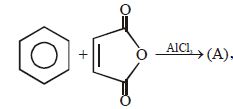
A
$3-$benzoylprop$-2-$enoic acid
B
$4-$oxo$-4-$phenylbutanoic acid
C
$1,4-$naphthoquinone
D
Phthalic anhydride
Solution
(B) The reaction between benzene and maleic anhydride in the presence of $AlCl_3$ is a Friedel-Crafts acylation reaction.
In this reaction,the benzene ring attacks the carbonyl carbon of the maleic anhydride.
This leads to the opening of the anhydride ring,resulting in the formation of $4-\text{oxo}-4-\text{phenylbutanoic acid}$ (also known as $\beta-\text{benzoylpropionic acid}$).
The correct option is $B$.
In this reaction,the benzene ring attacks the carbonyl carbon of the maleic anhydride.
This leads to the opening of the anhydride ring,resulting in the formation of $4-\text{oxo}-4-\text{phenylbutanoic acid}$ (also known as $\beta-\text{benzoylpropionic acid}$).
The correct option is $B$.
0 likes
View Solution445
DifficultMCQ
The decreasing order of nucleophilicity among the following nucleophiles is:
$(I)$ $CH_3-COO^{-}$
$(II)$ $CH_3O^{-}$
$(III)$ $C_6H_5O^{-}$
$(IV)$ $CH_3-SO_3^-$
$(I)$ $CH_3-COO^{-}$
$(II)$ $CH_3O^{-}$
$(III)$ $C_6H_5O^{-}$
$(IV)$ $CH_3-SO_3^-$
A
$I, II, III, IV$
B
$IV, III, II, I$
C
$II, III, I, IV$
D
$III, II, I, IV$
Solution
(C) Nucleophilicity generally follows the order of basicity in the same solvent. The basicity depends on the stability of the anion; the more stable the anion (due to resonance or inductive effects),the weaker the base and the weaker the nucleophile.
$1.$ In $CH_3O^-$,the negative charge is localized on the oxygen atom,making it the strongest base and nucleophile.
$2.$ In $C_6H_5O^-$,the negative charge is delocalized into the benzene ring.
$3.$ In $CH_3-COO^-$,the negative charge is delocalized over two electronegative oxygen atoms,making it more stable than phenoxide.
$4.$ In $CH_3-SO_3^-$,the negative charge is delocalized over three oxygen atoms,making it the most stable and the weakest nucleophile.
Therefore,the decreasing order is: $II > III > I > IV$.
$1.$ In $CH_3O^-$,the negative charge is localized on the oxygen atom,making it the strongest base and nucleophile.
$2.$ In $C_6H_5O^-$,the negative charge is delocalized into the benzene ring.
$3.$ In $CH_3-COO^-$,the negative charge is delocalized over two electronegative oxygen atoms,making it more stable than phenoxide.
$4.$ In $CH_3-SO_3^-$,the negative charge is delocalized over three oxygen atoms,making it the most stable and the weakest nucleophile.
Therefore,the decreasing order is: $II > III > I > IV$.
0 likes
View Solution446
MediumMCQ
Which of the following is the correct order of acidic strength?
A
$CF_3COOH > CHCl_2COOH > HCOOH > C_6H_5CH_2COOH > CH_3COOH$
B
$CF_3COOH > HCOOH > CF_3HCOOH > CHCl_2COOH > C_6H_5CH_2COOH$
C
$HCOOH > C_6H_5CH_2COOH > CF_3COOH > CHCl_2COOH > CH_3COOH$
D
$CF_3COOH > CH_3COOH > HCOOH > CHCl_2COOH > C_6H_5CH_2COOH$
Solution
(A) The acidic strength of carboxylic acids is determined by the stability of the conjugate base (carboxylate ion).
Electron-withdrawing groups ($-I$ effect) increase acidity by stabilizing the negative charge,while electron-donating groups ($+I$ effect) decrease acidity.
The order of $-I$ effect strength is $CF_3 > CHCl_2 > H > C_6H_5CH_2 > CH_3$.
$CF_3$ is a very strong electron-withdrawing group,making $CF_3COOH$ the strongest acid.
$CHCl_2$ is also electron-withdrawing,making $CHCl_2COOH$ stronger than $HCOOH$.
$HCOOH$ is stronger than $C_6H_5CH_2COOH$ (where the phenyl group has a slight $+I$ effect) and $CH_3COOH$ (where the methyl group has a $+I$ effect).
Thus,the correct order is $CF_3COOH > CHCl_2COOH > HCOOH > C_6H_5CH_2COOH > CH_3COOH$.
Electron-withdrawing groups ($-I$ effect) increase acidity by stabilizing the negative charge,while electron-donating groups ($+I$ effect) decrease acidity.
The order of $-I$ effect strength is $CF_3 > CHCl_2 > H > C_6H_5CH_2 > CH_3$.
$CF_3$ is a very strong electron-withdrawing group,making $CF_3COOH$ the strongest acid.
$CHCl_2$ is also electron-withdrawing,making $CHCl_2COOH$ stronger than $HCOOH$.
$HCOOH$ is stronger than $C_6H_5CH_2COOH$ (where the phenyl group has a slight $+I$ effect) and $CH_3COOH$ (where the methyl group has a $+I$ effect).
Thus,the correct order is $CF_3COOH > CHCl_2COOH > HCOOH > C_6H_5CH_2COOH > CH_3COOH$.
0 likes
View Solution447
MediumMCQ
The strongest acid among the following compounds is
A
$CH_3COOH$
B
$CH_3CH_2CH(Cl)COOH$
C
$HCOOH$
D
$ClCH_2CH_2CH_2COOH$
Solution
(B) The acidity of carboxylic acids is increased by the presence of electron-withdrawing groups ($-I$ effect) attached to the carbon chain.
In $CH_3CH_2CH(Cl)COOH$,the chlorine atom is at the $\alpha$-position,which exerts a strong $-I$ effect,stabilizing the carboxylate anion significantly.
In $ClCH_2CH_2CH_2COOH$,the chlorine atom is at the $\gamma$-position,and the $-I$ effect decreases rapidly with distance.
Therefore,$CH_3CH_2CH(Cl)COOH$ is the strongest acid among the given options.
In $CH_3CH_2CH(Cl)COOH$,the chlorine atom is at the $\alpha$-position,which exerts a strong $-I$ effect,stabilizing the carboxylate anion significantly.
In $ClCH_2CH_2CH_2COOH$,the chlorine atom is at the $\gamma$-position,and the $-I$ effect decreases rapidly with distance.
Therefore,$CH_3CH_2CH(Cl)COOH$ is the strongest acid among the given options.
0 likes
View Solution448
DifficultMCQ
Which of the following is not correct?
A
$CH_3-C(=O)-OC_2H_5 \xrightarrow{DIBAL} CH_3-C(=O)-H$
B
$CH_3-C(=O)-Cl \xrightarrow[Boiling \ xylene]{Pd-BaSO_4} CH_3-C(=O)-H$
C
$CH_3-C(=O)-NH_2 \xrightarrow{LiAlH_4} CH_3-CH_2-NH_2$
D
$CH_3-C(=O)-NH_2 \xrightarrow{PCl_5} CH_3-C(=O)-Cl$
Solution
(D) When a primary amide like acetamide $(CH_3-CONH_2)$ reacts with $PCl_5$,it undergoes dehydration to form a nitrile $(CH_3CN)$,not an acid chloride $(CH_3-C(=O)-Cl)$.
The reaction is: $CH_3-CONH_2 + PCl_5 \rightarrow CH_3CN + POCl_3 + 2HCl$.
The reaction is: $CH_3-CONH_2 + PCl_5 \rightarrow CH_3CN + POCl_3 + 2HCl$.
0 likes
View Solution449
AdvancedMCQ
$C_4H_7OCl$ $(x)$ $\xrightarrow{NH_3} C_4H_9NO$ $\xrightarrow{Br_2 + KOH} CH_3-CH_2-CH_2-NH_2$. Compound $x$ is:
A
Butanoyl chloride $(CH_3CH_2CH_2COCl)$
B
$2-$Methylpropanoyl chloride $((CH_3)_2CHCOCl)$
C
$4-$Chloro$-2-$butanol $(ClCH_2CH_2CH(OH)CH_3)$
D
$4-$Chlorobutanal $(ClCH_2CH_2CH_2CHO)$
Solution
(A) The reaction sequence is: $C_4H_7OCl$ $(x)$ $\xrightarrow{NH_3} C_4H_9NO$ (amide) $\xrightarrow{Br_2 + KOH} CH_3-CH_2-CH_2-NH_2$ (propylamine).
This is a Hofmann bromamide degradation reaction,which converts an amide $(R-CONH_2)$ into a primary amine $(R-NH_2)$ with one carbon atom less.
Since the product is propylamine $(CH_3CH_2CH_2NH_2)$,the amide must be butanamide $(CH_3CH_2CH_2CONH_2)$.
Butanamide is formed by the reaction of butanoyl chloride $(CH_3CH_2CH_2COCl)$ with ammonia $(NH_3)$.
Therefore,compound $x$ is butanoyl chloride.
This is a Hofmann bromamide degradation reaction,which converts an amide $(R-CONH_2)$ into a primary amine $(R-NH_2)$ with one carbon atom less.
Since the product is propylamine $(CH_3CH_2CH_2NH_2)$,the amide must be butanamide $(CH_3CH_2CH_2CONH_2)$.
Butanamide is formed by the reaction of butanoyl chloride $(CH_3CH_2CH_2COCl)$ with ammonia $(NH_3)$.
Therefore,compound $x$ is butanoyl chloride.
0 likes
View Solution450
MediumMCQ
Which of the following has the maximum boiling point?
A
$CH_3COOH$
B
$CH_3-CH_2-OH$
C
$CH_3-CH_2-NH_2$
D
$CH_3-CH_2-CH=O$
Solution
(A) The boiling point of organic compounds depends on the strength of intermolecular forces.
$CH_3COOH$ (acetic acid) forms stable intermolecular hydrogen-bonded dimers in the liquid phase,which significantly increases its boiling point compared to alcohols,amines,and aldehydes of similar molecular mass.
$CH_3-CH_2-OH$ and $CH_3-CH_2-NH_2$ also exhibit hydrogen bonding,but it is less extensive than the dimer formation in carboxylic acids.
$CH_3-CH_2-CH=O$ (propanal) only has dipole-dipole interactions and lacks hydrogen bonding,resulting in the lowest boiling point among the given options.
Therefore,$CH_3COOH$ has the maximum boiling point.
$CH_3COOH$ (acetic acid) forms stable intermolecular hydrogen-bonded dimers in the liquid phase,which significantly increases its boiling point compared to alcohols,amines,and aldehydes of similar molecular mass.
$CH_3-CH_2-OH$ and $CH_3-CH_2-NH_2$ also exhibit hydrogen bonding,but it is less extensive than the dimer formation in carboxylic acids.
$CH_3-CH_2-CH=O$ (propanal) only has dipole-dipole interactions and lacks hydrogen bonding,resulting in the lowest boiling point among the given options.
Therefore,$CH_3COOH$ has the maximum boiling point.
0 likes
View Solution8-2.Carboxylic acids and Their derivative — Properties of Carboxylic Acids and Their Derivatives · Frequently Asked Questions
1Are these 8-2.Carboxylic acids and Their derivative questions useful for JEE and NEET?
Yes. All questions in this section are mapped to JEE Main and NEET exam patterns. Previous year questions from JEE Main, NEET, GUJCET and state-level exams are included with full solutions.
2Can I switch to Hindi or Gujarati for these questions?
Yes. Use the language tabs in the hero section or the sidebar to view the same questions and solutions in English, Hindi or Gujarati.
3How do I generate a question paper from this subtopic?
Use the Vedclass Exam Paper Generator — select the chapter and subtopic, set difficulty, and generate Sets A, B, C, D automatically. First 3 chapters of every subject are free.
Vedclass Products
For Students
Vedclass Test Series
Mock tests in real JEE/NEET style with performance analysis. 5-day free trial.
Start Free TrialFor Teachers
Exam Paper Generator
Generate Set A/B/C/D papers from this chapter in 2 minutes. 3 chapters free.
Try FreeFor Institutes
Online Exam Module
Live online exams with unlimited students, 360° analytics & white-label branding.
See DemoFor Teachers & Institutes
Generate a 8-2.Carboxylic acids and Their derivative Exam Paper in 2 Minutes
Select subtopic & difficulty — Sets A, B, C, D auto-generated with No Repeat logic.
First 3 chapters of every subject are free — no payment required.