
A English
Properties of Carboxylic Acids and Their Derivatives Questions in English
Class 12 Chemistry · 8-2.Carboxylic acids and Their derivative · Properties of Carboxylic Acids and Their Derivatives
791+
Questions
English
Language
100%
With Solutions
Showing 50 of 791 questions in English
351
MediumMCQ
Among the following,which is most highly ionized in water?
A
$CH_3-CH_2-CH(NO_2)-COOH$
B
$CH_3-CH(NO_2)-CH_2-COOH$
C
$O_2N-CH_2-CH_2-CH_2-COOH$
D
All of these
Solution
(A) The acidity of carboxylic acids increases with the presence of electron-withdrawing groups due to the $-I$ effect.
The $-NO_2$ group is a strong electron-withdrawing group.
Since the $-I$ effect decreases with distance,the acid where the $-NO_2$ group is closest to the $-COOH$ group (at the $\alpha$-position) will be the most acidic and thus most highly ionized in water.
In $CH_3-CH_2-CH(NO_2)-COOH$,the $-NO_2$ group is at the $\alpha$-position relative to the $-COOH$ group.
Therefore,$CH_3-CH_2-CH(NO_2)-COOH$ is the most highly ionized.
The $-NO_2$ group is a strong electron-withdrawing group.
Since the $-I$ effect decreases with distance,the acid where the $-NO_2$ group is closest to the $-COOH$ group (at the $\alpha$-position) will be the most acidic and thus most highly ionized in water.
In $CH_3-CH_2-CH(NO_2)-COOH$,the $-NO_2$ group is at the $\alpha$-position relative to the $-COOH$ group.
Therefore,$CH_3-CH_2-CH(NO_2)-COOH$ is the most highly ionized.
0 likes
View Solution352
MediumMCQ
If oxalic acid is treated with conc. $H_2SO_4$,then the gases formed will be:
A
$SO_2$ and $SO_3$
B
$CO$ and $SO_2$
C
$CO$ and $CO_2$
D
$O_2$ and $N_2$
Solution
(C) Oxalic acid $(H_2C_2O_4)$ undergoes dehydration when treated with concentrated sulfuric acid $(conc. H_2SO_4)$.
The reaction is as follows:
$H_2C_2O_4 \xrightarrow{conc. H_2SO_4} CO + CO_2 + H_2O$
Concentrated $H_2SO_4$ acts as a dehydrating agent,removing a water molecule from the oxalic acid,resulting in the formation of carbon monoxide $(CO)$ and carbon dioxide $(CO_2)$ gases.
The reaction is as follows:
$H_2C_2O_4 \xrightarrow{conc. H_2SO_4} CO + CO_2 + H_2O$
Concentrated $H_2SO_4$ acts as a dehydrating agent,removing a water molecule from the oxalic acid,resulting in the formation of carbon monoxide $(CO)$ and carbon dioxide $(CO_2)$ gases.
0 likes
View Solution353
MediumMCQ
Aspirin can be prepared by reacting salicylic acid with
A
$CH_3-CO-CH_3$
B
$CH_3-CHO$
C
$CH_3-COOH$
D
$CH_3-CONH_2$
Solution
(C) Aspirin (acetylsalicylic acid) is prepared by the acetylation of the phenolic hydroxyl group of salicylic acid.
Salicylic acid reacts with acetic acid $(CH_3COOH)$ or acetic anhydride $((CH_3CO)_2O)$ in the presence of an acid catalyst to form aspirin.
Reaction: $C_6H_4(OH)COOH + CH_3COOH \rightarrow C_6H_4(OCOCH_3)COOH + H_2O$.
Salicylic acid reacts with acetic acid $(CH_3COOH)$ or acetic anhydride $((CH_3CO)_2O)$ in the presence of an acid catalyst to form aspirin.
Reaction: $C_6H_4(OH)COOH + CH_3COOH \rightarrow C_6H_4(OCOCH_3)COOH + H_2O$.
0 likes
View Solution354
MediumMCQ
Which of the following rings is highly strained?
A
$\delta$-lactone
B
$\gamma$-lactone
C
$\beta$-lactone
D
$\delta$-lactam
Solution
(C) Ring strain is inversely proportional to the size of the ring. Smaller rings have higher angle strain due to significant deviation from the ideal tetrahedral bond angle of $109.5^{\circ}$. Among the given options,the $\beta$-lactone is a four-membered ring,which possesses the highest angle strain compared to the five-membered ($\gamma$-lactone) and six-membered ($\delta$-lactone/lactam) rings. Therefore,the $\beta$-lactone is the most highly strained.
0 likes
View Solution355
MediumMCQ
Select the acid with the highest $K_a$ (i.e.,lowest $pK_a$).
A
Acetic acid $(CH_3COOH)$
B
Dichloroacetic acid $(Cl_2CHCOOH)$
C
$4-$Iodocyclohexanecarboxylic acid
D
$4-$Chlorocyclohexanecarboxylic acid
Solution
(B) The acidic strength of carboxylic acids is directly proportional to the electron-withdrawing effect ($-I$ effect) of the substituents attached to the carbon chain.
$1$. Acetic acid $(CH_3COOH)$ has a $+I$ group $(CH_3)$,which decreases acidity.
$2$. Dichloroacetic acid $(Cl_2CHCOOH)$ has two highly electronegative chlorine atoms,which exert a strong $-I$ effect,significantly stabilizing the carboxylate anion and increasing acidity.
$3$. $4-$Iodocyclohexanecarboxylic acid and $4-$Chlorocyclohexanecarboxylic acid have the electron-withdrawing groups far from the carboxylic acid group,resulting in a much weaker $-I$ effect compared to dichloroacetic acid.
Therefore,dichloroacetic acid is the strongest acid among the given options,meaning it has the highest $K_a$ and lowest $pK_a$ value.
$1$. Acetic acid $(CH_3COOH)$ has a $+I$ group $(CH_3)$,which decreases acidity.
$2$. Dichloroacetic acid $(Cl_2CHCOOH)$ has two highly electronegative chlorine atoms,which exert a strong $-I$ effect,significantly stabilizing the carboxylate anion and increasing acidity.
$3$. $4-$Iodocyclohexanecarboxylic acid and $4-$Chlorocyclohexanecarboxylic acid have the electron-withdrawing groups far from the carboxylic acid group,resulting in a much weaker $-I$ effect compared to dichloroacetic acid.
Therefore,dichloroacetic acid is the strongest acid among the given options,meaning it has the highest $K_a$ and lowest $pK_a$ value.
0 likes
View Solution356
MediumMCQ
Arrange the following in increasing order of their $pK_a$ values:
$(x) CH_3SO_3H$
$(y) CH_3COOH$
$(z) CH_3OH$
$(x) CH_3SO_3H$
$(y) CH_3COOH$
$(z) CH_3OH$
A
$y < x < z$
B
$x < y < z$
C
$y < z < x$
D
$x < z < y$
Solution
(B) The acid strength is determined by the stability of the conjugate base.
$1.$ In $(x) CH_3SO_3H$,the conjugate base $CH_3SO_3^-$ is highly stabilized by resonance over three oxygen atoms,making it the strongest acid among the three.
$2.$ In $(y) CH_3COOH$,the conjugate base $CH_3COO^-$ is stabilized by resonance over two oxygen atoms,making it a weaker acid than $(x)$.
$3.$ In $(z) CH_3OH$,the conjugate base $CH_3O^-$ has no resonance stabilization,making it the weakest acid.
The order of acid strength is $x > y > z$.
Since $pK_a$ is inversely proportional to acid strength $(pK_a = -\log K_a)$,the increasing order of $pK_a$ values is $x < y < z$.
$1.$ In $(x) CH_3SO_3H$,the conjugate base $CH_3SO_3^-$ is highly stabilized by resonance over three oxygen atoms,making it the strongest acid among the three.
$2.$ In $(y) CH_3COOH$,the conjugate base $CH_3COO^-$ is stabilized by resonance over two oxygen atoms,making it a weaker acid than $(x)$.
$3.$ In $(z) CH_3OH$,the conjugate base $CH_3O^-$ has no resonance stabilization,making it the weakest acid.
The order of acid strength is $x > y > z$.
Since $pK_a$ is inversely proportional to acid strength $(pK_a = -\log K_a)$,the increasing order of $pK_a$ values is $x < y < z$.
0 likes
View Solution357
MediumMCQ
The carboxylic acid which has maximum solubility in water is
A
phthalic acid
B
succinic acid
C
malonic acid
D
salicylic acid
Solution
(C) The solubility of carboxylic acids in $H_2O$ depends on the size of the hydrophobic hydrocarbon chain.
Smaller carboxylic acids are more soluble because they can form stronger hydrogen bonds with water relative to their non-polar part.
Comparing the given acids:
$1$. Malonic acid $(HOOC-CH_2-COOH)$ has $3$ carbons.
$2$. Succinic acid $(HOOC-CH_2-CH_2-COOH)$ has $4$ carbons.
$3$. Phthalic acid $(C_6H_4(COOH)_2)$ has $8$ carbons.
$4$. Salicylic acid $(C_6H_4(OH)(COOH))$ has $7$ carbons.
Since malonic acid has the smallest hydrocarbon chain,it exhibits the maximum solubility in water.
Smaller carboxylic acids are more soluble because they can form stronger hydrogen bonds with water relative to their non-polar part.
Comparing the given acids:
$1$. Malonic acid $(HOOC-CH_2-COOH)$ has $3$ carbons.
$2$. Succinic acid $(HOOC-CH_2-CH_2-COOH)$ has $4$ carbons.
$3$. Phthalic acid $(C_6H_4(COOH)_2)$ has $8$ carbons.
$4$. Salicylic acid $(C_6H_4(OH)(COOH))$ has $7$ carbons.
Since malonic acid has the smallest hydrocarbon chain,it exhibits the maximum solubility in water.
0 likes
View Solution358
DifficultMCQ
Some pairs of acids are given below. Select the pair in which the second acid is stronger than the first.
A
$CH_3CO_2H$ and $CH_2FCO_2H$
B
$CH_2FCO_2H$ and $CH_2ClCO_2H$
C
$CH_2ClCO_2H$ and $CH_2BrCO_2H$
D
$CH_3CH_2CHFCO_2H$ and $CH_3CHFCH_2CO_2H$
Solution
(A) The acidic strength of carboxylic acids is determined by the stability of the conjugate base (carboxylate ion).
Electron-withdrawing groups ($-I$ effect) stabilize the carboxylate ion and increase acidity.
In option $(A)$,$CH_3CO_2H$ has no electron-withdrawing group,while $CH_2FCO_2H$ has a highly electronegative $F$ atom,which exerts a strong $-I$ effect.
Therefore,$CH_2FCO_2H$ is significantly stronger than $CH_3CO_2H$.
In other options,the second acid is weaker than the first because the $-I$ effect decreases as the distance of the substituent from the $-CO_2H$ group increases or as the electronegativity of the substituent decreases.
Electron-withdrawing groups ($-I$ effect) stabilize the carboxylate ion and increase acidity.
In option $(A)$,$CH_3CO_2H$ has no electron-withdrawing group,while $CH_2FCO_2H$ has a highly electronegative $F$ atom,which exerts a strong $-I$ effect.
Therefore,$CH_2FCO_2H$ is significantly stronger than $CH_3CO_2H$.
In other options,the second acid is weaker than the first because the $-I$ effect decreases as the distance of the substituent from the $-CO_2H$ group increases or as the electronegativity of the substituent decreases.
0 likes
View Solution359
MediumMCQ
Which compound has the highest value of $pK_a$?
A
$Cl-CH_2-CH_2-COOH$
B
$CH_3-CH_2-COOH$
C
$CH_3-CH(Cl)-COOH$
D
$CH_3-C(Cl)_2-COOH$
Solution
(B) $pK_a$ is inversely proportional to the acidity of the compound $(pK_a \propto 1/K_a)$.
Electron-withdrawing groups $(EWG)$ like $-Cl$ increase acidity (decrease $pK_a$) through the $-I$ effect.
The closer the $EWG$ is to the $-COOH$ group,the stronger the effect.
Electron-donating groups $(EDG)$ like alkyl groups increase $pK_a$ (decrease acidity) through the $+I$ effect.
Among the given options,$CH_3-CH_2-COOH$ has no electron-withdrawing groups,making it the weakest acid and thus having the highest $pK_a$ value.
Electron-withdrawing groups $(EWG)$ like $-Cl$ increase acidity (decrease $pK_a$) through the $-I$ effect.
The closer the $EWG$ is to the $-COOH$ group,the stronger the effect.
Electron-donating groups $(EDG)$ like alkyl groups increase $pK_a$ (decrease acidity) through the $+I$ effect.
Among the given options,$CH_3-CH_2-COOH$ has no electron-withdrawing groups,making it the weakest acid and thus having the highest $pK_a$ value.
0 likes
View Solution360
AdvancedMCQ
Identify the most acidic hydrogen in the given compound.
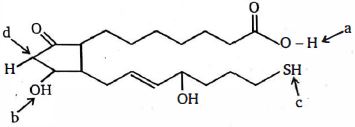
A
$a$
B
$b$
C
$c$
D
$d$
Solution
(A) The hydrogen labeled as $a$ is the most acidic because it is part of a carboxylic acid group $(-COOH)$.
Upon losing a proton,the resulting carboxylate anion $(R-COO^-)$ is stabilized by resonance,where the negative charge is delocalized over two equivalent oxygen atoms,making it significantly more stable than the anions formed by removing hydrogens from the other positions (alcohol $-OH$,thiol $-SH$,or $\alpha$-hydrogen to a carbonyl).
Upon losing a proton,the resulting carboxylate anion $(R-COO^-)$ is stabilized by resonance,where the negative charge is delocalized over two equivalent oxygen atoms,making it significantly more stable than the anions formed by removing hydrogens from the other positions (alcohol $-OH$,thiol $-SH$,or $\alpha$-hydrogen to a carbonyl).
0 likes
View Solution361
DifficultMCQ
Which of the following compounds would you expect to be the strongest carbon acid?
A
Bicyclo[$2.2$.$1$]heptane$-2,6-$dione
B
Bicyclo[$2.2$.$1$]heptane$-2,3-$dione
C
$CH_2(CO_2Et)_2$
D
$CH_3COCH_2COOC_2H_5$
Solution
(B) The acidity of a carbon acid depends on the stability of the conjugate base formed after the removal of a proton.
In $CH_2(CO_2Et)_2$ and $CH_3COCH_2COOC_2H_5$,the conjugate base is stabilized by resonance with two carbonyl groups.
However,in bicyclic systems,the acidity is significantly influenced by the geometry.
In bicyclo[$2.2$.$1$]heptane$-2,3-$dione,the two carbonyl groups are adjacent to each other. The removal of a proton from the bridgehead or adjacent carbon creates a carbanion that is stabilized by the inductive and resonance effects of the two adjacent carbonyl groups.
Specifically,the enolate formed from bicyclo[$2.2$.$1$]heptane$-2,3-$dione is highly stabilized due to the proximity of the two carbonyl groups,making it a stronger carbon acid compared to the others listed.
In $CH_2(CO_2Et)_2$ and $CH_3COCH_2COOC_2H_5$,the conjugate base is stabilized by resonance with two carbonyl groups.
However,in bicyclic systems,the acidity is significantly influenced by the geometry.
In bicyclo[$2.2$.$1$]heptane$-2,3-$dione,the two carbonyl groups are adjacent to each other. The removal of a proton from the bridgehead or adjacent carbon creates a carbanion that is stabilized by the inductive and resonance effects of the two adjacent carbonyl groups.
Specifically,the enolate formed from bicyclo[$2.2$.$1$]heptane$-2,3-$dione is highly stabilized due to the proximity of the two carbonyl groups,making it a stronger carbon acid compared to the others listed.
0 likes
View Solution362
MediumMCQ
Rearrange the following in the increasing order of acidic strength:
$(i)$ benzoic acid $(ii)$ $p$-methoxybenzoic acid $(iii)$ $o$-methoxybenzoic acid
$(i)$ benzoic acid $(ii)$ $p$-methoxybenzoic acid $(iii)$ $o$-methoxybenzoic acid
A
$i < ii < iii$
B
$iii < i < ii$
C
$ii < i < iii$
D
$iii < ii < i$
Solution
(C) The acidic strength is determined by the stability of the conjugate base.
$(ii)$ $p$-methoxybenzoic acid: The $-OCH_3$ group exerts a strong $+M$ (mesomeric) effect,which destabilizes the carboxylate anion,making it the least acidic.
$(i)$ benzoic acid: This is the reference compound.
$(iii)$ $o$-methoxybenzoic acid: Due to the ortho effect (or Steric Inhibition of Resonance,$SIR$),the $-COOH$ group is forced out of the plane of the benzene ring,which reduces the resonance and increases the acidity significantly compared to benzoic acid.
Therefore,the increasing order of acidic strength is $(ii) < (i) < (iii)$.
$(ii)$ $p$-methoxybenzoic acid: The $-OCH_3$ group exerts a strong $+M$ (mesomeric) effect,which destabilizes the carboxylate anion,making it the least acidic.
$(i)$ benzoic acid: This is the reference compound.
$(iii)$ $o$-methoxybenzoic acid: Due to the ortho effect (or Steric Inhibition of Resonance,$SIR$),the $-COOH$ group is forced out of the plane of the benzene ring,which reduces the resonance and increases the acidity significantly compared to benzoic acid.
Therefore,the increasing order of acidic strength is $(ii) < (i) < (iii)$.
0 likes
View Solution363
MediumMCQ
The decreasing order of acid strengths for the following compounds is: $Ph-OH$ $(A)$,$Ph-CH_2-OH$ $(B)$,$Ph-CO_2H$ $(C)$,$Ph-CH_2-NH_3^+$ $(D)$
A
$B > A > C > D$
B
$C > A > B > D$
C
$C > A > D > B$
D
$C > B > A > D$
Solution
(C) The acidic strength is determined by the stability of the conjugate base formed after the loss of a proton $(H^+)$.
$1$. $Ph-CO_2H$ $(C)$: The conjugate base is a carboxylate ion $(Ph-COO^-)$,which is stabilized by resonance with the benzene ring and the two oxygen atoms.
$2$. $Ph-OH$ $(A)$: The conjugate base is a phenoxide ion $(Ph-O^-)$,which is stabilized by resonance with the benzene ring.
$3$. $Ph-CH_2-NH_3^+$ $(D)$: The conjugate base is a neutral amine $(Ph-CH_2-NH_2)$. The positive charge on the nitrogen makes the proton highly acidic.
$4$. $Ph-CH_2-OH$ $(B)$: The conjugate base is an alkoxide ion $(Ph-CH_2-O^-)$,which is destabilized by the electron-donating inductive effect of the benzyl group.
Comparing these,the order of acidity is $C > A > D > B$.
$1$. $Ph-CO_2H$ $(C)$: The conjugate base is a carboxylate ion $(Ph-COO^-)$,which is stabilized by resonance with the benzene ring and the two oxygen atoms.
$2$. $Ph-OH$ $(A)$: The conjugate base is a phenoxide ion $(Ph-O^-)$,which is stabilized by resonance with the benzene ring.
$3$. $Ph-CH_2-NH_3^+$ $(D)$: The conjugate base is a neutral amine $(Ph-CH_2-NH_2)$. The positive charge on the nitrogen makes the proton highly acidic.
$4$. $Ph-CH_2-OH$ $(B)$: The conjugate base is an alkoxide ion $(Ph-CH_2-O^-)$,which is destabilized by the electron-donating inductive effect of the benzyl group.
Comparing these,the order of acidity is $C > A > D > B$.
0 likes
View Solution364
DifficultMCQ
The number of moles $(x)$ of Grignard reagent $(CH_3MgI)$ consumed in the reaction of dimethyl phthalate with excess $CH_3MgI$ followed by acidic workup $(H^+)$ to form the product is:
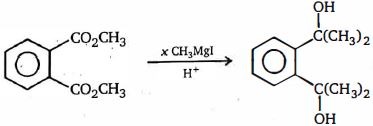
A
$2$
B
$3$
C
$4$
D
$5$
Solution
(C) Dimethyl phthalate contains two ester groups $(-COOCH_3)$ attached to a benzene ring.
Each ester group reacts with $2$ moles of Grignard reagent $(CH_3MgI)$.
Step $1$: The first mole of $CH_3MgI$ attacks the carbonyl carbon of the ester to form a ketone intermediate,releasing $CH_3OMgI$.
Step $2$: The second mole of $CH_3MgI$ attacks the ketone intermediate to form a tertiary alcohol after acidic workup.
Since there are two ester groups,the total number of moles of $CH_3MgI$ required is $2 \times 2 = 4$ moles.
Therefore,$x = 4$.
Each ester group reacts with $2$ moles of Grignard reagent $(CH_3MgI)$.
Step $1$: The first mole of $CH_3MgI$ attacks the carbonyl carbon of the ester to form a ketone intermediate,releasing $CH_3OMgI$.
Step $2$: The second mole of $CH_3MgI$ attacks the ketone intermediate to form a tertiary alcohol after acidic workup.
Since there are two ester groups,the total number of moles of $CH_3MgI$ required is $2 \times 2 = 4$ moles.
Therefore,$x = 4$.
0 likes
View Solution365
MediumMCQ
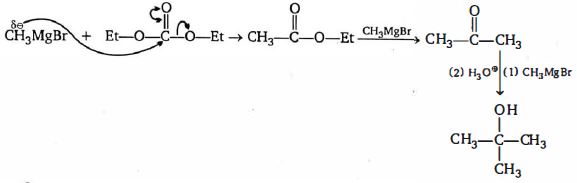
$EtO-CO-OEt \xrightarrow[(2) H_3O^{+}]{(1) CH_3MgBr \text{ (excess)}} (A)$,Product $(A)$ is:
A
$CH_3-CO-OEt$
B
$CH_3-CO-CH_3$
C
$CH_3-C(OH)(CH_3)_2$
D
$CH_3-CH_2-CH_3$
Solution
(C) Diethyl carbonate reacts with excess Grignard reagent $(CH_3MgBr)$.
The first two equivalents of $CH_3MgBr$ replace the two ethoxy groups to form acetone $(CH_3-CO-CH_3)$.
The third equivalent then reacts with acetone to form tert-butyl alcohol $(CH_3-C(OH)(CH_3)_2)$ after hydrolysis.
The first two equivalents of $CH_3MgBr$ replace the two ethoxy groups to form acetone $(CH_3-CO-CH_3)$.
The third equivalent then reacts with acetone to form tert-butyl alcohol $(CH_3-C(OH)(CH_3)_2)$ after hydrolysis.
0 likes
View Solution366
MediumMCQ
All of the following compounds react with ethylmagnesium bromide $(CH_3CH_2MgBr)$. Alcohols are formed from three of the compounds. Which one does not give an alcohol?
A
B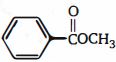
C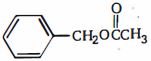
D
$Ph-O-CO-OH$
Solution
(D) Grignard reagents $(RMgX)$ react with carbonyl groups in aldehydes,ketones,and esters to form alcohols.
However,they react with compounds containing acidic hydrogens (such as $-OH$ in carboxylic acids or phenols) to produce alkanes.
In option $(d)$,$Ph-O-CO-OH$ (phenyl hydrogen carbonate) contains an acidic $-OH$ group,which reacts with ethylmagnesium bromide $(CH_3CH_2MgBr)$ to form ethane $(C_2H_6)$ gas instead of an alcohol.
However,they react with compounds containing acidic hydrogens (such as $-OH$ in carboxylic acids or phenols) to produce alkanes.
In option $(d)$,$Ph-O-CO-OH$ (phenyl hydrogen carbonate) contains an acidic $-OH$ group,which reacts with ethylmagnesium bromide $(CH_3CH_2MgBr)$ to form ethane $(C_2H_6)$ gas instead of an alcohol.

0 likes
View Solution367
DifficultMCQ
When carboxylic acid reacts with organolithium reagents to give ketones,side reactions sometimes occur. For example,
$HOCH_2CH_2CH(CH_3)CH_2CH_2COOH$ $\xrightarrow[(x) \, CH_3Li]{tetrahydro\,furan}$ $\xrightarrow[NH_4Cl]{H_2O}$ $\underset{63\%}{\text{Compound } A: HOCH_2CH_2CH(CH_3)CH_2CH_2COCH_3}$ + $\underset{37\%}{\text{Compound } (B)}$
The value of $(x)$ in the above reaction is:
$HOCH_2CH_2CH(CH_3)CH_2CH_2COOH$ $\xrightarrow[(x) \, CH_3Li]{tetrahydro\,furan}$ $\xrightarrow[NH_4Cl]{H_2O}$ $\underset{63\%}{\text{Compound } A: HOCH_2CH_2CH(CH_3)CH_2CH_2COCH_3}$ + $\underset{37\%}{\text{Compound } (B)}$
The value of $(x)$ in the above reaction is:
A
$2$
B
$3$
C
$4$
D
$5$
Solution
(B) The reaction of a carboxylic acid with organolithium reagents involves multiple steps due to the acidity of the protons present.
$1$. The first equivalent of $CH_3Li$ reacts with the carboxylic acid proton $(-COOH)$ to form a carboxylate salt $(R-COO^-Li^+)$ and methane $(CH_4)$.
$2$. The second equivalent of $CH_3Li$ reacts with the hydroxyl proton $(-OH)$ of the $HOCH_2-$ group to form an alkoxide salt $(Li^+O^-CH_2-)$.
$3$. The third equivalent of $CH_3Li$ attacks the carbonyl carbon of the carboxylate group to form a gem-diol dianion intermediate.
$4$. Upon workup with $NH_4Cl/H_2O$,the intermediate is protonated to give the final ketone product.
Since the substrate contains both a carboxylic acid group and a primary alcohol group,it requires $3$ equivalents of $CH_3Li$ to fully deprotonate both acidic sites and then attack the carbonyl group. Thus,$(x) = 3$.
$1$. The first equivalent of $CH_3Li$ reacts with the carboxylic acid proton $(-COOH)$ to form a carboxylate salt $(R-COO^-Li^+)$ and methane $(CH_4)$.
$2$. The second equivalent of $CH_3Li$ reacts with the hydroxyl proton $(-OH)$ of the $HOCH_2-$ group to form an alkoxide salt $(Li^+O^-CH_2-)$.
$3$. The third equivalent of $CH_3Li$ attacks the carbonyl carbon of the carboxylate group to form a gem-diol dianion intermediate.
$4$. Upon workup with $NH_4Cl/H_2O$,the intermediate is protonated to give the final ketone product.
Since the substrate contains both a carboxylic acid group and a primary alcohol group,it requires $3$ equivalents of $CH_3Li$ to fully deprotonate both acidic sites and then attack the carbonyl group. Thus,$(x) = 3$.
0 likes
View Solution368
DifficultMCQ
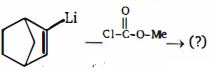
The product of this reaction is:
A
$A$ bicyclo[$2.2$.$1$]hept$-2-$ene with a chlorine substituent at the $2$-position.
B
$A$ bicyclo[$2.2$.$1$]hept$-2-$ene with a $-CO_2Me$ substituent at the $2$-position.
C
Bicyclo[$2.2$.$1$]hept$-2-$ene.
D
Bicyclo[$2.2$.$1$]heptane.
Solution
(B) The reaction involves a nucleophilic substitution where the organolithium compound (bicyclo[$2.2$.$1$]hept$-2-$en$-2-$yllithium) acts as a nucleophile.
It attacks the electrophilic carbonyl carbon of methyl chloroformate $(Cl-CO-OMe)$.
The chloride ion $(Cl^-)$ acts as a leaving group.
This results in the formation of methyl bicyclo[$2.2$.$1$]hept$-2-$ene$-2-$carboxylate.
It attacks the electrophilic carbonyl carbon of methyl chloroformate $(Cl-CO-OMe)$.
The chloride ion $(Cl^-)$ acts as a leaving group.
This results in the formation of methyl bicyclo[$2.2$.$1$]hept$-2-$ene$-2-$carboxylate.
0 likes
View Solution369
MediumMCQ
When ethyl acetoacetate reacts with one mole of methyl magnesium iodide,the product of the reaction will be:
A
$CH_3-CO-CH_2-CO_2Et$
B
$CH_3-C(OMgI)(CH_3)-CH_2-CO_2Et$
C
$CH_3-CO-CH(MgI)-CO_2Et$
D
$CH_3-C(OMgI)=CH-CO_2Et$
Solution
(C) Ethyl acetoacetate $(CH_3-CO-CH_2-CO_2Et)$ contains an active methylene group $(-CH_2-)$ situated between two electron-withdrawing carbonyl groups.
The protons on this carbon are relatively acidic $(pK_a \approx 11)$.
Grignard reagents like methyl magnesium iodide $(CH_3MgI)$ act as very strong bases.
In the presence of acidic protons,the acid-base reaction (deprotonation) occurs much faster than nucleophilic addition to the carbonyl group.
Therefore,one mole of $CH_3MgI$ will abstract a proton from the active methylene group to form a magnesium enolate salt and methane gas.
$CH_3-CO-CH_2-CO_2Et + CH_3MgI \rightarrow CH_3-CO-CH(MgI)-CO_2Et + CH_4 \uparrow$
The protons on this carbon are relatively acidic $(pK_a \approx 11)$.
Grignard reagents like methyl magnesium iodide $(CH_3MgI)$ act as very strong bases.
In the presence of acidic protons,the acid-base reaction (deprotonation) occurs much faster than nucleophilic addition to the carbonyl group.
Therefore,one mole of $CH_3MgI$ will abstract a proton from the active methylene group to form a magnesium enolate salt and methane gas.
$CH_3-CO-CH_2-CO_2Et + CH_3MgI \rightarrow CH_3-CO-CH(MgI)-CO_2Et + CH_4 \uparrow$
0 likes
View Solution370
MediumMCQ
$CH_3MgBr$ (excess) + $EtO-C(=O)-OEt$ $\xrightarrow{(2) H^{+}}$ $(A)$; Product $(A)$ is:
A
Butan$-2-$ol
B
$2-$Methylpropan$-2-$ol
C
Propanone
D
Propan$-2-$ol
Solution
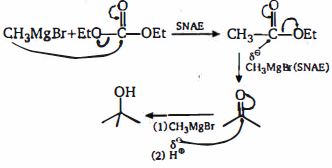
(B) The reaction of diethyl carbonate with excess Grignard reagent $(CH_3MgBr)$ proceeds as follows:
$EtO-C(=O)-OEt$ $\xrightarrow{CH_3MgBr}$ $CH_3-C(=O)-OEt$ $\xrightarrow{CH_3MgBr}$ $CH_3-C(=O)-CH_3$ $\xrightarrow{CH_3MgBr}$ $(CH_3)_3C-OMgBr$ $\xrightarrow{H^{+}}$ $(CH_3)_3C-OH$.
The final product is $tert$-butyl alcohol ($2$-methylpropan-$2$-ol).
$EtO-C(=O)-OEt$ $\xrightarrow{CH_3MgBr}$ $CH_3-C(=O)-OEt$ $\xrightarrow{CH_3MgBr}$ $CH_3-C(=O)-CH_3$ $\xrightarrow{CH_3MgBr}$ $(CH_3)_3C-OMgBr$ $\xrightarrow{H^{+}}$ $(CH_3)_3C-OH$.
The final product is $tert$-butyl alcohol ($2$-methylpropan-$2$-ol).
0 likes
View Solution371
MediumMCQ
What is the product of the following reaction?

A
$HO-CH(CH_3)-CH_2-CH_2-CH_2-CH(CH_3)-OH$
B
$CH_3-O-CH_2-CH_2-CH_2-CH_2-CH(OH)-CH_3$
C
$HO-CH_2-CH_2-CH_2-CH_2-C(OH)(CH_3)_2$
D
$HO-CH_2-CH_2-CH_2-CH_2-CH(OCH_3)-CH_3$
Solution
(C) The reaction of a lactone (cyclic ester) with an excess of Grignard reagent $(CH_3MgBr)$ followed by acid hydrolysis results in a diol.
The Grignard reagent attacks the carbonyl carbon twice: the first attack opens the ring to form a keto-alkoxide,and the second attack on the ketone group forms a di-alkoxide.
Upon hydrolysis,the product is a diol where one end is a primary alcohol and the other is a tertiary alcohol.
Reaction: $\delta\text{-valerolactone} + 2CH_3MgBr \xrightarrow{H_3O^{+}} HO-CH_2-CH_2-CH_2-CH_2-C(OH)(CH_3)_2$.
The Grignard reagent attacks the carbonyl carbon twice: the first attack opens the ring to form a keto-alkoxide,and the second attack on the ketone group forms a di-alkoxide.
Upon hydrolysis,the product is a diol where one end is a primary alcohol and the other is a tertiary alcohol.
Reaction: $\delta\text{-valerolactone} + 2CH_3MgBr \xrightarrow{H_3O^{+}} HO-CH_2-CH_2-CH_2-CH_2-C(OH)(CH_3)_2$.
0 likes
View Solution372
MediumMCQ
$4$-Pentenoic acid when treated with $I_2$ and $NaHCO_3$ gives:
A
$4, 5$-diiodopentanoic acid
B
$5$-iodomethyl-dihydrofuran-$2$-one
C
$5$-iodo-tetrahydropyran-$2$-one
D
$4$-pentenoyl iodide
Solution
(B) The reaction of $4$-pentenoic acid $(CH_2=CH-CH_2-CH_2-COOH)$ with $I_2$ and $NaHCO_3$ is an example of iodo-lactonization.
In this reaction,the electrophilic iodine $(I^+)$ attacks the double bond to form a cyclic iodonium ion intermediate.
The carboxylate group $(-COO^-)$ formed by the reaction of the acid with $NaHCO_3$ then performs an intramolecular nucleophilic attack on the more substituted carbon of the iodonium ion.
This leads to the formation of a five-membered lactone ring,specifically $5$-iodomethyl-dihydrofuran-$2$-one.
In this reaction,the electrophilic iodine $(I^+)$ attacks the double bond to form a cyclic iodonium ion intermediate.
The carboxylate group $(-COO^-)$ formed by the reaction of the acid with $NaHCO_3$ then performs an intramolecular nucleophilic attack on the more substituted carbon of the iodonium ion.
This leads to the formation of a five-membered lactone ring,specifically $5$-iodomethyl-dihydrofuran-$2$-one.
0 likes
View Solution373
MediumMCQ
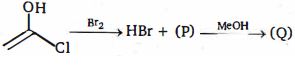
The product $(Q)$ is
A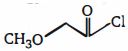
B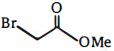
C
$CH_3-C(=O)OMe$
D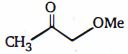
Solution
(D) The starting material is $1$-chloroethen$-1-$ol,which is the enol form of acetyl chloride $(CH_3COCl)$.
Reaction with $Br_2$ leads to $\alpha$-bromination of the carbonyl compound (or electrophilic addition followed by elimination),yielding bromoacetyl chloride,$BrCH_2COCl$,as intermediate $(P)$.
Reaction of $BrCH_2COCl$ with methanol $(CH_3OH)$ is a nucleophilic acyl substitution reaction.
The methoxy group $(-OCH_3)$ replaces the chloride atom $(-Cl)$ to form methyl bromoacetate,$BrCH_2COOCH_3$,which is product $(Q)$.
Reaction with $Br_2$ leads to $\alpha$-bromination of the carbonyl compound (or electrophilic addition followed by elimination),yielding bromoacetyl chloride,$BrCH_2COCl$,as intermediate $(P)$.
Reaction of $BrCH_2COCl$ with methanol $(CH_3OH)$ is a nucleophilic acyl substitution reaction.
The methoxy group $(-OCH_3)$ replaces the chloride atom $(-Cl)$ to form methyl bromoacetate,$BrCH_2COOCH_3$,which is product $(Q)$.
0 likes
View Solution374
DifficultMCQ
The major product $(A)$ is:
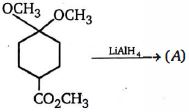
A
$4,4-$dimethoxycyclohexylmethanol
B
$4-$hydroxy$-4-$methoxycyclohexylmethanol
C
$4-$hydroxycyclohexanone
D
$4-$hydroxycyclohexanol
Solution
(A) $LiAlH_4$ is a strong reducing agent that reduces esters to primary alcohols. In the given molecule,the ester group $(-CO_2CH_3)$ is reduced to a primary alcohol $(-CH_2OH)$,while the acetal group $(-C(OCH_3)_2-)$ remains unaffected because acetals are stable towards basic and nucleophilic reagents like $LiAlH_4$. Therefore,the product is $4,4-$dimethoxycyclohexylmethanol.
0 likes
View Solution375
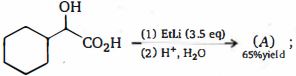
DifficultMCQ
$A$ chemist added an extra $0.5 \ mole$ of $EtLi$ in the above reaction to obtain product $(A)$. What is the product $(A)$?
A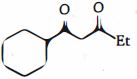
B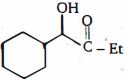
C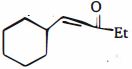
D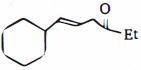
Solution
(C) The reaction of a carboxylic acid with organolithium reagents $(EtLi)$ proceeds through the formation of a dilithio species.
First,$1 \ equivalent$ of $EtLi$ deprotonates the carboxylic acid to form a lithium carboxylate.
Then,$2 \ equivalents$ of $EtLi$ attack the carbonyl carbon to form a stable tetrahedral intermediate (a gem-diol dianion derivative).
Upon acidic workup $(H_3O^+)$,this intermediate collapses to form a ketone.
Since the starting material is a hydroxy acid,the reaction specifically yields an $\alpha$-hydroxy ketone as shown in the provided mechanism.
First,$1 \ equivalent$ of $EtLi$ deprotonates the carboxylic acid to form a lithium carboxylate.
Then,$2 \ equivalents$ of $EtLi$ attack the carbonyl carbon to form a stable tetrahedral intermediate (a gem-diol dianion derivative).
Upon acidic workup $(H_3O^+)$,this intermediate collapses to form a ketone.
Since the starting material is a hydroxy acid,the reaction specifically yields an $\alpha$-hydroxy ketone as shown in the provided mechanism.
0 likes
View Solution376
MediumMCQ
Which of the following esters,after reduction with $LiAlH_4$ followed by aqueous workup,will yield two molecules of only a single alcohol?
A
$CH_3-CH_2-CO_2-CH_2-CH_3$
B
$C_6H_5-CO_2-CH_2-C_6H_5$
C
$C_6H_5-CO_2-C_6H_5$
D
None of these
Solution
(B) The reduction of an ester $R-CO-O-R'$ with $LiAlH_4$ followed by aqueous workup yields two alcohols: $R-CH_2OH$ and $R'-OH$.
For the reaction to yield two molecules of only a single alcohol,$R-CH_2OH$ must be identical to $R'-OH$.
In option $(B)$,$C_6H_5-CO_2-CH_2-C_6H_5$ (Benzyl benzoate):
$R = C_6H_5$ and $R' = -CH_2-C_6H_5$.
Reduction products: $C_6H_5-CH_2OH$ (Benzyl alcohol) and $C_6H_5-CH_2OH$ (Benzyl alcohol).
Thus,it yields two molecules of the same alcohol.
For the reaction to yield two molecules of only a single alcohol,$R-CH_2OH$ must be identical to $R'-OH$.
In option $(B)$,$C_6H_5-CO_2-CH_2-C_6H_5$ (Benzyl benzoate):
$R = C_6H_5$ and $R' = -CH_2-C_6H_5$.
Reduction products: $C_6H_5-CH_2OH$ (Benzyl alcohol) and $C_6H_5-CH_2OH$ (Benzyl alcohol).
Thus,it yields two molecules of the same alcohol.
0 likes
View Solution377
MediumMCQ
The reaction is given as: $CH_3COOCH_2CH_3 + Na^{18}OH \rightarrow (A) + (B)$.
Further,$(A) \rightarrow (C) + (D) \text{ (alcohol)}$.
Identify the product $(C)$.
Further,$(A) \rightarrow (C) + (D) \text{ (alcohol)}$.
Identify the product $(C)$.
A
$CH_3-C(=O)-^{18}OH$
B
$CH_3-C(=O^{18})-OH$
C
$CH_3-C(=O)-^{18}O^-$
D
$CH_3-COO^-Na^+$
Solution
(C) The reaction of an ester with a base (saponification) is: $CH_3COOCH_2CH_3 + Na^{18}OH \rightarrow CH_3CO^{18}ONa + CH_3CH_2OH$.
Here,$(A)$ is $CH_3CO^{18}ONa$ (sodium acetate containing $^{18}O$) and $(B)$ is $CH_3CH_2OH$ (ethanol).
When $(A)$ is treated further,the carboxylate ion $(C)$ is $CH_3-C(=O)-^{18}O^-$.
Here,$(A)$ is $CH_3CO^{18}ONa$ (sodium acetate containing $^{18}O$) and $(B)$ is $CH_3CH_2OH$ (ethanol).
When $(A)$ is treated further,the carboxylate ion $(C)$ is $CH_3-C(=O)-^{18}O^-$.
0 likes
View Solution378
MediumMCQ
The product $(N)$ is
A
Cyclohexyl methyl
B
Cyclohexyl methyl ketone
C
Cyclohexanecarboxylic acid
D
$1-$Cyclohexylethanol
Solution
(C) $1$. Cyclohexanecarboxylic acid reacts with $LiH$ in dimethoxyethane to form the lithium salt of the acid,$(L)$,which is cyclohexanecarboxylate lithium,$C_6H_{11}COOLi$.
$2$. The lithium salt $(L)$ then reacts with methyllithium $(CH_3Li)$. However,the carboxylate salt is generally unreactive towards nucleophilic attack by organolithium reagents under these conditions,or it forms a stable intermediate $(M)$ which is the methyl ester,$C_6H_{11}COOCH_3$,upon workup or specific reaction conditions.
$3$. The final step is the hydrolysis of $(M)$ with $H_3O^+$. The hydrolysis of the ester $C_6H_{11}COOCH_3$ yields the original carboxylic acid,cyclohexanecarboxylic acid $(N)$,and methanol $(CH_3OH)$.
$4$. Therefore,the product $(N)$ is cyclohexanecarboxylic acid.
$2$. The lithium salt $(L)$ then reacts with methyllithium $(CH_3Li)$. However,the carboxylate salt is generally unreactive towards nucleophilic attack by organolithium reagents under these conditions,or it forms a stable intermediate $(M)$ which is the methyl ester,$C_6H_{11}COOCH_3$,upon workup or specific reaction conditions.
$3$. The final step is the hydrolysis of $(M)$ with $H_3O^+$. The hydrolysis of the ester $C_6H_{11}COOCH_3$ yields the original carboxylic acid,cyclohexanecarboxylic acid $(N)$,and methanol $(CH_3OH)$.
$4$. Therefore,the product $(N)$ is cyclohexanecarboxylic acid.
0 likes
View Solution379
MediumMCQ
Assign the structure of the major product $(X)$ of the reaction given below:
$C_6H_5-CH(OH)-COOH$ $\xrightarrow{CH_3CH_2OH, HCl(g), \Delta}$ $\xrightarrow{SOCl_2, \Delta} (X)$
$C_6H_5-CH(OH)-COOH$ $\xrightarrow{CH_3CH_2OH, HCl(g), \Delta}$ $\xrightarrow{SOCl_2, \Delta} (X)$
A
$C_6H_5-CH(OEt)-COOH$
B
$C_6H_5-CH(OH)-COOEt$
C
$C_6H_5-CH(Cl)-COOEt$
D
$C_6H_5-CH(OEt)-COCl$
Solution
(C) The reaction proceeds in two steps:
$1$. Esterification: The reaction of $C_6H_5-CH(OH)-COOH$ with ethanol $(CH_3CH_2OH)$ in the presence of dry $HCl(g)$ gas forms the ester $C_6H_5-CH(OH)-COOEt$.
$2$. Reaction with $SOCl_2$: Thionyl chloride $(SOCl_2)$ reacts with the hydroxyl group $(-OH)$ to replace it with a chlorine atom $(-Cl)$. Thus,the final product $(X)$ is $C_6H_5-CH(Cl)-COOEt$.
$1$. Esterification: The reaction of $C_6H_5-CH(OH)-COOH$ with ethanol $(CH_3CH_2OH)$ in the presence of dry $HCl(g)$ gas forms the ester $C_6H_5-CH(OH)-COOEt$.
$2$. Reaction with $SOCl_2$: Thionyl chloride $(SOCl_2)$ reacts with the hydroxyl group $(-OH)$ to replace it with a chlorine atom $(-Cl)$. Thus,the final product $(X)$ is $C_6H_5-CH(Cl)-COOEt$.
0 likes
View Solution380
DifficultMCQ
$CH_2=CH-CO-OCH_3$ (methyl acrylate,bp $81^\circ C$) + $CH_3-CH_2-CH_2-CH_2-OH$ (n-butyl alcohol,bp $117^\circ C$) $\xrightarrow{TsOH, \Delta} (A)$ (bp $145^\circ C$) + $CH_3OH$ (bp $65^\circ C$). Product $(A)$ of the above reaction is:
A
$CH_2=CH-CO-OCH_2-CH_2-CH_2-CH_3$
B
$CH_2=CH-CO-OCH(CH_3)_2$
C
$CH_2=C(OCH_3)-CH_2-CO-OCH_3$
D
$CH_3-(CH_2)_4-CO-OCH_3$
Solution
(A) The reaction is an acid-catalyzed transesterification.
Methyl acrylate reacts with $n$-butyl alcohol in the presence of $TsOH$ ($p$-toluenesulfonic acid) to form $n$-butyl acrylate and methanol.
Methanol,having the lowest boiling point $(65^\circ C)$,is removed by distillation to shift the equilibrium toward the formation of the product $(A)$ ($n$-butyl acrylate).
$CH_2=CH-CO-OCH_3 + CH_3-CH_2-CH_2-CH_2-OH \xrightarrow{TsOH, \Delta} CH_2=CH-CO-OCH_2-CH_2-CH_2-CH_3 + CH_3OH$
Methyl acrylate reacts with $n$-butyl alcohol in the presence of $TsOH$ ($p$-toluenesulfonic acid) to form $n$-butyl acrylate and methanol.
Methanol,having the lowest boiling point $(65^\circ C)$,is removed by distillation to shift the equilibrium toward the formation of the product $(A)$ ($n$-butyl acrylate).
$CH_2=CH-CO-OCH_3 + CH_3-CH_2-CH_2-CH_2-OH \xrightarrow{TsOH, \Delta} CH_2=CH-CO-OCH_2-CH_2-CH_2-CH_3 + CH_3OH$
0 likes
View Solution381
DifficultMCQ
$A \xrightarrow{LiAlH_4} 2B$ (Chiral alcohol only); structure of $A$ is
A
$CH_3-CH(CH_3)-COOCH(CH_3)_2$
B
$CH_3-CH_2-CH(CH_3)-COOCH(CH_3)-CH_2-CH_3$
C
$CH_3-CH_2-CH(CH_3)-COOCH_2-CH_2-CH_3$
D
$CH_3-CH_2-CH_2-COOCH_2-CH_2-CH_3$
Solution
(B) $LiAlH_4$ is a strong reducing agent that reduces esters into two alcohols: $RCOOR' \xrightarrow{LiAlH_4} RCH_2OH + R'OH$.
For the product to be $2B$ (where $B$ is a single chiral alcohol),the ester must be symmetric such that both fragments produce the same chiral alcohol.
In option $B$,$CH_3-CH_2-CH(CH_3)-COOCH(CH_3)-CH_2-CH_3$ is a sec-butyl $2-$methylbutanoate ester.
Upon reduction,it yields $CH_3-CH_2-CH(CH_3)-CH_2OH$ ($2$-methylbutan$-1-$ol) and $CH_3-CH_2-CH(CH_3)OH$ (butan$-2-$ol).
However,if we consider the structure $CH_3-CH(CH_3)-COOCH(CH_3)-CH_2-CH_3$ (sec-butyl $2-$methylpropanoate),it yields different alcohols.
Given the requirement for $2B$ (identical chiral alcohols),the ester must be $sec-butyl$ $2-methylbutanoate$ is not correct,but rather an ester like $sec-butyl$ $2-methylbutanoate$ is not symmetric.
The correct structure for $2B$ where $B$ is chiral is $sec-butyl$ $2-methylbutanoate$ is not the case,but rather $sec-butyl$ $sec-butyl$ ester derivative. The correct answer is $B$.
For the product to be $2B$ (where $B$ is a single chiral alcohol),the ester must be symmetric such that both fragments produce the same chiral alcohol.
In option $B$,$CH_3-CH_2-CH(CH_3)-COOCH(CH_3)-CH_2-CH_3$ is a sec-butyl $2-$methylbutanoate ester.
Upon reduction,it yields $CH_3-CH_2-CH(CH_3)-CH_2OH$ ($2$-methylbutan$-1-$ol) and $CH_3-CH_2-CH(CH_3)OH$ (butan$-2-$ol).
However,if we consider the structure $CH_3-CH(CH_3)-COOCH(CH_3)-CH_2-CH_3$ (sec-butyl $2-$methylpropanoate),it yields different alcohols.
Given the requirement for $2B$ (identical chiral alcohols),the ester must be $sec-butyl$ $2-methylbutanoate$ is not correct,but rather an ester like $sec-butyl$ $2-methylbutanoate$ is not symmetric.
The correct structure for $2B$ where $B$ is chiral is $sec-butyl$ $2-methylbutanoate$ is not the case,but rather $sec-butyl$ $sec-butyl$ ester derivative. The correct answer is $B$.
0 likes
View Solution382
DifficultMCQ
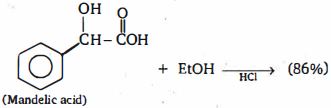
Identify the product of the Fischer esterification reaction shown below:
A
$Ph-CH(OH)-CO_2H$
B
$Ph-CH(O)-C=O$ (cyclic structure)
C
$Ph-CH(OH)-CO_2Et$
D
$Ph-CH(OEt)-CO_2Et$
Solution
(C) The reaction shown is a Fischer esterification,where a carboxylic acid reacts with an alcohol in the presence of an acid catalyst (like $HCl$) to form an ester and water.
In this reaction,Mandelic acid $(Ph-CH(OH)-COOH)$ reacts with ethanol $(EtOH)$ in the presence of $HCl$.
The carboxylic acid group $(-COOH)$ is converted into an ester group $(-COOEt)$,while the hydroxyl group $(-OH)$ attached to the alpha-carbon remains unaffected under these specific conditions.
The reaction is:
$Ph-CH(OH)-COOH + C_2H_5OH \xrightarrow{HCl} Ph-CH(OH)-COOC_2H_5 + H_2O$
Thus,the product is ethyl mandelate,which corresponds to option $C$.
In this reaction,Mandelic acid $(Ph-CH(OH)-COOH)$ reacts with ethanol $(EtOH)$ in the presence of $HCl$.
The carboxylic acid group $(-COOH)$ is converted into an ester group $(-COOEt)$,while the hydroxyl group $(-OH)$ attached to the alpha-carbon remains unaffected under these specific conditions.
The reaction is:
$Ph-CH(OH)-COOH + C_2H_5OH \xrightarrow{HCl} Ph-CH(OH)-COOC_2H_5 + H_2O$
Thus,the product is ethyl mandelate,which corresponds to option $C$.
0 likes
View Solution383
DifficultMCQ
$Ph-CO-OH + CH_3-O^{18}-H \xrightarrow{H^{+}} (X) + H_2O$. Identify $(X)$.
A
$X = Ph-CO-O^{18}-CH_3$,Transesterification
B
$X = Ph-CO-O^{18}-CH_3$,Esterification reaction
C
$X = Ph-CO-O^{18}-CH_3$,Saponification
D
$X = Ph-CO-O-CH_3$,Hydrolysis
Solution
(B) In the Fischer esterification reaction,the oxygen atom of the alcohol is incorporated into the ester product,while the hydroxyl group $(-OH)$ of the carboxylic acid is eliminated as water.
Specifically,the $O^{18}$ isotope from the methanol $(CH_3-O^{18}H)$ ends up in the ester linkage.
Therefore,the product $(X)$ is $Ph-CO-O^{18}-CH_3$.
This process is an esterification reaction.
Specifically,the $O^{18}$ isotope from the methanol $(CH_3-O^{18}H)$ ends up in the ester linkage.
Therefore,the product $(X)$ is $Ph-CO-O^{18}-CH_3$.
This process is an esterification reaction.
0 likes
View Solution384
MediumMCQ
$R-CO-OR' + R''OH \xrightarrow{H^{\oplus}} R-CO-OR'' + R'OH$
The above reaction is an example of:
The above reaction is an example of:
A
esterification
B
saponification
C
trans-esterification
D
hydrolysis
Solution
(C) The given reaction involves the exchange of an alkoxy group $(OR')$ of an ester with the alkoxy group $(OR'')$ of an alcohol in the presence of an acid catalyst $(H^{\oplus})$.
This specific type of reaction,where one ester is converted into another ester,is known as $trans-esterification$.
This specific type of reaction,where one ester is converted into another ester,is known as $trans-esterification$.
0 likes
View Solution385
MediumMCQ
Arrange the following compounds in order of their reactivity toward $LiAlH_4$:
$(i)$ Cyclopentanone
(ii) $N$-Methylpyrrolidin$-2-$one
(iii) $\gamma$-Butyrolactone
$(i)$ Cyclopentanone
(ii) $N$-Methylpyrrolidin$-2-$one
(iii) $\gamma$-Butyrolactone
A
$ii < iii < i$
B
$i < iii < ii$
C
$ii < i < iii$
D
$iii < ii < i$
Solution
(A) The reactivity of carbonyl compounds toward nucleophilic attack by $LiAlH_4$ depends on the electrophilicity of the carbonyl carbon.
$(i)$ Cyclopentanone is a ketone,which is highly reactive toward nucleophilic attack as there is no resonance stabilization of the carbonyl carbon.
(ii) $N$-Methylpyrrolidin$-2-$one is an amide. The lone pair on the nitrogen atom participates in resonance with the carbonyl group ($+M$ effect),significantly reducing the electrophilicity of the carbonyl carbon.
(iii) $\gamma$-Butyrolactone is an ester. The lone pair on the oxygen atom participates in resonance with the carbonyl group ($+M$ effect),reducing the electrophilicity of the carbonyl carbon,but to a lesser extent than the amide because oxygen is more electronegative than nitrogen.
Thus,the order of reactivity is: Amide $(ii)$ < Ester $(iii)$ < Ketone $(i)$.
Therefore,the correct order is $ii < iii < i$.
$(i)$ Cyclopentanone is a ketone,which is highly reactive toward nucleophilic attack as there is no resonance stabilization of the carbonyl carbon.
(ii) $N$-Methylpyrrolidin$-2-$one is an amide. The lone pair on the nitrogen atom participates in resonance with the carbonyl group ($+M$ effect),significantly reducing the electrophilicity of the carbonyl carbon.
(iii) $\gamma$-Butyrolactone is an ester. The lone pair on the oxygen atom participates in resonance with the carbonyl group ($+M$ effect),reducing the electrophilicity of the carbonyl carbon,but to a lesser extent than the amide because oxygen is more electronegative than nitrogen.
Thus,the order of reactivity is: Amide $(ii)$ < Ester $(iii)$ < Ketone $(i)$.
Therefore,the correct order is $ii < iii < i$.
0 likes
View Solution386
MediumMCQ
Identify the compound $(B)$ in the following reaction sequence:
$2\text{-formylmethylbenzoic acid}$ $\xrightarrow{NaBH_4} (A)$ $\xrightarrow{H^{\oplus}, \Delta} (B) \text{ (Cyclic)}$
$2\text{-formylmethylbenzoic acid}$ $\xrightarrow{NaBH_4} (A)$ $\xrightarrow{H^{\oplus}, \Delta} (B) \text{ (Cyclic)}$
A
Isocoumarin derivative
B
Isocumarin
C
Dihydroisocoumarin
D
$(a)$ and $(c)$ both
Solution
(C) $1$. The starting material is $2\text{-formylmethylbenzoic acid}$.
$2$. $NaBH_4$ is a selective reducing agent that reduces the aldehyde group $(-CHO)$ to a primary alcohol $(-CH_2OH)$ but does not reduce the carboxylic acid group $(-COOH)$. Thus,$(A)$ is $2\text{-(2-hydroxyethyl)benzoic acid}$.
$3$. Upon treatment with $H^{\oplus}$ and heating $(\Delta)$,the carboxylic acid and the primary alcohol undergo an intramolecular esterification (cyclization) reaction,eliminating a water molecule to form a cyclic ester known as a lactone.
$4$. The product $(B)$ is $3,4\text{-dihydroisocoumarin}$ (also known as dihydroisocoumarin).
$2$. $NaBH_4$ is a selective reducing agent that reduces the aldehyde group $(-CHO)$ to a primary alcohol $(-CH_2OH)$ but does not reduce the carboxylic acid group $(-COOH)$. Thus,$(A)$ is $2\text{-(2-hydroxyethyl)benzoic acid}$.
$3$. Upon treatment with $H^{\oplus}$ and heating $(\Delta)$,the carboxylic acid and the primary alcohol undergo an intramolecular esterification (cyclization) reaction,eliminating a water molecule to form a cyclic ester known as a lactone.
$4$. The product $(B)$ is $3,4\text{-dihydroisocoumarin}$ (also known as dihydroisocoumarin).
0 likes
View Solution387
AdvancedMCQ
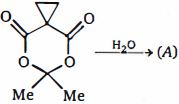
Predict the product of hydrolysis of the above molecule.
A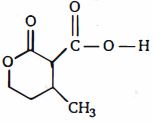
B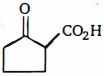
C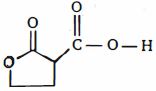
D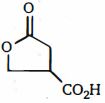
Solution
(D) The hydrolysis of the given cyclic anhydride (Meldrum's acid derivative) initially leads to the formation of an unstable intermediate,which is a substituted malonic acid derivative.
This intermediate undergoes decarboxylation upon heating to form a $\gamma$-hydroxy acid.
The $\gamma$-hydroxy acid then undergoes intramolecular cyclization (lactonization) to form a five-membered lactone ring ($\gamma$-lactone) with a carboxylic acid substituent.
The final product is a five-membered lactone ring with a $-CO_2H$ group attached.
This intermediate undergoes decarboxylation upon heating to form a $\gamma$-hydroxy acid.
The $\gamma$-hydroxy acid then undergoes intramolecular cyclization (lactonization) to form a five-membered lactone ring ($\gamma$-lactone) with a carboxylic acid substituent.
The final product is a five-membered lactone ring with a $-CO_2H$ group attached.
0 likes
View Solution388
MediumMCQ
Total number of products obtained in the above reaction is:

A
$2$
B
$3$
C
$4$
D
$5$
Solution
(A) The reaction involves the alkaline hydrolysis of an ester using $KOH$ in $H_2O/\Delta$.
The reactant is a tert-butyl ester. Alkaline hydrolysis of an ester (saponification) yields a carboxylate salt and an alcohol.
$1$. The ester group $(CH_3)_3CO-CO-CH_2-CH_2-CH(OH)-Ar$ undergoes hydrolysis to produce tert-butanol $(CH_3)_3COH$ and the corresponding carboxylic acid,which immediately reacts with $KOH$ to form the carboxylate salt $HOOC-CH_2-CH_2-CH(OH)-Ar$ (which becomes the carboxylate anion).
$2$. The ether groups ($-OCH_3$ and $-OCH_2CH_2CH_3$) attached to the aromatic ring are stable under these basic conditions and do not react.
$3$. The hydroxyl group $(-OH)$ on the aliphatic chain is also stable under these conditions.
Thus,the products are tert-butanol and the carboxylate salt of the carboxylic acid.
Total number of products = $2$.
The reactant is a tert-butyl ester. Alkaline hydrolysis of an ester (saponification) yields a carboxylate salt and an alcohol.
$1$. The ester group $(CH_3)_3CO-CO-CH_2-CH_2-CH(OH)-Ar$ undergoes hydrolysis to produce tert-butanol $(CH_3)_3COH$ and the corresponding carboxylic acid,which immediately reacts with $KOH$ to form the carboxylate salt $HOOC-CH_2-CH_2-CH(OH)-Ar$ (which becomes the carboxylate anion).
$2$. The ether groups ($-OCH_3$ and $-OCH_2CH_2CH_3$) attached to the aromatic ring are stable under these basic conditions and do not react.
$3$. The hydroxyl group $(-OH)$ on the aliphatic chain is also stable under these conditions.
Thus,the products are tert-butanol and the carboxylate salt of the carboxylic acid.
Total number of products = $2$.
0 likes
View Solution389
MediumMCQ
Which of the following compounds on reaction with excess $CH_3MgBr$ and subsequent hydrolysis will give a tertiary alcohol?
A
$C_2H_5CHO$
B
$C_2H_5CO_2CH_3$
C
$C_2H_5COOH$
D
$2,3-$epoxybutane
Solution
(B) The reaction of $CH_3MgBr$ (a Grignard reagent) with different functional groups yields different alcohols:
$1$. $C_2H_5CHO$ (an aldehyde) reacts with $CH_3MgBr$ to form a secondary alcohol.
$2$. $C_2H_5CO_2CH_3$ (an ester) reacts with excess $CH_3MgBr$ to form a tertiary alcohol. The ester first reacts to form a ketone,which then reacts with another equivalent of $CH_3MgBr$ to form the tertiary alcohol after hydrolysis.
$3$. $C_2H_5COOH$ (a carboxylic acid) reacts with $CH_3MgBr$ to release methane gas due to the acidic hydrogen,not forming a tertiary alcohol.
$4$. $2,3-$epoxybutane reacts with $CH_3MgBr$ to form a secondary alcohol.
Therefore,the ester $C_2H_5CO_2CH_3$ is the correct answer.
$1$. $C_2H_5CHO$ (an aldehyde) reacts with $CH_3MgBr$ to form a secondary alcohol.
$2$. $C_2H_5CO_2CH_3$ (an ester) reacts with excess $CH_3MgBr$ to form a tertiary alcohol. The ester first reacts to form a ketone,which then reacts with another equivalent of $CH_3MgBr$ to form the tertiary alcohol after hydrolysis.
$3$. $C_2H_5COOH$ (a carboxylic acid) reacts with $CH_3MgBr$ to release methane gas due to the acidic hydrogen,not forming a tertiary alcohol.
$4$. $2,3-$epoxybutane reacts with $CH_3MgBr$ to form a secondary alcohol.
Therefore,the ester $C_2H_5CO_2CH_3$ is the correct answer.
0 likes
View Solution390
MediumMCQ
In which of the following compounds are the methylenic hydrogens the most acidic?
A
$CH_3-CO-CH_2-CH_3$
B
$CH_3-CH_2-COOC_2H_5$
C
$CH_3-CH_2-CH(COOC_2H_5)_2$
D
$CH_3-CO-CH_2-CN$
Solution
(D) The acidity of methylenic hydrogens $(-CH_2-)$ increases when they are attached to electron-withdrawing groups (EWGs).
In $CH_3-CO-CH_2-CN$,the methylene group is located between two strong EWGs: an acetyl group $(-COCH_3)$ and a cyano group $(-CN)$.
This makes these hydrogens the most acidic due to the strong $-I$ and $-M$ effects of both groups,which stabilize the resulting carbanion through resonance.
In $CH_3-CO-CH_2-CN$,the methylene group is located between two strong EWGs: an acetyl group $(-COCH_3)$ and a cyano group $(-CN)$.
This makes these hydrogens the most acidic due to the strong $-I$ and $-M$ effects of both groups,which stabilize the resulting carbanion through resonance.
0 likes
View Solution391
DifficultMCQ
Which of the following $\beta$-keto carboxylic acids does not undergo decarboxylation on heating?
A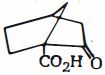
B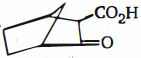
C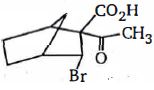
D
None of these
Solution
(A) Decarboxylation of $\beta$-keto acids typically proceeds through a cyclic six-membered transition state,which requires the formation of an enol intermediate. This mechanism is governed by Bredt's rule in bicyclic systems.
According to Bredt's rule,a double bond cannot be placed at the bridgehead of a bridged bicyclic system unless the rings are large enough.
In option $A$,the carboxyl group is at the bridgehead position. Decarboxylation would require the formation of an enol with a double bond at the bridgehead. Since this violates Bredt's rule,the transition state is highly unstable or impossible to form,preventing decarboxylation.
Therefore,the compound in option $A$ does not undergo decarboxylation.
According to Bredt's rule,a double bond cannot be placed at the bridgehead of a bridged bicyclic system unless the rings are large enough.
In option $A$,the carboxyl group is at the bridgehead position. Decarboxylation would require the formation of an enol with a double bond at the bridgehead. Since this violates Bredt's rule,the transition state is highly unstable or impossible to form,preventing decarboxylation.
Therefore,the compound in option $A$ does not undergo decarboxylation.
0 likes
View Solution392
DifficultMCQ
The product $(D)$ in the following reaction sequence is: $HOCH_2CH_2CH_2COOCH_2CH_3$ $\xrightarrow{PCC} (A)$ $\xrightarrow[{(1 \ molar \ equivalent)}]{H_2C=CHMgBr} (B)$ $\xrightarrow{NH_4Cl/H_2O} (C)$ $\xrightarrow[H_2O]{KOH}$ $\xrightarrow{H_3O^{+}}$ $\xrightarrow[pyridine]{(CH_3CO)_2O} (D)$
A
$H_2C=CHCH(OCOCH_3)CH_2CH_2COOH$
B
$H_2C=CHCH_2C(OH)COOH$
C
$H_2C=CHC(OH)CH_2CH_2COOCH_3$
D
$H_2C=CHCH_2CH(OH)CH_2COOH$
Solution
(A) $1.$ $PCC$ oxidizes the primary alcohol to an aldehyde: $HOCH_2CH_2CH_2COOCH_2CH_3 \xrightarrow{PCC} O=CHCH_2CH_2COOCH_2CH_3$ $(A)$.
$2.$ One molar equivalent of vinyl magnesium bromide reacts with the more reactive aldehyde group: $O=CHCH_2CH_2COOCH_2CH_3$ $\xrightarrow{H_2C=CHMgBr}$ $\xrightarrow{NH_4Cl/H_2O} H_2C=CHCH(OH)CH_2CH_2COOCH_2CH_3$ $(C)$.
$3.$ Saponification of the ester with $KOH/H_2O$ followed by acidification with $H_3O^{+}$ gives the carboxylic acid: $H_2C=CHCH(OH)CH_2CH_2COOH$.
$4.$ Acetylation of the secondary alcohol with acetic anhydride in pyridine yields the final product $(D)$: $H_2C=CHCH(OCOCH_3)CH_2CH_2COOH$.
$2.$ One molar equivalent of vinyl magnesium bromide reacts with the more reactive aldehyde group: $O=CHCH_2CH_2COOCH_2CH_3$ $\xrightarrow{H_2C=CHMgBr}$ $\xrightarrow{NH_4Cl/H_2O} H_2C=CHCH(OH)CH_2CH_2COOCH_2CH_3$ $(C)$.
$3.$ Saponification of the ester with $KOH/H_2O$ followed by acidification with $H_3O^{+}$ gives the carboxylic acid: $H_2C=CHCH(OH)CH_2CH_2COOH$.
$4.$ Acetylation of the secondary alcohol with acetic anhydride in pyridine yields the final product $(D)$: $H_2C=CHCH(OCOCH_3)CH_2CH_2COOH$.
0 likes
View Solution393
DifficultMCQ
The product $(B)$ is:

A
$Ph-NH-CO-CO_2H$
B
$Ph-NH-CO-CH_2-CO_2H$
C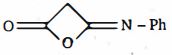
D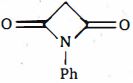
Solution
(B) The reaction involves the ozonolysis of an unsaturated lactone.
$1$. Ozonolysis of the given cyclic compound breaks the double bond to form formaldehyde $(HCHO)$ and a cyclic anhydride/lactone intermediate $(A)$,which is malonic anhydride (or a related cyclic structure).
$2$. The nucleophilic attack of aniline $(Ph-NH_2)$ on the carbonyl group of the intermediate $(A)$ leads to ring opening.
$3$. The reaction follows the mechanism of nucleophilic acyl substitution,resulting in the formation of $N$-phenylmalonamic acid,which is $Ph-NH-CO-CH_2-CO_2H$.
$1$. Ozonolysis of the given cyclic compound breaks the double bond to form formaldehyde $(HCHO)$ and a cyclic anhydride/lactone intermediate $(A)$,which is malonic anhydride (or a related cyclic structure).
$2$. The nucleophilic attack of aniline $(Ph-NH_2)$ on the carbonyl group of the intermediate $(A)$ leads to ring opening.
$3$. The reaction follows the mechanism of nucleophilic acyl substitution,resulting in the formation of $N$-phenylmalonamic acid,which is $Ph-NH-CO-CH_2-CO_2H$.
0 likes
View Solution394
DifficultMCQ
In which of the following reactions is the final product $NOT$ a ketone?
A
$CH_3-C \equiv CH$ $\xrightarrow{NaNH_2} (A)$ $\xrightarrow{CH_3-I} (B)$ $\xrightarrow{HgSO_4, H_2SO_4} (C)$
B
$HC \equiv CH$ $\xrightarrow{NaNH_2} (C)$ $\xrightarrow{CH_3-CH_2-I} (D)$ $\xrightarrow{Hg(OAc)_2, H_2O / NaBH_4, OH^{-}} (E)$
C
$R-C(=O)-OH$ $\xrightarrow{NaOH} (A)$ $\xrightarrow{CH_3-I} (B)$
D
$1-butyne$ $\xrightarrow{NaNH_2} (A)$ $\xrightarrow{CH_3-I} (B)$ $\xrightarrow{(1) BH_3, THF; (2) H_2O_2/OH^{-}} (C)$
Solution
(C) In reaction $(c)$,the carboxylic acid reacts with $NaOH$ to form a sodium salt,which then reacts with methyl iodide to form an ester,not a ketone.
$R-C(=O)-OH$ $\xrightarrow{NaOH} R-C(=O)-ONa$ $\xrightarrow{CH_3-I} R-C(=O)-OCH_3$ (Ester).
In option $(a)$,the hydration of an alkyne yields a ketone.
In option $(b)$,the hydration of an alkyne yields a ketone.
In option $(d)$,the hydroboration-oxidation of an internal alkyne yields a ketone.
$R-C(=O)-OH$ $\xrightarrow{NaOH} R-C(=O)-ONa$ $\xrightarrow{CH_3-I} R-C(=O)-OCH_3$ (Ester).
In option $(a)$,the hydration of an alkyne yields a ketone.
In option $(b)$,the hydration of an alkyne yields a ketone.
In option $(d)$,the hydroboration-oxidation of an internal alkyne yields a ketone.
0 likes
View Solution395
DifficultMCQ
Identify the major product $P$ in the following reaction:
$CH_2=C(OLi)-CH=C(OLi)OEt \xrightarrow[(ii) H_3O^+]{(i) CH_3CH_2I / THF} P$
$CH_2=C(OLi)-CH=C(OLi)OEt \xrightarrow[(ii) H_3O^+]{(i) CH_3CH_2I / THF} P$
A
Ethyl $3$-oxopentanoate
B
$3$-ethoxy-pent-$2$-en-$1$-one
C
$2$-ethyl-$3$-oxobutanoate
D
$3$-ethoxy-pent-$3$-en-$2$-one
Solution
(D) The starting material is a dianion of ethyl acetoacetate,specifically the $O,O$-dianion formed by treating ethyl acetoacetate with two equivalents of a strong base like $LDA$.
$1$. The dianion is more nucleophilic at the $\alpha$-carbon (the carbon between the two carbonyl groups) than at the oxygen atoms.
$2$. When treated with an alkyl halide like $CH_3CH_2I$,the $\alpha$-carbon attacks the ethyl group in an $S_N2$ reaction.
$3$. Subsequent acidic workup $(H_3O^+)$ protonates the enolate oxygens to regenerate the keto-ester functionality.
$4$. The resulting product is ethyl $2$-ethylacetoacetate,which is ethyl $2$-ethyl-$3$-oxobutanoate. Looking at the options,option $D$ represents the structure of $2$-ethyl-$3$-oxobutanoate (ethyl $2$-ethylacetoacetate).
$1$. The dianion is more nucleophilic at the $\alpha$-carbon (the carbon between the two carbonyl groups) than at the oxygen atoms.
$2$. When treated with an alkyl halide like $CH_3CH_2I$,the $\alpha$-carbon attacks the ethyl group in an $S_N2$ reaction.
$3$. Subsequent acidic workup $(H_3O^+)$ protonates the enolate oxygens to regenerate the keto-ester functionality.
$4$. The resulting product is ethyl $2$-ethylacetoacetate,which is ethyl $2$-ethyl-$3$-oxobutanoate. Looking at the options,option $D$ represents the structure of $2$-ethyl-$3$-oxobutanoate (ethyl $2$-ethylacetoacetate).
0 likes
View Solution396
DifficultMCQ
Identify $C$ in the following sequence of reactions:
$2\text{-methylcyclohexanecarboxylic acid}$ $\xrightarrow{SOCl_2} A$ $\xrightarrow{NH_3} B$ $\xrightarrow{P_4O_{10}, \text{heat}} C(C_8H_{13}N)$
$2\text{-methylcyclohexanecarboxylic acid}$ $\xrightarrow{SOCl_2} A$ $\xrightarrow{NH_3} B$ $\xrightarrow{P_4O_{10}, \text{heat}} C(C_8H_{13}N)$
A
$2-$methylcyclohexanol
B
$2-$methylcyclohexanecarbonitrile
C
$1-$cyano$-2-$methylcyclohexane (cis-isomer)
D
$1-$cyano$-2-$methylcyclohexane (trans-isomer)
Solution
(B) The reaction sequence is as follows:
$1$. $2\text{-methylcyclohexanecarboxylic acid}$ reacts with $SOCl_2$ to form the acid chloride,$A$ $(2\text{-methylcyclohexanecarbonyl chloride})$.
$2$. The acid chloride $A$ reacts with $NH_3$ to form the amide,$B$ $(2\text{-methylcyclohexanecarboxamide})$.
$3$. The amide $B$ undergoes dehydration with $P_4O_{10}$ upon heating to form the nitrile,$C$ $(2\text{-methylcyclohexanecarbonitrile})$.
The stereochemistry is retained throughout the reaction sequence. The starting material has the $-COOH$ group and $-CH_3$ group in a specific relative configuration (trans). Therefore,the final product $C$ will also have the $-CN$ group and $-CH_3$ group in the same relative configuration.
$1$. $2\text{-methylcyclohexanecarboxylic acid}$ reacts with $SOCl_2$ to form the acid chloride,$A$ $(2\text{-methylcyclohexanecarbonyl chloride})$.
$2$. The acid chloride $A$ reacts with $NH_3$ to form the amide,$B$ $(2\text{-methylcyclohexanecarboxamide})$.
$3$. The amide $B$ undergoes dehydration with $P_4O_{10}$ upon heating to form the nitrile,$C$ $(2\text{-methylcyclohexanecarbonitrile})$.
The stereochemistry is retained throughout the reaction sequence. The starting material has the $-COOH$ group and $-CH_3$ group in a specific relative configuration (trans). Therefore,the final product $C$ will also have the $-CN$ group and $-CH_3$ group in the same relative configuration.
0 likes
View Solution397
MediumMCQ
An optically active compound $X$ has molecular formula $C_4H_8O_3$. It evolves $CO_2$ with $NaHCO_3$. $X$ reacts with $LiAlH_4$ to give an achiral compound. $X$ is
A
$CH_3CH_2CH(OH)COOH$
B
$CH_3CH(CH_3)COOH$
C
$CH_3CH(CH_2OH)COOH$
D
$CH_3CH(OH)CH_2COOH$
Solution
(C) $1$. The molecular formula $C_4H_8O_3$ and the evolution of $CO_2$ with $NaHCO_3$ indicate that $X$ is a carboxylic acid.
$2$. $X$ is optically active,meaning it must contain a chiral center.
$3$. Reduction of $X$ with $LiAlH_4$ yields an achiral compound. Let us analyze option $C$: $CH_3CH(CH_2OH)COOH$.
$4$. $CH_3CH(CH_2OH)COOH$ has a chiral center at the $C-2$ position.
$5$. Upon reduction with $LiAlH_4$,the carboxylic acid group $-COOH$ is reduced to $-CH_2OH$,resulting in $CH_3CH(CH_2OH)CH_2OH$.
$6$. In $CH_3CH(CH_2OH)CH_2OH$,the central carbon is attached to two identical $-CH_2OH$ groups,making the molecule achiral.
$7$. Thus,$X$ is $CH_3CH(CH_2OH)COOH$.
$2$. $X$ is optically active,meaning it must contain a chiral center.
$3$. Reduction of $X$ with $LiAlH_4$ yields an achiral compound. Let us analyze option $C$: $CH_3CH(CH_2OH)COOH$.
$4$. $CH_3CH(CH_2OH)COOH$ has a chiral center at the $C-2$ position.
$5$. Upon reduction with $LiAlH_4$,the carboxylic acid group $-COOH$ is reduced to $-CH_2OH$,resulting in $CH_3CH(CH_2OH)CH_2OH$.
$6$. In $CH_3CH(CH_2OH)CH_2OH$,the central carbon is attached to two identical $-CH_2OH$ groups,making the molecule achiral.
$7$. Thus,$X$ is $CH_3CH(CH_2OH)COOH$.
0 likes
View Solution398
DifficultMCQ
$CH_3-C(=O)-O-CH_2-CH_3 + H-\bullet^- \to$ (where $\bullet = ^{18}O$) One of the products of the reaction is
A
$CH_3-C(=O)-OH$
B
$CH_3-CH_2-\bullet-H$
C
$CH_3-C(=O)-\bullet^-$
D
$CH_3-CH_2-\bullet^-$
Solution
(C) The reaction is a nucleophilic acyl substitution where the nucleophile $H-\bullet^-$ (where $\bullet = ^{18}O$) attacks the carbonyl carbon of the ester $CH_3-C(=O)-O-CH_2-CH_3$.
$1$. The nucleophile $H-\bullet^-$ attacks the electrophilic carbonyl carbon,leading to the formation of a tetrahedral intermediate.
$2$. The tetrahedral intermediate collapses,expelling the ethoxide ion $(EtO^-)$ as a leaving group.
$3$. This results in the formation of $CH_3-C(=O)-\bullet-H$ (an ester with $^{18}O$ in the carbonyl oxygen position).
$4$. The ethoxide ion $(EtO^-)$ then acts as a base and abstracts the proton from the newly formed ester,resulting in the formation of $CH_3-C(=O)-\bullet^-$ and ethanol $(EtOH)$.
Thus,one of the products is $CH_3-C(=O)-\bullet^-$.
$1$. The nucleophile $H-\bullet^-$ attacks the electrophilic carbonyl carbon,leading to the formation of a tetrahedral intermediate.
$2$. The tetrahedral intermediate collapses,expelling the ethoxide ion $(EtO^-)$ as a leaving group.
$3$. This results in the formation of $CH_3-C(=O)-\bullet-H$ (an ester with $^{18}O$ in the carbonyl oxygen position).
$4$. The ethoxide ion $(EtO^-)$ then acts as a base and abstracts the proton from the newly formed ester,resulting in the formation of $CH_3-C(=O)-\bullet^-$ and ethanol $(EtOH)$.
Thus,one of the products is $CH_3-C(=O)-\bullet^-$.
0 likes
View Solution399
AdvancedMCQ
Select the final product from this sequence of reactions.
Acetoacetic ester $\xrightarrow{NaOEt}$ $\xrightarrow{CH_3I}$ $\xrightarrow{NaOEt}$ $\xrightarrow{CH_3CH_2CH_2Br}$
Acetoacetic ester $\xrightarrow{NaOEt}$ $\xrightarrow{CH_3I}$ $\xrightarrow{NaOEt}$ $\xrightarrow{CH_3CH_2CH_2Br}$
A
$CH_3-C(=O)-C(CH_3)(CH_2CH_2CH_3)-COOC_2H_5$
B
$CH_3-C(CH_3)(CH_2CH_2CH_3)-CH_2COOC_2H_5$
C
$CH_3-C(H)(CH_2CH_2CH_3)-CH_2COOC_2H_5$
D
$CH_3CO^{-}C(CH_3)_2-CH_2COOC_2H_5$
Solution
(A) The reaction sequence is an example of acetoacetic ester synthesis.
$1$. Acetoacetic ester $(CH_3COCH_2COOC_2H_5)$ reacts with $NaOEt$ to form an enolate ion at the $\alpha$-carbon.
$2$. This enolate reacts with $CH_3I$ via an $S_N2$ mechanism to produce ethyl $2$-methylacetoacetate $(CH_3COCH(CH_3)COOC_2H_5)$.
$3$. Treatment with another equivalent of $NaOEt$ generates a new enolate at the same $\alpha$-carbon.
$4$. This enolate reacts with $CH_3CH_2CH_2Br$ ($n$-propyl bromide) via $S_N2$ to yield the final product,ethyl $2$-methyl-$2$-propylacetoacetate,which is $CH_3-C(=O)-C(CH_3)(CH_2CH_2CH_3)-COOC_2H_5$.
$1$. Acetoacetic ester $(CH_3COCH_2COOC_2H_5)$ reacts with $NaOEt$ to form an enolate ion at the $\alpha$-carbon.
$2$. This enolate reacts with $CH_3I$ via an $S_N2$ mechanism to produce ethyl $2$-methylacetoacetate $(CH_3COCH(CH_3)COOC_2H_5)$.
$3$. Treatment with another equivalent of $NaOEt$ generates a new enolate at the same $\alpha$-carbon.
$4$. This enolate reacts with $CH_3CH_2CH_2Br$ ($n$-propyl bromide) via $S_N2$ to yield the final product,ethyl $2$-methyl-$2$-propylacetoacetate,which is $CH_3-C(=O)-C(CH_3)(CH_2CH_2CH_3)-COOC_2H_5$.
0 likes
View Solution400
DifficultMCQ
$CH_2(CO_2Me)_2 + ? \xrightarrow[(i) \ Na]{(ii) \ AcOH} CH(CO_2Me)_3$
Which of the following reactants will complete the above reaction?
Which of the following reactants will complete the above reaction?
A
$CH_2(CO_2Me)_2$
B
$(CO_2Me)_2$
C
$ClCO_2Me$
D
$COCl_2$
Solution
(C) The reaction involves the formation of a carbanion from dimethyl malonate $(CH_2(CO_2Me)_2)$ using sodium $(Na)$.
The carbanion $Na^+[CH(CO_2Me)_2]^-$ acts as a nucleophile.
This nucleophile attacks the electrophilic carbon of methyl chloroformate $(ClCO_2Me)$.
The reaction proceeds as follows:
$CH_2(CO_2Me)_2 + Na \rightarrow Na^+[CH(CO_2Me)_2]^- + \frac{1}{2}H_2$
$Na^+[CH(CO_2Me)_2]^- + ClCO_2Me \rightarrow CH(CO_2Me)_3 + NaCl$
Thus,the missing reactant is $ClCO_2Me$.
The carbanion $Na^+[CH(CO_2Me)_2]^-$ acts as a nucleophile.
This nucleophile attacks the electrophilic carbon of methyl chloroformate $(ClCO_2Me)$.
The reaction proceeds as follows:
$CH_2(CO_2Me)_2 + Na \rightarrow Na^+[CH(CO_2Me)_2]^- + \frac{1}{2}H_2$
$Na^+[CH(CO_2Me)_2]^- + ClCO_2Me \rightarrow CH(CO_2Me)_3 + NaCl$
Thus,the missing reactant is $ClCO_2Me$.
0 likes
View Solution8-2.Carboxylic acids and Their derivative — Properties of Carboxylic Acids and Their Derivatives · Frequently Asked Questions
1Are these 8-2.Carboxylic acids and Their derivative questions useful for JEE and NEET?
Yes. All questions in this section are mapped to JEE Main and NEET exam patterns. Previous year questions from JEE Main, NEET, GUJCET and state-level exams are included with full solutions.
2Can I switch to Hindi or Gujarati for these questions?
Yes. Use the language tabs in the hero section or the sidebar to view the same questions and solutions in English, Hindi or Gujarati.
3How do I generate a question paper from this subtopic?
Use the Vedclass Exam Paper Generator — select the chapter and subtopic, set difficulty, and generate Sets A, B, C, D automatically. First 3 chapters of every subject are free.
Vedclass Products
For Students
Vedclass Test Series
Mock tests in real JEE/NEET style with performance analysis. 5-day free trial.
Start Free TrialFor Teachers
Exam Paper Generator
Generate Set A/B/C/D papers from this chapter in 2 minutes. 3 chapters free.
Try FreeFor Institutes
Online Exam Module
Live online exams with unlimited students, 360° analytics & white-label branding.
See DemoFor Teachers & Institutes
Generate a 8-2.Carboxylic acids and Their derivative Exam Paper in 2 Minutes
Select subtopic & difficulty — Sets A, B, C, D auto-generated with No Repeat logic.
First 3 chapters of every subject are free — no payment required.