
A English
Properties Questions in English
Class 12 Chemistry · 8-1.Aldehydes and Ketones · Properties
1739+
Questions
English
Language
100%
With Solutions
Showing 40 of 1739 questions in English
1551
DifficultMCQ
In the following reaction sequence,the product $D$ is:
$CH_3COOH$ $\xrightarrow{SOCl_2} A$ $\xrightarrow[AlCl_3]{C_6H_6} B$ $\xrightarrow{HCN} C$ $\xrightarrow{H_2O} D$
$CH_3COOH$ $\xrightarrow{SOCl_2} A$ $\xrightarrow[AlCl_3]{C_6H_6} B$ $\xrightarrow{HCN} C$ $\xrightarrow{H_2O} D$
A
$2-$phenyl$-2-$hydroxypropanoic acid
B
$2-$phenyl$-2-$hydroxypropanenitrile
C
$2-$phenyl$-2-$methylpropanenitrile
D
$2-$phenyl$-2-$hydroxypropanoic acid
Solution
(D) $1$. $CH_3COOH + SOCl_2 \rightarrow CH_3COCl$ (Compound $A$ is acetyl chloride).
$2$. $CH_3COCl + C_6H_6 \xrightarrow{AlCl_3} C_6H_5COCH_3$ (Friedel-Crafts acylation,Compound $B$ is acetophenone).
$3$. $C_6H_5COCH_3 + HCN \rightarrow C_6H_5C(OH)(CH_3)CN$ (Nucleophilic addition,Compound $C$ is acetophenone cyanohydrin).
$4$. $C_6H_5C(OH)(CH_3)CN + H_2O \rightarrow C_6H_5C(OH)(CH_3)COOH$ (Hydrolysis of nitrile to carboxylic acid,Compound $D$ is $2-$hydroxy$-2-$phenylpropanoic acid).
$2$. $CH_3COCl + C_6H_6 \xrightarrow{AlCl_3} C_6H_5COCH_3$ (Friedel-Crafts acylation,Compound $B$ is acetophenone).
$3$. $C_6H_5COCH_3 + HCN \rightarrow C_6H_5C(OH)(CH_3)CN$ (Nucleophilic addition,Compound $C$ is acetophenone cyanohydrin).
$4$. $C_6H_5C(OH)(CH_3)CN + H_2O \rightarrow C_6H_5C(OH)(CH_3)COOH$ (Hydrolysis of nitrile to carboxylic acid,Compound $D$ is $2-$hydroxy$-2-$phenylpropanoic acid).
0 likes
View Solution1552
MediumMCQ
What are $X$ and $Y$ respectively in the following set of reactions?
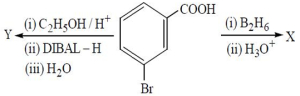
A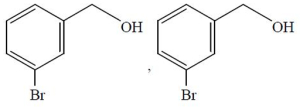
B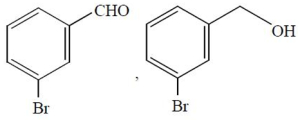
C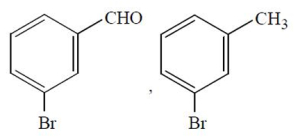
D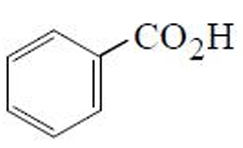
Solution
(C) The starting material is $3$-bromobenzoic acid.
$1$. Formation of $X$:
Reaction with $B_2H_6$ followed by $H_3O^+$ is a selective reduction of the carboxylic acid group $(-COOH)$ to a primary alcohol $(-CH_2OH)$ without affecting the bromine $(-Br)$ substituent on the benzene ring. Thus,$X$ is $3$-bromobenzyl alcohol.
$2$. Formation of $Y$:
$(i)$ Esterification: $3$-bromobenzoic acid reacts with $C_2H_5OH/H^+$ to form ethyl $3$-bromobenzoate.
(ii) Reduction: $DIBAL-H$ is a selective reducing agent that reduces esters $(-COOC_2H_5)$ to aldehydes $(-CHO)$.
(iii) Hydrolysis: The final step yields $3$-bromobenzaldehyde as $Y$.
Therefore,$X$ is $3$-bromobenzyl alcohol and $Y$ is $3$-bromobenzaldehyde. The correct option is $C$.
$1$. Formation of $X$:
Reaction with $B_2H_6$ followed by $H_3O^+$ is a selective reduction of the carboxylic acid group $(-COOH)$ to a primary alcohol $(-CH_2OH)$ without affecting the bromine $(-Br)$ substituent on the benzene ring. Thus,$X$ is $3$-bromobenzyl alcohol.
$2$. Formation of $Y$:
$(i)$ Esterification: $3$-bromobenzoic acid reacts with $C_2H_5OH/H^+$ to form ethyl $3$-bromobenzoate.
(ii) Reduction: $DIBAL-H$ is a selective reducing agent that reduces esters $(-COOC_2H_5)$ to aldehydes $(-CHO)$.
(iii) Hydrolysis: The final step yields $3$-bromobenzaldehyde as $Y$.
Therefore,$X$ is $3$-bromobenzyl alcohol and $Y$ is $3$-bromobenzaldehyde. The correct option is $C$.
0 likes
View Solution1553
MediumMCQ
The final product $(C)$ in the given reaction sequence is
$C_6H_5COOH$ $\xrightarrow{SOCl_2} (A)$ $\xrightarrow[\text{anhy. } AlCl_3]{C_6H_6} (B)$ $\xrightarrow[\text{(ii) } KOH / (CH_2OH)_2]{\text{(i) } NH_2-NH_2} (C)$
$C_6H_5COOH$ $\xrightarrow{SOCl_2} (A)$ $\xrightarrow[\text{anhy. } AlCl_3]{C_6H_6} (B)$ $\xrightarrow[\text{(ii) } KOH / (CH_2OH)_2]{\text{(i) } NH_2-NH_2} (C)$
A
Benzophenone
B
Diphenyl methane
C
Diphenylmethanol
D
Benzoic acid
Solution
(B) Step $1$: $C_6H_5COOH + SOCl_2 \rightarrow C_6H_5COCl (A) + SO_2 + HCl$. This is the conversion of benzoic acid to benzoyl chloride.
Step $2$: $C_6H_5COCl + C_6H_6 \xrightarrow{\text{anhy. } AlCl_3} C_6H_5COC_6H_5 (B) + HCl$. This is a Friedel-Crafts acylation reaction producing benzophenone.
Step $3$: $C_6H_5COC_6H_5 \xrightarrow[\text{(ii) } KOH / (CH_2OH)_2]{\text{(i) } NH_2-NH_2} C_6H_5CH_2C_6H_5 (C)$. This is the Wolff-Kishner reduction of benzophenone to diphenylmethane.
Step $2$: $C_6H_5COCl + C_6H_6 \xrightarrow{\text{anhy. } AlCl_3} C_6H_5COC_6H_5 (B) + HCl$. This is a Friedel-Crafts acylation reaction producing benzophenone.
Step $3$: $C_6H_5COC_6H_5 \xrightarrow[\text{(ii) } KOH / (CH_2OH)_2]{\text{(i) } NH_2-NH_2} C_6H_5CH_2C_6H_5 (C)$. This is the Wolff-Kishner reduction of benzophenone to diphenylmethane.
0 likes
View Solution1554
MediumMCQ
Consider the following reaction sequence:
$(CH_3)_2C=CH_2 \xrightarrow[\text{(2) } Zn/H_2O]{\text{(1) } O_3} X + Y$
$X + Y \xrightarrow[\text{(2) } \Delta]{\text{(1) dil. } NaOH} Z$
The $IUPAC$ name of '$Z$' is
$(CH_3)_2C=CH_2 \xrightarrow[\text{(2) } Zn/H_2O]{\text{(1) } O_3} X + Y$
$X + Y \xrightarrow[\text{(2) } \Delta]{\text{(1) dil. } NaOH} Z$
The $IUPAC$ name of '$Z$' is
A
but$-1-$en$-3-$one
B
$4-$Hydroxybutan$-2-$one
C
but$-3-$en$-2-$one
D
$1-$Hydroxybutan$-3-$one
Solution
(C) Step $1$: Ozonolysis of $2-$methylpropene $(CH_3)_2C=CH_2$ gives acetone $(CH_3COCH_3)$ and formaldehyde $(HCHO)$.
$(CH_3)_2C=CH_2 \xrightarrow[\text{(2) } Zn/H_2O]{\text{(1) } O_3} CH_3COCH_3 (X) + HCHO (Y)$
Step $2$: The reaction of acetone with formaldehyde in the presence of dilute $NaOH$ and heat is an aldol condensation reaction.
Acetone has $\alpha$-hydrogens,so it acts as the nucleophile,and formaldehyde acts as the electrophile.
The product formed is $4-$hydroxybutan$-2-$one $(CH_3COCH_2CH_2OH)$.
Upon heating $(\Delta)$,it undergoes dehydration to form but$-3-$en$-2-$one $(CH_3COCH=CH_2)$.
However,the question asks for the product '$Z$' formed after the reaction with dilute $NaOH$ and $\Delta$. The aldol product is $4-$hydroxybutan$-2-$one,and the dehydrated product is but$-3-$en$-2-$one.
Given the options,the $IUPAC$ name of the final dehydrated product '$Z$' is but$-3-$en$-2-$one.
$(CH_3)_2C=CH_2 \xrightarrow[\text{(2) } Zn/H_2O]{\text{(1) } O_3} CH_3COCH_3 (X) + HCHO (Y)$
Step $2$: The reaction of acetone with formaldehyde in the presence of dilute $NaOH$ and heat is an aldol condensation reaction.
Acetone has $\alpha$-hydrogens,so it acts as the nucleophile,and formaldehyde acts as the electrophile.
The product formed is $4-$hydroxybutan$-2-$one $(CH_3COCH_2CH_2OH)$.
Upon heating $(\Delta)$,it undergoes dehydration to form but$-3-$en$-2-$one $(CH_3COCH=CH_2)$.
However,the question asks for the product '$Z$' formed after the reaction with dilute $NaOH$ and $\Delta$. The aldol product is $4-$hydroxybutan$-2-$one,and the dehydrated product is but$-3-$en$-2-$one.
Given the options,the $IUPAC$ name of the final dehydrated product '$Z$' is but$-3-$en$-2-$one.
0 likes
View Solution1555
EasyMCQ
If the general formula of oxime and semicarbazone is $C=N-Z$,what is '$Z$' in oxime $(I)$ and semicarbazone $(II)$?
A
$NHCONH_2, \quad OH$
B
$OH, \quad NH_2$
C
$OH, \quad NHCONH_2$
D
$NH_2, \quad OH$
Solution
(C) The general structure for these derivatives is $C=N-Z$.
For oximes,the derivative is formed by the reaction of a carbonyl compound with hydroxylamine $(NH_2OH)$. Thus,the group $Z$ attached to the nitrogen is $-OH$.
For semicarbazones,the derivative is formed by the reaction of a carbonyl compound with semicarbazide $(NH_2NHCONH_2)$. Thus,the group $Z$ attached to the nitrogen is $-NHCONH_2$.
Therefore,for oxime $(I)$,$Z = -OH$ and for semicarbazone $(II)$,$Z = -NHCONH_2$.
For oximes,the derivative is formed by the reaction of a carbonyl compound with hydroxylamine $(NH_2OH)$. Thus,the group $Z$ attached to the nitrogen is $-OH$.
For semicarbazones,the derivative is formed by the reaction of a carbonyl compound with semicarbazide $(NH_2NHCONH_2)$. Thus,the group $Z$ attached to the nitrogen is $-NHCONH_2$.
Therefore,for oxime $(I)$,$Z = -OH$ and for semicarbazone $(II)$,$Z = -NHCONH_2$.
0 likes
View Solution1556
EasyMCQ
Nucleophilic addition reaction will be most favoured in which among the following compounds?
A
$CH_3 CH_2 CHO$
B
$CH_3 CHO$
C
$CH_3 CH_2 CH_2 CO CH_3$
D
$CH_3 CO CH_3$
Solution
(B) $(I)$ Aldehydes and ketones that are less sterically hindered at the carbonyl carbon show a higher rate of nucleophilic addition reaction.
$(II)$ The presence of electron-donating groups at the carbonyl carbon decreases the electrophilicity of the carbon atom,thereby decreasing the rate of reaction.
$(III)$ Comparing the given compounds: $CH_3 CHO$ is an aldehyde with the least steric hindrance and the least number of electron-donating groups attached to the carbonyl carbon.
$\therefore$ Nucleophilic addition reaction will be most favoured in $CH_3 CHO$.
$(II)$ The presence of electron-donating groups at the carbonyl carbon decreases the electrophilicity of the carbon atom,thereby decreasing the rate of reaction.
$(III)$ Comparing the given compounds: $CH_3 CHO$ is an aldehyde with the least steric hindrance and the least number of electron-donating groups attached to the carbonyl carbon.
$\therefore$ Nucleophilic addition reaction will be most favoured in $CH_3 CHO$.
0 likes
View Solution1557
DifficultMCQ
Alkenes $(X)$ and carbonyl compounds $(Y)$ participate in which of the following addition reactions?
A
$A$. $(X) -$ Electrophilic,$(Y) -$ Electrophilic
B
$B$. $(X) -$ Nucleophilic,$(Y) -$ Electrophilic
C
$C$. $(X) -$ Electrophilic,$(Y) -$ Nucleophilic
D
$D$. $(X) -$ Nucleophilic,$(Y) -$ Nucleophilic
Solution
(C) Alkenes $(X)$ are electron-rich due to the presence of a $\pi$-electron cloud,making them susceptible to attack by electrophiles. Therefore,they undergo electrophilic addition reactions.
Carbonyl compounds $(Y)$ contain a polar $C=O$ bond where the carbon atom is electron-deficient (electrophilic). Consequently,they undergo nucleophilic addition reactions.
Carbonyl compounds $(Y)$ contain a polar $C=O$ bond where the carbon atom is electron-deficient (electrophilic). Consequently,they undergo nucleophilic addition reactions.
0 likes
View Solution1558
EasyMCQ
Which one of the following is used for the purification of aldehydes?
A
$NaOCl$
B
$NaHSO_3$
C
$C_6H_5SO_2Cl$
D
$Na_2SO_4$
Solution
(B) Carbonyl compounds (aldehydes and ketones) form solid crystalline addition products with sodium bisulphite $(NaHSO_3)$.
These solid bisulphite addition products can be separated from the reaction mixture by filtration,leaving impurities behind.
The pure carbonyl compound is then regenerated from the solid addition product by treatment with dilute acid or base.
The reaction is as follows:
$CH_3CHO + NaHSO_3 \rightarrow CH_3CH(OH)SO_3Na$ (Solid addition product)
$CH_3CH(OH)SO_3Na + H_2O \rightarrow CH_3CHO + NaHSO_3$ (Pure aldehyde)
These solid bisulphite addition products can be separated from the reaction mixture by filtration,leaving impurities behind.
The pure carbonyl compound is then regenerated from the solid addition product by treatment with dilute acid or base.
The reaction is as follows:
$CH_3CHO + NaHSO_3 \rightarrow CH_3CH(OH)SO_3Na$ (Solid addition product)
$CH_3CH(OH)SO_3Na + H_2O \rightarrow CH_3CHO + NaHSO_3$ (Pure aldehyde)
0 likes
View Solution1559
EasyMCQ
Which of the following sequence of reagents converts $3-$hexene to propane?
A
$(i) KMnO_4 | H^{+}; (ii) NaOH, CaO$
B
$(i) O_3; (ii) Zn, H_2O; NaBH_4$
C
$(i) O_3; (ii) Zn, H_2O; Zn(Hg), HCl$
D
$(i) KMnO_4 | H^{+}; (ii) LiAlH_4, H_2O$
Solution
(C) The conversion of $3-$hexene to propane involves two main steps:
Step-$I$: Ozonolysis of $3-$hexene $(CH_3CH_2CH=CHCH_2CH_3)$ using $(i) O_3$ followed by $(ii) Zn, H_2O$ yields two molecules of propanal $(CH_3CH_2CHO)$.
Step-$II$: Reduction of propanal $(CH_3CH_2CHO)$ to propane $(CH_3CH_2CH_3)$ is achieved using Clemmensen reduction,which employs $Zn(Hg)$ and $HCl$.
Step-$I$: Ozonolysis of $3-$hexene $(CH_3CH_2CH=CHCH_2CH_3)$ using $(i) O_3$ followed by $(ii) Zn, H_2O$ yields two molecules of propanal $(CH_3CH_2CHO)$.
Step-$II$: Reduction of propanal $(CH_3CH_2CHO)$ to propane $(CH_3CH_2CH_3)$ is achieved using Clemmensen reduction,which employs $Zn(Hg)$ and $HCl$.
0 likes
View Solution1560
DifficultMCQ
Identify the major product of the following reaction:
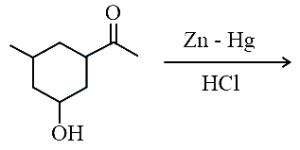
A
$3-$ethyl$-5-$methylcyclohexan$-1-$ol
B
$1-$($5$-methylcyclohexyl)ethanol
C
$1-$chloro$-3-$ethyl$-5-$methylcyclohexane
D
$1-$chloro$-3-$methyl$-5-$acetylcyclohexane
Solution
(C) The Clemmensen reduction uses zinc-amalgam $(Zn-Hg)$ and concentrated hydrochloric acid $(HCl)$ to reduce carbonyl groups $(C=O)$ of aldehydes and ketones to methylene groups $(CH_2)$.
Additionally,under these acidic conditions,secondary and tertiary alcohols can undergo substitution reactions with $HCl$ to form alkyl chlorides.
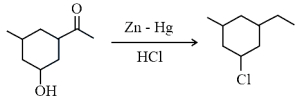
In the given molecule,the ketone group is reduced to an ethyl group $(-CH_2CH_3)$,and the secondary alcohol group is converted into a chloro group $(-Cl)$.
Therefore,the major product is $1$-chloro-$3$-ethyl-$5$-methylcyclohexane.
Additionally,under these acidic conditions,secondary and tertiary alcohols can undergo substitution reactions with $HCl$ to form alkyl chlorides.
In the given molecule,the ketone group is reduced to an ethyl group $(-CH_2CH_3)$,and the secondary alcohol group is converted into a chloro group $(-Cl)$.
Therefore,the major product is $1$-chloro-$3$-ethyl-$5$-methylcyclohexane.
0 likes
View Solution1561
MediumMCQ
Identify the major product of the following reaction.
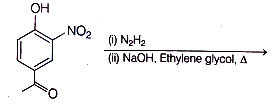
A
$4-$ethyl$-2-$nitrophenol
B
$1-$($4$-hydroxy$-3-$nitrophenyl)ethanol
C
$4-$hydroxy$-3-$nitrobenzoic acid
D
$2-$amino$-4-$hydroxyphenol
Solution
(A) The reaction conditions $(i) \ N_2H_4, (ii) \ NaOH, \text{Ethylene glycol}, \Delta$ represent the Wolff-Kishner reduction. This reaction specifically reduces a carbonyl group $(C=O)$ to a methylene group $(CH_2)$. In the given substrate,the acetyl group $(-COCH_3)$ is reduced to an ethyl group $(-CH_2CH_3)$,while the phenolic $-OH$ and nitro $-NO_2$ groups remain unaffected.
0 likes
View Solution1562
MediumMCQ
In which of the following reactions is the product $NOT$ correct?
A
$CH_3CHO \stackrel{LiAlH_4}{\longrightarrow} CH_3CH_2OH$
B
$CH_3COCH_3 \stackrel{Zn(Hg)/HCl}{\longrightarrow} CH_3CH(OH)CH_2OH$
C
$CH_3CHO \stackrel{I_2/NaOH}{\longrightarrow} CHI_3 + HCOONa$
D
$CH_3CH_2CHO \stackrel{KMnO_4}{\longrightarrow} CH_3CH_2COOH$
Solution
(B) Let us analyze each reaction:
$(A)$ $CH_3CHO$ is reduced by $LiAlH_4$ to ethanol $(CH_3CH_2OH)$. This is correct.
$(B)$ $CH_3COCH_3$ undergoes Clemmensen reduction with $Zn(Hg)/HCl$ to form propane $(CH_3CH_2CH_3)$. The product given in the option is incorrect as it shows a diol.
$(C)$ $CH_3CHO$ undergoes the iodoform reaction with $I_2/NaOH$ to form iodoform $(CHI_3)$ and sodium formate $(HCOONa)$. This is correct.
$(D)$ $CH_3CH_2CHO$ is oxidized by $KMnO_4$ to propanoic acid $(CH_3CH_2COOH)$. This is correct.
Therefore,the incorrect product is in option $(B)$.
$(A)$ $CH_3CHO$ is reduced by $LiAlH_4$ to ethanol $(CH_3CH_2OH)$. This is correct.
$(B)$ $CH_3COCH_3$ undergoes Clemmensen reduction with $Zn(Hg)/HCl$ to form propane $(CH_3CH_2CH_3)$. The product given in the option is incorrect as it shows a diol.
$(C)$ $CH_3CHO$ undergoes the iodoform reaction with $I_2/NaOH$ to form iodoform $(CHI_3)$ and sodium formate $(HCOONa)$. This is correct.
$(D)$ $CH_3CH_2CHO$ is oxidized by $KMnO_4$ to propanoic acid $(CH_3CH_2COOH)$. This is correct.
Therefore,the incorrect product is in option $(B)$.
0 likes
View Solution1563
DifficultMCQ
In the presence of peroxide,styrene reacts with $HBr$ to give $X$. When $X$ is reacted with magnesium in dry ether followed by $CO_2$ and hydrolysis,it gives $Y$. Treatment of $Y$ with $PCl_5$ and then with $H_2, Pd-BaSO_4$ gives $Z$. What is $Z$?
A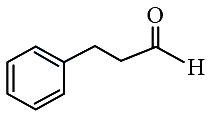
B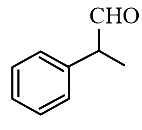
C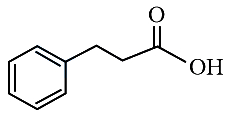
D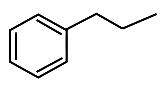
Solution
(A) The reaction sequence is as follows:
$1$. Styrene $(C_6H_5CH=CH_2)$ reacts with $HBr$ in the presence of peroxide via anti-Markovnikov addition to form $1-$bromo$-2-$phenylethane ($X$,$C_6H_5CH_2CH_2Br$).
$2$. $X$ reacts with $Mg$ in dry ether to form the Grignard reagent $C_6H_5CH_2CH_2MgBr$. This reacts with $CO_2$ followed by hydrolysis to yield $3-$phenylpropanoic acid ($Y$,$C_6H_5CH_2CH_2COOH$).
$3$. $Y$ reacts with $PCl_5$ to form $3-$phenylpropanoyl chloride $(C_6H_5CH_2CH_2COCl)$.
$4$. $3-$phenylpropanoyl chloride undergoes Rosenmund reduction with $H_2, Pd-BaSO_4$ to form $3-$phenylpropan$-1-$al ($Z$,$C_6H_5CH_2CH_2CHO$).
The structure of $Z$ corresponds to the image provided in option $A$.
$1$. Styrene $(C_6H_5CH=CH_2)$ reacts with $HBr$ in the presence of peroxide via anti-Markovnikov addition to form $1-$bromo$-2-$phenylethane ($X$,$C_6H_5CH_2CH_2Br$).
$2$. $X$ reacts with $Mg$ in dry ether to form the Grignard reagent $C_6H_5CH_2CH_2MgBr$. This reacts with $CO_2$ followed by hydrolysis to yield $3-$phenylpropanoic acid ($Y$,$C_6H_5CH_2CH_2COOH$).
$3$. $Y$ reacts with $PCl_5$ to form $3-$phenylpropanoyl chloride $(C_6H_5CH_2CH_2COCl)$.
$4$. $3-$phenylpropanoyl chloride undergoes Rosenmund reduction with $H_2, Pd-BaSO_4$ to form $3-$phenylpropan$-1-$al ($Z$,$C_6H_5CH_2CH_2CHO$).
The structure of $Z$ corresponds to the image provided in option $A$.
0 likes
View Solution1564
DifficultMCQ
Identify the major product formed from the following reaction sequence:
$CH_3-CH=CH_2$ $\xrightarrow[(i) HBr]{(ii) NaOH}$ ${\xrightarrow[(iii) Cu/573 \ K]{(iv) Ba(OH)_2, \Delta}} ?$
$CH_3-CH=CH_2$ $\xrightarrow[(i) HBr]{(ii) NaOH}$ ${\xrightarrow[(iii) Cu/573 \ K]{(iv) Ba(OH)_2, \Delta}} ?$
A
$4-$methylpent$-3-$en$-2-$one
B
Phloroglucinol
C
Mesitylene
D
Pent$-3-$en$-2-$one
Solution
(A) The reaction sequence is as follows:
$1$. $CH_3-CH=CH_2 + HBr \rightarrow CH_3-CH(Br)-CH_3$ (Markovnikov addition).
$2$. $CH_3-CH(Br)-CH_3 + NaOH(aq) \rightarrow CH_3-CH(OH)-CH_3$ (Nucleophilic substitution to form propan$-2-$ol).
$3$. $CH_3-CH(OH)-CH_3 \xrightarrow{Cu/573 \ K} CH_3-CO-CH_3$ (Dehydrogenation of secondary alcohol to acetone).
$4$. $2 CH_3-CO-CH_3 \xrightarrow{Ba(OH)_2, \Delta} (CH_3)_2C=CH-CO-CH_3$ (Aldol condensation of acetone to form mesityl oxide,which is $4-$methylpent$-3-$en$-2-$one).
$1$. $CH_3-CH=CH_2 + HBr \rightarrow CH_3-CH(Br)-CH_3$ (Markovnikov addition).
$2$. $CH_3-CH(Br)-CH_3 + NaOH(aq) \rightarrow CH_3-CH(OH)-CH_3$ (Nucleophilic substitution to form propan$-2-$ol).
$3$. $CH_3-CH(OH)-CH_3 \xrightarrow{Cu/573 \ K} CH_3-CO-CH_3$ (Dehydrogenation of secondary alcohol to acetone).
$4$. $2 CH_3-CO-CH_3 \xrightarrow{Ba(OH)_2, \Delta} (CH_3)_2C=CH-CO-CH_3$ (Aldol condensation of acetone to form mesityl oxide,which is $4-$methylpent$-3-$en$-2-$one).
0 likes
View Solution1565
DifficultMCQ
What are $X$ and $Y$ in the following reaction sequence?
$Propene$ $\xrightarrow{HBr} A$ $\xrightarrow[Dry \ ether]{Mg} B$ $\xrightarrow[2. H_3O^{+}]{1. X} Y$
$Propene$ $\xrightarrow{HBr} A$ $\xrightarrow[Dry \ ether]{Mg} B$ $\xrightarrow[2. H_3O^{+}]{1. X} Y$
A
$X$ = Pentan$-3-$one,$Y$ = $3-$ethyl$-2-$methylpentan$-3-$ol
B
$X$ = Pentan$-3-$one,$Y$ = $3-$ethyl$-2-$methylpentan$-3-$ol
C
$X$ = Pentan$-3-$one,$Y$ = $3-$ethyl$-2-$methylpentan$-3-$ol
D
$X$ = $2-$methylpentan$-3-$one,$Y$ = $3,4-$dimethylhexan$-3-$ol
Solution
(C) $1$. $Propene$ $(CH_3-CH=CH_2)$ reacts with $HBr$ to form $2-bromopropane$ $(A)$ $(CH_3-CH(Br)-CH_3)$.
$2$. $2-bromopropane$ reacts with $Mg$ in $Dry \ ether$ to form $isopropylmagnesium \ bromide$ $(B)$ $(CH_3-CH(MgBr)-CH_3)$.
$3$. $Isopropylmagnesium \ bromide$ $(B)$ reacts with $Pentan-3-one$ $(X)$ $(CH_3CH_2-CO-CH_2CH_3)$ followed by acid hydrolysis $(H_3O^+)$ to form $3-ethyl-2-methylpentan-3-ol$ $(Y)$.
$2$. $2-bromopropane$ reacts with $Mg$ in $Dry \ ether$ to form $isopropylmagnesium \ bromide$ $(B)$ $(CH_3-CH(MgBr)-CH_3)$.
$3$. $Isopropylmagnesium \ bromide$ $(B)$ reacts with $Pentan-3-one$ $(X)$ $(CH_3CH_2-CO-CH_2CH_3)$ followed by acid hydrolysis $(H_3O^+)$ to form $3-ethyl-2-methylpentan-3-ol$ $(Y)$.
0 likes
View Solution1566
DifficultMCQ
$Propyne$ $\xrightarrow[Hg^{2+} / H_2 O, \Delta]{H^{+}}$ $P$ $\stackrel{Ba(OH)_2}{\rightleftharpoons}$ $Q$ $\xrightarrow{\Delta}$ $R$. $R$ in the above sequence of reactions is:
A
$CH_3-CH=CH-CHO$
B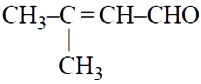
C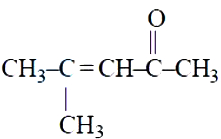
D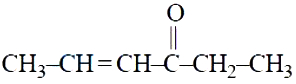
Solution
(C) $1$. $Propyne$ $(CH_3-C \equiv CH)$ reacts with $Hg^{2 } / H_2O, H $ to undergo hydration to form $Acetone$ $(CH_3-CO-CH_3)$ as $P$.
$2$. $Acetone$ $(P)$ undergoes $Aldol$ condensation in the presence of $Ba(OH)_2$ to form $Diacetone$ $alcohol$ $(Q)$,which is $CH_3-CO-CH_2-C(OH)(CH_3)_2$.
$3$. Upon heating $(\Delta)$,$Diacetone$ $alcohol$ $(Q)$ undergoes dehydration to form $Mesityl$ $oxide$ $(R)$,which is $CH_3-CO-CH=C(CH_3)_2$.
$2$. $Acetone$ $(P)$ undergoes $Aldol$ condensation in the presence of $Ba(OH)_2$ to form $Diacetone$ $alcohol$ $(Q)$,which is $CH_3-CO-CH_2-C(OH)(CH_3)_2$.
$3$. Upon heating $(\Delta)$,$Diacetone$ $alcohol$ $(Q)$ undergoes dehydration to form $Mesityl$ $oxide$ $(R)$,which is $CH_3-CO-CH=C(CH_3)_2$.
0 likes
View Solution1567
MediumMCQ
Consider the following sequence of reactions.
$C_6H_5COONa$ $\xrightarrow[\Delta]{NaOH/CaO} X$ $\xrightarrow[\text{Anhy. } AlCl_3]{CO/HCl} Y$ $\xrightarrow[NaOH]{\text{conc. }} A + B$.
If $A$ is the reduction product of $Y$,what is $B$?
$C_6H_5COONa$ $\xrightarrow[\Delta]{NaOH/CaO} X$ $\xrightarrow[\text{Anhy. } AlCl_3]{CO/HCl} Y$ $\xrightarrow[NaOH]{\text{conc. }} A + B$.
If $A$ is the reduction product of $Y$,what is $B$?
A
Sodium formate
B
Sodium phenoxide
C
Sodium salt of benzoic acid
D
Sodium salt of salicylic acid
Solution
(C) $1$. Decarboxylation of $C_6H_5COONa$ with soda lime $(NaOH/CaO)$ gives $X = C_6H_6$ (Benzene).
$2$. Gattermann-Koch reaction of benzene with $CO/HCl$ in the presence of anhydrous $AlCl_3$ gives $Y = C_6H_5CHO$ (Benzaldehyde).
$3$. The reaction of benzaldehyde with concentrated $NaOH$ is a Cannizzaro reaction.
$4$. In the Cannizzaro reaction,$C_6H_5CHO$ undergoes disproportionation to give $A = C_6H_5CH_2OH$ (Benzyl alcohol,the reduction product) and $B = C_6H_5COONa$ (Sodium benzoate,the oxidation product).
$2$. Gattermann-Koch reaction of benzene with $CO/HCl$ in the presence of anhydrous $AlCl_3$ gives $Y = C_6H_5CHO$ (Benzaldehyde).
$3$. The reaction of benzaldehyde with concentrated $NaOH$ is a Cannizzaro reaction.
$4$. In the Cannizzaro reaction,$C_6H_5CHO$ undergoes disproportionation to give $A = C_6H_5CH_2OH$ (Benzyl alcohol,the reduction product) and $B = C_6H_5COONa$ (Sodium benzoate,the oxidation product).
0 likes
View Solution1568
MediumMCQ
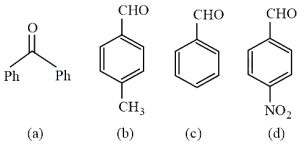
Arrange the following in increasing order of their reactivity for nucleophilic addition reaction:
A
$a < b < c < d$
B
$a < d < c < b$
C
$c < b < a < d$
D
$c < a < b < d$
Solution
(A) Aldehydes are generally more reactive than ketones in nucleophilic addition reactions due to steric and electronic factors. Sterically,the presence of two relatively large substituents in ketones hinders the approach of the nucleophile to the carbonyl carbon more than in aldehydes,which have only one such substituent. Electronically,aldehydes are more reactive because the two alkyl groups in ketones reduce the electrophilicity of the carbonyl carbon more effectively than in aldehydes. Benzophenone $(a)$ is a ketone and is the least reactive. Among the aldehydes,$p$-tolualdehyde $(b)$ is less reactive than benzaldehyde $(c)$ because the $CH_3$ group at the para position increases electron density on the carbonyl carbon through the hyperconjugation effect,making it less electrophilic. In $p$-nitrobenzaldehyde $(d)$,the $NO_2$ group is strongly electron-withdrawing due to both $-I$ and $-R$ effects,which decreases electron density on the carbonyl carbon and significantly increases its reactivity towards nucleophilic attack. Therefore,the increasing order of reactivity is $a < b < c < d$.
0 likes
View Solution1569
DifficultMCQ
The product '$Q$' of the following reaction is:

A
Propylbenzene
B
Isopropylbenzene
C
$1-$Phenylpropan$-1-$ol
D
$1-$Phenylprop$-1-$ene
Solution
(A) The reaction proceeds in two steps:
$1$. Friedel-Crafts acylation of benzene with $CH_3CH_2COCl$ in the presence of anhydrous $AlCl_3$ gives propiophenone $(C_6H_5COCH_2CH_3)$.
$2$. Clemmensen reduction of the ketone using $Zn-Hg$ and concentrated $HCl$ reduces the carbonyl group $(C=O)$ to a methylene group $(-CH_2-)$,yielding propylbenzene $(C_6H_5CH_2CH_2CH_3)$.
$1$. Friedel-Crafts acylation of benzene with $CH_3CH_2COCl$ in the presence of anhydrous $AlCl_3$ gives propiophenone $(C_6H_5COCH_2CH_3)$.
$2$. Clemmensen reduction of the ketone using $Zn-Hg$ and concentrated $HCl$ reduces the carbonyl group $(C=O)$ to a methylene group $(-CH_2-)$,yielding propylbenzene $(C_6H_5CH_2CH_2CH_3)$.
0 likes
View Solution1570
MediumMCQ
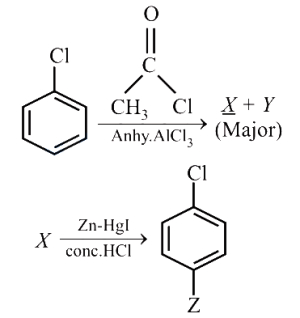
What is $\underline{Z}$ in the following sequence of reactions?
A
$-COCH_3$
B
$-COCH_2Cl$
C
$-CH_3$
D
$-CH_2CH_3$
Solution
(D) The reaction sequence is as follows:
$1$. Chlorobenzene reacts with acetyl chloride $(CH_3COCl)$ in the presence of anhydrous $AlCl_3$ (Friedel-Crafts acylation) to form $p$-chloroacetophenone as the major product $(X)$.
$2$. $X$ ($p$-chloroacetophenone) undergoes Clemmensen reduction using $Zn-Hg$ and $conc. HCl$,which reduces the carbonyl group $(-COCH_3)$ to an ethyl group $(-CH_2CH_3)$.
$3$. Therefore,the final product is $1-chloro-4-ethylbenzene$,and $\underline{Z}$ is the ethyl group,$-CH_2CH_3$.
$1$. Chlorobenzene reacts with acetyl chloride $(CH_3COCl)$ in the presence of anhydrous $AlCl_3$ (Friedel-Crafts acylation) to form $p$-chloroacetophenone as the major product $(X)$.
$2$. $X$ ($p$-chloroacetophenone) undergoes Clemmensen reduction using $Zn-Hg$ and $conc. HCl$,which reduces the carbonyl group $(-COCH_3)$ to an ethyl group $(-CH_2CH_3)$.
$3$. Therefore,the final product is $1-chloro-4-ethylbenzene$,and $\underline{Z}$ is the ethyl group,$-CH_2CH_3$.
0 likes
View Solution1571
DifficultMCQ
Benzene on reaction with acetyl chloride in the presence of anhydrous $AlCl_3$ gave the product $P$. The product $P$ on reaction with methyl magnesium bromide followed by treatment with water furnished the product $Q$. The molecular formula of $Q$ is
A
$C_8H_{10}O$
B
$C_8H_8O$
C
$C_9H_{12}O$
D
$C_9H_{10}O$
Solution
(C) Step $1$: Benzene reacts with acetyl chloride $(CH_3COCl)$ in the presence of anhydrous $AlCl_3$ (Friedel-Crafts acylation) to form acetophenone $(P)$,which is $C_6H_5COCH_3$.
Step $2$: Acetophenone $(P)$ reacts with methyl magnesium bromide $(CH_3MgBr)$ followed by hydrolysis $(H_2O)$ to form $2$-phenylpropan-$2$-ol $(Q)$.
The reaction is: $C_6H_5COCH_3 + CH_3MgBr$ $\rightarrow C_6H_5C(OMgBr)(CH_3)_2$ $\xrightarrow{H_2O} C_6H_5C(OH)(CH_3)_2$.
The structure of $Q$ is $C_6H_5C(OH)(CH_3)_2$,which contains $9$ carbon atoms,$12$ hydrogen atoms,and $1$ oxygen atom.
Thus,the molecular formula of $Q$ is $C_9H_{12}O$.
Step $2$: Acetophenone $(P)$ reacts with methyl magnesium bromide $(CH_3MgBr)$ followed by hydrolysis $(H_2O)$ to form $2$-phenylpropan-$2$-ol $(Q)$.
The reaction is: $C_6H_5COCH_3 + CH_3MgBr$ $\rightarrow C_6H_5C(OMgBr)(CH_3)_2$ $\xrightarrow{H_2O} C_6H_5C(OH)(CH_3)_2$.
The structure of $Q$ is $C_6H_5C(OH)(CH_3)_2$,which contains $9$ carbon atoms,$12$ hydrogen atoms,and $1$ oxygen atom.
Thus,the molecular formula of $Q$ is $C_9H_{12}O$.
0 likes
View Solution1572
MediumMCQ
The major product in the following transformation is
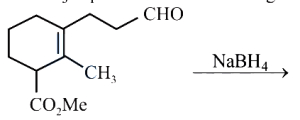
A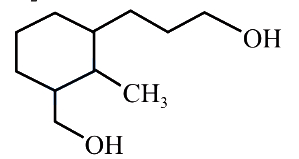
B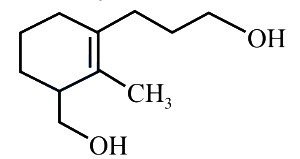
C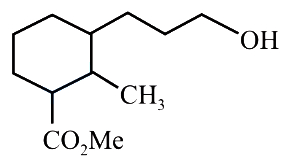
D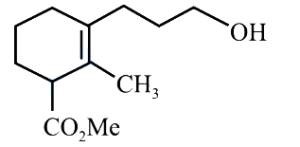
Solution
(D) $NaBH_4$ is a mild reducing agent. It selectively reduces the aldehyde group to a primary alcohol while leaving the ester group $(-COOCH_3)$ and the alkene $(-C=C-)$ intact.
0 likes
View Solution1573
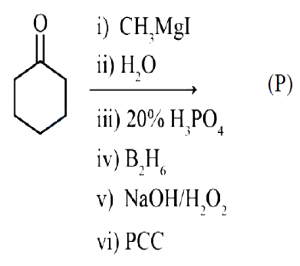
DifficultMCQ
The major product $(P)$ in the following reaction sequence is:
A
$1-$methylcyclohex$-1-$ene
B
$2-$methylcyclohex$-2-$en$-1-$one
C
$2-$methylcyclohexanone
D
cyclohexanecarbaldehyde
Solution
(C) $1$. Cyclohexanone reacts with $CH_3MgI$ followed by $H_2O$ to form $1$-methylcyclohexan-$1$-ol.
$2$. Dehydration with $H_3PO_4$ gives $1$-methylcyclohexene.
$3$. Hydroboration-oxidation $(B_2H_6, H_2O_2/NaOH)$ adds $-OH$ group anti-Markovnikov to the double bond,forming $2$-methylcyclohexan-$1$-ol.
$4$. Oxidation with $PCC$ converts the secondary alcohol into a ketone,resulting in $2$-methylcyclohexanone.
$2$. Dehydration with $H_3PO_4$ gives $1$-methylcyclohexene.
$3$. Hydroboration-oxidation $(B_2H_6, H_2O_2/NaOH)$ adds $-OH$ group anti-Markovnikov to the double bond,forming $2$-methylcyclohexan-$1$-ol.
$4$. Oxidation with $PCC$ converts the secondary alcohol into a ketone,resulting in $2$-methylcyclohexanone.
0 likes
View Solution1574
MediumMCQ
Match the following reactions in List-$I$ with their products in List-$II$.
| List-$I$ (Reaction) | List-$II$ (Product) |
| $A$. $\text{Ketone} + NaBH_4$ | $I$. $1^\circ$-alcohol |
| $B$. $\text{Ester} + LiAlH_4$ | $II$. $3^\circ$-alcohol |
| $C$. $RMgX + \text{Ketone}$ | $III$. $2^\circ$-alcohol |
| $IV$. $\text{Alkane}$ |
A
$A-III, B-I, C-II$
B
$A-III, B-I, C-IV$
C
$A-I, B-IV, C-II$
D
$A-II, B-I, C-IV$
Solution
(A) The correct matching is as follows:
$A$. $\text{Ketone} + NaBH_4 \rightarrow 2^\circ$-alcohol $(III)$.
$B$. $\text{Ester} + LiAlH_4 \rightarrow 1^\circ$-alcohol $(I)$.
$C$. $RMgX + \text{Ketone} \rightarrow 3^\circ$-alcohol $(II)$.
Thus,the correct sequence is $A-III, B-I, C-II$.
$A$. $\text{Ketone} + NaBH_4 \rightarrow 2^\circ$-alcohol $(III)$.
$B$. $\text{Ester} + LiAlH_4 \rightarrow 1^\circ$-alcohol $(I)$.
$C$. $RMgX + \text{Ketone} \rightarrow 3^\circ$-alcohol $(II)$.
Thus,the correct sequence is $A-III, B-I, C-II$.
0 likes
View Solution1575
MediumMCQ
In the given reaction sequence,$Z$ is a mixture of alcohol and acid. The reaction for the conversion of $Y$ to $Z$ is:
$CH_3CH_2OH$ $\xrightarrow[443 \ K]{\text{Conc. } H_2SO_4} X$ $\xrightarrow[(2) \ Zn/H_2O]{(1) \ O_3} Y$ $\xrightarrow[(ii) \ H^+]{(i) \ \text{Conc. } NaOH} Z$
$CH_3CH_2OH$ $\xrightarrow[443 \ K]{\text{Conc. } H_2SO_4} X$ $\xrightarrow[(2) \ Zn/H_2O]{(1) \ O_3} Y$ $\xrightarrow[(ii) \ H^+]{(i) \ \text{Conc. } NaOH} Z$
A
Reimer-Tiemann reaction
B
Kolbe's reaction
C
Cannizzaro reaction
D
Stephen reaction
Solution
(C) $1$. Dehydration of ethanol: $CH_3CH_2OH \xrightarrow[443 \ K]{\text{Conc. } H_2SO_4} CH_2=CH_2$ ($X$ is ethene).
$2$. Ozonolysis of ethene: $CH_2=CH_2 \xrightarrow[(2) \ Zn/H_2O]{(1) \ O_3} 2HCHO$ ($Y$ is formaldehyde).
$3$. Cannizzaro reaction: Formaldehyde $(HCHO)$ has no $\alpha$-hydrogen,so it undergoes the Cannizzaro reaction in the presence of concentrated $NaOH$ to form methanol $(CH_3OH)$ and sodium formate $(HCOONa)$.
$4$. Thus,the conversion of $Y$ to $Z$ is the Cannizzaro reaction.
$2$. Ozonolysis of ethene: $CH_2=CH_2 \xrightarrow[(2) \ Zn/H_2O]{(1) \ O_3} 2HCHO$ ($Y$ is formaldehyde).
$3$. Cannizzaro reaction: Formaldehyde $(HCHO)$ has no $\alpha$-hydrogen,so it undergoes the Cannizzaro reaction in the presence of concentrated $NaOH$ to form methanol $(CH_3OH)$ and sodium formate $(HCOONa)$.
$4$. Thus,the conversion of $Y$ to $Z$ is the Cannizzaro reaction.
0 likes
View Solution1576
MediumMCQ
$A$ primary alcohol was reacted with pyridinium chlorochromate $(PCC)$,which resulted in a product $P$. The product $P$ on treatment with ammoniacal silver nitrate solution produces:
A
Anhydride of carboxylic acid
B
Aldehyde
C
Amide
D
Carboxylate anion
Solution
(D) $1$. Primary alcohols are oxidized to aldehydes by pyridinium chlorochromate $(PCC)$. Thus,the product $P$ is an aldehyde.
$2$. Aldehydes react with ammoniacal silver nitrate solution (Tollens' reagent) to undergo oxidation,forming a carboxylate anion along with the deposition of metallic silver (silver mirror test).
$2$. Aldehydes react with ammoniacal silver nitrate solution (Tollens' reagent) to undergo oxidation,forming a carboxylate anion along with the deposition of metallic silver (silver mirror test).
0 likes
View Solution1577
DifficultMCQ
Which one among the following reaction products gives the iodoform test?
A
$CH_3CH_2CH_2CN \xrightarrow[\text{(ii) } H_3O^{+}]{\text{(i) } C_6H_5MgBr} CH_3CH_2CH_2COC_6H_5$
B
$(C_6H_5)_2Cd \xrightarrow{CH_3COCl} C_6H_5COCH_3$
C
$CH_2=CHCH_2CH(OH)C_6H_5 \xrightarrow{PCC} CH_2=CHCH_2COC_6H_5$
D
$C_6H_5CH_2CN \xrightarrow[\text{(ii) } H_3O^{+}]{\text{(i) } C_2H_5MgBr} C_6H_5CH_2COC_2H_5$
Solution
(B) The iodoform test is given by compounds containing a $CH_3CO-$ group (methyl ketones) or compounds that can be oxidized to such a group (like acetaldehyde or secondary alcohols with a methyl group at the alpha position).
$(A)$ $CH_3CH_2CH_2COC_6H_5$ (Butyrophenone): Does not have a $CH_3CO-$ group.
$(B)$ $C_6H_5COCH_3$ (Acetophenone): This is a methyl ketone $(CH_3CO-C_6H_5)$,so it gives a positive iodoform test.
$(C)$ $CH_2=CHCH_2COC_6H_5$: Does not have a $CH_3CO-$ group.
$(D)$ $C_6H_5CH_2COC_2H_5$: Does not have a $CH_3CO-$ group.
Thus,option $B$ is the correct answer.
$(A)$ $CH_3CH_2CH_2COC_6H_5$ (Butyrophenone): Does not have a $CH_3CO-$ group.
$(B)$ $C_6H_5COCH_3$ (Acetophenone): This is a methyl ketone $(CH_3CO-C_6H_5)$,so it gives a positive iodoform test.
$(C)$ $CH_2=CHCH_2COC_6H_5$: Does not have a $CH_3CO-$ group.
$(D)$ $C_6H_5CH_2COC_2H_5$: Does not have a $CH_3CO-$ group.
Thus,option $B$ is the correct answer.
0 likes
View Solution1578
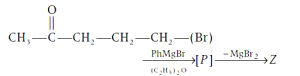
DifficultMCQ
The major product $(Z)$ of the following chemical reaction is
A
$CH_3-C(OH)(Ph)-CH_2-CH_2-CH_3$
B
$CH_3-C(OH)(Ph)-CH_2-CH_2-CH_2Br$
C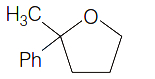
$A$ cyclic ether with a five-membered ring containing a phenyl group and a methyl group at the same carbon.
D
$CH_3-C(=O)-CH_2-CH_2-CH_2-Ph$
Solution
(C) The reaction involves the nucleophilic addition of the Grignard reagent,$PhMgBr$,to the carbonyl group of $5$-bromo-$2$-pentanone.
$1$. The phenyl group $(Ph^-)$ attacks the electrophilic carbonyl carbon of the ketone to form an intermediate alkoxide,$CH_3-C(OMgBr)(Ph)-CH_2-CH_2-CH_2Br$ (labeled as $P$).
$2$. The alkoxide oxygen then performs an intramolecular nucleophilic substitution $(S_N2)$ on the carbon bearing the bromine atom,displacing the bromide ion and forming a five-membered cyclic ether ring.
$3$. This results in the formation of $2$-methyl-$2$-phenyltetrahydrofuran as the major product $(Z)$.
$1$. The phenyl group $(Ph^-)$ attacks the electrophilic carbonyl carbon of the ketone to form an intermediate alkoxide,$CH_3-C(OMgBr)(Ph)-CH_2-CH_2-CH_2Br$ (labeled as $P$).
$2$. The alkoxide oxygen then performs an intramolecular nucleophilic substitution $(S_N2)$ on the carbon bearing the bromine atom,displacing the bromide ion and forming a five-membered cyclic ether ring.
$3$. This results in the formation of $2$-methyl-$2$-phenyltetrahydrofuran as the major product $(Z)$.
0 likes
View Solution1579
MediumMCQ
The products $A$ and $B$ of the below reaction sequence are
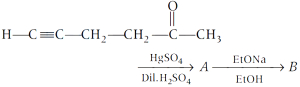
A
$CH_3COCH_2CH_2COCH_3$,$3$-methylcyclopent-$2$-en-$1$-one
B
$OHC(CH_2)_3COCH_3$,$2$-methylcyclobut-$1$-ene-$1$-carbaldehyde
C
$CH_3CH(OH)CH_2CH_2COCH_3$,$2$-methyl-tetrahydrofuran-$2$-ol
D
$CH_3COCH_2CH_2COCH_3$,$3$-methylcyclopent-$2$-en-$1$-one
Solution
(D) The reaction of $HC \equiv C-CH_2-CH_2-COCH_3$ with $HgSO_4$ and dilute $H_2SO_4$ is a hydration reaction of an alkyne. The terminal alkyne undergoes hydration to form a ketone. The product $A$ is $CH_3COCH_2CH_2COCH_3$ (hexane-$2,5$-dione).
Next,the reaction of $CH_3COCH_2CH_2COCH_3$ with $EtONa$ and $EtOH$ is an intramolecular aldol condensation. The base $EtO^-$ abstracts an $\alpha$-hydrogen from one of the methyl groups,forming an enolate,which then attacks the other carbonyl group to form a five-membered ring. Subsequent dehydration yields $3$-methylcyclopent-$2$-en-$1$-one as product $B$.
Next,the reaction of $CH_3COCH_2CH_2COCH_3$ with $EtONa$ and $EtOH$ is an intramolecular aldol condensation. The base $EtO^-$ abstracts an $\alpha$-hydrogen from one of the methyl groups,forming an enolate,which then attacks the other carbonyl group to form a five-membered ring. Subsequent dehydration yields $3$-methylcyclopent-$2$-en-$1$-one as product $B$.
0 likes
View Solution1580
MediumMCQ
Identify the correct statements about $Z$ in the following reaction sequence:
$C_2H_5NH_2$ $\xrightarrow[NaNO_2 / HCl]{} X$ $\xrightarrow{H_2O} Y$ $\xrightarrow{Cu / 573 \ K} Z$
$I$. $Z$ is an aldehyde
$II$. $Z$ undergoes Cannizzaro reaction
$III$. $Z$ gives iodoform test
$IV$. $Z$ does not give test with Tollens' reagent
$C_2H_5NH_2$ $\xrightarrow[NaNO_2 / HCl]{} X$ $\xrightarrow{H_2O} Y$ $\xrightarrow{Cu / 573 \ K} Z$
$I$. $Z$ is an aldehyde
$II$. $Z$ undergoes Cannizzaro reaction
$III$. $Z$ gives iodoform test
$IV$. $Z$ does not give test with Tollens' reagent
A
$I$ and $III$
B
$II$ and $IV$
C
$I$ and $IV$
D
$II$ and $III$
Solution
(A) The reaction sequence is as follows:
$C_2H_5NH_2$ $\xrightarrow{NaNO_2/HCl} [C_2H_5N_2^+Cl^-] (X)$ $\xrightarrow{H_2O} C_2H_5OH (Y)$ $\xrightarrow{Cu, 573 \ K} CH_3CHO (Z)$
$Z$ is acetaldehyde $(CH_3CHO)$.
$I$. $Z$ is an aldehyde. (Correct)
$II$. $Z$ has $\alpha$-hydrogen atoms,so it does not undergo Cannizzaro reaction. (Incorrect)
$III$. $Z$ contains a $CH_3CO-$ group,so it gives a positive iodoform test. (Correct)
$IV$. $Z$ is an aldehyde,so it gives a positive test with Tollens' reagent. (Incorrect)
Thus,statements $I$ and $III$ are correct.
$C_2H_5NH_2$ $\xrightarrow{NaNO_2/HCl} [C_2H_5N_2^+Cl^-] (X)$ $\xrightarrow{H_2O} C_2H_5OH (Y)$ $\xrightarrow{Cu, 573 \ K} CH_3CHO (Z)$
$Z$ is acetaldehyde $(CH_3CHO)$.
$I$. $Z$ is an aldehyde. (Correct)
$II$. $Z$ has $\alpha$-hydrogen atoms,so it does not undergo Cannizzaro reaction. (Incorrect)
$III$. $Z$ contains a $CH_3CO-$ group,so it gives a positive iodoform test. (Correct)
$IV$. $Z$ is an aldehyde,so it gives a positive test with Tollens' reagent. (Incorrect)
Thus,statements $I$ and $III$ are correct.
0 likes
View Solution1581
MediumMCQ
In the following compounds,the ones that give positive iodoform test are:
$(I)$ $CH_3CH_2COCH_2CH_3$
$(II)$ $CH_3CH(OH)CH_3$
$(III)$ $1$-indanone
$(IV)$ $CH_3CH_2COCH_3$
$(V)$ $PhCOPh$
$(VI)$ $PhCOCH_3$
$(I)$ $CH_3CH_2COCH_2CH_3$
$(II)$ $CH_3CH(OH)CH_3$
$(III)$ $1$-indanone
$(IV)$ $CH_3CH_2COCH_3$
$(V)$ $PhCOPh$
$(VI)$ $PhCOCH_3$
A
$I, II$ and $III$
B
$II, III$ and $V$
C
$IV, V$ and $VI$
D
$II, IV$ and $VI$
Solution
(D) The iodoform test is given by compounds containing the $CH_3CO-$ group or the $CH_3CH(OH)-$ group.
$(I)$ $CH_3CH_2COCH_2CH_3$: Does not contain $CH_3CO-$ group.
$(II)$ $CH_3CH(OH)CH_3$: Contains $CH_3CH(OH)-$ group,so it gives a positive test.
$(III)$ $1$-indanone: Does not contain $CH_3CO-$ group.
$(IV)$ $CH_3CH_2COCH_3$: Contains $CH_3CO-$ group,so it gives a positive test.
$(V)$ $PhCOPh$: Does not contain $CH_3CO-$ group.
$(VI)$ $PhCOCH_3$: Contains $CH_3CO-$ group,so it gives a positive test.
Therefore,compounds $(II), (IV),$ and $(VI)$ give a positive iodoform test.
$(I)$ $CH_3CH_2COCH_2CH_3$: Does not contain $CH_3CO-$ group.
$(II)$ $CH_3CH(OH)CH_3$: Contains $CH_3CH(OH)-$ group,so it gives a positive test.
$(III)$ $1$-indanone: Does not contain $CH_3CO-$ group.
$(IV)$ $CH_3CH_2COCH_3$: Contains $CH_3CO-$ group,so it gives a positive test.
$(V)$ $PhCOPh$: Does not contain $CH_3CO-$ group.
$(VI)$ $PhCOCH_3$: Contains $CH_3CO-$ group,so it gives a positive test.
Therefore,compounds $(II), (IV),$ and $(VI)$ give a positive iodoform test.
0 likes
View Solution1582
EasyMCQ
Which one of the following gives a yellow precipitate with iodine and $NaOH$ solution?
A
$CH_3CHO$
B
$C_6H_5COC_6H_5$
C
$HCHO$
D
$CH_3OH$
Solution
(A) Alcohols containing the $CH_3CH(OH)-$ group and carbonyl compounds containing the $CH_3CO-$ group give a yellow precipitate with iodine and $NaOH$ solution. This reaction is known as the iodoform test.
Thus,$CH_3CHO$ gives a yellow precipitate with $I_2$ and $NaOH$ due to the presence of the $CH_3CO-$ group.
The reaction is: $CH_3CHO + 3I_2 + 4NaOH \longrightarrow CHI_3 + HCOONa + 3NaI + 3H_2O$.
Thus,$CH_3CHO$ gives a yellow precipitate with $I_2$ and $NaOH$ due to the presence of the $CH_3CO-$ group.
The reaction is: $CH_3CHO + 3I_2 + 4NaOH \longrightarrow CHI_3 + HCOONa + 3NaI + 3H_2O$.
0 likes
View Solution1583
MediumMCQ
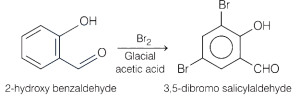
What is the major product formed when salicylaldehyde is reacted with $2$ equivalents of bromine in glacial acetic acid at $0^{\circ} C$?
A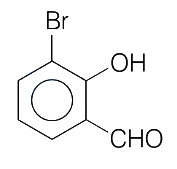
B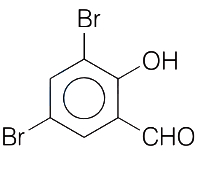
C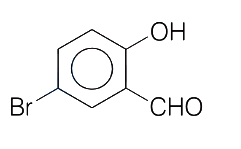
D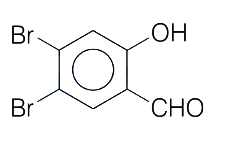
Solution
(B) Salicylaldehyde ($2$-hydroxybenzaldehyde) contains a strongly activating $-OH$ group,which directs electrophilic substitution to the ortho and para positions.
Since the ortho position is already occupied by the $-CHO$ group,the bromine atoms substitute at the $3$ and $5$ positions (which are ortho and para to the $-OH$ group respectively).
When treated with $2$ equivalents of $Br_2$ in glacial acetic acid,the reaction yields $3,5-$dibromosalicylaldehyde as the major product.
Since the ortho position is already occupied by the $-CHO$ group,the bromine atoms substitute at the $3$ and $5$ positions (which are ortho and para to the $-OH$ group respectively).
When treated with $2$ equivalents of $Br_2$ in glacial acetic acid,the reaction yields $3,5-$dibromosalicylaldehyde as the major product.
0 likes
View Solution1584
MediumMCQ
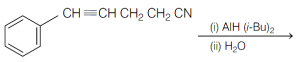
The major product formed in the following reaction is:
A
$Ph-CH_2-CH_2-CH_2-CH_2-CH_2-NH_2$
B
$Ph-CH_2-CH_2-CH_2-CH_2-CH_2-OH$
C
$Ph-CH=CH-CH_2-CH_2-CH_2-NH_2$
D
$Ph-CH=CH-CH_2-CH_2-CHO$
Solution
(D) The reagent $DIBAL-H$ (diisobutylaluminium hydride,$AlH(i-Bu)_2$) is a selective reducing agent. It reduces nitriles $(-CN)$ to aldehydes $(-CHO)$ after hydrolysis,while leaving other functional groups like carbon-carbon double bonds $(C=C)$ unaffected. Therefore,the reaction of $Ph-CH=CH-CH_2-CH_2-CN$ with $DIBAL-H$ followed by $H_2O$ yields $Ph-CH=CH-CH_2-CH_2-CHO$.
0 likes
View Solution1585
MediumMCQ
What is '$Z$' in the given sequence of reactions?

A
Chlorobenzene
B
Toluene
C
Benzyl alcohol
D
Phenol
Solution
(B) The reaction sequence is as follows:
$1$. Benzaldehyde $(C_6H_5CHO)$ is oxidized by $KMnO_4/H^+$ to form Benzoic acid $(C_6H_5COOH)$,which is '$X$'.
$2$. Benzoic acid reacts with $SOCl_2$ to form Benzoyl chloride $(C_6H_5COCl)$.
$3$. Benzoyl chloride undergoes Rosenmund reduction $(H_2, Pd/BaSO_4)$ to form Benzaldehyde $(C_6H_5CHO)$,which is '$Y$'.
$4$. Benzaldehyde undergoes Clemmensen reduction $(Zn-Hg/Conc. HCl)$ to form Toluene $(C_6H_5CH_3)$,which is '$Z$'.
Therefore,'$Z$' is Toluene.
$1$. Benzaldehyde $(C_6H_5CHO)$ is oxidized by $KMnO_4/H^+$ to form Benzoic acid $(C_6H_5COOH)$,which is '$X$'.
$2$. Benzoic acid reacts with $SOCl_2$ to form Benzoyl chloride $(C_6H_5COCl)$.
$3$. Benzoyl chloride undergoes Rosenmund reduction $(H_2, Pd/BaSO_4)$ to form Benzaldehyde $(C_6H_5CHO)$,which is '$Y$'.
$4$. Benzaldehyde undergoes Clemmensen reduction $(Zn-Hg/Conc. HCl)$ to form Toluene $(C_6H_5CH_3)$,which is '$Z$'.
Therefore,'$Z$' is Toluene.
0 likes
View Solution1586
MediumMCQ
In the given reaction sequence,the conversion of $B$ to $C$ is known as:

A
Stephen's reaction
B
Rosenmund reduction
C
Etard reaction
D
Gatterman reaction
Solution
(C) The reaction sequence is as follows:
$1$. Sodium benzoate reacts with $NaOH + CaO$ (sodalime) to form benzene $(A)$.
$2$. Benzene $(A)$ undergoes Friedel-Crafts alkylation with $CH_3Cl$ in the presence of anhydrous $AlCl_3$ to form toluene $(B)$.
$3$. Toluene $(B)$ reacts with chromyl chloride $(CrO_2Cl_2)$ in $CS_2$ followed by hydrolysis $(H_3O^+)$ to form benzaldehyde $(C)$.
This specific oxidation of the methyl group of toluene to a formyl group using chromyl chloride is known as the $Etard$ reaction.
$1$. Sodium benzoate reacts with $NaOH + CaO$ (sodalime) to form benzene $(A)$.
$2$. Benzene $(A)$ undergoes Friedel-Crafts alkylation with $CH_3Cl$ in the presence of anhydrous $AlCl_3$ to form toluene $(B)$.
$3$. Toluene $(B)$ reacts with chromyl chloride $(CrO_2Cl_2)$ in $CS_2$ followed by hydrolysis $(H_3O^+)$ to form benzaldehyde $(C)$.
This specific oxidation of the methyl group of toluene to a formyl group using chromyl chloride is known as the $Etard$ reaction.
0 likes
View Solution1587
DifficultMCQ
Consider the following reaction,where:
$(A)$ The change in the functional group and
$(B)$ The corresponding change in the hybridization from the starting material to the final product are:
$CH_3-C \equiv N \xrightarrow[(ii) \ HI + \text{Red } P]{(i) \ SnCl_2, HCl / H_3O^{+}}$
$(A)$ The change in the functional group and
$(B)$ The corresponding change in the hybridization from the starting material to the final product are:
$CH_3-C \equiv N \xrightarrow[(ii) \ HI + \text{Red } P]{(i) \ SnCl_2, HCl / H_3O^{+}}$
A
$A: -CN$ $\rightarrow -CH_2OH \quad (sp^2$ $\rightarrow sp^3)$
B
$A: -CN$ $\rightarrow -CONH_2 \quad (sp$ $\rightarrow sp^2)$
C
$A: -CN$ $\rightarrow -CH_2NH_2 \quad (sp$ $\rightarrow sp^3)$
D
$A: -CN$ $\rightarrow -CH_3 \quad (sp$ $\rightarrow sp^3)$
Solution
(D) The reaction proceeds in two main steps:
$1$. Stephen reduction: $CH_3-CN$ $\xrightarrow{SnCl_2, HCl} CH_3-CH=NH$ $\xrightarrow{H_3O^+} CH_3CHO$.
$2$. Reduction of aldehyde: $CH_3CHO \xrightarrow{HI, \text{Red } P} CH_3-CH_3$ (Ethane).
In the starting material,the carbon of the $-CN$ group is $sp$ hybridized.
In the final product,ethane $(CH_3-CH_3)$,the carbons are $sp^3$ hybridized.
The functional group changes from $-CN$ (nitrile) to $-CH_3$ (alkyl group).
Thus,the correct change is $A: -CN \rightarrow -CH_3$ and $B: sp \rightarrow sp^3$.
$1$. Stephen reduction: $CH_3-CN$ $\xrightarrow{SnCl_2, HCl} CH_3-CH=NH$ $\xrightarrow{H_3O^+} CH_3CHO$.
$2$. Reduction of aldehyde: $CH_3CHO \xrightarrow{HI, \text{Red } P} CH_3-CH_3$ (Ethane).
In the starting material,the carbon of the $-CN$ group is $sp$ hybridized.
In the final product,ethane $(CH_3-CH_3)$,the carbons are $sp^3$ hybridized.
The functional group changes from $-CN$ (nitrile) to $-CH_3$ (alkyl group).
Thus,the correct change is $A: -CN \rightarrow -CH_3$ and $B: sp \rightarrow sp^3$.
0 likes
View Solution1588
DifficultMCQ
Match the following reactions in Column-$1$ with their products in Column-$2$.
The correct match is:
| Column-$1$ (Reaction) | Column-$2$ (Product) |
| $A$. Benzaldehyde + $Zn-Hg/HCl$ | $I$. Cyclohexanol |
| $B$. Benzoyl chloride + $H_2/Pd-BaSO_4$ | $II$. Benzyl alcohol |
| $C$. Cyclohexanone + $NH_2NH_2/KOH$ | $III$. Toluene |
| $IV$. Benzaldehyde | |
| $V$. Cyclohexane |
The correct match is:
A
| $A$ | $B$ | $C$ |
| $III$ | $V$ | $IV$ |
B
| $A$ | $B$ | $C$ |
| $III$ | $II$ | $V$ |
C
| $A$ | $B$ | $C$ |
| $III$ | $IV$ | $V$ |
D
| $A$ | $B$ | $C$ |
| $II$ | $IV$ | $I$ |
Solution
(C) The reactions are as follows:
$A$. Benzaldehyde $(C_6H_5CHO)$ undergoes Clemmensen reduction with $Zn-Hg/HCl$ to form Toluene $(C_6H_5CH_3)$. Thus,$A \rightarrow III$.
$B$. Benzoyl chloride $(C_6H_5COCl)$ undergoes Rosenmund reduction with $H_2/Pd-BaSO_4$ to form Benzaldehyde $(C_6H_5CHO)$. Thus,$B \rightarrow IV$.
$C$. Cyclohexanone undergoes Wolff-Kishner reduction with $NH_2NH_2/KOH$ to form Cyclohexane $(C_6H_{12})$. Thus,$C \rightarrow V$.
Therefore,the correct match is $A-III, B-IV, C-V$.
$A$. Benzaldehyde $(C_6H_5CHO)$ undergoes Clemmensen reduction with $Zn-Hg/HCl$ to form Toluene $(C_6H_5CH_3)$. Thus,$A \rightarrow III$.
$B$. Benzoyl chloride $(C_6H_5COCl)$ undergoes Rosenmund reduction with $H_2/Pd-BaSO_4$ to form Benzaldehyde $(C_6H_5CHO)$. Thus,$B \rightarrow IV$.
$C$. Cyclohexanone undergoes Wolff-Kishner reduction with $NH_2NH_2/KOH$ to form Cyclohexane $(C_6H_{12})$. Thus,$C \rightarrow V$.
Therefore,the correct match is $A-III, B-IV, C-V$.
0 likes
View Solution1589
MediumMCQ
What are $X$ and $Y$ in the following reaction sequence?
$Toluene$ $\xrightarrow{X} Benzaldehyde$ $\xrightarrow{HNO_3 + H_2SO_4, 273-283 \ K} Y$
$Toluene$ $\xrightarrow{X} Benzaldehyde$ $\xrightarrow{HNO_3 + H_2SO_4, 273-283 \ K} Y$
A
$(i) \ CrO_2Cl_2/CS_2, (ii) \ H_3O^+$; $Y = m-nitrobenzaldehyde$
B
$CrO_3/H_2SO_4$; $Y = m-sulfobenzaldehyde$
C
$CrO_2Cl_2/H_3O^+$; $Y = benzoic \ acid$
D
$CrO_3/H_2SO_4$; $Y = m-nitrobenzoic \ acid$
Solution
(A) The reaction sequence is as follows:
$1$. The conversion of $Toluene$ to $Benzaldehyde$ is an oxidation reaction known as $Etard's$ reaction,which uses $CrO_2Cl_2$ in $CS_2$ followed by hydrolysis $(H_3O^+)$. Thus,$X = (i) \ CrO_2Cl_2/CS_2, (ii) \ H_3O^+$.
$2$. $Benzaldehyde$ contains a $-CHO$ group,which is a deactivating and $meta$-directing group for electrophilic substitution reactions.
$3$. Nitration of $Benzaldehyde$ using a nitrating mixture $(HNO_3 + H_2SO_4)$ at $273-283 \ K$ yields $m-nitrobenzaldehyde$ as the major product. Thus,$Y = m-nitrobenzaldehyde$.
$1$. The conversion of $Toluene$ to $Benzaldehyde$ is an oxidation reaction known as $Etard's$ reaction,which uses $CrO_2Cl_2$ in $CS_2$ followed by hydrolysis $(H_3O^+)$. Thus,$X = (i) \ CrO_2Cl_2/CS_2, (ii) \ H_3O^+$.
$2$. $Benzaldehyde$ contains a $-CHO$ group,which is a deactivating and $meta$-directing group for electrophilic substitution reactions.
$3$. Nitration of $Benzaldehyde$ using a nitrating mixture $(HNO_3 + H_2SO_4)$ at $273-283 \ K$ yields $m-nitrobenzaldehyde$ as the major product. Thus,$Y = m-nitrobenzaldehyde$.
0 likes
View Solution1590
DifficultMCQ
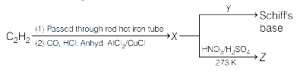
Identify $X, Y$ and $Z$ respectively from the following reactions:
A
Benzaldehyde,Aniline,$m$-Nitrobenzaldehyde
B
Benzaldehyde,Phenylhydrazine,$m$-Nitrobenzoic acid
C
Benzoic acid,Aniline,$m$-Nitrobenzoic acid
D
Benzaldehyde,$2$,$4$-Dinitrophenylhydrazine,$p$-Nitrobenzoic acid
Solution
(A) The reaction sequence is as follows:
$1$. $C_2H_2$ (acetylene) when passed through a red hot iron tube undergoes cyclic polymerization to form benzene. Benzene reacts with $CO$ and $HCl$ in the presence of anhydrous $AlCl_3/CuCl$ (Gattermann-Koch reaction) to form $X$ (Benzaldehyde).
$2$. Benzaldehyde $(X)$ reacts with aniline $(Y)$ to form a Schiff's base.
$3$. Benzaldehyde $(X)$ undergoes nitration with $HNO_3/H_2SO_4$ at $273 \ K$ to form $Z$ ($m$-nitrobenzaldehyde) because the $-CHO$ group is meta-directing.
Therefore,$X$ is benzaldehyde,$Y$ is aniline,and $Z$ is $m$-nitrobenzaldehyde. The correct option is $(a)$.
$1$. $C_2H_2$ (acetylene) when passed through a red hot iron tube undergoes cyclic polymerization to form benzene. Benzene reacts with $CO$ and $HCl$ in the presence of anhydrous $AlCl_3/CuCl$ (Gattermann-Koch reaction) to form $X$ (Benzaldehyde).
$2$. Benzaldehyde $(X)$ reacts with aniline $(Y)$ to form a Schiff's base.
$3$. Benzaldehyde $(X)$ undergoes nitration with $HNO_3/H_2SO_4$ at $273 \ K$ to form $Z$ ($m$-nitrobenzaldehyde) because the $-CHO$ group is meta-directing.
Therefore,$X$ is benzaldehyde,$Y$ is aniline,and $Z$ is $m$-nitrobenzaldehyde. The correct option is $(a)$.
0 likes
View Solution8-1.Aldehydes and Ketones — Properties · Frequently Asked Questions
1Are these 8-1.Aldehydes and Ketones questions useful for JEE and NEET?
Yes. All questions in this section are mapped to JEE Main and NEET exam patterns. Previous year questions from JEE Main, NEET, GUJCET and state-level exams are included with full solutions.
2Can I switch to Hindi or Gujarati for these questions?
Yes. Use the language tabs in the hero section or the sidebar to view the same questions and solutions in English, Hindi or Gujarati.
3How do I generate a question paper from this subtopic?
Use the Vedclass Exam Paper Generator — select the chapter and subtopic, set difficulty, and generate Sets A, B, C, D automatically. First 3 chapters of every subject are free.
Vedclass Products
For Students
Vedclass Test Series
Mock tests in real JEE/NEET style with performance analysis. 5-day free trial.
Start Free TrialFor Teachers
Exam Paper Generator
Generate Set A/B/C/D papers from this chapter in 2 minutes. 3 chapters free.
Try FreeFor Institutes
Online Exam Module
Live online exams with unlimited students, 360° analytics & white-label branding.
See DemoFor Teachers & Institutes
Generate a 8-1.Aldehydes and Ketones Exam Paper in 2 Minutes
Select subtopic & difficulty — Sets A, B, C, D auto-generated with No Repeat logic.
First 3 chapters of every subject are free — no payment required.