
A English
Properties Questions in English
Class 12 Chemistry · 8-1.Aldehydes and Ketones · Properties
1739+
Questions
English
Language
100%
With Solutions
Showing 42 of 1739 questions in English
1501
MediumMCQ
What are '$X$' and '$Y$' respectively in the following reactions?
$C_6H_5CHO + C_6H_5COCH_3$ $\xrightarrow[293 \ K]{OH^{-}} \underset{\text{major}}{X}$ $\xrightarrow{NaBH_4} Y$
$C_6H_5CHO + C_6H_5COCH_3$ $\xrightarrow[293 \ K]{OH^{-}} \underset{\text{major}}{X}$ $\xrightarrow{NaBH_4} Y$
A
$C_6H_5COCH=C(CH_3)C_6H_5, C_6H_5CH_2CH_2COC_6H_5$
B
$C_6H_5COCH=C(CH_3)C_6H_5, C_6H_5=CHCH(OH)C_6H_5$
C
$C_6H_5CH=CHCOC_6H_5, C_6H_5CH=CHCH(OH)C_6H_5$
D
$C_6H_5CH=CHCOC_6H_5, C_6H_5CH_2CH_2COC_6H_5$
Solution
(C) The reaction between benzaldehyde $(C_6H_5CHO)$ and acetophenone $(C_6H_5COCH_3)$ in the presence of a base $(OH^-)$ is a Claisen-Schmidt condensation reaction.
This reaction produces an $\alpha,\beta$-unsaturated ketone,which is $X = C_6H_5CH=CHCOC_6H_5$ (benzalacetophenone).
Next,$NaBH_4$ is a selective reducing agent that reduces the carbonyl group $(C=O)$ to a hydroxyl group $(-OH)$ without affecting the carbon-carbon double bond $(C=C)$.
Therefore,the reduction of $C_6H_5CH=CHCOC_6H_5$ with $NaBH_4$ yields $Y = C_6H_5CH=CHCH(OH)C_6H_5$ ($1$,$3$-diphenylprop$-2-$en$-1-$ol).
Thus,the correct option is $C$.
This reaction produces an $\alpha,\beta$-unsaturated ketone,which is $X = C_6H_5CH=CHCOC_6H_5$ (benzalacetophenone).
Next,$NaBH_4$ is a selective reducing agent that reduces the carbonyl group $(C=O)$ to a hydroxyl group $(-OH)$ without affecting the carbon-carbon double bond $(C=C)$.
Therefore,the reduction of $C_6H_5CH=CHCOC_6H_5$ with $NaBH_4$ yields $Y = C_6H_5CH=CHCH(OH)C_6H_5$ ($1$,$3$-diphenylprop$-2-$en$-1-$ol).
Thus,the correct option is $C$.
0 likes
View Solution1502
MediumMCQ
The number of products obtained in the following reaction is:
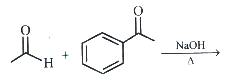
A
$1$
B
$3$
C
$2$
D
$4$
Solution
(D) The reaction involves $CH_3CHO$ (acetaldehyde) and $C_6H_5COCH_3$ (acetophenone) in the presence of $NaOH$ and heat. Both compounds contain $\alpha$-hydrogens,so they undergo self-aldol condensation and cross-aldol condensation.
$1$. Self-aldol condensation of $CH_3CHO$ gives one product.
$2$. Self-aldol condensation of $C_6H_5COCH_3$ gives one product.
$3$. Cross-aldol condensation of $CH_3CHO$ (as donor) and $C_6H_5COCH_3$ (as acceptor) gives one product.
$4$. Cross-aldol condensation of $C_6H_5COCH_3$ (as donor) and $CH_3CHO$ (as acceptor) gives one product.
Thus,a total of $4$ products are obtained.
$1$. Self-aldol condensation of $CH_3CHO$ gives one product.
$2$. Self-aldol condensation of $C_6H_5COCH_3$ gives one product.
$3$. Cross-aldol condensation of $CH_3CHO$ (as donor) and $C_6H_5COCH_3$ (as acceptor) gives one product.
$4$. Cross-aldol condensation of $C_6H_5COCH_3$ (as donor) and $CH_3CHO$ (as acceptor) gives one product.
Thus,a total of $4$ products are obtained.
0 likes
View Solution1503
MediumMCQ
Which of the following is a hemiacetal?
A
B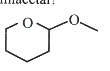
C
D
Solution
(A) hemiacetal is a functional group characterized by a carbon atom bonded to one $-OH$ group,one $-OR$ group,and two other carbon-containing groups (or hydrogen atoms).
In the given options,the structure in option $A$ shows a carbon atom bonded to an $-OH$ group and an ether oxygen atom within a ring,which fits the definition of a cyclic hemiacetal.
In the given options,the structure in option $A$ shows a carbon atom bonded to an $-OH$ group and an ether oxygen atom within a ring,which fits the definition of a cyclic hemiacetal.
0 likes
View Solution1504
MediumMCQ
What are '$X$' and '$Y$' in the following reaction?
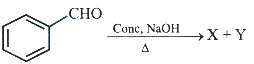
A
Phenol + Sodium benzoate
B
Benzyl alcohol + Benzoic acid
C
Benzyl alcohol + Sodium benzoate
D
Sodium benzyloxide + Benzoic acid
Solution
(C) The given reaction is the Cannizzaro reaction. Benzaldehyde $(C_6H_5CHO)$ does not have an $\alpha$-hydrogen atom,so it undergoes a self-oxidation and reduction (disproportionation) reaction in the presence of a concentrated base like $NaOH$.
One molecule of benzaldehyde is reduced to benzyl alcohol $(C_6H_5CH_2OH)$,and another molecule is oxidized to sodium benzoate $(C_6H_5COONa)$.
Thus,the products '$X$' and '$Y$' are benzyl alcohol and sodium benzoate.
One molecule of benzaldehyde is reduced to benzyl alcohol $(C_6H_5CH_2OH)$,and another molecule is oxidized to sodium benzoate $(C_6H_5COONa)$.
Thus,the products '$X$' and '$Y$' are benzyl alcohol and sodium benzoate.
0 likes
View Solution1505
MediumMCQ
Which of the following reagents will convert isobutyraldehyde to the corresponding acid?
| $I. HNO_3$ | $II. NH_2NH_2 / OH^-$ |
| $III. 2[Ag(NH_3)_2]^+$ | $IV. NaOH$ |
A
$I, III$
B
$I, II$
C
$II, IV$
D
$III, IV$
Solution
(A) Isobutyraldehyde is an aldehyde,which can be oxidized to the corresponding carboxylic acid (isobutyric acid) using oxidizing agents.
$HNO_3$ is a strong oxidizing agent.
$2[Ag(NH_3)_2]^+$ (Tollen's reagent) is a mild oxidizing agent that specifically oxidizes aldehydes to carboxylic acids.
$NH_2NH_2 / OH^-$ (Wolff-Kishner reduction) reduces aldehydes to alkanes.
$NaOH$ typically causes aldol condensation or Cannizzaro reaction (if no $\alpha$-hydrogen is present) but does not oxidize aldehydes to acids.
Therefore,reagents $I$ and $III$ are the correct oxidizing agents.
$HNO_3$ is a strong oxidizing agent.
$2[Ag(NH_3)_2]^+$ (Tollen's reagent) is a mild oxidizing agent that specifically oxidizes aldehydes to carboxylic acids.
$NH_2NH_2 / OH^-$ (Wolff-Kishner reduction) reduces aldehydes to alkanes.
$NaOH$ typically causes aldol condensation or Cannizzaro reaction (if no $\alpha$-hydrogen is present) but does not oxidize aldehydes to acids.
Therefore,reagents $I$ and $III$ are the correct oxidizing agents.
0 likes
View Solution1506
MediumMCQ
The number of aldehydes that undergo Cannizzaro reaction from the following are Phenyl ethanal,Methanal,$2-$Methoxy propanal,Trichloro ethanal.
A
$2$
B
$3$
C
$4$
D
$1$
Solution
(A) Aldehydes that do not have $\alpha$-hydrogens undergo the Cannizzaro reaction.
$1$. Methanal $(HCHO)$: It has no $\alpha$-carbon,hence no $\alpha$-hydrogen.
$2$. Trichloro ethanal $(CCl_3CHO)$: The carbon adjacent to the carbonyl group is bonded to three chlorine atoms,so there is no $\alpha$-hydrogen.
$3$. Phenyl ethanal $(C_6H_5CH_2CHO)$: It has two $\alpha$-hydrogens on the carbon attached to the phenyl ring.
$4$. $2-$Methoxy propanal $(CH_3OCH(CH_3)CHO)$: It has one $\alpha$-hydrogen on the carbon at the $2-$position.
Thus,only Methanal and Trichloro ethanal undergo the Cannizzaro reaction. The total number is $2$.
$1$. Methanal $(HCHO)$: It has no $\alpha$-carbon,hence no $\alpha$-hydrogen.
$2$. Trichloro ethanal $(CCl_3CHO)$: The carbon adjacent to the carbonyl group is bonded to three chlorine atoms,so there is no $\alpha$-hydrogen.
$3$. Phenyl ethanal $(C_6H_5CH_2CHO)$: It has two $\alpha$-hydrogens on the carbon attached to the phenyl ring.
$4$. $2-$Methoxy propanal $(CH_3OCH(CH_3)CHO)$: It has one $\alpha$-hydrogen on the carbon at the $2-$position.
Thus,only Methanal and Trichloro ethanal undergo the Cannizzaro reaction. The total number is $2$.
0 likes
View Solution1507
EasyMCQ
Which of the following can undergo a disproportionation reaction on heating with concentrated alkali?
A
$C_6H_5CHO$
B
$C_6H_5COOH$
C
$C_6H_5CH_2OH$
D
$C_6H_5CH_2CHO$
Solution
(A) Aldehydes that do not possess an $\alpha$-hydrogen atom undergo a disproportionation reaction (self-oxidation and reduction) when heated with concentrated alkali. This reaction is known as the Cannizzaro reaction. Among the given options,benzaldehyde $(C_6H_5CHO)$ has no $\alpha$-hydrogen atom attached to the carbonyl carbon,and therefore,it undergoes the Cannizzaro reaction.
0 likes
View Solution1508
MediumMCQ
The total number of structural products formed in the following reaction sequence is $CH_3COCl \xrightarrow{i) (CH_3)_2Cd} (P)$; $(P) + CH_3CHO \xrightarrow{ii) NaOH (aq.), \Delta} ?$
A
$2$
B
$4$
C
$1$
D
$3$
Solution
(B) Step $1$: Reaction of $CH_3COCl$ with $(CH_3)_2Cd$ gives acetone $(P)$ as $CH_3COCH_3$.
Step $2$: The reaction of acetone $(CH_3COCH_3)$ and acetaldehyde $(CH_3CHO)$ in the presence of $NaOH$ and $\Delta$ is a cross-aldol condensation.
Since both carbonyl compounds possess $\alpha$-hydrogens,they undergo self-aldol and cross-aldol condensation.
The possible products are:
$1$. Self-aldol of acetaldehyde: $CH_3CH=CHCHO$
$2$. Self-aldol of acetone: $(CH_3)_2C=CHCOCH_3$
$3$. Cross-aldol ($CH_3CHO$ as nucleophile): $CH_3CH=C(CH_3)CHO$
$4$. Cross-aldol (acetone as nucleophile): $(CH_3)_2C=CHCHO$
Thus,the total number of structural products formed is $4$.
Step $2$: The reaction of acetone $(CH_3COCH_3)$ and acetaldehyde $(CH_3CHO)$ in the presence of $NaOH$ and $\Delta$ is a cross-aldol condensation.
Since both carbonyl compounds possess $\alpha$-hydrogens,they undergo self-aldol and cross-aldol condensation.
The possible products are:
$1$. Self-aldol of acetaldehyde: $CH_3CH=CHCHO$
$2$. Self-aldol of acetone: $(CH_3)_2C=CHCOCH_3$
$3$. Cross-aldol ($CH_3CHO$ as nucleophile): $CH_3CH=C(CH_3)CHO$
$4$. Cross-aldol (acetone as nucleophile): $(CH_3)_2C=CHCHO$
Thus,the total number of structural products formed is $4$.
0 likes
View Solution1509
MediumMCQ
Identify the condensation product of the following reaction.
$R-CHO + NH_2OH \longrightarrow ?$
$R-CHO + NH_2OH \longrightarrow ?$
A
$R-CH_2-NH_2$
B
$R-CH(OH)-NH_2$
C
$R-C \equiv N$
D
$R-CH=N-OH$
Solution
(D) The reaction between an aldehyde $(R-CHO)$ and hydroxylamine $(NH_2OH)$ is a nucleophilic addition-elimination reaction (condensation).
In this reaction,the lone pair on the nitrogen atom of hydroxylamine attacks the electrophilic carbonyl carbon of the aldehyde.
This leads to the elimination of a water molecule $(H_2O)$ to form an oxime.
The general reaction is: $R-CHO + NH_2OH \longrightarrow R-CH=N-OH + H_2O$.
Thus,the product is an oxime $(R-CH=N-OH)$.
In this reaction,the lone pair on the nitrogen atom of hydroxylamine attacks the electrophilic carbonyl carbon of the aldehyde.
This leads to the elimination of a water molecule $(H_2O)$ to form an oxime.
The general reaction is: $R-CHO + NH_2OH \longrightarrow R-CH=N-OH + H_2O$.
Thus,the product is an oxime $(R-CH=N-OH)$.
0 likes
View Solution1510
DifficultMCQ
The semicarbazone of cyclobutanone is represented as:
A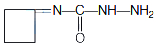
B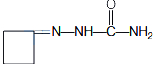
C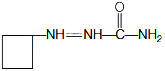
D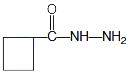
Solution
(B) The reaction between a ketone (cyclobutanone) and semicarbazide $(H_2N-NH-CO-NH_2)$ is a nucleophilic addition-elimination reaction.
In this reaction,the carbonyl oxygen of the ketone is replaced by the nitrogen atom of the semicarbazide,resulting in the formation of a semicarbazone.
The general structure of a semicarbazone is $R_2C=N-NH-CO-NH_2$.
For cyclobutanone,the structure is a cyclobutane ring double-bonded to a nitrogen atom,which is attached to an $NH$ group,which is attached to a carbonyl group,which is attached to an $NH_2$ group.
This matches the structure shown in option $B$.
In this reaction,the carbonyl oxygen of the ketone is replaced by the nitrogen atom of the semicarbazide,resulting in the formation of a semicarbazone.
The general structure of a semicarbazone is $R_2C=N-NH-CO-NH_2$.
For cyclobutanone,the structure is a cyclobutane ring double-bonded to a nitrogen atom,which is attached to an $NH$ group,which is attached to a carbonyl group,which is attached to an $NH_2$ group.
This matches the structure shown in option $B$.
0 likes
View Solution1511
DifficultMCQ
Which of the following represents the structure of the methyl hemiacetal of formaldehyde?
A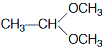
B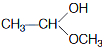
C
D
Solution
(C) Formaldehyde is $HCHO$. $A$ hemiacetal is formed by the addition of one molecule of an alcohol to an aldehyde. The reaction of formaldehyde with methanol $(CH_3OH)$ forms methyl hemiacetal of formaldehyde.
The reaction is: $HCHO + CH_3OH \rightleftharpoons H_2C(OH)(OCH_3)$.
The structure consists of a central carbon atom bonded to two hydrogen atoms,one hydroxyl group $(-OH)$,and one methoxy group $(-OCH_3)$.
This corresponds to the structure $H_2C(OH)(OCH_3)$.
Hence,the correct option is $(C)$.
The reaction is: $HCHO + CH_3OH \rightleftharpoons H_2C(OH)(OCH_3)$.
The structure consists of a central carbon atom bonded to two hydrogen atoms,one hydroxyl group $(-OH)$,and one methoxy group $(-OCH_3)$.
This corresponds to the structure $H_2C(OH)(OCH_3)$.
Hence,the correct option is $(C)$.
0 likes
View Solution1512
DifficultMCQ
Which among the following is a possible product during cross aldol condensation between propanal (as electrophile) and butanal (as nucleophile)?
A
$3-$hydroxy$-2-$methylhexanal
B
$2-$ethyl$-3-$hydroxypentanal
C
$3-$hydroxy$-2-$methylpentanal
D
$2-$ethyl$-3-$hydroxyhexanal
Solution
(B) In a cross aldol condensation,the nucleophile (enolate) attacks the carbonyl carbon of the electrophile.
Here,$CH_3CH_2CH_2CHO$ (butanal) acts as the nucleophile,forming an enolate at the $\alpha$-carbon: $CH_3CH_2CH^-CHO$.
This enolate attacks the carbonyl carbon of $CH_3CH_2CHO$ (propanal) as the electrophile.
The reaction is: $CH_3CH_2CHO + CH_3CH_2CH_2CHO \rightarrow CH_3CH_2-CH(OH)-CH(CH_2CH_3)-CHO$.
The product formed is $2-$ethyl$-3-$hydroxypentanal.
Hence,the correct option is $B$.
Here,$CH_3CH_2CH_2CHO$ (butanal) acts as the nucleophile,forming an enolate at the $\alpha$-carbon: $CH_3CH_2CH^-CHO$.
This enolate attacks the carbonyl carbon of $CH_3CH_2CHO$ (propanal) as the electrophile.
The reaction is: $CH_3CH_2CHO + CH_3CH_2CH_2CHO \rightarrow CH_3CH_2-CH(OH)-CH(CH_2CH_3)-CHO$.
The product formed is $2-$ethyl$-3-$hydroxypentanal.
Hence,the correct option is $B$.
0 likes
View Solution1513
MediumMCQ
Which of the following compounds would undergo aldol condensation?
A
Methanal
B
Butan-$1$-ol
C
$2$-methyl pentanal
D
$2,2$-dimethyl pentanal
Solution
(C) Aldol condensation occurs in aldehydes or ketones that possess at least one $\alpha$-hydrogen atom.
$1$. Methanal $(HCHO)$ has no $\alpha$-carbon,hence no $\alpha$-hydrogen.
$2$. Butan-$1$-ol is an alcohol,not an aldehyde or ketone.
$3$. $2$-methyl pentanal $(CH_3CH_2CH_2CH(CH_3)CHO)$ has one $\alpha$-hydrogen atom at the $C-2$ position,so it undergoes aldol condensation.
$4$. $2,2$-dimethyl pentanal $(CH_3CH_2CH_2C(CH_3)_2CHO)$ has no $\alpha$-hydrogen atom because the $C-2$ carbon is fully substituted with two methyl groups and the aldehyde group.
Therefore,the correct option is $C$.
$1$. Methanal $(HCHO)$ has no $\alpha$-carbon,hence no $\alpha$-hydrogen.
$2$. Butan-$1$-ol is an alcohol,not an aldehyde or ketone.
$3$. $2$-methyl pentanal $(CH_3CH_2CH_2CH(CH_3)CHO)$ has one $\alpha$-hydrogen atom at the $C-2$ position,so it undergoes aldol condensation.
$4$. $2,2$-dimethyl pentanal $(CH_3CH_2CH_2C(CH_3)_2CHO)$ has no $\alpha$-hydrogen atom because the $C-2$ carbon is fully substituted with two methyl groups and the aldehyde group.
Therefore,the correct option is $C$.
0 likes
View Solution1514
MediumMCQ
The product of the following reaction is $C_6H_5CHO + CH_3CH_2CHO \xrightarrow[\Delta]{\text{Dil. NaOH}}$
A
$C_6H_5CH=C(CH_3)CHO$
B
$C_6H_5CH=CHCH_2CHO$
C
$C_6H_5CH=C(CH_3)CHO$
D
$C_6H_5CH_2CH(OH)CH(CH_3)CHO$
Solution
(A) The reaction is a Claisen-Schmidt condensation,which is a type of crossed aldol condensation between benzaldehyde (which has no $\alpha$-hydrogens) and propanal (which has $\alpha$-hydrogens).
In the presence of dilute $NaOH$,the $\alpha$-carbon of propanal acts as a nucleophile and attacks the carbonyl carbon of benzaldehyde to form an aldol intermediate.
Subsequent dehydration (loss of $H_2O$) under heating $(\Delta)$ yields the $\alpha,\beta$-unsaturated aldehyde,$C_6H_5CH=C(CH_3)CHO$.
Thus,the correct product is $C_6H_5CH=C(CH_3)CHO$.
In the presence of dilute $NaOH$,the $\alpha$-carbon of propanal acts as a nucleophile and attacks the carbonyl carbon of benzaldehyde to form an aldol intermediate.
Subsequent dehydration (loss of $H_2O$) under heating $(\Delta)$ yields the $\alpha,\beta$-unsaturated aldehyde,$C_6H_5CH=C(CH_3)CHO$.
Thus,the correct product is $C_6H_5CH=C(CH_3)CHO$.
0 likes
View Solution1515
EasyMCQ
Benzaldehyde on heating with concentrated $NaOH$ gives:
A
Phenylacetic acid
B
Cinnamaldehyde
C
$C_6H_5CH_2OH$ and $C_6H_5COO^-Na^+$
D
Phenol and $C_6H_5CH_2COO^-Na^+$
Solution
(C) When benzaldehyde is heated with concentrated $NaOH$,it undergoes the Cannizzaro reaction.
In this reaction,aldehydes that do not contain an $\alpha$-hydrogen atom undergo self-oxidation and reduction (disproportionation).
Benzaldehyde $(C_6H_5CHO)$ lacks an $\alpha$-hydrogen,so it is reduced to benzyl alcohol $(C_6H_5CH_2OH)$ and oxidized to sodium benzoate $(C_6H_5COO^-Na^+)$.
The overall reaction is:
$2C_6H_5CHO + NaOH \xrightarrow{\Delta} C_6H_5CH_2OH + C_6H_5COO^-Na^+$
In this reaction,aldehydes that do not contain an $\alpha$-hydrogen atom undergo self-oxidation and reduction (disproportionation).
Benzaldehyde $(C_6H_5CHO)$ lacks an $\alpha$-hydrogen,so it is reduced to benzyl alcohol $(C_6H_5CH_2OH)$ and oxidized to sodium benzoate $(C_6H_5COO^-Na^+)$.
The overall reaction is:
$2C_6H_5CHO + NaOH \xrightarrow{\Delta} C_6H_5CH_2OH + C_6H_5COO^-Na^+$
0 likes
View Solution1516
MediumMCQ
The hydrogen atom bonded to the carbon designated by which number in $\stackrel{4}{C}H_3-\stackrel{3}{C}H_2-\stackrel{2}{C}H_2-\stackrel{1}{C}HO$ is most acidic?
A
$C-4$
B
$C-2$
C
$C-3$
D
$C-1$
Solution
(B) The acidity of $\alpha$-hydrogens in aldehydes and ketones is due to the electron-withdrawing effect of the carbonyl group $(C=O)$,which stabilizes the resulting conjugate base (enolate ion) through resonance.
In the given molecule,$CH_3-CH_2-CH_2-CHO$,the carbon atom adjacent to the carbonyl group $(C=O)$ is the $\alpha$-carbon.
The carbon labeled as $C-2$ is the $\alpha$-carbon,as it is directly attached to the carbonyl carbon $(C-1)$.
Therefore,the hydrogen atoms bonded to $C-2$ are the most acidic.
In the given molecule,$CH_3-CH_2-CH_2-CHO$,the carbon atom adjacent to the carbonyl group $(C=O)$ is the $\alpha$-carbon.
The carbon labeled as $C-2$ is the $\alpha$-carbon,as it is directly attached to the carbonyl carbon $(C-1)$.
Therefore,the hydrogen atoms bonded to $C-2$ are the most acidic.
0 likes
View Solution1517
EasyMCQ
Which of the following reactions does not represent the aldol condensation reaction?
A
Acetaldehyde with dilute $NaOH/\Delta$
B
Acetaldehyde and propanal with dilute $NaOH/\Delta$
C
Acetone with $Ba(OH)_2/\Delta$
D
Formaldehyde with concentrated $NaOH/\Delta$
Solution
(D) Aldol condensation is a reaction in which aldehydes or ketones containing at least one $\alpha$-hydrogen atom undergo self-condensation or cross-condensation in the presence of a dilute alkali (like dilute $NaOH$ or $Ba(OH)_2$) to form $\beta$-hydroxy aldehydes (aldols) or $\beta$-hydroxy ketones (ketols),which upon heating undergo dehydration to form $\alpha,\beta$-unsaturated carbonyl compounds.
$A$,$B$,and $C$ represent standard aldol condensation reactions because the reactants possess $\alpha$-hydrogen atoms.
Option $D$ involves formaldehyde $(HCHO)$,which does not contain any $\alpha$-hydrogen atom. In the presence of concentrated $NaOH$,formaldehyde undergoes the Cannizzaro reaction (a disproportionation reaction) rather than aldol condensation. Therefore,it does not represent an aldol condensation reaction.
$A$,$B$,and $C$ represent standard aldol condensation reactions because the reactants possess $\alpha$-hydrogen atoms.
Option $D$ involves formaldehyde $(HCHO)$,which does not contain any $\alpha$-hydrogen atom. In the presence of concentrated $NaOH$,formaldehyde undergoes the Cannizzaro reaction (a disproportionation reaction) rather than aldol condensation. Therefore,it does not represent an aldol condensation reaction.
0 likes
View Solution1518
EasyMCQ
Butanone reacts with methyl magnesium bromide to form an addition product $(Z)$. On hydrolysis,$(Z)$ gives:
A
$CH_3-CH_2-C(OH)(CH_3)_2$
B
$CH_3-CH_2-C(OH)(CH_2)-CH_3$
C
$CH_3-CH_2-CH_2-CH(OH)-CH_3$
D
$CH_3-CH_2-CH(CH_3)-CH_2-OH$
Solution
(A) The reaction of butanone $(CH_3-CO-CH_2-CH_3)$ with methyl magnesium bromide $(CH_3MgBr)$ is a nucleophilic addition reaction.
The nucleophilic methyl group $(CH_3^-)$ from the Grignard reagent attacks the electrophilic carbonyl carbon of butanone to form an intermediate addition product $(Z)$,which is $CH_3-C(OMgBr)(CH_3)-CH_2-CH_3$.
Upon subsequent hydrolysis with dilute acid $(H^+/H_2O)$,the intermediate $(Z)$ is converted into a tertiary alcohol,$2$-methylbutan$-2-$ol.
The structure of $2-$methylbutan$-2-$ol is $CH_3-CH_2-C(OH)(CH_3)_2$.
The nucleophilic methyl group $(CH_3^-)$ from the Grignard reagent attacks the electrophilic carbonyl carbon of butanone to form an intermediate addition product $(Z)$,which is $CH_3-C(OMgBr)(CH_3)-CH_2-CH_3$.
Upon subsequent hydrolysis with dilute acid $(H^+/H_2O)$,the intermediate $(Z)$ is converted into a tertiary alcohol,$2$-methylbutan$-2-$ol.
The structure of $2-$methylbutan$-2-$ol is $CH_3-CH_2-C(OH)(CH_3)_2$.
0 likes
View Solution1519
EasyMCQ
Which of the following reactions does not represent the aldol condensation reaction?
A
$2 CH_3CHO \xrightarrow{\text{dil. } NaOH / \Delta}$
B
$CH_3CHO + CH_3CH_2CHO \xrightarrow{\text{dil. } NaOH / \Delta}$
C
$2 CH_3COCH_3 \xrightarrow{(i) Ba(OH)_2, (ii) \Delta}$
D
$2 HCHO \xrightarrow{\text{conc. } NaOH / \Delta}$
Solution
(D) Aldol condensation requires the presence of at least one $\alpha-$hydrogen atom in the aldehyde or ketone.
$A$,$B$,and $C$ involve carbonyl compounds ($CH_3CHO$,$CH_3CH_2CHO$,$CH_3COCH_3$) that possess $\alpha-$hydrogens,thus they undergo aldol condensation.
$D$ involves formaldehyde $(HCHO)$,which has no $\alpha-$hydrogen. Therefore,it does not undergo aldol condensation. Instead,it undergoes the Cannizzaro reaction in the presence of concentrated $NaOH$.
$A$,$B$,and $C$ involve carbonyl compounds ($CH_3CHO$,$CH_3CH_2CHO$,$CH_3COCH_3$) that possess $\alpha-$hydrogens,thus they undergo aldol condensation.
$D$ involves formaldehyde $(HCHO)$,which has no $\alpha-$hydrogen. Therefore,it does not undergo aldol condensation. Instead,it undergoes the Cannizzaro reaction in the presence of concentrated $NaOH$.
0 likes
View Solution1520
DifficultMCQ
Which one of the following is not formed by aldol condensation of a mixture of ethanal and propanal?
A
$2-$Methylpent$-2-$enal
B
But$-2-$enal
C
Pent$-2-$enal
D
Hex$-3-$enal
Solution
(D) The aldol condensation of a mixture of ethanal $(CH_3CHO)$ and propanal $(CH_3CH_2CHO)$ involves four possible products:
$1$. Self-condensation of ethanal: $CH_3CH=CHCHO$ (But$-2-$enal).
$2$. Self-condensation of propanal: $CH_3CH_2CH=C(CH_3)CHO$ ($2-$Methylpent$-2-$enal).
$3$. Cross-condensation (ethanal as nucleophile,propanal as electrophile): $CH_3CH_2CH=CHCHO$ (Pent$-2-$enal).
$4$. Cross-condensation (propanal as nucleophile,ethanal as electrophile): $CH_3CH=C(CH_3)CHO$ ($2-$Methylbut$-2-$enal).
Hex$-3-$enal is not formed in this reaction.
$1$. Self-condensation of ethanal: $CH_3CH=CHCHO$ (But$-2-$enal).
$2$. Self-condensation of propanal: $CH_3CH_2CH=C(CH_3)CHO$ ($2-$Methylpent$-2-$enal).
$3$. Cross-condensation (ethanal as nucleophile,propanal as electrophile): $CH_3CH_2CH=CHCHO$ (Pent$-2-$enal).
$4$. Cross-condensation (propanal as nucleophile,ethanal as electrophile): $CH_3CH=C(CH_3)CHO$ ($2-$Methylbut$-2-$enal).
Hex$-3-$enal is not formed in this reaction.
0 likes
View Solution1521
DifficultMCQ
What are $A, B, C$ and $D$ in the following cross-aldol condensation reaction?
$\text{Propanal} + \text{Ethanal} \xrightarrow[ii) \ \Delta]{i) \ NaOH} A + B + C + D$
(The products are the four possible $\alpha,\beta$-unsaturated aldehydes formed by self and cross-aldol condensation followed by dehydration.)
$\text{Propanal} + \text{Ethanal} \xrightarrow[ii) \ \Delta]{i) \ NaOH} A + B + C + D$
(The products are the four possible $\alpha,\beta$-unsaturated aldehydes formed by self and cross-aldol condensation followed by dehydration.)
A
B
C
D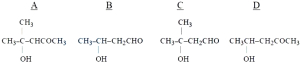
Solution
(A) The reaction is a cross-aldol condensation between propanal $(CH_3CH_2CHO)$ and ethanal $(CH_3CHO)$ in the presence of $NaOH$ followed by heating $(\Delta)$.
This reaction produces four possible $\alpha,\beta$-unsaturated aldehydes:
$1$. Self-aldol of ethanal: $2CH_3CHO \rightarrow CH_3CH=CHCHO$ (But$-2-$enal).
$2$. Self-aldol of propanal: $2CH_3CH_2CHO \rightarrow CH_3CH_2CH=C(CH_3)CHO$ ($2$-methylpent$-2-$enal).
$3$. Cross-aldol (propanal as donor,ethanal as acceptor): $CH_3CH_2CHO + CH_3CHO \rightarrow CH_3CH_2CH=CHCHO$ (Pent$-2-$enal).
$4$. Cross-aldol (ethanal as donor,propanal as acceptor): $CH_3CHO + CH_3CH_2CHO \rightarrow CH_3CH=C(CH_3)CHO$ ($2$-methylbut$-2-$enal).
Thus,the four products are $CH_3CH=CHCHO$,$CH_3CH_2CH=C(CH_3)CHO$,$CH_3CH_2CH=CHCHO$,and $CH_3CH=C(CH_3)CHO$.
This reaction produces four possible $\alpha,\beta$-unsaturated aldehydes:
$1$. Self-aldol of ethanal: $2CH_3CHO \rightarrow CH_3CH=CHCHO$ (But$-2-$enal).
$2$. Self-aldol of propanal: $2CH_3CH_2CHO \rightarrow CH_3CH_2CH=C(CH_3)CHO$ ($2$-methylpent$-2-$enal).
$3$. Cross-aldol (propanal as donor,ethanal as acceptor): $CH_3CH_2CHO + CH_3CHO \rightarrow CH_3CH_2CH=CHCHO$ (Pent$-2-$enal).
$4$. Cross-aldol (ethanal as donor,propanal as acceptor): $CH_3CHO + CH_3CH_2CHO \rightarrow CH_3CH=C(CH_3)CHO$ ($2$-methylbut$-2-$enal).
Thus,the four products are $CH_3CH=CHCHO$,$CH_3CH_2CH=C(CH_3)CHO$,$CH_3CH_2CH=CHCHO$,and $CH_3CH=C(CH_3)CHO$.
0 likes
View Solution1522
MediumMCQ
The compound formed when propanone is made to react with ethyl magnesium bromide followed by hydrolysis is
A
$2-$Methylbutan$-2-$ol
B
Pentan$-2-$ol
C
$2-$Methylpropan$-2-$ol
D
$3-$Methylbutan$-2-$ol
Solution
(A) The reaction of propanone $(CH_3COCH_3)$ with ethyl magnesium bromide $(CH_3CH_2MgBr)$ is a Grignard reaction.
$1$. Nucleophilic attack: The ethyl group $(CH_3CH_2^-)$ from the Grignard reagent attacks the electrophilic carbonyl carbon of propanone to form an alkoxide intermediate: $CH_3COCH_3 + CH_3CH_2MgBr \rightarrow CH_3C(OMgBr)(CH_2CH_3)CH_3$.
$2$. Hydrolysis: Subsequent hydrolysis of the intermediate with water $(H_2O/H^+)$ yields the tertiary alcohol: $CH_3C(OMgBr)(CH_2CH_3)CH_3 + H_2O \rightarrow CH_3C(OH)(CH_2CH_3)CH_3 + Mg(OH)Br$.
$3$. The product is $2-$methylbutan$-2-$ol.
$1$. Nucleophilic attack: The ethyl group $(CH_3CH_2^-)$ from the Grignard reagent attacks the electrophilic carbonyl carbon of propanone to form an alkoxide intermediate: $CH_3COCH_3 + CH_3CH_2MgBr \rightarrow CH_3C(OMgBr)(CH_2CH_3)CH_3$.
$2$. Hydrolysis: Subsequent hydrolysis of the intermediate with water $(H_2O/H^+)$ yields the tertiary alcohol: $CH_3C(OMgBr)(CH_2CH_3)CH_3 + H_2O \rightarrow CH_3C(OH)(CH_2CH_3)CH_3 + Mg(OH)Br$.
$3$. The product is $2-$methylbutan$-2-$ol.
0 likes
View Solution1523
DifficultMCQ
What is the product obtained in the reaction of acetaldehyde with semicarbazide?
A
$H_3C-CH=N-NH-CO-NH_2$
B
$H_3C-CH=N-NH_2$
C
$H_3C-CH=N-OH$
D
$H_3C-C(CH_3)=N-NH-CO-NH_2$
Solution
(A) The reaction of acetaldehyde $(CH_3CHO)$ with semicarbazide $(H_2N-NH-CO-NH_2)$ is a nucleophilic addition-elimination reaction.
In this reaction,the carbonyl oxygen of the aldehyde is replaced by the nitrogen of the semicarbazide,resulting in the formation of a semicarbazone.
The reaction is as follows:
$CH_3CHO + H_2N-NH-CO-NH_2 \rightarrow CH_3CH=N-NH-CO-NH_2 + H_2O$
The product formed is acetaldehyde semicarbazone,which corresponds to the structure $H_3C-CH=N-NH-CO-NH_2$.
In this reaction,the carbonyl oxygen of the aldehyde is replaced by the nitrogen of the semicarbazide,resulting in the formation of a semicarbazone.
The reaction is as follows:
$CH_3CHO + H_2N-NH-CO-NH_2 \rightarrow CH_3CH=N-NH-CO-NH_2 + H_2O$
The product formed is acetaldehyde semicarbazone,which corresponds to the structure $H_3C-CH=N-NH-CO-NH_2$.
0 likes
View Solution1524
DifficultMCQ
$CaOCl_2 + H_2O \longrightarrow Ca(OH)_2 + X$
$X + CH_3CHO \longrightarrow Y$
$Y + Ca(OH)_2 \longrightarrow CHCl_3$
What is '$Y$'?
$X + CH_3CHO \longrightarrow Y$
$Y + Ca(OH)_2 \longrightarrow CHCl_3$
What is '$Y$'?
A
$CH_3CH(OH)_2$
B
$CH_2Cl_2$
C
$CCl_3CHO$
D
$CCl_3COCH_3$
Solution
(C) The given reactions represent the haloform reaction process for the preparation of chloroform $(CHCl_3)$:
$1$. Bleaching powder reacts with water to produce chlorine gas $(X = Cl_2)$:
$CaOCl_2 + H_2O \longrightarrow Ca(OH)_2 + Cl_2$
$2$. Chlorine reacts with acetaldehyde $(CH_3CHO)$ to form chloral $(Y = CCl_3CHO)$:
$CH_3CHO + 3Cl_2 \longrightarrow CCl_3CHO + 3HCl$
$3$. Chloral reacts with calcium hydroxide to produce chloroform:
$2CCl_3CHO + Ca(OH)_2 \longrightarrow 2CHCl_3 + (HCOO)_2Ca$
Thus,'$Y$' is $CCl_3CHO$ (chloral).
$1$. Bleaching powder reacts with water to produce chlorine gas $(X = Cl_2)$:
$CaOCl_2 + H_2O \longrightarrow Ca(OH)_2 + Cl_2$
$2$. Chlorine reacts with acetaldehyde $(CH_3CHO)$ to form chloral $(Y = CCl_3CHO)$:
$CH_3CHO + 3Cl_2 \longrightarrow CCl_3CHO + 3HCl$
$3$. Chloral reacts with calcium hydroxide to produce chloroform:
$2CCl_3CHO + Ca(OH)_2 \longrightarrow 2CHCl_3 + (HCOO)_2Ca$
Thus,'$Y$' is $CCl_3CHO$ (chloral).
0 likes
View Solution1525
MediumMCQ
$3$-hydroxybutanal is formed when $(X)$ reacts with $(Y)$ in dilute $(Z)$ solution. What are $X, Y$ and $Z$?
A
$CH_3CHO, (CH_3)_2CO, NaOH$
B
$CH_3CHO, CH_3CHO, NaCl$
C
$(CH_3)_2CO, (CH_3)_2CO, HCl$
D
$CH_3CHO, CH_3CHO, NaOH$
Solution
(D) $3$-hydroxybutanal is an aldol addition product.
It is formed by the self-aldol condensation of two molecules of acetaldehyde $(CH_3CHO)$ in the presence of a dilute base like $NaOH$.
The reaction is as follows:
$2CH_3CHO \xrightarrow{\text{dil. } NaOH} CH_3-CH(OH)-CH_2-CHO$
Therefore,$X = CH_3CHO$,$Y = CH_3CHO$,and $Z = NaOH$.
It is formed by the self-aldol condensation of two molecules of acetaldehyde $(CH_3CHO)$ in the presence of a dilute base like $NaOH$.
The reaction is as follows:
$2CH_3CHO \xrightarrow{\text{dil. } NaOH} CH_3-CH(OH)-CH_2-CHO$
Therefore,$X = CH_3CHO$,$Y = CH_3CHO$,and $Z = NaOH$.
0 likes
View Solution1526
MediumMCQ
What are the products formed in the following reaction?
$CH_3CH_2CHO + 2Cu^{2+} + 5OH^{-} \rightarrow X + Y + 3H_2O$
$CH_3CH_2CHO + 2Cu^{2+} + 5OH^{-} \rightarrow X + Y + 3H_2O$
A
$CH_3CH_2COOH, Cu(OH)_2$
B
$CH_3CH_2COO^{-}, Cu$
C
$CH_3CH_2COOH, Cu_2O$
D
$CH_3CH_2COO^{-}, Cu_2O$
Solution
(D) The given reaction is the oxidation of an aldehyde (propanal) by Fehling's solution.
Fehling's solution is an alkaline solution of copper$(II)$ ions complexed with tartrate ions.
Aldehydes are oxidized to the corresponding carboxylate anions $(RCOO^{-})$ in the presence of base,while $Cu^{2+}$ ions are reduced to red-brown precipitate of copper$(I)$ oxide $(Cu_2O)$.
The balanced equation is:
$CH_3CH_2CHO + 2Cu^{2+} + 5OH^{-} \rightarrow CH_3CH_2COO^{-} + Cu_2O + 3H_2O$
Comparing this with the given reaction,$X = CH_3CH_2COO^{-}$ and $Y = Cu_2O$.
Fehling's solution is an alkaline solution of copper$(II)$ ions complexed with tartrate ions.
Aldehydes are oxidized to the corresponding carboxylate anions $(RCOO^{-})$ in the presence of base,while $Cu^{2+}$ ions are reduced to red-brown precipitate of copper$(I)$ oxide $(Cu_2O)$.
The balanced equation is:
$CH_3CH_2CHO + 2Cu^{2+} + 5OH^{-} \rightarrow CH_3CH_2COO^{-} + Cu_2O + 3H_2O$
Comparing this with the given reaction,$X = CH_3CH_2COO^{-}$ and $Y = Cu_2O$.
0 likes
View Solution1527
DifficultMCQ
Choose the incorrect statement among the following.
$A$. The reactivity of aromatic aldehydes and ketones is less than that of aliphatic carbonyl compounds towards nucleophilic addition reactions.
$B$. Benzaldehyde does not give Fehling's test.
$C$. The $\alpha$-$H$ atoms in ethanal are acidic in nature.
$D$. $p$-nitro benzaldehyde is less reactive than benzaldehyde towards nucleophilic addition reactions.
$A$. The reactivity of aromatic aldehydes and ketones is less than that of aliphatic carbonyl compounds towards nucleophilic addition reactions.
$B$. Benzaldehyde does not give Fehling's test.
$C$. The $\alpha$-$H$ atoms in ethanal are acidic in nature.
$D$. $p$-nitro benzaldehyde is less reactive than benzaldehyde towards nucleophilic addition reactions.
A
$A$
B
$B$
C
$C$
D
$D$
Solution
(D) Due to the presence of bulky aryl groups,the nucleophilic attack on the $sp^2$ carbon of the $>C=O$ group experiences steric hindrance,decreasing the reaction rate.
$(B)$ Fehling's solution is a mild oxidizing agent and cannot oxidize benzaldehyde.
$(C)$ Ethanal contains $\alpha$-hydrogens which are acidic due to the electron-withdrawing effect of the carbonyl group,allowing for enolization.
$(D)$ The $-NO_2$ group at the $p$-position exerts a strong $-R$ (resonance) and $-I$ (inductive) effect,which increases the partial positive charge on the carbonyl carbon,making it more susceptible to nucleophilic attack. Thus,$p$-nitrobenzaldehyde is more reactive than benzaldehyde. Therefore,statement $D$ is incorrect.
$(B)$ Fehling's solution is a mild oxidizing agent and cannot oxidize benzaldehyde.
$(C)$ Ethanal contains $\alpha$-hydrogens which are acidic due to the electron-withdrawing effect of the carbonyl group,allowing for enolization.
$(D)$ The $-NO_2$ group at the $p$-position exerts a strong $-R$ (resonance) and $-I$ (inductive) effect,which increases the partial positive charge on the carbonyl carbon,making it more susceptible to nucleophilic attack. Thus,$p$-nitrobenzaldehyde is more reactive than benzaldehyde. Therefore,statement $D$ is incorrect.
0 likes
View Solution1528
MediumMCQ
The product formed when formaldehyde reacts with ammonia is
A
Melamine
B
Formic acid
C
Ammonium formate
D
Urotropine
Solution
(D) Formaldehyde $(HCHO)$ reacts with ammonia $(NH_3)$ to produce hexamethylenetetramine,which is commonly known as urotropine.
The balanced chemical equation is:
$6 HCHO + 4 NH_3 \rightarrow (CH_2)_6N_4 + 6 H_2O$
The balanced chemical equation is:
$6 HCHO + 4 NH_3 \rightarrow (CH_2)_6N_4 + 6 H_2O$
0 likes
View Solution1529
DifficultMCQ
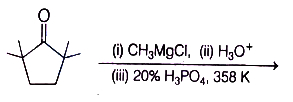
Identify the major product from the following reaction sequence.
A
$2,2,5,5-$tetramethylcyclopentanol
B
$2,2,5-$trimethylcyclopent$-1-$ene
C
$1,2,2,5,5-$pentamethylcyclopentene
D
$2,2,5,5-$tetramethylcyclopent$-1-$ene
Solution
(C) The reaction proceeds in three steps:
$1$. Nucleophilic addition of the Grignard reagent $(CH_3MgCl)$ to the carbonyl group of $2,2,5,5$-tetramethylcyclopentanone,followed by acid workup $(H_3O^+)$,yields $1,2,2,5,5$-pentamethylcyclopentanol.
$2$. The subsequent treatment with $20\% \ H_3PO_4$ at $358 \ K$ causes acid-catalyzed dehydration of the tertiary alcohol.
$3$. Dehydration occurs via the formation of a carbocation,followed by the loss of a proton to form the most stable alkene. In this case,the double bond forms between the $C_1$ and $C_2$ positions to give $1,2,2,5,5$-pentamethylcyclopentene.
$1$. Nucleophilic addition of the Grignard reagent $(CH_3MgCl)$ to the carbonyl group of $2,2,5,5$-tetramethylcyclopentanone,followed by acid workup $(H_3O^+)$,yields $1,2,2,5,5$-pentamethylcyclopentanol.
$2$. The subsequent treatment with $20\% \ H_3PO_4$ at $358 \ K$ causes acid-catalyzed dehydration of the tertiary alcohol.
$3$. Dehydration occurs via the formation of a carbocation,followed by the loss of a proton to form the most stable alkene. In this case,the double bond forms between the $C_1$ and $C_2$ positions to give $1,2,2,5,5$-pentamethylcyclopentene.
0 likes
View Solution1530
MediumMCQ
$A$ carbonyl compound $X$ $(C_8H_8O)$ gives a yellow precipitate with $NaOI$. The hemiacetal of $X$ with methanol/dry $HCl$ is:
A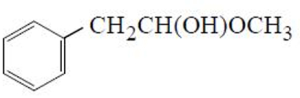
B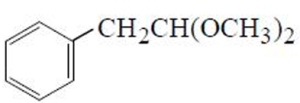
C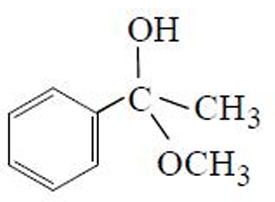
D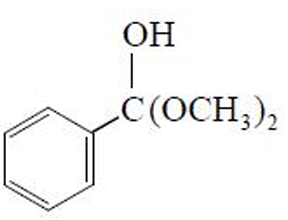
Solution
(C) The carbonyl compound $X$ has the molecular formula $C_8H_8O$.
Since it gives a yellow precipitate with $NaOI$ (iodoform test),it must contain a $CH_3CO-$ group or a $CH_3CH(OH)-$ group.
Given it is a carbonyl compound,it must be acetophenone $(C_6H_5COCH_3)$.
When acetophenone reacts with methanol $(CH_3OH)$ in the presence of dry $HCl$,it forms a hemiacetal.
The reaction is: $C_6H_5COCH_3 + CH_3OH \xrightarrow{dry \ HCl} C_6H_5C(OH)(OCH_3)CH_3$.
Comparing this with the given options,the structure in option $C$ represents the hemiacetal $1$-methoxy-$1$-phenylethanol.
Since it gives a yellow precipitate with $NaOI$ (iodoform test),it must contain a $CH_3CO-$ group or a $CH_3CH(OH)-$ group.
Given it is a carbonyl compound,it must be acetophenone $(C_6H_5COCH_3)$.
When acetophenone reacts with methanol $(CH_3OH)$ in the presence of dry $HCl$,it forms a hemiacetal.
The reaction is: $C_6H_5COCH_3 + CH_3OH \xrightarrow{dry \ HCl} C_6H_5C(OH)(OCH_3)CH_3$.
Comparing this with the given options,the structure in option $C$ represents the hemiacetal $1$-methoxy-$1$-phenylethanol.
0 likes
View Solution1531
MediumMCQ
The reaction sequence is as follows:
Benzene + $CH_3Cl$ $\xrightarrow{Anhy. AlCl_3} A$ $\xrightarrow[(2) H_3O^+, \Delta]{(1) CrO_3 / (CH_3CO)_2O, 273-283K} B$
The incorrect statement about '$B$' is:
Benzene + $CH_3Cl$ $\xrightarrow{Anhy. AlCl_3} A$ $\xrightarrow[(2) H_3O^+, \Delta]{(1) CrO_3 / (CH_3CO)_2O, 273-283K} B$
The incorrect statement about '$B$' is:
A
It gives test with Tollens reagent
B
It gives test with Fehling's solution
C
It does not give test with $NaOH + I_2$ solution
D
It forms acid and alcohol with concentrated $NaOH$,followed by acidification
Solution
(B) $1$. The reaction of benzene with $CH_3Cl$ in the presence of anhydrous $AlCl_3$ is a Friedel-Crafts alkylation,yielding toluene $(A)$.
$2$. The oxidation of toluene with $CrO_3$ in the presence of acetic anhydride followed by hydrolysis is the Etard reaction,which yields benzaldehyde $(B)$.
$3$. Benzaldehyde $(B)$ is an aromatic aldehyde.
$4$. Aromatic aldehydes give a positive Tollens' reagent test.
$5$. Aromatic aldehydes do not give the Fehling's solution test.
$6$. Benzaldehyde does not contain an $\alpha$-methyl group,so it does not give the iodoform test $(NaOH + I_2)$.
$7$. Benzaldehyde undergoes the Cannizzaro reaction with concentrated $NaOH$ to form benzoic acid and benzyl alcohol.
$8$. Therefore,the statement that it gives a test with Fehling's solution is incorrect.
$2$. The oxidation of toluene with $CrO_3$ in the presence of acetic anhydride followed by hydrolysis is the Etard reaction,which yields benzaldehyde $(B)$.
$3$. Benzaldehyde $(B)$ is an aromatic aldehyde.
$4$. Aromatic aldehydes give a positive Tollens' reagent test.
$5$. Aromatic aldehydes do not give the Fehling's solution test.
$6$. Benzaldehyde does not contain an $\alpha$-methyl group,so it does not give the iodoform test $(NaOH + I_2)$.
$7$. Benzaldehyde undergoes the Cannizzaro reaction with concentrated $NaOH$ to form benzoic acid and benzyl alcohol.
$8$. Therefore,the statement that it gives a test with Fehling's solution is incorrect.
0 likes
View Solution1532
MediumMCQ
Match the following reagents with the products obtained when they react with a ketone.
Correct answer is:
| List-$I$ | List-$II$ |
|---|---|
| $A. \ C_6H_5NHNH_2$ | $I. \ \text{Schiff base}$ |
| $B. \ NH_2OH$ | $II. \ \text{Hydrazone}$ |
| $C. \ C_6H_5NH_2$ | $III. \ \text{Oxime}$ |
| $IV. \ \text{Phenyl hydrazone}$ |
Correct answer is:
A
$A-IV, B-III, C-I$
B
$A-IV, B-II, C-I$
C
$A-II, B-III, C-IV$
D
$A-II, B-IV, C-III$
Solution
(A) The reaction of a ketone with various nitrogen-containing nucleophiles produces different derivatives:
$1$. $C_6H_5NHNH_2$ (Phenylhydrazine) reacts with a ketone to form a phenylhydrazone $(A-IV)$.
$2$. $NH_2OH$ (Hydroxylamine) reacts with a ketone to form an oxime $(B-III)$.
$3$. $C_6H_5NH_2$ (Aniline) reacts with a ketone to form a Schiff base $(C-I)$.
Therefore,the correct matching is $A-IV, B-III, C-I$.
$1$. $C_6H_5NHNH_2$ (Phenylhydrazine) reacts with a ketone to form a phenylhydrazone $(A-IV)$.
$2$. $NH_2OH$ (Hydroxylamine) reacts with a ketone to form an oxime $(B-III)$.
$3$. $C_6H_5NH_2$ (Aniline) reacts with a ketone to form a Schiff base $(C-I)$.
Therefore,the correct matching is $A-IV, B-III, C-I$.
0 likes
View Solution1533
EasyMCQ
An organic compound $(X)$ has an empirical formula $C_4H_8O$. This gives a pale yellow precipitate with iodine in $NaOH$ solution. What is $X$?
A
$CH_3CH_2CH_2CHO$
B
$CH_2=CHCH(OH)CH_3$
C
$CH_2=C(CH_3)OCH_3$
D
$CH_3CH_2OCH=CH_2$
Solution
(B) The empirical formula is $C_4H_8O$. The compound $(X)$ gives a pale yellow precipitate with iodine in $NaOH$ solution,which indicates the presence of a methyl ketone group or a secondary alcohol that can be oxidized to a methyl ketone (iodoform test).
Among the options,$CH_2=CHCH(OH)CH_3$ is a secondary alcohol. Upon oxidation,it forms $CH_2=CHCOCH_3$ (methyl vinyl ketone),which contains a methyl ketone group $(CH_3CO-)$ and thus gives a positive iodoform test.
The reaction is:
$CH_2=CHCH(OH)CH_3$ $\xrightarrow{\text{Oxidation}} CH_2=CHCOCH_3$ $\xrightarrow{I_2/NaOH} CHI_3 + CH_2=CHCOO^-Na^+$.
Among the options,$CH_2=CHCH(OH)CH_3$ is a secondary alcohol. Upon oxidation,it forms $CH_2=CHCOCH_3$ (methyl vinyl ketone),which contains a methyl ketone group $(CH_3CO-)$ and thus gives a positive iodoform test.
The reaction is:
$CH_2=CHCH(OH)CH_3$ $\xrightarrow{\text{Oxidation}} CH_2=CHCOCH_3$ $\xrightarrow{I_2/NaOH} CHI_3 + CH_2=CHCOO^-Na^+$.
0 likes
View Solution1534
DifficultMCQ
Which of the following statements is false?
A
Only Tollen's reagent can oxidise both aliphatic and aromatic aldehydes.
B
Oximes are less acidic than hydroxylamine.
C
Sodium borohydride does not reduce carboxyl group.
D
Dialkyl cadmium is considered superior to Grignard reagent for the preparation of a ketone from an acid chloride.
Solution
(B) Statement $B$ is false because oximes are more acidic than hydroxylamine $(NH_2OH)$.
This is due to the delocalization of $\pi$-electrons (resonance) in the conjugate base of the oxime,which stabilizes the negative charge on the oxygen atom.
In hydroxylamine,there is no such resonance stabilization of the conjugate base.
Statement $A$ is also technically false as both Tollen's reagent and Fehling's solution are used for oxidation,but Tollen's reagent is the standard answer for oxidizing both types of aldehydes.
However,in the context of standard chemistry problems,statement $B$ is the intended false statement.
This is due to the delocalization of $\pi$-electrons (resonance) in the conjugate base of the oxime,which stabilizes the negative charge on the oxygen atom.
In hydroxylamine,there is no such resonance stabilization of the conjugate base.
Statement $A$ is also technically false as both Tollen's reagent and Fehling's solution are used for oxidation,but Tollen's reagent is the standard answer for oxidizing both types of aldehydes.
However,in the context of standard chemistry problems,statement $B$ is the intended false statement.
0 likes
View Solution1535
EasyMCQ
Both ethanal and propanone will react with which of the following?
A
Tollen's reagent
B
Schiff's reagent
C
Fehling's reagent
D
Grignard reagent
Solution
(D) Ethanal $(CH_3CHO)$ and propanone $(CH_3COCH_3)$ both react with a Grignard reagent $(RMgX)$ to form alcohols.
Specifically,ethanal reacts with a Grignard reagent to form a secondary alcohol (after hydrolysis),while propanone reacts with a Grignard reagent to form a tertiary alcohol (after hydrolysis).
In contrast,Tollen's reagent,Fehling's reagent,and Schiff's reagent are specific tests for aldehydes and do not react with ketones like propanone.
Therefore,the correct option is $(D)$.
Specifically,ethanal reacts with a Grignard reagent to form a secondary alcohol (after hydrolysis),while propanone reacts with a Grignard reagent to form a tertiary alcohol (after hydrolysis).
In contrast,Tollen's reagent,Fehling's reagent,and Schiff's reagent are specific tests for aldehydes and do not react with ketones like propanone.
Therefore,the correct option is $(D)$.
0 likes
View Solution1536
MediumMCQ
Which of the following are oxidised by $NaOCl$ ?
$I. RCH(OH)CH_3$
$II. RCH_2CH_2-CO-CH_2CH_3$
$III. R-COCH_3$
$IV. CH_3CHO$
$V. (CH_3)_2C=C(CH_3)COCH_3$
$I. RCH(OH)CH_3$
$II. RCH_2CH_2-CO-CH_2CH_3$
$III. R-COCH_3$
$IV. CH_3CHO$
$V. (CH_3)_2C=C(CH_3)COCH_3$
A
$I, III, IV, V$
B
$I, II, III$
C
$II, IV, V$
D
$II, III, IV$
Solution
(A) $NaOCl$ acts as an oxidizing agent and is used in the haloform reaction. Compounds that undergo the haloform reaction with $NaOCl$ are:
$1$. Secondary alcohols with a methyl group attached to the carbinol carbon $(RCH(OH)CH_3)$.
$2$. Methyl ketones $(R-COCH_3)$.
$3$. Acetaldehyde $(CH_3CHO)$.
$4$. Compounds containing a $CH_3CO-$ group,such as $V$ $( (CH_3)_2C=C(CH_3)COCH_3 )$.
Analyzing the given compounds:
$I. RCH(OH)CH_3$ is a $2^{\circ}$ alcohol with a $CH_3$ group,so it reacts.
$II. RCH_2CH_2-CO-CH_2CH_3$ is a ketone but lacks a $CH_3$ group attached to the carbonyl carbon,so it does not react.
$III. R-COCH_3$ is a methyl ketone,so it reacts.
$IV. CH_3CHO$ is acetaldehyde,which reacts.
$V. (CH_3)_2C=C(CH_3)COCH_3$ contains a $CH_3CO-$ group,so it reacts.
Therefore,$I, III, IV,$ and $V$ are oxidized by $NaOCl$.
$1$. Secondary alcohols with a methyl group attached to the carbinol carbon $(RCH(OH)CH_3)$.
$2$. Methyl ketones $(R-COCH_3)$.
$3$. Acetaldehyde $(CH_3CHO)$.
$4$. Compounds containing a $CH_3CO-$ group,such as $V$ $( (CH_3)_2C=C(CH_3)COCH_3 )$.
Analyzing the given compounds:
$I. RCH(OH)CH_3$ is a $2^{\circ}$ alcohol with a $CH_3$ group,so it reacts.
$II. RCH_2CH_2-CO-CH_2CH_3$ is a ketone but lacks a $CH_3$ group attached to the carbonyl carbon,so it does not react.
$III. R-COCH_3$ is a methyl ketone,so it reacts.
$IV. CH_3CHO$ is acetaldehyde,which reacts.
$V. (CH_3)_2C=C(CH_3)COCH_3$ contains a $CH_3CO-$ group,so it reacts.
Therefore,$I, III, IV,$ and $V$ are oxidized by $NaOCl$.
0 likes
View Solution1537
MediumMCQ
Match the following:
| $A$. Lucas reagent | $I$. $SnCl_2 + HCl$ |
| $B$. Clemmensen reagent | $II$. $[Ag(NH_3)_2]^+$ |
| $C$. Tollen's reagent | $III$. Anhydrous $ZnCl_2 + conc. HCl$ |
| $D$. Stephen reagent | $IV$. $Zn-Hg/HCl$ |
A
$A-III, B-IV, C-II, D-I$
B
$A-III, B-IV, C-I, D-II$
C
$A-IV, B-II, C-III, D-V$
D
$A-IV, B-III, C-I, D-V$
Solution
(A) $(A)-(III)$: Anhydrous $ZnCl_2 + conc. HCl$ is called Lucas reagent and is used to distinguish between $1^{\circ}, 2^{\circ}, 3^{\circ}$ alcohols.
$(B)-(IV)$: $Zn-Hg/HCl$ is called Clemmensen reagent and is used in the conversion of carbonyl compounds into alkanes.
$(C)-(II)$: Tollen's reagent is $[Ag(NH_3)_2]^+$ and is used as an oxidizing agent.
$(D)-(I)$: Stephen reagent is $SnCl_2 + HCl$ and is used in the reduction of nitrile compounds.
$(B)-(IV)$: $Zn-Hg/HCl$ is called Clemmensen reagent and is used in the conversion of carbonyl compounds into alkanes.
$(C)-(II)$: Tollen's reagent is $[Ag(NH_3)_2]^+$ and is used as an oxidizing agent.
$(D)-(I)$: Stephen reagent is $SnCl_2 + HCl$ and is used in the reduction of nitrile compounds.
0 likes
View Solution1538
DifficultMCQ
Identify $A, B$,and $C$ in the following reactions:
Isopropyl chloride $\xrightarrow{NaOH} A$ $\xrightarrow{Cu/573 \ K} B$ $\xrightarrow{NaOI} C + \text{Iodoform}$
Isopropyl chloride $\xrightarrow{NaOH} A$ $\xrightarrow{Cu/573 \ K} B$ $\xrightarrow{NaOI} C + \text{Iodoform}$
A
$CH_3-CH_2-CH_2-OH, CH_3-CH_2-CHO, CH_3-CH_2-COONa$
B
$CH_3-CH_2-OH, CH_3-CHO, HCOONa$
C
$CH_3-CH(OH)-CH_3, CH_3-CO-CH_3, CH_3-COONa$
D
$CH_3-CH(OH)-CH_3, CH_3-CH_2-CHO, CH_3-COONa$
Solution
(C) The reaction sequence is as follows:
$1$. Isopropyl chloride $(CH_3-CHCl-CH_3)$ reacts with aqueous $NaOH$ (nucleophilic substitution) to form Isopropyl alcohol $(A)$: $CH_3-CHCl-CH_3 \xrightarrow{NaOH} CH_3-CH(OH)-CH_3 (A)$.
$2$. Isopropyl alcohol $(A)$ on dehydrogenation with $Cu$ at $573 \ K$ gives Acetone $(B)$: $CH_3-CH(OH)-CH_3 \xrightarrow{Cu/573 \ K} CH_3-CO-CH_3 (B)$.
$3$. Acetone $(B)$ undergoes the iodoform reaction with $NaOI$ to give Sodium acetate $(C)$ and Iodoform $(CHI_3)$: $CH_3-CO-CH_3 \xrightarrow{NaOI} CH_3-COONa (C) + CHI_3$.
Thus,the correct sequence is $A = CH_3-CH(OH)-CH_3$,$B = CH_3-CO-CH_3$,and $C = CH_3-COONa$.
$1$. Isopropyl chloride $(CH_3-CHCl-CH_3)$ reacts with aqueous $NaOH$ (nucleophilic substitution) to form Isopropyl alcohol $(A)$: $CH_3-CHCl-CH_3 \xrightarrow{NaOH} CH_3-CH(OH)-CH_3 (A)$.
$2$. Isopropyl alcohol $(A)$ on dehydrogenation with $Cu$ at $573 \ K$ gives Acetone $(B)$: $CH_3-CH(OH)-CH_3 \xrightarrow{Cu/573 \ K} CH_3-CO-CH_3 (B)$.
$3$. Acetone $(B)$ undergoes the iodoform reaction with $NaOI$ to give Sodium acetate $(C)$ and Iodoform $(CHI_3)$: $CH_3-CO-CH_3 \xrightarrow{NaOI} CH_3-COONa (C) + CHI_3$.
Thus,the correct sequence is $A = CH_3-CH(OH)-CH_3$,$B = CH_3-CO-CH_3$,and $C = CH_3-COONa$.
0 likes
View Solution1539
MediumMCQ
The compound which does not respond to iodoform test is
A
$CH_3-CHO$
B
$CH_3-CH(OH)-CH_3$
C
$C_2H_5-CO-C_2H_5$
D
$C_6H_5-COCH_3$
Solution
(C) The iodoform test is positive for compounds containing the $CH_3CO-$ group or the $CH_3CH(OH)-$ group.
$A$ $CH_3CHO$ contains a $CH_3CO-$ group,so it gives a positive test.
$B$ $CH_3CH(OH)CH_3$ contains a $CH_3CH(OH)-$ group,so it gives a positive test.
$C$ $C_2H_5-CO-C_2H_5$ (pentan-$3$-one) does not contain a $CH_3CO-$ group,so it does not respond to the iodoform test.
$D$ $C_6H_5-COCH_3$ (acetophenone) contains a $CH_3CO-$ group,so it gives a positive test.
$A$ $CH_3CHO$ contains a $CH_3CO-$ group,so it gives a positive test.
$B$ $CH_3CH(OH)CH_3$ contains a $CH_3CH(OH)-$ group,so it gives a positive test.
$C$ $C_2H_5-CO-C_2H_5$ (pentan-$3$-one) does not contain a $CH_3CO-$ group,so it does not respond to the iodoform test.
$D$ $C_6H_5-COCH_3$ (acetophenone) contains a $CH_3CO-$ group,so it gives a positive test.
0 likes
View Solution1540
MediumMCQ
The compound which does not respond to iodoform test is
A
$CH_3-CHO$
B
$CH_3CH(OH)CH_3$
C
$C_2H_5-CO-C_2H_5$
D
$C_6H_5COCH_3$
Solution
(C) The iodoform test is given by compounds containing either the $CH_3-CO-$ group or the $CH_3-CH(OH)-$ group.
$(1)$ $CH_3-CHO$ (acetaldehyde) contains the $CH_3-CO-$ group.
$(2)$ $CH_3CH(OH)CH_3$ (propan$-2-$ol) contains the $CH_3-CH(OH)-$ group.
$(3)$ $C_6H_5COCH_3$ (acetophenone) contains the $CH_3-CO-$ group.
$(4)$ $C_2H_5-CO-C_2H_5$ (pentan$-3-$one) does not contain either the $CH_3-CO-$ group or the $CH_3-CH(OH)-$ group.
Therefore,$C_2H_5-CO-C_2H_5$ does not respond to the iodoform test.
$(1)$ $CH_3-CHO$ (acetaldehyde) contains the $CH_3-CO-$ group.
$(2)$ $CH_3CH(OH)CH_3$ (propan$-2-$ol) contains the $CH_3-CH(OH)-$ group.
$(3)$ $C_6H_5COCH_3$ (acetophenone) contains the $CH_3-CO-$ group.
$(4)$ $C_2H_5-CO-C_2H_5$ (pentan$-3-$one) does not contain either the $CH_3-CO-$ group or the $CH_3-CH(OH)-$ group.
Therefore,$C_2H_5-CO-C_2H_5$ does not respond to the iodoform test.
0 likes
View Solution1541
DifficultMCQ
What are $X$ and $Y$ respectively in the following reaction sequence?

A
$NH_2NH_2, C_6H_5SO_2Cl$ / Pyridine
B
$NH_2NH_2, (CH_3CO)_2O$
C
$NH_2OH, C_6H_5SO_2Cl$ / Pyridine
D
$NH_2OH, (CH_3CO)_2O$
Solution
(D) The reaction sequence is as follows:
$1$. Benzaldehyde reacts with hydroxylamine $(NH_2OH)$ to form benzaldoxime. This is reagent $X$.
$2$. Benzaldoxime is then dehydrated using acetic anhydride $((CH_3CO)_2O)$ to form benzonitrile $(C_6H_5CN)$. This is reagent $Y$.
Therefore,$X = NH_2OH$ and $Y = (CH_3CO)_2O$.
$1$. Benzaldehyde reacts with hydroxylamine $(NH_2OH)$ to form benzaldoxime. This is reagent $X$.
$2$. Benzaldoxime is then dehydrated using acetic anhydride $((CH_3CO)_2O)$ to form benzonitrile $(C_6H_5CN)$. This is reagent $Y$.
Therefore,$X = NH_2OH$ and $Y = (CH_3CO)_2O$.
0 likes
View Solution1542
DifficultMCQ
Compound '$A$' undergoes formation of cyanohydrins,which on hydrolysis gives lactic acid $(CH_3CHOHCOOH)$. Therefore,compound '$A$' is . . . . . .
A
formaldehyde
B
acetaldehyde
C
acetone
D
benzaldehyde
Solution
(B) The reaction proceeds as follows:
$CH_3CHO + HCN \rightarrow CH_3CH(OH)CN$ (Acetaldehyde cyanohydrin)
$CH_3CH(OH)CN + 2H_2O + H^+ \rightarrow CH_3CH(OH)COOH + NH_4^+$
Acetaldehyde on reaction with hydrogen cyanide $(HCN)$ gives a cyanohydrin,which on hydrolysis yields lactic acid $(CH_3CH(OH)COOH)$.
Therefore,compound '$A$' is acetaldehyde. Hence,the correct option is $(B)$.
$CH_3CHO + HCN \rightarrow CH_3CH(OH)CN$ (Acetaldehyde cyanohydrin)
$CH_3CH(OH)CN + 2H_2O + H^+ \rightarrow CH_3CH(OH)COOH + NH_4^+$
Acetaldehyde on reaction with hydrogen cyanide $(HCN)$ gives a cyanohydrin,which on hydrolysis yields lactic acid $(CH_3CH(OH)COOH)$.
Therefore,compound '$A$' is acetaldehyde. Hence,the correct option is $(B)$.
0 likes
View Solution8-1.Aldehydes and Ketones — Properties · Frequently Asked Questions
1Are these 8-1.Aldehydes and Ketones questions useful for JEE and NEET?
Yes. All questions in this section are mapped to JEE Main and NEET exam patterns. Previous year questions from JEE Main, NEET, GUJCET and state-level exams are included with full solutions.
2Can I switch to Hindi or Gujarati for these questions?
Yes. Use the language tabs in the hero section or the sidebar to view the same questions and solutions in English, Hindi or Gujarati.
3How do I generate a question paper from this subtopic?
Use the Vedclass Exam Paper Generator — select the chapter and subtopic, set difficulty, and generate Sets A, B, C, D automatically. First 3 chapters of every subject are free.
Vedclass Products
For Students
Vedclass Test Series
Mock tests in real JEE/NEET style with performance analysis. 5-day free trial.
Start Free TrialFor Teachers
Exam Paper Generator
Generate Set A/B/C/D papers from this chapter in 2 minutes. 3 chapters free.
Try FreeFor Institutes
Online Exam Module
Live online exams with unlimited students, 360° analytics & white-label branding.
See DemoFor Teachers & Institutes
Generate a 8-1.Aldehydes and Ketones Exam Paper in 2 Minutes
Select subtopic & difficulty — Sets A, B, C, D auto-generated with No Repeat logic.
First 3 chapters of every subject are free — no payment required.