
A English
Properties Questions in English
Class 12 Chemistry · 8-1.Aldehydes and Ketones · Properties
1739+
Questions
English
Language
100%
With Solutions
Showing 40 of 1739 questions in English
1451
MediumMCQ
An organic compound $X$ is oxidised by using acidified $K_2Cr_2O_7$ solution. The product obtained reacts with phenyl hydrazine but does not give the silver mirror test. The compound $X$ is,
A
$2-$propanol
B
Ethanal
C
Ethanol
D
$CH_3CH_2CH_3$
Solution
(A) $1$. The oxidation product of the organic compound $(X)$ reacts with phenyl hydrazine,which indicates that the product is a carbonyl compound (aldehyde or ketone).
$2$. The product does not give the silver mirror test (Tollens' test),which confirms that it is a ketone,not an aldehyde.
$3$. Secondary alcohols are oxidized by acidified $K_2Cr_2O_7$ to form ketones.
$4$. Among the given options,$2-$propanol is a secondary alcohol. Its oxidation gives acetone (propanone),which is a ketone.
$5$. Acetone reacts with phenyl hydrazine to form acetone phenylhydrazone but does not give the silver mirror test.
$6$. Therefore,the compound $X$ is $2-$propanol.
$2$. The product does not give the silver mirror test (Tollens' test),which confirms that it is a ketone,not an aldehyde.
$3$. Secondary alcohols are oxidized by acidified $K_2Cr_2O_7$ to form ketones.
$4$. Among the given options,$2-$propanol is a secondary alcohol. Its oxidation gives acetone (propanone),which is a ketone.
$5$. Acetone reacts with phenyl hydrazine to form acetone phenylhydrazone but does not give the silver mirror test.
$6$. Therefore,the compound $X$ is $2-$propanol.
0 likes
View Solution1452
EasyMCQ
The reagent used to distinguish between acetaldehyde and benzaldehyde is
A
Tollen's reagent
B
Fehling's solution
C
$2,4-$dinitrophenylhydrazine
D
semicarbazide
Solution
(B) Acetaldehyde is an aliphatic aldehyde,while benzaldehyde is an aromatic aldehyde.
Fehling's solution is a mild oxidizing agent that can oxidize aliphatic aldehydes (like acetaldehyde) to their corresponding carboxylic acids,resulting in a red precipitate of cuprous oxide $(Cu_2O)$.
However,aromatic aldehydes (like benzaldehyde) are not strong enough to be oxidized by Fehling's solution.
Therefore,Fehling's solution can be used to distinguish between acetaldehyde and benzaldehyde.
Tollen's reagent reacts with both aliphatic and aromatic aldehydes,so it cannot distinguish between them.
Fehling's solution is a mild oxidizing agent that can oxidize aliphatic aldehydes (like acetaldehyde) to their corresponding carboxylic acids,resulting in a red precipitate of cuprous oxide $(Cu_2O)$.
However,aromatic aldehydes (like benzaldehyde) are not strong enough to be oxidized by Fehling's solution.
Therefore,Fehling's solution can be used to distinguish between acetaldehyde and benzaldehyde.
Tollen's reagent reacts with both aliphatic and aromatic aldehydes,so it cannot distinguish between them.
0 likes
View Solution1453
EasyMCQ
The reagent with which both acetaldehyde and acetone react is
A
Fehling's solution
B
$I_{2} / NaOH$
C
Tollen's reagent
D
Carbonic acid
Solution
(B) Both acetaldehyde $(CH_{3}CHO)$ and acetone $(CH_{3}COCH_{3})$ contain the methyl ketone group $(CH_{3}CO-)$,which makes them undergo the iodoform reaction.
When treated with iodine $(I_{2})$ in the presence of sodium hydroxide $(NaOH)$,they form a yellow precipitate of iodoform $(CHI_{3})$.
Acetaldehyde reaction:
$CH_{3}CHO + 3I_{2} + 4NaOH \longrightarrow CHI_{3} + HCOONa + 3NaI + 3H_{2}O$
Acetone reaction:
$CH_{3}COCH_{3} + 3I_{2} + 4NaOH \longrightarrow CHI_{3} + CH_{3}COONa + 3NaI + 3H_{2}O$
Fehling's solution and Tollen's reagent only react with aldehydes (like acetaldehyde) and not with ketones (like acetone).
When treated with iodine $(I_{2})$ in the presence of sodium hydroxide $(NaOH)$,they form a yellow precipitate of iodoform $(CHI_{3})$.
Acetaldehyde reaction:
$CH_{3}CHO + 3I_{2} + 4NaOH \longrightarrow CHI_{3} + HCOONa + 3NaI + 3H_{2}O$
Acetone reaction:
$CH_{3}COCH_{3} + 3I_{2} + 4NaOH \longrightarrow CHI_{3} + CH_{3}COONa + 3NaI + 3H_{2}O$
Fehling's solution and Tollen's reagent only react with aldehydes (like acetaldehyde) and not with ketones (like acetone).
0 likes
View Solution1454
MediumMCQ
Benzaldehyde and acetone can be best distinguished using
A
Fehling's solution
B
Sodium hydroxide solution
C
$2, 4-DNP$
D
Tollen's reagent
Solution
(D) Benzaldehyde is an aromatic aldehyde,while acetone is a ketone.
$Tollen's$ reagent is used to distinguish between aldehydes and ketones.
Aldehydes like benzaldehyde react with $Tollen's$ reagent to form a silver mirror (precipitate),whereas ketones like acetone do not react with $Tollen's$ reagent.
Fehling's solution is generally used to distinguish between aliphatic aldehydes and ketones,but it does not react with aromatic aldehydes like benzaldehyde.
Therefore,$Tollen's$ reagent is the best choice for distinguishing benzaldehyde and acetone.
$Tollen's$ reagent is used to distinguish between aldehydes and ketones.
Aldehydes like benzaldehyde react with $Tollen's$ reagent to form a silver mirror (precipitate),whereas ketones like acetone do not react with $Tollen's$ reagent.
Fehling's solution is generally used to distinguish between aliphatic aldehydes and ketones,but it does not react with aromatic aldehydes like benzaldehyde.
Therefore,$Tollen's$ reagent is the best choice for distinguishing benzaldehyde and acetone.
0 likes
View Solution1455
MediumMCQ
Which of the following organic compounds answers to both iodoform test and Fehling's test?
A
Ethanol
B
Methanal
C
Ethanal
D
Propanone
Solution
(C) The compound which contains a $CH_3CO-$ group in its structure gives a positive iodoform test,and the compound which contains an aldehyde group $(-CHO)$ gives a positive Fehling's test.
In ethanal $(CH_3CHO)$,both the $CH_3CO-$ group and the $-CHO$ group are present.
Therefore,it responds to both the iodoform test and Fehling's test.
$CH_3CHO + 3I_2 + 4NaOH \rightarrow CHI_3 + HCOONa + 3NaI + 3H_2O$ (Iodoform test)
$CH_3CHO + 2Cu(OH)_2 + NaOH \rightarrow CH_3COONa + Cu_2O \downarrow + 3H_2O$ (Fehling's test)
In ethanal $(CH_3CHO)$,both the $CH_3CO-$ group and the $-CHO$ group are present.
Therefore,it responds to both the iodoform test and Fehling's test.
$CH_3CHO + 3I_2 + 4NaOH \rightarrow CHI_3 + HCOONa + 3NaI + 3H_2O$ (Iodoform test)
$CH_3CHO + 2Cu(OH)_2 + NaOH \rightarrow CH_3COONa + Cu_2O \downarrow + 3H_2O$ (Fehling's test)
0 likes
View Solution1456
DifficultMCQ
The product formed when hydroxylamine $(NH_2OH)$ condenses with a carbonyl compound is called:
A
hydrazide
B
oxime
C
hydrazine
D
hydrazone
Solution
(B) When a carbonyl compound (aldehyde or ketone) reacts with hydroxylamine $(NH_2OH)$,it undergoes a condensation reaction to form an oxime $(>C=N-OH)$.
The general reaction is:
$R_2C=O + NH_2OH \rightarrow R_2C=N-OH + H_2O$.
The general reaction is:
$R_2C=O + NH_2OH \rightarrow R_2C=N-OH + H_2O$.
0 likes
View Solution1457
EasyMCQ
Cannizzaro's reaction is an example of auto-oxidation and reduction (disproportionation). Which of the following statements is correct regarding this reaction?
A
It is a typical reaction of aliphatic aldehydes.
B
It is a reaction answered only by aromatic aldehydes.
C
It is a reaction answered by aldehydes that do not contain an $\alpha$-hydrogen atom.
D
None of the above
Solution
(C) The Cannizzaro reaction is a disproportionation reaction (auto-oxidation and reduction).
It occurs in aldehydes that do not possess an $\alpha$-hydrogen atom,such as formaldehyde $(HCHO)$ and benzaldehyde $(C_6H_5CHO)$.
When treated with concentrated alkali,one molecule of the aldehyde is oxidized to a carboxylic acid salt,and another molecule is reduced to an alcohol.
It occurs in aldehydes that do not possess an $\alpha$-hydrogen atom,such as formaldehyde $(HCHO)$ and benzaldehyde $(C_6H_5CHO)$.
When treated with concentrated alkali,one molecule of the aldehyde is oxidized to a carboxylic acid salt,and another molecule is reduced to an alcohol.
0 likes
View Solution1458
MediumMCQ
Which is the most suitable reagent for the following conversion?
$CH_3-CH=CH-CH_2-CO-CH_3 \rightarrow CH_3-CH=CH-CH_2-COO^- + CHI_3$
$CH_3-CH=CH-CH_2-CO-CH_3 \rightarrow CH_3-CH=CH-CH_2-COO^- + CHI_3$
A
Benzoyl peroxide
B
$Sn$ and $NaOH$ solution
C
Tollen's reagent
D
$I_2$ and $NaOH$ solution
Solution
(D) The given reaction is a haloform reaction (specifically iodoform test).
$CH_3-CH=CH-CH_2-CO-CH_3$ contains a methyl ketone group $(-COCH_3)$.
Methyl ketones react with $I_2$ in the presence of $NaOH$ to form a carboxylate salt and iodoform $(CHI_3)$.
This reaction is specific to methyl ketones and does not affect the double bond present in the chain.
Therefore,the correct reagent is $I_2$ and $NaOH$ solution.
$CH_3-CH=CH-CH_2-CO-CH_3$ contains a methyl ketone group $(-COCH_3)$.
Methyl ketones react with $I_2$ in the presence of $NaOH$ to form a carboxylate salt and iodoform $(CHI_3)$.
This reaction is specific to methyl ketones and does not affect the double bond present in the chain.
Therefore,the correct reagent is $I_2$ and $NaOH$ solution.
0 likes
View Solution1459
DifficultMCQ
Predict the product $C$ in the following series of reactions:

A
$CH_3CH(OH)C_6H_5$
B
$CH_3CH(OH)C_6H_5$
C
$CH_3CH(OH)C_2H_5$
D
$(CH_3)_2C(OH)C_6H_5$
Solution
(D) The reaction sequence is as follows:
$1$. $CH_3COOH + PCl_5 \rightarrow CH_3COCl$ (Product $A$ is acetyl chloride).
$2$. $CH_3COCl + C_6H_6 \xrightarrow{Anhyd. AlCl_3} CH_3COC_6H_5$ (Product $B$ is acetophenone,a Friedel-Crafts acylation reaction).
$3$. $CH_3COC_6H_5 + CH_3MgBr \rightarrow (CH_3)_2C(OH)C_6H_5$ (Product $C$ is $2-$phenylpropan$-2-$ol,formed by the nucleophilic addition of the Grignard reagent to the ketone).
$1$. $CH_3COOH + PCl_5 \rightarrow CH_3COCl$ (Product $A$ is acetyl chloride).
$2$. $CH_3COCl + C_6H_6 \xrightarrow{Anhyd. AlCl_3} CH_3COC_6H_5$ (Product $B$ is acetophenone,a Friedel-Crafts acylation reaction).
$3$. $CH_3COC_6H_5 + CH_3MgBr \rightarrow (CH_3)_2C(OH)C_6H_5$ (Product $C$ is $2-$phenylpropan$-2-$ol,formed by the nucleophilic addition of the Grignard reagent to the ketone).
0 likes
View Solution1460
MediumMCQ
The compound obtained when acetaldehyde reacts with dilute aqueous sodium hydroxide exhibits
A
geometrical isomerism
B
optical isomerism
C
neither optical nor geometrical isomerism
D
both optical and geometrical isomerism
Solution
(D) When acetaldehyde $(CH_3CHO)$ reacts with dilute aqueous sodium hydroxide $(NaOH)$,it undergoes aldol condensation due to the presence of $\alpha-H$ atoms.
The reaction is: $2CH_3CHO \xrightarrow{dil. NaOH} CH_3CH(OH)CH_2CHO$ ($3$-hydroxybutanal).
This aldol product contains one chiral (asymmetric) carbon atom,which makes it optically active,thus exhibiting optical isomerism.
Upon heating,the aldol loses a water molecule to form an $\alpha,\beta$-unsaturated aldehyde: $CH_3CH(OH)CH_2CHO \xrightarrow{\Delta} CH_3CH=CHCHO$ (but$-2-$enal).
This alkene $(CH_3CH=CHCHO)$ exhibits geometrical isomerism due to the restricted rotation around the $C=C$ double bond.
The reaction is: $2CH_3CHO \xrightarrow{dil. NaOH} CH_3CH(OH)CH_2CHO$ ($3$-hydroxybutanal).
This aldol product contains one chiral (asymmetric) carbon atom,which makes it optically active,thus exhibiting optical isomerism.
Upon heating,the aldol loses a water molecule to form an $\alpha,\beta$-unsaturated aldehyde: $CH_3CH(OH)CH_2CHO \xrightarrow{\Delta} CH_3CH=CHCHO$ (but$-2-$enal).
This alkene $(CH_3CH=CHCHO)$ exhibits geometrical isomerism due to the restricted rotation around the $C=C$ double bond.
0 likes
View Solution1461
MediumMCQ
The reagent used in Clemmensen's reduction is
A
conc. $H_2SO_4$
B
$Zn-Hg$ / conc. $HCl$
C
$aq. KOH$
D
$alc. KOH$
Solution
(B) In Clemmensen's reduction,$Zn-Hg$ amalgam with concentrated $HCl$ is used as the reagent.
This reaction reduces carbonyl groups $(>C=O)$ to methylene groups $(-CH_2-)$.
The general reaction is: $>C=O + 4[H] \xrightarrow{Zn-Hg / \text{conc. } HCl} >CH_2 + H_2O$.
This method is specifically used to convert aldehydes and ketones into their corresponding alkanes.
This reaction reduces carbonyl groups $(>C=O)$ to methylene groups $(-CH_2-)$.
The general reaction is: $>C=O + 4[H] \xrightarrow{Zn-Hg / \text{conc. } HCl} >CH_2 + H_2O$.
This method is specifically used to convert aldehydes and ketones into their corresponding alkanes.
0 likes
View Solution1462
MediumMCQ
Which of the following compounds undergoes haloform reaction?
A
$CH_3COCH_3$
B
$HCHO$
C
$CH_3CH_2Br$
D
$CH_3-O-CH_3$
Solution
(A) Compounds containing the $CH_3CO-$ group or the $CH_3CH(OH)-$ group undergo the haloform reaction.
$CH_3COCH_3$ (acetone) contains the $CH_3CO-$ group,therefore,it gives a positive haloform test.
The reaction is as follows:
$CH_3COCH_3 + 3I_2 + 4NaOH \rightarrow CH_3COONa + CHI_3 \downarrow + 3NaI + 3H_2O$
Here,$CHI_3$ (iodoform) is obtained as a yellow precipitate.
$CH_3COCH_3$ (acetone) contains the $CH_3CO-$ group,therefore,it gives a positive haloform test.
The reaction is as follows:
$CH_3COCH_3 + 3I_2 + 4NaOH \rightarrow CH_3COONa + CHI_3 \downarrow + 3NaI + 3H_2O$
Here,$CHI_3$ (iodoform) is obtained as a yellow precipitate.
0 likes
View Solution1463
EasyMCQ
An organic compound '$A$' burns with a sooty flame. It is negative towards Tollen's reagent test and positive for Borsche's reagent test. The compound '$A$' is
A
Acetophenone
B
Acetone
C
Salicylic acid
D
Benzaldehyde
Solution
(A) Since the given compound '$A$' burns with a sooty flame,it must be an aromatic compound.
When it reacts with Borsche's reagent (acidic $2,4-$dinitrophenylhydrazine solution),it yields an orange precipitate,which indicates that it is a carbonyl compound (aldehyde or ketone).
Since '$A$' gives a negative result for Tollen's reagent test,it cannot be an aldehyde.
Therefore,it must be an aromatic ketone.
Hence,'$A$' is acetophenone.
When it reacts with Borsche's reagent (acidic $2,4-$dinitrophenylhydrazine solution),it yields an orange precipitate,which indicates that it is a carbonyl compound (aldehyde or ketone).
Since '$A$' gives a negative result for Tollen's reagent test,it cannot be an aldehyde.
Therefore,it must be an aromatic ketone.
Hence,'$A$' is acetophenone.
0 likes
View Solution1464
DifficultMCQ
In the given set of reactions,identify $D$:
$CH_3COOH$ $\xrightarrow{SOCl_2} A$ $\xrightarrow[Anhy. AlCl_3]{Benzene} B$ $\xrightarrow{HCN} C$ $\xrightarrow{H_2O} D$
$CH_3COOH$ $\xrightarrow{SOCl_2} A$ $\xrightarrow[Anhy. AlCl_3]{Benzene} B$ $\xrightarrow{HCN} C$ $\xrightarrow{H_2O} D$
A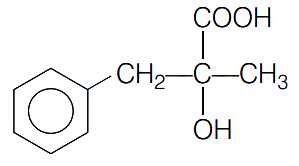
B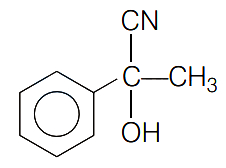
C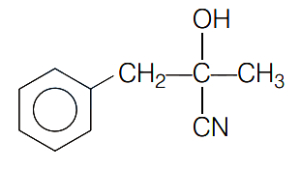
D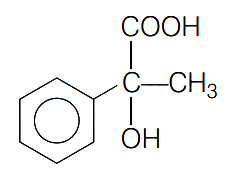
Solution
(D) The reaction sequence is as follows:
$1$. $CH_3COOH + SOCl_2 \rightarrow CH_3COCl$ ($A$ is acetyl chloride).
$2$. $CH_3COCl + C_6H_6 \xrightarrow{Anhy. AlCl_3} C_6H_5COCH_3$ ($B$ is acetophenone,a Friedel-Crafts acylation reaction).
$3$. $C_6H_5COCH_3 + HCN \rightarrow C_6H_5C(OH)(CH_3)CN$ ($C$ is acetophenone cyanohydrin).
$4$. $C_6H_5C(OH)(CH_3)CN + H_2O \rightarrow C_6H_5C(OH)(CH_3)COOH$ ($D$ is $2-$hydroxy$-2-$phenylpropanoic acid,formed by the hydrolysis of the cyanohydrin group).
$1$. $CH_3COOH + SOCl_2 \rightarrow CH_3COCl$ ($A$ is acetyl chloride).
$2$. $CH_3COCl + C_6H_6 \xrightarrow{Anhy. AlCl_3} C_6H_5COCH_3$ ($B$ is acetophenone,a Friedel-Crafts acylation reaction).
$3$. $C_6H_5COCH_3 + HCN \rightarrow C_6H_5C(OH)(CH_3)CN$ ($C$ is acetophenone cyanohydrin).
$4$. $C_6H_5C(OH)(CH_3)CN + H_2O \rightarrow C_6H_5C(OH)(CH_3)COOH$ ($D$ is $2-$hydroxy$-2-$phenylpropanoic acid,formed by the hydrolysis of the cyanohydrin group).
0 likes
View Solution1465
DifficultMCQ
$P \xrightarrow{H_2 / Pd-BaSO_4} Q \xrightarrow{(i) \text{ conc. } NaOH} R + S$. $R$ and $S$ form benzyl benzoate when treated with each other. Hence,$P$ is
A
$C_{6}H_{5}COCl$
B
$C_{6}H_{5}COOH$
C
$C_{6}H_{5}CHO$
D
$C_{6}H_{5}CH_{2}OH$
Solution
(A) $1$. The reaction $P \stackrel{H_{2} / Pd-BaSO_{4}}{\longrightarrow} Q$ is the Rosenmund reduction,which converts an acid chloride $(RCOCl)$ to an aldehyde $(RCHO)$. Thus,$P$ is $C_{6}H_{5}COCl$ (benzoyl chloride) and $Q$ is $C_{6}H_{5}CHO$ (benzaldehyde).
$2$. The reaction of $Q$ (benzaldehyde) with conc. $NaOH$ is the Cannizzaro reaction,which produces a carboxylic acid salt and an alcohol. Upon acidification,we get $R$ ($C_{6}H_{5}COOH$,benzoic acid) and $S$ ($C_{6}H_{5}CH_{2}OH$,benzyl alcohol).
$3$. Benzoic acid $(R)$ and benzyl alcohol $(S)$ undergo esterification to form benzyl benzoate $(C_{6}H_{5}COOCH_{2}C_{6}H_{5})$.
$4$. Therefore,$P$ is $C_{6}H_{5}COCl$.
$2$. The reaction of $Q$ (benzaldehyde) with conc. $NaOH$ is the Cannizzaro reaction,which produces a carboxylic acid salt and an alcohol. Upon acidification,we get $R$ ($C_{6}H_{5}COOH$,benzoic acid) and $S$ ($C_{6}H_{5}CH_{2}OH$,benzyl alcohol).
$3$. Benzoic acid $(R)$ and benzyl alcohol $(S)$ undergo esterification to form benzyl benzoate $(C_{6}H_{5}COOCH_{2}C_{6}H_{5})$.
$4$. Therefore,$P$ is $C_{6}H_{5}COCl$.
0 likes
View Solution1466
EasyMCQ
The reaction is given as follows: $(CH_3)_2CHCHO + CH_3MgBr$ $\xrightarrow{Ether} A$ $\xrightarrow{H_3O^+} B$. The $IUPAC$ name of $B$ is:
A
$2-$methylbutane$-3-$ol
B
Pentan$-2-$ol
C
$3-$methylbutan$-2-$ol
D
$2-$methylbutane$-2-$ol
Solution
(C) The reaction of isobutyraldehyde $((CH_3)_2CHCHO)$ with methylmagnesium bromide $(CH_3MgBr)$ in the presence of ether follows a nucleophilic addition mechanism.
$1$. The Grignard reagent $(CH_3^-)$ attacks the carbonyl carbon of the aldehyde to form an intermediate alkoxide $(A)$,which is $(CH_3)_2CH-CH(OMgBr)-CH_3$.
$2$. Subsequent acid hydrolysis $(H_3O^+)$ converts the intermediate into the corresponding alcohol $(B)$,which is $(CH_3)_2CH-CH(OH)-CH_3$.
$3$. The structure of $B$ is $CH_3-CH(CH_3)-CH(OH)-CH_3$.
$4$. According to $IUPAC$ nomenclature,the longest chain containing the hydroxyl group has $4$ carbons. Numbering from the right gives the hydroxyl group at position $2$ and the methyl group at position $3$. Thus,the $IUPAC$ name is $3-$methylbutan$-2-$ol.
$1$. The Grignard reagent $(CH_3^-)$ attacks the carbonyl carbon of the aldehyde to form an intermediate alkoxide $(A)$,which is $(CH_3)_2CH-CH(OMgBr)-CH_3$.
$2$. Subsequent acid hydrolysis $(H_3O^+)$ converts the intermediate into the corresponding alcohol $(B)$,which is $(CH_3)_2CH-CH(OH)-CH_3$.
$3$. The structure of $B$ is $CH_3-CH(CH_3)-CH(OH)-CH_3$.
$4$. According to $IUPAC$ nomenclature,the longest chain containing the hydroxyl group has $4$ carbons. Numbering from the right gives the hydroxyl group at position $2$ and the methyl group at position $3$. Thus,the $IUPAC$ name is $3-$methylbutan$-2-$ol.
0 likes
View Solution1467
EasyMCQ
Reduction of ketones cannot be carried out with which of the following reagents?
A
Sodium borohydride or lithium aluminium hydride
B
Zinc amalgam and concentrated $HCl$
C
Hydrazine and $KOH$ in ethylene glycol
D
Hydrogen in presence of palladium in Barium sulphate and quinoline
Solution
(D) Ketones can be reduced to secondary alcohols using $NaBH_4$ or $LiAlH_4$.
They can also be reduced to alkanes using Clemmensen reduction $(Zn(Hg)/conc. HCl)$ or Wolff-Kishner reduction ($NH_2NH_2/KOH$ in ethylene glycol).
Hydrogen in the presence of palladium in Barium sulphate and quinoline is known as Lindlar's catalyst,which is specifically used for the partial reduction of alkynes to alkenes,not for the reduction of ketones.
They can also be reduced to alkanes using Clemmensen reduction $(Zn(Hg)/conc. HCl)$ or Wolff-Kishner reduction ($NH_2NH_2/KOH$ in ethylene glycol).
Hydrogen in the presence of palladium in Barium sulphate and quinoline is known as Lindlar's catalyst,which is specifically used for the partial reduction of alkynes to alkenes,not for the reduction of ketones.
0 likes
View Solution1468
MediumMCQ
$X \underset{\text{Reductive}}{\stackrel{\text{Ozonolysis}}{\longrightarrow}} Y + Z$. $Y$ can be obtained by Etard's reaction,$Z$ undergoes disproportionation reaction with concentrated alkali. $X$ could be:
A
Styrene $(C_6H_5CH=CH_2)$
B
$2-$Phenylpropene $(C_6H_5C(CH_3)=CH_2)$
C
Phenylacetylene $(C_6H_5C \equiv CH)$
D
$1-$Phenylpropene $(C_6H_5CH=CH-CH_3)$
Solution
(A) $1$. Reductive ozonolysis of an alkene $R_1R_2C=CR_3R_4$ yields carbonyl compounds $R_1R_2C=O$ and $R_3R_4C=O$.
$2$. $Y$ is obtained by Etard's reaction,which is the oxidation of toluene to benzaldehyde $(C_6H_5CHO)$. Thus,$Y$ is benzaldehyde.
$3$. $Z$ undergoes a disproportionation reaction (Cannizzaro reaction) with concentrated alkali. Formaldehyde $(HCHO)$ is an aldehyde without $\alpha$-hydrogens,so it undergoes the Cannizzaro reaction.
$4$. Combining $Y$ $(C_6H_5CHO)$ and $Z$ $(HCHO)$,the original alkene $X$ must be styrene $(C_6H_5CH=CH_2)$.
$5$. The reaction is: $C_6H_5CH=CH_2 \xrightarrow{\text{O}_3, \text{Zn/H}_2\text{O}} C_6H_5CHO + HCHO$.
$2$. $Y$ is obtained by Etard's reaction,which is the oxidation of toluene to benzaldehyde $(C_6H_5CHO)$. Thus,$Y$ is benzaldehyde.
$3$. $Z$ undergoes a disproportionation reaction (Cannizzaro reaction) with concentrated alkali. Formaldehyde $(HCHO)$ is an aldehyde without $\alpha$-hydrogens,so it undergoes the Cannizzaro reaction.
$4$. Combining $Y$ $(C_6H_5CHO)$ and $Z$ $(HCHO)$,the original alkene $X$ must be styrene $(C_6H_5CH=CH_2)$.
$5$. The reaction is: $C_6H_5CH=CH_2 \xrightarrow{\text{O}_3, \text{Zn/H}_2\text{O}} C_6H_5CHO + HCHO$.
0 likes
View Solution1469
DifficultMCQ
Identify the product $P$ from the following sequence of reactions?
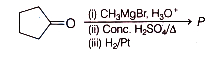
A
Methylcyclopentane
B
$1-$methylcyclopent$-1-$ene
C
$1-$methylcyclopentanol
D
Cyclopent$-2-$en$-1-$ol
Solution
(A) The reaction sequence is as follows:
$1$. Cyclopentanone reacts with $CH_3MgBr$ followed by $H_3O^+$ to form $1$-methylcyclopentanol (a tertiary alcohol).
$2$. Treatment of $1$-methylcyclopentanol with $Conc. H_2SO_4/\Delta$ causes dehydration to form $1$-methylcyclopent-$1$-ene.
$3$. Hydrogenation of $1$-methylcyclopent-$1$-ene using $H_2/Pt$ reduces the double bond to form $1$-methylcyclopentane.
Thus,the final product $P$ is $1$-methylcyclopentane.
$1$. Cyclopentanone reacts with $CH_3MgBr$ followed by $H_3O^+$ to form $1$-methylcyclopentanol (a tertiary alcohol).
$2$. Treatment of $1$-methylcyclopentanol with $Conc. H_2SO_4/\Delta$ causes dehydration to form $1$-methylcyclopent-$1$-ene.
$3$. Hydrogenation of $1$-methylcyclopent-$1$-ene using $H_2/Pt$ reduces the double bond to form $1$-methylcyclopentane.
Thus,the final product $P$ is $1$-methylcyclopentane.
0 likes
View Solution1470
MediumMCQ
Identify the suitable reagent for the reaction given below.
$CH_3-CO-CH_3 \xrightarrow[(ii) H_3O^+]{(i) ?} (CH_3)_3C-OH$
$CH_3-CO-CH_3 \xrightarrow[(ii) H_3O^+]{(i) ?} (CH_3)_3C-OH$
A
$(CH_3)_2CHMgBr$
B
$CH_3MgBr$
C
$(CH_3)_3CMgBr$
D
$(CH_3)_2CH^-Br$
Solution
(B) The given reaction is the addition of a Grignard reagent to a ketone (acetone) followed by acidic hydrolysis to form a tertiary alcohol.
The reactant is acetone $(CH_3COCH_3)$ and the product is $2$-methylpropan-$2$-ol $((CH_3)_3COH)$.
The reaction is: $CH_3COCH_3 + CH_3MgBr$ $\rightarrow (CH_3)_3COMgBr$ $\xrightarrow{H_3O^+} (CH_3)_3COH + Mg(OH)Br$.
Therefore,the required Grignard reagent is $CH_3MgBr$.
The reactant is acetone $(CH_3COCH_3)$ and the product is $2$-methylpropan-$2$-ol $((CH_3)_3COH)$.
The reaction is: $CH_3COCH_3 + CH_3MgBr$ $\rightarrow (CH_3)_3COMgBr$ $\xrightarrow{H_3O^+} (CH_3)_3COH + Mg(OH)Br$.
Therefore,the required Grignard reagent is $CH_3MgBr$.
0 likes
View Solution1471
MediumMCQ
The major product of the following reaction is
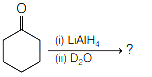
A
Cyclohexanol with a $D$ atom attached to the carbon and an $-OH$ group.
B
Cyclohexanol with a $D$ atom attached to the carbon and an $-OD$ group.
C
Cyclohexanol with a $D$ atom and an $H$ atom attached to the carbon.
D
Cyclohexanol with an $H$ atom attached to the carbon and an $-OD$ group.
Solution
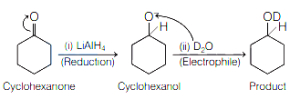
(D) $LiAlH_4$ acts as a source of hydride ion $(H^-)$,which attacks the electrophilic carbonyl carbon of cyclohexanone to form an alkoxide intermediate.
In the second step,$D_2O$ acts as a source of deuterium $(D^+)$,which protonates (deuterates) the alkoxide oxygen to form the final product,which is a cyclohexanol derivative with an $-OD$ group and a hydrogen atom attached to the alpha carbon.
In the second step,$D_2O$ acts as a source of deuterium $(D^+)$,which protonates (deuterates) the alkoxide oxygen to form the final product,which is a cyclohexanol derivative with an $-OD$ group and a hydrogen atom attached to the alpha carbon.
0 likes
View Solution1472
DifficultMCQ
Identify $X, Y, Z$ in the following reaction sequence:

A
$X = CH_3CH_2COCl, Y = CH_3MgBr, Z = HOCH_2CH_2OH/OH^-$
B
$X = CH_3CH_2CH_2Cl, Y = (CH_3)_2Cd, Z = HOCH_2CH_2Cl$
C
$X = CH_3CH_2COCl, Y = (CH_3)_2Cd, Z = HOCH_2CH_2OH/HCl \text{ (gas)}$
D
$X = CH_3COCl, Y = (C_2H_5)_2Cd, Z = HOCH_2CH_2OH/H^+$
Solution
(C) $1$. The starting material is propan$-1-$ol $(CH_3CH_2CH_2OH)$.
$2$. Oxidation with $CrO_3/H_2SO_4$ (Jones reagent) converts the primary alcohol to propanoic acid $(CH_3CH_2COOH)$.
$3$. Treatment with $SOCl_2$ converts the carboxylic acid to propanoyl chloride $(CH_3CH_2COCl)$,which is $X$.
$4$. Reaction of $X$ with dimethylcadmium $((CH_3)_2Cd)$ is a standard method to prepare ketones from acid chlorides,yielding butan$-2-$one $(CH_3CH_2COCH_3)$. Thus,$Y = (CH_3)_2Cd$.
$5$. The final step is the protection of the ketone as a cyclic acetal using ethylene glycol $(HOCH_2CH_2OH)$ in the presence of dry $HCl$ gas. Thus,$Z = HOCH_2CH_2OH/HCl \text{ (gas)}$.
$6$. Therefore,option $C$ is correct.
$2$. Oxidation with $CrO_3/H_2SO_4$ (Jones reagent) converts the primary alcohol to propanoic acid $(CH_3CH_2COOH)$.
$3$. Treatment with $SOCl_2$ converts the carboxylic acid to propanoyl chloride $(CH_3CH_2COCl)$,which is $X$.
$4$. Reaction of $X$ with dimethylcadmium $((CH_3)_2Cd)$ is a standard method to prepare ketones from acid chlorides,yielding butan$-2-$one $(CH_3CH_2COCH_3)$. Thus,$Y = (CH_3)_2Cd$.
$5$. The final step is the protection of the ketone as a cyclic acetal using ethylene glycol $(HOCH_2CH_2OH)$ in the presence of dry $HCl$ gas. Thus,$Z = HOCH_2CH_2OH/HCl \text{ (gas)}$.
$6$. Therefore,option $C$ is correct.
0 likes
View Solution1473
MediumMCQ
Consider the following sequence of reactions:
Isopropyl benzene $\xrightarrow{O_2} x$ $\xrightarrow[H_2 O]{H^{+}} y + z$
The incorrect statement about $z$ is:
Isopropyl benzene $\xrightarrow{O_2} x$ $\xrightarrow[H_2 O]{H^{+}} y + z$
The incorrect statement about $z$ is:
A
$z$ gives yellow precipitate of $CHI_3$ with $NaOH + I_2$ solution
B
$z$ gives isopropyl alcohol on reduction with $H_2$ in the presence of $Pd$ catalyst
C
$z$ on reaction with $CH_3 MgBr$ followed by hydrolysis gives $2^{\circ}$ alcohol
D
$z$ does not give positive test with Fehling's reagent
Solution
(C) The reaction sequence is the industrial preparation of phenol and acetone from cumene (isopropyl benzene).
$1.$ Isopropyl benzene (cumene) reacts with $O_2$ to form cumene hydroperoxide $(x)$.
$2.$ Cumene hydroperoxide on acid hydrolysis gives phenol $(y)$ and acetone $(z = CH_3COCH_3)$.
Analysis of statements about acetone $(z)$:
$A.$ Acetone contains a $CH_3CO-$ group,so it gives a positive iodoform test ($CHI_3$ yellow ppt). This is a correct statement.
$B.$ Reduction of acetone $(CH_3COCH_3)$ with $H_2/Pd$ gives isopropyl alcohol $(CH_3CH(OH)CH_3)$. This is a correct statement.
$C.$ Reaction of acetone $(CH_3COCH_3)$ with $CH_3MgBr$ followed by hydrolysis gives tert-butyl alcohol $(CH_3C(OH)(CH_3)_2)$,which is a $3^{\circ}$ alcohol,not a $2^{\circ}$ alcohol. This is an incorrect statement.
$D.$ Acetone is a ketone and does not reduce Fehling's reagent. This is a correct statement.
Therefore,the incorrect statement is $C$.
$1.$ Isopropyl benzene (cumene) reacts with $O_2$ to form cumene hydroperoxide $(x)$.
$2.$ Cumene hydroperoxide on acid hydrolysis gives phenol $(y)$ and acetone $(z = CH_3COCH_3)$.
Analysis of statements about acetone $(z)$:
$A.$ Acetone contains a $CH_3CO-$ group,so it gives a positive iodoform test ($CHI_3$ yellow ppt). This is a correct statement.
$B.$ Reduction of acetone $(CH_3COCH_3)$ with $H_2/Pd$ gives isopropyl alcohol $(CH_3CH(OH)CH_3)$. This is a correct statement.
$C.$ Reaction of acetone $(CH_3COCH_3)$ with $CH_3MgBr$ followed by hydrolysis gives tert-butyl alcohol $(CH_3C(OH)(CH_3)_2)$,which is a $3^{\circ}$ alcohol,not a $2^{\circ}$ alcohol. This is an incorrect statement.
$D.$ Acetone is a ketone and does not reduce Fehling's reagent. This is a correct statement.
Therefore,the incorrect statement is $C$.
0 likes
View Solution1474
MediumMCQ
Match the following reactions in List-$I$ with their corresponding final products in List-$II$:
The correct answer is:
| List-$I$ (Type of reaction) | List-$II$ (Final Product) |
|---|---|
| $A$. Reimer-Tiemann reaction | $I$. Chlorobenzene |
| $B$. Etard reaction | $II$. Salicylaldehyde |
| $C$. Sandmeyer reaction | $III$. Benzaldehyde |
| $D$. Friedel-Crafts reaction | $IV$. Acetophenone |
The correct answer is:
A
$A-II, B-III, C-I, D-IV$
B
$A-II, B-III, C-I, D-IV$
C
$A-IV, B-I, C-III, D-II$
D
$A-III, B-IV, C-I, D-II$
Solution
(B) The correct matches are as follows:
$A$. Reimer-Tiemann reaction: Phenol reacts with $CHCl_3$ and $NaOH$ to form $o$-hydroxybenzaldehyde (Salicylaldehyde). Thus,$A-II$.
$B$. Etard reaction: Toluene reacts with $CrO_2Cl_2$ followed by hydrolysis to form Benzaldehyde. Thus,$B-III$.
$C$. Sandmeyer reaction: Benzene diazonium chloride reacts with $CuCl/HCl$ to form Chlorobenzene. Thus,$C-I$.
$D$. Friedel-Crafts reaction: Benzene reacts with acetyl chloride in the presence of anhydrous $AlCl_3$ to form Acetophenone. Thus,$D-IV$.
Therefore,the correct sequence is $A-II, B-III, C-I, D-IV$.
$A$. Reimer-Tiemann reaction: Phenol reacts with $CHCl_3$ and $NaOH$ to form $o$-hydroxybenzaldehyde (Salicylaldehyde). Thus,$A-II$.
$B$. Etard reaction: Toluene reacts with $CrO_2Cl_2$ followed by hydrolysis to form Benzaldehyde. Thus,$B-III$.
$C$. Sandmeyer reaction: Benzene diazonium chloride reacts with $CuCl/HCl$ to form Chlorobenzene. Thus,$C-I$.
$D$. Friedel-Crafts reaction: Benzene reacts with acetyl chloride in the presence of anhydrous $AlCl_3$ to form Acetophenone. Thus,$D-IV$.
Therefore,the correct sequence is $A-II, B-III, C-I, D-IV$.
0 likes
View Solution1475
EasyMCQ
Which of the following reactions involve the carbon-carbon bond formation?
A
Hydroboration-Oxidation of alkenes
B
Cannizzaro reaction
C
Reimer-Tiemann reaction
D
Stephen reaction
Solution
(C) The $Reimer-Tiemann$ reaction involves the treatment of phenol with $CHCl_3$ in the presence of aqueous $NaOH$,which leads to the introduction of a $-CHO$ group at the ortho position of the benzene ring. This process involves the formation of a new $C-C$ bond between the benzene ring and the dichlorocarbene intermediate $(:CCl_2)$.
$1.$ Hydroboration-Oxidation of alkenes involves the addition of $H_2O$ across a double bond.
$2.$ Cannizzaro reaction is a disproportionation reaction of aldehydes lacking $\alpha$-hydrogen.
$3.$ Stephen reaction is the reduction of nitriles to aldehydes using $SnCl_2/HCl$.
$1.$ Hydroboration-Oxidation of alkenes involves the addition of $H_2O$ across a double bond.
$2.$ Cannizzaro reaction is a disproportionation reaction of aldehydes lacking $\alpha$-hydrogen.
$3.$ Stephen reaction is the reduction of nitriles to aldehydes using $SnCl_2/HCl$.
0 likes
View Solution1476
EasyMCQ
Identify $(Z)$ in the following reaction:
$CH_3COOH$ $\xrightarrow{LiAlH_4} (X)$ $\xrightarrow{573 \ K, \ Cu} (Y)$ $\xrightarrow{dil.NaOH} (Z)$
$CH_3COOH$ $\xrightarrow{LiAlH_4} (X)$ $\xrightarrow{573 \ K, \ Cu} (Y)$ $\xrightarrow{dil.NaOH} (Z)$
A
Aldol
B
Ketol
C
Acetol
D
Butanol
Solution
(A) $LiAlH_4$ is a strong reducing agent that reduces carboxylic acids to primary alcohols.
$CH_3COOH \xrightarrow{LiAlH_4} CH_3CH_2OH$ (Ethanol,$X$).
Heating primary alcohols with $Cu$ at $573 \ K$ causes dehydrogenation to form aldehydes.
$CH_3CH_2OH \xrightarrow{573 \ K, \ Cu} CH_3CHO$ (Ethanal,$Y$).
Ethanal contains $\alpha$-hydrogens and undergoes an aldol condensation reaction in the presence of dilute $NaOH$ to form a $\beta$-hydroxyaldehyde,commonly known as aldol.
$CH_3CHO \xrightarrow{dil.NaOH} CH_3-CH(OH)-CH_2-CHO$ (Aldol,$Z$).
$CH_3COOH \xrightarrow{LiAlH_4} CH_3CH_2OH$ (Ethanol,$X$).
Heating primary alcohols with $Cu$ at $573 \ K$ causes dehydrogenation to form aldehydes.
$CH_3CH_2OH \xrightarrow{573 \ K, \ Cu} CH_3CHO$ (Ethanal,$Y$).
Ethanal contains $\alpha$-hydrogens and undergoes an aldol condensation reaction in the presence of dilute $NaOH$ to form a $\beta$-hydroxyaldehyde,commonly known as aldol.
$CH_3CHO \xrightarrow{dil.NaOH} CH_3-CH(OH)-CH_2-CHO$ (Aldol,$Z$).
0 likes
View Solution1477
DifficultMCQ
What are $X$ and $Y$ respectively in the following reactions?
$C_6H_5COOH \xrightarrow{X} C_6H_5CHO$
$C_6H_5CHO \xrightarrow[OH^-, 293 \ K]{C_6H_5COOH} Y \text{ (Major product)}$
$C_6H_5COOH \xrightarrow{X} C_6H_5CHO$
$C_6H_5CHO \xrightarrow[OH^-, 293 \ K]{C_6H_5COOH} Y \text{ (Major product)}$
A
$(i) \ SOCl_2, (ii) \ H_2|Ni; \ C_6H_5-C(CH_3)=CH-C_6H_5$
B
$(i) \ SOCl_2, (ii) \ H_2|Ni; \ C_6H_5-CH=CH-CO-C_6H_5$
C
$(i) \ C_2H_5OH|H^+, (ii) \ DiBAL-H, (iii) \ H_2O; \ C_6H_5-CH=CH-CO-C_6H_5$
D
$(i) \ C_2H_5OH|H^+, (ii) \ DiBAL-H, (iii) \ H_2O; \ C_6H_5-C(CH_3)=CH-C_6H_5$
Solution
(C) The first reaction is the reduction of benzoic acid $(C_6H_5COOH)$ to benzaldehyde $(C_6H_5CHO)$. This cannot be done directly with $SOCl_2$ and $H_2|Ni$ (which reduces acid chlorides to aldehydes,but the conditions are specific). The standard laboratory method to reduce a carboxylic acid to an aldehyde involves converting it to an ester first,followed by reduction with $DiBAL-H$.
Step $1$: $C_6H_5COOH + C_2H_5OH \xrightarrow{H^+} C_6H_5COOC_2H_5 + H_2O$ (Esterification).
Step $2$: $C_6H_5COOC_2H_5 \xrightarrow{(i) \ DiBAL-H, (ii) \ H_2O} C_6H_5CHO$ (Reduction of ester to aldehyde).
Thus,$X$ is $(i) \ C_2H_5OH|H^+, (ii) \ DiBAL-H, (iii) \ H_2O$.
Step $3$: The second reaction is an Aldol condensation between benzaldehyde $(C_6H_5CHO)$ and acetophenone (implied,though the prompt shows $C_6H_5COOH$ as a reactant,the product $Y$ is clearly the Claisen-Schmidt condensation product,benzalacetophenone or chalcone,$C_6H_5-CH=CH-CO-C_6H_5$).
Therefore,the correct option is $C$.
Step $1$: $C_6H_5COOH + C_2H_5OH \xrightarrow{H^+} C_6H_5COOC_2H_5 + H_2O$ (Esterification).
Step $2$: $C_6H_5COOC_2H_5 \xrightarrow{(i) \ DiBAL-H, (ii) \ H_2O} C_6H_5CHO$ (Reduction of ester to aldehyde).
Thus,$X$ is $(i) \ C_2H_5OH|H^+, (ii) \ DiBAL-H, (iii) \ H_2O$.
Step $3$: The second reaction is an Aldol condensation between benzaldehyde $(C_6H_5CHO)$ and acetophenone (implied,though the prompt shows $C_6H_5COOH$ as a reactant,the product $Y$ is clearly the Claisen-Schmidt condensation product,benzalacetophenone or chalcone,$C_6H_5-CH=CH-CO-C_6H_5$).
Therefore,the correct option is $C$.
0 likes
View Solution1478
EasyMCQ
What are the products formed when an aldehyde $(R-CHO)$ is reacted with Tollen's reagent?
A
$Ag, H_2O, R-CH_2OH, NH_3$
B
$Ag, H_2O, R-COO^-, H_2$
C
$Ag, H_2O, R-COO^-, NH_3$
D
$Ag_2, H_2O, R-COO^-, NH_3$
Solution
(C) When an aldehyde $(R-CHO)$ reacts with Tollen's reagent,the following reaction takes place:
$R-CHO + 2[Ag(NH_3)_2]^+ + 3OH^- \longrightarrow R-COO^- + 2Ag + 4NH_3 + 2H_2O$
Thus,the products formed are $Ag, H_2O, R-COO^-$ and $NH_3$,and option $(C)$ is the correct answer.
$R-CHO + 2[Ag(NH_3)_2]^+ + 3OH^- \longrightarrow R-COO^- + 2Ag + 4NH_3 + 2H_2O$
Thus,the products formed are $Ag, H_2O, R-COO^-$ and $NH_3$,and option $(C)$ is the correct answer.
0 likes
View Solution1479
MediumMCQ
The reaction of $A$ to give $B$ and $C$ as shown in the reaction scheme is an example of:
$CH_2=CH_2$ $\xrightarrow[2. Zn/H_2O]{1. O_3} A$ $\xrightarrow{Conc. NaOH} B + C$
(Where $B$ is an alcohol and $C$ is a sodium salt of a carboxylic acid)
$CH_2=CH_2$ $\xrightarrow[2. Zn/H_2O]{1. O_3} A$ $\xrightarrow{Conc. NaOH} B + C$
(Where $B$ is an alcohol and $C$ is a sodium salt of a carboxylic acid)
A
$HVZ$ reaction
B
Stephen reaction
C
Etard reaction
D
Cannizzaro reaction
Solution
(D) The reaction sequence is as follows:
$1$. Reductive ozonolysis of ethene $(CH_2=CH_2)$ gives formaldehyde $(HCHO)$ as product $A$.
$CH_2=CH_2 \xrightarrow[2. Zn/H_2O]{1. O_3} 2HCHO (A)$
$2$. Formaldehyde $(HCHO)$ lacks $\alpha$-hydrogen atoms,so it undergoes a self-oxidation-reduction reaction (disproportionation) in the presence of concentrated $NaOH$,known as the Cannizzaro reaction.
$2HCHO + NaOH (conc.) \rightarrow CH_3OH (B) + HCOONa (C)$
Here,$B$ is methanol (alcohol) and $C$ is sodium formate (sodium salt of carboxylic acid).
Therefore,the reaction of $A$ to give $B$ and $C$ is an example of the Cannizzaro reaction.
$1$. Reductive ozonolysis of ethene $(CH_2=CH_2)$ gives formaldehyde $(HCHO)$ as product $A$.
$CH_2=CH_2 \xrightarrow[2. Zn/H_2O]{1. O_3} 2HCHO (A)$
$2$. Formaldehyde $(HCHO)$ lacks $\alpha$-hydrogen atoms,so it undergoes a self-oxidation-reduction reaction (disproportionation) in the presence of concentrated $NaOH$,known as the Cannizzaro reaction.
$2HCHO + NaOH (conc.) \rightarrow CH_3OH (B) + HCOONa (C)$
Here,$B$ is methanol (alcohol) and $C$ is sodium formate (sodium salt of carboxylic acid).
Therefore,the reaction of $A$ to give $B$ and $C$ is an example of the Cannizzaro reaction.
0 likes
View Solution1480
MediumMCQ
The mixed aldol products obtained from the aldol condensation of ethanal $(CH_3CHO)$ and propanone $(CH_3COCH_3)$ are:
A
$4-$hydroxypentan$-2-$one and pent$-3-$en$-2-$one
B
$4-$hydroxypentan$-2-$one and pent$-3-$en$-2-$one
C
$4-$hydroxy$-4-$methylpentan$-2-$one and $4-$methylpent$-3-$en$-2-$one
D
$4-$hydroxy$-4-$methylpentan$-2-$one and $4-$methylpent$-3-$en$-2-$one
Solution
(A) When ethanal $(CH_3CHO)$ and propanone $(CH_3COCH_3)$ undergo crossed-aldol condensation,the nucleophilic enolate of propanone attacks the carbonyl carbon of ethanal.
$1$. The initial addition product is $4$-hydroxypentan-$2$-one $(CH_3-CH(OH)-CH_2-COCH_3)$.
$2$. Upon dehydration (heating),this yields the unsaturated product,pent-$3$-en-$2$-one $(CH_3-CH=CH-COCH_3)$.
$1$. The initial addition product is $4$-hydroxypentan-$2$-one $(CH_3-CH(OH)-CH_2-COCH_3)$.
$2$. Upon dehydration (heating),this yields the unsaturated product,pent-$3$-en-$2$-one $(CH_3-CH=CH-COCH_3)$.
0 likes
View Solution1481
MediumMCQ
Identify $P$ and $Q$ respectively of the following reaction.
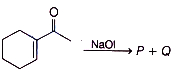
A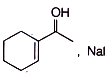
B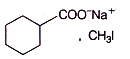
C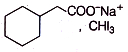
D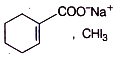
Solution
(D) The given substrate is a methyl ketone (cyclohex$-1-$en$-1-$yl methyl ketone),which contains the $CH_3CO-$ group.
In the presence of $NaOI$ (sodium hypoiodite),it undergoes the iodoform reaction.
The $CH_3$ group is converted into iodoform $(CHI_3)$,and the remaining part of the molecule is oxidized to a carboxylate salt $(RCOO^-Na^+)$.
Therefore,the reaction is:
$Cyclohex-1-en-1-yl \ methyl \ ketone + 3NaOI$ $\rightarrow Cyclohex-1-ene-1-carboxylate \ sodium \ salt (P) + CHI_3 (Q) + 2NaOH$.
Comparing this with the given options,option $D$ correctly represents $P$ and $Q$.
In the presence of $NaOI$ (sodium hypoiodite),it undergoes the iodoform reaction.
The $CH_3$ group is converted into iodoform $(CHI_3)$,and the remaining part of the molecule is oxidized to a carboxylate salt $(RCOO^-Na^+)$.
Therefore,the reaction is:
$Cyclohex-1-en-1-yl \ methyl \ ketone + 3NaOI$ $\rightarrow Cyclohex-1-ene-1-carboxylate \ sodium \ salt (P) + CHI_3 (Q) + 2NaOH$.
Comparing this with the given options,option $D$ correctly represents $P$ and $Q$.
0 likes
View Solution1482
MediumMCQ
What are $X$,$Y$,and $Z$ in the following reaction sequence respectively?
Benzene $\xrightarrow{X}$ Benzaldehyde $\xrightarrow{\text{Conc. NaOH}, \Delta} Y + Z$
Benzene $\xrightarrow{X}$ Benzaldehyde $\xrightarrow{\text{Conc. NaOH}, \Delta} Y + Z$
A
$X = \text{CO, HCl, AlCl}_3$; $Y = \text{Benzyl alcohol}$,$Z = \text{Sodium benzoate}$
B
$X = \text{CO, HCl, CuCl}$; $Y = \text{Benzyl alcohol}$,$Z = \text{Sodium benzoate}$
C
$X = \text{HCHO, HCl, anhydrous AlCl}_3$; $Y = \text{Benzyl alcohol}$,$Z = \text{Benzoic acid}$
D
$X = \text{CO, HCl}$; $Y = \text{Phenylacetic acid}$,$Z = \text{Phenol}$
Solution
(B) The first step is the Gattermann-Koch reaction,where benzene reacts with carbon monoxide $(\text{CO})$ and hydrogen chloride $(\text{HCl})$ in the presence of anhydrous aluminum chloride $(\text{AlCl}_3)$ and cuprous chloride $(\text{CuCl})$ to form benzaldehyde. Thus,$X = \text{CO, HCl, CuCl}$.
The second step is the Cannizzaro reaction. Benzaldehyde,which lacks $\alpha$-hydrogen atoms,undergoes self-oxidation and reduction in the presence of concentrated sodium hydroxide $(\text{NaOH})$ to form benzyl alcohol $(Y)$ and sodium benzoate $(Z)$.
The second step is the Cannizzaro reaction. Benzaldehyde,which lacks $\alpha$-hydrogen atoms,undergoes self-oxidation and reduction in the presence of concentrated sodium hydroxide $(\text{NaOH})$ to form benzyl alcohol $(Y)$ and sodium benzoate $(Z)$.
0 likes
View Solution1483
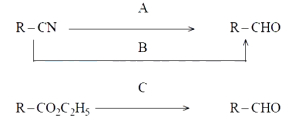
MediumMCQ
What are $A$,$B$,and $C$ in the following reactions?
A
$A$: $i) \ K_2Cr_2O_7, ii) \ H^{\oplus}$; $B$: $i) \ SnCl_2|HCl, ii) \ H_3O^{\oplus}$; $C$: $i) \ AlH(i-Bu)_2, ii) \ H_2O$
B
$A$: $i) \ SnCl_2|HCl, ii) \ H_3O^{\oplus}$; $B$: $i) \ AlH(i-Bu)_2, ii) \ H_2O$; $C$: $i) \ DIBAL-H, ii) \ H_2O$
C
$A$: $H_2|Pd-BaSO_4$; $B$: $Al_2O_3$; $C$: $i) \ SnCl_2|HCl, ii) \ H_2O$
D
$A$: $Al_2O_3$; $B$: $i) \ SnCl_2|HCl, ii) \ H_3O^{\oplus}$; $C$: $i) \ DIBAL-H, ii) \ H_2O$
Solution
(B) The conversion of $R-CN$ to $R-CHO$ is a standard reduction reaction known as the Stephen reduction,which uses $SnCl_2$ in the presence of $HCl$ followed by hydrolysis $(H_3O^{\oplus})$. Thus,$A$ represents the Stephen reduction reagents.
The conversion of $R-CN$ to $R-CHO$ can also be achieved using $DIBAL-H$ (Diisobutylaluminium hydride),which is a selective reducing agent. In the provided options,$B$ corresponds to $AlH(i-Bu)_2$ (which is $DIBAL-H$) followed by water.
The conversion of an ester $(R-CO_2C_2H_5)$ to an aldehyde $(R-CHO)$ is also specifically carried out using $DIBAL-H$ followed by water. Thus,$C$ represents $DIBAL-H$ followed by $H_2O$.
Comparing these with the given options,option $B$ correctly identifies $A$ as $SnCl_2|HCl$ followed by $H_3O^{\oplus}$,$B$ as $AlH(i-Bu)_2$ followed by $H_2O$,and $C$ as $DIBAL-H$ followed by $H_2O$.
The conversion of $R-CN$ to $R-CHO$ can also be achieved using $DIBAL-H$ (Diisobutylaluminium hydride),which is a selective reducing agent. In the provided options,$B$ corresponds to $AlH(i-Bu)_2$ (which is $DIBAL-H$) followed by water.
The conversion of an ester $(R-CO_2C_2H_5)$ to an aldehyde $(R-CHO)$ is also specifically carried out using $DIBAL-H$ followed by water. Thus,$C$ represents $DIBAL-H$ followed by $H_2O$.
Comparing these with the given options,option $B$ correctly identifies $A$ as $SnCl_2|HCl$ followed by $H_3O^{\oplus}$,$B$ as $AlH(i-Bu)_2$ followed by $H_2O$,and $C$ as $DIBAL-H$ followed by $H_2O$.
0 likes
View Solution1484
EasyMCQ
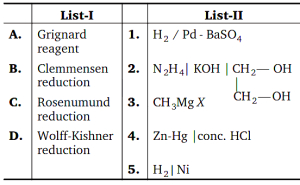
Match the following lists:
A
| $A$. Grignard reagent | $1$. $H_2 / Pd-BaSO_4$ |
| $B$. Clemmensen reduction | $2$. $N_2H_4 / KOH / \text{ethylene glycol}$ |
| $C$. Rosenmund reduction | $3$. $CH_3MgX$ |
| $D$. Wolff-Kishner reduction | $4$. $Zn-Hg / conc. HCl$ |
| $5$. $H_2 / Ni$ |
B
$A-3, B-4, C-1, D-2$
C
$A-3, B-4, C-1, D-2$
D
$A-2, B-1, C-4, D-5$
Solution
(B) The correct matches are as follows:
$A$. Grignard reagent is $CH_3MgX$ $(3)$.
$B$. Clemmensen reduction uses $Zn-Hg / conc. HCl$ $(4)$.
$C$. Rosenmund reduction uses $H_2 / Pd-BaSO_4$ $(1)$.
$D$. Wolff-Kishner reduction uses $N_2H_4 / KOH$ in ethylene glycol $(2)$.
Thus,the correct sequence is $A-3, B-4, C-1, D-2$.
$A$. Grignard reagent is $CH_3MgX$ $(3)$.
$B$. Clemmensen reduction uses $Zn-Hg / conc. HCl$ $(4)$.
$C$. Rosenmund reduction uses $H_2 / Pd-BaSO_4$ $(1)$.
$D$. Wolff-Kishner reduction uses $N_2H_4 / KOH$ in ethylene glycol $(2)$.
Thus,the correct sequence is $A-3, B-4, C-1, D-2$.
0 likes
View Solution1485
MediumMCQ
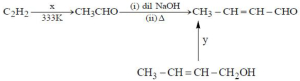
What are $x$ and $y$ in the following reaction sequence?
A
$H_2O / H_2SO_4 ; KMnO_4 / H^{+}$
B
$H_2O / H_2SO_4 ; PCC$
C
$H_2O / H_2SO_4, Hg^{2+} ; KMnO_4 / H^{+}$
D
$H_2O / H_2SO_4, Hg^{2+} ; PCC$
Solution
(D) The reaction of $C_2H_2$ (acetylene) with $H_2O / H_2SO_4, Hg^{2+}$ at $333 \ K$ is the hydration of an alkyne,which yields acetaldehyde $(CH_3CHO)$. Thus,$x = H_2O / H_2SO_4, Hg^{2+}$.
The conversion of $CH_3-CH=CH-CH_2OH$ (crotyl alcohol) to $CH_3-CH=CH-CHO$ (crotonaldehyde) involves the oxidation of a primary allylic alcohol to an aldehyde. $PCC$ (Pyridinium chlorochromate) is a selective oxidizing agent that oxidizes primary alcohols to aldehydes without further oxidation to carboxylic acids. Thus,$y = PCC$.
The conversion of $CH_3-CH=CH-CH_2OH$ (crotyl alcohol) to $CH_3-CH=CH-CHO$ (crotonaldehyde) involves the oxidation of a primary allylic alcohol to an aldehyde. $PCC$ (Pyridinium chlorochromate) is a selective oxidizing agent that oxidizes primary alcohols to aldehydes without further oxidation to carboxylic acids. Thus,$y = PCC$.
0 likes
View Solution1486
EasyMCQ
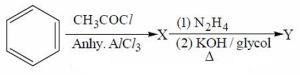
In the given reaction sequence,the conversion of $X$ to $Y$ is an example of:
A
Clemmensen reduction
B
Stephen reduction
C
Wolff-Kishner reduction
D
Rosenmund reduction
Solution
(C) The reaction sequence is as follows:
$1$. Benzene reacts with $CH_3COCl$ in the presence of anhydrous $AlCl_3$ (Friedel-Crafts acylation) to form acetophenone ($X$ = $C_6H_5COCH_3$).
$2$. The conversion of $X$ $(C_6H_5COCH_3)$ to $Y$ ($C_6H_5CH_2CH_3$,ethylbenzene) is carried out using hydrazine $(N_2H_4)$ followed by heating with $KOH$ in glycol.
$3$. This specific reagent system $(N_2H_4, KOH/glycol, \Delta)$ is characteristic of the Wolff-Kishner reduction,which reduces carbonyl groups $(C=O)$ to methylene groups $(CH_2)$.
$1$. Benzene reacts with $CH_3COCl$ in the presence of anhydrous $AlCl_3$ (Friedel-Crafts acylation) to form acetophenone ($X$ = $C_6H_5COCH_3$).
$2$. The conversion of $X$ $(C_6H_5COCH_3)$ to $Y$ ($C_6H_5CH_2CH_3$,ethylbenzene) is carried out using hydrazine $(N_2H_4)$ followed by heating with $KOH$ in glycol.
$3$. This specific reagent system $(N_2H_4, KOH/glycol, \Delta)$ is characteristic of the Wolff-Kishner reduction,which reduces carbonyl groups $(C=O)$ to methylene groups $(CH_2)$.
0 likes
View Solution1487
MediumMCQ
Arrange the following in decreasing order of electrophilicity of carbonyl carbon.
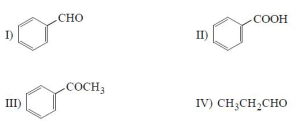
A
$IV > I > III > II$
B
$IV > I > II > III$
C
$I > IV > III > II$
D
$I > II > IV > III$
Solution
(A) The electrophilicity of the carbonyl carbon depends on the magnitude of the positive charge on it. This is influenced by electronic effects (inductive and resonance effects) of the groups attached to the carbonyl carbon.
$I)$ Benzaldehyde $(C_6H_5CHO)$: The phenyl group shows resonance,which decreases the electrophilicity of the carbonyl carbon.
$II)$ Benzoic acid $(C_6H_5COOH)$: The $-OH$ group donates electrons via resonance to the carbonyl carbon,significantly reducing its electrophilicity.
$III)$ Acetophenone $(C_6H_5COCH_3)$: The phenyl group and the methyl group both decrease the electrophilicity of the carbonyl carbon. The methyl group is electron-donating via hyperconjugation and inductive effect,and the phenyl group donates via resonance.
$IV)$ Propanal $(CH_3CH_2CHO)$: This is an aliphatic aldehyde. It lacks the resonance stabilization provided by the phenyl ring,making its carbonyl carbon the most electrophilic among the given options.
Comparing the four:
$IV$ (Aliphatic aldehyde) > $I$ (Benzaldehyde) > $III$ (Acetophenone) > $II$ (Benzoic acid).
Thus,the decreasing order is $IV > I > III > II$.
$I)$ Benzaldehyde $(C_6H_5CHO)$: The phenyl group shows resonance,which decreases the electrophilicity of the carbonyl carbon.
$II)$ Benzoic acid $(C_6H_5COOH)$: The $-OH$ group donates electrons via resonance to the carbonyl carbon,significantly reducing its electrophilicity.
$III)$ Acetophenone $(C_6H_5COCH_3)$: The phenyl group and the methyl group both decrease the electrophilicity of the carbonyl carbon. The methyl group is electron-donating via hyperconjugation and inductive effect,and the phenyl group donates via resonance.
$IV)$ Propanal $(CH_3CH_2CHO)$: This is an aliphatic aldehyde. It lacks the resonance stabilization provided by the phenyl ring,making its carbonyl carbon the most electrophilic among the given options.
Comparing the four:
$IV$ (Aliphatic aldehyde) > $I$ (Benzaldehyde) > $III$ (Acetophenone) > $II$ (Benzoic acid).
Thus,the decreasing order is $IV > I > III > II$.
0 likes
View Solution1488
MediumMCQ
What are $X$ and $Y$ respectively in the following reaction sequence?
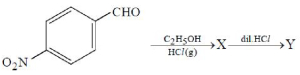
A
The diethyl acetal of $p$-nitrobenzaldehyde and $p$-nitrobenzaldehyde.
B
$A$ hemiacetal and the diethyl acetal.
C
The diethyl acetal and a hemiacetal.
D
$A$ hemiacetal and $p$-nitrobenzyl alcohol.
Solution
(A) The reaction of $p$-nitrobenzaldehyde with ethanol in the presence of dry $HCl(g)$ is an acetal formation reaction.
Aldehydes react with alcohols in the presence of dry $HCl$ to form hemiacetals,which further react with another molecule of alcohol to form acetals.
Step $1$: $p$-Nitrobenzaldehyde reacts with $C_2H_5OH$ in the presence of $HCl(g)$ to form the diethyl acetal,$X$,which is $p-NO_2-C_6H_4-CH(OC_2H_5)_2$.
Step $2$: The acetal $X$ on hydrolysis with dilute $HCl$ (acidic hydrolysis) regenerates the original aldehyde,$Y$,which is $p-nitrobenzaldehyde$ $(p-NO_2-C_6H_4-CHO)$.
Therefore,$X$ is the diethyl acetal and $Y$ is the original aldehyde.
Aldehydes react with alcohols in the presence of dry $HCl$ to form hemiacetals,which further react with another molecule of alcohol to form acetals.
Step $1$: $p$-Nitrobenzaldehyde reacts with $C_2H_5OH$ in the presence of $HCl(g)$ to form the diethyl acetal,$X$,which is $p-NO_2-C_6H_4-CH(OC_2H_5)_2$.
Step $2$: The acetal $X$ on hydrolysis with dilute $HCl$ (acidic hydrolysis) regenerates the original aldehyde,$Y$,which is $p-nitrobenzaldehyde$ $(p-NO_2-C_6H_4-CHO)$.
Therefore,$X$ is the diethyl acetal and $Y$ is the original aldehyde.
0 likes
View Solution1489
MediumMCQ
$A$ carbonyl compound $X$ $(C_8H_8O)$ undergoes disproportionation with conc. $KOH$ on heating. The product of $X$ with $Zn-Hg/HCl$ is $Y$ and the product of $X$ with $NaBH_4$ is $Z$. What are $Y$ and $Z$ respectively?
A
Ethylbenzene,$2$-Phenylethanol
B
p-Xylene,p-Methylbenzyl alcohol
C
p-Methylbenzyl alcohol,p-Xylene
D
$2-$Phenylethanol,Ethylbenzene
Solution
(A) The molecular formula $C_8H_8O$ and the fact that it undergoes disproportionation (Cannizzaro reaction) with conc. $KOH$ indicates that $X$ is an aldehyde without $\alpha$-hydrogen atoms. The structure of $X$ is phenylacetaldehyde $(C_6H_5CH_2CHO)$,but wait,phenylacetaldehyde has $\alpha$-hydrogens. Let us re-evaluate. The compound $C_8H_8O$ that undergoes Cannizzaro is benzaldehyde derivatives or similar. Actually,the compound is $C_6H_5CH_2CHO$ (phenylacetaldehyde) but it has $\alpha$-hydrogens. The compound $C_8H_8O$ is Phenylacetaldehyde. Wait,the compound is likely $C_6H_5CHO$ (benzaldehyde) which is $C_7H_6O$. For $C_8H_8O$,the compound is Phenylacetaldehyde $(C_6H_5CH_2CHO)$. However,the question implies a Cannizzaro reaction. Let's check $C_6H_5CH_2CHO$. It has $\alpha$-$H$. Maybe it is $C_6H_5-CO-CH_3$ (Acetophenone)? No. The compound is Phenylacetaldehyde. Actually,the compound is $C_6H_5CH_2CHO$. Let's re-examine the options. Option $A$ shows Ethylbenzene $(C_6H_5CH_2CH_3)$ and $2-$Phenylethanol $(C_6H_5CH_2CH_2OH)$. If $X$ is $C_6H_5CH_2CHO$,then $Zn-Hg/HCl$ (Clemmensen reduction) gives $C_6H_5CH_2CH_3$ (Ethylbenzene) and $NaBH_4$ gives $C_6H_5CH_2CH_2OH$ ($2$-Phenylethanol). This matches option $A$.
0 likes
View Solution1490
MediumMCQ
$A$ carbonyl compound $X$ $(C_3H_6O)$ on oxidation gives a carboxylic acid $Y$ $(C_3H_6O_2)$. The oxime of $X$ is:
A
$CH_3-C(CH_3)=NNH_2$
B
$CH_3-C(CH_3)=NOH$
C
$CH_3-CH_2-CH=NOH$
D
$CH_3-CH_2-CH=NNH_2$
Solution
(C) The carbonyl compound $X$ has the molecular formula $C_3H_6O$. On oxidation,it gives a carboxylic acid $Y$ with the formula $C_3H_6O_2$.
Since the number of carbon atoms remains the same ($3$ carbons) during oxidation,$X$ must be an aldehyde (propanal,$CH_3-CH_2-CHO$).
Ketones with $3$ carbons would undergo cleavage and produce acids with fewer carbon atoms.
Therefore,$X$ is propanal $(CH_3-CH_2-CHO)$.
The reaction of an aldehyde with hydroxylamine $(NH_2OH)$ forms an oxime:
$CH_3-CH_2-CHO + NH_2OH \rightarrow CH_3-CH_2-CH=NOH + H_2O$.
Thus,the oxime of $X$ is $CH_3-CH_2-CH=NOH$.
Since the number of carbon atoms remains the same ($3$ carbons) during oxidation,$X$ must be an aldehyde (propanal,$CH_3-CH_2-CHO$).
Ketones with $3$ carbons would undergo cleavage and produce acids with fewer carbon atoms.
Therefore,$X$ is propanal $(CH_3-CH_2-CHO)$.
The reaction of an aldehyde with hydroxylamine $(NH_2OH)$ forms an oxime:
$CH_3-CH_2-CHO + NH_2OH \rightarrow CH_3-CH_2-CH=NOH + H_2O$.
Thus,the oxime of $X$ is $CH_3-CH_2-CH=NOH$.
0 likes
View Solution8-1.Aldehydes and Ketones — Properties · Frequently Asked Questions
1Are these 8-1.Aldehydes and Ketones questions useful for JEE and NEET?
Yes. All questions in this section are mapped to JEE Main and NEET exam patterns. Previous year questions from JEE Main, NEET, GUJCET and state-level exams are included with full solutions.
2Can I switch to Hindi or Gujarati for these questions?
Yes. Use the language tabs in the hero section or the sidebar to view the same questions and solutions in English, Hindi or Gujarati.
3How do I generate a question paper from this subtopic?
Use the Vedclass Exam Paper Generator — select the chapter and subtopic, set difficulty, and generate Sets A, B, C, D automatically. First 3 chapters of every subject are free.
Vedclass Products
For Students
Vedclass Test Series
Mock tests in real JEE/NEET style with performance analysis. 5-day free trial.
Start Free TrialFor Teachers
Exam Paper Generator
Generate Set A/B/C/D papers from this chapter in 2 minutes. 3 chapters free.
Try FreeFor Institutes
Online Exam Module
Live online exams with unlimited students, 360° analytics & white-label branding.
See DemoFor Teachers & Institutes
Generate a 8-1.Aldehydes and Ketones Exam Paper in 2 Minutes
Select subtopic & difficulty — Sets A, B, C, D auto-generated with No Repeat logic.
First 3 chapters of every subject are free — no payment required.