
A English
Properties Questions in English
Class 12 Chemistry · 8-1.Aldehydes and Ketones · Properties
1739+
Questions
English
Language
100%
With Solutions
Showing 35 of 1739 questions in English
1601
MediumMCQ
Match the following lists:
| List-$I$ | List-$II$ |
|---|---|
| $A$. Grignard reagent | $1$. $H_2 / Pd-BaSO_4$ |
| $B$. Clemmensen reduction | $2$. $N_2H_4 / KOH / (CH_2OH)_2$ |
| $C$. Rosenmund reduction | $3$. $CH_3MgX$ |
| $D$. Wolff-Kishner reduction | $4$. $Zn-Hg / \text{conc. } HCl$ |
| $5$. $H_2 / Ni$ |
A
$A-3, B-4, C-2, D-1$
B
$A-3, B-4, C-1, D-2$
C
$A-2, B-1, C-4, D-5$
D
$A-5, B-3, C-2, D-1$
Solution
(B) The correct matches are:
$A$. Grignard reagent is $CH_3MgX$ $(3)$.
$B$. Clemmensen reduction uses $Zn-Hg / \text{conc. } HCl$ $(4)$.
$C$. Rosenmund reduction uses $H_2 / Pd-BaSO_4$ $(1)$.
$D$. Wolff-Kishner reduction uses $N_2H_4 / KOH / (CH_2OH)_2$ $(2)$.
Thus,the correct matching is $A-3, B-4, C-1, D-2$.
$A$. Grignard reagent is $CH_3MgX$ $(3)$.
$B$. Clemmensen reduction uses $Zn-Hg / \text{conc. } HCl$ $(4)$.
$C$. Rosenmund reduction uses $H_2 / Pd-BaSO_4$ $(1)$.
$D$. Wolff-Kishner reduction uses $N_2H_4 / KOH / (CH_2OH)_2$ $(2)$.
Thus,the correct matching is $A-3, B-4, C-1, D-2$.
0 likes
View Solution1602
DifficultMCQ
Toluene $\xrightarrow[(2) \ H_3O^{+}]{(1) \ CrO_2Cl_2 / CS_2} X$ $\xrightarrow{\text{Conc. } NaOH} Y + Z$. The correct statements about $Y$ and $Z$ are:
$A. \quad Y$ is a secondary alcohol
$B. \quad Y$ is the reduction product of $X$
$C. \quad Z$ on heating with soda lime gives benzene
$D. \quad Y$ does not give $H_2$ gas with $Na$ metal
$A. \quad Y$ is a secondary alcohol
$B. \quad Y$ is the reduction product of $X$
$C. \quad Z$ on heating with soda lime gives benzene
$D. \quad Y$ does not give $H_2$ gas with $Na$ metal
A
$B$ & $C$ only
B
$A$ & $B$ only
C
$A$ & $D$ only
D
$B$ & $D$ only
Solution
(A) The reaction of toluene with $CrO_2Cl_2$ in $CS_2$ followed by hydrolysis is the $Etard$ reaction,which produces benzaldehyde $(X = C_6H_5CHO)$.
Benzaldehyde undergoes the Cannizzaro reaction with concentrated $NaOH$ because it lacks $\alpha$-hydrogens. This produces benzyl alcohol $(Y = C_6H_5CH_2OH)$ and sodium benzoate $(Z = C_6H_5COONa)$.
Evaluating the statements:
$A.$ $Y$ (benzyl alcohol) is a primary alcohol,not secondary. (Incorrect)
$B.$ $Y$ is the reduction product of $X$ (benzaldehyde is reduced to benzyl alcohol). (Correct)
$C.$ $Z$ (sodium benzoate) on heating with soda lime $(NaOH + CaO)$ undergoes decarboxylation to give benzene. (Correct)
$D.$ $Y$ (benzyl alcohol) contains an $-OH$ group and reacts with $Na$ metal to release $H_2$ gas. (Incorrect)
Therefore,statements $B$ and $C$ are correct.
Benzaldehyde undergoes the Cannizzaro reaction with concentrated $NaOH$ because it lacks $\alpha$-hydrogens. This produces benzyl alcohol $(Y = C_6H_5CH_2OH)$ and sodium benzoate $(Z = C_6H_5COONa)$.
Evaluating the statements:
$A.$ $Y$ (benzyl alcohol) is a primary alcohol,not secondary. (Incorrect)
$B.$ $Y$ is the reduction product of $X$ (benzaldehyde is reduced to benzyl alcohol). (Correct)
$C.$ $Z$ (sodium benzoate) on heating with soda lime $(NaOH + CaO)$ undergoes decarboxylation to give benzene. (Correct)
$D.$ $Y$ (benzyl alcohol) contains an $-OH$ group and reacts with $Na$ metal to release $H_2$ gas. (Incorrect)
Therefore,statements $B$ and $C$ are correct.
0 likes
View Solution1603
MediumMCQ
Identify the compounds $A$ and $B$ involved in the formation of the given aldol product: $A + B \xrightarrow{OH^-} CH_3-CH_2-CH(OH)-CH(CH_3)-CHO$
A
$CH_3 CH_2 CH_2 OH, CH_3 CH_2 CHO$
B
$CH_3 COCH_3, CH_3 CH_2 CHO$
C
$CH_3 CH_2 CHO, CH_3 CH_2 CHO$
D
$CH_3-CH(CH_3)-CHO, CH_3CHO$
Solution
(C) The given reaction is an aldol condensation. The product is $CH_3-CH_2-CH(OH)-CH(CH_3)-CHO$.
To identify the reactants,we break the bond between the $\alpha$ and $\beta$ carbons relative to the aldehyde group $(-CHO)$.
The product is a $\beta$-hydroxy aldehyde. The bond cleavage occurs between the $C_2$ and $C_3$ positions relative to the $-CHO$ group.
Breaking the bond at the $C-C$ bond between the $CH(OH)$ and $CH(CH_3)$ groups gives:
$1$. $CH_3-CH_2-CHO$ (Propanal) which acts as the nucleophile (enolate donor).
$2$. $CH_3-CH_2-CHO$ (Propanal) which acts as the electrophile (carbonyl acceptor).
Thus,the reaction is a self-aldol condensation of propanal $(CH_3 CH_2 CHO)$.
To identify the reactants,we break the bond between the $\alpha$ and $\beta$ carbons relative to the aldehyde group $(-CHO)$.
The product is a $\beta$-hydroxy aldehyde. The bond cleavage occurs between the $C_2$ and $C_3$ positions relative to the $-CHO$ group.
Breaking the bond at the $C-C$ bond between the $CH(OH)$ and $CH(CH_3)$ groups gives:
$1$. $CH_3-CH_2-CHO$ (Propanal) which acts as the nucleophile (enolate donor).
$2$. $CH_3-CH_2-CHO$ (Propanal) which acts as the electrophile (carbonyl acceptor).
Thus,the reaction is a self-aldol condensation of propanal $(CH_3 CH_2 CHO)$.
0 likes
View Solution1604
MediumMCQ
Observe the following set of reactions. What are $X, Y$ and $Z$ respectively?

A
$H_2 | Pd ; (CH_3)_2Cd ; C_6H_5CH=CH-C(=O)C_6H_5$
B
$LiAlH_4, H_3O^+ ; CH_3MgBr ; C_6H_5-C(CH_3)=CH-C(=O)C_6H_5$
C
$H_2 | Pd-BaSO_4 ; (CH_3)_2Cd ; C_6H_5CH=CH-C(=O)C_6H_5$
D
$H_2 | Pd-BaSO_4 ; CH_3MgBr ; C_6H_5CH=CH-C(=O)C_6H_5$
Solution
(C) $1$. The conversion of benzoyl chloride $(C_6H_5COCl)$ to benzaldehyde $(C_6H_5CHO)$ is the Rosenmund reduction,which uses $H_2 | Pd-BaSO_4$ as the reagent. Thus,$X = H_2 | Pd-BaSO_4$.
$2$. The conversion of benzoyl chloride $(C_6H_5COCl)$ to acetophenone $(C_6H_5COCH_3)$ is achieved using a dialkyl cadmium reagent,$(CH_3)_2Cd$. Thus,$Y = (CH_3)_2Cd$.
$3$. The reaction between benzaldehyde $(C_6H_5CHO)$ and acetophenone $(C_6H_5COCH_3)$ in the presence of $OH^-$ at $293 \ K$ is a Claisen-Schmidt condensation reaction. The major product $Z$ is benzalacetophenone (chalcone),which has the structure $C_6H_5CH=CH-C(=O)C_6H_5$.
$2$. The conversion of benzoyl chloride $(C_6H_5COCl)$ to acetophenone $(C_6H_5COCH_3)$ is achieved using a dialkyl cadmium reagent,$(CH_3)_2Cd$. Thus,$Y = (CH_3)_2Cd$.
$3$. The reaction between benzaldehyde $(C_6H_5CHO)$ and acetophenone $(C_6H_5COCH_3)$ in the presence of $OH^-$ at $293 \ K$ is a Claisen-Schmidt condensation reaction. The major product $Z$ is benzalacetophenone (chalcone),which has the structure $C_6H_5CH=CH-C(=O)C_6H_5$.
0 likes
View Solution1605
MediumMCQ
Assertion $(A)$: Aldehydes are more reactive than ketones towards nucleophilic addition reactions.
Reason $(R)$: In aldehydes,carbonyl carbon is less electrophilic compared to ketones.
The correct answer is
Reason $(R)$: In aldehydes,carbonyl carbon is less electrophilic compared to ketones.
The correct answer is
A
$(A)$ and $(R)$ are correct. $(R)$ is the correct explanation of $(A)$
B
$(A)$ and $(R)$ are correct,but $(R)$ is not the correct explanation of $(A)$
C
$(A)$ is correct but $(R)$ is not correct
D
$(A)$ is not correct but $(R)$ is correct
Solution
(C) Assertion $(A)$ is correct: Aldehydes are more reactive than ketones towards nucleophilic addition reactions due to both electronic and steric factors.
Reason $(R)$ is incorrect: In aldehydes,the carbonyl carbon is more electrophilic than in ketones because aldehydes have only one electron-donating alkyl group attached to the carbonyl carbon,whereas ketones have two.
Additionally,aldehydes have less steric hindrance compared to ketones,making them more susceptible to nucleophilic attack.
Reason $(R)$ is incorrect: In aldehydes,the carbonyl carbon is more electrophilic than in ketones because aldehydes have only one electron-donating alkyl group attached to the carbonyl carbon,whereas ketones have two.
Additionally,aldehydes have less steric hindrance compared to ketones,making them more susceptible to nucleophilic attack.
0 likes
View Solution1606
MediumMCQ
Identify the set in which $X$ and $Y$ are correctly matched for the reaction of benzaldehyde with a reagent $X$ to form product $Y$.
A
$NH_2OH$,Hydrazone
B
$NH_2NH_2$,Semicarbazone
C
$C_6H_5NH_2$,Schiff base
D
$RNH_2$,Oxime
Solution
(C) The reaction of an aldehyde or ketone with a primary amine $(RNH_2)$ leads to the formation of an imine,which is also known as a Schiff base.
In the given reaction,benzaldehyde reacts with aniline $(C_6H_5NH_2)$ to form a Schiff base.
Therefore,$X = C_6H_5NH_2$ and $Y = \text{Schiff base}$.
Other options are incorrect because:
- $NH_2OH$ forms an oxime.
- $NH_2NH_2$ forms a hydrazone.
- $NH_2CONHNH_2$ forms a semicarbazone.
In the given reaction,benzaldehyde reacts with aniline $(C_6H_5NH_2)$ to form a Schiff base.
Therefore,$X = C_6H_5NH_2$ and $Y = \text{Schiff base}$.
Other options are incorrect because:
- $NH_2OH$ forms an oxime.
- $NH_2NH_2$ forms a hydrazone.
- $NH_2CONHNH_2$ forms a semicarbazone.
0 likes
View Solution1607
MediumMCQ
Arrange the following compounds in the correct order of their reactivity towards nucleophilic addition reactions:
$I: CH_3CHO$
$II: CH_3CONH_2$
$III: HCHO$
$IV: CH_3COCH_3$
$I: CH_3CHO$
$II: CH_3CONH_2$
$III: HCHO$
$IV: CH_3COCH_3$
A
$I > III > IV > II$
B
$IV > II > I > III$
C
$II > III > I > IV$
D
$III > I > IV > II$
Solution
(D) The reactivity of a carbonyl compound towards nucleophilic addition depends on the electrophilicity of the carbonyl carbon.
$1$. Steric hindrance: Smaller groups around the carbonyl carbon increase reactivity.
$2$. Electronic effects: Electron-donating groups (like $-CH_3$) decrease the electrophilicity of the carbonyl carbon,while electron-withdrawing groups increase it.
Comparing the compounds:
$III$ $(HCHO)$ is formaldehyde,which has no electron-donating groups and minimal steric hindrance,making it the most reactive.
$I$ $(CH_3CHO)$ is acetaldehyde,which has one electron-donating $-CH_3$ group.
$IV$ $(CH_3COCH_3)$ is acetone,which has two electron-donating $-CH_3$ groups,making it less reactive than $I$.
$II$ $(CH_3CONH_2)$ is an amide. The lone pair on the nitrogen atom is involved in resonance with the carbonyl group $(CH_3-C(=O)-NH_2 \leftrightarrow CH_3-C(-O^-)=N^+H_2)$,which significantly reduces the electrophilicity of the carbonyl carbon,making it the least reactive towards nucleophilic addition.
Thus,the correct order of reactivity is $III > I > IV > II$.
$1$. Steric hindrance: Smaller groups around the carbonyl carbon increase reactivity.
$2$. Electronic effects: Electron-donating groups (like $-CH_3$) decrease the electrophilicity of the carbonyl carbon,while electron-withdrawing groups increase it.
Comparing the compounds:
$III$ $(HCHO)$ is formaldehyde,which has no electron-donating groups and minimal steric hindrance,making it the most reactive.
$I$ $(CH_3CHO)$ is acetaldehyde,which has one electron-donating $-CH_3$ group.
$IV$ $(CH_3COCH_3)$ is acetone,which has two electron-donating $-CH_3$ groups,making it less reactive than $I$.
$II$ $(CH_3CONH_2)$ is an amide. The lone pair on the nitrogen atom is involved in resonance with the carbonyl group $(CH_3-C(=O)-NH_2 \leftrightarrow CH_3-C(-O^-)=N^+H_2)$,which significantly reduces the electrophilicity of the carbonyl carbon,making it the least reactive towards nucleophilic addition.
Thus,the correct order of reactivity is $III > I > IV > II$.
0 likes
View Solution1608
DifficultMCQ
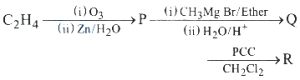
Consider the following sequence of reactions. The incorrect statement about $R$ is:
A
It gives test with Tollen's reagent
B
It undergoes Cannizzaro reaction
C
It gives iodoform test
D
It undergoes aldol condensation
Solution
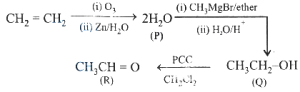
(B) Step $1$: Ozonolysis of $C_2H_4$ $(CH_2=CH_2)$ gives formaldehyde $(HCHO)$ as $P$.
Step $2$: Reaction of $HCHO$ with $CH_3MgBr$ followed by hydrolysis gives ethanol $(CH_3CH_2OH)$ as $Q$.
Step $3$: Oxidation of ethanol $(CH_3CH_2OH)$ with $PCC$ gives acetaldehyde $(CH_3CHO)$ as $R$.
$R$ is $CH_3CHO$,which contains $\alpha$-hydrogens. Therefore,it cannot undergo the Cannizzaro reaction. It gives a positive Tollen's test,iodoform test,and undergoes aldol condensation. Thus,the incorrect statement is that it undergoes the Cannizzaro reaction.
Step $2$: Reaction of $HCHO$ with $CH_3MgBr$ followed by hydrolysis gives ethanol $(CH_3CH_2OH)$ as $Q$.
Step $3$: Oxidation of ethanol $(CH_3CH_2OH)$ with $PCC$ gives acetaldehyde $(CH_3CHO)$ as $R$.
$R$ is $CH_3CHO$,which contains $\alpha$-hydrogens. Therefore,it cannot undergo the Cannizzaro reaction. It gives a positive Tollen's test,iodoform test,and undergoes aldol condensation. Thus,the incorrect statement is that it undergoes the Cannizzaro reaction.
0 likes
View Solution1609
MediumMCQ
The conversion of $X$ into $Y$ is an example of which reaction?

A
Rosenmund reduction
B
Clemmensen reduction
C
Wolff-Kishner reduction
D
Stephen reduction
Solution
(B) The reaction sequence is as follows:
$1$. Benzene reacts with acetyl chloride in the presence of anhydrous $AlCl_3$ (Friedel-Crafts acylation) to yield acetophenone $(X)$.
$2$. The reduction of ketones or aldehydes using zinc amalgam $(Zn-Hg)$ and concentrated hydrochloric acid $(HCl)$ yields the corresponding alkanes. This specific reaction is known as the Clemmensen reduction.
$3$. In this case,acetophenone $(X)$ is reduced to ethylbenzene $(Y)$ using $Zn-Hg/conc. HCl$.
$1$. Benzene reacts with acetyl chloride in the presence of anhydrous $AlCl_3$ (Friedel-Crafts acylation) to yield acetophenone $(X)$.
$2$. The reduction of ketones or aldehydes using zinc amalgam $(Zn-Hg)$ and concentrated hydrochloric acid $(HCl)$ yields the corresponding alkanes. This specific reaction is known as the Clemmensen reduction.
$3$. In this case,acetophenone $(X)$ is reduced to ethylbenzene $(Y)$ using $Zn-Hg/conc. HCl$.
0 likes
View Solution1610
DifficultMCQ
Propyne was subjected to a reaction with $HgSO_4/dil. H_2SO_4$,which resulted in a product $P$. The product $P$ was heated with $Ba(OH)_2$ to give the product $Q$. The molecular formula of the product $Q$ is
A
$C_3H_6O$
B
$C_3H_8O$
C
$C_6H_{12}O_2$
D
$C_6H_{10}O$
Solution
(D) When propyne is treated with $dil. H_2SO_4$ in the presence of $HgSO_4$,the major product $P$ is acetone $(CH_3COCH_3)$.
This reaction involves the addition of water to the triple bond to form an enol,which then tautomerizes to the keto form:
$CH_3C \equiv CH$ $\xrightarrow{HgSO_4, H_2SO_4} CH_3C(OH)=CH_2$ $\rightarrow CH_3COCH_3$ $(P)$
Acetone undergoes an aldol condensation reaction in the presence of $Ba(OH)_2$ to form diacetone alcohol:
$2CH_3COCH_3 \xrightarrow{Ba(OH)_2} (CH_3)_2C(OH)CH_2COCH_3$
Upon heating,diacetone alcohol undergoes dehydration to form mesityl oxide $(Q)$:
$(CH_3)_2C(OH)CH_2COCH_3 \xrightarrow{\Delta} (CH_3)_2C=CHCOCH_3$ $(Q)$
The molecular formula of mesityl oxide $(Q)$ is $C_6H_{10}O$.
This reaction involves the addition of water to the triple bond to form an enol,which then tautomerizes to the keto form:
$CH_3C \equiv CH$ $\xrightarrow{HgSO_4, H_2SO_4} CH_3C(OH)=CH_2$ $\rightarrow CH_3COCH_3$ $(P)$
Acetone undergoes an aldol condensation reaction in the presence of $Ba(OH)_2$ to form diacetone alcohol:
$2CH_3COCH_3 \xrightarrow{Ba(OH)_2} (CH_3)_2C(OH)CH_2COCH_3$
Upon heating,diacetone alcohol undergoes dehydration to form mesityl oxide $(Q)$:
$(CH_3)_2C(OH)CH_2COCH_3 \xrightarrow{\Delta} (CH_3)_2C=CHCOCH_3$ $(Q)$
The molecular formula of mesityl oxide $(Q)$ is $C_6H_{10}O$.
0 likes
View Solution1611
MediumMCQ
Assertion $(A)$: Ammonia and its derivatives of the form $H_2N-Z$ undergo condensation reaction with carbonyl compounds (aldehydes and ketones).
Reason $(R)$: This reaction is an example of an irreversible reaction.
The correct option among the following is:
Reason $(R)$: This reaction is an example of an irreversible reaction.
The correct option among the following is:
A
$A$ is true,$(R)$ is true and $(R)$ is the correct explanation for $(A)$
B
$A$ is true,$(R)$ is true but $(R)$ is not the correct explanation for $(A)$
C
$A$ is true but $(R)$ is false
D
$A$ is false but $(R)$ is true
Solution
(C) The reaction of ammonia derivatives $(H_2N-Z)$ with carbonyl compounds is a nucleophilic addition followed by the elimination of a water molecule to form an imine derivative $(>C=N-Z)$.
This reaction is reversible and is acid-catalyzed.
Therefore,the Assertion $(A)$ is true,but the Reason $(R)$ is false because the reaction is reversible,not irreversible.
This reaction is reversible and is acid-catalyzed.
Therefore,the Assertion $(A)$ is true,but the Reason $(R)$ is false because the reaction is reversible,not irreversible.
0 likes
View Solution1612
DifficultMCQ
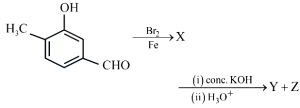
The major products $Y$ and $Z$ in the following reactions are
A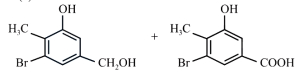
B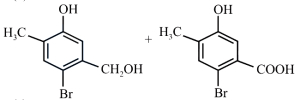
C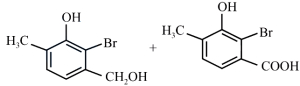
D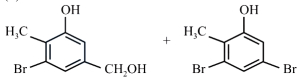
Solution
(B) Step $1$: Electrophilic aromatic substitution of $3$-methyl-$4$-hydroxybenzaldehyde with $Br_2/Fe$ occurs at the position ortho to the $-OH$ group. The $-OH$ group is a strong activating group,directing the incoming electrophile $Br^+$ to the ortho position. This yields $X$ ($3$-bromo-$4$-methyl-$5$-hydroxybenzaldehyde).
Step $2$: The compound $X$ undergoes the Cannizzaro reaction with concentrated $KOH$ followed by acid workup $(H_3O^+)$. The aldehyde group $(-CHO)$ is converted into a mixture of alcohol $(-CH_2OH)$ and carboxylic acid $(-COOH)$ groups. The resulting products $Y$ and $Z$ are $3$-bromo-$4$-methyl-$5$-hydroxybenzyl alcohol and $3$-bromo-$4$-methyl-$5$-hydroxybenzoic acid,respectively.
Step $2$: The compound $X$ undergoes the Cannizzaro reaction with concentrated $KOH$ followed by acid workup $(H_3O^+)$. The aldehyde group $(-CHO)$ is converted into a mixture of alcohol $(-CH_2OH)$ and carboxylic acid $(-COOH)$ groups. The resulting products $Y$ and $Z$ are $3$-bromo-$4$-methyl-$5$-hydroxybenzyl alcohol and $3$-bromo-$4$-methyl-$5$-hydroxybenzoic acid,respectively.
0 likes
View Solution1613
MediumMCQ
Match the following:
The correct match is:
| Column-$1$ (Reaction of carbonyl compound with) | Column-$2$ (Product) |
|---|---|
| $A$. Hydroxylamine | $I$. Hydrazone |
| $B$. Alcohol | $II$. Schiff's base (Substituted imine) |
| $C$. Hydrazine | $III$. Oxime |
| $D$. Amine | $IV$. Ketal |
A
$A-III, B-IV, C-I, D-II$
B
$A-III, B-II, C-I, D-IV$
C
$A-I, B-IV, C-III, D-II$
D
$A-I, B-II, C-III, D-IV$
Solution
(A) The reaction of carbonyl compounds with various nucleophiles is as follows:
$1$. Carbonyl compound + Hydroxylamine $(NH_2OH)$ $\rightarrow$ Oxime $(R_2C=NOH)$. Thus,$A-III$.
$2$. Carbonyl compound + Alcohol $(ROH)$ $\rightarrow$ Ketal $(R_2C(OR)_2)$. Thus,$B-IV$.
$3$. Carbonyl compound + Hydrazine $(NH_2NH_2)$ $\rightarrow$ Hydrazone $(R_2C=NNH_2)$. Thus,$C-I$.
$4$. Carbonyl compound + Amine $(R'NH_2)$ $\rightarrow$ Schiff's base/Imine $(R_2C=NR')$. Thus,$D-II$.
Therefore,the correct match is $A-III, B-IV, C-I, D-II$.
$1$. Carbonyl compound + Hydroxylamine $(NH_2OH)$ $\rightarrow$ Oxime $(R_2C=NOH)$. Thus,$A-III$.
$2$. Carbonyl compound + Alcohol $(ROH)$ $\rightarrow$ Ketal $(R_2C(OR)_2)$. Thus,$B-IV$.
$3$. Carbonyl compound + Hydrazine $(NH_2NH_2)$ $\rightarrow$ Hydrazone $(R_2C=NNH_2)$. Thus,$C-I$.
$4$. Carbonyl compound + Amine $(R'NH_2)$ $\rightarrow$ Schiff's base/Imine $(R_2C=NR')$. Thus,$D-II$.
Therefore,the correct match is $A-III, B-IV, C-I, D-II$.
0 likes
View Solution1614
MediumMCQ
Ethane can be obtained from ethanal in one step by
A
$Na-Hg + \text{water}$
B
$Zn-Hg + \text{conc. } HCl$
C
Aluminium isopropoxide and isopropyl alcohol
D
$LiAlH_4 + \text{ether}$
Solution
(B) Ethanal $(CH_3CHO)$ can be reduced to ethane $(CH_3CH_3)$ in one step using the Clemmensen reduction reagent,which consists of zinc amalgam $(Zn-Hg)$ and concentrated hydrochloric acid $(HCl)$.
This reaction reduces the carbonyl group $(>C=O)$ to a methylene group $(-CH_2-)$.
The chemical equation is:
$CH_3CHO \xrightarrow[\text{conc. } HCl]{Zn-Hg} CH_3-CH_3$
This reaction reduces the carbonyl group $(>C=O)$ to a methylene group $(-CH_2-)$.
The chemical equation is:
$CH_3CHO \xrightarrow[\text{conc. } HCl]{Zn-Hg} CH_3-CH_3$
0 likes
View Solution1615
DifficultMCQ
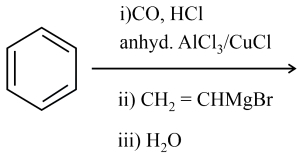
The major product of the following reaction sequence is
A
Benzophenone
B
Benzoic acid
C
Ethylbenzene
D
$1-$Phenylethenol
Solution
(D) The first step is the Gattermann-Koch reaction,where benzene reacts with $CO$ and $HCl$ in the presence of anhydrous $AlCl_3$ and $CuCl$ to form benzaldehyde $(C_6H_5CHO)$.
In the second step,the Grignard reagent $CH_2=CHMgBr$ (vinylmagnesium bromide) undergoes nucleophilic addition to the carbonyl group of benzaldehyde to form an alkoxide intermediate.
In the third step,hydrolysis with $H_2O$ converts the alkoxide into the final alcohol product,$1$-phenylethenol $(C_6H_5CH(OH)CH=CH_2)$.
In the second step,the Grignard reagent $CH_2=CHMgBr$ (vinylmagnesium bromide) undergoes nucleophilic addition to the carbonyl group of benzaldehyde to form an alkoxide intermediate.
In the third step,hydrolysis with $H_2O$ converts the alkoxide into the final alcohol product,$1$-phenylethenol $(C_6H_5CH(OH)CH=CH_2)$.
0 likes
View Solution1616
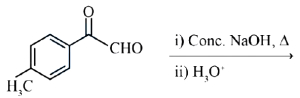
MediumMCQ
The major product of the following reaction is
A
$4-$methylphenylglycol
B
$1-$($4$-methylphenyl)ethane$-1,2-$diol
C
$2-$hydroxy$-2-$($4$-methylphenyl)acetic acid
D
$2-$hydroxy$-1-$($4$-methylphenyl)ethan$-1-$one
Solution
(C) The given reactant is $4$-methylphenylglyoxal $(CH_3-C_6H_4-CO-CHO)$.
This compound contains two carbonyl groups,both of which lack $\alpha$-hydrogens.
When treated with concentrated $NaOH$ followed by acid workup $(H_3O^+)$,it undergoes an intramolecular Cannizzaro reaction.
The aldehyde group $(-CHO)$ is more reactive towards nucleophilic attack than the ketone group $(-CO-)$.
Therefore,the aldehyde group is oxidized to a carboxylic acid $(-COOH)$ and the ketone group is reduced to a secondary alcohol $(-CH(OH)-)$.
The resulting product is $2$-hydroxy-$2-(4$-methylphenyl$)$acetic acid.
This compound contains two carbonyl groups,both of which lack $\alpha$-hydrogens.
When treated with concentrated $NaOH$ followed by acid workup $(H_3O^+)$,it undergoes an intramolecular Cannizzaro reaction.
The aldehyde group $(-CHO)$ is more reactive towards nucleophilic attack than the ketone group $(-CO-)$.
Therefore,the aldehyde group is oxidized to a carboxylic acid $(-COOH)$ and the ketone group is reduced to a secondary alcohol $(-CH(OH)-)$.
The resulting product is $2$-hydroxy-$2-(4$-methylphenyl$)$acetic acid.
0 likes
View Solution1617
MediumMCQ
Identify the major product $(P)$ in the given reaction of propanal with dilute $NaOH$ followed by heating.
A
$CH_3-CH_2-CH=C(CH_3)-CHO$
B
$CH_3-CH_2-CH(OH)-CH_2-CH_2-CHO$
C
$(CH_3)_2CH-CH=CH-CHO$
D
$CH_3-CH_2-CH=C(CH_3)-CHO$
Solution
(A) Propanal $(CH_3CH_2CHO)$ has $\alpha$-hydrogens,so it undergoes aldol condensation in the presence of a dilute base $(NaOH)$.
$1$. Two molecules of propanal react to form $3$-hydroxy-$2$-methylpentanal.
$2$. Upon heating,this $\beta$-hydroxy aldehyde undergoes dehydration to form the $\alpha,\beta$-unsaturated aldehyde,which is $2$-methylpent-$2$-enal.
Reaction: $2CH_3CH_2CHO \xrightarrow{dil. NaOH, \Delta} CH_3CH_2CH=C(CH_3)CHO + H_2O$.
$1$. Two molecules of propanal react to form $3$-hydroxy-$2$-methylpentanal.
$2$. Upon heating,this $\beta$-hydroxy aldehyde undergoes dehydration to form the $\alpha,\beta$-unsaturated aldehyde,which is $2$-methylpent-$2$-enal.
Reaction: $2CH_3CH_2CHO \xrightarrow{dil. NaOH, \Delta} CH_3CH_2CH=C(CH_3)CHO + H_2O$.
0 likes
View Solution1618
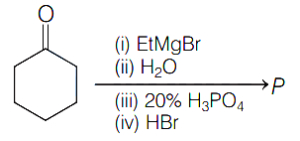
DifficultMCQ
The major product in the following reaction sequence is
A
$1-$bromo$-1-$ethylcyclohexane
B
$1-$bromo$-2-$ethylcyclohexane
C
$1-$bromo$-1-$ethylcyclohexane (isomer)
D
$3-$bromo$-1-$ethylcyclohexane
Solution
(A) $Step \ 1$: Cyclohexanone reacts with $EtMgBr$ (Grignard reagent) followed by hydrolysis $(H_2O)$ to form $1$-ethylcyclohexanol.
$Step \ 2$: Dehydration of $1$-ethylcyclohexanol in the presence of $20\% \ H_3PO_4$ yields ethylidenecyclohexane as the major alkene product.
$Step \ 3$: Addition of $HBr$ to ethylidenecyclohexane follows Markovnikov's rule,where the proton adds to the terminal carbon of the double bond and the bromide ion adds to the more substituted carbon,resulting in $1$-bromo-$1$-ethylcyclohexane as the final product $(P)$.
$Step \ 2$: Dehydration of $1$-ethylcyclohexanol in the presence of $20\% \ H_3PO_4$ yields ethylidenecyclohexane as the major alkene product.
$Step \ 3$: Addition of $HBr$ to ethylidenecyclohexane follows Markovnikov's rule,where the proton adds to the terminal carbon of the double bond and the bromide ion adds to the more substituted carbon,resulting in $1$-bromo-$1$-ethylcyclohexane as the final product $(P)$.
0 likes
View Solution1619
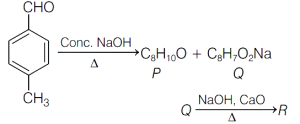
MediumMCQ
What is the product $R$ in the following reaction sequence?
A
p-Xylene
B
Toluene
C
p-Cresol
D
p-Methylbenzyl alcohol
Solution
(B) The given reaction is a Cannizzaro reaction of $4$-methylbenzaldehyde with concentrated $NaOH$.
$2 \ CH_3-C_6H_4-CHO + NaOH \xrightarrow{\Delta} CH_3-C_6H_4-CH_2OH (P) + CH_3-C_6H_4-COONa (Q)$.
Here,$P$ is $4$-methylbenzyl alcohol and $Q$ is sodium $4$-methylbenzoate.
When $Q$ is heated with sodalime $(NaOH + CaO)$,it undergoes decarboxylation to form toluene $(R)$.
$CH_3-C_6H_4-COONa + NaOH \xrightarrow{CaO, \Delta} CH_3-C_6H_5 + Na_2CO_3$.
Thus,the product $R$ is toluene.
$2 \ CH_3-C_6H_4-CHO + NaOH \xrightarrow{\Delta} CH_3-C_6H_4-CH_2OH (P) + CH_3-C_6H_4-COONa (Q)$.
Here,$P$ is $4$-methylbenzyl alcohol and $Q$ is sodium $4$-methylbenzoate.
When $Q$ is heated with sodalime $(NaOH + CaO)$,it undergoes decarboxylation to form toluene $(R)$.
$CH_3-C_6H_4-COONa + NaOH \xrightarrow{CaO, \Delta} CH_3-C_6H_5 + Na_2CO_3$.
Thus,the product $R$ is toluene.
0 likes
View Solution1620
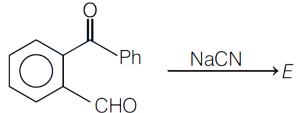
DifficultMCQ
What is the product $E$ in the following reaction?
A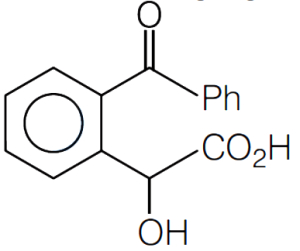
B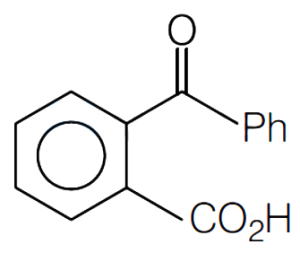
C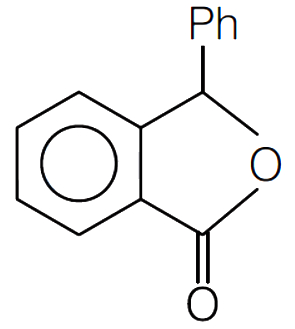
D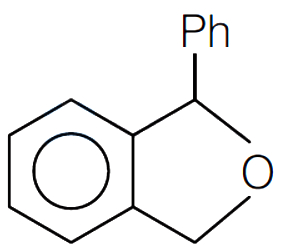
Solution
(C) The reaction is an intramolecular benzoin condensation followed by rearrangement.
$CN^-$ acts as a nucleophile and attacks the aldehyde carbonyl group.
This is followed by an intramolecular attack on the ketone carbonyl group.
After hydrolysis and rearrangement,the final product $E$ is formed,which is a cyclic compound as shown in the reaction mechanism.
$CN^-$ acts as a nucleophile and attacks the aldehyde carbonyl group.
This is followed by an intramolecular attack on the ketone carbonyl group.
After hydrolysis and rearrangement,the final product $E$ is formed,which is a cyclic compound as shown in the reaction mechanism.
0 likes
View Solution1621
MediumMCQ
Benzaldehyde can be converted to benzonitrile by treatment with
A
$NH_3$
B
$NH_3$ followed by reaction with $C_6H_5SO_2Cl$
C
$NH_2OH$ followed by reaction with acetic anhydride
D
$NH_2OH$
Solution
(C) When benzaldehyde reacts with $NH_2OH$ (hydroxylamine),an oxime is formed.
Further,the oxime undergoes dehydration upon heating with acetic anhydride to yield benzonitrile.
$C_6H_5CHO + NH_2OH \rightarrow C_6H_5CH=NOH + H_2O$
$C_6H_5CH=NOH \xrightarrow{Ac_2O, \Delta} C_6H_5CN + H_2O$
Thus,option $(C)$ is correct.
Further,the oxime undergoes dehydration upon heating with acetic anhydride to yield benzonitrile.
$C_6H_5CHO + NH_2OH \rightarrow C_6H_5CH=NOH + H_2O$
$C_6H_5CH=NOH \xrightarrow{Ac_2O, \Delta} C_6H_5CN + H_2O$
Thus,option $(C)$ is correct.
0 likes
View Solution1622
MediumMCQ
Identify the method that gives benzyl alcohol.
A
Toluene $\xrightarrow{1) CrO_2Cl_2, CS_2 \ 2) H_3O^+}$
B
Benzaldehyde $\xrightarrow{H_2, Pd-BaSO_4}$
C
Benzaldehyde $\xrightarrow{Conc. NaOH, \Delta}$
D
Benzene $\xrightarrow{CO, HCl, Anhyd. AlCl_3/CuCl}$
Solution
(C) The reaction of benzaldehyde with concentrated $NaOH$ is a Cannizzaro reaction.
In this reaction,two molecules of a non-enolizable aldehyde undergo base-induced disproportionation to form a primary alcohol and a carboxylic acid salt.
Benzaldehyde,being a non-enolizable aldehyde,reacts with concentrated $NaOH$ to produce benzyl alcohol and sodium benzoate.
Therefore,option $(C)$ is correct.
In this reaction,two molecules of a non-enolizable aldehyde undergo base-induced disproportionation to form a primary alcohol and a carboxylic acid salt.
Benzaldehyde,being a non-enolizable aldehyde,reacts with concentrated $NaOH$ to produce benzyl alcohol and sodium benzoate.
Therefore,option $(C)$ is correct.
0 likes
View Solution1623
MediumMCQ
The product $(P)$ of the below reaction sequence is:
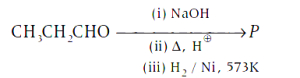
A
$CH_3CH_2CH=C(CH_3)CH_3$
B
$CH_3CH_2CH_2CH(CH_3)CH_2OH$
C
$CH_3CH_2CH=C(CH_3)CHO$
D
$CH_3CH_2CH=C(CH_3)CO_2H$
Solution
(B) Step $1$: Aldol condensation of $CH_3CH_2CHO$ (propanal) in the presence of $NaOH$ gives $\beta$-hydroxy aldehyde,which upon heating $( \Delta, H^{\oplus} )$ undergoes dehydration to form an $\alpha,\beta$-unsaturated aldehyde: $CH_3CH_2CH=C(CH_3)CHO$.
Step $2$: The final step involves hydrogenation using $H_2/Ni$ at $573 \ K$. This reagent reduces both the carbon-carbon double bond and the aldehyde group to a primary alcohol.
Thus,the final product $(P)$ is $CH_3CH_2CH_2CH(CH_3)CH_2OH$.
Step $2$: The final step involves hydrogenation using $H_2/Ni$ at $573 \ K$. This reagent reduces both the carbon-carbon double bond and the aldehyde group to a primary alcohol.
Thus,the final product $(P)$ is $CH_3CH_2CH_2CH(CH_3)CH_2OH$.
0 likes
View Solution1624
DifficultMCQ
The products $A$,$B$ and $C$ in the following reaction sequence are:

A
$A$: $1-$phenylbutan$-2-$ol,$B$: $1-$phenylbutan$-2-$imine,$C$: $1-$phenylbutan$-2-$amine
B
$A$: $1-$phenylbutan$-2-$one,$B$: $1-$phenylbut$-1-$ene,$C$: $1-$phenylbutane
C
$A$: $1-$phenylbutan$-2-$one,$B$: $1-$phenylbutan$-2-$hydrazone,$C$: $1-$phenylbutane
D
$A$: $1-$phenylbutan$-2-$one,$B$: $1-$phenylbutan$-2-$imine,$C$: $1-$phenylbutane
Solution
(C) The reaction sequence is as follows:
$1$. Oxidation of the secondary alcohol $1\text{-phenylbutan-2-ol}$ with $PCC$ (Pyridinium chlorochromate) yields the ketone $A$,which is $1\text{-phenylbutan-2-one}$ $(CH_3CH_2COCH_2Ph)$.
$2$. The reaction of the ketone $A$ with hydrazine $(H_2N-NH_2)$ forms the hydrazone $B$,which is $1\text{-phenylbutan-2-one hydrazone}$ $(CH_3CH_2C(=NNH_2)CH_2Ph)$.
$3$. The subsequent treatment of the hydrazone $B$ with $KOH$ in ethylene glycol at high temperature is the Wolff-Kishner reduction,which reduces the carbonyl group to a methylene group,yielding the alkane $C$,which is $1\text{-phenylbutane}$ $(CH_3CH_2CH_2CH_2Ph)$.
Thus,the correct sequence is $A$: $1\text{-phenylbutan-2-one}$,$B$: $1\text{-phenylbutan-2-one hydrazone}$,$C$: $1\text{-phenylbutane}$.
$1$. Oxidation of the secondary alcohol $1\text{-phenylbutan-2-ol}$ with $PCC$ (Pyridinium chlorochromate) yields the ketone $A$,which is $1\text{-phenylbutan-2-one}$ $(CH_3CH_2COCH_2Ph)$.
$2$. The reaction of the ketone $A$ with hydrazine $(H_2N-NH_2)$ forms the hydrazone $B$,which is $1\text{-phenylbutan-2-one hydrazone}$ $(CH_3CH_2C(=NNH_2)CH_2Ph)$.
$3$. The subsequent treatment of the hydrazone $B$ with $KOH$ in ethylene glycol at high temperature is the Wolff-Kishner reduction,which reduces the carbonyl group to a methylene group,yielding the alkane $C$,which is $1\text{-phenylbutane}$ $(CH_3CH_2CH_2CH_2Ph)$.
Thus,the correct sequence is $A$: $1\text{-phenylbutan-2-one}$,$B$: $1\text{-phenylbutan-2-one hydrazone}$,$C$: $1\text{-phenylbutane}$.
0 likes
View Solution1625
MediumMCQ
What is the possible product $(P)$ in the following reaction?
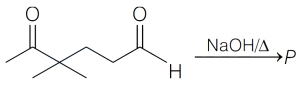
A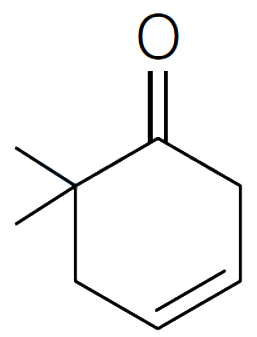
B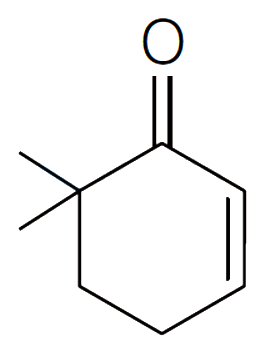
C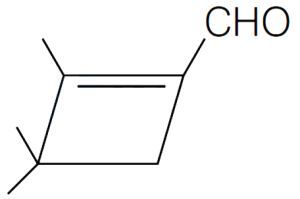
D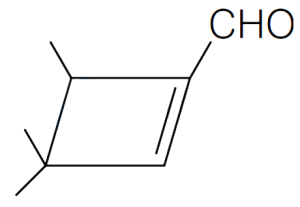
Solution
(A) The given reaction is an intramolecular aldol condensation.
$1$. The reactant is a keto-aldehyde,specifically $6$-methylhept-$5$-en-$2$-one derivative or similar structure.
$2$. In the presence of $NaOH$ and heat $(\Delta)$,the enolate formed at the $\alpha$-carbon of the ketone attacks the carbonyl carbon of the aldehyde.
$3$. This leads to the formation of a cyclic $\beta$-hydroxy aldehyde/ketone,which subsequently undergoes dehydration (elimination of water) to form an $\alpha,\beta$-unsaturated carbonyl compound.
$4$. Based on the structure,the product is $6,6$-dimethylcyclohex-$2$-en-$1$-one.
$1$. The reactant is a keto-aldehyde,specifically $6$-methylhept-$5$-en-$2$-one derivative or similar structure.
$2$. In the presence of $NaOH$ and heat $(\Delta)$,the enolate formed at the $\alpha$-carbon of the ketone attacks the carbonyl carbon of the aldehyde.
$3$. This leads to the formation of a cyclic $\beta$-hydroxy aldehyde/ketone,which subsequently undergoes dehydration (elimination of water) to form an $\alpha,\beta$-unsaturated carbonyl compound.
$4$. Based on the structure,the product is $6,6$-dimethylcyclohex-$2$-en-$1$-one.
0 likes
View Solution1626
MediumMCQ
What is the product obtained in the reaction of acetaldehyde with semicarbazide?
A
$H_3C-CH=N-NH-C(=O)-NH_2$
B
$H_3C-CH=N-NH_2$
C
$H_3C-CH=N-OH$
D
$H_3C-C(CH_3)=N-NH-C(=O)-NH_2$
Solution
(A) The reaction between acetaldehyde $(CH_3CHO)$ and semicarbazide $(H_2N-NHCONH_2)$ is a nucleophilic addition-elimination reaction.
In this reaction,the carbonyl oxygen of the acetaldehyde is replaced by the nitrogen atom of the semicarbazide,resulting in the formation of a semicarbazone derivative.
The reaction is as follows:
$CH_3CHO + H_2N-NHCONH_2 \rightarrow CH_3CH=N-NHCONH_2 + H_2O$
The product formed is acetaldehyde semicarbazone,which corresponds to the structure $H_3C-CH=N-NH-C(=O)-NH_2$.
In this reaction,the carbonyl oxygen of the acetaldehyde is replaced by the nitrogen atom of the semicarbazide,resulting in the formation of a semicarbazone derivative.
The reaction is as follows:
$CH_3CHO + H_2N-NHCONH_2 \rightarrow CH_3CH=N-NHCONH_2 + H_2O$
The product formed is acetaldehyde semicarbazone,which corresponds to the structure $H_3C-CH=N-NH-C(=O)-NH_2$.
0 likes
View Solution1627
MediumMCQ
The synthesis of crotonaldehyde from acetaldehyde is an example of ....... reaction.
A
nucleophilic addition
B
elimination
C
electrophilic addition
D
nucleophilic addition-elimination
Solution
(D) The synthesis of crotonaldehyde from acetaldehyde occurs in two steps:
$1$. Aldol condensation of two molecules of acetaldehyde $(CH_3CHO)$ in the presence of dilute $NaOH$ to form $3-$hydroxybutanal (aldol). This step is a nucleophilic addition reaction.
$2$. Dehydration (elimination of water) of $3-$hydroxybutanal upon heating to form crotonaldehyde $(CH_3CH=CHCHO)$.
Since the overall process involves both nucleophilic addition and elimination,it is classified as a nucleophilic addition-elimination reaction.
$1$. Aldol condensation of two molecules of acetaldehyde $(CH_3CHO)$ in the presence of dilute $NaOH$ to form $3-$hydroxybutanal (aldol). This step is a nucleophilic addition reaction.
$2$. Dehydration (elimination of water) of $3-$hydroxybutanal upon heating to form crotonaldehyde $(CH_3CH=CHCHO)$.
Since the overall process involves both nucleophilic addition and elimination,it is classified as a nucleophilic addition-elimination reaction.
0 likes
View Solution1628
MediumMCQ
Acetone on addition to methyl magnesium bromide forms a complex,which on decomposition with acid gives $X$ and $Mg(OH)Br$. Which one of the following is $X$?
A
$CH_3OH$
B
$(CH_3)_3COH$
C
$(CH_3)_2CHOH$
D
$CH_3CH_2OH$
Solution
(B) Acetone $(CH_3COCH_3)$ reacts with methyl magnesium bromide $(CH_3MgBr)$ to form an addition complex.
This complex is $(CH_3)_3COMgBr$.
Upon acid hydrolysis (decomposition with acid),the complex undergoes protonation to yield a tertiary alcohol,$2$-methylpropan-$2$-ol,which is $(CH_3)_3COH$,and $Mg(OH)Br$.
Thus,$X$ is $(CH_3)_3COH$.
This complex is $(CH_3)_3COMgBr$.
Upon acid hydrolysis (decomposition with acid),the complex undergoes protonation to yield a tertiary alcohol,$2$-methylpropan-$2$-ol,which is $(CH_3)_3COH$,and $Mg(OH)Br$.
Thus,$X$ is $(CH_3)_3COH$.
0 likes
View Solution1629
MediumMCQ
Given the reactions:
$CaOCl_2 + H_2O \longrightarrow Ca(OH)_2 + X$
$X + CH_3CHO \longrightarrow Y$
$Y + Ca(OH)_2 \longrightarrow CHCl_3$
What is '$Y$'?
$CaOCl_2 + H_2O \longrightarrow Ca(OH)_2 + X$
$X + CH_3CHO \longrightarrow Y$
$Y + Ca(OH)_2 \longrightarrow CHCl_3$
What is '$Y$'?
A
$CH_3CH(OH)_2$
B
$CH_2Cl_2$
C
$CCl_3CHO$
D
$CCl_3COCH_3$
Solution
(C) The reaction sequence represents the haloform reaction for the preparation of chloroform $(CHCl_3)$:
$1$. Bleaching powder reacts with water to produce chlorine gas $(X)$:
$CaOCl_2 + H_2O \longrightarrow Ca(OH)_2 + Cl_2 (X)$
$2$. Acetaldehyde reacts with chlorine to form chloral $(Y)$:
$CH_3CHO + 3Cl_2 \longrightarrow CCl_3CHO (Y) + 3HCl$
$3$. Chloral reacts with calcium hydroxide to produce chloroform:
$2CCl_3CHO + Ca(OH)_2 \longrightarrow 2CHCl_3 + (HCOO)_2Ca$
Thus,'$Y$' is $CCl_3CHO$ (chloral).
$1$. Bleaching powder reacts with water to produce chlorine gas $(X)$:
$CaOCl_2 + H_2O \longrightarrow Ca(OH)_2 + Cl_2 (X)$
$2$. Acetaldehyde reacts with chlorine to form chloral $(Y)$:
$CH_3CHO + 3Cl_2 \longrightarrow CCl_3CHO (Y) + 3HCl$
$3$. Chloral reacts with calcium hydroxide to produce chloroform:
$2CCl_3CHO + Ca(OH)_2 \longrightarrow 2CHCl_3 + (HCOO)_2Ca$
Thus,'$Y$' is $CCl_3CHO$ (chloral).
0 likes
View Solution1630
MediumMCQ
Which of the products is formed when acetone is reacted with barium hydroxide solution?
A
$CH_3-CO-CH_2-C(OH)(CH_3)_2$
B
$CH_3-CO-CH(CH_3)-CH(OH)-CH_3$
C
$CH_3-CO-CH(OH)-CH(CH_3)-CH_3$
D
$CH_3-C(OH)(CH_3)-C(OH)(CH_3)_2$
Solution
(A) When acetone $(CH_3COCH_3)$ is treated with a base like barium hydroxide $(Ba(OH)_2)$,it undergoes an aldol condensation reaction.
Two molecules of acetone react to form $4$-hydroxy-$4$-methylpentan-$2$-one,which is commonly known as diacetone alcohol.
The reaction is as follows:
$2CH_3COCH_3 \xrightarrow{Ba(OH)_2} CH_3-CO-CH_2-C(OH)(CH_3)_2$
Therefore,the correct product is represented by option $A$.
Two molecules of acetone react to form $4$-hydroxy-$4$-methylpentan-$2$-one,which is commonly known as diacetone alcohol.
The reaction is as follows:
$2CH_3COCH_3 \xrightarrow{Ba(OH)_2} CH_3-CO-CH_2-C(OH)(CH_3)_2$
Therefore,the correct product is represented by option $A$.
0 likes
View Solution1631
MediumMCQ
$3$-hydroxybutanal is formed when $(X)$ reacts with $(Y)$ in a dilute $(Z)$ solution. What are $X, Y$ and $Z$?
A
$CH_3CHO, CH_3COCH_3, NaOH$
B
$CH_3CHO, CH_3CHO, NaCl$
C
$CH_3COCH_3, CH_3COCH_3, HCl$
D
$CH_3CHO, CH_3CHO, NaOH$
Solution
(D) $3$-hydroxybutanal is an aldol product.
It is formed by the aldol condensation of two molecules of acetaldehyde $(CH_3CHO)$ in the presence of a dilute base like $NaOH$.
Reaction: $2 CH_3CHO \xrightarrow{\text{dilute } NaOH} CH_3-CH(OH)-CH_2-CHO$.
Therefore,$X = CH_3CHO$,$Y = CH_3CHO$,and $Z = NaOH$.
It is formed by the aldol condensation of two molecules of acetaldehyde $(CH_3CHO)$ in the presence of a dilute base like $NaOH$.
Reaction: $2 CH_3CHO \xrightarrow{\text{dilute } NaOH} CH_3-CH(OH)-CH_2-CHO$.
Therefore,$X = CH_3CHO$,$Y = CH_3CHO$,and $Z = NaOH$.
0 likes
View Solution1632
MediumMCQ
Which of the following reagents can form a hydrazone with alkanone?
A
$NH_2OH$
B
$PhNHNH_2$
C
$NH_2NHCONH_2$
D
$HCN$
Solution
(B) Hydrazines react with alkanones through a nucleophilic addition-elimination reaction to form hydrazones.
$PhNHNH_2$ (Phenylhydrazine) reacts with an alkanone $(>C=O)$ to produce a phenylhydrazone $(>C=N-NHC_6H_5)$ and water $(H_2O)$.
The reaction is:
$>C=O + H_2N-NHC_6H_5 \rightarrow >C=N-NHC_6H_5 + H_2O$
$PhNHNH_2$ (Phenylhydrazine) reacts with an alkanone $(>C=O)$ to produce a phenylhydrazone $(>C=N-NHC_6H_5)$ and water $(H_2O)$.
The reaction is:
$>C=O + H_2N-NHC_6H_5 \rightarrow >C=N-NHC_6H_5 + H_2O$
0 likes
View Solution1633
EasyMCQ
Acetaldehyde forms a white crystalline precipitate on mixing with a ...... solution of
A
acidic,$Zn-Hg$
B
alcoholic,$Na_2SO_3$
C
saturated aqueous,$NaHSO_3$
D
aqueous,$NaCl$
Solution
(C) Acetaldehyde $(CH_3CHO)$ reacts with a saturated aqueous solution of sodium bisulphite $(NaHSO_3)$ to form an addition product known as acetaldehyde sodium bisulphite.
This product appears as a white crystalline precipitate.
The reaction is as follows:
$CH_3CHO + NaHSO_3 \rightarrow CH_3-CH(OH)-SO_3Na$
(Acetaldehyde sodium bisulphite,white crystalline precipitate).
This product appears as a white crystalline precipitate.
The reaction is as follows:
$CH_3CHO + NaHSO_3 \rightarrow CH_3-CH(OH)-SO_3Na$
(Acetaldehyde sodium bisulphite,white crystalline precipitate).
0 likes
View Solution1634
MediumMCQ
What is $X$ in the following reaction?
$2 CH_3COCH_3 \stackrel{Ba(OH)_2}{\longrightarrow} X$
$2 CH_3COCH_3 \stackrel{Ba(OH)_2}{\longrightarrow} X$
A
$CH_3-C(OH)(CH_3)-CH_2-CO-CH_3$
B
$CH_3-C(OH)(CH_3)-CH_2-CH_2-CHO$
C
$CH_3CH(CH_3)CH_2COCH_3$
D
$H_3C-CH(CH_3)-CH(OH)-CO-CH_3$
Solution
(A) The reaction $2 CH_3COCH_3 \stackrel{Ba(OH)_2}{\longrightarrow} X$ is an aldol condensation reaction of acetone.
In this reaction,two molecules of acetone undergo condensation in the presence of a base like $Ba(OH)_2$ to form $4-hydroxy-4-methylpentan-2-one$.
The reaction mechanism involves the formation of an enolate ion from one acetone molecule,which then attacks the carbonyl carbon of another acetone molecule.
The product $X$ is $CH_3-C(OH)(CH_3)-CH_2-CO-CH_3$.
In this reaction,two molecules of acetone undergo condensation in the presence of a base like $Ba(OH)_2$ to form $4-hydroxy-4-methylpentan-2-one$.
The reaction mechanism involves the formation of an enolate ion from one acetone molecule,which then attacks the carbonyl carbon of another acetone molecule.
The product $X$ is $CH_3-C(OH)(CH_3)-CH_2-CO-CH_3$.
0 likes
View Solution1635
EasyMCQ
When acetaldehyde is reacted with $LiAlH_4$,what is the product formed?
A
$CH_3COOH$
B
$CH_3CH_2OH$
C
$CH_3OH$
D
$HCOOH$
Solution
(B) Acetaldehyde $(CH_3CHO)$ is an aldehyde.
$LiAlH_4$ is a strong reducing agent that reduces aldehydes to primary alcohols.
The reaction is as follows:
$CH_3CHO + 2[H] \xrightarrow{LiAlH_4} CH_3CH_2OH$
Therefore,the product formed is ethanol $(CH_3CH_2OH)$.
$LiAlH_4$ is a strong reducing agent that reduces aldehydes to primary alcohols.
The reaction is as follows:
$CH_3CHO + 2[H] \xrightarrow{LiAlH_4} CH_3CH_2OH$
Therefore,the product formed is ethanol $(CH_3CH_2OH)$.
0 likes
View Solution8-1.Aldehydes and Ketones — Properties · Frequently Asked Questions
1Are these 8-1.Aldehydes and Ketones questions useful for JEE and NEET?
Yes. All questions in this section are mapped to JEE Main and NEET exam patterns. Previous year questions from JEE Main, NEET, GUJCET and state-level exams are included with full solutions.
2Can I switch to Hindi or Gujarati for these questions?
Yes. Use the language tabs in the hero section or the sidebar to view the same questions and solutions in English, Hindi or Gujarati.
3How do I generate a question paper from this subtopic?
Use the Vedclass Exam Paper Generator — select the chapter and subtopic, set difficulty, and generate Sets A, B, C, D automatically. First 3 chapters of every subject are free.
Vedclass Products
For Students
Vedclass Test Series
Mock tests in real JEE/NEET style with performance analysis. 5-day free trial.
Start Free TrialFor Teachers
Exam Paper Generator
Generate Set A/B/C/D papers from this chapter in 2 minutes. 3 chapters free.
Try FreeFor Institutes
Online Exam Module
Live online exams with unlimited students, 360° analytics & white-label branding.
See DemoFor Teachers & Institutes
Generate a 8-1.Aldehydes and Ketones Exam Paper in 2 Minutes
Select subtopic & difficulty — Sets A, B, C, D auto-generated with No Repeat logic.
First 3 chapters of every subject are free — no payment required.