
A English
Properties Questions in English
Class 12 Chemistry · 8-1.Aldehydes and Ketones · Properties
1739+
Questions
English
Language
100%
With Solutions
Showing 38 of 1739 questions in English
1651
DifficultMCQ
Consider the following reaction sequence:
$\text{But-2-ene}$ $\xrightarrow{\text{ozonolysis}} X$ $\xrightarrow[(ii) H_3O^+]{(i) CH_3MgBr} Y$ $\xrightarrow[573 \ K]{Cu} Z$
The correct statements about $Z$ are:
$I$. It gives yellow precipitate with $I_2$ and $NaOH$ solution.
$II$. It undergoes disproportionation reaction in the presence of concentrated $NaOH$ solution.
$III$. It undergoes Wolff-Kishner reduction.
$IV$. It forms red precipitate with Fehling's reagent.
$\text{But-2-ene}$ $\xrightarrow{\text{ozonolysis}} X$ $\xrightarrow[(ii) H_3O^+]{(i) CH_3MgBr} Y$ $\xrightarrow[573 \ K]{Cu} Z$
The correct statements about $Z$ are:
$I$. It gives yellow precipitate with $I_2$ and $NaOH$ solution.
$II$. It undergoes disproportionation reaction in the presence of concentrated $NaOH$ solution.
$III$. It undergoes Wolff-Kishner reduction.
$IV$. It forms red precipitate with Fehling's reagent.
A
$I$ & $II$ only
B
$II$ & $III$ only
C
$I$ & $IV$ only
D
$I$ & $III$ only
Solution
(D) $1$. Ozonolysis of $\text{but-2-ene}$ gives acetaldehyde $(CH_3CHO)$ as $X$.
$2$. Reaction of $X$ $(CH_3CHO)$ with $CH_3MgBr$ followed by hydrolysis gives propan$-2-$ol $(CH_3CH(OH)CH_3)$ as $Y$.
$3$. Dehydrogenation of $Y$ (a secondary alcohol) with $Cu$ at $573 \ K$ gives acetone $(CH_3COCH_3)$ as $Z$.
$4$. $Z$ is acetone,which is a methyl ketone. It gives a positive iodoform test (yellow precipitate with $I_2$ and $NaOH$),so statement $I$ is correct.
$5$. Acetone does not have $\alpha$-hydrogens that can lead to Cannizzaro reaction,so it does not undergo disproportionation with concentrated $NaOH$,making $II$ incorrect.
$6$. Acetone undergoes Wolff-Kishner reduction to form propane,so statement $III$ is correct.
$7$. Acetone is a ketone and does not reduce Fehling's reagent,so statement $IV$ is incorrect.
Therefore,statements $I$ and $III$ are correct.
$2$. Reaction of $X$ $(CH_3CHO)$ with $CH_3MgBr$ followed by hydrolysis gives propan$-2-$ol $(CH_3CH(OH)CH_3)$ as $Y$.
$3$. Dehydrogenation of $Y$ (a secondary alcohol) with $Cu$ at $573 \ K$ gives acetone $(CH_3COCH_3)$ as $Z$.
$4$. $Z$ is acetone,which is a methyl ketone. It gives a positive iodoform test (yellow precipitate with $I_2$ and $NaOH$),so statement $I$ is correct.
$5$. Acetone does not have $\alpha$-hydrogens that can lead to Cannizzaro reaction,so it does not undergo disproportionation with concentrated $NaOH$,making $II$ incorrect.
$6$. Acetone undergoes Wolff-Kishner reduction to form propane,so statement $III$ is correct.
$7$. Acetone is a ketone and does not reduce Fehling's reagent,so statement $IV$ is incorrect.
Therefore,statements $I$ and $III$ are correct.
0 likes
View Solution1652
DifficultMCQ
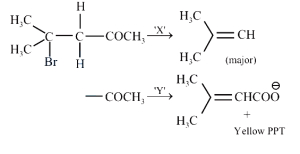
The suitable reagents $X$ and $Y$,respectively,in the following reactions are:
A
aq. $KOH, CrO_3$
B
alc. $KOH, Cu / \Delta$
C
aq. $NaHCO_3, KMnO_4$
D
alc. $KOH, NaOI$
Solution
(D) For reagent $X$: The starting material is a $\beta$-bromo ketone. Treatment with alcoholic $KOH$ (alc. $KOH$) leads to dehydrohalogenation via an $E2$ mechanism,resulting in the formation of an $\alpha,\beta$-unsaturated ketone.
For reagent $Y$: The product contains a carboxylate ion and a yellow precipitate $(CHI_3)$,which is characteristic of the iodoform reaction. This reaction is specific to methyl ketones (or alcohols that can be oxidized to methyl ketones) and is performed using $NaOI$ (sodium hypoiodite).
For reagent $Y$: The product contains a carboxylate ion and a yellow precipitate $(CHI_3)$,which is characteristic of the iodoform reaction. This reaction is specific to methyl ketones (or alcohols that can be oxidized to methyl ketones) and is performed using $NaOI$ (sodium hypoiodite).
0 likes
View Solution1653
MediumMCQ
Match the items in List-$I$ with the items in List-$II$ and select the correct code:
| List-$I$ | List-$II$ |
| $A$. Tollen's reagent | $I$. Para-rosaniline + $SO_2$ |
| $B$. Schiff's reagent | $II$. Rochelle salt + $aq. NaOH$ |
| $C$. Rosenmund reduction | $III$. Ammoniacal silver nitrate |
| $D$. Fehling solution $B$ | $IV$. $Pd + BaSO_4$ |
A
$A-III, B-I, C-IV, D-II$
B
$A-II, B-III, C-I, D-IV$
C
$A-I, B-III, C-IV, D-II$
D
$A-II, B-IV, C-III, D-I$
Solution
(A) . Tollen's reagent is ammoniacal silver nitrate.
$B$. Schiff's reagent is a solution of para-rosaniline hydrochloride decolorized by $SO_2$.
$C$. Rosenmund reduction uses $Pd$ supported on $BaSO_4$ as a catalyst.
$D$. Fehling solution '$B$' is an aqueous solution of Rochelle salt (potassium sodium tartrate) in $NaOH$.
Thus,the correct matching is $A-III, B-I, C-IV, D-II$.
$B$. Schiff's reagent is a solution of para-rosaniline hydrochloride decolorized by $SO_2$.
$C$. Rosenmund reduction uses $Pd$ supported on $BaSO_4$ as a catalyst.
$D$. Fehling solution '$B$' is an aqueous solution of Rochelle salt (potassium sodium tartrate) in $NaOH$.
Thus,the correct matching is $A-III, B-I, C-IV, D-II$.
0 likes
View Solution1654
MediumMCQ
An organic compound,'$A$' with molecular formula $C_8H_8O$ on reaction with $I_2/KOH$ gives a salt of carboxylic acid '$B$' and a halo-compound '$C$'. Compound '$C$' on reaction with silver powder gives '$D$'. The structures of '$A$' and '$D$' are
A
$A$: Acetophenone,$D$: $CH_3CHO$
B
$A$: Acetophenone,$D$: $HC\equiv CH$
C
$A$: Phenyl vinyl ether,$D$: $H_2C=CH_2$
D
$A$: Acetophenone,$D$: $CH_4$
Solution
(B) $1$. The compound '$A$' has the molecular formula $C_8H_8O$ and reacts with $I_2/KOH$ (haloform reaction),which indicates the presence of a methyl ketone group $(-COCH_3)$.
$2$. Acetophenone $(C_6H_5COCH_3)$ fits this description. It reacts with $I_2/KOH$ to form potassium benzoate ($B$,$C_6H_5COOK$) and iodoform ($C$,$CHI_3$).
$3$. Iodoform $(CHI_3)$ on heating with silver powder $(Ag)$ undergoes dehalogenation to form acetylene ($D$,$HC\equiv CH$).
$4$. The reaction is: $2CHI_3 + 6Ag \rightarrow HC\equiv CH + 6AgI$.
$5$. Therefore,'$A$' is acetophenone and '$D$' is acetylene $(HC\equiv CH)$.
$2$. Acetophenone $(C_6H_5COCH_3)$ fits this description. It reacts with $I_2/KOH$ to form potassium benzoate ($B$,$C_6H_5COOK$) and iodoform ($C$,$CHI_3$).
$3$. Iodoform $(CHI_3)$ on heating with silver powder $(Ag)$ undergoes dehalogenation to form acetylene ($D$,$HC\equiv CH$).
$4$. The reaction is: $2CHI_3 + 6Ag \rightarrow HC\equiv CH + 6AgI$.
$5$. Therefore,'$A$' is acetophenone and '$D$' is acetylene $(HC\equiv CH)$.
0 likes
View Solution1655
MediumMCQ
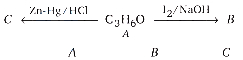
Compound $A$ $(C_3H_6O)$ undergoes the following reactions to form $B$ and $C$. Identify $A, B$ and $C$.
A
$A = CH_3COCH_3, B = CHI_3, C = CH_3CH_2CH_3$
B
$A = CH_2=C(H)CH_2OH, B = CH_3I, C = CH_3CH_2CH_2OH$
C
$A = CH_3CH_2CHO, B = CHI_3, C = CH_3CH(OH)CH_3$
D
$A = CH_3COCH_3, B = CHI_3, C = CH_3CH(OH)CH_3$
Solution
(A) The compound $A$ is $CH_3COCH_3$ (acetone),which has the molecular formula $C_3H_6O$.
$1$. Reaction with $I_2/NaOH$ (Iodoform test): Acetone reacts with $I_2$ in the presence of $NaOH$ to give a yellow precipitate of iodoform $(CHI_3)$.
$CH_3COCH_3 + 3I_2 + 4NaOH \rightarrow CHI_3 + CH_3COONa + 3NaI + 3H_2O$. Here,$B$ is $CHI_3$.
$2$. Reaction with $Zn-Hg/HCl$ (Clemmensen reduction): Acetone undergoes reduction to form propane $(CH_3CH_2CH_3)$.
$CH_3COCH_3 \xrightarrow{Zn-Hg/HCl} CH_3CH_2CH_3$. Here,$C$ is $CH_3CH_2CH_3$.
$1$. Reaction with $I_2/NaOH$ (Iodoform test): Acetone reacts with $I_2$ in the presence of $NaOH$ to give a yellow precipitate of iodoform $(CHI_3)$.
$CH_3COCH_3 + 3I_2 + 4NaOH \rightarrow CHI_3 + CH_3COONa + 3NaI + 3H_2O$. Here,$B$ is $CHI_3$.
$2$. Reaction with $Zn-Hg/HCl$ (Clemmensen reduction): Acetone undergoes reduction to form propane $(CH_3CH_2CH_3)$.
$CH_3COCH_3 \xrightarrow{Zn-Hg/HCl} CH_3CH_2CH_3$. Here,$C$ is $CH_3CH_2CH_3$.
0 likes
View Solution1656
EasyMCQ
When acetaldehyde is heated with Fehling solution,a red precipitate is formed. Which of the following is that?
A
$Cu_2O$
B
$Cu$
C
$CuO$
D
$CuSO_4$
Solution
(A) When acetaldehyde $(CH_3CHO)$ is heated with Fehling solution,it undergoes oxidation to form acetate ions,while the $Cu^{2+}$ ions in the Fehling solution are reduced to $Cu^+$ ions.
This results in the formation of a red precipitate of cuprous oxide $(Cu_2O)$.
The chemical reaction is:
$CH_3CHO + 2Cu(OH)_2 + NaOH \longrightarrow CH_3COONa + Cu_2O \downarrow (\text{Red}) + 3H_2O$
This results in the formation of a red precipitate of cuprous oxide $(Cu_2O)$.
The chemical reaction is:
$CH_3CHO + 2Cu(OH)_2 + NaOH \longrightarrow CH_3COONa + Cu_2O \downarrow (\text{Red}) + 3H_2O$
0 likes
View Solution1657
MediumMCQ
Statement $I$: Aldehyde on reaction with $HCN$ gives Cyanohydrin.
Statement $II$: Cyanohydrin is a compound which consists of hydroxy and cyano groups on the same carbon.
Choose the correct answer from the following with reference to above statements.
Statement $II$: Cyanohydrin is a compound which consists of hydroxy and cyano groups on the same carbon.
Choose the correct answer from the following with reference to above statements.
A
Both statements $I$ and $II$ are false
B
Both statements $I$ and $II$ are true
C
Statement $I$ is true and Statement $II$ is false
D
Statement $I$ is false and Statement $II$ is true
Solution
(B) Statement $I$: Aldehydes react with $HCN$ to form cyanohydrins. The reaction is a nucleophilic addition reaction where the $CN^-$ ion attacks the carbonyl carbon,followed by protonation to yield the cyanohydrin product.
Statement $II$: $A$ cyanohydrin is defined as an organic compound that contains both a hydroxyl group $(-OH)$ and a cyano group $(-CN)$ attached to the same carbon atom. This is consistent with the structure $R-CH(OH)(CN)$.
Both statements are correct.
Statement $II$: $A$ cyanohydrin is defined as an organic compound that contains both a hydroxyl group $(-OH)$ and a cyano group $(-CN)$ attached to the same carbon atom. This is consistent with the structure $R-CH(OH)(CN)$.
Both statements are correct.
0 likes
View Solution1658
MediumMCQ
Which among the following is the correct structure of the semicarbazone formed when ethanal reacts with semicarbazide?
A
$H_3C-CH=N-C(=O)-NH-NH_2$
B
$H_3C-CH_2-NH-C(=O)-NH-NH_2$
C
$H_3C-CH=N-NH-C(=O)-NH_2$
D
$H_3C-CH_2-NH-NH-C(=O)-NH_2$
Solution
(C) When ethanal $(CH_3CHO)$ reacts with semicarbazide $(NH_2NHCONH_2)$,a condensation reaction occurs where a molecule of water is eliminated to form a semicarbazone. The terminal $-NH_2$ group of semicarbazide is involved in the reaction with the carbonyl group of the aldehyde.
The reaction is as follows:
$CH_3CHO + NH_2NHCONH_2 \rightarrow CH_3CH=NNHCONH_2 + H_2O$
The correct structure of the product,acetaldehyde semicarbazone,is $H_3C-CH=N-NH-C(=O)-NH_2$.
The reaction is as follows:
$CH_3CHO + NH_2NHCONH_2 \rightarrow CH_3CH=NNHCONH_2 + H_2O$
The correct structure of the product,acetaldehyde semicarbazone,is $H_3C-CH=N-NH-C(=O)-NH_2$.
0 likes
View Solution1659
DifficultMCQ
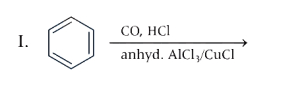
Which of the following reactions gives a carboxylate ion in their reaction mixture?
A
$I$ and $II$
B
$II$ and $III$
C
$I$ and $III$
D
$III$ and $IV$
Solution
(B) In reaction $(I)$,benzene reacts with $CO$ and $HCl$ in the presence of anhydrous $AlCl_3/CuCl$ to form benzaldehyde (Gattermann-Koch reaction). No carboxylate ion is formed.
In reaction $(II)$,acetaldehyde $(CH_3CHO)$ reacts with Tollen's reagent $([Ag(NH_3)_2]^+)$ in a basic medium to form an acetate ion $(CH_3COO^-)$,which is a carboxylate ion.
In reaction $(III)$,benzaldehyde reacts with Fehling's solution $(Cu^{2+}/OH^-)$ to form a benzoate ion $(C_6H_5COO^-)$,which is a carboxylate ion.
In reaction $(IV)$,aniline is treated with $Cl_2/hv$ followed by $H_2O$ at $373 \ K$,which does not produce a carboxylate ion.
Therefore,reactions $(II)$ and $(III)$ produce a carboxylate ion in their reaction mixture.
In reaction $(II)$,acetaldehyde $(CH_3CHO)$ reacts with Tollen's reagent $([Ag(NH_3)_2]^+)$ in a basic medium to form an acetate ion $(CH_3COO^-)$,which is a carboxylate ion.
In reaction $(III)$,benzaldehyde reacts with Fehling's solution $(Cu^{2+}/OH^-)$ to form a benzoate ion $(C_6H_5COO^-)$,which is a carboxylate ion.
In reaction $(IV)$,aniline is treated with $Cl_2/hv$ followed by $H_2O$ at $373 \ K$,which does not produce a carboxylate ion.
Therefore,reactions $(II)$ and $(III)$ produce a carboxylate ion in their reaction mixture.
0 likes
View Solution1660
MediumMCQ
Which one of the following is an acetal?
A
$R-CH(OR')_2$
B
$R-CH(OH)(OR')$
C
$R_2C(OH)(OR')$
D
$R-CH(OH)(OR')$
Solution
(A) An acetal is an organic compound formed by the reaction of an aldehyde with two equivalents of an alcohol in the presence of an acid catalyst. The general structure of an acetal is $R-CH(OR')_2$,where a single carbon atom is bonded to two alkoxy groups $(-OR')$,one hydrogen atom,and one alkyl group $(R)$.
0 likes
View Solution1661
EasyMCQ
Identify 'acetaldoxime'.
A
$CH_3CH=NNH_2$
B
$CH_3CH=NOH$
C
$(CH_3)_2C=NOH$
D
$CH_2=NOH$
Solution
(B) Acetaldoxime is formed by the reaction of acetaldehyde $(CH_3CHO)$ with hydroxylamine $(NH_2OH)$.
The reaction is as follows:
$CH_3CHO + NH_2OH \rightarrow CH_3CH=NOH + H_2O$
Thus,the structure of acetaldoxime is $CH_3CH=NOH$.
The reaction is as follows:
$CH_3CHO + NH_2OH \rightarrow CH_3CH=NOH + H_2O$
Thus,the structure of acetaldoxime is $CH_3CH=NOH$.
0 likes
View Solution1662
DifficultMCQ
The compound that does not undergo haloform reaction is
A
$CH_3CHO$
B
$CH_3CH_2OH$
C
$CH_3COCH_3$
D
$C_2H_5COCH_2CH_3$
Solution
(D) The haloform reaction is given by compounds containing the methyl keto group $(CH_3-CO-)$ or compounds that can be oxidized to a methyl keto group,such as secondary alcohols with the structure $(R-CH(OH)-CH_3)$.
$1$. $CH_3CHO$ (acetaldehyde) contains the $CH_3-CO-$ group.
$2$. $CH_3CH_2OH$ (ethanol) can be oxidized to $CH_3CHO$,which contains the $CH_3-CO-$ group.
$3$. $CH_3COCH_3$ (acetone) contains the $CH_3-CO-$ group.
$4$. $C_2H_5COCH_2CH_3$ (pentan$-3-$one) does not contain a methyl keto group $(CH_3-CO-)$ and cannot be oxidized to one.
Therefore,$C_2H_5COCH_2CH_3$ does not undergo the haloform reaction.
$1$. $CH_3CHO$ (acetaldehyde) contains the $CH_3-CO-$ group.
$2$. $CH_3CH_2OH$ (ethanol) can be oxidized to $CH_3CHO$,which contains the $CH_3-CO-$ group.
$3$. $CH_3COCH_3$ (acetone) contains the $CH_3-CO-$ group.
$4$. $C_2H_5COCH_2CH_3$ (pentan$-3-$one) does not contain a methyl keto group $(CH_3-CO-)$ and cannot be oxidized to one.
Therefore,$C_2H_5COCH_2CH_3$ does not undergo the haloform reaction.
0 likes
View Solution1663
DifficultMCQ
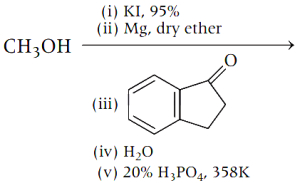
The major product formed in the following reaction is:
A
$1-$methyl-1H-indene
B
$1-$methylene$-2,3-$dihydro-1H-indene
C
$3-$methyl-1H-indene
D
$1-$methyl$-2,3-$dihydro-1H-inden$-1-$ol
Solution
(A) The reaction proceeds as follows:
$(i)$ $CH_3OH$ reacts with $KI$ to form $CH_3I$.
(ii) $CH_3I$ reacts with $Mg$ in dry ether to form the Grignard reagent $CH_3MgI$.
(iii) $CH_3MgI$ undergoes nucleophilic addition to the carbonyl group of $1-$indanone ($2$,$3$-dihydro-1H-inden$-1-$one).
(iv) Subsequent hydrolysis with $H_2O$ yields $1-$methyl$-2,3-$dihydro-1H-inden$-1-$ol.
$(v)$ Dehydration of the alcohol using $20\% H_3PO_4$ at $358 \ K$ results in the formation of the more stable conjugated alkene,$1$-methyl-1H-indene,as the major product.
$(i)$ $CH_3OH$ reacts with $KI$ to form $CH_3I$.
(ii) $CH_3I$ reacts with $Mg$ in dry ether to form the Grignard reagent $CH_3MgI$.
(iii) $CH_3MgI$ undergoes nucleophilic addition to the carbonyl group of $1-$indanone ($2$,$3$-dihydro-1H-inden$-1-$one).
(iv) Subsequent hydrolysis with $H_2O$ yields $1-$methyl$-2,3-$dihydro-1H-inden$-1-$ol.
$(v)$ Dehydration of the alcohol using $20\% H_3PO_4$ at $358 \ K$ results in the formation of the more stable conjugated alkene,$1$-methyl-1H-indene,as the major product.
0 likes
View Solution1664
DifficultMCQ
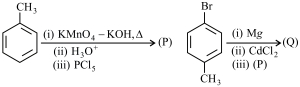
The major product $Q$ of the following reaction scheme is:
A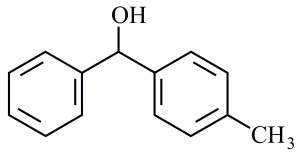
B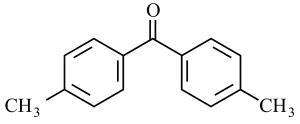
C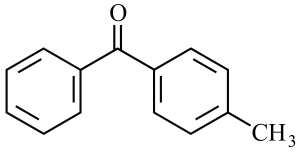
D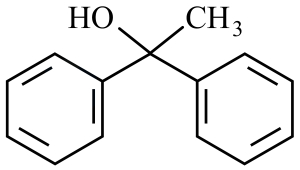
Solution
(D) Step $1$: Conversion of toluene to $(P)$. Toluene reacts with $KMnO_4 / KOH$ followed by $H_3O^+$ to form $p$-methylbenzoic acid. This acid then reacts with $PCl_5$ to form $p$-methylbenzoyl chloride,which is $(P)$.
Step $2$: Conversion of bromobenzene to $(Q)$. Bromobenzene reacts with $Mg$ to form phenylmagnesium bromide,which then reacts with $CdCl_2$ to form diphenylcadmium. This organocadmium compound reacts with $(P)$ ($p$-methylbenzoyl chloride) to form the final product $(Q)$,which is $4$-methylbenzophenone.
Step $2$: Conversion of bromobenzene to $(Q)$. Bromobenzene reacts with $Mg$ to form phenylmagnesium bromide,which then reacts with $CdCl_2$ to form diphenylcadmium. This organocadmium compound reacts with $(P)$ ($p$-methylbenzoyl chloride) to form the final product $(Q)$,which is $4$-methylbenzophenone.
0 likes
View Solution1665
EasyMCQ
Which of the following reactions is an example of Clemmensen reduction?
A
$R-COCl + H_2 \xrightarrow{Pd/BaSO_4} R-CHO + HCl$
B
$R-CHO \xrightarrow[(ii) KOH/HOCH_2CH_2OH]{(i) NH_2-NH_2} R-CH_3$
C
$R-COOC_2H_5 \xrightarrow[2. H_2O]{1. DIBAL-H} R-CHO + C_2H_5OH$
D
$R-COCH_3 \xrightarrow{Zn-Hg/HCl} R-CH_2-CH_3$
Solution
(D) The Clemmensen reduction is a chemical reaction that reduces carbonyl groups (aldehydes and ketones) to methylene groups $(-CH_2-)$ using zinc amalgam $(Zn-Hg)$ and concentrated hydrochloric acid $(HCl)$.
Option $A$ represents the Rosenmund reduction.
Option $B$ represents the Wolff-Kishner reduction.
Option $C$ represents the reduction of an ester to an aldehyde using $DIBAL-H$.
Option $D$ represents the Clemmensen reduction,where the ketone $R-COCH_3$ is reduced to the alkane $R-CH_2-CH_3$.
Option $A$ represents the Rosenmund reduction.
Option $B$ represents the Wolff-Kishner reduction.
Option $C$ represents the reduction of an ester to an aldehyde using $DIBAL-H$.
Option $D$ represents the Clemmensen reduction,where the ketone $R-COCH_3$ is reduced to the alkane $R-CH_2-CH_3$.
0 likes
View Solution1666
DifficultMCQ
The major product of the following reaction is:
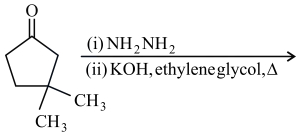
A
$3,3-$dimethylcyclopentane
B
$3,3-$dimethylcyclopentene
C
$3,3-$dimethylcyclopentanol
D
Pinacol-like dimer
Solution
(A) The given reaction is an example of the $Wolff-Kishner$ reduction.
This reaction involves the reduction of a carbonyl group $(C=O)$ to a methylene group $(CH_2)$.
First,the ketone reacts with hydrazine $(NH_2NH_2)$ to form a hydrazone intermediate.
Then,in the presence of a strong base like $KOH$ and a high-boiling solvent like ethylene glycol,the hydrazone undergoes base-catalyzed decomposition to release nitrogen gas $(N_2)$ and form the corresponding alkane.
In this specific case,$3,3-dimethylcyclopentanone$ is reduced to $3,3-dimethylcyclopentane$.
This reaction involves the reduction of a carbonyl group $(C=O)$ to a methylene group $(CH_2)$.
First,the ketone reacts with hydrazine $(NH_2NH_2)$ to form a hydrazone intermediate.
Then,in the presence of a strong base like $KOH$ and a high-boiling solvent like ethylene glycol,the hydrazone undergoes base-catalyzed decomposition to release nitrogen gas $(N_2)$ and form the corresponding alkane.
In this specific case,$3,3-dimethylcyclopentanone$ is reduced to $3,3-dimethylcyclopentane$.
0 likes
View Solution1667
EasyMCQ
The reagent used in the Wolff-Kishner reduction is
A
$NH_2NH_2 / KOH$
B
$H_2 / Ni$
C
$Sn / HCl$
D
$LiAlH_4$
Solution
(A) The Wolff-Kishner reduction is a chemical reaction used to convert carbonyl groups (aldehydes or ketones) into methylene groups $(-CH_2-)$.
It involves heating the carbonyl compound with hydrazine $(NH_2NH_2)$ and a strong base like potassium hydroxide $(KOH)$ in a high-boiling solvent such as ethylene glycol.
The reaction proceeds via the formation of a hydrazone intermediate,which then undergoes base-catalyzed decomposition to release nitrogen gas $(N_2)$ and form the corresponding alkane.
It involves heating the carbonyl compound with hydrazine $(NH_2NH_2)$ and a strong base like potassium hydroxide $(KOH)$ in a high-boiling solvent such as ethylene glycol.
The reaction proceeds via the formation of a hydrazone intermediate,which then undergoes base-catalyzed decomposition to release nitrogen gas $(N_2)$ and form the corresponding alkane.
0 likes
View Solution1668
DifficultMCQ
Identify the product ' $P$ ' in the given reaction sequence.

A
$4-$hydroxy$-4-$methylpentan$-2-$one
B
$3-$hydroxy$-2-$methylpentan$-2-$one
C
$4-$methylpent$-3-$en$-2-$one
D
$3-$hydroxy$-3-$methylbutanal
Solution
(A) The starting material is $2,3$-dimethylbut-$2$-ene.
Step $1$: Ozonolysis of $2,3$-dimethylbut-$2$-ene with $(1) \ O_3$ and $(2) \ Zn/H_2O$ leads to the cleavage of the double bond,producing two molecules of acetone $(CH_3COCH_3)$.
Step $2$: The product ' $A$ ' is acetone. When acetone is treated with $Ba(OH)_2$ (a base),it undergoes an aldol condensation reaction.
Two molecules of acetone react to form $4$-hydroxy-$4$-methylpentan-$2$-one (diacetone alcohol).
Therefore,the product ' $P$ ' is $4$-hydroxy-$4$-methylpentan-$2$-one.
Step $1$: Ozonolysis of $2,3$-dimethylbut-$2$-ene with $(1) \ O_3$ and $(2) \ Zn/H_2O$ leads to the cleavage of the double bond,producing two molecules of acetone $(CH_3COCH_3)$.
Step $2$: The product ' $A$ ' is acetone. When acetone is treated with $Ba(OH)_2$ (a base),it undergoes an aldol condensation reaction.
Two molecules of acetone react to form $4$-hydroxy-$4$-methylpentan-$2$-one (diacetone alcohol).
Therefore,the product ' $P$ ' is $4$-hydroxy-$4$-methylpentan-$2$-one.
0 likes
View Solution1669
MediumMCQ
The products $C$ and $D$ are given by the following reaction sequence:
$CH_3CH_2COCH_3$ $\xrightarrow[(ii) H_3O^+]{(i) CH_3MgBr} A$ $\xrightarrow[358 \ K]{20\% H_3PO_4} B \text{ (Major)}$ $\xrightarrow[(ii) Zn/H_2O]{(i) O_3} C + D$
$CH_3CH_2COCH_3$ $\xrightarrow[(ii) H_3O^+]{(i) CH_3MgBr} A$ $\xrightarrow[358 \ K]{20\% H_3PO_4} B \text{ (Major)}$ $\xrightarrow[(ii) Zn/H_2O]{(i) O_3} C + D$
A
Ethanoic acid,ethanal
B
Ethanol,Propanone
C
Ethanal,Propanone
D
Propanal,Propanone
Solution
(C) $1$. Reaction of $CH_3CH_2COCH_3$ (Butan$-2-$one) with $CH_3MgBr$ followed by hydrolysis gives $A$,which is $CH_3CH_2C(OH)(CH_3)_2$ ($2$-methylbutan$-2-$ol).
$2$. Dehydration of $A$ with $20\% H_3PO_4$ at $358 \ K$ follows Saytzeff's rule to give the major product $B$,which is $CH_3CH=C(CH_3)_2$ ($2$-methylbut$-2-$ene).
$3$. Ozonolysis of $B$ $(CH_3CH=C(CH_3)_2)$ gives $CH_3CHO$ (Ethanal) and $(CH_3)_2CO$ (Propanone) as products $C$ and $D$.
$2$. Dehydration of $A$ with $20\% H_3PO_4$ at $358 \ K$ follows Saytzeff's rule to give the major product $B$,which is $CH_3CH=C(CH_3)_2$ ($2$-methylbut$-2-$ene).
$3$. Ozonolysis of $B$ $(CH_3CH=C(CH_3)_2)$ gives $CH_3CHO$ (Ethanal) and $(CH_3)_2CO$ (Propanone) as products $C$ and $D$.
0 likes
View Solution1670
DifficultMCQ
What are $Y$ and $Z$ respectively in the given reaction sequence?

A
$CH_3COCH_3, CH_3CH=CHCHO$
B
$CH_3CH_2CHO, CH_3CH_2CH=C(CH_3)CHO$
C
$CH_3CH_2CHO, CH_3CH_2CH=C(CH_3)CHO$
D
$CH_3CH_2CH_2OH, CH_3CH_2COOH$
Solution
(B) $1$. The starting material is propene $(CH_3CH=CH_2)$.
$2$. Hydroboration-oxidation of propene with $(i) B_2H_6$ and $(ii) H_2O_2/NaOH$ gives propan$-1-$ol $(CH_3CH_2CH_2OH)$ as $X$.
$3$. Dehydrogenation of propan$-1-$ol $(X)$ using $Cu$ at $573 \ K$ gives propanal $(CH_3CH_2CHO)$ as $Y$.
$4$. Propanal $(Y)$ undergoes aldol condensation in the presence of dilute $NaOH$ followed by heating $(\Delta)$ to give the $\alpha,\beta$-unsaturated aldehyde,$2$-methylpent-$2$-enal $(CH_3CH_2CH=C(CH_3)CHO)$ as $Z$.
$2$. Hydroboration-oxidation of propene with $(i) B_2H_6$ and $(ii) H_2O_2/NaOH$ gives propan$-1-$ol $(CH_3CH_2CH_2OH)$ as $X$.
$3$. Dehydrogenation of propan$-1-$ol $(X)$ using $Cu$ at $573 \ K$ gives propanal $(CH_3CH_2CHO)$ as $Y$.
$4$. Propanal $(Y)$ undergoes aldol condensation in the presence of dilute $NaOH$ followed by heating $(\Delta)$ to give the $\alpha,\beta$-unsaturated aldehyde,$2$-methylpent-$2$-enal $(CH_3CH_2CH=C(CH_3)CHO)$ as $Z$.
0 likes
View Solution1671
DifficultMCQ
Identify $A$ and $B$ from the following reactions:
$(I)$ $CH_3-CH=CH-CH_3 \xrightarrow{\text{(i) } O_3}{\text{(ii) } Zn-H_2O} 2X$
$(II)$ $2X$ $\xrightarrow[2. \Delta]{1. NaOH \text{ (dil.)}} Z$ $\xrightarrow[\text{(ii) } Zn-H_2O]{\text{(i) } O_3} A + B$
$(I)$ $CH_3-CH=CH-CH_3 \xrightarrow{\text{(i) } O_3}{\text{(ii) } Zn-H_2O} 2X$
$(II)$ $2X$ $\xrightarrow[2. \Delta]{1. NaOH \text{ (dil.)}} Z$ $\xrightarrow[\text{(ii) } Zn-H_2O]{\text{(i) } O_3} A + B$
A
$CH_3CHO + CHO-CHO$
B
$2CH_3CHO$
C
$CH_3CH_2CHO + CH_2O$
D
$CH_3COCH_3 + CHO-CHO$
Solution
(A) Step $1$: Ozonolysis of $but-2-ene$ $(CH_3-CH=CH-CH_3)$ yields two molecules of acetaldehyde $(CH_3CHO)$. Thus,$X = CH_3CHO$.
Step $2$: Aldol condensation of $2$ molecules of acetaldehyde $(2CH_3CHO)$ in the presence of dilute $NaOH$ followed by heating $(\Delta)$ gives $but-2-enal$ $(CH_3-CH=CH-CHO)$,which is $Z$.
Step $3$: Ozonolysis of $but-2-enal$ $(CH_3-CH=CH-CHO)$ breaks the double bond to form acetaldehyde $(CH_3CHO)$ and glyoxal $(CHO-CHO)$.
Therefore,$A$ and $B$ are $CH_3CHO$ and $CHO-CHO$.
Step $2$: Aldol condensation of $2$ molecules of acetaldehyde $(2CH_3CHO)$ in the presence of dilute $NaOH$ followed by heating $(\Delta)$ gives $but-2-enal$ $(CH_3-CH=CH-CHO)$,which is $Z$.
Step $3$: Ozonolysis of $but-2-enal$ $(CH_3-CH=CH-CHO)$ breaks the double bond to form acetaldehyde $(CH_3CHO)$ and glyoxal $(CHO-CHO)$.
Therefore,$A$ and $B$ are $CH_3CHO$ and $CHO-CHO$.
0 likes
View Solution1672
DifficultMCQ
The major product formed in the following reaction sequence is $CH_3-CH=CH_2$ $\xrightarrow[\substack{(iii) \ CH_3-CH_2-CHO \\ (iv) \ CrO_3}]{\substack{(i) \ HBr, \text{ peroxide} \\ (ii) \ Mg}}$
A
$3-$Hexanone
B
$2-$Hexanone
C
$2-$Methyl$-3-$pentanone
D
Hexanal
Solution
(A) $1$. Propene undergoes anti-Markovnikov addition with $HBr$ in the presence of peroxide to form $1-$bromopropane: $CH_3-CH=CH_2 + HBr \xrightarrow{\text{peroxide}} CH_3-CH_2-CH_2Br$.
$2$. $1-$bromopropane reacts with $Mg$ in the presence of dry ether to form the Grignard reagent,propylmagnesium bromide: $CH_3-CH_2-CH_2Br + Mg \xrightarrow{\text{dry ether}} CH_3-CH_2-CH_2MgBr$.
$3$. Propanal $(CH_3-CH_2-CHO)$ undergoes nucleophilic addition with propylmagnesium bromide followed by hydrolysis to form hexan$-3-$ol: $CH_3-CH_2-CHO + CH_3-CH_2-CH_2MgBr \rightarrow CH_3-CH_2-CH(OH)-CH_2-CH_2-CH_3$.
$4$. Hexan$-3-$ol on oxidation with $CrO_3$ forms hexan$-3-$one: $CH_3-CH_2-CH(OH)-CH_2-CH_2-CH_3 \xrightarrow{CrO_3} CH_3-CH_2-CO-CH_2-CH_2-CH_3$.
$2$. $1-$bromopropane reacts with $Mg$ in the presence of dry ether to form the Grignard reagent,propylmagnesium bromide: $CH_3-CH_2-CH_2Br + Mg \xrightarrow{\text{dry ether}} CH_3-CH_2-CH_2MgBr$.
$3$. Propanal $(CH_3-CH_2-CHO)$ undergoes nucleophilic addition with propylmagnesium bromide followed by hydrolysis to form hexan$-3-$ol: $CH_3-CH_2-CHO + CH_3-CH_2-CH_2MgBr \rightarrow CH_3-CH_2-CH(OH)-CH_2-CH_2-CH_3$.
$4$. Hexan$-3-$ol on oxidation with $CrO_3$ forms hexan$-3-$one: $CH_3-CH_2-CH(OH)-CH_2-CH_2-CH_3 \xrightarrow{CrO_3} CH_3-CH_2-CO-CH_2-CH_2-CH_3$.
0 likes
View Solution1673
DifficultMCQ
An alkene $A$ $(C_4H_8)$ exhibits cis/trans isomerism. $A$ on ozonolysis gives $B$,which when reacted with $NaOH$ followed by hydroxylamine gives $C$. What are $B$ and $C$?
A
| $B$ | $C$ |
| $CH_3CH_2CHO$ | $CH_3CH_2CH=NOH$ |
B
| $B$ | $C$ |
| $CH_3CH_2CHO$ | $CH_3CH=CHCH=NOH$ |
C
| $B$ | $C$ |
| $CH_3CHO$ | $CH_3CH=CHCH=NNH_2$ |
D
| $B$ | $C$ |
| $CH_3CHO$ | $CH_3CH=CHCH=NOH$ |
Solution
(D) $1$. The alkene $A$ is $but-2-ene$ $(CH_3CH=CHCH_3)$,which shows cis/trans isomerism.
$2$. Ozonolysis of $but-2-ene$ yields two molecules of acetaldehyde $(CH_3CHO)$,so $B = CH_3CHO$.
$3$. Acetaldehyde undergoes aldol condensation in the presence of $NaOH$ to form $but-2-enal$ $(CH_3CH=CHCHO)$.
$4$. Reaction of $but-2-enal$ with hydroxylamine $(NH_2OH)$ forms the corresponding oxime,$CH_3CH=CHCH=NOH$,which is $C$.
$2$. Ozonolysis of $but-2-ene$ yields two molecules of acetaldehyde $(CH_3CHO)$,so $B = CH_3CHO$.
$3$. Acetaldehyde undergoes aldol condensation in the presence of $NaOH$ to form $but-2-enal$ $(CH_3CH=CHCHO)$.
$4$. Reaction of $but-2-enal$ with hydroxylamine $(NH_2OH)$ forms the corresponding oxime,$CH_3CH=CHCH=NOH$,which is $C$.
0 likes
View Solution1674
MediumMCQ
The product$(s)$ formed when $m$-chlorobenzaldehyde is heated with concentrated $NaOH$ is/are:
A
$A$ mixture of $3$-chlorobenzoic acid and $3$-chlorobenzyl alcohol.
B
$A$ mixture of sodium $3$-chlorobenzoate and $3$-chlorobenzyl alcohol.
C
$A$ pinacol-type coupling product.
D
$A$ diol derivative.
Solution
(B) The reaction of $m$-chlorobenzaldehyde with concentrated $NaOH$ is a Cannizzaro reaction.
Aldehydes that do not contain any $\alpha$-hydrogen atoms undergo self-oxidation and reduction (disproportionation) in the presence of a concentrated base.
In this reaction,one molecule of $m$-chlorobenzaldehyde is oxidized to the corresponding salt of the carboxylic acid (sodium $3$-chlorobenzoate),and another molecule is reduced to the corresponding alcohol ($3$-chlorobenzyl alcohol).
The reaction is: $2 \text{ } m\text{-Cl-C}_6\text{H}_4\text{CHO} + \text{NaOH (conc.)}$ $\rightarrow m\text{-Cl-C}_6\text{H}_4\text{CH}_2\text{OH} + m\text{-Cl-C}_6\text{H}_4\text{COONa}$.
Aldehydes that do not contain any $\alpha$-hydrogen atoms undergo self-oxidation and reduction (disproportionation) in the presence of a concentrated base.
In this reaction,one molecule of $m$-chlorobenzaldehyde is oxidized to the corresponding salt of the carboxylic acid (sodium $3$-chlorobenzoate),and another molecule is reduced to the corresponding alcohol ($3$-chlorobenzyl alcohol).
The reaction is: $2 \text{ } m\text{-Cl-C}_6\text{H}_4\text{CHO} + \text{NaOH (conc.)}$ $\rightarrow m\text{-Cl-C}_6\text{H}_4\text{CH}_2\text{OH} + m\text{-Cl-C}_6\text{H}_4\text{COONa}$.
0 likes
View Solution1675
DifficultMCQ
The major product of the following reaction is:
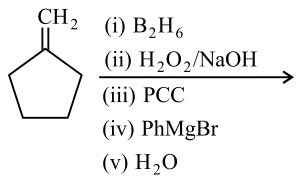
A
Cyclopentylphenylmethanol
B
Cyclopentyl phenyl ketone
C
Cyclopentylmethanol
D
Benzylcyclopentane
Solution
(A) The reaction proceeds as follows:
$1$. Hydroboration-oxidation of methylenecyclopentane with $(i) B_2H_6$ and $(ii) H_2O_2/NaOH$ yields cyclopentylmethanol.
$2$. Oxidation of the primary alcohol with $PCC$ (Pyridinium chlorochromate) yields cyclopentanecarbaldehyde.
$3$. Nucleophilic addition of the Grignard reagent $PhMgBr$ to the aldehyde,followed by hydrolysis with $(v) H_2O$,yields the secondary alcohol,cyclopentylphenylmethanol.
$1$. Hydroboration-oxidation of methylenecyclopentane with $(i) B_2H_6$ and $(ii) H_2O_2/NaOH$ yields cyclopentylmethanol.
$2$. Oxidation of the primary alcohol with $PCC$ (Pyridinium chlorochromate) yields cyclopentanecarbaldehyde.
$3$. Nucleophilic addition of the Grignard reagent $PhMgBr$ to the aldehyde,followed by hydrolysis with $(v) H_2O$,yields the secondary alcohol,cyclopentylphenylmethanol.
0 likes
View Solution1676
MediumMCQ
The reaction $Ph-CDO \xrightarrow{50\% \text{ aq. } NaOH, \text{ warm}} Ph-COO^- + \text{an alcohol}$. This alcohol is:
A
$Ph-CHD-OH$
B
$Ph-CHD-OD$
C
$Ph-CD_2-OH$
D
$Ph-CD_2-OD$
Solution
(C) The reaction is a Cannizzaro reaction. In the mechanism,the nucleophilic attack of $OH^-$ on the carbonyl carbon of $Ph-CDO$ forms a tetrahedral intermediate. In the rate-determining step,a hydride (or deuteride) ion is transferred from this intermediate to another molecule of $Ph-CDO$. Since the intermediate contains a $D$ atom attached to the carbon,a deuteride ion $(D^-)$ is transferred to the second $Ph-CDO$ molecule. This results in the formation of $Ph-CD_2-O^-$ and $Ph-COO^-$. Upon workup (or proton exchange with the solvent),the alkoxide $Ph-CD_2-O^-$ becomes $Ph-CD_2-OH$.
0 likes
View Solution1677
MediumMCQ
Reduction of the lactol $S$ with sodium borohydride $(NaBH_4)$ gives:
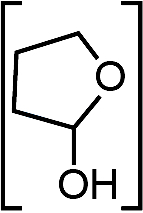
A
Tetrahydrofuran
B
Butyrolactone
C
Pentane$-1,5-$diol
D
Butan$-1-$ol
Solution
(C) lactol exists in equilibrium with its open-chain hydroxy-aldehyde form.
In the presence of $NaBH_4$,the aldehyde group is reduced to a primary alcohol.
The lactol $S$ ($2$-hydroxytetrahydropyran) opens to form $5-$hydroxypentanal,which is then reduced by $NaBH_4$ to pentane$-1,5-$diol.
In the presence of $NaBH_4$,the aldehyde group is reduced to a primary alcohol.
The lactol $S$ ($2$-hydroxytetrahydropyran) opens to form $5-$hydroxypentanal,which is then reduced by $NaBH_4$ to pentane$-1,5-$diol.
0 likes
View Solution1678
MediumMCQ
Which one among the following compounds will most readily be dehydrated under acidic condition?
A
$5-$hydroxyhexan$-3-$one
B
$4-$hydroxyhexan$-3-$one
C
$3-$hydroxyhexan$-2-$one
D
$4-$hydroxyhexan$-2-$one
Solution
(D) The ease of dehydration of alcohols under acidic conditions depends on the stability of the carbocation formed after the loss of the water molecule.
In the given options,the dehydration of $4$-hydroxyhexan-$2$-one (Option $D$) leads to the formation of a carbocation that is stabilized by hyperconjugation with $5$ $\alpha$-hydrogen atoms.
Additionally,the resulting alkene product is conjugated with the carbonyl group,which provides extra stability through resonance.
Therefore,$4$-hydroxyhexan-$2$-one undergoes dehydration most readily.
In the given options,the dehydration of $4$-hydroxyhexan-$2$-one (Option $D$) leads to the formation of a carbocation that is stabilized by hyperconjugation with $5$ $\alpha$-hydrogen atoms.
Additionally,the resulting alkene product is conjugated with the carbonyl group,which provides extra stability through resonance.
Therefore,$4$-hydroxyhexan-$2$-one undergoes dehydration most readily.
0 likes
View Solution1679
MediumMCQ
Which of the following will be dehydrated most readily in alkaline medium?
A
$4-$hydroxy$-3-$pentanone
B
$4-$hydroxy$-2-$pentanone
C
$2-$pentanol
D
$4-$hydroxy$-2-$butanone
Solution
(B) In an alkaline medium,the dehydration of $\beta$-hydroxy carbonyl compounds (aldol products) occurs via an $E1cB$ mechanism.
First,the base abstracts the acidic $\alpha$-proton to form an enolate ion.
Then,the hydroxide ion $(-OH)$ at the $\beta$-position is eliminated to form an $\alpha,\beta$-unsaturated carbonyl compound.
For this to occur,the molecule must have both a carbonyl group and a hydroxyl group at the $\beta$-position relative to each other,and an $\alpha$-hydrogen must be available.
Option $(B)$,$4$-hydroxy$-2-$pentanone,is a $\beta$-hydroxy ketone with an $\alpha$-hydrogen,which readily undergoes dehydration to form pent$-3-$en$-2-$one.
First,the base abstracts the acidic $\alpha$-proton to form an enolate ion.
Then,the hydroxide ion $(-OH)$ at the $\beta$-position is eliminated to form an $\alpha,\beta$-unsaturated carbonyl compound.
For this to occur,the molecule must have both a carbonyl group and a hydroxyl group at the $\beta$-position relative to each other,and an $\alpha$-hydrogen must be available.
Option $(B)$,$4$-hydroxy$-2-$pentanone,is a $\beta$-hydroxy ketone with an $\alpha$-hydrogen,which readily undergoes dehydration to form pent$-3-$en$-2-$one.
0 likes
View Solution1680
EasyMCQ
Upon treatment with $I_{2}$ and aqueous $NaOH$,which of the following compounds will form iodoform?
A
$CH_{3} CH_{2} CH_{2} CH_{2} CHO$
B
$CH_{3} CH_{2} CO CH_{2} CH_{3}$
C
$CH_{3} CH_{2} CH_{2} CH_{2} CH_{2} OH$
D
$CH_{3} CH_{2} CH_{2} CH(OH) CH_{3}$
Solution
(D) The iodoform test is given by compounds containing the $CH_{3}CO-$ group or compounds that can be oxidized to this group,such as secondary alcohols with the $CH_{3}CH(OH)-$ group.
Option $A$: $CH_{3} CH_{2} CH_{2} CH_{2} CHO$ is a pentanal,which does not contain the $CH_{3}CO-$ group.
Option $B$: $CH_{3} CH_{2} CO CH_{2} CH_{3}$ is pentan-$3$-one,which lacks the $CH_{3}CO-$ group.
Option $C$: $CH_{3} CH_{2} CH_{2} CH_{2} CH_{2} OH$ is pentan-$1$-ol,a primary alcohol that does not form the required methyl ketone upon oxidation.
Option $D$: $CH_{3} CH_{2} CH_{2} CH(OH) CH_{3}$ is pentan-$2$-ol. It contains the $CH_{3}CH(OH)-$ group,which is oxidized by $I_{2}/NaOH$ to pentan-$2$-one $(CH_{3} CH_{2} CH_{2} CO CH_{3})$,a methyl ketone that subsequently undergoes the iodoform reaction to produce $CHI_{3}$ (iodoform).
Option $A$: $CH_{3} CH_{2} CH_{2} CH_{2} CHO$ is a pentanal,which does not contain the $CH_{3}CO-$ group.
Option $B$: $CH_{3} CH_{2} CO CH_{2} CH_{3}$ is pentan-$3$-one,which lacks the $CH_{3}CO-$ group.
Option $C$: $CH_{3} CH_{2} CH_{2} CH_{2} CH_{2} OH$ is pentan-$1$-ol,a primary alcohol that does not form the required methyl ketone upon oxidation.
Option $D$: $CH_{3} CH_{2} CH_{2} CH(OH) CH_{3}$ is pentan-$2$-ol. It contains the $CH_{3}CH(OH)-$ group,which is oxidized by $I_{2}/NaOH$ to pentan-$2$-one $(CH_{3} CH_{2} CH_{2} CO CH_{3})$,a methyl ketone that subsequently undergoes the iodoform reaction to produce $CHI_{3}$ (iodoform).
0 likes
View Solution1681
EasyMCQ
In which of the following reactions is a new carbon-carbon bond not formed?
A
Cannizzaro reaction
B
Wurtz reaction
C
Aldol condensation
D
Friedel-Crafts reaction
Solution
(A) In the Cannizzaro reaction,an aldehyde lacking an $\alpha$-hydrogen undergoes disproportionation in the presence of a concentrated base to form an alcohol and a carboxylic acid salt. No new $C-C$ bond is formed in this process.
For example: $2HCHO + 50\% NaOH \rightarrow CH_3OH + HCOONa$.
For example: $2HCHO + 50\% NaOH \rightarrow CH_3OH + HCOONa$.
0 likes
View Solution1682
MediumMCQ
In the following sequence of reactions,compound $M$ is:
$M$ $\xrightarrow{CH_3MgBr} N + CH_4 \uparrow$ $\xrightarrow{H^+} CH_3COCH_2COCH_3$
$M$ $\xrightarrow{CH_3MgBr} N + CH_4 \uparrow$ $\xrightarrow{H^+} CH_3COCH_2COCH_3$
A
$CH_3COCH_2COCH_3$
B
$CH_3COCH_2CO_2Et$
C
$CH_3COCH_3$
D
$CH_3COOH$
Solution
(A) The reaction shows that compound $M$ reacts with $CH_3MgBr$ (a Grignard reagent) to release $CH_4$ gas. This indicates that $M$ contains an acidic hydrogen atom.
Upon treatment with $H^+$,the intermediate $N$ yields $CH_3COCH_2COCH_3$ (acetylacetone).
Acetylacetone has an active methylene group ($-CH_2-$ between two carbonyl groups) with acidic protons.
Therefore,$M$ must be $CH_3COCH_2COCH_3$ itself,as the Grignard reagent acts as a base to abstract the acidic proton from the active methylene group,forming the enolate $N$,which is then protonated back to the original ketone upon treatment with $H^+$.
Upon treatment with $H^+$,the intermediate $N$ yields $CH_3COCH_2COCH_3$ (acetylacetone).
Acetylacetone has an active methylene group ($-CH_2-$ between two carbonyl groups) with acidic protons.
Therefore,$M$ must be $CH_3COCH_2COCH_3$ itself,as the Grignard reagent acts as a base to abstract the acidic proton from the active methylene group,forming the enolate $N$,which is then protonated back to the original ketone upon treatment with $H^+$.
0 likes
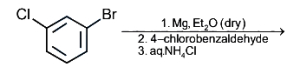
View Solution1683
DifficultMCQ
The product of the following reaction is :
A
$3-$chlorophenyl$-4-$chlorophenylmethanol
B
$3-$bromophenyl$-4-$chlorophenylmethanol
C
$4-$bromophenyl$-3-$chlorophenylmethanol
D
bis($4$-chlorophenyl)methanol
Solution
(A) The reaction proceeds as follows:
$1$. $3$-bromo-$1$-chlorobenzene reacts with $Mg$ in dry $Et_2O$ to form the Grignard reagent,$3$-chlorophenylmagnesium bromide.
$2$. This Grignard reagent then undergoes a nucleophilic addition reaction with $4$-chlorobenzaldehyde.
$3$. Finally,aqueous $NH_4Cl$ workup protonates the alkoxide intermediate to yield the secondary alcohol,$3$-chlorophenyl-$4$-chlorophenylmethanol.
$1$. $3$-bromo-$1$-chlorobenzene reacts with $Mg$ in dry $Et_2O$ to form the Grignard reagent,$3$-chlorophenylmagnesium bromide.
$2$. This Grignard reagent then undergoes a nucleophilic addition reaction with $4$-chlorobenzaldehyde.
$3$. Finally,aqueous $NH_4Cl$ workup protonates the alkoxide intermediate to yield the secondary alcohol,$3$-chlorophenyl-$4$-chlorophenylmethanol.
0 likes
View Solution1684
EasyMCQ
Which of the following would produce enantiomeric products when reacted with methyl magnesium iodide?
A
Benzaldehyde
B
Propiophenone
C
Acetone
D
Acetaldehyde
Solution
(A) The reaction of a carbonyl compound $R-CO-R'$ with methyl magnesium iodide $(CH_3MgI)$ followed by hydrolysis yields a tertiary or secondary alcohol with a chiral center if the four groups attached to the central carbon are different.
For the product to be chiral (enantiomeric),the central carbon must be bonded to four distinct groups: $R$,$R'$,$CH_3$,and $H$ (or $OH$ group).
$1$. Benzaldehyde $(C_6H_5CHO)$: Reacts to form $1$-phenylethanol,which has a chiral center $(C_6H_5, CH_3, H, OH)$. Thus,it produces enantiomers.
$2$. Propiophenone $(C_6H_5COCH_2CH_3)$: Reacts to form $2$-phenylbutan-$2$-ol. Here,the groups are $C_6H_5, CH_3, CH_2CH_3, OH$. All four are different,so it forms enantiomers.
$3$. Acetone $(CH_3COCH_3)$: Forms $2$-methylpropan-$2$-ol,which is achiral.
$4$. Acetaldehyde $(CH_3CHO)$: Forms propan-$2$-ol,which is achiral.
Given the options,Benzaldehyde is the standard example for producing a chiral secondary alcohol.
For the product to be chiral (enantiomeric),the central carbon must be bonded to four distinct groups: $R$,$R'$,$CH_3$,and $H$ (or $OH$ group).
$1$. Benzaldehyde $(C_6H_5CHO)$: Reacts to form $1$-phenylethanol,which has a chiral center $(C_6H_5, CH_3, H, OH)$. Thus,it produces enantiomers.
$2$. Propiophenone $(C_6H_5COCH_2CH_3)$: Reacts to form $2$-phenylbutan-$2$-ol. Here,the groups are $C_6H_5, CH_3, CH_2CH_3, OH$. All four are different,so it forms enantiomers.
$3$. Acetone $(CH_3COCH_3)$: Forms $2$-methylpropan-$2$-ol,which is achiral.
$4$. Acetaldehyde $(CH_3CHO)$: Forms propan-$2$-ol,which is achiral.
Given the options,Benzaldehyde is the standard example for producing a chiral secondary alcohol.
0 likes
View Solution1685
MediumMCQ
Which of the following statement$(s)$ is/are correct about the given compound?
$CH_3COCH_2COOC_2H_5$
$CH_3COCH_2COOC_2H_5$
A
It exhibits tautomerism
B
It does not react with metallic sodium
C
It gives reddish-violet coloration with $FeCl_3$ solution
D
It gives precipitate with $2,4-$dinitrophenyl hydrazine solution
Solution
(A, C, D) The given compound is ethyl acetoacetate $(CH_3COCH_2COOC_2H_5)$.
$(A)$ It contains active methylene group,so it exhibits keto-enol tautomerism.
$(B)$ The enol form has an acidic hydroxyl group,so it reacts with metallic sodium to release $H_2$ gas.
$(C)$ The enol form gives a characteristic reddish-violet coloration with neutral $FeCl_3$ solution.
$(D)$ It contains a keto group,so it reacts with $2,4-$dinitrophenyl hydrazine $(2,4-DNP)$ to form a precipitate.
Therefore,statements $(A)$,$(C)$,and $(D)$ are correct.
$(A)$ It contains active methylene group,so it exhibits keto-enol tautomerism.
$(B)$ The enol form has an acidic hydroxyl group,so it reacts with metallic sodium to release $H_2$ gas.
$(C)$ The enol form gives a characteristic reddish-violet coloration with neutral $FeCl_3$ solution.
$(D)$ It contains a keto group,so it reacts with $2,4-$dinitrophenyl hydrazine $(2,4-DNP)$ to form a precipitate.
Therefore,statements $(A)$,$(C)$,and $(D)$ are correct.
0 likes
View Solution1686
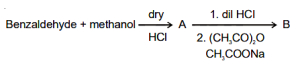
MediumMCQ
The compounds $A$ and $B$ are respectively
A
$Ph-CH(Cl)(OMe)$ and $Ph-CH=CH-CO_2H$
B
$Ph-CH(OMe)_2$ and $PhCOCH_3$
C
$Ph-CH(OMe)(OH)$ and $Ph-CH(OH)-CH_2-CO_2H$
D
$Ph-CH(OMe)_2$ and $Ph-CH=CH-CO_2H$
Solution
(D) $1$. Reaction of benzaldehyde with methanol in the presence of dry $HCl$ gas leads to the formation of an acetal,$A$,which is benzaldehyde dimethyl acetal,$Ph-CH(OMe)_2$.
$2$. Treatment of the acetal $A$ with dilute $HCl$ results in its hydrolysis back to benzaldehyde $(Ph-CHO)$ and methanol.
$3$. The subsequent reaction of benzaldehyde with acetic anhydride $((CH_3CO)_2O)$ in the presence of sodium acetate $(CH_3COONa)$ is the Perkin condensation reaction,which yields cinnamic acid $(Ph-CH=CH-COOH)$ as the final product $B$.
$2$. Treatment of the acetal $A$ with dilute $HCl$ results in its hydrolysis back to benzaldehyde $(Ph-CHO)$ and methanol.
$3$. The subsequent reaction of benzaldehyde with acetic anhydride $((CH_3CO)_2O)$ in the presence of sodium acetate $(CH_3COONa)$ is the Perkin condensation reaction,which yields cinnamic acid $(Ph-CH=CH-COOH)$ as the final product $B$.
0 likes
View Solution1687
MediumMCQ
The reduction product of ethyl $3$-oxobutanoate by $NaBH_4$ in methanol is
A
Ethyl $3,3$-dihydroxybutanoate
B
$4$-hydroxypentan-$2$-one
C
Ethyl $3$-hydroxybutanoate
D
$4$-hydroxypentan-$2$-one
Solution
(C) $NaBH_4$ is a selective reducing agent that reduces ketones and aldehydes to alcohols but does not reduce esters under mild conditions.
Ethyl $3$-oxobutanoate contains both a ketone group and an ester group.
Therefore,$NaBH_4$ will selectively reduce the ketone group at the $C-3$ position to a hydroxyl group,while the ester group at the $C-1$ position remains unaffected.
The reaction is:
$CH_3COCH_2COOC_2H_5 \xrightarrow{NaBH_4, CH_3OH} CH_3CH(OH)CH_2COOC_2H_5$
Thus,the product is ethyl $3$-hydroxybutanoate.
Ethyl $3$-oxobutanoate contains both a ketone group and an ester group.
Therefore,$NaBH_4$ will selectively reduce the ketone group at the $C-3$ position to a hydroxyl group,while the ester group at the $C-1$ position remains unaffected.
The reaction is:
$CH_3COCH_2COOC_2H_5 \xrightarrow{NaBH_4, CH_3OH} CH_3CH(OH)CH_2COOC_2H_5$
Thus,the product is ethyl $3$-hydroxybutanoate.
0 likes
View Solution1688
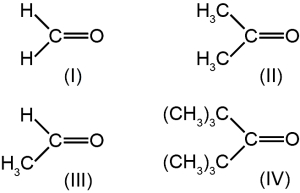
MediumMCQ
The correct order of reactivity for the addition reaction of the following carbonyl compounds with ethylmagnesium iodide is:
A
$I > III > II > IV$
B
$IV > III > II > I$
C
$I > II > IV > III$
D
$III > II > I > IV$
Solution
(A) The correct order of reactivity for the nucleophilic addition reaction of the given carbonyl compounds with ethylmagnesium iodide is $I > III > II > IV$.
This order is determined by two primary factors:
$(i)$ Inductive effect: Alkyl groups are electron-releasing. As the number of alkyl groups attached to the carbonyl carbon increases,the electron density on the carbonyl carbon increases,which reduces its electrophilicity and thus decreases reactivity towards nucleophilic attack.
$(ii)$ Steric effect: As the number and size of alkyl groups attached to the carbonyl carbon increase,the steric hindrance around the carbonyl carbon increases,making it more difficult for the nucleophile to attack.
Therefore,formaldehyde $(I)$ is the most reactive,followed by acetaldehyde $(III)$,acetone $(II)$,and finally di-tert-butyl ketone $(IV)$.
This order is determined by two primary factors:
$(i)$ Inductive effect: Alkyl groups are electron-releasing. As the number of alkyl groups attached to the carbonyl carbon increases,the electron density on the carbonyl carbon increases,which reduces its electrophilicity and thus decreases reactivity towards nucleophilic attack.
$(ii)$ Steric effect: As the number and size of alkyl groups attached to the carbonyl carbon increase,the steric hindrance around the carbonyl carbon increases,making it more difficult for the nucleophile to attack.
Therefore,formaldehyde $(I)$ is the most reactive,followed by acetaldehyde $(III)$,acetone $(II)$,and finally di-tert-butyl ketone $(IV)$.
0 likes
View Solution8-1.Aldehydes and Ketones — Properties · Frequently Asked Questions
1Are these 8-1.Aldehydes and Ketones questions useful for JEE and NEET?
Yes. All questions in this section are mapped to JEE Main and NEET exam patterns. Previous year questions from JEE Main, NEET, GUJCET and state-level exams are included with full solutions.
2Can I switch to Hindi or Gujarati for these questions?
Yes. Use the language tabs in the hero section or the sidebar to view the same questions and solutions in English, Hindi or Gujarati.
3How do I generate a question paper from this subtopic?
Use the Vedclass Exam Paper Generator — select the chapter and subtopic, set difficulty, and generate Sets A, B, C, D automatically. First 3 chapters of every subject are free.
Vedclass Products
For Students
Vedclass Test Series
Mock tests in real JEE/NEET style with performance analysis. 5-day free trial.
Start Free TrialFor Teachers
Exam Paper Generator
Generate Set A/B/C/D papers from this chapter in 2 minutes. 3 chapters free.
Try FreeFor Institutes
Online Exam Module
Live online exams with unlimited students, 360° analytics & white-label branding.
See DemoFor Teachers & Institutes
Generate a 8-1.Aldehydes and Ketones Exam Paper in 2 Minutes
Select subtopic & difficulty — Sets A, B, C, D auto-generated with No Repeat logic.
First 3 chapters of every subject are free — no payment required.