
A English
Properties Questions in English
Class 12 Chemistry · 8-1.Aldehydes and Ketones · Properties
1739+
Questions
English
Language
100%
With Solutions
Showing 50 of 1739 questions in English
701
MediumMCQ
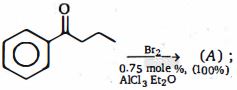
The product $(A)$ of the following reaction is (bromination does not occur in the benzene ring):
A
$1-$bromo$-1-$phenylbutan$-2-$one
B
$3-$bromo$-1-$phenylbutan$-1-$one
C
$2-$bromo$-1-$phenylbutan$-1-$one
D
$4-$bromo$-1-$phenylbutan$-1-$one
Solution
(C) The reaction involves the $\alpha$-bromination of a ketone.
In the presence of a Lewis acid like $AlCl_3$ or an acid catalyst,the ketone exists in equilibrium with its enol form.
The enol form acts as a nucleophile and attacks the $Br_2$ molecule.
The $\alpha$-carbon (the carbon adjacent to the carbonyl group) is the site of nucleophilic attack.
For $1$-phenylbutan-$1$-one $(C_6H_5COCH_2CH_2CH_3)$,the $\alpha$-carbon is the one attached to the carbonyl group $(C_6H_5COCH(Br)CH_2CH_3)$.
Therefore,the product is $2$-bromo-$1$-phenylbutan-$1$-one.
In the presence of a Lewis acid like $AlCl_3$ or an acid catalyst,the ketone exists in equilibrium with its enol form.
The enol form acts as a nucleophile and attacks the $Br_2$ molecule.
The $\alpha$-carbon (the carbon adjacent to the carbonyl group) is the site of nucleophilic attack.
For $1$-phenylbutan-$1$-one $(C_6H_5COCH_2CH_2CH_3)$,the $\alpha$-carbon is the one attached to the carbonyl group $(C_6H_5COCH(Br)CH_2CH_3)$.
Therefore,the product is $2$-bromo-$1$-phenylbutan-$1$-one.
0 likes
View Solution702
MediumMCQ
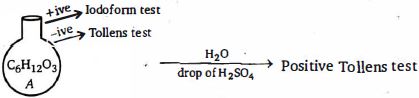
Compound $(A)$ with molecular formula $C_6H_{12}O_3$ gives a positive iodoform test and a negative Tollens' test. Upon hydrolysis with a drop of $H_2SO_4$,it gives a product that shows a positive Tollens' test. Compound $(A)$ is:
A
$CH_3-C(=O)-CH(OCH_3)-CH_2(OCH_3)$
B
$CH_3-C(=O)-C(OCH_3)_2-CH_3$
C
$CH_3-C(=O)-CH_2-CH(OCH_3)_2$
D
$CH_3-C(=O)-CH_2-CH_2-CH(OCH_3)_2$
Solution
(C) $1$. Compound $(A)$ has the molecular formula $C_6H_{12}O_3$.
$2$. It gives a positive iodoform test,which indicates the presence of a $CH_3-C(=O)-$ group.
$3$. It gives a negative Tollens' test,meaning it does not contain an aldehyde group.
$4$. Upon acid-catalyzed hydrolysis,it gives a product that shows a positive Tollens' test,indicating the formation of an aldehyde group.
$5$. The structure $CH_3-C(=O)-CH_2-CH(OCH_3)_2$ contains a $CH_3-C(=O)-$ group (positive iodoform test) and an acetal group (negative Tollens' test).
$6$. Hydrolysis of the acetal group $-CH(OCH_3)_2$ in the presence of $H^+$ yields an aldehyde group $-CHO$,which gives a positive Tollens' test.
$7$. Therefore,the compound is $CH_3-C(=O)-CH_2-CH(OCH_3)_2$.
$2$. It gives a positive iodoform test,which indicates the presence of a $CH_3-C(=O)-$ group.
$3$. It gives a negative Tollens' test,meaning it does not contain an aldehyde group.
$4$. Upon acid-catalyzed hydrolysis,it gives a product that shows a positive Tollens' test,indicating the formation of an aldehyde group.
$5$. The structure $CH_3-C(=O)-CH_2-CH(OCH_3)_2$ contains a $CH_3-C(=O)-$ group (positive iodoform test) and an acetal group (negative Tollens' test).
$6$. Hydrolysis of the acetal group $-CH(OCH_3)_2$ in the presence of $H^+$ yields an aldehyde group $-CHO$,which gives a positive Tollens' test.
$7$. Therefore,the compound is $CH_3-C(=O)-CH_2-CH(OCH_3)_2$.
0 likes
View Solution703
AdvancedMCQ
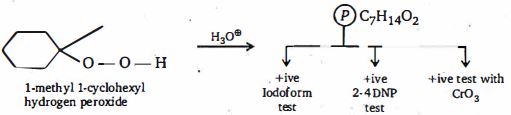
Compound $(P)$ is formed by the acid-catalyzed rearrangement of $1$-methyl-$1$-cyclohexyl hydrogen peroxide. The reaction is shown below. Identify compound $(P)$.
A
$CH_3-CO-(CH_2)_4-CH(OH)-CH_3$
B
$CH_3-CO-(CH_2)_3-CH(OH)-CH_2-CH_3$
C
$CH_3-CO-(CH_2)_5-OH$
D
$CH_3-CO-CH(CH_3)-CH(OH)-CH_3$
Solution
(C) The acid-catalyzed rearrangement of $1$-methyl-$1$-cyclohexyl hydrogen peroxide involves the protonation of the peroxide oxygen,followed by the migration of the ring carbon to the oxygen atom,leading to ring expansion and subsequent cleavage to form a ketone with a terminal hydroxyl group.
The product is $6$-hydroxyhexan-$2$-one,which has the structure $CH_3-CO-(CH_2)_4-CH_2-OH$,or $CH_3-CO-(CH_2)_5-OH$.
This compound gives a positive iodoform test due to the $CH_3-CO-$ group,a positive $2,4-DNP$ test due to the carbonyl group,and a positive test with $CrO_3$ due to the primary alcohol group.
The product is $6$-hydroxyhexan-$2$-one,which has the structure $CH_3-CO-(CH_2)_4-CH_2-OH$,or $CH_3-CO-(CH_2)_5-OH$.
This compound gives a positive iodoform test due to the $CH_3-CO-$ group,a positive $2,4-DNP$ test due to the carbonyl group,and a positive test with $CrO_3$ due to the primary alcohol group.
0 likes
View Solution704
MediumMCQ
What is the correct order of reactivity of the following compounds towards a Grignard reagent?
$(I)$ $CH_3CHO$
$(II)$ $HCHO$
$(III)$ $CH_3COC_6H_5$
$(I)$ $CH_3CHO$
$(II)$ $HCHO$
$(III)$ $CH_3COC_6H_5$
A
$I > II > III$
B
$II > I > III$
C
$II > III > I$
D
$I > III > II$
Solution
(B) The reactivity of carbonyl compounds towards nucleophilic addition (like Grignard reagents) depends on the magnitude of the positive charge on the carbonyl carbon.
$1$. $HCHO$ $(II)$ has two hydrogen atoms attached to the carbonyl carbon,which provide no electron-donating effect,making it the most reactive.
$2$. $CH_3CHO$ $(I)$ has one methyl group which provides a $+I$ (inductive) effect,reducing the positive charge on the carbonyl carbon,making it less reactive than $HCHO$.
$3$. $CH_3COC_6H_5$ $(III)$ has a phenyl group attached to the carbonyl carbon,which provides a strong $+M$ (mesomeric) effect,significantly reducing the positive charge on the carbonyl carbon,making it the least reactive.
Therefore,the correct order of reactivity is $II > I > III$.
$1$. $HCHO$ $(II)$ has two hydrogen atoms attached to the carbonyl carbon,which provide no electron-donating effect,making it the most reactive.
$2$. $CH_3CHO$ $(I)$ has one methyl group which provides a $+I$ (inductive) effect,reducing the positive charge on the carbonyl carbon,making it less reactive than $HCHO$.
$3$. $CH_3COC_6H_5$ $(III)$ has a phenyl group attached to the carbonyl carbon,which provides a strong $+M$ (mesomeric) effect,significantly reducing the positive charge on the carbonyl carbon,making it the least reactive.
Therefore,the correct order of reactivity is $II > I > III$.
0 likes
View Solution705
DifficultMCQ
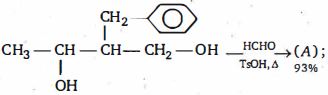
Product $(A)$ is
A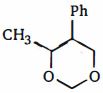
B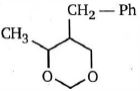
C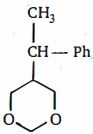
D
Solution
(B) The reaction involves the formation of a cyclic acetal from a $1,3-diol$ and formaldehyde $(HCHO)$ in the presence of an acid catalyst $(TsOH)$.
The starting material is $CH_3-CH(OH)-CH(CH_2Ph)-CH_2OH$.
The two hydroxyl groups at the $1$ and $3$ positions relative to each other react with $HCHO$ to form a $1,3-dioxane$ ring.
The carbon atom attached to the $CH_3$ group and the carbon atom attached to the $CH_2Ph$ group are part of the ring.
Based on the structure,the $CH_3$ group and the $CH_2Ph$ group are on adjacent carbons of the $1,3-dioxane$ ring.
Comparing the options,option $(B)$ correctly represents the cyclic acetal formed where the $CH_2Ph$ group is attached to the carbon between the two oxygen-bearing carbons,which matches the connectivity of the starting material.
The starting material is $CH_3-CH(OH)-CH(CH_2Ph)-CH_2OH$.
The two hydroxyl groups at the $1$ and $3$ positions relative to each other react with $HCHO$ to form a $1,3-dioxane$ ring.
The carbon atom attached to the $CH_3$ group and the carbon atom attached to the $CH_2Ph$ group are part of the ring.
Based on the structure,the $CH_3$ group and the $CH_2Ph$ group are on adjacent carbons of the $1,3-dioxane$ ring.
Comparing the options,option $(B)$ correctly represents the cyclic acetal formed where the $CH_2Ph$ group is attached to the carbon between the two oxygen-bearing carbons,which matches the connectivity of the starting material.
0 likes
View Solution706
DifficultMCQ
What reagent and/or reaction conditions would you choose to bring about the conversion shown in the image?

A
$1. LiAlH_4, 2. H_2O$
B
$H_2O, H_2SO_4, \text{heat}$
C
$H_2O, NaOH, \text{heat}$
D
$PCC, CH_2Cl_2$
Solution
(B) The reaction shows the hydrolysis of a cyclic acetal (specifically,a $1,3-$dioxolane derivative) to regenerate the original aldehyde (benzaldehyde) and the diol (ethylene glycol).
Acetals are stable in basic conditions but undergo hydrolysis to aldehydes or ketones in the presence of aqueous acid.
Therefore,the correct condition is $H_2O, H_2SO_4, \text{heat}$ (acidic hydrolysis).
Thus,the correct option is $(B)$.
Acetals are stable in basic conditions but undergo hydrolysis to aldehydes or ketones in the presence of aqueous acid.
Therefore,the correct condition is $H_2O, H_2SO_4, \text{heat}$ (acidic hydrolysis).
Thus,the correct option is $(B)$.
0 likes
View Solution707
MediumMCQ
What is the product of the following reaction?
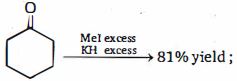
A
$2,6-$dimethylcyclohexanone
B
$2,2,6-$trimethylcyclohexanone
C
$2,2,6,6-$tetramethylcyclohexanone
D
$2,6,6-$trimethylcyclohexanone
Solution
(C) The reaction involves the alkylation of cyclohexanone using excess $CH_3I$ and $KH$.
$KH$ is a strong base that deprotonates the $\alpha$-carbons of the ketone to form enolate ions.
Since $KH$ and $CH_3I$ are in excess,all four $\alpha$-hydrogens of the cyclohexanone are replaced by methyl groups.
First,the two $\alpha$-carbons are deprotonated to form a dienolate,which then reacts with $CH_3I$ to form $2,6-$dimethylcyclohexanone.
Further treatment with excess $KH$ and $CH_3I$ leads to the substitution of the remaining two $\alpha$-hydrogens,resulting in $2,2,6,6-$tetramethylcyclohexanone.
$KH$ is a strong base that deprotonates the $\alpha$-carbons of the ketone to form enolate ions.
Since $KH$ and $CH_3I$ are in excess,all four $\alpha$-hydrogens of the cyclohexanone are replaced by methyl groups.
First,the two $\alpha$-carbons are deprotonated to form a dienolate,which then reacts with $CH_3I$ to form $2,6-$dimethylcyclohexanone.
Further treatment with excess $KH$ and $CH_3I$ leads to the substitution of the remaining two $\alpha$-hydrogens,resulting in $2,2,6,6-$tetramethylcyclohexanone.
0 likes
View Solution708
MediumMCQ
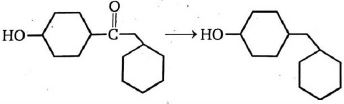
The above reduction can be best carried out by
A
Clemmensen reduction
B
Wolff-Kishner reduction
C
$NaBH_4$
D
None of these
Solution
(B) The reaction involves the reduction of a ketone group to a methylene group $(-CH_2-)$ in the presence of an alcohol $(-OH)$ group.
Clemmensen reduction uses $Zn(Hg)/HCl$ (acidic medium),which would cause the dehydration or protonation of the $-OH$ group.
$NaBH_4$ reduces ketones to alcohols,not to methylene groups.
Wolff-Kishner reduction uses $NH_2NH_2/KOH$ (basic medium),which is suitable for this transformation as the $-OH$ group remains unaffected in basic conditions.
Therefore,the correct reagent is Wolff-Kishner reduction,which corresponds to option $B$.
Clemmensen reduction uses $Zn(Hg)/HCl$ (acidic medium),which would cause the dehydration or protonation of the $-OH$ group.
$NaBH_4$ reduces ketones to alcohols,not to methylene groups.
Wolff-Kishner reduction uses $NH_2NH_2/KOH$ (basic medium),which is suitable for this transformation as the $-OH$ group remains unaffected in basic conditions.
Therefore,the correct reagent is Wolff-Kishner reduction,which corresponds to option $B$.
0 likes
View Solution709
DifficultMCQ
The end product $(C)$ in the following reaction is:
A
B
C
D
Solution
(B) $1$. The reaction starts with cyclopentanone. Treatment with $HCN$ gives the cyanohydrin,which is $1$-hydroxycyclopentanecarbonitrile $(A)$.
$2$. Reduction of the cyanohydrin $(A)$ with $LiAlH_4$ reduces the $-CN$ group to a $-CH_2NH_2$ group,yielding $1$-aminomethylcyclopentan$-1-$ol $(B)$.
$3$. Treatment of the primary amine $(B)$ with $NaNO_2/HCl$ (diazotization) leads to the formation of a diazonium salt,which is unstable and undergoes a Tiffeneau-Demjanov rearrangement. This involves the expansion of the five-membered ring to a six-membered ring,resulting in the formation of cyclohexanone $(C)$.
$2$. Reduction of the cyanohydrin $(A)$ with $LiAlH_4$ reduces the $-CN$ group to a $-CH_2NH_2$ group,yielding $1$-aminomethylcyclopentan$-1-$ol $(B)$.
$3$. Treatment of the primary amine $(B)$ with $NaNO_2/HCl$ (diazotization) leads to the formation of a diazonium salt,which is unstable and undergoes a Tiffeneau-Demjanov rearrangement. This involves the expansion of the five-membered ring to a six-membered ring,resulting in the formation of cyclohexanone $(C)$.
0 likes
View Solution710
MediumMCQ
Compound $(X)$ with molecular formula $C_4H_8O$ reacts with $2,4-DNP$ to form a derivative and gives a negative haloform test. The compound $(X)$ is:
A
$CH_3-CO-CH_2-CH_3$
B
$CH_3-CH(CH_3)-CHO$
C
Cyclobutanol
D
$CH_3-CH_2-CH(OH)-CH_3$
Solution
(B) $1$. The compound $(X)$ has the molecular formula $C_4H_8O$.
$2$. It reacts with $2,4-DNP$, which indicates that it is an aldehyde or a ketone.
$3$. It gives a negative haloform test, which means it does not contain a $CH_3CO-$ group or a $CH_3CH(OH)-$ group.
$4$. Let us analyze the options:
- Option $(A)$ is butan-$2$-one $(CH_3-CO-CH_2-CH_3)$, which is a methyl ketone and gives a positive haloform test.
- Option $(B)$ is $2$-methylpropanal $(CH_3-CH(CH_3)-CHO)$, which is an aldehyde and does not contain a $CH_3CO-$ group, thus it gives a negative haloform test.
- Option $(C)$ is cyclobutanol, which is an alcohol, not an aldehyde or ketone, so it will not react with $2,4-DNP$.
- Option $(D)$ is butan-$2$-ol, which is an alcohol and gives a positive haloform test.
$5$. Therefore, the correct compound is $2$-methylpropanal.
$2$. It reacts with $2,4-DNP$, which indicates that it is an aldehyde or a ketone.
$3$. It gives a negative haloform test, which means it does not contain a $CH_3CO-$ group or a $CH_3CH(OH)-$ group.
$4$. Let us analyze the options:
- Option $(A)$ is butan-$2$-one $(CH_3-CO-CH_2-CH_3)$, which is a methyl ketone and gives a positive haloform test.
- Option $(B)$ is $2$-methylpropanal $(CH_3-CH(CH_3)-CHO)$, which is an aldehyde and does not contain a $CH_3CO-$ group, thus it gives a negative haloform test.
- Option $(C)$ is cyclobutanol, which is an alcohol, not an aldehyde or ketone, so it will not react with $2,4-DNP$.
- Option $(D)$ is butan-$2$-ol, which is an alcohol and gives a positive haloform test.
$5$. Therefore, the correct compound is $2$-methylpropanal.
0 likes
View Solution711
MediumMCQ
When a nucleophile encounters a ketone,the site of attack is
A
the carbon atom of the carbonyl
B
the oxygen atom of the carbonyl
C
both the carbon and oxygen atoms,with equal probability
D
no attack occurs as ketones do not react with nucleophiles
Solution
(A) In a carbonyl group,the oxygen atom is more electronegative than the carbon atom,which creates a dipole moment.
This results in a partial positive charge $(\delta )$ on the carbon atom and a partial negative charge $(\delta-)$ on the oxygen atom.
Since a nucleophile is an electron-rich species,it is attracted to the electron-deficient site.
Therefore,the nucleophile attacks the electrophilic carbon atom of the carbonyl group.
This results in a partial positive charge $(\delta )$ on the carbon atom and a partial negative charge $(\delta-)$ on the oxygen atom.
Since a nucleophile is an electron-rich species,it is attracted to the electron-deficient site.
Therefore,the nucleophile attacks the electrophilic carbon atom of the carbonyl group.
0 likes
View Solution712
MediumMCQ
The correct order of rate of reaction toward nucleophilic addition reaction for the following compounds is:
$(a)$ $p-NO_2-C_6H_4-CHO$
$(b)$ $C_6H_5-CHO$
$(c)$ $p-OMe-C_6H_4-CHO$
$(d)$ $CH_3-CO-CH_2CH_3$
$(e)$ $C_6H_5-CO-C_6H_5$
$(a)$ $p-NO_2-C_6H_4-CHO$
$(b)$ $C_6H_5-CHO$
$(c)$ $p-OMe-C_6H_4-CHO$
$(d)$ $CH_3-CO-CH_2CH_3$
$(e)$ $C_6H_5-CO-C_6H_5$
A
$a > b > c > d > e$
B
$a > b > d > c > e$
C
$a > d > e > b > c$
D
$a > b > e > d > c$
Solution
(A) The rate of nucleophilic addition reaction depends on the electrophilicity of the carbonyl carbon.
$1$. Aldehydes are more reactive than ketones due to less steric hindrance and electronic factors.
$2$. Electron-withdrawing groups (like $-NO_2$) increase the electrophilicity of the carbonyl carbon,while electron-donating groups (like $-OMe$) decrease it.
$3$. Comparing the given compounds:
$(a)$ $p-NO_2-C_6H_4-CHO$: Contains a strong electron-withdrawing group $(-NO_2)$,making it the most reactive.
$(b)$ $C_6H_5-CHO$: Benzaldehyde.
$(c)$ $p-OMe-C_6H_4-CHO$: Contains an electron-donating group $(-OMe)$,making it less reactive than benzaldehyde.
$(d)$ $CH_3-CO-CH_2CH_3$: Aliphatic ketone,more reactive than aromatic ketone.
$(e)$ $C_6H_5-CO-C_6H_5$: Benzophenone,least reactive due to steric hindrance and resonance stabilization of the carbonyl group by two phenyl rings.
Thus,the order is $a > b > c > d > e$.
$1$. Aldehydes are more reactive than ketones due to less steric hindrance and electronic factors.
$2$. Electron-withdrawing groups (like $-NO_2$) increase the electrophilicity of the carbonyl carbon,while electron-donating groups (like $-OMe$) decrease it.
$3$. Comparing the given compounds:
$(a)$ $p-NO_2-C_6H_4-CHO$: Contains a strong electron-withdrawing group $(-NO_2)$,making it the most reactive.
$(b)$ $C_6H_5-CHO$: Benzaldehyde.
$(c)$ $p-OMe-C_6H_4-CHO$: Contains an electron-donating group $(-OMe)$,making it less reactive than benzaldehyde.
$(d)$ $CH_3-CO-CH_2CH_3$: Aliphatic ketone,more reactive than aromatic ketone.
$(e)$ $C_6H_5-CO-C_6H_5$: Benzophenone,least reactive due to steric hindrance and resonance stabilization of the carbonyl group by two phenyl rings.
Thus,the order is $a > b > c > d > e$.
0 likes
View Solution713
MediumMCQ
The structure shown in the figure is best classified as a(an):

A
Acetal
B
Hemiacetal
C
Hydrate
D
Cyanohydrin
Solution
(B) The given structure is a cyclic hemiacetal.
In a hemiacetal,a single carbon atom is bonded to both an $-OH$ group and an $-OR$ (ether) group.
Since the carbon atom in the ring is attached to both an $-OH$ group and an oxygen atom that is part of the ring (ether linkage),it is classified as a hemiacetal.
In a hemiacetal,a single carbon atom is bonded to both an $-OH$ group and an $-OR$ (ether) group.
Since the carbon atom in the ring is attached to both an $-OH$ group and an oxygen atom that is part of the ring (ether linkage),it is classified as a hemiacetal.
0 likes
View Solution714
MediumMCQ
Which of the following pairs of reactants is most effective in forming an enamine?
A
$CH_3CH_2CHO + ((CH_3)_2CH)_2NH$
B
Cyclohexanone + $(CH_3)_2NH$
C
$((CH_3)_3)C-CHO + (CH_3)_2NH$
D
None of these form an enamine.
Solution
(B) Enamines are formed by the reaction of a carbonyl compound (aldehyde or ketone) having at least one $\alpha$-hydrogen with a secondary $(2^o)$ amine.
Option $A$ involves a bulky secondary amine (diisopropylamine),which is sterically hindered and less effective.
Option $B$ involves cyclohexanone (a ketone with $\alpha$-hydrogens) and dimethylamine (a simple,unhindered secondary amine). This pair is highly effective for enamine formation.
Option $C$ involves a sterically hindered aldehyde (pivalaldehyde),which lacks $\alpha$-hydrogens,making it unable to form an enamine.
Therefore,the pair in option $B$ is the most effective.
Option $A$ involves a bulky secondary amine (diisopropylamine),which is sterically hindered and less effective.
Option $B$ involves cyclohexanone (a ketone with $\alpha$-hydrogens) and dimethylamine (a simple,unhindered secondary amine). This pair is highly effective for enamine formation.
Option $C$ involves a sterically hindered aldehyde (pivalaldehyde),which lacks $\alpha$-hydrogens,making it unable to form an enamine.
Therefore,the pair in option $B$ is the most effective.
0 likes
View Solution715
MediumMCQ
The reaction of $C_6H_5CH=CHCHO$ with $LiAlH_4$ gives
A
$C_6H_5CH_2CH_2CH_2OH$
B
$C_6H_5CH=CHCH_2OH$
C
$C_6H_5CH_2CH_2CHO$
D
$C_6H_5CH_2CHOHCH_3$
Solution
(A) $LiAlH_4$ (Lithium aluminium hydride) is a strong reducing agent that reduces both the aldehyde group $(-CHO)$ and the carbon-carbon double bond $(C=C)$ when conjugated with an aromatic ring or an electron-withdrawing group.
In the case of cinnamaldehyde $(C_6H_5CH=CHCHO)$,$LiAlH_4$ reduces both the aldehyde group to a primary alcohol and the double bond to a single bond,resulting in the formation of $3-phenylpropan-1-ol$ $(C_6H_5CH_2CH_2CH_2OH)$.
In the case of cinnamaldehyde $(C_6H_5CH=CHCHO)$,$LiAlH_4$ reduces both the aldehyde group to a primary alcohol and the double bond to a single bond,resulting in the formation of $3-phenylpropan-1-ol$ $(C_6H_5CH_2CH_2CH_2OH)$.
0 likes
View Solution716
DifficultMCQ
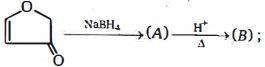
The product $(B)$ of the reaction is:
A
$2,5-$dihydrofuran$-3-$ol
B
furan
C
$2,3-$dihydrofuran
D
$3-$hydroxy$-2,3-$dihydrofuran
Solution
(B) The starting material is $2(5H)$-furanone.
Step $1$: Reduction with $NaBH_4$ selectively reduces the carbonyl group to a hydroxyl group,yielding $2,5$-dihydrofuran-$2$-ol (compound $(A)$).
Step $2$: Acid-catalyzed dehydration $(H^+/\Delta)$ of the cyclic hemiacetal $(A)$ leads to the formation of furan (compound $(B)$) by the elimination of a water molecule and restoration of aromaticity.
Step $1$: Reduction with $NaBH_4$ selectively reduces the carbonyl group to a hydroxyl group,yielding $2,5$-dihydrofuran-$2$-ol (compound $(A)$).
Step $2$: Acid-catalyzed dehydration $(H^+/\Delta)$ of the cyclic hemiacetal $(A)$ leads to the formation of furan (compound $(B)$) by the elimination of a water molecule and restoration of aromaticity.
0 likes
View Solution717
MediumMCQ
Which of the following compounds is a hemiacetal?
A
$1-$methoxycyclohexan$-1-$ol
B
tetrahydro-2H-pyran$-2-$ol
C
oxiran$-2-$ol
D
All of these
Solution
(D) hemiacetal is a compound that has both an alcohol group $(-OH)$ and an ether group $(-OR)$ attached to the same carbon atom.
$1$. In $1$-methoxycyclohexan-$1$-ol,the carbon atom is bonded to $-OH$ and $-OCH_3$ (ether). This is a hemiacetal.
$2$. In tetrahydro-$2H$-pyran-$2$-ol,the carbon at position $2$ is bonded to $-OH$ and an oxygen atom that is part of the ring (ether linkage). This is a cyclic hemiacetal.
$3$. In oxiran-$2$-ol,the carbon at position $2$ is bonded to $-OH$ and an oxygen atom that is part of the ring (ether linkage). This is also a cyclic hemiacetal.
Since all the given structures satisfy the definition of a hemiacetal,the correct answer is $D$.
$1$. In $1$-methoxycyclohexan-$1$-ol,the carbon atom is bonded to $-OH$ and $-OCH_3$ (ether). This is a hemiacetal.
$2$. In tetrahydro-$2H$-pyran-$2$-ol,the carbon at position $2$ is bonded to $-OH$ and an oxygen atom that is part of the ring (ether linkage). This is a cyclic hemiacetal.
$3$. In oxiran-$2$-ol,the carbon at position $2$ is bonded to $-OH$ and an oxygen atom that is part of the ring (ether linkage). This is also a cyclic hemiacetal.
Since all the given structures satisfy the definition of a hemiacetal,the correct answer is $D$.
0 likes
View Solution718
MediumMCQ
$Ph-CH=CH-C(=O)CH_3 \to Ph-CH=CH-CO_2H$
The above conversion can be achieved by:
The above conversion can be achieved by:
A
$KMnO_4, \Delta$ followed by $H^+$
B
$I_2/NaOH$ followed by $H^+$
C
$H_2/Pt$
D
$LiAlH_4$
Solution
(B) The conversion of a methyl ketone $(R-CO-CH_3)$ to a carboxylic acid $(R-COOH)$ while preserving the carbon-carbon double bond is achieved via the Haloform reaction (specifically the Iodoform test).
$1$. $I_2/NaOH$ (Iodoform reagent) selectively oxidizes the methyl ketone group to a carboxylate salt $(R-COO^-)$ and $CHI_3$,without affecting the $C=C$ double bond.
$2$. Subsequent acidification with $H^+$ yields the carboxylic acid $(R-COOH)$.
$3$. $KMnO_4$ is a strong oxidizing agent that would cleave the $C=C$ double bond.
$4$. $H_2/Pt$ would reduce the $C=C$ double bond.
$5$. $LiAlH_4$ would reduce the ketone to a secondary alcohol.
$1$. $I_2/NaOH$ (Iodoform reagent) selectively oxidizes the methyl ketone group to a carboxylate salt $(R-COO^-)$ and $CHI_3$,without affecting the $C=C$ double bond.
$2$. Subsequent acidification with $H^+$ yields the carboxylic acid $(R-COOH)$.
$3$. $KMnO_4$ is a strong oxidizing agent that would cleave the $C=C$ double bond.
$4$. $H_2/Pt$ would reduce the $C=C$ double bond.
$5$. $LiAlH_4$ would reduce the ketone to a secondary alcohol.
0 likes
View Solution719
DifficultMCQ
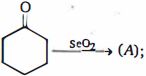
Product $(A)$ of the reaction is
A
Cyclohexanol
B
Cyclohexane$-1,2-$dione
C
Cyclohex$-2-$en$-1-$one
D
Cyclopentane$-1,2-$dione
Solution
(B) Selenium dioxide $(SeO_2)$ is a specific oxidizing agent used for the oxidation of active methylene groups adjacent to a carbonyl group.
In the given reaction,cyclohexanone reacts with $SeO_2$ to undergo oxidation at the $\alpha$-position,resulting in the formation of cyclohexane$-1,2-$dione.
The reaction is: $\text{Cyclohexanone} + SeO_2 \rightarrow \text{Cyclohexane-1,2-dione}$.
In the given reaction,cyclohexanone reacts with $SeO_2$ to undergo oxidation at the $\alpha$-position,resulting in the formation of cyclohexane$-1,2-$dione.
The reaction is: $\text{Cyclohexanone} + SeO_2 \rightarrow \text{Cyclohexane-1,2-dione}$.
0 likes
View Solution720
DifficultMCQ
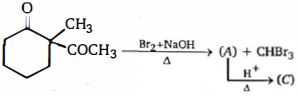
The product $(C)$ of the reaction is:
A
$2-$methylcyclohexanone
B
$1-$methylcyclohexanone
C
$1-$bromomethylcyclohexanone
D
$1-$tribromomethylcyclohexanone
Solution
(A) The given reaction is a haloform reaction followed by decarboxylation.
$1$. The starting material is $1$-acetyl-$1$-methylcyclohexane.
$2$. Treatment with $Br_2 NaOH$ (haloform reaction) converts the $-COCH_3$ group into a carboxylate salt $(-COO^-)$,forming the intermediate $(A)$ which is the salt of a $\beta$-keto acid.
$3$. Upon acidification $(H^ )$ and heating $(\Delta)$,the $\beta$-keto acid undergoes decarboxylation (loss of $CO_2$) to yield $2$-methylcyclohexanone as the final product $(C)$.
$1$. The starting material is $1$-acetyl-$1$-methylcyclohexane.
$2$. Treatment with $Br_2 NaOH$ (haloform reaction) converts the $-COCH_3$ group into a carboxylate salt $(-COO^-)$,forming the intermediate $(A)$ which is the salt of a $\beta$-keto acid.
$3$. Upon acidification $(H^ )$ and heating $(\Delta)$,the $\beta$-keto acid undergoes decarboxylation (loss of $CO_2$) to yield $2$-methylcyclohexanone as the final product $(C)$.
0 likes
View Solution721
AdvancedMCQ
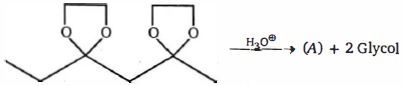
The product $(A)$ of the following reaction is:
A
$CH_3-CH_2-C(=O)-CH_2-C(=O)-CH_2-CH_3$
B
$CH_3-CH_2-C(=O)-CH_2-CH_2-C(=O)-CH_3$
C
$CH_3-CH_2-C(=O)-CH_2-C(=O)-CH_3$
D
$CH_3-C(=O)-CH_2-C(=O)-CH_3$
Solution
(C) The given reactant is a cyclic acetal (specifically a bis-dioxolane derivative) formed from a diketone and ethylene glycol.
Acid-catalyzed hydrolysis $(H_3O^+)$ of cyclic acetals regenerates the parent carbonyl compound and releases the glycol.
The structure shows a chain with two dioxolane rings at the $2$nd and $4$th positions relative to the ethyl group at the end.
Specifically,the structure corresponds to the protection of $hexane-2,4-dione$.
Upon hydrolysis,the two dioxolane rings are converted back into two ketone groups,yielding $CH_3-CH_2-C(=O)-CH_2-C(=O)-CH_3$.
Acid-catalyzed hydrolysis $(H_3O^+)$ of cyclic acetals regenerates the parent carbonyl compound and releases the glycol.
The structure shows a chain with two dioxolane rings at the $2$nd and $4$th positions relative to the ethyl group at the end.
Specifically,the structure corresponds to the protection of $hexane-2,4-dione$.
Upon hydrolysis,the two dioxolane rings are converted back into two ketone groups,yielding $CH_3-CH_2-C(=O)-CH_2-C(=O)-CH_3$.
0 likes
View Solution722
MediumMCQ
$R-C(=O)H + R-NH_2 \rightarrow R-CH=N-R$. This reaction gives the best yield at:
A
$pH \, 1 - 2$
B
$pH \, 4 - 5$
C
$pH \, 10 - 11$
D
$pH \, 13 - 14$
Solution
(B) The reaction of an aldehyde or ketone with a primary amine to form an imine is an acid-catalyzed process.
At very low $pH$ (highly acidic),the amine $(R-NH_2)$ gets protonated to form the ammonium ion $(R-NH_3^+)$,which is no longer nucleophilic,thus slowing down the reaction.
At very high $pH$ (basic),there is insufficient acid to catalyze the dehydration step,which involves the conversion of a poor leaving group $(-OH)$ into a good leaving group $(-OH_2^+)$.
Therefore,the reaction proceeds with the best yield at a mildly acidic $pH$ range of $4 - 5$,which provides enough acid to catalyze the dehydration without fully protonating the amine.
At very low $pH$ (highly acidic),the amine $(R-NH_2)$ gets protonated to form the ammonium ion $(R-NH_3^+)$,which is no longer nucleophilic,thus slowing down the reaction.
At very high $pH$ (basic),there is insufficient acid to catalyze the dehydration step,which involves the conversion of a poor leaving group $(-OH)$ into a good leaving group $(-OH_2^+)$.
Therefore,the reaction proceeds with the best yield at a mildly acidic $pH$ range of $4 - 5$,which provides enough acid to catalyze the dehydration without fully protonating the amine.
0 likes
View Solution723
MediumMCQ
Compound $A$ (molecular formula $C_3H_8O$) is treated with acidified potassium dichromate to form a product $B$ (molecular formula $C_3H_6O$). $B$ forms a shining silver mirror on warming with ammoniacal silver nitrate,and $B$ when treated with an aqueous solution of $NH_2NHCONH_2$ and sodium acetate gives a product $C$. Identify the structure of $C$.
A
$CH_3CH_2CH=NNHCONH_2$
B
$CH_3C(CH_3)=NNHCONH_2$
C
$CH_3C(CH_3)=NCONHNH_2$
D
$CH_3CH_2CH=NCONHNH_2$
Solution
(A) is $CH_3CH_2CH_2OH$ (propan$-1-$ol),which on oxidation with acidified $K_2Cr_2O_7$ gives $B$ ($CH_3CH_2CHO$,propanal).
$B$ gives a positive Tollen's test (shining silver mirror),confirming it is an aldehyde.
Reaction of propanal $(CH_3CH_2CHO)$ with semicarbazide $(NH_2NHCONH_2)$ in the presence of sodium acetate yields the semicarbazone product $C$.
The reaction is: $CH_3CH_2CHO + NH_2NHCONH_2 \rightarrow CH_3CH_2CH=NNHCONH_2 + H_2O$.
Therefore,the structure of $C$ is $CH_3CH_2CH=NNHCONH_2$.
$B$ gives a positive Tollen's test (shining silver mirror),confirming it is an aldehyde.
Reaction of propanal $(CH_3CH_2CHO)$ with semicarbazide $(NH_2NHCONH_2)$ in the presence of sodium acetate yields the semicarbazone product $C$.
The reaction is: $CH_3CH_2CHO + NH_2NHCONH_2 \rightarrow CH_3CH_2CH=NNHCONH_2 + H_2O$.
Therefore,the structure of $C$ is $CH_3CH_2CH=NNHCONH_2$.
0 likes
View Solution724
MediumMCQ
In the reaction,the acid obtained will be
$CH_3CHO + HCN \to CH_3CH(OH)CN \xrightarrow{H_2O} CH_3CH(OH)COOH$
$CH_3CHO + HCN \to CH_3CH(OH)CN \xrightarrow{H_2O} CH_3CH(OH)COOH$
A
$D$-isomer
B
$L$-isomer
C
$(80\% \,D + 20\% \,L)$ mixture
D
$(50\% \,D + 50\% \,L)$ mixture
Solution
(D) The reaction involves the nucleophilic addition of $HCN$ to acetaldehyde $(CH_3CHO)$.
The carbonyl carbon in $CH_3CHO$ is $sp^2$ hybridized and planar.
The cyanide ion $(CN^-)$ can attack the carbonyl carbon from either the top or the bottom face with equal probability.
This leads to the formation of a racemic mixture of the cyanohydrin intermediate,which upon hydrolysis yields a racemic mixture of $2$-hydroxypropanoic acid (lactic acid).
$A$ racemic mixture consists of an equal amount of $D$ and $L$ isomers,i.e.,a $(50\% \,D + 50\% \,L)$ mixture.
The carbonyl carbon in $CH_3CHO$ is $sp^2$ hybridized and planar.
The cyanide ion $(CN^-)$ can attack the carbonyl carbon from either the top or the bottom face with equal probability.
This leads to the formation of a racemic mixture of the cyanohydrin intermediate,which upon hydrolysis yields a racemic mixture of $2$-hydroxypropanoic acid (lactic acid).
$A$ racemic mixture consists of an equal amount of $D$ and $L$ isomers,i.e.,a $(50\% \,D + 50\% \,L)$ mixture.
0 likes
View Solution725
DifficultMCQ
Carbonyl compounds can generally be converted to hydrocarbons by
A
$H_2 / Pt$
B
$LiAlH_4$
C
$N_2H_4 \cdot KOH / \Delta$
D
$K_2Cr_2O_7 \cdot H_2SO_4$
Solution
(C) The conversion of carbonyl compounds (aldehydes and ketones) to hydrocarbons is achieved by reduction methods such as the Wolff-Kishner reduction or the Clemmensen reduction.
In the Wolff-Kishner reduction,the carbonyl compound is treated with hydrazine $(N_2H_4)$ followed by heating with a strong base like potassium hydroxide $(KOH)$ in a high-boiling solvent.
Therefore,the correct reagent is $N_2H_4 \cdot KOH / \Delta$.
In the Wolff-Kishner reduction,the carbonyl compound is treated with hydrazine $(N_2H_4)$ followed by heating with a strong base like potassium hydroxide $(KOH)$ in a high-boiling solvent.
Therefore,the correct reagent is $N_2H_4 \cdot KOH / \Delta$.
0 likes
View Solution726
MediumMCQ
Which statement about the aldol condensation is correct?
A
$A$. $A$ Lewis acid is commonly used as a catalyst
B
$B$. The initial step is the formation of an enolate ion (carbanion)
C
$C$. $A$ Lewis base is employed to induce carbocation formation
D
$D$. The carbon chain is lengthened through the elimination of $1 \ mole$ of water
Solution
(B) The aldol condensation reaction involves the following steps:
$1$. The base (catalyst) abstracts an $\alpha$-hydrogen from the carbonyl compound to form an enolate ion (carbanion).
$2$. This enolate ion acts as a nucleophile and attacks the carbonyl carbon of another molecule.
$3$. Therefore,the initial step is the formation of a carbanion (enolate ion).
Thus,the correct statement is $B$.
$1$. The base (catalyst) abstracts an $\alpha$-hydrogen from the carbonyl compound to form an enolate ion (carbanion).
$2$. This enolate ion acts as a nucleophile and attacks the carbonyl carbon of another molecule.
$3$. Therefore,the initial step is the formation of a carbanion (enolate ion).
Thus,the correct statement is $B$.
0 likes
View Solution727
MediumMCQ
$A$ compound gives a positive test with $I_2/NaOH$ and is extracted from benzene by saturated $NaHSO_3$. It may be
A
$CH_3(CH_2)_4CHO$
B
$CH_3(CH_2)_3COCH_3$
C
$CH_3CH_2COCH_2CH_3$
D
$CH_3(CH_2)_4CH_2OH$
Solution
(B) The compound must contain a methyl ketone group $(-COCH_3)$ to give a positive iodoform test with $I_2/NaOH$.
Additionally,it must form a bisulfite addition product with saturated $NaHSO_3$ solution,which is characteristic of aldehydes and methyl ketones.
$CH_3(CH_2)_3COCH_3$ is a methyl ketone,thus it satisfies both conditions.
Additionally,it must form a bisulfite addition product with saturated $NaHSO_3$ solution,which is characteristic of aldehydes and methyl ketones.
$CH_3(CH_2)_3COCH_3$ is a methyl ketone,thus it satisfies both conditions.
0 likes
View Solution728
MediumMCQ
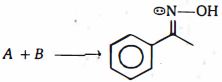
The reactants $(A)$ and $(B)$ are:
A
$Ph-CH_2-CH=O + NH_2-OH$
B
$Ph-CH=O + NH_2-OH$
C
$Ph-C(=O)-CH_3 + NH_2-NH_2$
D
$Ph-C(=O)-CH_3 + NH_2-OH$
Solution
(D) The reaction shown is the formation of an oxime from a ketone and hydroxylamine $(NH_2OH)$.
In the product,the carbon atom is attached to a phenyl group $(Ph)$,a methyl group $(-CH_3)$,and is double-bonded to a nitrogen atom which is attached to an $-OH$ group.
This structure corresponds to the oxime of acetophenone $(Ph-C(=O)-CH_3)$.
Therefore,the reactants are acetophenone $(Ph-C(=O)-CH_3)$ and hydroxylamine $(NH_2-OH)$.
In the product,the carbon atom is attached to a phenyl group $(Ph)$,a methyl group $(-CH_3)$,and is double-bonded to a nitrogen atom which is attached to an $-OH$ group.
This structure corresponds to the oxime of acetophenone $(Ph-C(=O)-CH_3)$.
Therefore,the reactants are acetophenone $(Ph-C(=O)-CH_3)$ and hydroxylamine $(NH_2-OH)$.
0 likes
View Solution729
MediumMCQ
Which of the following does not form a stable hydrate on addition of $H_2O$?
A
Ninhydrin
B
Cyclopropanone
C
Cyclohexanone
D
Chloral $(CCl_3CHO)$
Solution
(C) The formation of a stable hydrate from a carbonyl compound depends on the stability of the resulting gem-diol.
$1$. $Ninhydrin$ forms a very stable hydrate due to the presence of electron-withdrawing carbonyl groups.
$2$. $Cyclopropanone$ forms a stable hydrate due to the relief of ring strain upon $sp^2$ to $sp^3$ hybridization change.
$3$. $Chloral$ $(CCl_3CHO)$ forms a stable hydrate $(CCl_3CH(OH)_2)$ due to the strong electron-withdrawing effect of the $CCl_3$ group.
$4$. $Cyclohexanone$ does not form a stable hydrate because the equilibrium lies far to the left,favoring the ketone over the gem-diol.
$1$. $Ninhydrin$ forms a very stable hydrate due to the presence of electron-withdrawing carbonyl groups.
$2$. $Cyclopropanone$ forms a stable hydrate due to the relief of ring strain upon $sp^2$ to $sp^3$ hybridization change.
$3$. $Chloral$ $(CCl_3CHO)$ forms a stable hydrate $(CCl_3CH(OH)_2)$ due to the strong electron-withdrawing effect of the $CCl_3$ group.
$4$. $Cyclohexanone$ does not form a stable hydrate because the equilibrium lies far to the left,favoring the ketone over the gem-diol.
0 likes
View Solution730
MediumMCQ
Consider the following sequence of reactions:
Ketone $A$ $\xrightarrow[2. H_2O]{1. C_2H_5MgBr} B$ $\xrightarrow[- H_2O]{H_2SO_4, \text{Heat}} C$ $\xrightarrow[2. Zn, H_2O]{1. O_3} \text{Propanone} + \text{Acetaldehyde}$
The ketone $A$ is:
Ketone $A$ $\xrightarrow[2. H_2O]{1. C_2H_5MgBr} B$ $\xrightarrow[- H_2O]{H_2SO_4, \text{Heat}} C$ $\xrightarrow[2. Zn, H_2O]{1. O_3} \text{Propanone} + \text{Acetaldehyde}$
The ketone $A$ is:
A
Butan$-2-$one
B
Pentan$-3-$one
C
Pentan$-2-$one
D
Propanone
Solution
(D) Let the ketone $A$ be $R-CO-R'$.
$1$. Reaction with $C_2H_5MgBr$ followed by hydrolysis gives a tertiary alcohol $B$ $(R-C(OH)(C_2H_5)-R')$.
$2$. Dehydration of $B$ with $H_2SO_4$ and heat gives an alkene $C$.
$3$. Ozonolysis of $C$ gives propanone $(CH_3COCH_3)$ and acetaldehyde $(CH_3CHO)$.
$4$. The products of ozonolysis indicate that the alkene $C$ is $CH_3-C(CH_3)=CH-CH_3$ ($2$-methylbut$-2-$ene).
$5$. Working backwards,the alcohol $B$ must be $CH_3-C(OH)(CH_3)-CH_2-CH_3$ ($2$-methylbutan$-2-$ol).
$6$. This alcohol is formed by the reaction of butan$-2-$one $(CH_3COCH_2CH_3)$ with $CH_3MgBr$ $OR$ by the reaction of propanone $(CH_3COCH_3)$ with $C_2H_5MgBr$.
$7$. Given the sequence uses $C_2H_5MgBr$,the ketone $A$ must be propanone $(CH_3COCH_3)$.
$1$. Reaction with $C_2H_5MgBr$ followed by hydrolysis gives a tertiary alcohol $B$ $(R-C(OH)(C_2H_5)-R')$.
$2$. Dehydration of $B$ with $H_2SO_4$ and heat gives an alkene $C$.
$3$. Ozonolysis of $C$ gives propanone $(CH_3COCH_3)$ and acetaldehyde $(CH_3CHO)$.
$4$. The products of ozonolysis indicate that the alkene $C$ is $CH_3-C(CH_3)=CH-CH_3$ ($2$-methylbut$-2-$ene).
$5$. Working backwards,the alcohol $B$ must be $CH_3-C(OH)(CH_3)-CH_2-CH_3$ ($2$-methylbutan$-2-$ol).
$6$. This alcohol is formed by the reaction of butan$-2-$one $(CH_3COCH_2CH_3)$ with $CH_3MgBr$ $OR$ by the reaction of propanone $(CH_3COCH_3)$ with $C_2H_5MgBr$.
$7$. Given the sequence uses $C_2H_5MgBr$,the ketone $A$ must be propanone $(CH_3COCH_3)$.
0 likes
View Solution731
MediumMCQ
The conversion of acetophenone into benzoic acid can be achieved by its reaction with
A
sodium hydroxide followed by acidification
B
iodine and sodium hydroxide,followed by acidification
C
hydroxylamine followed by reaction with $H_2SO_4$
D
$m$-chloroperbenzoic acid
Solution
(B) The conversion of acetophenone $(C_6H_5COCH_3)$ to benzoic acid $(C_6H_5COOH)$ is achieved using the haloform reaction.
Acetophenone reacts with iodine $(I_2)$ in the presence of sodium hydroxide $(NaOH)$ to form sodium benzoate and iodoform $(CHI_3)$.
$C_6H_5COCH_3 + 3I_2 + 4NaOH \rightarrow C_6H_5COONa + CHI_3 + 3NaI + 3H_2O$.
Subsequent acidification of sodium benzoate yields benzoic acid: $C_6H_5COONa + HCl \rightarrow C_6H_5COOH + NaCl$.
Acetophenone reacts with iodine $(I_2)$ in the presence of sodium hydroxide $(NaOH)$ to form sodium benzoate and iodoform $(CHI_3)$.
$C_6H_5COCH_3 + 3I_2 + 4NaOH \rightarrow C_6H_5COONa + CHI_3 + 3NaI + 3H_2O$.
Subsequent acidification of sodium benzoate yields benzoic acid: $C_6H_5COONa + HCl \rightarrow C_6H_5COOH + NaCl$.
0 likes
View Solution732
DifficultMCQ
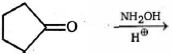
Which is the major product of the following reaction?
A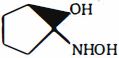
B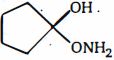
C
D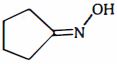
Solution
(D) The reaction of a ketone with hydroxylamine $(NH_2OH)$ in the presence of an acid catalyst $(H^+)$ is a nucleophilic addition-elimination reaction.
$1$. The nucleophilic nitrogen atom of $NH_2OH$ attacks the electrophilic carbonyl carbon of the ketone.
$2$. This is followed by the loss of a water molecule $(H_2O)$ to form an oxime.
$3$. The reaction is represented as: $R_2C=O + NH_2OH \xrightarrow{H^+} R_2C=N-OH + H_2O$.
$4$. For cyclopentanone,the product is cyclopentanone oxime.
$1$. The nucleophilic nitrogen atom of $NH_2OH$ attacks the electrophilic carbonyl carbon of the ketone.
$2$. This is followed by the loss of a water molecule $(H_2O)$ to form an oxime.
$3$. The reaction is represented as: $R_2C=O + NH_2OH \xrightarrow{H^+} R_2C=N-OH + H_2O$.
$4$. For cyclopentanone,the product is cyclopentanone oxime.
0 likes
View Solution733
MediumMCQ
The final product of the following reaction sequence is: $(CH_3O)_2CH-CH_2-CH_2-CH_2-Br$ $\xrightarrow{Mg}$ $\xrightarrow{H_2C=O}$ $\xrightarrow[heat]{H_3O^{+}}$
A
$OHC-CH_2-CH_2-CH_2-CH_2OH$
B
$CH_3-CO-CH_2-CH_2-CH_2-CH_2OH$
C
$H-CO-CH_2-CH_2-CH_2-CH_2OH$
D
$H-CO-CH_2-CH_2-CH_2-CO-H$
Solution
(C) The reaction sequence is as follows:
$1.$ Formation of Grignard reagent: $(CH_3O)_2CH-CH_2-CH_2-CH_2-Br + Mg \rightarrow (CH_3O)_2CH-CH_2-CH_2-CH_2-MgBr$
$2.$ Nucleophilic addition to formaldehyde: $(CH_3O)_2CH-CH_2-CH_2-CH_2-MgBr + H_2C=O \rightarrow (CH_3O)_2CH-CH_2-CH_2-CH_2-CH_2-OMgBr$
$3.$ Acidic hydrolysis and deprotection: $(CH_3O)_2CH-CH_2-CH_2-CH_2-CH_2-OMgBr \xrightarrow[heat]{H_3O^{+}} OHC-CH_2-CH_2-CH_2-CH_2OH$
In the final step,the acetal group $(CH_3O)_2CH-$ is hydrolyzed to an aldehyde group $OHC-$,and the alkoxide group is hydrolyzed to a primary alcohol $-CH_2OH$. The final product is $OHC-CH_2-CH_2-CH_2-CH_2OH$ ($5$-hydroxypentanal).
$1.$ Formation of Grignard reagent: $(CH_3O)_2CH-CH_2-CH_2-CH_2-Br + Mg \rightarrow (CH_3O)_2CH-CH_2-CH_2-CH_2-MgBr$
$2.$ Nucleophilic addition to formaldehyde: $(CH_3O)_2CH-CH_2-CH_2-CH_2-MgBr + H_2C=O \rightarrow (CH_3O)_2CH-CH_2-CH_2-CH_2-CH_2-OMgBr$
$3.$ Acidic hydrolysis and deprotection: $(CH_3O)_2CH-CH_2-CH_2-CH_2-CH_2-OMgBr \xrightarrow[heat]{H_3O^{+}} OHC-CH_2-CH_2-CH_2-CH_2OH$
In the final step,the acetal group $(CH_3O)_2CH-$ is hydrolyzed to an aldehyde group $OHC-$,and the alkoxide group is hydrolyzed to a primary alcohol $-CH_2OH$. The final product is $OHC-CH_2-CH_2-CH_2-CH_2OH$ ($5$-hydroxypentanal).
0 likes
View Solution734
DifficultMCQ
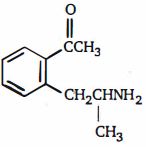
The amino ketone shown below undergoes a spontaneous cyclization on standing. What is the major product of this intramolecular reaction?
A
$2-$methyl$-1,2-$dihydroquinoline
B
$4-$methyl$-1,2-$dihydroquinoline
C
$2-$methyl$-3,4-$dihydroquinoline
D
$4-$methyl$-3,4-$dihydroquinoline
Solution
(C) The given molecule is $o$-amino ketone,specifically $2-(2-aminopropyl)acetophenone$ derivative.
Upon standing,the primary amine group $(NH_2)$ undergoes a nucleophilic attack on the carbonyl carbon $(C=O)$ of the ketone group.
This is an intramolecular condensation reaction (dehydration) that leads to the formation of an imine.
The cyclization results in the formation of a six-membered nitrogen-containing ring,specifically a dihydroquinoline derivative.
Based on the structure,the product formed is $2-methyl-3,4-dihydroquinoline$.
Upon standing,the primary amine group $(NH_2)$ undergoes a nucleophilic attack on the carbonyl carbon $(C=O)$ of the ketone group.
This is an intramolecular condensation reaction (dehydration) that leads to the formation of an imine.
The cyclization results in the formation of a six-membered nitrogen-containing ring,specifically a dihydroquinoline derivative.
Based on the structure,the product formed is $2-methyl-3,4-dihydroquinoline$.
0 likes
View Solution735
MediumMCQ
Compound $(A)$ with molecular formula $C_6H_{12}O$ is optically active. Compound $(A)$ gives a negative Tollens test and a positive test with $2,4$-dinitrophenylhydrazine. Identify $(A)$.
A
$CH_3-C(=O)-CH_2-CH(CH_3)-CH_3$
B
$CH_3-C(=O)-CH(CH_3)-CH_2-CH_3$
C
$H-C(=O)-CH_2-CH(CH_3)-CH_2-CH_3$
D
$CH_3-C(=O)-CH_2-CH_2-CH_2-CH_3$
Solution
(B) The molecular formula $C_6H_{12}O$ corresponds to a degree of unsaturation of $1$,indicating either an aldehyde or a ketone.
Since the compound gives a positive $2,4$-dinitrophenylhydrazine test,it contains a carbonyl group.
$A$ negative Tollens test confirms that the compound is a ketone,not an aldehyde.
For the compound to be optically active,it must possess a chiral center.
In option $(B)$,$CH_3-C(=O)-CH(CH_3)-CH_2-CH_3$,the carbon atom at the $3^{rd}$ position is bonded to four different groups: $-H$,$-CH_3$,$-CH_2CH_3$,and $-COCH_3$,making it a chiral center.
Since the compound gives a positive $2,4$-dinitrophenylhydrazine test,it contains a carbonyl group.
$A$ negative Tollens test confirms that the compound is a ketone,not an aldehyde.
For the compound to be optically active,it must possess a chiral center.
In option $(B)$,$CH_3-C(=O)-CH(CH_3)-CH_2-CH_3$,the carbon atom at the $3^{rd}$ position is bonded to four different groups: $-H$,$-CH_3$,$-CH_2CH_3$,and $-COCH_3$,making it a chiral center.
0 likes
View Solution736
MediumMCQ
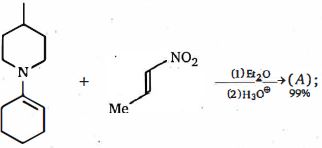
The product $(A)$ of the following reaction is:
A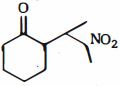
B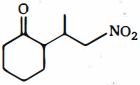
C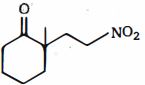
D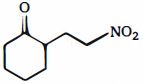
Solution
(A) The reaction is a Stork enamine alkylation followed by hydrolysis.
$1$. The enamine formed from cyclohexanone and $4$-methylpiperidine acts as a nucleophile.
$2$. It undergoes a Michael addition with the nitroalkene ($1$-nitropropene).
$3$. The nucleophilic carbon of the enamine attacks the $\beta$-carbon of the nitroalkene.
$4$. Subsequent acid-catalyzed hydrolysis $(H_3O^+)$ converts the enamine back into a ketone,resulting in the $\alpha$-alkylation of the cyclohexanone.
$5$. The product is $2$-($1$-nitropropan$-2-$yl)cyclohexanone,which corresponds to option $(A)$.
$1$. The enamine formed from cyclohexanone and $4$-methylpiperidine acts as a nucleophile.
$2$. It undergoes a Michael addition with the nitroalkene ($1$-nitropropene).
$3$. The nucleophilic carbon of the enamine attacks the $\beta$-carbon of the nitroalkene.
$4$. Subsequent acid-catalyzed hydrolysis $(H_3O^+)$ converts the enamine back into a ketone,resulting in the $\alpha$-alkylation of the cyclohexanone.
$5$. The product is $2$-($1$-nitropropan$-2-$yl)cyclohexanone,which corresponds to option $(A)$.
0 likes
View Solution737
DifficultMCQ
The product $(Q)$ will be:

A
$1-$phenylcyclopentene
B
$3-$phenylcyclopentene
C
$4-$phenylcyclopentene
D
$1-$phenylcyclopentanol
Solution
(A) $1$. The reaction of cyclopentanone with phenylmagnesium bromide $(PhMgBr)$ followed by hydrolysis with $NH_4Cl/H_2O$ yields $1-$phenylcyclopentanol $(O)$.
$2$. Treatment of $1-$phenylcyclopentanol with cold concentrated $HCl$ results in the substitution of the $-OH$ group with a $-Cl$ atom,forming $1-$chloro$-1-$phenylcyclopentane $(P)$.
$3$. Finally,the reaction of $1-$chloro$-1-$phenylcyclopentane with $KOH$ in ethanol under heating (dehydrohalogenation) leads to the formation of $1-$phenylcyclopentene $(Q)$ via an $E2$ elimination mechanism.
$2$. Treatment of $1-$phenylcyclopentanol with cold concentrated $HCl$ results in the substitution of the $-OH$ group with a $-Cl$ atom,forming $1-$chloro$-1-$phenylcyclopentane $(P)$.
$3$. Finally,the reaction of $1-$chloro$-1-$phenylcyclopentane with $KOH$ in ethanol under heating (dehydrohalogenation) leads to the formation of $1-$phenylcyclopentene $(Q)$ via an $E2$ elimination mechanism.
0 likes
View Solution738
MediumMCQ
$Ph-CH_3$ $\xrightarrow{CrO_2Cl_2} (A)$ $\xrightarrow{conc. KOH} Ph-CH_2OH + (B)$
Product $(B)$ of the above reaction is:
Product $(B)$ of the above reaction is:
A
$Ph-CO_2H$
B
$Ph-CO_2^-$
C
$Ph-CHO$
D
$Ph-CH_3$
Solution
(B) The reaction sequence is as follows:
$1$. $Ph-CH_3$ reacts with $CrO_2Cl_2$ (Etard reaction) to form benzaldehyde $(A)$,which is $Ph-CHO$.
$2$. $Ph-CHO$ reacts with concentrated $KOH$ (Cannizzaro reaction). Since benzaldehyde has no $\alpha$-hydrogen,it undergoes disproportionation to form benzyl alcohol $(Ph-CH_2OH)$ and potassium benzoate $(Ph-COO^-K^+)$.
$3$. Thus,product $(B)$ is the benzoate ion,$Ph-COO^-$.
$1$. $Ph-CH_3$ reacts with $CrO_2Cl_2$ (Etard reaction) to form benzaldehyde $(A)$,which is $Ph-CHO$.
$2$. $Ph-CHO$ reacts with concentrated $KOH$ (Cannizzaro reaction). Since benzaldehyde has no $\alpha$-hydrogen,it undergoes disproportionation to form benzyl alcohol $(Ph-CH_2OH)$ and potassium benzoate $(Ph-COO^-K^+)$.
$3$. Thus,product $(B)$ is the benzoate ion,$Ph-COO^-$.
0 likes
View Solution739
DifficultMCQ
The product $(C)$ of the reaction is:

A
Piperidin$-4-$ol
B
Piperidine
C
Piperidin$-2-$one
D
Piperidin$-2-$ol
Solution
(B) $1$. Cyclopentanone reacts with hydroxylamine $(NH_2OH)$ to form cyclopentanone oxime $(A)$.
$2$. In the presence of an acid $(H^+)$,the oxime undergoes Beckmann rearrangement to form a cyclic amide,$\epsilon$-caprolactam $(B)$.
$3$. Reduction of the amide $(B)$ with lithium aluminium hydride $(LAH)$ yields the corresponding cyclic amine,piperidine $(C)$.
$2$. In the presence of an acid $(H^+)$,the oxime undergoes Beckmann rearrangement to form a cyclic amide,$\epsilon$-caprolactam $(B)$.
$3$. Reduction of the amide $(B)$ with lithium aluminium hydride $(LAH)$ yields the corresponding cyclic amine,piperidine $(C)$.
0 likes
View Solution740
DifficultMCQ
Identify the products $(A)$ and $(C)$ in the following reaction sequence:
$Cyclopentyl-^{14}CN + CH_3MgBr$ $\xrightarrow{H_3O^\oplus} (A)$ $\xrightarrow{NaOI} (B) + (C)$
$Cyclopentyl-^{14}CN + CH_3MgBr$ $\xrightarrow{H_3O^\oplus} (A)$ $\xrightarrow{NaOI} (B) + (C)$
A
$Cyclopentyl-^{14}C(=O)CH_3; CHI_3$
B
$Cyclopentyl-^{14}C(=O)CH_3; CHI_3$
C
$Cyclopentyl-C(=O)^{14}CH_3; CHI_3$
D
$Cyclopentyl-CH_2-^{14}CHO; CHI_3$
Solution
(A) $1$. The reaction of $Cyclopentyl-^{14}CN$ with $CH_3MgBr$ followed by acid hydrolysis $(H_3O^\oplus)$ is a standard method to prepare ketones from nitriles. The methyl group from the Grignard reagent attacks the nitrile carbon,forming an imine intermediate,which upon hydrolysis yields the ketone: $Cyclopentyl-^{14}C(=O)CH_3$ (Product $A$).
$2$. The ketone $(A)$ contains a methyl ketone group $(-C(=O)CH_3)$. When treated with $NaOI$ (which provides $I_2$ and $NaOH$),it undergoes the iodoform reaction.
$3$. The iodoform reaction cleaves the methyl group to form iodoform ($CHI_3$,Product $C$) and the corresponding carboxylate salt $(B)$: $Cyclopentyl-^{14}COO^\ominus$.
$2$. The ketone $(A)$ contains a methyl ketone group $(-C(=O)CH_3)$. When treated with $NaOI$ (which provides $I_2$ and $NaOH$),it undergoes the iodoform reaction.
$3$. The iodoform reaction cleaves the methyl group to form iodoform ($CHI_3$,Product $C$) and the corresponding carboxylate salt $(B)$: $Cyclopentyl-^{14}COO^\ominus$.
0 likes
View Solution741
DifficultMCQ
$Ph-CH(OH)-CH_3$ $\xrightarrow{PCC} (A)$ $\xrightarrow{NH_2-NH-C(=O)-NH_2} (B)$. Product $(B)$ is:
A
$Ph-C(CH_3)=N-C(=O)-NH-NH_2$
B
$Ph-C(CH_3)=N-NH-C(=O)-NH_2$
C
$Ph-CH=N-N(CH_3)-C(=O)-NH_2$
D
$Ph-CH=N-C(=O)-NH_2$
Solution
(B) $PCC$ (Pyridinium chlorochromate) is a mild oxidizing agent that oxidizes secondary alcohols to ketones. Thus,$(A)$ is acetophenone $(Ph-C(=O)-CH_3)$.
Acetophenone reacts with semicarbazide $(NH_2-NH-C(=O)-NH_2)$ to form acetophenone semicarbazone.
In semicarbazide,the $-NH_2$ group attached to the carbonyl group is less nucleophilic due to resonance,so the terminal $-NH_2$ group of the hydrazine part reacts with the carbonyl group of the ketone.
The product $(B)$ is $Ph-C(CH_3)=N-NH-C(=O)-NH_2$.
Acetophenone reacts with semicarbazide $(NH_2-NH-C(=O)-NH_2)$ to form acetophenone semicarbazone.
In semicarbazide,the $-NH_2$ group attached to the carbonyl group is less nucleophilic due to resonance,so the terminal $-NH_2$ group of the hydrazine part reacts with the carbonyl group of the ketone.
The product $(B)$ is $Ph-C(CH_3)=N-NH-C(=O)-NH_2$.
0 likes
View Solution742
DifficultMCQ
The product $(P)$ is formed by the reaction of cyclohexanone with $2$ equivalents of ethanol in the presence of an acid catalyst. The reaction is given as:
Cyclohexanone $+ 2EtOH \xrightarrow{H^+} (P)$
Product $(P)$ is:
Cyclohexanone $+ 2EtOH \xrightarrow{H^+} (P)$
Product $(P)$ is:
A
Hemiacetal
B
Acetal
C
Alcohol
D
Alkane
Solution
(B) When a ketone (like cyclohexanone) reacts with two equivalents of an alcohol (like ethanol) in the presence of an acid catalyst $(H^+)$,it forms an acetal.
The reaction proceeds in two steps:
$1$. The ketone reacts with one equivalent of alcohol to form a hemiacetal.
$2$. The hemiacetal then reacts with a second equivalent of alcohol to form an acetal.
Since the reaction uses $2$ equivalents of ethanol,the final product $(P)$ is an acetal.
The reaction proceeds in two steps:
$1$. The ketone reacts with one equivalent of alcohol to form a hemiacetal.
$2$. The hemiacetal then reacts with a second equivalent of alcohol to form an acetal.
Since the reaction uses $2$ equivalents of ethanol,the final product $(P)$ is an acetal.
0 likes
View Solution743
MediumMCQ
The correct order of decreasing value of $K_{eq.}$ for the addition of $HCN$ to the following carbonyl compounds is:
| Reactant | $K_{eq.}$ |
|---|---|
| $PhCHO$ | $a$ |
| $CH_3CH_2COCH_3$ | $b$ |
| $PhCOCH_3$ | $c$ |
| $CH_3CHO$ | $d$ |
A
$a > b > c > d$
B
$d > a > b > c$
C
$d > b > a > c$
D
$d > a > c > d$
Solution
(B) The addition of $HCN$ to carbonyl compounds is a nucleophilic addition reaction. The equilibrium constant $K_{eq.}$ depends on the electrophilicity of the carbonyl carbon and the steric hindrance around it.
$1$. Aldehydes are more reactive than ketones due to less steric hindrance and higher electrophilicity of the carbonyl carbon.
$2$. Among aldehydes,$CH_3CHO$ $(d)$ is more reactive than $PhCHO$ $(a)$ because the phenyl group in $PhCHO$ provides resonance stabilization to the carbonyl group,reducing its electrophilicity.
$3$. Among ketones,$CH_3CH_2COCH_3$ $(b)$ is more reactive than $PhCOCH_3$ $(c)$ because the phenyl group in $PhCOCH_3$ provides significant resonance stabilization and steric hindrance.
Thus,the reactivity order (and hence $K_{eq.}$ order) is: $CH_3CHO > PhCHO > CH_3CH_2COCH_3 > PhCOCH_3$.
Therefore,the order is $d > a > b > c$.
$1$. Aldehydes are more reactive than ketones due to less steric hindrance and higher electrophilicity of the carbonyl carbon.
$2$. Among aldehydes,$CH_3CHO$ $(d)$ is more reactive than $PhCHO$ $(a)$ because the phenyl group in $PhCHO$ provides resonance stabilization to the carbonyl group,reducing its electrophilicity.
$3$. Among ketones,$CH_3CH_2COCH_3$ $(b)$ is more reactive than $PhCOCH_3$ $(c)$ because the phenyl group in $PhCOCH_3$ provides significant resonance stabilization and steric hindrance.
Thus,the reactivity order (and hence $K_{eq.}$ order) is: $CH_3CHO > PhCHO > CH_3CH_2COCH_3 > PhCOCH_3$.
Therefore,the order is $d > a > b > c$.
0 likes
View Solution744
DifficultMCQ
The end product $(C)$ of the reaction is:

A
B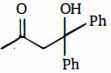
C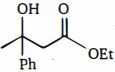
D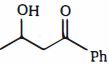
Solution
(B) $1$. The starting material is ethyl acetoacetate,which contains both a ketone and an ester functional group.
$2$. The first step involves the reaction with ethylene glycol in the presence of an acid catalyst $(H^+)$. Since ketones are more reactive towards nucleophilic addition than esters,the ketone group is selectively protected as a cyclic acetal.
$3$. The second step involves the reaction with $2$ equivalents of $PhMgBr$ (a Grignard reagent). The Grignard reagent attacks the ester group,leading to the formation of a tertiary alcohol after the addition of two phenyl groups.
$4$. The final step is the acid-catalyzed hydrolysis $(H_3O^+)$,which deprotects the cyclic acetal back to the ketone.
$5$. The final product $(C)$ is $CH_3COCH_2C(OH)(Ph)_2$.
$2$. The first step involves the reaction with ethylene glycol in the presence of an acid catalyst $(H^+)$. Since ketones are more reactive towards nucleophilic addition than esters,the ketone group is selectively protected as a cyclic acetal.
$3$. The second step involves the reaction with $2$ equivalents of $PhMgBr$ (a Grignard reagent). The Grignard reagent attacks the ester group,leading to the formation of a tertiary alcohol after the addition of two phenyl groups.
$4$. The final step is the acid-catalyzed hydrolysis $(H_3O^+)$,which deprotects the cyclic acetal back to the ketone.
$5$. The final product $(C)$ is $CH_3COCH_2C(OH)(Ph)_2$.
0 likes
View Solution745
DifficultMCQ
Compound $(A)$ with molecular formula $C_{11}H_8O$ does not undergo self-aldol condensation. Upon ozonolysis,it yields $Ph-CHO$ and $2B$,where $B$ on oxidation with $Ag^{+}$ gives oxalic acid. Identify compound $(A)$.
A
$Ph-C \equiv C-C \equiv C-CHO$
B
$Ph-C \equiv C-CH=CH-CHO$
C
$Ph-CH=CH-C \equiv C-CHO$
D
$Ph-CH=CH-C=CH-CO_2H$
Solution
(C) $1$. The compound $(A)$ is $Ph-CH=CH-C \equiv C-CHO$.
$2$. It does not undergo self-aldol condensation because the aldehyde group is conjugated with a triple bond,reducing its electrophilicity and the acidity of $\alpha$-hydrogens.
$3$. Ozonolysis of $Ph-CH=CH-C \equiv C-CHO$ gives $Ph-CHO$ and $OHC-C \equiv C-CHO$.
$4$. The product $B$ is $OHC-C \equiv C-CHO$ (butenedial derivative).
$5$. Oxidation of $B$ with $Ag^{+}$ (Tollens' reagent) yields oxalic acid $(HOOC-COOH)$.
$2$. It does not undergo self-aldol condensation because the aldehyde group is conjugated with a triple bond,reducing its electrophilicity and the acidity of $\alpha$-hydrogens.
$3$. Ozonolysis of $Ph-CH=CH-C \equiv C-CHO$ gives $Ph-CHO$ and $OHC-C \equiv C-CHO$.
$4$. The product $B$ is $OHC-C \equiv C-CHO$ (butenedial derivative).
$5$. Oxidation of $B$ with $Ag^{+}$ (Tollens' reagent) yields oxalic acid $(HOOC-COOH)$.
0 likes
View Solution746
AdvancedMCQ
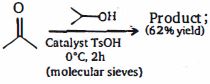
What is the product of the following reaction?
A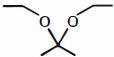
B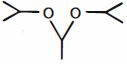
C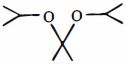
D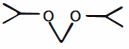
Solution
(B) The reaction of acetone $(CH_3COCH_3)$ with isopropyl alcohol $((CH_3)_2CHOH)$ in the presence of an acid catalyst like $TsOH$ (p-toluenesulfonic acid) and molecular sieves leads to the formation of an acetal.
$1$. First,the ketone reacts with one equivalent of alcohol to form a hemiacetal.
$2$. The hemiacetal then reacts with a second equivalent of alcohol in the presence of the acid catalyst to form the final acetal product,which is $2,2$-diisopropoxypropane.
$3$. The molecular sieves are used to remove water,which shifts the equilibrium towards the formation of the acetal product.
$1$. First,the ketone reacts with one equivalent of alcohol to form a hemiacetal.
$2$. The hemiacetal then reacts with a second equivalent of alcohol in the presence of the acid catalyst to form the final acetal product,which is $2,2$-diisopropoxypropane.
$3$. The molecular sieves are used to remove water,which shifts the equilibrium towards the formation of the acetal product.
0 likes
View Solution747
AdvancedMCQ
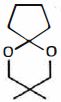
Which pair of reactant compounds may be used to make the given acetal?
A
Cyclohexanone + Ethane$-1,2-$diol
B
Cyclopentanone + Propane$-1,2-$diol
C
Cyclopentanone + $2-$methylpropane$-1,3-$diol
D
Cyclopentanone + $2,2-$dimethylpropane$-1,3-$diol
Solution
(D) The given acetal is a cyclic ketal formed from a ketone and a diol.
By analyzing the structure of the acetal,we can identify the ketone and the diol used in its synthesis.
The acetal contains a cyclopentane ring attached to the ketal carbon,which indicates that the starting ketone is cyclopentanone.
The ketal part is a six-membered ring containing two oxygen atoms,which is derived from $2,2-$dimethylpropane$-1,3-$diol (neopentyl glycol).
The reaction is: $\text{Cyclopentanone} + \text{2,2-dimethylpropane-1,3-diol} \xrightarrow{H^+, \Delta} \text{Acetal} + H_2O$.
Thus,the correct pair of reactants is cyclopentanone and $2,2-$dimethylpropane$-1,3-$diol.
By analyzing the structure of the acetal,we can identify the ketone and the diol used in its synthesis.
The acetal contains a cyclopentane ring attached to the ketal carbon,which indicates that the starting ketone is cyclopentanone.
The ketal part is a six-membered ring containing two oxygen atoms,which is derived from $2,2-$dimethylpropane$-1,3-$diol (neopentyl glycol).
The reaction is: $\text{Cyclopentanone} + \text{2,2-dimethylpropane-1,3-diol} \xrightarrow{H^+, \Delta} \text{Acetal} + H_2O$.
Thus,the correct pair of reactants is cyclopentanone and $2,2-$dimethylpropane$-1,3-$diol.
0 likes
View Solution748
DifficultMCQ
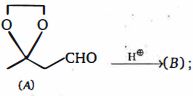
$A$ and $B$ are isomers; Isomer $B$ is
A
$A$ cyclic enol ether
B
$A$ keto-aldehyde
C
An acetal
D
An enol
Solution
(B) The starting material $A$ is a cyclic acetal containing an aldehyde group. In the presence of an acid catalyst $(H^+)$,the cyclic acetal undergoes hydrolysis to release the original aldehyde and ethylene glycol. The resulting product $B$ is an isomer of $A$ that contains both a ketone and an aldehyde group,which is a keto-aldehyde.
0 likes
View Solution749
DifficultMCQ
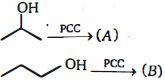
How can $A$ and $B$ be differentiated?
A
$NaH$
B
$2,4-DNP$
C
Tollen's reagent
D
$NaHSO_3$
Solution
(C) The reaction of propan$-2-$ol with $PCC$ gives propanone (a ketone),which is product $A$.
The reaction of propan$-1-$ol with $PCC$ gives propanal (an aldehyde),which is product $B$.
Aldehydes and ketones can be differentiated using Tollen's reagent,as aldehydes give a positive silver mirror test while ketones do not.
Therefore,the correct option is $C$.
The reaction of propan$-1-$ol with $PCC$ gives propanal (an aldehyde),which is product $B$.
Aldehydes and ketones can be differentiated using Tollen's reagent,as aldehydes give a positive silver mirror test while ketones do not.
Therefore,the correct option is $C$.
0 likes
View Solution750
DifficultMCQ
Which of the following pairs cannot be differentiated by Tollens' reagent?
A
Benzaldehyde and benzyl alcohol
B
Hexanal and $2-$hexanone
C
$2-$Hexanol and $2-$hexanone
D
Pentanal and diethyl ether
Solution
(C) Tollens' reagent is an oxidizing agent used to distinguish between aldehydes and ketones.
Aldehydes (like benzaldehyde,hexanal,and pentanal) react with Tollens' reagent to form a silver mirror,whereas ketones (like $2-$hexanone) and alcohols (like benzyl alcohol and $2-$hexanol) do not react.
In the pair $2-$hexanol and $2-$hexanone,both compounds fail to react with Tollens' reagent because $2-$hexanol is a secondary alcohol and $2-$hexanone is a ketone.
Therefore,they cannot be differentiated using this reagent.
Aldehydes (like benzaldehyde,hexanal,and pentanal) react with Tollens' reagent to form a silver mirror,whereas ketones (like $2-$hexanone) and alcohols (like benzyl alcohol and $2-$hexanol) do not react.
In the pair $2-$hexanol and $2-$hexanone,both compounds fail to react with Tollens' reagent because $2-$hexanol is a secondary alcohol and $2-$hexanone is a ketone.
Therefore,they cannot be differentiated using this reagent.
0 likes
View Solution8-1.Aldehydes and Ketones — Properties · Frequently Asked Questions
1Are these 8-1.Aldehydes and Ketones questions useful for JEE and NEET?
Yes. All questions in this section are mapped to JEE Main and NEET exam patterns. Previous year questions from JEE Main, NEET, GUJCET and state-level exams are included with full solutions.
2Can I switch to Hindi or Gujarati for these questions?
Yes. Use the language tabs in the hero section or the sidebar to view the same questions and solutions in English, Hindi or Gujarati.
3How do I generate a question paper from this subtopic?
Use the Vedclass Exam Paper Generator — select the chapter and subtopic, set difficulty, and generate Sets A, B, C, D automatically. First 3 chapters of every subject are free.
Vedclass Products
For Students
Vedclass Test Series
Mock tests in real JEE/NEET style with performance analysis. 5-day free trial.
Start Free TrialFor Teachers
Exam Paper Generator
Generate Set A/B/C/D papers from this chapter in 2 minutes. 3 chapters free.
Try FreeFor Institutes
Online Exam Module
Live online exams with unlimited students, 360° analytics & white-label branding.
See DemoFor Teachers & Institutes
Generate a 8-1.Aldehydes and Ketones Exam Paper in 2 Minutes
Select subtopic & difficulty — Sets A, B, C, D auto-generated with No Repeat logic.
First 3 chapters of every subject are free — no payment required.