
A English
Properties Questions in English
Class 12 Chemistry · 8-1.Aldehydes and Ketones · Properties
1739+
Questions
English
Language
100%
With Solutions
Showing 50 of 1739 questions in English
651
MediumMCQ
The principal product of the reaction between methyl butanoate and $2$ moles of $CH_3MgBr$ after hydrolysis is
A
$C_3H_7-CO-CH_3$
B
$C_3H_7-C(OH)(CH_3)_2$
C
$C_3H_7-CH(OH)-CH_3$
D
$C_3H_7-CO-CH(CH_3)_2$
Solution
(B) Methyl butanoate $(C_3H_7COOCH_3)$ reacts with the first mole of $CH_3MgBr$ to form a ketone,$2$-pentanone $(C_3H_7COCH_3)$,by displacing the methoxy group $(-OCH_3)$.
This ketone then reacts with the second mole of $CH_3MgBr$ to form an alkoxide intermediate.
Upon acidic hydrolysis,the alkoxide intermediate yields the tertiary alcohol,$2$-methylpentan-$2$-ol $(C_3H_7C(OH)(CH_3)_2)$.
This ketone then reacts with the second mole of $CH_3MgBr$ to form an alkoxide intermediate.
Upon acidic hydrolysis,the alkoxide intermediate yields the tertiary alcohol,$2$-methylpentan-$2$-ol $(C_3H_7C(OH)(CH_3)_2)$.
0 likes
View Solution652
MediumMCQ
Comment on the stereochemistry of the products for the following reaction:
$3$-methylpentan-$2$-one + $CH_3MgBr$ followed by $NH_4Cl$ workup.
$3$-methylpentan-$2$-one + $CH_3MgBr$ followed by $NH_4Cl$ workup.
A
diastereomers
B
racemic
C
single stereoisomer
D
meso
Solution
(A) The starting material,$3$-methylpentan-$2$-one,contains a chiral center at the $C3$ position.
The nucleophilic attack of the Grignard reagent $(CH_3MgBr)$ occurs at the $sp^2$ hybridized carbonyl carbon $(C2)$.
Since the $C3$ chiral center is already present and its configuration remains fixed during the reaction,the attack of the nucleophile from the two different faces of the planar carbonyl group creates a new chiral center at $C2$.
This results in the formation of two products that have the same configuration at $C3$ but different configurations at $C2$.
Such stereoisomers,which are not mirror images of each other,are known as diastereomers.
The nucleophilic attack of the Grignard reagent $(CH_3MgBr)$ occurs at the $sp^2$ hybridized carbonyl carbon $(C2)$.
Since the $C3$ chiral center is already present and its configuration remains fixed during the reaction,the attack of the nucleophile from the two different faces of the planar carbonyl group creates a new chiral center at $C2$.
This results in the formation of two products that have the same configuration at $C3$ but different configurations at $C2$.
Such stereoisomers,which are not mirror images of each other,are known as diastereomers.
0 likes
View Solution653
MediumMCQ
$CH_3-CH_2-CHO \xrightarrow{Red\,P + HI} A$. Product $A$ is:
A
propane
B
propanol
C
propanoic acid
D
propene
Solution
(A) Red phosphorus and hydroiodic acid $(Red\,P + HI)$ is a powerful reducing agent that reduces aldehydes and ketones to their corresponding alkanes.
The reaction is: $CH_3-CH_2-CHO + 4HI \xrightarrow{Red\,P, \Delta} CH_3-CH_2-CH_3 + H_2O + 2I_2$.
Therefore,the product $A$ is propane.
The reaction is: $CH_3-CH_2-CHO + 4HI \xrightarrow{Red\,P, \Delta} CH_3-CH_2-CH_3 + H_2O + 2I_2$.
Therefore,the product $A$ is propane.
0 likes
View Solution654
MediumMCQ
In which of the following reactions,two products will be formed other than triphenylphosphine oxide $(Ph_3PO)$?
A
Cyclohexanone + $Ph_3P=CH_2 \to$
B
$CH_3CHO + Ph_3P=C(CH_3)_2 \to$
C
$PhCHO + Ph_3P=CHPh \to$
D
$HCHO + Ph_3P=CHCH_3 \to$
Solution
(C) In the Wittig reaction,an aldehyde or ketone reacts with a phosphonium ylide to form an alkene and triphenylphosphine oxide $(Ph_3PO)$. If the resulting alkene can exhibit geometric isomerism ($cis/trans$ or $E/Z$),then two products (isomers) are formed.
In reaction $(C)$: $PhCHO + Ph_3P=CHPh \to PhCH=CHPh + Ph_3PO$.
The alkene $PhCH=CHPh$ (Stilbene) exists as two geometric isomers: $cis$-stilbene and $trans$-stilbene.
In $(A)$,$(B)$,and $(D)$,the alkenes formed do not have geometric isomers because at least one of the double-bonded carbons is attached to two identical groups (e.g.,in $A$,the product is methylenecyclohexane; in $B$,$CH_3CH=C(CH_3)_2$; in $D$,$CH_2=CHCH_3$).
In reaction $(C)$: $PhCHO + Ph_3P=CHPh \to PhCH=CHPh + Ph_3PO$.
The alkene $PhCH=CHPh$ (Stilbene) exists as two geometric isomers: $cis$-stilbene and $trans$-stilbene.
In $(A)$,$(B)$,and $(D)$,the alkenes formed do not have geometric isomers because at least one of the double-bonded carbons is attached to two identical groups (e.g.,in $A$,the product is methylenecyclohexane; in $B$,$CH_3CH=C(CH_3)_2$; in $D$,$CH_2=CHCH_3$).
0 likes
View Solution655
MediumMCQ
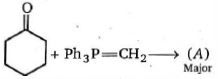
The major product $A$ is:
A
Cyclohexene
B
$1-$Methylcyclohexene
C
Methylenecyclohexane
D
Cyclohexanol
Solution
(C) The given reaction is a Wittig reaction,where a ketone reacts with a phosphorus ylide $(Ph_3P=CH_2)$ to form an alkene.
In this reaction,the oxygen atom of the cyclohexanone is replaced by the $=CH_2$ group from the ylide,resulting in the formation of methylenecyclohexane as the major product $A$ along with triphenylphosphine oxide $(Ph_3P=O)$ as a byproduct.
In this reaction,the oxygen atom of the cyclohexanone is replaced by the $=CH_2$ group from the ylide,resulting in the formation of methylenecyclohexane as the major product $A$ along with triphenylphosphine oxide $(Ph_3P=O)$ as a byproduct.
0 likes
View Solution656
DifficultMCQ
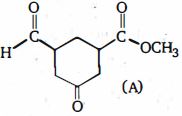
Predict the product when the given compound reacts with $LiAlH_4$.
A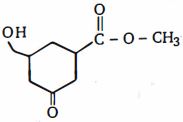
B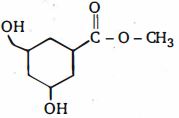
C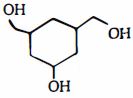
D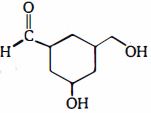
Solution
(C) $LiAlH_4$ (Lithium aluminium hydride) is a strong reducing agent. It reduces aldehydes,ketones,and esters to their corresponding alcohols.
In the given compound,there is an aldehyde group $(-CHO)$,a ketone group $(>C=O)$,and an ester group $(-COOCH_3)$.
$LiAlH_4$ will reduce all three functional groups:
$1$. The aldehyde group $(-CHO)$ is reduced to a primary alcohol $(-CH_2OH)$.
$2$. The ketone group $(>C=O)$ is reduced to a secondary alcohol $(-CHOH-)$.
$3$. The ester group $(-COOCH_3)$ is reduced to a primary alcohol $(-CH_2OH)$ and methanol $(CH_3OH)$.
Therefore,the final product will have three alcohol groups: two primary alcohols and one secondary alcohol.
In the given compound,there is an aldehyde group $(-CHO)$,a ketone group $(>C=O)$,and an ester group $(-COOCH_3)$.
$LiAlH_4$ will reduce all three functional groups:
$1$. The aldehyde group $(-CHO)$ is reduced to a primary alcohol $(-CH_2OH)$.
$2$. The ketone group $(>C=O)$ is reduced to a secondary alcohol $(-CHOH-)$.
$3$. The ester group $(-COOCH_3)$ is reduced to a primary alcohol $(-CH_2OH)$ and methanol $(CH_3OH)$.
Therefore,the final product will have three alcohol groups: two primary alcohols and one secondary alcohol.
0 likes
View Solution657
MediumMCQ
Predict the product when the given compound $(A)$ reacts with $NaBH_4$.
A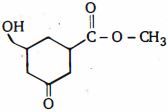
B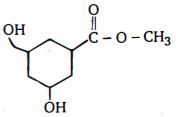
C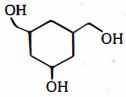
D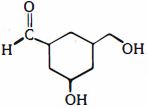
Solution
(A) $NaBH_4$ is a selective reducing agent that reduces aldehydes and ketones to alcohols but does not reduce esters or carboxylic acids.
In the given compound,there is a ketone group and an ester group.
$NaBH_4$ will selectively reduce the ketone group to a secondary alcohol while leaving the ester group intact.
Therefore,the product is a compound containing both a primary alcohol (from the original structure) and a secondary alcohol (formed from the ketone),with the ester group remaining unchanged.
This corresponds to option $(A)$.
In the given compound,there is a ketone group and an ester group.
$NaBH_4$ will selectively reduce the ketone group to a secondary alcohol while leaving the ester group intact.
Therefore,the product is a compound containing both a primary alcohol (from the original structure) and a secondary alcohol (formed from the ketone),with the ester group remaining unchanged.
This corresponds to option $(A)$.
0 likes
View Solution658
AdvancedMCQ
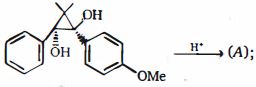
Predict the major product of the given reaction.
Product $A$ is
Product $A$ is
A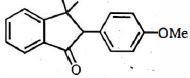
B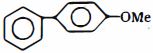
C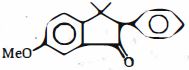
D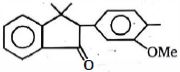
Solution
(A) The reaction proceeds via the protonation of the hydroxyl group attached to the cyclopropane ring,followed by ring opening to form a stable carbocation. The electron-donating methoxy group on the phenyl ring facilitates an intramolecular electrophilic aromatic substitution (Friedel-Crafts type cyclization) to form the final indanone derivative.
$1$. Protonation of the $OH$ group on the cyclopropane ring.
$2$. Ring opening of the cyclopropane ring to generate a stable carbocation intermediate.
$3$. Intramolecular electrophilic aromatic substitution by the carbocation onto the electron-rich $p$-methoxyphenyl ring.
$4$. The final product is the indanone derivative shown in option $A$.
$1$. Protonation of the $OH$ group on the cyclopropane ring.
$2$. Ring opening of the cyclopropane ring to generate a stable carbocation intermediate.
$3$. Intramolecular electrophilic aromatic substitution by the carbocation onto the electron-rich $p$-methoxyphenyl ring.
$4$. The final product is the indanone derivative shown in option $A$.
0 likes
View Solution659
DifficultMCQ
In the presence of dil. $HCl$,compound $A$ is converted to a constitutional isomer $(B)$. Compound $B$ is:
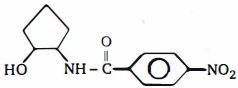
A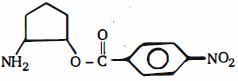
B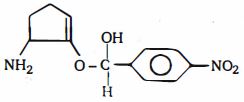
C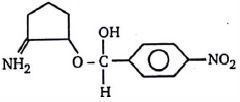
D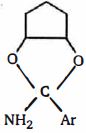
Solution
(B) The reaction involves an intramolecular nucleophilic attack of the hydroxyl group on the carbonyl carbon of the amide group,facilitated by protonation in the presence of dil. $HCl$.
This leads to the formation of an intermediate,followed by an intramolecular acid-base reaction and rearrangement to form an ester linkage,resulting in the constitutional isomer $(B)$ as shown in the provided mechanism.
This leads to the formation of an intermediate,followed by an intramolecular acid-base reaction and rearrangement to form an ester linkage,resulting in the constitutional isomer $(B)$ as shown in the provided mechanism.
0 likes
View Solution660
DifficultMCQ
For the conversion of cyclohexanone to $1-$hydroxy$-1-$methylcyclohexan$-2-$one,the correct order of reagents used is:
$(1)$ $CH_3MgBr / H^+$
$(2)$ $H^+ / \Delta$
$(3)$ $KMnO_4$ (cold dil.)
$(4)$ $CrO_3$
$(1)$ $CH_3MgBr / H^+$
$(2)$ $H^+ / \Delta$
$(3)$ $KMnO_4$ (cold dil.)
$(4)$ $CrO_3$
A
$1 \to 2 \to 3 \to 4$
B
$1 \to 4 \to 3 \to 2$
C
$1 \to 4 \to 2 \to 3$
D
$2 \to 3 \to 4 \to 1$
Solution
(A) The conversion proceeds as follows:
$1$. Cyclohexanone reacts with $CH_3MgBr$ followed by $H^+$ to form $1$-methylcyclohexanol (Reagent $1$).
$2$. $1$-methylcyclohexanol undergoes acid-catalyzed dehydration with $H^+ / \Delta$ to form $1$-methylcyclohexene (Reagent $2$).
$3$. $1$-methylcyclohexene reacts with cold dilute $KMnO_4$ (Baeyer's reagent) to undergo syn-dihydroxylation,forming $1$-methylcyclohexane-$1,2$-diol (Reagent $3$).
$4$. Finally,$CrO_3$ selectively oxidizes the secondary alcohol group to a ketone,yielding $1$-hydroxy-$1$-methylcyclohexan-$2$-one (Reagent $4$).
Thus,the correct order is $1 \to 2 \to 3 \to 4$.
$1$. Cyclohexanone reacts with $CH_3MgBr$ followed by $H^+$ to form $1$-methylcyclohexanol (Reagent $1$).
$2$. $1$-methylcyclohexanol undergoes acid-catalyzed dehydration with $H^+ / \Delta$ to form $1$-methylcyclohexene (Reagent $2$).
$3$. $1$-methylcyclohexene reacts with cold dilute $KMnO_4$ (Baeyer's reagent) to undergo syn-dihydroxylation,forming $1$-methylcyclohexane-$1,2$-diol (Reagent $3$).
$4$. Finally,$CrO_3$ selectively oxidizes the secondary alcohol group to a ketone,yielding $1$-hydroxy-$1$-methylcyclohexan-$2$-one (Reagent $4$).
Thus,the correct order is $1 \to 2 \to 3 \to 4$.
0 likes
View Solution661
MediumMCQ
An organic compound $B$ is formed by the reaction of ethylmagnesium iodide $(CH_3CH_2MgI)$ with a substance $A,$ followed by treatment with dilute aqueous acid. Compound $B$ does not react with $PCC$ in dichloromethane. Identify $A$.
A
$CH_3-CHO$
B
$CH_3CH_2-CO-CH_3$
C
$H_2C=O$
D
Ethylene oxide
Solution
(B) The reaction of a Grignard reagent with a carbonyl compound or epoxide yields an alcohol.
$PCC$ (Pyridinium chlorochromate) is an oxidizing agent that oxidizes primary alcohols to aldehydes and secondary alcohols to ketones.
It cannot oxidize tertiary $(3^{\circ})$ alcohols.
If we react ethylmagnesium iodide with butan$-2-$one $(CH_3CH_2-CO-CH_3)$,we get a tertiary alcohol:
$CH_3CH_2-CO-CH_3 + CH_3CH_2MgI$ $\xrightarrow{Ether} (CH_3CH_2)_2C(OMgI)CH_3$ $\xrightarrow{H_3O^+} (CH_3CH_2)_2C(OH)CH_3$
This product is $3-methylpentan-3-ol$,which is a tertiary alcohol and does not react with $PCC$.
$PCC$ (Pyridinium chlorochromate) is an oxidizing agent that oxidizes primary alcohols to aldehydes and secondary alcohols to ketones.
It cannot oxidize tertiary $(3^{\circ})$ alcohols.
If we react ethylmagnesium iodide with butan$-2-$one $(CH_3CH_2-CO-CH_3)$,we get a tertiary alcohol:
$CH_3CH_2-CO-CH_3 + CH_3CH_2MgI$ $\xrightarrow{Ether} (CH_3CH_2)_2C(OMgI)CH_3$ $\xrightarrow{H_3O^+} (CH_3CH_2)_2C(OH)CH_3$
This product is $3-methylpentan-3-ol$,which is a tertiary alcohol and does not react with $PCC$.
0 likes
View Solution662
MediumMCQ
Which of the following reagents would carry out the following transformation? ($D = $ $^2H$)
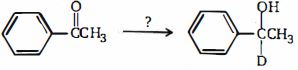
A
$NaBD_4$ in $CH_3OH$
B
$LiAlH_4$,then $D_2O$
C
$NaBD_4$ in $CH_3OD$
D
$LiAlD_4$,then $D_2O$
Solution
(A) The transformation involves the reduction of acetophenone to a chiral secondary alcohol where a deuterium atom $(D)$ is added to the carbonyl carbon.
$NaBD_4$ acts as a source of deuteride ions $(D^-)$,which perform a nucleophilic attack on the carbonyl carbon of the ketone.
The solvent $CH_3OH$ provides the proton $(H^+)$ during the workup to form the hydroxyl group $(-OH)$.
Therefore,the reaction of acetophenone with $NaBD_4$ in $CH_3OH$ yields the desired product.
$NaBD_4$ acts as a source of deuteride ions $(D^-)$,which perform a nucleophilic attack on the carbonyl carbon of the ketone.
The solvent $CH_3OH$ provides the proton $(H^+)$ during the workup to form the hydroxyl group $(-OH)$.
Therefore,the reaction of acetophenone with $NaBD_4$ in $CH_3OH$ yields the desired product.
0 likes
View Solution663
MediumMCQ
In which of the following groups does each member give a positive iodoform test?
A
methanol,ethanol,propanone
B
ethanol,isopropanal,methanal
C
ethanol,ethanal,isopropyl alcohol
D
propanal,propanol-$2$,propanone
Solution
(C) The iodoform test is given by compounds containing the $CH_3CO-$ group or the $CH_3CH(OH)-$ group.
$1$. Ethanol $(CH_3CH_2OH)$ contains the $CH_3CH(OH)-$ group.
$2$. Ethanal $(CH_3CHO)$ contains the $CH_3CO-$ group.
$3$. Isopropyl alcohol $(CH_3CH(OH)CH_3)$ contains the $CH_3CH(OH)-$ group.
Therefore,all members in option $(c)$ give a positive iodoform test.
$1$. Ethanol $(CH_3CH_2OH)$ contains the $CH_3CH(OH)-$ group.
$2$. Ethanal $(CH_3CHO)$ contains the $CH_3CO-$ group.
$3$. Isopropyl alcohol $(CH_3CH(OH)CH_3)$ contains the $CH_3CH(OH)-$ group.
Therefore,all members in option $(c)$ give a positive iodoform test.
0 likes
View Solution664
MediumMCQ
Give the best conditions for this transformation:

A
$CH_3OH, H^{+} (cat.),$ heat
B
$H_2O, H^{+} (cat.),$ heat
C
$Mg,$ ether,$CH_3OH$
D
$SOCl_2, CH_3OH$
Solution
(A) The given reaction is the conversion of an aldehyde (butanal) into an acetal ($1$,$1$-dimethoxybutane).
This reaction proceeds via the nucleophilic addition of methanol to the carbonyl group in the presence of an acid catalyst.
First,the aldehyde reacts with one equivalent of $CH_3OH$ in the presence of $H^{+}$ to form a hemiacetal.
Then,the hemiacetal reacts with a second equivalent of $CH_3OH$ in the presence of $H^{+}$ to form the final acetal product.
Therefore,the best conditions for this transformation are $CH_3OH$ with an acid catalyst $(H^{+})$ and heat to drive the reaction forward.
This reaction proceeds via the nucleophilic addition of methanol to the carbonyl group in the presence of an acid catalyst.
First,the aldehyde reacts with one equivalent of $CH_3OH$ in the presence of $H^{+}$ to form a hemiacetal.
Then,the hemiacetal reacts with a second equivalent of $CH_3OH$ in the presence of $H^{+}$ to form the final acetal product.
Therefore,the best conditions for this transformation are $CH_3OH$ with an acid catalyst $(H^{+})$ and heat to drive the reaction forward.

0 likes
View Solution665
DifficultMCQ
Give the major organic product of the following reaction.
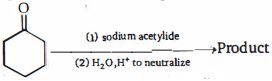
A
$1-$ethynylcyclohexanol
B
cyclohex$-1-$en$-1-$ol
C
$1-$hydroxycyclohexanecarbaldehyde
D
$1,1-$diethynylcyclohexane
Solution
(A) The reaction involves the nucleophilic addition of the acetylide ion $(HC \equiv C^-)$ to the carbonyl carbon of cyclohexanone.
$1$. The acetylide ion acts as a strong nucleophile and attacks the electrophilic carbonyl carbon of cyclohexanone,leading to the formation of an alkoxide intermediate.
$2$. Subsequent protonation of the alkoxide intermediate with $H_3O^+$ yields the final product,$1$-ethynylcyclohexanol.
$1$. The acetylide ion acts as a strong nucleophile and attacks the electrophilic carbonyl carbon of cyclohexanone,leading to the formation of an alkoxide intermediate.
$2$. Subsequent protonation of the alkoxide intermediate with $H_3O^+$ yields the final product,$1$-ethynylcyclohexanol.
0 likes
View Solution666
AdvancedMCQ
Identify the reagents $(1-4)$ required for the transformations shown and arrange them in the correct order.
$(1)$ $LiAlH_4$
$(2)$ $OsO_4$
$(3)$ $NaIO_4$
$(4)$ $NaBH_4$
$(1)$ $LiAlH_4$
$(2)$ $OsO_4$
$(3)$ $NaIO_4$
$(4)$ $NaBH_4$
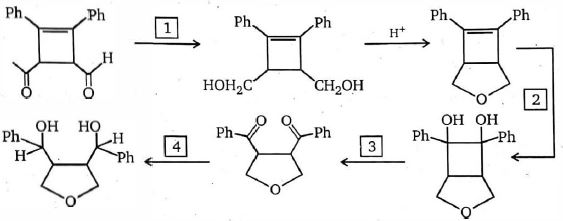
A
$1 \to 2 \to 3 \to 4$
B
$2 \to 3 \to 1 \to 4$
C
$2 \to 1 \to 3 \to 4$
D
$1 \to 3 \to 4 \to 2$
Solution
(A) Step $1$: The reduction of the dialdehyde to a diol is achieved using $LiAlH_4$.
Step $2$: The syn-dihydroxylation of the double bond is achieved using $OsO_4$.
Step $3$: The oxidative cleavage of the vicinal diol to a diketone is achieved using $NaIO_4$ (or $HIO_4$).
Step $4$: The reduction of the diketone to a diol is achieved using $NaBH_4$.
Thus,the correct order of reagents is $1 \to 2 \to 3 \to 4$.
Step $2$: The syn-dihydroxylation of the double bond is achieved using $OsO_4$.
Step $3$: The oxidative cleavage of the vicinal diol to a diketone is achieved using $NaIO_4$ (or $HIO_4$).
Step $4$: The reduction of the diketone to a diol is achieved using $NaBH_4$.
Thus,the correct order of reagents is $1 \to 2 \to 3 \to 4$.
0 likes
View Solution667
MediumMCQ
The conversion shown in the image can be achieved by:
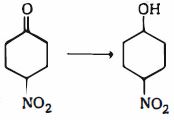
A
$LiAlH_4$
B
$NaBH_4$
C
$H_2/Ni$
D
$CrO_3$
Solution
(B) The reaction involves the selective reduction of a ketone group to an alcohol group in the presence of a nitro group $(-NO_2)$.
$NaBH_4$ (Sodium borohydride) is a selective reducing agent that reduces aldehydes and ketones to alcohols but does not reduce the nitro group $(-NO_2)$.
$LiAlH_4$ and $H_2/Ni$ are strong reducing agents that would reduce both the ketone and the nitro group.
Therefore,$NaBH_4$ is the correct reagent.
$NaBH_4$ (Sodium borohydride) is a selective reducing agent that reduces aldehydes and ketones to alcohols but does not reduce the nitro group $(-NO_2)$.
$LiAlH_4$ and $H_2/Ni$ are strong reducing agents that would reduce both the ketone and the nitro group.
Therefore,$NaBH_4$ is the correct reagent.
0 likes
View Solution668
MediumMCQ
Which of these reagents would accomplish the following reduction?
$NC-CH_2-CO-CH_2-CH=CH_2 \to NC-CH_2-CH(OH)-CH_2-CH=CH_2$
$NC-CH_2-CO-CH_2-CH=CH_2 \to NC-CH_2-CH(OH)-CH_2-CH=CH_2$
A
$NaBH_4$
B
$LiAlH_4$
C
$1 \ mole \ H_2$,poisoned catalyst,low pressure
D
$H_3O^{+}$
Solution
(A) The reaction involves the selective reduction of a ketone group to a secondary alcohol in the presence of a cyano group $(-CN)$ and an alkene $(-CH=CH_2)$ group.
$NaBH_4$ is a selective reducing agent that reduces aldehydes and ketones to alcohols but does not reduce alkenes or cyano groups.
$LiAlH_4$ is a strong reducing agent that would reduce the ketone,the cyano group,and potentially the alkene.
Therefore,$NaBH_4$ is the correct reagent for this transformation.
$NaBH_4$ is a selective reducing agent that reduces aldehydes and ketones to alcohols but does not reduce alkenes or cyano groups.
$LiAlH_4$ is a strong reducing agent that would reduce the ketone,the cyano group,and potentially the alkene.
Therefore,$NaBH_4$ is the correct reagent for this transformation.
0 likes
View Solution669
MediumMCQ
Identify $A$ and $B$ in the given reaction sequence:
Cyclohexylidene ethyl acetate $\xrightarrow{A}$ Cyclohexylidene ethanol $\xrightarrow{MnO_2} B$
Cyclohexylidene ethyl acetate $\xrightarrow{A}$ Cyclohexylidene ethanol $\xrightarrow{MnO_2} B$
A
$A = NaBH_4, B = \text{Cyclohexylidene acetic acid}$
B
$A = NaBH_4, B = \text{Cyclohexylidene acetaldehyde}$
C
$A = LiAlH_4, B = \text{Cyclohexylidene acetaldehyde}$
D
$A = LiAlH_4, B = \text{Cyclohexylidene acetic acid}$
Solution
(C) The starting material is an $\alpha,\beta$-unsaturated ester (cyclohexylidene ethyl acetate).
Step $1$: The reduction of an ester to a primary alcohol requires a strong reducing agent like $LiAlH_4$. $NaBH_4$ is generally not strong enough to reduce esters to alcohols. Therefore,$A = LiAlH_4$.
Step $2$: The product formed is an allylic alcohol (cyclohexylidene ethanol). $MnO_2$ is a selective oxidizing agent that specifically oxidizes allylic and benzylic alcohols to their corresponding aldehydes or ketones without affecting other functional groups like the double bond. Thus,the oxidation of the primary allylic alcohol yields the corresponding aldehyde,cyclohexylidene acetaldehyde.
Therefore,$A = LiAlH_4$ and $B = \text{Cyclohexylidene acetaldehyde}$.
Step $1$: The reduction of an ester to a primary alcohol requires a strong reducing agent like $LiAlH_4$. $NaBH_4$ is generally not strong enough to reduce esters to alcohols. Therefore,$A = LiAlH_4$.
Step $2$: The product formed is an allylic alcohol (cyclohexylidene ethanol). $MnO_2$ is a selective oxidizing agent that specifically oxidizes allylic and benzylic alcohols to their corresponding aldehydes or ketones without affecting other functional groups like the double bond. Thus,the oxidation of the primary allylic alcohol yields the corresponding aldehyde,cyclohexylidene acetaldehyde.
Therefore,$A = LiAlH_4$ and $B = \text{Cyclohexylidene acetaldehyde}$.
0 likes
View Solution670
DifficultMCQ
$H_2C=CH-CH_2-CH_2-CH(OH)-CH_3$ $\xrightarrow[\text{Pyridine}]{SOCl_2} (A)$ $\xrightarrow[H_2O]{O_3/Zn} (B) (C_5H_9ClO)$ $\xrightarrow{NaBH_4} (C)$
Compound $(C)$ is:
Compound $(C)$ is:
A
$CH_3-CH(OH)-CH_2-CH(Cl)-CH_3$
B
$HO-CH_2-CH_2-CH_2-CH_2-CH_2-Cl$
C
$HO-CH_2-CH_2-CH_2-CH(Cl)-CH_3$
D
$HO-CH_2-CH_2-CH(Cl)-CH_2-CH_3$
Solution
(C) $1.$ Reaction of alcohol with $SOCl_2$ in pyridine replaces the $-OH$ group with $-Cl$ with retention of configuration (or simple substitution): $H_2C=CH-CH_2-CH_2-CH(OH)-CH_3 + SOCl_2 \rightarrow H_2C=CH-CH_2-CH_2-CH(Cl)-CH_3 (A)$.
$2.$ Ozonolysis of the terminal alkene $(A)$ using $O_3/Zn, H_2O$ cleaves the double bond to form an aldehyde: $H_2C=CH-CH_2-CH_2-CH(Cl)-CH_3 \rightarrow OHC-CH_2-CH_2-CH(Cl)-CH_3 (B) + HCHO$.
$3.$ Reduction of the aldehyde $(B)$ with $NaBH_4$ yields the corresponding primary alcohol: $OHC-CH_2-CH_2-CH(Cl)-CH_3 \xrightarrow{NaBH_4} HO-CH_2-CH_2-CH_2-CH(Cl)-CH_3 (C)$.
$2.$ Ozonolysis of the terminal alkene $(A)$ using $O_3/Zn, H_2O$ cleaves the double bond to form an aldehyde: $H_2C=CH-CH_2-CH_2-CH(Cl)-CH_3 \rightarrow OHC-CH_2-CH_2-CH(Cl)-CH_3 (B) + HCHO$.
$3.$ Reduction of the aldehyde $(B)$ with $NaBH_4$ yields the corresponding primary alcohol: $OHC-CH_2-CH_2-CH(Cl)-CH_3 \xrightarrow{NaBH_4} HO-CH_2-CH_2-CH_2-CH(Cl)-CH_3 (C)$.
0 likes
View Solution671
AdvancedMCQ
The product $(A)$ of the reaction is:
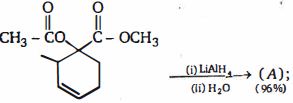
A
B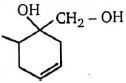
C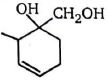
D
Solution
(C) $LiAlH_4$ is a strong reducing agent that reduces esters and anhydrides to primary alcohols. In the given molecule,there is an ester group $(-COOCH_3)$ and an anhydride-like linkage. Upon treatment with $LiAlH_4$ followed by $H_2O$,the ester group is reduced to a primary alcohol $(-CH_2OH)$ and the anhydride linkage is cleaved to form a secondary alcohol $(-OH)$ at the same carbon atom,along with the release of methanol $(CH_3OH)$ and ethanol $(CH_3CH_2OH)$. The final product $(A)$ is a cyclic diol containing both a tertiary hydroxyl group and a primary hydroxymethyl group at the same carbon position.
0 likes
View Solution672
MediumMCQ
Which of the following compounds gives $2HCHO, CO_2, HCO_2H$ when oxidized by periodic acid $(HIO_4)$?
A
$CH_2OH-CH(OH)-CH(OH)-CH_2OH$
B
$CHO-CH(OH)-CH(OH)-CH_2OH$
C
$CH_2OH-CO-CH(OH)-CH(OH)-CH_2OH$
D
$CHO-CO-CH(OH)-CH_2OH$
Solution
(D) Periodic acid $(HIO_4)$ cleaves vicinal diols,$\alpha$-hydroxy carbonyls,and $1,2-$dicarbonyl compounds.
For the compound $CHO-CO-CH(OH)-CH_2OH$:
$1$. The bond between $CHO$ and $CO$ cleaves to give $HCOOH$ and $HCOOH$ (which further oxidizes to $CO_2$ and $H_2O$ or remains as $HCOOH$ depending on conditions).
$2$. The bond between $CO$ and $CH(OH)$ cleaves to give $HCOOH$ and $HCHO$.
$3$. The bond between $CH(OH)$ and $CH_2OH$ cleaves to give $HCHO$ and $HCOOH$.
Summing the products for $CHO-CO-CH(OH)-CH_2OH$ with $3HIO_4$ yields $2HCHO, CO_2, HCO_2H$ as shown in the reaction: $CHO-CO-CH(OH)-CH_2OH + 3HIO_4 \rightarrow 2HCHO + CO_2 + 2HCOOH$ (Note: $HCOOH$ is $HCO_2H$).
Thus,option $D$ is correct.
For the compound $CHO-CO-CH(OH)-CH_2OH$:
$1$. The bond between $CHO$ and $CO$ cleaves to give $HCOOH$ and $HCOOH$ (which further oxidizes to $CO_2$ and $H_2O$ or remains as $HCOOH$ depending on conditions).
$2$. The bond between $CO$ and $CH(OH)$ cleaves to give $HCOOH$ and $HCHO$.
$3$. The bond between $CH(OH)$ and $CH_2OH$ cleaves to give $HCHO$ and $HCOOH$.
Summing the products for $CHO-CO-CH(OH)-CH_2OH$ with $3HIO_4$ yields $2HCHO, CO_2, HCO_2H$ as shown in the reaction: $CHO-CO-CH(OH)-CH_2OH + 3HIO_4 \rightarrow 2HCHO + CO_2 + 2HCOOH$ (Note: $HCOOH$ is $HCO_2H$).
Thus,option $D$ is correct.
0 likes
View Solution673
DifficultMCQ
Product $C$ is
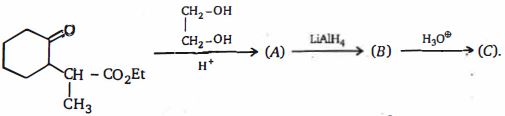
A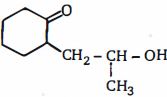
B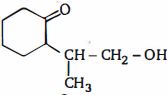
C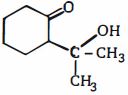
D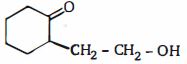
Solution
(B) The reaction sequence is as follows:
$1$. The starting material is a keto-ester. The ketone group is more reactive toward nucleophilic attack than the ester group.
$2$. Treatment with ethylene glycol $(HO-CH_2-CH_2-OH)$ in the presence of an acid catalyst $(H^+)$ selectively protects the ketone as a cyclic acetal (Product $A$).
$3$. Subsequent reduction with $LiAlH_4$ reduces the ester group to a primary alcohol (Product $B$).
$4$. Finally,acid-catalyzed hydrolysis $(H_3O^+)$ removes the acetal protecting group to regenerate the ketone,yielding the final product $C$.
$1$. The starting material is a keto-ester. The ketone group is more reactive toward nucleophilic attack than the ester group.
$2$. Treatment with ethylene glycol $(HO-CH_2-CH_2-OH)$ in the presence of an acid catalyst $(H^+)$ selectively protects the ketone as a cyclic acetal (Product $A$).
$3$. Subsequent reduction with $LiAlH_4$ reduces the ester group to a primary alcohol (Product $B$).
$4$. Finally,acid-catalyzed hydrolysis $(H_3O^+)$ removes the acetal protecting group to regenerate the ketone,yielding the final product $C$.
0 likes
View Solution674
MediumMCQ
Reactant $A$ of the above reaction is
$(A)$ + $\begin{matrix} CH_2-OH \\ | \\ CH_2-OH \end{matrix}$ $\xrightarrow{\text{Pyridine}} \begin{matrix} CH_2-O \\ | \\ CH_2-O \end{matrix} > C = O$
$(A)$ + $\begin{matrix} CH_2-OH \\ | \\ CH_2-OH \end{matrix}$ $\xrightarrow{\text{Pyridine}} \begin{matrix} CH_2-O \\ | \\ CH_2-O \end{matrix} > C = O$
A
$CH_3-CO-CH_3$
B
$COCl_2$
C
$CH_3-CO-Cl$
D
$CH_3-CO-OEt$
Solution
(B) The reaction involves the cyclization of ethylene glycol with phosgene $(COCl_2)$ in the presence of pyridine.
Ethylene glycol acts as a nucleophile,attacking the electrophilic carbonyl carbon of phosgene.
Pyridine acts as a base to neutralize the $HCl$ produced during the reaction.
The reaction proceeds as follows:
$HO-CH_2-CH_2-OH + COCl_2 \xrightarrow{\text{Pyridine}} \text{Cyclic carbonate} + 2HCl$.
Thus,reactant $A$ is phosgene $(COCl_2)$.
Ethylene glycol acts as a nucleophile,attacking the electrophilic carbonyl carbon of phosgene.
Pyridine acts as a base to neutralize the $HCl$ produced during the reaction.
The reaction proceeds as follows:
$HO-CH_2-CH_2-OH + COCl_2 \xrightarrow{\text{Pyridine}} \text{Cyclic carbonate} + 2HCl$.
Thus,reactant $A$ is phosgene $(COCl_2)$.
0 likes
View Solution675
MediumMCQ
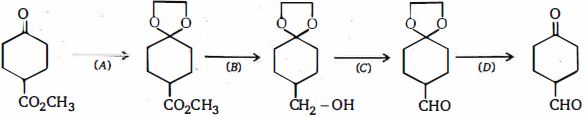
Identify the correct reagents for the given reaction sequence:
A
$A: HO-CH_2-CH_2-OH, H^+$
B
$B: LiAlH_4$
C
$C: CrO_3 / CH_2Cl_2$ (mild)
D
$D: H_3O^+$
Solution
(A-D) The reaction sequence involves the following steps:
$1$. Step $(A)$: Protection of the ketone group as a cyclic acetal using ethylene glycol $(HO-CH_2-CH_2-OH)$ in the presence of an acid catalyst $(H^+)$.
$2$. Step $(B)$: Reduction of the ester group $(-CO_2CH_3)$ to a primary alcohol $(-CH_2OH)$ using a strong reducing agent like $LiAlH_4$.
$3$. Step $(C)$: Mild oxidation of the primary alcohol to an aldehyde $(-CHO)$ using $CrO_3$ in $CH_2Cl_2$ (Collins reagent or similar mild oxidant).
$4$. Step $(D)$: Deprotection of the cyclic acetal back to the ketone using aqueous acid $(H_3O^+)$.
$1$. Step $(A)$: Protection of the ketone group as a cyclic acetal using ethylene glycol $(HO-CH_2-CH_2-OH)$ in the presence of an acid catalyst $(H^+)$.
$2$. Step $(B)$: Reduction of the ester group $(-CO_2CH_3)$ to a primary alcohol $(-CH_2OH)$ using a strong reducing agent like $LiAlH_4$.
$3$. Step $(C)$: Mild oxidation of the primary alcohol to an aldehyde $(-CHO)$ using $CrO_3$ in $CH_2Cl_2$ (Collins reagent or similar mild oxidant).
$4$. Step $(D)$: Deprotection of the cyclic acetal back to the ketone using aqueous acid $(H_3O^+)$.
0 likes
View Solution676
MediumMCQ
$(EtO)_2CH-CHO + CH_3MgI \xrightarrow{H_3O^{+}} (A)$. The product obtained in the above reaction is:
A
$CH_3-CO-CHO$
B
$CH_3-CH(OH)-CHO$
C
$CH_3-CO-CH_2OH$
D
$CH_3-CH(OH)-CH_2OH$
Solution
(B) The Grignard reagent $CH_3MgI$ acts as a nucleophile and attacks the carbonyl carbon of the aldehyde group in $(EtO)_2CH-CHO$ to form an intermediate alkoxide.
Upon acidic hydrolysis $(H_3O^{+})$,the intermediate alkoxide is protonated to form an alcohol,and the acetal group $(EtO)_2CH-$ is hydrolyzed to an aldehyde group $(-CHO)$.
The reaction sequence is: $(EtO)_2CH-CHO + CH_3MgI$ $\rightarrow (EtO)_2CH-CH(OMgI)CH_3$ $\xrightarrow{H_3O^{+}} OHC-CH(OH)CH_3$.
Upon acidic hydrolysis $(H_3O^{+})$,the intermediate alkoxide is protonated to form an alcohol,and the acetal group $(EtO)_2CH-$ is hydrolyzed to an aldehyde group $(-CHO)$.
The reaction sequence is: $(EtO)_2CH-CHO + CH_3MgI$ $\rightarrow (EtO)_2CH-CH(OMgI)CH_3$ $\xrightarrow{H_3O^{+}} OHC-CH(OH)CH_3$.
0 likes
View Solution677
DifficultMCQ
Which of the following sets of reagents,used in the order shown,would successfully accomplish the conversion shown?

A
$CH_3-CH_2-CH_2MgBr$; $H_3O^{+}$; $PCC, CH_2Cl_2$
B
$CH_3-CH_2-CH_2MgBr$; $H_3O^{+}$; $H_2SO_4, \text{heat}$; $PCC, CH_2Cl_2$
C
$(C_6H_5)_3P^{+}-C^{-}HCH_2CH_3$; $B_2H_6$; $CH_3CO_2H$
D
$(C_6H_5)_3P^{+}-C^{-}HCH_2CH_3$; $H_2O$
Solution
(C) The conversion involves transforming a ketone into an alkane with a longer carbon chain.
$1$. The Wittig reaction between the ketone and the ylide $(C_6H_5)_3P^{+}-C^{-}HCH_2CH_3$ produces an alkene.
$2$. Hydroboration-oxidation (using $B_2H_6$ followed by $CH_3CO_2H$ or $H_2O_2/OH^-$) typically adds an $-OH$ group,but here the sequence is used to reduce the alkene to the alkane.
Option $C$ correctly uses the Wittig reaction followed by hydroboration-deboronation to achieve the final product.
$1$. The Wittig reaction between the ketone and the ylide $(C_6H_5)_3P^{+}-C^{-}HCH_2CH_3$ produces an alkene.
$2$. Hydroboration-oxidation (using $B_2H_6$ followed by $CH_3CO_2H$ or $H_2O_2/OH^-$) typically adds an $-OH$ group,but here the sequence is used to reduce the alkene to the alkane.
Option $C$ correctly uses the Wittig reaction followed by hydroboration-deboronation to achieve the final product.
0 likes
View Solution678
DifficultMCQ
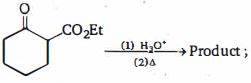
Product of the reaction is
A
Cyclohexanecarbaldehyde
B
Cyclohexanone
C
$2-$Methylcyclohexanone
D
Cyclohexane$-1,2-$dione
Solution
(B) The given reactant is ethyl $2-$oxocyclohexanecarboxylate,which is a $\beta$-keto ester.
Step $(1)$: Acidic hydrolysis $(H_3O^ )$ of the ester group converts it into a carboxylic acid,forming a $\beta$-keto acid.
Step $(2)$: Heating $(\Delta)$ the $\beta$-keto acid leads to decarboxylation,where the $-COOH$ group is lost as $CO_2$.
The final product obtained is cyclohexanone.
Step $(1)$: Acidic hydrolysis $(H_3O^ )$ of the ester group converts it into a carboxylic acid,forming a $\beta$-keto acid.
Step $(2)$: Heating $(\Delta)$ the $\beta$-keto acid leads to decarboxylation,where the $-COOH$ group is lost as $CO_2$.
The final product obtained is cyclohexanone.
0 likes
View Solution679
DifficultMCQ
Which of the following compounds,upon hydrolysis followed by heating,gives a product that yields a positive iodoform test?
A
$1-$acetylcyclobutane$-1-$carboxylic acid ethyl ester
B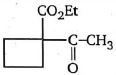
C
$CH_3-CH(CO_2Et)_2$
D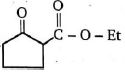
Solution
(A) The iodoform test is given by compounds containing the $CH_3CO-$ group or compounds that can be oxidized to this group.
Upon hydrolysis and subsequent heating (decarboxylation),$\beta$-keto esters yield ketones.
Specifically,$1$-acetylcyclobutane$-1-$carboxylic acid ethyl ester undergoes hydrolysis to form a $\beta$-keto acid,which upon heating loses $CO_2$ to form acetylcyclobutane (a methyl ketone).
This methyl ketone $(CH_3-CO-R)$ gives a positive iodoform test with $I_2/NaOH$ to form $CHI_3$ (iodoform) and a carboxylate salt.
Upon hydrolysis and subsequent heating (decarboxylation),$\beta$-keto esters yield ketones.
Specifically,$1$-acetylcyclobutane$-1-$carboxylic acid ethyl ester undergoes hydrolysis to form a $\beta$-keto acid,which upon heating loses $CO_2$ to form acetylcyclobutane (a methyl ketone).
This methyl ketone $(CH_3-CO-R)$ gives a positive iodoform test with $I_2/NaOH$ to form $CHI_3$ (iodoform) and a carboxylate salt.
0 likes
View Solution680
DifficultMCQ
Find out the reactivity order of the labeled functional groups towards $LiAlH_4$ reduction.
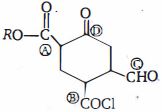
A
$A > B > C > D$
B
$B > C > D > A$
C
$D > C > B > A$
D
$B > D > C > A$
Solution
(B) The reduction with $LiAlH_4$ is a nucleophilic addition-elimination reaction for carbonyl derivatives and a nucleophilic addition for aldehydes/ketones.
The general reactivity order towards nucleophilic attack is: Acid chloride $(B)$ > Aldehyde $(C)$ > Ketone $(D)$ > Ester $(A)$.
Therefore,the correct order is $B > C > D > A$.
The general reactivity order towards nucleophilic attack is: Acid chloride $(B)$ > Aldehyde $(C)$ > Ketone $(D)$ > Ester $(A)$.
Therefore,the correct order is $B > C > D > A$.
0 likes
View Solution681
MediumMCQ
In the given compound,how many functional groups are reduced by $LiAlH_4$ (Lithium aluminium hydride) and $NaBH_4$ (Sodium borohydride) respectively? (Assume the compound contains an ester,an acid,a ketone,and an aldehyde group).
A
$4, 4$
B
$4, 3$
C
$3, 4$
D
$4, 2$
Solution
(D) $LiAlH_4$ is a strong reducing agent that can reduce all four functional groups: ester,carboxylic acid,ketone,and aldehyde.
$NaBH_4$ is a selective reducing agent that can only reduce aldehydes and ketones.
Therefore,$LiAlH_4$ reduces $4$ groups,and $NaBH_4$ reduces $2$ groups.
The correct option is $D$.
$NaBH_4$ is a selective reducing agent that can only reduce aldehydes and ketones.
Therefore,$LiAlH_4$ reduces $4$ groups,and $NaBH_4$ reduces $2$ groups.
The correct option is $D$.
0 likes
View Solution682
AdvancedMCQ
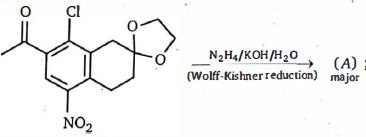
Identify the major product $A$ in the following reaction:
[Image of the reaction: $A$ substituted tetralin derivative with a ketone group,a chlorine atom,and a nitro group,reacting with $N_2H_4/KOH/H_2O$ (Wolff-Kishner reduction)]
[Image of the reaction: $A$ substituted tetralin derivative with a ketone group,a chlorine atom,and a nitro group,reacting with $N_2H_4/KOH/H_2O$ (Wolff-Kishner reduction)]
A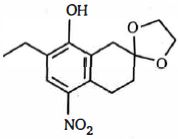
B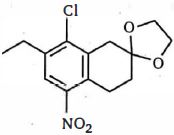
C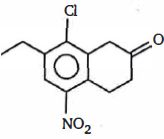
D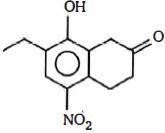
Solution
(A) The reaction involves two main steps:
$1$. The $N_2H_4/KOH/H_2O$ reagent performs a Wolff-Kishner reduction on the ketone group,converting it into an ethyl group.
$2$. The presence of a strong electron-withdrawing nitro group $(-NO_2)$ at the ortho/para position relative to the chlorine atom makes the chlorine susceptible to nucleophilic aromatic substitution $(SNAr)$. Under the basic conditions $(KOH)$,the $Cl$ atom is replaced by an $-OH$ group.
Therefore,the final product $A$ contains an ethyl group,a hydroxyl group,and a nitro group.
$1$. The $N_2H_4/KOH/H_2O$ reagent performs a Wolff-Kishner reduction on the ketone group,converting it into an ethyl group.
$2$. The presence of a strong electron-withdrawing nitro group $(-NO_2)$ at the ortho/para position relative to the chlorine atom makes the chlorine susceptible to nucleophilic aromatic substitution $(SNAr)$. Under the basic conditions $(KOH)$,the $Cl$ atom is replaced by an $-OH$ group.
Therefore,the final product $A$ contains an ethyl group,a hydroxyl group,and a nitro group.
0 likes
View Solution683
MediumMCQ
The above conversion can be achieved by:
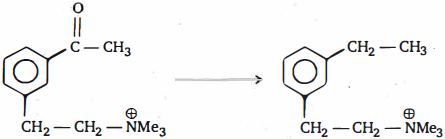
A
Wolff-Kishner reduction.
B
Clemmensen reduction.
C
$LiAlH_4$
D
$NaBH_4$
Solution
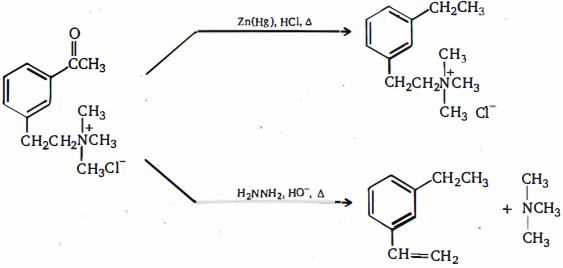
(B) The substrate contains a carbonyl group and a quaternary ammonium group $(-CH_2CH_2N^+(CH_3)_3)$.
Wolff-Kishner reduction uses strong basic conditions $(NH_2NH_2, OH^-, \Delta)$,which would cause a Hofmann elimination of the quaternary ammonium group.
Clemmensen reduction uses acidic conditions $(Zn(Hg), HCl, \Delta)$,which do not affect the quaternary ammonium group,allowing the selective reduction of the carbonyl group to a methylene group.
Wolff-Kishner reduction uses strong basic conditions $(NH_2NH_2, OH^-, \Delta)$,which would cause a Hofmann elimination of the quaternary ammonium group.
Clemmensen reduction uses acidic conditions $(Zn(Hg), HCl, \Delta)$,which do not affect the quaternary ammonium group,allowing the selective reduction of the carbonyl group to a methylene group.
0 likes
View Solution684
DifficultMCQ
The above conversion can be achieved by:

A
Wolff-Kishner reduction
B
Clemmensen reduction
C
$HS-CH_2-CH_2-SH$,followed by Raney $Ni$
D
None of these
Solution
(D) The starting material contains a ketone group and an epoxide ring.
$1$. Wolff-Kishner reduction is carried out in strongly basic conditions $(NH_2NH_2, KOH)$.
$2$. Clemmensen reduction is carried out in strongly acidic conditions $(Zn(Hg), HCl)$.
$3$. The thioacetal formation followed by Raney $Ni$ reduction also typically involves acidic conditions.
Since the epoxide ring is sensitive and unstable in both strongly acidic and strongly basic media,none of the standard methods for reducing a ketone to a methylene group can be used without destroying the epoxide ring.
Therefore,the correct answer is $D$.
$1$. Wolff-Kishner reduction is carried out in strongly basic conditions $(NH_2NH_2, KOH)$.
$2$. Clemmensen reduction is carried out in strongly acidic conditions $(Zn(Hg), HCl)$.
$3$. The thioacetal formation followed by Raney $Ni$ reduction also typically involves acidic conditions.
Since the epoxide ring is sensitive and unstable in both strongly acidic and strongly basic media,none of the standard methods for reducing a ketone to a methylene group can be used without destroying the epoxide ring.
Therefore,the correct answer is $D$.
0 likes
View Solution685
DifficultMCQ
What is the product of the Clemmensen reduction of $3-nitroacetophenone$?
A
$3-ethylnitrobenzene$
B
$1-(3-nitrophenyl)ethanol$
C
$3-ethylaniline$
D
$3-nitro-1-phenylethanol$
Solution
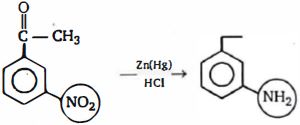
0 likes
View Solution686
MediumMCQ
$CH_3-CH(OH)-CH_2-CH_2-CO-CH_3 \rightarrow CH_3-CH(OH)-(CH_2)_3-CH_3$
The above conversion can be achieved by:
The above conversion can be achieved by:
A
Wolff-Kishner reduction
B
Clemmensen reduction
C
$LiAlH_4$
D
$NaBH_4$
Solution
(A) The conversion involves the reduction of a ketone group $(-CO-)$ to a methylene group $(-CH_2-)$ in the presence of an alcohol group $(-OH)$.
$1$. $LiAlH_4$ and $NaBH_4$ are reducing agents that reduce ketones to alcohols,not to alkanes.
$2$. Clemmensen reduction uses $Zn(Hg)/HCl$ (acidic medium). In acidic conditions,the alcohol group can undergo dehydration or other side reactions.
$3$. Wolff-Kishner reduction uses $NH_2NH_2/KOH$ (basic medium). The alcohol group is stable in basic conditions,making this the preferred method for this specific transformation.
Therefore,the correct option is $A$.
$1$. $LiAlH_4$ and $NaBH_4$ are reducing agents that reduce ketones to alcohols,not to alkanes.
$2$. Clemmensen reduction uses $Zn(Hg)/HCl$ (acidic medium). In acidic conditions,the alcohol group can undergo dehydration or other side reactions.
$3$. Wolff-Kishner reduction uses $NH_2NH_2/KOH$ (basic medium). The alcohol group is stable in basic conditions,making this the preferred method for this specific transformation.
Therefore,the correct option is $A$.
0 likes
View Solution687
MediumMCQ
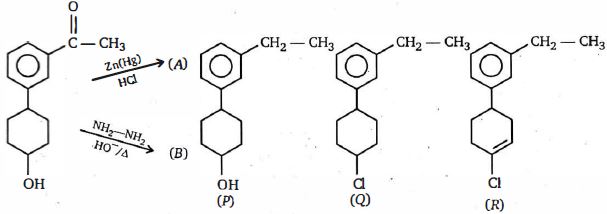
Identify the products $(A)$ and $(B)$ from the given structures $P, Q, R$.
A
$A = P, B = Q$
B
$A = Q, B = R$
C
$A = Q, B = P$
D
$A = R, B = P$
Solution
(C) The reaction with $Zn(Hg)/HCl$ is the Clemmensen reduction,which reduces the carbonyl group to a methylene group. However,in the presence of $HCl$,the secondary alcohol group undergoes substitution to form a chloro derivative. Thus,product $(A)$ is $Q$.
The reaction with $NH_2-NH_2/HO^-, \Delta$ is the Wolff-Kishner reduction,which reduces the carbonyl group to a methylene group under basic conditions. The alcohol group remains unaffected under these conditions. Thus,product $(B)$ is $P$.
Therefore,$A = Q$ and $B = P$.
The reaction with $NH_2-NH_2/HO^-, \Delta$ is the Wolff-Kishner reduction,which reduces the carbonyl group to a methylene group under basic conditions. The alcohol group remains unaffected under these conditions. Thus,product $(B)$ is $P$.
Therefore,$A = Q$ and $B = P$.
0 likes
View Solution688
DifficultMCQ
Identify the product $A$ in the following reaction:
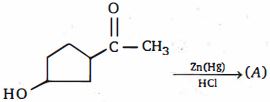
A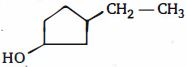
B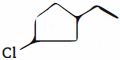
C
D
Solution
(C) The reaction uses $Zn(Hg)/HCl$,which is the Clemmensen reduction. This reagent specifically reduces the carbonyl group $(C=O)$ of aldehydes or ketones to a methylene group $(-CH_2-)$.
However,in the presence of $HCl$ (a strong acid),the hydroxyl group $(-OH)$ present in the molecule can undergo a substitution reaction. The secondary alcohol reacts with $HCl$ to form an alkyl chloride $(-Cl)$.
Therefore,the ketone is reduced to an ethyl group $(-CH_2CH_3)$ and the alcohol is converted to a chloride $(-Cl)$.
The correct product is shown in option $C$.
However,in the presence of $HCl$ (a strong acid),the hydroxyl group $(-OH)$ present in the molecule can undergo a substitution reaction. The secondary alcohol reacts with $HCl$ to form an alkyl chloride $(-Cl)$.
Therefore,the ketone is reduced to an ethyl group $(-CH_2CH_3)$ and the alcohol is converted to a chloride $(-Cl)$.
The correct product is shown in option $C$.
0 likes
View Solution689
MediumMCQ
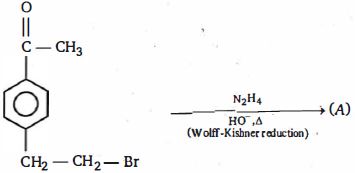
The product $(A)$ is:
A
$4-$ethylphenylethanol
B
$1-$ethyl$-4-$vinylbenzene
C
$1-$ethyl$-4-$($2$-bromoethyl)benzene
D
$1-$ethyl$-4-$($1$-bromoethyl)benzene
Solution
(C) The given reaction involves the Wolff-Kishner reduction of a ketone group $(C=O)$ to a methylene group $(-CH_2-)$ using $N_2H_4$ and $HO^-, \Delta$.
$1$. The Wolff-Kishner reduction specifically targets the carbonyl group,converting the acetyl group $(-COCH_3)$ into an ethyl group $(-CH_2CH_3)$.
$2$. The alkyl halide group $(-CH_2CH_2Br)$ remains unaffected by the Wolff-Kishner reduction conditions.
$3$. Therefore,the product $(A)$ is $1-ethyl-4-(2-bromoethyl)benzene$.
$1$. The Wolff-Kishner reduction specifically targets the carbonyl group,converting the acetyl group $(-COCH_3)$ into an ethyl group $(-CH_2CH_3)$.
$2$. The alkyl halide group $(-CH_2CH_2Br)$ remains unaffected by the Wolff-Kishner reduction conditions.
$3$. Therefore,the product $(A)$ is $1-ethyl-4-(2-bromoethyl)benzene$.
0 likes
View Solution690
DifficultMCQ
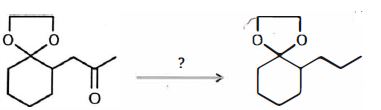
The above conversion can be carried out by:
A
Clemmensen reduction
B
Wolff-Kishner reduction
C
$LiAlH_4$
D
$NaBH_4$
Solution
(B) The starting material contains a ketone group and an acetal (cyclic ketal) protecting group.
To reduce the ketone to an alkane without affecting the acetal,we must use conditions that are stable in basic media.
Clemmensen reduction uses $Zn(Hg)/HCl$,which is acidic and would hydrolyze the acetal.
Wolff-Kishner reduction uses $NH_2NH_2/KOH$,which is basic.
Acetals are stable in basic media,making Wolff-Kishner reduction the correct choice for this transformation.
To reduce the ketone to an alkane without affecting the acetal,we must use conditions that are stable in basic media.
Clemmensen reduction uses $Zn(Hg)/HCl$,which is acidic and would hydrolyze the acetal.
Wolff-Kishner reduction uses $NH_2NH_2/KOH$,which is basic.
Acetals are stable in basic media,making Wolff-Kishner reduction the correct choice for this transformation.
0 likes
View Solution691
MediumMCQ
Arrange the following compounds in the increasing order of their equilibrium constants for the formation of a hydrate:
$(I)$ $6$-amino-$1$-tetralone
$(II)$ $7$-amino-$1$-tetralone
$(III)$ $1$-tetralone
$(IV)$ $6$-nitro-$1$-tetralone
$(I)$ $6$-amino-$1$-tetralone
$(II)$ $7$-amino-$1$-tetralone
$(III)$ $1$-tetralone
$(IV)$ $6$-nitro-$1$-tetralone
A
$IV < III < II < I$
B
$IV < III < I < II$
C
$I < II < III < IV$
D
$II < III < I < IV$
Solution
(C) The equilibrium constant for the formation of a hydrate depends on the electrophilicity of the carbonyl carbon.
$1$. Electron-withdrawing groups $(EWG)$ increase the positive charge on the carbonyl carbon,making it more susceptible to nucleophilic attack by $H_2O$,thus increasing the equilibrium constant for hydrate formation.
$2$. Electron-donating groups $(EDG)$ decrease the positive charge on the carbonyl carbon,making it less susceptible to nucleophilic attack,thus decreasing the equilibrium constant.
$3$. Comparing the substituents:
- $-NO_2$ (in $IV$) is a strong $EWG$,which increases the electrophilicity significantly.
- $-H$ (in $III$) is the reference.
- $-NH_2$ is an $EDG$. In $I$ ($6$-position),the resonance effect is more pronounced compared to $II$ ($7$-position) due to better conjugation with the carbonyl group,making $I$ less reactive than $II$.
$4$. Therefore,the increasing order of reactivity (and thus equilibrium constant) is: $I < II < III < IV$.
$1$. Electron-withdrawing groups $(EWG)$ increase the positive charge on the carbonyl carbon,making it more susceptible to nucleophilic attack by $H_2O$,thus increasing the equilibrium constant for hydrate formation.
$2$. Electron-donating groups $(EDG)$ decrease the positive charge on the carbonyl carbon,making it less susceptible to nucleophilic attack,thus decreasing the equilibrium constant.
$3$. Comparing the substituents:
- $-NO_2$ (in $IV$) is a strong $EWG$,which increases the electrophilicity significantly.
- $-H$ (in $III$) is the reference.
- $-NH_2$ is an $EDG$. In $I$ ($6$-position),the resonance effect is more pronounced compared to $II$ ($7$-position) due to better conjugation with the carbonyl group,making $I$ less reactive than $II$.
$4$. Therefore,the increasing order of reactivity (and thus equilibrium constant) is: $I < II < III < IV$.
0 likes
View Solution692
DifficultMCQ
The given reaction is: $CH_3-CH=CH-O-C(CH_3)=CH_2 \xrightarrow{H_3O^+} A + B$. Compounds $(A)$ and $(B)$ can be differentiated by:
A
$2,4-DNP$
B
Fehling solution
C
Lucas reagent
D
$NaHSO_3$
Solution
(B) The acid-catalyzed hydrolysis of the given enol ether proceeds as follows:
$CH_3-CH=CH-O-C(CH_3)=CH_2 + H_2O \xrightarrow{H^+} CH_3-CH_2-CHO + CH_3-CO-CH_3$
Here,$(A)$ is propanal $(CH_3-CH_2-CHO)$,which is an aldehyde.
$(B)$ is propanone $(CH_3-CO-CH_3)$,which is a ketone.
Fehling solution is a mild oxidizing agent that reacts with aliphatic aldehydes to form a red precipitate of $Cu_2O$,but it does not react with ketones.
Therefore,Fehling solution is used to differentiate between $(A)$ and $(B)$.
$CH_3-CH=CH-O-C(CH_3)=CH_2 + H_2O \xrightarrow{H^+} CH_3-CH_2-CHO + CH_3-CO-CH_3$
Here,$(A)$ is propanal $(CH_3-CH_2-CHO)$,which is an aldehyde.
$(B)$ is propanone $(CH_3-CO-CH_3)$,which is a ketone.
Fehling solution is a mild oxidizing agent that reacts with aliphatic aldehydes to form a red precipitate of $Cu_2O$,but it does not react with ketones.
Therefore,Fehling solution is used to differentiate between $(A)$ and $(B)$.
0 likes
View Solution693
MediumMCQ
Reagents to carry out the above conversion,$P$,$Q$,$R$ respectively are:

A
$H_2C = CH - CH_2 - Br, (HO^{\ominus})$,$[HO^{\ominus}, \Delta]$,Wacker-process
B
$H_2C = CH - CH_2 - Br (HO^{\ominus})$,Wacker-process,$HO^{\ominus}, \Delta$
C
Wacker process,$H_2C = CH - CH_2 - Br (HO^{\ominus})$,$HO^{\ominus} (\Delta)$
D
Wacker process,$HO^{\ominus} (\Delta)$,$H_2C = CH - CH_2 - Br (HO^{\ominus})$
Solution
(B) $1$. Step $P$: Alkylation of cyclohexanone using allyl bromide $(H_2C = CH - CH_2 - Br)$ in the presence of a base $(HO^{\ominus})$ to form $2$-allylcyclohexanone.
$2$. Step $Q$: The Wacker process oxidizes the terminal alkene to a ketone,yielding $2-(2-oxopropyl)cyclohexanone$.
$3$. Step $R$: Intramolecular aldol condensation using a base $(HO^{\ominus})$ and heat $(\Delta)$ leads to the formation of the bicyclic enone product.
Thus,the correct sequence of reagents is $H_2C = CH - CH_2 - Br (HO^{\ominus})$,Wacker-process,$HO^{\ominus}, \Delta$.
$2$. Step $Q$: The Wacker process oxidizes the terminal alkene to a ketone,yielding $2-(2-oxopropyl)cyclohexanone$.
$3$. Step $R$: Intramolecular aldol condensation using a base $(HO^{\ominus})$ and heat $(\Delta)$ leads to the formation of the bicyclic enone product.
Thus,the correct sequence of reagents is $H_2C = CH - CH_2 - Br (HO^{\ominus})$,Wacker-process,$HO^{\ominus}, \Delta$.
0 likes
View Solution694
DifficultMCQ
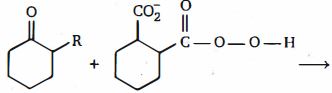
The reaction shown above is a Baeyer-Villiger rearrangement of an asymmetric ketone with magnesium monoperoxyphthalate hexahydrate (in the drawing,$Mg^{+2}$ is omitted for clarity). Identify the major product.
A
B
C
D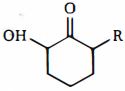
Solution
(A) The reaction is a Baeyer-Villiger oxidation of a ketone.
In this rearrangement,an oxygen atom is inserted into the bond between the carbonyl carbon and the more substituted alkyl group (migratory aptitude: tertiary alkyl > secondary alkyl > primary alkyl > methyl).
For the given $2$-substituted cyclohexanone,the oxygen inserts between the carbonyl carbon and the more substituted carbon (the one bearing the $R$ group) to form a lactone.
Thus,the product is the one where the oxygen is inserted between the carbonyl carbon and the carbon with the $R$ substituent,which corresponds to option $A$.
In this rearrangement,an oxygen atom is inserted into the bond between the carbonyl carbon and the more substituted alkyl group (migratory aptitude: tertiary alkyl > secondary alkyl > primary alkyl > methyl).
For the given $2$-substituted cyclohexanone,the oxygen inserts between the carbonyl carbon and the more substituted carbon (the one bearing the $R$ group) to form a lactone.
Thus,the product is the one where the oxygen is inserted between the carbonyl carbon and the carbon with the $R$ substituent,which corresponds to option $A$.
0 likes
View Solution695
DifficultMCQ
Product $(D)$ will be

A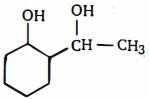
B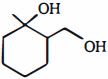
C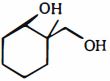
D
Solution
(C) $1$. The starting material is $2$-hydroxymethylcyclohexanol. Treatment with excess $PCC$ oxidizes both the secondary alcohol to a ketone and the primary alcohol to an aldehyde,yielding $2$-formylcyclohexanone.
$2$. Treatment with $1$ equivalent of ethylene glycol in the presence of $H^+$ selectively protects the more reactive aldehyde group as a cyclic acetal.
$3$. Reaction with $CH_3MgBr$ followed by $H_3O^+$ adds a methyl group to the ketone carbonyl,forming a tertiary alcohol,and simultaneously deprotects the acetal back to the aldehyde.
$4$. Finally,$NaBH_4$ reduces the aldehyde group to a primary alcohol,resulting in $1$-methyl-$2$-hydroxymethylcyclohexanol.
$2$. Treatment with $1$ equivalent of ethylene glycol in the presence of $H^+$ selectively protects the more reactive aldehyde group as a cyclic acetal.
$3$. Reaction with $CH_3MgBr$ followed by $H_3O^+$ adds a methyl group to the ketone carbonyl,forming a tertiary alcohol,and simultaneously deprotects the acetal back to the aldehyde.
$4$. Finally,$NaBH_4$ reduces the aldehyde group to a primary alcohol,resulting in $1$-methyl-$2$-hydroxymethylcyclohexanol.
0 likes
View Solution696
MediumMCQ
In the reaction,the product $(X)$ is

A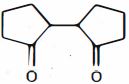
B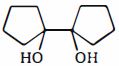
C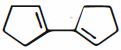
D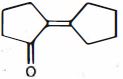
Solution
(C) The reaction of cyclopentanone with $Al(Hg)$ in benzene followed by hydrolysis is a reductive coupling reaction known as the pinacol coupling.
$1$. The aluminum amalgam $(Al(Hg))$ acts as a reducing agent,donating electrons to the carbonyl group of the cyclopentanone to form a ketyl radical anion.
$2$. Two of these ketyl radical anions undergo dimerization to form a di-alkoxide intermediate.
$3$. Subsequent hydrolysis with $H_2O$ protonates the alkoxide ions to yield the final product,which is a pinacol ($1$,$2$-diol).
$4$. The structure formed is $1,1'-bi(cyclopentane)-1,1'-diol$.
$1$. The aluminum amalgam $(Al(Hg))$ acts as a reducing agent,donating electrons to the carbonyl group of the cyclopentanone to form a ketyl radical anion.
$2$. Two of these ketyl radical anions undergo dimerization to form a di-alkoxide intermediate.
$3$. Subsequent hydrolysis with $H_2O$ protonates the alkoxide ions to yield the final product,which is a pinacol ($1$,$2$-diol).
$4$. The structure formed is $1,1'-bi(cyclopentane)-1,1'-diol$.
0 likes
View Solution697
MediumMCQ
Rank the following compounds in order of increasing value of the equilibrium constant for hydration,$K_{hyd}$. (smallest value first).
$1$: Cyclobutanone
$2$: Cyclopropanone
$3$: Di-tert-butyl ketone
$1$: Cyclobutanone
$2$: Cyclopropanone
$3$: Di-tert-butyl ketone
A
$1 < 2 < 3$
B
$3 < 1 < 2$
C
$2 < 1 < 3$
D
$2 < 3 < 1$
Solution
(B) The equilibrium constant for hydration $(K_{hyd})$ depends on the electrophilicity of the carbonyl carbon and steric hindrance.
$1$. $K_{hyd}$ is higher when the carbonyl carbon is more electrophilic and when the reactant is more sterically strained (as hydration relieves ring strain).
$2$. Cyclopropanone $(2)$ has significant ring strain,which is relieved upon hydration,making it the most reactive towards hydration.
$3$. Cyclobutanone $(1)$ has less ring strain than cyclopropanone,so it is less reactive than $2$.
$4$. Di-tert-butyl ketone $(3)$ is extremely sterically hindered due to the two bulky tert-butyl groups,making it the least reactive towards nucleophilic attack.
$5$. Therefore,the order of increasing $K_{hyd}$ is $3 < 1 < 2$.
$1$. $K_{hyd}$ is higher when the carbonyl carbon is more electrophilic and when the reactant is more sterically strained (as hydration relieves ring strain).
$2$. Cyclopropanone $(2)$ has significant ring strain,which is relieved upon hydration,making it the most reactive towards hydration.
$3$. Cyclobutanone $(1)$ has less ring strain than cyclopropanone,so it is less reactive than $2$.
$4$. Di-tert-butyl ketone $(3)$ is extremely sterically hindered due to the two bulky tert-butyl groups,making it the least reactive towards nucleophilic attack.
$5$. Therefore,the order of increasing $K_{hyd}$ is $3 < 1 < 2$.
0 likes
View Solution698
DifficultMCQ
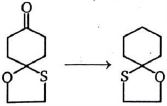
The conversion shown in the image can be achieved by:
A
$Zn(Hg), HCl$
B
$NH_2-NH_2/KOH/\Delta$
C
$LiAlH_4$
D
$H_2/Ni$
Solution
(B) The reaction involves the reduction of a carbonyl group $(C=O)$ to a methylene group $(CH_2)$.
$1$. Clemmensen reduction $(Zn(Hg), HCl)$ is acidic and would hydrolyze the acetal/thioacetal protecting group.
$2$. Wolff-Kishner reduction $(NH_2-NH_2/KOH/\Delta)$ is basic and is suitable for reducing carbonyls in the presence of base-stable protecting groups like acetals or thioacetals.
$3$. $LiAlH_4$ would reduce the carbonyl to an alcohol.
$4$. $H_2/Ni$ would reduce the carbonyl to an alcohol.
Therefore,the correct reagent is $NH_2-NH_2/KOH/\Delta$.
$1$. Clemmensen reduction $(Zn(Hg), HCl)$ is acidic and would hydrolyze the acetal/thioacetal protecting group.
$2$. Wolff-Kishner reduction $(NH_2-NH_2/KOH/\Delta)$ is basic and is suitable for reducing carbonyls in the presence of base-stable protecting groups like acetals or thioacetals.
$3$. $LiAlH_4$ would reduce the carbonyl to an alcohol.
$4$. $H_2/Ni$ would reduce the carbonyl to an alcohol.
Therefore,the correct reagent is $NH_2-NH_2/KOH/\Delta$.
0 likes
View Solution699
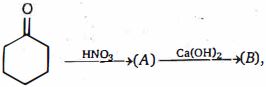
DifficultMCQ
The product $(B)$ in the following reaction is:
A
Cyclobutanone
B
Cyclopropanone
C
Cyclopentanone
D
Cycloheptanone
Solution
(C) $1$. The reaction starts with cyclohexanone,which undergoes oxidation with $HNO_3$ to form adipic acid (hexanedioic acid),represented as $HOOC-(CH_2)_4-COOH$.
$2$. Adipic acid reacts with calcium hydroxide,$Ca(OH)_2$,to form a calcium salt.
$3$. Upon heating,the calcium salt of adipic acid undergoes decarboxylation and cyclization to form cyclopentanone and calcium carbonate $(CaCO_3)$.
$2$. Adipic acid reacts with calcium hydroxide,$Ca(OH)_2$,to form a calcium salt.
$3$. Upon heating,the calcium salt of adipic acid undergoes decarboxylation and cyclization to form cyclopentanone and calcium carbonate $(CaCO_3)$.
0 likes
View Solution700
MediumMCQ
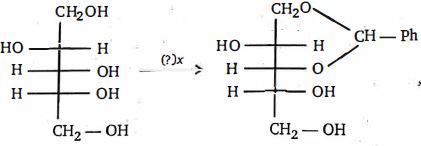
The compound $(x)$ in the above reaction is:
A
$Ph-C(=O)-CH_3$
B
$Ph-CHO$
C
$Ph-CH_2-CHO$
D
$Ph-CH_2-C(=O)-CH_3$
Solution
(B) The reaction shows the formation of a cyclic acetal from a polyol (specifically,a sugar derivative like a pentitol or hexitol) and a carbonyl compound $(x)$.
This is an acetalization reaction where two hydroxyl groups react with an aldehyde to form a cyclic acetal.
In the product,the $CH-Ph$ group is attached to two oxygen atoms,which indicates that the reactant $(x)$ is benzaldehyde,$Ph-CHO$.
This is an acetalization reaction where two hydroxyl groups react with an aldehyde to form a cyclic acetal.
In the product,the $CH-Ph$ group is attached to two oxygen atoms,which indicates that the reactant $(x)$ is benzaldehyde,$Ph-CHO$.
0 likes
View Solution8-1.Aldehydes and Ketones — Properties · Frequently Asked Questions
1Are these 8-1.Aldehydes and Ketones questions useful for JEE and NEET?
Yes. All questions in this section are mapped to JEE Main and NEET exam patterns. Previous year questions from JEE Main, NEET, GUJCET and state-level exams are included with full solutions.
2Can I switch to Hindi or Gujarati for these questions?
Yes. Use the language tabs in the hero section or the sidebar to view the same questions and solutions in English, Hindi or Gujarati.
3How do I generate a question paper from this subtopic?
Use the Vedclass Exam Paper Generator — select the chapter and subtopic, set difficulty, and generate Sets A, B, C, D automatically. First 3 chapters of every subject are free.
Vedclass Products
For Students
Vedclass Test Series
Mock tests in real JEE/NEET style with performance analysis. 5-day free trial.
Start Free TrialFor Teachers
Exam Paper Generator
Generate Set A/B/C/D papers from this chapter in 2 minutes. 3 chapters free.
Try FreeFor Institutes
Online Exam Module
Live online exams with unlimited students, 360° analytics & white-label branding.
See DemoFor Teachers & Institutes
Generate a 8-1.Aldehydes and Ketones Exam Paper in 2 Minutes
Select subtopic & difficulty — Sets A, B, C, D auto-generated with No Repeat logic.
First 3 chapters of every subject are free — no payment required.