
A English
Properties Questions in English
Class 12 Chemistry · 8-1.Aldehydes and Ketones · Properties
1739+
Questions
English
Language
100%
With Solutions
Showing 50 of 1739 questions in English
801
DifficultMCQ
Identify the principal product of the following reaction:

A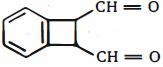
B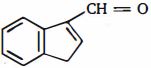
C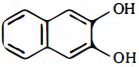
D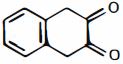
Solution
(C) The reaction is an intramolecular aldol condensation of $o$-phthalaldehyde (benzene$-1,2-$dicarbaldehyde).
In the presence of a base $(NaOH)$,one of the aldehyde groups forms an enolate ion,which then attacks the other carbonyl group to form a cyclic structure.
This leads to the formation of $1$-hydroxy-indane-$2$-one or,upon dehydration,$1H$-indene-$2$-carbaldehyde.
However,looking at the provided options,the structure corresponding to the cyclized product of $o$-phthalaldehyde under these conditions is $1H$-indene-$2$-carbaldehyde (Option $C$).
In the presence of a base $(NaOH)$,one of the aldehyde groups forms an enolate ion,which then attacks the other carbonyl group to form a cyclic structure.
This leads to the formation of $1$-hydroxy-indane-$2$-one or,upon dehydration,$1H$-indene-$2$-carbaldehyde.
However,looking at the provided options,the structure corresponding to the cyclized product of $o$-phthalaldehyde under these conditions is $1H$-indene-$2$-carbaldehyde (Option $C$).
0 likes
View Solution802
MediumMCQ
Which one of the following compounds is the best choice for being prepared by an efficient mixed aldol addition reaction?
A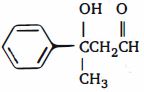
B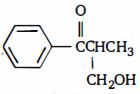
C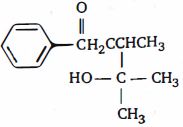
D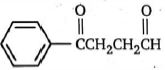
Solution
(B) An efficient mixed aldol addition reaction requires one carbonyl component to have $\alpha$-hydrogens (to act as the nucleophile) and the other carbonyl component to have no $\alpha$-hydrogens (to act as the electrophile).
Formaldehyde $(HCHO)$ is an excellent electrophile because it has no $\alpha$-hydrogens and is highly reactive toward nucleophilic attack.
Propiophenone $(C_6H_5COCH_2CH_3)$ has $\alpha$-hydrogens on the $CH_2$ group,allowing it to form an enolate.
The reaction between propiophenone and formaldehyde is an efficient mixed aldol reaction.
The product formed is $C_6H_5COCH(CH_3)CH_2OH$.
Formaldehyde $(HCHO)$ is an excellent electrophile because it has no $\alpha$-hydrogens and is highly reactive toward nucleophilic attack.
Propiophenone $(C_6H_5COCH_2CH_3)$ has $\alpha$-hydrogens on the $CH_2$ group,allowing it to form an enolate.
The reaction between propiophenone and formaldehyde is an efficient mixed aldol reaction.
The product formed is $C_6H_5COCH(CH_3)CH_2OH$.
0 likes
View Solution803
MediumMCQ
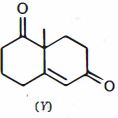
The enolate ion that reacts with $3-$buten$-2-$one to form $(Y)$ is
A
B
C
D
Solution
(D) The reaction shown is a Robinson annulation,which involves a Michael addition followed by an intramolecular aldol condensation.
To form the product $(Y)$,the enolate ion must be derived from $2-$methylcyclohexane$-1,3-$dione.
The enolate ion formed at the $C-2$ position (between the two carbonyl groups) is the most stable due to resonance stabilization by both carbonyl groups.
This enolate attacks the $3-$buten$-2-$one via Michael addition,followed by an intramolecular aldol condensation to yield the bicyclic product $(Y)$.
To form the product $(Y)$,the enolate ion must be derived from $2-$methylcyclohexane$-1,3-$dione.
The enolate ion formed at the $C-2$ position (between the two carbonyl groups) is the most stable due to resonance stabilization by both carbonyl groups.
This enolate attacks the $3-$buten$-2-$one via Michael addition,followed by an intramolecular aldol condensation to yield the bicyclic product $(Y)$.
0 likes
View Solution804
DifficultMCQ
The product $(B)$ in the above reaction is:

A
$CH_3-CH=CH-CH=CH-CHO$
B
$CH_3-CH=CH-CH=CH-CHO$ (with $^{14}C$ at the $3^{rd}$ position)
C
$CH_3-^{14}CH=CH-CH=CH-CHO$
D
$CH_2=CH-CH=CH-CHO$ (with $^{14}C$ at the $1^{st}$ position)
Solution
(A) $1$. The starting material is $CH_3(^{14}CH)-CH_2-CHO$. Upon treatment with base and heat,it undergoes dehydrohalogenation to form crotonaldehyde,$CH_3-CH=CH-CHO$,where the $^{14}C$ is at the $\alpha$-position relative to the aldehyde group,i.e.,$CH_3-CH=^{14}CH-CHO$ is not correct,it is $CH_3-CH=CH-CHO$ with $^{14}C$ at the methyl group.
$2$. The reaction of $(A)$ $(CH_3-CH=CH-CHO)$ with $CH_3CHO$ in the presence of dilute $HO^-$ (aldol condensation) leads to the formation of a conjugated system.
$3$. The enolate formed from $(A)$ attacks the carbonyl carbon of acetaldehyde.
$4$. The final product $(B)$ is $CH_3-CH=CH-CH=CH-CHO$ where the $^{14}C$ label is maintained at the terminal methyl group.
$2$. The reaction of $(A)$ $(CH_3-CH=CH-CHO)$ with $CH_3CHO$ in the presence of dilute $HO^-$ (aldol condensation) leads to the formation of a conjugated system.
$3$. The enolate formed from $(A)$ attacks the carbonyl carbon of acetaldehyde.
$4$. The final product $(B)$ is $CH_3-CH=CH-CH=CH-CHO$ where the $^{14}C$ label is maintained at the terminal methyl group.
0 likes
View Solution805
MediumMCQ
$HCDO \xrightarrow[{(50\%)}]{{OH^{-}}}$ Product of this Cannizzaro reaction is:
A
$DCOO^- + CH_2DOH$
B
$HCOO^- + DCOO^-$
C
$DCOO^- + CH_2DOD$
D
$DCOO^- + CHD_2OH$
Solution
(A) The Cannizzaro reaction involves the disproportionation of an aldehyde lacking $\alpha$-hydrogen atoms in the presence of a concentrated base.
In the given reaction,$HCDO$ (deuterated formaldehyde) undergoes disproportionation.
The hydride/deuteride ion transfer occurs from the carbonyl carbon to another molecule of the aldehyde.
Specifically,the $H^-$ or $D^-$ is transferred. In $HCDO$,the transfer of $H^-$ leads to the formation of $DCOO^-$ and $CH_2DOH$.
The reaction is: $2HCDO + OH^- \rightarrow DCOO^- + CH_2DOH$.
In the given reaction,$HCDO$ (deuterated formaldehyde) undergoes disproportionation.
The hydride/deuteride ion transfer occurs from the carbonyl carbon to another molecule of the aldehyde.
Specifically,the $H^-$ or $D^-$ is transferred. In $HCDO$,the transfer of $H^-$ leads to the formation of $DCOO^-$ and $CH_2DOH$.
The reaction is: $2HCDO + OH^- \rightarrow DCOO^- + CH_2DOH$.
0 likes
View Solution806
DifficultMCQ
An organic compound with the molecular formula $C_9H_{10}O$ forms a $2,4-DNP$ derivative,reduces Tollen's reagent and undergoes Cannizzaro reaction; on vigorous oxidation it gives $1,2-$benzenedicarboxylic acid. The structure of the organic compound is:
A
B
C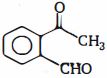
D
Solution
(B) $1$. The molecular formula $C_9H_{10}O$ and the formation of a $2,4-DNP$ derivative indicate the presence of a carbonyl group (aldehyde or ketone).
$2$. The compound reduces Tollen's reagent,which confirms it is an aldehyde.
$3$. It undergoes the Cannizzaro reaction,which implies it does not have any $\alpha-$hydrogen atoms.
$4$. On vigorous oxidation,it yields $1,2-$benzenedicarboxylic acid (phthalic acid),which indicates that the compound is an ortho-substituted benzene derivative.
$5$. Combining these facts,the compound must be $2-$ethylbenzaldehyde. The ethyl group at the ortho position prevents $\alpha-$hydrogens from being available at the carbon attached to the benzene ring,allowing for the Cannizzaro reaction.
$6$. Thus,the structure is $2-$ethylbenzaldehyde.
$2$. The compound reduces Tollen's reagent,which confirms it is an aldehyde.
$3$. It undergoes the Cannizzaro reaction,which implies it does not have any $\alpha-$hydrogen atoms.
$4$. On vigorous oxidation,it yields $1,2-$benzenedicarboxylic acid (phthalic acid),which indicates that the compound is an ortho-substituted benzene derivative.
$5$. Combining these facts,the compound must be $2-$ethylbenzaldehyde. The ethyl group at the ortho position prevents $\alpha-$hydrogens from being available at the carbon attached to the benzene ring,allowing for the Cannizzaro reaction.
$6$. Thus,the structure is $2-$ethylbenzaldehyde.
0 likes
View Solution807
MediumMCQ
$CH_3-CO-CH_2-CH_2-CH_2-CH_2-CHO \xrightarrow{KOH} ?$ The number of intramolecular aldol condensation products is:
A
$1$
B
$2$
C
$3$
D
$4$
Solution
(B) The given compound is $CH_3-CO-CH_2-CH_2-CH_2-CH_2-CHO$.
Intramolecular aldol condensation occurs between the carbonyl carbon of the aldehyde and the $\alpha$-hydrogens of the ketone or vice versa.
$1$. The aldehyde group $(-CHO)$ has an $\alpha$-carbon at position $2$ (relative to $CHO$),but it has no $\alpha$-hydrogens.
$2$. The ketone group $(-CO-)$ has $\alpha$-hydrogens at the $CH_3$ group and the $CH_2$ group.
$3$. Attack of the enolate formed from the $CH_2$ group (adjacent to the ketone) on the aldehyde carbonyl leads to a $6$-membered ring.
$4$. Attack of the enolate formed from the $CH_3$ group on the aldehyde carbonyl leads to a $8$-membered ring.
$5$. Attack of the enolate formed from the $CH_2$ group on the ketone carbonyl is not possible as it would form a highly strained $3$-membered ring.
Considering the stability of the rings formed,the $6$-membered ring product is the major one. However,in the context of intramolecular aldol condensation for this specific molecule,there are $2$ possible cyclic products formed via different enolate attacks on the aldehyde carbonyl. Thus,the correct answer is $2$.
Intramolecular aldol condensation occurs between the carbonyl carbon of the aldehyde and the $\alpha$-hydrogens of the ketone or vice versa.
$1$. The aldehyde group $(-CHO)$ has an $\alpha$-carbon at position $2$ (relative to $CHO$),but it has no $\alpha$-hydrogens.
$2$. The ketone group $(-CO-)$ has $\alpha$-hydrogens at the $CH_3$ group and the $CH_2$ group.
$3$. Attack of the enolate formed from the $CH_2$ group (adjacent to the ketone) on the aldehyde carbonyl leads to a $6$-membered ring.
$4$. Attack of the enolate formed from the $CH_3$ group on the aldehyde carbonyl leads to a $8$-membered ring.
$5$. Attack of the enolate formed from the $CH_2$ group on the ketone carbonyl is not possible as it would form a highly strained $3$-membered ring.
Considering the stability of the rings formed,the $6$-membered ring product is the major one. However,in the context of intramolecular aldol condensation for this specific molecule,there are $2$ possible cyclic products formed via different enolate attacks on the aldehyde carbonyl. Thus,the correct answer is $2$.
0 likes
View Solution808
MediumMCQ
Which of the following compounds will not undergo the Cannizzaro reaction when treated with $50\%$ aqueous alkali?
A
$Ph-CHO$
B
Furfural
C
$Me_2CH-CHO$
D
$Ph-CH_2-CHO$
Solution
(D) The Cannizzaro reaction is characteristic of aldehydes that do not possess an $\alpha$-hydrogen atom.
$A$. $Ph-CHO$ (Benzaldehyde) has no $\alpha$-hydrogen,so it undergoes the Cannizzaro reaction.
$B$. Furfural has no $\alpha$-hydrogen,so it undergoes the Cannizzaro reaction.
$C$. $Me_2CH-CHO$ (Isobutyraldehyde) has one $\alpha$-hydrogen,but it is a known exception that can undergo the Cannizzaro reaction under specific conditions.
$D$. $Ph-CH_2-CHO$ (Phenylacetaldehyde) has two $\alpha$-hydrogens. Aldehydes with $\alpha$-hydrogens typically undergo aldol condensation rather than the Cannizzaro reaction in the presence of aqueous alkali. Therefore,it will not undergo the Cannizzaro reaction.
$A$. $Ph-CHO$ (Benzaldehyde) has no $\alpha$-hydrogen,so it undergoes the Cannizzaro reaction.
$B$. Furfural has no $\alpha$-hydrogen,so it undergoes the Cannizzaro reaction.
$C$. $Me_2CH-CHO$ (Isobutyraldehyde) has one $\alpha$-hydrogen,but it is a known exception that can undergo the Cannizzaro reaction under specific conditions.
$D$. $Ph-CH_2-CHO$ (Phenylacetaldehyde) has two $\alpha$-hydrogens. Aldehydes with $\alpha$-hydrogens typically undergo aldol condensation rather than the Cannizzaro reaction in the presence of aqueous alkali. Therefore,it will not undergo the Cannizzaro reaction.
0 likes
View Solution809
DifficultMCQ
$H-CDO + H^{18}O^{-} \rightarrow D-C^{18}O^{-} + CH_2D-OH$. The above reaction is known as:
A
Cannizzaro reaction,Disproportionation reaction
B
Tishchenko reaction,Disproportionation reaction
C
Cross Cannizzaro reaction; Redox reaction
D
Tishchenko reaction,Redox reaction
Solution
(A) The given reaction involves the self-oxidation and reduction of an aldehyde (specifically formaldehyde derivative $H-CDO$) in the presence of a base $(OH^-)$.
This type of reaction,where the same species is simultaneously oxidized to a carboxylic acid derivative and reduced to an alcohol,is known as the Cannizzaro reaction.
Since the same molecule undergoes both oxidation and reduction,it is also classified as a disproportionation reaction (a specific type of redox reaction).
This type of reaction,where the same species is simultaneously oxidized to a carboxylic acid derivative and reduced to an alcohol,is known as the Cannizzaro reaction.
Since the same molecule undergoes both oxidation and reduction,it is also classified as a disproportionation reaction (a specific type of redox reaction).
0 likes
View Solution810
DifficultMCQ
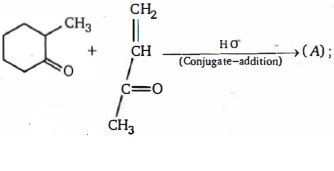
The product $(A)$ is:
A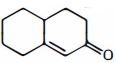
B
C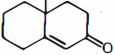
D
Solution
(D) The reaction is a Robinson annulation,which involves two main steps:
$1$. Michael addition: The enolate of $2$-methylcyclohexanone attacks the $\beta$-carbon of methyl vinyl ketone.
$2$. Intramolecular aldol condensation: The resulting intermediate undergoes an intramolecular aldol reaction followed by dehydration to form the bicyclic product.
The final product is $8a$-methyl-$3,4,8,8a$-tetrahydro-naphthalen-$1(2H)$-one,which corresponds to structure $(D)$.
$1$. Michael addition: The enolate of $2$-methylcyclohexanone attacks the $\beta$-carbon of methyl vinyl ketone.
$2$. Intramolecular aldol condensation: The resulting intermediate undergoes an intramolecular aldol reaction followed by dehydration to form the bicyclic product.
The final product is $8a$-methyl-$3,4,8,8a$-tetrahydro-naphthalen-$1(2H)$-one,which corresponds to structure $(D)$.
0 likes
View Solution811
DifficultMCQ
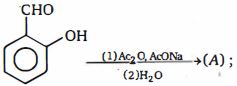
Identify the product $(A)$ and the name of the reaction for the given transformation:
A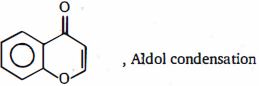
B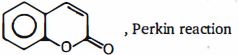
C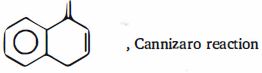
D
Solution
(B) The reaction of salicylaldehyde with acetic anhydride $(Ac_2O)$ in the presence of sodium acetate $(AcONa)$ is a classic example of the Perkin reaction.
In this reaction,the aldehyde group of salicylaldehyde undergoes condensation with the acetic anhydride to form an intermediate,which subsequently undergoes intramolecular cyclization by the loss of a water molecule $(-H_2O)$ to form the cyclic ester known as coumarin ($2H$-chromen-$2$-one).
In this reaction,the aldehyde group of salicylaldehyde undergoes condensation with the acetic anhydride to form an intermediate,which subsequently undergoes intramolecular cyclization by the loss of a water molecule $(-H_2O)$ to form the cyclic ester known as coumarin ($2H$-chromen-$2$-one).
0 likes
View Solution812
MediumMCQ
$CH_3-CH(OH)-CH_2-CHO$
$3HCHO + A \xrightarrow[40^o C]{Na_2CO_3} (B) (82\%)$
Product $(B)$ of the above reaction is
$3HCHO + A \xrightarrow[40^o C]{Na_2CO_3} (B) (82\%)$
Product $(B)$ of the above reaction is
A
$C(CH_2OH)_4$
B
$(HOCH_2)_2C(CHO)_2$
C
$(HOCH_2)_3C-CHO$
D
$(HOCH_2)_2C(CHO)-CH_2-CH_2OH$
Solution
(C) The reaction of acetaldehyde $(CH_3CHO)$ with formaldehyde $(HCHO)$ in the presence of a base $(Na_2CO_3)$ is a crossed aldol condensation followed by Cannizzaro reaction or simply a multi-step aldol addition.
Acetaldehyde has three $\alpha$-hydrogens. In the presence of $3$ moles of formaldehyde,all three $\alpha$-hydrogens are replaced by hydroxymethyl $(-CH_2OH)$ groups.
The reaction proceeds as: $CH_3CHO + 3HCHO \xrightarrow{Na_2CO_3} (HOCH_2)_3C-CHO$ (Pentaerythritol precursor).
Thus,the product $(B)$ is $(HOCH_2)_3C-CHO$.
Acetaldehyde has three $\alpha$-hydrogens. In the presence of $3$ moles of formaldehyde,all three $\alpha$-hydrogens are replaced by hydroxymethyl $(-CH_2OH)$ groups.
The reaction proceeds as: $CH_3CHO + 3HCHO \xrightarrow{Na_2CO_3} (HOCH_2)_3C-CHO$ (Pentaerythritol precursor).
Thus,the product $(B)$ is $(HOCH_2)_3C-CHO$.
0 likes
View Solution813
MediumMCQ
$CH_3CH=CHCHO$ $\xrightarrow[\text{Aldol condensation}]{OH^{-}}$ $\xrightarrow{\Delta} A$; Product $A$ is
A
$CH_3(CH=CH)_3CHO$
B
$CH_3CH_2CH_2(CH=CH)_2CHO$
C
$CH_3(CH_2CH_2)_3CH=CH^{-}CHO$
D
none is correct
Solution
(A) The reaction is an aldol condensation of crotonaldehyde $(CH_3CH=CHCHO)$.
In the presence of a base $(OH^-)$,two molecules of crotonaldehyde undergo aldol condensation to form a $\beta$-hydroxy aldehyde.
Upon heating $(\Delta)$,this intermediate undergoes dehydration (loss of $H_2O$) to form an $\alpha,\beta$-unsaturated aldehyde.
The reaction is: $CH_3CH=CHCHO + CH_3CH=CHCHO \rightarrow CH_3CH=CH-CH(OH)-CH_2-CH=CHCHO$ (intermediate).
Dehydration gives: $CH_3CH=CH-CH=CH-CH=CHCHO$.
This corresponds to $CH_3(CH=CH)_3CHO$.
In the presence of a base $(OH^-)$,two molecules of crotonaldehyde undergo aldol condensation to form a $\beta$-hydroxy aldehyde.
Upon heating $(\Delta)$,this intermediate undergoes dehydration (loss of $H_2O$) to form an $\alpha,\beta$-unsaturated aldehyde.
The reaction is: $CH_3CH=CHCHO + CH_3CH=CHCHO \rightarrow CH_3CH=CH-CH(OH)-CH_2-CH=CHCHO$ (intermediate).
Dehydration gives: $CH_3CH=CH-CH=CH-CH=CHCHO$.
This corresponds to $CH_3(CH=CH)_3CHO$.
0 likes
View Solution814
DifficultMCQ
$A$ and $B$ are isomers. Identify $B$.
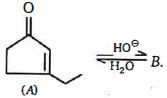
A
$3-$ethylcyclopent$-2-$en$-1-$one
B
$2,3-$dimethylcyclopent$-2-$en$-1-$one
C
$3-$ethylcyclopent$-3-$en$-1-$one
D
$2,3-$dimethylcyclopent$-3-$en$-1-$one
Solution
(B) The reaction involves the base-catalyzed isomerization of an $\alpha,\beta$-unsaturated ketone.
In the presence of $HO^\ominus$ and $H_2O$,the double bond in the cyclopentenone ring migrates to a more substituted position to form a more stable isomer.
The starting material $A$ is $3$-ethylcyclopent-$2$-en-$1$-one.
Under basic conditions,the double bond shifts to form the more stable,more substituted $2,3$-dimethylcyclopent-$2$-en-$1$-one $(B)$.
This is a thermodynamic isomerization process where the more substituted alkene is favored.
In the presence of $HO^\ominus$ and $H_2O$,the double bond in the cyclopentenone ring migrates to a more substituted position to form a more stable isomer.
The starting material $A$ is $3$-ethylcyclopent-$2$-en-$1$-one.
Under basic conditions,the double bond shifts to form the more stable,more substituted $2,3$-dimethylcyclopent-$2$-en-$1$-one $(B)$.
This is a thermodynamic isomerization process where the more substituted alkene is favored.
0 likes
View Solution815
DifficultMCQ
Product $(C)$ is
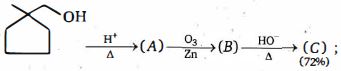
A
$1-$methylcyclohex$-1-$ene
B
cyclohexanone
C
$3-$methylcyclopent$-2-$en$-1-$one
D
$2-$methylcyclopent$-1-$enecarbaldehyde
Solution
(C) $1$. The starting material is $1$-methylcyclopentanol. Upon treatment with $H^+/\Delta$,it undergoes dehydration to form $1$-methylcyclopent$-1-$ene $(A)$.
$2$. Ozonolysis of $(A)$ $(O_3/Zn)$ results in the cleavage of the double bond to form a diketone,$6$-oxoheptanal $(B)$,which is $CH_3COCH_2CH_2CH_2CHO$.
$3$. Compound $(B)$ contains both a ketone and an aldehyde group. In the presence of $HO^-/\Delta$,it undergoes intramolecular aldol condensation. The enolate forms at the $\alpha$-carbon of the ketone,which then attacks the aldehyde carbonyl group to form a five-membered ring,resulting in $3$-methylcyclopent$-2-$en$-1-$one $(C)$.
$2$. Ozonolysis of $(A)$ $(O_3/Zn)$ results in the cleavage of the double bond to form a diketone,$6$-oxoheptanal $(B)$,which is $CH_3COCH_2CH_2CH_2CHO$.
$3$. Compound $(B)$ contains both a ketone and an aldehyde group. In the presence of $HO^-/\Delta$,it undergoes intramolecular aldol condensation. The enolate forms at the $\alpha$-carbon of the ketone,which then attacks the aldehyde carbonyl group to form a five-membered ring,resulting in $3$-methylcyclopent$-2-$en$-1-$one $(C)$.
0 likes
View Solution816
DifficultMCQ
The reaction of acetophenone with benzaldehyde in the presence of $HCl$ and heat produces product $(A)$. Identify $(A)$.
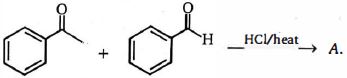
A
$Ph-CO-CH=CH-Ph$
B
$Ph-C(=O)-CH_2-CH_2-Ph$
C
$Ph-CH=CH-CH(OH)-Ph$
D
$Ph-CH=C=CH-Ph$
Solution
(A) The reaction between acetophenone $(Ph-CO-CH_3)$ and benzaldehyde $(Ph-CHO)$ in the presence of an acid catalyst $(HCl)$ and heat is a Claisen-Schmidt condensation,which is a type of cross-aldol condensation.
$1$. The acetophenone acts as the nucleophile by forming an enol.
$2$. The benzaldehyde acts as the electrophile.
$3$. The reaction proceeds through the formation of a $\beta$-hydroxy ketone intermediate,followed by dehydration (loss of $H_2O$) under heating to form an $\alpha,\beta$-unsaturated ketone.
$4$. The final product is benzalacetophenone (chalcone),which is $Ph-CO-CH=CH-Ph$.
$1$. The acetophenone acts as the nucleophile by forming an enol.
$2$. The benzaldehyde acts as the electrophile.
$3$. The reaction proceeds through the formation of a $\beta$-hydroxy ketone intermediate,followed by dehydration (loss of $H_2O$) under heating to form an $\alpha,\beta$-unsaturated ketone.
$4$. The final product is benzalacetophenone (chalcone),which is $Ph-CO-CH=CH-Ph$.
0 likes
View Solution817
DifficultMCQ
Which of the following reactants,on reaction with concentrated $NaOH$ followed by acidification,gives the following lactone as the product?

A
Phthalic acid methyl ester (o-methoxycarbonylbenzoic acid)
B
o-Formylbenzoic acid
C
Phthalaldehyde (benzene$-1,2-$dicarbaldehyde)
D
Phthalic acid
Solution
(C) The reaction of phthalaldehyde (benzene$-1,2-$dicarbaldehyde) with concentrated $NaOH$ undergoes an intramolecular Cannizzaro reaction.
In this reaction,one aldehyde group is oxidized to a carboxylate ion $(-COO^-)$ and the other is reduced to an alcohol group $(-CH_2OH)$.
This results in the formation of a hydroxy-carboxylate intermediate.
Upon subsequent acidification,the carboxylic acid and the alcohol group undergo an intramolecular esterification (cyclization) to form the lactone,which is phthalide.
In this reaction,one aldehyde group is oxidized to a carboxylate ion $(-COO^-)$ and the other is reduced to an alcohol group $(-CH_2OH)$.
This results in the formation of a hydroxy-carboxylate intermediate.
Upon subsequent acidification,the carboxylic acid and the alcohol group undergo an intramolecular esterification (cyclization) to form the lactone,which is phthalide.
0 likes
View Solution818
DifficultMCQ
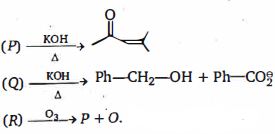
The structure of $(R)$ is:
A
$Ph-CH=CH-CH_3$
B
$Ph-CH=C(CH_3)_2$
C
$Ph-C(CH_3)=CH-CH_3$
D
$CH_3-C(CH_3)=CH_2$
Solution
(B) From the reaction $(R) \xrightarrow{O_3} P + O$,we know that $(R)$ is an alkene that undergoes ozonolysis to produce $P$ and $O$.
From the first reaction,$(P)$ is formed by the aldol condensation of acetone $(CH_3COCH_3)$,which is $CH_3-CO-CH=C(CH_3)_2$ (mesityl oxide).
From the second reaction,$(Q)$ is the Cannizzaro reaction of benzaldehyde $(PhCHO)$ to give benzyl alcohol $(Ph-CH_2OH)$ and benzoate ion $(Ph-COO^-)$.
Thus,$O$ is benzaldehyde $(PhCHO)$ and $P$ is mesityl oxide $(CH_3-CO-CH=C(CH_3)_2)$.
Ozonolysis of an alkene $R$ gives $P$ and $O$. The structure of $R$ is obtained by joining the carbonyl carbons of $P$ and $O$ with a double bond.
$R = Ph-CH=C(CH_3)_2$.
From the first reaction,$(P)$ is formed by the aldol condensation of acetone $(CH_3COCH_3)$,which is $CH_3-CO-CH=C(CH_3)_2$ (mesityl oxide).
From the second reaction,$(Q)$ is the Cannizzaro reaction of benzaldehyde $(PhCHO)$ to give benzyl alcohol $(Ph-CH_2OH)$ and benzoate ion $(Ph-COO^-)$.
Thus,$O$ is benzaldehyde $(PhCHO)$ and $P$ is mesityl oxide $(CH_3-CO-CH=C(CH_3)_2)$.
Ozonolysis of an alkene $R$ gives $P$ and $O$. The structure of $R$ is obtained by joining the carbonyl carbons of $P$ and $O$ with a double bond.
$R = Ph-CH=C(CH_3)_2$.
0 likes
View Solution819
MediumMCQ
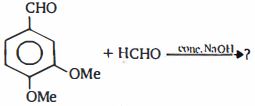
The following reaction gives:
A
$3,4-$Dimethoxybenzyl alcohol + Methanol
B
$3,4-$Dimethoxybenzyl alcohol + Formate ion
C
$3,4-$Dimethoxybenzoic acid + Formic acid
D
$3,4-$Dimethoxybenzoic acid + Methanol
Solution
(B) The reaction is a Cross Cannizzaro reaction between $3,4-$dimethoxybenzaldehyde and formaldehyde $(HCHO)$ in the presence of concentrated $NaOH$.
In a Cross Cannizzaro reaction,the more reactive aldehyde (formaldehyde) is oxidized to the corresponding acid salt (formate,$HCOO^-$),and the less reactive aldehyde ($3$,$4$-dimethoxybenzaldehyde) is reduced to the corresponding alcohol ($3$,$4$-dimethoxybenzyl alcohol).
Therefore,the products are $3,4-$dimethoxybenzyl alcohol and the formate ion $(HCOO^-)$.
In a Cross Cannizzaro reaction,the more reactive aldehyde (formaldehyde) is oxidized to the corresponding acid salt (formate,$HCOO^-$),and the less reactive aldehyde ($3$,$4$-dimethoxybenzaldehyde) is reduced to the corresponding alcohol ($3$,$4$-dimethoxybenzyl alcohol).
Therefore,the products are $3,4-$dimethoxybenzyl alcohol and the formate ion $(HCOO^-)$.
0 likes
View Solution820
MediumMCQ
Which of the following is not the product of an intramolecular aldol condensation?
A
Indenone derivative
B
Cyclohexenone derivative
C
Naphthalenone derivative
D
Decalone derivative
Solution
(C) Intramolecular aldol condensation typically occurs in dicarbonyl compounds to form cyclic $\alpha,\beta$-unsaturated carbonyl compounds.
Option $(A)$ represents $1$-indanone,which can be formed from $2-(2-oxopropyl)benzaldehyde$.
Option $(B)$ represents $2$-cyclohexenone,which can be formed from $heptane-2,6-dione$.
Option $(C)$ represents a structure that is not typically formed via simple intramolecular aldol condensation of a single dicarbonyl precursor,as it often requires cross-aldol conditions or specific precursors not commonly classified under standard intramolecular cyclization.
Option $(D)$ represents a bicyclic system that can be formed via Robinson annulation (a type of intramolecular aldol condensation).
Therefore,$(C)$ is the correct answer.
Option $(A)$ represents $1$-indanone,which can be formed from $2-(2-oxopropyl)benzaldehyde$.
Option $(B)$ represents $2$-cyclohexenone,which can be formed from $heptane-2,6-dione$.
Option $(C)$ represents a structure that is not typically formed via simple intramolecular aldol condensation of a single dicarbonyl precursor,as it often requires cross-aldol conditions or specific precursors not commonly classified under standard intramolecular cyclization.
Option $(D)$ represents a bicyclic system that can be formed via Robinson annulation (a type of intramolecular aldol condensation).
Therefore,$(C)$ is the correct answer.
0 likes
View Solution821
AdvancedMCQ
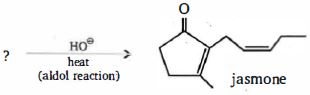
Choose the reactant whose aldol reaction would give jasmone.
A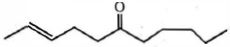
B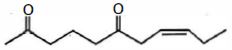
C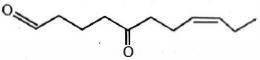
D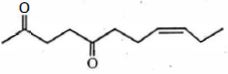
Solution
(D) Jasmone is a cyclopentenone derivative. The synthesis of jasmone via an intramolecular aldol condensation involves a precursor that contains both a ketone and an aldehyde group (or two ketone groups) positioned such that cyclization forms a five-membered ring. The structure shown in option $D$ is $3-methyl-2-(cis-2-pentenyl)-2-cyclopenten-1-one$ (jasmone). The precursor for this reaction is $cis-8-undecene-2,5-dione$. Under basic conditions,the $\alpha$-carbon of the ketone group undergoes an intramolecular aldol condensation followed by dehydration to form the cyclopentenone ring system of jasmone. Therefore,the correct reactant is the one shown in option $D$.
0 likes
View Solution822
AdvancedMCQ
Compound $X$ undergoes the following reaction sequence. What is the structure of compound $X$?

A
$3-$methylpentanal
B
$2-$methylpentanal
C
pentanal
D
butanal
Solution
(A) The reaction sequence represents an aldol condensation followed by dehydration,hydrogenation,and reduction.
$1$. The final product is a primary alcohol,which is obtained by the reduction of an aldehyde.
$2$. The sequence shows that two molecules of an aldehyde undergo aldol condensation in the presence of $NaOH$ to form a $\beta$-hydroxy aldehyde.
$3$. Upon heating,this undergoes dehydration to form an $\alpha,\beta$-unsaturated aldehyde.
$4$. Hydrogenation with $H_2/Pd$ reduces the double bond,and $LiAlH_4$ reduces the aldehyde group to a primary alcohol.
$5$. By reversing the steps,the starting material $X$ is identified as $3$-methylpentanal.
$1$. The final product is a primary alcohol,which is obtained by the reduction of an aldehyde.
$2$. The sequence shows that two molecules of an aldehyde undergo aldol condensation in the presence of $NaOH$ to form a $\beta$-hydroxy aldehyde.
$3$. Upon heating,this undergoes dehydration to form an $\alpha,\beta$-unsaturated aldehyde.
$4$. Hydrogenation with $H_2/Pd$ reduces the double bond,and $LiAlH_4$ reduces the aldehyde group to a primary alcohol.
$5$. By reversing the steps,the starting material $X$ is identified as $3$-methylpentanal.
0 likes
View Solution823
AdvancedMCQ
Predict the major product of the following reaction sequence:
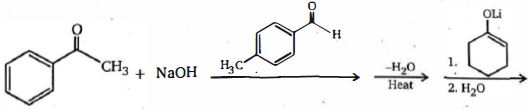
A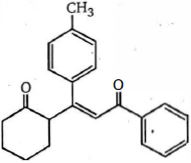
B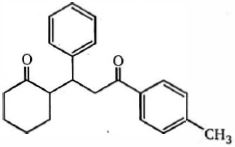
C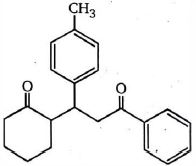
D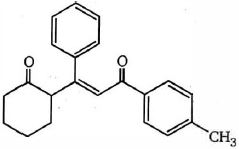
Solution
(C) The reaction proceeds in two main steps:
$1$. Claisen-Schmidt condensation: Acetophenone reacts with $4$-methylbenzaldehyde in the presence of $NaOH$ to form an $\alpha,\beta$-unsaturated ketone (chalcone derivative).
$2$. Michael addition: The lithium enolate of cyclohexanone performs a conjugate addition (Michael addition) to the $\alpha,\beta$-unsaturated ketone formed in the first step.
Following the mechanism,the enolate attacks the $\beta$-carbon of the unsaturated system.
After protonation with $H_2O$,the final product is the one where the cyclohexanone ring is attached to the $\beta$-carbon of the original chalcone structure.
Comparing this with the given options,the structure matches option $C$.
$1$. Claisen-Schmidt condensation: Acetophenone reacts with $4$-methylbenzaldehyde in the presence of $NaOH$ to form an $\alpha,\beta$-unsaturated ketone (chalcone derivative).
$2$. Michael addition: The lithium enolate of cyclohexanone performs a conjugate addition (Michael addition) to the $\alpha,\beta$-unsaturated ketone formed in the first step.
Following the mechanism,the enolate attacks the $\beta$-carbon of the unsaturated system.
After protonation with $H_2O$,the final product is the one where the cyclohexanone ring is attached to the $\beta$-carbon of the original chalcone structure.
Comparing this with the given options,the structure matches option $C$.
0 likes
View Solution824
DifficultMCQ
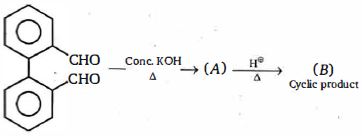
The structure of $(B)$ is:
A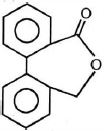
B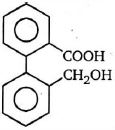
C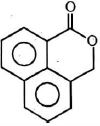
D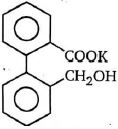
Solution
(D) The starting material is biphenyl-$2$,$2$'-dicarbaldehyde. Since there are no $\alpha$-hydrogens,it undergoes an intramolecular Cannizzaro reaction in the presence of concentrated $KOH$ and heat to form a salt of the hydroxy-acid intermediate $(A)$.
$(A)$ is the potassium salt of $2-$(hydroxymethyl)biphenyl-$2$'-carboxylic acid.
Upon treatment with $H^{\oplus}$ and heat,$(A)$ undergoes acid-catalyzed intramolecular esterification (lactonization) to form the cyclic product $(B)$,which is a lactone (specifically,$5$,$7$-dihydrodibenzo$[c,e]$oxepin$-5-$one).
$(A)$ is the potassium salt of $2-$(hydroxymethyl)biphenyl-$2$'-carboxylic acid.
Upon treatment with $H^{\oplus}$ and heat,$(A)$ undergoes acid-catalyzed intramolecular esterification (lactonization) to form the cyclic product $(B)$,which is a lactone (specifically,$5$,$7$-dihydrodibenzo$[c,e]$oxepin$-5-$one).
0 likes
View Solution825
DifficultMCQ
Product $(C)$ is
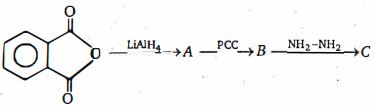
A
Phthalimide
B
Phthalazine
C
Phthalaldehyde
D
o-Phenylenediamine
Solution
(B) The reaction sequence is as follows:
$1$. Phthalic anhydride reacts with $LiAlH_4$ (a strong reducing agent) to reduce both carbonyl groups of the anhydride to primary alcohol groups,forming benzene$-1,2-$dimethanol (compound $A$).
$2$. Compound $A$ (benzene$-1,2-$dimethanol) is then treated with $PCC$ (Pyridinium chlorochromate),which is a mild oxidizing agent that selectively oxidizes primary alcohols to aldehydes. This converts both $-CH_2OH$ groups into $-CHO$ groups,forming phthalaldehyde (compound $B$).
$3$. Finally,phthalaldehyde reacts with hydrazine $(NH_2-NH_2)$ via a condensation reaction (forming a cyclic hydrazone),which results in the formation of phthalazine (compound $C$).
$1$. Phthalic anhydride reacts with $LiAlH_4$ (a strong reducing agent) to reduce both carbonyl groups of the anhydride to primary alcohol groups,forming benzene$-1,2-$dimethanol (compound $A$).
$2$. Compound $A$ (benzene$-1,2-$dimethanol) is then treated with $PCC$ (Pyridinium chlorochromate),which is a mild oxidizing agent that selectively oxidizes primary alcohols to aldehydes. This converts both $-CH_2OH$ groups into $-CHO$ groups,forming phthalaldehyde (compound $B$).
$3$. Finally,phthalaldehyde reacts with hydrazine $(NH_2-NH_2)$ via a condensation reaction (forming a cyclic hydrazone),which results in the formation of phthalazine (compound $C$).
0 likes
View Solution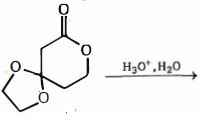
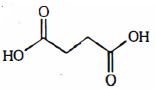
827
DifficultMCQ
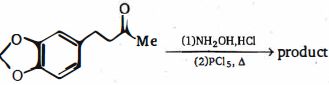
Which of the following products will be obtained in the given (consider minor product also) Beckmann rearrangement?
A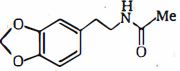
B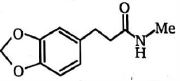
C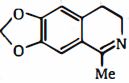
D
All of these.
Solution
(D) The reaction proceeds via the formation of an oxime with $NH_2OH, HCl$.
Treatment with $PCl_5$ causes the Beckmann rearrangement.
The oxime can exist as two stereoisomers ($syn$ and $anti$ to the alkyl chain).
Migration of the alkyl group leads to the cyclic imine (product $c$).
Migration of the aryl group leads to the amide (product $a$ and $b$ depending on the specific isomer).
Since the question asks to consider minor products as well,all these products are formed in the reaction mixture.
Treatment with $PCl_5$ causes the Beckmann rearrangement.
The oxime can exist as two stereoisomers ($syn$ and $anti$ to the alkyl chain).
Migration of the alkyl group leads to the cyclic imine (product $c$).
Migration of the aryl group leads to the amide (product $a$ and $b$ depending on the specific isomer).
Since the question asks to consider minor products as well,all these products are formed in the reaction mixture.
0 likes
View Solution828
AdvancedMCQ
The products $(A)$ and $(B)$ respectively in the above Beckmann rearrangement reactions are:

A
$Ph-C(=O)-NH-CH_3, CH_3-C(=O)-NH-Ph$
B
$CH_3-C(=O)-NH-Ph, Ph-C(=O)-NH-CH_3$
C
$Ph-C(=O)-NH-CH_3, Ph-C(=O)-NH-CH_3$
D
$CH_3-C(=O)-NH-Ph, CH_3-C(=O)-NH-Ph$
Solution
(A) In the Beckmann rearrangement,the group anti to the $-OH$ group on the nitrogen atom migrates to the nitrogen.
In the first reaction,the $-CH_3$ group is anti to the $-OH$ group. Therefore,the $-CH_3$ group migrates to the nitrogen,resulting in the product $Ph-C(=O)-NH-CH_3$.
In the second reaction,the $-Ph$ group is anti to the $-OH$ group. Therefore,the $-Ph$ group migrates to the nitrogen,resulting in the product $CH_3-C(=O)-NH-Ph$.
Thus,the products $(A)$ and $(B)$ are $Ph-C(=O)-NH-CH_3$ and $CH_3-C(=O)-NH-Ph$ respectively.
In the first reaction,the $-CH_3$ group is anti to the $-OH$ group. Therefore,the $-CH_3$ group migrates to the nitrogen,resulting in the product $Ph-C(=O)-NH-CH_3$.
In the second reaction,the $-Ph$ group is anti to the $-OH$ group. Therefore,the $-Ph$ group migrates to the nitrogen,resulting in the product $CH_3-C(=O)-NH-Ph$.
Thus,the products $(A)$ and $(B)$ are $Ph-C(=O)-NH-CH_3$ and $CH_3-C(=O)-NH-Ph$ respectively.
0 likes
View Solution829
DifficultMCQ
Compare the rate of reaction toward Beckmann rearrangement for the given oxime derivatives where $\gamma$ is: $(i) CH_3COO^-$,$(ii) ClCH_2COO^-$,$(iii) PhSO_3^-$.
A
$i > ii > iii$
B
$ii > i > iii$
C
$iii > ii > i$
D
$iii > i > ii$
Solution
(C) The rate of Beckmann rearrangement depends on the leaving group ability of the group attached to the nitrogen atom.
The rate-determining step $(RDS)$ involves the departure of the leaving group.
Better leaving groups are weaker bases.
The basicity order of the conjugate bases is: $CH_3COO^- > ClCH_2COO^- > PhSO_3^-$.
Therefore,the leaving group ability order is: $PhSO_3^- > ClCH_2COO^- > CH_3COO^-$.
Thus,the rate of reaction follows the order: $(iii) > (ii) > (i)$.
The rate-determining step $(RDS)$ involves the departure of the leaving group.
Better leaving groups are weaker bases.
The basicity order of the conjugate bases is: $CH_3COO^- > ClCH_2COO^- > PhSO_3^-$.
Therefore,the leaving group ability order is: $PhSO_3^- > ClCH_2COO^- > CH_3COO^-$.
Thus,the rate of reaction follows the order: $(iii) > (ii) > (i)$.
0 likes
View Solution830
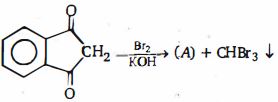
MediumMCQ
The product $(A)$ of the reaction is:
A
Phthalic acid
B
$2-$acetylbenzoic acid
C
Phthalate ion
D
$2-$methylbenzoic acid
Solution
(C) The given reaction is an example of the haloform reaction. The reactant is indan$-1,3-$dione (or a similar cyclic $\beta$-diketone derivative). In the presence of $Br_2$ and $KOH$,the active methylene group undergoes bromination followed by cleavage to form the corresponding carboxylic acid salt. Specifically,for this structure,the reaction leads to the formation of phthalate ion (benzene$-1,2-$dicarboxylate) as the final product after workup or in the basic medium. Therefore,the correct option is $(C)$.
0 likes
View Solution831
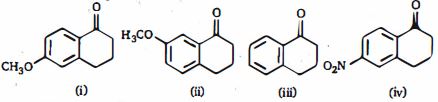
DifficultMCQ
The increasing order of the equilibrium constant for the formation of a hydrate from the following compounds is:
A
$i < ii < iii < iv$
B
$iv < ii < i < iii$
C
$ii < iv < iii < i$
D
$iv < ii < iii < i$
Solution
(A) The formation of a hydrate involves the nucleophilic attack of water on the carbonyl carbon. The equilibrium constant for this reaction increases as the electrophilicity of the carbonyl carbon increases.
Electron-donating groups $(EDG)$ decrease the electrophilicity of the carbonyl carbon by donating electron density,thus decreasing the equilibrium constant.
Electron-withdrawing groups $(EWG)$ increase the electrophilicity of the carbonyl carbon by withdrawing electron density,thus increasing the equilibrium constant.
Comparing the substituents:
$(i)$ $-OCH_3$ at the para position is a strong $EDG$ via resonance.
(ii) $-OCH_3$ at the meta position is an $EDG$ via induction but less effective than at the para position.
(iii) No substituent (reference).
(iv) $-NO_2$ is a strong $EWG$.
The order of electrophilicity is: $(i) < (ii) < (iii) < (iv)$.
Therefore,the increasing order of the equilibrium constant is: $i < ii < iii < iv$.
Electron-donating groups $(EDG)$ decrease the electrophilicity of the carbonyl carbon by donating electron density,thus decreasing the equilibrium constant.
Electron-withdrawing groups $(EWG)$ increase the electrophilicity of the carbonyl carbon by withdrawing electron density,thus increasing the equilibrium constant.
Comparing the substituents:
$(i)$ $-OCH_3$ at the para position is a strong $EDG$ via resonance.
(ii) $-OCH_3$ at the meta position is an $EDG$ via induction but less effective than at the para position.
(iii) No substituent (reference).
(iv) $-NO_2$ is a strong $EWG$.
The order of electrophilicity is: $(i) < (ii) < (iii) < (iv)$.
Therefore,the increasing order of the equilibrium constant is: $i < ii < iii < iv$.
0 likes
View Solution832
DifficultMCQ
Which of the following compounds is the slowest to react with nitrosonium ion $(NO^{+})$?
A
Benzene
B
tert-Butylbenzene
C
Acetophenone
D
Anisole
Solution
(C) The nitrosonium ion $(NO^{+})$ is an electrophile. The rate of reaction with an electrophile in electrophilic aromatic substitution depends on the electron density of the benzene ring. Electron-donating groups increase the rate,while electron-withdrawing groups decrease it.
$1$. $Anisole$ $(-OCH_3)$: The $-OCH_3$ group has a strong $+M$ effect,which significantly increases the electron density of the ring,making it the most reactive.
$2$. $Benzene$: This is the reference compound.
$3$. $tert-Butylbenzene$ $(-C(CH_3)_3)$: The alkyl group has a $+I$ effect,which slightly increases the electron density,making it more reactive than benzene.
$4$. $Acetophenone$ $(-COCH_3)$: The $-COCH_3$ group has both $-M$ and $-I$ effects,which strongly withdraw electrons from the ring,making it the least reactive.
Therefore,$Acetophenone$ is the slowest to react with $NO^{+}$.
$1$. $Anisole$ $(-OCH_3)$: The $-OCH_3$ group has a strong $+M$ effect,which significantly increases the electron density of the ring,making it the most reactive.
$2$. $Benzene$: This is the reference compound.
$3$. $tert-Butylbenzene$ $(-C(CH_3)_3)$: The alkyl group has a $+I$ effect,which slightly increases the electron density,making it more reactive than benzene.
$4$. $Acetophenone$ $(-COCH_3)$: The $-COCH_3$ group has both $-M$ and $-I$ effects,which strongly withdraw electrons from the ring,making it the least reactive.
Therefore,$Acetophenone$ is the slowest to react with $NO^{+}$.
0 likes
View Solution833
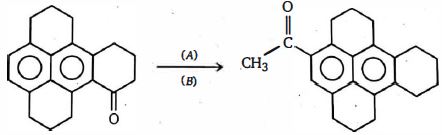
DifficultMCQ
In the given conversion,the best yield will be obtained with:
A
$A = CH_3 - CO - Cl, AlCl_3$; $B = Zn(Hg), HCl$
B
$A = Zn(Hg), HCl$; $B = CH_3 - CO - Cl, AlCl_3$
C
$A = CH_3 - CH_2 - Cl, AlCl_3$; $B = Zn(Hg), HCl$
D
$A = NH_2 - NH_2/HO^-, \Delta$; $B = CH_3 - CH_2 - Cl, AlCl_3$
Solution
(B) The starting material is a polycyclic ketone. To introduce an acetyl group at the specific position,we first need to reduce the carbonyl group to a methylene group using Clemmensen reduction $(Zn(Hg), HCl)$.
After the reduction,the aromatic system is activated,allowing for a Friedel-Crafts acylation using $CH_3 - CO - Cl$ in the presence of $AlCl_3$ to introduce the acetyl group.
Therefore,the correct sequence is $A = Zn(Hg), HCl$ followed by $B = CH_3 - CO - Cl, AlCl_3$.
After the reduction,the aromatic system is activated,allowing for a Friedel-Crafts acylation using $CH_3 - CO - Cl$ in the presence of $AlCl_3$ to introduce the acetyl group.
Therefore,the correct sequence is $A = Zn(Hg), HCl$ followed by $B = CH_3 - CO - Cl, AlCl_3$.
0 likes
View Solution834
AdvancedMCQ
Product $(D)$ in the above sequence is:

A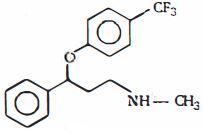
B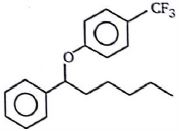
C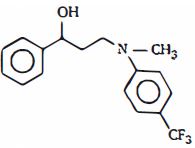
D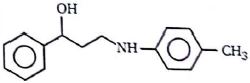
Solution
(A) $1$. Friedel-Crafts acylation of benzene with succinic anhydride gives $4$-oxo-$4$-phenylbutanoic acid $(A)$.
$2$. Reaction of $(A)$ with $SOCl_2$ followed by $NaN_3$ gives the acyl azide,which undergoes Curtius rearrangement to form an isocyanate,and subsequent reaction with $MeOH$ gives a carbamate. However,the sequence implies the formation of an amine derivative. Given the final structure,the sequence leads to $3$-(methylamino)-$1$-phenylpropan-$1$-ol $(C)$ after reduction with $LiAlH_4$.
$3$. The final step involves the reaction of the secondary alcohol $(C)$ with $NaH$ to form an alkoxide,which then performs a Nucleophilic Aromatic Substitution $(S_NAr)$ on $1$-chloro-$4$-(trifluoromethyl)benzene to yield the final product $(D)$.
$2$. Reaction of $(A)$ with $SOCl_2$ followed by $NaN_3$ gives the acyl azide,which undergoes Curtius rearrangement to form an isocyanate,and subsequent reaction with $MeOH$ gives a carbamate. However,the sequence implies the formation of an amine derivative. Given the final structure,the sequence leads to $3$-(methylamino)-$1$-phenylpropan-$1$-ol $(C)$ after reduction with $LiAlH_4$.
$3$. The final step involves the reaction of the secondary alcohol $(C)$ with $NaH$ to form an alkoxide,which then performs a Nucleophilic Aromatic Substitution $(S_NAr)$ on $1$-chloro-$4$-(trifluoromethyl)benzene to yield the final product $(D)$.
0 likes
View Solution835
DifficultMCQ
Consider the following sequence of reactions:
$2-\text{benzylbenzoic acid}$ $\xrightarrow[2. \text{anhyd. } AlCl_3]{1. SOCl_2} A$ $\xrightarrow{Zn-Hg, \text{Conc. } HCl} B$
The end product $(B)$ is:
$2-\text{benzylbenzoic acid}$ $\xrightarrow[2. \text{anhyd. } AlCl_3]{1. SOCl_2} A$ $\xrightarrow{Zn-Hg, \text{Conc. } HCl} B$
The end product $(B)$ is:
A
Anthraquinone
B
Anthracene
C
$9,10-$Dihydroanthracene
D
$2-$Benzylbenzaldehyde
Solution
(C) $1$. The starting material is $2-\text{benzylbenzoic acid}$.
$2$. Treatment with $SOCl_2$ converts the carboxylic acid group into an acid chloride $(-COCl)$.
$3$. Subsequent treatment with anhydrous $AlCl_3$ induces an intramolecular Friedel-Crafts acylation,forming the cyclic ketone,anthraquinone (compound $A$).
$4$. The final step uses Clemmensen reduction $(Zn-Hg, \text{Conc. } HCl)$,which reduces the carbonyl group $(C=O)$ to a methylene group $(-CH_2-)$.
$5$. The reduction of anthraquinone yields $9,10-\text{dihydroanthracene}$ (compound $B$).
$2$. Treatment with $SOCl_2$ converts the carboxylic acid group into an acid chloride $(-COCl)$.
$3$. Subsequent treatment with anhydrous $AlCl_3$ induces an intramolecular Friedel-Crafts acylation,forming the cyclic ketone,anthraquinone (compound $A$).
$4$. The final step uses Clemmensen reduction $(Zn-Hg, \text{Conc. } HCl)$,which reduces the carbonyl group $(C=O)$ to a methylene group $(-CH_2-)$.
$5$. The reduction of anthraquinone yields $9,10-\text{dihydroanthracene}$ (compound $B$).
0 likes
View Solution836
DifficultMCQ
An organic compound having the molecular formula $C_8H_{10}O$ on being heated with $I_2$ and dilute $NaOH$ gives a yellow precipitate. The expected compound is
A
$C_6H_5CH_2CH_2OH$
B
$4-$methylbenzyl alcohol
C
$2,4-$dimethylphenol
D
$1-$phenylethanol
Solution
(D) The reaction with $I_2$ and dilute $NaOH$ is the iodoform test,which is given by compounds containing the $CH_3CO-$ group or the $CH_3CH(OH)-$ group.
Among the given options,$1$-phenylethanol $(C_6H_5CH(OH)CH_3)$ contains the $CH_3CH(OH)-$ group.
It undergoes oxidation to acetophenone $(C_6H_5COCH_3)$ in the presence of $NaOI$,which then reacts further to produce a yellow precipitate of iodoform $(CHI_3)$.
The reaction sequence is:
$C_6H_5CH(OH)CH_3$ $\xrightarrow[Oxidation]{NaOI} C_6H_5COCH_3$ $\xrightarrow[Haloform]{I_2+NaOH} C_6H_5COO^- + CHI_3 \downarrow$ (yellow precipitate).
Among the given options,$1$-phenylethanol $(C_6H_5CH(OH)CH_3)$ contains the $CH_3CH(OH)-$ group.
It undergoes oxidation to acetophenone $(C_6H_5COCH_3)$ in the presence of $NaOI$,which then reacts further to produce a yellow precipitate of iodoform $(CHI_3)$.
The reaction sequence is:
$C_6H_5CH(OH)CH_3$ $\xrightarrow[Oxidation]{NaOI} C_6H_5COCH_3$ $\xrightarrow[Haloform]{I_2+NaOH} C_6H_5COO^- + CHI_3 \downarrow$ (yellow precipitate).
0 likes
View Solution837
DifficultMCQ
Consider the following sequence of reactions.
$1$-methylindene $\xrightarrow[NaHSO_3]{OsO_4} A$ $\xrightarrow[2. NaOH, \text{heat}]{1. HIO_4} B$
The final product $(B)$ is
$1$-methylindene $\xrightarrow[NaHSO_3]{OsO_4} A$ $\xrightarrow[2. NaOH, \text{heat}]{1. HIO_4} B$
The final product $(B)$ is
A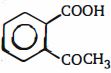
B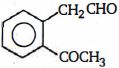
C
D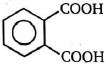
Solution
(C) Step $1$: The reaction of $1$-methylindene with $OsO_4$ followed by $NaHSO_3$ is a syn-dihydroxylation of the double bond,yielding $A$ ($1$-methylindane-$1,2$-diol).
Step $2$: Treatment of the diol $A$ with $HIO_4$ (periodic acid) causes oxidative cleavage of the vicinal diol to form a diketone intermediate ($2$-(acetyl)phenylacetaldehyde).
Step $3$: Subsequent treatment with $NaOH$ and heat induces an intramolecular aldol condensation,followed by dehydration to form the final product $B$,which is $1$-tetralone.
Step $2$: Treatment of the diol $A$ with $HIO_4$ (periodic acid) causes oxidative cleavage of the vicinal diol to form a diketone intermediate ($2$-(acetyl)phenylacetaldehyde).
Step $3$: Subsequent treatment with $NaOH$ and heat induces an intramolecular aldol condensation,followed by dehydration to form the final product $B$,which is $1$-tetralone.
0 likes
View Solution838
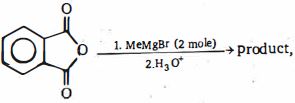
DifficultMCQ
For the reaction,the product expected is:
A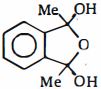
B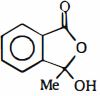
C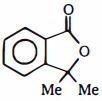
D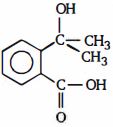
Solution
(D) The reaction of phthalic anhydride with $2 \text{ moles}$ of $CH_3MgBr$ (a Grignard reagent) proceeds as follows:
$1$. The first equivalent of $CH_3MgBr$ attacks one of the carbonyl carbons of the phthalic anhydride,opening the anhydride ring to form a magnesium salt of an ortho-acetylbenzoic acid derivative.
$2$. The second equivalent of $CH_3MgBr$ attacks the newly formed ketone carbonyl group.
$3$. Upon acidic workup with $H_3O^+$,the magnesium salts are protonated to yield $2-(2-\text{hydroxypropan}-2-\text{yl})\text{benzoic acid}$ as the final product.
$1$. The first equivalent of $CH_3MgBr$ attacks one of the carbonyl carbons of the phthalic anhydride,opening the anhydride ring to form a magnesium salt of an ortho-acetylbenzoic acid derivative.
$2$. The second equivalent of $CH_3MgBr$ attacks the newly formed ketone carbonyl group.
$3$. Upon acidic workup with $H_3O^+$,the magnesium salts are protonated to yield $2-(2-\text{hydroxypropan}-2-\text{yl})\text{benzoic acid}$ as the final product.
0 likes
View Solution839
DifficultMCQ
The treatment of $Ph_2C(OH)CH_2NH_2$ with $NaNO_2 - HCl$ gives a product $(P)$ which on oxidation gives benzoic acid only. Identify the product $(P)$.
A
$Ph-CH_2-CH_2-Ph$
B
$Ph-C(=O)-CH_2-Ph$
C
$Ph-C(=O)-C(=O)-Ph$
D
$Ph-CH_2-NH-Ph$
Solution
(B) The reaction of $Ph_2C(OH)CH_2NH_2$ with $NaNO_2 - HCl$ involves the diazotization of the primary amine to form an unstable diazonium salt.
This is followed by a $1,2-Ph$ shift (Tiffeneau-Demjanov rearrangement type) to form a carbocation,which then loses a proton to form the ketone $Ph-C(=O)-CH_2-Ph$.
This product $(P)$ is $1,2-diphenylethanone$ (deoxybenzoin).
Upon oxidation,$Ph-C(=O)-CH_2-Ph$ undergoes cleavage to yield benzoic acid as the primary product.
This is followed by a $1,2-Ph$ shift (Tiffeneau-Demjanov rearrangement type) to form a carbocation,which then loses a proton to form the ketone $Ph-C(=O)-CH_2-Ph$.
This product $(P)$ is $1,2-diphenylethanone$ (deoxybenzoin).
Upon oxidation,$Ph-C(=O)-CH_2-Ph$ undergoes cleavage to yield benzoic acid as the primary product.
0 likes
View Solution840
AdvancedMCQ
The product $(4)$ in the given reaction sequence is:

A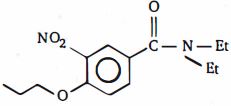
B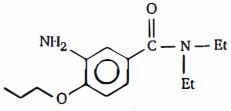
C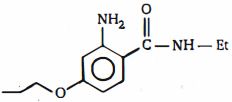
D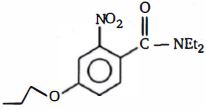
Solution
(B) $1$. The starting material is $4$-hydroxybenzoic acid. Treatment with $HNO_3$ (nitration) introduces a nitro group at the ortho position to the $-OH$ group,yielding $4$-hydroxy-$3$-nitrobenzoic acid.
$2$. Reaction with a base followed by $n-PrCl$ (propyl chloride) performs an $S_N2$ alkylation of the phenolic $-OH$ group to form $4$-propoxy-$3$-nitrobenzoic acid.
$3$. Treatment with $SOCl_2$ converts the carboxylic acid group into an acid chloride,forming $4$-propoxy-$3$-nitrobenzoyl chloride.
$4$. Reaction with $Et_2NH$ (diethylamine) converts the acid chloride into an amide,yielding $N,N$-diethyl-$4$-propoxy-$3$-nitrobenzamide.
$5$. Finally,catalytic hydrogenation using $H_2/Pd-C$ reduces the nitro group $(-NO_2)$ to an amino group $(-NH_2)$,resulting in the final product: $3$-amino-$4$-propoxy-$N,N$-diethylbenzamide.
$2$. Reaction with a base followed by $n-PrCl$ (propyl chloride) performs an $S_N2$ alkylation of the phenolic $-OH$ group to form $4$-propoxy-$3$-nitrobenzoic acid.
$3$. Treatment with $SOCl_2$ converts the carboxylic acid group into an acid chloride,forming $4$-propoxy-$3$-nitrobenzoyl chloride.
$4$. Reaction with $Et_2NH$ (diethylamine) converts the acid chloride into an amide,yielding $N,N$-diethyl-$4$-propoxy-$3$-nitrobenzamide.
$5$. Finally,catalytic hydrogenation using $H_2/Pd-C$ reduces the nitro group $(-NO_2)$ to an amino group $(-NH_2)$,resulting in the final product: $3$-amino-$4$-propoxy-$N,N$-diethylbenzamide.
0 likes
View Solution841
MediumMCQ
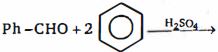
What is the major product of this reaction?
A
$Ph_3CH$
B
$Ph_3C^{-}OH$
C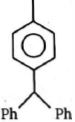
D
$Ph_2CH_2$
Solution
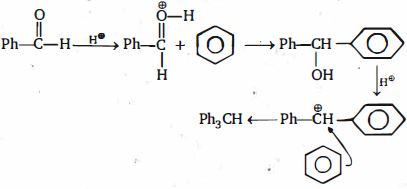
(A) The reaction between benzaldehyde $(Ph-CHO)$ and two equivalents of benzene $(C_6H_6)$ in the presence of concentrated sulfuric acid $(H_2SO_4)$ is an electrophilic aromatic substitution reaction.
$1$. The acid protonates the carbonyl oxygen of benzaldehyde to form a highly reactive electrophilic carbocation intermediate $(Ph-CH^{+}-OH)$.
$2$. This electrophile undergoes electrophilic aromatic substitution with the first molecule of benzene to form diphenylmethanol $(Ph_2CHOH)$.
$3$. In the presence of acid,the hydroxyl group is protonated and leaves as water,generating a stable diphenylmethyl carbocation $(Ph_2CH^{+})$.
$4$. This carbocation then undergoes a second electrophilic aromatic substitution with the second molecule of benzene to yield triphenylmethane $(Ph_3CH)$ as the major product.
$1$. The acid protonates the carbonyl oxygen of benzaldehyde to form a highly reactive electrophilic carbocation intermediate $(Ph-CH^{+}-OH)$.
$2$. This electrophile undergoes electrophilic aromatic substitution with the first molecule of benzene to form diphenylmethanol $(Ph_2CHOH)$.
$3$. In the presence of acid,the hydroxyl group is protonated and leaves as water,generating a stable diphenylmethyl carbocation $(Ph_2CH^{+})$.
$4$. This carbocation then undergoes a second electrophilic aromatic substitution with the second molecule of benzene to yield triphenylmethane $(Ph_3CH)$ as the major product.
0 likes
View Solution842
DifficultMCQ
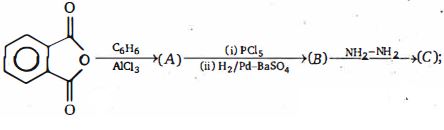
Compound $(C)$ is
A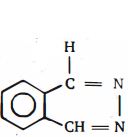
B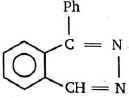
C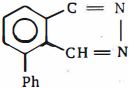
D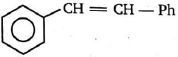
Solution
(C) $1$. The reaction of phthalic anhydride with benzene in the presence of $AlCl_3$ (Friedel-Crafts acylation) yields $o$-benzoylbenzoic acid $(A)$.
$2$. Treatment of $(A)$ with $PCl_5$ converts the carboxylic acid group to an acid chloride,followed by Rosenmund reduction $(H_2/Pd-BaSO_4)$ to form $o$-benzoylbenzaldehyde $(B)$.
$3$. The reaction of $o$-benzoylbenzaldehyde $(B)$ with hydrazine $(NH_2-NH_2)$ involves a nucleophilic attack. Since the aldehyde group is more reactive toward nucleophilic attack than the ketone group,the hydrazine reacts with the aldehyde first,followed by cyclization with the ketone to form the final product $(C)$,which is $4$-phenylphthalazine (or a related phthalazine derivative).
$2$. Treatment of $(A)$ with $PCl_5$ converts the carboxylic acid group to an acid chloride,followed by Rosenmund reduction $(H_2/Pd-BaSO_4)$ to form $o$-benzoylbenzaldehyde $(B)$.
$3$. The reaction of $o$-benzoylbenzaldehyde $(B)$ with hydrazine $(NH_2-NH_2)$ involves a nucleophilic attack. Since the aldehyde group is more reactive toward nucleophilic attack than the ketone group,the hydrazine reacts with the aldehyde first,followed by cyclization with the ketone to form the final product $(C)$,which is $4$-phenylphthalazine (or a related phthalazine derivative).
0 likes
View Solution843
DifficultMCQ
The product $(B)$ of the following reaction is:
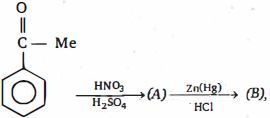
A
$3-$ethylnitrobenzene
B
$3-$ethylaniline
C
$4-$nitroacetophenone
D
$2-$ethylnitrobenzene
Solution
(B) $1$. The starting material is acetophenone. Nitration with $HNO_3/H_2SO_4$ introduces a nitro group at the meta-position due to the deactivating and meta-directing nature of the acetyl group,forming $3$-nitroacetophenone $(A)$.
$2$. The second step involves Clemmensen reduction using $Zn(Hg)/HCl$. This reagent reduces the carbonyl group $(C=O)$ to a methylene group $(CH_2)$.
$3$. Importantly,$Zn(Hg)/HCl$ also reduces the nitro group $(NO_2)$ to an amino group $(NH_2)$.
$4$. Therefore,the final product $(B)$ is $3$-ethylaniline.
$2$. The second step involves Clemmensen reduction using $Zn(Hg)/HCl$. This reagent reduces the carbonyl group $(C=O)$ to a methylene group $(CH_2)$.
$3$. Importantly,$Zn(Hg)/HCl$ also reduces the nitro group $(NO_2)$ to an amino group $(NH_2)$.
$4$. Therefore,the final product $(B)$ is $3$-ethylaniline.
0 likes
View Solution844
DifficultMCQ
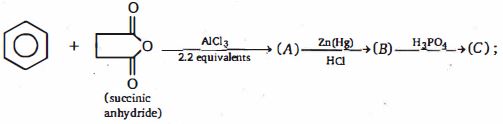
Product $(C)$ of the above reaction is
A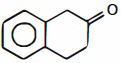
B
C
D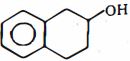
Solution
(B) The reaction sequence is as follows:
$1$. Benzene reacts with succinic anhydride in the presence of $AlCl_3$ (Friedel-Crafts acylation) to form $4-$oxo$-4-$phenylbutanoic acid $(A)$.
$2$. Clemmensen reduction of $(A)$ using $Zn(Hg)/HCl$ reduces the keto group to a methylene group,yielding $4-$phenylbutanoic acid $(B)$.
$3$. Intramolecular Friedel-Crafts acylation of $(B)$ using $H_3PO_4$ (or $P_2O_5$) leads to the formation of $\alpha$-tetralone ($1$-tetralone) as product $(C)$.
$1$. Benzene reacts with succinic anhydride in the presence of $AlCl_3$ (Friedel-Crafts acylation) to form $4-$oxo$-4-$phenylbutanoic acid $(A)$.
$2$. Clemmensen reduction of $(A)$ using $Zn(Hg)/HCl$ reduces the keto group to a methylene group,yielding $4-$phenylbutanoic acid $(B)$.
$3$. Intramolecular Friedel-Crafts acylation of $(B)$ using $H_3PO_4$ (or $P_2O_5$) leads to the formation of $\alpha$-tetralone ($1$-tetralone) as product $(C)$.
0 likes
View Solution845
AdvancedMCQ
Identify the reagents $S$ and $\mu$ in the scheme below in which $R$ is converted to the nitrile via the benzylic halide. $R, S$ and $\mu$ respectively are:

A
$C_6H_5Cl, \text{m-BrCH}_2C_6H_4CHO (AlCl_3), HCN$
B
$C_6H_6, \text{m-BrCH}_2C_6H_4COCl (AlCl_3), KCN$
C
$C_6H_6, \text{m-BrCH}_2C_6H_4COCl (AlCl_3), HCN$
D
$C_6H_5CH_2Br (AlCl_3), C_6H_5COCl, KCN$
Solution
(B) The reaction sequence is a Friedel-Crafts acylation followed by a nucleophilic substitution ($S_N2$ reaction).
$1$. The starting material $R$ is benzene $(C_6H_6)$.
$2$. The reagent $S$ is $m$-bromomethylbenzoyl chloride $(m-BrCH_2C_6H_4COCl)$ in the presence of $AlCl_3$ (a Lewis acid catalyst). This performs a Friedel-Crafts acylation to form the intermediate benzylic halide.
$3$. The reagent $\mu$ is $KCN$,which acts as a nucleophile to replace the bromine atom in the benzylic position via an $S_N2$ mechanism to form the nitrile product.
Therefore,$R = C_6H_6$,$S = m-BrCH_2C_6H_4COCl (AlCl_3)$,and $\mu = KCN$.
$1$. The starting material $R$ is benzene $(C_6H_6)$.
$2$. The reagent $S$ is $m$-bromomethylbenzoyl chloride $(m-BrCH_2C_6H_4COCl)$ in the presence of $AlCl_3$ (a Lewis acid catalyst). This performs a Friedel-Crafts acylation to form the intermediate benzylic halide.
$3$. The reagent $\mu$ is $KCN$,which acts as a nucleophile to replace the bromine atom in the benzylic position via an $S_N2$ mechanism to form the nitrile product.
Therefore,$R = C_6H_6$,$S = m-BrCH_2C_6H_4COCl (AlCl_3)$,and $\mu = KCN$.
0 likes
View Solution846
AdvancedMCQ
Product $A$ is
A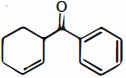
B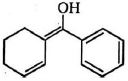
C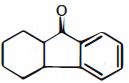
D
none of these
Solution
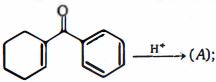
(C) The reaction involves the acid-catalyzed cyclization of $1$-phenylcyclohex-$2$-en-$1$-one.
In the presence of $H^+$,the carbonyl oxygen gets protonated,increasing the electrophilicity of the carbonyl carbon.
This facilitates an intramolecular electrophilic aromatic substitution (a type of Friedel-Crafts cyclization) where the double bond of the cyclohexene ring attacks the carbonyl carbon or,more commonly in this specific structural arrangement,the acid catalyzes the cyclization to form the tricyclic ketone structure shown in option $C$.
In the presence of $H^+$,the carbonyl oxygen gets protonated,increasing the electrophilicity of the carbonyl carbon.
This facilitates an intramolecular electrophilic aromatic substitution (a type of Friedel-Crafts cyclization) where the double bond of the cyclohexene ring attacks the carbonyl carbon or,more commonly in this specific structural arrangement,the acid catalyzes the cyclization to form the tricyclic ketone structure shown in option $C$.
0 likes
View Solution847
DifficultMCQ
The product obtained in the following transformation is:
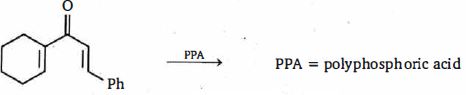
A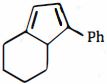
B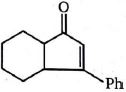
C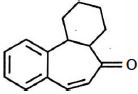
D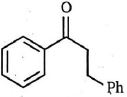
Solution
(B) The reaction involves the cyclization of an $\alpha,\beta$-unsaturated ketone in the presence of polyphosphoric acid $(PPA)$. This is a Nazarov cyclization. The mechanism proceeds as follows:
$1$. Protonation of the carbonyl oxygen by $PPA$ increases the electrophilicity of the carbonyl carbon.
$2$. The $\pi$-electrons of the cyclohexene ring attack the $\beta$-carbon of the enone system.
$3$. This forms a new carbon-carbon bond,creating a bicyclic carbocation intermediate.
$4$. Loss of a proton restores the double bond,resulting in the final bicyclic product.
$1$. Protonation of the carbonyl oxygen by $PPA$ increases the electrophilicity of the carbonyl carbon.
$2$. The $\pi$-electrons of the cyclohexene ring attack the $\beta$-carbon of the enone system.
$3$. This forms a new carbon-carbon bond,creating a bicyclic carbocation intermediate.
$4$. Loss of a proton restores the double bond,resulting in the final bicyclic product.
0 likes
View Solution848
DifficultMCQ
The reaction of $50\%$ aq $KOH$ on an equimolar mixture of $4-$methylbenzaldehyde and formaldehyde followed by acidification gives
A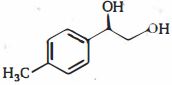
B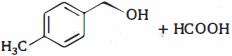
C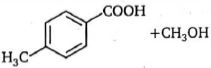
D
Solution
(B) The reaction involves a cross-Cannizzaro reaction between $4-$methylbenzaldehyde (which has no $\alpha-$hydrogen) and formaldehyde (which also has no $\alpha-$hydrogen).
In a cross-Cannizzaro reaction,the more reactive aldehyde (formaldehyde) is oxidized to the corresponding acid salt (formate),and the less reactive aldehyde ($4-$methylbenzaldehyde) is reduced to the corresponding alcohol ($4-$methylbenzyl alcohol).
Reaction: $CH_3-C_6H_4-CHO + HCHO + KOH \rightarrow CH_3-C_6H_4-CH_2OH + HCOOK$.
Upon acidification,the formate salt $HCOOK$ converts to $HCOOH$ and the alcohol remains as $4-$methylbenzyl alcohol.
Thus,the products are $4-$methylbenzyl alcohol and formic acid.
In a cross-Cannizzaro reaction,the more reactive aldehyde (formaldehyde) is oxidized to the corresponding acid salt (formate),and the less reactive aldehyde ($4-$methylbenzaldehyde) is reduced to the corresponding alcohol ($4-$methylbenzyl alcohol).
Reaction: $CH_3-C_6H_4-CHO + HCHO + KOH \rightarrow CH_3-C_6H_4-CH_2OH + HCOOK$.
Upon acidification,the formate salt $HCOOK$ converts to $HCOOH$ and the alcohol remains as $4-$methylbenzyl alcohol.
Thus,the products are $4-$methylbenzyl alcohol and formic acid.
0 likes
View Solution849
DifficultMCQ
The main reduction product of the following compound with $NaBH_4$ in methanol is
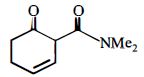
A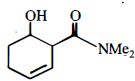
B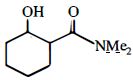
C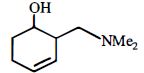
D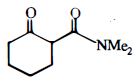
Solution
(A) $NaBH_4$ (sodium borohydride) is a selective reducing agent that specifically reduces aldehydes and ketones to their corresponding alcohols. It does not reduce amides,esters,or $C=C$ double bonds under standard conditions. In the given compound,there is a ketonic group and an amide group along with a $C=C$ double bond. Therefore,$NaBH_4$ will selectively reduce the ketone to a secondary alcohol while leaving the amide and the $C=C$ double bond unaffected. The product is the corresponding hydroxy-amide with the double bond intact.
0 likes
View Solution850
DifficultMCQ
The major product formed in the following reaction is
(Structure of the reactant) $\xrightarrow[{CHCl_3}]{{PCC}}$
(Structure of the reactant) $\xrightarrow[{CHCl_3}]{{PCC}}$
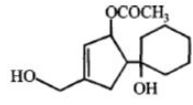
A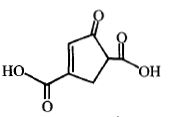
B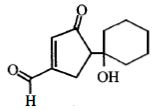
C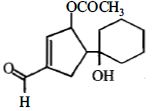
D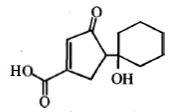
Solution
(C) $PCC$ (Pyridinium chlorochromate) is a selective oxidizing agent that oxidizes primary alcohols to aldehydes and secondary alcohols to ketones. In the given reactant,there is a primary allylic alcohol group $(-CH_2OH)$ and a secondary alcohol group $(-OH)$ attached to the ring. $PCC$ will oxidize the primary alcohol to an aldehyde and the secondary alcohol to a ketone. The $-OCOCH_3$ group remains unaffected under these conditions. Therefore,the product is the one where the primary alcohol is converted to an aldehyde and the secondary alcohol is converted to a ketone.
0 likes
View Solution8-1.Aldehydes and Ketones — Properties · Frequently Asked Questions
1Are these 8-1.Aldehydes and Ketones questions useful for JEE and NEET?
Yes. All questions in this section are mapped to JEE Main and NEET exam patterns. Previous year questions from JEE Main, NEET, GUJCET and state-level exams are included with full solutions.
2Can I switch to Hindi or Gujarati for these questions?
Yes. Use the language tabs in the hero section or the sidebar to view the same questions and solutions in English, Hindi or Gujarati.
3How do I generate a question paper from this subtopic?
Use the Vedclass Exam Paper Generator — select the chapter and subtopic, set difficulty, and generate Sets A, B, C, D automatically. First 3 chapters of every subject are free.
Vedclass Products
For Students
Vedclass Test Series
Mock tests in real JEE/NEET style with performance analysis. 5-day free trial.
Start Free TrialFor Teachers
Exam Paper Generator
Generate Set A/B/C/D papers from this chapter in 2 minutes. 3 chapters free.
Try FreeFor Institutes
Online Exam Module
Live online exams with unlimited students, 360° analytics & white-label branding.
See DemoFor Teachers & Institutes
Generate a 8-1.Aldehydes and Ketones Exam Paper in 2 Minutes
Select subtopic & difficulty — Sets A, B, C, D auto-generated with No Repeat logic.
First 3 chapters of every subject are free — no payment required.