
A English
Properties Questions in English
Class 12 Chemistry · 8-1.Aldehydes and Ketones · Properties
1739+
Questions
English
Language
100%
With Solutions
Showing 50 of 1739 questions in English
751
DifficultMCQ
An optically active compound $C_6H_{12}O$ gives a positive test with $2,4-$dinitrophenylhydrazine,but a negative test with Tollens' reagent. What is the structure of the compound?
A
$CH_3-CO-CH_2-CH_2-CH_2-CH_3$
B
$CH_3-CH_2-CH_2-CH(CH_3)-CHO$
C
$CH_3-CO-CH(CH_3)-CH_2-CH_3$
D
$CH_3-CH_2-CO-CH(CH_3)-CH_3$
Solution
(C) $1$. The compound gives a positive $2,4-DNP$ test,which indicates the presence of a carbonyl group (aldehyde or ketone).
$2$. It gives a negative Tollens' reagent test,which indicates that it is a ketone,not an aldehyde.
$3$. The molecular formula is $C_6H_{12}O$.
$4$. The compound must be optically active,meaning it must contain a chiral center (a carbon atom bonded to four different groups).
$5$. Option $C$ is $CH_3-CO-CH(CH_3)-CH_2-CH_3$ ($3$-methylpentan$-2-$one). The carbon at the $3^{rd}$ position is chiral because it is attached to $-H$,$-CH_3$,$-COCH_3$,and $-CH_2CH_3$ groups. Thus,it is optically active.
$2$. It gives a negative Tollens' reagent test,which indicates that it is a ketone,not an aldehyde.
$3$. The molecular formula is $C_6H_{12}O$.
$4$. The compound must be optically active,meaning it must contain a chiral center (a carbon atom bonded to four different groups).
$5$. Option $C$ is $CH_3-CO-CH(CH_3)-CH_2-CH_3$ ($3$-methylpentan$-2-$one). The carbon at the $3^{rd}$ position is chiral because it is attached to $-H$,$-CH_3$,$-COCH_3$,and $-CH_2CH_3$ groups. Thus,it is optically active.
0 likes
View Solution752
AdvancedMCQ
Compound $(A)$,$C_6H_{12}O_3$,when treated with $I_2$ in aqueous sodium hydroxide gives a yellow precipitate. When $(A)$ is treated with Tollens' reagent,no reaction occurs. When $(A)$ is hydrolysed and then treated with Tollens' reagent,a silver mirror is formed in the test tube. Compound $(A)$ will be
A
$CH_3-CO-CH_2-CH_2-CH(OCH_3)OH$
B
$CH_3-CO-C(OCH_3)_2-CH_3$
C
$CH_3-CO-CH_2-CH(OCH_3)_2$
D
$H-CO-CH_2-CH_2-CH(OCH_3)_2$
Solution
(C) $1$. The compound $(A)$ gives a yellow precipitate with $I_2/NaOH$,indicating the presence of a methyl ketone group $(CH_3CO-)$.
$2$. $(A)$ does not react with Tollens' reagent,meaning it does not contain a free aldehyde group.
$3$. Upon hydrolysis,$(A)$ gives a positive Tollens' test,indicating the formation of an aldehyde group.
$4$. Option $(C)$,$CH_3-CO-CH_2-CH(OCH_3)_2$,is an acetal. It contains a methyl ketone group,so it gives the iodoform test. It does not have a free aldehyde group,so it does not react with Tollens' reagent. Upon hydrolysis,the acetal group $-CH(OCH_3)_2$ converts to an aldehyde group $-CHO$,which gives a positive Tollens' test.
$2$. $(A)$ does not react with Tollens' reagent,meaning it does not contain a free aldehyde group.
$3$. Upon hydrolysis,$(A)$ gives a positive Tollens' test,indicating the formation of an aldehyde group.
$4$. Option $(C)$,$CH_3-CO-CH_2-CH(OCH_3)_2$,is an acetal. It contains a methyl ketone group,so it gives the iodoform test. It does not have a free aldehyde group,so it does not react with Tollens' reagent. Upon hydrolysis,the acetal group $-CH(OCH_3)_2$ converts to an aldehyde group $-CHO$,which gives a positive Tollens' test.
0 likes
View Solution753
DifficultMCQ
The reaction sequence is as follows:
$HOOC-CH_2-CH_2-CH_2-CH_2-COOH$ $\xrightarrow[BaCO_3]{\Delta} A$ $\xrightarrow{NH_2-NH_2} B$ $\xrightarrow[KOH]{\text{heat}} C$
The final product $(C)$ obtained is:
$HOOC-CH_2-CH_2-CH_2-CH_2-COOH$ $\xrightarrow[BaCO_3]{\Delta} A$ $\xrightarrow{NH_2-NH_2} B$ $\xrightarrow[KOH]{\text{heat}} C$
The final product $(C)$ obtained is:
A
$CH_3-CH=CH-CH_2-CH_3$
B
Cyclopentanone
C
Cyclopentane
D
Cyclopentanone hydrazone
Solution
(C) $1$. The starting material is adipic acid $(HOOC-(CH_2)_4-COOH)$. Heating a dicarboxylic acid with $BaCO_3$ leads to the formation of a cyclic ketone via decarboxylation and cyclization. Thus,$A$ is cyclopentanone.
$2$. The reaction of cyclopentanone $(A)$ with hydrazine $(NH_2-NH_2)$ forms the corresponding hydrazone,which is $B$ (cyclopentanone hydrazone).
$3$. The reaction of the hydrazone $(B)$ with $KOH$ and heat is the Wolff-Kishner reduction,which reduces the carbonyl group to a methylene group $(-CH_2-)$. Thus,$C$ is cyclopentane.
$2$. The reaction of cyclopentanone $(A)$ with hydrazine $(NH_2-NH_2)$ forms the corresponding hydrazone,which is $B$ (cyclopentanone hydrazone).
$3$. The reaction of the hydrazone $(B)$ with $KOH$ and heat is the Wolff-Kishner reduction,which reduces the carbonyl group to a methylene group $(-CH_2-)$. Thus,$C$ is cyclopentane.
0 likes
View Solution754
MediumMCQ
Which of the following does not react with $NaHSO_3$ (sodium bisulphite)?
A
$CH_3CHO$
B
$CH_3COCH_2CH_3$
C
$CH_3CH_2COCH_2CH_3$
D
$C_6H_5CH_2COCH_3$
Solution
(C) $NaHSO_3$ (sodium bisulphite) reacts with aldehydes and methyl ketones to form crystalline bisulphite addition products.
Steric hindrance in ketones prevents the addition of $NaHSO_3$ to non-methyl ketones.
$CH_3CH_2COCH_2CH_3$ (diethyl ketone) is a non-methyl ketone and possesses significant steric hindrance,therefore it does not react with $NaHSO_3$.
Steric hindrance in ketones prevents the addition of $NaHSO_3$ to non-methyl ketones.
$CH_3CH_2COCH_2CH_3$ (diethyl ketone) is a non-methyl ketone and possesses significant steric hindrance,therefore it does not react with $NaHSO_3$.
0 likes
View Solution755
DifficultMCQ
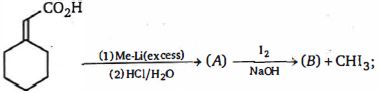
The product $(B)$ in the given reaction is:
A
Cyclohexylideneacetic acid sodium salt
B
Cyclohexylideneacetone sodium salt
C
Sodium cyclohex$-1-$ene$-1-$carboxylate
D
Sodium cyclohexanecarboxylate
Solution
(C) $1$. The reaction of cyclohexylideneacetic acid with excess $CH_3Li$ followed by $HCl/H_2O$ converts the carboxylic acid group into a methyl ketone,forming cyclohexylideneacetone $(A)$.
$2$. The compound $(A)$ contains a methyl ketone group $(CH_3-CO-)$,which undergoes the haloform reaction with $I_2/NaOH$.
$3$. The haloform reaction cleaves the methyl ketone to form a carboxylate salt and iodoform $(CHI_3)$.
$4$. The product $(B)$ is sodium cyclohex$-1-$ene$-1-$carboxylate.
$2$. The compound $(A)$ contains a methyl ketone group $(CH_3-CO-)$,which undergoes the haloform reaction with $I_2/NaOH$.
$3$. The haloform reaction cleaves the methyl ketone to form a carboxylate salt and iodoform $(CHI_3)$.
$4$. The product $(B)$ is sodium cyclohex$-1-$ene$-1-$carboxylate.
0 likes
View Solution756
MediumMCQ
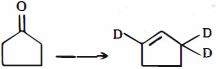
Arrange the following reagents in the correct order in which the above transformation is carried out:
A
$KOD/D_2O, H^{+}/ \Delta, LiAlH_4$
B
$H^{+}/ \Delta, KOD/D_2O, LiAlH_4$
C
$KOD/D_2O, LiAlH_4, H^{+}/ \Delta$
D
$LiAlH_4, H^{+}/ \Delta, KOD/D_2O$
Solution
(C) Step $1$: Cyclopentanone reacts with $KOD/D_2O$ (base-catalyzed deuterium exchange) to replace all $\alpha$-hydrogens with deuterium atoms,forming $2,2,5,5$-tetradeuterocyclopentanone.
Step $2$: The deuterated ketone is then reduced using $LiAlH_4$ to form the corresponding alcohol,$2,2,5,5$-tetradeuterocyclopentanol.
Step $3$: Finally,acid-catalyzed dehydration $(H^{+}/ \Delta)$ of the alcohol leads to the formation of the alkene product,$1,5,5$-trideuterocyclopentene (note: the product structure in the image implies the elimination of $D_2O$ or $HOD$ to form the double bond).
Therefore,the correct order is $KOD/D_2O, LiAlH_4, H^{+}/ \Delta$.
Step $2$: The deuterated ketone is then reduced using $LiAlH_4$ to form the corresponding alcohol,$2,2,5,5$-tetradeuterocyclopentanol.
Step $3$: Finally,acid-catalyzed dehydration $(H^{+}/ \Delta)$ of the alcohol leads to the formation of the alkene product,$1,5,5$-trideuterocyclopentene (note: the product structure in the image implies the elimination of $D_2O$ or $HOD$ to form the double bond).
Therefore,the correct order is $KOD/D_2O, LiAlH_4, H^{+}/ \Delta$.
0 likes
View Solution757
AdvancedMCQ
$CH_3-CHO$ $\xrightarrow{HCN} (A)$ $\xrightarrow{H_3O^{+}} (B)$ $\xrightarrow{\Delta} (C)$ $\xrightarrow{LiAlH_4} (D)$ $\xrightarrow{HIO_4} HCHO + (E)$. Compound $(C)$ can show geometrical isomerism. Product $(E)$ of the reaction will be:
A
$CH_3-COCH_3$
B
$CH_3-CH_2-CHO$
C
$CH_3-CHO$
D
$HCHO$
Solution
(C) The reaction sequence is as follows:
$1. CH_3-CHO + HCN \rightarrow CH_3-CH(OH)-CN (A)$ (Acetaldehyde cyanohydrin).
$2. CH_3-CH(OH)-CN \xrightarrow{H_3O^{+}} CH_3-CH(OH)-COOH (B)$ (Lactic acid).
$3. 2$ molecules of Lactic acid $(B)$ on heating $(\Delta)$ undergo intermolecular esterification to form a cyclic diester called Lactide $(C)$. Lactide shows geometrical isomerism (cis and trans).
$4. \text{Lactide} (C) \xrightarrow{LiAlH_4} CH_3-CH(OH)-CH_2OH (D)$ (Propane$-1,2-$diol).
$5. CH_3-CH(OH)-CH_2OH (D) \xrightarrow{HIO_4} CH_3-CHO (E) + HCHO$.
Therefore,product $(E)$ is Acetaldehyde $(CH_3-CHO)$.
$1. CH_3-CHO + HCN \rightarrow CH_3-CH(OH)-CN (A)$ (Acetaldehyde cyanohydrin).
$2. CH_3-CH(OH)-CN \xrightarrow{H_3O^{+}} CH_3-CH(OH)-COOH (B)$ (Lactic acid).
$3. 2$ molecules of Lactic acid $(B)$ on heating $(\Delta)$ undergo intermolecular esterification to form a cyclic diester called Lactide $(C)$. Lactide shows geometrical isomerism (cis and trans).
$4. \text{Lactide} (C) \xrightarrow{LiAlH_4} CH_3-CH(OH)-CH_2OH (D)$ (Propane$-1,2-$diol).
$5. CH_3-CH(OH)-CH_2OH (D) \xrightarrow{HIO_4} CH_3-CHO (E) + HCHO$.
Therefore,product $(E)$ is Acetaldehyde $(CH_3-CHO)$.
0 likes
View Solution758
MediumMCQ
Arrange the following compounds in increasing order of their equilibrium constants for hydration:
$(A). CH_3COCH_3, (B). CH_3CHO, (C). ClCH_2COCH_3, (D). HCHO, (E). ClCH_2CHO$
$(A). CH_3COCH_3, (B). CH_3CHO, (C). ClCH_2COCH_3, (D). HCHO, (E). ClCH_2CHO$
A
$A < B < C < D < E$
B
$A < C < B < E < D$
C
$A < C < E < B < D$
D
$C < A < B < E < D$
Solution
(B) The equilibrium constant for hydration depends on the electrophilicity of the carbonyl carbon and steric hindrance.
$1$. Aldehydes are more reactive than ketones due to less steric hindrance and lower electronic stabilization of the carbonyl carbon.
$2$. Electron-withdrawing groups (like $-Cl$) increase the electrophilicity of the carbonyl carbon,thereby increasing the equilibrium constant for hydration.
Comparing the compounds:
$(A) CH_3COCH_3$ (Ketone,no $-I$ group)
$(B) CH_3CHO$ (Aldehyde,no $-I$ group)
$(C) ClCH_2COCH_3$ (Ketone with $-I$ group)
$(D) HCHO$ (Smallest aldehyde,no $-I$ group)
$(E) ClCH_2CHO$ (Aldehyde with $-I$ group)
Order of reactivity:
Ketones: $(A) < (C)$
Aldehydes: $(B) < (E) < (D)$
Combining these,the increasing order is: $(A) < (C) < (B) < (E) < (D)$.
$1$. Aldehydes are more reactive than ketones due to less steric hindrance and lower electronic stabilization of the carbonyl carbon.
$2$. Electron-withdrawing groups (like $-Cl$) increase the electrophilicity of the carbonyl carbon,thereby increasing the equilibrium constant for hydration.
Comparing the compounds:
$(A) CH_3COCH_3$ (Ketone,no $-I$ group)
$(B) CH_3CHO$ (Aldehyde,no $-I$ group)
$(C) ClCH_2COCH_3$ (Ketone with $-I$ group)
$(D) HCHO$ (Smallest aldehyde,no $-I$ group)
$(E) ClCH_2CHO$ (Aldehyde with $-I$ group)
Order of reactivity:
Ketones: $(A) < (C)$
Aldehydes: $(B) < (E) < (D)$
Combining these,the increasing order is: $(A) < (C) < (B) < (E) < (D)$.
0 likes
View Solution759
DifficultMCQ
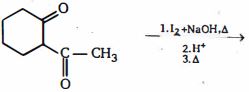
End products of the following sequence of reactions are:
A
yellow ppt. of $CHI_3$,$2$-oxocyclohexanecarboxylic acid
B
yellow ppt. of $CHI_3$,$2$-oxocyclohexanecarbaldehyde
C
yellow ppt. of $CHI_3$,cyclohexanone
D
yellow ppt. of $CHI_3$,cyclohexane$-1,2-$dicarboxylic acid
Solution
(C) The given reactant is $2$-acetylcyclohexanone.
$1$. The reaction with $I_2 NaOH$ is a haloform reaction. Since the compound contains an acetyl group $(-COCH_3)$,it undergoes the haloform reaction to produce a yellow precipitate of iodoform $(CHI_3)$ and the corresponding carboxylate salt,which upon acidification $(H^ )$ gives $2$-oxocyclohexanecarboxylic acid.
$2$. The resulting $2$-oxocyclohexanecarboxylic acid is a $\beta$-keto acid.
$3$. Upon heating $(\Delta)$,$\beta$-keto acids undergo decarboxylation to lose $CO_2$ and form the corresponding ketone,which is cyclohexanone.
$1$. The reaction with $I_2 NaOH$ is a haloform reaction. Since the compound contains an acetyl group $(-COCH_3)$,it undergoes the haloform reaction to produce a yellow precipitate of iodoform $(CHI_3)$ and the corresponding carboxylate salt,which upon acidification $(H^ )$ gives $2$-oxocyclohexanecarboxylic acid.
$2$. The resulting $2$-oxocyclohexanecarboxylic acid is a $\beta$-keto acid.
$3$. Upon heating $(\Delta)$,$\beta$-keto acids undergo decarboxylation to lose $CO_2$ and form the corresponding ketone,which is cyclohexanone.
0 likes
View Solution760
DifficultMCQ
$Ph-CH_2-CN \xrightarrow[(1) EtONa]{(2) CH_3-COCl, (3) H_3O^{\oplus}/\Delta} (P)$; Product $(P)$ of the reaction will be
A
$Ph-CH_2-CHO$
B
$Ph-CH_2-CO-CH_3$
C
$Ph-CH(CH_3)-CHO$
D
$Ph-CH(CH_3)-CO-CH_3$
Solution
(B) Step $1$: The base $EtONa$ abstracts an acidic $\alpha$-hydrogen from $Ph-CH_2-CN$ to form a carbanion,$Ph-CH^{\ominus}-CN$.
Step $2$: This carbanion acts as a nucleophile and attacks the electrophilic carbonyl carbon of acetyl chloride $(CH_3-COCl)$,resulting in the formation of $Ph-CH(CN)-CO-CH_3$.
Step $3$: Acidic hydrolysis $(H_3O^{\oplus})$ converts the cyano group $(-CN)$ into a carboxylic acid group $(-COOH)$,yielding $Ph-CH(COOH)-CO-CH_3$,which is a $\beta$-keto acid.
Step $4$: Upon heating $(\Delta)$,the $\beta$-keto acid undergoes decarboxylation (loss of $CO_2$) to form the final product,$Ph-CH_2-CO-CH_3$ (phenylacetone).
Step $2$: This carbanion acts as a nucleophile and attacks the electrophilic carbonyl carbon of acetyl chloride $(CH_3-COCl)$,resulting in the formation of $Ph-CH(CN)-CO-CH_3$.
Step $3$: Acidic hydrolysis $(H_3O^{\oplus})$ converts the cyano group $(-CN)$ into a carboxylic acid group $(-COOH)$,yielding $Ph-CH(COOH)-CO-CH_3$,which is a $\beta$-keto acid.
Step $4$: Upon heating $(\Delta)$,the $\beta$-keto acid undergoes decarboxylation (loss of $CO_2$) to form the final product,$Ph-CH_2-CO-CH_3$ (phenylacetone).
0 likes
View Solution761
MediumMCQ
The reactant is $3$-methylpentanal. The reaction with $NaCN$ followed by $H_2SO_4$ (cyanohydrin formation) is shown below:
$CH_3CH_2CH(CH_3)CH_2CHO \xrightarrow{NaCN/H^+} CH_3CH_2CH(CH_3)CH_2CH(OH)CN$
Products of the reaction are:
$CH_3CH_2CH(CH_3)CH_2CHO \xrightarrow{NaCN/H^+} CH_3CH_2CH(CH_3)CH_2CH(OH)CN$
Products of the reaction are:
A
Racemic mixture
B
Diastereomers
C
Meso
D
Mixture of meso compound and optically active compound
Solution
(B) The starting material,$3$-methylpentanal,contains a chiral center at the $C-3$ position.
When the nucleophilic addition of $CN^-$ occurs at the carbonyl carbon (the $C-1$ position),a new chiral center is generated at $C-1$.
Since the molecule already has a chiral center at $C-3$,the formation of a new chiral center at $C-1$ results in two possible configurations ($R$ or $S$) at this new center.
These two resulting isomers have the same configuration at $C-3$ but different configurations at $C-1$,making them diastereomers.
Therefore,the products are diastereomers.
When the nucleophilic addition of $CN^-$ occurs at the carbonyl carbon (the $C-1$ position),a new chiral center is generated at $C-1$.
Since the molecule already has a chiral center at $C-3$,the formation of a new chiral center at $C-1$ results in two possible configurations ($R$ or $S$) at this new center.
These two resulting isomers have the same configuration at $C-3$ but different configurations at $C-1$,making them diastereomers.
Therefore,the products are diastereomers.
0 likes
View Solution762
DifficultMCQ
$CH_3CH_2COCH_3 \xrightarrow{NaNO_2/HCl}$ Major product of this reaction is
A
$CH_3CH(NO)COCH_3$
B
$CH_3CH_2COCH=NOH$
C
$CH_3COC(=NOH)CH_3$
D
$CH_3CH_2C(=NOH)CH_3$
Solution
(C) The reaction of a ketone with $NaNO_2/HCl$ (which generates $HNO_2$ in situ) leads to nitrosation at the $\alpha$-carbon atom.
For $CH_3CH_2COCH_3$ (butanone),there are two types of $\alpha$-hydrogens: those on the $CH_3$ group and those on the $CH_2$ group.
Nitrosation occurs preferentially at the more substituted $\alpha$-carbon (the $CH_2$ group) to form an $\alpha$-nitroso ketone $(CH_3CH(NO)COCH_3)$.
This nitroso compound exists in tautomeric equilibrium with its oxime form,$CH_3C(=NOH)COCH_3$ (an $\alpha$-isonitroso ketone).
The reaction proceeds as follows:
$CH_3CH_2COCH_3 + HNO_2 \rightarrow CH_3CH(NO)COCH_3 \rightleftharpoons CH_3C(=NOH)COCH_3$.
Thus,the major product is $CH_3COC(=NOH)CH_3$.
For $CH_3CH_2COCH_3$ (butanone),there are two types of $\alpha$-hydrogens: those on the $CH_3$ group and those on the $CH_2$ group.
Nitrosation occurs preferentially at the more substituted $\alpha$-carbon (the $CH_2$ group) to form an $\alpha$-nitroso ketone $(CH_3CH(NO)COCH_3)$.
This nitroso compound exists in tautomeric equilibrium with its oxime form,$CH_3C(=NOH)COCH_3$ (an $\alpha$-isonitroso ketone).
The reaction proceeds as follows:
$CH_3CH_2COCH_3 + HNO_2 \rightarrow CH_3CH(NO)COCH_3 \rightleftharpoons CH_3C(=NOH)COCH_3$.
Thus,the major product is $CH_3COC(=NOH)CH_3$.
0 likes
View Solution763
AdvancedMCQ
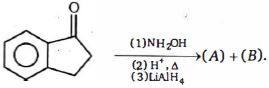
The products $(A)$ and $(B)$ are formed by the following reaction sequence:
$1$. $\text{NH}_2\text{OH}$
$2$. $\text{H}^+, \Delta$
$3$. $\text{LiAlH}_4$
Identify the products $(A)$ and $(B)$.
$1$. $\text{NH}_2\text{OH}$
$2$. $\text{H}^+, \Delta$
$3$. $\text{LiAlH}_4$
Identify the products $(A)$ and $(B)$.
A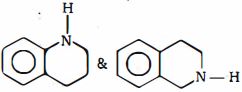
B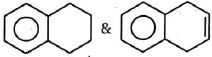
C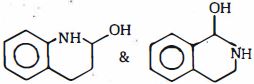
D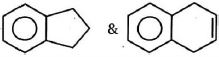
Solution
(A) The reaction sequence is as follows:
$1$. Reaction with $\text{NH}_2\text{OH}$ converts the ketone ($1$-indanone) into its oxime.
$2$. The oxime undergoes $\text{Beckmann rearrangement}$ in the presence of acid $(\text{H}^+)$ and heat $(\Delta)$ to form two isomeric cyclic amides (lactams).
$3$. Reduction of these amides with $\text{LiAlH}_4$ yields the corresponding cyclic amines.
The final products are $1,2,3,4-\text{tetrahydroquinoline}$ and $1,2,3,4-\text{tetrahydroisoquinoline}$.
$1$. Reaction with $\text{NH}_2\text{OH}$ converts the ketone ($1$-indanone) into its oxime.
$2$. The oxime undergoes $\text{Beckmann rearrangement}$ in the presence of acid $(\text{H}^+)$ and heat $(\Delta)$ to form two isomeric cyclic amides (lactams).
$3$. Reduction of these amides with $\text{LiAlH}_4$ yields the corresponding cyclic amines.
The final products are $1,2,3,4-\text{tetrahydroquinoline}$ and $1,2,3,4-\text{tetrahydroisoquinoline}$.
0 likes
View Solution764
AdvancedMCQ
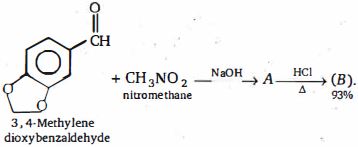
The product $(B)$ is:
A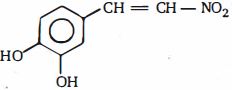
B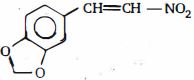
C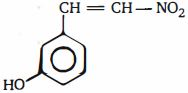
D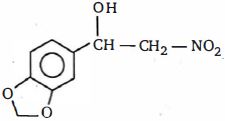
Solution
(B) The reaction of $3,4$-methylenedioxybenzaldehyde (piperonal) with nitromethane $(CH_3NO_2)$ in the presence of a base $(NaOH)$ is a Henry reaction (nitro-aldol condensation).
This reaction produces a $\beta$-hydroxy nitro compound as an intermediate,which then undergoes dehydration to form the nitroalkene,$(A)$,which is $3,4$-methylenedioxy-$\beta$-nitrostyrene.
The structure of $(A)$ is a benzene ring with a methylenedioxy group at the $3,4$-positions and a $-CH=CH-NO_2$ group at the $1$-position.
When $(A)$ is treated with $HCl$ and heated,the methylenedioxy group $(-O-CH_2-O-)$ undergoes hydrolysis to yield the corresponding catechol derivative (a benzene ring with two $-OH$ groups at the $3,4$-positions) and the side chain $-CH=CH-NO_2$ remains intact.
Therefore,the final product $(B)$ is $3,4$-dihydroxy-$\beta$-nitrostyrene.
This reaction produces a $\beta$-hydroxy nitro compound as an intermediate,which then undergoes dehydration to form the nitroalkene,$(A)$,which is $3,4$-methylenedioxy-$\beta$-nitrostyrene.
The structure of $(A)$ is a benzene ring with a methylenedioxy group at the $3,4$-positions and a $-CH=CH-NO_2$ group at the $1$-position.
When $(A)$ is treated with $HCl$ and heated,the methylenedioxy group $(-O-CH_2-O-)$ undergoes hydrolysis to yield the corresponding catechol derivative (a benzene ring with two $-OH$ groups at the $3,4$-positions) and the side chain $-CH=CH-NO_2$ remains intact.
Therefore,the final product $(B)$ is $3,4$-dihydroxy-$\beta$-nitrostyrene.
0 likes
View Solution765
AdvancedMCQ
Product $(A)$ is
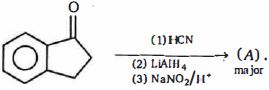
A
B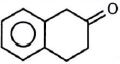
C
D
Solution
(A) The reaction sequence is as follows:
$1$. The starting material is indanone. Reaction with $HCN$ leads to the formation of a cyanohydrin.
$2$. Reduction of the cyanohydrin with $LiAlH_4$ reduces the $-CN$ group to a $-CH_2NH_2$ group,forming a $\beta$-amino alcohol.
$3$. Treatment with $NaNO_2/H^+$ (Tiffeneau-Demjanov rearrangement conditions) leads to the deamination and ring expansion of the five-membered ring to a six-membered ring,resulting in the formation of $\alpha$-tetralone.
Thus,the final product $(A)$ is $\alpha$-tetralone.
$1$. The starting material is indanone. Reaction with $HCN$ leads to the formation of a cyanohydrin.
$2$. Reduction of the cyanohydrin with $LiAlH_4$ reduces the $-CN$ group to a $-CH_2NH_2$ group,forming a $\beta$-amino alcohol.
$3$. Treatment with $NaNO_2/H^+$ (Tiffeneau-Demjanov rearrangement conditions) leads to the deamination and ring expansion of the five-membered ring to a six-membered ring,resulting in the formation of $\alpha$-tetralone.
Thus,the final product $(A)$ is $\alpha$-tetralone.
0 likes
View Solution766
DifficultMCQ
The product $(A)$ is:

A
$1,1-$dicyclopropyl ketone
B
$1,5-$dichloro-pent$-1-$en$-3-$one (incorrect structure)
C
Dicyclopropyl ketone
D
$1,5-$dihydroxy-pentan$-3-$one
Solution
(C) The reaction involves the treatment of $1,7-dichloroheptan-4-one$ with $2 \text{ moles}$ of alcoholic $KOH$.
$KOH$ acts as a base and abstracts the acidic $\alpha$-hydrogen atoms adjacent to the carbonyl group.
The resulting enolate ions undergo intramolecular nucleophilic substitution (an example of Neighboring Group Participation or $N$.$G$.$P$.) to form two cyclopropane rings attached to the carbonyl carbon.
Thus,the final product $(A)$ is dicyclopropyl ketone.
$KOH$ acts as a base and abstracts the acidic $\alpha$-hydrogen atoms adjacent to the carbonyl group.
The resulting enolate ions undergo intramolecular nucleophilic substitution (an example of Neighboring Group Participation or $N$.$G$.$P$.) to form two cyclopropane rings attached to the carbonyl carbon.
Thus,the final product $(A)$ is dicyclopropyl ketone.
0 likes
View Solution767
MediumMCQ
The reaction $R-C(=O)-R + HCN \xrightarrow{\text{catalyst}} R-C(OH)(CN)-R$ is a nucleophilic addition reaction. Which of the following can be used as a catalyst in the above reaction?
A
$Cl^{-}$
B
$CH_3COO^{-}$
C
$EtO^{-}$
D
$HSO_4^{-}$
Solution
(C) The reaction involves the nucleophilic attack of the cyanide ion $(CN^{-})$ on the carbonyl carbon.
To generate $CN^{-}$ from $HCN$,a base is required to abstract the proton from $HCN$.
The base used must be stronger than the cyanide ion $(CN^{-})$ to effectively shift the equilibrium towards the formation of $CN^{-}$.
Among the given options,the ethoxide ion $(EtO^{-})$ is a stronger base than the cyanide ion $(CN^{-})$,making it an effective catalyst for this reaction.
To generate $CN^{-}$ from $HCN$,a base is required to abstract the proton from $HCN$.
The base used must be stronger than the cyanide ion $(CN^{-})$ to effectively shift the equilibrium towards the formation of $CN^{-}$.
Among the given options,the ethoxide ion $(EtO^{-})$ is a stronger base than the cyanide ion $(CN^{-})$,making it an effective catalyst for this reaction.
0 likes
View Solution768
MediumMCQ
Arrange the following carbonyl compounds in decreasing order of their reactivity in nucleophilic addition reaction:
$(i)$ Benzaldehyde
(ii) $p$-Nitrobenzaldehyde
(iii) Acetophenone
(iv) $p$-Methylbenzaldehyde
$(i)$ Benzaldehyde
(ii) $p$-Nitrobenzaldehyde
(iii) Acetophenone
(iv) $p$-Methylbenzaldehyde
A
$ii > i > iv > iii$
B
$ii > iii > i > iv$
C
$iii > ii > i > iv$
D
$iii > i > iv > ii$
Solution
(A) The reactivity of carbonyl compounds towards nucleophilic addition depends on the magnitude of the positive charge on the carbonyl carbon.
$1$. Aldehydes are more reactive than ketones due to less steric hindrance and lower electronic effect. Thus,$(i), (ii), (iv)$ are more reactive than $(iii)$.
$2$. Electron-withdrawing groups $(EWG)$ increase reactivity by increasing the positive charge on the carbonyl carbon,while electron-donating groups $(EDG)$ decrease it.
$3$. The $-NO_2$ group in $(ii)$ is a strong $EWG$,making it the most reactive.
$4$. The $-CH_3$ group in $(iv)$ is an $EDG$,making it less reactive than benzaldehyde $(i)$.
$5$. Acetophenone $(iii)$ is a ketone and has an electron-donating phenyl group,making it the least reactive.
Therefore,the order is $(ii) > (i) > (iv) > (iii)$.
$1$. Aldehydes are more reactive than ketones due to less steric hindrance and lower electronic effect. Thus,$(i), (ii), (iv)$ are more reactive than $(iii)$.
$2$. Electron-withdrawing groups $(EWG)$ increase reactivity by increasing the positive charge on the carbonyl carbon,while electron-donating groups $(EDG)$ decrease it.
$3$. The $-NO_2$ group in $(ii)$ is a strong $EWG$,making it the most reactive.
$4$. The $-CH_3$ group in $(iv)$ is an $EDG$,making it less reactive than benzaldehyde $(i)$.
$5$. Acetophenone $(iii)$ is a ketone and has an electron-donating phenyl group,making it the least reactive.
Therefore,the order is $(ii) > (i) > (iv) > (iii)$.
0 likes
View Solution769
DifficultMCQ
Methyl vinyl ketone on reaction with $LiCuMe_2$ gives a major product,whose structure is
A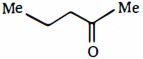
B
C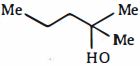
D
Solution
(A) Methyl vinyl ketone is $CH_3-CO-CH=CH_2$.
$LiCuMe_2$ (Gilman reagent) is a soft nucleophile that undergoes conjugate addition ($1$,$4$-addition) to $\alpha,\beta$-unsaturated carbonyl compounds.
In the reaction of methyl vinyl ketone with $LiCuMe_2$,the methyl group $(CH_3^-)$ attacks the $\beta$-carbon of the double bond.
The resulting enolate is then protonated during workup to give $CH_3-CO-CH_2-CH_2-CH_3$ (pentan$-2-$one).
The structure corresponding to pentan$-2-$one is shown in option $A$.
$LiCuMe_2$ (Gilman reagent) is a soft nucleophile that undergoes conjugate addition ($1$,$4$-addition) to $\alpha,\beta$-unsaturated carbonyl compounds.
In the reaction of methyl vinyl ketone with $LiCuMe_2$,the methyl group $(CH_3^-)$ attacks the $\beta$-carbon of the double bond.
The resulting enolate is then protonated during workup to give $CH_3-CO-CH_2-CH_2-CH_3$ (pentan$-2-$one).
The structure corresponding to pentan$-2-$one is shown in option $A$.
0 likes
View Solution770
DifficultMCQ
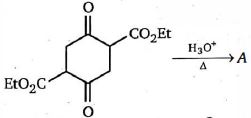
The product $A$ obtained in the following reaction is:
A
Cyclohexane$-1,4-$dione with one $CO_2Et$ group
B
Cyclohexane$-1,4-$dione
C
$3-$hydroxycyclohex$-2-$en$-1-$one
D
None of these
Solution
(B) The starting material is a diester of a $\beta$-keto acid derivative.
$1$. Acidic hydrolysis $(H_3O^ )$ of the ester groups $(CO_2Et)$ converts them into carboxylic acid groups $(CO_2H)$.
$2$. Heating $(\Delta)$ the resulting $\beta$-keto acid leads to decarboxylation,where $CO_2$ is lost from the molecule.
$3$. Since there are two such groups,both undergo decarboxylation to yield cyclohexane$-1,4-$dione as the final product $A$.
$1$. Acidic hydrolysis $(H_3O^ )$ of the ester groups $(CO_2Et)$ converts them into carboxylic acid groups $(CO_2H)$.
$2$. Heating $(\Delta)$ the resulting $\beta$-keto acid leads to decarboxylation,where $CO_2$ is lost from the molecule.
$3$. Since there are two such groups,both undergo decarboxylation to yield cyclohexane$-1,4-$dione as the final product $A$.
0 likes
View Solution771
MediumMCQ
$\underset{\text{symmetrical Ketone}}{(A)}\,$ $\xrightarrow{LiAlH_{4}}(B)$ $\xrightarrow[\Delta ]{H^{\oplus }}\text{Diastereomers}$
Reactant $(A)$ is
Reactant $(A)$ is
A
$CH_{3}-C(=O)-CH_{3}$
B
$CH_{3}-C(=O)-CH_{2}-CH_{3}$
C
$CH_{3}-CH_{2}-C(=O)-CH_{2}-CH_{3}$
D
$CH_{3}-CH_{2}-CH_{2}-CH=O$
Solution
(C) The reaction sequence is as follows:
$1$. $(A)$ is a symmetrical ketone. Reduction of a ketone with $LiAlH_{4}$ yields a secondary alcohol $(B)$.
$2$. Dehydration of the secondary alcohol $(B)$ in the presence of $H^{\oplus}$ and heat $(\Delta)$ produces an alkene.
$3$. For the product to exhibit diastereomerism (specifically geometric isomerism),the alkene formed must have different groups attached to the double-bonded carbons.
$4$. Let's analyze option $(C)$: $CH_{3}CH_{2}C(=O)CH_{2}CH_{3}$ (Pentan$-3-$one).
$5$. $CH_{3}CH_{2}C(=O)CH_{2}CH_{3} \xrightarrow{LiAlH_{4}} CH_{3}CH_{2}CH(OH)CH_{2}CH_{3}$ (Pentan$-3-$ol).
$6$. $CH_{3}CH_{2}CH(OH)CH_{2}CH_{3} \xrightarrow{H^{\oplus}, \Delta} CH_{3}CH=CHCH_{2}CH_{3}$ (Pent$-2-$ene).
$7$. Pent$-2-$ene exists as cis and trans isomers,which are diastereomers.
Therefore,the correct reactant $(A)$ is pentan$-3-$one.
$1$. $(A)$ is a symmetrical ketone. Reduction of a ketone with $LiAlH_{4}$ yields a secondary alcohol $(B)$.
$2$. Dehydration of the secondary alcohol $(B)$ in the presence of $H^{\oplus}$ and heat $(\Delta)$ produces an alkene.
$3$. For the product to exhibit diastereomerism (specifically geometric isomerism),the alkene formed must have different groups attached to the double-bonded carbons.
$4$. Let's analyze option $(C)$: $CH_{3}CH_{2}C(=O)CH_{2}CH_{3}$ (Pentan$-3-$one).
$5$. $CH_{3}CH_{2}C(=O)CH_{2}CH_{3} \xrightarrow{LiAlH_{4}} CH_{3}CH_{2}CH(OH)CH_{2}CH_{3}$ (Pentan$-3-$ol).
$6$. $CH_{3}CH_{2}CH(OH)CH_{2}CH_{3} \xrightarrow{H^{\oplus}, \Delta} CH_{3}CH=CHCH_{2}CH_{3}$ (Pent$-2-$ene).
$7$. Pent$-2-$ene exists as cis and trans isomers,which are diastereomers.
Therefore,the correct reactant $(A)$ is pentan$-3-$one.
0 likes
View Solution772
AdvancedMCQ
The value of $x$ in the above reaction is:

A
$1$
B
$1/2$
C
$1/4$
D
$4$
Solution
(C) The reduction of a ketone using $LiAlH_4$ follows the stoichiometry where $4$ moles of the ketone react with $1$ mole of $LiAlH_4$ to form an aluminum alkoxide intermediate.
The balanced reaction is: $4 \text{ Cyclobutanone} + LiAlH_4 \rightarrow (\text{Cyclobutoxy})_4AlLi$.
Upon hydrolysis with $H_3O^{\oplus}$,this yields $4$ moles of cyclobutanol.
Therefore,the stoichiometric coefficient $x$ for $LiAlH_4$ relative to $4$ moles of cyclobutanone is $1/4$.
The balanced reaction is: $4 \text{ Cyclobutanone} + LiAlH_4 \rightarrow (\text{Cyclobutoxy})_4AlLi$.
Upon hydrolysis with $H_3O^{\oplus}$,this yields $4$ moles of cyclobutanol.
Therefore,the stoichiometric coefficient $x$ for $LiAlH_4$ relative to $4$ moles of cyclobutanone is $1/4$.
0 likes
View Solution773
DifficultMCQ
$(A)$ $\xrightarrow{NH_2OH} (B)$ $\xrightarrow{H_2SO_4} (C)$ $\xrightarrow{H_3O^{\oplus}} (D) + (E)$ $\xrightarrow{CHCl_3, KOH} CH_3-NC$ (carbylamine test). $(D)$ $\xrightarrow{SOCl_2} (F)$ $\xrightarrow{(i) PhMgBr \text{ (excess) } (ii) H^{\oplus}} (G)$ $\xrightarrow[\Delta]{H^{\oplus}} (H)$ $\xrightarrow{CH_2I_2, Zn/Cu} \text{1,1-diphenylcyclopropane}$. The molecular weight of compound $(A)$ is:
A
$58$
B
$120$
C
$60$
D
$182$
Solution
(A) is acetone $(CH_3COCH_3)$,which has a molecular weight of $58 \ g/mol$.
$(A) \xrightarrow{NH_2OH} (B)$ (acetone oxime,$CH_3C(=NOH)CH_3$).
$(B) \xrightarrow{H_2SO_4} (C)$ ($N$-methylacetamide,$CH_3CONHCH_3$ via Beckmann rearrangement).
$(C) \xrightarrow{H_3O^{\oplus}} (D) + (E)$ (acetic acid,$CH_3COOH$ and methylamine,$CH_3NH_2$).
$(E) \xrightarrow{CHCl_3, KOH} CH_3NC$ (carbylamine test confirms methylamine).
$(D) \xrightarrow{SOCl_2} (F)$ (acetyl chloride,$CH_3COCl$).
$(F) \xrightarrow{(i) PhMgBr (excess) (ii) H^{\oplus}} (G)$ ($1$,$1$-diphenylethanol,$Ph_2C(OH)CH_3$).
$(G) \xrightarrow[\Delta]{H^{\oplus}} (H)$ ($1$,$1$-diphenylethene,$Ph_2C=CH_2$).
$(H) \xrightarrow{CH_2I_2, Zn/Cu} \text{1,1-diphenylcyclopropane}$ (Simmons-Smith reaction).
Thus,$(A)$ is acetone,$C_3H_6O$,molecular weight $= 3 \times 12 + 6 \times 1 + 16 = 58$.
$(A) \xrightarrow{NH_2OH} (B)$ (acetone oxime,$CH_3C(=NOH)CH_3$).
$(B) \xrightarrow{H_2SO_4} (C)$ ($N$-methylacetamide,$CH_3CONHCH_3$ via Beckmann rearrangement).
$(C) \xrightarrow{H_3O^{\oplus}} (D) + (E)$ (acetic acid,$CH_3COOH$ and methylamine,$CH_3NH_2$).
$(E) \xrightarrow{CHCl_3, KOH} CH_3NC$ (carbylamine test confirms methylamine).
$(D) \xrightarrow{SOCl_2} (F)$ (acetyl chloride,$CH_3COCl$).
$(F) \xrightarrow{(i) PhMgBr (excess) (ii) H^{\oplus}} (G)$ ($1$,$1$-diphenylethanol,$Ph_2C(OH)CH_3$).
$(G) \xrightarrow[\Delta]{H^{\oplus}} (H)$ ($1$,$1$-diphenylethene,$Ph_2C=CH_2$).
$(H) \xrightarrow{CH_2I_2, Zn/Cu} \text{1,1-diphenylcyclopropane}$ (Simmons-Smith reaction).
Thus,$(A)$ is acetone,$C_3H_6O$,molecular weight $= 3 \times 12 + 6 \times 1 + 16 = 58$.
0 likes
View Solution774
MediumMCQ
$Ph_2CH-C(=O)H \xrightarrow{\text{aqueous acid}} (A) (81\%) + \text{enol} (2\%) + \text{aldehyde} (17\%)$. Product $(A)$ of the above reaction will be:
A
$Ph_2C=CH-OH$
B
$Ph_2CH-CH_2OH$
C
$Ph_2CH-CH(OH)_2$
D
$Ph_2CH-C(=O)CH_3$
Solution
(C) The reaction involves the hydration of an aldehyde in the presence of an aqueous acid.
Aldehydes exist in equilibrium with their hydrate form,known as a geminal diol.
For the given aldehyde $Ph_2CH-CHO$,the addition of water across the carbonyl group results in the formation of the geminal diol $Ph_2CH-CH(OH)_2$.
This hydrate is the major product $(A)$ in the equilibrium mixture.
Aldehydes exist in equilibrium with their hydrate form,known as a geminal diol.
For the given aldehyde $Ph_2CH-CHO$,the addition of water across the carbonyl group results in the formation of the geminal diol $Ph_2CH-CH(OH)_2$.
This hydrate is the major product $(A)$ in the equilibrium mixture.
0 likes
View Solution775
MediumMCQ
Which of the following will form a stable hydrate?
A
$CCl_3-CHO$ (Chloral)
B
Ninhydrin
C
$(CF_3)_2CO$
D
All of these
Solution
(D) The formation of a stable hydrate from an aldehyde or ketone depends on the presence of strong electron-withdrawing groups attached to the carbonyl carbon.
$1$. $CCl_3-CHO$ (Chloral) forms a stable hydrate called chloral hydrate due to the strong $-I$ effect of the three chlorine atoms.
$2$. Ninhydrin forms a stable hydrate because the carbonyl group is highly electrophilic due to the presence of adjacent electron-withdrawing carbonyl groups.
$3$. $(CF_3)_2CO$ (Hexafluoroacetone) forms a stable hydrate due to the strong $-I$ effect of the two $-CF_3$ groups.
Therefore,all of these compounds form stable hydrates.
$1$. $CCl_3-CHO$ (Chloral) forms a stable hydrate called chloral hydrate due to the strong $-I$ effect of the three chlorine atoms.
$2$. Ninhydrin forms a stable hydrate because the carbonyl group is highly electrophilic due to the presence of adjacent electron-withdrawing carbonyl groups.
$3$. $(CF_3)_2CO$ (Hexafluoroacetone) forms a stable hydrate due to the strong $-I$ effect of the two $-CF_3$ groups.
Therefore,all of these compounds form stable hydrates.
0 likes
View Solution776
DifficultMCQ
Arrange the given gem-diols in decreasing order of their stability.

A
$I > II > III$
B
$III > II > I$
C
$I > III > II$
D
$III > I > II$
Solution
(B) The stability of gem-diols in cyclic systems is governed by the relief of angle strain.
In a three-membered ring $(I)$,the bond angle is $60^{\circ}$,which is highly strained.
In a four-membered ring $(II)$,the bond angle is $90^{\circ}$,which has less strain than the three-membered ring.
In a five-membered ring $(III)$,the bond angle is $108^{\circ}$,which is closest to the ideal tetrahedral angle of $109.5^{\circ}$,resulting in the least angle strain.
Therefore,the stability increases as the ring size increases from three to five members.
The decreasing order of stability is $III > II > I$.
In a three-membered ring $(I)$,the bond angle is $60^{\circ}$,which is highly strained.
In a four-membered ring $(II)$,the bond angle is $90^{\circ}$,which has less strain than the three-membered ring.
In a five-membered ring $(III)$,the bond angle is $108^{\circ}$,which is closest to the ideal tetrahedral angle of $109.5^{\circ}$,resulting in the least angle strain.
Therefore,the stability increases as the ring size increases from three to five members.
The decreasing order of stability is $III > II > I$.
0 likes
View Solution777
MediumMCQ
Which of the following compounds undergoes maximum hydration?
A
$CF_3-CO-CF_3$
B
$CH_3-CO-CH_3$
C
$CH_3-CH(Cl)-CO-CH_3$
D
$C_6H_5-CO-C_6H_5$
Solution
(A) The extent of hydration of carbonyl compounds depends on the electrophilicity of the carbonyl carbon and steric hindrance.
$1$. Electron-withdrawing groups (like $-F$ or $-Cl$) increase the electrophilicity of the carbonyl carbon by the inductive effect ($-I$ effect),making it more susceptible to nucleophilic attack by water.
$2$. The compound $CF_3-CO-CF_3$ (hexafluoroacetone) has two highly electronegative $CF_3$ groups,which exert a strong $-I$ effect,significantly increasing the positive charge on the carbonyl carbon.
$3$. Consequently,$CF_3-CO-CF_3$ forms a stable hydrate (gem-diol) most readily compared to the other options.
Therefore,the correct option is $A$.
$1$. Electron-withdrawing groups (like $-F$ or $-Cl$) increase the electrophilicity of the carbonyl carbon by the inductive effect ($-I$ effect),making it more susceptible to nucleophilic attack by water.
$2$. The compound $CF_3-CO-CF_3$ (hexafluoroacetone) has two highly electronegative $CF_3$ groups,which exert a strong $-I$ effect,significantly increasing the positive charge on the carbonyl carbon.
$3$. Consequently,$CF_3-CO-CF_3$ forms a stable hydrate (gem-diol) most readily compared to the other options.
Therefore,the correct option is $A$.
0 likes
View Solution778
DifficultMCQ
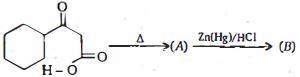
In the above reaction,product $(B)$ is:
A
Cyclohexyl methyl
B
Ethylcyclohexane
C
Propylcyclohexane
D
$2-$Cyclohexylethanol
Solution
(B) The starting material is a $\beta$-keto acid. Upon heating $(\Delta)$,it undergoes decarboxylation to form a ketone. The reaction is: $\text{Cyclohexyl-CO-CH}_2\text{COOH} \xrightarrow{\Delta} \text{Cyclohexyl-CO-CH}_3 + \text{CO}_2$. Thus,product $(A)$ is acetylcyclohexane (or cyclohexyl methyl ketone).
Next,the Clemmensen reduction $(Zn(Hg)/HCl)$ reduces the carbonyl group $(C=O)$ to a methylene group $(CH_2)$.
Therefore,$\text{Cyclohexyl-CO-CH}_3 \xrightarrow{Zn(Hg)/HCl} \text{Cyclohexyl-CH}_2\text{CH}_3$.
The final product $(B)$ is ethylcyclohexane.
Next,the Clemmensen reduction $(Zn(Hg)/HCl)$ reduces the carbonyl group $(C=O)$ to a methylene group $(CH_2)$.
Therefore,$\text{Cyclohexyl-CO-CH}_3 \xrightarrow{Zn(Hg)/HCl} \text{Cyclohexyl-CH}_2\text{CH}_3$.
The final product $(B)$ is ethylcyclohexane.
0 likes
View Solution779
MediumMCQ
To carry out the following conversion,arrange the reagents in the correct order:
$O_3/Zn$ $(1)$
$EtONa/EtOH/\Delta$ $(2)$
$NaOCl$ $(3)$
$H^{+}$ $(4)$
$O_3/Zn$ $(1)$
$EtONa/EtOH/\Delta$ $(2)$
$NaOCl$ $(3)$
$H^{+}$ $(4)$
A
$1 \to 3 \to 2 \to 4$
B
$1 \to 2 \to 4 \to 3$
C
$1 \to 3 \to 4 \to 2$
D
$1 \to 2 \to 3 \to 4$
Solution
(D) The conversion involves the following steps:
$1$. Ozonolysis $(O_3/Zn)$ of $1,2$-dimethylcyclohexene yields $2,6$-heptanedione.
$2$. Intramolecular aldol condensation $(EtONa/EtOH/\Delta)$ converts the diketone into a cyclic $\alpha,\beta$-unsaturated ketone.
$3$. Haloform reaction $(NaOCl)$ converts the methyl ketone group into a carboxylic acid group.
$4$. Acidification $(H^{+})$ yields the final product,$2$-methylcyclohex$-1-$ene$-1-$carboxylic acid.
$1$. Ozonolysis $(O_3/Zn)$ of $1,2$-dimethylcyclohexene yields $2,6$-heptanedione.
$2$. Intramolecular aldol condensation $(EtONa/EtOH/\Delta)$ converts the diketone into a cyclic $\alpha,\beta$-unsaturated ketone.
$3$. Haloform reaction $(NaOCl)$ converts the methyl ketone group into a carboxylic acid group.
$4$. Acidification $(H^{+})$ yields the final product,$2$-methylcyclohex$-1-$ene$-1-$carboxylic acid.
0 likes
View Solution780
AdvancedMCQ
Identify appropriate reagents for the above reaction.

A
$a = Br_2 / CCl_4, b = aq. KOH$
B
$a = Br_2 / H^{+}, b = aq. KOH$
C
$a = Br_2 / H^{+}, b = alc. KOH$
D
$a = Br_2 / HO^{-}, b = aq. KOH$
Solution
(C) The reaction involves the alpha-bromination of an aldehyde followed by dehydrobromination.
Step $a$: The reaction of cyclohexanecarbaldehyde with $Br_2$ in the presence of an acid catalyst $(H^{+})$ proceeds via the enol form to give alpha-bromocyclohexanecarbaldehyde.
Step $b$: The alpha-bromoaldehyde undergoes dehydrobromination (elimination) using a base like alcoholic $KOH$ $(alc. KOH)$ to form the alpha,beta-unsaturated aldehyde (cyclohex$-1-$enecarbaldehyde).
Thus,the correct reagents are $a = Br_2 / H^{+}$ and $b = alc. KOH$.
Step $a$: The reaction of cyclohexanecarbaldehyde with $Br_2$ in the presence of an acid catalyst $(H^{+})$ proceeds via the enol form to give alpha-bromocyclohexanecarbaldehyde.
Step $b$: The alpha-bromoaldehyde undergoes dehydrobromination (elimination) using a base like alcoholic $KOH$ $(alc. KOH)$ to form the alpha,beta-unsaturated aldehyde (cyclohex$-1-$enecarbaldehyde).
Thus,the correct reagents are $a = Br_2 / H^{+}$ and $b = alc. KOH$.
0 likes
View Solution781
MediumMCQ
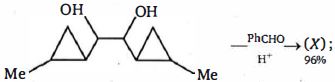
The product $(X)$ of the following reaction is:
A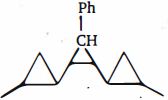
B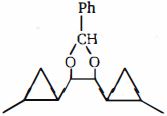
C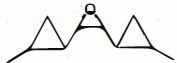
D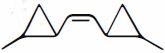
Solution
(C) The reaction involves the acid-catalyzed reaction of a vicinal diol with an aldehyde $(PhCHO)$.
This is a standard acetalization reaction where the diol reacts with the carbonyl compound to form a cyclic acetal.
The two hydroxyl groups of the diol condense with the carbonyl group of benzaldehyde to form a five-membered dioxolane ring.
Therefore,the correct product is represented by option $C$.
This is a standard acetalization reaction where the diol reacts with the carbonyl compound to form a cyclic acetal.
The two hydroxyl groups of the diol condense with the carbonyl group of benzaldehyde to form a five-membered dioxolane ring.
Therefore,the correct product is represented by option $C$.
0 likes
View Solution782
MediumMCQ
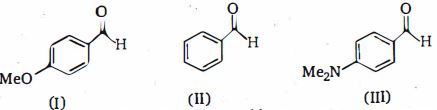
The $K_{eq.}$ values in $HCN$ addition to the following aldehydes are in the order:
A
$I > II > III$
B
$II > III > I$
C
$III > I > II$
D
$II > I > III$
Solution
(D) The addition of $HCN$ to an aldehyde is a nucleophilic addition reaction. The equilibrium constant $K_{eq.}$ depends on the electrophilicity of the carbonyl carbon.
Electron-donating groups (like $-OCH_3$ and $-N(CH_3)_2$) decrease the electrophilicity of the carbonyl carbon by resonance ($+M$ effect),thereby decreasing the $K_{eq.}$ value.
Comparing the substituents:
- In $(II)$,there is no substituent on the benzene ring.
- In $(I)$,the $-OCH_3$ group exerts a $+M$ effect.
- In $(III)$,the $-N(CH_3)_2$ group exerts a stronger $+M$ effect than $-OCH_3$.
Therefore,the electrophilicity order is $(II) > (I) > (III)$,which is also the order of $K_{eq.}$ values.
Thus,the correct order is $II > I > III$.
Electron-donating groups (like $-OCH_3$ and $-N(CH_3)_2$) decrease the electrophilicity of the carbonyl carbon by resonance ($+M$ effect),thereby decreasing the $K_{eq.}$ value.
Comparing the substituents:
- In $(II)$,there is no substituent on the benzene ring.
- In $(I)$,the $-OCH_3$ group exerts a $+M$ effect.
- In $(III)$,the $-N(CH_3)_2$ group exerts a stronger $+M$ effect than $-OCH_3$.
Therefore,the electrophilicity order is $(II) > (I) > (III)$,which is also the order of $K_{eq.}$ values.
Thus,the correct order is $II > I > III$.
0 likes
View Solution783
MediumMCQ
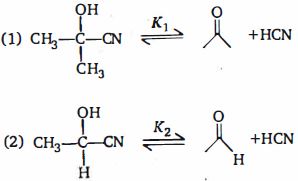
The relation between $K_1$ and $K_2$ for the given equilibrium reactions is:
A
$K_1 = K_2$
B
$K_1 > K_2$
C
$K_2 > K_1$
D
$K_1 = K_2 = 1$
Solution
(B) The reactions represent the dissociation of cyanohydrins into carbonyl compounds and $HCN$.
Reaction $(1)$ is the dissociation of acetone cyanohydrin,and reaction $(2)$ is the dissociation of acetaldehyde cyanohydrin.
The equilibrium constant for the formation of cyanohydrin is $K_{form} = \frac{1}{K_{dissociation}}$.
Aldehydes are more reactive towards nucleophilic addition than ketones due to less steric hindrance and electronic factors.
Therefore,the formation constant for acetaldehyde cyanohydrin is greater than that for acetone cyanohydrin.
This implies $K_{form(acetaldehyde)} > K_{form(acetone)}$.
Since $K_{form} = \frac{1}{K_{dissociation}}$,we have $\frac{1}{K_2} > \frac{1}{K_1}$,which leads to $K_1 > K_2$.
Reaction $(1)$ is the dissociation of acetone cyanohydrin,and reaction $(2)$ is the dissociation of acetaldehyde cyanohydrin.
The equilibrium constant for the formation of cyanohydrin is $K_{form} = \frac{1}{K_{dissociation}}$.
Aldehydes are more reactive towards nucleophilic addition than ketones due to less steric hindrance and electronic factors.
Therefore,the formation constant for acetaldehyde cyanohydrin is greater than that for acetone cyanohydrin.
This implies $K_{form(acetaldehyde)} > K_{form(acetone)}$.
Since $K_{form} = \frac{1}{K_{dissociation}}$,we have $\frac{1}{K_2} > \frac{1}{K_1}$,which leads to $K_1 > K_2$.
0 likes
View Solution784
MediumMCQ
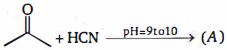
Which of the following is correct for the reaction shown?
A
$A$ is cyanohydrin
B
Nucleophilic-addition reaction
C
The above reaction is not shown by alkenes
D
All of these
Solution
(D) The reaction of acetone with $HCN$ at $pH = 9-10$ is a nucleophilic addition reaction.
In this reaction,the nucleophile $CN^-$ attacks the electrophilic carbonyl carbon to form a cyanohydrin.
Alkenes do not undergo this reaction because they lack an electrophilic carbon center (no partial positive charge is developed on the carbon in alkenes).
Therefore,all the given statements are correct.
In this reaction,the nucleophile $CN^-$ attacks the electrophilic carbonyl carbon to form a cyanohydrin.
Alkenes do not undergo this reaction because they lack an electrophilic carbon center (no partial positive charge is developed on the carbon in alkenes).
Therefore,all the given statements are correct.
0 likes
View Solution785
MediumMCQ
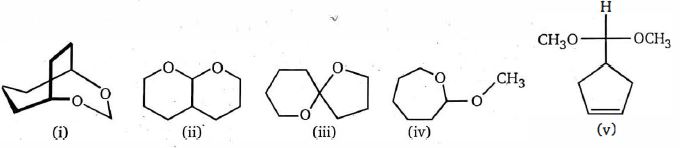
Which of the following compounds ($i$ through $v$) should not be classified as an acetal?
A
$ii$ and $iii$
B
$iv$
C
$i$
D
none (they are all acetals)
Solution
(A) An acetal is defined as a compound containing two ether linkages attached to the same carbon atom,represented by the general formula $R_2C(OR')_2$.
Analyzing the structures:
$(i)$ This is a bicyclic acetal where two oxygen atoms are attached to the same carbon.
$(ii)$ This is a fused bicyclic ether (specifically a $1,4-$dioxane derivative),not an acetal,because the oxygen atoms are not attached to the same carbon atom.
$(iii)$ This is a spiro-acetal where two oxygen atoms are attached to the same spiro carbon atom.
$(iv)$ This is a cyclic acetal (specifically a $2-$methoxytetrahydropyran derivative) where two oxygen atoms are attached to the same carbon.
$(v)$ This is an acyclic acetal where two methoxy groups are attached to the same carbon.
Therefore,compound $(ii)$ is not an acetal. Since the options provided do not include $(ii)$ as a standalone answer,and the question asks which should not be classified as an acetal,there is an error in the provided options. However,based on the definition,$(ii)$ is the correct answer.
Analyzing the structures:
$(i)$ This is a bicyclic acetal where two oxygen atoms are attached to the same carbon.
$(ii)$ This is a fused bicyclic ether (specifically a $1,4-$dioxane derivative),not an acetal,because the oxygen atoms are not attached to the same carbon atom.
$(iii)$ This is a spiro-acetal where two oxygen atoms are attached to the same spiro carbon atom.
$(iv)$ This is a cyclic acetal (specifically a $2-$methoxytetrahydropyran derivative) where two oxygen atoms are attached to the same carbon.
$(v)$ This is an acyclic acetal where two methoxy groups are attached to the same carbon.
Therefore,compound $(ii)$ is not an acetal. Since the options provided do not include $(ii)$ as a standalone answer,and the question asks which should not be classified as an acetal,there is an error in the provided options. However,based on the definition,$(ii)$ is the correct answer.
0 likes
View Solution786
MediumMCQ
The product obtained from the following sequence of reactions is
$CH_3-C\equiv CH$ $\xrightarrow{HgSO_4, H_2SO_4} A$ $\xrightarrow{NaBH_4} B$
$CH_3-C\equiv CH$ $\xrightarrow{HgSO_4, H_2SO_4} A$ $\xrightarrow{NaBH_4} B$
A
propanol
B
$2-$propanol
C
$1-$propanol
D
propane
Solution
(B) Step $1$: The reaction of propyne $(CH_3-C\equiv CH)$ with $HgSO_4$ and $H_2SO_4$ is a hydration reaction following Markovnikov's rule,which yields acetone $(CH_3-CO-CH_3)$ as product $A$.
Step $2$: The reduction of acetone $(CH_3-CO-CH_3)$ with $NaBH_4$ reduces the ketone group to a secondary alcohol,yielding $2-$propanol $(CH_3-CH(OH)-CH_3)$ as product $B$.
Step $2$: The reduction of acetone $(CH_3-CO-CH_3)$ with $NaBH_4$ reduces the ketone group to a secondary alcohol,yielding $2-$propanol $(CH_3-CH(OH)-CH_3)$ as product $B$.
0 likes
View Solution787
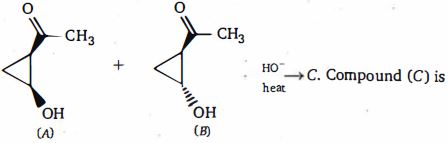
AdvancedMCQ
Compounds $A$ and $B$,both were treated with $NaOH$,producing a single compound $C$. Identify compound $C$.
A
Cyclopent$-2-$en$-1-$one
B
Cyclopropan$-1-$one derivative
C
Hex$-5-$en$-2-$one
D
Cyclopent$-3-$en$-1-$one
Solution
(A) The reaction involves a retro-aldol cleavage followed by an intramolecular aldol condensation.
$1$. The base $HO^-$ attacks the hydroxyl group of the cyclopropane derivative,leading to the opening of the ring via a retro-aldol mechanism to form a linear intermediate,$CH_3-CO-CH_2-CH_2-CHO$.
$2$. This linear intermediate then undergoes an intramolecular aldol condensation in the presence of $HO^-$ and heat to form a five-membered ring with a double bond,which is cyclopent$-2-$en$-1-$one.
$3$. Thus,the final product $C$ is cyclopent$-2-$en$-1-$one.
$1$. The base $HO^-$ attacks the hydroxyl group of the cyclopropane derivative,leading to the opening of the ring via a retro-aldol mechanism to form a linear intermediate,$CH_3-CO-CH_2-CH_2-CHO$.
$2$. This linear intermediate then undergoes an intramolecular aldol condensation in the presence of $HO^-$ and heat to form a five-membered ring with a double bond,which is cyclopent$-2-$en$-1-$one.
$3$. Thus,the final product $C$ is cyclopent$-2-$en$-1-$one.
0 likes
View Solution788
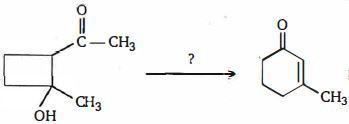
MediumMCQ
This conversion can be achieved by
A
Dehydration,Hydrolysis
B
Retro aldol and further condensation
C
Perkin condensation & Clemmensen reduction
D
Clemmensen and Perkin condensation
Solution
(B) The starting material is a $\beta$-hydroxy ketone. In the presence of a base $(HO^-)$,it undergoes a retro-aldol reaction to form a diketone intermediate $(CH_3-CO-CH_2-CH_2-CH_2-CO-CH_3)$. This diketone then undergoes an intramolecular aldol condensation followed by dehydration to yield the final product,$3$-methylcyclohex-$2$-en-$1$-one. Thus,the correct sequence is retro-aldol followed by intramolecular aldol condensation.
0 likes
View Solution789
DifficultMCQ
The given reaction is an example of an intramolecular aldol condensation. Identify the product $(A)$ formed in the reaction:
$1,5-\text{cyclooctanedione} \xrightarrow{H_2SO_4, H_2O} (A)$
$1,5-\text{cyclooctanedione} \xrightarrow{H_2SO_4, H_2O} (A)$
A
Bicyclo[$3.3$.$0$]oct$-1-$en$-3-$one
B
Bicyclo[$3.3$.$0$]oct$-2-$en$-3-$one
C
Bicyclo[$4.2$.$0$]oct$-1-$en$-2-$one
D
Bicyclo[$3.3$.$0$]oct$-1-$en$-6-$one
Solution
(D) The reaction is an intramolecular aldol condensation of $1,5-\text{cyclooctanedione}$ in the presence of an acid catalyst $(H_2SO_4)$.
$1$. Formation of the enol: One of the carbonyl groups is protonated,and the adjacent $\alpha$-carbon loses a proton to form an enol.
$2$. Nucleophilic attack: The enol double bond attacks the other carbonyl carbon,leading to the formation of a bicyclic structure.
$3$. Dehydration: The resulting $\beta$-hydroxy ketone undergoes dehydration (loss of $H_2O$) to form an $\alpha,\beta$-unsaturated ketone.
$4$. The final product is bicyclo[$3.3$.$0$]oct$-1-$en$-6-$one,which corresponds to option $(D)$.
$1$. Formation of the enol: One of the carbonyl groups is protonated,and the adjacent $\alpha$-carbon loses a proton to form an enol.
$2$. Nucleophilic attack: The enol double bond attacks the other carbonyl carbon,leading to the formation of a bicyclic structure.
$3$. Dehydration: The resulting $\beta$-hydroxy ketone undergoes dehydration (loss of $H_2O$) to form an $\alpha,\beta$-unsaturated ketone.
$4$. The final product is bicyclo[$3.3$.$0$]oct$-1-$en$-6-$one,which corresponds to option $(D)$.
0 likes
View Solution790
MediumMCQ
Reaction: $CH_3-CO-CH_2-CH_2-CH_2-CH_2-CHO \xrightarrow{HO^{-}/\Delta} \underset{(73\%)}{(A)}$
Product $(A)$ is
Product $(A)$ is
A
Cyclohept$-2-$en$-1-$one
B
$1-$Acetylcyclopentene
C
$2-$Methylcyclopent$-1-$enecarbaldehyde
D
$1-$Acetylcyclopent$-1-$ene
Solution
(B) The reaction is an intramolecular aldol condensation of $CH_3-CO-CH_2-CH_2-CH_2-CH_2-CHO$.
$1$. The base $HO^-$ abstracts an $\alpha$-hydrogen from the ketone group ($CH_3$ group) to form an enolate ion.
$2$. This enolate ion attacks the carbonyl carbon of the aldehyde group,leading to the formation of a five-membered ring.
$3$. Subsequent dehydration (loss of $H_2O$) under heating $(\Delta)$ yields the conjugated unsaturated product.
$4$. The structure formed is $1$-acetylcyclopentene,which corresponds to option $(B)$.
$1$. The base $HO^-$ abstracts an $\alpha$-hydrogen from the ketone group ($CH_3$ group) to form an enolate ion.
$2$. This enolate ion attacks the carbonyl carbon of the aldehyde group,leading to the formation of a five-membered ring.
$3$. Subsequent dehydration (loss of $H_2O$) under heating $(\Delta)$ yields the conjugated unsaturated product.
$4$. The structure formed is $1$-acetylcyclopentene,which corresponds to option $(B)$.
0 likes
View Solution791
DifficultMCQ
$Ph-CH=CH-CHO + CH_3-CH=CH-CHO \xrightarrow[EtOH, \Delta]{\text{base}} (A) (87\%)$; The product of this reaction is:
A
$Ph-(CH=CH)_2-CHO$
B
$Ph-(CH=CH)_3-CHO$
C
$Ph-(CH=CH)_4-CHO$
D
$Ph-CH=CH-CH=CH-CH_3$
Solution
(B) The reaction is a cross-aldol condensation between cinnamaldehyde $(Ph-CH=CH-CHO)$ and crotonaldehyde $(CH_3-CH=CH-CHO)$.
In the presence of a base,the $\alpha$-hydrogen of crotonaldehyde is removed to form an enolate ion: $CH_2^--CH=CH-CHO$.
This enolate ion attacks the carbonyl carbon of cinnamaldehyde.
Following the aldol addition and subsequent dehydration upon heating $(\Delta)$,the final product is formed.
The reaction sequence is:
$CH_3-CH=CH-CHO \xrightarrow{\text{base}} CH_2^--CH=CH-CHO$
$CH_2^--CH=CH-CHO + Ph-CH=CH-CHO \rightarrow Ph-CH=CH-CH(OH)-CH_2-CH=CH-CHO$
$Ph-CH=CH-CH(OH)-CH_2-CH=CH-CHO \xrightarrow{\Delta, -H_2O} Ph-(CH=CH)_3-CHO$
The final product is $Ph-(CH=CH)_3-CHO$.
In the presence of a base,the $\alpha$-hydrogen of crotonaldehyde is removed to form an enolate ion: $CH_2^--CH=CH-CHO$.
This enolate ion attacks the carbonyl carbon of cinnamaldehyde.
Following the aldol addition and subsequent dehydration upon heating $(\Delta)$,the final product is formed.
The reaction sequence is:
$CH_3-CH=CH-CHO \xrightarrow{\text{base}} CH_2^--CH=CH-CHO$
$CH_2^--CH=CH-CHO + Ph-CH=CH-CHO \rightarrow Ph-CH=CH-CH(OH)-CH_2-CH=CH-CHO$
$Ph-CH=CH-CH(OH)-CH_2-CH=CH-CHO \xrightarrow{\Delta, -H_2O} Ph-(CH=CH)_3-CHO$
The final product is $Ph-(CH=CH)_3-CHO$.
0 likes
View Solution792
DifficultMCQ
$CH_3CHO$ $\xrightarrow[5\,^{\circ}C]{10\%\,NaOH}$ $\xrightarrow[\Delta]{}$ $\xrightarrow[Ni]{H_2} (A)$; Product $(A)$ of the reaction is
A
propanol
B
ethanol
C
butanol
D
pentanol
Solution
(C) $1$. $CH_3CHO$ in the presence of $10\% \, NaOH$ at $5\,^{\circ}C$ undergoes Aldol condensation to form $3-hydroxybutanal$ $(CH_3-CH(OH)-CH_2-CHO)$.
$2$. Upon heating $(\Delta)$,$3-hydroxybutanal$ undergoes dehydration to form $but-2-enal$ $(CH_3-CH=CH-CHO)$.
$3$. Finally,hydrogenation with $H_2/Ni$ reduces both the aldehyde group and the carbon-carbon double bond to form $n-butanol$ $(CH_3-CH_2-CH_2-CH_2-OH)$.
$2$. Upon heating $(\Delta)$,$3-hydroxybutanal$ undergoes dehydration to form $but-2-enal$ $(CH_3-CH=CH-CHO)$.
$3$. Finally,hydrogenation with $H_2/Ni$ reduces both the aldehyde group and the carbon-carbon double bond to form $n-butanol$ $(CH_3-CH_2-CH_2-CH_2-OH)$.
0 likes
View Solution793
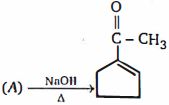
MediumMCQ
Reactant $(A)$ is:
A
$CH_3-CO-(CH_2)_5-CO-CH_3$
B
$CH_3-CO-(CH_2)_4-CHO$
C
$H-CO-(CH_2)_5-CHO$
D
$CH_3-CO-(CH_2)_4-CH_2-OH$
Solution
(B) The reaction is an intramolecular aldol condensation followed by dehydration.
The product is $1$-acetylcyclopentene.
To form a five-membered ring via aldol condensation,the starting material must be a dicarbonyl compound with a chain length that allows the formation of a stable ring.
$CH_3-CO-(CH_2)_4-CHO$ (heptane-$2,6$-dione derivative) undergoes intramolecular aldol condensation to form a five-membered ring product.
Thus,the reactant $(A)$ is $CH_3-CO-(CH_2)_4-CHO$.
The product is $1$-acetylcyclopentene.
To form a five-membered ring via aldol condensation,the starting material must be a dicarbonyl compound with a chain length that allows the formation of a stable ring.
$CH_3-CO-(CH_2)_4-CHO$ (heptane-$2,6$-dione derivative) undergoes intramolecular aldol condensation to form a five-membered ring product.
Thus,the reactant $(A)$ is $CH_3-CO-(CH_2)_4-CHO$.
0 likes
View Solution794
DifficultMCQ
The reaction $CH_3-C(=O)-CH_2-C(CH_3)_2-CHO \xrightarrow{KOH, H_2O} (A)$; Product $A$ is
A
$3,3-$dimethylcyclopent$-1-$en$-1-$one
B
$4,4-$dimethylcyclopent$-2-$en$-1-$one
C
$3-$methylcyclohex$-2-$en$-1-$one
D
$2,3-$dimethylcyclopent$-2-$en$-1-$one
Solution
(B) The given reactant is $CH_3-C(=O)-CH_2-C(CH_3)_2-CHO$. In the presence of $KOH$ and $H_2O$,an intramolecular aldol condensation occurs. The enolate is formed at the $CH_2$ group adjacent to the ketone,which then attacks the aldehyde carbonyl carbon. This forms a five-membered ring. Subsequent dehydration leads to the formation of the $\alpha,\beta$-unsaturated ketone,which is $4,4-\text{dimethylcyclopent-2-en-1-one}$.
0 likes
View Solution795
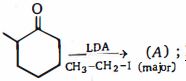
MediumMCQ
The product $A$ in the following reaction is:
A
$2-$ethyl$-6-$methylcyclohexanone
B
$2,2-$diethylcyclohexanone
C
$2-$ethyl$-2-$methylcyclohexanone
D
$2,6-$dimethylcyclohexanone
Solution
(A) The reaction involves the alkylation of an unsymmetrical ketone,$2$-methylcyclohexanone,using a strong,sterically hindered base,$LDA$ (Lithium diisopropylamide).
$LDA$ is a kinetic base that selectively removes a proton from the less sterically hindered $\alpha$-carbon.
In $2$-methylcyclohexanone,there are two types of $\alpha$-carbons: one is the tertiary carbon (substituted with a methyl group) and the other is the secondary carbon ($-CH_2-$ group).
$LDA$ removes a proton from the less hindered $-CH_2-$ $\alpha$-carbon to form the kinetic enolate.
Subsequent reaction of this kinetic enolate with the alkylating agent,ethyl iodide $(CH_3-CH_2-I)$,leads to the alkylation at the less substituted $\alpha$-carbon.
Therefore,the major product $A$ is $2$-ethyl-$6$-methylcyclohexanone.
$LDA$ is a kinetic base that selectively removes a proton from the less sterically hindered $\alpha$-carbon.
In $2$-methylcyclohexanone,there are two types of $\alpha$-carbons: one is the tertiary carbon (substituted with a methyl group) and the other is the secondary carbon ($-CH_2-$ group).
$LDA$ removes a proton from the less hindered $-CH_2-$ $\alpha$-carbon to form the kinetic enolate.
Subsequent reaction of this kinetic enolate with the alkylating agent,ethyl iodide $(CH_3-CH_2-I)$,leads to the alkylation at the less substituted $\alpha$-carbon.
Therefore,the major product $A$ is $2$-ethyl-$6$-methylcyclohexanone.
0 likes
View Solution796
MediumMCQ
Identify the product of the following reaction:
$C_6H_4(CHO)_2 + \text{conc. } NaOH \xrightarrow{\text{heat}} ?$
$C_6H_4(CHO)_2 + \text{conc. } NaOH \xrightarrow{\text{heat}} ?$
A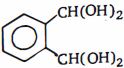
B
C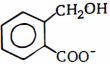
D
Solution
(C) The given reaction is an intramolecular Cannizzaro reaction.
Phthalaldehyde $(C_6H_4(CHO)_2)$ reacts with concentrated $NaOH$ to undergo a disproportionation reaction where one aldehyde group is reduced to an alcohol $(-CH_2OH)$ and the other is oxidized to a carboxylate ion $(-COO^-)$.
Thus,the product is $o$-hydroxymethylbenzoate (or the corresponding salt).
Phthalaldehyde $(C_6H_4(CHO)_2)$ reacts with concentrated $NaOH$ to undergo a disproportionation reaction where one aldehyde group is reduced to an alcohol $(-CH_2OH)$ and the other is oxidized to a carboxylate ion $(-COO^-)$.
Thus,the product is $o$-hydroxymethylbenzoate (or the corresponding salt).
0 likes
View Solution797
MediumMCQ
Compare the stability of the enolate formed from $A$ (cyclohexane$-1,3-$dione) and $B$ (cyclohexane$-1,4-$dione).
Which of the following statements is true?
Which of the following statements is true?
A
$A$ is more stable than $B$
B
$A$ and $B$ have the same stability
C
$B$ is more stable than $A$
D
No comparison of stability can be made
Solution
(A) The enolate formed from $A$ (cyclohexane$-1,3-$dione) is significantly more stable than the enolate formed from $B$ (cyclohexane$-1,4-$dione).
In the enolate of $A$,the negative charge is delocalized over two carbonyl groups via resonance ($-M$ effect),which provides extra stabilization.
In the enolate of $B$,the negative charge is delocalized over only one carbonyl group,as the other carbonyl group is too far away to participate in the resonance stabilization of the carbanion.
Therefore,the enolate of $A$ is more stable.
In the enolate of $A$,the negative charge is delocalized over two carbonyl groups via resonance ($-M$ effect),which provides extra stabilization.
In the enolate of $B$,the negative charge is delocalized over only one carbonyl group,as the other carbonyl group is too far away to participate in the resonance stabilization of the carbanion.
Therefore,the enolate of $A$ is more stable.
0 likes
View Solution798
MediumMCQ
Benzalacetone is the product of mixed aldol condensation between benzaldehyde $(C_6H_5CHO)$ and acetone $(CH_3COCH_3)$. What is its structure?
A
$C_6H_5CH=CHCOCH_3$
B
$C_6H_5CH=C(CH_3)_2$
C
$C_6H_5COCH=CHCH_3$
D
$C_6H_5CH_2COCH=CH_2$
Solution
(A) The mixed aldol condensation occurs between benzaldehyde $(C_6H_5CHO)$ and acetone $(CH_3COCH_3)$.
Acetone acts as the nucleophile by forming an enolate ion $(CH_3COCH_2^-)$ in the presence of a base.
This enolate ion attacks the electrophilic carbonyl carbon of benzaldehyde.
Following dehydration,the final product formed is benzalacetone,which has the structure $C_6H_5CH=CHCOCH_3$.
Acetone acts as the nucleophile by forming an enolate ion $(CH_3COCH_2^-)$ in the presence of a base.
This enolate ion attacks the electrophilic carbonyl carbon of benzaldehyde.
Following dehydration,the final product formed is benzalacetone,which has the structure $C_6H_5CH=CHCOCH_3$.
0 likes
View Solution799
DifficultMCQ
Identify the major product $P$ in the following reaction:
$1,3-\text{cyclohexanedione} + Cl-CH_2-CHO \xrightarrow{\text{aq. NaOH}} P$
$1,3-\text{cyclohexanedione} + Cl-CH_2-CHO \xrightarrow{\text{aq. NaOH}} P$
A
B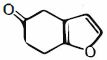
C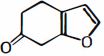
D
Solution
(A) The reaction proceeds through the following steps:
$1$. The base $HO^-$ abstracts an $\alpha$-hydrogen from $1,3-\text{cyclohexanedione}$ to form an enolate ion.
$2$. This enolate ion performs a nucleophilic substitution $(S_N2)$ on $Cl-CH_2-CHO$,displacing the chloride ion.
$3$. The resulting intermediate undergoes an intramolecular aldol condensation followed by dehydration to form the final bicyclic product.
$4$. The final product is a fused ring system containing a ketone and a furan ring,which corresponds to option $A$.
$1$. The base $HO^-$ abstracts an $\alpha$-hydrogen from $1,3-\text{cyclohexanedione}$ to form an enolate ion.
$2$. This enolate ion performs a nucleophilic substitution $(S_N2)$ on $Cl-CH_2-CHO$,displacing the chloride ion.
$3$. The resulting intermediate undergoes an intramolecular aldol condensation followed by dehydration to form the final bicyclic product.
$4$. The final product is a fused ring system containing a ketone and a furan ring,which corresponds to option $A$.
0 likes
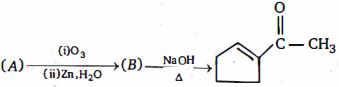
View Solution800
DifficultMCQ
The reactant $(A)$ will be:
A
$1-$methylcyclohex$-1-$ene
B
$3-$methylcyclohex$-1-$ene
C
$4-$methylcyclohex$-1-$ene
D
methylenecyclohexane
Solution
(A) The reaction sequence involves ozonolysis followed by an intramolecular aldol condensation.
$1$. Ozonolysis of $(A)$ with $(i) O_3$ and $(ii) Zn, H_2O$ breaks the double bond to form a dicarbonyl compound $(B)$.
$2$. The product shown is a cyclic $\alpha,\beta$-unsaturated ketone ($2$-methylcyclopent$-2-$enone derivative structure).
$3$. For the final product to be $2-$methylcyclopent$-2-$enone,the intermediate $(B)$ must be heptane$-2,6-$dione.
$4$. This dione is formed by the ozonolysis of $1-$methylcyclohex$-1-$ene. The double bond in $1-$methylcyclohex$-1-$ene is between $C_1$ and $C_2$. Ozonolysis cleaves this bond,resulting in a chain with carbonyl groups at positions $1$ and $6$ relative to the methyl group.
$1$. Ozonolysis of $(A)$ with $(i) O_3$ and $(ii) Zn, H_2O$ breaks the double bond to form a dicarbonyl compound $(B)$.
$2$. The product shown is a cyclic $\alpha,\beta$-unsaturated ketone ($2$-methylcyclopent$-2-$enone derivative structure).
$3$. For the final product to be $2-$methylcyclopent$-2-$enone,the intermediate $(B)$ must be heptane$-2,6-$dione.
$4$. This dione is formed by the ozonolysis of $1-$methylcyclohex$-1-$ene. The double bond in $1-$methylcyclohex$-1-$ene is between $C_1$ and $C_2$. Ozonolysis cleaves this bond,resulting in a chain with carbonyl groups at positions $1$ and $6$ relative to the methyl group.
0 likes
View Solution8-1.Aldehydes and Ketones — Properties · Frequently Asked Questions
1Are these 8-1.Aldehydes and Ketones questions useful for JEE and NEET?
Yes. All questions in this section are mapped to JEE Main and NEET exam patterns. Previous year questions from JEE Main, NEET, GUJCET and state-level exams are included with full solutions.
2Can I switch to Hindi or Gujarati for these questions?
Yes. Use the language tabs in the hero section or the sidebar to view the same questions and solutions in English, Hindi or Gujarati.
3How do I generate a question paper from this subtopic?
Use the Vedclass Exam Paper Generator — select the chapter and subtopic, set difficulty, and generate Sets A, B, C, D automatically. First 3 chapters of every subject are free.
Vedclass Products
For Students
Vedclass Test Series
Mock tests in real JEE/NEET style with performance analysis. 5-day free trial.
Start Free TrialFor Teachers
Exam Paper Generator
Generate Set A/B/C/D papers from this chapter in 2 minutes. 3 chapters free.
Try FreeFor Institutes
Online Exam Module
Live online exams with unlimited students, 360° analytics & white-label branding.
See DemoFor Teachers & Institutes
Generate a 8-1.Aldehydes and Ketones Exam Paper in 2 Minutes
Select subtopic & difficulty — Sets A, B, C, D auto-generated with No Repeat logic.
First 3 chapters of every subject are free — no payment required.