
A English
Properties Questions in English
Class 12 Chemistry · 8-1.Aldehydes and Ketones · Properties
1739+
Questions
English
Language
100%
With Solutions
Showing 50 of 1739 questions in English
601
DifficultMCQ
Which of the following pairs cannot be distinguished by Tollen's reagent?
A
$CH_3COCH_3, PhCHO$
B
$HCOOH, CH_3COCH_3$
C
$CH_3CHO, PhCH_2CHO$
D
$PhCOCH_3, HCHO$
Solution
(C) Tollen's reagent is used to distinguish between aldehydes and most ketones.
Aldehydes (except formaldehyde,which is an exception in some contexts,but generally all aldehydes) and alpha-hydroxy ketones give a positive Tollen's test (silver mirror).
Formic acid $(HCOOH)$ also gives a positive Tollen's test because it contains an aldehydic group.
In the pair $CH_3CHO$ and $PhCH_2CHO$,both are aldehydes and will both give a positive Tollen's test,thus they cannot be distinguished by this reagent.
Aldehydes (except formaldehyde,which is an exception in some contexts,but generally all aldehydes) and alpha-hydroxy ketones give a positive Tollen's test (silver mirror).
Formic acid $(HCOOH)$ also gives a positive Tollen's test because it contains an aldehydic group.
In the pair $CH_3CHO$ and $PhCH_2CHO$,both are aldehydes and will both give a positive Tollen's test,thus they cannot be distinguished by this reagent.
0 likes
View Solution602
DifficultMCQ
$CH_3-CH_2-OH$ $\xrightarrow{PCC} A$ $\xrightarrow{HCN} B$ $\xrightarrow[\Delta]{H_3O^{+}} C$
Compound $C$ is:
Compound $C$ is:
A
$CH_3-CH(OH)COOH$
B
$CH_3-CH(OH)CN$
C
$CH_3-CH=CH-CHO$
D
$CH_3-CH=N-OH$
Solution
(A) Step $1$: Oxidation of ethanol $(CH_3-CH_2-OH)$ with $PCC$ (Pyridinium chlorochromate) gives acetaldehyde $(CH_3-CHO)$,which is compound $A$.
Step $2$: Nucleophilic addition of $HCN$ to acetaldehyde $(CH_3-CHO)$ yields acetaldehyde cyanohydrin $(CH_3-CH(OH)CN)$,which is compound $B$.
Step $3$: Acidic hydrolysis of the cyanohydrin $(CH_3-CH(OH)CN)$ followed by heating converts the $-CN$ group into a carboxylic acid group $(-COOH)$,resulting in $2$-hydroxypropanoic acid $(CH_3-CH(OH)COOH)$,which is compound $C$.
Step $2$: Nucleophilic addition of $HCN$ to acetaldehyde $(CH_3-CHO)$ yields acetaldehyde cyanohydrin $(CH_3-CH(OH)CN)$,which is compound $B$.
Step $3$: Acidic hydrolysis of the cyanohydrin $(CH_3-CH(OH)CN)$ followed by heating converts the $-CN$ group into a carboxylic acid group $(-COOH)$,resulting in $2$-hydroxypropanoic acid $(CH_3-CH(OH)COOH)$,which is compound $C$.
0 likes
View Solution603
DifficultMCQ
Identify the product of the following reaction:
$CH_3-CO-CH_2-CH_2-CH_2-CHO \xrightarrow{NaOH, \Delta} \text{Product}$
$CH_3-CO-CH_2-CH_2-CH_2-CHO \xrightarrow{NaOH, \Delta} \text{Product}$
A
Cyclopentanone
B
Cyclopent$-2-$en$-1-$one
C
Cyclopent$-2-$en$-1-$ol
D
Cyclopent$-1-$en$-1-$ol
Solution
(B) The reaction is an intramolecular Aldol condensation.
$1$. The base $(NaOH)$ abstracts an $\alpha$-hydrogen from the methyl group of the ketone $(CH_3-CO-CH_2-CH_2-CH_2-CHO)$ to form an enolate ion.
$2$. This enolate ion performs a nucleophilic attack on the aldehyde carbonyl carbon $(C1)$,leading to the formation of a stable $5-$membered ring.
$3$. The resulting $\beta$-hydroxy ketone intermediate undergoes dehydration upon heating $(\Delta)$ to form the conjugated unsaturated ketone,cyclopent$-2-$en$-1-$one.
$1$. The base $(NaOH)$ abstracts an $\alpha$-hydrogen from the methyl group of the ketone $(CH_3-CO-CH_2-CH_2-CH_2-CHO)$ to form an enolate ion.
$2$. This enolate ion performs a nucleophilic attack on the aldehyde carbonyl carbon $(C1)$,leading to the formation of a stable $5-$membered ring.
$3$. The resulting $\beta$-hydroxy ketone intermediate undergoes dehydration upon heating $(\Delta)$ to form the conjugated unsaturated ketone,cyclopent$-2-$en$-1-$one.
0 likes
View Solution604
MediumMCQ
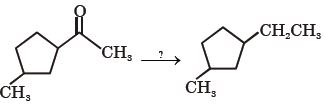
Which among the following reagents cannot be used for the above interconversion? The reaction involves the reduction of a ketone group $(>C=O)$ to a methylene group $(-CH_2-)$.
A
$Zn-Hg/HCl$
B
$HI/Red \ P, \ \Delta$
C
$(i) \ NH_2-NH_2, \ (ii) \ OH^-/\Delta$
D
$NaBH_4$
Solution
(D) The given reaction is the reduction of a ketone to an alkane (specifically,a methylene group).
$1$. $Zn-Hg/HCl$ is the Clemmensen reduction,which reduces ketones to alkanes.
$2$. $HI/Red \ P, \ \Delta$ is a strong reducing agent that reduces ketones to alkanes.
$3$. $(i) \ NH_2-NH_2, \ (ii) \ OH^-/\Delta$ is the Wolff-Kishner reduction,which also reduces ketones to alkanes.
$4$. $NaBH_4$ is a mild reducing agent that reduces aldehydes and ketones to alcohols,not to alkanes.
Therefore,$NaBH_4$ cannot be used for this interconversion.
$1$. $Zn-Hg/HCl$ is the Clemmensen reduction,which reduces ketones to alkanes.
$2$. $HI/Red \ P, \ \Delta$ is a strong reducing agent that reduces ketones to alkanes.
$3$. $(i) \ NH_2-NH_2, \ (ii) \ OH^-/\Delta$ is the Wolff-Kishner reduction,which also reduces ketones to alkanes.
$4$. $NaBH_4$ is a mild reducing agent that reduces aldehydes and ketones to alcohols,not to alkanes.
Therefore,$NaBH_4$ cannot be used for this interconversion.
0 likes
View Solution605
MediumMCQ
Nucleophilic addition reaction will be most favoured in:
A
$CH_3-CH_2-CHO$
B
$CH_3-CHO$
C
$CH_3-CH_2-CH_2-C(=O)-CH_3$
D
$CH_3-C(=O)-CH_3$
Solution
(B) Nucleophilic addition reactions are generally more favored in aldehydes than in ketones due to both steric and electronic factors.
Sterically,the presence of two relatively large substituents in ketones hinders the approach of a nucleophile to the carbonyl carbon.
Electronically,two alkyl groups reduce the electrophilicity of the carbonyl carbon more effectively than in aldehydes due to their $+I$ effect.
Among the given options,$CH_3-CHO$ (ethanal) has the smallest alkyl group compared to propanal and the ketones,making it the most reactive towards nucleophilic addition.
Sterically,the presence of two relatively large substituents in ketones hinders the approach of a nucleophile to the carbonyl carbon.
Electronically,two alkyl groups reduce the electrophilicity of the carbonyl carbon more effectively than in aldehydes due to their $+I$ effect.
Among the given options,$CH_3-CHO$ (ethanal) has the smallest alkyl group compared to propanal and the ketones,making it the most reactive towards nucleophilic addition.
0 likes
View Solution606
DifficultMCQ
$Ph-CO-CHO \xrightarrow[\Delta]{conc. NaOH} \text{Product}$
A
$Ph-CO-COONa$
B
$Ph-CH(OH)-COONa$
C
$Ph-CO-CH_2OH$
D
$Ph-CO-O-CO-H$
Solution
(B) The given reaction is an example of an intramolecular Cannizzaro reaction.
The $OH^-$ ion attacks the more electrophilic aldehyde carbonyl carbon.
Subsequently,a hydride ion $(H^-)$ shifts from the aldehyde carbon to the ketone carbonyl carbon.
This is followed by a proton transfer to yield the salt of a hydroxy acid,which is sodium mandelate $(Ph-CH(OH)-COONa)$.
The $OH^-$ ion attacks the more electrophilic aldehyde carbonyl carbon.
Subsequently,a hydride ion $(H^-)$ shifts from the aldehyde carbon to the ketone carbonyl carbon.
This is followed by a proton transfer to yield the salt of a hydroxy acid,which is sodium mandelate $(Ph-CH(OH)-COONa)$.
0 likes
View Solution607
MediumMCQ
Identify the product $A$ in the following reaction:
$\text{Substrate} \xrightarrow{MnO_2} A$
(The substrate is a benzene ring with a $-OH$ group,a $-COOH$ group,and a $-CH(CH_2CH_3)CHO$ group attached to it.)
$\text{Substrate} \xrightarrow{MnO_2} A$
(The substrate is a benzene ring with a $-OH$ group,a $-COOH$ group,and a $-CH(CH_2CH_3)CHO$ group attached to it.)
A
The product $A$ is a benzene ring with a $-OH$ group,a $-COOH$ group,and a $-CH(CH_2CH_3)CHO$ group.
B
The product $A$ is a benzene ring with a $-OH$ group,a $-CHO$ group,and a $-CH(CH_2CH_3)CHO$ group.
C
The product $A$ is a benzene ring with a $-OH$ group,a $-CHO$ group,and a $-CH(CH_2CH_3)CH_2OH$ group.
D
The product $A$ is a cyclohexadienone derivative with a $-CHO$ group and a $-CH(CH_2CH_3)CHO$ group.
Solution
(B) $MnO_2$ (Manganese dioxide) is a selective oxidizing agent that specifically oxidizes allylic and benzylic alcohols to their corresponding aldehydes or ketones.
In the given substrate,the $-CH(CH_2CH_3)CHO$ group contains an aldehyde,and the $-COOH$ group is a carboxylic acid. The $-OH$ group is phenolic. $MnO_2$ does not oxidize phenolic $-OH$ groups or carboxylic acids under standard conditions.
However,if the substrate was intended to have an allylic or benzylic alcohol,$MnO_2$ would oxidize it to an aldehyde. Given the options,the reaction likely involves the selective oxidation of a benzylic alcohol to an aldehyde. Option $B$ represents the oxidation of a benzylic alcohol to an aldehyde while leaving the phenolic $-OH$ and the other aldehyde group intact.
In the given substrate,the $-CH(CH_2CH_3)CHO$ group contains an aldehyde,and the $-COOH$ group is a carboxylic acid. The $-OH$ group is phenolic. $MnO_2$ does not oxidize phenolic $-OH$ groups or carboxylic acids under standard conditions.
However,if the substrate was intended to have an allylic or benzylic alcohol,$MnO_2$ would oxidize it to an aldehyde. Given the options,the reaction likely involves the selective oxidation of a benzylic alcohol to an aldehyde. Option $B$ represents the oxidation of a benzylic alcohol to an aldehyde while leaving the phenolic $-OH$ and the other aldehyde group intact.
0 likes
View Solution608
DifficultMCQ
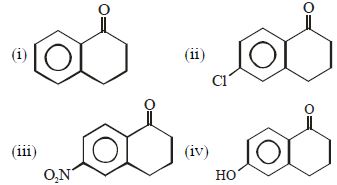
Which of the following is the correct order for the rate of nucleophilic addition of the given compounds?
A
$i > ii > iii > iv$
B
$iv > i > ii > iii$
C
$iii > ii > i > iv$
D
$iii > i > iv > ii$
Solution
(C) The rate of nucleophilic addition reaction $(N.A.R.)$ is directly proportional to the electron deficiency of the carbonyl carbon.
Electron-withdrawing groups ($-I$ or $-M$ effect) increase the electrophilicity of the carbonyl carbon,thereby increasing the rate of $N.A.R.$.
Electron-donating groups ($+I$ or $+M$ effect) decrease the electrophilicity of the carbonyl carbon,thereby decreasing the rate of $N.A.R.$.
Comparing the substituents:
(iii) $-NO_2$ group has a strong $-M$ and $-I$ effect (strongly electron-withdrawing).
(ii) $-Cl$ group has a $-I$ effect but a $+M$ effect (overall electron-withdrawing due to $-I > +M$).
$(i)$ No substituent.
(iv) $-OH$ group has a strong $+M$ effect (strongly electron-donating).
Therefore,the order of reactivity is: $(iii) > (ii) > (i) > (iv)$.
Electron-withdrawing groups ($-I$ or $-M$ effect) increase the electrophilicity of the carbonyl carbon,thereby increasing the rate of $N.A.R.$.
Electron-donating groups ($+I$ or $+M$ effect) decrease the electrophilicity of the carbonyl carbon,thereby decreasing the rate of $N.A.R.$.
Comparing the substituents:
(iii) $-NO_2$ group has a strong $-M$ and $-I$ effect (strongly electron-withdrawing).
(ii) $-Cl$ group has a $-I$ effect but a $+M$ effect (overall electron-withdrawing due to $-I > +M$).
$(i)$ No substituent.
(iv) $-OH$ group has a strong $+M$ effect (strongly electron-donating).
Therefore,the order of reactivity is: $(iii) > (ii) > (i) > (iv)$.
0 likes
View Solution609
AdvancedMCQ
The product of the following reaction is:
$Ph-CO-CH_3 \xrightarrow[{(ii)\,\Delta }]{{(i)\,aq.\,K_2CO_3}}$ Product
$Ph-CO-CH_3 \xrightarrow[{(ii)\,\Delta }]{{(i)\,aq.\,K_2CO_3}}$ Product
A
$Ph-CH(OH)-CH_3$
B
$Ph-CO-CH=C(CH_3)-Ph$
C
$Ph-CO-CH_2-CH_2-CO-Ph$
D
$Ph-CO-CH_2-CH(OH)-Ph$
Solution
(B) Acetophenone $(Ph-CO-CH_3)$ contains $\alpha$-hydrogens. In the presence of a base like $aq. \ K_2CO_3$ and heating $(\Delta)$,it undergoes Aldol condensation followed by dehydration to form an $\alpha,\beta$-unsaturated ketone.
$2 Ph-CO-CH_3$ $\xrightarrow{aq. \ K_2CO_3} Ph-CO-CH_2-C(OH)(CH_3)Ph$ $\xrightarrow{\Delta} Ph-CO-CH=C(CH_3)Ph + H_2O$.
$2 Ph-CO-CH_3$ $\xrightarrow{aq. \ K_2CO_3} Ph-CO-CH_2-C(OH)(CH_3)Ph$ $\xrightarrow{\Delta} Ph-CO-CH=C(CH_3)Ph + H_2O$.
0 likes
View Solution610
DifficultMCQ
In the given Cannizzaro reaction,the slowest step is:
$2PhCHO \xrightarrow{KOH} PhCH_2OH + PhCOO^-$
$2PhCHO \xrightarrow{KOH} PhCH_2OH + PhCOO^-$
A
The attack of $OH^-$ at the carbonyl group
B
The transfer of hydride to the carbonyl group
C
The abstraction of proton from the carboxylic acid
D
The deprotonation of $PhCH_2OH$
Solution
(B) The Cannizzaro reaction involves the nucleophilic attack of $OH^-$ on the carbonyl carbon to form a di-anion intermediate.
This intermediate then undergoes a hydride transfer to another molecule of aldehyde.
The hydride transfer step is the rate-determining step $(R.D.S.)$ because it involves the breaking of a $C-H$ bond and is the slowest step in the mechanism.
This intermediate then undergoes a hydride transfer to another molecule of aldehyde.
The hydride transfer step is the rate-determining step $(R.D.S.)$ because it involves the breaking of a $C-H$ bond and is the slowest step in the mechanism.
0 likes
View Solution611
MediumMCQ
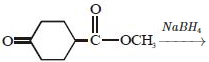
The product formed in the reaction is:
A
$4-$hydroxycyclohexanecarboxylic acid methyl ester
B
$4-$hydroxycyclohexylmethanol
C
$4-$oxocyclohexylmethanol
D
cyclohex$-3-$enecarboxylic acid methyl ester
Solution
(A) $NaBH_4$ is a selective reducing agent that reduces aldehydes and ketones to alcohols but does not reduce esters. In the given molecule,there is a ketone group and an ester group. $NaBH_4$ will selectively reduce the ketone group to a secondary alcohol while leaving the ester group intact. Therefore,the product is $4-$hydroxycyclohexanecarboxylic acid methyl ester.
0 likes
View Solution612
MediumMCQ
Find the major product of the following reaction:
$Ph-CHO + CH_3-CHO \xrightarrow[\Delta]{Ca(OH)_2}$ Major product
$Ph-CHO + CH_3-CHO \xrightarrow[\Delta]{Ca(OH)_2}$ Major product
A
$Ph-CH=CH-CH_2-CHO$
B
$CH_3-CH_2-CH=C(CH_3)-CHO$
C
$CH_3-CH_2-CH=CH-CH_2-CHO$
D
$Ph-CH=CH-CHO$
Solution
(D) The reaction between benzaldehyde $(Ph-CHO)$ and acetaldehyde $(CH_3-CHO)$ in the presence of a base like $Ca(OH)_2$ followed by heating $(\Delta)$ is a Claisen-Schmidt condensation,which is a type of cross-aldol condensation.
$1$. The $\alpha$-hydrogen of acetaldehyde is removed by the base to form an enolate nucleophile $(CH_2^-CHO)$.
$2$. This enolate attacks the carbonyl carbon of benzaldehyde to form a $\beta$-hydroxy aldehyde intermediate.
$3$. Subsequent dehydration upon heating $(\Delta)$ gives cinnamaldehyde $(Ph-CH=CH-CHO)$ as the major product.
$1$. The $\alpha$-hydrogen of acetaldehyde is removed by the base to form an enolate nucleophile $(CH_2^-CHO)$.
$2$. This enolate attacks the carbonyl carbon of benzaldehyde to form a $\beta$-hydroxy aldehyde intermediate.
$3$. Subsequent dehydration upon heating $(\Delta)$ gives cinnamaldehyde $(Ph-CH=CH-CHO)$ as the major product.
0 likes
View Solution613
MediumMCQ
Which of the following is least reactive towards nucleophilic addition?
A
$CH_2O$
B
$CCl_3CHO$
C
$CH_3COC_2H_5$
D
$CH_3CHO$
Solution
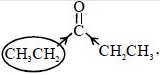
(C) Nucleophilic addition reactivity decreases with an increase in the number and size of alkyl groups due to the $+I$ effect and steric hindrance.
Ketones are generally less reactive than aldehydes.
Among the given options,$CH_3COC_2H_5$ (ethyl methyl ketone) is a ketone with two alkyl groups,making it the least reactive towards nucleophilic addition.
Ketones are generally less reactive than aldehydes.
Among the given options,$CH_3COC_2H_5$ (ethyl methyl ketone) is a ketone with two alkyl groups,making it the least reactive towards nucleophilic addition.
0 likes
View Solution614
DifficultMCQ
Which of the following reactions are incorrect?
$(a)$ $CH_2(COOH)_2 \xrightarrow{\Delta} CH_3COOH + CO_2$
$(b)$ Aniline $\xrightarrow{CH_3Cl/AlCl_3}$ $p$-chloroaniline
$(c)$ Phenol $\xrightarrow{CHCl_3 + aq. NaOH}$ Salicylic acid
$(d)$ $CH_3CHO + NaHSO_3 \rightleftharpoons CH_3CH(OH)SO_3Na$
$(e)$ Benzene $\xrightarrow{CO, HCl, Anhydrous AlCl_3/CuCl}$ Benzaldehyde
$(a)$ $CH_2(COOH)_2 \xrightarrow{\Delta} CH_3COOH + CO_2$
$(b)$ Aniline $\xrightarrow{CH_3Cl/AlCl_3}$ $p$-chloroaniline
$(c)$ Phenol $\xrightarrow{CHCl_3 + aq. NaOH}$ Salicylic acid
$(d)$ $CH_3CHO + NaHSO_3 \rightleftharpoons CH_3CH(OH)SO_3Na$
$(e)$ Benzene $\xrightarrow{CO, HCl, Anhydrous AlCl_3/CuCl}$ Benzaldehyde
A
$a, b, c$
B
$b, c$
C
$a, b, c, d$
D
$b, c, e$
Solution
(B) Let us analyze each reaction:
$(a)$ Malonic acid undergoes decarboxylation on heating to give acetic acid and $CO_2$. This is correct.
$(b)$ Aniline forms a complex with $AlCl_3$ (a Lewis acid) due to the lone pair on nitrogen,which deactivates the ring and prevents Friedel-Crafts alkylation. The product shown is incorrect.
$(c)$ Reimer-Tiemann reaction of phenol with $CHCl_3$ and $NaOH$ yields salicylaldehyde,not salicylic acid. This is incorrect.
$(d)$ Acetaldehyde reacts with sodium bisulfite to form a bisulfite addition product. This is correct.
$(e)$ Gattermann-Koch reaction of benzene with $CO$ and $HCl$ in the presence of anhydrous $AlCl_3/CuCl$ gives benzaldehyde. This is correct.
Thus,reactions $(b)$ and $(c)$ are incorrect.
$(a)$ Malonic acid undergoes decarboxylation on heating to give acetic acid and $CO_2$. This is correct.
$(b)$ Aniline forms a complex with $AlCl_3$ (a Lewis acid) due to the lone pair on nitrogen,which deactivates the ring and prevents Friedel-Crafts alkylation. The product shown is incorrect.
$(c)$ Reimer-Tiemann reaction of phenol with $CHCl_3$ and $NaOH$ yields salicylaldehyde,not salicylic acid. This is incorrect.
$(d)$ Acetaldehyde reacts with sodium bisulfite to form a bisulfite addition product. This is correct.
$(e)$ Gattermann-Koch reaction of benzene with $CO$ and $HCl$ in the presence of anhydrous $AlCl_3/CuCl$ gives benzaldehyde. This is correct.
Thus,reactions $(b)$ and $(c)$ are incorrect.
0 likes
View Solution615
MediumMCQ
Which of the following compounds does not react with $NaHSO_3$?
A
$C_6H_5CHO$
B
$C_6H_5COCH_3$
C
$CH_3COCH_3$
D
$CH_3CHO$
Solution
(B) The addition of sodium bisulphite $(NaHSO_3)$ to carbonyl compounds is a nucleophilic addition reaction.
Steric hindrance plays a crucial role in this reaction.
Acetophenone $(C_6H_5COCH_3)$ contains a bulky phenyl group and a methyl group attached to the carbonyl carbon,which creates significant steric hindrance.
Due to this steric hindrance,the nucleophile $(HSO_3^-)$ cannot easily attack the carbonyl carbon,and therefore,acetophenone does not form an addition product with $NaHSO_3$.
Steric hindrance plays a crucial role in this reaction.
Acetophenone $(C_6H_5COCH_3)$ contains a bulky phenyl group and a methyl group attached to the carbonyl carbon,which creates significant steric hindrance.
Due to this steric hindrance,the nucleophile $(HSO_3^-)$ cannot easily attack the carbonyl carbon,and therefore,acetophenone does not form an addition product with $NaHSO_3$.
0 likes
View Solution616
DifficultMCQ
The reaction sequence is as follows:
Benzene + $CH_3COCl$ $\xrightarrow{\text{Anhydrous } AlCl_3} (A)$ $\xrightarrow{(x)} \text{Ethylbenzene}$.
Reagent $(x)$ can be:
Benzene + $CH_3COCl$ $\xrightarrow{\text{Anhydrous } AlCl_3} (A)$ $\xrightarrow{(x)} \text{Ethylbenzene}$.
Reagent $(x)$ can be:
A
$HI / \text{Red } P$
B
$Zn-Hg / HCl$
C
$NH_2-NH_2 / \overset{\Theta}{O}H / \Delta$
D
All of the above
Solution
(D) $1$. The reaction of benzene with $CH_3COCl$ in the presence of anhydrous $AlCl_3$ is a Friedel-Crafts acylation reaction,which produces acetophenone $(A)$ as the product $(C_6H_5COCH_3)$.
$2$. The conversion of acetophenone to ethylbenzene $(C_6H_5CH_2CH_3)$ involves the reduction of the carbonyl group $(>C=O)$ to a methylene group $(>CH_2)$.
$3$. The reagents listed are all standard methods for the reduction of carbonyl compounds to alkanes:
- $HI / \text{Red } P$ is a strong reducing agent that reduces carbonyl groups to methylene groups.
- $Zn-Hg / HCl$ is the reagent for Clemmensen reduction,which reduces ketones to alkanes.
- $NH_2-NH_2 / \overset{\Theta}{O}H / \Delta$ is the reagent for Wolff-Kishner reduction,which also reduces ketones to alkanes.
$4$. Since all three reagents can perform this transformation,the correct answer is 'All of the above'.
$2$. The conversion of acetophenone to ethylbenzene $(C_6H_5CH_2CH_3)$ involves the reduction of the carbonyl group $(>C=O)$ to a methylene group $(>CH_2)$.
$3$. The reagents listed are all standard methods for the reduction of carbonyl compounds to alkanes:
- $HI / \text{Red } P$ is a strong reducing agent that reduces carbonyl groups to methylene groups.
- $Zn-Hg / HCl$ is the reagent for Clemmensen reduction,which reduces ketones to alkanes.
- $NH_2-NH_2 / \overset{\Theta}{O}H / \Delta$ is the reagent for Wolff-Kishner reduction,which also reduces ketones to alkanes.
$4$. Since all three reagents can perform this transformation,the correct answer is 'All of the above'.
0 likes
View Solution617
DifficultMCQ
Compound $x$ having molecular formula $C_3H_6O$ is reduced by Red $P/HI$ to give compound $y$ $(C_3H_8)$. Since $x$ reduces Tollen's reagent,what is the possible structure of $x$?
A
$CH_3CH_2CHO$
B
$CH_3COCH_3$
C
$CH_2=CHCH_2OH$
D
None of these
Solution
(A) The molecular formula $C_3H_6O$ corresponds to either an aldehyde or a ketone.
Since compound $x$ reduces Tollen's reagent,it must be an aldehyde.
Among the given options,$CH_3CH_2CHO$ (propanal) is an aldehyde.
Red $P/HI$ is a strong reducing agent that reduces carbonyl groups to alkanes,converting propanal $(C_3H_6O)$ to propane $(C_3H_8)$.
Since compound $x$ reduces Tollen's reagent,it must be an aldehyde.
Among the given options,$CH_3CH_2CHO$ (propanal) is an aldehyde.
Red $P/HI$ is a strong reducing agent that reduces carbonyl groups to alkanes,converting propanal $(C_3H_6O)$ to propane $(C_3H_8)$.
0 likes
View Solution618
AdvancedMCQ
The compound $(P)$ undergoes the following reaction sequence: $(P)$ $\xrightarrow{\Delta} X$ $\xrightarrow{Zn-Hg/HCl} Y$. Identify $Y$.

A
Methylcyclohexane
B
Cyclohexanone
C
Cyclohexane
D
$2-$(hydroxymethyl)cyclohexanol
Solution
(C) The starting material $(P)$ is $2$-oxocyclohexanecarboxylic acid.
Heating $(P)$ causes decarboxylation,where the $-COOH$ group is lost as $CO_2$,resulting in the formation of cyclohexanone as intermediate $X$.
The subsequent reaction with $Zn-Hg/HCl$ is a Clemmensen reduction,which reduces the carbonyl group $(C=O)$ of cyclohexanone to a methylene group $(CH_2)$.
Therefore,the final product $Y$ is cyclohexane.
Heating $(P)$ causes decarboxylation,where the $-COOH$ group is lost as $CO_2$,resulting in the formation of cyclohexanone as intermediate $X$.
The subsequent reaction with $Zn-Hg/HCl$ is a Clemmensen reduction,which reduces the carbonyl group $(C=O)$ of cyclohexanone to a methylene group $(CH_2)$.
Therefore,the final product $Y$ is cyclohexane.
0 likes
View Solution619
MediumMCQ
$2(CHO-COOH) \xrightarrow{NaOH} CH_2OH-COOH + HOOC-COONa$. This reaction is:
A
Crossed Cannizzaro reaction
B
Intermolecular Cannizzaro reaction
C
Intramolecular Cannizzaro reaction
D
None
Solution
(B) In the given reaction,two molecules of glyoxylic acid $(CHO-COOH)$ react in the presence of $NaOH$.
One aldehyde group is oxidized to a carboxylate group $(COONa)$,and the other is reduced to an alcohol group $(CH_2OH)$.
Since this disproportionation (redox) occurs between two separate molecules of the same substance,it is classified as an intermolecular Cannizzaro reaction.
One aldehyde group is oxidized to a carboxylate group $(COONa)$,and the other is reduced to an alcohol group $(CH_2OH)$.
Since this disproportionation (redox) occurs between two separate molecules of the same substance,it is classified as an intermolecular Cannizzaro reaction.
0 likes
View Solution620
AdvancedMCQ
The starting material is $CH_3COCH_2CHO$. The reaction sequence is:
$CH_3COCH_2CHO$ $\xrightarrow[{(ii)LiAlH_4}]{{(i)ethylene\,glycol/dry\,HCl}} A$ $\xrightarrow[\Delta ]{H_3O^{+}} B$
What will be $B$?
$CH_3COCH_2CHO$ $\xrightarrow[{(ii)LiAlH_4}]{{(i)ethylene\,glycol/dry\,HCl}} A$ $\xrightarrow[\Delta ]{H_3O^{+}} B$
What will be $B$?
A
$4-$hydroxybutan$-2-$one
B
but$-2-$en$-1-$al
C
but$-3-$en$-2-$one
D
$3-$hydroxybutanal
Solution
(B) The starting material is $CH_3COCH_2CHO$ ($3$-oxobutanal).
Step $(i)$: Treatment with ethylene glycol and dry $HCl$ selectively protects the more reactive carbonyl group (aldehyde) as a cyclic acetal. The ketone remains unaffected.
Step $(ii)$: $LiAlH_4$ reduces the ketone group to a secondary alcohol. The product $A$ is $CH_3CH(OH)CH_2CH(OCH_2CH_2O)$.
Step $(iii)$: Acidic hydrolysis $(H_3O^{+}/\Delta)$ deprotects the acetal back to an aldehyde and simultaneously causes dehydration of the $\beta$-hydroxy ketone formed,leading to an $\alpha,\beta$-unsaturated carbonyl compound.
The final product $B$ is $CH_3CH=CHCHO$ (but$-2-$enal).
Step $(i)$: Treatment with ethylene glycol and dry $HCl$ selectively protects the more reactive carbonyl group (aldehyde) as a cyclic acetal. The ketone remains unaffected.
Step $(ii)$: $LiAlH_4$ reduces the ketone group to a secondary alcohol. The product $A$ is $CH_3CH(OH)CH_2CH(OCH_2CH_2O)$.
Step $(iii)$: Acidic hydrolysis $(H_3O^{+}/\Delta)$ deprotects the acetal back to an aldehyde and simultaneously causes dehydration of the $\beta$-hydroxy ketone formed,leading to an $\alpha,\beta$-unsaturated carbonyl compound.
The final product $B$ is $CH_3CH=CHCHO$ (but$-2-$enal).
0 likes
View Solution621
DifficultMCQ
$CH_3-CH(NH_2)-CH_3$ $\xrightarrow{HNO_2} A$ $\xrightarrow{\text{oxidation}} B$ $\xrightarrow[(ii) H_2O]{(i) CH_3MgI} C$. $C$ is:
A
$CH_3-CH_2-CH_2-CH_2-OH$
B
$CH_3-CH_2-CH(OH)-CH_3$
C
$CH_3-CH(CH_3)-CH_2-OH$
D
$CH_3-C(CH_3)(OH)-CH_3$
Solution
(D) Isopropylamine $(CH_3-CH(NH_2)-CH_3)$ reacts with nitrous acid $(HNO_2)$ to form Isopropyl alcohol $(A)$.
The oxidation of Isopropyl alcohol,which is a secondary alcohol,yields Acetone $(B)$.
Acetone then reacts with the Grignard reagent Methyl magnesium iodide $(CH_3MgI)$,followed by hydrolysis,to produce tert-Butyl alcohol $(C)$.
Reaction sequence:
$CH_3-CH(NH_2)-CH_3$ $\xrightarrow{HNO_2} CH_3-CH(OH)-CH_3 (A)$ $\xrightarrow{\text{oxidation}} CH_3-CO-CH_3 (B)$ $\xrightarrow{(i) CH_3MgI, (ii) H_2O} CH_3-C(CH_3)(OH)-CH_3 (C)$.
The oxidation of Isopropyl alcohol,which is a secondary alcohol,yields Acetone $(B)$.
Acetone then reacts with the Grignard reagent Methyl magnesium iodide $(CH_3MgI)$,followed by hydrolysis,to produce tert-Butyl alcohol $(C)$.
Reaction sequence:
$CH_3-CH(NH_2)-CH_3$ $\xrightarrow{HNO_2} CH_3-CH(OH)-CH_3 (A)$ $\xrightarrow{\text{oxidation}} CH_3-CO-CH_3 (B)$ $\xrightarrow{(i) CH_3MgI, (ii) H_2O} CH_3-C(CH_3)(OH)-CH_3 (C)$.
0 likes
View Solution622
DifficultMCQ
$(A)$ and $(B)$ in the following reaction sequence are:
$RR'C=O$ $\xrightarrow{HCN} (A)$ $\xrightarrow{B} RR'C(OH)CH_2NH_2$
$RR'C=O$ $\xrightarrow{HCN} (A)$ $\xrightarrow{B} RR'C(OH)CH_2NH_2$
A
$(A) = RR'C(OH)CN, (B) = LiAlH_4$
B
$(A) = RR'C(OH)COOH, (B) = NH_3$
C
$(A) = RR'C(OH)CN, (B) = H_3O^{+}$
D
$(A) = RR'C(OH)CN, (B) = H_2/Ni$
Solution
(A) The reaction of a carbonyl compound $(RR'C=O)$ with $HCN$ is a nucleophilic addition reaction that forms a cyanohydrin $(A) = RR'C(OH)CN$.
The subsequent reduction of the nitrile group $(-CN)$ to a primary amine $(-CH_2NH_2)$ requires a strong reducing agent like $LiAlH_4$.
Therefore,$(A) = RR'C(OH)CN$ and $(B) = LiAlH_4$.
The subsequent reduction of the nitrile group $(-CN)$ to a primary amine $(-CH_2NH_2)$ requires a strong reducing agent like $LiAlH_4$.
Therefore,$(A) = RR'C(OH)CN$ and $(B) = LiAlH_4$.
0 likes
View Solution623
DifficultMCQ
How many compounds among the following give white crystals when reacted with sodium bisulphite $(NaHSO_3)$?
$1. HCHO$
$2. CH_3CHO$
$3. CH_3COCH_3$
$4. C_6H_5COCH_3$
$5. C_6H_5COC_6H_5$
$1. HCHO$
$2. CH_3CHO$
$3. CH_3COCH_3$
$4. C_6H_5COCH_3$
$5. C_6H_5COC_6H_5$
A
$2$
B
$3$
C
$4$
D
$5$
Solution
(B) Sodium bisulphite $(NaHSO_3)$ reacts with all aldehydes and most methyl ketones to form white crystalline addition products. The reaction is sensitive to steric hindrance.
$1. HCHO$ (Formaldehyde): Reacts.
$2. CH_3CHO$ (Acetaldehyde): Reacts.
$3. CH_3COCH_3$ (Acetone): Reacts.
$4. C_6H_5COCH_3$ (Acetophenone): Does not react significantly due to steric hindrance from the phenyl group.
$5. C_6H_5COC_6H_5$ (Benzophenone): Does not react due to significant steric hindrance from two phenyl groups.
Thus,only $3$ compounds $(HCHO, CH_3CHO, CH_3COCH_3)$ form white crystalline products with $NaHSO_3$.
$1. HCHO$ (Formaldehyde): Reacts.
$2. CH_3CHO$ (Acetaldehyde): Reacts.
$3. CH_3COCH_3$ (Acetone): Reacts.
$4. C_6H_5COCH_3$ (Acetophenone): Does not react significantly due to steric hindrance from the phenyl group.
$5. C_6H_5COC_6H_5$ (Benzophenone): Does not react due to significant steric hindrance from two phenyl groups.
Thus,only $3$ compounds $(HCHO, CH_3CHO, CH_3COCH_3)$ form white crystalline products with $NaHSO_3$.
0 likes
View Solution624
MediumMCQ
For the given reaction,find the sum of $x + y = ?$
$CH_3-CH_2-CO-CH_3 \xrightarrow[(ii) \ y \ mol \ NaNH_2]{(i) \ x \ mol \ PCl_5} CH_3-C \equiv C-CH_3$
$CH_3-CH_2-CO-CH_3 \xrightarrow[(ii) \ y \ mol \ NaNH_2]{(i) \ x \ mol \ PCl_5} CH_3-C \equiv C-CH_3$
A
$2$
B
$3$
C
$4$
D
$5$
Solution
(B) The reaction involves the conversion of a ketone $(CH_3-CH_2-CO-CH_3)$ into an alkyne $(CH_3-C \equiv C-CH_3)$.
Step $1$: Reaction with $PCl_5$ $(x \ mol)$: The ketone reacts with $PCl_5$ to form a gem-dichloride. Since $1 \ mol$ of ketone reacts with $1 \ mol$ of $PCl_5$,$x = 1$.
$CH_3-CH_2-CO-CH_3 + PCl_5 \rightarrow CH_3-CH_2-CCl_2-CH_3 + POCl_3$
Step $2$: Reaction with $NaNH_2$ $(y \ mol)$: The gem-dichloride undergoes dehydrohalogenation to form an alkyne. This requires $2 \ mol$ of $NaNH_2$ to remove $2 \ mol$ of $HCl$ to form the triple bond. Thus,$y = 2$.
$CH_3-CH_2-CCl_2-CH_3 + 2NaNH_2 \rightarrow CH_3-C \equiv C-CH_3 + 2NaCl + 2NH_3$
Therefore,$x + y = 1 + 2 = 3$.
Step $1$: Reaction with $PCl_5$ $(x \ mol)$: The ketone reacts with $PCl_5$ to form a gem-dichloride. Since $1 \ mol$ of ketone reacts with $1 \ mol$ of $PCl_5$,$x = 1$.
$CH_3-CH_2-CO-CH_3 + PCl_5 \rightarrow CH_3-CH_2-CCl_2-CH_3 + POCl_3$
Step $2$: Reaction with $NaNH_2$ $(y \ mol)$: The gem-dichloride undergoes dehydrohalogenation to form an alkyne. This requires $2 \ mol$ of $NaNH_2$ to remove $2 \ mol$ of $HCl$ to form the triple bond. Thus,$y = 2$.
$CH_3-CH_2-CCl_2-CH_3 + 2NaNH_2 \rightarrow CH_3-C \equiv C-CH_3 + 2NaCl + 2NH_3$
Therefore,$x + y = 1 + 2 = 3$.
0 likes
View Solution625
MediumMCQ
Which of the following compounds can show an aldol condensation reaction?
A
$CH_3CHO$
B
$CH_3COCH_3$
C
$CH_3CH_2CHO$
D
All of the above
Solution
(D) Aldol condensation is shown by aldehydes and ketones that possess at least one $\alpha$-hydrogen atom.
$1$. $CH_3CHO$ (Acetaldehyde) has three $\alpha$-hydrogen atoms.
$2$. $CH_3COCH_3$ (Acetone) has six $\alpha$-hydrogen atoms.
$3$. $CH_3CH_2CHO$ (Propanal) has two $\alpha$-hydrogen atoms.
Since all the given compounds contain at least one $\alpha$-hydrogen atom,they all can undergo aldol condensation.
$1$. $CH_3CHO$ (Acetaldehyde) has three $\alpha$-hydrogen atoms.
$2$. $CH_3COCH_3$ (Acetone) has six $\alpha$-hydrogen atoms.
$3$. $CH_3CH_2CHO$ (Propanal) has two $\alpha$-hydrogen atoms.
Since all the given compounds contain at least one $\alpha$-hydrogen atom,they all can undergo aldol condensation.
0 likes
View Solution626
MediumMCQ
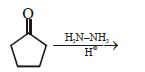
The reaction shown below proceeds via which mechanism?
A
Nucleophilic substitution-elimination mechanism
B
Electrophilic addition-elimination mechanism
C
Electrophilic substitution-elimination mechanism
D
Nucleophilic addition-elimination mechanism
Solution
(D) The reaction of a carbonyl compound (cyclopentanone) with hydrazine $(H_2N-NH_2)$ in the presence of an acid catalyst $(H^+)$ is a classic example of nucleophilic addition followed by elimination of water.
$1$. The nucleophilic nitrogen atom of hydrazine attacks the electrophilic carbonyl carbon of the ketone (Nucleophilic addition).
$2$. This is followed by the loss of a water molecule $(H_2O)$ to form a hydrazone (Elimination).
Therefore,the overall process is a nucleophilic addition-elimination mechanism.
$1$. The nucleophilic nitrogen atom of hydrazine attacks the electrophilic carbonyl carbon of the ketone (Nucleophilic addition).
$2$. This is followed by the loss of a water molecule $(H_2O)$ to form a hydrazone (Elimination).
Therefore,the overall process is a nucleophilic addition-elimination mechanism.
0 likes
View Solution627
MediumMCQ
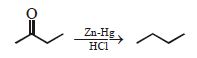
The reaction shown below is:
A
Finkelstein reaction
B
Williamson's synthesis
C
Clemmensen's reduction
D
Schotten Baumann reaction
Solution
(C) The reaction shown is the reduction of a ketone (butanone) to an alkane (butane) using zinc amalgam $(Zn-Hg)$ and concentrated hydrochloric acid $(HCl)$.
This specific chemical reaction is known as the Clemmensen reduction.
In this process,the carbonyl group $(>C=O)$ of aldehydes or ketones is reduced to a methylene group $(-CH_2-)$.
This specific chemical reaction is known as the Clemmensen reduction.
In this process,the carbonyl group $(>C=O)$ of aldehydes or ketones is reduced to a methylene group $(-CH_2-)$.
0 likes
View Solution628
DifficultMCQ
Which reaction is correctly matched with its name?
A
$C_6H_6 + CO + HCl \xrightarrow{Anhydrous AlCl_3/CuCl} C_6H_5CHO$ is the Gattermann-Koch reaction.
B
$C_6H_5CH_3 + CrO_2Cl_2 \xrightarrow{H_3O^+} C_6H_5CHO$ is the Etard reaction.
C
$C_6H_5CONH_2 \xrightarrow{Br_2 + KOH} C_6H_5NH_2$ is the Hoffmann Bromamide degradation reaction.
D
All of these
Solution
(C) Let us analyze each reaction:
$1$. The reaction of benzene with $CO$ and $HCl$ in the presence of anhydrous $AlCl_3$ and $CuCl$ to form benzaldehyde is known as the Gattermann-Koch reaction.
$2$. The oxidation of toluene to benzaldehyde using chromyl chloride $(CrO_2Cl_2)$ is known as the Etard reaction.
$3$. The reaction of an amide with bromine and a strong base $(KOH)$ to form a primary amine with one carbon atom less is known as the Hoffmann Bromamide degradation reaction.
Since the original options provided incorrect names for the first two reactions,the question as stated is technically flawed. However,assuming the intent was to identify the correctly named reaction among the choices,option $C$ is the only one correctly matched with its name.
$1$. The reaction of benzene with $CO$ and $HCl$ in the presence of anhydrous $AlCl_3$ and $CuCl$ to form benzaldehyde is known as the Gattermann-Koch reaction.
$2$. The oxidation of toluene to benzaldehyde using chromyl chloride $(CrO_2Cl_2)$ is known as the Etard reaction.
$3$. The reaction of an amide with bromine and a strong base $(KOH)$ to form a primary amine with one carbon atom less is known as the Hoffmann Bromamide degradation reaction.
Since the original options provided incorrect names for the first two reactions,the question as stated is technically flawed. However,assuming the intent was to identify the correctly named reaction among the choices,option $C$ is the only one correctly matched with its name.
0 likes
View Solution629
DifficultMCQ
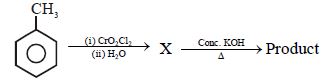
The product formed in the given reaction sequence is:
A
Benzyl alcohol
B
Phenol
C
Potassium benzoate
D
Both $A$ and $C$
Solution
(D) The reaction sequence is as follows:
$1$. The first step is the Etard reaction,where toluene is oxidized using chromyl chloride $(CrO_2Cl_2)$ followed by hydrolysis to form benzaldehyde $(X = C_6H_5CHO)$.
$2$. The second step involves the reaction of benzaldehyde with concentrated $KOH$ (Cannizzaro reaction). Since benzaldehyde lacks $\alpha$-hydrogen atoms,it undergoes disproportionation in the presence of a strong base to form benzyl alcohol $(C_6H_5CH_2OH)$ and potassium benzoate $(C_6H_5COOK)$.
$3$. Therefore,the final product is a mixture of both benzyl alcohol and potassium benzoate.
$1$. The first step is the Etard reaction,where toluene is oxidized using chromyl chloride $(CrO_2Cl_2)$ followed by hydrolysis to form benzaldehyde $(X = C_6H_5CHO)$.
$2$. The second step involves the reaction of benzaldehyde with concentrated $KOH$ (Cannizzaro reaction). Since benzaldehyde lacks $\alpha$-hydrogen atoms,it undergoes disproportionation in the presence of a strong base to form benzyl alcohol $(C_6H_5CH_2OH)$ and potassium benzoate $(C_6H_5COOK)$.
$3$. Therefore,the final product is a mixture of both benzyl alcohol and potassium benzoate.
0 likes
View Solution630
MediumMCQ
Which of the following does not give iodoform reaction?
A
$CH_3CH_2OH$
B
$CH_3OH$
C
$CH_3CHO$
D
$PhCOCH_3$
Solution
(B) The iodoform test is given by compounds containing the $CH_3CO-$ group or the $CH_3CH(OH)-$ group.
$CH_3CH_2OH$ contains the $CH_3CH(OH)-$ group,so it gives a positive iodoform test.
$CH_3OH$ (methanol) does not contain the $CH_3CO-$ or $CH_3CH(OH)-$ group,so it does not give the iodoform reaction.
$CH_3CHO$ (acetaldehyde) contains the $CH_3CO-$ group,so it gives a positive iodoform test.
$PhCOCH_3$ (acetophenone) contains the $CH_3CO-$ group attached to a phenyl ring,so it gives a positive iodoform test.
Therefore,$CH_3OH$ is the correct answer.
$CH_3CH_2OH$ contains the $CH_3CH(OH)-$ group,so it gives a positive iodoform test.
$CH_3OH$ (methanol) does not contain the $CH_3CO-$ or $CH_3CH(OH)-$ group,so it does not give the iodoform reaction.
$CH_3CHO$ (acetaldehyde) contains the $CH_3CO-$ group,so it gives a positive iodoform test.
$PhCOCH_3$ (acetophenone) contains the $CH_3CO-$ group attached to a phenyl ring,so it gives a positive iodoform test.
Therefore,$CH_3OH$ is the correct answer.
0 likes
View Solution631
MediumMCQ
Least reactive towards nucleophilic addition is
A
$HCHO$
B
$CCl_3CHO$
C
$CH_3CHO$
D
$CH_3COC_2H_5$
Solution
(D) The reactivity of carbonyl compounds towards nucleophilic addition depends on steric and electronic factors. Ketones are generally less reactive than aldehydes because:
$1.$ The $+I$ effect of two alkyl groups in ketones reduces the positive charge (electrophilicity) on the carbonyl carbon more than the single alkyl group in aldehydes.
$2.$ The presence of two bulky alkyl groups in ketones creates more steric hindrance for the attacking nucleophile.
Among the given options,$CH_3COC_2H_5$ (butanone) is a ketone with the largest alkyl groups,making it the least reactive.
$1.$ The $+I$ effect of two alkyl groups in ketones reduces the positive charge (electrophilicity) on the carbonyl carbon more than the single alkyl group in aldehydes.
$2.$ The presence of two bulky alkyl groups in ketones creates more steric hindrance for the attacking nucleophile.
Among the given options,$CH_3COC_2H_5$ (butanone) is a ketone with the largest alkyl groups,making it the least reactive.
0 likes
View Solution632
DifficultMCQ
Two molecules of acetone in the presence of dilute $NaOH$ give the product:
A
$4-$Methyl$-2-$pentanone
B
$4-$Hydroxy$-2-$pentanone
C
$3-$Hydroxy isopropyl propanone
D
$4-$Hydroxy$-4-$methyl$-2-$pentanone
Solution
(D) The reaction between two molecules of acetone $(CH_3COCH_3)$ in the presence of dilute $NaOH$ is an Aldol condensation reaction.
In this reaction,one molecule of acetone acts as a nucleophile (enolate ion) and attacks the carbonyl carbon of another acetone molecule.
The reaction proceeds as follows:
$2 CH_3COCH_3 \xrightarrow{dil. NaOH} (CH_3)_2C(OH)CH_2COCH_3$
The product formed is $4-$hydroxy$-4-$methylpentan$-2-$one,which is also known as diacetone alcohol.
In this reaction,one molecule of acetone acts as a nucleophile (enolate ion) and attacks the carbonyl carbon of another acetone molecule.
The reaction proceeds as follows:
$2 CH_3COCH_3 \xrightarrow{dil. NaOH} (CH_3)_2C(OH)CH_2COCH_3$
The product formed is $4-$hydroxy$-4-$methylpentan$-2-$one,which is also known as diacetone alcohol.
0 likes
View Solution633
MediumMCQ
Which of the following ketones has the maximum dipole moment?
A
$3-$methylcyclobut$-2-$en$-1-$one
B
cyclopent$-2-$en$-1-$one
C
cycloprop$-2-$en$-1-$one
D
cyclohex$-2-$en$-1-$one
Solution
(C) The dipole moment of a molecule is related to the polarity of its bonds and the presence of resonance structures that contribute to charge separation.
In cycloprop$-2-$en$-1-$one,the oxygen atom pulls electrons from the double bond,leading to a resonance structure where the ring becomes aromatic (cyclopropenyl cation,$2\pi$ electrons,$H$ückel's rule $4n+2$ with $n=0$).
This resonance structure is highly stable,resulting in significant charge separation $(C^{\delta+} = O^{\delta-})$,which gives the molecule a very high dipole moment compared to the other non-aromatic ketones listed.
In cycloprop$-2-$en$-1-$one,the oxygen atom pulls electrons from the double bond,leading to a resonance structure where the ring becomes aromatic (cyclopropenyl cation,$2\pi$ electrons,$H$ückel's rule $4n+2$ with $n=0$).
This resonance structure is highly stable,resulting in significant charge separation $(C^{\delta+} = O^{\delta-})$,which gives the molecule a very high dipole moment compared to the other non-aromatic ketones listed.
0 likes
View Solution634
MediumMCQ
Among the following compounds,which will give maximum enol content in solution?
A
$C_6H_5-CO-CH_2-CO-C_6H_5$
B
$CH_3-CO-CH_2-CO-CH_3$
C
$CH_3-CO-CH_2-CH_2-CH_3$
D
$CH_3-CO-CH_2-COOC_2H_5$
Solution
(A) The compound $C_6H_5-CO-CH_2-CO-C_6H_5$ (dibenzoylmethane) exhibits the highest enol content.
This is because its enol form is stabilized by both intramolecular hydrogen bonding and extensive conjugation with two phenyl rings.
The general order of enol content is:
$C_6H_5-CO-CH_2-CO-C_6H_5 > CH_3-CO-CH_2-CO-CH_3 > CH_3-CO-CH_2-COOC_2H_5 > CH_3-CO-CH_2-CH_2-CH_3$.
This is because its enol form is stabilized by both intramolecular hydrogen bonding and extensive conjugation with two phenyl rings.
The general order of enol content is:
$C_6H_5-CO-CH_2-CO-C_6H_5 > CH_3-CO-CH_2-CO-CH_3 > CH_3-CO-CH_2-COOC_2H_5 > CH_3-CO-CH_2-CH_2-CH_3$.
0 likes
View Solution635
DifficultMCQ
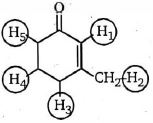
In $3-Methyl-2-cyclohexenone$,which hydrogen cannot undergo deuterium exchange when it reacts with $CH_3O^{-} / CH_3OD$?
A
$H_1, H_4$
B
$H_4$
C
$H_3, H_2$
D
$H_5, H_3$
Solution
(B) Deuterium exchange in ketones occurs via the formation of an enolate ion,which requires the presence of $\alpha$-hydrogens.
In $3-Methyl-2-cyclohexenone$,the hydrogens at positions $H_1, H_3, H_5$ are $\alpha$-hydrogens relative to the carbonyl group or the double bond,making them acidic enough to be removed by a base.
$H_2$ is part of the methyl group attached to the $sp^2$ hybridized carbon,and these hydrogens are also exchangeable due to the conjugation of the resulting enolate.
$H_4$ is a $\beta$-hydrogen relative to the carbonyl group and is attached to an $sp^3$ hybridized carbon that is not adjacent to the carbonyl group,making it non-acidic and unable to form a stable enolate.
Therefore,$H_4$ cannot undergo deuterium exchange.
In $3-Methyl-2-cyclohexenone$,the hydrogens at positions $H_1, H_3, H_5$ are $\alpha$-hydrogens relative to the carbonyl group or the double bond,making them acidic enough to be removed by a base.
$H_2$ is part of the methyl group attached to the $sp^2$ hybridized carbon,and these hydrogens are also exchangeable due to the conjugation of the resulting enolate.
$H_4$ is a $\beta$-hydrogen relative to the carbonyl group and is attached to an $sp^3$ hybridized carbon that is not adjacent to the carbonyl group,making it non-acidic and unable to form a stable enolate.
Therefore,$H_4$ cannot undergo deuterium exchange.
0 likes
View Solution636
DifficultMCQ
Among the given ketones,the one which does not enolize is:
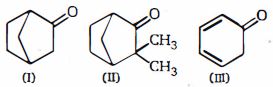
A
$(I)$
B
$(II)$
C
$(III)$
D
none of these
Solution
(B) For a ketone to enolize,it must have at least one $\alpha$-hydrogen atom.
$(I)$ Bicyclo[$2.2$.$1$]heptan$-2-$one has $\alpha$-hydrogens and can form an enol.
$(II)$ $3,3$-dimethylbicyclo[$2.2$.$1$]heptan$-2-$one has no $\alpha$-hydrogen at the $C-3$ position. However,it has an $\alpha$-hydrogen at the bridgehead position $(C-1)$. According to Bredt's rule,the formation of a double bond at the bridgehead of a small bicyclic system is highly unstable. Thus,it does not enolize.
$(III)$ Cyclohexa-$2,4$-dienone has $\alpha$-hydrogens and can enolize to form phenol.
Therefore,the correct answer is $(II)$.
$(I)$ Bicyclo[$2.2$.$1$]heptan$-2-$one has $\alpha$-hydrogens and can form an enol.
$(II)$ $3,3$-dimethylbicyclo[$2.2$.$1$]heptan$-2-$one has no $\alpha$-hydrogen at the $C-3$ position. However,it has an $\alpha$-hydrogen at the bridgehead position $(C-1)$. According to Bredt's rule,the formation of a double bond at the bridgehead of a small bicyclic system is highly unstable. Thus,it does not enolize.
$(III)$ Cyclohexa-$2,4$-dienone has $\alpha$-hydrogens and can enolize to form phenol.
Therefore,the correct answer is $(II)$.
0 likes
View Solution637
MediumMCQ
$(A) Ph-CH(OH)-CHO \xrightarrow[H_2O]{HO^-} (B)$; $(A)$ and $(B)$ are isomers and isomerization is effectively carried out by a trace of base. Identify $(B)$.
A
$Ph-CH_2-COOH$
B
$Ph-CO-OCH_3$
C
$Ph-CO-CH_2OH$
D
$H-CO-CH_2-O-Ph$
Solution
(C) The reaction is a base-catalyzed isomerization of an $\alpha$-hydroxy aldehyde to an $\alpha$-hydroxy ketone via an enediol intermediate.
This process is similar to the Lobry de Bruyn-van Ekenstein transformation.
$Ph-CH(OH)-CHO \rightleftharpoons Ph-C(OH)=CH-OH \rightleftharpoons Ph-CO-CH_2OH$.
This process is similar to the Lobry de Bruyn-van Ekenstein transformation.
$Ph-CH(OH)-CHO \rightleftharpoons Ph-C(OH)=CH-OH \rightleftharpoons Ph-CO-CH_2OH$.
0 likes
View Solution638
AdvancedMCQ
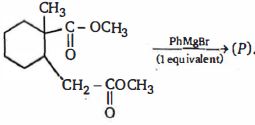
The product $P$ is:
A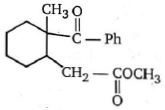
B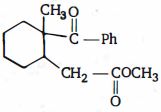
C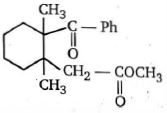
D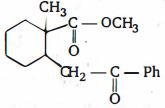
Solution
(D) The given compound contains two ester groups. One is attached directly to the cyclohexane ring (sterically hindered),and the other is attached via a $-CH_2-$ group (less sterically hindered).
When $1 \ equivalent$ of $PhMgBr$ is added,it acts as a nucleophile.
Due to steric hindrance,the nucleophilic attack by $Ph^-$ occurs at the less sterically hindered carbonyl carbon of the $-CH_2COOCH_3$ group.
This results in the formation of a ketone,where the $-OCH_3$ group is replaced by the $-Ph$ group.
The final product $P$ is the one where the phenyl group is attached to the carbonyl carbon of the side chain ester.
When $1 \ equivalent$ of $PhMgBr$ is added,it acts as a nucleophile.
Due to steric hindrance,the nucleophilic attack by $Ph^-$ occurs at the less sterically hindered carbonyl carbon of the $-CH_2COOCH_3$ group.
This results in the formation of a ketone,where the $-OCH_3$ group is replaced by the $-Ph$ group.
The final product $P$ is the one where the phenyl group is attached to the carbonyl carbon of the side chain ester.
0 likes
View Solution639
AdvancedMCQ
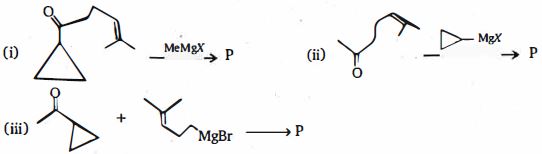
In which of the following reactions is the product formed the same?
A
$(i)$ and $(ii)$
B
$(ii)$ and $(iii)$
C
$(i)$ and $(iii)$
D
$(i)$,$(ii)$ and $(iii)$
Solution
(D) In all three reactions,a Grignard reagent acts as a nucleophile and attacks the carbonyl carbon of a ketone to form the same tertiary alcohol product after acidic workup.
$(i)$ Cyclopropyl ketone reacts with $MeMgX$ to form the product.
$(ii)$ $A$ ketone reacts with a cyclopropyl Grignard reagent to form the same product.
$(iii)$ $A$ cyclopropyl ketone reacts with a long-chain Grignard reagent to form the same product.
Thus,all three reactions yield the same product $P$.
$(i)$ Cyclopropyl ketone reacts with $MeMgX$ to form the product.
$(ii)$ $A$ ketone reacts with a cyclopropyl Grignard reagent to form the same product.
$(iii)$ $A$ cyclopropyl ketone reacts with a long-chain Grignard reagent to form the same product.
Thus,all three reactions yield the same product $P$.
0 likes
View Solution640
DifficultMCQ
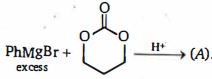
The product $(A)$ in the following reaction is:
A
$Ph-CH(OH)-CH_2-CH_2-CH_2-OH$
B
$Ph-C(OH)(Ph)_2$
C
$Ph-CO-Ph$
D
$Ph-CH_2-Ph$
Solution
(B) The reaction involves the ring-opening of trimethylene carbonate by excess phenylmagnesium bromide $(PhMgBr)$.
$1$. The first equivalent of $PhMgBr$ attacks the carbonyl carbon of the cyclic carbonate,leading to ring opening and the formation of a benzoate ester intermediate: $Ph-CO-O-CH_2-CH_2-CH_2-OMgBr$.
$2$. Subsequent reaction with excess $PhMgBr$ leads to the formation of triphenylmethanol $(Ph_3C-OH)$ after acid hydrolysis.
$3$. The final product is triphenylmethanol,which is represented as $Ph-C(OH)(Ph)_2$.
$1$. The first equivalent of $PhMgBr$ attacks the carbonyl carbon of the cyclic carbonate,leading to ring opening and the formation of a benzoate ester intermediate: $Ph-CO-O-CH_2-CH_2-CH_2-OMgBr$.
$2$. Subsequent reaction with excess $PhMgBr$ leads to the formation of triphenylmethanol $(Ph_3C-OH)$ after acid hydrolysis.
$3$. The final product is triphenylmethanol,which is represented as $Ph-C(OH)(Ph)_2$.
0 likes
View Solution641
DifficultMCQ
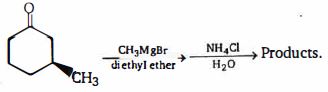
Comment on the optical activity of the products. They are:
A
racemic mixture
B
diastereomers
C
meso forms
D
optically inactive due to absence of chiral centre
Solution
(B) The reaction involves the nucleophilic addition of the Grignard reagent $(CH_3MgBr)$ to the carbonyl group of $3$-methylcyclohexanone.
Since the starting material,$3$-methylcyclohexanone,is chiral,the attack of the $CH_3^-$ nucleophile can occur from either the top or the bottom face of the planar carbonyl group.
This leads to the formation of two new stereoisomers at the newly formed chiral center.
Because the molecule already contains a fixed chiral center at the $C-3$ position,the two resulting products have different configurations at the new chiral center while sharing the same configuration at the $C-3$ position.
Such stereoisomers that are not mirror images of each other are known as diastereomers.
Since the starting material,$3$-methylcyclohexanone,is chiral,the attack of the $CH_3^-$ nucleophile can occur from either the top or the bottom face of the planar carbonyl group.
This leads to the formation of two new stereoisomers at the newly formed chiral center.
Because the molecule already contains a fixed chiral center at the $C-3$ position,the two resulting products have different configurations at the new chiral center while sharing the same configuration at the $C-3$ position.
Such stereoisomers that are not mirror images of each other are known as diastereomers.
0 likes
View Solution642
AdvancedMCQ
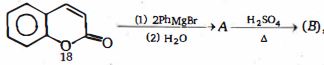
Product $(B)$ in this reaction is
A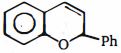
B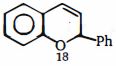
C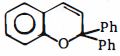
D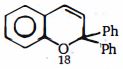
Solution
(D) The reaction involves the nucleophilic attack of $PhMgBr$ on the lactone (coumarin derivative).
$1$. The first equivalent of $PhMgBr$ attacks the carbonyl carbon,leading to the ring opening of the lactone to form a phenoxide intermediate.
$2$. The second equivalent of $PhMgBr$ attacks the newly formed ketone group to form a tertiary alcohol after aqueous workup.
$3$. Upon treatment with $H_2SO_4$ and heating,the tertiary alcohol undergoes acid-catalyzed cyclization. The phenolic oxygen attacks the carbocation formed at the tertiary carbon,resulting in the formation of the cyclic product $(B)$.
The oxygen atom labeled as $18$ remains in the ring throughout the process as shown in the mechanism.
$1$. The first equivalent of $PhMgBr$ attacks the carbonyl carbon,leading to the ring opening of the lactone to form a phenoxide intermediate.
$2$. The second equivalent of $PhMgBr$ attacks the newly formed ketone group to form a tertiary alcohol after aqueous workup.
$3$. Upon treatment with $H_2SO_4$ and heating,the tertiary alcohol undergoes acid-catalyzed cyclization. The phenolic oxygen attacks the carbocation formed at the tertiary carbon,resulting in the formation of the cyclic product $(B)$.
The oxygen atom labeled as $18$ remains in the ring throughout the process as shown in the mechanism.
0 likes
View Solution643
MediumMCQ
Which of the following gives two isomers of $3^o$ alcohol,when treated with phenyl magnesium bromide?
A
$4,4-$dimethylcyclohexanone
B
$4-$methylcyclohexanone
C
cyclohexanone
D
$4,4-$dideuteriocyclohexanone
Solution
(B) When $4$-methylcyclohexanone is treated with phenyl magnesium bromide $(PhMgBr)$,the nucleophilic $Ph^-$ attacks the carbonyl carbon.
Since the molecule has a chiral center at the $C-4$ position (due to the methyl group),the attack of $PhMgBr$ on the planar carbonyl group creates a new stereocenter at the $C-1$ position.
This results in the formation of two diastereomers (geometrical isomers) because the $Ph$ group can approach from either the same side or the opposite side of the methyl group at $C-4$.
Thus,$4$-methylcyclohexanone gives two isomers of $3^o$ alcohol.
Since the molecule has a chiral center at the $C-4$ position (due to the methyl group),the attack of $PhMgBr$ on the planar carbonyl group creates a new stereocenter at the $C-1$ position.
This results in the formation of two diastereomers (geometrical isomers) because the $Ph$ group can approach from either the same side or the opposite side of the methyl group at $C-4$.
Thus,$4$-methylcyclohexanone gives two isomers of $3^o$ alcohol.
0 likes
View Solution644
MediumMCQ
The product obtained in this reaction is:
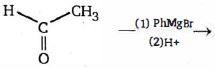
A
diastereomers
B
racemic
C
pure enantiomer
D
meso
Solution
(B) The reaction of acetaldehyde $(CH_3CHO)$ with phenylmagnesium bromide $(PhMgBr)$ followed by acidic workup $(H^+)$ is a nucleophilic addition reaction to a carbonyl group.
$1$. The nucleophilic phenyl group $(Ph^-)$ attacks the electrophilic carbonyl carbon of acetaldehyde from either side of the planar carbonyl group with equal probability.
$2$. This results in the formation of a chiral center at the carbon atom bearing the hydroxyl group.
$3$. Since the attack is equally likely from both sides,an equal mixture of both enantiomers ($R$ and $S$ configurations) is formed.
$4$. An equimolar mixture of two enantiomers is known as a racemic mixture.
$1$. The nucleophilic phenyl group $(Ph^-)$ attacks the electrophilic carbonyl carbon of acetaldehyde from either side of the planar carbonyl group with equal probability.
$2$. This results in the formation of a chiral center at the carbon atom bearing the hydroxyl group.
$3$. Since the attack is equally likely from both sides,an equal mixture of both enantiomers ($R$ and $S$ configurations) is formed.
$4$. An equimolar mixture of two enantiomers is known as a racemic mixture.
0 likes
View Solution645
DifficultMCQ
$CH_3CO_2Et + (CH_2)_5(MgBr)_2 \xrightarrow[(2) H^{+}]{(1)} \mathop {C_7H_{14}O}\limits_{(A)}$ ; compound $(A)$ will be
A
$1-$methylcyclohexanol
B
$2-$methylcyclohexanol
C
$CH_3-C(=O)-(CH_2)_4-CH_3$
D
cyclohexylmethanol
Solution
(A) The reaction involves the reaction of an ester with a Grignard reagent.
$CH_3CO_2Et$ reacts with the bifunctional Grignard reagent $(CH_2)_5(MgBr)_2$.
First,one end of the Grignard reagent attacks the carbonyl carbon of the ester,displacing the ethoxide group to form a ketone intermediate: $CH_3-C(=O)-(CH_2)_5-MgBr$.
Next,the second Grignard end (intramolecularly) attacks the newly formed ketone carbonyl group.
This forms a cyclic alkoxide intermediate,which upon acidic workup $(H^+)$ yields the cyclic tertiary alcohol,$1-methylcyclohexanol$.
$CH_3CO_2Et$ reacts with the bifunctional Grignard reagent $(CH_2)_5(MgBr)_2$.
First,one end of the Grignard reagent attacks the carbonyl carbon of the ester,displacing the ethoxide group to form a ketone intermediate: $CH_3-C(=O)-(CH_2)_5-MgBr$.
Next,the second Grignard end (intramolecularly) attacks the newly formed ketone carbonyl group.
This forms a cyclic alkoxide intermediate,which upon acidic workup $(H^+)$ yields the cyclic tertiary alcohol,$1-methylcyclohexanol$.
0 likes
View Solution646
DifficultMCQ
Identify the product $A$ in the following reaction:
$1$-phenylcyclohex-$1$-en-$1$-one $\xrightarrow[(2) H^+]{(1) PhMgBr/CuCl} (A) (C_{19}H_{20}O)$
$1$-phenylcyclohex-$1$-en-$1$-one $\xrightarrow[(2) H^+]{(1) PhMgBr/CuCl} (A) (C_{19}H_{20}O)$
A
$2-$phenylcyclohexanone
B
$1-$phenyl$-1-$hydroxycyclohexene
C
$2-$phenylcyclohexanone (with specific stereochemistry)
D
$1-$phenylcyclohexanone
Solution
(A) The reaction involves the conjugate addition (also known as $1,4$-addition) of an organometallic reagent to an $\alpha,\beta$-unsaturated carbonyl compound.
In the presence of copper salts (like $CuCl$),the Grignard reagent $(PhMgBr)$ forms an organocopper species $(PhCu)$,which acts as a 'soft' nucleophile.
Soft nucleophiles prefer to attack the $\beta$-carbon of the $\alpha,\beta$-unsaturated system rather than the carbonyl carbon (which is a 'hard' electrophilic site).
Therefore,the phenyl group $(Ph)$ adds to the $\beta$-position of the cyclohexenone ring,followed by protonation $(H^+)$ of the resulting enolate to yield $2$-phenylcyclohexanone.
In the presence of copper salts (like $CuCl$),the Grignard reagent $(PhMgBr)$ forms an organocopper species $(PhCu)$,which acts as a 'soft' nucleophile.
Soft nucleophiles prefer to attack the $\beta$-carbon of the $\alpha,\beta$-unsaturated system rather than the carbonyl carbon (which is a 'hard' electrophilic site).
Therefore,the phenyl group $(Ph)$ adds to the $\beta$-position of the cyclohexenone ring,followed by protonation $(H^+)$ of the resulting enolate to yield $2$-phenylcyclohexanone.
0 likes
View Solution647
MediumMCQ
For the sequence of reactions,$A$ $\xrightarrow[{ether}]{{C_2H_5MgI}} B$ $\xrightarrow{{H_2O/H^{+}}}$ tert-Pentyl alcohol. The compound $A$ in the sequence is
A
$2-$Butanone
B
Acetaldehyde
C
Acetone
D
Propanal
Solution
(C) The reaction of a Grignard reagent $(C_2H_5MgI)$ with a ketone $(A)$ followed by acid hydrolysis yields a tertiary alcohol.
tert-Pentyl alcohol is $CH_3-C(OH)(CH_3)(C_2H_5)$.
To obtain this structure,the starting ketone $A$ must be $CH_3-CO-CH_3$ (Acetone).
The reaction is: $CH_3-CO-CH_3 + C_2H_5MgI$ $\rightarrow CH_3-C(OMgI)(CH_3)(C_2H_5)$ $\xrightarrow{H_3O^{+}} CH_3-C(OH)(CH_3)(C_2H_5)$.
tert-Pentyl alcohol is $CH_3-C(OH)(CH_3)(C_2H_5)$.
To obtain this structure,the starting ketone $A$ must be $CH_3-CO-CH_3$ (Acetone).
The reaction is: $CH_3-CO-CH_3 + C_2H_5MgI$ $\rightarrow CH_3-C(OMgI)(CH_3)(C_2H_5)$ $\xrightarrow{H_3O^{+}} CH_3-C(OH)(CH_3)(C_2H_5)$.
0 likes
View Solution648
MediumMCQ
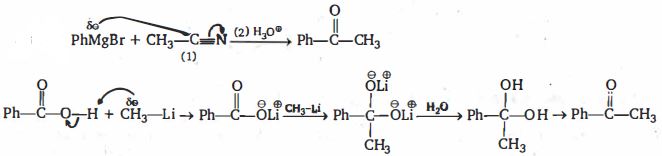
The same product $(A)$ is formed in both of the following reactions:
$1. PhMgBr + CH_3-CN \xrightarrow{H_3O^{+}} (A)$
$2. Ph-COOH \xrightarrow{(1) \text{ excess } CH_3Li, (2) H_3O^{+}} (A)$
Identify product $(A)$.
$1. PhMgBr + CH_3-CN \xrightarrow{H_3O^{+}} (A)$
$2. Ph-COOH \xrightarrow{(1) \text{ excess } CH_3Li, (2) H_3O^{+}} (A)$
Identify product $(A)$.
A
$Ph-C(OH)(CH_3)_2$
B
$Ph-CHO$
C
$Ph-C(=O)-CH_3$
D
$Ph-CH_2-COOH$
Solution
(C) In reaction $1.$,the Grignard reagent $(PhMgBr)$ adds to the nitrile $(CH_3-CN)$ to form an imine salt,which upon acidic hydrolysis $(H_3O^{+})$ yields acetophenone $(Ph-C(=O)-CH_3)$.
In reaction $2.$,the carboxylic acid $(Ph-COOH)$ reacts with two equivalents of organolithium $(CH_3Li)$ to form a gem-dialkoxide intermediate,which upon acidic hydrolysis yields acetophenone $(Ph-C(=O)-CH_3)$.
Therefore,$(A)$ is acetophenone,which corresponds to option $(C)$.
In reaction $2.$,the carboxylic acid $(Ph-COOH)$ reacts with two equivalents of organolithium $(CH_3Li)$ to form a gem-dialkoxide intermediate,which upon acidic hydrolysis yields acetophenone $(Ph-C(=O)-CH_3)$.
Therefore,$(A)$ is acetophenone,which corresponds to option $(C)$.
0 likes
View Solution649
MediumMCQ
In the reaction sequence,
$Cyclohex-2-en-1-one \xrightarrow[(ii) H_2O/H^+]{(i) CH_3MgBr/CuCl} (X)$
Product $(X)$ will be:
$Cyclohex-2-en-1-one \xrightarrow[(ii) H_2O/H^+]{(i) CH_3MgBr/CuCl} (X)$
Product $(X)$ will be:
A
$3-$methylcyclohexanone
B
$1-$methylcyclohex$-2-$en$-1-$ol
C
$2-$hydroxy$-2-$methylcyclohexanone
D
$1-$hydroxy$-1,3-$dimethylcyclohexane
Solution
(A) The reaction of $\alpha, \beta$-unsaturated ketones with Grignard reagents $(RMgX)$ in the presence of a catalytic amount of copper $(I)$ salts (like $CuCl$) leads to conjugate addition ($1$,$4$-addition) rather than direct addition ($1$,$2$-addition) to the carbonyl group.
$1$. The $CuCl$ reacts with $CH_3MgBr$ to form an organocopper reagent $(CH_3Cu)$,which is a 'softer' nucleophile than the Grignard reagent.
$2$. This softer nucleophile selectively attacks the softer electrophilic center,which is the $\beta$-carbon of the $\alpha, \beta$-unsaturated system.
$3$. The initial product is an enolate,which upon aqueous workup $(H_2O/H^+)$ yields the saturated ketone,$3$-methylcyclohexanone.
Therefore,the correct product $(X)$ is $3$-methylcyclohexanone.
$1$. The $CuCl$ reacts with $CH_3MgBr$ to form an organocopper reagent $(CH_3Cu)$,which is a 'softer' nucleophile than the Grignard reagent.
$2$. This softer nucleophile selectively attacks the softer electrophilic center,which is the $\beta$-carbon of the $\alpha, \beta$-unsaturated system.
$3$. The initial product is an enolate,which upon aqueous workup $(H_2O/H^+)$ yields the saturated ketone,$3$-methylcyclohexanone.
Therefore,the correct product $(X)$ is $3$-methylcyclohexanone.
0 likes
View Solution650
MediumMCQ
$(C_2H_5O)_2CO \xrightarrow[H_3O^{+}]{CH_3MgBr(\text{excess})} A$. $A$ (alcohol) can also be obtained by:
A
$CH_3-CH_2-CHO \xrightarrow[H_3O^{+}]{CH_3MgBr(2 \, mol)}$
B
$CH_3-COOC_2H_5 \xrightarrow[H_3O^{+}]{CH_3MgBr(2 \, mol)}$
C
$CH_3-CO-CH_3 \xrightarrow[H_3O^{+}]{CH_3MgBr(1 \, mol)}$
D
as in $(b)$ and $(c)$
Solution
(D) The reaction of diethyl carbonate with excess Grignard reagent proceeds as follows:
$(C_2H_5O)_2CO + 3CH_3MgBr \xrightarrow{H_3O^{+}} (CH_3)_3COH + 2C_2H_5OH$.
Product $A$ is $tert$-butyl alcohol $((CH_3)_3COH)$.
In option $(b)$: $CH_3-COOC_2H_5 + 2CH_3MgBr \xrightarrow{H_3O^{+}} (CH_3)_3COH + C_2H_5OH$.
In option $(c)$: $CH_3-CO-CH_3 + CH_3MgBr \xrightarrow{H_3O^{+}} (CH_3)_3COH$.
Therefore,both $(b)$ and $(c)$ yield the same product $A$.
$(C_2H_5O)_2CO + 3CH_3MgBr \xrightarrow{H_3O^{+}} (CH_3)_3COH + 2C_2H_5OH$.
Product $A$ is $tert$-butyl alcohol $((CH_3)_3COH)$.
In option $(b)$: $CH_3-COOC_2H_5 + 2CH_3MgBr \xrightarrow{H_3O^{+}} (CH_3)_3COH + C_2H_5OH$.
In option $(c)$: $CH_3-CO-CH_3 + CH_3MgBr \xrightarrow{H_3O^{+}} (CH_3)_3COH$.
Therefore,both $(b)$ and $(c)$ yield the same product $A$.
0 likes
View Solution8-1.Aldehydes and Ketones — Properties · Frequently Asked Questions
1Are these 8-1.Aldehydes and Ketones questions useful for JEE and NEET?
Yes. All questions in this section are mapped to JEE Main and NEET exam patterns. Previous year questions from JEE Main, NEET, GUJCET and state-level exams are included with full solutions.
2Can I switch to Hindi or Gujarati for these questions?
Yes. Use the language tabs in the hero section or the sidebar to view the same questions and solutions in English, Hindi or Gujarati.
3How do I generate a question paper from this subtopic?
Use the Vedclass Exam Paper Generator — select the chapter and subtopic, set difficulty, and generate Sets A, B, C, D automatically. First 3 chapters of every subject are free.
Vedclass Products
For Students
Vedclass Test Series
Mock tests in real JEE/NEET style with performance analysis. 5-day free trial.
Start Free TrialFor Teachers
Exam Paper Generator
Generate Set A/B/C/D papers from this chapter in 2 minutes. 3 chapters free.
Try FreeFor Institutes
Online Exam Module
Live online exams with unlimited students, 360° analytics & white-label branding.
See DemoFor Teachers & Institutes
Generate a 8-1.Aldehydes and Ketones Exam Paper in 2 Minutes
Select subtopic & difficulty — Sets A, B, C, D auto-generated with No Repeat logic.
First 3 chapters of every subject are free — no payment required.