
A English
Properties Questions in English
Class 12 Chemistry · 8-1.Aldehydes and Ketones · Properties
1739+
Questions
English
Language
100%
With Solutions
Showing 50 of 1739 questions in English
551
AdvancedMCQ
You have two $C_6H_{10}O$ ketones,$I$ and $II$. Both are optically active,but $I$ is racemized by treatment with acid and $II$ is not. Wolff-Kishner reduction of both ketones gives the same achiral hydrocarbon,formula $C_6H_{12}$. What reasonable structures may be assigned to $I$ and $II$ respectively?
A
$I$ is $3-$Methylcyclopentanone,$II$ is $2-$Methylcyclopentanone
B
$I$ is $2-$Methylcyclopentanone,$II$ is $3-$Methylcyclopentanone
C
$I$ is $3-$Methyl$-4-$penten$-2-$one,$II$ is $4-$Methyl$-1-$penten$-3-$one
D
$I$ is $2-$Ethylcyclobutanone,$II$ is $3-$Ethylcyclobutanone
Solution
(B) $2-$Methylcyclopentanone $(I)$ has an $\alpha-$hydrogen atom at the chiral center. In the presence of acid,it undergoes keto-enol tautomerization,which leads to the loss of chirality at the $\alpha-$carbon,resulting in racemization.
$3-$Methylcyclopentanone $(II)$ also has a chiral center,but it is not at the $\alpha-$position relative to the carbonyl group. Therefore,it cannot form an enol that would lead to racemization at the chiral center under acidic conditions.
Both $2-$methylcyclopentanone and $3-$methylcyclopentanone,upon Wolff-Kishner reduction $(N_2H_4, OH^-, \Delta)$,yield the same achiral hydrocarbon,methylcyclopentane $(C_6H_{12})$.
Thus,$I$ is $2-$methylcyclopentanone and $II$ is $3-$methylcyclopentanone.
$3-$Methylcyclopentanone $(II)$ also has a chiral center,but it is not at the $\alpha-$position relative to the carbonyl group. Therefore,it cannot form an enol that would lead to racemization at the chiral center under acidic conditions.
Both $2-$methylcyclopentanone and $3-$methylcyclopentanone,upon Wolff-Kishner reduction $(N_2H_4, OH^-, \Delta)$,yield the same achiral hydrocarbon,methylcyclopentane $(C_6H_{12})$.
Thus,$I$ is $2-$methylcyclopentanone and $II$ is $3-$methylcyclopentanone.
0 likes
View Solution552
AdvancedMCQ
Predict the product of the following reaction:
$2,2',6,6'$-tetraformylbiphenyl $\xrightarrow[(ii)\,H^{+}/H_2O, 0^{\circ}C]{(i)\,NaOH (excess)}$ ?
$2,2',6,6'$-tetraformylbiphenyl $\xrightarrow[(ii)\,H^{+}/H_2O, 0^{\circ}C]{(i)\,NaOH (excess)}$ ?
A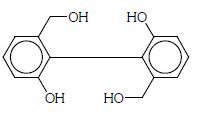
B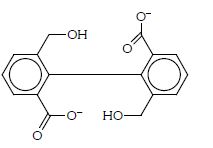
C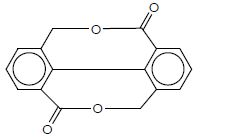
D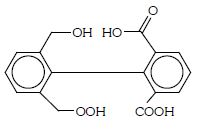
Solution
(C) The given reaction is an intramolecular Cannizzaro reaction.
Aldehydes that do not have $\alpha$-hydrogen atoms undergo self-oxidation and reduction (disproportionation) in the presence of concentrated alkali.
In the given molecule,$2,2',6,6'$-tetraformylbiphenyl,the aldehyde groups are present on the benzene rings.
Upon treatment with excess $NaOH$,two of the $-CHO$ groups are reduced to $-CH_2OH$ (alcohol) groups,and the other two $-CHO$ groups are oxidized to $-COO^-$ (carboxylate) groups.
Subsequent acidification with $H^+/H_2O$ converts the carboxylate groups into $-COOH$ (carboxylic acid) groups.
Thus,the final product contains two $-CH_2OH$ groups and two $-COOH$ groups.
Aldehydes that do not have $\alpha$-hydrogen atoms undergo self-oxidation and reduction (disproportionation) in the presence of concentrated alkali.
In the given molecule,$2,2',6,6'$-tetraformylbiphenyl,the aldehyde groups are present on the benzene rings.
Upon treatment with excess $NaOH$,two of the $-CHO$ groups are reduced to $-CH_2OH$ (alcohol) groups,and the other two $-CHO$ groups are oxidized to $-COO^-$ (carboxylate) groups.
Subsequent acidification with $H^+/H_2O$ converts the carboxylate groups into $-COOH$ (carboxylic acid) groups.
Thus,the final product contains two $-CH_2OH$ groups and two $-COOH$ groups.
0 likes
View Solution553
DifficultMCQ
For the given compound,determine the number of hydrogen atoms that are replaced by $D$ upon keeping it for a long time with $\mathop O\limits^\ominus D / D_2O$.
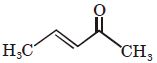
A
$5$
B
$2$
C
$3$
D
$7$
Solution
(A) The given compound is pent$-3-$en$-2-$one,which contains an $\alpha,\beta$-unsaturated carbonyl system.
In the presence of a base like $\mathop O\limits^\ominus D$ in $D_2O$,the $\alpha$-hydrogens are acidic and undergo keto-enol tautomerism.
The compound is $CH_3-CH=CH-CO-CH_3$.
The $\alpha$-hydrogens are those attached to the carbon adjacent to the carbonyl group $(C=O)$.
There are $3$ $\alpha$-hydrogens on the methyl group attached to the carbonyl carbon.
Additionally,the $\gamma$-hydrogens (on the $CH_3$ group at the other end of the double bond) are also acidic due to conjugation with the carbonyl group through the double bond.
Thus,the $3$ hydrogens of the terminal $CH_3$ group and the $2$ hydrogens on the $\alpha$-carbon (if present,but here it is $CH_3-CH=CH-CO-CH_3$,so the $\alpha$-carbon is the carbonyl carbon,and the adjacent $CH_3$ has $3$ hydrogens) are exchangeable.
Specifically,the $3$ hydrogens of the $CH_3$ group adjacent to the carbonyl and the $2$ hydrogens on the $CH$ groups of the alkene part in conjugation with the carbonyl are susceptible to exchange.
However,in $CH_3-CH=CH-CO-CH_3$,the $3$ hydrogens of the acetyl group $(CH_3-CO-)$ are exchangeable.
Also,the $2$ vinylic hydrogens at the $\gamma$ and $\delta$ positions are not acidic,but the $3$ hydrogens of the terminal $CH_3$ group are acidic due to vinylogous enolization.
Total exchangeable hydrogens = $3$ (from $CH_3-CO$) + $2$ (from the $CH_3$ group at the other end via vinylogous enolization) = $5$.
In the presence of a base like $\mathop O\limits^\ominus D$ in $D_2O$,the $\alpha$-hydrogens are acidic and undergo keto-enol tautomerism.
The compound is $CH_3-CH=CH-CO-CH_3$.
The $\alpha$-hydrogens are those attached to the carbon adjacent to the carbonyl group $(C=O)$.
There are $3$ $\alpha$-hydrogens on the methyl group attached to the carbonyl carbon.
Additionally,the $\gamma$-hydrogens (on the $CH_3$ group at the other end of the double bond) are also acidic due to conjugation with the carbonyl group through the double bond.
Thus,the $3$ hydrogens of the terminal $CH_3$ group and the $2$ hydrogens on the $\alpha$-carbon (if present,but here it is $CH_3-CH=CH-CO-CH_3$,so the $\alpha$-carbon is the carbonyl carbon,and the adjacent $CH_3$ has $3$ hydrogens) are exchangeable.
Specifically,the $3$ hydrogens of the $CH_3$ group adjacent to the carbonyl and the $2$ hydrogens on the $CH$ groups of the alkene part in conjugation with the carbonyl are susceptible to exchange.
However,in $CH_3-CH=CH-CO-CH_3$,the $3$ hydrogens of the acetyl group $(CH_3-CO-)$ are exchangeable.
Also,the $2$ vinylic hydrogens at the $\gamma$ and $\delta$ positions are not acidic,but the $3$ hydrogens of the terminal $CH_3$ group are acidic due to vinylogous enolization.
Total exchangeable hydrogens = $3$ (from $CH_3-CO$) + $2$ (from the $CH_3$ group at the other end via vinylogous enolization) = $5$.
0 likes
View Solution554
DifficultMCQ
Ketone reacts with $NH_2OH$ to give oxime. The reaction is as follows:
$R_2C=O + H_2N-OH \rightarrow R_2C=N-OH + H_2O$
The total number of organic products (ketoxime) formed when the simplest ketone and its next higher homologue react with $NH_2OH$,is:
$R_2C=O + H_2N-OH \rightarrow R_2C=N-OH + H_2O$
The total number of organic products (ketoxime) formed when the simplest ketone and its next higher homologue react with $NH_2OH$,is:
A
$1$
B
$2$
C
$3$
D
$4$
Solution
(C) The simplest ketone is acetone $(CH_3COCH_3)$.
When acetone reacts with $NH_2OH$,it forms acetone oxime: $(CH_3)_2C=N-OH$.
This product does not exhibit geometrical isomerism because the two groups attached to the carbon atom are identical ($CH_3$ groups).
The next higher homologue of acetone is butan$-2-$one $(CH_3COCH_2CH_3)$.
When butan$-2-$one reacts with $NH_2OH$,it forms butan$-2-$one oxime: $CH_3(C_2H_5)C=N-OH$.
This product exhibits geometrical isomerism because the two groups attached to the carbon atom ($CH_3$ and $C_2H_5$) are different.
Thus,it forms $2$ geometrical isomers ($syn$ and $anti$ forms).
Total organic products formed = $1$ (from acetone) + $2$ (from butan$-2-$one) = $3$.
When acetone reacts with $NH_2OH$,it forms acetone oxime: $(CH_3)_2C=N-OH$.
This product does not exhibit geometrical isomerism because the two groups attached to the carbon atom are identical ($CH_3$ groups).
The next higher homologue of acetone is butan$-2-$one $(CH_3COCH_2CH_3)$.
When butan$-2-$one reacts with $NH_2OH$,it forms butan$-2-$one oxime: $CH_3(C_2H_5)C=N-OH$.
This product exhibits geometrical isomerism because the two groups attached to the carbon atom ($CH_3$ and $C_2H_5$) are different.
Thus,it forms $2$ geometrical isomers ($syn$ and $anti$ forms).
Total organic products formed = $1$ (from acetone) + $2$ (from butan$-2-$one) = $3$.
0 likes
View Solution555
DifficultMCQ
$2-$pentanone can be distinguished from $3-$pentanone by the reagent:
A
$2,4-$dinitrophenylhydrazine
B
Tollens reagent
C
$I_2$ and dil. $NaOH$
D
$NaHSO_3$
Solution
(C) $2-$pentanone is a methyl ketone $(CH_3COCH_2CH_2CH_3)$,which undergoes the iodoform reaction with $I_2$ and $NaOH$ to give a yellow precipitate of iodoform $(CHI_3)$.
$3-$pentanone $(CH_3CH_2COCH_2CH_3)$ does not contain a methyl ketone group and therefore does not give the iodoform test.
Thus,$I_2$ and dil. $NaOH$ can be used to distinguish between them.
$3-$pentanone $(CH_3CH_2COCH_2CH_3)$ does not contain a methyl ketone group and therefore does not give the iodoform test.
Thus,$I_2$ and dil. $NaOH$ can be used to distinguish between them.
0 likes
View Solution556
DifficultMCQ
Benzaldehyde on heating with acetone in the presence of $NaOH$ gives:
A
$C_6H_5-CH(OH)-CH_2-COCH_3$
B
$C_6H_5-CH=CH-COCH_3$
C
$C_6H_5-CH=C(CH_3)_2$
D
$C_6H_5-CH(OH)-C(OH)(CH_3)_2$
Solution
(B) $Benzaldehyde$ $(C_6H_5CHO)$ reacts with acetone $(CH_3COCH_3)$ in the presence of $NaOH$ to undergo the $Claisen-Schmidt$ condensation reaction.
This is a type of cross-aldol condensation.
The reaction initially forms an aldol intermediate $(4-phenyl-4-hydroxybutan-2-one)$,which upon heating undergoes dehydration to produce benzalacetone $(C_6H_5-CH=CH-COCH_3)$.
The reaction is:
$C_6H_5CHO + CH_3COCH_3 \xrightarrow{NaOH, \Delta} C_6H_5-CH=CH-COCH_3 + H_2O$
This is a type of cross-aldol condensation.
The reaction initially forms an aldol intermediate $(4-phenyl-4-hydroxybutan-2-one)$,which upon heating undergoes dehydration to produce benzalacetone $(C_6H_5-CH=CH-COCH_3)$.
The reaction is:
$C_6H_5CHO + CH_3COCH_3 \xrightarrow{NaOH, \Delta} C_6H_5-CH=CH-COCH_3 + H_2O$
0 likes
View Solution557
DifficultMCQ
Acetaldehyde reacts with semicarbazide,the product will be:
A
$CH_3CH=NNHCONH_2$
B
$CH_3CH=NCONHNH_2$
C
$CH_3CH=NHNH_2$
D
$CH_3-C(=O)-NH-CONH_2$
Solution
(A) Acetaldehyde $(CH_3CHO)$ reacts with semicarbazide $(NH_2NHCONH_2)$ to form acetaldehyde semicarbazone $(CH_3CH=NNHCONH_2)$.
This is a nucleophilic addition-elimination reaction.
The nitrogen atom of the $-NH_2$ group attached to the $-NH-$ group acts as the nucleophile because its lone pair is not involved in resonance with the carbonyl group,unlike the amide nitrogen.
$CH_3CHO + NH_2NHCONH_2 \rightarrow CH_3CH=NNHCONH_2 + H_2O$
This is a nucleophilic addition-elimination reaction.
The nitrogen atom of the $-NH_2$ group attached to the $-NH-$ group acts as the nucleophile because its lone pair is not involved in resonance with the carbonyl group,unlike the amide nitrogen.
$CH_3CHO + NH_2NHCONH_2 \rightarrow CH_3CH=NNHCONH_2 + H_2O$
0 likes
View Solution558
DifficultMCQ
Glyoxal $(OHC-CHO)$ on being heated with concentrated $NaOH$ forms:
A
$HOOC-COOH$
B
$HOCH_2-CH_2OH$
C
$OHC-COOH$
D
$HOCH_2-COONa$
Solution
(D) Glyoxal $(OHC-CHO)$ undergoes an internal Cannizzaro reaction when heated with concentrated $NaOH$.
One aldehyde group is reduced to an alcohol group $(-CH_2OH)$ and the other is oxidized to a carboxylate group $(-COONa)$,forming sodium glycolate $(HOCH_2-COONa)$.
One aldehyde group is reduced to an alcohol group $(-CH_2OH)$ and the other is oxidized to a carboxylate group $(-COONa)$,forming sodium glycolate $(HOCH_2-COONa)$.
0 likes
View Solution559
MediumMCQ
Which of the following reagents can distinguish between propanal and propanone?
A
$I_2 / NaOH$
B
Fehling's solution
C
Tollens reagent
D
All of these
Solution
(D) Propanal is an aldehyde,while propanone is a ketone.
$1$. Fehling's solution and Tollens reagent are used to distinguish aldehydes from ketones; propanal gives a positive test (red precipitate with Fehling's,silver mirror with Tollens),while propanone does not.
$2$. $I_2 / NaOH$ (Iodoform test) is used to distinguish methyl ketones from other carbonyl compounds; propanone gives a yellow precipitate of iodoform,while propanal does not.
Since all these reagents can distinguish between the two compounds,the correct answer is $D$.
$1$. Fehling's solution and Tollens reagent are used to distinguish aldehydes from ketones; propanal gives a positive test (red precipitate with Fehling's,silver mirror with Tollens),while propanone does not.
$2$. $I_2 / NaOH$ (Iodoform test) is used to distinguish methyl ketones from other carbonyl compounds; propanone gives a yellow precipitate of iodoform,while propanal does not.
Since all these reagents can distinguish between the two compounds,the correct answer is $D$.
0 likes
View Solution560
MediumMCQ
The reagent used in the Wolff-Kishner reduction is:
A
$NH_2-NH_2 + KOH$
B
$Zn(Hg) + Conc. HCl$
C
$NH_2-NH_2 + H^{+}$
D
$Red \ P + HI$
Solution
(A) The Wolff-Kishner reduction is a chemical reaction used to convert carbonyl groups (aldehydes or ketones) into methylene groups $(-CH_2-)$.
The reagent used for this reaction is hydrazine $(NH_2NH_2)$ in the presence of a strong base like potassium hydroxide $(KOH)$ or sodium hydroxide $(NaOH)$ in a high-boiling solvent.
Therefore,the correct reagent is $NH_2-NH_2 + KOH$ (or $OH^{\ominus}$).
The reagent used for this reaction is hydrazine $(NH_2NH_2)$ in the presence of a strong base like potassium hydroxide $(KOH)$ or sodium hydroxide $(NaOH)$ in a high-boiling solvent.
Therefore,the correct reagent is $NH_2-NH_2 + KOH$ (or $OH^{\ominus}$).
0 likes
View Solution561
MediumMCQ
What is reactant $A$?

A
$2-$methylbutanoic acid
B
Propanone
C
Butan$-2-$one
D
Pentan$-3-$one
Solution
(C) The reaction shown is the Clemmensen reduction,which uses $Zn-Hg$ and $HCl$ to reduce a carbonyl group $(C=O)$ to a methylene group $(CH_2)$.
The product formed is butane $(CH_3-CH_2-CH_2-CH_3)$.
To obtain butane from a carbonyl compound,the reactant $A$ must be a four-carbon ketone,which is butan$-2-$one $(CH_3-CO-CH_2-CH_3)$.
Therefore,the correct option is $C$.
The product formed is butane $(CH_3-CH_2-CH_2-CH_3)$.
To obtain butane from a carbonyl compound,the reactant $A$ must be a four-carbon ketone,which is butan$-2-$one $(CH_3-CO-CH_2-CH_3)$.
Therefore,the correct option is $C$.
0 likes
View Solution562
DifficultMCQ
What is the major product of the following reaction?
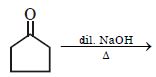
A
B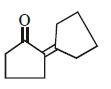
C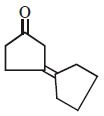
D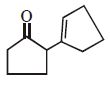
Solution
(C) The reaction of cyclopentanone with dilute $NaOH$ and heat is an intramolecular aldol condensation reaction.
$1$. The base $(OH^-)$ abstracts an $\alpha$-hydrogen from the cyclopentanone to form an enolate ion.
$2$. This enolate ion attacks the carbonyl carbon of another cyclopentanone molecule to form a $\beta$-hydroxy ketone (aldol).
$3$. Upon heating,the $\beta$-hydroxy ketone undergoes dehydration (elimination of water) to form an $\alpha,\beta$-unsaturated ketone.
$4$. The structure formed is a cyclopentanone ring attached to a cyclopentylidene group via a double bond. This corresponds to the structure shown in option $C$.
$1$. The base $(OH^-)$ abstracts an $\alpha$-hydrogen from the cyclopentanone to form an enolate ion.
$2$. This enolate ion attacks the carbonyl carbon of another cyclopentanone molecule to form a $\beta$-hydroxy ketone (aldol).
$3$. Upon heating,the $\beta$-hydroxy ketone undergoes dehydration (elimination of water) to form an $\alpha,\beta$-unsaturated ketone.
$4$. The structure formed is a cyclopentanone ring attached to a cyclopentylidene group via a double bond. This corresponds to the structure shown in option $C$.
0 likes
View Solution563
DifficultMCQ
Which of the following compounds does not give Tollen's test?
A
Tetrahydropyran$-2-$ol
B
Acetophenone
C
Benzaldehyde
D
Benzoin
Solution
(B) Tollen's test is given by aldehydes and $\alpha$-hydroxy ketones.
$A$. Tetrahydropyran$-2-$ol is a hemiacetal,which exists in equilibrium with $5-$hydroxypentanal (an aldehyde),so it gives a positive Tollen's test.
$B$. Acetophenone is a ketone and does not contain an $\alpha$-hydroxy group,so it does not give Tollen's test.
$C$. Benzaldehyde is an aldehyde,so it gives a positive Tollen's test.
$D$. Benzoin $(Ph-CO-CH(OH)-Ph)$ is an $\alpha$-hydroxy ketone,so it gives a positive Tollen's test.
Therefore,the correct answer is $B$.
$A$. Tetrahydropyran$-2-$ol is a hemiacetal,which exists in equilibrium with $5-$hydroxypentanal (an aldehyde),so it gives a positive Tollen's test.
$B$. Acetophenone is a ketone and does not contain an $\alpha$-hydroxy group,so it does not give Tollen's test.
$C$. Benzaldehyde is an aldehyde,so it gives a positive Tollen's test.
$D$. Benzoin $(Ph-CO-CH(OH)-Ph)$ is an $\alpha$-hydroxy ketone,so it gives a positive Tollen's test.
Therefore,the correct answer is $B$.
0 likes
View Solution564
AdvancedMCQ
The major product $(Q)$ of the following reaction is:
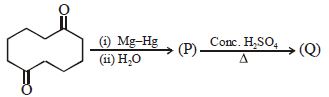
A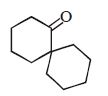
B
C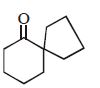
D
Solution
(C) The reaction involves the Pinacol-Pinacolone rearrangement of a $1,2-$diol.
Step $1$: The reaction of the diketone with $Mg-Hg$ followed by $H_2O$ is a reductive coupling reaction (Pinacol reduction) that converts the diketone into a cyclic $1,2-$diol.
Step $2$: The treatment of the resulting $1,2-$diol with $Conc. \ H_2SO_4$ and heat leads to the Pinacol-Pinacolone rearrangement.
In this specific case,the starting material is cyclodecane$-1,6-$dione. The reduction produces a bicyclic diol,and the subsequent acid-catalyzed rearrangement results in the formation of a spiro-ketone. The structure corresponds to spiro[$4.5$]decan$-6-$one,which matches option $C$.
Step $1$: The reaction of the diketone with $Mg-Hg$ followed by $H_2O$ is a reductive coupling reaction (Pinacol reduction) that converts the diketone into a cyclic $1,2-$diol.
Step $2$: The treatment of the resulting $1,2-$diol with $Conc. \ H_2SO_4$ and heat leads to the Pinacol-Pinacolone rearrangement.
In this specific case,the starting material is cyclodecane$-1,6-$dione. The reduction produces a bicyclic diol,and the subsequent acid-catalyzed rearrangement results in the formation of a spiro-ketone. The structure corresponds to spiro[$4.5$]decan$-6-$one,which matches option $C$.
0 likes
View Solution565
AdvancedMCQ
In the above reaction,which of the following will be obtained in maximum yield?
A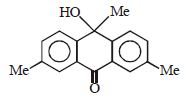
B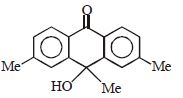
C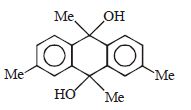
D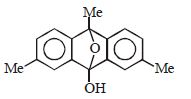
Solution
(A) The starting material is $2,7$-dimethylanthraquinone.
It is a symmetric molecule with two equivalent carbonyl groups at the $9$ and $10$ positions.
When $1$ equivalent of $MeMgBr$ (a Grignard reagent) is added,it performs a nucleophilic addition to one of the carbonyl groups.
Since both carbonyl groups are equivalent,the attack can occur at either position,leading to the same product structure.
The reaction involves the addition of a methyl group to the carbonyl carbon,followed by protonation during the aqueous workup $(H_2O)$ to form a tertiary alcohol.
The resulting product is $2,7$-dimethyl$-9-$hydroxy$-9-$methylanthracen-$10$(9H)-one (or its equivalent at the $10$ position).
Options $A$ and $B$ represent the same molecule due to the symmetry of the starting material. However,standard nomenclature usually assigns the lower number to the substituted position. Thus,the product is $2,7$-dimethyl$-9-$hydroxy$-9-$methylanthracen-$10$(9H)-one.
It is a symmetric molecule with two equivalent carbonyl groups at the $9$ and $10$ positions.
When $1$ equivalent of $MeMgBr$ (a Grignard reagent) is added,it performs a nucleophilic addition to one of the carbonyl groups.
Since both carbonyl groups are equivalent,the attack can occur at either position,leading to the same product structure.
The reaction involves the addition of a methyl group to the carbonyl carbon,followed by protonation during the aqueous workup $(H_2O)$ to form a tertiary alcohol.
The resulting product is $2,7$-dimethyl$-9-$hydroxy$-9-$methylanthracen-$10$(9H)-one (or its equivalent at the $10$ position).
Options $A$ and $B$ represent the same molecule due to the symmetry of the starting material. However,standard nomenclature usually assigns the lower number to the substituted position. Thus,the product is $2,7$-dimethyl$-9-$hydroxy$-9-$methylanthracen-$10$(9H)-one.
0 likes
View Solution566
DifficultMCQ
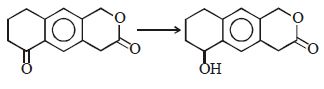
Select the best reagent to carry out the above conversion.
A
$LiAlH_4$
B
$NaBH_4$
C
$NH_2-NH_2 + H_2O_2$
D
$H_2 \ (excess) / Ni, \Delta$
Solution
(B) The starting material contains both a ketone group and an ester group (lactone).
We need to selectively reduce the ketone to a secondary alcohol without affecting the ester group.
$LiAlH_4$ is a strong reducing agent that would reduce both the ketone and the ester.
$NaBH_4$ is a milder reducing agent that selectively reduces ketones and aldehydes to alcohols,but generally does not reduce esters under standard conditions.
Therefore,$NaBH_4$ is the best reagent for this selective reduction.
We need to selectively reduce the ketone to a secondary alcohol without affecting the ester group.
$LiAlH_4$ is a strong reducing agent that would reduce both the ketone and the ester.
$NaBH_4$ is a milder reducing agent that selectively reduces ketones and aldehydes to alcohols,but generally does not reduce esters under standard conditions.
Therefore,$NaBH_4$ is the best reagent for this selective reduction.
0 likes
View Solution567
AdvancedMCQ
Select the option in which the incorrect major product is shown.
A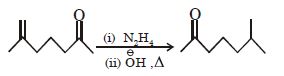
B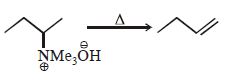
C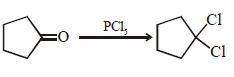
D
$Ph-I \xrightarrow[\Delta]{Cu} Ph-Ph$
Solution
(A) Let us analyze each reaction:
$A$: The reaction is a Wolff-Kishner reduction. It reduces a carbonyl group to a methylene group. The alkene double bond is unaffected. The product shown is correct.
$B$: This is a Hofmann elimination reaction. It involves the thermal decomposition of a quaternary ammonium hydroxide to form an alkene. The product shown is correct.
$C$: The reaction of a ketone with $PCl_5$ replaces the carbonyl oxygen with two chlorine atoms (gem-dichloride). The product shown is correct.
$D$: The reaction $Ph-I \xrightarrow[\Delta]{Cu} Ph-Ph$ is an Ullmann coupling reaction. However,the Ullmann reaction typically requires an aryl halide (like iodobenzene) and copper powder to form a biaryl compound. The reactant $Ph-I$ is iodobenzene,and the product $Ph-Ph$ is biphenyl. This reaction is actually correct.
Wait,re-evaluating the options:
In option $A$,the starting material is a ketone with an alkene. Wolff-Kishner reduction $(N_2H_4, OH^-, \Delta)$ reduces the ketone to an alkane. The product shown in the image for $A$ is a ketone,which means the reaction did not occur as expected. Therefore,$A$ is the incorrect product.
$A$: The reaction is a Wolff-Kishner reduction. It reduces a carbonyl group to a methylene group. The alkene double bond is unaffected. The product shown is correct.
$B$: This is a Hofmann elimination reaction. It involves the thermal decomposition of a quaternary ammonium hydroxide to form an alkene. The product shown is correct.
$C$: The reaction of a ketone with $PCl_5$ replaces the carbonyl oxygen with two chlorine atoms (gem-dichloride). The product shown is correct.
$D$: The reaction $Ph-I \xrightarrow[\Delta]{Cu} Ph-Ph$ is an Ullmann coupling reaction. However,the Ullmann reaction typically requires an aryl halide (like iodobenzene) and copper powder to form a biaryl compound. The reactant $Ph-I$ is iodobenzene,and the product $Ph-Ph$ is biphenyl. This reaction is actually correct.
Wait,re-evaluating the options:
In option $A$,the starting material is a ketone with an alkene. Wolff-Kishner reduction $(N_2H_4, OH^-, \Delta)$ reduces the ketone to an alkane. The product shown in the image for $A$ is a ketone,which means the reaction did not occur as expected. Therefore,$A$ is the incorrect product.
0 likes
View Solution568
DifficultMCQ
Which of the following compounds would not give tert-butyl alcohol when treated with excess methylmagnesium bromide $(CH_3MgBr)$ followed by acid?
A
Acetyl chloride
B
Acetaldehyde
C
Methyl acetate
D
Acetic anhydride
Solution
(B) Acetaldehyde $(CH_3CHO)$ reacts with methylmagnesium bromide $(CH_3MgBr)$ to form isopropyl alcohol $(CH_3CH(OH)CH_3)$,which is a secondary alcohol.
In contrast,acetyl chloride $(CH_3COCl)$,methyl acetate $(CH_3COOCH_3)$,and acetic anhydride $((CH_3CO)_2O)$ react with excess $CH_3MgBr$ to form tert-butyl alcohol $((CH_3)_3COH)$,which is a tertiary alcohol.
Therefore,the correct answer is $B$.
In contrast,acetyl chloride $(CH_3COCl)$,methyl acetate $(CH_3COOCH_3)$,and acetic anhydride $((CH_3CO)_2O)$ react with excess $CH_3MgBr$ to form tert-butyl alcohol $((CH_3)_3COH)$,which is a tertiary alcohol.
Therefore,the correct answer is $B$.
0 likes
View Solution569
AdvancedMCQ
Cyclopentanone $\xrightarrow[\text{traces of } KOH]{HCN} A$ $\xrightarrow{LiAlH_4} B$ $\xrightarrow{NaNO_2, HCl} C$
$C$ is
$C$ is
A
$2-$(aminomethyl)cyclopentan$-1-$ol
B
cyclohexane$-1,2-$diol
C
cyclopentane$-1,2-$diol
D
cyclohexanone
Solution
(D) $1$. The reaction of cyclopentanone with $HCN$ in the presence of traces of $KOH$ gives the cyanohydrin,$A$ ($1$-hydroxycyclopentanecarbonitrile).
$2$. Reduction of $A$ with $LiAlH_4$ gives the amine,$B$ ($1$-(aminomethyl)cyclopentan$-1-$ol).
$3$. Treatment of $B$ with $NaNO_2/HCl$ (diazotization) forms a diazonium salt,which is unstable and loses $N_2$ gas.
$4$. This leads to a ring expansion rearrangement (Tiffeneau-Demjanov rearrangement) to form cyclohexanone,$C$.
$2$. Reduction of $A$ with $LiAlH_4$ gives the amine,$B$ ($1$-(aminomethyl)cyclopentan$-1-$ol).
$3$. Treatment of $B$ with $NaNO_2/HCl$ (diazotization) forms a diazonium salt,which is unstable and loses $N_2$ gas.
$4$. This leads to a ring expansion rearrangement (Tiffeneau-Demjanov rearrangement) to form cyclohexanone,$C$.
0 likes
View Solution570
AdvancedMCQ
Arrange the following in the correct order of the rate of Nucleophilic Addition Reaction $(NAR)$:
$(I) \ HCHO$
$(II) \ CH_3CHO$
$(III) \ p-NO_2-C_6H_4CHO$
$(IV) \ p-CH_3-C_6H_4CHO$
$(I) \ HCHO$
$(II) \ CH_3CHO$
$(III) \ p-NO_2-C_6H_4CHO$
$(IV) \ p-CH_3-C_6H_4CHO$
A
$I > II > III > IV$
B
$I > III > II > IV$
C
$IV > III > II > I$
D
$III > I > II > IV$
Solution
(B) The rate of Nucleophilic Addition Reaction $(NAR)$ depends on two main factors:
$1$. Magnitude of positive charge on the carbonyl carbon: Higher positive charge increases the rate.
$2$. Steric hindrance: Higher steric hindrance decreases the rate.
Comparing the given compounds:
$(I) \ HCHO$: No alkyl group,least steric hindrance,highest electrophilicity.
$(II) \ CH_3CHO$: One electron-donating methyl group,moderate steric hindrance.
$(III) \ p-NO_2-C_6H_4CHO$: The $-NO_2$ group is strongly electron-withdrawing ($-I$ and $-M$ effect),which increases the positive charge on the carbonyl carbon,making it more reactive than $(IV)$ and $(II)$.
$(IV) \ p-CH_3-C_6H_4CHO$: The $-CH_3$ group is electron-donating ($+I$ and hyperconjugation),which decreases the positive charge on the carbonyl carbon,making it the least reactive.
Thus,the order of reactivity is: $(I) > (III) > (II) > (IV)$.
$1$. Magnitude of positive charge on the carbonyl carbon: Higher positive charge increases the rate.
$2$. Steric hindrance: Higher steric hindrance decreases the rate.
Comparing the given compounds:
$(I) \ HCHO$: No alkyl group,least steric hindrance,highest electrophilicity.
$(II) \ CH_3CHO$: One electron-donating methyl group,moderate steric hindrance.
$(III) \ p-NO_2-C_6H_4CHO$: The $-NO_2$ group is strongly electron-withdrawing ($-I$ and $-M$ effect),which increases the positive charge on the carbonyl carbon,making it more reactive than $(IV)$ and $(II)$.
$(IV) \ p-CH_3-C_6H_4CHO$: The $-CH_3$ group is electron-donating ($+I$ and hyperconjugation),which decreases the positive charge on the carbonyl carbon,making it the least reactive.
Thus,the order of reactivity is: $(I) > (III) > (II) > (IV)$.
0 likes
View Solution571
MediumMCQ
Which of the following is most reactive for a nucleophilic addition reaction?
A
$p$-methylbenzaldehyde
B
$p$-chlorobenzaldehyde
C
$p$-nitrobenzaldehyde
D
Benzaldehyde
Solution
(C) The reactivity of carbonyl compounds towards nucleophilic addition reactions is directly proportional to the electrophilicity of the carbonyl carbon.
Electron-withdrawing groups $(EWG)$ increase the electrophilicity of the carbonyl carbon by pulling electron density away from it,thereby increasing reactivity.
Electron-donating groups $(EDG)$ decrease the electrophilicity by donating electron density,thereby decreasing reactivity.
Comparing the substituents at the para position:
$1$. $-CH_3$ is an $EDG$ (via hyperconjugation and inductive effect).
$2$. $-Cl$ is an $EWG$ (via inductive effect) but also an $EDG$ (via resonance).
$3$. $-NO_2$ is a strong $EWG$ (via both inductive and resonance effects).
$4$. $-H$ is the reference.
Since the $-NO_2$ group is the strongest electron-withdrawing group among the given options,it makes the carbonyl carbon most electrophilic,making $p$-nitrobenzaldehyde the most reactive towards nucleophilic addition.
Electron-withdrawing groups $(EWG)$ increase the electrophilicity of the carbonyl carbon by pulling electron density away from it,thereby increasing reactivity.
Electron-donating groups $(EDG)$ decrease the electrophilicity by donating electron density,thereby decreasing reactivity.
Comparing the substituents at the para position:
$1$. $-CH_3$ is an $EDG$ (via hyperconjugation and inductive effect).
$2$. $-Cl$ is an $EWG$ (via inductive effect) but also an $EDG$ (via resonance).
$3$. $-NO_2$ is a strong $EWG$ (via both inductive and resonance effects).
$4$. $-H$ is the reference.
Since the $-NO_2$ group is the strongest electron-withdrawing group among the given options,it makes the carbonyl carbon most electrophilic,making $p$-nitrobenzaldehyde the most reactive towards nucleophilic addition.
0 likes
View Solution572
DifficultMCQ
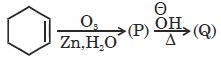
Product $(Q)$ is :-
A
Cyclopentanone
B
Cyclopent$-2-$en$-1-$one
C
Cyclopent$-2-$ene$-1-$carbaldehyde
D
Cyclopent$-1-$ene$-1-$carbaldehyde
Solution
(D) The reaction proceeds in two steps:
$1$. Ozonolysis of cyclohexene with $O_3$ followed by $Zn/H_2O$ leads to the cleavage of the double bond to form hexane$-1,6-$dial (adipaldehyde),which is product $(P)$.
$2$. The treatment of hexane$-1,6-$dial with $OH^-/\Delta$ involves an intramolecular aldol condensation. The aldehyde group at one end acts as an electrophile,and the $\alpha$-carbon of the other aldehyde group acts as a nucleophile. This results in the formation of a five-membered ring with an aldehyde group attached to the double bond,which is cyclopent$-1-$ene$-1-$carbaldehyde,product $(Q)$.
$1$. Ozonolysis of cyclohexene with $O_3$ followed by $Zn/H_2O$ leads to the cleavage of the double bond to form hexane$-1,6-$dial (adipaldehyde),which is product $(P)$.
$2$. The treatment of hexane$-1,6-$dial with $OH^-/\Delta$ involves an intramolecular aldol condensation. The aldehyde group at one end acts as an electrophile,and the $\alpha$-carbon of the other aldehyde group acts as a nucleophile. This results in the formation of a five-membered ring with an aldehyde group attached to the double bond,which is cyclopent$-1-$ene$-1-$carbaldehyde,product $(Q)$.
0 likes
View Solution573
MediumMCQ
Identify the number of $\alpha$-Hydrogen atoms in the given compound.

A
$2$
B
$3$
C
$4$
D
$6$
Solution
(B) The given compound is $2$-methylcyclohexanone.
An $\alpha$-carbon is a carbon atom directly attached to the functional group (in this case,the carbonyl group,$C=O$).
In $2$-methylcyclohexanone,there are two $\alpha$-carbons adjacent to the carbonyl group.
One $\alpha$-carbon is a $CH_2$ group (having $2$ hydrogen atoms).
The other $\alpha$-carbon is a $CH(CH_3)$ group (having $1$ hydrogen atom).
Therefore,the total number of $\alpha$-hydrogen atoms is $2 + 1 = 3$.
An $\alpha$-carbon is a carbon atom directly attached to the functional group (in this case,the carbonyl group,$C=O$).
In $2$-methylcyclohexanone,there are two $\alpha$-carbons adjacent to the carbonyl group.
One $\alpha$-carbon is a $CH_2$ group (having $2$ hydrogen atoms).
The other $\alpha$-carbon is a $CH(CH_3)$ group (having $1$ hydrogen atom).
Therefore,the total number of $\alpha$-hydrogen atoms is $2 + 1 = 3$.
0 likes
View Solution574
DifficultMCQ
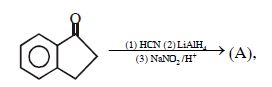
The major product $(A)$ is:
A
$1-$tetralone
B
$2-$tetralone
C
tetralin
D
naphthalene
Solution
(A) The starting material is $1$-indanone.
Step $(1)$: Reaction with $HCN$ adds a cyano group to the carbonyl carbon,forming a cyanohydrin.
Step $(2)$: Reduction with $LiAlH_4$ reduces the cyano group to a primary amine $(-CH_2NH_2)$ and the hydroxyl group (from the cyanohydrin) is removed via deoxygenation or reduction processes in these conditions,leading to an expansion or rearrangement. However,looking at the sequence $HCN$,$LiAlH_4$,and $NaNO_2/H^+$,this is a classic Tiffeneau-Demjanov rearrangement.
The cyanohydrin is reduced to a $\beta$-amino alcohol,which upon treatment with $NaNO_2/H^+$ undergoes diazotization followed by ring expansion.
Starting with a $5$-membered ring ketone ($1$-indanone),the ring expansion leads to a $6$-membered ring ketone,which is $1$-tetralone.
Step $(1)$: Reaction with $HCN$ adds a cyano group to the carbonyl carbon,forming a cyanohydrin.
Step $(2)$: Reduction with $LiAlH_4$ reduces the cyano group to a primary amine $(-CH_2NH_2)$ and the hydroxyl group (from the cyanohydrin) is removed via deoxygenation or reduction processes in these conditions,leading to an expansion or rearrangement. However,looking at the sequence $HCN$,$LiAlH_4$,and $NaNO_2/H^+$,this is a classic Tiffeneau-Demjanov rearrangement.
The cyanohydrin is reduced to a $\beta$-amino alcohol,which upon treatment with $NaNO_2/H^+$ undergoes diazotization followed by ring expansion.
Starting with a $5$-membered ring ketone ($1$-indanone),the ring expansion leads to a $6$-membered ring ketone,which is $1$-tetralone.
0 likes
View Solution575
MediumMCQ
Which one of the following will be most readily dehydrated in acidic condition?
A
$4-$hydroxy$-2-$pentanone
B
$2-$pentanol
C
$3-$hydroxy$-2-$pentanone
D
$5-$hydroxy$-2-$pentanone
Solution
(A) Dehydration in acidic conditions typically proceeds via an $E1$ mechanism involving the formation of a carbocation intermediate. However,for $\beta$-hydroxy carbonyl compounds,dehydration is significantly facilitated because the resulting product is a conjugated $\alpha,\beta$-unsaturated carbonyl system,which is thermodynamically very stable.
In option $A$,the compound is $4$-hydroxy-$2$-pentanone. This is a $\beta$-hydroxy ketone. Upon dehydration,it forms a conjugated system (pent$-3-$en$-2-$one). The presence of the carbonyl group at the $\beta$-position relative to the hydroxyl group makes the $\alpha$-hydrogen acidic,facilitating the elimination of water to form a stable conjugated enone.
Other options do not form a conjugated system as readily or at all under these conditions. Therefore,$4$-hydroxy-$2$-pentanone is the most readily dehydrated.
In option $A$,the compound is $4$-hydroxy-$2$-pentanone. This is a $\beta$-hydroxy ketone. Upon dehydration,it forms a conjugated system (pent$-3-$en$-2-$one). The presence of the carbonyl group at the $\beta$-position relative to the hydroxyl group makes the $\alpha$-hydrogen acidic,facilitating the elimination of water to form a stable conjugated enone.
Other options do not form a conjugated system as readily or at all under these conditions. Therefore,$4$-hydroxy-$2$-pentanone is the most readily dehydrated.
0 likes
View Solution576
DifficultMCQ
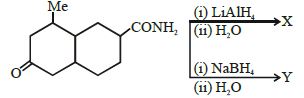
Identify $X$ and $Y$ in the following reaction:
A
$X$ is a diol and $Y$ is a hydroxy-amide.
B
$X$ is a hydroxy-amine and $Y$ is a hydroxy-amide.
C
$X$ is a hydroxy-amine and $Y$ is a diol.
D
$X$ is a diol and $Y$ is a hydroxy-amine.
Solution
(B) $LiAlH_4$ is a strong reducing agent that reduces both the ketone group to a secondary alcohol and the amide group to a primary amine. Thus,$X$ is a hydroxy-amine.
$NaBH_4$ is a milder reducing agent that reduces the ketone group to a secondary alcohol but does not reduce the amide group. Thus,$Y$ is a hydroxy-amide.
Therefore,$X$ is a hydroxy-amine and $Y$ is a hydroxy-amide.
$NaBH_4$ is a milder reducing agent that reduces the ketone group to a secondary alcohol but does not reduce the amide group. Thus,$Y$ is a hydroxy-amide.
Therefore,$X$ is a hydroxy-amine and $Y$ is a hydroxy-amide.
0 likes
View Solution577
AdvancedMCQ
Identify the final product $D$ in the given reaction sequence:
$CH_3CH_2Cl$ $\xrightarrow{Aq. KOH} A$ $\xrightarrow{PCC} B$ $\xrightarrow{Cl_2/NaOH} C$ $\xrightarrow{Acetone} D$
Product $D$ is known as:
$CH_3CH_2Cl$ $\xrightarrow{Aq. KOH} A$ $\xrightarrow{PCC} B$ $\xrightarrow{Cl_2/NaOH} C$ $\xrightarrow{Acetone} D$
Product $D$ is known as:
A
Mustard Gas
B
Chloropicrin
C
Chloretone
D
Lewsite gas
Solution
(C) $1$. $CH_3CH_2Cl$ reacts with $Aq. KOH$ (nucleophilic substitution) to form ethanol $(A = CH_3CH_2OH)$.
$2$. Ethanol $(A)$ is oxidized by $PCC$ (Pyridinium chlorochromate) to form acetaldehyde $(B = CH_3CHO)$.
$3$. Acetaldehyde $(B)$ reacts with $Cl_2/NaOH$ (haloform reaction) to form chloroform $(C = CHCl_3)$.
$4$. Chloroform $(C)$ reacts with acetone $(CH_3COCH_3)$ in the presence of a base to form $1,1,1-trichloro-2-methylpropan-2-ol$,which is commonly known as Chloretone $(D)$.
$2$. Ethanol $(A)$ is oxidized by $PCC$ (Pyridinium chlorochromate) to form acetaldehyde $(B = CH_3CHO)$.
$3$. Acetaldehyde $(B)$ reacts with $Cl_2/NaOH$ (haloform reaction) to form chloroform $(C = CHCl_3)$.
$4$. Chloroform $(C)$ reacts with acetone $(CH_3COCH_3)$ in the presence of a base to form $1,1,1-trichloro-2-methylpropan-2-ol$,which is commonly known as Chloretone $(D)$.
0 likes
View Solution578
DifficultMCQ
Predict the product in the given reaction:
$3-\text{chlorobenzaldehyde} \xrightarrow{50\% \text{KOH}, \Delta} ?$
$3-\text{chlorobenzaldehyde} \xrightarrow{50\% \text{KOH}, \Delta} ?$
A
$3-\text{chlorobenzyl alcohol} + 3-\text{chlorophenylacetate}$
B
$3-\text{chlorobenzyl alcohol} + 3-\text{hydroxybenzyl alcohol}$
C
$3-\text{chlorobenzyl alcohol} + 3-\text{chlorobenzoate}$
D
$3-\text{hydroxybenzyl alcohol} + 3-\text{chlorobenzoate}$
Solution
(C) The given reaction is a Cannizzaro reaction because $3-\text{chlorobenzaldehyde}$ does not have any $\alpha-\text{hydrogen}$ atoms.
In the presence of concentrated alkali $(50\% \text{KOH})$,aldehydes lacking $\alpha-\text{hydrogen}$ undergo self-oxidation and reduction (disproportionation) to form a mixture of the corresponding alcohol and the salt of the carboxylic acid.
$2 \text{C}_6\text{H}_4(\text{Cl})\text{CHO} + \text{KOH}$ $\rightarrow \text{C}_6\text{H}_4(\text{Cl})\text{CH}_2\text{OH} + \text{C}_6\text{H}_4(\text{Cl})\text{COOK}$
Thus,$3-\text{chlorobenzaldehyde}$ produces $3-\text{chlorobenzyl alcohol}$ and $3-\text{chlorobenzoate}$ ion.
In the presence of concentrated alkali $(50\% \text{KOH})$,aldehydes lacking $\alpha-\text{hydrogen}$ undergo self-oxidation and reduction (disproportionation) to form a mixture of the corresponding alcohol and the salt of the carboxylic acid.
$2 \text{C}_6\text{H}_4(\text{Cl})\text{CHO} + \text{KOH}$ $\rightarrow \text{C}_6\text{H}_4(\text{Cl})\text{CH}_2\text{OH} + \text{C}_6\text{H}_4(\text{Cl})\text{COOK}$
Thus,$3-\text{chlorobenzaldehyde}$ produces $3-\text{chlorobenzyl alcohol}$ and $3-\text{chlorobenzoate}$ ion.
0 likes
View Solution579
DifficultMCQ
Which of the following reactions is not possible?
A
$CH_3-CH_2-NH_2 \xrightarrow{HNO_2} CH_3-CH_2-OH$
B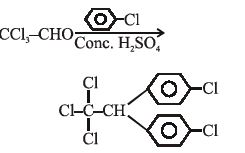
C
$CH_3CHO \xrightarrow[\Delta]{dil. NaOH} CH_3COONa + CH_3CH_2CH_2OH$
D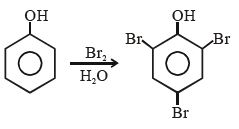
Solution
(C) Option $A$ is a standard reaction where primary aliphatic amines react with nitrous acid to form alcohols.
Option $B$ shows the synthesis of $DDT$ from chloral and chlorobenzene in the presence of concentrated $H_2SO_4$,which is a known reaction.
Option $C$ is incorrect because acetaldehyde $(CH_3CHO)$ undergoes aldol condensation in the presence of dilute $NaOH$ to form $3-hydroxybutanal$ $(CH_3CH(OH)CH_2CHO)$,not the products shown.
Option $D$ shows the bromination of phenol with bromine water to form $2,4,6-tribromophenol$,which is a standard reaction.
Therefore,the reaction in option $C$ is not possible.
Option $B$ shows the synthesis of $DDT$ from chloral and chlorobenzene in the presence of concentrated $H_2SO_4$,which is a known reaction.
Option $C$ is incorrect because acetaldehyde $(CH_3CHO)$ undergoes aldol condensation in the presence of dilute $NaOH$ to form $3-hydroxybutanal$ $(CH_3CH(OH)CH_2CHO)$,not the products shown.
Option $D$ shows the bromination of phenol with bromine water to form $2,4,6-tribromophenol$,which is a standard reaction.
Therefore,the reaction in option $C$ is not possible.
0 likes
View Solution580
MediumMCQ
Which of the following compounds will not show tautomerism?
A
$1,4-$Benzoquinone
B
Cyclobut$-2-$enone
C
$2,2,6,6-$Tetramethylcyclohexanone
D
All of these
Solution
(D) Tautomerism requires the presence of at least one $\alpha$-hydrogen atom adjacent to a carbonyl group $(-C=O)$ or similar functional group.
$1$. $1,4$-Benzoquinone: It has no $\alpha$-hydrogen atoms adjacent to the carbonyl groups,as the carbons are part of a double bond in the ring.
$2$. Cyclobut$-2-$enone: The $\alpha$-carbon (at position $4$) has two hydrogen atoms,so it can show tautomerism.
$3$. $2,2,6,6$-Tetramethylcyclohexanone: The $\alpha$-carbons (positions $2$ and $6$) are fully substituted with methyl groups and have no $\alpha$-hydrogen atoms,so it cannot show tautomerism.
Since both $1,4$-Benzoquinone and $2,2,6,6$-Tetramethylcyclohexanone do not show tautomerism,the question implies identifying which of the given options do not show it. However,based on standard chemistry problems of this type,if multiple options are correct,the question might be flawed or intended to be 'Which of the following...'. Given the options,$1,4$-Benzoquinone and $2,2,6,6$-Tetramethylcyclohexanone both lack $\alpha$-hydrogens. If we must choose one,$2,2,6,6$-Tetramethylcyclohexanone is a classic example of a ketone lacking $\alpha$-hydrogens.
$1$. $1,4$-Benzoquinone: It has no $\alpha$-hydrogen atoms adjacent to the carbonyl groups,as the carbons are part of a double bond in the ring.
$2$. Cyclobut$-2-$enone: The $\alpha$-carbon (at position $4$) has two hydrogen atoms,so it can show tautomerism.
$3$. $2,2,6,6$-Tetramethylcyclohexanone: The $\alpha$-carbons (positions $2$ and $6$) are fully substituted with methyl groups and have no $\alpha$-hydrogen atoms,so it cannot show tautomerism.
Since both $1,4$-Benzoquinone and $2,2,6,6$-Tetramethylcyclohexanone do not show tautomerism,the question implies identifying which of the given options do not show it. However,based on standard chemistry problems of this type,if multiple options are correct,the question might be flawed or intended to be 'Which of the following...'. Given the options,$1,4$-Benzoquinone and $2,2,6,6$-Tetramethylcyclohexanone both lack $\alpha$-hydrogens. If we must choose one,$2,2,6,6$-Tetramethylcyclohexanone is a classic example of a ketone lacking $\alpha$-hydrogens.
0 likes
View Solution581
MediumMCQ
Which of the following compounds responds to both iodoform test and Fehling's test?
A
Acetone
B
Acetaldehyde
C
Propionaldehyde
D
Ethyl alcohol
Solution
(B) The iodoform test is given by compounds containing the $CH_3CO-$ group or $CH_3CH(OH)-$ group.
Fehling's test is given by aliphatic aldehydes.
$CH_3CHO$ (Acetaldehyde) contains the $CH_3CO-$ group,so it gives the iodoform test.
It is also an aliphatic aldehyde,so it gives the Fehling's test.
Therefore,$CH_3CHO$ responds to both tests.
Fehling's test is given by aliphatic aldehydes.
$CH_3CHO$ (Acetaldehyde) contains the $CH_3CO-$ group,so it gives the iodoform test.
It is also an aliphatic aldehyde,so it gives the Fehling's test.
Therefore,$CH_3CHO$ responds to both tests.
0 likes
View Solution582
EasyMCQ
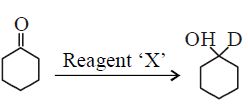
Reagent $X$ in the given reaction is:
(Image shows cyclohexanone being converted to cyclohexanol with a deuterium atom attached to the same carbon as the hydroxyl group.)
(Image shows cyclohexanone being converted to cyclohexanol with a deuterium atom attached to the same carbon as the hydroxyl group.)
A
$LiAlH_4 + H_2O$
B
$LiAlD_4 + H_2O$
C
$LiAlH_4 + D_2O$
D
$LiAlD_4 + D_2O$
Solution
(B) The reaction involves the reduction of a ketone (cyclohexanone) to an alcohol.
In the reduction of a carbonyl group using $LiAlH_4$ or $LiAlD_4$,the hydride $(H^-)$ or deuteride $(D^-)$ ion from the metal hydride reagent attacks the electrophilic carbonyl carbon.
Subsequently,the oxygen atom is protonated or deuterated during the workup step using water $(H_2O)$ or heavy water $(D_2O)$.
In the product,the carbon atom is bonded to a hydroxyl group $(-OH)$ and a deuterium atom $(-D)$.
This indicates that the deuterium atom was added during the reduction step (from the reagent) and the hydrogen atom was added during the workup step (from the water).
Therefore,the reagent $X$ must be $LiAlD_4$ followed by $H_2O$.
In the reduction of a carbonyl group using $LiAlH_4$ or $LiAlD_4$,the hydride $(H^-)$ or deuteride $(D^-)$ ion from the metal hydride reagent attacks the electrophilic carbonyl carbon.
Subsequently,the oxygen atom is protonated or deuterated during the workup step using water $(H_2O)$ or heavy water $(D_2O)$.
In the product,the carbon atom is bonded to a hydroxyl group $(-OH)$ and a deuterium atom $(-D)$.
This indicates that the deuterium atom was added during the reduction step (from the reagent) and the hydrogen atom was added during the workup step (from the water).
Therefore,the reagent $X$ must be $LiAlD_4$ followed by $H_2O$.
0 likes
View Solution583
DifficultMCQ
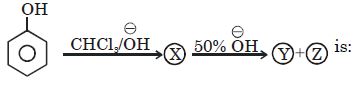
The end product in the reaction is:
A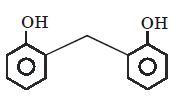
B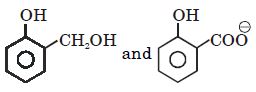
C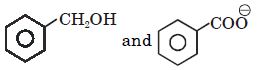
D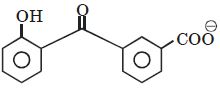
Solution
(B) The reaction sequence is as follows:
$1$. The first step is the Reimer-Tiemann reaction,where phenol reacts with $CHCl_3$ and $OH^-$ to form $o$-hydroxybenzaldehyde (salicylaldehyde) as the intermediate product $X$.
$2$. The second step involves the treatment of $o$-hydroxybenzaldehyde with $50\% \ NaOH$ (concentrated alkali),which leads to the Cannizzaro reaction.
$3$. In the Cannizzaro reaction,the aldehyde group is disproportionated into an alcohol group $(-CH_2OH)$ and a carboxylate group $(-COO^-)$.
$4$. Thus,the final products $Y$ and $Z$ are $2$-hydroxybenzyl alcohol and $2$-hydroxybenzoate ion,respectively.
$1$. The first step is the Reimer-Tiemann reaction,where phenol reacts with $CHCl_3$ and $OH^-$ to form $o$-hydroxybenzaldehyde (salicylaldehyde) as the intermediate product $X$.
$2$. The second step involves the treatment of $o$-hydroxybenzaldehyde with $50\% \ NaOH$ (concentrated alkali),which leads to the Cannizzaro reaction.
$3$. In the Cannizzaro reaction,the aldehyde group is disproportionated into an alcohol group $(-CH_2OH)$ and a carboxylate group $(-COO^-)$.
$4$. Thus,the final products $Y$ and $Z$ are $2$-hydroxybenzyl alcohol and $2$-hydroxybenzoate ion,respectively.
0 likes
View Solution584
AdvancedMCQ
Predict the major product of the following reaction:
$1,3$-benzodioxole $\xrightarrow[(ii) CHCl_3, NaOH]{(i) HI \text{ (excess)}}$ ?
$1,3$-benzodioxole $\xrightarrow[(ii) CHCl_3, NaOH]{(i) HI \text{ (excess)}}$ ?
A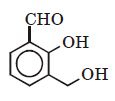
B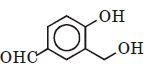
C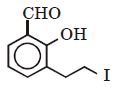
D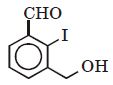
Solution
(A) The starting material is $1,3$-benzodioxole.
Step $(i)$: Treatment with excess $HI$ causes the cleavage of the cyclic acetal (dioxole ring). The $C-O$ bonds are broken,resulting in the formation of a catechol derivative ($1,2$-dihydroxybenzene) and formaldehyde $(CH_2O)$,but in this specific fused system,the ring opening leads to $2$-hydroxybenzyl alcohol (salicyl alcohol).
Step $(ii)$: The Reimer-Tiemann reaction $(CHCl_3, NaOH)$ introduces a formyl group $(-CHO)$ at the ortho position relative to the phenolic $-OH$ group.
Thus,the product is $2$-hydroxy$-3-$(hydroxymethyl)benzaldehyde.
Step $(i)$: Treatment with excess $HI$ causes the cleavage of the cyclic acetal (dioxole ring). The $C-O$ bonds are broken,resulting in the formation of a catechol derivative ($1,2$-dihydroxybenzene) and formaldehyde $(CH_2O)$,but in this specific fused system,the ring opening leads to $2$-hydroxybenzyl alcohol (salicyl alcohol).
Step $(ii)$: The Reimer-Tiemann reaction $(CHCl_3, NaOH)$ introduces a formyl group $(-CHO)$ at the ortho position relative to the phenolic $-OH$ group.
Thus,the product is $2$-hydroxy$-3-$(hydroxymethyl)benzaldehyde.
0 likes
View Solution585
MediumMCQ
$CH_3-CHO$ $\xrightarrow[OH^{-}]{HCN} (A)$ $\xrightarrow{\text{Partial Hydrolysis}} (B)$. Product $B$ is:
A
$CH_3-CH(OH)-CN$
B
$CH_3-CH(OH)-COOH$
C
Racemic mixture of $CH_3-CH(OH)-COOH$
D
$CH_3-CH(OH)-CONH_2$
Solution
(D) Acetaldehyde reacts with $HCN$ in the presence of a base $(OH^{-})$ to form acetaldehyde cyanohydrin $(A)$,which is $CH_3-CH(OH)-CN$.
Partial hydrolysis of the nitrile group $(-CN)$ in $(A)$ yields an amide group $(-CONH_2)$,resulting in the formation of $CH_3-CH(OH)-CONH_2$ $(B)$.
Reaction:
$CH_3-CHO + HCN$ $\xrightarrow{OH^{-}} CH_3-CH(OH)-CN (A)$ $\xrightarrow{H_2O/H^{+}} CH_3-CH(OH)-CONH_2 (B)$
Partial hydrolysis of the nitrile group $(-CN)$ in $(A)$ yields an amide group $(-CONH_2)$,resulting in the formation of $CH_3-CH(OH)-CONH_2$ $(B)$.
Reaction:
$CH_3-CHO + HCN$ $\xrightarrow{OH^{-}} CH_3-CH(OH)-CN (A)$ $\xrightarrow{H_2O/H^{+}} CH_3-CH(OH)-CONH_2 (B)$
0 likes
View Solution586
MediumMCQ
Which of the following compounds does not give an Aldol condensation reaction?
A
Acetophenone
B
Propanal
C
Cyclohexanone
D
Benzophenone
Solution
(D) Aldol condensation reaction is given by aldehydes and ketones that possess at least one $\alpha$-hydrogen atom.
$1$. Acetophenone $(C_6H_5COCH_3)$ has three $\alpha$-hydrogen atoms.
$2$. Propanal $(CH_3CH_2CHO)$ has two $\alpha$-hydrogen atoms.
$3$. Cyclohexanone has four $\alpha$-hydrogen atoms.
$4$. Benzophenone $(C_6H_5COC_6H_5)$ does not have any $\alpha$-hydrogen atom attached to the carbonyl carbon.
Therefore,Benzophenone does not undergo Aldol condensation.
$1$. Acetophenone $(C_6H_5COCH_3)$ has three $\alpha$-hydrogen atoms.
$2$. Propanal $(CH_3CH_2CHO)$ has two $\alpha$-hydrogen atoms.
$3$. Cyclohexanone has four $\alpha$-hydrogen atoms.
$4$. Benzophenone $(C_6H_5COC_6H_5)$ does not have any $\alpha$-hydrogen atom attached to the carbonyl carbon.
Therefore,Benzophenone does not undergo Aldol condensation.
0 likes
View Solution587
MediumMCQ
Which of the following reducing reagents will be suitable for the conversion shown below?
(Structure: $3-$methylcyclohexanone to methylcyclohexane)
(Structure: $3-$methylcyclohexanone to methylcyclohexane)
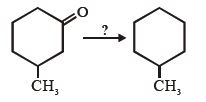
A
$Zn-Hg/HCl$
B
$NH_2-NH_2/OH^-$
C
$HI/P$ (red)
D
All of these
Solution
(D) The given reaction is the reduction of a ketone ($3$-methylcyclohexanone) to an alkane (methylcyclohexane).
$1$. $Zn-Hg/HCl$ is the reagent for Clemmensen reduction,which reduces carbonyl groups to methylene groups.
$2$. $NH_2-NH_2/OH^-$ is the reagent for Wolff-Kishner reduction,which also reduces carbonyl groups to methylene groups.
$3$. $HI/P$ (red) is a strong reducing agent that can reduce carbonyl compounds to alkanes.
Since all three reagents are capable of performing this reduction,the correct answer is $D$.
$1$. $Zn-Hg/HCl$ is the reagent for Clemmensen reduction,which reduces carbonyl groups to methylene groups.
$2$. $NH_2-NH_2/OH^-$ is the reagent for Wolff-Kishner reduction,which also reduces carbonyl groups to methylene groups.
$3$. $HI/P$ (red) is a strong reducing agent that can reduce carbonyl compounds to alkanes.
Since all three reagents are capable of performing this reduction,the correct answer is $D$.
0 likes
View Solution588
AdvancedMCQ
Identify the products $A$,$B$,and $C$ in the following reaction sequence:
$C_6H_5CONH_2$ $\xrightarrow{P_2O_5, \Delta} A$ $\xrightarrow[(ii) H_2O]{(i) DIBAL-H} B$
$A \xrightarrow[(ii) H_3O^+, \Delta]{(i) (CH_3CO)_2O/CH_3COONa} C$
$C_6H_5CONH_2$ $\xrightarrow{P_2O_5, \Delta} A$ $\xrightarrow[(ii) H_2O]{(i) DIBAL-H} B$
$A \xrightarrow[(ii) H_3O^+, \Delta]{(i) (CH_3CO)_2O/CH_3COONa} C$
A
$A$ = $C_6H_5CN$,$B$ = $C_6H_5CHO$,$C$ = $C_6H_5CH=CHCHO$
B
$A$ = $C_6H_5CN$,$B$ = $C_6H_5CHO$,$C$ = $C_6H_5CH=CHCOOH$
C
$A$ = $C_6H_5CN$,$B$ = $C_6H_5CH_2OH$,$C$ = $C_6H_5CH_2CH_2COOH$
D
$A$ = $C_6H_5CONHCH_3$,$B$ = $C_6H_5CHO$,$C$ = $C_6H_5CH=CHCHO$
Solution
(B) $1$. The reaction of benzamide $(C_6H_5CONH_2)$ with $P_2O_5$ followed by heating causes dehydration to form benzonitrile $(A = C_6H_5CN)$.
$2$. The reduction of benzonitrile $(C_6H_5CN)$ with $DIBAL-H$ followed by hydrolysis yields benzaldehyde $(B = C_6H_5CHO)$.
$3$. The reaction of benzaldehyde $(C_6H_5CHO)$ with acetic anhydride $((CH_3CO)_2O)$ in the presence of sodium acetate $(CH_3COONa)$ is the Perkin condensation,which yields cinnamic acid $(C = C_6H_5CH=CHCOOH)$ after acidic hydrolysis.
$2$. The reduction of benzonitrile $(C_6H_5CN)$ with $DIBAL-H$ followed by hydrolysis yields benzaldehyde $(B = C_6H_5CHO)$.
$3$. The reaction of benzaldehyde $(C_6H_5CHO)$ with acetic anhydride $((CH_3CO)_2O)$ in the presence of sodium acetate $(CH_3COONa)$ is the Perkin condensation,which yields cinnamic acid $(C = C_6H_5CH=CHCOOH)$ after acidic hydrolysis.
0 likes
View Solution589
MediumMCQ
An organic compound $A$ is oxidized using acidified $K_2Cr_2O_7$ solution to form compound $B$. Compound $B$ gives the $DNP$ test but not the silver mirror test. Then,compound $A$ is:
A
$2-$propanol
B
$1-$propanol
C
ethanal
D
ethanol
Solution
(A) $1$. The $DNP$ test ($2$,$4$-dinitrophenylhydrazine test) is given by aldehydes and ketones.
$2$. The silver mirror test (Tollens' test) is given by aldehydes but not by ketones.
$3$. Since compound $B$ gives the $DNP$ test but not the silver mirror test,$B$ must be a ketone.
$4$. $A$ secondary alcohol is oxidized by acidified $K_2Cr_2O_7$ to form a ketone.
$5$. Among the given options,$2-$propanol is a secondary alcohol,which on oxidation yields acetone (propanone),a ketone.
$2$. The silver mirror test (Tollens' test) is given by aldehydes but not by ketones.
$3$. Since compound $B$ gives the $DNP$ test but not the silver mirror test,$B$ must be a ketone.
$4$. $A$ secondary alcohol is oxidized by acidified $K_2Cr_2O_7$ to form a ketone.
$5$. Among the given options,$2-$propanol is a secondary alcohol,which on oxidation yields acetone (propanone),a ketone.
0 likes
View Solution590
DifficultMCQ
Which of the following does not give a stable product with water?
A
$CF_3-CO-CF_3$
B
$CF_3-CHO$
C
Ninhydrin
D
$Ph-CHO$
Solution
(D) Carbonyl compounds react with water to form gem-diols (hydrates).
Usually,these are unstable and revert to the carbonyl compound.
However,strong electron-withdrawing groups like $-CF_3$ or $-CCl_3$ stabilize the hydrate by increasing the electrophilicity of the carbonyl carbon through inductive effects.
$CF_3-CO-CF_3$,$CF_3-CHO$,and $CCl_3-CHO$ form stable hydrates.
Ninhydrin also forms a stable hydrate due to the presence of adjacent electron-withdrawing carbonyl groups.
Benzaldehyde $(Ph-CHO)$ does not have such stabilizing groups,and its hydrate is unstable.
Usually,these are unstable and revert to the carbonyl compound.
However,strong electron-withdrawing groups like $-CF_3$ or $-CCl_3$ stabilize the hydrate by increasing the electrophilicity of the carbonyl carbon through inductive effects.
$CF_3-CO-CF_3$,$CF_3-CHO$,and $CCl_3-CHO$ form stable hydrates.
Ninhydrin also forms a stable hydrate due to the presence of adjacent electron-withdrawing carbonyl groups.
Benzaldehyde $(Ph-CHO)$ does not have such stabilizing groups,and its hydrate is unstable.
0 likes
View Solution591
MediumMCQ
Which of the following will reduce Fehling's solution?
A
$CH_3-CH(OH)-COOH$
B
$CH_3-CO-CH_2-OH$
C
$CH_3-CO-CH_3$
D
Benzaldehyde $(C_6H_5CHO)$
Solution
(B) Fehling's solution is reduced by aliphatic aldehydes and $\alpha$-hydroxy ketones.
$CH_3-CO-CH_2-OH$ is an $\alpha$-hydroxy ketone,which can tautomerize to an aldehyde in the alkaline medium of Fehling's solution,thereby reducing it.
Benzaldehyde $(C_6H_5CHO)$ is an aromatic aldehyde and does not reduce Fehling's solution.
Therefore,the correct option is $(b)$.
$CH_3-CO-CH_2-OH$ is an $\alpha$-hydroxy ketone,which can tautomerize to an aldehyde in the alkaline medium of Fehling's solution,thereby reducing it.
Benzaldehyde $(C_6H_5CHO)$ is an aromatic aldehyde and does not reduce Fehling's solution.
Therefore,the correct option is $(b)$.
0 likes
View Solution592
DifficultMCQ
Which of the following compounds does not undergo the Cannizzaro reaction?
A
$HCHO$
B
$CH_3CHO$
C
$CH_3CH_2CHO$
D
$PhCHO$
Solution
(B) The Cannizzaro reaction is given by aldehydes that do not have any $\alpha$-hydrogen atom.
$HCHO$ (Formaldehyde) has no $\alpha$-hydrogen,so it undergoes the Cannizzaro reaction.
$PhCHO$ (Benzaldehyde) has no $\alpha$-hydrogen,so it undergoes the Cannizzaro reaction.
$CH_3CHO$ (Acetaldehyde) has three $\alpha$-hydrogens,so it does not undergo the Cannizzaro reaction.
$CH_3CH_2CHO$ (Propanal) has two $\alpha$-hydrogens,so it does not undergo the Cannizzaro reaction.
Since the question asks for a compound that does not give the Cannizzaro reaction,both $B$ and $C$ are correct. However,in standard multiple-choice questions of this type,$CH_3CHO$ is the most common example of an aldehyde that fails to undergo this reaction due to the presence of $\alpha$-hydrogens.
$HCHO$ (Formaldehyde) has no $\alpha$-hydrogen,so it undergoes the Cannizzaro reaction.
$PhCHO$ (Benzaldehyde) has no $\alpha$-hydrogen,so it undergoes the Cannizzaro reaction.
$CH_3CHO$ (Acetaldehyde) has three $\alpha$-hydrogens,so it does not undergo the Cannizzaro reaction.
$CH_3CH_2CHO$ (Propanal) has two $\alpha$-hydrogens,so it does not undergo the Cannizzaro reaction.
Since the question asks for a compound that does not give the Cannizzaro reaction,both $B$ and $C$ are correct. However,in standard multiple-choice questions of this type,$CH_3CHO$ is the most common example of an aldehyde that fails to undergo this reaction due to the presence of $\alpha$-hydrogens.
0 likes
View Solution593
MediumMCQ
Which of the following tests can be used to differentiate acetaldehyde and acetone?
A
Fehling's test
B
$NaHSO_3$ test
C
Iodoform test
D
All of these
Solution
(A) Acetaldehyde $(CH_3CHO)$ is an aldehyde,while acetone $(CH_3COCH_3)$ is a ketone.
$1$. Fehling's test: Aldehydes like acetaldehyde give a positive test (red precipitate of $Cu_2O$),whereas ketones like acetone do not.
$2$. $NaHSO_3$ test: Both aldehydes and ketones generally form bisulfite addition products,but this test is often used to distinguish between different carbonyl compounds based on reactivity; however,it is not the primary differentiator here.
$3$. Iodoform test: Both acetaldehyde and acetone contain the $CH_3CO-$ group,so both give a positive iodoform test. Therefore,this cannot differentiate them.
Since Fehling's test specifically distinguishes aldehydes from ketones,it is the correct choice.
$1$. Fehling's test: Aldehydes like acetaldehyde give a positive test (red precipitate of $Cu_2O$),whereas ketones like acetone do not.
$2$. $NaHSO_3$ test: Both aldehydes and ketones generally form bisulfite addition products,but this test is often used to distinguish between different carbonyl compounds based on reactivity; however,it is not the primary differentiator here.
$3$. Iodoform test: Both acetaldehyde and acetone contain the $CH_3CO-$ group,so both give a positive iodoform test. Therefore,this cannot differentiate them.
Since Fehling's test specifically distinguishes aldehydes from ketones,it is the correct choice.
0 likes
View Solution594
DifficultMCQ
The correct statement regarding a carbonyl compound with a hydrogen atom on its $\alpha$-carbon is
A
a carbonyl compound with a hydrogen atom on its $\alpha$-carbon never equilibrates with its corresponding enol.
B
a carbonyl compound with a hydrogen atom on its $\alpha$-carbon rapidly equilibrates with its corresponding enol and this process is known as aldehyde-ketone equilibration.
C
a carbonyl compound with a hydrogen atom on its $\alpha$-carbon rapidly equilibrates with its corresponding enol and this process is known as carbonylation.
D
a carbonyl compound with a hydrogen atom on its $\alpha$-carbon equilibrates with its corresponding enol and this process is known as keto-enol tautomerism.
Solution
(D) Carbonyl compounds containing at least one $\alpha$-hydrogen atom exhibit a special type of isomerism known as keto-enol tautomerism.
In this process,the $\alpha$-hydrogen atom migrates to the oxygen atom of the carbonyl group,resulting in an equilibrium between the keto form and the enol form.
Therefore,the correct statement is that a carbonyl compound with a hydrogen atom on its $\alpha$-carbon equilibrates with its corresponding enol and this process is known as keto-enol tautomerism.
In this process,the $\alpha$-hydrogen atom migrates to the oxygen atom of the carbonyl group,resulting in an equilibrium between the keto form and the enol form.
Therefore,the correct statement is that a carbonyl compound with a hydrogen atom on its $\alpha$-carbon equilibrates with its corresponding enol and this process is known as keto-enol tautomerism.
0 likes
View Solution595
AdvancedMCQ
In the given reaction sequence,identify the structure of $(B)$:
Cyclohexanol $\xrightarrow{PCC}$ $(A)$ $\xrightarrow{H-CHO, \text{dil. } KOH, \Delta}$ $(B)$
Cyclohexanol $\xrightarrow{PCC}$ $(A)$ $\xrightarrow{H-CHO, \text{dil. } KOH, \Delta}$ $(B)$
A
$2-$(hydroxymethyl)cyclohexanone
B
$1-$hydroxy$-1-$methylcyclohexane
C
$2-$methylcyclohex$-2-$en$-1-$one
D
$2-$methylenecyclohexanone
Solution
(D) $1$. The first step is the oxidation of cyclohexanol using $PCC$ (Pyridinium chlorochromate),which is a mild oxidizing agent that converts secondary alcohols into ketones. Thus,$(A)$ is cyclohexanone.
$2$. The second step is an aldol-type condensation reaction between cyclohexanone $(A)$ and formaldehyde $(H-CHO)$ in the presence of dilute $KOH$ and heat. This is a crossed-aldol condensation followed by dehydration.
$3$. The $\alpha$-carbon of cyclohexanone attacks the carbonyl carbon of formaldehyde to form a $\beta$-hydroxy ketone intermediate,which subsequently undergoes dehydration (elimination of water) under heating conditions to form the $\alpha,\beta$-unsaturated product.
$4$. The final product $(B)$ is $2$-methylenecyclohexanone.
$2$. The second step is an aldol-type condensation reaction between cyclohexanone $(A)$ and formaldehyde $(H-CHO)$ in the presence of dilute $KOH$ and heat. This is a crossed-aldol condensation followed by dehydration.
$3$. The $\alpha$-carbon of cyclohexanone attacks the carbonyl carbon of formaldehyde to form a $\beta$-hydroxy ketone intermediate,which subsequently undergoes dehydration (elimination of water) under heating conditions to form the $\alpha,\beta$-unsaturated product.
$4$. The final product $(B)$ is $2$-methylenecyclohexanone.
0 likes
View Solution596
DifficultMCQ
Which of the following gives the iodoform test?
A
$Ph-CHO$
B
$Ph-CO-Ph$
C
$Ph-CO-CH_3$
D
$Ph-CO-CH_2-CH_3$
Solution
(C) The iodoform test is given by compounds containing the methyl ketone group $(CH_3-CO-)$ or the $CH_3-CH(OH)-$ group.
Among the given options,acetophenone $(Ph-CO-CH_3)$ contains the methyl ketone group.
Therefore,it gives a positive iodoform test.
Among the given options,acetophenone $(Ph-CO-CH_3)$ contains the methyl ketone group.
Therefore,it gives a positive iodoform test.
0 likes
View Solution597
DifficultMCQ
The reaction of cyclohexanone with $NaOH$ followed by heating $(\Delta)$ gives product $(A)$. Identify $(A)$.
A
Bicyclohexylidene
B
$2-$cyclohexylidenecyclohexanone
C
$2-$cyclohexylidenecyclohexanone (with different isomer)
D
$1-$hydroxy-$1$'-cyclohexylcyclohexane
Solution
(B) Cyclohexanone undergoes self-aldol condensation in the presence of a base $(NaOH)$.
$1$. Two molecules of cyclohexanone react to form a $\beta$-hydroxy ketone (aldol product).
$2$. Upon heating $(\Delta)$,this aldol product undergoes dehydration (elimination of water) to form an $\alpha,\beta$-unsaturated ketone.
$3$. The final product is $2$-cyclohexylidenecyclohexanone.
$1$. Two molecules of cyclohexanone react to form a $\beta$-hydroxy ketone (aldol product).
$2$. Upon heating $(\Delta)$,this aldol product undergoes dehydration (elimination of water) to form an $\alpha,\beta$-unsaturated ketone.
$3$. The final product is $2$-cyclohexylidenecyclohexanone.
0 likes
View Solution598
DifficultMCQ
The reaction sequence is: $P$ $\xrightarrow{\Delta } X$ $\xrightarrow[{HCl}]{{Zn-Hg}} Y$. Here,$P$ is $2-$oxocyclohexanecarboxylic acid. Identify $Y$.
A
Methylcyclohexane
B
Cyclohexanone
C
Cyclohexane
D
$2-$hydroxymethylcyclohexanol
Solution
(C) The starting material $P$ is $2$-oxocyclohexanecarboxylic acid.
Heating $( \Delta )$ this $\beta$-keto acid leads to decarboxylation,where the $-COOH$ group is lost as $CO_2$,resulting in the formation of cyclohexanone $(X)$.
The subsequent reaction with $Zn-Hg/HCl$ is a Clemmensen reduction,which reduces the carbonyl group $(C=O)$ to a methylene group $(-CH_2-)$.
Therefore,the reduction of cyclohexanone $(X)$ yields cyclohexane $(Y)$.
Heating $( \Delta )$ this $\beta$-keto acid leads to decarboxylation,where the $-COOH$ group is lost as $CO_2$,resulting in the formation of cyclohexanone $(X)$.
The subsequent reaction with $Zn-Hg/HCl$ is a Clemmensen reduction,which reduces the carbonyl group $(C=O)$ to a methylene group $(-CH_2-)$.
Therefore,the reduction of cyclohexanone $(X)$ yields cyclohexane $(Y)$.
0 likes
View Solution599
MediumMCQ
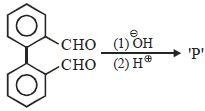
The major product $'P'$ formed in this reaction is:
A
$2$,$2$'-bis(hydroxymethyl)biphenyl
B
$2$,$2$'-biphenyldicarboxylic acid
C
$2-$(hydroxymethyl)biphenyl-$2$'-carboxylic acid
D
$2-$($2$-hydroxyethyl)biphenyl-$2$'-carboxylic acid
Solution
(C) The given reactant is $2,2'$-diformylbiphenyl.
Since both aldehyde groups are attached to the biphenyl system and lack $\alpha$-hydrogens,they undergo an intramolecular Cannizzaro reaction in the presence of a base $(\text{OH}^-)$.
One aldehyde group is reduced to a primary alcohol $(-CH_2OH)$ and the other is oxidized to a carboxylate group $(-COO^-)$.
Upon acidic workup $(\text{H}^+)$,the carboxylate group is protonated to form a carboxylic acid $(-COOH)$.
Thus,the product is $2$-(hydroxymethyl)biphenyl-$2'$-carboxylic acid.
Since both aldehyde groups are attached to the biphenyl system and lack $\alpha$-hydrogens,they undergo an intramolecular Cannizzaro reaction in the presence of a base $(\text{OH}^-)$.
One aldehyde group is reduced to a primary alcohol $(-CH_2OH)$ and the other is oxidized to a carboxylate group $(-COO^-)$.
Upon acidic workup $(\text{H}^+)$,the carboxylate group is protonated to form a carboxylic acid $(-COOH)$.
Thus,the product is $2$-(hydroxymethyl)biphenyl-$2'$-carboxylic acid.
0 likes
View Solution600
MediumMCQ
Arrange the following compounds in decreasing order of reactivity towards nucleophilic addition reaction:
$I: HCHO$
$II: CH_3CHO$
$III: CH_3COCH_3$
$IV: PhCOCH_3$
$I: HCHO$
$II: CH_3CHO$
$III: CH_3COCH_3$
$IV: PhCOCH_3$
A
$I > II > III > IV$
B
$I > II > IV > III$
C
$IV > III > II > I$
D
$II > III > IV > I$
Solution
(A) The reactivity of carbonyl compounds towards nucleophilic addition reaction $(NAR)$ is governed by two main factors:
$1.$ Electronic effect: The presence of electron-donating groups $(EDG)$ decreases the electrophilicity of the carbonyl carbon,thereby reducing reactivity.
$2.$ Steric effect: Increased steric hindrance around the carbonyl carbon hinders the approach of the nucleophile,reducing reactivity.
Comparing the given compounds:
$I: HCHO$ (Formaldehyde) - No $EDG$,least steric hindrance.
$II: CH_3CHO$ (Acetaldehyde) - One $CH_3$ group ($+I$ effect),moderate steric hindrance.
$III: CH_3COCH_3$ (Acetone) - Two $CH_3$ groups ($+I$ effect),higher steric hindrance.
$IV: PhCOCH_3$ (Acetophenone) - One $Ph$ group (strong resonance $EDG$ and bulky),highest steric hindrance.
Thus,the decreasing order of reactivity is $I > II > III > IV$.
$1.$ Electronic effect: The presence of electron-donating groups $(EDG)$ decreases the electrophilicity of the carbonyl carbon,thereby reducing reactivity.
$2.$ Steric effect: Increased steric hindrance around the carbonyl carbon hinders the approach of the nucleophile,reducing reactivity.
Comparing the given compounds:
$I: HCHO$ (Formaldehyde) - No $EDG$,least steric hindrance.
$II: CH_3CHO$ (Acetaldehyde) - One $CH_3$ group ($+I$ effect),moderate steric hindrance.
$III: CH_3COCH_3$ (Acetone) - Two $CH_3$ groups ($+I$ effect),higher steric hindrance.
$IV: PhCOCH_3$ (Acetophenone) - One $Ph$ group (strong resonance $EDG$ and bulky),highest steric hindrance.
Thus,the decreasing order of reactivity is $I > II > III > IV$.
0 likes
View Solution8-1.Aldehydes and Ketones — Properties · Frequently Asked Questions
1Are these 8-1.Aldehydes and Ketones questions useful for JEE and NEET?
Yes. All questions in this section are mapped to JEE Main and NEET exam patterns. Previous year questions from JEE Main, NEET, GUJCET and state-level exams are included with full solutions.
2Can I switch to Hindi or Gujarati for these questions?
Yes. Use the language tabs in the hero section or the sidebar to view the same questions and solutions in English, Hindi or Gujarati.
3How do I generate a question paper from this subtopic?
Use the Vedclass Exam Paper Generator — select the chapter and subtopic, set difficulty, and generate Sets A, B, C, D automatically. First 3 chapters of every subject are free.
Vedclass Products
For Students
Vedclass Test Series
Mock tests in real JEE/NEET style with performance analysis. 5-day free trial.
Start Free TrialFor Teachers
Exam Paper Generator
Generate Set A/B/C/D papers from this chapter in 2 minutes. 3 chapters free.
Try FreeFor Institutes
Online Exam Module
Live online exams with unlimited students, 360° analytics & white-label branding.
See DemoFor Teachers & Institutes
Generate a 8-1.Aldehydes and Ketones Exam Paper in 2 Minutes
Select subtopic & difficulty — Sets A, B, C, D auto-generated with No Repeat logic.
First 3 chapters of every subject are free — no payment required.