
A English
Properties Questions in English
Class 12 Chemistry · 8-1.Aldehydes and Ketones · Properties
1739+
Questions
English
Language
100%
With Solutions
Showing 50 of 1739 questions in English
501
DifficultMCQ
In the given reaction: $C_6H_5-COCH_3 \xrightarrow[(ii) H^{+}]{(i) Br_2/KOH} CHBr_3 + [X]$,$[X]$ will be:
A
$C_6H_5-CHO$
B
$C_6H_5COOH$
C
$C_6H_5-CH_2OH$
D
$CH_3COOH$
Solution
(B) The reaction is a haloform reaction.
Acetophenone $(C_6H_5-COCH_3)$ reacts with $Br_2$ and $KOH$ to form potassium benzoate $(C_6H_5-COOK)$ and bromoform $(CHBr_3)$.
Upon acidification with $H^{+}$,the potassium benzoate is converted to benzoic acid $(C_6H_5COOH)$.
Therefore,$[X]$ is $C_6H_5COOH$.
Acetophenone $(C_6H_5-COCH_3)$ reacts with $Br_2$ and $KOH$ to form potassium benzoate $(C_6H_5-COOK)$ and bromoform $(CHBr_3)$.
Upon acidification with $H^{+}$,the potassium benzoate is converted to benzoic acid $(C_6H_5COOH)$.
Therefore,$[X]$ is $C_6H_5COOH$.
0 likes
View Solution502
DifficultMCQ
The given reaction is: $C_6H_5-CHO + C_6H_5-CHO \xrightarrow{Na_2[Fe(CO)_4]} C_6H_5-COOCH_2-C_6H_5$
A
Claisen reaction
B
Tishchenko reaction
C
Perkin reaction
D
Cannizzaro reaction
Solution
(B) The reaction of two molecules of an aldehyde to form an ester in the presence of a catalyst is known as the Tishchenko reaction.
In this reaction,two molecules of benzaldehyde undergo a disproportionation-like process to form benzyl benzoate $(C_6H_5-COOCH_2-C_6H_5)$.
In this reaction,two molecules of benzaldehyde undergo a disproportionation-like process to form benzyl benzoate $(C_6H_5-COOCH_2-C_6H_5)$.
0 likes
View Solution503
AdvancedMCQ
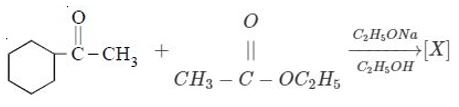
In the given reaction,$[X]$ will be:
A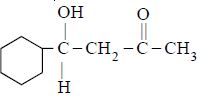
B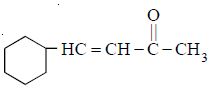
C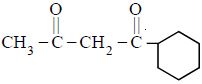
D
$CH_3-C(=O)-CH_2-COOH$
Solution
(C) The reaction is a Claisen-Schmidt condensation (a type of aldol condensation) between a ketone (cyclohexyl methyl ketone) and an ester (ethyl acetate) in the presence of a base $(C_2H_5ONa)$.
However,looking at the reactants,this is a cross-aldol condensation between cyclohexyl methyl ketone and ethyl acetate.
Actually,the reaction shown is a Claisen condensation between cyclohexyl methyl ketone and ethyl acetate.
The base $C_2H_5ONa$ abstracts an $\alpha$-hydrogen from the ketone to form an enolate,which then attacks the carbonyl carbon of the ester.
The product $[X]$ is $1$-cyclohexylbutane-$1,3$-dione,which is $CH_3-C(=O)-CH_2-C(=O)-\text{cyclohexyl}$.
However,looking at the reactants,this is a cross-aldol condensation between cyclohexyl methyl ketone and ethyl acetate.
Actually,the reaction shown is a Claisen condensation between cyclohexyl methyl ketone and ethyl acetate.
The base $C_2H_5ONa$ abstracts an $\alpha$-hydrogen from the ketone to form an enolate,which then attacks the carbonyl carbon of the ester.
The product $[X]$ is $1$-cyclohexylbutane-$1,3$-dione,which is $CH_3-C(=O)-CH_2-C(=O)-\text{cyclohexyl}$.
0 likes
View Solution504
MediumMCQ
In the reaction sequence: $CH_3-CHO$ $\xrightarrow{HCN, OH^{-}} (A)$ $\xrightarrow{H_2O/H^{+}, \Delta} \text{Product}$. The product will be:
A
$CH_3-CH(OH)-COOH$
B
$HOOC-CH(OH)-CH_3$
C
$A$ racemic mixture of $CH_3-CH(OH)-COOH$
D
$CH_3-CH(OH)-CONH_2$
Solution
(C) In the first step,the nucleophilic addition of $CN^{-}$ to the planar carbonyl group of acetaldehyde $(CH_3-CHO)$ occurs.
Since the attack can happen from either side of the $sp^2$ hybridized carbon with equal probability,a racemic mixture of acetaldehyde cyanohydrin $(CH_3-CH(OH)-CN)$ is formed.
In the second step,the acidic hydrolysis of the nitrile group $(-CN)$ converts it into a carboxylic acid group $(-COOH)$ without affecting the chiral center.
Thus,the final product is a racemic mixture of lactic acid ($2$-hydroxypropanoic acid),which consists of both enantiomers: $CH_3-CH(OH)-COOH$ and $HOOC-CH(OH)-CH_3$.
$CH_3-CHO + HCN$ $\xrightarrow{OH^{-}} CH_3-CH(OH)-CN \text{ (Racemic)}$ $\xrightarrow{H_2O/H^{+}, \Delta} CH_3-CH(OH)-COOH \text{ (Racemic)}$
Since the attack can happen from either side of the $sp^2$ hybridized carbon with equal probability,a racemic mixture of acetaldehyde cyanohydrin $(CH_3-CH(OH)-CN)$ is formed.
In the second step,the acidic hydrolysis of the nitrile group $(-CN)$ converts it into a carboxylic acid group $(-COOH)$ without affecting the chiral center.
Thus,the final product is a racemic mixture of lactic acid ($2$-hydroxypropanoic acid),which consists of both enantiomers: $CH_3-CH(OH)-COOH$ and $HOOC-CH(OH)-CH_3$.
$CH_3-CHO + HCN$ $\xrightarrow{OH^{-}} CH_3-CH(OH)-CN \text{ (Racemic)}$ $\xrightarrow{H_2O/H^{+}, \Delta} CH_3-CH(OH)-COOH \text{ (Racemic)}$
0 likes
View Solution505
DifficultMCQ
Which of the following reactions will give $\alpha$-hydroxy acid as a product?
A
$CH_3-CHO \xrightarrow{(i) NaCN/HCl, (ii) H_2O/H^{+}/\Delta}$
B
$CH_3-CHO + Br-CH_2-COOC_2H_5 \xrightarrow{(i) Zn, (ii) NH_4Cl/HOH, (iii) HOH/H^{+}/\Delta}$
C
$X-CH_2-CH_2-COOH \xrightarrow{NaOH/HOH}$
D
All of these
Solution
(A) In reaction $(a)$,acetaldehyde reacts with $NaCN/HCl$ to form acetaldehyde cyanohydrin,which upon acid hydrolysis yields lactic acid,which is an $\alpha$-hydroxy acid: $CH_3-CHO + HCN$ $\rightarrow CH_3-CH(OH)CN$ $\xrightarrow{H_2O/H^{+}/\Delta} CH_3-CH(OH)COOH$.
$(b)$ The Reformatsky reaction yields a $\beta$-hydroxy ester,which upon hydrolysis gives a $\beta$-hydroxy acid.
$(c)$ Nucleophilic substitution of $X$ by $OH^-$ at the $\beta$-carbon yields a $\beta$-hydroxy acid.
$(b)$ The Reformatsky reaction yields a $\beta$-hydroxy ester,which upon hydrolysis gives a $\beta$-hydroxy acid.
$(c)$ Nucleophilic substitution of $X$ by $OH^-$ at the $\beta$-carbon yields a $\beta$-hydroxy acid.
0 likes
View Solution506
AdvancedMCQ
In the given reaction: $CH_3-CH(CH_3)-CO-CH_2-CH_3 \xrightarrow{CF_3COOOH} [X]$ as the main product. $[X]$ will be:
A
$CH_3-CH_2-COO-CH(CH_3)_2$
B
$CH_3-CH(CH_3)-COO-CH_2-CH_3$
C
$CH_3-COO-C(CH_3)_3$
D
$(CH_3)_3C-COO-CH_3$
Solution
(A) This is a $Baeyer-Villiger$ oxidation reaction.
The migratory aptitude of groups is $3^\circ > 2^\circ > 1^\circ > \text{methyl}$.
In the ketone $CH_3-CH(CH_3)-CO-CH_2-CH_3$,the groups attached to the carbonyl carbon are isopropyl $(2^\circ)$ and ethyl $(1^\circ)$.
Since the isopropyl group has a higher migratory aptitude than the ethyl group,the oxygen atom inserts between the carbonyl carbon and the isopropyl group.
The resulting ester is $CH_3-CH_2-COO-CH(CH_3)_2$,which is equivalent to $CH_3-CH_2-COO-CH(CH_3)-CH_3$.
The migratory aptitude of groups is $3^\circ > 2^\circ > 1^\circ > \text{methyl}$.
In the ketone $CH_3-CH(CH_3)-CO-CH_2-CH_3$,the groups attached to the carbonyl carbon are isopropyl $(2^\circ)$ and ethyl $(1^\circ)$.
Since the isopropyl group has a higher migratory aptitude than the ethyl group,the oxygen atom inserts between the carbonyl carbon and the isopropyl group.
The resulting ester is $CH_3-CH_2-COO-CH(CH_3)_2$,which is equivalent to $CH_3-CH_2-COO-CH(CH_3)-CH_3$.
0 likes
View Solution507
MediumMCQ
Which one of the following reactions can be used for the preparation of $\beta$-hydroxy acid derivatives?
A
Perkin reaction
B
Reformatsky reaction
C
Aldol condensation
D
Claisen condensation
Solution
(B) The Reformatsky reaction involves the condensation of an aldehyde or ketone with an $\alpha$-halo ester in the presence of zinc metal to produce a $\beta$-hydroxy ester.
Upon hydrolysis,the $\beta$-hydroxy ester yields a $\beta$-hydroxy acid.
The general reaction is:
$R_2C=O + BrCH_2COOR'$ $\xrightarrow{Zn} R_2C(OH)CH_2COOR'$ $\xrightarrow{H_3O^+} R_2C(OH)CH_2COOH$.
Upon hydrolysis,the $\beta$-hydroxy ester yields a $\beta$-hydroxy acid.
The general reaction is:
$R_2C=O + BrCH_2COOR'$ $\xrightarrow{Zn} R_2C(OH)CH_2COOR'$ $\xrightarrow{H_3O^+} R_2C(OH)CH_2COOH$.
0 likes
View Solution508
AdvancedMCQ
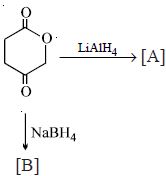
In the given reaction,$[A]$ and $[B]$ are respectively:
A
$HO-CH_2-CH_2-CH_2-CH(OH)-CH_2-OH$ and $4-$hydroxytetrahydropyran$-2-$one
B
$4-$hydroxytetrahydropyran$-2-$one and $HO-CH_2-CH_2-CH_2-CH(OH)-CH_2-OH$
C
Both are $4-$hydroxytetrahydropyran$-2-$one
D
Both are $HO-CH_2-CH_2-CH_2-CH(OH)-CH_2-OH$
Solution
(A) $LiAlH_4$ is a strong reducing agent that reduces both the ester and the ketone functional groups in the cyclic lactone to alcohols,resulting in the ring-opening product $HO-CH_2-CH_2-CH_2-CH(OH)-CH_2-OH$ (pentane$-1,2,5-$triol).
$NaBH_4$ is a milder reducing agent that selectively reduces the ketone group while leaving the ester group intact,resulting in the cyclic product $4-$hydroxytetrahydropyran$-2-$one.
Therefore,$[A]$ is $HO-CH_2-CH_2-CH_2-CH(OH)-CH_2-OH$ and $[B]$ is $4-$hydroxytetrahydropyran$-2-$one.
$NaBH_4$ is a milder reducing agent that selectively reduces the ketone group while leaving the ester group intact,resulting in the cyclic product $4-$hydroxytetrahydropyran$-2-$one.
Therefore,$[A]$ is $HO-CH_2-CH_2-CH_2-CH(OH)-CH_2-OH$ and $[B]$ is $4-$hydroxytetrahydropyran$-2-$one.
0 likes
View Solution509
DifficultMCQ
In the given reaction :
$CH_3CHO$ $\xrightarrow[(i) \ NaCN/HCl]{(ii) \ H_2O/H^{\oplus}/\Delta} (A)$ $\xrightarrow[reagent]{Fenton} (B)$
$(B)$ will be :
$CH_3CHO$ $\xrightarrow[(i) \ NaCN/HCl]{(ii) \ H_2O/H^{\oplus}/\Delta} (A)$ $\xrightarrow[reagent]{Fenton} (B)$
$(B)$ will be :
A
Acetic acid
B
Oxalic acid
C
Pyruvic acid
D
Citric acid
Solution
(C) The reaction of acetaldehyde $(CH_3CHO)$ with $NaCN/HCl$ forms acetaldehyde cyanohydrin.
Subsequent hydrolysis of the cyano group in the presence of $H_2O/H^{\oplus}/\Delta$ yields compound $(A)$,which is $2-hydroxy$ propanoic acid $(CH_3CH(OH)COOH)$.
The hydroxyl group in $(A)$ is then oxidized to a carbonyl group using Fenton reagent $(Fe^{2+}/H_2O_2)$ to obtain compound $(B)$,which is Pyruvic acid $(CH_3COCOOH)$.
Subsequent hydrolysis of the cyano group in the presence of $H_2O/H^{\oplus}/\Delta$ yields compound $(A)$,which is $2-hydroxy$ propanoic acid $(CH_3CH(OH)COOH)$.
The hydroxyl group in $(A)$ is then oxidized to a carbonyl group using Fenton reagent $(Fe^{2+}/H_2O_2)$ to obtain compound $(B)$,which is Pyruvic acid $(CH_3COCOOH)$.
0 likes
View Solution510
AdvancedMCQ
The reaction sequence is as follows:
$Cyclopentanecarboxamide$ $\xrightarrow{P_2O_5, \Delta} W$ $\xrightarrow{CH_3MgBr, H_3^+O} X$ $\xrightarrow{Ca(OH)_2, I_2 (\text{yellow ppt.})} Y$ $\xrightarrow{\Delta} Z$
$Z$ is:
$Cyclopentanecarboxamide$ $\xrightarrow{P_2O_5, \Delta} W$ $\xrightarrow{CH_3MgBr, H_3^+O} X$ $\xrightarrow{Ca(OH)_2, I_2 (\text{yellow ppt.})} Y$ $\xrightarrow{\Delta} Z$
$Z$ is:
A
Cyclopentyl methyl ketone
B
Cyclopentyl carboxylic acid
C
Cyclopentyl amide
D
Dicyclopentyl ketone
0 likes
View Solution511
AdvancedMCQ
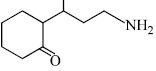
Reductive amination of $A$ forms :
$A$ :
$A$ :
A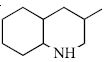
B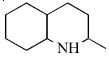
C
D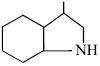
Solution
(D) Reductive amination involves the reaction of a carbonyl compound with an amine to form an imine,which is then reduced to an amine.
In the given molecule $A$,there is a ketone group and a primary amine group in the same molecule.
This allows for an intramolecular reductive amination.
The carbonyl oxygen reacts with the primary amine group to form a cyclic imine intermediate.
Reduction of this imine leads to the formation of a bicyclic amine.
Specifically,the $2$-substituted cyclohexanone derivative undergoes cyclization to form a $1$-methyl$-2-$azabicyclo[$4.4$.$0$]decane or similar bicyclic structure depending on the chain length.
Based on the structure of $A$,the cyclization results in the formation of the bicyclic amine shown in option $D$.
In the given molecule $A$,there is a ketone group and a primary amine group in the same molecule.
This allows for an intramolecular reductive amination.
The carbonyl oxygen reacts with the primary amine group to form a cyclic imine intermediate.
Reduction of this imine leads to the formation of a bicyclic amine.
Specifically,the $2$-substituted cyclohexanone derivative undergoes cyclization to form a $1$-methyl$-2-$azabicyclo[$4.4$.$0$]decane or similar bicyclic structure depending on the chain length.
Based on the structure of $A$,the cyclization results in the formation of the bicyclic amine shown in option $D$.
0 likes
View Solution512
MediumMCQ
In the reaction sequence $C_6H_5-CH(OH)-CH_2-C(=O)-CH_3 \xrightarrow{(i) NaOBr, (ii) H_2O/H^{+}, (iii) \Delta}$ product,the product will be:
A
$C_6H_5-CH(OH)-CH_2-COOH$
B
$C_6H_5-COOH, HOOC-COOH$ and $CHBr_3$
C
$C_6H_5-C(=O)-CH_3$ and $CHBr_3$
D
Only $CHBr_3$
Solution
(C) $(i)$ $NaOBr$ acts as an oxidizing agent and a haloform reagent. It oxidizes the secondary alcohol to a ketone: $C_6H_5-CH(OH)-CH_2-C(=O)-CH_3 \xrightarrow{NaOBr} C_6H_5-C(=O)-CH_2-C(=O)-CH_3$. Then,the methyl ketone group undergoes the haloform reaction: $C_6H_5-C(=O)-CH_2-C(=O)-CH_3 \xrightarrow{NaOBr} C_6H_5-C(=O)-CH_2-COO^{-} + CHBr_3$.
$(ii)$ Acidification converts the salt to a $\beta$-keto acid: $C_6H_5-C(=O)-CH_2-COO^{-} \xrightarrow{H^{+}} C_6H_5-C(=O)-CH_2-COOH$.
$(iii)$ Heating $(\Delta)$ causes the $\beta$-keto acid to undergo decarboxylation: $C_6H_5-C(=O)-CH_2-COOH \xrightarrow{\Delta} C_6H_5-C(=O)-CH_3 + CO_2$.
The final products are acetophenone $(C_6H_5-C(=O)-CH_3)$ and bromoform $(CHBr_3)$.
$(ii)$ Acidification converts the salt to a $\beta$-keto acid: $C_6H_5-C(=O)-CH_2-COO^{-} \xrightarrow{H^{+}} C_6H_5-C(=O)-CH_2-COOH$.
$(iii)$ Heating $(\Delta)$ causes the $\beta$-keto acid to undergo decarboxylation: $C_6H_5-C(=O)-CH_2-COOH \xrightarrow{\Delta} C_6H_5-C(=O)-CH_3 + CO_2$.
The final products are acetophenone $(C_6H_5-C(=O)-CH_3)$ and bromoform $(CHBr_3)$.
0 likes
View Solution513
DifficultMCQ
The major product of the following reaction is:
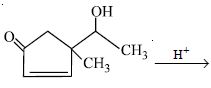
A
$3,4-$dimethylcyclopent$-2-$en$-1-$one
B
$3-$isopropylcyclopent$-2-$en$-1-$one
C
$3,4-$dimethylphenol
D
$5-$isopropylidenecyclopent$-2-$en$-1-$ol
Solution
(B) The reaction involves the acid-catalyzed dehydration of a $\beta$-hydroxy ketone.
$1$. The hydroxyl group $(-OH)$ is protonated by $H^+$ to form a good leaving group $(-OH_2^+)$.
$2$. Water is eliminated,creating a carbocation at the carbon atom.
$3$. The carbocation undergoes rearrangement or elimination to form a stable conjugated system.
$4$. In this specific case,the elimination of water leads to the formation of a double bond conjugated with the carbonyl group,resulting in $3$-isopropylcyclopent-$2$-en-$1$-one as the major product.
$1$. The hydroxyl group $(-OH)$ is protonated by $H^+$ to form a good leaving group $(-OH_2^+)$.
$2$. Water is eliminated,creating a carbocation at the carbon atom.
$3$. The carbocation undergoes rearrangement or elimination to form a stable conjugated system.
$4$. In this specific case,the elimination of water leads to the formation of a double bond conjugated with the carbonyl group,resulting in $3$-isopropylcyclopent-$2$-en-$1$-one as the major product.
0 likes
View Solution514
MediumMCQ
The reaction of cyclopentanone with $NaOBr$ gives which product?
$\text{Cyclopentanone} \xrightarrow{NaOBr} \text{Product}$
$\text{Cyclopentanone} \xrightarrow{NaOBr} \text{Product}$
A
$1-$hydroxycyclopentanecarboxylic acid
B
$2-$bromo$-1-$hydroxycyclopentanecarboxylic acid
C
$2-$bromo$-1-$hydroxycyclopentanone
D
None of these
Solution
(D) The reagent $NaOBr$ (sodium hypobromite) is a source of $Br_2$ in basic medium $(NaOH)$.
Cyclopentanone is a ketone with $\alpha$-hydrogens. In the presence of $NaOBr$,it undergoes the haloform reaction or $\alpha$-halogenation depending on the conditions.
However,for a simple ketone like cyclopentanone,$NaOBr$ typically leads to the formation of $\alpha$-bromo derivatives. Specifically,the reaction of cyclopentanone with $NaOBr$ results in the formation of $2$-bromocyclopentanone.
Looking at the provided options,none of the structures correctly represent the expected product of the reaction between cyclopentanone and $NaOBr$. Therefore,the correct answer is $D$.
Cyclopentanone is a ketone with $\alpha$-hydrogens. In the presence of $NaOBr$,it undergoes the haloform reaction or $\alpha$-halogenation depending on the conditions.
However,for a simple ketone like cyclopentanone,$NaOBr$ typically leads to the formation of $\alpha$-bromo derivatives. Specifically,the reaction of cyclopentanone with $NaOBr$ results in the formation of $2$-bromocyclopentanone.
Looking at the provided options,none of the structures correctly represent the expected product of the reaction between cyclopentanone and $NaOBr$. Therefore,the correct answer is $D$.
0 likes
View Solution515
DifficultMCQ
$A$ $(C_3H_6O)$ $\xrightarrow{NaCN/H_2SO_4}$ cyanohydrin of $A$. If the cyanohydrin is optically active,then the possible structure of $A$ is:
A
Propanal $(CH_3CH_2CHO)$
B
Propanone $(CH_3COCH_3)$
C
Cyclopropanol
D
Oxetane
Solution
(A) The molecular formula $C_3H_6O$ corresponds to either an aldehyde or a ketone. The reaction with $NaCN/H_2SO_4$ is the formation of a cyanohydrin from a carbonyl compound.
$1$. Propanal $(CH_3CH_2CHO)$ reacts with $HCN$ to form $CH_3CH_2CH(OH)CN$. This molecule has a chiral carbon atom (the carbon attached to $-OH$,$-CN$,$-H$,and $-CH_2CH_3$),making it optically active.
$2$. Propanone $(CH_3COCH_3)$ reacts with $HCN$ to form $CH_3C(OH)(CN)CH_3$. This molecule is symmetric and achiral,so it is optically inactive.
$3$. Cyclopropanol and oxetane are not carbonyl compounds and do not form cyanohydrins under these conditions.
Therefore,the correct structure for $A$ is propanal.
$1$. Propanal $(CH_3CH_2CHO)$ reacts with $HCN$ to form $CH_3CH_2CH(OH)CN$. This molecule has a chiral carbon atom (the carbon attached to $-OH$,$-CN$,$-H$,and $-CH_2CH_3$),making it optically active.
$2$. Propanone $(CH_3COCH_3)$ reacts with $HCN$ to form $CH_3C(OH)(CN)CH_3$. This molecule is symmetric and achiral,so it is optically inactive.
$3$. Cyclopropanol and oxetane are not carbonyl compounds and do not form cyanohydrins under these conditions.
Therefore,the correct structure for $A$ is propanal.
0 likes
View Solution516
MediumMCQ
Which of the following has minimum reactivity towards nucleophiles?
A
$CH_2O$
B
$CH_3CHO$
C
$CH_3COCH_3$
D
$CH_3COCH_2CH_3$
Solution
(D) The reactivity of carbonyl compounds towards nucleophilic addition reactions decreases as the number and size of alkyl groups attached to the carbonyl carbon increase.
This is due to the $+I$ effect,which reduces the partial positive charge on the carbonyl carbon,and steric hindrance,which blocks the approach of the nucleophile.
Comparing the options: $CH_2O$ (formaldehyde) has no alkyl groups,$CH_3CHO$ (acetaldehyde) has one methyl group,$CH_3COCH_3$ (acetone) has two methyl groups,and $CH_3COCH_2CH_3$ (butanone) has one methyl and one ethyl group.
Since the ethyl group is larger than the methyl group,$CH_3COCH_2CH_3$ provides the greatest steric hindrance and electronic stabilization of the carbonyl carbon,making it the least reactive towards nucleophiles.
This is due to the $+I$ effect,which reduces the partial positive charge on the carbonyl carbon,and steric hindrance,which blocks the approach of the nucleophile.
Comparing the options: $CH_2O$ (formaldehyde) has no alkyl groups,$CH_3CHO$ (acetaldehyde) has one methyl group,$CH_3COCH_3$ (acetone) has two methyl groups,and $CH_3COCH_2CH_3$ (butanone) has one methyl and one ethyl group.
Since the ethyl group is larger than the methyl group,$CH_3COCH_2CH_3$ provides the greatest steric hindrance and electronic stabilization of the carbonyl carbon,making it the least reactive towards nucleophiles.
0 likes
View Solution517
MediumMCQ
Which of the following compounds has the greatest extent of hydration?
A
Cyclohexanone
B
$2-$Bromocyclohexanone
C
$1-$Bromocyclohexanecarbaldehyde
D
All are equal
Solution
(C) The extent of hydration of a carbonyl compound depends on the electrophilicity of the carbonyl carbon and steric hindrance.
Electron-withdrawing groups (like $-Br$) increase the electrophilicity of the carbonyl carbon,thereby increasing the equilibrium constant for hydration.
$A$: Cyclohexanone has no electron-withdrawing group.
$B$: $2$-Bromocyclohexanone has an electron-withdrawing $-Br$ group at the $\alpha$-position,which increases the electrophilicity of the carbonyl carbon.
$C$: $1$-Bromocyclohexanecarbaldehyde is an aldehyde. Aldehydes are generally more reactive towards nucleophilic addition than ketones due to less steric hindrance and higher electrophilicity of the carbonyl carbon. Additionally,the presence of the $-Br$ group further increases the electrophilicity.
Therefore,$1$-Bromocyclohexanecarbaldehyde will have the greatest extent of hydration.
Electron-withdrawing groups (like $-Br$) increase the electrophilicity of the carbonyl carbon,thereby increasing the equilibrium constant for hydration.
$A$: Cyclohexanone has no electron-withdrawing group.
$B$: $2$-Bromocyclohexanone has an electron-withdrawing $-Br$ group at the $\alpha$-position,which increases the electrophilicity of the carbonyl carbon.
$C$: $1$-Bromocyclohexanecarbaldehyde is an aldehyde. Aldehydes are generally more reactive towards nucleophilic addition than ketones due to less steric hindrance and higher electrophilicity of the carbonyl carbon. Additionally,the presence of the $-Br$ group further increases the electrophilicity.
Therefore,$1$-Bromocyclohexanecarbaldehyde will have the greatest extent of hydration.
0 likes
View Solution518
AdvancedMCQ
Which of the following statements is wrong?
A
All carbonyl compounds of the general structure $CH_3-C(=O)-R$ give a positive iodoform test.
B
All secondary alcohols give iodoform reaction.
C
Alkanols of the structure $CH_3-CH(OH)-R$ (where $R = H,$ alkyl or aryl) give iodoform reaction.
D
The only aldehyde giving iodoform reaction is acetaldehyde.
Solution
(B) All secondary alcohols do not give the iodoform test.
Only those secondary alcohols which contain a methyl group attached to the carbon atom having the hydroxyl group $(CH_3-CH(OH)-R)$ give a positive iodoform test.
For example,$3-pentanol$ $(CH_3-CH_2-CH(OH)-CH_2-CH_3)$ does not give this test.
Only those secondary alcohols which contain a methyl group attached to the carbon atom having the hydroxyl group $(CH_3-CH(OH)-R)$ give a positive iodoform test.
For example,$3-pentanol$ $(CH_3-CH_2-CH(OH)-CH_2-CH_3)$ does not give this test.
0 likes
View Solution519
EasyMCQ
The appropriate naming for the second step in the haloform reaction is:
A
Halogenation
B
Dehydrohalogenation
C
Reduction
D
Dehydrogenation
Solution
(B) The haloform reaction involves three main steps:
$1$. $\alpha$-halogenation: The $\alpha$-hydrogens of the carbonyl compound are replaced by halogen atoms.
$2$. Hydrolysis (or cleavage): The trihalomethyl ketone formed in the first step undergoes nucleophilic attack by $OH^-$ followed by the cleavage of the $C-C$ bond to produce a carboxylate ion and a haloform $(CHX_3)$.
$3$. Acid-base reaction: The haloform is formed.
However, in many textbooks, the process of forming the haloform from the trihalomethyl intermediate is often categorized under the broader mechanism of nucleophilic acyl substitution or simply the cleavage step. Given the options provided, the reaction sequence is often described as $\alpha$-halogenation followed by the cleavage/hydrolysis step. Since the question asks for the naming of the second step in the context of the haloform reaction mechanism, and considering the options, the most accurate description of the transformation of the trihalomethyl ketone is the cleavage step, which is a type of nucleophilic substitution. If we look at the options, none perfectly describe the cleavage, but the reaction is often taught as $\alpha$-halogenation followed by the formation of the haloform. Given the standard options, if the question implies the overall process, the second step is the cleavage of the $C-C$ bond.
$1$. $\alpha$-halogenation: The $\alpha$-hydrogens of the carbonyl compound are replaced by halogen atoms.
$2$. Hydrolysis (or cleavage): The trihalomethyl ketone formed in the first step undergoes nucleophilic attack by $OH^-$ followed by the cleavage of the $C-C$ bond to produce a carboxylate ion and a haloform $(CHX_3)$.
$3$. Acid-base reaction: The haloform is formed.
However, in many textbooks, the process of forming the haloform from the trihalomethyl intermediate is often categorized under the broader mechanism of nucleophilic acyl substitution or simply the cleavage step. Given the options provided, the reaction sequence is often described as $\alpha$-halogenation followed by the cleavage/hydrolysis step. Since the question asks for the naming of the second step in the context of the haloform reaction mechanism, and considering the options, the most accurate description of the transformation of the trihalomethyl ketone is the cleavage step, which is a type of nucleophilic substitution. If we look at the options, none perfectly describe the cleavage, but the reaction is often taught as $\alpha$-halogenation followed by the formation of the haloform. Given the standard options, if the question implies the overall process, the second step is the cleavage of the $C-C$ bond.
0 likes
View Solution520
MediumMCQ
Consider the following reaction sequence:
$B \xleftarrow{NaBH_4} CH_2=CH-CHO \xrightarrow{H_2/Pt} A$
Identify $A$ and $B$.
$B \xleftarrow{NaBH_4} CH_2=CH-CHO \xrightarrow{H_2/Pt} A$
Identify $A$ and $B$.
A
$CH_3-CH_2-CHO, CH_2=CH-CH_2OH$
B
$CH_3-CH_2-CH_2OH, CH_2=CH-CH_2OH$
C
$CH_2=CH-CH_2OH$ in both cases
D
$CH_3-CH_2-CH_2OH$ in both cases
Solution
(B) $NaBH_4$ is a selective reducing agent that reduces aldehydes and ketones to alcohols but does not reduce carbon-carbon double bonds $(C=C)$.
Therefore,$CH_2=CH-CHO \xrightarrow{NaBH_4} CH_2=CH-CH_2OH$ ($B$ is allyl alcohol).
$H_2/Pt$ is a strong reducing agent that reduces both aldehydes/ketones and carbon-carbon double bonds $(C=C)$.
Therefore,$CH_2=CH-CHO \xrightarrow{H_2/Pt} CH_3-CH_2-CH_2OH$ ($A$ is propan$-1-$ol).
Thus,$A$ is $CH_3-CH_2-CH_2OH$ and $B$ is $CH_2=CH-CH_2OH$.
Therefore,$CH_2=CH-CHO \xrightarrow{NaBH_4} CH_2=CH-CH_2OH$ ($B$ is allyl alcohol).
$H_2/Pt$ is a strong reducing agent that reduces both aldehydes/ketones and carbon-carbon double bonds $(C=C)$.
Therefore,$CH_2=CH-CHO \xrightarrow{H_2/Pt} CH_3-CH_2-CH_2OH$ ($A$ is propan$-1-$ol).
Thus,$A$ is $CH_3-CH_2-CH_2OH$ and $B$ is $CH_2=CH-CH_2OH$.
0 likes
View Solution521
AdvancedMCQ
What is the product of the following reaction?
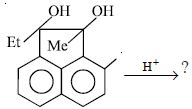
A
B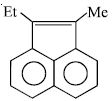
C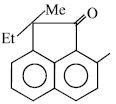
D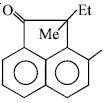
Solution
(C) The given reactant is a vicinal diol (pinacol). In the presence of an acid catalyst $(H^+)$,it undergoes a pinacol-pinacolone rearrangement.
$1$. Protonation of one of the hydroxyl groups occurs.
$2$. Loss of water leads to the formation of a carbocation.
$3$. $A$ $1,2-$alkyl shift occurs to stabilize the carbocation and form a more stable oxocarbocation.
$4$. Deprotonation yields the final ketone product.
Given the structure,the migration of the ethyl group $(Et)$ is preferred over the methyl group $(Me)$ due to its higher migratory aptitude. Thus,the product is the ketone where the $Et$ group has shifted,resulting in the structure shown in option $C$.
$1$. Protonation of one of the hydroxyl groups occurs.
$2$. Loss of water leads to the formation of a carbocation.
$3$. $A$ $1,2-$alkyl shift occurs to stabilize the carbocation and form a more stable oxocarbocation.
$4$. Deprotonation yields the final ketone product.
Given the structure,the migration of the ethyl group $(Et)$ is preferred over the methyl group $(Me)$ due to its higher migratory aptitude. Thus,the product is the ketone where the $Et$ group has shifted,resulting in the structure shown in option $C$.
0 likes
View Solution522
DifficultMCQ
The reaction of $1-(\text{aminomethyl})cyclohexan-1-ol$ with $NaNO_2/HCl$ gives $A$. Identify $A$.
A
$1-$(hydroxymethyl)cyclohexan$-1-$ol
B
$1-$(chloromethyl)cyclohexan$-1-$ol
C
$1-$(nitromethyl)cyclohexan$-1-$ol
D
cyclohexanone
Solution
(D) The reaction of a primary aliphatic amine with nitrous acid $(NaNO_2 + HCl)$ produces a highly unstable diazonium salt.
This diazonium salt rapidly undergoes decomposition to form a carbocation,which then undergoes rearrangement or elimination to form a stable product.
In this specific case,the $1-(\text{aminomethyl})cyclohexan-1-ol$ reacts with $NaNO_2/HCl$ to form a diazonium salt at the $-\text{CH}_2\text{NH}_2$ group.
The resulting carbocation undergoes a ring expansion (Tiffeneau-Demjanov rearrangement) to form a seven-membered ring ketone,which is cycloheptanone.
This diazonium salt rapidly undergoes decomposition to form a carbocation,which then undergoes rearrangement or elimination to form a stable product.
In this specific case,the $1-(\text{aminomethyl})cyclohexan-1-ol$ reacts with $NaNO_2/HCl$ to form a diazonium salt at the $-\text{CH}_2\text{NH}_2$ group.
The resulting carbocation undergoes a ring expansion (Tiffeneau-Demjanov rearrangement) to form a seven-membered ring ketone,which is cycloheptanone.
0 likes
View Solution523
MediumMCQ
Benzene on reaction with $A$ forms acetophenone,which on reaction with $B$ forms ethylbenzene. $A$ and $B$ are:
A
$CH_3COCl/AlCl_3, Zn(Hg)/conc. HCl$
B
$CH_3Cl/AlCl_3, LiAlH_4$
C
$CH_3COCl/AlCl_3, NaBH_4$
D
$CH_3Cl/AlCl_3, Zn(Hg)/conc. HCl$
Solution
(A) $1$. Benzene reacts with acetyl chloride $(CH_3COCl)$ in the presence of anhydrous $AlCl_3$ (Friedel-Crafts acylation) to form acetophenone $(C_6H_5COCH_3)$. Thus,$A = CH_3COCl/AlCl_3$.
$2$. Acetophenone on reduction with $Zn(Hg)/conc. HCl$ (Clemmensen reduction) yields ethylbenzene $(C_6H_5CH_2CH_3)$. Thus,$B = Zn(Hg)/conc. HCl$.
$2$. Acetophenone on reduction with $Zn(Hg)/conc. HCl$ (Clemmensen reduction) yields ethylbenzene $(C_6H_5CH_2CH_3)$. Thus,$B = Zn(Hg)/conc. HCl$.
0 likes
View Solution524
MediumMCQ
Which pair never represents $X$ and $Y$ in the following reaction?
Reaction: $X \xrightarrow{Y} CHCl_3 + Z$
Reaction: $X \xrightarrow{Y} CHCl_3 + Z$
A
$2$-Butanol,$NaOCl$
B
Ethanol,aq. $CaOCl_2$
C
Butanone,$NaOH / Cl_2$
D
Ethanol,$NaCl$
Solution
(D) The reaction $X \xrightarrow{Y} CHCl_3 + Z$ represents the haloform reaction.
For a compound to undergo the haloform reaction,it must contain either a $CH_3CO-$ group or a $CH_3CH(OH)-$ group.
$A$. $2$-Butanol $(CH_3CH(OH)CH_2CH_3)$ contains the $CH_3CH(OH)-$ group and $NaOCl$ provides the halogen source,so it gives the haloform reaction.
$B$. Ethanol $(CH_3CH_2OH)$ contains the $CH_3CH(OH)-$ group and $CaOCl_2$ provides the halogen source,so it gives the haloform reaction.
$C$. Butanone $(CH_3COCH_2CH_3)$ contains the $CH_3CO-$ group and $NaOH / Cl_2$ provides the halogen source,so it gives the haloform reaction.
$D$. Ethanol $(CH_3CH_2OH)$ is a valid substrate,but $NaCl$ is not an oxidizing/halogenating agent capable of performing the haloform reaction. Therefore,this pair does not represent the reaction.
For a compound to undergo the haloform reaction,it must contain either a $CH_3CO-$ group or a $CH_3CH(OH)-$ group.
$A$. $2$-Butanol $(CH_3CH(OH)CH_2CH_3)$ contains the $CH_3CH(OH)-$ group and $NaOCl$ provides the halogen source,so it gives the haloform reaction.
$B$. Ethanol $(CH_3CH_2OH)$ contains the $CH_3CH(OH)-$ group and $CaOCl_2$ provides the halogen source,so it gives the haloform reaction.
$C$. Butanone $(CH_3COCH_2CH_3)$ contains the $CH_3CO-$ group and $NaOH / Cl_2$ provides the halogen source,so it gives the haloform reaction.
$D$. Ethanol $(CH_3CH_2OH)$ is a valid substrate,but $NaCl$ is not an oxidizing/halogenating agent capable of performing the haloform reaction. Therefore,this pair does not represent the reaction.
0 likes
View Solution525
MediumMCQ
Based on the reaction sequence shown,select the incorrect statement about $P_2$. The reaction starts with cyclohexanone reacting with $Mg-Hg/H_2O$ to form $P_1$,which then reacts with conc. $H_2SO_4$ and heat to form $P_2$.
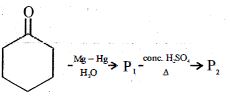
A
$P_2$ is a spiro compound
B
$P_2$ is a cyclic ketone
C
$P_2$ has $3$ degree of unsaturation
D
$P_2$ is a bicyclo hydrocarbon
Solution
(D) $1$. The reaction of cyclohexanone with $Mg-Hg/H_2O$ is a pinacol reduction,which produces pinacol ($1$,$1$'-bi(cyclohexyl)-$1$,$1$'-diol) as $P_1$.
$2$. Treatment of $P_1$ with conc. $H_2SO_4$ and heat leads to pinacol-pinacolone rearrangement,resulting in the formation of $P_2$ (dicyclohexyl ketone derivative or similar rearranged product depending on specific conditions,but typically leads to a ketone).
$3$. $P_2$ is a ketone,so it is not a hydrocarbon. Therefore,the statement '$P_2$ is a bicyclo hydrocarbon' is incorrect.
$2$. Treatment of $P_1$ with conc. $H_2SO_4$ and heat leads to pinacol-pinacolone rearrangement,resulting in the formation of $P_2$ (dicyclohexyl ketone derivative or similar rearranged product depending on specific conditions,but typically leads to a ketone).
$3$. $P_2$ is a ketone,so it is not a hydrocarbon. Therefore,the statement '$P_2$ is a bicyclo hydrocarbon' is incorrect.
0 likes
View Solution526
DifficultMCQ
How many total oximes are possible for ketones having molecular formula $C_3H_6O$,$C_4H_8O$ and $C_5H_{10}O$?
A
$4$
B
$5$
C
$7$
D
$8$
Solution
(D) For $C_3H_6O$ (Acetone): $CH_3COCH_3$ gives $1$ oxime (no geometrical isomerism).
For $C_4H_8O$ (Butanone): $CH_3COCH_2CH_3$ gives $2$ oximes (syn and anti isomers).
For $C_5H_{10}O$ (Pentan$-2-$one,Pentan$-3-$one,$3$-Methylbutan$-2-$one):
$CH_3COCH_2CH_2CH_3$ gives $2$ oximes (syn and anti).
$CH_3CH_2COCH_2CH_3$ gives $1$ oxime (no geometrical isomerism).
$CH_3COCH(CH_3)_2$ gives $2$ oximes (syn and anti).
Total oximes = $1 + 2 + 2 + 1 + 2 = 8$.
For $C_4H_8O$ (Butanone): $CH_3COCH_2CH_3$ gives $2$ oximes (syn and anti isomers).
For $C_5H_{10}O$ (Pentan$-2-$one,Pentan$-3-$one,$3$-Methylbutan$-2-$one):
$CH_3COCH_2CH_2CH_3$ gives $2$ oximes (syn and anti).
$CH_3CH_2COCH_2CH_3$ gives $1$ oxime (no geometrical isomerism).
$CH_3COCH(CH_3)_2$ gives $2$ oximes (syn and anti).
Total oximes = $1 + 2 + 2 + 1 + 2 = 8$.
0 likes
View Solution527
AdvancedMCQ
What will be the product obtained when formaldehyde is treated with conc. $NaOD$ followed by treatment with conc. $H_2SO_4$?
A
$H-C(=O)-O^-Na^+ + CH_3-OD$
B
$H-C(=O)-OH + CH_3-OD$
C
$H-C(=O)-OCH_3$
D
$D-C(=O)-OCH_3$
Solution
(C) Formaldehyde $(HCHO)$ undergoes the Cannizzaro reaction when treated with concentrated $NaOD$:
$2HCHO + NaOD \rightarrow HCOONa + CH_3OD$
Subsequent treatment with concentrated $H_2SO_4$ causes acidification of the salt to form formic acid $(HCOOH)$ and then promotes esterification between $HCOOH$ and $CH_3OD$:
$HCOONa + H_2SO_4 \rightarrow HCOOH + NaHSO_4$
$HCOOH + CH_3OD \xrightarrow{H_2SO_4} HCOOCH_3 + HDO$
The final product is methyl formate $(H-C(=O)-OCH_3)$.
$2HCHO + NaOD \rightarrow HCOONa + CH_3OD$
Subsequent treatment with concentrated $H_2SO_4$ causes acidification of the salt to form formic acid $(HCOOH)$ and then promotes esterification between $HCOOH$ and $CH_3OD$:
$HCOONa + H_2SO_4 \rightarrow HCOOH + NaHSO_4$
$HCOOH + CH_3OD \xrightarrow{H_2SO_4} HCOOCH_3 + HDO$
The final product is methyl formate $(H-C(=O)-OCH_3)$.
0 likes
View Solution528
MediumMCQ
Which of the following statements is $INCORRECT$?
A
Antiperiplanar transition state is involved in $S_N2$
B
$E_1CB$ involves carbanion intermediate
C
Ethene is formed when ethanol at $443 \ K$ is heated with an excess of concentrated sulphuric acid.
D
Acetone can not undergo Cannizzaro reaction
Solution
(A) Option $A$ is $INCORRECT$ because the $S_N2$ reaction mechanism involves a pentacoordinate transition state where the nucleophile attacks from the backside,but it does not specifically require an antiperiplanar transition state; antiperiplanar geometry is a requirement for $E_2$ elimination reactions.
Option $B$ is correct as $E_1CB$ (Elimination Unimolecular Conjugate Base) proceeds via a carbanion intermediate.
Option $C$ is correct as ethanol undergoes dehydration in the presence of concentrated $H_2SO_4$ at $443 \ K$ to form ethene.
Option $D$ is correct as Cannizzaro reaction is given only by aldehydes that do not have $\alpha$-hydrogen atoms. Acetone has $\alpha$-hydrogens,so it does not undergo the Cannizzaro reaction.
Option $B$ is correct as $E_1CB$ (Elimination Unimolecular Conjugate Base) proceeds via a carbanion intermediate.
Option $C$ is correct as ethanol undergoes dehydration in the presence of concentrated $H_2SO_4$ at $443 \ K$ to form ethene.
Option $D$ is correct as Cannizzaro reaction is given only by aldehydes that do not have $\alpha$-hydrogen atoms. Acetone has $\alpha$-hydrogens,so it does not undergo the Cannizzaro reaction.
0 likes
View Solution529
MediumMCQ
Which of the following compounds can undergo the haloform reaction?
A
$CH_3-CO-Cl$
B
$CH_3-CO-OH$
C
$BrCH_2-CO-CH_2CH_3$
D
$Ph-CO-Ph$
Solution
(C) The haloform reaction is given by compounds containing a methyl ketone group $(CH_3-CO-)$ or an alpha-halo ketone group like $XCH_2-CO-R$.
In $BrCH_2-CO-CH_2CH_3$,the $BrCH_2-$ group can be further halogenated to $-CBr_3$,which then undergoes cleavage in the presence of a base to form bromoform $(CHBr_3)$.
In $BrCH_2-CO-CH_2CH_3$,the $BrCH_2-$ group can be further halogenated to $-CBr_3$,which then undergoes cleavage in the presence of a base to form bromoform $(CHBr_3)$.
0 likes
View Solution530
MediumMCQ
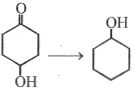
Which of the following reagents must be used in the given interconversion? The reaction involves the reduction of $4$-hydroxycyclohexanone to cyclohexanol,where the carbonyl group is reduced to a methylene group while the hydroxyl group remains unaffected.
A
$LiAlH_4$
B
$DIBALH$
C
$Zn-Hg/HCl$
D
$NH_2-NH_2/OH^-$
Solution
(D) The given reaction is the conversion of $4$-hydroxycyclohexanone to cyclohexanol.
In this reaction,the carbonyl group $(C=O)$ is reduced to a methylene group $(-CH_2-)$,while the hydroxyl group $(-OH)$ remains unchanged.
$LiAlH_4$ and $DIBALH$ are reducing agents that reduce carbonyl groups to alcohols,not methylene groups.
$Zn-Hg/HCl$ is the reagent for Clemmensen reduction,which reduces carbonyl groups to methylene groups. However,it is acidic and would cause the dehydration of the alcohol or other side reactions.
$NH_2-NH_2/OH^-$ is the reagent for Wolff-Kishner reduction,which is a basic medium reduction that converts carbonyl groups to methylene groups without affecting the hydroxyl group.
Therefore,the correct reagent is $NH_2-NH_2/OH^-$.
In this reaction,the carbonyl group $(C=O)$ is reduced to a methylene group $(-CH_2-)$,while the hydroxyl group $(-OH)$ remains unchanged.
$LiAlH_4$ and $DIBALH$ are reducing agents that reduce carbonyl groups to alcohols,not methylene groups.
$Zn-Hg/HCl$ is the reagent for Clemmensen reduction,which reduces carbonyl groups to methylene groups. However,it is acidic and would cause the dehydration of the alcohol or other side reactions.
$NH_2-NH_2/OH^-$ is the reagent for Wolff-Kishner reduction,which is a basic medium reduction that converts carbonyl groups to methylene groups without affecting the hydroxyl group.
Therefore,the correct reagent is $NH_2-NH_2/OH^-$.
0 likes
View Solution531
MediumMCQ
Select the reaction with the correct major product.
A
Acetone $\xrightarrow{\text{dry } HCl, 25^{\circ}C}$ Mesitylene
B
$HCHO \xrightarrow{450^{\circ}C} H_2 + CO$
C
$CH_3CHO \xrightarrow[\Delta]{KOH} CH_3COOK + CH_3CH_2OH$
D
$PhCHO + HCHO \xrightarrow[\Delta]{NaOH} PhCOONa + CH_3OH$
Solution
(A) Let us analyze each reaction:
$A$: Acetone $(CH_3COCH_3)$ reacts with dry $HCl$ gas to undergo aldol condensation followed by dehydration to form mesitylene ($1,3,5$-trimethylbenzene). This is a standard reaction.
$B$: Formaldehyde $(HCHO)$ at $450^{\circ}C$ does not simply decompose into $H_2$ and $CO$ as the major pathway.
$C$: Acetaldehyde $(CH_3CHO)$ undergoes aldol condensation with $KOH$,not the Cannizzaro reaction (which requires aldehydes without $\alpha$-hydrogens).
$D$: This is a crossed-Cannizzaro reaction between benzaldehyde and formaldehyde. The correct products are sodium benzoate $(PhCOONa)$ and methanol $(CH_3OH)$. Both $A$ and $D$ are chemically correct reactions. However,in the context of standard textbook questions,$A$ is the classic example of acid-catalyzed trimerization of acetone to mesitylene.
$A$: Acetone $(CH_3COCH_3)$ reacts with dry $HCl$ gas to undergo aldol condensation followed by dehydration to form mesitylene ($1,3,5$-trimethylbenzene). This is a standard reaction.
$B$: Formaldehyde $(HCHO)$ at $450^{\circ}C$ does not simply decompose into $H_2$ and $CO$ as the major pathway.
$C$: Acetaldehyde $(CH_3CHO)$ undergoes aldol condensation with $KOH$,not the Cannizzaro reaction (which requires aldehydes without $\alpha$-hydrogens).
$D$: This is a crossed-Cannizzaro reaction between benzaldehyde and formaldehyde. The correct products are sodium benzoate $(PhCOONa)$ and methanol $(CH_3OH)$. Both $A$ and $D$ are chemically correct reactions. However,in the context of standard textbook questions,$A$ is the classic example of acid-catalyzed trimerization of acetone to mesitylene.
0 likes
View Solution532
DifficultMCQ
The correct order of the rate of reaction with $PhMgBr$ is:
A
$PhCOCl > PhCOMe > PhCOOMe$
B
$PhCOMe > PhCOCl > PhCOOMe$
C
$PhCOOMe > PhCOCl > PhCOMe$
D
$PhCOCl > PhCOOMe > PhCOMe$
Solution
(A) The rate of nucleophilic attack by the Grignard reagent $(PhMgBr)$ depends on the magnitude of the partial positive charge $(\delta^+)$ on the carbonyl carbon.
$1.$ In $PhCOCl$,the strong $-I$ effect of the $Cl$ atom significantly increases the electrophilicity of the carbonyl carbon.
$2.$ In $PhCOMe$,the $+I$ effect of the methyl group slightly decreases the electrophilicity compared to $PhCOCl$.
$3.$ In $PhCOOMe$,the $+M$ effect (resonance) of the methoxy group $(-OCH_3)$ significantly reduces the electrophilicity of the carbonyl carbon.
Therefore,the correct order of reactivity is $PhCOCl > PhCOMe > PhCOOMe$.
$1.$ In $PhCOCl$,the strong $-I$ effect of the $Cl$ atom significantly increases the electrophilicity of the carbonyl carbon.
$2.$ In $PhCOMe$,the $+I$ effect of the methyl group slightly decreases the electrophilicity compared to $PhCOCl$.
$3.$ In $PhCOOMe$,the $+M$ effect (resonance) of the methoxy group $(-OCH_3)$ significantly reduces the electrophilicity of the carbonyl carbon.
Therefore,the correct order of reactivity is $PhCOCl > PhCOMe > PhCOOMe$.
0 likes
View Solution533
MediumMCQ
Arrange the following compounds in increasing order of their reactivity towards $HCN$:
$I$. Acetaldehyde
$II$. Acetone
$III$. Di-tert-butyl ketone
$IV$. Methyl-tert-butyl ketone
$I$. Acetaldehyde
$II$. Acetone
$III$. Di-tert-butyl ketone
$IV$. Methyl-tert-butyl ketone
A
$III < IV < II < I$
B
$IV < III < II < I$
C
$I < III < IV < II$
D
$I < II < III < IV$
Solution
(A) The reactivity of carbonyl compounds towards nucleophilic addition reactions like $HCN$ addition depends on two factors: steric hindrance and electronic effects.
$1$. Steric hindrance: As the size of the alkyl groups attached to the carbonyl carbon increases,the approach of the nucleophile $(CN^-)$ becomes more difficult,decreasing reactivity.
$2$. Electronic effect: Alkyl groups are electron-donating ($+I$ effect),which decreases the electrophilicity of the carbonyl carbon,thereby decreasing reactivity.
Comparing the compounds:
$I$. Acetaldehyde $(CH_3CHO)$: Least steric hindrance,most reactive.
$II$. Acetone $(CH_3COCH_3)$: More steric hindrance than acetaldehyde.
$III$. Di-tert-butyl ketone $((CH_3)_3CCO C(CH_3)_3)$: Extremely high steric hindrance,least reactive.
$IV$. Methyl-tert-butyl ketone $((CH_3)_3CCOCH_3)$: More steric hindrance than acetone but less than di-tert-butyl ketone.
Thus,the order of increasing reactivity is: $III < IV < II < I$.
$1$. Steric hindrance: As the size of the alkyl groups attached to the carbonyl carbon increases,the approach of the nucleophile $(CN^-)$ becomes more difficult,decreasing reactivity.
$2$. Electronic effect: Alkyl groups are electron-donating ($+I$ effect),which decreases the electrophilicity of the carbonyl carbon,thereby decreasing reactivity.
Comparing the compounds:
$I$. Acetaldehyde $(CH_3CHO)$: Least steric hindrance,most reactive.
$II$. Acetone $(CH_3COCH_3)$: More steric hindrance than acetaldehyde.
$III$. Di-tert-butyl ketone $((CH_3)_3CCO C(CH_3)_3)$: Extremely high steric hindrance,least reactive.
$IV$. Methyl-tert-butyl ketone $((CH_3)_3CCOCH_3)$: More steric hindrance than acetone but less than di-tert-butyl ketone.
Thus,the order of increasing reactivity is: $III < IV < II < I$.
0 likes
View Solution534
MediumMCQ
Identify the pair of compounds which can be distinguished by the iodoform test.
A
Propanal and propan-$1$-ol
B
Acetophenone and Benzophenone
C
Phenol and Benzoic acid
D
Benzoic acid and phenyl benzoate
Solution
(B) The iodoform test is given by compounds containing the $CH_3CO-$ group or the $CH_3CH(OH)-$ group.
$1$. Acetophenone $(C_6H_5COCH_3)$ contains the $CH_3CO-$ group and gives a positive iodoform test (yellow precipitate of $CHI_3$).
$2$. Benzophenone $(C_6H_5COC_6H_5)$ does not contain the $CH_3CO-$ group and does not give the iodoform test.
Therefore,acetophenone and benzophenone can be distinguished by the iodoform test.
$1$. Acetophenone $(C_6H_5COCH_3)$ contains the $CH_3CO-$ group and gives a positive iodoform test (yellow precipitate of $CHI_3$).
$2$. Benzophenone $(C_6H_5COC_6H_5)$ does not contain the $CH_3CO-$ group and does not give the iodoform test.
Therefore,acetophenone and benzophenone can be distinguished by the iodoform test.
0 likes
View Solution535
MediumMCQ
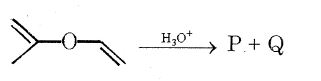
In the above sequence,$P$ and $Q$ products can be distinguished by?
A
Tollen's reagent
B
Fehling's solution
C
Benedict's solution
D
All of these
Solution
(D) The reaction is the acid-catalyzed hydrolysis of an enol ether. The substrate is $CH_2=C(CH_3)-O-CH=CH_2$.
Acid hydrolysis of this enol ether yields an aldehyde and a ketone.
The hydrolysis of the vinyl ether part $(CH_2=CH-O-)$ yields acetaldehyde $(CH_3CHO)$.
The hydrolysis of the isopropenyl ether part yields acetone $(CH_3COCH_3)$.
Thus,$P$ and $Q$ are acetaldehyde $(CH_3CHO)$ and acetone $(CH_3COCH_3)$.
Acetaldehyde is an aldehyde,which gives a positive test with Tollen's reagent,Fehling's solution,and Benedict's solution.
Acetone is a ketone,which does not give a positive test with any of these reagents.
Therefore,all of these reagents can be used to distinguish between $P$ and $Q$.
Acid hydrolysis of this enol ether yields an aldehyde and a ketone.
The hydrolysis of the vinyl ether part $(CH_2=CH-O-)$ yields acetaldehyde $(CH_3CHO)$.
The hydrolysis of the isopropenyl ether part yields acetone $(CH_3COCH_3)$.
Thus,$P$ and $Q$ are acetaldehyde $(CH_3CHO)$ and acetone $(CH_3COCH_3)$.
Acetaldehyde is an aldehyde,which gives a positive test with Tollen's reagent,Fehling's solution,and Benedict's solution.
Acetone is a ketone,which does not give a positive test with any of these reagents.
Therefore,all of these reagents can be used to distinguish between $P$ and $Q$.
0 likes
View Solution536
DifficultMCQ
The major product of the following reaction is:

A
$5-$methyl$-5-$hexen$-2-$one
B
$2,2-$dimethyl$-5-$methyltetrahydrofuran
C
$2-$methyl$-5-$methylenetetrahydrofuran
D
$2-$methyl$-2-$methylenetetrahydrofuran
Solution
(A) The starting material is a $\gamma$-lactone ($5$-methyldihydrofuran-$2$(3H)-one).
Step $1$: Reaction with excess $CH_3MgBr$ followed by $H_3O^+$ leads to the ring opening and formation of a diol. The lactone reacts twice with the Grignard reagent to form a tertiary alcohol at the carbonyl carbon and a secondary alcohol at the original lactone oxygen position. The product $X$ is $2-methylhexane-2,5-diol$.
Step $2$: Treatment with $H^+$ and $\Delta$ (acid-catalyzed dehydration) selectively dehydrates the tertiary alcohol to form a double bond,yielding $5-methylhex-4-en-2-ol$.
Step $3$: Oxidation with $CrO_3$ converts the secondary alcohol into a ketone,resulting in the final product $Y$,which is $5-methylhex-4-en-2-one$ (also known as $5-methyl-5-hexen-2-one$ depending on nomenclature interpretation of the structure provided in the options). Based on the structure shown in the solution image,the product is $5-methylhex-4-en-2-one$.
Step $1$: Reaction with excess $CH_3MgBr$ followed by $H_3O^+$ leads to the ring opening and formation of a diol. The lactone reacts twice with the Grignard reagent to form a tertiary alcohol at the carbonyl carbon and a secondary alcohol at the original lactone oxygen position. The product $X$ is $2-methylhexane-2,5-diol$.
Step $2$: Treatment with $H^+$ and $\Delta$ (acid-catalyzed dehydration) selectively dehydrates the tertiary alcohol to form a double bond,yielding $5-methylhex-4-en-2-ol$.
Step $3$: Oxidation with $CrO_3$ converts the secondary alcohol into a ketone,resulting in the final product $Y$,which is $5-methylhex-4-en-2-one$ (also known as $5-methyl-5-hexen-2-one$ depending on nomenclature interpretation of the structure provided in the options). Based on the structure shown in the solution image,the product is $5-methylhex-4-en-2-one$.
0 likes
View Solution537
AdvancedMCQ
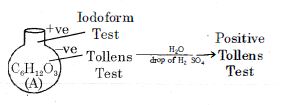
Compound $(A)$ with molecular formula $C_6H_{12}O_3$ gives a positive iodoform test and a negative Tollens' test. Upon treatment with water and a drop of $H_2SO_4$,it gives a positive Tollens' test. Compound $(A)$ is:
A
$CH_3-C(=O)-CH(OCH_3)-CH_2(OCH_3)$
B
$CH_3-C(=O)-C(OCH_3)_2-CH_3$
C
$CH_3-C(=O)-CH_2-CH(OCH_3)_2$
D
$H-C(=O)-CH_2-CH_2-CH(OCH_3)_2$
Solution
(C) Compound $(A)$ has the molecular formula $C_6H_{12}O_3$.
It gives a positive iodoform test,indicating the presence of a $CH_3C(=O)-$ group.
It gives a negative Tollens' test,meaning it does not have a free aldehyde group.
Upon treatment with water and a drop of $H_2SO_4$ (acidic hydrolysis),it gives a positive Tollens' test,which indicates that an aldehyde group is generated.
This suggests that $(A)$ contains a protected aldehyde group,specifically an acetal.
Structure $(c)$,$CH_3-C(=O)-CH_2-CH(OCH_3)_2$,contains a $CH_3C(=O)-$ group (positive iodoform test) and an acetal group $-CH(OCH_3)_2$.
Acidic hydrolysis of the acetal group yields an aldehyde group $(-CHO)$,which gives a positive Tollens' test.
It gives a positive iodoform test,indicating the presence of a $CH_3C(=O)-$ group.
It gives a negative Tollens' test,meaning it does not have a free aldehyde group.
Upon treatment with water and a drop of $H_2SO_4$ (acidic hydrolysis),it gives a positive Tollens' test,which indicates that an aldehyde group is generated.
This suggests that $(A)$ contains a protected aldehyde group,specifically an acetal.
Structure $(c)$,$CH_3-C(=O)-CH_2-CH(OCH_3)_2$,contains a $CH_3C(=O)-$ group (positive iodoform test) and an acetal group $-CH(OCH_3)_2$.
Acidic hydrolysis of the acetal group yields an aldehyde group $(-CHO)$,which gives a positive Tollens' test.
0 likes
View Solution538
AdvancedMCQ
Which of the following reactions gives a product with a $C=N-N$ linkage and a yellow precipitate?
A
$R-CH=CH-CH=O + H_2N-CO-NH-NH_2 \xrightarrow{H^{+}}$
B
Cyclohexanone + $CH_3CH_2-NH_2 \xrightarrow{H^{+}}$
C
$1-$Acetylcyclohexane + $H_2N-NH-(C_6H_3(NO_2)_2) \xrightarrow{H^{+}}$
D
Cyclobutanone + $H_2N-OH \xrightarrow{H^{+}}$
Solution
(C) Aldehydes and ketones react with $2,4$-dinitrophenylhydrazine $(2,4-DNP)$ to form $2,4$-dinitrophenylhydrazones.
The reaction is: $R_2C=O + H_2N-NH-C_6H_3(NO_2)_2 \xrightarrow{H^{+}} R_2C=N-NH-C_6H_3(NO_2)_2 + H_2O$.
The product contains a $C=N-N$ linkage and is typically a yellow,orange,or red precipitate.
Option $C$ represents the reaction of a ketone with $2,4-DNP$,which yields the characteristic yellow precipitate.
The reaction is: $R_2C=O + H_2N-NH-C_6H_3(NO_2)_2 \xrightarrow{H^{+}} R_2C=N-NH-C_6H_3(NO_2)_2 + H_2O$.
The product contains a $C=N-N$ linkage and is typically a yellow,orange,or red precipitate.
Option $C$ represents the reaction of a ketone with $2,4-DNP$,which yields the characteristic yellow precipitate.
0 likes
View Solution539
DifficultMCQ
Identify the final product in the following reaction sequence: $R-CHO$ $\xrightarrow{HS-(CH_2)_3-SH}$ $\xrightarrow{n-BuLi}$ $\xrightarrow{D_2O}$ $\xrightarrow{HgCl_2/CdCO_3, H_2O} \text{Product}$
A
$R-CO-CH_3$
B
$R-CD=O$
C
$R-CO-OD$
D
$R-CO-D$
Solution
(B) The reaction sequence represents the Umpolung (polarity reversal) of an aldehyde.
$1.$ $R-CHO + HS-(CH_2)_3-SH \rightarrow$ cyclic thioacetal ($1,3$-dithiane derivative).
$2.$ $n-BuLi$ (a strong base) removes the acidic proton at the $C-2$ position of the dithiane ring to form a carbanion.
$3.$ $D_2O$ acts as an electrophile,adding a deuterium atom to the $C-2$ position.
$4.$ Hydrolysis with $HgCl_2/CdCO_3$ in $H_2O$ removes the dithiane protecting group to regenerate the carbonyl group,resulting in the deuterated aldehyde $R-CD=O$.
$1.$ $R-CHO + HS-(CH_2)_3-SH \rightarrow$ cyclic thioacetal ($1,3$-dithiane derivative).
$2.$ $n-BuLi$ (a strong base) removes the acidic proton at the $C-2$ position of the dithiane ring to form a carbanion.
$3.$ $D_2O$ acts as an electrophile,adding a deuterium atom to the $C-2$ position.
$4.$ Hydrolysis with $HgCl_2/CdCO_3$ in $H_2O$ removes the dithiane protecting group to regenerate the carbonyl group,resulting in the deuterated aldehyde $R-CD=O$.
0 likes
View Solution540
AdvancedMCQ
In the given reactions,which one is $INCORRECT$?
A
$A$ $2-$chlorocyclohexane reacting with $C_2H_5OH$ to form $2-$ethoxycyclohexane and ethoxycyclohexane.
B
Cyclopentanone reacting with $OH^-/\Delta$ to form a self-aldol condensation product.
C
$CH_3-C \equiv C-CH_3 \xrightarrow{Na/liq.NH_3} \text{trans-but-2-ene (Possible Product)}$
D
$A$ bicyclic dichloride reacting with $MeOH$ to form a methoxy-substituted product.
Solution
(B) Let's analyze each reaction:
$A$: The reaction of $2$-chlorocyclohexane with $C_2H_5OH$ (a weak nucleophile/solvent) proceeds via an $S_N1$ mechanism,which involves a carbocation intermediate. This can lead to rearrangement or substitution at different positions,making the products shown plausible.
$B$: The reaction of cyclopentanone with $OH^-/\Delta$ is an aldol condensation,which typically forms a $\beta$-hydroxy ketone followed by dehydration to an $\alpha,\beta$-unsaturated ketone. The product shown is not the standard aldol condensation product of cyclopentanone.
$C$: The reduction of an internal alkyne with $Na/liq. NH_3$ (Birch-type reduction) is a stereospecific reaction that yields the $trans$-alkene. This is correct.
$D$: The reaction of the bicyclic dichloride with $MeOH$ is a solvolysis reaction. Given the structure,it can undergo substitution to form the methoxy product.
Therefore,option $B$ is the $INCORRECT$ reaction.
$A$: The reaction of $2$-chlorocyclohexane with $C_2H_5OH$ (a weak nucleophile/solvent) proceeds via an $S_N1$ mechanism,which involves a carbocation intermediate. This can lead to rearrangement or substitution at different positions,making the products shown plausible.
$B$: The reaction of cyclopentanone with $OH^-/\Delta$ is an aldol condensation,which typically forms a $\beta$-hydroxy ketone followed by dehydration to an $\alpha,\beta$-unsaturated ketone. The product shown is not the standard aldol condensation product of cyclopentanone.
$C$: The reduction of an internal alkyne with $Na/liq. NH_3$ (Birch-type reduction) is a stereospecific reaction that yields the $trans$-alkene. This is correct.
$D$: The reaction of the bicyclic dichloride with $MeOH$ is a solvolysis reaction. Given the structure,it can undergo substitution to form the methoxy product.
Therefore,option $B$ is the $INCORRECT$ reaction.
0 likes
View Solution541
MediumMCQ
In the given compounds,which one does not give the silver mirror test?
A
$C_6H_5CHO$
B
$C_6H_5OH$
C
$C_6H_5-CH_2-C(=O)-CH_2OH$
D
$CH_3CHO$
Solution
(B) The silver mirror test (Tollen's test) is a characteristic reaction used to identify aldehydes and $\alpha$-hydroxy ketones.
$C_6H_5CHO$ (benzaldehyde) is an aromatic aldehyde and gives a positive test.
$CH_3CHO$ (acetaldehyde) is an aliphatic aldehyde and gives a positive test.
$C_6H_5-CH_2-C(=O)-CH_2OH$ is an $\alpha$-hydroxy ketone and gives a positive test.
$C_6H_5OH$ (phenol) does not contain an aldehyde or $\alpha$-hydroxy ketone group,therefore it does not give the silver mirror test.
$C_6H_5CHO$ (benzaldehyde) is an aromatic aldehyde and gives a positive test.
$CH_3CHO$ (acetaldehyde) is an aliphatic aldehyde and gives a positive test.
$C_6H_5-CH_2-C(=O)-CH_2OH$ is an $\alpha$-hydroxy ketone and gives a positive test.
$C_6H_5OH$ (phenol) does not contain an aldehyde or $\alpha$-hydroxy ketone group,therefore it does not give the silver mirror test.
0 likes
View Solution542
DifficultMCQ
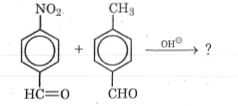
What is the final product of this reaction?
A
$A$ mixture of $p$-nitrobenzyl alcohol and $p$-methylbenzoate ion.
B
$A$ mixture of $p$-nitrobenzyl alcohol and $p$-methylbenzyl alcohol.
C
$A$ mixture of $p$-nitrobenzoate ion and $p$-methylbenzyl alcohol.
D
$A$ mixture of $p$-nitrobenzoate ion and $p$-methylbenzoate ion.
Solution
(C) The given reaction is a cross-Cannizzaro reaction between $p$-nitrobenzaldehyde and $p$-methylbenzaldehyde in the presence of a base $(OH^-)$.
In a cross-Cannizzaro reaction,the more electrophilic aldehyde is reduced to the corresponding alcohol,while the less electrophilic aldehyde is oxidized to the corresponding carboxylate ion.
$p$-Nitrobenzaldehyde has an electron-withdrawing $-NO_2$ group,making its carbonyl carbon more electrophilic.
$p$-Methylbenzaldehyde has an electron-donating $-CH_3$ group,making its carbonyl carbon less electrophilic.
Therefore,$p$-nitrobenzaldehyde is reduced to $p$-nitrobenzyl alcohol,and $p$-methylbenzaldehyde is oxidized to the $p$-methylbenzoate ion.
The correct products are $p$-nitrobenzyl alcohol and $p$-methylbenzoate ion.
In a cross-Cannizzaro reaction,the more electrophilic aldehyde is reduced to the corresponding alcohol,while the less electrophilic aldehyde is oxidized to the corresponding carboxylate ion.
$p$-Nitrobenzaldehyde has an electron-withdrawing $-NO_2$ group,making its carbonyl carbon more electrophilic.
$p$-Methylbenzaldehyde has an electron-donating $-CH_3$ group,making its carbonyl carbon less electrophilic.
Therefore,$p$-nitrobenzaldehyde is reduced to $p$-nitrobenzyl alcohol,and $p$-methylbenzaldehyde is oxidized to the $p$-methylbenzoate ion.
The correct products are $p$-nitrobenzyl alcohol and $p$-methylbenzoate ion.
0 likes
View Solution543
AdvancedMCQ
$CH_3-CHO \xrightarrow{dil. OH^{-} / \Delta}$ Major product formed in the above reaction is:
A
$CH_2=C(CH_3)-CHO$
B
$CH_3-CH(OH)-CH_2-CHO$
C
$CH_3-CH=CH-CHO$
D
$CH_3-C(=O)-O-CH_2-CH_3$
Solution
(C) The reaction of $CH_3-CHO$ with $dil. OH^{-}$ followed by heating $(\Delta)$ is an Aldol condensation reaction.
Step $1$: Two molecules of acetaldehyde undergo aldol addition in the presence of a dilute base to form $3-hydroxybutanal$ $(CH_3-CH(OH)-CH_2-CHO)$.
Step $2$: Upon heating $(\Delta)$,the aldol product undergoes dehydration (loss of $H_2O$) to form the $\alpha,\beta$-unsaturated aldehyde,$but-2-enal$ $(CH_3-CH=CH-CHO)$,which is commonly known as crotonaldehyde.
Step $1$: Two molecules of acetaldehyde undergo aldol addition in the presence of a dilute base to form $3-hydroxybutanal$ $(CH_3-CH(OH)-CH_2-CHO)$.
Step $2$: Upon heating $(\Delta)$,the aldol product undergoes dehydration (loss of $H_2O$) to form the $\alpha,\beta$-unsaturated aldehyde,$but-2-enal$ $(CH_3-CH=CH-CHO)$,which is commonly known as crotonaldehyde.
0 likes
View Solution544
DifficultMCQ
Which of the following compounds gives the $2,4-DNP$ test?
A
Acetic acid $(CH_3COOH)$
B
$1-$Butyne $(CH_3CH_2C \equiv CH)$
C
Butan$-2-$one $(CH_3COCH_2CH_3)$
D
Butan$-2-$ol $(CH_3CH(OH)CH_2CH_3)$
Solution
(C) The $2,4-DNP$ ($2$,$4$-dinitrophenylhydrazine) test is a characteristic chemical test used to identify the presence of a carbonyl group,specifically in aldehydes and ketones.
$1$. Acetic acid is a carboxylic acid and does not give the $2,4-DNP$ test.
$2$. $1$-Butyne is an alkyne and does not give the $2,4-DNP$ test.
$3$. Butan$-2-$one is a ketone,which contains a carbonyl group $(>C=O)$,and therefore it reacts with $2,4-DNP$ to form a yellow or orange precipitate.
$4$. Butan$-2-$ol is an alcohol and does not give the $2,4-DNP$ test.
Thus,the correct compound is Butan$-2-$one.
$1$. Acetic acid is a carboxylic acid and does not give the $2,4-DNP$ test.
$2$. $1$-Butyne is an alkyne and does not give the $2,4-DNP$ test.
$3$. Butan$-2-$one is a ketone,which contains a carbonyl group $(>C=O)$,and therefore it reacts with $2,4-DNP$ to form a yellow or orange precipitate.
$4$. Butan$-2-$ol is an alcohol and does not give the $2,4-DNP$ test.
Thus,the correct compound is Butan$-2-$one.
0 likes
View Solution545
DifficultMCQ
Which statement is correct for product '$X$'?
$Cl-CO-CH_2-C(C \equiv CH)(CH_2-CN)-CH_2-CH_2-CO-CH_3 \xrightarrow{H_2/Pd/BaSO_4} X$
$Cl-CO-CH_2-C(C \equiv CH)(CH_2-CN)-CH_2-CH_2-CO-CH_3 \xrightarrow{H_2/Pd/BaSO_4} X$
A
$1^o$ alcohol functional group is present in '$X$'
B
Ethyl group is present in '$X$'
C
$2^o$ alcohol functional group is present in '$X$'
D
Alkene functional group is present in '$X$'
Solution
(D) The reagent $H_2/Pd/BaSO_4$ is known as Lindlar's catalyst or a poisoned catalyst used in the Rosenmund reduction.
It selectively reduces the acid chloride group $(-COCl)$ to an aldehyde group $(-CHO)$ and the alkyne group $(-C \equiv CH)$ to an alkene group $(-CH=CH_2)$.
It does not affect the nitrile $(-CN)$ or ketone $(-CO-)$ functional groups under these conditions.
Therefore,the product '$X$' contains an alkene functional group.
It selectively reduces the acid chloride group $(-COCl)$ to an aldehyde group $(-CHO)$ and the alkyne group $(-C \equiv CH)$ to an alkene group $(-CH=CH_2)$.
It does not affect the nitrile $(-CN)$ or ketone $(-CO-)$ functional groups under these conditions.
Therefore,the product '$X$' contains an alkene functional group.
0 likes
View Solution546
DifficultMCQ
Which of the following reactions is correct?
A
$CH_2=CH-C(CH_3)_2-COOH \xrightarrow{NaOH + CaO / \Delta} CH_2=CH-CH(CH_3)_2$
B
$CH_3-CH(COOH)-CH(D)-CH_3 \xrightarrow{(i) Ag_2O, (ii) Br_2/CCl_4/\Delta} CH_3-CH(Br)-CH(D)-CH_3 + \text{Enantiomer}$
C
$CH_3-CH(F)-CH_2-NO_2 \xrightarrow{OH^{-} / H_2O, \Delta} CH_2=CH-CH_2-NO_2$
D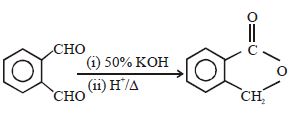
Solution
(D) Option $D$ is correct. The reaction of phthalaldehyde $(C_6H_4(CHO)_2)$ with concentrated $KOH$ undergoes an intramolecular Cannizzaro reaction. One aldehyde group is oxidized to a carboxylate $(COO^-)$ and the other is reduced to an alcohol $(CH_2OH)$. Upon acidification $(H^ )$ and heating $(\Delta)$,the hydroxy acid undergoes intramolecular esterification to form a cyclic ester known as phthalide.
0 likes
View Solution547
MediumMCQ
$CH_3-CH(OH)-CH_3 \xrightarrow{Cu/300^\circ C} \text{Product (X)}$. Which of the following is correct about product $X$?
A
Degree of unsaturation of product is $2$.
B
Product can reduce Tollens' reagent.
C
Product is an aldehyde.
D
Product can undergo aldol condensation.
Solution
(D) $CH_3-CH(OH)-CH_3$ is a secondary alcohol.
When heated with $Cu$ at $300^\circ C$,it undergoes dehydrogenation to form acetone $(CH_3-CO-CH_3)$.
$CH_3-CH(OH)-CH_3 \xrightarrow{Cu/300^\circ C} CH_3-CO-CH_3 + H_2$.
Acetone $(X)$ has $\alpha$-hydrogens,so it can undergo aldol condensation.
Its degree of unsaturation is $1$,and it does not reduce Tollens' reagent as it is a ketone.
When heated with $Cu$ at $300^\circ C$,it undergoes dehydrogenation to form acetone $(CH_3-CO-CH_3)$.
$CH_3-CH(OH)-CH_3 \xrightarrow{Cu/300^\circ C} CH_3-CO-CH_3 + H_2$.
Acetone $(X)$ has $\alpha$-hydrogens,so it can undergo aldol condensation.
Its degree of unsaturation is $1$,and it does not reduce Tollens' reagent as it is a ketone.
0 likes
View Solution548
DifficultMCQ
The best reagent to carry out the following conversion is:
$3$-hydroxyethylcyclopentane-$1$-carbaldehyde $\rightarrow$ $1$-ethyl-$3$-methylcyclopentane (with a hydroxy group on the ethyl side chain).
(Note: The image shows the reduction of an aldehyde group $-CHO$ to a methyl group $-CH_3$ while keeping the secondary alcohol $-CH(OH)CH_3$ intact.)
$3$-hydroxyethylcyclopentane-$1$-carbaldehyde $\rightarrow$ $1$-ethyl-$3$-methylcyclopentane (with a hydroxy group on the ethyl side chain).
(Note: The image shows the reduction of an aldehyde group $-CHO$ to a methyl group $-CH_3$ while keeping the secondary alcohol $-CH(OH)CH_3$ intact.)
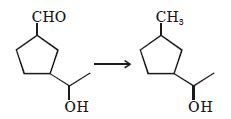
A
$Red \ P / I_2$
B
$LiAlH_4, Et_2O$
C
$Zn-Hg / HCl$
D
$(i) N_2H_4; (ii) \mathop O\limits^\Theta H, \Delta$
Solution
(D) The given reaction involves the reduction of an aldehyde group $(-CHO)$ to a methyl group $(-CH_3)$ while preserving the secondary alcohol group $(-CH(OH)CH_3)$.
$1$. $Red \ P / I_2$ is a strong reducing agent that would reduce both the aldehyde and the alcohol group to an alkane.
$2$. $LiAlH_4$ is a strong reducing agent that would reduce the aldehyde to a primary alcohol $(-CH_2OH)$ and would not reduce it to a methyl group.
$3$. $Zn-Hg / HCl$ is the Clemmensen reduction reagent. It is acidic in nature. The secondary alcohol group is sensitive to acid and might undergo dehydration or other side reactions under these conditions.
$4$. $(i) N_2H_4; (ii) \mathop O\limits^\Theta H, \Delta$ is the Wolff-Kishner reduction reagent. It is basic in nature. It selectively reduces the aldehyde (or ketone) group to a methyl (or methylene) group without affecting the alcohol group,which is stable under basic conditions.
Therefore,the correct reagent is $(i) N_2H_4; (ii) \mathop O\limits^\Theta H, \Delta$.
$1$. $Red \ P / I_2$ is a strong reducing agent that would reduce both the aldehyde and the alcohol group to an alkane.
$2$. $LiAlH_4$ is a strong reducing agent that would reduce the aldehyde to a primary alcohol $(-CH_2OH)$ and would not reduce it to a methyl group.
$3$. $Zn-Hg / HCl$ is the Clemmensen reduction reagent. It is acidic in nature. The secondary alcohol group is sensitive to acid and might undergo dehydration or other side reactions under these conditions.
$4$. $(i) N_2H_4; (ii) \mathop O\limits^\Theta H, \Delta$ is the Wolff-Kishner reduction reagent. It is basic in nature. It selectively reduces the aldehyde (or ketone) group to a methyl (or methylene) group without affecting the alcohol group,which is stable under basic conditions.
Therefore,the correct reagent is $(i) N_2H_4; (ii) \mathop O\limits^\Theta H, \Delta$.
0 likes
View Solution549
MediumMCQ
Identify the correct option regarding the distinction between pairs of compounds.
A
Pair of compounds: $(I) HCHO, (II) CH_3CHO$. Reagent: $NaOH/I_2$. Response: $(I)$ forms yellow ppt,$(II)$ does not.
B
Pair of compounds: $(I) PhCHO, (II) CH_3CHO$. Reagent: Tollen's reagent $(AgNO_3 + NH_4OH)$. Response: $(II)$ forms a silver mirror,$(I)$ does not.
C
Pair of compounds: $(I) \text{Glucose}, (II) \text{Fructose}$. Reagent: Bromine water $(Br_2/H_2O)$. Response: $(I)$ decolourises bromine water,$(II)$ does not.
D
Pair of compounds: $(I) CH_3OH, (II) CH_3CHO$. Reagent: $2,4-DNP$. Response: $(I)$ forms yellow/orange ppt,$(II)$ does not.
Solution
(B) Option $(B)$ is correct.
$PhCHO$ (Benzaldehyde) does not contain an $\alpha$-methyl group,so it does not give a positive Tollen's test for silver mirror formation in the same way as aliphatic aldehydes,but more importantly,$CH_3CHO$ (Acetaldehyde) is an aliphatic aldehyde that readily reduces Tollen's reagent to form a silver mirror.
Option $(A)$ is incorrect because $HCHO$ does not have an $\alpha$-methyl group and does not give the iodoform test,while $CH_3CHO$ does.
Option $(C)$ is incorrect because both glucose and fructose react with bromine water (fructose isomerizes to glucose in basic/neutral conditions or reacts via enediol).
Option $(D)$ is incorrect because $2,4-DNP$ reacts with all carbonyl compounds (aldehydes and ketones),so it cannot distinguish between them.
$PhCHO$ (Benzaldehyde) does not contain an $\alpha$-methyl group,so it does not give a positive Tollen's test for silver mirror formation in the same way as aliphatic aldehydes,but more importantly,$CH_3CHO$ (Acetaldehyde) is an aliphatic aldehyde that readily reduces Tollen's reagent to form a silver mirror.
Option $(A)$ is incorrect because $HCHO$ does not have an $\alpha$-methyl group and does not give the iodoform test,while $CH_3CHO$ does.
Option $(C)$ is incorrect because both glucose and fructose react with bromine water (fructose isomerizes to glucose in basic/neutral conditions or reacts via enediol).
Option $(D)$ is incorrect because $2,4-DNP$ reacts with all carbonyl compounds (aldehydes and ketones),so it cannot distinguish between them.
0 likes
View Solution550
DifficultMCQ
Identify the reagents $X$ and $Y$ in the following reaction sequence:
$CH_3COCl \xrightarrow{X} CH_3CH_2OH$
$CH_3COCl \xrightarrow{Y} CH_3CHO$
$CH_3COCl \xrightarrow{X} CH_3CH_2OH$
$CH_3COCl \xrightarrow{Y} CH_3CHO$
A
$X$: $(a) Li(t-BuO)_3AlH, (b) H_2O$; $Y$: $(a) LiAlH_4, (b) H_2O$
B
$X$: $(a) NaBH_4, (b) H_2O$; $Y$: $(a) H_2-\text{Raney } Ni$
C
$X$: $(a) DIBAL-H, (b) H_2O$; $Y$: $(a) LiAlH_4, (b) H_2O$
D
$X$: $(a) NaBH_4, (b) H_2O$; $Y$: $(a) DIBAL-H, (b) H_2O$
Solution
(D) $1$. For the conversion of acetyl chloride $(CH_3COCl)$ to ethanol $(CH_3CH_2OH)$,a strong reducing agent is required. $NaBH_4$ is typically used for this reduction.
$2$. For the conversion of acetyl chloride $(CH_3COCl)$ to acetaldehyde $(CH_3CHO)$,a milder,selective reducing agent is required to stop the reduction at the aldehyde stage. $DIBAL-H$ (Diisobutylaluminium hydride) at low temperature is the standard reagent for this transformation.
$3$. Therefore,$X$ is $(a) NaBH_4, (b) H_2O$ and $Y$ is $(a) DIBAL-H, (b) H_2O$.
$2$. For the conversion of acetyl chloride $(CH_3COCl)$ to acetaldehyde $(CH_3CHO)$,a milder,selective reducing agent is required to stop the reduction at the aldehyde stage. $DIBAL-H$ (Diisobutylaluminium hydride) at low temperature is the standard reagent for this transformation.
$3$. Therefore,$X$ is $(a) NaBH_4, (b) H_2O$ and $Y$ is $(a) DIBAL-H, (b) H_2O$.
0 likes
View Solution8-1.Aldehydes and Ketones — Properties · Frequently Asked Questions
1Are these 8-1.Aldehydes and Ketones questions useful for JEE and NEET?
Yes. All questions in this section are mapped to JEE Main and NEET exam patterns. Previous year questions from JEE Main, NEET, GUJCET and state-level exams are included with full solutions.
2Can I switch to Hindi or Gujarati for these questions?
Yes. Use the language tabs in the hero section or the sidebar to view the same questions and solutions in English, Hindi or Gujarati.
3How do I generate a question paper from this subtopic?
Use the Vedclass Exam Paper Generator — select the chapter and subtopic, set difficulty, and generate Sets A, B, C, D automatically. First 3 chapters of every subject are free.
Vedclass Products
For Students
Vedclass Test Series
Mock tests in real JEE/NEET style with performance analysis. 5-day free trial.
Start Free TrialFor Teachers
Exam Paper Generator
Generate Set A/B/C/D papers from this chapter in 2 minutes. 3 chapters free.
Try FreeFor Institutes
Online Exam Module
Live online exams with unlimited students, 360° analytics & white-label branding.
See DemoFor Teachers & Institutes
Generate a 8-1.Aldehydes and Ketones Exam Paper in 2 Minutes
Select subtopic & difficulty — Sets A, B, C, D auto-generated with No Repeat logic.
First 3 chapters of every subject are free — no payment required.