
A English
Process of Recombinant DNA technology Questions in English
Class 12 Biology · Biotechnology Principals and Process · Process of Recombinant DNA technology
315+
Questions
English
Language
100%
With Solutions
Showing 50 of 315 questions in English
251
MediumMCQ
The enzyme $(a)$ is needed for isolating genetic material from plant cells and enzyme $(b)$ for isolating genetic material from fungus. Choose the correct pair of options from the following:
A
$(a)$ Cellulase $(b)$ Protease
B
$(a)$ Cellulase $(b)$ Chitinase
C
$(a)$ Chitinase $(b)$ Lipase
D
$(a)$ Cellulase $(b)$ Lipase
Solution
(B) To isolate genetic material $(DNA)$ from plant cells,the cell wall must be broken down. Plant cell walls are primarily composed of cellulose,so the enzyme $(a)$ Cellulase is required.
Fungal cell walls are composed of chitin,so the enzyme $(b)$ Chitinase is required to break them down and release the genetic material.
Therefore,the correct pair is $(a)$ Cellulase and $(b)$ Chitinase.
Fungal cell walls are composed of chitin,so the enzyme $(b)$ Chitinase is required to break them down and release the genetic material.
Therefore,the correct pair is $(a)$ Cellulase and $(b)$ Chitinase.
0 likes
View Solution252
MediumMCQ
Which of the following methods is not commonly used for introducing foreign $DNA$ into the plant cell?
A
Agrobacterium mediated transformation
B
Gene gun
C
'Disarmed pathogen' vectors
D
Bacteriophages
Solution
(D) The introduction of foreign $DNA$ into plant cells is typically achieved through methods like $Agrobacterium$-mediated transformation,the use of a gene gun (biolistics),and disarmed pathogen vectors.
Bacteriophages are viruses that infect bacteria. While they are used as vectors for cloning $DNA$ into bacterial cells,they are not used to introduce foreign $DNA$ directly into plant cells.
Therefore,the correct answer is $D$.
Bacteriophages are viruses that infect bacteria. While they are used as vectors for cloning $DNA$ into bacterial cells,they are not used to introduce foreign $DNA$ directly into plant cells.
Therefore,the correct answer is $D$.
0 likes
View Solution253
MediumMCQ
Upon exposure to $UV$ radiation,$DNA$ stained with ethidium bromide will show:
A
Bright orange colour
B
Bright red colour
C
Bright blue colour
D
Bright yellow colour
Solution
(A) Option $A$ is the correct answer. In recombinant $DNA$ technology,the separated $DNA$ fragments can be visualized only after staining the $DNA$ with a substance known as ethidium bromide followed by exposure to $UV$ radiation.
When the gel is exposed to $UV$ light,the ethidium bromide-stained $DNA$ fragments appear as bright orange-coloured bands.
When the gel is exposed to $UV$ light,the ethidium bromide-stained $DNA$ fragments appear as bright orange-coloured bands.
0 likes
View Solution254
EasyMCQ
During the purification process for recombinant $DNA$ technology,the addition of chilled ethanol precipitates out:
A
Polysaccharides
B
$RNA$
C
$DNA$
D
Histones
Solution
(C) During the isolation of genetic material,the final step involves the addition of chilled ethanol to the purified mixture.
This process causes the $DNA$ to precipitate out as fine threads in the suspension.
Therefore,option $(C)$ is the correct answer.
Proteins are removed using proteases,and $RNA$ is removed using ribonuclease enzymes.
This process causes the $DNA$ to precipitate out as fine threads in the suspension.
Therefore,option $(C)$ is the correct answer.
Proteins are removed using proteases,and $RNA$ is removed using ribonuclease enzymes.
0 likes
View Solution255
MediumMCQ
Main steps in the formation of Recombinant $DNA$ are given below. Arrange these steps in a correct sequence.
$A$. Insertion of recombinant $DNA$ into the host cell
$B$. Cutting of $DNA$ at specific location by restriction enzyme
$C$. Isolation of desired $DNA$ fragment
$D$. Amplification of gene of interest using $PCR$
Choose the correct answer from the options given below:
$A$. Insertion of recombinant $DNA$ into the host cell
$B$. Cutting of $DNA$ at specific location by restriction enzyme
$C$. Isolation of desired $DNA$ fragment
$D$. Amplification of gene of interest using $PCR$
Choose the correct answer from the options given below:
A
$B, D, A, C$
B
$B, C, D, A$
C
$C, A, B, D$
D
$C, B, D, A$
Solution
(B) The process of Recombinant $DNA$ technology follows a specific sequence:
$1$. Isolation of the genetic material $(DNA)$.
$2$. Cutting of $DNA$ at specific locations using restriction enzymes $(B)$.
$3$. Isolation of the desired $DNA$ fragment $(C)$.
$4$. Amplification of the gene of interest using $PCR$ $(D)$.
$5$. Ligation of the $DNA$ fragment into a vector.
$6$. Insertion of recombinant $DNA$ into the host cell $(A)$.
Therefore,the correct sequence is $B, C, D, A$.
$1$. Isolation of the genetic material $(DNA)$.
$2$. Cutting of $DNA$ at specific locations using restriction enzymes $(B)$.
$3$. Isolation of the desired $DNA$ fragment $(C)$.
$4$. Amplification of the gene of interest using $PCR$ $(D)$.
$5$. Ligation of the $DNA$ fragment into a vector.
$6$. Insertion of recombinant $DNA$ into the host cell $(A)$.
Therefore,the correct sequence is $B, C, D, A$.
0 likes
View Solution256
MediumMCQ
Which of the following statements is incorrect?
A
Most commonly used bio-reactors are of stirring type
B
Bio-reactors are used to produce small scale bacterial cultures
C
Bio-reactors have an agitator system,an oxygen delivery system and foam control system
D
$A$ bio-reactor provides optimal growth conditions for achieving the desired product
Solution
(B) The correct answer is option $(B)$.
Statement $(B)$ is incorrect because bio-reactors are designed to process large volumes ($100-1000$ liters) of culture.
Small-scale cultures cannot yield significant quantities of products. To produce products in large quantities,the development of large-scale bio-reactors is essential.
Statement $(B)$ is incorrect because bio-reactors are designed to process large volumes ($100-1000$ liters) of culture.
Small-scale cultures cannot yield significant quantities of products. To produce products in large quantities,the development of large-scale bio-reactors is essential.
0 likes
View Solution257
MediumMCQ
Polymerase chain reaction $\text{(PCR)}$ amplifies $\text{DNA}$ following the equation:
A
$N^2$
B
$2^n$
C
$2n+1$
D
$2N^2$
Solution
(B) The Polymerase Chain Reaction $\text{(PCR)}$ is a technique used to amplify a specific segment of $\text{DNA}$ in vitro.
In each cycle of $\text{PCR}$,the amount of $\text{DNA}$ doubles.
If we start with a single molecule of $\text{DNA}$,after $n$ cycles,the number of $\text{DNA}$ molecules produced is given by the formula $2^n$.
Therefore,the correct equation for amplification is $2^n$.
In each cycle of $\text{PCR}$,the amount of $\text{DNA}$ doubles.
If we start with a single molecule of $\text{DNA}$,after $n$ cycles,the number of $\text{DNA}$ molecules produced is given by the formula $2^n$.
Therefore,the correct equation for amplification is $2^n$.
0 likes
View Solution258
DifficultMCQ
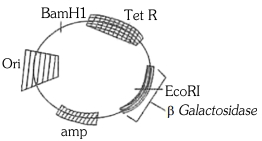
In the above represented plasmid,an alien piece of $\text{DNA}$ is inserted at the $\text{EcoRI}$ site. Which of the following strategies will be chosen to select the recombinant colonies?
A
Using ampicillin $\&$ tetracycline containing medium plate
B
Blue color colonies will be selected
C
White color colonies will be selected
D
Blue color colonies grown on ampicillin plates can be selected
Solution
(C) The plasmid contains the $\beta$-galactosidase gene,which is responsible for the production of the enzyme $\beta$-galactosidase.
When a foreign $\text{DNA}$ fragment is inserted at the $\text{EcoRI}$ site,which is located within the $\beta$-galactosidase gene,it leads to the insertional inactivation of the gene.
As a result,the enzyme $\beta$-galactosidase is not produced.
In the presence of a chromogenic substrate,non-recombinant colonies (containing the functional gene) produce a blue color,whereas recombinant colonies (where the gene is inactivated) appear white.
Therefore,white color colonies are selected to identify the recombinants.
When a foreign $\text{DNA}$ fragment is inserted at the $\text{EcoRI}$ site,which is located within the $\beta$-galactosidase gene,it leads to the insertional inactivation of the gene.
As a result,the enzyme $\beta$-galactosidase is not produced.
In the presence of a chromogenic substrate,non-recombinant colonies (containing the functional gene) produce a blue color,whereas recombinant colonies (where the gene is inactivated) appear white.
Therefore,white color colonies are selected to identify the recombinants.
0 likes
View Solution259
MediumMCQ
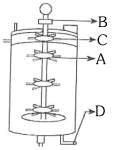
Identify the part of a bioreactor which is used as a foam breaker from the given figure.
A
$A$
B
$B$
C
$D$
D
$C$
Solution
(D) In a stirred-tank bioreactor,the components are labeled as follows:
$A$: Impeller (Agitator system)
$B$: Motor
$C$: Foam breaker
$D$: Sterile air inlet
The foam breaker $(C)$ is located at the top of the shaft to control the foam produced during the fermentation process.
Therefore,the correct option is $D$.
$A$: Impeller (Agitator system)
$B$: Motor
$C$: Foam breaker
$D$: Sterile air inlet
The foam breaker $(C)$ is located at the top of the shaft to control the foam produced during the fermentation process.
Therefore,the correct option is $D$.
0 likes
View Solution260
DifficultMCQ
Given below are two statements:
Statement $I:$ The $\text{DNA}$ fragments extracted from gel electrophoresis can be used in the construction of recombinant $\text{DNA}$.
Statement $II:$ Smaller size $\text{DNA}$ fragments are observed near the anode while larger fragments are found near the wells in an agarose gel.
In the light of the above statements,choose the most appropriate answer from the options given below:
Statement $I:$ The $\text{DNA}$ fragments extracted from gel electrophoresis can be used in the construction of recombinant $\text{DNA}$.
Statement $II:$ Smaller size $\text{DNA}$ fragments are observed near the anode while larger fragments are found near the wells in an agarose gel.
In the light of the above statements,choose the most appropriate answer from the options given below:
A
Both statement $I$ and statement $II$ are correct
B
Both statement $I$ and statement $II$ are incorrect
C
Statement $I$ is correct but statement $II$ is incorrect
D
Statement $I$ is incorrect but statement $II$ is correct
Solution
(A) Statement $I$ is correct: After the process of gel electrophoresis,the separated $\text{DNA}$ fragments can be extracted from the agarose gel and purified. This process is known as elution. These purified $\text{DNA}$ fragments can then be used in the construction of recombinant $\text{DNA}$ by joining them with cloning vectors.
Statement $II$ is correct: $\text{DNA}$ molecules are negatively charged due to the phosphate backbone. When an electric field is applied,they move towards the positive electrode (anode). The agarose gel acts as a molecular sieve. Smaller $\text{DNA}$ fragments move faster and travel further through the pores of the gel,reaching closer to the anode,while larger fragments move slower and remain closer to the wells.
Statement $II$ is correct: $\text{DNA}$ molecules are negatively charged due to the phosphate backbone. When an electric field is applied,they move towards the positive electrode (anode). The agarose gel acts as a molecular sieve. Smaller $\text{DNA}$ fragments move faster and travel further through the pores of the gel,reaching closer to the anode,while larger fragments move slower and remain closer to the wells.
0 likes
View Solution261
MediumMCQ
The blue and white selectable markers have been developed which differentiate recombinant colonies from non-recombinant colonies on the basis of their ability to produce colour in the presence of a chromogenic substrate.
Given below are two statements about this method :
Statement-$I$ : The blue coloured colonies have $\text{DNA}$ insert in the plasmid and they are identified as recombinant colonies.
Statement-$II$ : The colonies without blue colour have $\text{DNA}$ insert in the plasmid and are identified as recombinant colonies.
In the light of the above statements,choose the most appropriate answer from the options given below:
Given below are two statements about this method :
Statement-$I$ : The blue coloured colonies have $\text{DNA}$ insert in the plasmid and they are identified as recombinant colonies.
Statement-$II$ : The colonies without blue colour have $\text{DNA}$ insert in the plasmid and are identified as recombinant colonies.
In the light of the above statements,choose the most appropriate answer from the options given below:
A
Both Statement $I$ and Statement $II$ are correct
B
Both Statement $I$ and Statement $II$ are incorrect
C
Statement $I$ is correct but Statement $II$ is incorrect
D
Statement $I$ is incorrect but Statement $II$ is correct
Solution
(D) In the blue-white screening method,the enzyme $\beta$-galactosidase is used. The gene for this enzyme is interrupted by the insertion of the foreign $\text{DNA}$ sequence (insertional inactivation).
If the plasmid does not contain the $\text{DNA}$ insert,the enzyme $\beta$-galactosidase is produced,which reacts with the chromogenic substrate to produce blue-coloured colonies (non-recombinant).
If the plasmid contains the $\text{DNA}$ insert,the gene for $\beta$-galactosidase is inactivated,and no blue colour is produced,resulting in white colonies (recombinant).
Therefore,Statement-$I$ is incorrect because blue colonies are non-recombinant,and Statement-$II$ is correct because white (non-blue) colonies are recombinant.
If the plasmid does not contain the $\text{DNA}$ insert,the enzyme $\beta$-galactosidase is produced,which reacts with the chromogenic substrate to produce blue-coloured colonies (non-recombinant).
If the plasmid contains the $\text{DNA}$ insert,the gene for $\beta$-galactosidase is inactivated,and no blue colour is produced,resulting in white colonies (recombinant).
Therefore,Statement-$I$ is incorrect because blue colonies are non-recombinant,and Statement-$II$ is correct because white (non-blue) colonies are recombinant.
0 likes
View Solution262
MediumMCQ
Which of the following is correct for polymerase chain reaction $(\text{PCR})$?
A
In $\text{PCR}$ multiple copies of $\text{DNA}$ are synthesized in the cell.
B
The correct order of steps is denaturation,extension,and annealing,respectively.
C
The $\text{DNA}$ probe used is complementary to the $5'$ end of the template strand.
D
The $\text{DNA}$ polymerase used in $\text{PCR}$ is thermostable and remains active during high temperatures.
Solution
(D) The Polymerase Chain Reaction $(\text{PCR})$ is an in vitro technique used to amplify a specific segment of $\text{DNA}$.
$1$. $\text{PCR}$ is performed in a test tube (in vitro),not inside a cell.
$2$. The correct order of steps in $\text{PCR}$ is denaturation,annealing,and extension.
$3$. $\text{PCR}$ uses primers,not probes,which are complementary to the $3'$ end of the template strand.
$4$. The $\text{DNA}$ polymerase used in $\text{PCR}$ (e.g.,Taq polymerase) is isolated from the bacterium Thermus aquaticus,which is thermostable and remains active at high temperatures required for denaturation.
$1$. $\text{PCR}$ is performed in a test tube (in vitro),not inside a cell.
$2$. The correct order of steps in $\text{PCR}$ is denaturation,annealing,and extension.
$3$. $\text{PCR}$ uses primers,not probes,which are complementary to the $3'$ end of the template strand.
$4$. The $\text{DNA}$ polymerase used in $\text{PCR}$ (e.g.,Taq polymerase) is isolated from the bacterium Thermus aquaticus,which is thermostable and remains active at high temperatures required for denaturation.
0 likes
View Solution263
DifficultMCQ
Refer to the following statements for agarose-gel electrophoresis:
$(a)$ The $\text{DNA}$ fragments resolve according to their size.
$(b)$ The separated $\text{DNA}$ fragment can be visualised only after staining with ethidium bromide followed by exposure to $UV$ radiation.
$(c)$ $\text{DNA}$ is always loaded into the well.
$(d)$ The smallest fragment of $\text{DNA}$ is near the well.
Choose the correct statements:
$(a)$ The $\text{DNA}$ fragments resolve according to their size.
$(b)$ The separated $\text{DNA}$ fragment can be visualised only after staining with ethidium bromide followed by exposure to $UV$ radiation.
$(c)$ $\text{DNA}$ is always loaded into the well.
$(d)$ The smallest fragment of $\text{DNA}$ is near the well.
Choose the correct statements:
A
$(a)$ and $(b)$ only
B
$(a), (b)$ and $(c)$ only
C
$(a), (b)$ and $(d)$ only
D
$(b), (c)$ and $(d)$ only
Solution
(B) In agarose-gel electrophoresis:
$(a)$ $\text{DNA}$ fragments separate based on their size due to the sieving effect of the agarose gel matrix. This is a correct statement.
$(b)$ $\text{DNA}$ is colorless and cannot be seen directly. Staining with ethidium bromide followed by exposure to $UV$ radiation makes the $\text{DNA}$ bands visible as bright orange fluorescent bands. This is a correct statement.
$(c)$ $\text{DNA}$ samples are loaded into the wells at the cathode end of the gel. This is a correct statement.
$(d)$ Since $\text{DNA}$ is negatively charged,it moves towards the anode. The smaller fragments move faster and travel further away from the well,while larger fragments remain near the well. Thus,the smallest fragment is farthest from the well,not near it. This statement is incorrect.
Therefore,statements $(a), (b),$ and $(c)$ are correct.
$(a)$ $\text{DNA}$ fragments separate based on their size due to the sieving effect of the agarose gel matrix. This is a correct statement.
$(b)$ $\text{DNA}$ is colorless and cannot be seen directly. Staining with ethidium bromide followed by exposure to $UV$ radiation makes the $\text{DNA}$ bands visible as bright orange fluorescent bands. This is a correct statement.
$(c)$ $\text{DNA}$ samples are loaded into the wells at the cathode end of the gel. This is a correct statement.
$(d)$ Since $\text{DNA}$ is negatively charged,it moves towards the anode. The smaller fragments move faster and travel further away from the well,while larger fragments remain near the well. Thus,the smallest fragment is farthest from the well,not near it. This statement is incorrect.
Therefore,statements $(a), (b),$ and $(c)$ are correct.
0 likes
View Solution264
EasyMCQ
Ethidium bromide stained agarose gel is exposed to $.......,$ to observe $\text{DNA}$ as bright orange coloured bands.
A
Air
B
$\text{UV}$ light
C
Infrared
D
Green light
Solution
(B) Ethidium bromide $(\text{EtBr})$ is a fluorescent dye used to stain $\text{DNA}$ in agarose gel electrophoresis.
When the gel is exposed to $\text{UV}$ light,the $\text{EtBr}$ molecules intercalated between the $\text{DNA}$ base pairs fluoresce.
This allows the $\text{DNA}$ fragments to be visualized as bright orange-coloured bands under the $\text{UV}$ transilluminator.
When the gel is exposed to $\text{UV}$ light,the $\text{EtBr}$ molecules intercalated between the $\text{DNA}$ base pairs fluoresce.
This allows the $\text{DNA}$ fragments to be visualized as bright orange-coloured bands under the $\text{UV}$ transilluminator.
0 likes
View Solution265
EasyMCQ
In a stirred-tank bioreactor,the stirrer facilitates $........$
A
Mixing of reactor contents
B
Oxygen availability throughout the bioreactor
C
Sterilisation
D
Both $(A)$ and $(B)$
Solution
(D) stirred-tank bioreactor is usually cylindrical or has a curved base to facilitate the mixing of the reactor contents.
The stirrer facilitates the even mixing of the culture medium,nutrients,and microorganisms.
Furthermore,it ensures oxygen availability throughout the bioreactor,which is crucial for the aerobic growth of microorganisms.
Therefore,both mixing and oxygen availability are primary functions of the stirrer in a bioreactor.
The stirrer facilitates the even mixing of the culture medium,nutrients,and microorganisms.
Furthermore,it ensures oxygen availability throughout the bioreactor,which is crucial for the aerobic growth of microorganisms.
Therefore,both mixing and oxygen availability are primary functions of the stirrer in a bioreactor.
0 likes
View Solution266
EasyMCQ
During the processing of the prohormone $proinsulin$ into the mature $insulin$—
A
$C$-peptide is added to proinsulin
B
$C$-peptide is removed from proinsulin
C
$B$-peptide is added to proinsulin
D
$B$-peptide is removed from proinsulin
Solution
(B) Proinsulin is a precursor molecule that consists of three chains: $A$,$B$,and $C$.
During the maturation process,the $C$-peptide,which is a short connecting polypeptide,is removed from the proinsulin molecule.
This leaves behind the $A$ and $B$ chains,which are then linked together by disulfide bonds to form the functional,mature $insulin$ molecule.
Therefore,the correct process is the removal of the $C$-peptide.
During the maturation process,the $C$-peptide,which is a short connecting polypeptide,is removed from the proinsulin molecule.
This leaves behind the $A$ and $B$ chains,which are then linked together by disulfide bonds to form the functional,mature $insulin$ molecule.
Therefore,the correct process is the removal of the $C$-peptide.
0 likes
View Solution267
EasyMCQ
In the presence of a chromogenic substrate,recombinant bacteria give:
A
Red coloured colonies
B
Colourless colonies
C
Blue colonies
D
Green colonies
Solution
(B) In recombinant $DNA$ technology,the process of insertional inactivation is used to distinguish recombinant colonies from non-recombinant ones. The enzyme $\beta$-galactosidase is encoded by the $lacZ$ gene. When a foreign $DNA$ fragment is inserted into the $lacZ$ gene,the enzyme becomes inactivated. In the presence of a chromogenic substrate,non-recombinant bacteria (containing the functional $lacZ$ gene) produce blue-coloured colonies. However,recombinant bacteria (where the $lacZ$ gene is interrupted) fail to produce the enzyme and therefore appear as colourless colonies.
0 likes
View Solution268
MediumMCQ
Recombinant $\text{DNA}$ is directly injected into the nucleus of an animal cell by $-$
A
Microinjection
B
Gene gun
C
Electroporation
D
With help of $\text{PEG}$
Solution
(A) In the process of direct gene transfer into animal cells,the method of microinjection is used.
In this technique,recombinant $\text{DNA}$ is directly injected into the nucleus of an animal cell using a fine glass micropipette.
This method is commonly used for oocytes,eggs,and embryos.
Gene gun (biolistics) is typically used for plant cells.
Electroporation involves creating temporary pores in the cell membrane using electrical pulses.
$\text{PEG}$ (polyethylene glycol) is a chemical method used for protoplast fusion.
In this technique,recombinant $\text{DNA}$ is directly injected into the nucleus of an animal cell using a fine glass micropipette.
This method is commonly used for oocytes,eggs,and embryos.
Gene gun (biolistics) is typically used for plant cells.
Electroporation involves creating temporary pores in the cell membrane using electrical pulses.
$\text{PEG}$ (polyethylene glycol) is a chemical method used for protoplast fusion.
0 likes
View Solution269
MediumMCQ
When foreign $\text{DNA}$ is inserted into any vector,it results in inactivation of any marker gene. This is used for the selection of $........$ ?
A
Cancerous cells
B
Non-transformant cells
C
Disarmed pathogens
D
Recombinant cells
Solution
(D) The insertion of foreign $\text{DNA}$ into a vector often occurs at a site within a selectable marker gene (e.g.,antibiotic resistance genes like $amp^R$ or $tet^R$).
This process leads to the disruption or inactivation of the marker gene,a phenomenon known as insertional inactivation.
By comparing the growth of colonies on media containing different antibiotics,researchers can distinguish between cells that have taken up the recombinant vector (recombinant cells) and those that have taken up the non-recombinant vector (non-recombinant cells).
Therefore,insertional inactivation is a crucial technique used for the selection of recombinant cells.
This process leads to the disruption or inactivation of the marker gene,a phenomenon known as insertional inactivation.
By comparing the growth of colonies on media containing different antibiotics,researchers can distinguish between cells that have taken up the recombinant vector (recombinant cells) and those that have taken up the non-recombinant vector (non-recombinant cells).
Therefore,insertional inactivation is a crucial technique used for the selection of recombinant cells.
0 likes
View Solution270
MediumMCQ
Which one of the following statements is correct regarding gel electrophoresis?
A
Separated bands of $DNA$ are cut from the gel,this is known as spooling.
B
$DNA$ fragments being positively charged move towards the anode under an electric field.
C
$DNA$ fragments separate according to their size.
D
Separated $DNA$ fragments are stained by using methylene blue.
Solution
(C) Gel electrophoresis is a technique used to separate $DNA$ fragments based on their size.
$DNA$ molecules are negatively charged due to the phosphate groups in their backbone,so they move towards the positively charged electrode (anode) when placed in an electric field.
The smaller fragments move faster and travel further through the agarose gel matrix compared to larger fragments.
Spooling refers to the process of removing purified $DNA$ from a solution using a glass rod,not cutting bands from a gel.
$DNA$ fragments are typically stained with ethidium bromide $(EtBr)$ and visualized under $UV$ light,not methylene blue.
$DNA$ molecules are negatively charged due to the phosphate groups in their backbone,so they move towards the positively charged electrode (anode) when placed in an electric field.
The smaller fragments move faster and travel further through the agarose gel matrix compared to larger fragments.
Spooling refers to the process of removing purified $DNA$ from a solution using a glass rod,not cutting bands from a gel.
$DNA$ fragments are typically stained with ethidium bromide $(EtBr)$ and visualized under $UV$ light,not methylene blue.
0 likes
View Solution271
MediumMCQ
Separated bands of $\text{DNA}$ in agarose gel electrophoresis observed under $\text{UV}$ radiation are stained with
A
Methylene blue
B
Ethidium bromide
C
Acetocarmine
D
Coomassie blue
Solution
(B) In agarose gel electrophoresis,the $\text{DNA}$ fragments are separated based on their size. Since $\text{DNA}$ is colorless,it cannot be seen directly. To visualize the separated $\text{DNA}$ bands,the gel is stained with a fluorescent dye called ethidium bromide $(\text{EtBr})$. When this gel is exposed to $\text{UV}$ radiation,the $\text{DNA}$ bands appear as bright orange-colored bands.
0 likes
View Solution272
EasyMCQ
After the biosynthetic phase, the product is separated & purified by the process called :-
A
Agarose gel electrophoresis
B
$PCR$
C
Downstream processing
D
Insertional inactivation
Solution
(C) In biotechnology, the production of a desired product involves two main stages: the upstream processing and the downstream processing.
$1$. The upstream processing includes the preparation of the culture medium, sterilization, and the growth of the organism in a bioreactor.
$2$. The biosynthetic phase occurs within the bioreactor where the product is synthesized.
$3$. After the biosynthetic phase, the product needs to be separated from the culture medium and purified to ensure its quality and efficacy.
$4$. This entire process of separation and purification is collectively known as $Downstream \text{ } processing$.
$1$. The upstream processing includes the preparation of the culture medium, sterilization, and the growth of the organism in a bioreactor.
$2$. The biosynthetic phase occurs within the bioreactor where the product is synthesized.
$3$. After the biosynthetic phase, the product needs to be separated from the culture medium and purified to ensure its quality and efficacy.
$4$. This entire process of separation and purification is collectively known as $Downstream \text{ } processing$.
0 likes
View Solution273
EasyMCQ
Separation of $\text{DNA}$ fragments is done by a technique known as :
A
Polymerase chain reaction
B
Recombinant technology
C
Gel electrophoresis
D
Western blotting
Solution
(C) The separation of $\text{DNA}$ fragments based on their size is achieved through a technique called $\text{Gel electrophoresis}$.
In this process,$\text{DNA}$ fragments are separated by forcing them to move towards the anode under an electric field through a matrix,typically agarose gel.
Since $\text{DNA}$ molecules are negatively charged,they move towards the positive electrode (anode).
The smaller fragments move faster and travel further through the gel matrix compared to larger fragments,allowing for effective separation.
In this process,$\text{DNA}$ fragments are separated by forcing them to move towards the anode under an electric field through a matrix,typically agarose gel.
Since $\text{DNA}$ molecules are negatively charged,they move towards the positive electrode (anode).
The smaller fragments move faster and travel further through the gel matrix compared to larger fragments,allowing for effective separation.
0 likes
View Solution274
MediumMCQ
Which of the following is not the application of $\text{PCR}?$
A
Detection of very low concentration of bacteria or virus
B
Detection of mutations in genes in suspected cancer patients
C
Amplification of desired $\text{DNA}$ segment
D
Detection of antibodies synthesised against pathogens
Solution
(D) The $\text{Polymerase Chain Reaction}$ $(\text{PCR})$ is a technique used to amplify specific $\text{DNA}$ sequences.
$1$. It is used to detect very low concentrations of bacteria or viruses by amplifying their nucleic acids.
$2$. It is used to detect mutations in genes in suspected cancer patients.
$3$. It is the primary method for the amplification of a desired $\text{DNA}$ segment.
$4$. The detection of antibodies synthesized against pathogens is done using $\text{ELISA}$ $(\text{Enzyme-Linked Immunosorbent Assay})$,not $\text{PCR}$. $\text{PCR}$ detects the presence of the pathogen's genetic material,whereas $\text{ELISA}$ detects the host's immune response (antibodies).
$1$. It is used to detect very low concentrations of bacteria or viruses by amplifying their nucleic acids.
$2$. It is used to detect mutations in genes in suspected cancer patients.
$3$. It is the primary method for the amplification of a desired $\text{DNA}$ segment.
$4$. The detection of antibodies synthesized against pathogens is done using $\text{ELISA}$ $(\text{Enzyme-Linked Immunosorbent Assay})$,not $\text{PCR}$. $\text{PCR}$ detects the presence of the pathogen's genetic material,whereas $\text{ELISA}$ detects the host's immune response (antibodies).
0 likes
View Solution275
MediumMCQ
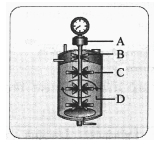
Consider the following figure of a stirred-tank bioreactor and identify $A, B, C$,and $D$.
A
$A \rightarrow$ Motor,$B \rightarrow$ Culture broth,$C \rightarrow$ Impeller,$D \rightarrow$ Foam breaker
B
$A \rightarrow$ Foam breaker,$B \rightarrow$ Motor,$C \rightarrow$ Culture broth,$D \rightarrow$ Impeller
C
$A \rightarrow$ Motor,$B \rightarrow$ Foam breaker,$C \rightarrow$ Impeller,$D \rightarrow$ Culture broth
D
$A \rightarrow$ Motor,$B \rightarrow$ Foam breaker,$C \rightarrow$ Culture broth,$D \rightarrow$ Impeller
Solution
(C) The provided figure represents a typical stirred-tank bioreactor used in biotechnology for large-scale production of recombinant proteins.
- $A$ represents the Motor,which provides the mechanical energy for rotation.
- $B$ represents the Foam breaker,which helps in reducing the foam formed during the process.
- $C$ represents the Impeller,which ensures proper mixing and oxygen availability throughout the bioreactor.
- $D$ represents the Culture broth,which is the medium containing the microorganisms and nutrients.
Therefore,the correct identification is $A \rightarrow$ Motor,$B \rightarrow$ Foam breaker,$C \rightarrow$ Impeller,$D \rightarrow$ Culture broth.
- $A$ represents the Motor,which provides the mechanical energy for rotation.
- $B$ represents the Foam breaker,which helps in reducing the foam formed during the process.
- $C$ represents the Impeller,which ensures proper mixing and oxygen availability throughout the bioreactor.
- $D$ represents the Culture broth,which is the medium containing the microorganisms and nutrients.
Therefore,the correct identification is $A \rightarrow$ Motor,$B \rightarrow$ Foam breaker,$C \rightarrow$ Impeller,$D \rightarrow$ Culture broth.
0 likes
View Solution276
MediumMCQ
Bacterial colonies that have a foreign $\text{DNA}$ fragment inserted into the plasmid will appear white,because $-$
A
$X-$gal can be cleaved by $\beta-$galactosidase
B
$\beta-$galactosidase gene shows insertional inactivation due to insertion of foreign $\text{DNA}$
C
Lac $z$ gene is active
D
$X-$gal can be cleaved by permease
Solution
(B) In the process of recombinant $\text{DNA}$ technology,the $Lac \ Z$ gene encodes for the enzyme $\beta-$galactosidase.
When a foreign $\text{DNA}$ fragment is inserted into this gene,it results in the disruption of the gene,a process known as insertional inactivation.
As a result,the enzyme $\beta-$galactosidase is not produced.
In the presence of a chromogenic substrate like $X-$gal,non-recombinant colonies (where the gene is intact) produce the enzyme,which cleaves $X-$gal to produce blue-colored colonies.
Conversely,recombinant colonies (where the gene is inactivated) cannot produce the enzyme,so they cannot cleave $X-$gal and thus appear white.
When a foreign $\text{DNA}$ fragment is inserted into this gene,it results in the disruption of the gene,a process known as insertional inactivation.
As a result,the enzyme $\beta-$galactosidase is not produced.
In the presence of a chromogenic substrate like $X-$gal,non-recombinant colonies (where the gene is intact) produce the enzyme,which cleaves $X-$gal to produce blue-colored colonies.
Conversely,recombinant colonies (where the gene is inactivated) cannot produce the enzyme,so they cannot cleave $X-$gal and thus appear white.
0 likes
View Solution277
EasyMCQ
Which statements are correct for gel electrophoresis to separate $\text{DNA}$ fragments?
$(a)$ $\text{DNA}$ is a negatively charged molecule and so it is loaded on the gel towards the anode terminal.
$(b)$ $\text{DNA}$ fragments travel along the surface of the gel whose concentration does not affect the movement of $\text{DNA}$.
$(c)$ Smaller the size of $\text{DNA}$ fragments,larger is the distance it travels through it.
$(d)$ Pure $\text{DNA}$ can be visualized directly by exposing it to $\text{UV}$ radiation.
$(a)$ $\text{DNA}$ is a negatively charged molecule and so it is loaded on the gel towards the anode terminal.
$(b)$ $\text{DNA}$ fragments travel along the surface of the gel whose concentration does not affect the movement of $\text{DNA}$.
$(c)$ Smaller the size of $\text{DNA}$ fragments,larger is the distance it travels through it.
$(d)$ Pure $\text{DNA}$ can be visualized directly by exposing it to $\text{UV}$ radiation.
A
$a, c$ and $d$
B
$a, b$ and $c$
C
only $d$ is correct
D
only $c$ is correct
Solution
(D) Statement $(a)$ is incorrect because $\text{DNA}$ is negatively charged and moves towards the anode (positive electrode),so it must be loaded towards the cathode (negative electrode).
Statement $(b)$ is incorrect because $\text{DNA}$ fragments move through the gel matrix (sieve),and the concentration of the gel (e.g.,agarose) significantly affects the movement of $\text{DNA}$ fragments.
Statement $(c)$ is correct because smaller $\text{DNA}$ fragments face less resistance from the gel matrix and travel faster and further than larger fragments.
Statement $(d)$ is incorrect because $\text{DNA}$ is colorless and cannot be visualized directly; it must be stained with a dye like ethidium bromide and then exposed to $\text{UV}$ radiation to be seen.
Statement $(b)$ is incorrect because $\text{DNA}$ fragments move through the gel matrix (sieve),and the concentration of the gel (e.g.,agarose) significantly affects the movement of $\text{DNA}$ fragments.
Statement $(c)$ is correct because smaller $\text{DNA}$ fragments face less resistance from the gel matrix and travel faster and further than larger fragments.
Statement $(d)$ is incorrect because $\text{DNA}$ is colorless and cannot be visualized directly; it must be stained with a dye like ethidium bromide and then exposed to $\text{UV}$ radiation to be seen.
0 likes
View Solution278
MediumMCQ
When foreign $\text{DNA}$ is inserted into any vector,it results in inactivation of any marker gene. This is used for selection of $......\ :-$
A
Non-transformant cells
B
Transformant cells
C
Recombinant cells
D
Cancer cells
Solution
(C) The process of insertional inactivation is a technique used to distinguish between recombinant and non-recombinant cells.
When a foreign $\text{DNA}$ fragment is inserted into a selectable marker gene (e.g.,the $\text{ampicillin}$ or $\text{tetracycline}$ resistance gene in $pBR322$),the gene becomes non-functional.
This process is known as insertional inactivation.
If the vector contains the foreign $\text{DNA}$,the marker gene is inactivated,and the cell becomes a recombinant cell.
If the vector does not contain the foreign $\text{DNA}$,the marker gene remains functional,and the cell is a non-recombinant cell.
Therefore,this method is specifically used for the selection of recombinant cells.
When a foreign $\text{DNA}$ fragment is inserted into a selectable marker gene (e.g.,the $\text{ampicillin}$ or $\text{tetracycline}$ resistance gene in $pBR322$),the gene becomes non-functional.
This process is known as insertional inactivation.
If the vector contains the foreign $\text{DNA}$,the marker gene is inactivated,and the cell becomes a recombinant cell.
If the vector does not contain the foreign $\text{DNA}$,the marker gene remains functional,and the cell is a non-recombinant cell.
Therefore,this method is specifically used for the selection of recombinant cells.
0 likes
View Solution279
MediumMCQ
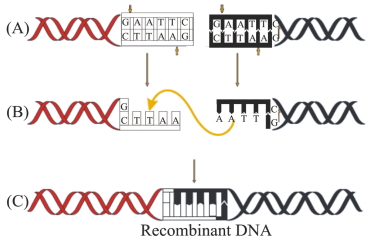
The figure below shows three steps $(A, B, C)$ of a process. Select the option giving the correct identification $:-$
A
$(C)$ Joining of vector $\text{DNA}$ and foreign $\text{DNA}$ with the help of $\text{DNA}$ ligase
B
$(A)$ Cutting of $\text{DNA}$ with the help of $\text{EcoRI}$
C
$(B)$ Joining of two vector $\text{DNA}$ with the help of endonuclease
D
$(A)$ Separation of $\text{DNA}$ by southern blotting
Solution
(A) The figure illustrates the process of recombinant $\text{DNA}$ technology.
Step $(A)$ shows the action of a restriction endonuclease (specifically $\text{EcoRI}$) on both the vector $\text{DNA}$ and foreign $\text{DNA}$ at specific palindromic sequences $(GAATTC)$,resulting in sticky ends.
Step $(B)$ shows the base pairing of the complementary sticky ends of the vector $\text{DNA}$ and foreign $\text{DNA}$.
Step $(C)$ shows the sealing of the nicks in the sugar-phosphate backbone by the enzyme $\text{DNA}$ ligase,resulting in the formation of recombinant $\text{DNA}$.
Therefore,the correct identification is $(C)$ Joining of vector $\text{DNA}$ and foreign $\text{DNA}$ with the help of $\text{DNA}$ ligase.
Step $(A)$ shows the action of a restriction endonuclease (specifically $\text{EcoRI}$) on both the vector $\text{DNA}$ and foreign $\text{DNA}$ at specific palindromic sequences $(GAATTC)$,resulting in sticky ends.
Step $(B)$ shows the base pairing of the complementary sticky ends of the vector $\text{DNA}$ and foreign $\text{DNA}$.
Step $(C)$ shows the sealing of the nicks in the sugar-phosphate backbone by the enzyme $\text{DNA}$ ligase,resulting in the formation of recombinant $\text{DNA}$.
Therefore,the correct identification is $(C)$ Joining of vector $\text{DNA}$ and foreign $\text{DNA}$ with the help of $\text{DNA}$ ligase.
0 likes
View Solution280
MediumMCQ
Arrange the steps of $\text{rDNA}$ technology in the correct order$:-$
$(I.)$ Extraction of the desired gene product.
$(II.)$ Amplification of the gene of interest.
$(III.)$ Isolation of the desired $\text{DNA}$ fragment.
$(IV.)$ Ligation of the $\text{DNA}$ fragment into a vector.
$(V.)$ Insertion of $\text{rDNA}$ into the host.
The correct order is$:-$
$(I.)$ Extraction of the desired gene product.
$(II.)$ Amplification of the gene of interest.
$(III.)$ Isolation of the desired $\text{DNA}$ fragment.
$(IV.)$ Ligation of the $\text{DNA}$ fragment into a vector.
$(V.)$ Insertion of $\text{rDNA}$ into the host.
The correct order is$:-$
A
$I, II, III, IV, V$
B
$V, IV, III, II, I$
C
$III, II, IV, V, I$
D
$III, IV, II, I, V$
Solution
(C) The steps of $\text{rDNA}$ (recombinant $\text{DNA}$) technology follow a specific sequence:
$1.$ First,the desired $\text{DNA}$ fragment is isolated from the source organism $(III)$.
$2.$ This fragment is then amplified using techniques like $\text{PCR}$ $(II)$.
$3.$ The amplified $\text{DNA}$ is ligated into a suitable vector to form $\text{rDNA}$ $(IV)$.
$4.$ The $\text{rDNA}$ is then inserted into the host cell $(V)$.
$5.$ Finally,the desired gene product is extracted from the host $(I)$.
Thus,the correct sequence is $III, II, IV, V, I$.
$1.$ First,the desired $\text{DNA}$ fragment is isolated from the source organism $(III)$.
$2.$ This fragment is then amplified using techniques like $\text{PCR}$ $(II)$.
$3.$ The amplified $\text{DNA}$ is ligated into a suitable vector to form $\text{rDNA}$ $(IV)$.
$4.$ The $\text{rDNA}$ is then inserted into the host cell $(V)$.
$5.$ Finally,the desired gene product is extracted from the host $(I)$.
Thus,the correct sequence is $III, II, IV, V, I$.
0 likes
View Solution281
EasyMCQ
The primer extension during $PCR$ cycle requires the temperature range of . . . . . . .
A
$70-75^{\circ} C$
B
$90-98^{\circ} C$
C
$65-85^{\circ} C$
D
$35-40^{\circ} C$
Solution
(A) The $PCR$ (Polymerase Chain Reaction) process consists of three main steps: denaturation,annealing,and extension.
$1$. Denaturation occurs at $94-98^{\circ} C$.
$2$. Annealing occurs at $50-65^{\circ} C$.
$3$. Primer extension is performed by the $Taq$ polymerase enzyme,which is heat-stable and functions optimally at a temperature range of $70-75^{\circ} C$. Therefore,the correct option is $A$.
$1$. Denaturation occurs at $94-98^{\circ} C$.
$2$. Annealing occurs at $50-65^{\circ} C$.
$3$. Primer extension is performed by the $Taq$ polymerase enzyme,which is heat-stable and functions optimally at a temperature range of $70-75^{\circ} C$. Therefore,the correct option is $A$.
0 likes
View Solution282
EasyMCQ
Given below are two statements.
Statement $I$ - The isolated $DNA$ of donor organism is cleaved by suitable restriction endonuclease to form $DNA$ fragments with cohesive staggered or blunt ends.
Statement $II$ - The foreign $DNA$ or passenger $DNA$ can also be obtained directly from genomic or cDNA library.
In the light of above statements,select the correct option given below:
Statement $I$ - The isolated $DNA$ of donor organism is cleaved by suitable restriction endonuclease to form $DNA$ fragments with cohesive staggered or blunt ends.
Statement $II$ - The foreign $DNA$ or passenger $DNA$ can also be obtained directly from genomic or cDNA library.
In the light of above statements,select the correct option given below:
A
Both statement $I$ and statement $II$ are correct.
B
Both statement $I$ and statement $II$ are incorrect.
C
Statement $I$ is correct but statement $II$ is incorrect.
D
Statement $I$ is incorrect but statement $II$ is correct.
Solution
(A) Statement $I$ is correct: Restriction endonucleases are enzymes that cut $DNA$ at specific recognition sequences,producing either 'sticky' (cohesive/staggered) ends or 'blunt' ends,which are essential for recombinant $DNA$ technology.
Statement $II$ is correct: Foreign $DNA$ (or passenger $DNA$) can be isolated directly from the donor organism,or it can be obtained from a genomic library (containing all $DNA$ sequences of an organism) or a $cDNA$ library (containing only expressed genes).
Since both statements are scientifically accurate,the correct option is $A$.
Statement $II$ is correct: Foreign $DNA$ (or passenger $DNA$) can be isolated directly from the donor organism,or it can be obtained from a genomic library (containing all $DNA$ sequences of an organism) or a $cDNA$ library (containing only expressed genes).
Since both statements are scientifically accurate,the correct option is $A$.
0 likes
View Solution283
EasyMCQ
Which of the following range of temperature is required for denaturation,annealing of primer,and primer extension of $PCR$ respectively?
A
$90-98^{\circ} C, 40-60^{\circ} C, 70-75^{\circ} C$
B
$70-75^{\circ} C, 40-60^{\circ} C, 90-98^{\circ} C$
C
$90-98^{\circ} C, 70-75^{\circ} C, 40-60^{\circ} C$
D
$40-60^{\circ} C, 90-98^{\circ} C, 70-75^{\circ} C$
Solution
(A) The $PCR$ (Polymerase Chain Reaction) process consists of three main steps:
$1$. Denaturation: The double-stranded $DNA$ is heated to a high temperature $(90-98^{\circ} C)$ to separate the strands.
$2$. Annealing: The temperature is lowered $(40-60^{\circ} C)$ to allow the primers to bind to the complementary sequences on the single-stranded $DNA$.
$3$. Extension: The temperature is adjusted to $70-75^{\circ} C$ to allow the $Taq$ $DNA$ polymerase to synthesize the new $DNA$ strand by adding nucleotides.
Therefore,the correct sequence of temperature ranges is $90-98^{\circ} C, 40-60^{\circ} C, 70-75^{\circ} C$.
$1$. Denaturation: The double-stranded $DNA$ is heated to a high temperature $(90-98^{\circ} C)$ to separate the strands.
$2$. Annealing: The temperature is lowered $(40-60^{\circ} C)$ to allow the primers to bind to the complementary sequences on the single-stranded $DNA$.
$3$. Extension: The temperature is adjusted to $70-75^{\circ} C$ to allow the $Taq$ $DNA$ polymerase to synthesize the new $DNA$ strand by adding nucleotides.
Therefore,the correct sequence of temperature ranges is $90-98^{\circ} C, 40-60^{\circ} C, 70-75^{\circ} C$.
0 likes
View Solution284
EasyMCQ
Agarose gel electrophoresis is used to separate $DNA$ fragments. The $DNA$ fragments separate due to . . . . . . .
A
difference in their staining property
B
difference in the base sequence in them
C
positive charge on the fragments
D
difference in the size of fragments
Solution
(D) Agarose gel electrophoresis is a technique used to separate $DNA$ fragments based on their size.
When an electric field is applied,the negatively charged $DNA$ fragments move towards the anode (positive pole).
The gel matrix acts as a molecular sieve,where smaller fragments move faster and travel further through the pores of the gel compared to larger fragments.
Therefore,the separation of $DNA$ fragments is primarily based on the difference in their size.
When an electric field is applied,the negatively charged $DNA$ fragments move towards the anode (positive pole).
The gel matrix acts as a molecular sieve,where smaller fragments move faster and travel further through the pores of the gel compared to larger fragments.
Therefore,the separation of $DNA$ fragments is primarily based on the difference in their size.
0 likes
View Solution285
EasyMCQ
Southern blotting technique uses . . . . . . paper for embedding $DNA$ strands.
A
Whatman No $1$
B
Parchment
C
Nitrocellulose
D
Cellophane
Solution
(C) In the $Southern$ blotting technique,the $DNA$ fragments separated by gel electrophoresis are transferred onto a solid support membrane.
$Nitrocellulose$ or $Nylon$ membranes are commonly used for this purpose because they have a high affinity for $DNA$ and can bind single-stranded $DNA$ molecules effectively through capillary action.
Therefore,$Nitrocellulose$ paper is the correct material used for embedding $DNA$ strands in this technique.
$Nitrocellulose$ or $Nylon$ membranes are commonly used for this purpose because they have a high affinity for $DNA$ and can bind single-stranded $DNA$ molecules effectively through capillary action.
Therefore,$Nitrocellulose$ paper is the correct material used for embedding $DNA$ strands in this technique.
0 likes
View Solution286
EasyMCQ
Which of the following is not present in a bioreactor?
A
pH controller
B
Light distribution system
C
Oxygen distribution system
D
Foam breaker system
Solution
(B) bioreactor is a vessel in which raw materials are biologically converted into specific products by microbes,plant/animal cells,or their enzymes.
Standard bioreactors are equipped with essential components to maintain optimal growth conditions,including:
$1$. An agitator system for mixing.
$2$. An oxygen delivery system for aeration.
$3$. $A$ foam control system to manage foaming.
$4$. $A$ temperature control system.
$5$. $A$ pH control system.
$6$. Sampling ports for periodic withdrawal of the culture.
Light distribution systems are typically required for photobioreactors (used for photosynthetic organisms like algae),but they are not standard components of a general-purpose industrial bioreactor.
Standard bioreactors are equipped with essential components to maintain optimal growth conditions,including:
$1$. An agitator system for mixing.
$2$. An oxygen delivery system for aeration.
$3$. $A$ foam control system to manage foaming.
$4$. $A$ temperature control system.
$5$. $A$ pH control system.
$6$. Sampling ports for periodic withdrawal of the culture.
Light distribution systems are typically required for photobioreactors (used for photosynthetic organisms like algae),but they are not standard components of a general-purpose industrial bioreactor.
0 likes
View Solution287
EasyMCQ
Which of the following diagrams is correct for primer annealing in $PCR$?
A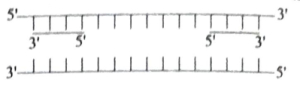
B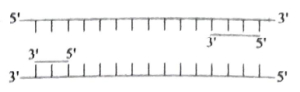
C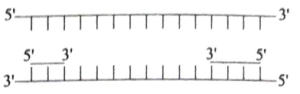
D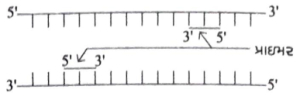
Solution
(B) In the Polymerase Chain Reaction $(PCR)$,primers are short,single-stranded $DNA$ sequences that are complementary to the flanking regions of the target $DNA$ sequence.
$1$. $DNA$ strands are antiparallel,meaning one strand runs in the $5' \rightarrow 3'$ direction and the other in the $3' \rightarrow 5'$ direction.
$2$. Primers anneal to the template $DNA$ strands such that they are complementary and antiparallel to the template.
$3$. Specifically,the primer must bind to the $3'$ end of the template strand so that $DNA$ polymerase can extend it in the $5' \rightarrow 3'$ direction.
$4$. In diagram $B$,the primers are correctly oriented: the primer on the top strand (which is $5' \rightarrow 3'$) binds to the $3'$ end of the template,and the primer on the bottom strand (which is $3' \rightarrow 5'$) binds to the $3'$ end of its respective template,allowing for proper extension.
Therefore,the correct diagram is $B$.
$1$. $DNA$ strands are antiparallel,meaning one strand runs in the $5' \rightarrow 3'$ direction and the other in the $3' \rightarrow 5'$ direction.
$2$. Primers anneal to the template $DNA$ strands such that they are complementary and antiparallel to the template.
$3$. Specifically,the primer must bind to the $3'$ end of the template strand so that $DNA$ polymerase can extend it in the $5' \rightarrow 3'$ direction.
$4$. In diagram $B$,the primers are correctly oriented: the primer on the top strand (which is $5' \rightarrow 3'$) binds to the $3'$ end of the template,and the primer on the bottom strand (which is $3' \rightarrow 5'$) binds to the $3'$ end of its respective template,allowing for proper extension.
Therefore,the correct diagram is $B$.
0 likes
View Solution288
EasyMCQ
Choose the correct statement:
$P -$ Endonucleases cut the $DNA$ at a specific site inside the $DNA$.
$Q -$ $A$ stirred-tank reactor is usually square in shape.
$R -$ In order to force bacteria to take up the plasmid,the bacterial cells must first be made 'competent' to take up $DNA$ by treating them with a divalent cation like $Ca^{2+}$.
$P -$ Endonucleases cut the $DNA$ at a specific site inside the $DNA$.
$Q -$ $A$ stirred-tank reactor is usually square in shape.
$R -$ In order to force bacteria to take up the plasmid,the bacterial cells must first be made 'competent' to take up $DNA$ by treating them with a divalent cation like $Ca^{2+}$.
A
Statement $P$ is true
B
Statement $Q, R$ are true
C
Statement $P, Q$ are true
D
Statement $P, Q, R$ are true
Solution
(A) Statement $P$ is correct because restriction endonucleases recognize specific palindromic sequences and cut $DNA$ at specific sites within the molecule.
Statement $Q$ is incorrect because a stirred-tank reactor is usually cylindrical or has a curved base to facilitate the mixing of the reactor contents.
Statement $R$ is incorrect because the divalent cation used to make bacterial cells competent is typically calcium $(Ca^{2+})$,not magnesium $(Mg^{2+})$. Therefore,only statement $P$ is true.
Statement $Q$ is incorrect because a stirred-tank reactor is usually cylindrical or has a curved base to facilitate the mixing of the reactor contents.
Statement $R$ is incorrect because the divalent cation used to make bacterial cells competent is typically calcium $(Ca^{2+})$,not magnesium $(Mg^{2+})$. Therefore,only statement $P$ is true.
0 likes
View Solution289
EasyMCQ
Identify the labels $X$,$Y$,and $Z$ in the given diagram representing the process of recombinant $DNA$ technology.
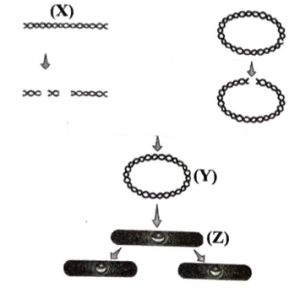
A
$X$ - foreign $DNA$,$Y$ - recombinant $DNA$,$Z$ - transduction
B
$X$ - $DNA$,$Y$ - recombinant $DNA$,$Z$ - transformation
C
$X$ - foreign $DNA$,$Y$ - recombinant $DNA$,$Z$ - transformation
D
$X$ - $DNA$,$Y$ - recombinant $DNA$,$Z$ - transduction
Solution
(C) In the provided diagram of recombinant $DNA$ technology:
$1$. $X$ represents the foreign $DNA$ (or gene of interest) which is being cut by restriction enzymes.
$2$. $Y$ represents the recombinant $DNA$ formed by ligating the foreign $DNA$ into the vector (plasmid).
$3$. $Z$ represents the process of transformation,where the recombinant $DNA$ is introduced into the host cell (bacterium) to express the desired trait.
Therefore,the correct labels are $X$ - foreign $DNA$,$Y$ - recombinant $DNA$,and $Z$ - transformation.
$1$. $X$ represents the foreign $DNA$ (or gene of interest) which is being cut by restriction enzymes.
$2$. $Y$ represents the recombinant $DNA$ formed by ligating the foreign $DNA$ into the vector (plasmid).
$3$. $Z$ represents the process of transformation,where the recombinant $DNA$ is introduced into the host cell (bacterium) to express the desired trait.
Therefore,the correct labels are $X$ - foreign $DNA$,$Y$ - recombinant $DNA$,and $Z$ - transformation.
0 likes
View Solution290
EasyMCQ
r-$DNA$ is inserted within the coding sequence of an enzyme,$\beta$-galactosidase. This results in the inactivation of the gene for the synthesis of this enzyme,which is referred to as . . . . . . .
A
Insertional inactivation
B
Recombinant inactivation
C
Insertional activation
D
Combined inactivation
Solution
(A) When a recombinant $DNA$ ($r$-$DNA$) molecule is inserted within the coding sequence of an enzyme,such as $\beta$-galactosidase,it disrupts the gene's sequence. This disruption leads to the loss of the gene's ability to produce a functional enzyme,a phenomenon known as insertional inactivation. This technique is widely used in blue-white screening to identify recombinant colonies.
0 likes
View Solution291
EasyMCQ
Which of the following methods is used for the isolation of $DNA$?
A
Selectable marker
B
Micro-injection
C
Biolistic
D
Gel electrophoresis
Solution
(D) The correct answer is $D$.
Gel electrophoresis is a technique used to separate $DNA$ fragments based on their size and charge.
While the question asks for isolation,in the context of standard biotechnology curriculum,gel electrophoresis is the primary method used to isolate and purify specific $DNA$ fragments from a mixture after they have been extracted and digested with restriction enzymes.
Other options like 'Selectable marker' are used for identifying transformants,'Micro-injection' is a method for direct gene transfer,and 'Biolistic' (gene gun) is a method for introducing $DNA$ into cells.
Gel electrophoresis is a technique used to separate $DNA$ fragments based on their size and charge.
While the question asks for isolation,in the context of standard biotechnology curriculum,gel electrophoresis is the primary method used to isolate and purify specific $DNA$ fragments from a mixture after they have been extracted and digested with restriction enzymes.
Other options like 'Selectable marker' are used for identifying transformants,'Micro-injection' is a method for direct gene transfer,and 'Biolistic' (gene gun) is a method for introducing $DNA$ into cells.
0 likes
View Solution292
EasyMCQ
Which chemical is utilised during the isolation of $DNA$ at the end of precipitation?
A
Chilled methanol
B
Chilled butanol
C
Chilled ethanol
D
Chilled phenol
Solution
(C) During the process of $DNA$ isolation,the final step involves the precipitation of purified $DNA$. This is achieved by adding chilled ethanol to the $DNA$ solution. The chilled ethanol reduces the solubility of $DNA$ in the aqueous solution,causing it to precipitate out as fine threads,which can then be collected by spooling.
0 likes
View Solution293
EasyMCQ
Which of the following is the correct sequence for $PCR$?
A
Denaturation $\rightarrow$ Elongation $\rightarrow$ Annealing
B
Elongation $\rightarrow$ Denaturation $\rightarrow$ Annealing
C
Annealing $\rightarrow$ Denaturation $\rightarrow$ Elongation
D
Denaturation $\rightarrow$ Annealing $\rightarrow$ Elongation
Solution
(D) The Polymerase Chain Reaction $(PCR)$ consists of three main steps that are repeated in cycles:
$1$. Denaturation: The double-stranded $DNA$ is heated to a high temperature (around $94-95^{\circ}C$) to separate the two strands.
$2$. Annealing: The temperature is lowered (usually $50-65^{\circ}C$) to allow the primers to bind to the complementary sequences on the single-stranded $DNA$ templates.
$3$. Elongation (Extension): The temperature is adjusted (usually $72^{\circ}C$) for the $DNA$ polymerase enzyme to synthesize the new $DNA$ strand by adding nucleotides.
Therefore,the correct sequence is Denaturation $\rightarrow$ Annealing $\rightarrow$ Elongation.
$1$. Denaturation: The double-stranded $DNA$ is heated to a high temperature (around $94-95^{\circ}C$) to separate the two strands.
$2$. Annealing: The temperature is lowered (usually $50-65^{\circ}C$) to allow the primers to bind to the complementary sequences on the single-stranded $DNA$ templates.
$3$. Elongation (Extension): The temperature is adjusted (usually $72^{\circ}C$) for the $DNA$ polymerase enzyme to synthesize the new $DNA$ strand by adding nucleotides.
Therefore,the correct sequence is Denaturation $\rightarrow$ Annealing $\rightarrow$ Elongation.
0 likes
View Solution294
EasyMCQ
Which of the following is not a step of downstream processing?
A
Purification
B
Isolation
C
Clinical trials
D
Expression
Solution
(D) Downstream processing refers to the processes involved in the separation and purification of the product after the biosynthesis stage. It includes separation,purification,and formulation. Expression of the gene (production of the desired protein) occurs during the upstream processing or the fermentation stage,not the downstream processing. Therefore,$D$ is the correct answer.
0 likes
View Solution295
EasyMCQ
At which stage of $PCR$,does the template join with the primer?
A
Annealing
B
Denaturation
C
Elongation
D
Centrifugation
Solution
(A) The Polymerase Chain Reaction $(PCR)$ consists of three main steps:
$1$. Denaturation: The double-stranded $DNA$ is heated to separate it into two single strands.
$2$. Annealing: The temperature is lowered to allow the primers to bind (join) to their complementary sequences on the single-stranded template $DNA$.
$3$. Extension (Elongation): The $Taq$ polymerase enzyme synthesizes the new $DNA$ strand by adding nucleotides to the primer.
Therefore,the stage where the template joins with the primer is Annealing.
$1$. Denaturation: The double-stranded $DNA$ is heated to separate it into two single strands.
$2$. Annealing: The temperature is lowered to allow the primers to bind (join) to their complementary sequences on the single-stranded template $DNA$.
$3$. Extension (Elongation): The $Taq$ polymerase enzyme synthesizes the new $DNA$ strand by adding nucleotides to the primer.
Therefore,the stage where the template joins with the primer is Annealing.
0 likes
View Solution296
EasyMCQ
By which process is a fragment of $DNA$ transferred into a bacterial host cell?
A
Translation
B
Transformation
C
Transcription
D
Transportation
Solution
(B) The correct answer is $B$. Transformation is the process by which a bacterial cell takes up foreign genetic material $(DNA)$ from its surroundings. In biotechnology,this is a fundamental technique used to introduce recombinant $DNA$ into host cells like $E. coli$ to produce desired proteins or clones.
0 likes
View Solution297
EasyMCQ
Silencing of specific mRNA in RNAi is by
A
ssDNA
B
ssRNA
C
dsDNA
D
dsRNA
Solution
(D) $RNAi$ involves the silencing of a specific $mRNA$ due to a complementary $dsRNA$ molecule that prevents the translation of the $mRNA$.
This process is a method of cellular defense and gene regulation.
This process is a method of cellular defense and gene regulation.
0 likes
View Solution298
EasyMCQ
Which of the following diagnostic tools allows the detection of very low concentration of bacteria or viruses by amplifying their nucleic acid?
A
$ELISA$
B
$PCR$
C
Autoradiography
D
r-$DNA$ technology
Solution
(B) $PCR$.
Polymerase Chain Reaction $(PCR)$ is a molecular biology technique that allows for the amplification of specific $DNA$ sequences.
It enables the detection of pathogens like bacteria or viruses even when they are present in very low concentrations in a sample by creating millions of copies of their nucleic acid.
Polymerase Chain Reaction $(PCR)$ is a molecular biology technique that allows for the amplification of specific $DNA$ sequences.
It enables the detection of pathogens like bacteria or viruses even when they are present in very low concentrations in a sample by creating millions of copies of their nucleic acid.
0 likes
View Solution299
EasyMCQ
Rapid antigen test and $RT$-$PCR$ are two diagnostic tests for the $COVID-19$ virus. $PCR$,a molecular diagnostic tool,stands for:
A
Polymerase Chain Reaction
B
Polymerase Chain Reagent
C
Physiological Chain Reaction
D
Physiological Chain Reagent
Solution
(A) $PCR$ stands for Polymerase Chain Reaction.
It is a molecular diagnostic technique used to amplify specific segments of $DNA$ in vitro.
In this process,a short region of a $DNA$ molecule is copied many times using the $DNA$ polymerase enzyme,allowing for the detection of pathogens like the $COVID-19$ virus even in small quantities.
It is a molecular diagnostic technique used to amplify specific segments of $DNA$ in vitro.
In this process,a short region of a $DNA$ molecule is copied many times using the $DNA$ polymerase enzyme,allowing for the detection of pathogens like the $COVID-19$ virus even in small quantities.
0 likes
View Solution300
EasyMCQ
Select the correct statements from the following:
A
$DNA$ from one organism will not band $DNA$ from other organism.
B
Genetic engineering works only on animals and not yet successfully used on plants.
C
There are no risk factors associated with r-$DNA$ technology.
D
The first step in $PCR$ is heating which is used to separate both the strands of gene of interest.
Solution
(D) The correct statement is $D$. The first step in $PCR$ is denaturation,which involves heating the $DNA$ to approximately $94-98^{\circ}C$ to separate the two strands of the gene of interest.
Option $A$ is incorrect because $DNA$ from different organisms can be joined (recombinant $DNA$ technology).
Option $B$ is incorrect because genetic engineering is widely and successfully used in plants (e.g.,$Bt$ cotton).
Option $C$ is incorrect because there are ethical and safety concerns (biosafety) associated with $r-DNA$ technology.
Option $A$ is incorrect because $DNA$ from different organisms can be joined (recombinant $DNA$ technology).
Option $B$ is incorrect because genetic engineering is widely and successfully used in plants (e.g.,$Bt$ cotton).
Option $C$ is incorrect because there are ethical and safety concerns (biosafety) associated with $r-DNA$ technology.
0 likes
View SolutionBiotechnology Principals and Process — Process of Recombinant DNA technology · Frequently Asked Questions
1Are these Biotechnology Principals and Process questions useful for JEE and NEET?
Yes. All questions in this section are mapped to JEE Main and NEET exam patterns. Previous year questions from JEE Main, NEET, GUJCET and state-level exams are included with full solutions.
2Can I switch to Hindi or Gujarati for these questions?
Yes. Use the language tabs in the hero section or the sidebar to view the same questions and solutions in English, Hindi or Gujarati.
3How do I generate a question paper from this subtopic?
Use the Vedclass Exam Paper Generator — select the chapter and subtopic, set difficulty, and generate Sets A, B, C, D automatically. First 3 chapters of every subject are free.
Vedclass Products
For Students
Vedclass Test Series
Mock tests in real JEE/NEET style with performance analysis. 5-day free trial.
Start Free TrialFor Teachers
Exam Paper Generator
Generate Set A/B/C/D papers from this chapter in 2 minutes. 3 chapters free.
Try FreeFor Institutes
Online Exam Module
Live online exams with unlimited students, 360° analytics & white-label branding.
See DemoFor Teachers & Institutes
Generate a Biotechnology Principals and Process Exam Paper in 2 Minutes
Select subtopic & difficulty — Sets A, B, C, D auto-generated with No Repeat logic.
First 3 chapters of every subject are free — no payment required.