
A English
Heat Engine and Carnot Cycle Questions in English
Class 11 Physics · Thermodynamics · Heat Engine and Carnot Cycle
247+
Questions
English
Language
100%
With Solutions
Showing 50 of 247 questions in English
101
EasyMCQ
What is the common feature of a heat engine based on a cyclic process?
A
It converts heat into work continuously.
B
It operates between two temperatures.
C
The system returns to its initial state after each cycle.
D
All of the above.
Solution
(D) heat engine is a device that converts heat energy into mechanical work through a cyclic process.
$1$. It absorbs heat from a high-temperature source $(T_H)$.
$2$. It performs some amount of work $(W)$.
$3$. It rejects the remaining heat to a low-temperature sink $(T_L)$.
$4$. Since it operates in a cyclic process, the change in internal energy $(\Delta U)$ of the system over one complete cycle is zero $(\Delta U = 0)$.
Therefore, all the mentioned features are characteristic of a heat engine.
$1$. It absorbs heat from a high-temperature source $(T_H)$.
$2$. It performs some amount of work $(W)$.
$3$. It rejects the remaining heat to a low-temperature sink $(T_L)$.
$4$. Since it operates in a cyclic process, the change in internal energy $(\Delta U)$ of the system over one complete cycle is zero $(\Delta U = 0)$.
Therefore, all the mentioned features are characteristic of a heat engine.
0 likes
View Solution102
Medium
What is the efficiency of a heat engine? Write its formula.
Solution
(N/A) The efficiency $\eta$ of a heat engine is defined as the ratio of the net work done $(W)$ by the engine per cycle to the total heat absorbed $(Q_H)$ from the hot reservoir (source) per cycle.
It represents the fraction of heat energy converted into useful work.
The formula for efficiency is given by:
$\eta = \frac{W}{Q_H}$
Since $W = Q_H - Q_L$ (where $Q_L$ is the heat rejected to the cold reservoir or sink), the formula can also be expressed as:
$\eta = 1 - \frac{Q_L}{Q_H}$
Efficiency is typically expressed as a percentage by multiplying the result by $100\%$.
It represents the fraction of heat energy converted into useful work.
The formula for efficiency is given by:
$\eta = \frac{W}{Q_H}$
Since $W = Q_H - Q_L$ (where $Q_L$ is the heat rejected to the cold reservoir or sink), the formula can also be expressed as:
$\eta = 1 - \frac{Q_L}{Q_H}$
Efficiency is typically expressed as a percentage by multiplying the result by $100\%$.
0 likes
View Solution103
EasyMCQ
What is the theoretical efficiency of a heat engine?
A
$\eta = 1 - \frac{T_2}{T_1}$
B
$\eta = 1 + \frac{T_2}{T_1}$
C
$\eta = \frac{T_2}{T_1} - 1$
D
$\eta = \frac{T_1}{T_2}$
Solution
(A) The theoretical efficiency of a heat engine is defined by the Carnot efficiency,which represents the maximum possible efficiency for any heat engine operating between two temperatures,$T_1$ (source) and $T_2$ (sink).
The formula for Carnot efficiency is given by $\eta = 1 - \frac{T_2}{T_1}$,where $T_1$ is the absolute temperature of the hot reservoir and $T_2$ is the absolute temperature of the cold reservoir.
This efficiency is independent of the working substance and depends only on the temperatures of the source and the sink.
The formula for Carnot efficiency is given by $\eta = 1 - \frac{T_2}{T_1}$,where $T_1$ is the absolute temperature of the hot reservoir and $T_2$ is the absolute temperature of the cold reservoir.
This efficiency is independent of the working substance and depends only on the temperatures of the source and the sink.
0 likes
View Solution104
MediumMCQ
What is the efficiency of an ideal gas?
A
$1$
B
$0$
C
Depends on the process
D
Depends on the temperature
Solution
(D) The efficiency of a heat engine is defined as the ratio of work done to the heat absorbed from the source. For an ideal gas undergoing a cycle,the efficiency depends on the temperatures of the source $(T_H)$ and the sink $(T_L)$. According to the Carnot theorem,the maximum efficiency of any heat engine operating between two temperatures is given by $\eta = 1 - \frac{T_L}{T_H}$. Therefore,the efficiency is not a fixed constant for an ideal gas but depends on the temperatures of the reservoirs involved in the thermodynamic process.
0 likes
View Solution105
Medium
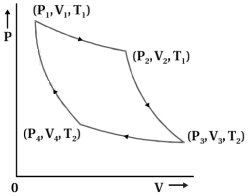
What is a Carnot cycle? Explain it by drawing a figure.
Solution
(N/A) Carnot cycle is a theoretical thermodynamic cycle proposed by Sadi Carnot. It describes the most efficient possible heat engine operating between two heat reservoirs at temperatures $T_{1}$ (source) and $T_{2}$ (sink),where $T_{1} > T_{2}$.
The cycle consists of four reversible processes:
$1$. Reversible isothermal expansion: The gas expands at a constant temperature $T_{1}$,absorbing heat $Q_{1}$ from the source.
$2$. Reversible adiabatic expansion: The gas expands further without heat exchange,and its temperature drops from $T_{1}$ to $T_{2}$.
$3$. Reversible isothermal compression: The gas is compressed at a constant temperature $T_{2}$,rejecting heat $Q_{2}$ to the sink.
$4$. Reversible adiabatic compression: The gas is compressed further without heat exchange,and its temperature rises from $T_{2}$ back to $T_{1}$.
The $P-V$ diagram for the Carnot cycle is shown in the figure.
The cycle consists of four reversible processes:
$1$. Reversible isothermal expansion: The gas expands at a constant temperature $T_{1}$,absorbing heat $Q_{1}$ from the source.
$2$. Reversible adiabatic expansion: The gas expands further without heat exchange,and its temperature drops from $T_{1}$ to $T_{2}$.
$3$. Reversible isothermal compression: The gas is compressed at a constant temperature $T_{2}$,rejecting heat $Q_{2}$ to the sink.
$4$. Reversible adiabatic compression: The gas is compressed further without heat exchange,and its temperature rises from $T_{2}$ back to $T_{1}$.
The $P-V$ diagram for the Carnot cycle is shown in the figure.
0 likes
View Solution106
Difficult
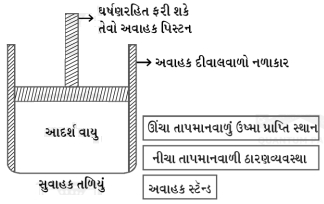
Explain: Carnot cycle and Carnot engine.
Solution
(N/A) Carnot engine is a theoretical thermodynamic cycle proposed by Nicolas $L$éonard Sadi Carnot. It operates between two heat reservoirs at temperatures $T_H$ (source) and $T_L$ (sink).
$1$. Carnot Engine Components:
- $A$ cylinder with insulating walls and a perfectly conducting base.
- $A$ frictionless,insulating piston.
- $A$ working substance (ideal gas).
- $A$ heat source at high temperature $T_H$.
- $A$ heat sink at low temperature $T_L$.
- An insulating stand.
$2$. Carnot Cycle Steps:
- Step $I$: Isothermal Expansion: The gas is placed on the heat source. It expands isothermally at temperature $T_H$,absorbing heat $Q_H$ from the source.
- Step $II$: Adiabatic Expansion: The cylinder is placed on the insulating stand. The gas expands adiabatically until its temperature drops to $T_L$.
- Step $III$: Isothermal Compression: The cylinder is placed on the heat sink. The gas is compressed isothermally at temperature $T_L$,rejecting heat $Q_L$ to the sink.
- Step $IV$: Adiabatic Compression: The cylinder is placed back on the insulating stand. The gas is compressed adiabatically until its temperature rises back to $T_H$,completing the cycle.
$1$. Carnot Engine Components:
- $A$ cylinder with insulating walls and a perfectly conducting base.
- $A$ frictionless,insulating piston.
- $A$ working substance (ideal gas).
- $A$ heat source at high temperature $T_H$.
- $A$ heat sink at low temperature $T_L$.
- An insulating stand.
$2$. Carnot Cycle Steps:
- Step $I$: Isothermal Expansion: The gas is placed on the heat source. It expands isothermally at temperature $T_H$,absorbing heat $Q_H$ from the source.
- Step $II$: Adiabatic Expansion: The cylinder is placed on the insulating stand. The gas expands adiabatically until its temperature drops to $T_L$.
- Step $III$: Isothermal Compression: The cylinder is placed on the heat sink. The gas is compressed isothermally at temperature $T_L$,rejecting heat $Q_L$ to the sink.
- Step $IV$: Adiabatic Compression: The cylinder is placed back on the insulating stand. The gas is compressed adiabatically until its temperature rises back to $T_H$,completing the cycle.
0 likes
View Solution107
Difficult
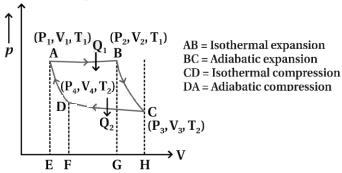
Show the four steps of a Carnot engine in a $P-V$ graph,write the equation for each step,and obtain the work done by the system. Also,derive the efficiency of a Carnot engine.
Solution
(N/A) Carnot engine operates through a cycle of four reversible processes:
$(1)$ Isothermal expansion $(A \rightarrow B)$: The gas expands at a constant temperature $T_1$. The heat absorbed is $Q_1 = \mu RT_1 \ln(V_2/V_1)$. The work done is $W_1 = Q_1 = \mu RT_1 \ln(V_2/V_1)$.
$(2)$ Adiabatic expansion $(B \rightarrow C)$: The gas expands adiabatically from $(P_2, V_2, T_1)$ to $(P_3, V_3, T_2)$. The work done is $W_2 = \frac{\mu R(T_1 - T_2)}{\gamma - 1}$.
$(3)$ Isothermal compression $(C \rightarrow D)$: The gas is compressed at a constant temperature $T_2$. The heat rejected is $Q_2 = \mu RT_2 \ln(V_3/V_4)$. The work done on the gas is $W_3 = \mu RT_2 \ln(V_3/V_4)$.
$(4)$ Adiabatic compression $(D \rightarrow A)$: The gas is compressed adiabatically from $(P_4, V_4, T_2)$ to $(P_1, V_1, T_1)$. The work done on the gas is $W_4 = \frac{\mu R(T_1 - T_2)}{\gamma - 1}$.
Total work done by the system: $W = W_1 + W_2 - W_3 - W_4 = W_1 - W_3 = \mu RT_1 \ln(V_2/V_1) - \mu RT_2 \ln(V_3/V_4)$.
Efficiency $\eta = 1 - \frac{Q_2}{Q_1} = 1 - \frac{T_2}{T_1}$.
$(1)$ Isothermal expansion $(A \rightarrow B)$: The gas expands at a constant temperature $T_1$. The heat absorbed is $Q_1 = \mu RT_1 \ln(V_2/V_1)$. The work done is $W_1 = Q_1 = \mu RT_1 \ln(V_2/V_1)$.
$(2)$ Adiabatic expansion $(B \rightarrow C)$: The gas expands adiabatically from $(P_2, V_2, T_1)$ to $(P_3, V_3, T_2)$. The work done is $W_2 = \frac{\mu R(T_1 - T_2)}{\gamma - 1}$.
$(3)$ Isothermal compression $(C \rightarrow D)$: The gas is compressed at a constant temperature $T_2$. The heat rejected is $Q_2 = \mu RT_2 \ln(V_3/V_4)$. The work done on the gas is $W_3 = \mu RT_2 \ln(V_3/V_4)$.
$(4)$ Adiabatic compression $(D \rightarrow A)$: The gas is compressed adiabatically from $(P_4, V_4, T_2)$ to $(P_1, V_1, T_1)$. The work done on the gas is $W_4 = \frac{\mu R(T_1 - T_2)}{\gamma - 1}$.
Total work done by the system: $W = W_1 + W_2 - W_3 - W_4 = W_1 - W_3 = \mu RT_1 \ln(V_2/V_1) - \mu RT_2 \ln(V_3/V_4)$.
Efficiency $\eta = 1 - \frac{Q_2}{Q_1} = 1 - \frac{T_2}{T_1}$.
0 likes
View Solution108
Medium
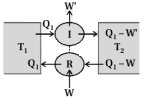
State and explain Carnot's theorem.
Solution
(N/A) Carnot's theorem consists of two main parts:
$(a)$ No heat engine operating between two given heat reservoirs at temperatures $T_{1}$ and $T_{2}$ can be more efficient than a reversible Carnot engine operating between the same two reservoirs.
$(b)$ All reversible engines operating between the same two heat reservoirs have the same efficiency,regardless of the working substance used.
To prove part $(a)$,consider an irreversible engine $I$ and a reversible Carnot engine $R$ operating between a source at temperature $T_{1}$ and a sink at temperature $T_{2}$.
Assume $I$ absorbs heat $Q_{1}$ from the source,performs work $W'$,and rejects heat $Q_{1} - W'$ to the sink. Let $R$ be coupled to $I$ such that $R$ acts as a refrigerator,taking heat $Q_{2}$ from the sink and requiring work $W$ to return heat $Q_{1}$ to the source.
If we assume $\eta_{I} > \eta_{R}$,then for the same heat $Q_{1}$ absorbed from the source,the work done by $I$ is $W' > W$. The net work output of the combined system is $W' - W$,and the net heat extracted from the cold reservoir is $(Q_{1} - W) - (Q_{1} - W') = W' - W$. This implies the system converts heat directly into work without any other effect,which violates the Kelvin-Planck statement of the second law of thermodynamics. Thus,$\eta_{I} \leq \eta_{R}$.
For part $(b)$,if we have two reversible engines $R_{1}$ and $R_{2}$,we can run one in reverse to form a combined system. If one were more efficient,it would violate the second law. Therefore,all reversible engines must have the same efficiency,given by $\eta = 1 - \frac{T_{2}}{T_{1}}$,which is independent of the working substance.
$(a)$ No heat engine operating between two given heat reservoirs at temperatures $T_{1}$ and $T_{2}$ can be more efficient than a reversible Carnot engine operating between the same two reservoirs.
$(b)$ All reversible engines operating between the same two heat reservoirs have the same efficiency,regardless of the working substance used.
To prove part $(a)$,consider an irreversible engine $I$ and a reversible Carnot engine $R$ operating between a source at temperature $T_{1}$ and a sink at temperature $T_{2}$.
Assume $I$ absorbs heat $Q_{1}$ from the source,performs work $W'$,and rejects heat $Q_{1} - W'$ to the sink. Let $R$ be coupled to $I$ such that $R$ acts as a refrigerator,taking heat $Q_{2}$ from the sink and requiring work $W$ to return heat $Q_{1}$ to the source.
If we assume $\eta_{I} > \eta_{R}$,then for the same heat $Q_{1}$ absorbed from the source,the work done by $I$ is $W' > W$. The net work output of the combined system is $W' - W$,and the net heat extracted from the cold reservoir is $(Q_{1} - W) - (Q_{1} - W') = W' - W$. This implies the system converts heat directly into work without any other effect,which violates the Kelvin-Planck statement of the second law of thermodynamics. Thus,$\eta_{I} \leq \eta_{R}$.
For part $(b)$,if we have two reversible engines $R_{1}$ and $R_{2}$,we can run one in reverse to form a combined system. If one were more efficient,it would violate the second law. Therefore,all reversible engines must have the same efficiency,given by $\eta = 1 - \frac{T_{2}}{T_{1}}$,which is independent of the working substance.
0 likes
View Solution109
Medium
What is a Carnot cycle?
Solution
(N/A) Carnot cycle is a theoretical thermodynamic cycle proposed by Nicolas $L$éonard Sadi Carnot in $1824$. It describes the most efficient possible heat engine operating between two heat reservoirs at temperatures $T_H$ (hot) and $T_C$ (cold). The cycle consists of four reversible processes:
$1$. Reversible isothermal expansion: The gas expands at a constant high temperature $T_H$,absorbing heat $Q_H$ from the source.
$2$. Reversible adiabatic expansion: The gas continues to expand without heat exchange,and its temperature drops from $T_H$ to $T_C$.
$3$. Reversible isothermal compression: The gas is compressed at a constant low temperature $T_C$,rejecting heat $Q_C$ to the sink.
$4$. Reversible adiabatic compression: The gas is compressed without heat exchange,and its temperature rises from $T_C$ back to $T_H$,completing the cycle.
$1$. Reversible isothermal expansion: The gas expands at a constant high temperature $T_H$,absorbing heat $Q_H$ from the source.
$2$. Reversible adiabatic expansion: The gas continues to expand without heat exchange,and its temperature drops from $T_H$ to $T_C$.
$3$. Reversible isothermal compression: The gas is compressed at a constant low temperature $T_C$,rejecting heat $Q_C$ to the sink.
$4$. Reversible adiabatic compression: The gas is compressed without heat exchange,and its temperature rises from $T_C$ back to $T_H$,completing the cycle.
0 likes
View Solution110
EasyMCQ
What is a Carnot engine?
A
$A$ real engine that operates with $100\%$ efficiency.
B
$A$ theoretical engine that operates on a reversible cycle between two temperatures.
C
An engine that uses internal combustion to produce work.
D
An engine that operates only at absolute zero.
Solution
(B) Carnot engine is a theoretical model of a heat engine proposed by Sadi Carnot in $1824$.
It operates on a reversible cycle known as the Carnot cycle,which consists of two isothermal processes and two adiabatic processes.
It provides the theoretical upper limit for the efficiency of any heat engine operating between two given temperatures,$T_H$ (hot reservoir) and $T_L$ (cold reservoir).
The efficiency of a Carnot engine is given by $\eta = 1 - \frac{T_L}{T_H}$,where temperatures are in Kelvin.
Since it is a reversible cycle,it is the most efficient engine possible between two heat reservoirs.
It operates on a reversible cycle known as the Carnot cycle,which consists of two isothermal processes and two adiabatic processes.
It provides the theoretical upper limit for the efficiency of any heat engine operating between two given temperatures,$T_H$ (hot reservoir) and $T_L$ (cold reservoir).
The efficiency of a Carnot engine is given by $\eta = 1 - \frac{T_L}{T_H}$,where temperatures are in Kelvin.
Since it is a reversible cycle,it is the most efficient engine possible between two heat reservoirs.
0 likes
View Solution111
MediumMCQ
Who first proposed (invented) the Carnot engine?
A
Nicolas $L$éonard Sadi Carnot
B
Rudolf Clausius
C
Lord Kelvin
D
James Prescott Joule
Solution
(A) The Carnot engine is a theoretical thermodynamic cycle proposed by the French physicist $Nicolas$ $Léonard$ $Sadi$ $Carnot$ in $1824$.
He developed this model to determine the maximum possible efficiency that any heat engine can achieve when operating between two given thermal reservoirs at different temperatures.
Therefore,the correct answer is $Nicolas$ $Léonard$ $Sadi$ $Carnot$.
He developed this model to determine the maximum possible efficiency that any heat engine can achieve when operating between two given thermal reservoirs at different temperatures.
Therefore,the correct answer is $Nicolas$ $Léonard$ $Sadi$ $Carnot$.
0 likes
View Solution112
MediumMCQ
Which type of process is performed in an ideal engine?
A
Isothermal process
B
Adiabatic process
C
Isobaric process
D
$A$ combination of isothermal and adiabatic processes
Solution
(D) An ideal engine,specifically the Carnot engine,operates on the Carnot cycle.
This cycle consists of four reversible processes:
$1$. Reversible isothermal expansion.
$2$. Reversible adiabatic expansion.
$3$. Reversible isothermal compression.
$4$. Reversible adiabatic compression.
Therefore,an ideal engine involves a combination of isothermal and adiabatic processes.
This cycle consists of four reversible processes:
$1$. Reversible isothermal expansion.
$2$. Reversible adiabatic expansion.
$3$. Reversible isothermal compression.
$4$. Reversible adiabatic compression.
Therefore,an ideal engine involves a combination of isothermal and adiabatic processes.
0 likes
View Solution113
MediumMCQ
The efficiency of a Carnot engine depends on what,and of what is it independent?
A
Depends on the temperatures of the source and sink; independent of the working substance.
B
Depends on the working substance; independent of the temperatures of the source and sink.
C
Depends on the pressure of the gas; independent of the volume.
D
Depends on the volume of the gas; independent of the pressure.
Solution
(A) The efficiency $\eta$ of a Carnot engine is given by the formula: $\eta = 1 - \frac{T_2}{T_1}$,where $T_1$ is the temperature of the source and $T_2$ is the temperature of the sink.
From this formula,it is clear that the efficiency depends only on the temperatures of the source and the sink ($T_1$ and $T_2$).
It is independent of the nature of the working substance used in the engine and the design of the engine.
From this formula,it is clear that the efficiency depends only on the temperatures of the source and the sink ($T_1$ and $T_2$).
It is independent of the nature of the working substance used in the engine and the design of the engine.
0 likes
View Solution114
Medium
Explain why the efficiency of a Carnot engine cannot be $100\%$?
Solution
(N/A) The efficiency of a Carnot engine is given by the formula $\eta = 1 - \frac{T_L}{T_H}$,where $T_L$ is the absolute temperature of the cold reservoir (sink) and $T_H$ is the absolute temperature of the hot reservoir (source).
For the efficiency $\eta$ to be $100\%$ (or $1$),the term $\frac{T_L}{T_H}$ must be equal to $0$.
This implies that either $T_L = 0 \ K$ (absolute zero) or $T_H = \infty$.
According to the Third Law of Thermodynamics,it is impossible to reach absolute zero $(0 \ K)$ in a finite number of steps.
Furthermore,it is physically impossible to have a heat source at infinite temperature.
Therefore,it is impossible for any heat engine,including the ideal Carnot engine,to have an efficiency of $100\%$.
For the efficiency $\eta$ to be $100\%$ (or $1$),the term $\frac{T_L}{T_H}$ must be equal to $0$.
This implies that either $T_L = 0 \ K$ (absolute zero) or $T_H = \infty$.
According to the Third Law of Thermodynamics,it is impossible to reach absolute zero $(0 \ K)$ in a finite number of steps.
Furthermore,it is physically impossible to have a heat source at infinite temperature.
Therefore,it is impossible for any heat engine,including the ideal Carnot engine,to have an efficiency of $100\%$.
0 likes
View Solution115
Easy
State Carnot's theorem.
Solution
(N/A) Carnot's theorem states two main points regarding the efficiency of heat engines:
$1$. All reversible heat engines operating between the same two temperatures ($T_1$ and $T_2$) have the same efficiency,regardless of the working substance used.
$2$. No irreversible heat engine operating between two given temperatures can have an efficiency greater than that of a reversible heat engine operating between the same two temperatures.
Mathematically,the efficiency $\eta$ of a Carnot engine is given by $\eta = 1 - \frac{T_2}{T_1}$,where $T_1$ is the temperature of the source and $T_2$ is the temperature of the sink.
$1$. All reversible heat engines operating between the same two temperatures ($T_1$ and $T_2$) have the same efficiency,regardless of the working substance used.
$2$. No irreversible heat engine operating between two given temperatures can have an efficiency greater than that of a reversible heat engine operating between the same two temperatures.
Mathematically,the efficiency $\eta$ of a Carnot engine is given by $\eta = 1 - \frac{T_2}{T_1}$,where $T_1$ is the temperature of the source and $T_2$ is the temperature of the sink.
0 likes
View Solution116
Medium
Write two essential characteristics of an ideal heat engine.
Solution
(N/A) An ideal heat engine,often referred to as a Carnot engine,operates on a reversible cycle. Two essential characteristics are:
$(i)$ The source of heat must have an infinite heat capacity,meaning it can supply any amount of heat without a change in its temperature.
$(ii)$ The sink must have an infinite heat capacity,meaning it can absorb any amount of heat without a change in its temperature.
$(i)$ The source of heat must have an infinite heat capacity,meaning it can supply any amount of heat without a change in its temperature.
$(ii)$ The sink must have an infinite heat capacity,meaning it can absorb any amount of heat without a change in its temperature.
0 likes
View Solution117
MediumMCQ
Under which ideal condition does the efficiency of a Carnot engine become $100 \%$?
A
When the temperature of the source is $0 \ K$.
B
When the temperature of the sink is $0 \ K$.
C
When the temperature of the source is infinite.
D
When the temperature of the sink is equal to the temperature of the source.
Solution
(B) The efficiency of a Carnot engine is given by the formula $\eta = 1 - \frac{T_2}{T_1}$,where $T_1$ is the temperature of the source and $T_2$ is the temperature of the sink.
For the efficiency $\eta$ to be $100 \%$ (or $1$),the term $\frac{T_2}{T_1}$ must be equal to $0$.
This condition is satisfied if the temperature of the sink $T_2$ is $0 \ K$ (absolute zero),while the source temperature $T_1$ remains finite and greater than $0 \ K$.
For the efficiency $\eta$ to be $100 \%$ (or $1$),the term $\frac{T_2}{T_1}$ must be equal to $0$.
This condition is satisfied if the temperature of the sink $T_2$ is $0 \ K$ (absolute zero),while the source temperature $T_1$ remains finite and greater than $0 \ K$.
0 likes
View Solution118
EasyMCQ
Does a Carnot engine working under an isothermal state perform any useful work?
A
Yes,it performs maximum work.
B
No,it does not perform any useful work.
C
Yes,it performs work equal to the heat absorbed.
D
Yes,it performs work equal to the heat rejected.
Solution
(B) The efficiency of a Carnot engine is given by the formula: $\eta = 1 - \frac{T_2}{T_1}$.
For an isothermal process,the temperature remains constant,meaning $T_1 = T_2$.
Substituting this into the efficiency formula: $\eta = 1 - \frac{T_1}{T_1} = 1 - 1 = 0$.
Since the efficiency $\eta$ is $0$,the engine cannot convert any heat into useful work. Therefore,no useful work is performed.
For an isothermal process,the temperature remains constant,meaning $T_1 = T_2$.
Substituting this into the efficiency formula: $\eta = 1 - \frac{T_1}{T_1} = 1 - 1 = 0$.
Since the efficiency $\eta$ is $0$,the engine cannot convert any heat into useful work. Therefore,no useful work is performed.
0 likes
View Solution119
MediumMCQ
What is the efficiency of a Carnot engine working between the boiling point and the freezing point of water (in $\%$)?
A
$100$
B
$26.8$
C
$50$
D
$12.5$
Solution
(B) The efficiency of a Carnot engine is given by the formula $\eta = 1 - \frac{T_L}{T_H}$,where $T_L$ is the temperature of the sink and $T_H$ is the temperature of the source in Kelvin.
For water,the boiling point is $100^{\circ}C = 373.15 \ K$ and the freezing point is $0^{\circ}C = 273.15 \ K$.
Here,$T_H = 373.15 \ K$ and $T_L = 273.15 \ K$.
Substituting these values into the formula:
$\eta = 1 - \frac{273.15}{373.15} = \frac{373.15 - 273.15}{373.15} = \frac{100}{373.15} \approx 0.268$.
Converting to percentage,$\eta \approx 26.8\%$.
For water,the boiling point is $100^{\circ}C = 373.15 \ K$ and the freezing point is $0^{\circ}C = 273.15 \ K$.
Here,$T_H = 373.15 \ K$ and $T_L = 273.15 \ K$.
Substituting these values into the formula:
$\eta = 1 - \frac{273.15}{373.15} = \frac{373.15 - 273.15}{373.15} = \frac{100}{373.15} \approx 0.268$.
Converting to percentage,$\eta \approx 26.8\%$.
0 likes
View Solution120
Easy
Consider a Carnot cycle operating between $T_1 = 500\, K$ and $T_2 = 300\, K$ producing $1\, kJ$ of mechanical work per cycle. Find the heat transferred to the engine by the reservoirs.
Solution
(A) The temperature of the source is $T_1 = 500\, K$ and the temperature of the sink is $T_2 = 300\, K$.
The work done per cycle is $W = 1\, kJ = 1000\, J$.
The efficiency of a Carnot engine is given by $\eta = 1 - \frac{T_2}{T_1}$.
Substituting the values,$\eta = 1 - \frac{300}{500} = 1 - 0.6 = 0.4$.
Since efficiency $\eta = \frac{W}{Q_1}$,the heat transferred to the engine from the source is $Q_1 = \frac{W}{\eta}$.
$Q_1 = \frac{1000\, J}{0.4} = 2500\, J$.
The heat rejected to the sink is $Q_2 = Q_1 - W = 2500\, J - 1000\, J = 1500\, J$.
The work done per cycle is $W = 1\, kJ = 1000\, J$.
The efficiency of a Carnot engine is given by $\eta = 1 - \frac{T_2}{T_1}$.
Substituting the values,$\eta = 1 - \frac{300}{500} = 1 - 0.6 = 0.4$.
Since efficiency $\eta = \frac{W}{Q_1}$,the heat transferred to the engine from the source is $Q_1 = \frac{W}{\eta}$.
$Q_1 = \frac{1000\, J}{0.4} = 2500\, J$.
The heat rejected to the sink is $Q_2 = Q_1 - W = 2500\, J - 1000\, J = 1500\, J$.
0 likes
View Solution121
EasyMCQ
The efficiency of a Carnot engine depends upon
A
the temperature of the source only
B
the temperature of the sink only
C
the temperatures of the source and sink
D
the volume of the cylinder of the engine
Solution
(C) The efficiency $\eta$ of a Carnot engine is given by the formula:
$\eta = 1 - \frac{T_{2}}{T_{1}}$
where $T_{1}$ is the absolute temperature of the source and $T_{2}$ is the absolute temperature of the sink.
Therefore,the efficiency of a Carnot engine depends on both the temperature of the source and the temperature of the sink.
$\eta = 1 - \frac{T_{2}}{T_{1}}$
where $T_{1}$ is the absolute temperature of the source and $T_{2}$ is the absolute temperature of the sink.
Therefore,the efficiency of a Carnot engine depends on both the temperature of the source and the temperature of the sink.
0 likes
View Solution122
MediumMCQ
Determine the efficiency of a Carnot cycle if,in the adiabatic expansion,the volume becomes $3$ times its initial value and $\gamma = 1.5$.
A
$1-\frac{1}{\sqrt{2}}$
B
$1-\frac{1}{\sqrt{3}}$
C
$1+\frac{1}{\sqrt{2}}$
D
$1+\frac{1}{\sqrt{3}}$
Solution
(B) For an adiabatic process,the relationship between temperature and volume is given by $T_1 V_1^{\gamma-1} = T_2 V_2^{\gamma-1}$.
Rearranging this,we get $\frac{T_2}{T_1} = \left(\frac{V_1}{V_2}\right)^{\gamma-1}$.
Given that the final volume $V_2 = 3V_1$,we have $\frac{V_1}{V_2} = \frac{1}{3}$.
Substituting the values $\gamma = 1.5$ and $\frac{V_1}{V_2} = \frac{1}{3}$:
$\frac{T_2}{T_1} = \left(\frac{1}{3}\right)^{1.5-1} = \left(\frac{1}{3}\right)^{0.5} = \frac{1}{\sqrt{3}}$.
The efficiency $\eta$ of a Carnot cycle is defined as $\eta = 1 - \frac{T_2}{T_1}$.
Substituting the ratio,we get $\eta = 1 - \frac{1}{\sqrt{3}}$.
Rearranging this,we get $\frac{T_2}{T_1} = \left(\frac{V_1}{V_2}\right)^{\gamma-1}$.
Given that the final volume $V_2 = 3V_1$,we have $\frac{V_1}{V_2} = \frac{1}{3}$.
Substituting the values $\gamma = 1.5$ and $\frac{V_1}{V_2} = \frac{1}{3}$:
$\frac{T_2}{T_1} = \left(\frac{1}{3}\right)^{1.5-1} = \left(\frac{1}{3}\right)^{0.5} = \frac{1}{\sqrt{3}}$.
The efficiency $\eta$ of a Carnot cycle is defined as $\eta = 1 - \frac{T_2}{T_1}$.
Substituting the ratio,we get $\eta = 1 - \frac{1}{\sqrt{3}}$.
0 likes
View Solution123
MediumMCQ
The temperature of food material in a refrigerator is $4^{\circ} C$ and the temperature of the environment is $15^{\circ} C$. If a Carnot cycle is used in its working gas,find its Carnot efficiency.
A
$0.038$
B
$0.028$
C
$0.053$
D
$0.072$
Solution
(A) The efficiency of a Carnot cycle is given by the formula:
$\eta = 1 - \frac{T_{cold}}{T_{hot}}$
Here,the cold reservoir temperature $T_{cold} = 4^{\circ} C = 273 + 4 = 277 \ K$.
The hot reservoir temperature $T_{hot} = 15^{\circ} C = 273 + 15 = 288 \ K$.
Substituting these values into the formula:
$\eta = 1 - \frac{277}{288}$
$\eta = 1 - 0.9618$
$\eta \approx 0.0382$
Rounding to three decimal places,we get $\eta = 0.038$.
$\eta = 1 - \frac{T_{cold}}{T_{hot}}$
Here,the cold reservoir temperature $T_{cold} = 4^{\circ} C = 273 + 4 = 277 \ K$.
The hot reservoir temperature $T_{hot} = 15^{\circ} C = 273 + 15 = 288 \ K$.
Substituting these values into the formula:
$\eta = 1 - \frac{277}{288}$
$\eta = 1 - 0.9618$
$\eta \approx 0.0382$
Rounding to three decimal places,we get $\eta = 0.038$.
0 likes
View Solution124
MediumMCQ
$A$ Carnot engine works between $27^{\circ} C$ and $127^{\circ} C$. Heat supplied by the source is $500 \ J$. The heat ejected to the sink is (in $J$):
A
$1000$
B
$667$
C
$375$
D
$500$
Solution
(C) For a Carnot engine,the ratio of heat exchanged is equal to the ratio of absolute temperatures:
$\frac{Q_{\text{source}}}{Q_{\text{sink}}} = \frac{T_{\text{source}}}{T_{\text{sink}}}$
Given:
$T_{\text{source}} = 127^{\circ} C = 127 + 273 = 400 \ K$
$T_{\text{sink}} = 27^{\circ} C = 27 + 273 = 300 \ K$
$Q_{\text{source}} = 500 \ J$
Substituting the values into the formula:
$\frac{500}{Q_{\text{sink}}} = \frac{400}{300}$
$\frac{500}{Q_{\text{sink}}} = \frac{4}{3}$
$Q_{\text{sink}} = \frac{500 \times 3}{4} = 125 \times 3 = 375 \ J$
$\frac{Q_{\text{source}}}{Q_{\text{sink}}} = \frac{T_{\text{source}}}{T_{\text{sink}}}$
Given:
$T_{\text{source}} = 127^{\circ} C = 127 + 273 = 400 \ K$
$T_{\text{sink}} = 27^{\circ} C = 27 + 273 = 300 \ K$
$Q_{\text{source}} = 500 \ J$
Substituting the values into the formula:
$\frac{500}{Q_{\text{sink}}} = \frac{400}{300}$
$\frac{500}{Q_{\text{sink}}} = \frac{4}{3}$
$Q_{\text{sink}} = \frac{500 \times 3}{4} = 125 \times 3 = 375 \ J$
0 likes
View Solution125
MediumMCQ
$A$ Carnot engine working between $400\, K$ and $800\, K$ has a work output of $1200\, J$ per cycle. The amount of heat energy supplied to the engine from the source in each cycle is ........... $J$
A
$3200$
B
$1800$
C
$1600$
D
$2400$
Solution
(D) The efficiency $\eta$ of a Carnot engine is given by $\eta = 1 - \frac{T_2}{T_1}$,where $T_1 = 800\, K$ (source temperature) and $T_2 = 400\, K$ (sink temperature).
$\eta = 1 - \frac{400}{800} = 1 - 0.5 = 0.5$.
Also,efficiency is defined as $\eta = \frac{W}{Q_1}$,where $W$ is the work output and $Q_1$ is the heat supplied.
Given $W = 1200\, J$,we have $0.5 = \frac{1200}{Q_1}$.
Therefore,$Q_1 = \frac{1200}{0.5} = 2400\, J$.
$\eta = 1 - \frac{400}{800} = 1 - 0.5 = 0.5$.
Also,efficiency is defined as $\eta = \frac{W}{Q_1}$,where $W$ is the work output and $Q_1$ is the heat supplied.
Given $W = 1200\, J$,we have $0.5 = \frac{1200}{Q_1}$.
Therefore,$Q_1 = \frac{1200}{0.5} = 2400\, J$.
0 likes
View Solution126
MediumMCQ
For an ideal heat engine,the temperature of the source is $127\,^{\circ} C$. In order to have $60\, \%$ efficiency,the temperature of the sink should be $........\,{ }^{\circ} C$. (Round off to the nearest integer)
A
$-\,113$
B
$121$
C
$107$
D
$128$
Solution
(A) The efficiency $\eta$ of an ideal (Carnot) heat engine is given by $\eta = 1 - \frac{T_L}{T_H}$,where $T_H$ is the temperature of the source and $T_L$ is the temperature of the sink in Kelvin.
Given: $\eta = 60\, \% = 0.60$ and $T_H = 127\,^{\circ} C = 127 + 273 = 400\, K$.
Substituting the values: $0.60 = 1 - \frac{T_L}{400}$.
Rearranging the equation: $\frac{T_L}{400} = 1 - 0.60 = 0.40$.
$T_L = 0.40 \times 400 = 160\, K$.
Converting back to Celsius: $T_L(^{\circ} C) = 160 - 273 = -113\,^{\circ} C$.
Given: $\eta = 60\, \% = 0.60$ and $T_H = 127\,^{\circ} C = 127 + 273 = 400\, K$.
Substituting the values: $0.60 = 1 - \frac{T_L}{400}$.
Rearranging the equation: $\frac{T_L}{400} = 1 - 0.60 = 0.40$.
$T_L = 0.40 \times 400 = 160\, K$.
Converting back to Celsius: $T_L(^{\circ} C) = 160 - 273 = -113\,^{\circ} C$.
0 likes
View Solution127
MediumMCQ
$A$ reversible heat engine converts one-fourth of the heat input into work. When the temperature of the sink is reduced by $52 \, K$,its efficiency is doubled. The temperature in Kelvin of the source will be ...... .
A
$256$
B
$208$
C
$104$
D
$52$
Solution
(B) The efficiency of a heat engine is given by $\eta = 1 - \frac{T_2}{T_1}$,where $T_1$ is the source temperature and $T_2$ is the sink temperature.
Given $\eta = \frac{1}{4}$,we have $\frac{1}{4} = 1 - \frac{T_2}{T_1}$,which implies $\frac{T_2}{T_1} = \frac{3}{4}$,so $T_2 = 0.75 T_1$.
When the sink temperature is reduced by $52 \, K$,the new efficiency $\eta' = 2 \times \eta = 2 \times \frac{1}{4} = \frac{1}{2}$.
The new sink temperature is $T_2' = T_2 - 52$.
Using the efficiency formula for the new state: $\frac{1}{2} = 1 - \frac{T_2 - 52}{T_1}$.
This simplifies to $\frac{T_2 - 52}{T_1} = \frac{1}{2}$,or $T_2 - 52 = 0.5 T_1$.
Substituting $T_2 = 0.75 T_1$ into the equation: $0.75 T_1 - 52 = 0.5 T_1$.
$0.25 T_1 = 52$,which gives $T_1 = \frac{52}{0.25} = 208 \, K$.
Given $\eta = \frac{1}{4}$,we have $\frac{1}{4} = 1 - \frac{T_2}{T_1}$,which implies $\frac{T_2}{T_1} = \frac{3}{4}$,so $T_2 = 0.75 T_1$.
When the sink temperature is reduced by $52 \, K$,the new efficiency $\eta' = 2 \times \eta = 2 \times \frac{1}{4} = \frac{1}{2}$.
The new sink temperature is $T_2' = T_2 - 52$.
Using the efficiency formula for the new state: $\frac{1}{2} = 1 - \frac{T_2 - 52}{T_1}$.
This simplifies to $\frac{T_2 - 52}{T_1} = \frac{1}{2}$,or $T_2 - 52 = 0.5 T_1$.
Substituting $T_2 = 0.75 T_1$ into the equation: $0.75 T_1 - 52 = 0.5 T_1$.
$0.25 T_1 = 52$,which gives $T_1 = \frac{52}{0.25} = 208 \, K$.
0 likes
View Solution128
MediumMCQ
$A$ heat engine operates between a cold reservoir at temperature $T_{2} = 400 \, K$ and a hot reservoir at temperature $T_{1}$. It takes $300 \, J$ of heat from the hot reservoir and delivers $240 \, J$ of heat to the cold reservoir in a cycle. The minimum temperature of the hot reservoir has to be $.... K$.
A
$400$
B
$500$
C
$300$
D
$100$
Solution
(B) Given: Heat absorbed from the hot reservoir $Q_{\text{in}} = 300 \, J$.
Heat rejected to the cold reservoir $Q_{\text{out}} = 240 \, J$.
Temperature of the cold reservoir $T_{2} = 400 \, K$.
For a reversible heat engine (Carnot engine),the efficiency is given by $\eta = 1 - \frac{Q_{\text{out}}}{Q_{\text{in}}}$.
Substituting the values: $\eta = 1 - \frac{240}{300} = 1 - 0.8 = 0.2$.
Also,the efficiency of a Carnot engine is $\eta = 1 - \frac{T_{2}}{T_{1}}$.
Equating the two expressions for efficiency: $0.2 = 1 - \frac{400}{T_{1}}$.
$\frac{400}{T_{1}} = 1 - 0.2 = 0.8$.
$T_{1} = \frac{400}{0.8} = 500 \, K$.
Thus,the minimum temperature of the hot reservoir must be $500 \, K$.
Heat rejected to the cold reservoir $Q_{\text{out}} = 240 \, J$.
Temperature of the cold reservoir $T_{2} = 400 \, K$.
For a reversible heat engine (Carnot engine),the efficiency is given by $\eta = 1 - \frac{Q_{\text{out}}}{Q_{\text{in}}}$.
Substituting the values: $\eta = 1 - \frac{240}{300} = 1 - 0.8 = 0.2$.
Also,the efficiency of a Carnot engine is $\eta = 1 - \frac{T_{2}}{T_{1}}$.
Equating the two expressions for efficiency: $0.2 = 1 - \frac{400}{T_{1}}$.
$\frac{400}{T_{1}} = 1 - 0.2 = 0.8$.
$T_{1} = \frac{400}{0.8} = 500 \, K$.
Thus,the minimum temperature of the hot reservoir must be $500 \, K$.
0 likes
View Solution129
DifficultMCQ
$A$ reversible engine has an efficiency of $\frac{1}{4}$. If the temperature of the sink is reduced by $58^{\circ}C$,its efficiency becomes double. Calculate the temperature of the sink in $^{\circ}C$.
A
$174$
B
$280$
C
$180.4$
D
$382$
Solution
(A) Let $T_1$ be the temperature of the source and $T_2$ be the temperature of the sink in Kelvin.
Efficiency $\eta = 1 - \frac{T_2}{T_1}$.
Given $\eta = \frac{1}{4}$,so $\frac{1}{4} = 1 - \frac{T_2}{T_1} \Rightarrow \frac{T_2}{T_1} = \frac{3}{4} \dots (i)$.
When the sink temperature is reduced by $58^{\circ}C$ (which is equivalent to $58 \ K$ in temperature difference),the new sink temperature is $T_2' = T_2 - 58$.
The new efficiency is double,so $\eta' = 2 \times \frac{1}{4} = \frac{1}{2}$.
Thus,$\frac{1}{2} = 1 - \frac{T_2 - 58}{T_1} \Rightarrow \frac{T_2 - 58}{T_1} = \frac{1}{2}$.
Substituting $\frac{T_2}{T_1} = \frac{3}{4}$ into the equation: $\frac{3}{4} - \frac{58}{T_1} = \frac{1}{2}$.
$\frac{58}{T_1} = \frac{3}{4} - \frac{1}{2} = \frac{1}{4} \Rightarrow T_1 = 58 \times 4 = 232 \ K$.
Now,$T_2 = \frac{3}{4} \times 232 = 174 \ K$.
Since the temperature in Kelvin is $174 \ K$,we convert it to Celsius: $T_C = 174 - 273.15 = -99.15^{\circ}C$. However,assuming the question implies the temperature values are in Kelvin and the result is requested in Celsius based on standard textbook problem conventions where $T(K) = T(^{\circ}C) + 273$,the sink temperature is $174 \ K$,which is $-99^{\circ}C$. Given the options,there is a discrepancy in the unit interpretation. Re-evaluating: if $T_2 = 174 \ K$,the answer is $174$ if the question implies the value in Kelvin.
Efficiency $\eta = 1 - \frac{T_2}{T_1}$.
Given $\eta = \frac{1}{4}$,so $\frac{1}{4} = 1 - \frac{T_2}{T_1} \Rightarrow \frac{T_2}{T_1} = \frac{3}{4} \dots (i)$.
When the sink temperature is reduced by $58^{\circ}C$ (which is equivalent to $58 \ K$ in temperature difference),the new sink temperature is $T_2' = T_2 - 58$.
The new efficiency is double,so $\eta' = 2 \times \frac{1}{4} = \frac{1}{2}$.
Thus,$\frac{1}{2} = 1 - \frac{T_2 - 58}{T_1} \Rightarrow \frac{T_2 - 58}{T_1} = \frac{1}{2}$.
Substituting $\frac{T_2}{T_1} = \frac{3}{4}$ into the equation: $\frac{3}{4} - \frac{58}{T_1} = \frac{1}{2}$.
$\frac{58}{T_1} = \frac{3}{4} - \frac{1}{2} = \frac{1}{4} \Rightarrow T_1 = 58 \times 4 = 232 \ K$.
Now,$T_2 = \frac{3}{4} \times 232 = 174 \ K$.
Since the temperature in Kelvin is $174 \ K$,we convert it to Celsius: $T_C = 174 - 273.15 = -99.15^{\circ}C$. However,assuming the question implies the temperature values are in Kelvin and the result is requested in Celsius based on standard textbook problem conventions where $T(K) = T(^{\circ}C) + 273$,the sink temperature is $174 \ K$,which is $-99^{\circ}C$. Given the options,there is a discrepancy in the unit interpretation. Re-evaluating: if $T_2 = 174 \ K$,the answer is $174$ if the question implies the value in Kelvin.
0 likes
View Solution130
DifficultMCQ
$A$ heat engine has an efficiency of $\frac{1}{6}$. When the temperature of the sink is reduced by $62^{\circ}C$,its efficiency gets doubled. The temperature of the source is $.....^{\circ}C$.
A
$37$
B
$99$
C
$62$
D
$124$
Solution
(B) The efficiency of a Carnot engine is given by $\eta = 1 - \frac{T_2}{T_1}$,where $T_1$ is the source temperature and $T_2$ is the sink temperature in Kelvin.
In the first case,$\eta_1 = \frac{1}{6} = 1 - \frac{T_2}{T_1}$,which implies $\frac{T_2}{T_1} = \frac{5}{6}$ (Equation $i$).
In the second case,the sink temperature is reduced by $62^{\circ}C$ (which is equivalent to $62 K$ in temperature difference),so the new sink temperature is $T_2' = T_2 - 62$. The new efficiency is $\eta_2 = 2 \times \frac{1}{6} = \frac{1}{3}$.
Thus,$\frac{1}{3} = 1 - \frac{T_2 - 62}{T_1}$,which implies $\frac{T_2 - 62}{T_1} = \frac{2}{3}$ (Equation $ii$).
Subtracting Equation $ii$ from Equation $i$: $\frac{T_2}{T_1} - \frac{T_2 - 62}{T_1} = \frac{5}{6} - \frac{2}{3}$.
$\frac{62}{T_1} = \frac{5-4}{6} = \frac{1}{6}$.
Therefore,$T_1 = 62 \times 6 = 372 K$.
To convert Kelvin to Celsius: $T(^{\circ}C) = 372 - 273 = 99^{\circ}C$.
In the first case,$\eta_1 = \frac{1}{6} = 1 - \frac{T_2}{T_1}$,which implies $\frac{T_2}{T_1} = \frac{5}{6}$ (Equation $i$).
In the second case,the sink temperature is reduced by $62^{\circ}C$ (which is equivalent to $62 K$ in temperature difference),so the new sink temperature is $T_2' = T_2 - 62$. The new efficiency is $\eta_2 = 2 \times \frac{1}{6} = \frac{1}{3}$.
Thus,$\frac{1}{3} = 1 - \frac{T_2 - 62}{T_1}$,which implies $\frac{T_2 - 62}{T_1} = \frac{2}{3}$ (Equation $ii$).
Subtracting Equation $ii$ from Equation $i$: $\frac{T_2}{T_1} - \frac{T_2 - 62}{T_1} = \frac{5}{6} - \frac{2}{3}$.
$\frac{62}{T_1} = \frac{5-4}{6} = \frac{1}{6}$.
Therefore,$T_1 = 62 \times 6 = 372 K$.
To convert Kelvin to Celsius: $T(^{\circ}C) = 372 - 273 = 99^{\circ}C$.
0 likes
View Solution131
DifficultMCQ
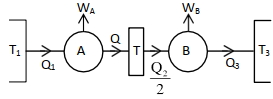
Two Carnot engines $A$ and $B$ operate in series such that engine $A$ absorbs heat $Q_1$ at temperature $T_1$ and rejects heat $Q$ to a sink at temperature $T$. Engine $B$ absorbs half of the heat rejected by engine $A$ (i.e.,$Q/2$) and rejects heat $Q_3$ to the sink at temperature $T_3$. When the work done in both cases is equal,the value of $T$ is:
A
$\frac{2}{3} T_1 + \frac{1}{3} T_3$
B
$\frac{3}{2} T_1 + \frac{1}{3} T_3$
C
$\frac{1}{3} T_1 + \frac{2}{3} T_3$
D
$\frac{2}{3} T_1 + \frac{3}{2} T_3$
Solution
(A) For Carnot engine $A$: Efficiency $\eta_A = 1 - \frac{T}{T_1} = \frac{W_A}{Q_1}$. Thus,$W_A = Q_1 \left(1 - \frac{T}{T_1}\right) = Q_1 - \frac{Q_1 T}{T_1}$.
Since $\frac{Q}{Q_1} = \frac{T}{T_1}$,we have $Q = \frac{Q_1 T}{T_1}$.
For Carnot engine $B$: It absorbs heat $Q_B = Q/2$ at temperature $T$ and rejects heat $Q_3$ at temperature $T_3$. Efficiency $\eta_B = 1 - \frac{T_3}{T} = \frac{W_B}{Q_B}$.
Thus,$W_B = \frac{Q}{2} \left(1 - \frac{T_3}{T}\right) = \frac{Q}{2} - \frac{Q T_3}{2 T}$.
Given $W_A = W_B$,so $Q_1 - Q = \frac{Q}{2} - Q_3$.
Substituting $Q = \frac{Q_1 T}{T_1}$,we get $Q_1 - \frac{Q_1 T}{T_1} = \frac{Q_1 T}{2 T_1} - Q_3$.
Rearranging terms: $Q_1 + Q_3 = \frac{Q_1 T}{T_1} + \frac{Q_1 T}{2 T_1} = \frac{3 Q_1 T}{2 T_1}$.
Using the relation for engine $B$,$\frac{Q_3}{Q/2} = \frac{T_3}{T} \Rightarrow Q_3 = \frac{Q T_3}{2 T} = \frac{Q_1 T T_3}{2 T_1 T} = \frac{Q_1 T_3}{2 T_1}$.
Substituting $Q_3$ back: $Q_1 + \frac{Q_1 T_3}{2 T_1} = \frac{3 Q_1 T}{2 T_1}$.
Dividing by $Q_1$: $1 + \frac{T_3}{2 T_1} = \frac{3 T}{2 T_1}$.
Multiplying by $\frac{2 T_1}{3}$: $T = \frac{2 T_1}{3} + \frac{T_3}{3} = \frac{2}{3} T_1 + \frac{1}{3} T_3$.
Since $\frac{Q}{Q_1} = \frac{T}{T_1}$,we have $Q = \frac{Q_1 T}{T_1}$.
For Carnot engine $B$: It absorbs heat $Q_B = Q/2$ at temperature $T$ and rejects heat $Q_3$ at temperature $T_3$. Efficiency $\eta_B = 1 - \frac{T_3}{T} = \frac{W_B}{Q_B}$.
Thus,$W_B = \frac{Q}{2} \left(1 - \frac{T_3}{T}\right) = \frac{Q}{2} - \frac{Q T_3}{2 T}$.
Given $W_A = W_B$,so $Q_1 - Q = \frac{Q}{2} - Q_3$.
Substituting $Q = \frac{Q_1 T}{T_1}$,we get $Q_1 - \frac{Q_1 T}{T_1} = \frac{Q_1 T}{2 T_1} - Q_3$.
Rearranging terms: $Q_1 + Q_3 = \frac{Q_1 T}{T_1} + \frac{Q_1 T}{2 T_1} = \frac{3 Q_1 T}{2 T_1}$.
Using the relation for engine $B$,$\frac{Q_3}{Q/2} = \frac{T_3}{T} \Rightarrow Q_3 = \frac{Q T_3}{2 T} = \frac{Q_1 T T_3}{2 T_1 T} = \frac{Q_1 T_3}{2 T_1}$.
Substituting $Q_3$ back: $Q_1 + \frac{Q_1 T_3}{2 T_1} = \frac{3 Q_1 T}{2 T_1}$.
Dividing by $Q_1$: $1 + \frac{T_3}{2 T_1} = \frac{3 T}{2 T_1}$.
Multiplying by $\frac{2 T_1}{3}$: $T = \frac{2 T_1}{3} + \frac{T_3}{3} = \frac{2}{3} T_1 + \frac{1}{3} T_3$.
0 likes
View Solution132
MediumMCQ
$A$ Carnot engine takes $5000 \, kcal$ of heat from a reservoir at $727 \, ^{\circ}C$ and gives heat to a sink at $127 \, ^{\circ}C$. The work done by the engine is $.......... \times 10^{6} \, J$.
A
$3$
B
$0$
C
$12.6$
D
$8.4$
Solution
(C) The efficiency of a Carnot engine is given by $\eta = 1 - \frac{T_L}{T_H}$.
Given: $Q_H = 5000 \, kcal$,$T_H = 727 + 273 = 1000 \, K$,$T_L = 127 + 273 = 400 \, K$.
Efficiency $\eta = 1 - \frac{400}{1000} = 1 - 0.4 = 0.6$.
Work done $W = \eta \times Q_H = 0.6 \times 5000 \, kcal = 3000 \, kcal$.
Since $1 \, kcal = 4184 \, J$,then $W = 3000 \times 4184 \, J = 12,552,000 \, J$.
Rounding to the nearest value,$W \approx 12.6 \times 10^{6} \, J$.
Given: $Q_H = 5000 \, kcal$,$T_H = 727 + 273 = 1000 \, K$,$T_L = 127 + 273 = 400 \, K$.
Efficiency $\eta = 1 - \frac{400}{1000} = 1 - 0.4 = 0.6$.
Work done $W = \eta \times Q_H = 0.6 \times 5000 \, kcal = 3000 \, kcal$.
Since $1 \, kcal = 4184 \, J$,then $W = 3000 \times 4184 \, J = 12,552,000 \, J$.
Rounding to the nearest value,$W \approx 12.6 \times 10^{6} \, J$.
1 likes
View Solution133
DifficultMCQ
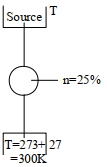
$A$ Carnot engine whose heat sink is at $27\,^{\circ} C$ has an efficiency of $25 \%$. By how many degrees should the temperature of the source be changed to increase the efficiency by $100 \%$ of the original efficiency?
A
Increase by $18\,^{\circ} C$
B
Increase by $200\,^{\circ} C$
C
Increase by $120\,^{\circ} C$
D
Increase by $73\,^{\circ} C$
Solution
(B) The efficiency of a Carnot engine is given by $\eta = 1 - \frac{T_L}{T_H}$,where $T_L$ is the sink temperature and $T_H$ is the source temperature.
Given $T_L = 27\,^{\circ} C = 300\, K$ and $\eta = 25\% = 0.25$.
Substituting the values: $0.25 = 1 - \frac{300}{T_H} \implies \frac{300}{T_H} = 0.75 \implies T_H = \frac{300}{0.75} = 400\, K$.
If the efficiency is increased by $100\%$ of its original value,the new efficiency $\eta' = \eta + 100\% \text{ of } \eta = 0.25 + 0.25 = 0.50$ or $50\%$.
Let the new source temperature be $T_H'$.
$0.50 = 1 - \frac{300}{T_H'} \implies \frac{300}{T_H'} = 0.50 \implies T_H' = \frac{300}{0.50} = 600\, K$.
The change in temperature is $\Delta T = T_H' - T_H = 600\, K - 400\, K = 200\, K$.
Since a change in temperature of $1\, K$ is equivalent to a change of $1\,^{\circ} C$,the temperature should be increased by $200\,^{\circ} C$.
Given $T_L = 27\,^{\circ} C = 300\, K$ and $\eta = 25\% = 0.25$.
Substituting the values: $0.25 = 1 - \frac{300}{T_H} \implies \frac{300}{T_H} = 0.75 \implies T_H = \frac{300}{0.75} = 400\, K$.
If the efficiency is increased by $100\%$ of its original value,the new efficiency $\eta' = \eta + 100\% \text{ of } \eta = 0.25 + 0.25 = 0.50$ or $50\%$.
Let the new source temperature be $T_H'$.
$0.50 = 1 - \frac{300}{T_H'} \implies \frac{300}{T_H'} = 0.50 \implies T_H' = \frac{300}{0.50} = 600\, K$.
The change in temperature is $\Delta T = T_H' - T_H = 600\, K - 400\, K = 200\, K$.
Since a change in temperature of $1\, K$ is equivalent to a change of $1\,^{\circ} C$,the temperature should be increased by $200\,^{\circ} C$.
0 likes
View Solution134
MediumMCQ
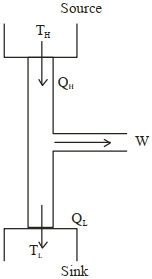
$A$ heat engine operates with the cold reservoir at a temperature of $324 \; K$. If the heat engine takes $300 \; J$ of heat from the hot reservoir and delivers $180 \; J$ of heat to the cold reservoir per cycle,what is the minimum temperature of the hot reservoir in $K$?
A
$530$
B
$540$
C
$550$
D
$560$
Solution
(B) For a reversible (Carnot) heat engine,the efficiency is given by $\eta = 1 - \frac{Q_L}{Q_H} = 1 - \frac{T_L}{T_H}$.
Given:
Temperature of the cold reservoir,$T_L = 324 \; K$.
Heat taken from the hot reservoir,$Q_H = 300 \; J$.
Heat delivered to the cold reservoir,$Q_L = 180 \; J$.
Using the relation for a reversible engine: $\frac{Q_L}{Q_H} = \frac{T_L}{T_H}$.
Substituting the values:
$\frac{180}{300} = \frac{324}{T_H}$.
$T_H = \frac{324 \times 300}{180}$.
$T_H = \frac{324 \times 5}{3} = 108 \times 5 = 540 \; K$.
Thus,the minimum temperature of the hot reservoir is $540 \; K$.
Given:
Temperature of the cold reservoir,$T_L = 324 \; K$.
Heat taken from the hot reservoir,$Q_H = 300 \; J$.
Heat delivered to the cold reservoir,$Q_L = 180 \; J$.
Using the relation for a reversible engine: $\frac{Q_L}{Q_H} = \frac{T_L}{T_H}$.
Substituting the values:
$\frac{180}{300} = \frac{324}{T_H}$.
$T_H = \frac{324 \times 300}{180}$.
$T_H = \frac{324 \times 5}{3} = 108 \times 5 = 540 \; K$.
Thus,the minimum temperature of the hot reservoir is $540 \; K$.
0 likes
View Solution135
MediumMCQ
The efficiency of a Carnot engine,working between the steam point and the ice point,will be $....\,\%$ (in $.81$)
A
$26$
B
$37$
C
$47$
D
$57$
Solution
(A) The efficiency $\eta$ of a Carnot engine is given by the formula: $\eta = \left(1 - \frac{T_L}{T_H}\right) \times 100\,\%$
Here,the ice point is $T_L = 0\,^{\circ}C = 273\,K$ and the steam point is $T_H = 100\,^{\circ}C = 373\,K$.
Substituting these values into the formula:
$\eta = \left(1 - \frac{273}{373}\right) \times 100\,\%$
$\eta = \left(\frac{373 - 273}{373}\right) \times 100\,\%$
$\eta = \left(\frac{100}{373}\right) \times 100\,\%$
$\eta \approx 0.2681 \times 100\,\% = 26.81\,\%$
Here,the ice point is $T_L = 0\,^{\circ}C = 273\,K$ and the steam point is $T_H = 100\,^{\circ}C = 373\,K$.
Substituting these values into the formula:
$\eta = \left(1 - \frac{273}{373}\right) \times 100\,\%$
$\eta = \left(\frac{373 - 273}{373}\right) \times 100\,\%$
$\eta = \left(\frac{100}{373}\right) \times 100\,\%$
$\eta \approx 0.2681 \times 100\,\% = 26.81\,\%$
0 likes
View Solution136
MediumMCQ
In a Carnot engine,the temperature of the reservoir is $527^{\circ} C$ and that of the sink is $200 \; K$. If the work done by the engine when it transfers heat from the reservoir to the sink is $12000 \; kJ$,the quantity of heat absorbed by the engine from the reservoir is $x \times 10^{6} \; J$. Find the value of $x$.
A
$16$
B
$26$
C
$36$
D
$46$
Solution
(A) Given:
Temperature of the reservoir,$T_{1} = 527^{\circ} C = 527 + 273 = 800 \; K$.
Temperature of the sink,$T_{2} = 200 \; K$.
Work done,$W = 12000 \; kJ = 12 \times 10^{6} \; J$.
Efficiency of a Carnot engine is given by $\eta = 1 - \frac{T_{2}}{T_{1}}$.
Also,efficiency is defined as $\eta = \frac{W}{Q_{1}}$,where $Q_{1}$ is the heat absorbed from the reservoir.
Equating the two expressions for efficiency:
$1 - \frac{200}{800} = \frac{12 \times 10^{6}}{Q_{1}}$
$1 - \frac{1}{4} = \frac{12 \times 10^{6}}{Q_{1}}$
$\frac{3}{4} = \frac{12 \times 10^{6}}{Q_{1}}$
$Q_{1} = \frac{12 \times 10^{6} \times 4}{3}$
$Q_{1} = 16 \times 10^{6} \; J$.
Thus,the value of $x$ is $16$.
Temperature of the reservoir,$T_{1} = 527^{\circ} C = 527 + 273 = 800 \; K$.
Temperature of the sink,$T_{2} = 200 \; K$.
Work done,$W = 12000 \; kJ = 12 \times 10^{6} \; J$.
Efficiency of a Carnot engine is given by $\eta = 1 - \frac{T_{2}}{T_{1}}$.
Also,efficiency is defined as $\eta = \frac{W}{Q_{1}}$,where $Q_{1}$ is the heat absorbed from the reservoir.
Equating the two expressions for efficiency:
$1 - \frac{200}{800} = \frac{12 \times 10^{6}}{Q_{1}}$
$1 - \frac{1}{4} = \frac{12 \times 10^{6}}{Q_{1}}$
$\frac{3}{4} = \frac{12 \times 10^{6}}{Q_{1}}$
$Q_{1} = \frac{12 \times 10^{6} \times 4}{3}$
$Q_{1} = 16 \times 10^{6} \; J$.
Thus,the value of $x$ is $16$.
1 likes
View Solution137
MediumMCQ
$300 \, cal$ of heat is given to a heat engine and it rejects $225 \, cal$ of heat. If the source temperature is $227^{\circ} C$,then the temperature of the sink will be . . . . . . $^{\circ} C$.
A
$107$
B
$99$
C
$100$
D
$102$
Solution
(D) For a reversible heat engine,the efficiency is given by $\eta = 1 - \frac{Q_2}{Q_1} = 1 - \frac{T_2}{T_1}$.
Given $Q_1 = 300 \, cal$ and $Q_2 = 225 \, cal$.
The source temperature $T_1 = 227^{\circ} C = 227 + 273 = 500 \, K$.
Using the relation $\frac{Q_2}{Q_1} = \frac{T_2}{T_1}$:
$\frac{225}{300} = \frac{T_2}{500}$.
$T_2 = \frac{225 \times 500}{300} = \frac{225 \times 5}{3} = 75 \times 5 = 375 \, K$.
To convert the sink temperature to Celsius: $T_2(^{\circ} C) = 375 - 273 = 102^{\circ} C$.
Given $Q_1 = 300 \, cal$ and $Q_2 = 225 \, cal$.
The source temperature $T_1 = 227^{\circ} C = 227 + 273 = 500 \, K$.
Using the relation $\frac{Q_2}{Q_1} = \frac{T_2}{T_1}$:
$\frac{225}{300} = \frac{T_2}{500}$.
$T_2 = \frac{225 \times 500}{300} = \frac{225 \times 5}{3} = 75 \times 5 = 375 \, K$.
To convert the sink temperature to Celsius: $T_2(^{\circ} C) = 375 - 273 = 102^{\circ} C$.
0 likes
View Solution138
MediumMCQ
Let $\eta_{1}$ be the efficiency of a Carnot engine at $T_{H}=447^{\circ}C$ and $T_{L}=147^{\circ}C$,while $\eta_{2}$ is the efficiency at $T_{H}=947^{\circ}C$ and $T_{L}=47^{\circ}C$. The ratio $\frac{\eta_{1}}{\eta_{2}}$ will be:
A
$0.41$
B
$0.56$
C
$0.73$
D
$0.70$
Solution
(B) The efficiency of a Carnot engine is given by $\eta = 1 - \frac{T_{L}}{T_{H}}$,where temperatures must be in Kelvin $(K = ^{\circ}C + 273)$.
For $\eta_{1}$:
$T_{H} = 447 + 273 = 720 \ K$
$T_{L} = 147 + 273 = 420 \ K$
$\eta_{1} = 1 - \frac{420}{720} = 1 - \frac{42}{72} = 1 - \frac{7}{12} = \frac{5}{12}$.
For $\eta_{2}$:
$T_{H} = 947 + 273 = 1220 \ K$
$T_{L} = 47 + 273 = 320 \ K$
$\eta_{2} = 1 - \frac{320}{1220} = 1 - \frac{32}{122} = 1 - \frac{16}{61} = \frac{45}{61}$.
Now,the ratio $\frac{\eta_{1}}{\eta_{2}}$ is:
$\frac{\eta_{1}}{\eta_{2}} = \frac{5/12}{45/61} = \frac{5}{12} \times \frac{61}{45} = \frac{61}{12 \times 9} = \frac{61}{108} \approx 0.5648$.
Rounding to two decimal places,the ratio is $0.56$.
For $\eta_{1}$:
$T_{H} = 447 + 273 = 720 \ K$
$T_{L} = 147 + 273 = 420 \ K$
$\eta_{1} = 1 - \frac{420}{720} = 1 - \frac{42}{72} = 1 - \frac{7}{12} = \frac{5}{12}$.
For $\eta_{2}$:
$T_{H} = 947 + 273 = 1220 \ K$
$T_{L} = 47 + 273 = 320 \ K$
$\eta_{2} = 1 - \frac{320}{1220} = 1 - \frac{32}{122} = 1 - \frac{16}{61} = \frac{45}{61}$.
Now,the ratio $\frac{\eta_{1}}{\eta_{2}}$ is:
$\frac{\eta_{1}}{\eta_{2}} = \frac{5/12}{45/61} = \frac{5}{12} \times \frac{61}{45} = \frac{61}{12 \times 9} = \frac{61}{108} \approx 0.5648$.
Rounding to two decimal places,the ratio is $0.56$.
0 likes
View Solution139
MediumMCQ
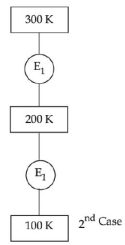
In the $1^{\text{st}}$ case,a Carnot engine operates between temperatures $300 \, K$ and $100 \, K$. In the $2^{\text{nd}}$ case,as shown in the figure,a combination of two engines is used. The efficiency of this combination (in the $2^{\text{nd}}$ case) will be:
A
same as the $1^{\text{st}}$ case
B
always greater than the $1^{\text{st}}$ case
C
always less than the $1^{\text{st}}$ case
D
may increase or decrease with respect to the $1^{\text{st}}$ case
Solution
(A) First case: The efficiency of a Carnot engine is given by $\eta = 1 - \frac{T_L}{T_H}$.
For the first case,$\eta = 1 - \frac{100}{300} = 1 - \frac{1}{3} = \frac{2}{3}$.
Second case: Two engines are connected in series. The net efficiency $\eta_{\text{net}}$ of two engines in series is given by $\eta_{\text{net}} = \eta_1 + \eta_2 - \eta_1 \eta_2$.
For the first engine $(E_1)$ operating between $300 \, K$ and $200 \, K$,$\eta_1 = 1 - \frac{200}{300} = 1 - \frac{2}{3} = \frac{1}{3}$.
For the second engine $(E_2)$ operating between $200 \, K$ and $100 \, K$,$\eta_2 = 1 - \frac{100}{200} = 1 - \frac{1}{2} = \frac{1}{2}$.
Now,calculating the net efficiency: $\eta_{\text{net}} = \frac{1}{3} + \frac{1}{2} - (\frac{1}{3} \times \frac{1}{2}) = \frac{1}{3} + \frac{1}{2} - \frac{1}{6} = \frac{2+3-1}{6} = \frac{4}{6} = \frac{2}{3}$.
Thus,the efficiency in the $2^{\text{nd}}$ case is the same as in the $1^{\text{st}}$ case.
For the first case,$\eta = 1 - \frac{100}{300} = 1 - \frac{1}{3} = \frac{2}{3}$.
Second case: Two engines are connected in series. The net efficiency $\eta_{\text{net}}$ of two engines in series is given by $\eta_{\text{net}} = \eta_1 + \eta_2 - \eta_1 \eta_2$.
For the first engine $(E_1)$ operating between $300 \, K$ and $200 \, K$,$\eta_1 = 1 - \frac{200}{300} = 1 - \frac{2}{3} = \frac{1}{3}$.
For the second engine $(E_2)$ operating between $200 \, K$ and $100 \, K$,$\eta_2 = 1 - \frac{100}{200} = 1 - \frac{1}{2} = \frac{1}{2}$.
Now,calculating the net efficiency: $\eta_{\text{net}} = \frac{1}{3} + \frac{1}{2} - (\frac{1}{3} \times \frac{1}{2}) = \frac{1}{3} + \frac{1}{2} - \frac{1}{6} = \frac{2+3-1}{6} = \frac{4}{6} = \frac{2}{3}$.
Thus,the efficiency in the $2^{\text{nd}}$ case is the same as in the $1^{\text{st}}$ case.
0 likes
View Solution140
MediumMCQ
$A$ Carnot engine has an efficiency of $50 \%$. If the temperature of the sink is reduced by $40 \, K$,its efficiency increases by $30 \%$. The temperature of the source will be $.... \, K$.
A
$166.7$
B
$255.1$
C
$266.7$
D
$367.7$
Solution
(C) The efficiency of a Carnot engine is given by $\eta = 1 - \frac{T_L}{T_H}$.
Given $\eta_1 = 0.5$,so $0.5 = 1 - \frac{T_L}{T_H} \implies \frac{T_L}{T_H} = 0.5 \implies T_L = 0.5 T_H$.
When the sink temperature is reduced by $40 \, K$,the new sink temperature is $T_L' = T_L - 40$.
The new efficiency $\eta_2$ increases by $30 \%$ of the original efficiency,so $\eta_2 = 0.5 + 0.3 = 0.8$.
Using the formula for the new efficiency: $0.8 = 1 - \frac{T_L - 40}{T_H}$.
Substituting $T_L = 0.5 T_H$: $0.8 = 1 - \frac{0.5 T_H - 40}{T_H}$.
$0.8 = 1 - 0.5 + \frac{40}{T_H}$.
$0.8 = 0.5 + \frac{40}{T_H} \implies 0.3 = \frac{40}{T_H}$.
$T_H = \frac{40}{0.3} = 133.33 \, K$.
Wait,checking the calculation: $0.5(1.3) = 0.65$. $0.65 = 1 - \frac{T_L - 40}{T_H} \implies \frac{T_L - 40}{T_H} = 0.35$.
Since $\frac{T_L}{T_H} = 0.5$,then $0.5 - \frac{40}{T_H} = 0.35 \implies \frac{40}{T_H} = 0.15 \implies T_H = \frac{40}{0.15} = 266.67 \, K$.
Given $\eta_1 = 0.5$,so $0.5 = 1 - \frac{T_L}{T_H} \implies \frac{T_L}{T_H} = 0.5 \implies T_L = 0.5 T_H$.
When the sink temperature is reduced by $40 \, K$,the new sink temperature is $T_L' = T_L - 40$.
The new efficiency $\eta_2$ increases by $30 \%$ of the original efficiency,so $\eta_2 = 0.5 + 0.3 = 0.8$.
Using the formula for the new efficiency: $0.8 = 1 - \frac{T_L - 40}{T_H}$.
Substituting $T_L = 0.5 T_H$: $0.8 = 1 - \frac{0.5 T_H - 40}{T_H}$.
$0.8 = 1 - 0.5 + \frac{40}{T_H}$.
$0.8 = 0.5 + \frac{40}{T_H} \implies 0.3 = \frac{40}{T_H}$.
$T_H = \frac{40}{0.3} = 133.33 \, K$.
Wait,checking the calculation: $0.5(1.3) = 0.65$. $0.65 = 1 - \frac{T_L - 40}{T_H} \implies \frac{T_L - 40}{T_H} = 0.35$.
Since $\frac{T_L}{T_H} = 0.5$,then $0.5 - \frac{40}{T_H} = 0.35 \implies \frac{40}{T_H} = 0.15 \implies T_H = \frac{40}{0.15} = 266.67 \, K$.
0 likes
View Solution141
AdvancedMCQ
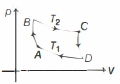
One mole of an ideal monoatomic gas undergoes the following four reversible processes:
Step $1$: It is first compressed adiabatically from volume $V_{1}$ to $1 \; m^{3}$.
Step $2$: Then expanded isothermally to volume $10 \; m^{3}$.
Step $3$: Then expanded adiabatically to volume $V_{3}$.
Step $4$: Then compressed isothermally to volume $V_{1}$.
If the efficiency of the above cycle is $3/4$, then $V_{1}$ is ............ $m^{3}$.
Step $1$: It is first compressed adiabatically from volume $V_{1}$ to $1 \; m^{3}$.
Step $2$: Then expanded isothermally to volume $10 \; m^{3}$.
Step $3$: Then expanded adiabatically to volume $V_{3}$.
Step $4$: Then compressed isothermally to volume $V_{1}$.
If the efficiency of the above cycle is $3/4$, then $V_{1}$ is ............ $m^{3}$.
A
$2$
B
$4$
C
$6$
D
$8$
Solution
(D) The given cycle is a Carnot cycle consisting of two isothermal and two adiabatic processes.
The efficiency $\eta$ of a Carnot cycle is given by $\eta = 1 - \frac{T_{L}}{T_{H}}$, where $T_{L}$ is the temperature of the cold reservoir and $T_{H}$ is the temperature of the hot reservoir.
For an adiabatic process, $TV^{\gamma-1} = \text{constant}$.
In the adiabatic compression step $(A \to B)$, the gas is compressed from $V_{1}$ to $V_{B} = 1 \; m^{3}$ at temperature $T_{L}$ to $T_{H}$.
Thus, $T_{L} V_{1}^{\gamma-1} = T_{H} V_{B}^{\gamma-1}$.
$\frac{T_{L}}{T_{H}} = \left( \frac{V_{B}}{V_{1}} \right)^{\gamma-1} = \left( \frac{1}{V_{1}} \right)^{\gamma-1}$.
Given $\eta = 3/4$, so $1 - \frac{T_{L}}{T_{H}} = 3/4$, which implies $\frac{T_{L}}{T_{H}} = 1/4$.
For a monoatomic gas, the adiabatic index $\gamma = 5/3$, so $\gamma - 1 = 2/3$.
Substituting these values: $\left( \frac{1}{V_{1}} \right)^{2/3} = 1/4$.
Taking the reciprocal: $V_{1}^{2/3} = 4$.
Raising both sides to the power of $3/2$: $V_{1} = 4^{3/2} = (2^{2})^{3/2} = 2^{3} = 8 \; m^{3}$.
The efficiency $\eta$ of a Carnot cycle is given by $\eta = 1 - \frac{T_{L}}{T_{H}}$, where $T_{L}$ is the temperature of the cold reservoir and $T_{H}$ is the temperature of the hot reservoir.
For an adiabatic process, $TV^{\gamma-1} = \text{constant}$.
In the adiabatic compression step $(A \to B)$, the gas is compressed from $V_{1}$ to $V_{B} = 1 \; m^{3}$ at temperature $T_{L}$ to $T_{H}$.
Thus, $T_{L} V_{1}^{\gamma-1} = T_{H} V_{B}^{\gamma-1}$.
$\frac{T_{L}}{T_{H}} = \left( \frac{V_{B}}{V_{1}} \right)^{\gamma-1} = \left( \frac{1}{V_{1}} \right)^{\gamma-1}$.
Given $\eta = 3/4$, so $1 - \frac{T_{L}}{T_{H}} = 3/4$, which implies $\frac{T_{L}}{T_{H}} = 1/4$.
For a monoatomic gas, the adiabatic index $\gamma = 5/3$, so $\gamma - 1 = 2/3$.
Substituting these values: $\left( \frac{1}{V_{1}} \right)^{2/3} = 1/4$.
Taking the reciprocal: $V_{1}^{2/3} = 4$.
Raising both sides to the power of $3/2$: $V_{1} = 4^{3/2} = (2^{2})^{3/2} = 2^{3} = 8 \; m^{3}$.
0 likes
View Solution142
EasyMCQ
The value of efficiency $\eta$ for a heat engine may lie between
A
$0$ to $1$
B
$1$ to $\infty$
C
$-1$ to $+1$
D
$0$ to $\infty$
Solution
(A) The efficiency $\eta$ of a heat engine is defined as the ratio of the work done $W$ by the engine to the heat $Q_H$ absorbed from the source.
$\eta = \frac{W}{Q_H} = 1 - \frac{Q_L}{Q_H}$
According to the second law of thermodynamics,no heat engine can have an efficiency of $1$ $(100\%)$,as it would require the heat rejected to the sink $Q_L$ to be $0$,which is impossible.
Also,the efficiency cannot be negative as it would imply the engine is performing work by absorbing heat from a cold reservoir without external work,violating the second law.
Therefore,the efficiency $\eta$ always lies between $0$ and $1$ $(0 < \eta < 1)$.
$\eta = \frac{W}{Q_H} = 1 - \frac{Q_L}{Q_H}$
According to the second law of thermodynamics,no heat engine can have an efficiency of $1$ $(100\%)$,as it would require the heat rejected to the sink $Q_L$ to be $0$,which is impossible.
Also,the efficiency cannot be negative as it would imply the engine is performing work by absorbing heat from a cold reservoir without external work,violating the second law.
Therefore,the efficiency $\eta$ always lies between $0$ and $1$ $(0 < \eta < 1)$.
0 likes
View Solution143
EasyMCQ
If a Carnot engine works between $127^{\circ} C$ and $527^{\circ} C$,then its efficiency is ...... $\%$
A
$25$
B
$37.5$
C
$50$
D
$75$
Solution
(C) The efficiency of a Carnot engine is given by the formula $\eta = 1 - \frac{T_1}{T_2}$,where $T_1$ is the temperature of the sink and $T_2$ is the temperature of the source in Kelvin.
Given:
$T_1 = 127^{\circ} C = 127 + 273 = 400 \ K$
$T_2 = 527^{\circ} C = 527 + 273 = 800 \ K$
Substituting the values into the formula:
$\eta = 1 - \frac{400}{800}$
$\eta = 1 - 0.5 = 0.5$
To express the efficiency as a percentage:
$\text{Efficiency} = 0.5 \times 100 = 50 \%$
Given:
$T_1 = 127^{\circ} C = 127 + 273 = 400 \ K$
$T_2 = 527^{\circ} C = 527 + 273 = 800 \ K$
Substituting the values into the formula:
$\eta = 1 - \frac{400}{800}$
$\eta = 1 - 0.5 = 0.5$
To express the efficiency as a percentage:
$\text{Efficiency} = 0.5 \times 100 = 50 \%$
0 likes
View Solution144
EasyMCQ
If the temperature of the sink is at absolute zero,then the efficiency of the Carnot engine will be ........ $\%$
A
$0$
B
$100$
C
$50$
D
$75$
Solution
(B) The efficiency $\eta$ of a Carnot engine is given by the formula: $\eta = 1 - \frac{T_2}{T_1}$.
Here,$T_1$ is the temperature of the source and $T_2$ is the temperature of the sink.
Given that the temperature of the sink is at absolute zero,we have $T_2 = 0 \ K$.
Substituting this value into the efficiency formula:
$\eta = 1 - \frac{0}{T_1} = 1 - 0 = 1$.
To express the efficiency as a percentage,we multiply by $100$:
$\eta = 1 \times 100\% = 100\%$.
Therefore,the efficiency of the Carnot engine is $100\%$.
Here,$T_1$ is the temperature of the source and $T_2$ is the temperature of the sink.
Given that the temperature of the sink is at absolute zero,we have $T_2 = 0 \ K$.
Substituting this value into the efficiency formula:
$\eta = 1 - \frac{0}{T_1} = 1 - 0 = 1$.
To express the efficiency as a percentage,we multiply by $100$:
$\eta = 1 \times 100\% = 100\%$.
Therefore,the efficiency of the Carnot engine is $100\%$.
0 likes
View Solution145
MediumMCQ
$A$ Carnot engine whose sink is at $300 \, K$ has an efficiency of $50 \%$. By how much should the temperature of the source be increased so that the efficiency becomes $70 \%$?
A
$100$
B
$200$
C
$300$
D
$400$
Solution
(D) The efficiency of a Carnot engine is given by $\eta = 1 - \frac{T_2}{T_1}$,where $T_1$ is the source temperature and $T_2$ is the sink temperature.
Given $T_2 = 300 \, K$ and initial efficiency $\eta = 0.5$.
$0.5 = 1 - \frac{300}{T_1} \Rightarrow \frac{300}{T_1} = 0.5 \Rightarrow T_1 = 600 \, K$.
Now,the new efficiency $\eta' = 0.7$ with the same sink temperature $T_2 = 300 \, K$.
$0.7 = 1 - \frac{300}{T_1'} \Rightarrow \frac{300}{T_1'} = 0.3 \Rightarrow T_1' = \frac{300}{0.3} = 1000 \, K$.
The increase in source temperature is $\Delta T = T_1' - T_1 = 1000 \, K - 600 \, K = 400 \, K$.
Given $T_2 = 300 \, K$ and initial efficiency $\eta = 0.5$.
$0.5 = 1 - \frac{300}{T_1} \Rightarrow \frac{300}{T_1} = 0.5 \Rightarrow T_1 = 600 \, K$.
Now,the new efficiency $\eta' = 0.7$ with the same sink temperature $T_2 = 300 \, K$.
$0.7 = 1 - \frac{300}{T_1'} \Rightarrow \frac{300}{T_1'} = 0.3 \Rightarrow T_1' = \frac{300}{0.3} = 1000 \, K$.
The increase in source temperature is $\Delta T = T_1' - T_1 = 1000 \, K - 600 \, K = 400 \, K$.
0 likes
View Solution146
EasyMCQ
$A$ Carnot engine takes $6000 \,cal$ of heat from a reservoir at $627^{\circ} C$ and gives it to a sink at $27^{\circ} C$. The work done by the engine is ......... $kcal$.
A
$2$
B
$3$
C
$4$
D
$8$
Solution
(C) The efficiency of a Carnot engine is given by $\eta = 1 - \frac{T_2}{T_1}$.
Given temperatures are $T_1 = 627^{\circ} C = 627 + 273 = 900 \, K$ and $T_2 = 27^{\circ} C = 27 + 273 = 300 \, K$.
The heat taken from the source is $Q_1 = 6000 \, cal = 6 \, kcal$.
The efficiency is $\eta = 1 - \frac{300}{900} = 1 - \frac{1}{3} = \frac{2}{3}$.
Since $\eta = \frac{W}{Q_1}$,the work done $W = \eta \times Q_1$.
$W = \frac{2}{3} \times 6 \, kcal = 4 \, kcal$.
Given temperatures are $T_1 = 627^{\circ} C = 627 + 273 = 900 \, K$ and $T_2 = 27^{\circ} C = 27 + 273 = 300 \, K$.
The heat taken from the source is $Q_1 = 6000 \, cal = 6 \, kcal$.
The efficiency is $\eta = 1 - \frac{300}{900} = 1 - \frac{1}{3} = \frac{2}{3}$.
Since $\eta = \frac{W}{Q_1}$,the work done $W = \eta \times Q_1$.
$W = \frac{2}{3} \times 6 \, kcal = 4 \, kcal$.
0 likes
View Solution147
MediumMCQ
In practice,all heat engines have an efficiency less than that of a Carnot engine because
A
Carnot engine is irreversible
B
$A$ reversible process can never be attained in the real world
C
An irreversible engine has higher efficiency than a reversible engine
D
The efficiency of a Carnot engine is always one
Solution
(B) The correct answer is $(B)$.
$A$ Carnot engine operates on a reversible cycle,which is an idealized theoretical model.
In the real world,all thermodynamic processes involve friction,turbulence,and heat loss to the surroundings,making them inherently irreversible.
Since a perfectly reversible process cannot be achieved in practice,real heat engines always have lower efficiency than the theoretical Carnot engine operating between the same two temperatures.
$A$ Carnot engine operates on a reversible cycle,which is an idealized theoretical model.
In the real world,all thermodynamic processes involve friction,turbulence,and heat loss to the surroundings,making them inherently irreversible.
Since a perfectly reversible process cannot be achieved in practice,real heat engines always have lower efficiency than the theoretical Carnot engine operating between the same two temperatures.
0 likes
View Solution148
MediumMCQ
The efficiency of a reversible engine is . . . . . . the efficiency of an irreversible engine.
A
Less than
B
Greater than
C
Equal to
D
Negligible compared to
Solution
(B) The correct answer is $B$.
According to the Carnot theorem,the efficiency of a reversible engine operating between two given temperatures is the maximum possible efficiency for any engine operating between those same temperatures.
An irreversible engine involves dissipative effects like friction,turbulence,and heat loss,which reduce the amount of heat converted into work.
Therefore,the efficiency of a reversible engine is always greater than that of an irreversible engine operating between the same two heat reservoirs.
According to the Carnot theorem,the efficiency of a reversible engine operating between two given temperatures is the maximum possible efficiency for any engine operating between those same temperatures.
An irreversible engine involves dissipative effects like friction,turbulence,and heat loss,which reduce the amount of heat converted into work.
Therefore,the efficiency of a reversible engine is always greater than that of an irreversible engine operating between the same two heat reservoirs.
0 likes
View Solution149
EasyMCQ
$A$ Carnot cycle consists of
A
Two stages
B
Four stages
C
Six stages
D
Eight stages
Solution
(B) The correct answer is $B$.
The Carnot cycle is one of the foundations of the second law of thermodynamics,and Sadi Carnot is often considered the father of thermodynamics. He was one of the pioneers who first determined an idealistic way of converting heat energy into work. The Carnot cycle represents the most efficient heat engine cycle.
The Carnot cycle consists of the following four processes:
$I.$ Isothermal expansion: The gas undergoes an isothermal expansion at a high temperature $T_{\text{high}}$. In this process,the gas absorbs $q_{\text{in}}$ amount of heat from the source and performs work $w_1$ on the surroundings.
$II.$ Reversible adiabatic expansion: The gas then undergoes a reversible adiabatic expansion. Consequently,the temperature of the gas decreases to a lower temperature $T_{\text{low}}$.
$III.$ Isothermal compression: The gas is then compressed isothermally at the lower temperature $T_{\text{low}}$. In this process,the gas releases $q_{\text{out}}$ amount of heat to the sink,and work is done on the gas by the surroundings.
$IV.$ Reversible adiabatic compression: Finally,the gas undergoes a reversible adiabatic compression,which causes the temperature to rise back to $T_{\text{high}}$.
Thus,the Carnot cycle consists of two isothermal and two adiabatic processes,totaling four stages.
The Carnot cycle is one of the foundations of the second law of thermodynamics,and Sadi Carnot is often considered the father of thermodynamics. He was one of the pioneers who first determined an idealistic way of converting heat energy into work. The Carnot cycle represents the most efficient heat engine cycle.
The Carnot cycle consists of the following four processes:
$I.$ Isothermal expansion: The gas undergoes an isothermal expansion at a high temperature $T_{\text{high}}$. In this process,the gas absorbs $q_{\text{in}}$ amount of heat from the source and performs work $w_1$ on the surroundings.
$II.$ Reversible adiabatic expansion: The gas then undergoes a reversible adiabatic expansion. Consequently,the temperature of the gas decreases to a lower temperature $T_{\text{low}}$.
$III.$ Isothermal compression: The gas is then compressed isothermally at the lower temperature $T_{\text{low}}$. In this process,the gas releases $q_{\text{out}}$ amount of heat to the sink,and work is done on the gas by the surroundings.
$IV.$ Reversible adiabatic compression: Finally,the gas undergoes a reversible adiabatic compression,which causes the temperature to rise back to $T_{\text{high}}$.
Thus,the Carnot cycle consists of two isothermal and two adiabatic processes,totaling four stages.
0 likes
View Solution150
EasyMCQ
The maximum possible efficiency of a heat engine is ...........
A
$100 \%$
B
$\frac{T_1}{T_2}$
C
$\frac{T_1}{T_2}+1$
D
Dependent upon the temperature of source $(T_1)$ and sink $(T_2)$ and is equal to $(1-\frac{T_2}{T_1})$
Solution
(D) The efficiency of a heat engine is defined by the Carnot theorem,which states that the maximum possible efficiency for any heat engine operating between two temperatures is the efficiency of a Carnot engine.
The formula for the efficiency $(\eta)$ of a Carnot engine is given by:
$\eta = 1 - \frac{T_2}{T_1}$
Where:
$T_1$ is the absolute temperature of the source.
$T_2$ is the absolute temperature of the sink.
Thus,the maximum possible efficiency depends on the temperatures of the source and the sink.
The formula for the efficiency $(\eta)$ of a Carnot engine is given by:
$\eta = 1 - \frac{T_2}{T_1}$
Where:
$T_1$ is the absolute temperature of the source.
$T_2$ is the absolute temperature of the sink.
Thus,the maximum possible efficiency depends on the temperatures of the source and the sink.
0 likes
View SolutionThermodynamics — Heat Engine and Carnot Cycle · Frequently Asked Questions
1Are these Thermodynamics questions useful for JEE and NEET?
Yes. All questions in this section are mapped to JEE Main and NEET exam patterns. Previous year questions from JEE Main, NEET, GUJCET and state-level exams are included with full solutions.
2Can I switch to Hindi or Gujarati for these questions?
Yes. Use the language tabs in the hero section or the sidebar to view the same questions and solutions in English, Hindi or Gujarati.
3How do I generate a question paper from this subtopic?
Use the Vedclass Exam Paper Generator — select the chapter and subtopic, set difficulty, and generate Sets A, B, C, D automatically. First 3 chapters of every subject are free.
Vedclass Products
For Students
Vedclass Test Series
Mock tests in real JEE/NEET style with performance analysis. 5-day free trial.
Start Free TrialFor Teachers
Exam Paper Generator
Generate Set A/B/C/D papers from this chapter in 2 minutes. 3 chapters free.
Try FreeFor Institutes
Online Exam Module
Live online exams with unlimited students, 360° analytics & white-label branding.
See DemoFor Teachers & Institutes
Generate a Thermodynamics Exam Paper in 2 Minutes
Select subtopic & difficulty — Sets A, B, C, D auto-generated with No Repeat logic.
First 3 chapters of every subject are free — no payment required.