
A English
Motion of Centre of Mass Questions in English
Class 11 Physics · System of Particles and Rotational Motion · Motion of Centre of Mass
156+
Questions
English
Language
100%
With Solutions
Showing 50 of 156 questions in English
51
MediumMCQ
Two particles $A$ and $B$,initially at rest,move towards each other under a mutual force of attraction. At the instant when the speed of $A$ is $v$ and the speed of $B$ is $2v$,the speed of the center of mass of the system is:
A
Zero
B
$v$
C
$\frac{3v}{2}$
D
$3v$
Solution
(A) The system consists of two particles $A$ and $B$ moving under a mutual force of attraction.
Since there is no external force acting on the system $(F_{ext} = 0)$,the acceleration of the center of mass is zero $(a_{cm} = 0)$.
This implies that the velocity of the center of mass $(v_{cm})$ remains constant over time.
Initially,both particles are at rest,so the initial velocity of the center of mass is $v_{cm, initial} = 0$.
Therefore,at any subsequent instant,including when the speeds of $A$ and $B$ are $v$ and $2v$ respectively,the velocity of the center of mass remains $v_{cm} = 0$.
Since there is no external force acting on the system $(F_{ext} = 0)$,the acceleration of the center of mass is zero $(a_{cm} = 0)$.
This implies that the velocity of the center of mass $(v_{cm})$ remains constant over time.
Initially,both particles are at rest,so the initial velocity of the center of mass is $v_{cm, initial} = 0$.
Therefore,at any subsequent instant,including when the speeds of $A$ and $B$ are $v$ and $2v$ respectively,the velocity of the center of mass remains $v_{cm} = 0$.
0 likes
View Solution52
MediumMCQ
$A$ shell fired from a gun at an angle to the horizontal explodes in mid-air. Then the centre of mass of the shell fragments will move
A
Vertically down
B
Horizontally
C
Along the same parabolic path along which the intact shell was moving
D
Along the tangent to the parabolic path of the intact shell,at the point of explosion
Solution
(C) The explosion is an internal force event. According to the law of conservation of momentum,internal forces cannot change the motion of the centre of mass of a system.
Since the external force acting on the shell (gravity) remains unchanged,the acceleration of the centre of mass remains $g$ directed downwards.
Therefore,the centre of mass of the shell fragments continues to follow the same parabolic path that the intact shell would have followed if it had not exploded.
Since the external force acting on the shell (gravity) remains unchanged,the acceleration of the centre of mass remains $g$ directed downwards.
Therefore,the centre of mass of the shell fragments continues to follow the same parabolic path that the intact shell would have followed if it had not exploded.
0 likes
View Solution53
MediumMCQ
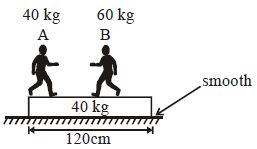
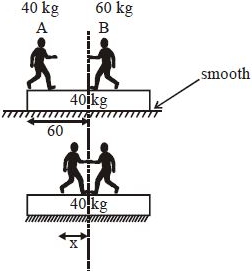
Two men $A$ and $B$ are standing on a plank. $B$ is at the middle of the plank and $A$ is at the left end of the plank. The bottom surface of the plank is smooth. The system is initially at rest and the masses are as shown in the figure. $A$ and $B$ start moving such that the position of $B$ remains fixed with respect to the ground and $A$ meets $B$. Then the point where $A$ meets $B$ is located at
A
the middle of the plank
B
$30 \, cm$ from the left end of the plank
C
the right end of the plank
D
None of these
Solution
(C) Let the mass of man $A$ be $m_A = 40 \, kg$,mass of man $B$ be $m_B = 60 \, kg$,and mass of the plank be $m_P = 40 \, kg$. The length of the plank is $L = 120 \, cm$.
Since the bottom surface is smooth and there are no external horizontal forces,the position of the center of mass of the system remains fixed.
Let the initial position of the center of the plank be the origin $(0, 0)$.
Initially,man $A$ is at $x_A = -60 \, cm$,man $B$ is at $x_B = 0 \, cm$,and the center of the plank is at $x_P = 0 \, cm$.
The center of mass of the system is $X_{CM} = \frac{m_A x_A + m_B x_B + m_P x_P}{m_A + m_B + m_P} = \frac{40(-60) + 60(0) + 40(0)}{40 + 60 + 40} = \frac{-2400}{140} = -\frac{120}{7} \, cm$.
When $A$ meets $B$,let the plank have shifted by a displacement $d$ to the right. The new position of the plank's center is $x_P' = d$.
Since $B$ remains fixed with respect to the ground,$B$ is at $x_B' = 0$. Since $B$ was at the center of the plank,and the plank shifted by $d$,$B$ is now at the right edge of the plank (relative to the plank's frame). Thus,$A$ must also be at the right edge of the plank to meet $B$.
Using the conservation of center of mass: $m_A x_A' + m_B x_B' + m_P x_P' = m_A x_A + m_B x_B + m_P x_P$.
Since $A$ and $B$ meet at the right end of the plank,$x_A' = x_B' = d + 60$.
$40(d + 60) + 60(0) + 40(d) = -2400$.
$40d + 2400 + 40d = -2400 \Rightarrow 80d = -4800 \Rightarrow d = -60 \, cm$.
The meeting point is $x_B' = 0$. The right end of the plank is at $x_P' + 60 = -60 + 60 = 0$. Thus,they meet at the right end of the plank.
Since the bottom surface is smooth and there are no external horizontal forces,the position of the center of mass of the system remains fixed.
Let the initial position of the center of the plank be the origin $(0, 0)$.
Initially,man $A$ is at $x_A = -60 \, cm$,man $B$ is at $x_B = 0 \, cm$,and the center of the plank is at $x_P = 0 \, cm$.
The center of mass of the system is $X_{CM} = \frac{m_A x_A + m_B x_B + m_P x_P}{m_A + m_B + m_P} = \frac{40(-60) + 60(0) + 40(0)}{40 + 60 + 40} = \frac{-2400}{140} = -\frac{120}{7} \, cm$.
When $A$ meets $B$,let the plank have shifted by a displacement $d$ to the right. The new position of the plank's center is $x_P' = d$.
Since $B$ remains fixed with respect to the ground,$B$ is at $x_B' = 0$. Since $B$ was at the center of the plank,and the plank shifted by $d$,$B$ is now at the right edge of the plank (relative to the plank's frame). Thus,$A$ must also be at the right edge of the plank to meet $B$.
Using the conservation of center of mass: $m_A x_A' + m_B x_B' + m_P x_P' = m_A x_A + m_B x_B + m_P x_P$.
Since $A$ and $B$ meet at the right end of the plank,$x_A' = x_B' = d + 60$.
$40(d + 60) + 60(0) + 40(d) = -2400$.
$40d + 2400 + 40d = -2400 \Rightarrow 80d = -4800 \Rightarrow d = -60 \, cm$.
The meeting point is $x_B' = 0$. The right end of the plank is at $x_P' + 60 = -60 + 60 = 0$. Thus,they meet at the right end of the plank.
0 likes
View Solution54
MediumMCQ
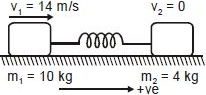
Two blocks of masses $10\,kg$ and $4\,kg$ are connected by a spring of negligible mass and placed on a frictionless horizontal surface. An impulse gives a velocity of $14\,m/s$ to the heavier block in the direction of the lighter block. The velocity of the centre of mass is ........ $m/s$.
A
$30$
B
$20$
C
$10$
D
$5$
Solution
(C) The velocity of the centre of mass $(V_{COM})$ is given by the formula:
$V_{COM} = \frac{m_{1}v_{1} + m_{2}v_{2}}{m_{1} + m_{2}}$
Given:
$m_{1} = 10\,kg$,$v_{1} = 14\,m/s$
$m_{2} = 4\,kg$,$v_{2} = 0\,m/s$
Substituting the values:
$V_{COM} = \frac{10 \times 14 + 4 \times 0}{10 + 4}$
$V_{COM} = \frac{140}{14} = 10\,m/s$
$V_{COM} = \frac{m_{1}v_{1} + m_{2}v_{2}}{m_{1} + m_{2}}$
Given:
$m_{1} = 10\,kg$,$v_{1} = 14\,m/s$
$m_{2} = 4\,kg$,$v_{2} = 0\,m/s$
Substituting the values:
$V_{COM} = \frac{10 \times 14 + 4 \times 0}{10 + 4}$
$V_{COM} = \frac{140}{14} = 10\,m/s$
0 likes
View Solution55
EasyMCQ
Two balls are thrown in the air. The second ball is thrown $2 \ s$ after the first ball. What is the acceleration of the center of mass of the two balls while they are in the air?
A
Depends on the direction of the motion of the balls
B
Depends on the masses of the balls
C
Depends on the speed of the two balls
D
Is equal to $g$
Solution
(D) The acceleration of the center of mass $(a_{CM})$ of a system is given by the formula $a_{CM} = \frac{F_{ext}}{M_{total}}$.
When both balls are in the air,the only external force acting on each ball is the gravitational force,which is $mg$ acting downwards.
Let the masses of the two balls be $m_1$ and $m_2$. The total external force is $F_{ext} = m_1g + m_2g = (m_1 + m_2)g$.
The total mass of the system is $M_{total} = m_1 + m_2$.
Therefore,$a_{CM} = \frac{(m_1 + m_2)g}{m_1 + m_2} = g$.
Since the acceleration due to gravity $g$ is constant and independent of the mass,velocity,or time of projection,the acceleration of the center of mass remains $g$ downwards.
When both balls are in the air,the only external force acting on each ball is the gravitational force,which is $mg$ acting downwards.
Let the masses of the two balls be $m_1$ and $m_2$. The total external force is $F_{ext} = m_1g + m_2g = (m_1 + m_2)g$.
The total mass of the system is $M_{total} = m_1 + m_2$.
Therefore,$a_{CM} = \frac{(m_1 + m_2)g}{m_1 + m_2} = g$.
Since the acceleration due to gravity $g$ is constant and independent of the mass,velocity,or time of projection,the acceleration of the center of mass remains $g$ downwards.
0 likes
View Solution56
DifficultMCQ
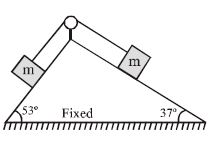
Two blocks of mass $m$ each,connected to each other by a massless string,are placed on two inclined planes as shown in the figure. After releasing from rest,find the magnitude of the acceleration of the centre of mass of both the blocks. (Given $g = 10 \, m/s^2$)
A
$1 \, m/s^2$
B
$\frac{1}{\sqrt{2}} \, m/s^2$
C
$\sqrt{2} \, m/s^2$
D
zero
Solution
(B) Let the acceleration of the system be $a$. Since the string is inextensible,both blocks move with the same magnitude of acceleration $a$.
For the block on the $53^{\circ}$ incline,the equation of motion is: $mg \sin 53^{\circ} - T = ma$.
For the block on the $37^{\circ}$ incline,the equation of motion is: $T - mg \sin 37^{\circ} = ma$.
Adding these two equations: $mg(\sin 53^{\circ} - \sin 37^{\circ}) = 2ma$.
$a = \frac{g(\sin 53^{\circ} - \sin 37^{\circ})}{2} = \frac{10(0.8 - 0.6)}{2} = \frac{10(0.2)}{2} = 1 \, m/s^2$.
The acceleration of the centre of mass is given by $\vec{a}_{cm} = \frac{m\vec{a}_1 + m\vec{a}_2}{2m} = \frac{\vec{a}_1 + \vec{a}_2}{2}$.
The acceleration vectors are $\vec{a}_1 = a(\cos 53^{\circ} \hat{i} + \sin 53^{\circ} \hat{j})$ and $\vec{a}_2 = a(-\cos 37^{\circ} \hat{i} + \sin 37^{\circ} \hat{j})$.
Since $\cos 53^{\circ} = \sin 37^{\circ} = 0.6$ and $\sin 53^{\circ} = \cos 37^{\circ} = 0.8$,we have $\vec{a}_1 = a(0.6 \hat{i} + 0.8 \hat{j})$ and $\vec{a}_2 = a(-0.8 \hat{i} + 0.6 \hat{j})$.
$\vec{a}_{cm} = \frac{a}{2} [(0.6 - 0.8) \hat{i} + (0.8 + 0.6) \hat{j}] = \frac{a}{2} [-0.2 \hat{i} + 1.4 \hat{j}] = a(-0.1 \hat{i} + 0.7 \hat{j})$.
The magnitude is $|\vec{a}_{cm}| = a \sqrt{(-0.1)^2 + (0.7)^2} = 1 \sqrt{0.01 + 0.49} = \sqrt{0.5} = \frac{1}{\sqrt{2}} \, m/s^2$.
For the block on the $53^{\circ}$ incline,the equation of motion is: $mg \sin 53^{\circ} - T = ma$.
For the block on the $37^{\circ}$ incline,the equation of motion is: $T - mg \sin 37^{\circ} = ma$.
Adding these two equations: $mg(\sin 53^{\circ} - \sin 37^{\circ}) = 2ma$.
$a = \frac{g(\sin 53^{\circ} - \sin 37^{\circ})}{2} = \frac{10(0.8 - 0.6)}{2} = \frac{10(0.2)}{2} = 1 \, m/s^2$.
The acceleration of the centre of mass is given by $\vec{a}_{cm} = \frac{m\vec{a}_1 + m\vec{a}_2}{2m} = \frac{\vec{a}_1 + \vec{a}_2}{2}$.
The acceleration vectors are $\vec{a}_1 = a(\cos 53^{\circ} \hat{i} + \sin 53^{\circ} \hat{j})$ and $\vec{a}_2 = a(-\cos 37^{\circ} \hat{i} + \sin 37^{\circ} \hat{j})$.
Since $\cos 53^{\circ} = \sin 37^{\circ} = 0.6$ and $\sin 53^{\circ} = \cos 37^{\circ} = 0.8$,we have $\vec{a}_1 = a(0.6 \hat{i} + 0.8 \hat{j})$ and $\vec{a}_2 = a(-0.8 \hat{i} + 0.6 \hat{j})$.
$\vec{a}_{cm} = \frac{a}{2} [(0.6 - 0.8) \hat{i} + (0.8 + 0.6) \hat{j}] = \frac{a}{2} [-0.2 \hat{i} + 1.4 \hat{j}] = a(-0.1 \hat{i} + 0.7 \hat{j})$.
The magnitude is $|\vec{a}_{cm}| = a \sqrt{(-0.1)^2 + (0.7)^2} = 1 \sqrt{0.01 + 0.49} = \sqrt{0.5} = \frac{1}{\sqrt{2}} \, m/s^2$.
0 likes
View Solution57
MediumMCQ
$A$ man of mass $M$ stands at one end of a plank of length $\ell$,which lies at rest on a frictionless surface. The man walks to the other end of the plank. If the mass of the plank is $3M$,what is the distance moved by the man relative to the ground?
A
$\frac{\ell}{4}$
B
$\frac{3\ell}{4}$
C
$\frac{2\ell}{3}$
D
$\frac{\ell}{3}$
Solution
(B) Since the surface is frictionless and there are no external horizontal forces,the center of mass of the system remains stationary.
Let the distance moved by the plank be $x$ in the direction opposite to the man's motion.
The man moves a distance $(\ell - x)$ relative to the ground.
Using the principle of conservation of the center of mass: $M(\ell - x) = (3M)x$.
Dividing both sides by $M$: $\ell - x = 3x$.
Solving for $x$: $4x = \ell$,which gives $x = \frac{\ell}{4}$.
The distance moved by the man relative to the ground is $\ell - x = \ell - \frac{\ell}{4} = \frac{3\ell}{4}$.
Let the distance moved by the plank be $x$ in the direction opposite to the man's motion.
The man moves a distance $(\ell - x)$ relative to the ground.
Using the principle of conservation of the center of mass: $M(\ell - x) = (3M)x$.
Dividing both sides by $M$: $\ell - x = 3x$.
Solving for $x$: $4x = \ell$,which gives $x = \frac{\ell}{4}$.
The distance moved by the man relative to the ground is $\ell - x = \ell - \frac{\ell}{4} = \frac{3\ell}{4}$.
0 likes
View Solution58
MediumMCQ
In free space,a shell moving with velocity $60\,m/s$ along the positive $x$-axis passes through the origin and explodes into two pieces with a mass ratio of $1:2$. After the explosion,the velocity of the centre of mass is ....... $m/s$.
A
$20$
B
$60$
C
$90$
D
$0$
Solution
(B) According to the principle of conservation of linear momentum,if the external force acting on a system is zero,the velocity of the centre of mass remains constant.
In this problem,the shell is in free space,meaning there are no external forces acting on it $(F_{ext} = 0)$.
Therefore,the velocity of the centre of mass after the explosion will be the same as the velocity of the shell before the explosion.
Given initial velocity $v = 60\,m/s$.
Thus,$v_{cm} = 60\,m/s$.
In this problem,the shell is in free space,meaning there are no external forces acting on it $(F_{ext} = 0)$.
Therefore,the velocity of the centre of mass after the explosion will be the same as the velocity of the shell before the explosion.
Given initial velocity $v = 60\,m/s$.
Thus,$v_{cm} = 60\,m/s$.
0 likes
View Solution59
MediumMCQ
Three men $A, B$ and $C$ of masses $40\,kg, 50\,kg$ and $60\,kg$ are standing on a plank of mass $90\,kg$,which is kept on a smooth horizontal plane. If $A$ and $C$ exchange their positions,then mass $B$ will shift:
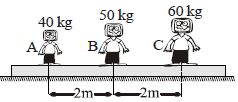
A
$1/3\,m$ towards left
B
$1/3\,m$ towards right
C
will not move $w.r.t.$ ground
D
$5/3\,m$ towards left
Solution
(B) Since the system is on a smooth horizontal plane,there is no external horizontal force acting on the system. Therefore,the centre of mass of the system remains stationary,i.e.,$\Delta X_{cm} = 0$.
Let the plank move by a distance $x$ towards the right when $A$ and $C$ interchange their positions.
Let the initial positions of $A, B, C$ and the plank be $x_A = -2\,m, x_B = 0\,m, x_C = 2\,m$ and $x_P = 0\,m$ respectively.
When $A$ and $C$ interchange positions,their new positions relative to the plank are $x'_A = 2\,m$ and $x'_C = -2\,m$. The plank has shifted by $x$ towards the right.
The displacement of each mass relative to the ground is:
$\Delta x_A = (2 + x) - (-2) = 4 + x$
$\Delta x_B = x - 0 = x$
$\Delta x_C = (-2 + x) - 2 = -4 + x$
$\Delta x_P = x - 0 = x$
Using the formula $m_A \Delta x_A + m_B \Delta x_B + m_C \Delta x_C + m_P \Delta x_P = 0$:
$40(4 + x) + 50(x) + 60(-4 + x) + 90(x) = 0$
$160 + 40x + 50x - 240 + 60x + 90x = 0$
$240x - 80 = 0$
$x = 80/240 = 1/3\,m$.
Since $x$ is positive,the plank (and thus $B$ which is on the plank) shifts $1/3\,m$ towards the right.
Let the plank move by a distance $x$ towards the right when $A$ and $C$ interchange their positions.
Let the initial positions of $A, B, C$ and the plank be $x_A = -2\,m, x_B = 0\,m, x_C = 2\,m$ and $x_P = 0\,m$ respectively.
When $A$ and $C$ interchange positions,their new positions relative to the plank are $x'_A = 2\,m$ and $x'_C = -2\,m$. The plank has shifted by $x$ towards the right.
The displacement of each mass relative to the ground is:
$\Delta x_A = (2 + x) - (-2) = 4 + x$
$\Delta x_B = x - 0 = x$
$\Delta x_C = (-2 + x) - 2 = -4 + x$
$\Delta x_P = x - 0 = x$
Using the formula $m_A \Delta x_A + m_B \Delta x_B + m_C \Delta x_C + m_P \Delta x_P = 0$:
$40(4 + x) + 50(x) + 60(-4 + x) + 90(x) = 0$
$160 + 40x + 50x - 240 + 60x + 90x = 0$
$240x - 80 = 0$
$x = 80/240 = 1/3\,m$.
Since $x$ is positive,the plank (and thus $B$ which is on the plank) shifts $1/3\,m$ towards the right.
0 likes
View Solution60
MediumMCQ
Two blocks,each of mass $m$,are connected to each other by a massless string and placed on two inclined planes as shown in the figure. After releasing the system from rest,find the magnitude of the acceleration of the centre of mass of the two blocks. (Take $g = 10 \, m/s^2$)
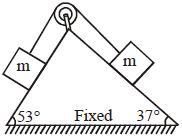
A
$1 \, m/s^2$
B
$\frac{1}{\sqrt{2}} \, m/s^2$
C
$\sqrt{2} \, m/s^2$
D
Zero
Solution
(B) Let the acceleration of the system be $a$. Since the blocks are connected by a string,they move with the same magnitude of acceleration $a$.
Applying Newton's second law to the system:
$T - mg \sin 37^{\circ} = ma$
$mg \sin 53^{\circ} - T = ma$
Adding these two equations,we get:
$mg(\sin 53^{\circ} - \sin 37^{\circ}) = 2ma$
$a = \frac{g(\sin 53^{\circ} - \sin 37^{\circ})}{2} = \frac{10(0.8 - 0.6)}{2} = \frac{10(0.2)}{2} = 1 \, m/s^2$.
The acceleration of the first block is $\vec{a}_1 = a \angle 53^{\circ}$ (up the incline) and the second block is $\vec{a}_2 = a \angle 37^{\circ}$ (down the incline).
The acceleration of the centre of mass is $\vec{a}_{cm} = \frac{m\vec{a}_1 + m\vec{a}_2}{2m} = \frac{\vec{a}_1 + \vec{a}_2}{2}$.
The magnitude is $a_{cm} = \frac{1}{2} \sqrt{a^2 + a^2 + 2a^2 \cos(180^{\circ} - (53^{\circ} + 37^{\circ}))} = \frac{1}{2} \sqrt{2a^2 + 2a^2 \cos(90^{\circ})} = \frac{a\sqrt{2}}{2} = \frac{a}{\sqrt{2}}$.
Substituting $a = 1 \, m/s^2$,we get $a_{cm} = \frac{1}{\sqrt{2}} \, m/s^2$.
Applying Newton's second law to the system:
$T - mg \sin 37^{\circ} = ma$
$mg \sin 53^{\circ} - T = ma$
Adding these two equations,we get:
$mg(\sin 53^{\circ} - \sin 37^{\circ}) = 2ma$
$a = \frac{g(\sin 53^{\circ} - \sin 37^{\circ})}{2} = \frac{10(0.8 - 0.6)}{2} = \frac{10(0.2)}{2} = 1 \, m/s^2$.
The acceleration of the first block is $\vec{a}_1 = a \angle 53^{\circ}$ (up the incline) and the second block is $\vec{a}_2 = a \angle 37^{\circ}$ (down the incline).
The acceleration of the centre of mass is $\vec{a}_{cm} = \frac{m\vec{a}_1 + m\vec{a}_2}{2m} = \frac{\vec{a}_1 + \vec{a}_2}{2}$.
The magnitude is $a_{cm} = \frac{1}{2} \sqrt{a^2 + a^2 + 2a^2 \cos(180^{\circ} - (53^{\circ} + 37^{\circ}))} = \frac{1}{2} \sqrt{2a^2 + 2a^2 \cos(90^{\circ})} = \frac{a\sqrt{2}}{2} = \frac{a}{\sqrt{2}}$.
Substituting $a = 1 \, m/s^2$,we get $a_{cm} = \frac{1}{\sqrt{2}} \, m/s^2$.
0 likes
View Solution61
MediumMCQ
The velocity of the centre of mass of the system as shown in the figure is
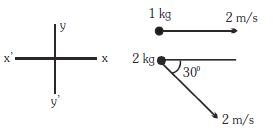
A
$\left( \frac{2 - 2\sqrt{3}}{3} \right)\hat{i} - \frac{1}{3}\hat{j}$
B
$\left( \frac{2 + 2\sqrt{3}}{3} \right)\hat{i} - \frac{2}{3}\hat{j}$
C
$4\hat{i}$
D
None of these
Solution
(B) Given:
Mass $m_1 = 1 \text{ kg}$,velocity $\vec{v}_1 = 2\hat{i} \text{ m/s}$.
Mass $m_2 = 2 \text{ kg}$,velocity $\vec{v}_2 = 2 \cos(30^{\circ})\hat{i} - 2 \sin(30^{\circ})\hat{j} \text{ m/s}$.
The velocity of the centre of mass $\vec{v}_{CM}$ is given by:
$\vec{v}_{CM} = \frac{m_1 \vec{v}_1 + m_2 \vec{v}_2}{m_1 + m_2}$
Substituting the values:
$\vec{v}_{CM} = \frac{1(2\hat{i}) + 2(2 \cos 30^{\circ}\hat{i} - 2 \sin 30^{\circ}\hat{j})}{1 + 2}$
Since $\cos 30^{\circ} = \frac{\sqrt{3}}{2}$ and $\sin 30^{\circ} = \frac{1}{2}$:
$\vec{v}_{CM} = \frac{2\hat{i} + 2(2 \cdot \frac{\sqrt{3}}{2}\hat{i} - 2 \cdot \frac{1}{2}\hat{j})}{3}$
$\vec{v}_{CM} = \frac{2\hat{i} + 2(\sqrt{3}\hat{i} - 1\hat{j})}{3}$
$\vec{v}_{CM} = \frac{2\hat{i} + 2\sqrt{3}\hat{i} - 2\hat{j}}{3}$
$\vec{v}_{CM} = \left( \frac{2 + 2\sqrt{3}}{3} \right)\hat{i} - \frac{2}{3}\hat{j} \text{ m/s}$.
Mass $m_1 = 1 \text{ kg}$,velocity $\vec{v}_1 = 2\hat{i} \text{ m/s}$.
Mass $m_2 = 2 \text{ kg}$,velocity $\vec{v}_2 = 2 \cos(30^{\circ})\hat{i} - 2 \sin(30^{\circ})\hat{j} \text{ m/s}$.
The velocity of the centre of mass $\vec{v}_{CM}$ is given by:
$\vec{v}_{CM} = \frac{m_1 \vec{v}_1 + m_2 \vec{v}_2}{m_1 + m_2}$
Substituting the values:
$\vec{v}_{CM} = \frac{1(2\hat{i}) + 2(2 \cos 30^{\circ}\hat{i} - 2 \sin 30^{\circ}\hat{j})}{1 + 2}$
Since $\cos 30^{\circ} = \frac{\sqrt{3}}{2}$ and $\sin 30^{\circ} = \frac{1}{2}$:
$\vec{v}_{CM} = \frac{2\hat{i} + 2(2 \cdot \frac{\sqrt{3}}{2}\hat{i} - 2 \cdot \frac{1}{2}\hat{j})}{3}$
$\vec{v}_{CM} = \frac{2\hat{i} + 2(\sqrt{3}\hat{i} - 1\hat{j})}{3}$
$\vec{v}_{CM} = \frac{2\hat{i} + 2\sqrt{3}\hat{i} - 2\hat{j}}{3}$
$\vec{v}_{CM} = \left( \frac{2 + 2\sqrt{3}}{3} \right)\hat{i} - \frac{2}{3}\hat{j} \text{ m/s}$.
0 likes
View Solution62
DifficultMCQ
$A$ balloon of mass $M$ with a light rope and a monkey of mass $m$ are at rest in mid-air. If the monkey climbs up the rope and reaches the top of the rope,the distance by which the balloon descends will be (Total length of the rope is $L$):
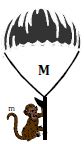
A
$\frac{mL}{m + M}$
B
$\frac{ML}{m + M}$
C
$\frac{(m + M)L}{m}$
D
$\frac{(M + m)}{mL}$
Solution
(A) Since there is no external force acting on the system (balloon + monkey) in the vertical direction,the position of the center of mass $(COM)$ of the system remains unchanged.
Let the balloon descend by a distance $y$. As the monkey climbs the rope of length $L$,the monkey moves upward by a distance $(L - y)$ relative to the ground.
Taking the initial position of the $COM$ as the reference point,the condition for the $COM$ to remain stationary is:
$M \cdot y = m \cdot (L - y)$
$My = mL - my$
$My + my = mL$
$y(M + m) = mL$
$y = \frac{mL}{M + m}$
Therefore,the distance by which the balloon descends is $\frac{mL}{M + m}$.
Let the balloon descend by a distance $y$. As the monkey climbs the rope of length $L$,the monkey moves upward by a distance $(L - y)$ relative to the ground.
Taking the initial position of the $COM$ as the reference point,the condition for the $COM$ to remain stationary is:
$M \cdot y = m \cdot (L - y)$
$My = mL - my$
$My + my = mL$
$y(M + m) = mL$
$y = \frac{mL}{M + m}$
Therefore,the distance by which the balloon descends is $\frac{mL}{M + m}$.
0 likes
View Solution63
DifficultMCQ
$A$ boy of mass $20\, kg$ is standing on an $80\, kg$ cart that is free to move. There is negligible friction between the cart and the ground. Initially,the boy is standing $25\, m$ from a wall. If he walks $10\, m$ on the cart towards the wall,then the final distance of the boy from the wall will be ........ $m$
A
$15$
B
$12.5$
C
$15.5$
D
$17$
Solution
(D) Since there is no external horizontal force acting on the system,the center of mass of the boy-cart system remains stationary relative to the ground.
Let $m_1 = 20\, kg$ be the mass of the boy and $m_2 = 80\, kg$ be the mass of the cart.
Let the boy move $10\, m$ towards the wall relative to the cart. Let the cart move a distance $x$ away from the wall relative to the ground.
The displacement of the boy relative to the ground towards the wall is $\Delta x_1 = 10 - x$.
The displacement of the cart relative to the ground away from the wall is $\Delta x_2 = -x$.
Using the center of mass displacement formula: $m_1 \Delta x_1 + m_2 \Delta x_2 = 0$.
$20(10 - x) + 80(-x) = 0$.
$200 - 20x - 80x = 0$.
$100x = 200 \implies x = 2\, m$.
The net displacement of the boy towards the wall relative to the ground is $\Delta x_1 = 10 - 2 = 8\, m$.
The final distance of the boy from the wall is $25 - 8 = 17\, m$.
Let $m_1 = 20\, kg$ be the mass of the boy and $m_2 = 80\, kg$ be the mass of the cart.
Let the boy move $10\, m$ towards the wall relative to the cart. Let the cart move a distance $x$ away from the wall relative to the ground.
The displacement of the boy relative to the ground towards the wall is $\Delta x_1 = 10 - x$.
The displacement of the cart relative to the ground away from the wall is $\Delta x_2 = -x$.
Using the center of mass displacement formula: $m_1 \Delta x_1 + m_2 \Delta x_2 = 0$.
$20(10 - x) + 80(-x) = 0$.
$200 - 20x - 80x = 0$.
$100x = 200 \implies x = 2\, m$.
The net displacement of the boy towards the wall relative to the ground is $\Delta x_1 = 10 - 2 = 8\, m$.
The final distance of the boy from the wall is $25 - 8 = 17\, m$.
0 likes
View Solution64
DifficultMCQ
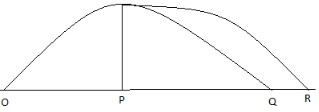
$A$ projectile of mass $M$ is fired so that the horizontal range is $4\, km$. At the highest point,the projectile explodes into two parts of masses $M/4$ and $3M/4$ respectively. The heavier part starts falling down vertically with zero initial speed. The horizontal range (distance from the point of firing) of the lighter part is .................. $km$.
A
$16$
B
$1$
C
$10$
D
$2$
Solution
(C) Let the point of firing be $O$ and the original range be $OQ = 4\, km$. The highest point is $P$,which is at a horizontal distance of $OP = 2\, km$ from the firing point.
Since the explosion is due to internal forces,the center of mass of the system continues to follow the original parabolic path and hits the ground at point $Q$.
Let the mass of the heavier part be $m_1 = 3M/4$ and the lighter part be $m_2 = M/4$.
The heavier part falls vertically from $P$,so its horizontal position is $x_1 = OP = 2\, km$.
Let the horizontal position of the lighter part be $x_2 = OR$.
The position of the center of mass $x_{cm}$ is given by:
$x_{cm} = \frac{m_1 x_1 + m_2 x_2}{m_1 + m_2}$
Substituting the values:
$4 = \frac{(3M/4) \times 2 + (M/4) \times x_2}{M}$
$4 = \frac{3}{2} + \frac{x_2}{4}$
$4 - 1.5 = \frac{x_2}{4}$
$2.5 = \frac{x_2}{4}$
$x_2 = 10\, km$.
Thus,the horizontal range of the lighter part is $10\, km$.
Since the explosion is due to internal forces,the center of mass of the system continues to follow the original parabolic path and hits the ground at point $Q$.
Let the mass of the heavier part be $m_1 = 3M/4$ and the lighter part be $m_2 = M/4$.
The heavier part falls vertically from $P$,so its horizontal position is $x_1 = OP = 2\, km$.
Let the horizontal position of the lighter part be $x_2 = OR$.
The position of the center of mass $x_{cm}$ is given by:
$x_{cm} = \frac{m_1 x_1 + m_2 x_2}{m_1 + m_2}$
Substituting the values:
$4 = \frac{(3M/4) \times 2 + (M/4) \times x_2}{M}$
$4 = \frac{3}{2} + \frac{x_2}{4}$
$4 - 1.5 = \frac{x_2}{4}$
$2.5 = \frac{x_2}{4}$
$x_2 = 10\, km$.
Thus,the horizontal range of the lighter part is $10\, km$.
0 likes
View Solution65
DifficultMCQ
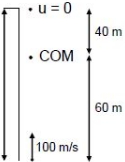
$A$ piece of wood of mass $0.03\, kg$ is dropped from the top of a $100\, m$ height building. At the same time,a bullet of mass $0.02\, kg$ is fired vertically upward,with a velocity $100\, ms^{-1}$,from the ground. The bullet gets embedded in the wood. Then the maximum height to which the combined system reaches above the top of the building before falling below is ........ $m$. $(g = 10\, ms^{-2})$
A
$20$
B
$30$
C
$40$
D
$10$
Solution
(C) Let the mass of the wood be $m_1 = 0.03\, kg$ and the mass of the bullet be $m_2 = 0.02\, kg$. The total mass is $M = m_1 + m_2 = 0.05\, kg$.
At the instant of collision,the wood has fallen from the top $(y = 100\, m)$ and the bullet has risen from the ground $(y = 0)$. Since they are dropped/fired at the same time,they collide when the bullet reaches the wood. However,the problem implies the center of mass $(COM)$ approach.
The position of the center of mass from the ground is $Y_{cm} = \frac{m_1 y_1 + m_2 y_2}{m_1 + m_2} = \frac{0.03 \times 100 + 0.02 \times 0}{0.05} = \frac{3}{0.05} = 60\, m$.
The velocity of the center of mass is $V_{cm} = \frac{m_1 v_1 + m_2 v_2}{m_1 + m_2} = \frac{0.03 \times 0 + 0.02 \times 100}{0.05} = \frac{2}{0.05} = 40\, m/s$.
After the collision,the system moves as a single particle with initial velocity $V_{cm} = 40\, m/s$ at a height of $60\, m$.
The maximum height $H_{max}$ reached by the center of mass from the ground is given by $H_{max} = Y_{cm} + \frac{V_{cm}^2}{2g} = 60 + \frac{40^2}{2 \times 10} = 60 + \frac{1600}{20} = 60 + 80 = 140\, m$.
The height above the top of the building is $140\, m - 100\, m = 40\, m$.
At the instant of collision,the wood has fallen from the top $(y = 100\, m)$ and the bullet has risen from the ground $(y = 0)$. Since they are dropped/fired at the same time,they collide when the bullet reaches the wood. However,the problem implies the center of mass $(COM)$ approach.
The position of the center of mass from the ground is $Y_{cm} = \frac{m_1 y_1 + m_2 y_2}{m_1 + m_2} = \frac{0.03 \times 100 + 0.02 \times 0}{0.05} = \frac{3}{0.05} = 60\, m$.
The velocity of the center of mass is $V_{cm} = \frac{m_1 v_1 + m_2 v_2}{m_1 + m_2} = \frac{0.03 \times 0 + 0.02 \times 100}{0.05} = \frac{2}{0.05} = 40\, m/s$.
After the collision,the system moves as a single particle with initial velocity $V_{cm} = 40\, m/s$ at a height of $60\, m$.
The maximum height $H_{max}$ reached by the center of mass from the ground is given by $H_{max} = Y_{cm} + \frac{V_{cm}^2}{2g} = 60 + \frac{40^2}{2 \times 10} = 60 + \frac{1600}{20} = 60 + 80 = 140\, m$.
The height above the top of the building is $140\, m - 100\, m = 40\, m$.
0 likes
View Solution66
DifficultMCQ
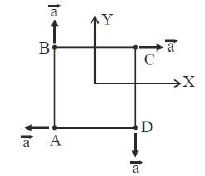
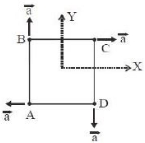
Four particles $A, B, C$ and $D$ with masses $m_A=m, m_B=2m, m_C=3m$ and $m_D=4m$ are at the corners of a square. They have accelerations of equal magnitude $a$ with directions as shown. The acceleration of the centre of mass of the particles is
A
$\frac{a}{5}\,\left( {\hat i - \hat j} \right)$
B
Zero
C
$\frac{a}{5}\,\left( {\hat i + \hat j} \right)$
D
$a\left( {\hat i + \hat j} \right)$
Solution
(A) The accelerations of the particles are given by:
$\vec{a}_A = -a\hat{i}$
$\vec{a}_B = a\hat{j}$
$\vec{a}_C = a\hat{i}$
$\vec{a}_D = -a\hat{j}$
The acceleration of the centre of mass is given by:
$\vec{a}_{cm} = \frac{m_A\vec{a}_A + m_B\vec{a}_B + m_C\vec{a}_C + m_D\vec{a}_D}{m_A + m_B + m_C + m_D}$
Substituting the values:
$\vec{a}_{cm} = \frac{m(-a\hat{i}) + 2m(a\hat{j}) + 3m(a\hat{i}) + 4m(-a\hat{j})}{m + 2m + 3m + 4m}$
$\vec{a}_{cm} = \frac{-ma\hat{i} + 2ma\hat{j} + 3ma\hat{i} - 4ma\hat{j}}{10m}$
$\vec{a}_{cm} = \frac{2ma\hat{i} - 2ma\hat{j}}{10m} = \frac{a}{5}\hat{i} - \frac{a}{5}\hat{j} = \frac{a}{5}(\hat{i} - \hat{j})$
$\vec{a}_A = -a\hat{i}$
$\vec{a}_B = a\hat{j}$
$\vec{a}_C = a\hat{i}$
$\vec{a}_D = -a\hat{j}$
The acceleration of the centre of mass is given by:
$\vec{a}_{cm} = \frac{m_A\vec{a}_A + m_B\vec{a}_B + m_C\vec{a}_C + m_D\vec{a}_D}{m_A + m_B + m_C + m_D}$
Substituting the values:
$\vec{a}_{cm} = \frac{m(-a\hat{i}) + 2m(a\hat{j}) + 3m(a\hat{i}) + 4m(-a\hat{j})}{m + 2m + 3m + 4m}$
$\vec{a}_{cm} = \frac{-ma\hat{i} + 2ma\hat{j} + 3ma\hat{i} - 4ma\hat{j}}{10m}$
$\vec{a}_{cm} = \frac{2ma\hat{i} - 2ma\hat{j}}{10m} = \frac{a}{5}\hat{i} - \frac{a}{5}\hat{j} = \frac{a}{5}(\hat{i} - \hat{j})$
0 likes
View Solution67
MediumMCQ
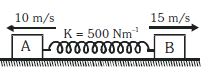
Two blocks $A$ and $B$ are joined together with a compressed spring. When the system is released,the two blocks move with unequal speeds in opposite directions as shown in the figure. Select the correct statement.
A
The centre of mass of the system will remain stationary.
B
Mass of block $A$ is equal to that of block $B$.
C
The centre of mass of the system will move towards the right.
D
It is an impossible physical situation.
Solution
(A) The system consists of two blocks $A$ and $B$ connected by a spring. When the system is released,the only forces acting on the blocks are the internal spring forces.
Since there is no external force acting on the system in the horizontal direction,the net external force on the system is zero $(F_{ext} = 0)$.
According to the property of the centre of mass,if the net external force on a system is zero,the acceleration of the centre of mass is zero $(a_{cm} = 0)$.
If the system was initially at rest,the velocity of the centre of mass remains zero,meaning the centre of mass remains stationary.
Since there is no external force acting on the system in the horizontal direction,the net external force on the system is zero $(F_{ext} = 0)$.
According to the property of the centre of mass,if the net external force on a system is zero,the acceleration of the centre of mass is zero $(a_{cm} = 0)$.
If the system was initially at rest,the velocity of the centre of mass remains zero,meaning the centre of mass remains stationary.
0 likes
View Solution68
MediumMCQ
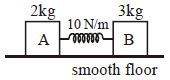
In the given figure,if the speed given to block $A$ is $10\,m/s$ and block $B$ is initially at rest,then the speed of the centre of mass after $10\,s$ will be ....... $m/s$.
A
$2$
B
$4$
C
$40$
D
$0.2$
Solution
(B) The system consists of two blocks $A$ and $B$ with masses $m_A = 2\,kg$ and $m_B = 3\,kg$ connected by a spring on a smooth horizontal floor.
Since the floor is smooth,there is no external horizontal force acting on the system.
According to the law of conservation of linear momentum,the velocity of the centre of mass $(v_{cm})$ remains constant if the net external force on the system is zero.
The initial velocity of block $A$ is $v_A = 10\,m/s$ and block $B$ is at rest,$v_B = 0\,m/s$.
The velocity of the centre of mass is given by:
$v_{cm} = \frac{m_A v_A + m_B v_B}{m_A + m_B}$
$v_{cm} = \frac{2 \times 10 + 3 \times 0}{2 + 3} = \frac{20}{5} = 4\,m/s$
Since the net external force is zero,the velocity of the centre of mass will remain $4\,m/s$ at any time $t$,including at $t = 10\,s$.
Since the floor is smooth,there is no external horizontal force acting on the system.
According to the law of conservation of linear momentum,the velocity of the centre of mass $(v_{cm})$ remains constant if the net external force on the system is zero.
The initial velocity of block $A$ is $v_A = 10\,m/s$ and block $B$ is at rest,$v_B = 0\,m/s$.
The velocity of the centre of mass is given by:
$v_{cm} = \frac{m_A v_A + m_B v_B}{m_A + m_B}$
$v_{cm} = \frac{2 \times 10 + 3 \times 0}{2 + 3} = \frac{20}{5} = 4\,m/s$
Since the net external force is zero,the velocity of the centre of mass will remain $4\,m/s$ at any time $t$,including at $t = 10\,s$.
0 likes
View Solution69
MediumMCQ
Two bodies of masses $2\,kg$ and $4\,kg$ are moving with velocities $2\,m/s$ and $10\,m/s$ respectively towards each other due to mutual gravitational attraction. What is the velocity of their centre of mass,given that the bodies were at rest initially?
A
$5.3$
B
$6.4$
C
$0$
D
$8.1$
Solution
(C) The velocity of the centre of mass of a system is given by $v_{cm} = \frac{m_1v_1 + m_2v_2}{m_1 + m_2}$.
Since the bodies are moving towards each other due to mutual gravitational attraction,there is no external force acting on the system $(F_{ext} = 0)$.
According to the law of conservation of momentum,if the initial velocity of the system is zero,the velocity of the centre of mass remains zero throughout the motion.
Given that the bodies were at rest initially,the initial momentum of the system is $P_i = m_1(0) + m_2(0) = 0$.
Therefore,the velocity of the centre of mass $v_{cm} = 0\,m/s$.
Since the bodies are moving towards each other due to mutual gravitational attraction,there is no external force acting on the system $(F_{ext} = 0)$.
According to the law of conservation of momentum,if the initial velocity of the system is zero,the velocity of the centre of mass remains zero throughout the motion.
Given that the bodies were at rest initially,the initial momentum of the system is $P_i = m_1(0) + m_2(0) = 0$.
Therefore,the velocity of the centre of mass $v_{cm} = 0\,m/s$.
0 likes
View Solution70
DifficultMCQ
$A$ $500\,kg$ boat is $9\,m$ long and is floating without motion on still water. $A$ man of mass $100\,kg$ is at one end and if he runs to the other end of the boat and stops,the displacement of the boat is
A
$1.5\,m$ in the direction of displacement of the man
B
$0.75\,m$ in the direction of displacement of the man
C
$1.5\,m$ in the direction opposite to the displacement of the man
D
$0.75\,m$ in the direction opposite to the displacement of the man
Solution
(C) Since there is no external horizontal force acting on the system (man + boat),the center of mass of the system remains stationary.
Let $M = 500\,kg$ be the mass of the boat and $m = 100\,kg$ be the mass of the man.
Let $L = 9\,m$ be the length of the boat.
Let $x$ be the displacement of the boat relative to the water.
When the man moves from one end to the other,his displacement relative to the boat is $L = 9\,m$.
His displacement relative to the water is $(L - x) = (9 - x)$.
Using the principle of conservation of the center of mass: $m(L - x) - Mx = 0$.
Substituting the values: $100(9 - x) - 500x = 0$.
$900 - 100x - 500x = 0$.
$900 = 600x$.
$x = \frac{900}{600} = 1.5\,m$.
Since the boat moves in the direction opposite to the man's motion to keep the center of mass fixed,the displacement is $1.5\,m$ in the direction opposite to the displacement of the man.
Let $M = 500\,kg$ be the mass of the boat and $m = 100\,kg$ be the mass of the man.
Let $L = 9\,m$ be the length of the boat.
Let $x$ be the displacement of the boat relative to the water.
When the man moves from one end to the other,his displacement relative to the boat is $L = 9\,m$.
His displacement relative to the water is $(L - x) = (9 - x)$.
Using the principle of conservation of the center of mass: $m(L - x) - Mx = 0$.
Substituting the values: $100(9 - x) - 500x = 0$.
$900 - 100x - 500x = 0$.
$900 = 600x$.
$x = \frac{900}{600} = 1.5\,m$.
Since the boat moves in the direction opposite to the man's motion to keep the center of mass fixed,the displacement is $1.5\,m$ in the direction opposite to the displacement of the man.
0 likes
View Solution71
DifficultMCQ
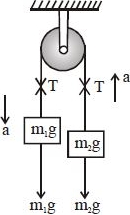
Two bodies of masses $m_1$ and $m_2$ $(m_1 > m_2)$ are tied to the ends of a string which passes over a light frictionless pulley. The masses are initially at rest and then released. The acceleration of the centre of mass is
A
${\left( {\frac{{{m_1} - {m_2}}}{{{m_1} + {m_2}}}} \right)^2}g$
B
$\left( {\frac{{{m_1} - {m_2}}}{{{m_1} + {m_2}}}} \right)g$
C
$g$
D
zero
Solution
(A) For an Atwood machine,the acceleration of the masses is given by $a = \frac{m_1 - m_2}{m_1 + m_2} g$.
Let the downward direction be positive for $m_1$ and the upward direction be positive for $m_2$. Then the acceleration of $m_1$ is $a_1 = a$ (downward) and the acceleration of $m_2$ is $a_2 = -a$ (upward).
The acceleration of the centre of mass $(a_{CM})$ is given by:
$a_{CM} = \frac{m_1 a_1 + m_2 a_2}{m_1 + m_2}$
Substituting the values:
$a_{CM} = \frac{m_1(a) + m_2(-a)}{m_1 + m_2} = \frac{(m_1 - m_2)a}{m_1 + m_2}$
Now,substitute $a = \frac{m_1 - m_2}{m_1 + m_2} g$ into the equation:
$a_{CM} = \left( \frac{m_1 - m_2}{m_1 + m_2} \right) \left( \frac{m_1 - m_2}{m_1 + m_2} g \right)$
$a_{CM} = \left( \frac{m_1 - m_2}{m_1 + m_2} \right)^2 g$
Let the downward direction be positive for $m_1$ and the upward direction be positive for $m_2$. Then the acceleration of $m_1$ is $a_1 = a$ (downward) and the acceleration of $m_2$ is $a_2 = -a$ (upward).
The acceleration of the centre of mass $(a_{CM})$ is given by:
$a_{CM} = \frac{m_1 a_1 + m_2 a_2}{m_1 + m_2}$
Substituting the values:
$a_{CM} = \frac{m_1(a) + m_2(-a)}{m_1 + m_2} = \frac{(m_1 - m_2)a}{m_1 + m_2}$
Now,substitute $a = \frac{m_1 - m_2}{m_1 + m_2} g$ into the equation:
$a_{CM} = \left( \frac{m_1 - m_2}{m_1 + m_2} \right) \left( \frac{m_1 - m_2}{m_1 + m_2} g \right)$
$a_{CM} = \left( \frac{m_1 - m_2}{m_1 + m_2} \right)^2 g$
0 likes
View Solution72
DifficultMCQ
Consider a two-particle system with particles having masses $m_1$ and $m_2$. If the first particle is pushed towards the centre of mass through a distance $d$,by what distance should the second particle be moved,so as to keep the centre of mass at the same position?
A
$d$
B
$\left( \frac{m_2}{m_1} \right) d$
C
$\left( \frac{m_2}{m_1 + m_2} \right) d$
D
$\left( \frac{m_1}{m_2} \right) d$
Solution
(D) The position of the centre of mass $R_{cm}$ is given by $R_{cm} = \frac{m_1 r_1 + m_2 r_2}{m_1 + m_2}$.
For the centre of mass to remain at the same position,the change in the position of the centre of mass must be zero,i.e.,$\Delta R_{cm} = 0$.
Therefore,$m_1 \Delta r_1 + m_2 \Delta r_2 = 0$.
Given that the first particle is moved by a distance $d$ towards the centre of mass,let $\Delta r_1 = d$.
Substituting this into the equation: $m_1 d + m_2 \Delta r_2 = 0$.
Solving for $\Delta r_2$: $\Delta r_2 = -\left( \frac{m_1}{m_2} \right) d$.
The negative sign indicates that the second particle must be moved in the opposite direction to the first particle,also towards the centre of mass,by a distance of $\left( \frac{m_1}{m_2} \right) d$.
For the centre of mass to remain at the same position,the change in the position of the centre of mass must be zero,i.e.,$\Delta R_{cm} = 0$.
Therefore,$m_1 \Delta r_1 + m_2 \Delta r_2 = 0$.
Given that the first particle is moved by a distance $d$ towards the centre of mass,let $\Delta r_1 = d$.
Substituting this into the equation: $m_1 d + m_2 \Delta r_2 = 0$.
Solving for $\Delta r_2$: $\Delta r_2 = -\left( \frac{m_1}{m_2} \right) d$.
The negative sign indicates that the second particle must be moved in the opposite direction to the first particle,also towards the centre of mass,by a distance of $\left( \frac{m_1}{m_2} \right) d$.
0 likes
View Solution73
MediumMCQ
Two masses $m_1$ and $m_2$ start to move towards each other due to mutual gravitational force. If the distance covered by $m_1$ is $x$,then the distance covered by $m_2$ is:
A
$\frac{m_2 x}{m_1 + m_2}$
B
$\frac{m_2 x}{m_1}$
C
$\frac{m_1 x}{m_2}$
D
$\frac{m_1 x}{m_1 + m_2}$
Solution
(C) Since the only force acting on the system is the mutual gravitational force,there is no external force acting on the system of two masses.
According to the law of conservation of momentum,the center of mass of the system remains at rest if it was initially at rest.
Let $x_1$ be the distance covered by $m_1$ and $x_2$ be the distance covered by $m_2$.
Since the center of mass remains stationary,we have $m_1 x_1 = m_2 x_2$.
Given that $x_1 = x$,we substitute this into the equation:
$m_1 x = m_2 x_2$.
Solving for $x_2$,we get $x_2 = \frac{m_1 x}{m_2}$.
According to the law of conservation of momentum,the center of mass of the system remains at rest if it was initially at rest.
Let $x_1$ be the distance covered by $m_1$ and $x_2$ be the distance covered by $m_2$.
Since the center of mass remains stationary,we have $m_1 x_1 = m_2 x_2$.
Given that $x_1 = x$,we substitute this into the equation:
$m_1 x = m_2 x_2$.
Solving for $x_2$,we get $x_2 = \frac{m_1 x}{m_2}$.
0 likes
View Solution74
MediumMCQ
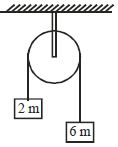
If the system is released,then the acceleration of the centre of mass of the system is
A
$g/4$
B
$g/2$
C
$g$
D
$2g$
Solution
(A) Let the masses be $m_1 = 2m$ and $m_2 = 6m$.
The acceleration of the masses in an Atwood machine is given by $a = \frac{|m_2 - m_1|}{m_1 + m_2} g$.
Substituting the values,$a = \frac{|6m - 2m|}{6m + 2m} g = \frac{4m}{8m} g = \frac{g}{2}$.
The acceleration of the centre of mass is $a_{cm} = \frac{m_1 a_1 + m_2 a_2}{m_1 + m_2}$.
Here,$a_1 = a$ (upwards) and $a_2 = -a$ (downwards).
So,$a_{cm} = \frac{m_1 a - m_2 a}{m_1 + m_2} = \frac{(2m - 6m) a}{2m + 6m} = \frac{-4m}{8m} a = -\frac{1}{2} a$.
The magnitude of the acceleration of the centre of mass is $|a_{cm}| = \frac{1}{2} a = \frac{1}{2} \times \frac{g}{2} = \frac{g}{4}$.
The acceleration of the masses in an Atwood machine is given by $a = \frac{|m_2 - m_1|}{m_1 + m_2} g$.
Substituting the values,$a = \frac{|6m - 2m|}{6m + 2m} g = \frac{4m}{8m} g = \frac{g}{2}$.
The acceleration of the centre of mass is $a_{cm} = \frac{m_1 a_1 + m_2 a_2}{m_1 + m_2}$.
Here,$a_1 = a$ (upwards) and $a_2 = -a$ (downwards).
So,$a_{cm} = \frac{m_1 a - m_2 a}{m_1 + m_2} = \frac{(2m - 6m) a}{2m + 6m} = \frac{-4m}{8m} a = -\frac{1}{2} a$.
The magnitude of the acceleration of the centre of mass is $|a_{cm}| = \frac{1}{2} a = \frac{1}{2} \times \frac{g}{2} = \frac{g}{4}$.
0 likes
View Solution75
MediumMCQ
Two particles which are initially at rest,move towards each other under the action of their internal attraction. If their speeds are $v$ and $2v$ at any instant,then the speed of the centre of mass of the system will be
A
$v$
B
$2v$
C
Zero
D
$1.5\,v$
Solution
(C) The system consists of two particles moving under the influence of their internal mutual attraction.
Since there is no external force acting on the system,the net external force $\vec{F}_{ext} = 0$.
According to the properties of the centre of mass,if the net external force on a system is zero,the acceleration of the centre of mass is zero $(\vec{a}_{cm} = 0)$.
This implies that the velocity of the centre of mass remains constant.
Initially,both particles are at rest,so the initial velocity of the centre of mass $\vec{v}_{cm, initial} = 0$.
Therefore,the velocity of the centre of mass at any instant remains $\vec{v}_{cm} = 0$.
Since there is no external force acting on the system,the net external force $\vec{F}_{ext} = 0$.
According to the properties of the centre of mass,if the net external force on a system is zero,the acceleration of the centre of mass is zero $(\vec{a}_{cm} = 0)$.
This implies that the velocity of the centre of mass remains constant.
Initially,both particles are at rest,so the initial velocity of the centre of mass $\vec{v}_{cm, initial} = 0$.
Therefore,the velocity of the centre of mass at any instant remains $\vec{v}_{cm} = 0$.
0 likes
View Solution76
DifficultMCQ
The centre of mass of two masses $m$ and $m'$ moves by a distance $\frac{x}{5}$ when mass $m$ is moved by a distance $x$ and $m'$ is kept fixed. The ratio $\frac{m'}{m}$ is
A
$2$
B
$4$
C
$1/4$
D
None of these
Solution
(B) The displacement of the centre of mass $(\Delta R_{cm})$ is given by the formula: $\Delta R_{cm} = \frac{m_1 \Delta r_1 + m_2 \Delta r_2}{m_1 + m_2}$.
Given,$m_1 = m$,$\Delta r_1 = x$,$m_2 = m'$,$\Delta r_2 = 0$,and $\Delta R_{cm} = \frac{x}{5}$.
Substituting these values into the equation:
$\frac{x}{5} = \frac{m(x) + m'(0)}{m + m'}$.
$\frac{x}{5} = \frac{mx}{m + m'}$.
Dividing both sides by $x$ (assuming $x \neq 0$):
$\frac{1}{5} = \frac{m}{m + m'}$.
$m + m' = 5m$.
$m' = 4m$.
Therefore,the ratio $\frac{m'}{m} = 4$.
Given,$m_1 = m$,$\Delta r_1 = x$,$m_2 = m'$,$\Delta r_2 = 0$,and $\Delta R_{cm} = \frac{x}{5}$.
Substituting these values into the equation:
$\frac{x}{5} = \frac{m(x) + m'(0)}{m + m'}$.
$\frac{x}{5} = \frac{mx}{m + m'}$.
Dividing both sides by $x$ (assuming $x \neq 0$):
$\frac{1}{5} = \frac{m}{m + m'}$.
$m + m' = 5m$.
$m' = 4m$.
Therefore,the ratio $\frac{m'}{m} = 4$.
0 likes
View Solution77
MediumMCQ
Two skaters $A$ and $B$ of weights in the ratio $5 : 7$ start facing each other $6\,m$ apart on a horizontal smooth surface. They pull on a rope stretched between them. How far has each moved when they meet?
A
Both have moved $3\,m$
B
$A$ moves $4\,m$ and $B$ moves $2\,m$
C
$A$ moves $2.5\,m$ and $B$ moves $3.5\,m$
D
$A$ moves $3.5\,m$ and $B$ moves $2.5\,m$
Solution
(D) Since there is no external force acting on the system,the center of mass remains stationary. The ratio of the distances moved by the skaters is inversely proportional to their masses (or weights).
Let $m_A$ and $m_B$ be the weights of skaters $A$ and $B$ respectively,where $m_A/m_B = 5/7$.
Let $x_A$ and $x_B$ be the distances moved by $A$ and $B$ respectively. Since they meet,$x_A + x_B = 6\,m$.
From the conservation of momentum,$m_A x_A = m_B x_B$.
Substituting the ratio,$5 x_A = 7 x_B$.
Since $x_B = 6 - x_A$,we have $5 x_A = 7(6 - x_A)$.
$5 x_A = 42 - 7 x_A \implies 12 x_A = 42 \implies x_A = 3.5\,m$.
Then $x_B = 6 - 3.5 = 2.5\,m$.
Let $m_A$ and $m_B$ be the weights of skaters $A$ and $B$ respectively,where $m_A/m_B = 5/7$.
Let $x_A$ and $x_B$ be the distances moved by $A$ and $B$ respectively. Since they meet,$x_A + x_B = 6\,m$.
From the conservation of momentum,$m_A x_A = m_B x_B$.
Substituting the ratio,$5 x_A = 7 x_B$.
Since $x_B = 6 - x_A$,we have $5 x_A = 7(6 - x_A)$.
$5 x_A = 42 - 7 x_A \implies 12 x_A = 42 \implies x_A = 3.5\,m$.
Then $x_B = 6 - 3.5 = 2.5\,m$.
0 likes
View Solution78
MediumMCQ
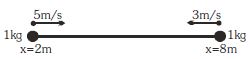
The figure shows the positions and velocities of two particles. If the particles move under their mutual attraction,then the position of the centre of mass at $t = 1\,s$ is
A
$x = 5\,m$
B
$x = 6\,m$
C
$x = 3\,m$
D
$x = 2\,m$
Solution
(B) The particles are moving under mutual attraction,which means the net external force on the system is zero $(F_{ext} = 0)$.
Therefore,the velocity of the centre of mass $(v_{CM})$ remains constant.
Given: $m_1 = 1\,kg$,$x_1 = 2\,m$,$v_1 = 5\,m/s$; $m_2 = 1\,kg$,$x_2 = 8\,m$,$v_2 = -3\,m/s$.
The initial position of the centre of mass is $X_{CM}(0) = \frac{m_1x_1 + m_2x_2}{m_1 + m_2} = \frac{(1)(2) + (1)(8)}{1 + 1} = \frac{10}{2} = 5\,m$.
The velocity of the centre of mass is $v_{CM} = \frac{m_1v_1 + m_2v_2}{m_1 + m_2} = \frac{(1)(5) + (1)(-3)}{1 + 1} = \frac{2}{2} = 1\,m/s$.
The position of the centre of mass at time $t$ is given by $X_{CM}(t) = X_{CM}(0) + v_{CM} \cdot t$.
At $t = 1\,s$,$X_{CM}(1) = 5 + (1)(1) = 6\,m$.
Therefore,the velocity of the centre of mass $(v_{CM})$ remains constant.
Given: $m_1 = 1\,kg$,$x_1 = 2\,m$,$v_1 = 5\,m/s$; $m_2 = 1\,kg$,$x_2 = 8\,m$,$v_2 = -3\,m/s$.
The initial position of the centre of mass is $X_{CM}(0) = \frac{m_1x_1 + m_2x_2}{m_1 + m_2} = \frac{(1)(2) + (1)(8)}{1 + 1} = \frac{10}{2} = 5\,m$.
The velocity of the centre of mass is $v_{CM} = \frac{m_1v_1 + m_2v_2}{m_1 + m_2} = \frac{(1)(5) + (1)(-3)}{1 + 1} = \frac{2}{2} = 1\,m/s$.
The position of the centre of mass at time $t$ is given by $X_{CM}(t) = X_{CM}(0) + v_{CM} \cdot t$.
At $t = 1\,s$,$X_{CM}(1) = 5 + (1)(1) = 6\,m$.
0 likes
View Solution79
MediumMCQ
Two particles $A$ and $B$ initially at rest move towards each other under a mutual force of attraction. At the instant when the velocity of $A$ is $v$ and that of $B$ is $2v$,the velocity of the centre of mass of the system is:
A
$v$
B
$2v$
C
$3v$
D
Zero
Solution
(D) The system consists of two particles $A$ and $B$ moving under a mutual force of attraction.
Since there is no external force acting on the system,the net external force $F_{ext} = 0$.
According to the law of conservation of momentum for the centre of mass,if the net external force is zero,the velocity of the centre of mass remains constant.
Initially,both particles $A$ and $B$ are at rest,so the initial velocity of the centre of mass $v_{cm, initial} = 0$.
Since the velocity of the centre of mass remains constant,the velocity of the centre of mass at any instant,including when the velocities of $A$ and $B$ are $v$ and $2v$ respectively,will be $0$.
Since there is no external force acting on the system,the net external force $F_{ext} = 0$.
According to the law of conservation of momentum for the centre of mass,if the net external force is zero,the velocity of the centre of mass remains constant.
Initially,both particles $A$ and $B$ are at rest,so the initial velocity of the centre of mass $v_{cm, initial} = 0$.
Since the velocity of the centre of mass remains constant,the velocity of the centre of mass at any instant,including when the velocities of $A$ and $B$ are $v$ and $2v$ respectively,will be $0$.
0 likes
View Solution80
DifficultMCQ
Two particles of equal masses have velocities $\overrightarrow{v_1} = 2\hat{i} \ m/s$ and $\overrightarrow{v_2} = 2\hat{j} \ m/s$. The first particle has an acceleration $\overrightarrow{a_1} = (3\hat{i} + 3\hat{j}) \ m/s^2$,while the acceleration of the other particle is zero. The centre of mass of the two particles moves in a
A
circle
B
parabola
C
straight line
D
ellipse
Solution
(C) The velocity of the center of mass is given by $\overrightarrow{v}_{com} = \frac{m_1 \overrightarrow{v_1} + m_2 \overrightarrow{v_2}}{m_1 + m_2}$.
Since $m_1 = m_2 = m$,we have $\overrightarrow{v}_{com} = \frac{m(\overrightarrow{v_1} + \overrightarrow{v_2})}{2m} = \frac{\overrightarrow{v_1} + \overrightarrow{v_2}}{2} = \frac{2\hat{i} + 2\hat{j}}{2} = (\hat{i} + \hat{j}) \ m/s$.
Similarly,the acceleration of the center of mass is $\overrightarrow{a}_{com} = \frac{m_1 \overrightarrow{a_1} + m_2 \overrightarrow{a_2}}{m_1 + m_2} = \frac{\overrightarrow{a_1} + \overrightarrow{a_2}}{2}$.
Given $\overrightarrow{a_1} = (3\hat{i} + 3\hat{j}) \ m/s^2$ and $\overrightarrow{a_2} = 0$,we get $\overrightarrow{a}_{com} = \frac{3\hat{i} + 3\hat{j}}{2} = 1.5(\hat{i} + \hat{j}) \ m/s^2$.
Since the initial velocity vector $\overrightarrow{v}_{com} = (\hat{i} + \hat{j})$ and the acceleration vector $\overrightarrow{a}_{com} = 1.5(\hat{i} + \hat{j})$ are parallel to each other,the center of mass moves in a straight line.
Since $m_1 = m_2 = m$,we have $\overrightarrow{v}_{com} = \frac{m(\overrightarrow{v_1} + \overrightarrow{v_2})}{2m} = \frac{\overrightarrow{v_1} + \overrightarrow{v_2}}{2} = \frac{2\hat{i} + 2\hat{j}}{2} = (\hat{i} + \hat{j}) \ m/s$.
Similarly,the acceleration of the center of mass is $\overrightarrow{a}_{com} = \frac{m_1 \overrightarrow{a_1} + m_2 \overrightarrow{a_2}}{m_1 + m_2} = \frac{\overrightarrow{a_1} + \overrightarrow{a_2}}{2}$.
Given $\overrightarrow{a_1} = (3\hat{i} + 3\hat{j}) \ m/s^2$ and $\overrightarrow{a_2} = 0$,we get $\overrightarrow{a}_{com} = \frac{3\hat{i} + 3\hat{j}}{2} = 1.5(\hat{i} + \hat{j}) \ m/s^2$.
Since the initial velocity vector $\overrightarrow{v}_{com} = (\hat{i} + \hat{j})$ and the acceleration vector $\overrightarrow{a}_{com} = 1.5(\hat{i} + \hat{j})$ are parallel to each other,the center of mass moves in a straight line.
0 likes
View Solution81
EasyMCQ
Two particles of masses $m_1$ and $m_2$ $(m_1 > m_2)$,initially at rest,move towards each other under an inverse square law force of attraction. Pick out the correct statement about the centre of mass $(CM)$ of the system.
A
The $CM$ moves towards $m_1$
B
The $CM$ moves towards $m_2$
C
The $CM$ remains at rest
D
The motion of $CM$ is accelerated
Solution
(C) The system consists of two particles $m_1$ and $m_2$ interacting via an internal force of attraction.
Since there is no external force acting on the system,the net external force $F_{ext} = 0$.
According to the property of the centre of mass,the acceleration of the centre of mass is given by $a_{CM} = F_{ext} / (m_1 + m_2) = 0$.
Since the particles are initially at rest,the initial velocity of the centre of mass $v_{CM} = 0$.
Because $a_{CM} = 0$ and $v_{CM} = 0$,the centre of mass remains at rest throughout the motion.
Since there is no external force acting on the system,the net external force $F_{ext} = 0$.
According to the property of the centre of mass,the acceleration of the centre of mass is given by $a_{CM} = F_{ext} / (m_1 + m_2) = 0$.
Since the particles are initially at rest,the initial velocity of the centre of mass $v_{CM} = 0$.
Because $a_{CM} = 0$ and $v_{CM} = 0$,the centre of mass remains at rest throughout the motion.
0 likes
View Solution82
Easy
$A$ child sits stationary at one end of a long trolley moving uniformly with a speed $V$ on a smooth horizontal floor. If the child gets up and runs about on the trolley in any manner,what is the speed of the $CM$ of the (trolley + child) system?
Solution
(V) The speed of the $CM$ remains $V$.
The child is running arbitrarily on a trolley moving with velocity $V$. The running of the child constitutes internal forces within the (trolley + child) system.
According to the law of conservation of momentum,the velocity of the centre of mass $(CM)$ of a system changes only if there is an external force acting on the system.
Since the floor is smooth (frictionless) and there are no other external horizontal forces acting on the system,the net external force on the (trolley + child) system is zero.
Therefore,the velocity of the $CM$ of the system remains unchanged,regardless of the child's motion on the trolley. The speed of the $CM$ remains $V$.
The child is running arbitrarily on a trolley moving with velocity $V$. The running of the child constitutes internal forces within the (trolley + child) system.
According to the law of conservation of momentum,the velocity of the centre of mass $(CM)$ of a system changes only if there is an external force acting on the system.
Since the floor is smooth (frictionless) and there are no other external horizontal forces acting on the system,the net external force on the (trolley + child) system is zero.
Therefore,the velocity of the $CM$ of the system remains unchanged,regardless of the child's motion on the trolley. The speed of the $CM$ remains $V$.
0 likes
View Solution83
Easy
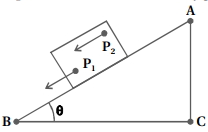
Explain translational motion by the given illustration.
Solution
(N/A) rectangular block is shown sliding down an inclined plane $AB$ at an angle $\theta$ without any sidewise movement.
In this motion,the block moves down the plane such that all particles of the body (e.g.,$P_1$ and $P_2$) move together. This means that at any instant of time,every particle of the rigid body has the same velocity vector.
Such motion of a rigid body is defined as pure translational motion.
Therefore,in pure translational motion,at any instant of time,all particles of the body possess the same velocity.
In this motion,the block moves down the plane such that all particles of the body (e.g.,$P_1$ and $P_2$) move together. This means that at any instant of time,every particle of the rigid body has the same velocity vector.
Such motion of a rigid body is defined as pure translational motion.
Therefore,in pure translational motion,at any instant of time,all particles of the body possess the same velocity.
0 likes
View Solution84
Medium
What are some of the notable points in the derivation of $M\vec{A} = \vec{F}_{ext}$?
Solution
(N/A) $(1)$ To determine the motion of the centre of mass,no knowledge of internal forces of the system of particles is required; only the external forces are needed.
$(2)$ To obtain this equation,we did not need to specify the nature of the system of particles. The system may be a collection of particles with various internal motions,or it may be a rigid body undergoing pure translational motion or a combination of translational and rotational motion.
$(3)$ Regardless of the nature of the system and the motion of its individual particles,the centre of mass always moves according to the equation $M\vec{A} = \vec{F}_{ext}$.
$(2)$ To obtain this equation,we did not need to specify the nature of the system of particles. The system may be a collection of particles with various internal motions,or it may be a rigid body undergoing pure translational motion or a combination of translational and rotational motion.
$(3)$ Regardless of the nature of the system and the motion of its individual particles,the centre of mass always moves according to the equation $M\vec{A} = \vec{F}_{ext}$.
0 likes
View Solution85
Medium
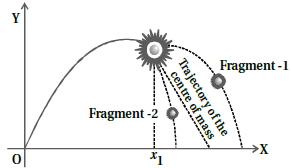
Discuss the explosion of a projectile.
Solution
(N/A) As shown in the figure,a projectile following a parabolic path explodes into fragments midway in the air.
The forces leading to the explosion are internal forces,and they contribute nothing to the motion of the centre of mass.
Total external force,which is the force of gravity acting on the body,remains the same before and after the explosion.
Therefore,the centre of mass continues to move under the influence of the external force along the same parabolic trajectory as it would have followed if there were no explosion.
The forces leading to the explosion are internal forces,and they contribute nothing to the motion of the centre of mass.
Total external force,which is the force of gravity acting on the body,remains the same before and after the explosion.
Therefore,the centre of mass continues to move under the influence of the external force along the same parabolic trajectory as it would have followed if there were no explosion.
0 likes
View Solution86
MediumMCQ
The equation $M\vec{A} = \vec{F}_{ext}$ denotes what?
A
Newton's first law of motion
B
Newton's second law of motion for a system of particles
C
Conservation of linear momentum
D
Conservation of angular momentum
Solution
(B) The equation $M\vec{A} = \vec{F}_{ext}$ represents the motion of the center of mass of a system of particles.
Here,$M$ is the total mass of the system,$\vec{A}$ is the acceleration of the center of mass,and $\vec{F}_{ext}$ is the vector sum of all external forces acting on the system.
This is derived from Newton's second law applied to a system of particles,where the internal forces cancel out due to Newton's third law.
Therefore,it is the form of Newton's second law for a system of particles.
Here,$M$ is the total mass of the system,$\vec{A}$ is the acceleration of the center of mass,and $\vec{F}_{ext}$ is the vector sum of all external forces acting on the system.
This is derived from Newton's second law applied to a system of particles,where the internal forces cancel out due to Newton's third law.
Therefore,it is the form of Newton's second law for a system of particles.
0 likes
View Solution87
Medium
Obtain an expression for the velocity of the centre of mass for a system of $n$ particles.
Solution
Consider a system of $n$ particles. Let $\overrightarrow{r_{1}}, \overrightarrow{r_{2}}, \overrightarrow{r_{3}}, \ldots, \overrightarrow{r_{n}}$ be the position vectors of the particles of masses $m_{1}, m_{2}, m_{3}, \ldots, m_{n}$ respectively with respect to the origin of a coordinate system.
If $\overrightarrow{R}$ is the position vector of the centre of mass,then:
$\overrightarrow{R} = \frac{m_{1} \overrightarrow{r_{1}} + m_{2} \overrightarrow{r_{2}} + \ldots + m_{n} \overrightarrow{r_{n}}}{m_{1} + m_{2} + \ldots + m_{n}}$
Let $M = \sum_{i=1}^{n} m_{i}$ be the total mass of the system. Then:
$M \overrightarrow{R} = m_{1} \overrightarrow{r_{1}} + m_{2} \overrightarrow{r_{2}} + \ldots + m_{n} \overrightarrow{r_{n}} \quad \ldots (1)$
Assuming the mass of the system does not change with time,we differentiate equation $(1)$ with respect to time $t$:
$M \frac{d \overrightarrow{R}}{d t} = m_{1} \frac{d \overrightarrow{r_{1}}}{d t} + m_{2} \frac{d \overrightarrow{r_{2}}}{d t} + \ldots + m_{n} \frac{d \overrightarrow{r_{n}}}{d t}$
Since $\frac{d \overrightarrow{R}}{d t} = \overrightarrow{V}$ (velocity of the centre of mass) and $\frac{d \overrightarrow{r_{i}}}{d t} = \overrightarrow{v_{i}}$ (velocity of the $i$-th particle),we get:
$M \overrightarrow{V} = m_{1} \overrightarrow{v_{1}} + m_{2} \overrightarrow{v_{2}} + \ldots + m_{n} \overrightarrow{v_{n}}$
Therefore,the velocity of the centre of mass is:
$\overrightarrow{V} = \frac{m_{1} \overrightarrow{v_{1}} + m_{2} \overrightarrow{v_{2}} + \ldots + m_{n} \overrightarrow{v_{n}}}{M} = \frac{\sum_{i=1}^{n} m_{i} \overrightarrow{v_{i}}}{\sum_{i=1}^{n} m_{i}}$
If $\overrightarrow{R}$ is the position vector of the centre of mass,then:
$\overrightarrow{R} = \frac{m_{1} \overrightarrow{r_{1}} + m_{2} \overrightarrow{r_{2}} + \ldots + m_{n} \overrightarrow{r_{n}}}{m_{1} + m_{2} + \ldots + m_{n}}$
Let $M = \sum_{i=1}^{n} m_{i}$ be the total mass of the system. Then:
$M \overrightarrow{R} = m_{1} \overrightarrow{r_{1}} + m_{2} \overrightarrow{r_{2}} + \ldots + m_{n} \overrightarrow{r_{n}} \quad \ldots (1)$
Assuming the mass of the system does not change with time,we differentiate equation $(1)$ with respect to time $t$:
$M \frac{d \overrightarrow{R}}{d t} = m_{1} \frac{d \overrightarrow{r_{1}}}{d t} + m_{2} \frac{d \overrightarrow{r_{2}}}{d t} + \ldots + m_{n} \frac{d \overrightarrow{r_{n}}}{d t}$
Since $\frac{d \overrightarrow{R}}{d t} = \overrightarrow{V}$ (velocity of the centre of mass) and $\frac{d \overrightarrow{r_{i}}}{d t} = \overrightarrow{v_{i}}$ (velocity of the $i$-th particle),we get:
$M \overrightarrow{V} = m_{1} \overrightarrow{v_{1}} + m_{2} \overrightarrow{v_{2}} + \ldots + m_{n} \overrightarrow{v_{n}}$
Therefore,the velocity of the centre of mass is:
$\overrightarrow{V} = \frac{m_{1} \overrightarrow{v_{1}} + m_{2} \overrightarrow{v_{2}} + \ldots + m_{n} \overrightarrow{v_{n}}}{M} = \frac{\sum_{i=1}^{n} m_{i} \overrightarrow{v_{i}}}{\sum_{i=1}^{n} m_{i}}$
0 likes
View Solution88
Medium
Show that the total momentum of a system of particles is equal to the product of the total mass of the system and the velocity of the centre of mass.
Solution
(N/A) Let a system consist of $n$ particles with masses $m_1, m_2, \dots, m_n$ moving with velocities $\vec{v}_1, \vec{v}_2, \dots, \vec{v}_n$ respectively.
The total linear momentum $\vec{P}$ of the system is the vector sum of the individual momenta of all particles:
$\vec{P} = \vec{p}_1 + \vec{p}_2 + \dots + \vec{p}_n = m_1 \vec{v}_1 + m_2 \vec{v}_2 + \dots + m_n \vec{v}_n$ --- $(1)$
The velocity of the centre of mass $\vec{V}$ is defined as:
$\vec{V} = \frac{m_1 \vec{v}_1 + m_2 \vec{v}_2 + \dots + m_n \vec{v}_n}{m_1 + m_2 + \dots + m_n}$
Let the total mass of the system be $M = \sum_{i=1}^{n} m_i$. Then:
$\vec{V} = \frac{m_1 \vec{v}_1 + m_2 \vec{v}_2 + \dots + m_n \vec{v}_n}{M}$
Rearranging this,we get:
$M \vec{V} = m_1 \vec{v}_1 + m_2 \vec{v}_2 + \dots + m_n \vec{v}_n$ --- $(2)$
Comparing equation $(1)$ and $(2)$,we find:
$\vec{P} = M \vec{V}$
Thus,the total momentum of the system is equal to the product of the total mass of the system and the velocity of the centre of mass.
The total linear momentum $\vec{P}$ of the system is the vector sum of the individual momenta of all particles:
$\vec{P} = \vec{p}_1 + \vec{p}_2 + \dots + \vec{p}_n = m_1 \vec{v}_1 + m_2 \vec{v}_2 + \dots + m_n \vec{v}_n$ --- $(1)$
The velocity of the centre of mass $\vec{V}$ is defined as:
$\vec{V} = \frac{m_1 \vec{v}_1 + m_2 \vec{v}_2 + \dots + m_n \vec{v}_n}{m_1 + m_2 + \dots + m_n}$
Let the total mass of the system be $M = \sum_{i=1}^{n} m_i$. Then:
$\vec{V} = \frac{m_1 \vec{v}_1 + m_2 \vec{v}_2 + \dots + m_n \vec{v}_n}{M}$
Rearranging this,we get:
$M \vec{V} = m_1 \vec{v}_1 + m_2 \vec{v}_2 + \dots + m_n \vec{v}_n$ --- $(2)$
Comparing equation $(1)$ and $(2)$,we find:
$\vec{P} = M \vec{V}$
Thus,the total momentum of the system is equal to the product of the total mass of the system and the velocity of the centre of mass.
0 likes
View Solution89
Medium
Obtain Newton's second law for a system of particles and write its statement.
Solution
(N/A) The total linear momentum of a system of particles is given by $\vec{p} = M\vec{v}_{cm}$,where $M$ is the total mass of the system and $\vec{v}_{cm}$ is the velocity of the centre of mass.
Taking the derivative with respect to time $t$ on both sides:
$\frac{d\vec{p}}{dt} = M \frac{d\vec{v}_{cm}}{dt}$
Since the acceleration of the centre of mass is $\vec{a}_{cm} = \frac{d\vec{v}_{cm}}{dt}$,we have:
$\frac{d\vec{p}}{dt} = M\vec{a}_{cm}$
According to the motion of the centre of mass,the net external force acting on the system is $\vec{F}_{ext} = M\vec{a}_{cm}$.
Therefore,substituting this into the equation,we get:
$\frac{d\vec{p}}{dt} = \vec{F}_{ext}$
This is Newton's second law for a system of particles.
Statement: The external force acting on a system of particles is equal to the rate of change of the total linear momentum of the system.
Taking the derivative with respect to time $t$ on both sides:
$\frac{d\vec{p}}{dt} = M \frac{d\vec{v}_{cm}}{dt}$
Since the acceleration of the centre of mass is $\vec{a}_{cm} = \frac{d\vec{v}_{cm}}{dt}$,we have:
$\frac{d\vec{p}}{dt} = M\vec{a}_{cm}$
According to the motion of the centre of mass,the net external force acting on the system is $\vec{F}_{ext} = M\vec{a}_{cm}$.
Therefore,substituting this into the equation,we get:
$\frac{d\vec{p}}{dt} = \vec{F}_{ext}$
This is Newton's second law for a system of particles.
Statement: The external force acting on a system of particles is equal to the rate of change of the total linear momentum of the system.
0 likes
View Solution90
Medium
Discuss the motion of binary (double) stars in astronomy.
Solution
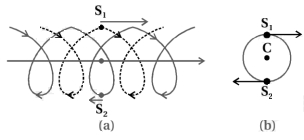
(N/A) If there are no external forces,the centre of mass of a double star system moves like a free particle,as shown in figure $(a)$.
The trajectories of the two stars of equal mass are also shown in figure $(a)$. They appear complex.
If we transform to the centre of mass frame,we find that the two stars are moving in a circular orbit about the centre of mass,which remains at rest. The positions of the stars are diametrically opposite to each other,as shown in figure $(b)$.
In our laboratory frame of reference,the trajectories of the stars are a combination of:
$(i)$ Uniform motion in a straight line of the centre of mass,and
$(ii)$ Circular orbits of the stars about the centre of mass.
The trajectories of the two stars of equal mass are also shown in figure $(a)$. They appear complex.
If we transform to the centre of mass frame,we find that the two stars are moving in a circular orbit about the centre of mass,which remains at rest. The positions of the stars are diametrically opposite to each other,as shown in figure $(b)$.
In our laboratory frame of reference,the trajectories of the stars are a combination of:
$(i)$ Uniform motion in a straight line of the centre of mass,and
$(ii)$ Circular orbits of the stars about the centre of mass.
0 likes
View Solution91
DifficultMCQ
If one observes from the reference frame in which the centre of mass appears to be at rest,what will be the velocity of the centre of mass?
A
Zero
B
Constant
C
Variable
D
Infinite
Solution
(A) The centre of mass $(CM)$ of a system is defined as the point where the total mass of the system is assumed to be concentrated.
In a reference frame attached to the centre of mass,the centre of mass itself is at rest by definition.
Since the velocity of the centre of mass is defined as the rate of change of its position vector,if the position of the $CM$ is constant in this frame,its velocity must be zero.
Therefore,in the centre of mass frame,the velocity of the centre of mass is $0 \ m/s$.
In a reference frame attached to the centre of mass,the centre of mass itself is at rest by definition.
Since the velocity of the centre of mass is defined as the rate of change of its position vector,if the position of the $CM$ is constant in this frame,its velocity must be zero.
Therefore,in the centre of mass frame,the velocity of the centre of mass is $0 \ m/s$.
0 likes
View Solution92
EasyMCQ
Are you in agreement with the statement: "The velocity of all particles of a system is equal to the velocity of the centre of mass"?
A
Yes
B
No
C
Sometimes
D
Depends on the system
Solution
(B) The statement is incorrect.
In a system of particles, the velocity of the centre of mass is defined as the weighted average of the velocities of all individual particles: $V_{cm} = \frac{\sum m_i v_i}{\sum m_i}$.
Individual particles in a system can have different velocities due to internal motion, rotation, or vibration.
For example, in a rotating rigid body, particles at different distances from the axis of rotation have different linear velocities, while the centre of mass may be stationary or moving with a constant velocity.
In a system of particles, the velocity of the centre of mass is defined as the weighted average of the velocities of all individual particles: $V_{cm} = \frac{\sum m_i v_i}{\sum m_i}$.
Individual particles in a system can have different velocities due to internal motion, rotation, or vibration.
For example, in a rotating rigid body, particles at different distances from the axis of rotation have different linear velocities, while the centre of mass may be stationary or moving with a constant velocity.
0 likes
View Solution93
EasyMCQ
If a gas is filled in a stationary sphere,its molecules are in random motion due to thermal energy. Will the center of mass of these molecules be in motion?
A
Yes,it will move.
B
No,it will remain stationary.
C
It depends on the temperature.
D
It depends on the pressure.
Solution
(B) No,the center of mass will remain stationary.
Since the sphere is stationary and there is no external force acting on the system of gas molecules,the net external force $\vec{F}_{ext} = 0$.
According to the law of conservation of momentum,if the net external force is zero,the velocity of the center of mass remains constant.
Since the sphere is initially at rest,the initial velocity of the center of mass is zero.
Therefore,the center of mass will remain at rest,i.e.,$\vec{v}_{cm} = 0$.
Since the sphere is stationary and there is no external force acting on the system of gas molecules,the net external force $\vec{F}_{ext} = 0$.
According to the law of conservation of momentum,if the net external force is zero,the velocity of the center of mass remains constant.
Since the sphere is initially at rest,the initial velocity of the center of mass is zero.
Therefore,the center of mass will remain at rest,i.e.,$\vec{v}_{cm} = 0$.
0 likes
View Solution94
EasyMCQ
Three bodies having masses $5 \, kg$,$4 \, kg$,and $2 \, kg$ are moving at speeds of $5 \, m/s$,$4 \, m/s$,and $2 \, m/s$ respectively along the $X$-axis. The magnitude of the velocity of the centre of mass is (in $m/s$):
A
$1.0$
B
$4.09$
C
$0.9$
D
$1.3$
Solution
(B) The velocity of the centre of mass $(v_{CM})$ for a system of particles moving in one dimension is given by the formula:
$v_{CM} = \frac{m_1 v_1 + m_2 v_2 + m_3 v_3}{m_1 + m_2 + m_3}$
Given:
$m_1 = 5 \, kg, v_1 = 5 \, m/s$
$m_2 = 4 \, kg, v_2 = 4 \, m/s$
$m_3 = 2 \, kg, v_3 = 2 \, m/s$
Substituting the values into the formula:
$v_{CM} = \frac{(5 \times 5) + (4 \times 4) + (2 \times 2)}{5 + 4 + 2}$
$v_{CM} = \frac{25 + 16 + 4}{11}$
$v_{CM} = \frac{45}{11} \approx 4.09 \, m/s$
$v_{CM} = \frac{m_1 v_1 + m_2 v_2 + m_3 v_3}{m_1 + m_2 + m_3}$
Given:
$m_1 = 5 \, kg, v_1 = 5 \, m/s$
$m_2 = 4 \, kg, v_2 = 4 \, m/s$
$m_3 = 2 \, kg, v_3 = 2 \, m/s$
Substituting the values into the formula:
$v_{CM} = \frac{(5 \times 5) + (4 \times 4) + (2 \times 2)}{5 + 4 + 2}$
$v_{CM} = \frac{25 + 16 + 4}{11}$
$v_{CM} = \frac{45}{11} \approx 4.09 \, m/s$
0 likes
View Solution95
MediumMCQ
$A$ uniform rod of mass $M$ and length $L$ is placed on a smooth horizontal surface. $A$ horizontal force $F$ is applied at one end of the rod at an angle $\theta$ with the rod. The acceleration of the centre of mass of the rod is:
A
$F/M$
B
$F \sin \theta / M$
C
$F \cos \theta / M$
D
$F \tan \theta / M$
Solution
(A) The acceleration of the centre of mass of a system depends only on the net external force acting on the system,regardless of the point of application of the force.
According to Newton's second law,the acceleration $a_{cm}$ of the centre of mass is given by $a_{cm} = \frac{F_{net}}{M}$.
Here,the net external force acting on the rod is the applied force $F$.
Therefore,the acceleration of the centre of mass is $a_{cm} = \frac{F}{M}$.
This acceleration is independent of the angle $\theta$ at which the force is applied,as the entire force $F$ contributes to the translational motion of the centre of mass.
According to Newton's second law,the acceleration $a_{cm}$ of the centre of mass is given by $a_{cm} = \frac{F_{net}}{M}$.
Here,the net external force acting on the rod is the applied force $F$.
Therefore,the acceleration of the centre of mass is $a_{cm} = \frac{F}{M}$.
This acceleration is independent of the angle $\theta$ at which the force is applied,as the entire force $F$ contributes to the translational motion of the centre of mass.
0 likes
View Solution96
MediumMCQ
$A$ uniform rod of mass $M$ and length $L$ is placed on a smooth horizontal surface. $A$ horizontal force $F$ is applied at one end of the rod. The acceleration of the centre of mass of the rod is:
A
$F/M$
B
$2F/M$
C
$F/2M$
D
$F/3M$
Solution
(A) The motion of the centre of mass of a system of particles is governed by the net external force acting on the system.
According to Newton's second law for the centre of mass,$F_{ext} = M_{total} \cdot a_{cm}$.
Here,the total mass of the rod is $M$ and the net external force applied is $F$.
Therefore,$F = M \cdot a_{cm}$.
Solving for the acceleration of the centre of mass,we get $a_{cm} = F/M$.
According to Newton's second law for the centre of mass,$F_{ext} = M_{total} \cdot a_{cm}$.
Here,the total mass of the rod is $M$ and the net external force applied is $F$.
Therefore,$F = M \cdot a_{cm}$.
Solving for the acceleration of the centre of mass,we get $a_{cm} = F/M$.
0 likes
View Solution97
MediumMCQ
$A$ system consists of two particles of masses $m_1$ and $m_2$ separated by a distance $r$. If the particles move towards each other with velocities $v_1$ and $v_2$ respectively,the velocity of the centre of mass of the system is:
A
$\frac{m_1 v_1 + m_2 v_2}{m_1 + m_2}$
B
$\frac{m_1 v_1 - m_2 v_2}{m_1 + m_2}$
C
$\frac{m_2 v_2 - m_1 v_1}{m_1 + m_2}$
D
$\frac{m_1 v_1 + m_2 v_2}{m_1 - m_2}$
Solution
(B) The velocity of the centre of mass $(V_{cm})$ of a system of particles is given by the formula:
$V_{cm} = \frac{m_1 v_1 + m_2 v_2}{m_1 + m_2}$
In this problem,the particles are moving towards each other. Let us define the direction of $m_1$ as positive and $m_2$ as negative (or vice versa) to account for their relative motion.
If $v_1$ is the velocity of $m_1$ in the positive direction,then $v_2$ (moving towards $m_1$) must be in the negative direction,i.e.,$-v_2$.
Substituting these into the formula:
$V_{cm} = \frac{m_1 v_1 + m_2 (-v_2)}{m_1 + m_2} = \frac{m_1 v_1 - m_2 v_2}{m_1 + m_2}$
Thus,the correct option is $B$.
$V_{cm} = \frac{m_1 v_1 + m_2 v_2}{m_1 + m_2}$
In this problem,the particles are moving towards each other. Let us define the direction of $m_1$ as positive and $m_2$ as negative (or vice versa) to account for their relative motion.
If $v_1$ is the velocity of $m_1$ in the positive direction,then $v_2$ (moving towards $m_1$) must be in the negative direction,i.e.,$-v_2$.
Substituting these into the formula:
$V_{cm} = \frac{m_1 v_1 + m_2 (-v_2)}{m_1 + m_2} = \frac{m_1 v_1 - m_2 v_2}{m_1 + m_2}$
Thus,the correct option is $B$.
0 likes
View Solution98
DifficultMCQ
$A$ system consists of two particles of masses $m_1$ and $m_2$ separated by a distance $r$. If the particles move towards each other with velocities $v_1$ and $v_2$ respectively,the velocity of the centre of mass of the system is:
A
$\frac{m_1v_1 + m_2v_2}{m_1 + m_2}$
B
$\frac{m_1v_1 - m_2v_2}{m_1 + m_2}$
C
$\frac{m_2v_2 - m_1v_1}{m_1 + m_2}$
D
Zero
Solution
(B) The velocity of the centre of mass $(V_{cm})$ of a system of particles is given by the formula:
$V_{cm} = \frac{m_1\vec{v}_1 + m_2\vec{v}_2}{m_1 + m_2}$
In this problem,the particles move towards each other. Let the direction of $m_1$ be positive. Then the velocity of $m_1$ is $\vec{v}_1 = v_1$ and the velocity of $m_2$ is $\vec{v}_2 = -v_2$ (since it moves in the opposite direction).
Substituting these values into the formula:
$V_{cm} = \frac{m_1(v_1) + m_2(-v_2)}{m_1 + m_2}$
$V_{cm} = \frac{m_1v_1 - m_2v_2}{m_1 + m_2}$
Thus,the correct option is $B$.
$V_{cm} = \frac{m_1\vec{v}_1 + m_2\vec{v}_2}{m_1 + m_2}$
In this problem,the particles move towards each other. Let the direction of $m_1$ be positive. Then the velocity of $m_1$ is $\vec{v}_1 = v_1$ and the velocity of $m_2$ is $\vec{v}_2 = -v_2$ (since it moves in the opposite direction).
Substituting these values into the formula:
$V_{cm} = \frac{m_1(v_1) + m_2(-v_2)}{m_1 + m_2}$
$V_{cm} = \frac{m_1v_1 - m_2v_2}{m_1 + m_2}$
Thus,the correct option is $B$.
0 likes
View Solution99
DifficultMCQ
Two particles of mass $m_1$ and $m_2$ are separated by a distance $d$. If the first particle is moved towards the centre of mass by a distance $x$,then the distance by which the second particle must be moved towards the centre of mass to keep the centre of mass at the same position is:
A
$m_2x/m_1$
B
$m_1x/m_2$
C
$d$
D
$x$
Solution
(B) Let the positions of the two particles be $x_1$ and $x_2$ relative to the centre of mass $(CM)$.
By the definition of the centre of mass,$m_1 x_1 = m_2 x_2$.
When the first particle is moved by a distance $x$ towards the $CM$,its new position is $x_1' = x_1 - x$.
To keep the $CM$ at the same position,the second particle must be moved by a distance $x'$ towards the $CM$ such that $m_1(x_1 - x) = m_2(x_2 - x')$.
Expanding this,we get $m_1 x_1 - m_1 x = m_2 x_2 - m_2 x'$.
Since $m_1 x_1 = m_2 x_2$,these terms cancel out,leaving $-m_1 x = -m_2 x'$.
Therefore,$x' = \frac{m_1 x}{m_2}$.
By the definition of the centre of mass,$m_1 x_1 = m_2 x_2$.
When the first particle is moved by a distance $x$ towards the $CM$,its new position is $x_1' = x_1 - x$.
To keep the $CM$ at the same position,the second particle must be moved by a distance $x'$ towards the $CM$ such that $m_1(x_1 - x) = m_2(x_2 - x')$.
Expanding this,we get $m_1 x_1 - m_1 x = m_2 x_2 - m_2 x'$.
Since $m_1 x_1 = m_2 x_2$,these terms cancel out,leaving $-m_1 x = -m_2 x'$.
Therefore,$x' = \frac{m_1 x}{m_2}$.
0 likes
View Solution100
MediumMCQ
$A$ uniform rod of mass $M$ and length $L$ is placed on a smooth horizontal surface. $A$ horizontal force $F$ is applied at one end of the rod perpendicular to its length. The acceleration of the centre of mass of the rod is:
A
$F/M$
B
$2F/M$
C
$F/2M$
D
$3F/M$
Solution
(A) The motion of the centre of mass of a system is governed by the net external force acting on the system,according to Newton's second law for a system of particles: $F_{ext} = M_{total} \cdot a_{cm}$.
Here,the total mass of the rod is $M$ and the net external force applied is $F$.
Therefore,the acceleration of the centre of mass is given by:
$a_{cm} = \frac{F_{ext}}{M_{total}} = \frac{F}{M}$.
This result is independent of the point of application of the force,as the force $F$ acts on the entire mass $M$ to produce translational acceleration of the centre of mass.
Here,the total mass of the rod is $M$ and the net external force applied is $F$.
Therefore,the acceleration of the centre of mass is given by:
$a_{cm} = \frac{F_{ext}}{M_{total}} = \frac{F}{M}$.
This result is independent of the point of application of the force,as the force $F$ acts on the entire mass $M$ to produce translational acceleration of the centre of mass.
0 likes
View SolutionSystem of Particles and Rotational Motion — Motion of Centre of Mass · Frequently Asked Questions
1Are these System of Particles and Rotational Motion questions useful for JEE and NEET?
Yes. All questions in this section are mapped to JEE Main and NEET exam patterns. Previous year questions from JEE Main, NEET, GUJCET and state-level exams are included with full solutions.
2Can I switch to Hindi or Gujarati for these questions?
Yes. Use the language tabs in the hero section or the sidebar to view the same questions and solutions in English, Hindi or Gujarati.
3How do I generate a question paper from this subtopic?
Use the Vedclass Exam Paper Generator — select the chapter and subtopic, set difficulty, and generate Sets A, B, C, D automatically. First 3 chapters of every subject are free.
Vedclass Products
For Students
Vedclass Test Series
Mock tests in real JEE/NEET style with performance analysis. 5-day free trial.
Start Free TrialFor Teachers
Exam Paper Generator
Generate Set A/B/C/D papers from this chapter in 2 minutes. 3 chapters free.
Try FreeFor Institutes
Online Exam Module
Live online exams with unlimited students, 360° analytics & white-label branding.
See DemoFor Teachers & Institutes
Generate a System of Particles and Rotational Motion Exam Paper in 2 Minutes
Select subtopic & difficulty — Sets A, B, C, D auto-generated with No Repeat logic.
First 3 chapters of every subject are free — no payment required.