
A English
Motion of Centre of Mass Questions in English
Class 11 Physics · System of Particles and Rotational Motion · Motion of Centre of Mass
156+
Questions
English
Language
100%
With Solutions
Showing 6 of 156 questions in English
151
DifficultMCQ
Two bodies of $6 \,kg$ and $4 \,kg$ masses have their velocities $5 \hat{i}-2 \hat{j}+10 \hat{k}$ and $10 \hat{i}-2 \hat{j}+5 \hat{k}$ respectively. Then the velocity of their centre of mass is
A
$5 \hat{i}+2 \hat{j}-8 \hat{k}$
B
$7 \hat{i}+2 \hat{j}-8 \hat{k}$
C
$7 \hat{i}-2 \hat{j}+8 \hat{k}$
D
$5 \hat{i}-2 \hat{j}+8 \hat{k}$
Solution
(C) Given,$m_1 = 6 \,kg, m_2 = 4 \,kg$ and $\overrightarrow{v}_1 = 5 \hat{i}-2 \hat{j}+10 \hat{k}, \overrightarrow{v}_2 = 10 \hat{i}-2 \hat{j}+5 \hat{k}$.
The velocity of the centre of mass $\overrightarrow{v}_{cm}$ is given by the formula:
$\overrightarrow{v}_{cm} = \frac{m_1 \overrightarrow{v}_1 + m_2 \overrightarrow{v}_2}{m_1 + m_2}$
Substituting the values:
$\overrightarrow{v}_{cm} = \frac{6(5 \hat{i}-2 \hat{j}+10 \hat{k}) + 4(10 \hat{i}-2 \hat{j}+5 \hat{k})}{6 + 4}$
$\overrightarrow{v}_{cm} = \frac{(30 \hat{i}-12 \hat{j}+60 \hat{k}) + (40 \hat{i}-8 \hat{j}+20 \hat{k})}{10}$
$\overrightarrow{v}_{cm} = \frac{70 \hat{i}-20 \hat{j}+80 \hat{k}}{10}$
$\overrightarrow{v}_{cm} = 7 \hat{i}-2 \hat{j}+8 \hat{k}$
The velocity of the centre of mass $\overrightarrow{v}_{cm}$ is given by the formula:
$\overrightarrow{v}_{cm} = \frac{m_1 \overrightarrow{v}_1 + m_2 \overrightarrow{v}_2}{m_1 + m_2}$
Substituting the values:
$\overrightarrow{v}_{cm} = \frac{6(5 \hat{i}-2 \hat{j}+10 \hat{k}) + 4(10 \hat{i}-2 \hat{j}+5 \hat{k})}{6 + 4}$
$\overrightarrow{v}_{cm} = \frac{(30 \hat{i}-12 \hat{j}+60 \hat{k}) + (40 \hat{i}-8 \hat{j}+20 \hat{k})}{10}$
$\overrightarrow{v}_{cm} = \frac{70 \hat{i}-20 \hat{j}+80 \hat{k}}{10}$
$\overrightarrow{v}_{cm} = 7 \hat{i}-2 \hat{j}+8 \hat{k}$
0 likes
View Solution152
EasyMCQ
$A$ ball of mass $M$ moving with a speed of $2 \ m \ s^{-1}$ hits another ball of mass $1 \ kg$ moving in the same direction with a speed of $1 \ m \ s^{-1}$. If the kinetic energy of the center of mass is $4/3 \ J$,then the magnitude of $M$ is: (in $kg$)
A
$1$
B
$0.25$
C
$0.50$
D
$2$
Solution
(C) The velocity of the center of mass $(v_{cm})$ is given by: $v_{cm} = \frac{M \cdot v_1 + m \cdot v_2}{M + m} = \frac{M(2) + 1(1)}{M + 1} = \frac{2M + 1}{M + 1}$.
The kinetic energy of the center of mass is given by: $K.E._{cm} = \frac{1}{2} (M + m) v_{cm}^2$.
Given $K.E._{cm} = \frac{4}{3} \ J$,we substitute the values:
$\frac{4}{3} = \frac{1}{2} (M + 1) \left( \frac{2M + 1}{M + 1} \right)^2$.
$\frac{4}{3} = \frac{1}{2} \frac{(2M + 1)^2}{M + 1}$.
$8(M + 1) = 3(4M^2 + 4M + 1)$.
$8M + 8 = 12M^2 + 12M + 3$.
$12M^2 + 4M - 5 = 0$.
Solving the quadratic equation using the formula $M = \frac{-b \pm \sqrt{b^2 - 4ac}}{2a}$:
$M = \frac{-4 \pm \sqrt{16 - 4(12)(-5)}}{2(12)} = \frac{-4 \pm \sqrt{16 + 240}}{24} = \frac{-4 \pm \sqrt{256}}{24} = \frac{-4 \pm 16}{24}$.
Since mass must be positive,$M = \frac{12}{24} = 0.5 \ kg$.
The kinetic energy of the center of mass is given by: $K.E._{cm} = \frac{1}{2} (M + m) v_{cm}^2$.
Given $K.E._{cm} = \frac{4}{3} \ J$,we substitute the values:
$\frac{4}{3} = \frac{1}{2} (M + 1) \left( \frac{2M + 1}{M + 1} \right)^2$.
$\frac{4}{3} = \frac{1}{2} \frac{(2M + 1)^2}{M + 1}$.
$8(M + 1) = 3(4M^2 + 4M + 1)$.
$8M + 8 = 12M^2 + 12M + 3$.
$12M^2 + 4M - 5 = 0$.
Solving the quadratic equation using the formula $M = \frac{-b \pm \sqrt{b^2 - 4ac}}{2a}$:
$M = \frac{-4 \pm \sqrt{16 - 4(12)(-5)}}{2(12)} = \frac{-4 \pm \sqrt{16 + 240}}{24} = \frac{-4 \pm \sqrt{256}}{24} = \frac{-4 \pm 16}{24}$.
Since mass must be positive,$M = \frac{12}{24} = 0.5 \ kg$.
0 likes
View Solution153
EasyMCQ
$A$ ball of mass $100 \ g$ is dropped at time $t=0$. $A$ second ball of mass $200 \ g$ is dropped from the same point at $t=0.2 \ s$. The distance between the center of mass of the two balls and the release point at $t=0.4 \ s$ is: (Assume $g=10 \ m \ s^{-2}$) (in $m$)
A
$0.4$
B
$0.5$
C
$0.6$
D
$0.8$
Solution
(A) Given: Masses of the balls $m_1 = 100 \ g = 0.1 \ kg$ and $m_2 = 200 \ g = 0.2 \ kg$.
At $t = 0.4 \ s$,the time of fall for the first ball is $t_1 = 0.4 \ s$.
The distance travelled by the first ball is $s_1 = \frac{1}{2} g t_1^2 = \frac{1}{2} \times 10 \times (0.4)^2 = 5 \times 0.16 = 0.8 \ m$.
At $t = 0.4 \ s$,the time of fall for the second ball is $t_2 = 0.4 - 0.2 = 0.2 \ s$.
The distance travelled by the second ball is $s_2 = \frac{1}{2} g t_2^2 = \frac{1}{2} \times 10 \times (0.2)^2 = 5 \times 0.04 = 0.2 \ m$.
The distance of the center of mass from the release point is given by $s_{cm} = \frac{m_1 s_1 + m_2 s_2}{m_1 + m_2}$.
Substituting the values: $s_{cm} = \frac{0.1 \times 0.8 + 0.2 \times 0.2}{0.1 + 0.2} = \frac{0.08 + 0.04}{0.3} = \frac{0.12}{0.3} = 0.4 \ m$.
At $t = 0.4 \ s$,the time of fall for the first ball is $t_1 = 0.4 \ s$.
The distance travelled by the first ball is $s_1 = \frac{1}{2} g t_1^2 = \frac{1}{2} \times 10 \times (0.4)^2 = 5 \times 0.16 = 0.8 \ m$.
At $t = 0.4 \ s$,the time of fall for the second ball is $t_2 = 0.4 - 0.2 = 0.2 \ s$.
The distance travelled by the second ball is $s_2 = \frac{1}{2} g t_2^2 = \frac{1}{2} \times 10 \times (0.2)^2 = 5 \times 0.04 = 0.2 \ m$.
The distance of the center of mass from the release point is given by $s_{cm} = \frac{m_1 s_1 + m_2 s_2}{m_1 + m_2}$.
Substituting the values: $s_{cm} = \frac{0.1 \times 0.8 + 0.2 \times 0.2}{0.1 + 0.2} = \frac{0.08 + 0.04}{0.3} = \frac{0.12}{0.3} = 0.4 \ m$.
0 likes
View Solution154
MediumMCQ
Two particles $A$ and $B$ (both initially at rest) start moving towards each other under a mutual force of attraction. At the instant,when the speed of $A$ is $v$ and the speed of $B$ is $2v$,the speed of the centre of mass is
A
zero
B
$v$
C
$\frac{3v}{2}$
D
$-\frac{3v}{2}$
Solution
(A) The centre of mass of a system moves according to the net external force acting on it,as given by the equation $F_{ext} = M a_{cm}$.
Since the particles $A$ and $B$ are moving under a mutual force of attraction,there is no external force acting on the system $(F_{ext} = 0)$.
Initially,both particles are at rest,so the initial velocity of the centre of mass is $v_{cm, initial} = 0$.
Since $F_{ext} = 0$,the acceleration of the centre of mass is $a_{cm} = 0$,which implies that the velocity of the centre of mass remains constant over time.
Therefore,the velocity of the centre of mass at any instant remains equal to its initial velocity,which is $0$.
Since the particles $A$ and $B$ are moving under a mutual force of attraction,there is no external force acting on the system $(F_{ext} = 0)$.
Initially,both particles are at rest,so the initial velocity of the centre of mass is $v_{cm, initial} = 0$.
Since $F_{ext} = 0$,the acceleration of the centre of mass is $a_{cm} = 0$,which implies that the velocity of the centre of mass remains constant over time.
Therefore,the velocity of the centre of mass at any instant remains equal to its initial velocity,which is $0$.
0 likes
View Solution155
DifficultMCQ
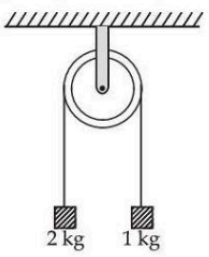
Two blocks of masses $2 \text{ kg}$ and $1 \text{ kg}$ respectively,are tied to the ends of a string which passes over a light frictionless pulley as shown in the figure below. The masses are held at rest at the same horizontal level and then released. The distance traversed by the centre of mass in $2 \text{ s}$ is . . . . . . $\text{m}$. (Take $g = 10 \text{ m/s}^2$)
A
$3.33$
B
$3.12$
C
$2.22$
D
$1.42$
Solution
(C) Let the masses be $m_1 = 2 \text{ kg}$ and $m_2 = 1 \text{ kg}$.
The acceleration of the system is given by $a = \frac{(m_1 - m_2)g}{m_1 + m_2} = \frac{(2 - 1) \times 10}{2 + 1} = \frac{10}{3} \text{ m/s}^2$.
The $2 \text{ kg}$ block moves downwards with acceleration $a_1 = 10/3 \text{ m/s}^2$ and the $1 \text{ kg}$ block moves upwards with acceleration $a_2 = 10/3 \text{ m/s}^2$.
Taking the downward direction as positive,the acceleration of the center of mass is $a_{cm} = \frac{m_1 a_1 - m_2 a_2}{m_1 + m_2} = \frac{2(10/3) - 1(10/3)}{2 + 1} = \frac{10/3}{3} = 10/9 \text{ m/s}^2$.
The distance traversed by the center of mass in $t = 2 \text{ s}$ is $d = \frac{1}{2} a_{cm} t^2 = \frac{1}{2} \times \frac{10}{9} \times (2)^2 = \frac{1}{2} \times \frac{10}{9} \times 4 = \frac{20}{9} \approx 2.22 \text{ m}$.
The acceleration of the system is given by $a = \frac{(m_1 - m_2)g}{m_1 + m_2} = \frac{(2 - 1) \times 10}{2 + 1} = \frac{10}{3} \text{ m/s}^2$.
The $2 \text{ kg}$ block moves downwards with acceleration $a_1 = 10/3 \text{ m/s}^2$ and the $1 \text{ kg}$ block moves upwards with acceleration $a_2 = 10/3 \text{ m/s}^2$.
Taking the downward direction as positive,the acceleration of the center of mass is $a_{cm} = \frac{m_1 a_1 - m_2 a_2}{m_1 + m_2} = \frac{2(10/3) - 1(10/3)}{2 + 1} = \frac{10/3}{3} = 10/9 \text{ m/s}^2$.
The distance traversed by the center of mass in $t = 2 \text{ s}$ is $d = \frac{1}{2} a_{cm} t^2 = \frac{1}{2} \times \frac{10}{9} \times (2)^2 = \frac{1}{2} \times \frac{10}{9} \times 4 = \frac{20}{9} \approx 2.22 \text{ m}$.
0 likes
View Solution156
DifficultMCQ
Two identical bodies $A$ and $B$ of equal masses have initial velocities $v_1 = 4\hat{i} \text{ m/s}$ and $v_2 = 4\hat{j} \text{ m/s}$ respectively. The body $A$ has acceleration $a_1 = 6\hat{i} + 6\hat{j} \text{ m/s}^2$ while the acceleration of the other body $B$ is zero. The centre of mass of the two bodies moves in . . . . . . path.
A
circular
B
parabolic
C
straight line
D
elliptical
Solution
(C) The acceleration of the centre of mass is given by $a_{cm} = \frac{m_A a_1 + m_B a_2}{m_A + m_B}$.
Since $m_A = m_B = m$,we have $a_{cm} = \frac{m(6\hat{i} + 6\hat{j}) + m(0)}{2m} = 3\hat{i} + 3\hat{j} \text{ m/s}^2$.
The initial velocity of the centre of mass is $v_{cm} = \frac{m_A v_1 + m_B v_2}{m_A + m_B} = \frac{m(4\hat{i}) + m(4\hat{j})}{2m} = 2\hat{i} + 2\hat{j} \text{ m/s}$.
Since the acceleration vector $a_{cm} = 3\hat{i} + 3\hat{j}$ and the initial velocity vector $v_{cm} = 2\hat{i} + 2\hat{j}$ are parallel (specifically,$a_{cm} = 1.5 v_{cm}$),the motion of the centre of mass is along a straight line.
Since $m_A = m_B = m$,we have $a_{cm} = \frac{m(6\hat{i} + 6\hat{j}) + m(0)}{2m} = 3\hat{i} + 3\hat{j} \text{ m/s}^2$.
The initial velocity of the centre of mass is $v_{cm} = \frac{m_A v_1 + m_B v_2}{m_A + m_B} = \frac{m(4\hat{i}) + m(4\hat{j})}{2m} = 2\hat{i} + 2\hat{j} \text{ m/s}$.
Since the acceleration vector $a_{cm} = 3\hat{i} + 3\hat{j}$ and the initial velocity vector $v_{cm} = 2\hat{i} + 2\hat{j}$ are parallel (specifically,$a_{cm} = 1.5 v_{cm}$),the motion of the centre of mass is along a straight line.
0 likes
View SolutionSystem of Particles and Rotational Motion — Motion of Centre of Mass · Frequently Asked Questions
1Are these System of Particles and Rotational Motion questions useful for JEE and NEET?
Yes. All questions in this section are mapped to JEE Main and NEET exam patterns. Previous year questions from JEE Main, NEET, GUJCET and state-level exams are included with full solutions.
2Can I switch to Hindi or Gujarati for these questions?
Yes. Use the language tabs in the hero section or the sidebar to view the same questions and solutions in English, Hindi or Gujarati.
3How do I generate a question paper from this subtopic?
Use the Vedclass Exam Paper Generator — select the chapter and subtopic, set difficulty, and generate Sets A, B, C, D automatically. First 3 chapters of every subject are free.
Vedclass Products
For Students
Vedclass Test Series
Mock tests in real JEE/NEET style with performance analysis. 5-day free trial.
Start Free TrialFor Teachers
Exam Paper Generator
Generate Set A/B/C/D papers from this chapter in 2 minutes. 3 chapters free.
Try FreeFor Institutes
Online Exam Module
Live online exams with unlimited students, 360° analytics & white-label branding.
See DemoFor Teachers & Institutes
Generate a System of Particles and Rotational Motion Exam Paper in 2 Minutes
Select subtopic & difficulty — Sets A, B, C, D auto-generated with No Repeat logic.
First 3 chapters of every subject are free — no payment required.