
A English
Motion of Centre of Mass Questions in English
Class 11 Physics · System of Particles and Rotational Motion · Motion of Centre of Mass
156+
Questions
English
Language
100%
With Solutions
Showing 46 of 156 questions in English
101
DifficultMCQ
$A$ system consists of two particles of masses $m_1$ and $m_2$ separated by a distance $r$. If the particle of mass $m_1$ is moved towards the centre of mass by a distance $d$,then the particle of mass $m_2$ must be moved by a distance $d'$ so that the centre of mass remains at the same position. The value of $d'$ is:
A
$d' = \frac{m_1}{m_2} d$
B
$d' = \frac{m_2}{m_1} d$
C
$d' = d$
D
$d' = \frac{m_1 + m_2}{m_1} d$
Solution
(A) The position of the centre of mass $(R_{cm})$ is given by $R_{cm} = \frac{m_1 x_1 + m_2 x_2}{m_1 + m_2}$.
For the centre of mass to remain stationary,the change in the position of the centre of mass must be zero: $\Delta R_{cm} = \frac{m_1 \Delta x_1 + m_2 \Delta x_2}{m_1 + m_2} = 0$.
This implies $m_1 \Delta x_1 + m_2 \Delta x_2 = 0$.
Given that mass $m_1$ is moved towards the centre of mass by distance $d$,we have $\Delta x_1 = d$ (taking the direction towards the centre of mass as positive).
To keep the centre of mass at the same position,mass $m_2$ must move in the opposite direction by distance $d'$,so $\Delta x_2 = -d'$.
Substituting these into the equation: $m_1(d) + m_2(-d') = 0$.
$m_1 d = m_2 d'$.
Therefore,$d' = \frac{m_1}{m_2} d$.
For the centre of mass to remain stationary,the change in the position of the centre of mass must be zero: $\Delta R_{cm} = \frac{m_1 \Delta x_1 + m_2 \Delta x_2}{m_1 + m_2} = 0$.
This implies $m_1 \Delta x_1 + m_2 \Delta x_2 = 0$.
Given that mass $m_1$ is moved towards the centre of mass by distance $d$,we have $\Delta x_1 = d$ (taking the direction towards the centre of mass as positive).
To keep the centre of mass at the same position,mass $m_2$ must move in the opposite direction by distance $d'$,so $\Delta x_2 = -d'$.
Substituting these into the equation: $m_1(d) + m_2(-d') = 0$.
$m_1 d = m_2 d'$.
Therefore,$d' = \frac{m_1}{m_2} d$.
0 likes
View Solution102
MediumMCQ
Two blocks of masses $10 \; kg$ and $30 \; kg$ are placed on the same straight line with coordinates $(0,0) \; cm$ and $(x, 0) \; cm$ respectively. The block of $10 \; kg$ is moved on the same line through a distance of $6 \; cm$ towards the other block. The distance through which the block of $30 \; kg$ must be moved to keep the position of the centre of mass of the system unchanged is
A
$4 \; cm$ towards the $10 \; kg$ block
B
$2 \; cm$ away from the $10 \; kg$ block
C
$2 \; cm$ towards the $10 \; kg$ block
D
$4 \; cm$ away from the $10 \; kg$ block
Solution
(C) The position of the centre of mass $X_{CM}$ is given by $X_{CM} = \frac{m_1 x_1 + m_2 x_2}{m_1 + m_2}$.
To keep the centre of mass unchanged,the change in the position of the centre of mass must be zero,i.e.,$\Delta X_{CM} = 0$.
This implies $\Delta X_{CM} = \frac{m_1 \Delta x_1 + m_2 \Delta x_2}{m_1 + m_2} = 0$.
Given $m_1 = 10 \; kg$,$m_2 = 30 \; kg$,and the displacement of the first block $\Delta x_1 = +6 \; cm$ (towards the second block).
Substituting the values: $0 = \frac{10 \times 6 + 30 \times \Delta x_2}{10 + 30}$.
$0 = 60 + 30 \Delta x_2$.
$30 \Delta x_2 = -60$.
$\Delta x_2 = -2 \; cm$.
The negative sign indicates that the $30 \; kg$ block must move in the opposite direction of the $10 \; kg$ block's displacement,which means it must move towards the $10 \; kg$ block by $2 \; cm$.
To keep the centre of mass unchanged,the change in the position of the centre of mass must be zero,i.e.,$\Delta X_{CM} = 0$.
This implies $\Delta X_{CM} = \frac{m_1 \Delta x_1 + m_2 \Delta x_2}{m_1 + m_2} = 0$.
Given $m_1 = 10 \; kg$,$m_2 = 30 \; kg$,and the displacement of the first block $\Delta x_1 = +6 \; cm$ (towards the second block).
Substituting the values: $0 = \frac{10 \times 6 + 30 \times \Delta x_2}{10 + 30}$.
$0 = 60 + 30 \Delta x_2$.
$30 \Delta x_2 = -60$.
$\Delta x_2 = -2 \; cm$.
The negative sign indicates that the $30 \; kg$ block must move in the opposite direction of the $10 \; kg$ block's displacement,which means it must move towards the $10 \; kg$ block by $2 \; cm$.
1 likes
View Solution103
AdvancedMCQ
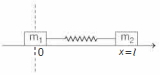
Two masses $m_1$ and $m_2$ are connected by a massless spring of spring constant $k$ and unstretched length $l$. The masses are placed on a frictionless straight channel,which we consider our $X$-axis. They are initially at rest at $x=0$ and $x=l$,respectively. At $t=0$,a velocity of $v_0$ is suddenly imparted to the first particle. At a later time $t$,the centre of mass of the two masses is at
A
$x=\frac{m_2 l}{m_1+m_2}$
B
$x=\frac{m_1 l}{m_1+m_2}+\frac{m_1 v_0 t}{m_1+m_2}$
C
$x=\frac{m_2 l}{m_1+m_2}+\frac{m_2 v_0 t}{m_1+m_2}$
D
$x=\frac{m_2 l}{m_1+m_2}+\frac{m_1 v_0 t}{m_1+m_2}$
Solution
(D) The initial positions of the masses are $x_1 = 0$ and $x_2 = l$.
The initial position of the centre of mass $(x_{CM})$ at $t=0$ is given by:
$x_{CM} = \frac{m_1 x_1 + m_2 x_2}{m_1 + m_2} = \frac{m_1(0) + m_2(l)}{m_1 + m_2} = \frac{m_2 l}{m_1 + m_2}$
The initial velocities of the masses are $v_1 = v_0$ and $v_2 = 0$.
The velocity of the centre of mass $(v_{CM})$ is constant because there is no external force acting on the system:
$v_{CM} = \frac{m_1 v_1 + m_2 v_2}{m_1 + m_2} = \frac{m_1 v_0 + m_2(0)}{m_1 + m_2} = \frac{m_1 v_0}{m_1 + m_2}$
At a later time $t$,the position of the centre of mass $(x'_{CM})$ is given by:
$x'_{CM} = x_{CM} + v_{CM} t$
$x'_{CM} = \frac{m_2 l}{m_1 + m_2} + \left( \frac{m_1 v_0}{m_1 + m_2} \right) t$
$x'_{CM} = \frac{m_2 l}{m_1 + m_2} + \frac{m_1 v_0 t}{m_1 + m_2}$
Thus,the correct option is $D$.
The initial position of the centre of mass $(x_{CM})$ at $t=0$ is given by:
$x_{CM} = \frac{m_1 x_1 + m_2 x_2}{m_1 + m_2} = \frac{m_1(0) + m_2(l)}{m_1 + m_2} = \frac{m_2 l}{m_1 + m_2}$
The initial velocities of the masses are $v_1 = v_0$ and $v_2 = 0$.
The velocity of the centre of mass $(v_{CM})$ is constant because there is no external force acting on the system:
$v_{CM} = \frac{m_1 v_1 + m_2 v_2}{m_1 + m_2} = \frac{m_1 v_0 + m_2(0)}{m_1 + m_2} = \frac{m_1 v_0}{m_1 + m_2}$
At a later time $t$,the position of the centre of mass $(x'_{CM})$ is given by:
$x'_{CM} = x_{CM} + v_{CM} t$
$x'_{CM} = \frac{m_2 l}{m_1 + m_2} + \left( \frac{m_1 v_0}{m_1 + m_2} \right) t$
$x'_{CM} = \frac{m_2 l}{m_1 + m_2} + \frac{m_1 v_0 t}{m_1 + m_2}$
Thus,the correct option is $D$.
0 likes
View Solution104
MediumMCQ
$A$ man inside a freely falling box throws a heavy ball towards a side wall. The ball keeps on bouncing between the opposite walls of the box. We neglect air resistance and friction. Which of the following figures depicts the motion of the centre of mass of the entire system (man,the ball and the box)?
A
B
C
D
Solution
(A) The centre of mass of the system is subjected only to the external gravitational force acting downwards.
Internal forces,such as the man throwing the ball or the ball bouncing off the walls,do not affect the motion of the centre of mass of the system.
According to Newton's second law for a system of particles,$F_{ext} = M_{total} \cdot a_{cm}$.
Since the only external force is gravity,the acceleration of the centre of mass is $g$ directed downwards.
Therefore,the centre of mass will move in a straight vertical line downwards,as depicted in Figure $A$.
Internal forces,such as the man throwing the ball or the ball bouncing off the walls,do not affect the motion of the centre of mass of the system.
According to Newton's second law for a system of particles,$F_{ext} = M_{total} \cdot a_{cm}$.
Since the only external force is gravity,the acceleration of the centre of mass is $g$ directed downwards.
Therefore,the centre of mass will move in a straight vertical line downwards,as depicted in Figure $A$.
0 likes
View Solution105
DifficultMCQ
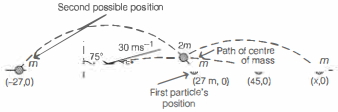
$A$ firecracker is thrown with a velocity of $30 \, ms^{-1}$ in a direction that makes an angle of $75^{\circ}$ with the vertical axis. At some point on its trajectory,the firecracker splits into two identical pieces in such a way that one piece falls $27 \, m$ far from the shooting point. Assuming that all trajectories are contained in the same plane,how far will the other piece fall from the shooting point? (Take $g = 10 \, ms^{-2}$ and neglect air resistance)
A
$63 \, m$ or $144 \, m$
B
$72 \, m$ or $99 \, m$
C
$28 \, m$ or $72 \, m$
D
$63 \, m$ or $117 \, m$
Solution
(D) The explosion force that splits the firecracker is internal to the system,so the path of the centre of mass of the system remains unchanged.
The range of the centre of mass of the system is given by $R = \frac{u^2 \sin 2\theta}{g}$.
Here,$u = 30 \, ms^{-1}$ and the angle with the horizontal is $\theta = 90^{\circ} - 75^{\circ} = 15^{\circ}$.
Therefore,$R = \frac{30 \times 30 \times \sin(2 \times 15^{\circ})}{10} = 90 \times \sin(30^{\circ}) = 90 \times 0.5 = 45 \, m$.
So,the position ($x$-coordinate) of the centre of mass is at $45 \, m$ distance from the origin.
Using the formula for the centre of mass,$X_{CM} = \frac{m_1 x_1 + m_2 x_2}{m_1 + m_2}$,where $m_1 = m_2 = m$ and $X_{CM} = 45 \, m$:
$45 = \frac{m(27) + m(x)}{m + m}$
$45 = \frac{27 + x}{2}$
$90 = 27 + x \Rightarrow x = 63 \, m$.
However,the first piece could also fall at $-27 \, m$ (behind the origin) if the explosion is strong enough to reverse its direction:
$45 = \frac{m(-27) + m(x)}{2m}$
$90 = -27 + x \Rightarrow x = 117 \, m$.
Thus,the other piece will fall at $63 \, m$ or $117 \, m$ from the shooting point.
The range of the centre of mass of the system is given by $R = \frac{u^2 \sin 2\theta}{g}$.
Here,$u = 30 \, ms^{-1}$ and the angle with the horizontal is $\theta = 90^{\circ} - 75^{\circ} = 15^{\circ}$.
Therefore,$R = \frac{30 \times 30 \times \sin(2 \times 15^{\circ})}{10} = 90 \times \sin(30^{\circ}) = 90 \times 0.5 = 45 \, m$.
So,the position ($x$-coordinate) of the centre of mass is at $45 \, m$ distance from the origin.
Using the formula for the centre of mass,$X_{CM} = \frac{m_1 x_1 + m_2 x_2}{m_1 + m_2}$,where $m_1 = m_2 = m$ and $X_{CM} = 45 \, m$:
$45 = \frac{m(27) + m(x)}{m + m}$
$45 = \frac{27 + x}{2}$
$90 = 27 + x \Rightarrow x = 63 \, m$.
However,the first piece could also fall at $-27 \, m$ (behind the origin) if the explosion is strong enough to reverse its direction:
$45 = \frac{m(-27) + m(x)}{2m}$
$90 = -27 + x \Rightarrow x = 117 \, m$.
Thus,the other piece will fall at $63 \, m$ or $117 \, m$ from the shooting point.
0 likes
View Solution106
EasyMCQ
Consider a system of two identical particles. One of the particles is at rest and the other has an acceleration $\vec{f}$. The centre of mass has an acceleration
A
$0$
B
$\vec{f}$
C
$\frac{\vec{f}}{2}$
D
$2 \vec{f}$
Solution
(C) The acceleration of the centre of mass $\vec{a}_{cm}$ for a system of particles is given by the formula:
$\vec{a}_{cm} = \frac{m_1 \vec{a}_1 + m_2 \vec{a}_2}{m_1 + m_2}$
Given that the two particles are identical,let their masses be $m_1 = m_2 = m$.
One particle is at rest,so its acceleration $\vec{a}_1 = 0$.
The other particle has an acceleration $\vec{a}_2 = \vec{f}$.
Substituting these values into the formula:
$\vec{a}_{cm} = \frac{m(0) + m(\vec{f})}{m + m} = \frac{m\vec{f}}{2m} = \frac{\vec{f}}{2}$
Therefore,the acceleration of the centre of mass is $\frac{\vec{f}}{2}$.
$\vec{a}_{cm} = \frac{m_1 \vec{a}_1 + m_2 \vec{a}_2}{m_1 + m_2}$
Given that the two particles are identical,let their masses be $m_1 = m_2 = m$.
One particle is at rest,so its acceleration $\vec{a}_1 = 0$.
The other particle has an acceleration $\vec{a}_2 = \vec{f}$.
Substituting these values into the formula:
$\vec{a}_{cm} = \frac{m(0) + m(\vec{f})}{m + m} = \frac{m\vec{f}}{2m} = \frac{\vec{f}}{2}$
Therefore,the acceleration of the centre of mass is $\frac{\vec{f}}{2}$.
0 likes
View Solution107
EasyMCQ
Two blocks of masses $5 \, kg$ and $2 \, kg$ are connected by a spring of negligible mass and placed on a frictionless horizontal surface. An impulse provides a velocity of $7 \, m/s$ to the heavier block in the direction of the lighter block. The velocity of the centre of mass is ............ $m/s$.
A
$4$
B
$5$
C
$2$
D
$3$
Solution
(B) The velocity of the centre of mass $(v_{cm})$ of a system is given by the formula: $v_{cm} = \frac{m_1v_1 + m_2v_2}{m_1 + m_2}$.
Here,the system is initially at rest,so the initial velocity of the lighter block is $v_2 = 0 \, m/s$.
The heavier block $(m_1 = 5 \, kg)$ is given a velocity $v_1 = 7 \, m/s$.
The total mass of the system is $M = m_1 + m_2 = 5 \, kg + 2 \, kg = 7 \, kg$.
Substituting the values into the formula:
$v_{cm} = \frac{(5 \, kg \times 7 \, m/s) + (2 \, kg \times 0 \, m/s)}{5 \, kg + 2 \, kg}$
$v_{cm} = \frac{35 \, kg \cdot m/s}{7 \, kg}$
$v_{cm} = 5 \, m/s$.
Here,the system is initially at rest,so the initial velocity of the lighter block is $v_2 = 0 \, m/s$.
The heavier block $(m_1 = 5 \, kg)$ is given a velocity $v_1 = 7 \, m/s$.
The total mass of the system is $M = m_1 + m_2 = 5 \, kg + 2 \, kg = 7 \, kg$.
Substituting the values into the formula:
$v_{cm} = \frac{(5 \, kg \times 7 \, m/s) + (2 \, kg \times 0 \, m/s)}{5 \, kg + 2 \, kg}$
$v_{cm} = \frac{35 \, kg \cdot m/s}{7 \, kg}$
$v_{cm} = 5 \, m/s$.
0 likes
View Solution108
EasyMCQ
$A$ body falling vertically downwards under gravity breaks into two parts of unequal masses. The centre of mass of the two parts taken together
A
Shifts horizontally towards the heavier piece
B
Shifts horizontally towards the lighter piece
C
Does not shift horizontally
D
Shifts horizontally if the initial speed is zero
Solution
(C) The correct option is $C$.
When a body falls vertically under gravity,the only external force acting on it is the gravitational force,which acts in the vertical downward direction.
According to the law of motion of the centre of mass $(COM)$,the acceleration of the $COM$ is given by $a_{COM} = \frac{F_{ext}}{M}$.
Since there is no external horizontal force acting on the system $(F_{ext, x} = 0)$,the horizontal acceleration of the $COM$ is zero $(a_{COM, x} = 0)$.
Because the initial horizontal velocity of the body is zero,the $COM$ will continue to move only in the vertical direction.
Therefore,the centre of mass of the two parts taken together does not shift horizontally.
When a body falls vertically under gravity,the only external force acting on it is the gravitational force,which acts in the vertical downward direction.
According to the law of motion of the centre of mass $(COM)$,the acceleration of the $COM$ is given by $a_{COM} = \frac{F_{ext}}{M}$.
Since there is no external horizontal force acting on the system $(F_{ext, x} = 0)$,the horizontal acceleration of the $COM$ is zero $(a_{COM, x} = 0)$.
Because the initial horizontal velocity of the body is zero,the $COM$ will continue to move only in the vertical direction.
Therefore,the centre of mass of the two parts taken together does not shift horizontally.
0 likes
View Solution109
MediumMCQ
$A$ particle of mass $m$ is thrown horizontally from the top of a tower and another particle of mass $2m$ is thrown vertically upward. The acceleration of the centre of mass is .............
A
$g$
B
$\frac{g}{3}$
C
$\frac{2g}{3}$
D
$\frac{g}{2}$
Solution
(A) Both particles are under the influence of gravity only,so each particle experiences a downward acceleration of $g$.
The acceleration of the centre of mass is given by the formula:
$a_{cm} = \frac{m_1 a_1 + m_2 a_2}{m_1 + m_2}$
Substituting the given values $m_1 = m$,$a_1 = g$ (downwards),$m_2 = 2m$,and $a_2 = g$ (downwards):
$a_{cm} = \frac{m(g) + 2m(g)}{m + 2m}$
$a_{cm} = \frac{3mg}{3m} = g$
Therefore,the acceleration of the centre of mass is $g$ directed downwards.
The acceleration of the centre of mass is given by the formula:
$a_{cm} = \frac{m_1 a_1 + m_2 a_2}{m_1 + m_2}$
Substituting the given values $m_1 = m$,$a_1 = g$ (downwards),$m_2 = 2m$,and $a_2 = g$ (downwards):
$a_{cm} = \frac{m(g) + 2m(g)}{m + 2m}$
$a_{cm} = \frac{3mg}{3m} = g$
Therefore,the acceleration of the centre of mass is $g$ directed downwards.
0 likes
View Solution110
EasyMCQ
$A$ child is standing at one end of a long trolley moving with a speed $v$ on a smooth horizontal track. If the child starts running towards the other end of the trolley with a speed $u$,the centre of mass of the system (trolley + child) will move with a speed
A
Zero
B
$(v+u)$
C
$v$
D
$(v-u)$
Solution
(C) The system consists of the child and the trolley.
Since the track is smooth,there is no external horizontal force acting on the system (child + trolley).
According to Newton's second law for a system of particles,the acceleration of the centre of mass is given by $a_{com} = \frac{F_{ext}}{M_{total}}$.
Since $F_{ext} = 0$,the acceleration of the centre of mass $a_{com} = 0$.
This implies that the velocity of the centre of mass remains constant.
Initially,the trolley is moving with speed $v$ and the child is standing on it,so the initial velocity of the centre of mass is $v$.
Therefore,even when the child starts running,the centre of mass of the system will continue to move with the same speed $v$.
Since the track is smooth,there is no external horizontal force acting on the system (child + trolley).
According to Newton's second law for a system of particles,the acceleration of the centre of mass is given by $a_{com} = \frac{F_{ext}}{M_{total}}$.
Since $F_{ext} = 0$,the acceleration of the centre of mass $a_{com} = 0$.
This implies that the velocity of the centre of mass remains constant.
Initially,the trolley is moving with speed $v$ and the child is standing on it,so the initial velocity of the centre of mass is $v$.
Therefore,even when the child starts running,the centre of mass of the system will continue to move with the same speed $v$.
0 likes
View Solution111
MediumMCQ
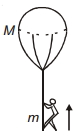
$A$ man of mass $m$ is suspended in air by holding the rope of a balloon of mass $M$. As the man climbs up the rope,the balloon
A
Moves upward
B
Moves downward
C
Remains stationary
D
Cannot say
Solution
(B) The system consists of the man and the balloon. There is no net external force acting on the system in the vertical direction (assuming the balloon is in equilibrium in the air).
Initially,the system is at rest,so the velocity of the centre of mass is zero.
Since the net external force is zero,the acceleration of the centre of mass is zero,and the position of the centre of mass remains constant.
Let $y_m$ be the position of the man and $y_b$ be the position of the balloon. The position of the centre of mass $Y_{cm}$ is given by $Y_{cm} = \frac{M y_b + m y_m}{M + m}$.
As the man climbs up,$y_m$ increases. To keep $Y_{cm}$ constant,$y_b$ must decrease.
Therefore,the balloon moves downward.
Initially,the system is at rest,so the velocity of the centre of mass is zero.
Since the net external force is zero,the acceleration of the centre of mass is zero,and the position of the centre of mass remains constant.
Let $y_m$ be the position of the man and $y_b$ be the position of the balloon. The position of the centre of mass $Y_{cm}$ is given by $Y_{cm} = \frac{M y_b + m y_m}{M + m}$.
As the man climbs up,$y_m$ increases. To keep $Y_{cm}$ constant,$y_b$ must decrease.
Therefore,the balloon moves downward.
0 likes
View Solution112
EasyMCQ
$A$ ball of mass $m$ is thrown upward and another ball of same mass is thrown downward so as to move freely under gravity. The acceleration of the centre of mass is .........
A
$g$
B
$\frac{g}{2}$
C
$2g$
D
$0$
Solution
(A) The acceleration of the centre of mass $(a_{cm})$ for a system of particles is given by the formula:
$a_{cm} = \frac{m_1 a_1 + m_2 a_2}{m_1 + m_2}$
Here,both balls are moving freely under gravity,so the acceleration of each ball is $a_1 = -g$ and $a_2 = -g$ (taking the downward direction as negative).
Substituting the values:
$a_{cm} = \frac{m(-g) + m(-g)}{m + m}$
$a_{cm} = \frac{-2mg}{2m}$
$a_{cm} = -g$
The magnitude of the acceleration of the centre of mass is $g$ directed downwards.
$a_{cm} = \frac{m_1 a_1 + m_2 a_2}{m_1 + m_2}$
Here,both balls are moving freely under gravity,so the acceleration of each ball is $a_1 = -g$ and $a_2 = -g$ (taking the downward direction as negative).
Substituting the values:
$a_{cm} = \frac{m(-g) + m(-g)}{m + m}$
$a_{cm} = \frac{-2mg}{2m}$
$a_{cm} = -g$
The magnitude of the acceleration of the centre of mass is $g$ directed downwards.
0 likes
View Solution113
EasyMCQ
Two blocks of masses $5 \,kg$ and $2 \,kg$ are connected by a spring of negligible mass and placed on a frictionless horizontal surface. An impulse gives a velocity of $7 \,m/s$ to the heavier block in the direction of the lighter block. The velocity of the centre of mass is ....... $m/s$.
A
$30$
B
$20$
C
$10$
D
$5$
Solution
(D) The velocity of the centre of mass $(v_{cm})$ for a system of particles is given by the formula:
$v_{cm} = \frac{m_1 v_1 + m_2 v_2}{m_1 + m_2}$
Given:
Mass of the first block $(m_1)$ = $5 \,kg$
Velocity of the first block $(v_1)$ = $7 \,m/s$
Mass of the second block $(m_2)$ = $2 \,kg$
Velocity of the second block $(v_2)$ = $0 \,m/s$ (initially at rest)
Substituting the values into the formula:
$v_{cm} = \frac{5 \times 7 + 2 \times 0}{5 + 2}$
$v_{cm} = \frac{35 + 0}{7}$
$v_{cm} = \frac{35}{7} = 5 \,m/s$
Therefore,the velocity of the centre of mass is $5 \,m/s$.
$v_{cm} = \frac{m_1 v_1 + m_2 v_2}{m_1 + m_2}$
Given:
Mass of the first block $(m_1)$ = $5 \,kg$
Velocity of the first block $(v_1)$ = $7 \,m/s$
Mass of the second block $(m_2)$ = $2 \,kg$
Velocity of the second block $(v_2)$ = $0 \,m/s$ (initially at rest)
Substituting the values into the formula:
$v_{cm} = \frac{5 \times 7 + 2 \times 0}{5 + 2}$
$v_{cm} = \frac{35 + 0}{7}$
$v_{cm} = \frac{35}{7} = 5 \,m/s$
Therefore,the velocity of the centre of mass is $5 \,m/s$.
0 likes
View Solution114
MediumMCQ
Given below are two statements: one is labelled as Assertion $(A)$ and the other is labelled as Reason $(R)$.
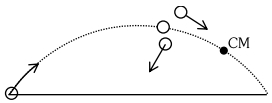
Assertion $(A)$: When a firecracker (rocket) explodes in mid-air,its fragments fly in such a way that the centre of mass of the fragments continues to move along the same parabolic path that the firecracker would have followed had it not exploded.
Reason $(R)$: The explosion of a firecracker (rocket) occurs due to internal forces only,and no external force acts to cause this explosion.
Assertion $(A)$: When a firecracker (rocket) explodes in mid-air,its fragments fly in such a way that the centre of mass of the fragments continues to move along the same parabolic path that the firecracker would have followed had it not exploded.
Reason $(R)$: The explosion of a firecracker (rocket) occurs due to internal forces only,and no external force acts to cause this explosion.
A
Both $(A)$ and $(R)$ are correct and $(R)$ is the correct explanation of $(A)$.
B
Both $(A)$ and $(R)$ are correct but $(R)$ is not the correct explanation of $(A)$.
C
$(A)$ is correct but $(R)$ is not correct.
D
$(A)$ is not correct but $(R)$ is correct.
Solution
(D) Assertion $(A)$ is incorrect because it states that the fragments themselves follow the original path. In reality,only the centre of mass $(C.O.M.)$ of the fragments continues to follow the original parabolic trajectory.
Reason $(R)$ is correct because the explosion is caused by internal chemical forces,and the external force (gravity) remains unchanged during the explosion.
Since the assertion statement is factually incorrect in its phrasing,the correct choice is that $(A)$ is not correct but $(R)$ is correct.
Reason $(R)$ is correct because the explosion is caused by internal chemical forces,and the external force (gravity) remains unchanged during the explosion.
Since the assertion statement is factually incorrect in its phrasing,the correct choice is that $(A)$ is not correct but $(R)$ is correct.
0 likes
View Solution115
DifficultMCQ
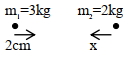
In a system,two particles of masses $m_1 = 3 \text{ kg}$ and $m_2 = 2 \text{ kg}$ are placed at a certain distance from each other. The particle of mass $m_1$ is moved towards the center of mass of the system through a distance of $2 \text{ cm}$. In order to keep the center of mass of the system at the original position,the particle of mass $m_2$ should move towards the center of mass by a distance of . . . . . . $\text{cm}$.
A
$5$
B
$4$
C
$6$
D
$3$
Solution
(D) The displacement of the center of mass is given by the formula: $\Delta X_{\text{COM}} = \frac{m_1 \Delta x_1 + m_2 \Delta x_2}{m_1 + m_2}$.
Since the center of mass must remain at its original position,the net displacement of the center of mass is zero,i.e.,$\Delta X_{\text{COM}} = 0$.
Let the displacement of $m_1$ be $\Delta x_1 = +2 \text{ cm}$ (towards the center of mass) and the displacement of $m_2$ be $\Delta x_2 = -x$ (towards the center of mass).
Substituting the values into the equation:
$0 = \frac{3 \times 2 + 2 \times (-x)}{3 + 2}$
$0 = \frac{6 - 2x}{5}$
$6 - 2x = 0$
$2x = 6$
$x = 3 \text{ cm}$.
Therefore,the particle of mass $m_2$ must move by $3 \text{ cm}$ towards the center of mass.
Since the center of mass must remain at its original position,the net displacement of the center of mass is zero,i.e.,$\Delta X_{\text{COM}} = 0$.
Let the displacement of $m_1$ be $\Delta x_1 = +2 \text{ cm}$ (towards the center of mass) and the displacement of $m_2$ be $\Delta x_2 = -x$ (towards the center of mass).
Substituting the values into the equation:
$0 = \frac{3 \times 2 + 2 \times (-x)}{3 + 2}$
$0 = \frac{6 - 2x}{5}$
$6 - 2x = 0$
$2x = 6$
$x = 3 \text{ cm}$.
Therefore,the particle of mass $m_2$ must move by $3 \text{ cm}$ towards the center of mass.
0 likes
View Solution116
MediumMCQ
Two particles of masses $3 \ kg$ and $6 \ kg$ are approaching towards each other with accelerations $2 \ m/s^2$ and $4 \ m/s^2$ respectively,on a smooth horizontal surface. Then the acceleration of the centre of mass of the system is ..... $m/s^2$.
A
$2$
B
$4$
C
$1$
D
$6$
Solution
(A) The acceleration of the centre of mass of a system is given by the formula: $\vec{a}_{\text{com}} = \frac{m_1 \vec{a}_1 + m_2 \vec{a}_2}{m_1 + m_2}$.
Since the particles are approaching each other,their acceleration vectors are in opposite directions. Let the direction of the first particle be positive,then $\vec{a}_1 = 2 \ m/s^2$ and $\vec{a}_2 = -4 \ m/s^2$.
Substituting the values: $\vec{a}_{\text{com}} = \frac{(3 \ kg)(2 \ m/s^2) + (6 \ kg)(-4 \ m/s^2)}{3 \ kg + 6 \ kg}$.
$\vec{a}_{\text{com}} = \frac{6 - 24}{9} = \frac{-18}{9} = -2 \ m/s^2$.
The magnitude of the acceleration of the centre of mass is $|\vec{a}_{\text{com}}| = 2 \ m/s^2$.
Since the particles are approaching each other,their acceleration vectors are in opposite directions. Let the direction of the first particle be positive,then $\vec{a}_1 = 2 \ m/s^2$ and $\vec{a}_2 = -4 \ m/s^2$.
Substituting the values: $\vec{a}_{\text{com}} = \frac{(3 \ kg)(2 \ m/s^2) + (6 \ kg)(-4 \ m/s^2)}{3 \ kg + 6 \ kg}$.
$\vec{a}_{\text{com}} = \frac{6 - 24}{9} = \frac{-18}{9} = -2 \ m/s^2$.
The magnitude of the acceleration of the centre of mass is $|\vec{a}_{\text{com}}| = 2 \ m/s^2$.
0 likes
View Solution117
MediumMCQ
$A$ $500 \ kg$ boat is $9 \ m$ long and is floating without motion on still water. $A$ man of mass $100 \ kg$ is at one end. If he runs to the other end of the boat and stops,the displacement of the boat is:
A
$1.5 \ m$ in the direction of displacement of the man
B
$0.75 \ m$ in the direction of displacement of the man
C
$1.5 \ m$ in the direction opposite to the displacement of the man
D
$0.75 \ m$ in the direction opposite to the displacement of the man
Solution
(C) Let the mass of the man be $m = 100 \ kg$ and the mass of the boat be $M = 500 \ kg$. The length of the boat is $L = 9 \ m$.
Since there is no external horizontal force acting on the system (man + boat),the center of mass of the system remains stationary.
Let $x$ be the displacement of the boat. The man moves a distance $L$ relative to the boat,so his displacement relative to the water is $(L - x)$ in the opposite direction.
Using the center of mass conservation principle: $m(L - x) = Mx$.
$100(9 - x) = 500x$.
$900 - 100x = 500x$.
$600x = 900$.
$x = \frac{900}{600} = 1.5 \ m$.
The boat moves in the direction opposite to the man's motion to keep the center of mass at the same position.
Since there is no external horizontal force acting on the system (man + boat),the center of mass of the system remains stationary.
Let $x$ be the displacement of the boat. The man moves a distance $L$ relative to the boat,so his displacement relative to the water is $(L - x)$ in the opposite direction.
Using the center of mass conservation principle: $m(L - x) = Mx$.
$100(9 - x) = 500x$.
$900 - 100x = 500x$.
$600x = 900$.
$x = \frac{900}{600} = 1.5 \ m$.
The boat moves in the direction opposite to the man's motion to keep the center of mass at the same position.
0 likes
View Solution118
DifficultMCQ
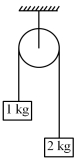
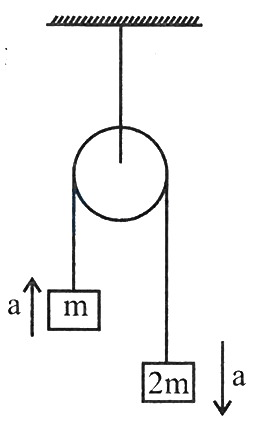
Two masses of $1 \ kg$ and $2 \ kg$ are hanged from a pulley as shown in the figure. If the system starts from rest,find the distance travelled by the centre of mass in the first two seconds.
A
$\frac{20}{9} \ m$
B
$\frac{40}{9} \ m$
C
$\frac{2}{3} \ m$
D
$\frac{1}{3} \ m$
Solution
(A) The acceleration of the system is given by $a = \left(\frac{m_2 - m_1}{m_1 + m_2}\right)g = \left(\frac{2 - 1}{2 + 1}\right) \times 10 = \frac{10}{3} \ m/s^2$.
Let the upward direction be positive. The acceleration of the $1 \ kg$ mass is $a_1 = +\frac{10}{3} \ m/s^2$ and the acceleration of the $2 \ kg$ mass is $a_2 = -\frac{10}{3} \ m/s^2$.
The acceleration of the centre of mass is $a_{cm} = \frac{m_1 a_1 + m_2 a_2}{m_1 + m_2}$.
Substituting the values,$a_{cm} = \frac{1(\frac{10}{3}) + 2(-\frac{10}{3})}{1 + 2} = \frac{\frac{10}{3} - \frac{20}{3}}{3} = \frac{-10/3}{3} = -\frac{10}{9} \ m/s^2$.
The magnitude of acceleration of the centre of mass is $|a_{cm}| = \frac{10}{9} \ m/s^2$.
The distance travelled by the centre of mass in $t = 2 \ s$ starting from rest is $S_{cm} = \frac{1}{2} |a_{cm}| t^2$.
$S_{cm} = \frac{1}{2} \times \frac{10}{9} \times (2)^2 = \frac{1}{2} \times \frac{10}{9} \times 4 = \frac{20}{9} \ m$.
Let the upward direction be positive. The acceleration of the $1 \ kg$ mass is $a_1 = +\frac{10}{3} \ m/s^2$ and the acceleration of the $2 \ kg$ mass is $a_2 = -\frac{10}{3} \ m/s^2$.
The acceleration of the centre of mass is $a_{cm} = \frac{m_1 a_1 + m_2 a_2}{m_1 + m_2}$.
Substituting the values,$a_{cm} = \frac{1(\frac{10}{3}) + 2(-\frac{10}{3})}{1 + 2} = \frac{\frac{10}{3} - \frac{20}{3}}{3} = \frac{-10/3}{3} = -\frac{10}{9} \ m/s^2$.
The magnitude of acceleration of the centre of mass is $|a_{cm}| = \frac{10}{9} \ m/s^2$.
The distance travelled by the centre of mass in $t = 2 \ s$ starting from rest is $S_{cm} = \frac{1}{2} |a_{cm}| t^2$.
$S_{cm} = \frac{1}{2} \times \frac{10}{9} \times (2)^2 = \frac{1}{2} \times \frac{10}{9} \times 4 = \frac{20}{9} \ m$.
0 likes
View Solution119
MediumMCQ
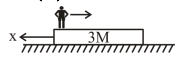
$A$ man of mass $M$ stands at one end of a plank of length $L$ which lies at rest on a frictionless surface. The man walks to the other end of the plank. If the mass of the plank is $3M$,the distance that the man moves relative to the ground is:
A
$\frac{L}{3}$
B
$\frac{2L}{3}$
C
$\frac{L}{4}$
D
$\frac{3L}{4}$
Solution
(D) Since there is no external horizontal force on the system (man + plank),the center of mass of the system remains stationary.
Let the plank move a distance $x$ to the left. The man moves a distance $(L - x)$ to the right relative to the ground.
Using the principle of conservation of the center of mass: $m_1 \Delta x_1 + m_2 \Delta x_2 = 0$.
Let $m_1 = M$ (man) and $m_2 = 3M$ (plank).
$M(L - x) - 3M(x) = 0$
$L - x - 3x = 0$
$L = 4x$
$x = \frac{L}{4}$ (distance moved by the plank).
The distance moved by the man relative to the ground is $(L - x) = L - \frac{L}{4} = \frac{3L}{4}$.
Let the plank move a distance $x$ to the left. The man moves a distance $(L - x)$ to the right relative to the ground.
Using the principle of conservation of the center of mass: $m_1 \Delta x_1 + m_2 \Delta x_2 = 0$.
Let $m_1 = M$ (man) and $m_2 = 3M$ (plank).
$M(L - x) - 3M(x) = 0$
$L - x - 3x = 0$
$L = 4x$
$x = \frac{L}{4}$ (distance moved by the plank).
The distance moved by the man relative to the ground is $(L - x) = L - \frac{L}{4} = \frac{3L}{4}$.
0 likes
View Solution120
MediumMCQ
In the system of two particles of masses $m_1$ and $m_2$,the first particle is moved by a distance $d$ towards the centre of mass. To keep the centre of mass unchanged,the second particle will have to be moved by a distance
A
$\frac{m_2}{m_1} d$,towards the centre of mass.
B
$\frac{m_1}{m_2} d$,away from the centre of mass.
C
$\frac{m_1}{m_2} d$,towards the centre of mass.
D
$\frac{m_2}{m_1} d$,away from the centre of mass.
Solution
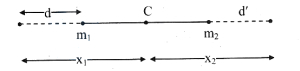
(C) Let $x_1$ and $x_2$ be the initial distances of particles $m_1$ and $m_2$ from the centre of mass $C$ respectively. For the centre of mass to remain at $C$,the condition is $m_1 x_1 = m_2 x_2$ ... $(i)$
When particle $m_1$ is moved by distance $d$ towards the centre of mass,its new distance from $C$ becomes $(x_1 - d)$.
Let the second particle $m_2$ be moved by a distance $d'$ to keep the centre of mass unchanged. Its new distance from $C$ will be $(x_2 - d')$.
For the centre of mass to remain unchanged,the new condition is $m_1(x_1 - d) = m_2(x_2 - d')$ ... (ii)
Expanding equation (ii): $m_1 x_1 - m_1 d = m_2 x_2 - m_2 d'$
Since $m_1 x_1 = m_2 x_2$ from equation $(i)$,we can substitute this into the expanded equation:
$m_2 x_2 - m_1 d = m_2 x_2 - m_2 d'$
$-m_1 d = -m_2 d'$
$d' = \frac{m_1}{m_2} d$
Since the displacement $d'$ is positive in the direction towards the centre of mass,the second particle must also be moved towards the centre of mass.
When particle $m_1$ is moved by distance $d$ towards the centre of mass,its new distance from $C$ becomes $(x_1 - d)$.
Let the second particle $m_2$ be moved by a distance $d'$ to keep the centre of mass unchanged. Its new distance from $C$ will be $(x_2 - d')$.
For the centre of mass to remain unchanged,the new condition is $m_1(x_1 - d) = m_2(x_2 - d')$ ... (ii)
Expanding equation (ii): $m_1 x_1 - m_1 d = m_2 x_2 - m_2 d'$
Since $m_1 x_1 = m_2 x_2$ from equation $(i)$,we can substitute this into the expanded equation:
$m_2 x_2 - m_1 d = m_2 x_2 - m_2 d'$
$-m_1 d = -m_2 d'$
$d' = \frac{m_1}{m_2} d$
Since the displacement $d'$ is positive in the direction towards the centre of mass,the second particle must also be moved towards the centre of mass.
0 likes
View Solution121
EasyMCQ
In a system of two particles of masses $m_{1}$ and $m_{2}$,the first particle is moved by a distance $d$ towards the centre of mass. To keep the centre of mass unchanged,the second particle will have to be moved by a distance:
A
$\frac{m_{1}}{m_{2}} d$,towards the centre of mass.
B
$\frac{m_{2}}{m_{1}} d$,away from the centre of mass.
C
$\frac{m_{2}}{m_{1}} d$,towards the centre of mass.
D
$\frac{m_{1}}{m_{2}} d$,away from the centre of mass.
Solution
(D) Let $x_{1}$ and $x_{2}$ be the distances of masses $m_{1}$ and $m_{2}$ from the centre of mass,respectively.
By the definition of the centre of mass,$m_{1}x_{1} = m_{2}x_{2}$.
When the first particle is moved by a distance $d$ towards the centre of mass,its new distance becomes $(x_{1} - d)$.
Let the second particle be moved by a distance $D$ to keep the centre of mass unchanged.
For the centre of mass to remain at the same position,the new distances must satisfy: $m_{1}(x_{1} - d) = m_{2}(x_{2} - D)$.
Expanding this,we get $m_{1}x_{1} - m_{1}d = m_{2}x_{2} - m_{2}D$.
Since $m_{1}x_{1} = m_{2}x_{2}$,the equation simplifies to $-m_{1}d = -m_{2}D$.
Thus,$D = \frac{m_{1}}{m_{2}} d$.
Since the first particle moved towards the centre of mass,the second particle must move away from the centre of mass to maintain the balance.
By the definition of the centre of mass,$m_{1}x_{1} = m_{2}x_{2}$.
When the first particle is moved by a distance $d$ towards the centre of mass,its new distance becomes $(x_{1} - d)$.
Let the second particle be moved by a distance $D$ to keep the centre of mass unchanged.
For the centre of mass to remain at the same position,the new distances must satisfy: $m_{1}(x_{1} - d) = m_{2}(x_{2} - D)$.
Expanding this,we get $m_{1}x_{1} - m_{1}d = m_{2}x_{2} - m_{2}D$.
Since $m_{1}x_{1} = m_{2}x_{2}$,the equation simplifies to $-m_{1}d = -m_{2}D$.
Thus,$D = \frac{m_{1}}{m_{2}} d$.
Since the first particle moved towards the centre of mass,the second particle must move away from the centre of mass to maintain the balance.
0 likes
View Solution122
EasyMCQ
Two particles which are initially at rest move towards each other under the action of their mutual attraction. If their speeds are $v$ and $2v$ at any instant,then the speed of the center of mass of the system is,
A
$1.5v$
B
$2v$
C
$v$
D
zero
Solution
(D) The center of mass velocity is given by $V_{cm} = \frac{m_1v_1 + m_2v_2}{m_1 + m_2}$.
Since the particles are initially at rest,the initial momentum of the system is $P_{initial} = 0$.
There are no external forces acting on the system (only mutual internal attraction),so the net external force $F_{ext} = 0$.
According to the law of conservation of linear momentum,the total momentum of the system remains constant.
Therefore,$P_{final} = P_{initial} = 0$.
Since $P_{final} = M_{total} \times V_{cm}$,and the total mass $M_{total}$ is non-zero,the velocity of the center of mass $V_{cm}$ must be $0$ at all times.
Since the particles are initially at rest,the initial momentum of the system is $P_{initial} = 0$.
There are no external forces acting on the system (only mutual internal attraction),so the net external force $F_{ext} = 0$.
According to the law of conservation of linear momentum,the total momentum of the system remains constant.
Therefore,$P_{final} = P_{initial} = 0$.
Since $P_{final} = M_{total} \times V_{cm}$,and the total mass $M_{total}$ is non-zero,the velocity of the center of mass $V_{cm}$ must be $0$ at all times.
0 likes
View Solution123
EasyMCQ
Two balls are thrown simultaneously in the air. The acceleration of the centre of mass of the two balls when in the air,
A
depends on the masses of the two balls
B
depends on the speeds of the two balls
C
is equal to $g$ (acceleration due to gravity)
D
depends on the direction of motion of the two balls.
Solution
(C) The acceleration of the centre of mass $a_{cm}$ is given by the formula: $a_{cm} = \frac{m_1 a_1 + m_2 a_2}{m_1 + m_2}$.
Since both balls are in the air,they are under the influence of gravity alone,so $a_1 = -g$ and $a_2 = -g$.
Substituting these values: $a_{cm} = \frac{m_1(-g) + m_2(-g)}{m_1 + m_2}$.
$a_{cm} = -g \frac{(m_1 + m_2)}{(m_1 + m_2)} = -g$.
Therefore,the magnitude of the acceleration of the centre of mass is equal to $g$,which is the acceleration due to gravity.
Since both balls are in the air,they are under the influence of gravity alone,so $a_1 = -g$ and $a_2 = -g$.
Substituting these values: $a_{cm} = \frac{m_1(-g) + m_2(-g)}{m_1 + m_2}$.
$a_{cm} = -g \frac{(m_1 + m_2)}{(m_1 + m_2)} = -g$.
Therefore,the magnitude of the acceleration of the centre of mass is equal to $g$,which is the acceleration due to gravity.
0 likes
View Solution124
MediumMCQ
Three blocks $A$,$B$ and $C$ are arranged as shown in the figure such that the distance between two successive blocks is $10 \ m$. Block $A$ has a mass of $10 \ kg$,block $B$ has a mass of $25 \ kg$,and block $C$ has a mass of $15 \ kg$. Block $A$ is displaced towards block $B$ by $2 \ m$ and block $C$ is displaced towards block $B$ by $3 \ m$. The distance through which the block $B$ should be moved so that the centre of mass of the system does not change is
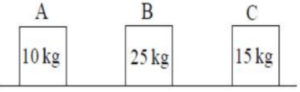
A
$1.4 \ m$,towards block $C$
B
$1.5 \ m$,towards block $A$
C
$2 \ m$,towards block $A$
D
$1 \ m$,towards block $C$
Solution
(D) For the centre of mass of the system to remain unchanged,the net displacement of the centre of mass must be zero.
Let the masses be $m_A = 10 \ kg$,$m_B = 25 \ kg$,and $m_C = 15 \ kg$.
Let the displacements be $\Delta x_A$,$\Delta x_B$,and $\Delta x_C$.
Taking the direction towards the right as positive:
Block $A$ is moved towards $B$ (right) by $2 \ m$,so $\Delta x_A = +2 \ m$.
Block $C$ is moved towards $B$ (left) by $3 \ m$,so $\Delta x_C = -3 \ m$.
Let block $B$ be moved by $\Delta x_B$.
The condition for the centre of mass to remain unchanged is:
$m_A \Delta x_A + m_B \Delta x_B + m_C \Delta x_C = 0$
Substituting the values:
$(10 \ kg)(2 \ m) + (25 \ kg)(\Delta x_B) + (15 \ kg)(-3 \ m) = 0$
$20 + 25 \Delta x_B - 45 = 0$
$25 \Delta x_B - 25 = 0$
$25 \Delta x_B = 25$
$\Delta x_B = 1 \ m$
Since the result is positive,block $B$ must be moved by $1 \ m$ in the positive direction,which is towards block $C$.
Let the masses be $m_A = 10 \ kg$,$m_B = 25 \ kg$,and $m_C = 15 \ kg$.
Let the displacements be $\Delta x_A$,$\Delta x_B$,and $\Delta x_C$.
Taking the direction towards the right as positive:
Block $A$ is moved towards $B$ (right) by $2 \ m$,so $\Delta x_A = +2 \ m$.
Block $C$ is moved towards $B$ (left) by $3 \ m$,so $\Delta x_C = -3 \ m$.
Let block $B$ be moved by $\Delta x_B$.
The condition for the centre of mass to remain unchanged is:
$m_A \Delta x_A + m_B \Delta x_B + m_C \Delta x_C = 0$
Substituting the values:
$(10 \ kg)(2 \ m) + (25 \ kg)(\Delta x_B) + (15 \ kg)(-3 \ m) = 0$
$20 + 25 \Delta x_B - 45 = 0$
$25 \Delta x_B - 25 = 0$
$25 \Delta x_B = 25$
$\Delta x_B = 1 \ m$
Since the result is positive,block $B$ must be moved by $1 \ m$ in the positive direction,which is towards block $C$.
0 likes
View Solution125
MediumMCQ
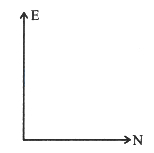
$A$ body of mass $2 \,kg$ is moving towards north with a velocity of $20 \,m \,s^{-1}$ and another body of mass $3 \,kg$ is moving towards east with a velocity of $10 \,m \,s^{-1}$. The magnitude of the velocity of the centre of mass of the system of the two bodies is
A
$20 \,m \,s^{-1}$
B
$10 \,m \,s^{-1}$
C
$15 \,m \,s^{-1}$
D
$2 \sqrt{13} \,m \,s^{-1}$
Solution
(B) The velocity of the centre of mass is given by the formula: $\vec{v}_{cm} = \frac{m_1 \vec{v}_1 + m_2 \vec{v}_2}{m_1 + m_2}$.
Given: $m_1 = 2 \,kg$,$\vec{v}_1 = 20 \hat{j} \,m \,s^{-1}$ (towards north).
$m_2 = 3 \,kg$,$\vec{v}_2 = 10 \hat{i} \,m \,s^{-1}$ (towards east).
Substituting the values:
$\vec{v}_{cm} = \frac{2(20 \hat{j}) + 3(10 \hat{i})}{2 + 3} = \frac{40 \hat{j} + 30 \hat{i}}{5} = 6 \hat{i} + 8 \hat{j} \,m \,s^{-1}$.
The magnitude of the velocity is $|\vec{v}_{cm}| = \sqrt{6^2 + 8^2} = \sqrt{36 + 64} = \sqrt{100} = 10 \,m \,s^{-1}$.
Given: $m_1 = 2 \,kg$,$\vec{v}_1 = 20 \hat{j} \,m \,s^{-1}$ (towards north).
$m_2 = 3 \,kg$,$\vec{v}_2 = 10 \hat{i} \,m \,s^{-1}$ (towards east).
Substituting the values:
$\vec{v}_{cm} = \frac{2(20 \hat{j}) + 3(10 \hat{i})}{2 + 3} = \frac{40 \hat{j} + 30 \hat{i}}{5} = 6 \hat{i} + 8 \hat{j} \,m \,s^{-1}$.
The magnitude of the velocity is $|\vec{v}_{cm}| = \sqrt{6^2 + 8^2} = \sqrt{36 + 64} = \sqrt{100} = 10 \,m \,s^{-1}$.
0 likes
View Solution126
MediumMCQ
Two bodies of masses $M$ and $4M$ initially at rest,start moving towards each other due to their mutual attraction. The velocity of their centre of mass when the first body attains a velocity $v_0$ is
A
zero
B
$-v_0$
C
$2 v_0$
D
$-4 v_0$
Solution
(A) The centre of mass of a system moves according to the net external force acting on the system.
In this problem,the two bodies are moving towards each other due to their mutual gravitational attraction,which is an internal force.
Since there is no external force acting on the system of the two bodies,the net external force $F_{ext} = 0$.
According to the property of the centre of mass,if the net external force on a system is zero,the acceleration of the centre of mass is zero $(a_{cm} = 0)$.
Since the bodies are initially at rest,the initial velocity of the centre of mass is $v_{cm, initial} = 0$.
Because the acceleration of the centre of mass is zero,its velocity remains constant over time.
Therefore,the velocity of the centre of mass at any instant,including when the first body attains a velocity $v_0$,will remain $0$.
In this problem,the two bodies are moving towards each other due to their mutual gravitational attraction,which is an internal force.
Since there is no external force acting on the system of the two bodies,the net external force $F_{ext} = 0$.
According to the property of the centre of mass,if the net external force on a system is zero,the acceleration of the centre of mass is zero $(a_{cm} = 0)$.
Since the bodies are initially at rest,the initial velocity of the centre of mass is $v_{cm, initial} = 0$.
Because the acceleration of the centre of mass is zero,its velocity remains constant over time.
Therefore,the velocity of the centre of mass at any instant,including when the first body attains a velocity $v_0$,will remain $0$.
0 likes
View Solution127
MediumMCQ
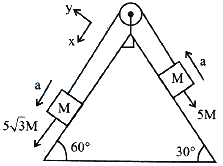
Two blocks of equal masses $M$ are tied with a light string passing over a massless pulley on a wedge with angles $60^{\circ}$ and $30^{\circ}$ (assuming frictionless surfaces). The acceleration of the centre of mass of the two blocks is $\left(g=10 \text{ ms}^{-2}\right)$.
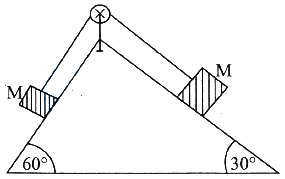
A
$\frac{5(\sqrt{3}-1)}{2}$
B
$\frac{5(\sqrt{3}-1)}{2 \sqrt{2}}$
C
$\frac{5(\sqrt{3}+1)}{2 \sqrt{2}}$
D
$\frac{5(\sqrt{3}-1)}{\sqrt{2}}$
Solution
(B) Let the acceleration of the blocks be $a$. The forces along the incline are $Mg \sin 60^{\circ}$ and $Mg \sin 30^{\circ}$.
The equation of motion is $Mg \sin 60^{\circ} - Mg \sin 30^{\circ} = (M+M)a$.
$a = \frac{g(\sin 60^{\circ} - \sin 30^{\circ})}{2} = \frac{10(\frac{\sqrt{3}}{2} - \frac{1}{2})}{2} = \frac{5(\sqrt{3}-1)}{2} \text{ ms}^{-2}$.
The acceleration of the block on the $60^{\circ}$ incline is $\vec{a}_1 = a(\cos 60^{\circ} \hat{i} - \sin 60^{\circ} \hat{j})$ and the block on the $30^{\circ}$ incline is $\vec{a}_2 = a(-\cos 30^{\circ} \hat{i} - \sin 30^{\circ} \hat{j})$.
However,using the coordinate system aligned with the inclines as shown in the figure,$\vec{a}_1 = a \hat{i}'$ and $\vec{a}_2 = -a \hat{j}'$ where $\hat{i}'$ and $\hat{j}'$ are unit vectors along the inclines.
The acceleration of the centre of mass is $\vec{a}_{cm} = \frac{M\vec{a}_1 + M\vec{a}_2}{2M} = \frac{\vec{a}_1 + \vec{a}_2}{2}$.
The angle between the two inclines is $90^{\circ}$. Thus,the magnitude is $a_{cm} = \frac{\sqrt{a^2 + a^2}}{2} = \frac{a\sqrt{2}}{2} = \frac{a}{\sqrt{2}}$.
Substituting $a = \frac{5(\sqrt{3}-1)}{2}$,we get $a_{cm} = \frac{5(\sqrt{3}-1)}{2\sqrt{2}}$.
The equation of motion is $Mg \sin 60^{\circ} - Mg \sin 30^{\circ} = (M+M)a$.
$a = \frac{g(\sin 60^{\circ} - \sin 30^{\circ})}{2} = \frac{10(\frac{\sqrt{3}}{2} - \frac{1}{2})}{2} = \frac{5(\sqrt{3}-1)}{2} \text{ ms}^{-2}$.
The acceleration of the block on the $60^{\circ}$ incline is $\vec{a}_1 = a(\cos 60^{\circ} \hat{i} - \sin 60^{\circ} \hat{j})$ and the block on the $30^{\circ}$ incline is $\vec{a}_2 = a(-\cos 30^{\circ} \hat{i} - \sin 30^{\circ} \hat{j})$.
However,using the coordinate system aligned with the inclines as shown in the figure,$\vec{a}_1 = a \hat{i}'$ and $\vec{a}_2 = -a \hat{j}'$ where $\hat{i}'$ and $\hat{j}'$ are unit vectors along the inclines.
The acceleration of the centre of mass is $\vec{a}_{cm} = \frac{M\vec{a}_1 + M\vec{a}_2}{2M} = \frac{\vec{a}_1 + \vec{a}_2}{2}$.
The angle between the two inclines is $90^{\circ}$. Thus,the magnitude is $a_{cm} = \frac{\sqrt{a^2 + a^2}}{2} = \frac{a\sqrt{2}}{2} = \frac{a}{\sqrt{2}}$.
Substituting $a = \frac{5(\sqrt{3}-1)}{2}$,we get $a_{cm} = \frac{5(\sqrt{3}-1)}{2\sqrt{2}}$.
0 likes
View Solution128
EasyMCQ
Two particles of masses $1 \,g$ and $2 \,g$ move towards each other with velocities $10 \,ms^{-1}$ and $20 \,ms^{-1}$ respectively. The velocity of the centre of mass of the system of the two particles is (in $\,ms^{-1}$)
A
$5$
B
$10$
C
$15$
D
$20$
Solution
(B) Given: $m_1 = 1 \,g$,$m_2 = 2 \,g$.
Since the particles move towards each other,we assign opposite directions. Let $v_1 = 10 \,ms^{-1}$ and $v_2 = -20 \,ms^{-1}$.
The velocity of the centre of mass $V_{cm}$ is given by the formula:
$V_{cm} = \frac{m_1 v_1 + m_2 v_2}{m_1 + m_2}$
Substituting the values:
$V_{cm} = \frac{(1 \times 10) + (2 \times -20)}{1 + 2}$
$V_{cm} = \frac{10 - 40}{3} = \frac{-30}{3} = -10 \,ms^{-1}$.
The magnitude of the velocity is $10 \,ms^{-1}$.
Since the particles move towards each other,we assign opposite directions. Let $v_1 = 10 \,ms^{-1}$ and $v_2 = -20 \,ms^{-1}$.
The velocity of the centre of mass $V_{cm}$ is given by the formula:
$V_{cm} = \frac{m_1 v_1 + m_2 v_2}{m_1 + m_2}$
Substituting the values:
$V_{cm} = \frac{(1 \times 10) + (2 \times -20)}{1 + 2}$
$V_{cm} = \frac{10 - 40}{3} = \frac{-30}{3} = -10 \,ms^{-1}$.
The magnitude of the velocity is $10 \,ms^{-1}$.
0 likes
View Solution129
DifficultMCQ
$A$ particle of mass $10 \text{ g}$ is moving towards east with a velocity of $10 \text{ ms}^{-1}$ and another particle of mass $15 \text{ g}$ is moving towards north with a velocity of $5 \text{ ms}^{-1}$. The magnitude of the velocity of the centre of mass of the system of the two particles is (in $\text{ ms}^{-1}$)
A
$5$
B
$10$
C
$15$
D
$7.5$
Solution
(A) Let the velocity of the first particle be $\vec{v}_1 = 10 \hat{i} \text{ ms}^{-1}$ and the velocity of the second particle be $\vec{v}_2 = 5 \hat{j} \text{ ms}^{-1}$.
The masses are $m_1 = 10 \text{ g}$ and $m_2 = 15 \text{ g}$.
The velocity of the centre of mass $\vec{v}_{cm}$ is given by:
$\vec{v}_{cm} = \frac{m_1 \vec{v}_1 + m_2 \vec{v}_2}{m_1 + m_2}$
$\vec{v}_{cm} = \frac{10(10 \hat{i}) + 15(5 \hat{j})}{10 + 15} = \frac{100 \hat{i} + 75 \hat{j}}{25} = 4 \hat{i} + 3 \hat{j} \text{ ms}^{-1}$.
The magnitude of the velocity of the centre of mass is:
$|\vec{v}_{cm}| = \sqrt{4^2 + 3^2} = \sqrt{16 + 9} = \sqrt{25} = 5 \text{ ms}^{-1}$.
The masses are $m_1 = 10 \text{ g}$ and $m_2 = 15 \text{ g}$.
The velocity of the centre of mass $\vec{v}_{cm}$ is given by:
$\vec{v}_{cm} = \frac{m_1 \vec{v}_1 + m_2 \vec{v}_2}{m_1 + m_2}$
$\vec{v}_{cm} = \frac{10(10 \hat{i}) + 15(5 \hat{j})}{10 + 15} = \frac{100 \hat{i} + 75 \hat{j}}{25} = 4 \hat{i} + 3 \hat{j} \text{ ms}^{-1}$.
The magnitude of the velocity of the centre of mass is:
$|\vec{v}_{cm}| = \sqrt{4^2 + 3^2} = \sqrt{16 + 9} = \sqrt{25} = 5 \text{ ms}^{-1}$.
0 likes
View Solution130
DifficultMCQ
Two bodies of masses $12 \,kg$ and $6 \,kg$ are projected simultaneously with velocities $15 \,ms^{-1}$ and $20 \,ms^{-1}$ respectively from the top of a tower of height $25 \,m$. The body of mass $12 \,kg$ is projected vertically upwards and the body of mass $6 \,kg$ is projected horizontally. Find the maximum height reached by the centre of mass of the system of two bodies from the ground. $(g = 10 \,ms^{-2})$ (in $\,m$)
A
$5$
B
$25$
C
$30$
D
$50$
Solution
(C) Let the top of the tower be the origin $(0, 25)$ in the $xy$-plane. The masses are $m_1 = 12 \,kg$ and $m_2 = 6 \,kg$.
The initial velocities are $\vec{v}_1 = 15 \hat{j} \,ms^{-1}$ and $\vec{v}_2 = 20 \hat{i} \,ms^{-1}$.
The vertical component of the velocity of the centre of mass is $v_{cm,y} = \frac{m_1 v_{1y} + m_2 v_{2y}}{m_1 + m_2} = \frac{12(15) + 6(0)}{12 + 6} = \frac{180}{18} = 10 \,ms^{-1}$.
The vertical acceleration of the centre of mass is $a_{cm,y} = -g = -10 \,ms^{-2}$.
The height of the centre of mass from the top of the tower is $y_{cm} = v_{cm,y} t - \frac{1}{2} g t^2$.
The maximum height from the top is reached when $v_{cm,y}(t) = 0$,i.e.,$10 - 10t = 0 \implies t = 1 \,s$.
The maximum displacement from the top is $y_{max} = 10(1) - \frac{1}{2}(10)(1)^2 = 10 - 5 = 5 \,m$.
The total height from the ground is $H = 25 + 5 = 30 \,m$.
The initial velocities are $\vec{v}_1 = 15 \hat{j} \,ms^{-1}$ and $\vec{v}_2 = 20 \hat{i} \,ms^{-1}$.
The vertical component of the velocity of the centre of mass is $v_{cm,y} = \frac{m_1 v_{1y} + m_2 v_{2y}}{m_1 + m_2} = \frac{12(15) + 6(0)}{12 + 6} = \frac{180}{18} = 10 \,ms^{-1}$.
The vertical acceleration of the centre of mass is $a_{cm,y} = -g = -10 \,ms^{-2}$.
The height of the centre of mass from the top of the tower is $y_{cm} = v_{cm,y} t - \frac{1}{2} g t^2$.
The maximum height from the top is reached when $v_{cm,y}(t) = 0$,i.e.,$10 - 10t = 0 \implies t = 1 \,s$.
The maximum displacement from the top is $y_{max} = 10(1) - \frac{1}{2}(10)(1)^2 = 10 - 5 = 5 \,m$.
The total height from the ground is $H = 25 + 5 = 30 \,m$.
0 likes
View Solution131
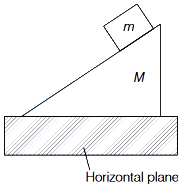
MediumMCQ
$A$ mass $m$ is at rest on an inclined plane of mass $M$,which is further resting on a smooth horizontal plane. Now,if the mass $m$ starts moving under gravity,the position of the centre of mass of the system will
A
remain unchanged
B
change along the horizontal direction
C
move up in the vertical direction
D
move down in the vertical direction and remain unchanged along the horizontal direction
Solution
(D) Consider the system consisting of the mass $m$ and the wedge of mass $M$.
Since the horizontal plane is smooth,there is no external horizontal force acting on the system.
According to the property of the centre of mass,if the net external force on a system in a particular direction is zero,the acceleration of the centre of mass in that direction is zero.
Since the initial velocity of the system is zero,the centre of mass will not move in the horizontal direction.
However,in the vertical direction,the gravitational force acts on the system,which is an external force.
As the mass $m$ slides down the inclined plane,the vertical position of the centre of mass of the system changes (it moves downwards).
Therefore,the centre of mass moves down in the vertical direction and remains unchanged along the horizontal direction.
Since the horizontal plane is smooth,there is no external horizontal force acting on the system.
According to the property of the centre of mass,if the net external force on a system in a particular direction is zero,the acceleration of the centre of mass in that direction is zero.
Since the initial velocity of the system is zero,the centre of mass will not move in the horizontal direction.
However,in the vertical direction,the gravitational force acts on the system,which is an external force.
As the mass $m$ slides down the inclined plane,the vertical position of the centre of mass of the system changes (it moves downwards).
Therefore,the centre of mass moves down in the vertical direction and remains unchanged along the horizontal direction.
0 likes
View Solution132
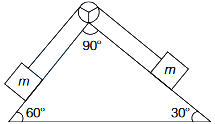
MediumMCQ
In the figure shown,the blocks have equal masses. Friction,mass of the string,and the mass of the pulley are negligible. The magnitude of the acceleration of the centre of mass of the two blocks is (Acceleration due to gravity $= g$).
A
$\left(\frac{\sqrt{3}-1}{\sqrt{2}}\right) g$
B
$\frac{g}{2}$
C
$(\sqrt{3}-1) g$
D
$\left(\frac{\sqrt{3}-1}{4 \sqrt{2}}\right) g$
Solution
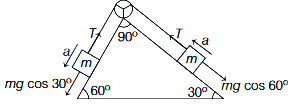
(D) Let the acceleration of the blocks be $a$. The forces acting along the incline for the block on the $60^{\circ}$ slope is $mg \sin 60^{\circ} - T = ma$ and for the block on the $30^{\circ}$ slope is $T - mg \sin 30^{\circ} = ma$.
Adding these two equations: $mg(\sin 60^{\circ} - \sin 30^{\circ}) = 2ma$.
$a = \frac{g}{2} (\frac{\sqrt{3}}{2} - \frac{1}{2}) = \frac{g(\sqrt{3}-1)}{4}$.
The acceleration vectors for the two blocks are $\vec{a}_1 = a(\cos 60^{\circ} \hat{i} - \sin 60^{\circ} \hat{j})$ and $\vec{a}_2 = a(-\cos 30^{\circ} \hat{i} - \sin 30^{\circ} \hat{j})$.
The acceleration of the centre of mass is $\vec{a}_{CM} = \frac{m\vec{a}_1 + m\vec{a}_2}{2m} = \frac{\vec{a}_1 + \vec{a}_2}{2}$.
$\vec{a}_{CM} = \frac{a}{2} [(\cos 60^{\circ} - \cos 30^{\circ}) \hat{i} - (\sin 60^{\circ} + \sin 30^{\circ}) \hat{j}]$.
Substituting $a = \frac{g(\sqrt{3}-1)}{4}$,$\cos 60^{\circ} = 1/2$,$\cos 30^{\circ} = \sqrt{3}/2$,$\sin 60^{\circ} = \sqrt{3}/2$,$\sin 30^{\circ} = 1/2$:
$|\vec{a}_{CM}| = \frac{a}{2} \sqrt{(\frac{1-\sqrt{3}}{2})^2 + (\frac{\sqrt{3}+1}{2})^2} = \frac{a}{2} \sqrt{\frac{1+3-2\sqrt{3} + 3+1+2\sqrt{3}}{4}} = \frac{a}{2} \sqrt{\frac{8}{4}} = \frac{a\sqrt{2}}{2} = \frac{a}{\sqrt{2}}$.
$|\vec{a}_{CM}| = \frac{g(\sqrt{3}-1)}{4\sqrt{2}}$.
Thus,option $(d)$ is correct.
Adding these two equations: $mg(\sin 60^{\circ} - \sin 30^{\circ}) = 2ma$.
$a = \frac{g}{2} (\frac{\sqrt{3}}{2} - \frac{1}{2}) = \frac{g(\sqrt{3}-1)}{4}$.
The acceleration vectors for the two blocks are $\vec{a}_1 = a(\cos 60^{\circ} \hat{i} - \sin 60^{\circ} \hat{j})$ and $\vec{a}_2 = a(-\cos 30^{\circ} \hat{i} - \sin 30^{\circ} \hat{j})$.
The acceleration of the centre of mass is $\vec{a}_{CM} = \frac{m\vec{a}_1 + m\vec{a}_2}{2m} = \frac{\vec{a}_1 + \vec{a}_2}{2}$.
$\vec{a}_{CM} = \frac{a}{2} [(\cos 60^{\circ} - \cos 30^{\circ}) \hat{i} - (\sin 60^{\circ} + \sin 30^{\circ}) \hat{j}]$.
Substituting $a = \frac{g(\sqrt{3}-1)}{4}$,$\cos 60^{\circ} = 1/2$,$\cos 30^{\circ} = \sqrt{3}/2$,$\sin 60^{\circ} = \sqrt{3}/2$,$\sin 30^{\circ} = 1/2$:
$|\vec{a}_{CM}| = \frac{a}{2} \sqrt{(\frac{1-\sqrt{3}}{2})^2 + (\frac{\sqrt{3}+1}{2})^2} = \frac{a}{2} \sqrt{\frac{1+3-2\sqrt{3} + 3+1+2\sqrt{3}}{4}} = \frac{a}{2} \sqrt{\frac{8}{4}} = \frac{a\sqrt{2}}{2} = \frac{a}{\sqrt{2}}$.
$|\vec{a}_{CM}| = \frac{g(\sqrt{3}-1)}{4\sqrt{2}}$.
Thus,option $(d)$ is correct.
0 likes
View Solution133
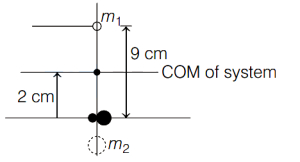
MediumMCQ
Two particles of masses in the ratio $1:2$ are placed along a vertical line. The lighter particle is raised through a height of $9 \ cm$. To raise the centre of mass of the system by $2 \ cm$,the heavier particle should be
A
moved $1.5 \ cm$ downward
B
moved $2 \ cm$ upward
C
moved $1.5 \ cm$ upward
D
moved $2 \ cm$ downward
Solution
(A) Let the masses of the particles be $m_1 = m$ and $m_2 = 2m$. The displacement of the centre of mass $\Delta Y_{cm}$ is given by the formula:
$\Delta Y_{cm} = \frac{m_1 \Delta y_1 + m_2 \Delta y_2}{m_1 + m_2}$
Given that $\Delta Y_{cm} = 2 \ cm$,$\Delta y_1 = 9 \ cm$,$m_1 = m$,and $m_2 = 2m$,we substitute these values into the equation:
$2 = \frac{m(9) + 2m(\Delta y_2)}{m + 2m}$
$2 = \frac{9m + 2m(\Delta y_2)}{3m}$
$2 = \frac{9 + 2\Delta y_2}{3}$
$6 = 9 + 2\Delta y_2$
$2\Delta y_2 = 6 - 9$
$2\Delta y_2 = -3$
$\Delta y_2 = -1.5 \ cm$
The negative sign indicates that the heavier particle must be moved $1.5 \ cm$ downward.
$\Delta Y_{cm} = \frac{m_1 \Delta y_1 + m_2 \Delta y_2}{m_1 + m_2}$
Given that $\Delta Y_{cm} = 2 \ cm$,$\Delta y_1 = 9 \ cm$,$m_1 = m$,and $m_2 = 2m$,we substitute these values into the equation:
$2 = \frac{m(9) + 2m(\Delta y_2)}{m + 2m}$
$2 = \frac{9m + 2m(\Delta y_2)}{3m}$
$2 = \frac{9 + 2\Delta y_2}{3}$
$6 = 9 + 2\Delta y_2$
$2\Delta y_2 = 6 - 9$
$2\Delta y_2 = -3$
$\Delta y_2 = -1.5 \ cm$
The negative sign indicates that the heavier particle must be moved $1.5 \ cm$ downward.
0 likes
View Solution134
MediumMCQ
Two particles $A$ and $B$,initially at rest,move towards each other under a mutual force of attraction. At an instance when the speed of $A$ is $v$ and the speed of $B$ is $2v$,the speed of the centre of mass $(CM)$ is:
A
Zero
B
$v$
C
$2.5v$
D
$4v$
Solution
(A) The velocity of the centre of mass $(CM)$ is given by the formula $V_{CM} = \frac{m_A v_A + m_B v_B}{m_A + m_B}$.
Since the particles are initially at rest,the initial velocity of the centre of mass is $V_{CM, initial} = 0$.
According to the law of conservation of momentum,if the net external force on a system is zero,the velocity of the centre of mass remains constant.
In this system,the particles move under mutual forces of attraction,which are internal forces.
Therefore,the net external force on the system is zero.
Since the initial velocity of the centre of mass was zero,it must remain zero at all times,regardless of the individual speeds of the particles.
Since the particles are initially at rest,the initial velocity of the centre of mass is $V_{CM, initial} = 0$.
According to the law of conservation of momentum,if the net external force on a system is zero,the velocity of the centre of mass remains constant.
In this system,the particles move under mutual forces of attraction,which are internal forces.
Therefore,the net external force on the system is zero.
Since the initial velocity of the centre of mass was zero,it must remain zero at all times,regardless of the individual speeds of the particles.
0 likes
View Solution135
DifficultMCQ
Two particles of equal mass have velocities $\overrightarrow{v}_1=4 \hat{i} \text{ ms}^{-1}$ and $\overrightarrow{v}_2=4 \hat{j} \text{ ms}^{-1}$. The first particle has an acceleration $\overrightarrow{a}_1=(5 \hat{i}+5 \hat{j}) \text{ ms}^{-2}$ while the acceleration of the other particle is zero. The centre of mass of the two particles moves in a path of
A
straight line
B
parabola
C
circle
D
ellipse
Solution
(A) The velocity of the centre of mass $(v_{CM})$ is given by:
$v_{CM} = \frac{m_1 \overrightarrow{v}_1 + m_2 \overrightarrow{v}_2}{m_1 + m_2} = \frac{\overrightarrow{v}_1 + \overrightarrow{v}_2}{2}$ (since $m_1 = m_2 = m$).
$v_{CM} = \frac{4 \hat{i} + 4 \hat{j}}{2} = (2 \hat{i} + 2 \hat{j}) \text{ ms}^{-1}$.
The acceleration of the centre of mass $(a_{CM})$ is given by:
$a_{CM} = \frac{m_1 \overrightarrow{a}_1 + m_2 \overrightarrow{a}_2}{m_1 + m_2} = \frac{\overrightarrow{a}_1 + 0}{2} = \frac{5 \hat{i} + 5 \hat{j}}{2} = (2.5 \hat{i} + 2.5 \hat{j}) \text{ ms}^{-2}$.
Since the acceleration vector $\overrightarrow{a}_{CM}$ is constant,the centre of mass moves with constant acceleration.
Because the initial velocity $\overrightarrow{v}_{CM}$ and the acceleration $\overrightarrow{a}_{CM}$ are parallel (both are in the direction of $\hat{i} + \hat{j}$),the path of the centre of mass is a straight line.
$v_{CM} = \frac{m_1 \overrightarrow{v}_1 + m_2 \overrightarrow{v}_2}{m_1 + m_2} = \frac{\overrightarrow{v}_1 + \overrightarrow{v}_2}{2}$ (since $m_1 = m_2 = m$).
$v_{CM} = \frac{4 \hat{i} + 4 \hat{j}}{2} = (2 \hat{i} + 2 \hat{j}) \text{ ms}^{-1}$.
The acceleration of the centre of mass $(a_{CM})$ is given by:
$a_{CM} = \frac{m_1 \overrightarrow{a}_1 + m_2 \overrightarrow{a}_2}{m_1 + m_2} = \frac{\overrightarrow{a}_1 + 0}{2} = \frac{5 \hat{i} + 5 \hat{j}}{2} = (2.5 \hat{i} + 2.5 \hat{j}) \text{ ms}^{-2}$.
Since the acceleration vector $\overrightarrow{a}_{CM}$ is constant,the centre of mass moves with constant acceleration.
Because the initial velocity $\overrightarrow{v}_{CM}$ and the acceleration $\overrightarrow{a}_{CM}$ are parallel (both are in the direction of $\hat{i} + \hat{j}$),the path of the centre of mass is a straight line.
0 likes
View Solution136
MediumMCQ
Two blocks of masses $m$ and $2m$ are connected by a massless string which passes over a fixed frictionless pulley. If the system of blocks is released from rest,the speed of the centre of mass of the system of two blocks after a time of $5.4 \ s$ is (Acceleration due to gravity $= 10 \ ms^{-2}$) (in $ms^{-1}$)
A
$6$
B
$8$
C
$4$
D
$12$
Solution
(A) The acceleration $a$ of the system is given by:
$a = \left( \frac{m_2 - m_1}{m_1 + m_2} \right) g = \left( \frac{2m - m}{2m + m} \right) \times 10 = \frac{10}{3} \ ms^{-2}$
After time $t = 5.4 \ s$,the speed of each block is:
$v = at = \frac{10}{3} \times 5.4 = 18 \ ms^{-1}$
The block of mass $m$ moves upwards with velocity $v_1 = 18 \ ms^{-1}$ (let this be positive direction),and the block of mass $2m$ moves downwards with velocity $v_2 = -18 \ ms^{-1}$.
The velocity of the centre of mass is:
$v_{cm} = \frac{m_1 v_1 + m_2 v_2}{m_1 + m_2} = \frac{m(18) + 2m(-18)}{m + 2m} = \frac{18m - 36m}{3m} = \frac{-18m}{3m} = -6 \ ms^{-1}$
The speed is the magnitude of the velocity,which is $6 \ ms^{-1}$.
$a = \left( \frac{m_2 - m_1}{m_1 + m_2} \right) g = \left( \frac{2m - m}{2m + m} \right) \times 10 = \frac{10}{3} \ ms^{-2}$
After time $t = 5.4 \ s$,the speed of each block is:
$v = at = \frac{10}{3} \times 5.4 = 18 \ ms^{-1}$
The block of mass $m$ moves upwards with velocity $v_1 = 18 \ ms^{-1}$ (let this be positive direction),and the block of mass $2m$ moves downwards with velocity $v_2 = -18 \ ms^{-1}$.
The velocity of the centre of mass is:
$v_{cm} = \frac{m_1 v_1 + m_2 v_2}{m_1 + m_2} = \frac{m(18) + 2m(-18)}{m + 2m} = \frac{18m - 36m}{3m} = \frac{-18m}{3m} = -6 \ ms^{-1}$
The speed is the magnitude of the velocity,which is $6 \ ms^{-1}$.
0 likes
View Solution137
MediumMCQ
$A$ wooden plank of mass $90 \ kg$ and length $3.3 \ m$ is floating on still water. $A$ girl of mass $20 \ kg$ walks from one end to the other end of the plank. The distance through which the plank moves is (in $cm$)
A
$30$
B
$40$
C
$80$
D
$60$
Solution
(D) Let $M = 90 \ kg$ be the mass of the plank and $m = 20 \ kg$ be the mass of the girl.
The length of the plank is $l = 3.3 \ m$.
Since there is no external horizontal force acting on the system (plank + girl),the center of mass of the system remains stationary.
Let the displacement of the plank be $\Delta x$ in the direction opposite to the girl's motion.
The displacement of the girl relative to the water is $(l - \Delta x)$.
Using the center of mass principle: $M \Delta x = m(l - \Delta x)$.
$90 \Delta x = 20(3.3 - \Delta x)$.
$90 \Delta x = 66 - 20 \Delta x$.
$110 \Delta x = 66$.
$\Delta x = \frac{66}{110} = 0.6 \ m$.
Converting to centimeters: $0.6 \ m = 60 \ cm$.
The length of the plank is $l = 3.3 \ m$.
Since there is no external horizontal force acting on the system (plank + girl),the center of mass of the system remains stationary.
Let the displacement of the plank be $\Delta x$ in the direction opposite to the girl's motion.
The displacement of the girl relative to the water is $(l - \Delta x)$.
Using the center of mass principle: $M \Delta x = m(l - \Delta x)$.
$90 \Delta x = 20(3.3 - \Delta x)$.
$90 \Delta x = 66 - 20 \Delta x$.
$110 \Delta x = 66$.
$\Delta x = \frac{66}{110} = 0.6 \ m$.
Converting to centimeters: $0.6 \ m = 60 \ cm$.
0 likes
View Solution138
MediumMCQ
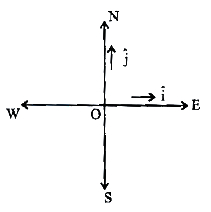
Three particles $A, B$ and $C$ of masses $m, 2m$ and $3m$ are moving towards north, south and east respectively. If the velocities of the particles $A, B$ and $C$ are $6 \,ms^{-1}, 12 \,ms^{-1}$ and $8 \,ms^{-1}$ respectively, then the velocity of the centre of mass of the system of particles is (in $\,ms^{-1}$)
A
$7$
B
$5$
C
$26$
D
$8$
Solution
(B) Given masses are $m_1 = m$, $m_2 = 2m$, and $m_3 = 3m$.
The velocities are directed as follows:
Particle $A$ moves north: $\vec{v}_1 = 6 \hat{j} \,ms^{-1}$
Particle $B$ moves south: $\vec{v}_2 = -12 \hat{j} \,ms^{-1}$
Particle $C$ moves east: $\vec{v}_3 = 8 \hat{i} \,ms^{-1}$
The velocity of the centre of mass $\vec{v}_{cm}$ is given by:
$\vec{v}_{cm} = \frac{m_1 \vec{v}_1 + m_2 \vec{v}_2 + m_3 \vec{v}_3}{m_1 + m_2 + m_3}$
Substituting the values:
$\vec{v}_{cm} = \frac{m(6 \hat{j}) + 2m(-12 \hat{j}) + 3m(8 \hat{i})}{m + 2m + 3m}$
$\vec{v}_{cm} = \frac{6m \hat{j} - 24m \hat{j} + 24m \hat{i}}{6m}$
$\vec{v}_{cm} = \frac{24m \hat{i} - 18m \hat{j}}{6m} = 4 \hat{i} - 3 \hat{j} \,ms^{-1}$
The magnitude of the velocity of the centre of mass is:
$v_{cm} = \sqrt{(4)^2 + (-3)^2} = \sqrt{16 + 9} = \sqrt{25} = 5 \,ms^{-1}$
The velocities are directed as follows:
Particle $A$ moves north: $\vec{v}_1 = 6 \hat{j} \,ms^{-1}$
Particle $B$ moves south: $\vec{v}_2 = -12 \hat{j} \,ms^{-1}$
Particle $C$ moves east: $\vec{v}_3 = 8 \hat{i} \,ms^{-1}$
The velocity of the centre of mass $\vec{v}_{cm}$ is given by:
$\vec{v}_{cm} = \frac{m_1 \vec{v}_1 + m_2 \vec{v}_2 + m_3 \vec{v}_3}{m_1 + m_2 + m_3}$
Substituting the values:
$\vec{v}_{cm} = \frac{m(6 \hat{j}) + 2m(-12 \hat{j}) + 3m(8 \hat{i})}{m + 2m + 3m}$
$\vec{v}_{cm} = \frac{6m \hat{j} - 24m \hat{j} + 24m \hat{i}}{6m}$
$\vec{v}_{cm} = \frac{24m \hat{i} - 18m \hat{j}}{6m} = 4 \hat{i} - 3 \hat{j} \,ms^{-1}$
The magnitude of the velocity of the centre of mass is:
$v_{cm} = \sqrt{(4)^2 + (-3)^2} = \sqrt{16 + 9} = \sqrt{25} = 5 \,ms^{-1}$
0 likes
View Solution139
MediumMCQ
$A$ system consists of two particles of masses $m_1$ and $m_2$. If the particle of mass $m_1$ is moved towards the centre of mass through a distance $d$,then the distance the second particle should be moved,so as to keep the centre of mass at the same position is
A
$-\frac{m_2}{m_1} d$
B
$\frac{m_2}{m_1+m_2} d$
C
$-\frac{m_1}{m_2} d$
D
$\frac{m_1}{m_2} d$
Solution
(D) Let $x_1$ and $x_2$ be the initial distances of $m_1$ and $m_2$ from the centre of mass,respectively.
By the definition of the centre of mass,$m_1 x_1 = m_2 x_2$.
If $m_1$ is moved towards the centre of mass by a distance $d$,its new distance from the centre of mass becomes $(x_1 - d)$.
Let the second particle $m_2$ be moved by a distance $s$ towards the centre of mass to keep the centre of mass at the same position.
Its new distance from the centre of mass becomes $(x_2 - s)$.
For the centre of mass to remain at the same position,the new condition must satisfy $m_1(x_1 - d) = m_2(x_2 - s)$.
Expanding this,we get $m_1 x_1 - m_1 d = m_2 x_2 - m_2 s$.
Since $m_1 x_1 = m_2 x_2$,we can subtract these terms from both sides to get $-m_1 d = -m_2 s$.
Solving for $s$,we get $s = \frac{m_1}{m_2} d$.
By the definition of the centre of mass,$m_1 x_1 = m_2 x_2$.
If $m_1$ is moved towards the centre of mass by a distance $d$,its new distance from the centre of mass becomes $(x_1 - d)$.
Let the second particle $m_2$ be moved by a distance $s$ towards the centre of mass to keep the centre of mass at the same position.
Its new distance from the centre of mass becomes $(x_2 - s)$.
For the centre of mass to remain at the same position,the new condition must satisfy $m_1(x_1 - d) = m_2(x_2 - s)$.
Expanding this,we get $m_1 x_1 - m_1 d = m_2 x_2 - m_2 s$.
Since $m_1 x_1 = m_2 x_2$,we can subtract these terms from both sides to get $-m_1 d = -m_2 s$.
Solving for $s$,we get $s = \frac{m_1}{m_2} d$.
0 likes
View Solution140
EasyMCQ
$A$ system of two particles has masses $m_1$ and $m_2$. If the particle of mass $m_1$ is pushed towards the centre of mass of the particles through a distance $d$,by what distance should the particle of mass $m_2$ be moved to keep the centre of mass of the particles at the original position?
A
$\left(\frac{m_1}{m_1+m_2}\right) d$
B
$\left(\frac{m_2}{m_1+m_2}\right) d$
C
$\left(\frac{m_1}{m_2}\right) d$
D
$\left(\frac{m_2}{m_1}\right) d$
Solution
(C) The position of the centre of mass $R_{cm}$ is given by $R_{cm} = \frac{m_1 r_1 + m_2 r_2}{m_1 + m_2}$.
For the centre of mass to remain at the same position,the change in the position of the centre of mass must be zero,i.e.,$\Delta R_{cm} = 0$.
Therefore,$m_1 \Delta r_1 + m_2 \Delta r_2 = 0$.
Here,the particle of mass $m_1$ is moved by a distance $d$ towards the centre of mass,so $\Delta r_1 = -d$ (assuming the direction towards the centre of mass is negative).
Substituting this into the equation: $m_1 (-d) + m_2 \Delta r_2 = 0$.
$m_2 \Delta r_2 = m_1 d$.
$\Delta r_2 = \left(\frac{m_1}{m_2}\right) d$.
Thus,the particle of mass $m_2$ must be moved by a distance of $\left(\frac{m_1}{m_2}\right) d$ to keep the centre of mass at the original position.
For the centre of mass to remain at the same position,the change in the position of the centre of mass must be zero,i.e.,$\Delta R_{cm} = 0$.
Therefore,$m_1 \Delta r_1 + m_2 \Delta r_2 = 0$.
Here,the particle of mass $m_1$ is moved by a distance $d$ towards the centre of mass,so $\Delta r_1 = -d$ (assuming the direction towards the centre of mass is negative).
Substituting this into the equation: $m_1 (-d) + m_2 \Delta r_2 = 0$.
$m_2 \Delta r_2 = m_1 d$.
$\Delta r_2 = \left(\frac{m_1}{m_2}\right) d$.
Thus,the particle of mass $m_2$ must be moved by a distance of $\left(\frac{m_1}{m_2}\right) d$ to keep the centre of mass at the original position.
0 likes
View Solution141
DifficultMCQ
$A$ body of mass $m_1 = 4 \text{ kg}$ moves at $5 \hat{i} \text{ m/s}$ and another body of mass $m_2 = 2 \text{ kg}$ moves at $10 \hat{i} \text{ m/s}$. The kinetic energy of the centre of mass is:
A
$\frac{200}{3} \text{ J}$
B
$\frac{500}{3} \text{ J}$
C
$\frac{400}{3} \text{ J}$
D
$\frac{800}{3} \text{ J}$
Solution
(C) The velocity of the centre of mass $(v_{CM})$ is given by the formula:
$v_{CM} = \frac{m_1 v_1 + m_2 v_2}{m_1 + m_2}$
Substituting the given values:
$v_{CM} = \frac{4 \times 5 \hat{i} + 2 \times 10 \hat{i}}{4 + 2}$
$v_{CM} = \frac{20 \hat{i} + 20 \hat{i}}{6} = \frac{40 \hat{i}}{6} = \frac{20}{3} \hat{i} \text{ m/s}$
The kinetic energy of the centre of mass is calculated as:
$K_{CM} = \frac{1}{2} (m_1 + m_2) v_{CM}^2$
$K_{CM} = \frac{1}{2} \times (4 + 2) \times \left( \frac{20}{3} \right)^2$
$K_{CM} = \frac{1}{2} \times 6 \times \frac{400}{9}$
$K_{CM} = 3 \times \frac{400}{9} = \frac{400}{3} \text{ J}$
$v_{CM} = \frac{m_1 v_1 + m_2 v_2}{m_1 + m_2}$
Substituting the given values:
$v_{CM} = \frac{4 \times 5 \hat{i} + 2 \times 10 \hat{i}}{4 + 2}$
$v_{CM} = \frac{20 \hat{i} + 20 \hat{i}}{6} = \frac{40 \hat{i}}{6} = \frac{20}{3} \hat{i} \text{ m/s}$
The kinetic energy of the centre of mass is calculated as:
$K_{CM} = \frac{1}{2} (m_1 + m_2) v_{CM}^2$
$K_{CM} = \frac{1}{2} \times (4 + 2) \times \left( \frac{20}{3} \right)^2$
$K_{CM} = \frac{1}{2} \times 6 \times \frac{400}{9}$
$K_{CM} = 3 \times \frac{400}{9} = \frac{400}{3} \text{ J}$
0 likes
View Solution142
MediumMCQ
Two blocks of masses $2 \,kg$ and $1 \,kg$ are tied to the ends of a string which passes over a light frictionless pulley. The blocks are held at rest at the same horizontal level and then released suddenly. The distance traversed by their centre of mass in $2 \,s$ is (acceleration due to gravity $g = 10 \,ms^{-2}$) (in $\,m$)
A
$1.42$
B
$2.22$
C
$3.12$
D
$3.33$
Solution
(B) Let the masses be $m_1 = 2 \,kg$ and $m_2 = 1 \,kg$. The acceleration of the system is given by $a = \frac{(m_1 - m_2)g}{m_1 + m_2} = \frac{(2 - 1)g}{2 + 1} = \frac{g}{3}$.
Taking the downward direction as positive for $m_1$ and upward for $m_2$,the accelerations are $a_1 = \frac{g}{3}$ (downward) and $a_2 = -\frac{g}{3}$ (upward).
The acceleration of the centre of mass is $a_{cm} = \frac{m_1 a_1 + m_2 a_2}{m_1 + m_2} = \frac{2(g/3) + 1(-g/3)}{2 + 1} = \frac{g/3}{3} = \frac{g}{9}$.
The distance traversed by the centre of mass in $t = 2 \,s$ starting from rest is $S = \frac{1}{2} a_{cm} t^2$.
Substituting the values: $S = \frac{1}{2} \times \frac{10}{9} \times (2)^2 = \frac{1}{2} \times \frac{10}{9} \times 4 = \frac{20}{9} \approx 2.22 \,m$.
Taking the downward direction as positive for $m_1$ and upward for $m_2$,the accelerations are $a_1 = \frac{g}{3}$ (downward) and $a_2 = -\frac{g}{3}$ (upward).
The acceleration of the centre of mass is $a_{cm} = \frac{m_1 a_1 + m_2 a_2}{m_1 + m_2} = \frac{2(g/3) + 1(-g/3)}{2 + 1} = \frac{g/3}{3} = \frac{g}{9}$.
The distance traversed by the centre of mass in $t = 2 \,s$ starting from rest is $S = \frac{1}{2} a_{cm} t^2$.
Substituting the values: $S = \frac{1}{2} \times \frac{10}{9} \times (2)^2 = \frac{1}{2} \times \frac{10}{9} \times 4 = \frac{20}{9} \approx 2.22 \,m$.
0 likes
View Solution143
MediumMCQ
$A$ $750 \ kg$ boat is $10 \ m$ long and is floating without motion on still water. $A$ man of mass $80 \ kg$ is at one end. If he runs to the other end of the boat and stops,the displacement of the boat is:
A
$1.8 \ m$ in the direction of displacement of the man
B
$0.96 \ m$ in the direction opposite to the displacement of the man
C
$0.96 \ m$ in the direction of displacement of the man
D
$1.8 \ m$ in the direction opposite to the displacement of the man
Solution
(B) Mass of the boat,$M = 750 \ kg$. Mass of the man,$m = 80 \ kg$. Length of the boat,$L = 10 \ m$. Since there is no external horizontal force acting on the system (boat + man),the centre of mass of the system remains stationary. Let the boat displace by a distance $x$ in the direction opposite to the man's motion. The man moves a distance $L$ relative to the boat,so his displacement relative to the water is $(L - x)$. The displacement of the boat's centre of mass relative to the water is $x$ in the opposite direction. Using the principle of conservation of the centre of mass: $m \Delta x_m + M \Delta x_B = 0$. Here,$\Delta x_m = (L - x)$ and $\Delta x_B = -x$. Substituting the values: $80(10 - x) + 750(-x) = 0$. $800 - 80x - 750x = 0$. $830x = 800$. $x = \frac{800}{830} \approx 0.96 \ m$. Thus,the boat moves $0.96 \ m$ in the direction opposite to the man's displacement.
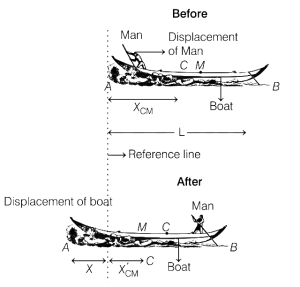
0 likes
View Solution144
EasyMCQ
$30 \,kg$ boy stands at the far edge of a floating plank, whose near edge is against the shore of a river. The plank is $10 \,m$ long and weighs $10 \,kg$. If the boy walks to the near edge of the plank, how far from the shore does the plank move (in $\,m$)?
A
$7$
B
$8$
C
$7.5$
D
$15$
Solution
(C) In the absence of any external horizontal force, the position of the Centre of Mass $(COM)$ of the system remains unchanged.
Let the shore be the origin $(x = 0)$.
The mass of the plank is $M = 10 \,kg$ and its length is $L = 10 \,m$. Its $COM$ is at $x_p = 5 \,m$.
The mass of the boy is $m = 30 \,kg$. Initially, he is at the far edge, so his position is $x_b = 10 \,m$.
The initial position of the system's $COM$ is:
$X_{COM} = \frac{M x_p + m x_b}{M + m} = \frac{10 \times 5 + 30 \times 10}{10 + 30} = \frac{50 + 300}{40} = \frac{350}{40} = 8.75 \,m$.
When the boy walks to the near edge, the plank moves by a distance $d$ away from the shore. The new position of the plank's $COM$ is $x_p' = 5 + d$, and the new position of the boy is $x_b' = d$.
Since the $COM$ remains at the same position:
$X_{COM} = \frac{M x_p' + m x_b'}{M + m}$
$8.75 = \frac{10(5 + d) + 30(d)}{40}$
$8.75 \times 40 = 50 + 10d + 30d$
$350 = 50 + 40d$
$300 = 40d$
$d = \frac{300}{40} = 7.5 \,m$.
Let the shore be the origin $(x = 0)$.
The mass of the plank is $M = 10 \,kg$ and its length is $L = 10 \,m$. Its $COM$ is at $x_p = 5 \,m$.
The mass of the boy is $m = 30 \,kg$. Initially, he is at the far edge, so his position is $x_b = 10 \,m$.
The initial position of the system's $COM$ is:
$X_{COM} = \frac{M x_p + m x_b}{M + m} = \frac{10 \times 5 + 30 \times 10}{10 + 30} = \frac{50 + 300}{40} = \frac{350}{40} = 8.75 \,m$.
When the boy walks to the near edge, the plank moves by a distance $d$ away from the shore. The new position of the plank's $COM$ is $x_p' = 5 + d$, and the new position of the boy is $x_b' = d$.
Since the $COM$ remains at the same position:
$X_{COM} = \frac{M x_p' + m x_b'}{M + m}$
$8.75 = \frac{10(5 + d) + 30(d)}{40}$
$8.75 \times 40 = 50 + 10d + 30d$
$350 = 50 + 40d$
$300 = 40d$
$d = \frac{300}{40} = 7.5 \,m$.
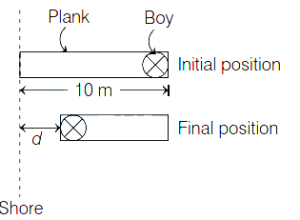
0 likes
View Solution145
DifficultMCQ
Two bodies of mass $4 \,kg$ and $5 \,kg$ are moving along east and north directions with velocities $5 \,m/s$ and $3 \,m/s$ respectively. The magnitude of the velocity of the centre of mass of the system is:
A
$\frac{25}{9} \,m/s$
B
$\frac{9}{25} \,m/s$
C
$\frac{41}{9} \,m/s$
D
$\frac{16}{9} \,m/s$
Solution
(A) The velocity of the centre of mass is given by the formula:
$v_{CM} = \frac{m_1 \vec{v}_1 + m_2 \vec{v}_2}{m_1 + m_2}$
Given: $m_1 = 4 \,kg$,$m_2 = 5 \,kg$. The velocity $\vec{v}_1$ is along the east (x-axis) and $\vec{v}_2$ is along the north (y-axis).
So,$\vec{v}_1 = 5 \hat{i} \,m/s$ and $\vec{v}_2 = 3 \hat{j} \,m/s$.
Substituting the values:
$\vec{v}_{CM} = \frac{4(5 \hat{i}) + 5(3 \hat{j})}{4 + 5}$
$\vec{v}_{CM} = \frac{20 \hat{i} + 15 \hat{j}}{9} = \frac{20}{9} \hat{i} + \frac{15}{9} \hat{j} \,m/s$
The magnitude of the velocity is:
$|v_{CM}| = \sqrt{(\frac{20}{9})^2 + (\frac{15}{9})^2}$
$|v_{CM}| = \sqrt{\frac{400 + 225}{81}} = \sqrt{\frac{625}{81}}$
$|v_{CM}| = \frac{25}{9} \,m/s$
$v_{CM} = \frac{m_1 \vec{v}_1 + m_2 \vec{v}_2}{m_1 + m_2}$
Given: $m_1 = 4 \,kg$,$m_2 = 5 \,kg$. The velocity $\vec{v}_1$ is along the east (x-axis) and $\vec{v}_2$ is along the north (y-axis).
So,$\vec{v}_1 = 5 \hat{i} \,m/s$ and $\vec{v}_2 = 3 \hat{j} \,m/s$.
Substituting the values:
$\vec{v}_{CM} = \frac{4(5 \hat{i}) + 5(3 \hat{j})}{4 + 5}$
$\vec{v}_{CM} = \frac{20 \hat{i} + 15 \hat{j}}{9} = \frac{20}{9} \hat{i} + \frac{15}{9} \hat{j} \,m/s$
The magnitude of the velocity is:
$|v_{CM}| = \sqrt{(\frac{20}{9})^2 + (\frac{15}{9})^2}$
$|v_{CM}| = \sqrt{\frac{400 + 225}{81}} = \sqrt{\frac{625}{81}}$
$|v_{CM}| = \frac{25}{9} \,m/s$
0 likes
View Solution146
DifficultMCQ
Two bodies of $6 \,kg$ and $4 \,kg$ masses have their velocities $5 \hat{i}-2 \hat{j}+10 \hat{k}$ and $10 \hat{i}-2 \hat{j}+5 \hat{k}$ respectively. Then the velocity of their centre of mass is
A
$5 \hat{i}+2 \hat{j}-8 \hat{k}$
B
$7 \hat{i}+2 \hat{j}-8 \hat{k}$
C
$7 \hat{i}-2 \hat{j}+8 \hat{k}$
D
$5 \hat{i}-2 \hat{j}+8 \hat{k}$
Solution
(C) Given,$m_1 = 6 \,kg, m_2 = 4 \,kg$ and $\overrightarrow{v}_1 = 5 \hat{i}-2 \hat{j}+10 \hat{k}, \overrightarrow{v}_2 = 10 \hat{i}-2 \hat{j}+5 \hat{k}$.
The velocity of the centre of mass $\overrightarrow{v}_{cm}$ is given by the formula:
$\overrightarrow{v}_{cm} = \frac{m_1 \overrightarrow{v}_1 + m_2 \overrightarrow{v}_2}{m_1 + m_2}$
Substituting the values:
$\overrightarrow{v}_{cm} = \frac{6(5 \hat{i}-2 \hat{j}+10 \hat{k}) + 4(10 \hat{i}-2 \hat{j}+5 \hat{k})}{6 + 4}$
$\overrightarrow{v}_{cm} = \frac{(30 \hat{i}-12 \hat{j}+60 \hat{k}) + (40 \hat{i}-8 \hat{j}+20 \hat{k})}{10}$
$\overrightarrow{v}_{cm} = \frac{70 \hat{i}-20 \hat{j}+80 \hat{k}}{10}$
$\overrightarrow{v}_{cm} = 7 \hat{i}-2 \hat{j}+8 \hat{k}$
The velocity of the centre of mass $\overrightarrow{v}_{cm}$ is given by the formula:
$\overrightarrow{v}_{cm} = \frac{m_1 \overrightarrow{v}_1 + m_2 \overrightarrow{v}_2}{m_1 + m_2}$
Substituting the values:
$\overrightarrow{v}_{cm} = \frac{6(5 \hat{i}-2 \hat{j}+10 \hat{k}) + 4(10 \hat{i}-2 \hat{j}+5 \hat{k})}{6 + 4}$
$\overrightarrow{v}_{cm} = \frac{(30 \hat{i}-12 \hat{j}+60 \hat{k}) + (40 \hat{i}-8 \hat{j}+20 \hat{k})}{10}$
$\overrightarrow{v}_{cm} = \frac{70 \hat{i}-20 \hat{j}+80 \hat{k}}{10}$
$\overrightarrow{v}_{cm} = 7 \hat{i}-2 \hat{j}+8 \hat{k}$
0 likes
View SolutionSystem of Particles and Rotational Motion — Motion of Centre of Mass · Frequently Asked Questions
1Are these System of Particles and Rotational Motion questions useful for JEE and NEET?
Yes. All questions in this section are mapped to JEE Main and NEET exam patterns. Previous year questions from JEE Main, NEET, GUJCET and state-level exams are included with full solutions.
2Can I switch to Hindi or Gujarati for these questions?
Yes. Use the language tabs in the hero section or the sidebar to view the same questions and solutions in English, Hindi or Gujarati.
3How do I generate a question paper from this subtopic?
Use the Vedclass Exam Paper Generator — select the chapter and subtopic, set difficulty, and generate Sets A, B, C, D automatically. First 3 chapters of every subject are free.
Vedclass Products
For Students
Vedclass Test Series
Mock tests in real JEE/NEET style with performance analysis. 5-day free trial.
Start Free TrialFor Teachers
Exam Paper Generator
Generate Set A/B/C/D papers from this chapter in 2 minutes. 3 chapters free.
Try FreeFor Institutes
Online Exam Module
Live online exams with unlimited students, 360° analytics & white-label branding.
See DemoFor Teachers & Institutes
Generate a System of Particles and Rotational Motion Exam Paper in 2 Minutes
Select subtopic & difficulty — Sets A, B, C, D auto-generated with No Repeat logic.
First 3 chapters of every subject are free — no payment required.