
A English
Moment of Inertia and Radius of gyration Questions in English
Class 11 Physics · System of Particles and Rotational Motion · Moment of Inertia and Radius of gyration
371+
Questions
English
Language
100%
With Solutions
Showing 50 of 371 questions in English
101
EasyMCQ
The analogue of mass in rotational motion is:
A
moment of inertia
B
angular momentum
C
torque
D
none of the above
Solution
(A) In translational motion,the property of a body to resist a change in its state of rest or uniform motion is called mass $(m)$.
In rotational motion,the property of a body to resist a change in its state of rotational motion is called the moment of inertia $(I)$.
The rotational analogue of Newton's second law $(F = ma)$ is $\tau = I\alpha$,where $\tau$ is torque,$I$ is the moment of inertia,and $\alpha$ is angular acceleration.
Thus,the moment of inertia plays the same role in rotational motion as mass does in translational motion.
Therefore,the correct option is $A$.
In rotational motion,the property of a body to resist a change in its state of rotational motion is called the moment of inertia $(I)$.
The rotational analogue of Newton's second law $(F = ma)$ is $\tau = I\alpha$,where $\tau$ is torque,$I$ is the moment of inertia,and $\alpha$ is angular acceleration.
Thus,the moment of inertia plays the same role in rotational motion as mass does in translational motion.
Therefore,the correct option is $A$.
0 likes
View Solution102
DifficultMCQ
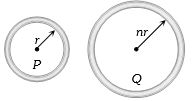
From a uniform wire,two circular loops are made: $(i)\ P$ of radius $r$ and $(ii)\ Q$ of radius $nr$. If the moment of inertia of $Q$ about an axis passing through its center and perpendicular to its plane is $8$ times that of $P$ about a similar axis,the value of $n$ is (diameter of the wire is very much smaller than $r$ or $nr$).
A
$8$
B
$6$
C
$4$
D
$2$
Solution
(D) Let the mass per unit length of the wire be $\lambda$.
The circumference of loop $P$ is $2\pi r$,so its mass is $M_P = \lambda(2\pi r)$.
The moment of inertia of loop $P$ about an axis passing through its center and perpendicular to its plane is $I_P = M_P r^2 = \lambda(2\pi r)r^2 = 2\pi\lambda r^3$.
The circumference of loop $Q$ is $2\pi(nr)$,so its mass is $M_Q = \lambda(2\pi nr) = n M_P$.
The moment of inertia of loop $Q$ about a similar axis is $I_Q = M_Q (nr)^2 = (n M_P)(n^2 r^2) = n^3 M_P r^2 = n^3 I_P$.
Given that $I_Q = 8 I_P$,we have $n^3 I_P = 8 I_P$.
Therefore,$n^3 = 8$,which gives $n = 2$.
The circumference of loop $P$ is $2\pi r$,so its mass is $M_P = \lambda(2\pi r)$.
The moment of inertia of loop $P$ about an axis passing through its center and perpendicular to its plane is $I_P = M_P r^2 = \lambda(2\pi r)r^2 = 2\pi\lambda r^3$.
The circumference of loop $Q$ is $2\pi(nr)$,so its mass is $M_Q = \lambda(2\pi nr) = n M_P$.
The moment of inertia of loop $Q$ about a similar axis is $I_Q = M_Q (nr)^2 = (n M_P)(n^2 r^2) = n^3 M_P r^2 = n^3 I_P$.
Given that $I_Q = 8 I_P$,we have $n^3 I_P = 8 I_P$.
Therefore,$n^3 = 8$,which gives $n = 2$.
0 likes
View Solution103
MediumMCQ
The moment of inertia of a sphere of mass $M$ and radius $R$ about an axis passing through its centre is $\frac{2}{5} M R^2$. The radius of gyration of the sphere about a parallel axis to the above and tangent to the sphere is
A
$ \frac{7}{5}R $
B
$ \frac{3}{5}R $
C
$ \sqrt{\frac{7}{5}} R $
D
$ \sqrt{\frac{3}{5}} R $
Solution
(C) The moment of inertia of a sphere about an axis passing through its centre is $I_{cm} = \frac{2}{5}MR^2$.
Using the parallel axis theorem,the moment of inertia $I$ about a tangent axis is $I = I_{cm} + MR^2$.
Substituting the values,$I = \frac{2}{5}MR^2 + MR^2 = \frac{7}{5}MR^2$.
The radius of gyration $K$ is defined by $I = MK^2$.
Therefore,$MK^2 = \frac{7}{5}MR^2$.
Solving for $K$,we get $K = \sqrt{\frac{7}{5}}R$.
Using the parallel axis theorem,the moment of inertia $I$ about a tangent axis is $I = I_{cm} + MR^2$.
Substituting the values,$I = \frac{2}{5}MR^2 + MR^2 = \frac{7}{5}MR^2$.
The radius of gyration $K$ is defined by $I = MK^2$.
Therefore,$MK^2 = \frac{7}{5}MR^2$.
Solving for $K$,we get $K = \sqrt{\frac{7}{5}}R$.
0 likes
View Solution104
DifficultMCQ
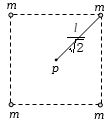
Four particles,each of mass $m$,are placed at the corners of a square of side $l$. The radius of gyration of the system about an axis passing through the center of the square and perpendicular to its plane is:
A
$ \frac{l}{\sqrt{2}} $
B
$ \frac{l}{2} $
C
$ l $
D
$ (\sqrt{2})l $
Solution
(A) The distance of each particle from the center $P$ of the square is $r = \frac{l}{\sqrt{2}}$.
The moment of inertia $I$ of the system about an axis passing through the center $P$ and perpendicular to the plane is given by:
$I = \sum m_i r_i^2 = 4 \times m \times r^2 = 4m \left( \frac{l}{\sqrt{2}} \right)^2 = 4m \left( \frac{l^2}{2} \right) = 2ml^2$.
The radius of gyration $K$ is defined by the relation $I = MK^2$,where $M$ is the total mass of the system.
Here,$M = 4m$,so:
$4mK^2 = 2ml^2$
$K^2 = \frac{2ml^2}{4m} = \frac{l^2}{2}$
$K = \frac{l}{\sqrt{2}}$.
The moment of inertia $I$ of the system about an axis passing through the center $P$ and perpendicular to the plane is given by:
$I = \sum m_i r_i^2 = 4 \times m \times r^2 = 4m \left( \frac{l}{\sqrt{2}} \right)^2 = 4m \left( \frac{l^2}{2} \right) = 2ml^2$.
The radius of gyration $K$ is defined by the relation $I = MK^2$,where $M$ is the total mass of the system.
Here,$M = 4m$,so:
$4mK^2 = 2ml^2$
$K^2 = \frac{2ml^2}{4m} = \frac{l^2}{2}$
$K = \frac{l}{\sqrt{2}}$.
0 likes
View Solution105
EasyMCQ
The radius of gyration of a body depends upon
A
on the size and mass of the body
B
mass distribution and axis of rotation
C
on the size of the body
D
on the mass of the body
Solution
(B) The radius of gyration $K$ of a body is defined by the relation $I = MK^2$,where $I$ is the moment of inertia and $M$ is the total mass of the body.
From this,$K = \sqrt{I/M}$.
The moment of inertia $I$ of a body depends on the distribution of mass relative to the axis of rotation.
Since $K$ is derived from $I$ and $M$,and $I$ itself accounts for the mass distribution relative to the axis,the radius of gyration $K$ depends on the mass distribution and the chosen axis of rotation.
Therefore,the correct option is $B$.
From this,$K = \sqrt{I/M}$.
The moment of inertia $I$ of a body depends on the distribution of mass relative to the axis of rotation.
Since $K$ is derived from $I$ and $M$,and $I$ itself accounts for the mass distribution relative to the axis,the radius of gyration $K$ depends on the mass distribution and the chosen axis of rotation.
Therefore,the correct option is $B$.
0 likes
View Solution106
MediumMCQ
The radius of gyration of a disc of mass $50 \, g$ and radius $2.5 \, cm$ about an axis passing through its center of gravity and perpendicular to its plane is ....... $cm$.
A
$0.52$
B
$1.76$
C
$3.54$
D
$6.54$
Solution
(B) The moment of inertia $(I)$ of a disc about an axis passing through its center of gravity and perpendicular to its plane is given by $I = \frac{1}{2}MR^2$.
By the definition of radius of gyration $(K)$,the moment of inertia is also expressed as $I = MK^2$.
Equating the two expressions: $MK^2 = \frac{1}{2}MR^2$.
Simplifying,we get $K^2 = \frac{R^2}{2}$,which implies $K = \frac{R}{\sqrt{2}}$.
Given $R = 2.5 \, cm$,we calculate $K = \frac{2.5}{\sqrt{2}} \approx \frac{2.5}{1.414} \approx 1.767 \, cm$.
Rounding to the nearest provided option,we get $1.76 \, cm$.
By the definition of radius of gyration $(K)$,the moment of inertia is also expressed as $I = MK^2$.
Equating the two expressions: $MK^2 = \frac{1}{2}MR^2$.
Simplifying,we get $K^2 = \frac{R^2}{2}$,which implies $K = \frac{R}{\sqrt{2}}$.
Given $R = 2.5 \, cm$,we calculate $K = \frac{2.5}{\sqrt{2}} \approx \frac{2.5}{1.414} \approx 1.767 \, cm$.
Rounding to the nearest provided option,we get $1.76 \, cm$.
0 likes
View Solution107
EasyMCQ
The radius of gyration of a disc of mass $100\,g$ and radius $5\,cm$,about an axis passing through its centre of gravity and perpendicular to the plane,is ....... $cm$.
A
$3.54$
B
$1.54$
C
$4.54$
D
$2.5$
Solution
(A) The moment of inertia $(I)$ of a disc about an axis passing through its centre of gravity and perpendicular to its plane is given by $I = \frac{1}{2}MR^2$.
By definition,the radius of gyration $(K)$ is related to the moment of inertia by $I = MK^2$.
Equating the two expressions: $MK^2 = \frac{1}{2}MR^2$.
Canceling mass $(M)$ from both sides: $K^2 = \frac{R^2}{2}$.
Taking the square root: $K = \frac{R}{\sqrt{2}}$.
Given the radius $R = 5\,cm$,we have $K = \frac{5}{\sqrt{2}} \approx \frac{5}{1.414} \approx 3.535\,cm$.
Rounding to two decimal places,we get $K = 3.54\,cm$.
By definition,the radius of gyration $(K)$ is related to the moment of inertia by $I = MK^2$.
Equating the two expressions: $MK^2 = \frac{1}{2}MR^2$.
Canceling mass $(M)$ from both sides: $K^2 = \frac{R^2}{2}$.
Taking the square root: $K = \frac{R}{\sqrt{2}}$.
Given the radius $R = 5\,cm$,we have $K = \frac{5}{\sqrt{2}} \approx \frac{5}{1.414} \approx 3.535\,cm$.
Rounding to two decimal places,we get $K = 3.54\,cm$.
0 likes
View Solution108
EasyMCQ
$A$ cylinder of mass $500 \ g$ and radius $10 \ cm$ has a moment of inertia about an axis passing through its centre and parallel to its length equal to:
A
$2.5 \times 10^{-3} \ kg \cdot m^2$
B
$2 \times 10^{-3} \ kg \cdot m^2$
C
$5 \times 10^{-3} \ kg \cdot m^2$
D
$3.5 \times 10^{-3} \ kg \cdot m^2$
Solution
(A) The moment of inertia $(I)$ of a solid cylinder about its central longitudinal axis is given by the formula: $I = \frac{1}{2}MR^2$.
Given:
Mass $(M)$ = $500 \ g = 0.5 \ kg$.
Radius $(R)$ = $10 \ cm = 0.1 \ m$.
Substituting the values into the formula:
$I = \frac{1}{2} \times 0.5 \times (0.1)^2$
$I = 0.25 \times 0.01$
$I = 0.0025 \ kg \cdot m^2$
$I = 2.5 \times 10^{-3} \ kg \cdot m^2$.
Given:
Mass $(M)$ = $500 \ g = 0.5 \ kg$.
Radius $(R)$ = $10 \ cm = 0.1 \ m$.
Substituting the values into the formula:
$I = \frac{1}{2} \times 0.5 \times (0.1)^2$
$I = 0.25 \times 0.01$
$I = 0.0025 \ kg \cdot m^2$
$I = 2.5 \times 10^{-3} \ kg \cdot m^2$.
0 likes
View Solution109
MediumMCQ
What is the moment of inertia of a thin circular disc about its diameter? ($M$ is the mass and $R$ is the radius of the disc.)
A
$ \frac{MR^2}{4} $
B
$ \frac{MR^2}{2} $
C
$ MR^2 $
D
$ 2MR^2 $
Solution
(A) The moment of inertia of a thin circular disc about an axis passing through its center and perpendicular to its plane is $I_z = \frac{1}{2}MR^2$.
According to the perpendicular axis theorem,$I_z = I_x + I_y$.
Since the disc is symmetric,the moment of inertia about any diameter is the same,so $I_x = I_y = I_d$.
Therefore,$I_z = 2I_d$.
Substituting the value of $I_z$,we get $\frac{1}{2}MR^2 = 2I_d$.
Solving for $I_d$,we get $I_d = \frac{1}{4}MR^2$.
According to the perpendicular axis theorem,$I_z = I_x + I_y$.
Since the disc is symmetric,the moment of inertia about any diameter is the same,so $I_x = I_y = I_d$.
Therefore,$I_z = 2I_d$.
Substituting the value of $I_z$,we get $\frac{1}{2}MR^2 = 2I_d$.
Solving for $I_d$,we get $I_d = \frac{1}{4}MR^2$.
0 likes
View Solution110
EasyMCQ
Radius of gyration of a uniform thin rod of length $L$ about an axis passing normally through its centre of mass is
A
$ \frac{L}{\sqrt{12}} $
B
$ \frac{L}{12} $
C
$ \sqrt{12} L $
D
$ 12 L $
Solution
(A) The moment of inertia $I$ of a uniform thin rod of mass $M$ and length $L$ about an axis passing through its centre of mass and perpendicular to its length is given by $I = \frac{ML^2}{12}$.
By definition,the radius of gyration $K$ is related to the moment of inertia by the equation $I = MK^2$.
Equating the two expressions for $I$,we get $MK^2 = \frac{ML^2}{12}$.
Canceling $M$ from both sides,we have $K^2 = \frac{L^2}{12}$.
Taking the square root of both sides,we find $K = \frac{L}{\sqrt{12}}$.
By definition,the radius of gyration $K$ is related to the moment of inertia by the equation $I = MK^2$.
Equating the two expressions for $I$,we get $MK^2 = \frac{ML^2}{12}$.
Canceling $M$ from both sides,we have $K^2 = \frac{L^2}{12}$.
Taking the square root of both sides,we find $K = \frac{L}{\sqrt{12}}$.
0 likes
View Solution111
MediumMCQ
Two rings have their moments of inertia in the ratio $2:1$ and their diameters are in the ratio $2:1$. The ratio of their masses is
A
$2:1$
B
$1:2$
C
$1:4$
D
$1:1$
Solution
(B) The moment of inertia $I$ of a ring about its central axis is given by $I = mR^2$,where $m$ is the mass and $R$ is the radius.
Since the diameter $D = 2R$,we can write $R = D/2$.
Substituting this into the formula,we get $I = m(D/2)^2 = m(D^2/4)$.
This implies $I \propto mD^2$,or $m \propto I/D^2$.
Given the ratios $I_1/I_2 = 2/1$ and $D_1/D_2 = 2/1$,we find the ratio of masses as:
$m_1/m_2 = (I_1/I_2) \times (D_2/D_1)^2$
$m_1/m_2 = (2/1) \times (1/2)^2 = 2 \times (1/4) = 2/4 = 1/2$.
Therefore,the ratio of their masses is $1:2$.
Since the diameter $D = 2R$,we can write $R = D/2$.
Substituting this into the formula,we get $I = m(D/2)^2 = m(D^2/4)$.
This implies $I \propto mD^2$,or $m \propto I/D^2$.
Given the ratios $I_1/I_2 = 2/1$ and $D_1/D_2 = 2/1$,we find the ratio of masses as:
$m_1/m_2 = (I_1/I_2) \times (D_2/D_1)^2$
$m_1/m_2 = (2/1) \times (1/2)^2 = 2 \times (1/4) = 2/4 = 1/2$.
Therefore,the ratio of their masses is $1:2$.
0 likes
View Solution112
EasyMCQ
If the mass and radius of a hollow sphere are $M$ and $R$ respectively,then its moment of inertia with respect to its diameter is:
A
$ \frac{2}{5}MR^2 $
B
$ \frac{2}{3}MR^2 $
C
$ \frac{1}{2}MR^2 $
D
$ MR^2 $
Solution
(B) The moment of inertia of a hollow sphere (thin spherical shell) about an axis passing through its center (diameter) is given by the standard formula $I = \frac{2}{3}MR^2$.
Here,$M$ is the mass of the hollow sphere and $R$ is its radius.
Therefore,the correct option is $B$.
Here,$M$ is the mass of the hollow sphere and $R$ is its radius.
Therefore,the correct option is $B$.
0 likes
View Solution113
DifficultMCQ
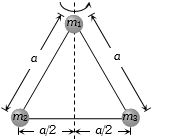
Three point masses $m_1, m_2, m_3$ are placed at the vertices of an equilateral triangle of side $a$. The moment of inertia of the system about an axis passing through the vertex $m_1$ and perpendicular to the plane of the triangle is not what is asked; rather,the axis passes through $m_1$ and bisects the opposite side $m_2m_3$. What is the moment of inertia of the system about this axis?
A
$ (m_2 + m_3) \frac{a^2}{4} $
B
$ (m_1 + m_2 + m_3) a^2 $
C
$ (m_1 + m_2) \frac{a^2}{4} $
D
$ (m_2 + m_3) a^2 $
Solution
(A) The moment of inertia $I$ of a system of point masses about an axis is given by $I = \sum m_i r_i^2$,where $r_i$ is the perpendicular distance of the $i$-th mass from the axis.
For the given axis passing through $m_1$ and bisecting the side $m_2m_3$:
$1$. The distance of $m_1$ from the axis is $r_1 = 0$.
$2$. The distance of $m_2$ from the axis is $r_2 = a/2$.
$3$. The distance of $m_3$ from the axis is $r_3 = a/2$.
Therefore,the total moment of inertia is:
$I = m_1(0)^2 + m_2(a/2)^2 + m_3(a/2)^2$
$I = 0 + m_2(a^2/4) + m_3(a^2/4)$
$I = (m_2 + m_3) \frac{a^2}{4}$
For the given axis passing through $m_1$ and bisecting the side $m_2m_3$:
$1$. The distance of $m_1$ from the axis is $r_1 = 0$.
$2$. The distance of $m_2$ from the axis is $r_2 = a/2$.
$3$. The distance of $m_3$ from the axis is $r_3 = a/2$.
Therefore,the total moment of inertia is:
$I = m_1(0)^2 + m_2(a/2)^2 + m_3(a/2)^2$
$I = 0 + m_2(a^2/4) + m_3(a^2/4)$
$I = (m_2 + m_3) \frac{a^2}{4}$
0 likes
View Solution114
DifficultMCQ
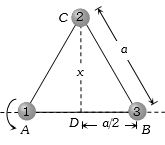
Three particles of mass $m$ each are placed at the three vertices of an equilateral triangle. The length of each side of the triangle is $a$. The moment of inertia of this system about any side of the triangle is:
A
$m a^2$
B
$3 m a^2$
C
$\frac{3}{4} m a^2$
D
$\frac{2}{3} m a^2$
Solution
(C) Let the vertices of the equilateral triangle be $A$,$B$,and $C$. Let the axis of rotation be the side $AB$.
The particles at $A$ and $B$ lie on the axis of rotation,so their perpendicular distances from the axis are $0$. Thus,their contribution to the moment of inertia is $0$.
The particle at $C$ is at a perpendicular distance $x$ from the side $AB$. In an equilateral triangle of side $a$,the altitude $x$ is given by $x = a \sin(60^\circ) = \frac{\sqrt{3}}{2} a$.
The moment of inertia of the system about side $AB$ is $I = \sum m_i r_i^2 = m(0)^2 + m(0)^2 + m(x)^2$.
$I = m x^2 = m \left( \frac{\sqrt{3}}{2} a \right)^2 = m \left( \frac{3}{4} a^2 \right) = \frac{3}{4} m a^2$.
The particles at $A$ and $B$ lie on the axis of rotation,so their perpendicular distances from the axis are $0$. Thus,their contribution to the moment of inertia is $0$.
The particle at $C$ is at a perpendicular distance $x$ from the side $AB$. In an equilateral triangle of side $a$,the altitude $x$ is given by $x = a \sin(60^\circ) = \frac{\sqrt{3}}{2} a$.
The moment of inertia of the system about side $AB$ is $I = \sum m_i r_i^2 = m(0)^2 + m(0)^2 + m(x)^2$.
$I = m x^2 = m \left( \frac{\sqrt{3}}{2} a \right)^2 = m \left( \frac{3}{4} a^2 \right) = \frac{3}{4} m a^2$.
0 likes
View Solution115
EasyMCQ
Of the two eggs which have identical sizes,shapes and weights,one is raw and the other is half-boiled. The ratio between the moment of inertia of the raw egg to the half-boiled egg about their central axis is
A
one
B
more than one
C
less than one
D
Not comparable
Solution
(B) raw egg contains liquid inside,which does not rotate with the shell. Thus,it behaves like a spherical shell with mass concentrated near the surface. The moment of inertia of a spherical shell is $I_{raw} = \frac{2}{3}MR^2$.
$A$ half-boiled egg is more viscous and behaves more like a solid sphere as the contents rotate with the shell. The moment of inertia of a solid sphere is $I_{boiled} = \frac{2}{5}MR^2$.
Therefore,the ratio of the moment of inertia of the raw egg to the half-boiled egg is:
$\frac{I_{raw}}{I_{boiled}} = \frac{\frac{2}{3}MR^2}{\frac{2}{5}MR^2} = \frac{5}{3} = 1.67$.
Since $1.67 > 1$,the ratio is more than one.
$A$ half-boiled egg is more viscous and behaves more like a solid sphere as the contents rotate with the shell. The moment of inertia of a solid sphere is $I_{boiled} = \frac{2}{5}MR^2$.
Therefore,the ratio of the moment of inertia of the raw egg to the half-boiled egg is:
$\frac{I_{raw}}{I_{boiled}} = \frac{\frac{2}{3}MR^2}{\frac{2}{5}MR^2} = \frac{5}{3} = 1.67$.
Since $1.67 > 1$,the ratio is more than one.
0 likes
View Solution116
EasyMCQ
$A$ rod has a length of $1 \ m$ and a mass of $0.12 \ kg$. The moment of inertia about an axis passing through its center and perpendicular to its length is ...... $kg \cdot m^2$.
A
$0.01$
B
$0.001$
C
$1$
D
$10$
Solution
(A) The moment of inertia $(I)$ of a uniform rod of mass $M$ and length $L$ about an axis passing through its center and perpendicular to its length is given by the formula:
$I = \frac{ML^2}{12}$
Given:
Mass $(M)$ = $0.12 \ kg$
Length $(L)$ = $1 \ m$
Substituting the values into the formula:
$I = \frac{0.12 \times (1)^2}{12}$
$I = \frac{0.12}{12}$
$I = 0.01 \ kg \cdot m^2$
Therefore,the correct option is $A$.
$I = \frac{ML^2}{12}$
Given:
Mass $(M)$ = $0.12 \ kg$
Length $(L)$ = $1 \ m$
Substituting the values into the formula:
$I = \frac{0.12 \times (1)^2}{12}$
$I = \frac{0.12}{12}$
$I = 0.01 \ kg \cdot m^2$
Therefore,the correct option is $A$.
0 likes
View Solution117
MediumMCQ
Two rings of the same radius and mass are placed such that their centers are at the same point and their planes are mutually perpendicular. The moment of inertia of this system about an axis passing through the center and perpendicular to the plane of one of the rings is (mass of ring = $m$,radius = $r$):
A
$ \frac{1}{2}mr^2 $
B
$ mr^2 $
C
$ \frac{3}{2}mr^2 $
D
$ 2mr^2 $
Solution
(C) Let the two rings be $1$ and $2$.
For ring $1$,the axis of rotation is perpendicular to its plane and passes through its center. The moment of inertia of ring $1$ about this axis is $I_1 = mr^2$.
For ring $2$,the axis of rotation lies in its plane and passes through its center (i.e.,it is a diameter of ring $2$). The moment of inertia of ring $2$ about this diameter is $I_2 = \frac{1}{2}mr^2$.
The total moment of inertia of the system about the given axis is $I = I_1 + I_2 = mr^2 + \frac{1}{2}mr^2 = \frac{3}{2}mr^2$.
For ring $1$,the axis of rotation is perpendicular to its plane and passes through its center. The moment of inertia of ring $1$ about this axis is $I_1 = mr^2$.
For ring $2$,the axis of rotation lies in its plane and passes through its center (i.e.,it is a diameter of ring $2$). The moment of inertia of ring $2$ about this diameter is $I_2 = \frac{1}{2}mr^2$.
The total moment of inertia of the system about the given axis is $I = I_1 + I_2 = mr^2 + \frac{1}{2}mr^2 = \frac{3}{2}mr^2$.
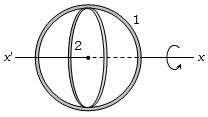
0 likes
View Solution118
EasyMCQ
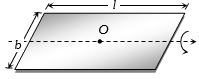
The moment of inertia of a uniform rectangular plate about an axis passing through its center and parallel to its length $(l)$ is ($b =$ width of the rectangular plate):
A
$ \frac{Mb^2}{4} $
B
$ \frac{Mb^3}{6} $
C
$ \frac{Mb^3}{12} $
D
$ \frac{Mb^2}{12} $
Solution
(D) For a uniform rectangular plate of mass $M$,length $l$,and width $b$,the moment of inertia about an axis passing through its center and parallel to its length $l$ is calculated by treating the plate as a series of rods of length $l$ stacked along the width $b$.
The moment of inertia of a thin rod of mass $m$ and length $l$ about its center is $I = \frac{ml^2}{12}$.
For the rectangular plate,we consider an elemental strip of width $dy$ at a distance $y$ from the central axis parallel to the length. The mass of this strip is $dm = \frac{M}{b} dy$.
The moment of inertia of this strip about the central axis is $dI = (dm) y^2 = \left( \frac{M}{b} dy \right) y^2$.
Integrating this from $y = -b/2$ to $y = b/2$:
$I = \int_{-b/2}^{b/2} \frac{M}{b} y^2 dy = \frac{M}{b} \left[ \frac{y^3}{3} \right]_{-b/2}^{b/2} = \frac{M}{b} \left( \frac{b^3}{24} - (-\frac{b^3}{24}) \right) = \frac{M}{b} \left( \frac{2b^3}{24} \right) = \frac{Mb^2}{12}$.
Thus,the correct option is $(D)$.
The moment of inertia of a thin rod of mass $m$ and length $l$ about its center is $I = \frac{ml^2}{12}$.
For the rectangular plate,we consider an elemental strip of width $dy$ at a distance $y$ from the central axis parallel to the length. The mass of this strip is $dm = \frac{M}{b} dy$.
The moment of inertia of this strip about the central axis is $dI = (dm) y^2 = \left( \frac{M}{b} dy \right) y^2$.
Integrating this from $y = -b/2$ to $y = b/2$:
$I = \int_{-b/2}^{b/2} \frac{M}{b} y^2 dy = \frac{M}{b} \left[ \frac{y^3}{3} \right]_{-b/2}^{b/2} = \frac{M}{b} \left( \frac{b^3}{24} - (-\frac{b^3}{24}) \right) = \frac{M}{b} \left( \frac{2b^3}{24} \right) = \frac{Mb^2}{12}$.
Thus,the correct option is $(D)$.
0 likes
View Solution119
MediumMCQ
Two circular discs of iron have the same thickness. The diameter of disc $A$ is twice that of disc $B$. The moment of inertia of $A$ will be ........ times that of $B$.
A
$2$
B
$4$
C
$8$
D
$16$
Solution
(D) The moment of inertia of a circular disc is given by $I = \frac{1}{2}MR^2$.
Since mass $M = \text{density} (\rho) \times \text{volume} (V) = \rho \times (\pi R^2 t)$,where $t$ is the thickness.
Substituting $M$ into the formula: $I = \frac{1}{2} (\pi R^2 t \rho) R^2 = \frac{1}{2} \pi t \rho R^4$.
Given that the discs are made of the same material (same $\rho$) and have the same thickness $(t)$,we have $I \propto R^4$.
Since diameter $D = 2R$,it follows that $I \propto D^4$.
Therefore,$\frac{I_A}{I_B} = \left( \frac{D_A}{D_B} \right)^4$.
Given $D_A = 2 D_B$,we get $\frac{I_A}{I_B} = (2)^4 = 16$.
Thus,the moment of inertia of $A$ is $16$ times that of $B$.
Since mass $M = \text{density} (\rho) \times \text{volume} (V) = \rho \times (\pi R^2 t)$,where $t$ is the thickness.
Substituting $M$ into the formula: $I = \frac{1}{2} (\pi R^2 t \rho) R^2 = \frac{1}{2} \pi t \rho R^4$.
Given that the discs are made of the same material (same $\rho$) and have the same thickness $(t)$,we have $I \propto R^4$.
Since diameter $D = 2R$,it follows that $I \propto D^4$.
Therefore,$\frac{I_A}{I_B} = \left( \frac{D_A}{D_B} \right)^4$.
Given $D_A = 2 D_B$,we get $\frac{I_A}{I_B} = (2)^4 = 16$.
Thus,the moment of inertia of $A$ is $16$ times that of $B$.
0 likes
View Solution120
DifficultMCQ
The ratio of the masses of two circular rings is $1:2$ and the ratio of their diameters is $2:1$. The ratio of their moments of inertia is:
A
$1:4$
B
$2:1$
C
$4:1$
D
$\sqrt{2}:1$
Solution
(B) The moment of inertia $I$ of a circular ring about its central axis is given by $I = MR^2$,where $M$ is the mass and $R$ is the radius.
Since the ratio of diameters is $2:1$,the ratio of radii $R_1/R_2$ is also $2:1$.
Given $M_1/M_2 = 1/2$ and $R_1/R_2 = 2/1$.
The ratio of moments of inertia is $\frac{I_1}{I_2} = \frac{M_1 R_1^2}{M_2 R_2^2} = \left( \frac{M_1}{M_2} \right) \left( \frac{R_1}{R_2} \right)^2$.
Substituting the values: $\frac{I_1}{I_2} = \left( \frac{1}{2} \right) \times \left( \frac{2}{1} \right)^2 = \frac{1}{2} \times 4 = 2$.
Thus,the ratio is $2:1$.
Since the ratio of diameters is $2:1$,the ratio of radii $R_1/R_2$ is also $2:1$.
Given $M_1/M_2 = 1/2$ and $R_1/R_2 = 2/1$.
The ratio of moments of inertia is $\frac{I_1}{I_2} = \frac{M_1 R_1^2}{M_2 R_2^2} = \left( \frac{M_1}{M_2} \right) \left( \frac{R_1}{R_2} \right)^2$.
Substituting the values: $\frac{I_1}{I_2} = \left( \frac{1}{2} \right) \times \left( \frac{2}{1} \right)^2 = \frac{1}{2} \times 4 = 2$.
Thus,the ratio is $2:1$.
0 likes
View Solution121
DifficultMCQ
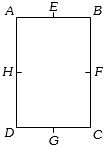
For a rectangle $ABCD$ with $BC = 2AB$,about which axis will the moment of inertia be minimum?
A
$BC$
B
$BD$
C
$HF$
D
$EG$
Solution
(D) Let the mass of the rectangle be $M$. Let $AB = l$ and $BC = 2l$.
The moment of inertia of a rectangle about an axis passing through its center and parallel to its sides is given by $I = \frac{M d^2}{12}$,where $d$ is the side perpendicular to the axis.
$1$. For axis $HF$ (parallel to $AB$): The perpendicular side is $BC = 2l$. So,$I_{HF} = \frac{M(2l)^2}{12} = \frac{4Ml^2}{12} = \frac{Ml^2}{3}$.
$2$. For axis $EG$ (parallel to $BC$): The perpendicular side is $AB = l$. So,$I_{EG} = \frac{Ml^2}{12}$.
Comparing the two,$I_{EG} < I_{HF}$.
Since $EG$ passes through the center and is parallel to the longer side,it results in the minimum moment of inertia among the given options.
The moment of inertia of a rectangle about an axis passing through its center and parallel to its sides is given by $I = \frac{M d^2}{12}$,where $d$ is the side perpendicular to the axis.
$1$. For axis $HF$ (parallel to $AB$): The perpendicular side is $BC = 2l$. So,$I_{HF} = \frac{M(2l)^2}{12} = \frac{4Ml^2}{12} = \frac{Ml^2}{3}$.
$2$. For axis $EG$ (parallel to $BC$): The perpendicular side is $AB = l$. So,$I_{EG} = \frac{Ml^2}{12}$.
Comparing the two,$I_{EG} < I_{HF}$.
Since $EG$ passes through the center and is parallel to the longer side,it results in the minimum moment of inertia among the given options.
0 likes
View Solution122
MediumMCQ
Which of the following has the largest moment of inertia?
A
Moment of inertia of a circular ring about an axis perpendicular to its plane.
B
Moment of inertia of a disc about an axis perpendicular to its plane.
C
Moment of inertia of a solid sphere.
D
Moment of inertia of a rod.
Solution
(A) The moment of inertia $(I)$ depends on the distribution of mass relative to the axis of rotation.
For a circular ring of mass $m$ and radius $R$ about an axis perpendicular to its plane,$I = mR^2$.
For a disc of mass $m$ and radius $R$ about an axis perpendicular to its plane,$I = \frac{1}{2}mR^2$.
For a solid sphere of mass $m$ and radius $R$ about its diameter,$I = \frac{2}{5}mR^2$.
For a rod of mass $m$ and length $L$ about its center,$I = \frac{1}{12}mL^2$.
Comparing these,the ring has the largest moment of inertia because all its mass is concentrated at the maximum distance $R$ from the axis.
For a circular ring of mass $m$ and radius $R$ about an axis perpendicular to its plane,$I = mR^2$.
For a disc of mass $m$ and radius $R$ about an axis perpendicular to its plane,$I = \frac{1}{2}mR^2$.
For a solid sphere of mass $m$ and radius $R$ about its diameter,$I = \frac{2}{5}mR^2$.
For a rod of mass $m$ and length $L$ about its center,$I = \frac{1}{12}mL^2$.
Comparing these,the ring has the largest moment of inertia because all its mass is concentrated at the maximum distance $R$ from the axis.
0 likes
View Solution123
EasyMCQ
The moment of inertia of a ring of mass $M$ and radius $R$ about an axis passing through its center and perpendicular to its plane is:
A
$ \frac{1}{2}M{R^2} $
B
$ M{R^2} $
C
$ \frac{1}{4}M{R^2} $
D
$ \frac{3}{4}M{R^2} $
Solution
(B) The moment of inertia of a rigid body is defined as $I = \sum m_i r_i^2$.
For a ring of mass $M$ and radius $R$,all mass elements are at a constant distance $R$ from the axis passing through the center and perpendicular to the plane.
Therefore,$I = \int r^2 dm = \int R^2 dm = R^2 \int dm$.
Since $\int dm = M$,the moment of inertia is $I = M R^2$.
For a ring of mass $M$ and radius $R$,all mass elements are at a constant distance $R$ from the axis passing through the center and perpendicular to the plane.
Therefore,$I = \int r^2 dm = \int R^2 dm = R^2 \int dm$.
Since $\int dm = M$,the moment of inertia is $I = M R^2$.
0 likes
View Solution124
EasyMCQ
The moment of inertia of an object is effective during:
A
Motion of the object in a curved path
B
Linear motion
C
Rotational motion
D
None of the above
Solution
(C) The moment of inertia is a physical quantity that represents the rotational inertia of a rigid body. It is the rotational analogue of mass in linear motion. It measures the resistance of an object to changes in its rotational motion about a specific axis. Therefore,it is effective during rotational motion.
0 likes
View Solution125
EasyMCQ
If the diameter of a flywheel is increased by $1\%$,then the percentage increase in its moment of inertia about an axis passing through its center will be ....... $\%$
A
$2$
B
$2.5$
C
$1.5$
D
$3$
Solution
(A) The moment of inertia $I$ of a flywheel (disk) about an axis passing through its center is given by $I = \frac{1}{2}MR^2$,where $M$ is the mass and $R$ is the radius.
Since the diameter $D = 2R$,we have $R = D/2$. Substituting this into the formula,$I = \frac{1}{2}M(D/2)^2 = \frac{1}{8}MD^2$.
This shows that $I \propto D^2$.
Using the concept of percentage error,if $D$ increases by $1\%$,the percentage change in $I$ is given by $\frac{\Delta I}{I} \times 100 = 2 \times (\frac{\Delta D}{D} \times 100)$.
Substituting the given value,$\frac{\Delta I}{I} \times 100 = 2 \times 1\% = 2\%$.
Therefore,the percentage increase in the moment of inertia is $2\%$.
Since the diameter $D = 2R$,we have $R = D/2$. Substituting this into the formula,$I = \frac{1}{2}M(D/2)^2 = \frac{1}{8}MD^2$.
This shows that $I \propto D^2$.
Using the concept of percentage error,if $D$ increases by $1\%$,the percentage change in $I$ is given by $\frac{\Delta I}{I} \times 100 = 2 \times (\frac{\Delta D}{D} \times 100)$.
Substituting the given value,$\frac{\Delta I}{I} \times 100 = 2 \times 1\% = 2\%$.
Therefore,the percentage increase in the moment of inertia is $2\%$.
0 likes
View Solution126
MediumMCQ
The moment of inertia of a thin circular plate of mass $1\,kg$ and diameter $0.2\,m$ about one of its diameters is:
A
$5 \times 10^{-3}\,kg\cdot m^2$
B
$2.5 \times 10^{-3}\,kg\cdot m^2$
C
$4 \times 10^{-2}\,kg\cdot m^2$
D
$0.2\,kg\cdot m^2$
Solution
(B) Given: Mass $m = 1\,kg$,Diameter $D = 0.2\,m$.
Radius $r = D/2 = 0.1\,m = 10^{-1}\,m$.
The moment of inertia of a circular plate about its diameter is given by the formula $I = \frac{1}{4}mr^2$.
Substituting the values:
$I = \frac{1}{4} \times 1\,kg \times (0.1\,m)^2$
$I = \frac{1}{4} \times 1 \times 0.01\,kg\cdot m^2$
$I = 0.0025\,kg\cdot m^2 = 2.5 \times 10^{-3}\,kg\cdot m^2$.
Thus,the correct option is $B$.
Radius $r = D/2 = 0.1\,m = 10^{-1}\,m$.
The moment of inertia of a circular plate about its diameter is given by the formula $I = \frac{1}{4}mr^2$.
Substituting the values:
$I = \frac{1}{4} \times 1\,kg \times (0.1\,m)^2$
$I = \frac{1}{4} \times 1 \times 0.01\,kg\cdot m^2$
$I = 0.0025\,kg\cdot m^2 = 2.5 \times 10^{-3}\,kg\cdot m^2$.
Thus,the correct option is $B$.
0 likes
View Solution127
EasyMCQ
What is the radius of gyration of a circular disc of radius $R$ about an axis passing through its center and perpendicular to its plane?
A
$R/\sqrt{2}$
B
$\sqrt{2}R$
C
$R/2$
D
$2R$
Solution
(A) The moment of inertia $(I)$ of a circular disc of mass $M$ and radius $R$ about an axis passing through its center and perpendicular to its plane is given by $I = \frac{1}{2}MR^2$.
By definition,the radius of gyration $(k)$ is related to the moment of inertia by the formula $I = Mk^2$.
Equating the two expressions for $I$:
$Mk^2 = \frac{1}{2}MR^2$
$k^2 = \frac{R^2}{2}$
$k = \frac{R}{\sqrt{2}}$
Therefore,the correct option is $A$.
By definition,the radius of gyration $(k)$ is related to the moment of inertia by the formula $I = Mk^2$.
Equating the two expressions for $I$:
$Mk^2 = \frac{1}{2}MR^2$
$k^2 = \frac{R^2}{2}$
$k = \frac{R}{\sqrt{2}}$
Therefore,the correct option is $A$.
0 likes
View Solution128
MediumMCQ
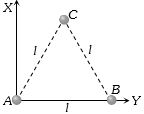
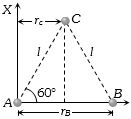
Three particles,each of mass $m \; g$,are situated at the vertices of an equilateral triangle $ABC$ of side $l \; cm$ (as shown in the figure). The moment of inertia of the system about a line $AX$ perpendicular to $AB$ and in the plane of $ABC$ in $g \cdot cm^2$ units will be:
A
$ \frac{3}{4} m l^2 $
B
$ 2 m l^2 $
C
$ \frac{5}{4} m l^2 $
D
$ \frac{3}{2} m l^2 $
Solution
(C) The moment of inertia of the system about the axis $AX$ is given by the sum of the moments of inertia of individual particles:
$I = I_A + I_B + I_C$
Since particle $A$ lies on the axis $AX$,its perpendicular distance $r_A = 0$. Thus,$I_A = m(0)^2 = 0$.
Particle $B$ is at a distance $l$ from $A$ along the line $AB$. Since $AX$ is perpendicular to $AB$,the perpendicular distance of $B$ from $AX$ is $r_B = l$. Thus,$I_B = m(l)^2 = m l^2$.
Particle $C$ forms an equilateral triangle with $A$ and $B$. The perpendicular distance of $C$ from the axis $AX$ is the horizontal projection of side $AC$ onto the line perpendicular to $AX$ (which is parallel to $AB$). This distance is $r_C = l \cos(60^{\circ}) = l \cdot \frac{1}{2} = \frac{l}{2}$.
Thus,$I_C = m(r_C)^2 = m(\frac{l}{2})^2 = \frac{m l^2}{4}$.
Total moment of inertia $I = 0 + m l^2 + \frac{m l^2}{4} = \frac{5}{4} m l^2$.
$I = I_A + I_B + I_C$
Since particle $A$ lies on the axis $AX$,its perpendicular distance $r_A = 0$. Thus,$I_A = m(0)^2 = 0$.
Particle $B$ is at a distance $l$ from $A$ along the line $AB$. Since $AX$ is perpendicular to $AB$,the perpendicular distance of $B$ from $AX$ is $r_B = l$. Thus,$I_B = m(l)^2 = m l^2$.
Particle $C$ forms an equilateral triangle with $A$ and $B$. The perpendicular distance of $C$ from the axis $AX$ is the horizontal projection of side $AC$ onto the line perpendicular to $AX$ (which is parallel to $AB$). This distance is $r_C = l \cos(60^{\circ}) = l \cdot \frac{1}{2} = \frac{l}{2}$.
Thus,$I_C = m(r_C)^2 = m(\frac{l}{2})^2 = \frac{m l^2}{4}$.
Total moment of inertia $I = 0 + m l^2 + \frac{m l^2}{4} = \frac{5}{4} m l^2$.
0 likes
View Solution129
DifficultMCQ
The ratio of the radii of gyration of a circular disc about a tangential axis in the plane of the disc and of a circular ring of the same radius about a tangential axis in the plane of the ring is
A
$2 : 3$
B
$2 : 1$
C
$\sqrt{5} : \sqrt{6}$
D
$1 : \sqrt{2}$
Solution
(C) For a circular disc of mass $M$ and radius $R$,the moment of inertia about a tangential axis in its plane is given by $I_{\text{disk}} = I_{\text{cm}} + MR^2 = \frac{1}{4}MR^2 + MR^2 = \frac{5}{4}MR^2$.
Since $I = MK^2$,the radius of gyration $K_{\text{disk}} = \sqrt{\frac{5}{4}}R = \frac{\sqrt{5}}{2}R$.
For a circular ring of mass $M$ and radius $R$,the moment of inertia about a tangential axis in its plane is given by $I_{\text{ring}} = I_{\text{cm}} + MR^2 = \frac{1}{2}MR^2 + MR^2 = \frac{3}{2}MR^2$.
Since $I = MK^2$,the radius of gyration $K_{\text{ring}} = \sqrt{\frac{3}{2}}R = \frac{\sqrt{3}}{\sqrt{2}}R$.
The ratio of the radii of gyration is $\frac{K_{\text{disk}}}{K_{\text{ring}}} = \frac{\sqrt{5}/2}{\sqrt{3}/\sqrt{2}} = \frac{\sqrt{5}}{2} \times \frac{\sqrt{2}}{\sqrt{3}} = \frac{\sqrt{5}}{\sqrt{2} \times \sqrt{3}} = \sqrt{\frac{5}{6}}$.
Since $I = MK^2$,the radius of gyration $K_{\text{disk}} = \sqrt{\frac{5}{4}}R = \frac{\sqrt{5}}{2}R$.
For a circular ring of mass $M$ and radius $R$,the moment of inertia about a tangential axis in its plane is given by $I_{\text{ring}} = I_{\text{cm}} + MR^2 = \frac{1}{2}MR^2 + MR^2 = \frac{3}{2}MR^2$.
Since $I = MK^2$,the radius of gyration $K_{\text{ring}} = \sqrt{\frac{3}{2}}R = \frac{\sqrt{3}}{\sqrt{2}}R$.
The ratio of the radii of gyration is $\frac{K_{\text{disk}}}{K_{\text{ring}}} = \frac{\sqrt{5}/2}{\sqrt{3}/\sqrt{2}} = \frac{\sqrt{5}}{2} \times \frac{\sqrt{2}}{\sqrt{3}} = \frac{\sqrt{5}}{\sqrt{2} \times \sqrt{3}} = \sqrt{\frac{5}{6}}$.
0 likes
View Solution130
MediumMCQ
$A$ solid sphere $A$ and a hollow sphere $B$ have the same mass and the same external radius. Their moments of inertia about their diameters are $I_A$ and $I_B$ respectively. Which of the following relations is correct?
A
$I_A = I_B$
B
$I_A > I_B$
C
$I_A < I_B$
D
$I_A / I_B = d_A / d_B$
Solution
(C) The moment of inertia of a solid sphere of mass $M$ and radius $R$ about its diameter is given by $I_A = \frac{2}{5}MR^2 = 0.4 MR^2$.
The moment of inertia of a hollow sphere of mass $M$ and radius $R$ about its diameter is given by $I_B = \frac{2}{3}MR^2 \approx 0.67 MR^2$.
Since both spheres have the same mass $M$ and the same radius $R$,comparing the coefficients shows that $0.4 MR^2 < 0.67 MR^2$.
Therefore,$I_A < I_B$.
The moment of inertia of a hollow sphere of mass $M$ and radius $R$ about its diameter is given by $I_B = \frac{2}{3}MR^2 \approx 0.67 MR^2$.
Since both spheres have the same mass $M$ and the same radius $R$,comparing the coefficients shows that $0.4 MR^2 < 0.67 MR^2$.
Therefore,$I_A < I_B$.
0 likes
View Solution131
MediumMCQ
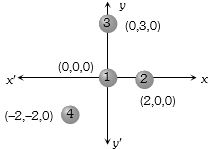
Point masses $1, 2, 3$ and $4 \text{ kg}$ are lying at the points $(0,0,0), (2,0,0), (0,3,0)$ and $(-2,-2,0)$ respectively. The moment of inertia of this system about the $x$-axis will be:
A
$43 \text{ kg} \cdot \text{m}^2$
B
$34 \text{ kg} \cdot \text{m}^2$
C
$27 \text{ kg} \cdot \text{m}^2$
D
$72 \text{ kg} \cdot \text{m}^2$
Solution
(A) The moment of inertia $I$ of a system of particles about an axis is given by $I = \sum m_i r_i^2$, where $r_i$ is the perpendicular distance of the $i$-th particle from the axis of rotation.
For the $x$-axis, the perpendicular distance of a point $(x, y, z)$ is $r = \sqrt{y^2 + z^2}$.
$1$. For mass $m_1 = 1 \text{ kg}$ at $(0,0,0)$: $r_1 = \sqrt{0^2 + 0^2} = 0 \text{ m}$. So, $I_1 = 1 \times 0^2 = 0 \text{ kg} \cdot \text{m}^2$.
$2$. For mass $m_2 = 2 \text{ kg}$ at $(2,0,0)$: $r_2 = \sqrt{0^2 + 0^2} = 0 \text{ m}$. So, $I_2 = 2 \times 0^2 = 0 \text{ kg} \cdot \text{m}^2$.
$3$. For mass $m_3 = 3 \text{ kg}$ at $(0,3,0)$: $r_3 = \sqrt{3^2 + 0^2} = 3 \text{ m}$. So, $I_3 = 3 \times 3^2 = 27 \text{ kg} \cdot \text{m}^2$.
$4$. For mass $m_4 = 4 \text{ kg}$ at $(-2,-2,0)$: $r_4 = \sqrt{(-2)^2 + 0^2} = 2 \text{ m}$. So, $I_4 = 4 \times 2^2 = 16 \text{ kg} \cdot \text{m}^2$.
The total moment of inertia $I = I_1 + I_2 + I_3 + I_4 = 0 + 0 + 27 + 16 = 43 \text{ kg} \cdot \text{m}^2$.
For the $x$-axis, the perpendicular distance of a point $(x, y, z)$ is $r = \sqrt{y^2 + z^2}$.
$1$. For mass $m_1 = 1 \text{ kg}$ at $(0,0,0)$: $r_1 = \sqrt{0^2 + 0^2} = 0 \text{ m}$. So, $I_1 = 1 \times 0^2 = 0 \text{ kg} \cdot \text{m}^2$.
$2$. For mass $m_2 = 2 \text{ kg}$ at $(2,0,0)$: $r_2 = \sqrt{0^2 + 0^2} = 0 \text{ m}$. So, $I_2 = 2 \times 0^2 = 0 \text{ kg} \cdot \text{m}^2$.
$3$. For mass $m_3 = 3 \text{ kg}$ at $(0,3,0)$: $r_3 = \sqrt{3^2 + 0^2} = 3 \text{ m}$. So, $I_3 = 3 \times 3^2 = 27 \text{ kg} \cdot \text{m}^2$.
$4$. For mass $m_4 = 4 \text{ kg}$ at $(-2,-2,0)$: $r_4 = \sqrt{(-2)^2 + 0^2} = 2 \text{ m}$. So, $I_4 = 4 \times 2^2 = 16 \text{ kg} \cdot \text{m}^2$.
The total moment of inertia $I = I_1 + I_2 + I_3 + I_4 = 0 + 0 + 27 + 16 = 43 \text{ kg} \cdot \text{m}^2$.
0 likes
View Solution132
EasyMCQ
$A$ ring of mass $m$ and radius $r$ is melted and recast into a sphere. The moment of inertia of the sphere will be:
A
Greater than the ring
B
Less than the ring
C
Equal to the ring
D
None of the above
Solution
(B) The moment of inertia of a ring about its central axis is $I_{ring} = mr^2$.
When the ring is melted and recast into a sphere of the same mass $m$,let the radius of the sphere be $r'$.
Since the volume remains constant,the density is uniform. However,for a sphere of mass $m$ and radius $r'$,the moment of inertia about its diameter is $I_{sphere} = \frac{2}{5}mr'^2$.
Since the sphere is formed from the material of the ring,the radius of the sphere $r'$ will be significantly smaller than the radius of the ring $r$ (i.e.,$r' \ll r$).
Therefore,$I_{sphere} = \frac{2}{5}mr'^2 < mr^2 = I_{ring}$.
Thus,the moment of inertia of the sphere is less than that of the ring.
When the ring is melted and recast into a sphere of the same mass $m$,let the radius of the sphere be $r'$.
Since the volume remains constant,the density is uniform. However,for a sphere of mass $m$ and radius $r'$,the moment of inertia about its diameter is $I_{sphere} = \frac{2}{5}mr'^2$.
Since the sphere is formed from the material of the ring,the radius of the sphere $r'$ will be significantly smaller than the radius of the ring $r$ (i.e.,$r' \ll r$).
Therefore,$I_{sphere} = \frac{2}{5}mr'^2 < mr^2 = I_{ring}$.
Thus,the moment of inertia of the sphere is less than that of the ring.
0 likes
View Solution133
MediumMCQ
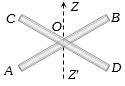
Two rods,each of mass $m$ and length $l$,are joined at their centers to form a cross. What is the moment of inertia of the cross about an axis passing through their common center and perpendicular to the plane of the rods?
A
$ml^2/12$
B
$ml^2/6$
C
$ml^2/3$
D
$ml^2/2$
Solution
(B) The moment of inertia of a single rod of mass $m$ and length $l$ about an axis passing through its center and perpendicular to its length is given by $I = \frac{ml^2}{12}$.
Since the cross is formed by two such rods joined at their centers,the total moment of inertia about the axis passing through their common center and perpendicular to the plane of the rods is the sum of the moments of inertia of the two individual rods.
$I_{total} = I_{rod1} + I_{rod2} = \frac{ml^2}{12} + \frac{ml^2}{12} = \frac{2ml^2}{12} = \frac{ml^2}{6}$.
Since the cross is formed by two such rods joined at their centers,the total moment of inertia about the axis passing through their common center and perpendicular to the plane of the rods is the sum of the moments of inertia of the two individual rods.
$I_{total} = I_{rod1} + I_{rod2} = \frac{ml^2}{12} + \frac{ml^2}{12} = \frac{2ml^2}{12} = \frac{ml^2}{6}$.
0 likes
View Solution134
DifficultMCQ
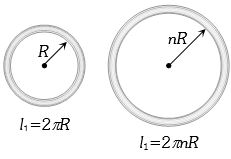
Two rings of the same material have radii $R$ and $nR$ respectively. The ratio of their moments of inertia about an axis passing through their centers and perpendicular to their planes is $1 : 8$. The value of $n$ is:
A
$2$
B
$2\sqrt{2}$
C
$4$
D
$\frac{1}{2}$
Solution
(A) The moment of inertia of a ring of mass $M$ and radius $r$ about an axis passing through its center and perpendicular to its plane is $I = Mr^2$.
Since the rings are made of the same material and have the same cross-sectional area,their mass is proportional to their circumference ($M = \lambda \cdot 2\pi r$,where $\lambda$ is the linear mass density).
For the first ring: $M_1 = \lambda \cdot 2\pi R$ and $I_1 = M_1 R^2 = (\lambda \cdot 2\pi R) R^2 = 2\pi \lambda R^3$.
For the second ring: $M_2 = \lambda \cdot 2\pi (nR)$ and $I_2 = M_2 (nR)^2 = (\lambda \cdot 2\pi nR) (nR)^2 = 2\pi \lambda n^3 R^3$.
The ratio of the moments of inertia is given as $\frac{I_1}{I_2} = \frac{1}{8}$.
Substituting the expressions: $\frac{2\pi \lambda R^3}{2\pi \lambda n^3 R^3} = \frac{1}{n^3} = \frac{1}{8}$.
Therefore,$n^3 = 8$,which gives $n = 2$.
Since the rings are made of the same material and have the same cross-sectional area,their mass is proportional to their circumference ($M = \lambda \cdot 2\pi r$,where $\lambda$ is the linear mass density).
For the first ring: $M_1 = \lambda \cdot 2\pi R$ and $I_1 = M_1 R^2 = (\lambda \cdot 2\pi R) R^2 = 2\pi \lambda R^3$.
For the second ring: $M_2 = \lambda \cdot 2\pi (nR)$ and $I_2 = M_2 (nR)^2 = (\lambda \cdot 2\pi nR) (nR)^2 = 2\pi \lambda n^3 R^3$.
The ratio of the moments of inertia is given as $\frac{I_1}{I_2} = \frac{1}{8}$.
Substituting the expressions: $\frac{2\pi \lambda R^3}{2\pi \lambda n^3 R^3} = \frac{1}{n^3} = \frac{1}{8}$.
Therefore,$n^3 = 8$,which gives $n = 2$.
0 likes
View Solution135
EasyMCQ
$A$ solid cylinder of mass $20 \ kg$ has length $1 \ m$ and radius $0.2 \ m$. Then its moment of inertia (in $kg \cdot m^2$) about its geometrical axis is
A
$0.8$
B
$0.4$
C
$0.2$
D
$20.2$
Solution
(B) The moment of inertia $I$ of a solid cylinder about its geometrical axis (longitudinal axis) is given by the formula:
$I = \frac{1}{2} M R^2$
Given:
Mass $M = 20 \ kg$
Radius $R = 0.2 \ m$
Substituting the values into the formula:
$I = \frac{1}{2} \times 20 \times (0.2)^2$
$I = 10 \times 0.04$
$I = 0.4 \ kg \cdot m^2$
$I = \frac{1}{2} M R^2$
Given:
Mass $M = 20 \ kg$
Radius $R = 0.2 \ m$
Substituting the values into the formula:
$I = \frac{1}{2} \times 20 \times (0.2)^2$
$I = 10 \times 0.04$
$I = 0.4 \ kg \cdot m^2$
0 likes
View Solution136
EasyMCQ
$A$ swimmer curls their body before diving into the water from a height so that:
A
Moment of inertia increases
B
Moment of inertia decreases
C
Angular momentum decreases
D
Angular velocity decreases
Solution
(B) When a swimmer curls their body,the mass distribution shifts closer to the axis of rotation.
According to the formula $I = \sum mr^2$,this reduction in the distance $r$ of the mass from the axis leads to a decrease in the moment of inertia $(I)$.
Since the angular momentum $(L = I\omega)$ remains conserved in the absence of external torque,a decrease in the moment of inertia $(I)$ results in an increase in the angular velocity $(\omega)$.
Therefore,the correct option is $B$.
According to the formula $I = \sum mr^2$,this reduction in the distance $r$ of the mass from the axis leads to a decrease in the moment of inertia $(I)$.
Since the angular momentum $(L = I\omega)$ remains conserved in the absence of external torque,a decrease in the moment of inertia $(I)$ results in an increase in the angular velocity $(\omega)$.
Therefore,the correct option is $B$.
0 likes
View Solution137
EasyMCQ
$A$ person is sitting on a rotating table with their arms outstretched. If they suddenly pull their arms inward,then:
A
The angular velocity will decrease.
B
The angular velocity will remain constant.
C
The moment of inertia will decrease.
D
The angular momentum will increase.
Solution
(C) When the person pulls their arms inward,the mass distribution shifts closer to the axis of rotation.
Since the moment of inertia $I = \sum m_i r_i^2$,decreasing the distance $r$ of the mass from the axis leads to a decrease in the moment of inertia.
According to the law of conservation of angular momentum,$L = I\omega = \text{constant}$.
Since $I$ decreases,the angular velocity $\omega$ must increase to keep $L$ constant.
Therefore,the correct observation is that the moment of inertia decreases.
Since the moment of inertia $I = \sum m_i r_i^2$,decreasing the distance $r$ of the mass from the axis leads to a decrease in the moment of inertia.
According to the law of conservation of angular momentum,$L = I\omega = \text{constant}$.
Since $I$ decreases,the angular velocity $\omega$ must increase to keep $L$ constant.
Therefore,the correct observation is that the moment of inertia decreases.
0 likes
View Solution138
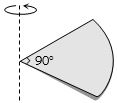
DifficultMCQ
$A$ quarter circular sector is cut from a uniform circular disc. The mass of this sector is $M$. It is rotated about an axis passing through the center of the original disc and perpendicular to its plane. The moment of inertia of this sector about the axis of rotation is:
A
$ \frac{1}{2}MR^2 $
B
$ \frac{1}{4}MR^2 $
C
$ \frac{1}{8}MR^2 $
D
$ \sqrt{2}MR^2 $
Solution
(A) The moment of inertia of a complete uniform circular disc of mass $M_{total}$ and radius $R$ about an axis passing through its center and perpendicular to its plane is given by $I = \frac{1}{2}M_{total}R^2$.
Since the disc is uniform,the mass is distributed proportionally to the area. $A$ quarter sector has $\frac{1}{4}$ of the total area,so its mass $M$ is $\frac{1}{4}M_{total}$,which means $M_{total} = 4M$.
The moment of inertia of the quarter sector about the same axis is $\frac{1}{4}$ of the moment of inertia of the full disc.
Therefore,$I_{sector} = \frac{1}{4} \times (\frac{1}{2} M_{total} R^2) = \frac{1}{4} \times (\frac{1}{2} \times 4M \times R^2) = \frac{1}{2}MR^2$.
Since the disc is uniform,the mass is distributed proportionally to the area. $A$ quarter sector has $\frac{1}{4}$ of the total area,so its mass $M$ is $\frac{1}{4}M_{total}$,which means $M_{total} = 4M$.
The moment of inertia of the quarter sector about the same axis is $\frac{1}{4}$ of the moment of inertia of the full disc.
Therefore,$I_{sector} = \frac{1}{4} \times (\frac{1}{2} M_{total} R^2) = \frac{1}{4} \times (\frac{1}{2} \times 4M \times R^2) = \frac{1}{2}MR^2$.
0 likes
View Solution139
DifficultMCQ
Two discs of the same thickness but different radii are made of two different materials such that their masses are equal. The densities of the materials are in the ratio $1:3$. The ratio of the moments of inertia of the discs about the axes passing through their centers and perpendicular to their planes is:
A
$1:3$
B
$3:1$
C
$1:9$
D
$9:1$
Solution
(B) The moment of inertia $I$ of a disc about an axis passing through its center and perpendicular to its plane is given by $I = \frac{1}{2}MR^2$.
Since the mass $M$ is related to density $\rho$,thickness $t$,and radius $R$ by $M = \rho \cdot V = \rho \cdot (\pi R^2 t)$,we can express the radius as $R^2 = \frac{M}{\pi t \rho}$.
Substituting this into the moment of inertia formula: $I = \frac{1}{2}M \left( \frac{M}{\pi t \rho} \right) = \frac{M^2}{2 \pi t \rho}$.
Given that the mass $M$ and thickness $t$ are constant for both discs,we have $I \propto \frac{1}{\rho}$.
Therefore,the ratio of the moments of inertia is $\frac{I_1}{I_2} = \frac{\rho_2}{\rho_1}$.
Given the ratio of densities $\rho_1 : \rho_2 = 1 : 3$,we have $\frac{\rho_2}{\rho_1} = \frac{3}{1}$.
Thus,$\frac{I_1}{I_2} = 3:1$.
Since the mass $M$ is related to density $\rho$,thickness $t$,and radius $R$ by $M = \rho \cdot V = \rho \cdot (\pi R^2 t)$,we can express the radius as $R^2 = \frac{M}{\pi t \rho}$.
Substituting this into the moment of inertia formula: $I = \frac{1}{2}M \left( \frac{M}{\pi t \rho} \right) = \frac{M^2}{2 \pi t \rho}$.
Given that the mass $M$ and thickness $t$ are constant for both discs,we have $I \propto \frac{1}{\rho}$.
Therefore,the ratio of the moments of inertia is $\frac{I_1}{I_2} = \frac{\rho_2}{\rho_1}$.
Given the ratio of densities $\rho_1 : \rho_2 = 1 : 3$,we have $\frac{\rho_2}{\rho_1} = \frac{3}{1}$.
Thus,$\frac{I_1}{I_2} = 3:1$.
0 likes
View Solution140
EasyMCQ
$A$ flywheel is constructed such that its entire mass is concentrated at the rim because:
A
It increases the power of the flywheel.
B
It increases the speed of the flywheel.
C
It increases the moment of inertia of the flywheel.
D
It prevents the flywheel from breaking.
Solution
(C) The moment of inertia $I$ of a body is given by $I = \sum m_i r_i^2$. By concentrating the mass $M$ at the rim (at a distance $R$ from the axis of rotation),the radius of gyration is maximized. Since $I = MR^2$ for a ring-like structure,placing the mass as far as possible from the axis of rotation significantly increases the moment of inertia. $A$ higher moment of inertia allows the flywheel to store more rotational kinetic energy and resist changes in its rotational speed,which is the primary function of a flywheel.
0 likes
View Solution141
EasyMCQ
$A$ wheel (rim) of mass $6 \ kg$ and radius $40 \ cm$ is rotating at a rate of $300 \ rpm$. Its moment of inertia is ....... $kg \cdot m^2$.
A
$0.092$
B
$0.96$
C
$2.4$
D
$2.98$
Solution
(B) The moment of inertia $I$ of a rim (or thin hoop) about its central axis is given by the formula $I = mr^2$.
Given:
Mass $m = 6 \ kg$
Radius $r = 40 \ cm = 0.4 \ m$
Substituting the values into the formula:
$I = 6 \times (0.4)^2$
$I = 6 \times 0.16$
$I = 0.96 \ kg \cdot m^2$.
Thus,the moment of inertia is $0.96 \ kg \cdot m^2$.
Given:
Mass $m = 6 \ kg$
Radius $r = 40 \ cm = 0.4 \ m$
Substituting the values into the formula:
$I = 6 \times (0.4)^2$
$I = 6 \times 0.16$
$I = 0.96 \ kg \cdot m^2$.
Thus,the moment of inertia is $0.96 \ kg \cdot m^2$.
0 likes
View Solution142
MediumMCQ
Two discs of same mass and same thickness have densities $\rho_1$ and $\rho_2$. The ratio of their moment of inertia about their central axes is .........
A
$\rho_1 : \rho_2$
B
$\rho_1 \rho_2 : 1$
C
$1 : \rho_1 \rho_2$
D
$\rho_2 : \rho_1$
Solution
(D) The moment of inertia of a disc is $I = \frac{1}{2} M r^2$.
Since mass $M = V \rho = (\pi r^2 t) \rho$,we can write $r^2 = \frac{M}{\pi t \rho}$.
Substituting $r^2$ into the moment of inertia formula: $I = \frac{1}{2} M \left( \frac{M}{\pi t \rho} \right) = \frac{M^2}{2 \pi t \rho}$.
Given that both discs have the same mass $M$ and same thickness $t$,the moment of inertia is inversely proportional to the density: $I \propto \frac{1}{\rho}$.
Therefore,the ratio of their moments of inertia is $\frac{I_1}{I_2} = \frac{\rho_2}{\rho_1}$.
Since mass $M = V \rho = (\pi r^2 t) \rho$,we can write $r^2 = \frac{M}{\pi t \rho}$.
Substituting $r^2$ into the moment of inertia formula: $I = \frac{1}{2} M \left( \frac{M}{\pi t \rho} \right) = \frac{M^2}{2 \pi t \rho}$.
Given that both discs have the same mass $M$ and same thickness $t$,the moment of inertia is inversely proportional to the density: $I \propto \frac{1}{\rho}$.
Therefore,the ratio of their moments of inertia is $\frac{I_1}{I_2} = \frac{\rho_2}{\rho_1}$.
0 likes
View Solution143
DifficultMCQ
We have two spheres,one solid and one hollow. Their moments of inertia about their respective diameters are equal. The ratio of their radii will be:
A
$5:7$
B
$3:5$
C
$\sqrt{3}:\sqrt{5}$
D
$\sqrt{3}:7$
Solution
(C) The moment of inertia of a solid sphere about its diameter is $I_S = \frac{2}{5}MR_S^2$.
The moment of inertia of a hollow sphere about its diameter is $I_H = \frac{2}{3}MR_H^2$.
Given that the moments of inertia are equal,$I_H = I_S$.
Substituting the formulas: $\frac{2}{3}MR_H^2 = \frac{2}{5}MR_S^2$.
Canceling common terms: $\frac{R_H^2}{3} = \frac{R_S^2}{5}$.
Rearranging for the ratio of radii: $\frac{R_H^2}{R_S^2} = \frac{3}{5}$.
Taking the square root on both sides: $\frac{R_H}{R_S} = \sqrt{\frac{3}{5}} = \frac{\sqrt{3}}{\sqrt{5}}$.
Thus,the ratio is $\sqrt{3}:\sqrt{5}$.
The moment of inertia of a hollow sphere about its diameter is $I_H = \frac{2}{3}MR_H^2$.
Given that the moments of inertia are equal,$I_H = I_S$.
Substituting the formulas: $\frac{2}{3}MR_H^2 = \frac{2}{5}MR_S^2$.
Canceling common terms: $\frac{R_H^2}{3} = \frac{R_S^2}{5}$.
Rearranging for the ratio of radii: $\frac{R_H^2}{R_S^2} = \frac{3}{5}$.
Taking the square root on both sides: $\frac{R_H}{R_S} = \sqrt{\frac{3}{5}} = \frac{\sqrt{3}}{\sqrt{5}}$.
Thus,the ratio is $\sqrt{3}:\sqrt{5}$.
0 likes
View Solution144
MediumMCQ
Three bodies have equal masses $m$. Body $A$ is a solid cylinder of radius $R$,body $B$ is a square lamina of side $R$,and body $C$ is a solid sphere of radius $R$. Which body has the smallest moment of inertia about an axis passing through their centre of mass and perpendicular to the plane (in case of lamina)?
A
$A$
B
$B$
C
$C$
D
Both $(A)$ and $(C)$
Solution
(B) The moment of inertia for each body about an axis passing through its center of mass is as follows:
For body $A$ (solid cylinder of radius $R$): $I_{A} = \frac{1}{2} mR^{2} = 0.5 mR^{2}$.
For body $B$ (square lamina of side $R$): The moment of inertia about an axis passing through the center and perpendicular to the plane is $I_{B} = \frac{m}{12}(R^{2} + R^{2}) = \frac{2mR^{2}}{12} = \frac{1}{6} mR^{2} \approx 0.167 mR^{2}$.
For body $C$ (solid sphere of radius $R$): $I_{C} = \frac{2}{5} mR^{2} = 0.4 mR^{2}$.
Comparing the values: $0.5 mR^{2} > 0.4 mR^{2} > 0.167 mR^{2}$.
Thus,$I_{A} > I_{C} > I_{B}$.
Therefore,body $B$ has the smallest moment of inertia.
For body $A$ (solid cylinder of radius $R$): $I_{A} = \frac{1}{2} mR^{2} = 0.5 mR^{2}$.
For body $B$ (square lamina of side $R$): The moment of inertia about an axis passing through the center and perpendicular to the plane is $I_{B} = \frac{m}{12}(R^{2} + R^{2}) = \frac{2mR^{2}}{12} = \frac{1}{6} mR^{2} \approx 0.167 mR^{2}$.
For body $C$ (solid sphere of radius $R$): $I_{C} = \frac{2}{5} mR^{2} = 0.4 mR^{2}$.
Comparing the values: $0.5 mR^{2} > 0.4 mR^{2} > 0.167 mR^{2}$.
Thus,$I_{A} > I_{C} > I_{B}$.
Therefore,body $B$ has the smallest moment of inertia.
0 likes
View Solution145
DifficultMCQ
For the same total mass,which of the following will have the largest moment of inertia about an axis passing through its centre of mass and perpendicular to the plane of the body?
A
$A$ disc of radius $a$
B
$A$ ring of radius $a$
C
$A$ square lamina of side $2a$
D
Four rods forming a square of side $2a$
Solution
(D) Let the total mass of each body be $m$. The moment of inertia $(I)$ about an axis passing through the centre of mass and perpendicular to the plane is:
$1$. For a disc of radius $a$: $I_{\text{disc}} = \frac{1}{2} m a^2 = 0.5 m a^2$.
$2$. For a ring of radius $a$: $I_{\text{ring}} = m a^2 = 1.0 m a^2$.
$3$. For a square lamina of side $L = 2a$: Using the perpendicular axis theorem,$I_z = I_x + I_y$. Since $I_x = I_y = \frac{m L^2}{12}$,we have $I_{\text{sq}} = \frac{m(2a)^2}{12} + \frac{m(2a)^2}{12} = \frac{4 m a^2}{12} + \frac{4 m a^2}{12} = \frac{8 m a^2}{12} = \frac{2}{3} m a^2 \approx 0.67 m a^2$.
$4$. For four rods of length $L = 2a$ forming a square: Each rod has mass $m/4$. The moment of inertia of one rod about the centre of the square is found using the parallel axis theorem: $I_{\text{rod}} = I_{\text{cm}} + (m/4)d^2 = \frac{(m/4)(2a)^2}{12} + (m/4)a^2 = \frac{m a^2}{3} + \frac{m a^2}{4} = \frac{7}{12} m a^2$. For four rods,$I_{\text{total}} = 4 \times \frac{7}{12} m a^2 = \frac{7}{3} m a^2 \approx 2.33 m a^2$.
Comparing the values,the four rods forming a square have the largest moment of inertia.
$1$. For a disc of radius $a$: $I_{\text{disc}} = \frac{1}{2} m a^2 = 0.5 m a^2$.
$2$. For a ring of radius $a$: $I_{\text{ring}} = m a^2 = 1.0 m a^2$.
$3$. For a square lamina of side $L = 2a$: Using the perpendicular axis theorem,$I_z = I_x + I_y$. Since $I_x = I_y = \frac{m L^2}{12}$,we have $I_{\text{sq}} = \frac{m(2a)^2}{12} + \frac{m(2a)^2}{12} = \frac{4 m a^2}{12} + \frac{4 m a^2}{12} = \frac{8 m a^2}{12} = \frac{2}{3} m a^2 \approx 0.67 m a^2$.
$4$. For four rods of length $L = 2a$ forming a square: Each rod has mass $m/4$. The moment of inertia of one rod about the centre of the square is found using the parallel axis theorem: $I_{\text{rod}} = I_{\text{cm}} + (m/4)d^2 = \frac{(m/4)(2a)^2}{12} + (m/4)a^2 = \frac{m a^2}{3} + \frac{m a^2}{4} = \frac{7}{12} m a^2$. For four rods,$I_{\text{total}} = 4 \times \frac{7}{12} m a^2 = \frac{7}{3} m a^2 \approx 2.33 m a^2$.
Comparing the values,the four rods forming a square have the largest moment of inertia.
0 likes
View Solution146
DifficultMCQ
Three identical thin rods each of mass $m$ and length $l$ are placed along $x, y$ and $z$-axes respectively. They are placed such that one end of each rod is at the origin $O$. The moment of inertia of this system about the $z$-axis is:
A
$\frac{ml^2}{3}$
B
$\frac{2ml^2}{3}$
C
$ml^2$
D
$\frac{ml^2}{4}$
Solution
(B) The moment of inertia of a thin rod of mass $m$ and length $l$ about an axis passing through one of its ends and perpendicular to its length is given by $I = \frac{ml^2}{3}$.
$1$. For the rod along the $x$-axis: The axis of rotation is the $z$-axis. Since the rod lies in the $xy$-plane and is perpendicular to the $z$-axis at the origin,its moment of inertia about the $z$-axis is $I_x = \frac{ml^2}{3}$.
$2$. For the rod along the $y$-axis: The axis of rotation is the $z$-axis. Since the rod lies in the $yz$-plane and is perpendicular to the $z$-axis at the origin,its moment of inertia about the $z$-axis is $I_y = \frac{ml^2}{3}$.
$3$. For the rod along the $z$-axis: The rod lies along the axis of rotation itself. Therefore,the distance of every mass element of this rod from the $z$-axis is zero. Thus,$I_z = 0$.
Total moment of inertia $I_{\text{total}} = I_x + I_y + I_z = \frac{ml^2}{3} + \frac{ml^2}{3} + 0 = \frac{2ml^2}{3}$.
$1$. For the rod along the $x$-axis: The axis of rotation is the $z$-axis. Since the rod lies in the $xy$-plane and is perpendicular to the $z$-axis at the origin,its moment of inertia about the $z$-axis is $I_x = \frac{ml^2}{3}$.
$2$. For the rod along the $y$-axis: The axis of rotation is the $z$-axis. Since the rod lies in the $yz$-plane and is perpendicular to the $z$-axis at the origin,its moment of inertia about the $z$-axis is $I_y = \frac{ml^2}{3}$.
$3$. For the rod along the $z$-axis: The rod lies along the axis of rotation itself. Therefore,the distance of every mass element of this rod from the $z$-axis is zero. Thus,$I_z = 0$.
Total moment of inertia $I_{\text{total}} = I_x + I_y + I_z = \frac{ml^2}{3} + \frac{ml^2}{3} + 0 = \frac{2ml^2}{3}$.
0 likes
View Solution147
DifficultMCQ
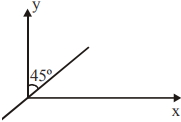
Two rods of equal mass $m$ and length $l$ lie along the $x$-axis and $y$-axis with their centers at the origin. What is the moment of inertia of both about the line $x=y$?
A
$\frac{ml^2}{3}$
B
$\frac{ml^2}{4}$
C
$\frac{ml^2}{12}$
D
$\frac{ml^2}{6}$
Solution
(C) The moment of inertia of a rod of mass $m$ and length $l$ about an axis passing through its center and making an angle $\theta$ with the rod is given by $I = \frac{ml^2}{12} \sin^2 \theta$.
For the rod along the $x$-axis,the angle with the line $x=y$ is $\theta = 45^\circ$. Thus,$I_1 = \frac{ml^2}{12} \sin^2 45^\circ = \frac{ml^2}{12} \times \frac{1}{2} = \frac{ml^2}{24}$.
For the rod along the $y$-axis,the angle with the line $x=y$ is also $\theta = 45^\circ$. Thus,$I_2 = \frac{ml^2}{12} \sin^2 45^\circ = \frac{ml^2}{24}$.
The total moment of inertia is $I = I_1 + I_2 = \frac{ml^2}{24} + \frac{ml^2}{24} = \frac{2ml^2}{24} = \frac{ml^2}{12}$.
For the rod along the $x$-axis,the angle with the line $x=y$ is $\theta = 45^\circ$. Thus,$I_1 = \frac{ml^2}{12} \sin^2 45^\circ = \frac{ml^2}{12} \times \frac{1}{2} = \frac{ml^2}{24}$.
For the rod along the $y$-axis,the angle with the line $x=y$ is also $\theta = 45^\circ$. Thus,$I_2 = \frac{ml^2}{12} \sin^2 45^\circ = \frac{ml^2}{24}$.
The total moment of inertia is $I = I_1 + I_2 = \frac{ml^2}{24} + \frac{ml^2}{24} = \frac{2ml^2}{24} = \frac{ml^2}{12}$.
0 likes
View Solution148
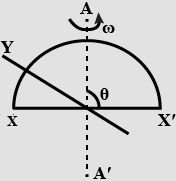
DifficultMCQ
The moment of inertia of a semicircular plate of radius $R$ and mass $M$ about an axis $AA'$ in its plane passing through its centre is given by:

A
$\frac{MR^2}{2}$
B
$\frac{MR^2}{4} \cos^2 \theta$
C
$\frac{MR^2}{4} \sin^2 \theta$
D
$\frac{MR^2}{4}$
Solution
(D) For a semicircular plate of mass $M$ and radius $R$,the moment of inertia about an axis passing through the centre and perpendicular to the diameter (the axis of symmetry) is $I = \frac{MR^2}{4}$.
Since the semicircular plate is symmetric about this axis,any axis passing through the centre in the plane of the plate will have the same moment of inertia due to the distribution of mass being identical relative to the axis of symmetry.
Thus,the moment of inertia about the axis $AA'$ is $I = \frac{MR^2}{4}$.
Since the semicircular plate is symmetric about this axis,any axis passing through the centre in the plane of the plate will have the same moment of inertia due to the distribution of mass being identical relative to the axis of symmetry.
Thus,the moment of inertia about the axis $AA'$ is $I = \frac{MR^2}{4}$.
0 likes
View Solution149
MediumMCQ
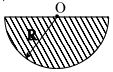
The moment of inertia of a thin semicircular disc (mass $= M$ and radius $= R$) about an axis passing through point $O$ and perpendicular to the plane of the disc is given by:
A
$\frac{1}{4} MR^2$
B
$\frac{1}{2} MR^2$
C
$\frac{1}{8} MR^2$
D
$MR^2$
Solution
(B) The moment of inertia of a complete circular disc of mass $M'$ and radius $R$ about an axis passing through its center and perpendicular to its plane is $I_{total} = \frac{1}{2} M' R^2$.
For a semicircular disc of mass $M$,we can consider it as half of a complete circular disc of mass $2M$ and radius $R$.
The moment of inertia of this complete circular disc (mass $2M$) about the axis through its center $O$ is $I_{total} = \frac{1}{2} (2M) R^2 = MR^2$.
Since the semicircular disc is exactly half of this complete disc,its moment of inertia about the same axis is half of the total moment of inertia.
Therefore,$I = \frac{1}{2} I_{total} = \frac{1}{2} (MR^2) = \frac{1}{2} MR^2$.
For a semicircular disc of mass $M$,we can consider it as half of a complete circular disc of mass $2M$ and radius $R$.
The moment of inertia of this complete circular disc (mass $2M$) about the axis through its center $O$ is $I_{total} = \frac{1}{2} (2M) R^2 = MR^2$.
Since the semicircular disc is exactly half of this complete disc,its moment of inertia about the same axis is half of the total moment of inertia.
Therefore,$I = \frac{1}{2} I_{total} = \frac{1}{2} (MR^2) = \frac{1}{2} MR^2$.
0 likes
View Solution150
MediumMCQ
$A$ square sheet of edge length $L$ and uniform mass per unit area $\sigma$ is used to form a hollow cylinder. The moment of inertia of this cylinder about its central axis is
A
$\frac{2\sigma L^4}{\pi^2}$
B
$\frac{\sigma L^4}{4\pi^2}$
C
$\sigma L^2$
D
$\frac{\sigma L^4}{3\sqrt{2}\pi^2}$
Solution
(B) The square sheet has side length $L$. When it is rolled into a hollow cylinder,the side length $L$ becomes the circumference of the cylinder's base.
Therefore,$L = 2\pi R$,which gives the radius $R = \frac{L}{2\pi}$.
The total mass $M$ of the sheet is given by $M = \sigma \times \text{Area} = \sigma L^2$.
The moment of inertia $I$ of a hollow cylinder of mass $M$ and radius $R$ about its central axis is $I = MR^2$.
Substituting the values of $M$ and $R$:
$I = (\sigma L^2) \times \left(\frac{L}{2\pi}\right)^2$
$I = \sigma L^2 \times \frac{L^2}{4\pi^2}$
$I = \frac{\sigma L^4}{4\pi^2}$.
Therefore,$L = 2\pi R$,which gives the radius $R = \frac{L}{2\pi}$.
The total mass $M$ of the sheet is given by $M = \sigma \times \text{Area} = \sigma L^2$.
The moment of inertia $I$ of a hollow cylinder of mass $M$ and radius $R$ about its central axis is $I = MR^2$.
Substituting the values of $M$ and $R$:
$I = (\sigma L^2) \times \left(\frac{L}{2\pi}\right)^2$
$I = \sigma L^2 \times \frac{L^2}{4\pi^2}$
$I = \frac{\sigma L^4}{4\pi^2}$.
0 likes
View SolutionSystem of Particles and Rotational Motion — Moment of Inertia and Radius of gyration · Frequently Asked Questions
1Are these System of Particles and Rotational Motion questions useful for JEE and NEET?
Yes. All questions in this section are mapped to JEE Main and NEET exam patterns. Previous year questions from JEE Main, NEET, GUJCET and state-level exams are included with full solutions.
2Can I switch to Hindi or Gujarati for these questions?
Yes. Use the language tabs in the hero section or the sidebar to view the same questions and solutions in English, Hindi or Gujarati.
3How do I generate a question paper from this subtopic?
Use the Vedclass Exam Paper Generator — select the chapter and subtopic, set difficulty, and generate Sets A, B, C, D automatically. First 3 chapters of every subject are free.
Vedclass Products
For Students
Vedclass Test Series
Mock tests in real JEE/NEET style with performance analysis. 5-day free trial.
Start Free TrialFor Teachers
Exam Paper Generator
Generate Set A/B/C/D papers from this chapter in 2 minutes. 3 chapters free.
Try FreeFor Institutes
Online Exam Module
Live online exams with unlimited students, 360° analytics & white-label branding.
See DemoFor Teachers & Institutes
Generate a System of Particles and Rotational Motion Exam Paper in 2 Minutes
Select subtopic & difficulty — Sets A, B, C, D auto-generated with No Repeat logic.
First 3 chapters of every subject are free — no payment required.