
A English
Moment of Inertia and Radius of gyration Questions in English
Class 11 Physics · System of Particles and Rotational Motion · Moment of Inertia and Radius of gyration
371+
Questions
English
Language
100%
With Solutions
Showing 49 of 371 questions in English
201
DifficultMCQ
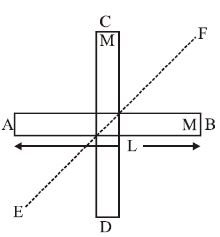
Two uniform thin identical rods $AB$ and $CD$ each of mass $M$ and length $L$ are joined so as to form a cross as shown. The moment of inertia of the cross about a bisector line $EF$ is (Line $EF$ is in the plane of the cross and bisects the angle between the rods).
A
$\frac{ML^2}{6}$
B
$\frac{ML^2}{4}$
C
$\frac{ML^2}{12}$
D
$\frac{ML^2}{3}$
Solution
(C) Let the intersection point of the rods be the origin $(0,0)$.
For rod $AB$ lying along the $x$-axis,the moment of inertia about the $x$-axis is $I_x = 0$ and about the $y$-axis is $I_y = \frac{ML^2}{12}$.
For rod $CD$ lying along the $y$-axis,the moment of inertia about the $x$-axis is $I_x = \frac{ML^2}{12}$ and about the $y$-axis is $I_y = 0$.
The total moment of inertia of the cross about the $x$-axis is $I_x = 0 + \frac{ML^2}{12} = \frac{ML^2}{12}$.
The total moment of inertia of the cross about the $y$-axis is $I_y = \frac{ML^2}{12} + 0 = \frac{ML^2}{12}$.
The line $EF$ is a bisector in the $xy$-plane,making an angle of $45^{\circ}$ with both axes.
The moment of inertia about an axis in the plane of the object is given by $I = I_x \sin^2 \theta + I_y \cos^2 \theta - 2 I_{xy} \sin \theta \cos \theta$.
Since the rods are symmetric about the axes,the product of inertia $I_{xy} = 0$.
Thus,$I_{EF} = I_x \sin^2 45^{\circ} + I_y \cos^2 45^{\circ} = \frac{ML^2}{12} \left( \frac{1}{2} \right) + \frac{ML^2}{12} \left( \frac{1}{2} \right) = \frac{ML^2}{12}$.
For rod $AB$ lying along the $x$-axis,the moment of inertia about the $x$-axis is $I_x = 0$ and about the $y$-axis is $I_y = \frac{ML^2}{12}$.
For rod $CD$ lying along the $y$-axis,the moment of inertia about the $x$-axis is $I_x = \frac{ML^2}{12}$ and about the $y$-axis is $I_y = 0$.
The total moment of inertia of the cross about the $x$-axis is $I_x = 0 + \frac{ML^2}{12} = \frac{ML^2}{12}$.
The total moment of inertia of the cross about the $y$-axis is $I_y = \frac{ML^2}{12} + 0 = \frac{ML^2}{12}$.
The line $EF$ is a bisector in the $xy$-plane,making an angle of $45^{\circ}$ with both axes.
The moment of inertia about an axis in the plane of the object is given by $I = I_x \sin^2 \theta + I_y \cos^2 \theta - 2 I_{xy} \sin \theta \cos \theta$.
Since the rods are symmetric about the axes,the product of inertia $I_{xy} = 0$.
Thus,$I_{EF} = I_x \sin^2 45^{\circ} + I_y \cos^2 45^{\circ} = \frac{ML^2}{12} \left( \frac{1}{2} \right) + \frac{ML^2}{12} \left( \frac{1}{2} \right) = \frac{ML^2}{12}$.
0 likes
View Solution202
DifficultMCQ
Two rings of radius $R$ and $nR$ having different masses and made up of the same wire have the ratio of moment of inertia about an axis passing through the centre as $1 : 8$. The value of $n$ is
A
$2$
B
$2\sqrt{2}$
C
$4$
D
$1/2$
Solution
(A) The moment of inertia $I$ of a ring of mass $M$ and radius $r$ about an axis passing through its centre and perpendicular to its plane is $I = Mr^2$.
Since the rings are made of the same wire,their linear mass density $\lambda$ is constant.
The mass of a ring is given by $M = \lambda \times \text{circumference} = \lambda (2\pi r)$.
For the first ring: $M_1 = \lambda (2\pi R)$ and $r_1 = R$. Thus,$I_1 = M_1 R^2 = \lambda (2\pi R) R^2 = 2\pi \lambda R^3$.
For the second ring: $M_2 = \lambda (2\pi nR)$ and $r_2 = nR$. Thus,$I_2 = M_2 (nR)^2 = \lambda (2\pi nR) (nR)^2 = 2\pi \lambda n^3 R^3$.
The ratio of the moments of inertia is given as $\frac{I_1}{I_2} = \frac{1}{8}$.
Substituting the expressions: $\frac{2\pi \lambda R^3}{2\pi \lambda n^3 R^3} = \frac{1}{n^3} = \frac{1}{8}$.
Therefore,$n^3 = 8$,which gives $n = 2$.
Since the rings are made of the same wire,their linear mass density $\lambda$ is constant.
The mass of a ring is given by $M = \lambda \times \text{circumference} = \lambda (2\pi r)$.
For the first ring: $M_1 = \lambda (2\pi R)$ and $r_1 = R$. Thus,$I_1 = M_1 R^2 = \lambda (2\pi R) R^2 = 2\pi \lambda R^3$.
For the second ring: $M_2 = \lambda (2\pi nR)$ and $r_2 = nR$. Thus,$I_2 = M_2 (nR)^2 = \lambda (2\pi nR) (nR)^2 = 2\pi \lambda n^3 R^3$.
The ratio of the moments of inertia is given as $\frac{I_1}{I_2} = \frac{1}{8}$.
Substituting the expressions: $\frac{2\pi \lambda R^3}{2\pi \lambda n^3 R^3} = \frac{1}{n^3} = \frac{1}{8}$.
Therefore,$n^3 = 8$,which gives $n = 2$.
0 likes
View Solution203
MediumMCQ
Two solid spheres of iron have radii in the ratio $1 : 2$. Their moments of inertia will be in the ratio
A
$1 : 4$
B
$1 : 8$
C
$1 : 16$
D
$1 : 32$
Solution
(D) The moment of inertia $I$ of a solid sphere is given by $I = \frac{2}{5} mr^{2}$.
Since the spheres are made of the same material (iron), their density $d$ is the same.
The mass $m$ of a sphere is given by $m = \text{Volume} \times \text{Density} = \frac{4}{3} \pi r^{3} d$.
Substituting the expression for mass into the moment of inertia formula:
$I = \frac{2}{5} (\frac{4}{3} \pi r^{3} d) r^{2} = \frac{8}{15} \pi d r^{5}$.
This shows that $I \propto r^{5}$.
Given the ratio of radii $r_{1} : r_{2} = 1 : 2$, the ratio of their moments of inertia is:
$\frac{I_{1}}{I_{2}} = (\frac{r_{1}}{r_{2}})^{5} = (\frac{1}{2})^{5} = \frac{1}{32}$.
Therefore, the ratio is $1 : 32$.
Since the spheres are made of the same material (iron), their density $d$ is the same.
The mass $m$ of a sphere is given by $m = \text{Volume} \times \text{Density} = \frac{4}{3} \pi r^{3} d$.
Substituting the expression for mass into the moment of inertia formula:
$I = \frac{2}{5} (\frac{4}{3} \pi r^{3} d) r^{2} = \frac{8}{15} \pi d r^{5}$.
This shows that $I \propto r^{5}$.
Given the ratio of radii $r_{1} : r_{2} = 1 : 2$, the ratio of their moments of inertia is:
$\frac{I_{1}}{I_{2}} = (\frac{r_{1}}{r_{2}})^{5} = (\frac{1}{2})^{5} = \frac{1}{32}$.
Therefore, the ratio is $1 : 32$.
0 likes
View Solution204
DifficultMCQ
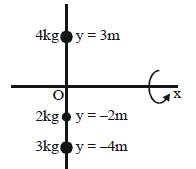
Three particles are connected by massless rods lying along the $y-$ axis. If the system rotates about the $x-$ axis with an angular speed of $2 \, rad/s$,the moment of inertia $(M.I.)$ of the system is ......... $kg \cdot m^2$.
A
$46$
B
$92$
C
$184$
D
$276$
Solution
(B) The moment of inertia $(I)$ of a system of point masses rotating about an axis is given by $I = \sum m_i r_i^2$,where $r_i$ is the perpendicular distance of the $i^{th}$ particle from the axis of rotation.
Here,the system rotates about the $x-$ axis. The perpendicular distance of a particle at position $y$ from the $x-$ axis is $|y|$.
Given masses and their positions:
$1$. $m_1 = 4 \, kg$ at $y_1 = 3 \, m$,so $r_1 = 3 \, m$.
$2$. $m_2 = 2 \, kg$ at $y_2 = -2 \, m$,so $r_2 = 2 \, m$.
$3$. $m_3 = 3 \, kg$ at $y_3 = -4 \, m$,so $r_3 = 4 \, m$.
Calculating the total moment of inertia:
$I = m_1 r_1^2 + m_2 r_2^2 + m_3 r_3^2$
$I = 4(3)^2 + 2(2)^2 + 3(4)^2$
$I = 4(9) + 2(4) + 3(16)$
$I = 36 + 8 + 48$
$I = 92 \, kg \cdot m^2$.
Here,the system rotates about the $x-$ axis. The perpendicular distance of a particle at position $y$ from the $x-$ axis is $|y|$.
Given masses and their positions:
$1$. $m_1 = 4 \, kg$ at $y_1 = 3 \, m$,so $r_1 = 3 \, m$.
$2$. $m_2 = 2 \, kg$ at $y_2 = -2 \, m$,so $r_2 = 2 \, m$.
$3$. $m_3 = 3 \, kg$ at $y_3 = -4 \, m$,so $r_3 = 4 \, m$.
Calculating the total moment of inertia:
$I = m_1 r_1^2 + m_2 r_2^2 + m_3 r_3^2$
$I = 4(3)^2 + 2(2)^2 + 3(4)^2$
$I = 4(9) + 2(4) + 3(16)$
$I = 36 + 8 + 48$
$I = 92 \, kg \cdot m^2$.
0 likes
View Solution205
MediumMCQ
If $I_1, I_2$ and $I_3$ are moments of inertia of a solid sphere,a hollow sphere,and a ring of the same mass $M$ and radius $R$ about their respective geometrical axes,which of the following statements holds true?
A
$I_1 > I_2 > I_3$
B
$I_3 > I_2 > I_1$
C
$I_2 > I_1 > I_3$
D
$I_2 > I_3 > I_1$
Solution
(B) The moment of inertia for the given objects about their geometrical axes are as follows:
$1$. For a solid sphere: $I_1 = \frac{2}{5}MR^2 = 0.4MR^2$
$2$. For a hollow sphere: $I_2 = \frac{2}{3}MR^2 \approx 0.67MR^2$
$3$. For a ring: $I_3 = MR^2 = 1.0MR^2$
Comparing the coefficients: $1.0 > 0.67 > 0.4$.
Therefore,$I_3 > I_2 > I_1$.
$1$. For a solid sphere: $I_1 = \frac{2}{5}MR^2 = 0.4MR^2$
$2$. For a hollow sphere: $I_2 = \frac{2}{3}MR^2 \approx 0.67MR^2$
$3$. For a ring: $I_3 = MR^2 = 1.0MR^2$
Comparing the coefficients: $1.0 > 0.67 > 0.4$.
Therefore,$I_3 > I_2 > I_1$.
0 likes
View Solution206
DifficultMCQ
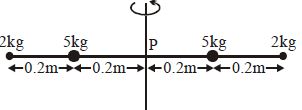
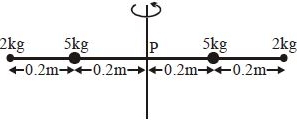
Four masses are fixed on a massless rod as shown in the figure. The moment of inertia about the axis $P$ is about ....... $kg \cdot m^2$.
A
$6.8$
B
$1.04$
C
$0.5$
D
$0.3$
Solution
(B) The moment of inertia $I$ of a system of point masses about an axis is given by $I = \sum m_i r_i^2$,where $m_i$ is the mass and $r_i$ is the perpendicular distance from the axis of rotation $P$.
From the figure,the distances of the masses from axis $P$ are:
- Two $5 \ kg$ masses are at a distance of $0.2 \ m$ from axis $P$.
- Two $2 \ kg$ masses are at a distance of $(0.2 \ m + 0.2 \ m) = 0.4 \ m$ from axis $P$.
Calculating the total moment of inertia $I_P$:
$I_P = (5 \ kg \times (0.2 \ m)^2) + (5 \ kg \times (0.2 \ m)^2) + (2 \ kg \times (0.4 \ m)^2) + (2 \ kg \times (0.4 \ m)^2)$
$I_P = 2 \times (5 \times 0.04) + 2 \times (2 \times 0.16)$
$I_P = 2 \times (0.2) + 2 \times (0.32)$
$I_P = 0.4 + 0.64$
$I_P = 1.04 \ kg \cdot m^2$.
From the figure,the distances of the masses from axis $P$ are:
- Two $5 \ kg$ masses are at a distance of $0.2 \ m$ from axis $P$.
- Two $2 \ kg$ masses are at a distance of $(0.2 \ m + 0.2 \ m) = 0.4 \ m$ from axis $P$.
Calculating the total moment of inertia $I_P$:
$I_P = (5 \ kg \times (0.2 \ m)^2) + (5 \ kg \times (0.2 \ m)^2) + (2 \ kg \times (0.4 \ m)^2) + (2 \ kg \times (0.4 \ m)^2)$
$I_P = 2 \times (5 \times 0.04) + 2 \times (2 \times 0.16)$
$I_P = 2 \times (0.2) + 2 \times (0.32)$
$I_P = 0.4 + 0.64$
$I_P = 1.04 \ kg \cdot m^2$.
0 likes
View Solution207
DifficultMCQ
We have two spheres,one of which is hollow and the other solid. They have identical masses and moments of inertia about their respective diameters. The ratio of their radii is given by:
A
$5 : 7$
B
$3 : 5$
C
$\sqrt{3} : \sqrt{5}$
D
$\sqrt{3} : \sqrt{7}$
Solution
(C) Let $M$ be the mass of both spheres. Let $R_1$ be the radius of the hollow sphere and $R_2$ be the radius of the solid sphere.
The moment of inertia of a hollow sphere about its diameter is $I_1 = \frac{2}{3} M R_1^2$.
The moment of inertia of a solid sphere about its diameter is $I_2 = \frac{2}{5} M R_2^2$.
Given that the moments of inertia are identical $(I_1 = I_2)$,we have:
$\frac{2}{3} M R_1^2 = \frac{2}{5} M R_2^2$
Canceling $M$ and the factor of $2$ from both sides:
$\frac{R_1^2}{3} = \frac{R_2^2}{5}$
Rearranging to find the ratio of the radii:
$\frac{R_1^2}{R_2^2} = \frac{3}{5}$
Taking the square root of both sides:
$\frac{R_1}{R_2} = \sqrt{\frac{3}{5}} = \frac{\sqrt{3}}{\sqrt{5}}$
Thus,the ratio is $\sqrt{3} : \sqrt{5}$.
The moment of inertia of a hollow sphere about its diameter is $I_1 = \frac{2}{3} M R_1^2$.
The moment of inertia of a solid sphere about its diameter is $I_2 = \frac{2}{5} M R_2^2$.
Given that the moments of inertia are identical $(I_1 = I_2)$,we have:
$\frac{2}{3} M R_1^2 = \frac{2}{5} M R_2^2$
Canceling $M$ and the factor of $2$ from both sides:
$\frac{R_1^2}{3} = \frac{R_2^2}{5}$
Rearranging to find the ratio of the radii:
$\frac{R_1^2}{R_2^2} = \frac{3}{5}$
Taking the square root of both sides:
$\frac{R_1}{R_2} = \sqrt{\frac{3}{5}} = \frac{\sqrt{3}}{\sqrt{5}}$
Thus,the ratio is $\sqrt{3} : \sqrt{5}$.
0 likes
View Solution208
DifficultMCQ
Two loops $P$ and $Q$ are made from a uniform wire. The radii of $P$ and $Q$ are $r_1$ and $r_2$ respectively,and their moments of inertia are $I_1$ and $I_2$ respectively. If $I_2/I_1 = 4$,then $\frac{r_2}{r_1}$ equals:
A
$4^{2/3}$
B
$4^{1/3}$
C
$4^{-2/3}$
D
$4^{-1/3}$
Solution
(B) The moment of inertia of a loop of mass $m$ and radius $r$ about its central axis is given by $I = mr^2$.
Since the loops are made from a uniform wire,the mass $m$ is proportional to the circumference,so $m = \lambda (2\pi r)$,where $\lambda$ is the linear mass density.
Thus,$I = (\lambda 2\pi r) r^2 = 2\pi\lambda r^3$.
Given the ratio of moments of inertia: $\frac{I_2}{I_1} = \frac{2\pi\lambda r_2^3}{2\pi\lambda r_1^3} = \left(\frac{r_2}{r_1}\right)^3$.
We are given $\frac{I_2}{I_1} = 4$.
Therefore,$\left(\frac{r_2}{r_1}\right)^3 = 4$.
Taking the cube root on both sides,we get $\frac{r_2}{r_1} = 4^{1/3}$.
Since the loops are made from a uniform wire,the mass $m$ is proportional to the circumference,so $m = \lambda (2\pi r)$,where $\lambda$ is the linear mass density.
Thus,$I = (\lambda 2\pi r) r^2 = 2\pi\lambda r^3$.
Given the ratio of moments of inertia: $\frac{I_2}{I_1} = \frac{2\pi\lambda r_2^3}{2\pi\lambda r_1^3} = \left(\frac{r_2}{r_1}\right)^3$.
We are given $\frac{I_2}{I_1} = 4$.
Therefore,$\left(\frac{r_2}{r_1}\right)^3 = 4$.
Taking the cube root on both sides,we get $\frac{r_2}{r_1} = 4^{1/3}$.
0 likes
View Solution209
EasyMCQ
The moment of inertia of a body does not depend on
A
the mass of the body
B
the angular velocity of the body
C
the axis of rotation of the body
D
the distribution of the mass in the body
Solution
(B) The moment of inertia $(I)$ of a rigid body is defined as $I = \sum m_i r_i^2$,where $m_i$ is the mass of the $i$-th particle and $r_i$ is its perpendicular distance from the axis of rotation.
From this definition,it is clear that the moment of inertia depends on the mass of the body,the distribution of mass relative to the axis,and the position/orientation of the axis of rotation.
It does not depend on the state of motion of the body,such as its angular velocity or angular acceleration.
Therefore,the moment of inertia of a body does not depend on the angular velocity of the body.
From this definition,it is clear that the moment of inertia depends on the mass of the body,the distribution of mass relative to the axis,and the position/orientation of the axis of rotation.
It does not depend on the state of motion of the body,such as its angular velocity or angular acceleration.
Therefore,the moment of inertia of a body does not depend on the angular velocity of the body.
0 likes
View Solution210
DifficultMCQ
Five masses,each of $2\, kg$,are placed on a horizontal circular disc,which can be rotated about a vertical axis passing through its centre. All the masses are equidistant from the axis at a distance of $10\, cm$. The moment of inertia of the whole system (in $g\cdot cm^2$) is: (Assume the disc is of negligible mass)
A
$10^5$
B
$10^4$
C
$10^6$
D
$10^8$
Solution
(C) The moment of inertia $I$ of a system of point masses is given by the formula $I = \sum m_i r_i^2$.
Here,there are $5$ masses,each of mass $m = 2\, kg = 2000\, g$.
Each mass is at a distance $r = 10\, cm$ from the axis of rotation.
Since all masses are at the same distance,the total moment of inertia is $I = 5 \times m \times r^2$.
Substituting the values: $I = 5 \times 2000\, g \times (10\, cm)^2$.
$I = 10000 \times 100 = 10^6\, g\cdot cm^2$.
Here,there are $5$ masses,each of mass $m = 2\, kg = 2000\, g$.
Each mass is at a distance $r = 10\, cm$ from the axis of rotation.
Since all masses are at the same distance,the total moment of inertia is $I = 5 \times m \times r^2$.
Substituting the values: $I = 5 \times 2000\, g \times (10\, cm)^2$.
$I = 10000 \times 100 = 10^6\, g\cdot cm^2$.
0 likes
View Solution211
EasyMCQ
The moment of inertia of a regular circular disc of mass $0.4\, kg$ and radius $100\, cm$ about an axis perpendicular to the plane of the disc and passing through its centre is ...... $kg\, m^2$.
A
$0.2$
B
$0.02$
C
$0.002$
D
$2$
Solution
(A) The moment of inertia $(I)$ of a circular disc about an axis perpendicular to its plane and passing through its center is given by the formula:
$I = \frac{1}{2} M R^2$
Given:
Mass $(M)$ = $0.4\, kg$
Radius $(R)$ = $100\, cm = 1\, m$
Substituting the values into the formula:
$I = \frac{1}{2} \times 0.4\, kg \times (1\, m)^2$
$I = 0.2 \times 1 = 0.2\, kg\, m^2$
Therefore,the correct option is $A$.
$I = \frac{1}{2} M R^2$
Given:
Mass $(M)$ = $0.4\, kg$
Radius $(R)$ = $100\, cm = 1\, m$
Substituting the values into the formula:
$I = \frac{1}{2} \times 0.4\, kg \times (1\, m)^2$
$I = 0.2 \times 1 = 0.2\, kg\, m^2$
Therefore,the correct option is $A$.
1 likes
View Solution212
MediumMCQ
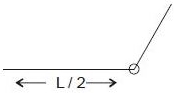
The moment of inertia of a rod of mass $M$ and length $L$ about an axis passing through its centre and perpendicular to it is $\frac{1}{12} ML^2$. The rod is bent in the middle so that the two halves make an angle of $60^o$. The moment of inertia of the bent rod about the same axis (passing through the original centre of the rod) would be:
A
$\frac{1}{48} ML^2$
B
$\frac{1}{12} ML^2$
C
$\frac{1}{24} ML^2$
D
$\frac{ML^2}{8\sqrt{3}}$
Solution
(B) Let the rod be along the $x$-axis initially with its centre at the origin $(0,0)$. The rod consists of two halves,each of mass $m = M/2$ and length $l = L/2$.
When the rod is bent at the centre,the centre of the rod remains at the origin. Let the axis of rotation be the $z$-axis passing through the origin.
The moment of inertia of a rod of mass $m$ and length $l$ about an axis passing through one of its ends and making an angle $\theta$ with the rod is given by $I = \int r^2 dm$,where $r$ is the perpendicular distance from the axis.
For each half of the rod,the distance $r$ of a point at a distance $x$ from the centre along the rod is $r = x \sin(\theta)$,where $\theta$ is the angle between the rod and the axis of rotation. Here,the axis is perpendicular to the original rod,so for the first half,$\theta = 90^o$,and for the second half,the angle changes.
However,a simpler approach: The moment of inertia $I = \int r^2 dm$. Since the distance $r$ of every mass element $dm$ from the axis of rotation remains unchanged when the rod is bent at its centre (the centre point is on the axis),the total moment of inertia remains the same.
Therefore,$I = \frac{1}{12} ML^2$.
When the rod is bent at the centre,the centre of the rod remains at the origin. Let the axis of rotation be the $z$-axis passing through the origin.
The moment of inertia of a rod of mass $m$ and length $l$ about an axis passing through one of its ends and making an angle $\theta$ with the rod is given by $I = \int r^2 dm$,where $r$ is the perpendicular distance from the axis.
For each half of the rod,the distance $r$ of a point at a distance $x$ from the centre along the rod is $r = x \sin(\theta)$,where $\theta$ is the angle between the rod and the axis of rotation. Here,the axis is perpendicular to the original rod,so for the first half,$\theta = 90^o$,and for the second half,the angle changes.
However,a simpler approach: The moment of inertia $I = \int r^2 dm$. Since the distance $r$ of every mass element $dm$ from the axis of rotation remains unchanged when the rod is bent at its centre (the centre point is on the axis),the total moment of inertia remains the same.
Therefore,$I = \frac{1}{12} ML^2$.
0 likes
View Solution213
MediumMCQ
In the diagram shown below,all three rods are of equal length $L$ and equal mass $M$. The system is rotated such that rod $B$ is the axis. What is the moment of inertia of the system?

A
$\frac{M L^2}{6}$
B
$\frac{4}{3} M L^2$
C
$\frac{M L^2}{3}$
D
$\frac{2}{3} M L^2$
Solution
(A) The total moment of inertia of the system is the sum of the moments of inertia of the individual rods about the axis of rotation (rod $B$).
$1$. Moment of inertia of rod $B$: Since rod $B$ itself is the axis of rotation,every mass element of rod $B$ lies on the axis. Therefore,its moment of inertia is $I_B = 0$.
$2$. Moment of inertia of rod $A$: Rod $A$ is perpendicular to the axis $B$ and is attached at its center to the axis. The moment of inertia of a rod of mass $M$ and length $L$ about an axis passing through its center and perpendicular to its length is $I_A = \frac{1}{12} M L^2$.
$3$. Moment of inertia of rod $C$: Similarly,rod $C$ is also perpendicular to the axis $B$ and attached at its center. Thus,$I_C = \frac{1}{12} M L^2$.
Total moment of inertia $I = I_A + I_B + I_C = \frac{1}{12} M L^2 + 0 + \frac{1}{12} M L^2 = \frac{2}{12} M L^2 = \frac{1}{6} M L^2$.
$1$. Moment of inertia of rod $B$: Since rod $B$ itself is the axis of rotation,every mass element of rod $B$ lies on the axis. Therefore,its moment of inertia is $I_B = 0$.
$2$. Moment of inertia of rod $A$: Rod $A$ is perpendicular to the axis $B$ and is attached at its center to the axis. The moment of inertia of a rod of mass $M$ and length $L$ about an axis passing through its center and perpendicular to its length is $I_A = \frac{1}{12} M L^2$.
$3$. Moment of inertia of rod $C$: Similarly,rod $C$ is also perpendicular to the axis $B$ and attached at its center. Thus,$I_C = \frac{1}{12} M L^2$.
Total moment of inertia $I = I_A + I_B + I_C = \frac{1}{12} M L^2 + 0 + \frac{1}{12} M L^2 = \frac{2}{12} M L^2 = \frac{1}{6} M L^2$.
0 likes
View Solution214
MediumMCQ
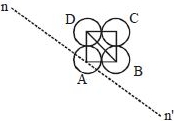
Four point masses,each of value $m$,are placed at the corners of a square $ABCD$ of side $l$. The moment of inertia of this system about an axis passing through $A$ and parallel to $BD$ is
A
$2ml^2$
B
$\sqrt{3}ml^2$
C
$3ml^2$
D
$ml^2$
Solution
(C) Let the square be $ABCD$ with side length $l$. The masses are at $A, B, C, D$.
The axis passes through $A$ and is parallel to the diagonal $BD$.
The distance of point $A$ from the axis is $0$.
The distance of point $B$ from the axis is $d_B = \frac{l}{\sqrt{2}}$.
The distance of point $D$ from the axis is $d_D = \frac{l}{\sqrt{2}}$.
The distance of point $C$ from the axis is $d_C = \sqrt{l^2 + (l/\sqrt{2})^2} = \sqrt{l^2 + l^2/2} = \sqrt{3l^2/2} = l\sqrt{3/2}$.
Alternatively,the distance of $C$ from the diagonal $BD$ is $l\sqrt{2}$.
The moment of inertia $I$ is given by $\sum m_i r_i^2$.
$I = m(0)^2 + m(l/\sqrt{2})^2 + m(l\sqrt{2})^2 + m(l/\sqrt{2})^2$
$I = 0 + m(l^2/2) + 2ml^2 + m(l^2/2)$
$I = ml^2 + 2ml^2 = 3ml^2$.
The axis passes through $A$ and is parallel to the diagonal $BD$.
The distance of point $A$ from the axis is $0$.
The distance of point $B$ from the axis is $d_B = \frac{l}{\sqrt{2}}$.
The distance of point $D$ from the axis is $d_D = \frac{l}{\sqrt{2}}$.
The distance of point $C$ from the axis is $d_C = \sqrt{l^2 + (l/\sqrt{2})^2} = \sqrt{l^2 + l^2/2} = \sqrt{3l^2/2} = l\sqrt{3/2}$.
Alternatively,the distance of $C$ from the diagonal $BD$ is $l\sqrt{2}$.
The moment of inertia $I$ is given by $\sum m_i r_i^2$.
$I = m(0)^2 + m(l/\sqrt{2})^2 + m(l\sqrt{2})^2 + m(l/\sqrt{2})^2$
$I = 0 + m(l^2/2) + 2ml^2 + m(l^2/2)$
$I = ml^2 + 2ml^2 = 3ml^2$.
0 likes
View Solution215
MediumMCQ
$A$ wire of mass $m$ and length $l$ is bent in the form of a circular ring. The moment of inertia of the ring about its axis is:
A
$\left( \frac{1}{8\pi^2} \right) ml^2$
B
$\left( \frac{1}{2\pi^2} \right) ml^2$
C
$\left( \frac{1}{4\pi^2} \right) ml^2$
D
$ml^2$
Solution
(C) The length of the wire is $l$ and its mass is $m$.
When the wire is bent into a circular ring of radius $r$,the circumference of the ring is equal to the length of the wire.
$2\pi r = l$
Therefore,the radius of the ring is $r = \frac{l}{2\pi}$.
The moment of inertia $I$ of a ring of mass $m$ and radius $r$ about its central axis is given by the formula:
$I = mr^2$
Substituting the value of $r$ into the formula:
$I = m \left( \frac{l}{2\pi} \right)^2$
$I = m \left( \frac{l^2}{4\pi^2} \right)$
$I = \left( \frac{1}{4\pi^2} \right) ml^2$
When the wire is bent into a circular ring of radius $r$,the circumference of the ring is equal to the length of the wire.
$2\pi r = l$
Therefore,the radius of the ring is $r = \frac{l}{2\pi}$.
The moment of inertia $I$ of a ring of mass $m$ and radius $r$ about its central axis is given by the formula:
$I = mr^2$
Substituting the value of $r$ into the formula:
$I = m \left( \frac{l}{2\pi} \right)^2$
$I = m \left( \frac{l^2}{4\pi^2} \right)$
$I = \left( \frac{1}{4\pi^2} \right) ml^2$
0 likes
View Solution216
MediumMCQ
One quarter sector is cut from a uniform circular disc of radius $R$. This sector has mass $M$. It is made to rotate about a line perpendicular to its plane and passing through the centre of the original disc. Its moment of inertia about the axis of rotation is
A
$\frac{1}{2} M R^2$
B
$\frac{1}{4} M R^2$
C
$\frac{1}{8} M R^2$
D
$\sqrt{2} M R^2$
Solution
(A) Let the mass of the full circular disc be $M_{total}$. Since the quarter sector has mass $M$,the mass of the full disc is $M_{total} = 4M$.
The moment of inertia of a full uniform circular disc of mass $M_{total}$ and radius $R$ about an axis passing through its center and perpendicular to its plane is given by $I_{total} = \frac{1}{2} M_{total} R^2$.
Substituting $M_{total} = 4M$,we get $I_{total} = \frac{1}{2} (4M) R^2 = 2 M R^2$.
By the principle of symmetry,the moment of inertia of any sector of the disc about the same axis is proportional to its mass.
Therefore,the moment of inertia $I$ of the quarter sector is $I = \frac{I_{total}}{4} = \frac{2 M R^2}{4} = \frac{1}{2} M R^2$.
The moment of inertia of a full uniform circular disc of mass $M_{total}$ and radius $R$ about an axis passing through its center and perpendicular to its plane is given by $I_{total} = \frac{1}{2} M_{total} R^2$.
Substituting $M_{total} = 4M$,we get $I_{total} = \frac{1}{2} (4M) R^2 = 2 M R^2$.
By the principle of symmetry,the moment of inertia of any sector of the disc about the same axis is proportional to its mass.
Therefore,the moment of inertia $I$ of the quarter sector is $I = \frac{I_{total}}{4} = \frac{2 M R^2}{4} = \frac{1}{2} M R^2$.
0 likes
View Solution217
MediumMCQ
$Assertion$ : Moment of inertia depends on the axis of rotation and the nature of distribution of the mass of the body.
$Reason$ : Moment of inertia is the rotational inertia of the body.
$Reason$ : Moment of inertia is the rotational inertia of the body.
A
If both $Assertion$ and $Reason$ are correct and the $Reason$ is a correct explanation of the $Assertion$.
B
If both $Assertion$ and $Reason$ are correct but $Reason$ is not a correct explanation of the $Assertion$.
C
If the $Assertion$ is correct but $Reason$ is incorrect.
D
If both the $Assertion$ and $Reason$ are incorrect.
Solution
(B) The moment of inertia $I$ of a system of particles is defined as $I = \sum m_i r_i^2$,where $r_i$ is the perpendicular distance of the $i$-th particle of mass $m_i$ from the axis of rotation.
From this definition,it is clear that $I$ depends on the distribution of mass relative to the axis of rotation and the position/orientation of the axis itself. Thus,the $Assertion$ is correct.
$Moment$ of inertia is defined as the rotational analogue of mass in linear motion. Just as mass represents the inertia of a body in linear motion (resistance to change in linear velocity),the moment of inertia represents the rotational inertia of a body (resistance to change in angular velocity). Thus,the $Reason$ is also correct.
However,the $Reason$ explains what the moment of inertia represents (rotational inertia),but it does not explain *why* it depends on the axis of rotation and mass distribution. Therefore,the $Reason$ is not the correct explanation of the $Assertion$. The correct option is $B$.
From this definition,it is clear that $I$ depends on the distribution of mass relative to the axis of rotation and the position/orientation of the axis itself. Thus,the $Assertion$ is correct.
$Moment$ of inertia is defined as the rotational analogue of mass in linear motion. Just as mass represents the inertia of a body in linear motion (resistance to change in linear velocity),the moment of inertia represents the rotational inertia of a body (resistance to change in angular velocity). Thus,the $Reason$ is also correct.
However,the $Reason$ explains what the moment of inertia represents (rotational inertia),but it does not explain *why* it depends on the axis of rotation and mass distribution. Therefore,the $Reason$ is not the correct explanation of the $Assertion$. The correct option is $B$.
0 likes
View Solution218
EasyMCQ
$Assertion$ : $A$ judo fighter,in order to throw his opponent onto the mat,tries to initially bend his opponent and then rotate him around his hip.
$Reason$ : As the mass of the opponent is brought closer to the fighter's hip,the moment of inertia of the opponent about the axis of rotation decreases,which makes it easier to rotate the opponent.
$Reason$ : As the mass of the opponent is brought closer to the fighter's hip,the moment of inertia of the opponent about the axis of rotation decreases,which makes it easier to rotate the opponent.
A
If both $Assertion$ and $Reason$ are correct and the $Reason$ is a correct explanation of the $Assertion$.
B
If both $Assertion$ and $Reason$ are correct but $Reason$ is not a correct explanation of the $Assertion$.
C
If the $Assertion$ is correct but $Reason$ is incorrect.
D
If both the $Assertion$ and $Reason$ are incorrect.
Solution
(A) The moment of inertia $I$ of a body is given by $I = \sum m_i r_i^2$,where $r_i$ is the distance of the mass element $m_i$ from the axis of rotation.
By bending the opponent and bringing their mass closer to the hip (the axis of rotation),the average distance $r$ decreases.
As $I \propto r^2$,the moment of inertia of the opponent decreases significantly.
$A$ smaller moment of inertia requires less torque to produce a given angular acceleration,making it easier for the judo fighter to rotate and throw the opponent.
Thus,both the $Assertion$ and $Reason$ are correct,and the $Reason$ is the correct explanation.
By bending the opponent and bringing their mass closer to the hip (the axis of rotation),the average distance $r$ decreases.
As $I \propto r^2$,the moment of inertia of the opponent decreases significantly.
$A$ smaller moment of inertia requires less torque to produce a given angular acceleration,making it easier for the judo fighter to rotate and throw the opponent.
Thus,both the $Assertion$ and $Reason$ are correct,and the $Reason$ is the correct explanation.
0 likes
View Solution219
EasyMCQ
$Assertion$ : Radius of gyration of a body is a constant quantity.
$Reason$ : The radius of gyration of a body about an axis of rotation may be defined as the root mean square distance of the particles from the axis of rotation.
$Reason$ : The radius of gyration of a body about an axis of rotation may be defined as the root mean square distance of the particles from the axis of rotation.
A
If both $Assertion$ and $Reason$ are correct and the $Reason$ is a correct explanation of the $Assertion$.
B
If both $Assertion$ and $Reason$ are correct but $Reason$ is not a correct explanation of the $Assertion$.
C
If the $Assertion$ is correct but $Reason$ is incorrect.
D
If both the $Assertion$ and $Reason$ are incorrect.
Solution
(D) The radius of gyration $K$ of a body is defined as $K = \sqrt{\frac{\sum m_i r_i^2}{M}}$,where $M$ is the total mass and $r_i$ is the distance of the $i$-th particle from the axis of rotation.
It is not a constant quantity because its value depends on the position and orientation of the axis of rotation.
Therefore,the $Assertion$ is incorrect.
The $Reason$ correctly defines the radius of gyration as the root mean square distance of the particles from the axis of rotation.
Thus,the $Assertion$ is incorrect,but the $Reason$ is correct.
It is not a constant quantity because its value depends on the position and orientation of the axis of rotation.
Therefore,the $Assertion$ is incorrect.
The $Reason$ correctly defines the radius of gyration as the root mean square distance of the particles from the axis of rotation.
Thus,the $Assertion$ is incorrect,but the $Reason$ is correct.
0 likes
View Solution220
DifficultMCQ
The mass per unit area of a circular disc of radius $a$ depends on the distance $r$ from its centre as $\sigma(r) = A + Br$. The moment of inertia of the disc about the axis perpendicular to the plane and passing through its centre is
A
$2 \pi a^{4} \left( \frac{A}{4} + \frac{aB}{5} \right)$
B
$\pi a^{4} \left( \frac{A}{4} + \frac{aB}{5} \right)$
C
$2 \pi a^{4} \left( \frac{aA}{4} + \frac{B}{5} \right)$
D
$2 \pi a^{4} \left( \frac{A}{4} + \frac{B}{5} \right)$
Solution
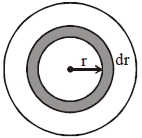
(A) Consider a thin circular ring of radius $r$ and thickness $dr$. The area of this ring is $dA = 2 \pi r dr$.
The mass of this elemental ring is $dm = \sigma(r) dA = (A + Br) (2 \pi r dr)$.
The moment of inertia of this ring about the axis perpendicular to the plane and passing through the centre is $dI = dm r^{2}$.
Substituting the value of $dm$,we get $dI = (A + Br) (2 \pi r dr) r^{2} = 2 \pi (A r^{3} + B r^{4}) dr$.
To find the total moment of inertia $I$,we integrate $dI$ from $r = 0$ to $r = a$:
$I = \int_{0}^{a} 2 \pi (A r^{3} + B r^{4}) dr = 2 \pi \left[ \frac{A r^{4}}{4} + \frac{B r^{5}}{5} \right]_{0}^{a}$.
$I = 2 \pi \left( \frac{A a^{4}}{4} + \frac{B a^{5}}{5} \right) = 2 \pi a^{4} \left( \frac{A}{4} + \frac{aB}{5} \right)$.
The mass of this elemental ring is $dm = \sigma(r) dA = (A + Br) (2 \pi r dr)$.
The moment of inertia of this ring about the axis perpendicular to the plane and passing through the centre is $dI = dm r^{2}$.
Substituting the value of $dm$,we get $dI = (A + Br) (2 \pi r dr) r^{2} = 2 \pi (A r^{3} + B r^{4}) dr$.
To find the total moment of inertia $I$,we integrate $dI$ from $r = 0$ to $r = a$:
$I = \int_{0}^{a} 2 \pi (A r^{3} + B r^{4}) dr = 2 \pi \left[ \frac{A r^{4}}{4} + \frac{B r^{5}}{5} \right]_{0}^{a}$.
$I = 2 \pi \left( \frac{A a^{4}}{4} + \frac{B a^{5}}{5} \right) = 2 \pi a^{4} \left( \frac{A}{4} + \frac{aB}{5} \right)$.
0 likes
View Solution221
MediumMCQ
The radius of gyration of a uniform rod of length $l$ about an axis passing through a point $\frac{l}{4}$ away from the centre of the rod and perpendicular to it is:
A
$\frac{1}{8} l$
B
$\sqrt{\frac{7}{48}} l$
C
$\sqrt{\frac{3}{8}} l$
D
$\frac{1}{4} l$
Solution
(B) The moment of inertia of a uniform rod of mass $m$ and length $l$ about an axis passing through its centre and perpendicular to it is $I_{cm} = \frac{ml^2}{12}$.
According to the parallel axis theorem,the moment of inertia about an axis at a distance $d = \frac{l}{4}$ from the centre is $I = I_{cm} + md^2$.
Substituting the values,we get $I = \frac{ml^2}{12} + m(\frac{l}{4})^2 = \frac{ml^2}{12} + \frac{ml^2}{16}$.
Taking the common denominator,$I = \frac{4ml^2 + 3ml^2}{48} = \frac{7ml^2}{48}$.
The radius of gyration $k$ is defined by $I = mk^2$,so $mk^2 = \frac{7ml^2}{48}$.
Thus,$k^2 = \frac{7l^2}{48}$,which gives $k = \sqrt{\frac{7}{48}} l$.
According to the parallel axis theorem,the moment of inertia about an axis at a distance $d = \frac{l}{4}$ from the centre is $I = I_{cm} + md^2$.
Substituting the values,we get $I = \frac{ml^2}{12} + m(\frac{l}{4})^2 = \frac{ml^2}{12} + \frac{ml^2}{16}$.
Taking the common denominator,$I = \frac{4ml^2 + 3ml^2}{48} = \frac{7ml^2}{48}$.
The radius of gyration $k$ is defined by $I = mk^2$,so $mk^2 = \frac{7ml^2}{48}$.
Thus,$k^2 = \frac{7l^2}{48}$,which gives $k = \sqrt{\frac{7}{48}} l$.
0 likes
View Solution222
Medium
Obtain the expression for the moment of inertia and define it. What are the factors on which the moment of inertia depends? Write its unit and dimensional formula.
Solution
(N/A) When a body is rotating about a fixed axis,each particle $i$ of the body moves in a circle with linear velocity $v_{i} = r_{i} \omega$,where $i = 1, 2, \ldots, n$.
The kinetic energy of motion of this particle is $K_{i} = \frac{1}{2} m_{i} v_{i}^{2} = \frac{1}{2} m_{i} r_{i}^{2} \omega^{2}$.
The total kinetic energy $K$ of the rotating body is the sum of the kinetic energies of all its particles:
$K = \sum K_{i} = \sum \frac{1}{2} m_{i} r_{i}^{2} \omega^{2} = \frac{1}{2} \omega^{2} \sum m_{i} r_{i}^{2}$.
Comparing this with the expression for translational kinetic energy $K = \frac{1}{2} M v^{2}$,we define the moment of inertia $I$ as $I = \sum_{i=1}^{n} m_{i} r_{i}^{2}$.
Definition: The moment of inertia of a rigid body about a given axis is defined as the sum of the products of the masses of the individual particles and the square of their respective perpendicular distances from the axis of rotation.
Factors affecting moment of inertia: It depends on the mass of the body,the shape and size of the body,the distribution of mass about the axis of rotation,and the position and orientation of the axis of rotation.
Unit: The $SI$ unit of moment of inertia is $\text{kg} \cdot \text{m}^{2}$.
Dimensional formula: The dimensional formula is $[M^{1} L^{2} T^{0}]$.
The kinetic energy of motion of this particle is $K_{i} = \frac{1}{2} m_{i} v_{i}^{2} = \frac{1}{2} m_{i} r_{i}^{2} \omega^{2}$.
The total kinetic energy $K$ of the rotating body is the sum of the kinetic energies of all its particles:
$K = \sum K_{i} = \sum \frac{1}{2} m_{i} r_{i}^{2} \omega^{2} = \frac{1}{2} \omega^{2} \sum m_{i} r_{i}^{2}$.
Comparing this with the expression for translational kinetic energy $K = \frac{1}{2} M v^{2}$,we define the moment of inertia $I$ as $I = \sum_{i=1}^{n} m_{i} r_{i}^{2}$.
Definition: The moment of inertia of a rigid body about a given axis is defined as the sum of the products of the masses of the individual particles and the square of their respective perpendicular distances from the axis of rotation.
Factors affecting moment of inertia: It depends on the mass of the body,the shape and size of the body,the distribution of mass about the axis of rotation,and the position and orientation of the axis of rotation.
Unit: The $SI$ unit of moment of inertia is $\text{kg} \cdot \text{m}^{2}$.
Dimensional formula: The dimensional formula is $[M^{1} L^{2} T^{0}]$.
0 likes
View Solution223
EasyMCQ
Find the moment of inertia of a ring about an axis passing through the centre and perpendicular to its plane.
A
$MR^2$
B
$\frac{1}{2}MR^2$
C
$\frac{2}{5}MR^2$
D
$\frac{2}{3}MR^2$
Solution
(A) Consider a uniform circular ring of radius $R$ and mass $M$.
The moment of inertia $I$ is defined as $I = \sum m_i r_i^2$.
For a ring,every mass element $dm$ is at a constant distance $R$ from the axis passing through the centre and perpendicular to the plane of the ring.
Therefore,$I = \int R^2 dm$.
Since $R$ is constant,$I = R^2 \int dm$.
As $\int dm = M$,we get $I = MR^2$.
The moment of inertia $I$ is defined as $I = \sum m_i r_i^2$.
For a ring,every mass element $dm$ is at a constant distance $R$ from the axis passing through the centre and perpendicular to the plane of the ring.
Therefore,$I = \int R^2 dm$.
Since $R$ is constant,$I = R^2 \int dm$.
As $\int dm = M$,we get $I = MR^2$.
0 likes
View Solution224
Easy
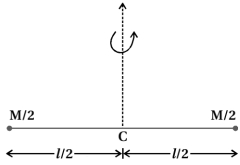
Find the moment of inertia of a thin,massless rod about an axis passing through its centre of mass,where a pair of masses is suspended at both ends of this rod.
Solution
(N/A) The system is rotating about an axis passing through the centre of mass of the system and perpendicular to the rod.
Suppose $C$ is the centre of mass. The distance of each small mass from the centre is $\frac{l}{2}$.
The moment of inertia of each mass about the mentioned axis is given by $I_i = m r^2 = \left(\frac{M}{2}\right)\left(\frac{l}{2}\right)^{2}$.
Therefore,the total moment of inertia of the system is:
$I = I_1 + I_2 = \left(\frac{M}{2}\right)\left(\frac{l}{2}\right)^{2} + \left(\frac{M}{2}\right)\left(\frac{l}{2}\right)^{2}$
$I = 2 \times \left(\frac{M}{2}\right)\left(\frac{l}{2}\right)^{2}$
$I = M \times \frac{l^2}{4} = \frac{M l^{2}}{4}$
Suppose $C$ is the centre of mass. The distance of each small mass from the centre is $\frac{l}{2}$.
The moment of inertia of each mass about the mentioned axis is given by $I_i = m r^2 = \left(\frac{M}{2}\right)\left(\frac{l}{2}\right)^{2}$.
Therefore,the total moment of inertia of the system is:
$I = I_1 + I_2 = \left(\frac{M}{2}\right)\left(\frac{l}{2}\right)^{2} + \left(\frac{M}{2}\right)\left(\frac{l}{2}\right)^{2}$
$I = 2 \times \left(\frac{M}{2}\right)\left(\frac{l}{2}\right)^{2}$
$I = M \times \frac{l^2}{4} = \frac{M l^{2}}{4}$
0 likes
View Solution225
Medium
Explain the radius of gyration.
Solution
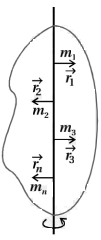
(N/A) The radius of gyration is a parameter that describes how the mass of a rotating rigid body is distributed with respect to the axis of rotation.
It is related to the moment of inertia $(I)$ and the total mass $(M)$ of the body.
Consider a rigid body rotating about a given axis,consisting of $n$ particles,each of mass $m$. The total mass of the rigid body is $M = n m$.
The moment of inertia about the given axis is:
$I = m_{1} r_{1}^{2} + m_{2} r_{2}^{2} + \ldots + m_{n} r_{n}^{2}$
Since $m_{i} = m$ for all particles:
$I = m r_{1}^{2} + m r_{2}^{2} + \ldots + m r_{n}^{2} = m (r_{1}^{2} + r_{2}^{2} + \ldots + r_{n}^{2})$
By multiplying and dividing by $n$:
$I = (m n) \left[ \frac{r_{1}^{2} + r_{2}^{2} + \ldots + r_{n}^{2}}{n} \right]$
We define the radius of gyration $k$ such that $k^2 = \frac{r_{1}^{2} + r_{2}^{2} + \ldots + r_{n}^{2}}{n}$.
Thus,the moment of inertia is given by:
$I = M k^{2}$
Here,$k$ represents the root mean square distance of the particles from the axis of rotation.
It is related to the moment of inertia $(I)$ and the total mass $(M)$ of the body.
Consider a rigid body rotating about a given axis,consisting of $n$ particles,each of mass $m$. The total mass of the rigid body is $M = n m$.
The moment of inertia about the given axis is:
$I = m_{1} r_{1}^{2} + m_{2} r_{2}^{2} + \ldots + m_{n} r_{n}^{2}$
Since $m_{i} = m$ for all particles:
$I = m r_{1}^{2} + m r_{2}^{2} + \ldots + m r_{n}^{2} = m (r_{1}^{2} + r_{2}^{2} + \ldots + r_{n}^{2})$
By multiplying and dividing by $n$:
$I = (m n) \left[ \frac{r_{1}^{2} + r_{2}^{2} + \ldots + r_{n}^{2}}{n} \right]$
We define the radius of gyration $k$ such that $k^2 = \frac{r_{1}^{2} + r_{2}^{2} + \ldots + r_{n}^{2}}{n}$.
Thus,the moment of inertia is given by:
$I = M k^{2}$
Here,$k$ represents the root mean square distance of the particles from the axis of rotation.
0 likes
View Solution226
Difficult
Write the practical uses of moment of inertia.
Solution
(N/A) The practical application of the moment of inertia is observed in machines such as steam engines and automobile engines.
These machines utilize a disc with a very large moment of inertia,known as a flywheel.
The flywheel resists sudden increases or decreases in the speed of the vehicle or machine.
Consequently,it minimizes jerks in the motion,ensuring a smoother operation and making travel or mechanical work more efficient.
These machines utilize a disc with a very large moment of inertia,known as a flywheel.
The flywheel resists sudden increases or decreases in the speed of the vehicle or machine.
Consequently,it minimizes jerks in the motion,ensuring a smoother operation and making travel or mechanical work more efficient.
0 likes
View Solution227
Medium
Define moment of inertia,write its unit and dimensional formula.
Solution
(N/A) The moment of inertia $(I)$ of a rigid body about a given axis of rotation is defined as the sum of the products of the masses of its constituent particles and the square of their respective distances from the axis of rotation. Mathematically,$I = \sum m_i r_i^2$.
$1$. $SI$ Unit: The $SI$ unit of moment of inertia is $kg \cdot m^2$.
$2$. Dimensional Formula: Since $I = M \cdot L^2$,the dimensional formula is $[M^1 L^2 T^0]$.
$1$. $SI$ Unit: The $SI$ unit of moment of inertia is $kg \cdot m^2$.
$2$. Dimensional Formula: Since $I = M \cdot L^2$,the dimensional formula is $[M^1 L^2 T^0]$.
0 likes
View Solution228
Easy
What are the factors on which the magnitude of the moment of inertia depends?
Solution
(N/A) The moment of inertia $(I)$ of a rigid body depends on the following factors:
$1$. Mass of the body: The moment of inertia is directly proportional to the mass of the body.
$2$. Distribution of mass: It depends on how the mass is distributed relative to the axis of rotation. If more mass is concentrated farther from the axis,the moment of inertia increases.
$3$. Position and orientation of the axis of rotation: The moment of inertia changes if the axis of rotation is shifted or its orientation is changed relative to the body.
$1$. Mass of the body: The moment of inertia is directly proportional to the mass of the body.
$2$. Distribution of mass: It depends on how the mass is distributed relative to the axis of rotation. If more mass is concentrated farther from the axis,the moment of inertia increases.
$3$. Position and orientation of the axis of rotation: The moment of inertia changes if the axis of rotation is shifted or its orientation is changed relative to the body.
0 likes
View Solution229
MediumMCQ
How does the moment of inertia depend on the angular momentum?
A
It is directly proportional to angular momentum.
B
It is inversely proportional to angular momentum.
C
It is independent of angular momentum.
D
It depends on the square of angular momentum.
Solution
(C) The angular momentum $L$ of a rotating rigid body is given by the relation $L = I\omega$,where $I$ is the moment of inertia and $\omega$ is the angular velocity.
From this relation,the moment of inertia is $I = L/\omega$.
However,the moment of inertia $I$ is a property of the body's mass distribution relative to the axis of rotation and is defined as $I = \sum m_i r_i^2$.
Since $I$ depends only on the mass and the geometry of the body,it is independent of the angular momentum $L$ and the angular velocity $\omega$.
Therefore,the moment of inertia does not change with a change in angular momentum.
From this relation,the moment of inertia is $I = L/\omega$.
However,the moment of inertia $I$ is a property of the body's mass distribution relative to the axis of rotation and is defined as $I = \sum m_i r_i^2$.
Since $I$ depends only on the mass and the geometry of the body,it is independent of the angular momentum $L$ and the angular velocity $\omega$.
Therefore,the moment of inertia does not change with a change in angular momentum.
0 likes
View Solution230
EasyMCQ
What is analogous to mass in linear motion for rotational motion?
A
Moment of inertia
B
Torque
C
Angular momentum
D
Angular velocity
Solution
(A) In linear motion,the property of a body to resist a change in its state of motion is called mass $(m)$.
In rotational motion,the property of a body to resist a change in its state of rotational motion is called the moment of inertia $(I)$.
Therefore,the moment of inertia is the rotational analogue of mass in linear motion.
In rotational motion,the property of a body to resist a change in its state of rotational motion is called the moment of inertia $(I)$.
Therefore,the moment of inertia is the rotational analogue of mass in linear motion.
0 likes
View Solution231
Medium
What is the radius of gyration? Write its unit and dimensional formula.
Solution
(N/A) The radius of gyration of a body about a given axis is defined as the distance from the axis of rotation to a point where,if the entire mass of the body were concentrated,its moment of inertia would be the same as the actual body.
Mathematically,$I = MK^2$,where $I$ is the moment of inertia,$M$ is the total mass,and $K$ is the radius of gyration.
Thus,$K = \sqrt{I/M}$.
Unit: The $SI$ unit of the radius of gyration is the meter $(m)$.
Dimensional formula: Since it represents a distance,its dimensional formula is $[M^0 L^1 T^0]$.
Mathematically,$I = MK^2$,where $I$ is the moment of inertia,$M$ is the total mass,and $K$ is the radius of gyration.
Thus,$K = \sqrt{I/M}$.
Unit: The $SI$ unit of the radius of gyration is the meter $(m)$.
Dimensional formula: Since it represents a distance,its dimensional formula is $[M^0 L^1 T^0]$.
0 likes
View Solution232
MediumMCQ
Can the moment of inertia of the same body be different?
A
Yes
B
No
C
Depends on the material
D
Depends on the temperature
Solution
(A) Yes,the moment of inertia of the same body can be different. The moment of inertia depends on the distribution of mass relative to the axis of rotation. As the axis of rotation changes,the distance of the mass elements from the axis changes,which results in a change in the moment of inertia.
0 likes
View Solution233
MediumMCQ
What is the $SI$ unit of the radius of gyration?
A
$m$
B
$m^2$
C
$kg \cdot m$
D
$kg \cdot m^2$
Solution
(A) The radius of gyration $(k)$ is defined as the distance from the axis of rotation to a point where the entire mass of the body could be concentrated without changing its moment of inertia.
Since it represents a distance,its $SI$ unit is the meter $(m)$.
Since it represents a distance,its $SI$ unit is the meter $(m)$.
0 likes
View Solution234
Easy
Why does a solid sphere have a smaller moment of inertia than a hollow cylinder of the same mass and radius,about an axis passing through their axes of symmetry?
Solution
(N/A) The moment of inertia $I$ of a body is given by $I = \sum m_i r_i^2$,where $m_i$ is the mass element and $r_i$ is its perpendicular distance from the axis of rotation.
For a hollow cylinder of mass $M$ and radius $R$,all its mass is distributed at a distance $R$ from the axis of symmetry. Thus,its moment of inertia is $I_{cylinder} = MR^2$.
For a solid sphere of mass $M$ and radius $R$,the mass is distributed throughout its volume,meaning most of its mass lies at a distance $r < R$ from the axis of symmetry. Its moment of inertia is $I_{sphere} = \frac{2}{5}MR^2$.
Since $\frac{2}{5}MR^2 < MR^2$,the solid sphere has a smaller moment of inertia than the hollow cylinder.
For a hollow cylinder of mass $M$ and radius $R$,all its mass is distributed at a distance $R$ from the axis of symmetry. Thus,its moment of inertia is $I_{cylinder} = MR^2$.
For a solid sphere of mass $M$ and radius $R$,the mass is distributed throughout its volume,meaning most of its mass lies at a distance $r < R$ from the axis of symmetry. Its moment of inertia is $I_{sphere} = \frac{2}{5}MR^2$.
Since $\frac{2}{5}MR^2 < MR^2$,the solid sphere has a smaller moment of inertia than the hollow cylinder.
0 likes
View Solution235
Medium
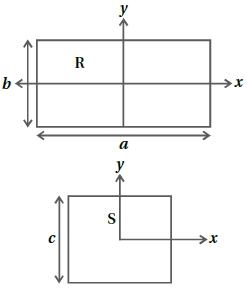
$A$ uniform square plate $S$ (side $c$) and a uniform rectangular plate $R$ (sides $b, a$) have identical areas and masses. Show that:
$(i) \frac{I_{xR}}{I_{xS}} < 1$
$(ii) \frac{I_{yR}}{I_{yS}} > 1$
$(iii) \frac{I_{zR}}{I_{zS}} > 1$
$(i) \frac{I_{xR}}{I_{xS}} < 1$
$(ii) \frac{I_{yR}}{I_{yS}} > 1$
$(iii) \frac{I_{zR}}{I_{zS}} > 1$
Solution
(N/A) Given that the area of the square plate $S$ is equal to the area of the rectangular plate $R$.
Therefore,$c^2 = a \times b$,which implies $c^2 = ab$.
Let $M$ be the mass of both plates.
The moment of inertia of a rectangular plate of sides $a$ and $b$ about the $x$-axis (passing through the center and parallel to side $a$) is $I_{xR} = \frac{Mb^2}{12}$.
The moment of inertia of a square plate of side $c$ about the $x$-axis is $I_{xS} = \frac{Mc^2}{12}$.
$(i)$ $\frac{I_{xR}}{I_{xS}} = \frac{Mb^2/12}{Mc^2/12} = \frac{b^2}{c^2} = \frac{b^2}{ab} = \frac{b}{a}$. Since $a > b$ for a rectangle,$\frac{b}{a} < 1$,so $\frac{I_{xR}}{I_{xS}} < 1$.
$(ii)$ Similarly,$I_{yR} = \frac{Ma^2}{12}$ and $I_{yS} = \frac{Mc^2}{12}$.
$\frac{I_{yR}}{I_{yS}} = \frac{a^2}{c^2} = \frac{a^2}{ab} = \frac{a}{b}$. Since $a > b$,$\frac{a}{b} > 1$,so $\frac{I_{yR}}{I_{yS}} > 1$.
$(iii)$ By the perpendicular axis theorem,$I_z = I_x + I_y$.
$I_{zR} = \frac{M(a^2 + b^2)}{12}$ and $I_{zS} = \frac{M(c^2 + c^2)}{12} = \frac{2Mc^2}{12}$.
$\frac{I_{zR}}{I_{zS}} = \frac{a^2 + b^2}{2c^2} = \frac{a^2 + b^2}{2ab}$.
Since $(a - b)^2 > 0$,we have $a^2 + b^2 > 2ab$,therefore $\frac{a^2 + b^2}{2ab} > 1$,which implies $\frac{I_{zR}}{I_{zS}} > 1$.
Therefore,$c^2 = a \times b$,which implies $c^2 = ab$.
Let $M$ be the mass of both plates.
The moment of inertia of a rectangular plate of sides $a$ and $b$ about the $x$-axis (passing through the center and parallel to side $a$) is $I_{xR} = \frac{Mb^2}{12}$.
The moment of inertia of a square plate of side $c$ about the $x$-axis is $I_{xS} = \frac{Mc^2}{12}$.
$(i)$ $\frac{I_{xR}}{I_{xS}} = \frac{Mb^2/12}{Mc^2/12} = \frac{b^2}{c^2} = \frac{b^2}{ab} = \frac{b}{a}$. Since $a > b$ for a rectangle,$\frac{b}{a} < 1$,so $\frac{I_{xR}}{I_{xS}} < 1$.
$(ii)$ Similarly,$I_{yR} = \frac{Ma^2}{12}$ and $I_{yS} = \frac{Mc^2}{12}$.
$\frac{I_{yR}}{I_{yS}} = \frac{a^2}{c^2} = \frac{a^2}{ab} = \frac{a}{b}$. Since $a > b$,$\frac{a}{b} > 1$,so $\frac{I_{yR}}{I_{yS}} > 1$.
$(iii)$ By the perpendicular axis theorem,$I_z = I_x + I_y$.
$I_{zR} = \frac{M(a^2 + b^2)}{12}$ and $I_{zS} = \frac{M(c^2 + c^2)}{12} = \frac{2Mc^2}{12}$.
$\frac{I_{zR}}{I_{zS}} = \frac{a^2 + b^2}{2c^2} = \frac{a^2 + b^2}{2ab}$.
Since $(a - b)^2 > 0$,we have $a^2 + b^2 > 2ab$,therefore $\frac{a^2 + b^2}{2ab} > 1$,which implies $\frac{I_{zR}}{I_{zS}} > 1$.
0 likes
View Solution236
MediumMCQ
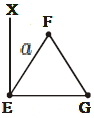
$A$ massless equilateral triangle $EFG$ of side $'a'$ (as shown in the figure) has three particles of mass $m$ situated at its vertices. The moment of inertia of the system about the line $EX$ perpendicular to $EG$ in the plane of $EFG$ is $\frac{N}{20} ma^{2}$,where $N$ is an integer. The value of $N$ is
A
$25$
B
$33$
C
$30$
D
$39$
Solution
(A) Let the vertices be $E(0, 0)$,$G(a, 0)$,and $F(a/2, a\sqrt{3}/2)$.
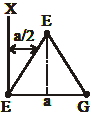
The line $EX$ is the $y$-axis (perpendicular to $EG$ at $E$).
The distances of the particles at $E, G, F$ from the $y$-axis are $r_E = 0$,$r_G = a$,and $r_F = a/2$.
The moment of inertia $I$ about the $y$-axis is given by $I = \sum m_i r_i^2$.
$I = m(0)^2 + m(a)^2 + m(a/2)^2$
$I = 0 + ma^2 + \frac{ma^2}{4} = \frac{5}{4} ma^2$.
We are given $I = \frac{N}{20} ma^2$.
Equating the two expressions: $\frac{5}{4} ma^2 = \frac{N}{20} ma^2$.
$\frac{5}{4} = \frac{N}{20} \implies N = \frac{5 \times 20}{4} = 25$.
The line $EX$ is the $y$-axis (perpendicular to $EG$ at $E$).
The distances of the particles at $E, G, F$ from the $y$-axis are $r_E = 0$,$r_G = a$,and $r_F = a/2$.
The moment of inertia $I$ about the $y$-axis is given by $I = \sum m_i r_i^2$.
$I = m(0)^2 + m(a)^2 + m(a/2)^2$
$I = 0 + ma^2 + \frac{ma^2}{4} = \frac{5}{4} ma^2$.
We are given $I = \frac{N}{20} ma^2$.
Equating the two expressions: $\frac{5}{4} ma^2 = \frac{N}{20} ma^2$.
$\frac{5}{4} = \frac{N}{20} \implies N = \frac{5 \times 20}{4} = 25$.
0 likes
View Solution237
DifficultMCQ
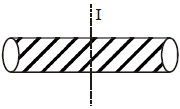
The moment of inertia of a cylinder of mass $M$,length $L$,and radius $R$ about an axis passing through its centre and perpendicular to the axis of the cylinder is $I = M \left(\frac{R^2}{4} + \frac{L^2}{12}\right)$. If such a cylinder is to be made for a given mass of material,the ratio $L/R$ for it to have the minimum possible $I$ is
A
$\sqrt{\frac{2}{3}}$
B
$\frac{3}{2}$
C
$\sqrt{\frac{3}{2}}$
D
$\frac{2}{3}$
Solution
(C) Given the moment of inertia $I = M \left(\frac{R^2}{4} + \frac{L^2}{12}\right)$.
Since the mass $M$ and density $\rho$ are constant,the volume $V = \pi R^2 L$ must be constant.
Thus,$R^2 L = K$ (where $K$ is a constant).
Differentiating with respect to $R$,we get $2RL + R^2 \frac{dL}{dR} = 0$,which implies $\frac{dL}{dR} = -\frac{2L}{R}$.
To minimize $I$,we set $\frac{dI}{dR} = 0$:
$\frac{dI}{dR} = M \left(\frac{2R}{4} + \frac{2L}{12} \frac{dL}{dR}\right) = 0$.
$\frac{R}{2} + \frac{L}{6} \left(-\frac{2L}{R}\right) = 0$.
$\frac{R}{2} - \frac{L^2}{3R} = 0$.
$\frac{R}{2} = \frac{L^2}{3R} \Rightarrow \frac{L^2}{R^2} = \frac{3}{2}$.
Therefore,$\frac{L}{R} = \sqrt{\frac{3}{2}}$.
Since the mass $M$ and density $\rho$ are constant,the volume $V = \pi R^2 L$ must be constant.
Thus,$R^2 L = K$ (where $K$ is a constant).
Differentiating with respect to $R$,we get $2RL + R^2 \frac{dL}{dR} = 0$,which implies $\frac{dL}{dR} = -\frac{2L}{R}$.
To minimize $I$,we set $\frac{dI}{dR} = 0$:
$\frac{dI}{dR} = M \left(\frac{2R}{4} + \frac{2L}{12} \frac{dL}{dR}\right) = 0$.
$\frac{R}{2} + \frac{L}{6} \left(-\frac{2L}{R}\right) = 0$.
$\frac{R}{2} - \frac{L^2}{3R} = 0$.
$\frac{R}{2} = \frac{L^2}{3R} \Rightarrow \frac{L^2}{R^2} = \frac{3}{2}$.
Therefore,$\frac{L}{R} = \sqrt{\frac{3}{2}}$.
0 likes
View Solution238
DifficultMCQ
Consider two uniform discs of the same thickness and different radii $R_{1} = R$ and $R_{2} = \alpha R$ made of the same material. If the ratio of their moments of inertia $I_{1}$ and $I_{2}$,respectively,about their axes is $I_{1} : I_{2} = 1 : 16$,then the value of $\alpha$ is:
A
$ \sqrt{2} $
B
$ 2 $
C
$ 4 $
D
$ 2 \sqrt{2} $
Solution
(B) The moment of inertia of a uniform disc about its central axis is given by $I = \frac{1}{2} M R^{2}$.
Since the discs are made of the same material and have the same thickness $t$,the mass $M$ can be expressed as $M = \rho V = \rho (\pi R^{2} t)$,where $\rho$ is the density.
Substituting this into the formula for $I$,we get $I = \frac{1}{2} (\rho \pi R^{2} t) R^{2} = \frac{1}{2} \rho \pi t R^{4}$.
Since $\rho$,$\pi$,and $t$ are constant for both discs,we have $I \propto R^{4}$.
Given the ratio $\frac{I_{1}}{I_{2}} = \frac{1}{16}$,we can write $\frac{R_{1}^{4}}{R_{2}^{4}} = \frac{1}{16}$.
Taking the fourth root of both sides,we get $\frac{R_{1}}{R_{2}} = \frac{1}{2}$.
Given $R_{1} = R$ and $R_{2} = \alpha R$,we have $\frac{R}{\alpha R} = \frac{1}{2}$,which implies $\frac{1}{\alpha} = \frac{1}{2}$.
Therefore,$\alpha = 2$.
Since the discs are made of the same material and have the same thickness $t$,the mass $M$ can be expressed as $M = \rho V = \rho (\pi R^{2} t)$,where $\rho$ is the density.
Substituting this into the formula for $I$,we get $I = \frac{1}{2} (\rho \pi R^{2} t) R^{2} = \frac{1}{2} \rho \pi t R^{4}$.
Since $\rho$,$\pi$,and $t$ are constant for both discs,we have $I \propto R^{4}$.
Given the ratio $\frac{I_{1}}{I_{2}} = \frac{1}{16}$,we can write $\frac{R_{1}^{4}}{R_{2}^{4}} = \frac{1}{16}$.
Taking the fourth root of both sides,we get $\frac{R_{1}}{R_{2}} = \frac{1}{2}$.
Given $R_{1} = R$ and $R_{2} = \alpha R$,we have $\frac{R}{\alpha R} = \frac{1}{2}$,which implies $\frac{1}{\alpha} = \frac{1}{2}$.
Therefore,$\alpha = 2$.
0 likes
View Solution239
DifficultMCQ
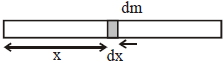
The linear mass density of a thin rod $AB$ of length $L$ varies from $A$ to $B$ as $\lambda(x) = \lambda_{0}(1 + \frac{x}{L})$,where $x$ is the distance from $A$. If $M$ is the mass of the rod,then its moment of inertia about an axis passing through $A$ and perpendicular to the rod is $......ML^{2}$.
A
$0.416$
B
$0.428$
C
$0.4$
D
$0.388$
Solution
(D) The moment of inertia $I$ is given by $I = \int r^{2} dm = \int_{0}^{L} x^{2} \lambda(x) dx$.
Substituting $\lambda(x) = \lambda_{0}(1 + \frac{x}{L})$:
$I = \int_{0}^{L} x^{2} \lambda_{0}(1 + \frac{x}{L}) dx = \lambda_{0} \int_{0}^{L} (x^{2} + \frac{x^{3}}{L}) dx$
$I = \lambda_{0} [\frac{x^{3}}{3} + \frac{x^{4}}{4L}]_{0}^{L} = \lambda_{0} (\frac{L^{3}}{3} + \frac{L^{3}}{4}) = \frac{7}{12} \lambda_{0} L^{3} \quad ...(i)$
Now,calculate the total mass $M$:
$M = \int_{0}^{L} \lambda(x) dx = \int_{0}^{L} \lambda_{0}(1 + \frac{x}{L}) dx = \lambda_{0} [x + \frac{x^{2}}{2L}]_{0}^{L} = \lambda_{0} (L + \frac{L}{2}) = \frac{3}{2} \lambda_{0} L$
Thus,$\lambda_{0} L = \frac{2}{3} M \quad ...(ii)$
Substituting $(ii)$ into $(i)$:
$I = \frac{7}{12} (\lambda_{0} L) L^{2} = \frac{7}{12} (\frac{2}{3} M) L^{2} = \frac{14}{36} M L^{2} = \frac{7}{18} M L^{2}$
$I \approx 0.388 M L^{2}$.
Substituting $\lambda(x) = \lambda_{0}(1 + \frac{x}{L})$:
$I = \int_{0}^{L} x^{2} \lambda_{0}(1 + \frac{x}{L}) dx = \lambda_{0} \int_{0}^{L} (x^{2} + \frac{x^{3}}{L}) dx$
$I = \lambda_{0} [\frac{x^{3}}{3} + \frac{x^{4}}{4L}]_{0}^{L} = \lambda_{0} (\frac{L^{3}}{3} + \frac{L^{3}}{4}) = \frac{7}{12} \lambda_{0} L^{3} \quad ...(i)$
Now,calculate the total mass $M$:
$M = \int_{0}^{L} \lambda(x) dx = \int_{0}^{L} \lambda_{0}(1 + \frac{x}{L}) dx = \lambda_{0} [x + \frac{x^{2}}{2L}]_{0}^{L} = \lambda_{0} (L + \frac{L}{2}) = \frac{3}{2} \lambda_{0} L$
Thus,$\lambda_{0} L = \frac{2}{3} M \quad ...(ii)$
Substituting $(ii)$ into $(i)$:
$I = \frac{7}{12} (\lambda_{0} L) L^{2} = \frac{7}{12} (\frac{2}{3} M) L^{2} = \frac{14}{36} M L^{2} = \frac{7}{18} M L^{2}$
$I \approx 0.388 M L^{2}$.
0 likes
View Solution240
DifficultMCQ
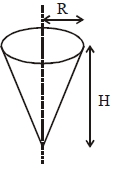
Shown in the figure is a hollow ice cream cone (it is open at the top). If its mass is $M$,radius of its top is $R$,and height is $H$,then its moment of inertia about its axis is
A
$\frac{MR^2}{2}$
B
$\frac{MH^2}{3}$
C
$\frac{MR^2}{3}$
D
$\frac{M(R^2 + H^2)}{4}$
Solution
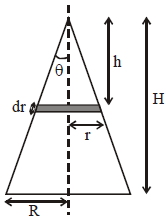
(A) Consider a hollow cone of mass $M$,height $H$,and base radius $R$. The slant height is $L = \sqrt{R^2 + H^2}$.
Let $\theta$ be the semi-vertical angle,so $\tan \theta = R/H$.
Consider a thin circular ring element at a distance $y$ from the apex along the axis,with thickness $dy$ along the slant height.
The radius of this ring is $r = y \tan \theta$.
The slant length of the element is $dl = dy / \cos \theta$.
The surface area of the cone is $A = \pi R L = \pi R \sqrt{R^2 + H^2}$.
The mass per unit area is $\sigma = M / A = M / (\pi R \sqrt{R^2 + H^2})$.
The area of the ring element is $dA = 2 \pi r dl = 2 \pi (y \tan \theta) (dy / \cos \theta)$.
The mass of the element is $dm = \sigma dA = \frac{M}{\pi R \sqrt{R^2 + H^2}} \cdot 2 \pi (y \tan \theta) \frac{dy}{\cos \theta} = \frac{2M}{R \sqrt{R^2 + H^2}} \cdot \frac{\tan \theta}{\cos \theta} y dy$.
Since $\tan \theta = R/H$ and $\cos \theta = H/L = H/\sqrt{R^2 + H^2}$,we have $\frac{\tan \theta}{\cos \theta} = \frac{R/H}{H/L} = \frac{RL}{H^2} = \frac{R\sqrt{R^2+H^2}}{H^2}$.
Thus,$dm = \frac{2M}{R\sqrt{R^2+H^2}} \cdot \frac{R\sqrt{R^2+H^2}}{H^2} y dy = \frac{2M}{H^2} y dy$.
The moment of inertia of this ring about the axis is $dI = dm \cdot r^2 = (\frac{2M}{H^2} y dy) (y \tan \theta)^2 = \frac{2M}{H^2} \tan^2 \theta \cdot y^3 dy$.
Integrating from $y=0$ to $y=H$:
$I = \int_0^H \frac{2M}{H^2} (R/H)^2 y^3 dy = \frac{2MR^2}{H^4} \int_0^H y^3 dy = \frac{2MR^2}{H^4} [\frac{y^4}{4}]_0^H = \frac{2MR^2}{H^4} \cdot \frac{H^4}{4} = \frac{MR^2}{2}$.
Let $\theta$ be the semi-vertical angle,so $\tan \theta = R/H$.
Consider a thin circular ring element at a distance $y$ from the apex along the axis,with thickness $dy$ along the slant height.
The radius of this ring is $r = y \tan \theta$.
The slant length of the element is $dl = dy / \cos \theta$.
The surface area of the cone is $A = \pi R L = \pi R \sqrt{R^2 + H^2}$.
The mass per unit area is $\sigma = M / A = M / (\pi R \sqrt{R^2 + H^2})$.
The area of the ring element is $dA = 2 \pi r dl = 2 \pi (y \tan \theta) (dy / \cos \theta)$.
The mass of the element is $dm = \sigma dA = \frac{M}{\pi R \sqrt{R^2 + H^2}} \cdot 2 \pi (y \tan \theta) \frac{dy}{\cos \theta} = \frac{2M}{R \sqrt{R^2 + H^2}} \cdot \frac{\tan \theta}{\cos \theta} y dy$.
Since $\tan \theta = R/H$ and $\cos \theta = H/L = H/\sqrt{R^2 + H^2}$,we have $\frac{\tan \theta}{\cos \theta} = \frac{R/H}{H/L} = \frac{RL}{H^2} = \frac{R\sqrt{R^2+H^2}}{H^2}$.
Thus,$dm = \frac{2M}{R\sqrt{R^2+H^2}} \cdot \frac{R\sqrt{R^2+H^2}}{H^2} y dy = \frac{2M}{H^2} y dy$.
The moment of inertia of this ring about the axis is $dI = dm \cdot r^2 = (\frac{2M}{H^2} y dy) (y \tan \theta)^2 = \frac{2M}{H^2} \tan^2 \theta \cdot y^3 dy$.
Integrating from $y=0$ to $y=H$:
$I = \int_0^H \frac{2M}{H^2} (R/H)^2 y^3 dy = \frac{2MR^2}{H^4} \int_0^H y^3 dy = \frac{2MR^2}{H^4} [\frac{y^4}{4}]_0^H = \frac{2MR^2}{H^4} \cdot \frac{H^4}{4} = \frac{MR^2}{2}$.
0 likes
View Solution241
MediumMCQ
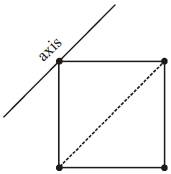
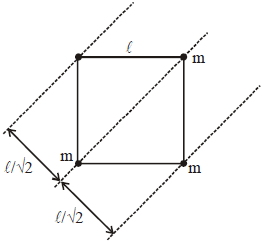
Four point masses,each of mass $m$,are fixed at the corners of a square of side $\ell$. The square is rotating with angular frequency $\omega$,about an axis passing through one of the corners of the square and parallel to its diagonal,as shown in the figure. The angular momentum of the square about this axis is $.......m\ell^2 \omega$.
A
$2$
B
$3$
C
$1$
D
$4$
Solution
(C) Let the corners of the square be at $(0,0)$,$(\ell, 0)$,$(\ell, \ell)$,and $(0, \ell)$. The axis passes through $(0,0)$ and is parallel to the diagonal connecting $(0, \ell)$ and $(\ell, 0)$. The equation of this diagonal is $x + y = \ell$. The perpendicular distance $r$ of a point $(x, y)$ from the line $x + y - \ell = 0$ is given by $r = \frac{|x + y - \ell|}{\sqrt{1^2 + 1^2}} = \frac{|x + y - \ell|}{\sqrt{2}}$.
For the four masses:
$1$. At $(0,0)$: $r_1 = \frac{|0 + 0 - \ell|}{\sqrt{2}} = \frac{\ell}{\sqrt{2}}$.
$2$. At $(\ell, 0)$: $r_2 = \frac{|\ell + 0 - \ell|}{\sqrt{2}} = 0$.
$3$. At $(0, \ell)$: $r_3 = \frac{|0 + \ell - \ell|}{\sqrt{2}} = 0$.
$4$. At $(\ell, \ell)$: $r_4 = \frac{|\ell + \ell - \ell|}{\sqrt{2}} = \frac{\ell}{\sqrt{2}}$.
The moment of inertia $I$ about the axis is $I = \sum mr_i^2 = m \left( \left(\frac{\ell}{\sqrt{2}}\right)^2 + 0^2 + 0^2 + \left(\frac{\ell}{\sqrt{2}}\right)^2 \right) = m \left( \frac{\ell^2}{2} + \frac{\ell^2}{2} \right) = m\ell^2$.
Angular momentum $L = I\omega = m\ell^2\omega$. Therefore,the missing value is $1$.
For the four masses:
$1$. At $(0,0)$: $r_1 = \frac{|0 + 0 - \ell|}{\sqrt{2}} = \frac{\ell}{\sqrt{2}}$.
$2$. At $(\ell, 0)$: $r_2 = \frac{|\ell + 0 - \ell|}{\sqrt{2}} = 0$.
$3$. At $(0, \ell)$: $r_3 = \frac{|0 + \ell - \ell|}{\sqrt{2}} = 0$.
$4$. At $(\ell, \ell)$: $r_4 = \frac{|\ell + \ell - \ell|}{\sqrt{2}} = \frac{\ell}{\sqrt{2}}$.
The moment of inertia $I$ about the axis is $I = \sum mr_i^2 = m \left( \left(\frac{\ell}{\sqrt{2}}\right)^2 + 0^2 + 0^2 + \left(\frac{\ell}{\sqrt{2}}\right)^2 \right) = m \left( \frac{\ell^2}{2} + \frac{\ell^2}{2} \right) = m\ell^2$.
Angular momentum $L = I\omega = m\ell^2\omega$. Therefore,the missing value is $1$.
0 likes
View Solution242
DifficultMCQ
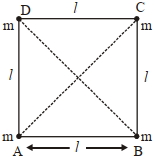
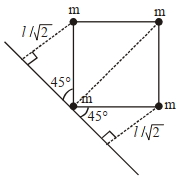
Four equal masses,$m$ each,are placed at the corners of a square of side length $l$ as shown in the figure. The moment of inertia of the system about an axis passing through $A$ and parallel to $DB$ would be:
A
$m l^2$
B
$2 m l^2$
C
$3 m l^2$
D
$\sqrt{3} m l^2$
Solution
(C) The moment of inertia of a point mass is given by $I = m r^2$,where $r$ is the perpendicular distance from the axis of rotation.
Let the axis pass through $A$ and be parallel to the diagonal $DB$.
The perpendicular distances of the four masses from this axis are:
$1$. For mass at $A$: $r_A = 0$ (since the axis passes through $A$).
$2$. For mass at $B$: $r_B = l \sin(45^\circ) = l / \sqrt{2}$.
$3$. For mass at $D$: $r_D = l \sin(45^\circ) = l / \sqrt{2}$.
$4$. For mass at $C$: $r_C = l \sin(45^\circ) + l \sin(45^\circ) = l / \sqrt{2} + l / \sqrt{2} = 2l / \sqrt{2} = l \sqrt{2}$.
The total moment of inertia is $I = m(r_A^2 + r_B^2 + r_D^2 + r_C^2)$.
$I = m [0^2 + (l / \sqrt{2})^2 + (l / \sqrt{2})^2 + (l \sqrt{2})^2]$
$I = m [0 + l^2/2 + l^2/2 + 2l^2]$
$I = m [l^2 + 2l^2] = 3 m l^2$.
Let the axis pass through $A$ and be parallel to the diagonal $DB$.
The perpendicular distances of the four masses from this axis are:
$1$. For mass at $A$: $r_A = 0$ (since the axis passes through $A$).
$2$. For mass at $B$: $r_B = l \sin(45^\circ) = l / \sqrt{2}$.
$3$. For mass at $D$: $r_D = l \sin(45^\circ) = l / \sqrt{2}$.
$4$. For mass at $C$: $r_C = l \sin(45^\circ) + l \sin(45^\circ) = l / \sqrt{2} + l / \sqrt{2} = 2l / \sqrt{2} = l \sqrt{2}$.
The total moment of inertia is $I = m(r_A^2 + r_B^2 + r_D^2 + r_C^2)$.
$I = m [0^2 + (l / \sqrt{2})^2 + (l / \sqrt{2})^2 + (l \sqrt{2})^2]$
$I = m [0 + l^2/2 + l^2/2 + 2l^2]$
$I = m [l^2 + 2l^2] = 3 m l^2$.
0 likes
View Solution243
MediumMCQ
Consider a uniform wire of mass $M$ and length $L$. It is bent into a semicircle. Its moment of inertia about a line perpendicular to the plane of the wire passing through the centre is:
A
$\frac{1}{4} \frac{ML^2}{\pi^2}$
B
$\frac{2}{5} \frac{ML^2}{\pi^2}$
C
$\frac{ML^2}{\pi^2}$
D
$\frac{1}{2} \frac{ML^2}{\pi^2}$
Solution
(C) The length of the wire is $L$. When bent into a semicircle of radius $r$,the arc length is $\pi r = L$.
Thus,the radius is $r = \frac{L}{\pi}$.
Since all points of the wire are at the same distance $r$ from the center of the semicircle,the moment of inertia $I$ about an axis perpendicular to the plane passing through the center is given by $I = \int r^2 dm = r^2 \int dm$.
Since $\int dm = M$,we have $I = Mr^2$.
Substituting $r = \frac{L}{\pi}$,we get $I = M \left( \frac{L}{\pi} \right)^2 = \frac{ML^2}{\pi^2}$.
Thus,the radius is $r = \frac{L}{\pi}$.
Since all points of the wire are at the same distance $r$ from the center of the semicircle,the moment of inertia $I$ about an axis perpendicular to the plane passing through the center is given by $I = \int r^2 dm = r^2 \int dm$.
Since $\int dm = M$,we have $I = Mr^2$.
Substituting $r = \frac{L}{\pi}$,we get $I = M \left( \frac{L}{\pi} \right)^2 = \frac{ML^2}{\pi^2}$.
0 likes
View Solution244
MediumMCQ
The moment of inertia $(M.I.)$ of four bodies,having the same mass $M$ and radius $R$,are reported as follows:
$I_{1} = M.I.$ of a thin circular ring about its diameter.
$I_{2} = M.I.$ of a circular disc about an axis perpendicular to the disc and passing through the centre.
$I_{3} = M.I.$ of a solid cylinder about its axis.
$I_{4} = M.I.$ of a solid sphere about its diameter.
Then:
$I_{1} = M.I.$ of a thin circular ring about its diameter.
$I_{2} = M.I.$ of a circular disc about an axis perpendicular to the disc and passing through the centre.
$I_{3} = M.I.$ of a solid cylinder about its axis.
$I_{4} = M.I.$ of a solid sphere about its diameter.
Then:
A
$I_{1} + I_{3} < I_{2} + I_{4}$
B
$I_{1} + I_{2} = I_{3} + \frac{5}{2} I_{4}$
C
$I_{1} = I_{2} = I_{3} > I_{4}$
D
$I_{1} = I_{2} = I_{3} < I_{4}$
Solution
(C) For a thin circular ring of mass $M$ and radius $R$,the moment of inertia about its diameter is $I_{1} = \frac{1}{2} MR^{2}$.
For a circular disc of mass $M$ and radius $R$,the moment of inertia about an axis perpendicular to the disc and passing through the centre is $I_{2} = \frac{1}{2} MR^{2}$.
For a solid cylinder of mass $M$ and radius $R$,the moment of inertia about its central axis is $I_{3} = \frac{1}{2} MR^{2}$.
For a solid sphere of mass $M$ and radius $R$,the moment of inertia about its diameter is $I_{4} = \frac{2}{5} MR^{2}$.
Comparing these values,we see that $I_{1} = I_{2} = I_{3} = 0.5 MR^{2}$ and $I_{4} = 0.4 MR^{2}$.
Therefore,$I_{1} = I_{2} = I_{3} > I_{4}$.
For a circular disc of mass $M$ and radius $R$,the moment of inertia about an axis perpendicular to the disc and passing through the centre is $I_{2} = \frac{1}{2} MR^{2}$.
For a solid cylinder of mass $M$ and radius $R$,the moment of inertia about its central axis is $I_{3} = \frac{1}{2} MR^{2}$.
For a solid sphere of mass $M$ and radius $R$,the moment of inertia about its diameter is $I_{4} = \frac{2}{5} MR^{2}$.
Comparing these values,we see that $I_{1} = I_{2} = I_{3} = 0.5 MR^{2}$ and $I_{4} = 0.4 MR^{2}$.
Therefore,$I_{1} = I_{2} = I_{3} > I_{4}$.
0 likes
View Solution245
DifficultMCQ
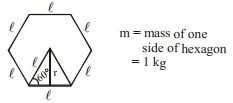
$A$ uniform thin bar of mass $6 \,kg$ and length $2.4 \,m$ is bent to make an equilateral hexagon. The moment of inertia about an axis passing through the centre of mass and perpendicular to the plane of the hexagon is ...... $\times 10^{-1} \,kg \cdot m^2$.
A
$16$
B
$8$
C
$24$
D
$4$
Solution
(B) The total length of the bar is $L = 2.4 \,m$. Since it is bent into a hexagon with $6$ sides,the length of each side is $\ell = \frac{2.4}{6} = 0.4 \,m$.
The mass of the total bar is $M = 6 \,kg$,so the mass of each side is $m = \frac{6}{6} = 1 \,kg$.
For an equilateral hexagon,the distance $r$ from the center to the midpoint of a side is given by $r = \ell \sin 60^{\circ} = \ell \frac{\sqrt{3}}{2}$.
The moment of inertia of one side about an axis passing through its center and perpendicular to its length is $I_{cm} = \frac{m \ell^2}{12}$.
Using the parallel axis theorem,the moment of inertia of one side about the center of the hexagon is $I_1 = I_{cm} + m r^2 = \frac{m \ell^2}{12} + m \left(\frac{\ell \sqrt{3}}{2}\right)^2 = \frac{m \ell^2}{12} + \frac{3 m \ell^2}{4} = \frac{m \ell^2 + 9 m \ell^2}{12} = \frac{10 m \ell^2}{12} = \frac{5}{6} m \ell^2$.
Since there are $6$ such sides,the total moment of inertia is $I = 6 \times I_1 = 6 \times \frac{5}{6} m \ell^2 = 5 m \ell^2$.
Substituting the values $m = 1 \,kg$ and $\ell = 0.4 \,m$:
$I = 5 \times 1 \times (0.4)^2 = 5 \times 0.16 = 0.8 \,kg \cdot m^2$.
Thus,$I = 8 \times 10^{-1} \,kg \cdot m^2$.
The mass of the total bar is $M = 6 \,kg$,so the mass of each side is $m = \frac{6}{6} = 1 \,kg$.
For an equilateral hexagon,the distance $r$ from the center to the midpoint of a side is given by $r = \ell \sin 60^{\circ} = \ell \frac{\sqrt{3}}{2}$.
The moment of inertia of one side about an axis passing through its center and perpendicular to its length is $I_{cm} = \frac{m \ell^2}{12}$.
Using the parallel axis theorem,the moment of inertia of one side about the center of the hexagon is $I_1 = I_{cm} + m r^2 = \frac{m \ell^2}{12} + m \left(\frac{\ell \sqrt{3}}{2}\right)^2 = \frac{m \ell^2}{12} + \frac{3 m \ell^2}{4} = \frac{m \ell^2 + 9 m \ell^2}{12} = \frac{10 m \ell^2}{12} = \frac{5}{6} m \ell^2$.
Since there are $6$ such sides,the total moment of inertia is $I = 6 \times I_1 = 6 \times \frac{5}{6} m \ell^2 = 5 m \ell^2$.
Substituting the values $m = 1 \,kg$ and $\ell = 0.4 \,m$:
$I = 5 \times 1 \times (0.4)^2 = 5 \times 0.16 = 0.8 \,kg \cdot m^2$.
Thus,$I = 8 \times 10^{-1} \,kg \cdot m^2$.
0 likes
View Solution246
DifficultMCQ
$A$ system consists of two identical spheres,each of mass $1.5\, {kg}$ and radius $50\, {cm}$,attached to the ends of a light rod. The distance between the centers of the two spheres is $5\, {m}$. What is the moment of inertia of the system about an axis perpendicular to the rod and passing through its midpoint? (in ${kgm}^{2}$)
A
$18.75$
B
$1.905$
C
$19.05$
D
$1.875$
Solution
(C) Given: Mass of each sphere $M = 1.5\, {kg}$,radius $r = 50\, {cm} = 0.5\, {m}$,and distance between centers $L = 5\, {m}$.
The axis of rotation passes through the midpoint of the rod,which is also the center of mass of the system.
The distance of each sphere's center from the axis of rotation is $d = L/2 = 5/2 = 2.5\, {m}$.
Using the parallel axis theorem for each sphere,the moment of inertia $I$ of one sphere about the axis is $I_{sphere} = I_{cm} + Md^2 = \frac{2}{5}Mr^2 + Md^2$.
Since there are two identical spheres,the total moment of inertia of the system is $I_{total} = 2 \times (\frac{2}{5}Mr^2 + Md^2)$.
Substituting the values: $I_{total} = 2 \times [\frac{2}{5} \times 1.5 \times (0.5)^2 + 1.5 \times (2.5)^2]$.
$I_{total} = 2 \times [0.4 \times 1.5 \times 0.25 + 1.5 \times 6.25]$.
$I_{total} = 2 \times [0.15 + 9.375] = 2 \times 9.525 = 19.05\, {kgm}^{2}$.
The axis of rotation passes through the midpoint of the rod,which is also the center of mass of the system.
The distance of each sphere's center from the axis of rotation is $d = L/2 = 5/2 = 2.5\, {m}$.
Using the parallel axis theorem for each sphere,the moment of inertia $I$ of one sphere about the axis is $I_{sphere} = I_{cm} + Md^2 = \frac{2}{5}Mr^2 + Md^2$.
Since there are two identical spheres,the total moment of inertia of the system is $I_{total} = 2 \times (\frac{2}{5}Mr^2 + Md^2)$.
Substituting the values: $I_{total} = 2 \times [\frac{2}{5} \times 1.5 \times (0.5)^2 + 1.5 \times (2.5)^2]$.
$I_{total} = 2 \times [0.4 \times 1.5 \times 0.25 + 1.5 \times 6.25]$.
$I_{total} = 2 \times [0.15 + 9.375] = 2 \times 9.525 = 19.05\, {kgm}^{2}$.
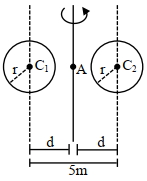
0 likes
View Solution247
EasyMCQ
From a circular ring of mass $M$ and radius $R$,an arc corresponding to a $90^{\circ}$ sector is removed. The moment of inertia of the remaining part of the ring about an axis passing through the centre of the ring and perpendicular to the plane of the ring is $K$ times $MR^{2}$. Then the value of $K$ is
A
$\frac{3}{4}$
B
$\frac{7}{8}$
C
$\frac{1}{4}$
D
$\frac{1}{8}$
Solution
(A) The moment of inertia of a complete circular ring of mass $M$ and radius $R$ about an axis passing through its centre and perpendicular to its plane is $I = MR^{2}$.
Since the mass is uniformly distributed along the circumference,the mass of the remaining part of the ring after removing a $90^{\circ}$ sector (which is $1/4$ of the total circumference) is $M' = M - \frac{1}{4}M = \frac{3}{4}M$.
The moment of inertia of a point mass $m$ at a distance $R$ from the axis is $I = mR^{2}$. Since every point on the ring is at the same distance $R$ from the central axis,the moment of inertia of any part of the ring with mass $M'$ is simply $I' = M'R^{2}$.
Substituting $M' = \frac{3}{4}M$,we get $I' = \frac{3}{4}MR^{2}$.
Comparing this with $I' = KMR^{2}$,we find $K = \frac{3}{4}$.
Since the mass is uniformly distributed along the circumference,the mass of the remaining part of the ring after removing a $90^{\circ}$ sector (which is $1/4$ of the total circumference) is $M' = M - \frac{1}{4}M = \frac{3}{4}M$.
The moment of inertia of a point mass $m$ at a distance $R$ from the axis is $I = mR^{2}$. Since every point on the ring is at the same distance $R$ from the central axis,the moment of inertia of any part of the ring with mass $M'$ is simply $I' = M'R^{2}$.
Substituting $M' = \frac{3}{4}M$,we get $I' = \frac{3}{4}MR^{2}$.
Comparing this with $I' = KMR^{2}$,we find $K = \frac{3}{4}$.
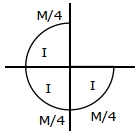
0 likes
View Solution248
MediumMCQ
Given below are two statements: one is labelled as Assertion $A$ and the other is labelled as Reason $R$.
Assertion $A$: Moment of inertia of a circular disc of mass $M$ and radius $R$ about $X, Y$ axes (passing through its plane) and $Z$-axis which is perpendicular to its plane were found to be $I_{x}, I_{y}$ and $I_{z}$ respectively. The respective radii of gyration about all the three axes will be the same.
Reason $R$: $A$ rigid body making rotational motion has fixed mass and shape.
In the light of the above statements,choose the most appropriate answer from the options given below:
Assertion $A$: Moment of inertia of a circular disc of mass $M$ and radius $R$ about $X, Y$ axes (passing through its plane) and $Z$-axis which is perpendicular to its plane were found to be $I_{x}, I_{y}$ and $I_{z}$ respectively. The respective radii of gyration about all the three axes will be the same.
Reason $R$: $A$ rigid body making rotational motion has fixed mass and shape.
In the light of the above statements,choose the most appropriate answer from the options given below:
A
Both $A$ and $R$ are correct but $R$ is $NOT$ the correct explanation of $A$.
B
$A$ is not correct but $R$ is correct.
C
$A$ is correct but $R$ is not correct.
D
Both $A$ and $R$ are correct and $R$ is the correct explanation of $A$.
Solution
(B) According to the perpendicular axes theorem,for a planar body like a circular disc,$I_{z} = I_{x} + I_{y}$.
The radius of gyration $K$ is defined by the relation $I = MK^{2}$,where $M$ is the mass of the body.
Substituting this into the theorem: $MK_{z}^{2} = MK_{x}^{2} + MK_{y}^{2}$,which simplifies to $K_{z}^{2} = K_{x}^{2} + K_{y}^{2}$.
Since $K_{z}^{2} = K_{x}^{2} + K_{y}^{2}$,the radii of gyration about the three axes cannot be the same. Thus,Assertion $A$ is incorrect.
Reason $R$ states that a rigid body has a fixed mass and shape,which is a correct definition of a rigid body in rotational mechanics. Therefore,$A$ is incorrect but $R$ is correct.
The radius of gyration $K$ is defined by the relation $I = MK^{2}$,where $M$ is the mass of the body.
Substituting this into the theorem: $MK_{z}^{2} = MK_{x}^{2} + MK_{y}^{2}$,which simplifies to $K_{z}^{2} = K_{x}^{2} + K_{y}^{2}$.
Since $K_{z}^{2} = K_{x}^{2} + K_{y}^{2}$,the radii of gyration about the three axes cannot be the same. Thus,Assertion $A$ is incorrect.
Reason $R$ states that a rigid body has a fixed mass and shape,which is a correct definition of a rigid body in rotational mechanics. Therefore,$A$ is incorrect but $R$ is correct.
0 likes
View Solution249
MediumMCQ
The figure shows two solid discs with radius $R$ and $r$ respectively. If the mass per unit area is the same for both,what is the ratio of the moment of inertia $(MI)$ of the bigger disc about axis $AB$ (which is perpendicular to the plane of the disc and passing through its centre) to the $MI$ of the smaller disc about one of its diameters lying on its plane? Given $M$ is the mass of the larger disc.
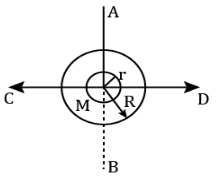
A
$2r^{4}:R^{4}$
B
$2R^{2}:r^{2}$
C
$2R^{4}:r^{4}$
D
$R^{2}:r^{2}$
Solution
(C) Let $\sigma$ be the mass per unit area (surface mass density). Since $\sigma$ is the same for both discs:
Mass of larger disc,$M = \sigma \pi R^{2}$
Mass of smaller disc,$m = \sigma \pi r^{2}$
The moment of inertia of the larger disc about axis $AB$ (perpendicular to the plane through the centre) is $I_{1} = \frac{1}{2} MR^{2} = \frac{1}{2} (\sigma \pi R^{2}) R^{2} = \frac{1}{2} \sigma \pi R^{4}$.
The moment of inertia of the smaller disc about its diameter is $I_{2} = \frac{1}{4} mr^{2} = \frac{1}{4} (\sigma \pi r^{2}) r^{2} = \frac{1}{4} \sigma \pi r^{4}$.
The ratio of the moments of inertia is $\frac{I_{1}}{I_{2}} = \frac{\frac{1}{2} \sigma \pi R^{4}}{\frac{1}{4} \sigma \pi r^{4}} = \frac{1/2}{1/4} \cdot \frac{R^{4}}{r^{4}} = 2 \frac{R^{4}}{r^{4}}$.
Thus,the ratio is $2R^{4}:r^{4}$.
Mass of larger disc,$M = \sigma \pi R^{2}$
Mass of smaller disc,$m = \sigma \pi r^{2}$
The moment of inertia of the larger disc about axis $AB$ (perpendicular to the plane through the centre) is $I_{1} = \frac{1}{2} MR^{2} = \frac{1}{2} (\sigma \pi R^{2}) R^{2} = \frac{1}{2} \sigma \pi R^{4}$.
The moment of inertia of the smaller disc about its diameter is $I_{2} = \frac{1}{4} mr^{2} = \frac{1}{4} (\sigma \pi r^{2}) r^{2} = \frac{1}{4} \sigma \pi r^{4}$.
The ratio of the moments of inertia is $\frac{I_{1}}{I_{2}} = \frac{\frac{1}{2} \sigma \pi R^{4}}{\frac{1}{4} \sigma \pi r^{4}} = \frac{1/2}{1/4} \cdot \frac{R^{4}}{r^{4}} = 2 \frac{R^{4}}{r^{4}}$.
Thus,the ratio is $2R^{4}:r^{4}$.
0 likes
View SolutionSystem of Particles and Rotational Motion — Moment of Inertia and Radius of gyration · Frequently Asked Questions
1Are these System of Particles and Rotational Motion questions useful for JEE and NEET?
Yes. All questions in this section are mapped to JEE Main and NEET exam patterns. Previous year questions from JEE Main, NEET, GUJCET and state-level exams are included with full solutions.
2Can I switch to Hindi or Gujarati for these questions?
Yes. Use the language tabs in the hero section or the sidebar to view the same questions and solutions in English, Hindi or Gujarati.
3How do I generate a question paper from this subtopic?
Use the Vedclass Exam Paper Generator — select the chapter and subtopic, set difficulty, and generate Sets A, B, C, D automatically. First 3 chapters of every subject are free.
Vedclass Products
For Students
Vedclass Test Series
Mock tests in real JEE/NEET style with performance analysis. 5-day free trial.
Start Free TrialFor Teachers
Exam Paper Generator
Generate Set A/B/C/D papers from this chapter in 2 minutes. 3 chapters free.
Try FreeFor Institutes
Online Exam Module
Live online exams with unlimited students, 360° analytics & white-label branding.
See DemoFor Teachers & Institutes
Generate a System of Particles and Rotational Motion Exam Paper in 2 Minutes
Select subtopic & difficulty — Sets A, B, C, D auto-generated with No Repeat logic.
First 3 chapters of every subject are free — no payment required.